• News
    • News & Views
    • RGME Activities for 2024 and 2025
    • Around & About with the RGME
    • Reviews
    • Highlights
  • Blogs
    • Manuscript Studies
      • Manuscript Studies: Contents List
    • International Congress on Medieval Studies
      • Abstracts of Congress Papers
        • Abstracts of Papers Listed by Author
        • Abstracts of Papers Listed by Year
  • About
    • Mission
    • Who We Are
      • Officers, Associates & Volunteers
      • RGME Committees
      • Friends of the Research Group on Manuscript Evidence
    • Policies & Statements
      • RGME Privacy Policy Statement
      • RGME Intellectual Property Statement & Agreements
    • People
      • Mildred Budny — Her Page
      • Adelaide Bennett Hagens
    • Activities
      • Events
      • Congress Activities
        • Sponsored Conference Sessions (1993‒)
          • Panels at the M-MLA Convention (from 2016)
        • Co-sponsored Conference Sessions (2006‒)
    • History
      • Seals, Matrices & Documents
      • Genealogies & Archives
    • Contact Us
  • Bembino
    • Multi-Lingual Bembino
    • RGME Bembino: Resources
  • Congress
    • Sponsored Conference Sessions (1993‒)
    • Co-sponsored Conference Sessions (2006‒)
    • Abstracts of Congress Papers
      • Abstracts Listed by Author
      • Abstracts Listed by Year
    • Kalamazoo Archive
    • Panels at the M-MLA Convention (2016-2019)
      • Abstracts of Papers for the M-MLA Convention
      • Panels at the M-MLA Convention (from 2016)
  • Events
    • RGME Activities for 2024 and 2025
      • 2023 Activities and 2024 Planned Activities
    • Seminars, Workshops, Colloquia & Symposia (1989–)
      • Seminars on ‘The Evidence of Manuscripts’
      • Symposia on ‘The Transmission of the Bible’
      • The New Series (2001-)
        • 2019 Anniversary Symposium Program: The Roads Taken
        • 2019 Anniversary Symposium Registration
        • 2019 Anniversary Symposium Registration Open
      • RGME Symposia: The Various Series
      • The Research Group Speaks: The Series
      • Meetings of the Friends of the Research Group on Manuscript Evidence
      • RGME Online Events
    • Abstracts of Papers for Events
      • Abstracts of Papers for Seminars on ‘The Evidence of Manuscripts’
      • Abstracts of Papers for Symposia, Workshops & Colloquia
    • Receptions & Parties
    • Business Meetings
    • Photographic Exhibitions & Master Classes
    • Events Archive
  • ShelfLife
    • Journal Description
    • ShelfMarks: The RGME-Newsletter
    • Publications
      • “Insular, Anglo-Saxon, and Early Anglo-Norman Manuscript Art at Corpus Christi College, Cambridge” (1997)
        • Mildred Budny, ‘Catalogue’
        • The Illustrated Catalogue (1997)
      • The Illustrated Handlist
      • Semi-Official Counterfeiting in France 1380-1422
      • No Snap Decisions: Challenges of Manuscript Photography
    • History and Design of Our Website
  • Galleries
    • Watermarks & the History of Paper
    • Galleries: Contents List
    • Scripts on Parade
    • Texts on Parade
      • Latin Documents & Cartularies
      • New Testament Leaves in Old Armenian
    • Posters on Display
    • Layout Designs
  • Donations and Contributions
    • RGME Donor Promise
    • 2023 End-of-Year Fundraiser for our 2024 Anniversary Year
    • 2019 Anniversary Appeal
    • Orders
  • Links
    • Catalogs, Metadata, and Databases: A Handlist of Links
    • Handlist of Resources for Manuscript Studies and Fragmentology
    • Manuscripts & Rare Books
    • Maps, Plans & Drawings
    • Seals, Seal-Matrices & Documents

  • News
    • News & Views
    • RGME Activities for 2024 and 2025
    • Around & About with the RGME
    • Reviews
    • Highlights
  • Blogs
    • Manuscript Studies
      • Manuscript Studies: Contents List
    • International Congress on Medieval Studies
      • Abstracts of Congress Papers
        • Abstracts of Papers Listed by Author
        • Abstracts of Papers Listed by Year
  • About
    • Mission
    • Who We Are
      • Officers, Associates & Volunteers
      • RGME Committees
      • Friends of the Research Group on Manuscript Evidence
    • Policies & Statements
      • RGME Privacy Policy Statement
      • RGME Intellectual Property Statement & Agreements
    • People
      • Mildred Budny — Her Page
      • Adelaide Bennett Hagens
    • Activities
      • Events
      • Congress Activities
        • Sponsored Conference Sessions (1993‒)
          • Panels at the M-MLA Convention (from 2016)
        • Co-sponsored Conference Sessions (2006‒)
    • History
      • Seals, Matrices & Documents
      • Genealogies & Archives
    • Contact Us
  • Bembino
    • Multi-Lingual Bembino
    • RGME Bembino: Resources
  • Congress
    • Sponsored Conference Sessions (1993‒)
    • Co-sponsored Conference Sessions (2006‒)
    • Abstracts of Congress Papers
      • Abstracts Listed by Author
      • Abstracts Listed by Year
    • Kalamazoo Archive
    • Panels at the M-MLA Convention (2016-2019)
      • Abstracts of Papers for the M-MLA Convention
      • Panels at the M-MLA Convention (from 2016)
  • Events
    • RGME Activities for 2024 and 2025
      • 2023 Activities and 2024 Planned Activities
    • Seminars, Workshops, Colloquia & Symposia (1989–)
      • Seminars on ‘The Evidence of Manuscripts’
      • Symposia on ‘The Transmission of the Bible’
      • The New Series (2001-)
        • 2019 Anniversary Symposium Program: The Roads Taken
        • 2019 Anniversary Symposium Registration
        • 2019 Anniversary Symposium Registration Open
      • RGME Symposia: The Various Series
      • The Research Group Speaks: The Series
      • Meetings of the Friends of the Research Group on Manuscript Evidence
      • RGME Online Events
    • Abstracts of Papers for Events
      • Abstracts of Papers for Seminars on ‘The Evidence of Manuscripts’
      • Abstracts of Papers for Symposia, Workshops & Colloquia
    • Receptions & Parties
    • Business Meetings
    • Photographic Exhibitions & Master Classes
    • Events Archive
  • ShelfLife
    • Journal Description
    • ShelfMarks: The RGME-Newsletter
    • Publications
      • “Insular, Anglo-Saxon, and Early Anglo-Norman Manuscript Art at Corpus Christi College, Cambridge” (1997)
        • Mildred Budny, ‘Catalogue’
        • The Illustrated Catalogue (1997)
      • The Illustrated Handlist
      • Semi-Official Counterfeiting in France 1380-1422
      • No Snap Decisions: Challenges of Manuscript Photography
    • History and Design of Our Website
  • Galleries
    • Watermarks & the History of Paper
    • Galleries: Contents List
    • Scripts on Parade
    • Texts on Parade
      • Latin Documents & Cartularies
      • New Testament Leaves in Old Armenian
    • Posters on Display
    • Layout Designs
  • Donations and Contributions
    • RGME Donor Promise
    • 2023 End-of-Year Fundraiser for our 2024 Anniversary Year
    • 2019 Anniversary Appeal
    • Orders
  • Links
    • Catalogs, Metadata, and Databases: A Handlist of Links
    • Handlist of Resources for Manuscript Studies and Fragmentology
    • Manuscripts & Rare Books
    • Maps, Plans & Drawings
    • Seals, Seal-Matrices & Documents

Log in

Archives

Featured Posts

2026 International Congress on Medieval Studies: Program
Episode 24. “Life with Books” (Interview with John Windle)
Announcing the Launch of RGME Bembino WP
2026 RGME Colloquium at The Grolier Club: Report
Medieval Missal Fragment as Early-Modern Cover
The Weber Leaf from Ege MS 61
"Bembino" Booklet Cover
Episode 23. “Meet RGME Bembino: Facets of a Font”
2026 RGME Colloquium on “Transformations & Renewals” at The Grolier Club
2026 Theme of the Year: “Transformations and Renewals”
A Leaf with Patchwork from the Saint Albans Bible
A Sister Leaf from a Miniature Latin Vulgate Bible
A Little Latin Vulgate Bible Manuscript Leaf in Princeton
J. S. Wagner Collection. Leaf from from Prime in a Latin manuscript Breviary. Folio 4 Verso, with part of Psalm 117 (118) in the Vulgate Version, set out in verses with decorated initials.
2026 Annual Appeal
Episode 22: “Encounters with Local Saints and Their Cults”
Private Collection, Ege's FBNC Portfolio, Dante Leaf, Verso, Detail. Reproduced by Permission.
2025 RGME Autumn Colloquium on Fragments
Workshop 8: A Hybrid Book where Medieval Music Meets Early-Modern Herbal
2025 RGME Autumn Symposium on “Readers, Fakers, and Re-Creators of Books”
RGME Workshops on “The Evidence of Manuscripts, Etc.”
2025 International Medieval Congress at Leeds: RGME Program
Episode 21. “Learning How to Look”
2025 International Congress on Medieval Studies: Program
2025 RGME Visit to Vassar College
Two Leaves in the Book of Numbers from the Chudleigh Bible
Delibovi on Glassgold on Boethius: A Blogpost
Ronald Smeltzer on “Émilie du Châtelet, Woman of Science”
2025 Spring Symposium: “Makers, Producers, and Collectors of Books”
Starters’ Orders
The Weber Leaf from the Saint Albans Bible
Workshop 4. “Manuscript Fragments Compared”
Episode 20. “Comic Book Theory for Medievalists”
Episode 19: “At the Gate: Starting the Year 2025 at its Threshold”
Favorite Recipes for Lemonade, Etc.
RGME Visit to the Lomazow Collection: Report
2024 Autumn Symposium: “At the Helm”
A Latin Vulgate Leaf of the Book of Numbers
The RGME ‘Lending Library’
Florence, Italy, Ponte Vecchio from Ponte alle Grazie. Photo: Ingo Mehling, CC BY-SA 4.0 , via Wikimedia Commons
Episode 17. “RGME Retrospect and Prospects: Anniversary Reflections”
2024 Anniversary Symposium: The Booklet
Jesse Hurlbut at the Bonneville Salt Flats, Utah. Photograph Jesse Hurlbut.
Episode 16: An Interview with Jesse D. Hurlbut
To Whom Do Manuscripts Belong?
Kalamazoo, MI Western Michigan University, Valley III from the side. Photograph: David W. Sorenson.
2024 International Congress on Medieval Studies: Report
2024 Spring Symposium at Vassar College
Puente de San Martín: Bridge with reflection over the River Targus, Toledo, Spain.
2024 Grant for “Between Past and Future” Project from The Gladys Krieble Delmas Foundation Research Libraries Program
2024 Anniversary Symposium in Thanks to Jesse Hurlbut: Program

You are browsing the Blog for Manuscript studies

New Testament Leaves in Old Armenian

September 28, 2015 in Manuscript Studies, Photographic Exhibition, Reports

Into Place

A Pair of Leaves Identified, Described, Collated,
and Set into the Context of its Manuscript

[First published on 28 September 2015, with updates.]

In our series of blogposts on Manuscript Studies, Mildred Budny sets the stage for an illustrated Report available for download here.

[News Flash: With her discovery in November 2016 of another leaf from the same manuscript, please watch for a further Update in a coming blogpost.

And now, that Update is here.]

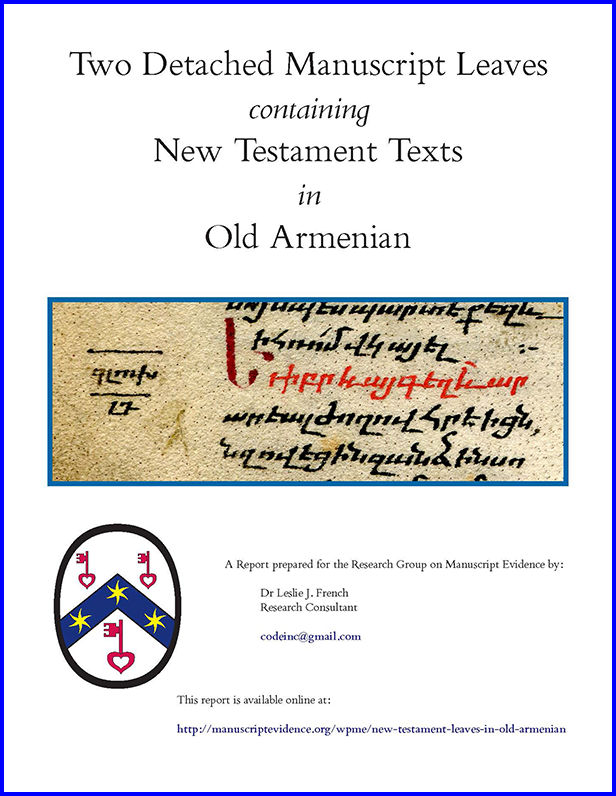
Cover for the Report on 'Two Detached Manuscript Leaves containing New Testament Texts in Old Armenian' by Leslie J. French for the Research Group on Manuscript Evidence, with a detail of Leaf I verso, column a lines 10-12, with the opening of Acts 23:12As part of the process of exhibiting images from manuscripts, documents, and other written materials — for example in our Galleries of Scripts on Parade and Texts on Parade, and in our Reports on Manuscript Studies — we offer a Report on ‘Two Detached Manuscript Leaves containing New Testament Texts in Old Armenian’ by our Associate, Leslie J. French.

Booklet ‘On Demand’

This Report is available below for download as PDF.  In the form of a booklet, it presents its materials laid out in the official font of the Research Group on Manuscript Evidence, Bembino, a multilingual digital font (which you see on this website), and in accordance with the principles of our Style Manifesto. Such an approach resembles the presentation of our Newsletter ShelfMarks in booklet form, likewise available freely for download — as are the Style Manifesto and the descriptive booklet, with specimens, for Bembino. The font itself is also FREE for download here (now in Version 1.3).

The Report examines and illustrates two detached leaves in Old Armenian which came to our attention when preparing their presentation among other specimens in various languages in our Gallery of Scripts on Parade. Then, identifying the passages of text and the elements of textual apparatus on the leaves proceeded hand in hand with an exploration of the available evidence, or records, for other parts of the same manuscript dispersed in several collections.  Designing Armenian characters, lowercase and uppercase, for Bembino (in its next version, still in progress, responding to requests) allowed for the collation of the texts in full, as an aid to decipherment for readers who may be unfamiliar with the language or the medieval script forms.  And so the booklet took shape. Read the rest of this entry →

Tags: Acts of the Apostles, Armenian Manuscripts, Bembino Digital Font, Bible Manuscripts, Bolorgir script, Edgar J. Goodspeed Manuscript Collection, Epistle to the Romans, Euthalian Apparatus, Goodspeed MS 229, Goodspeed MS 773, Harry Kurdian, Manuscript studies, Medieval Manuscript Collecting, Mekhitarian Monastery of San Lazzaro, New Testament Manuscripts, Philosophical Research Library MS Arm. 3, Wellcome Library Armenian MS 1
No Comments »

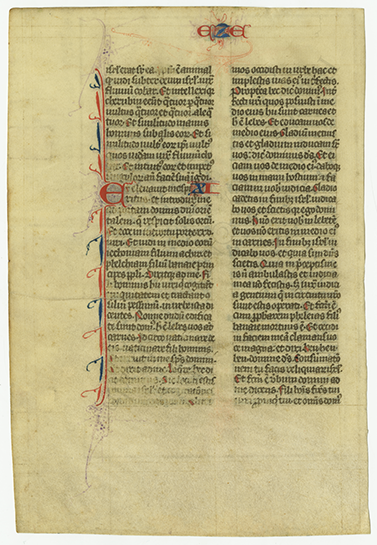
A New Leaf from ‘Otto Ege Manuscript 61’

August 10, 2015 in Manuscript Studies, Photographic Exhibition

Budny Handlist 7. Ezekiel Leaf Verso with the end of Chapter 10 and the beginning of Chapter 11. Photography by Mildred Budny

Ezekiel Leaf Verso

Part of Ezekiel from a
32-Line Latin Vulgate Pocket Bible from France

Budny Handlist 7

Single leaf from a pocket-sized Bible
Circa 186 × 126 mm <written area circa 119 × 81 mm>
Double columns of 32 lines in Gothic Bookhand, with embellishments in red, blue, and purple pigment

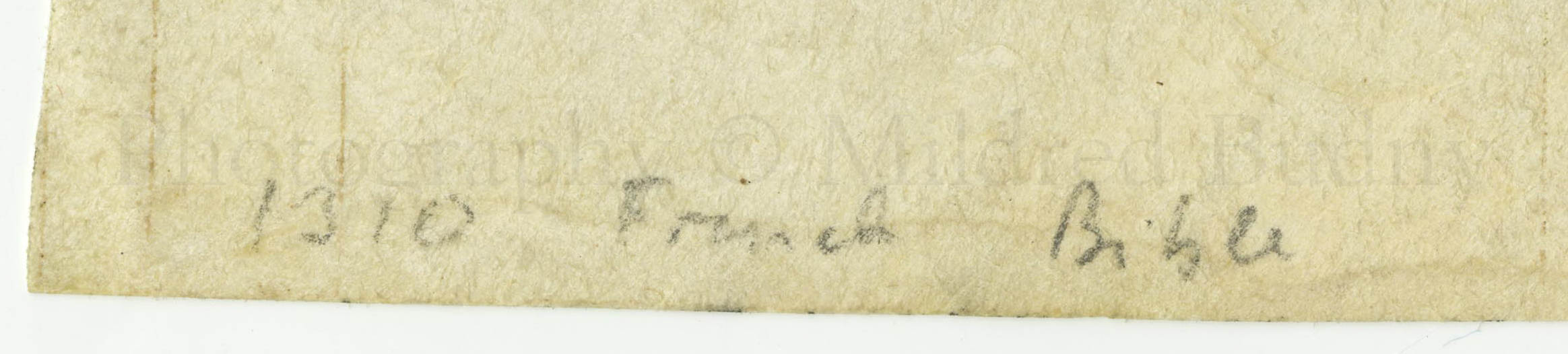
Pencil inscription ‘1310 French Bible’ at the bottom of the recto

Formerly part of Ege Manuscript 61 (Gwara, Handlist 61)

Southern France, circa 1325

Read the rest of this entry →

Tags: Dawson's Bookshop, Ege Manuscript 61, manuscript fragments, Manuscript studies, Otto Ege's Manuscripts, Otto F. Ege, Pocket Bible
No Comments »

Lost & Foundlings

June 26, 2015 in Manuscript Studies, Photographic Exhibition

The Tainted Legacy of ‘Biblioclasts’
The Case of Otto F. Ege as Collector and Despoiler

As Part II in a series on ‘Manuscript Fragments’, now part of a larger series on Manuscript Studies, Mildred Budny reflects on the predicaments and potentials of dispersed, deliberately detached randomly dispersed leaves from medieval manuscripts collected and dismembered by Otto F. Ege in the first half of the 20th century.
Part I in this series considered the ‘Foundling Hospital’ for Manuscript Fragments, as exhibited in earlier ages of manuscript despoiliation.  The issue calls for further exploration, bringing it up to date in an unhappy continuing state of dispersal.

[Part III (next) will reveal ‘A New Leaf from Ege Manuscript 41’]
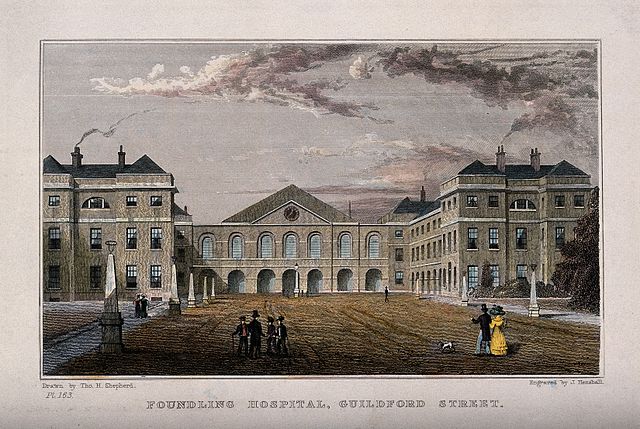
The Foundling Hospital: The main buildings seen from within the grounds. Coloured engraving by J. Henshall after T. H. Shepherd. Via http://welcomeimages.org/ under Creative Commons

The Foundling Hospital: The main buildings seen from within the grounds. Coloured engraving by J. Henshall after T. H. Shepherd. Via http://welcomeimages.org/ under Creative Commons

Outcasts Flung into a Wider World
With Uncertain Hopes for Finding Foster Homes

This series of posts continues to celebrate the legacy of the Foundling Hospital in London.  We take inspiration from its complicated legacy of a brave endeavour to provide sustenance to lost and abandoned creatures.  And so, we consider the implications for reconstitution regarding medieval manuscripts which have been dispersed and, in some ways, abandoned for future rescue, if possible.

In recent years, keeping up with developments in various areas of manuscript studies, I have paid attention to the research discoveries of various scholars, including some Associates of the Research Group on Manuscript Evidence, in their efforts to examine, collate, and reconstruct the traces of medieval and other manuscript fragments let loose onto the world by such agents as the book-destroyer Otto F. Ege (1888‒1951), teacher, lecturer, graphic artist, bookseller, and professed ‘biblioclast’ active mainly at Cleveland, Ohio.

Invaluable contributions to this painstaking research and reconstruction (for the most part virtually) of his dismembered books appear in print, exhibition, or online.  They encourage me to report my own contributions, guided by their progress.

Little did I know that paying attention to those generous postings would prove to be valuable, not only in order to learn about progress in manuscript studies as such, but also to provide breakthroughs in some of the research I was already developing.  It can help to pay attention, huh?

More ‘Foundlings’ Identified

In preparing the Handlist of medieval and early modern manuscript and early printed materials in a private assemblage, as reported earlier, I reflect upon the precarious fates of original written materials in their uncertain transmission across the ages and through the hands of different custodians or predators, by turns – not necessarily in that order.  The first post in this series described such effects in the Middle Ages, at a center prepared to despoil and dismember, by turns across the centuries, one of its most splendid and illustrated manuscripts. The central case involved the magnificent Royal Bible of Saint Augustine’s Abbey, Canterbury, with partial dispersal or dismemberment at several stages and subsequent attempts to restore the remnants in some fashion.

Perhaps it is one thing for the creator of a monument to re-create it in various ways as the changing centuries might dictate. It may be something else again for others who take the materials into their own hands to decide how to dispose of them, with the operative word being ‘dispose’.

And so, now I turn to the methods of some 20th-century plunderers and distributors of medieval manuscript fragments. Within the Handlist, a few items are identifiable (after the fact) as leaves which passed through the hands of Otto Ege in the fuller form of their former manuscripts.

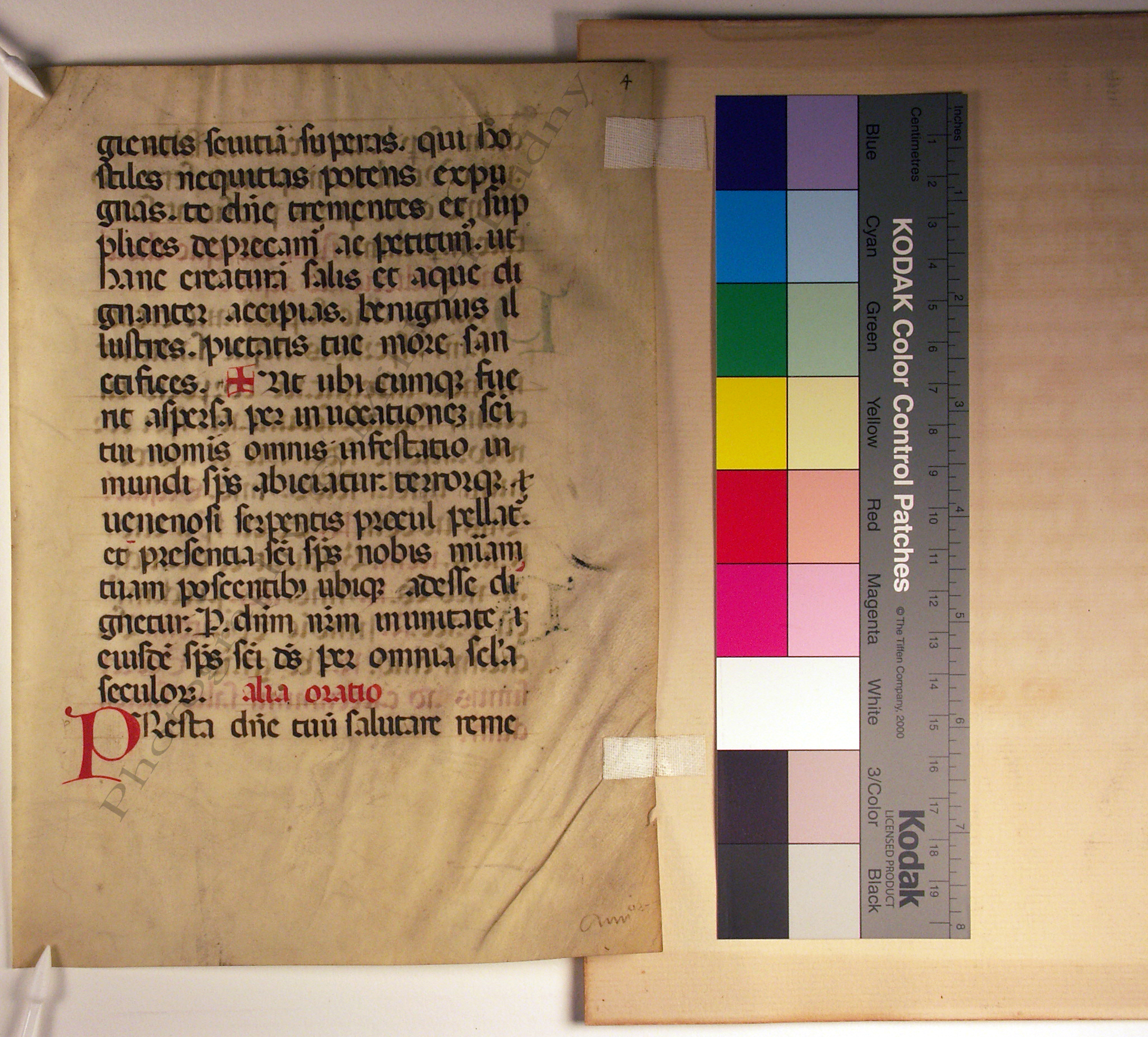
For example, one leaf, which carries the Arabic numeral 4 in black ink on its original recto, was contained within a glass-fronted frame when I first saw it, nearly a decade ago, as part of the initial stage of photographic work on the assemblage (in its state at the time). For conservation, I removed the frame and then photographed the leaf, recto and verso, while still attached to its existing cardboard mat. In consultation with the owner of the leaf, we decided to remove the mat and conserve the leaf separately. Those practices for the Assemblage as a whole, in stages, will be reported elsewhere. Meanwhile, I can show a first photograph (under flourescent lights) of the leaf lifted at an angle from its ‘original’ mat.

Because of my training, and awareness of the importance of respecting the evidence of manuscripts (and other materials), even if, at first sight, the value of specific clues might not be recognized, I have taken care to try to keep them in mind, while my experience might widen into areas which they require for decipherment.

I didn’t know it at the time, but the style of matting itself turns out to be a potentially diagnostic feature in the quest for identifying the fragment, its context, and its provenance. Call it a forensic clue in this complex detective work. Another post will focus upon this leaf, but, for now, we focus upon the clues in question.
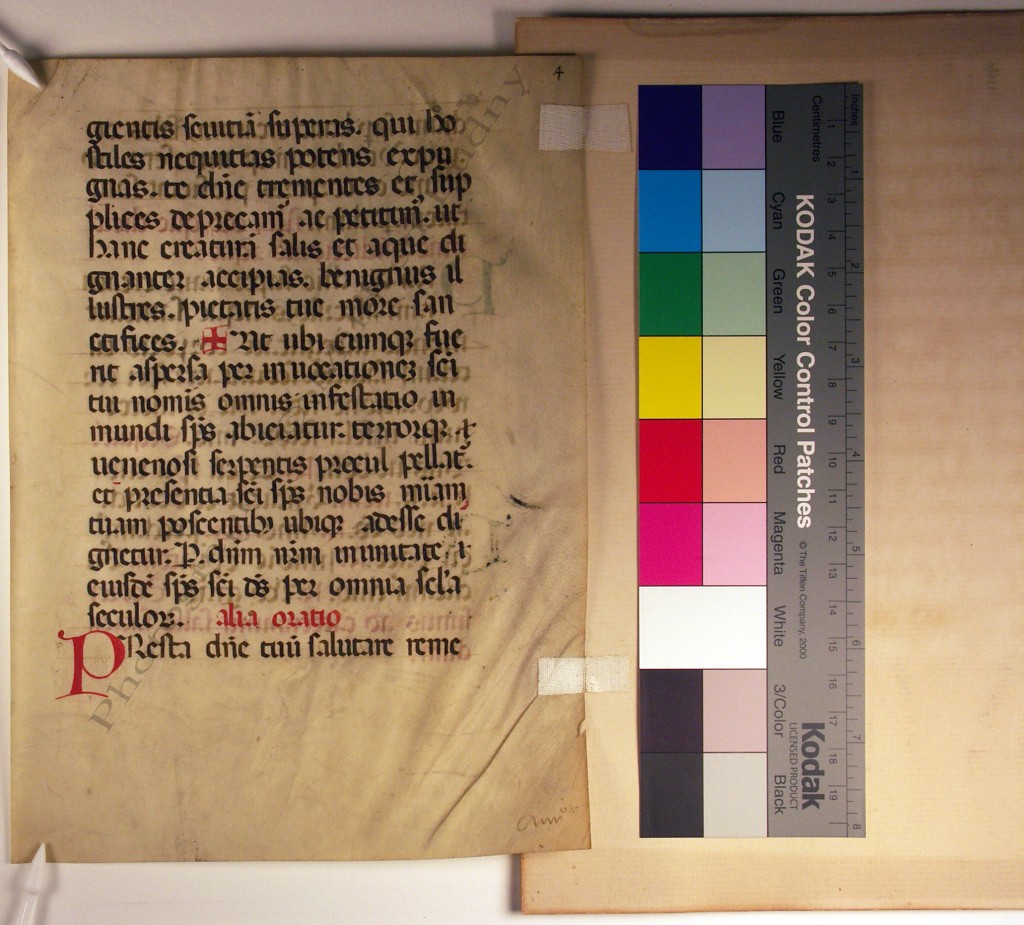
Folio 4r still attached to the mat. Photography © Mildred Budny

A detached folio 4r still attached to a cardboard mat with Ege-style tapes asymmetrically aligned (Budny Handlist 9)

Bits & Pieces, Reassembled

The cumulative contributions are worth celebrating, as we collectively move forward with their clues and directions.  Some examples of these contributions (mostly freely available) set the scene, with observations, discoveries, illustrations, references, and suggestions for further discoveries:

Barbara A. Shailor (our Associate)

“Otto Ege: His Manuscript Fragment Collection and the Opportunities Presented by Electronic Technology”

Lisa Fagin Davis (our Associate and former Trustee):

“In Otto Ege’s Footsteps”
“Otto Ege, St. Margaret, and Digital Fragmentology”
“Manuscript Road Trip to Virginia”
“Reconstructing the Beauvais Missal”

Peter Kidd:

“A Newly Discovered Leaf”
“Ege’s 12th-Century Italian Lectionary”
“Ege Leaves at Glencairn Museum” (with specimens of the handwriting of Otto Ege and of his wife Louise)

Scott Gwara (our Associate):

Otto Ege’s Manuscripts: A Study of Ege’s Manuscript Collections, Portfolios, and Retail Trade (a book for sale),
with a survey of the evidence for the acquisition and dispersal of his manuscripts,
including a “Handlist of Manuscripts and Fragments Collected or Sold by Otto F. Ege” (Appendix X).

An important part of these processes of investigation and discovery is the ability to examine the originals, whether in person or by proxy, through images reproduced in print or otherwise. Digital facsimiles of all or parts of their Ege materials are available online for some collections, as here:

The Ege Manuscript Leaf Portfolios in several collections, gathered virtually by the Denison University Library
Fifty Original Leaves . . . From the Otto F. Ege Collection at Case Western Reserve University
Otto Ege Collection in the Public Library of Cinncinati and Hamilton County
Fifty Original Leaves From Medieval Manuscripts (Otto F. Ege Collection) at the University of Minnesota
50 Medieval Manuscript Leaves at the University of Sasketchewan
Pages from the Past: Ege at the University of South Carolina
Massey College Medieval Manus . . . at the University of Toronto.

Examining and comparing these specimens, together with the scattered evidence for the distribution and identification of the sundered portions of the original manuscripts, which apparently survived more-or-less intact into the 20th century before their ‘repurposing’, may help to recognize more of their separated parts. Such is the case here.

Way to Go

More discoveries await recognition, as the news spreads about research and discoveries relating to the dispersed manuscripts and the processes of acquisition, dismemberment, and piecemeal distribution. While deploring the vandalism of monuments of the past, we admire the dedicated efforts to assemble the virtual ‘reconstitution’ of their fragments. At least it is something.

That it is less than perfect, and less than it could have been, is not the responsibility principally of the despoilers who dismembered the materials and failed to record the crucial contextual information as they let the fragments loose onto the world. Orphans by intent. Foundlings by goodwill, dedication, and good fortune. Sometimes, it seems, we find them without notice. Sometimes, it may be, they call out to us.

Lost & Foundlings
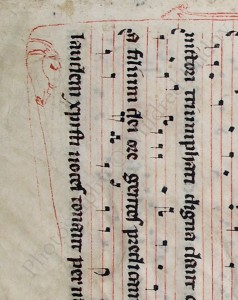
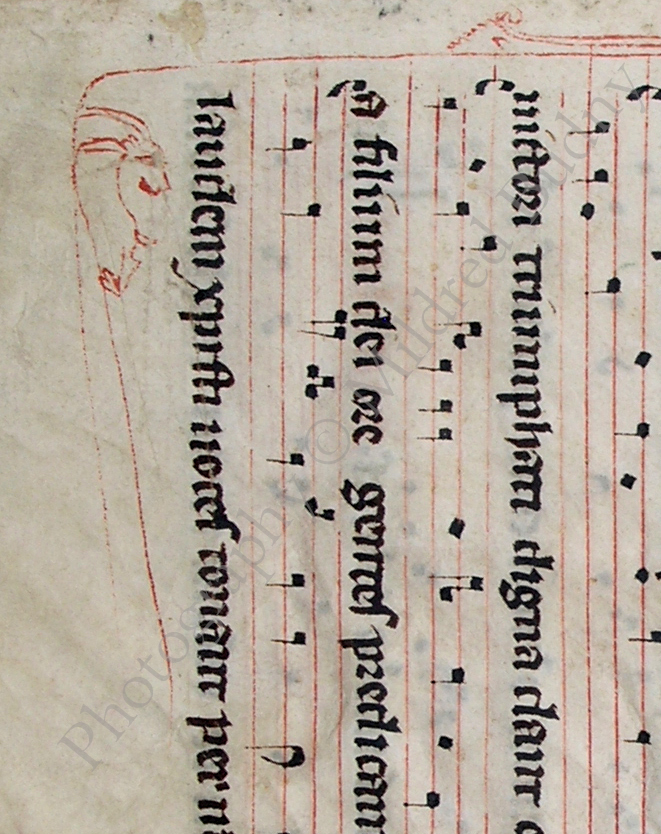
Penwork extending from a decorated initial extends below the final line of text and ends in a horned animal head which looks into its direction. Photography © Mildred Budny

A whimsical creature at the bottom of the page faces the music. Budny Handlist 4

And so, now, as I round out the preparations of illustrated reports on the private ‘Assemblage’ of medieval manuscript fragments and documents, now with a Handlist assigning numbers to the items, the rapidly advancing research on Otto Ege’s manuscripts and fragments by scholars, librarians, catalogers, and book-sellers can enable the further recognition of other stray fragments which came from (or through) his holdings, set loose into the world with little information to record their origins, state their contexts, or signal the survival of any other siblings from the same original volume. Such recognition often comes only in pieces, that is, as we individually or collectively might find the relevant expertise and discover some firmer information about the original whole that may reside in one or another of its other surviving or recorded parts, with a colophon naming the maker.

In some cases, the identification of a stray leaf as having formerly belonged to a known Ege Manuscript might be secured by the continuity of textual sequences between it and another in that book (as listed occasionally here), by offsets of pigment from the formerly adjacent page onto it, or similar clues. In contrast, in some cases, while the processes of research and recovery continue to advance, such specific establishing indicators might not survive, or come yet to light, so that the identification might have to remain tentative, perhaps at least for the time being, or as having belonged to a volume in the same style, by the same hand(s), from the same center at about the same period of production, or the like.

It’s a shame that we have to restore some sense of continuity and context to these ‘waifs’ so laboriously and sometimes haphazardly, at best.

Otto Ege cut into pieces many medieval and early modern manuscripts of various types, dates, and places of origin, for assembly as individual leaves into various unique sets, as with the series of portfolios entitled Fifty Original Leaves from Medieval Manuscripts. Mounted on individual mats, given identifying labels, and numbered in sequence, the selected leaves were placed into boxes and distributed mostly by sale to museums, institutions, and private book-collectors. Only a generic descriptive label, printed on a slip, accompanied each of these individual representatives of a former unique whole. Other leaves from the same manuscripts – the rejected ‘random or rogue’ leaves as described by Lisa Fagin Davis and by Barbara Shailor – were circulated in various ways through gift or sale. Some of those leaves, if they are ‘lucky’, carry brief inscriptions written by Ege or his helper(s) in the lower margins of their rectos. Over time, the ownership and locations of some sets, parts of sets, and individual leaves have changed. The current locations of some of this Portfolio of Fifty and other Portfolios (focusing upon other themes) assembled by Ege are known; some of them have lost some of their individual components. It remains a tedious task for scholars to attempt to pick up the pieces, even if only virtually.

It is an asset that some collections offer digitized views of their representatives of these fragments. The form or appearance of such representatives can vary greatly. Those variations, some cumbersome, merit another reflection or review. Now let’s look briefly at what the individual ‘Orphans’, ‘Waifs’, and Strays’ might bring with them when they come into our view. I think of them as Foundlings, left upon our doorsteps. Here is why.

Babies & Bathwater

Approaches to abandoning babies — human babies, snatched from their birth-mothers and birth-families — can vary enormously, (un-)naturally. Across the centuries, such approaches might range from inexorably casting the new-born, naked, into the mouth of the lair of wolves, at one extreme, to placing them, lovingly, wistfully, at the other extreme, at the entrance of the forum, church, or sanctuary, say at dawn at the beginning of the day’s commerce and traffic, and setting them on to their new, uncertain, course, with a basket or cradle, a tender supply of clothing, a blanket, jewelry of some kind, a toy perhaps, maybe a bit of food, to hope to smooth the safe passage of the living being into the hands and care of strangers, who might be prepared to offer them foster homes or even adoption.

Clues or Clueless

Babies are different, true, from manuscript fragments, but the point is clear. What traces do their occasional owners, masters, agents, or purveyors choose to hand on, or hand over, to the adoptive homes or ‘adoptive agencies’ so as, perchance, to allow for some awareness of the parentage, ‘birth certificates’, genetic tendencies, family contexts, and other relevant information about their origins and upbringing?

In a nutshell: Not Much, in many cases. Ah well, sometimes the results may be due to negligence, indifference, or haste, but in some cases the effects as well as the methods appear to resemble the actions of ‘criminals’ who have the sense to destroy as much evidence as possible, take the money, and run. At ‘best’, the conveyers of altered, fragmented manuscript materials might be little aware of how much forensic evidence can reside in the substances, surfaces, and accretions of those materials.

Forensics in Manuscript Studies
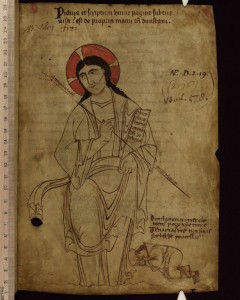
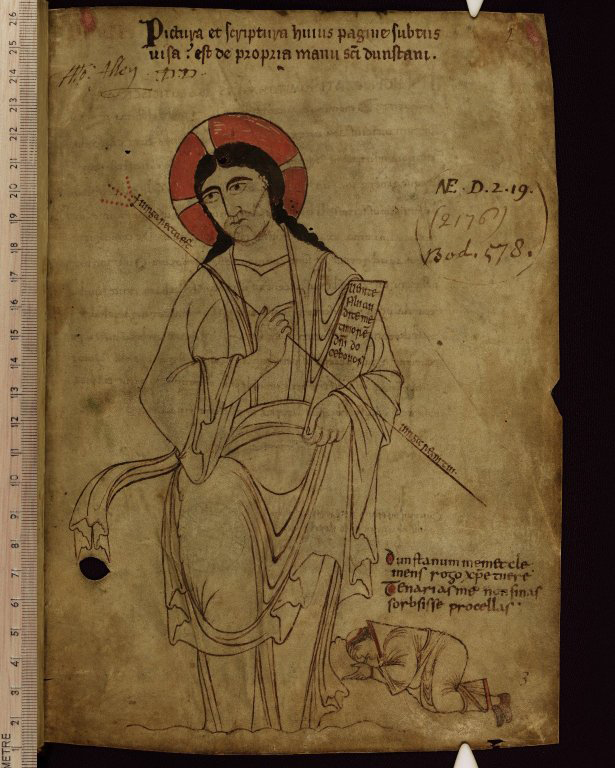
Frontispiece image, with the prostrate figure of Saint Dunstan beside Christ, in Saint Dunstan's Classbook, MS. Auct. F. 4. 32, folio 1r, tenth century. Photo: © Bodleian Library, University of Oxford (2015)

Saint Dunstan’s Classbook, MS. Auct. F. 4. 32, folio 1r, tenth century. Photo: © Bodleian Library, University of Oxford (2015).

Permitting those seemingly insignificant traces of many kinds to remain in place (provided, for example, they do not actively harm the artefacts) may allow them to be observed, recognized, and deciphered by appropriate expertise.

An example of such discoveries applied to a renowned early medieval manuscript, or rather composite manuscript (assembling into one volume several different portions containing different texts, languages, dates, places of origin, annotations, scribbles, and other alterations), can be observed for the so-called ‘Classbook’ of Saint Dunstan and its ‘signed’ frontispiece image.  For centuries that image has been believed — wrongly, it turns out, through forensic examination – to be the saint’s self-portrait.  Yet it does have his own ‘autograph’ in the form of a prayer in his own hand and in his own name, added to the drawing of a monk before Christ made by a different scribal artist.  Appropriation may be a sincere form of flattery, but it does not necessarily constitute (when detected) the authentication of the appropriator as the creator of the artwork in full.

‘ID Bracelets’ and ‘Identity Marks’

In the absence of explicit testimony, both within or upon the fragment itself, it can be appropriate or expedient to turn to forensic and other forms of evidence, implicit or indirect. Such testimony, when properly recognized, can work wonders.

The ‘Seller’s Tell’

The ‘Identity Marks’ or tags made by many sellers of manuscript fragments may take distinctive, recognizable forms. The styles and methods may be telling. The statements may serve as concise cues identifying the item in some way, say with a verbal description or an inventory number. Some may function as cryptic notation, perhaps including codes denoting the expected price or price-range in a manner obvious to the seller but not the buyer. When entered in pencil discreetly at the bottom of a page, the tag might seem unobtrusive, possibly erasable without much trace, and readily ignored — especially when covered by the overlap of a mounting frame.

Exhibit A

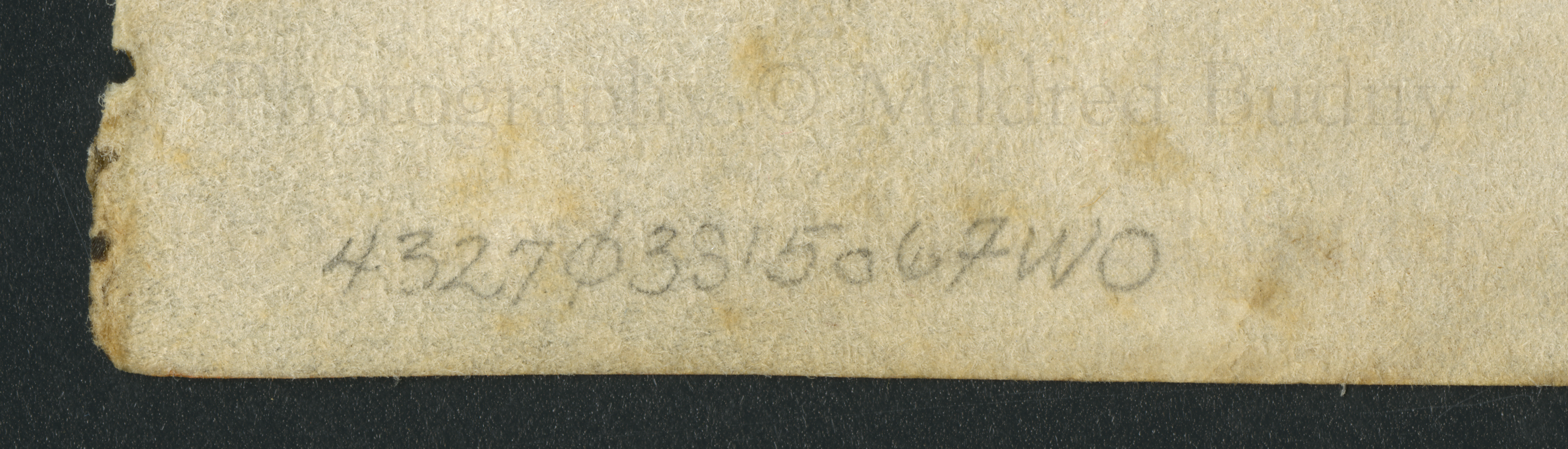
A cryptic form of seller’s mark appears in the cryptic string of numbers and letters on the recto of the leaf with the Gregory Mass, purchased by its present owner from a major international bookseller in the 1990s.
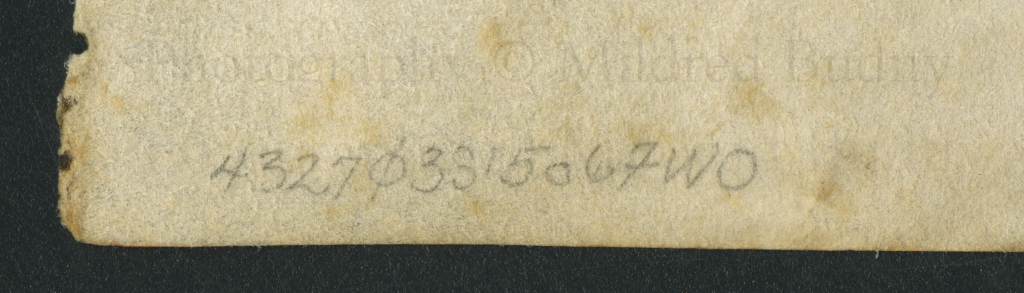
Seller's Mark in Code. Budny Handlist 13. Photography © Mildred Budny

Seller’s Mark in Code (Budny Handlist 13)

Exhibit B

A different form of Seller’s Mark characterizes the approach to marking many of the ‘Rogue’ leaves dispersed from Otto Ege’s collection. Not all such leaves carry this form (which has some variations). But where they do, they may give significant, if compacted, information besides the price.

A simple form, reduced to the presumed date and genre of book, labels a pocket-sized leaf with text from the Book of Exekiel as ‘1310 French Bible’, tout court. By itself, the inscription might hold little promise, but a detailed comparison indicates the identity of the hand and the conditions of the ‘Tagging’.
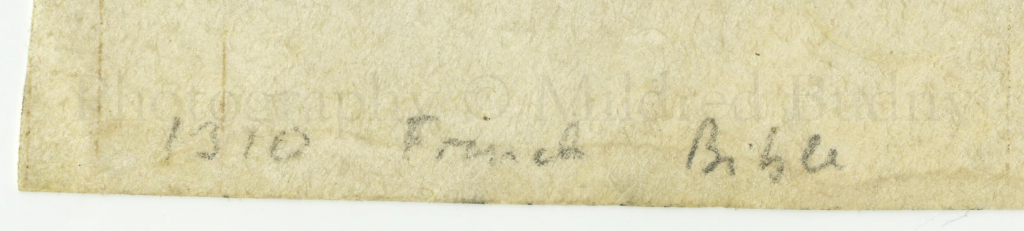
Ezekiel recto with pencil inscription. Photography © Mildred Budny

Pencil inscription (Budny Handlist 7)

The discovery of the connection of this fragment to Otto Ege’s collection and its former manuscript had to await the recent research on the ensemble of manuscript materials as a whole. It is both fortuitous and beneficial that my ongoing research on the ensemble and its components coincided with the plenitude of reports of rapidly advancing discoveries about many of Ege’s dispersed fragments, their current locations, their marks of Ege’s handling, and their interrelations.

Various of the reports listed above identify and illustrate these marks, including specimens of Ege’s handwriting, the characteristics of his his mats for many of the leaves both within and beyond his Portfolios, and his form and uneven style of mounting tapes for the leaves and their mats. More about those mounting tapes in a moment, but first, a closer look at another pencil inscription which clinches the deal.

Exhibit C

One leaf which, according to his recollection, the present owner purchased at the shop of the Cleveland Museum of Art in or about 1953, carries on its recto the price of ‘$2.—’ and, spaced at an interval to the right, the brief description of the item as ‘French Bible 1300 – List of Hebrew names’. The owner purchased the leaf on its own, unmounted, and without any further description. A future post will tell more about this leaf and its former manuscript, a massive Bible now dispersed in many directions and collections, with confusingly inconsistent seller’s and cataloguers’ descriptions.

Pencil Inscription at the lower front of a manuscript leaf. Photography © Mildred Budny

‘List of Hebrew Names’ in a ‘French Bible’ of ‘1300’, price ‘$2’, purchased circa 1953 at the Cleveland Museum of Art shop (Budny Handlist 8)

Exhibit D

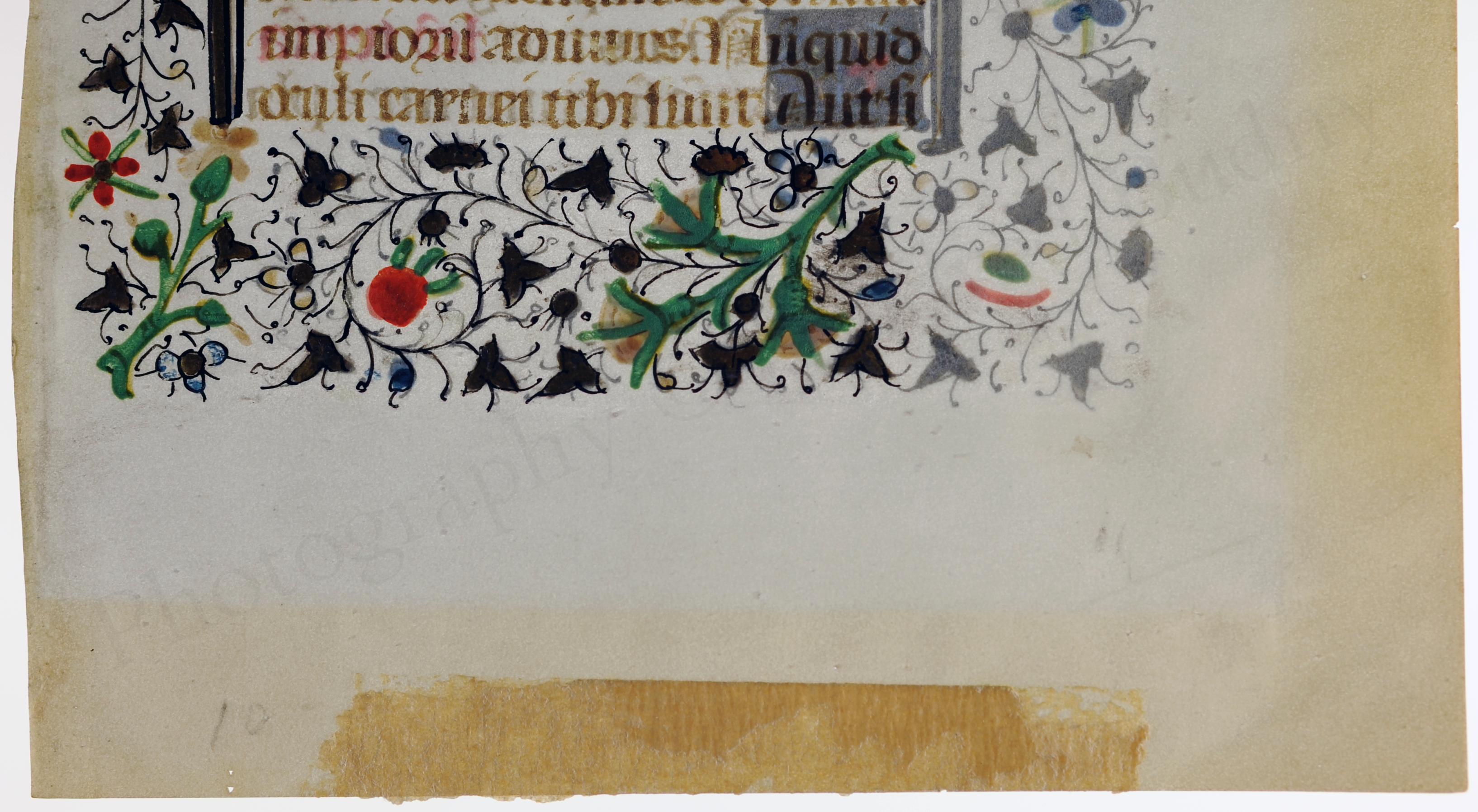
A leaf now identifiable on other grounds as an Ege ‘Rogue’ Leaf appears to have a pencil inscription characteristic for the varied genre, starting with a price of ’10 –’ (presumably in dollars), followed perhaps by some more information entered at the same time, by the same hand, and in the same medium. However, the subsequently applied masking tape, with unevenly torn edges, which served to adhere the leaf to a mat by 1959 when the leaf was given to its present owner (and which has recently been removed in conservation) also mostly masks (presumably) the rest of an inscription. When the leaf was conserved recently, it was decided to allow the masking tape to remain, as a record of the history of the leaf. And so the rest of the inscription (if any) could remain for future revelations.
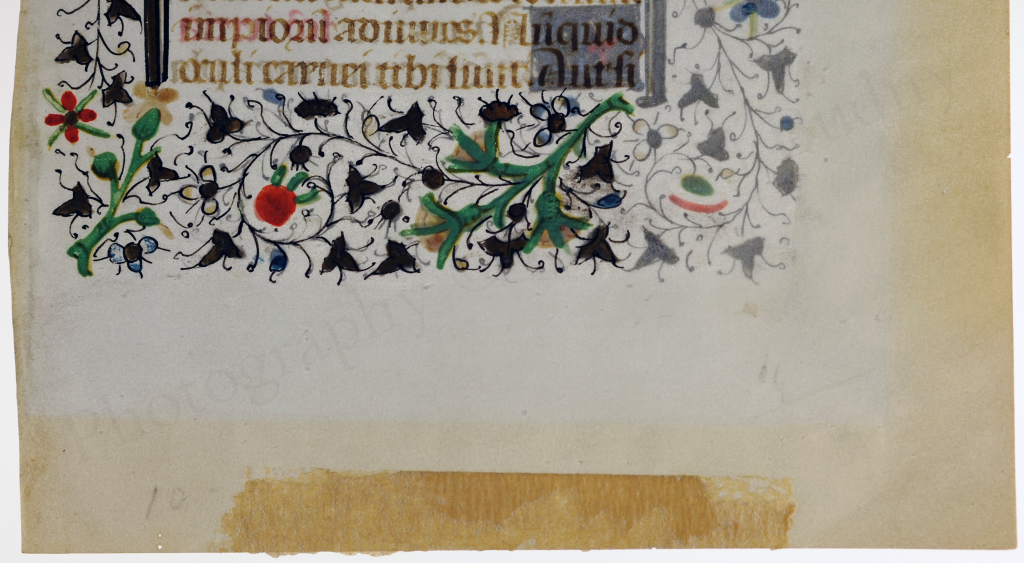
The pencil inscription at the bottom of a manuscript fragment names the price ($10) but the rest is veiled by a masking tape mount from a former frame. Photography © Mildred Budny

Pencil Inscription Partly Veiled (Budny Handlist 12)

‘Baby Blankets’, ‘Swaddling Clothes’ & ‘Cradles’
Mats & Mounting Tapes

Some telling, or ‘diagnostic’, features might seem insignificant at first glance, but they could provide evidence of the hand at work. Where other clues have been removed, such traces may be essential and solitary in their attestations as witnesses. And so they might have to testify (see above) as Tips of Icebergs. Let us consider the often dismal evidence of mounting tapes, that is, the adhesive tapes found on manuscript fragments — which, in some cases, they not only accompany, but also enslave.

At most glances, such tapes might easily be ignored. Who cares? Well, some of us do, although not everyone has to. It’s enough to recognize that someone might find them worth examining. To forensic examination, their features can sometimes reveal significant testimony.

Exhibit E

A simple example can set the scene. Non-archival masking tape is sometimes readily employed in framing materials, presumably for its convenience, ignorance about its interactive characteristics, and awareness that its presence will be hidden under the mat or the edges of the frame. In recent conservation, the removal of the frame, glass, and mat from a detached leaf of an 11th-century Giant Latin Bible purchased in 1951 in Florence, Italy, and subsequently framed in the United States has revealed some strips of tape, with unevenly torn edges.

Masking Tape added after 1951 to the reframed fragments of a single large-format 11th-century leaf. Budny Handlist 1.

Masking Tape added after 1951 to the reframed fragments of a single large-format 11th-century leaf (Budny Handlist 1)

Exhibit F

Now we turn to examples of Ege’s mounting tapes within the Handlist. The pair of unevenly cut and unevenly placed mounting strips of gauze tape glued along one long side of ‘Folio 4’ of Handlist Number 9 (shown above still attached to its former mat) is representative of his style of application, given the cases already attested.

On various grounds, even apart from the tapes, this leaf can be identified as one of Ege’s ‘reject’ leaves from a manuscript deployed among the Fifty Original Leaves. Known Ege examples are illustrated, for example, here and here.

A detached Folio, which carries the Arabic number ‘4’ in black ink at the top of its recto (inscribed on the leaf while it still stood in place in its former manuscript), retains its asymmetrically placed whitish gauze mounting tapes attached to the outer edge. The non-archival cardboard mount for this leaf, to which the tape strips formerly adhered in the form of hinges, has been detached during recent conservation, and is kept separately. On the mat, the leaf was mounted with its original recto turned to the verso.

The type of tape and its style of placement corresponds with known Ege methods. A ‘stroll’ or ‘scroll’ through the digital facsimiles of mounted Ege materials (as in the Massey College Medieval Manus . . . series) reveals many cases of such mounting tapes, not infrequently positioned asymmetrically. Same as here:

Pieces of gauze mounting tips in a pair along the long edge of a detached manuscript leaf, with Photography © by Mildred Budny

The outer edge of a detached Folio ‘4’ recto and its 20th-century ‘Ege’ mounting tapes (Budny Handlist 9)

Exhibit G

In another case, such mounting tapes were removed some time ago by some agent or other, without record. Similar traces appear, for example, here.
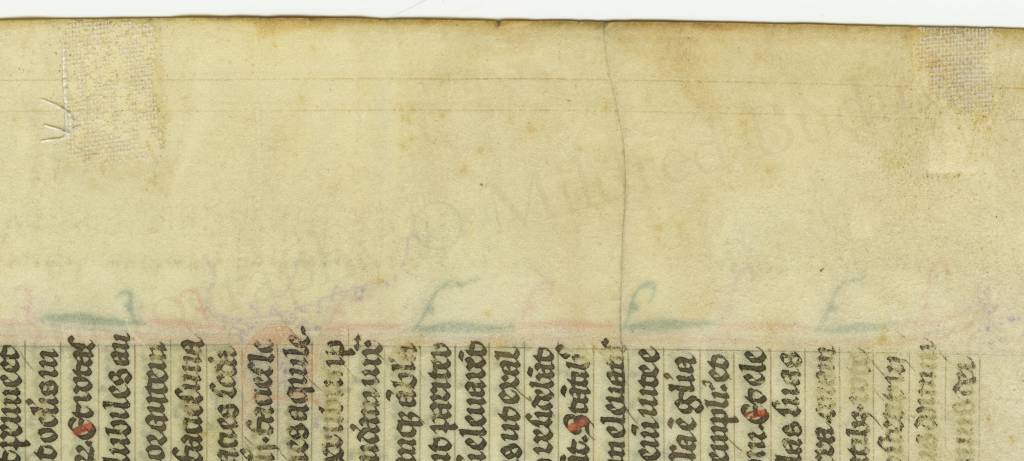
Ezekiel recto White cropped to tape traces rotated with branding at 5 percent

Remnants of a pair of gauze mounting tapes (Budny Handlist 7)


Fortunately, it turns out, the gummy substance resisted the removal of all trace of the tapes, whose material, form, and alignment are familiar to observers of Ege’s methods of mounting the detached leaves, whether for his Portfolios or other forms of dispersal.

Even so, many of his dispersed leaves ‘rejected’ for inclusion in the Portfolios have wandered without the addition of mats. In their cases, the brief (or briefest) pencil inscriptions might have to serve alone as a clue to his intervention in the history of the artefact. In other cases, Ege’s dispersed leaves might have to roam without any of his recognizable marks, until, say, the identification of the text, the scribe, the workshop, or some other means of connection with the original manuscript might be accomplished. Meanwhile, every step forward, by whatever clues, may count as progress.

Next we report the discoveries for another detached ‘Ege Manuscript Leaf’, which has wandered on its own, without label, identifying inscription, or other explicit mark of Ege’s ownership. For such a case, other detective methods also are required.

A Virtual ‘Orphanage’

How the different ‘Foundlings’ among manuscript fragments might sometime find a proper, albeit virtual, home so as to acknowledge, to record, and to welcome their familial connections in former whole manuscripts as a form of ‘genealogical recovery’ remains to be determined in the concerted quest in various centers to establish and to foster such projects. While they find their fuller footing, with larger institutional supports, we will turn to the next report on our findings.

Next stop: ‘A New Leaf from Ege Manuscript 41’, from a different collection.

We welcome your comments, questions, and feedback. Please leave a comment or Contact Us.

*****



Tags: Budny Handlist, Foundling Hospital, Manuscript studies, Medieval Manuscript Collecting, Medieval Manuscript Fragments, Otto Ege's Manuscripts
No Comments »

2015 Reception

May 30, 2015 in Events, ICMS, International Congress on Medieval Studies, Kalamazoo, Reception

Co-Sponsored Reception
at the 50th International Congress on Medieval Studies

[Published on 11 November 2015]

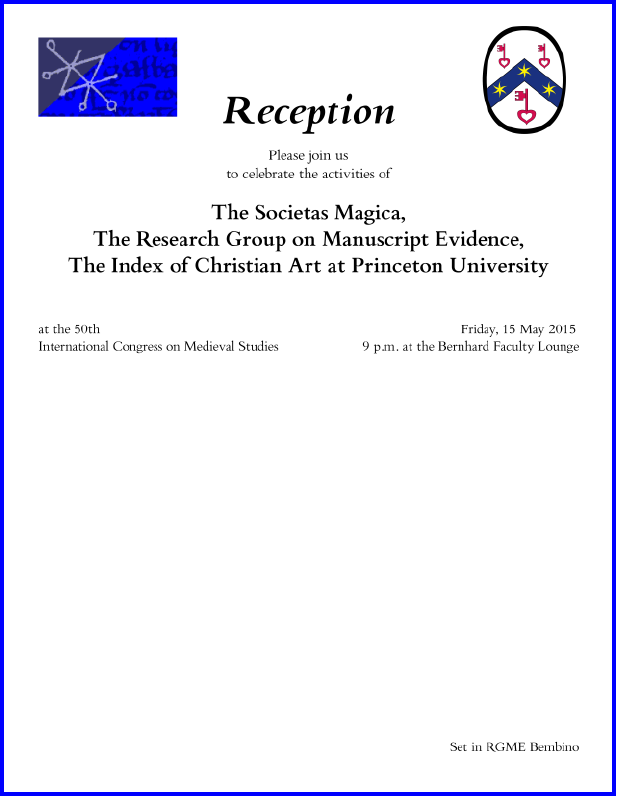
Invitation for Reception at the 2015 International Congress on Medieval Studies co-sponsored by the Societas Magica, the Research Group on Manuscript Evidence, and the Index of Christian Art at Princeton UniversityAt the 2015 Congress, we continued the tradition of co-sponsoring a Reception.  The tradition began with the 2014 Anniversary Reception, co-sponsored at the 49th International Congress on Medieval Studies by the Societas Magica and the Research Group on Manuscript Evidence, to celebrate the anniversaries of both organizations.

And so, we held another Reception at the 2015 Congress, this time co-sponsored by

  • the Societas Magica
  • the Research Group on Manuscript Evidence, and
  • the Index of Christian Art at Princeton University.

The Reception Invitation (shown here) is laid out in the RGME copyright font Bembino, with donated design layout according with our style principles, as expressed in our Style Manifesto (now available in an illustrated version, updated for the Congress). This multilingual digital font is available for download, for FREE: Bembino.

Read the rest of this entry →

Tags: Index of Christian Art at Princeton University, Manuscript studies, Societas Magica
No Comments »

2014 Colloquium on “When the Dust Has Settled” Accomplished

November 17, 2014 in Abstracts of Conference Papers, Anniversary, Bembino, Book & Exhibition Reviews, Conference, Events, Exhibition

We report successful completion of the Colloquium on Friday, 14 November 2014 at Princeton University.

[This post updates both the Announcement for this event (published as Colloquium Announced), and its Colloquium Program.]

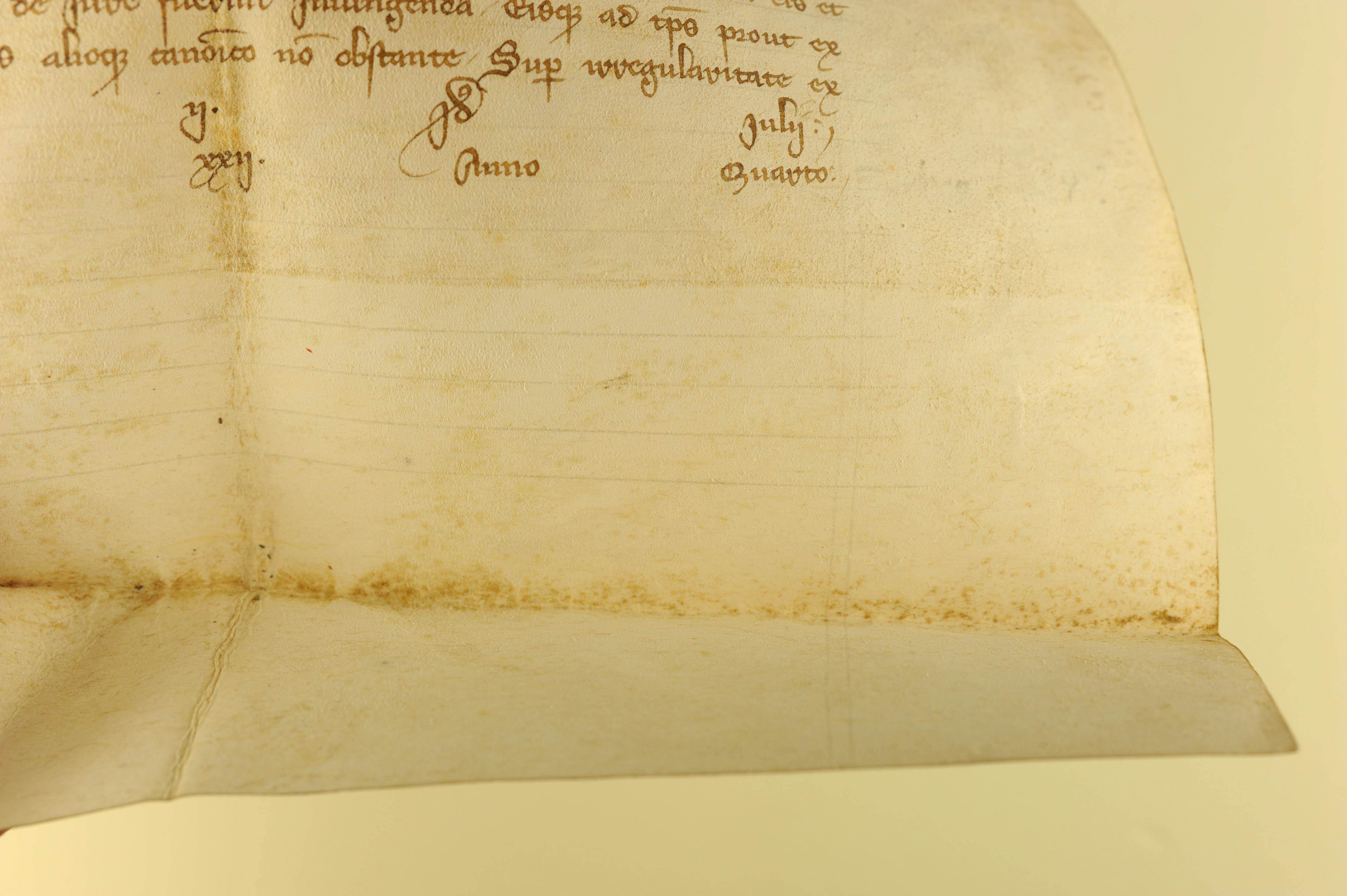
Document of Berengarius, detail, unfolded, with concluding date and gathered dust in the fold. Photography © Mildred Budny

“A Settling of Dust”

When the Dust Has Settled

(or, When Good Scholars Go Back . . . )

A Colloquium
co-sponsored by the Research Group on Manuscript Evidence
and the Index of Christian Art at Princeton University

Sponsors

Department of Art and Archaeology, Princeton University
John H. Rassweiler
Celia Chazelle

The Aim
“Settled Dust Could Give Clarity of Vision”

What happens when a dedicated specialist returns to a subject of long-term interest after other tasks — other projects, jobs, administrative tasks, life in general — have cleared away? While the world, methods, tools, and aims of research (let alone publication) have changed dramatically, sometimes beyond recognition, a return to the chosen subject might also draw upon experience and reflection gained through the passage of time, an accumulation of experiences, and extended “immersion” both in the subject matter and its wider contexts. Thus, although daunting, the return need not involve a start completely from square one or ground zero.

When the dust has settled, and, it may be, the air has cleared, a return might allow for renewal, which could build upon an available, partly remembered, foundation for direction and refinement in this light. Our colloquium offers informal reflections, questions, and discussions about the challenges and potential of returning now to a variety of subjects, in the arts and letters, from Antiquity to Modernity.

Read the rest of this entry →

Tags: Anglo-Saxon Manuscripts, Apocalypse manuscripts, Architectural Sculpture, Charles Rufus Morey, Deir Sim'an, Department of Art and Archaeology, Early Christian Sculpture, Flemish Psalter Illustration, Günther Haseloff, Illustrated Old English Hexateuch, Index of Christian Art, Interlace Ornament, Manuscript Illumination, Manuscript studies, Psalter Illustration, Qal'at Sim'an, Royal Bible of St. Augustine's Abbey Canterbury
No Comments »

The Bouquet List: A Gathering of Books

October 31, 2014 in Book & Exhibition Reviews, Index of Christian Art, Manuscript Studies, reviews


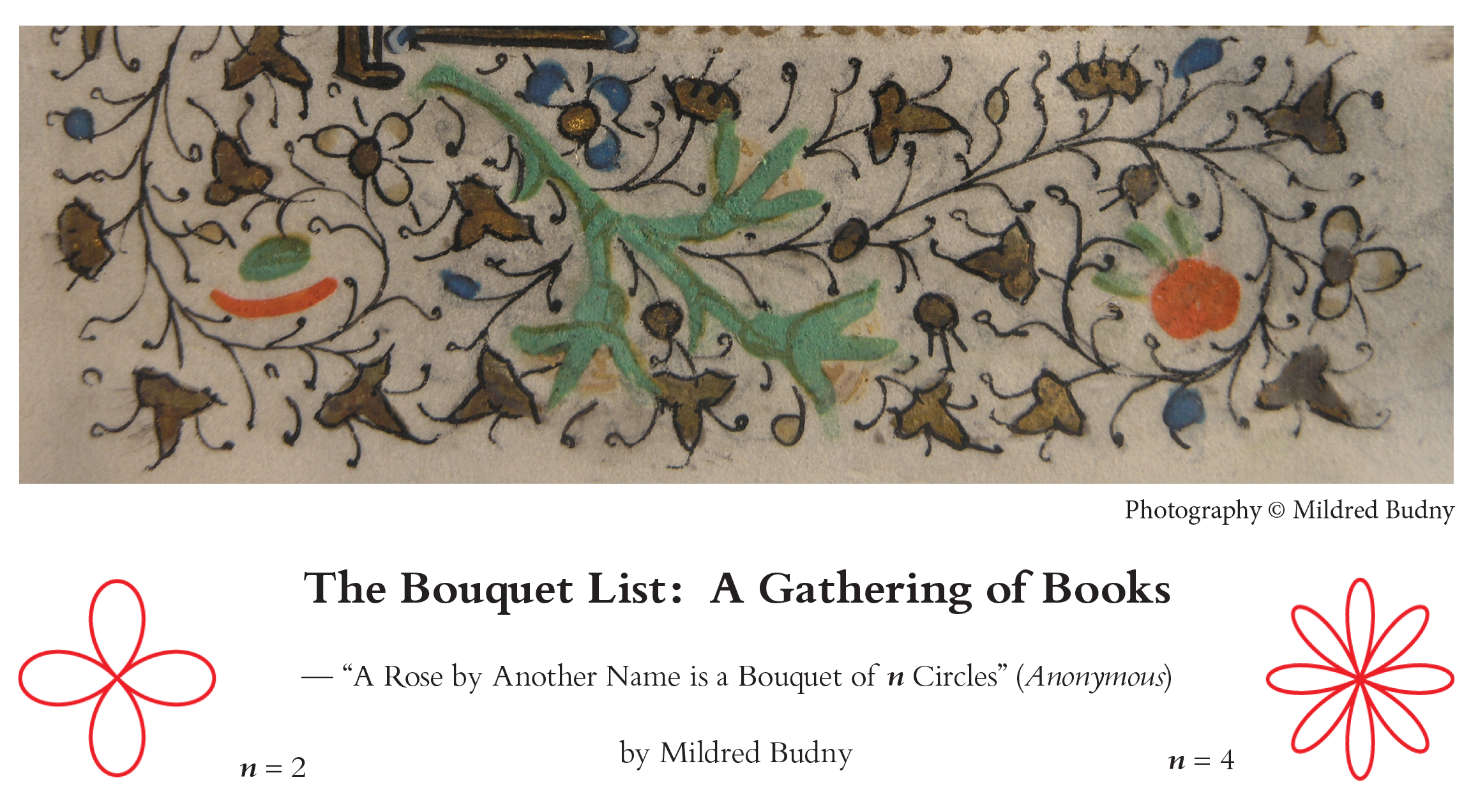
"The Bouquet List: A Gathering of Books", a review by Mildred Budny with motto: "A Rose by Another Name is a Bouquet of n Circles" (Anonymous)

The first in a series of reviews by Mildred Budny

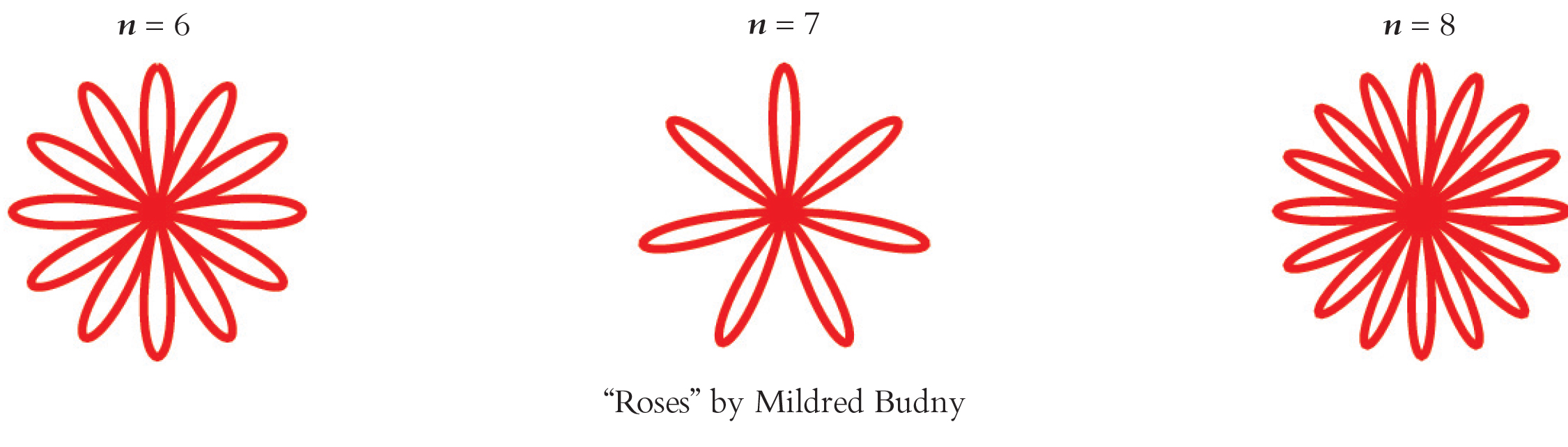
This review celebrates research by and partly by Trustees and Associates of the Research Group on Manuscript Evidence (RGME) by showcasing some recent publications in print and online.  The title alludes to the widespread medieval genre of florilegia (“gatherings of flowers”), which collect selected extracts of texts from a larger body or bodies of work. Such compilations, also called “Commonplace Books” or “Miscellanies” — whether deliberate, haphazard, or serendipitous in their assembly — have figured in various RGME workshops and publications, and continue to offer challenges for examination.  The title also takes inspiration from the term bouquet in mathematics, wherein, according to some definitions, a “rose”, also known as a “bouquet of n circles”, yields a “topological space” by “gluing” together a collection of circles (which might take various shapes such as loops) along a single point (Bouquet of circles).  The mathematical term ‘Rose’ is defined at Wolfram MathWorld. Figural examples appear here:  Bouquet of n circles via Tikz.

roses croppedThe group of flowering works selected here represent a sampling of our collective and individual interests, which converge and overlap to various extents.

First I salute the most recent publications in the long series issuing from conferences held by the Index of Christian Art at Princeton University.  This University, through its Departments and Programs, including the Department of Art and Archaeology, the Index, and the Program in Medieval Studies, has been the most frequent host and co-sponsor for symposia of the RGME since our arrival in Princeton in 1994.  The publications are edited by our Honorary Trustee Colum Hourihane, with contributions by some of our Trustees, Officers, and Associates.  They are:

  • Patronage:  Power & Agency in Medieval Art (Princeton, 2013, ISBN 978-0-9837537-4-2), issuing from the 2012 conference celebrating the 95th anniversary of the foundation of the Index, and
  • Index of Christian Art Online Publications (generously available without subscription), starting with the first two, which record the annual conference proceedings devoted to The Digital World of Art History
    [originally [I] (July 12th, 2012), now here] (July 12th, 2012) and
    [originally II: Theory and Practice, now here] (June 26th, 2013).

The fourteen papers in the Patronage volume consider diverse materials, regions, dynamics of creation/commission, patterns of patronage, and issues of interpretation.  Cases poised upon textual evidence — occurring in manuscript, documentary, and monumental forms — are plentiful.  They include Elizabeth Carson Pastan’s nuanced assessment of “The Bayeux Embroidery [not a Tapestry!] & Its Interpretative History” particularly within the sphere of its original creators and audience; Nigel Morgan’s reading of “Patrons & Their Scrolls in Fifteenth-Century English Art” through text- or speech-scrolls in manuscripts, stained glass windows, and monumental brasses; Lucy Freeman Sandler’s sensitive assessment of “The Bohun Women & Manuscript Patronage in Fourteenth-Century England”, as revealed through the stages of “commissioning, conceiving, executing, receiving, and bequeathing”, and our Trustee Adelaide Bennett’s reconsideration of “Issues of Female Patronage: French Books of Hours, 1220–1320”, with an instructive analysis of the traces of women’s reading habits and instruction.  The ensemble offers a series of explorations into both charted and hitherto uncharted waters in the vast ocean of medieval materials which came into being through the aid, impediments, guidance, inspiration, and vision of patronage in many forms.

Among the multiple worthy subjects considered in the two e-volumes of The Digital World of Art History (with twenty-two papers), several are firmly central to RGME research activities.  For example, jointly Maria Oldal, Elizabeth O’Keefe, and William Voelkle (Volume I, chapter 4 = I.4) present a guide to the Corsair database of the Pierpont Morgan Library, which freely provides “unified access to over 250,000 records for medieval and Renaissance manuscripts, rare and reference books, literary and historical manuscripts, music scores, ancient seals and tablets, drawings, prints, and other art objects”.  Gretchen Wagner offers a trenchant survey of the challenges and possible solutions facing the issues of “Copyright and Scholarship in the Arts” (I.5) in a fast-changing world.  In “The ‘Art’ of Digital Art History” (II.7), focusing upon her experiences in assembling a major report on Transitioning to a Digital World for the Kress Foundation, Diane Zorich reflects as a consultant on the nature and potential of digital strategies and issues involving cultural heritage in cultural and educational institutions, principally major museums.  Members of the Staff of the Index of Christian Art – Judith Golden, Jessica Savage, our Associate Henry Schilb, Beatrice Raddan Keefe, and Jon Niola – contribute reports (in I.10–14) of its iconographic and bibliographic work, its collaborative projects accomplished or in preparation, and its other resources.

Kandice Rawlings (II.4) describes the varied history and development of the Oxford Art Online encyclopedia — available through subscription — about anything and everything connected with art, also said to provide “access to the most authoritative, inclusive, and easily searchable online art resources available today”.  As a contributor to the original printed form, that is, the Grove Dictionary of Art (1996), I find the story of this enterprise instructive as a vigorous case of transfer from an earlier age of publication, in book form, to the present internet industry of cumulative and composite forces able and willing to overtake, update, expand, and gain, while offering valuable research resources to privileged subscribers.

ShelfMarks 1 as booklet 23 Oct LJF page 3 really with images as a pair

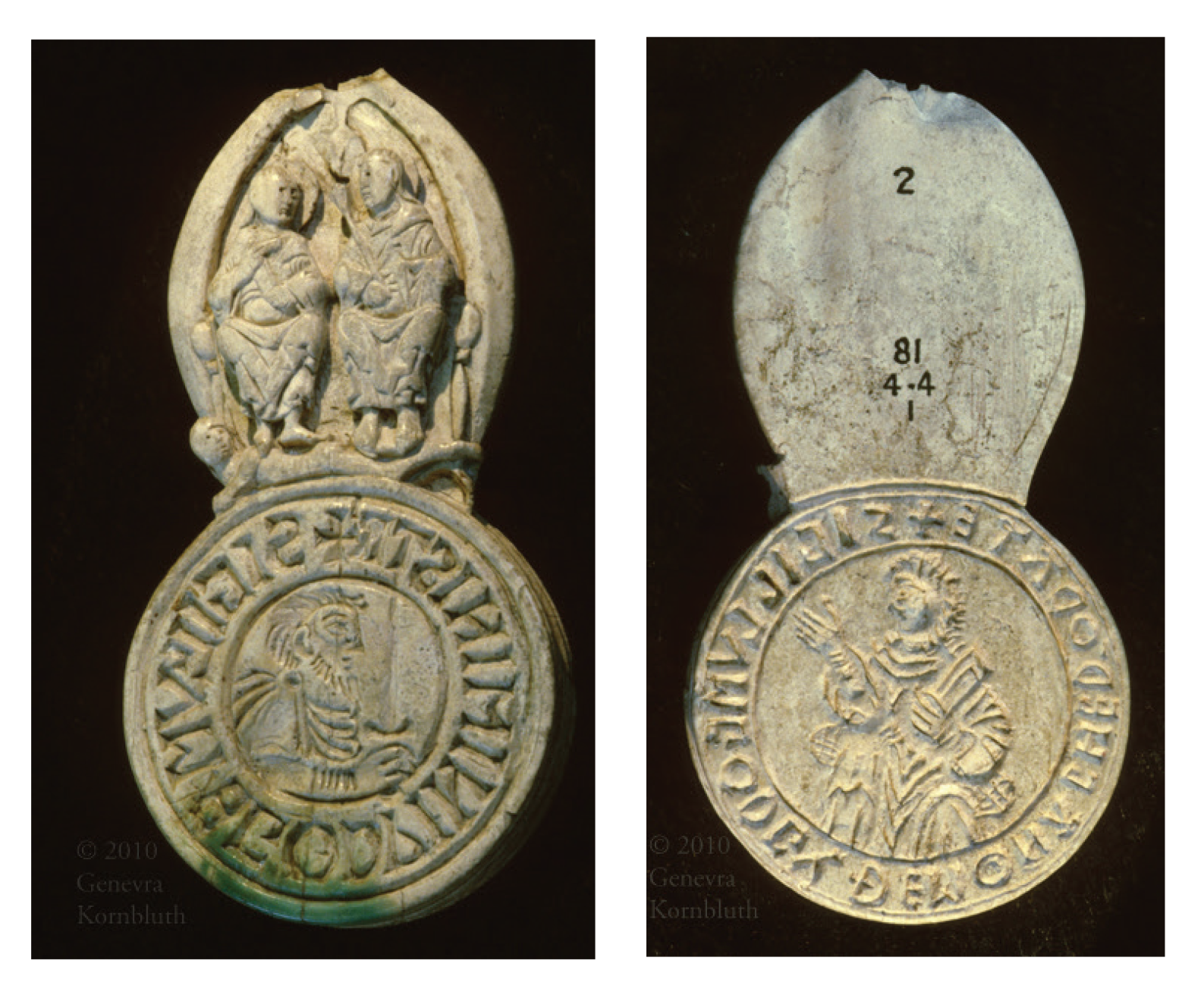
Anglo-Saxon double-sided seal-matrix of the thegn Godwin (front) and the nun Godgytha (back), made of walrus-ivory in the first half of the 11th century C.E.  The front of the handle depicts the Trinity resting upon a prone human figure.  The coin-like roundels on obverse and reverse depict the part-length male and female figures identified by Latin inscriptions, ready for sealing wax.  Photographs © Genevra Kornbluth, reproduced by permission.  A detail appears here, with more information here.  Original: London, British Museum, M&ME 1881,4-4,1.

The report by our Associate Genevra Kornbluth on “Kornbluth Photography: From Private Research to Private Archive” (II.4) describes the creation, many years in the making, of her expert photographic archive, now available, with honorable copyright conditions, on her website.  Its “Historical Archive” gathers images of objects or monuments arranged by multiple indexes (culture/period, chronology, iconography, medium, object type, location, and artist), including text-based works such as manuscripts, charters, seals and matrices, relic labels, book covers, and inscriptions.

I first met Genevra years ago, when she was conducting research for her Ph.D. dissertation, published as Engraved Gems of the Carolingian Empire (Penn State University Press, 1995, ISBN 978-0-271-01426-5), and I have followed the progress of her work with care, so that I have long been aware of the beauty of her detailed photographs of carved rock-crystal gemstones and many other objects of complexity.  Like her, I have devoted much time to photographing original source materials — in my case mostly manuscripts and other written works — not only for my own study, but also for that of others, already in the age before digital methods paved the way for widespread access, now at least on screen and often in high-definition.

As a practitioner, I can attest that the active photographic process (not only as product) of close study of the works themselves – including manuscripts and other written works – might reveal features otherwise unsuspected.  For the gems, the microscopic traces of carving methods, with tools of distinctly differing points, allowed Genevra to distinguish between Byzantine and Carolingian works, in a valuable contribution to knowledge of their identifying characteristics, with photographs recording the features for all to see.  While Genevra’s contribution to the Index volume freely provides a sampling of her photographs we may illustrate other examples from her website here, generously with her permission.  Thus it can be possible to look through, as it were, the eyes of the expert examining the sources directly and closely.

ShelfMarks 1 page 4 really images as a pair

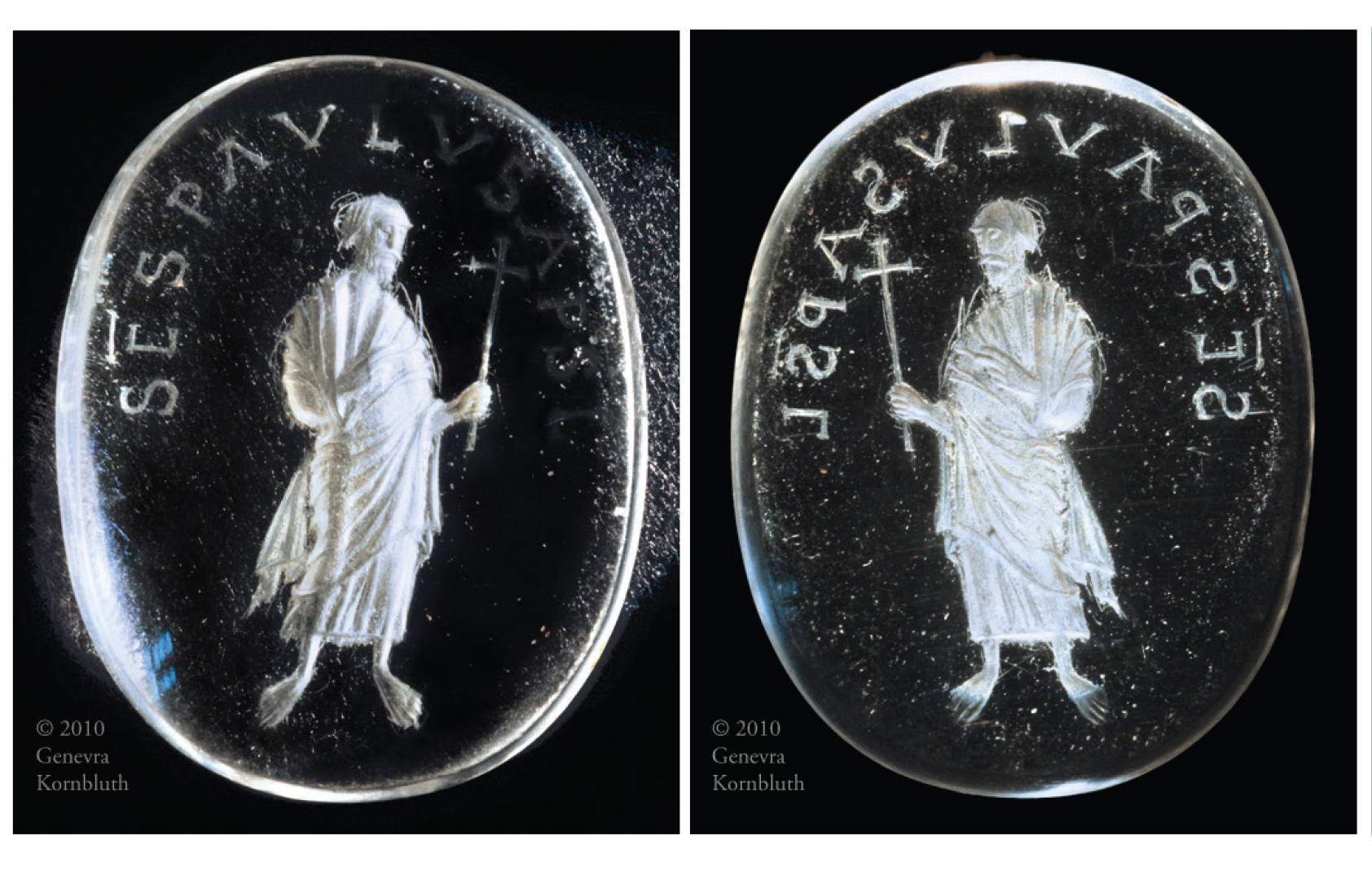
Rock crystal (quartz stone) intaglio, mid-to-late 9th century, seen from the smooth front and the engraved, incised back of the stone.  The upright, cross-bearing “St. Paul the Apostle”, is identified by Latin inscription.  Photographs © Genevra Kornbluth, reproduced by permission.  An oblique view appears here.  Original: Paris, Bibliothèque Nationale de France, Cabinet des Médailles, H3416.

Now, to the bouquet I respectfully add the final publications by our RGME Associate Malcolm B. Parkes, who died in 2013 at the age of eighty-three.  A memorial by our Trustee David Ganz appears here:  Malcolm B. Parkes., Palaeographer (1930‒2013.  A collection of Malcolm’s essays in 2012 (complementing an earlier collection in 1991) has now followed the printed version in 2008 of his Lyell Lectures.

  • 3) M. B. Parkes, Their Hands Before Our Eyes:  A Closer Look at Scribes.  The Lyell Lectures Delivered in the University of Oxford, 1999 (Ashgate Publishing, 2008, [formerly “http://www.ashgate.com/isbn/9780754663379” but now] ISBN 978-0-7546-6337-9).
  • 4) M. B. Parkes, Pages from the Past:  Medieval Writing Skills and Manuscript Books, edited by P. R. Robinson and Rivkah Zim (Ashgate Publishing, 2012, [formerly “http://www.ashgate.com/isbn/9781409438069” but now ISBN 978-1-4094-3806-9).

These works record and preserve multiple fundamental, often ground-breaking, insights into the nature of scripts in relation to the process of writing, the minds at work, and the voices of the languages, authors, and speakers which the scripts transmit.  The plates offer examples for study and instruction.  We are grateful for their presence, while we lament the passing of their author, a kind friend and teacher.

This requirement calls forth the wistful reflection that some florilegia transmitted from the past may represent cherished recollections of previous living voices and vivid moments of instruction — of which only parts of the originally full representations may yet endure, both in memory and in “print”.  We treasure these traces.

For the next issues of the Newsletter, the RGME invites suggestions and donations for books to review.  While this first “Bouquet” centers upon publications by, or with contributions by, contributors to the Research Group on Manuscript Evidence, we welcome works by others too.

GenEld_1

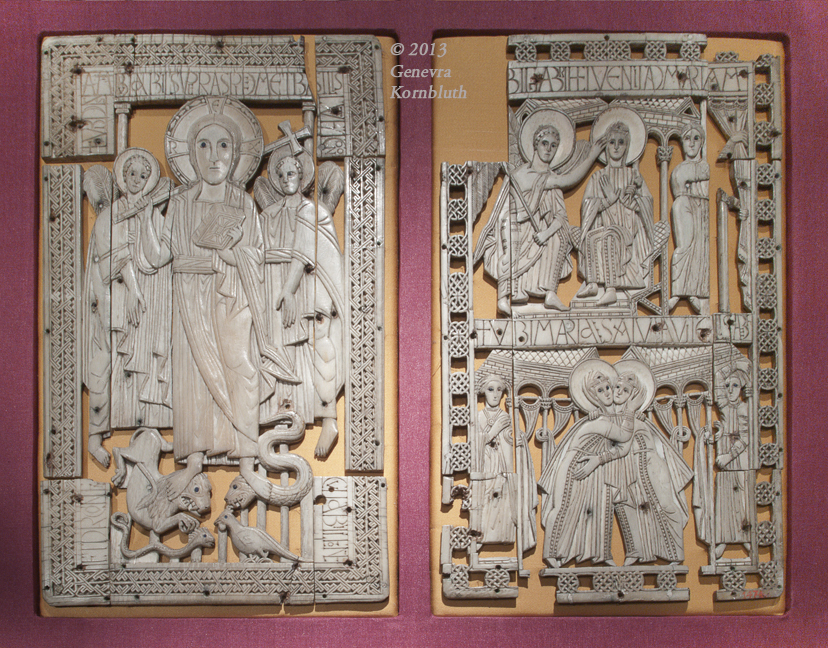
Genoels–Elderen openwork ivory diptych made circa 800 C.E. — perhaps formerly the paired covers for a sacred book or a writing tablet.  Framed within geometric and interlace borders and accompanied by Latin inscriptions, the cross-bearing Christ, flanked by angels, stands upon the Beasts (with Bird in the form of Rooster), while His mother Mary experiences both the Annunciation with Gabriel and the Visitation with Elizabeth, all with attendants.   Photograph © Genevra Kornbluth, reproduced by permission.   More views and details here: Genoels Elderen.   Original: Brussels, Musées royaux d’Art et d’Histoire, Musée du Cinquantenaire, no. 1474.

Roses according to n=6, n=7, and n=8, laid out by Mildred Budny

*****

This review forms part of the first issue of the Research Group Newsletter, ShelfMarks.
An e-version of this issue, with ShelfTags for ShelfMarks and some extra images, appears here.
The full issue appears here: ShelfMarks, Volume 1, Number 1 (PDF).
You might Subscribe here.

Masthead for ShelfMarks, the newsletter of the Research Group on Manuscript Evidence, laid out in RGME Bembino

*****

Tags: Florilegia, Index of Christian Art, Manuscript Illumination, Manuscript Photography, Manuscript studies, Palaeography, Photography of Works of Art, Roses in Mathematics
1 Comment »

2015 Congress Call for Papers

July 16, 2014 in Conference Announcement, ICMS, International Congress on Medieval Studies

CALL FOR PAPERS

Sessions Sponsored and Co-Sponsored
by the Research Group on Manuscript Evidence
at the
50th International Congress on Medieval Studies

Western Michigan University, 14–17 May 2015

Deadline for Proposals:  15 September 2014

Logo of the Research Group on Manuscript Evidence (colour version)For the 50th Congress, the Research Group on Manuscript Evidence (RGME) prepares five Sessions to celebrate a wide range of interests and explorations in the realms of medieval, early modern, and related studies.  We continue sponsorships and co-sponsorships of sessions, designed to showcase the work of younger, independent, and established scholars and teachers alike, in a constructive interchange between areas of expertise and spans of experience.

We invite proposals for papers for the 2015 Sessions.  Please send your proposed title and abstract directly to the session organizers by 15 September 2014, along with the completed Congress Participant Information Form (PIF) [no longer online, following the deadline].  We welcome your questions and suggestions. Read the rest of this entry →

Tags: Bad Rulers, Center for Medieval and Early Modern Studies at the University of Florida, Dream Books, Forgeries & Imitations, History of Magic, Ideal Rulers, International Congress on Medieval Studies, Le Pont Neuf Paris, Manuscript studies, Manuscripts & Early Printed Books, Medieval Kingship, Medieval Studies, Power of Words, Societas Magica, Ugly Rulers
3 Comments »

2014 Symposium on “Recollections of the Past”

July 15, 2014 in Abstracts of Conference Papers, Bembino, Conference Announcement, Events

Recollections of the Past:
Editorial & Artistic Workshops
from Late Antiquity to Early Modernity & Beyond

Friday & Saturday 16 & 17 May 2014
138 Lewis Library
Princeton University

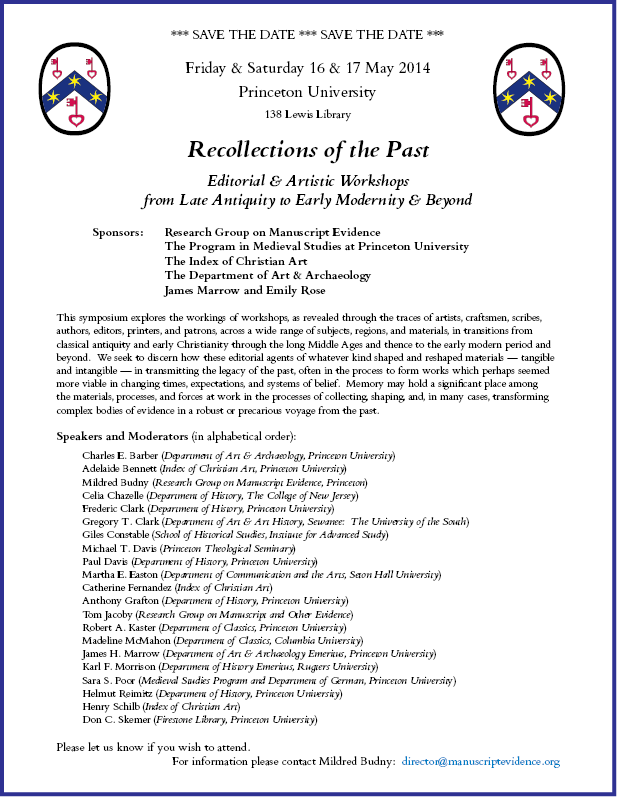
Save the Date Announcement for Symposium on "Recollections of the Past" (May 2015) in its completed version with border

“Save the Date” Announcement (complete)

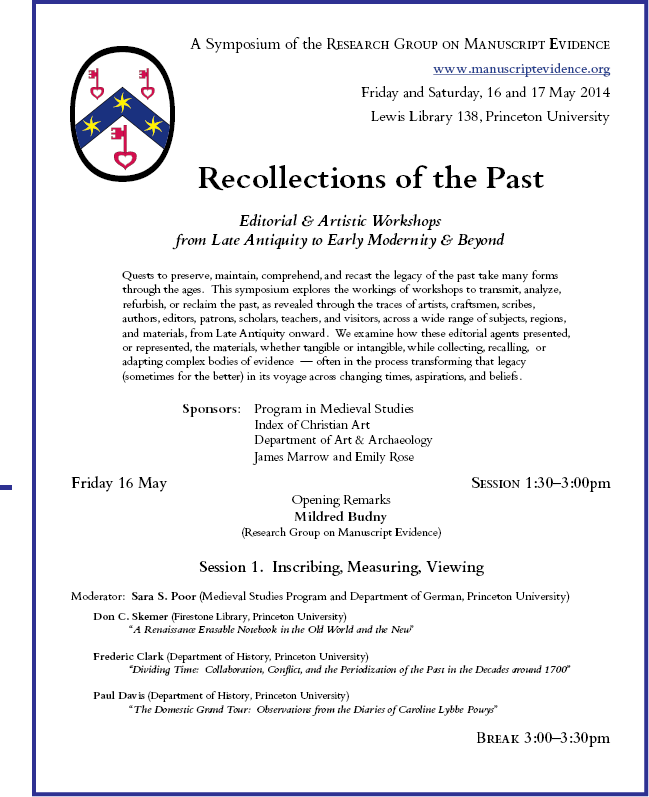
RGME Symposium 2014 Program & Abstracts Page 1 with border

Symposium Program Page 1

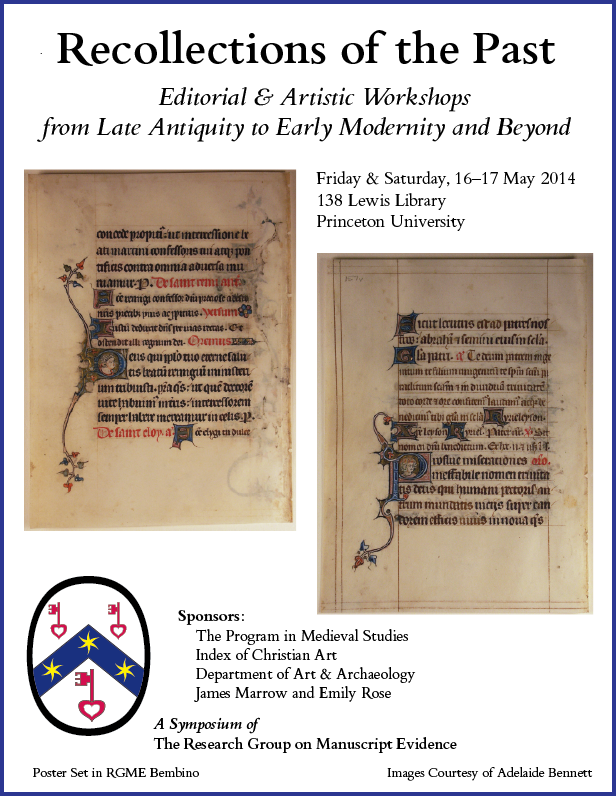
Poster for "Recollections of the Past" Symposium (May 2014) with border

Symposium Poster


[First published on 15 July 2014, with updates.  And now with the corrected Program Booklet:
RGME Symposium 2014 Program & abstracts corrected]

The “Save the Date” Announcement (Save the Date 16-17 May 2014) set the stage by describing the intentions and scope of the subject.  To sum up:

This symposium explored the workings of workshops, as revealed through the traces of artists, craftsmen, scribes, authors, editors, printers, and patrons, across a wide range of subjects, regions, and materials, in transitions from classical antiquity and early Christianity through the long Middle Ages and thence to the early modern period and beyond. We seek to discern how these editorial agents of whatever kind shaped and reshaped materials — tangible and intangible — in transmitting the legacy of the past, often in the process to form works which perhaps seemed more viable in changing times, expectations, and systems of belief. Memory may hold a significant place among the materials, processes, and forces at work in the processes of collecting, shaping, and, in many cases, transforming complex bodies of evidence in a robust or precarious voyage from the past.

The Research Group on Manuscript Evidence warmly thank the Sponsors, Donors, and Contributors to the Symposium, which formed part of the celebrations for our 2014 Anniversary Year.  Other celebrations have included our Sessions at the 2014 International Congress on Medieval Studies in May, along with an Anniversary Reception. Read the rest of this entry →

Tags: bokes of antiquity, Books of Hours, Caroline Lybbe Powys, Carolingian Studies, Church History, Codex Amiatinus, Courtly Love Ivories, Department of Art & Archaeology, Domestic Grand Tour, Early Modern Studies, Editorial Practices, erasable notebooks, Eusebian Canon Tables, History of Cambridge University, History of Workshops, Iconoclasm studies, Index of Christian Art, John Caius, Manuscript Illumination, Manuscript studies, Matthew Parker, Medieval Studies, Monkwearmouth-Jarrow, periodization of history, Princeton University, Qal'at Sim'an, Romanesque Sculpture, Saint-Sernin of Toulouse, Syriac Cave of Treasures
1 Comment »

2014 Congress Report

June 25, 2014 in Abstracts of Conference Papers, Bembino, Conference Announcement, ICMS, International Congress on Medieval Studies, Kalamazoo

49th International Congress on Medieval Studies
An Anniversary Year

8-11 May 2014

[Published on 25 June 2014, with updates]

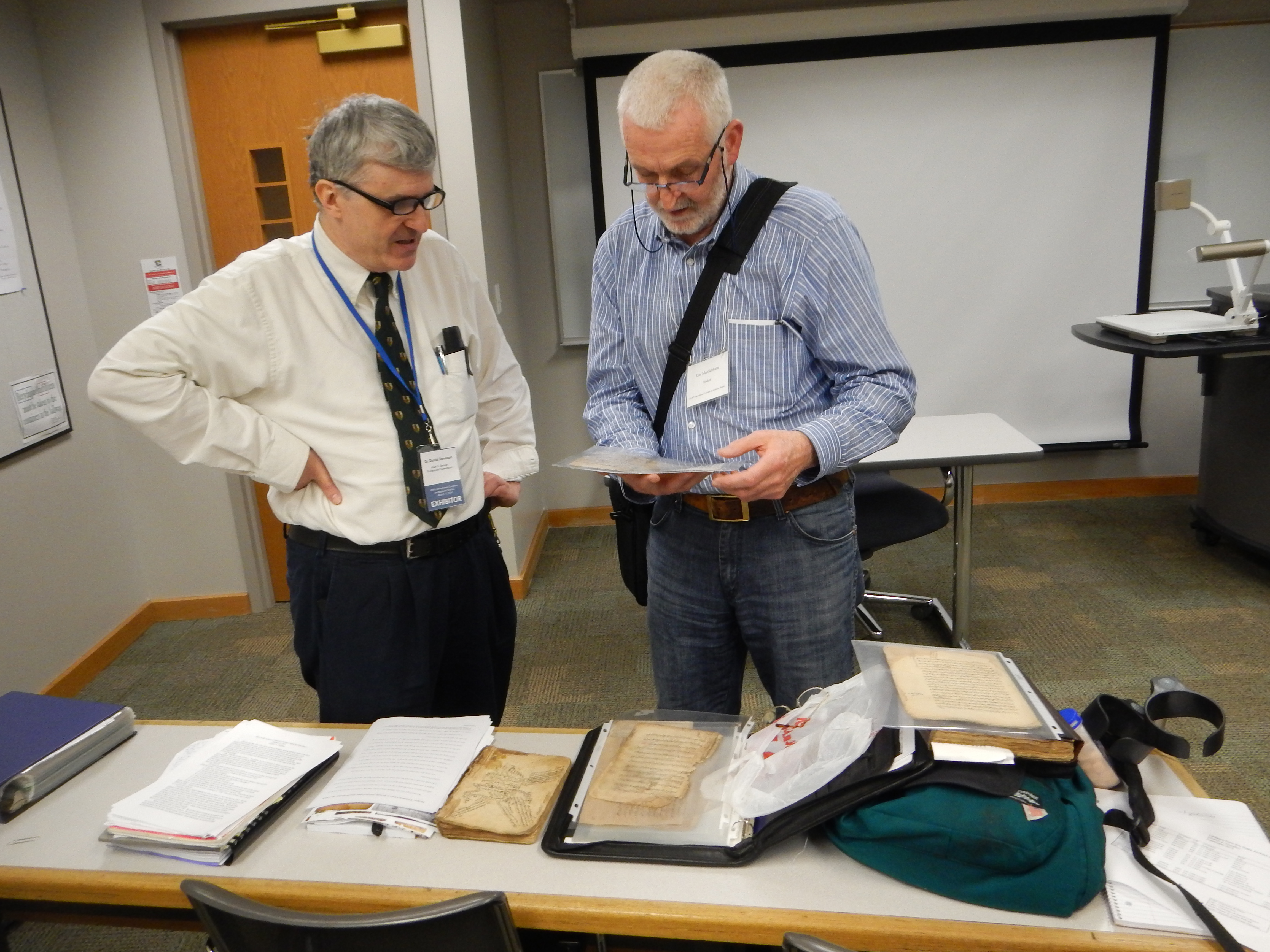
David Sorenson and Donncha MacGabhann examine manuscript materials

Photography by Mildred Budny

Our sessions at the 2014 Congress formed part of the celebrations for our anniversary year.   2014 marks our 15th anniversary as a nonprofit educational organization and our 25th anniversary as an international scholarly society.  At the Congress, we both sponsored sessions and co-sponsored sessions, as before, with the Societas Magica, in the eighth year of this co-sponsorship, and, for the first time, with the Center for the Study of Medieval and Early Modern Studies at the University of Florida.  As is our practice, various of our Trustees, Officers, and Associates participated in these and other sessions at the Congress.

Read the rest of this entry →

Tags: Anglo-Saxon Manuscripts, Assenids, Book of Kells, Carolingian Manuscripts, Center for Medieval and Early Modern Studies at the University of Florida, Datini Archives, Early Ottoman Empire, Ethiopic Manuscripts, Gems, History of Canon Law, History of Magic, History of Paper, House Style, Individual Style, Islamic Manuscripts, Manuscript Illumination, Manuscript studies, Medieval manuscripts, Medieval Music, Medieval Writing Materials, Palaeography, Second Bulgarian Empire, Societas Magica, Talismans
No Comments »

2013 Congress

January 1, 2014 in Abstracts of Conference Papers, Bembino, Conference Announcement, ICMS, International Congress on Medieval Studies, Kalamazoo

48th International Congress on Medieval Studies

9-12 May 2013

[First published on our first website on *6 December 2012, with updates there and here]

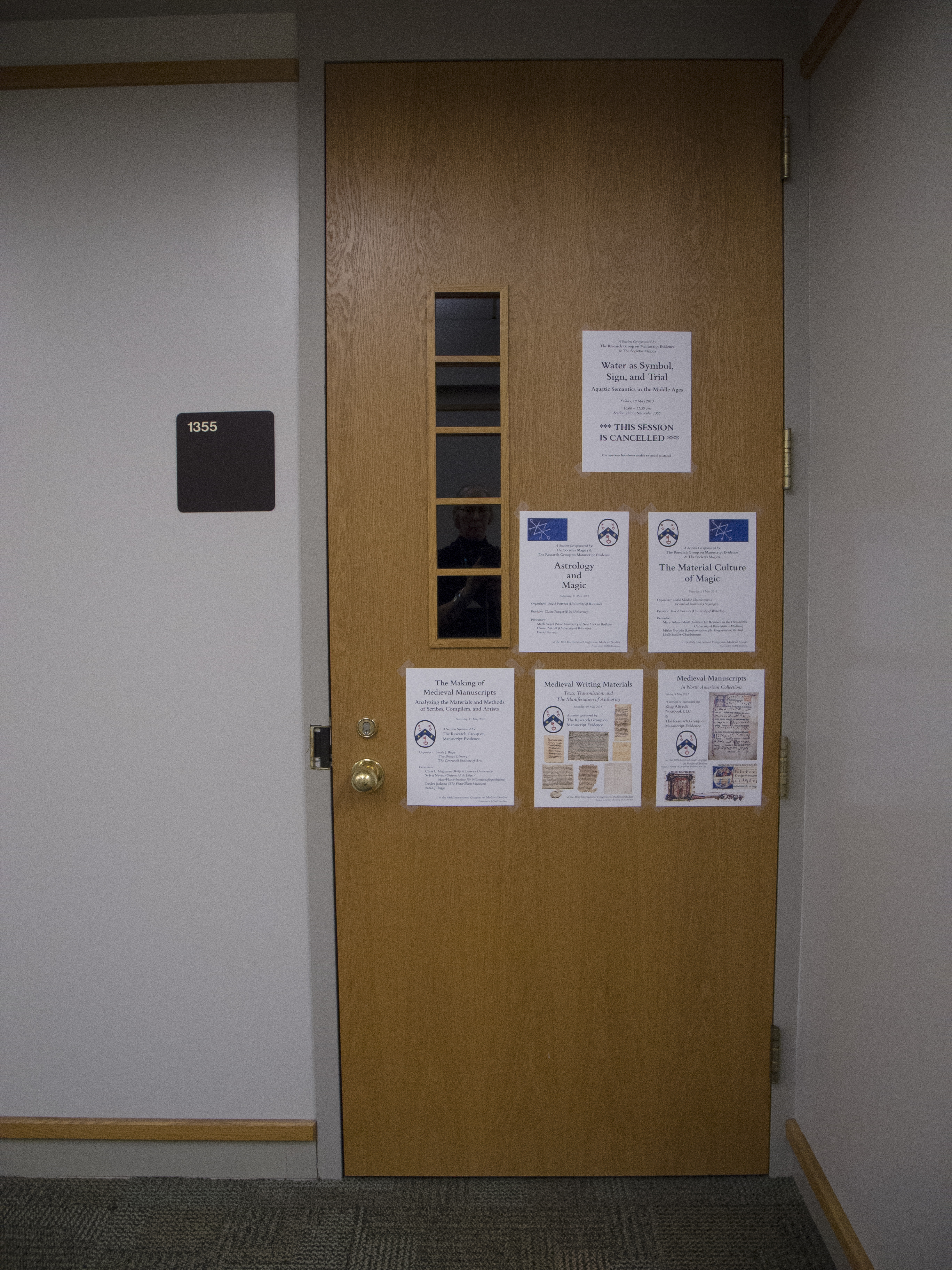
Posters for our Sessions displayed at the 2014 CongressWith its mission to “apply an integrated, holistic approach to manuscripts and texts in all forms,” at the International Congress on Medieval Studies in 2013, the Research Group on Manuscript Evidence held sponsored and co-sponsored sessions examining the material culture, production, and purposes of written records in Western Europe and beyond, and the dispersal, recovery, and study of those works in various forms and widespread locations.  Besides these interlinked subjects, the year’s highlighted genres were astrology, the material technology of magic, and the symbolism of water in the Middle Ages.

As before, we co-sponsored sessions with the Societas Magica and King Alfred’s Notebook LLC (respectively in the eighth and second years of this co-sponsorship). Also, three of our Trustees and many of our Officers, and Associates presented papers at the Congress in a variety of sessions.

Here we report the Programs for our Sessions, publish the Abstracts of their Papers, and illustrate the Posters for the Sessions.  For the first time, we designed Posters for all of our Sessions at the Congress, Sponsored and Co-Sponsored.  At the 2011 Congress we had one Poster, and two Posters at this 2013 Congress for our Sponsored Sessions, all with images courtesy of David W. Sorenson, whose donation of images inspired their creation. The series of Posters now stand exhibited in our Gallery of Posters on Display.  The Posters are set in our own multi-lingual digital font Bembino, available for download for FREE here.

Read the rest of this entry →

Tags: 'Huntingdonshire Scribe', Adam Pinkhurst, Artists' Recipe Books, Astrology, Bibliothèque nationale de France Ms Latin 16714, British Library Cotton MS Faustina C i, Datini Archive, Digital Imaging, Ducal Charters, History of Paper, Islamic Paper, Late Medieval English Scribes Project, Manipulus Florum, Manuscript Illumination, Manuscript studies, Medieval Manuscript Collecting, Medieval manuscripts, Medieval Music, Medieval Writing Materials, Middle English, Orpiment Pigment, Palaeography, Peter of Blois, Picatrix, Pigment Analysis, Popular Magic, Rhygyfarch ap Sulien, Scribe B - Pynkhurst Debate, Sigillum Dei, Silesia, Societas Magica, Textual Amulet, Thomas of Ireland, Welsh-Latin Poetry
No Comments »

« Older Entries
Newer Entries »
  • Top
©2024 Research Group on Manuscript Evidence.


is proudly powered by WordPress. WordPress Themes X2 developed by ThemeKraft.