• News
    • News & Views
    • RGME Activities for 2024 and 2025
    • Around & About with the RGME
    • Reviews
    • Highlights
  • Blogs
    • Manuscript Studies
      • Manuscript Studies: Contents List
    • International Congress on Medieval Studies
      • Abstracts of Congress Papers
        • Abstracts of Papers Listed by Author
        • Abstracts of Papers Listed by Year
  • About
    • Mission
    • Who We Are
      • Officers, Associates & Volunteers
      • RGME Committees
      • Friends of the Research Group on Manuscript Evidence
    • Policies & Statements
      • RGME Privacy Policy Statement
      • RGME Intellectual Property Statement & Agreements
    • People
      • Mildred Budny — Her Page
      • Adelaide Bennett Hagens
    • Activities
      • Events
      • Congress Activities
        • Sponsored Conference Sessions (1993‒)
          • Panels at the M-MLA Convention (from 2016)
        • Co-sponsored Conference Sessions (2006‒)
    • History
      • Seals, Matrices & Documents
      • Genealogies & Archives
    • Contact Us
  • Bembino
    • Multi-Lingual Bembino
    • RGME Bembino: Resources
  • Congress
    • Sponsored Conference Sessions (1993‒)
    • Co-sponsored Conference Sessions (2006‒)
    • Abstracts of Congress Papers
      • Abstracts Listed by Author
      • Abstracts Listed by Year
    • Kalamazoo Archive
    • Panels at the M-MLA Convention (2016-2019)
      • Abstracts of Papers for the M-MLA Convention
      • Panels at the M-MLA Convention (from 2016)
  • Events
    • RGME Activities for 2024 and 2025
      • 2023 Activities and 2024 Planned Activities
    • Seminars, Workshops, Colloquia & Symposia (1989–)
      • Seminars on ‘The Evidence of Manuscripts’
      • Symposia on ‘The Transmission of the Bible’
      • The New Series (2001-)
        • 2019 Anniversary Symposium Program: The Roads Taken
        • 2019 Anniversary Symposium Registration
        • 2019 Anniversary Symposium Registration Open
      • RGME Symposia: The Various Series
      • The Research Group Speaks: The Series
      • Meetings of the Friends of the Research Group on Manuscript Evidence
      • RGME Online Events
    • Abstracts of Papers for Events
      • Abstracts of Papers for Seminars on ‘The Evidence of Manuscripts’
      • Abstracts of Papers for Symposia, Workshops & Colloquia
    • Receptions & Parties
    • Business Meetings
    • Photographic Exhibitions & Master Classes
    • Events Archive
  • ShelfLife
    • Journal Description
    • ShelfMarks: The RGME-Newsletter
    • Publications
      • “Insular, Anglo-Saxon, and Early Anglo-Norman Manuscript Art at Corpus Christi College, Cambridge” (1997)
        • Mildred Budny, ‘Catalogue’
        • The Illustrated Catalogue (1997)
      • The Illustrated Handlist
      • Semi-Official Counterfeiting in France 1380-1422
      • No Snap Decisions: Challenges of Manuscript Photography
    • History and Design of Our Website
  • Galleries
    • Watermarks & the History of Paper
    • Galleries: Contents List
    • Scripts on Parade
    • Texts on Parade
      • Latin Documents & Cartularies
      • New Testament Leaves in Old Armenian
    • Posters on Display
    • Layout Designs
  • Donations and Contributions
    • RGME Donor Promise
    • 2023 End-of-Year Fundraiser for our 2024 Anniversary Year
    • 2019 Anniversary Appeal
    • Orders
  • Links
    • Catalogs, Metadata, and Databases: A Handlist of Links
    • Handlist of Resources for Manuscript Studies and Fragmentology
    • Manuscripts & Rare Books
    • Maps, Plans & Drawings
    • Seals, Seal-Matrices & Documents

  • News
    • News & Views
    • RGME Activities for 2024 and 2025
    • Around & About with the RGME
    • Reviews
    • Highlights
  • Blogs
    • Manuscript Studies
      • Manuscript Studies: Contents List
    • International Congress on Medieval Studies
      • Abstracts of Congress Papers
        • Abstracts of Papers Listed by Author
        • Abstracts of Papers Listed by Year
  • About
    • Mission
    • Who We Are
      • Officers, Associates & Volunteers
      • RGME Committees
      • Friends of the Research Group on Manuscript Evidence
    • Policies & Statements
      • RGME Privacy Policy Statement
      • RGME Intellectual Property Statement & Agreements
    • People
      • Mildred Budny — Her Page
      • Adelaide Bennett Hagens
    • Activities
      • Events
      • Congress Activities
        • Sponsored Conference Sessions (1993‒)
          • Panels at the M-MLA Convention (from 2016)
        • Co-sponsored Conference Sessions (2006‒)
    • History
      • Seals, Matrices & Documents
      • Genealogies & Archives
    • Contact Us
  • Bembino
    • Multi-Lingual Bembino
    • RGME Bembino: Resources
  • Congress
    • Sponsored Conference Sessions (1993‒)
    • Co-sponsored Conference Sessions (2006‒)
    • Abstracts of Congress Papers
      • Abstracts Listed by Author
      • Abstracts Listed by Year
    • Kalamazoo Archive
    • Panels at the M-MLA Convention (2016-2019)
      • Abstracts of Papers for the M-MLA Convention
      • Panels at the M-MLA Convention (from 2016)
  • Events
    • RGME Activities for 2024 and 2025
      • 2023 Activities and 2024 Planned Activities
    • Seminars, Workshops, Colloquia & Symposia (1989–)
      • Seminars on ‘The Evidence of Manuscripts’
      • Symposia on ‘The Transmission of the Bible’
      • The New Series (2001-)
        • 2019 Anniversary Symposium Program: The Roads Taken
        • 2019 Anniversary Symposium Registration
        • 2019 Anniversary Symposium Registration Open
      • RGME Symposia: The Various Series
      • The Research Group Speaks: The Series
      • Meetings of the Friends of the Research Group on Manuscript Evidence
      • RGME Online Events
    • Abstracts of Papers for Events
      • Abstracts of Papers for Seminars on ‘The Evidence of Manuscripts’
      • Abstracts of Papers for Symposia, Workshops & Colloquia
    • Receptions & Parties
    • Business Meetings
    • Photographic Exhibitions & Master Classes
    • Events Archive
  • ShelfLife
    • Journal Description
    • ShelfMarks: The RGME-Newsletter
    • Publications
      • “Insular, Anglo-Saxon, and Early Anglo-Norman Manuscript Art at Corpus Christi College, Cambridge” (1997)
        • Mildred Budny, ‘Catalogue’
        • The Illustrated Catalogue (1997)
      • The Illustrated Handlist
      • Semi-Official Counterfeiting in France 1380-1422
      • No Snap Decisions: Challenges of Manuscript Photography
    • History and Design of Our Website
  • Galleries
    • Watermarks & the History of Paper
    • Galleries: Contents List
    • Scripts on Parade
    • Texts on Parade
      • Latin Documents & Cartularies
      • New Testament Leaves in Old Armenian
    • Posters on Display
    • Layout Designs
  • Donations and Contributions
    • RGME Donor Promise
    • 2023 End-of-Year Fundraiser for our 2024 Anniversary Year
    • 2019 Anniversary Appeal
    • Orders
  • Links
    • Catalogs, Metadata, and Databases: A Handlist of Links
    • Handlist of Resources for Manuscript Studies and Fragmentology
    • Manuscripts & Rare Books
    • Maps, Plans & Drawings
    • Seals, Seal-Matrices & Documents

Log in

Archives

Featured Posts

2026 International Medieval Congress at Leeds: Program
Sanskrit and Prakrit Manuscripts, Continued: More Leaves for Manuscript Sample XII
2026 International Congress on Medieval Studies: Program
Episode 24. “Life with Books” (Interview with John Windle)
Announcing the Launch of RGME Bembino WP
2026 RGME Colloquium at The Grolier Club: Report
Medieval Missal Fragment as Early-Modern Cover
The Weber Leaf from Ege MS 61
"Bembino" Booklet Cover
Episode 23. “Meet RGME Bembino: Facets of a Font”
2026 RGME Colloquium on “Transformations & Renewals” at The Grolier Club
2026 Theme of the Year: “Transformations and Renewals”
A Leaf with Patchwork from the Saint Albans Bible
A Sister Leaf from a Miniature Latin Vulgate Bible
A Little Latin Vulgate Bible Manuscript Leaf in Princeton
J. S. Wagner Collection. Leaf from from Prime in a Latin manuscript Breviary. Folio 4 Verso, with part of Psalm 117 (118) in the Vulgate Version, set out in verses with decorated initials.
2026 Annual Appeal
Episode 22: “Encounters with Local Saints and Their Cults”
Private Collection, Ege's FBNC Portfolio, Dante Leaf, Verso, Detail. Reproduced by Permission.
2025 RGME Autumn Colloquium on Fragments
Workshop 8: A Hybrid Book where Medieval Music Meets Early-Modern Herbal
2025 RGME Autumn Symposium on “Readers, Fakers, and Re-Creators of Books”
RGME Workshops on “The Evidence of Manuscripts, Etc.”
2025 International Medieval Congress at Leeds: RGME Program
Episode 21. “Learning How to Look”
2025 International Congress on Medieval Studies: Program
2025 RGME Visit to Vassar College
Two Leaves in the Book of Numbers from the Chudleigh Bible
Delibovi on Glassgold on Boethius: A Blogpost
Ronald Smeltzer on “Émilie du Châtelet, Woman of Science”
2025 Spring Symposium: “Makers, Producers, and Collectors of Books”
Starters’ Orders
The Weber Leaf from the Saint Albans Bible
Workshop 4. “Manuscript Fragments Compared”
Episode 20. “Comic Book Theory for Medievalists”
Episode 19: “At the Gate: Starting the Year 2025 at its Threshold”
Favorite Recipes for Lemonade, Etc.
RGME Visit to the Lomazow Collection: Report
2024 Autumn Symposium: “At the Helm”
A Latin Vulgate Leaf of the Book of Numbers
The RGME ‘Lending Library’
Florence, Italy, Ponte Vecchio from Ponte alle Grazie. Photo: Ingo Mehling, CC BY-SA 4.0 , via Wikimedia Commons
Episode 17. “RGME Retrospect and Prospects: Anniversary Reflections”
2024 Anniversary Symposium: The Booklet
Jesse Hurlbut at the Bonneville Salt Flats, Utah. Photograph Jesse Hurlbut.
Episode 16: An Interview with Jesse D. Hurlbut
To Whom Do Manuscripts Belong?
Kalamazoo, MI Western Michigan University, Valley III from the side. Photograph: David W. Sorenson.
2024 International Congress on Medieval Studies: Report
2024 Spring Symposium at Vassar College
Puente de San Martín: Bridge with reflection over the River Targus, Toledo, Spain.
2024 Grant for “Between Past and Future” Project from The Gladys Krieble Delmas Foundation Research Libraries Program
2024 Anniversary Symposium in Thanks to Jesse Hurlbut: Program

You are browsing the Blog for Conference Announcement

2023 International Congress on Medieval Studies: Program

January 15, 2023 in Conference, Conference Announcement, International Congress on Medieval Studies

2023 International Congress on Medieval Studies: Program

58th ICMS (11–13 May 2023)

To occur in a transitional ‘hybrid’ form
with Sponsored and Co-Sponsored Sessions
—  to be held either in person or online (with some options) —
and with an Open Business Meeting
and Co-Sponsored Reception

[Posted on 17 January 2023, with updates]

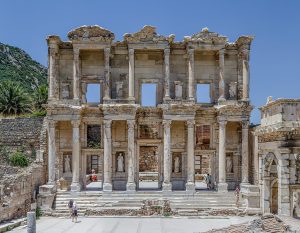
Façade of the Celsus library, in Ephesus, near Selçuk, west Turkey. Photograph (1910): Benh LIEU SONG, via Creative Commons.

Façade of the Celsus library, in Ephesus, near Selçuk, west Turkey. Photograph (1910): Benh LIEU SONG, via Creative Commons.

Building upon the successful completion of our activities at the 2022 ICMS (see our 2022 International Congress on Medieval Studies Program), we announce our Activities for the 2023 International Congress on Medieval Studies, following our Preparations for them, with the completion of the Call for Papers (15 September 2022) and the selection and submission of the Programs for our Sessions (by 15 October 2022).

For information about the Congress, registration for it, and the current version of the 2023 Congress Program (plus the extra Corrigenda), see the Congress website.

With the turn of the calendar year toward the year of the Congress, we published the selected Programs for our Sessions and announced our other Activities, while we awaited the promulgation of the official Schedule for the 2023 Congress as a whole.  With the publication of a Sneek Peak for the Congress Program, we can add the times and venues for our Sessions.  As the Congress approaches, new information guides additional features of our planning, with Virtual options now possible for some of our In-Person events, through extra arrangements by the RGME.

This year, with some Sessions on line and some in person in a transitional ICMS, we prepare six Sessions, an Open Business Meeting, and a Reception. Our co-sponsors:

  • Societas Magica:  2 Sessions and the Reception
  • Schoenberg Institute for Manuscript Studies (SIMS): 2 Sessions
  • Polytheism-Oriented Medievalists of North America (P.-O.M.o.N.A.): 1 Session
  • Index of Medieval Art at Princeton University: Reception

This year marks Year 19 of our co-sponsorship with the Societas Magica; the second (non-consecutive) year of co-sponsorship with POMONA, the third of co-sponsorship with the Index of Medieval Art, and the first year of co-sponsorship with SIMS.

As always, we thank the host, organizers, co-sponsors, presiders, speakers, respondents, advisers, and participants for our activities at the Congress, along with the Congress staff and support staff.

Here we list our Sessions (arranged in the order in which they are scheduled for the Congress), with the Links to the Abstracts for the individual Papers, then turn to our other Activities (Open Business Meeting and Reception).  A Note on our Congress Sessions describes the Indexes of the Abstracts for Papers as published on our website, listed both by Alphabetical order of Author’s Surname and by Year.

Logistics

This year, the partly in-person, virtual, and hybrid modalities to the Congress add to the complexity, tasks, resources, and expenses for preparing for our events there.  The complexity encourages us to create more flexible and resourceful our arrangements for some events held in person or virtually, so as to accommodate attendance in these different modalities directed by the Congress, while any fully hybrid event is not permitted for us in the arrangements by this online/offline Congress.

1) Optional RGME Zoom Meeting Room in live time for some In-Person events.  For Congress participants unable to travel to the place, but registered for the Congress, we offer an optional Virtual Meeting Room by RGME Zoom subscription.  In this way, an In Person Congress event might be accessed virtually — with registration for each of them through our RGME Eventbrite Collection.

We provide the RGME Zoom option (by specific registration, without charge) for

  • our In Person Open Business Meeting on Thursday lunchtime and
  • our pair of co-sponsored In-Person Sessions on Saturday afternoon.

2) Especially Reserved In-Person Room for In-Person Attendees of the Congress who will log-on to our Virtual Sessions.  These reserved rooms are prepared (in different, but adjacent, buildings) for:

  • our first, Virtual Session on Thursday morning, with an In-Person option (Session 50 / Schneider 1220)
  • the pair of our co-sponsored Virtual Sessions on Thursday afternoon, with In-Person option (Sessions 87 + 137 / Fetzer 1030)The second dedicated room is located a few steps away, on the same floor, in the same building, from the two In-Person events before and after that pair of Sessions, namely the Open Business Meeting and the Reception.

Details below, including information about how to register with us for the access by Zoom for the In-Person events.

In brief:

Day 1 of the Congress (Thursday 11 May) has a full set of events. They open with the Morning Session, lead to the RGME Open Business Meeting (with lunch provided), follow with a pair of Sessions, and round out with the co-hosted Reception.

  1. Session 50 on “Words as Agents”
    held Virtually
    from 10:00-11:30 am EDT (GMT-4)
    — with In-Person option:  By arrangement, Schneider 1220 is reserved for us for that time period for those attending the Congress in person, to be able to gather for accessing the online Sessions with their own computers
  2. RGME Open Business Meeting
    held In Person
    in Fetzer 1035 from 12:00-1:00 pm EDT, with catered lunch (donations are welcome)
    — We recommend registering if you plan to attend in person, so that we could know how many to expect.
    In Person Reservation for RGME Open Business Meeting
    — We also offer the option to attend virtually through the RGME (not via the Congress), for Congress participants unable to travel.  With your registration for the event itself, we will send the Zoom link ahead of time.
    Virtual Registration Option for RGME Open Business Meeting
  3. Sessions 87 and 137 on “The Eloquence of Medieval Book Bindings”, Parts 1-2
    (“Bindings from German Lands” and “Diverse Regional Techniques”)
    held Virtually from 1:30-3:00 pm and 3:30-5:00 pm EDT (GMT-4)
    — with In-Person option:  Fetzer 1030 is reserved for us for the afternoon for those attending the Congress in person, to gather for accessing the online Sessions with their own computers
    Update on 7 May: The order of the three Papers in Session 87 is changed from that advertised in the Congress Program Booklet. The Paper by William H. Campbell, formerly in first position, has moved to third, as indicated below.
  4. Co-hosted Reception
    held in Person
    in Fetzer 1035-1045 from 5:30-7:00 pm EDT (GMT-4).

For the RGME Open Business Meeting held In Person, open to to Congress attendees, it would help us to know how many to expect if you would please register for it through the RGME Eventbrite collection.  See below.

Day 3 of the Congress (Saturday 13 May) has a pair of Sessions.

  1. Sessions 369 and 419 on”Moving Parts and Pedagogy”, Parts I–II (“Teaching Magic and Other Occult Arts” and “Teaching Astrology and Other Liberal Arts”)
    held In Person in Fetzer 2040 from 1:30-3:00 pm and 3:30-5:00 pm EDT (GMT-4)
    (If requested, we will set up an RGME Zoom Room for these Sessions.)

Note:  If you have questions about these arrangements, we apologize for the complexity, and ask that you contact director@manuscriptevidence.org.  Safe travels!

Read the rest of this entry →

Tags: Albert the Great, Archaeology of Bindings, Astrology, Board Games, Catalogues & Metadata & Databases, Chieromancy, Datini Collection, Ephesia Grammata, Ephesus, Fairy Summoning, Fragmentology, Gutenberg Bible, History of Games, History of Magic, Index of Medieval Art, Islamic Bookbindings, Liberal Arts Curriculum, Ludwig Millich, Manuscript studies, Medieval Writing Materials, Otto Ege Fragments, Pedagogy, POMONA, Quadrivium, Quire Signatures, Schoenberg Institute for Manuscript Studies, Seven Liberal Arts, Societas Magica, Trivium, William Fulke, Witchcraft
No Comments »

2023 Spring Symposium: “From the Ground Up”

January 12, 2023 in Conference, Conference Announcement, Manuscript Studies, RGME Symposia

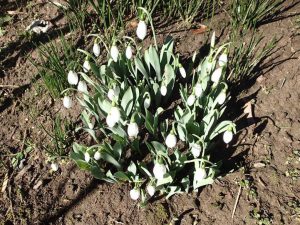
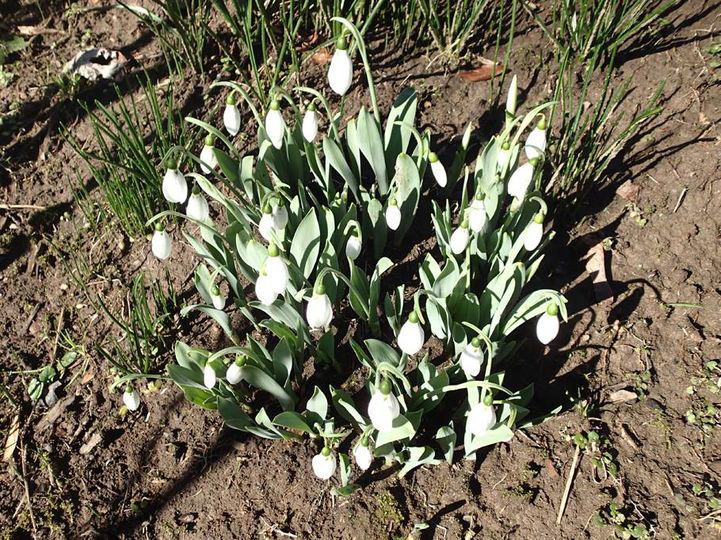
Photograph of the stems and white blooms of Snowdrops emerging from a patch of bare ground in the sunlight. Photograph Ⓒ Mildred Budny.

“From the Ground Up”. Photograph Ⓒ Mildred Budny.

2023 Spring Symposium
“From the Ground Up”

Part 1 of 2 in the
2023 Spring and Autumn Symposia
on “Materials & Access”

[Posted on 12 January 2023 , with updates]

With its chosen Theme of “Materials & Access” for the Year 2023, the Research Group prepares a pair of Symposia, continuing its expanded pattern of paired day-long virtual Spring and Autumn Symposia launched in 2022.   Until then, RGME Symposia had occurred on occasion at one per year, sometimes annually and sometimes at intervals.  Whereas previously they occurred in person, at various centers (like the 2020 Spring Symposium, which had to be cancelled on account of lockdown for Covid), the Symposia in 2022 and 2023 take place online by Zoom.

This year, the Spring and Autumn Symposia will take place by Zoom on:

  • Saturday, 25 March 2023
  • Saturday 21 October 2023 (“The Sweetest Day” 2023)

And There’s More

In a further expansion, the 2023 Spring Symposium will be preceded by a half-day Pre-Symposium which presents a series of Lightning Talks.  They will emerge from the Call for Proposals, issued on 10 January 2023, with a deadline of 12 February 2023.

  • 2023 Pre-Symposium Call for Papers: “Intrepid Borders” Lightning Talks.

Following that deadline, the Program of Talks for the Pre-Symposium has been selected and is now announced.

  • 2023 ‘Pre-Symposium’ on “Intrepid Borders”

The New Ensemble:  Pre-Symposium and Symposium

This year, with the Theme of “Materials and Access”, we not only prepare a pair of Symposia, but also extend the Spring Symposium with an accompanying ‘Pre-Symposium’ of Lightning Talks on the afternoon before. Selected through a Call for Proposals, these Talks explore the challenges of “Intrepid Borders: Marginalia in Medieval and Early Modern Books”. The plan for such sessions, their subject, the Call for Proposals, and the selected Program for the Lightning Talks are due to the initiative, enthusiasm, and organizational expertise of Jessica L. Savage and her co-organizers Katharine C. Chandler and Jenifer Larson. The fresh combination of exploratory Lightning Talks on Friday and the invited Symposium Presentations on Saturday opens our Symposia more widely.

The extended Symposium presents new and cumulative work, with reports of discoveries, work-in-progress, and collaborative projects. Some build upon work presented for the Symposia in 2022 (2022 Spring Symposium on “Structures of Knowledge” and 2022 Autumn Symposium on “Supports for Knowledge”).

We consider evidence from the medieval to modern periods and across a wide geographical, historical, and cultural range, both Western (Europe and North America) and non-Western (Ethiopia, Yemen, and Western India). From multiple centers, the Symposium plus Pre-Symposium gathers specialists, teachers, students, collectors, and others engaged or interested in activities relating to manuscripts, printed books, other media, and mixtures of them.

Program Booklet

To accompany the event and celebrate its contributors, we publish a combined Pre-Symposium/Symposium Program Booklet, with Abstracts of Presentations and companion Images.  See below for information how to receive a copy in print or by download on this site.

*****

2023 half-day Pre-Symposium and full-day Symposium (online)

I.   “Pre-Symposium of Lightning Talks” on Friday afternoon 24 March 2023

“Intrepid Borders:
Marginalia in Medieval Manuscripts and Early Modern Books”

A Virtual Lightning Talks / Half-Day Symposium
of the Research Group on Manuscript Evidence

Co-Organized by Katharine C. Chandler, Jennifer Larson, and Jessica L. Savage

2023 RGME ‘Pre-Symposium’ on “Intrepid Borders”

Registration for this event is required, and can be made through its portal:
  • https://www.eventbrite.com/e/intrepid-borders-pre-symposium-for-2023-spring-symposium-tickets-512253994487

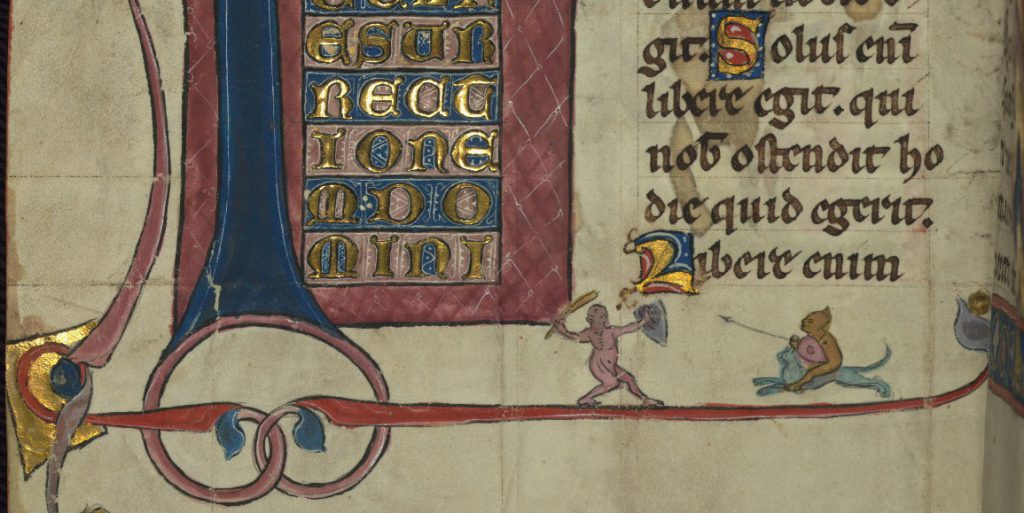
Baltimore, Walters Art Museum, MS. W.148, folio 33v, bottom. Image via Creative Commons.

II.   Symposium on Saturday 25 March 2023

“From the Ground Up”

Following the models of the 2022 Spring and Autumn Symposia, the 2023 Spring and Autumn Symposia will showcase some of our ongoing series of subjects, as well as introduce new ones.  We explore challenges and opportunities for approaching and accessing materials of many kinds in the history, production, transmission, study, and display of manuscripts and books, across time and place.

Registration for this event can be made through its portal:

  • 2023 RGME Spring Symposium “From the Ground Up”

Speakers, Respondents, Presiders, and Moderators (in alphabetical order):

  • Linde M. Brocato, Mildred Budny, Katharine C. Chandler, Hannah Goeselt, Justin Hastings, Zoey Kambour, Atria A. Larson, Jennifer Larson, Ann Pascoe-van Zyl, Ronald Patkus, Jaclyn Reed, David W. Sorenson, and others.

Occasion:

This Symposium occurs on 25 March, a day for, among other celebrations, the liturgical Feast of the Annunciation.  (See below.)  This manuscript image represents the decisive event with a rich interior, landscape exterior and inhabited foliage in the margins, and bookish features such as a speech scroll and an opened book on a table at the back.
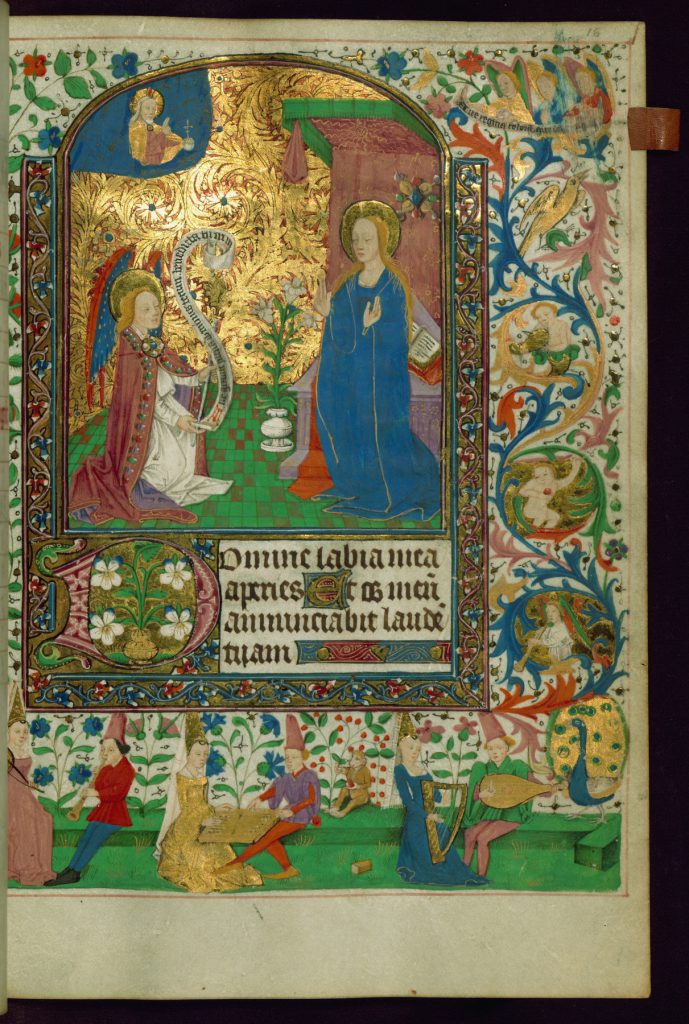
Within a foliate border, the verse of Psalm 50:17 (Domine labia mea aperies et os meum annuntiatbit laudem tuam) fits between a framed image of the Annunciation above, with an opened book on a lectern and and inscribed unrolled scroll. The foliate border includes an ‘inhabited’ scrolling stem at the right, with angels, humans, and birds; and a garden scene below, where human couples play musical instruments and backgammon.

Baltimore, The Walters Art Museum, MS M.269, folio 16r. Book of Hours, France, circa 1460. Image courtesy The Walters Art Museum by CC0 License via https://www.thedigitalwalters.org/Data/WaltersManuscripts/html/W269/.

Program

Saturday 25 March 2023

9:30 am – 5:00 pm EDT (GMT-4) online by Zoom
with registration through Eventbrite
via 2023 RGME Spring Symposium “From the Ground Up”

Session 1.  “Laying the Groundwork”
9:30 – 11:00 am EDT (GMT -4)

Welcome and Introduction

Mildred Budny (Director, Research Group on Manuscript Evidence)

Opening Keynote Presentation

Linde M. Brocato (Cataloging & Metadata Librarian, University of Miami Libraries)
“Grounding the Work, Making the Book”

Presider:  Mildred Budny

Coffee Break
11:15 – 11:30 am EDT

Session 2.  “The Lay of the Land”
11:30 am – 1:00 pm EDT

Presider:  Jennifer Larson (Department of Classics, Kent State University)

Ann Pascoe-Van Zyl (School of English, Trinity College, Dublin)
“Landscape and the Mind in Exile: Four Old English Elegies”

Justin Hastings (The John Dickinson Writings Project, University of Delaware)
“The Horatian Ground of John Dickinson’s Farmer Persona”

Hannah Goeselt (Library and Information Science (MS): Cultural Heritage Informatics, Simmons University, Boston)
      and
Zoey Kambour (Post Graduate Fellow in European & American Art at the Jordan Schnitzer Museum of Art at the    University of Oregon)
“Where Are We Now?  Informal Updates since Last Year’s RGME Symposia”

Lunch Break
1:00 – 1:45 pm EDT

Session 3.  “Materials & Margins”
1:45 – 3:15 pm EDT

Presider:  Jaclyn Reed (Department of English and Writing Studies, University of Western Ontario)

Atria A. Larson (Associate Professor of Medieval Christianity, Saint Louis University)
“Gallery of Glosses:
An NEH-Funded Digital Humanities Project that Cultivates Scholarly Attention to Manuscript Margins”

David W. Sorenson (Allen G. Berman, Professional Numismatist)
“Examples of Paleography and Paper in dated Jain Manuscripts of the 15th through 19th Centuries”
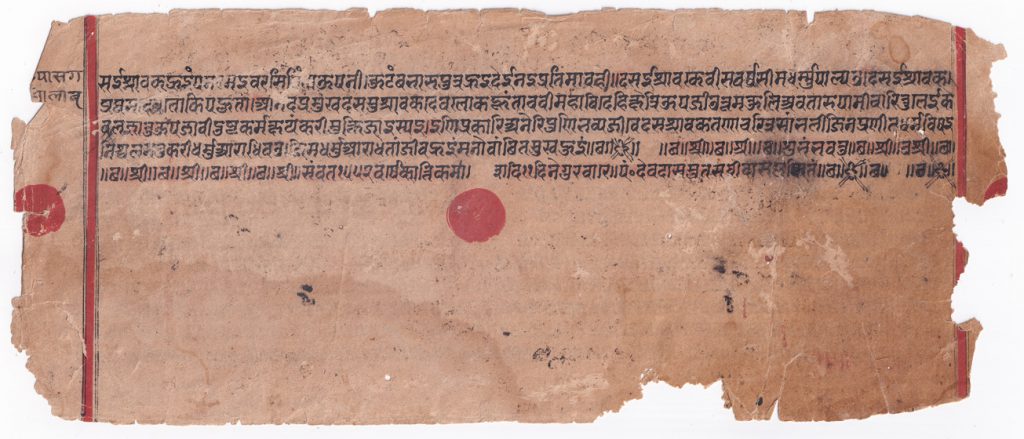
Private Collection, Jain manuscript on paper, dated Vikrama Samvat (VS) 1552 = AD 1496 by colophon.

Private Collection, Jain manuscript on paper, dated Vikrama Samvat (VS) 1552 = AD 1496 by colophon.

Tea Break
3:15 – 3:30 pm EDT

Session 4.  “The Living Library (Part III):
Manuscripts & Collections as Sources for Teaching & Research”
3:30 – 5:00 pm EDT

Presider:  Justin Hastings

Ronald Patkus (Head of Special Collections
          and Adjunct Associate Professor of History on the Frederick Weyerhaeuser Chair, Vassar College)
“Nicholas B. Scheetz’s Medieval and Renaissance Manuscripts at Vassar:
A Teaching Collection for a Teaching Collection”

Katharine C. Chandler (Special Collections and Serials Cataloger, University of Arkansas Libraries)
“Sister Manuscripts from the Carthusian Monastery of Chartreuse de Champmol”

Concluding Remarks:

Mildred Budny (Director, Research Group on Manuscript Evidence)
“Material Grounds for  Teaching, Study, and Varieties of Access”

*****

In keeping with the 2023 Theme of “Materials & Access” and the focus of attention in the Spring Symposium “From the Ground Up”, we may celebrate the emergence of fresh shoots and blooms as Winter turns to Spring, and the earth revives its cycle of growth and renewal.

We note that the date selected for this Spring Symposium, 25 March, represents the celebration of, among other things, the Feast of the Annunciation in the Christian liturgical calendar and the occurrence of the spring (or vernal) equinox (see also March equinox.
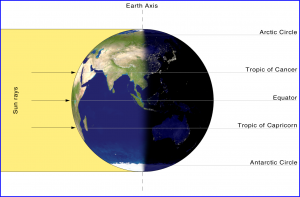
Image of illumination of earth by the sun on the Spring or Autumn Equinox (Vernal and Autumnal)

Depiction of the llumination of Earth by the Sun on the Spring or Autumn Equinox (Vernal and Autumnal) Image by Przemyslaw “Blueshade” Idzkiewicz via cc-by-sa license.

This is the second time that a RGME Spring Symposium included the date of 25 March in its events stretching over more than one day.  See the 2012 Symposium on “Words and Deeds” Report for our Symposium on 25–26 March 2016 at Princeton University.

We thank the contributors and advisers for help in organizing this event, as well as its new companion the Pre-Symposium.

  • 2023 RGME ‘Pre-Symposium’ on “Intrepid Borders”
  • 2023-spring-symposium-from-the-ground-up (You are Here)

*****

Registration

Registration for the Pre-Symposium and the Spring Symposium is required for each event.

Registration for these events can be made through their portals:
  • “Intrepid Borders” Pre-Symposium for 2023 Spring Symposium
  • 2023 RGME Spring Symposium “From the Ground Up”
Photograph of the stems and white blooms of Snowdrops emerging from a patch of bare ground in the sunlight. Photograph Ⓒ Mildred Budny.

The blooms of Snowdrops emerging “From the Ground Up”. Photograph Ⓒ Mildred Budny.

The Program Booklet

Printed copies of the 2023 Spring Symposium Program Booklet can be distributed on request to participants and others.  If you wish a printed copy, please contact please contact director@manuscriptevidence.org and provide your mailing address.

The digital version can be downloaded freely here.  We provide two formats, or ‘flavors’, of the digital Program Booklet, in consecutive pages and as a foldable booklet.  The choice depends upon your printing facilities and preferences.  Experience shows that the choice can be helpful.

  • Consecutive Pages (quarto size, or 8 1/2″ × 11″ sheets)
    consecutive pages
  • Foldable Booklet (11″ × 17″ sheets), to be folded in half, producing a nested group of bifolia
    foldable booklet

Please note that some images are included in the booklet through the License or Contract stipulating their reproduction for this publication alone.  We ask you to respect these conditions.

We thank the contributors, private collectors, and institutions for the images and the permission to reproduce them.  We wish also to extend thanks to these individuals, for their extra efforts in this quest:  Ágnes Kelecsényi and Judit Jabloknay of the Library of the Hungarian Academy of Sciences; and Graham Fereday and Gary Stringer of the Digital Humanities – Library and Culture Services of the University of Exeter; Exeter Cathedral Library.

Thanks also are due to the authors, photographers, owners and providers of photographs, organizers, compilers, editors, copy-editors, images and permissions researcher, typesetter, layout designer, proof-readers, printer, web-editor, and others.

That most of these tasks required for producing and publishing the booklet are carried out — and to the level of proficiency manifested on the pages — by one or two volunteers is a tribute to the collegial collaboration and dedication of our nonprofit educational organization, which has no paid staff whatsoever, and which has a shoestring budget.  That budget is itself the product almost entirely of the generosity of volunteer donations, year by year.

These results can be accomplished mostly because of the pro-bono donations by so many contributors, who help to make the events possible, and for whom we give steady thanks.

*****

2023 RGME Events

Other Events are planned for the Year.  See
  • “The Research Group Speaks”: The Series
  • 2023 International Congress on Medieval Studies: Program for Thursday 11 to Saturday 13 May 2023
  • 2023 Autumn Symposium “Between Earth and Sky”
    Registration here: 2023 Autumn Symposium Tickets for Saturday 21 October 2023 by Zoom
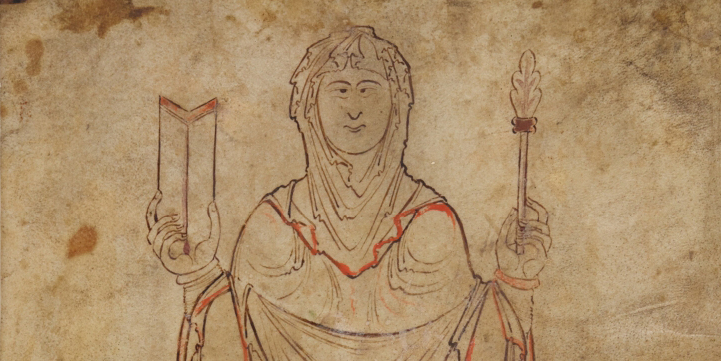
Philosophy personified as female figure, wearing headveil and mantle, holding at both sides a raised book and a foliate-topped scepter. Frontispiece figure for Boethius' Consolation of Philosophy.

Trinity College, Cambridge, MS O.3.7, fol. 1r, top. Philosophy Personified, with book and scepter. Frontispiece figure for Boethius’ Consolation of Philosophy. Image via CC 4.0 International License, via https://mss-cat.trin.cam.ac.uk/Manuscript/O.3.7. Image cropped here to detail (unchanged otherwise).

Suggestion Box

Please Contact Us or visit:

  • our FaceBook Page
  • our Twitter Feed (@rgme_mss)
  • our Blog on Manuscript Studies and its Contents List

Donations and contributions, in funds or in kind, are welcome and easy to give.  See Contributions and Donations.

We look forward to hearing from you.

*****

"Centered". Photograph Ⓒ 2014 Mildred Budny. Image of Dew at the center of Sedum.

“Centered”. Photograph Ⓒ 2014 Mildred Budny.

*****

Tags: Annunciation, Chartreuse de Champmol, Early Books, Glossing Glosses, History of Paper, Jain Manuscripts, John Dickinson, Manuscript Decoration, Manuscript Illustration, Manuscript studies, Manuscripts at Vassar College, Materials & Access, Nicholas B Sheetz Collection, Old English Elegies, Palaeography, RGME Symposia
No Comments »

Program for 2022 Autumn Symposium on “Supports for Knowledge”

October 6, 2022 in Announcements, Conference Announcement, Manuscript Studies, Uncategorized

2022 RGME Spring and Autumn Symposia
on “Structured Knowledge”

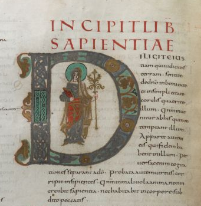
© British Library Board, London, British Library, Add. MS 1546, folio 262v, detail. Opening of the Book of Sapientia (“Wisdom”).

2 of 2: 2022 Autumn Symposium
“Supports for Knowledge”
Saturday, 15 October 2022

Symposium Program
9:00 am – 5:30 pm EDT
Online via Zoom

Sessions with Presentations and Discussion (“Q&A”)
Breaks for Coffee, Lunch, and Tea
Closing Keynote Presentation and Concluding Remarks

For Registration see below

[Posted on 5 October, with updates]

On the pair of Symposia, see 2022 Spring and Autumn Symposia
On Part 1 of this pair, see 2022 Spring Symposium on “Structures of Knowledge”
On Part 2, see 2022 Autumn Symposium on “Supports for Knowledge”

Here we present the Program for Part 2 on “Supports for Knowledge”, held on Saturday 15 October 2022 by Zoom
— Registration is required, with a limited number of places (see below).

The Program Booklet (in preparation) will present the Program and Abstracts of the Presentations and Responses, with multiple Illustrations.  In accordance with our tradition of Program Booklets for our Symposia and some other events (see our Publications, it will be issued in printed form as well as digital form, with a downloadable pdf.

Timetable

Session 1.    9:00–10:30 am EDT
Brief Introduction to the Symposium and Welcome
“Teaching with (and through) Manuscripts, Part II”
Q&A

Break.          10:30–10:45 am

Session 2.   10:45 am – 12:15 pm
“Catalogs, Metadata, and Databases, Continued (Part III)”
Q&A

Lunch Break.   12:15–1:15 pm

–– During the Break.  12:30–12:50 pm

Presentation (at the time when the Speaker could attend)

David W. Sorenson (Allen Berman, Numismatist)
“A Jain Manuscript of the Seventeenth Century on Imported Watermarked Paper: An Early, Dated, Witness to Imported Paper Stocks in Indian Manuscripts”
As a contribution to our series on the “History and Uses of Paper”

Session 3.    1:15–2:45 pm
“The Living Library (Part II)”
Q&A

Break.          2:45–3:00 pm

Session 4.   3:00–4:30 pm
“Hybrid Books (Part I)”
Q&A

Break.         4:30–4:45 pm

Session 5.   4:45–5:30 pm EDT
“Books and Their Structures”
Closing Keynote Presentation and Concluding Remarks

*****

Sessions

Session 1.  “Teaching with (and through) Manuscripts, Part II”
— continuing the series begun at the Spring Symposium on “Structures of Knowledge”

Presider

David Porreca (Department of Classical Studies, University of Waterloo)

Speakers

Caley McCarthy (Research Associate and Project Manager, Environments of Change, University of Waterloo)
and
Andrew Moore (Research Fellow, Environments of Change, and Associate Director, DRAGEN Lab, University of Waterloo)
“Collaborative Pedagogy with Medieval Manuscripts in a Digital Lab”

William H. Campbell (Director, Center for the Digital Text, University of Pittsburgh-Greensburg)
Amber McAlister (Assistant Professor, History & Architecture, University of Pittsburgh-Greensburg)
and
Connor Chinoy (Student at the University of Pittsburgh-Greensburg and member of the “History of the Book” class)
“Books in the Flesh: An Interdisciplinary Undergraduate Class with Medieval Manuscripts”

Q&A

*****

Mid-Morning Break

*****

Session 2.  “Catalogs, Metadata, and Databases, Continued (Part III)”
— continuing our series
This is Part III in our series on these subjects, building upon Parts I and II, and leading to further Parts in 2023

  • our Roundtable in February on Catalogs, Metadata, and Databases, Part I and
  • the Session on “Catalogs, Metadata, and Databases, Part II” in the Spring Symposium

See the Links of Interest (Catalogs , Metadata, and Databases: A Handlist of Links)
— for which suggestions and additions are welcome.

Presider

Jessica L. Savage (Art History Specialist, Index of Medieval Art)

Speakers

Jessica L. Savage
“Cataloguing Manuscript Iconography between Digital Covers at the Index of Medieval Art”

Barbara Williams Ellertson (The BASIRA Project and Research Group on Manuscript Evidence)
“A Painter, a Printer, and a Search for Shared Exemplars”

Katharine C. Chandler (Special Collections and Serials Cataloger, University of Arkansas Libraries)
“Manuscripts from Print: The Schwenkfelders and their Dangerous Books”

Respondent

David Porreca (Department of Classics, University of Waterloo)
“My $0.02 Worth”

Moderator for the Questions-and-Answers

Derek Shank (Research Group on Manuscript Evidence)

Q&A

*****

Lunch Break

Perhaps — TBD — during part of the Break
Presentation (from about 12:15–12:35 pm), if the Speaker might attend, depending on short-notice work timetables:

David W. Sorenson (Allan Berman, Numismatist)
“A Jain MS of the Seventeenth Century on Imported Watermarked Paper:  An Early, Dated, Witness to Imported Paper Stocks in Indian Manuscripts”

*****

Session 3.  “The Living Library (Part II)”

— continuing the series begun at the Spring Symposium on “Structures of Knowledge”

Presider

Jaclyn Reed (Department of English and Writing Studies, University of Western Ontario)

Speakers

Christine E. Bachman (Department of Art & Art History, University of Colorado at Boulder)
“Unbound, Dispersed, Resewn:  The Flexible Codex in Eighth-Century Northwestern Europe”

Zoey Kambour (Post Graduate Fellow in European & American Art at the Jordan Schnitzer Museum of Art at the University of Oregon)
“Textual Interaction Through Artistic Expression:  The Marginal Drawings in the Decretales Libri V of Pope Gregory IX (University of Oregon MS 027)”

David Porreca (Department of Classical Studies, University of Waterloo)
“The Warburg Institute Library:   Where Idiosyncracy Meets User-Friendliness”

Respondent

Thomas E Hill (Art Librarian, Vassar College)
“Some Early Background to Warburg’s Project in Post-Wunderkammer Systematic Catalogues of the European Baroque and Enlightenment Periods”

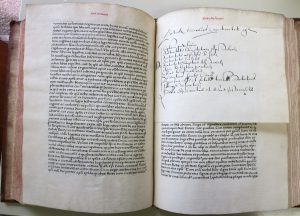
Le Parc Abbey, Theological Volume, Part B and added Part-Leaf between folios 103–104 (or folios "7"–"8").

Private Collection, Le Parc Abbey, Theological Volume, Part B and added Part-Leaf (or Bookmark) between folios 103–104. Photography Mildred Budny.

Q&A

*****

Mid-Afternoon Break

*****

Session 4.  “Hybrid Books (Part I)”

— beginning a series for which more sessions are planned

Presider

Justin Hastings (University of Delaware)

Speakers

Hannah Goeselt (Library and Information Science (MS): Cultural Heritage Informatics, Simmons University, Boston)
“Structures of Art and Scripture in Otto Ege’s ‘Cambridge Bible’ (Ege Manuscript 6)”

Jennifer Larson (Department of Classics, Kent State University)
“Printed and Scribed:  A Collector’s View of Hybrid Books”

Linde M. Brocato (Cataloging & Metadata Librarian, University of Miami Libraries)
“Paths of Access and Horizons of Expectation, II:  From Book-In-Hand to Catalog(ues)”

N. Kıvılcım Yavuz (Lecturer in Medieval Studies and Digital Humanities, School of History, University of Leeds)
“Bound With:  Towards a Typology of Hybrid Codices”

Q&A

*****

Tea Break

*****

Session 5. “Books and Their Structures”

Presider

Mildred Budny (Director, Research Group on Manuscript Evidence)

Closing Keynote Presentation

Linde M. Brocato (Cataloging & Metadata Librarian, University of Miami Libraries)
“Hybrid Books: Fragments and Compilatio, Structure and Heuristic in Richard Twiss’s Farrago”

Discussion & Brief Concluding Remarks

Mildred Budny
“Structured Knowledge, Structures of Knowledge, and Supports for Knowledge:  A Framework for the Year”

*****

Closing Keynote Presentation

“Hybrid Books:
Fragments and Compilatio, Structure and Heuristic in
Richard Twiss’ Farrago“

In the group of artists’ books from the Ruth and Marvin Shackner Archive of Concrete Poetry purchased by the University of Miami Special Collections, there is an extraordinary volume, sold by a vendor as late 19th century, anonymous, and an artist’s book avant la lettre.  Careful analysis for bibliographical cataloging revealed the error in all these assertions.

In this presentation, I will lay out both the process of that analysis, and its results, along with reflections on hybrid books of various kinds.  My reflections will encompass the kinds of structured information that make their way into databases, and structuring codes of cataloging and bibliography, all of which are necessary but not sufficient for our understanding and convivencia with books , which are always already hybrid.  In these reflections, I will bring together many of the strands of thinking we have all worked to weave together in the symposium.

Richard Twiss, Farrago, held in the Unversity of Miami Special Collections, Artists’ Books Collection. Sidelong View. Photograph Linde M. Brocato.

Glimpses of the volume comprising Farrago compiled by the writer, traveler, chess-player, and would-be paper manufacturer Richard Twiss (1749–1821) can be seen in our blogpost called “I Was Here”, with photographs by Linde M. Brocato.

Concluding Remarks

Mildred Budny
“Structured Knowledge, Structures of Knowledge, and Supports for Knowledge: A Framework for the Year”

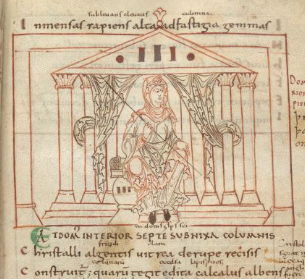
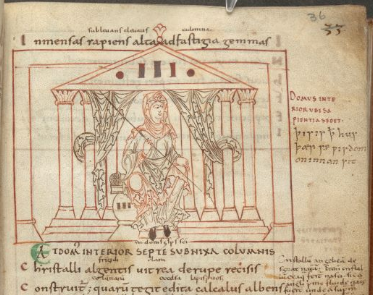
© British Library Board, London, British Library, Cotton MS Cleopatra C. viii, folio 36r, top: Sapientia in her Temple. Prudentius, Psychomachia, in a Canterbury copy of the late tenth or early eleventh century.

*****

To register for the Symposium, visit 2022 Autumn Symposium Registration. Places are limited.

Questions? Contact director@manuscriptevidence.org.

*****

Suggestion Box

Do you have suggestions for subjects for our events, or offers to participate? Please let us know.

If you wish to join our events, please contact director@manuscriptevidence.org.

For updates, watch this space, and visit:

  • 2022 Spring and Autumn Symposia
  • The Research Group Speaks: The Series;
  • our FaceBook Page and
  • our Twitter Feed (@rgme_mss).

Please leave your Comments below, Contact Us, and visit our FaceBook Page and Twitter Feed (@rgme_mss).  We look forward to hearing from you

We invite you to donate to our nonprofit educational mission. Donations may be tax-deductible. We welcome donations in funds and in kind:

  • Contributions and Donations .

Floral Motif as Lower Border in a Book of Hours. Photography Mildred Budny.

*****
 

Tags: Catalogs & Metadata & Databases, Decretals of Pope Gregory IX, DRAGEN Lab, Fragmentology, History of Paper, Hybrid Books, Index of Medieval Art, Jain Manuscripts, Les Enluminures, Medieval Manuscript Fragments, Medieval manuscripts, Miniature Books, Otto Ege Manuscript 8, Otto Ege Manuscripts, RGME Symposia, Richard Twiss's Farrago, Schwenkfelder Books, Structured Knowledge, Teaching with and through Knowledge, Teaching with Manuscripts, The Living Library, University of Oregon MS 027, Warburg Institute Library, Watermarked Paper, Watermarks
No Comments »

2022 Autumn Symposium on “Supports for Knowledge”

April 7, 2022 in Announcements, Conference, Conference Announcement, Manuscript Studies

2022 RGME Spring and Autumn Symposia
on “Structured Knowledge”

© British Library Board, London, British Library, Add. MS 1546, folio 262v, detail. Opening of the Book of Sapientia (“Wisdom”).

2 of 2: Autumn Symposium
“Supports for Knowledge”
Saturday, 15 October 2022
Online

9:00 am – 5:30 pm EDT with Sessions, Discussion, and Breaks

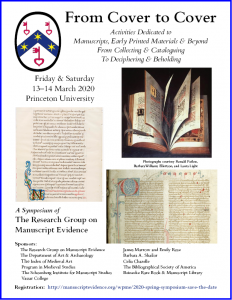
2020 Spring Symposium "From Cover to Cover" Poster 2

2020 Spring Symposium Poster 2

[Posted on 5 April 2022 with updates]

In 2022, the Research Group returns to our series of Symposia (formerly held in person). The series underwent an interruption with the cancelled 2020 Spring Symposium, “From Cover to Cover”. See its record in the illustrated Program Booklet, with Abstracts of the planned presentations and workshops. Its core and its promise inspire this renewal.

This year, each Symposium in the pair is designed as a one-day event, with sessions and workshops of about 1 and 1/2 hours, giving scope for discussion. The Spring Symposium was held online by Zoom. The Autumn Symposium would be held online, but, conditions permitting, it might be hybrid, that is, partly in person, as well as online. See 2022 Spring and Autumn Symposia.

  1.  Structures of Knowledge (Spring)
  2.  Supports for Knowledge (Autumn)

These events, by request, flow in addition to — and partly from — our other activities during the year:

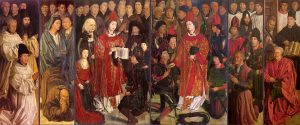
Lisbon, Museu Nacional de Arte Antiga: The mid 15th-century Saint Vincent Panels, attributed to Nuno Gonçalves. Image via Creative Commons.

1) Continuing Episodes in the online series of The Research Group Speaks (2021–)

  • https://manuscriptevidence.org/wpme/the-research-group-speaks-the-series/
  • Catalogs, Metadata, and Databases (Part I)

2) Our four sponsored and co-sponsored Congress Sessions at the 57th International Congress on Medieval Studies (online) in May

  • https://manuscriptevidence.org/wpme/2022-international-congress-on-medieval-studies-program
    (Abstracts of the Papers are included).

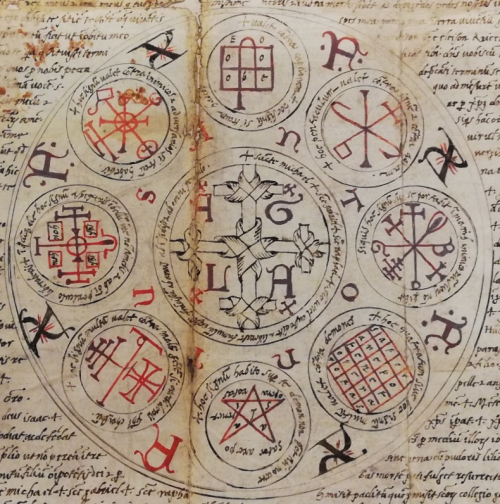
© The British Library Board. Additional MS 15505, folio 22r. Italian, early 16th century. Circular diagram with coloured drawings of nine magical seals, as a textual amulet with charms against diseases.

Structured Knowledge (Parts I and II)

The interlinked pair of Spring and Autumn Symposia examine themes of Structured Knowledge.

Some proposed presentations at these Symposia offer refreshed materials which had been planned for the cancelled 2020 Spring Symposium.

  • See https://manuscriptevidence.org/wpme/2020-spring-symposium-save-the-date, with a published Program Booklet including illustrations and Abstracts.
The Spring Symposium is dedicated to “Structures of Knowledge”. The Autumn Symposium considers “Supports for Knowledge”. Sessions include approaches to databases and library catalogs; specific case studies and projects; issues relating to reproductions and display , research and teaching, and more.

Part I: Spring Symposium (Saturday, 2 April 2022)
on “Structures of Knowledge”

  • See 2022 Spring Symposium on “Structures of Knowledge”

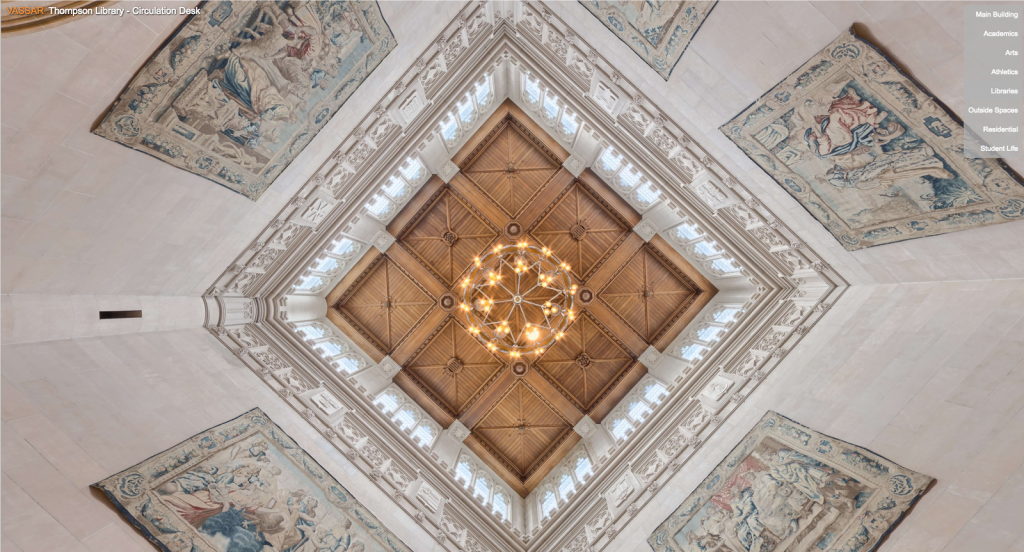
Vassar College, Frederick Thompson Memorial Library, Entry, Ceiling and Gobelin Tapestry Series.

Part II: Autumn Symposium (Saturday, 15 October 2022)
on “Supports for Knowledge”

For link to register for the Symposium, see below.

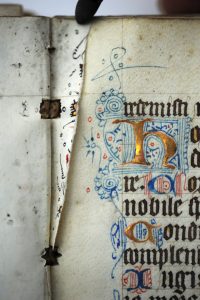
Private Collection, Book of Hours, Decorated Initial and Stub from Despoiled Leaf. Photography Mildred Budny.

Sessions include approaches to books, libraries, catalogues, and databases; case studies, projects, and work-in-progress and projects examining individual original sources or groups of them; the history, uses, and reuses of books and their materials; issues, opportunities, and successes in research and teaching; and more.

Speakers, Respondents, and Presiders:

Christine E. Bachman, Linde M. Brocato, Mildred Budny, William H. Campbell, Katharine C. Chandler, Connor Chinoy, Barbara Williams Ellertson, Hannah Goeselt, Justin Hastings, Thomas E. Hill, Zoey Kambour, Jennifer Larson, Amber McAlister, Caley Macaulay, Andrew Moore, David Porreca, Jaclyn Reed, Jessica L. Savage, Derek Shank, Kate Schmidt, David W. Sorenson, and N. Kıvılcım Yavuz.

Timetable

Session 1.    9:00–10:30 am EDT by Zoom

Coffee Break.          10:30–10:45 am

Session 2.   10:45 am – 12:15 pm

Lunch Break.   12:15–1:15 pm

Session 3.    1:15–2:45 pm

Tea Break.          2:45–3:00 pm

Session 4.   3:00–4:30 pm

Break.         4:30–4:45 pm

Session 5.   4:45–5:30 pm EDT
Closing Keynote Presentation, Discussion, and Concluding Remarks

Sessions

1.  “Teaching with (and through) Manuscripts, Part II”

— Part II in our series on these subjects, building upon Part I in the Spring Symposium.

— including presentations by:
Caley McArthur and Andrew Moore, representatives of the Team from the DRAGEN Lab, at the University of Waterloo, reporting on “initiatives in our lab to train students, both undergraduate and graduate, in medieval paleography”; and
William H. Campbell and his colleagues and students, Amber McAlister, Kate Schmidt, and Connor Chinoy, on the experience of teaching an undergraduate course this summer using the Les Enluminures Manuscripts in the Curriculum program at the University of Pittsburgh-Greensburg.

2. “Catalogs, Metadata, and Databases, Continued (Part III)”

— Part III in our series on these subjects, building upon our Roundtable in February on Catalogs, Metadata, and Databases, Part I and the Session on “Catalogs, Metadata, and Databases, Part II” in the Spring Symposium.

— including presentations by:
Jessica L. Savage
on “Cataloguing Manuscript Iconography between Digital Covers at the Index of Medieval Art”;
Katharine C. Chandler on “Manuscripts from Print: The Schwenkfelders and their Dangerous Books”; and
Barbara Williams Ellertson on “A Painter, a Printer, and a Search for Shared Exemplars”
(focusing upon Giovanni Bellini’s painting of Saint Benedict and his Book);
with a response by David Porreca on “My $0.02 Worth”.

For this Session, Jessica Savage and Barbara Williams Ellertson revive, update, and expand the presentations which they had prepared for the 2020 Spring Symposium, which had to be cancelled; their Abstracts then appear in its freely-available Program Booklet, published as a souvenir or token of the intentions for the event.

For the subject of this series, see the Links of Interest (Catalogs, Metadata, and Databases: A Handlist of Links), for which suggestions and additions are welcome.

3.  “The Living Library (Part II)”

Part II in the series, building upon Part I at the Spring Symposium
— including
Christine E. Bachman on “Unbound, Dispersed, Resewn:  The Flexible Codex in Eighth-Century Northwestern Europe”;
Zoey Kambour on interactions between scribes, readers, and text in a copy of the Decretals of Pope Gregory IX at the University of Oregon;
David Porreca‘s presentation which had been planned for our Spring Symposium:  “The Warburg Institute Library: Where Idiosyncracy Meets User-Friendliness”; and
Thomas E. Hill‘s response on systems of structuring libraries in Germany from the Baroque and Enlightenment periods.

4.  “Hybrid Books (Part I)”

Part I in a continuing series
— including
Hannah Goeselt on “Structures of Art and Scripture in Otto Ege’s ‘Cambridge Bible’ (Ege Manuscript 6)”;
Jennifer Larson‘s presentation of selected examples of types of “Hybrid Books” in her collection of miniature books;
Linde M. Brocato‘s demonstration, using some of Jennifer’s examples, of how to catalog such cases; and
N. Kıvılcım Yavuz‘s response on decision-making processes involved in producing codices composed of handwritten and printed components, with a proposal of ways of differentiating among different types of hybrid codices.

[Note:  Depending upon variable work timetables, David W. Sorenson might be able to attend at some point during the day to present preliminary findings on “A Jain MS of the Seventeenth Century on Imported Watermarked Paper”.]

Closing Keynote Presentation

Linde M. Brocato
“Hybrid Books:  Fragments and Compilatio, Structure and Heuristic in Richard Twiss’ Farrago”
[For glimpses of this book, see our blogpost called “I Was Here”.]

“In these reflections, I will bring together many of the strands of thinking we have all worked to weave together in the symposium.”

Richard Twiss, Farrago, held in the Unversity of Miami Special Collections, Artists’ Books Collection. Sidelong View. Photograph Linde M. Brocato.

Concluding Remarks

Mildred Budny
“Structured Knowledge, Structures of Knowledge, and Supports for Knowledge:  A Framework for the RGME Year 2022”

*****

© British Library Board, London, British Library, Cotton MS Cleopatra C. viii, folio 36r, top: Sapientia in her Temple. Prudentius, Psychomachia, in a Canterbury copy of the late tenth or early eleventh century.

The Schedule

For details see the 2022 Autumn Symposium Program.

Registration

Please register for the Symposium.  Space is limited.  Visit 2022 Autumn Symposium Registration.

Questions? Contact director@manuscriptevidence.org.

*****

Other Activities

Besides the 2022 Spring and Autumn Symposia , the Research Group

  • sponsors and co-sponsors Sessions at the ICMS (see our 2022 Congress Program and 2023 International Congress on Medieval Studies Preparations)
  • prepares more online Episodes for The Research Group Speaks: The Series
  • plans events for 2023, including online Open Business Meetings and a pair of Symposia (Spring and Autumn)
  • prepares publications in various forms from these events, research work, discoveries, and divers materials, including our blog on Manuscript Studies (see its Contents List) and more Research Booklets.

Suggestion Box

Do you have suggestions for subjects for our events, or offers to participate? Please let us know.

If you wish to join our events, please contact director@manuscriptevidence.org.

For updates, watch this space, see 2022 Spring and Autumn Symposia and The Research Group Speaks: The Series; and visit our FaceBook Page and Twitter Feed (@rgme_mss).

Floral Motif as Lower Border in a Book of Hours. Photography Mildred Budny.

We invite you to donate to our nonprofit educational mission. Donations may be tax-deductible. We welcome donations in funds and in kind:

  • Contributions and Donations .

Please leave your Comments below , Contact Us, and visit our FaceBook Page and Twitter Feed (@rgme_mss).  We look forward to hearing from you.

© British Library Board, London, British Library, Add. MS 1546, folio 262v, detail. Opening of the Book of Sapientia (“Wisdom”) in the Moutier-Grandval Bible, an imposing Carolingian manuscript of the Latin Vulgate Bible.

*****

Tags: Catalogs & Metadata & Databases, Giovanni Bellini, Hybrid Books, Index of Medieval Art, Manuscripts in the Curriculum, Otto Ege Manusript 6, RGME Symposia, Richard Twiss's Farrago, Structured Knowledge, Teaching with and through Manuscripts, The Living Library, Warburg Institute Library
No Comments »

2022 Spring Symposium on “Structures of Knowledge”

March 15, 2022 in Abstracts of Conference Papers, Conference, Conference Announcement, Uncategorized

2022 RGME Spring and Autumn Symposia
on “Structured Knowledge”

1 of 2: Spring Symposium
“Structures of Knowledge”
Saturday, 2 April 2022 (Online)

2020 Spring Symposium "From Cover to Cover" Poster 2

2020 Spring Symposium Poster 2

[Posted on 15 March 2022, with updates]

In 2022, the Research Group returns to our series of Symposia (formerly held in person). The series underwent an interruption with the cancelled 2020 Spring Symposium, “From Cover to Cover”. See its record in the illustrated Program Booklet, with Abstracts of the planned presentations and workshops. Its core and its promise inspire this renewal.

This year, each Symposium in the pair is designed as a one-day event, with sessions and workshops of about 1 and 1/2 hours, giving scope for discussion. The Spring Symposium will be held online by Zoom. (The Autumn Symposium would be held online, but, conditions permitting, it might be hybrid, that is, partly in person, as well as online.) See 2022 Spring and Autumn Symposia.

  1. Structures of Knowledge (Spring)
  2. Structures for Knowledge (Autumn)

These events, by request, flow in addition to — and partly from — our other activities during the year:

1) Continuing Episodes in the online series of The Research Group Speaks (2021–)

  • https://manuscriptevidence.org/wpme/the-research-group-speaks-the-series/
  • Catalogs, Metadata, and Databases (Part I)

2) Our four sponsored and c0-sponsored Congress Sessions at the 57th International Congress on Medieval Studies (online) in May

  • https://manuscriptevidence.org/wpme/2022-international-congress-on-medieval-studies-program
    (Abstracts of the Papers are included).

Structured Knowledge (Parts I and II)

The interlinked pair of Spring and Autumn Symposia examine themes of Structured Knowledge.

Some proposed presentations at these Symposia offer refreshed materials which had been planned for the cancelled 2020 Spring Symposium.

  • See https://manuscriptevidence.org/wpme/2020-spring-symposium-save-the-date, with a published Program Booklet including illustrations and Abstracts.
The Spring Symposium is dedicated to “Structures of Knowledge”. The Autumn Symposium considers “Supports for Knowledge”. Sessions include approaches to databases and library catalogs; specific case studies and projects; issues relating to reproductions and display, research and teaching, and more.

Part I: Spring Symposium (Saturday, 2 April 2022)
on “Structures of Knowledge”

Note: If you wish to register for the Symposium, please contact director@manuscriptevidence.org.

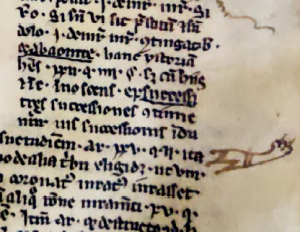
Eugene, Oregon, University of Oregon, Knight Library, MS 027, folio 25r. Manicle as outstretched paw, with cuff. Photography Zoey Kambour.

Presenters, Respondents, and Presiders for the Spring Symposium include (in alphabetical order): Phillip A. Bernhardt-House, Linde M. Brocato, Mildred Budny, Katharine C. Chandler, Barbara Williams Ellertson, Howard German, Hannah Goeselt, Thomas E. Hill, Eric. J. Johnson, Zoey Kambour, David Porreca, Jessica L. Savage, Derek Shank, Ronald Smeltzer, and David W. Sorenson.

As the Program evolves, adapting to changes in some speakers’ plans or requirements, we thank all the speakers who responded willingly to such changes, even at short notice, for example by expanding an intended “Response” to a “Presentation”, or the reverse, so as to keep to the time-allotments of the Sessions. We also thank the Presiders for their help in monitoring each of the Sessions during the course of the Symposium.
We acknowledge, with thanks, the renewed sponsorship of the Symposia this year by Barbara A. Shailor.

Read the rest of this entry →

Tags: Advertisements in Early Scientific Publications, BASIRA Project, Book Arts, CANTUS Chant, Decretals of Gregory IX, Esoterica, Fragmentarium Database, Gobelin Tapestries, History of Cataloging, History of Paper, Library Catalogues, Lima (OH) Public Library Staff Loan Assistance Fund, Louise Ege, Manuscript studies, Otto Ege Collection, Otto Ege Manuscript 6, Otto F. Ege, Shahnameh, Structured Knowledge, Structures of Knowledge, Tale of Cupid and Psyche, The Ohio State University, University of Oregon MS 027, Vassar College Library, Warburg Institute Library
No Comments »

2022 Congress Preparations

July 16, 2021 in Announcements, Conference, Conference Announcement, Ibero-Medieval Association of North America, IMANA, International Congress on Medieval Studies, Kalamazoo, Societas Magica

Call for Papers (CFP) for Sessions
Sponsored or Co-Sponsored by the RGME

at the 57th International Congress on Medieval Studies (Online)
Monday, May 9, through Saturday, May 14, 2022

CFP Deadline:  15 September 2021
[Deadline for Session Programs:  1 October 2021]

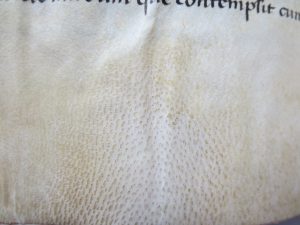
Le Parc Abbey, Theological Volume, Part B: Detail of Vellum Leaf.

Private Collection, Le Parc Abbey, Theological Volume, Part B: Detail of Vellum Leaf. Photography Mildred Budny.

[Update on 22 September 2021:
Following the close of the CFP on 15 September, we can welcome the received proposals for papers, observe their strength and range, and prepare the programs for each session.  With the selection of proposed papers accomplished, it comes time to arrange their sequence within the given Sessions, assign the Presiders for them, and submit the programs to the Congress Committee by 1 October 2021.

When appropriate, we can announce the Programs, report the assignment of their scheduling within the Congress Program overall, and publish the Abstracts of the Papers and Responses, as the authors might be willing. The Congress Program will become available in due course, and registration for the online Congress might commence.

Update on 1 October 2021:
At the close of the deadline for submission of the programs to the Congress, we report that each of our Sessions has three or four Papers; three sessions also have Responses; and we plan to hold a Business Meeting at the Congress, as in previous years.  All these activities are to take place online.]

[Posted on 15 July 2021]

After accomplishing the 2021 ICMS Online, with 5 Sponsored and Co-Sponsored Sessions, plus our Open Business Meeting, we produced the 2021 Congress Report, as we turned to preparations for the 2022 Congress.  We proposed Sessions, and received answers in stages.

Through the Confex system for the 2022 International Congress on Medieval Studies, we have learned that all but one of our proposed sessions have been accepted.

One of the accepted sessions resumes a series (“Medieval Writing Materials”) which a rejection for the 2015 Congress disrupted.  That rejection interfered with the momentum of our series of sessions on the subject at the 2011–2016 Congresses.  (See Sponsored Sessions.)  The interval between then and now is a long time to wait.  We had to turn to other subjects, as the momentum for their own action not only gathered to produce the proposals to sponsor or co-sponsor them, but also found favor by the Congress Committee, so that it could become possible to move to the phase of the Call for Papers for them. With the Pre-Congress Business Meeting in May 2021, as we prepared for this year’s Congress, we aimed to resume that series, as well as to explore other sessions as their subjects and proponents might direct.

So, we can resume the series on Medieval Writing Materials for 2022.  But a new rejection of another subject for the Congress leads us to reconsider our approach to its current momentum.  This time, learning from experience, we could choose what to do, but elsewhere, before long, with the subject not accepted this time around, rather than waiting for some other year — or decade — at the Congress.

And so, now, we announce the Call for Papers for the 2022 Congress.

Read the rest of this entry →

Tags: Ars Notaria, History of Alphabets, History of Magic, History of Paper, History of Paper Manufacture, History of Watermarks, Manuscript studies, Medieval Studies, Medieval Writing Materials
No Comments »

2021 International Congress on Medieval Studies Report

July 7, 2021 in Conference, Conference Announcement, International Congress on Medieval Studies, Kalamazoo, Reports

Report

Activities of the
Research Group on Manuscript Evidence
at the
56th International Congress on Medieval Studies
(10–15 May 2021)

#kzoo2021 / #kazoo2021

Baltimore, The Walters Art Museum, MS W.782, folio 15r. Van Alphen Hours. Dutch Book of Hours made for a female patron in the mid 15th century. Opening page of the Hours of the Virgin: "Here du salste opdoen mine lippen". Image via Creative Commons. At the bottom of the bordered page, an elegantly dressed woman sits before a shiny bowl- or mirror-like object, in order, perhaps, to perform skrying or to lure a unicorn.

Baltimore, The Walters Art Museum, MS W.782, folio 15r. Van Alphen Hours. Dutch Book of Hours. Image via Creative Commons.

We report the accomplishment of our activities at the 2021 ICMS, held entirely online. Individually and collectively, we have attended the Congress for many years.  Our ICMS blog records activities sponsored and co-sponsored by the RGME along the way.

This year’s Congress presented the first time for a totally “virtual” process.  Next year’s Congress will be the second.

The new format posed challenges, mostly surmounted.  Gladly we observe that, albeit with several technical glitches and scheduling issues, the activities of the RGME, both sponsored and co-sponsored, succeeded as we had wished.  The Sessions and Business Meeting proceeded smoothly, with time and scope for feedback and discussion.

How We Prepared

First, there was the cancellation of the 2020 Congress itself.  See our 2020 Congress Program Announced.

Then came the re-planning for the 2021 Congress.  Initially, it was designed to be held in person, like the 2019 Congress, and others before it.

Only after all the re-submissions of our intended 2020 Sessions to the Congress Committee, the completion of the 2021 Congress Call for Papers, the selection of the Session Programs, and the bookings for our Reception and Business Meeting (see our 2021 Congress Planning), did there come the decision that the 2021 Congress had to take place only online.

That choice led all 3 co-sponsors for our planned Reception —RGME, Societas Magica, and Index of Medieval Art — to agree that it makes sense to wait, instead, for such an event until a suitable occasion in person.  Likewise, a few rearrangements were required for the Sessions as had been planned.

Preparing for the 5 Sessions and our Open Business Meeting, we announced our Activities for the 2021 Congress Program.

Next came the Congress itself, as described in its own Program (plus Corrigenda), with further information on its website.

Sessions

Recorded Sessions

Vajra Regan presents his Paper for his 2021 Congress Session on “Prologues”.

With the virtual format, some Congress events were recorded, so as to be available for viewing by Congress Registrants from 17 to 29 May.  According with the participants’ wishes, 2 of our Sessions were recorded.  

  • Medieval Magic in Theory:
    Prologues to Learned Texts of Magic

Congress Session 103

  • Revealing the Unknown, II

    Congress Session 279

Thus were available, for a time, the chances to view and to re-view, a few of our activities ‘there’ this year.  For them and the others, this Report describes the accomplishment of the plans, already for the 2020 Congress, which had to be cancelled.  This year’s Congress gave the opportunity to complete the plan, with some changes as appropriate.

Read the rest of this entry →

Tags: 'Toulouse deformity', Bibliomancy, Ephesia Grammata, Headbinding, History of Documents, History of Magic, Manuscript studies, Matthew Paris, Medieval Lapidaries, Medieval Prologues, Medieval Seals, Picatrix, Reused Antique Gems, Scrying, Seals and Signatures, Sortilège, Thomas Hoccleve
No Comments »

2021 Congress Program Announced

December 16, 2020 in Abstracts of Conference Papers, Announcements, Business Meeting, Conference, Conference Announcement, Events, Index of Medieval Art, International Congress on Medieval Studies, Kalamazoo, Societas Magica

Activities of the
Research Group on Manuscript Evidence
At the
56th International Congress on Medieval Studies
(10–15 May 2021)

Following the Call for Papers
(due by 15 September 2020)
and the Selection of Papers (due by 1 October 2020)
We announce the Program for our Sessions

#kzoo2021 / #kazoo2021

Baltimore, The Walters Art Museum, MS W.782, folio 15r. Van Alphen Hours. Dutch Book of Hours made for a female patron in the mid 15th century. Opening page of the Hours of the Virgin: "Here du salste opdoen mine lippen". Image via Creative Commons. At the bottom of the bordered page, an elegantly dressed woman sits before a shiny bowl- or mirror-like object, in order, perhaps, to perform skrying or to lure a unicorn.

Baltimore, The Walters Art Museum, MS W.782, folio 15r. Van Alphen Hours. Dutch Book of Hours. Image via Creative Commons.

Following the 2021 Congress Call for Papers, the Selection of proposed Papers, and the submission of the Programs for our Sessions to the Congress Committee (see our 2021 Congress Planning), we announce the Program for our Sessions and our other Activities for the 2021 ICMS Congress.

All activities at the Congress are scheduled to take place only “virtually”.  For such virtual plans, see the Congress page of the Medieval Institute. 

Watch this space. We await instructions from the Congress Committee regarding the revised approach to Sessions.

Note that, once the Committee announced that the Congress would have to go ‘virtual’, all 3 co-sponsors for our planned Reception agreed that it would make sense to wait for such an event until some suitable occasion in person.  However, we continue to plan for all 5 Sessions and our Open Business Meeting.

Update on 26 March 2021:
The Program of the Congress is now available. For information about the Congress, see its website.

*****

In a Nutshell

Open Business Meeting:  All are Welcome

Thursday, 13 May at 12:00 pm EDT.

  • 2021 Congress Program, page 99.

Sessions

Seal the Real, I–II

Congress Sessions 259 and 279, Virtually on
Thursday, 13 May at 11:00 am EDT and at 1:00 pm EDT

  • 2021 Congress Program, pages 92–93 and 100–101.

Medieval Magic in Theory:
Prologues to Learned Texts of Magic

Congress Session 103, Virtually on
Tuesday, 11 May at 11:00 am EDT

  • 2021 Congress Program, pages 38–39.

Revealing the Unknown, Parts I–II

Congress Sessions 181 and 201, Virtually on
Wednesday, 12 May at 11:00 am and 1:00 pm EDT

  • 2021 Congress Program, pages 66 and 73.

Details follow here.

Read the rest of this entry →

Tags: Bibliomancy, History of Documents, History of Magic, Manuscript studies, Matthew Paris, Medieval Lapidaries, Medieval Prologues, Medieval Seals, Picatrix, Reused Antique Gems, Scrying, Seals and Signatures, Sortilège, Thomas Hoccleve
No Comments »

2021 Congress Program in Progress

October 14, 2020 in Announcements, Business Meeting, Conference, Conference Announcement, Index of Medieval Art, International Congress on Medieval Studies, Societas Magica, Uncategorized

Activities of the
Research Group on Manuscript Evidence
Planned for the
56th International Congress on Medieval Studies
(13–16 > 10–15 May 2021)

Preparations

Following the Call for Papers due by 15 September 2020
and now the Announcement by the Medieval Institute on 16 October 2020

[Posted on 15 October 2020, with updates]

Update on 16 October 2020:

Today the Medieval Institute announced on its Congress page these changes for the 2021 Congress, which affect both the date-span and the activities, to occur only “virtually”:

Due to the ongoing health crisis, the 2021 International Congress on Medieval Studies hosted by Western Michigan University’s Medieval Institute will be held virtually, Monday to Saturday, May 10 to 15, 2021. More details will be released as they become available.

We will miss the camaraderie of the in-person experience. We look forward to hosting a vibrant and intellectually engaging virtual conference that offers plenty of opportunity for stimulating interaction at a distance. Please mark your calendar for these revised dates.

Watch this space.  We await instructions from the Congress Committee regarding the revised approach to Sessions.

Update on 5 November 2020:

As the plans advance for the now-virtual Congress, we announce that we continue to plan for the Sessions and the Open Business Meeting, but not for a Reception.  We co-sponsors for the Reception agree that it would make sense to wait for such an event under conditions in person.  We look forward to the new stages in preparing for a fully online presentation of the 2021 Congress.

*****

After the cancellation of the 2020 Congress (see our 2020 Congress Program Announced), preparations for the 2021 Congress permitted re-submitting the sessions which had been designed to take place in May 2020.  By popular request, we performed that re-submission for all 5 Sessions.  With approval by the Congress Committee, these Sessions joined the listings of all sessions on call on the Congress website — with additional details on our website, in our own 2021 Congress Call for Papers.  #kzoo2021.

New for this year, all proposals (or re-proposals from 2020) had to be made through a Confex system, as directed on the Congress website.  The new system imposed some teething problems for prospective participants, Session Organizers, and Sponsors.  These challenges emerged in several forms at various stages, including close to the several deadlines for submission of proposals for papers and of the proposed programs of the Sessions.

Especially under such conditions, it was helpful to have the benefit of collaborative consultations, among all our Organizers, and with our Sessions Co-Sponsor.  We thank Dr. Elizabeth Teviotdale of the Medieval Institute especially for her swift responses directly along the way, when our Director had to turn to her repeatedly for help, information, and advice.

In time, we will announce the Programs which we have chosen for the Sessions, now that the Call for Papers has completed on 15 September 2020, and following our choices for those Programs by 1 October 2020.  Before announcing our plans in detail, we await their Confirmation or adaptation by the Congress Committee.  We thank our Participants and Organizers for their contributions.

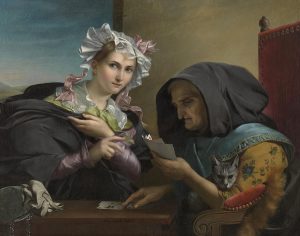
Adèle Kindt (1804–1884), The Fortune Teller (circa 1835). Antwerp, Koninklijk Museum voor Schone Kunsten. Image via Wikimedia Commons. A young lady, brightly lit and beautifully dressed, looks outward as an older woman, beneath a dark hood, holds a set of cards and stares at them with intent.

Adèle Kindt (1804–1884), The Fortune Teller (circa 1835). Antwerp, Koninklijk Museum voor Schone Kunsten. Image via Wikimedia Commons.

The Plan We Had for the 2020 Congress

The Announcement for our Sessions and other Activities at the 2020 Congress describes what we planned.  As customary, we published the Abstracts of Papers, so as to record the intentions of speakers for their presentations. The Abstracts are accessible both through that Announcement and through the Indexes of published Abstracts by Year and by Author.

The Sessions included 3 Sessions sponsored by the Research Group on Manuscript Evidence and 2 Sessions co-sponsored with the Societas Magica, in the 16th year of this co-sponsorship at the International Congress on Medieval Studies.

Like the 2015–2019 Congresses, we also planned for

  • an Open Business Meeting and
  • a co-sponsored Reception.

Even so, the Agenda for the postponed 2020 Business Meeting is available.  It takes into account the changes for Spring 2020:

  • 2020 Agenda.

The Plan We Have for 2021

We contemplate a similar approach to the 2021 Congress, conditions permitting.  [See Update above.]

For the 2021 Congress, we present the same Sessions, with a few changes.  Our pair of Sponsored Sessions dedicated to “Seal the Real I–II” remain as before.  The pair of co-sponsored Sessions dedicated to “Revealing the Unknown I–II” have some changes in the line-up.  One Session has a revised title (“Medieval Magic in Theory:  Prologues in Medieval Texts of Magic, Astrology, and Prophecy”).  For 2021, the Societas Magica has agreed also to co-sponsor this Session, so that the alignment of sponsorship has adapted to changing opportunities.

The 2021 Congress will be the 17th year of our co-sponsorship with the Societas Magica, in a constantly constructive partnership of friends, students, and colleagues.

As before, we have planned for an Open Business Meeting and a Co-Sponsored Reception.

For 2021, the co-sponsorship for a Reception joins the Research Group with the Societas Magica and The Index of Medieval Art, combining all 3 Sponsors in recent years.

[The virtual presentation of the Congress may allow for some form of Business Meeting and Reception.  Watch this Space.]

Read the rest of this entry →

Tags: Divination, History of Documents, History of Magic, Index of Medieval Art, International Congress on Medieval Studies, Manuscript studies, Medieval Seals, Skrying, Societas Magica
No Comments »

Keeping Up: Updates for Spring 2020

April 4, 2020 in Abstracts of Conference Papers, Announcements, Bembino, Business Meeting, Conference, Conference Announcement, ICMS, Index of Medieval Art, International Congress on Medieval Studies, Kalamazoo, Manuscript Studies, Princeton University, Societas Magica

Keeping Up:

Updates for Spring 2020

Baltimore, The Walters Art Museum, MS W.782, folio 15r. Van Alphen Hours. Dutch Book of Hours made for a female patron in the mid 15th century. Opening page of the Hours of the Virgin: "Here du salste opdoen mine lippen". Image via Creative Commons. At the bottom of the bordered page, an elegantly dressed woman sits before a shiny bowl- or mirror-like object, in order, perhaps, to perform skrying or to lure a unicorn.

Baltimore, The Walters Art Museum, MS W.782, folio 15r. Van Alphen Hours. Scrying, Perchance? Image via Creative Commons.

This Spring, the cancellation of 2 of our major events planned for this year, and intended to take place in mid-March and mid-May, produces perforce a redirection of energies and activities.  Call it “Regrouping”.

We report updates.

1.  Our 2020 Spring Symposium:  “From Cover to Cover”

Planned for 13–14 March at Princeton University
But Cancelled or Postponed

As preparations were proceeding apace, the event was cancelled by Princeton University — along with other events — on 9 March, in response to growing concerns for the spread of COVID-19 on a global scale.  Although at short notice, it was possible swiftly to cancel reservations for the venue, catering, and other services before participants had begun their journeys.

What We Planned

  • 2020 Spring Symposium: Save the Date
2020 Symposium "From Cover to Cover" Poster 2

2020 Symposium Poster 2

We aimed to consider, “From Cover to Cover”, activities dedicated to manuscripts, early printed materials, and beyond, from collecting and cataloguing to deciphering and beholding.  We prepared to gather specialists, teachers, students, and others engaged or interested in activities such as “Collecting, Curating, Conserving, Cataloguing, Deciphering, Reading, Reconsidering, Editing, Teaching, Displaying, Accessing, Beholding, and More”.

The focus was designed to center primarily upon medieval and early modern materials, both Western and non-Western.  The presentations would include reports of discoveries, work-in-progress, cumulative research, and collaborative projects by specialists from multiple centers, including independent scholars and younger scholars.

Included were workshops over original materials in manuscript and early print, a demonstration of materials and processes for medieval scripts, discussions about databases devoted to manuscripts and rare books, and sessions addressing multiple activities approaching medieval, early modern, and other textual resources.  Subjects would span a wide range geographically and chronologically, and take care to attend to the material and bibiographical evidence.

What We Can Do

There are requests for rescheduling the Symposium, or parts thereof, when conditions might permit.

Meanwhile, we can publish the Symposium Booklet.  At the time of cancellation, it had come close to completion for printing and distributing at the event and then afterward, as is our custom.  For example:

  • 2019 Anniversary Symposium on “The Roads Taken”
  • 2016 Symposium on ‘Words & Deeds”
  • 2014 Symposium on “Recollections of the Past”
  • 2013 Symposium on “Identity & Authenticity”

For all these and our other Booklets (see our Publications), the Research Group on Manuscript Evidence is the nonprofit publisher and distributor.  The design and layout conform with our Style Manifesto and employ our own digital font Bembino .

Florence, Galleria degli Uffizi, Anonymous, Still Life of an Illuminated Book, German School, 15th century. Oil on Wood. Opened book with fanned pages. Image via Wikimedia, Public Domain.

Florence, Galleria degli Uffizi, Anonymous, Still Life of an Illuminated Book, German School, 15th century. Image via Wikimedia, Public Domain.

The new 44-page Symposium Booklet contains the 2020 Symposium Program, Abstracts of the Papers and Masterclasses, and a set of accompanying Illustrations (some published for the first time).  The Booklet includes corrections and revisions offered by several of the authors as we completed the layout and editing, after the cancellation of the event.

It is the longest so far of all our Symposium Booklets. The 2019 Booklet for “The Roads Taken” has 28 pages, and the 2016 Booklet for “Words & Deeds” has 24 pages.  Only the Booklet for our multi-lingual digital font Bembino is longer, at 56 pages, including all the font tables for the different styles and languages. That Booklet and the font itself (now in Version 1.6) are freely available for download and use (commercial use included).  Here:  Bembino .

Our illustrated 2020 Spring Symposium Booklet is likewise freely available for download. As with other cases, for your convenience, we make it available in 2 versions, which may suit different printing arrangements, as wished.  The versions are:

  • printable in consecutive quarto-sized pages (8 1/2″ × 11″)
    2020 Spring Symposium Booklet as Consecutive Pages
  • printable as double sheets (11″ × 17″) which can be folded into the booklet, nesting the bifolia within each other
    — a design which does not require staples for closure and perusal
    2020 Spring Symposium as a Foldable Booklet

We thank our hosts, sponsors, contributors, owners and donors of images, editor, copy-editor, and layout designer. The publication is our gift to all who aimed to participate in the event and to follow its ‘ripples’ after the accomplishment of the Symposium. We offer it as a ‘souvenir’ of what our contributors, and the spirit of generous participation, intended for the event.

While we may explore plans to reschedule the event, or its parts, in some way or ways, the Booklet stands as a place-holder, and as a vivid glimpse of what could be and, indeed, can be. The gathering energy and enthusiasm for the event, as the weeks and days advanced toward it, remain a testimony to the constructive collective spirit which inspired it.

2020 Symposium "From Cover to Cover" Poster 1

2020 Symposium Poster 1

_____

With these observations, I am reminded of the Motto which I chose, years ago, for the 2-volume Illustrated Catalogue, co-published by the Research Group on Manuscript Evidence.

For Books are not absolutely dead things,
but doe contain a potencie of life in them
to be active as that soule was whose progeny they are;
nay, they do preserve as in a violl the purest efficacie and extraction
of the living intellect that bred them.

John Milton, Aeropagitica (1644)

Perhaps same as it ever was.

_____

Cover Page for Sorenson (2020 Spring Symposium Paper as Draft for Comment), with an array of illustrations and the title "Introduction to Indian Manuscripts"

Cover Page for Sorenson (2020 Spring Symposium Paper as Draft for Comment)

P. S.  Already one of our speakers, David W. Sorenson, has provided a draft version of his intended Symposium Paper for feedback. It expands the Abstract which appears in the 2020 Spring Symposium Booklet.

The paper provides “A Quick Introduction to Indian Manuscripts for the Non-Specialist”, with examples and illustrations.

With permission, we offer here his pdf.

Please contact us with your questions or suggestions.  (Contact details below.)

*****

2.  Our Activities at the 55th International Congress on Medieval Studies

Planned for 7–10 May at Kalamazoo
But Cancelled or Postponed

On 17 March, this year’s International Congress on Medieval Studies in May was cancelled, and with it all the activities which we were to sponsor and co-sponsor there, including Sessions and other meetings.  The Congress organizers declared that “We invite the organizers of sponsored . . . sessions approved for the 2020 Congress to re-propose them for the 2021 congress.  If proposed, they will be approved automatically”.

Unlike some organizations, who have declared this intention to re-present for the 2121 Congress, we do not know automatically if such a course would be appropriate for us, or for each and every one of our sessions.  Time will tell.

2019 Anniversary Reception Invitation. set in RGME digital font Bembino.

2019 Anniversary Reception Invitation.

Poster for our Session co-sponsored with the Societas Magica on "Celtic Magic Texts", organized by Phillip A. Bernhardt-House and sponsored by both the Research Group on Manuscript Evidence amd the Societas Magica at the 2018 International Congress on Medieval Studies. Poster set in RGME Bembino.

2018 Poster

The cancellation came in time before all reservations for the journey had been set into place.  Because our customary year-long preparations for the Congress had not reached the last weeks of its approach, we had not yet prepared the customary Posters for our Sessions or the Invitations to the Reception and Business Meeting, nor had the Agenda for that Meeting yet been drawn up.  Posters for previous Congresses show the standards.

However, we did in place have a series of posts on our website (You Are Here) announcing the plans for our 2020 Congress Activities, in stages with updates:

  • the Call for Papers for our approved Sessions, with descriptions of their aims and with selected Images (poster-worthy when the time would come) to exemplify their subjects and scope
  • the 2020 Congress Program, with the authors and titles of the selected Papers for each Session — including a permitted extra Session, given the strength of the responses to the Call, for our proposed Session “Seal the Real”
  • the 2020 Congress Program Announced, with the times and rooms assigned by the Congress Committee for our Program Activities, and with some of the Abstracts for the Papers.

In keeping with custom, we had begun, one by one (starting with the New Year), to post the Abstracts, as a foretaste for the presentations and discussions to come.

The cancellation of the Congress brought these stages to a halt, for a while, during which time we turned to other tasks — including the on-going follow-up from the cancellation or postponement of our Spring Symposium, and the completion of its Booklet.

Baltimore, The Walters Art Museum, MS W.782, folio 15r. Van Alphen Hours. Dutch Book of Hours made for a female patron in the mid 15th century. Opening page of the Hours of the Virgin: "Here du salste opdoen mine lippen". Image via Creative Commons. At the bottom of the bordered page, an elegantly dressed woman sits before a shiny bowl- or mirror-like object, in order, perhaps, to perform skrying or to lure a unicorn.

Baltimore, The Walters Art Museum, MS W.782, folio 15r. Van Alphen Hours. mage via Creative Commons.

What We Planned

  • 2020 International Congress on Medieval Studies Program Announced

We prepared for 5 Sessions with Papers, an Open Business Meeting, and a Reception.

These resemble the numbers and sorts of our activities in recent years at the Annual Congress.  For example:

  • 2019 Congress
  • 2018 Congress
  • 2017 Congress
  • 2016 Congress
  • 2015 Congress

This year’s plans also involved our 2 co-sponsors in recent years for Sessions and/or Receptions.

A.  Sessions

We prepared for 5 Sessions this year.

3 Sessions Sponsored by the Research Group on Manuscript Evidence

1–2. Seal the Real: Documentary Records, Seals & Authentications

organized by Mildred Budny

Part I.  Signed & Sealed
Part II.  × Marks the Spot

3. Prologues in Medieval Texts of Magic, Astrology, and Prophecy

organized by Vajra Regan

Logo of the Societas Magica, reproduced by permission

Logo of the Societas Magica

2 Sessions Co-Sponsored with the Societas Magica
in the 16th year of this collaboration

4–5. Revealing the Unknown

organized by Sanne de Laat and László Sándor Chardonnens

Part I.  Scryers and Scrying in the Middle Ages and Early Modern Period
Part II.   Sortilège, Bibliomancy, and Divination

B.  2020 Open Business Meeting of the Research Group on Manuscript Evidence

1-Page Agendas customarily provided at the time.  This year we send it out already.  (See below.)

C.  Reception co-sponsored with the Index of Medieval Art at Princeton University
in the 3rd year of this collaboration

_____

P. S.  Part of Mildred Budny’s on-going research on the subject of seals and signatures, which would have figured in her Response to Session II of our “Seals” Sessions, now appears on our blog, Manuscript Studies, presenting Preston Take 2.  (See the Contents List for the blog, as more discoveries await publication.)

_____

P. P. S.  It is not lost on us that some of our planned Sessions for 2020 were to consider aspects of the history of divinatory skills across time and place.  But when we collectively chose these, as well as other subjects, last year for our sponsored and co-sponsored Sessions this year, it was not easy to guess then that this year’s Sessions would not take place, after all, at their appointed time and place.

Adèle Kindt (1804–1884), The Fortune Teller (circa 1835). Antwerp, Koninklijk Museum voor Schone Kunsten. Image via Wikimedia Commons. A young lady, brightly lit and beautifully dressed, looks outward as an older woman, beneath a dark hood, holds a set of cards and stares at them with intent.

Adèle Kindt (1804–1884), The Fortune Teller (circa 1835). Antwerp, Koninklijk Museum voor Schone Kunsten. Image via Wikimedia Commons.

What We Can Do

A.  Abstracts for the 2020 Congress Papers

Detail of opened book with schematic text. Photography © Mildred BudnyOur custom is to post on our website the Abstracts for the Papers of our Sessions at the Congress.  (See our Abstracts for Congress Papers.)  This year is no different.

In the winter of 2019–2020, we had begun to post the 2020 Abstracts, one by one, as is our custom.  They are linked to our announced Program: 2020 Congress Program Announced. The Abstracts function as a foretaste of the ‘Menu’ of the Sessions, and can provide a record of their subjects, aims, and scope of the presentations.

Already in earlier years (as with the 2016 Congress and the 2014 Congress), as a sign of appreciation, we chose to adopt the tradition of posting Abstracts even when a contributor was unable to travel to the Congress and to present the paper in person.  The publication of such Abstracts states that, although proposed, accepted, and scheduled within the Session and Congress Program, the paper was not, in the event, presented.

Before March 2020, only once before, in more than 30 years of activities in many centers in the United States and elsewhere (see our Events and Congress Activities), has the Research Group had to cancel an event itself.  That case was only 1 Session among 7 sponsored and co-sponsored Sessions at the 48th International Congress on Medieval Studies in May 2013.

This year, after the cancellation of both our 2020 Spring Symposium (see above) and the 2020 Congress, we first turned to completing the Symposium Booklet, and then to completing the posting of the 2020 Abstracts.

Those tasks are now accomplished.  For these Congress Abstracts, see

  • 2020 Congress Program Announced and Abstracts of Congress Papers Listed by Year.

For the Symposium Booklet, see

  • 2020 Spring Symposium: Save the Date

Thus we honor the intentions of our participants and their readiness to contribute to our events.

Next, we might turn to contemplating further activities, and perhaps rescheduling some of these ones.

[Update:  In the summer and autumn of 2020, we advance with planning to hold the same Sessions, albeit with a few changes, at the 2021 Congress.  See the 2021 Congress Program in Progress.]

B.  Agenda for the 2020 Business Meeting

Meeting to be rescheduled:  Time and Place to be Determined

The Annual Agendas for our Open Business Meetings, customarily held at the International Congress on Medieval Studies, remain available for consultation.

  • 2019 Agenda
  • 2018 Agenda
  • 2017 Agenda
  • 2016 Agenda
  • 2015 Agenda

These 1-page statements serve as concise Reports for our Activities, Plans, and Desiderata.  After the Meetings, the Abstracts are available for download on our website.  Some of them remain among the most popular downloads here.

Normally, the Agenda is presented at the Meeting.  This year, we send it out ahead of time.  It incorporates the updates of Spring 2020 and their constructive measures.

  • 2020 Agenda

It is not yet clear when this year’s Meeting, which had to be postponed, will take place.  Under present circumstances, we may contemplate a virtual meeting, say via online conferencing in some form.

Please let us know if you wish to participate in the Meeting.  We invite your comments, questions, and suggestions.  (See below.)

C. More

We thank all our contributors to the 2020 events.  The continuing momentum for such activities is a tribute to you all.

Please Contact Us with your questions and suggestions, for example to items on our  2020 Agenda.

For updates, please visit this site, our News & Views, and our Facebook Page .

For our nonprofit educational mission, with tax-exempt status, your donations in funds and/or in kind (expertise, materials, time) are welcome. Join us!

Tags: 'Manuscript Studies' Blog, 2020 Congress, 2020 Symposium, Bembino, Bembino Digital Font, Business Meeting, Early Printing, History of Documents, Manuscript studies, Medieval Studies, Seals and Signatures, Style Manifesto
No Comments »

« Older Entries
Newer Entries »
  • Top
©2024 Research Group on Manuscript Evidence.


is proudly powered by WordPress. WordPress Themes X2 developed by ThemeKraft.