“Building Bridges ‘Over Troubled Waters’
For 25 Years and More”
Our Theme of “Bridges” for our 2024 Anniversary Year
with the
Call for Papers for
an Inaugural RGME-Sponsored Session
at the 2024 International Medieval Congress at Leeds
(1–4 July 2024 in hybrid format)
Blogpost composed by Michael Allman Conrad, with Mildred Budny and Ann Pascoe–van Zyl
[Posted on 9 August 2023]
In 2024 the Research Group on Manuscript Evidence (RGME) will celebrate its 25th Anniversary as a Nonprofit Educational Corporation based in the United States and its 35th Anniversary as an International Scholarly Organization founded in England. Among its 2024 Anniversary Celebrations (Events such as Symposia, Episodes of our online series “The Research Group Speaks”, and more), the RGME prepares a set of Conference Sessions by “Setting Sails for A Double Gig in the USA and the United Kingdom”.
A Tale of Two Congresses
First, we revisit the annual International Congress on Medieval Studies (ICMS) at Kalamazoo in May. As customary for many years, we plan for RGME-sponsored and co-sponsored Sessions there. For these plans, see our 2024 Call for Papers for these Sessions. Also, for the first time, we prepare to sponsor a Session at the International Medieval Congress (IMS) at Leeds in July.
For 2024, the former conference will be held, somewhat confusingly, partly online and partly in-person (with individual Sessions either the one of the other). In contrast, the latter is fully hybrid, with in-person and online participation together. For the thematic subject of “Crisis” chosen for the 2024 Leeds Congress, we bring our own 2024 Anniversary Theme of “Bridges”.
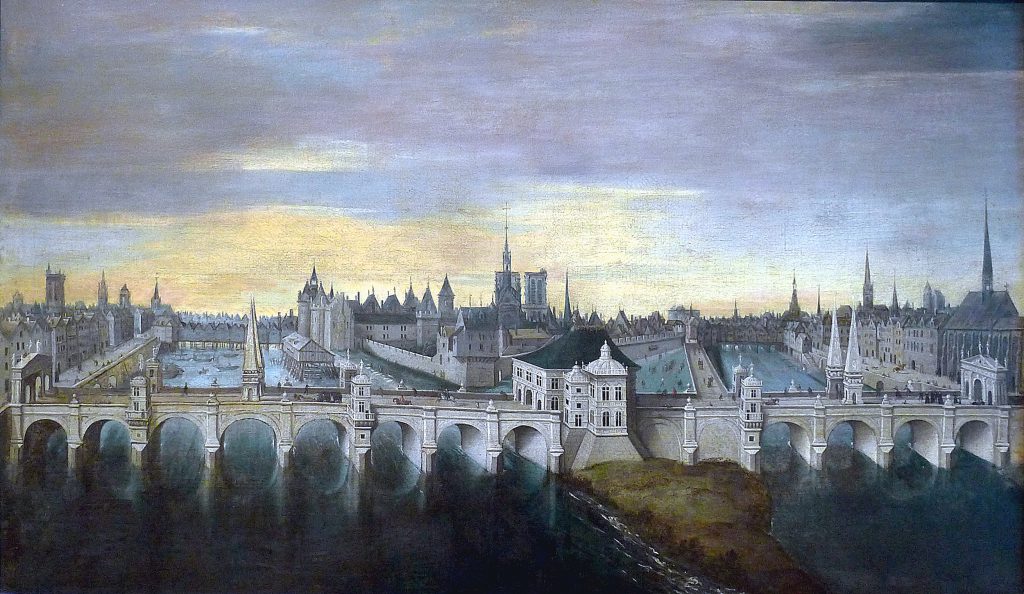
Paris , Musée Carnavalet, Projet pour le Pont Neuf, by an anonymous artist, circa 1577. Image via Wikimedia via Creative Commons Attribution 3.0 Unported.
Note on the image: The Pont Neuf (“New Bridge”) was the first Parisian bridge to have no houses; it is the oldest standing bridge to survive in Paris. The painting in the Musée Carnavalet shown above depicts the design approved in 1578 by King Henry III (1551–1589), who laid the first stone on 31 May 1578. The bridge as completed in 1606 had a simpler design, partly in response to constraints and challenges — crises amidst the French Wars of Religion — during this time in the king’s reign leading, for example, to his assassination. The bridge provided both a thoroughfare for horses and conveyances, and pavements for pedestrians. See Le Pont_Neuf. See also below.
For information on how to submit your Proposal for a Paper for our Inaugural Session, see below.
Building (and Rebuilding) Bridges
Whenever we speak of bridges as structures or constructions over physical objects by land or sea — rather than, say, a card game, a trick-taking game, some prosthesis for teeth, or the pilothouse of a ship — we speak of connections and obstacles. Can we even think of bridges without also thinking of dangers, of collapse, of falling down, of burning?
No bridge is needed where connection is simple and guaranteed, where creeks can be passed easily, where communication flows unhindered. It is only when underlying currents become perilous, when we are to transverse to unknown shores that may challenge our bare existence that we yearn for a bridge to provide us safe passage. In such cases, we might even wonder on occasion if the passage and its direction (let alone its progress) constitutes ‘coming’ or ‘going’. With such potential, depending upon how and from whence the traveller approaches a passageway not necessarily unidirectional, the viewpoints for a given bridge might resemble the dual perspectives of the antique Roman god Janus , presider over doorways, gates, thresholds, passages, beginnings and endings, war and peace.
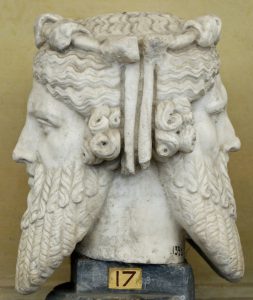
Vatican City, Vatican Museums, Museo Chiaramonti, section XIV, no.17. Janus-type Double Herm. Marble, Roman copy after a Greek original. Image via Wikimedia via Creative Commons 3.0 Unported.
And so, a bridge turns out to be a very ambivalent endeavor (as indeed all crossings and bifurcations are), living in the fuzzy realm between stability and destabilization, between safety and risk. With bridges, we might enter dangerous worlds otherwise inaccessible to us (sometimes for the better), so that the mere existence of bridges as gateways to these spaces can appear dangerous in itself, whilst they create an opening, and thus, opportunities in its original Latin sense as opportunus.
Knowing this far too well, we are required to cultivate trust in a bridge’s supports to safely guide us to the other side, but also to return if things turn out harmful. In such conditions we might, if circumstances and structures warrant, call upon the facilities and resourcefulness of a draw-bridge or pontoon bridge, and be prepared for the potential (and sometimes uneasily apparent) insecurity of suspension bridges.
Bear in mind the double-meaning of support here: bridges stand on supports and lend us support. They stabilize passages to cross what otherwise would be uncrossable – and thereby “ease your mind”, as Simon & Garfunkel sang in Bridge Over Troubled Water (1970); see the lyrics. Nor need we overlook the implication of the symbol of the Cross as the signature of Christ.
That said, shouldn’t all researchers thus be bridge-makers? Since what else is the prototype of a researcher than a person who, driven by endless curiosity, feels a strong inner desire of wanting to pass over to those unexplored realms on the other side?
It is this ambiguous nature of an in-between, of an entity standing in two worlds at once while creating an own space that belongs to none of them fully that make bridges such interesting transitional spaces. Yes, more than that: the bridge is the Urbild, the archetype of what transition and transitional spaces mean avant la lettre. This condition, by the way, is no less true for the double-identity of the messenger, a figure that embodies both bridge and bridge-maker to create meaningful connections between senders and receivers, between material and immaterial worlds, between heaven and the earth. And how could we forget that the Roman chief High Priest was known as the pontifex maximus, the great bridge-builder, a title later related to the Pope in Rome?[1]
Already in antiquity, the ambivalent figure of Hermes[2] as Olympic Messenger encapsulated the ambiguity of all bridges, as he is the protector not only of human heralds, travelers, merchants, and orators, but also of thieves, pointing out how much all hermeneutics convey risky endeavors, since all acts of interpretations may fail, or even be the cause of dangers of their own.
As a model of transition par excellence, bridges also remind us negatively of its connective nature, especially whenever we cross the Rubicon or burn down bridges, and thereby pass the point of no return — a very current fear in respect to Climate Change and Anthropocene. Either way, Hermes makes us aware of the close proximity of commuting and communicating.
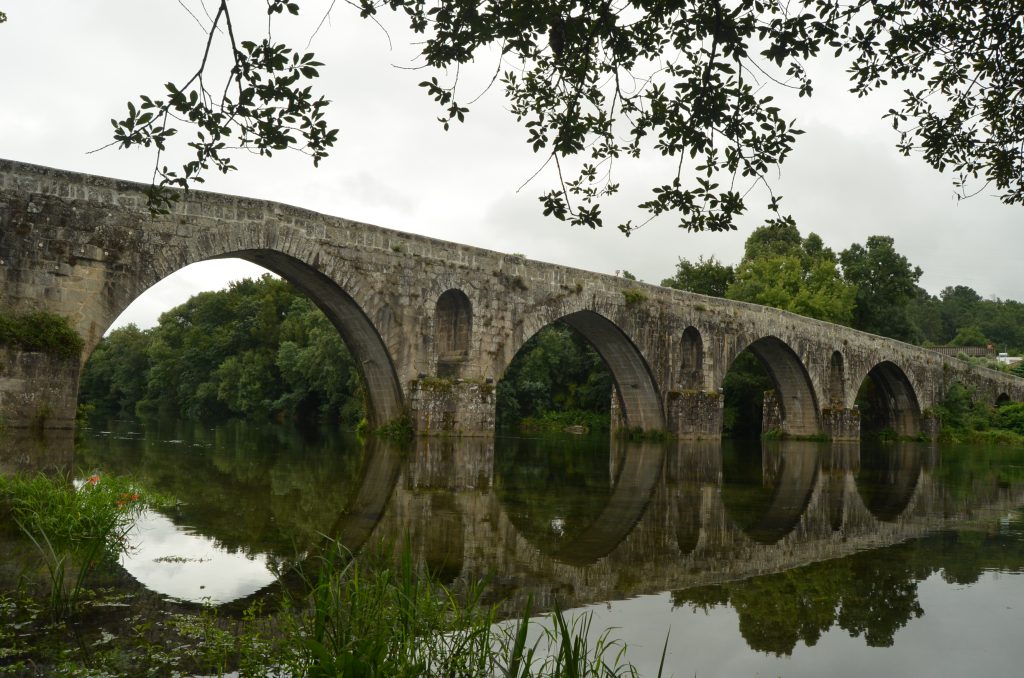
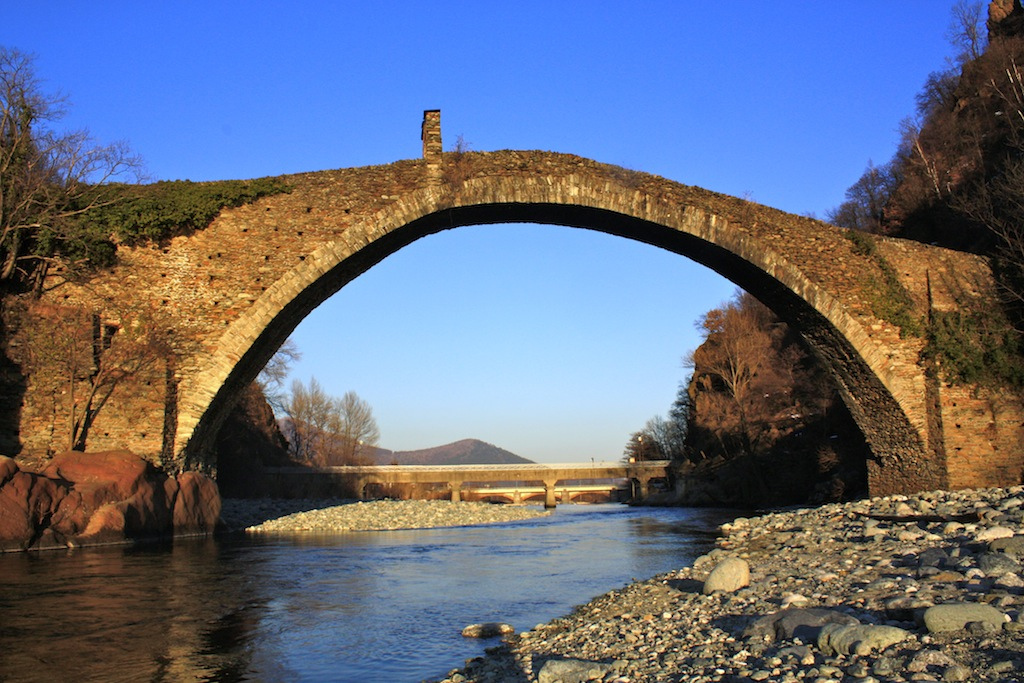
“Study on a Medieval Bridge” at Amares, Braga District, Portugal. Image by Pedro Nuno Caetano (2019) via Wikimedia Commons via Creative Commons 2.0 Generic.
Bridges Then and Now
For its next Anniversary Year, the Research Group for Manuscript Evidence has chosen the Theme of Bridges as its guiding symbol. In fact, it has been the mission of the RGME to build bridges since its first beginning — between disciplines, methods and media, and scholars from different countries, even continents, all driven by their passion for manuscripts and their historical significance, as well as their context among written texts as such and within the course (or coursing) of history.
For its anniversary, the RGME takes this mission one step further, by crossing the great sea in an attempt to bridge the academic cultures of the New World and Old World — in what could be described as a reversal of the Mayflower’s itinerary, from the Americas back to the British Isles, and back again. Let’s hope for calm waters and steady weather! (And is it too far-fetched to remind us that both Cambridge and Oxford are names that allude to bridge-like passages? Isn’t education always a bridge, a rite of passage?)
CFP for a RGME Session at the 2024 ICMS
(1–4 July 2024 in hybrid format)
In this spirit, we prepare sponsored Sessions, as usual, for the International Congress on Medieval Studies (ICMS) at Kalamazoo in May. See our Call for Papers for the 2024 ICMS.
Also, for the first time, we prepare an Inaugural Sponsored Session for the International Medieval Congress (IMC) at Leeds in July 2024. The chosen Thematic Focus for the Leeds Congress is “Crisis”.
The Co-Organisers for our Leeds Session are
Ann Pascoe–van Zyl (Trinity College Dublin)
and
Michael Allman Conrad
(Research Group on Manuscript Evidence and Universität St. Gallen)
Bridges and “Troubled Waters”
Under our guiding concept of “bridges,” the RGME invites papers for a Session at Leeds on all kinds of bridges and bridge-related topics. Be it more literally, as physical architectures and landmarks, such as historically significant specimens, or be it more abstractly, as architectural devices of the mind that enable us to make unexpected and unpredicted connections between marginal, off-field, divergent media, methods, and subjects that are usually not made or ignored.
In addition, we ask how bridges answer to different forms of crises, especially, but not only, with regard to communication, travel, social, cultural or political relations, or of the natural environment. In turn, we are also interested in papers that discuss how the establishment and maintenance of bridges may prevent crises or, contrarily, cause new unforeseen forms of crisis.
In summary, we welcome all bold bridge-makers willing to traverse pathways that others have not dared to take. In such ways, we might also respond to the opportunities and challenges which the captain and officers on the bridge of a ship can observe directly, better to steer a course in the passage.
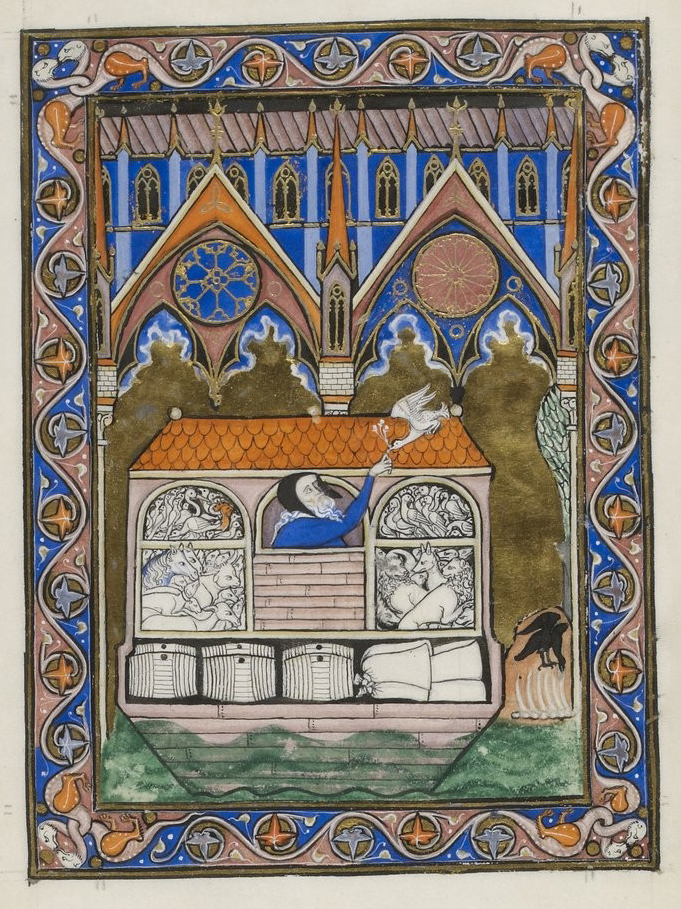
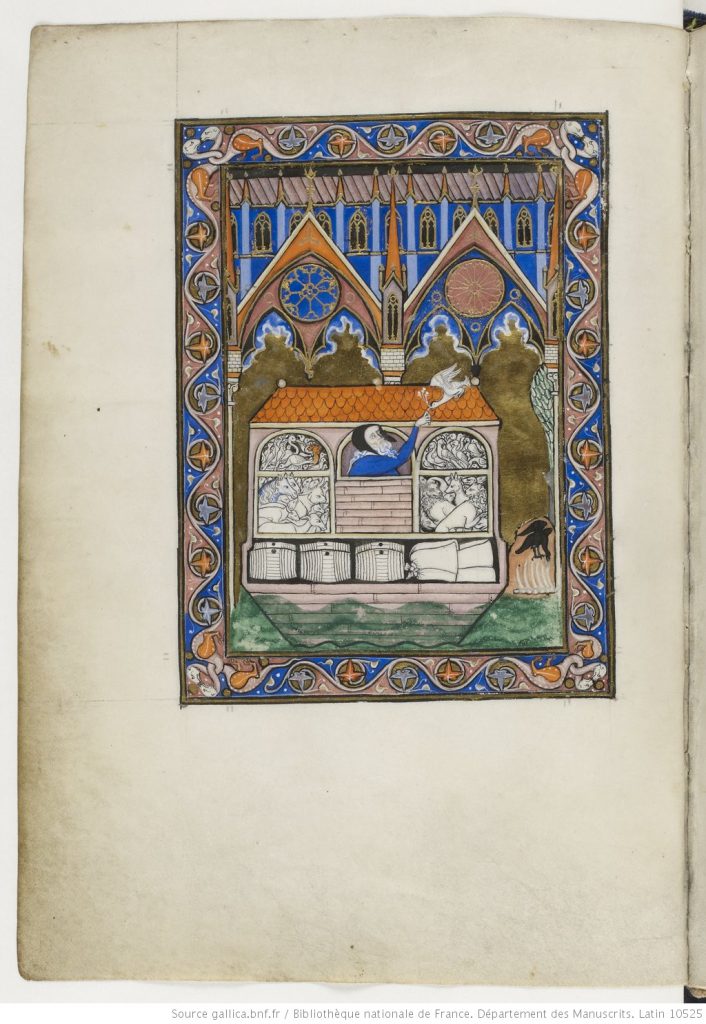
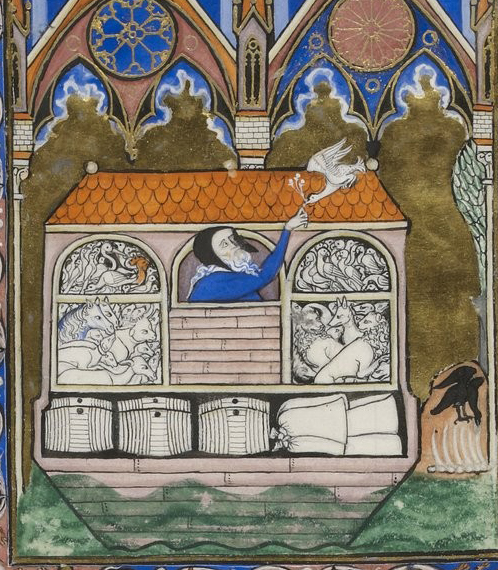
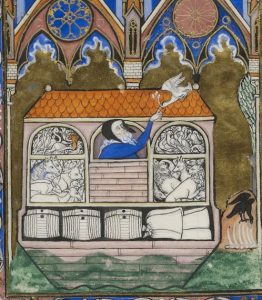
Paris , Bibliothèque nationale de France, Département des manuscrits, MS Lat 10525, fol. 3v, detail. Noah’s Ark. Image Public Domain via https://gallica.bnf.fr/ark:/12148/btv1b8447877n.
Note on the image: Paris, Bibliothèque nationale de France, Département des manuscrits, MS Lat 10525, folio 3v. Psalter of Saint Louis, Paris circa 1270. See Psautier de Saint Louis: Latin 10525. On the genre, see, for example, Noah’s Ark; and Noah’s Arkhive.
*****
Proposals Invited for Papers
for our 2024 Session at Leeds
— Due by 31 August 2023
We invite abstracts of 200–300 words. Your proposals should be made to the Session Co-Organisers to the address below by 31 August 2023. Following this Call for Papers, the RGME Session will be selected and submitted to the Congress by 30 September 2023. We will inform you of the selection by this time.
The Congress at Leeds will be held in person, with provisions for online participation. In this way, we hope that you might be able to attend onsite or at a distance, depending upon your travel arrangements. Please indicate in your Proposal if you you would prefer to present your paper or session in-person or virtually.
Deadline for Paper Proposals: Due by 31 August 2023
We look forward to your contributions.
For information about this RGME Session, and to make your Proposal, please contact the Co-organisers:
Ann Pascoe-van Zyl and Michael Allman Conrad
for the Research Group on Manuscript Evidence
rgmesessions@gmail.com
*****
Footnotes
[1] Originally, this might have been meant literally: the position of bridge-builder was an important one in Rome, where the major bridges were over the Tiber. Considered a deity, only authorities with sacral functions could be allowed to “disturb” the river with mechanical additions. The title of “pontifex” for the Pontiff in Rome was already around for centuries, but did not become a regular title of honor for Popes before the 15th century, which is probably linked to the Fall of Constantinople in 1453 and the death of the last East Roman Emperor.
Fun fact: Pope Benedict XVI adopted @pontifex as his Twitter handle, which has been maintained by his successor Pope Francis.
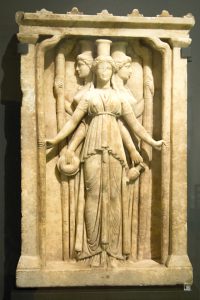
Prague, National Gallery, Kinský Palace, NM-H10 4742. Marble relief of triplicate Hekate. Image via Creative Commons Attribution Share-Alike 3.0 Unported.
[2] There is something strange to be observed when we look at antiquity in this regard. The areas of expertise and responsibility for Greek and Roman Gods with respect to bridges is not clear-cut.
In fact, Janus seems to be the more suitable candidate if we want to know what God was actually related to bridges, as he generally was the God of motion, of pathways, doors and gates, of beginnings and endings, devoted to spatial and temporal transitions.
However, if we think about the mitigation, communication between different realms, dominions, and areas, this job would be that of Hermes as mitigator and messenger.
But, thirdly, there’s also Hecate, as the dark Goddess of crossings, of magic and witchery. Sometimes represented as triple-formed, her associations include crossroads, entrance-ways, night, light, sorcery, witchcraft, necromancy, graves, and protection from witchcraft. These powers extended her realms of transitions to stretch beyond the worlds of the living.
The lines seem to be a bit blurred here, and it seems to depend on what aspect of bridges interests us exactly to know which God to tend to: the dark aspects of all crossings (as mixing things that should be kept separate), the mitigation and moderation in communicative acts (Hermes), or transition and ambivalence in general?
We invite you to join the conversation.
*****
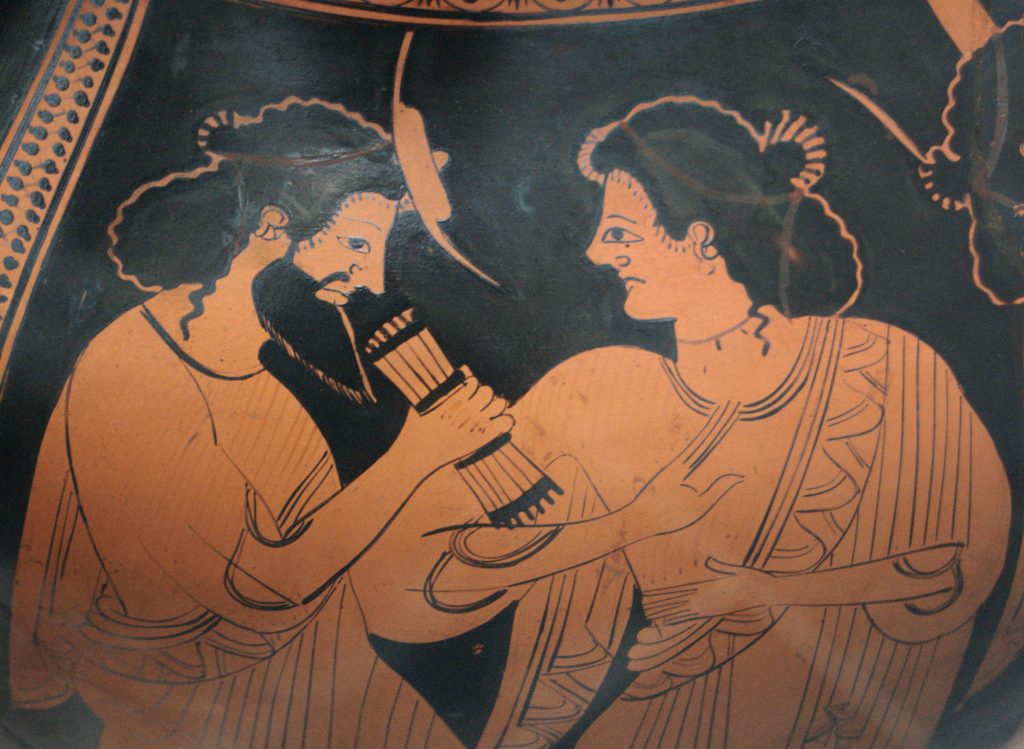
Munich, Staatliche Antikensammlungen, Nikoxenos Painter, Attic red-figure belly-amphora, ca. 500 BC, Side B, detail of Council of the Gods on Mount Olympus: Hermes with his mother Maia. Image via Wikimedia via Creative Commons.
Note on the image: See Council of the Gods.
*****
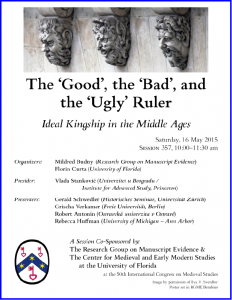
RGME Poster for 2015 Session on “Ideal Kingship”.
Note on Le Pont Neuf
(see image above)
The ornate sculptural masks (mascarons) on the sides of Le Pont_Neuf in Paris inspired the series of posters for our Sessions at the 2015 ICMS at Kalamazoo. See:
For the photographs in the posters, we thank Ilya V. Sverdlov.
The 381 original and individual Renaissance mascarons were replaced in the complete rebuilding of the bridge in 1851–1854 with copies by 19th-century sculptors. At the time, some of the 16th-century originals — attributed to the French Renaissance sculptor Germain Pilon (1525–1590) — were placed in the Musée Carnavalet (six originals and eight molds of others) and the Musée de Cluny – Musée national du Moyen Âge (eight originals); the latter were transferred later to the French National Museum of the Renaissance in the Château d’Écouen.
The masks are said to “represent the heads of forest and field divinities from ancient mythology, as well as satyrs and sylvains.” (Le Pont_Neuf.) With elaborate beards, enlarged ears, and animated and often threatening expressions, the faces of the mascarons stand constant watch both upstream and downstream on “The New Bridge”. It is as if — from their stable supports on the stone structure — they pose both troubled and troubling outlooks for the waters below, as well as toward all passengers upon or beside them.
In two spans, that construction links opposite sides of the River Seine with the western (downstream) end “of the Île de la Cité, the island in the middle of the river that was, between 250 and 225 BC, the birthplace of Paris, then known as Lutetia and, during the medieval period, the heart of the city.” (Le Pont_Neuf.)
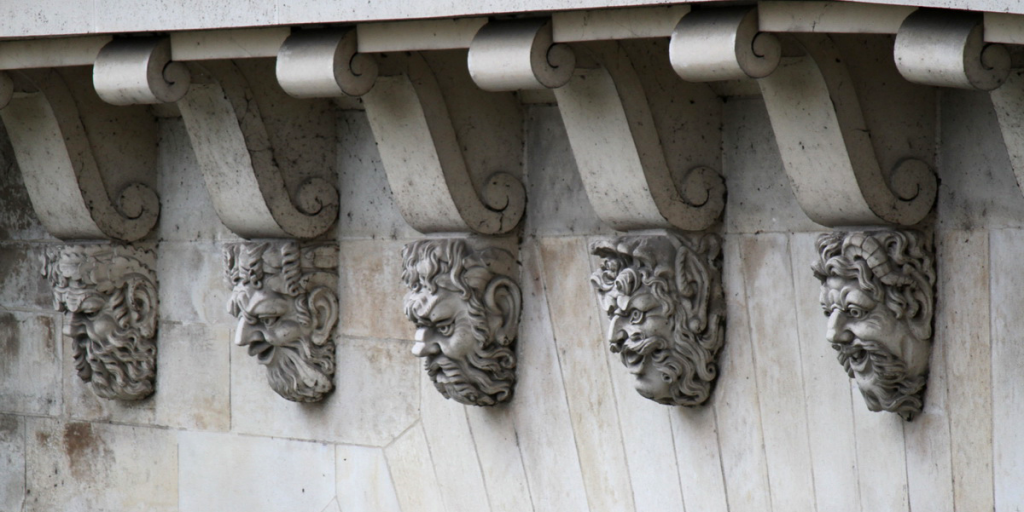
Le Pont Neuf, 5 Corbel Heads All in a Row. Photography by Ilya V. Sverdlov. Reproduced by permission.
*****
We look forward to your contributions. We invite Proposals for Papers in our Inaugural Sponsored Session on “Building Bridges ‘Over Troubled Waters’ ” at the 2024 International Medieval Congress at Leeds.
Please be sure to submit your Proposal by 31 August 2023 to the address above.
*****
Please leave your Comments or questions here, Contact Us, or visit
Donations and contributions, in funds or in kind, are welcome and easy to give. See Contributions and Donations.
We look forward to hearing from you.
*****


2025 International Medieval Congress at Leeds: Call for Papers
August 1, 2024 in Announcements, Call for Papers, International Medieval Congress, Leeds, Manuscript Studies
2025 International Medieval Congress
at Leeds:
Call for Papers
“Manuscripts as Worlds of Learning”
(2 Sessions + Roundtable)
32nd Annual IMC
Monday to Thursday 07–10 July 2025
(with In-Person and Virtual Components)
Deadline for your Proposals for Papers: 5 September 2024
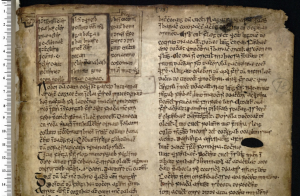
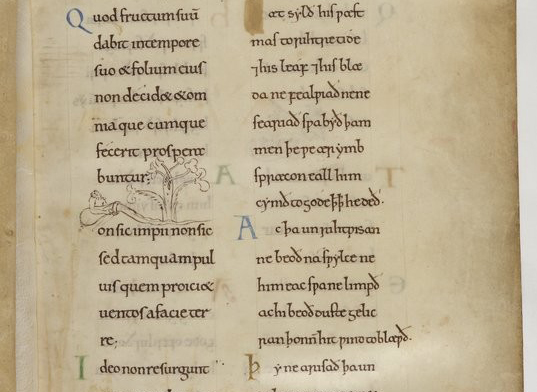
Dublin, Royal Irish Academy, MS 23 E 25, p. 73, top. Image via https://codecs.vanhamel.nl/Dublin,_Royal_Irish_Academy,_MS_23_E_25 via Creative Commons (CC BY-SA 3.0).
[Posted on 1 August 2024, with updates]
Building upon the successful completion of our RGME Inaugural Session at the International Medieval Congress (IMC) at the University of Leeds in July 2024, we announce the Call for Papers (CFP) for our activities at next year’s Congress.
For information about the Congress, see
Note that the general deadline for individual papers without specified sessions in a general pool is 31 August 2024.
The deadline for proposals for our RGME-sponsored Sessions is 5 September 2024. Please send your proposals directly to us as organisers; we will select the programmes by their deadline of 30 September 2024. (Instructions below.)
“Worlds of Learning” at Leeds in 2025
Next year’s Thematic Focus for the IMC is “Worlds of Learning”. The broad scope is described in the general Call for Papers: IMC 2025 – ‘Worlds of Learning’.
We invite you to submit proposals for a set of interlinked events planned for the Research Group on Manuscript Evidence (RGME) to focus on the power and potential of manuscripts to contain, convey, and embody worlds of learning within their span. In effect, given their structure and contents, as we approach them as beholder, user, reader, student, teacher, or admirer, they may carry worlds in our hands.
How might medieval manuscripts do so, variously for their medieval audience, later intermediaries, and our own times? How might and do they function as “Worlds of Learning” in their own right/write? We explore.
Update (14 August 2024): As interest grows, we plan several sessions for the 2025 IMC.
In another post, we present a Session with Papers devoted to “Game Knowledge and Knowledge of Games”, which follows up a strand in our RGME Inaugural Session this year.
Here we present a suite of events containing two Sessions with Papers accompanied by a Round Table with Discussion, all dedicated to “Manuscripts as Worlds of Learning”.
Read the rest of this entry →
Tags: 'Commonplace Books', Authority Texts, Biblical Commentaries, Classbooks, History of Pedagogy, Instruments of Learning, International Congress on Medieval Studies, International Medieval Congress, Lebor na hUidre (LU), Legal Commentaries, Manuscript Miscellanies, Manuscript studies, Pedagogy, RIA MS 23 E 25, Worlds of Learning
No Comments »