• News
    • News & Views
    • RGME Activities for 2024 and 2025
    • Around & About with the RGME
    • Reviews
    • Highlights
  • Blogs
    • Manuscript Studies
      • Manuscript Studies: Contents List
    • International Congress on Medieval Studies
      • Abstracts of Congress Papers
        • Abstracts of Papers Listed by Author
        • Abstracts of Papers Listed by Year
  • About
    • Mission
    • Who We Are
      • Officers, Associates & Volunteers
      • RGME Committees
      • Friends of the Research Group on Manuscript Evidence
    • Policies & Statements
      • RGME Privacy Policy Statement
      • RGME Intellectual Property Statement & Agreements
    • People
      • Mildred Budny — Her Page
      • Adelaide Bennett Hagens
    • Activities
      • Events
      • Congress Activities
        • Sponsored Conference Sessions (1993‒)
          • Panels at the M-MLA Convention (from 2016)
        • Co-sponsored Conference Sessions (2006‒)
    • History
      • Seals, Matrices & Documents
      • Genealogies & Archives
    • Contact Us
  • Bembino
    • Multi-Lingual Bembino
    • RGME Bembino: Resources
  • Congress
    • Sponsored Conference Sessions (1993‒)
    • Co-sponsored Conference Sessions (2006‒)
    • Abstracts of Congress Papers
      • Abstracts Listed by Author
      • Abstracts Listed by Year
    • Kalamazoo Archive
    • Panels at the M-MLA Convention (2016-2019)
      • Abstracts of Papers for the M-MLA Convention
      • Panels at the M-MLA Convention (from 2016)
  • Events
    • RGME Activities for 2024 and 2025
      • 2023 Activities and 2024 Planned Activities
    • Seminars, Workshops, Colloquia & Symposia (1989–)
      • Seminars on ‘The Evidence of Manuscripts’
      • Symposia on ‘The Transmission of the Bible’
      • The New Series (2001-)
        • 2019 Anniversary Symposium Program: The Roads Taken
        • 2019 Anniversary Symposium Registration
        • 2019 Anniversary Symposium Registration Open
      • RGME Symposia: The Various Series
      • The Research Group Speaks: The Series
      • Meetings of the Friends of the Research Group on Manuscript Evidence
      • RGME Online Events
    • Abstracts of Papers for Events
      • Abstracts of Papers for Seminars on ‘The Evidence of Manuscripts’
      • Abstracts of Papers for Symposia, Workshops & Colloquia
    • Receptions & Parties
    • Business Meetings
    • Photographic Exhibitions & Master Classes
    • Events Archive
  • ShelfLife
    • Journal Description
    • ShelfMarks: The RGME-Newsletter
    • Publications
      • “Insular, Anglo-Saxon, and Early Anglo-Norman Manuscript Art at Corpus Christi College, Cambridge” (1997)
        • Mildred Budny, ‘Catalogue’
        • The Illustrated Catalogue (1997)
      • The Illustrated Handlist
      • Semi-Official Counterfeiting in France 1380-1422
      • No Snap Decisions: Challenges of Manuscript Photography
    • History and Design of Our Website
  • Galleries
    • Watermarks & the History of Paper
    • Galleries: Contents List
    • Scripts on Parade
    • Texts on Parade
      • Latin Documents & Cartularies
      • New Testament Leaves in Old Armenian
    • Posters on Display
    • Layout Designs
  • Donations and Contributions
    • RGME Donor Promise
    • 2023 End-of-Year Fundraiser for our 2024 Anniversary Year
    • 2019 Anniversary Appeal
    • Orders
  • Links
    • Catalogs, Metadata, and Databases: A Handlist of Links
    • Handlist of Resources for Manuscript Studies and Fragmentology
    • Manuscripts & Rare Books
    • Maps, Plans & Drawings
    • Seals, Seal-Matrices & Documents

  • News
    • News & Views
    • RGME Activities for 2024 and 2025
    • Around & About with the RGME
    • Reviews
    • Highlights
  • Blogs
    • Manuscript Studies
      • Manuscript Studies: Contents List
    • International Congress on Medieval Studies
      • Abstracts of Congress Papers
        • Abstracts of Papers Listed by Author
        • Abstracts of Papers Listed by Year
  • About
    • Mission
    • Who We Are
      • Officers, Associates & Volunteers
      • RGME Committees
      • Friends of the Research Group on Manuscript Evidence
    • Policies & Statements
      • RGME Privacy Policy Statement
      • RGME Intellectual Property Statement & Agreements
    • People
      • Mildred Budny — Her Page
      • Adelaide Bennett Hagens
    • Activities
      • Events
      • Congress Activities
        • Sponsored Conference Sessions (1993‒)
          • Panels at the M-MLA Convention (from 2016)
        • Co-sponsored Conference Sessions (2006‒)
    • History
      • Seals, Matrices & Documents
      • Genealogies & Archives
    • Contact Us
  • Bembino
    • Multi-Lingual Bembino
    • RGME Bembino: Resources
  • Congress
    • Sponsored Conference Sessions (1993‒)
    • Co-sponsored Conference Sessions (2006‒)
    • Abstracts of Congress Papers
      • Abstracts Listed by Author
      • Abstracts Listed by Year
    • Kalamazoo Archive
    • Panels at the M-MLA Convention (2016-2019)
      • Abstracts of Papers for the M-MLA Convention
      • Panels at the M-MLA Convention (from 2016)
  • Events
    • RGME Activities for 2024 and 2025
      • 2023 Activities and 2024 Planned Activities
    • Seminars, Workshops, Colloquia & Symposia (1989–)
      • Seminars on ‘The Evidence of Manuscripts’
      • Symposia on ‘The Transmission of the Bible’
      • The New Series (2001-)
        • 2019 Anniversary Symposium Program: The Roads Taken
        • 2019 Anniversary Symposium Registration
        • 2019 Anniversary Symposium Registration Open
      • RGME Symposia: The Various Series
      • The Research Group Speaks: The Series
      • Meetings of the Friends of the Research Group on Manuscript Evidence
      • RGME Online Events
    • Abstracts of Papers for Events
      • Abstracts of Papers for Seminars on ‘The Evidence of Manuscripts’
      • Abstracts of Papers for Symposia, Workshops & Colloquia
    • Receptions & Parties
    • Business Meetings
    • Photographic Exhibitions & Master Classes
    • Events Archive
  • ShelfLife
    • Journal Description
    • ShelfMarks: The RGME-Newsletter
    • Publications
      • “Insular, Anglo-Saxon, and Early Anglo-Norman Manuscript Art at Corpus Christi College, Cambridge” (1997)
        • Mildred Budny, ‘Catalogue’
        • The Illustrated Catalogue (1997)
      • The Illustrated Handlist
      • Semi-Official Counterfeiting in France 1380-1422
      • No Snap Decisions: Challenges of Manuscript Photography
    • History and Design of Our Website
  • Galleries
    • Watermarks & the History of Paper
    • Galleries: Contents List
    • Scripts on Parade
    • Texts on Parade
      • Latin Documents & Cartularies
      • New Testament Leaves in Old Armenian
    • Posters on Display
    • Layout Designs
  • Donations and Contributions
    • RGME Donor Promise
    • 2023 End-of-Year Fundraiser for our 2024 Anniversary Year
    • 2019 Anniversary Appeal
    • Orders
  • Links
    • Catalogs, Metadata, and Databases: A Handlist of Links
    • Handlist of Resources for Manuscript Studies and Fragmentology
    • Manuscripts & Rare Books
    • Maps, Plans & Drawings
    • Seals, Seal-Matrices & Documents

Log in

Archives

Featured Posts

2026 International Congress on Medieval Studies: Program
Episode 24. “Life with Books” (Interview with John Windle)
Announcing the Launch of RGME Bembino WP
2026 RGME Colloquium at The Grolier Club: Report
Medieval Missal Fragment as Early-Modern Cover
The Weber Leaf from Ege MS 61
"Bembino" Booklet Cover
Episode 23. “Meet RGME Bembino: Facets of a Font”
2026 RGME Colloquium on “Transformations & Renewals” at The Grolier Club
2026 Theme of the Year: “Transformations and Renewals”
A Leaf with Patchwork from the Saint Albans Bible
A Sister Leaf from a Miniature Latin Vulgate Bible
A Little Latin Vulgate Bible Manuscript Leaf in Princeton
J. S. Wagner Collection. Leaf from from Prime in a Latin manuscript Breviary. Folio 4 Verso, with part of Psalm 117 (118) in the Vulgate Version, set out in verses with decorated initials.
2026 Annual Appeal
Episode 22: “Encounters with Local Saints and Their Cults”
Private Collection, Ege's FBNC Portfolio, Dante Leaf, Verso, Detail. Reproduced by Permission.
2025 RGME Autumn Colloquium on Fragments
Workshop 8: A Hybrid Book where Medieval Music Meets Early-Modern Herbal
2025 RGME Autumn Symposium on “Readers, Fakers, and Re-Creators of Books”
RGME Workshops on “The Evidence of Manuscripts, Etc.”
2025 International Medieval Congress at Leeds: RGME Program
Episode 21. “Learning How to Look”
2025 International Congress on Medieval Studies: Program
2025 RGME Visit to Vassar College
Two Leaves in the Book of Numbers from the Chudleigh Bible
Delibovi on Glassgold on Boethius: A Blogpost
Ronald Smeltzer on “Émilie du Châtelet, Woman of Science”
2025 Spring Symposium: “Makers, Producers, and Collectors of Books”
Starters’ Orders
The Weber Leaf from the Saint Albans Bible
Workshop 4. “Manuscript Fragments Compared”
Episode 20. “Comic Book Theory for Medievalists”
Episode 19: “At the Gate: Starting the Year 2025 at its Threshold”
Favorite Recipes for Lemonade, Etc.
RGME Visit to the Lomazow Collection: Report
2024 Autumn Symposium: “At the Helm”
A Latin Vulgate Leaf of the Book of Numbers
The RGME ‘Lending Library’
Florence, Italy, Ponte Vecchio from Ponte alle Grazie. Photo: Ingo Mehling, CC BY-SA 4.0 , via Wikimedia Commons
Episode 17. “RGME Retrospect and Prospects: Anniversary Reflections”
2024 Anniversary Symposium: The Booklet
Jesse Hurlbut at the Bonneville Salt Flats, Utah. Photograph Jesse Hurlbut.
Episode 16: An Interview with Jesse D. Hurlbut
To Whom Do Manuscripts Belong?
Kalamazoo, MI Western Michigan University, Valley III from the side. Photograph: David W. Sorenson.
2024 International Congress on Medieval Studies: Report
2024 Spring Symposium at Vassar College
Puente de San Martín: Bridge with reflection over the River Targus, Toledo, Spain.
2024 Grant for “Between Past and Future” Project from The Gladys Krieble Delmas Foundation Research Libraries Program
2024 Anniversary Symposium in Thanks to Jesse Hurlbut: Program

You are browsing the Blog for History of Bridges

2024 Autumn Symposium: “At the Helm”

February 19, 2024 in Anniversary, Conference, Conference Announcement, RGME Symposia

2024 Autumn Symposium
“At the Helm:
Spotlight on Special Collections
as Teaching Events”

Friday and Saturday, 25–26 October 2024 by Zoom

[Posted on 19 February 2024, with updates first including the Symposium Program, Posters, and Symposium Booklet with Program, Abstracts, and Images, and then reporting the issue of the corrected Symposium Booklet after the event, in more than one stage, as refinements came forward]

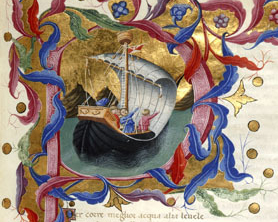
London, The British Library , Yates Thompson MS 36, fol. 65r, detail. Dante Alighieri, Divina Comedia, Canto 1, Purgatorio. Northern Italy, 15th century.

Part 2 (of 2) in the series of

2024 Spring and Autumn Symposia
on “Bridges”

To follow up from

Part 1 (of 2)
2024 Spring Symposium at Vassar College

“Between Past and Future:
Building Bridges between Special Collections and
Teaching for the Liberal Arts”

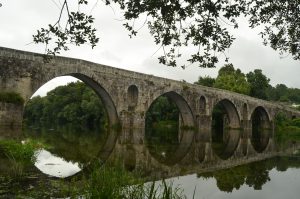
“Study on a Medieval Bridge” at Amares , Braga District, Portugal. Image by Pedro Nuno Caetano (2019) via Wikimedia Commons via Creative Commons 2.0 Generic.

[Posted on 18 February 2024, with updates]

This event forms a pair with the Spring Symposium (Part 1) in the 2024 RGME Anniversary Year, for which our Theme is “Bridges”.

  • “Bridges” for our 2024 Anniversary Year

By request, as its momentum and enthusiasm develops, this Symposium has extended its span, from one day to two full days.

Part 1 in April

Part 1 is planned in hybrid format, with access in person and online.  It was held over three days in April, from 18 Friday to 22 Sunday 2024.  Its Title tells its purpose, focus, and mission:

“Between Past and Future:
Building Bridges between Special Collections
and Teaching for the Liberal Arts”

  • Spring Symposium ‘Home Page’
    2024 Spring Symposium at Vassar College
  • Report
    2024 Spring Symposium at Vassar College: Report

Part 2 in October

Part 2, to be held online for two full days in October, provides an integrated follow-up for the Spring Symposium centered upon Vassar.

This time, taking charge on the Bridge of a nautical vessel of passage (Bridge, Wheelhouse, or Pilothouse; Bridge or Pilothouse), we focus on selected cases to examine such teaching practices and resources at work.

“At the Helm:
Spotlight on Special Collections as Teaching Events”

Friday and Saturday 24–25 October 2024
by Zoom

Friday 9:45 am – 5:00 pm EDT (GMT-4)
Saturday 9:00 am – 5:15 pm EDT

In keeping with our tradition – informal, but structured – for our RGME Symposia (as with our 2023 Spring and Autumn Symposia), we offer presenters the opportunity, with minimal preparation, to showcase collections (private and public) in virtual visits guided by curators or collectors, in the company of teachers and students on-site and online.

Our goal here is to channel the purposeful momentum for the 2024 Spring Symposium at Vassar College in a simpler follow-up demonstrating the mission in action of teaching with the material evidence in Special Collections.  Whilst the Spring Symposium focuses (but not exclusively) on the Medieval and Renaissance periods, the Autumn Symposium welcomes a wide variety of periods, cultures, and genres of material.

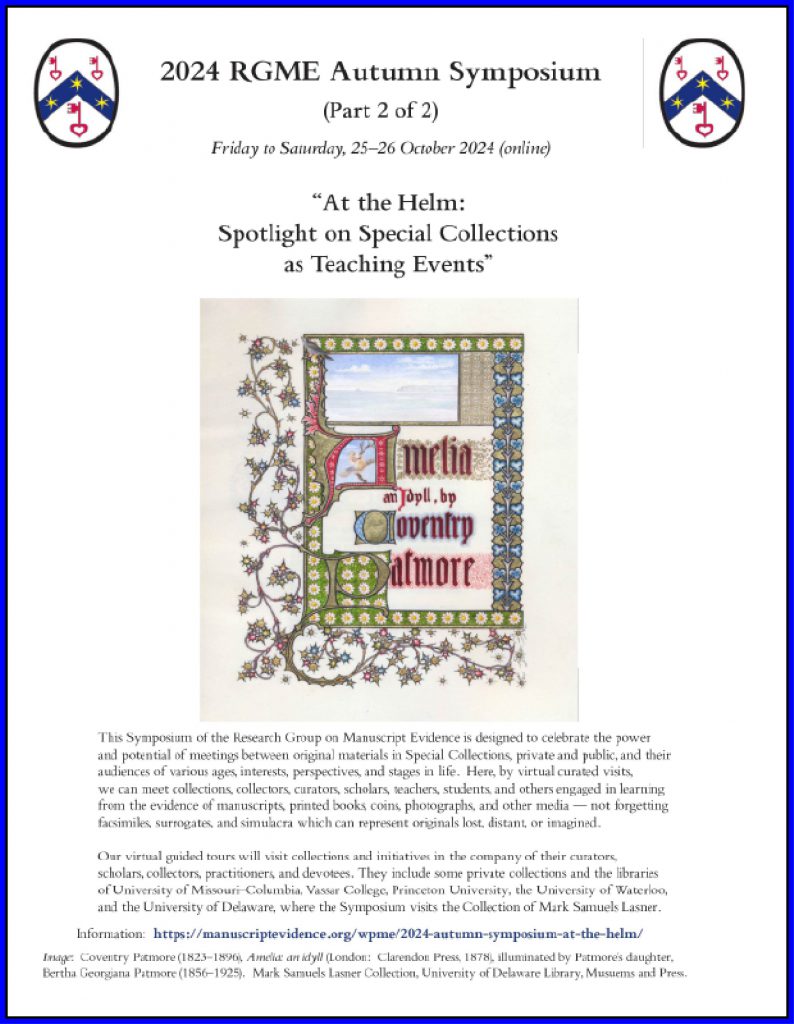
Poster 2 for RGME 2024 Autumn Symposium. Set in RGME Bembino. Image: Coventry Patmore, Amelia: an idyll (1878), title page, illuminated by Bertha Patmore. Mark Samuels Lasner Collection, University of Delaware Library, Museums and Press.

The poster is available to download. Please circulate and display it, if you wish.

  • Poster 2 for RGME 2024 Autumn Symposium

For more information and to register, see below.

Read the rest of this entry →

Tags: Archives and Special Collections Library of Vassar College, Edgar William Pyke Collection of Coins, History of Bridges, Mark Samuels Lasner Collection, RGME Anniversary Year, RGME Library & Archives, RGME Symposia, Special Collections, Special Collections of Ellis Library University of Missouri, Teaching Events, Virtual Visits to Collections
No Comments »

2024 Spring and Autumn Symposia plus Anniversary Symposium

February 4, 2024 in Uncategorized

2024 Spring and Autumn Symposia
on “Bridges”

Plus a special Anniversary Symposium
on “Manuscript (He)art”

“Study on a Medieval Bridge” at Amares, Braga District, Portugal. Image by Pedro Nuno Caetano (2019) via Wikimedia Commons via Creative Commons 2.0 Generic.

[Posted on 4 February 2023, with updates]

The Research Group prepares a pair of Spring and Autumn Symposia in our Anniversary Year of 2024, continuing the paired pattern which, reviving our tradition of individual Symposia in some years, we launched in 2022 and developed further for 2023.

Add-Ons On Occasion

Last year, we added a half-day Pre-Symposium to the Spring Symposium, with a full-day Symposium in both Spring and Autumn.  The result was a 1½-day event on 24–25 March (Pre-Symposium + Spring Symposium) and a 1-day event on 21 October (Autumn Symposium).  The March Event and the October Event each have an illustrated Symposium Booklet, available for download.  (See below.)

2024 RGME Events

For activities planned overall for this Anniversary Year for the RGME, with the year’s theme of “Bridges”, see:

  • RGME 2023 and 2024 Activities.
  • “Bridges” for our 2024 Anniversary Year

They include episodes for “The Research Group Speaks”, conference sessions at two international congresses for medieval studies (at Kalamazoo and Leeds), anniversary celebrations, and three Symposia.

Of these, the first is an exceptional Anniversary Symposium in thanks to our First WebMaster upon his retirement.

  • 2024 Anniversary Symposium in Thanks to Jesse Hurlbut, RGME WebMaster Emeritus

The next form a linked pair as Part 1 and Part 2

  • 2024 Spring Symposium at Vassar College
  • 2024 Autumn Symposium “At the Helm”

2024 Anniversary Symposium (Online)

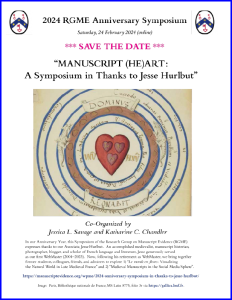
Save-the-Date Poster for 2024 Anniversary Symposium in Thanks to Jesse Hurlbut. Poster set in RGME Bembino.

This year, we add a one-day Anniversary Symposium to start the series of three Symposia for the year.  It is designed to express thanks to the First WebMaster of the RGME upon his retirement, Jesse D. Hurlbut.

  • 2024 Anniversary Symposium in Thanks to Jesse Hurlbut: Program

Co-organized by Katharine C. Chandler and Jessica L. Savage (co-organizers, with Jennifer Larson, of the 2023 Pre-Symposium), this event gathers former students, colleagues, and friends to consider subjects of interest to Jesse and to which he has contributed, including medieval manuscript studies, digital access to them, and the promotion of online communities for their study and enjoyment.

This event will take place online on Saturday 24 February by Zoom.  You may register to attend this Symposium through our Eventbrite portal.

See our selection:

  • RGME Eventbrite Collection

For this event:

  • 2024 Anniversary Symposium “Manuscript Heart” Tickets

Registration is free; we welcome Voluntary Donations to help to support our nonprofit mission for our organization powered mainly by volunteers and dependent mostly upon donations.  See also

  • Donations and Contributions

2024 Spring and Autumn Symposia
on “Bridges”

This exceptional series has two parts. It represents a year-long project which focuses attention

“Between Past and Future:
RGME Spring & Autumn Symposia in 2024
for Teaching in the Liberal Arts with Original Sources,
at Vassar College and Beyond”

At center stage, the perspectives on the theme of the Spring Symposium at Vassar College present a coherent, multi-disciplinary, and multi-generational scholarly program in a sequence of teaching events with expertise and materials in multiple centers. They stand poised, as proclaimed by its title, “Between Past and Future: Building Bridges between Special Collections and Teaching for the Liberal Arts”.

The Autumn Symposium carries it forward with a selection of virtual visits placed “At the Helm:  Spotlight on Special Collections as Teaching Events”. The informal style accords with our proven approach for online events as roundtables, interviews, conversations, master classes, and workshops. Thus, we might channel the purposeful momentum for the Spring Symposium in its central event in a simpler follow-up with participants including representation from Vassar, whether present or alums.

Part 1 (of 2).
2024 Spring Symposium at Vassar College

“Between Past and Future:
Building Bridges between Special Collections
and Teaching for the Liberal Arts”

(3-Day, Hybrid, In Person and Online)

Friday to Sunday 19–21 April 2024

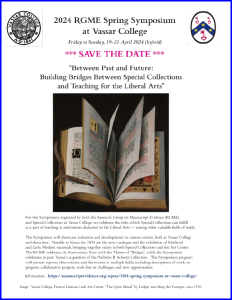
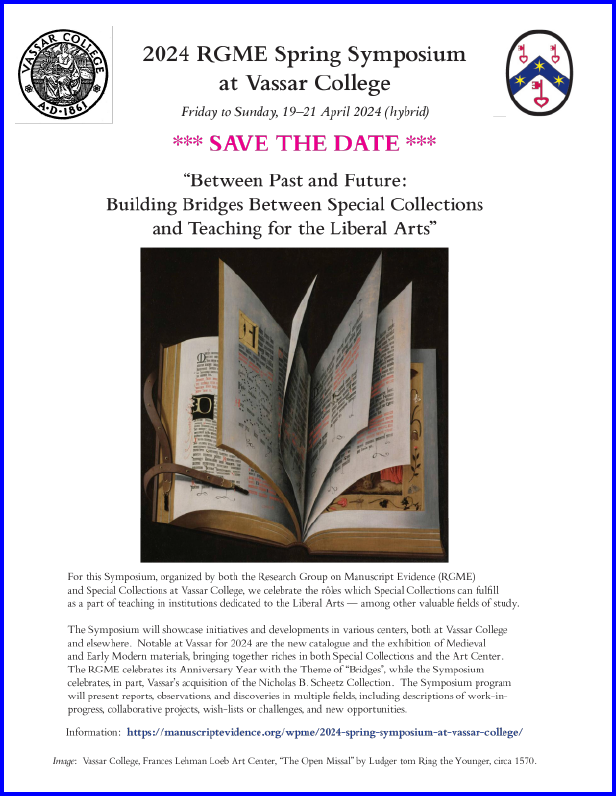
Poster 1: Save-the-Date for 2024 Spring Symposium at Vassar.

Poster 1: Save-the-Date for 2024 Spring Symposium at Vassar.

For this Symposium, organized by both the RGME and Special Collections (The Catherine Pelton Durrell ’25 Archives and Special Collections Library) at Vassar College, we celebrate the rôles which Special Collections can fulfill as part of teaching in institutions dedicated to the Liberal Arts — among other valuable fields of study.

The Symposium showcases initiatives and developments in various centers, both at Vassar College and elsewhere. Notable at Vassar for 2024 are:

  •  A new Catalogue of the Medieval and Early Modern books or fragments in both Special Collections and the Frances Lehman Loeb Art Center, and
  • A companion exhibition at the Art Center to showcase examples of their riches in “Books in the Middle Ages and the Renaissance”

Also, the RGME celebrates its Anniversary Year with the Theme of “Bridges”.

  • “Bridges” for our 2024 Anniversary Year.

The Spring Symposium will, in part, celebrate the acquisition of the Nicholas B. Scheetz Collection of Medieval and Renaissance Manuscripts.  The Symposium presents reports, observations, and discoveries in multiple fields, including descriptions of work-in-progress, collaborative projects, wish-lists or challenges, and new opportunities.

Information:

  • 2024 Spring Symposium at Vassar College

You may register here:

  • RGME Eventbrite Collection

For this event , there is a registration fee.

Registration is free for students, and it is waived for invited Speakers at the Symposium.

To attend In Person

  • 2024 Spring Symposium at Vassar College: In Person Tickets

To attend Online

  • 2024 Spring Symposium at Vassar College: Online Tickets
Poster 1: Save-the-Date for 2024 Spring Symposium at Vassar.

Poster 1: Save-the-Date for 2024 Spring Symposium at Vassar.

Part 2 (of 2).
2024 Autumn Symposium (One-Day, Online)

“At the Helm:
Spotlight on Special Collections
as Teaching Events”

Saturday 22 October 2024 by Zoom

The perspectives on the theme of the Spring Symposium at Vassar present a coherent, multi-disciplinary, and multi-generational scholarly program in a sequence of teaching events with expertise and materials in multiple centers. They stand poised , as proclaimed by its title, “Between Past and Future: Building Bridges between Special Collections and Teaching for the Liberal Arts”. 

The Autumn Symposium carries it forward with a selection of virtual visits placed “At the Helm:  Spotlight on Special Collections as Teaching Events”. They allow presenters the opportunity, with minimal preparation, to showcase collections (public and private) in virtual visits guided by curators, in the company of teachers and students on-site and online. The informal style accords with our proven approach for online events as roundtables, interviews, conversations, master classes, and workshops. Thus, we might channel the purposeful momentum for the Spring Symposium by a simpler follow-up.

Information

  • 2024 Autumn Symposium “At the Helm”

To register, see our selection:

  • RGME Eventbrite Collection

Our Series of Symposia

  • RGME Symposia: The Various Series (1995–), in person or online.

2024 RGME Events

“Study on a Medieval Bridge” at Amares, Braga District, Portugal. Image by Pedro Nuno Caetano (2019) via Wikimedia Commons via Creative Commons 2.0 Generic.

For activities planned for our Anniversary Year, with the theme of “Bridges”, see:

  • RGME 2023 and 2024 Activities.
  • “Bridges” for our 2024 Anniversary Year

They include episodes for “The Research Group Speaks”, conference sessions at two international congresses for medieval studies (at Kalamazoo and Leeds), anniversary celebrations, and two symposia.

  • 2024 Anniversary Symposium in Thanks to Jesse Hurlbut, RGME WebMaster Emeritus
  • 2024 Spring Symposium at Vassar College

Suggestion Box

Please Contact Us or visit

  • our FaceBook Page
  • our Twitter Feed (@rgme_mss)
  • our Blog on Manuscript Studies and its Contents List

Donations and contributions, in funds or in kind, are welcome and easy to give.  See

  • Contributions and Donations.

We look forward to hearing from you.

*****

Tags: Anniversary Symposium, Autumn Symposium, History of Bridges, RGME Symposia, Special Collections, Spring Symposium, Teaching for the Liberal Arts, Teaching with Special Collections
No Comments »

2024 International Medieval Congress at Leeds: Program

November 24, 2023 in Conference, Conference Announcement, International Medieval Congress, Uncategorized

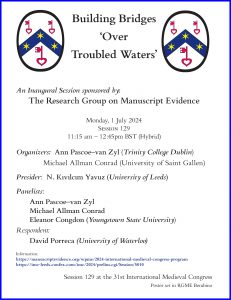
“Building Bridges
‘Over Troubled Waters’
For 25 Years and More”

An Inaugural RGME-Sponsored Session at Leeds

Thirty-First International Medieval Congress
University of Leeds
(1–4 July 2024 in hybrid format)

[Posted on 23 November 2023, with updates]

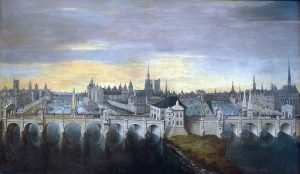
Paris, Musée Carnavalet, Projet pour le Pont Neuf, circa 1577. Image via Wikimedia via Creative Commons Attribution 3.0 Unported.

Paris, Musée Carnavalet, Projet pour le Pont Neuf, circa 1577. Image via Wikimedia via Creative Commons Attribution 3.0 Unported.

The Research Group on Manuscript Evidence prepares an Inaugural Sponsored Session at the International Medieval Congress (IMC), University of Leeds, United Kingdom, to be held in hybrid format from 1st – 4th July, 2024. This Session would comprise our first Sponsored Session at the Congress.

In December, we learned that the proposed Session has been accepted. Here we describe the plan.

Also, now that the Congress schedule has been posted — see IMC 2024 Programme — we announce details of our Inaugural Session, scheduled for the first day of the Congress (1 July).

The Plan

The Congress subject for 2024 is “Crisis”.

The RGME Theme for its Anniversary Year of 2024 is “Bridges”.

For the 2024 ICMS at Leeds we examine subjects pertaining to the challenges and opportunities of “Building Bridges ‘Over Troubled Waters’ ”.  Responses to our Call for Proposals for this Session yielded a strong program with varied subjects from multiple perspectives far and near across time and place.

This Session joins our events celebrating the Anniversary Year for the RGME.

  • 2023 and 2024 Activities
  • 2024 Anniversary Appeal

Our 2024 Anniversary Year: “Bridges”

In 2024 the Research Group on Manuscript Evidence (RGME) celebrates its 25th Anniversary as a Nonprofit Educational Corporation based in the United States and its 35th Anniversary as an International Scholarly Organization founded in England.

To mark our anniversary year, we prepare sponsored Sessions, as usual, for the International Congress on Medieval Studies (ICMS) at Kalamazoo in May.  See our Call for Papers for the 2024 ICMS and now the 2024 International Congress on Medieval Studies: Program.

Also, for the first time, we prepare an Inaugural RGME-sponsored Session for the International Medieval Congress (IMC) at Leeds in July 2024. Our dedicated Co-Organizers for this new ‘venture’ as an Inaugural Session on our Anniversary bring a rich range of perspectives and interests sprouting from distant lands, different subjects, multiple waterways or paths of communication, and varied cultural endeavours, from poetry to correspondence, and voyagers’ routes using and forming bridges both tangibly and intangibly.

Our Co-Organizers hail from different traditions and upbringings, varied geographical locations (more than one, different continents included), and multi-lingual perspectives.  Meet the Co-Organizers, whom we earnestly thank for skillfully shaping this event:

  • Ann Pascoe van Zyl
  • Dr. Michael Allman Conrad and Curriculum Vitae.

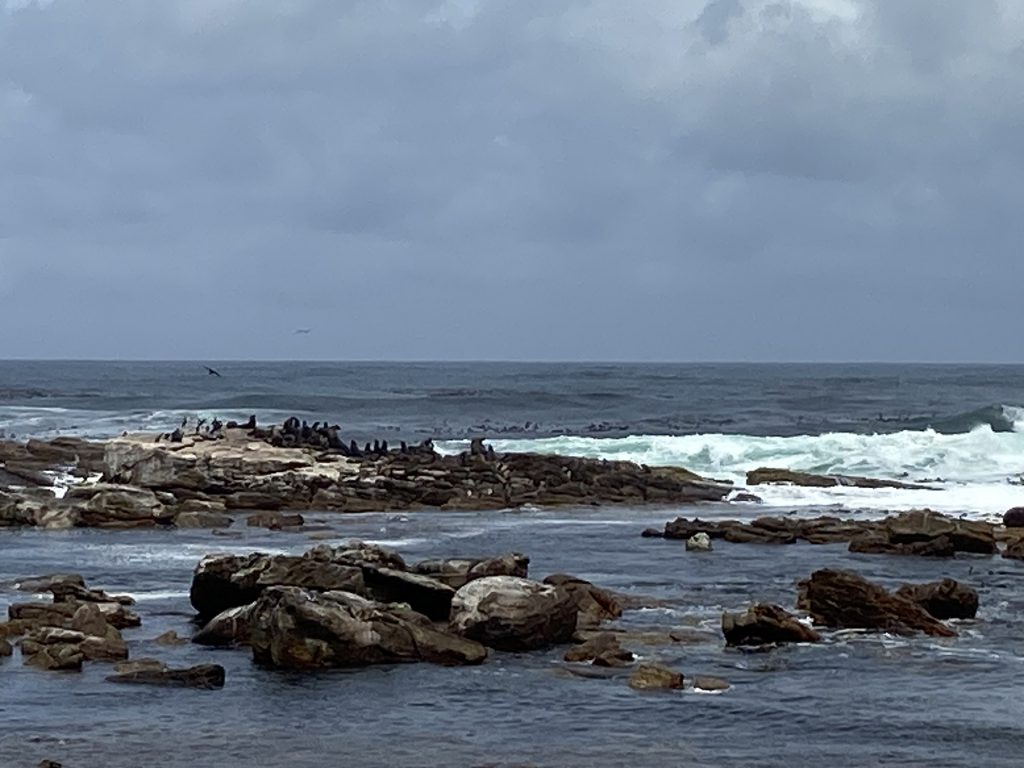
With awareness of distances which may be involved, we contemplate a view toward the waters, with thanks to our Co-Organizer for the photograph and permission to include it here as an evocative emblem from sometimes-distant shores.

Cape Point, Cape of Good Hope. Photograph © 12.2022 Ann Pascoe van Zyl.

The 2024 Leeds Congress:  “Crises”

The chosen “Thematic Focus” for the Leeds Congress in 2024 is “Crisis”.  It stands the tradition of varied Themes for the Leeds Congress since its foundation.  The Congress website describes many ways in which this theme might be viewed and explored.

Bridges and “Troubled Waters”

Given the Theme for the 2024 Congress at Leeds and our Theme for our 2024 Anniversary Year, it seemed natural to contemplate processes which, when called for, might create a Bridge Over Troubled Water in some form or other.  Repeating the results — in one or other form, as required or possible — might amount to a habit.

That thought reminded us of some practices and habits of the RGME over the years.  And so, the title for the session came into existence, and could form a rallying call or sorts for the plan of its approach.

Call it a ‘bridge’ in response to the call for the 2024 Congress to consider the natures of ‘crisis’ of various kinds, medieval and more, as a focus subject for discussion.

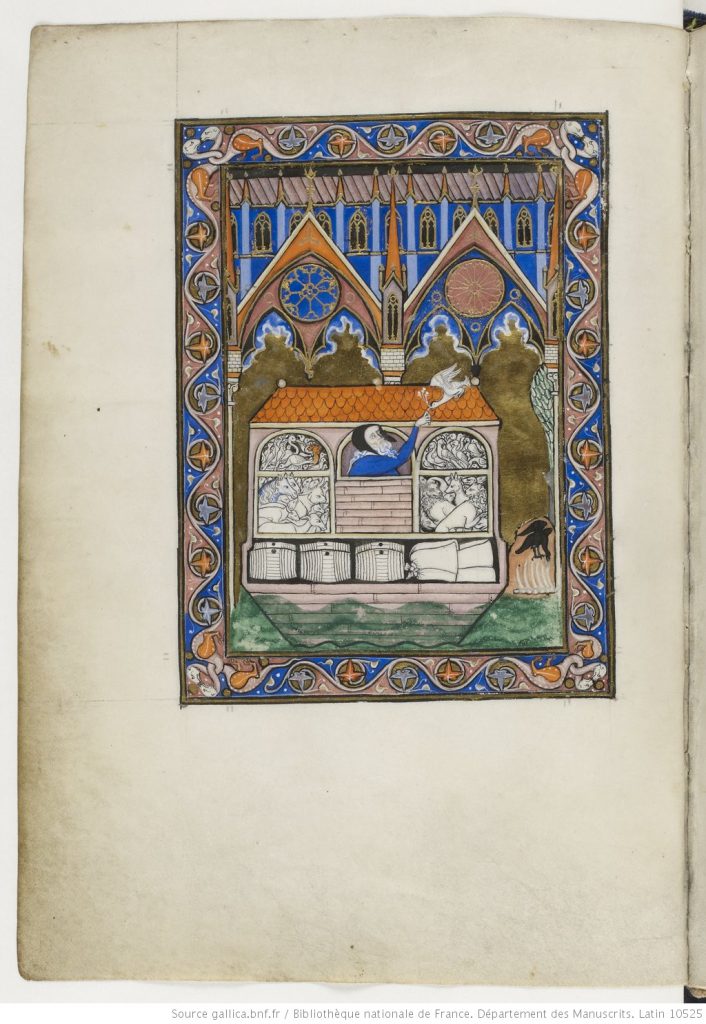
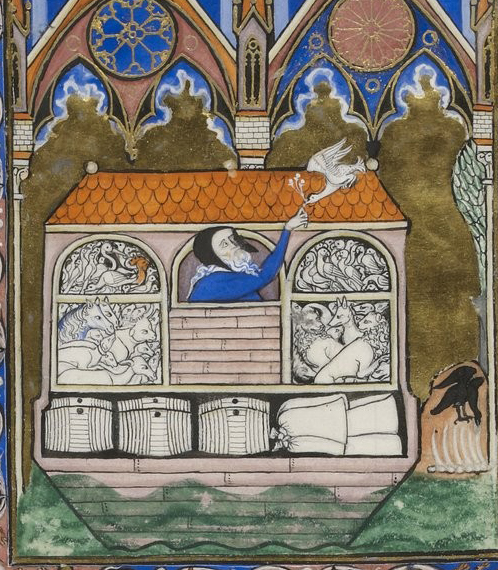
With bridges both literal and metaphorical in mind, we thought of the Ark as a response or safe haven.  Some medieval images of Noah’s Ark, its inhabitants, and its provident storage of provisions, come to mind.  For example, in an illustration enclosed within an ornamental architectural frame, itself set ‘at sea’ or afloat within a broad outer frame of the expansive margins of the manuscript leaf:

Illustration of Noah's Ark within a rectangular frame. The house-shaped ark has window-like openings for animals and birds. At the center, Noah as an aged and bearded man reaches up to receive a flying bird.

Paris, Bibliothèque nationale de France, Département des Manuscrits, Latin MS 10525, folio 3v. Image Public Domain via https://gallica.bnf.fr/ark:/12148./btv1b8447877n.r=psautier+dit+de+saint+louis.langFR.

Note on the Image

Paris, Bibliothèque nationale de France, Département des Manuscrits, Latin MS 10525, folio 3v.

“Psalter of Saint Louis”, formerly owned by Louis IX (1214-1270), King of France.
Image Public Domain via gallica.bnf.fr (Scan View 20).

Building Bridges: The Plan for the Session

The Research Group on Manuscript Evidence (RGME) came into existence in 1989 from a major Research Project at the Parker Library of Corpus Christi College, Cambridge.  It moved to the USA in 1994 and became a nonprofit educational corporation based in Princeton in 1999.

Under our guiding concept of Bridges for our 2024 Anniversary Year, the RGME offers a Session on bridges and bridge-related topics, specifically as relating to crises. We consider ‘bridges’ both literally, as physical architectures and landmarks (such as historically significant specimens), and abstractly, as architectural devices of the mind that enable us to make unexpected, unpredicted, and sometimes serendipitous connections between marginal, off-field, divergent media, methods, and subjects sometimes ignored in such contexts.

Moreover, we examine how bridges answer to different forms of crises, especially, but not only, with regard to communication, travel, social, cultural or political relations, and the natural environment. In turn, we also consider how establishing and maintaining bridges may prevent crises or, contrarily, cause new unforeseen forms of crisis.

Our session welcomes all bold bridge-makers willing to traverse pathways that others might have not dared to take.  Our subjects are:

1) Old English Psalms as a metaphorical bridge between crisis in the locus horribilis to peace in the locus amoenus,

2) Mercantile Venetian responses to blockages to trade-routes,

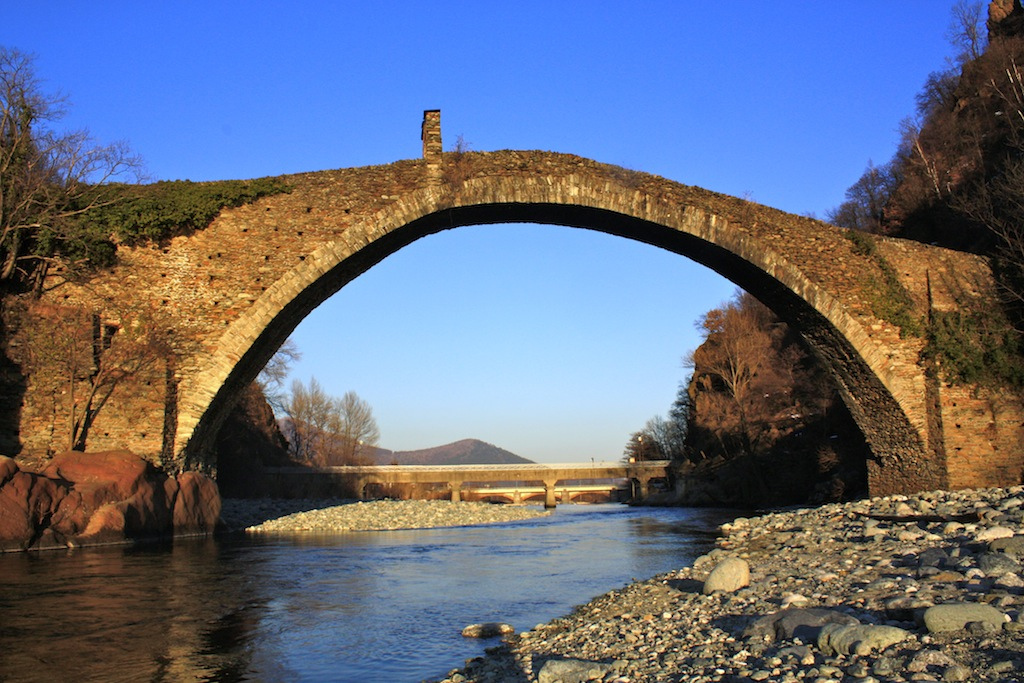
3) Dangers of bridges, especially Devil’s Bridges and Robber’s Bridge, as pilgrims’ routes, with digital visualizations and reference to contemporary discourse on safety,

4) a Response to these cases, along with a zreflection on the RGME’s tradition of building bridges through ‘crises’ in its passage across time to its anniversary with a session at the IMC.

Thus, we respond to opportunities and challenges which the captain and officers on the bridge of a ship might observe directly, better to steer a course forward.

We invite you to join us on the voyage.

Paris, Bibliothèque nationale de France, Departément des Manuscrits, Latin MS 10525, folio 3v. Image Public Domain via https://gallica.bnf.fr/ark:/12148.

*****

With the publication of the IMC 2024 Programme, we announce the Programme of our Inaugural Session.

“Building Bridges ‘Over Troubled Waters’ ”
Sponsor:
Research Group on Manuscript Evidence

Session 129 (page 71 in the IMC 2024 Programme)

Organisers:
Ann Pascoe-van Zyl, School of English, Trinity College Dublin
and
Michael Allman Conrad, Kontextstudium, Universität St Gallen

Moderator:
N. Kıvılcım Yavuz, Institute for Medieval Studies / School of History,
University of Leeds

Respondent: David Porreca, Department of Classics, University of Waterloo, Ontario

Presentations:

129-a: Ann Pascoe-van Zyl, School of English, Trinity College Dublin

“The Imagery of the Old English Psalms of the Paris Psalter:  A
Metaphorical Bridge from Crisis in the locus horribilis to Peace
in the locus amoenus”
(Language: English)

Abstract

129-b: Eleanor Congdon, Department of History, Youngstown State University,
Ohio
“Resourcefulness in Action: The Use of the Port of Ibiza in Place
of Mainland Ports by Venetian Ships between 1400-1403″
(Language: English)

Abstract

129-c: Michael Allman Conrad, Kontextstudium, Universität St Gallen
“Diabolic, Dangerous, and Daring: Bridges as Ambiguous
Symbols of Medieval Risk Perception”
(Language: English)

Abstract

Update (20 August 2024): Michael has kindly provided a list of selected bibliography on the subject.  We offer it for download:

  • “Literature on “Devil’s Bridges” compiled by Michael A. Conrad.

Response:

“129-d“: David Porreca, Department of Classics, University of Waterloo, Ontario

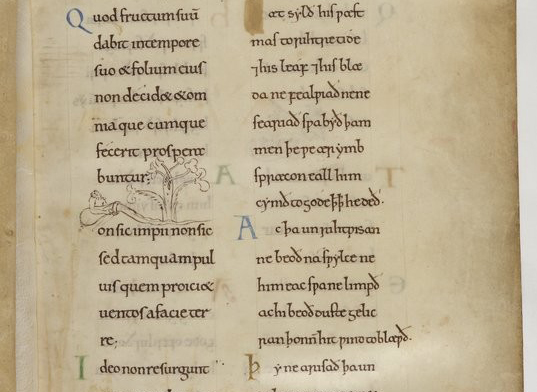
A glimpse of the Bilingual Latin and Old English Paris Psalter:

Paris, Bibliothèque nationale de France, Département des Manuscrits, MS Latin 8824, folio 1r, midsection with illustration. Image Public Domain via https://gallica.bnf.fr/ark:/12148/btv1b8451636f/f11.item#.

*****

Posters for our Session

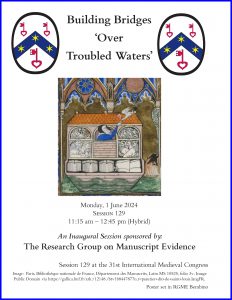
RGME @ 2024 IMC at Leeds: Poster 2 set in RGME Bembino, with border.

RGME @ 2024 IMC at Leeds: Poster 1, set in RGME Bembino.

The Posters (in A4 format) can be downloaded.

  • Posters 1–2
  • Poster 1
  • Poster 2 with image of Noah’s Ark Afloat

“The RGME: Who We Are”

For this Congress, we provide a brief introduction to the RGME, with some links, in thanks for our Inaugural Session.  The two-page flyer can be downloaded in two versions for our international audience. Honouring our host, the International Medieval Congress at the University of Leeds, we prepare the pdf in both quarto and A4 formats.

1. Who We Are (A4 format)

2. Who We Are (Quarto format)

*****

See how this Session stands among RGME activities both recent and planned:

  • 2023 and 2024 Activities
Valli_di_Lanzo, Lanzo Torinese, Ponte del Diavolo. Photograph by Emiliana Borruto (24 February 2012). Image via Wikimedia Commons via Creative Commons Attribution 2.0 Generic.

Valli_di_Lanzo, Lanzo Torinese, Ponte del Diavolo. Photograph by Emiliana Borruto (24 February 2012). Image via Wikimedia Commons via Creative Commons Attribution 2.0 Generic.

*****

Questions or Suggestions?

Please leave your comments or questions below, Contact Us, or visit

  • our FaceBook Page
  • our Facebook Group
  • our Twitter Feed (@rgme_mss)
  • our Bluesky nest @rgmesocial.bluesky.social)
  • our LinkedIn Group
  • our Blog on Manuscript Studies and its Contents List

We invite you to join:

  • Friends of the RGME.

Donations and contributions, in funds or in kind, are welcome and easy to give.  Given our low overheads, your donations have direct impact on our work and the furtherance of our mission.  For our Section 501(c)(3) nonprofit educational organization, your donations may be tax-deductible to the fullest extent permitted by law.  Thank you for your support!

  • Contributions and Donations

We invite you to consider favorably

  • our 2024 Anniversary Appeal.

We look forward to hearing from you and seeing you at our events.

*****

Paris, Musée Carnavalet, Projet pour le Pont Neuf, circa 1577. Image via Wikimedia via Creative Commons Attribution 3.0 Unported.

*****

Tags: "Bridge Over Troubled Water", Anglo-Saxon Paris Psalter, Bibliothèque nationale de France Ms Latin 8834, Bridges, Building Bridges, Crisis, Devil's Bridges, History of Bridges, International Medieval Congress, locus amoenus, Medieval Studies, Mercantile Venetian Trade Routes, Noah's Ark, Port of Ibiza, RGME Anniversary, Robber's Bridge
No Comments »

2024 Spring Symposium at Vassar College

October 16, 2023 in Announcements, Conference, Conference Announcement, Manuscript Studies, Reception, RGME Symposia, Uncategorized

2024 RGME Spring Symposium
at Vassar College

Vassar College: Current Seal.

“Between Past and Future:
Building Bridges
between Special Collections
and Teaching for the Liberal Arts”

Friday to Sunday, 18 to 21 April 2024

(hybrid, with both in-person events
and online participation by Zoom)

Celebrating the Acquisition of the
Nicholas B. Scheetz Collection
of Medieval and Renaissance Manuscripts

[Posted on 16 October 2023, with updates]

Update 15 April 2024:  Now see the updated Program (below).
Update 16 April:  For registrations, now see Late Registrations (below)

2024 RGME Spring Symposium at Vassar College:
“Between Past and Future:
Building Bridges
between Special Collections and Teaching for the Liberal Arts”
Friday to Sunday, 19 to 21 April 2024
https://library.vassar.edu/…/2024-RGME-Spring-Symposium…
(hybrid, with both in-person events and online participation by Zoom)

*****

For 2024, the Research Group on Manuscript Evidence celebrates an anniversary. Our Theme for the Year is “Bridges”. See “Bridges” for our 2024 Anniversary Year.

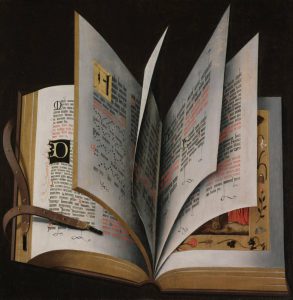
Vassar College, Frances Lehman Loeb Art Center, “The Open Missal”. Ludger tom Ring the Younger, circa 1570.

Among our celebrations, the RGME continues with its Symposium Series. With a Spring Symposium at Vassar College, in Poughkeepsie, New York, the RGME Symposia return to an in-person event, this time as a hybrid event also with online participation.

In 2023, the RGME began to return to in-person events with its activities at the partly-hybrid 58th International Congress on Medieval Studies. This step came after the cancellation of the Congress in 2020 and an online Congress in both 2021 and 2022. For 2024, our Symposia join this return, with the invitation to hold our Spring Symposium at Vassar College.

For some of our Symposia, whether in-person at Princeton University in 2019 (and intended there in 2020), or online by Zoom in 2022, 2023, and 2024, our RGME Associates at Vassar have given presentations about their work, the Library, and Special Collections. See, for example,

  • 2019 Anniversary Symposium Report: The Roads Taken
  • 2022 Spring and Autumn Symposia
  • 2023 Spring and Autumn Symposia
  • 2023 Autumn Symposium “Between Earth and Sky”
  • 2023 Spring Symposium “From the Ground Up”
  • 2024 Anniversary Symposium in Thanks to Jesse Hurlbut

Now we visit Vassar to join the celebrations for a new catalogue and exhibition of Medieval and Renaissance Books in the collection. We do so by gathering scholars, librarians, curators, cataloguers, collectors, vendors, teachers, and others to participate in an RGME Symposium which showcases the materials in the light of expertise and appreciation dedicated to them.

The choice of the Program and other components of the Symposium is guided by the Vassar/RGME Symposium Advisory Committee, and by other advisers both at Vassar and elsewhere. The Advisory Committee comprises

  • Ronald Patkus,
  • Elizabeth Lastra,
  • Mildred Budny, and
  • Barbara Williams Ellertson.

Note on the Image

Poughkeepsie, New York, Vassar College, Frances Lehman Loeb Art Center. The Open Missal (circa 1570) attributed to Ludger tom Ring the Younger (1522-1582). Image via “The Open Missal”.

Read the rest of this entry →

Tags: Early Printed Books, Frances Lehman Loeb Art Center, Frederick Ferris Thompson Memorial Library, History of Bridges, Les Enluminures, Manuscript studies, Manuscripts & Early Printed Books, Nicholas B. Scheetz Collection, RGME Anniversary Year, RGME Symposia, Symbols in Vassar Architecture, Vassar College, Vassar College Library, Vassar College Special Collections and Archives
No Comments »

“Bridges” for our 2024 Anniversary Year

August 9, 2023 in Conference, International Congress on Medieval Studies, International Medieval Congress, Uncategorized

“Building Bridges ‘Over Troubled Waters’
For 25 Years and More”

Our Theme of “Bridges” for our 2024 Anniversary Year

with the

Call for Papers for
an Inaugural RGME-Sponsored Session
at the 2024 International Medieval Congress at Leeds
(1–4 July 2024 in hybrid format)

Blogpost composed by Michael Allman Conrad, with Mildred Budny and Ann Pascoe–van Zyl

[Posted on 9 August 2023]

In 2024 the Research Group on Manuscript Evidence (RGME) will celebrate its 25th Anniversary as a Nonprofit Educational Corporation based in the United States and its 35th Anniversary as an International Scholarly Organization founded in England.  Among its 2024 Anniversary Celebrations (Events such as Symposia, Episodes of our online series “The Research Group Speaks”, and more), the RGME prepares a set of Conference Sessions by “Setting Sails for A Double Gig in the USA and the United Kingdom”.

A Tale of Two Congresses

First, we revisit the annual International Congress on Medieval Studies (ICMS) at Kalamazoo in May.  As customary for many years, we plan for RGME-sponsored and co-sponsored Sessions there. For these plans, see our 2024 Call for Papers for these Sessions.  Also, for the first time, we prepare to sponsor a Session at the International Medieval Congress (IMS) at Leeds in July.

For 2024, the former conference will be held, somewhat confusingly, partly online and partly in-person (with individual Sessions either the one of the other). In contrast, the latter is fully hybrid, with in-person and online participation together. For the thematic subject of “Crisis” chosen for the 2024 Leeds Congress, we bring our own 2024 Anniversary Theme of “Bridges”.
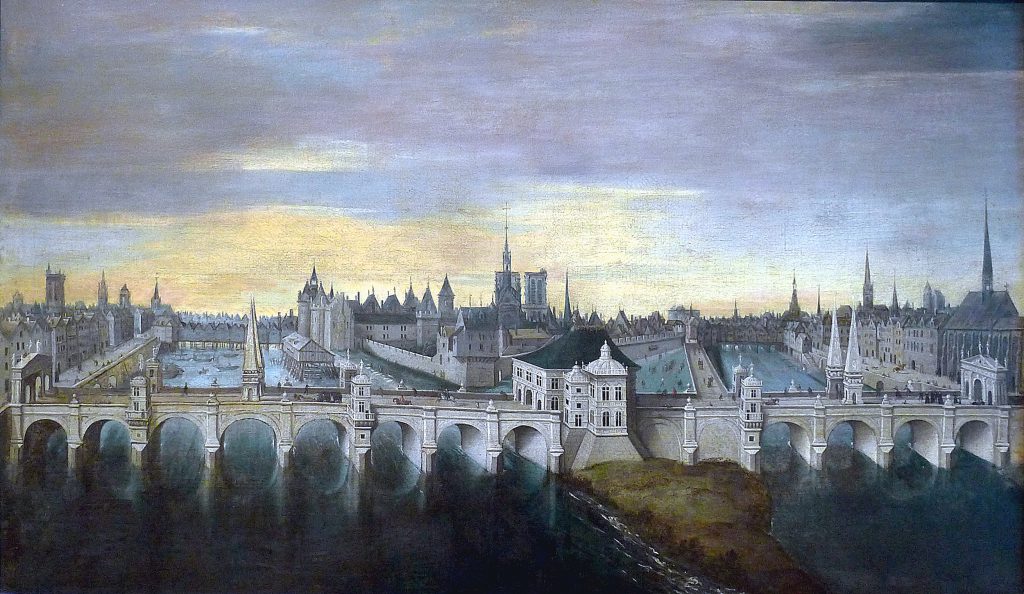
Paris , Musée Carnavalet, Projet pour le Pont Neuf, by an anonymous artist, circa 1577. Image via Wikimedia via Creative Commons Attribution 3.0 Unported.

Note on the image:  The Pont Neuf (“New Bridge”) was the first Parisian bridge to have no houses; it is the oldest standing bridge to survive in Paris.  The painting in the Musée Carnavalet shown above depicts the design approved in 1578 by King Henry III (1551–1589), who laid the first stone on 31 May 1578. The bridge as completed in 1606 had a simpler design, partly in response to constraints and challenges — crises amidst the French Wars of Religion — during this time in the king’s reign leading, for example, to his assassination. The bridge provided both a thoroughfare for horses and conveyances, and pavements for pedestrians.  See Le Pont_Neuf.  See also below.

For information on how to submit your Proposal for a Paper for our Inaugural Session, see below.

Building (and Rebuilding) Bridges

Whenever we speak of bridges as structures or constructions over physical objects by land or sea — rather than, say, a card game, a trick-taking game, some prosthesis for teeth, or the pilothouse of a ship — we speak of connections and obstacles. Can we even think of bridges without also thinking of dangers, of collapse, of falling down, of burning?

No bridge is needed where connection is simple and guaranteed, where creeks can be passed easily, where communication flows unhindered. It is only when underlying currents become perilous, when we are to transverse to unknown shores that may challenge our bare existence that we yearn for a bridge to provide us safe passage. In such cases, we might even wonder on occasion if the passage and its direction (let alone its progress) constitutes ‘coming’ or ‘going’. With such potential, depending upon how and from whence the traveller approaches a passageway not necessarily unidirectional, the viewpoints for a given bridge might resemble the dual perspectives of the antique Roman god Janus , presider over doorways, gates, thresholds, passages, beginnings and endings, war and peace.
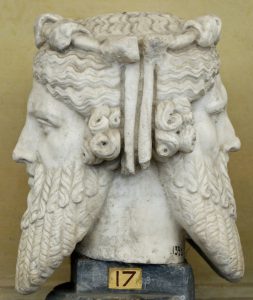
Vatican City, Vatican Museums, Museo Chiaramonti, section XIV, no.17. Janus-type Double Herm. Marble, Roman copy after a Greek original. Image via Wikimedia via Creative Commons 3.0 Unported.

And so, a bridge turns out to be a very ambivalent endeavor (as indeed all crossings and bifurcations are), living in the fuzzy realm between stability and destabilization, between safety and risk. With bridges, we might enter dangerous worlds otherwise inaccessible to us (sometimes for the better), so that the mere existence of bridges as gateways to these spaces can appear dangerous in itself, whilst they create an opening, and thus, opportunities in its original Latin sense as opportunus.

Knowing this far too well, we are required to cultivate trust in a bridge’s supports to safely guide us to the other side, but also to return if things turn out harmful. In such conditions we might, if circumstances and structures warrant, call upon the facilities and resourcefulness of a draw-bridge or pontoon bridge, and be prepared for the potential (and sometimes uneasily apparent) insecurity of suspension bridges.

Bear in mind the double-meaning of support here: bridges stand on supports and lend us support. They stabilize passages to cross what otherwise would be uncrossable – and thereby “ease your mind”, as Simon & Garfunkel sang in Bridge Over Troubled Water (1970); see the lyrics. Nor need we overlook the implication of the symbol of the Cross as the signature of Christ.

That said, shouldn’t all researchers thus be bridge-makers? Since what else is the prototype of a researcher than a person who, driven by endless curiosity, feels a strong inner desire of wanting to pass over to those unexplored realms on the other side?

It is this ambiguous nature of an in-between, of an entity standing in two worlds at once while creating an own space that belongs to none of them fully that make bridges such interesting transitional spaces. Yes, more than that: the bridge is the Urbild, the archetype of what transition and transitional spaces mean avant la lettre. This condition, by the way, is no less true for the double-identity of the messenger, a figure that embodies both bridge and bridge-maker to create meaningful connections between senders and receivers, between material and immaterial worlds, between heaven and the earth. And how could we forget that the Roman chief High Priest was known as the pontifex maximus, the great bridge-builder, a title later related to the Pope in Rome?[1]

Already in antiquity, the ambivalent figure of Hermes[2] as Olympic Messenger encapsulated the ambiguity of all bridges, as he is the protector not only of human heralds, travelers, merchants, and orators, but also of thieves, pointing out how much all hermeneutics convey risky endeavors, since all acts of interpretations may fail, or even be the cause of dangers of their own.

As a model of transition par excellence, bridges also remind us negatively of its connective nature, especially whenever we cross the Rubicon or burn down bridges, and thereby pass the point of no return — a very current fear in respect to Climate Change and Anthropocene. Either way, Hermes makes us aware of the close proximity of commuting and communicating.
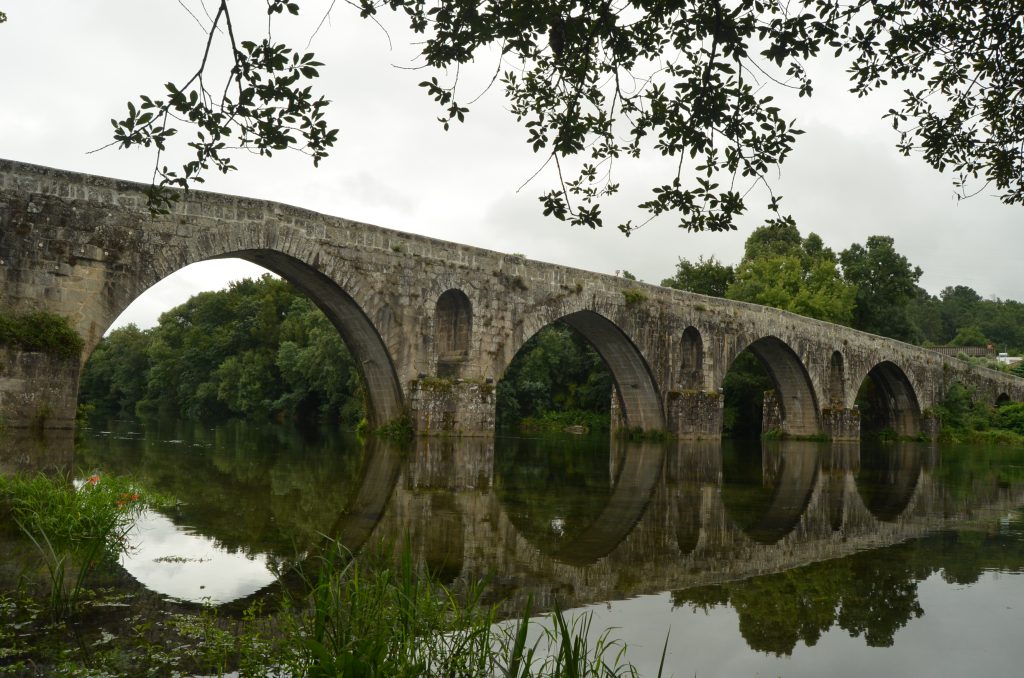
“Study on a Medieval Bridge” at Amares, Braga District, Portugal. Image by Pedro Nuno Caetano (2019) via Wikimedia Commons via Creative Commons 2.0 Generic.

Bridges Then and Now

For its next Anniversary Year, the Research Group for Manuscript Evidence has chosen the Theme of Bridges as its guiding symbol. In fact, it has been the mission of the RGME to build bridges since its first beginning — between disciplines, methods and media, and scholars from different countries, even continents, all driven by their passion for manuscripts and their historical significance, as well as their context among written texts as such and within the course (or coursing) of history.

For its anniversary, the RGME takes this mission one step further, by crossing the great sea in an attempt to bridge the academic cultures of the New World and Old World — in what could be described as a reversal of the Mayflower’s itinerary, from the Americas back to the British Isles, and back again. Let’s hope for calm waters and steady weather! (And is it too far-fetched to remind us that both Cambridge and Oxford are names that allude to bridge-like passages? Isn’t education always a bridge, a rite of passage?)

CFP for a RGME Session at the 2024 ICMS
(1–4 July 2024 in hybrid format)

In this spirit, we prepare sponsored Sessions, as usual, for the International Congress on Medieval Studies (ICMS) at Kalamazoo in May.  See our Call for Papers for the 2024 ICMS.

Also, for the first time, we prepare an Inaugural Sponsored Session for the International Medieval Congress (IMC) at Leeds in July 2024. The chosen Thematic Focus for the Leeds Congress is  “Crisis”.

The Co-Organisers for our Leeds Session are

Ann Pascoe–van Zyl (Trinity College Dublin)
and
Michael Allman Conrad
(Research Group on Manuscript Evidence and Universität St. Gallen)

Bridges and “Troubled Waters”

Under our guiding concept of “bridges,” the RGME invites papers for a Session at Leeds on all kinds of bridges and bridge-related topics. Be it more literally, as physical architectures and landmarks, such as historically significant specimens, or be it more abstractly, as architectural devices of the mind that enable us to make unexpected and unpredicted connections between marginal, off-field, divergent media, methods, and subjects that are usually not made or ignored.

In addition, we ask how bridges answer to different forms of crises, especially, but not only, with regard to communication, travel, social, cultural or political relations, or of the natural environment. In turn, we are also interested in papers that discuss how the establishment and maintenance of bridges may prevent crises or, contrarily, cause new unforeseen forms of crisis.

In summary, we welcome all bold bridge-makers willing to traverse pathways that others have not dared to take. In such ways, we might also respond to the opportunities and challenges which the captain and officers on the bridge of a ship can observe directly, better to steer a course in the passage.
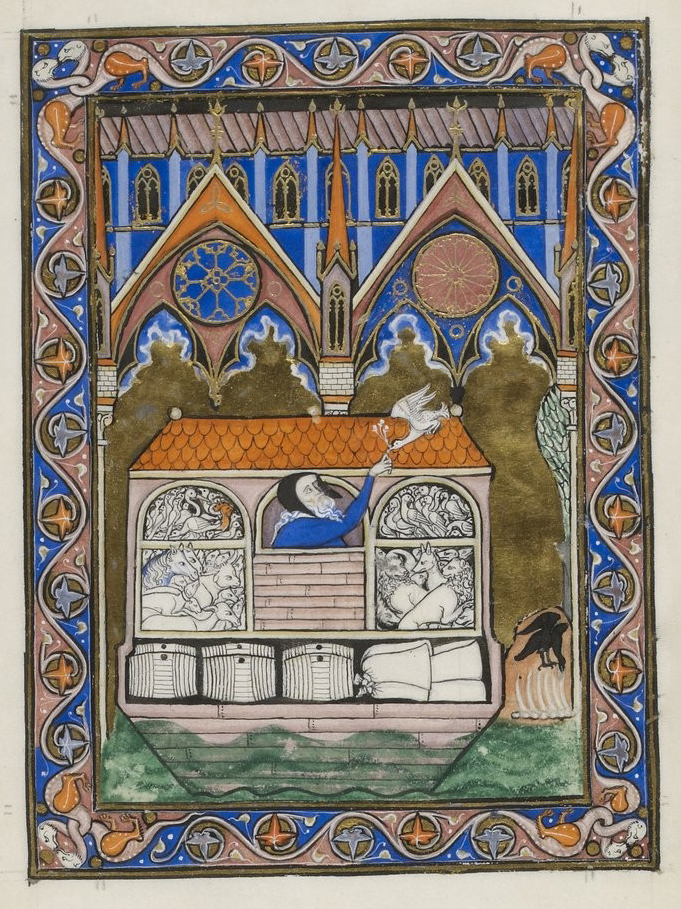
Paris , Bibliothèque nationale de France, Département des manuscrits, MS Lat 10525, fol. 3v, detail. Noah’s Ark. Image Public Domain via https://gallica.bnf.fr/ark:/12148/btv1b8447877n.

Note on the image:  Paris, Bibliothèque nationale de France, Département des manuscrits, MS Lat 10525, folio 3v. Psalter of Saint Louis, Paris circa 1270. See Psautier de Saint Louis: Latin 10525. On the genre, see, for example, Noah’s Ark; and Noah’s Arkhive.

*****

Proposals Invited for Papers
for our 2024 Session at Leeds
— Due by 31 August 2023

We invite abstracts of 200–300 words.  Your proposals should be made to the Session Co-Organisers to the address below by 31 August 2023.  Following this Call for Papers, the RGME Session will be selected and submitted to the Congress by 30 September 2023.  We will inform you of the selection by this time.

The Congress at Leeds will be held in person, with provisions for online participation. In this way, we hope that you might be able to attend onsite or at a distance, depending upon your travel arrangements.  Please indicate in your Proposal if you you would prefer to present your paper or session in-person or virtually.

  • Congress Website
    https://www.imc.leeds.ac.uk/imc-2024/
  • Proposal Criteria
    https://www.imc.leeds.ac.uk/proposals/criteria/

Deadline for Paper Proposals:  Due by 31 August 2023

We look forward to your contributions.

For information about this RGME Session, and to make your Proposal, please contact the Co-organisers:

Ann Pascoe-van Zyl and Michael Allman Conrad
for the Research Group on Manuscript Evidence

rgmesessions@gmail.com

*****

Footnotes

[1] Originally, this might have been meant literally: the position of bridge-builder was an important one in Rome, where the major bridges were over the Tiber. Considered a deity, only authorities with sacral functions could be allowed to “disturb” the river with mechanical additions. The title of “pontifex” for the Pontiff in Rome was already around for centuries, but did not become a regular title of honor for Popes before the 15th century, which is probably linked to the Fall of Constantinople in 1453 and the death of the last East Roman Emperor.

Fun fact: Pope Benedict XVI adopted @pontifex as his Twitter handle, which has been maintained by his successor Pope Francis.
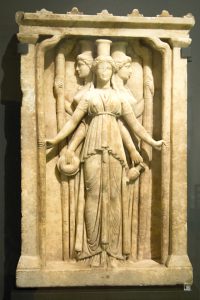
Prague, National Gallery, Kinský Palace, NM-H10 4742. Marble relief of triplicate Hekate. Image via Creative Commons Attribution Share-Alike 3.0 Unported.

[2] There is something strange to be observed when we look at antiquity in this regard. The areas of expertise and responsibility for Greek and Roman Gods with respect to bridges is not clear-cut.

In fact, Janus seems to be the more suitable candidate if we want to know what God was actually related to bridges, as he generally was the God of motion, of pathways, doors and gates, of beginnings and endings, devoted to spatial and temporal transitions.

However, if we think about the mitigation, communication between different realms, dominions, and areas, this job would be that of Hermes as mitigator and messenger.

But, thirdly, there’s also Hecate, as the dark Goddess of crossings, of magic and witchery. Sometimes represented as triple-formed, her associations include crossroads, entrance-ways, night, light, sorcery, witchcraft, necromancy, graves, and protection from witchcraft. These powers extended her realms of transitions to stretch beyond the worlds of the living.

The lines seem to be a bit blurred here, and it seems to depend on what aspect of bridges interests us exactly to know which God to tend to: the dark aspects of all crossings (as mixing things that should be kept separate), the mitigation and moderation in communicative acts (Hermes), or transition and ambivalence in general?

We invite you to join the conversation.

*****
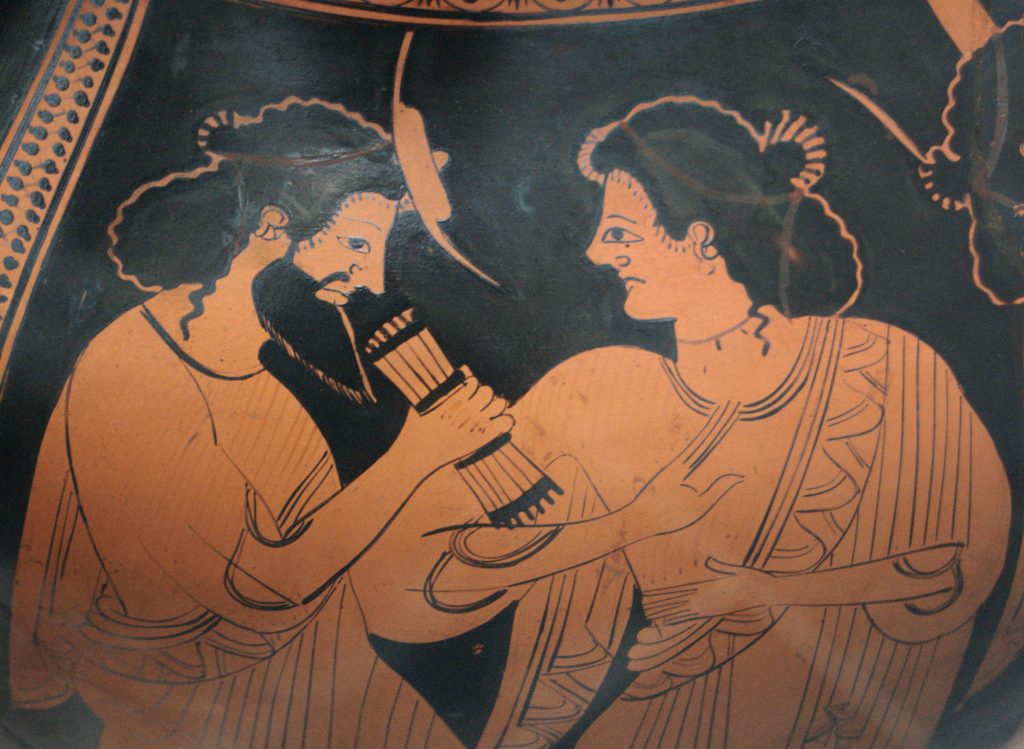
Munich, Staatliche Antikensammlungen, Nikoxenos Painter, Attic red-figure belly-amphora, ca. 500 BC, Side B, detail of Council of the Gods on Mount Olympus: Hermes with his mother Maia. Image via Wikimedia via Creative Commons.

Note on the image:  See Council of the Gods.

*****
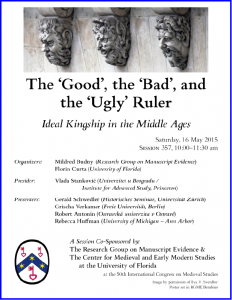
2015 Poster for the Session on 'Ideal Kingship' co-sponsored by the Research Group on Mauscript Evidence and the Center for Medieval and Early Modern Studies at the University of Florida, set in RGME Bembino, with a photograph of Le Pont Neuf in Paris by Ilya V. Sverdlov, reproduced by permission.

RGME Poster for 2015 Session on “Ideal Kingship”.

Note on Le Pont Neuf
(see image above)

The ornate sculptural masks (mascarons) on the sides of Le Pont_Neuf in Paris inspired the series of posters for our Sessions at the 2015 ICMS at Kalamazoo.  See:

  • 2015 International Congress on Medieval Studies Report.

For the photographs in the posters, we thank Ilya V. Sverdlov.

The 381 original and individual Renaissance mascarons were replaced in the complete rebuilding of the bridge in 1851–1854 with copies by 19th-century sculptors. At the time, some of the 16th-century originals — attributed to the French Renaissance sculptor Germain Pilon (1525–1590) — were placed in the Musée Carnavalet (six originals and eight molds of others) and the Musée de Cluny – Musée national du Moyen Âge (eight originals); the latter were transferred later to the French National Museum of the Renaissance in the Château d’Écouen.

The masks are said to “represent the heads of forest and field divinities from ancient mythology, as well as satyrs and sylvains.” (Le Pont_Neuf.) With elaborate beards, enlarged ears, and animated and often threatening expressions, the faces of the mascarons stand constant watch both upstream and downstream on “The New Bridge”.  It is as if — from their stable supports on the stone structure — they pose both troubled and troubling outlooks for the waters below, as well as toward all passengers upon or beside them.

In two spans, that construction links opposite sides of the River Seine with the western (downstream) end “of the Île de la Cité, the island in the middle of the river that was, between 250 and 225 BC, the birthplace of Paris, then known as Lutetia and, during the medieval period, the heart of the city.”  (Le Pont_Neuf.)
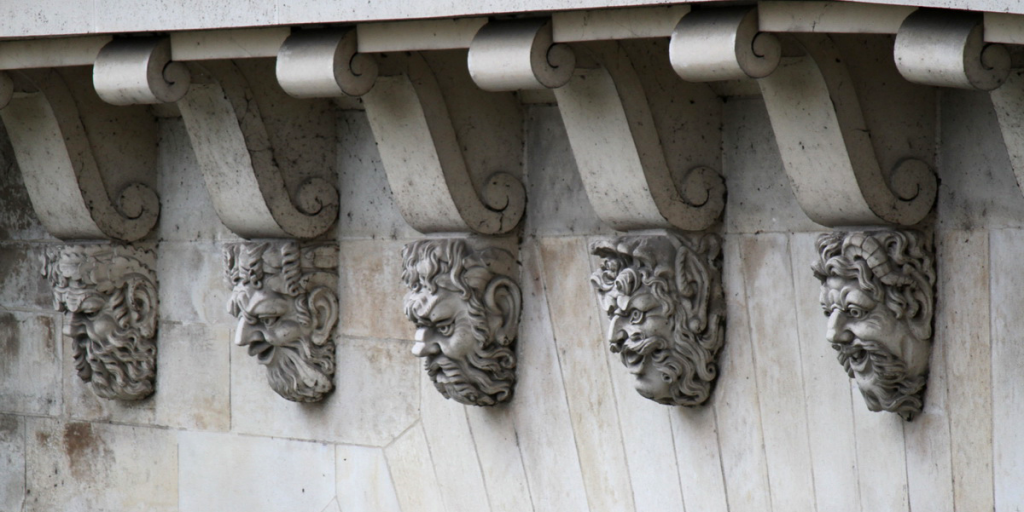
Le Pont Neuf, 5 Corbel Heads All in a Row. Photography by Ilya V. Sverdlov. Reproduced by permission.

*****

We look forward to your contributions.  We invite Proposals for Papers in our Inaugural Sponsored Session on “Building Bridges ‘Over Troubled Waters’ ” at the 2024 International Medieval Congress at Leeds.

Please be sure to submit your Proposal by 31 August 2023 to the address above.

*****

Please leave your Comments or questions here, Contact Us, or visit

  • our FaceBook Page
  • our Twitter Feed (@rgme_mss)
  • our Blog on Manuscript Studies and its Contents List

Donations and contributions, in funds or in kind, are welcome and easy to give.  See Contributions and Donations.

We look forward to hearing from you.

*****

Tags: "Bridge Over Troubled Water", Bridges, Council of the Gods, Crises, Hecate, Hermes, History of Bridges, International Congress for Medieval Studies, International Medieval Congress, Janus, Le Pont Neuf, Le Pont Neuf Paris, Medieval Studies, Noah's Ark, RGME Anniversary Year
No Comments »

  • Top
©2024 Research Group on Manuscript Evidence.


is proudly powered by WordPress. WordPress Themes X2 developed by ThemeKraft.