
Sanskrit and Prakrit Manuscripts, Continued: More Leaves for Manuscript Sample XII
June 23, 2026 in Manuscript Fragments, Manuscript Studies, Photographic Exhibition
Continuing to explore the dispersal and find-places for manuscript fragments of many kinds, on parchment or paper and in a wide range of languages and genres, we note with pleasure the discoveries which may await the attention, observation, and recognition by scholars and researchers worldwide, given the opportunity to see postings online of materials of interest.
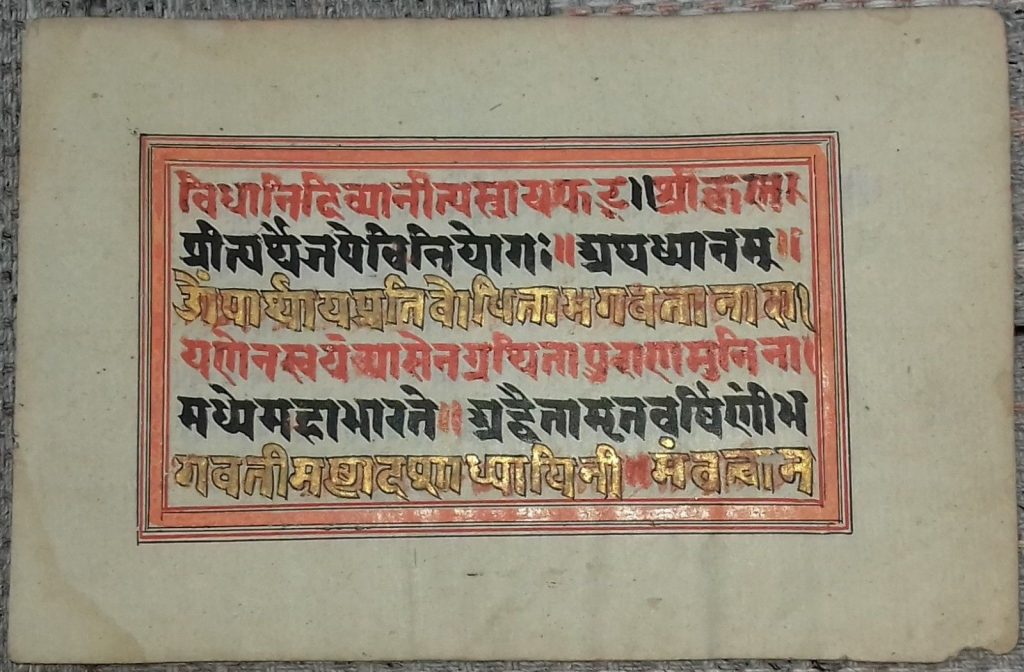
Responding to a message from a visitor to this RGME blog on Manuscript Studies, we have asked the private owner of the item in question for further information about the page (or single side of a leaf) which we posted as Manuscript Sample XII (in our own numbering, for convenience in the blogpost).
First, we reprise that posting, extracted from the set of specimens in the blogpost on
To whit:
XII. Manuscript Leaf on Paper
with a Bordered Rectangular Frame and Polychrome Lines of Text
The column of 6 long lines of text stands within a bordered rectangular frame comprising a nested series of bands. The broadest band is filled with a pale reddish or orange pigment. The lines of text alternate in color regularly between red pigment, black ink, and gold leaf laid within ink outlines.
Purchased from an online seller.
Next, with thanks to the collector for responding so swiftly, we report more information.
Measurements
Measurements: leaf, 9.5 × 14.4 cm; border, 6.0 × 10.3 cm.
Structure and Companion Pages
The page is part of a bifolium.
We are permitted to reproduce it, front and back. The polychrome sample page used for “Manuscript XII,” with gold pigment as well as red and black for the other pages, stands as the recto of Side 1 of the bifolium.
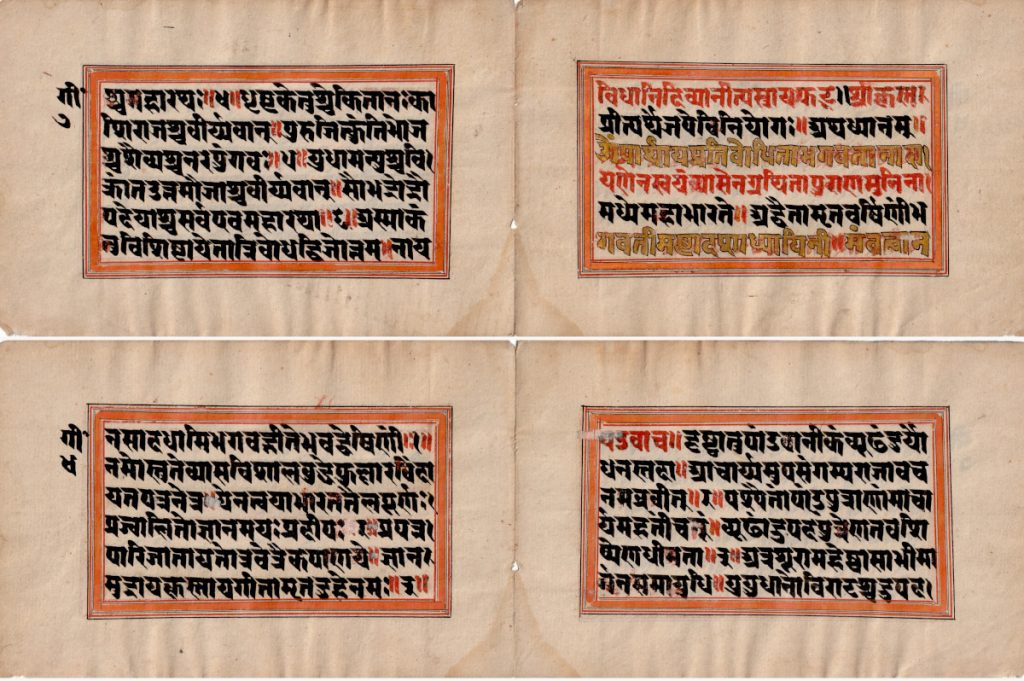
Private Collection, “Manuscript Sample XII”, bifolium: both sides. Top: Side 1. Bottom Side 2. Photograph by the Owner, Reproduced by Permission.
Do you know of other leaves from this manuscript or by the same scribal artist? Do you have information about the text, original manuscript, pattern of distribution after fragmentation, or other features?
We would be glad to learn.
Please contact us.
***********