• News
    • News & Views
    • RGME Activities for 2024 and 2025
    • Around & About with the RGME
    • Reviews
    • Highlights
  • Blogs
    • Manuscript Studies
      • Manuscript Studies: Contents List
    • International Congress on Medieval Studies
      • Abstracts of Congress Papers
        • Abstracts of Papers Listed by Author
        • Abstracts of Papers Listed by Year
  • About
    • Mission
    • Who We Are
      • Officers, Associates & Volunteers
      • RGME Committees
      • Friends of the Research Group on Manuscript Evidence
    • Policies & Statements
      • RGME Privacy Policy Statement
      • RGME Intellectual Property Statement & Agreements
    • People
      • Mildred Budny — Her Page
      • Adelaide Bennett Hagens
    • Activities
      • Events
      • Congress Activities
        • Sponsored Conference Sessions (1993‒)
          • Panels at the M-MLA Convention (from 2016)
        • Co-sponsored Conference Sessions (2006‒)
    • History
      • Seals, Matrices & Documents
      • Genealogies & Archives
    • Contact Us
  • Bembino
    • Multi-Lingual Bembino
    • RGME Bembino: Resources
  • Congress
    • Sponsored Conference Sessions (1993‒)
    • Co-sponsored Conference Sessions (2006‒)
    • Abstracts of Congress Papers
      • Abstracts Listed by Author
      • Abstracts Listed by Year
    • Kalamazoo Archive
    • Panels at the M-MLA Convention (2016-2019)
      • Abstracts of Papers for the M-MLA Convention
      • Panels at the M-MLA Convention (from 2016)
  • Events
    • RGME Activities for 2024 and 2025
      • 2023 Activities and 2024 Planned Activities
    • Seminars, Workshops, Colloquia & Symposia (1989–)
      • Seminars on ‘The Evidence of Manuscripts’
      • Symposia on ‘The Transmission of the Bible’
      • The New Series (2001-)
        • 2019 Anniversary Symposium Program: The Roads Taken
        • 2019 Anniversary Symposium Registration
        • 2019 Anniversary Symposium Registration Open
      • RGME Symposia: The Various Series
      • The Research Group Speaks: The Series
      • Meetings of the Friends of the Research Group on Manuscript Evidence
      • RGME Online Events
    • Abstracts of Papers for Events
      • Abstracts of Papers for Seminars on ‘The Evidence of Manuscripts’
      • Abstracts of Papers for Symposia, Workshops & Colloquia
    • Receptions & Parties
    • Business Meetings
    • Photographic Exhibitions & Master Classes
    • Events Archive
  • ShelfLife
    • Journal Description
    • ShelfMarks: The RGME-Newsletter
    • Publications
      • “Insular, Anglo-Saxon, and Early Anglo-Norman Manuscript Art at Corpus Christi College, Cambridge” (1997)
        • Mildred Budny, ‘Catalogue’
        • The Illustrated Catalogue (1997)
      • The Illustrated Handlist
      • Semi-Official Counterfeiting in France 1380-1422
      • No Snap Decisions: Challenges of Manuscript Photography
    • History and Design of Our Website
  • Galleries
    • Watermarks & the History of Paper
    • Galleries: Contents List
    • Scripts on Parade
    • Texts on Parade
      • Latin Documents & Cartularies
      • New Testament Leaves in Old Armenian
    • Posters on Display
    • Layout Designs
  • Donations and Contributions
    • RGME Donor Promise
    • 2023 End-of-Year Fundraiser for our 2024 Anniversary Year
    • 2019 Anniversary Appeal
    • Orders
  • Links
    • Catalogs, Metadata, and Databases: A Handlist of Links
    • Handlist of Resources for Manuscript Studies and Fragmentology
    • Manuscripts & Rare Books
    • Maps, Plans & Drawings
    • Seals, Seal-Matrices & Documents

  • News
    • News & Views
    • RGME Activities for 2024 and 2025
    • Around & About with the RGME
    • Reviews
    • Highlights
  • Blogs
    • Manuscript Studies
      • Manuscript Studies: Contents List
    • International Congress on Medieval Studies
      • Abstracts of Congress Papers
        • Abstracts of Papers Listed by Author
        • Abstracts of Papers Listed by Year
  • About
    • Mission
    • Who We Are
      • Officers, Associates & Volunteers
      • RGME Committees
      • Friends of the Research Group on Manuscript Evidence
    • Policies & Statements
      • RGME Privacy Policy Statement
      • RGME Intellectual Property Statement & Agreements
    • People
      • Mildred Budny — Her Page
      • Adelaide Bennett Hagens
    • Activities
      • Events
      • Congress Activities
        • Sponsored Conference Sessions (1993‒)
          • Panels at the M-MLA Convention (from 2016)
        • Co-sponsored Conference Sessions (2006‒)
    • History
      • Seals, Matrices & Documents
      • Genealogies & Archives
    • Contact Us
  • Bembino
    • Multi-Lingual Bembino
    • RGME Bembino: Resources
  • Congress
    • Sponsored Conference Sessions (1993‒)
    • Co-sponsored Conference Sessions (2006‒)
    • Abstracts of Congress Papers
      • Abstracts Listed by Author
      • Abstracts Listed by Year
    • Kalamazoo Archive
    • Panels at the M-MLA Convention (2016-2019)
      • Abstracts of Papers for the M-MLA Convention
      • Panels at the M-MLA Convention (from 2016)
  • Events
    • RGME Activities for 2024 and 2025
      • 2023 Activities and 2024 Planned Activities
    • Seminars, Workshops, Colloquia & Symposia (1989–)
      • Seminars on ‘The Evidence of Manuscripts’
      • Symposia on ‘The Transmission of the Bible’
      • The New Series (2001-)
        • 2019 Anniversary Symposium Program: The Roads Taken
        • 2019 Anniversary Symposium Registration
        • 2019 Anniversary Symposium Registration Open
      • RGME Symposia: The Various Series
      • The Research Group Speaks: The Series
      • Meetings of the Friends of the Research Group on Manuscript Evidence
      • RGME Online Events
    • Abstracts of Papers for Events
      • Abstracts of Papers for Seminars on ‘The Evidence of Manuscripts’
      • Abstracts of Papers for Symposia, Workshops & Colloquia
    • Receptions & Parties
    • Business Meetings
    • Photographic Exhibitions & Master Classes
    • Events Archive
  • ShelfLife
    • Journal Description
    • ShelfMarks: The RGME-Newsletter
    • Publications
      • “Insular, Anglo-Saxon, and Early Anglo-Norman Manuscript Art at Corpus Christi College, Cambridge” (1997)
        • Mildred Budny, ‘Catalogue’
        • The Illustrated Catalogue (1997)
      • The Illustrated Handlist
      • Semi-Official Counterfeiting in France 1380-1422
      • No Snap Decisions: Challenges of Manuscript Photography
    • History and Design of Our Website
  • Galleries
    • Watermarks & the History of Paper
    • Galleries: Contents List
    • Scripts on Parade
    • Texts on Parade
      • Latin Documents & Cartularies
      • New Testament Leaves in Old Armenian
    • Posters on Display
    • Layout Designs
  • Donations and Contributions
    • RGME Donor Promise
    • 2023 End-of-Year Fundraiser for our 2024 Anniversary Year
    • 2019 Anniversary Appeal
    • Orders
  • Links
    • Catalogs, Metadata, and Databases: A Handlist of Links
    • Handlist of Resources for Manuscript Studies and Fragmentology
    • Manuscripts & Rare Books
    • Maps, Plans & Drawings
    • Seals, Seal-Matrices & Documents

Log in

Archives

Featured Posts

2026 International Congress on Medieval Studies: Program
Episode 24. “Life with Books” (Interview with John Windle)
Announcing the Launch of RGME Bembino WP
2026 RGME Colloquium at The Grolier Club: Report
Medieval Missal Fragment as Early-Modern Cover
The Weber Leaf from Ege MS 61
"Bembino" Booklet Cover
Episode 23. “Meet RGME Bembino: Facets of a Font”
2026 RGME Colloquium on “Transformations & Renewals” at The Grolier Club
2026 Theme of the Year: “Transformations and Renewals”
A Leaf with Patchwork from the Saint Albans Bible
A Sister Leaf from a Miniature Latin Vulgate Bible
A Little Latin Vulgate Bible Manuscript Leaf in Princeton
J. S. Wagner Collection. Leaf from from Prime in a Latin manuscript Breviary. Folio 4 Verso, with part of Psalm 117 (118) in the Vulgate Version, set out in verses with decorated initials.
2026 Annual Appeal
Episode 22: “Encounters with Local Saints and Their Cults”
Private Collection, Ege's FBNC Portfolio, Dante Leaf, Verso, Detail. Reproduced by Permission.
2025 RGME Autumn Colloquium on Fragments
Workshop 8: A Hybrid Book where Medieval Music Meets Early-Modern Herbal
2025 RGME Autumn Symposium on “Readers, Fakers, and Re-Creators of Books”
RGME Workshops on “The Evidence of Manuscripts, Etc.”
2025 International Medieval Congress at Leeds: RGME Program
Episode 21. “Learning How to Look”
2025 International Congress on Medieval Studies: Program
2025 RGME Visit to Vassar College
Two Leaves in the Book of Numbers from the Chudleigh Bible
Delibovi on Glassgold on Boethius: A Blogpost
Ronald Smeltzer on “Émilie du Châtelet, Woman of Science”
2025 Spring Symposium: “Makers, Producers, and Collectors of Books”
Starters’ Orders
The Weber Leaf from the Saint Albans Bible
Workshop 4. “Manuscript Fragments Compared”
Episode 20. “Comic Book Theory for Medievalists”
Episode 19: “At the Gate: Starting the Year 2025 at its Threshold”
Favorite Recipes for Lemonade, Etc.
RGME Visit to the Lomazow Collection: Report
2024 Autumn Symposium: “At the Helm”
A Latin Vulgate Leaf of the Book of Numbers
The RGME ‘Lending Library’
Florence, Italy, Ponte Vecchio from Ponte alle Grazie. Photo: Ingo Mehling, CC BY-SA 4.0 , via Wikimedia Commons
Episode 17. “RGME Retrospect and Prospects: Anniversary Reflections”
2024 Anniversary Symposium: The Booklet
Jesse Hurlbut at the Bonneville Salt Flats, Utah. Photograph Jesse Hurlbut.
Episode 16: An Interview with Jesse D. Hurlbut
To Whom Do Manuscripts Belong?
Kalamazoo, MI Western Michigan University, Valley III from the side. Photograph: David W. Sorenson.
2024 International Congress on Medieval Studies: Report
2024 Spring Symposium at Vassar College
Puente de San Martín: Bridge with reflection over the River Targus, Toledo, Spain.
2024 Grant for “Between Past and Future” Project from The Gladys Krieble Delmas Foundation Research Libraries Program
2024 Anniversary Symposium in Thanks to Jesse Hurlbut: Program

You are browsing the Blog for History of Board Games

Knowledge Games and Games of Knowledge: An RGME Session for IMC 2025

August 13, 2024 in Announcements, Call for Papers, Conference, Events, International Medieval Congress, Leeds, Manuscript Studies

Call for Papers
“Knowledge Games and Games of Knowledge:
A Global Perspective on
How Manuscripts Conserve and Transmit Ludic Knowledge”

Session
Sponsored by the RGME
IMC Leeds 2025

Organised by Michael A. Conrad
(University of Sankt-Gallen)

[Posted on 13 August 2024]

Following the success of our Inaugural Session at the International Medieval Congress this year, the Research Group on Manuscript Evidence announces its proposed Sessions for the International Medieval Congress to be held at the University of Leeds from 1–10 July 2025.
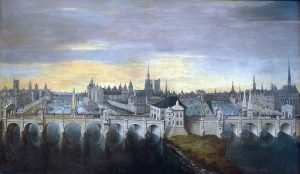
Paris, Musée Carnavalet, Projet pour le Pont Neuf, circa 1577. Image via Wikimedia via Creative Commons Attribution 3.0 Unported.

Background: 2024

Our 2024 Inaugural Session, co-organised by our Associates Ann Pascoe-van Zyl and Michael Allman Conrad, focused on “Building Bridges ‘Over Troubled Waters'”:

  • 2024 International Medieval Congress at Leeds: 2024

Foreground: 2025

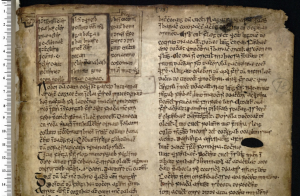
Dublin, Royal Irish Academy, MS 23 E 25, p. 73, top. Image via https://codecs.vanhamel.nl/Dublin,_Royal_Irish_Academy,_MS_23_E_25 via Creative Commons (CC BY-SA 3.0).

For 2025,with the IMC’s Thematic focus of “Worlds of Learning”, the RGME proposes an integrated suite of events comprising a pair of Sessions of papers plus a Roundtable discussion on “Manuscripts as Worlds of Learning”.

  • 2025 International Medieval Congress at Leeds: Call for Papers (Manuscripts as Worlds of Learning)

In addition, following up on a strand in our 2024 Inaugural Session, the RGME also proposes a sponsored session organised by that session’s co-organizer and presenter, Michael Allman Conrad.

The Plan for the Session

“Knowledge Games and Games of Knowledge:
A Global Perspective on
How Manuscripts Conserve and Transmit
Ludic Knowledge”

Recent scholarship has pointed out time and again how much in the Middle Ages games and other joyful pastimes were not only cherished and accepted as an essential part of everyday life, but also well appreciated as educational tools for making difficult lessons more palatable for students.

Some of these educational games have a long tradition, such as rithmomachia, which was used in schools for instruction in the quadrivial arts and still known by scholars of the 17th century. Some disciplines, such as astronomy, even had their own games — in this case, for example, the ludus astrologicus. The knowledge of such elaborate games was transmitted through manuscripts, often as part of miscellanies. Besides, there is no lack of writings dedicated to more profane games either. In fact, there are collections of board games (and other pastimes), with some of these manuscripts showing very rich and ornate embellishments and game diagrams, along with vivid miniatures depicting players in action.
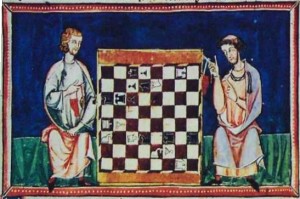
Madrid, Real Biblioteca del Monasterio de El Escorial, MS T-I-6, folio 27 verso. Image in the Public Domain, Via Wikipedia Commons.

Madrid, Real Biblioteca del Monasterio de El Escorial, MS T-I-6, folio 27 verso. Image in the Public Domain, Via Wikipedia Commons.

Examples of such works include

  • the Book of Games (Libro de acedrez dados e tablas c. 1284) by Alfonso X of Castile, in the Bonus Socius group (13th century?),
  • the Paris manuscript of Le jeu de echecs by Nicola de S. Nicholai (Paris, Bibliothèque nationale de France (BNF), MS fr. 1173, 14th century),
  • as well as lesser-known manuscripts, such as Cambridge, Trinity College, MS O 2.45 (after 1248 AD).

The book medium, however, poses serious challenges to scribes concerned with conserving and conveying knowledge related to games and other pastimes, as their existence is ephemeral and their experience difficult to verbalize — which is a reason why in the (Arabic and European) tradition medieval books on games usually came with said pictures and diagrams, with the intent to compensate for what cannot be easily expressed through words alone. What is more, in medieval writings on games their epistemological status often remains ambivalent and uncertain, as they were often touted as morally ambiguous and did not fit existing knowledge systems. That said, there nonetheless were some scholars that tried to fit ludic knowledge into prevalent eschatological framework of knowledge, such as Hugh of Saint-Victor, with some of them basing their (re-)assessments of the morality and epistemic status of games and other forms of entertainment on Arabic and Greek influences.  As reaffirmed by Hugh and in the work of Thomas Aquinas, the Latin concept of ludus could not only serve as an umbrella term for various kinds of games, but all forms of entertainment.

While the focus of the proposed Session is games, the evocation of ludic knowledge is intended as an invitation to different kinds of pastimes in order jointly to examine how medieval scholars dealt with game-related forms of knowledge, from material objects to their metaphysical and anthropological relevance. Especially the latter implies and extends the perspective towards practices employing games and other pastimes methodologically for educational purposes. Consequently, the geographical scope is not restricted to the European sphere. On the contrary, since there is strong evidence that European game manuscripts drew much from Arabic and other non-Latin traditions, contributors focusing on the Byzantine Empire, the Islamic world, India, or other cultural world regions are very much welcome and encouraged to partake.

Some possible questions could be (but are not limited to):

  • What do we know about the authorship of game manuscripts?
  • Are the works written by single individuals or collectives?
  • In what types of miscellanies do writings on games and game manuals appear and why?
  • How do manuscripts/authors deal with ephemeral aspects of games and other pastimes that are difficult to be expressed linguistically?
  • How can we reconstruct the concrete educational practices wherein games and other pastimes were used?
  • What hints thereof can we find in the material evidence of manuscripts?
  • How do authors try to systematize ludic knowledge and where do they position it within given epistemic frameworks?
  • What can we say about the relationship between game diagrams and diagrammatic representations in scientific disciplines in terms of a shared visual vocabulary?
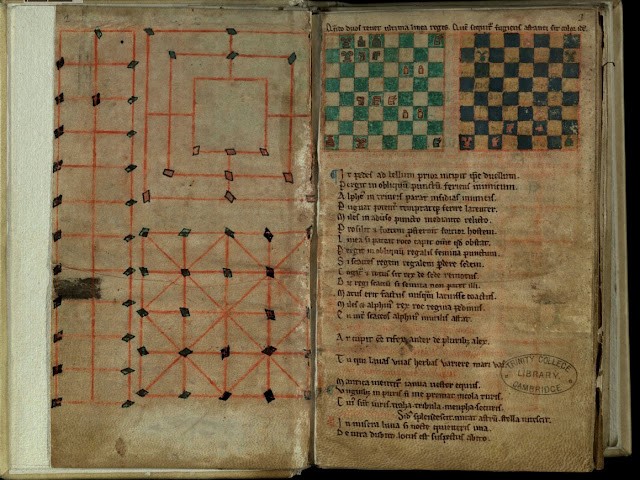
Cambridge, Trinity College, MS O.2.45, fols 2v-3r. Image copyright the Master and Fellows of Trinity College, Cambridge, via CC-NY 4.0.

Note on the Image

Cambridge, Trinity College, MS O 2.45 (after 1248 AD), folios 2v and 3r. Accompanying the text, diagrams and illustrations depict two chess boards, an alquerque, a nine-mens-morris and a daldøsa game board. The first moves of the game are already played.

Image © the Master and Fellows of Trinity College, Cambridge, via License CC BY-NC 4.0 via Trinity College Cambridge.

Proposals

For information about submitting your proposals for our Sessions, please see the CFP for our companion suite for IMC 2025:

  • 2025 International Medieval Congress at Leeds: Call for Papers (Manuscripts as Worlds of Learning)

Deadlines for Proposals

  • 5 September 2024 for your individual paper proposals for our RGME Sessions and Round-table Discussion
  • 30 September 2024 for the RGME to complete and submit its programmes.

To prepare your proposals, see the IMC instructions

  • How to Submit a Proposal

Send your proposals for our Session to us at

  • rgme.imc.sessions@gmail.com by 5 September 2024

When your proposals are accepted, we will direct you to submit them through the

  • IMC-Leeds Confex Submission Portal

Spread the Word

Look for our RGME CFPs on the IMC 2025 website:

  • IMC 2025 Padlet Page

Questions and Suggestions?

If you wish, please:

  • add your Comments here,
  • send us a message (Contact Us),
  • visit our Facebook Page and Facebook Group,
  • join the Friends of the Research Group on Manuscript Evidence (there is no charge), and
  • register for our events on our RGME Eventbrite Portal:
    RGME Eventbrite Collection

*****
 

Tags: Alfonso X of Castile, Board Games, Book of Games, Chess, Games in the Middle Ages, History of Board Games, Jeu des echecs, Le jeu de echecs, Ludus astrologicus, Manuscript studies, Quadrivia, Rhythmomachy
No Comments »

Episode 11: Michael Allman Conrad on “Gamified Numbers”

May 26, 2023 in Manuscript Studies, Research Group Speaks (The Series), Uncategorized

The Research Group Speaks
Episode 11
Saturday 8 July 2023 online
12:00–1:30 pm EDT (GMT-4) by Zoom

“Gamified Numbers and Digitalized Castles:

Digital Reconstructions of Medieval Board Games
and Other Forms of Data Visualization
as Methods in the Humanities
“

Michael Allman Conrad

[Posted on 5 June 2023, with updates]

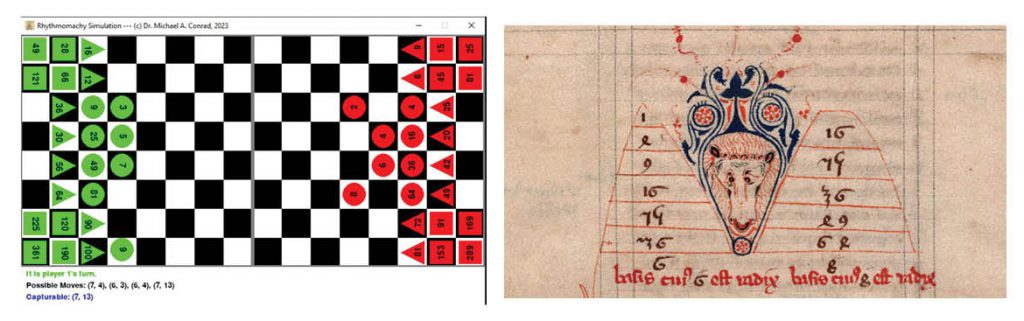
For Episode 11 in the online series of The Research Group Speaks, our Associate Michael Allman Conrad will talk about his ongoing work on games, board games, and interrelations between gameplay and numbers.

Left: Rhythmomachy Simulation (Player 1's turn). Image © 2023 Michael A. Conrad. Right: Bibliothèque interuniversitaire, Section Médecine, Montpellier, H 366, f. 13v, with rhythmomachy pyramids at the top flanking a lion's mask. Image via Creative Commons, via https://portail.biblissima.fr/fr/ark:/43093/mdata268b7df0d12be6fa155f802fd66b4123b9ddd65a.Left: Rhythmomachy Simulation (Player 1's turn). Image © 2023 Michael A. Conrad. Right: Bibliothèque interuniversitaire, Section Médecine, Montpellier, H 366, f. 13v, with rhythmomachy pyramids at the top flanking a lion's mask. Image via Creative Commons, via https://portail.biblissima.fr/fr/ark:/43093/mdata268b7df0d12be6fa155f802fd66b4123b9ddd65a.

Left: Rhythmomachy Simulation (Player 1’s turn). Image © 2023 Michael A. Conrad.
Right: Bibliothèque interuniversitaire, Section Médecine, Montpellier, H 366, f. 13v, with rhythmomachy pyramids at the top flanking a lion’s mask. Image via Creative Commons.

Recently, Michael spoke about some aspects of this work for a Session co-sponsored by the Societas Magica and the Research Group on Manuscript Evidence at the 2023 International Congress on Medieval Studies in May.  See the Program for our activities there (2023 Congress Program) and the illustrated Abstract for Michael’s paper.

In our co-sponsored Session on “Teaching Astrology and Other Liberal Arts” , Michael’s topic was “Gamified Numbers:  Board Games as Educational Instruments for Teaching Astrology and Other Quadrivial Arts”.  In the short time-span permitted by a full Session with four individual presentations , he briefly examined the game of rhythmomachy (rhitmomachia or “Battle of Numbers”), an early mathematical board game, and described his project of studying and preparing a computer simulation for its play.

Now we have the opportunity to hear Michael describe this complicated game, its origins, and its intricate relationship with knowledge of Boethian theories on the mathematical arts. That is, its structure is grounded in the understanding of those arts expounded by Anicius Manlius Severinus Boethius (circa 480 – 524 CE) in his influential manual De Institutione arithmetica Libri duo, based upon his loose translation of the treatise on the subject composed in Greek by the Neopythagorean philosopher Nicomachus of Gerasa (circa 60 – circa 120 CE).

More than that, Michael’s explorations of the game and its underlying theories build a bridge to a more general debate on the use of digital methods in the humanities, which he is also exploring in different ongoing data projects of his, some of which he is also going to introduce briefly in the course of his paper. The discussion will start with reflections on his experiences with using these methods, their requirements, benefits, and downsides.

Please register to attend this online event (see below).

Read the rest of this entry →

Tags: Alfonso X of Castile, Anicius Manilius Severinus Boethius, De consolatione philosophiae, De institutione arithmetica, Gameplay, History of Board Games, Mathematical Games, Nichomachus of Gerasa, Rhythmomachy, Ritmomachia, Scholasticism, The Research Group Speaks
No Comments »

  • Top
©2024 Research Group on Manuscript Evidence.


is proudly powered by WordPress. WordPress Themes X2 developed by ThemeKraft.