• News
    • News & Views
    • RGME Activities for 2024 and 2025
    • Around & About with the RGME
    • Reviews
    • Highlights
  • Blogs
    • Manuscript Studies
      • Manuscript Studies: Contents List
    • International Congress on Medieval Studies
      • Abstracts of Congress Papers
        • Abstracts of Papers Listed by Author
        • Abstracts of Papers Listed by Year
  • About
    • Mission
    • Who We Are
      • Officers, Associates & Volunteers
      • RGME Committees
      • Friends of the Research Group on Manuscript Evidence
    • Policies & Statements
      • RGME Privacy Policy Statement
      • RGME Intellectual Property Statement & Agreements
    • People
      • Mildred Budny — Her Page
      • Adelaide Bennett Hagens
    • Activities
      • Events
      • Congress Activities
        • Sponsored Conference Sessions (1993‒)
          • Panels at the M-MLA Convention (from 2016)
        • Co-sponsored Conference Sessions (2006‒)
    • History
      • Seals, Matrices & Documents
      • Genealogies & Archives
    • Contact Us
  • Bembino
    • Multi-Lingual Bembino
    • RGME Bembino: Resources
  • Congress
    • Sponsored Conference Sessions (1993‒)
    • Co-sponsored Conference Sessions (2006‒)
    • Abstracts of Congress Papers
      • Abstracts Listed by Author
      • Abstracts Listed by Year
    • Kalamazoo Archive
    • Panels at the M-MLA Convention (2016-2019)
      • Abstracts of Papers for the M-MLA Convention
      • Panels at the M-MLA Convention (from 2016)
  • Events
    • RGME Activities for 2024 and 2025
      • 2023 Activities and 2024 Planned Activities
    • Seminars, Workshops, Colloquia & Symposia (1989–)
      • Seminars on ‘The Evidence of Manuscripts’
      • Symposia on ‘The Transmission of the Bible’
      • The New Series (2001-)
        • 2019 Anniversary Symposium Program: The Roads Taken
        • 2019 Anniversary Symposium Registration
        • 2019 Anniversary Symposium Registration Open
      • RGME Symposia: The Various Series
      • The Research Group Speaks: The Series
      • Meetings of the Friends of the Research Group on Manuscript Evidence
      • RGME Online Events
    • Abstracts of Papers for Events
      • Abstracts of Papers for Seminars on ‘The Evidence of Manuscripts’
      • Abstracts of Papers for Symposia, Workshops & Colloquia
    • Receptions & Parties
    • Business Meetings
    • Photographic Exhibitions & Master Classes
    • Events Archive
  • ShelfLife
    • Journal Description
    • ShelfMarks: The RGME-Newsletter
    • Publications
      • “Insular, Anglo-Saxon, and Early Anglo-Norman Manuscript Art at Corpus Christi College, Cambridge” (1997)
        • Mildred Budny, ‘Catalogue’
        • The Illustrated Catalogue (1997)
      • The Illustrated Handlist
      • Semi-Official Counterfeiting in France 1380-1422
      • No Snap Decisions: Challenges of Manuscript Photography
    • History and Design of Our Website
  • Galleries
    • Watermarks & the History of Paper
    • Galleries: Contents List
    • Scripts on Parade
    • Texts on Parade
      • Latin Documents & Cartularies
      • New Testament Leaves in Old Armenian
    • Posters on Display
    • Layout Designs
  • Donations and Contributions
    • RGME Donor Promise
    • 2023 End-of-Year Fundraiser for our 2024 Anniversary Year
    • 2019 Anniversary Appeal
    • Orders
  • Links
    • Catalogs, Metadata, and Databases: A Handlist of Links
    • Handlist of Resources for Manuscript Studies and Fragmentology
    • Manuscripts & Rare Books
    • Maps, Plans & Drawings
    • Seals, Seal-Matrices & Documents

  • News
    • News & Views
    • RGME Activities for 2024 and 2025
    • Around & About with the RGME
    • Reviews
    • Highlights
  • Blogs
    • Manuscript Studies
      • Manuscript Studies: Contents List
    • International Congress on Medieval Studies
      • Abstracts of Congress Papers
        • Abstracts of Papers Listed by Author
        • Abstracts of Papers Listed by Year
  • About
    • Mission
    • Who We Are
      • Officers, Associates & Volunteers
      • RGME Committees
      • Friends of the Research Group on Manuscript Evidence
    • Policies & Statements
      • RGME Privacy Policy Statement
      • RGME Intellectual Property Statement & Agreements
    • People
      • Mildred Budny — Her Page
      • Adelaide Bennett Hagens
    • Activities
      • Events
      • Congress Activities
        • Sponsored Conference Sessions (1993‒)
          • Panels at the M-MLA Convention (from 2016)
        • Co-sponsored Conference Sessions (2006‒)
    • History
      • Seals, Matrices & Documents
      • Genealogies & Archives
    • Contact Us
  • Bembino
    • Multi-Lingual Bembino
    • RGME Bembino: Resources
  • Congress
    • Sponsored Conference Sessions (1993‒)
    • Co-sponsored Conference Sessions (2006‒)
    • Abstracts of Congress Papers
      • Abstracts Listed by Author
      • Abstracts Listed by Year
    • Kalamazoo Archive
    • Panels at the M-MLA Convention (2016-2019)
      • Abstracts of Papers for the M-MLA Convention
      • Panels at the M-MLA Convention (from 2016)
  • Events
    • RGME Activities for 2024 and 2025
      • 2023 Activities and 2024 Planned Activities
    • Seminars, Workshops, Colloquia & Symposia (1989–)
      • Seminars on ‘The Evidence of Manuscripts’
      • Symposia on ‘The Transmission of the Bible’
      • The New Series (2001-)
        • 2019 Anniversary Symposium Program: The Roads Taken
        • 2019 Anniversary Symposium Registration
        • 2019 Anniversary Symposium Registration Open
      • RGME Symposia: The Various Series
      • The Research Group Speaks: The Series
      • Meetings of the Friends of the Research Group on Manuscript Evidence
      • RGME Online Events
    • Abstracts of Papers for Events
      • Abstracts of Papers for Seminars on ‘The Evidence of Manuscripts’
      • Abstracts of Papers for Symposia, Workshops & Colloquia
    • Receptions & Parties
    • Business Meetings
    • Photographic Exhibitions & Master Classes
    • Events Archive
  • ShelfLife
    • Journal Description
    • ShelfMarks: The RGME-Newsletter
    • Publications
      • “Insular, Anglo-Saxon, and Early Anglo-Norman Manuscript Art at Corpus Christi College, Cambridge” (1997)
        • Mildred Budny, ‘Catalogue’
        • The Illustrated Catalogue (1997)
      • The Illustrated Handlist
      • Semi-Official Counterfeiting in France 1380-1422
      • No Snap Decisions: Challenges of Manuscript Photography
    • History and Design of Our Website
  • Galleries
    • Watermarks & the History of Paper
    • Galleries: Contents List
    • Scripts on Parade
    • Texts on Parade
      • Latin Documents & Cartularies
      • New Testament Leaves in Old Armenian
    • Posters on Display
    • Layout Designs
  • Donations and Contributions
    • RGME Donor Promise
    • 2023 End-of-Year Fundraiser for our 2024 Anniversary Year
    • 2019 Anniversary Appeal
    • Orders
  • Links
    • Catalogs, Metadata, and Databases: A Handlist of Links
    • Handlist of Resources for Manuscript Studies and Fragmentology
    • Manuscripts & Rare Books
    • Maps, Plans & Drawings
    • Seals, Seal-Matrices & Documents

Log in

Archives

Featured Posts

J. S. Wagner Collection. Leaf from from Prime in a Latin manuscript Breviary. Folio 4 Verso, with part of Psalm 117 (118) in the Vulgate Version, set out in verses with decorated initials.
2026 Annual Appeal
Private Collection, Ege's FBNC Portfolio, Dante Leaf, Verso, Detail. Reproduced by Permission.
2025 RGME Autumn Colloquium on Fragments
Workshop 8: A Hybrid Book where Medieval Music Meets Early-Modern Herbal
2025 RGME Autumn Symposium on “Readers, Fakers, and Re-Creators of Books”
“Thresholds and Communities”
RGME Workshops on “The Evidence of Manuscripts, Etc.”
2025 International Medieval Congress at Leeds: RGME Program
Episode 21. “Learning How to Look”
2025 International Congress on Medieval Studies: Program
2025 RGME Visit to Vassar College
Two Leaves in the Book of Numbers from the Chudleigh Bible
Delibovi on Glassgold on Boethius: A Blogpost
Ronald Smeltzer on “Émilie du Châtelet, Woman of Science”
2025 Spring Symposium: “Makers, Producers, and Collectors of Books”
Starters’ Orders
The Weber Leaf from the Saint Albans Bible
Workshop 4. “Manuscript Fragments Compared”
Episode 20. “Comic Book Theory for Medievalists”
Episode 19: “At the Gate: Starting the Year 2025 at its Threshold”
2025 Annual Appeal
Favorite Recipes for Lemonade, Etc.
RGME Visit to the Lomazow Collection: Report
2024 Autumn Symposium: “At the Helm”
Medieval Women’s Networks
A Latin Vulgate Leaf of the Book of Numbers
The RGME ‘Lending Library’
Florence, Italy, Ponte Vecchio from Ponte alle Grazie. Photo: Ingo Mehling, CC BY-SA 4.0 , via Wikimedia Commons
Episode 17. “RGME Retrospect and Prospects: Anniversary Reflections”
2024 Anniversary Symposium: The Booklet
2024 International Medieval Congress at Leeds: Program
Jesse Hurlbut at the Bonneville Salt Flats, Utah. Photograph Jesse Hurlbut.
Episode 16: An Interview with Jesse D. Hurlbut
To Whom Do Manuscripts Belong?
Kalamazoo, MI Western Michigan University, Valley III from the side. Photograph: David W. Sorenson.
2024 International Congress on Medieval Studies: Report
2024 Spring Symposium at Vassar College
Puente de San Martín: Bridge with reflection over the River Targus, Toledo, Spain.
2024 Grant for “Between Past and Future” Project from The Gladys Krieble Delmas Foundation Research Libraries Program
2024 Anniversary Symposium in Thanks to Jesse Hurlbut: Program

You are browsing the Blog for Scribbles and Sketches

2026 ICMS at Leeds: Call for Papers

August 13, 2025 in Announcements, Call for Papers, Conference, Conference Announcement, International Medieval Congress, Manuscript Studies

Call for Papers

Sessions Sponsored
by the Research Group on Manuscript Evidence

at the 2026 International Medieval Congress
(In person or Hybrid)
6–9 July 2026

“Manuscripts at Play and as Play:
Temporalities and (Re)Configurations
as Reading Methods”

Organisers:
Michael Allman Conrad
and Mildred Budny

Name of the Game

For 2026 the RGME proposes to explore the nature of play in manuscripts across time and place.  We think of manuscripts at play, as play, and in play.

With the success of our activities at the International Medieval Congress (IMC) at Leeds in 2024 and 2025, we prepare for another year responding to the “Special Thematic Strand” selected for the 2026 IMC. Thus, we announce our Call for Papers here and now.

For information about the IMC and its plans for 2026, see:

  • International Medieval Congress at Leeds
  • Call for Papers for the 2026 IMC, with the Special Thematic Strand of “Temporalities”.
  • IMC 2026 Padlet, with poster-like announcements of Calls for Papers

Locating Manuscripts in Their (Mobile) Temporalities

For the 2026 IMC and its Special Theme, we will consider manuscripts in terms of the essence of their ‘temporalities’ (also see Temporalities) — that is, in a nutshell, “the state of existing within or having some relationship with time”, which pertains intrinsically to any physical object, just like its “spatial position”. That essence or condition, combining location with points in time, forms both centerpiece and focus-point going forward in our continuing studies of Manuscript Evidence.

Building upon the success of our activities at the annual IMC in 2024 and 2025, we propose to extend the subject of one of our Sessions at the 2025 Congress:

  • “Knowledge Games and Games of Knowledge”, organised by Michael Allman Conrad (see RGME @ 2025 IMC: Program)
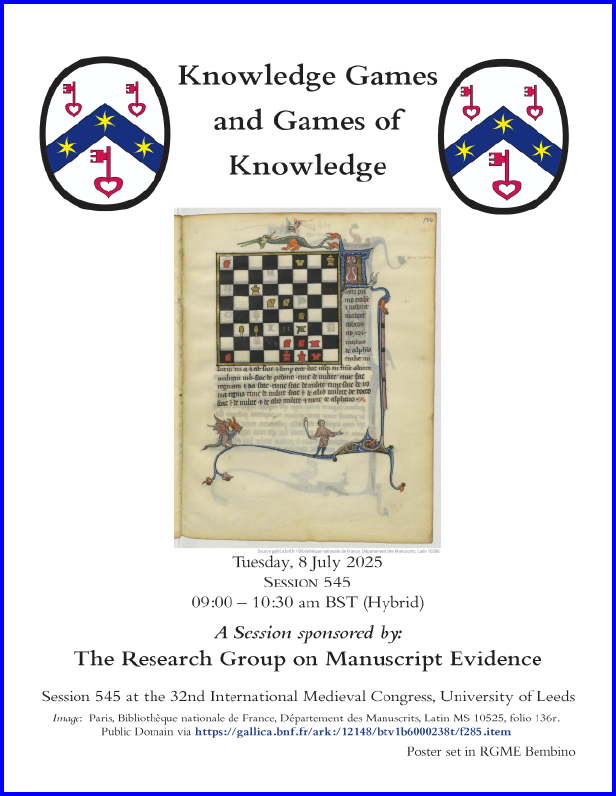
2025 Leeds: “Knowledge Games and Games of Knowledge” Poster 1. Set in RGME Bembino.

Next, we seek to examine games and playful approaches of multiple kinds with regard to manuscripts. The opportunities across time range from the creation of a book to its use in the world. We observe, for example, habits of entering scribbles and sketches as spontaneous or imaginative playtime on the one hand to creating and transmitting texts about games or gaming strategies.

Aims

By their nature, whether text or image, the planarity of manuscript surfaces offers invitations for readers to engage with them playfully. This play entails a process of temporalisation, of setting manuscript elements into motion, resulting in configurations and re-configurations that are keys for deciphering hidden — or less apparent — meanings. While carmina figurata or picture poems may range among the most obvious examples, they are by no means limited to them. Such elements can include scribbles and sketches, diagrams (including game diagrams specifically), material extensions (such as volvelles and other pop-up features), acrostics, and other puzzles. We consider the performativity and dynamics at work, or play, on the pages.

We invite contributions on a wide range of materials and genres and from a variety of perspectives and any discipline, to consider case-studies, work-in-progress, or research results celebrating the roles of play in which manuscripts engage, and which they might inspire in us as readers, scholars, and beholders. Want to play? Are you game?

Papers might address, but are not limited to the following questions:

  • Are there any contemporary reflections on time and motion as keys for interpreting the playful elements of manuscripts, e.g., acrostics, scientific diagrams, or game diagrams (or others)? What can they tell us about the relationship of readers/spectators with time and across time?
  • As they are artworks and semantic devices at the same time, what may playful components tell us about how the similarities as well as differences between art and writing/reading were perceived at points of creation and use?
  • How did readers know how to decipher these playful elements? What part may contemporary game culture take in this understanding? What could the presence of playful elements in manuscripts indicate about the position of play and games within the broader scope of their culture?
  • What are possible reasons why scribes decided to include these elements exactly at this position within a manuscript? What strategies (be it either aesthetic, religious, cultural, or otherwise) may their application serve?
  • How does a preference for a playful element, its style and form, possibly tie into idiosyncrasies of the period?
  • What relationship between what can or cannot be known is expressed in the interplay between the visually hidden and virtually absent?

Proposals, Please

Please submit a title, an abstract of no more than 200 words, and a short bio by 15 September 2025 to

  • rgme.imc.sessions@gmail.com

We particularly welcome proposals for individual papers and panels from postgraduate and early career scholars. We look forward to your responses.

Images

Examples of dynamic constructions involving word-play upon the page include the elaborate, intricate, and beautiful picture-poems favoured among some authors, not least at in the early medieval period. We display specimens by the Carolingian author Hrabanus (or Rabanus) Maurus Magnentius (circa 780 – 856), Archbishop of Mainz (from 847). His poem De laudibus sanctae crucis (“In Praise of the Holy Cross”), which survives in multiple copies, contains a series of poems laid out as rectangular constructions in which each line contains the same number of letters as any other.

Their patterns make it possible to lay out the letters not only in horizontal lines but also in vertical rows, strictly in line with each other. Moreover, it is possible to read key portions vertically as well as horizontally. Reading vertically in a line using the initial, medial, or final letter of each line yields an acrostic, mesostic, or telestic. Such forms of cross-word puzzles can produce wonders of legibility, requiring the attention in steps of time to gain comprehension of the message as a whole. Adding images to the ensemble increases the layering of meanings, and the possibilities of wonderment through resonance.
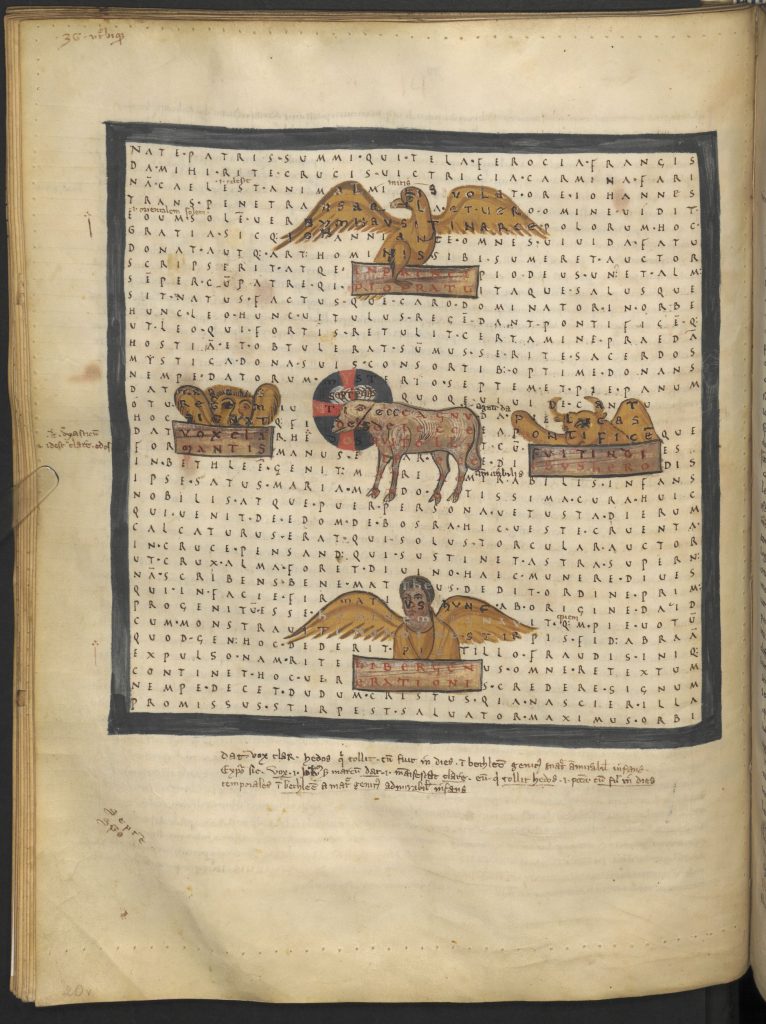
Vienna, Österreichische Nationalbibliothek, Cod. 652, fol. 20v (scan 50 of 109). Hrabanus Maurus, De laude sanctae crucibus. Mainz or Fulda, 9th century (circa 830-840). Carmen figuratum with four Evangelist symbols surrounding the Lamb of God. Image via https://viewer.onb.ac.at/10048D05/.
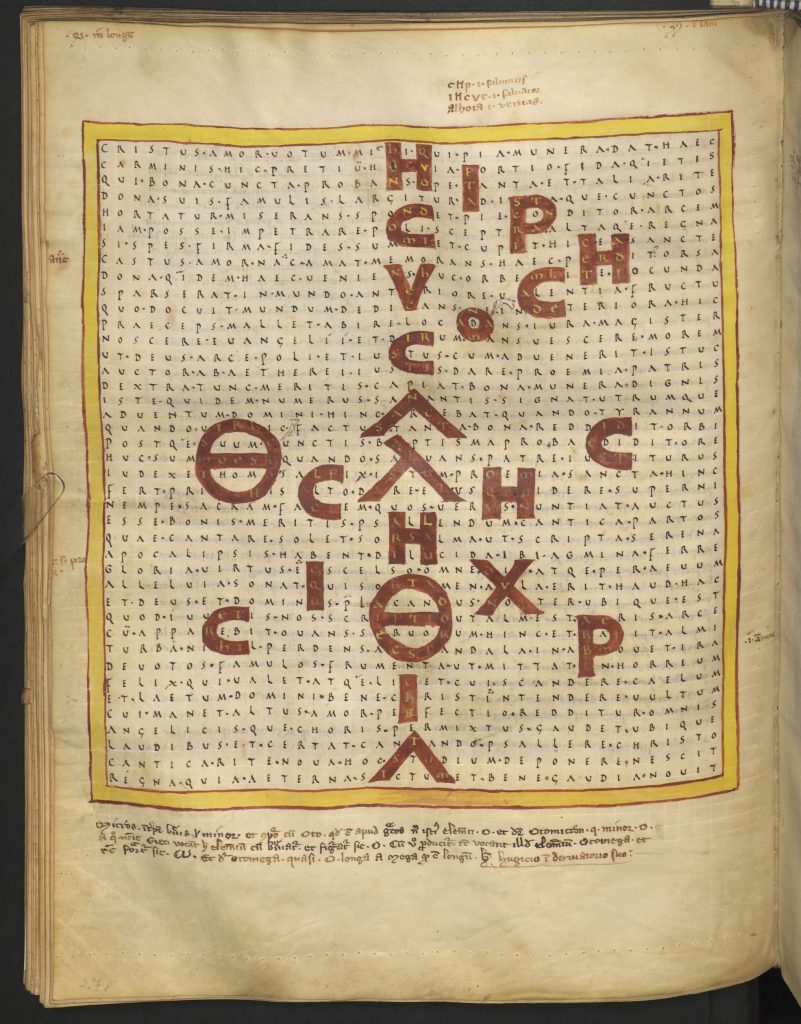
Vienna, Österreichische Nationalbibliothek, Cod. 652, fol.
Image https://viewer.onb.ac.at/10048D05/.

Questions or Suggestions?

  • Leave your comments or questions below
  • Contact Us
  • Sign up for our Newsletter and information about our activities.
    Send a note to director@manuscriptevidence.org or RGMEevents@gmail.com

Visit our Social Media:

  • our FaceBook Page
  • our Facebook Group
  • our Twitter Feed (@rgme_mss)
  • our Bluesky nest @rgmesocial.bluesky.social)
  • our LinkedIn Group

Join the Friends of the RGME.

Register for our Events by the RGME Eventbrite Collection.

Attend our next Events if your timetable allows.

Consider making a Donation in Funds or in Kind for our nonprofit educational corporation powered principally by volunteers. Your donations and contributions are welcome, and can go a long way. They may be tax-deductible to the fullest extent provided by the law.

  • Donations and Contributions
  • 2025 Annual Appeal

We look forward to hearing from you and welcoming you to our events.

*****
 

Tags: Acrostics, Call for Papers, Carmina Figurata, De laudibus sanctae crucis, Diagrams, History of Games, Hrabanus Maurus, International Medieval Congress, Manuscript studies, Manuscripts and Temporalities, Manuscripts as Play, Manuscripts at Play, Medieval manuscripts, Picture Poems, Scribbles and Sketches
No Comments »

Seminar on the Evidence of Manuscripts (11 December 1993)

September 16, 2016 in Manuscript Studies, Seminars on Manuscript Evidence, Uncategorized

“Corpus Christi College, Cambridge, MS 41:  A Workshop”
Parker Library, 11 December 1993

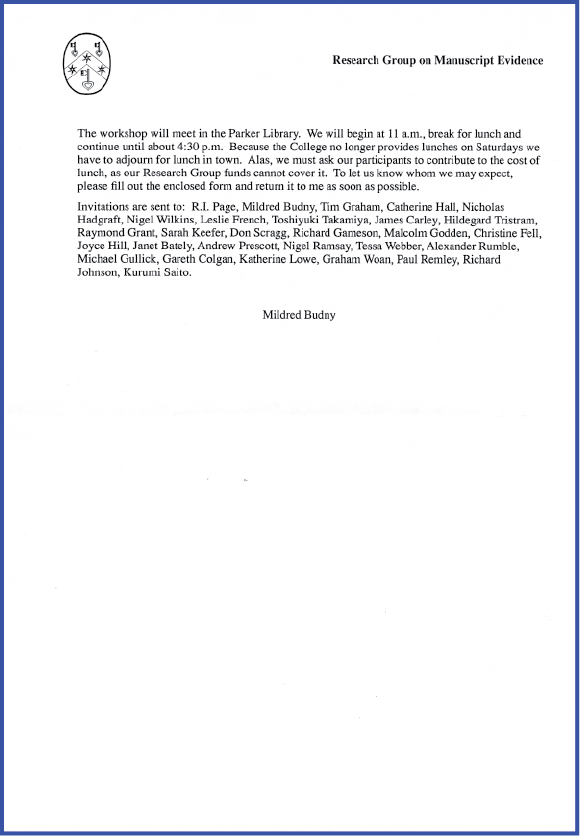
Invitation Letter Page 1 for Workshop on 'Corpus Christi College MS 41' on 11 December 1993

Invitation Letter Page 1 for 11 December 1993

Invitation Letter Page 2 for 11 December 1993

Invitation Letter Page 2 for 11 December 1993

In the Series of Seminars and Workshops on “The Evidence of Manuscripts”
The Parker Library, Corpus Christi College, Cambridge

2-page Invitation in pdf with 1-page RSVP Form

The previous Workshop in the Series considered

“Professionals’ Views of Manuscript Writing”
1 November 1993

[First published in 15 September 2016, as Mildred Budny reviews the event and its setting among the many events and activities of the Research Group on Manuscript Evidence]

*****

The Plan

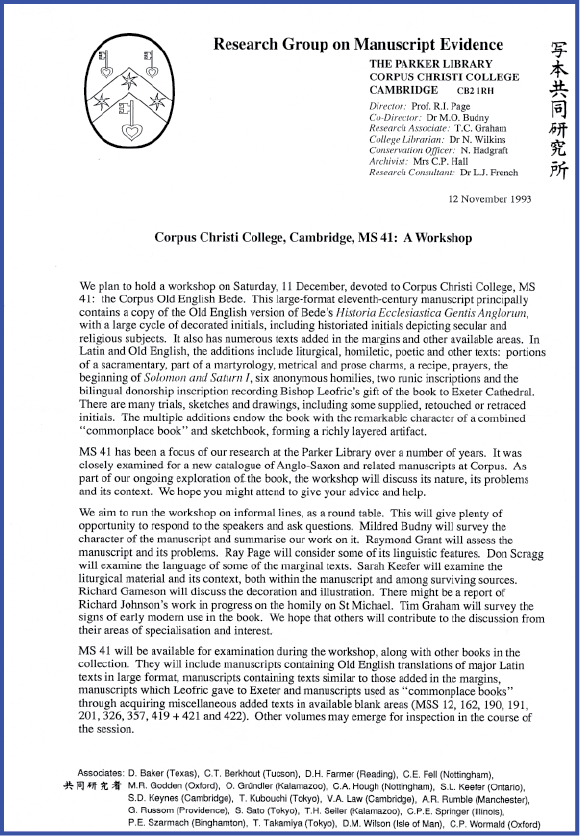
Dated 12 November 1993, the 2-page Invitation Letter (shown here and downloadable here with the 1-page RSVP Form) provides the Menu for the Food for Thought.

We plan to hold a workshop on Saturday, 11 December, devoted to Corpus Christi College, MS 41:  the Corpus Old English Bede.  This large-format eleventh-century manuscript principally contains a copy of the Old English version of Bede‘s Historia Ecclesiastica Gentis Anglorum, with a large cycle of decorated initials, including historiated initials depicting secular and religious subjects.  It also has numerous texts added in the margins and other available areas.  In Latin and Old English, the additions include liturgical, homiletic, poetic and other texts:  portions of a sacramentary, part of a martyrology, metrical and prose charms, a recipe, prayers, the beginning of Solomon and Saturn I, six anonymous homilies, two runic inscriptions and the bilingual donorship inscription recording Bishop Leofric‘s gift of the book to Exeter Cathedral.  There are many trials, sketches and drawings, including some supplied, retouched or retraced initials.  The multiple additions endow the book with the remarkable character of a combined “commonplace book” and sketchbook, forming a richly layered artifact.

Much goes on between the covers.  Not all of it seemly.  For example, this manuscript sees fit to include an image of a hanged man.  Creepy.

Read the rest of this entry →

Tags: 'Commonplace Books', Bishop Leofric, Charms, Corpus Christi College MS 12, Corpus Christi College Ms 162, Corpus Christi College MS 190, Corpus Christi College Ms 191, Corpus Christi College MS 201, Corpus Christi College MS 326, Corpus Christi College Ms 357, Corpus Christi College MS 41, Corpus Christi College MS 411, Corpus Christi College MSS 419+ 421, Exeter Cathedral, Historia Ecclesiastica Gentis Anglorum, Historiated Initials, Martyrology, Old English Bede, Parker Library, Prayers, Runic inscriptions, Sacramentary, Saint Michael, Scribbles and Sketches, Seminars on Manuscript Evidence, Solomon and Saturn I
No Comments »

Seminar on the Evidence of Manuscripts (May 1989)

August 25, 2016 in Seminars on Manuscript Evidence

1. “Illustrations in Manuscripts
As Evidence for Anglo-Saxon Life”

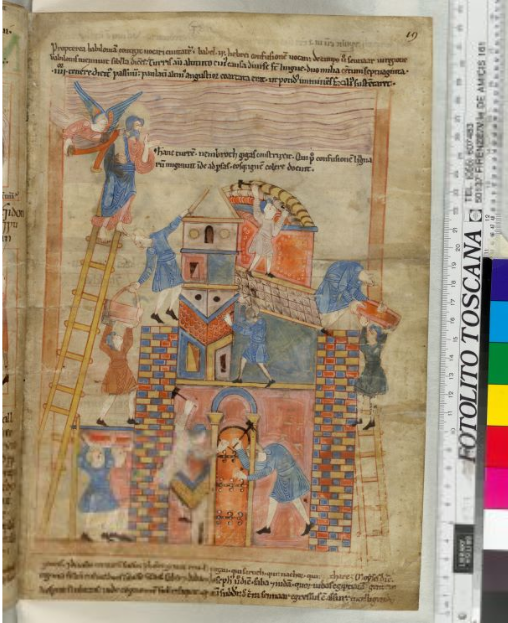
© The British Library Board, Cotton MS Claudius B IV, folio 19r: Genesis 11. Reproduced by permission.

© The British Library Board, Cotton MS Claudius B IV, folio 19r. Reproduced by permission.

First in the Series of Seminars on the Evidence of Manuscripts
The Parker Library, Corpus Christi College, Cambridge
20 May 1989

[Published on 25 August 2016, with updates]

With invitations to colleagues in various fields, a full day’s seminar took place on Saturday, 20 May 1989 at the Parker Library.  This was long before the rise of digital imaging, digital facsimiles of manuscripts, and the proliferation of manuscript images on the internet.  Let alone a website devoted to that manuscript collection.  We had to, and wished to, look at the books.

That wish, plus application and dedication, had led to the gathering of resources, funding included, for full-time research in that place, alongside its major conservation programme.  In the Spring of 1989, as the first 2 years of this research were rounding out, we were poised to begin, on 1 October, a five-year Research Project on “Anglo-Saxon and Related Manuscripts” supported by the Leverhulme Trust.

The Approach

On the day of the Seminar, there gathered specialists in archaeology, linguistics, library history, architectural history, manuscript studies, Anglo-Saxon manuscripts, and related fields.  There came R.I. Page (Parker Librarian), David Wilson, Christine Fell, Richard Gem, Martin Carver, James Graham-Campbell, Leslie Webster, and Mildred Budny (Senior Research Associate at the Parker Library and now the Director of the Research Group on Manuscript Evidence).  The aim was to bring together different forms of expertise, both “bookish” and practical, to consider illustrations in the manuscripts themselves as witnesses for daily life, Anglo-Saxon in particular.

Read the rest of this entry →

Tags: Anglo-Saxon Manuscripts, Archaeology, British Library Cotton MS Claudius B.iv, Budny's Illustrated Catalogue, Caedmon Manuscript of Old English Poetry, Corpus Christi College MS 183, Corpus Christi College MS 23, Corpus Christi College MS 389, Corpus Christi College MS 41, Eadwine Psalter, Illustrated Old English Hexateuch, Junius MS 11, Leslie Webster, Manuscript Illustrations, Manuscript studies, Parker Library, Psychomachia, Scribbles and Sketches, Sutton Hoo
No Comments »

  • Top
©2024 Research Group on Manuscript Evidence.


is proudly powered by WordPress. WordPress Themes X2 developed by ThemeKraft.