• News
    • News & Views
    • RGME Activities for 2024 and 2025
    • Around & About with the RGME
    • Reviews
    • Highlights
  • Blogs
    • Manuscript Studies
      • Manuscript Studies: Contents List
    • International Congress on Medieval Studies
      • Abstracts of Congress Papers
        • Abstracts of Papers Listed by Author
        • Abstracts of Papers Listed by Year
  • About
    • Mission
    • Who We Are
      • Officers, Associates & Volunteers
      • RGME Committees
      • Friends of the Research Group on Manuscript Evidence
    • Policies & Statements
      • RGME Privacy Policy Statement
      • RGME Intellectual Property Statement & Agreements
    • People
      • Mildred Budny — Her Page
      • Adelaide Bennett Hagens
    • Activities
      • Events
      • Congress Activities
        • Sponsored Conference Sessions (1993‒)
          • Panels at the M-MLA Convention (from 2016)
        • Co-sponsored Conference Sessions (2006‒)
    • History
      • Seals, Matrices & Documents
      • Genealogies & Archives
    • Contact Us
  • Bembino
    • Multi-Lingual Bembino
    • RGME Bembino: Resources
  • Congress
    • Sponsored Conference Sessions (1993‒)
    • Co-sponsored Conference Sessions (2006‒)
    • Abstracts of Congress Papers
      • Abstracts Listed by Author
      • Abstracts Listed by Year
    • Kalamazoo Archive
    • Panels at the M-MLA Convention (2016-2019)
      • Abstracts of Papers for the M-MLA Convention
      • Panels at the M-MLA Convention (from 2016)
  • Events
    • RGME Activities for 2024 and 2025
      • 2023 Activities and 2024 Planned Activities
    • Seminars, Workshops, Colloquia & Symposia (1989–)
      • Seminars on ‘The Evidence of Manuscripts’
      • Symposia on ‘The Transmission of the Bible’
      • The New Series (2001-)
        • 2019 Anniversary Symposium Program: The Roads Taken
        • 2019 Anniversary Symposium Registration
        • 2019 Anniversary Symposium Registration Open
      • RGME Symposia: The Various Series
      • The Research Group Speaks: The Series
      • Meetings of the Friends of the Research Group on Manuscript Evidence
      • RGME Online Events
    • Abstracts of Papers for Events
      • Abstracts of Papers for Seminars on ‘The Evidence of Manuscripts’
      • Abstracts of Papers for Symposia, Workshops & Colloquia
    • Receptions & Parties
    • Business Meetings
    • Photographic Exhibitions & Master Classes
    • Events Archive
  • ShelfLife
    • Journal Description
    • ShelfMarks: The RGME-Newsletter
    • Publications
      • “Insular, Anglo-Saxon, and Early Anglo-Norman Manuscript Art at Corpus Christi College, Cambridge” (1997)
        • Mildred Budny, ‘Catalogue’
        • The Illustrated Catalogue (1997)
      • The Illustrated Handlist
      • Semi-Official Counterfeiting in France 1380-1422
      • No Snap Decisions: Challenges of Manuscript Photography
    • History and Design of Our Website
  • Galleries
    • Watermarks & the History of Paper
    • Galleries: Contents List
    • Scripts on Parade
    • Texts on Parade
      • Latin Documents & Cartularies
      • New Testament Leaves in Old Armenian
    • Posters on Display
    • Layout Designs
  • Donations and Contributions
    • RGME Donor Promise
    • 2023 End-of-Year Fundraiser for our 2024 Anniversary Year
    • 2019 Anniversary Appeal
    • Orders
  • Links
    • Catalogs, Metadata, and Databases: A Handlist of Links
    • Handlist of Resources for Manuscript Studies and Fragmentology
    • Manuscripts & Rare Books
    • Maps, Plans & Drawings
    • Seals, Seal-Matrices & Documents

  • News
    • News & Views
    • RGME Activities for 2024 and 2025
    • Around & About with the RGME
    • Reviews
    • Highlights
  • Blogs
    • Manuscript Studies
      • Manuscript Studies: Contents List
    • International Congress on Medieval Studies
      • Abstracts of Congress Papers
        • Abstracts of Papers Listed by Author
        • Abstracts of Papers Listed by Year
  • About
    • Mission
    • Who We Are
      • Officers, Associates & Volunteers
      • RGME Committees
      • Friends of the Research Group on Manuscript Evidence
    • Policies & Statements
      • RGME Privacy Policy Statement
      • RGME Intellectual Property Statement & Agreements
    • People
      • Mildred Budny — Her Page
      • Adelaide Bennett Hagens
    • Activities
      • Events
      • Congress Activities
        • Sponsored Conference Sessions (1993‒)
          • Panels at the M-MLA Convention (from 2016)
        • Co-sponsored Conference Sessions (2006‒)
    • History
      • Seals, Matrices & Documents
      • Genealogies & Archives
    • Contact Us
  • Bembino
    • Multi-Lingual Bembino
    • RGME Bembino: Resources
  • Congress
    • Sponsored Conference Sessions (1993‒)
    • Co-sponsored Conference Sessions (2006‒)
    • Abstracts of Congress Papers
      • Abstracts Listed by Author
      • Abstracts Listed by Year
    • Kalamazoo Archive
    • Panels at the M-MLA Convention (2016-2019)
      • Abstracts of Papers for the M-MLA Convention
      • Panels at the M-MLA Convention (from 2016)
  • Events
    • RGME Activities for 2024 and 2025
      • 2023 Activities and 2024 Planned Activities
    • Seminars, Workshops, Colloquia & Symposia (1989–)
      • Seminars on ‘The Evidence of Manuscripts’
      • Symposia on ‘The Transmission of the Bible’
      • The New Series (2001-)
        • 2019 Anniversary Symposium Program: The Roads Taken
        • 2019 Anniversary Symposium Registration
        • 2019 Anniversary Symposium Registration Open
      • RGME Symposia: The Various Series
      • The Research Group Speaks: The Series
      • Meetings of the Friends of the Research Group on Manuscript Evidence
      • RGME Online Events
    • Abstracts of Papers for Events
      • Abstracts of Papers for Seminars on ‘The Evidence of Manuscripts’
      • Abstracts of Papers for Symposia, Workshops & Colloquia
    • Receptions & Parties
    • Business Meetings
    • Photographic Exhibitions & Master Classes
    • Events Archive
  • ShelfLife
    • Journal Description
    • ShelfMarks: The RGME-Newsletter
    • Publications
      • “Insular, Anglo-Saxon, and Early Anglo-Norman Manuscript Art at Corpus Christi College, Cambridge” (1997)
        • Mildred Budny, ‘Catalogue’
        • The Illustrated Catalogue (1997)
      • The Illustrated Handlist
      • Semi-Official Counterfeiting in France 1380-1422
      • No Snap Decisions: Challenges of Manuscript Photography
    • History and Design of Our Website
  • Galleries
    • Watermarks & the History of Paper
    • Galleries: Contents List
    • Scripts on Parade
    • Texts on Parade
      • Latin Documents & Cartularies
      • New Testament Leaves in Old Armenian
    • Posters on Display
    • Layout Designs
  • Donations and Contributions
    • RGME Donor Promise
    • 2023 End-of-Year Fundraiser for our 2024 Anniversary Year
    • 2019 Anniversary Appeal
    • Orders
  • Links
    • Catalogs, Metadata, and Databases: A Handlist of Links
    • Handlist of Resources for Manuscript Studies and Fragmentology
    • Manuscripts & Rare Books
    • Maps, Plans & Drawings
    • Seals, Seal-Matrices & Documents

Log in

Archives

Featured Posts

2026 International Medieval Congress at Leeds: Program
Sanskrit and Prakrit Manuscripts, Continued: More Leaves for Manuscript Sample XII
2026 International Congress on Medieval Studies: Program
Episode 24. “Life with Books” (Interview with John Windle)
Announcing the Launch of RGME Bembino WP
2026 RGME Colloquium at The Grolier Club: Report
Medieval Missal Fragment as Early-Modern Cover
The Weber Leaf from Ege MS 61
"Bembino" Booklet Cover
Episode 23. “Meet RGME Bembino: Facets of a Font”
2026 RGME Colloquium on “Transformations & Renewals” at The Grolier Club
2026 Theme of the Year: “Transformations and Renewals”
A Leaf with Patchwork from the Saint Albans Bible
A Sister Leaf from a Miniature Latin Vulgate Bible
A Little Latin Vulgate Bible Manuscript Leaf in Princeton
J. S. Wagner Collection. Leaf from from Prime in a Latin manuscript Breviary. Folio 4 Verso, with part of Psalm 117 (118) in the Vulgate Version, set out in verses with decorated initials.
2026 Annual Appeal
Episode 22: “Encounters with Local Saints and Their Cults”
Private Collection, Ege's FBNC Portfolio, Dante Leaf, Verso, Detail. Reproduced by Permission.
2025 RGME Autumn Colloquium on Fragments
Workshop 8: A Hybrid Book where Medieval Music Meets Early-Modern Herbal
2025 RGME Autumn Symposium on “Readers, Fakers, and Re-Creators of Books”
RGME Workshops on “The Evidence of Manuscripts, Etc.”
2025 International Medieval Congress at Leeds: RGME Program
Episode 21. “Learning How to Look”
2025 International Congress on Medieval Studies: Program
2025 RGME Visit to Vassar College
Two Leaves in the Book of Numbers from the Chudleigh Bible
Delibovi on Glassgold on Boethius: A Blogpost
Ronald Smeltzer on “Émilie du Châtelet, Woman of Science”
2025 Spring Symposium: “Makers, Producers, and Collectors of Books”
Starters’ Orders
The Weber Leaf from the Saint Albans Bible
Workshop 4. “Manuscript Fragments Compared”
Episode 20. “Comic Book Theory for Medievalists”
Episode 19: “At the Gate: Starting the Year 2025 at its Threshold”
Favorite Recipes for Lemonade, Etc.
RGME Visit to the Lomazow Collection: Report
2024 Autumn Symposium: “At the Helm”
A Latin Vulgate Leaf of the Book of Numbers
The RGME ‘Lending Library’
Florence, Italy, Ponte Vecchio from Ponte alle Grazie. Photo: Ingo Mehling, CC BY-SA 4.0 , via Wikimedia Commons
Episode 17. “RGME Retrospect and Prospects: Anniversary Reflections”
2024 Anniversary Symposium: The Booklet
Jesse Hurlbut at the Bonneville Salt Flats, Utah. Photograph Jesse Hurlbut.
Episode 16: An Interview with Jesse D. Hurlbut
To Whom Do Manuscripts Belong?
Kalamazoo, MI Western Michigan University, Valley III from the side. Photograph: David W. Sorenson.
2024 International Congress on Medieval Studies: Report
2024 Spring Symposium at Vassar College
Puente de San Martín: Bridge with reflection over the River Targus, Toledo, Spain.
2024 Grant for “Between Past and Future” Project from The Gladys Krieble Delmas Foundation Research Libraries Program
2024 Anniversary Symposium in Thanks to Jesse Hurlbut: Program

You are browsing the Blog for Sacramentary

Folio 4 with Latin Blessings for Holy Water and an Exorcism for Salt

June 19, 2022 in Manuscript Studies, Photographic Exhibition

Folio 4 from an ‘Italian Missal’ in Latin
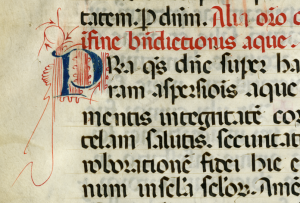
Private Collection, Single Leaf from a Latin Missal. Folio 4r, Detail. Photography Mildred Budny. Reproduced by permission.

Single Leaf on Vellum
Circa 222 × 158 mm
<written area circa 150 × 104 mm>

Single columns of 18 lines,
starting below the top ruled line,
with rubricated elements

Blessings of Holy Water and Salt
and the title for an Exorcism of Salt
[qui inimici ru-/]gientis seuitiam seperas . . .
Exorcisimus ad catecuminum salis faciendum. [/]

Italy?  Southern France?  circa 1400–1450

Budny Handlist 10

[Posted on 20 June 2022]

We post a report of a leaf from a Private Collection which we examined and photographed a few years ago, as part of a larger study for an Illustrated Handlist.

The leaf was recorded briefly, with a description supplied by its owner, in C. U. Faye and W. H. Bond, Supplement to the Census of Medieval and Renaissance Manuscripts in the United States and Canada (1962), page 284, number 5.  There it is described as part of an “Italian Missal”.  The owner acquired the leaf by an unknown route, perhaps by gift already framed, before the preparation of that description for the Census.

At the owner’s request several years ago, we removed the leaf first from its plain wooden frame and then from its stained and darkened backing mat, onto which parts of the original script had offset. The leaf was photographed at several stages and examined in detail.  We show views of the leaf while still on the mat and afterward.

The Leaf Before

Here are both sides of the leaf as it was mounted to the backing mat.

The Front, or Forward-Facing, Side of the Leaf as Mounted for the Frame

For the frame, the leaf faces front with lines in script in black ink and red pigment.
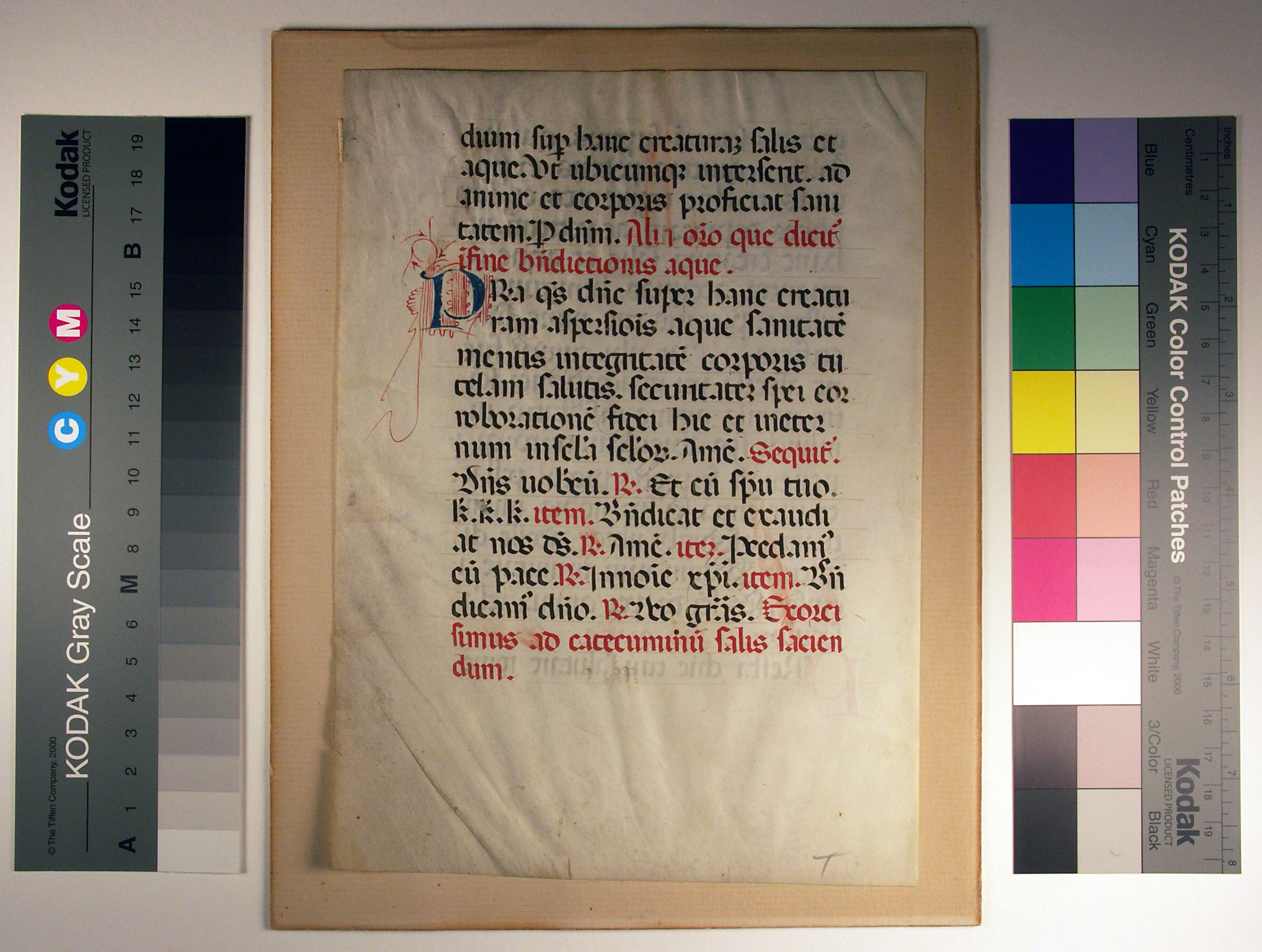
"Folio

positioned as the front-facing page for the viewer. Private Collection. Folio 4v facing front on the former mat. Photography © Mildred Budny. Reproduced by permission.

The Other Side, Partly Lifted

Turning over the leaf, we can see the pair of hinged gauze mounting tapes which attach the edge of the leaf to the mat.
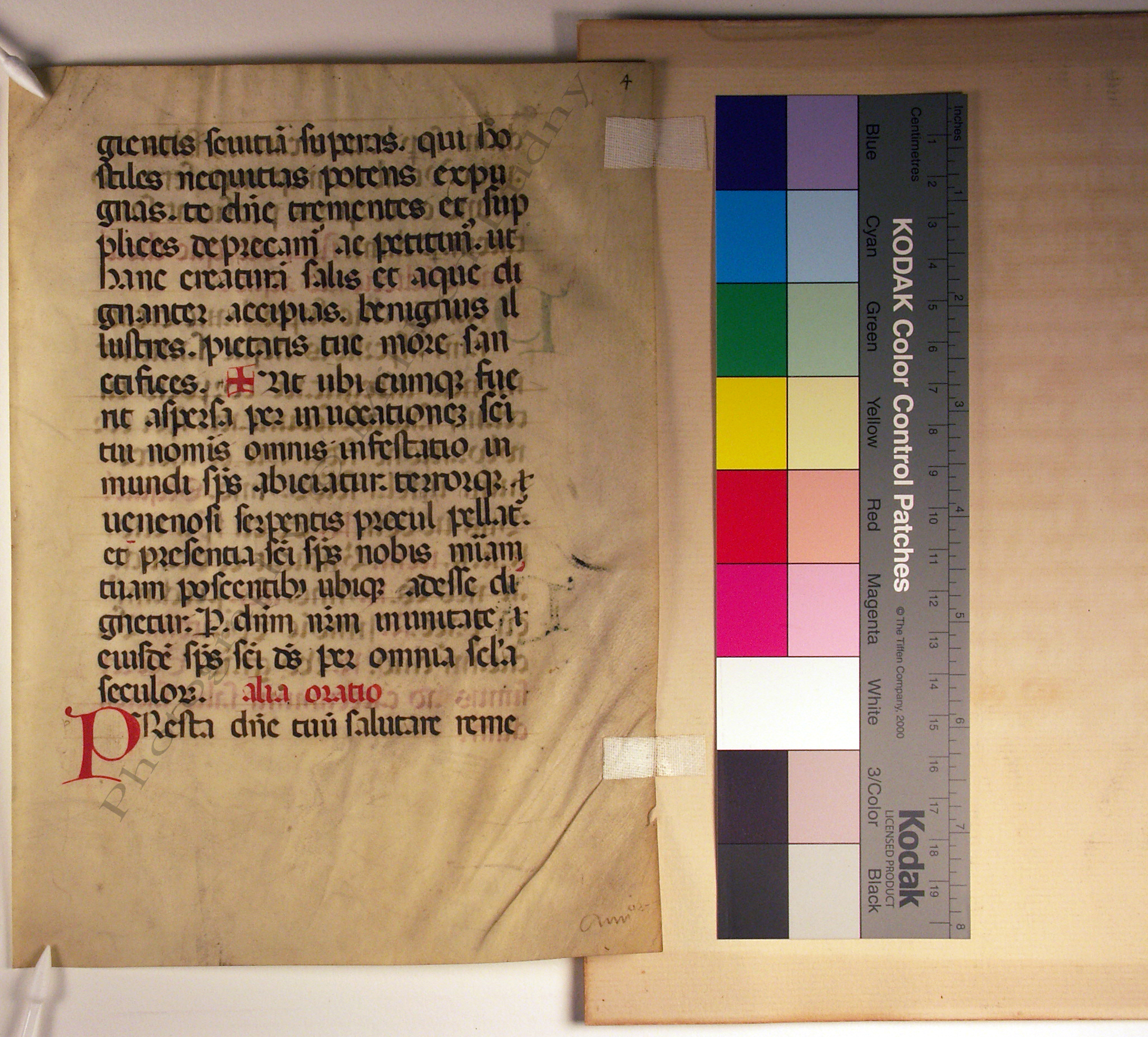
Folio 4r still attached to the mat. Photograph © Mildred Budny

Private Collection. Folio 4r still attached to the mat with a pair of hinged gauze tapes. Photography Mildred Budny. Reproduced by permission.

The Leaf apart from the Mat

The Original Recto

The recto has a modern folio number, an upright arabic 4, entered in dark brown ink at the top right.  The different expanses of the upper and lower margins imply that the short upper margin was trimmed at some stage, whilst the lower and outer margins appear to retain all or most of their original extents.  The accumulated dirt along the upper edge attests to an extended duration when the former manuscript, closed, stood upright on a shelf or in storage.
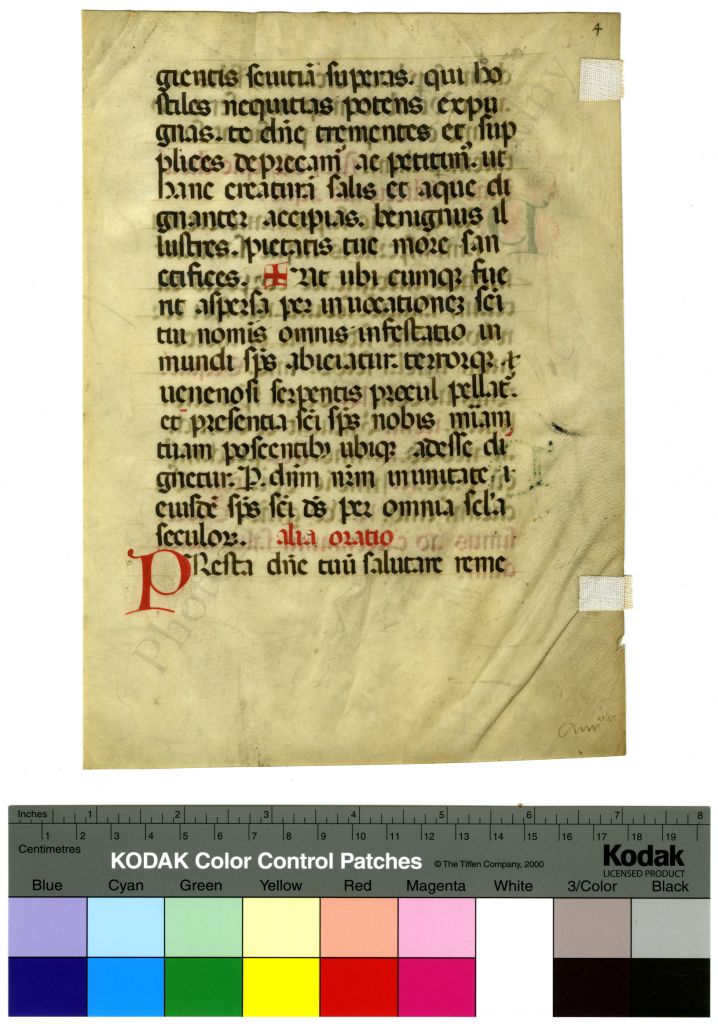
Private Collection, Single Leaf from a Latin Missal. Folio 4v with Guide. Photography Mildred Budny. Reproduced by permission.

This side of the leaf shows offsets or show-through of enlarged initials at the right-hand side of the column, as well as rubricated script at points within it.  The initials, in reverse, show the forms of a P and a D.

Most of these elements can be accounted for by the rubrications and the enlarged initial P on the other side of the leaf, so that they constitute show-through.  For the other, we must recognize that its offset must derive from contact with a formerly adjacent leaf.

The Original Verso
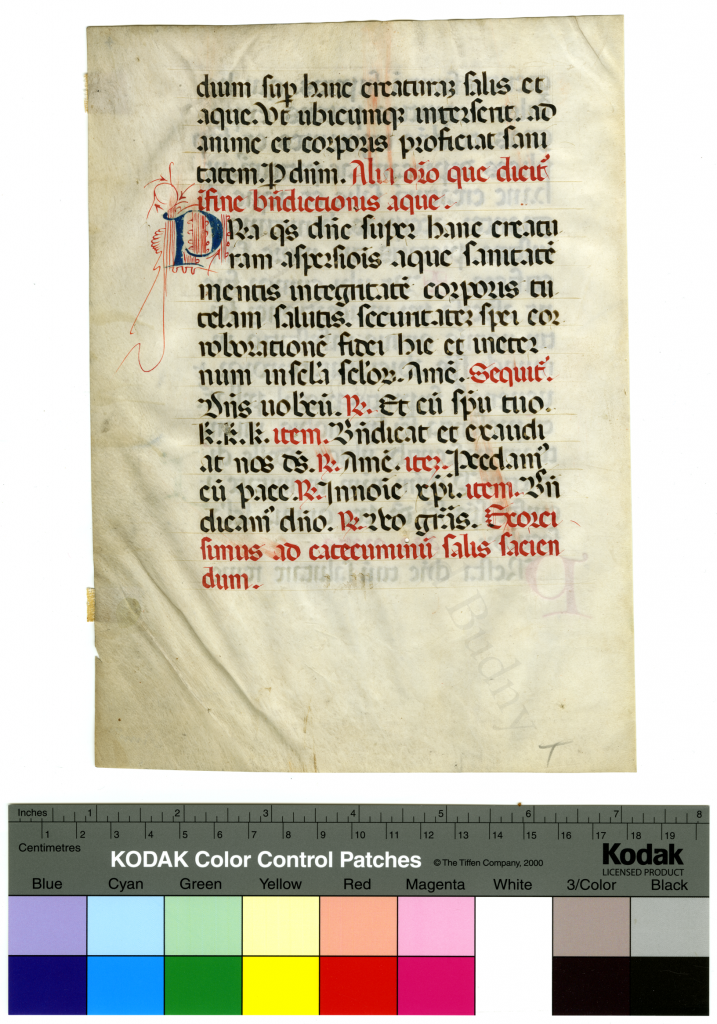
Private Collection, Single Leaf from a Latin Missal. Folio 4r. Detail. Photography Mildred Budny. Reproduced by permission.

On this page, an enlarged and decorated initial P, partly inset within two indented lines of text, comprises an enlarged Capital P (for Presta) rendered in blue pigment, with penline flourishes and extensions in red pigment.  In both curved and parallel straight lines, those flourishes fit between the initial and the indented letters, fill the bow and ‘footrest’ of the P, and extend in the margin above, beside, and below the initial.

A staple of the flourishing appears to be the sets of narrowly spaced parallel lines.  Characteristic, too, are the short, arrowhead-tipped elements which, separately, press into the cusps of parts of the flourishing below the right-hand side of the bow of the letter and in a whorl of three around the circular extension at the upper left of the letter.

The Text

The set of texts on the leaf provide directions for Exorcisms and Blessings of Salt and Water.  At an appropriate point, a sign of the cross (rendered within the outlines of a box-like frame, all in red) stands within the text to indicate its sign, or signing, as part of the ritual.

Specimens of such texts in medieval sources of various dates and from various places are edited, for example, in these bibliographical resources:

  • Benedictio Salis et Aquae in the Vetera Liturgia Alemannica = J. P. Migne, Patrologia Latina, Vol. 138, cols. 1039–1052 (downloadable here).
  • Missale Romanum Mediolani (1474), Vol. II = Henry Bradshaw Society, Vol. XXXIII (1907).

The text on the leaf provides snippets of the ritual for these functions.  We provide a transcription, with silently expanded abbreviations, and with indications of the rubrications in red.

Recto

[Oratio . . .  qui inimici ru-/]
gientis scuitiam superas. qui ho-
stiles nequitias potens expu-
gnas. te domine trementes et sup-
plices deprecam; ac petitumus. ut
hanc creaturam salis et aque di-
gnanter accipias. benignus il-
lustres. pietatis tue more san-
ctifices. + At ubi cumque sue-
nt aspersa per in uocationes sancti
tui nominis omis infestatio in
mundi spiritus abieiatur. terrorque . +
uenenosi serpentis procul pellatur.
et presentia sancti spiritus nobis misericordiam
tuam poscentibus ubique adesse di-
gnitur.  Per dominum nostrum in uinitate +
eiusdem spiritus sancti deus per omnia secula
seculorum.  Alia oratio
Presta domine tuum saltare reme-

Verso

dium super hand creaturam salis et
aque.  Ut ubicumque interserit. ad
anime et corporis proficiat sani-
tatem.  Per dominum.  Alia oratio qui dicitur
i[n] fine benedictionis aque.
Presta quos domine deus super hanc creatu-
ram aspersionis aque sanitatem
mentis integritatem corpus : tu-
telam saltis. securitatem spei. cor-
roborationem fidei hic et in eter-
num in secula seculorum.  Amen.  Sequitur.
Dominus vobiscum. Responsio. Et cum spiritu tuo.
kyrie. kyrie. kyrie. item.  Benedicat et exaudi-
at nos deus.  Responsio.  Amen.  iter.   Procedamus
cum pace.  Responsio.  Innomine [sic, for In nomine] christi.  item.  Bene-
dicamus domino.  Responsio.  Deo gratias.  Exorci-
simus at catecuminum salis facien-
dum.

The Former Manuscript

Parts of the text, or some texts in the sequence, can be found in other sources.  For example, comparisons for the text of the Roman Missal for the Liturgical Use of Milan (printed in 1474), show a similar version of the Presta which appears on the verso, although its version begins somewhat differently.

Presta michi domine deus per hanc creaturam aspersionis aque atque sanitatem mentis integritatem corpus : tutelam saltis : securitatem spei. corroborationem fidei : fructum charitatis nune et in futuro. Amen.

  • See Robert Lippe, Missale Romanum Mediolani (1474), Vol. II:  A Collation with other Editions Printed before 1570. Henry Bradshaw Society, Vol. XXXIII (1907), at page  385.
    The Milan Missal of 1474 was printed at Venice by Antonius Zarotis, with the date of 6 December 1474 (Incunabula Shorttitle Catalogue Number im00688450).

The long prayer on the recto belongs to the blessing of water.

  • See Traditional Rite of Blessing of Water.

It begins with an exorcism (or purification) of salt — but not the one intended for catechumens. as specified in the rubricated title at the bottom on the verso of the leaf.

Both the long prayer on the recto and the two following prayers also occur in that order in the Sacramentary portion of the composite Leofric Missal, but not followed by the exorcism of salt.

  • Frederick Edward Warren, ed., The Leofric Missal, As Used in the Cathedral of Exeter During the Episcopate of Its First Bishop, A.D. 1050-1072, Together with Some Account of the Red Book of Derby, the Missal of Robert of Jumieges, and a Few Other Early Manuscript Service Books of the English Church (Oxford:  Clarendon Press, 1883, page 250.

There is a close match for the sequence of texts on the leaf, with only a few variations, in an another source from Milan later than the printed edition of 1474.  That is:

  • the Rituale Sacramentorum ad Usum Mediolanensis Ecclesiae (“Ritual of the Sacraments for the Use of the Church of Milan“) of 1815, at pages 282–283.

The text on the Recto of the leaf starts on page 282 in the Oratio:  “[inimici ru-/]gientis saevitiam superas . . .”  The Oratio begins thus:  Deus invictae virtutis Auctor . . .  A brief section of text intervenes between this opening and the top of the extant recto.  Such an initial D, low in the column, formed the offset at the right-hand side of the column on the recto.

The “Alia Oratio Presta domine tuum salutare . . .” ends the recto and continues on the verso into the Aquam Benedictam “Presta quaesumus domine.”  Then come the Versicles and Responses extending to “Deo gratias”, but not the “Pax . . .”

Since the following text following refers to “hanc creaturam salis”, it may be the exorcism for which we have only the title.

The correspondences with texts in Missals associated with Milan, in northern Italy, might strengthen, but not confirm, the suggested origin of the leaf as part of an “Italian Missal” — or some similar liturgical handbook — in Latin from such a region.

For now, pending further information (such as the discovery of more parts of the same manuscript), let us continue to refer to it as containing (or, by virtue of the title, implying) a set of Ordines which address 1) the Blessing for the preparation of Holy Water and Salt, and 2) the Exorcism (or Purification) of Salt for Catechumens.  The former has a place in the Sacramentary portion of a Missal, whereas the latter would pertain, insofar as we have been able to discover, to a different form of book instead — such as a Collectar.

The folio number 4 indicates that the leaf occupied an early position within its book, whether or not that modern numeration took into account leaves (such as endleaves) which a modern observer might deem extraneous.  As companion materials, the texts to which this leaf belonged could have formed prefatory matter for a book of one or other genre designed to guide instruction and performance of liturgical practices at whatever stages required for the place of its production.

Perhaps other leaves from the same book as well as further research will resolve the mystery.  This lone leaf joins the company of all too many single, dispersed, leaves which have lost track or trace (apart from, say, an offset from an adjacent leaf) of their former siblings.  By close inspection of their material and textual evidence, it can partly become possible to retrieve some elements of their former connections and contexts.

Welcome to the ‘Foundling Hospital for Manuscript Fragments’, as invited in one of the early posts for our blog.

  • The ‘Foundling Hospital’ for Manuscript Fragments.

*****

Do you know of more leaves from this manuscript? Do you recognize the hand of the scribe, scribal artist, and rubricator in other parts of this book or in other manuscripts?

You might reach us via Contact Us or our Facebook Page. Comments here are welcome too. We look forward to hearing from you.

Watch our blog on Manuscript Studies for more discoveries. Please visit its Contents List.

*****
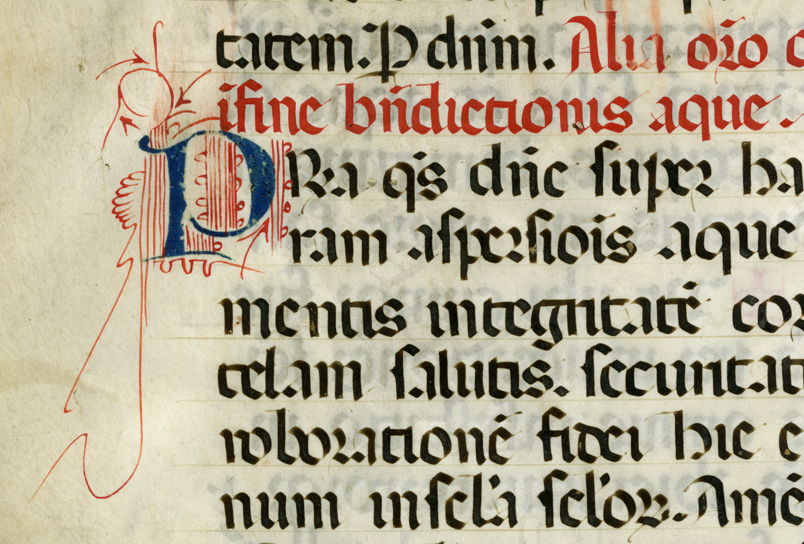
Private Collection, Single Leaf from a Latin Missal. Folio 4r, Detail. Reproduced by permission.

*****
Tags: 'Foundling Hospital' for Manuscript Fragments, Blessings for Holy Water and Salt, Census of Medieval and Renaissance Manuscripts, Collectar, Exorcism for Salt for Catechumens, Exorcisms and Blessings, Italian Missal, latin Missal, manuscript fragments, Medieval Manuscript Fragments, Offsets and Show-Through, Sacramentary
No Comments »

Seminar on the Evidence of Manuscripts (11 December 1993)

September 16, 2016 in Manuscript Studies, Seminars on Manuscript Evidence, Uncategorized

“Corpus Christi College, Cambridge, MS 41:  A Workshop”
Parker Library, 11 December 1993

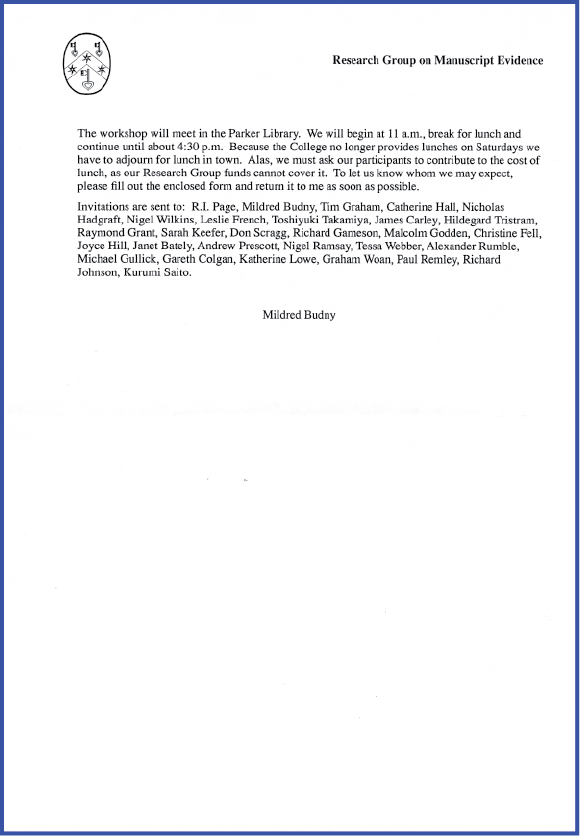
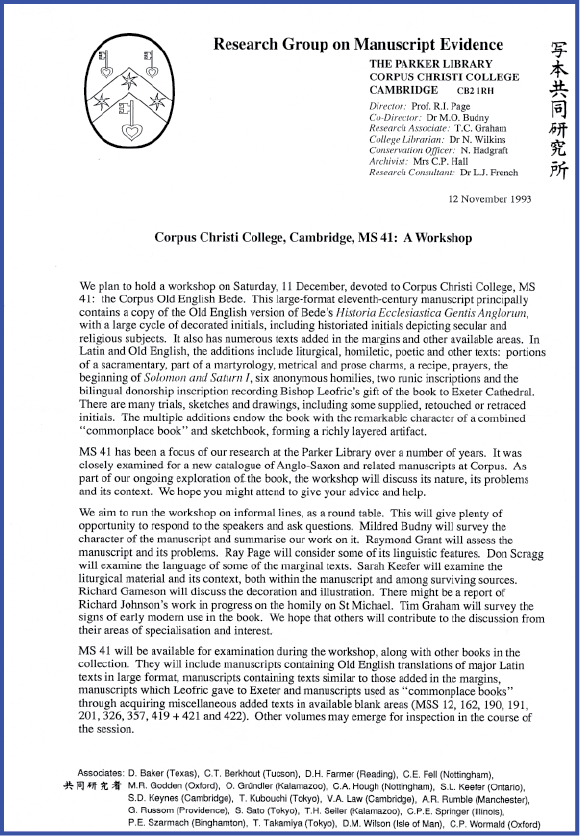
Invitation Letter Page 1 for Workshop on 'Corpus Christi College MS 41' on 11 December 1993

Invitation Letter Page 1 for 11 December 1993

Invitation Letter Page 2 for 11 December 1993

Invitation Letter Page 2 for 11 December 1993

In the Series of Seminars and Workshops on “The Evidence of Manuscripts”
The Parker Library, Corpus Christi College, Cambridge

2-page Invitation in pdf with 1-page RSVP Form

The previous Workshop in the Series considered

“Professionals’ Views of Manuscript Writing”
1 November 1993

[First published in 15 September 2016, as Mildred Budny reviews the event and its setting among the many events and activities of the Research Group on Manuscript Evidence]

*****

The Plan

Dated 12 November 1993, the 2-page Invitation Letter (shown here and downloadable here with the 1-page RSVP Form) provides the Menu for the Food for Thought.

We plan to hold a workshop on Saturday, 11 December, devoted to Corpus Christi College, MS 41:  the Corpus Old English Bede.  This large-format eleventh-century manuscript principally contains a copy of the Old English version of Bede‘s Historia Ecclesiastica Gentis Anglorum, with a large cycle of decorated initials, including historiated initials depicting secular and religious subjects.  It also has numerous texts added in the margins and other available areas.  In Latin and Old English, the additions include liturgical, homiletic, poetic and other texts:  portions of a sacramentary, part of a martyrology, metrical and prose charms, a recipe, prayers, the beginning of Solomon and Saturn I, six anonymous homilies, two runic inscriptions and the bilingual donorship inscription recording Bishop Leofric‘s gift of the book to Exeter Cathedral.  There are many trials, sketches and drawings, including some supplied, retouched or retraced initials.  The multiple additions endow the book with the remarkable character of a combined “commonplace book” and sketchbook, forming a richly layered artifact.

Much goes on between the covers.  Not all of it seemly.  For example, this manuscript sees fit to include an image of a hanged man.  Creepy.

Read the rest of this entry →

Tags: 'Commonplace Books', Bishop Leofric, Charms, Corpus Christi College MS 12, Corpus Christi College Ms 162, Corpus Christi College MS 190, Corpus Christi College Ms 191, Corpus Christi College MS 201, Corpus Christi College MS 326, Corpus Christi College Ms 357, Corpus Christi College MS 41, Corpus Christi College MS 411, Corpus Christi College MSS 419+ 421, Exeter Cathedral, Historia Ecclesiastica Gentis Anglorum, Historiated Initials, Martyrology, Old English Bede, Parker Library, Prayers, Runic inscriptions, Sacramentary, Saint Michael, Scribbles and Sketches, Seminars on Manuscript Evidence, Solomon and Saturn I
No Comments »

  • Top
©2024 Research Group on Manuscript Evidence.


is proudly powered by WordPress. WordPress Themes X2 developed by ThemeKraft.