
2026 RGME Symposium: “Teaching for the Future”
September 28, 2026 in Announcements, Manuscript Studies, RGME Symposia
SAVE THE DATE
2026 RGME Symposium
“Teaching for the Future:
Transformations and Renewals
in the Transmission of Learning”
online by Zoom and partly hybrid
Date Range (TBD)
between Wednesday 2 December through 7 December 2026
not necessarily consecutive
Sessions of 1 ½ hours (including scope for Q&A)
between 10:00 am and 5:00 pm EST (GMT-5)
with breaks
Sessions of Presentations, Interviews, Roundtable Discussions, Workshops
[Posted on 24 September 2026, with updates]
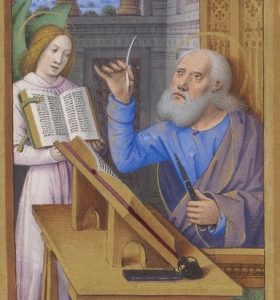
Paris, Bibliothèque nationale de France. Département des Manuscrits. Latin 10532, page 2, detail. Horæ ad usum Fratrum Prædicatorum, dites Heures de Frédéric d’Aragon. Image Public Domain via https://gallica.bnf.fr/ark:/12148/btv1b8427228j/f6.item.
In keeping with our 2026 Theme of “Transformations and Renewals,” for our 2026 RGME Symposium we explore perspectives and experiences in learning and teaching (and vice versa), considered across generations, subjects, and methods. At the center are observations about the challenges and opportunities for the transmission of the past in the hands of the present, notably considering that process through written records, and taking into account our responsibilities for the future. We focus on experiences, at various stages across lifespans, and what they teach us.
In a nutshell: we reflect about “Manuscripts, Books, Written Materials, and their Powers as Teachers.” We also attend to processes by which we might learn, be taught, and embark upon teaching, in cycles that might interlink in response to inspiration, encouragement, cautions, discoveries, serendipity, and choices made or revised as experience or evidence might direct.
The scope for subjects of teaching and learning can range across a multitude of periods, genres, methods, processes, purposes, and results. They span manuscripts and beyond, medieval and more, including documents, prints, arts, crafts, skills, sciences, and a multitude of approaches to the transmission of learning.
Call for Participation
We wish to gather stories and compare notes. We will hear from young students, practicing teachers, scholars, retirees, and others in the worlds of learning and practice, whether in the classroom or beyond. We recognize that these worlds can have wide horizons and that the learning experiences and the agencies for learning can extend across a given lifetime as well as move across lifetimes.
We take into account a wide range of approaches in both Arts and Sciences. We attend to the experiences of people where they stand in their journey. Although the state of education in the present climate encounters challenges aplenty, the individual and collective dedication to teaching and its transmission from person to person and generation to generation, as well as across the ages, calls for celebration of the joys of learning, along with the processes of sharing and mentoring them.
Some questions to examine might include:
- Experiences in learning and teaching (or vice versa), whether for career choices or life-training
- Teaching in the classroom, teaching outside the classroom
- Recollections of teachers and their impact(s), good or bad
- Life-lessons learned through experience and hindsight
- Where do we go from here, from this point in time, to move forward?
Generally we seek presentations of some 20 to 25 minutes, longer presentations of some 40 to 45 minutes, responses of some 10 to 15 minutes, and comments of varied lengths — impromptu included — for roundtable discussions and conversations. They will occupy sessions of 1 ½ hours, which include scope for Q&A. We begin to draw up the program, with sessions settling into place.
Participation is welcome and flexible: Advise, Attend, Preside, Talk, Present, Respond, Ask Questions, Give Feedback, Compare Notes. Join the Celebration!
Please let us know if you wish to participate.
Contact: director@manuscriptevidence.org or mildredbudny@gmail.com
We look forward to comparing notes, learning, and learning anew.
People
We assemble the program. The symposium is organized by Mildred Budny and Ann Jianxue Chen.
People who will participate, whether as Advisers, Presiders, Moderators, Presenters, Respondents, Panelists, Commentators, and Behind-the-Scene Supporters, whether in-person or online, include (in alphabetical order):
Cortney Anne Berg (City University of New York Graduate Center)
Phillip Bernhardt–House (Research Group on Manuscript Evidence)
Rebecca Bramlett (Syracuse University Libraries)
Mildred Budny (Research Group on Manuscript Evidence)
Ann Jianxue Chen (Princeton University)
Zenon Donaldson (University of Waterloo)
Augustine Dickinson (Universität Münster)
Daria Elagina (Universität Münster)
Robert Martin Kerr (Universität des Saarlandes)
Hannah Goeselt (Massachusetts Historical Society Library)
Justin Hastings (Research Group on Manuscript Evidence)
Antony R. Henk (Medievalisms – Ruhr-Universität Bohum)
Thomas E. Hill (Art Library, Vassar College)
Kevin Maringer (The Pirbright Institute, Surrey)
Beppy Landrum Owen
Zoe Langer (Rare Book School)
David Porreca (University of Waterloo)
Mark Saltviet (Independent Scholar)
Anna Siebach–Larson (Colgate University)
David W. Sorenson (Allen G. Berman, Numismatist)
N. Kivilcim Yavuz (University of Leeds)
And more!
As we shape the Program and find Venues for parts of the event (see below), we invite Contributions. These forms of participation might suit different styles, personalities, genres, and approaches.
Subjects and Sessions
Sessions in preparation include:
“Manuscripts as Pedagogy”
“Learning to Read, From the Ground Up: Mothers, Teachers, Schooling”
“Transmission of Literary Cultures”
“Experiments in Teaching: Reports from the Classroom”
“Books as Teachers”
“Students as Teachers, Teachers as Students”
“Notes from the Fieldwork”
“Insights from Lessons Learned and In Progress: Hindsight and Foresight”
“Learning for Life”
And more!
Subjects include practices in pedagogy across time, the transmission of literary cultures, the rôles of women in that transmission, the nature of written sources as witnesses, case-studies centering on specific manuscripts or printed books (or fragments thereof), and interviews or conversations with teachers, students, and practitioners in a wide range of fields of activity and agency.
Support and Hospitality
In shaping the event, we look for Venues and Sponsors. As we work to gather the delicious and nutritious Food for Thought, we also think about sustenance in the forms of Food and Drink, back-up operations online and in-person by the RGME Production Team, and other components to enable a vibrant accomplishment of this eagerly collaborative event.
Please get in touch.
Venues
As we shape the Program and its cast of Participants, we explore venues for some of its parts to take place in-person. We aim for all sessions to be accessible online. Recordings for some of them might become available, with permissions.
Updates:
Part of the event has been approved to take place at Princeton University on Monday 7 December. We thank our co-organizer, Ann Jianxue Chen, for securing approval for this very special event, co-organized by the RGME and the East Asian Cultural Association (EACA) of Princeton University, and open to all in hybrid format.
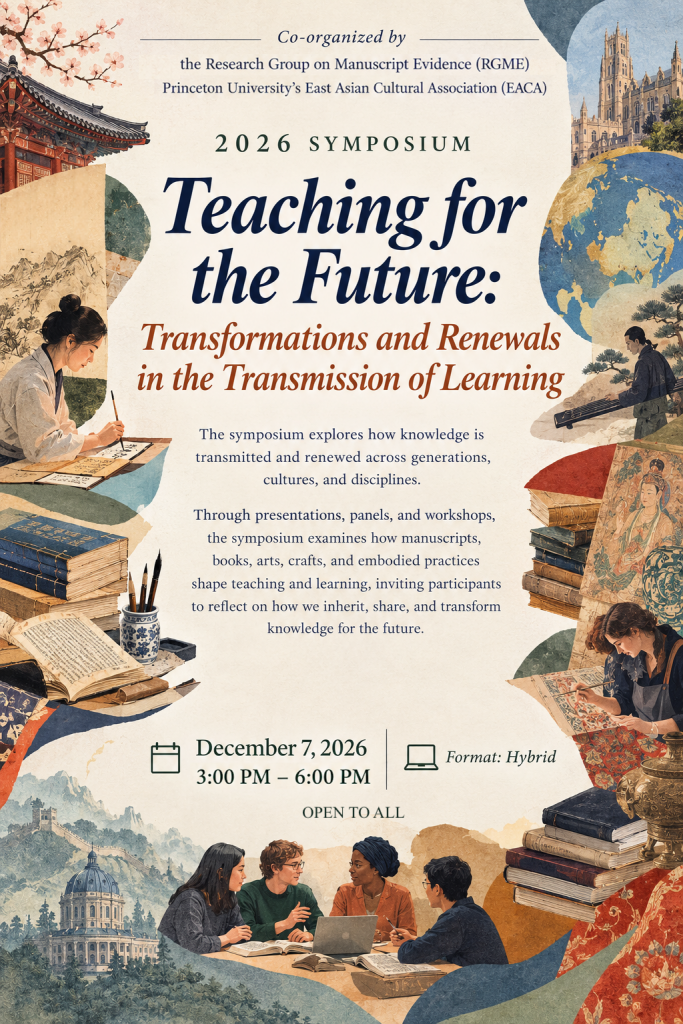
2026 Symposium Poster RGME + EACA: Monday 6 December. Poster designed by Ann Jianxue Chen.
A New Update
Part of the event has been approved to take place at Vassar College, Poughkeepsie, New York, on Friday 4 December. We thank Nancy Bisaha, Thomas E. Hill, and Ronald Patkus for this welcome development.
Share your questions, suggestions, and requests with us, as we collaboratively design the event.
Posters
Posters are available for download and display.
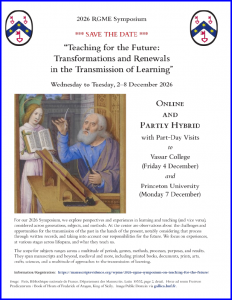 Save the Date
Registration
As the program takes shape, you may register through our Eventbrite Portal:
Note that there are three different registration portals on our Eventbrite Portal.
Registration Option 1. ONLINE Attendance for the full event (2 December – 8 December),
— including for the hybrid portions on two of those days
Options 2–3. IN PERSON Attendance for each of the two venues (4 December and 7 December)
Note: These in-person events will also be accessible online
For online participation see above (Option 1)
2. IN PERSON Event at Vassar College
Friday 4 December, 3:00–5:00 pm EST (GMT-5)
3. IN PERSON Event at Princeton University
Monday 7 December, 3:00–6:00 pm EST (GMT-5)
- 2026 Symposium on “Teaching for the Future” – IN PERSON EVENT AT PRINCETON (Monday 7 December): Registration
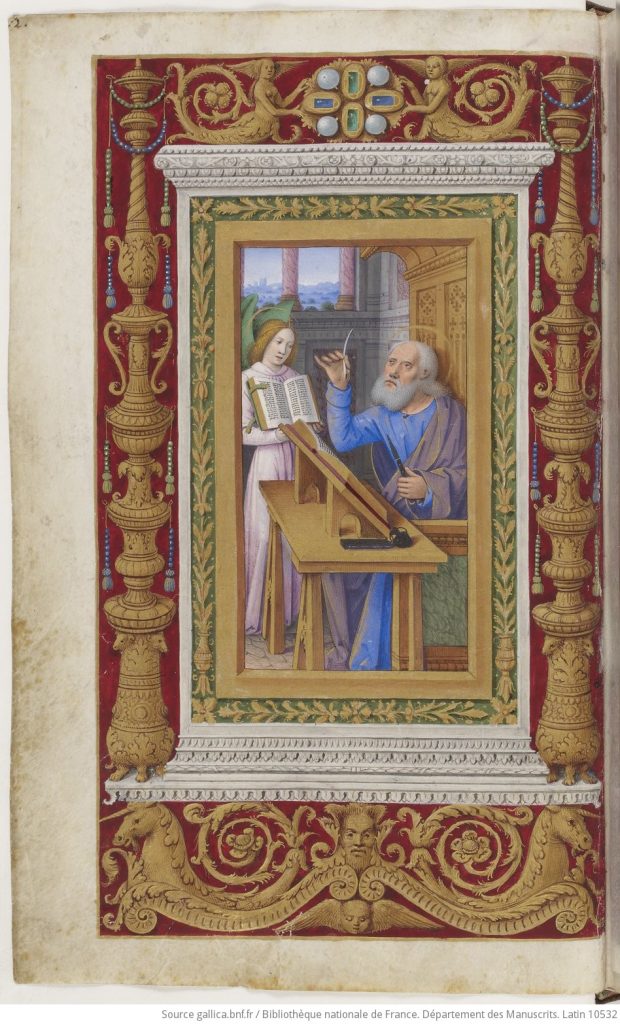
Paris, Bibliothèque nationale de France. Département des Manuscrits. Latin 10532, page 2. Horæ ad usum Fratrum Prædicatorum, dites Heures de Frédéric d’Aragon. Image Public Domain via https://gallica.bnf.fr/ark:/12148/btv1b8427228j/f6.item.
Note on the Image
Full-page frontispiece image of the Evangelist Matthew at work on writing his sacred text, accompanied by a youthful angel who holds open a completed, bound, book with double-columns of text and opened clasps, whilst the old man inspects his quill pen. The image comes from the Book of Hours of Frederick of Aragon, King of Naples: Paris, Bibliothèque nationale de France. Département des Manuscrits. Latin 10532, page 2. Image via gallica.bnf.fr. On the manuscript, see:
We choose this image in recognition of the rôles which inspiration can play in the creation, transformation, and renewal of texts and other forms of representation or communication across the ages.
***************
Hoping to attend December 7–love the topic. It’s been a very busy fall with new collaborative book coming out this winter. Dana Delibovi