• News
    • News & Views
    • RGME Activities for 2024 and 2025
    • Around & About with the RGME
    • Reviews
    • Highlights
  • Blogs
    • Manuscript Studies
      • Manuscript Studies: Contents List
    • International Congress on Medieval Studies
      • Abstracts of Congress Papers
        • Abstracts of Papers Listed by Author
        • Abstracts of Papers Listed by Year
  • About
    • Mission
    • Who We Are
      • Officers, Associates & Volunteers
      • RGME Committees
      • Friends of the Research Group on Manuscript Evidence
    • Policies & Statements
      • RGME Privacy Policy Statement
      • RGME Intellectual Property Statement & Agreements
    • People
      • Mildred Budny — Her Page
      • Adelaide Bennett Hagens
    • Activities
      • Events
      • Congress Activities
        • Sponsored Conference Sessions (1993‒)
          • Panels at the M-MLA Convention (from 2016)
        • Co-sponsored Conference Sessions (2006‒)
    • History
      • Seals, Matrices & Documents
      • Genealogies & Archives
    • Contact Us
  • Bembino
    • Multi-Lingual Bembino
    • RGME Bembino: Resources
  • Congress
    • Sponsored Conference Sessions (1993‒)
    • Co-sponsored Conference Sessions (2006‒)
    • Abstracts of Congress Papers
      • Abstracts Listed by Author
      • Abstracts Listed by Year
    • Kalamazoo Archive
    • Panels at the M-MLA Convention (2016-2019)
      • Abstracts of Papers for the M-MLA Convention
      • Panels at the M-MLA Convention (from 2016)
  • Events
    • RGME Activities for 2024 and 2025
      • 2023 Activities and 2024 Planned Activities
    • Seminars, Workshops, Colloquia & Symposia (1989–)
      • Seminars on ‘The Evidence of Manuscripts’
      • Symposia on ‘The Transmission of the Bible’
      • The New Series (2001-)
        • 2019 Anniversary Symposium Program: The Roads Taken
        • 2019 Anniversary Symposium Registration
        • 2019 Anniversary Symposium Registration Open
      • RGME Symposia: The Various Series
      • The Research Group Speaks: The Series
      • Meetings of the Friends of the Research Group on Manuscript Evidence
      • RGME Online Events
    • Abstracts of Papers for Events
      • Abstracts of Papers for Seminars on ‘The Evidence of Manuscripts’
      • Abstracts of Papers for Symposia, Workshops & Colloquia
    • Receptions & Parties
    • Business Meetings
    • Photographic Exhibitions & Master Classes
    • Events Archive
  • ShelfLife
    • Journal Description
    • ShelfMarks: The RGME-Newsletter
    • Publications
      • “Insular, Anglo-Saxon, and Early Anglo-Norman Manuscript Art at Corpus Christi College, Cambridge” (1997)
        • Mildred Budny, ‘Catalogue’
        • The Illustrated Catalogue (1997)
      • The Illustrated Handlist
      • Semi-Official Counterfeiting in France 1380-1422
      • No Snap Decisions: Challenges of Manuscript Photography
    • History and Design of Our Website
  • Galleries
    • Watermarks & the History of Paper
    • Galleries: Contents List
    • Scripts on Parade
    • Texts on Parade
      • Latin Documents & Cartularies
      • New Testament Leaves in Old Armenian
    • Posters on Display
    • Layout Designs
  • Donations and Contributions
    • RGME Donor Promise
    • 2023 End-of-Year Fundraiser for our 2024 Anniversary Year
    • 2019 Anniversary Appeal
    • Orders
  • Links
    • Catalogs, Metadata, and Databases: A Handlist of Links
    • Handlist of Resources for Manuscript Studies and Fragmentology
    • Manuscripts & Rare Books
    • Maps, Plans & Drawings
    • Seals, Seal-Matrices & Documents

  • News
    • News & Views
    • RGME Activities for 2024 and 2025
    • Around & About with the RGME
    • Reviews
    • Highlights
  • Blogs
    • Manuscript Studies
      • Manuscript Studies: Contents List
    • International Congress on Medieval Studies
      • Abstracts of Congress Papers
        • Abstracts of Papers Listed by Author
        • Abstracts of Papers Listed by Year
  • About
    • Mission
    • Who We Are
      • Officers, Associates & Volunteers
      • RGME Committees
      • Friends of the Research Group on Manuscript Evidence
    • Policies & Statements
      • RGME Privacy Policy Statement
      • RGME Intellectual Property Statement & Agreements
    • People
      • Mildred Budny — Her Page
      • Adelaide Bennett Hagens
    • Activities
      • Events
      • Congress Activities
        • Sponsored Conference Sessions (1993‒)
          • Panels at the M-MLA Convention (from 2016)
        • Co-sponsored Conference Sessions (2006‒)
    • History
      • Seals, Matrices & Documents
      • Genealogies & Archives
    • Contact Us
  • Bembino
    • Multi-Lingual Bembino
    • RGME Bembino: Resources
  • Congress
    • Sponsored Conference Sessions (1993‒)
    • Co-sponsored Conference Sessions (2006‒)
    • Abstracts of Congress Papers
      • Abstracts Listed by Author
      • Abstracts Listed by Year
    • Kalamazoo Archive
    • Panels at the M-MLA Convention (2016-2019)
      • Abstracts of Papers for the M-MLA Convention
      • Panels at the M-MLA Convention (from 2016)
  • Events
    • RGME Activities for 2024 and 2025
      • 2023 Activities and 2024 Planned Activities
    • Seminars, Workshops, Colloquia & Symposia (1989–)
      • Seminars on ‘The Evidence of Manuscripts’
      • Symposia on ‘The Transmission of the Bible’
      • The New Series (2001-)
        • 2019 Anniversary Symposium Program: The Roads Taken
        • 2019 Anniversary Symposium Registration
        • 2019 Anniversary Symposium Registration Open
      • RGME Symposia: The Various Series
      • The Research Group Speaks: The Series
      • Meetings of the Friends of the Research Group on Manuscript Evidence
      • RGME Online Events
    • Abstracts of Papers for Events
      • Abstracts of Papers for Seminars on ‘The Evidence of Manuscripts’
      • Abstracts of Papers for Symposia, Workshops & Colloquia
    • Receptions & Parties
    • Business Meetings
    • Photographic Exhibitions & Master Classes
    • Events Archive
  • ShelfLife
    • Journal Description
    • ShelfMarks: The RGME-Newsletter
    • Publications
      • “Insular, Anglo-Saxon, and Early Anglo-Norman Manuscript Art at Corpus Christi College, Cambridge” (1997)
        • Mildred Budny, ‘Catalogue’
        • The Illustrated Catalogue (1997)
      • The Illustrated Handlist
      • Semi-Official Counterfeiting in France 1380-1422
      • No Snap Decisions: Challenges of Manuscript Photography
    • History and Design of Our Website
  • Galleries
    • Watermarks & the History of Paper
    • Galleries: Contents List
    • Scripts on Parade
    • Texts on Parade
      • Latin Documents & Cartularies
      • New Testament Leaves in Old Armenian
    • Posters on Display
    • Layout Designs
  • Donations and Contributions
    • RGME Donor Promise
    • 2023 End-of-Year Fundraiser for our 2024 Anniversary Year
    • 2019 Anniversary Appeal
    • Orders
  • Links
    • Catalogs, Metadata, and Databases: A Handlist of Links
    • Handlist of Resources for Manuscript Studies and Fragmentology
    • Manuscripts & Rare Books
    • Maps, Plans & Drawings
    • Seals, Seal-Matrices & Documents

Log in

Archives

Featured Posts

Sanskrit and Prakrit Manuscripts, Continued: More Leaves for Manuscript Sample XII?
2026 International Congress on Medieval Studies: Program
Episode 24. “Life with Books” (Interview with John Windle)
Announcing the Launch of RGME Bembino WP
2026 RGME Colloquium at The Grolier Club: Report
Medieval Missal Fragment as Early-Modern Cover
The Weber Leaf from Ege MS 61
"Bembino" Booklet Cover
Episode 23. “Meet RGME Bembino: Facets of a Font”
2026 RGME Colloquium on “Transformations & Renewals” at The Grolier Club
2026 Theme of the Year: “Transformations and Renewals”
A Leaf with Patchwork from the Saint Albans Bible
A Sister Leaf from a Miniature Latin Vulgate Bible
A Little Latin Vulgate Bible Manuscript Leaf in Princeton
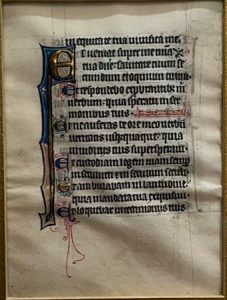
J. S. Wagner Collection. Leaf from from Prime in a Latin manuscript Breviary. Folio 4 Verso, with part of Psalm 117 (118) in the Vulgate Version, set out in verses with decorated initials.
2026 Annual Appeal
Episode 22: “Encounters with Local Saints and Their Cults”
Private Collection, Ege's FBNC Portfolio, Dante Leaf, Verso, Detail. Reproduced by Permission.
2025 RGME Autumn Colloquium on Fragments
Workshop 8: A Hybrid Book where Medieval Music Meets Early-Modern Herbal
2025 RGME Autumn Symposium on “Readers, Fakers, and Re-Creators of Books”
RGME Workshops on “The Evidence of Manuscripts, Etc.”
2025 International Medieval Congress at Leeds: RGME Program
Episode 21. “Learning How to Look”
2025 International Congress on Medieval Studies: Program
2025 RGME Visit to Vassar College
Two Leaves in the Book of Numbers from the Chudleigh Bible
Delibovi on Glassgold on Boethius: A Blogpost
Ronald Smeltzer on “Émilie du Châtelet, Woman of Science”
2025 Spring Symposium: “Makers, Producers, and Collectors of Books”
Starters’ Orders
The Weber Leaf from the Saint Albans Bible
Workshop 4. “Manuscript Fragments Compared”
Episode 20. “Comic Book Theory for Medievalists”
Episode 19: “At the Gate: Starting the Year 2025 at its Threshold”
Favorite Recipes for Lemonade, Etc.
RGME Visit to the Lomazow Collection: Report
2024 Autumn Symposium: “At the Helm”
A Latin Vulgate Leaf of the Book of Numbers
The RGME ‘Lending Library’
Florence, Italy, Ponte Vecchio from Ponte alle Grazie. Photo: Ingo Mehling, CC BY-SA 4.0 , via Wikimedia Commons
Episode 17. “RGME Retrospect and Prospects: Anniversary Reflections”
2024 Anniversary Symposium: The Booklet
Jesse Hurlbut at the Bonneville Salt Flats, Utah. Photograph Jesse Hurlbut.
Episode 16: An Interview with Jesse D. Hurlbut
To Whom Do Manuscripts Belong?
Kalamazoo, MI Western Michigan University, Valley III from the side. Photograph: David W. Sorenson.
2024 International Congress on Medieval Studies: Report
2024 Spring Symposium at Vassar College
Puente de San Martín: Bridge with reflection over the River Targus, Toledo, Spain.
2024 Grant for “Between Past and Future” Project from The Gladys Krieble Delmas Foundation Research Libraries Program
2024 Anniversary Symposium in Thanks to Jesse Hurlbut: Program

You are browsing the Blog for Otto Ege Manuscripts

Program for 2022 Autumn Symposium on “Supports for Knowledge”

October 6, 2022 in Announcements, Conference Announcement, Manuscript Studies, Uncategorized

2022 RGME Spring and Autumn Symposia
on “Structured Knowledge”
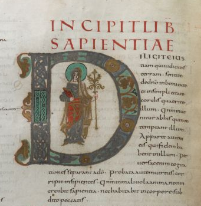
© British Library Board, London, British Library, Add. MS 1546, folio 262v, detail. Opening of the Book of Sapientia (“Wisdom”).

2 of 2: 2022 Autumn Symposium
“Supports for Knowledge”
Saturday, 15 October 2022

Symposium Program
9:00 am – 5:30 pm EDT
Online via Zoom

Sessions with Presentations and Discussion (“Q&A”)
Breaks for Coffee, Lunch, and Tea
Closing Keynote Presentation and Concluding Remarks

For Registration see below

[Posted on 5 October, with updates]

On the pair of Symposia, see 2022 Spring and Autumn Symposia
On Part 1 of this pair, see 2022 Spring Symposium on “Structures of Knowledge”
On Part 2, see 2022 Autumn Symposium on “Supports for Knowledge”

Here we present the Program for Part 2 on “Supports for Knowledge”, held on Saturday 15 October 2022 by Zoom
— Registration is required, with a limited number of places (see below).

The Program Booklet (in preparation) will present the Program and Abstracts of the Presentations and Responses, with multiple Illustrations.  In accordance with our tradition of Program Booklets for our Symposia and some other events (see our Publications, it will be issued in printed form as well as digital form, with a downloadable pdf.

Timetable

Session 1.    9:00–10:30 am EDT
Brief Introduction to the Symposium and Welcome
“Teaching with (and through) Manuscripts, Part II”
Q&A

Break.          10:30–10:45 am

Session 2.   10:45 am – 12:15 pm
“Catalogs, Metadata, and Databases, Continued (Part III)”
Q&A

Lunch Break.   12:15–1:15 pm

–– During the Break.  12:30–12:50 pm

Presentation (at the time when the Speaker could attend)

David W. Sorenson (Allen Berman, Numismatist)
“A Jain Manuscript of the Seventeenth Century on Imported Watermarked Paper: An Early, Dated, Witness to Imported Paper Stocks in Indian Manuscripts”
As a contribution to our series on the “History and Uses of Paper”

Session 3.    1:15–2:45 pm
“The Living Library (Part II)”
Q&A

Break.          2:45–3:00 pm

Session 4.   3:00–4:30 pm
“Hybrid Books (Part I)”
Q&A

Break.         4:30–4:45 pm

Session 5.   4:45–5:30 pm EDT
“Books and Their Structures”
Closing Keynote Presentation and Concluding Remarks

*****

Sessions

Session 1.  “Teaching with (and through) Manuscripts, Part II”
— continuing the series begun at the Spring Symposium on “Structures of Knowledge”

Presider

David Porreca (Department of Classical Studies, University of Waterloo)

Speakers

Caley McCarthy (Research Associate and Project Manager, Environments of Change, University of Waterloo)
and
Andrew Moore (Research Fellow, Environments of Change, and Associate Director, DRAGEN Lab, University of Waterloo)
“Collaborative Pedagogy with Medieval Manuscripts in a Digital Lab”

William H. Campbell (Director, Center for the Digital Text, University of Pittsburgh-Greensburg)
Amber McAlister (Assistant Professor, History & Architecture, University of Pittsburgh-Greensburg)
and
Connor Chinoy (Student at the University of Pittsburgh-Greensburg and member of the “History of the Book” class)
“Books in the Flesh: An Interdisciplinary Undergraduate Class with Medieval Manuscripts”

Q&A

*****

Mid-Morning Break

*****

Session 2.  “Catalogs, Metadata, and Databases, Continued (Part III)”
— continuing our series
This is Part III in our series on these subjects, building upon Parts I and II, and leading to further Parts in 2023

  • our Roundtable in February on Catalogs, Metadata, and Databases, Part I and
  • the Session on “Catalogs, Metadata, and Databases, Part II” in the Spring Symposium

See the Links of Interest (Catalogs , Metadata, and Databases: A Handlist of Links)
— for which suggestions and additions are welcome.

Presider

Jessica L. Savage (Art History Specialist, Index of Medieval Art)

Speakers

Jessica L. Savage
“Cataloguing Manuscript Iconography between Digital Covers at the Index of Medieval Art”

Barbara Williams Ellertson (The BASIRA Project and Research Group on Manuscript Evidence)
“A Painter, a Printer, and a Search for Shared Exemplars”

Katharine C. Chandler (Special Collections and Serials Cataloger, University of Arkansas Libraries)
“Manuscripts from Print: The Schwenkfelders and their Dangerous Books”

Respondent

David Porreca (Department of Classics, University of Waterloo)
“My $0.02 Worth”

Moderator for the Questions-and-Answers

Derek Shank (Research Group on Manuscript Evidence)

Q&A

*****

Lunch Break

Perhaps — TBD — during part of the Break
Presentation (from about 12:15–12:35 pm), if the Speaker might attend, depending on short-notice work timetables:

David W. Sorenson (Allan Berman, Numismatist)
“A Jain MS of the Seventeenth Century on Imported Watermarked Paper:  An Early, Dated, Witness to Imported Paper Stocks in Indian Manuscripts”

*****

Session 3.  “The Living Library (Part II)”

— continuing the series begun at the Spring Symposium on “Structures of Knowledge”

Presider

Jaclyn Reed (Department of English and Writing Studies, University of Western Ontario)

Speakers

Christine E. Bachman (Department of Art & Art History, University of Colorado at Boulder)
“Unbound, Dispersed, Resewn:  The Flexible Codex in Eighth-Century Northwestern Europe”

Zoey Kambour (Post Graduate Fellow in European & American Art at the Jordan Schnitzer Museum of Art at the University of Oregon)
“Textual Interaction Through Artistic Expression:  The Marginal Drawings in the Decretales Libri V of Pope Gregory IX (University of Oregon MS 027)”

David Porreca (Department of Classical Studies, University of Waterloo)
“The Warburg Institute Library:   Where Idiosyncracy Meets User-Friendliness”

Respondent

Thomas E Hill (Art Librarian, Vassar College)
“Some Early Background to Warburg’s Project in Post-Wunderkammer Systematic Catalogues of the European Baroque and Enlightenment Periods”
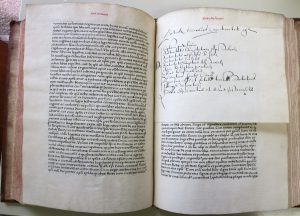
Le Parc Abbey, Theological Volume, Part B and added Part-Leaf between folios 103–104 (or folios "7"–"8").

Private Collection, Le Parc Abbey, Theological Volume, Part B and added Part-Leaf (or Bookmark) between folios 103–104. Photography Mildred Budny.

Q&A

*****

Mid-Afternoon Break

*****

Session 4.  “Hybrid Books (Part I)”

— beginning a series for which more sessions are planned

Presider

Justin Hastings (University of Delaware)

Speakers

Hannah Goeselt (Library and Information Science (MS): Cultural Heritage Informatics, Simmons University, Boston)
“Structures of Art and Scripture in Otto Ege’s ‘Cambridge Bible’ (Ege Manuscript 6)”

Jennifer Larson (Department of Classics, Kent State University)
“Printed and Scribed:  A Collector’s View of Hybrid Books”

Linde M. Brocato (Cataloging & Metadata Librarian, University of Miami Libraries)
“Paths of Access and Horizons of Expectation, II:  From Book-In-Hand to Catalog(ues)”

N. Kıvılcım Yavuz (Lecturer in Medieval Studies and Digital Humanities, School of History, University of Leeds)
“Bound With:  Towards a Typology of Hybrid Codices”

Q&A

*****

Tea Break

*****

Session 5. “Books and Their Structures”

Presider

Mildred Budny (Director, Research Group on Manuscript Evidence)

Closing Keynote Presentation

Linde M. Brocato (Cataloging & Metadata Librarian, University of Miami Libraries)
“Hybrid Books: Fragments and Compilatio, Structure and Heuristic in Richard Twiss’s Farrago”

Discussion & Brief Concluding Remarks

Mildred Budny
“Structured Knowledge, Structures of Knowledge, and Supports for Knowledge:  A Framework for the Year”

*****

Closing Keynote Presentation

“Hybrid Books:
Fragments and Compilatio, Structure and Heuristic in
Richard Twiss’ Farrago“

In the group of artists’ books from the Ruth and Marvin Shackner Archive of Concrete Poetry purchased by the University of Miami Special Collections, there is an extraordinary volume, sold by a vendor as late 19th century, anonymous, and an artist’s book avant la lettre.  Careful analysis for bibliographical cataloging revealed the error in all these assertions.

In this presentation, I will lay out both the process of that analysis, and its results, along with reflections on hybrid books of various kinds.  My reflections will encompass the kinds of structured information that make their way into databases, and structuring codes of cataloging and bibliography, all of which are necessary but not sufficient for our understanding and convivencia with books , which are always already hybrid.  In these reflections, I will bring together many of the strands of thinking we have all worked to weave together in the symposium.
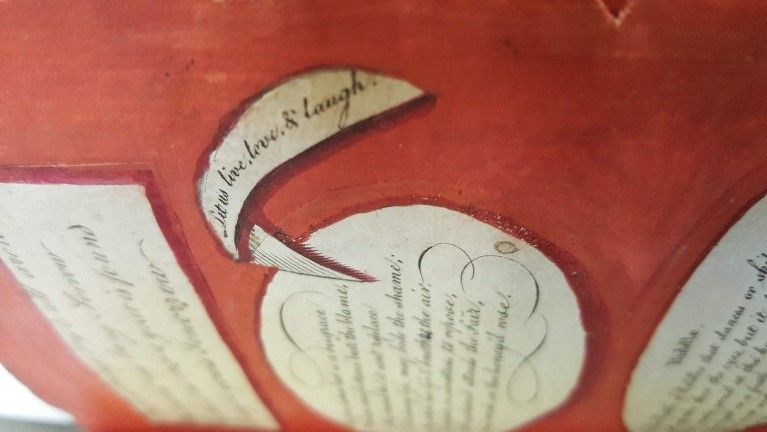
Richard Twiss, Farrago, held in the Unversity of Miami Special Collections, Artists’ Books Collection. Sidelong View. Photograph Linde M. Brocato.

Glimpses of the volume comprising Farrago compiled by the writer, traveler, chess-player, and would-be paper manufacturer Richard Twiss (1749–1821) can be seen in our blogpost called “I Was Here”, with photographs by Linde M. Brocato.

Concluding Remarks

Mildred Budny
“Structured Knowledge, Structures of Knowledge, and Supports for Knowledge: A Framework for the Year”
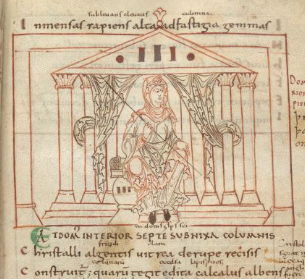
© British Library Board, London, British Library, Cotton MS Cleopatra C. viii, folio 36r, top: Sapientia in her Temple. Prudentius, Psychomachia, in a Canterbury copy of the late tenth or early eleventh century.

*****

To register for the Symposium, visit 2022 Autumn Symposium Registration. Places are limited.

Questions? Contact director@manuscriptevidence.org.

*****

Suggestion Box

Do you have suggestions for subjects for our events, or offers to participate? Please let us know.

If you wish to join our events, please contact director@manuscriptevidence.org.

For updates, watch this space, and visit:

  • 2022 Spring and Autumn Symposia
  • The Research Group Speaks: The Series;
  • our FaceBook Page and
  • our Twitter Feed (@rgme_mss).

Please leave your Comments below, Contact Us, and visit our FaceBook Page and Twitter Feed (@rgme_mss).  We look forward to hearing from you

We invite you to donate to our nonprofit educational mission. Donations may be tax-deductible. We welcome donations in funds and in kind:
  • Contributions and Donations .

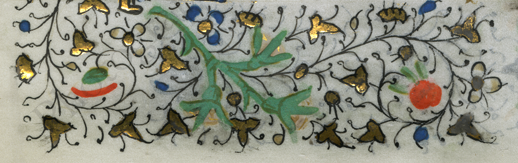
Floral Motif as Lower Border in a Book of Hours. Photography Mildred Budny.

*****
 

Tags: Catalogs & Metadata & Databases, Decretals of Pope Gregory IX, DRAGEN Lab, Fragmentology, History of Paper, Hybrid Books, Index of Medieval Art, Jain Manuscripts, Les Enluminures, Medieval Manuscript Fragments, Medieval manuscripts, Miniature Books, Otto Ege Manuscript 8, Otto Ege Manuscripts, RGME Symposia, Richard Twiss's Farrago, Schwenkfelder Books, Structured Knowledge, Teaching with and through Knowledge, Teaching with Manuscripts, The Living Library, University of Oregon MS 027, Warburg Institute Library, Watermarked Paper, Watermarks
No Comments »

The Weber Leaf from “The Warburg Missal” (Otto Ege Manuscript 22)

July 5, 2022 in Manuscript Studies

The Weber Leaf
from ‘Otto Ege Manuscript 22’
(The Warburg Missal)

Collection of Richard Weber

Latin Missal made in Germany circa 1325
Written in Gothic Script (Textualis)

Folio Number Absent

Double columns of 31 lines
Circa 360 × 257 mm < written area circa 289 × 190 mm >

with Rubrications,
Inset Initials in Red or Blue,
and Musical Notation in Hufnagelschrift (“Horseshoe-Nail Notes”)
on 4-Line Staves

[Posted on 5 July 2022]

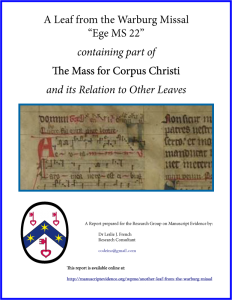
Front Cover for Report by Leslie J. French for Wagner Leaf from Ege MS 22 (2021)

Front Cover for Report by Leslie J. French for Wagner Leaf from Ege MS 22 (2021)

With thanks to the collector, Richard Weber, we examine a leaf from one of the manuscripts dispersed by Otto F. Ege (1888–1951). It comes from ‘Ege Manuscript 22’, a Latin Missal written in double columns of 30–32 lines in Gothic Script, with musical notation.

An earlier blogpost by Mildred Budny and the companion Report Booklet (2021) by Leslie J. French examine another Leaf from the same manuscript, set it in its former context, and re-assess the attribution of the book.

See:

  • Another Leaf from the Warburg Missal in the Collection of J. S. Wagner.
  • A Leaf from the Warburg Missal (“Ege MS 22”) containing part of The Mass for Corpus Christi and its Relation to Other Leaves.

Already, too, we have examined some other materials in the Collection of Richard Weber, with several blogposts — with more on the way.

  • A Leaf from ‘Otto Ege Manuscript 214’ in the Collection of Richard Weber
  • More Leaves from an Old Armenian Praxapostolos
  • Portfolio 93 of Ege’s “Famous Books in Eight Centuries” in the Collection of Richard Weber.

Now we turn to a leaf from Otto Ege’s dispersals that stands outside a specific set of a Portfolio, but with its original Ege Label and mat.  Normally, ‘Ege Manuscript 22’ would belong to the Portfolio of Fifty Original Leaves from from Medieval Manuscripts, as a specimen leaf in position Number 22 out of the 50.  See, for example:

  • Otto F. Ege Collection
  • The Guide to the Otto F. Ege Collection.

In this case, the Leaf must speak for itself.

Read the rest of this entry →

Tags: Collection of J. S Wagner, Collection of Richard Weber, Gloria, Kyrie Elieson, manuscript fragments, Medieval Manuscript Fragmenta, Otto Ege Manscript 19, Otto Ege Manuscript 22, Otto Ege Manuscripts, The Warburg Missal
No Comments »

Another Leaf from a Portable Manuscript Bible in the Collection of Birgitt G. Lopez

May 18, 2022 in Manuscript Studies, Uncategorized

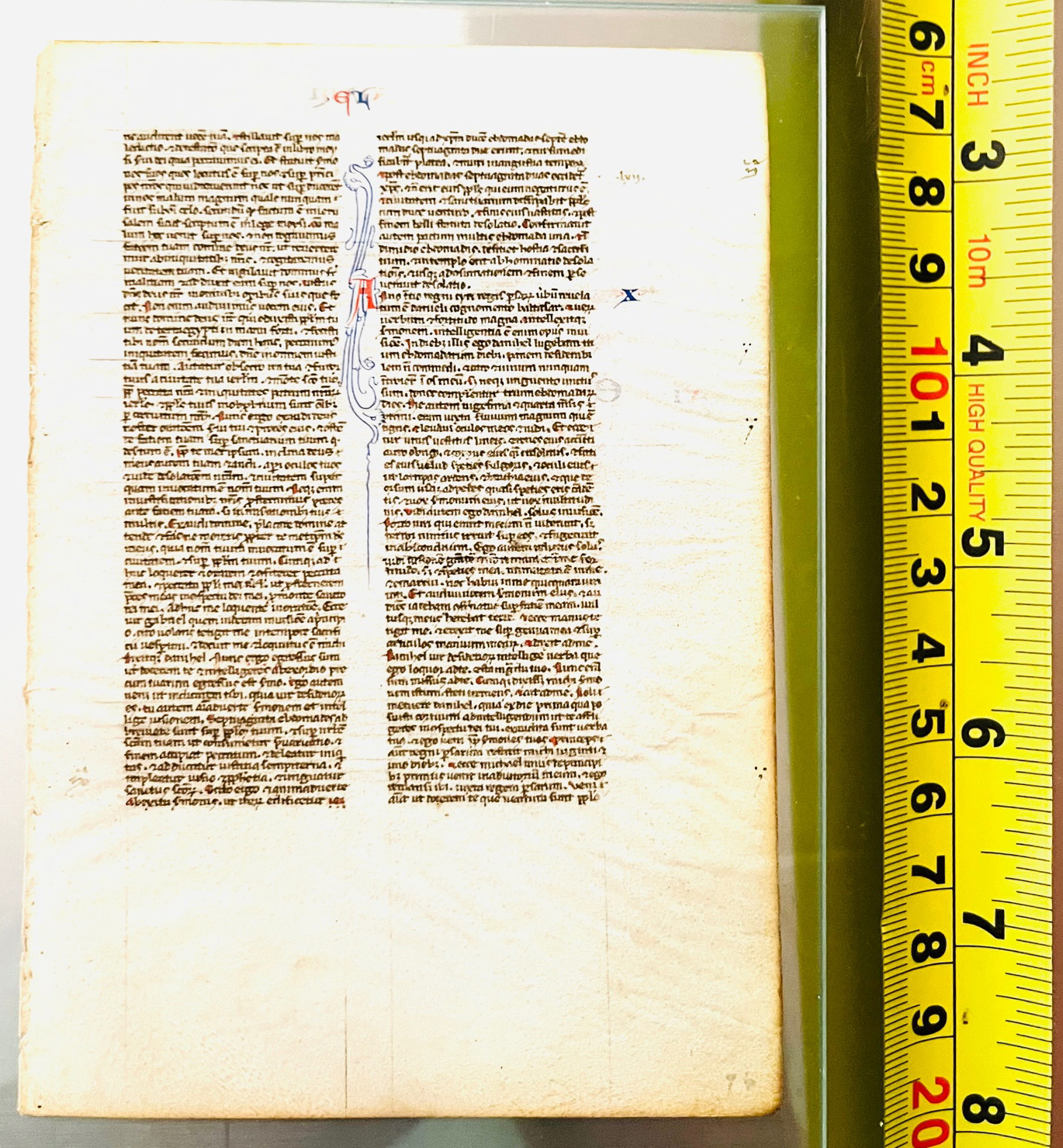
Another Latin Bible Manuscript Leaf
in the Collection of Birgitt G. Lopez

Single Leaf from a Latin Vulgate Bible
Folio “74[?]” with Part of the Book of Daniel

Daniel 9:11 ([. . . et declinaverunt / ] ne audirent)
– 11:30 (et cogitabit [ / advesum eos . . . ])

Double Columns of 56 lines

Written in Gothic Script
with Running Titles, Initials, Pen-flourishes, and Annotations
including a Modern Folio Number

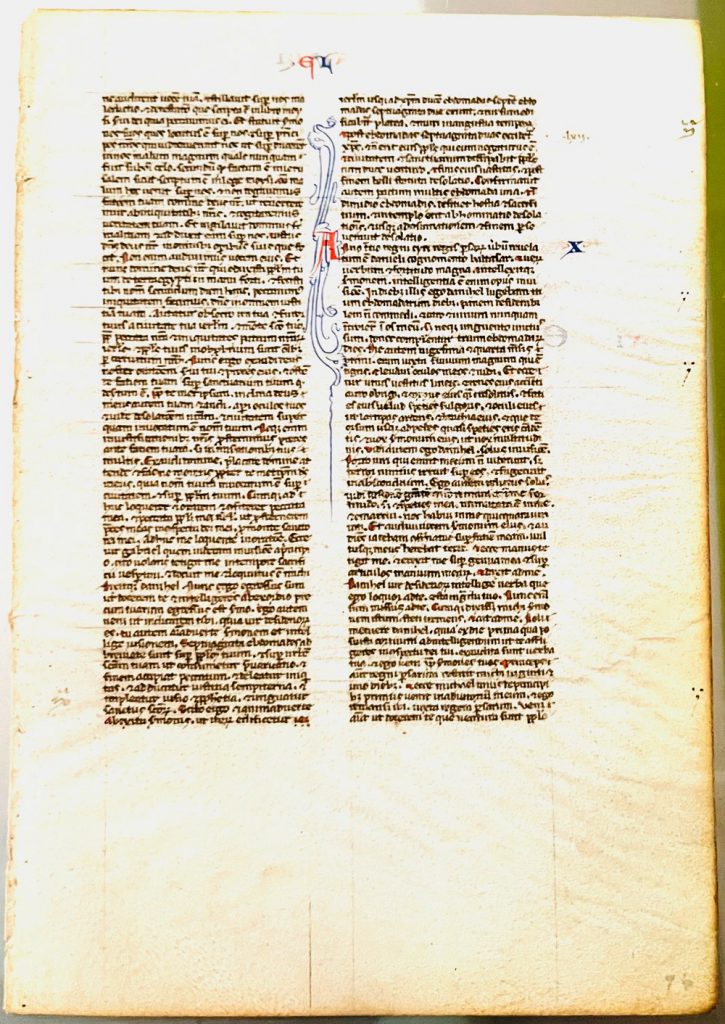
Collection of Birgitt G. Lopez, Vulgate Bible Manuscript Leaf purchased in London around 2000: Recto with opening of Daniel Chapter X.

[Posted on 17 May 2022]

Collection of Birgitt G. Lopez, Framed Leaf from ‘Otto Ege Manuscript 20’, Front-Facing Page (“Recto”).

Collection of Birgitt G. Lopez, Framed Leaf from ‘Otto Ege Manuscript 14’.

Following our blogpost reporting Two Ege Manuscript Leaves and Two Ege Labels in the Collection of Birgitt G. Lopez, we learn of another leaf in the same collection, with a different provenance.  Those two Ege leaves and labels pertain to three manuscripts dismembered and distributed by Otto F. Ege (1888–1951).  That is,

  • with a leaf from “Otto Ege Manuscript 14” and its Ege Label,
  • an Ege Label from “Ege Manuscript 54”, and
  • a leaf from “Ege Manuscript 20”.

They all pertain to books of the Latin Vulgate Bible, either as full Bibles in large or small format, or as the Book of Psalms in a separate volume (or Psalter) in small format. They came to their collector in stages, by purchase at auction at the Dallas Public Library in 1998, or as a gift in 2003 from its former Librarian, Lillian Moore Bradshaw (1915–2010), with a mix-up at some stage between labels and leaves.

Collection of Birgitt G. Lopez, Otto Ege Label for “Ege Manuscript 54”.
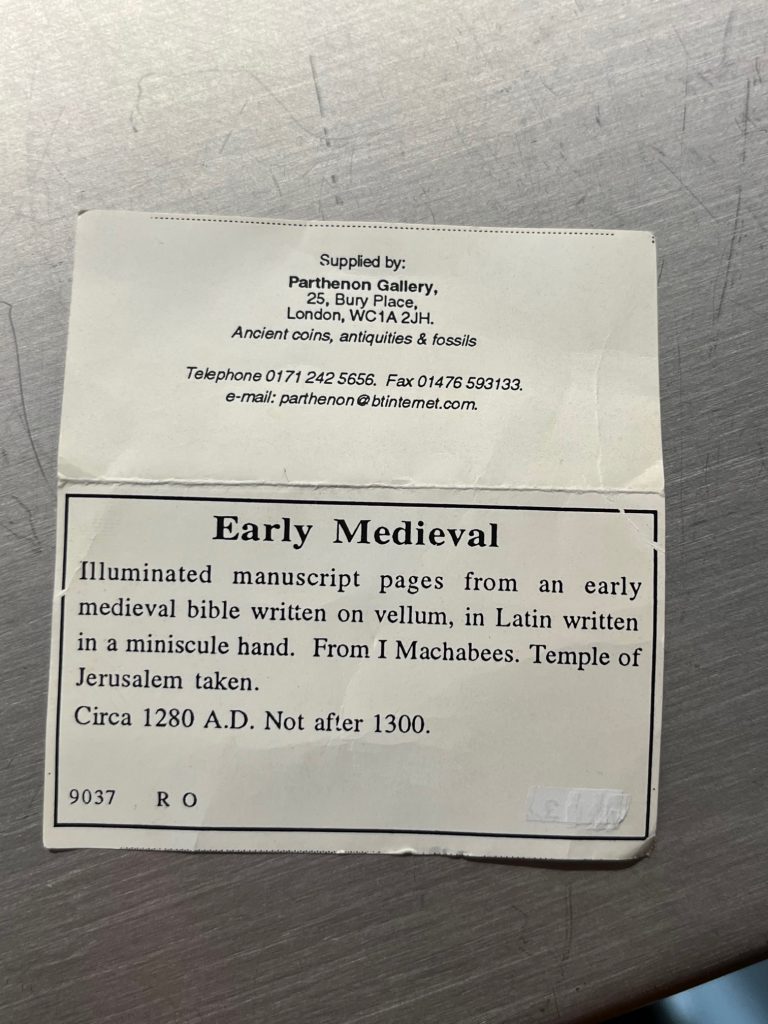
The Next Leaf

The next leaf reaching our attention came from a small-format Vulgate Bible manuscript.  In correspondence, Ernesto Lopez reports that he purchased the leaf in London, England, around the year 2000.

The unframed leaf and its seller’s label tell the story of a pattern of transmission of a dismembered medieval manuscript leaf which, at some stage in transmission after dismemberment, lost a record of connection to the original book.  Here we examine the label and both sides of the leaf, as revealed in the collector’s photographs, generously supplied for study and for presentation here to a wider world.

The Seller’s Label

With the leaf is a folded rectangular paper label with printed or print-out text in two halves above and below the fold-line which would permit the label to stand upright, say in a case or on a shelf.  The upper half of the sheet, above the fold line, identifies the seller, the Parthenon Gallery in London, purveyor of “Ancient coins, antiquities & fossils”.  This gallery is still located in the same place, at 25, Bury Place, WC1A 2JH.

Within a rectangular frame, the lower half of the label calls the specimen “Early Medieval”.  Details cite the item as comprising “Illuminated manuscript pages [sic] from an early medieval bible written on vellum, with Latin written in a miniscule hand”; identifies the contents as part of the text of “I Machabees, relating the episode of “The Temple taken”; and dates the item to “Circa 1280 A.D. Not after 1300.”

At the bottom of the frame, at the left, there stands the printed identifier “9037   R  0”, in arabic-numbers-plus-letters (or-letter).   At the right, layered pieces of gauze tape cover the price identifier, which is partly visible in show-through, beginning with the currency-identifier for pounds sterling (£).

The Leaf

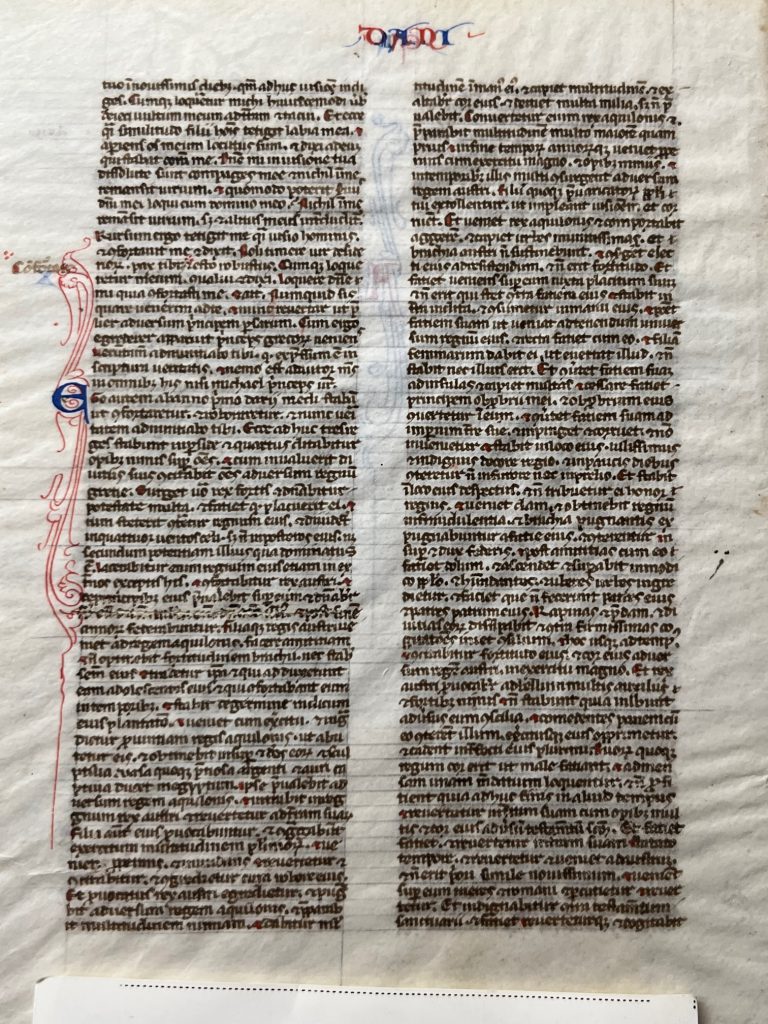
Side 1

To begin with, we saw a photograph of only one side.  The cropped edges of the photograph do not offer indications of which side of the leaf it is, whether recto or verso.  We decided to examine the image for what it might show.

The Text

Despite the label, this leaf does not belong to any part of the First Book of Maccabees (I Maccabees). Instead it has part of the text in the Book of Daniel.

The text on the page starts within Daniel 10:14 ([ . . . sunt populo / ] tuo in novissimis diebus, quoniam adhuc visio in dies).   The page ends in the middle of 11:30 (et faciet: reverteturque, et cogitabit [ / advesum eos . . . ]).

The enlarged initial signals the beginning of Chapter 11:1, which reads:  Ego autem ab anno primo Darii Medi stabam ut confortaretur et roboraretur.  Rendered in blue pigment, the initial E stands outside the column of text.  Above and below the letter extend pen-flourishes in red pigment, which reach most of the height of the column. In places, the flourishes form the outlines of foliate motifs, sometimes branching, with rippled contours in some places.

Show-through from the opposite side of the leaf indicates that a similar enlarged chapter-initial, with pen-flourishes, stands in the intercolumn, pertaining to a place in column b, about one-quarter of the way down its course.  Chapter 12 would begin with an initial I:  In tempore autem . . .  Chapter 10 would begin with an initial A:  Anno tertio Cyri regis Persarum . . .  On the strength of those different letter-forms, it is tempting to guess that that opposite side of the leaf carries the last part of Chapter 9 and the first part of Chapter 10.

Even the running title points to the Book of Daniel.  Centered at the top of the page , the bichrome red-and-blue capital letters designate the first part of the name:  “DANI-“.  Given the orientation, this portion of a bi-partite title on a verso would be complemented by the second portion on the formerly facing recto of the next leaf in the book.

An addition in ink in the left margin supplies a missing word confortare, with a signe-de-renvoi linking it with its place in the text, within Daniel 10:19

et dixit: Noli timere, vir desideriorum: pax tibi: confortare, et esto robustus. Cumque loqueretur mecum, convalui, et dixi: Loquere, domine mi, quia confortasti me.

The signes-de-renvoi take the form of an identical pair of triple dots in triangular formation in red pigment.  One twin stands at the upper left of the correction.  The other hovers in the interline at the place within the column of text where the insertion is to be supplied.  A wash of red pigment enhances the bow of the somewhat enlarged letter c, like various minor text initials in the columns of text.

At first, when I examined the photograph of this page, some features, including forms of the pen-flourishing, reminded me especially of a couple of Vulgate Bible manuscripts dismembered by Otto Ege and distributed in more than one of his several Portfolios of specimen leaves from manuscripts and printed books.

The pair of manuscripts , which I come on occasion to think of as “Otto Ege Manuscript 9 + Manuscript 54”, featured in my recent blogpost exploring the Two Ege Manuscript Leaves and Two Ege Labels in the Collection of Birgitt G. Lopez.  Their numbers derive from the different positions of cataloguing the two manuscripts in Scott Gwara’s Handlist of Ege’s Manuscripts.  They figure on the one hand as its Handlist Number 9 (for its position among the numbered specimens in the Fifty Original Leaves Portfolio, or FOL) on the one hand; and, on the other, as its Handlist Number 54 (for both versions of the Original Leaves from Famous Books Portfolio, respectively in Eight and Nine Centuries, or FBEC and FBNC).  For citations, please see that earlier blogpost.

The overlap or perhaps sometimes confusion between the two manuscripts results from the distribution of their respective specimens sometimes in FOL and sometimes in the versions of Famous Books , as substitutions might arise in the course of assembling individual sets of one or other Portfolio.  For example, the manuscript normally deployed for Number 9 in FOL sometimes did service in FBEC or FBNC.   The other manuscript sometimes or normally deployed instead for FBEC (as Leaf 1) or FBNC (as Leaf 2), has Gwara’s assigned Number 54.

If this seems complicated, welcome to the world of Ege Manuscript Studies!  Fortunately, careful and precise examination of the individual cases can aid the process by bringing a strong dose of recognition of their specific characteristics.

Ege’s Labels for these two manuscripts, curiously interlinked or intermixed in Ege’s distribution patterns, identify them differently as

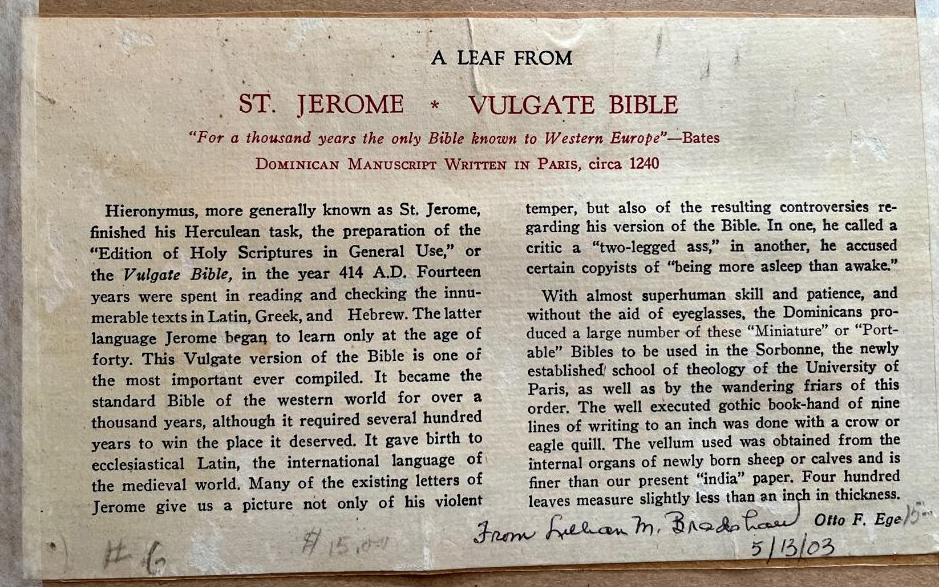
  • a Bible written written in France, specifically Paris, in the middle of the XIIIth Century (FOL), or
  • a Bible written by Dominicans in Paris circa 1240 (FBNC)
    — as seen above, in one of the Ege Labels in the Collection of Birgitt G. Lopez.

For the two books Gwara prefers an attribution of “France, ca. 1250” (No. 9 for FOL and FBEC); and “Northern France, ca. 1250” (No. 54 for FBEC and FBNC), with cross-references between both numbers.  Gwara’s list notes different numbers of lines for those two items, with script in double columns respectively of “53 lines” and  “57 lines”.

The variation in numbers of lines per column and page in a single volume with closely-spaced text is not unaccustomed in small-format Vulgate Bible manuscripts of the period, so that the span of 56 lines on the Lopez Leaf under examination here, like some stylistic variations in script and pen-flourishes, need not in themselves rule out a possible association or connection with that Ege manuscript.

The point is that the general resemblance only, without closer inspection, brings to mind rather similar manuscripts from Ege’s collection whose features I have been recently been surveying, in the quest to sort out the partly divergent evidence of the Ege Labels and Leaves with a Dallas Public Library in the Collection of Birgitt G. Lopez.

More information comes to light on the other side of the leaf from London.

Side 2

Next, upon request, we could see the other side, revealing the full expanse of the leaf, insofar as it survives, and with a scale to indicate size.

Collection of Birgitt G. Lopez, Vulgate Bible Manuscript Leaf purchased in London around 2000: Recto with Scale.

This page shows some tell-tale features pertaining to the structure, location, and forms of use of the leaf within its former book.  They include annotations which provide medieval references in ink in the outer margin and a modern folio number in pencil at the bottom right.  The edge of the gutter, or stitching line, remains at the right-hand contour, while the wider expanse of the outer margin on the opposite edge appears to represent its full original extent.

In that outer margin stand the blue Chapter numeral X; a mark designating the roman numeral lvii or lxii (“lvij” or “xlij”) opposite line 4 of the text; an abbreviated mark awaiting decipherment to its right; a vertical set of three marks at intervals down the page, in the form of triple dots in triangular formation atop a leftwards-curving tail (let’s cite it here as “;”); and the arabic numeral 74, 75, or 76[?] in the lower outer corner.

At the top of the page stands part of of a bipartite running title in bichrome Gothic Capitals, forming the second half of the name for the Biblical Book of [DANI-/]EL.

Evidently, this side of the leaf is the original recto.

Collection of Birgitt G. Lopez, Vulgate Bible Manuscript Leaf purchased in London around 2000: Recto.
The text begins within Daniel 9:11.

[11 Et omnis Israël prævaricati sunt legem tuam, et declinaverunt / ] ne audirent vocem tuam: et stillavit super nos maledictio et detestatio quæ scripta est in libro Moysi servi Dei, quia peccavimus ei.

The marks opposite line 4 in the outer margin, lvij or lxij, plus a larger abbreviation to its right, might signal the passage for reading.  The ‘;’ markings at intervals opposite more lines lower down might be related to the readings from Daniel for the 21-day fast.  See:

  • https://likeabubblingbrook.com/daniel-fast-scripture-readings/

The listed readings in that resource do not exactly line up with this version, but it is the closest which we have found so far.

*****

Further research might identify which Vulgate Bible manuscript gave this specimen, somehow to reach the antiquary shop in London.  As yet, it is unclear by which time and where the leaf acquired its modern folio number within the original volume, became separated from the book, and acquired its inventory number, selling price, and label, giving an attribution to a different text, and a particular passage, from a different Biblical Book in the Old Testament.  We might assume, say, given the plural “pages” in the label, that its text was drafted to identify a group of specimens from the specific manuscript, laid out in an array from which a purchase might be selected.  From them one, but not this one, could correspond to the specified passage about the Temple in I Macabees.

Perhaps the formula which the label assigns to the date-range of the specimen, like the citation of “I Machabees”, will provide a clue to its former location in a source-manuscript, according with a form of identification not unlike some employed by, say, Otto Ege, in labeling the dismembered pieces for distribution and perhaps offering a selling-point.  For now, we might begin to look for Vulgate Bible specimens in double columns of around 56 lines, with comparable dimensions, and with corresponding folio numbers, all of which are identified as dating from “Circa 1280 A.D. Not after 1300.”

The modern folio number points to a different manuscript than the one which first came to mind when I saw a photograph from its “first side”, perhaps probably because that manuscript was fresh in mind.  Some Ege manuscripts have modern folio numbers, entered before the books were taken to pieces.  (See, for example, More Leaves from “Otto Ege Manuscript 51”.) But not, apparently, any leaves from Ege MS 9 or MS 54.  The quest is open.

I invite your advice.

*****

Do you know of more leaves from this manuscript?  Do you recognize the hands of these scribes, artists, and annotators in other parts of this book or in other manuscripts?

You might reach us via Contact Us or our Facebook Page. Comments here are welcome too. We look forward to hearing from you.

Watch our blog on Manuscript Studies for more discoveries. Please visit its Contents List.

*****

Tags: Book of Daniel, Book of I Macabees, Latin Vulgate Bibles, manuscript fragments, Otto Ege Manuscript 14, Otto Ege Manuscript 20, Otto Ege Manuscript 54, Otto Ege Manuscript 9, Otto Ege Manuscripts
No Comments »

A Leaf from ‘Otto Ege Manuscript 19’ and Ege’s Workshop Practices

May 1, 2020 in Manuscript Studies, Uncategorized

An Old Testament Leaf from ‘Otto Ege Manuscript 19’

And Ege’s Workshop Habits
in Assembling His Portfolios

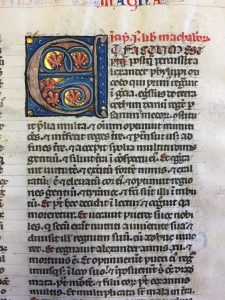
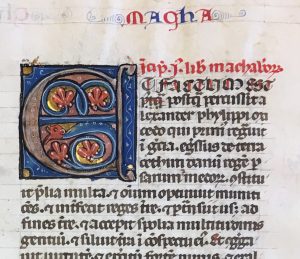
Opening of the Book of Macabees in Otto Ege MS 19. Private Collection.

Portable Bible in the Latin Vulgate Version
Italy, circa 1275, with Illuminations made apparently in Paris

Double columns in 48 lines
circa 235 × 170 mm <written area circa 153 × 107 mm>

End of Malachi (within 2:13 – 4:10),
Jerome’s Prologue to Maccabees, Argumentum,
and Opening of I Maccabees (1:1 – within 1:21)

J. S. Wagner Collection

[Posted on 1 May 2020, with updates]
A detached leaf from ‘Otto Ege Manuscript 19’, now in the J. S. Wagner Collection, provides the transition from one Old Testament Book to the next.  In reporting its survival and setting it into the context of its former manuscript and the known patterns of Otto Ege’s distribution of his dismembered manuscripts, we examine the leaf, its presentation as part of a larger series (initially as Ege’s Number 19, altered for some reason to a Number 13), and Ege’s evolving “workshop practices” in mounting and distributing manuscript leaves to wider audiences.

[Note:  This post began as the report of a Leaf from one of the manuscripts dispersed by Otto F. Ege, to follow our earlier reports for some other manuscripts of his.  It grew into a report also of Ege’s varying workshop practices over time in assembling or reassembling his Portfolios of specimen Leaves extracted from manuscripts and other books.  Selected specimens would be mounted in mats, often with identifying labels or inscriptions in print or pencil, arranged in groups (notably in the Portfolios, but also in other batches) or distributed as left-overs, and sold far and wide.  Mercifully, apart from cutting the individual leaves out of the books, Ege did not crop them except by the rectangular windows of their mats.

As reported in other posts on this blog (see the Contents List), our cumulative examination of various Portfolios, individual sets thereof, and individual leaves either extracted from Portfolios or distributed on their own (as “Strays”), has yielded detailed grounds for conjectures about Ege’s evolving and revolving practices over an extended period of intense activity dedicated to maximizing the teaching (and commercial) potential of his collection.  We share some results of that research here.]

Opening of the Book of Macabees in Otto Ege MS 19. Private Collection.

Wagner Leaf from Ege Manuscript 19, verso, detail.

With thanks to the present collector, J. S. Wagner, who drew this find to our attention on account of our blog (You are Here), we present the images, front and back, of a detached leaf from a small-format 13th-century Vulgate Latin Bible dispersed by Otto F. Ege (1888–1951).  The leaf was formerly part of Ege Manuscript 19 (Gwara, Handlist, No. 19, page 124).

Already, in our blog on Manuscript Studies (You are Here), we have considered leaves from other manuscripts distributed by Ege.  See our Contents List for the series of discoveries, which so far principally concern Ege Manuscripts 8, 14, 41, 51, 61,  and 214; we begin work also on Ege Manuscript 56 in Armenian.

This new opportunity opens the possibility to consider another of Ege’s dismembered manuscripts showcased in his Portfolio of Fifty Original Manuscripts (= “FOL”), for which a core study was developed with the website devoted to a group of its survivors as ege.denison.edu, and for which work has continued to advance apace in multiple centers.

This Portfolio is one of several which Ege devoted to specific titles or genres of books in manuscript and/or print (such as the Bible in several languages).  Ege gave this one the title of Fifty Leaves from Medieval Manuscripts, XII–XVI Century [sic for the plural].  Ege numbered its Leaves as “1–50”, in the sequence which he chose for their presentation there.  Their source manuscripts, accordingly, in Scott Gwara’s Handlist of Ege’s manuscripts are known as “Ege Manuscripts 1–50” (of at least 1–325, and counting).  A provisional summary of the contents of this Portfolio and some of its known sets appears online in The Otto F. Ege Palaeography Portfolio: Towards a Virtual and Interactive Reconstruction of Fifty Dismembered Manuscripts.  Virtual reconstructions of one and another of its manuscripts continue to emerge, as with FOL Leaf 15, the 14th-century Beauvais Missal.

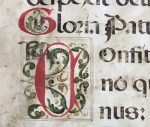
J. S. Wagner Collection. Leaf from from Prime in a Latin manuscript Breviary. Folio 4 Recto, Initial C for "Confitimini" of Psalm 117 (118), with scrolling foliate decoration.

Already, in this blog, we have presented 2 leaves from the J. S. Wagner Collection:

  • The Penitent King David from a Book of Hours
  • A Leaf from Prime in a Large-Format Breviary .

Now we turn to the Ege Leaf in that Collection.

Read the rest of this entry →

Tags: "Fifty Original Manuscripts", Bible Manuscripts, Charles Carmichael Lacaita, Ege's Portfolios, Ege's Workshop Practices, J.S. Wagner Collection, Latin Vulgate Bible, manuscript fragments, Otto Ege, Otto Ege Manscript 61, Otto Ege Manuscriipt 23, Otto Ege Manuscript 13, Otto Ege Manuscript 14, Otto Ege Manuscript 19, Otto Ege Manuscript 41, Otto Ege Manuscripts, Portable Bibles, Sir Joseph Lacaita
6 Comments »

More Discoveries for ‘Otto Ege Manuscript 41’

November 27, 2018 in Manuscript Studies, Photographic Exhibition

New Haven, Yale University, Beinecke Rare Book and Manuscript Library, Otto Ege Collection, Family Portfolio of Fifty Original Leaves ("FOL") of Medieval Western Manuscripts, Leaf 41, recto, column b, top. Medieval Contents List for the Volume in the upper margin, above the concluding line of the Chaper List for Book I and the Opening of that Book. Photography by Mildred BudnyOtto Ege’s
Dismembered Manuscript 41

A Latin copy of the
Dialogues of Gregory the Great,
Epistles and Homilies of John Chrysostom,
Meditations of Anselm,
And Maybe More

Double columns of 40 lines with some embellishment

Produced probably in Flanders, perhaps circa 1450

Plundered in World War I
From the Library of the Van der Cruisse de Waziers, near Lille in France

Sold circa 1925 through the Bookseller Thorpe in Surrey, England

Brought to the United States Intact, Then Dismembered and Distributed in Pieces

Continuing our series on Manuscript Studies, Mildred Budny (see Her Page) adds new evidence to her earlier reports of some leaves from medieval manuscripts dispersed by Otto F. Ege (1888–1951). Further research and newly revealed materials augment our knowledge of these manuscripts (and others). 

This report updates our earlier blogpost on parts of Otto Ege Manuscript 41.  See also the posts for Ege Manuscripts 8, 14, 51, and 61, plus updates (More Discoveries for Ege Manuscript 61), as well as the Report for our 2016 Symposium on ‘Words & Deeds’, with an illustrated Program Booklet. 

This report, drafted following a first visit in 2017 to view examples in the Otto Ege Collection now at the Beinecke Rare Book and Manuscript Collection, benefits from updates following a new visit in October 2018, with my thanks for permission to examine and to photograph the materials, especially while they remain mostly uncatalogued.

Picking Up The Piecework

As more pieces of the manuscript come to light, and/or become recognized for what they are, the process of virtually picking up their pieces toward a reasonable reconstruction of their original contents can or must proceed piecemeal.  More discoveries advance that process considerably.  Here we report new stages.  Some of them, naturally enough, may revise the received understanding about the manuscript.

Read the rest of this entry →

Tags: Beinecke Rare Book and Manuscript Library, Dialogues of Gregory the Great, Epistles of John Chrysostom, Homilies of John Chrysostom, Homilies on the Epistle to the Hebrews, library of the Van Der Cruisse de Waziers family, Manuscript studies, Medieval Manuscript Fragments, Meditations of Saint Anselm, Otto Ege Manuscript 41, Otto Ege Manuscripts
1 Comment »

  • Top
©2024 Research Group on Manuscript Evidence.


is proudly powered by WordPress. WordPress Themes X2 developed by ThemeKraft.