
Workshop 8: A Hybrid Book where Medieval Music Meets Early-Modern Herbal
October 11, 2025 in Announcements, Early-Printed Books, Event Registration, Manuscript Studies, Research Group Workshops, Workshops on "The Evidence of Manuscripts"
RGME Workshops
on
“The Evidence of Manuscripts, Etc.”
Workshop 8
“Face the Music, or,
Where Manuscript Meets Print
in a Hybrid Book:
An Early-Modern German Astrological Herbal
with a Reused Binding Fragment
from a Medieval Musical Manuscript”
Sunday 26 October 2025
Online by Zoom
[Posted on 15 September 2025, with updates)
Our series of Workshops on “The Evidence of Manuscripts, Etc.” continues with an exploration of a hybrid book for Workshop 8.
The Hybrid Book
This workshop will examine a puzzling vellum fragment (or is it a set of patchwork fragments?) in a private collection. The fragment(s) come(s) from a single musical manuscript in Latin on vellum laid out in double columns with text and notation on 4-line staves. The reused medieval material forms the outer covering of a 17th-century printed book in German on laid paper.

Private Collection, Front Cover with Reused Medieval Musical Fragment on Vellum. Photograph by Mildred Budny.
The Musical Fragment and its ‘Find-Place’
For the musical fragment, we will work to decipher the visible parts of the text and music, identify the readings/lections and chants, and, if possible (given the fragmentary nature), determine the probable genre of original manuscript, such as lectionary, breviary, antiphonary, or missal. Perhaps, over time, we might find other survivors from the same despoiled medieval manuscript.
Narrowing down its possible origin—or location in the early 17th century or later when it came to be reused as a binding cover–might aid the quest to determine the circumstances of its reuse and whence other parts of it might have been disseminated, whether as reused binding materials or otherwise.
For the workshop, we will examine the features of the printed book. It includes multiple woodcut illustrations and occasional marginalia in forms of annotations demonstrating attention of several kinds to the contents of the herbal.
What brought this medieval musical fragment and early modern printed book together? Even if we might never know all the answers, won’t it be fun to question how and why? There is a story here.
We love the puzzles, and give thanks to the collector for lending the book to the RGME for study and teaching and for sharing it with our audience in this workshop and beyond.
Information
People who be participating at the workshop to offer observations, reflections, and suggestions about the composite volume include (in alphabetical order):
Phillip Bernhardt–House
Mildred Budny
Natalia Fay
Leslie French (represented by a report on the musical manuscript fragment)
Beppy Landrum Owen
David Porreca
David W. Sorenson (with some specimens of herbals mentioning astrological influences)
And others.
At our 2024 Spring Symposium at Vassar College, Natalia delightfully described her work for her exhibition on herbals then on display in the Art Library. She shares the poster and brochure for the exhibition with us, as she returns to our events in this workshop to report on her continuing interests in plants, books, manuscripts, and their transmission.
The Manuscript Fragments
The visible portions of the manuscript appear, with only one side facing and the other side hidden, on the outer sides of the front and back covers, spine, and fore-edges of the binding.
Their text and music on four-line staves stand upright on the volume. Written in Gothic script, the parallel lines of music and text have some elements in red and blue pigments. There are ten lines on the front cover and on the spine, but the back cover has an additional line of music at the bottom, amounting to 10 1/2 lines on this portion. Each portion of the fragment shows a single column, or part of one. At the right on the back cover, the right-hand side of the fragment extends beyond the column with an expanse of outer margin from its original extent.
Sections open with 2-line initials which span the full height of the paired lines of music-and-text, for which the staves separate their horizontal course. One initial comprises a blue capital I (front cover, line 7). Three band-like initials comprise decorative forms in black ink with a vertical twist at the left-hand side; red pigment fills the centers of their twists (front cover, lines 2 and 6; back cover, line 2).
1. Front Cover

Private Collection, Front Cover with Reused Medieval Musical Fragment on Vellum. Photograph by Mildred Budny.
2. Back Cover

Private Collection. Musical Manuscript Fragment, Back Cover with ruler.
Spine

Private Collection. Hybrid book with Musical Manuscript Fragment, Spine View.
The Printed Book
The printed text comprises the German Kreutterbuch (“Book of Herbs”), an astrological herbal, by Bartholomaeus Carrichter (1510–1574), in an early edition printed in Strasbourg in Alsace in 1606. The author, who wrote under the pseudonym of Philomusus Anonymus, was physician to Ferdinand I (1503–1564), Holy Roman Emperor from 1556, and his son Maximilian II, Holy Roman Emperor from 1564 to 1576. The first edition of his Kreutterbuch was printed in Strasbourg in 1517 by Chistian Muller. For later editions, the physician, poet, and alchemist Michael Toxites (1515–1581), whose birth-name was Johann Michael Schütz, added some material to Carrichter’s work and edited it.
One of various versions of the illustrated genre by different authors (see, for example the Kreutterbuch desz Hocgelehrten und Weitberuhmten Herrn D. Petri Andreae Matthioli . . . ), this book combines information about plants, use, and lore with astrological considerations.
Title Page
A catalogue description of the volume characteristically derives from information on the title page:
Philomusus Anonymous [Bartholomaeus Carrichter (1510–1574)], Horn des Heyls menschlicher Blödigkeit, oder Kreütterbuch, darinn die Kreütter des Teutschenlands auss dem Liecht der Natur nach rechter Art der himmelischen Einfliessungen beschriben / durch Philomusum Anonymum [Bartholomäus Carrichter], with a foreword by Michael Toxites, born Johann Michael Schütz (1514–1581), (Strassbourg: Anton Bertram, DCVI/1606).
An inscription in light black ink at the foot of the title page gives the initials “G. S.” Perhaps they refer to an owner.

Private Collection, Kreutterbuch, title page. Photograph by Mildred Budny.
For the first edition of 1576, printed in Straßburg, see an online digital facsimile of a copy in Augsburg, Staats- und Stadtbibliothek. For an edition of 1619 also printed by A. Bertram, see the copy in the Wellcome Collection.
Like the 1619 edition, this folio volume has 10 unnumbered pages, 180 numbered pages, and 5 unnumbered leaves, with a woodcut title page and outline illustrations. Interspersed within the columns of text, the book has 58 outline illustrations depicting the herbs which it describes. For example, borage (Borago officinalis) or starflower:

Private Collection, Carrichter’s Kreutterbuch (Strasbourg, 1604). Borage. Photography by Mildred Budny.
Up close:

Private Collection, Carrichter’s Kreutterbuch (Strasbourg, 1604). Borage. Photography by Mildred Budny.
For comparison: Borage ‘In The Wild’

Borago officinalis. Photograph by By Christian Orlandi (12 April 2025) – Own work, CC BY-SA 4.0. Image via Wikimedia Commons via https://commons.wikimedia.org/wiki/File:Borago_officinalis_(2025).jpg.
Some marginal annotations in brown ink amplify or comment upon passages.

Private Collection, Carrichter’s Kreutterbuch (Strasbourg, 1604). Textual opening with marginal Annotations. Photography by Mildred Budny.
*****
Registration for the Workshop
We invite you to join the quest.
*****
Questions? Suggestions?
- Leave your comments or questions below
- Contact Us
Visit our Social Media:
- Leave your comments or questions below
- Contact Us
Visit our Social Media:
- our Facebook Page
- our Facebook Group
- our X/Twitter Feed (@rgme_mss)
- our Bluesky nest @rgmesocial.bluesky.social)
- our Instagram Page
- our LinkedIn Group
Join the Friends of the RGME.
Please make a Donation in Funds or in Kind for our nonprofit educational corporation powered principally by volunteers. Your donations and contributions are welcome, and can go a long way. They may be tax-deductible to the fullest extent provided by the law.
*************
 The Roads Taken, Or, The Obstacle Course
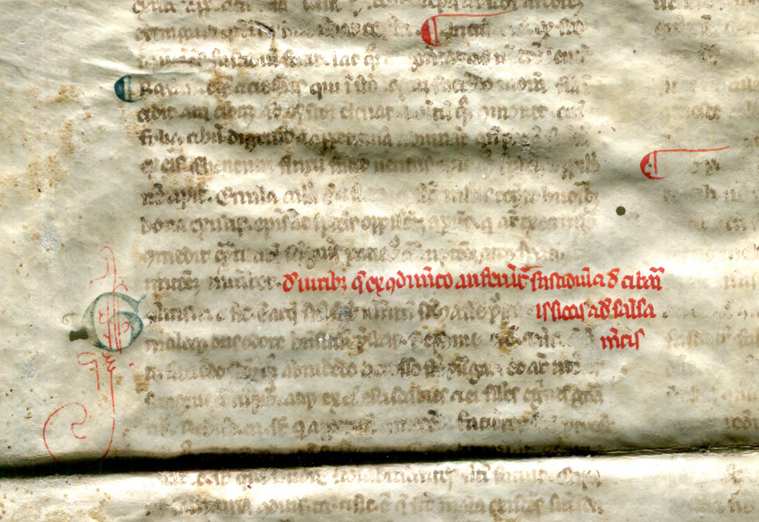
A Leaf from Gregory’s Dialogues Reused for Euthymius
December 24, 2016 in Manuscript Studies, Photographic Exhibition, Uncategorized
A Leaf from Gregory’s Dialogues
Reused for Binding
A Copy of
Euthymius Zigabenus’s On the Psalms
Budny Handlist 3
In our blog on Manuscript Studies (see its Contents List), Mildred Budny (see Her Page) continues to report the results of research for her Illustrated Handlist.
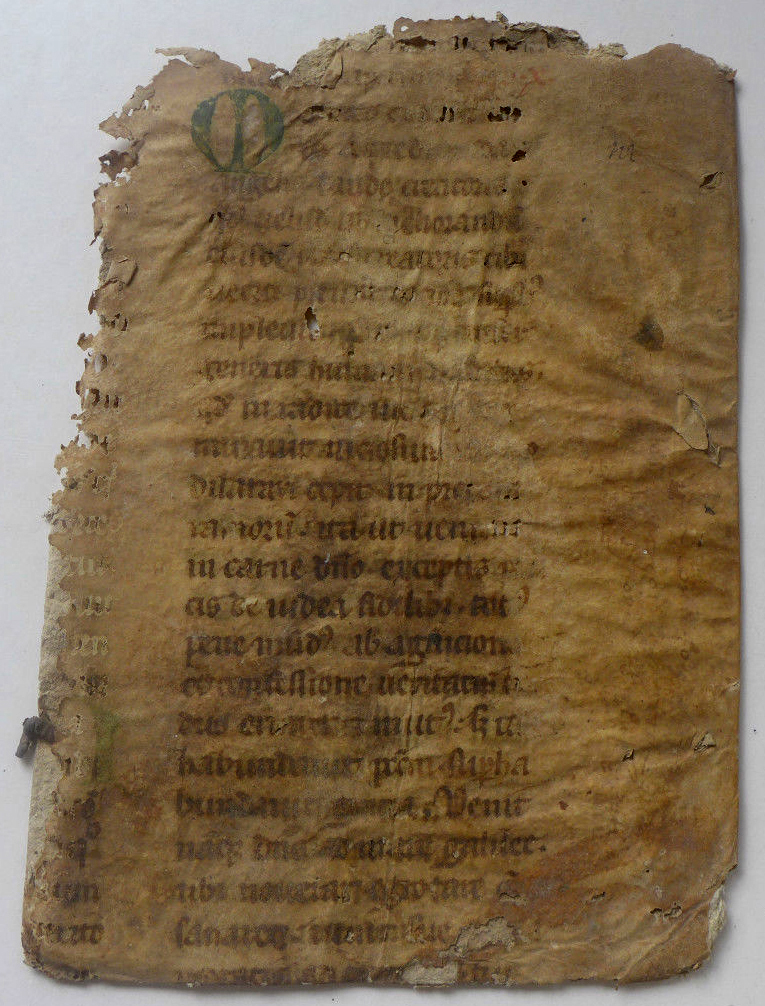
Here, we focus upon a leaf plucked from its 12th-century manuscript and pressed into service, with trimmed edges and mitered folds, as the vellum covering for a binding for a different text of small format. Both texts, primary and secondary in the life of the leaf, concern religious subjects, but they emanate from authors of different dates, locations, and languages in the Latin West and the Orthodox East respectively. The primary text represents a remnant of a text and an author familiar in some other blogposts, which consider the Dialogues, the Sermons or Homilies, and other texts by Pope Gregory the Great (pope from 590 to 694 CE).
Handlist 3, Recto
Handlist 3, Verso
Part of Gregory’s Dialogues, Book III, Chapter 7
(on Andreas, Bishop of Fondi/Fundi):
Sections 2 (Hic namque uenerabilis uir) –
8 (uel quae in conuentu)
Present measurements:
Circa 357 × 237 mm
< written area circa 266 × 133 mm >
Single column of 28 lines
in revived Caroline minuscule
without embellishments
Germany, circa 1175
Reused for some time as the vellum cover for the binding of a copy of
Euthymius Zigabenus‘s Commentary on the Psalms
in Greek or in Latin translation?
(now lost or preserved elsewhere in a location unknown)
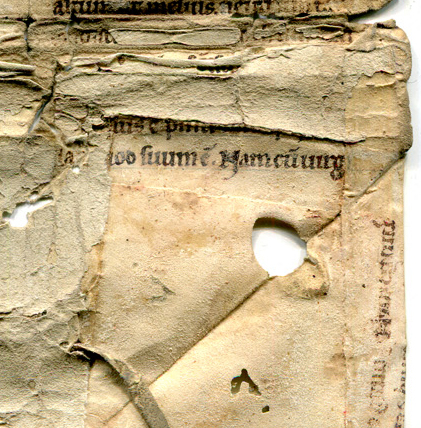
For this secondary use, the remnants of a set of titles on the outside of the spine of the cover (the original verso of the reused leaf) remain in place, albeit abraded and fragmented, as both a pasted, inscribed paper label (orientated along the ‘horizontal’ across the spine) and an ink inscription on the reused leaf itself in Capitals (‘vertical’, with the tops of those letters turned toward the ‘front cover’). Another, smaller and fragmentary pasted label with a broad rectangular border stands near the bottom of the broad spine of the cover and partly overlies the ‘vertical’ spine inscription.
Acquired, probably by purchase (according to the Owner’s recollections), in France in the past 15 years or so, but before 2007 when I first saw and began to photograph the leaf. This item and others in the Illustrated Handlist acquired in France at various times and by various means (purchase, gift, or exchange), came from a single source in the Département of Saône-et-Loire, from about 1999 onward. Because the leaf does not carry indications of its original place and time of production, apart from its materials, layout, design, script, orthography, and punctuation, those unknowns must depend upon evaluations of the style of the script, lacking any forms of embellishment, such as decorated initials, which might have provided possibly more closely datable symptoms than the letters “alone”.
Read the rest of this entry →
Tags: 'Fifty Original Leaves from Medieval Manuscripts', Binding History, Bishop Andrew of Fundi, Budny's Illustrated Catalogue, Ege Manuscript 41, Euthymius Zigabenos, Fondi, Gregory the Great, Gregory's Dialogues, manuscript fragments, Manuscript Fragments Reused in Bindings, Manuscript studies, Psalter Commentary, Saki, Temple of Apollo
No Comments »