• News
    • News & Views
    • RGME Activities for 2024 and 2025
    • Around & About with the RGME
    • Reviews
    • Highlights
  • Blogs
    • Manuscript Studies
      • Manuscript Studies: Contents List
    • International Congress on Medieval Studies
      • Abstracts of Congress Papers
        • Abstracts of Papers Listed by Author
        • Abstracts of Papers Listed by Year
  • About
    • Mission
    • Who We Are
      • Officers, Associates & Volunteers
      • RGME Committees
      • Friends of the Research Group on Manuscript Evidence
    • Policies & Statements
      • RGME Privacy Policy Statement
      • RGME Intellectual Property Statement & Agreements
    • People
      • Mildred Budny — Her Page
      • Adelaide Bennett Hagens
    • Activities
      • Events
      • Congress Activities
        • Sponsored Conference Sessions (1993‒)
          • Panels at the M-MLA Convention (from 2016)
        • Co-sponsored Conference Sessions (2006‒)
    • History
      • Seals, Matrices & Documents
      • Genealogies & Archives
    • Contact Us
  • Bembino
    • Multi-Lingual Bembino
    • RGME Bembino: Resources
  • Congress
    • Sponsored Conference Sessions (1993‒)
    • Co-sponsored Conference Sessions (2006‒)
    • Abstracts of Congress Papers
      • Abstracts Listed by Author
      • Abstracts Listed by Year
    • Kalamazoo Archive
    • Panels at the M-MLA Convention (2016-2019)
      • Abstracts of Papers for the M-MLA Convention
      • Panels at the M-MLA Convention (from 2016)
  • Events
    • RGME Activities for 2024 and 2025
      • 2023 Activities and 2024 Planned Activities
    • Seminars, Workshops, Colloquia & Symposia (1989–)
      • Seminars on ‘The Evidence of Manuscripts’
      • Symposia on ‘The Transmission of the Bible’
      • The New Series (2001-)
        • 2019 Anniversary Symposium Program: The Roads Taken
        • 2019 Anniversary Symposium Registration
        • 2019 Anniversary Symposium Registration Open
      • RGME Symposia: The Various Series
      • The Research Group Speaks: The Series
      • Meetings of the Friends of the Research Group on Manuscript Evidence
      • RGME Online Events
    • Abstracts of Papers for Events
      • Abstracts of Papers for Seminars on ‘The Evidence of Manuscripts’
      • Abstracts of Papers for Symposia, Workshops & Colloquia
    • Receptions & Parties
    • Business Meetings
    • Photographic Exhibitions & Master Classes
    • Events Archive
  • ShelfLife
    • Journal Description
    • ShelfMarks: The RGME-Newsletter
    • Publications
      • “Insular, Anglo-Saxon, and Early Anglo-Norman Manuscript Art at Corpus Christi College, Cambridge” (1997)
        • Mildred Budny, ‘Catalogue’
        • The Illustrated Catalogue (1997)
      • The Illustrated Handlist
      • Semi-Official Counterfeiting in France 1380-1422
      • No Snap Decisions: Challenges of Manuscript Photography
    • History and Design of Our Website
  • Galleries
    • Watermarks & the History of Paper
    • Galleries: Contents List
    • Scripts on Parade
    • Texts on Parade
      • Latin Documents & Cartularies
      • New Testament Leaves in Old Armenian
    • Posters on Display
    • Layout Designs
  • Donations and Contributions
    • RGME Donor Promise
    • 2023 End-of-Year Fundraiser for our 2024 Anniversary Year
    • 2019 Anniversary Appeal
    • Orders
  • Links
    • Catalogs, Metadata, and Databases: A Handlist of Links
    • Handlist of Resources for Manuscript Studies and Fragmentology
    • Manuscripts & Rare Books
    • Maps, Plans & Drawings
    • Seals, Seal-Matrices & Documents

  • News
    • News & Views
    • RGME Activities for 2024 and 2025
    • Around & About with the RGME
    • Reviews
    • Highlights
  • Blogs
    • Manuscript Studies
      • Manuscript Studies: Contents List
    • International Congress on Medieval Studies
      • Abstracts of Congress Papers
        • Abstracts of Papers Listed by Author
        • Abstracts of Papers Listed by Year
  • About
    • Mission
    • Who We Are
      • Officers, Associates & Volunteers
      • RGME Committees
      • Friends of the Research Group on Manuscript Evidence
    • Policies & Statements
      • RGME Privacy Policy Statement
      • RGME Intellectual Property Statement & Agreements
    • People
      • Mildred Budny — Her Page
      • Adelaide Bennett Hagens
    • Activities
      • Events
      • Congress Activities
        • Sponsored Conference Sessions (1993‒)
          • Panels at the M-MLA Convention (from 2016)
        • Co-sponsored Conference Sessions (2006‒)
    • History
      • Seals, Matrices & Documents
      • Genealogies & Archives
    • Contact Us
  • Bembino
    • Multi-Lingual Bembino
    • RGME Bembino: Resources
  • Congress
    • Sponsored Conference Sessions (1993‒)
    • Co-sponsored Conference Sessions (2006‒)
    • Abstracts of Congress Papers
      • Abstracts Listed by Author
      • Abstracts Listed by Year
    • Kalamazoo Archive
    • Panels at the M-MLA Convention (2016-2019)
      • Abstracts of Papers for the M-MLA Convention
      • Panels at the M-MLA Convention (from 2016)
  • Events
    • RGME Activities for 2024 and 2025
      • 2023 Activities and 2024 Planned Activities
    • Seminars, Workshops, Colloquia & Symposia (1989–)
      • Seminars on ‘The Evidence of Manuscripts’
      • Symposia on ‘The Transmission of the Bible’
      • The New Series (2001-)
        • 2019 Anniversary Symposium Program: The Roads Taken
        • 2019 Anniversary Symposium Registration
        • 2019 Anniversary Symposium Registration Open
      • RGME Symposia: The Various Series
      • The Research Group Speaks: The Series
      • Meetings of the Friends of the Research Group on Manuscript Evidence
      • RGME Online Events
    • Abstracts of Papers for Events
      • Abstracts of Papers for Seminars on ‘The Evidence of Manuscripts’
      • Abstracts of Papers for Symposia, Workshops & Colloquia
    • Receptions & Parties
    • Business Meetings
    • Photographic Exhibitions & Master Classes
    • Events Archive
  • ShelfLife
    • Journal Description
    • ShelfMarks: The RGME-Newsletter
    • Publications
      • “Insular, Anglo-Saxon, and Early Anglo-Norman Manuscript Art at Corpus Christi College, Cambridge” (1997)
        • Mildred Budny, ‘Catalogue’
        • The Illustrated Catalogue (1997)
      • The Illustrated Handlist
      • Semi-Official Counterfeiting in France 1380-1422
      • No Snap Decisions: Challenges of Manuscript Photography
    • History and Design of Our Website
  • Galleries
    • Watermarks & the History of Paper
    • Galleries: Contents List
    • Scripts on Parade
    • Texts on Parade
      • Latin Documents & Cartularies
      • New Testament Leaves in Old Armenian
    • Posters on Display
    • Layout Designs
  • Donations and Contributions
    • RGME Donor Promise
    • 2023 End-of-Year Fundraiser for our 2024 Anniversary Year
    • 2019 Anniversary Appeal
    • Orders
  • Links
    • Catalogs, Metadata, and Databases: A Handlist of Links
    • Handlist of Resources for Manuscript Studies and Fragmentology
    • Manuscripts & Rare Books
    • Maps, Plans & Drawings
    • Seals, Seal-Matrices & Documents

Log in

Archives

Featured Posts

J. S. Wagner Collection. Leaf from from Prime in a Latin manuscript Breviary. Folio 4 Verso, with part of Psalm 117 (118) in the Vulgate Version, set out in verses with decorated initials.
2026 Annual Appeal
Private Collection, Ege's FBNC Portfolio, Dante Leaf, Verso, Detail. Reproduced by Permission.
2025 RGME Autumn Colloquium on Fragments
Workshop 8: A Hybrid Book where Medieval Music Meets Early-Modern Herbal
2025 RGME Autumn Symposium on “Readers, Fakers, and Re-Creators of Books”
“Thresholds and Communities”
RGME Workshops on “The Evidence of Manuscripts, Etc.”
2025 International Medieval Congress at Leeds: RGME Program
Episode 21. “Learning How to Look”
2025 International Congress on Medieval Studies: Program
2025 RGME Visit to Vassar College
Two Leaves in the Book of Numbers from the Chudleigh Bible
Delibovi on Glassgold on Boethius: A Blogpost
Ronald Smeltzer on “Émilie du Châtelet, Woman of Science”
2025 Spring Symposium: “Makers, Producers, and Collectors of Books”
Starters’ Orders
The Weber Leaf from the Saint Albans Bible
Workshop 4. “Manuscript Fragments Compared”
Episode 20. “Comic Book Theory for Medievalists”
Episode 19: “At the Gate: Starting the Year 2025 at its Threshold”
2025 Annual Appeal
Favorite Recipes for Lemonade, Etc.
RGME Visit to the Lomazow Collection: Report
2024 Autumn Symposium: “At the Helm”
Medieval Women’s Networks
A Latin Vulgate Leaf of the Book of Numbers
The RGME ‘Lending Library’
Florence, Italy, Ponte Vecchio from Ponte alle Grazie. Photo: Ingo Mehling, CC BY-SA 4.0 , via Wikimedia Commons
Episode 17. “RGME Retrospect and Prospects: Anniversary Reflections”
2024 Anniversary Symposium: The Booklet
2024 International Medieval Congress at Leeds: Program
Jesse Hurlbut at the Bonneville Salt Flats, Utah. Photograph Jesse Hurlbut.
Episode 16: An Interview with Jesse D. Hurlbut
To Whom Do Manuscripts Belong?
Kalamazoo, MI Western Michigan University, Valley III from the side. Photograph: David W. Sorenson.
2024 International Congress on Medieval Studies: Report
2024 Spring Symposium at Vassar College
Puente de San Martín: Bridge with reflection over the River Targus, Toledo, Spain.
2024 Grant for “Between Past and Future” Project from The Gladys Krieble Delmas Foundation Research Libraries Program
2024 Anniversary Symposium in Thanks to Jesse Hurlbut: Program

You are browsing the Blog for history of printing

2025 RGME Autumn Colloquium Program Detailed

November 6, 2025 in Announcements, Conference, Conference Announcement, RGME Colloquia

Detailed Program

2025 RGME Autumn Colloquium
of the Research Group on Manuscript Evidence

“Break-Up Books and Make-Up Books:
Encountering and Reconstructing
the Legacy of Otto F. Ege
and Other Biblioclasts”

Friday – Sunday, 21-23 November 2025
In Person, Hybrid, or Online by Zoom

Program: 1) Overview and 2) Detailed View

I. Program Overview

Program Overview itself is available also here:

  • 2025 RGME Autumn Colloquium on Fragments: Program Overview

Day 1. Friday 17 October. 9:00 am – 5:00 pm EST (GMT-5)
— NOTE TWO DIFFERENT VENUES FOR FRIDAY Morning and Afternoon —

Morning Sessions at Green Hall (accessibility information). 9:00 am – 12:00 pm
Washington Road, Princeton, New Jersey 08542

Lunch Break. 12:00–1:00 pm

Afternoon Workshops with original materials at Special Collections, Firestone Library
(accessibility information)

Choose 1 of 2 (space is limited for in-person attendance)
2 Sittings:

1) Workshop 1. 1:30–3:00 pm (arrive at Firestone Library at 1:15 pm)
2) Workshop 2. 3:30–5:00 pm (arrive at Firestone Library at 3:15 pm)

Day 2. Saturday 18 October. 9:00 am – 5:00 pm

All-day Sessions at Nassau Presbyterian Church
(see also Nassau Presbyterian Church)
61 Nassau Street, Princeton, 08542
Accessibility information.

(Note: The original portion of the present building was designed and built by Charles Steadman and dedicated in 1836.)

Day 3. Sunday 19 October at 10:30am – 12:00am

Morning Sessions online. 10:30 am – 12:00 pm

Registration

Note: If accessing the registration link by laptop or computer does not connect through to select your choice of category, please access the link through your phone. For questions, please contact:

  • director@manuscriptevidence.org or rgmesocial@gmail.com

Choices

1) ONLINE (Friday to Sunday)

    • 2025 Autumn Colloquium: Online Attendance Tickets

2) IN PERSON (Friday and Saturday)

    • 2025 RGME Colloquium IN PERSON: Tickets

3) IN PERSON WORKSHOPS 1 and 2 at Special Collections (Friday afternoon)
(Space IN PERSON is limited; the Workshops are also available ONLINE)
Choose 1. Registration is required.

    • Workshop 1 (1:30 to 3:00 pm EST=GMT-5), First Sitting
      Workshop 1 IN PERSON: Tickets
    • Workshop 2 (3:30-5:00 pm EST), Second Sitting
      Workshop 2 IN PERSON: Tickets

4) Optional Dinner (at attendees’ expense) at a local restauraut

    • Friday 21 November (7:00–9:30 pm)
      and/or
    • Saturday 22 November (7:00–9:30 pm)
    • https://www.eventbrite.com/e/2025-rgme-colloquium-optional-dinner-friday-andor-saturday-tickets-1919146451699

For information and updates see the Colloquium HomePage

  • 2025 RGME Autumn Colloquium on Fragments

II. Program in Detail

* = Research Group on Manuscript Evidence (Trustees, Associates, Consultants)

Note different In-Person Venues — Register for ONLINE or IN PERSON

1) Two Hybrid Sessions Friday Morning (Green Hall)
2) Two Hybrid Workshops Friday Afternoon (Special Collections)
— Register Separately for either Workshop for Attendance In Person! Space is limited
3) Four Hybrid Sessions Saturday (Nassau Presbyterian Church)
4) Optional In-Person Dinner on Friday and/or Saturday (local restaurant by reservation)

5) One Session Online Sunday (online by Zoom)

Day 1. Friday 21 November

Princeton University, Approach to Green Hall from the southwest (October 2025). Photograph by Mildred Budny.

Morning Session 1 (Green Hall Room 1-N-5)
9:00 am – 12:00 pm EST (GMT-5)

Morning Sessions – Green Hall, Room 1-N-5

Welcome and Coffee. 9:00–9:15

Session 1. 9:15–10:00 am. Registration, Welcome, and Introduction

Session 1
“Tracing the Background for Otto F. Ege’s Oeuvre:
The Making of Biblioclasts
and the Unmaking of Books”

Presider. * Mildred Budny (RGME Director)

Speakers.

* Mildred Budny
(in person)

“Welcome and Introduction: Books, Breakers, and Re-Makers”

* Scott Gwara (University of South Carolina, College of Arts and Sciences)
(online)

“What Did He Know, and When Did He Know it?
Otto F. Ege, Philip C. Duschnes, and the Invention of Middle-Class Manuscript Scholarship”

John P. Chalmers (Caxton Club, Retired Librarian)
(a report by representation)

“Medieval Fragments in the Context of Leaf Books:
History, Present, and Future Activity”

Q&A

Break. 10:00–10:15 am

Session 2. 10:15 am – 12:00 pm

Session 2
“Illuminating Otto F. Ege’s Fragments:
Case-Studies in Manuscript and Print”

Private Collection, Ege's FBNC Portfolio, Dante Leaf, Verso, Detail. Reproduced by Permission.

Private Collection, Ege’s FBNC Portfolio, Dante Leaf, Verso, Detail. Reproduced by Permission.

Presider. * Justin Hastings

Speakers.

* Lisa Fagin Davis (Director, Medieval Academy of America / Simmons University School of Library and Information Science)
(online)

“Ege, Biblioclasm, and Fragmentology in the Library Science Classroom”

Juilee Decker (Professor of Museum Studies & Co-Director of the Cultural Heritage Imaging Lab
at the Rochester Institute of Technology)
(in person or online)

“More than the Sum of Its Parts:
Fifty Original Leaves from Medieval Manuscripts as Example, Exemplar, and Assemblage”

* Mildred Budny
     and
* Michael Allman Conrad (School of Humanities and Social Science, University of Saint-Gall)
(in person & online = hybrid presentation)

Part I. “Dismembered but Remembered:
Otto F. Ege’s Copy of Dante’s Commedia with Illustrations plus Landino’s Commento (Venice, November 1491)”

Q&A

Lunch Break. 12:00–1:30 pm

Afternoon Sessions

Photo: Andreas Praefcke (June 2007), CC BY 3.0 <https://creativecommons.org/licenses/by/3.0>, via Wikimedia Commons

= Workshops 1&2 (Choice of 1)
Special Collections, Firestone Library
Princeton University

Sessions 3–4. 1:30–5:00 pm (hybrid):

Workshops 1 & 2
“Fragments at Princeton”
in Special Collections,
with Choice of 1 of 2 Sittings

Note: Registration for Attendance IN PERSON is necessary (space is limited)
For registration see below

Workshop Leader.

*Eric M. White (Scheide Librarian and Assistant University Librarian for Special Collections, Rare Books and Manuscripts, Princeton University Library)

Workshop Intern.

* Hannah Goeselt (RGME Intern Executive Associate / Massachusetts Historical Society Library, Boston)

Princeton University Library, Special Collections, 7927 recto. Artist’s test sheet with patterns, sketches, and pen-trials. Northern Italy, circa 1400.

Sitting 1 = Session 3. 1:30 – 3:00 pm — Workshop 1 (hybrid)

— In-Person Attendance: arrive at Front Lobby of Firestone Library for check-in at 1:15 pm

Break. 3:00–3:30 pm 

Sitting 2 = Session 4. 3:30 – 5:00 pm

Workshop 2 (hybrid)
— In-Person Attendance: arrive at Front Lobby of Firestone Library for check-in at 3:15 pm

Dinner (Optional) 7:00–9:30 pm at local restaurant at attendees’ expense

*****************

Day 2. Saturday 22 November at 9:00 am – 5:00 pm EST (GMT -5)

Presbyterian church in Princeton, New Jersey from a pre-1923 postcard From RG 428, Postcard Collection, Presbyterian Historical Society, Philadelphia, Pennsylvania. Image Public Domain, via Wikimedia Commons via https://commons.wikimedia.org/wiki/File:Princeton_NJ_Presby_PHS768.jpg

Venue: Nassau Presbyterian Church, Assembly Room (ground floor)
61 Nassau Street, Princeton

Session 5. 9:00–10:30 am

Session 5
“Traveling
With and Through the World of Fragments”

Presider. * N. Kivilcim Yavuz (Lecturer in Medieval Studies and Digital Humanities, University of Leeds)

Speakers.

* Michael Ian Hensley (University of Hamburg)

“The Afterlives of Texts and Manuscripts: Users and Uses of Fragments in Ethiopia and Eritrea”

Respondent.
* Augustine Dickinson (University of Muenster)

“Living Manuscripts: Complex Composite Manuscripts in Ethiopia and Eritrea” — A Response

Scott Ellwood (Assistant Librarian, The Grolier Club of the City of New York)

“Facing the Unknown: Islamic Manuscript Fragments in the Grolier Club Library”

Irina Savetskaya (Special Collections Research Center, Syracuse University Libraries Syracuse University)

“Reconstructing a Medieval Medical Text from Manuscript-Waste Fragments
in the Bindings at the Strahov Library (Prague) and Syracuse University Libraries”

Q&A

Break. 10:30–11:00 am

Session 6. 11:00 am – 12:30 pm

Session 6
“Picking Up Pieces,
Bringing Them to Light, and Bringing Them Home”

Presider. * David Porreca (Department of Classics, University of Waterloo)

Speakers.

* Anna Siebach–Larsen (The Rossell Hope Robbins Library & Koller-Collins Center for English Studies, University of Rochester)
     and
Eleanor Price (University of Rochester)

“Fragmentary Notes: Creating the Idea of Medieval Music through Fragment Collections”

Josephine Koster (Winthrop University)
(online)

“Continuing the Hunt for Ege Manuscript 6: An English Cambridge Bible of the Early Thirteenth Century”

Respondent.
* Hannah Goeselt (Massachusetts Historical Society Library, Boston)
(in person)

“Using Auction Records and Tracking an Art-Historical Reconstruction:
Ege’s ‘Cambridge Bible’ as Case-Study”

* Richard Weber (Collector, Tennessee)
(online)

“From Pavement to Parchment: An Engineer’s Foray into Manuscript Collecting”

Q&A

Lunch Break. 12:30–1:30 pm

Session 7. 1:30 – 3:00 pm

Session 7
“Collecting, Curating, Cataloguing:
Reclaiming the Lost as Found”

Presider. * Barbara A. Shailor (Department of Classics, Yale University)

Speakers.

* Agnieszka Rec (Curator, Beinecke Rare Books & Manuscript Library, Yale University)

“The Otto F. Ege Collection (GEN MSS 1498) at the Beinecke Library: An Introduction”

Beauvais Missal (Fragment), Bloomington, IN, Indiana University, Lilly Library (Image via https://fragmentarium.ms/overview/F-rnci)

* Altstatt, Alison (University of Northern Iowa),
  Anna de Bakker (McGill University),
 and
   Debra Lacoste (Dalhousie University)
— Sponsored by the Digital Analysis of Chant Transmission (DACT) Project

“Compiling, Cleaning, and Completing Data:
Using the Cantus Database to Catalogue Ege’s Fifty Original Leaves
and Other Chant Manuscript Fragments”

Kate Steiner (Department of Music, Conrad Grebel University College)

“The DACT Project: A Brief Report on Work-in-Progress”

Q&A

Break. 3:00–3:30 pm

Session 8. 3:30 – 5:00 pm

Session 8
“Confronting and Reconstituting
the Legacies of Biblioclasts:
A Roundtable Discussion”

Presider. * TBA

Panelists (Alphabetical Order)

* Mildred Budny
  William Claspy (Director Emeritus, University Archives and Special Collections,
Kelvin Smith Library, Case Western Reserve University)
* Michael Allman Conrad
* David Porreca
* Agnieszka Rec
* Eric M. White

Q&A

Optional Dinner 7:00–9:30 pm at local restaurant (at attendees’ expense)

*****************

Day 3. Sunday 23 November at 10:30 am – 12:00 pm EST (GMT -5)
— Online only

Session 9. 10:30 – 12:00 pm

Session 9
“Picking Up the Pieces:
Examining Fragments of Books
in Their Find-Places”

Presider. * Jennifer Larson (Department of Classics, Kent State University)

Speakers.

* David Porreca (Department of Classics, University of Waterloo)
   and
Jordan Tardif (Department of History, University of Waterloo)

“Single Leaves of Manuscript and Early-Printed Books at the University of Waterloo:  An Overview”

Q&A (to 10:55 am)

* Katharine C. Chandler (Special Collections and Serials Cataloguer, University of Arkansas Libraries; Adjunct Faculty, San José University)

“Dispersed Manuscripts, Disrupted Histories: The Case of the Graduals of the Chartreuse de Champmol”

* David W. Sorenson (Allen G. Berman, Numismatist)

“Not Just Parchment: Paper “Binder’s Waste” Manuscript Fragments in Europe and the Near East”

* Mildred Budny
   and
* Michael Allman Conrad

Part II: “A Summing Up: On the Essence of Fragments and Recovery, with Ege’s Dante as Guide”

Q&A

* Mildred Budny

“Closing Remarks”

*************

Further Reading and Viewing

See the Handlist of Bibliographical References to accompany the Colloquium

  • Preliminary Handlist of Bibliographical References about Fragments

Please add suggestions for this list!

*************

Beinecke Rare Book and Manuscript Library, Otto Ege Collection. The Ege Family Portfolio, Leaves 41 and 42 in their mats, side-by-side, outside the opened box. Photograph by Mildred Budny.

New Haven, Yale University, Beinecke Rare Book & Manuscript Library, Otto F. Ege Collection GEN MSS 1498, Series 2. “Ege Family FOL Portfolio”, Leaves 41 and 42 in their Ege mats with labels, in front of the opened clamshell box in the readers’ room. Photograph by Mildred Budny.

Tags: Biblioclasts, history of printing, Manuscript studies, Medieval manuscripts, Otto F. Ege
No Comments »

Workshop 8: A Hybrid Book where Medieval Music Meets Early-Modern Herbal

October 11, 2025 in Announcements, Early-Printed Books, Event Registration, Manuscript Studies, Research Group Workshops, Workshops on "The Evidence of Manuscripts"

RGME Workshops
on
“The Evidence of Manuscripts, Etc.”

Workshop 8
“Face the Music, or,
Where Manuscript Meets Print
in a Hybrid Book:

An Early-Modern German Astrological Herbal
with a Reused Binding Fragment
from a Medieval Musical Manuscript”

Sunday 26 October 2025
Online by Zoom

[Posted on 15 September 2025, with updates)

Our series of Workshops on “The Evidence of Manuscripts, Etc.” continues with an exploration of a hybrid book for Workshop 8.

The Hybrid Book

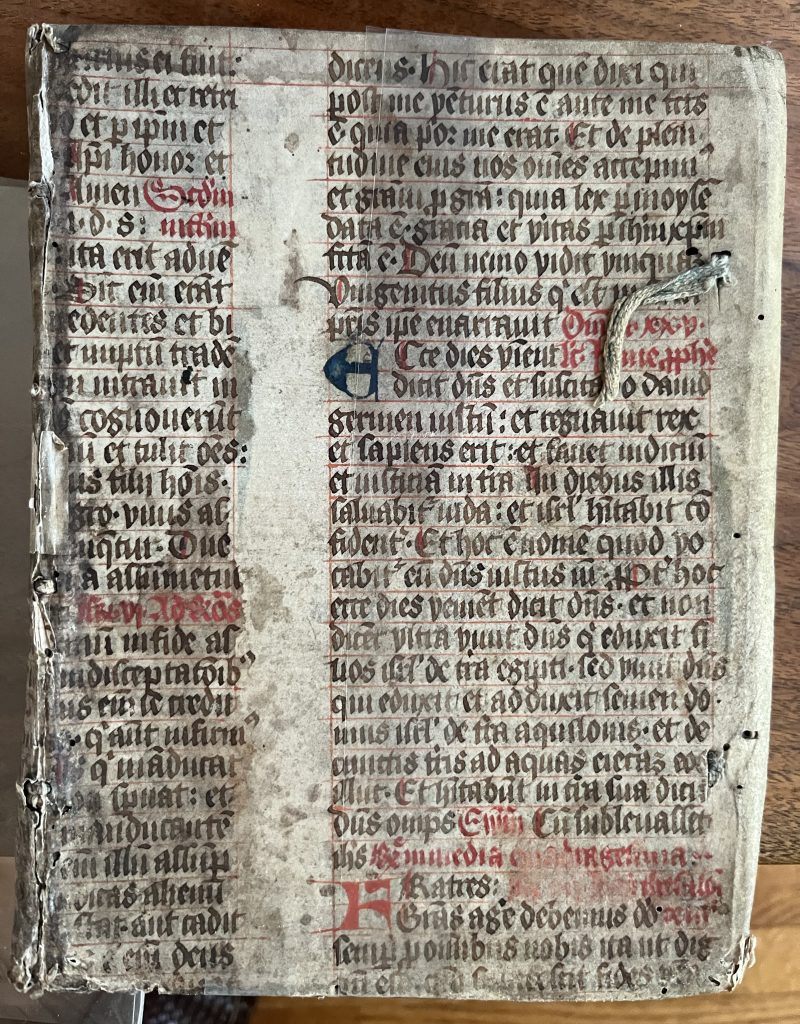
This workshop will examine a puzzling vellum fragment (or is it a set of patchwork fragments?) in a private collection. The fragment(s) come(s) from a single musical manuscript in Latin on vellum laid out in double columns with text and notation on 4-line staves. The reused medieval material forms the outer covering of a 17th-century printed book in German on laid paper.

Private Collection, Front Cover with Reused Medieval Musical Fragment on Vellum. Photograph by Mildred Budny.

The Musical Fragment and its ‘Find-Place’

For the musical fragment, we will work to decipher the visible parts of the text and music, identify the readings/lections and chants, and, if possible (given the fragmentary nature), determine the probable genre of original manuscript, such as lectionary, breviary, antiphonary, or missal. Perhaps, over time, we might find other survivors from the same despoiled medieval manuscript.

Narrowing down its possible origin—or location in the early 17th century or later when it came to be reused as a binding cover–might aid the quest to determine the circumstances of its reuse and whence other parts of it might have been disseminated, whether as reused binding materials or otherwise.

For the workshop, we will examine the features of the printed book. It includes multiple woodcut illustrations and occasional marginalia in forms of annotations demonstrating attention of several kinds to the contents of the herbal.

What brought this medieval musical fragment and early modern printed book together? Even if we might never know all the answers, won’t it be fun to question how and why? There is a story here.

We love the puzzles, and give thanks to the collector for lending the book to the RGME for study and teaching and for sharing it with our audience in this workshop and beyond.

Information

People who be participating at the workshop to offer observations, reflections, and suggestions about the composite volume include (in alphabetical order):

Phillip Bernhardt–House

Mildred Budny

Natalia Fay

Leslie French (represented by a report on the musical manuscript fragment)

Beppy Landrum Owen

David Porreca

David W. Sorenson (with some specimens of herbals mentioning astrological influences)

And others.

At our 2024 Spring Symposium at Vassar College, Natalia delightfully described her work for her exhibition on herbals then on display in the Art Library. She shares the poster and brochure for the exhibition with us, as she returns to our events in this workshop to report on her continuing interests in plants, books, manuscripts, and their transmission.

  • Natalia Fay, Botanicals Thesis Poster
  • Natalia Fay, Arcane Botanicals Program

The Manuscript Fragments

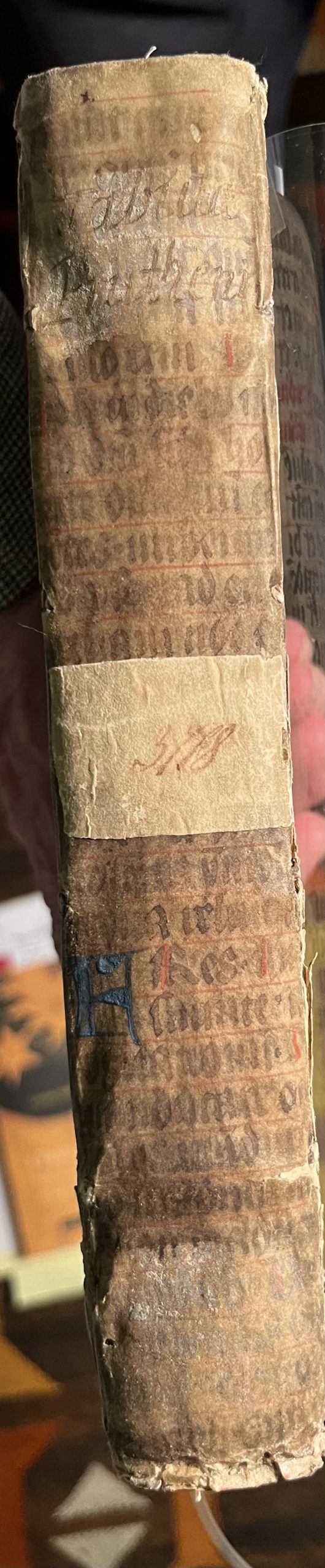
The visible portions of the manuscript appear, with only one side facing and the other side hidden, on the outer sides of the front and back covers, spine, and fore-edges of the binding.

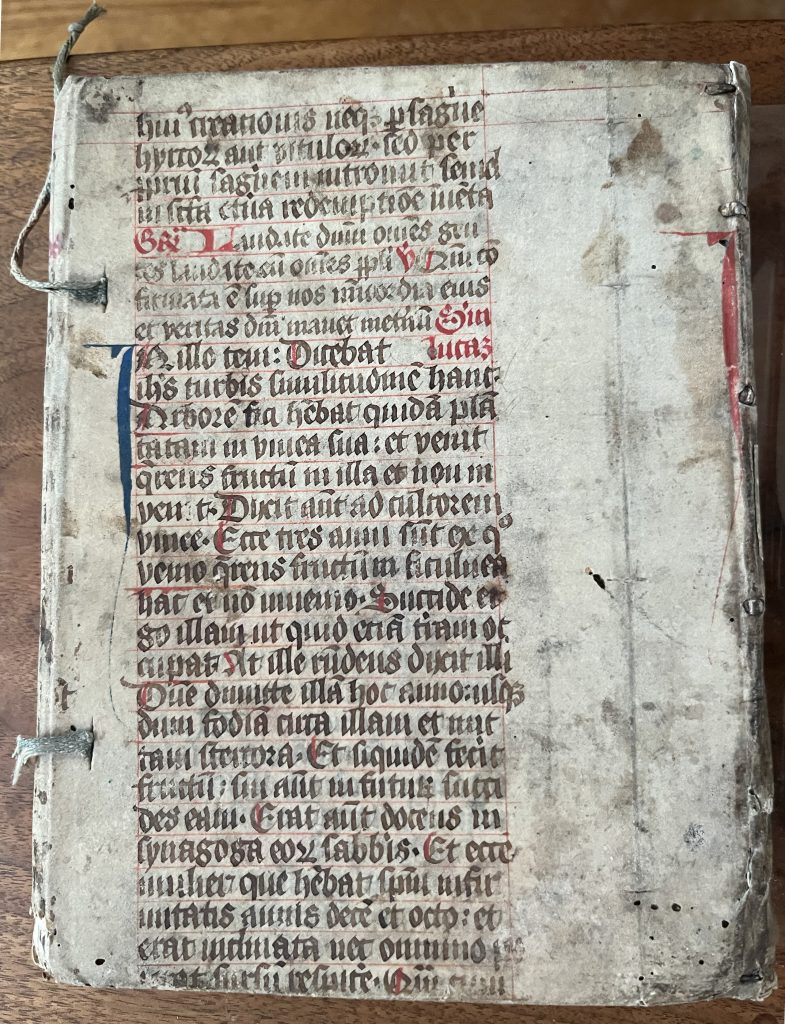
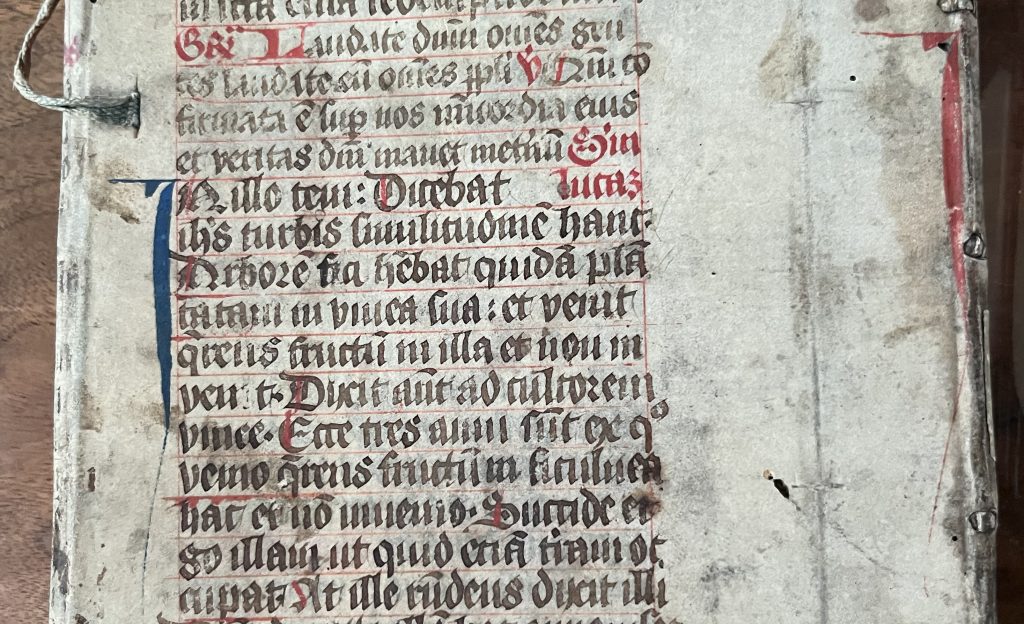
Their text and music on four-line staves stand upright on the volume. Written in Gothic script, the parallel lines of music and text have some elements in red and blue pigments. There are ten lines on the front cover and on the spine, but the back cover has an additional line of music at the bottom, amounting to 10 1/2 lines on this portion. Each portion of the fragment shows a single column, or part of one. At the right on the back cover, the right-hand side of the fragment extends beyond the column with an expanse of outer margin from its original extent.

Sections open with 2-line initials which span the full height of the paired lines of music-and-text, for which the staves separate their horizontal course. One initial comprises a blue capital I (front cover, line 7). Three band-like initials comprise decorative forms in black ink with a vertical twist at the left-hand side; red pigment fills the centers of their twists (front cover, lines 2 and 6; back cover, line 2).

1. Front Cover

Private Collection, Front Cover with Reused Medieval Musical Fragment on Vellum. Photograph by Mildred Budny.

2. Back Cover

Private Collection. Musical Manuscript Fragment, Back Cover with ruler.

Spine

Private Collection. Hybrid book with Musical Manuscript Fragment, Spine View.

The Printed Book

The printed text comprises the German Kreutterbuch (“Book of Herbs”), an astrological herbal, by Bartholomaeus Carrichter (1510–1574), in an early edition printed in Strasbourg in Alsace in 1606. The author, who wrote under the pseudonym of Philomusus Anonymus, was physician to Ferdinand I (1503–1564), Holy Roman Emperor from 1556, and his son Maximilian II, Holy Roman Emperor from 1564 to 1576. The first edition of his Kreutterbuch was printed in Strasbourg in 1517 by Chistian Muller. For later editions, the physician, poet, and alchemist Michael Toxites (1515–1581), whose birth-name was Johann Michael Schütz, added some material to Carrichter’s work and edited it.

One of various versions of the illustrated genre by different authors (see, for example the Kreutterbuch desz Hocgelehrten und Weitberuhmten Herrn D. Petri Andreae Matthioli . . . ), this book combines information about plants, use, and lore with astrological considerations.

Title Page

A catalogue description of the volume characteristically derives from information on the title page:

Philomusus Anonymous [Bartholomaeus Carrichter (1510–1574)], Horn des Heyls menschlicher Blödigkeit, oder Kreütterbuch, darinn die Kreütter des Teutschenlands auss dem Liecht der Natur nach rechter Art der himmelischen Einfliessungen beschriben / durch Philomusum Anonymum [Bartholomäus Carrichter], with a foreword by Michael Toxites, born Johann Michael Schütz (1514–1581), (Strassbourg: Anton Bertram, DCVI/1606).

An inscription in light black ink at the foot of the title page gives the initials “G. S.” Perhaps they refer to an owner.

Private Collection, Kreutterbuch, title page. Photograph by Mildred Budny.

For the first edition of 1576, printed in Straßburg, see an online digital facsimile of a copy in Augsburg, Staats- und Stadtbibliothek. For an edition of 1619 also printed by A. Bertram, see the copy in the Wellcome Collection.

Like the 1619 edition, this folio volume has 10 unnumbered pages, 180 numbered pages, and 5 unnumbered leaves, with a woodcut title page and outline illustrations. Interspersed within the columns of text, the book has 58 outline illustrations depicting the herbs which it describes. For example, borage (Borago officinalis) or starflower:

Private Collection, Carrichter’s Kreutterbuch (Strasbourg, 1604). Borage. Photography by Mildred Budny.

Up close:

Private Collection, Carrichter’s Kreutterbuch (Strasbourg, 1604). Borage. Photography by Mildred Budny.

For comparison: Borage ‘In The Wild’

Borago officinalis. Photograph by By Christian Orlandi (12 April 2025) – Own work, CC BY-SA 4.0. Image via Wikimedia Commons via https://commons.wikimedia.org/wiki/File:Borago_officinalis_(2025).jpg.

Some marginal annotations in brown ink amplify or comment upon passages.

Private Collection, Carrichter’s Kreutterbuch (Strasbourg, 1604). Textual opening with marginal Annotations. Photography by Mildred Budny.

*****

Registration for the Workshop

We invite you to join the quest.

  • https://www.eventbrite.com/e/workshop-8-a-hybrid-book-with-astrological-herbal-and-medieval-missal-tickets-1340074201009

*****

Questions? Suggestions?

  • Leave your comments or questions below
  • Contact Us

Visit our Social Media:

  • Leave your comments or questions below
  • Contact Us

Visit our Social Media:

  • our Facebook Page
  • our Facebook Group
  • our X/Twitter Feed (@rgme_mss)
  • our Bluesky nest @rgmesocial.bluesky.social)
  • our Instagram Page
  • our LinkedIn Group

Join the Friends of the RGME.

Please make a Donation in Funds or in Kind for our nonprofit educational corporation powered principally by volunteers. Your donations and contributions are welcome, and can go a long way. They may be tax-deductible to the fullest extent provided by the law.

  • Donations and Contributions
  • 2025 Annual Appeal

*************

Tags: astrological herbals, Bartholomaeus Carrichter, Early modern printing, history of herbals, history of printing, Kreutterbuch, manuscript fragments, Manuscript Fragments Reused in Bindings, Manuscript studies, medieval musical manuscripts, Michael Toxites
No Comments »

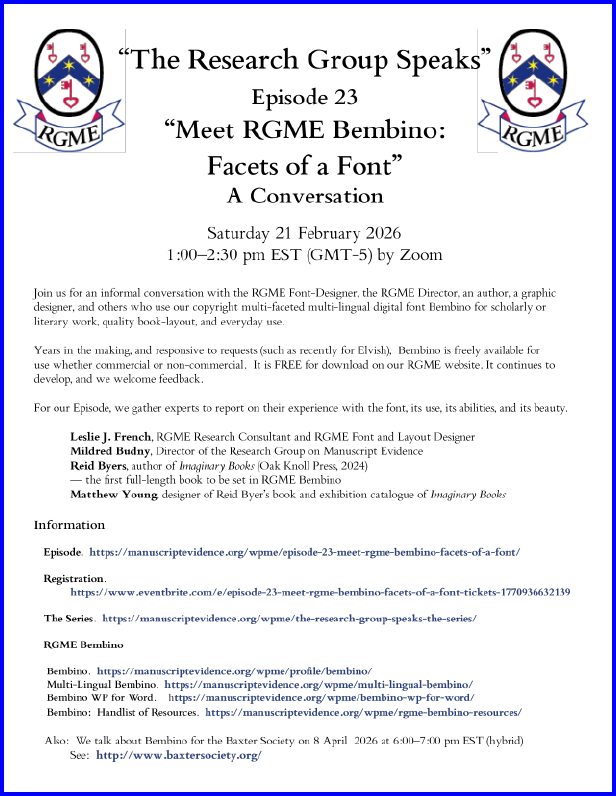
Episode 23. “Meet RGME Bembino: Facets of a Font”

September 1, 2025 in Bembino, Book, Design, Event Registration, Manuscript Studies, Research Group Episodes for The Research Group Speaks, Research Group Speaks (The Series)

“The Research Group Speaks”
Episode 23

“Meet RGME Bembino:
Facets of a Font”
A Conversation

Saturday 28 February 2026
1:00–2:30 pm EST (GMT-5) by Zoom

[Posted on 31 August 2025, with updates]

As the series wherein “The Research Group Speaks,” we respond to suggestions and requests as the series unfolds. For information about the series, please see:

  • “The Research Group Speaks”: The Series

The Plan

Join us for an informal conversation with the RGME Font-Designer, the RGME Director, an author, a graphic designer, and others who use our copyright multi-faceted multi-lingual digital font Bembino for scholarly or literary work, quality book-layout, and everyday use.

Years in the making, and responsive to requests (such as recently for Elvish),  Bembino is freely available for use whether commercial or non-commercial. It is FREE for download on our RGME website. It continues to develop, and we welcome feedback.

For our Episode, we gather experts to report on their experience with the font, its use, its abilities, and its beauty.

  • Leslie J. French (see the Interview with our Font and Layout Designer)
  • Mildred Budny (Mildred Budny: Her Page)
  • Reid Byers), author of Imaginary Books (Oak Knoll Press, 2024) — the first full-length book to be set in RGME Bembino
  • Matthew Young), designer of Reid Byer’s book and exhibition catalogue of Imaginary Books

Front Cover: Imaginary Books by Reid Byers (Oak Knoll Press, 2024), via https://reidbyers.com/?page_id=147; see https://www.oakknoll.com/pages/books/141071.

We welcome you to share your observations and requests.

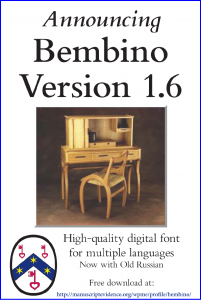
Poster announcing Bembino Version 1.6 (January 2019)

Meet the Font

This Episode features presentations by:

  • the RGME Font Designer, Leslie French;
  • the Director of the RGME, Mildred Budny;
  • the author of the first full-length book set in RGME Bembino, Reid Byers;
  • the graphic designer for that book, Matthew Young.

Information

  • Bembino
  • Multi-Lingual Bembino
  • Bembino WP for Word
  • Bembino: Handlist of Resources

Registration

  • Episode 23. Meet RGME Bembino: Registration
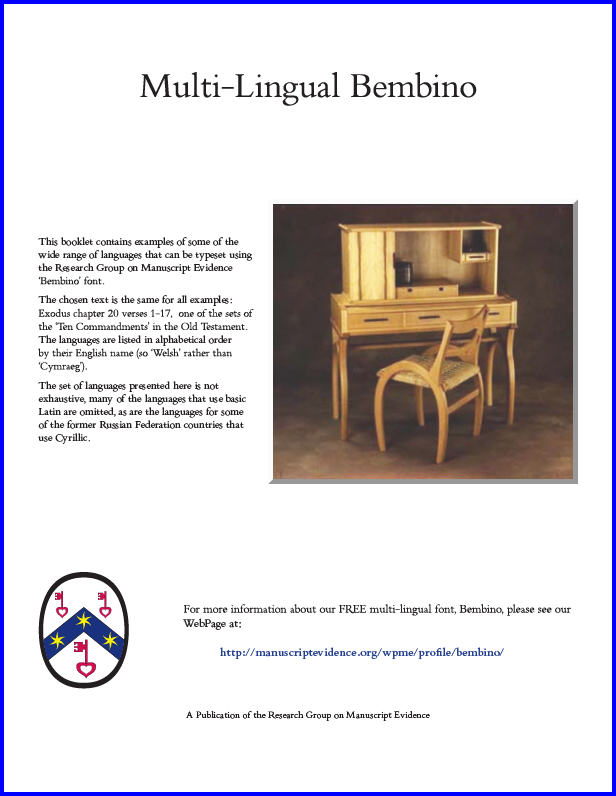
Cover page for 'Multi-Lingual Bembino' demonstrating specimens from a wide range of languages typeset in Bembino

Multi-Lingual Bembino Booklet Cover

Tracks

Keep track of the series as it unfolds:

  • “The Research Group Speaks”: The Series

*****

Tags: Bembino WP for Word, digital fonts, Font Design, graphic design, History of Design, history of printing, Imaginary Books, Multi-Lingual Bembino, RGME Bembino, The Research Group Speaks
No Comments »

2025 RGME Autumn Colloquium on Fragments

June 27, 2025 in Announcements, Koller-Collins Center for English Studies, Manuscript Studies, Princeton Bibliophiles & Collectors, Rossell Hope Robbins Library at the University of Rochester, Visits to Collections

2025 RGME Autumn Colloquium
on Fragments

“Break-Up Books
and Make-Up Books:

Encountering and Reconstructing
the Legacy of Otto F. Ege
and Other Biblioclasts
“

Friday to Sunday 21–23 November 2025
Hybrid and partly Online
Hybrid: In Person at Princeton and Online (Friday and Saturday)
Online: Zoom (Sunday)

*****

Colloquium Sponsors, Co-Sponsors, and Affiliates

Research Group on Manuscript Evidence

Princeton University Special Collections
The Friends of the Princeton University Library
Princeton Bibliophiles & Collectors
Department of Art & Archaeology, Princeton University

Rossell Hope Robbins Library
and Koller-Collins Center for English Studies
at the University of Rochester

Barbara Hanselman

[Your Name Here]

*****

[First posted on 5 January 2025, with updates. Now revised on 20 June 2025, 20 August 2025, 5 September 2025, and 29 October 2025, with changes in plan, co-sponsorship, host, and venues.]

Venue: In-Person, Hybrid, and Online

After an imposed change in venue from our initial plans, the Colloquium goes forward in online format, as planned from the beginning, with an in-person/hybrid component.  Its dates remain the same, from Friday to Sunday 21–23 November. The changes allow us to turn to a new host, for which we give thanks. For the earlier version, see

  • https://manuscriptevidence.org/wpme/2025-rgme-autumn-colloquium-at-the-university-of-waterloo/.

Online sessions will take place on Friday to Sunday. Sessions and Workshops will be hybrid on Friday and Saturday, with venues in different locations at Princeton University and nearby.

On Friday afternoon, our Associate Eric White, Curator of Rare Books, will hold a special set of Workshops on Fragments at Princeton in Special Collections at Firestone Library of the Princeton University Library. These workshops and reports on original materials return to a tradition of the RGME with Symposia and other events at Princeton University, before the Covid Pandemic. For example:

  • 2014 Seminar on Manuscripts and Their Photographs
  • 2019 Anniversary Symposium Program
  • 2020 Spring Symposium: Save the Date

For the 2025 Colloquium, searching for an appropriate location for other parts of the Colloquium beside the Workshops at Special Collections on the Friday afternoon, we explored collaboration with colleagues and organizations for other venues in Princeton to enable a Friday morning session and the Saturday sessions, all in hybrid format. Step by step, with assistance from the Friends of the Princeton University Library and the Department of Art & Archaeology, which had co-sponsored many of our Symposia before the Covid Pandemic. We give thanks for the generous responses to foster the plan for a ‘home’ for this Colloquium.

In such a way, people who travel to Princeton for the Friday workshops and related celebrations might also participate in other in-person sessions on both Friday and Saturday, leaving one session on Sunday to take place in online format only. With this news, some participants and attendees prepared to come to Princeton for the event IN PERSON.

With help of many kinds, we are able to report a collaborative event worthy of the initial plan to which many participants responded so enthusiastically (albeit for a different host which changed its mind). Reviving and transforming the plan has, we hope, been worthy of the complex, multi-faceted subject of fragments which reaches widely into very many aspects of manuscript and related studies, the history of collecting, and the recovery and transmission of written sources from the past. For this collaboration, we give thanks.

Read the rest of this entry →

Tags: Biblioclasts, Biblioclasts' Portfolios, Early modern printing, Fragmentology, History of Music, history of printing, manuscript fragments, Manuscript Fragments Reused in Bindings, Manuscript studies, Medieval manuscripts, Medieval Music Manuscripts, Otto F. Ege, Scrapbooks and Albums
No Comments »

The Curious Printing History of ‘La Science de l’Arpenteur’

December 1, 2021 in Manuscript Studies, Research Group Speaks (The Series), Uncategorized

The Research Group Speaks
Episode 5

The Curious, Possibly Unique, Printing History
of Editions (1766–1813)
of La Science de l’Arpenteur
by Dupain de Montesson

Ronald K. Smeltzer

Dupain de Montesson, Le spectacle de la campagne and La science de l’arpenteur (1777), First Title-page, Vignette. Ronald K. Smeltzer Collection. Photograph Ronald K. Smeltzer, reproduced by permission.

[Posted on 1 December 2021, with updates]

For Episode 5 in our series (23 January 2022), Ronald K. Smeltzer (Ronald K. Smeltzer, Ph.D.) examines a telling case of multiple editions, issued with variations in printing methods, of an eighteenth-century treatise in French on methods of surveying.  The technique of surveying has a long and venerable tradition, with a varied series of books on the subject from late-antiquity onward.

The Plan

Direct, detailed examination of the editions, all in octavo format, of La science de l’arpenteur by Louis Charles Dupain de Montesson reveals multiple changes and adaptations that illuminate its extraordinary printing history.  Early editions were printed all engraved including signatures of the leaves.  Some of the later changes to the text and to the book design were a direct result of the French Revolution.  Assembling examples of all the known editions has taken twenty years.  The process attests to the value of direct inspection.  This presentation describes the results.

Read the rest of this entry →

Tags: Dupain de Montesson, French Revolution, history of printing, History of surveying, Intaglio printing, La science de l'arpenteur, Le spectacle de la campagne, Letterpress Printing, The Research Group Speaks
No Comments »

Carmelite Missal Leaf of 1509

October 6, 2020 in Bembino, Manuscript Studies, Reports, Uncategorized

Single Leaf on Paper from an
Early-Printed Latin Missal (Missale Romanum)
For use in a Carmelite Monastery

Part of the Mass for Holy Saturday (Sabbato Sancto)

Printed in 1509
by Lucantonio Giunta in Venice
in 2 columns of 36 lines
With Music on 4-Line Staves

J. S. Wagner Collection

Another leaf from the J. S. Wagner Collection takes center stage as we examine its features.  We thank the collector for allowing us to see and to show the material.

Other leaves from this collection are reported in earlier posts. They came from medieval manuscripts and stand on vellum.

  • Updates for ‘Otto Ege Manuscript 19’
  • A Leaf from ‘Otto Ege Manuscript 19’ and Ege’s Workshop Practices
  • The Penitent King David from a Book of Hours
  • A Leaf from Prime in a Large-Format Breviary .

*****

This time, the single leaf stands on paper and came from an early-printed Latin Missal. On paper.  The form of book contains all the instructions and texts necessary for the celebration of the liturgical year.

We offer a description, identification, and 12-page downloadable Report. The Report, by our Associate and Font Designer, Leslie J. French, is available below. It is set in our copyright digital font Bembino (of course).

Worth saying that the printed leaf has sparked the interest of our Font Designer.  Glad for his expert examination and exploration.  This blogpost serves as a foundation, counterpart, and compliment to his report.

J. S. Wagner Collection, Single Leaf from a Latin Missal containing part of the Mass for Holy Saturday for use in a Carmelite Monastery, printed in 1509 Lucantonio Giunta in Venice. Recto, detail. Reproduced by Permission.

J. S. Wagner Collection, Single Leaf from a Latin Missal containing part of the Mass for Holy Saturday for use in a Carmelite Monastery, printed in 1509 Lucantonio Giunta in Venice. Recto, detail. Reproduced by Permission.

Other Materials from the Same Collection

The collector has generously shared with us images of some fragments, manuscript and printed.  They include a leaf from a dismembered Vulgate Bible manuscript, now known as ‘Otto Ege Manuscript 19’, which occupied center stage in earlier blogposts.

J. S. Wagner Collection, Ege Leaf 19, verso, detail. Lower portion, with end of the Book of Malachi, the Argumentum ("Summary") of the Books of Maccabees, and part of the text of I Maccabees.

J. S. Wagner Collection, Ege Leaf 19, verso, detail.

Other leaves carry illustration or decoration (or both) as well as text.  For example, The Penitent King David from a Book of Hours:

J. S. Wagner Collection. Detached Manuscript Detached Leaf with the Opening in Latin of the Penitent Psalm 37 (38) and its Illustration of King David.

J. S. Wagner Collection. Detached Manuscript Leaf with the Opening in Latin of the Penitent Psalm 37 (38) and its Illustration of King David.

And A Leaf from Prime in a Large-Format Breviary :

J. S. Wagner Collection, Leaf from from Prime in a Latin manuscript Missal. Folio 4 Recto, with the end of Psalm 53, the title for the Gloria Patri, and the opening of Psalm 117 (118), set out in verses with decorated initials..

J. S. Wagner Collection. Leaf from from Prime in a Latin manuscript Breviary. Folio 4 Recto.

The Leaf in Question

The text on the leaf to which we turn now contains part of the Mass for Holy Saturday (Sabbato Sancto), including music with notation on staves, for use in a Carmelite Monastery, that is, Carmelites, known as the “Order of the Brothers of the Blessed Virgin Mary of Mount Carmel” (Ordo Fratrum Beatissimæ Virginis Mariæ de Monte Carmelo). The spiritual focus) of the Carmelite Order is contemplation, encompassing prayer, community, and service.

Pietro Lorenzetti, Predella panel. Carmelite Hermits at the Fountain of Elijah (1328-1329). Siena, Pinacoteca Nazionale di Siena. Image Public Domain, via Wikimedia Commons.

Pietro Lorenzetti, Predella panel. Carmelite Hermits at the Fountain of Elijah (1328-1329). Siena, Pinacoteca Nazionale di Siena. Image Public Domain, via Wikimedia Commons.

The features of the Missal Leaf, including fonts, demonstrate that it was printed by Lucantonio Giunta in Venice, Italy. That is, Lucantonio Giunti (or Giunta), prolific book publisher and printer, born in Florence and active in Venice from 1489.

The Numbers Game

The recto of the leaf carries the printed folio number cij. Numbers in pencil in the outer corners at top and bottom label it as folio 148 and as an item-of-some-kind number 49991. The unevenly cut inner edge more-or-less follows the fold-line between the leaf and its mate in the former bifolium, or pair of leaves which nested within the gathering of leaves. The inner edge retains the 5 more-or-less regularly spaced notches which were cut into the fold of the gathering in preparation for stitching the text-block into the binding. (According to Ligatus: The Language of Binding, such features are to be known as “knife-cut recesses”, thus defined.)

The top of the Recto, with alternate Folio numbers in print and in pencil:

J. S. Wagner Collection, Single Leaf from a Latin Missal containing part of the Mass for Holy Saturday for use in a Carmelite Monastery, printed in 1509 Lucantonio Giunta in Venice. Recto, detail: Top Portion. Reproduced by Permission.

J. S. Wagner Collection, Single Leaf from a Latin Missal containing part of the Mass for Holy Saturday for use in a Carmelite Monastery, printed in 1509 Lucantonio Giunta in Venice. Recto, detail: Top Portion. Reproduced by Permission.

The bottom of the recto, with a large number very close to 50,000:

J. S. Wagner Collection, Single Leaf from a Latin Missal containing part of the Mass for Holy Saturday for use in a Carmelite Monastery, printed in 1509 by Lucantonio Giunta in Venice. Recto, detail: Bottom Portion. Reproduced by Permission.

J. S. Wagner Collection, Single Leaf from a Latin Missal containing part of the Mass for Holy Saturday for use in a Carmelite Monastery, printed in 1509 by Lucantonio Giunta in Venice. Recto, detail: Bottom Portion. Reproduced by Permission.

The Leaf in Full

Recto and Verso, one by one. Let us have a look and turn the page.

Recto of Leaf Number CII/148

J. S. Wagner Collection, Single Leaf from a Latin Missal containing part of the Mass for Holy Saturday for use in a Carmelite Monastery, printed in 1509 Lucantonio Giunta in Venice. Recto. Reproduced by Permission.

J. S. Wagner Collection, Single Leaf from a Latin Missal containing part of the Mass for Holy Saturday for use in a Carmelite Monastery, printed in 1509 Lucantonio Giunta in Venice. Recto. Reproduced by Permission.

Verso of Leaf, with Catchword

J. S. Wagner Collection, Single Leaf from a Latin Missal containing part of the Mass for Holy Saturday for use in a Carmelite Monastery, printed in 1509 Lucantonio Giunta in Venice. Recto, detail: Top Portion. Reproduced by Permission.

J. S. Wagner Collection, Single Leaf from a Latin Missal (‘Missale Romanum’) containing part of the Mass for Holy Saturday for use in a Carmelite Monastery, printed in 1509 by Lucantonio Giunta in Venice, Italy. Verso of Leaf. Reproduced by Permission.

Features to note: Well, everything. (It’s what we do.)

Including: the Running Title, the Text, the Initials, the Music; and the Yellow Wash. Etc.  For example, as showcased in our accompanying Booklet (See Below):

J. S. Wagner Collection, Single Leaf from a Latin Missal containing part of the Mass for Holy Saturday for use in a Carmelite Monastery, printed in 1509 Lucantonio Giunta in Venice. Recto, detail. Reproduced by Permission.

J. S. Wagner Collection, Single Leaf from a Latin Missal containing part of the Mass for Holy Saturday for use in a Carmelite Monastery, printed in 1509 Lucantonio Giunta in Venice. Recto, detail. Reproduced by Permission.

In passing, we note that other blogposts have had occasion to observe the placement of a wash or fill of yellow pigment within minor initials of manuscripts.  Some authorities regard the feature as Italian or ‘Italianate’.  See, for example

  • More Discoveries for ‘Otto Ege Manuscript 41″
  • A 15th-Century Theological Volume from Le Parc Abbey
Private Collection, Le Parc Abbey, Theological Volume, Part B, opening page: Peter the Venerable.

Private Collection, Le Parc Abbey, Theological Volume, Part B, opening page: Peter the Venerable.

Other Leaves From This Dispersed Book

It took a while to find some comparanda, as we continued to explore. You know, we might now wonder (story be told), if that dearth of close comparanda might indicate a rarity, we’d be prepared to agree.

The Report (see below) and this blogpost tell that story.

To start, where we began, once trying to fine some bearings among online resources.

Here is a close relative, exhibited online for sale at one time on ebay and now shown via worthpoint.com as
https://www.worthpoint.com/worthopedia/1509-giunta-missal-leaf-woodcuts-172119411 . It is described thus:

A Leaf From a rare, Giunta Missale, (secundum usum Carmelitarum), numerous woodcuts of New Testament scenes and saints, facing pages with composite borders of figured vignettes, profusion of woodcut historiated and decorative initials. Text and music printed in red and black throughout. The Missal contains the prayers said by the priest at the alter [sic] as well as all that is officially read or sung in connection with the Holy Sacrifice of the Mass throughout the ecclesiastical year. This particular leaf features two woodcuts as well as the text for the Mass that is celebrated during Passion Week for The Easter Season. Verso: Text and music printed in red and black throughout. (Venice: Lucantonio Giunta, 13 January 1509). Condition of this leaf is under fine[F-] and this leaf measures 6.75″ x 4.5″.

Note the generic description that addresses a single “Leaf”, but cites multiple leaves from the same source-volume, as it mentions “numerous woodcuts”, “facing pages with composite borders”, a “profusion of woodcut historiated and decorated initials”, “text and music printed in red and black throughout”, etc., and then refers to features on “this particular leaf”. To whit:

This particular leaf features two woodcuts as well as the text for the Mass that is celebrated during Passion Week for The Easter Season.

Even so, the description could serve for any leaf within the portion dedicated to Passion Week, provided that it has “two woodcuts” and carries music on the verso. Perhaps that is the idea.

(We have become familiar with such a generic approach to identical labels circulated with different individual leaves from a single book in our investigations of manuscripts and other textual materials dispersed from the collection of Otto F. Ege (1888–1951), as considered in multiple posts on our blog; see its Contents List.)

We note the seller’s grading of the condition of that leaf: “under fine” or “F-“, according to recognized book-selling terminology for “used books”. Presumably, if that grading is correct, it could aptly apply to other leaves from the same book, unless, that is, other parts of the book suffered different and more extensive forms of damage.

J. S. Wagner Collection, Single Leaf from a Latin Missal containing part of the Mass for Holy Saturday for use in a Carmelite Monastery, printed in 1509 Lucantonio Giunta in Venice. Recto, detail: Bottom Portion. Reproduced by Permission.

J. S. Wagner Collection, Single Leaf from a Latin Missal printed in 1509 Lucantonio Giunta in Venice. Recto, detail: Bottom Portion. Reproduced by Permission.

According to the image exhibited online in the sales offering, its recto (with a single woodcut) carries the printed folio number liv, and 2 more numbers in pencil: another folio number (“109”) in Arabic numerals in the top right corner, and another number in the bottom right corner (“49952”) — the latter in the same hand as the number 49991 on the Wagner Leaf.

Customarily we could think of such large numbers at bottom right as an inventory number in a seller’s marker. Given the specificity of the number, in a high number not always evenly rounded off, it seems clear that the number is not a price, in whatever currency. Identifying the ‘code’ particular to a given seller might aid in deducing the provenance of the piece. Thus might progress a hunt for a particular seller’s style.

That is how we first regarded the high number on the Wagner Leaf. Further exploration, and the discovery of other leaves carrying similar numbers in a sequence which can be revealed to have a specific import relating to the volume itself, is explained in the Report downloadable below.

Spoiler Alert: We still think that these numbers are inventory numbers, which pertain to the individual leaves of the given volume. But they also appear to stand within a very large inventory which could or would involve very many individual leaves extracted from very many individual books.

The Leaf and its Provenance

The present owner reports that the Leaf came to him in a collection, with no identification of its contents or a source for the item.

And so, exploring aspects in turn of the Missal Leaf — as described here and in the 12-page Report by our Associate (and Font Designer), Leslie J. French (see below) — we have discovered that this very Leaf was listed for Sale via faginarms.com, where it was presented as an Italian Missal Page [Update of 17 November 2020:  that post appears to have been removed], with an image clinching the identification:

Straight from the heart of the Renaissance! Printed page, 6 3/4″ x 4 1/2″, by Lucantonio Giunta, Venice, 13 January, 1509. This page with the prayers and songs for Holy Saturday. Excellent and suitable for framing.

Stock Number: FNS3583

Sold

Discovering, if wished, which individual copy of the Missal was dismembered and dispersed, from which collection, and by whom, would require further research.

Other Leaves from the Same Book

Suffice it to say that we have seen online a few other leaves which must have come from the same copy. Mostly, it appears, they passed through eBay. For example, a 1509 Giunta Missal Leaf, described as:

(Venice:  Lucantonio Giunta, 13 January 1509).

More leaves are described in our booklet, for which see below.

The Edition and Its Components

Thus, identifying the printer and the date of the edition led us to consult standard bibliographical resources for the genre of book, the printer, Missals printed by the same printer, and other aspects.

First:

  • William H. James Weale and Hanns Bohatta, ed., Bibliographica Liturgica: Catalogus Missalium ritus latino ab anno M.CCCC.LXXIV Impressorum (London: Bernard Quaritch, 1928).

An earlier version of the catalogue appears online:

  • William H. James Weale, ed., Bibliographica Liturgica: Catalogus Missalium ritus latino ab anno M.CCCC.LXXIV Impressorum (London: Bernard Quaritch, 1886), online via archive.org.

Both versions mention this Missal among the Missals for Use of the Order of the Fratres B. V. Mariae de Monte Carmelo.

But they differ.

In the 1886 version, this Missal is no. 1509 (p. 251), listed only briefly, with the mention of the date and place of publication, and the existence of a copy at “Frankfurt a. M. : S”. I give this detail because you can see its evidence online. I can also report the extra text in the 1928 book, which I possess.

In the 1928 version, this Missal is no. 1887 (p. 319), with more information:

1509, ID. Ian. (13 Jan.) Missale secundum ordinem fratrum Carmelitarum. In Uenetorum ciuitate, Lucas antonius de giunta. 8vo. 44 nn., 299 n., 1 vac = 344 Fol. . . . 2 col. 36 lin.

Frankfurt a. M. : S.

Rivoli 311, 274

That is, in 3 stages:

1) Bibliographical information about the publication itself, its date (the Ides of January, or 13 January, 1509), title, place of printing (“In the City of Venice” or In Uenetorum ciuitate), printer, colophon, format, number of leaves (344), layout in number of columns (2) and lines per page (36), etc.;
2) A known copy of the book, in this case at Frankfurt am Main in the “S[tadtbibliothek].”, however with unspecified pressmark; and
3) The reference to another bibliographical resource, namely “Rivoli” with the numbers “311, 271”.

The 3rd stage refers to a substantial publication by the 3rd Duc de Rivoli (also the Prince d’Essling), Victor Masséna (1836–1910), bibliophile and scholar (see also Essling, Victor Masséna):

  • Duc de Rivoli (Victor Masséna), Les Missels imprimés à Venise de 1481 à 1600: Description — Illustration — Bibliographie. Études sur l’art de la Gravure sur Bois (Paris: J. Rothschild, 1894), p. xviii and no. 274 on pages 311–312, online via 1894.

There we find a more detailed description of the volume, according to the single copy examined or known (“l’exemplaire que nous avons vu”) — albeit lacking its title page and some other pages. As a result, the title for the Missal is not reported. The description includes a list of 22 woodcut illustrations, which appear in a cycle from the Immaculée Conception to Christ de pitié — including some which seen to appear also in other Missals printed by or for L.-A. Giunta. Also noted by the description are:

Nombreuses petites vignettes, dont une certaine quantité a fond noir criblé, principalement dans les encadrements qui se trouvent au recto des pages en regard des grands bois. — Initiales ornées.

No mention of the music, but presumably that is to be taken as a given for the genre of book?

The colophon (on R. 288):

Explicit missale per ordinem fratrum gloriosissime dei genitricis semperque virginis marie de monte carmello : … quod impensa sua ac solerti cura Lucasantonius de giunta florentinus in Venetorum ciuitate floretissima impressit. Anno natalis domini. M. d. ix. idibus ianuarij.

(“Here ends the Missal for the Order of the Brothers of the Most Glorious Mother of God and eternal Virgin Mary of Mount Carmel, . . . which, at his expense and by the diligence of skills, Lucas Antonius de Giunta, the Florentine, printed [or caused to be printed?] in the city of Venice. In the year of the Lord, 1509, on the Ides of January.”)

Rivoli identified the sole copy under his consideration as belonging to the city library at Frankfurt, with a pressmark: “Francfort, B[ibliothèque]. de la Ville, Rit. cath. 512”.

In Frankfurt, the Stadtbibliothek now combines with another major institutional library, as the Stadt- und Universitätsbibliothek Frankfurt am Main (since 1945). So far, we have not been able to learn about its copy of this Missal (pressmark “Rit. cath. 512”) through the library website.

The apparent rarity of appearances of copies (or fragments) online or in some standard reference works might show a small-scale printing to start with, or a wider disinterest in the edition as such, given some with earlier dates and/or heightened extents of illustration. If it was a rare issue, then the dismemberment of the volume sold piecemeal online (perhaps not very recently) would represent an even more lamentable loss, with the destruction of the integrity of an early-printed object not easily to be found or replaced elsewhere.

Because Rivoli does not illustrate any of its woodcuts in this edition, we may glimpse their character and perhaps their style from other illustrations of the same subjects in other of Guinta’s Missals which appear among Rivoli’s figures and descriptions. Some of these correspondences or resemblances which Rivoli noted in his entry for this 1509 Missal, by referring to other Missal numbers and to other pages (as with “Missel 59 et p. 167” for the Annonciation XVI, the Assomption (“Cf. pp. 22, 25), and the Nativité de la Ste Vierge (“Cf. p. 113”) — subjects centering upon the Virgin Mary presumably of especial interest to the Carmelites.

Some examples:

  • 1509 Giunta Missal Leaf Medieval Music Leaser Lent
  • Recto only of Leaf 49952, with a part-page woodcut. An opportunity described in these glowing terms:

A Wonderful Leaf for The Manuscript Collector and A Great Gift Idea! Purchase Three or More Individual Auctions and There Will Be No Charge For Shipping We Now Accept PayPal WE SHIP WORLDWIDE – PLEASE CONTACT US FOR A FREE SHIPPING QUOTE! for more information.

The Printer and His Works

The printer’s career is surveyed in Lucantonio Giunti or Giunta (1457 – 1538), or in English via Lucantonio Giunti. We learn, for example:

Lucantonio Giunta or Giunta (1457–1538) was a Florentine book publisher and printer, active in Venice from 1489, a member of the Giunti family of printers. His publishing business was successful, and among the most important in the late fifteenth and early sixteenth centuries. Through partnerships, often with members of his family, he expanded the business through much of Europe.

It is useful to note that for some works he served directly as printer in the production, and for others indirectly as publisher in the distribution.

The Printer, His Devices, and Examples of Title-Pages

Over the course of his output, Giunta employed several forms of printer’s device. Some are gathered and displayed online via Luca Antonio Giunta. Examples appear in Missals both earlier and later than the 1509 Carmelite Missal, in various formats, and for various Orders, as well for the practices of various Churches — as with the Church of Rome in the Missal Romanum. Some title-pages for his Missals are illustrated in Rivoli (1894).

Here follow a few specimens.

Florence, Biblioteca Nazionale, Missale Romanum printed by Lucantonio Giunta (1521), Title-page, detail: Printer's Device. Image Public Domain via Wikimedia Commons.

Florence, Biblioteca Nazionale, Missale Romanum printed by Lucantonio Giunta (1521), Title-page, detail: Printer’s Device. Image Public Domain via Wikimedia Commons.

1) From the Roman Missal of 1501 in Folio Format

The title-page of the Missale Romanum nouiter impressum, printed by Lucantonio de Giunta on 20 November 1501 in Venice.

Florence, Biblioteca Nazionale, Missale Romanum printed by Lucantonio Giunta (1501), Title-page. Image via Creative Commons.

Florence, Biblioteca Nazionale, Missale Romanum printed by Lucantonio Giunta (1501), Title-page. Image via Creative Commons.

The end-page with the colophon displays a mostly full page of text printed in black and red.

Florence, Biblioteca Nazionale, Missale Romanum printed by Lucantonio Giunta (1501), End-page. Image via Creative Commons.

Florence, Biblioteca Nazionale, Missale Romanum printed by Lucantonio Giunta (1501), End-page. Image via Creative Commons.

The edition is listed in Weale and Bohatta (1928), no. 964 (p. 169); and Rivoli (1894), no. 59 (pp. 167–168).

2) For the Dominican Order of 1504 in Folio Format

The title-page of a folio Missale secundum ordinem fratrum Predicatorum, printed by Lucantonio de Giunta on 30 June 1504 in Venice.

The full title, citing the “most beautiful figures (figuris)” describes the work thus:

Missale predicatorum nuper impressum ac emendatum cum multis missis: orationibus pulcherrimisque figuris in capite missarum festiuitatum solennium de nouo superadditis: ut inspicienti patebit.

The edition is listed in Weale and Bohatta (1928), no. 1828 (p. 311); and Rivoli (1894), no. 256 (pp. 300–301).

The tapered title is surmounted by a woodcut illustration of a full-length and haloed figure holding flowers and an edifice, in a depiction of the founder and patron of the Order, the Castilian Saint Dominic (1170–1221). At the bottom of the page appears the printer’s device in an upright rectangular frame, including the initials L and A. The whole volume appears online from a copy still in Venice, at the Biblioteca nazionale Marciana: here.  The title-page, from Biblioteca nazionale Marciana – Venezia – IT-VE0049 :

First page of the 'Missale predicatorum' (1504), printed by Lucantonio de Giunta in Venice. Image Public Domain via Wikimedia Commons.

First page of the ‘Missale predicatorum’ (1504), printed by Lucantonio de Giunta in Venice. Image Public Domain via Wikimedia Commons.

3) From a Missal Romanum of 10 May 1521 in Folio Format

That is, Missale romanum nuper adoptatum ad commodum. Venetijs in aedibus Luce antonij de giunta.

The Title page carries a variant version, within a paneled border.

Florence, Biblioteca Nazionale, Missale Romanum printed by Lucantonio Giunta (1521), Title-page, detail: Printer's Device. Image Public Domain via Wikimedia Commons.

Florence, Biblioteca Nazionale, Missale Romanum printed by Lucantonio Giunta (1521), Title-page, detail: Printer’s Device. Image Public Domain via Wikimedia Commons.

The page in full:

Florence, Biblioteca Nazionale, Missale Romanum printed by Lucantonio Giunta (1521), Illustrated Title-page. Image via Creative Commons.

Florence, Biblioteca Nazionale, Missale Romanum printed by Lucantonio Giunta (1521), Illustrated Title-page. Image via Creative Commons.

The detailed title:

Missale Romanum ordinarium. Missale romanum nuper ad optatum comodumquorumcumque sacerdotum summa diligentia distinctum et ortographia castigatum atqueita ex nouo ordine digestum . . .

The edition is  Weale and Bohatta (1928), no. 1046 (p. 182); Rivoli (1894), no. 92 (pp. 196–198).

From the copy in Florence, Biblioteca nazionale centrale, shelfmark MAGL.2.109 (identifier info:sbn/CNCE011532), some specimen pages are shown in the Biblioteca digitale italiana via www.internetculturale.it, specifically here.  The colophon:

Florence, Biblioteca Nazionale, Missale Romanum printed by Lucantonio Giunta (1521), End Page with Colophon. Image via Creative Commons.

Florence, Biblioteca Nazionale, Missale Romanum printed by Lucantonio Giunta (1521), End Page with Colophon. Image via Creative Commons.

4) From a Missale Nouum of 21 April 1537 for the (Hungarian) Order of Saint Paul the First Hermit in Quarto Format

From a copy in Budapest, National Széchényi Library, I. II, 66:

Budapest, National Széchényi Library, I. II, 66, Title-page. Missal (1537). Image Public Domain via Wikimedia Commons.

Budapest, National Széchényi Library, I. II, 66, Title-page. Missal (1537). Image Public Domain via Wikimedia Commons.

This edition is Weale and Bohatta (1928), no. 1814 (p. 308); Rivoli (1894), no. 247 (p. 296).

*****

In sum, the Wagner Missal Leaf belongs to a dispersed copy of Guinta’s Missal of 1509 for Carmelite Use.

We offer more information about the leaf and its edition in this 12-page illustrated booklet prepared by our Font and Layout Designer.  Free to download.  Enjoy!

As customary, we offer the booklet in 2 versions.  They might conform with your preferences for viewing and printing.

  • Leslie J. French, “A Detached Printed Leaf containing Part of The Mass for Holy Saturday for Carmelite Use: A Process of Discovery” (Princeton: Research Group on Manuscript Evidence, 2020)1) Booklet as consecutive pages (8½” × 11″).

    2) Booklet as foldable Booklet, printable on 11″ × 17″ sheets ready to fold into a nested Booklet.

We thank the owner for permission to examine the material and to present it here.  We thank Leslie French for his research and the booklet.

*****

Camelite Booklet Cover Page with New Front Cover with border

Camelite Booklet Cover Page with New Front Cover with border

Suggestions for Further Reading

More information about this printer, his Missals, and their Music:

  • Mary Kay Duggan, Italian Music Incunabula: Printers and Type (Berkeley, etc.: University of California Press, 1992)
  • Lesley T. Stone, From Chapel to Chamber: Liturgy and Devotion in Lucantonio Giunta’s Missale romanum, 1508 (M. A. dissertation, Department of Art and Art History, University of South Florida, 2005), examining the edition of 3 October 1508 (especially its woodcuts),
    online via https://scholarcommons.usf.edu/cgi/viewcontent.cgi?article=1877&context=etd = University of South Florida Scholar Commons
  • Leslie J. French, “A Detached Printed Leaf containing Part of The Mass for Holy Saturday for Carmelite Use: A Process of Discovery” (Princeton: Research Group on Manuscript Evidence, 2020), freely available for download here.

*****

Do you know of other leaves from this Missal? Do you have information about the provenance of this copy?

Please let us know.

Add your Comments here, Contact Us, and visit our Facebook Page.
Follow our blog on blog for further research on dispersed books, and watch its Contents List.

J. S. Wagner Collection, Single Leaf from a Latin Missal containing part of the Mass for Holy Saturday for use in a Carmelite Monastery, printed in 1509 Lucantonio Giunta in Venice. Recto, detail. Reproduced by Permission.

J. S. Wagner Collection, Single Leaf from a Latin Missal containing part of the Mass for Holy Saturday for use in a Carmelite Monastery, printed in 1509 by Lucantonio Giunta in Venice. Recto, detail. Reproduced by Permission.

*****

Tags: Carmelite Missal of 1509, Dominican Order, Duc de Rivoli's Missels, Early Printing, Early Printing in Venice, history of printing, Holy Saturday, J.S. Wagner Collection, latin Missal, Lucantonio Giunta, Roman Missal, Weale and Bohatta
No Comments »

  • Top
©2024 Research Group on Manuscript Evidence.


is proudly powered by WordPress. WordPress Themes X2 developed by ThemeKraft.