• News
    • News & Views
    • RGME Activities for 2024 and 2025
    • Around & About with the RGME
    • Reviews
    • Highlights
  • Blogs
    • Manuscript Studies
      • Manuscript Studies: Contents List
    • International Congress on Medieval Studies
      • Abstracts of Congress Papers
        • Abstracts of Papers Listed by Author
        • Abstracts of Papers Listed by Year
  • About
    • Mission
    • Who We Are
      • Officers, Associates & Volunteers
      • RGME Committees
      • Friends of the Research Group on Manuscript Evidence
    • Policies & Statements
      • RGME Privacy Policy Statement
      • RGME Intellectual Property Statement & Agreements
    • People
      • Mildred Budny — Her Page
      • Adelaide Bennett Hagens
    • Activities
      • Events
      • Congress Activities
        • Sponsored Conference Sessions (1993‒)
          • Panels at the M-MLA Convention (from 2016)
        • Co-sponsored Conference Sessions (2006‒)
    • History
      • Seals, Matrices & Documents
      • Genealogies & Archives
    • Contact Us
  • Bembino
    • Multi-Lingual Bembino
    • RGME Bembino: Resources
  • Congress
    • Sponsored Conference Sessions (1993‒)
    • Co-sponsored Conference Sessions (2006‒)
    • Abstracts of Congress Papers
      • Abstracts Listed by Author
      • Abstracts Listed by Year
    • Kalamazoo Archive
    • Panels at the M-MLA Convention (2016-2019)
      • Abstracts of Papers for the M-MLA Convention
      • Panels at the M-MLA Convention (from 2016)
  • Events
    • RGME Activities for 2024 and 2025
      • 2023 Activities and 2024 Planned Activities
    • Seminars, Workshops, Colloquia & Symposia (1989–)
      • Seminars on ‘The Evidence of Manuscripts’
      • Symposia on ‘The Transmission of the Bible’
      • The New Series (2001-)
        • 2019 Anniversary Symposium Program: The Roads Taken
        • 2019 Anniversary Symposium Registration
        • 2019 Anniversary Symposium Registration Open
      • RGME Symposia: The Various Series
      • The Research Group Speaks: The Series
      • Meetings of the Friends of the Research Group on Manuscript Evidence
      • RGME Online Events
    • Abstracts of Papers for Events
      • Abstracts of Papers for Seminars on ‘The Evidence of Manuscripts’
      • Abstracts of Papers for Symposia, Workshops & Colloquia
    • Receptions & Parties
    • Business Meetings
    • Photographic Exhibitions & Master Classes
    • Events Archive
  • ShelfLife
    • Journal Description
    • ShelfMarks: The RGME-Newsletter
    • Publications
      • “Insular, Anglo-Saxon, and Early Anglo-Norman Manuscript Art at Corpus Christi College, Cambridge” (1997)
        • Mildred Budny, ‘Catalogue’
        • The Illustrated Catalogue (1997)
      • The Illustrated Handlist
      • Semi-Official Counterfeiting in France 1380-1422
      • No Snap Decisions: Challenges of Manuscript Photography
    • History and Design of Our Website
  • Galleries
    • Watermarks & the History of Paper
    • Galleries: Contents List
    • Scripts on Parade
    • Texts on Parade
      • Latin Documents & Cartularies
      • New Testament Leaves in Old Armenian
    • Posters on Display
    • Layout Designs
  • Donations and Contributions
    • RGME Donor Promise
    • 2023 End-of-Year Fundraiser for our 2024 Anniversary Year
    • 2019 Anniversary Appeal
    • Orders
  • Links
    • Catalogs, Metadata, and Databases: A Handlist of Links
    • Handlist of Resources for Manuscript Studies and Fragmentology
    • Manuscripts & Rare Books
    • Maps, Plans & Drawings
    • Seals, Seal-Matrices & Documents

  • News
    • News & Views
    • RGME Activities for 2024 and 2025
    • Around & About with the RGME
    • Reviews
    • Highlights
  • Blogs
    • Manuscript Studies
      • Manuscript Studies: Contents List
    • International Congress on Medieval Studies
      • Abstracts of Congress Papers
        • Abstracts of Papers Listed by Author
        • Abstracts of Papers Listed by Year
  • About
    • Mission
    • Who We Are
      • Officers, Associates & Volunteers
      • RGME Committees
      • Friends of the Research Group on Manuscript Evidence
    • Policies & Statements
      • RGME Privacy Policy Statement
      • RGME Intellectual Property Statement & Agreements
    • People
      • Mildred Budny — Her Page
      • Adelaide Bennett Hagens
    • Activities
      • Events
      • Congress Activities
        • Sponsored Conference Sessions (1993‒)
          • Panels at the M-MLA Convention (from 2016)
        • Co-sponsored Conference Sessions (2006‒)
    • History
      • Seals, Matrices & Documents
      • Genealogies & Archives
    • Contact Us
  • Bembino
    • Multi-Lingual Bembino
    • RGME Bembino: Resources
  • Congress
    • Sponsored Conference Sessions (1993‒)
    • Co-sponsored Conference Sessions (2006‒)
    • Abstracts of Congress Papers
      • Abstracts Listed by Author
      • Abstracts Listed by Year
    • Kalamazoo Archive
    • Panels at the M-MLA Convention (2016-2019)
      • Abstracts of Papers for the M-MLA Convention
      • Panels at the M-MLA Convention (from 2016)
  • Events
    • RGME Activities for 2024 and 2025
      • 2023 Activities and 2024 Planned Activities
    • Seminars, Workshops, Colloquia & Symposia (1989–)
      • Seminars on ‘The Evidence of Manuscripts’
      • Symposia on ‘The Transmission of the Bible’
      • The New Series (2001-)
        • 2019 Anniversary Symposium Program: The Roads Taken
        • 2019 Anniversary Symposium Registration
        • 2019 Anniversary Symposium Registration Open
      • RGME Symposia: The Various Series
      • The Research Group Speaks: The Series
      • Meetings of the Friends of the Research Group on Manuscript Evidence
      • RGME Online Events
    • Abstracts of Papers for Events
      • Abstracts of Papers for Seminars on ‘The Evidence of Manuscripts’
      • Abstracts of Papers for Symposia, Workshops & Colloquia
    • Receptions & Parties
    • Business Meetings
    • Photographic Exhibitions & Master Classes
    • Events Archive
  • ShelfLife
    • Journal Description
    • ShelfMarks: The RGME-Newsletter
    • Publications
      • “Insular, Anglo-Saxon, and Early Anglo-Norman Manuscript Art at Corpus Christi College, Cambridge” (1997)
        • Mildred Budny, ‘Catalogue’
        • The Illustrated Catalogue (1997)
      • The Illustrated Handlist
      • Semi-Official Counterfeiting in France 1380-1422
      • No Snap Decisions: Challenges of Manuscript Photography
    • History and Design of Our Website
  • Galleries
    • Watermarks & the History of Paper
    • Galleries: Contents List
    • Scripts on Parade
    • Texts on Parade
      • Latin Documents & Cartularies
      • New Testament Leaves in Old Armenian
    • Posters on Display
    • Layout Designs
  • Donations and Contributions
    • RGME Donor Promise
    • 2023 End-of-Year Fundraiser for our 2024 Anniversary Year
    • 2019 Anniversary Appeal
    • Orders
  • Links
    • Catalogs, Metadata, and Databases: A Handlist of Links
    • Handlist of Resources for Manuscript Studies and Fragmentology
    • Manuscripts & Rare Books
    • Maps, Plans & Drawings
    • Seals, Seal-Matrices & Documents

Log in

Archives

Featured Posts

J. S. Wagner Collection. Leaf from from Prime in a Latin manuscript Breviary. Folio 4 Verso, with part of Psalm 117 (118) in the Vulgate Version, set out in verses with decorated initials.
2026 Annual Appeal
Private Collection, Ege's FBNC Portfolio, Dante Leaf, Verso, Detail. Reproduced by Permission.
2025 RGME Autumn Colloquium on Fragments
Workshop 8: A Hybrid Book where Medieval Music Meets Early-Modern Herbal
2025 RGME Autumn Symposium on “Readers, Fakers, and Re-Creators of Books”
“Thresholds and Communities”
RGME Workshops on “The Evidence of Manuscripts, Etc.”
2025 International Medieval Congress at Leeds: RGME Program
Episode 21. “Learning How to Look”
2025 International Congress on Medieval Studies: Program
2025 RGME Visit to Vassar College
Two Leaves in the Book of Numbers from the Chudleigh Bible
Delibovi on Glassgold on Boethius: A Blogpost
Ronald Smeltzer on “Émilie du Châtelet, Woman of Science”
2025 Spring Symposium: “Makers, Producers, and Collectors of Books”
Starters’ Orders
The Weber Leaf from the Saint Albans Bible
Workshop 4. “Manuscript Fragments Compared”
Episode 20. “Comic Book Theory for Medievalists”
Episode 19: “At the Gate: Starting the Year 2025 at its Threshold”
2025 Annual Appeal
Favorite Recipes for Lemonade, Etc.
RGME Visit to the Lomazow Collection: Report
2024 Autumn Symposium: “At the Helm”
Medieval Women’s Networks
A Latin Vulgate Leaf of the Book of Numbers
The RGME ‘Lending Library’
Florence, Italy, Ponte Vecchio from Ponte alle Grazie. Photo: Ingo Mehling, CC BY-SA 4.0 , via Wikimedia Commons
Episode 17. “RGME Retrospect and Prospects: Anniversary Reflections”
2024 Anniversary Symposium: The Booklet
2024 International Medieval Congress at Leeds: Program
Jesse Hurlbut at the Bonneville Salt Flats, Utah. Photograph Jesse Hurlbut.
Episode 16: An Interview with Jesse D. Hurlbut
To Whom Do Manuscripts Belong?
Kalamazoo, MI Western Michigan University, Valley III from the side. Photograph: David W. Sorenson.
2024 International Congress on Medieval Studies: Report
2024 Spring Symposium at Vassar College
Puente de San Martín: Bridge with reflection over the River Targus, Toledo, Spain.
2024 Grant for “Between Past and Future” Project from The Gladys Krieble Delmas Foundation Research Libraries Program
2024 Anniversary Symposium in Thanks to Jesse Hurlbut: Program

You are browsing the Blog for Research Group Workshops

Workshop 8: A Hybrid Book where Medieval Music Meets Early-Modern Herbal

October 11, 2025 in Announcements, Early-Printed Books, Event Registration, Manuscript Studies, Research Group Workshops, Workshops on "The Evidence of Manuscripts"

RGME Workshops
on
“The Evidence of Manuscripts, Etc.”

Workshop 8
“Face the Music, or,
Where Manuscript Meets Print
in a Hybrid Book:

An Early-Modern German Astrological Herbal
with a Reused Binding Fragment
from a Medieval Musical Manuscript”

Sunday 26 October 2025
Online by Zoom

[Posted on 15 September 2025, with updates)

Our series of Workshops on “The Evidence of Manuscripts, Etc.” continues with an exploration of a hybrid book for Workshop 8.

The Hybrid Book

This workshop will examine a puzzling vellum fragment (or is it a set of patchwork fragments?) in a private collection. The fragment(s) come(s) from a single musical manuscript in Latin on vellum laid out in double columns with text and notation on 4-line staves. The reused medieval material forms the outer covering of a 17th-century printed book in German on laid paper.

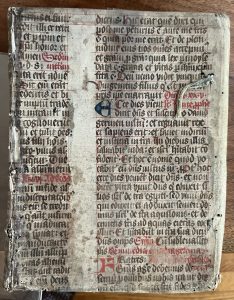
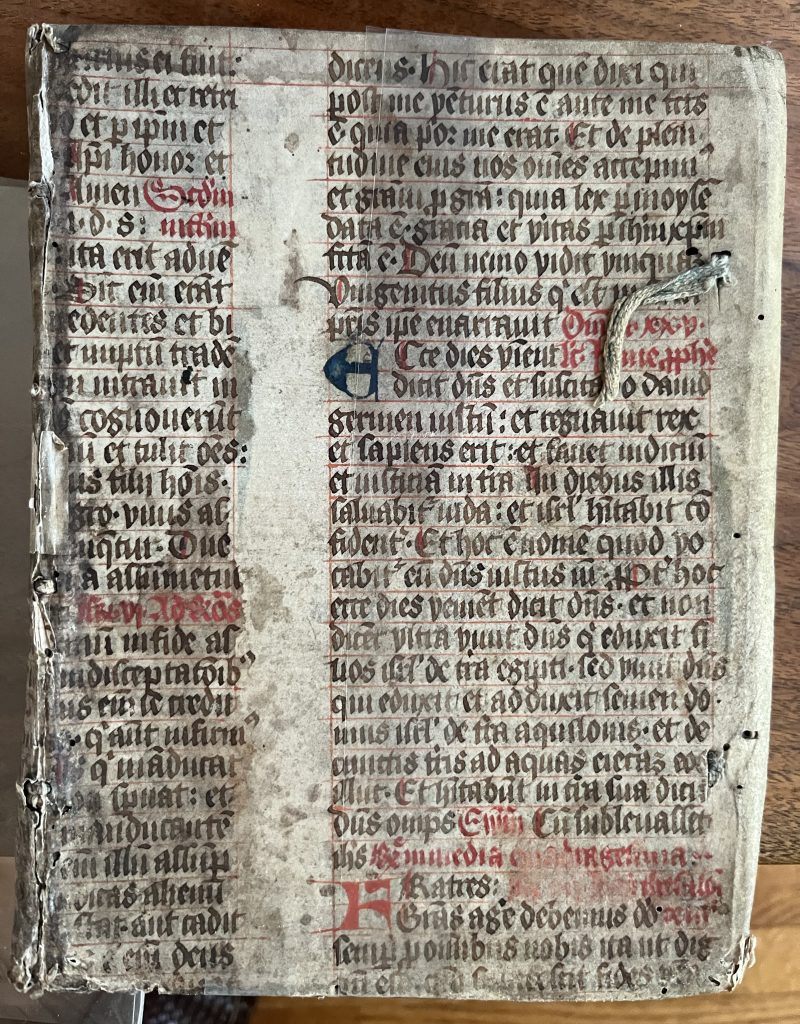
Private Collection, Front Cover with Reused Medieval Musical Fragment on Vellum. Photograph by Mildred Budny.

The Musical Fragment and its ‘Find-Place’

For the musical fragment, we will work to decipher the visible parts of the text and music, identify the readings/lections and chants, and, if possible (given the fragmentary nature), determine the probable genre of original manuscript, such as lectionary, breviary, antiphonary, or missal. Perhaps, over time, we might find other survivors from the same despoiled medieval manuscript.

Narrowing down its possible origin—or location in the early 17th century or later when it came to be reused as a binding cover–might aid the quest to determine the circumstances of its reuse and whence other parts of it might have been disseminated, whether as reused binding materials or otherwise.

For the workshop, we will examine the features of the printed book. It includes multiple woodcut illustrations and occasional marginalia in forms of annotations demonstrating attention of several kinds to the contents of the herbal.

What brought this medieval musical fragment and early modern printed book together? Even if we might never know all the answers, won’t it be fun to question how and why? There is a story here.

We love the puzzles, and give thanks to the collector for lending the book to the RGME for study and teaching and for sharing it with our audience in this workshop and beyond.

Information

People who be participating at the workshop to offer observations, reflections, and suggestions about the composite volume include (in alphabetical order):

Phillip Bernhardt–House

Mildred Budny

Natalia Fay

Leslie French (represented by a report on the musical manuscript fragment)

Beppy Landrum Owen

David Porreca

David W. Sorenson (with some specimens of herbals mentioning astrological influences)

And others.

At our 2024 Spring Symposium at Vassar College, Natalia delightfully described her work for her exhibition on herbals then on display in the Art Library. She shares the poster and brochure for the exhibition with us, as she returns to our events in this workshop to report on her continuing interests in plants, books, manuscripts, and their transmission.

  • Natalia Fay, Botanicals Thesis Poster
  • Natalia Fay, Arcane Botanicals Program

The Manuscript Fragments

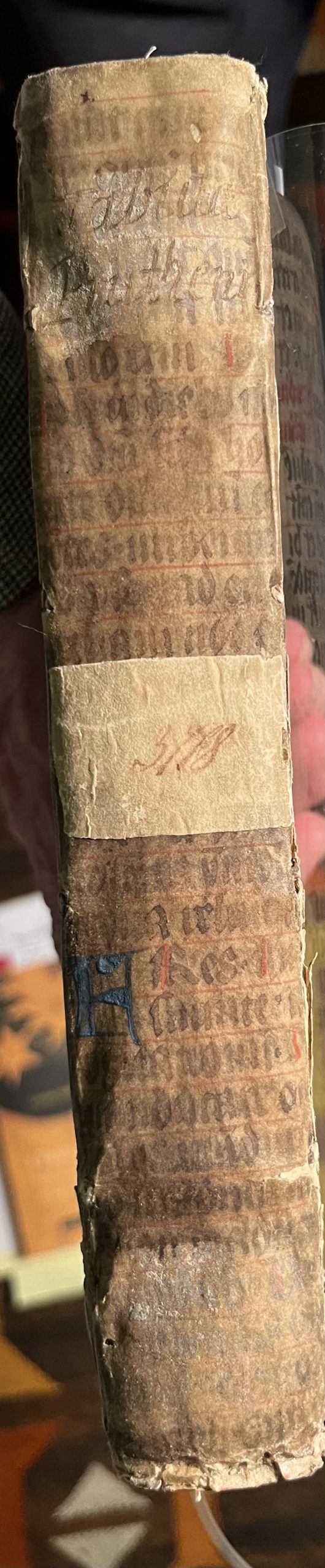
The visible portions of the manuscript appear, with only one side facing and the other side hidden, on the outer sides of the front and back covers, spine, and fore-edges of the binding.

Their text and music on four-line staves stand upright on the volume. Written in Gothic script, the parallel lines of music and text have some elements in red and blue pigments. There are ten lines on the front cover and on the spine, but the back cover has an additional line of music at the bottom, amounting to 10 1/2 lines on this portion. Each portion of the fragment shows a single column, or part of one. At the right on the back cover, the right-hand side of the fragment extends beyond the column with an expanse of outer margin from its original extent.

Sections open with 2-line initials which span the full height of the paired lines of music-and-text, for which the staves separate their horizontal course. One initial comprises a blue capital I (front cover, line 7). Three band-like initials comprise decorative forms in black ink with a vertical twist at the left-hand side; red pigment fills the centers of their twists (front cover, lines 2 and 6; back cover, line 2).

1. Front Cover

Private Collection, Front Cover with Reused Medieval Musical Fragment on Vellum. Photograph by Mildred Budny.

2. Back Cover

Private Collection. Musical Manuscript Fragment, Back Cover with ruler.

Spine

Private Collection. Hybrid book with Musical Manuscript Fragment, Spine View.

The Printed Book

The printed text comprises the German Kreutterbuch (“Book of Herbs”), an astrological herbal, by Bartholomaeus Carrichter (1510–1574), in an early edition printed in Strasbourg in Alsace in 1606. The author, who wrote under the pseudonym of Philomusus Anonymus, was physician to Ferdinand I (1503–1564), Holy Roman Emperor from 1556, and his son Maximilian II, Holy Roman Emperor from 1564 to 1576. The first edition of his Kreutterbuch was printed in Strasbourg in 1517 by Chistian Muller. For later editions, the physician, poet, and alchemist Michael Toxites (1515–1581), whose birth-name was Johann Michael Schütz, added some material to Carrichter’s work and edited it.

One of various versions of the illustrated genre by different authors (see, for example the Kreutterbuch desz Hocgelehrten und Weitberuhmten Herrn D. Petri Andreae Matthioli . . . ), this book combines information about plants, use, and lore with astrological considerations.

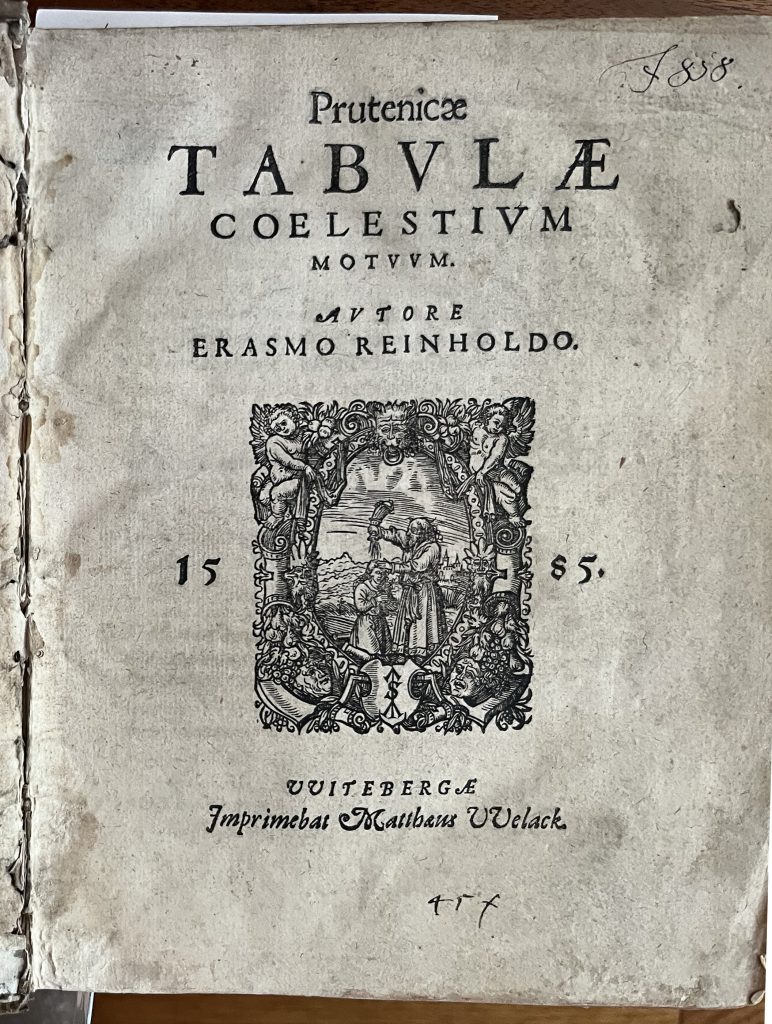
Title Page

A catalogue description of the volume characteristically derives from information on the title page:

Philomusus Anonymous [Bartholomaeus Carrichter (1510–1574)], Horn des Heyls menschlicher Blödigkeit, oder Kreütterbuch, darinn die Kreütter des Teutschenlands auss dem Liecht der Natur nach rechter Art der himmelischen Einfliessungen beschriben / durch Philomusum Anonymum [Bartholomäus Carrichter], with a foreword by Michael Toxites, born Johann Michael Schütz (1514–1581), (Strassbourg: Anton Bertram, DCVI/1606).

An inscription in light black ink at the foot of the title page gives the initials “G. S.” Perhaps they refer to an owner.

Private Collection, Kreutterbuch, title page. Photograph by Mildred Budny.

For the first edition of 1576, printed in Straßburg, see an online digital facsimile of a copy in Augsburg, Staats- und Stadtbibliothek. For an edition of 1619 also printed by A. Bertram, see the copy in the Wellcome Collection.

Like the 1619 edition, this folio volume has 10 unnumbered pages, 180 numbered pages, and 5 unnumbered leaves, with a woodcut title page and outline illustrations. Interspersed within the columns of text, the book has 58 outline illustrations depicting the herbs which it describes. For example, borage (Borago officinalis) or starflower:

Private Collection, Carrichter’s Kreutterbuch (Strasbourg, 1604). Borage. Photography by Mildred Budny.

Up close:

Private Collection, Carrichter’s Kreutterbuch (Strasbourg, 1604). Borage. Photography by Mildred Budny.

For comparison: Borage ‘In The Wild’

Borago officinalis. Photograph by By Christian Orlandi (12 April 2025) – Own work, CC BY-SA 4.0. Image via Wikimedia Commons via https://commons.wikimedia.org/wiki/File:Borago_officinalis_(2025).jpg.

Some marginal annotations in brown ink amplify or comment upon passages.

Private Collection, Carrichter’s Kreutterbuch (Strasbourg, 1604). Textual opening with marginal Annotations. Photography by Mildred Budny.

*****

Registration for the Workshop

We invite you to join the quest.

  • https://www.eventbrite.com/e/workshop-8-a-hybrid-book-with-astrological-herbal-and-medieval-missal-tickets-1340074201009

*****

Questions? Suggestions?

  • Leave your comments or questions below
  • Contact Us

Visit our Social Media:

  • Leave your comments or questions below
  • Contact Us

Visit our Social Media:

  • our Facebook Page
  • our Facebook Group
  • our X/Twitter Feed (@rgme_mss)
  • our Bluesky nest @rgmesocial.bluesky.social)
  • our Instagram Page
  • our LinkedIn Group

Join the Friends of the RGME.

Please make a Donation in Funds or in Kind for our nonprofit educational corporation powered principally by volunteers. Your donations and contributions are welcome, and can go a long way. They may be tax-deductible to the fullest extent provided by the law.

  • Donations and Contributions
  • 2025 Annual Appeal

*************

Tags: astrological herbals, Bartholomaeus Carrichter, Early modern printing, history of herbals, history of printing, Kreutterbuch, manuscript fragments, Manuscript Fragments Reused in Bindings, Manuscript studies, medieval musical manuscripts, Michael Toxites
No Comments »

Fragments from a Book of Hours

July 27, 2025 in Manuscript Studies, Photographic Exhibition, Research Group Workshops, Workshops on "The Evidence of Manuscripts"

Detective Story
“Fragments from a Book of Hours
Looking for their Identity”

[Posted on 25 July 2025]

Would you help us identify these fragments of a single leaf from a Book of Hours in a Private Collection? As if by the skin of their teeth, they survive together in a single collection. That collection has no other fragments from the same manuscript.

We wonder about these ‘foundlings’ and their former home in the medieval manuscript which contained them and their ‘relatives’ comprising the other leaves and the rest of this one leaf. Would you like to join the quest to find their identity?

Original Recto

Private Collection, Fragmentary Leaf from a Book of Hours. Recto, with two pieces aligned in their former original position. Photograph by Mildred Budny.

Original Verso

Private Collection, Fragmentary Leaf from a Book of Hours. Verso, with two pieces aligned in their former original position. Photograph by Mildred Budny.

Do you recognize their style, script, layout, and original manuscript? When and where do you think that it was made, and do you know, perchance, when and where it was dismembered for distribution?

We turn to the wider world to crowd-source the answers.

What do you think?

We plan to showcase these fragments and others looking for their identities in the series of

  • RGME Workshops on “The Evidence of Manuscripts, Etc.”

Please join us for the joys of detective work and sharing discoveries.

We look forward to hearing from you.

Private Collection, Fragmentary Leaf from a Book of Hours. Recto bottom, with two pieces aligned in their former original position. Photograph by Mildred Budny.

*****


Tags: Books of Hours, Fragmentology, Manuscript Foundlings, manuscript fragments, Medieval manuscripts
No Comments »

Workshop 6. “What’s In a Name?”

April 16, 2025 in Announcements, Manuscript Studies, Research Group Workshops

RGME Workshops
on
“The Evidence of Manuscripts, Etc.”

Workshop 6
“What’s In a Name?
Guides to Nomenclature
for Manuscript Studies”
Sunday 27 April 2025

Jan Van Eyck, The Virgin and Child with Canon van der Paele, 1434–36, Bruges, Groeningemuseum (detail), image from the Closer to Van Eyck project (https://closertovaneyck.kikirpa.be/)

[Posted on 16 April 2025]

Continuing our series of RGME Workshops on “The Evidence of Manuscripts, Etc.”, we move from the first series, Workshops 1–5 devoted principally to identifying selected Medieval Latin Vulgate Bible Manuscript Fragments.

The Name ‘Game’

By request, for Workshop 6 we will consider ‘best practices’ with regard to the use of Nomenclature for Manuscript Studies.

We explore the range of terms in use (in English and other languages) for different parts of books, from the outside in. In this way, we consider the merits — or otherwise — of terms in use for different parts of manuscripts, books, bindings, and other features of the material evidence of written sources. How helpful and comprehensible are the systems of terminology?

Examples of reference works online and in print will be examined, with observations on their usefulness for various purposes, types of books, problems, and approaches.

Do you have specific questions? We can help.

Add-On

Since Workshop 5, a new discovery of a medieval Latin Bible leaf has come to light, so that we might briefly introduce it to our ongoing project on those materials.

The owner contacted us because of our blog on Manuscript Studies, which featured some leaves from the same Bible manuscript despoiled and distributed by Otto F. Ege, biblioclast. His work, its widespread legacy, and multiple projects dedicated to identifying and reconstructing (at least virtually) the fragments of manuscripts inspired us to prepare our 2025 Autumn Colloquium on “Break-Up Books and Make-Up Books”.

  • 2025 RGME Autumn Colloquium at the University of Waterloo

Can you guess which manuscript this fragment came from?

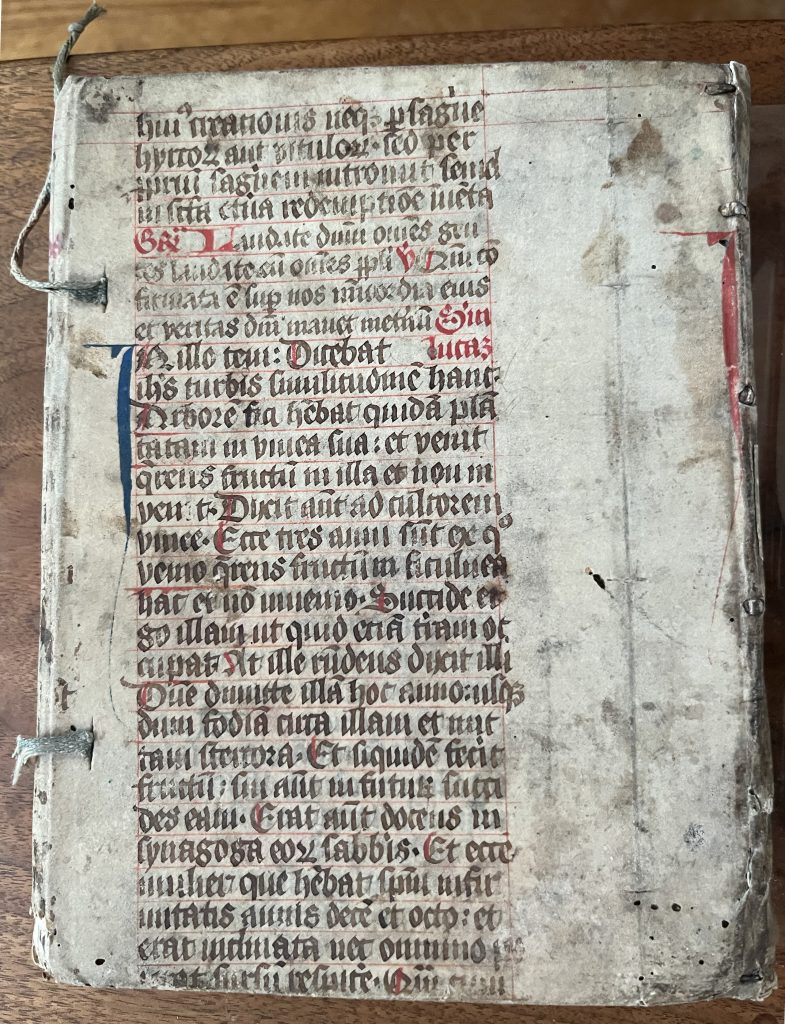
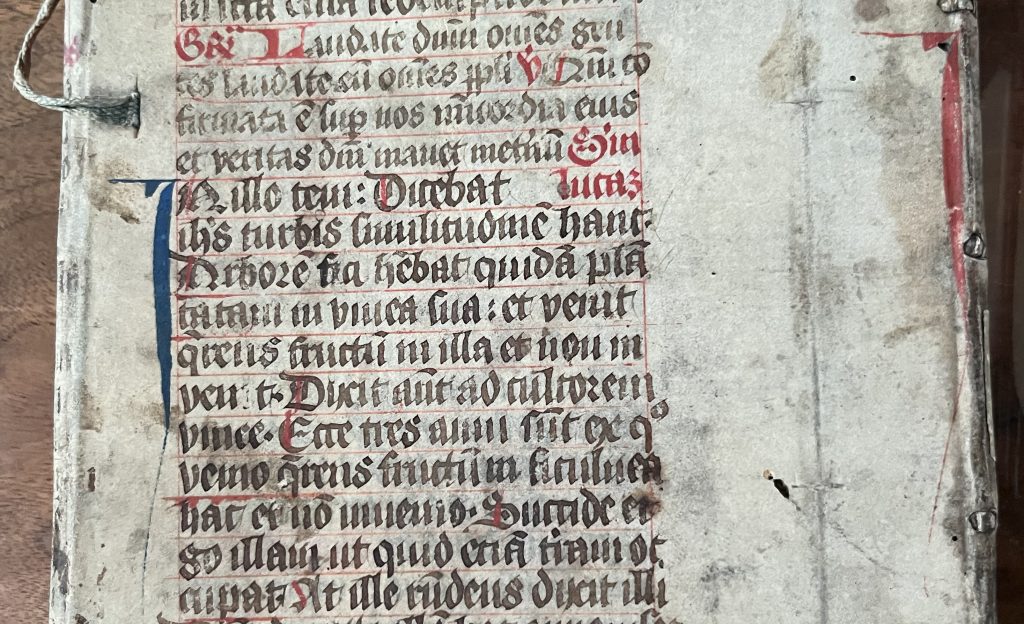
We show one side, as it stands in the glass frame which at present contains it. Visible within the window of the mat is the leaf with part of the running title (MA-) and the text laid out in two columns of thirty-two lines. In the intercolumn, a segmented frieze-like vertical series of J– or reverse L-shaped bar motifs in alternating red and blue pigment extends above and below the 2-line inset initial A (for Anno) for Chapter VII.

Private Collection. Leaf from a Medieval Latin Vulgate Bible, Manuscript, ‘Verso’.

Registration

  • Workshop 6. “What’s In a Name?” Tickets

After registration, we will send the Zoom Link shortly before the event.  The Link will come from the RGME, not Eventbrite or Zoom.

With registration, we invite you to make a Voluntary Donation in support of our nonprofit educational organization powered principally by volunteers. Your donation for our Section 509(c)(3) nonprofit organization might be tax-deductible to the fullest extent permitted by law.

We thank you for your support for our organization and interest in our activities.

We hope to see you there.

*****

Jan Van Eyck, The Virgin and Child with Canon van der Paele, 1434–36, Bruges, Groeningemuseum (detail), image from the Closer to Van Eyck project (https://closertovaneyck.kikirpa.be/)

Tags: Manuscript studies, Nomenclature for Manuscript Studies, RGME Workshops on the Evidence of MSS Etc.
No Comments »

Workshop 4. “Manuscript Fragments Compared”

February 16, 2025 in Announcements, Manuscript Studies, Research Group Workshops

RGME Workshops
on
“The Evidence of Manuscripts, Etc.”
(Formerly: “Examining Original Sources”)

Workshop 4
“Manuscript Fragments Compared”

Sunday 23 February 2025
1:00- 2:30 p.m. EST (GMT-4) by Zoom

We cordially invite you to join us for our next RGME Workshop on the “Evidence of Manuscripts Etc.” The series gives the opportunity collectively to examine original sources, in manuscript and other written forms. Beginners and experts are welcome; we can learn together.

The Series

Originally this series was planned as a two-part series of workshops to consider the medieval “Farell Leaf” on loan to the RGME Library and Archives from the Collection of Jennah Farrell. After rich discussions concerning the fragment and evidence for its production and provenance, most probably as part of the Saint Albans Bible (dismembered in 1964), our workshops have turned into a series for teaching manuscripts and related studies.

Collection of Jennah Farrell, Single Leaf from the Book of Numbers in a Medieval Latin Vulgate Bible manuscript: Recto, top. Photography by Mildred Budny.

Workshop 4

Workshop 4 introduces a comparative study. The plentiful genre of medieval Latin Vulgate Bibles is a rich field in Manuscript Studies. Work on cases of deliberately disbursed manuscripts has yielded in the last two decades a selection of stand-out works. Among them is the Saint Albans Bible, known through numerous studies in print and online. Examples include

  • “Breaking Bad: The Incomplete History of the Saint Albans Bible” (1 Nov 2019)
  • The Book, The Leaf, The Knife, and Some Bother
  • The St Albans Bible (20 June 2021)

Since Workshop 3, another leaf from the medium-format Saint Albans Bible has come to our attention. It stands in the collection of our Associate, Richard Weber – from whose collection our blog on Manuscript Studies has reported other discoveries. Its portion from the Acts of the Apostles offers comparison with the Farrell Leaf from the Book of Numbers, with a view toward the presentation of both Old and New Testaments within its former single volume.

Now see:

  • The Weber Leaf from the Saint Albans Bible

Collection of Richard Weber, Leaf from the Saint Albans Bible, Recto: Top Right. Photograph by Richard Weber.

In our workshop, the case of that manuscript is joined by another fragmented Bible, dismembered instead by the biblioclast Otto F. Ege: namely his large-format Ege MS 14, represented by a leaf now on loan to the RGME for teaching purposes. Over the years, our blog has contributed discoveries to knowledge of that manuscript (see Manuscript Studies). For our workshop, Richard Weber reports his leaf from that manuscript as well.

Private Collection, Leaf from ‘Ege MS 14’. Part of the Book of Jeremiah, Recto, Detail. Photograph by Mildred Budny.

Resources for the Quest

The different agents of destruction for these two books provide instructive case studies for the different but overlapping resources available in print and online for the detective work of fragmentology, in the quest to trace the steps of re-distribution of leaves from these Bibles, with a view toward identifying the locations of survivors and virtually reconstructing their original books, insofar as possible.

We welcome participants to join the quest and come forward with questions, updates on any work they have been doing on the Farrell Leaf, or suggestions for potential avenues of study in future workshops.

Registration

Registration is required and free. We are grateful for Voluntary Donations accompanying your Registration to help support our nonprofit educational organization powered principally by volunteers.

  • Workshop 4. “Manuscript Fragments Compared”: Tickets

Note that our Workshop series now appears on our Eventbrite Registration Portal:

  • RGME Workshops on “Examining Original Sources”: Tickets: Tickets

If you have issues with the Zoom Link or connecting, please contact

  • director@manuscriptevidence.org or rgmesocial@gmail.com .

Information about the series

  • RGME Workshops on “The Evidence of Manuscripts, Etc.”

  • The Bridge of Signs

  • Handlist of Recources for Manuscript Studies and Fragmentology

Workshop 5 is planned for Sunday March 2025 at 1:30-2:30 pm EST (GMT-5) by Zoom.

Please join us if your timetable allows. We look forward to welcoming you.

*****

Questions? Suggestions?

  • Leave your comments or questions below
  • Contact Us

Visit our Social Media:

  • our Facebook Page
  • our Facebook Group
  • our X/Twitter Feed (@rgme_mss)
  • our Bluesky nest @rgmesocial.bluesky.social)
  • our Instagram Page
  • our LinkedIn Group

Join the Friends of the RGME.

Please make a Donation in Funds or in Kind for our nonprofit educational corporation powered principally by volunteers. Your donations and contributions are welcome, and can go a long way. They may be tax-deductible to the fullest extent provided by the law.

  • Donations and Contributions
  • 2025 Annual Appeal

We look forward to seeing you at our events!

*****

Tags: Collection of Richard Weber, Fragmentology, Jennah Farrell Collection, Latin Vulgate Bibles, Manuscript studies, Medieval manuscripts, Otto Ege MS 14, Otto F. Ege, RGME Workshops on the Evidence of MSS Etc., Saint Albans Bible
No Comments »

The Latin Vulgate Bible Leaf in the Farrell Collection, Part 3: The Full Leaf

November 14, 2024 in Announcements, Event Registration, Manuscript Studies, Research Group Workshops, RGME Lending Library, RGME Library & Archives

The Latin Vulgate Bible Leaf
in the Collection of Jennah Farrell

Part 3: The Leaf Revealed in Full

Single Leaf from the Book of Numbers
now unframed

Laid out in double columns of 46 lines in Gothic Script

Size of leaf =
maximum circa 29.3 cm. tall
 × 20.1 cm. wide
(circa 11 9/16 in. × 7 15/16 in. )

< ruled writing area
circa 18.7 × 12.5 cm. (circa 7 3/4 × 4 7/8 in.)>

[Posted on 13 November 2024]

Collection of Jennah Farrell, Manuscript Leaf in Frame. Photograph by Jennah Farrrell.

Now that the manuscript leaf has been removed from its modern frame (see Part 2 in this series of blogposts), we display photographs of both sides of the leaf uncropped, showing its full extent at present.

We do so especially to prepare for the pair of online Workshops which we plan so as to crowdsource information, expertise, and collaboration. We invite a shared exploration to learn and teach more about the leaf, its original manuscript, its context within its genre of book and other relatives from the same center, period, or region, and perhaps also its travels from its date and place of origin in medieval Europe to its present collection in the United States.

About the frame and information about the collection from which Jennah Farrell acquired the leaf in its frame, see Part 2 on Provenance:

  • Latin Vulgate Bible Leaf in the Collection of Jennah Farrell, Part 2

Part 1 introduced the leaf in its frame, in the state in which it reached the RGME Lending Library for photography, conservation, research, and teaching:

  • A Latin Vulgate Leaf from the Book of Numbers (Part 1)

Now for Part 3 we focus on the leaf itself, including the evidence which its outer portions and its entire back side, formerly hidden, can reveal.

Side 1

This side faced forward in the former frame.

Collection of Jennah Farrell, Single Leaf from the Book of Numbers in a Medieval Latin Vulgate Bible manuscript. Full extent of the leaf, unframed: Recto. Photography by Mildred Budny.

Side 2

Collection of Jennah Farrell, Single Leaf from the Book of Numbers in a Medieval Latin Vulgate Bible manuscript. Full extent of the leaf, unframed: Verso. Photography by Mildred Budny.

Releasing the Leaf from the Frame

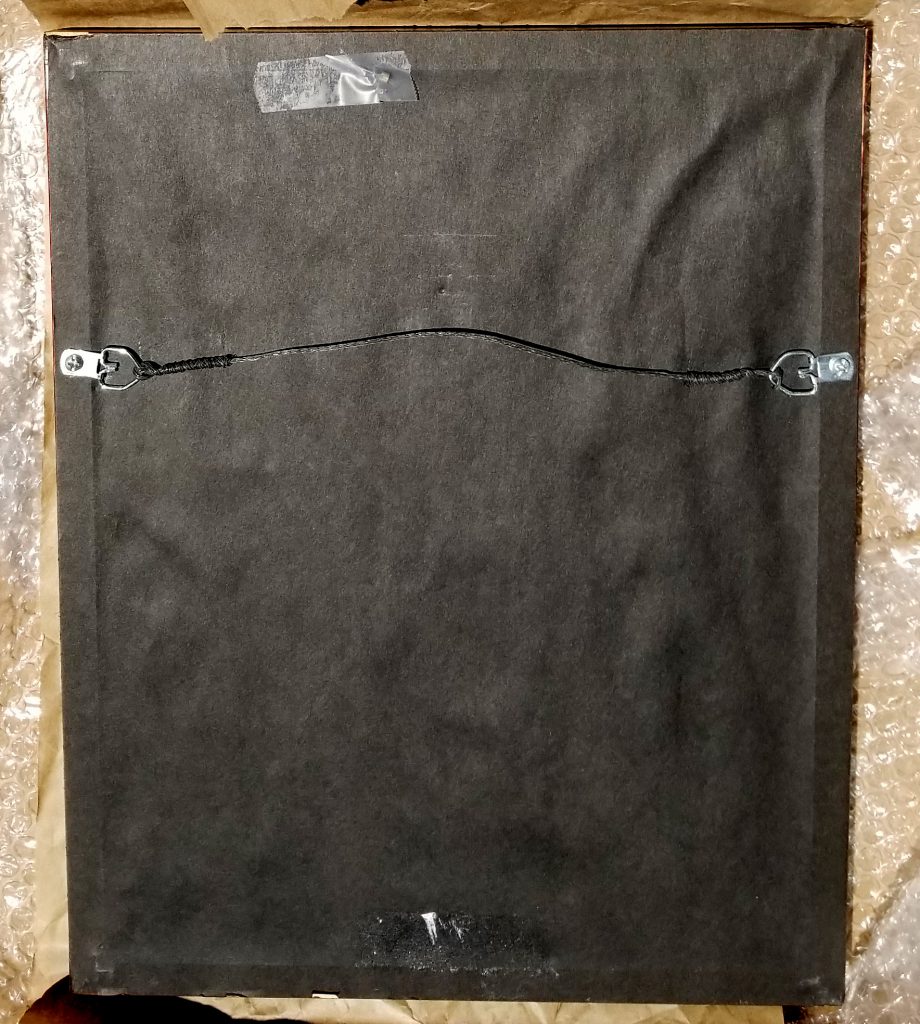
Collection of Jennah Farrell, Manuscript Leaf: Back of Frame. Photograph by Mildred Budny.

Removing the leaf from its frame employed a set of tools 1) to unscrew the mounting hinges and hanging wire, 2) release the backing paper glued to the back edges of the wooden frame, 3) detach the heavy staples which clamped a sheet of foam board to the framing mat, and 4) lift the mat to release the leaf.

Tools to Open the Frame and Left-over Pieces from the Frame containing the Farrell Bible Leaf. Photography by Mildred Budny.

The pieces of the frame are now kept together: stained wooden frame, sheet of glass, windowed mat, foam board, backing paper, staples, and hanging nail. The leaf is now kept in a clear archival L-sheet housed in an archival document binder.

Both Sides Now in View

Released from the frame and its mat, the leaf can be seen to have about 5 cm. more from top to bottom and about 4 more cm. from side to side.  Revealed are the full extent of the margins and parts of the foliate decoration of the ornamental bars which extend from the chapter initials in three columns of the four in the layout of two columns per page or side of the leaf.

Revealed too is the marginal correction for the text entered in the outer margin on the verso and the remnants of the stitching line at the inner edge or gutter of the leaf, where an uneven cut along the full length of the leaf severed it from its formerly conjoint leaf in its original manuscript.

Can you tell which side of the leaf is the front, or original recto, and which is the back, or original verso?

Do you recognize, or would you like to discover, which manuscript the leaf came from when it was cut out of its book and separated from its relatives, to enter the world as a single leaf on its own, suited for framing and display such as on a wall?

Would you like to help us to learn about it?

A Pair of Workshops for this Leaf

We plan two RGME Workshops on Looking at Manuscripts, the first in a new series, to introduce the leaf and learn how to identify its probable date and place of origin, as well as its former manuscript and its context among relatives. Our challenge is to discern what the leaf might itself have to say about these different stages, and what we might discover about its original identity, its former manuscript, and its dispersal.

Both workshops will be held online by Zoom, for which registration (free) is required.

1) Workshop 1 introduces the leaf and sets the groundwork.

Sunday 17 November 2024 at 1:00-2:30 pm EST (GMT-5) by Zoom

  • Workshop 1: Registration

2) Workshop 2 follows up the lines of investigation as we might collectively compare notes and refine our inquiries more fully to understand the leaf and its relatives.

Sunday 16 December 2024 at 1:00-2:30 pm EST (GMT-5)

  • Workshop 2: Registration

After you register, the Zoom Link will be sent to you a few days before the event.

Beginners and experts welcome!

*****

About our new series of Workshops on Looking at Manuscripts, see:

  • The Bridge of Signs

We have been waiting for the opportunity, occasion, and resources to bring to our community for workshops, online and/or in-person, collectively to explore original source materials. With the RGME “Lending Library” as well as our own materials in the RGME Library & Archives, and with our time-tested habits of online events as well as in-person workshops, we launch our new series in a mobile approach to bring together original sources and a community interested in studying them and teaching with them.

Please join our expedition!

*****

Suggestion Box

Please Contact Us or visit

  • our FaceBook Page
  • our Facebook Group
  • our Twitter Feed (@rgme_mss)
  • our Bluesky nest @rgmesocial.bluesky.social)
  • our LinkedIn Group
  • our Blog on Manuscript Studies and its Contents List

Would you like to help?

*****

Tags: Jennah Farrell Collection, Latin Vulgate Bibles, Manuscript studies, Medieval manuscripts
No Comments »

The Bridge of Signs

November 5, 2024 in Manuscript Studies, Research Group Workshops

The Bridge of Signs

Bridging the Gap
between Original Source
and its Interpretation

Signposts
by the RGME Research Consultant,
Leslie J. French

with a Foreword by the RGME Director and WebEditor,
Mildred Budny

[Posted on 5 November 2024, with updates]

Foreword

by Mildred Budny

As the RGME plans a new series of Workshops to examine manuscripts and other original sources, we reflect on the plan. In our early years based at the University of Cambridge as an outside-funded research project on selected Anglo-Saxon and Related Manuscripts at the Parker Library of Corpus Christi College (1989–1994), we held a series of RGME Seminars on the Evidence of Manuscripts.

From the start, as manifested in our choice of name, Research Group on Manuscript Evidence, and the integrated scope and functions of our very first project, we have taken care to distinguish between the evidence and interpretations made from it, as well as to attend to the stages or steps between them. Such steps extend from examination of the object, through photography, decipherment (if need be), transcription (diplomatic or normalized), edition (semi-diplomatic or normalized), translation, and placement in context, to reach increased, informed, and it may be collaborative, understanding — in steps which involve interpretation of various kinds.

Collection of Jennah Farrell, Manuscript Leaf in Frame. Photograph by Jennah Farrrell.

Now, in our 2024 Anniversary Year with its theme of Bridges, we prepare to launch a series of RGME Workshops on Manuscripts and Other Sources.  They start with a new Loan of a detached leaf on vellum from a medieval Latin Vulgate Bible in the Collection of Jennah Farrell.

  • A Latin Vulgate Leaf from the Book of Numbers (Part 1)

With permission, our Director Mildred Budny removed the leaf from its modern frame, to reveal its full extent and its back or verso which the frame had hidden, in time for our 2024 Autumn Symposium: Spotlight on Special Collections as Teaching Events (25–26 October). The Symposium Booklet illustrates both sides of the leaf. You may find the booklet for download as:

  • consecutive pages, quarto size (8 1/2″ × 11″ sheets)
    2024 Autumn Symposium Booklet: Consecutive Pages
  • foldable booklet (11″ × 17″ sheets)
    2024 Autumn Symposium Program: Foldable Booklet

Next, we will hold a pair of online Workshops to study the leaf collectively. For example, can we identify what this leaf contains, which manuscript originally contained this detached leaf, where and when it was made, how did it find its way from the manuscript in steps to the Farrell Collection, and what can it tell us about itself and its history?

These Workshops can show and share the detective work. Beginners and advanced scholars alike are welcome, as we compare notes and ‘adopt’ the leaf as a subject of discovery and wonder, while it visits the RGME on generous loan for research, study, and teaching, before it returns to its collection.

  • Workshop 1. Introduction to the Farrell Leaf: What do we See?
    (Sunday 17 November 2024 by Zoom)
    Registration: Workshop 1: Introduction to the Farrell Leaf
  • Workshop 2. Follow-up for the Farrell Leaf: What have we Learned?
    (Sunday 15 December 2024 by Zoom)
    Registration: Workshop 2: Follow Up for the Farrell Leaf

Collection of Jennah Farrell, Single Leaf from the Book of Numbers in a Medieval Latin Vulgate Bible manuscript: Recto, top. Photography by Mildred Budny.

Plan

First, we offer observations about the process, and its strategy, as we prepare this series of collective approaches to teach and learn the methods of examining and studying the sources — in such forms as they and their evidence become accessible, directly and/or through surrogates such as photographs, digital facsimiles, reports, and other means.

As a lead-in to our Workshops, we turn to our Research Consultant, Leslie J. French, for a description of the principles and practices which underpin their approaches and methodology, based on the experiences which the RGME has gathered in its years of work, photography, research, teaching, and publication on original materials. His approach provides both foundation and signposts for the work of the Workshops and the preparation of resources for them. Among such resources are photography, bibliographical references, and our growing

  • Handlist of Resources for Manuscript Studies and Fragmentology
    — for which we invite suggestions and additions.

Stepping Stones
Observations by our Research Consultant

Poster announcing Bembino Version 1.6 (January 2019)Leslie J. French, our Research Consultant and Font & Layout Designer, has contributed to many RGME activities and publications from our very beginnings in 1989 as part of a major, outside-funded, research project on Anglo-Saxon and Related Manuscripts at the Parker Library of Corpus Christi College in the University of Cambridge. His contributions include

  • the design of our logo,
  • the design and layout of most of our publications,
  • the creation of our multi-lingual digital font Bembino (displayed on our website and elsewhere), and
  • the research and preparations for numerous RGME Research Reports and presentations at our scholarly events.

See also:

  • Interview with Our Font & Layout Designer
  • The Design and Layout of the Illustrated Catalogue

In his own words:

Bridge of Signs

by Leslie J. French

View of the Pont Neuf, Paris. Photograph by Claudio Mota via https://www.pexels.com/photo/pont-neuf-bridge-in-paris-9999874/.

Increased digitization of manuscript and printed resources has dramatically improved scholars’ ability to view content.  However, increased accessibility does not imply increased comprehension.  There still remains a gap between what might be observed on a page, and its interpretation.
We seek to bridge that gap between the artefact on one bank and the reader on the other.  This may be a very large gap, particularly for newcomers to the field who are unfamiliar with the script, abbreviations, text and structure of the documents they are viewing.
Our aim is to create a series of pillars, or supports, across the gap, and to build the bridge, section by section, between.

Read the rest of this entry →

Tags: Bridges, Collection of Jennah Farrell, Editions, Le Pont Neuf, Manuscript Photography, Manuscript studies, RGME Lending Library, RGME Seminars on the Evidence of Manuscripts, RGME Workshops on Looking at Manuscripts, Transcriptions
No Comments »

  • Top
©2024 Research Group on Manuscript Evidence.


is proudly powered by WordPress. WordPress Themes X2 developed by ThemeKraft.