• News
    • News & Views
    • RGME Activities for 2024 and 2025
    • Around & About with the RGME
    • Reviews
    • Highlights
  • Blogs
    • Manuscript Studies
      • Manuscript Studies: Contents List
    • International Congress on Medieval Studies
      • Abstracts of Congress Papers
        • Abstracts of Papers Listed by Author
        • Abstracts of Papers Listed by Year
  • About
    • Mission
    • Who We Are
      • Officers, Associates & Volunteers
      • RGME Committees
      • Friends of the Research Group on Manuscript Evidence
    • Policies & Statements
      • RGME Privacy Policy Statement
      • RGME Intellectual Property Statement & Agreements
    • People
      • Mildred Budny — Her Page
      • Adelaide Bennett Hagens
    • Activities
      • Events
      • Congress Activities
        • Sponsored Conference Sessions (1993‒)
          • Panels at the M-MLA Convention (from 2016)
        • Co-sponsored Conference Sessions (2006‒)
    • History
      • Seals, Matrices & Documents
      • Genealogies & Archives
    • Contact Us
  • Bembino
    • Multi-Lingual Bembino
    • RGME Bembino: Resources
  • Congress
    • Sponsored Conference Sessions (1993‒)
    • Co-sponsored Conference Sessions (2006‒)
    • Abstracts of Congress Papers
      • Abstracts Listed by Author
      • Abstracts Listed by Year
    • Kalamazoo Archive
    • Panels at the M-MLA Convention (2016-2019)
      • Abstracts of Papers for the M-MLA Convention
      • Panels at the M-MLA Convention (from 2016)
  • Events
    • RGME Activities for 2024 and 2025
      • 2023 Activities and 2024 Planned Activities
    • Seminars, Workshops, Colloquia & Symposia (1989–)
      • Seminars on ‘The Evidence of Manuscripts’
      • Symposia on ‘The Transmission of the Bible’
      • The New Series (2001-)
        • 2019 Anniversary Symposium Program: The Roads Taken
        • 2019 Anniversary Symposium Registration
        • 2019 Anniversary Symposium Registration Open
      • RGME Symposia: The Various Series
      • The Research Group Speaks: The Series
      • Meetings of the Friends of the Research Group on Manuscript Evidence
      • RGME Online Events
    • Abstracts of Papers for Events
      • Abstracts of Papers for Seminars on ‘The Evidence of Manuscripts’
      • Abstracts of Papers for Symposia, Workshops & Colloquia
    • Receptions & Parties
    • Business Meetings
    • Photographic Exhibitions & Master Classes
    • Events Archive
  • ShelfLife
    • Journal Description
    • ShelfMarks: The RGME-Newsletter
    • Publications
      • “Insular, Anglo-Saxon, and Early Anglo-Norman Manuscript Art at Corpus Christi College, Cambridge” (1997)
        • Mildred Budny, ‘Catalogue’
        • The Illustrated Catalogue (1997)
      • The Illustrated Handlist
      • Semi-Official Counterfeiting in France 1380-1422
      • No Snap Decisions: Challenges of Manuscript Photography
    • History and Design of Our Website
  • Galleries
    • Watermarks & the History of Paper
    • Galleries: Contents List
    • Scripts on Parade
    • Texts on Parade
      • Latin Documents & Cartularies
      • New Testament Leaves in Old Armenian
    • Posters on Display
    • Layout Designs
  • Donations and Contributions
    • RGME Donor Promise
    • 2023 End-of-Year Fundraiser for our 2024 Anniversary Year
    • 2019 Anniversary Appeal
    • Orders
  • Links
    • Catalogs, Metadata, and Databases: A Handlist of Links
    • Handlist of Resources for Manuscript Studies and Fragmentology
    • Manuscripts & Rare Books
    • Maps, Plans & Drawings
    • Seals, Seal-Matrices & Documents

  • News
    • News & Views
    • RGME Activities for 2024 and 2025
    • Around & About with the RGME
    • Reviews
    • Highlights
  • Blogs
    • Manuscript Studies
      • Manuscript Studies: Contents List
    • International Congress on Medieval Studies
      • Abstracts of Congress Papers
        • Abstracts of Papers Listed by Author
        • Abstracts of Papers Listed by Year
  • About
    • Mission
    • Who We Are
      • Officers, Associates & Volunteers
      • RGME Committees
      • Friends of the Research Group on Manuscript Evidence
    • Policies & Statements
      • RGME Privacy Policy Statement
      • RGME Intellectual Property Statement & Agreements
    • People
      • Mildred Budny — Her Page
      • Adelaide Bennett Hagens
    • Activities
      • Events
      • Congress Activities
        • Sponsored Conference Sessions (1993‒)
          • Panels at the M-MLA Convention (from 2016)
        • Co-sponsored Conference Sessions (2006‒)
    • History
      • Seals, Matrices & Documents
      • Genealogies & Archives
    • Contact Us
  • Bembino
    • Multi-Lingual Bembino
    • RGME Bembino: Resources
  • Congress
    • Sponsored Conference Sessions (1993‒)
    • Co-sponsored Conference Sessions (2006‒)
    • Abstracts of Congress Papers
      • Abstracts Listed by Author
      • Abstracts Listed by Year
    • Kalamazoo Archive
    • Panels at the M-MLA Convention (2016-2019)
      • Abstracts of Papers for the M-MLA Convention
      • Panels at the M-MLA Convention (from 2016)
  • Events
    • RGME Activities for 2024 and 2025
      • 2023 Activities and 2024 Planned Activities
    • Seminars, Workshops, Colloquia & Symposia (1989–)
      • Seminars on ‘The Evidence of Manuscripts’
      • Symposia on ‘The Transmission of the Bible’
      • The New Series (2001-)
        • 2019 Anniversary Symposium Program: The Roads Taken
        • 2019 Anniversary Symposium Registration
        • 2019 Anniversary Symposium Registration Open
      • RGME Symposia: The Various Series
      • The Research Group Speaks: The Series
      • Meetings of the Friends of the Research Group on Manuscript Evidence
      • RGME Online Events
    • Abstracts of Papers for Events
      • Abstracts of Papers for Seminars on ‘The Evidence of Manuscripts’
      • Abstracts of Papers for Symposia, Workshops & Colloquia
    • Receptions & Parties
    • Business Meetings
    • Photographic Exhibitions & Master Classes
    • Events Archive
  • ShelfLife
    • Journal Description
    • ShelfMarks: The RGME-Newsletter
    • Publications
      • “Insular, Anglo-Saxon, and Early Anglo-Norman Manuscript Art at Corpus Christi College, Cambridge” (1997)
        • Mildred Budny, ‘Catalogue’
        • The Illustrated Catalogue (1997)
      • The Illustrated Handlist
      • Semi-Official Counterfeiting in France 1380-1422
      • No Snap Decisions: Challenges of Manuscript Photography
    • History and Design of Our Website
  • Galleries
    • Watermarks & the History of Paper
    • Galleries: Contents List
    • Scripts on Parade
    • Texts on Parade
      • Latin Documents & Cartularies
      • New Testament Leaves in Old Armenian
    • Posters on Display
    • Layout Designs
  • Donations and Contributions
    • RGME Donor Promise
    • 2023 End-of-Year Fundraiser for our 2024 Anniversary Year
    • 2019 Anniversary Appeal
    • Orders
  • Links
    • Catalogs, Metadata, and Databases: A Handlist of Links
    • Handlist of Resources for Manuscript Studies and Fragmentology
    • Manuscripts & Rare Books
    • Maps, Plans & Drawings
    • Seals, Seal-Matrices & Documents

Log in

Archives

Featured Posts

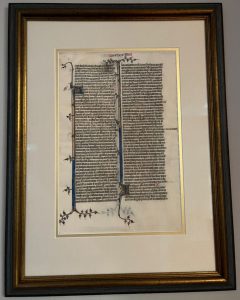
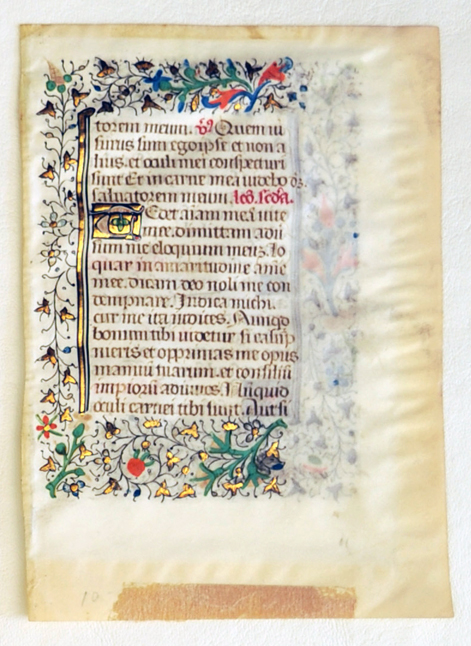
J. S. Wagner Collection. Leaf from from Prime in a Latin manuscript Breviary. Folio 4 Verso, with part of Psalm 117 (118) in the Vulgate Version, set out in verses with decorated initials.
2026 Annual Appeal
Private Collection, Ege's FBNC Portfolio, Dante Leaf, Verso, Detail. Reproduced by Permission.
2025 RGME Autumn Colloquium on Fragments
Workshop 8: A Hybrid Book where Medieval Music Meets Early-Modern Herbal
2025 RGME Autumn Symposium on “Readers, Fakers, and Re-Creators of Books”
“Thresholds and Communities”
RGME Workshops on “The Evidence of Manuscripts, Etc.”
2025 International Medieval Congress at Leeds: RGME Program
Episode 21. “Learning How to Look”
2025 International Congress on Medieval Studies: Program
2025 RGME Visit to Vassar College
Two Leaves in the Book of Numbers from the Chudleigh Bible
Delibovi on Glassgold on Boethius: A Blogpost
Ronald Smeltzer on “Émilie du Châtelet, Woman of Science”
2025 Spring Symposium: “Makers, Producers, and Collectors of Books”
Starters’ Orders
The Weber Leaf from the Saint Albans Bible
Workshop 4. “Manuscript Fragments Compared”
Episode 20. “Comic Book Theory for Medievalists”
Episode 19: “At the Gate: Starting the Year 2025 at its Threshold”
2025 Annual Appeal
Favorite Recipes for Lemonade, Etc.
RGME Visit to the Lomazow Collection: Report
2024 Autumn Symposium: “At the Helm”
Medieval Women’s Networks
A Latin Vulgate Leaf of the Book of Numbers
The RGME ‘Lending Library’
Florence, Italy, Ponte Vecchio from Ponte alle Grazie. Photo: Ingo Mehling, CC BY-SA 4.0 , via Wikimedia Commons
Episode 17. “RGME Retrospect and Prospects: Anniversary Reflections”
2024 Anniversary Symposium: The Booklet
2024 International Medieval Congress at Leeds: Program
Jesse Hurlbut at the Bonneville Salt Flats, Utah. Photograph Jesse Hurlbut.
Episode 16: An Interview with Jesse D. Hurlbut
To Whom Do Manuscripts Belong?
Kalamazoo, MI Western Michigan University, Valley III from the side. Photograph: David W. Sorenson.
2024 International Congress on Medieval Studies: Report
2024 Spring Symposium at Vassar College
Puente de San Martín: Bridge with reflection over the River Targus, Toledo, Spain.
2024 Grant for “Between Past and Future” Project from The Gladys Krieble Delmas Foundation Research Libraries Program
2024 Anniversary Symposium in Thanks to Jesse Hurlbut: Program

You are browsing the Blog for RGME Library & Archives

Two Leaves in the Book of Numbers from the Chudleigh Bible

April 22, 2025 in Announcements, Manuscript Studies, RGME Library & Archives

Two Leaves
in the Book of Numbers
from the Chudleigh Bible

Latin Vulgate Bible
Northern France
Sant-Vaast Abbey?
Circa 1220–1230

Text written in Gothic Bookhand
Laid out in Double Columns of 56 lines
with Running Titles, Rubrication,
Text-Initials in Red and Blue,
and Marginalia within Frames

[Posted on 17 April 2025, with updates]
Formerly Collection of Richard Weber, Leaf 1 from the Chudleigh Bible: Recto, Detail. Photograph by Mildred Budny.

Continuing our series of posts describing discoveries for the study of manuscript fragments (see Manuscript Studies Blog: Contents List), we introduce two leaves which belonged to the Book of Numbers in the medium-format Latin Vulgate Bible now known as the Chudleigh Bible. The name derives from one of its former owners, the eleventh Baron Clifford of Chudleigh.

  • Charles Oswald Hugh Clifford (1887–1962), Lord Clifford of Chudleigh (Devon, England)
    See also:
  • “We Remember Charles Oswald Hugh Clifford”

The place Chudleigh itself is an ancient wool town in Devon in Southwest England.

First we introduce the two leaves. Then we describe the original manuscript, insofar as it is known from surviving fragments and the descriptions in catalogues (of sales, collections, and genres of medieval French manuscript production). A preliminary list of surviving leaves, including not only the seemly more significant and financially valuable leaves with illustrations, is offered, as a compliment or companion to existing lists.

Further blogposts will offer more information about both forms of experience for the manuscript and its identifiable fragments, whether indirectly by catalogue or other surrogate representative, or more directly by in-person inspection. The goal is to build towards a fuller recognition of the survivors, their characteristics, and their locations.

I. Two Leaves from the Book of Numbers

These two leaves come to the RGME as a donation by our Associate, Richard Weber. Previous blogposts have reported portions of his collection of manuscript fragments, starting with Set 93 of the Portfolio of Famous Books assembled by Otto F. Ege (1888–1951).

  • Portfolio 93 of Otto Ege’s Famous Books in Eight Centuries in the Collection of Richard Weber
  • The Weber Leaf from the Warburg Missal: Otto Ege Manuscript 22
  • The Weber Leaf from the Saint Albans Bible

1. That first post has set in motion a continuing study of that portfolio and its different components representing manuscript and printed materials alike. One development recently focuses upon a collaborative study of the dismembered volume of Dante as we prepare for the 2025 Autumn Colloquium on “Break-Up Books and Make-Up Books: Encountering and Reconstructing the Legacy of Otto F. Ege and Other Biblioclasts”. Richard has generously agreed to speak about his collecting interests for that event.

  • 2025 RGME Autumn Colloquium at the University of Waterloo

2. The Weber Leaf from Otto Ege Manuscript 22 inspired us to examine closely the evidence of origin, provenance, and genre of book for this leaf and other survivors of the same volume, set against Otto Ege’s labels of attribution based upon incomplete and misrepresented knowledge. The resulting Research Booklet, freely available, presents the evidence. You can find it here:

  • The Weber Leaf from the Warburg Missal: Otto Ege Manuscript 22

3. Richard shared photographs of his leaf from the Saint Albans Bible in response to our new series of Workshops on “The Evidence of Manuscripts, Etc.”, which took inspiration from the loan of a leaf from that Bible from the Collection of Jennah Farrell to the RGME for photography, study, and publication. We decided to turn to crowd-sourcing and mentoring in these workshops as a collaborative, collective way to learn about manuscripts together, including beginners, experts, and others in between. It was a good choice.

  • RGME Workshops on “The Evidence of Manuscripts, Etc.”

As the Workshops developed, they considered fragments from different Latin Bible manuscripts pertaining to similar periods, styles of production, and various sizes or formats. By Workshop 5, we could survey their range and the progress which the workshops and their collaborative approach had attained.

  • Workshop 5. “Identifying Medieval Latin Bible Manuscript Fragments”

At this Workshop, Richard Weber generously offered to give a couple of medieval Latin Bible leaves to the RGME for our Research Library & Archives.

Soon, the leaves arrived, which Richard had had beautifully framed in a pair of matching frames with windowed mats and easily removable backs. Protecting the leaves, these frames both showed each leaf to advantage and allowed for access from the back of the frame to allow us to see the other side of the leaf and its full extent.

Companion sheets of paper report details of the leaves, their seller, and the original manuscript, the Chudleigh Bible.

For this gift, we created a bookplate recording Richard’s donation. We give thanks for his characteristic generosity and thoughtfulness.

The Two Leaves

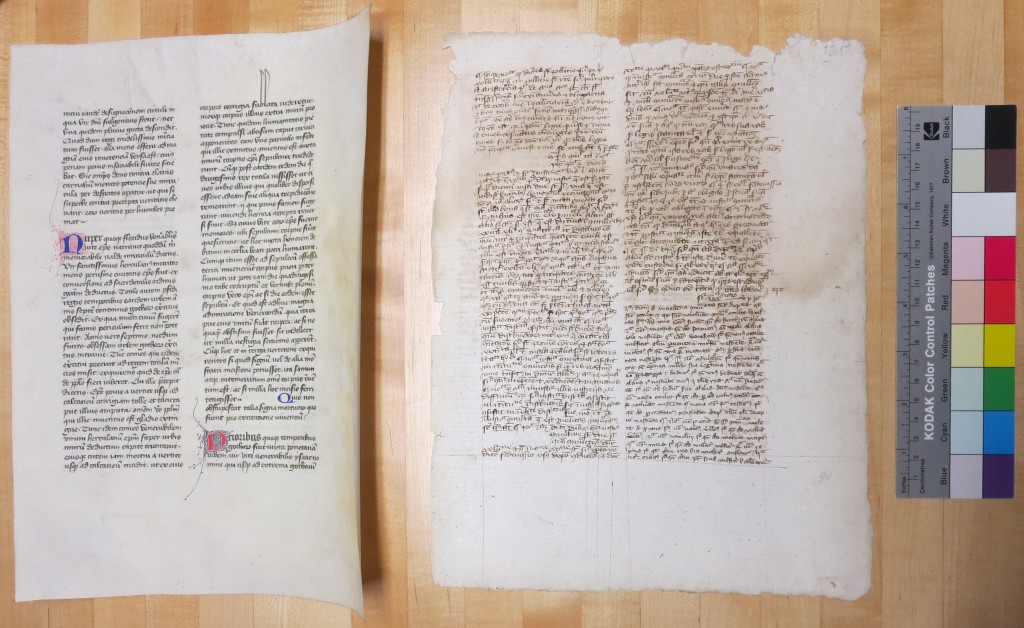
And so, we introduce a pair of non-consecutive leaves from the Book of Numbers in the Chudleigh Bible. The modern Arabic numbers written in pencil at the center directly below the columns of text label them as “38” and “43” respectively. Presumably they designate the folio numbers for them in a consecutive sequence entered before the separation of the leaves from each other.

So far we have not identified any surviving leaves which formerly stood between them or adjacent to them within the same Biblical Book.

Leaf 1: Folio 38

This leaf must have directly followed the opening leaf of the Book, as it starts partway within Chapter 1. That leaf would have carried the opening initial for the Book, with L for Locutusque. Its present location is unknown, but the contents of its illustrated initial have been recorded to indicate a depiction of the figures of God, Moses, and Joshua at an altar. (p. 69 and 72 note 8)

Recto

Formerly Collection of Richard Weber, Leaf 1 from the Chudleigh Bible: Recto.

Verso

Formerly Collection of Richard Weber, Leaf 1 from the Chudleigh Bible: Verso.

Leaf 2: Folio 43

Recto

Formerly Collection of Richard Weber, Leaf 2 from the Chudleigh Bible: Recto.

Verso

Formerly Collection of Richard Weber, Leaf 2 from the Chudleigh Bible: Verso.

Note that there has been some correction/adjustment in the Chapter Numbering. In the intercolumn for the left-hand column there stands a second XVI on the verso, duplicating the same number on the recto. It has been crossed out with a horizontal stroke. The numbering continues below with XVII and XVIII for the left- and right-hand columns respectively.


Contents: Text

Leaf 1 (recto and verso)

Numbers 1  36 [De filiis Benjamin per generationes et familias ac domos] cognationum suarum recensiti sunt nominibus singulorum a vigesimo anno et supra, omnes qui poterant ad bella procedere, 37triginta quinque millia quadringenti.
Numbers 2 1 Locutusque est Dominus ad Moysen et Aaron, dicens
Numbers 3  1 Hæ sunt generationes Aaron et Moysi in die qua locutus est Dominus ad Moysen in monte Sinai.
7 et observent quidquid ad cultum pertinet multitudinis coram taberna // culo testimonii,
Numbers 4  1 Locutusque est Dominus ad Moysen et Aaron, dicens
14 ponentque cum eo omnia vasa, quibus in ministerio ejus utuntur, id est, ignium receptacula[, fuscinulas ac tridentes, uncinos et batilla.]

Leaf 2 (recto and verso)

Numbers 15 9 [dabis per singulos boves similæ tres decimas consper]sæ oleo, quod habeat medium mensuræ hin
Numbers 16 1 Ecce autem Core filius Isaar, filii Caath, filii Levi, et Dathan atque Abiron filii Eliab,
28 Et ait Moyses : In //hoc scietis quod Dominus miserit me ut facerem universa quæ cernitis, et non ex proprio ea corde protulerim :
[Possibly struck through incorrect marking for chapter 16 at]
Numbers 16 36 Locutusque est Dominus ad Moysen, dicens
Numbers 17 1 Et locutus est Dominus ad Moysen, dicens
Numbers 18 1 Dixitque Dominus ad Aaron
11 Primitias autem, quas voverint et obtulerint filii Israël, tibi dedi, et filiis tuis, ac filiabus tuis, jure perpetuo : qui mundus est [in domo tua, vescetur eis. ]

*****

As part of the RGME’s Research Library & Archives and our ongoing project on medieval manuscript fragments, we begin the study of this leaf and its context, as part of the quest to identify and virtually reconstruct its former volume. Another blogpost will report more information about these two leaves.

Now we survey reports about the original volume and some of its identified survivors.

II. Once Upon a Time:
A Single-Volume Vulgate Bible

Formerly, as described in its sales catalogue descriptions while still intact, the manuscript comprised a single volume of 411 vellum leaves, with its text laid out in double columns of 56 lines each. Initials opening Books of the Bible contained historiated scenes and decorative elements; some 90 or 91 of them were historiated.

The volume as such was sold at auction in London several times first by Sotheby & Co and then by Christie’s. Its appearance on the market began at the hands of its former owner, Charles Oswald Hugh Clifford, the eleventh Lord Clifford of Chudleigh. By that ownership it acquired its modern name.

I. As a Single Volume

For an overview of the former “Parent Volume” from which came dispersed leaves, see Peter Kidd, McCarthy Collection, Volume III: French Miniatures (London, 2021), No. 17 (pp. 69–73).

Notice of the manuscript, with some black-and-white images of its illustrated elements, appeared in print three times, corresponding with its sale by successive owners, starting with Lord Clifford of Chudleigh himself.

1) Sold by Sotheby & Co, London,
7 December 1953, lot 51
(pp. 00 in catalogue)

Catalogue of fine Western and Oriental manuscripts and miniatures . . . :  which will be sold by auction by Messrs. Sotheby & Co. . . . at their large galleries 34 & 35 New Bond Street, W.1

Bought by Maggs Bros., London, for £680.

2) Sold by Sotheby & Co, London,
Wednesday, 8th July 1970 as Lot 104 (pp. 78–79 in catalogue)

Catalogue of important Western manuscripts and miniatures . . . : which will be sold by auction by Sotheby & Co. . . . at their large galleries, 34 and 35 New Bond Street, W.1 . . . ; day of sale: Wednesday, 8th July, 1970

The entry cites 139 illuminated initials, some of which are historiated. It mentions some defects, including many margins “to some extent stained” and damage to some initials, of which “5 are badly damaged and 15 slightly damaged.” Some losses were discernible, with “the first two leaves largely defective” and “a few leaves missing at the end of the Interpretations [of Hebrew Names]”.

Facing the catalogue entry, the companion page of “Illustration” shows 8 cropped images with historiated initials (sometimes two in succession on the same page), encompassing 10 initials altogether. Their locations in the manuscript are not indicated.

“The text is the normal text of a thirteenth-century Bible, i.e. the modern Vulgate with the addition of Esdras III, which is called Esdras II, the modern Estras II being called Nehemiah. Acts follows the Pauline Epistles. . . . Marginal annotations in red and plummet are fairly numerous. Many are enclosed in red cartouches.”

3) Sold by Christie’s, London,
Thursday, July 11, 1974, lot 18
(pp. 00 in catalogue)

Important Western manuscripts and miniatures from various sources: which will be sold at auction by Christie, Manson & Woods Ltd. . . . 8 King Street, St. James’s, London, SW1Y 6QT . . . on Thursday, July 11, 1974.

While still intact, the codex was reported in print:

  • Robert Branner, Manuscript Painting in Paris: A Study of Styles. California Studies in the History of Art (1997), as Number 17 (page 30), described as made in Northern France and related to Parisian examples.

See also:

  • Lilian M.C. Randell, assisted by Judith Oliver, Christopher Clarkson, Jeanne Krochalis, and Jennifer Morrish, Medieval and Renaissance Manuscripts in the Walters Art Gallery, I: France, 875–1420 (Baltimore and London: The Johns Hopkins University Press in association with The Walters Art Gallery, 1989), Number 17 (MS W. 61), 40–44, at p. 43. Illustrations of MS W. 61 appear in color in Pl. IVb (from fol. 96r) on p. 290 and in black-and-white in Figs. 33–36 (from fols. 1r, 88v, 228v, and 236r) on p. 303.”The flair exhibited in the figural illustrations from Genesis through Psalms [in MS W. 61, assigned to “Northeast France, s. XIII 2/4″ on p. 40] is most closely paralleled in another Bible of undetermined provenance indubitably produced in the same workshop,” namely “the manuscript formerly owned by Lord Clifford of Chudleigh,” sold at Sotheby’s in 1970, “assigned an English provenance” in that sales catalogue, and “more recently cited in passing as one of a group of manuscripts known to have belonged formerly to Saint-Vaast at Arras” by Robert Branner (1997).Further, “Another Bible containing illustrations related to this first style in Walters 61 is Lille 37 [5],” assigned to the “Guines Atelier” by Branner (1977), fig. 130 on p. 00.Note that Walters MS W.61 does not yet appear in the Digital Walters suite of online digital facsimiles. See https://www.thedigitalwalters.org/.

Afterward the manuscript was dismembered in the 1980s and resold as leaves. The dispersal of the leaves has progressed piecemeal. At various intervals, the pieces surface for sale or transfer ownership as gifts.

II. As Individual Leaves or Groups of Leaves

Thereafter leaves appeared in various catalogues, including these (which I have not yet seen):

  • Quaritch cat. 1147 (1991), no. 15
  • Maggs Bros, Fine Books and manuscripts, cat. 1167 (1993), no. 2
  • Sotheby’s, Western Manuscripts and Miniatures, 6 December 2005, lot 16

For some others, see below.

Sometimes the manuscript might receive notice on its own account. For example:

  • Christopher de Hamel, Scribes and Illuminators. Medieval Craftsman Series (Toronto, 1992), page 43 and plate 36.

The Collection of Robert McCarthy
(No. 17)

A set of leaves assembled from different sources belong to the McCarthy Collection in London. They have been described by Peter Kidd in his catalogue of the French Miniatures in the collection, with color illustrations from them (initials or their pages only).

  • Peter Kidd, The McCarthy Collection, III: French Miniatures (London, 2021), no. 17 (pp. 69–73)

Leaf 17a. End of Exodus and beginning of Leviticus (initial on recto)

Leaf 17b. End of Nehemiah and beginning of I Esdras (initial on verso)

Leaf 1c. End of Psalm 25 and beginning of Psalm 26 (initial on recto)

In his blog, Peter Kidd listed more leaves, with their sources:

  • Manuscript Provenance: McCarthy Catalogue, Volume III (French Illuminations).

The list cites the sales catalogues for the opening leaves from Joshua, Sapientia/Wisdom, II Samuel, Ecclesiastes, and the Epistle to the Philippians.  See below.

Some Specimens

We gather a list of specimen leaves which have circulated through the marketplace on their own or in groups. To some extent, this list follows the order of the Books in the Vulgate manuscript; sometimes a catalogue listing groups into one entry a set of several leaves from the manuscript.

In time, in combination with other resources such as the list of illuminated leaves by Peter Kidd (see above), this list might aid a full virtual reconstruction of the manuscript, not only of its illustrated leaves, but also leaves of text like the Weber/RGME leaves from within the text of the Book of Numbers.

Old Testament

Leaves of Text from the Book of Numbers (Folios 38 and 43)

See above, with images of both recto and verso for two leaves, bearing the pencil numbers 38 and 43 on their rectos.

Currently on Sale: A Leaf from Ezekiel 41–44 (Folio 269)

  • https://www.abebooks.com/paper-collectibles/Leaf-Chudleigh-Bible-Latin-manuscript-parchment/31517694881/bd#&gid=1&pid=1 (Seller Inventory # ABE-1685363877355)
    — for sale for $1,022.24 from the United Kingdom
Highlights of the seller’s description, wrongly identifying the text as I Samuel:
Single leaf with three columns of 53 lines of a delicate French university bookhand, small initials in red or blue with undulating lines in same forming line-fillers, larger initials in same with contrasting penwork, running titles a or b in red with blue penwork twirls at their sides, slight cockling and discolouration at edges from use, small holes in corner of one leaf, else excellent condition, 285mm x 190 mm. (written space: 187 by 125 mm.) Text is 1 Samuel 2-3.

Openings of Prologue and Book of Joshua

These two openings stand on the recto of the leaf.

  • Hartung & Hartung, Munich, Auktion 148, 3 November 2020, lot 8 (page 9 and color illustration of recto.)
    (See http://www.mdcom.de/Hartung/PDF/HH_A148_locked.pdf)
  • Pirages, Catalogue 78: New Acquisitions (2021), no. 11 (pages 12–13, with color illustration of recto).
    (See An Illuminated Vellum Manuscript Leaf from the Chudleigh Bible)

Opening of the Book of Esdras

Sold at Sotheby’s, Medieval & Renaissance Manuscripts, 8 July 2014, lot 13

  • https://www.sothebys.com/en/auctions/ecatalogue/2014/medieval-renaissance-manuscripts-l14240/lot.13.html

“. . . with a 12-line historiated initial ‘E’ in light pink and blue with white penwork decoration on contrasting grounds, enclosing Josias celebrating the Passover with the inhabitants of Jerusalem against a burnished gold ground (for the opening of the Book of Esdras), . . . capitals stroked in red, rubrics in red, running headers and chapter numbers alternately in red and blue, 2-line initials in red or blue with contrasting pen-flourishing, with wide margins, small stains, else in excellent condition. . . .

“This is an appealing leaf from the profusely decorated Chudleigh Bible, sold by Baron Clifford of Chudleigh in our rooms, 7 December 1953, lot 51, reappearing again, 8 July 1970, lot 104. . . .

“The Bible fits into a group of illuminated manuscripts associated with the abbey of St.-Vaast in Arras and was perhaps made there, although cross-references with the Alexander atelier in Paris are also apparent [citing Branner, Manuscript Painting in Paris, p.30, n.17; see also L.M.C. Randall, Medieval and Renaissance Manuscripts, I, 1989, p. 43].

“The monumental size and the abundant use of burnished gold attest the high prestige of a grand commission.”

Opening of Prologue for the Book of Malachi

Sold at Sotheby’s, Medieval & Renaissance Manuscripts, 8 July 2014, lot 14 (see previous item from Esdras)

  • https://www.sothebys.com/en/auctions/ecatalogue/2014/medieval-renaissance-manuscripts-l14240/lot.14.html?locale=en

Three Leaves with Historiated Initials:
Openings of Prologues for the
Books of Tobit, Zephaniah, and I Samuel

Sold at Christie’s sale of Script and Illumination: Leaves from Medieval and Renaissance Manuscripts, 3 December 2019 (Online Sale 12584), lot 9.

  • https://onlineonly.christies.com/s/script-illumination-leaves-medieval-renaissance-manuscripts/three-leaves-3-historiated-initials-chudleigh-bible-north-eastern-8/22915

Highlights of the seller’s description:

Three leaves from what would doubtless have been a monumental and prestigious 13th-century illuminated Bible. The style of illumination is derived from that of the early Parisian Moralised Bible ateliers, and particularly the Alexander atelier, which takes its name from the inscription at the top of a Bible, now Bibliothèque nationale de France, ms. lat. 11930–11931. That said, this particular production fits into a group of illuminated manuscripts associated with the abbey of St-Vaast in Arras and was perhaps made there: a testament to early regional collaboration in manuscript illumination.

The illuminated initials are:

(i) ‘C’ opening the prologue to the book of Tobit; historiated initial ‘T’ with Tobias plucking the white spots out of Tobit’s eyes, relieving him of his blindness (surely one of the earliest depictions of cataract surgery?), opening the book of Tobit;

(ii) ‘T’ opening the prologue to the book of Zephaniah; historiated initial ‘U’ with Zephaniah, opening his book;

(iii) ‘U’ opening the prologue to the first book of Kings (I Samuel); historiated initial ‘F’ with Hannah, kneeling in prayer before the priest Eli, her husband Elkanah standing behind her, opening 1 Samuel (or 1 Kings).

Opening of II Samuel

  • Hartung & Hartung, Munich, Auktion 146, 5 November 2019, lot 22 (pages 16–17, with color illustration of verso)
    (See http://www.mdcom.de/Hartung/PDF/HH_A146_locked.pdf.)
    Beginning of II Samuel; presumably text of End of I Samuel on recto

Prologue and Opening of Sapientia/Wisdom

Initials on recto.

  • Hartung & Hartung, Munich, Wertvollebücher, Manuskripte, Autographen, Grafik. Auction 150, 2 November 2021, lot 19 (page 15, with color illustration of recto).
    (See http://www.mdcom.de/Hartung/PDF/HH_A150_locked.pdf)
    Prologue and Beginning of Ecclesiastes; initial on recto

Opening of Ecclesiastes

Initial on verso.

  • The Hartung & Hartung, Munich, Auktion 152, 8 November 2022, lot 5 (page 9, with color illustration of verso)
    (See http://www.mdcom.de/Hartung/PDF/HH_A152_locked.pdf)
    Beginning of Ecclesiastes on verso; presumably End of Canticum Canticorum on recto.

New Testament

Opening of Saint Paul’s Epistle to the Ephesians

Initials for Prologue and Epistle on recto, preceded by closing text of Epistle to the Galatians.

Sold at Sotheby’s, Books, Manuscripts and Music from Medieval to Modern, 19 July 2022, lot 3

  • https://www.sothebys.com/en/buy/auction/2022/books-manuscripts-from-medieval-to-modern/st-paul-giving-his-letter-to-the-ephesians

Opening of the Epistle to the Philippians

Initial on recto or verso?

  • The Philippians leaf was in the collection of John Feldman [1957–2021] in 1989, “depicting Paul preaching in the Synagogue at Damascus” ‘ See Kidd, Medieval Manuscripts Provenance (above).
    Beginning of Epistle to the Philippians (recto or verso?)

Epistle to the Hebrews 8–18

Sold at Sotheby’s, Books, Manuscripts and Music from Medieval to Modern, 19 July 2022, lot 4

  • https://www.sothebys.com/en/buy/auction/2022/books-manuscripts-from-medieval-to-modern/part-of-hebrews-8-11-on-a-leaf-from-the-chudleigh

Companion Textual Apparatus

Interpretation of Hebrew Names
(Leaf with Glossary for Da–Du Entries)

Sold at Addison & Sarova, Auctioneers (Macon, Georgia), 2017-11-18, lot 1

  • https://addisonsauction.hibid.com/lot/35711434/chudleigh-bible-leaf–manuscript-on-vellum?ref=catalog

*****

Watch for another blogpost with more information about this research.

Do you know of other leaves from this manuscript? Do you know of other work by its scribal hands?

We look forward to hearing from you.

*****
Questions? Suggestions?

  • Leave your comments or questions below
  • Contact Us

Visit our Social Media:

  • our Facebook Page
  • our Facebook Group
  • our X/Twitter Feed (@rgme_mss)
  • our Bluesky nest @rgmesocial.bluesky.social)
  • our Instagram Page
  • our LinkedIn Group

Join the Friends of the RGME.

Please make a Donation in Funds or in Kind for our nonprofit educational corporation powered principally by volunteers. Your donations and contributions are welcome, and can go a long way. They may be tax-deductible to the fullest extent provided by the law.

  • Donations and Contributions
  • 2025 Annual Appeal

*****
Tags: Chudleigh Bible, Collection of Richard Weber, Latin Vulgate Bibles, manuscript fragments, Manuscript studies, Medieval Manuscript Fragments, RGME Research Library & Archives
No Comments »

The Latin Vulgate Bible Leaf in the Farrell Collection, Part 3: The Full Leaf

November 14, 2024 in Announcements, Event Registration, Manuscript Studies, Research Group Workshops, RGME Lending Library, RGME Library & Archives

The Latin Vulgate Bible Leaf
in the Collection of Jennah Farrell

Part 3: The Leaf Revealed in Full

Single Leaf from the Book of Numbers
now unframed

Laid out in double columns of 46 lines in Gothic Script

Size of leaf =
maximum circa 29.3 cm. tall
 × 20.1 cm. wide
(circa 11 9/16 in. × 7 15/16 in. )

< ruled writing area
circa 18.7 × 12.5 cm. (circa 7 3/4 × 4 7/8 in.)>

[Posted on 13 November 2024]

Collection of Jennah Farrell, Manuscript Leaf in Frame. Photograph by Jennah Farrrell.

Now that the manuscript leaf has been removed from its modern frame (see Part 2 in this series of blogposts), we display photographs of both sides of the leaf uncropped, showing its full extent at present.

We do so especially to prepare for the pair of online Workshops which we plan so as to crowdsource information, expertise, and collaboration. We invite a shared exploration to learn and teach more about the leaf, its original manuscript, its context within its genre of book and other relatives from the same center, period, or region, and perhaps also its travels from its date and place of origin in medieval Europe to its present collection in the United States.

About the frame and information about the collection from which Jennah Farrell acquired the leaf in its frame, see Part 2 on Provenance:

  • Latin Vulgate Bible Leaf in the Collection of Jennah Farrell, Part 2

Part 1 introduced the leaf in its frame, in the state in which it reached the RGME Lending Library for photography, conservation, research, and teaching:

  • A Latin Vulgate Leaf from the Book of Numbers (Part 1)

Now for Part 3 we focus on the leaf itself, including the evidence which its outer portions and its entire back side, formerly hidden, can reveal.

Side 1

This side faced forward in the former frame.

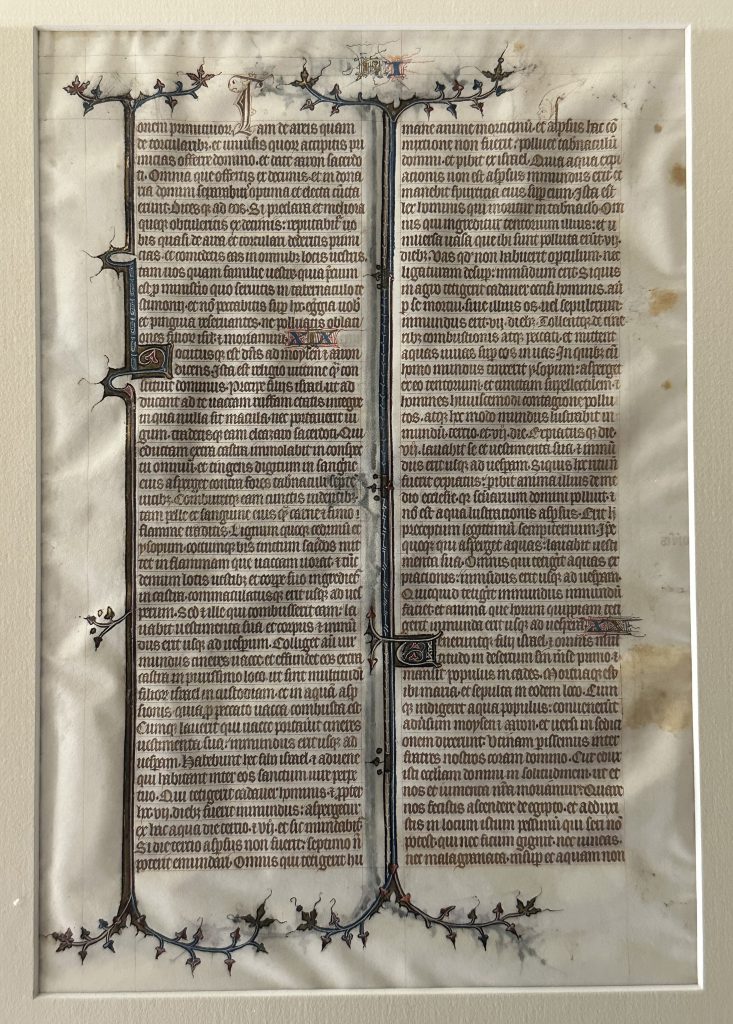
Collection of Jennah Farrell, Single Leaf from the Book of Numbers in a Medieval Latin Vulgate Bible manuscript. Full extent of the leaf, unframed: Recto. Photography by Mildred Budny.

Side 2

Collection of Jennah Farrell, Single Leaf from the Book of Numbers in a Medieval Latin Vulgate Bible manuscript. Full extent of the leaf, unframed: Verso. Photography by Mildred Budny.

Releasing the Leaf from the Frame

Collection of Jennah Farrell, Manuscript Leaf: Back of Frame. Photograph by Mildred Budny.

Removing the leaf from its frame employed a set of tools 1) to unscrew the mounting hinges and hanging wire, 2) release the backing paper glued to the back edges of the wooden frame, 3) detach the heavy staples which clamped a sheet of foam board to the framing mat, and 4) lift the mat to release the leaf.

Tools to Open the Frame and Left-over Pieces from the Frame containing the Farrell Bible Leaf. Photography by Mildred Budny.

The pieces of the frame are now kept together: stained wooden frame, sheet of glass, windowed mat, foam board, backing paper, staples, and hanging nail. The leaf is now kept in a clear archival L-sheet housed in an archival document binder.

Both Sides Now in View

Released from the frame and its mat, the leaf can be seen to have about 5 cm. more from top to bottom and about 4 more cm. from side to side.  Revealed are the full extent of the margins and parts of the foliate decoration of the ornamental bars which extend from the chapter initials in three columns of the four in the layout of two columns per page or side of the leaf.

Revealed too is the marginal correction for the text entered in the outer margin on the verso and the remnants of the stitching line at the inner edge or gutter of the leaf, where an uneven cut along the full length of the leaf severed it from its formerly conjoint leaf in its original manuscript.

Can you tell which side of the leaf is the front, or original recto, and which is the back, or original verso?

Do you recognize, or would you like to discover, which manuscript the leaf came from when it was cut out of its book and separated from its relatives, to enter the world as a single leaf on its own, suited for framing and display such as on a wall?

Would you like to help us to learn about it?

A Pair of Workshops for this Leaf

We plan two RGME Workshops on Looking at Manuscripts, the first in a new series, to introduce the leaf and learn how to identify its probable date and place of origin, as well as its former manuscript and its context among relatives. Our challenge is to discern what the leaf might itself have to say about these different stages, and what we might discover about its original identity, its former manuscript, and its dispersal.

Both workshops will be held online by Zoom, for which registration (free) is required.

1) Workshop 1 introduces the leaf and sets the groundwork.

Sunday 17 November 2024 at 1:00-2:30 pm EST (GMT-5) by Zoom

  • Workshop 1: Registration

2) Workshop 2 follows up the lines of investigation as we might collectively compare notes and refine our inquiries more fully to understand the leaf and its relatives.

Sunday 16 December 2024 at 1:00-2:30 pm EST (GMT-5)

  • Workshop 2: Registration

After you register, the Zoom Link will be sent to you a few days before the event.

Beginners and experts welcome!

*****
About our new series of Workshops on Looking at Manuscripts, see:

  • The Bridge of Signs

We have been waiting for the opportunity, occasion, and resources to bring to our community for workshops, online and/or in-person, collectively to explore original source materials. With the RGME “Lending Library” as well as our own materials in the RGME Library & Archives, and with our time-tested habits of online events as well as in-person workshops, we launch our new series in a mobile approach to bring together original sources and a community interested in studying them and teaching with them.

Please join our expedition!

*****
Suggestion Box

Please Contact Us or visit

  • our FaceBook Page
  • our Facebook Group
  • our Twitter Feed (@rgme_mss)
  • our Bluesky nest @rgmesocial.bluesky.social)
  • our LinkedIn Group
  • our Blog on Manuscript Studies and its Contents List

Would you like to help?

*****
Tags: Jennah Farrell Collection, Latin Vulgate Bibles, Manuscript studies, Medieval manuscripts
No Comments »

The RGME ‘Lending Library’

September 5, 2024 in Manuscript Studies, RGME Library & Archives

The RGME ‘Lending Library’

Books, Manuscripts, Fragments,
Documents, Seals and Seal Matrices,
Photographs, Prints and Drawings, and other Original Materials

Sometimes the Sources come to visit
the Research Group on Manuscript Evidence

Sometimes our Materials go to visit
for workshops, exhibitions, and study

[Posted on 4 September 2024, with updates]

Dialogues of Gregory the Great, Book III, chapter XIII initial, reproduced by permission

Manuscript Leaf with Dialogues of Gregory the Great, Book III, chapter 13 initial, while on loan. Photography by Mildred Budny.

Over the years, private collectors, scholars, students, and others continue to seek advice and expertise from the Research Group about manuscript, printed, documentary, and other materials in their possession. Indeed, our mission seeks to examine original sources of written works and their relatives by a dedicated process of “Going to the Sources”. (On this mission, see, for example, our 2024 Spring Symposium at Vassar College.)

Often the sources, or their surrogates in photographic and other means, come to us. Sometimes they come to stay, as gifts. Sometimes they come on loan.

How do they find us? They do so as their owners or researchers approach us from learning about the RGME and our wide range of interests and network of contacts, whether through our scholarly events (in person or online) or by word of mouth, posts on social media, or our blog on Manuscript Studies. Then they make contact to ask if we might be interested in looking at the item(s) in question. They send photographs to show the characteristics of the materials, and generously allow us to work with the evidence in their care, whether as gifts or through photographs or loans of the items.

Sometimes the owners generously loan original materials to the RGME for research, conservation, photography, and publication. This process can yield remarkable results.

Preparing now for our 2024 Autumn Symposium showcasing the work and potential of Special Collections of many kinds for teaching, it seems time to describe the years’-long tradition of sharing materials and expertise through the RGME Lending Library. (You are Here.)

Multi-Directional

Sometimes, in turn, we bring original materials — in our own collection, our Director’s, and other collections — to the attention of audiences in various locations, as we might take them for exhibitions, workshops, seminars, tutorials, research consultations, and teaching/learning opportunities. Sometimes this comprises displays at Receptions for our Symposia, and informal, sometimes ad-hoc, gatherings, such as at Sessions or Receptions at the International Congress on Medieval Studies.

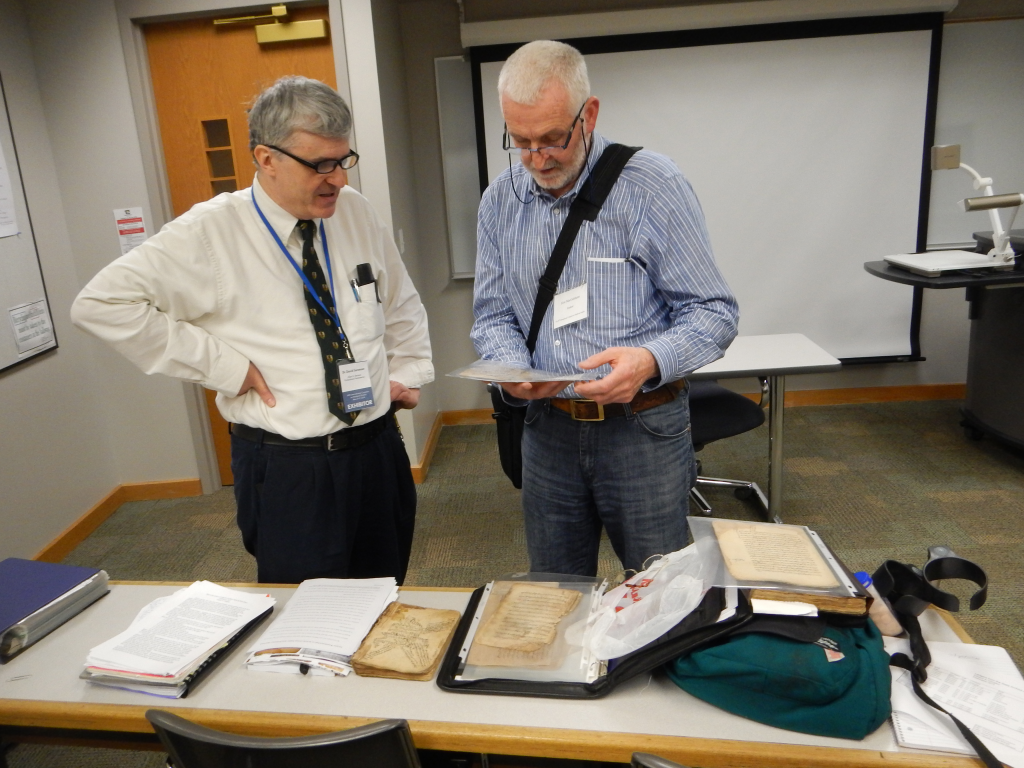
David Sorenson and Donncha MacGabhann examine manuscript materials

David Sorenson and Donnach MacGabhann examine manuscript materials after the RGME Writing Materials Session at the 2014 Congress. Photography by Mildred Budny

One of the most memorable on our roster of events over the years was the 2014 Seminar on site at the Index of Christian Art to consider selected examples (manuscripts, fragments, and documents) from a Private Collection on loan to the RGME for some years.

  • 2014 Seminar on Manuscripts and Their Photographs at the Index of Christian Art
    (now the Index of Medieval Art)
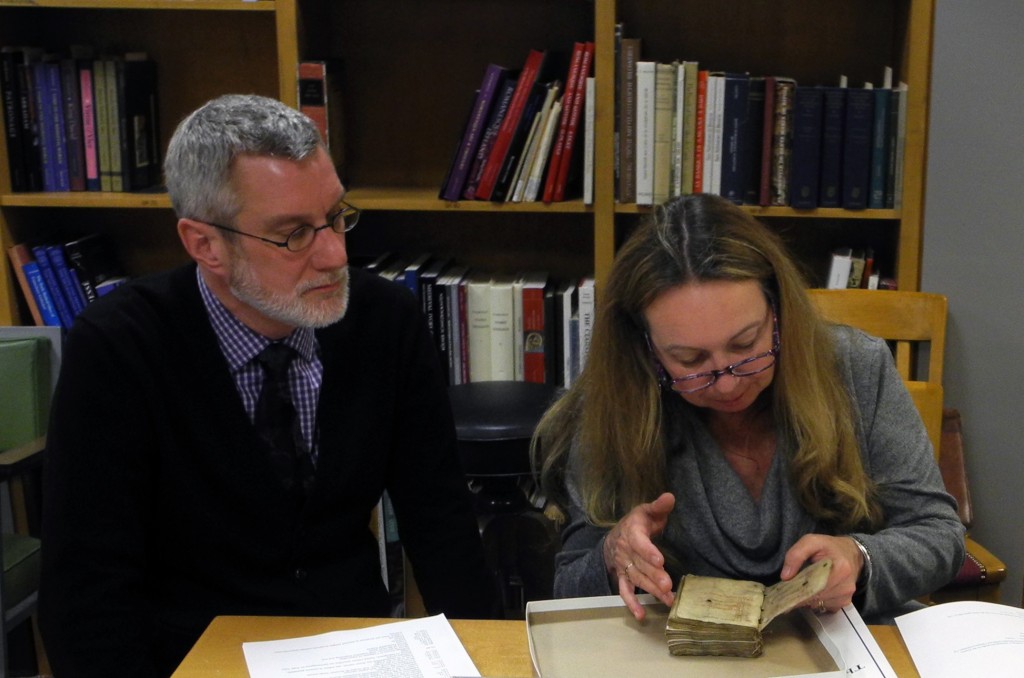
Inspecting the despoiled Book of Hours at our 'Show & Tell' Seminar on Manuscripts & Their Photographs on 9 December 2014

Observing the Book of Hours at the 2014 Seminar

Images

Private Collection, Back Endpaper for Printed Postilla.

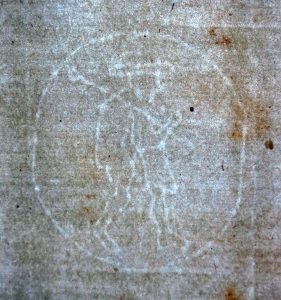
Private Collection, Back Endpaper for Printed Postilla: Watermark of Pilgrim with staff.

Sending photographs to us gives information about the item(s). Having a look, we might propose to help and also, if permission is granted, to ask others within our circles about further information in the areas, regions, subjects, languages, genres of objects, and contexts to which the materials pertain. For example, over the years, sharing photographs from a single private collection has, with permission, generated reports on a wide variety of items on paper and vellum or parchment, manuscript or printed, from many places of origin and in diverse languages.

Sometimes the approach concerns an object which relates to materials which we have already researched and published. Among them are fragments from specific medieval manuscripts or printed materials dispersed by Otto F. Ege (1888–1951) which our research has explored; and fragments from other manuscripts or printed materials also dispersed by Ege alone or in  compilations of Portfolios of fragments reused as specimens intended for teaching and display.  Sometimes (as with some of those cases), as time goes on and opportunity arises, travel permitting, we have the chance to see the originals which have become familiar through our research work from photographs.

'New Leaves' from Ege Manuscript 41, Verso, and from Ege Manuscript 51, Recto, viewed in November 2016. Photograph by Mildred Budny

‘New Leaves’ from Ege Manuscript 41, Verso, and from Ege Manuscript 51, Recto, viewed in November 2016. Photograph by Mildred Budny

Sometimes the collector’s initial approach to us about a specimen broaches a book or fragment of some other kind, in case our sphere of interests and contacts might bring enlightenment.

An example is the query several years ago from a collector abroad about a South Asian manuscript newly acquired from a friend; the language was unfamiliar; might we know what the book is?  The process of constructive, and amiable, collaborative inquiry led, with generous permission, to two blogposts which offer instruction about the book and its place within widespread practices in the book-trading world for tourists who may have little knowledge about the genre of book and its integrity as an object.

Often, as in that case, our research work progresses with the photographic representatives of the materials generously supplied by the owners.  Sometimes, as we explore together, the others take more photographs to illustrate specific features or produce diagrams for ruling patterns, folds, and alignment of the insides and outsides of bifolia within the original book.

On Site

Sometimes the owners generously send the materials themselves on loan to the Research Group, for detailed study in person, over a period of time. This loan enables detailed examination, photography, research, consultation, and refinement of results, whereupon the materials return to their owners or transfer to new ownership according to the owners’ directions.

Sometimes, if wished and permitted by the owner, the period of loan includes the conservation work, such as removal from non-archival frames or boxes, rematting, reframing, and/or placement in archival housing for storage, handling, or display.

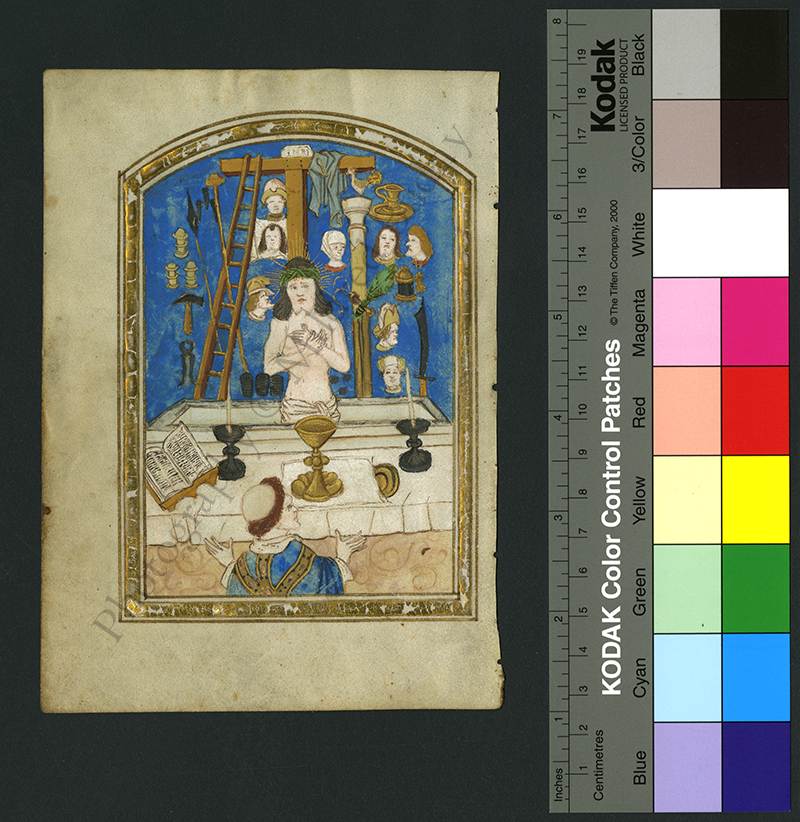
Full-page, framed illustration of the Mass of Saint Gregory on a detached leaf from a prayerbook. Photography © Mildred Budny

Private Collection, Vellum leaf with illustration of “Gregory Mass”, verso. Photograph by Mildred Budny.

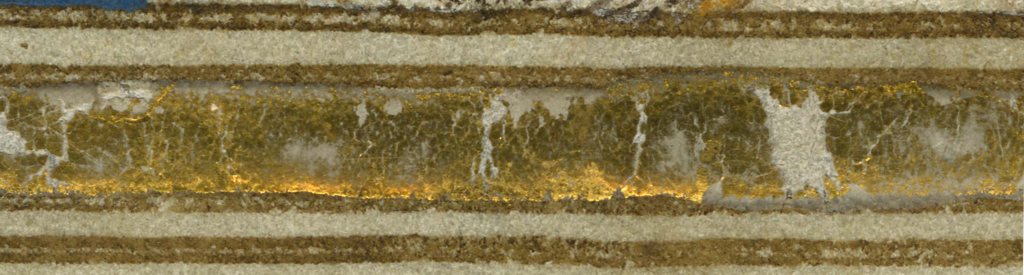
With these opportunities, close inspection is possible under various lights and angles of vision. These multiple approaches can be done in the presence of the object. Such variety can reveal features not necessarily clear or apparent in digital reproductions of single views, however high-quality they might be and capable of showing details under high magnification.

Gold Leaf partly lifted. Photography © Mildred Budny

Private Collection, Vellum leaf with illustration of “Gregory Mass”, verso: detail of lower border. Photograph by Mildred Budny.

Results

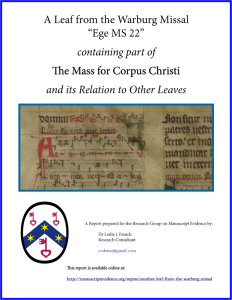
Front Cover for Report by Leslie J. French for Wagner Leaf from Ege MS 22 (2021)

Front Cover for Report by Leslie J. French for Wagner Leaf from Ege MS 22 (2021)

The quests can result — depending upon the materials and their context, the time available or required for research and write-up, and the choices for presentation of the results — variously in RGME blogposts, presentations for symposia, conference sessions, or other scholarly events, exhibition displays, RGME Research Booklets, and a combination of these.

With these presentations and publications, knowledge about the original materials can reach a wide audience, and add to knowledge about their contexts, including relatives among surviving witnesses to their periods and places of production, makers, owners, readers, collectors, collections, and other features.

Examples

So far, the range of materials is exemplified by a range of publications of materials from private collections, named or anonymous. Sometimes the publications include or represent materials in institutions, such as university or public libraries.  Named private collections represented include:

Collection of Birgitt G. Lopez, Framed Leaf from ‘Otto Ege Manuscript 14’. Leaf in Frame. Reproduced by permission.

Birgitt G. Lopez Collection

  • Two Ege Leaves and Two Ege Labels in the Collection of Brigitt G. Lopez
  • Another Leaf from a Portable Manuscript Bible in the Collection of Birgitt G. Lopez

Brent Rosenbrook Collection

  • A Leaf of Deuteronomy from ‘Otto Ege Manuscript 14’ in the Rosenbrook Collection

Ronald K. Smeltzer Collection

  • Vellum Binding Fragments in a Parisian Printed Book of 1538

Stephen Soderlind Collection

  • A Detached Folio 108 with Part of Vulgate Psalm 118 (117)
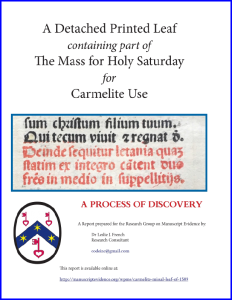
Camelite Booklet Cover Page with New Front Cover with border

Camelite Booklet Cover Page with New Front Cover with border

J.S. Wagner Collection

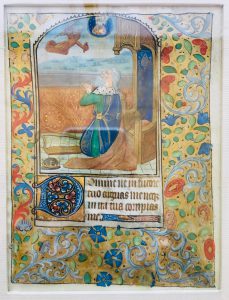
  • The Penitent King David from a Book of Hours
  • A Leaf from ‘Otto Ege Manuscript 19’ and Ege’s Workshop Practices
  • Another Leaf from the Warburg Missal
  • Carmelite Missal Leaf of 1509

Robert Weber Collection

  • A Leaf from ‘Otto Ege Manuscript 214’ in the Collection of Robert Weber
  • Portfolio 93 of Ege’s “Famous Books in Eight Centuries (FBEC)” in the Collection of Richard Weber

Two cases from the J.S. Wagner Collection represent:

1) The opening of one of the Penitential Psalms (with the Penitent King David) from the Psalter

  • The Penitent King David from a Book of Hours
J. S. Wagner Collection. Detached Manuscript Detached Leaf with the Opening in Latin of the Penitent Psalm 37 (38) and its Illustration of King David.

J. S. Wagner Collection. Detached Manuscript Leaf with the Opening in Latin of the Penitent Psalm 37 (38) and its Illustration of King David.

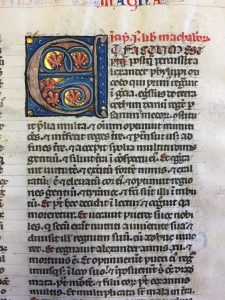
2) The opening of the Old Testament Book of Macabees in a Bible manuscript disbound and distributed by Otto F. Ege

  • A Leaf from ‘Otto Ege Manuscript 19’ and Ege’s Workshop Practices
Opening of the Book of Macabees in Otto Ege MS 19. Private Collection.

Wagner Collection. Opening of the Book of Macabees in Otto Ege MS 19.

Books and Fragments

Examples include

1) books and fragments from a single private assembly in the Illustrated Handlist, including specimens which we were asked to remove from their damaging modern frames for conservation and archival mounting.

Book of Hours with floral border. Photography by Mildred Budny.

2) manuscripts, fragments, documents, printed materials, and other media in various private collections as represented in our blog on Manuscript Studies; and

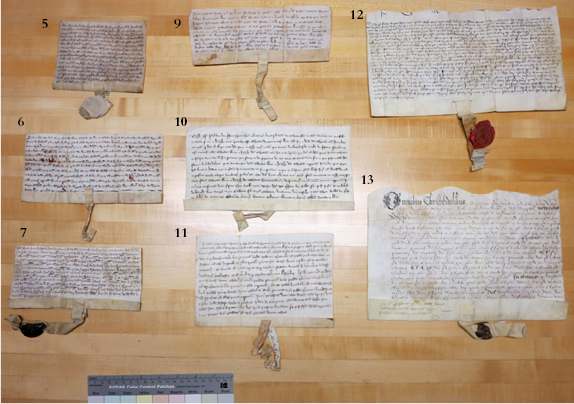
Preston Charters Dorses. Photograph Mildred Budny. Numbers added to the photograph report the present owner's numbering for the set, from 5 to 7 and 9 to 13.

Private Collection. “Preston Charters” Faces. Photograph Mildred Budny.

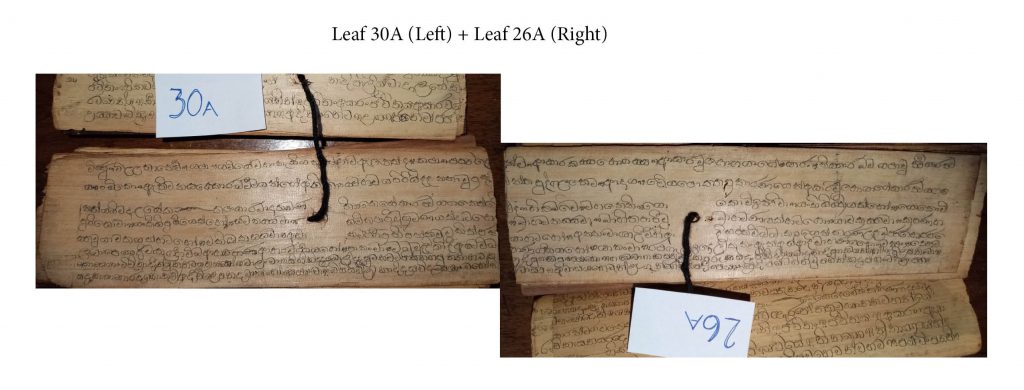
3) books or part-books, such as a disordered and reassembled Sinalese palm-leaf manuscript (with its reworked cover), which our study could reconstruct in part:

  • A Sinhalese Palm-Leaf Manuscript in Deconstructed and Reconstructed Order:
    Part 1 of 2.
  • More Leaves from a Deconstructed Sinhalese Palm-Leaf Manuscript: Part 2 of 2.
Private Collection, Sinhalese Palm-Leaf Manuscript, Reconstructed View of Former Leaf ('30A' + 26A').

Private Collection, Sinhalese Palm-Leaf Manuscript, Reconstructed View of Former Leaf (’30A’ + 26A’).

Books and Fragments On Loan

In some cases, the current owner’s curiosity about materials in his or her collection leads to the loan to the Research Group or its Director to enable direct examination, which can be an optimal circumstance for research.

1. The Illustrated Handlist

For example, the extended loans over several years (in stages) to the Director for conservation, photography, and research of materials in a private collection — comprising an assembly of manuscript, documentary, and early printed materials — provided the impetus for interim and cumulative reports in scholarly events of several kinds, such as conference or symposium sessions, and an RGME seminar at Princeton University.

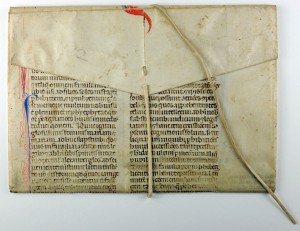
Justinian Wrapper folded from back with flap.

Budny Handlist 7: Folder from Back with Flap.

  • 2014 Seminar on Manuscripts and Their Photographs at the Index of Christian Art of Princeton University
    (now the Index of Medieval Art)

For the range of that assembly, now dispersed in different directions, see

  • the Illustrated Handlist.

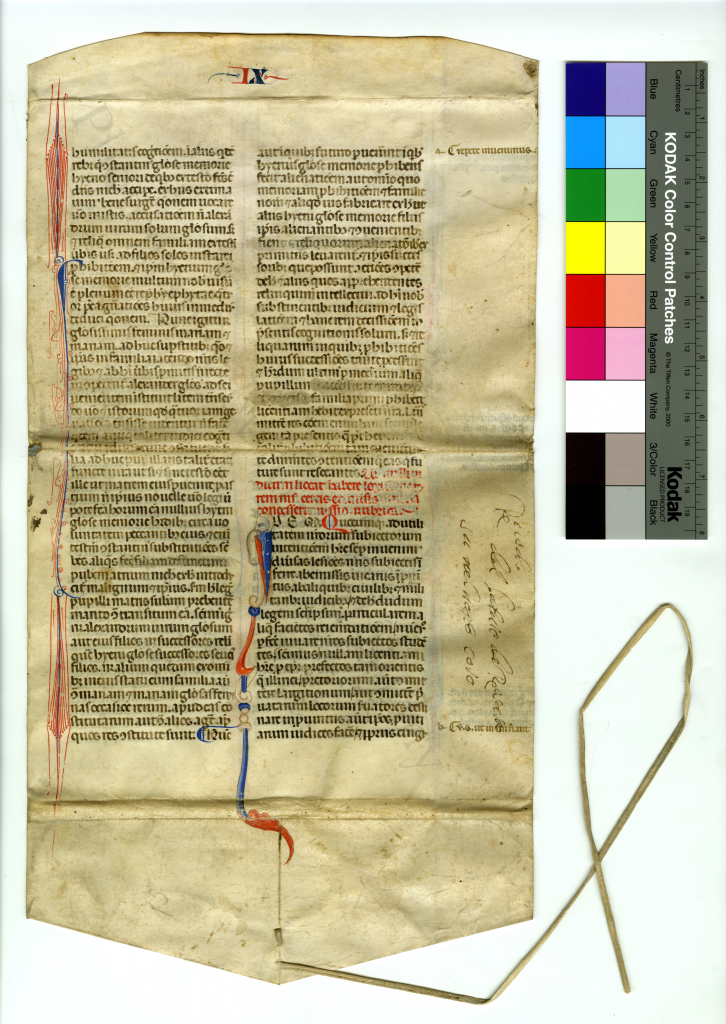
For example: It’s a Wrap.

Exterior of Justinian Wrapper Unfolded. Photography © Mildred Budny

Outside of Wrapper = Recto of Leaf

2. A Hybrid Book with Two Layers of Manuscripts

Another extended loan from another private collector in 2022–2023 generously brought a remarkable hybrid book, comprising a sandwiched set of vellum leaves within a limp-vellum binding, to the RGME for close inspection over months. The experience, with different forms of lighting (natural, artificial, enhanced), including back-lighting and side-lighting, made it possible to examine multiple aspects of the book which combines two layers produced in the scholastic period of the High Middle Ages and in the Counter Reformation respectively.  In time, when appropriate, we hope to describe the characteristics of this book and the results of our research.

3. The New Loan of a Manuscript Fragment (2024)

A new loan in 2024 brings a medieval manuscript leaf, in its frame, for study and publication, with permission, before its return.  See below for a first glimpse as our study begins.


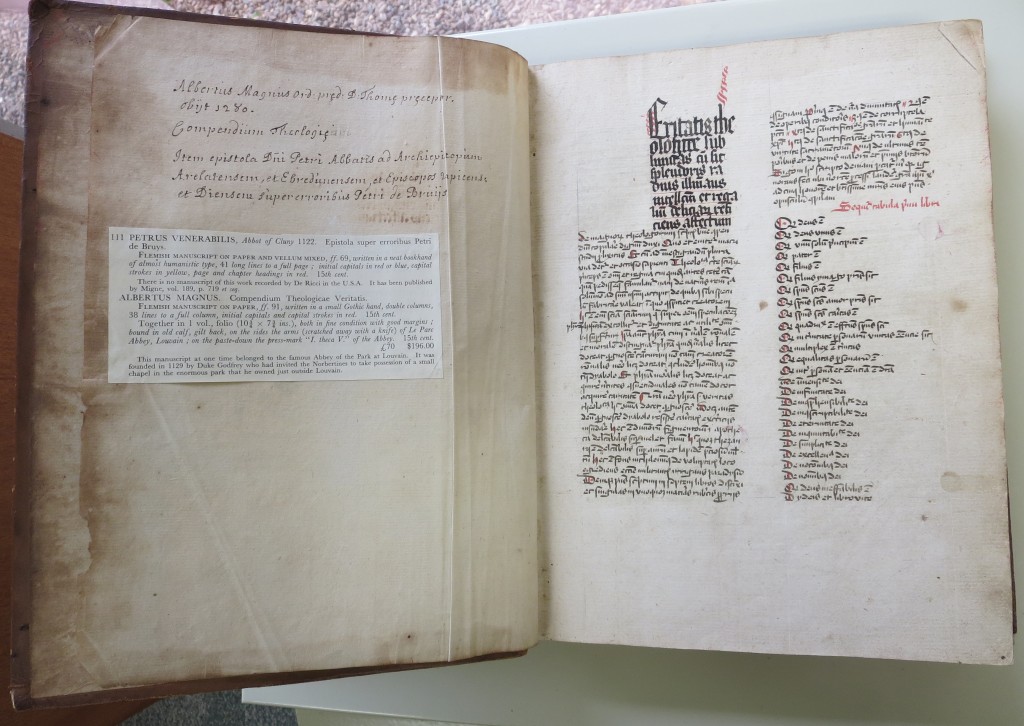
Opening between the Front Flyleaf, Verso, and Folio 1 recto, opening Part A.

Opening between the Front Flyleaf, Verso, and Folio 1 recto, opening Part A (“Albertus Magnus”). Photography Mildred Budny.

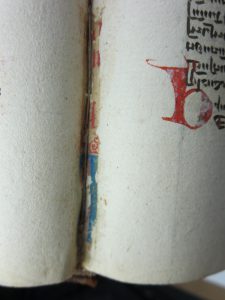
Up Close

Le Parc Abbey, Theological Volume, Part A, gutter. Photography Mildred Budny.

The opportunity to study these varied materials at close hand and over extended periods of time, as the research advanced and there emerged new discoveries, including by other scholars on related subjects and materials (such as the manuscripts dispersed by Otto F. Ege), spurred the creation of the RGME blog on Manuscript Studies and provided case-studies for multiple  blogposts.

Often these reports have newly discovered results augmenting knowledge about the object, its original state, and its context. They appear on our website as blogposts about individual items or groups of items; a webpage for the The Illustrated Handlist of a single assembly of items; and reports in other forms, including presentations as scholarly events, their publications, and exhibitions both in person and online.  Cases include:

  • Manuscript Studies: Contents List
  • The Illustrated Handlist
  • 2014 Seminar on Manuscripts and Their Photographs at the Index of Christian Art
    (now the Index of Medieval Art)

We give thanks to the collectors who send photographs of their materials and those who lend materials to the RGME for study, learning, and teaching for audiences near and far.

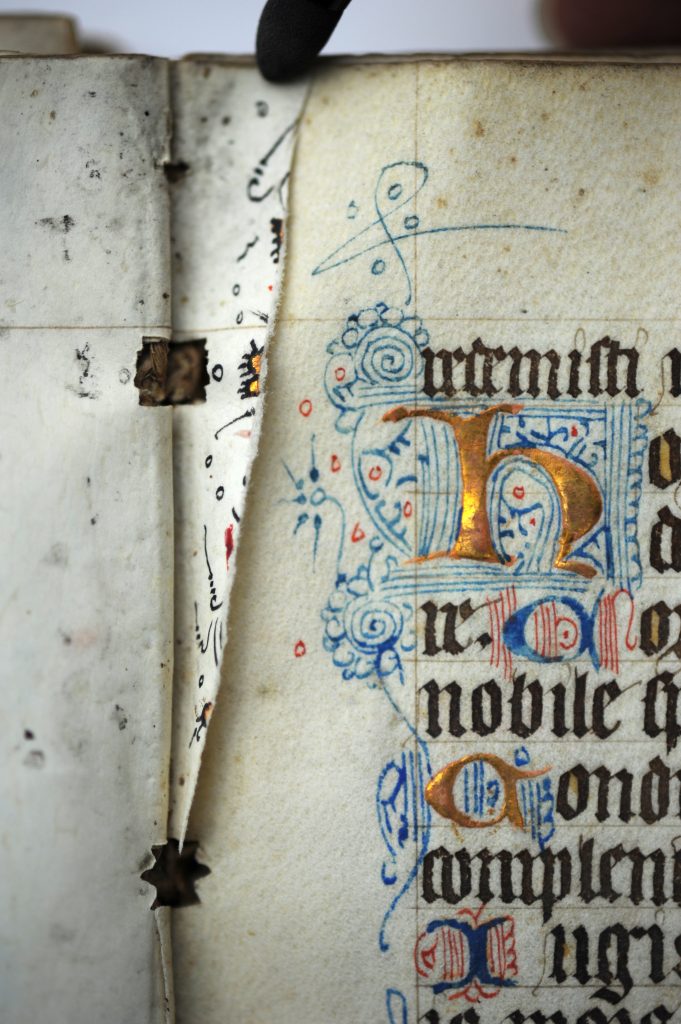
Private Collection, Book of Hours, Decorated Initial and Stub from Despoiled Leaf. Photography Mildred Budny.

Our Records of Earlier States, now Lost

In some cases, as the lent items after their return have transferred to new ownership from the private collections through which we met them, they have undergone transformations in themselves.  In such cases, it can be fortunate that our research has reported their previous stages, as some evidence has been destroyed in new ownership. See, for example, the separation in 2023 of a composite medieval manuscript from Le Parc Abbey, Belgium, into two parts with the removal and loss of the binding given by its original institution.

As a result, our blogposts preserve records of lost evidence.  Perforce, because of our care to record and report the evidence of the original item, in so far as time and resources allow, elements in our photographs, notes, descriptions, and reports reach the level of ‘primary evidence’ or surrogates for evidence in the originals which has been lost.

Opening between the Front Flyleaf, Verso, and Folio 1 recto, opening Part A.

Opening between the Front Flyleaf, Verso, and Folio 1 recto, opening Part A (“Albertus Magnus”). Photography Mildred Budny.

A New Loan

A new loan to the RGME for examination brings a single vellum leaf from a medieval manuscript, which the present owner recently acquired from a former owner’s belongings in its frame with mat.  The new owner approached the RGME Director on the strength of one of our blogposts.  With permission, the leaf has been sent on loan to the RGME in June 2024.

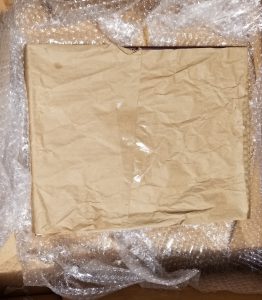
Private Collection. Framed Bible Leaf in its Wrapping for Transit to the RGME in July 2024: View upon arrival in unpacking the leaf. Photograph by Mildred Budny.

Work on the leaf after it had safely arrived, in secure packing, had to wait while disruptions to the RGME website and a cluster of other unexpected issues intervened, requiring attention. Resuming work (as you can see, our website is back in accessible working order), we begin our report on the leaf with this blogpost. It sets the scene and shows first photographs of the leaf still in its frame, to introduce the leaf to you.

At present, the leaf remains in its frame, while we study its visible features and explore its context. Then we will, with permission, remove the leaf from the frame, to photograph and study its other side and outer edges now hidden below the windowed opening of the mat and by the back of the frame.

The Visible Text: Recto or Verso?

The leaf stands in the windowed glass frame in which it reached its current owner.

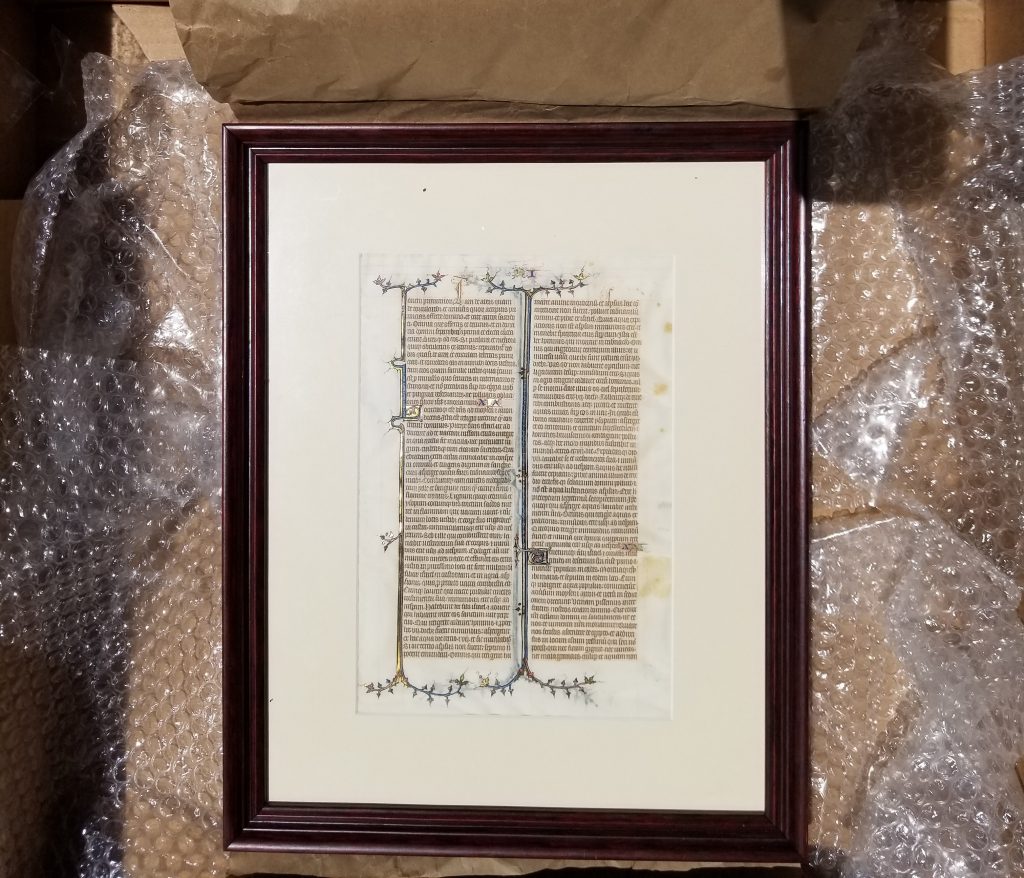
Collection of Jennah Farrell, Manuscript Leaf in Frame: Front, emerging from packaging upon arrival for study. Photograph by Mildred Budny.

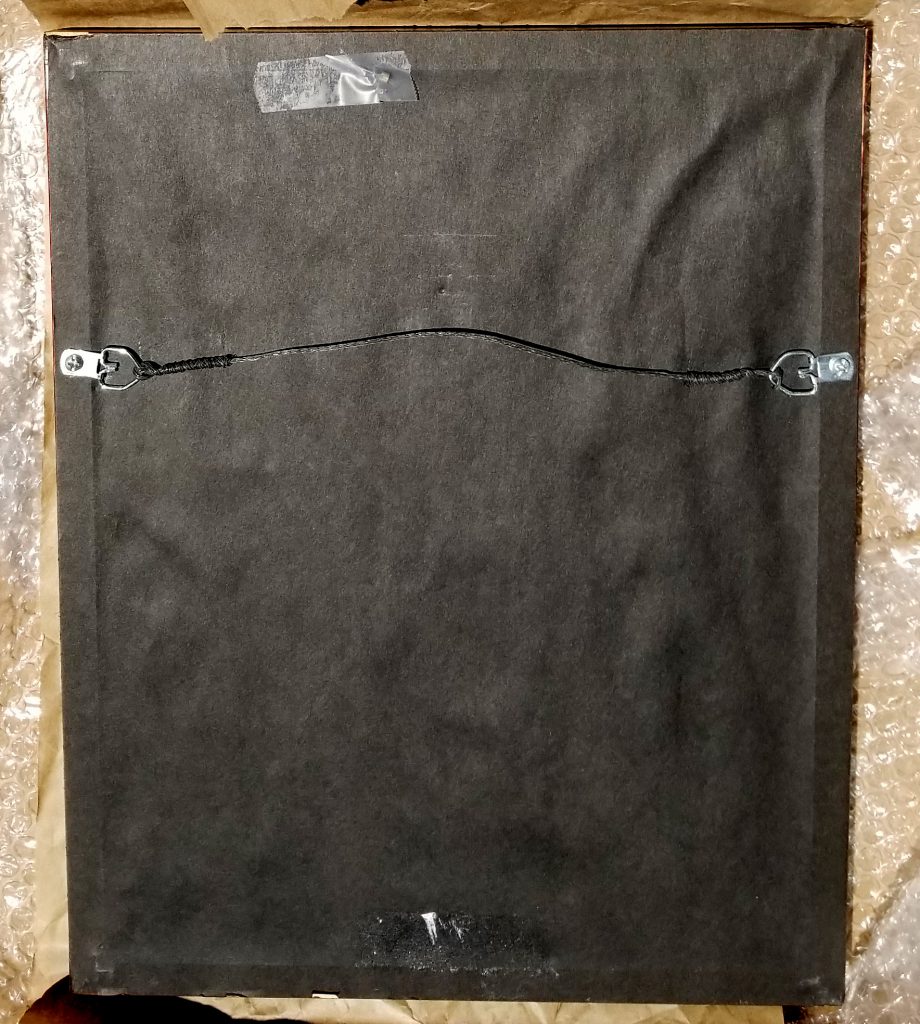
The back of the frame has few identifying features.  Its black paper covering has the traces of a removed label formerly centered at the bottom and a companion picture nail taped off-center at the top.

Collection of Jennah Farrell, Manuscript Leaf: Back of Frame. Photograph by Mildred Budny.

The visible extent of the leaf within the mat measures a maximum of circa 24.1 cm. tall × 16.3 cm. wide (circa 9 7/8 in. tall × 6 7/8 in. wide).  The ruled writing area measures circa 18.7 × 12.5 cm. (7 3/4 × 4 7/8 in.).

Collection of Jennah Farrell, Manuscript Leaf in Mat. Photograph by Jennah Farrrell.

Before the leaf is removed from its frame, the visible features of the leaf within the windowed mat must speak for themselves.
We might use this condition as a teaching exercise or opportunity, to see how much we might learn about the leaf from this perspective, before approaching its other side and the edges of the sheet which lie behind the mat and which remain hidden beneath the back covering of the frame. How much can it tell us in this state, before we move to the next?

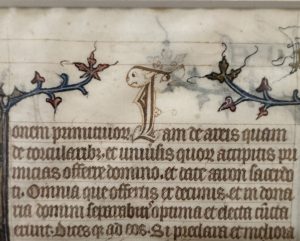
Collection of Jennah Farrell, Manuscript Leaf in Mat: top left. Photograph by Jennah Farrrell.

More to Come

Watch this space, as a next blogpost will examine the leaf in its own right.  Join the quest!

Update (11 September 2024):  Now see:

  • A Latin Vulgate Leaf from the Book of Numbers in the Collection of Jennah Farrell (Part 1)
  • Latin Vulgate Bible Leaf in the Collection of Jennah Farrell: Part 2
  • The Latin Vulgate Bible Leaf in the Farrell Collection, Part 3: The Full Leaf

P.S. Do you recognize this manuscript? Are you familiar with other leaves from it? Please let us know.

Please Contact Us or visit

  • our FaceBook Page
  • our Facebook Group
  • our Twitter Feed (@rgme_mss)
  • our Bluesky nest @rgmesocial.bluesky.social)
  • our LinkedIn Group
  • our Blog on Manuscript Studies and its Contents List

We look forward to hearing from you.

Update: Our work with these lent or donated materials has developed into a series of online collaborative workshops. See:

  • RGME Workshops on “The Evidence of Manuscripts, Etc.”

*****

Tags: Manuscript studies, Otto F. Ege, RGME Lending Library, RGME Library & Archives, The Illustated Handlist
No Comments »

  • Top
©2024 Research Group on Manuscript Evidence.


is proudly powered by WordPress. WordPress Themes X2 developed by ThemeKraft.