• News
    • News & Views
    • RGME Activities for 2024 and 2025
    • Around & About with the RGME
    • Reviews
    • Highlights
  • Blogs
    • Manuscript Studies
      • Manuscript Studies: Contents List
    • International Congress on Medieval Studies
      • Abstracts of Congress Papers
        • Abstracts of Papers Listed by Author
        • Abstracts of Papers Listed by Year
  • About
    • Mission
    • Who We Are
      • Officers, Associates & Volunteers
      • RGME Committees
      • Friends of the Research Group on Manuscript Evidence
    • Policies & Statements
      • RGME Privacy Policy Statement
      • RGME Intellectual Property Statement & Agreements
    • People
      • Mildred Budny — Her Page
      • Adelaide Bennett Hagens
    • Activities
      • Events
      • Congress Activities
        • Sponsored Conference Sessions (1993‒)
          • Panels at the M-MLA Convention (from 2016)
        • Co-sponsored Conference Sessions (2006‒)
    • History
      • Seals, Matrices & Documents
      • Genealogies & Archives
    • Contact Us
  • Bembino
    • Multi-Lingual Bembino
    • RGME Bembino: Resources
  • Congress
    • Sponsored Conference Sessions (1993‒)
    • Co-sponsored Conference Sessions (2006‒)
    • Abstracts of Congress Papers
      • Abstracts Listed by Author
      • Abstracts Listed by Year
    • Kalamazoo Archive
    • Panels at the M-MLA Convention (2016-2019)
      • Abstracts of Papers for the M-MLA Convention
      • Panels at the M-MLA Convention (from 2016)
  • Events
    • RGME Activities for 2024 and 2025
      • 2023 Activities and 2024 Planned Activities
    • Seminars, Workshops, Colloquia & Symposia (1989–)
      • Seminars on ‘The Evidence of Manuscripts’
      • Symposia on ‘The Transmission of the Bible’
      • The New Series (2001-)
        • 2019 Anniversary Symposium Program: The Roads Taken
        • 2019 Anniversary Symposium Registration
        • 2019 Anniversary Symposium Registration Open
      • RGME Symposia: The Various Series
      • The Research Group Speaks: The Series
      • Meetings of the Friends of the Research Group on Manuscript Evidence
      • RGME Online Events
    • Abstracts of Papers for Events
      • Abstracts of Papers for Seminars on ‘The Evidence of Manuscripts’
      • Abstracts of Papers for Symposia, Workshops & Colloquia
    • Receptions & Parties
    • Business Meetings
    • Photographic Exhibitions & Master Classes
    • Events Archive
  • ShelfLife
    • Journal Description
    • ShelfMarks: The RGME-Newsletter
    • Publications
      • “Insular, Anglo-Saxon, and Early Anglo-Norman Manuscript Art at Corpus Christi College, Cambridge” (1997)
        • Mildred Budny, ‘Catalogue’
        • The Illustrated Catalogue (1997)
      • The Illustrated Handlist
      • Semi-Official Counterfeiting in France 1380-1422
      • No Snap Decisions: Challenges of Manuscript Photography
    • History and Design of Our Website
  • Galleries
    • Watermarks & the History of Paper
    • Galleries: Contents List
    • Scripts on Parade
    • Texts on Parade
      • Latin Documents & Cartularies
      • New Testament Leaves in Old Armenian
    • Posters on Display
    • Layout Designs
  • Donations and Contributions
    • RGME Donor Promise
    • 2023 End-of-Year Fundraiser for our 2024 Anniversary Year
    • 2019 Anniversary Appeal
    • Orders
  • Links
    • Catalogs, Metadata, and Databases: A Handlist of Links
    • Handlist of Resources for Manuscript Studies and Fragmentology
    • Manuscripts & Rare Books
    • Maps, Plans & Drawings
    • Seals, Seal-Matrices & Documents

  • News
    • News & Views
    • RGME Activities for 2024 and 2025
    • Around & About with the RGME
    • Reviews
    • Highlights
  • Blogs
    • Manuscript Studies
      • Manuscript Studies: Contents List
    • International Congress on Medieval Studies
      • Abstracts of Congress Papers
        • Abstracts of Papers Listed by Author
        • Abstracts of Papers Listed by Year
  • About
    • Mission
    • Who We Are
      • Officers, Associates & Volunteers
      • RGME Committees
      • Friends of the Research Group on Manuscript Evidence
    • Policies & Statements
      • RGME Privacy Policy Statement
      • RGME Intellectual Property Statement & Agreements
    • People
      • Mildred Budny — Her Page
      • Adelaide Bennett Hagens
    • Activities
      • Events
      • Congress Activities
        • Sponsored Conference Sessions (1993‒)
          • Panels at the M-MLA Convention (from 2016)
        • Co-sponsored Conference Sessions (2006‒)
    • History
      • Seals, Matrices & Documents
      • Genealogies & Archives
    • Contact Us
  • Bembino
    • Multi-Lingual Bembino
    • RGME Bembino: Resources
  • Congress
    • Sponsored Conference Sessions (1993‒)
    • Co-sponsored Conference Sessions (2006‒)
    • Abstracts of Congress Papers
      • Abstracts Listed by Author
      • Abstracts Listed by Year
    • Kalamazoo Archive
    • Panels at the M-MLA Convention (2016-2019)
      • Abstracts of Papers for the M-MLA Convention
      • Panels at the M-MLA Convention (from 2016)
  • Events
    • RGME Activities for 2024 and 2025
      • 2023 Activities and 2024 Planned Activities
    • Seminars, Workshops, Colloquia & Symposia (1989–)
      • Seminars on ‘The Evidence of Manuscripts’
      • Symposia on ‘The Transmission of the Bible’
      • The New Series (2001-)
        • 2019 Anniversary Symposium Program: The Roads Taken
        • 2019 Anniversary Symposium Registration
        • 2019 Anniversary Symposium Registration Open
      • RGME Symposia: The Various Series
      • The Research Group Speaks: The Series
      • Meetings of the Friends of the Research Group on Manuscript Evidence
      • RGME Online Events
    • Abstracts of Papers for Events
      • Abstracts of Papers for Seminars on ‘The Evidence of Manuscripts’
      • Abstracts of Papers for Symposia, Workshops & Colloquia
    • Receptions & Parties
    • Business Meetings
    • Photographic Exhibitions & Master Classes
    • Events Archive
  • ShelfLife
    • Journal Description
    • ShelfMarks: The RGME-Newsletter
    • Publications
      • “Insular, Anglo-Saxon, and Early Anglo-Norman Manuscript Art at Corpus Christi College, Cambridge” (1997)
        • Mildred Budny, ‘Catalogue’
        • The Illustrated Catalogue (1997)
      • The Illustrated Handlist
      • Semi-Official Counterfeiting in France 1380-1422
      • No Snap Decisions: Challenges of Manuscript Photography
    • History and Design of Our Website
  • Galleries
    • Watermarks & the History of Paper
    • Galleries: Contents List
    • Scripts on Parade
    • Texts on Parade
      • Latin Documents & Cartularies
      • New Testament Leaves in Old Armenian
    • Posters on Display
    • Layout Designs
  • Donations and Contributions
    • RGME Donor Promise
    • 2023 End-of-Year Fundraiser for our 2024 Anniversary Year
    • 2019 Anniversary Appeal
    • Orders
  • Links
    • Catalogs, Metadata, and Databases: A Handlist of Links
    • Handlist of Resources for Manuscript Studies and Fragmentology
    • Manuscripts & Rare Books
    • Maps, Plans & Drawings
    • Seals, Seal-Matrices & Documents

Log in

Archives

Featured Posts

Sanskrit and Prakrit Manuscripts, Continued: More Leaves for Manuscript Sample XII?
2026 International Congress on Medieval Studies: Program
Episode 24. “Life with Books” (Interview with John Windle)
Announcing the Launch of RGME Bembino WP
2026 RGME Colloquium at The Grolier Club: Report
Medieval Missal Fragment as Early-Modern Cover
The Weber Leaf from Ege MS 61
"Bembino" Booklet Cover
Episode 23. “Meet RGME Bembino: Facets of a Font”
2026 RGME Colloquium on “Transformations & Renewals” at The Grolier Club
2026 Theme of the Year: “Transformations and Renewals”
A Leaf with Patchwork from the Saint Albans Bible
A Sister Leaf from a Miniature Latin Vulgate Bible
A Little Latin Vulgate Bible Manuscript Leaf in Princeton
J. S. Wagner Collection. Leaf from from Prime in a Latin manuscript Breviary. Folio 4 Verso, with part of Psalm 117 (118) in the Vulgate Version, set out in verses with decorated initials.
2026 Annual Appeal
Episode 22: “Encounters with Local Saints and Their Cults”
Private Collection, Ege's FBNC Portfolio, Dante Leaf, Verso, Detail. Reproduced by Permission.
2025 RGME Autumn Colloquium on Fragments
Workshop 8: A Hybrid Book where Medieval Music Meets Early-Modern Herbal
2025 RGME Autumn Symposium on “Readers, Fakers, and Re-Creators of Books”
RGME Workshops on “The Evidence of Manuscripts, Etc.”
2025 International Medieval Congress at Leeds: RGME Program
Episode 21. “Learning How to Look”
2025 International Congress on Medieval Studies: Program
2025 RGME Visit to Vassar College
Two Leaves in the Book of Numbers from the Chudleigh Bible
Delibovi on Glassgold on Boethius: A Blogpost
Ronald Smeltzer on “Émilie du Châtelet, Woman of Science”
2025 Spring Symposium: “Makers, Producers, and Collectors of Books”
Starters’ Orders
The Weber Leaf from the Saint Albans Bible
Workshop 4. “Manuscript Fragments Compared”
Episode 20. “Comic Book Theory for Medievalists”
Episode 19: “At the Gate: Starting the Year 2025 at its Threshold”
Favorite Recipes for Lemonade, Etc.
RGME Visit to the Lomazow Collection: Report
2024 Autumn Symposium: “At the Helm”
A Latin Vulgate Leaf of the Book of Numbers
The RGME ‘Lending Library’
Florence, Italy, Ponte Vecchio from Ponte alle Grazie. Photo: Ingo Mehling, CC BY-SA 4.0 , via Wikimedia Commons
Episode 17. “RGME Retrospect and Prospects: Anniversary Reflections”
2024 Anniversary Symposium: The Booklet
Jesse Hurlbut at the Bonneville Salt Flats, Utah. Photograph Jesse Hurlbut.
Episode 16: An Interview with Jesse D. Hurlbut
To Whom Do Manuscripts Belong?
Kalamazoo, MI Western Michigan University, Valley III from the side. Photograph: David W. Sorenson.
2024 International Congress on Medieval Studies: Report
2024 Spring Symposium at Vassar College
Puente de San Martín: Bridge with reflection over the River Targus, Toledo, Spain.
2024 Grant for “Between Past and Future” Project from The Gladys Krieble Delmas Foundation Research Libraries Program
2024 Anniversary Symposium in Thanks to Jesse Hurlbut: Program

You are browsing the Blog for Workshops on “The Evidence of Manuscripts”

More Leaves from the Book of Numbers in the Chudleigh Bible

March 19, 2026 in Announcements, Manuscript Studies, Workshops on "The Evidence of Manuscripts"

More Leaves
in the Book of Numbers
from the Chudleigh Bible

in the Collection of Richard Weber

Latin Vulgate Bible
Northern France
Sant-Vaast Abbey?
Circa 1220–1230

Text written in Gothic Bookhand
Laid out in Double Columns of 56 lines
with Running Titles, Rubrication,
Text-Initials in Red and Blue,
and Marginalia within Frames

[Posted on 19 March 2026]

Collection of Richard Weber. Chudleigh Bible Leaf 42, recto, top left. Photograph by Richard Weber.

Continuing our series of posts describing discoveries for the study of manuscript fragments (see Manuscript Studies Blog: Contents List), this post augments our post introducing two leaves which belonged to the Book of Numbers in the medium-format Latin Vulgate Bible now known as the Chudleigh Bible:

  • Two Leaves in the Book of Numbers from the Chudleigh Bible

Those are leaves (which we introduced as Leaves 1 and 2) are numbered in pencil as Folios 38 and 43, apparently once the outermost leaves of a quire.

Previous blogposts have celebrated portions of the collection of manuscripts of our Associate Richard Weber. For example:

  • Portfolio 93 of Otto Ege’s Famous Books in Eight Centuries in the Collection of Richard Weber
  • The Weber Leaf from the Warburg Missal: Otto Ege Manuscript 22
  • The Weber Leaf from the Saint Albans Bible
  • Workshop 5. “Identifying Medieval Latin Bible Manuscript Fragments”
  • 2025 RGME Autumn Colloquium on Fragments

Before

We quote from our previous blogpost:

The Two Leaves [Folios 38 and 43]

We introduce a pair of non-consecutive leaves from the Book of Numbers in the Chudleigh Bible. The modern Arabic numbers written in pencil at the center directly below the columns of text label them as “38” and “43” respectively. Presumably they designate the folio numbers for them in a consecutive sequence entered before the separation of the leaves from each other.

So far we have not identified any surviving leaves which formerly stood between them or adjacent to them within the same Biblical Book.

That was then. This is now.

More Is More

Now we introduce four more leaves in the Collection of Richard Weber. Together they form a consecutive group from a former quire within the same Book of the Old Testament in the originally complete Latin Vulgate Bible. They came with an explanatory label, which describes in 7 lines of italic font some salient points about the leaves, their consecutive text (or testo consecutivo, however unidentified), features of layout, and notice of attributed origin.

Collection of Richard Weber. Seller’s Printed Label for Group of 6 Leaves (6 fogli) from the Chudleigh Bible. Photograph by Richard Weber.

Name by Association

As recap, the name of the dismembered and dispersed manuscript derives from one of its former owners, the eleventh Baron Clifford of Chudleigh. The place Chudleigh itself is an ancient wool town in Devon in Southwest England. About this Baron:

  • Charles Oswald Hugh Clifford (1887–1962), Lord Clifford of Chudleigh (Devon, England)
    See also:
  • “We Remember Charles Oswald Hugh Clifford”

The name by which the fragmented book has become known does not celebrate or refer to its origin, artistry, creativity, or accomplishment in its own right, but attaches to an imposing nomenclature by association, attachment, or latter-day ownership. Current usage gives it the claim to ascendance in referring to this book and no other.

The Numbers Game:
Numbers of Leaves; Numbered Leaves,
and the Book of Numbers

Formerly, as described in its sales catalogue descriptions while still intact, the manuscript comprised a single volume of 411 vellum leaves, with its text laid out in double columns of 56 lines each. Initials opening Books of the Bible contained historiated scenes and decorative elements; some 90 or 91 of them were historiated.

The volume as such was sold at auction in London several times first by Sotheby & Co and then by Christie’s. Its appearance on the market began at the hands of its former owner, Charles Oswald Hugh Clifford, the eleventh Lord Clifford of Chudleigh. By that ownership it acquired its modern name.

Our first interest in the manuscript arose through the gift of two leaves, generously donated to the Research Group on Manuscript Evidence by our Associate, Richard Weber. From within the Book of Numbers, they are Leaves 38 and 43, as numbered in pencil at the center of the lower margin of the rectos. Our research continues to investigate the growing evidence for surviving leaves from the original book, along with their journeys from that book to their current homes.

Our first blogpost about about survivors, in the light of the two leaves from the Book of Numbers, surveys some known cases and outlines the scholarly assessments about the probable date and place of origin of the manuscript. Those assessments center upon books or articles by art historians and manuscript scholars, and descriptions by owners, vendors, and their agents, including catalogues for auctions or a given collection. See:

  • Two Leaves in the Book of Numbers from the Chudleigh Bible

Since that blogpost, further developments were reported in some of our events:

  • our RGME Workshops on the Evidence of Manuscript, Etc.
  • our 2025 RGME Autumn Colloquium on Fragments

Here we report some updates, with thanks to Richard Weber who shares information from his collection.

I. Two Leaves from the Book of Numbers

Previously we presented Folios 38 and 43. See below for their images and an account of their textual contents. These two leaves came apparently from the front back of a quire, to judge by their features.

II. Four More Leaves from the Book of Numbers
in the Collection of Richard Weber

With permission, we reproduce images of four more leaves, accompanied by details and observations. The modern pencil numbers of the leaves stand in the center of the lower margins. We use those numbers as reference points.

Folios 39–42

These specimens comprise Leaves 2, 3, 4, 5 in an original quire apparently of 6 leaves. Our previous blogpost introduced Leaves ‘1’ and ‘2’ of the pair of leaves which comprise Folio 38 and Folio 43; formerly they stood respectively at the front and the back of the quire. Together the group has significant evidence to show about the formation and construction of the original quire, manuscript, and its binding. We celebrate the opportunity to see the unit as a whole and to learn from its evidence.

1. Folio 39

Recto

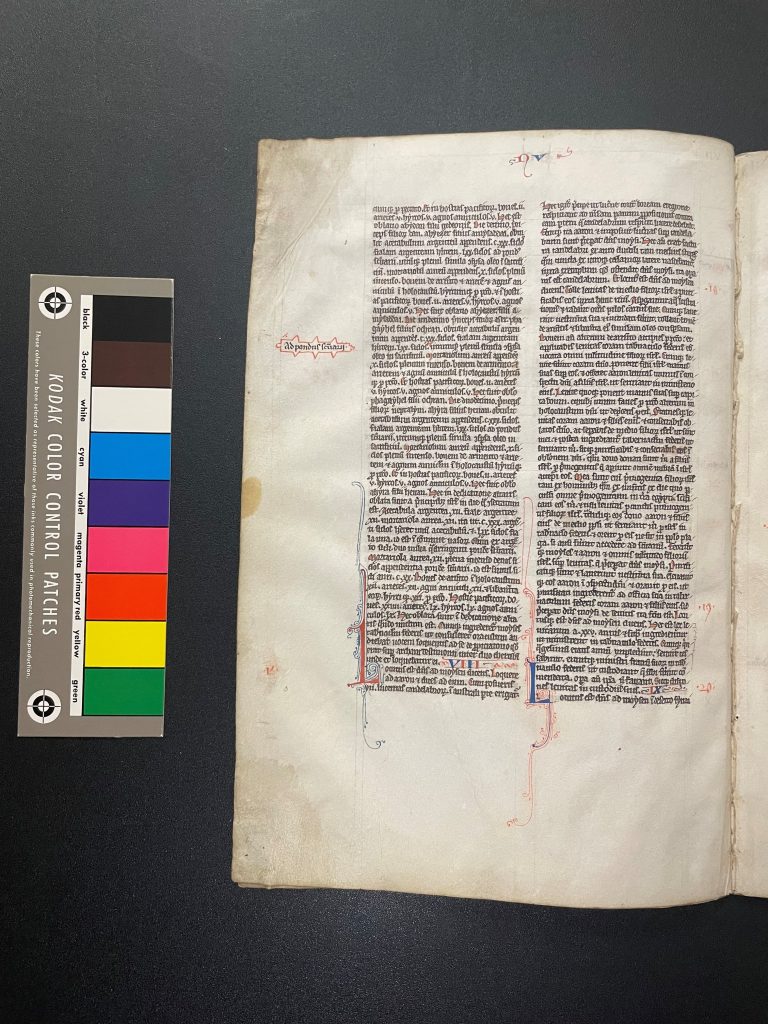
The page continues and completes Chapter IV through column a and partway through column b, then opens Chapter V in the lower part of column b, with an enlarged decorative initial L embellished with pen-line flourishing.

Collection of Richard Weber. Chudleigh Bible Leaf 39, recto. Photograph by Richard Weber.

Verso

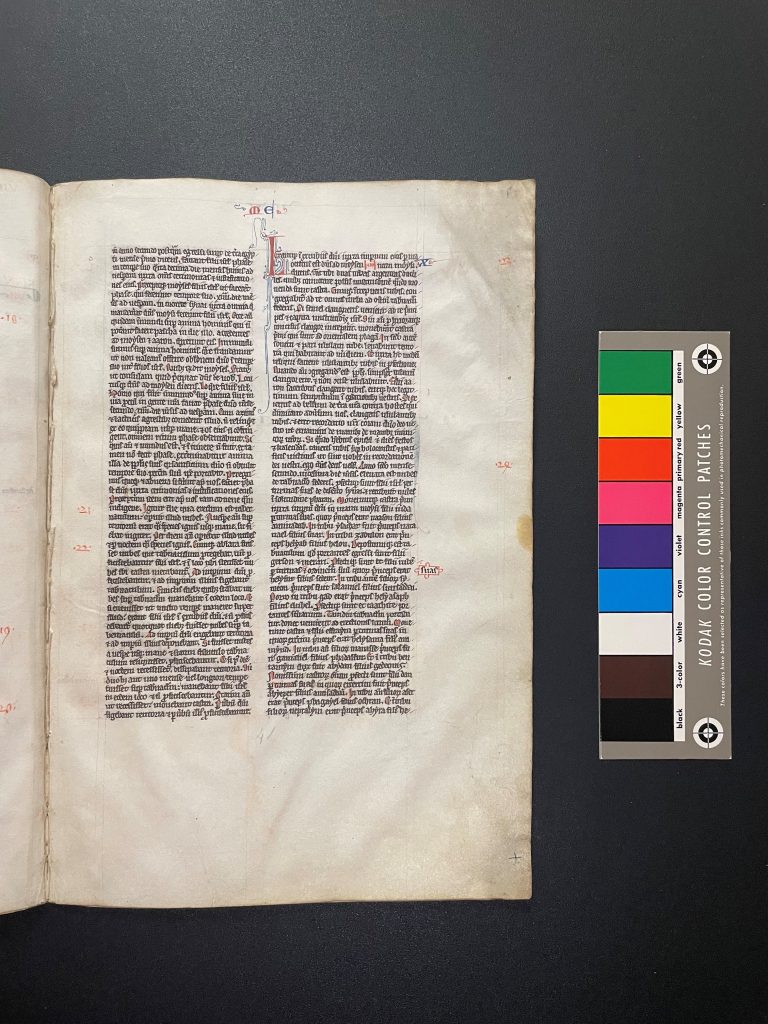
The page completes Chapter V in column a, opens Chapter VI which it finishes partway through column b, then opens Chapter VII apparently mistakenly in the lower part of column b, as its rubricated chapter number is cancelled with a horizontal cross-stroke.

Collection of Richard Weber. Chudleigh Bible Leaf 39, verso. Photograph by Richard Weber.

Detail

Collection of Richard Weber. Chudleigh Bible Leaf 39, verso: lower. Photograph by Richard Weber.

2. Folio 40

Recto

The page completes Chapter VI in column a, opens Chapter VII in line 7 modestly with an enlarged in-line initial and the chapter number VII entered within a paraph in the inner margin, continues the chapter through the rest of the page to continue on the verso.

Collection of Richard Weber. Chudleigh Bible Leaf 40, recto with guide. Photograph by Richard Weber.

Verso

The page completes Chapter VII in column a, opens Chapter VIII in the penultimate line of that column, and opens Chapter IX in the last line of column b; these chapters open with an initial L in each case, rendered respectively in red pigment or blue pigment, with pen-line flourishing in the opposite color.

Collection of Richard Weber. Chudleigh Bible Leaf 40, verso with guide. Photograph by Richard Weber.


3. Folio 41

Recto

The page contains the end of Chapter IX in column a, completes its text in the first two lines of column a, and opens Chapter X directly with an initial L in red.

Collection of Richard Weber. Chudleigh Bible Leaf 41, recto with guide. Photograph by Richard Weber.

Verso

The page completes Chapter X in the upper part of column a and opens Chapter XI with a blue initial L.

Collection of Richard Weber. Chudleigh Bible Leaf 41, verso with guide. Photograph by Richard Weber.

4. Folio 42

Recto

Collection of Richard Weber. Chudleigh Bible Leaf 42, recto with guide. Photograph by Richard Weber.

Verso

Collection of Richard Weber. Chudleigh Bible Leaf 42, verso with guide. Photograph by Richard Weber.

Traces of Stitching, Ruling, Pricking,
and other Processes of Production and Use

The ability to see adjacent leaves reveals significant evidence of shared processes of production, along with various traces of use. We celebrate the ability, with thanks to the generosity and perspicacity of the collector and the quality of his photographs!

Collection of Richard Weber. Chudleigh Bible Leaf 42, recto, top left. Photograph by Richard Weber.

The Outer Limits

We review the two known leaves which once directly preceded and followed the four leaves in the Weber Collection from the Book of Numbers in the Chudleigh Bible, as reported in our previous blogpost about them and their manuscript.

  • Two Leaves in the Book of Numbers from the Chudleigh Bible

Opening of Quire (Leaf ‘1’): Folio 38

This leaf must have directly followed the opening leaf of the Book, as it starts partway within Chapter 1. That leaf would have carried the opening initial for the Book, with L for Locutusque. Its present location is unknown, but the contents of its illustrated initial have been recorded to indicate a depiction of the figures of God, Moses, and Joshua at an altar. (p. 69 and 72 note 8)

Text (recto and verso)

Numbers 1  36 [De filiis Benjamin per generationes et familias ac domos] cognationum suarum recensiti sunt nominibus singulorum a vigesimo anno et supra, omnes qui poterant ad bella procedere, 37triginta quinque millia quadringenti.
Numbers 2 1 Locutusque est Dominus ad Moysen et Aaron, dicens
Numbers 3  1 Hæ sunt generationes Aaron et Moysi in die qua locutus est Dominus ad Moysen in monte Sinai.
7 et observent quidquid ad cultum pertinet multitudinis coram taberna // culo testimonii,
Numbers 4  1 Locutusque est Dominus ad Moysen et Aaron, dicens
14 ponentque cum eo omnia vasa, quibus in ministerio ejus utuntur, id est, ignium receptacula[, fuscinulas ac tridentes, uncinos et batilla.]

Recto

Formerly Collection of Richard Weber, Leaf 1 from the Chudleigh Bible: Recto.

Verso

Formerly Collection of Richard Weber, Leaf 1 from the Chudleigh Bible: Verso.

End of Quire (Leaf ‘6’): Folio 43

Text (recto and verso)

Numbers 15 9 [dabis per singulos boves similæ tres decimas consper]sæ oleo, quod habeat medium mensuræ hin
Numbers 16 1 Ecce autem Core filius Isaar, filii Caath, filii Levi, et Dathan atque Abiron filii Eliab,
28 Et ait Moyses : In //hoc scietis quod Dominus miserit me ut facerem universa quæ cernitis, et non ex proprio ea corde protulerim :
[Possibly struck through incorrect marking for chapter 16 at]
Numbers 16 36 Locutusque est Dominus ad Moysen, dicens
Numbers 17 1 Et locutus est Dominus ad Moysen, dicens
Numbers 18 1 Dixitque Dominus ad Aaron
11 Primitias autem, quas voverint et obtulerint filii Israël, tibi dedi, et filiis tuis, ac filiabus tuis, jure perpetuo : qui mundus est [in domo tua, vescetur eis. ]

*****

Recto

Formerly Collection of Richard Weber, Leaf 2 from the Chudleigh Bible: Recto.

Verso

Formerly Collection of Richard Weber, Leaf 2 from the Chudleigh Bible: Verso.

III. A (Disconnected) Quire as Witness

Thus we advance our on-going project to study the surviving witnesses to medieval manuscript fragments. As promised in our first blogpost on the Chudleigh Bible, we encourage and cultivate the study of the leaves and their context, in the quest to identify and virtually reconstruct the former volume. This second blogpost reports more information as more leaves are revealed.

The generic characteristics of the printed label accompanying the ensemble of 6 leaves (see above), giving no indication of the text to identify a particular part of the manuscript, implies that the seller may have prepared groups of leaves, such as intact quires, to sell in themselves. If so, there might be other quires or former quires which found their way through such a dealer and might, in time, surface among various collections around the world. We look forward to more discoveries.

IV. The Book

IV.1. A Single Volume

The subject of this quest? Notice of the manuscript whilst still intact, with some black-and-white images of its illustrated elements, appeared in print for its sale by successive owners, starting with Charles Oswald Hugh Clifford, the eleventh Lord Clifford of Chudleigh.

Formerly, as described in its sales catalogue descriptions while still intact (see our previous blogpost), the manuscript comprised a single volume of 411 vellum leaves (with its text laid out in double columns of 56 lines each). Mention is made of 139 illuminated initials, some of which are historiated. Initials opening Books of the Bible contained historiated scenes and decorative elements; some 90 or 91 of them were historiated. Mention is also made of some damage to the volume, including losses of leaves.

1) Sold by Sotheby & Co, London,
7 December 1953, lot 51
(pp. 00? in catalogue)

Catalogue of fine Western and Oriental manuscripts and miniatures . . . :  which will be sold by auction by Messrs. Sotheby & Co. . . . at their large galleries 34 & 35 New Bond Street, W.1

Bought by Maggs Bros., London, for £680.

2) Sold by Sotheby & Co, London,
Wednesday, 8th July 1970 as Lot 104 (pp. 78–79 in catalogue)

Catalogue of important Western manuscripts and miniatures . . . : which will be sold by auction by Sotheby & Co. . . . at their large galleries, 34 and 35 New Bond Street, W.1 . . . ; day of sale: Wednesday, 8th July, 1970

The entry cites 139 illuminated initials, some of which are historiated. It mentions some defects, including many margins “to some extent stained” and damage to some initials, of which “5 are badly damaged and 15 slightly damaged.” Some losses were discernible, with “the first two leaves largely defective” and “a few leaves missing at the end of the Interpretations [of Hebrew Names]”.

Facing the catalogue entry, the companion page of “Illustration” shows 8 cropped images with historiated initials (sometimes two in succession on the same page), encompassing 10 initials altogether. Their locations in the manuscript are not indicated.

“The text is the normal text of a thirteenth-century Bible, i.e. the modern Vulgate with the addition of Esdras III, which is called Esdras II, the modern Estras II being called Nehemiah. Acts follows the Pauline Epistles. . . . Marginal annotations in red and plummet are fairly numerous. Many are enclosed in red cartouches.”

IV.2. Individual Leaves or Groups of Leaves

Thereafter leaves appeared in various catalogues, including these (which I have not yet seen):

  • Quaritch cat. 1147 (1991), no. 15
  • Maggs Bros, Fine Books and manuscripts, cat. 1167 (1993), no. 2
  • Sotheby’s, Western Manuscripts and Miniatures, 6 December 2005, lot 16

Sometimes the manuscript might receive notice on its own account. For example:

  • Christopher de Hamel, Scribes and Illuminators. Medieval Craftsman Series (Toronto, 1992), page 43 and plate 36.

An account especially of the illuminated components appears by Peter Kidd:

  • Peter Kidd, The McCarthy Collection, III: French Miniatures (London, 2021), no. 17 (pp. 69–73)

His companion blogpost seems to have disappeared, along with the blog as a whole:

  • Manuscript Provenance: McCarthy Catalogue, Volume III (French Illuminations).

IV.3. Some Specimens

Our previous blogpost has gathered a selective list of specimen leaves which have circulated through the marketplace on their own or in groups. To some extent, this list follows the order of the Books in the Vulgate manuscript; sometimes a catalogue listing groups into one entry a set of several leaves from the manuscript.

In time, in combination with other resources, this list might aid a full virtual reconstruction of the manuscript, not only of its illustrated leaves, but also leaves of text like the Weber/RGME leaves from within the text of the Book of Numbers.

*****

Further blogposts and/or other reports may offer more information about the manuscript and its identifiable fragments. The goal is to build towards a fuller recognition of the survivors, their characteristics, and their locations.

Do you know of other leaves from this manuscript? Do you know of other work by its scribal hands?

We look forward to hearing from you.

*****

Questions? Suggestions?

  • Leave your comments or questions below
  • Contact Us

Visit our Social Media:

  • our Facebook Page
  • our Facebook Group
  • our X/Twitter Feed (@rgme_mss)
  • our Bluesky nest @rgmesocial.bluesky.social)
  • our Instagram Page
  • our LinkedIn Group

Join the Friends of the RGME.

Please make a Donation in Funds or in Kind for our nonprofit educational corporation powered principally by volunteers. Your donations and contributions are welcome, and can go a long way. They may be tax-deductible to the fullest extent provided by the law.

  • Donations and Contributions
  • 2026 Annual Appeal

*****

Collection of Richard Weber. Chudleigh Bible Leaf 39, verso: lower. Photograph by Richard Weber.

No Comments »

Medieval Missal Fragment as Early-Modern Cover

February 28, 2026 in History of Printing, Manuscript Studies, Photographic Exhibition, Reports, Research Group Workshops, Reused Binding Fragments, Workshops on "The Evidence of Manuscripts"

A Medieval Missal Fragment
in Latin on Vellum
Reused
as the Early-Modern Binding Cover
for Erasmus Reinhold,
Prutenicae Tabulae (1585)

Mildred Budny

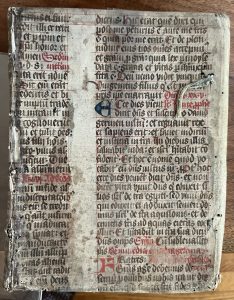
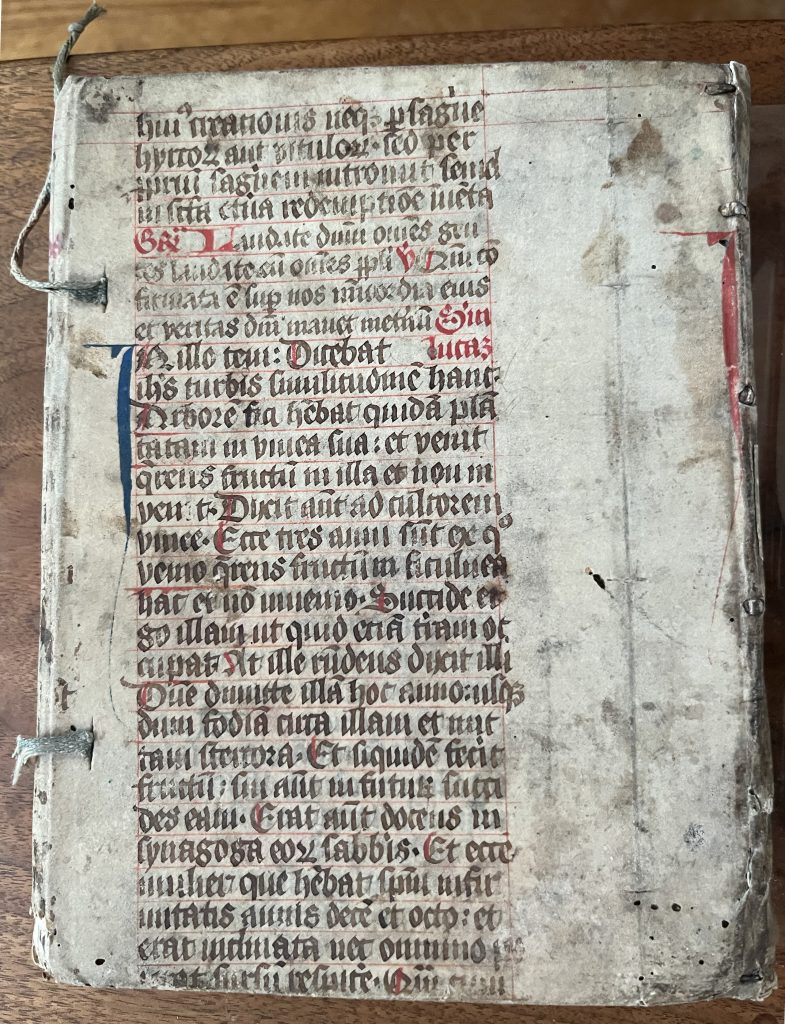
Reinhold (1585), Front Cover. Collector’s Photograph.

[Posted 25 February 2026, with updates]

In a Private Collection, we learn of an early-modern printed book on paper which reuses a medieval vellum binding fragment as cover for the card covers of its binding. Gladly we offer some first fruits of examining this evidence, in the process of work-in-progress process to learn about the original manuscript, the identity of its genre of book, its context, its reuse, and its fate within the printed book which ensured its survival, at least as a partial witness, to its former, intended, state.

With permission, we share the owner’s photographs of the ‘beginning, middle, and end’ of this specimen, or the ‘front, back, and side’.

I. The Printed Book

We introduce:

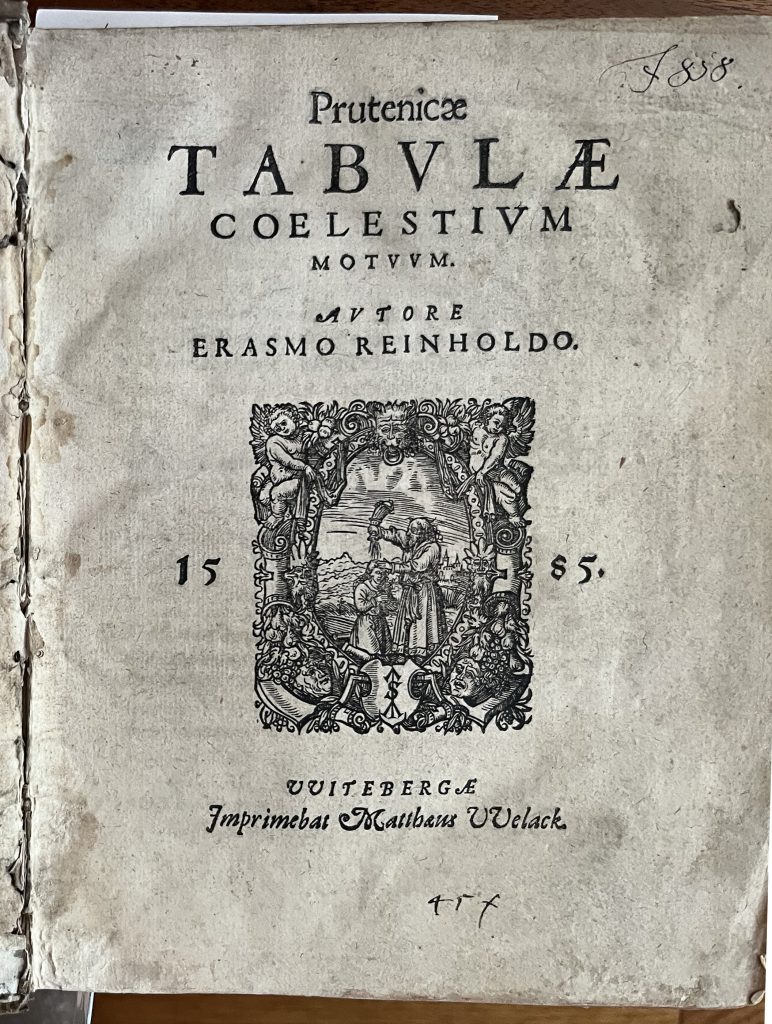
  • Erasmus Reinholdus, Prutenicae Tabulae Coelestium Motvem (Wittenberg, 1585)

Opening the book reveals the title page facing an originally blank page containing multiple entries, mostly in ink, in hand-written additions by different hands. Principal among them is the full-page single-column entry relating to the book and its context.

About the book itself, the work of the astronomer Erasmus Reinhold (1511–1553), a summary appears on Wikipedia (currently):

The Prutenic Tables (Latin: Tabulae prutenicae from Prutenia meaning “Prussia“, German: Prutenische oder Preußische Tafeln), were an ephemeris (astronomical tables) by the astronomer Erasmus Reinhold published in 1551 (reprinted in 1562, 1571 & 1585). They are sometimes called the Prussian Tables after Albert I, Duke of Prussia, who supported Reinhold and financed the printing. Reinhold calculated this new set of astronomical tables based on Nicolaus Copernicus‘ De revolutionibus orbium coelestium, the epochal exposition of Copernican heliocentrism published in 1543. Throughout his explanatory canons, Reinhold used as his paradigm the position of Saturn at the birth of the Duke, on 17 May 1490. With these tables, Reinhold intended to replace the Alfonsine Tables; he added redundant tables to his new tables so that compilers of almanacs familiar with the older Alfonsine Tables could perform all the steps in an analogous manner.

— Prutenic Tables

The first edition was printed in Tübingen in 1551 (see the copy for sale via Swann Galleries and an online digital facsimile of another copy via Google Books).

The edition under our consideration appeared in 1585. It was printed in Wittenburg by Matthaeus Welack (see another copy: via Swann Galleries or Swann Galleries).

At the front of the copy, the first verso (the pastedown on the inside front cover) carries a page of annotations in ink and pencil, facing the title page. At the top and bottom of the margins on both pages there gather some sellers’ or owners’ marks, codes, or notations: for example, 1R, N27, F858, 454, apparently to identify the item, such as within one or other individual collection. We note that some of these marks are crossed out or erased. A full-page single-column entry on the pastedown closes with the date ‘1632’, approaching a half-century after the printing of the book.

Reinhold (1585), Opening to Title Page. Collector’s Photograph.

Title Page

Reinhold (1585), Title Page. Collector’s Photograph.

II. The Reused Manuscript Fragment

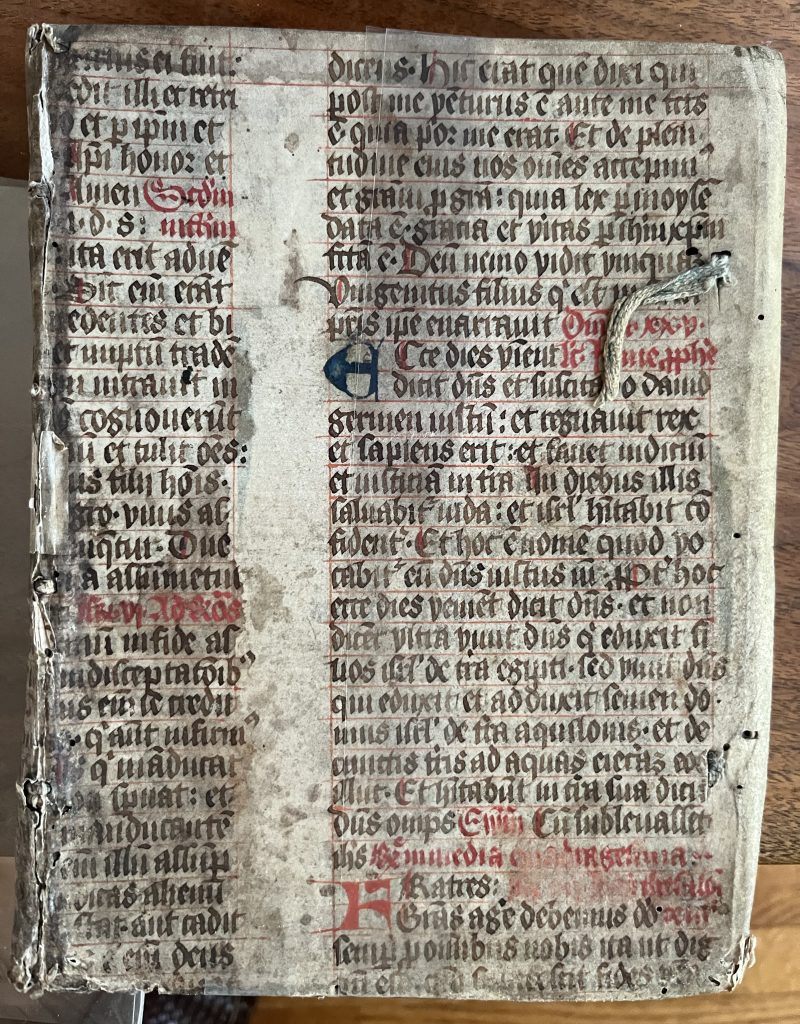
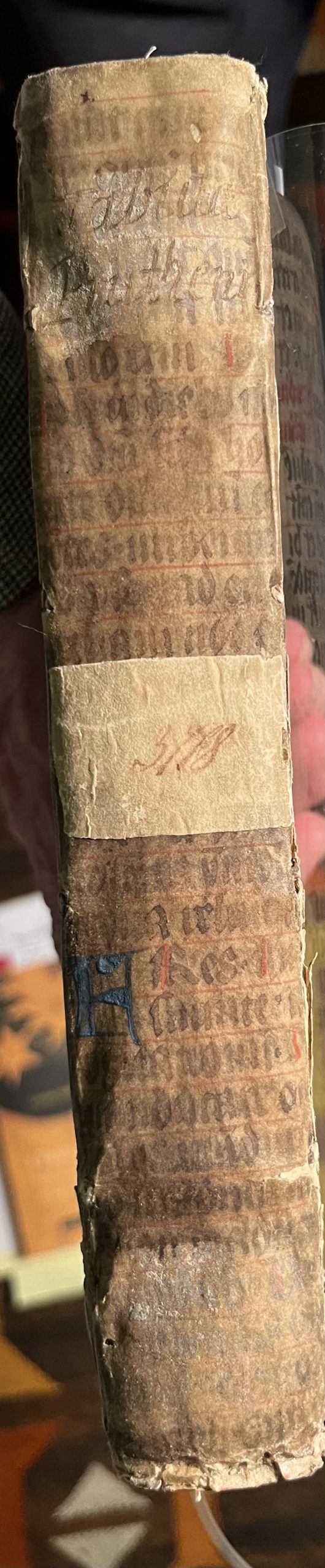
The reused vellum fragment reveals its characteristics only partly, because the presentation as the covering of the boards of a binding for another set of contents turns one side of the vellum sheet to the back, hidden from view. As it is presented on the front cover, spine, back-cover, and turn-ins of the boards, we might glimpse parts of two columns of text on each of two pages on a single bifolium, plus some of the margins, including the intercolumns, inner columns, and original gutter.

On the cover, the text of the reused sheet stands upright with relation to the printed book. Let us start with the Front Cover of the Printed Book, move to the Spine, and turn to the Back Cover. However, be it noted, taking the original text in columns reading from left to right on a page, let us observe that the reused sheet constitutes a pair of leaves, for which the text starts with the ‘verso’ of the first leaf of the bifolium on the back cover, turns to the portion overlying spine of the volume, and moves to the ‘recto’ of the second leaf on the front cover.

Front Cover of the Printed Copy:
Side 1 of the Reused Manuscript Fragment

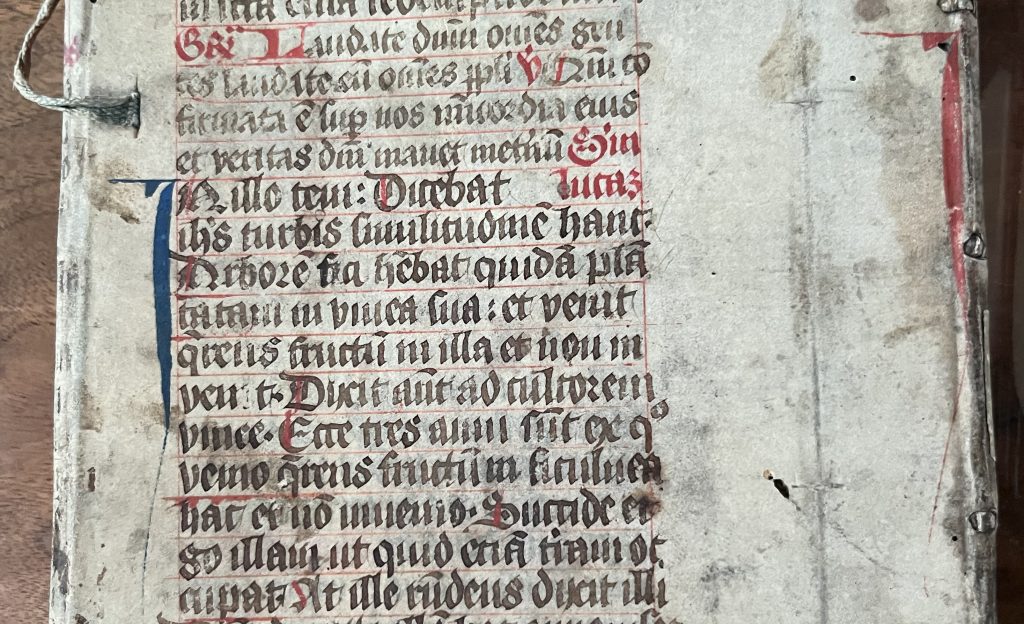
Here, with added ties to close the printed book, appears part of a 2-column page of text written in ink, with enlarged 2-line inset initials rendered alternately in blue or red pigment, rubrication written in red pigment for headings, and added strokes of red pigment to mark and highlight in minor text initials within the columns. Red lines set out the rulings for the lines and columns of text.

Reinhold (1585), Front Cover. Collector’s Photograph.

Spine

Reinhold (1585), Spine. Collector’s Photograph.

Back Cover
Side 2 of the Reused Manuscript Fragment

Reinhold (1585), Back Cover. Collector’s Photograph

Details

Back (Middle): Column B, Inner Margins, Gutter, and Initial of Column A

Reinhold (1585), Back Cover, Midsection. Collector’s Photograph

Front (Middle)

Reinhold (1585), Front Cover, Middle. Collector’s Photograph

*****

The Medieval Fragment

The RGME offers to the Private Collector and the wider world a preluminary report on “The Reinhold Missal Fragment.” It is available freely for download on our website.

With thanks to our Research Consultant, Leslie J. French, its preliminary findings can be summarized thus:

The two visible pages are consistent with a Roman Missal containing texts near the end of the Temporale.  Another extant missal containing exactly the sequences on these pages has not been located, so it is not yet possible to determine for which Use the original might have been constructed.  The following texts have been identified and matched against missal entries in the Usuarium database (https://usuarium.elte.hu/).

See the report:

  • Reinhold Missal Fragment

******

Would you like to join the quest to discover more about the original manuscript, and if possible to identify its producers, place of origin, and audience? Please let us know.

*********


Tags: Erasmus Reinhold, history of printing, Medieval Latin Missals, Medieval Manuscript Fragments, Prutenicae Tabulae Coelestium Motvem, Reused Binding Fragments
No Comments »

A Sister Leaf from a Miniature Latin Vulgate Bible

December 17, 2025 in Fragments, Manuscript Studies, Research Group Workshops, Workshops on "The Evidence of Manuscripts"

A Sister Leaf
from a Miniature Latin Vulgate Bible:
Fragments at Princeton

2 columns in 47 lines
Measurements
Leaf maximum circa 121 mm high × 82 mm wide
<Written area circa 90 × 57 mm>

[Posted on 16 December 2025]

Poster 3 for 2025 Autumn Colloquium. Workshops on “Fragments at Princeton”

For the recent 2025 RGME Autumn Colloquium on Fragments, our Associate Eric M. White presented a pair of Workshops on “Fragments at Princeton”, with a focus on “Books in Fragments / Fragments in Books”. The workshops took place in Special Collections of the Princeton University Library, in two sittings.

With a few variations in each workshop, the selected specimens considered a range of manuscript and printed materials. They included, for example, single manuscript leaves (or fragments thereof) on their own or manuscript fragments (single leaves or conjoint bifolia) reused as part of bindings, pastedowns, or endleaves for other texts.

For many of these specimens, Eric demonstrated their characteristics with a riveting commentary about the processes of discovery which brought them to Princeton or which enriched understanding about them once the curator or scholar came across them in the stacks or within their secondary homes in the form of composite codices mixing layers from different dates and places of production and different genres of books.

He presented some specimens of individual leaves as curiosities about which little is known — in case they might be recognized. About one of them I said that I thought I knew of another similar leaf. The Princeton University Leaf  came from a set of three boxes of manuscript fragments, which had little or no information about their sources.

Now we introduce another leaf which I believe came from the same manuscript. Do you agree?

Read the rest of this entry →

Tags: Book of Isaiah, Book of Wisdon, Fragmentology, manuscript fragments, Manuscript studies, Medieval Latin Vulgate Bibles, Medieval Manuscript Fragments, Princeton University Library
No Comments »

Workshop 8: A Hybrid Book where Medieval Music Meets Early-Modern Herbal

October 11, 2025 in Announcements, Early-Printed Books, Event Registration, Manuscript Studies, Research Group Workshops, Workshops on "The Evidence of Manuscripts"

RGME Workshops
on
“The Evidence of Manuscripts, Etc.”

Workshop 8
“Face the Music, or,
Where Manuscript Meets Print
in a Hybrid Book:

An Early-Modern German Astrological Herbal
with a Reused Binding Fragment
from a Medieval Musical Manuscript”

Sunday 26 October 2025
Online by Zoom

[Posted on 15 September 2025, with updates)

Our series of Workshops on “The Evidence of Manuscripts, Etc.” continues with an exploration of a hybrid book for Workshop 8.

The Hybrid Book

This workshop will examine a puzzling vellum fragment (or is it a set of patchwork fragments?) in a private collection. The fragment(s) come(s) from a single musical manuscript in Latin on vellum laid out in double columns with text and notation on 4-line staves. The reused medieval material forms the outer covering of a 17th-century printed book in German on laid paper.

Private Collection, Front Cover with Reused Medieval Musical Fragment on Vellum. Photograph by Mildred Budny.

The Musical Fragment and its ‘Find-Place’

For the musical fragment, we will work to decipher the visible parts of the text and music, identify the readings/lections and chants, and, if possible (given the fragmentary nature), determine the probable genre of original manuscript, such as lectionary, breviary, antiphonary, or missal. Perhaps, over time, we might find other survivors from the same despoiled medieval manuscript.

Narrowing down its possible origin—or location in the early 17th century or later when it came to be reused as a binding cover–might aid the quest to determine the circumstances of its reuse and whence other parts of it might have been disseminated, whether as reused binding materials or otherwise.

For the workshop, we will examine the features of the printed book. It includes multiple woodcut illustrations and occasional marginalia in forms of annotations demonstrating attention of several kinds to the contents of the herbal.

What brought this medieval musical fragment and early modern printed book together? Even if we might never know all the answers, won’t it be fun to question how and why? There is a story here.

We love the puzzles, and give thanks to the collector for lending the book to the RGME for study and teaching and for sharing it with our audience in this workshop and beyond.

Information

People who be participating at the workshop to offer observations, reflections, and suggestions about the composite volume include (in alphabetical order):

Phillip Bernhardt–House

Mildred Budny

Natalia Fay

Leslie French (represented by a report on the musical manuscript fragment)

Beppy Landrum Owen

David Porreca

David W. Sorenson (with some specimens of herbals mentioning astrological influences)

And others.

At our 2024 Spring Symposium at Vassar College, Natalia delightfully described her work for her exhibition on herbals then on display in the Art Library. She shares the poster and brochure for the exhibition with us, as she returns to our events in this workshop to report on her continuing interests in plants, books, manuscripts, and their transmission.

  • Natalia Fay, Botanicals Thesis Poster
  • Natalia Fay, Arcane Botanicals Program

The Manuscript Fragments

The visible portions of the manuscript appear, with only one side facing and the other side hidden, on the outer sides of the front and back covers, spine, and fore-edges of the binding.

Their text and music on four-line staves stand upright on the volume. Written in Gothic script, the parallel lines of music and text have some elements in red and blue pigments. There are ten lines on the front cover and on the spine, but the back cover has an additional line of music at the bottom, amounting to 10 1/2 lines on this portion. Each portion of the fragment shows a single column, or part of one. At the right on the back cover, the right-hand side of the fragment extends beyond the column with an expanse of outer margin from its original extent.

Sections open with 2-line initials which span the full height of the paired lines of music-and-text, for which the staves separate their horizontal course. One initial comprises a blue capital I (front cover, line 7). Three band-like initials comprise decorative forms in black ink with a vertical twist at the left-hand side; red pigment fills the centers of their twists (front cover, lines 2 and 6; back cover, line 2).

1. Front Cover

Private Collection, Front Cover with Reused Medieval Musical Fragment on Vellum. Photograph by Mildred Budny.

2. Back Cover

Private Collection. Musical Manuscript Fragment, Back Cover with ruler.

Spine

Private Collection. Hybrid book with Musical Manuscript Fragment, Spine View.

The Printed Book

The printed text comprises the German Kreutterbuch (“Book of Herbs”), an astrological herbal, by Bartholomaeus Carrichter (1510–1574), in an early edition printed in Strasbourg in Alsace in 1606. The author, who wrote under the pseudonym of Philomusus Anonymus, was physician to Ferdinand I (1503–1564), Holy Roman Emperor from 1556, and his son Maximilian II, Holy Roman Emperor from 1564 to 1576. The first edition of his Kreutterbuch was printed in Strasbourg in 1517 by Chistian Muller. For later editions, the physician, poet, and alchemist Michael Toxites (1515–1581), whose birth-name was Johann Michael Schütz, added some material to Carrichter’s work and edited it.

One of various versions of the illustrated genre by different authors (see, for example the Kreutterbuch desz Hocgelehrten und Weitberuhmten Herrn D. Petri Andreae Matthioli . . . ), this book combines information about plants, use, and lore with astrological considerations.

Title Page

A catalogue description of the volume characteristically derives from information on the title page:

Philomusus Anonymous [Bartholomaeus Carrichter (1510–1574)], Horn des Heyls menschlicher Blödigkeit, oder Kreütterbuch, darinn die Kreütter des Teutschenlands auss dem Liecht der Natur nach rechter Art der himmelischen Einfliessungen beschriben / durch Philomusum Anonymum [Bartholomäus Carrichter], with a foreword by Michael Toxites, born Johann Michael Schütz (1514–1581), (Strassbourg: Anton Bertram, DCVI/1606).

An inscription in light black ink at the foot of the title page gives the initials “G. S.” Perhaps they refer to an owner.

Private Collection, Kreutterbuch, title page. Photograph by Mildred Budny.

For the first edition of 1576, printed in Straßburg, see an online digital facsimile of a copy in Augsburg, Staats- und Stadtbibliothek. For an edition of 1619 also printed by A. Bertram, see the copy in the Wellcome Collection.

Like the 1619 edition, this folio volume has 10 unnumbered pages, 180 numbered pages, and 5 unnumbered leaves, with a woodcut title page and outline illustrations. Interspersed within the columns of text, the book has 58 outline illustrations depicting the herbs which it describes. For example, borage (Borago officinalis) or starflower:

Private Collection, Carrichter’s Kreutterbuch (Strasbourg, 1604). Borage. Photography by Mildred Budny.

Up close:

Private Collection, Carrichter’s Kreutterbuch (Strasbourg, 1604). Borage. Photography by Mildred Budny.

For comparison: Borage ‘In The Wild’

Borago officinalis. Photograph by By Christian Orlandi (12 April 2025) – Own work, CC BY-SA 4.0. Image via Wikimedia Commons via https://commons.wikimedia.org/wiki/File:Borago_officinalis_(2025).jpg.

Some marginal annotations in brown ink amplify or comment upon passages.

Private Collection, Carrichter’s Kreutterbuch (Strasbourg, 1604). Textual opening with marginal Annotations. Photography by Mildred Budny.

*****

Registration for the Workshop

We invite you to join the quest.

  • https://www.eventbrite.com/e/workshop-8-a-hybrid-book-with-astrological-herbal-and-medieval-missal-tickets-1340074201009

*****

Questions? Suggestions?

  • Leave your comments or questions below
  • Contact Us

Visit our Social Media:

  • Leave your comments or questions below
  • Contact Us

Visit our Social Media:

  • our Facebook Page
  • our Facebook Group
  • our X/Twitter Feed (@rgme_mss)
  • our Bluesky nest @rgmesocial.bluesky.social)
  • our Instagram Page
  • our LinkedIn Group

Join the Friends of the RGME.

Please make a Donation in Funds or in Kind for our nonprofit educational corporation powered principally by volunteers. Your donations and contributions are welcome, and can go a long way. They may be tax-deductible to the fullest extent provided by the law.

  • Donations and Contributions
  • 2025 Annual Appeal

*************

Tags: astrological herbals, Bartholomaeus Carrichter, Early modern printing, history of herbals, history of printing, Kreutterbuch, manuscript fragments, Manuscript Fragments Reused in Bindings, Manuscript studies, medieval musical manuscripts, Michael Toxites
No Comments »

Fragments from a Book of Hours

July 27, 2025 in Manuscript Studies, Photographic Exhibition, Research Group Workshops, Workshops on "The Evidence of Manuscripts"

Detective Story
“Fragments from a Book of Hours
Looking for their Identity”

[Posted on 25 July 2025]

Would you help us identify these fragments of a single leaf from a Book of Hours in a Private Collection? As if by the skin of their teeth, they survive together in a single collection. That collection has no other fragments from the same manuscript.

We wonder about these ‘foundlings’ and their former home in the medieval manuscript which contained them and their ‘relatives’ comprising the other leaves and the rest of this one leaf. Would you like to join the quest to find their identity?

Original Recto

Private Collection, Fragmentary Leaf from a Book of Hours. Recto, with two pieces aligned in their former original position. Photograph by Mildred Budny.

Original Verso

Private Collection, Fragmentary Leaf from a Book of Hours. Verso, with two pieces aligned in their former original position. Photograph by Mildred Budny.

Do you recognize their style, script, layout, and original manuscript? When and where do you think that it was made, and do you know, perchance, when and where it was dismembered for distribution?

We turn to the wider world to crowd-source the answers.

What do you think?

We plan to showcase these fragments and others looking for their identities in the series of

  • RGME Workshops on “The Evidence of Manuscripts, Etc.”

Please join us for the joys of detective work and sharing discoveries.

We look forward to hearing from you.

Private Collection, Fragmentary Leaf from a Book of Hours. Recto bottom, with two pieces aligned in their former original position. Photograph by Mildred Budny.

*****


Tags: Books of Hours, Fragmentology, Manuscript Foundlings, manuscript fragments, Medieval manuscripts
No Comments »

2024 Landmarks

March 3, 2025 in 2024 Grant, Anniversary, Events, Manuscript Studies, RGME Recollections, RGME Symposia, Student Friends of Princeton University Library, Visits to Collections, Workshops on "The Evidence of Manuscripts"

Landmarks

Achievements for the RGME Anniversary Year

Reflections on the Year’s RGME Visits
(In Person, Virtual, and Hybrid)
to Special Collections

2024 Spring and Autumn Symposia
2024 Spring Symposium at Vassar College
2024 Autumn Symposium “At The Helm”
RGME Visit to the Collection of Steven M. Lomazow: Report

[Posted on 2 March 2025]

Private Collection, Photograph of Bridges in Paris, 1850s (enhanced). Image courtesy of David W. Sorenson.

Reflecting upon the many achievements of the Research Group on Manuscript Evidence in its 2024 Anniversary Year, we celebrate the Landmarks in the journey, as well as the individual and collective steps of its full course.

For the Anniversary Year, our Theme was “Bridges”. Our funded Project for a major part of its accomplishments was “Between Past and Future”. See:

  • 2024 Grant for “Between Past and Future” Project from The Gladys Krieble Delmas Foundation Research Libraries Program

With the completion of the year’s work for 2024, we observe that it brought many developments for the RGME, as we responded to the momentum of the events as they unfolded. Learning from them and gathering their momentum with follow-up events, we discovered that it was possible to create fresh approaches, returning participation, and new collaborations.

Let us focus on one of those sets of landmarks, to show how both the planned activities and their unexpected expansions could produce a remarkable series of visits to Special Collections of various kinds, whether in person, online, or both in hybrid format.

RGME Visits to Special Collections in 2024

The story unfolded in a series of steps, leading to specific events.

Spring and Autumn Symposium as a Pair,
with Follow-Up

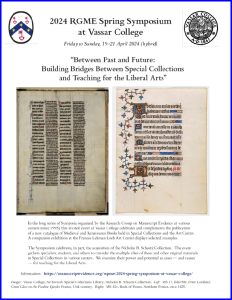
Poster 2 has two manuscript images at the center, with the RGME logo at top left and the Vassar College logo at top right.

Poster 2: Program for 2024 Spring Symposium at Vassar.

They centered upon the pair of 2024 Spring and Autumn Symposia, designed for the Project as an invited, hybrid, 3-day event in the Spring at Vassar College, and an online 1-day event in the Autumn as its follow-up.

  • 2024 Spring Symposium at Vassar College
  • 2024 Autumn Symposium “At the Helm”

The Spring Symposium took place as planned, while a few updates in the program adapted to circumstances, such as when a few speakers as short notice had to change travel plans and present in online format rather than in person. Our dedication to a hybrid format for the event maintained our commitment to our wider audience from the need to create online events in recent years, while we waited for the return of in-person events.

Spring Symposium “Between Past and Future”
April (hybrid)

That opportunity came in 2024, with the invitation to hold our Spring Symposium at Vassar College in April. The focus of the Symposium is manifested in its title,

“Between Past and Future:
Building Bridges between Special Collections
and Teaching for the Liberal Arts”
.

Speakers from Vassar and other centers in the United States and the United Kingdom reported projects and initiatives for Special Collections dedicated to teaching with original sources in manuscript and other forms.

Our subjects were primarily medieval and early modern, in keeping with the new catalogue of such materials and the special exhibition on “Books of the Middle Ages & Renaissance” at the college. Thus collectively, with the Spring Symposium, were celebrated the acquisition of the Nicholas B. Scheetz Collection of Medieval and Renaissance Manuscripts.

Autumn Symposium “At The Helm”
October (online)

Enthusiasm for the Spring Symposium led, by participants’ requests, to extend the Autumn Symposium to 2 days instead. This symposium featured a set of curated virtual visits to Special Collections, both private and public.

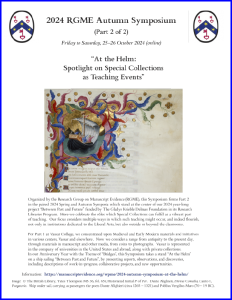
Poster 2 for RGME 2024 Autumn Symposium. Set in RGME Bembino. Image: Coventry Patmore, Amelia: An iIyll (1878), title page, illuminated by Bertha Patmore. Mark Samuels Lasner Collection, University of Delaware Library, Musuems and Press.

Expanding the time-frame of the Spring Symposium, the Autumn Symposium considered materials from antiquity to the present day, medieval and early modern still included. The materials under consideration included manuscripts, printed books, and coins.

The virtual visits examined highlights of collections at Vassar College (both Special Collections and the Art Center) and the Universities of Delaware, Missouri, Rochester, and Waterloo, as well as private collections. Manuscripts showcased in the presentations included examples not only from them, but also, for example, from the Biblioteca Capitolare in Vercelli, Princeton University, and the RGME’s own Library & Archives.

Collectors speaking about their collections and the inspiration for them included our RGME Associates, Mark Samuels Lasner, Beppy Owen, and Reid Byers, who previewed his exhibition on “Imaginary Books” about to open at The Grolier Club. Its catalogue, we note with delight, is set in our own RGME Bembino (like our website), Reid’s choice for its font.

The enthusiasm for that event was remarkable. It had vivid presentations and discussions about them by curators, teachers, students (undergraduate and graduate), independent scholars, and others. We can sum up the atmosphere with the words of one presider, Librarian at the University of Missouri, that the Symposium celebrated, and brought home and alive, “the joy of education”.

This momentum called for its own follow-up. Accordingly, we turned to an invitation (since January) to visit a private collection. The nature of our year’s Project encouraged us to prepare the visit, if possible, before the end of our Anniversary Year.

In-Person/Online Visit
November (hybrid)

In November, the RGME visited the Collection of Dr. Steven M. Lomazow both in person and online. The scope of the collection and our visit to it, with thanks to the generosity of Dr. Lomazow and his wife Suze Bienaimee, are described in our announcement and report:

  • RGME Visit to the Collection of Steven M. Lomazow, M.D.
  • RGME Visit to the Lomazow Collection: Report

This visit in hybrid format represents a significant landmark for the RGME. With it, we return to our tradition of In-Person Visits to collections, such as Firestone Library and the Princeton University Art Museum for our 2019 Spring Symposium “The Roads Taken”.

Poster 1 2024 Autumn Symposium

With the invited 2024 Spring Symposium at Vassar College, we have returned to In-Person Events, after having developed our multiple forms of Online Events in response to the Covid-19 Pandemic beginning in 2020.

The online 2024 Autumn Symposium “At the Helm” followed up the wonderfully successful Spring Symposium and carried forward its momentum by a set of curated virtual visits to Special Collections of various kinds, extending its range and covering many periods.

With the invited Visit to the Lomazow Collection, as a further follow-up for the curated visits of the 2024 Autumn Symposium “At the Helm”, we bring to the table the tradition of our online commitment to our wider audience.

Also, with this event came a new collaboration with the Student Friends of the Princeton University Library (SFPUL). We hope that it may continue into the future.

Culmination and Achievements

In certain ways, this hybrid visit in November represents a culmination for our 2024 Year of visits and virtual visits to see original materials attesting to the transmission of the written word across time and place. The inspiration and accomplishment of these goals formed the centerpiece for our 2024 Project “Between Past and Future”, designed to focus upon the strengths of Special Collections of many kinds for teaching and research in the Liberal Arts and other realms.

We give thanks to all our hosts, sponsors, contributors, participants, and audience for such instructive, illuminating, and enjoyable experiences.

The Golden Gate Bridge in San Francisco, California, as seen from Battery East. Photograph © Frank Schulenburg / CC BY-SA 4.0 via https://upload.wikimedia.org/wikipedia/commons/b/bf/Golden_Gate_Bridge_as_seen_from_Battery_East.jpg

Tags: 2024 Anniversary Year, 2024 Autumn Symposium, 2024 Project "Between Past and Future", 2024 Spring Symposium, Collection of Steven M. Lomazow, Vassar College, Visits to Special Collections
No Comments »

The Weber Leaf from the Saint Albans Bible

February 22, 2025 in Manuscript Studies, Workshops on "The Evidence of Manuscripts"

Leaf from the Saint Albans Bible
in the Collection of Richard Weber

Double columns of 46 lines in Gothic Script
with Decorated Initials, Bar-Extensions,
and Running Titles
Acts 26:14 (est tibi) – Acts 28:9 (insula habe[/-bant] )

Northern France, circa 1330

Collection of Richard Weber, Leaf from the Saint Albans Bible, Recto: Top Right. Photograph by Richard Weber.

[Posted on 21 February 2025]

In connection with our new series of RGME Workshops on “The Evidence of Manuscripts, Etc.”, our Associate, Richard Weber, revealed another leaf in his collection. This discovery joins the posts about different items in his collection which have been reported in our blog on Manuscript Studies.

Our workshops began by examining a leaf on loan to the RGME with part of the text of the Book of Numbers in a Latin Vulgate Bible in double columns of 46 lines in Gothic script, with decorative elements. See the reports of our discoveries about that leaf:

  • A Latin Vulgate Leaf from the Book of Numbers (Part 1)
  • Latin Vulgate Bible Leaf in the Collection of Jennah Farrell, Part 2: Provenance
  • The Latin Vulgate Bible Leaf in the Farrell Collection Part 3: The Full Leaf

Collection of Jennah Farrell, Single Leaf from the Book of Numbers in a Medieval Latin Vulgate Bible manuscript: Recto, top. Photography by Mildred Budny.

The collaborative work in our workshops, crowdsourcing the quest to identify the leaf, has revealed that it most probably came from the dismembered Saint Albans Bible, produced in Northern France in the 1320s or 1330s and formerly owned by Saint Albans’ Abbey. Our search among online resources, such as blogposts and vendors’ sites, and in printed works, ranging from books and journal articles to catalogues of sales or individual collections, followed up clues leading from one collection or sales room to another.

Collection of Jennah Farrell, Single Leaf from the Book of Numbers in a Medieval Latin Vulgate Bible manuscript: Recto. Photography by Mildred Budny.

The process of discovery persuaded us, from the resemblances between the leaf in hand and features of some surviving leaves from the Saint Albans Bible, that this leaf very likely came from the same manuscript — if not from another much like it by some of the same scribes and artists. We believe that proof positive (or the like) for this conjectured identification might come were one or both of the leaves which formerly directly preceded and directly followed the leaf to emerge into the light so as to demonstrate an exact match in the flow of text from one to the next.

And so we continue our search among the survivors, as we track the leaves from both the Old and New Testaments in the Saint Albans Bible, especially from the Book of Numbers. In view might be, were time and resources available, the creation of a virtual reconstruction of the manuscript, as has been accomplished or begun for various other manuscripts which now survive in fragments scattered across many locations.

Learning from our workshops that the Farrell Leaf is identifiable most probably as part of the dismembered Saint Albans Bible, our Associate, Richard Weber, reported the presence of another leaf from the same manuscript in his collection. With his permission, for which we give thanks, we introduce it to you and our Workshop Series, starting with RGME Workshop 4: “Manuscript Fragments Compared”.

The Weber Leaf
from the Saint Albans Bible

Acquired on May 23, 2023, from The Raab Collection (Nathan “Nate” Raab and Karen Pearlman Raab), this leaf preserves part of the Acts of the Apostles in the Saint Albans Bible, which was dismembered for resale in 1964. The leaf comes from the last part of the Book of Acts. It breaks off mid-word in its final chapter, about one-third of the way through it.

The Apostle Paul, His Travels, and His Travails

The text on the leaf presents the text from within Chapter 26 to within Chapter 28 of Acts in the Latin Vulgate Version. It opens within verse 14 ([persequeris durum /] est tibi contra) of Chapter 26, completes the chapter, turns to the full span of Chapter 27, and opens the last chapter of the Book up to its verse 9, whereupon it breaks off mid-word (insula habe[/-bant infirmitates]). That is, the span of text encompasses Acts 26:14–32 (the latter portion of the chapter); Acts 27:1–44 (the full chapter); and Acts 28:1–9 (the first third).

The leaf contains most of the extended first-hand account by the Apostle Paul (circa 5 – circa 64/65 AD) of his life’s adventures in his defense before King Herod Agrippa II of Judea (27/28 – 92 or 100 AD). From his own viewpoint, we hear about his transformation from soldier and Roman citizen to apostle in locations stretching from Tarsus in Asia Minor to Jerusalem, Antioch, Thessaloniki, Athens, Corinth, Ephesus, Malta, and finally Rome.

The scope, range, and variety of his exploits or adventures are illustrated vividly in some medieval manuscript illustrations. Notable among them is the full-page, multi-tiered cycle of scenes rendered by an exceptional master artist in the large-format Carolingian version of the Latin Vulgate Bible prepared at Tours for presentation to the monarch Charles the Bald (823–877). On this imposing Bible, see, for example, Latin 1.

Paris, Bibliothèque nationale de France. Département des Manuscrits. Latin 1, fol. 386v. Image Public Domain via https://gallica.bnf.fr/ark:/12148/btv1b8455903b/f780.item#.

The Leaf, Its Contents, and Its Presentation

Sections of the text are demarcated by

1) enlarged, decorated initials rendered in polychrome or in ink,
2) ornamental vertical bars extending from the 2-line inset polychrome Chapter Initials to foliate terminals,
3) ornamental or figurative motifs embellishing the enlarged pen-initial in the top line of all but one column,
4) polychrome chapter numerals,
5) polychrome running titles in the upper margins, rendered partly in alternating pigments and partly in pen-line flourishes, and
6) a marginal ‘insertion’ of script to correct an omission in the text.

Let us have a closer look.

The Recto

The recto of the Weber Leaf

Collection of Richard Weber, Leaf from the Saint Albans Bible, Recto. Photograph by Richard Weber.

Lively decorated letters rendered in ink rise to considerable heights in the first lines of each column of text, one to each column. In column a, E for Ego opens Verse 15 of Chapter 26. In column b, T completes the opening word UT of Chapter 27:1.

The two-part running title at the top spaces its words at a distance from each other. It keeps the first part (Actus) more-or-less centered above the two columns and places the second, abbreviated word (Ap[osto]lor[um]) offset extending partway into the margin.

The distant, offset half of the running title appears like an afterthought, although apparently as the work of the same scribal artist and during the same campaign of operation (if not at the same sitting). Could it represent a correction to supplement the ‘mistake’ of putting the first component, Actus, on the recto of an opening, rather than on the verso?

On the verso of a two-page opening, with the verso of one leaf facing the recto of the next, customarily a bipartite running title for one set text on both pages might have the first half or portion of a single title on the verso and the continuation in the second half or portion on the recto. What if this leaf received the Actus as if it were a verso, so that its match or completion, Apostolorum, was deemed to need to be fitted in? We wonder what the verso originally facing this leaf had for its running title.

Collection of Richard Weber, Leaf from the Saint Albans Bible, Recto: Top Right. Photograph by Richard Weber.

The Verso

Collection of Richard Weber, Leaf from the Saint Albans Bible, Verso. Photograph by Richard Weber.

This side of the leaf retains the use of a tall ink-drawn letter in the top line, but only for one column. The initial U or V for Valida opening 27:18

The running title keeps to its short form of one word (or syllable) only. Presumably the second part of the title appeared facing it on the recto of the next leaf. We are uncertain what intentions were in place for this enigmatic running title comprising DE (“Of”, “About”), which seems to stand in a suspended state awaiting the completion of a name or phrase on the formerly facing recto. Here is another mystery awaiting resolution, if possible, with the discovery of the next leaf in the sequence in the original book.

Collection of Richard Weber, Leaf from the Saint Albans Bible, Recto: Top Center. Photograph by Richard Weber.

The first stem of the animated pen-initial U atop Column a (the left-hand column of the pair on the page) on the verso rises to a backwards and downwards curve containing the shaggy neck and head of a wide-eyed creature with opened jaws with exposed teeth and fangs. One might wonder if the apparent ferocity of the creature emulates or evokes the stormy text of the verse which this initial opens (27:18), as it reads: Valida autem nobis tempestate jactatis sequenti die jactum fecerunt (“And we exceedingly tossed with a tempest, the next day they lightened the ship.”) Might we think of this creature as presenting the Jaws of a Tempest?

Collection of Richard Weber, Leaf from the Saint Albans Bible, Verso: Top Left. Photograph by Richard Weber.

The Seller’s Description

Richard shares with us the description which accompanied the leaf in preparation for its sale by The Raab Collection in 2023. This description deserves to join the growing group of sellers’, collectors, scholars’, curators’, and others’ descriptions of individual leaves or groups of leaves which are present, for a time, in their hands and before their eyes.

As such they can constitute direct witnesses to surviving portions of the manuscript. Our work toward a collaborative virtual reconstruction of the original will also assemble the descriptions as a contribution toward fuller knowledge of the manuscript and its stages of ownership, study, and wider understanding.

We quote:

The Saint Alban’s Bible started life in Paris in the 1320s or 1330s. Likely, three artists worked together in an atelier, or workshop, to create the high quality product. The workshop to which Christopher de Hamel attributes the creation is that of the famed Parisian artist, Jean Pucelle, one of the most important and influential artists for the Gothic style. While the Saint Alban’s Bible is not in the hand of John Pucelle, it is in the hands of his associates, the Saint Louis Master, whose name has been identifed as Mahiet (Kuroiwa, “Working with Jean Pucelle”). On the margins of another manuscript illustrated by the Saint Louis Master, housed in the Bibliotheque Nationale de France in Paris, a marginal note from Pucelle to an illuminator, Mahiet, confirms the Saint Louis Master’s identity. Through the association of the Saint Albans Bible with Mahiet and Pucelle, a complex network of Parisian bookmakers opens up, and their works can be traced.

From its manufacture on the Rue de la Parcheminerie, the Bible was likely a gift from Richard de Bury, Bishop of Durham to the Abbey of Saint Albans after his 1320-1330s visit to Paris (de Hamel, “Leaf of a Bible Manuscript”). Leaves have ended up in collections such as the Tokyo National Museum of Western Art, the University of Colorado at Boulder, and the University of British Columbia, with others in private hands. The post-medieval lives of manuscripts, as they fragment and change hands, demonstrates their endurance as status symbols and works of art— as a whole and as a part.

The text gives part of Paul’s recount of his life story to King Agrippa who is almost persuaded to become a Christian. The imprisoned Paul’s ship runs aground and he is shipwrecked in Malta on his way to face trial in Rome. The barbarians of Malta show Paul and the shipwrecked crew kindness by building a fire, but a viper emerged from the ashes and bit Paul’s hand, though he did not die.

Provenance: 1. From an incomplete Bible sold at Sotheby’s, 6 July 1964, lot 239, to the dealer and book-breaker Philip C. Duschnes [1897–1970], who dispersed it. Other leaves had already been removed, with some ending up in the collections of E.H. Dring (1864-1928), one reappearing in Bernard Quaritch, cat. 1036, 1984, no. 76).

Then identified in 1981 as from the medieval library of St Albans Abbey, Hertfordshire, and perhaps to be identified as one of ‘duas bonas biblias’ acquired by Abbot Michael de Mentmore (C. de Hamel in Fine Books and Book Collecting, 1981, pp. 10–12).2.

More details:

Leaf from the St Albans Abbey Bible, in Latin, illuminated manuscript on parchment [northern France (Paris), c. 1330] Single leaf, with double columns of 46 lines in a fine gothic bookhand (Acts 26:14–32; Acts 27:1–44; Acts 28:1–9), with hairline penwork ornamenting the V with a grotesque animal head biting the ascender, versal numbers (27, 28) in alternate liquid gold and blue capitals with contrasting penwork, running titles in same, two 2-line initials (one each side of leaf) each in faded pink with white ornamentation on gold background and enclosing foliage, one medieval correction in the margin indicated by a signe-de-renvoi, modern pencil numerations (3, 73), 295 by 200mm or 12 by 8 inches.

*****

Join the Quest

Would you like to join the quest? Do you know of other leaves from the Saint Albans Bible? Do you know of other works by the same scribes or artists? Are you curious about books and ways of looking at them?

Join our Workshops!

*****

Collection of Richard Weber, Leaf from the Saint Albans Bible, Recto: Top Right. Photograph by Richard Weber.


Tags: Acts of the Apostles, Book of Numbers, Collection of Jennah Farrell, Collection of Richard Weber, manuscript fragments, Manuscript studies, Medieval Vulgate Bibles, Saint Albans Bible
No Comments »

RGME Workshops on “The Evidence of Manuscripts, Etc.”

January 4, 2025 in Manuscript Studies, Workshops on "The Evidence of Manuscripts"

RGME Workshops
on
“The Evidence of Manuscripts, Etc.”

[Posted on 31 December 2024, with updates]

Private Collection, Pieces of a Vellum Leaf from a Medieval Manuscript: Recto. Photography by Mildred Budny.

In 2024 the RGME launched its series of Workshops dedicated to “The Evidence of Manuscripts, Etc.”

The series began in October 2024. So far they take place online as sessions of one and one-half hours, including scope for questions and answers. They are designed to teach and to crowdsource research on original materials, which may be newly discovered and so far unknown.

The workshops are free of charge. All are welcome to attend, join the discussion, and participate in the study of manuscripts and other original sources.

With this series, we revive an approach to collaborative events “On the Evidence of Manuscripts” which we nutured in our early years.

Our Early Series of Seminars
on “The Evidence of Manuscripts” (1989–1995)

Logo of the Research Group on Manuscript Evidence in Monochrome Version

RGME Logo in Black-and-White.

In its early years while based at the Parker Library of Corpus Christi College, Cambridge, the Research Group on Manuscript Evidence held a series of Seminars, Workshops, and Symposia (organized or co-organized by Mildred Budny) variously at the Parker Library and at other centers in England, Japan, and the United States. At libraries, the sessions took place over relevant manuscripts in the collection, supplemented by photographs. Elsewhere, the sessions were usually accompanied by displays or exhibitions of photographs (mostly by Mildred Budny).

  • Seminars, Workshops, Colloquia, and Symposia

In England, many of these sessions belonged to the series of Research Group Seminars on “The Evidence of Manuscripts.” Often they took place at the Parker Library in the company of the manuscripts under examination, sometimes also with early-printed books.
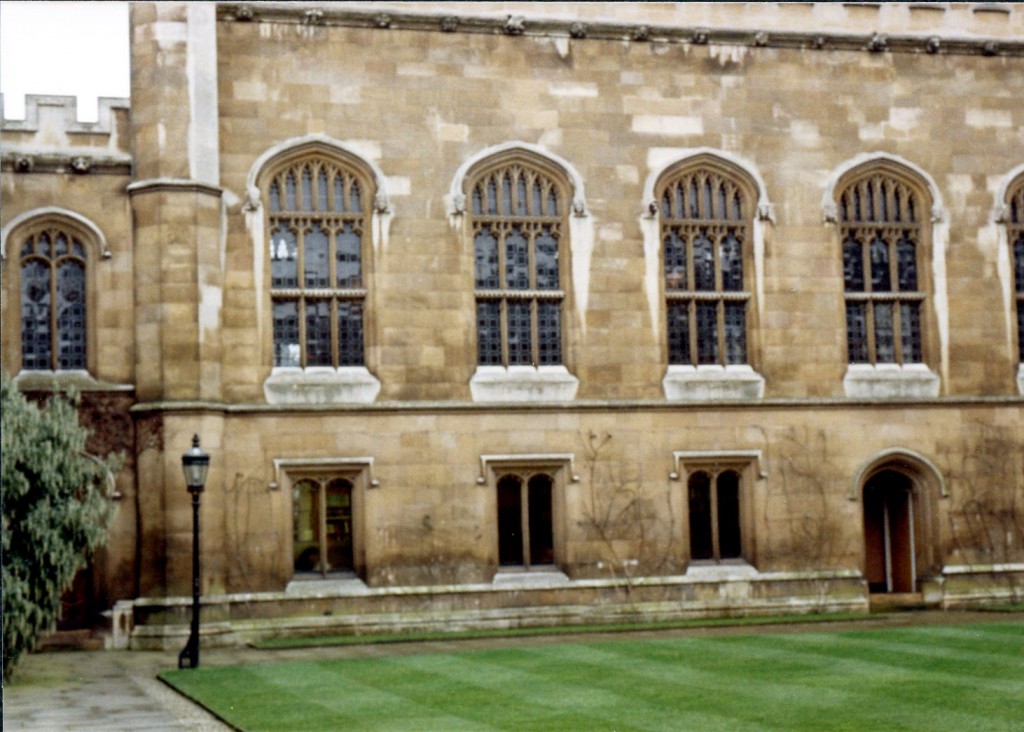
  • RGME Seminars on “The Evidence of Manuscripts”
View Toward the Entrance to the Parker Library in mid-1989 photograph © Mildred Budny

View Toward the Entrance to the Parker Library in mid-1989. Photograph © Mildred Budny.

Harking back to our first series of events as the RGME, in the series of RGME Seminars on “The Evidence of Manuscripts” (1989–1994), this new series brings forward for collective study (‘crowdsourcing’ and collaboration) the original specimens as witnesses in our own RGME Special Collections and the RGME Lending Library

Foreground

  • “The Bridge of Signs”

View of the Pont Neuf, Paris. Photograph by Claudio Mota via https://www.pexels.com/photo/pont-neuf-bridge-in-paris-9999874/.

Registration for the Workshops

To register for individual workshops in the series, please visit the RGME Eventbrite Collection for “The Evidence of Manuscripts, Etc.”

  • RGME Collection: Workshops

Workshop 1
“Introducing the Farrell Leaf”
Sunday 17 November 2024

The first Workshop considers practices of manuscript studies and introduces the first specimen for collaborative examination. We meet the medieval Latin Vulgate Bible leaf from the Book of Numbers in the Jennah Farrell Leaf, now on loan to the RGME “Lending Library”.

For background information about this leaf based on the characteristics of the leaf itself and the owner’s knowledge about its provenance with reference to the previous owner, see

  • our Blog on Manuscript Studies
  • and its Manuscript Studies Contents List.

Medieval Latin Vulgate Bible manuscript: Verso, top. Photography by Mildred Budny.

Workshop 2
“Follow-Up for the Farrell Leaf”
Sunday 15 December 2024

At this workshop, comparing notes about our investigations which followed Workshop 1, we agreed that, most probably (and perhaps almost certainly), this leaf formerly belonged to the Saint Albans Bible, dispersed only in recent decades and now having its surviving leaves widely separated through the marketplace. On this bible see, for example:

  • King David in the Waters Blessed by God, in a pair of leaves sold at Christie’s on 10 July 2019 and now in the McCarthy Collection

Fuller confidence in this proposed identification of the Farrell Leaf as part of the Saint Albans Bible might have to await the discovery or recognition of one of the leaves which formerly stood immediately adjacent, that is, directly preceding this leaf or directly following it, with a continuous flow of the text from leaf to leaf.

We continue our explorations.

Medieval Latin Vulgate Bible manuscript: Verso, top. Photography by Mildred Budny.

Workshop 3
“The Farrell Leaf and its Context”
Sunday 12 January 2025

Next, we consider the Farrell Leaf in its context:

  • in its original manuscript,
  • in relation to other leaves bearing the work of its scribe and scribal artist,
  • among other representatives in its time of the genre of Vulgate Bible manuscripts of medium format, and
  • as a witness to its production and deconstruction, whereby individual leaves became scattered through the sales room, sometimes multiple times over before reaching ‘Forever Homes’.

Collection of Jennah Farrell, Latin Vulgate Bible Leaf: Verso, Bottom of Columns. Photograph by Mildred Budny.

Registration:

  • Workshop 3. The Farrell Leaf and its Context: Tickets

*****

Workshop 4
“Manuscript Fragments Compared:
The Saint Albans Bible and Otto Ege MS 14”
Sunday 23 February 2025

Continuing our exploration of the Saint Albans Bible, from the previous Workshops (1–3), we now expand our scope to set its complex characteristics as a fragmentary, dispersed Latin Vulgate Bible manuscript in a wider context. Also, we can reveal another leaf from the same Bible, which came to our attention following Workshop 3.

We thank our Associate, Richard Weber, for sharing information and photographs about the leaf in his collection from the same manuscript, but from the New Testament portion.

Collection of Richard Weber, Leaf from the Saint Albans Bible, Recto: Top Right. Photograph by Richard Weber.

Note that, with permission, our blog has published discoveries for other leaves in Richard Weber’s collection. See:

  • A Leaf from “Otto Ege Manuscript 214” in the Collection of Richard Weber
  • More Leaves from an Old Armenian Praxapostolos
  • Portfolio 93 of Otto Ege’s “Famous Books in Eight Centuries” in the Collection of Richard Weber

At our Workshop, we may survey our progress for the Saint Albans Bible, as we collectively continue to explore the extent, range, and nature of its surviving parts, or to conjure up other parts for whom whereabouts are unknown from other sources as well as from the evidence of the leaves themselves or reports about them or the original manuscript. We can report the progress of the work to shape a list of known survivors, their present locations, their contents (which part of the Bible or the companion apparatus such as the glossary of Interpretations of Hebrew Names), span of text upon the individual fragments, and the citations about the manuscript and its fragments in books, articles, blogs, or sales catalogues.

In taking into consider other relatives of the genre, our quest can be twofold, taking into account

1) the genre of medieval Vulgate Bible manuscripts containing the full text of the Bible, both Old and New Testaments, within a single volume; and

2) such manuscripts which have befallen the fate of dismemberment and distribution of individual leaves or groups of leaves through the saleroom or other means.

Accordingly, first we might consider the possible survivors of other works by the same scribes, artists, and workshop.

Next we can take note of other Vulgate Latin Bibles of the period which may have suffered the same fate through fragmentation, dispersal, and restorative efforts to recognize the fragments wherever they might survive, study their evidence closely, and, insofar as possible reconstruct the fragments at least virtually.

Private Collection, Leaf from ‘Ege MS 14’. Part of the Book of Jeremiah, Recto, Detail. Photograph by Mildred Budny.

As a model for the latter, we turn to the case of the large-format Lectern Vulgate Bible which Otto F. Ege dispersed as his Manuscript 14, following his numeration of the specimen leaves which he selected for his portfolio of Fifty Original Leaves from Manuscripts of Western Europe (FOL). This manuscript we have been chasing for years in our research, as reported in our blog on Manuscript Studies. See its

  • Manuscript Studies: Contents List

A new Loan to the RGME brings a leaf from that Bible to the service of our RGME Workshops. Let us introduce it to you in the Workshop.

Information

  • Workshop 4. “Manuscript Fragments Compared”

Registration

  • Workshop 4. “Manuscript Fragments Compared”: Tickets

*****

Workshop 5
“Identifying Medieval Bible Manuscript Fragments”
Sunday 23 March 2025

We consider specimens from, for example,

  • the Saint Albans Bible,
  • Otto Ege MS 14, and
  • the Chudleigh Bible.

Collection of Richard Weber, Leaf from Otto Ege MS 14, recto. Photograph by Richard Weber.

Workshop 5 picks up where Workshop 4 left off, within the comparison of two medieval Latin Vulgate Bible manuscripts of different sizes and functions, as represented by some of their fragments. Formerly each comprised a single-volume Bible, with both Old and New Testaments.

These two manuscripts, the medium-format Saint Albans Bible and the large-format Otto Ege MS 14, merit further examination as we add another fragment into view. This discovery is a leaf from the Book of II Corinthians in the Collection of Richard Weber.

This leaf joins our quest to learn more about the original manuscripts and their context. We thank Richard for his generosity in sharing information of materials in his collection for our research and teaching.

After Workshop 4, Richard sent to the RGME a pair of single leaves from another dismembered Latin Vulgate Bible manuscript, this time a medium-format specimen in double columns of 53 lines. It belongs to the Chudleigh Bible, produced in northwestern France in the 13th century and dismembered after its sale in London in 1970. We will introduce the leaves at Workshop 5, to set their study in the context of our ongoing quest to learn more about the fragments Saint Albans Bible and Ege MS 14 and their original manuscripts.

This workshop could, for now, round out our introductory set of workshops on medieval Bible manuscripts, as other sorts of manuscript fragments have also come forward for study and teaching.

Would you like to join us in writing up the reports or blogposts about these leaves as they have come to light?

This workshop continues the demonstration of detective techniques for learning how to identify manuscript fragments which might come to light with little or no companion information. Using different manuscripts and their fragments as case studies, we advance with the quest to learn more about looking at the original sources. More surprises and discoveries may emerge.

Registration

  • Workshop 5. “Identifying Medieval Bible Manuscript Fragments”. Tickets

Collection of Richard Weber, Leaf from Otto Ege MS 14, recto, middle. Photograph by Richard Weber.

*****

Workshop 6
“What’s In a Name?
Guides to Nomenclature for Manuscript Studies”
Sunday 27 April 2025

Jan Van Eyck, The Virgin and Child with Canon van der Paele, 1434–36, Bruges, Groeningemuseum (detail), image from the Closer to Van Eyck project (https://closertovaneyck.kikirpa.be/)

By request, we will consider ‘best practices’ with regard to the use of Nomenclature for Manuscript Studies.

We explore the range of terms in use (in English and other languages) for different parts of books, from the outside in. In this way, we consider the merits — or otherwise — of terms in use for different parts of manuscripts, books, bindings, and other features of the material evidence of written sources. How helpful and comprehensible are the systems of terminology?

Examples of reference works online and in print will be examined, with observations on their usefulness for various purposes, types of books, problems, and approaches.

Do you have specific questions? We can help.

Extra

After our Workshops 1–5, another medieval Latin Vulgate Bible leaf has come to light. The owner has given permission for us to study the leaf as part of our ongoing project on medieval manuscript fragments.

Private Collection. Leaf from a Medieval Latin Vulgate Bible, Manuscript, ‘Verso’.

We will introduce the leaf so that it can begin to join the world of knowledge about dispersed medieval manuscripts which come to light in the work for virtually reconstructing their original codices, insofar as the identified and located fragments can allow.

Information

  • Workshop 6. “What’s In A Name?”

Registration

  • Workshop 6. “What’s In a Name?” Tickets

*****

Workshop 7
“Fragments & Documents”

Sunday 29 June 2025

This workshop will continue our exploration of fragments and open our investigations to the realm of documents, which resemble manuscript materials in certain respects, but also present significant differences from them. Our Workshop will consider the differences and similarities as we compare and contract techniques and methodologies from manuscript studies, fragmentology, and diplomatics.

Information

  • Examples may include the “Preston Series”.
    See:
    Manuscript Studies: Contents List for Preston Charters

Registration

  • Workshop 7. “Fragments and Documents”: Tickets
Preston Charter 12 Face with Seal. Photograph Mildred Budny.

Preston Charter 12 Face with Seal. Photograph Mildred Budny.

*****

Workshop 8
“Face the Music, or,
Where Manuscript Meets Print
in a Hybrid Book:
An Early-Modern German Herbal
with a Reused Binding Fragment
from a Medieval Musical Manuscript”

Sunday 26 October 2025

This workshop will examine a puzzling vellum fragment (or is it a set of patchwork fragments?) in a private collection. The fragment(s) come(s) from a single musical manuscript in Latin on vellum laid out in double columns with text and notation on 4-line staves. The reused medieval material forms the outer covering of a 17th-century printed book in German on laid paper.

We will work to decipher the visible parts of the text and music, identify the readings/lections and chants, and, if possible (given the fragmentary nature), determine the probable genre of original manuscript, such as lectionary, breviary, or missal. Perhaps we might find other survivors from the same despoiled medieval manuscript.

Plus we will exclaim over the features of the printed book, which includes illustrations and marginalia in forms of annotations demonstrating attention of several kinds.

What brought this medieval musical fragment and early modern printed book together? Even if we might never know all the answers, won’t it be fun to question how and why? There is a story here.

We love the puzzle, and give thanks to the collector for lending the book to the RGME for study and teaching.

Information

  • Workshop 8. A Hybrid Book where Medieval Music Meets Early-Modern Herbal
    We invite you to join our collaborative quest to learn more about the different parts of the ensemble.

Registration for the Workshop

  • https://www.eventbrite.com/e/workshop-8-a-hybrid-book-with-astrological-herbal-and-medieval-missal-tickets-1340074201009

The Manuscript Fragment and the Printed Book

Private Collection, Front Cover with Reused Medieval Musical Fragment on Vellum. Photograph by Mildred Budny.

Title Page

[Bartholomaeus Carrichter (1510–1574)], Horn des Heyls menschlicher Blödigkeit, oder Kreütterbuch, darinn die Kreütter des Teutschenlands auss dem Liecht der Natur nach rechter Art der himmelischen Einfliessungen beschriben / durch Philomusum Anonymum [Bartholomäus Carrichter], with a foreword by Michael Toxites, born Johann Michael Schütz (1514–1581), (Strassbourg: Anton Bertram, DCVI/1606).

Private Collection, Kreutterbuch, title page. Photograph by Mildred Budny.

For the first edition of 1576, printed in Straßburg, see an online digital facsimile of a copy in Augsburg, Staats- und Stadtbibliothek. For an edition of 1619 also printed by A. Bertram, see the copy in the Wellcome Collection.

Like the 1619 edition, this folio volume has 10 unnumbered pages, 180 numbered pages, and 5 unnumbered leaves, with a woodcut title page and outline illustrations.

*****

Workshop 9
“Books as Thresholds and Communities”

Sunday 21 December 2025

As the year 2025 draws to a close, we reflect on our Theme for the Year, “Thresholds and Communities” particularly as it applies to our explorations of books and their makers, users, collectors, readers, and others — through our series of workshops and other events — and as we prepare for next year and its new theme. Now we consider how manuscripts and printed books or other written materials might function as Thresholds and represent or foster Communities

  • Thresholds and Communities: RGME Theme for the Year 2025

We draw inspiration from our year’s activities, conversations, and insights. We may reflect on the multiple ways that they offered encounters with books of many kinds, from different ages and places, and with many voices, sometimes in harmony. With such perspectives, we might brace for, prepare for, and choose to welcome the new year.

Poster 2. 2025 Autumn Colloquium. Poster set in RGME Bembino.

Because the 2025 RGME Autumn Colloquium in late November will consider the subject of Fragments (manuscript and printed) from many perspectives, we may discuss some discoveries from that event and follow up with more materials which it helped to bring to light.

  • 2025 RGME Autumn Colloquium on Fragments

For example, do you have any manuscript or printed fragments that you would like to share or learn about? Bring them along, please, to our Zoom Meeting. Let’s see what we might learn together, and share the delight of discovery.

Part of the voyage, we have learned, brings the refreshing reconstitution or renewal of scattered and seemingly disparate fragments, to form new forms of communities fostered by books and the meanings or stories of human lives across time which they can convey.

Information

  • Workshop 9 on “Thresholds and Communities”

Registration

  • Workshop 9. Tickets

See you there!

Illumination from Hildegard’s Scivias (1151) showing her receiving a vision and dictating to teacher Volmar. Image Public Domain via Wikimedia Commons.

******

Workshop 10. Sunday 29 March 2026
” ‘Transformations and Renewals’ in our Ongoing Studies”

For this workshop, we show examples of our selected theme for the year in action for the close study of material evidence in books. On the theme, see:

  • RGME Theme for the Year 2026: “Transformations and Renewals”

For an exploration of the theme as applied to and manifested in books, see our Episode 24 (Sunday 18 April 2026) on “Transformations and Renewals by Way of Books”.

  • The Research Group Speaks: The Series
  • Episode 24. “Transformations and Renewals by Way of Books”: Registration
  • Eventbrite Portal for RGME

In Workshop 10, we take note of multiple discoveries so far in our series. From workshop to workshop, discoveries have come to light through our own continuing research and the revelations of materials in private or public collections which correspond to some specimens highlighted in one or more workshops.

We survey multiple discoveries for a variety of manuscripts, manuscript fragments, printed books, and combinations of printed books with reused manuscript fragments as a re-created form of hybrid book mixing media, periods of production, genres of book, and sometimes also languages in their different layers or components between, upon, and around the covers.

There is much to report. Examples, depending upon time allotted, might include more specimens from the dismembered Chudleigh Bible, an update about the dismembered Saint Albans Bible (the subject of our first four Workshops), new results from on-going RGME studies of missals dismembered by Otto F. Ege (notably the Cistercian Missal of “Ege MS 2,” as featured in our recent 2026 RGME Colloquium at the Grolier Club, and the Warburg Missal of “Ege MS 22“), and discoveries of more cases of hybrid 16th-century printed books from Germany with medieval Latin missal fragments (such as Medieval Missal Fragment as Early-Modern Cover).

We take note of the successful function and generously shared results of our RGME Workshops on “The Evidence of Manuscripts, Etc.” so far, as we celebrate the tenth in their series and look toward the future, with thanks to participants, audience, collaborators, collectors, students, advisers, and lovers of books.

Bring your questions, favorite cases, puzzles, and observations to the conversation!

Registration

  • Workshop 10. “Transformations and Renewals” in our Ongoing Studies


J. S. Wagner Collection, Ege Manuscript 22, Folio clvi, verso: Top Left. Reproduced by permission.

J. S. Wagner Collection, Ege Manuscript 22, Folio clvi, verso: Top Left. Reproduced by permission.

*************

Workshop 11
Sunday 9 August 2026
“Early-Modern Archives in Old and New England”

For this workshop we consider the challenges and opportunities of studying a rich selection of archival materials produced in the early seventeenth-century. Mildred Budny will explore cases of women’s wills, centered upon a holograph specimen of 1604 for the widow Sarah Overton of Southold, Long Island, and antecedents among Anglo-Saxon noblewomen’s wills of the tenth century, including the Will of Æthelgifu . Hannah Goeselt will analyze the legacy of a manuscript documenting the proceedings of the House of Commons for the year 1628 as it survives in American contexts, notably in the Massachusetts Historical Society Library. These cases may serve to highlight the nature of inventories, estate lists, wills, documentary records, literacy, and early collecting in colonial North America.

We welcome the chance to learn about other cases and projects concerning such materials. Please let us know about your interests in them. Contact us!

Boston, Massachusetts Historical Society Library, Ms. N-1325, “House of Commons Proceedings, 1628”, fols. 73v-74r. Photograph by Hannah Goeselt.

*****************

Workshop 12, Etc.
Subjects To Be Determined (We accept requests!)

Among subjects requested are:

Cataloging Manuscripts: Readers’ Perspectives
     Or, A User’s Guide to the Catalogue You Always Wanted
Now also see:

RGME Episode 26 (Saturday 25 July 2026)
“Catalog(u)ing Collections and Materials:
Processes, Challenges, Requests, and Opportunities”
Part 1 of a Series
 The Research Group Speaks: The Series

Manuscripts and (or Versus) Photography
     A User’s Guide

‘Hybrid Books’: What Are They?
Examples and Case-Studies

*****

Questions? Suggestions?

  • Leave your comments or questions below
  • Contact Us

Visit our Social Media:

  • our Facebook Page
  • our Facebook Group
  • our X/Twitter Feed (@rgme_mss)
  • our Bluesky nest @rgmesocial.bluesky.social)
  • our Instagram Page
  • our LinkedIn Group

Join the Friends of the RGME.

Please make a Donation in Funds or in Kind for our nonprofit educational corporation powered principally by volunteers. Your donations and contributions are welcome, and can go a long way. They may be tax-deductible to the fullest extent provided by the law.

  • Donations and Contributions
  • 2025 Annual Appeal

*****

Private Collection, Pieces of a Vellum Leaf from a Medieval Manuscript: Verso. Photography by Mildred Budny.

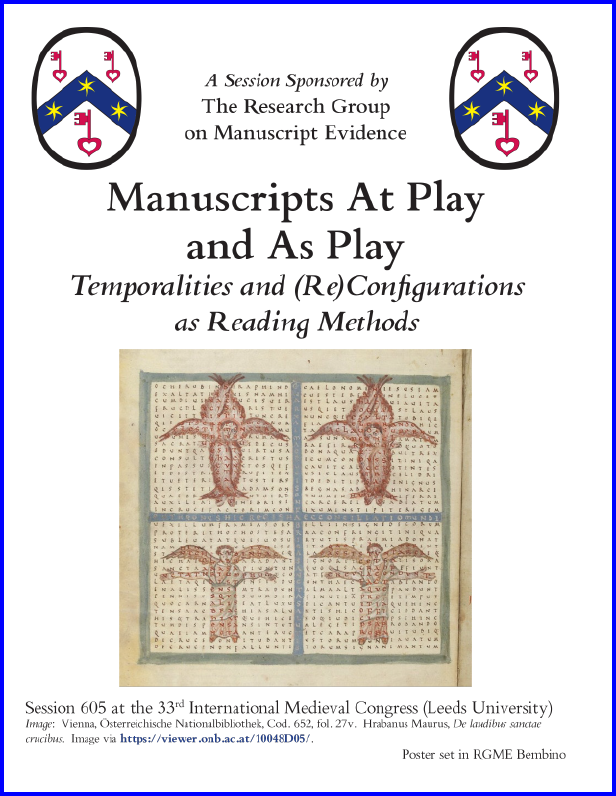
Tags: Chudleigh Bible, Collection of Jennah Farrell, Collection of Richard Weber, Farrell Leaf, Latin Vulgate Bibles, manuscript fragments, Manuscript studies, Medieval manuscripts, Otto Ege MS 14, Otto F. Ege, RGME Seminars on the Evidence of Manuscripts, RGME Workshops, The Saint Albans Bible
No Comments »

  • Top
©2024 Research Group on Manuscript Evidence.


is proudly powered by WordPress. WordPress Themes X2 developed by ThemeKraft.