
Workshop 11. “Manuscripts at Play, Continued: Figured Texts”
October 2, 2026 in Announcements, Event Registration, Manuscript Studies, Research Group Workshops, Workshops on "The Evidence of Manuscripts"
RGME Workshops on
“The Evidence of Manuscripts, Etc.”
Workshop 10
(Sunday 25 October 2026 online)
“Manuscripts at Play, Continued:
Figured Texts”
[Posted on 1 October 2026]
We continue our series of workshops on “The Evidence of Manuscripts Etc.” It comprises a range of styles including presentations, interviews, roundtables, and other forms of conversations. For information about the series:
This time, by request, we revisit, expand upon, and follow forward on the subjects which we presented for the RGME sponsored session at the 2026 International Medieval Congress in July 2026. See
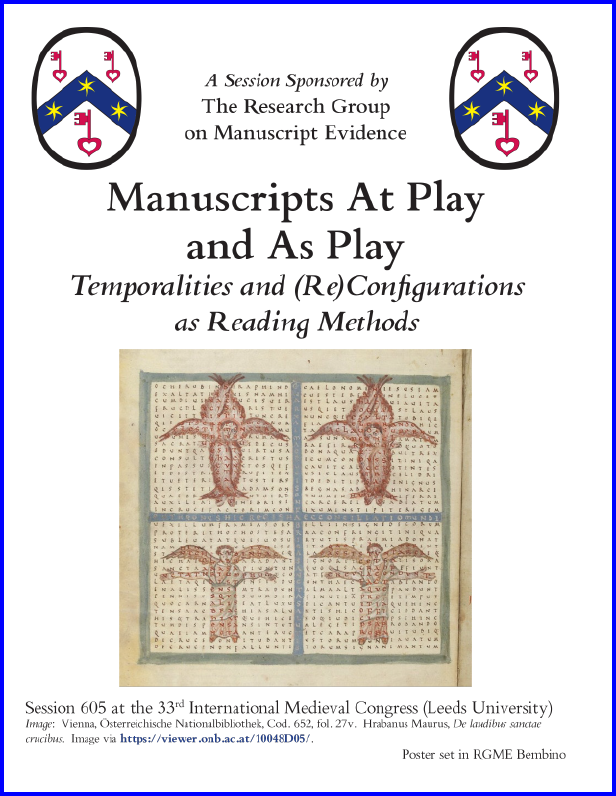
2026 IMC Poster 2 (Image)
The Purpose
For our Workshop, we gather panelists, respondents, and participants of that session to develop more aspects of the subject, report further work, and contribute to the conversation for a wider audience, also the view for a recording to ensure a longer-lasting record. Besides presenters and respondents from that session, we welcome an in-person attendee then, Mark Saltviet, who contributed questions and comments during the Q&A for the session and then contacted the RGME Director with the interest of participating in our activities.
It was his expression of interest which inspired the preparation of our new guide:
Contributors at the 2026 Leeds Session:
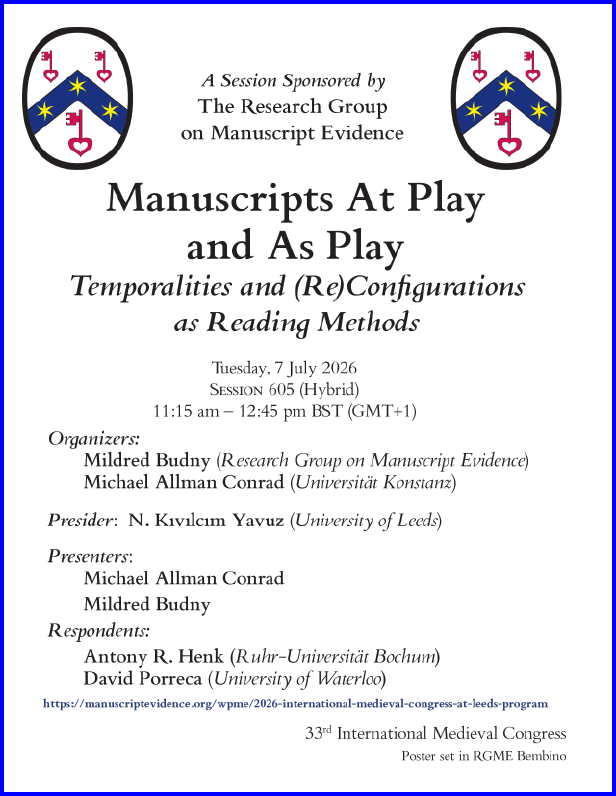
2026 IMC Poster 1 (Text)
The Plan
We gather to compare notes and join in discussion. The subjects of manuscripts (and other written records) in terms of their figural and figured approaches to the words as laid out on the writing surfaces, and as intended to be construed or parsed or puzzled out, have many directions. Some we have touched upon in the 2026 session on “Manuscripts at Play and as Play” at Leeds. Some we will continue to explore or broach afresh in our Workshop 11. Some may emerge for consideration, perhaps also for further exploration, at the Workshop.
We welcome you to bring your interests, questions, and suggestions.
The Team
We gather speakers and respondents to present case-studies and invite discussion.
1. Mildred Budny (Executive Director, Research Group on Manuscript Evidence)
Milly will introduce the session and its speakers, moderate the Q&A, and contribute her own reflections upon long-term work on manuscripts containing Figured Texts of many kinds.
2. Michael Allman Conrad (University of Konstanz)
Michael might be able to attend to reflect upon his close study of Hrabanus Maurus’s life and work, thereby developing his report for our 2026 Leeds session on the monumental illustrated manuscripts and printed editions
3. Mark Saltveit
“The Palindrome Sylloge”
Mark will report on a forthcoming publication:
The most consequential discovery I’ve made is what we’re now calling “The Palindrome Sylloge,” a previously unknown collection of 14 Latin poems from late antiquity or perhaps the very early medieval period, found (illegibly) on the front flyleaf of BL Harley MS 2735 (c. 860 CE). A generous tip from David Ganz led me to it and I’ve had assistance from many top scholars in different fields in wrestling it to the ground. It has 2 church inscriptions from de Rossi’s ICUR II, 8 versus recurrentes (5 unpublished), an unpublished ekphrastic distich about two miracles of the Apostle Peter, two carmen minora of Claudian, and Ps-Seneca’s De qualitate temporis. Our editio princeps is in revision at Scriptorium.
4. Antony R. Henk (Ruhr-Universität Bochum)
“Playing with Sacred Space:
Mapping and Re-Mapping the Holy Land
in Manuscripts of Adomnán’s and Bede’s De locis sanctis”
In my response paper for the 2026 Leeds session ‘Manuscripts at Play and as Play: Temporalities and (Re)Configurations as Reading Methods’, I discussed how the diagrams which accompany many manuscript recensions of Adomnán’s De locis sanctis can be understood as tools which facilitate Jean Leclerq’s concept (1961) of the peregrinatio in stabilitate. I suggested that these diagrams of holy sites are analogous to the ‘battle maps’ or ‘dungeon maps’ used in tabletop role-playing games, in that they allow the audience to more concretely visualise physical space than is possible via narrative description alone.
In my revisit to this topic and framework, I wish to examine how various copies of Adomnán’s work, and copies of Bede’s epitome of it, engage in ‘playing’ with these maps and the locations they aim to depict. In particular, I will explore the interplay of text and drawing, as well as the scribe-artists’ widely varying treatments of visual symbol, abstraction, and aestheticism.
Background
- Adomnán, De locis sanctis, edited and translated by Denis Meehan
Adomnán’s De locis sanctis - Bede, De locis sanctis, with digital critical edition
Bede’s De locis sanctis - Leclerq, Jean, 1961. ‘Monachisme et pérégrination du IXe au XIIe siècle’. Studia Monastica 3: 33-52.
Studia Monastica
For a digital facsimile of a manuscript with Adomnán’s illustrated text, see:
- Paris, Bibliothèque nationale de France, Département des Manuscrits, MS Latin 13048, f. 4v, via gallica.fr

Adomnán, De locis sanctis, Diagram of the Church of the Holy Sepulchre. Paris, Bibliothèque nationale de France, Département des Manuscrits, MS Latin 13048, f. 4v: Detail, Image Public Domain via https://gallica.bnf.fr/ark:/12148/btv1b10533305c/f16.item.
5. David Porreca (Department of Classical Studies, University of Waterloo)
“Figured Glosses for Classical and Other Authors
in the Copenhagen Fabricius Compendium“
David will speak about his long-term work on the marginal notes in a manuscript containing multiple authors, which he prepares for a critical edition for Patrologia Micrologica. Including works on medicine and the natural sciences, the authors include Sidonius Apollinarius, Apuleius, Bernardus Silvestris, Bernardus Magister, and others. For its contents and digital facsimile, see:
- Copenhagen, Det Koneglike Bibliotek, MS Fabricius 91 4° (https://permalink.kb.dk/permalink/2006/manus/271/)
*****
Registration
- Workshop 11. “Manuscripts at Play, Continued: Figured Texts”. Registration
- Eventbrite Portal for RGME
See you there!
*******