• News
    • News & Views
    • RGME Activities for 2024 and 2025
    • Around & About with the RGME
    • Reviews
    • Highlights
  • Blogs
    • Manuscript Studies
      • Manuscript Studies: Contents List
    • International Congress on Medieval Studies
      • Abstracts of Congress Papers
        • Abstracts of Papers Listed by Author
        • Abstracts of Papers Listed by Year
  • About
    • Mission
    • Who We Are
      • Officers, Associates & Volunteers
      • RGME Committees
      • Friends of the Research Group on Manuscript Evidence
    • Policies & Statements
      • RGME Privacy Policy Statement
      • RGME Intellectual Property Statement & Agreements
    • People
      • Mildred Budny — Her Page
      • Adelaide Bennett Hagens
    • Activities
      • Events
      • Congress Activities
        • Sponsored Conference Sessions (1993‒)
          • Panels at the M-MLA Convention (from 2016)
        • Co-sponsored Conference Sessions (2006‒)
    • History
      • Seals, Matrices & Documents
      • Genealogies & Archives
    • Contact Us
  • Bembino
    • Multi-Lingual Bembino
    • RGME Bembino: Resources
  • Congress
    • Sponsored Conference Sessions (1993‒)
    • Co-sponsored Conference Sessions (2006‒)
    • Abstracts of Congress Papers
      • Abstracts Listed by Author
      • Abstracts Listed by Year
    • Kalamazoo Archive
    • Panels at the M-MLA Convention (2016-2019)
      • Abstracts of Papers for the M-MLA Convention
      • Panels at the M-MLA Convention (from 2016)
  • Events
    • RGME Activities for 2024 and 2025
      • 2023 Activities and 2024 Planned Activities
    • Seminars, Workshops, Colloquia & Symposia (1989–)
      • Seminars on ‘The Evidence of Manuscripts’
      • Symposia on ‘The Transmission of the Bible’
      • The New Series (2001-)
        • 2019 Anniversary Symposium Program: The Roads Taken
        • 2019 Anniversary Symposium Registration
        • 2019 Anniversary Symposium Registration Open
      • RGME Symposia: The Various Series
      • The Research Group Speaks: The Series
      • Meetings of the Friends of the Research Group on Manuscript Evidence
      • RGME Online Events
    • Abstracts of Papers for Events
      • Abstracts of Papers for Seminars on ‘The Evidence of Manuscripts’
      • Abstracts of Papers for Symposia, Workshops & Colloquia
    • Receptions & Parties
    • Business Meetings
    • Photographic Exhibitions & Master Classes
    • Events Archive
  • ShelfLife
    • Journal Description
    • ShelfMarks: The RGME-Newsletter
    • Publications
      • “Insular, Anglo-Saxon, and Early Anglo-Norman Manuscript Art at Corpus Christi College, Cambridge” (1997)
        • Mildred Budny, ‘Catalogue’
        • The Illustrated Catalogue (1997)
      • The Illustrated Handlist
      • Semi-Official Counterfeiting in France 1380-1422
      • No Snap Decisions: Challenges of Manuscript Photography
    • History and Design of Our Website
  • Galleries
    • Watermarks & the History of Paper
    • Galleries: Contents List
    • Scripts on Parade
    • Texts on Parade
      • Latin Documents & Cartularies
      • New Testament Leaves in Old Armenian
    • Posters on Display
    • Layout Designs
  • Donations and Contributions
    • RGME Donor Promise
    • 2023 End-of-Year Fundraiser for our 2024 Anniversary Year
    • 2019 Anniversary Appeal
    • Orders
  • Links
    • Catalogs, Metadata, and Databases: A Handlist of Links
    • Handlist of Resources for Manuscript Studies and Fragmentology
    • Manuscripts & Rare Books
    • Maps, Plans & Drawings
    • Seals, Seal-Matrices & Documents

  • News
    • News & Views
    • RGME Activities for 2024 and 2025
    • Around & About with the RGME
    • Reviews
    • Highlights
  • Blogs
    • Manuscript Studies
      • Manuscript Studies: Contents List
    • International Congress on Medieval Studies
      • Abstracts of Congress Papers
        • Abstracts of Papers Listed by Author
        • Abstracts of Papers Listed by Year
  • About
    • Mission
    • Who We Are
      • Officers, Associates & Volunteers
      • RGME Committees
      • Friends of the Research Group on Manuscript Evidence
    • Policies & Statements
      • RGME Privacy Policy Statement
      • RGME Intellectual Property Statement & Agreements
    • People
      • Mildred Budny — Her Page
      • Adelaide Bennett Hagens
    • Activities
      • Events
      • Congress Activities
        • Sponsored Conference Sessions (1993‒)
          • Panels at the M-MLA Convention (from 2016)
        • Co-sponsored Conference Sessions (2006‒)
    • History
      • Seals, Matrices & Documents
      • Genealogies & Archives
    • Contact Us
  • Bembino
    • Multi-Lingual Bembino
    • RGME Bembino: Resources
  • Congress
    • Sponsored Conference Sessions (1993‒)
    • Co-sponsored Conference Sessions (2006‒)
    • Abstracts of Congress Papers
      • Abstracts Listed by Author
      • Abstracts Listed by Year
    • Kalamazoo Archive
    • Panels at the M-MLA Convention (2016-2019)
      • Abstracts of Papers for the M-MLA Convention
      • Panels at the M-MLA Convention (from 2016)
  • Events
    • RGME Activities for 2024 and 2025
      • 2023 Activities and 2024 Planned Activities
    • Seminars, Workshops, Colloquia & Symposia (1989–)
      • Seminars on ‘The Evidence of Manuscripts’
      • Symposia on ‘The Transmission of the Bible’
      • The New Series (2001-)
        • 2019 Anniversary Symposium Program: The Roads Taken
        • 2019 Anniversary Symposium Registration
        • 2019 Anniversary Symposium Registration Open
      • RGME Symposia: The Various Series
      • The Research Group Speaks: The Series
      • Meetings of the Friends of the Research Group on Manuscript Evidence
      • RGME Online Events
    • Abstracts of Papers for Events
      • Abstracts of Papers for Seminars on ‘The Evidence of Manuscripts’
      • Abstracts of Papers for Symposia, Workshops & Colloquia
    • Receptions & Parties
    • Business Meetings
    • Photographic Exhibitions & Master Classes
    • Events Archive
  • ShelfLife
    • Journal Description
    • ShelfMarks: The RGME-Newsletter
    • Publications
      • “Insular, Anglo-Saxon, and Early Anglo-Norman Manuscript Art at Corpus Christi College, Cambridge” (1997)
        • Mildred Budny, ‘Catalogue’
        • The Illustrated Catalogue (1997)
      • The Illustrated Handlist
      • Semi-Official Counterfeiting in France 1380-1422
      • No Snap Decisions: Challenges of Manuscript Photography
    • History and Design of Our Website
  • Galleries
    • Watermarks & the History of Paper
    • Galleries: Contents List
    • Scripts on Parade
    • Texts on Parade
      • Latin Documents & Cartularies
      • New Testament Leaves in Old Armenian
    • Posters on Display
    • Layout Designs
  • Donations and Contributions
    • RGME Donor Promise
    • 2023 End-of-Year Fundraiser for our 2024 Anniversary Year
    • 2019 Anniversary Appeal
    • Orders
  • Links
    • Catalogs, Metadata, and Databases: A Handlist of Links
    • Handlist of Resources for Manuscript Studies and Fragmentology
    • Manuscripts & Rare Books
    • Maps, Plans & Drawings
    • Seals, Seal-Matrices & Documents

Log in

Archives

Featured Posts

2026 RGME Symposium: “Teaching for the Future”
Workshop 11. “Manuscripts at Play, Continued: Figured Texts”
Episode 29. “The Life and Inquest of Jeanne-Marie de Maillé”
How to Join the RGME: Guide for Newcomers
Episode 28. Preview of Medieval “Printing on Fabric”
Episode 27. “Catalog(u)ing Collections and Materials”
2026 International Medieval Congress at Leeds: Program
Sanskrit and Prakrit Manuscripts, Continued: More Leaves for Manuscript Sample XII
Episode 24. “Life with Books” (Interview with John Windle)
Announcing the Launch of RGME Bembino WP
2026 RGME Colloquium at The Grolier Club: Report
Medieval Missal Fragment as Early-Modern Cover
The Weber Leaf from Ege MS 61
"Bembino" Booklet Cover
Episode 23. “Meet RGME Bembino: Facets of a Font”
2026 RGME Colloquium on “Transformations & Renewals” at The Grolier Club
2026 Theme of the Year: “Transformations and Renewals”
A Leaf with Patchwork from the Saint Albans Bible
A Sister Leaf from a Miniature Latin Vulgate Bible
A Little Latin Vulgate Bible Manuscript Leaf in Princeton
J. S. Wagner Collection. Leaf from from Prime in a Latin manuscript Breviary. Folio 4 Verso, with part of Psalm 117 (118) in the Vulgate Version, set out in verses with decorated initials.
2026 Annual Appeal
Episode 22: “Encounters with Local Saints and Their Cults”
Private Collection, Ege's FBNC Portfolio, Dante Leaf, Verso, Detail. Reproduced by Permission.
2025 RGME Autumn Colloquium on Fragments
Workshop 8: A Hybrid Book where Medieval Music Meets Early-Modern Herbal
2025 RGME Autumn Symposium on “Readers, Fakers, and Re-Creators of Books”
RGME Workshops on “The Evidence of Manuscripts, Etc.”
Episode 21. “Learning How to Look”
2025 International Congress on Medieval Studies: Program
2025 RGME Visit to Vassar College
Two Leaves in the Book of Numbers from the Chudleigh Bible
Delibovi on Glassgold on Boethius: A Blogpost
Ronald Smeltzer on “Émilie du Châtelet, Woman of Science”
2025 Spring Symposium: “Makers, Producers, and Collectors of Books”
Starters’ Orders
The Weber Leaf from the Saint Albans Bible
Workshop 4. “Manuscript Fragments Compared”
Episode 20. “Comic Book Theory for Medievalists”
Episode 19: “At the Gate: Starting the Year 2025 at its Threshold”
Favorite Recipes for Lemonade, Etc.
RGME Visit to the Lomazow Collection: Report
2024 Autumn Symposium: “At the Helm”
A Latin Vulgate Leaf of the Book of Numbers
The RGME ‘Lending Library’
Florence, Italy, Ponte Vecchio from Ponte alle Grazie. Photo: Ingo Mehling, CC BY-SA 4.0 , via Wikimedia Commons
Episode 17. “RGME Retrospect and Prospects: Anniversary Reflections”
Jesse Hurlbut at the Bonneville Salt Flats, Utah. Photograph Jesse Hurlbut.
Episode 16: An Interview with Jesse D. Hurlbut
Kalamazoo, MI Western Michigan University, Valley III from the side. Photograph: David W. Sorenson.
2024 International Congress on Medieval Studies: Report
2024 Spring Symposium at Vassar College
2024 Anniversary Symposium in Thanks to Jesse Hurlbut: Program

You are browsing the Blog for Event Registration

Episode 22: “Encounters with Local Saints and Their Cults”

August 20, 2025 in Announcements, Event Registration, Manuscript Studies, Research Group Episodes for The Research Group Speaks, Research Group Speaks (The Series)

“The Research Group Speaks”
Episode 22

“Encounters with
Local Saints and Their Cults:
Traces in
Prose, Poetry, and Relics”

Saturday 13 December 2025
1:00–2:30 pm EST (GMT-5) by Zoom

[Posted on 20 August 2025, with updates]

For the series wherein “The Research Group Speaks,” we respond to suggestions and requests as the series unfolds. For information, please see:

  • “The Research Group Speaks”: The Series

For Episode 22 we turn to reports by several scholars working in different areas and language-groups upon a similar subject of perennial interest in religious, historical, and devotional identities. Presentations will be accompanied by responses, followed by opportunities for feedback and discussion.

This Episode considers the characteristics of veneration of local saints, as manifested in the surviving evidence, especially in manuscripts. Among the materials are vitae, hymns and liturgical practices for saints’ feast days. The nature of the subject, as well as research work and discoveries in a variety of fields, shows that this episode offers scope for follow-up in one or more episodes in our series.

Speakers and Respondents

  • Guesh Solomon Teklu (Hiob Ludolf Centre for Ethiopian & Eritrean Studies, University of Hamburg)
  • Augustine Dickinson (University of Münster)
  • Mersha Alehegne Mengistie (Addis Ababa University; University of Hamburg)
  • Antony R. Henk (Ruhr-University Bochum)

Presider

  • Renate Blumenfeld–Kosinski (Renate Blumenfeld–Kosinski)

Outline
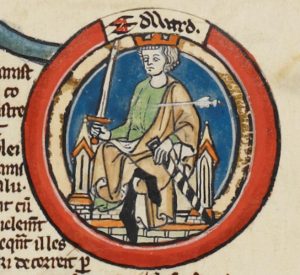
London, British Library, MS Royal 14 B VI, detail. King Edward Martyr, Image Public Domain via Wikimedia Commons via https://upload.wikimedia.org/wikipedia/commons/e/e3/Edward_the_Martyr_-_MS_Royal_14_B_VI.jpg.

This episode aims to consider the challenges and opportunities when encountering and studying local saints, those whose renown and veneration might not have reached a wide audience or enjoyed a persistent duration. Nonetheless, their stories and the individuals or communities who both followed and cultivated their appeal can reach across time and place to show how the habits of pious practices and the methodologies for discovering materials and contexts in modern study might be shared in widely different cultures, languages, and periods.

Looking at case studies from complete vitae, where the saint’s biography is given in full but only circulated locally, and progressing to hymns and paracontent, where only names and scattered biographic hints survive, the speakers and respondents will reflect on the methodological challenges posed in each instance and strategies for engaging with them.

Among the subjects will be Ethiopic vitae and hymns and Western Medieval liturgical Kalendars (such as in Books of Hours in Latin and/or vernaculars). Evidence includes manuscripts, printed sources, and textiles.

Program

1. Presentations

Guesh Solomon Teklu
(Hiob Ludolf Centre for Ethiopian & Eritrean Studies, University of Hamburg)

“The Gadla ʾAbbā Tansʾa Wald of Dabra Gʷǝlgizā and His Disciple Monks:
Thematic Aspects of Salāmtā Poetic Texts”

The Dabra Gʷǝlgizā (also known as Ǧǝwamāra) monastic tradition, founded by ʾAbbā Tansʾa Wald, represents a significant network of local and Egyptian saints and monasteries centered in Qollā Tamben, ʿĀdet, and Ṣallamṭi areas in Tigray, Ethiopia. The Gadla ʾAḫbǝro (literally ‘Combined vitae’) is a hagiographic compilation that chronicles the lives of ʾAbbā Tansʾa Wald and his disciple monks. The text mainly narrates the life of ʾAbbā Tansʾa Wald’s and the deputy abbot of ʾAbbā Maʿāza Dǝngǝl. The other fellow monks, ʾAbbā Tādewos of Dabra Maṣḥet ʿAbizāqa, ʾAbbā Tansʾa Krǝstos of Dabra Gannat, ʾAbbā Giyorgis of Kāwe, ʾAbbā Tomās of Ṣallay, ʾAbbā Zarʿā Bǝruk of ʾƎkkǝma, and ʾAbbā Fiqiṭor of Qaṣabā are mentioned several times throughout the hagiography. These monks lived and served together at Dabra Gʷǝlgizā in Qollā Tamben during the thirteenth to fourteenth centuries, according Gadla ʾAḫbǝro manuscripts.

This communal monastic life is extensively documented throughout the Gadla ʾAḫbǝro codices and the individual hagiographic texts of each saint. Following the death of the abbot, ʾAbbā Tansʾa Wald, his disciples established their own monastic churches, creating an interconnected network of religious foundations. The exception was ʾAbbā Maʿāza Dǝngǝl, who succeeded him as abbot at Dabra Gʷǝlgizā. Some remained in Qollā Tamben itself (ʾAbbā ʾAbbā Tomās, and ʾAbbā Zarʿā Bǝruk), while others founded monasteries in adjacent districts surrounding the Tekeze River, including ʿĀdet (ʾAbbā Giyorgis and ʾAbbā Fiqitor) and the Ṣallamṭi areas (ʾAbbā Tādewos and ʾAbbā Tansʾa Krǝstos). This presentation examines the religious, political, and environmental themes addressed in three hagiographies from this networked monastic tradition: the Gadla ʾAḫbǝro, the Gadla ʾAbbā Tādewos, and the Gadla ʾAbbā Tansʾa Krǝstos. Special emphasis is given to the thematic aspects of the salāmtā (ʾarke) poetic texts across these hagiographies.

Augustine Dickinson
(University of Münster)

“Identifying Ethiopic Hymns for Local Saints in Anthology Manuscripts”

When working with manuscript anthologies or collections of malkǝʾ-hymns, it is most often the case that the saints whose hymns are included are well-known and easily identified, whether they are saints known across Christian traditions or saints proper to the Ethiopian/Eritrean context. This paper will present case studies where the subject of a hymn is not so easily identified, always monastic saints commemorated only by a single monastery or within a relatively small network. Each case study will highlight strategies for finding clues leading to identifications (whether tentative or confident) of their respective subjects and contribute to broader remarks on this phenomenon in the field of Ethiopic hymnography.

2. Responses

Mersha Alehegne Mengistie
(Associate Professor, Department of Linguistics and Philology, Addis Ababa University)

“Experiences with and Discoveries for Local Hagiography in Ethiopia
and Their Implications for Publication”

Mersha will describe experiences with and discoveries for local hagiography in Ethiopia broadly and their implications for publication.

Antony R. Henk
(Ruhr-University Bochum)

“Inventing Peter the Deacon as Saint in Early England:
Mistaken Identity or Made up Entirely?”

Medieval English relic lists offer tantalizing clues to the presence of many now-obscure saints. One striking example is the presence of a later annotation in the late eleventh-century Exeter relic list in British Library, Royal MS 6 B VII, which explains that the relics of saint ‘Petri diaconi’ (Peter the Deacon) in that particular version of the list are, in fact, the relics of the ‘discipuli gregorii papae’ — the student of pope Gregory the Great, not the fourth-century Antiochene martyr by the same name commonly venerated in early England.

The English church’s deep affection for Gregory the Great is well understood, and his relics and feasts are widely attested in the English manuscript corpus. However, little evidence suggests that his companion and interlocutor in the Dialogi ever achieved lasting cult status in England, aside from a single embroidered depiction of a nimbed Peter on the early tenth-century maniple found with the body of Saint Cuthbert, still today an object of adoration at Durham Cathedral. In this short response, I ask a fateful question: Did the English Church try to ‘invent’ a Cult of Peter the Deacon, and what could the evidence here tell us about cases of seemingly mistaken sanctoral identity?

Note: For an image and bibliography about the textile image of Peter the Deacon as saint in the maniple among the Cuthbert embroideries see this site.

Antony Henk’s Handout:

  • Peter the Deacon: Episodes

3. Q&A

There follows the opportunity for questions, comments, and discussion. We welcome your observations.

Manuscript still in situ. Fols. 14v-15r. The beginning of Malkəʾa Marqorewos (Image of Marqorewos), a local saint of the monastery Ṣaʿadā ʾƎmbā ʾƎndā ʾAbuna Marʿāwe Krǝstos, within an anthology (malkǝʾa gubāʾe) manuscript. Photograph by Michael Gervers. Image via https://malkeagubae.com/manuscripts/MK049/#unit1item3.

Registration

Within the RGME Eventbrite Collection:

  • Episode 22. “Encounters with Local Saints and their Cults” Registration

Registration is free. We encourage you to Pay What You Can with the option for a Voluntary Donation. This year, the RGME has undergone setbacks with grants and funding, so that we ask your help. Any amount will give encouragement and contribute to recovering momentum. We thank you for your support.

Trier, Stadtbibliothek, MS. 171/1626: “Gregory Leaf”. Behind a curtain, Peter the Deacon witnesses Gregory the Great at work inspired by the Holy Spirit in the form of a dove. Master of the Registrum Gregorii, Image Public domain, via Wikimedia Commons.

Donations, which may be tax-deductible, help us to continue with our activities and sustain our mission for an organization principally powered by volunteers.

  • 2025 Annual Appeal
  • Donations and Contributions

Please note:

  • After your registration, the RGME will send you the Zoom Link as an email directly a few days before the event
  •  For security reasons, we do not distribute tickets or links through Eventbrite or Zoom.

If you have questions or problems with registering, or accessing the link,

  • Contact the RGME, not Eventbrite or Zoom,
    via rgmesocial@gmail.com

We use these measures to protect the security of our events.

Thank you for your interest in this event.

*****

Next Episode

Bembino Swash Motif

For our next Episode, see

  • Episode 23. Meet RGME Bembino: Facets of a Font
    Saturday 21 February 2026 at 1:00-2:30 pm EST (GMT-5) by Zoom

Registration

  • Episode 23. Meet RGME Bembino: Registration

*****

Questions? Suggestions?

  • Leave your comments or questions below
  • Contact Us

Visit our Social Media:

  • our FaceBook Page (https://www.facebook.com/people/Research-Group-on-Manuscript-Evidence/100064718795029/)
  • our Facebook Group (https://www.facebook.com/groups/rgmemss/)
  • our X/Twitter Feed (@rgme_mss)
  • our Bluesky nest @rgmesocial.bluesky.social)
  • our Instagram Page
  • our LinkedIn Group

Join the Friends of the RGME.

Please make a Donation in Funds or in Kind for our nonprofit educational corporation powered principally by volunteers. Your donations and contributions are welcome, and can go a long way. They may be tax-deductible to the fullest extent provided by the law.

  • Donations and Contributions
  • 2026 Annual Appeal

*****

Tags: History of Religion, Hymns and Hymnody, Liturgical Kalendars, Local Saints, Manuscript studies, Saints' Cults
2 Comments »

Ronald Smeltzer on “Émilie du Châtelet, Woman of Science”

April 9, 2025 in Announcements, Event Registration, Events, Manuscript Studies, Princeton Bibliophiles and Book-Collectors

The RGME and
Princeton Bibliophiles & Collectors
present a hybrid meeting

Ronald Smeltzer speaks about
“Émilie du Châtelet, Woman of Science”

Wednesday, 23 April 2025
5:00–6:30 pm EDT (GMT-5)

Princeton Public Library
Conference Room
Witherspoon Street
Princeton, New Jersey 08540

In Person and By Zoom
Registration Required

[Posted on 8 April 2025, with updates]

Partnership for the Meeting

Frontispiece to the Institutions de Physique (1740). Image Public Domain.

Co-sponsored by the Princeton Bibliophiles & Collectors
and the Research Group on Manuscript Evidence

This special event produces a Hybrid Visit in partnership between the Research Group on Manuscript Evidence (RGME) and the Princeton Bibliophiles & Collectors (PB&C), an affiliate of the Friends of the Princeton University Library (FPUL).

The meeting will take place in the Conference Room of the Princeton Public Library, Witherspoon Street, Princeton 08540. Parking is available in the Spring Street Parking Lot nearby.

The PB&C, led by Ronald Smeltzer, and the RGME, directed by Mildred Budny, have collaborated before with some RGME Symposia held at Princeton University (2018, 2019) before the Covid Pandemic. Now we move forward with a new form of collaboration.

With this event, the Meetings of the PB&C resume after a hiatus. The RGME shares the organizational tasks, manages the registration, and adds an online functionality for a fully hybrid event. This practice reflects RGME practices for its online events since 2021 and developments since 2024 for its In-Person Visits, with a hybrid feature, to Special Collections of various kinds, both private and public. This meeting represents the first in this year’s RGME In-Person Visits, for which several are scheduled for later this year.

The meeting will take place, as customary in recent years for the PB&C, at the Princeton Public Library, for which the Conference Room has been reserved. The RGME will bring the online function, through an interactive Zoom Meeting. This step corresponds with the RGME’s tradition since 2021 of providing online access for our events. This meeting also represents a development in Princeton for the RGME to hold an In-Person Visit — with online access for a fully hybrid occasion — to Special Collections of various kinds, private and public, as we resumed in November 2024.

The Speaker and Subject

Private Collection, Choisel, Château de Breteuil. Portrait of Emilie du Chatelet st her desk by Maurice Quentin de la Tour (1704–1788). Oil on canvas, 1750. Image via Wikimedia Commons.

Ronald K. Smeltzer will describe highlights of his years’-long interest in collecting and researching materials relating to Émilie du Châtelet (1706–1749), French mathematician and physicist. Some results of this work have appeared in the landmark exhibition at the Grolier Club,

  • Extraordinary Women in Science & Medicine: Four Centuries of Achievement, co-curated by Ronald K. Smelzer, Robert J. Rubin, and Paulette Rose (2013).

Now, Ronald will speak informally about reflections on this subject, with a view to Du Châtelet’s life, life’s work, collaboration with Voltaire (1694-1788), and early death at the age of 42. Among her many scholarly accomplishments are the Instutitions du Physique (Paris, 1740, with a second edition in 1742, translated also into German and Italian in 1743) and her translation into French of the Mathematical Principles of Natural Philosophy by Isaac Newton (1643-1727).

Ronald’s collecting interests and discoveries concern a variety of published and unpublished materials, gathered over many years. Ronald’s collecting interests and discoveries concern a variety of published and unpublished materials, gathered over many years. His talk illustrates merits of gathering into one collection an ensemble of materials about a particular subject, including different copies of a given edition, which may, upon inspection and comparison, exhibit significant differences. As he says about the discoveries, “It is important to look.”

At our meeting, we have the opportunity to hear from the scholar-collector about his experiences in forming the collection and bringing their discoveries to wider knowledge. Among the sources are manuscript materials. It might be possible, in person, to see several examples from the collection. Here we might learn more about them, in person and online, from Ronald himself.

Please join us if you can. We look forward to welcoming you.

Thanks

We thank the Friends of the Princeton University Library and also the Princeton Public Library for help with arranging and hosting this landmark event for the RGME in association with the PB&BC.

Registration

Please register to attend the event. There are two registration portals, for attendance in person or online.

Registration to Attend IN PERSON
Space is limited for the In-Person Event.

Please be sure to register so that we can know whom and how many to expect to attend in person. Registration is free. We invite Voluntary Donations for the RGME, a Section 501(c)(3) nonprofit organization principally run by volunteers.

  • https://www.eventbrite.com/e/ronald-smeltzer-talks-about-emilie-du-chatelet-woman-of-science-online-tickets-1310959468059

Registration to Attend ONLINE

  • https://www.eventbrite.com/e/ronald-smeltzer-talks-about-emilie-du-chatelet-woman-of-science-online-tickets-1310959468059

After registration, the RGME will send the Zoom Link to registrants a few days before the event.  To safeguard the security of our online events, the Zoom Link will not be sent by Eventbrite or by Zoom. Please do not share the Zoom Link with others; ask them to register for their own Zoom Link, so that we can keep track of attendance and monitor access to the Zoom Waiting Room.

If you have issues with the registration or Zoom Link, please turn to us for help. Send your questions to rgmesocial@gmail.com.

*****

Frontispiece to the Institutions de Physique (1740). Image Public Domain.

Image: Frontispiece for the First Edition of the Institutions de Physique (Paris, 1740), center, with an image of female figure in classical dress climbing to the Temple of Truth. Image Public Domain.

*****


Image: Title Page for the First Edition of the Institutions de Physique (Paris, 1740). Image Public Domain.

*****

Private Collection, Choisel, Château de Breteuil. Portrait of Emilie du Chatelet st her desk by Maurice Quentin de la Tour (1704–1788). Oil on canvas, 1750. Image via Wikimedia Commons.

Image: Portrait of Gabrielle Émilie Le Tonnelier de Breteuil, marquise du Châtelet (1706-1749), French mathematician and physicist. Oil on canvas. By Maurice Quentin de La Tour – http://enlenguapropia.files.wordpress.com/2013/06/emilie_chatelet.jpg viahttps://gallica.bnf.fr/essentiels/du-chatelethttp://classes.bnf.fr/pdf/Chatelet.pdfhttps://web.archive.org/web/20211016012211/http://classes.bnf.fr/pdf/Chatelet.pdf, Public Domain, https://commons.wikimedia.org/w/index.php?curid=29159624

*****

Tags: Émilie du Châtelet, Friends of the Princeton University Library, Institutions du Physique, Isaac Newton, Princeton Bibliophiles and Book Collectors, Ronald K. Smeltzer, Voltaire, Women of Science
No Comments »

2025 Spring Symposium: “Makers, Producers, and Collectors of Books”

March 12, 2025 in Conference, Conference Announcement, Event Registration, Manuscript Studies, RGME Symposia

2025 RGME Spring Symposium

“Makers, Producers,
and Collectors of Books:
From Author/Artist/Artisan
to Library”

Friday to Sunday, 28–30 March 2025

(Online by Zoom)

Part 1 of 2 in the Pair of
2025 Spring & Autumn Symposia
dedicated to “Agents and Agencies”

London, Welcome Collection, 45097i, image via Public Domain Mark https://wellcomecollection.org/works/g7kj7b2f/images?id=kkakxfdz

[Posted on 10 March 2025, with updates]

Following the extraordinary success of our 2024 Spring and Autumn Symposia, the central events during our 2024 Anniversary Year having the Theme of “Bridges”, we turn to our 2025 pair of symposia under this year’s Theme of “Thresholds and Communities”.

About the theme, see:

  • Episode 20. “At the Gate”
  • RGME Theme for 2025: “Thresholds and Communities”

2025 Spring and Autumn Symposia:
“Agents and Agencies”
Parts 1 and 2

For the plan for the pair, see:

  • 2025 Spring and Autumn Symposia “Agents and Agencies”

The 2025 Symposia explore the subject of Agents and Agencies regarding books.

As Part 1 of 2, the Spring Symposium (28–30 March 2025) addresses:

“Makers, Producers, and Collectors of Books:
From Author/Artist/Artisan to Library”

Friday to Sunday, 28–30 March 2025

As Part 2 of 2, the Autumn Symposium (17–19 October 2025) considers:

“Readers, Fakers, and Re-Creators of Books:
From Page to Marketplace and Beyond”

Friday to Sunday 17–19 October 2025

Making

Paris, Bibliothèque nationale de France. Bibliothèque de l’Arsenal, Ms-638 réserve, fol.17v. Image Public Domain via https://gallica.bnf.fr/ark:/12148/btv1b55008559f/f38.item.

For the two Symposia, we examine aspects of “Agents and Agencies” for books, mainly by human forces. These aspects can range from the processes whereby the initial inspiration comes to take shape on the pages of manuscripts or printed books, combining words as well as images (including the image of the words themselves). Once created, the books enter the world by various agents/agencies, then perhaps to experience or encounter additional ones which might transform them or re-create them decisively.

We propose to explore these factors, in multiple cases and approaches giving recognition to their variety, impact, and significance in the history of books as they pass through time to the present and beyond. Without being limited to a particular period, genre, or type of agent/agency, we might examine a wide range of phenomena, their challenges, and their delights.

RGME tradition produces illustrated Program Booklets for the Symposia, with participants’ abstracts and selected accompanying illustrations, to grant insider-glimpses for our audience (at the event and after) not necessarily familiar with the wide range of subjects and materials under discussion.  A recent example can be downloaded from the RGME website:

  • 2024 Autumn Symposium Booklet “At the Helm”

2025 Spring Symposium Poster 1

Posters

We offer posters for this event.

They are laid out in RGME Bembino, our own multi-lingual digital font. (See RGME Bembino.)

We circulate the printed version in both quarto (8 1/2″ × 11″) and larger size (11″×17″).

The poster can be downloaded in digital form. You are welcome to circulate them.

  • Spring Symposium Poster 1: Save-the-Date
  • Spring Symposium Poster 2: Announcement

2025 Spring Symposium Poster 2

Program

There are 7 Sessions. They will provide presentations, conversations, roundtable discussions, and the opportunity for interactive Q&A.

Program Overview

Edgar Allan Poe (1848) Daguerrotype taken by W.S. Hartshorn, Providence, Rhode Island, November, 1848. Public Domain via Wikimedia Commons.

Day 1. Friday 28 March 2025

Session 1
1:30 – 3:00 pm EDT (GMT-4)
“Books Come to Life, Part I: Authorship”

Break
3:00 to 3:30 pm EDT

Session 2.
3:30-5:00 pm EDT
“Books Come to Life, Part II: Artistry from the Creator’s Perspective”

Day 2. Saturday 29 March

Session 3
9:00-10:30 am EDT
“Life, Death, Afterlife, and Rebirth of Books”

Break
10:30 – 11:00 am

Session 4
11:00 am – 12:30 pm
“Picture This: Books into Being”

Lunch Break
12:30-1:30 pm

Session 5
1:30-3:00
“Books and Written Records as Repositories of Knowledge and Wonder”

Neuchâtel, Musée d’Art et d’Histoire de Neuchâtel, Les automates Jaquet-Droz Automata: The Writer. Photograph by Rama (2005), via the Creative Commons Attribution-Share Alike 2.0 France license.

Break
3:00-3:30 pm

Session 6
3:30-5:00 pm
Roundtable Discussion
“Agents and Agents: Processes, Products, and Inspiration”

Day 3. Sunday 30 March

Session 7
10:30 am – 12:00 noon
“Writing Materials as Agents and Agencies”

Concluding Remarks
“From Spring Forward to Autumn Back Again:
A Preview of Part 2 on “Agents and Agencies”

Detailed Program

For details, with speakers and titles, see the 8-page illustrated Program Booklet.

It is available in 2 versions, according with your preferences for printing and viewing.

1) As consecutive pages (8 1/2 by 11 in. sheets)

  • 2025 Spring Symposium: Program (Pages)

2) As a foldable booklet (11″ by 17″ sheets)

  • 2025 Spring Symposium: Program (Foldable Booklet)

Soon we will issue the 2025 Spring Symposium Booklet with Abstracts.

For registration for the symposium, see below.

Participants

Speakers, Panelists, and Presiders include (in alphabetical order):

Phillip Bernhardt–House (Independent Scholar)
Mildred Budny (Research Group on Manuscript Evidence)
Hannah Goeselt (RGME and Massachusetts Historical Society)
Justin Hastings (Independent Scholar)
Antony Henk (University of Bochum)
Michael Ian Hensley (University of Hamburg)
Eve Kahn (Independent Scholar)
Michael Allman Conrad (University of Saint-Gallen)
Richard Kopley (Penn State University DuBois Emeritus)
Laura Morreale (Independent Scholar)
Beppy Landrum Owen (Rollins College)
Jaclyn Reed (Independent Scholar)
Anna Siebach–Larsen (University of Rochester)
David W. Sorenson (Allen G. Berman, Numismatist)
Maro Vandorou (Visual Artist)
N. Kıvılcım Yavuz (University of Leeds)

Subjects range from antiquity to the present day, as represented by manuscripts, printed books, and other media.

Examples include (in proposed program order):

  • Richard Kopley‘s introduction to his ground-breaking new book, published in March:
    Edgar Allan Poe: A Life (University of Virginia Press, 2025)
  • Maro Vandorou, book-artist and visual artist, in conversation with Beppy Landrum Owen
    about her projects, from the gleam in the eye to the words gleaming on the page (see her website: Atelier Vandorou)
  • Justin Hastings‘ cumulative reflections on the contested authorship of
    “The Whitby Life of Gregory the Great“
  • Beppy Landrum Owen‘s haunting exploration of
    “Life After Life: Tales from the Making of the Icones Anatomicae”
  • Eve Kahn‘s continuing discoveries about the life and work of “The Irish American Imagemaker:
    Anna Frances Levins (1876-1941)”
  • Mildred Budny, “Last or Best Resort: When Authors Turn Publishers/Producers”
  • Michael Ian Hensley, “Sold and Traded, Dismembered and Hidden:
    The Many Fates of Medieval Ethiopian and Eritrean Libraries”
  • Laura Morreale on her Pop-Up Exhibition on the Riant Collection at the Houghton Library:
    The Crusades Come to Cambridge
  • Michael Allman Conrad, “Mechanized Inspiration from Raymond Lull to ChatGPT”
  • Hannah Goeselt, “Discoverability and the Pre-Modern Manuscripts of the Massachusetts Historical Society“
  • David W. Sorenson, “When Watermarks Tell Tall Tales:
    Watermarks in Exotic Destinations and Why They Can Be Unreliable”

Registration

To register for the Symposium, please visit the RGME Eventbrite Collection.

  • 2025 RGME Spring Symposium: Tickets

Advance registration for the Autumn Symposium (17–19 October 2025):

  • 2025 Autumn Symposium: Tickets

Optional Donation

  • Registration with Optional Donation: Voluntary donations for the RGME are welcome. Your donations , which may be tax-deductible, support our mission, work, and activities, for our Section 501(c)(3) nonprofit educational corporation endowed with few few resources, but powered mainly by volunteers and by your volunteer donations or contributions in kind.
  • See RGME Contributions and Donations
  • 2025 Annual Appeal

Images as Inspiration:
Agents and Agencies

As food for thought, we offer some images as reference points for the range of agents and agencies at work in the realms of books.

In the Study, Surrounded by Books

I. Evangelist as Scribe

Paris, Bibliothèque nationale de France. Bibliothèque de l’Arsenal, Ms-638 réserve, fol.17v. Evangelist Matthew as scribe. Book of Hours in Latin, 15th century. Image Public Domain via https://gallica.bnf.fr/ark:/12148/btv1b55008559f/f38.item.

Paris, Bibliothèque nationale de France. Bibliothèque de l’Arsenal, Ms-638 réserve, fol.17v. Book of Hours in Latin, 15th century. Saint Matthew writing at his desk accompanied by his symbol the angel, in an illustration above the text of Matthew 2:1-3 (stellam eius) enclosed within a border containing branches, foliage, flowers, and birds. Image via https://iiif.biblissima.fr/collections/manifest/0418e3c989d996266c02656f7390b8283b440ead

See also:

  • https://archivesetmanuscrits.bnf.fr/ark:/12148/cc79846r
  • https://gallica.bnf.fr/ark:/12148/btv1b55008559f/f38.item

II. Scholar/Practitioner/Alchemist as Scribe

In visual representations, the author or scribe seated at the task of writing may occupy a larger study than the previous illustration and have secular rather than divine assistants, as well as more and larger books. Such is the case in some early-modern views of an alchemist at work.

View 1

London, Welcome Collection, Painting by a follower of Thomas Wijck/Wyck (circa 1616 – 1677). Interior with an alchemist-type scholar seated at a large table and desk. Oil on canvas within frame. Wellcome Collection 45097i, image via Public Domain Mark https://wellcomecollection.org/works/g7kj7b2f/images?id=kkakxfdz

Note on the Image

London, Wellcome Collection. Oil on canvas within frame. Painting by a follower of Thomas Wijck/Wyck (circa 1616 – 1677). Interior with window and curtains at the left, drapery hanging at the top, and an alchemist-type scholar seated at work writing at a desk beside a central table piled with unrolled papers and large books opened and closed. Behind them is a globe; at the right another person sits at a table among chemical apparatus. In the foreground appear large books, a jar, and other apparatus. Given their size, central position, and the light shining upon them, the written materials on the table seem to be the principal subjects of attention.

Wellcome Collection 45097i, image via Public Domain Mark: https://wellcomecollection.org/works/g7kj7b2f/images?id=kkakxfdz .  See also: Interior with an alchemist seated at a table, writing.

View 2

London, Wellcome Collection 36093i. An alchemist peacefully writing in a room strewn with papers. Engraving by V.A.L. Texier after F. Giani after T. Wyck. Wellcome Collection. Source: Wellcome Collection; Public Domain Mark.

Note on the Image

London, Wellcome Collection, Victor André Louis Texier (1777–1864) after Felice Giani (1760–1823) after Thomas Wijck/Wyck (ca. 1616–1677). “An alchemist peacefully writing in a room strewn with papers (L’alchymiste en méditation) (n.d.).” .

Intaglio on paper. Wellcome Collection 36093i, image via Public Domain Mark
https://wellcomecollection.org/works/y873ctep/images?id=wsxqstpc

**********

The Series of RGME Symposia

  • RGME Symposia: The Various Series.
  • 2019 Anniversary Symposium Report: The Roads Taken
  • 2022 Spring and Autumn Symposia
    1. “Structures of Knowledge”
    2. “Supports for Knowledge” (Autumn)
  1. 2023 Spring and Autumn Symposia on “Materials and Access”
    1. 2023 Spring Symposium “From the Ground Up”
    2. 2023 Autumn Symposium “Between Earth and Sky”
  • 2024 Anniversary Symposium in Thanks to Jesse Hurlbut
  • 2024 Spring and Autumn Symposia on “Between Past and Future”
  1. 2024 Spring Symposium at Vassar College:
    “Between Past and Future:
    Building Bridges between Special Collections and Teaching for the Liberal Arts”
  2. 2024 Autumn Symposium
    “At the Helm: Spotlight on Special Collections as Teaching Events”

In 2024, the RGME Symposia returned to the in-person format with our 2024 Spring Symposium, having online participation as well, in hybrid form.

Now we welcome you to the 2025 Spring and Autumn Symposia on “Agents and Agencies”

More Information

Watch this space for more information as it unfolds. This site serves as the ‘Home Page’ for the Symposium. Here you can find updates.

*****
2025 RGME Events, with the Theme of “Thresholds and Communities”

Other Events are planned for the Year. See:

  • 2025 and 2026 Activities
  • 2025 Annual Appeal
  • “The Research Group Speaks”: The Series
  • 2025 International Congress on Medieval Studies: Program
  • 2025 International Medieval Congress at Leeds: Program

Suggestion Box

Please Contact Us or visit

  • our FaceBook Page
  • our Facebook Group
  • our Twitter Feed (@rgme_mss)
  • our Bluesky nest @rgmesocial.bluesky.social)
  • our Instagram Profile rgme94
  • our Blog on Manuscript Studies and its Contents List

Donations and contributions, in funds or in kind, are welcome and easy to give.

  • See Contributions and Donations.

We look forward to hearing from you.

*****

Neuchâtel, Musée d’Art et d’Histoire de Neuchâtel. Jaquet-Droz Automata: Draughtsman, Musician, and Writer. Photograph: Rama (2005) via Creative Commons Attribution-Share Alike 2.0 France.

*****

Tags: Agents and Agencies for Books, Anna Frances Levins, Atelier Vandorou, Book History, Booklists, ChatGPT, Edgar Allan Poe, Ethiopian Manuscripts, History of Paper, Icones Anatomar, Manuscript studies, Massachusetts Historical Society, Raymond Lull, RGME Spring Symposium, RGME Symposia, Riant Collection, Whitby Life of Gregory the Great
No Comments »

2025 RGME Autumn Colloquium at the University of Waterloo: A Failed Plan

January 5, 2025 in Announcements, Conference, Conference Announcement, Event Registration, Events, Manuscript Studies, RGME Colloquia, University of Waterloo

NOW OLD:
Plans have changed.
See
2025 RGME Autumn Colloqium on Fragments

and

2025 RGME Autumn Colloquium at the University of Waterloo with background

—————

[Note: This outdated post remains as a record
of the first intentions for the event
and its first six months of preparation
]

2025 RGME Autumn Colloquium
at the University of Waterloo

“Break-Up Books
and Make-Up Books:

Encountering and Reconstructing
the Legacy of Otto F. Ege
and Other Biblioclasts
“

Friday to Sunday 21–23 November 2025
in Hybrid Format (pending funding)
or Online by Zoom

Colloquium ‘Home Page’
for information and updates

[Posted on 5 January 2025, with updates. As of June 2025, the University of Waterloo is not a co-sponsor or host for the event. The renewed version of the initial plan retains its structure, but not that location or partner, while it honors the commitment by contributors who responded to the initial call. 

For the revised version at Princeton, see

  • 2025 RGME Autumn Colloquium on Fragments. 

For background on the necessary change, see 2025 RGME Autumn Colloquium at the University of Waterloo.]

Motto

“Yet will I leave a remnant, that ye may have some that shall escape the sword among the nations, when ye shall be scattered through the countries”
— Ezekiel 6:8

Waterloo, University of Waterloo, DRAGEN Lab, Vellum Leaf from a Book of Hours, Recto.

By request, in collaboration with the University of Waterloo, the RGME prepares a special 2025 Autumn Colloquium on the phenomena of widely dispersed remnants of dismembered manuscripts and other written materials scattered at the hands of biblioclasts such as Otto F. Ege (1888–1951), for a variety of purposes more and less laudable. We will showcase work being done in various centers and by many individuals on these materials, as part of long-term, laborious, significant, and sometimes dispersed research to identify, reclaim, and, insofar as possible, virtually reconstruct the originals and place them in context.

We seek to gather perspectives on the challenges and opportunities presented by the dispersed manuscript or other materials which survive, albeit disordered or reordered, after passing through the hands of collectors-turned-biblioclasts, for whatever reasons.

A main focus, given the number and variety of projects dedicated to them, will be the manuscripts and other materials dispersed by Otto F. Ege and his collaborators, notably his wife/widow Louise and the New York book-dealer and book-breaker Philip C. Duschnes (1897–1970). Yet, not least because many of their remnants have joined or become intermixed with fragments dispersed by others and through diverse processes in varied collections, it is worthwhile to consider that complex factor for their effective study as well.

We seek to showcase the work of these projects, compare notes about issues and methods of research, and set the legacy of those biblioclasts in the context of others working as predecessors, contemporaries, or followers, as they also redirected the course of manuscript and related studies by disrupting and dislocating its evidence.

The ‘delivery methods’ of dispersal range from assemblages of sets of fragments as specimens in Portfolios, Leaf-Books, Albums, Scrapbooks, or Loose Leaves which might circulate in mats with or without labels, on their own, or in groups sans identifying information. In effect, many of these remnants were cast out on their own as no-name ‘orphans’ whom expertise, serendipity, and circumstance might recognize as ‘foundlings’ or find forever homes, whether virtual or actual. (See The “Foundling Hospital” for Manuscript Fragments.)

Our Colloquium highlights the processes of recovery by multiple, interlinked, and interlocking means, as we gather representatives from the fields of manuscript studies and fragmentology to share their stories, processes, progress, and accomplishments.

New Haven, Yale University, Beinecke Rare Book and Manuscript Library, Otto F. Ege Collection, Leaf in Ege’s Mat from ‘Ege MS 14’. Opening page of the Apocalypse / Revelations in a large-format Lectern Bible in the Latin Vulgate Version. Photograph by Mildred Budny.

Scope

The University of Waterloo and the RGME propose to co-host an international Colloquium with hybrid functionality, for access by a wide audience with interests in multiple subjects. Our two educational organizations in Canada and the United States respectively combine experience and skills to produce a scholarly event with companion publications pre- and post-event, to promote and disseminate research work and discoveries in multiple, interrelated fields of study.

Waterloo, University of Waterloo, DRAGEN Lab, Vellum Leaf with music and notation for liturgical chants: Recto.

Our plan takes its starting point from the wish to gather expertise and perspectives from a different collections of manuscript materials — such as at the Medieval DRAGEN Lab (Digital Research Arts for Graphical & Environmental Networks — and the rich variety of new and long-term projects (both institutional and individual) dedicated to research on the medieval Western manuscripts despoiled and dispersed by Otto F. Ege and his collaborators.

These initiatives include the new project by the Cantus database (Cantus: A Database for Latin Ecclesiastical Chant – Inventories of Chant Sources) to produce a database of the musical manuscript fragments in Ege’s Portfolio of Fifty Original Leaves from Western Manuscripts (FOL). This notorious Portfolio was issued in multiple sets now widely dispersed in public or private collections through North America and beyond. Like others of Ege’s Portfolios, some sets are lost, or lost track of; some have themselves become fragmented, as parts have been removed, as specific manuscript specimens were further disjointed from their relatives, original or newer companions in the biblioclasts’ assemblages. Some of these ‘orphans’ or cast-offs have lost their identifying Ege mats or labels, further to complicate the issues of identification, recognition, and retrieval.

The RGME’s long-term project of research in these fields focuses on the variety of Ege’s Portfolios overall.  Dedicated to specific genres of books, such as Famous Books or Famous Bibles, they include not only manuscript fragments but also a multitude of printed materials ranging from incunabula (up to the year 1500) to the twentieth century; all were selected and arranged by Ege and his circle as specimens of the graphic arts and book arts for instruction and display. (For examples, see our blog on Manuscript Studies and its Contents List for Ege materials.)

Private Collection, Leaf from ‘Ege MS 14’. Part of the Book of Jeremiah, Recto, Detail. Photograph by Mildred Budny.

Research on the surviving evidence on many fronts and in multiple centers can bring expertise to bear upon specific genres (such as manuscripts containing music). So, too, it reveals the processes of workshop practices over decades in the destruction, re-constitution, and further distribution of the original books. For example, such elements have bearing upon the provenance of individual fragments and potential impact upon that of other fragments whose provenance might not otherwise be known.

Collection of Richard Weber, Leaf from Otto Ege MS 14, recto. Photograph by Richard Weber.

Given the progress of these and other projects in various centers concerned with Ege’s legacy, the time is right to bring their representatives (established scholars, curators, collectors, and others, as well as younger scholars) together to compare notes, showcase their work, and strengthen contacts between individuals and centers across borders.

By examining the book-breaking practices overall by “Ege & Co.” in the wider context of biblioclasts over time, including many of Ege’s contemporaries, predecessors, and followers, we might gain fuller knowledge of the individually as well as collectively destructive habits and their legacy. Likewise by comparing notes, surveying the results so far of different projects, and, it might be, identifying more of the seemingly lost fragments in unknown or unexpected places, our Colloquium could cross thresholds and open more gateways to wider knowledge.

Such larger contexts provide wider horizons and more comprehensive awareness of the destructive tendencies towards books in given times and places. They can demonstrate, by examination and comparison, the particular characteristics or ‘style’ of the collector, book-breaker, book-seller, and the resulting forms as altered pieces or bodies of evidence for the lost and damaged originals. Among notable predecessors for the genre can be counted the albums of “visually appealing” manuscript fragments created by Samuel Pepys (1633–1703) or the cuttings prepared by John Ruskin (1819-1900) and others.

Examining the complex legacy of these various re-creators of medieval manuscripts and other written materials and the range of projects dedicated to them from perspectives and fields of many kinds, sometimes integrated across a broad spectrum encompassing expertise in the arts and sciences, can advance knowledge in individual projects as well as in wider discourse relating to the transmission of written evidence from generation to generation and century to century, with losses, discoveries, and reconstitutions along the way.

Our focus for the co-sponsored Autumn Colloquium is the legacy of book-breakers, book-destroyers, and book-recreators active in multiple centers in Europe, the British Isles, and North America (at least), with the fragments produced by their activities and transmitted to diverse locations worldwide, often without appropriate identifying information. Our task, as receivers of the evidence from such disruptions, is to make sense of the evidence, identify it appropriately, recognize its characteristics as bodies of witnesses with a complex history, compare information about diverse projects (in many centers) relating to these materials, gather feedback, and disseminate the results to a wide audience.

Waterloo, University of Waterloo, DRAGEN Lab, Vellum Leaf from a Book of Hours, Recto, detail.

Purpose

This 2025 Colloquium stands within the long tradition of symposia, colloquia, workshops, and other scholarly events of the Research Group on Manuscript Evidence, now entering its second quarter-of-a-century as a nonprofit educational corporation based in Princeton, New Jersey. The RGME is dedicated to the study of manuscripts and other written records across the centuries. This year our theme is “Thresholds and Communities”.

Waterloo, University of Waterloo, DRAGEN Lab, Vellum Leaf with music and notation for liturgical chants: Verso.

For the 2025 Autumn Colloquium on 21–23 November, the RGME collaborates with the University of Waterloo and its range of programs and projects, including the Cantus Database and the DRAGEN Lab.

The Advisory Committee for the Colloquium comprises:

  • Mildred Budny, Director, Research Group on Manuscript Evidence
  • Debra Lacoste, Cantus Database, University of Waterloo; The Institute of Mediaeval Music; Digital Analysis of Chant Transmission, Dalhousie University
  • David Porreca, Associate Professor; President, Faculty Association of the University of Waterloo; Co-Director, Medieval Studies Undergraduate Program; Department of Classical Studies and Department of History, University of Waterloo

Spanning three days with half-days on Friday and Sunday, the Colloquium will include a series of sessions with presentations and Q&A, roundtable discussions/panels, hands-on workshops, and exhibitions of several kinds.

To augment the scholarly sessions of presentations and discussions, we plan for displays of original materials in manuscript or other forms and demonstrations of the sounds of music represented in medieval manuscript fragments. Among them is a SoundWalk which allows passersby to access audio recordings of specific musical passages preserved on medieval leaves in collections including the DRAGEN Lab and the Cantus Database.

A Reception ending each day’s sessions will lead from the scholarly program to further conversations.

Participants

Participants represent a wide range of interests, approaches, subjects, centers, and materials.

Speakers, Respondents, Panelists, Hosts, and Presiders

Rejoined Pieces of a Leaf from a Book of Hours. Private Collection, reproduced by permission.

Rejoined Pieces of a Leaf from a Book of Hours. Private Collection. Photography by Mildred Budny.

Participants include (in alphabetical order):

Alison Altstatt (University of Northern Iowa)
Steven Bednarski
(DRAGEN Lab, University of Waterloo)
Mildred Budny (Research Group on Manuscript Evidence)
John P. Chalmers (Retired)
Katharine C. Chandler (University of Arkansas)
Lisa Fagin Davis (Medieval Academy of America)
Juilee Decker (Rochester Institute of Technology)
Augustine Dickinson (University of Hamburg)
Scott Ellwood (Grolier Club Library)
Steven Galbraith (Rochester Institute of Technology)
Hannah Goeselt (Massachusetts Historical Library)
Scott Gwara (University of South Carolina and King Alfred’s Notebook LLC)
Elizabeth Hebbard (Indiana University Bloomington and Peripheral Manuscripts Project)
Josephine Koster (Winthrop University)
Debra Lacoste (University of Waterloo, Cantus Database, and Dalhousie University)
David Porreca (University of Waterloo)
Eleanor Price (University of Rochester)
Agnieszka Rec (Beinecke Rare Book & Manuscript Library)
Irina Savinetskaya (Syracuse University)
Kate Steiner (Conrad Grebel University College and University of Waterloo)
Anna Siebach–Larsen (University of Rochester)
Richard Weber (Independent Scholar)
N. Kıvılcım Yavuz (University of Leeds)

And others . . .

Some Results

RGME tradition produces illustrated Program Booklets for major events such as this Colloquium, with participants’ abstracts and selected accompanying illustrations, to grant insider glimpses for our audience (at the event and after) not necessarily familiar with the wide range of subjects and materials under discussion.

A recent example from our 2024 Autumn Symposium “At the Helm” can be downloaded from the RGME website: 

  • 2024 Autumn Symposium Booklet

Waterloo, University of Waterloo, DRAGEN Lab, Vellum Leaf from a Book of Hours, Recto, with the Opening of the Liturgical Kalendar for the Month of February.

We explore sources of funding and sponsorship for the event as a whole.  Information about the results would emerge as these explorations advance. Our aim is to have an in-person event with online access (for speakers and audience) for a fully hybrid colloquium; the online functionality would occur by Zoom Meetings (rather than Webinars with closed access). If funding proves elusive for the in-person facets as well, the event will take place online by Zoom.

We hope to welcome you to the Colloquium.

*****

Note:  For information about the RGME Autumn Colloquium as it develops, please continue to visit this ‘Home Page’.

For related RGME events, please see, for example:

  • 2025 Spring and Autumn Symposia

Registration

To register for RGME events, please visit:

  • RGME Eventbrite Collections

To register for the Autumn Colloquium, we offer portals to attend online or in person respectively.

1) Register for ONLINE Attendance

  • 2025 RGME Autumn Colloquium: Tickets for ONLINE Attendance

2) Register for IN PERSON Attendance

  • 2025 RGME Autumn Colloquium: Tickets for IN PERSON Attendance

Registration Fees

Circumstances lead us to charge a modest registration fee to attend this 3-day event. The extra costs for preparations in several formats and from different locations require a registration fee to help to offset them.

When you register, we ask you please to add the Eventbrite handling fee for the transaction, as a contribution to the RGME’s costs for this event.

1) General Attendance: $60 US per person

2) Student Discount for Official Students: $35 US per person. When registering for the discount, please let us know your registered affiliation as a student.

The registration fee is waived only for Speakers and Presiders, for whose contributions we give thanks.

We also encourage you to consider adding a Voluntary Donation in support of the RGME, a Section 501(c)(3) nonprofit educational organization principally powered by volunteers.  See:

  • 2025 Annual Appeal
  • Donations

We thank you for your support and your interest in the Colloquium.

*****

Questions? Suggestions?

  • Waterloo, University of Waterloo, DRAGEN Lab, Vellum Leaf from a Book of Hours, Recto, with the Liturgical Kalendar for the Month of February: Top.

    Leave your comments or questions below

  • Contact Us
  • Sign up for our Newsletter and information about our activities.
    Send a note to director@manuscriptevidence.org or RGMEevents@gmail.com

Visit our Social Media:

  • our FaceBook Page
  • our Facebook Group
  • our Twitter Feed (@rgme_mss)
  • our Bluesky nest @rgmesocial.bluesky.social)
  • Our Instagram account (rgme94)
  • our LinkedIn Group

Join the Friends of the RGME.

Register for our Events by the RGME Eventbrite Collection.

Among them are the

  • 2025 Spring and Autumn Symposia (online or hybrid)
  • Episodes of “The Research Group Speaks” (online)
  • RGME Workshops on “The Evidence of Manuscripts, Etc.” (online, in person, or hybrid)
  • Meetings of the Friends of the RGME (online)

Please consider making a Donation in Funds or in Kind for our nonprofit educational corporation powered principally by volunteers. Your donations and contributions are welcome, and can go a long way. They may be tax-deductible to the fullest extent provided by the law.

  • Donations and Contributions
  • 2025 Anniversary Appeal

We thank the hosts, co-organizers, advisers, and participants for generously contributing to this Colloquium.

*****

Waterloo, University of Waterloo, DRAGEN Lab, Vellum Leaf from a Book of Hours, Verso.


Tags: Albums of Manuscript Fragments, Biblioclasts, Broken Books, CANTUS Database, Dispersed Manuscripts, DRAGEN Lab, Early modern printing, Fragmentology, Leaf-Books, manuscript fragments, Manuscript studies, Medieval manuscripts, Otto Ege Portfolios, Otto F. Ege, Philip C. Duschnes, RGME Colloquia, University of Waterloo
No Comments »

Episode 19: “At the Gate: Starting the Year 2025 at its Threshold”

December 27, 2024 in Announcements, Event Registration, Manuscript Studies, Research Group Episodes for The Research Group Speaks, Research Group Speaks (The Series)

“The Research Group Speaks”
Episode 19
“At the Gate:
RGME Activities for 2025”
A Roundtable

Saturday 18 January 2025
1:00–2:30 pm EST (GMT-5) by Zoom

[Posted on 28 December 2025, with updates]

London, British Museum. Door-sill carved as a carpet. From Room I, door c, the North Palace of Ashurbanipal II at Nineveh, Iraq. 645-640 BCE. Photograph (2014) Osama Shukir Muhammed Amin FRCP(Glasg), CC BY-SA 4.0 <https://creativecommons.org/licenses/by-sa/4.0>, via Wikimedia Commons.

To open our events for 2025, our first Episode of the year in the online series wherein “The Research Group Speaks” positions us “At the Gate” as we embark on a year with a Theme dedicated to “Thresholds and Communities“.

Here we discuss the aims and structures of our series of activities and projects for 2025, as their organizers, co-organizers, advisors, and participants join an informal roundtable.

We invite you to join us to learn about the plans as they develop, and contribute feedback as we start the year’s program.

Following Episode 18 in December 2024 on “Women as Makers of Books” at the close of our Anniversary Year, this next Episode introduces the Theme for the New Year, as it launches the suite of our multiple activities for 2025.

We introduce our Theme for the Year and present the plan for our events and publications.

Our Theme for 2025:
“Thresholds and Communities”

Our activities will address a wide variety of subjects, fields of study, and genres of materials as we focus especially upon original sources, representing witnesses to writing in multiple forms. They include manuscripts, printed books, maps, music, works of art, epigraphy, and other forms, in keeping with our interests in a rich variety of sources from the past and recent past.

Some activities continue strands and momentum from 2024 activities. For example, the 2025 Spring and Autumn Symposia build upon the accomplishments of the highly successful series in 2024 by focusing upon Special Collections and original materials and their uses for study, teaching, and more.

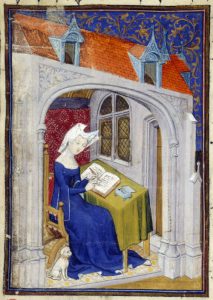
London, British Library, Harley MS 4431, fol. 4r.Christine de Pisan sits at work writing in an interior accompanied by a dog. France (Paris), c. 1410 – c. 1414. Image via https://blogs.bl.uk/digitisedmanuscripts/2013/06/christine-de-pizan-and-the-book-of-the-queen.html.

London, British Library, Harley MS 4431, fol. 4r. Christine de Pisan sits at work writing. France (Paris), c. 1410 – c. 1414. Image via https://blogs.bl.uk/digitisedmanuscripts/2013/06/christine-de-pizan-and-the-book-of-the-queen.html.

Similarly we build upon the inspiration of two Episodes for “The Research Group Speaks” which formed bookends or pendants for our Anniversary Year in January and December. The former considered the roles of Women Writers from the Medieval to Post-Modern Periods. The latter addressed Women as Makers of Books, by considering not only functions as authors but also activities as authorial book-designers or as calligraphers, illustrators, compilers, and editors, such as for successful serial publications.

The pair of Episodes focused upon the agency of women in and for books.

  • Episode 15. Women Writers from the Medieval to Post-Modern Periods
  • Episode 18. Women as Makers of Books

In 2025, we propose to examine, among other subjects, the multiple types and forms of agents and agencies in the making, producing, disseminating, collecting, reading, using, abusing, re-creating, and transmitting of books across time and place. Our programs shape accordingly.

Watch this space, and come to our Episode 19 to hear about the plans. We welcome your feedback and participation.

Panelists and Subjects

Panelists for our Roundtable include:

Phillip Bernhardt–House, Mildred Budny, Hannah Goeselt, Justin Hastings, and others.

Topics to consider include the processes of choosing the subjects, approaches, and structures of the events in their interconnected series. Our Speakers may describe the thought-processes, explorations, research, and consultations which underpin this creativity.

Plans for the year work to shape individual events or their series, and to integrate them into the full suite of events and publications of the RGME for the year round. Attendees are invited to offer suggestions and volunteer to participate in the events and their organization as well as their follow-up.

  • Episodes of “The Research Group Speaks”
  • Workshops on “The Evidence of Manuscripts, Etc.”
  • In-Person (and hybrid) Visits to Collections
  • Co-Sponsored 2025 Digital Medieval Studies Institute in Boston/Cambridge (March)
  • 2025 Spring and Autumn Symposia
    — Spring Symposium. “Makers, Producers, and Collectors of Books, From Author/Artist/Artisan to Library”
    — Autumn Symposium. “Readers, Fakers, and Re-Creators of Books, From Page to Marketplace and Beyond”
  • 2025 Autumn Colloquium
  • 2025 Conference Activities:
    — 2025 International Congress on Medieval Studies (ICMS) at Kalamazoo in May
    — 2025 International Medieval Congress (IMC) at Leeds in July
  • Meetings of the Friends of the Research Group on Manuscript Evidence
  • Competitions for the Friends (such as Favorite Recipes for an RGME Recipe Book),
    — Prizes Included
  • Masterclasses (by Request)

Rome, Capitoline Museums, Front panel of a sarcophagus representing the four seasons. Marble, Roman artwork, middle of the 3rd century CE. Photograph by Jean-Pol GRANDMONT. Image via Capitoline Museums, CC BY-SA 3.0 <https://creativecommons.org/licenses/by-sa/3.0>, via

Reflections on the Theme

In this living context, our Speakers may address the Year’s Theme of Thresholds in wider ramifications.

1) Liminal Deities

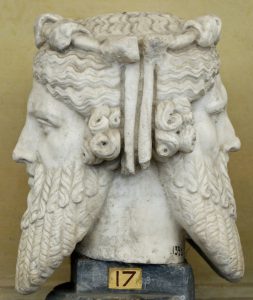
Vatican City, Vatican Museums, Museo Chiaramonti, section XIV, no.17. Janus-type Double Herm. Marble, Roman copy after a Greek original. Image via Wikimedia via Creative Commons 3.0 Unported.

For example, Phillip Bernhardt–House might survey some rituals and divinities or beings whose charge or domain occupies, or relates to, thresholds of various kinds from antiquity onward. Among them are numbered

  • Janus, the Roman “God of all beginnings, gates, transitions, time, choices, duality, doorways, passages, and endings” (Janus)
  • Hecate, the Greek goddess of boundaries, crossroads, doorways, and city walls
  • Cardea, the Roman goddess of health, thresholds, and door hinges and handles
  • Heimdall, the Norse god associated with boundaries, borders, and liminal spaces
  • Hermes, Greek god of roads, merchants, travelers, trade, thievery/thieves, cunning, and animal husbandry; messenger of Zeus and psychopomp (“guide of souls). In particular, Hermes is associated with particular types of oracles (the Astragalomanteia and the Kledones; see also Cledonism and Cleromancy), as well as with words, language, and magic — comprising some of the most liminal but connective and ‘commercial’ activities of all.
  • Mercury, Roman messenger god and psychopomp; equivalent to the Greek Hermes, sharing some of his functions, such as being a god of commerce, travelers, merchants, and thieves.

London, British Museum, Drawing of a Hekate Triformis, perhaps as a Hekation or shrine, Public domain, via Wikimedia Commons

2) Thresholds as Emblems

Our Director would briefly describe characteristics of Thresholds/Portals/Gateways, as exemplified or embodied in language, literature, art, architecture, religion, ritual, and imagination. Such reflections have sometimes guided RGME and related activities, as with the Symposium held at Princeton University for our 2009 Anniversary Year.

  • Gathering At the Threshold: A Celebratory Symposium

As motto, she proposes a quotation from the introduction to the first issue of a short-lived periodical by the polymath Johann Wolfgang von Goethe (1749–1832) under the name Propylaen (July 1798–1801). Regarding that enterprise, it can be observed that:

Through its German name, “Propyläen” (from the Greek προπύλαιον, propylaion, pl. προπύλαια, propulaia, an entryway to a building), which can be translated to English as “Propylaea“, the periodical, including its various themes, was to represent a uniquely cultural “entryway”; and thus, it symbolized the building that is life into which the artist is required to enter.

— Propyläen

Goethe’s Birthplace: Goethe-Haus, Grosser Hirschgraben, Frankfurt-am-Main, Innenstadt. Image: Dontworry, CC BY-SA 3.0 <https://creativecommons.org/licenses/by-sa/3.0>, via Wikimedia Commons

Selected as a motto at the start of her own Ph.D. Dissertation (London, 1985), Goethe’s classic “Introduction” (Einleitung) to his serial publication states a sobering observation from eloquent and perhaps prescient experience.

THE YOUTH (Jüngling), when Nature and Art attract him, thinks that with a vigorous effort he can soon penetrate into the innermost sanctuary; the Man, after long wanderings, finds himself still in the outer court.

Such an observation has suggested our title. It is only on the step, in the gateway, the entrance, the vestibule, the space between the outside and the inner chamber, between the sacred and the common, that we may ordinarily tarry with our friends.

In German:

Der Jüngling, wenn Naur und Kunst ihn anziehen, glaubt mit einer lebhaften Streben bald in das innerste Heiligtum zu dringen; der Mann bemerkt, nach langem Umherwandeln, daβ er sich noch immer in den Vorhõfen befinde.

Eine solche Betrachtung hat unsern Titel veranlaβt: Stufe, Tor, Eingang, Vorhalle, der Raum zwischen dem Innern und Ausern, zwischen den Heiligen und Gemeinem kann nur die Stelle sein, auf der wir uns mit unsern Freunden gewönlich aud halten werden.

—— Preface to Propyläen

Sesterce of Nero, 54-68 AD, Reverse: Temple of Janus with Closed Doors. Patrick H. C. Tan Collection. Image: Classical Numismatic Group, Inc. http://www.cngcoins.com, CC BY-SA 2.5 <https://creativecommons.org/licenses/by-sa/2.5>, via Wikimedia Commons

Registration

Please register to attend this online Episode. Registration is free, and we invite you to make a volunteer donation when you register, to help support our nonprofit educational corporation powered principally by volunteers.

After you register, the Zoom Link will be sent to you before the event.

Eventbrite Registration

  • Episode 19. “At the Gate: RGME Activities for 2025”

Thank you for joining us!

*****

Questions? Suggestions?

  • Leave your comments or questions below
  • Contact Us

Visit our Social Media:

  • our FaceBook Page
  • our Facebook Group
  • our X/Twitter Feed (@rgme_mss)
  • our Bluesky nest @rgmesocial.bluesky.social)
  • our Instagram Page
  • our LinkedIn Group

Join the Friends of the RGME.

Please make a Donation in Funds or in Kind for our nonprofit educational corporation powered principally by volunteers. Your donations and contributions are welcome, and can go a long way. They may be tax-deductible to the fullest extent provided by the law.

  • Donations and Contributions
  • 2025 Annual Appeal

*****

Paris, Porte Saint-Denis, from the South. Image: Photograph (10 September 2011) by Coyau / Wikimedia Commons/ via https://commons.wikimedia.org/wiki/File:Porte_Saint-Denis_01.jpg.

*****

Tags: "Thresholds and Communities", Friends of the Research Group on Manuscript Evidence, Gates and Gateways, Janus, Johann Wolfgang von Goethe, Liminal Deities, Manuscript studies, Propylaen, RGME Roundtable, RGME Theme for the Year, The Research Group Speaks
No Comments »

The Latin Vulgate Bible Leaf in the Farrell Collection, Part 3: The Full Leaf

November 14, 2024 in Announcements, Event Registration, Manuscript Studies, Research Group Workshops, RGME Lending Library, RGME Library & Archives

The Latin Vulgate Bible Leaf
in the Collection of Jennah Farrell

Part 3: The Leaf Revealed in Full

Single Leaf from the Book of Numbers
now unframed

Laid out in double columns of 46 lines in Gothic Script

Size of leaf =
maximum circa 29.3 cm. tall
 × 20.1 cm. wide
(circa 11 9/16 in. × 7 15/16 in. )

< ruled writing area
circa 18.7 × 12.5 cm. (circa 7 3/4 × 4 7/8 in.)>

[Posted on 13 November 2024]

Collection of Jennah Farrell, Manuscript Leaf in Frame. Photograph by Jennah Farrrell.

Now that the manuscript leaf has been removed from its modern frame (see Part 2 in this series of blogposts), we display photographs of both sides of the leaf uncropped, showing its full extent at present.

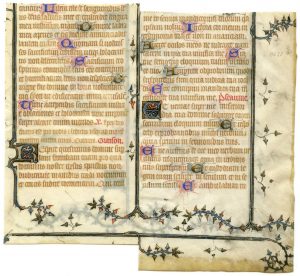
We do so especially to prepare for the pair of online Workshops which we plan so as to crowdsource information, expertise, and collaboration. We invite a shared exploration to learn and teach more about the leaf, its original manuscript, its context within its genre of book and other relatives from the same center, period, or region, and perhaps also its travels from its date and place of origin in medieval Europe to its present collection in the United States.

About the frame and information about the collection from which Jennah Farrell acquired the leaf in its frame, see Part 2 on Provenance:

  • Latin Vulgate Bible Leaf in the Collection of Jennah Farrell, Part 2

Part 1 introduced the leaf in its frame, in the state in which it reached the RGME Lending Library for photography, conservation, research, and teaching:

  • A Latin Vulgate Leaf from the Book of Numbers (Part 1)

Now for Part 3 we focus on the leaf itself, including the evidence which its outer portions and its entire back side, formerly hidden, can reveal.

Side 1

This side faced forward in the former frame.

Collection of Jennah Farrell, Single Leaf from the Book of Numbers in a Medieval Latin Vulgate Bible manuscript. Full extent of the leaf, unframed: Recto. Photography by Mildred Budny.

Side 2

Collection of Jennah Farrell, Single Leaf from the Book of Numbers in a Medieval Latin Vulgate Bible manuscript. Full extent of the leaf, unframed: Verso. Photography by Mildred Budny.

Releasing the Leaf from the Frame

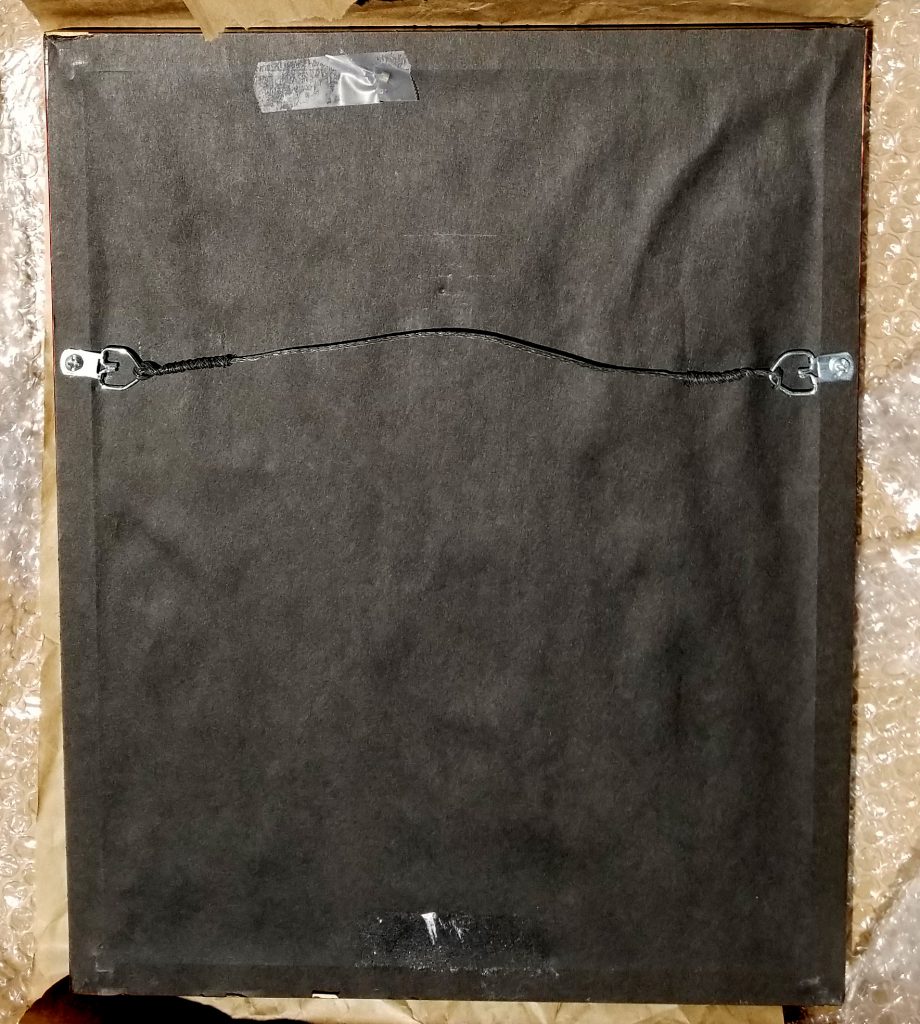
Collection of Jennah Farrell, Manuscript Leaf: Back of Frame. Photograph by Mildred Budny.

Removing the leaf from its frame employed a set of tools 1) to unscrew the mounting hinges and hanging wire, 2) release the backing paper glued to the back edges of the wooden frame, 3) detach the heavy staples which clamped a sheet of foam board to the framing mat, and 4) lift the mat to release the leaf.

Tools to Open the Frame and Left-over Pieces from the Frame containing the Farrell Bible Leaf. Photography by Mildred Budny.

The pieces of the frame are now kept together: stained wooden frame, sheet of glass, windowed mat, foam board, backing paper, staples, and hanging nail. The leaf is now kept in a clear archival L-sheet housed in an archival document binder.

Both Sides Now in View

Released from the frame and its mat, the leaf can be seen to have about 5 cm. more from top to bottom and about 4 more cm. from side to side.  Revealed are the full extent of the margins and parts of the foliate decoration of the ornamental bars which extend from the chapter initials in three columns of the four in the layout of two columns per page or side of the leaf.

Revealed too is the marginal correction for the text entered in the outer margin on the verso and the remnants of the stitching line at the inner edge or gutter of the leaf, where an uneven cut along the full length of the leaf severed it from its formerly conjoint leaf in its original manuscript.

Can you tell which side of the leaf is the front, or original recto, and which is the back, or original verso?

Do you recognize, or would you like to discover, which manuscript the leaf came from when it was cut out of its book and separated from its relatives, to enter the world as a single leaf on its own, suited for framing and display such as on a wall?

Would you like to help us to learn about it?

A Pair of Workshops for this Leaf

We plan two RGME Workshops on Looking at Manuscripts, the first in a new series, to introduce the leaf and learn how to identify its probable date and place of origin, as well as its former manuscript and its context among relatives. Our challenge is to discern what the leaf might itself have to say about these different stages, and what we might discover about its original identity, its former manuscript, and its dispersal.

Both workshops will be held online by Zoom, for which registration (free) is required.

1) Workshop 1 introduces the leaf and sets the groundwork.

Sunday 17 November 2024 at 1:00-2:30 pm EST (GMT-5) by Zoom

  • Workshop 1: Registration

2) Workshop 2 follows up the lines of investigation as we might collectively compare notes and refine our inquiries more fully to understand the leaf and its relatives.

Sunday 16 December 2024 at 1:00-2:30 pm EST (GMT-5)

  • Workshop 2: Registration

After you register, the Zoom Link will be sent to you a few days before the event.

Beginners and experts welcome!

*****

About our new series of Workshops on Looking at Manuscripts, see:

  • The Bridge of Signs

We have been waiting for the opportunity, occasion, and resources to bring to our community for workshops, online and/or in-person, collectively to explore original source materials. With the RGME “Lending Library” as well as our own materials in the RGME Library & Archives, and with our time-tested habits of online events as well as in-person workshops, we launch our new series in a mobile approach to bring together original sources and a community interested in studying them and teaching with them.

Please join our expedition!

*****

Suggestion Box

Please Contact Us or visit

  • our FaceBook Page
  • our Facebook Group
  • our Twitter Feed (@rgme_mss)
  • our Bluesky nest @rgmesocial.bluesky.social)
  • our LinkedIn Group
  • our Blog on Manuscript Studies and its Contents List

Would you like to help?

*****

Tags: Jennah Farrell Collection, Latin Vulgate Bibles, Manuscript studies, Medieval manuscripts
No Comments »

Visit to the Collection of Steven Lomazow, M.D.

October 3, 2024 in Announcements, Event Registration, Manuscript Studies, Uncategorized, Visits to Collections

RGME Visit to the
Collection of
Dr. Steven M. Lomazow

of American Magazines
and Other Sources

Saturday 16 November 2024

In-person visit,
with hybrid component
for an online virtual visit (by Zoom)

“I can read you like a magazine”
— Taylor Swift, Blank Space (2014)

[Posted on 1 October 2024, with updates]

The Periodical Collection of Steven Lomazov, St. Nicholas: Scribner’s Illustrated Magazine for Girls and Boys, Front Cover (November 1873), via https://www.americanmagazinecollection.com/st-nicholas-scribners-illustrated-magazine-for-girls-and-boys-2/.

By special invitation, the Research Group on Manuscript Evidence prepares to visit the private collection of Dr. Steven M. Lomazow — neurologist, book-collector, member of The Grolier Club, author, bibliographer, raconteur, and curator of exhibitions from his collection assembled over half a century. By design, this in-person visit by the RGME to his home in West Orange, New Jersey, might gather other Princeton bibliophiles and students, as our organization combines interests, resources, and organizational skills with other groups in the Princeton area and beyond, according with our traditions for in-person and online events alike.

Mindful also of responsibility to our wider audience, as customary, the RGME will provide a hybrid approach to this occasion, with a virtual component for part of the curated visit, so that parts of our wider community might attend from a distance by Zoom allowing for discussion and feedback.

Grateful for the invitation, we look forward to the visit with its opportunity for a curated tour of an extraordinary collection for many interests assembled over more than fifty years.

The Plan on the Day

We aim to arrive at the Lomazow Collection about 11:00 or 11:30 am EST (GMT-5), mindful of traffic conditions between our base at Princeton (or elsewhere for other attendees) and the location of the collection. The online component of the visit might commence at about 12:30 pm, in time for the introduction to the collection.

First, Dr. Lomazow and his wife will host a welcoming repast catered at home from a renowned bagel shop. We would ask attendees for dietary requirements.

Next, Steven will give an introduction to the collection, the materials, and their discoveries. This account would set the stage by describing the collection, how it grew, what it contains, how widely it reaches into spheres of history, literature, popular culture, and more, and how it is arranged — by groups of materials and by their size, each in alphabetical order for ease of discovery and consultation.

Then we would be able to visit the different rooms, examine their original materials, ask questions, and enter into conversations about the varied aspects of these original sources and their contexts. Thus we might learn from the materials and from each other while engaging with the original sources. Whether in person or virtually, we might count those encounters in real time as Break Out Rooms for the visit, with tailored focus for specific items, genres, and subjects.

We would end at about 5:00 pm, although perhaps some of us might remain for discussion until about 7:00 pm.  The span is subject to exploration governed by numbers and interests of attendees.

For transportation from Princeton and back again, we could explore alternatives.  Depending on interest and timetables, some of us might wish to drive; depending on numbers, transportation might be arranged. Please let us know your preferences and watch this space for developments as the preparations advance.

What would you like to see?  Given this generous opportunity, it might be difficult to single out specific magazines, dates, or genres, because the range of the collection is so extraordinarily varied, with something for almost everyone’s taste, and with very much for historical and cultural study. What might you choose?

The Collector

Steven Lomazow, M.D., is a board-certified neurologist in practice for 43 years.

His published works on bibliophilic and related subjects include series of reference works, celebrations of the collection, and monographs on presidential medical-historical subjects.

Looking forward to conversations with and feedback from our varied audience, both expert and general, Dr. Lomazow offers this special occasion with the RGME for opportunities to examine his varied collections and learn about them, in conversation with the knowledgeable collector. A variety of publications, in print and online, present the materials and reference perspectives on their context.

Books, Blogs, Catalogues, Exhibitions, and Virtual Exhibitions

    • Magazines and the American Experience:
      Highlights from the Collection of Steven Lomazow, M.D.
      americanmagazinecollection.com
  • Magazine History: A Collector’s Blog Documenting and illustrating the history, importance and the joy of collecting magazines
  • American Periodicals: A Collectors’ Guide and Reference Manual (West Orange, New Jersey: Lomazow, 1996)
  • The Great American Magazine: Adventures in History. Selections from The Steven Lomazow Collection of American Periodicals (West Orange, New Jersey: Lomazow, 2014)
  • Steven Lomazow et al., Magazines and the American Experience: Highlights from the Collection of Steven Lomazow, M.D.  A Catalogue published in conjunction with an exhibition held at The Grolier Club, January 20 – April 24, 2021 (New York: The Grolier Club, 2020).

“The exhibition is presented in two sections, beginning with a chronological history of American magazines from 1733 to the present. The second is devoted to a broad spectrum of genres which address the areas of popular culture that became a major focus of American magazines in the late nineteenth and twentieth centuries, including American artists and humorists, the ongoing struggle of African Americans to achieve equality, a salute to our national game of baseball, and the development of radio, television, and motion pictures.”

  • Companion Virtual Exhibition at the Grolier Club: American Magazines

Also:

  • Steven Lomazow (with Eric Fettman), FDR’s Deadly Secret (New York: BBS Publications, 2009)
  • Fdr’s Deadly Secret: A supplement to our book dedicated to the understanding of the health of our thirty-second president
  • FDR Unmasked: 73 Years of Medical Cover-ups That Rewrote History (Amsterdam: Lugler Publications, revised edition, 2024).  FDRUNMASKED.com

What is in Store?

Dr. Steven puts it succinctly.  The collection contains

“Thousands of exquisitely rare and historically important items.

“The collection contains virtually every major magazine highlight ever published from the eighteenth century to the present and covers virtually every topic- literature, politics, technology (TV, Radio, Movies, Aviation etc). It also includes by far the largest collection of first issue pulp magazines (over 850) in existence. Any institution or individual that acquires it will immediately become one of the leading repositories of American popular culture. . . . There are hundreds of feet of shelves occupied by bound volumes and individual issues.”

— Magazine Collection for Sale (2011)

Many items are destined for exhibition and perhaps transfer to other institutions.  This visit offers an in-depth opportunity to examine them on display in situ in the company of the collector, who has built an exceptional collection of a variety of genres, including American magazines from their beginnings, patriotic magazines in World War II, and more.

Registration

Registration is required for attendance, whether in person or online by Zoom. Numbers of attendees for the at-home visit are limited; in case of need, we will create a Waiting List.

Registration is free. We welcome voluntary donations for our section 501(c)(3) nonprofit educational organization equipped with slim financial resources and powered principally by volunteers with donations in funds and contributions in kind. Such donations help to sustain and foster our mission and activities.  Your donations may be tax-deductible to the fullest extent permitted by law.

Please register through the RGME Eventbrite Portal, which presents all our Collections of events. Here are the ways to register for the visit in hybrid formats.

1) To attend In Person

  • In Person Visit to the Collection of Steven Lomazow M.D.

2) To attend Online by Zoom

  • Virtual Visit to the Collection of Steven Lomazow M.D.

After you register for online attendance, you will be sent the Zoom Link a few days before the event.

Questions or Suggestions?

Do you have special requests for materials you would like to see in the collection during the visit? Questions for the collector? Would you like to share your experiences with growing up with American magazines?

Please Contact Us or visit

  • our FaceBook Page
  • our Facebook Group
  • our Twitter Feed (@rgme_mss)
  • our Bluesky nest @rgmesocial.bluesky.social)
  • our LinkedIn Group
  • our Blog on Manuscript Studies and its Contents List

We look forward to hearing from you.

*****

Update: Having successfully accomplished the visit, we offer a report. See

  • RGME Visit to the Lomazow Collection: Report

See also:

  • 2024 Landmarks

We give thanks to Dr. Lomazow, his wife Suze Bienaimee, the SFPUL, Jacqueline Zhou, Kurt Lemai, our online audience, and others for a wonderful collective experience.

The Periodical Collection of Steven Lomazov, St. Nicholas: Scribner’s Illustrated Magazine for Girls and Boys, Front Cover (November 1873), via https://www.americanmagazinecollection.com/st-nicholas-scribners-illustrated-magazine-for-girls-and-boys-2/.

Note on the Image. The long-lived St. Nicholas Magazine was launched in 1873, with the redoubtable Mary Mapes Dodge (1831–1905) as its first editor and many prominent authors as contributors during its period of circulation until 1940. From the Lomazow Collection, we glimpse the cover of the first issue.

Of the editor’s skills it is related:

She was able to persuade many of the great writers of the world to contribute to her children’s magazine – Mark Twain, Louisa May Alcott, Robert Louis Stevenson, Alfred, Lord Tennyson, Henry Wadsworth Longfellow, William Cullen Bryant, Oliver Wendell Holmes Sr., Bret Harte, John Hay, Charles Dudley Warner, Elizabeth Stuart Phelps Ward, and scores of others. One day, Rudyard Kipling told her a story of the Indian jungle; Dodge asked him to write it down for St. Nicholas. He never had written for children, but he would try. The result was The Jungle Book.

— Mary Mapes Dodge

Of especial interest to the RGME in its Anniversary Year is the first appearance in this magazine of the tale of The Little Red Hen, in its original form in a publication in English. This fable, in its original unadulterated form, serves as useful model for the RGME as goal for collaborative work and its practices or processes.

*****

Tags: American Magazines, History of Magazines, Popular Culture, RGME Anniversary, RGME Visits to Collections, Steven Lomazow Collection
No Comments »

Medieval Women’s Networks

August 4, 2024 in Announcements, Event Registration, Events, Manuscript Studies, Medieval Women's Networks

“Medieval Women’s Networks:
Exploring Tools and Techniques
for Digital Analysis”

A Pair of Interactive Public Workshops

co-organized by
Kathy Krause and Laura Morreale
and co-sponsored by the RGME

Thursday and Friday 17–18 October 2024 (Online)
12:30–14:30 pm EDT (GMT-4)

[Posted on 5 August 2024, with updates]

We gladly announce another event for our 2024 Anniversary Year.

The RGME has been invited to co-sponsor the free 2-day online event to explore and advance the swiftly developing world of work on Medieval Women’s Networks.

Co-Organizers

The event is conceived and co-organized by experts

  • Kathy Krause (University of Missouri, Kansas City, Emerita)
  • Laura Morreale (Independent Scholar and Middle Ages for Educators)

Laura, our RGME Associate, gave a presentation for our 2024 Anniversary Symposium “Manuscript Heart” in February. This coming event joins a series of collaborative events and projects which she helps to organize, accomplish, and publish.

We are glad to join forces with Kathy and her and all the co-sponsors for Medieval Womens’ Networks.

Co-Sponsors

To be held online, the event is co-sponsored by

  • Center for Digital and Public Humanities, the University of Missouri Kansas City
  • Digital Medievalist
  • the Research Group on Manuscript Evidence
  • and a generous Anonymous Benefactor.

UMKC Center for Digital and Public Humanities Logo

Logo of the Research Group on Manuscript Evidence (colour version)

RGME Logo

Digital Medievalist Logo

Dates

The Interactive Public Workshop will take place over two days, in sessions devoted respectively to

1) Projects. Thursday 17 October 2024
2) Data. Friday 18 October 2024

Each session is scheduled for 12:30–2:30 pm EDT (GMT-4) online.

For information see the flyer, shown here, and links below.

“Medieval Women’s Networks” Flyer.

Participants

Speakers and Digital Humanities Experts come from an international variety of centers and perspectives.

Speakers for Workshop 1: Projects

  • Adrienne Williams Boyarin (University of Victoria)
  • Elena Brizio (Georgetown University)
  • Tracy Chapman Hamilton (Sweet Briar College)
  • S.C. Kaplan (University of California, Santa Barbara)
  • Samantha Katz–Seal (University of New Hampshire)
  • Mariah Proctor–Tiffany (University of California, Long Beach)
  • Yvonne Seale (State University of New York, College at Geneseo)

Digital Humanities Experts for Workshop 2: Data

  • Kalani Craig (Indiana University)
  • Erin McCarthy (Saint Lawrence University)
  • Jeffrey Rudberg–Cox (University of Missouri, Kansas City)
  • Sébastien de Valeriola (Université libre de Bruxelles)

Information and Registration

To register please visit the Event registration form via Google Docs, where can also be found online information.

1. Event registration
2. An online information sheet
If Google Workspace is not accessible to you, please contact us. (See below.)
The Event flyer is available for download on the RGME website in two formats:
  • DHWomenFinalFlyer3 (pdf)
  • Medieval Women’s Networks Flyer (jpg)

London, British Museum, Additional MS 10292, fol. 149r. Prose Lancelot-Grail. Saint Omer or Tournai, 1316. Image © The British Library.

We thank the co-organizers and co-sponsors of Medieval Women’s Networks for the opportunity to join the carefully-prepared program for this outstanding event.  We look forward eagerly to it.  We invite you to join it!

*****

Other RGME-sponsored Events
for our 2024 Anniversary Year

  • 2023 and 2024 Events
  • Episode 17. “RGME Retrospect and Prospects: Anniversary Reflections (Saturday 21 September, online)
  • 2024 Autumn Symposium “At The Helm” (Friday and Saturday 25-26 October 2024, online)
  • Episode 18. “Women as Makers of Books” (Saturday 14 December 2024, online)

To register for these sponsored events, please visit the RGME Eventbrite Collection:

  • RGME Eventbrite Registration Portal

An RGME Bulletin Board

Ronda, Galicia, Spain, Puente Nuevo Bridge. Photograph 14 August 2007 by Mark Gilbert. Image: Judas6000 at English Wikipedia, CC BY 3.0 <https://creativecommons.org/licenses/by/3.0>, via Wikimedia Commons at https://commons.wikimedia.org/wiki/File:Punte_Nuevo_Bridge,_Ronda_-_Spain.jpg.

The co-sponsorship for Medieval Women’s Networks leads the RGME to open a new page on our website for news about activities, projects, conference papers, publications, and initiatives by people of the RGME.  Functioning as a form of bulletin board with announcements, it appears here:

  • Around and About with the RGME

First up, with an announcement by Laura Morreale, is the Sweet 16 Competition launched by the Princeton-based Middle Ages for Educators (MAFE). The due date for proposals is 1 October 2024.

Questions? Suggestions?

  • Leave your comments or questions below
  • Contact Us

Visit our Social Media:

  • our FaceBook Page
  • our Facebook Group
  • our Twitter Feed (@rgme_mss)
  • our Bluesky nest @rgmesocial.bluesky.social)
  • our LinkedIn Group

Join the Friends of the RGME.

Consider making a Donation in Funds or in Kind for our nonprofit educational corporation powered principally by volunteers. Your donations and contributions are welcome, and can go a long way. They may be tax-deductible to the fullest extent provided by the law.

  • Donations and Contributions
  • 2024 Anniversary Appeal

Remember to register for “Medieval Women’s Networks” for 17–18 October 2024 (see above). See you there!

*****

Tags: Center for Digital and Public Humanities, Digital Medievalist, Interactive Public Workshop, Medieval Women's Networks, RGME Anniversary, RGME Anniversary Year, University of Missouri Kansas City
No Comments »

Episode 16: An Interview with Jesse D. Hurlbut

February 14, 2024 in Announcements, Event Registration, Manuscript Studies, Research Group Episodes for The Research Group Speaks, Research Group Speaks (The Series)

The Research Group Speaks
Episode 16

Saturday 22 June 2024 online
1:00–2:30 pm EST (GMT-5) by Zoom

“Trailblazing the Medieval Digital Humanities:
An Interview with Jesse D. Hurlbut”

Interviewer:  Mildred Budny, Director of the RGME

[Posted on 10 February 2024, with updates]

Jesse Hurlbut at the Bonneville Salt Flats, Utah. Photograph Jesse Hurlbut.

Jesse Hurlbut at the Bonneville Salt Flats, Utah. Photograph Jesse Hurlbut.

We invite you to attend Episode 16 in our series:

  • The Research Group Speaks

In this Episode, Jesse D. Hurlbut, RGME First WebMaster Emeritus, will speak informally about his contributions to manuscript studies, websites, digital access, and other interests.

Among them are his contributions to medieval manuscript studies, photography, and digital access; his teaching and research on French studies; his websites for himself and others (academic and non-profit organizations); his interests in promoting online communities for manuscript study and enjoyment; and more.

Update: Jesse returns for Episode 20 in March 2025 to report on his project on comic books and medieval manuscripts, as mentioned in this Episode.

  • Episode 20. “Comic Book Theory for Medievalists”

The Anniversary Symposium
in February 2024

Save-the-Date Poster for 2024 Anniversary Symposium in Thanks to Jesse Hurlbut. Poster set in RGME Bembino.

This event follows upon the 2024 Anniversary “Manuscript (HE)ART”, held online on Saturday 24 February 2024, as the first in the RGME’s set of Symposia for the 2024 Anniversary Year:

  • 2024 Anniversary Symposium in Thanks to Jesse Hurlbut.. co-organized by Katharine C. Chandler and Jessica L. Savage

Taking its title from Jesse’s website Manuscript Art: Taking a Closer Look, the Symposium is designed to gather Jesse’s former students, colleagues, and friends, to consider subjects in manuscript and other studies of interest to him.

The Episode

Now, the Episode gives the chance to hear him, learn more about his interests, and join the conversation.  For example, in particular, he proposes to describe the early digital years. These recollections may record experiences viewed in hindsight and with foresight.

The Q&A to follow — or, if we wish, interlink — with the conversational interview gives the opportunity for feedback and participation.

Jesse Hurlbut holds his newly won manuscript leaf at the Kalamazoo Congress on 10 May 2014. (Photography by Mildred Budny)

Jesse Hurlbut holds his newly won manuscript leaf at the Kalamazoo Congress on 10 May 2014. (Photography by Mildred Budny)

Information about Jesse:

  • Jesse D. Hurlbut: Curriculum Vitae
  • Jesse Hurlbut (LinkedIn)
  • Manuscript Art: Taking a Closer Look

In His Own Words:

  • Interview with Medieval Scholar Jesse Hurlbut (Friday, 21 August 2009)
  • Beatus Vir (December 5, 2015)

Information about the Episode:

  • Episode 16. Trailblazing for the Medieval Digital Humanities: An Interview with Jesse Hurlbut
    You are Here.

Register for the Episode:

  • Episode 16: An Interview with Jesse D. Hurlbut; Tickets

Registration is free.

We offer the option for Registration with a voluntary Donation, which we welcome.

Donations, which may be tax-deductible, help us to continue with our activities and sustain our mission for an organization principally powered by volunteers. See:

  • Donations and Contributions

After registration, the Zoom link will be sent a few days before the event.

If you have questions or issues with the registration process, please contact

  • director@manuscriptevidence.org.
Jesse Hurlbut and others at the RGME Reception at the ICMS 9 May 2024. Photography Mildred Budny.

Jesse Hurlbut and others at the RGME Reception at the ICMS 9 May 2024. Photography Mildred Budny.

See you at the Episode!

*****

Future Episodes

Future Episodes are planned.  See:

  • “The Research Group Speaks”: The Series.

Other Events

We plan various other events for the 2024 Anniversary Year.

  • 2023 and 2024 Activities

For example:

  • 2024 Anniversary Symposium in Thanks to Jesse Hurlbut (online)
  • 2024 Spring and Autumn Symposia-plus-anniversary-symposium
  • 2024 Spring Symposium at Vassar College (hybrid)
  • 2024 International Congress on Medieval Studies: Program (severally in-person, online, and partly hybrid)
  • 2024 International Medieval Congress at Leeds (hybrid)

Questions or Suggestions?

Please leave your questions or comments here (below), Contact Us, or visit

  • our FaceBook Page
  • our Facebook Group
  • our Twitter Feed (@rgme_mss)
  • our Bluesky nest @rgmesocial.bluesky.social)
  • our LinkedIn Group
  • our Blog on Manuscript Studies and its Contents List

We invite you to join:

  • Friends of the RGME.

Donations and contributions, in funds or in kind, are welcome and easy to give.  Given our low overheads, your donations have direct impact on our work and the furtherance of our mission.  For our Section 501(c)(3) nonprofit educational organization, your donations may be tax-deductible to the fullest extent permitted by law.  Thank you for your support!

  • Contributions and Donations
  • 2024 Anniversary Appeal

We look forward to hearing from you and seeing you at our events.

*****

Lisbon, Museu Nacional de Arte Antiga: The mid 15th-century Saint Vincent Panels, attributed to Nuno Gonçalves. Image (https://upload.wikimedia.org/wikipedia/commons/3/3a/Nuno_Gon%C3%A7alves._Paineis_de_S%C3%A3o_Vicente_de_Fora.jpg) via Creative Commons.

*****


Tags: Interview, Jesse D. Hurlbut, Manuscript studies, Medieval Digital Humanities, Medieval manuscripts, RGME Webmaster, The Research Group Speaks, Trailblazing
No Comments »

2024 Anniversary Symposium in Thanks to Jesse Hurlbut: Program

October 18, 2023 in Announcements, Conference, Conference Announcement, Event Registration, Manuscript Studies, RGME Symposia, Uncategorized

“MANUSCRIPT (HE)ART”

An RGME Anniversary Symposium
in Thanks to Jesse Hurlbut
(RGME WebMaster Emeritus)

Co-Organized by
Katharine C. Chandler and Jessica L. Savage

Saturday 24 February 2024 online by Zoom
10:00 am – 4:00 pm EST (GMT-5)

Announcement Part 1: The Program

[Posted on 18 October 2023, with updates]

We announce the 2024 RGME Anniversary Symposium, as an expression of thanks to our RGME WebMaster Emeritus, Jesse Hurlbut, upon his retirement. This Symposium is the first in our Symposia for 2024, when the RGME celebrates an anniversary of 35 years as an international scholarly society founded in England, and 25 years as a nonprofit educational corporation based in Princeton, New Jersey.

Jesse’s contributions to the RGME as Associate and WebMaster date from 2005, a few years after our incorporation in 1999 as a 501(c)(3) nonprofit organization.  The generosity of his contributions to the RGME and many others in fields of manuscript and other studies across the years lead us, in the company of some of his former students and colleagues, to offer this Symposium in thanks.

For the background for this Symposium, see the companion post to this one:

  • 2024 Anniversary Symposium in Thanks to Jesse Hurlbut: Plan

The First WebMaster of the RGME

An accomplished medievalist, manuscript historian, photographer, blogger, and scholar of French language and literature, Jesse Hurlbut generously served as the first WebMaster of the Research Group on Manuscript Evidence (2005–2023). Following Jesse’s retirement on 30 June 2023, we wish to offer this event in thanks, to examine subjects related to his interests, work, and teaching in the world of manuscript studies. The Symposium brings together former students, colleagues, and friends to share their work and work-in-progress in various subjects or projects which his work, teaching, and example may have helped to inspire or refine.

Jesse Hurlbut and the Château de Chambord in 2023. Photograph by Patricia Stevenson.

The Purpose

Our Save-the-Date Poster expresses the plan in word and image for an Anniversary Symposium full of “MANUSCRIPT (HE)ART”.  (You may download it here.)

Save-the-Date Poster for 2024 Anniversary Symposium in Thanks to Jesse Hurlbut. Poster set in RGME Bembino.

Read the rest of this entry →

Tags: 2023 Autumn Symposium Progam, Anniversary Symposium, Giving Thanks, Jesse Hurlbut, Manuscript studies, Medieval manuscripts, RGME Symposia
No Comments »

Newer Entries »
  • Top
©2024 Research Group on Manuscript Evidence.


is proudly powered by WordPress. WordPress Themes X2 developed by ThemeKraft.