• News
    • News & Views
    • RGME Activities for 2024 and 2025
    • Around & About with the RGME
    • Reviews
    • Highlights
  • Blogs
    • Manuscript Studies
      • Manuscript Studies: Contents List
    • International Congress on Medieval Studies
      • Abstracts of Congress Papers
        • Abstracts of Papers Listed by Author
        • Abstracts of Papers Listed by Year
  • About
    • Mission
    • Who We Are
      • Officers, Associates & Volunteers
      • RGME Committees
      • Friends of the Research Group on Manuscript Evidence
    • Policies & Statements
      • RGME Privacy Policy Statement
      • RGME Intellectual Property Statement & Agreements
    • People
      • Mildred Budny — Her Page
      • Adelaide Bennett Hagens
    • Activities
      • Events
      • Congress Activities
        • Sponsored Conference Sessions (1993‒)
          • Panels at the M-MLA Convention (from 2016)
        • Co-sponsored Conference Sessions (2006‒)
    • History
      • Seals, Matrices & Documents
      • Genealogies & Archives
    • Contact Us
  • Bembino
    • Multi-Lingual Bembino
    • RGME Bembino: Resources
  • Congress
    • Sponsored Conference Sessions (1993‒)
    • Co-sponsored Conference Sessions (2006‒)
    • Abstracts of Congress Papers
      • Abstracts Listed by Author
      • Abstracts Listed by Year
    • Kalamazoo Archive
    • Panels at the M-MLA Convention (2016-2019)
      • Abstracts of Papers for the M-MLA Convention
      • Panels at the M-MLA Convention (from 2016)
  • Events
    • RGME Activities for 2024 and 2025
      • 2023 Activities and 2024 Planned Activities
    • Seminars, Workshops, Colloquia & Symposia (1989–)
      • Seminars on ‘The Evidence of Manuscripts’
      • Symposia on ‘The Transmission of the Bible’
      • The New Series (2001-)
        • 2019 Anniversary Symposium Program: The Roads Taken
        • 2019 Anniversary Symposium Registration
        • 2019 Anniversary Symposium Registration Open
      • RGME Symposia: The Various Series
      • The Research Group Speaks: The Series
      • Meetings of the Friends of the Research Group on Manuscript Evidence
      • RGME Online Events
    • Abstracts of Papers for Events
      • Abstracts of Papers for Seminars on ‘The Evidence of Manuscripts’
      • Abstracts of Papers for Symposia, Workshops & Colloquia
    • Receptions & Parties
    • Business Meetings
    • Photographic Exhibitions & Master Classes
    • Events Archive
  • ShelfLife
    • Journal Description
    • ShelfMarks: The RGME-Newsletter
    • Publications
      • “Insular, Anglo-Saxon, and Early Anglo-Norman Manuscript Art at Corpus Christi College, Cambridge” (1997)
        • Mildred Budny, ‘Catalogue’
        • The Illustrated Catalogue (1997)
      • The Illustrated Handlist
      • Semi-Official Counterfeiting in France 1380-1422
      • No Snap Decisions: Challenges of Manuscript Photography
    • History and Design of Our Website
  • Galleries
    • Watermarks & the History of Paper
    • Galleries: Contents List
    • Scripts on Parade
    • Texts on Parade
      • Latin Documents & Cartularies
      • New Testament Leaves in Old Armenian
    • Posters on Display
    • Layout Designs
  • Donations and Contributions
    • RGME Donor Promise
    • 2023 End-of-Year Fundraiser for our 2024 Anniversary Year
    • 2019 Anniversary Appeal
    • Orders
  • Links
    • Catalogs, Metadata, and Databases: A Handlist of Links
    • Handlist of Resources for Manuscript Studies and Fragmentology
    • Manuscripts & Rare Books
    • Maps, Plans & Drawings
    • Seals, Seal-Matrices & Documents

  • News
    • News & Views
    • RGME Activities for 2024 and 2025
    • Around & About with the RGME
    • Reviews
    • Highlights
  • Blogs
    • Manuscript Studies
      • Manuscript Studies: Contents List
    • International Congress on Medieval Studies
      • Abstracts of Congress Papers
        • Abstracts of Papers Listed by Author
        • Abstracts of Papers Listed by Year
  • About
    • Mission
    • Who We Are
      • Officers, Associates & Volunteers
      • RGME Committees
      • Friends of the Research Group on Manuscript Evidence
    • Policies & Statements
      • RGME Privacy Policy Statement
      • RGME Intellectual Property Statement & Agreements
    • People
      • Mildred Budny — Her Page
      • Adelaide Bennett Hagens
    • Activities
      • Events
      • Congress Activities
        • Sponsored Conference Sessions (1993‒)
          • Panels at the M-MLA Convention (from 2016)
        • Co-sponsored Conference Sessions (2006‒)
    • History
      • Seals, Matrices & Documents
      • Genealogies & Archives
    • Contact Us
  • Bembino
    • Multi-Lingual Bembino
    • RGME Bembino: Resources
  • Congress
    • Sponsored Conference Sessions (1993‒)
    • Co-sponsored Conference Sessions (2006‒)
    • Abstracts of Congress Papers
      • Abstracts Listed by Author
      • Abstracts Listed by Year
    • Kalamazoo Archive
    • Panels at the M-MLA Convention (2016-2019)
      • Abstracts of Papers for the M-MLA Convention
      • Panels at the M-MLA Convention (from 2016)
  • Events
    • RGME Activities for 2024 and 2025
      • 2023 Activities and 2024 Planned Activities
    • Seminars, Workshops, Colloquia & Symposia (1989–)
      • Seminars on ‘The Evidence of Manuscripts’
      • Symposia on ‘The Transmission of the Bible’
      • The New Series (2001-)
        • 2019 Anniversary Symposium Program: The Roads Taken
        • 2019 Anniversary Symposium Registration
        • 2019 Anniversary Symposium Registration Open
      • RGME Symposia: The Various Series
      • The Research Group Speaks: The Series
      • Meetings of the Friends of the Research Group on Manuscript Evidence
      • RGME Online Events
    • Abstracts of Papers for Events
      • Abstracts of Papers for Seminars on ‘The Evidence of Manuscripts’
      • Abstracts of Papers for Symposia, Workshops & Colloquia
    • Receptions & Parties
    • Business Meetings
    • Photographic Exhibitions & Master Classes
    • Events Archive
  • ShelfLife
    • Journal Description
    • ShelfMarks: The RGME-Newsletter
    • Publications
      • “Insular, Anglo-Saxon, and Early Anglo-Norman Manuscript Art at Corpus Christi College, Cambridge” (1997)
        • Mildred Budny, ‘Catalogue’
        • The Illustrated Catalogue (1997)
      • The Illustrated Handlist
      • Semi-Official Counterfeiting in France 1380-1422
      • No Snap Decisions: Challenges of Manuscript Photography
    • History and Design of Our Website
  • Galleries
    • Watermarks & the History of Paper
    • Galleries: Contents List
    • Scripts on Parade
    • Texts on Parade
      • Latin Documents & Cartularies
      • New Testament Leaves in Old Armenian
    • Posters on Display
    • Layout Designs
  • Donations and Contributions
    • RGME Donor Promise
    • 2023 End-of-Year Fundraiser for our 2024 Anniversary Year
    • 2019 Anniversary Appeal
    • Orders
  • Links
    • Catalogs, Metadata, and Databases: A Handlist of Links
    • Handlist of Resources for Manuscript Studies and Fragmentology
    • Manuscripts & Rare Books
    • Maps, Plans & Drawings
    • Seals, Seal-Matrices & Documents

Log in

Archives

Featured Posts

2026 “Transformations & Renewals”: The RGME visits Treasures of the Grolier Club Library
"Bembino" Booklet Cover
Episode 23. “Meet RGME Bembino: Facets of a Font”
2026 Theme of the Year: “Transformations and Renewals”
A Leaf with Patchwork from the Saint Albans Bible
A Sister Leaf from a Miniature Latin Vulgate Bible
A Little Latin Vulgate Bible Manuscript Leaf in Princeton
J. S. Wagner Collection. Leaf from from Prime in a Latin manuscript Breviary. Folio 4 Verso, with part of Psalm 117 (118) in the Vulgate Version, set out in verses with decorated initials.
2026 Annual Appeal
Episode 22: “Encounters with Local Saints and Their Cults”
Private Collection, Ege's FBNC Portfolio, Dante Leaf, Verso, Detail. Reproduced by Permission.
2025 RGME Autumn Colloquium on Fragments
Workshop 8: A Hybrid Book where Medieval Music Meets Early-Modern Herbal
2025 RGME Autumn Symposium on “Readers, Fakers, and Re-Creators of Books”
RGME Workshops on “The Evidence of Manuscripts, Etc.”
2025 International Medieval Congress at Leeds: RGME Program
Episode 21. “Learning How to Look”
2025 International Congress on Medieval Studies: Program
2025 RGME Visit to Vassar College
Two Leaves in the Book of Numbers from the Chudleigh Bible
Delibovi on Glassgold on Boethius: A Blogpost
Ronald Smeltzer on “Émilie du Châtelet, Woman of Science”
2025 Spring Symposium: “Makers, Producers, and Collectors of Books”
Starters’ Orders
The Weber Leaf from the Saint Albans Bible
Workshop 4. “Manuscript Fragments Compared”
Episode 20. “Comic Book Theory for Medievalists”
Episode 19: “At the Gate: Starting the Year 2025 at its Threshold”
Favorite Recipes for Lemonade, Etc.
RGME Visit to the Lomazow Collection: Report
2024 Autumn Symposium: “At the Helm”
A Latin Vulgate Leaf of the Book of Numbers
The RGME ‘Lending Library’
Florence, Italy, Ponte Vecchio from Ponte alle Grazie. Photo: Ingo Mehling, CC BY-SA 4.0 , via Wikimedia Commons
Episode 17. “RGME Retrospect and Prospects: Anniversary Reflections”
2024 Anniversary Symposium: The Booklet
Jesse Hurlbut at the Bonneville Salt Flats, Utah. Photograph Jesse Hurlbut.
Episode 16: An Interview with Jesse D. Hurlbut
To Whom Do Manuscripts Belong?
Kalamazoo, MI Western Michigan University, Valley III from the side. Photograph: David W. Sorenson.
2024 International Congress on Medieval Studies: Report
2024 Spring Symposium at Vassar College
Puente de San Martín: Bridge with reflection over the River Targus, Toledo, Spain.
2024 Grant for “Between Past and Future” Project from The Gladys Krieble Delmas Foundation Research Libraries Program
2024 Anniversary Symposium in Thanks to Jesse Hurlbut: Program

You are browsing the Blog for Bembino

Episode 23. “Meet RGME Bembino: Facets of a Font”

September 1, 2025 in Bembino, Book, Design, Event Registration, Manuscript Studies, Research Group Episodes for The Research Group Speaks, Research Group Speaks (The Series)

“The Research Group Speaks”
Episode 23

“Meet RGME Bembino:
Facets of a Font”
A Conversation

Saturday 21 February 2026
1:00–2:30 pm EST (GMT-5) by Zoom

[Posted on 31 August 2025, with updates]

As the series wherein “The Research Group Speaks” unfolds, we respond to suggestions and requests. For information about the series, please see:

  • “The Research Group Speaks”: The Series

The Plan

Join us for an informal conversation with the RGME Font-Designer, the RGME Director, an author, a graphic designer, and others who use our copyright multi-faceted multi-lingual digital font Bembino for scholarly or literary work, quality book-layout, and everyday use.

Years in the making, and responsive to requests (such as recently for Elvish),  Bembino is freely available for use whether commercial or non-commercial. It is FREE for download on our RGME website. It continues to develop, and we welcome feedback.

Meet the Font

For our Episode, we gather experts to report on their experience with the font, its use, its abilities, and its beauty.

  • Leslie J. French (see the Interview with our Font and Layout Designer)
  • Mildred Budny (Mildred Budny: Her Page)
  • Reid Byers, author of Imaginary Books (Oak Knoll Press, 2024) — the first full-length book to be set in RGME Bembino
  • Matthew Young, designer of Reid Byer’s book and exhibition catalogue of Imaginary Books

Reid Byers, Imaginary Books (set in RGME Bembino)

  • Reid Byers, Imaginary Books: Lost, Unfinished, and Fictive Works Found Only in Other Books”

Front Cover: Imaginary Books by Reid Byers (Oak Knoll Press, 2024), via https://reidbyers.com/?page_id=147; see https://www.oakknoll.com/pages/books/141071.

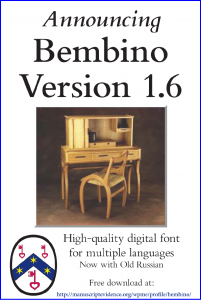
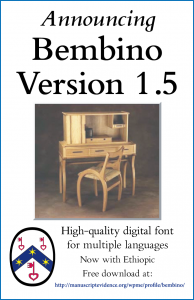
Poster announcing Bembino Version 1.6 (January 2019)

Information

  • Bembino
  • Multi-Lingual Bembino
  • Bembino WP for Word
  • Bembino: Handlist of Resources

Registration

  • Episode 23. Meet RGME Bembino: Registration
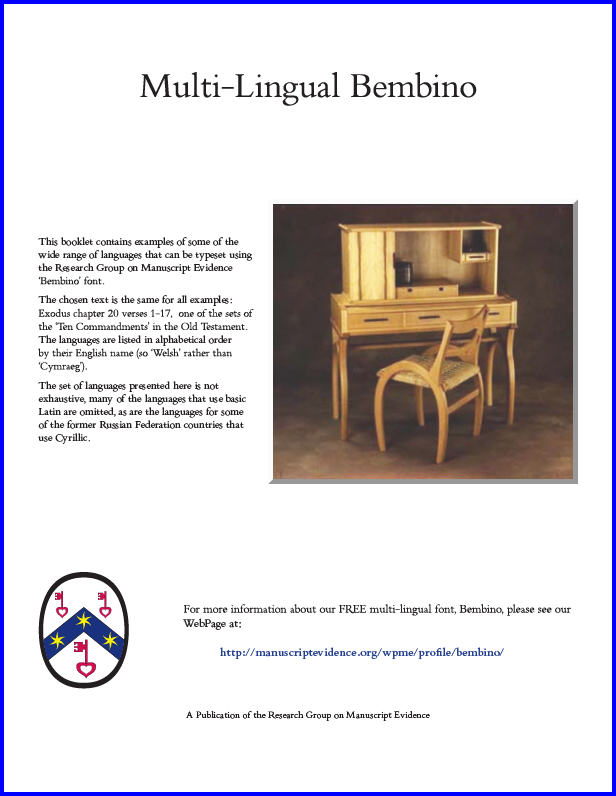
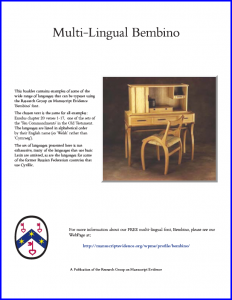
Cover page for 'Multi-Lingual Bembino' demonstrating specimens from a wide range of languages typeset in Bembino

Multi-Lingual Bembino Booklet Cover

Flyer

Downloadable as a 1-page pdf here:

  • Episode 23. RGME Bembino: Flyer

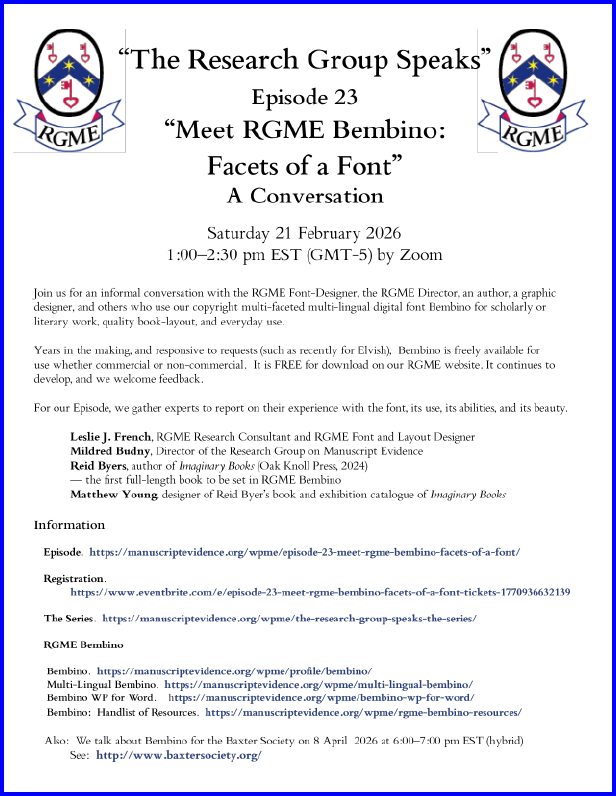
Episode 23. RGME Bembino: Poster, Set in RGME Bembino.

It Tracks

Keep track of the series as it unfolds:

  • “The Research Group Speaks”: The Series

We welcome suggestions and requests.

*****

Tags: Bembino WP for Word, digital fonts, Font Design, graphic design, History of Design, history of printing, Imaginary Books, Multi-Lingual Bembino, RGME Bembino, The Research Group Speaks
No Comments »

Patrick Wormald (1947–2007): A Memoir by David Ganz

August 12, 2024 in Announcements, Bembino, Manuscript Studies, Memoirs, Research Group Episodes for The Research Group Speaks, Research Group Speaks (The Series)

Patrick Wormald (1947–2007):
A Memoir by David Ganz

2024 RGME Anniversary Recollections
Part 2

[Posted on 12 August 2024]

Patrick Wormald at one of Wendy Davies’s charter weekends of the Bucknell group at Bucknell, Shropshire, in the late 1980s. Photograph by Rosemary Morris.

Our series of 2024 Anniversary Reflections continues its tributes for people who have contributed to our formation, progress, and the mission over the years.

Part 1 focused on Giles Constable (1929—2021), RGME Honorary Trustee, Colleague, Friend, and Mentor.

  • Recollections for the 2024 RGME Anniversary, Part 1: Giles Constable

Part 2 turns to our long-term Associate Patrick Wormald (1947–2007), Angl0-Saxon Legal Historian, with a Memoir by our Trustee David Ganz. We offer it as a booklet freely for download.

Anniversary Reflections

In 2024, with our year’s theme of Bridges, the RGME celebrates:

  • 25 years as a nonprofit educational organization incorporated in Princeton, New Jersey, and
  • 35 years as an international scholarly organization founded as part of a major research project on “Anglo-Saxon and Related Manuscripts” at The Parker Library of Corpus Christi College in the University of Cambridge in the United Kingdom.

Among the ways to mark our anniversary, the RGME continues with its series of Memoirs (including these Parts 1 and 2 in 2024) and prepares an Episode in our online series “The Research Group Speaks” to consider

  • Episode 17. “RGME Retrospect and Prospects: Anniversary Reflections”

To register:

  • Episode 17. Retrospect and Prospects: Anniversary Reflections
    Saturday 21 September 2024, 1:00–2:30 EDT (GMT-4) online via Zoom

The Episode aims to include recollections of people who have gone before us, and whose memory we wish to honor with informal conversation and a roundtable.

Memoir of Patrick Wormald
Angl0-Saxon Legal Historian

In preparation for the Episode in September 2024, David Ganz has offered this Memoir.

“The Schartz–Metterhulme Method:
A Memoir of Patrick Wormald (1947–2007)”
by David Ganz

David began its composition years ago, following the Memorial Service for Patrick in Oxford.  He returned to it recently for us in preparing for our Episode 17.  Additions for the publication include

  • photographs of Patrick, generously provided by Rosemary Morris;
  • David’s description of Patrick’s attention to and use of manuscript evidence and contributions to some RGME events;
  • bibliographical references; and
  • an Afterword by Mildred Budny.

The title takes its name from a short story with that name by Saki, the pen name of Hector Hugh Munro (1870–1916). First published in 1911, “The Schartz—Metterklume Method” appeared in the volume of Beasts and Super-Beasts (1914).

In conjuring up the world and horizons of historians at Oxford in an earlier generation when Patrick Wormald embarked upon his studies, giving shape to their pursuit across a lifetime at the University of Oxford and elsewhere, the Memoir by David Ganz offers perspectives from a near-contemporary of that life’s work, which continued to engage with various of those historians and their antecedents, not least Frederic William Maitland (1850–1906). The Memoir signals Patrick’s attention repeatedly to the evidence of manuscripts, as part of his research, teaching, and publications. Some of his publications long-planned found fruition posthumously after Patrick’s death too soon at the age of fifty-seven.

We publish this Memoir as an RGME Publication, following the principles of our Style Manifesto, set in our digital font Bembino, and freely available for circulation.  (For information about download or printed copies, see below.)

Patrick Wormald on a charter weekend at Bucknell, Shropshire, in the late 1980s. Photograph by Rosemary Morris.

Read the rest of this entry →

Tags: All Soul's College, Anglo-Saxon legal history, Christ Church University of Oxford, David Ganz, Elizabeth A.R. Brown, Frederic William Maitland, Memoirs, Oxford Historians, Patrick Wormald, Peggy Brown, RGME Anniversary, RGME Colloquia, RGME Seminars on the Evidence of Manuscripts, University of Glasgow, University of Oxford
No Comments »

Memoirs

July 23, 2024 in Announcements, Bembino, Manuscript Studies, Memoirs, Research Group Speaks (The Series), RGME Recollections, RGME Symposia, Seminars on Manuscript Evidence

Remembering
Those Who Have Gone Before

[Posted on 22 July 2024]

In our 2025 Anniversary Year, the Research Group on Manuscript Evidence reflects on people who have gone before us and whom we wish to recollect as companions or mentors, advisers, colleagues, and friends contributing to the origins, history, and growth of our organization across the years.

Part of that process has yielded the formation of our own nonprofit educational publishing house.  Our books and booklets in printed form and digital formats include Memoirs, to which we add this year.

1. Oleg Andreevich Grabar

The first of these Memoirs appeared quietly in 2015 as a 4-page booklet.  It offers a Memorial for Oleg Grabar, art historian and archaeologist:

In Memory of
Oleg Andreevich Grabar
[Олег Андреевич Грабар]
(3 November 1929 – 8 January 2011)

Composed by Leonid A. Beliaev, the text was published first in Russian. By request, it was translated from the Russian into English, set in multi-lingual RGME Bembino, provided with a photograph by permission, and laid out as a booklet corresponding with our RGME Style Manifesto.

Although Oleg did not participate in RGME activities, he generously gave advice for our research over several years while our Director worked as a part-time research assistant for his colleague Giles Constable (see below).  The translation and publication of the English version of the Memoir in Russian were carried out for its author, an RGME Associate, at the request and with the assistance of a long-term supporter and advisor of the RGME.  Note that the RGME font Bembino supports the Cyrillic font appropriate for portions of the text of the published Memoir.

The booklet can freely be downloaded:

  • Memorial for Oleg Grabar.

*****

2. Vivien Anne Law

For our blog on Manuscript Studies, in 2014 our Director, Mildred Budny, provided a blogpost called Memorials.  Principally it shares recollections of friend, colleague, and long-time RGME participant (first as Associate of our international scholarly organization in England and then as Trustee of our non-profit corporation), Vivien Anne Law (1954–2002). This forms part of a larger report or Memoir responding, in part, to the opportunity to examine and advise on Vivien’s archives in late 2005 at the request of her widower, Sir Nicholas Shackleton (1937–2006).

Our Director’s paper for our 2002 Colloquium at the British Museum in London in March (a month after Vivien’s death) is dedicated to her memory, as well as that of another, dear, friend and mentor.

  • 2002 Colloquium on “Shaping Understanding: Form and Order in the Anglo-Saxon World (400–1100)”.
Vivien Law in her Garden in Cambridge, England,June 1996 Photograph © Mildred Budny

Vivien Law in her Cambridge Garden in June 1996 (Photograph © Mildred Budny)

*****

3. Giles Constable

Also for our blog Manuscript Studies, this year we posted a set of recollections about of Giles Constable (1 June 1929 — 17 January 2021), friend, colleague, mentor, and RGME Associate and Honorary Trustee.  These recollections do not comprise an obituary as such, because Giles often and firmly expressed his wish for no such thing, nor any Memorial Service or Festschrift for him in his honor.

Instead, after an interval of mourning, we record appreciation for his contributions as a presence and guiding force for our organization since its early years in the United States, following the move of our principal base from the United Kingdom to Princeton, New Jersey, in October of 1994.

  • Recollections for the 2024 RGME Anniversary Year, Part 1. Giles Constable.
Giles Constable reading in his office at the Institute for Advanced Studies. Photograph by Mildred Budny.

Giles Constable reading in his office at the Institute for Advanced Studies. Photograph by Mildred Budny.

Also, his generous encouragement of our work for manuscript studies by long-term loans or gifts made it possible closely to examine, over time, groups of original specimens of medieval manuscripts, manuscript fragments, documents, seals in metal or wax, early printed materials, bindings, and associated records.  The work included conservation, photography, research, seminars, display, and publication in our blog and other forms.

Discoveries abounded, and found expression in those publications as well as in various of our RGME events. For example:

  • 2014 Seminar on Manuscripts and Their Photographs, held at the Index of Christian Art of Princeton University in its Seminar Room.

*****

5. Patrick Wormald

Now, in preparation for our Episode 17. “RGME Retrospect and Prospects: Anniversary Reflections” in September 2024, our RGME Associate and Trustee David Ganz offers a Memoir of our RGME Associate Patrick Wormald (1947–2004).

Coffee Break at the 2002 British Museum Colloquium.

Patrick Wormald at the 2002 Colloquium

*****

In Memoriam

See also RGME Officers, Associates, and Volunteers: In Memoriam.

Another Memoir composed by our Director in booklet format, published in a limited edition:

  • “The Guessing Game:  A Memoir of My Uncle Bob, Robert Roger McEwan (1918‒2007)” (Princeton, New Jersey:  Milly Budny Designs, 2017)

*****

Others?

Are there others whom you wish to remember?  Please let us know.  Would you like to contribute a Memoir of some kind about someone you recall with appreciation and seek to record?

For example, you could Contact Us or write to the director@manuscriptevidence.org with your requests or suggestions.

*****

Episode 17 of “The Research Group Speaks”

As part of our anniversary celebrations, the RGME prepares an Episode in our online series “The Research Group Speaks” to consider our past, present, and future.

  • Episode 17. “RGME Retrospect and Prospects: Anniversary Reflections”

It will, for example, offer recollections of people who have loomed large in our history, and whom we remember with affection, admiration, and gratitude.  Among them are Giles Constable, Vivien Law, and Patrick Wormald (see above).  Please join us.

To register:

  • Episode 17. Retrospect and Prospects: Anniversary Reflections
    Saturday 21 September 2024, 1:00–2:30 EDT (GMT-4) online via Zoom

See you there?

*****

Tags: Giles Constable, Memoirs, Oleg Grabar, Patrick Wormald, Vivien Law
No Comments »

More Fonts for Bembino: Devanāgarī (Hindi) and Tibetan (High-Uchen Script)

May 6, 2024 in Announcements, Bembino, Manuscript Studies

Fonts for Tibetan
(High Uchen-Style)
and Hindi
(Devanāgarī)
for our
Multi-Lingual Font Bembino

[Posted on 5 May 2024, with updates]

By request, work continues on improvements for our copyright multi-lingual font Bembino. Step by step, fonts for more languages are added.  Now we turn to Devanāgarī (Hindi) and Tibetan (High-Uchen Script).

By September 2023, specimens of these fonts in Bembino were ready to show for comment.  Now, after some RGME online and hybrid activities have been accomplished (October 2023 and January, February, and April 2024, with more in May and June), we show the specimens for your review.  Please let us know what you think!

[P.S.  Meanwhile, another request, by our RGME Associate Reid Byers, has led also to work on Elvish for J.R.R. Tolkin‘s creation Tengwar. Coming soon!]

Multi-Lingual Bembino

Poster Announcing Bembino Version 1.5 (April 2018) with border for Web display

Poster Announcing Bembino Version 1.5

Our copyright font is freely available for download and use for non-commercial and commercial use alike.  You might download the font, and its companion Booklet, here:

  • Bembino Version 1.5 (2018).

That booklet and the font itself (now in Version 1.5) are freely available via Bembino.  The “Bembino” Booklet describes and illustrates the font.

Another Booklet showing “Examples of Our Font in Multiple Languages” appeared in March 2018, with an updated Version 1.1 (June 2018).

  • Multi-Lingual Bembino (2018)

This booklet contains examples of some of the wide range of languages that can be typeset using the Research Group on Manuscript Evidence ‘Bembino’ font.

The Specimen Text

Cover page for 'Multi-Lingual Bembino' demonstrating specimens from a wide range of languages typeset in Bembino

Multi-Lingual Bembino Booklet Cover

The chosen text is the same for all examples in the booklet for Multi-Lingual Bembino.

The Specimen Text comes from: Exodus chapter 20 verses 1–17, one of the sets of the ‘Ten Commandments’ in the Old Testament.

The languages are listed in alphabetical order by their English name (so ‘Welsh’ rather than ‘Cymraeg’).  The set of languages presented is not exhaustive. Many of the languages that use basic Latin are omitted, as are the languages for some of the former Russian Federation countries that use Cyrillic.

*****

The new, on-going, work provides fonts for more cases.

After creating fonts for Japanese, Ethiopic, and Arabic, the direction to South Asia seemed worth pursuing. Requests arrived, and work began.

Hindi: Devanāgarī

Devanāgarī is a left-to-right writing system used in the Indian subcontinent.  “The Devanāgarī script, composed of 48 primary characters, including 14 vowels and 34 consonants, is the fourth most widely adopted writing system in the world, being used for more than 120 languages.” (See Devanāgarī.)

Our Bembino Specimen is set for Hindi, “the fourth most-spoken language in the world, after Mandarin, Spanish and English”.

The background for the work to produce such a font for Bembino extended across several years.  We owe the quest to comments offered by Harry Blair, responding to Bembino as a multi-lingual digital font in use for a variety of purposes.

For example (6 February 2019):

I was thinking that if Leslie had done Japanese and Ethiopic and Arabic (much harder than Devanāgarī, it seemed to me), then South Asia might be an interesting direction to take. Simpler than Western languages in that there’s only one case (no upper and lower), but more complex with all the conjuncts. Plus the vowels sometimes shift around consonants, sometimes preceding them in writing while following them in speaking.”

1.  Most of the conjuncts in common use are like ligatures in Western scripts: 2 letters joined in such a way that it’s easy to grasp what the separate letters are.  This Wikibooks table shows them (<https://en.wikibooks.org/wiki/Hindi/Consonant_combinations>). BTW the small diagonal appendage to each letter in the first column just indicates that the letter is by itself with no following vowel.

2. There’s a much smaller set of conjuncts commonly used that yield an entirely different form, listed at the bottom of the WikiBooks table as “special cases”.

Taking up the case, our Font Designer reported (5 February 2019):

I checked the latest version (11.0) of Unicode and they haven’t done anything to address the issues with Devanāgarī.

Here is my understanding of the issue, ignoring all the vehement rhetoric.

Basically, similar to Arabic, Devanagari has a ‘core’ of about 50 letter shapes (consonants and vowels) but when they co-occur there are combined forms that must be used.  It’s as though the fi, ffi, fl etc. ligatures were *mandatory* to set English.  There are about 1,000+ of these ‘ligatures’ needed correctly to set Devanagari.  Unicode contains only 128 glyphs for Devanagari, including punctuation and numerals!  Now, it is true that some of the ‘missing’ glyphs can be formed from the basic letters + overprints. Think of European accents, and the core ‘a’ used to form á, ä, à etc., but without having separate codepoints for â, ä and so on.  But there are still some combinations that need different shapes (like ffi) not just overprints.

There is no space in Unicode to add those different shapes.  They could be added through special font tables (like I did for the joined-up Ethiopic numerals), and there are specific tables in OpenType (the format I use for Bembino) to support them.  But building those tables requires an expert knowledge of Devanagari typesetting.  There are some sites on the Web that can help, but if I made a mistake I would never know.

Having said that, I’m willing to take on the challenge if I can get some help checking what I produce, similar to that Augustine [Dickinson] did with the Ethiopic [by asking for diacritics for Ge’ez among the languages of Ethiopia].

[Note: Our Associate Augustine Dickinson is now the Acting RGME WebMaster, as of 1 July 2023.]

With some suggestions for the specimen forms (such as more contrast between thick and thin strokes), a revised version of Devanāgarī for Bembino is now available upon request, before the next version of Bembino as a whole appears.

Bembino for Hindi and Tibetan

Now, a poster-style page shows the Bembino fonts so far for Hindi and Tibetan.

The Specimen Text

The chosen text is the same for all examples in the booklet for Multi-Lingual Bembino.  As described above, the Specimen Text comes from: Exodus chapter 20 verses 1–17, one of the sets of the ‘Ten Commandments’ in the Old Testament.

Fonts for Hindi and Tibetan for Multi-Lingual Bembino in Specimen Text.

Tibetan

Tibetan script is a segmental writing system, written from left to right.  The alphabet has thirty basic letters for consonants.  Syllables are separated by a tsek (་), and spaces are not used to divide words.  Because many Tibetan words are monosyllabic, the mark can function as if a space between words.  (See, for example, The Tibetan Writing System.)

When I [Mildred Budny, Editor-in-Chief of RGME Publications] asked our Font Designer about the choice of script for Tibetan, High-Uchen Style, he said: “I think it is beautiful”.

Here is a specimen of the script in manuscript form.  I show the specimen, and add parts of the companion description (metadata) which comes with the image in its digital facsimile available freely online.

Photograph: Ms. Sarah Walsh.

Notes on the Image

Image via Wikimedia Commons under CC 4.0 license, via https://commons.wikimedia.org/wiki/File:Isha_Upanishad_Verses_1_to_3,_Shukla_Yajurveda,_Sanskrit,_Devanagari.jpg

Information given at that source:

“Language: Sanskrit

“Script: Devanagari

“Script style: pre-14th century (Northern / Western)

“Isha Upanishad, verses 1–2, partially 3

“The thick text is the Upanishad scripture, the small text in the margins and edges are an unknown scholar’s notes and comments in the typical Hindu style of a minor bhasya.

“The photo above is of a 2D artwork of a text that is over 2,000 years old, from a manuscript that was produced decades before 1923. Therefore Wikimedia Commons PD-Art licensing guidelines apply. Any rights I have as a photographer is herewith donated to wikimedia commons under CC 4.0 license.

“The early Upanishads (Upanisad, Upanisat) are scriptures of Hinduism. Variously dated by scholars to have been composed between 900 BCE to about 200 BCE, these texts are in Sanskrit language and embedded within a layer of the Vedas. They contain a mixture of philosophy and mystical speculations, many set in the form of dialogues or pedagogic style. Their central teachings include the concepts of Atman (soul, self) and Brahman (metaphysical reality).

“These manuscripts are preserved at the Lalchand Research Library, Ancient Indian Manuscript Collection, DAV College Digital Library Initiative, Chandigarh India, in association with SP Lohia and Indorama Charitable Trust. The texts are over 2000 years old, the re-copying into this particular manuscript is dated to a pre-1867 reproduction (exact date unknown). The manuscript shows significant stain marks, decay and damage on the sides and its edges.”

*****

Suggestion Box

Do you have suggestions, questions, or requests for Bembino?

Please leave your comments here, Contact Us, or visit

  • our FaceBook Page
  • our Facebook Group
  • our Twitter Feed (@rgme_mss)
  • our Bluesky nest @rgmesocial.bluesky.social)
  • our LinkedIn Group
  • our Blog on Manuscript Studies and its Contents List

Donations and contributions, in funds or in kind, are welcome and easy to give.  Given our low overheads, your donations have direct impact on our work and the furtherance of our mission.  For our Section 501(c)(3) nonprofit educational organization, your donations may be tax-deductible to the fullest extent permitted by law.  Thank you for your support!

  • Contributions and Donations
  • 2024 Anniversary Appeal

We look forward to hearing from you.

*****


Tags: Bembino Digital Font, Book of Exodus, Devanāgarī, Elvish, Ethiopic Script, Exodus 20:1-17, Ge'ez diacritics, Hindi, Isha Upanishad, Lalchand Research Library, Multi-Lingual Bembino, RGME Font Design, Sanskrit, Specimen Text, Tengwar, Tibetan, Tibetan High-Uchan Script
No Comments »

RGME Pop-UP Poster Exhibition for the 2024 ICMS

May 4, 2024 in Bembino, Business Meeting, Conference, Conference Announcement, Events, Exhibition, ICMS, International Congress on Medieval Studies, Kalamazoo, POMONA, Postal History at Kalamazoo, Reception

RGME Posters on Display
for the
2024 International Congress on Medieval Studies (ICMS)

9–11 May in hybrid format

[Posted on 3 May 2024]

Our Pop-Up Poster Display for the 2024 ICMS

As the 2024 International Congress on Medieval Studies approaches (9–11 May in partly hybrid format), we unveil our Posters for all our events at this Congress. Our Congress activities form part of our Anniversary Year, celebrating 25 years as a nonprofit educational corporation and 35 years as an international scholarly society. For this year, our Theme is Bridges. Besides considering the nature of bridges, both natural and man-made, and exploring their challenges and opportunities, we take the liberty of creating some new ones — as with this Pop-Up Poster Session or Exhibition for the 2024 Congress.

Natural Owachomo Bridge, Natural Bridges Natural Monument, San Juan County, Utah. Image via Laban712 on en, Public domain, via Wikimedia Commons.

This Virtual Exhibition marks a new development for our evolving tradition of Posters for our different Events, comprising Conference Sessions, Symposia, Colloquia, Seminars, Workshops, Receptions, and more. Here, by bringing the set of Posters into an exhibition of their own, we offer a bridge between our webpost for the Congress; our printed Posters for the in-person event and for souvenirs afterward; and for download in digital form from our website.

Our website Home Page for our 2024 ICMS Activities describes each of these events in turn, with descriptions about their scope and aims, instructions for directions to them, and information about the programs of the individual sessions, also with the speakers’ abstracts for their presentations.

The directions include options to register for online access to scheduled in-person events — some Sessions and our Open Business Meeting — through our RGME Eventbrite Collection (at no charge), so as to provide a fully hybrid approach to the Congress.  Similarly, for a scheduled online Session, we have arranged for an in-person approach by reserving a room on campus for in-person attendees of the Congress.

See:

  • 2024 International Congress on Medieval Studies: Program

In a Nutshell

Now, the Posters present, in a nutshell, information about each session of papers or meeting, including updated details which did not emerge in time for the published Congress Program, but which our 2024 RGME @ ICMS HomePage has been able to report through revisions as the news reached us.

The RGME tradition for its sessions and other events at the ICMS has been to prepare Posters announcing, promoting, and celebrating the people participating in creating them; providing evocative illustrations encapsulating or, as it were, commenting upon them; and given concise information about the event and its logistics of time, place, and modes of arrival.

Over the years, the RGME Director, Mildred Budny (also Editor-in-Chief of Publications), has prepared the Posters for our ICMS activities (as for other Events), with the inspiration of images generously provided by our Associates and others, notably including David W. Sorenson, and with the help of the RGME Font and Layout Designer, using the RGME copyright digital font Bembino and RGME principles for our Publications, set out according to our Style Manifesto and our specifications for Designing Academic Posters.

Usually, the Director would bring the Posters to the ICMS for unveiling at the Congress, in printed copies displayed in various places (as a group upon general poster boards or individually at the door or on the wall of the session or meeting itself.

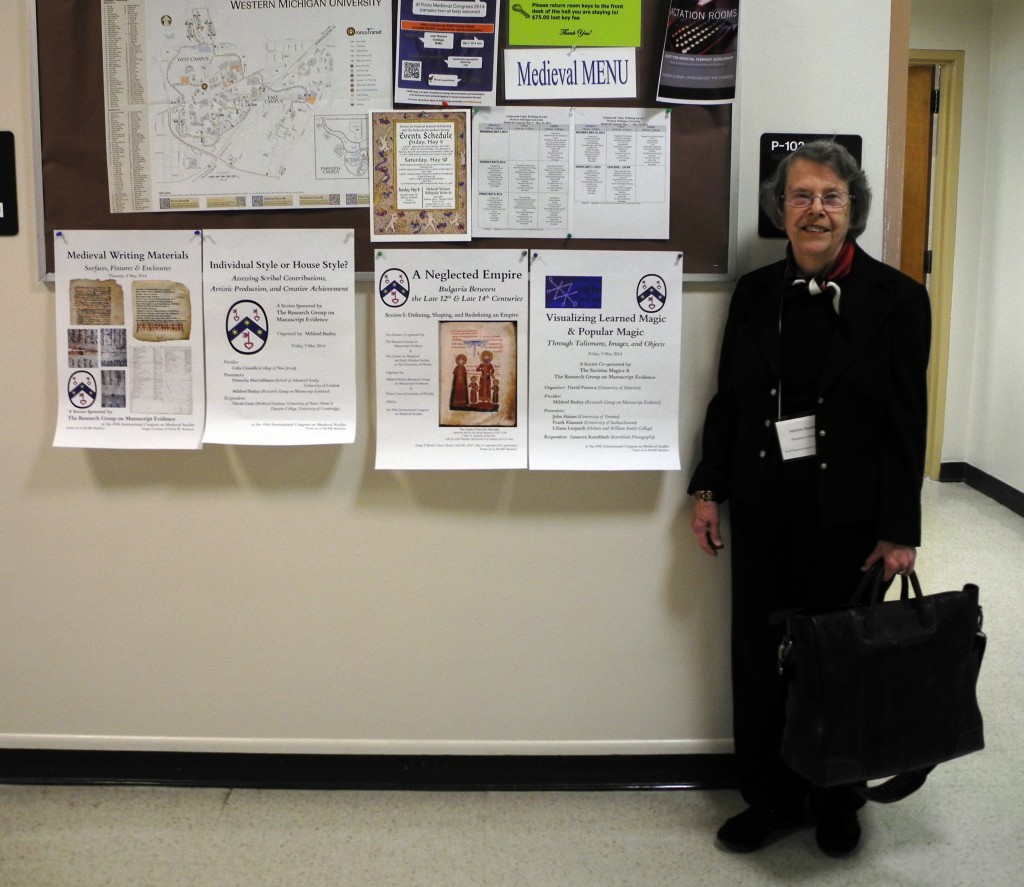
2014 ICMS

Adelaide Bennett stands beside the RGME Posters on display for the 2014 ICMS. Photography by Mildred Budny.

2015 ICMS

Derek Shank stands beside the RGME Poster Display for the 2025 ICMS. Photography by Mildred Budny.

Fit to Print, Free to Keep

Each year, we bring printed copies to display on walls, doors, and boards, where permitted, and also to give to speakers, contributors, and others wishing souvenirs.  We offer them also in digital form, to be downloaded free of charge on our website.  The links for these downloads are indicated in the HomePage for the event (or in other locations on our website).

Online Exhibition

Until now, our habit has been to place the Posters, once they are ready, within the HomePage for the event.  Thus usually occurs at a late stage in the preparations for the year’s Congress, once the final details have settled into place and most of our other tasks of preparation have taken precedence.

This year, in order to allow the Posters to stand alongside each other to tell their stories in unison, we present a curated Gallery or Pop-Up Poster Exhibition for your enjoyment.

The Posters tell in a nutshell the information you might need and wish to know about the event itself, how and where to find it, who is featured in its presentation, and what feature image or images might evoke its essence.

The information includes updated information which the Congress Program does not have, as some logistics evolved after the publication of the Congress Program, and as some details do not have a place in its structure.

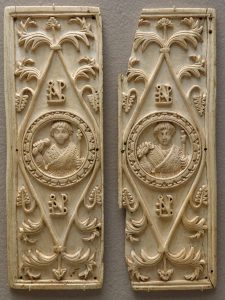
Two-By-Two as Pairs or Diptychs

Paris, Louvre Museum, Ivory consular diptych of Areobindus, Byzantium, 506 AD. Image Public domain, via Wikimedia Commons.

Paris, Louvre Museum, Ivory consular diptych of Areobindus, Byzantium, 506 AD. Image Public domain, via Wikimedia Commons.s

Note that, in recent years, we design the posters for individual Sessions as Pairs, to be viewed as Diptychs, in matching sets similar to the facing pages of an opened book.

In a given Pair, one Poster displays the names of the people responsible for the Session or Roundtable. The other exhibits a feature image or two.

While they share identifying elements, each poster in the pair reports information unique to it, so that the two posters provide more information than can one alone. Together they report a concise comprehensive indication of the ensemble which the event represents, encompassing people, a place, a time, and a focus for consideration.

Meetings

Anniversary Reception

2024 Anniversary Reception at the ICMS: Poster.

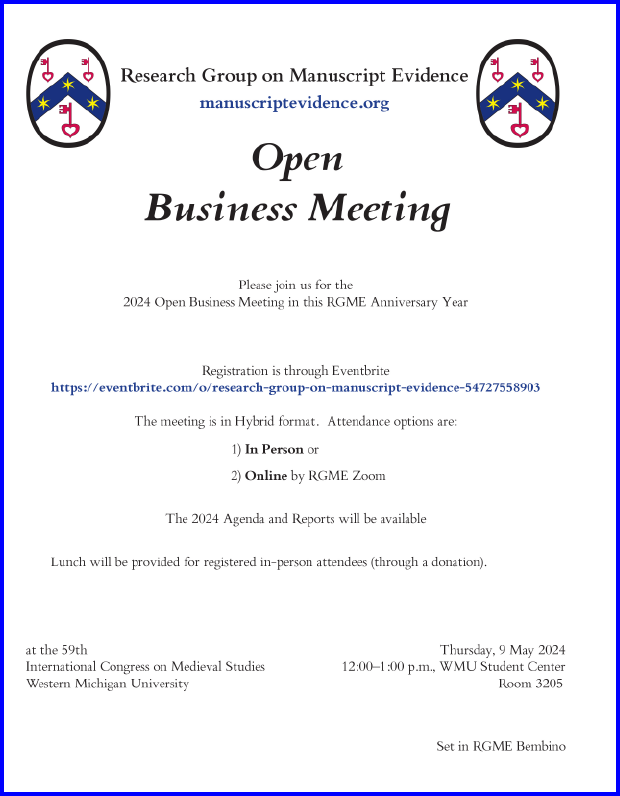
Open Business Meeting

2024 RGME Business Meeting Poster

2024 RGME Business Meeting Poster

Sessions and a Roundtable

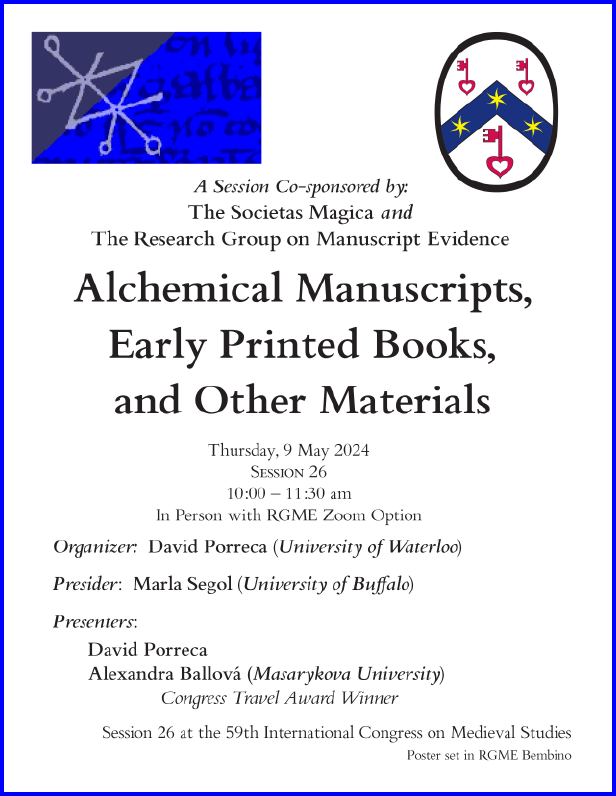
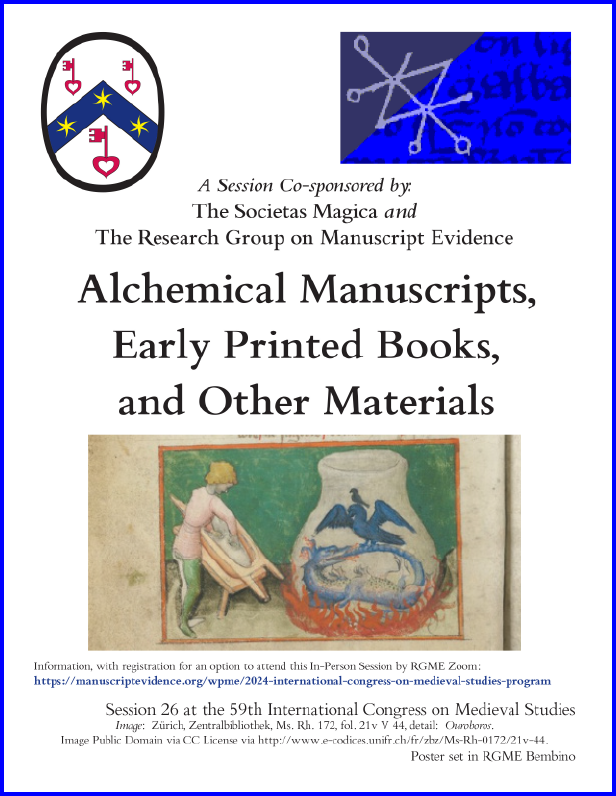
“Alchemical Manuscripts, Printed Books, and Materials”

Poster 1

2024 ICMS Alchemical Session Poster 1

2024 ICMS Alchemical Session Poster 1

Poster 2

2024 ICMS Alchemical Session Poster 2

2024 ICMS Alchemical Session Poster 2

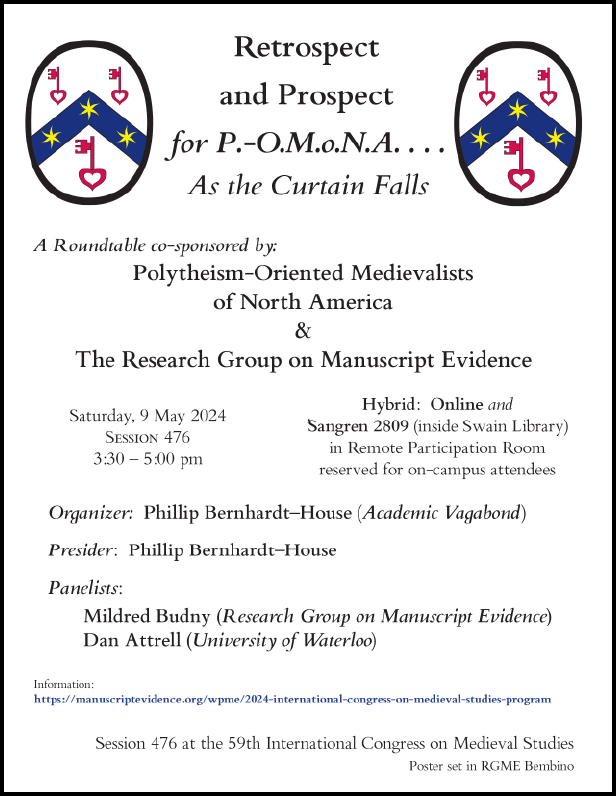
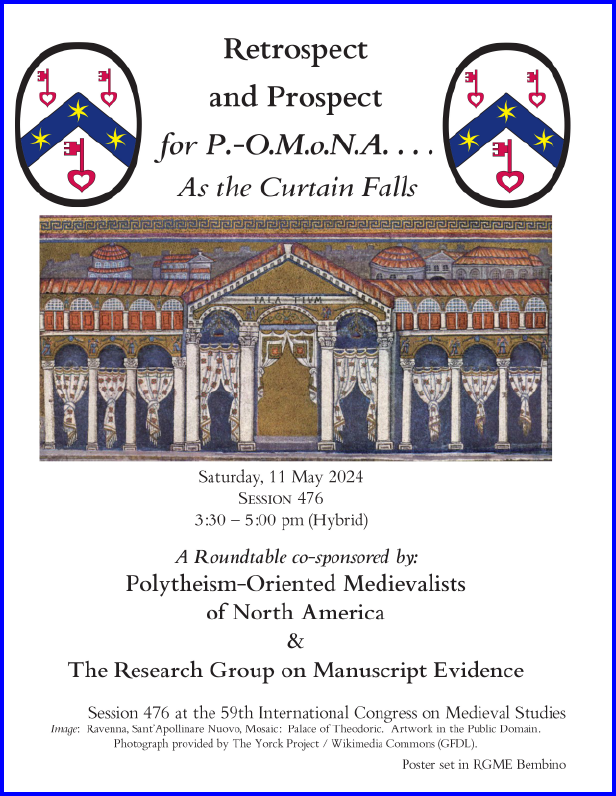
2. “Retrospect and Prospect”

Poster 1

2024 ICMS "Retrospect and Prospects" Session: Poster 1

2024 ICMS “Retrospect and Prospects” Session: Poster 1

Poster 2

2024 ICMS "Retrospect and Prospects" Session: Poster 2

2024 ICMS “Retrospect and Prospects” Session: Poster 2

3. “Letters, Couriers, and Post Offices:
Mail in the Medieval World”

Poster 1

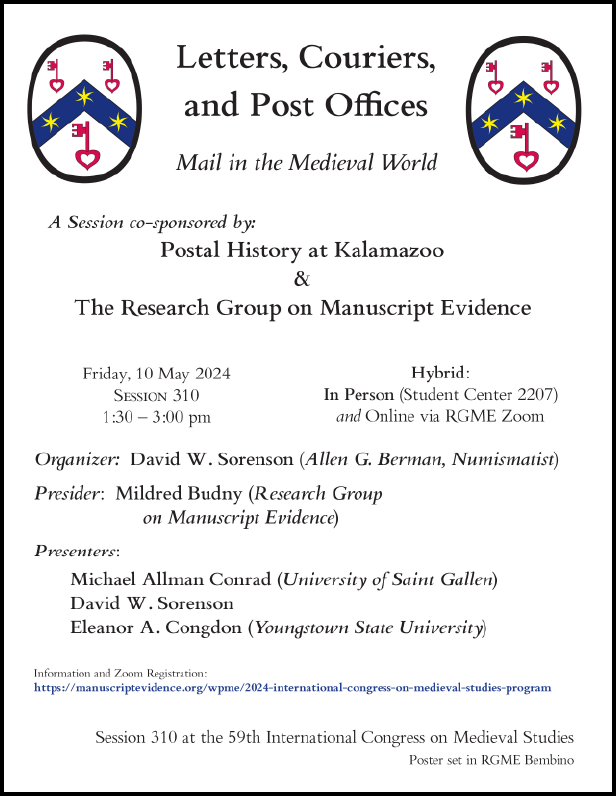
2024 ICMS Postal Session: Poster 1

2024 ICMS Postal Session: Poster 1

Poster 2

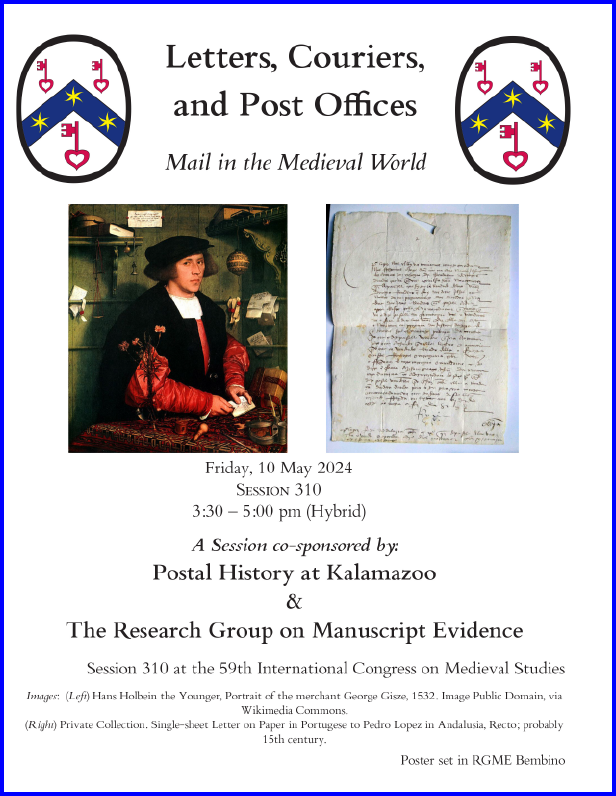
2024 ICMS Postal Session: Poster 2

2024 ICMS Postal Session: Poster 2

*****

Suggestion Box

Do you like this Pop-Up Exhibition? Would you like to see more of them?

Please Contact Us or visit

  • our FaceBook Page
  • our Facebook Group
  • our Twitter Feed (@rgme_mss)
  • our Bluesky nest @rgmesocial.bluesky.social)
  • our LinkedIn Group
  • our Blog on Manuscript Studies and its Contents List

Donations and contributions, in funds or in kind, are welcome and easy to give.  Given our low overheads, your donations have direct impact on our work and the furtherance of our mission.  For our Section 501(c)(3) nonprofit educational organization, your donations may be tax-deductible to the fullest extent permitted by law.  Thank you for your support!

  • Contributions and Donations
  • 2024 Anniversary Appeal

We look forward to hearing from you.

*****


Tags: 2024 ICMS, 2024 International Congress on Medieval Studies, Anniversary Reception, Bembino, Bembino Digital Font, Business Meeting, Designing Academic Posters, POMONA, Pop-Up Exhibition, Postal History at Kalamazoo, Poster Exhibition, RGME Posters, RGME Publications, Societas Magica, Style Manifesto
No Comments »

Carmelite Missal Leaf of 1509

October 6, 2020 in Bembino, Manuscript Studies, Reports, Uncategorized

Single Leaf on Paper from an
Early-Printed Latin Missal (Missale Romanum)
For use in a Carmelite Monastery

Part of the Mass for Holy Saturday (Sabbato Sancto)

Printed in 1509
by Lucantonio Giunta in Venice
in 2 columns of 36 lines
With Music on 4-Line Staves

J. S. Wagner Collection
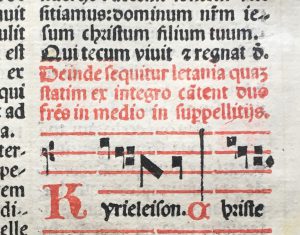
Another leaf from the J. S. Wagner Collection takes center stage as we examine its features.  We thank the collector for allowing us to see and to show the material.

Other leaves from this collection are reported in earlier posts. They came from medieval manuscripts and stand on vellum.

  • Updates for ‘Otto Ege Manuscript 19’
  • A Leaf from ‘Otto Ege Manuscript 19’ and Ege’s Workshop Practices
  • The Penitent King David from a Book of Hours
  • A Leaf from Prime in a Large-Format Breviary .

*****

This time, the single leaf stands on paper and came from an early-printed Latin Missal. On paper.  The form of book contains all the instructions and texts necessary for the celebration of the liturgical year.

We offer a description, identification, and 12-page downloadable Report. The Report, by our Associate and Font Designer, Leslie J. French, is available below. It is set in our copyright digital font Bembino (of course).

Worth saying that the printed leaf has sparked the interest of our Font Designer.  Glad for his expert examination and exploration.  This blogpost serves as a foundation, counterpart, and compliment to his report.
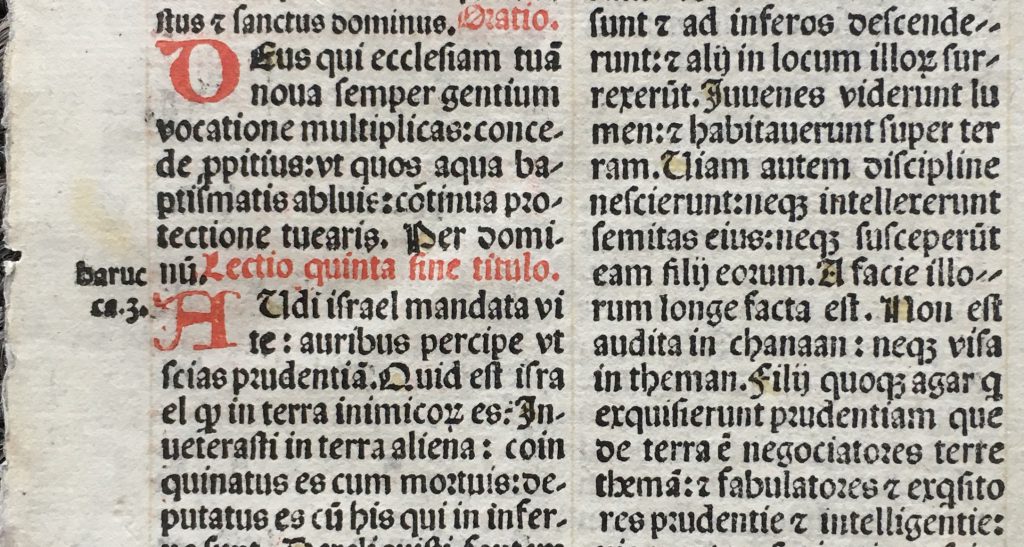
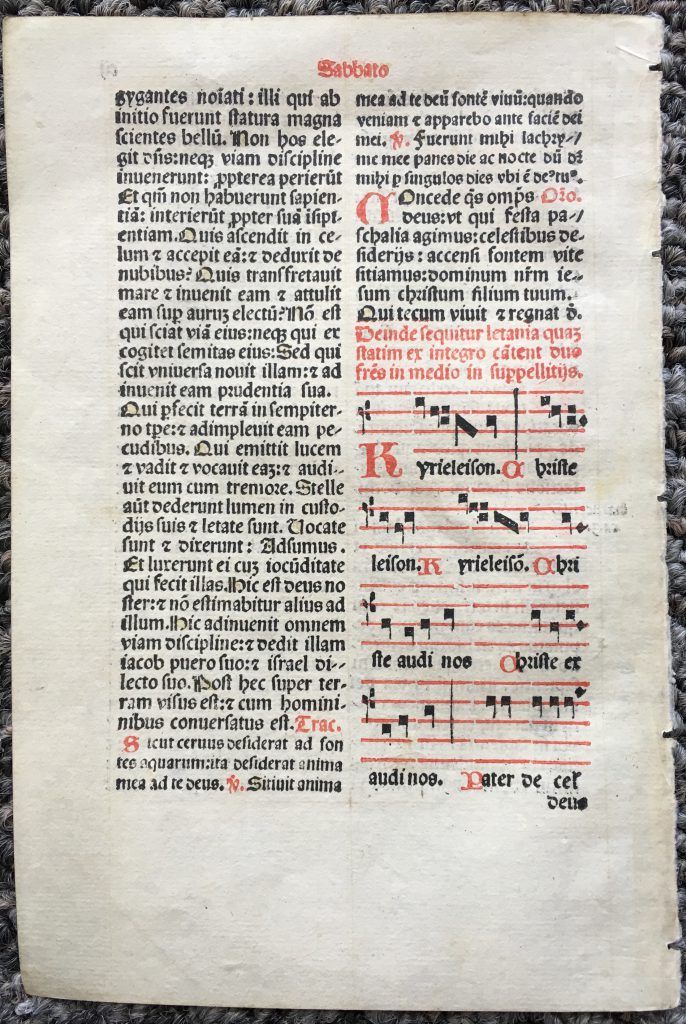
J. S. Wagner Collection, Single Leaf from a Latin Missal containing part of the Mass for Holy Saturday for use in a Carmelite Monastery, printed in 1509 Lucantonio Giunta in Venice. Recto, detail. Reproduced by Permission.

J. S. Wagner Collection, Single Leaf from a Latin Missal containing part of the Mass for Holy Saturday for use in a Carmelite Monastery, printed in 1509 Lucantonio Giunta in Venice. Recto, detail. Reproduced by Permission.

Other Materials from the Same Collection

The collector has generously shared with us images of some fragments, manuscript and printed.  They include a leaf from a dismembered Vulgate Bible manuscript, now known as ‘Otto Ege Manuscript 19’, which occupied center stage in earlier blogposts.
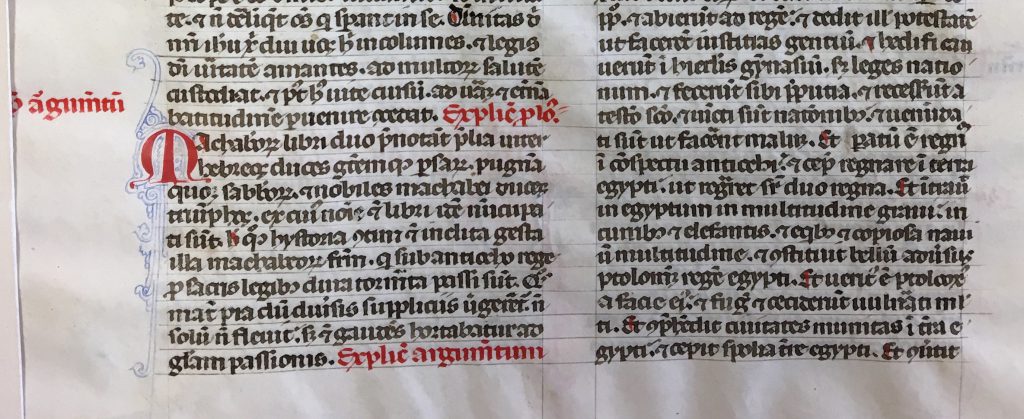
J. S. Wagner Collection, Ege Leaf 19, verso, detail. Lower portion, with end of the Book of Malachi, the Argumentum ("Summary") of the Books of Maccabees, and part of the text of I Maccabees.

J. S. Wagner Collection, Ege Leaf 19, verso, detail.

Other leaves carry illustration or decoration (or both) as well as text.  For example, The Penitent King David from a Book of Hours:
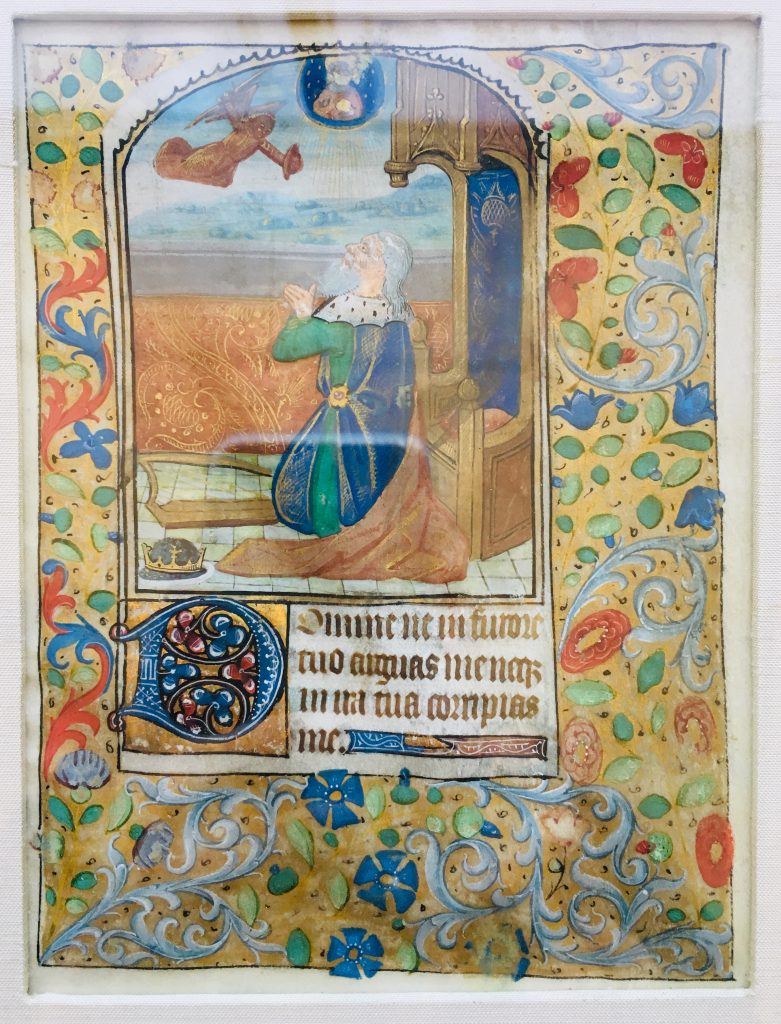
J. S. Wagner Collection. Detached Manuscript Detached Leaf with the Opening in Latin of the Penitent Psalm 37 (38) and its Illustration of King David.

J. S. Wagner Collection. Detached Manuscript Leaf with the Opening in Latin of the Penitent Psalm 37 (38) and its Illustration of King David.

And A Leaf from Prime in a Large-Format Breviary :
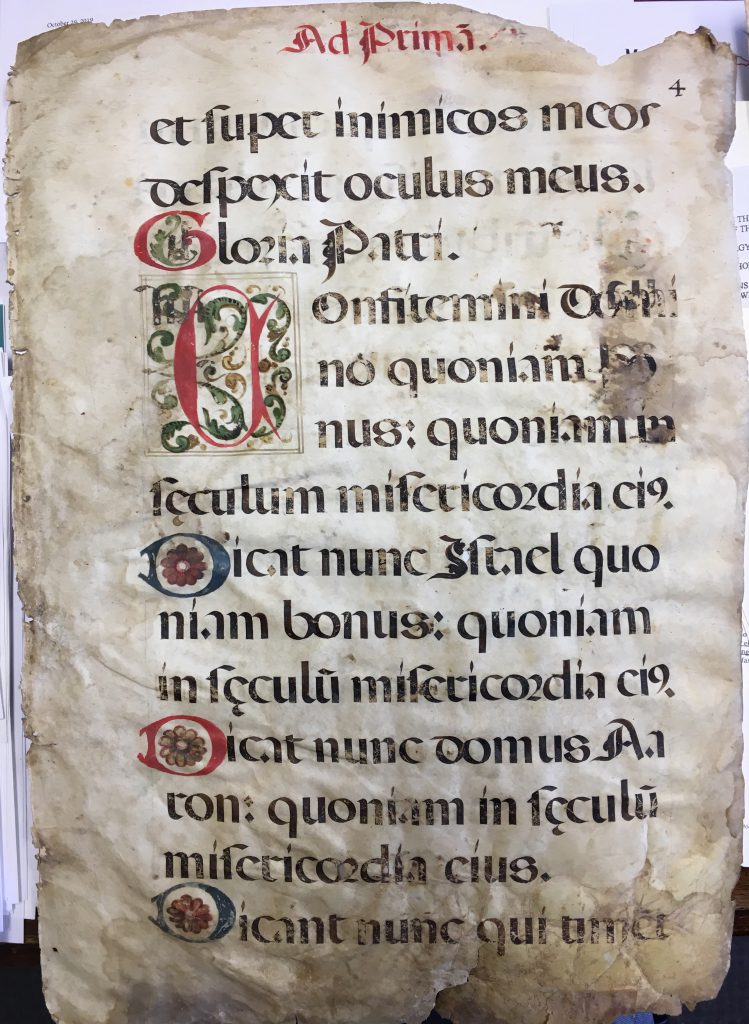
J. S. Wagner Collection, Leaf from from Prime in a Latin manuscript Missal. Folio 4 Recto, with the end of Psalm 53, the title for the Gloria Patri, and the opening of Psalm 117 (118), set out in verses with decorated initials..

J. S. Wagner Collection. Leaf from from Prime in a Latin manuscript Breviary. Folio 4 Recto.

The Leaf in Question

The text on the leaf to which we turn now contains part of the Mass for Holy Saturday (Sabbato Sancto), including music with notation on staves, for use in a Carmelite Monastery, that is, Carmelites, known as the “Order of the Brothers of the Blessed Virgin Mary of Mount Carmel” (Ordo Fratrum Beatissimæ Virginis Mariæ de Monte Carmelo). The spiritual focus) of the Carmelite Order is contemplation, encompassing prayer, community, and service.
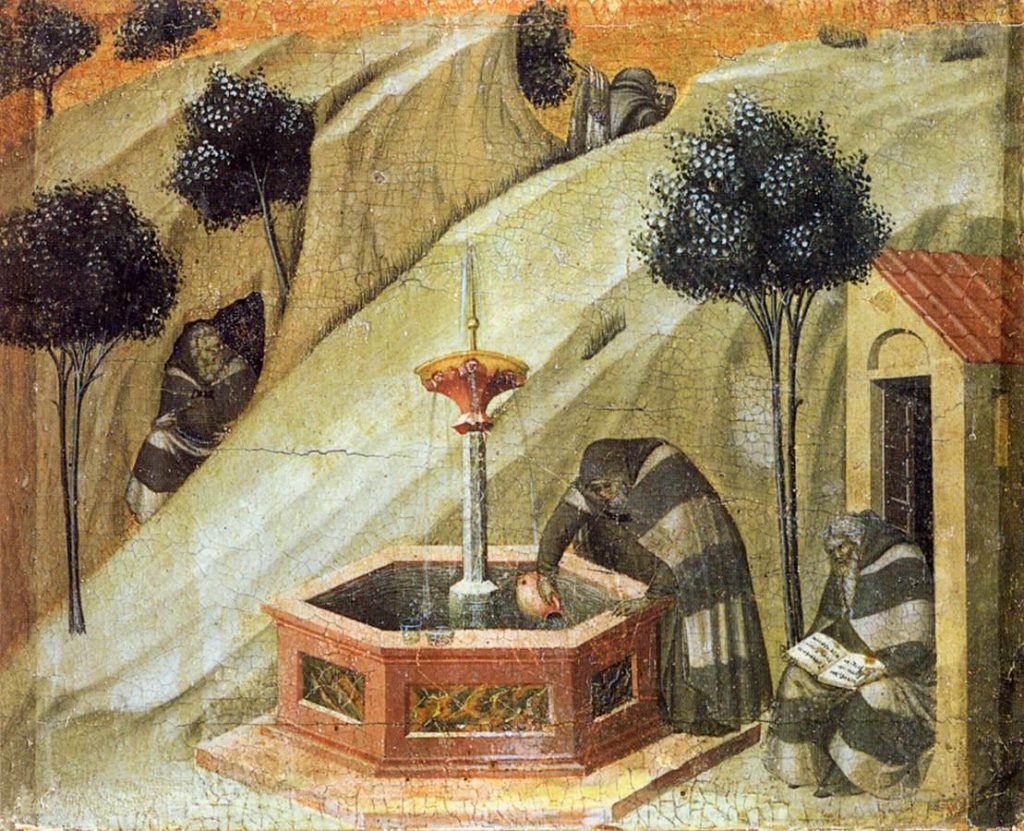
Pietro Lorenzetti, Predella panel. Carmelite Hermits at the Fountain of Elijah (1328-1329). Siena, Pinacoteca Nazionale di Siena. Image Public Domain, via Wikimedia Commons.

Pietro Lorenzetti, Predella panel. Carmelite Hermits at the Fountain of Elijah (1328-1329). Siena, Pinacoteca Nazionale di Siena. Image Public Domain, via Wikimedia Commons.

The features of the Missal Leaf, including fonts, demonstrate that it was printed by Lucantonio Giunta in Venice, Italy. That is, Lucantonio Giunti (or Giunta), prolific book publisher and printer, born in Florence and active in Venice from 1489.

The Numbers Game

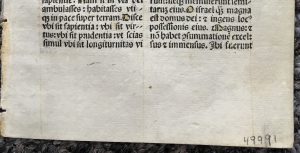
The recto of the leaf carries the printed folio number cij. Numbers in pencil in the outer corners at top and bottom label it as folio 148 and as an item-of-some-kind number 49991. The unevenly cut inner edge more-or-less follows the fold-line between the leaf and its mate in the former bifolium, or pair of leaves which nested within the gathering of leaves. The inner edge retains the 5 more-or-less regularly spaced notches which were cut into the fold of the gathering in preparation for stitching the text-block into the binding. (According to Ligatus: The Language of Binding, such features are to be known as “knife-cut recesses”, thus defined.)

The top of the Recto, with alternate Folio numbers in print and in pencil:
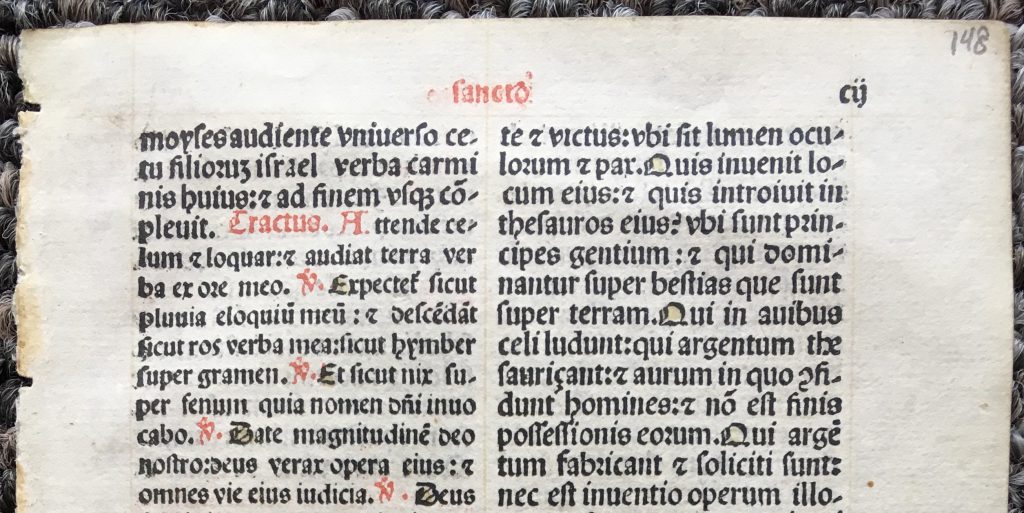
J. S. Wagner Collection, Single Leaf from a Latin Missal containing part of the Mass for Holy Saturday for use in a Carmelite Monastery, printed in 1509 Lucantonio Giunta in Venice. Recto, detail: Top Portion. Reproduced by Permission.

J. S. Wagner Collection, Single Leaf from a Latin Missal containing part of the Mass for Holy Saturday for use in a Carmelite Monastery, printed in 1509 Lucantonio Giunta in Venice. Recto, detail: Top Portion. Reproduced by Permission.

The bottom of the recto, with a large number very close to 50,000:
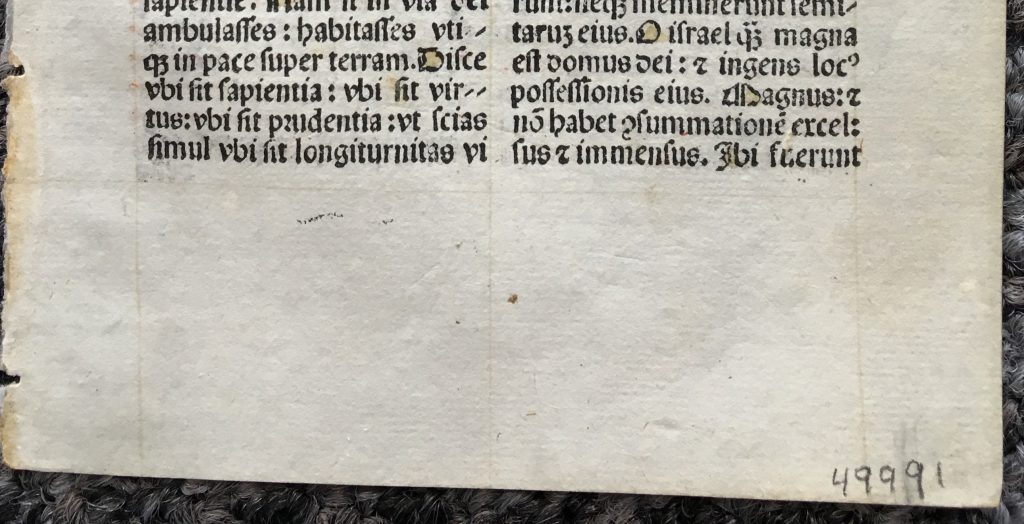
J. S. Wagner Collection, Single Leaf from a Latin Missal containing part of the Mass for Holy Saturday for use in a Carmelite Monastery, printed in 1509 by Lucantonio Giunta in Venice. Recto, detail: Bottom Portion. Reproduced by Permission.

J. S. Wagner Collection, Single Leaf from a Latin Missal containing part of the Mass for Holy Saturday for use in a Carmelite Monastery, printed in 1509 by Lucantonio Giunta in Venice. Recto, detail: Bottom Portion. Reproduced by Permission.

The Leaf in Full

Recto and Verso, one by one. Let us have a look and turn the page.

Recto of Leaf Number CII/148
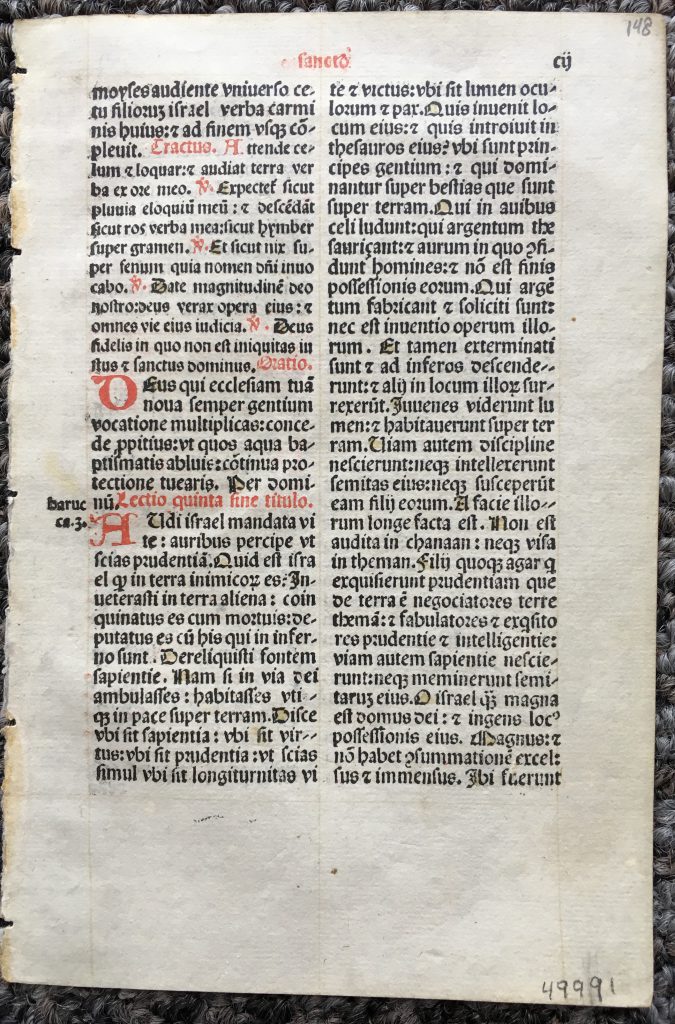
J. S. Wagner Collection, Single Leaf from a Latin Missal containing part of the Mass for Holy Saturday for use in a Carmelite Monastery, printed in 1509 Lucantonio Giunta in Venice. Recto. Reproduced by Permission.

J. S. Wagner Collection, Single Leaf from a Latin Missal containing part of the Mass for Holy Saturday for use in a Carmelite Monastery, printed in 1509 Lucantonio Giunta in Venice. Recto. Reproduced by Permission.

Verso of Leaf, with Catchword
J. S. Wagner Collection, Single Leaf from a Latin Missal containing part of the Mass for Holy Saturday for use in a Carmelite Monastery, printed in 1509 Lucantonio Giunta in Venice. Recto, detail: Top Portion. Reproduced by Permission.

J. S. Wagner Collection, Single Leaf from a Latin Missal (‘Missale Romanum’) containing part of the Mass for Holy Saturday for use in a Carmelite Monastery, printed in 1509 by Lucantonio Giunta in Venice, Italy. Verso of Leaf. Reproduced by Permission.

Features to note: Well, everything. (It’s what we do.)

Including: the Running Title, the Text, the Initials, the Music; and the Yellow Wash. Etc.  For example, as showcased in our accompanying Booklet (See Below):

J. S. Wagner Collection, Single Leaf from a Latin Missal containing part of the Mass for Holy Saturday for use in a Carmelite Monastery, printed in 1509 Lucantonio Giunta in Venice. Recto, detail. Reproduced by Permission.

J. S. Wagner Collection, Single Leaf from a Latin Missal containing part of the Mass for Holy Saturday for use in a Carmelite Monastery, printed in 1509 Lucantonio Giunta in Venice. Recto, detail. Reproduced by Permission.

In passing, we note that other blogposts have had occasion to observe the placement of a wash or fill of yellow pigment within minor initials of manuscripts.  Some authorities regard the feature as Italian or ‘Italianate’.  See, for example
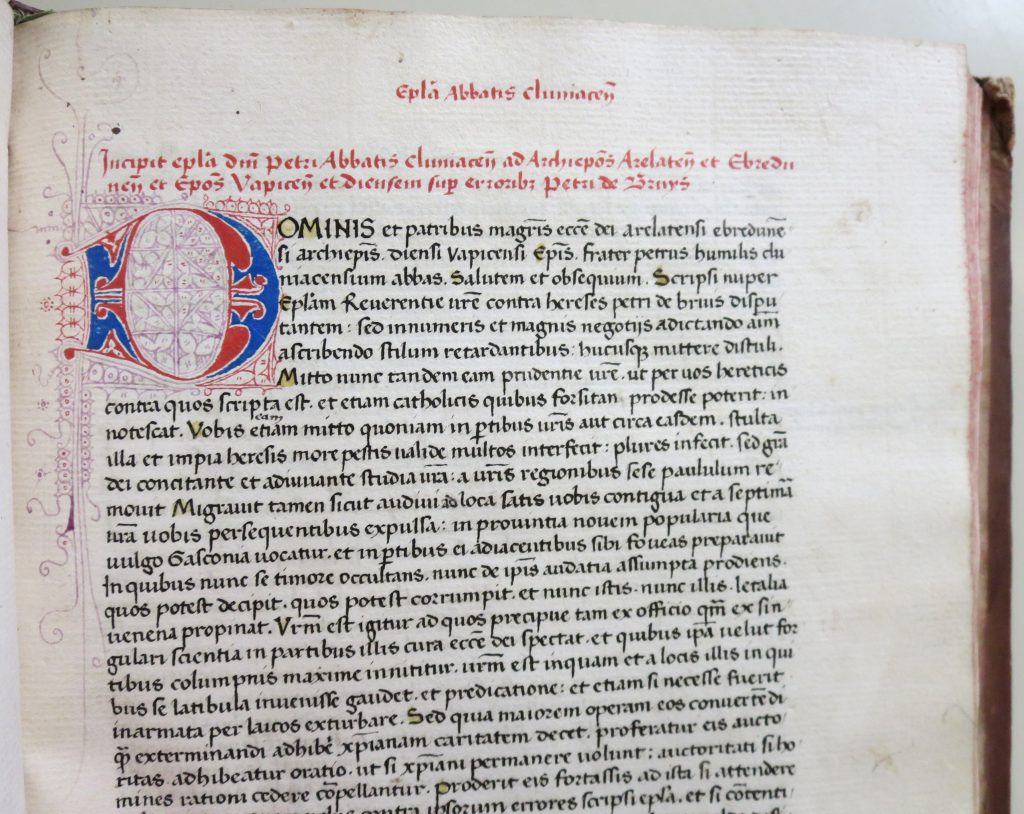
  • More Discoveries for ‘Otto Ege Manuscript 41″
  • A 15th-Century Theological Volume from Le Parc Abbey
Private Collection, Le Parc Abbey, Theological Volume, Part B, opening page: Peter the Venerable.

Private Collection, Le Parc Abbey, Theological Volume, Part B, opening page: Peter the Venerable.

Other Leaves From This Dispersed Book

It took a while to find some comparanda, as we continued to explore. You know, we might now wonder (story be told), if that dearth of close comparanda might indicate a rarity, we’d be prepared to agree.

The Report (see below) and this blogpost tell that story.

To start, where we began, once trying to fine some bearings among online resources.

Here is a close relative, exhibited online for sale at one time on ebay and now shown via worthpoint.com as
https://www.worthpoint.com/worthopedia/1509-giunta-missal-leaf-woodcuts-172119411 . It is described thus:

A Leaf From a rare, Giunta Missale, (secundum usum Carmelitarum), numerous woodcuts of New Testament scenes and saints, facing pages with composite borders of figured vignettes, profusion of woodcut historiated and decorative initials. Text and music printed in red and black throughout. The Missal contains the prayers said by the priest at the alter [sic] as well as all that is officially read or sung in connection with the Holy Sacrifice of the Mass throughout the ecclesiastical year. This particular leaf features two woodcuts as well as the text for the Mass that is celebrated during Passion Week for The Easter Season. Verso: Text and music printed in red and black throughout. (Venice: Lucantonio Giunta, 13 January 1509). Condition of this leaf is under fine[F-] and this leaf measures 6.75″ x 4.5″.

Note the generic description that addresses a single “Leaf”, but cites multiple leaves from the same source-volume, as it mentions “numerous woodcuts”, “facing pages with composite borders”, a “profusion of woodcut historiated and decorated initials”, “text and music printed in red and black throughout”, etc., and then refers to features on “this particular leaf”. To whit:

This particular leaf features two woodcuts as well as the text for the Mass that is celebrated during Passion Week for The Easter Season.

Even so, the description could serve for any leaf within the portion dedicated to Passion Week, provided that it has “two woodcuts” and carries music on the verso. Perhaps that is the idea.

(We have become familiar with such a generic approach to identical labels circulated with different individual leaves from a single book in our investigations of manuscripts and other textual materials dispersed from the collection of Otto F. Ege (1888–1951), as considered in multiple posts on our blog; see its Contents List.)

We note the seller’s grading of the condition of that leaf: “under fine” or “F-“, according to recognized book-selling terminology for “used books”. Presumably, if that grading is correct, it could aptly apply to other leaves from the same book, unless, that is, other parts of the book suffered different and more extensive forms of damage.
J. S. Wagner Collection, Single Leaf from a Latin Missal containing part of the Mass for Holy Saturday for use in a Carmelite Monastery, printed in 1509 Lucantonio Giunta in Venice. Recto, detail: Bottom Portion. Reproduced by Permission.

J. S. Wagner Collection, Single Leaf from a Latin Missal printed in 1509 Lucantonio Giunta in Venice. Recto, detail: Bottom Portion. Reproduced by Permission.

According to the image exhibited online in the sales offering, its recto (with a single woodcut) carries the printed folio number liv, and 2 more numbers in pencil: another folio number (“109”) in Arabic numerals in the top right corner, and another number in the bottom right corner (“49952”) — the latter in the same hand as the number 49991 on the Wagner Leaf.

Customarily we could think of such large numbers at bottom right as an inventory number in a seller’s marker. Given the specificity of the number, in a high number not always evenly rounded off, it seems clear that the number is not a price, in whatever currency. Identifying the ‘code’ particular to a given seller might aid in deducing the provenance of the piece. Thus might progress a hunt for a particular seller’s style.

That is how we first regarded the high number on the Wagner Leaf. Further exploration, and the discovery of other leaves carrying similar numbers in a sequence which can be revealed to have a specific import relating to the volume itself, is explained in the Report downloadable below.

Spoiler Alert: We still think that these numbers are inventory numbers, which pertain to the individual leaves of the given volume. But they also appear to stand within a very large inventory which could or would involve very many individual leaves extracted from very many individual books.

The Leaf and its Provenance

The present owner reports that the Leaf came to him in a collection, with no identification of its contents or a source for the item.

And so, exploring aspects in turn of the Missal Leaf — as described here and in the 12-page Report by our Associate (and Font Designer), Leslie J. French (see below) — we have discovered that this very Leaf was listed for Sale via faginarms.com, where it was presented as an Italian Missal Page [Update of 17 November 2020:  that post appears to have been removed], with an image clinching the identification:

Straight from the heart of the Renaissance! Printed page, 6 3/4″ x 4 1/2″, by Lucantonio Giunta, Venice, 13 January, 1509. This page with the prayers and songs for Holy Saturday. Excellent and suitable for framing.

Stock Number: FNS3583

Sold

Discovering, if wished, which individual copy of the Missal was dismembered and dispersed, from which collection, and by whom, would require further research.

Other Leaves from the Same Book

Suffice it to say that we have seen online a few other leaves which must have come from the same copy. Mostly, it appears, they passed through eBay. For example, a 1509 Giunta Missal Leaf, described as:

(Venice:  Lucantonio Giunta, 13 January 1509).

More leaves are described in our booklet, for which see below.

The Edition and Its Components

Thus, identifying the printer and the date of the edition led us to consult standard bibliographical resources for the genre of book, the printer, Missals printed by the same printer, and other aspects.

First:

  • William H. James Weale and Hanns Bohatta, ed., Bibliographica Liturgica: Catalogus Missalium ritus latino ab anno M.CCCC.LXXIV Impressorum (London: Bernard Quaritch, 1928).

An earlier version of the catalogue appears online:

  • William H. James Weale, ed., Bibliographica Liturgica: Catalogus Missalium ritus latino ab anno M.CCCC.LXXIV Impressorum (London: Bernard Quaritch, 1886), online via archive.org.

Both versions mention this Missal among the Missals for Use of the Order of the Fratres B. V. Mariae de Monte Carmelo.

But they differ.

In the 1886 version, this Missal is no. 1509 (p. 251), listed only briefly, with the mention of the date and place of publication, and the existence of a copy at “Frankfurt a. M. : S”. I give this detail because you can see its evidence online. I can also report the extra text in the 1928 book, which I possess.

In the 1928 version, this Missal is no. 1887 (p. 319), with more information:

1509, ID. Ian. (13 Jan.) Missale secundum ordinem fratrum Carmelitarum. In Uenetorum ciuitate, Lucas antonius de giunta. 8vo. 44 nn., 299 n., 1 vac = 344 Fol. . . . 2 col. 36 lin.

Frankfurt a. M. : S.

Rivoli 311, 274

That is, in 3 stages:

1) Bibliographical information about the publication itself, its date (the Ides of January, or 13 January, 1509), title, place of printing (“In the City of Venice” or In Uenetorum ciuitate), printer, colophon, format, number of leaves (344), layout in number of columns (2) and lines per page (36), etc.;
2) A known copy of the book, in this case at Frankfurt am Main in the “S[tadtbibliothek].”, however with unspecified pressmark; and
3) The reference to another bibliographical resource, namely “Rivoli” with the numbers “311, 271”.

The 3rd stage refers to a substantial publication by the 3rd Duc de Rivoli (also the Prince d’Essling), Victor Masséna (1836–1910), bibliophile and scholar (see also Essling, Victor Masséna):

  • Duc de Rivoli (Victor Masséna), Les Missels imprimés à Venise de 1481 à 1600: Description — Illustration — Bibliographie. Études sur l’art de la Gravure sur Bois (Paris: J. Rothschild, 1894), p. xviii and no. 274 on pages 311–312, online via 1894.

There we find a more detailed description of the volume, according to the single copy examined or known (“l’exemplaire que nous avons vu”) — albeit lacking its title page and some other pages. As a result, the title for the Missal is not reported. The description includes a list of 22 woodcut illustrations, which appear in a cycle from the Immaculée Conception to Christ de pitié — including some which seen to appear also in other Missals printed by or for L.-A. Giunta. Also noted by the description are:

Nombreuses petites vignettes, dont une certaine quantité a fond noir criblé, principalement dans les encadrements qui se trouvent au recto des pages en regard des grands bois. — Initiales ornées.

No mention of the music, but presumably that is to be taken as a given for the genre of book?

The colophon (on R. 288):

Explicit missale per ordinem fratrum gloriosissime dei genitricis semperque virginis marie de monte carmello : … quod impensa sua ac solerti cura Lucasantonius de giunta florentinus in Venetorum ciuitate floretissima impressit. Anno natalis domini. M. d. ix. idibus ianuarij.

(“Here ends the Missal for the Order of the Brothers of the Most Glorious Mother of God and eternal Virgin Mary of Mount Carmel, . . . which, at his expense and by the diligence of skills, Lucas Antonius de Giunta, the Florentine, printed [or caused to be printed?] in the city of Venice. In the year of the Lord, 1509, on the Ides of January.”)

Rivoli identified the sole copy under his consideration as belonging to the city library at Frankfurt, with a pressmark: “Francfort, B[ibliothèque]. de la Ville, Rit. cath. 512”.

In Frankfurt, the Stadtbibliothek now combines with another major institutional library, as the Stadt- und Universitätsbibliothek Frankfurt am Main (since 1945). So far, we have not been able to learn about its copy of this Missal (pressmark “Rit. cath. 512”) through the library website.

The apparent rarity of appearances of copies (or fragments) online or in some standard reference works might show a small-scale printing to start with, or a wider disinterest in the edition as such, given some with earlier dates and/or heightened extents of illustration. If it was a rare issue, then the dismemberment of the volume sold piecemeal online (perhaps not very recently) would represent an even more lamentable loss, with the destruction of the integrity of an early-printed object not easily to be found or replaced elsewhere.

Because Rivoli does not illustrate any of its woodcuts in this edition, we may glimpse their character and perhaps their style from other illustrations of the same subjects in other of Guinta’s Missals which appear among Rivoli’s figures and descriptions. Some of these correspondences or resemblances which Rivoli noted in his entry for this 1509 Missal, by referring to other Missal numbers and to other pages (as with “Missel 59 et p. 167” for the Annonciation XVI, the Assomption (“Cf. pp. 22, 25), and the Nativité de la Ste Vierge (“Cf. p. 113”) — subjects centering upon the Virgin Mary presumably of especial interest to the Carmelites.

Some examples:

  • 1509 Giunta Missal Leaf Medieval Music Leaser Lent
  • Recto only of Leaf 49952, with a part-page woodcut. An opportunity described in these glowing terms:

A Wonderful Leaf for The Manuscript Collector and A Great Gift Idea! Purchase Three or More Individual Auctions and There Will Be No Charge For Shipping We Now Accept PayPal WE SHIP WORLDWIDE – PLEASE CONTACT US FOR A FREE SHIPPING QUOTE! for more information.

The Printer and His Works

The printer’s career is surveyed in Lucantonio Giunti or Giunta (1457 – 1538), or in English via Lucantonio Giunti. We learn, for example:

Lucantonio Giunta or Giunta (1457–1538) was a Florentine book publisher and printer, active in Venice from 1489, a member of the Giunti family of printers. His publishing business was successful, and among the most important in the late fifteenth and early sixteenth centuries. Through partnerships, often with members of his family, he expanded the business through much of Europe.

It is useful to note that for some works he served directly as printer in the production, and for others indirectly as publisher in the distribution.

The Printer, His Devices, and Examples of Title-Pages

Over the course of his output, Giunta employed several forms of printer’s device. Some are gathered and displayed online via Luca Antonio Giunta. Examples appear in Missals both earlier and later than the 1509 Carmelite Missal, in various formats, and for various Orders, as well for the practices of various Churches — as with the Church of Rome in the Missal Romanum. Some title-pages for his Missals are illustrated in Rivoli (1894).

Here follow a few specimens.
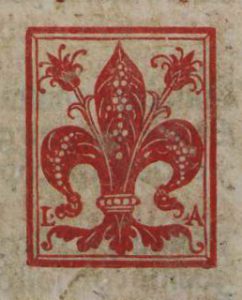
Florence, Biblioteca Nazionale, Missale Romanum printed by Lucantonio Giunta (1521), Title-page, detail: Printer's Device. Image Public Domain via Wikimedia Commons.

Florence, Biblioteca Nazionale, Missale Romanum printed by Lucantonio Giunta (1521), Title-page, detail: Printer’s Device. Image Public Domain via Wikimedia Commons.

1) From the Roman Missal of 1501 in Folio Format

The title-page of the Missale Romanum nouiter impressum, printed by Lucantonio de Giunta on 20 November 1501 in Venice.
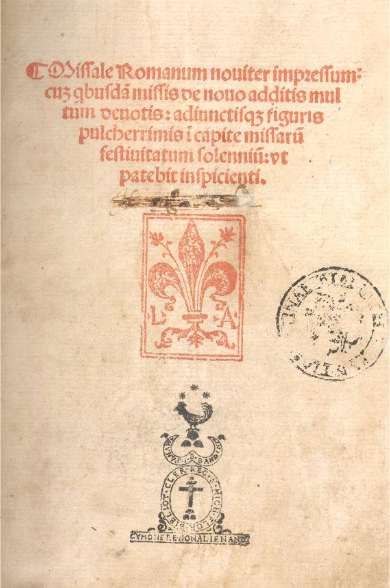
Florence, Biblioteca Nazionale, Missale Romanum printed by Lucantonio Giunta (1501), Title-page. Image via Creative Commons.

Florence, Biblioteca Nazionale, Missale Romanum printed by Lucantonio Giunta (1501), Title-page. Image via Creative Commons.

The end-page with the colophon displays a mostly full page of text printed in black and red.
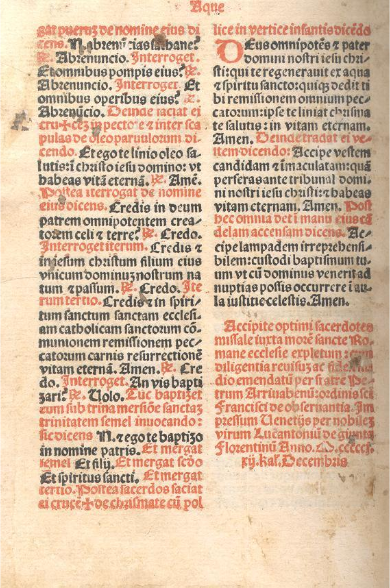
Florence, Biblioteca Nazionale, Missale Romanum printed by Lucantonio Giunta (1501), End-page. Image via Creative Commons.

Florence, Biblioteca Nazionale, Missale Romanum printed by Lucantonio Giunta (1501), End-page. Image via Creative Commons.

The edition is listed in Weale and Bohatta (1928), no. 964 (p. 169); and Rivoli (1894), no. 59 (pp. 167–168).

2) For the Dominican Order of 1504 in Folio Format

The title-page of a folio Missale secundum ordinem fratrum Predicatorum, printed by Lucantonio de Giunta on 30 June 1504 in Venice.

The full title, citing the “most beautiful figures (figuris)” describes the work thus:

Missale predicatorum nuper impressum ac emendatum cum multis missis: orationibus pulcherrimisque figuris in capite missarum festiuitatum solennium de nouo superadditis: ut inspicienti patebit.

The edition is listed in Weale and Bohatta (1928), no. 1828 (p. 311); and Rivoli (1894), no. 256 (pp. 300–301).

The tapered title is surmounted by a woodcut illustration of a full-length and haloed figure holding flowers and an edifice, in a depiction of the founder and patron of the Order, the Castilian Saint Dominic (1170–1221). At the bottom of the page appears the printer’s device in an upright rectangular frame, including the initials L and A. The whole volume appears online from a copy still in Venice, at the Biblioteca nazionale Marciana: here.  The title-page, from Biblioteca nazionale Marciana – Venezia – IT-VE0049 :
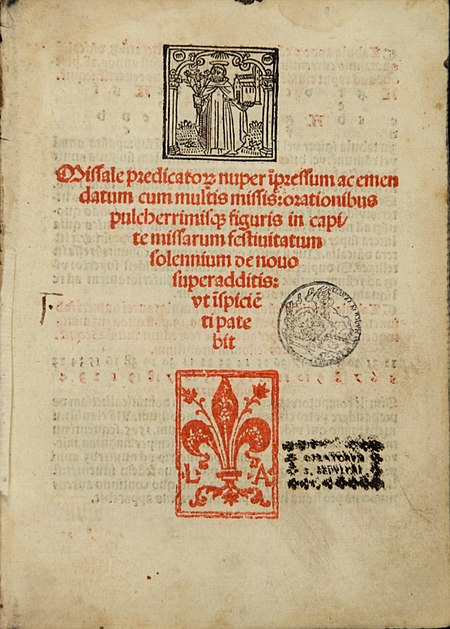
First page of the 'Missale predicatorum' (1504), printed by Lucantonio de Giunta in Venice. Image Public Domain via Wikimedia Commons.

First page of the ‘Missale predicatorum’ (1504), printed by Lucantonio de Giunta in Venice. Image Public Domain via Wikimedia Commons.

3) From a Missal Romanum of 10 May 1521 in Folio Format

That is, Missale romanum nuper adoptatum ad commodum. Venetijs in aedibus Luce antonij de giunta.

The Title page carries a variant version, within a paneled border.
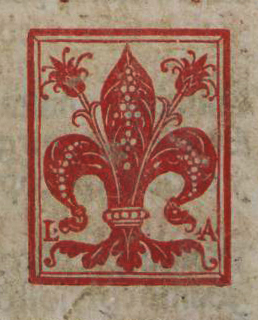
Florence, Biblioteca Nazionale, Missale Romanum printed by Lucantonio Giunta (1521), Title-page, detail: Printer's Device. Image Public Domain via Wikimedia Commons.

Florence, Biblioteca Nazionale, Missale Romanum printed by Lucantonio Giunta (1521), Title-page, detail: Printer’s Device. Image Public Domain via Wikimedia Commons.

The page in full:
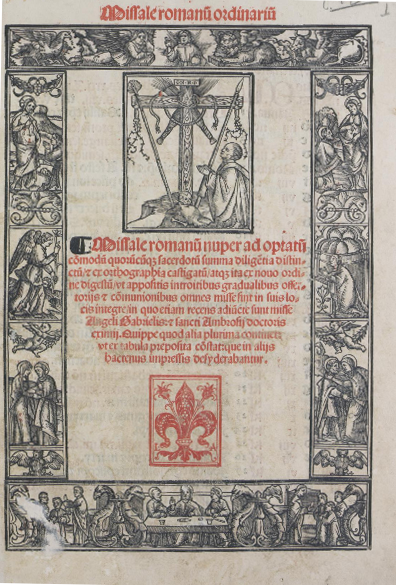
Florence, Biblioteca Nazionale, Missale Romanum printed by Lucantonio Giunta (1521), Illustrated Title-page. Image via Creative Commons.

Florence, Biblioteca Nazionale, Missale Romanum printed by Lucantonio Giunta (1521), Illustrated Title-page. Image via Creative Commons.

The detailed title:

Missale Romanum ordinarium. Missale romanum nuper ad optatum comodumquorumcumque sacerdotum summa diligentia distinctum et ortographia castigatum atqueita ex nouo ordine digestum . . .

The edition is  Weale and Bohatta (1928), no. 1046 (p. 182); Rivoli (1894), no. 92 (pp. 196–198).

From the copy in Florence, Biblioteca nazionale centrale, shelfmark MAGL.2.109 (identifier info:sbn/CNCE011532), some specimen pages are shown in the Biblioteca digitale italiana via www.internetculturale.it, specifically here.  The colophon:
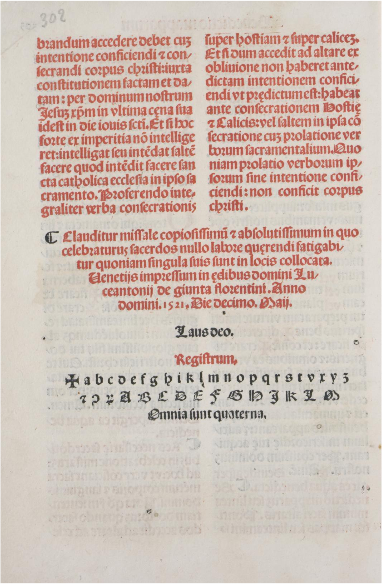
Florence, Biblioteca Nazionale, Missale Romanum printed by Lucantonio Giunta (1521), End Page with Colophon. Image via Creative Commons.

Florence, Biblioteca Nazionale, Missale Romanum printed by Lucantonio Giunta (1521), End Page with Colophon. Image via Creative Commons.

4) From a Missale Nouum of 21 April 1537 for the (Hungarian) Order of Saint Paul the First Hermit in Quarto Format

From a copy in Budapest, National Széchényi Library, I. II, 66:
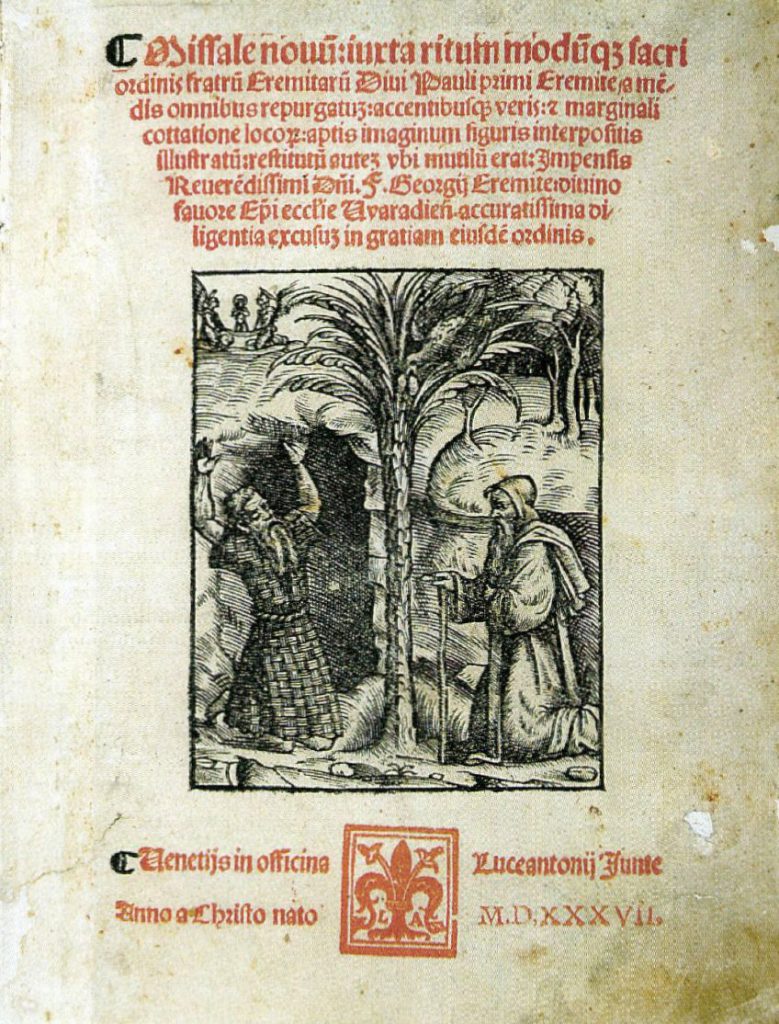
Budapest, National Széchényi Library, I. II, 66, Title-page. Missal (1537). Image Public Domain via Wikimedia Commons.

Budapest, National Széchényi Library, I. II, 66, Title-page. Missal (1537). Image Public Domain via Wikimedia Commons.

This edition is Weale and Bohatta (1928), no. 1814 (p. 308); Rivoli (1894), no. 247 (p. 296).

*****

In sum, the Wagner Missal Leaf belongs to a dispersed copy of Guinta’s Missal of 1509 for Carmelite Use.

We offer more information about the leaf and its edition in this 12-page illustrated booklet prepared by our Font and Layout Designer.  Free to download.  Enjoy!

As customary, we offer the booklet in 2 versions.  They might conform with your preferences for viewing and printing.

  • Leslie J. French, “A Detached Printed Leaf containing Part of The Mass for Holy Saturday for Carmelite Use: A Process of Discovery” (Princeton: Research Group on Manuscript Evidence, 2020)1) Booklet as consecutive pages (8½” × 11″).

    2) Booklet as foldable Booklet, printable on 11″ × 17″ sheets ready to fold into a nested Booklet.

We thank the owner for permission to examine the material and to present it here.  We thank Leslie French for his research and the booklet.

*****
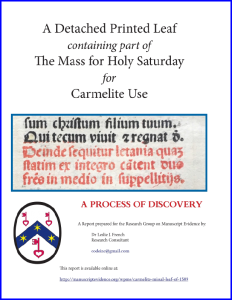
Camelite Booklet Cover Page with New Front Cover with border

Camelite Booklet Cover Page with New Front Cover with border

Suggestions for Further Reading

More information about this printer, his Missals, and their Music:

  • Mary Kay Duggan, Italian Music Incunabula: Printers and Type (Berkeley, etc.: University of California Press, 1992)
  • Lesley T. Stone, From Chapel to Chamber: Liturgy and Devotion in Lucantonio Giunta’s Missale romanum, 1508 (M. A. dissertation, Department of Art and Art History, University of South Florida, 2005), examining the edition of 3 October 1508 (especially its woodcuts),
    online via https://scholarcommons.usf.edu/cgi/viewcontent.cgi?article=1877&context=etd = University of South Florida Scholar Commons
  • Leslie J. French, “A Detached Printed Leaf containing Part of The Mass for Holy Saturday for Carmelite Use: A Process of Discovery” (Princeton: Research Group on Manuscript Evidence, 2020), freely available for download here.

*****

Do you know of other leaves from this Missal? Do you have information about the provenance of this copy?

Please let us know.

Add your Comments here, Contact Us, and visit our Facebook Page.
Follow our blog on blog for further research on dispersed books, and watch its Contents List.

J. S. Wagner Collection, Single Leaf from a Latin Missal containing part of the Mass for Holy Saturday for use in a Carmelite Monastery, printed in 1509 Lucantonio Giunta in Venice. Recto, detail. Reproduced by Permission.

J. S. Wagner Collection, Single Leaf from a Latin Missal containing part of the Mass for Holy Saturday for use in a Carmelite Monastery, printed in 1509 by Lucantonio Giunta in Venice. Recto, detail. Reproduced by Permission.

*****

Tags: Carmelite Missal of 1509, Dominican Order, Duc de Rivoli's Missels, Early Printing, Early Printing in Venice, history of printing, Holy Saturday, J.S. Wagner Collection, latin Missal, Lucantonio Giunta, Roman Missal, Weale and Bohatta
No Comments »

Keeping Up: Updates for Spring 2020

April 4, 2020 in Abstracts of Conference Papers, Announcements, Bembino, Business Meeting, Conference, Conference Announcement, ICMS, Index of Medieval Art, International Congress on Medieval Studies, Kalamazoo, Manuscript Studies, Princeton University, Societas Magica

Keeping Up:

Updates for Spring 2020

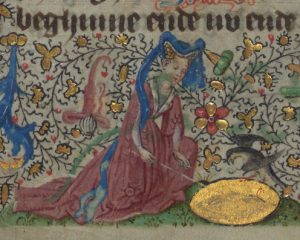
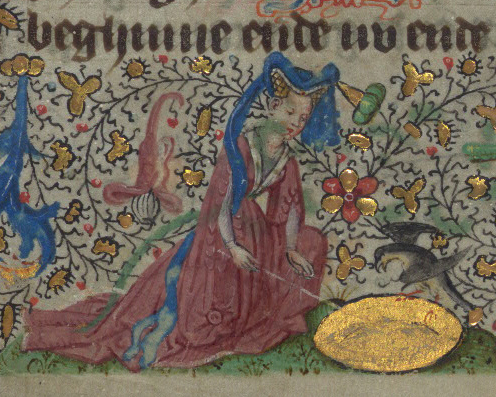
Baltimore, The Walters Art Museum, MS W.782, folio 15r. Van Alphen Hours. Dutch Book of Hours made for a female patron in the mid 15th century. Opening page of the Hours of the Virgin: "Here du salste opdoen mine lippen". Image via Creative Commons. At the bottom of the bordered page, an elegantly dressed woman sits before a shiny bowl- or mirror-like object, in order, perhaps, to perform skrying or to lure a unicorn.

Baltimore, The Walters Art Museum, MS W.782, folio 15r. Van Alphen Hours. Scrying, Perchance? Image via Creative Commons.

This Spring, the cancellation of 2 of our major events planned for this year, and intended to take place in mid-March and mid-May, produces perforce a redirection of energies and activities.  Call it “Regrouping”.

We report updates.

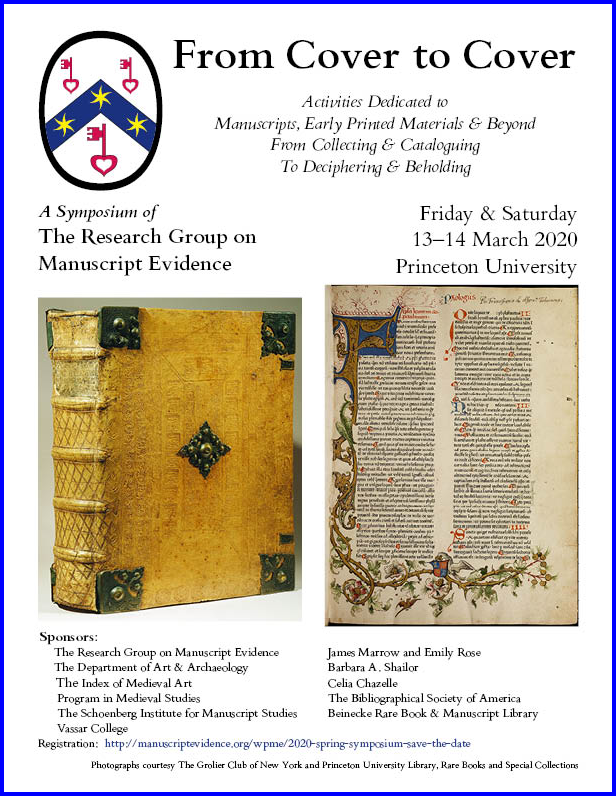
1.  Our 2020 Spring Symposium:  “From Cover to Cover”

Planned for 13–14 March at Princeton University
But Cancelled or Postponed

As preparations were proceeding apace, the event was cancelled by Princeton University — along with other events — on 9 March, in response to growing concerns for the spread of COVID-19 on a global scale.  Although at short notice, it was possible swiftly to cancel reservations for the venue, catering, and other services before participants had begun their journeys.

What We Planned

  • 2020 Spring Symposium: Save the Date
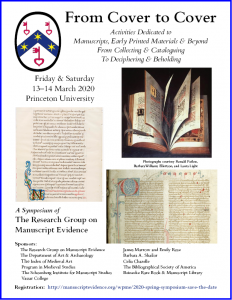
2020 Symposium "From Cover to Cover" Poster 2

2020 Symposium Poster 2

We aimed to consider, “From Cover to Cover”, activities dedicated to manuscripts, early printed materials, and beyond, from collecting and cataloguing to deciphering and beholding.  We prepared to gather specialists, teachers, students, and others engaged or interested in activities such as “Collecting, Curating, Conserving, Cataloguing, Deciphering, Reading, Reconsidering, Editing, Teaching, Displaying, Accessing, Beholding, and More”.

The focus was designed to center primarily upon medieval and early modern materials, both Western and non-Western.  The presentations would include reports of discoveries, work-in-progress, cumulative research, and collaborative projects by specialists from multiple centers, including independent scholars and younger scholars.

Included were workshops over original materials in manuscript and early print, a demonstration of materials and processes for medieval scripts, discussions about databases devoted to manuscripts and rare books, and sessions addressing multiple activities approaching medieval, early modern, and other textual resources.  Subjects would span a wide range geographically and chronologically, and take care to attend to the material and bibiographical evidence.

What We Can Do

There are requests for rescheduling the Symposium, or parts thereof, when conditions might permit.

Meanwhile, we can publish the Symposium Booklet.  At the time of cancellation, it had come close to completion for printing and distributing at the event and then afterward, as is our custom.  For example:

  • 2019 Anniversary Symposium on “The Roads Taken”
  • 2016 Symposium on ‘Words & Deeds”
  • 2014 Symposium on “Recollections of the Past”
  • 2013 Symposium on “Identity & Authenticity”

For all these and our other Booklets (see our Publications), the Research Group on Manuscript Evidence is the nonprofit publisher and distributor.  The design and layout conform with our Style Manifesto and employ our own digital font Bembino .

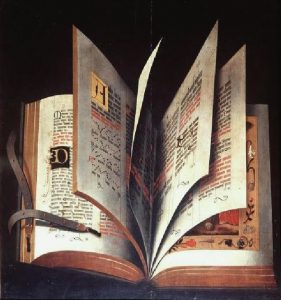
Florence, Galleria degli Uffizi, Anonymous, Still Life of an Illuminated Book, German School, 15th century. Oil on Wood. Opened book with fanned pages. Image via Wikimedia, Public Domain.

Florence, Galleria degli Uffizi, Anonymous, Still Life of an Illuminated Book, German School, 15th century. Image via Wikimedia, Public Domain.

The new 44-page Symposium Booklet contains the 2020 Symposium Program, Abstracts of the Papers and Masterclasses, and a set of accompanying Illustrations (some published for the first time).  The Booklet includes corrections and revisions offered by several of the authors as we completed the layout and editing, after the cancellation of the event.

It is the longest so far of all our Symposium Booklets. The 2019 Booklet for “The Roads Taken” has 28 pages, and the 2016 Booklet for “Words & Deeds” has 24 pages.  Only the Booklet for our multi-lingual digital font Bembino is longer, at 56 pages, including all the font tables for the different styles and languages. That Booklet and the font itself (now in Version 1.6) are freely available for download and use (commercial use included).  Here:  Bembino .

Our illustrated 2020 Spring Symposium Booklet is likewise freely available for download. As with other cases, for your convenience, we make it available in 2 versions, which may suit different printing arrangements, as wished.  The versions are:

  • printable in consecutive quarto-sized pages (8 1/2″ × 11″)
    2020 Spring Symposium Booklet as Consecutive Pages
  • printable as double sheets (11″ × 17″) which can be folded into the booklet, nesting the bifolia within each other
    — a design which does not require staples for closure and perusal
    2020 Spring Symposium as a Foldable Booklet

We thank our hosts, sponsors, contributors, owners and donors of images, editor, copy-editor, and layout designer. The publication is our gift to all who aimed to participate in the event and to follow its ‘ripples’ after the accomplishment of the Symposium. We offer it as a ‘souvenir’ of what our contributors, and the spirit of generous participation, intended for the event.

While we may explore plans to reschedule the event, or its parts, in some way or ways, the Booklet stands as a place-holder, and as a vivid glimpse of what could be and, indeed, can be. The gathering energy and enthusiasm for the event, as the weeks and days advanced toward it, remain a testimony to the constructive collective spirit which inspired it.

2020 Symposium "From Cover to Cover" Poster 1

2020 Symposium Poster 1

_____

With these observations, I am reminded of the Motto which I chose, years ago, for the 2-volume Illustrated Catalogue, co-published by the Research Group on Manuscript Evidence.

For Books are not absolutely dead things,
but doe contain a potencie of life in them
to be active as that soule was whose progeny they are;
nay, they do preserve as in a violl the purest efficacie and extraction
of the living intellect that bred them.

John Milton, Aeropagitica (1644)

Perhaps same as it ever was.

_____

Cover Page for Sorenson (2020 Spring Symposium Paper as Draft for Comment), with an array of illustrations and the title "Introduction to Indian Manuscripts"

Cover Page for Sorenson (2020 Spring Symposium Paper as Draft for Comment)

P. S.  Already one of our speakers, David W. Sorenson, has provided a draft version of his intended Symposium Paper for feedback. It expands the Abstract which appears in the 2020 Spring Symposium Booklet.

The paper provides “A Quick Introduction to Indian Manuscripts for the Non-Specialist”, with examples and illustrations.

With permission, we offer here his pdf.

Please contact us with your questions or suggestions.  (Contact details below.)

*****

2.  Our Activities at the 55th International Congress on Medieval Studies

Planned for 7–10 May at Kalamazoo
But Cancelled or Postponed

On 17 March, this year’s International Congress on Medieval Studies in May was cancelled, and with it all the activities which we were to sponsor and co-sponsor there, including Sessions and other meetings.  The Congress organizers declared that “We invite the organizers of sponsored . . . sessions approved for the 2020 Congress to re-propose them for the 2021 congress.  If proposed, they will be approved automatically”.

Unlike some organizations, who have declared this intention to re-present for the 2121 Congress, we do not know automatically if such a course would be appropriate for us, or for each and every one of our sessions.  Time will tell.

2019 Anniversary Reception Invitation. set in RGME digital font Bembino.

2019 Anniversary Reception Invitation.

Poster for our Session co-sponsored with the Societas Magica on "Celtic Magic Texts", organized by Phillip A. Bernhardt-House and sponsored by both the Research Group on Manuscript Evidence amd the Societas Magica at the 2018 International Congress on Medieval Studies. Poster set in RGME Bembino.

2018 Poster

The cancellation came in time before all reservations for the journey had been set into place.  Because our customary year-long preparations for the Congress had not reached the last weeks of its approach, we had not yet prepared the customary Posters for our Sessions or the Invitations to the Reception and Business Meeting, nor had the Agenda for that Meeting yet been drawn up.  Posters for previous Congresses show the standards.

However, we did in place have a series of posts on our website (You Are Here) announcing the plans for our 2020 Congress Activities, in stages with updates:

  • the Call for Papers for our approved Sessions, with descriptions of their aims and with selected Images (poster-worthy when the time would come) to exemplify their subjects and scope
  • the 2020 Congress Program, with the authors and titles of the selected Papers for each Session — including a permitted extra Session, given the strength of the responses to the Call, for our proposed Session “Seal the Real”
  • the 2020 Congress Program Announced, with the times and rooms assigned by the Congress Committee for our Program Activities, and with some of the Abstracts for the Papers.

In keeping with custom, we had begun, one by one (starting with the New Year), to post the Abstracts, as a foretaste for the presentations and discussions to come.

The cancellation of the Congress brought these stages to a halt, for a while, during which time we turned to other tasks — including the on-going follow-up from the cancellation or postponement of our Spring Symposium, and the completion of its Booklet.

Baltimore, The Walters Art Museum, MS W.782, folio 15r. Van Alphen Hours. Dutch Book of Hours made for a female patron in the mid 15th century. Opening page of the Hours of the Virgin: "Here du salste opdoen mine lippen". Image via Creative Commons. At the bottom of the bordered page, an elegantly dressed woman sits before a shiny bowl- or mirror-like object, in order, perhaps, to perform skrying or to lure a unicorn.

Baltimore, The Walters Art Museum, MS W.782, folio 15r. Van Alphen Hours. mage via Creative Commons.

What We Planned

  • 2020 International Congress on Medieval Studies Program Announced

We prepared for 5 Sessions with Papers, an Open Business Meeting, and a Reception.

These resemble the numbers and sorts of our activities in recent years at the Annual Congress.  For example:

  • 2019 Congress
  • 2018 Congress
  • 2017 Congress
  • 2016 Congress
  • 2015 Congress

This year’s plans also involved our 2 co-sponsors in recent years for Sessions and/or Receptions.

A.  Sessions

We prepared for 5 Sessions this year.

3 Sessions Sponsored by the Research Group on Manuscript Evidence

1–2. Seal the Real: Documentary Records, Seals & Authentications

organized by Mildred Budny

Part I.  Signed & Sealed
Part II.  × Marks the Spot

3. Prologues in Medieval Texts of Magic, Astrology, and Prophecy

organized by Vajra Regan

Logo of the Societas Magica, reproduced by permission

Logo of the Societas Magica

2 Sessions Co-Sponsored with the Societas Magica
in the 16th year of this collaboration

4–5. Revealing the Unknown

organized by Sanne de Laat and László Sándor Chardonnens

Part I.  Scryers and Scrying in the Middle Ages and Early Modern Period
Part II.   Sortilège, Bibliomancy, and Divination

B.  2020 Open Business Meeting of the Research Group on Manuscript Evidence

1-Page Agendas customarily provided at the time.  This year we send it out already.  (See below.)

C.  Reception co-sponsored with the Index of Medieval Art at Princeton University
in the 3rd year of this collaboration

_____

P. S.  Part of Mildred Budny’s on-going research on the subject of seals and signatures, which would have figured in her Response to Session II of our “Seals” Sessions, now appears on our blog, Manuscript Studies, presenting Preston Take 2.  (See the Contents List for the blog, as more discoveries await publication.)

_____

P. P. S.  It is not lost on us that some of our planned Sessions for 2020 were to consider aspects of the history of divinatory skills across time and place.  But when we collectively chose these, as well as other subjects, last year for our sponsored and co-sponsored Sessions this year, it was not easy to guess then that this year’s Sessions would not take place, after all, at their appointed time and place.

Adèle Kindt (1804–1884), The Fortune Teller (circa 1835). Antwerp, Koninklijk Museum voor Schone Kunsten. Image via Wikimedia Commons. A young lady, brightly lit and beautifully dressed, looks outward as an older woman, beneath a dark hood, holds a set of cards and stares at them with intent.

Adèle Kindt (1804–1884), The Fortune Teller (circa 1835). Antwerp, Koninklijk Museum voor Schone Kunsten. Image via Wikimedia Commons.

What We Can Do

A.  Abstracts for the 2020 Congress Papers

Detail of opened book with schematic text. Photography © Mildred BudnyOur custom is to post on our website the Abstracts for the Papers of our Sessions at the Congress.  (See our Abstracts for Congress Papers.)  This year is no different.

In the winter of 2019–2020, we had begun to post the 2020 Abstracts, one by one, as is our custom.  They are linked to our announced Program: 2020 Congress Program Announced. The Abstracts function as a foretaste of the ‘Menu’ of the Sessions, and can provide a record of their subjects, aims, and scope of the presentations.

Already in earlier years (as with the 2016 Congress and the 2014 Congress), as a sign of appreciation, we chose to adopt the tradition of posting Abstracts even when a contributor was unable to travel to the Congress and to present the paper in person.  The publication of such Abstracts states that, although proposed, accepted, and scheduled within the Session and Congress Program, the paper was not, in the event, presented.

Before March 2020, only once before, in more than 30 years of activities in many centers in the United States and elsewhere (see our Events and Congress Activities), has the Research Group had to cancel an event itself.  That case was only 1 Session among 7 sponsored and co-sponsored Sessions at the 48th International Congress on Medieval Studies in May 2013.

This year, after the cancellation of both our 2020 Spring Symposium (see above) and the 2020 Congress, we first turned to completing the Symposium Booklet, and then to completing the posting of the 2020 Abstracts.

Those tasks are now accomplished.  For these Congress Abstracts, see

  • 2020 Congress Program Announced and Abstracts of Congress Papers Listed by Year.

For the Symposium Booklet, see

  • 2020 Spring Symposium: Save the Date

Thus we honor the intentions of our participants and their readiness to contribute to our events.

Next, we might turn to contemplating further activities, and perhaps rescheduling some of these ones.

[Update:  In the summer and autumn of 2020, we advance with planning to hold the same Sessions, albeit with a few changes, at the 2021 Congress.  See the 2021 Congress Program in Progress.]

B.  Agenda for the 2020 Business Meeting

Meeting to be rescheduled:  Time and Place to be Determined

The Annual Agendas for our Open Business Meetings, customarily held at the International Congress on Medieval Studies, remain available for consultation.

  • 2019 Agenda
  • 2018 Agenda
  • 2017 Agenda
  • 2016 Agenda
  • 2015 Agenda

These 1-page statements serve as concise Reports for our Activities, Plans, and Desiderata.  After the Meetings, the Abstracts are available for download on our website.  Some of them remain among the most popular downloads here.

Normally, the Agenda is presented at the Meeting.  This year, we send it out ahead of time.  It incorporates the updates of Spring 2020 and their constructive measures.

  • 2020 Agenda

It is not yet clear when this year’s Meeting, which had to be postponed, will take place.  Under present circumstances, we may contemplate a virtual meeting, say via online conferencing in some form.

Please let us know if you wish to participate in the Meeting.  We invite your comments, questions, and suggestions.  (See below.)

C. More

We thank all our contributors to the 2020 events.  The continuing momentum for such activities is a tribute to you all.

Please Contact Us with your questions and suggestions, for example to items on our  2020 Agenda.

For updates, please visit this site, our News & Views, and our Facebook Page .

For our nonprofit educational mission, with tax-exempt status, your donations in funds and/or in kind (expertise, materials, time) are welcome. Join us!

Tags: 'Manuscript Studies' Blog, 2020 Congress, 2020 Symposium, Bembino, Bembino Digital Font, Business Meeting, Early Printing, History of Documents, Manuscript studies, Medieval Studies, Seals and Signatures, Style Manifesto
No Comments »

2020 International Congress on Medieval Studies Program Announced

January 18, 2020 in Abstracts of Conference Papers, Announcements, Bembino, Conference, Conference Announcement, Index of Christian Art, Index of Medieval Art, International Congress on Medieval Studies, Kalamazoo, Societas Magica

Research Group on Manuscript Evidence
at the 55th International Congress on Medieval Studies
7–10 May 2020

Program Announced
[NOW CANCELLED OR POSTPONED]

[Update on 12 July 2020:  Now see 2021 International Congress on Medieval Studies Call for Papers]

[Published on 18 January 2020, with updates.

Adèle Kindt (1804–1884), The Fortune Teller (circa 1835). Antwerp, Koninklijk Museum voor Schone Kunsten. Image via Wikimedia Commons. A young lady, brightly lit and beautifully dressed, looks outward as an older woman, beneath a dark hood, holds a set of cards and stares at them with intent.

Adèle Kindt (1804–1884), The Fortune Teller (circa 1835). Antwerp, Koninklijk Museum voor Schone Kunsten. Image via Wikimedia Commons.

Update on 17 March.  The 55th Congress has been Cancelled. 

According to the website for the International Congress on Medieval Studies:

The health and safety of our attendees and our community are our first priority. Due to the COVID-19 outbreak and the most recent recommendations of the CDC and the WHO regarding social distancing and public gatherings, we have made the difficult decision to cancel the 55th International Congress on Medieval Studies (May 7-10, 2020).

As for the future, according to the Congress organizers:

We invite the organizers of sponsored and special sessions approved for the 2020 Congress to re-propose them for the 2021 congress. If proposed, they will be approved automatically.

Meanwhile, with the preparations for the Congress set aside, the Research Group on Manuscript Evidence continues to advance with posting the Abstracts of the intended Papers for our 2020 ICMS Sessions, to stand alongside their Statements of Purpose as designed for the Call for Papers and announced in this post.

Our tradition regularly has been to post on our website the Abstracts before our Sessions in a given Congress, as a foretaste of the Menu.  Years ago, as a sign of appreciation, we adopted the custom of posting the Abstract of one or other contributor who became unable to attend to present in person (as with the 2016 Congress and the 2014 Congress).  Thus we honor the intentions of our participants to present the results (or interim results) of their research and reflections, even when they could not do so at the event.

Before March 2020, only once before, in more than 30 years of activities in many centers in the United States and elsewhere (see our Events and Congress Activities), has the Research Group had to cancel an event itself.  That case was only 1 Session among 7 sponsored and co-sponsored Sessions at the 48th International Congress on Medieval Studies in May 2013.

This March, in stark contrast, 2 of our major events for 2020 have had to be cancelled as a whole.  This change pertains both at the Congress and elsewhere.  First, our 2020 Spring Symposium, From Cover to Cover, intended for 13–14 March at Princeton University, has been Cancelled or Postponed.  Now, the 55th ICMS intended for May at Kalamazoo. 

For the former, we aim to complete the Symposium Booklet, with the Program, Abstracts, and Illustrations, as planned,and distribute it to contributors, registrants, and others, as a souvenir of the collective aims for the gathering.   Here we similarly honor our participants’ intentions by recording their Abstracts.]

*****

What We Planned

Baltimore, The Walters Art Museum, MS W.782, folio 15r. Van Alphen Hours. Dutch Book of Hours made for a female patron in the mid 15th century. Opening page of the Hours of the Virgin: "Here du salste opdoen mine lippen". Image via Creative Commons. At the bottom of the bordered page, an elegantly dressed woman sits before a shiny bowl- or mirror-like object, in order, perhaps, to perform skrying or to lure a unicorn.

Baltimore, The Walters Art Museum, MS W.782, folio 15r. Van Alphen Hours. Image via Creative Commons.

With the achievement of our Activities at the 2019 International Congress on Medieval Studies (ICMS), described in our 2019 Congress Report, we prepare for the 2020 Congress. With the conclusion of the Call for Papers on 15 September 2019 for our sponsored and co-sponsored Sessions, we have assigned their Programs and reported them to the Congress Committee.

Now, as the new year begins, we announce the programs as well as our other activities at the 2020 Congress.  As the Congress announces its Sneak Preview of the 2020 Congress Program, we report the times and room assignments. Soon, as is our custom, we will publish the Abstracts for their Papers and Responses.

*****
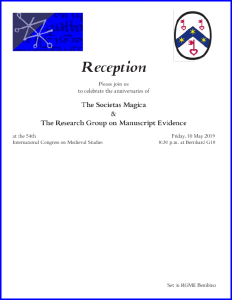
Our events at the Congress, as always, are designed to represent, to explore, to promote, to celebrate, and to advance aspects of our shared range of interests, fields of study, subject matter, and collaboration between younger and established scholars, teachers, and others, in multiple centers.

This year, the response to the Call for Papers for our Session on Seals received so strong a response that we have been granted 2 sessions in the place of the one as accepted. Again this year we co-sponsor Sessions with the Societas Magica (2 Sessions this year). It will be the 16th year of this co-sponsorship.

Also, like the 2015–2019 Congresses, we plan for

  • an Open Business Meeting and
  • a co-sponsored Reception.

Again, like the 2016–2018 Congresses, we co-sponsor a Reception with the Index of Medieval Art at Princeton University (formerly the Index of Christian Art).

Abstracts for previous Congresses appear in our Congress Abstracts, Indexed both by Year and by Author.  The Abstracts for this year’s Congress will join their company.

Read the rest of this entry →

Tags: 'Toulouse deformity', Bibliomancy, Divination, History of Documents, History of Magic, Manuscript studies, Medieval Seals, Scrying, Seals and Signatures, Sortilège
No Comments »

2019 International Congress on Medieval Studies Report

September 14, 2019 in Abstracts of Conference Papers, Anniversary, Announcements, Bembino, Business Meeting, Conference, Events, International Congress on Medieval Studies, Kalamazoo, POMONA, Reception, Reports, Societas Magica, Uncategorized

Report:  Events Sponsored and Co-Sponsored
by the Research Group on Manuscript Evidence
at the 54th International Congress on Medieval Studies
9–12 May 2019

[Published on 2 June 2019. With the achievement of our Activities at the 2019 Congress, we offer this Report (Abstracts of Papers Included), while we advance with preparations for the 2020 Congress. For updates, as they evolve, please watch this space and our Facebook Page.]

Central Rock Garden at WMU International Congress on Medieval Studies at Kalamazoo May 2019. Photograph Mildred Budny.

Central Rock Garden. Photograph Mildred Budny.

In 2019, the Research Group on Manuscript Evidence celebrates its 20th year as a nonprofit educational corporation and its 30th year as an international scholarly organization. Accordingly, we hold both customary and extra-special events, both at the Congress and elsewhere. For example, shortly before the 2019 Congress, we

We have a tradition of celebrating landmark Anniversaries, both for our organization, with organizations which which we share anniversaries, and for other events. As described, for example, in our 2014 Anniversary Reflections. For 2019, our events aim to represent, to explore, to promote, to celebrate, and to advance aspects of our shared range of interests, fields of study, subject matter, and collaboration between younger and established scholars, teachers, and others, in multiple centers.

Now we Report the successful accomplishment of our Activities at the 2019 Congress.

Who, What, Why Not

Logo of the Research Group on Manuscript Evidence (colour version)As in recent years, we co-sponsored Sessions with the Societas Magica (2 Sessions). It is the 14th year of this co-sponsorship, and the first year of co-sponsorship with the newly-founded organization Polytheism-Oriented Medievalists of North America (P.-O.M.O.N.A).

Also, like the 2015–2018 Congresses, we held

  • an Open Business Meeting, with a convenient downloadable 2019 Agenda, and
  • a co-sponsored Reception.

As usual, we publish the Program for the accepted Papers, as their Authors permit. Abstracts for previous Congresses appear in our Congress Abstracts, conveniently Indexed both by Year and by Author.

Read the rest of this entry →

Tags: Animals in Celtic Magical Texts, Beinecke Takamiya MS 23, Business Meeting, Celtic Magical Texts, Classical Deities, Classical Deities in Medieval Northern European Contexts, Dionysus, Ecstasy Defense, Grettisfærsla, Hêliand, History of Magic, Lapidaries, Mary Moody Emerson, Medieval manuscripts, Medieval Studies, P.-O.M.o.N.A., Reception, Societas Magica
No Comments »

2019 Anniversary Symposium Report: The Roads Taken

July 28, 2019 in Abstracts of Conference Papers, Anniversary, Announcements, Bembino, Conference, Index of Medieval Art, Manuscript Studies, Princeton University, Reception, Reports

The Roads Taken, Or, The Obstacle Course
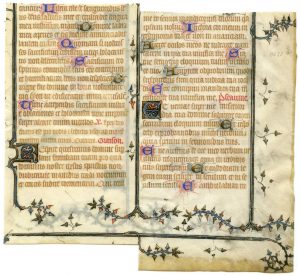
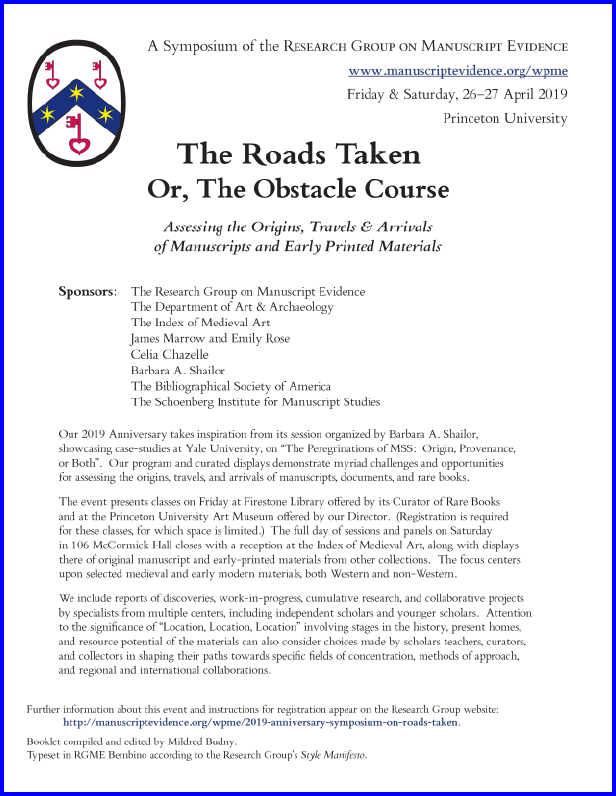
Challenges & Opportunities for
Assessing the Origins, Travels & Arrivals
of Manuscripts & Early Printed Materials

2019 Anniversary Symposium
of the Research Group on Manuscript Evidence

Princeton University
Friday 26 & Saturday 27 April 2019

Co-Sponsored by The Bibliographical Society of America

Rejoined Pieces of a Leaf from a Book of Hours. Private Collection, reproduced by permission.

Rejoined Pieces of a Leaf from a Book of Hours. Private Collection.

Sponsors

Department of Art & Archaeology, Princeton University

The Index of Medieval Art at Princeton University

James Marrow and Emily Rose

Celia Chazelle

Barbara A. Shailor

The Schoenberg Institute for Manuscript Studies

Vassar College

The Plan

In 2019 the Research Group on Manuscript [and Other] Evidence celebrates 20 years as a nonprofit educational corporation based in Princeton, and 30 years as an international scholarly society founded at the Parker Library of Corpus Christi College, Cambridge. Across the years, we have engaged in multiple events in many places, over multiple manuscripts and other original sources, and on a broad range of subjects. We celebrate our friends, colleagues, hosts, donors, volunteers, and subjects of study.

As part of these celebrations, our Anniversary Symposium took place at Princeton University, host of many of our events over the years, as remembered here.  Sponsorship for this Symposium included Sponsors from earlier years, as well as new sponsorship by The Bibliographical Society of America and by Vassar College .

The Cover Page for the 2019 Anniversary Symposium Booklet displays the name and logo of the Research Group on Manuscript Evidence, the title and subtitle of the Symposium, the List of Sponsors, and a description of the scope and aims of the Symposium. Like the rest of the Booklet, the Cover Page is set in RGME Bembino, the copyright multilingual font of the Research Group on Manuscript Evidence.

2019 Anniversary Symposium Booklet Cover Page

Read the rest of this entry →

Tags: Anniversary Symposium, Early Printing, manuscript fragments
No Comments »

« Older Entries
  • Top
©2024 Research Group on Manuscript Evidence.


is proudly powered by WordPress. WordPress Themes X2 developed by ThemeKraft.