• News
    • News & Views
    • RGME Activities for 2024 and 2025
    • Around & About with the RGME
    • Reviews
    • Highlights
  • Blogs
    • Manuscript Studies
      • Manuscript Studies: Contents List
    • International Congress on Medieval Studies
      • Abstracts of Congress Papers
        • Abstracts of Papers Listed by Author
        • Abstracts of Papers Listed by Year
  • About
    • Mission
    • Who We Are
      • Officers, Associates & Volunteers
      • RGME Committees
      • Friends of the Research Group on Manuscript Evidence
    • Policies & Statements
      • RGME Privacy Policy Statement
      • RGME Intellectual Property Statement & Agreements
    • People
      • Mildred Budny — Her Page
      • Adelaide Bennett Hagens
    • Activities
      • Events
      • Congress Activities
        • Sponsored Conference Sessions (1993‒)
          • Panels at the M-MLA Convention (from 2016)
        • Co-sponsored Conference Sessions (2006‒)
    • History
      • Seals, Matrices & Documents
      • Genealogies & Archives
    • Contact Us
  • Bembino
    • Multi-Lingual Bembino
    • RGME Bembino: Resources
  • Congress
    • Sponsored Conference Sessions (1993‒)
    • Co-sponsored Conference Sessions (2006‒)
    • Abstracts of Congress Papers
      • Abstracts Listed by Author
      • Abstracts Listed by Year
    • Kalamazoo Archive
    • Panels at the M-MLA Convention (2016-2019)
      • Abstracts of Papers for the M-MLA Convention
      • Panels at the M-MLA Convention (from 2016)
  • Events
    • RGME Activities for 2024 and 2025
      • 2023 Activities and 2024 Planned Activities
    • Seminars, Workshops, Colloquia & Symposia (1989–)
      • Seminars on ‘The Evidence of Manuscripts’
      • Symposia on ‘The Transmission of the Bible’
      • The New Series (2001-)
        • 2019 Anniversary Symposium Program: The Roads Taken
        • 2019 Anniversary Symposium Registration
        • 2019 Anniversary Symposium Registration Open
      • RGME Symposia: The Various Series
      • The Research Group Speaks: The Series
      • Meetings of the Friends of the Research Group on Manuscript Evidence
      • RGME Online Events
    • Abstracts of Papers for Events
      • Abstracts of Papers for Seminars on ‘The Evidence of Manuscripts’
      • Abstracts of Papers for Symposia, Workshops & Colloquia
    • Receptions & Parties
    • Business Meetings
    • Photographic Exhibitions & Master Classes
    • Events Archive
  • ShelfLife
    • Journal Description
    • ShelfMarks: The RGME-Newsletter
    • Publications
      • “Insular, Anglo-Saxon, and Early Anglo-Norman Manuscript Art at Corpus Christi College, Cambridge” (1997)
        • Mildred Budny, ‘Catalogue’
        • The Illustrated Catalogue (1997)
      • The Illustrated Handlist
      • Semi-Official Counterfeiting in France 1380-1422
      • No Snap Decisions: Challenges of Manuscript Photography
    • History and Design of Our Website
  • Galleries
    • Watermarks & the History of Paper
    • Galleries: Contents List
    • Scripts on Parade
    • Texts on Parade
      • Latin Documents & Cartularies
      • New Testament Leaves in Old Armenian
    • Posters on Display
    • Layout Designs
  • Donations and Contributions
    • RGME Donor Promise
    • 2023 End-of-Year Fundraiser for our 2024 Anniversary Year
    • 2019 Anniversary Appeal
    • Orders
  • Links
    • Catalogs, Metadata, and Databases: A Handlist of Links
    • Handlist of Resources for Manuscript Studies and Fragmentology
    • Manuscripts & Rare Books
    • Maps, Plans & Drawings
    • Seals, Seal-Matrices & Documents

  • News
    • News & Views
    • RGME Activities for 2024 and 2025
    • Around & About with the RGME
    • Reviews
    • Highlights
  • Blogs
    • Manuscript Studies
      • Manuscript Studies: Contents List
    • International Congress on Medieval Studies
      • Abstracts of Congress Papers
        • Abstracts of Papers Listed by Author
        • Abstracts of Papers Listed by Year
  • About
    • Mission
    • Who We Are
      • Officers, Associates & Volunteers
      • RGME Committees
      • Friends of the Research Group on Manuscript Evidence
    • Policies & Statements
      • RGME Privacy Policy Statement
      • RGME Intellectual Property Statement & Agreements
    • People
      • Mildred Budny — Her Page
      • Adelaide Bennett Hagens
    • Activities
      • Events
      • Congress Activities
        • Sponsored Conference Sessions (1993‒)
          • Panels at the M-MLA Convention (from 2016)
        • Co-sponsored Conference Sessions (2006‒)
    • History
      • Seals, Matrices & Documents
      • Genealogies & Archives
    • Contact Us
  • Bembino
    • Multi-Lingual Bembino
    • RGME Bembino: Resources
  • Congress
    • Sponsored Conference Sessions (1993‒)
    • Co-sponsored Conference Sessions (2006‒)
    • Abstracts of Congress Papers
      • Abstracts Listed by Author
      • Abstracts Listed by Year
    • Kalamazoo Archive
    • Panels at the M-MLA Convention (2016-2019)
      • Abstracts of Papers for the M-MLA Convention
      • Panels at the M-MLA Convention (from 2016)
  • Events
    • RGME Activities for 2024 and 2025
      • 2023 Activities and 2024 Planned Activities
    • Seminars, Workshops, Colloquia & Symposia (1989–)
      • Seminars on ‘The Evidence of Manuscripts’
      • Symposia on ‘The Transmission of the Bible’
      • The New Series (2001-)
        • 2019 Anniversary Symposium Program: The Roads Taken
        • 2019 Anniversary Symposium Registration
        • 2019 Anniversary Symposium Registration Open
      • RGME Symposia: The Various Series
      • The Research Group Speaks: The Series
      • Meetings of the Friends of the Research Group on Manuscript Evidence
      • RGME Online Events
    • Abstracts of Papers for Events
      • Abstracts of Papers for Seminars on ‘The Evidence of Manuscripts’
      • Abstracts of Papers for Symposia, Workshops & Colloquia
    • Receptions & Parties
    • Business Meetings
    • Photographic Exhibitions & Master Classes
    • Events Archive
  • ShelfLife
    • Journal Description
    • ShelfMarks: The RGME-Newsletter
    • Publications
      • “Insular, Anglo-Saxon, and Early Anglo-Norman Manuscript Art at Corpus Christi College, Cambridge” (1997)
        • Mildred Budny, ‘Catalogue’
        • The Illustrated Catalogue (1997)
      • The Illustrated Handlist
      • Semi-Official Counterfeiting in France 1380-1422
      • No Snap Decisions: Challenges of Manuscript Photography
    • History and Design of Our Website
  • Galleries
    • Watermarks & the History of Paper
    • Galleries: Contents List
    • Scripts on Parade
    • Texts on Parade
      • Latin Documents & Cartularies
      • New Testament Leaves in Old Armenian
    • Posters on Display
    • Layout Designs
  • Donations and Contributions
    • RGME Donor Promise
    • 2023 End-of-Year Fundraiser for our 2024 Anniversary Year
    • 2019 Anniversary Appeal
    • Orders
  • Links
    • Catalogs, Metadata, and Databases: A Handlist of Links
    • Handlist of Resources for Manuscript Studies and Fragmentology
    • Manuscripts & Rare Books
    • Maps, Plans & Drawings
    • Seals, Seal-Matrices & Documents

Log in

Archives

Featured Posts

2026 International Congress on Medieval Studies: Program
Episode 24. “Life with Books” (Interview with John Windle)
Announcing the Launch of RGME Bembino WP
2026 RGME Colloquium at The Grolier Club: Report
Medieval Missal Fragment as Early-Modern Cover
The Weber Leaf from Ege MS 61
"Bembino" Booklet Cover
Episode 23. “Meet RGME Bembino: Facets of a Font”
2026 RGME Colloquium on “Transformations & Renewals” at The Grolier Club
2026 Theme of the Year: “Transformations and Renewals”
A Leaf with Patchwork from the Saint Albans Bible
A Sister Leaf from a Miniature Latin Vulgate Bible
A Little Latin Vulgate Bible Manuscript Leaf in Princeton
J. S. Wagner Collection. Leaf from from Prime in a Latin manuscript Breviary. Folio 4 Verso, with part of Psalm 117 (118) in the Vulgate Version, set out in verses with decorated initials.
2026 Annual Appeal
Episode 22: “Encounters with Local Saints and Their Cults”
Private Collection, Ege's FBNC Portfolio, Dante Leaf, Verso, Detail. Reproduced by Permission.
2025 RGME Autumn Colloquium on Fragments
Workshop 8: A Hybrid Book where Medieval Music Meets Early-Modern Herbal
2025 RGME Autumn Symposium on “Readers, Fakers, and Re-Creators of Books”
RGME Workshops on “The Evidence of Manuscripts, Etc.”
2025 International Medieval Congress at Leeds: RGME Program
Episode 21. “Learning How to Look”
2025 International Congress on Medieval Studies: Program
2025 RGME Visit to Vassar College
Two Leaves in the Book of Numbers from the Chudleigh Bible
Delibovi on Glassgold on Boethius: A Blogpost
Ronald Smeltzer on “Émilie du Châtelet, Woman of Science”
2025 Spring Symposium: “Makers, Producers, and Collectors of Books”
Starters’ Orders
The Weber Leaf from the Saint Albans Bible
Workshop 4. “Manuscript Fragments Compared”
Episode 20. “Comic Book Theory for Medievalists”
Episode 19: “At the Gate: Starting the Year 2025 at its Threshold”
Favorite Recipes for Lemonade, Etc.
RGME Visit to the Lomazow Collection: Report
2024 Autumn Symposium: “At the Helm”
A Latin Vulgate Leaf of the Book of Numbers
The RGME ‘Lending Library’
Florence, Italy, Ponte Vecchio from Ponte alle Grazie. Photo: Ingo Mehling, CC BY-SA 4.0 , via Wikimedia Commons
Episode 17. “RGME Retrospect and Prospects: Anniversary Reflections”
2024 Anniversary Symposium: The Booklet
Jesse Hurlbut at the Bonneville Salt Flats, Utah. Photograph Jesse Hurlbut.
Episode 16: An Interview with Jesse D. Hurlbut
To Whom Do Manuscripts Belong?
Kalamazoo, MI Western Michigan University, Valley III from the side. Photograph: David W. Sorenson.
2024 International Congress on Medieval Studies: Report
2024 Spring Symposium at Vassar College
Puente de San Martín: Bridge with reflection over the River Targus, Toledo, Spain.
2024 Grant for “Between Past and Future” Project from The Gladys Krieble Delmas Foundation Research Libraries Program
2024 Anniversary Symposium in Thanks to Jesse Hurlbut: Program

You are browsing the Blog for Multi-Lingual Bembino

Episode 23. “Meet RGME Bembino: Facets of a Font”

September 1, 2025 in Bembino, Book, Design, Event Registration, Manuscript Studies, Research Group Episodes for The Research Group Speaks, Research Group Speaks (The Series)

“The Research Group Speaks”
Episode 23

“Meet RGME Bembino:
Facets of a Font”
A Conversation

Saturday 21 February 2026
1:00–2:30 pm EST (GMT-5) by Zoom

[Posted on 31 August 2025, with updates]

As the series wherein “The Research Group Speaks” unfolds, we respond to suggestions and requests. For information about the series, please see:

  • “The Research Group Speaks”: The Series

The Plan

Join us for an informal conversation with the RGME Font-Designer, the RGME Director, an author, a graphic designer, and others who use our copyright multi-faceted multi-lingual digital font Bembino for scholarly or literary work, quality book-layout, and everyday use.

Years in the making, and responsive to requests (such as recently for Elvish),  Bembino is freely available for use whether commercial or non-commercial. It is FREE for download on our RGME website. It continues to develop, and we welcome feedback.

Meet the Font

For our Episode, we gather experts to report on their experience with the font, its use, its abilities, and its beauty.

  • Leslie J. French (see the Interview with our Font and Layout Designer)
  • Mildred Budny (Mildred Budny: Her Page)
  • Reid Byers, author of Imaginary Books (Oak Knoll Press, 2024) — the first full-length book to be set in RGME Bembino
  • Matthew Young, designer of Reid Byer’s book and exhibition catalogue of Imaginary Books

Reid Byers, Imaginary Books (set in RGME Bembino)

  • Reid Byers, Imaginary Books: Lost, Unfinished, and Fictive Works Found Only in Other Books”

Front Cover: Imaginary Books by Reid Byers (Oak Knoll Press, 2024), via https://reidbyers.com/?page_id=147; see https://www.oakknoll.com/pages/books/141071.

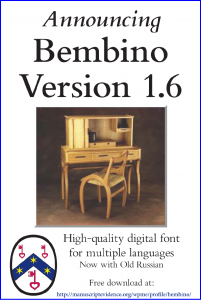
Poster announcing Bembino Version 1.6 (January 2019)

Information

  • Bembino
  • Multi-Lingual Bembino
  • Runes for Bembino
  • More Fonts for Bembino: Devanāgarī (Hindi) and Tibetan (High-Uchen Script)
  • Bembino WP for Word
  • Bembino: Handlist of Resources

Registration

  • Episode 23. Meet RGME Bembino: Registration
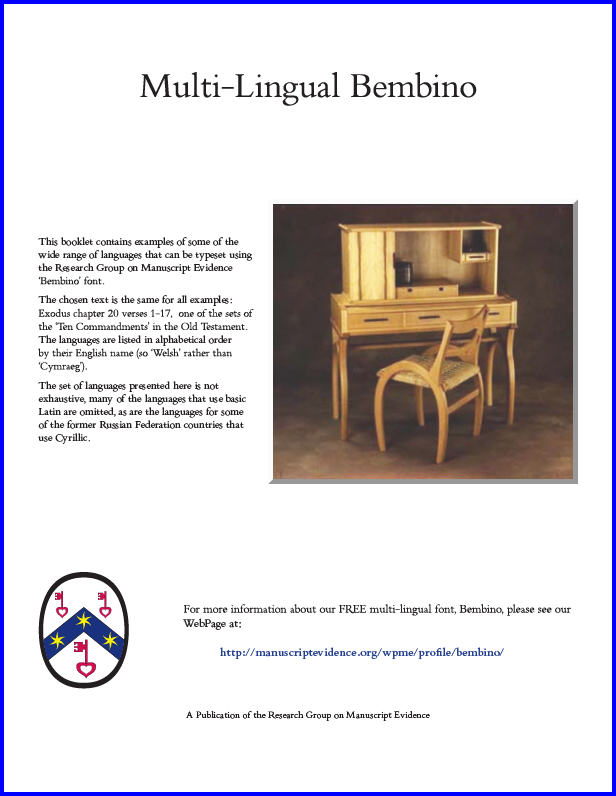
Cover page for 'Multi-Lingual Bembino' demonstrating specimens from a wide range of languages typeset in Bembino

Multi-Lingual Bembino Booklet Cover

Flyer

Downloadable as a 1-page pdf here:

  • Episode 23. RGME Bembino: Flyer

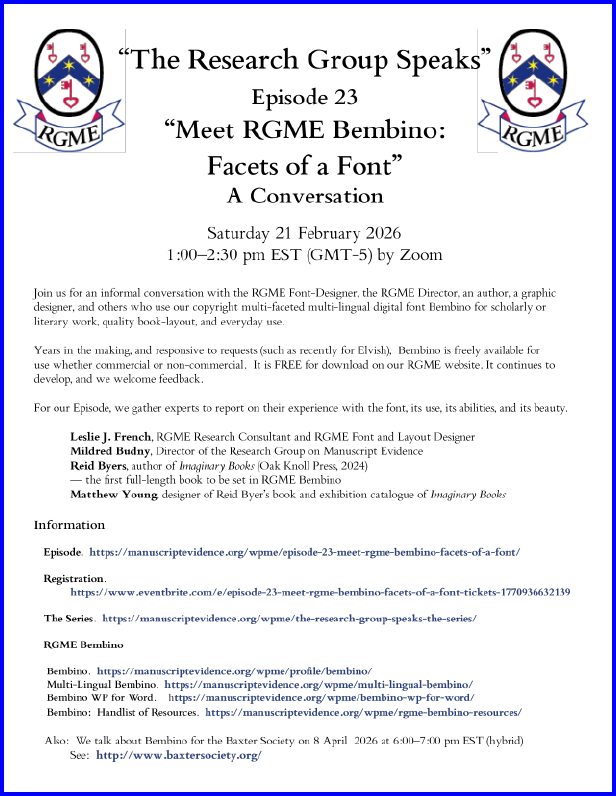
Episode 23. RGME Bembino: Poster, Set in RGME Bembino.

About the Font Bembino

  • Bembino (https://manuscriptevidence.org/wpme/bembino)
  • Multi-Lingual Bembino (https://manuscriptevidence.org/wpme/multi-lingual-bembino)
  • Bembino WP for Word (https://manuscriptevidence.org/wpme/bembino-wp-for-word/)
  • Bembino: Handlist of Resources (https://manuscriptevidence.org/wpme/rgme-bembino-resources/)

Permission for Use

Note that RGME Bembino is FREE.
The copyright for the Bembino font programs belongs to the RGME, which grants an automatic free license for use in typeset publications, including both scholarly and commercial material.

It Tracks

Keep track of the series as it unfolds:

  • “The Research Group Speaks”: The Series

We welcome suggestions and requests.

*****

Tags: Bembino WP for Word, digital fonts, Font Design, graphic design, History of Design, history of printing, Imaginary Books, Multi-Lingual Bembino, RGME Bembino, The Research Group Speaks
No Comments »

More Fonts for Bembino: Devanāgarī (Hindi) and Tibetan (High-Uchen Script)

May 6, 2024 in Announcements, Bembino, Manuscript Studies

Fonts for Tibetan
(High Uchen-Style)
and Hindi
(Devanāgarī)
for our
Multi-Lingual Font Bembino

[Posted on 5 May 2024, with updates]

By request, work continues on improvements for our copyright multi-lingual font Bembino. Step by step, fonts for more languages are added.  Now we turn to Devanāgarī (Hindi) and Tibetan (High-Uchen Script).

By September 2023, specimens of these fonts in Bembino were ready to show for comment.  Now, after some RGME online and hybrid activities have been accomplished (October 2023 and January, February, and April 2024, with more in May and June), we show the specimens for your review.  Please let us know what you think!

[P.S.  Meanwhile, another request, by our RGME Associate Reid Byers, has led also to work on Elvish for J.R.R. Tolkin‘s creation Tengwar. Coming soon!]

Multi-Lingual Bembino
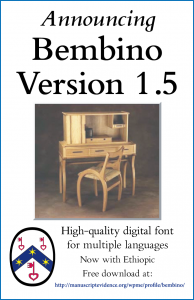
Poster Announcing Bembino Version 1.5 (April 2018) with border for Web display

Poster Announcing Bembino Version 1.5

Our copyright font is freely available for download and use for non-commercial and commercial use alike.  You might download the font, and its companion Booklet, here:

  • Bembino Version 1.5 (2018).

That booklet and the font itself (now in Version 1.5) are freely available via Bembino.  The “Bembino” Booklet describes and illustrates the font.

Another Booklet showing “Examples of Our Font in Multiple Languages” appeared in March 2018, with an updated Version 1.1 (June 2018).

  • Multi-Lingual Bembino (2018)

This booklet contains examples of some of the wide range of languages that can be typeset using the Research Group on Manuscript Evidence ‘Bembino’ font.

The Specimen Text
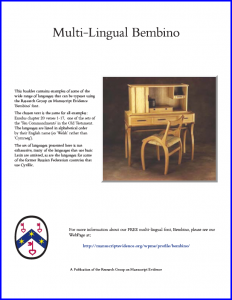
Cover page for 'Multi-Lingual Bembino' demonstrating specimens from a wide range of languages typeset in Bembino

Multi-Lingual Bembino Booklet Cover

The chosen text is the same for all examples in the booklet for Multi-Lingual Bembino.

The Specimen Text comes from: Exodus chapter 20 verses 1–17, one of the sets of the ‘Ten Commandments’ in the Old Testament.

The languages are listed in alphabetical order by their English name (so ‘Welsh’ rather than ‘Cymraeg’).  The set of languages presented is not exhaustive. Many of the languages that use basic Latin are omitted, as are the languages for some of the former Russian Federation countries that use Cyrillic.

*****

The new, on-going, work provides fonts for more cases.

After creating fonts for Japanese, Ethiopic, and Arabic, the direction to South Asia seemed worth pursuing. Requests arrived, and work began.

Hindi: Devanāgarī

Devanāgarī is a left-to-right writing system used in the Indian subcontinent.  “The Devanāgarī script, composed of 48 primary characters, including 14 vowels and 34 consonants, is the fourth most widely adopted writing system in the world, being used for more than 120 languages.” (See Devanāgarī.)

Our Bembino Specimen is set for Hindi, “the fourth most-spoken language in the world, after Mandarin, Spanish and English”.

The background for the work to produce such a font for Bembino extended across several years.  We owe the quest to comments offered by Harry Blair, responding to Bembino as a multi-lingual digital font in use for a variety of purposes.

For example (6 February 2019):

I was thinking that if Leslie had done Japanese and Ethiopic and Arabic (much harder than Devanāgarī, it seemed to me), then South Asia might be an interesting direction to take. Simpler than Western languages in that there’s only one case (no upper and lower), but more complex with all the conjuncts. Plus the vowels sometimes shift around consonants, sometimes preceding them in writing while following them in speaking.”

1.  Most of the conjuncts in common use are like ligatures in Western scripts: 2 letters joined in such a way that it’s easy to grasp what the separate letters are.  This Wikibooks table shows them (<https://en.wikibooks.org/wiki/Hindi/Consonant_combinations>). BTW the small diagonal appendage to each letter in the first column just indicates that the letter is by itself with no following vowel.

2. There’s a much smaller set of conjuncts commonly used that yield an entirely different form, listed at the bottom of the WikiBooks table as “special cases”.

Taking up the case, our Font Designer reported (5 February 2019):

I checked the latest version (11.0) of Unicode and they haven’t done anything to address the issues with Devanāgarī.

Here is my understanding of the issue, ignoring all the vehement rhetoric.

Basically, similar to Arabic, Devanagari has a ‘core’ of about 50 letter shapes (consonants and vowels) but when they co-occur there are combined forms that must be used.  It’s as though the fi, ffi, fl etc. ligatures were *mandatory* to set English.  There are about 1,000+ of these ‘ligatures’ needed correctly to set Devanagari.  Unicode contains only 128 glyphs for Devanagari, including punctuation and numerals!  Now, it is true that some of the ‘missing’ glyphs can be formed from the basic letters + overprints. Think of European accents, and the core ‘a’ used to form á, ä, à etc., but without having separate codepoints for â, ä and so on.  But there are still some combinations that need different shapes (like ffi) not just overprints.

There is no space in Unicode to add those different shapes.  They could be added through special font tables (like I did for the joined-up Ethiopic numerals), and there are specific tables in OpenType (the format I use for Bembino) to support them.  But building those tables requires an expert knowledge of Devanagari typesetting.  There are some sites on the Web that can help, but if I made a mistake I would never know.

Having said that, I’m willing to take on the challenge if I can get some help checking what I produce, similar to that Augustine [Dickinson] did with the Ethiopic [by asking for diacritics for Ge’ez among the languages of Ethiopia].

[Note: Our Associate Augustine Dickinson is now the Acting RGME WebMaster, as of 1 July 2023.]

With some suggestions for the specimen forms (such as more contrast between thick and thin strokes), a revised version of Devanāgarī for Bembino is now available upon request, before the next version of Bembino as a whole appears.

Bembino for Hindi and Tibetan

Now, a poster-style page shows the Bembino fonts so far for Hindi and Tibetan.

The Specimen Text

The chosen text is the same for all examples in the booklet for Multi-Lingual Bembino.  As described above, the Specimen Text comes from: Exodus chapter 20 verses 1–17, one of the sets of the ‘Ten Commandments’ in the Old Testament.

Fonts for Hindi and Tibetan for Multi-Lingual Bembino in Specimen Text.

Tibetan

Tibetan script is a segmental writing system, written from left to right.  The alphabet has thirty basic letters for consonants.  Syllables are separated by a tsek (་), and spaces are not used to divide words.  Because many Tibetan words are monosyllabic, the mark can function as if a space between words.  (See, for example, The Tibetan Writing System.)

When I [Mildred Budny, Editor-in-Chief of RGME Publications] asked our Font Designer about the choice of script for Tibetan, High-Uchen Style, he said: “I think it is beautiful”.

Here is a specimen of the script in manuscript form.  I show the specimen, and add parts of the companion description (metadata) which comes with the image in its digital facsimile available freely online.

Photograph: Ms. Sarah Walsh.

Notes on the Image

Image via Wikimedia Commons under CC 4.0 license, via https://commons.wikimedia.org/wiki/File:Isha_Upanishad_Verses_1_to_3,_Shukla_Yajurveda,_Sanskrit,_Devanagari.jpg

Information given at that source:

“Language: Sanskrit

“Script: Devanagari

“Script style: pre-14th century (Northern / Western)

“Isha Upanishad, verses 1–2, partially 3

“The thick text is the Upanishad scripture, the small text in the margins and edges are an unknown scholar’s notes and comments in the typical Hindu style of a minor bhasya.

“The photo above is of a 2D artwork of a text that is over 2,000 years old, from a manuscript that was produced decades before 1923. Therefore Wikimedia Commons PD-Art licensing guidelines apply. Any rights I have as a photographer is herewith donated to wikimedia commons under CC 4.0 license.

“The early Upanishads (Upanisad, Upanisat) are scriptures of Hinduism. Variously dated by scholars to have been composed between 900 BCE to about 200 BCE, these texts are in Sanskrit language and embedded within a layer of the Vedas. They contain a mixture of philosophy and mystical speculations, many set in the form of dialogues or pedagogic style. Their central teachings include the concepts of Atman (soul, self) and Brahman (metaphysical reality).

“These manuscripts are preserved at the Lalchand Research Library, Ancient Indian Manuscript Collection, DAV College Digital Library Initiative, Chandigarh India, in association with SP Lohia and Indorama Charitable Trust. The texts are over 2000 years old, the re-copying into this particular manuscript is dated to a pre-1867 reproduction (exact date unknown). The manuscript shows significant stain marks, decay and damage on the sides and its edges.”

*****

Suggestion Box

Do you have suggestions, questions, or requests for Bembino?

Please leave your comments here, Contact Us, or visit

  • our FaceBook Page
  • our Facebook Group
  • our Twitter Feed (@rgme_mss)
  • our Bluesky nest @rgmesocial.bluesky.social)
  • our LinkedIn Group
  • our Blog on Manuscript Studies and its Contents List

Donations and contributions, in funds or in kind, are welcome and easy to give.  Given our low overheads, your donations have direct impact on our work and the furtherance of our mission.  For our Section 501(c)(3) nonprofit educational organization, your donations may be tax-deductible to the fullest extent permitted by law.  Thank you for your support!

  • Contributions and Donations
  • 2024 Anniversary Appeal

We look forward to hearing from you.

*****

 

Tags: Bembino Digital Font, Book of Exodus, Devanāgarī, Elvish, Ethiopic Script, Exodus 20:1-17, Ge'ez diacritics, Hindi, Isha Upanishad, Lalchand Research Library, Multi-Lingual Bembino, RGME Font Design, Sanskrit, Specimen Text, Tengwar, Tibetan, Tibetan High-Uchan Script
No Comments »

  • Top
©2024 Research Group on Manuscript Evidence.


is proudly powered by WordPress. WordPress Themes X2 developed by ThemeKraft.