• News
    • News & Views
    • RGME Activities for 2024 and 2025
    • Around & About with the RGME
    • Reviews
    • Highlights
  • Blogs
    • Manuscript Studies
      • Manuscript Studies: Contents List
    • International Congress on Medieval Studies
      • Abstracts of Congress Papers
        • Abstracts of Papers Listed by Author
        • Abstracts of Papers Listed by Year
  • About
    • Mission
    • Who We Are
      • Officers, Associates & Volunteers
      • RGME Committees
      • Friends of the Research Group on Manuscript Evidence
    • Policies & Statements
      • RGME Privacy Policy Statement
      • RGME Intellectual Property Statement & Agreements
    • People
      • Mildred Budny — Her Page
      • Adelaide Bennett Hagens
    • Activities
      • Events
      • Congress Activities
        • Sponsored Conference Sessions (1993‒)
          • Panels at the M-MLA Convention (from 2016)
        • Co-sponsored Conference Sessions (2006‒)
    • History
      • Seals, Matrices & Documents
      • Genealogies & Archives
    • Contact Us
  • Bembino
    • Multi-Lingual Bembino
    • RGME Bembino: Resources
  • Congress
    • Sponsored Conference Sessions (1993‒)
    • Co-sponsored Conference Sessions (2006‒)
    • Abstracts of Congress Papers
      • Abstracts Listed by Author
      • Abstracts Listed by Year
    • Kalamazoo Archive
    • Panels at the M-MLA Convention (2016-2019)
      • Abstracts of Papers for the M-MLA Convention
      • Panels at the M-MLA Convention (from 2016)
  • Events
    • RGME Activities for 2024 and 2025
      • 2023 Activities and 2024 Planned Activities
    • Seminars, Workshops, Colloquia & Symposia (1989–)
      • Seminars on ‘The Evidence of Manuscripts’
      • Symposia on ‘The Transmission of the Bible’
      • The New Series (2001-)
        • 2019 Anniversary Symposium Program: The Roads Taken
        • 2019 Anniversary Symposium Registration
        • 2019 Anniversary Symposium Registration Open
      • RGME Symposia: The Various Series
      • The Research Group Speaks: The Series
      • Meetings of the Friends of the Research Group on Manuscript Evidence
      • RGME Online Events
    • Abstracts of Papers for Events
      • Abstracts of Papers for Seminars on ‘The Evidence of Manuscripts’
      • Abstracts of Papers for Symposia, Workshops & Colloquia
    • Receptions & Parties
    • Business Meetings
    • Photographic Exhibitions & Master Classes
    • Events Archive
  • ShelfLife
    • Journal Description
    • ShelfMarks: The RGME-Newsletter
    • Publications
      • “Insular, Anglo-Saxon, and Early Anglo-Norman Manuscript Art at Corpus Christi College, Cambridge” (1997)
        • Mildred Budny, ‘Catalogue’
        • The Illustrated Catalogue (1997)
      • The Illustrated Handlist
      • Semi-Official Counterfeiting in France 1380-1422
      • No Snap Decisions: Challenges of Manuscript Photography
    • History and Design of Our Website
  • Galleries
    • Watermarks & the History of Paper
    • Galleries: Contents List
    • Scripts on Parade
    • Texts on Parade
      • Latin Documents & Cartularies
      • New Testament Leaves in Old Armenian
    • Posters on Display
    • Layout Designs
  • Donations and Contributions
    • RGME Donor Promise
    • 2023 End-of-Year Fundraiser for our 2024 Anniversary Year
    • 2019 Anniversary Appeal
    • Orders
  • Links
    • Catalogs, Metadata, and Databases: A Handlist of Links
    • Handlist of Resources for Manuscript Studies and Fragmentology
    • Manuscripts & Rare Books
    • Maps, Plans & Drawings
    • Seals, Seal-Matrices & Documents

  • News
    • News & Views
    • RGME Activities for 2024 and 2025
    • Around & About with the RGME
    • Reviews
    • Highlights
  • Blogs
    • Manuscript Studies
      • Manuscript Studies: Contents List
    • International Congress on Medieval Studies
      • Abstracts of Congress Papers
        • Abstracts of Papers Listed by Author
        • Abstracts of Papers Listed by Year
  • About
    • Mission
    • Who We Are
      • Officers, Associates & Volunteers
      • RGME Committees
      • Friends of the Research Group on Manuscript Evidence
    • Policies & Statements
      • RGME Privacy Policy Statement
      • RGME Intellectual Property Statement & Agreements
    • People
      • Mildred Budny — Her Page
      • Adelaide Bennett Hagens
    • Activities
      • Events
      • Congress Activities
        • Sponsored Conference Sessions (1993‒)
          • Panels at the M-MLA Convention (from 2016)
        • Co-sponsored Conference Sessions (2006‒)
    • History
      • Seals, Matrices & Documents
      • Genealogies & Archives
    • Contact Us
  • Bembino
    • Multi-Lingual Bembino
    • RGME Bembino: Resources
  • Congress
    • Sponsored Conference Sessions (1993‒)
    • Co-sponsored Conference Sessions (2006‒)
    • Abstracts of Congress Papers
      • Abstracts Listed by Author
      • Abstracts Listed by Year
    • Kalamazoo Archive
    • Panels at the M-MLA Convention (2016-2019)
      • Abstracts of Papers for the M-MLA Convention
      • Panels at the M-MLA Convention (from 2016)
  • Events
    • RGME Activities for 2024 and 2025
      • 2023 Activities and 2024 Planned Activities
    • Seminars, Workshops, Colloquia & Symposia (1989–)
      • Seminars on ‘The Evidence of Manuscripts’
      • Symposia on ‘The Transmission of the Bible’
      • The New Series (2001-)
        • 2019 Anniversary Symposium Program: The Roads Taken
        • 2019 Anniversary Symposium Registration
        • 2019 Anniversary Symposium Registration Open
      • RGME Symposia: The Various Series
      • The Research Group Speaks: The Series
      • Meetings of the Friends of the Research Group on Manuscript Evidence
      • RGME Online Events
    • Abstracts of Papers for Events
      • Abstracts of Papers for Seminars on ‘The Evidence of Manuscripts’
      • Abstracts of Papers for Symposia, Workshops & Colloquia
    • Receptions & Parties
    • Business Meetings
    • Photographic Exhibitions & Master Classes
    • Events Archive
  • ShelfLife
    • Journal Description
    • ShelfMarks: The RGME-Newsletter
    • Publications
      • “Insular, Anglo-Saxon, and Early Anglo-Norman Manuscript Art at Corpus Christi College, Cambridge” (1997)
        • Mildred Budny, ‘Catalogue’
        • The Illustrated Catalogue (1997)
      • The Illustrated Handlist
      • Semi-Official Counterfeiting in France 1380-1422
      • No Snap Decisions: Challenges of Manuscript Photography
    • History and Design of Our Website
  • Galleries
    • Watermarks & the History of Paper
    • Galleries: Contents List
    • Scripts on Parade
    • Texts on Parade
      • Latin Documents & Cartularies
      • New Testament Leaves in Old Armenian
    • Posters on Display
    • Layout Designs
  • Donations and Contributions
    • RGME Donor Promise
    • 2023 End-of-Year Fundraiser for our 2024 Anniversary Year
    • 2019 Anniversary Appeal
    • Orders
  • Links
    • Catalogs, Metadata, and Databases: A Handlist of Links
    • Handlist of Resources for Manuscript Studies and Fragmentology
    • Manuscripts & Rare Books
    • Maps, Plans & Drawings
    • Seals, Seal-Matrices & Documents

Log in

Archives

Featured Posts

Sanskrit and Prakrit Manuscripts, Continued: More Leaves for Manuscript Sample XII?
2026 International Congress on Medieval Studies: Program
Episode 24. “Life with Books” (Interview with John Windle)
Announcing the Launch of RGME Bembino WP
2026 RGME Colloquium at The Grolier Club: Report
Medieval Missal Fragment as Early-Modern Cover
The Weber Leaf from Ege MS 61
"Bembino" Booklet Cover
Episode 23. “Meet RGME Bembino: Facets of a Font”
2026 RGME Colloquium on “Transformations & Renewals” at The Grolier Club
2026 Theme of the Year: “Transformations and Renewals”
A Leaf with Patchwork from the Saint Albans Bible
A Sister Leaf from a Miniature Latin Vulgate Bible
A Little Latin Vulgate Bible Manuscript Leaf in Princeton
J. S. Wagner Collection. Leaf from from Prime in a Latin manuscript Breviary. Folio 4 Verso, with part of Psalm 117 (118) in the Vulgate Version, set out in verses with decorated initials.
2026 Annual Appeal
Episode 22: “Encounters with Local Saints and Their Cults”
Private Collection, Ege's FBNC Portfolio, Dante Leaf, Verso, Detail. Reproduced by Permission.
2025 RGME Autumn Colloquium on Fragments
Workshop 8: A Hybrid Book where Medieval Music Meets Early-Modern Herbal
2025 RGME Autumn Symposium on “Readers, Fakers, and Re-Creators of Books”
RGME Workshops on “The Evidence of Manuscripts, Etc.”
2025 International Medieval Congress at Leeds: RGME Program
Episode 21. “Learning How to Look”
2025 International Congress on Medieval Studies: Program
2025 RGME Visit to Vassar College
Two Leaves in the Book of Numbers from the Chudleigh Bible
Delibovi on Glassgold on Boethius: A Blogpost
Ronald Smeltzer on “Émilie du Châtelet, Woman of Science”
2025 Spring Symposium: “Makers, Producers, and Collectors of Books”
Starters’ Orders
The Weber Leaf from the Saint Albans Bible
Workshop 4. “Manuscript Fragments Compared”
Episode 20. “Comic Book Theory for Medievalists”
Episode 19: “At the Gate: Starting the Year 2025 at its Threshold”
Favorite Recipes for Lemonade, Etc.
RGME Visit to the Lomazow Collection: Report
2024 Autumn Symposium: “At the Helm”
A Latin Vulgate Leaf of the Book of Numbers
The RGME ‘Lending Library’
Florence, Italy, Ponte Vecchio from Ponte alle Grazie. Photo: Ingo Mehling, CC BY-SA 4.0 , via Wikimedia Commons
Episode 17. “RGME Retrospect and Prospects: Anniversary Reflections”
2024 Anniversary Symposium: The Booklet
Jesse Hurlbut at the Bonneville Salt Flats, Utah. Photograph Jesse Hurlbut.
Episode 16: An Interview with Jesse D. Hurlbut
To Whom Do Manuscripts Belong?
Kalamazoo, MI Western Michigan University, Valley III from the side. Photograph: David W. Sorenson.
2024 International Congress on Medieval Studies: Report
2024 Spring Symposium at Vassar College
Puente de San Martín: Bridge with reflection over the River Targus, Toledo, Spain.
2024 Grant for “Between Past and Future” Project from The Gladys Krieble Delmas Foundation Research Libraries Program
2024 Anniversary Symposium in Thanks to Jesse Hurlbut: Program

You are browsing the Blog for Announcements

2025 Annual Appeal

November 26, 2024 in Announcements, Manuscript Studies, RGME Annual Appeal

2025 Annual Appeal
for Donations
to Support
our Mission and Activities

We invite you to join our 2025 Annual Appeal, as the Research Group rounds out the extraordinarily successful 2024 Anniversary Year with its theme of Bridges (see below), and prepares for the future.

In 2025 the Research Group will mark:

  • 26 years as a nonprofit 501(c)(3) nonprofit educational corporation based in Princeton, New Jersey
  • 36 years as an international scholarly organization founded in Cambridge, England, as part of a major research project at the Parker Library of Corpus Christi College.

Cahors (Lot), France, Pont Valentré. View of the western part of the bridge from southeast. Photograph (24 September 2024) by Benjamin Smith, CC BY-SA 4.0 <https://creativecommons.org/licenses/by-sa/4.0>, via Wikimedia Commons

Now, moving into a new quarter-century as a nonprofit educational corporation, we seek your help to continue with our work, maintain our organizational operations, and advance with our activities and their planning.  As a nonprofit educational organization “Without Members”, we must turn to donations from individuals and institutions, supplemented by grants, where available, and by the pro-bono contributions which power most of what we can do.

As an organization with no employees, and no paid fund-raisers, we must depend upon our own time and efforts, with advisers, to identify the needs of the organization as we prepare its activities, which are accomplished on our own or in association with other organizations, institutions, and initiatives. Likewise, we prepare and circulate the appeals for specific purposes and goals which funding and other contributions could make possible.

Without the polish, performance, and expense of professional fund-raising functions, we speak from the heart as we encourage you to accompany us on the quest for aid for our 2025 Annual Appeal. Because our endowment is slender, we have to turn instead to donations for the annual expenses of the corporation and for aspects of the various activities and publications. In this way, you can have the confidence of knowing that your donations can have a direct impact in sustaining and fostering the RGME from day to day and year to year.

The 2025 Appeal Letter

The signed 2025 Appeal Letter gives a collective statement of our needs and goals. It concisely lists our achievements, progress, aims, wishes, and gaps-to-fill in going forward.

The 2025 Appeal Letter is signed by supporters who ask for your help.

Dear Friend of the Research Group on Manuscript Evidence (RGME),

We write to you to ask for your support for our nonprofit educational corporation for the future.

In 2024, for our Anniversary Year, we undertook a variety of activities in support of our mission.  They included:

  • Holding our Spring & Autumn Symposia “Between Past and Future”, including the invited Spring Symposium at Vassar College (hybrid), plus an Anniversary Symposium “Manuscript (HE)ART”, with published booklets
  • Hosting Episodes 15-18 of our online presentation series, “The Research Group Speaks”
  • Sponsoring and co-sponsoring three sessions at the 59th International Congress on Medieval Studies (ICMS)
  • Sponsoring an Inaugural RGME Session at the 31st International Medieval Congress at Leeds (IMC)
  • Co-sponsoring a pair of webinars for “Medieval Women’s Networks”
  • Launching the series of RGME Workshops on “The Evidence of Manuscripts”
  • Conducting our 2024 “Between Past and Future” project, funded by The Gladys Krieble Delmas Foundation

Your generous donations for our 2024 Annual Appeal, Anniversary Endowment Appeal, and events (totalling $22,000) helped greatly to support our work and on-going projects and to grow our endowment.

In anticipating 2025, in addition to funding such ongoing programs as “The Research Group Speaks”, symposia, conference sessions, workshops, research projects, publications, and invited visits to public and private collections, we have five main goals:

  • Expanding our very modest endowment (now up to $4,750) to stabilize our ability to cover ongoing costs
  • Building “The Constable Fund” (so far $3,850) for work by the RGME on manuscript and related studies, to honor Giles Constable (†2021), medieval historian, Honorary Trustee, and long-time mentor for our organization
  • Augmenting donations (normally about $5,000 in a good year) so as to meet annual operating expenses, which have risen to about $17,000, including urgent needs now for our website hosting and management
  • Supporting our overworked, unpaid Director with funded administrative assistance, needed now more than ever

For details, please see https://manuscriptevidence.org/wpme/2025-annual-appeal.

Signed
Adelaide Bennett Hagens, Trustee
Celia Chazelle, Department of History, The College of New Jersey
Jennifer Larson, Advisory Board
David Porreca, Trustee and Department of Classics, University of Waterloo
Anna Siebach–Larsen, Director, Rossell Hope Robbins Library
and Koller–Collins Center  for English Studies, University of Rochester

Mildred Budny, Director and Founder Trustee

For Download Here

We offer the 2025 Annual Appeal Letter for download here:

  • 2025 Annual Appeal Letter
    or https://manuscriptevidence.org/wpme/download/19571/

For background and further information from last year’s ground-breaking work toward 2025 and beyond, please see:

  • 2024 Anniversary Appeal Letter + Appendix

Accomplishments and innovations of our 2024 Anniversary Year are cited below.

Also, for your convenience, here is our Donation Form if you wish a printout:

  • Donation Form

You might use the form to send checks to the Research Group on Manuscript Evidence.  Online methods are listed below.

Would you please help with these aims?

In sum, we seek funding and other forms of assistance (pro bono expertise, goods, etc.) for our work and the pursuit of our mission.

We invite you to join the team!

Ways to Donate Online and Other Ways

Ways to contribute?

There are many ways to help: Funds, Goods, Expertise, Time. All can help our work and mission.

For suggestions, see:

  • Contributions & Donations
  • Donations

1) Via Mightycause:

  • Donate
  • Mightycause for RGME 2025 Annual Appeal

2) Via Paypal, Venmo, ApplePay, Pay Later, or Debit or Credit Card:


A Community of Scholars, Teachers, Students, Friends, and Admirers of Books

We thank you for your support.

Please  join our community and join our cause.

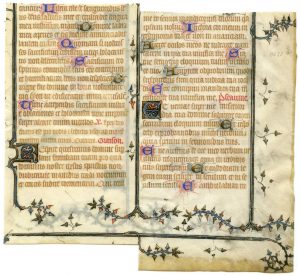
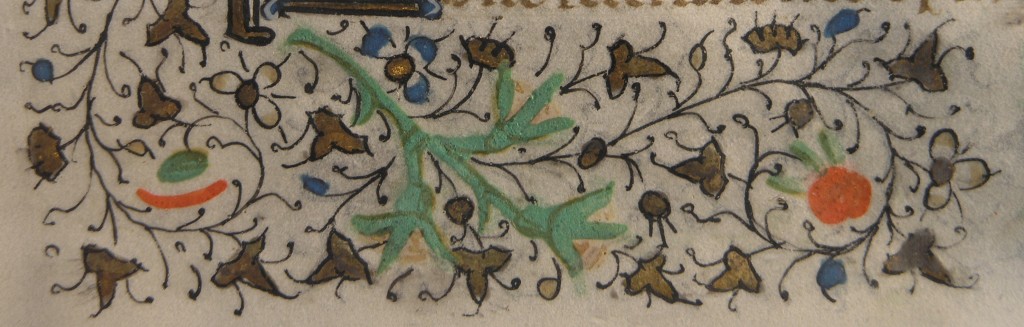
Floral border on the detached leaf from a 15th-century Book of Hours

Photography © Mildred Budny

Please leave your Comments or questions below, Contact Us, or visit

  • our FaceBook Page
  • our Facebook Group
  • our Twitter Feed (@rgme_mss)
  • our Bluesky nest @rgmesocial.bluesky.social)
  • our LinkedIn Group
  • our Blog on Manuscript Studies and its Contents List

Donations and Contributions

Donations and contributions, in funds or in kind, are welcome and easy to give.  See:

  • Contributions and Donations.

We look forward to hearing from you.

*****

Tags: 2024 Anniversary Appeal, 2025 Annual Appeal, Bridges, Bridges of Paris, Friends of the Research Group on Manuscript Evidence
No Comments »

The Latin Vulgate Bible Leaf in the Farrell Collection, Part 3: The Full Leaf

November 14, 2024 in Announcements, Event Registration, Manuscript Studies, Research Group Workshops, RGME Lending Library, RGME Library & Archives

The Latin Vulgate Bible Leaf
in the Collection of Jennah Farrell

Part 3: The Leaf Revealed in Full

Single Leaf from the Book of Numbers
now unframed

Laid out in double columns of 46 lines in Gothic Script

Size of leaf =
maximum circa 29.3 cm. tall
 × 20.1 cm. wide
(circa 11 9/16 in. × 7 15/16 in. )

< ruled writing area
circa 18.7 × 12.5 cm. (circa 7 3/4 × 4 7/8 in.)>

[Posted on 13 November 2024]

Collection of Jennah Farrell, Manuscript Leaf in Frame. Photograph by Jennah Farrrell.

Now that the manuscript leaf has been removed from its modern frame (see Part 2 in this series of blogposts), we display photographs of both sides of the leaf uncropped, showing its full extent at present.

We do so especially to prepare for the pair of online Workshops which we plan so as to crowdsource information, expertise, and collaboration. We invite a shared exploration to learn and teach more about the leaf, its original manuscript, its context within its genre of book and other relatives from the same center, period, or region, and perhaps also its travels from its date and place of origin in medieval Europe to its present collection in the United States.

About the frame and information about the collection from which Jennah Farrell acquired the leaf in its frame, see Part 2 on Provenance:

  • Latin Vulgate Bible Leaf in the Collection of Jennah Farrell, Part 2

Part 1 introduced the leaf in its frame, in the state in which it reached the RGME Lending Library for photography, conservation, research, and teaching:

  • A Latin Vulgate Leaf from the Book of Numbers (Part 1)

Now for Part 3 we focus on the leaf itself, including the evidence which its outer portions and its entire back side, formerly hidden, can reveal.

Side 1

This side faced forward in the former frame.

Collection of Jennah Farrell, Single Leaf from the Book of Numbers in a Medieval Latin Vulgate Bible manuscript. Full extent of the leaf, unframed: Recto. Photography by Mildred Budny.

Side 2

Collection of Jennah Farrell, Single Leaf from the Book of Numbers in a Medieval Latin Vulgate Bible manuscript. Full extent of the leaf, unframed: Verso. Photography by Mildred Budny.

Releasing the Leaf from the Frame

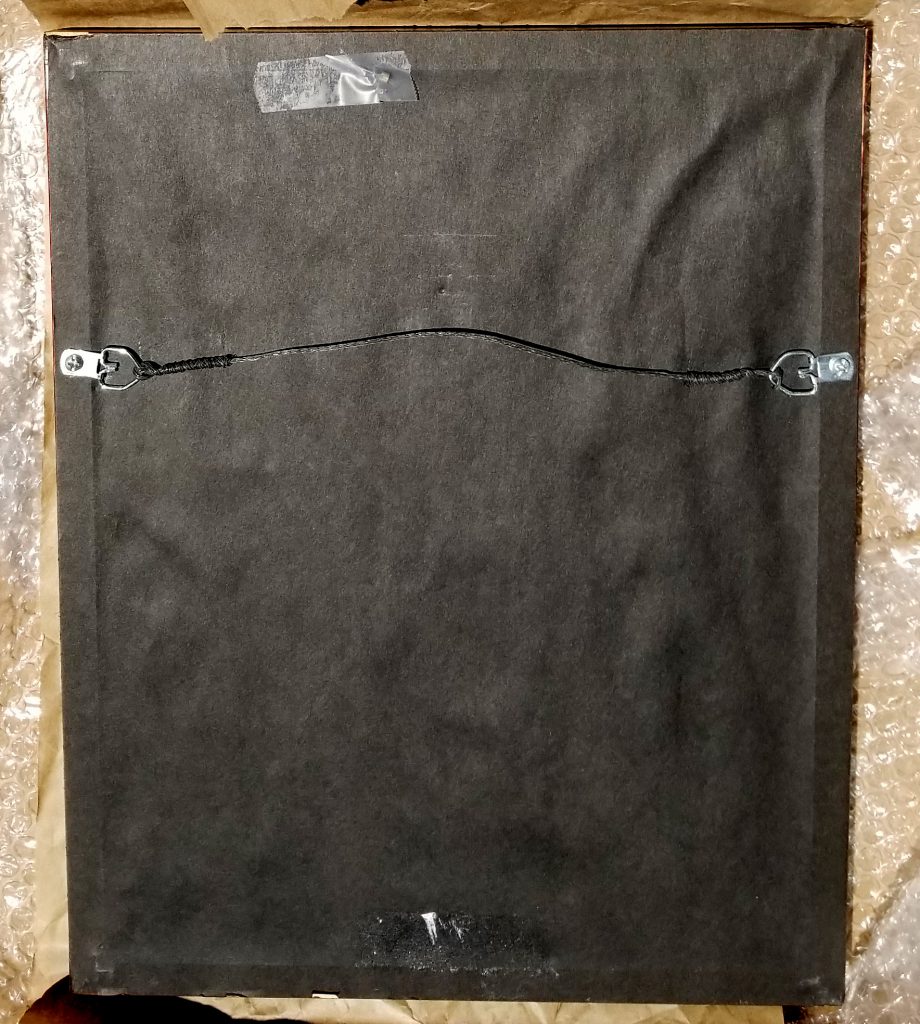
Collection of Jennah Farrell, Manuscript Leaf: Back of Frame. Photograph by Mildred Budny.

Removing the leaf from its frame employed a set of tools 1) to unscrew the mounting hinges and hanging wire, 2) release the backing paper glued to the back edges of the wooden frame, 3) detach the heavy staples which clamped a sheet of foam board to the framing mat, and 4) lift the mat to release the leaf.

Tools to Open the Frame and Left-over Pieces from the Frame containing the Farrell Bible Leaf. Photography by Mildred Budny.

The pieces of the frame are now kept together: stained wooden frame, sheet of glass, windowed mat, foam board, backing paper, staples, and hanging nail. The leaf is now kept in a clear archival L-sheet housed in an archival document binder.

Both Sides Now in View

Released from the frame and its mat, the leaf can be seen to have about 5 cm. more from top to bottom and about 4 more cm. from side to side.  Revealed are the full extent of the margins and parts of the foliate decoration of the ornamental bars which extend from the chapter initials in three columns of the four in the layout of two columns per page or side of the leaf.

Revealed too is the marginal correction for the text entered in the outer margin on the verso and the remnants of the stitching line at the inner edge or gutter of the leaf, where an uneven cut along the full length of the leaf severed it from its formerly conjoint leaf in its original manuscript.

Can you tell which side of the leaf is the front, or original recto, and which is the back, or original verso?

Do you recognize, or would you like to discover, which manuscript the leaf came from when it was cut out of its book and separated from its relatives, to enter the world as a single leaf on its own, suited for framing and display such as on a wall?

Would you like to help us to learn about it?

A Pair of Workshops for this Leaf

We plan two RGME Workshops on Looking at Manuscripts, the first in a new series, to introduce the leaf and learn how to identify its probable date and place of origin, as well as its former manuscript and its context among relatives. Our challenge is to discern what the leaf might itself have to say about these different stages, and what we might discover about its original identity, its former manuscript, and its dispersal.

Both workshops will be held online by Zoom, for which registration (free) is required.

1) Workshop 1 introduces the leaf and sets the groundwork.

Sunday 17 November 2024 at 1:00-2:30 pm EST (GMT-5) by Zoom

  • Workshop 1: Registration

2) Workshop 2 follows up the lines of investigation as we might collectively compare notes and refine our inquiries more fully to understand the leaf and its relatives.

Sunday 16 December 2024 at 1:00-2:30 pm EST (GMT-5)

  • Workshop 2: Registration

After you register, the Zoom Link will be sent to you a few days before the event.

Beginners and experts welcome!

*****

About our new series of Workshops on Looking at Manuscripts, see:

  • The Bridge of Signs

We have been waiting for the opportunity, occasion, and resources to bring to our community for workshops, online and/or in-person, collectively to explore original source materials. With the RGME “Lending Library” as well as our own materials in the RGME Library & Archives, and with our time-tested habits of online events as well as in-person workshops, we launch our new series in a mobile approach to bring together original sources and a community interested in studying them and teaching with them.

Please join our expedition!

*****

Suggestion Box

Please Contact Us or visit

  • our FaceBook Page
  • our Facebook Group
  • our Twitter Feed (@rgme_mss)
  • our Bluesky nest @rgmesocial.bluesky.social)
  • our LinkedIn Group
  • our Blog on Manuscript Studies and its Contents List

Would you like to help?

*****

Tags: Jennah Farrell Collection, Latin Vulgate Bibles, Manuscript studies, Medieval manuscripts
No Comments »

Visit to the Collection of Steven Lomazow, M.D.

October 3, 2024 in Announcements, Event Registration, Manuscript Studies, Uncategorized, Visits to Collections

RGME Visit to the
Collection of
Dr. Steven M. Lomazow

of American Magazines
and Other Sources

Saturday 16 November 2024

In-person visit,
with hybrid component
for an online virtual visit (by Zoom)

“I can read you like a magazine”
— Taylor Swift, Blank Space (2014)

[Posted on 1 October 2024, with updates]

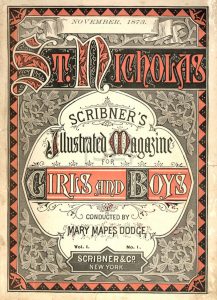
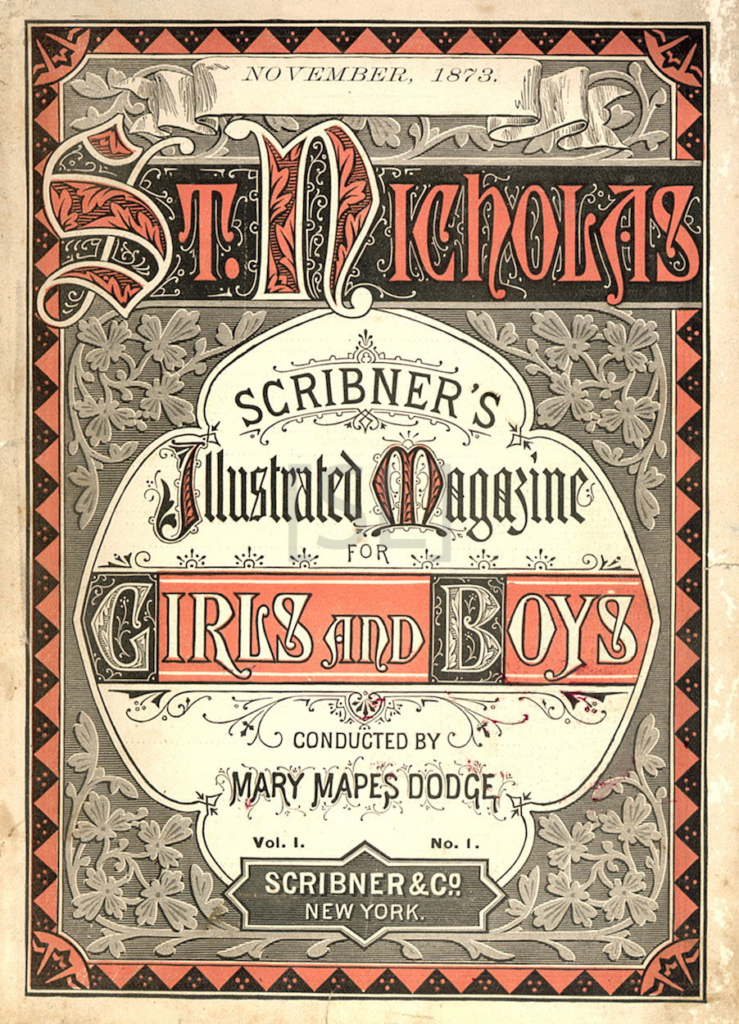
The Periodical Collection of Steven Lomazov, St. Nicholas: Scribner’s Illustrated Magazine for Girls and Boys, Front Cover (November 1873), via https://www.americanmagazinecollection.com/st-nicholas-scribners-illustrated-magazine-for-girls-and-boys-2/.

By special invitation, the Research Group on Manuscript Evidence prepares to visit the private collection of Dr. Steven M. Lomazow — neurologist, book-collector, member of The Grolier Club, author, bibliographer, raconteur, and curator of exhibitions from his collection assembled over half a century. By design, this in-person visit by the RGME to his home in West Orange, New Jersey, might gather other Princeton bibliophiles and students, as our organization combines interests, resources, and organizational skills with other groups in the Princeton area and beyond, according with our traditions for in-person and online events alike.

Mindful also of responsibility to our wider audience, as customary, the RGME will provide a hybrid approach to this occasion, with a virtual component for part of the curated visit, so that parts of our wider community might attend from a distance by Zoom allowing for discussion and feedback.

Grateful for the invitation, we look forward to the visit with its opportunity for a curated tour of an extraordinary collection for many interests assembled over more than fifty years.

The Plan on the Day

We aim to arrive at the Lomazow Collection about 11:00 or 11:30 am EST (GMT-5), mindful of traffic conditions between our base at Princeton (or elsewhere for other attendees) and the location of the collection. The online component of the visit might commence at about 12:30 pm, in time for the introduction to the collection.

First, Dr. Lomazow and his wife will host a welcoming repast catered at home from a renowned bagel shop. We would ask attendees for dietary requirements.

Next, Steven will give an introduction to the collection, the materials, and their discoveries. This account would set the stage by describing the collection, how it grew, what it contains, how widely it reaches into spheres of history, literature, popular culture, and more, and how it is arranged — by groups of materials and by their size, each in alphabetical order for ease of discovery and consultation.

Then we would be able to visit the different rooms, examine their original materials, ask questions, and enter into conversations about the varied aspects of these original sources and their contexts. Thus we might learn from the materials and from each other while engaging with the original sources. Whether in person or virtually, we might count those encounters in real time as Break Out Rooms for the visit, with tailored focus for specific items, genres, and subjects.

We would end at about 5:00 pm, although perhaps some of us might remain for discussion until about 7:00 pm.  The span is subject to exploration governed by numbers and interests of attendees.

For transportation from Princeton and back again, we could explore alternatives.  Depending on interest and timetables, some of us might wish to drive; depending on numbers, transportation might be arranged. Please let us know your preferences and watch this space for developments as the preparations advance.

What would you like to see?  Given this generous opportunity, it might be difficult to single out specific magazines, dates, or genres, because the range of the collection is so extraordinarily varied, with something for almost everyone’s taste, and with very much for historical and cultural study. What might you choose?

The Collector

Steven Lomazow, M.D., is a board-certified neurologist in practice for 43 years.

His published works on bibliophilic and related subjects include series of reference works, celebrations of the collection, and monographs on presidential medical-historical subjects.

Looking forward to conversations with and feedback from our varied audience, both expert and general, Dr. Lomazow offers this special occasion with the RGME for opportunities to examine his varied collections and learn about them, in conversation with the knowledgeable collector. A variety of publications, in print and online, present the materials and reference perspectives on their context.

Books, Blogs, Catalogues, Exhibitions, and Virtual Exhibitions

    • Magazines and the American Experience:
      Highlights from the Collection of Steven Lomazow, M.D.
      americanmagazinecollection.com
  • Magazine History: A Collector’s Blog Documenting and illustrating the history, importance and the joy of collecting magazines
  • American Periodicals: A Collectors’ Guide and Reference Manual (West Orange, New Jersey: Lomazow, 1996)
  • The Great American Magazine: Adventures in History. Selections from The Steven Lomazow Collection of American Periodicals (West Orange, New Jersey: Lomazow, 2014)
  • Steven Lomazow et al., Magazines and the American Experience: Highlights from the Collection of Steven Lomazow, M.D.  A Catalogue published in conjunction with an exhibition held at The Grolier Club, January 20 – April 24, 2021 (New York: The Grolier Club, 2020).

“The exhibition is presented in two sections, beginning with a chronological history of American magazines from 1733 to the present. The second is devoted to a broad spectrum of genres which address the areas of popular culture that became a major focus of American magazines in the late nineteenth and twentieth centuries, including American artists and humorists, the ongoing struggle of African Americans to achieve equality, a salute to our national game of baseball, and the development of radio, television, and motion pictures.”

  • Companion Virtual Exhibition at the Grolier Club: American Magazines

Also:

  • Steven Lomazow (with Eric Fettman), FDR’s Deadly Secret (New York: BBS Publications, 2009)
  • Fdr’s Deadly Secret: A supplement to our book dedicated to the understanding of the health of our thirty-second president
  • FDR Unmasked: 73 Years of Medical Cover-ups That Rewrote History (Amsterdam: Lugler Publications, revised edition, 2024).  FDRUNMASKED.com

What is in Store?

Dr. Steven puts it succinctly.  The collection contains

“Thousands of exquisitely rare and historically important items.

“The collection contains virtually every major magazine highlight ever published from the eighteenth century to the present and covers virtually every topic- literature, politics, technology (TV, Radio, Movies, Aviation etc). It also includes by far the largest collection of first issue pulp magazines (over 850) in existence. Any institution or individual that acquires it will immediately become one of the leading repositories of American popular culture. . . . There are hundreds of feet of shelves occupied by bound volumes and individual issues.”

— Magazine Collection for Sale (2011)

Many items are destined for exhibition and perhaps transfer to other institutions.  This visit offers an in-depth opportunity to examine them on display in situ in the company of the collector, who has built an exceptional collection of a variety of genres, including American magazines from their beginnings, patriotic magazines in World War II, and more.

Registration

Registration is required for attendance, whether in person or online by Zoom. Numbers of attendees for the at-home visit are limited; in case of need, we will create a Waiting List.

Registration is free. We welcome voluntary donations for our section 501(c)(3) nonprofit educational organization equipped with slim financial resources and powered principally by volunteers with donations in funds and contributions in kind. Such donations help to sustain and foster our mission and activities.  Your donations may be tax-deductible to the fullest extent permitted by law.

Please register through the RGME Eventbrite Portal, which presents all our Collections of events. Here are the ways to register for the visit in hybrid formats.

1) To attend In Person

  • In Person Visit to the Collection of Steven Lomazow M.D.

2) To attend Online by Zoom

  • Virtual Visit to the Collection of Steven Lomazow M.D.

After you register for online attendance, you will be sent the Zoom Link a few days before the event.

Questions or Suggestions?

Do you have special requests for materials you would like to see in the collection during the visit? Questions for the collector? Would you like to share your experiences with growing up with American magazines?

Please Contact Us or visit

  • our FaceBook Page
  • our Facebook Group
  • our Twitter Feed (@rgme_mss)
  • our Bluesky nest @rgmesocial.bluesky.social)
  • our LinkedIn Group
  • our Blog on Manuscript Studies and its Contents List

We look forward to hearing from you.

*****

Update: Having successfully accomplished the visit, we offer a report. See

  • RGME Visit to the Lomazow Collection: Report

See also:

  • 2024 Landmarks

We give thanks to Dr. Lomazow, his wife Suze Bienaimee, the SFPUL, Jacqueline Zhou, Kurt Lemai, our online audience, and others for a wonderful collective experience.

The Periodical Collection of Steven Lomazov, St. Nicholas: Scribner’s Illustrated Magazine for Girls and Boys, Front Cover (November 1873), via https://www.americanmagazinecollection.com/st-nicholas-scribners-illustrated-magazine-for-girls-and-boys-2/.

Note on the Image. The long-lived St. Nicholas Magazine was launched in 1873, with the redoubtable Mary Mapes Dodge (1831–1905) as its first editor and many prominent authors as contributors during its period of circulation until 1940. From the Lomazow Collection, we glimpse the cover of the first issue.

Of the editor’s skills it is related:

She was able to persuade many of the great writers of the world to contribute to her children’s magazine – Mark Twain, Louisa May Alcott, Robert Louis Stevenson, Alfred, Lord Tennyson, Henry Wadsworth Longfellow, William Cullen Bryant, Oliver Wendell Holmes Sr., Bret Harte, John Hay, Charles Dudley Warner, Elizabeth Stuart Phelps Ward, and scores of others. One day, Rudyard Kipling told her a story of the Indian jungle; Dodge asked him to write it down for St. Nicholas. He never had written for children, but he would try. The result was The Jungle Book.

— Mary Mapes Dodge

Of especial interest to the RGME in its Anniversary Year is the first appearance in this magazine of the tale of The Little Red Hen, in its original form in a publication in English. This fable, in its original unadulterated form, serves as useful model for the RGME as goal for collaborative work and its practices or processes.

*****

Tags: American Magazines, History of Magazines, Popular Culture, RGME Anniversary, RGME Visits to Collections, Steven Lomazow Collection
No Comments »

2024 Anniversary Survey

August 14, 2024 in Announcements, Manuscript Studies, Surveys

RGME
2024 Anniversary Survey

[Posted on 14 August 2024]

In our 2024 Anniversary Year, we invite you to fill out a short Survey, to gather feedback and help us guide future activities of the Research Group on Manuscript Evidence. In tune with the year’s Theme of Bridges, the Survey builds a bridge between the organizational groundwork of the RGME and our audience near and far, as we move toward the future. The Survey is open to all.

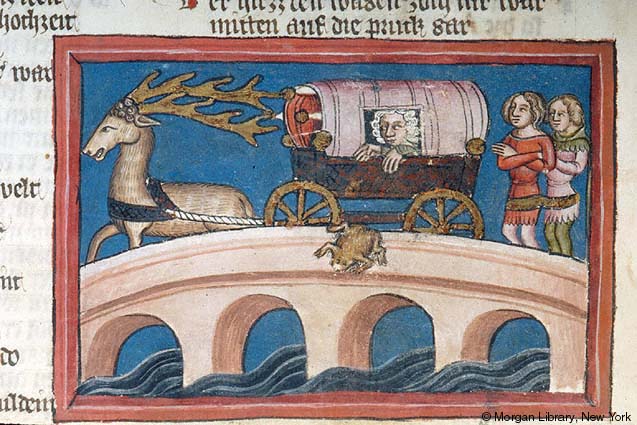
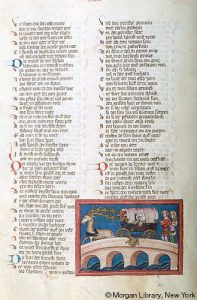
New York, Morgan Library & Museum, MS M.769, fol. 305v, detail. (Weltchronik or World Chronicle, Regensburg, Germany, 1360). Image © Morgan Library, New York, via https://ica.themorgan.org/manuscript/page/215/143938

The Goals

The results would aid us to learn about your interests and wishes as we:

  1.  launch the Friends of the RGME with meetings, competitions, and prizes to welcome our wider community;
  2.  prepare for our Anniversary Episode in September to celebrate “RGME Retrospect and Prospects” (Episode 17 of our online series “The Research Group Speaks”); and
  3.  assemble an Anniversary Anthology to celebrate our our 2024 Anniversary Year as part of our program of RGME Publications.

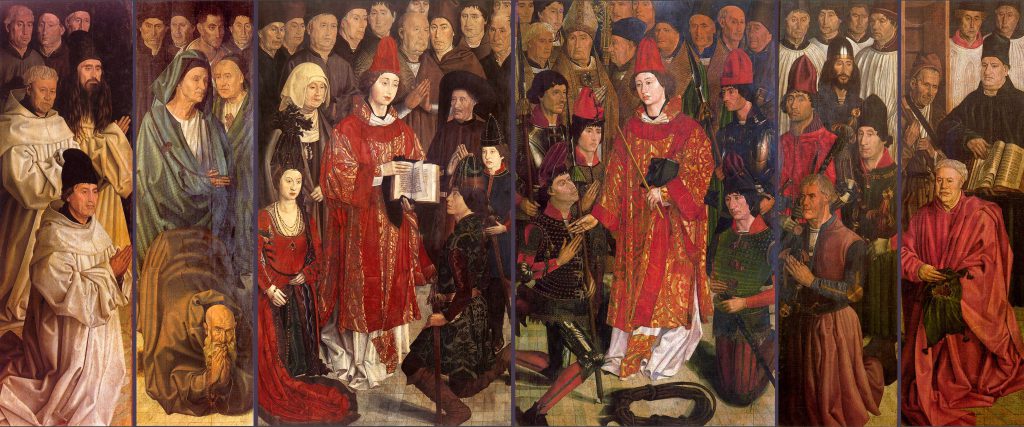
Lisbon, Museu Nacional de Arte Antiga: The mid 15th-century Saint Vincent Panels, attributed to Nuno Gonçalves. Image (https://upload.wikimedia.org/wikipedia/commons/3/3a/Nuno_Gon%C3%A7alves._Paineis_de_S%C3%A3o_Vicente_de_Fora.jpg) via Creative Commons.

We welcome your suggestions and feedback.

Please note that this Survey is designed to gather feedback for our in-house use, to guide our planning better attuned to our community.

Respecting privacy and confidentiality, we might at some time report aggregate views from the Survey, but without giving names. Please feel free to give your responses in confidence.

Please join our explorations of RGME identity, purpose, impact, and futures as we reflect on past accomplishments and explore new content ideas for the direction of future symposia, meetings, and publications.

2024 Survey

The short survey should take less than ten minutes to complete.

Methods

We offer the 2024 Anniversary Survey in two forms, for respondents with or without access to Google Workspace.

  • as an interactive Google Form
  • as a downloadable Word Document
    Please send this completed form in Word as an email attachment 1) to rgme.surveys@gmail.com or 2) by mail to the RGME at 46 Snowden Lane, Princeton, New Jersey, 08540, U.S.A.

Questions or difficulties with the form(s)? 

Ask us!  Let us know via rgme.surveys@gmail.com.

Due Date

A choice of two dates gives the chance first to gather feedback before Episode 17 on 21 September 2024, and then to allow responses from that Episode.

First and Second Rounds

  1. Florence, Italy, Ponte Vecchio from Ponte alle Grazie. Photo: Ingo Mehling, CC BY-SA 4.0 , via Wikimedia Commons

    Florence, Italy, Ponte Vecchio from Ponte alle Grazie. Photo: Ingo Mehling, CC BY-SA 4.0 <https://creativecommons.org/licenses/by-sa/4.0>, via Wikimedia Commons

    Please aim to complete the Survey by Wednesday, 18 September 2024 at midnight EDT (GMT-4), when its First Round will close.

  2. A chance to complete the Survey in a Second Round will remain open until Sunday, 23 September 2024 at midnight EDT, to give scope to offer feedback after our reflective and celebratory Episode 17.

Thanks

We are grateful for your time and input, and we thank you for your suggestions.

Our Survey Series

New York, Morgan Library & Museum, MS M.769, fol. 305v (Weltchronik or World Chronicle, Regensburg, Germany, 1360). Image © Morgan Library, New York, via https://ica.themorgan.org/manuscript/page/215/143938

This Survey compliments, and advances from, the Surveys respectively for our Editorial Committee and Participants designed by our Associate Jessica L. Savage in 2022.

A report by our Editorial Team about the 2022 RGME Surveys appears in Issue 2 of our eNewsletter ShelfMarks.

  • ShelfMarks, Issue 2 (Volume 2 Number 1 for Winter 2022-2023)

We warmly thank Jessica for her generous contributions to our mission and planning for activities. They are manifested, for example, in those Surveys, which inspired our 2024 Anniversary Survey designed by our Editorial Team this year, including both our

  • Intern Executive Assistant/Associate Hannah Goeselt
    and
  • Intern Executive Assistant Zoey Kambour.

Hannah and Zoey joined these positions in 2024, as part of:

  • our 2024 Project “Between Past and Future” and
  • our co-sponsored Workshop on “Medieval Women’s Networks”.

We give thanks for the advice for the 2024 Survey from the RGME Editorial Committee and other Advisors.

We look forward to learning your responses to our 2024 Anniversary Survey.

Questions? Suggestions?

  • Please leave your comments or questions below
  • Contact Us
  • Send a note to director@manuscriptevidence.org or RGMEevents@gmail.com

Visit our Social Media:

  • our FaceBook Page
  • our Facebook Group
  • our Twitter Feed (@rgme_mss)
  • our Bluesky nest @rgmesocial.bluesky.social)
  • our LinkedIn Group

Join the Friends of the RGME. Send your favorite recipe for Lemonade (and perhaps its Story) for our Competition.

Register for our Events by the RGME Eventbrite Collection.

Iron bridge over the Sava river at Radeče (IG. GRIDL fabrik, 1894). Photograph Petar Milošević (29 September 2020), CC BY-SA 4.0 <https://creativecommons.org/licenses/by-sa/4.0>, via Wikimedia Commons

*****

Tags: 2024 Anniversary Survey, Bridges, Friends of the Reaearch Group on Manuscript Evidence, RGME Anniversary, Survey, The Research Group Speaks
No Comments »

Knowledge Games and Games of Knowledge: An RGME Session for IMC 2025

August 13, 2024 in Announcements, Call for Papers, Conference, Events, International Medieval Congress, Leeds, Manuscript Studies

Call for Papers
“Knowledge Games and Games of Knowledge:
A Global Perspective on
How Manuscripts Conserve and Transmit Ludic Knowledge”

Session
Sponsored by the RGME
IMC Leeds 2025

Organised by Michael A. Conrad
(University of Sankt-Gallen)

[Posted on 13 August 2024]

Following the success of our Inaugural Session at the International Medieval Congress this year, the Research Group on Manuscript Evidence announces its proposed Sessions for the International Medieval Congress to be held at the University of Leeds from 1–10 July 2025.

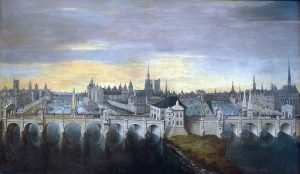
Paris, Musée Carnavalet, Projet pour le Pont Neuf, circa 1577. Image via Wikimedia via Creative Commons Attribution 3.0 Unported.

Background: 2024

Our 2024 Inaugural Session, co-organised by our Associates Ann Pascoe-van Zyl and Michael Allman Conrad, focused on “Building Bridges ‘Over Troubled Waters'”:

  • 2024 International Medieval Congress at Leeds: 2024

Foreground: 2025

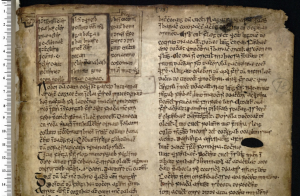
Dublin, Royal Irish Academy, MS 23 E 25, p. 73, top. Image via https://codecs.vanhamel.nl/Dublin,_Royal_Irish_Academy,_MS_23_E_25 via Creative Commons (CC BY-SA 3.0).

For 2025,with the IMC’s Thematic focus of “Worlds of Learning”, the RGME proposes an integrated suite of events comprising a pair of Sessions of papers plus a Roundtable discussion on “Manuscripts as Worlds of Learning”.

  • 2025 International Medieval Congress at Leeds: Call for Papers (Manuscripts as Worlds of Learning)

In addition, following up on a strand in our 2024 Inaugural Session, the RGME also proposes a sponsored session organised by that session’s co-organizer and presenter, Michael Allman Conrad.

The Plan for the Session

“Knowledge Games and Games of Knowledge:
A Global Perspective on
How Manuscripts Conserve and Transmit
Ludic Knowledge”

Recent scholarship has pointed out time and again how much in the Middle Ages games and other joyful pastimes were not only cherished and accepted as an essential part of everyday life, but also well appreciated as educational tools for making difficult lessons more palatable for students.

Some of these educational games have a long tradition, such as rithmomachia, which was used in schools for instruction in the quadrivial arts and still known by scholars of the 17th century. Some disciplines, such as astronomy, even had their own games — in this case, for example, the ludus astrologicus. The knowledge of such elaborate games was transmitted through manuscripts, often as part of miscellanies. Besides, there is no lack of writings dedicated to more profane games either. In fact, there are collections of board games (and other pastimes), with some of these manuscripts showing very rich and ornate embellishments and game diagrams, along with vivid miniatures depicting players in action.

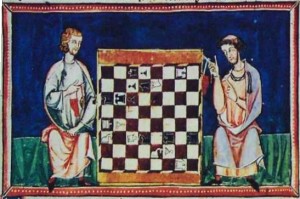
Madrid, Real Biblioteca del Monasterio de El Escorial, MS T-I-6, folio 27 verso. Image in the Public Domain, Via Wikipedia Commons.

Madrid, Real Biblioteca del Monasterio de El Escorial, MS T-I-6, folio 27 verso. Image in the Public Domain, Via Wikipedia Commons.

Examples of such works include

  • the Book of Games (Libro de acedrez dados e tablas c. 1284) by Alfonso X of Castile, in the Bonus Socius group (13th century?),
  • the Paris manuscript of Le jeu de echecs by Nicola de S. Nicholai (Paris, Bibliothèque nationale de France (BNF), MS fr. 1173, 14th century),
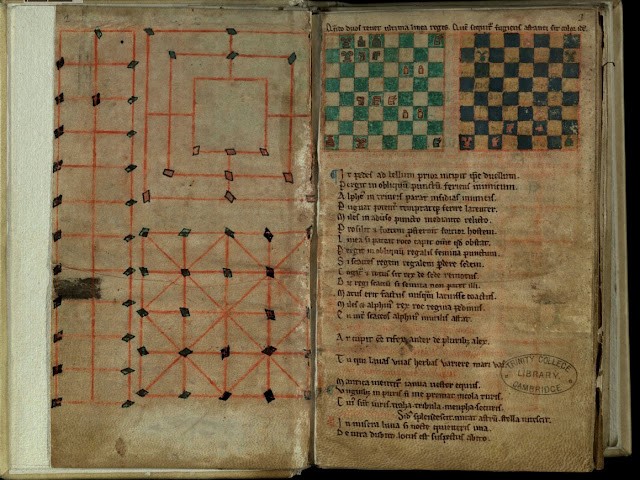
  • as well as lesser-known manuscripts, such as Cambridge, Trinity College, MS O 2.45 (after 1248 AD).

The book medium, however, poses serious challenges to scribes concerned with conserving and conveying knowledge related to games and other pastimes, as their existence is ephemeral and their experience difficult to verbalize — which is a reason why in the (Arabic and European) tradition medieval books on games usually came with said pictures and diagrams, with the intent to compensate for what cannot be easily expressed through words alone. What is more, in medieval writings on games their epistemological status often remains ambivalent and uncertain, as they were often touted as morally ambiguous and did not fit existing knowledge systems. That said, there nonetheless were some scholars that tried to fit ludic knowledge into prevalent eschatological framework of knowledge, such as Hugh of Saint-Victor, with some of them basing their (re-)assessments of the morality and epistemic status of games and other forms of entertainment on Arabic and Greek influences.  As reaffirmed by Hugh and in the work of Thomas Aquinas, the Latin concept of ludus could not only serve as an umbrella term for various kinds of games, but all forms of entertainment.

While the focus of the proposed Session is games, the evocation of ludic knowledge is intended as an invitation to different kinds of pastimes in order jointly to examine how medieval scholars dealt with game-related forms of knowledge, from material objects to their metaphysical and anthropological relevance. Especially the latter implies and extends the perspective towards practices employing games and other pastimes methodologically for educational purposes. Consequently, the geographical scope is not restricted to the European sphere. On the contrary, since there is strong evidence that European game manuscripts drew much from Arabic and other non-Latin traditions, contributors focusing on the Byzantine Empire, the Islamic world, India, or other cultural world regions are very much welcome and encouraged to partake.

Some possible questions could be (but are not limited to):

  • What do we know about the authorship of game manuscripts?
  • Are the works written by single individuals or collectives?
  • In what types of miscellanies do writings on games and game manuals appear and why?
  • How do manuscripts/authors deal with ephemeral aspects of games and other pastimes that are difficult to be expressed linguistically?
  • How can we reconstruct the concrete educational practices wherein games and other pastimes were used?
  • What hints thereof can we find in the material evidence of manuscripts?
  • How do authors try to systematize ludic knowledge and where do they position it within given epistemic frameworks?
  • What can we say about the relationship between game diagrams and diagrammatic representations in scientific disciplines in terms of a shared visual vocabulary?

Cambridge, Trinity College, MS O.2.45, fols 2v-3r. Image copyright the Master and Fellows of Trinity College, Cambridge, via CC-NY 4.0.

Note on the Image

Cambridge, Trinity College, MS O 2.45 (after 1248 AD), folios 2v and 3r. Accompanying the text, diagrams and illustrations depict two chess boards, an alquerque, a nine-mens-morris and a daldøsa game board. The first moves of the game are already played.

Image © the Master and Fellows of Trinity College, Cambridge, via License CC BY-NC 4.0 via Trinity College Cambridge.

Proposals

For information about submitting your proposals for our Sessions, please see the CFP for our companion suite for IMC 2025:

  • 2025 International Medieval Congress at Leeds: Call for Papers (Manuscripts as Worlds of Learning)

Deadlines for Proposals

  • 5 September 2024 for your individual paper proposals for our RGME Sessions and Round-table Discussion
  • 30 September 2024 for the RGME to complete and submit its programmes.

To prepare your proposals, see the IMC instructions

  • How to Submit a Proposal

Send your proposals for our Session to us at

  • rgme.imc.sessions@gmail.com by 5 September 2024

When your proposals are accepted, we will direct you to submit them through the

  • IMC-Leeds Confex Submission Portal

Spread the Word

Look for our RGME CFPs on the IMC 2025 website:

  • IMC 2025 Padlet Page

Questions and Suggestions?

If you wish, please:

  • add your Comments here,
  • send us a message (Contact Us),
  • visit our Facebook Page and Facebook Group,
  • join the Friends of the Research Group on Manuscript Evidence (there is no charge), and
  • register for our events on our RGME Eventbrite Portal:
    RGME Eventbrite Collection

*****


Tags: Alfonso X of Castile, Board Games, Book of Games, Chess, Games in the Middle Ages, History of Board Games, Jeu des echecs, Le jeu de echecs, Ludus astrologicus, Manuscript studies, Quadrivia, Rhythmomachy
No Comments »

Patrick Wormald (1947–2007): A Memoir by David Ganz

August 12, 2024 in Announcements, Bembino, Manuscript Studies, Memoirs, Research Group Episodes for The Research Group Speaks, Research Group Speaks (The Series)

Patrick Wormald (1947–2007):
A Memoir by David Ganz

2024 RGME Anniversary Recollections
Part 2

[Posted on 12 August 2024]

Patrick Wormald at one of Wendy Davies’s charter weekends of the Bucknell group at Bucknell, Shropshire, in the late 1980s. Photograph by Rosemary Morris.

Our series of 2024 Anniversary Reflections continues its tributes for people who have contributed to our formation, progress, and the mission over the years.

Part 1 focused on Giles Constable (1929—2021), RGME Honorary Trustee, Colleague, Friend, and Mentor.

  • Recollections for the 2024 RGME Anniversary, Part 1: Giles Constable

Part 2 turns to our long-term Associate Patrick Wormald (1947–2007), Angl0-Saxon Legal Historian, with a Memoir by our Trustee David Ganz. We offer it as a booklet freely for download.

Anniversary Reflections

In 2024, with our year’s theme of Bridges, the RGME celebrates:

  • 25 years as a nonprofit educational organization incorporated in Princeton, New Jersey, and
  • 35 years as an international scholarly organization founded as part of a major research project on “Anglo-Saxon and Related Manuscripts” at The Parker Library of Corpus Christi College in the University of Cambridge in the United Kingdom.

Among the ways to mark our anniversary, the RGME continues with its series of Memoirs (including these Parts 1 and 2 in 2024) and prepares an Episode in our online series “The Research Group Speaks” to consider

  • Episode 17. “RGME Retrospect and Prospects: Anniversary Reflections”

To register:

  • Episode 17. Retrospect and Prospects: Anniversary Reflections
    Saturday 21 September 2024, 1:00–2:30 EDT (GMT-4) online via Zoom

The Episode aims to include recollections of people who have gone before us, and whose memory we wish to honor with informal conversation and a roundtable.

Memoir of Patrick Wormald
Angl0-Saxon Legal Historian

In preparation for the Episode in September 2024, David Ganz has offered this Memoir.

“The Schartz–Metterhulme Method:
A Memoir of Patrick Wormald (1947–2007)”
by David Ganz

David began its composition years ago, following the Memorial Service for Patrick in Oxford.  He returned to it recently for us in preparing for our Episode 17.  Additions for the publication include

  • photographs of Patrick, generously provided by Rosemary Morris;
  • David’s description of Patrick’s attention to and use of manuscript evidence and contributions to some RGME events;
  • bibliographical references; and
  • an Afterword by Mildred Budny.

The title takes its name from a short story with that name by Saki, the pen name of Hector Hugh Munro (1870–1916). First published in 1911, “The Schartz—Metterklume Method” appeared in the volume of Beasts and Super-Beasts (1914).

In conjuring up the world and horizons of historians at Oxford in an earlier generation when Patrick Wormald embarked upon his studies, giving shape to their pursuit across a lifetime at the University of Oxford and elsewhere, the Memoir by David Ganz offers perspectives from a near-contemporary of that life’s work, which continued to engage with various of those historians and their antecedents, not least Frederic William Maitland (1850–1906). The Memoir signals Patrick’s attention repeatedly to the evidence of manuscripts, as part of his research, teaching, and publications. Some of his publications long-planned found fruition posthumously after Patrick’s death too soon at the age of fifty-seven.

We publish this Memoir as an RGME Publication, following the principles of our Style Manifesto, set in our digital font Bembino, and freely available for circulation.  (For information about download or printed copies, see below.)

Patrick Wormald on a charter weekend at Bucknell, Shropshire, in the late 1980s. Photograph by Rosemary Morris.

Read the rest of this entry →

Tags: All Soul's College, Anglo-Saxon legal history, Christ Church University of Oxford, David Ganz, Elizabeth A.R. Brown, Frederic William Maitland, Memoirs, Oxford Historians, Patrick Wormald, Peggy Brown, RGME Anniversary, RGME Colloquia, RGME Seminars on the Evidence of Manuscripts, University of Glasgow, University of Oxford
No Comments »

Medieval Women’s Networks

August 4, 2024 in Announcements, Event Registration, Events, Manuscript Studies, Medieval Women's Networks

“Medieval Women’s Networks:
Exploring Tools and Techniques
for Digital Analysis”

A Pair of Interactive Public Workshops

co-organized by
Kathy Krause and Laura Morreale
and co-sponsored by the RGME

Thursday and Friday 17–18 October 2024 (Online)
12:30–14:30 pm EDT (GMT-4)

[Posted on 5 August 2024, with updates]

We gladly announce another event for our 2024 Anniversary Year.

The RGME has been invited to co-sponsor the free 2-day online event to explore and advance the swiftly developing world of work on Medieval Women’s Networks.

Co-Organizers

The event is conceived and co-organized by experts

  • Kathy Krause (University of Missouri, Kansas City, Emerita)
  • Laura Morreale (Independent Scholar and Middle Ages for Educators)

Laura, our RGME Associate, gave a presentation for our 2024 Anniversary Symposium “Manuscript Heart” in February. This coming event joins a series of collaborative events and projects which she helps to organize, accomplish, and publish.

We are glad to join forces with Kathy and her and all the co-sponsors for Medieval Womens’ Networks.

Co-Sponsors

To be held online, the event is co-sponsored by

  • Center for Digital and Public Humanities, the University of Missouri Kansas City
  • Digital Medievalist
  • the Research Group on Manuscript Evidence
  • and a generous Anonymous Benefactor.

UMKC Center for Digital and Public Humanities Logo

Logo of the Research Group on Manuscript Evidence (colour version)

RGME Logo

Digital Medievalist Logo

Dates

The Interactive Public Workshop will take place over two days, in sessions devoted respectively to

1) Projects. Thursday 17 October 2024
2) Data. Friday 18 October 2024

Each session is scheduled for 12:30–2:30 pm EDT (GMT-4) online.

For information see the flyer, shown here, and links below.

“Medieval Women’s Networks” Flyer.

Participants

Speakers and Digital Humanities Experts come from an international variety of centers and perspectives.

Speakers for Workshop 1: Projects

  • Adrienne Williams Boyarin (University of Victoria)
  • Elena Brizio (Georgetown University)
  • Tracy Chapman Hamilton (Sweet Briar College)
  • S.C. Kaplan (University of California, Santa Barbara)
  • Samantha Katz–Seal (University of New Hampshire)
  • Mariah Proctor–Tiffany (University of California, Long Beach)
  • Yvonne Seale (State University of New York, College at Geneseo)

Digital Humanities Experts for Workshop 2: Data

  • Kalani Craig (Indiana University)
  • Erin McCarthy (Saint Lawrence University)
  • Jeffrey Rudberg–Cox (University of Missouri, Kansas City)
  • Sébastien de Valeriola (Université libre de Bruxelles)

Information and Registration

To register please visit the Event registration form via Google Docs, where can also be found online information.

1. Event registration
2. An online information sheet
If Google Workspace is not accessible to you, please contact us. (See below.)
The Event flyer is available for download on the RGME website in two formats:
  • DHWomenFinalFlyer3 (pdf)
  • Medieval Women’s Networks Flyer (jpg)

London, British Museum, Additional MS 10292, fol. 149r. Prose Lancelot-Grail. Saint Omer or Tournai, 1316. Image © The British Library.

We thank the co-organizers and co-sponsors of Medieval Women’s Networks for the opportunity to join the carefully-prepared program for this outstanding event.  We look forward eagerly to it.  We invite you to join it!

*****

Other RGME-sponsored Events
for our 2024 Anniversary Year

  • 2023 and 2024 Events
  • Episode 17. “RGME Retrospect and Prospects: Anniversary Reflections (Saturday 21 September, online)
  • 2024 Autumn Symposium “At The Helm” (Friday and Saturday 25-26 October 2024, online)
  • Episode 18. “Women as Makers of Books” (Saturday 14 December 2024, online)

To register for these sponsored events, please visit the RGME Eventbrite Collection:

  • RGME Eventbrite Registration Portal

An RGME Bulletin Board

Ronda, Galicia, Spain, Puente Nuevo Bridge. Photograph 14 August 2007 by Mark Gilbert. Image: Judas6000 at English Wikipedia, CC BY 3.0 <https://creativecommons.org/licenses/by/3.0>, via Wikimedia Commons at https://commons.wikimedia.org/wiki/File:Punte_Nuevo_Bridge,_Ronda_-_Spain.jpg.

The co-sponsorship for Medieval Women’s Networks leads the RGME to open a new page on our website for news about activities, projects, conference papers, publications, and initiatives by people of the RGME.  Functioning as a form of bulletin board with announcements, it appears here:

  • Around and About with the RGME

First up, with an announcement by Laura Morreale, is the Sweet 16 Competition launched by the Princeton-based Middle Ages for Educators (MAFE). The due date for proposals is 1 October 2024.

Questions? Suggestions?

  • Leave your comments or questions below
  • Contact Us

Visit our Social Media:

  • our FaceBook Page
  • our Facebook Group
  • our Twitter Feed (@rgme_mss)
  • our Bluesky nest @rgmesocial.bluesky.social)
  • our LinkedIn Group

Join the Friends of the RGME.

Consider making a Donation in Funds or in Kind for our nonprofit educational corporation powered principally by volunteers. Your donations and contributions are welcome, and can go a long way. They may be tax-deductible to the fullest extent provided by the law.

  • Donations and Contributions
  • 2024 Anniversary Appeal

Remember to register for “Medieval Women’s Networks” for 17–18 October 2024 (see above). See you there!

*****

Tags: Center for Digital and Public Humanities, Digital Medievalist, Interactive Public Workshop, Medieval Women's Networks, RGME Anniversary, RGME Anniversary Year, University of Missouri Kansas City
No Comments »

2025 International Medieval Congress at Leeds: Call for Papers

August 1, 2024 in Announcements, Call for Papers, International Medieval Congress, Leeds, Manuscript Studies

2025 International Medieval Congress
at Leeds:
Call for Papers

“Manuscripts as Worlds of Learning”
(2 Sessions + Roundtable)

32nd Annual IMC
Monday to Thursday 07–10 July 2025
(with In-Person and Virtual Components)

Deadline for your Proposals for Papers: 5 September 2024

Dublin, Royal Irish Academy, MS 23 E 25, p. 73, top. Image via https://codecs.vanhamel.nl/Dublin,_Royal_Irish_Academy,_MS_23_E_25 via Creative Commons (CC BY-SA 3.0).

[Posted on 1 August 2024, with updates]

Building upon the successful completion of our RGME Inaugural Session at the International Medieval Congress (IMC) at the University of Leeds in July 2024, we announce the Call for Papers (CFP) for our activities at next year’s Congress.

For information about the Congress, see

  • its official website,
  • instructions about submitting proposals via their Congress Confex Portal, and
  • the IMC 2025 Call for Papers Padlet page, which shows organised sessions that are advertising for papers, including Twitter/X posts tagging @IMC_Leeds.

Note that the general deadline for individual papers without specified sessions in a general pool is 31 August 2024.

The deadline for proposals for our RGME-sponsored Sessions is 5 September 2024.  Please send your proposals directly to us as organisers; we will select the programmes by their deadline of 30 September 2024.  (Instructions below.)

“Worlds of Learning” at Leeds in 2025

Next year’s Thematic Focus for the IMC is “Worlds of Learning”. The broad scope is described in the general Call for Papers: IMC 2025 – ‘Worlds of Learning’.

We invite you to submit proposals for a set of interlinked events planned for the Research Group on Manuscript Evidence (RGME) to focus on the power and potential of manuscripts to contain, convey, and embody worlds of learning within their span.  In effect, given their structure and contents, as we approach them as beholder, user, reader, student, teacher, or admirer, they may carry worlds in our hands.

How might medieval manuscripts do so, variously for their medieval audience, later intermediaries, and our own times? How might and do they function as “Worlds of Learning” in their own right/write?  We explore.

Update (14 August 2024): As interest grows, we plan several sessions for the 2025 IMC.

In another post, we present a Session with Papers devoted to “Game Knowledge and Knowledge of Games”, which follows up a strand in our RGME Inaugural Session this year.

  • “Knowledge Games and Games of Knowledge”: An RGME Session for IMC 2025

Here we present a suite of events containing two Sessions with Papers accompanied by a Round Table with Discussion, all dedicated to “Manuscripts as Worlds of Learning”.

Read the rest of this entry →

Tags: 'Commonplace Books', Authority Texts, Biblical Commentaries, Classbooks, History of Pedagogy, Instruments of Learning, International Congress on Medieval Studies, International Medieval Congress, Lebor na hUidre (LU), Legal Commentaries, Manuscript Miscellanies, Manuscript studies, Pedagogy, RIA MS 23 E 25, Worlds of Learning
No Comments »

Memoirs

July 23, 2024 in Announcements, Bembino, Manuscript Studies, Memoirs, Research Group Speaks (The Series), RGME Recollections, RGME Symposia, Seminars on Manuscript Evidence

Remembering
Those Who Have Gone Before

[Posted on 22 July 2024]

In our 2025 Anniversary Year, the Research Group on Manuscript Evidence reflects on people who have gone before us and whom we wish to recollect as companions or mentors, advisers, colleagues, and friends contributing to the origins, history, and growth of our organization across the years.

Part of that process has yielded the formation of our own nonprofit educational publishing house.  Our books and booklets in printed form and digital formats include Memoirs, to which we add this year.

1. Oleg Andreevich Grabar

The first of these Memoirs appeared quietly in 2015 as a 4-page booklet.  It offers a Memorial for Oleg Grabar, art historian and archaeologist:

In Memory of
Oleg Andreevich Grabar
[Олег Андреевич Грабар]
(3 November 1929 – 8 January 2011)

Composed by Leonid A. Beliaev, the text was published first in Russian. By request, it was translated from the Russian into English, set in multi-lingual RGME Bembino, provided with a photograph by permission, and laid out as a booklet corresponding with our RGME Style Manifesto.

Although Oleg did not participate in RGME activities, he generously gave advice for our research over several years while our Director worked as a part-time research assistant for his colleague Giles Constable (see below).  The translation and publication of the English version of the Memoir in Russian were carried out for its author, an RGME Associate, at the request and with the assistance of a long-term supporter and advisor of the RGME.  Note that the RGME font Bembino supports the Cyrillic font appropriate for portions of the text of the published Memoir.

The booklet can freely be downloaded:

  • Memorial for Oleg Grabar.

*****

2. Vivien Anne Law

For our blog on Manuscript Studies, in 2014 our Director, Mildred Budny, provided a blogpost called Memorials.  Principally it shares recollections of friend, colleague, and long-time RGME participant (first as Associate of our international scholarly organization in England and then as Trustee of our non-profit corporation), Vivien Anne Law (1954–2002). This forms part of a larger report or Memoir responding, in part, to the opportunity to examine and advise on Vivien’s archives in late 2005 at the request of her widower, Sir Nicholas Shackleton (1937–2006).

Our Director’s paper for our 2002 Colloquium at the British Museum in London in March (a month after Vivien’s death) is dedicated to her memory, as well as that of another, dear, friend and mentor.

  • 2002 Colloquium on “Shaping Understanding: Form and Order in the Anglo-Saxon World (400–1100)”.
Vivien Law in her Garden in Cambridge, England,June 1996 Photograph © Mildred Budny

Vivien Law in her Cambridge Garden in June 1996 (Photograph © Mildred Budny)

*****

3. Giles Constable

Also for our blog Manuscript Studies, this year we posted a set of recollections about of Giles Constable (1 June 1929 — 17 January 2021), friend, colleague, mentor, and RGME Associate and Honorary Trustee.  These recollections do not comprise an obituary as such, because Giles often and firmly expressed his wish for no such thing, nor any Memorial Service or Festschrift for him in his honor.

Instead, after an interval of mourning, we record appreciation for his contributions as a presence and guiding force for our organization since its early years in the United States, following the move of our principal base from the United Kingdom to Princeton, New Jersey, in October of 1994.

  • Recollections for the 2024 RGME Anniversary Year, Part 1. Giles Constable.
Giles Constable reading in his office at the Institute for Advanced Studies. Photograph by Mildred Budny.

Giles Constable reading in his office at the Institute for Advanced Studies. Photograph by Mildred Budny.

Also, his generous encouragement of our work for manuscript studies by long-term loans or gifts made it possible closely to examine, over time, groups of original specimens of medieval manuscripts, manuscript fragments, documents, seals in metal or wax, early printed materials, bindings, and associated records.  The work included conservation, photography, research, seminars, display, and publication in our blog and other forms.

Discoveries abounded, and found expression in those publications as well as in various of our RGME events. For example:

  • 2014 Seminar on Manuscripts and Their Photographs, held at the Index of Christian Art of Princeton University in its Seminar Room.

*****

5. Patrick Wormald

Now, in preparation for our Episode 17. “RGME Retrospect and Prospects: Anniversary Reflections” in September 2024, our RGME Associate and Trustee David Ganz offers a Memoir of our RGME Associate Patrick Wormald (1947–2004).

Coffee Break at the 2002 British Museum Colloquium.

Patrick Wormald at the 2002 Colloquium

*****

In Memoriam

See also RGME Officers, Associates, and Volunteers: In Memoriam.

Another Memoir composed by our Director in booklet format, published in a limited edition:

  • “The Guessing Game:  A Memoir of My Uncle Bob, Robert Roger McEwan (1918‒2007)” (Princeton, New Jersey:  Milly Budny Designs, 2017)

*****

Others?

Are there others whom you wish to remember?  Please let us know.  Would you like to contribute a Memoir of some kind about someone you recall with appreciation and seek to record?

For example, you could Contact Us or write to the director@manuscriptevidence.org with your requests or suggestions.

*****

Episode 17 of “The Research Group Speaks”

As part of our anniversary celebrations, the RGME prepares an Episode in our online series “The Research Group Speaks” to consider our past, present, and future.

  • Episode 17. “RGME Retrospect and Prospects: Anniversary Reflections”

It will, for example, offer recollections of people who have loomed large in our history, and whom we remember with affection, admiration, and gratitude.  Among them are Giles Constable, Vivien Law, and Patrick Wormald (see above).  Please join us.

To register:

  • Episode 17. Retrospect and Prospects: Anniversary Reflections
    Saturday 21 September 2024, 1:00–2:30 EDT (GMT-4) online via Zoom

See you there?

*****

Tags: Giles Constable, Memoirs, Oleg Grabar, Patrick Wormald, Vivien Law
No Comments »

Three-Step Program, Lemonade Included

June 25, 2024 in Announcements, Design, Manuscript Studies, RGME Competition, RGME Recipes

Favorite Recipes for Lemonade

Entries Invited

A Recipe Competition
for the Friends
of the
Research Group on Manuscript Evidence

[Posted on 25 June 2024, with updates]

Los Angeles, The J. Paul Getty Museum, Jacob van Hulsdonck (1582-1647), Still Life with Lemons, Oranges, and a Pomegranate. Image Public Domain.

As we launch the new community of Friends of the Research Group on Manuscript Evidence, we consider activities which might be both welcoming and easy to organize, as well as fun.

In considering what sorts of activities the Friends might like, we thought about gatherings for conversations with refreshments.

We began to dream about coffee mornings, tea parties, cocktail parties, receptions, and the like. While our gatherings would be mostly online, some would be in-person or hybrid.  The online format would require that, in such cases, the refreshments would take the form of Bring Your Own (BYO), but we could easily share recipe tips.

Contents of the Goody Bags, with Stories and Baked Goodies created by Linda Civitello. Photograph by Hannah Goeselt.

Already some of our online events have featured recipes, including a demonstration.

  • South Italian Cuisine Before Columbus (Linda Civitello)
  • Episode 15. Women Writers from the Medieval to Postmodern Periods, including cookery books and historic recipes (Linda Civitello and Hannah Goeselt)

Our 2024 Spring Symposium in hybrid format featured a generous Goody Bag created and home-made by our Associate Linda Civitello (see also Linda Civitello), culinary historian and exclusive caterer.

  • 2024 Spring Symposium at Vassar College: Report

This experience, together with our natural interest in food and sharing refreshments with friends in good company, led to the subject of recipes, shared recipes, and refreshments. Plus competitions, with prizes.  And so, we offer a Competition.

A Three-Step Program

We call this Competition a Three-Step Program.  In three steps, it sets out a plan to feature lemons, although other citrus fruits and other comestibles might pertain, to taste.

On the Subject of Lemons

“Native to South Asia, South Asia, East Asia, Southeast Asia, Melanesia, and Australia,” the genus Citrus comprises oranges, mandarins, lemons, grapefruits, pomelos, and limes. Used, cultivated, and domesticated by indigenous cultures since ancient times in these tropical and sub-tropical regions, the cultivation spread from there “into Micronesia and Polynesia by the Austronesian expansion (c. 3000–1500 BCE); and to the Middle East and the Mediterranean (c. 1200 BCE) via the incense trade route, and onwards to Europe and the Americas.”

— See Citrus (Wikipedia)

History as Background

The RGME has had some Competitions with Prizes before.  For example, in 2015, with a book as prize, we asked for entries giving the transcription and translation into modern English for two medieval charters.  One award per charter.

Preston Charters, Faces.

Private Collection. “Preston Charters” Faces. Numbers added to the photograph report the present owner’s numbering for the set, from 5 to 7 and 9 to 13. Photograph Mildred Budny.

I was researching a group of medieval charters from a Private Collection, with discoveries about the people, places, place-names, and landscapes which they evoke at specific moments in history regarding particular locations of land in the possession of various individuals and carrying signatures (or marks) of named individuals involved in transactions regarding those lands; some of these documents retain their seals (or remnants of them) or seal-bags.  A series of blogposts ensued.

  • Full Court Preston
  • Preston Charters: The Chierographs
  • Charter the Course: More on Preston Charters

Also:

  • “Seals, Matrices, and Signatories

There came a point when I thought it might be worthwhile to open the field, and I wished for help with transcribing and translating the documents. For prizes, I chose books on medieval land-related subjects, among which the winners could choose.

I opened the competition widely as a blogpost on the RGME website, with images of the charters and instructions.  Submissions were received, an expert committee reviewed them, winners were selected, and awards were given.  The book-awards were selected and sent.  The winning translations+translations were published as a follow-up blogpost:

  • Preston Take 2

The Winner, in this case, Takes All, because one person won both competitions:  William H. Campbell.  Later he expertly organized a pair of Sessions about medieval book-bindings which the RGME co-sponsored with the Schoenberg Institute for Manuscript Studies (SIMS) at the University of Pennsylvania for the 2023 International Congress on Medieval Studies. Now he is one of our Honorary Invited Associates. (See our Officers, Associates, and Volunteers.)

Three Steps

1. Maxim: Life Gives You Lemons

2. Action: Make Lemonade (or similar)

3. Result: Send Your Favorite Recipe for our Competition

Extra Bonus: Prize Award

Our competition takes its inspiration from a predicament and its resourceful resolution.  A brief history of the proverbial phrase in English, in several manifestations, covers the ground:

  • When Life Gives You Lemons, Make Lemonade.

The general idea appears to consider lemons, whether metaphorical or tangible, as being sour, therefore difficult, adverse, unfortunate, and so on. The advised response would work to make them palatable or better, by means of some additions and operations.

We could think of it, for our present purposes, as:

  • Challenge, Response, Prize.

Step 1. Find your Lemons

Note that the Competition does not require that the recipe for “Lemonade” have Lemon fruit itself.  Substitutions are allowed, such as other Citrus fruits.  Combinations of fruits (or flowers) are also allowed.

Customarily Lemonade, by virtue of its name, depends upon or implies Lemons as the main ingredient, with sweeteners of various kinds introduced to taste (and according to waistlines). Over the centuries, across cultures, and subject to availability or preference, sweeteners might range from dates or honey to sugar, maple syrup, stevia or other sugar substitutes / artificial sweeteners, and strawberries. These components are prepared in a variety of proportions, according to varieties, such as the sweeter hybrid Meyer Lemon, strictly #notalemon, which comprises a cross between a citrus and a mandarin orange / pomelo hybrid.

Some varieties are carbonated; some are alcoholic. The latter might, say, have bourbon, whiskey, tequila, gin, vodka, or sparkling wine. Straws might make an appearance, as might ice.  Garnishes appear in many variations, such as mint or lemon slices. Presentation, vessels, and accessories for the beverage can range from rough-and-ready, at-hand, or improvised, to elaborate and/or exquisite. It can be served on its own or in the company of foodstuffs, such as cookies or other baked goods.

See also, for example:

  • Limonade (French)
  • Limonata (Italian)
  • Limonade (German)
  • Limonade (drank) (Dutch)
  • Limonada (Spanish)
  • lemonêd (Welsh)
  • Лимонад (Russian)

Elena Chockova, “Lemon – fleur et fruit” (25 November 2007). Image via Wikimedia Commons via CC Elena Chochkova, CC BY-SA 4.0, via Wikimedia Commons.

Over to You

Please Share Your Recipe

Do you have a favorite, or favorites, among the many varieties of lemonade or ‘lemonade’?

For example, do you favor your mother’s or grandmother’s recipe for Lemonade? Are there companion goodies that you think customarily should go with Lemonade?

Please let us know your favorite recipe. The instructions can be as detailed or general as you wish.

You see, we understand that some people prefer to measure ingredients precisely; others prefer the “Chuck It In” Method.

That is what I used to call my father’s approach to cooking, so it seemed to me as a young observer of his methods rarely to be seen in the kitchen.  Roughly speaking, it looked somewhat like this:

Open the Cupboard / Refrigerator; Grab whatever is there or comes to hand; Chuck It In; Stir / Cook / Bake as Indicated or as Interest / Patience Allows; Dish It Out; Eat.

Despite his devotion to fruit and vegetable juices (all freshly made) in his later years, they never seemed to include Lemonade (although he was strong on fresh orange juice, industrial-grade juicer as producer included), so I must look to other families’ or cultures’ recipes. I’d be glad to learn about yours.

When it comes to judging the entries for our Competition, we would not have a bias ahead of time for precise measurements on the one hand or variable approximations or guesswork on the other, so please describe your recipe in the style to which you (or your source for it) are accustomed.

Do you have a name or title for your recipe?

If you like, please let us know its story. For example, is it handed down the family from one generation to the next (or the one after next), from mother, aunt, or grandmother to children, grandchildren, nieces or nephews, and so on? Did you invent or perfect it? Do you keep it, or did you find it, in some handwritten, typed, printed, or digital form?

Would you like to send pictures of the preparation and/or the product?

Competition for the Best Recipe(s)

Please send your entry for this Competition for the Friends of the Research Group on Manuscript Evidence to:

  • Friends of the RGME

Depending upon responses, we might publish the winning recipe, or a selection of recipes, as a first installment of the Friends’ Favorite Recipes.

We would welcome your suggestions for other sorts of recipes for our next Competition.

Prizes

With the official launch of the Group of Friends and this competition in time for our Episode 17 on “RGME Retrospect and Prospects”, we announce the prizes. (All of them are donations for the purpose).

First Prize: Kitchen Apron with lemon pattern and lemon-shaped pockets.
Second Prize: Set of 12 linen cocktail napkins with lemon pattern and yellow border.
Third Prize: 2 packs of 8 dinner-sized paper plates with a lemon-sprig design.

Bonus prize for all: RGME Recipe booklet with our Favorite Recipes (Yours included!)

Mint Lemonade in New York City at a Friends’ Reunion. Photography by Mildred Budny.

*****

Update (6 November 2024):

A new blogpost reports some first entries for this competition, announces an expansion of the terms of the competition (i.e. lemonade and more), and lists more prizes which have been donated to the cause.

  • Favorite Recipes for Lemonade, Etc.

*****

Questions or Suggestions?

Please leave your comments or questions below, Contact Us, or visit

  • our FaceBook Page
  • our Facebook Group
  • our Twitter Feed (@rgme_mss)
  • our Bluesky nest @rgmesocial.bluesky.social)
  • our LinkedIn Group
  • our Blog on Manuscript Studies and its Contents List

Donations and contributions , in funds or in kind, are welcome and easy to give.  Given our low overheads, your donations have direct impact on our work and the furtherance of our mission.  For our Section 501(c)(3) nonprofit educational organization, your donations may be tax-deductible to the fullest extent permitted by law.  Thank you for your support!

  • Contributions and Donations
  • 2024 Anniversary Appeal

We look forward to hearing from you.

*****

Update (22 August 2024)

The first entry has arrived. Simple as can be.

1. Our Layout and Font Designer describes the answer to “Live Gives You Lemons” succinctly:

  • Give Them Back

*****

Do you have a preferred recipe to share with us? We’d love to hear.

Los Angeles, The J. Paul Getty Museum, Jacob van Hulsdonck (1582-1647), Still Life with Lemons, Oranges, and a Pomegranate. Oil on panel, about 1620–1630, within frame. Image Public Domain, via https://useum.org/artwork/Still-Life-with-Lemons-Oranges-and-a-Pomegranate-Jacob-van-Hulsdonck

*****


Tags: Favorite Recipes, Friends of the Research Group on Manuscript Evidence, Lemonade, Lemons, Recipe Competition, Recipes
No Comments »

« Older Entries
Newer Entries »
  • Top
©2024 Research Group on Manuscript Evidence.


is proudly powered by WordPress. WordPress Themes X2 developed by ThemeKraft.