• News
    • News & Views
    • RGME Activities for 2024 and 2025
    • Around & About with the RGME
    • Reviews
    • Highlights
  • Blogs
    • Manuscript Studies
      • Manuscript Studies: Contents List
    • International Congress on Medieval Studies
      • Abstracts of Congress Papers
        • Abstracts of Papers Listed by Author
        • Abstracts of Papers Listed by Year
  • About
    • Mission
    • Who We Are
      • Officers, Associates & Volunteers
      • RGME Committees
      • Friends of the Research Group on Manuscript Evidence
    • Policies & Statements
      • RGME Privacy Policy Statement
      • RGME Intellectual Property Statement & Agreements
    • People
      • Mildred Budny — Her Page
      • Adelaide Bennett Hagens
    • Activities
      • Events
      • Congress Activities
        • Sponsored Conference Sessions (1993‒)
          • Panels at the M-MLA Convention (from 2016)
        • Co-sponsored Conference Sessions (2006‒)
    • History
      • Seals, Matrices & Documents
      • Genealogies & Archives
    • Contact Us
  • Bembino
    • Multi-Lingual Bembino
    • RGME Bembino: Resources
  • Congress
    • Sponsored Conference Sessions (1993‒)
    • Co-sponsored Conference Sessions (2006‒)
    • Abstracts of Congress Papers
      • Abstracts Listed by Author
      • Abstracts Listed by Year
    • Kalamazoo Archive
    • Panels at the M-MLA Convention (2016-2019)
      • Abstracts of Papers for the M-MLA Convention
      • Panels at the M-MLA Convention (from 2016)
  • Events
    • RGME Activities for 2024 and 2025
      • 2023 Activities and 2024 Planned Activities
    • Seminars, Workshops, Colloquia & Symposia (1989–)
      • Seminars on ‘The Evidence of Manuscripts’
      • Symposia on ‘The Transmission of the Bible’
      • The New Series (2001-)
        • 2019 Anniversary Symposium Program: The Roads Taken
        • 2019 Anniversary Symposium Registration
        • 2019 Anniversary Symposium Registration Open
      • RGME Symposia: The Various Series
      • The Research Group Speaks: The Series
      • Meetings of the Friends of the Research Group on Manuscript Evidence
      • RGME Online Events
    • Abstracts of Papers for Events
      • Abstracts of Papers for Seminars on ‘The Evidence of Manuscripts’
      • Abstracts of Papers for Symposia, Workshops & Colloquia
    • Receptions & Parties
    • Business Meetings
    • Photographic Exhibitions & Master Classes
    • Events Archive
  • ShelfLife
    • Journal Description
    • ShelfMarks: The RGME-Newsletter
    • Publications
      • “Insular, Anglo-Saxon, and Early Anglo-Norman Manuscript Art at Corpus Christi College, Cambridge” (1997)
        • Mildred Budny, ‘Catalogue’
        • The Illustrated Catalogue (1997)
      • The Illustrated Handlist
      • Semi-Official Counterfeiting in France 1380-1422
      • No Snap Decisions: Challenges of Manuscript Photography
    • History and Design of Our Website
  • Galleries
    • Watermarks & the History of Paper
    • Galleries: Contents List
    • Scripts on Parade
    • Texts on Parade
      • Latin Documents & Cartularies
      • New Testament Leaves in Old Armenian
    • Posters on Display
    • Layout Designs
  • Donations and Contributions
    • RGME Donor Promise
    • 2023 End-of-Year Fundraiser for our 2024 Anniversary Year
    • 2019 Anniversary Appeal
    • Orders
  • Links
    • Catalogs, Metadata, and Databases: A Handlist of Links
    • Handlist of Resources for Manuscript Studies and Fragmentology
    • Manuscripts & Rare Books
    • Maps, Plans & Drawings
    • Seals, Seal-Matrices & Documents

  • News
    • News & Views
    • RGME Activities for 2024 and 2025
    • Around & About with the RGME
    • Reviews
    • Highlights
  • Blogs
    • Manuscript Studies
      • Manuscript Studies: Contents List
    • International Congress on Medieval Studies
      • Abstracts of Congress Papers
        • Abstracts of Papers Listed by Author
        • Abstracts of Papers Listed by Year
  • About
    • Mission
    • Who We Are
      • Officers, Associates & Volunteers
      • RGME Committees
      • Friends of the Research Group on Manuscript Evidence
    • Policies & Statements
      • RGME Privacy Policy Statement
      • RGME Intellectual Property Statement & Agreements
    • People
      • Mildred Budny — Her Page
      • Adelaide Bennett Hagens
    • Activities
      • Events
      • Congress Activities
        • Sponsored Conference Sessions (1993‒)
          • Panels at the M-MLA Convention (from 2016)
        • Co-sponsored Conference Sessions (2006‒)
    • History
      • Seals, Matrices & Documents
      • Genealogies & Archives
    • Contact Us
  • Bembino
    • Multi-Lingual Bembino
    • RGME Bembino: Resources
  • Congress
    • Sponsored Conference Sessions (1993‒)
    • Co-sponsored Conference Sessions (2006‒)
    • Abstracts of Congress Papers
      • Abstracts Listed by Author
      • Abstracts Listed by Year
    • Kalamazoo Archive
    • Panels at the M-MLA Convention (2016-2019)
      • Abstracts of Papers for the M-MLA Convention
      • Panels at the M-MLA Convention (from 2016)
  • Events
    • RGME Activities for 2024 and 2025
      • 2023 Activities and 2024 Planned Activities
    • Seminars, Workshops, Colloquia & Symposia (1989–)
      • Seminars on ‘The Evidence of Manuscripts’
      • Symposia on ‘The Transmission of the Bible’
      • The New Series (2001-)
        • 2019 Anniversary Symposium Program: The Roads Taken
        • 2019 Anniversary Symposium Registration
        • 2019 Anniversary Symposium Registration Open
      • RGME Symposia: The Various Series
      • The Research Group Speaks: The Series
      • Meetings of the Friends of the Research Group on Manuscript Evidence
      • RGME Online Events
    • Abstracts of Papers for Events
      • Abstracts of Papers for Seminars on ‘The Evidence of Manuscripts’
      • Abstracts of Papers for Symposia, Workshops & Colloquia
    • Receptions & Parties
    • Business Meetings
    • Photographic Exhibitions & Master Classes
    • Events Archive
  • ShelfLife
    • Journal Description
    • ShelfMarks: The RGME-Newsletter
    • Publications
      • “Insular, Anglo-Saxon, and Early Anglo-Norman Manuscript Art at Corpus Christi College, Cambridge” (1997)
        • Mildred Budny, ‘Catalogue’
        • The Illustrated Catalogue (1997)
      • The Illustrated Handlist
      • Semi-Official Counterfeiting in France 1380-1422
      • No Snap Decisions: Challenges of Manuscript Photography
    • History and Design of Our Website
  • Galleries
    • Watermarks & the History of Paper
    • Galleries: Contents List
    • Scripts on Parade
    • Texts on Parade
      • Latin Documents & Cartularies
      • New Testament Leaves in Old Armenian
    • Posters on Display
    • Layout Designs
  • Donations and Contributions
    • RGME Donor Promise
    • 2023 End-of-Year Fundraiser for our 2024 Anniversary Year
    • 2019 Anniversary Appeal
    • Orders
  • Links
    • Catalogs, Metadata, and Databases: A Handlist of Links
    • Handlist of Resources for Manuscript Studies and Fragmentology
    • Manuscripts & Rare Books
    • Maps, Plans & Drawings
    • Seals, Seal-Matrices & Documents

Log in

Archives

Featured Posts

Announcing the Launch of RGME Bembino WP
2026 RGME Colloquium at The Grolier Club: Report
Medieval Missal Fragment as Early-Modern Cover
The Weber Leaf from Ege MS 61
"Bembino" Booklet Cover
Episode 23. “Meet RGME Bembino: Facets of a Font”
2026 RGME Colloquium on “Transformations & Renewals” at The Grolier Club
2026 Theme of the Year: “Transformations and Renewals”
A Leaf with Patchwork from the Saint Albans Bible
A Sister Leaf from a Miniature Latin Vulgate Bible
A Little Latin Vulgate Bible Manuscript Leaf in Princeton
J. S. Wagner Collection. Leaf from from Prime in a Latin manuscript Breviary. Folio 4 Verso, with part of Psalm 117 (118) in the Vulgate Version, set out in verses with decorated initials.
2026 Annual Appeal
Episode 22: “Encounters with Local Saints and Their Cults”
Private Collection, Ege's FBNC Portfolio, Dante Leaf, Verso, Detail. Reproduced by Permission.
2025 RGME Autumn Colloquium on Fragments
Workshop 8: A Hybrid Book where Medieval Music Meets Early-Modern Herbal
2025 RGME Autumn Symposium on “Readers, Fakers, and Re-Creators of Books”
RGME Workshops on “The Evidence of Manuscripts, Etc.”
2025 International Medieval Congress at Leeds: RGME Program
Episode 21. “Learning How to Look”
2025 International Congress on Medieval Studies: Program
2025 RGME Visit to Vassar College
Two Leaves in the Book of Numbers from the Chudleigh Bible
Delibovi on Glassgold on Boethius: A Blogpost
Ronald Smeltzer on “Émilie du Châtelet, Woman of Science”
2025 Spring Symposium: “Makers, Producers, and Collectors of Books”
Starters’ Orders
The Weber Leaf from the Saint Albans Bible
Workshop 4. “Manuscript Fragments Compared”
Episode 20. “Comic Book Theory for Medievalists”
Episode 19: “At the Gate: Starting the Year 2025 at its Threshold”
Favorite Recipes for Lemonade, Etc.
RGME Visit to the Lomazow Collection: Report
2024 Autumn Symposium: “At the Helm”
A Latin Vulgate Leaf of the Book of Numbers
The RGME ‘Lending Library’
Florence, Italy, Ponte Vecchio from Ponte alle Grazie. Photo: Ingo Mehling, CC BY-SA 4.0 , via Wikimedia Commons
Episode 17. “RGME Retrospect and Prospects: Anniversary Reflections”
2024 Anniversary Symposium: The Booklet
Jesse Hurlbut at the Bonneville Salt Flats, Utah. Photograph Jesse Hurlbut.
Episode 16: An Interview with Jesse D. Hurlbut
To Whom Do Manuscripts Belong?
Kalamazoo, MI Western Michigan University, Valley III from the side. Photograph: David W. Sorenson.
2024 International Congress on Medieval Studies: Report
2024 Spring Symposium at Vassar College
Puente de San Martín: Bridge with reflection over the River Targus, Toledo, Spain.
2024 Grant for “Between Past and Future” Project from The Gladys Krieble Delmas Foundation Research Libraries Program
2024 Anniversary Symposium in Thanks to Jesse Hurlbut: Program

You are browsing the Blog for RGME Competition

Starters’ Orders

February 25, 2025 in Announcements, Friends of the Research Group on Manuscript Evience, Manuscript Studies, RGME Competition, RGME Friends' Meetings, RGME Recipes

“Starters’ Orders”
Competition for Favorite Recipes

Appetizers, Hors d’Oeuvres,
Canapés, and Starters

Round 2
of the Competition
for the Favorite Recipes of the Friends
of the Research Group on Manuscript Evidence

Logo (2024) of the Friends of the Research Group on Manuscript Evidence

[Posted on 25 February 2025, with updates]

Following the completion of Round 1 and the awards of its Prizes and the creation of its Award Certificates for the Prize Winners, we turn to Round 2.

For Round 1 and its Entries, see:

  • Three-Step Program, Lemonade Included
  • RGME Favorite Recipes for Lemonade, Etc.


After exploring recipes for Lemonade, Etc., and awarding prizes for the winning entries in our Friends Meeting 3 (27 January 2025), we sought suggestions for the subject of Round 2 in our Competition for Favorite Recipes (and stories about them) for the RGME Friends Favorite Recipes Cookbook.

Prizes for the Favorite Recipes for “Lemonade, Etc.” Wrapped and ready to send. Photograph by Mildred Budny.

Our Favorite Recipe Competition now turns to Round 2. The theme for this round was chosen at our Fifth Meeting (23 February 2025).  We wondered: Shall we move from drinks such as lemonade to hors d’oeuvres, entrées, soups, salads, etc., or go straight to desserts? At once came the collective answer: “Starters!”

Starters’ Orders

So we order Starters for our next Round of Recipes.

For this round, we consider Appetizers, Hors D’Oeuvres, Canapes, Finger Food, and Starters of many kinds.

Whatever they are called, this multi-form and multi-purpose variety of foodstuffs is designed to perk the appetite (as “amuse-bouches” or the like), serve as bite-size morsels of deliciousness, stave off hunger in place of a meal when time or opportunity constrains, start a round of courses for a full meal, or stand in between courses as a sort of intermission within an elaborate meal.

Their creation can draw upon a wide range of ingredients and culinary traditions, along with time-tested recipes perhaps handed down in the family. They might also take inspiration from improvisations drawing together what is on hand in the pantry, in the fridge, on the shelves, in the garden or orchard, in the market, or in the shop. They might comprise single ingredients or types of ingredients — such as a handful of nuts, a selection of olives, a piece or pieces of cheese, a nibbling of crudités — or combinations of flavors, textures, and tastes, such as with sauces or dips for fruits and vegetables, raw or cooked.

They serve many purposes and take multiple forms. For example, one widespread genre, Canapes, might be described as:

“a type of starter, a small, prepared, and often decorative food, consisting of a small piece of bread (sometimes toasted) or cracker, wrapped or topped with some savoury food, held in the fingers and often eaten in one bite.”

————— Canapes

What are some of your favorites, and do you have stories about them? Let us know!

As for this Round on the ride to our RGME Friends’ Favorite Recipes Cookbook, shall we call it “Starters’ Orders”?

“Angels on Horseback”. Photograph by Lana via e Creative Commons Attribution 2.0 Generic lic.

Given the name of this game, might there, among the entries, be room for one or other of these offerings, which involve sticks or skewers?

  • Devils on Horseback
  • Angels on Horseback

Prizes and Incentives

As with Round 1, prizes (provided by a donation) await the winning entries. Please send in your entry, with title, description, and story. Sending more than one entry is allowed, indeed encouraged.

We will review the entries and award prizes at one of our Friends’ Meetings. See their schedule:

  • Meetings of the Friends of the Research Group on Manuscript Evidence

Also please visit our Eventbrite Registration Portal for information about our events and registration for them.

  • RGME Eventbrite Collection

A list of customary or popular offerings in this broad category might jog your memory and perk your interest.

  • Category: Appetizers

*****

From Soup to Nuts

We aim, over time, to gather recipes and stories to fill a cookbook. In this way, we can compare notes and share experiences reflecting the range and breadth of our RGME community. A full-course meal, perhaps, in a veritable Feast.

13-Course Place Setting. Photograph (2019) By Hopefulromntic21 – Own work, via Wikimedia Commons via CC BY-SA 4.0.

*****

Comments, questions, or suggestions?

Send your entries and contact the Friends via

  • friends.of.rgme@gmail.com

*****

Haarlem, Frans Hals Museum, Still Life with Fruits, Nuts, and Cheese (1613) by Floris Claesz van Dyck (1575–1651). By Floris van Dyck – The Yorck Project (2002) 10.000 Meisterwerke der Malerei (DVD-ROM), distributed by DIRECTMEDIA Publishing GmbH. ISBN: 3936122202., Public Domain, https://commons.wikimedia.org/w/index.php?curid=150586

Note on the Image: Haarlem, Netherlands, Frans Hals Museum, “Still Life with Fruits, Nuts, and Cheese” (1613) by Floris Claesz van Dyck (1575–1651). Credit: By Floris van Dyck – The Yorck Project (2002) 10.000 Meisterwerke der Malerei (DVD-ROM), distributed by DIRECTMEDIA Publishing GmbH. ISBN: 3936122202., Public Domain, https://commons.wikimedia.org/w/index.php?curid=150586.

*****

Tags: Appetizers, Favorite Recipes, Friends of the Reaearch Group on Manuscript Evidence, Hors d'Oeuvres, Lemonade, Recipe Competition, RGME Cookbook, Starters
No Comments »

Three-Step Program, Lemonade Included

June 25, 2024 in Announcements, Design, Manuscript Studies, RGME Competition, RGME Recipes

Favorite Recipes for Lemonade

Entries Invited

A Recipe Competition
for the Friends
of the
Research Group on Manuscript Evidence

[Posted on 25 June 2024, with updates]

Los Angeles, The J. Paul Getty Museum, Jacob van Hulsdonck (1582-1647), Still Life with Lemons, Oranges, and a Pomegranate. Image Public Domain.

As we launch the new community of Friends of the Research Group on Manuscript Evidence, we consider activities which might be both welcoming and easy to organize, as well as fun.

In considering what sorts of activities the Friends might like, we thought about gatherings for conversations with refreshments.

We began to dream about coffee mornings, tea parties, cocktail parties, receptions, and the like. While our gatherings would be mostly online, some would be in-person or hybrid.  The online format would require that, in such cases, the refreshments would take the form of Bring Your Own (BYO), but we could easily share recipe tips.

Contents of the Goody Bags, with Stories and Baked Goodies created by Linda Civitello. Photograph by Hannah Goeselt.

Already some of our online events have featured recipes, including a demonstration.

  • South Italian Cuisine Before Columbus (Linda Civitello)
  • Episode 15. Women Writers from the Medieval to Postmodern Periods, including cookery books and historic recipes (Linda Civitello and Hannah Goeselt)

Our 2024 Spring Symposium in hybrid format featured a generous Goody Bag created and home-made by our Associate Linda Civitello (see also Linda Civitello), culinary historian and exclusive caterer.

  • 2024 Spring Symposium at Vassar College: Report

This experience, together with our natural interest in food and sharing refreshments with friends in good company, led to the subject of recipes, shared recipes, and refreshments. Plus competitions, with prizes.  And so, we offer a Competition.

A Three-Step Program

We call this Competition a Three-Step Program.  In three steps, it sets out a plan to feature lemons, although other citrus fruits and other comestibles might pertain, to taste.

On the Subject of Lemons

“Native to South Asia, South Asia, East Asia, Southeast Asia, Melanesia, and Australia,” the genus Citrus comprises oranges, mandarins, lemons, grapefruits, pomelos, and limes. Used, cultivated, and domesticated by indigenous cultures since ancient times in these tropical and sub-tropical regions, the cultivation spread from there “into Micronesia and Polynesia by the Austronesian expansion (c. 3000–1500 BCE); and to the Middle East and the Mediterranean (c. 1200 BCE) via the incense trade route, and onwards to Europe and the Americas.”

— See Citrus (Wikipedia)

History as Background

The RGME has had some Competitions with Prizes before.  For example, in 2015, with a book as prize, we asked for entries giving the transcription and translation into modern English for two medieval charters.  One award per charter.
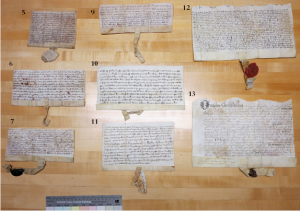
Preston Charters, Faces.

Private Collection. “Preston Charters” Faces. Numbers added to the photograph report the present owner’s numbering for the set, from 5 to 7 and 9 to 13. Photograph Mildred Budny.

I was researching a group of medieval charters from a Private Collection, with discoveries about the people, places, place-names, and landscapes which they evoke at specific moments in history regarding particular locations of land in the possession of various individuals and carrying signatures (or marks) of named individuals involved in transactions regarding those lands; some of these documents retain their seals (or remnants of them) or seal-bags.  A series of blogposts ensued.

  • Full Court Preston
  • Preston Charters: The Chierographs
  • Charter the Course: More on Preston Charters

Also:

  • “Seals, Matrices, and Signatories

There came a point when I thought it might be worthwhile to open the field, and I wished for help with transcribing and translating the documents. For prizes, I chose books on medieval land-related subjects, among which the winners could choose.

I opened the competition widely as a blogpost on the RGME website, with images of the charters and instructions.  Submissions were received, an expert committee reviewed them, winners were selected, and awards were given.  The book-awards were selected and sent.  The winning translations+translations were published as a follow-up blogpost:

  • Preston Take 2

The Winner, in this case, Takes All, because one person won both competitions:  William H. Campbell.  Later he expertly organized a pair of Sessions about medieval book-bindings which the RGME co-sponsored with the Schoenberg Institute for Manuscript Studies (SIMS) at the University of Pennsylvania for the 2023 International Congress on Medieval Studies. Now he is one of our Honorary Invited Associates. (See our Officers, Associates, and Volunteers.)

Three Steps

1. Maxim: Life Gives You Lemons

2. Action: Make Lemonade (or similar)

3. Result: Send Your Favorite Recipe for our Competition

Extra Bonus: Prize Award

Our competition takes its inspiration from a predicament and its resourceful resolution.  A brief history of the proverbial phrase in English, in several manifestations, covers the ground:

  • When Life Gives You Lemons, Make Lemonade.

The general idea appears to consider lemons, whether metaphorical or tangible, as being sour, therefore difficult, adverse, unfortunate, and so on. The advised response would work to make them palatable or better, by means of some additions and operations.

We could think of it, for our present purposes, as:

  • Challenge, Response, Prize.

Step 1. Find your Lemons

Note that the Competition does not require that the recipe for “Lemonade” have Lemon fruit itself.  Substitutions are allowed, such as other Citrus fruits.  Combinations of fruits (or flowers) are also allowed.

Customarily Lemonade, by virtue of its name, depends upon or implies Lemons as the main ingredient, with sweeteners of various kinds introduced to taste (and according to waistlines). Over the centuries, across cultures, and subject to availability or preference, sweeteners might range from dates or honey to sugar, maple syrup, stevia or other sugar substitutes / artificial sweeteners, and strawberries. These components are prepared in a variety of proportions, according to varieties, such as the sweeter hybrid Meyer Lemon, strictly #notalemon, which comprises a cross between a citrus and a mandarin orange / pomelo hybrid.

Some varieties are carbonated; some are alcoholic. The latter might, say, have bourbon, whiskey, tequila, gin, vodka, or sparkling wine. Straws might make an appearance, as might ice.  Garnishes appear in many variations, such as mint or lemon slices. Presentation, vessels, and accessories for the beverage can range from rough-and-ready, at-hand, or improvised, to elaborate and/or exquisite. It can be served on its own or in the company of foodstuffs, such as cookies or other baked goods.

See also, for example:

  • Limonade (French)
  • Limonata (Italian)
  • Limonade (German)
  • Limonade (drank) (Dutch)
  • Limonada (Spanish)
  • lemonêd (Welsh)
  • Лимонад (Russian)

Elena Chockova, “Lemon – fleur et fruit” (25 November 2007). Image via Wikimedia Commons via CC Elena Chochkova, CC BY-SA 4.0, via Wikimedia Commons.

Over to You

Please Share Your Recipe

Do you have a favorite, or favorites, among the many varieties of lemonade or ‘lemonade’?

For example, do you favor your mother’s or grandmother’s recipe for Lemonade? Are there companion goodies that you think customarily should go with Lemonade?

Please let us know your favorite recipe. The instructions can be as detailed or general as you wish.

You see, we understand that some people prefer to measure ingredients precisely; others prefer the “Chuck It In” Method.

That is what I used to call my father’s approach to cooking, so it seemed to me as a young observer of his methods rarely to be seen in the kitchen.  Roughly speaking, it looked somewhat like this:

Open the Cupboard / Refrigerator; Grab whatever is there or comes to hand; Chuck It In; Stir / Cook / Bake as Indicated or as Interest / Patience Allows; Dish It Out; Eat.

Despite his devotion to fruit and vegetable juices (all freshly made) in his later years, they never seemed to include Lemonade (although he was strong on fresh orange juice, industrial-grade juicer as producer included), so I must look to other families’ or cultures’ recipes. I’d be glad to learn about yours.

When it comes to judging the entries for our Competition, we would not have a bias ahead of time for precise measurements on the one hand or variable approximations or guesswork on the other, so please describe your recipe in the style to which you (or your source for it) are accustomed.

Do you have a name or title for your recipe?

If you like, please let us know its story. For example, is it handed down the family from one generation to the next (or the one after next), from mother, aunt, or grandmother to children, grandchildren, nieces or nephews, and so on? Did you invent or perfect it? Do you keep it, or did you find it, in some handwritten, typed, printed, or digital form?

Would you like to send pictures of the preparation and/or the product?

Competition for the Best Recipe(s)

Please send your entry for this Competition for the Friends of the Research Group on Manuscript Evidence to:

  • Friends of the RGME

Depending upon responses, we might publish the winning recipe, or a selection of recipes, as a first installment of the Friends’ Favorite Recipes.

We would welcome your suggestions for other sorts of recipes for our next Competition.

Prizes

With the official launch of the Group of Friends and this competition in time for our Episode 17 on “RGME Retrospect and Prospects”, we announce the prizes. (All of them are donations for the purpose).

First Prize: Kitchen Apron with lemon pattern and lemon-shaped pockets.
Second Prize: Set of 12 linen cocktail napkins with lemon pattern and yellow border.
Third Prize: 2 packs of 8 dinner-sized paper plates with a lemon-sprig design.

Bonus prize for all: RGME Recipe booklet with our Favorite Recipes (Yours included!)

Mint Lemonade in New York City at a Friends’ Reunion. Photography by Mildred Budny.

*****

Update (6 November 2024):

A new blogpost reports some first entries for this competition, announces an expansion of the terms of the competition (i.e. lemonade and more), and lists more prizes which have been donated to the cause.

  • Favorite Recipes for Lemonade, Etc.

*****

Questions or Suggestions?

Please leave your comments or questions below, Contact Us, or visit

  • our FaceBook Page
  • our Facebook Group
  • our Twitter Feed (@rgme_mss)
  • our Bluesky nest @rgmesocial.bluesky.social)
  • our LinkedIn Group
  • our Blog on Manuscript Studies and its Contents List

Donations and contributions , in funds or in kind, are welcome and easy to give.  Given our low overheads, your donations have direct impact on our work and the furtherance of our mission.  For our Section 501(c)(3) nonprofit educational organization, your donations may be tax-deductible to the fullest extent permitted by law.  Thank you for your support!

  • Contributions and Donations
  • 2024 Anniversary Appeal

We look forward to hearing from you.

*****

Update (22 August 2024)

The first entry has arrived. Simple as can be.

1. Our Layout and Font Designer describes the answer to “Live Gives You Lemons” succinctly:

  • Give Them Back

*****

Do you have a preferred recipe to share with us? We’d love to hear.

Los Angeles, The J. Paul Getty Museum, Jacob van Hulsdonck (1582-1647), Still Life with Lemons, Oranges, and a Pomegranate. Oil on panel, about 1620–1630, within frame. Image Public Domain, via https://useum.org/artwork/Still-Life-with-Lemons-Oranges-and-a-Pomegranate-Jacob-van-Hulsdonck

*****

 

Tags: Favorite Recipes, Friends of the Research Group on Manuscript Evidence, Lemonade, Lemons, Recipe Competition, Recipes
No Comments »

  • Top
©2024 Research Group on Manuscript Evidence.


is proudly powered by WordPress. WordPress Themes X2 developed by ThemeKraft.