• News
    • News & Views
    • RGME Activities for 2024 and 2025
    • Around & About with the RGME
    • Reviews
    • Highlights
  • Blogs
    • Manuscript Studies
      • Manuscript Studies: Contents List
    • International Congress on Medieval Studies
      • Abstracts of Congress Papers
        • Abstracts of Papers Listed by Author
        • Abstracts of Papers Listed by Year
  • About
    • Mission
    • Who We Are
      • Officers, Associates & Volunteers
      • RGME Committees
      • Friends of the Research Group on Manuscript Evidence
    • Policies & Statements
      • RGME Privacy Policy Statement
      • RGME Intellectual Property Statement & Agreements
    • People
      • Mildred Budny — Her Page
      • Adelaide Bennett Hagens
    • Activities
      • Events
      • Congress Activities
        • Sponsored Conference Sessions (1993‒)
          • Panels at the M-MLA Convention (from 2016)
        • Co-sponsored Conference Sessions (2006‒)
    • History
      • Seals, Matrices & Documents
      • Genealogies & Archives
    • Contact Us
  • Bembino
    • Multi-Lingual Bembino
    • RGME Bembino: Resources
  • Congress
    • Sponsored Conference Sessions (1993‒)
    • Co-sponsored Conference Sessions (2006‒)
    • Abstracts of Congress Papers
      • Abstracts Listed by Author
      • Abstracts Listed by Year
    • Kalamazoo Archive
    • Panels at the M-MLA Convention (2016-2019)
      • Abstracts of Papers for the M-MLA Convention
      • Panels at the M-MLA Convention (from 2016)
  • Events
    • RGME Activities for 2024 and 2025
      • 2023 Activities and 2024 Planned Activities
    • Seminars, Workshops, Colloquia & Symposia (1989–)
      • Seminars on ‘The Evidence of Manuscripts’
      • Symposia on ‘The Transmission of the Bible’
      • The New Series (2001-)
        • 2019 Anniversary Symposium Program: The Roads Taken
        • 2019 Anniversary Symposium Registration
        • 2019 Anniversary Symposium Registration Open
      • RGME Symposia: The Various Series
      • The Research Group Speaks: The Series
      • Meetings of the Friends of the Research Group on Manuscript Evidence
      • RGME Online Events
    • Abstracts of Papers for Events
      • Abstracts of Papers for Seminars on ‘The Evidence of Manuscripts’
      • Abstracts of Papers for Symposia, Workshops & Colloquia
    • Receptions & Parties
    • Business Meetings
    • Photographic Exhibitions & Master Classes
    • Events Archive
  • ShelfLife
    • Journal Description
    • ShelfMarks: The RGME-Newsletter
    • Publications
      • “Insular, Anglo-Saxon, and Early Anglo-Norman Manuscript Art at Corpus Christi College, Cambridge” (1997)
        • Mildred Budny, ‘Catalogue’
        • The Illustrated Catalogue (1997)
      • The Illustrated Handlist
      • Semi-Official Counterfeiting in France 1380-1422
      • No Snap Decisions: Challenges of Manuscript Photography
    • History and Design of Our Website
  • Galleries
    • Watermarks & the History of Paper
    • Galleries: Contents List
    • Scripts on Parade
    • Texts on Parade
      • Latin Documents & Cartularies
      • New Testament Leaves in Old Armenian
    • Posters on Display
    • Layout Designs
  • Donations and Contributions
    • RGME Donor Promise
    • 2023 End-of-Year Fundraiser for our 2024 Anniversary Year
    • 2019 Anniversary Appeal
    • Orders
  • Links
    • Catalogs, Metadata, and Databases: A Handlist of Links
    • Handlist of Resources for Manuscript Studies and Fragmentology
    • Manuscripts & Rare Books
    • Maps, Plans & Drawings
    • Seals, Seal-Matrices & Documents

  • News
    • News & Views
    • RGME Activities for 2024 and 2025
    • Around & About with the RGME
    • Reviews
    • Highlights
  • Blogs
    • Manuscript Studies
      • Manuscript Studies: Contents List
    • International Congress on Medieval Studies
      • Abstracts of Congress Papers
        • Abstracts of Papers Listed by Author
        • Abstracts of Papers Listed by Year
  • About
    • Mission
    • Who We Are
      • Officers, Associates & Volunteers
      • RGME Committees
      • Friends of the Research Group on Manuscript Evidence
    • Policies & Statements
      • RGME Privacy Policy Statement
      • RGME Intellectual Property Statement & Agreements
    • People
      • Mildred Budny — Her Page
      • Adelaide Bennett Hagens
    • Activities
      • Events
      • Congress Activities
        • Sponsored Conference Sessions (1993‒)
          • Panels at the M-MLA Convention (from 2016)
        • Co-sponsored Conference Sessions (2006‒)
    • History
      • Seals, Matrices & Documents
      • Genealogies & Archives
    • Contact Us
  • Bembino
    • Multi-Lingual Bembino
    • RGME Bembino: Resources
  • Congress
    • Sponsored Conference Sessions (1993‒)
    • Co-sponsored Conference Sessions (2006‒)
    • Abstracts of Congress Papers
      • Abstracts Listed by Author
      • Abstracts Listed by Year
    • Kalamazoo Archive
    • Panels at the M-MLA Convention (2016-2019)
      • Abstracts of Papers for the M-MLA Convention
      • Panels at the M-MLA Convention (from 2016)
  • Events
    • RGME Activities for 2024 and 2025
      • 2023 Activities and 2024 Planned Activities
    • Seminars, Workshops, Colloquia & Symposia (1989–)
      • Seminars on ‘The Evidence of Manuscripts’
      • Symposia on ‘The Transmission of the Bible’
      • The New Series (2001-)
        • 2019 Anniversary Symposium Program: The Roads Taken
        • 2019 Anniversary Symposium Registration
        • 2019 Anniversary Symposium Registration Open
      • RGME Symposia: The Various Series
      • The Research Group Speaks: The Series
      • Meetings of the Friends of the Research Group on Manuscript Evidence
      • RGME Online Events
    • Abstracts of Papers for Events
      • Abstracts of Papers for Seminars on ‘The Evidence of Manuscripts’
      • Abstracts of Papers for Symposia, Workshops & Colloquia
    • Receptions & Parties
    • Business Meetings
    • Photographic Exhibitions & Master Classes
    • Events Archive
  • ShelfLife
    • Journal Description
    • ShelfMarks: The RGME-Newsletter
    • Publications
      • “Insular, Anglo-Saxon, and Early Anglo-Norman Manuscript Art at Corpus Christi College, Cambridge” (1997)
        • Mildred Budny, ‘Catalogue’
        • The Illustrated Catalogue (1997)
      • The Illustrated Handlist
      • Semi-Official Counterfeiting in France 1380-1422
      • No Snap Decisions: Challenges of Manuscript Photography
    • History and Design of Our Website
  • Galleries
    • Watermarks & the History of Paper
    • Galleries: Contents List
    • Scripts on Parade
    • Texts on Parade
      • Latin Documents & Cartularies
      • New Testament Leaves in Old Armenian
    • Posters on Display
    • Layout Designs
  • Donations and Contributions
    • RGME Donor Promise
    • 2023 End-of-Year Fundraiser for our 2024 Anniversary Year
    • 2019 Anniversary Appeal
    • Orders
  • Links
    • Catalogs, Metadata, and Databases: A Handlist of Links
    • Handlist of Resources for Manuscript Studies and Fragmentology
    • Manuscripts & Rare Books
    • Maps, Plans & Drawings
    • Seals, Seal-Matrices & Documents

Log in

Archives

Featured Posts

Sanskrit and Prakrit Manuscripts, Continued: More Leaves for Manuscript Sample XII?
2026 International Congress on Medieval Studies: Program
Episode 24. “Life with Books” (Interview with John Windle)
Announcing the Launch of RGME Bembino WP
2026 RGME Colloquium at The Grolier Club: Report
Medieval Missal Fragment as Early-Modern Cover
The Weber Leaf from Ege MS 61
"Bembino" Booklet Cover
Episode 23. “Meet RGME Bembino: Facets of a Font”
2026 RGME Colloquium on “Transformations & Renewals” at The Grolier Club
2026 Theme of the Year: “Transformations and Renewals”
A Leaf with Patchwork from the Saint Albans Bible
A Sister Leaf from a Miniature Latin Vulgate Bible
A Little Latin Vulgate Bible Manuscript Leaf in Princeton
J. S. Wagner Collection. Leaf from from Prime in a Latin manuscript Breviary. Folio 4 Verso, with part of Psalm 117 (118) in the Vulgate Version, set out in verses with decorated initials.
2026 Annual Appeal
Episode 22: “Encounters with Local Saints and Their Cults”
Private Collection, Ege's FBNC Portfolio, Dante Leaf, Verso, Detail. Reproduced by Permission.
2025 RGME Autumn Colloquium on Fragments
Workshop 8: A Hybrid Book where Medieval Music Meets Early-Modern Herbal
2025 RGME Autumn Symposium on “Readers, Fakers, and Re-Creators of Books”
RGME Workshops on “The Evidence of Manuscripts, Etc.”
2025 International Medieval Congress at Leeds: RGME Program
Episode 21. “Learning How to Look”
2025 International Congress on Medieval Studies: Program
2025 RGME Visit to Vassar College
Two Leaves in the Book of Numbers from the Chudleigh Bible
Delibovi on Glassgold on Boethius: A Blogpost
Ronald Smeltzer on “Émilie du Châtelet, Woman of Science”
2025 Spring Symposium: “Makers, Producers, and Collectors of Books”
Starters’ Orders
The Weber Leaf from the Saint Albans Bible
Workshop 4. “Manuscript Fragments Compared”
Episode 20. “Comic Book Theory for Medievalists”
Episode 19: “At the Gate: Starting the Year 2025 at its Threshold”
Favorite Recipes for Lemonade, Etc.
RGME Visit to the Lomazow Collection: Report
2024 Autumn Symposium: “At the Helm”
A Latin Vulgate Leaf of the Book of Numbers
The RGME ‘Lending Library’
Florence, Italy, Ponte Vecchio from Ponte alle Grazie. Photo: Ingo Mehling, CC BY-SA 4.0 , via Wikimedia Commons
Episode 17. “RGME Retrospect and Prospects: Anniversary Reflections”
2024 Anniversary Symposium: The Booklet
Jesse Hurlbut at the Bonneville Salt Flats, Utah. Photograph Jesse Hurlbut.
Episode 16: An Interview with Jesse D. Hurlbut
To Whom Do Manuscripts Belong?
Kalamazoo, MI Western Michigan University, Valley III from the side. Photograph: David W. Sorenson.
2024 International Congress on Medieval Studies: Report
2024 Spring Symposium at Vassar College
Puente de San Martín: Bridge with reflection over the River Targus, Toledo, Spain.
2024 Grant for “Between Past and Future” Project from The Gladys Krieble Delmas Foundation Research Libraries Program
2024 Anniversary Symposium in Thanks to Jesse Hurlbut: Program

You are browsing the Blog for Announcements

2024 International Congress on Medieval Studies: Report

May 15, 2024 in Abstracts of Conference Papers, Anniversary, Announcements, Conference, Conference Announcement, Events, ICMS, Illustrated Handlist, International Congress on Medieval Studies, Kalamazoo, POMONA, Postal History at Kalamazoo, Societas Magica

2024 International Congress on Medieval Studies: Report

59th ICMS (9–11 May 2024)

Held in a transitional ‘hybrid’ form
with RGME Co-Sponsored Sessions,
an Open Business Meeting,
and Co-Sponsored Reception

In a Nutshell:
Mission Accomplished!

With Thanks to our Participants,
Co-Sponsors, Audience, and Friends

[Posted on 14 May 2024]
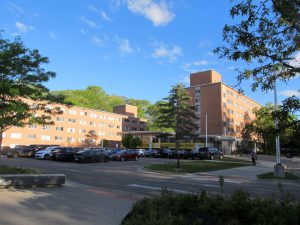
Western Michigan University, Valley III from the side. Photograph: David W. Sorenson.

Western Michigan University, Valley III from the side. Photograph: David W. Sorenson.

After the successful completion of all our activities at the 59th Annual 2024 International Congress on Medieval Studies International Congress on Medieval Studies (ICMS), we report our accomplishments and give updates about changes to the Program which we announced (with updates as appropriate) for its items. See the full ICMS Program issued by its organizing Committee:

  • 2024 Congress Program, with Corrigenda.

The Journey

Already from our first preparations toward the 2024 Congress,

  • starting with the 2023 Congress and our Open Business Meeting there to invite proposals,
  • moving on to our proposals for Sessions for 2024 submitted to the Congress Committee by 1 June 2023,
  • progressing with the approved Call for Papers for the 2024 ICMS,
  • reaching the firm conclusion of that Call on 15 September 2024, and
  • selecting the Program for our Sessions according to responses to that Call and related developments,

we have made revisions and provided updates for our plan.

They gave rise to our announcement for our own (and co-sponsored) Program (including the details of Sessions, their speakers, titles of papers, order of presentation, and so on; as well as ancillary events such as the Anniversary Reception), its updates throughout the months from October to May and the start of the Congress.  Now we follow up with the Report.

The proposals received not only yielded Programs for which the order of Papers and the follow-up invitation to Presiders and Panelists, but also encouraged us to combine resources within the Research Group, with our frequent co-sponsor, the Societas Magica, and with others.  Thus we collaboratively created a strong program of activities for the 2024 Congress.

Along the way, between

  • the submission of our selected Program to the Congress Committee by 15 October 2023,
  • its acceptance,
  • the assignment of dates, times, and venues for the individual activities for the 2024 Congress Program as officially published (with a series of Corrigenda, not affecting us, as the date of the Congress approached), and
  • the start of the Congress itself on Thursday 9 May 2024, with events variously in online and/or in-person formats,

our own 2024 Congress Program has had a few minor revisions, as people and technological arrangements permitted.

These changes did not interfere with the overall success of our activities.  Our 2024 Congress Program reported various changes up to the Congress; this Report describes those effected at or around the Congress.

Access Included

As in 2023, the RGME responded to the partly ‘hybrid’ conditions of the Congress by providing its Zoom Meetings for two scheduled solely ‘In Person’ Sessions, as well as for our In-Person catered lunchtime Open Business Meeting, and by reserving an onsite Remote Participation Room on campus for those participants for a scheduled ‘Virtual’ Session who were present at the Congress to be able to gather to sign on to the online Session hosted by the Congress Confex Portal. The RGME managed all these extra Zoom provisions and reservations, as part of its contribution to sponsoring or co-sponsoring Sessions at the ICMS over the years.

It can be worth noting that those donations — at the cost of the RGME, are made possible by donations to enable its Zoom Subscription, by our own provisions for technical backup, and principally by the many pro-bono donations by its Director as overall organizer and co-ordinator of the RGME activities at the Congress and elsewhere — are not covered within the costs to produce the Congress, which registration fees by attendees online and in-person work to subsidize. The extra efforts by the RGME to provide features or facilities for the contributors, participants, and attendees of its activities at the Congress, whether online or onsite, correspond with our approach to our activities of many kinds.

In this spirit, the RGME has consistently stepped up to the plate in response to changes in the facilities for the ICMS before and after the start of the Covid-19 pandemic, when the Congress was successively

  • 1) cancelled outright (2020),
  • 2) rescheduled in online format only (2021), and
  • 3) re-introduced in a partly in-person, partly virtual, ‘hybrid’ format (2022, 2o23, 2024, and more).

Throughout these developments, responding to their changing requirements, the RGME has continued to seek, insofar as possible with our own limited resources, to provide access to our sponsored and co-sponsored Congress activities to as wide an audience as possible, including those with disablilities, health issues, and difficulties in finding resources to travel and cover expenses to attend the Congress in person.

These ‘extras’ which we provide stand alongside the RGME tradition for many years of promoting our authors and the contributions of their work to our Congress Programs (see our Congress Activities) by the series of RGME promotional notices for the year’s Congress (with updates):

  • on our official Website (You are Here),
  • on our Social Media (listed Below),
  • in the Posters for each of our Congress activities, and
  • in the Congress Abstracts which we publish for the Authors’ presentations.

The Posters normally are displayed in printed form at the Congress — where permitted, such as on cork boards in the different buildings and in the rooms where our events take place — and on the RGME website, with printed copies also sent to presenters as souvenirs to display in their offices or studies and to give to their mothers.  For example for the 2015 Congress:

Derek Shank stands beside the RGME Poster Display for the 2025 ICMS. Photography by Mildred Budny.

The Abstracts appear in their own individual webpages — which can 1) extend for a longer span than the assigned limit (100 words) for the submission of a proposal for a Congress Paper; 2) add notes, links, and bibliography; and 3) include images — as publications in their own right.

Moreover, we take care to index all the Authors’ Abstracts for a given Congress to grant wider access both:

  • Alphabetically by Author’s Surname and
  • Chronologically by Year of Author’s Presentation.

The Arrival

After the Journey to arrive, there remained some bumps in the road at the destination.  The RGME Director was unable to travel for health reasons, and so had to attend online.

Program

One person on the Program for one Session decided not to attend.  Technical issues with one Speaker’s PowerPoint Presentation and its Zoom projection interrupted a short span of the flow of slides in an expertly crafted presentation in another Session, but this interruption could smoothly be kept to a brief minimum through co-ordination prepared ahead of time between the Speaker and the RGME Zoom Host, together with the Session Organizer.  The prepared co-ordination ahead of time for hybrid access dropped the ball between one scheduled in-person Session and the RGME-hosted Zoom online facility, required, it turned out, not as an extra, but as an essential, so as to enable the Presider and two of the Speakers unable to travel to the Congress to participate in the Session.

Audience Participation

At the last minute, an audience member generously offered to lend his computer so that the Organizer / Second Speaker could connect the Zoom Meeting for the Session and the In-Person Room.  We give thanks to collegiality and generous resourcefulness.

Posters

Another surprise came for the RGME Posters for our Congress Activities when the eve of the Congress arrived and participants came on site.  We suddenly discovered that the 2024 Congress prohibited the display of posters anywhere in a printed form, apart from selected tables requiring horizontal piles, rather than enabling vertical display for which our Posters are designed.

This change meant that the extra efforts by our Trustee and Co-Organizer David Porreca in the days before the Congress to produced printed Posters for display and distribution there — while our Director could not travel to the Congress to bring them as usual — were thwarted.  Henceforth, we will plan accordingly and distribute our Posters outside the Congress walls, both in digital and printed formats.

By fortunate choice, without knowing about the Congress’s redirections, the Director had posted the newly-designed Posters in a Web Gallery of their own on our website just a couple of days before the Congress, in a new departure for our tradition of sponsorship and co-sponsorship. Customarily, she would post them in the RGME webpost for the year’s Congress shortly after it had been accomplished, as part of its Report. (See 2023 International Congress on Medieval Studies: Report.)

Now, see the special Pop-Up Exhibition!
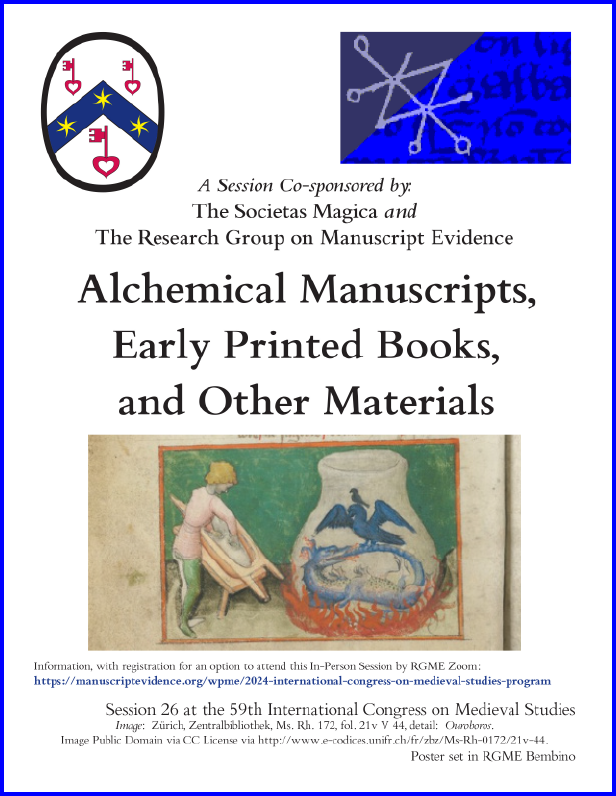
  • RGME Pop-Up Poster Exhibition for the 2024 ICMS
2024 ICMS Alchemical Session Poster 2

2024 ICMS Alchemical Session Poster 2

The Program as Accomplished

Our Program comprised:

  • three Co-sponsored Sessions 
  • our Open Business Meeting and
  • a co-sponsored Anniversary Reception.

In stages, first (in November 2023) we announced the Sessions, and reported the sequence of papers for them.  Next (January 2024), with information from the ICMS, we could report their assigned times, days, and locations on campus in cases of the in-person events, along with our other activities at the Congress.  Then we began to publish the abstracts for them; that process is now completed. Soon we will complete the Indexes for them.

For the In-Person Sessions and the Open Business Meeting, the RGME provided an online option for Congress Registrants through our Zoom Subscription and our Eventbrite Registration Portal:

  • Eventbrite: Research Group on Manuscript Evidence

‘Hybrid’ Facilities

Like last year (see 2023 International Congress on Medieval Studies: Report), the RGME offered Registration (without charge) for Online access through our Zoom Subscription to some of our In-Person events this year.  Likewise we offered registration for our two In-Person events to help us to learn how many to expect to attend for our planning and the catering for our Open Business Meeting and Co-Sponsored Reception.

For one Online Session, a remote-participation conference room was reserved so that participants and attendees on campus for the Congress might gather to join the online format while in company.

At ICMS for the RGME Anniversary Year

In 2024, the RGME celebrates its Anniversary Year to mark 25 years as a nonprofit educational corporation based in Princeton, New Jersey, and 25 years as an international scholarly society founded out of a major research project at Corpus Christi College in the University of Cambridge.

For our Anniversary Year, the theme is “Bridges”.
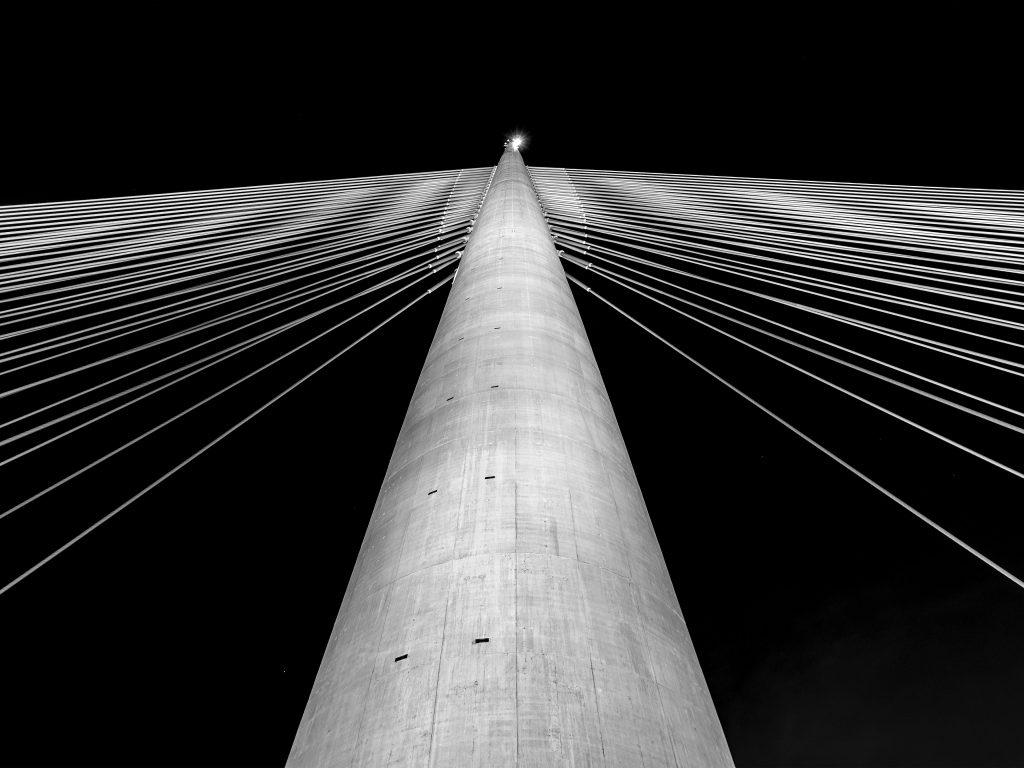
  • “Bridges” for our 2024 Anniversary Year
Ada Bridge pylon, Belgrade, Serbia

Ada Bridge pylon, Belgrade, Serbia. Photograph Petar Milošević (1 August 2021). Image via Wikimedia Creative Commons Attribution-Share Alike 4.0 International license.
Read the rest of this entry →

Tags: Abstracts of Congress Papers, Bridges, Early Printed Books, History of Alchemy, ICMS, International Congress on Medieval Studies, Manuscript studies, P.-O.M.o.N.A., Postal History at Kalamazoo, RGME Anniversary, RGME Anniversary Reception, RGME Business Meeting, RGME Posters, Societas Magica
No Comments »

More Fonts for Bembino: Devanāgarī (Hindi) and Tibetan (High-Uchen Script)

May 6, 2024 in Announcements, Bembino, Manuscript Studies

Fonts for Tibetan
(High Uchen-Style)
and Hindi
(Devanāgarī)
for our
Multi-Lingual Font Bembino

[Posted on 5 May 2024, with updates]

By request, work continues on improvements for our copyright multi-lingual font Bembino. Step by step, fonts for more languages are added.  Now we turn to Devanāgarī (Hindi) and Tibetan (High-Uchen Script).

By September 2023, specimens of these fonts in Bembino were ready to show for comment.  Now, after some RGME online and hybrid activities have been accomplished (October 2023 and January, February, and April 2024, with more in May and June), we show the specimens for your review.  Please let us know what you think!

[P.S.  Meanwhile, another request, by our RGME Associate Reid Byers, has led also to work on Elvish for J.R.R. Tolkin‘s creation Tengwar. Coming soon!]

Multi-Lingual Bembino

Poster Announcing Bembino Version 1.5 (April 2018) with border for Web display

Poster Announcing Bembino Version 1.5

Our copyright font is freely available for download and use for non-commercial and commercial use alike.  You might download the font, and its companion Booklet, here:

  • Bembino Version 1.5 (2018).

That booklet and the font itself (now in Version 1.5) are freely available via Bembino.  The “Bembino” Booklet describes and illustrates the font.

Another Booklet showing “Examples of Our Font in Multiple Languages” appeared in March 2018, with an updated Version 1.1 (June 2018).

  • Multi-Lingual Bembino (2018)

This booklet contains examples of some of the wide range of languages that can be typeset using the Research Group on Manuscript Evidence ‘Bembino’ font.

The Specimen Text

Cover page for 'Multi-Lingual Bembino' demonstrating specimens from a wide range of languages typeset in Bembino

Multi-Lingual Bembino Booklet Cover

The chosen text is the same for all examples in the booklet for Multi-Lingual Bembino.

The Specimen Text comes from: Exodus chapter 20 verses 1–17, one of the sets of the ‘Ten Commandments’ in the Old Testament.

The languages are listed in alphabetical order by their English name (so ‘Welsh’ rather than ‘Cymraeg’).  The set of languages presented is not exhaustive. Many of the languages that use basic Latin are omitted, as are the languages for some of the former Russian Federation countries that use Cyrillic.

*****

The new, on-going, work provides fonts for more cases.

After creating fonts for Japanese, Ethiopic, and Arabic, the direction to South Asia seemed worth pursuing. Requests arrived, and work began.

Hindi: Devanāgarī

Devanāgarī is a left-to-right writing system used in the Indian subcontinent.  “The Devanāgarī script, composed of 48 primary characters, including 14 vowels and 34 consonants, is the fourth most widely adopted writing system in the world, being used for more than 120 languages.” (See Devanāgarī.)

Our Bembino Specimen is set for Hindi, “the fourth most-spoken language in the world, after Mandarin, Spanish and English”.

The background for the work to produce such a font for Bembino extended across several years.  We owe the quest to comments offered by Harry Blair, responding to Bembino as a multi-lingual digital font in use for a variety of purposes.

For example (6 February 2019):

I was thinking that if Leslie had done Japanese and Ethiopic and Arabic (much harder than Devanāgarī, it seemed to me), then South Asia might be an interesting direction to take. Simpler than Western languages in that there’s only one case (no upper and lower), but more complex with all the conjuncts. Plus the vowels sometimes shift around consonants, sometimes preceding them in writing while following them in speaking.”

1.  Most of the conjuncts in common use are like ligatures in Western scripts: 2 letters joined in such a way that it’s easy to grasp what the separate letters are.  This Wikibooks table shows them (<https://en.wikibooks.org/wiki/Hindi/Consonant_combinations>). BTW the small diagonal appendage to each letter in the first column just indicates that the letter is by itself with no following vowel.

2. There’s a much smaller set of conjuncts commonly used that yield an entirely different form, listed at the bottom of the WikiBooks table as “special cases”.

Taking up the case, our Font Designer reported (5 February 2019):

I checked the latest version (11.0) of Unicode and they haven’t done anything to address the issues with Devanāgarī.

Here is my understanding of the issue, ignoring all the vehement rhetoric.

Basically, similar to Arabic, Devanagari has a ‘core’ of about 50 letter shapes (consonants and vowels) but when they co-occur there are combined forms that must be used.  It’s as though the fi, ffi, fl etc. ligatures were *mandatory* to set English.  There are about 1,000+ of these ‘ligatures’ needed correctly to set Devanagari.  Unicode contains only 128 glyphs for Devanagari, including punctuation and numerals!  Now, it is true that some of the ‘missing’ glyphs can be formed from the basic letters + overprints. Think of European accents, and the core ‘a’ used to form á, ä, à etc., but without having separate codepoints for â, ä and so on.  But there are still some combinations that need different shapes (like ffi) not just overprints.

There is no space in Unicode to add those different shapes.  They could be added through special font tables (like I did for the joined-up Ethiopic numerals), and there are specific tables in OpenType (the format I use for Bembino) to support them.  But building those tables requires an expert knowledge of Devanagari typesetting.  There are some sites on the Web that can help, but if I made a mistake I would never know.

Having said that, I’m willing to take on the challenge if I can get some help checking what I produce, similar to that Augustine [Dickinson] did with the Ethiopic [by asking for diacritics for Ge’ez among the languages of Ethiopia].

[Note: Our Associate Augustine Dickinson is now the Acting RGME WebMaster, as of 1 July 2023.]

With some suggestions for the specimen forms (such as more contrast between thick and thin strokes), a revised version of Devanāgarī for Bembino is now available upon request, before the next version of Bembino as a whole appears.

Bembino for Hindi and Tibetan

Now, a poster-style page shows the Bembino fonts so far for Hindi and Tibetan.

The Specimen Text

The chosen text is the same for all examples in the booklet for Multi-Lingual Bembino.  As described above, the Specimen Text comes from: Exodus chapter 20 verses 1–17, one of the sets of the ‘Ten Commandments’ in the Old Testament.

Fonts for Hindi and Tibetan for Multi-Lingual Bembino in Specimen Text.

Tibetan

Tibetan script is a segmental writing system, written from left to right.  The alphabet has thirty basic letters for consonants.  Syllables are separated by a tsek (་), and spaces are not used to divide words.  Because many Tibetan words are monosyllabic, the mark can function as if a space between words.  (See, for example, The Tibetan Writing System.)

When I [Mildred Budny, Editor-in-Chief of RGME Publications] asked our Font Designer about the choice of script for Tibetan, High-Uchen Style, he said: “I think it is beautiful”.

Here is a specimen of the script in manuscript form.  I show the specimen, and add parts of the companion description (metadata) which comes with the image in its digital facsimile available freely online.

Photograph: Ms. Sarah Walsh.

Notes on the Image

Image via Wikimedia Commons under CC 4.0 license, via https://commons.wikimedia.org/wiki/File:Isha_Upanishad_Verses_1_to_3,_Shukla_Yajurveda,_Sanskrit,_Devanagari.jpg

Information given at that source:

“Language: Sanskrit

“Script: Devanagari

“Script style: pre-14th century (Northern / Western)

“Isha Upanishad, verses 1–2, partially 3

“The thick text is the Upanishad scripture, the small text in the margins and edges are an unknown scholar’s notes and comments in the typical Hindu style of a minor bhasya.

“The photo above is of a 2D artwork of a text that is over 2,000 years old, from a manuscript that was produced decades before 1923. Therefore Wikimedia Commons PD-Art licensing guidelines apply. Any rights I have as a photographer is herewith donated to wikimedia commons under CC 4.0 license.

“The early Upanishads (Upanisad, Upanisat) are scriptures of Hinduism. Variously dated by scholars to have been composed between 900 BCE to about 200 BCE, these texts are in Sanskrit language and embedded within a layer of the Vedas. They contain a mixture of philosophy and mystical speculations, many set in the form of dialogues or pedagogic style. Their central teachings include the concepts of Atman (soul, self) and Brahman (metaphysical reality).

“These manuscripts are preserved at the Lalchand Research Library, Ancient Indian Manuscript Collection, DAV College Digital Library Initiative, Chandigarh India, in association with SP Lohia and Indorama Charitable Trust. The texts are over 2000 years old, the re-copying into this particular manuscript is dated to a pre-1867 reproduction (exact date unknown). The manuscript shows significant stain marks, decay and damage on the sides and its edges.”

*****

Suggestion Box

Do you have suggestions, questions, or requests for Bembino?

Please leave your comments here, Contact Us, or visit

  • our FaceBook Page
  • our Facebook Group
  • our Twitter Feed (@rgme_mss)
  • our Bluesky nest @rgmesocial.bluesky.social)
  • our LinkedIn Group
  • our Blog on Manuscript Studies and its Contents List

Donations and contributions, in funds or in kind, are welcome and easy to give.  Given our low overheads, your donations have direct impact on our work and the furtherance of our mission.  For our Section 501(c)(3) nonprofit educational organization, your donations may be tax-deductible to the fullest extent permitted by law.  Thank you for your support!

  • Contributions and Donations
  • 2024 Anniversary Appeal

We look forward to hearing from you.

*****


Tags: Bembino Digital Font, Book of Exodus, Devanāgarī, Elvish, Ethiopic Script, Exodus 20:1-17, Ge'ez diacritics, Hindi, Isha Upanishad, Lalchand Research Library, Multi-Lingual Bembino, RGME Font Design, Sanskrit, Specimen Text, Tengwar, Tibetan, Tibetan High-Uchan Script
No Comments »

2024 Grant for “Between Past and Future” Project from The Gladys Krieble Delmas Foundation Research Libraries Program

April 5, 2024 in 2024 Grant, Announcements, RGME Symposia

Announcement

2024 Grant to the RGME from
The Gladys Krieble Delmas Foundation
Research Libraries Program
for

A Year-Long Project with Paired Symposia

“Between Past and Future”
(Parts I–II)

[Posted on 5 April 2024]

Logo of the Research Group on Manuscript Evidence (colour version)

RGME Logo in Color (2014).

Gratefully we announce that The Gladys Krieble Delmas Foundation, through its Research Libraries Program, has awarded the Research Group on Manuscript Evidence (RGME) a grant for 2024 to carry out a one-year Project centered upon our Spring and Autumn Symposia in this Anniversary Year as a co-ordinated set of events.  Drawing upon fruits of the 2023 Project for our Library & Archives funded by the Foundation, this year’s grant in our Anniversary Year creates a new Project focused upon links between Special Collections and Teaching for the Liberal Arts.

“Between Past and Future:
RGME Spring & Autumn Symposia in 2024
for Teaching in the Liberal Arts with Original Sources,
at Vassar College and Beyond”

Last year, we focused upon the task of “Building the Plan for Recording, Structuring, and Accessing the RGME Library & Archives”. Now, we launch the work of crafting a set of events centered upon a return to our in-person Symposia and their follow-up in the plan for our 2024 Spring and Autumn Symposia.

  • 2024 Spring Symposium at Vassar College “Between Past and Future”
  • 2024 Autumn Symposium “At the Helm”

Building upon RGME integrated approaches across the years, these events are expressly dedicated to building bridges to aid passage across obstacles and standing watch on the bridge of a vessel poised to steer an enlightened course. Our voyage contemplates connections “Between Past and Future” , specifically for encountering myriad original sources, as found notably in Special Collections, and considering them as opportunities for “Teaching Events”.

This year’s Project embarks on a fresh campaign, as it builds upon last year’s funded Project to begin the process of structuring our Library & Archives as a collection.

  • Grant from The Gladys Krieble Delmas Foundation for the RGME Library & Archives in 2023.

Both grants have been awarded through the Research Libraries Program, for which “the overall objective . . .  is to improve the ability of research libraries to serve the needs of scholarship in the humanities and the performing arts, and to help make their resources more widely accessible to scholars and the general public.”

“Between Past and Future”:  The Way Forward

The project funded by The Gladys Krieble Delmas Foundation Grant will span the entirety of the 2024 calendar year, concluding with an end-of-the-year report.

Building upon the 2023 Pilot Project for the RGME Library & Archives, the 2024 year-long Project centers upon our Spring Symposium taking place at Vassar College in April in hybrid format, at the invitation of Head of Special Collections, Ronald D. Patkus, familiar as participant (2019–2023) with our Symposium Series both in-person and online.  Enthusiasm among speakers, respondents, presiders, consultants, and others joining the 2024 Spring Symposium Program informs the plan to create a curated set of RGME Symposia which not only co-produce this exceptional event, but also follow from it. (The Spring Symposium Program is available in pdf as consecutive pages or foldable booklet.)

Poster 1: Save-the-Date for 2024 Spring Symposium at Vassar.

Poster 1: Save-the-Date for 2024 Spring Symposium at Vassar.

The 2024 Autumn Symposium makes it possible to undertake an integrated follow-up for the Spring event without burdening Vassar with organizational work, by using RGME structures of paired Spring & Summer Symposia and our various other online events. They all function mainly through pro-bono donations, from pre-production through post-production and follow-up, to involve minimal expenses, for which regularly we must seek support above our organization’s expenses.

As a one-day online event, the Autumn Symposium has its program partly in place, with some participants from the Spring Symposium and openings to be filled through it, notably by meetings for planning at and around the Spring Symposium. In this flexible way, the ‘casting’ of the Autumn Symposium as a set of “Teaching Events” can assemble its program with relative ease of preparation to ‘enact’ the processes of teaching through encounters with Special Collections, for in-person and online audiences alike.

The 2024 Project is grounded upon our practice to interlink events (notably Symposia) and to employ a flexible, structured, approach to programming. Here we integrate the work for the Spring Symposium at Vassar College with some “first fruits” soon in a shorter event online, much like the paired events of earlier Spring & Autumn Symposia which grew from our occasional Symposia over the years. Examples include our

  • 2023 Spring and Autumn Symposia on “Materials and Access”
  • 2022 Spring and Autumn Symposia on “Structured Knowledge”
  • 2020 Spring Symposium at Princeton University:  “From Cover to Cover”

Both 2024 events have companion RGME publications, both digital and printed. They comprise webposts, blogposts, paired posters (preview, program), recordings, and more, notably the illustrated Symposium Booklets. We publish them mostly by pro-bono work from start to final proof, for issue in print and pdf. Costs for their printing and distribution (at in-person events and by mail as required) call for support.

The perspectives on the theme of the Spring Symposium present a coherent, multi-disciplinary, and multi-generational scholarly program in a sequence of teaching events with expertise and materials in multiple centers. They stand poised, as proclaimed by the Symposium title

  • “Between Past and Future: Building Bridges between Special Collections and Teaching for the Liberal Arts”.

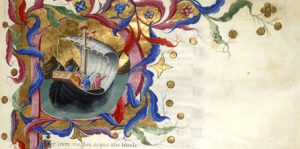
London, The British Library, Yates Thompson MS 36, fol. 65r, top left. Historiated initial enclosing a ship under sail with the poets Dante and his guide Vergil. Dante Alighieri, Divina Comedia, Canto 1, Purgatorio. Northern Italy, 15th century.

The Autumn Symposium carries it forward with a selection of virtual visits placed

  • “At the Helm: Spotlight on Special Collections as Teaching Events”.

This follow-up event allows presenters the opportunity, with minimal preparation, to showcase collections (public and private) in virtual visits guided by curators, in the company of teachers and students both on-site and online. The informal style accords with our proven approach for online events as roundtables, interviews, conversations, master classes, and workshops.

  • For example: “The Research Group Speaks”: The Series.

Thus, we might channel the purposeful momentum for the Spring Symposium in its central event and a simpler follow-up with participants including Vassar representatives: faculty, staff, students, and alums.

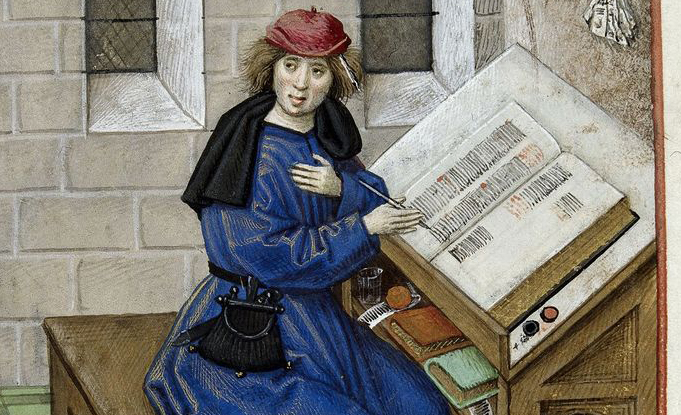
© The British Library, London, Harley MS 4425, fol. 133r, detail. Jean de Meun (c. 1240 – c. 1305), Roman de la Rose. Portrait of the author at his writing desk.

Center Stage

The Vassar Symposium in the Spring occupies center stage for the Project. Taking place in hybrid format from Friday to Sunday 19–21 April 2024, this event gathers participants at Vassar by invitation, with attendees both in person and online.

  • 2024 Spring Symposium at Vassar College

Its production rests upon organizational work and resources from both Vassar College and the RGME, guided by a Spring Symposium Advisory Planning Committee comprising Ronald Patkus, Elizabeth Lastra, Mildred Budny, and Barbara Williams Ellertson. The event expressly showcases

  • The Catherine Pelton Durrell ’25 Archives and Special Collections Library,
  • the companion exhibition at The Frances Lehman Loeb Art Center, and
  • the publication of the new commissioned catalogue on Medieval & Renaissance Books held by both Special Collections and the Art Center.

It also celebrates

  • the significant donation of the acquisition of the Nicholas B. Scheetz Collection of Medieval and Renaissance Manuscripts.

Vassar College’s resources, people, and representatives stand as focus, as the scope attends also to a wider context of accomplishments. Thus will gather experts and practitioners in the fields of Special Collections, teaching, learning, and the Liberal Arts, with speakers from different centers (also abroad) and stages or directions of engagement. They include librarians, archivists, curators, collectors, manuscript and rare-book vendors, faculty, students, and former students working in the field. Featured contributions include reports by recent Vassar College alumnae working with Special Collections, current Vassar students engaging with materials in the Vassar collections, and Vassar alums of longer duration revisiting and reviving such engagement.

The Autumn Symposium in online format on Saturday 26 October 2024, also with ancillary events, continues the engagement between original sources — medieval and more, across centuries, genres, styles, and languages — and the people who study and care for them, teach from them, and learn from them. Among them on the Programs for both Symposia are representatives from Vassar, both present and past.

  • 2024 Autumn Symposium “At the Helm”

As follow-up and follow-through, the Autumn Symposium offers virtual, curated visits to Special Collections of several kinds, institutional and private, with focus upon original materials, as witnesses with their own stories to tell. Its online visits (in this country and abroad) will showcase collections and programs dedicated to promoting pedagogy. One, by request, would exhibit some highlights of RGME Library & Archives, as revealed in our 2023 funded Pilot Project, along with results of our on-going research on manuscripts and related materials in our own and others’ collections.

The Plan for the Project

The grant for 2024 gives support for multiple aspects of the work to organize and accomplish both Symposia and to integrate them both with each other as a co-ordinated set and with the other RGME activities throughout the year. Among the funded elements are provisions for organizational logistics including online and in-person technical and logistical back-up for the paired Symposia, the preparations of their publications (traditional and digital) from conception through distribution, and the part-time services of an Intern Executive Assistant/Associate to aid the RGME Director to plan, refine, and complete events and integrate them as a cohesive pair dedicated to teaching original sources from the Medieval/Renaissance and other realms.

This latter position, unprecedented in the history of the RGME, offers invaluable support for the Director’s work to plan, co-ordinate, undertake, and follow through the work of RGME activities both in person and online as the year unfolds. In announcing the 2024 Project and its Grant, we also announce the appointment of its new Intern Executive Assistant/Associate, our RGME Associate Hannah Goeselt. Her work is familiar to the RGME already through her guest blogpost in August 2023 for our blog on Manuscript Studies as well as her contributions to our 2023 Spring and Autumn Symposia and Episode 15 in our online series “The Research Group Speaks”. We celebrate her contributions, look forward to further contributions, and thank her for her help in joining the ground-breaking 2024 Project.

The Project’s results aim for the two Symposia plus publications and ancillary activities, with the Vassar Symposium as the star. They incorporate knowledge gained from the 2023 Pilot Project , as does the plan of the Spring Symposium at Vassar itself. Mentorship for the Intern Executive Associate would provide professional experience at close hand with a master to teach, by doing, the steps to produce an educational series in its many manifestations, in person, online, and published.

Puente de San Martín: Bridge with reflection over the River Targus, Toledo, Spain.

Toledo, Castilla la Mancha, Spain, Puente de San Martín. Photograph by Ввласенко/Volodymyr Vlasenko via CC BY-SA 3.0 Deed license.

The Project will span the full 2024 calendar year, with pre-production/production/post-production in continuous, interlinked cycles. It is designed to express, enhance, and interlink with the celebrations of our 2024 RGME Anniversary Year, for which the chosen Theme is Bridges.

The Research Group on Manuscript Evidence (see our Mission Statement) exists to promote research on written sources across the ages, with our own nonprofit educational publishing house. Powered principally by volunteers, with some outside support, the RGME prepares this Project for its 2024 Anniversary Year, which celebrates 25 years as a Section 501(c)(3) nonprofit educational organization (incorporated at Princeton, New Jersey, in November 1999); and 35 years as an international scholarly organization (founded at the Parker Library of Corpus Christi College at the University of Cambridge in the United Kingdom in 1989). Its seeds, by its Founder Director Mildred Budny’s training, are grounded in a Vassar College Liberal Arts Education, with its emphasis on “going to the sources”.

Our Project brings fruits home.

The 2024 Project serves as the centerpiece and major focus for our activities in our 2024 Anniversary Year. With this year’s Theme of Bridges, we attend to our mission, guided by our experience, advisors, co-organizers, collaborators, contributors, friends, resources, and generous support, to travel “Between Past and Future” in an enlightened, integrated program of activities with companion publications of a variety of kinds, both traditional and digital. We give thanks for the support which sustains the plan in its journeys to accomplishments, both online and in person, for this year and beyond.

The Way Forward

The Research Group on Manuscript Evidence is most grateful for the generosity of spirit, the model, and the financial support of The Gladys Krieble Delmas Foundation for this next significant step in the continuing history of our organization, as we now turn to an integrated year-long Project poised “Between Past and Future” in constructing and strengthening bridges of multiple kinds between fields of study, original materials, institutions, individuals, generations, and forms of engagement with the legacy of the past, in its written and other traces, as it works its way in transmission towards the future.

Contact Us

For information, please contact director@manuscriptevidence.org or Contact Us.

For updates, please visit

  • our FaceBook Page
  • our Facebook Group
  • our Twitter Feed (@rgme_mss)
  • our Bluesky nest @rgmesocial.bluesky.social)
  • our LinkedIn Group
  • our Blog on Manuscript Studies and its Contents List
  • Friends of the RGME.

We look forward to hearing from you.

Puente de San Martín: Bridge with reflection over the River Targus, Toledo, Spain.

Toledo, Castilla la Mancha, Spain, Puente de San Martín, view from the north-west. Constructed in the late 14th century over the River Tagus. Photograph (24 May 2017) by Ввласенко/Volodymyr Vlasenko via Creative Commons Attribution-Share Alike 3.0 Unported license.

*****

Tags: 2024 Autumn Symposium, 2024 Project "Between Past and Future", 2024 RGME Anniversary, 2024 Spring Symposium, Archives and Special Collections Library of Vassar College, Bridges, Building Bridges, Medieval & Renaissance Books at Vassar College, Nicholas B. Scheetz Collection of Medieval and Renaissance Manuscripts, The Frances Lehman Loeb Art Center, The Gladys Krieble Delmas Foundation
No Comments »

2024 Anniversary Symposium: The Booklet

February 28, 2024 in Anniversary, Announcements, Manuscript Studies, RGME Symposia

“Manuscript (HE)ART”
Symposium Booklet

for the
2024 Anniversary Symposium
in Thanks to Jesse Hurlbut
(24 February 2024)

Co-Organized
by Katharine C. Chandler and Jessica L. Savage

[Posted on 27 February 2024]

The 64-page illustrated 2024 Anniversary Symposium Booklet is now available for our 2024 Anniversary Symposium “Manuscript (HE)ART” held online on 24 February 2024.

  • 2024 Anniversary Symposium in Thanks to Jesse Hurlbut: Program
  • 2024 Anniversary Symposium in Thanks to Jesse Hurlbut: Plan

You may download it as a pdf in two versions, depending upon your printer, paper stock, and preferences.

1) as consecutive pages for 8 1/2 in. x 11 in. sheets (quarto or letter)

2) as a foldable booklet for 11 in. x 17 in. sheets (tabloid, ledger, or B size) to fold in half

If you wish a copy of the printed version, please contact director@manuscriptevidence.org.

For the event, on the day, we circulated a Preview of the Booklet, with Authors’ Corrections, as a pdf.

Now we issue the Booklet, with a few more corrections, both in print and pdf, for wider circulation. It offers a souvenir of the occasion, with the Program, Abstracts for the presentations, companion Illustrations, the Speakers’ Bios, and a few Notices, including a list of “Contributions to Digital Humanities” by Jesse D. Hurlbut.

2024 Anniversary Symposium Booklet: Front Cover

*****

Coming Attractions

Watch for our next events.

2023 and 2024 Activities

2024 Spring Symposium at Vassar College

2024 International Congress on Medieval Studies: Program

And more!

For updates, please visit

  • News
  • our FaceBook Page
  • our Facebook Group
  • our Twitter Feed (@rgme_mss)
  • our Bluesky nest @rgmesocial.bluesky.social)
  • our Blog on Manuscript Studies and its Contents List

Donations and contributions, in funds or in kind, are welcome and easy to give.

  • See Contributions and Donations.

We look forward to hearing from you.

*****

Tags: RGME Anniversary, RGME Anniversary Symposium, RGME Symposia
No Comments »

Episode 16: An Interview with Jesse D. Hurlbut

February 14, 2024 in Announcements, Event Registration, Manuscript Studies, Research Group Episodes for The Research Group Speaks, Research Group Speaks (The Series)

The Research Group Speaks
Episode 16

Saturday 22 June 2024 online
1:00–2:30 pm EST (GMT-5) by Zoom

“Trailblazing the Medieval Digital Humanities:
An Interview with Jesse D. Hurlbut”

Interviewer:  Mildred Budny, Director of the RGME

[Posted on 10 February 2024, with updates]

Jesse Hurlbut at the Bonneville Salt Flats, Utah. Photograph Jesse Hurlbut.

Jesse Hurlbut at the Bonneville Salt Flats, Utah. Photograph Jesse Hurlbut.

We invite you to attend Episode 16 in our series:

  • The Research Group Speaks

In this Episode, Jesse D. Hurlbut, RGME First WebMaster Emeritus, will speak informally about his contributions to manuscript studies, websites, digital access, and other interests.

Among them are his contributions to medieval manuscript studies, photography, and digital access; his teaching and research on French studies; his websites for himself and others (academic and non-profit organizations); his interests in promoting online communities for manuscript study and enjoyment; and more.

Update: Jesse returns for Episode 20 in March 2025 to report on his project on comic books and medieval manuscripts, as mentioned in this Episode.

  • Episode 20. “Comic Book Theory for Medievalists”

The Anniversary Symposium
in February 2024

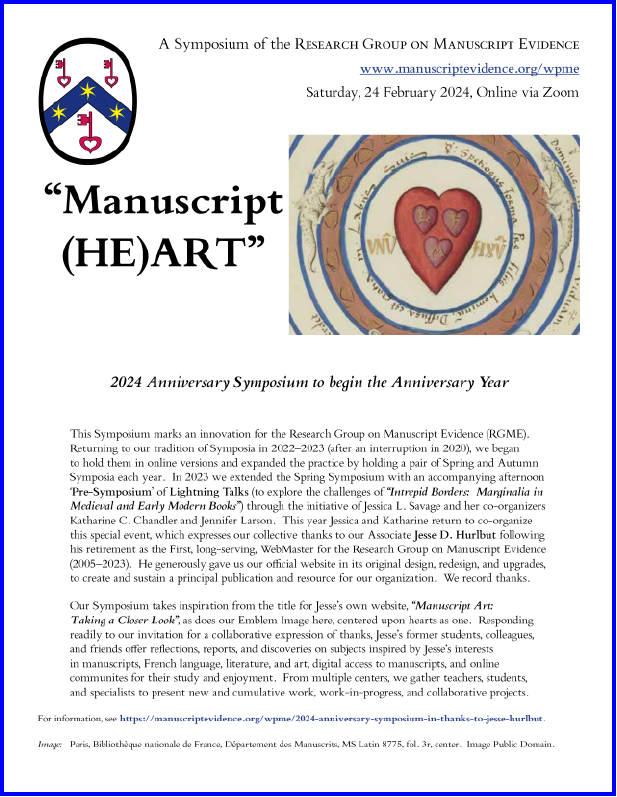
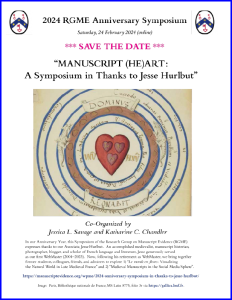
Save-the-Date Poster for 2024 Anniversary Symposium in Thanks to Jesse Hurlbut. Poster set in RGME Bembino.

This event follows upon the 2024 Anniversary “Manuscript (HE)ART”, held online on Saturday 24 February 2024, as the first in the RGME’s set of Symposia for the 2024 Anniversary Year:

  • 2024 Anniversary Symposium in Thanks to Jesse Hurlbut.. co-organized by Katharine C. Chandler and Jessica L. Savage

Taking its title from Jesse’s website Manuscript Art: Taking a Closer Look, the Symposium is designed to gather Jesse’s former students, colleagues, and friends, to consider subjects in manuscript and other studies of interest to him.

The Episode

Now, the Episode gives the chance to hear him, learn more about his interests, and join the conversation.  For example, in particular, he proposes to describe the early digital years. These recollections may record experiences viewed in hindsight and with foresight.

The Q&A to follow — or, if we wish, interlink — with the conversational interview gives the opportunity for feedback and participation.

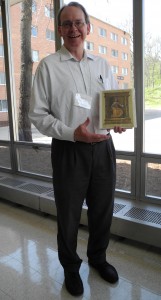
Jesse Hurlbut holds his newly won manuscript leaf at the Kalamazoo Congress on 10 May 2014. (Photography by Mildred Budny)

Jesse Hurlbut holds his newly won manuscript leaf at the Kalamazoo Congress on 10 May 2014. (Photography by Mildred Budny)

Information about Jesse:

  • Jesse D. Hurlbut: Curriculum Vitae
  • Jesse Hurlbut (LinkedIn)
  • Manuscript Art: Taking a Closer Look

In His Own Words:

  • Interview with Medieval Scholar Jesse Hurlbut (Friday, 21 August 2009)
  • Beatus Vir (December 5, 2015)

Information about the Episode:

  • Episode 16. Trailblazing for the Medieval Digital Humanities: An Interview with Jesse Hurlbut
    You are Here.

Register for the Episode:

  • Episode 16: An Interview with Jesse D. Hurlbut; Tickets

Registration is free.

We offer the option for Registration with a voluntary Donation, which we welcome.

Donations, which may be tax-deductible, help us to continue with our activities and sustain our mission for an organization principally powered by volunteers. See:

  • Donations and Contributions

After registration, the Zoom link will be sent a few days before the event.

If you have questions or issues with the registration process, please contact

  • director@manuscriptevidence.org.
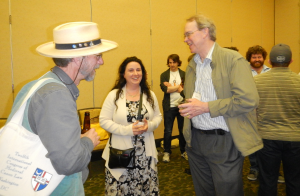
Jesse Hurlbut and others at the RGME Reception at the ICMS 9 May 2024. Photography Mildred Budny.

Jesse Hurlbut and others at the RGME Reception at the ICMS 9 May 2024. Photography Mildred Budny.

See you at the Episode!

*****

Future Episodes

Future Episodes are planned.  See:

  • “The Research Group Speaks”: The Series.

Other Events

We plan various other events for the 2024 Anniversary Year.

  • 2023 and 2024 Activities

For example:

  • 2024 Anniversary Symposium in Thanks to Jesse Hurlbut (online)
  • 2024 Spring and Autumn Symposia-plus-anniversary-symposium
  • 2024 Spring Symposium at Vassar College (hybrid)
  • 2024 International Congress on Medieval Studies: Program (severally in-person, online, and partly hybrid)
  • 2024 International Medieval Congress at Leeds (hybrid)

Questions or Suggestions?

Please leave your questions or comments here (below), Contact Us, or visit

  • our FaceBook Page
  • our Facebook Group
  • our Twitter Feed (@rgme_mss)
  • our Bluesky nest @rgmesocial.bluesky.social)
  • our LinkedIn Group
  • our Blog on Manuscript Studies and its Contents List

We invite you to join:

  • Friends of the RGME.

Donations and contributions, in funds or in kind, are welcome and easy to give.  Given our low overheads, your donations have direct impact on our work and the furtherance of our mission.  For our Section 501(c)(3) nonprofit educational organization, your donations may be tax-deductible to the fullest extent permitted by law.  Thank you for your support!

  • Contributions and Donations
  • 2024 Anniversary Appeal

We look forward to hearing from you and seeing you at our events.

*****

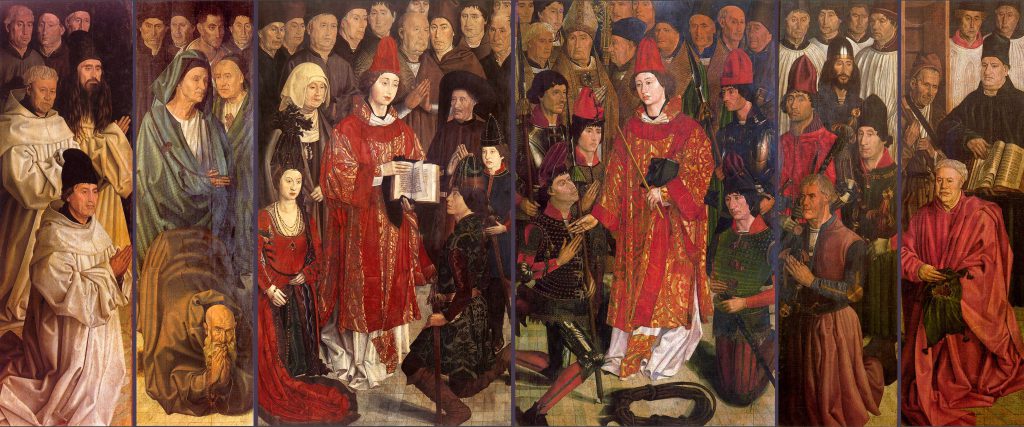
Lisbon, Museu Nacional de Arte Antiga: The mid 15th-century Saint Vincent Panels, attributed to Nuno Gonçalves. Image (https://upload.wikimedia.org/wikipedia/commons/3/3a/Nuno_Gon%C3%A7alves._Paineis_de_S%C3%A3o_Vicente_de_Fora.jpg) via Creative Commons.

*****


Tags: Interview, Jesse D. Hurlbut, Manuscript studies, Medieval Digital Humanities, Medieval manuscripts, RGME Webmaster, The Research Group Speaks, Trailblazing
No Comments »

2024 International Congress on Medieval Studies: Program

November 24, 2023 in Abstracts of Conference Papers, Announcements, Business Meeting, Conference Announcement, ICMS, International Congress on Medieval Studies, Kalamazoo, POMONA, Postal History at Kalamazoo, Reception, Societas Magica

2024 International Congress on Medieval Studies: Program

59th ICMS (9–11 May 2024)

To be held in a transitional ‘hybrid’ form
with RGME Co-Sponsored Sessions,
an Open Business Meeting,
and Co-Sponsored Reception

[Posted on 23 November 2023, with updates]

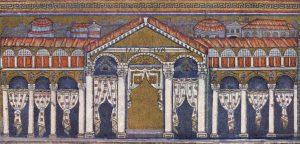
Ravenna, Sant’Apollinare Nuovo, Mosaic. Artwork in the public domain; photograph provided by The Yorck Project / Wikimedia Commons (GFDL).

After the successful completion of our Call for Papers for the 2024 International Congress on Medieval Studies (ICMS), we announce the Program for our activities, with:

  • three Co-sponsored Sessions 
  • our Open Business Meeting and
  • a co-sponsored Anniversary Reception.

In stages, first (in November 2023) we announced the Sessions. Next (4 January 2024), with information from the ICMS, we could report their assigned times, days, and locations on campus in cases of the in-person events, along with our other activities at the Congress.

Now we can report the sequence of papers for the sessions; we also begin to publish the abstracts for them.

Note that for the In-Person Sessions and the Open Business Meeting, the RGME provides an online option for Congress Registrants through our Zoom Subscription and our Eventbrite Registration Portal.  See below and

  • Eventbrite: Research Group on Manuscript Evidence

Congress Information

  • 2024 Congress Program for the full ICMS

Registration (required) for the Congress has opened in February:

  • Registration via ICMS website

‘Hybrid’ Facilities

Like last year (see 2023 International Congress on Medieval Studies: Report), the RGME offers Registration (without charge) for Online access through our Zoom Subscription to some of our In-Person events this year.  Likewise we offer registration for two of our In-Person events to help us to learn how many to expect to attend for our planning and the catering:

  • Open Business Meeting (In Person)
    and
  • Co-Sponsored Reception (In Person)

For an Online Session, a remote-participation conference room has been reserved so that participants and attendees on campus for the Congress might gather to join the online format while in company.

(For information, see below.)

At ICMS for the RGME Anniversary Year

In 2024, the RGME celebrates its Anniversary Year to mark 25 years as a nonprofit educational corporation based in Princeton, New Jersey, and 25 years as an international scholarly society founded out of a major research project at Corpus Christi College in the University of Cambridge.

For our Anniversary Year, the theme is “Bridges”.

  • “Bridges” for our 2024 Anniversary Year
Ada Bridge pylon, Belgrade, Serbia

Ada Bridge pylon, Belgrade, Serbia. Photograph Petar Milošević (1 August 2021). Image via Wikimedia Creative Commons Attribution-Share Alike 4.0 International license.

RGME Sessions (1–3) at the 2024 ICMS

For the 59th International Congress on Medieval Studies in 2024, with responses to our Call for Papers, the RGME co-sponsors these three Sessions.  Two of three are scheduled to take place in person, with the other online.

Arrangements have been made so that all three can be accessed both in person (whether as scheduled in the Congress Program or as arranged by especially reserving a room on campus) and online (whether as scheduled or as arranged for a Zoom Meeting hosted by the RGME).  Thus their access can constitute a truly hybrid approach to the conference.

We begin (2 May) to post the Abstracts of the Papers for the Sessions.

Locations on Campus

For the locations on campus, see these campus maps:

  • WMU Visitors’ Map
  • Parking Combined
  • Interactive Map with Building, Parking, Accessibility Information.

Read the rest of this entry →

Tags: Alchemical Books, Curtains, Early Printed Books, Hermes Trismegistus, Hieronmus Brunschwig, History of Magic, Manuscript studies, Medieval History, Medieval Studiies, Merchant Letters, Postal Couriers, Postal History, Postal History at Kalamazoo, RGME Anniversary Reception, RGME Open Business Meeting, Societas Magica
1 Comment »

2024 Anniversary Symposium in Thanks to Jesse Hurlbut: Program

October 18, 2023 in Announcements, Conference, Conference Announcement, Event Registration, Manuscript Studies, RGME Symposia, Uncategorized

“MANUSCRIPT (HE)ART”

An RGME Anniversary Symposium
in Thanks to Jesse Hurlbut
(RGME WebMaster Emeritus)

Co-Organized by
Katharine C. Chandler and Jessica L. Savage

Saturday 24 February 2024 online by Zoom
10:00 am – 4:00 pm EST (GMT-5)

Announcement Part 1: The Program

[Posted on 18 October 2023, with updates]

We announce the 2024 RGME Anniversary Symposium, as an expression of thanks to our RGME WebMaster Emeritus, Jesse Hurlbut, upon his retirement. This Symposium is the first in our Symposia for 2024, when the RGME celebrates an anniversary of 35 years as an international scholarly society founded in England, and 25 years as a nonprofit educational corporation based in Princeton, New Jersey.

Jesse’s contributions to the RGME as Associate and WebMaster date from 2005, a few years after our incorporation in 1999 as a 501(c)(3) nonprofit organization.  The generosity of his contributions to the RGME and many others in fields of manuscript and other studies across the years lead us, in the company of some of his former students and colleagues, to offer this Symposium in thanks.

For the background for this Symposium, see the companion post to this one:

  • 2024 Anniversary Symposium in Thanks to Jesse Hurlbut: Plan

The First WebMaster of the RGME

An accomplished medievalist, manuscript historian, photographer, blogger, and scholar of French language and literature, Jesse Hurlbut generously served as the first WebMaster of the Research Group on Manuscript Evidence (2005–2023). Following Jesse’s retirement on 30 June 2023, we wish to offer this event in thanks, to examine subjects related to his interests, work, and teaching in the world of manuscript studies. The Symposium brings together former students, colleagues, and friends to share their work and work-in-progress in various subjects or projects which his work, teaching, and example may have helped to inspire or refine.

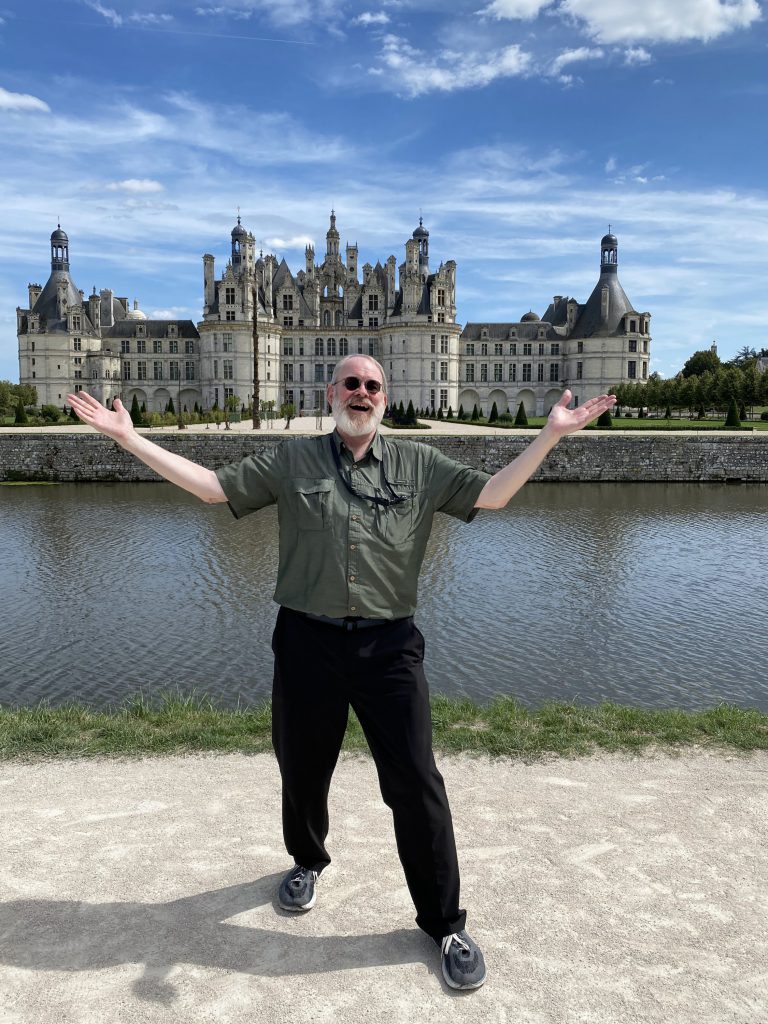
Jesse Hurlbut and the Château de Chambord in 2023. Photograph by Patricia Stevenson.

The Purpose

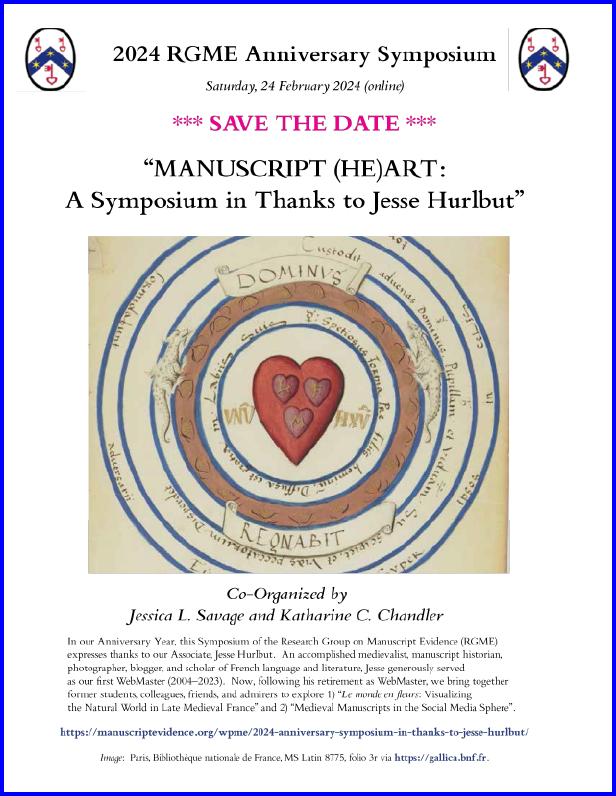
Our Save-the-Date Poster expresses the plan in word and image for an Anniversary Symposium full of “MANUSCRIPT (HE)ART”.  (You may download it here.)

Save-the-Date Poster for 2024 Anniversary Symposium in Thanks to Jesse Hurlbut. Poster set in RGME Bembino.

Read the rest of this entry →

Tags: 2023 Autumn Symposium Progam, Anniversary Symposium, Giving Thanks, Jesse Hurlbut, Manuscript studies, Medieval manuscripts, RGME Symposia
No Comments »

2024 Spring Symposium at Vassar College

October 16, 2023 in Announcements, Conference, Conference Announcement, Manuscript Studies, Reception, RGME Symposia, Uncategorized

2024 RGME Spring Symposium
at Vassar College

Vassar College: Current Seal.

“Between Past and Future:
Building Bridges
between Special Collections
and Teaching for the Liberal Arts”

Friday to Sunday, 18 to 21 April 2024

(hybrid, with both in-person events
and online participation by Zoom)

Celebrating the Acquisition of the
Nicholas B. Scheetz Collection
of Medieval and Renaissance Manuscripts

[Posted on 16 October 2023, with updates]

Update 15 April 2024:  Now see the updated Program (below).
Update 16 April:  For registrations, now see Late Registrations (below)

2024 RGME Spring Symposium at Vassar College:
“Between Past and Future:
Building Bridges
between Special Collections and Teaching for the Liberal Arts”
Friday to Sunday, 19 to 21 April 2024
https://library.vassar.edu/…/2024-RGME-Spring-Symposium…
(hybrid, with both in-person events and online participation by Zoom)

*****

For 2024, the Research Group on Manuscript Evidence celebrates an anniversary. Our Theme for the Year is “Bridges”. See “Bridges” for our 2024 Anniversary Year.

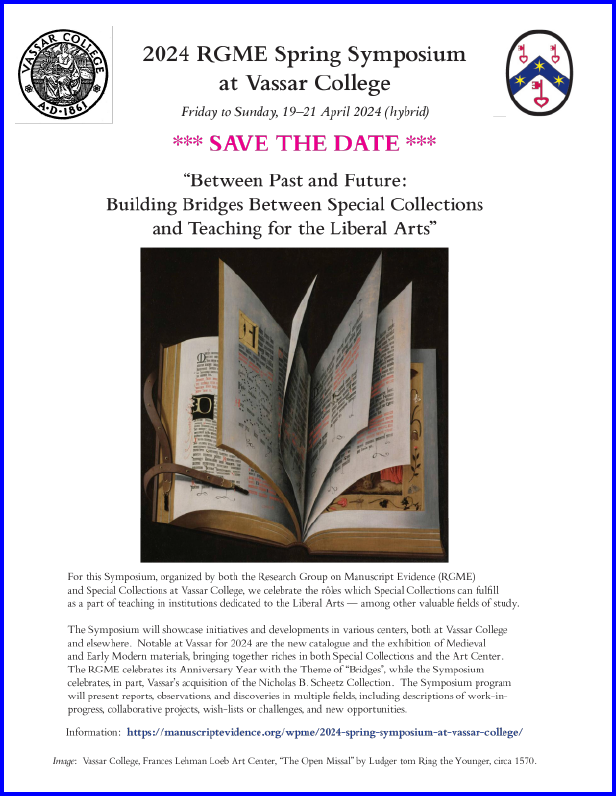
Vassar College, Frances Lehman Loeb Art Center, “The Open Missal”. Ludger tom Ring the Younger, circa 1570.

Among our celebrations, the RGME continues with its Symposium Series. With a Spring Symposium at Vassar College, in Poughkeepsie, New York, the RGME Symposia return to an in-person event, this time as a hybrid event also with online participation.

In 2023, the RGME began to return to in-person events with its activities at the partly-hybrid 58th International Congress on Medieval Studies. This step came after the cancellation of the Congress in 2020 and an online Congress in both 2021 and 2022. For 2024, our Symposia join this return, with the invitation to hold our Spring Symposium at Vassar College.

For some of our Symposia, whether in-person at Princeton University in 2019 (and intended there in 2020), or online by Zoom in 2022, 2023, and 2024, our RGME Associates at Vassar have given presentations about their work, the Library, and Special Collections. See, for example,

  • 2019 Anniversary Symposium Report: The Roads Taken
  • 2022 Spring and Autumn Symposia
  • 2023 Spring and Autumn Symposia
  • 2023 Autumn Symposium “Between Earth and Sky”
  • 2023 Spring Symposium “From the Ground Up”
  • 2024 Anniversary Symposium in Thanks to Jesse Hurlbut

Now we visit Vassar to join the celebrations for a new catalogue and exhibition of Medieval and Renaissance Books in the collection. We do so by gathering scholars, librarians, curators, cataloguers, collectors, vendors, teachers, and others to participate in an RGME Symposium which showcases the materials in the light of expertise and appreciation dedicated to them.

The choice of the Program and other components of the Symposium is guided by the Vassar/RGME Symposium Advisory Committee, and by other advisers both at Vassar and elsewhere. The Advisory Committee comprises

  • Ronald Patkus,
  • Elizabeth Lastra,
  • Mildred Budny, and
  • Barbara Williams Ellertson.

Note on the Image

Poughkeepsie, New York, Vassar College, Frances Lehman Loeb Art Center. The Open Missal (circa 1570) attributed to Ludger tom Ring the Younger (1522-1582). Image via “The Open Missal”.

Read the rest of this entry →

Tags: Early Printed Books, Frances Lehman Loeb Art Center, Frederick Ferris Thompson Memorial Library, History of Bridges, Les Enluminures, Manuscript studies, Manuscripts & Early Printed Books, Nicholas B. Scheetz Collection, RGME Anniversary Year, RGME Symposia, Symbols in Vassar Architecture, Vassar College, Vassar College Library, Vassar College Special Collections and Archives
No Comments »

Grant from The Gladys Krieble Delmas Foundation for the RGME Library & Archives in 2023

October 16, 2023 in Announcements, Manuscript Studies, Uncategorized

Announcement

2023 Grant from
The Gladys Krieble Delmas Foundation
Research Libraries Program
for Phase 1 for the RGME Library & Archives

“Building the Plan for ‘The Plan’ “

Logo of the Research Group on Manuscript Evidence (colour version)

RGME Logo in Color (2014).

Gratefully we announce that The Gladys Kreible Delmas Foundation, through its Research Libraries Program, has awarded the Research Group on Manuscript Evidence (RGME) a grant for 2023 to begin the process of structuring our Library & Archives as a collection.

The grant is awarded through the Research Libraries Program, for which “the overall objective . . .  is to improve the ability of research libraries to serve the needs of scholarship in the humanities and the performing arts, and to help make their resources more widely accessible to scholars and the general public.”

Building the Plan

With this funding, the RGME undertakes a one-year planning stage to produce an initial survey of the collection and its records and to plan for its Records-Management overall.  This project, which would comprise Phase 1 of work on the collection long-term, has the task of “Building the Plan for Recording, Structuring, and Accessing the RGME Library & Archives”.

The scope and purpose of the work as a whole will permit us to address more holistically the structure, maintenance, and longevity of our collection.  We will do so, moreover, in ways concordant with best practices for preservation, cataloguing, access, and other responsibilities.

The beginning work for Phase 1 supported by this grant belongs within the cohesion of RGME activities on multiple fronts for this year’s overarching theme of “Materials and Access”, as are addressed in our corporate activities and explored throughout our scholarly events, meetings, and publications, such as our 2023 Spring and Autumn Symposia dedicated specifically to the theme.

The RGME has formed a Task Force to guide and oversee the funded work to build the plan for the collection and its records-management, wider access, and development.  Guided by shared experiences and expert advice, we look toward creating improved, structured ways — taking into account our characteristics, abilities, and needs as an organization — for preparing our resources for the future, new records, and improved access by scholars and others.

The project funded by The Gladys Krieble Delmas Foundation Grant will span the entirety of the 2023 calendar year, concluding with an end-of-the-year report and a formal initial plan for the RGME’s archives and library.  This project will leave the Research Group, which in 2024 celebrates a key anniversary, in surer knowledge of its past and increased, informed, preparation for its future.

A Grant Unprecedented in our History

Logo of the Research Group on Manuscript Evidence in Monochrome Version

The original RGME Logo in black-and-white (1989).

The RGME has never had a grant of this kind before.  During our history, first as an international scholarly society founded in England in 1989 (from a major research project on “Anglo-Saxon and Related Manuscripts” at the Parker Library of Corpus Christi College, Cambridge), then based at Princeton, New Jersey, since 1994, and now established there as a nonprofit educational organization (incorporated in 1999), our work has primarily focused on the activities in pursuit of our mission.

Formerly, grants from various sources have supported research projects on specific materials, or scholarly events such as our Symposia and Colloquia held in various centers, in the United States and elsewhere.  While those earlier grants have enabled activities pursuant to our mission, this grant from The Gladys Krieble Delmas Foundation fosters the very essence of both our pursuits and our products as an entity, which was incorporated “for the purposes of lectures, discussions, and other publications”.

The Plan for the Project

The aim is to address our existing, in-coming, and future records (physical as well as digital, born-digital, obsolete digital, and digitized) with a responsible program according to “best practices” for preserving, conserving, archiving, cataloguing, digitizing, and accessing these materials for research, teaching, publication, and related purposes.  Equally, we take into account the needs of conducting our work as a living entity, for which more records continue to emerge.

For this year’s Pilot Project, to span the full course of the year, we have appointed a Task Force to guide and oversee the process of the work, and to produce a final report at the completion of this stage, along with our report to The Gladys Krieble Delmas Foundation at the close of Phase 1.  The Task Force will remain in place to continue to provide guidance in a next phase as it emerges.

The grant for 2023 gives the Research Group the opportunity to purchase equipment to archive digital materials and facilitate off-site consultation, and archival supplies to stabilize physical materials.  The grant also provides financial support for conservation services, technical back-up for our online meetings, and outside expertise in audio-visual processing/editing to increase the usability and access of our collections for scholars and others.  Significantly, too, the grant enables the process of undertaking the first steps for preparing for circulation the store of recordings which have emerged from our online events (since 2021), but had to await such an opportunity.  These measured steps in the project stand alongside, and integrate carefully with, the on-going work of our corporate and program activities as a living entity building for our future work, beginning with our Anniversary Year in 2024.

The Way Forward

The Research Group on Manuscript Evidence is most grateful for the generosity of spirit, the model, and the financial support of The Gladys Krieble Delmas Foundation for this significant step in the continuing history of our organization, as we now turn to addressing the nature, characteristics, responsibilities, and research potential of our Library & Archives as a collection.  The Pilot Project in 2023 enables us to prepare the Plan to do so.

For information, please contact director@manuscriptevidence.org.

*****

Tags: 2023 Pilot Project for RGME Library & Archives, Records Management, Research Library Program Grant, RGME Library & Archives, The Gladys Krieble Delmas Foundation
No Comments »

2024 International Medieval Congress at Leeds: Call for Papers

August 9, 2023 in Announcements, Call for Papers, Conference Announcement, International Congress on Medieval Studies, International Medieval Congress, Leeds, Uncategorized

RGME Call For Papers
for the 2024 International Medieval Congress at Leeds
(1–4 July 2024 in hybrid format)

“Building Bridges ‘Over Troubled Waters’
For 25 Years and More”

An Inaugural RGME-Sponsored Session at Leeds

[Posted on 9 August 2023]

Paris, Musée Carnavalet, Projet pour le Pont Neuf, circa 1577. Image via Wikimedia via Creative Commons Attribution 3.0 Unported.

The Research Group on Manuscript Evidence prepares an Inaugural Sponsored Session at the International Medieval Congress (IMC), University of Leeds, United Kingdom, to be held in hybrid format from 1st – 4th July, 2024. This Session comprises our first Sponsored Session at the Congress.

The Congress subject for 2024 is “Crisis”. The RGME Theme for its Anniversary Year of 2024 is “Bridges”.

For the 2024 ICMS at Leeds we propose to examine subjects pertaining to the challenges and opportunities of “Building Bridges Over Troubled Waters”.  We invite your proposals for Papers for this Session.

Our 2024 Anniversary Year: “Bridges”

In 2024 the Research Group on Manuscript Evidence (RGME) celebrates its 25th Anniversary as a Nonprofit Educational Corporation based in the United States and its 35th Anniversary as an International Scholarly Organization founded in England.

To mark our anniversary year, we prepare sponsored Sessions, as usual, for the International Congress on Medieval Studies (ICMS) at Kalamazoo in May.  See our Call for Papers for the 2024 ICMS.

Also, for the first time, we prepare an Inaugural RGME-sponsored Session for the International Medieval Congress (IMC) at Leeds in July 2024.


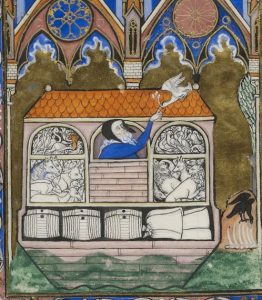
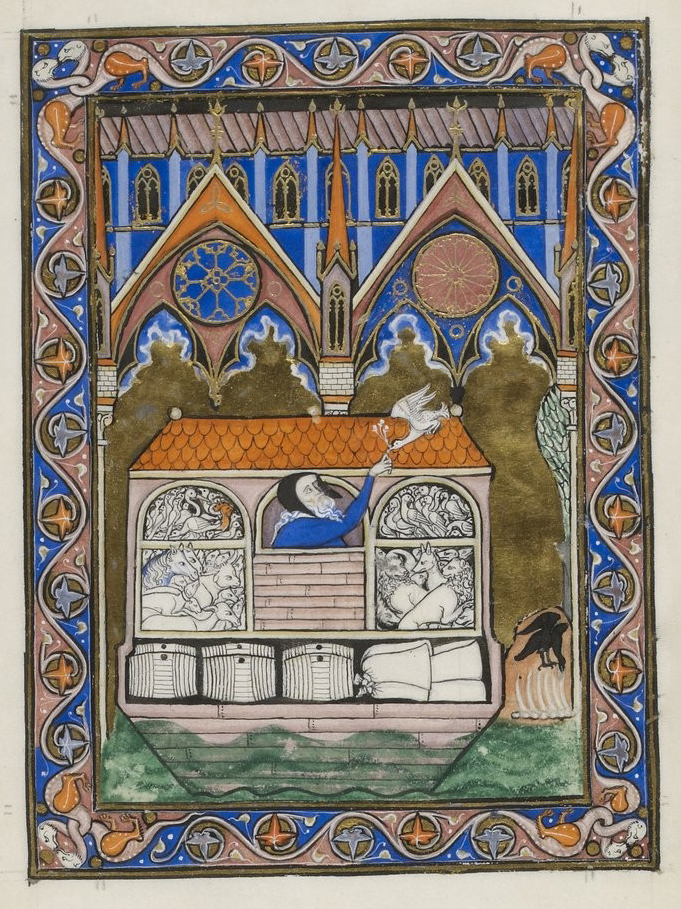
Paris, Bibliothèque nationale de France, Département des manuscrits, MS Lat 10525, fol, 3v, detail. Noah’s Ark. Image Public Domain via https://gallica.bnf.fr/ark:/12148/btv1b8447877n.

The 2024 Leeds Congress:  “Crises”

The chosen “Thematic Focus” for the Leeds Congress in 2024 is “Crisis”.

Bridges and “Troubled Waters”

Under our guiding concept of “Bridges” for 2024 (see Bridges for our 2024 Anniversary Year), the RGME invites papers for a Session at Leeds on all kinds of bridges and bridge-related topics. Be it more literally, as physical architectures and landmarks, such as historically significant specimens, be it more abstractly, as architectural devices of the mind that enable us to make unexpected and unpredicted connections between marginal, off-field, divergent media, methods, and subjects that are usually not made or ignored.

In addition, we ask how bridges answer to different forms of crises, especially, but not only, with regard to communication, travel, social, cultural or political relations, or of the natural environment. In turn, we are also interested in papers that discuss how the establishment and maintenance of bridges may prevent crises or, contrarily, cause new unforeseen forms of crisis.

In summary, we welcome all bold bridge-makers willing to traverse pathways that others have not dared to take. In such ways, we might also respond to the opportunities and challenges which the captain and officers on the bridge of a ship can observe directly, better to steer a course forward in the passage.

How to Submit your Proposal
for a Paper for our 2024 Session at Leeds
— Due by 31 August 2023

“Building Bridges ‘Over Troubled Waters’ ”

Session Co-Organisers:

Ann Pascoe-van Zyl (Trinity College Dublin)
and
Michael Allman Conrad (Research Group on Manuscript Evidence and Universität St. Gallen)

We invite abstracts of 200–300 words. Your proposals for papers should be made directly to the organisers by 31 August 2023.

We seek papers on a wide range of subjects pertaining to Bridges and to Crises.

Our own experience with RGME activities over the years, in promoting the possibilities of “Building Bridges” between disciplines, centres, and individuals, provides a keen interest in these issues and potential solutions.  See, for example, our

  • Events,
  • Congress Activities, and
  • Publications.

From your Proposals due by the end of August, the RGME Session will be selected and submitted to the Congress at Leeds by 30 September 2023.  We will inform you of our selection by that time.

Congress information

  • Congress Website
    https://www.imc.leeds.ac.uk/imc-2024/
  • Proposal Criteria
    https://www.imc.leeds.ac.uk/proposals/criteria/

The Congress will be held in person, with provisions for online participation. In this way, we hope that you might be able to attend onsite or at a distance, depending upon your travel arrangements.

Deadline for Paper Proposals:  Due by 31 August 2023

Please send your Proposal of 200–300 words for your Paper to the organisers at their address below.  Might you please note your preferred mode for presenting your paper — in person or virtually.

Address to send your Proposals:  rgmesessions@gmail.com

For information about this RGME Inaugural Session at the IMC, please contact the Session Co-organisers at their address.

We look forward to your contributions.

*****

Paris, Bibliothèque nationale de France, Département des manuscrits, MS Lat 10525, fol, 3v, detail. Noah’s Ark. Image Public Domain via https://gallica.bnf.fr/ark:/12148/btv1b8447877n.

*****

Tags: Bridges, Crises, International Medieval Congress, Medieval Studies, Noah's Ark
No Comments »

« Older Entries
Newer Entries »
  • Top
©2024 Research Group on Manuscript Evidence.


is proudly powered by WordPress. WordPress Themes X2 developed by ThemeKraft.