• News
    • News & Views
    • RGME Activities for 2024 and 2025
    • Around & About with the RGME
    • Reviews
    • Highlights
  • Blogs
    • Manuscript Studies
      • Manuscript Studies: Contents List
    • International Congress on Medieval Studies
      • Abstracts of Congress Papers
        • Abstracts of Papers Listed by Author
        • Abstracts of Papers Listed by Year
  • About
    • Mission
    • Who We Are
      • Officers, Associates & Volunteers
      • RGME Committees
      • Friends of the Research Group on Manuscript Evidence
    • Policies & Statements
      • RGME Privacy Policy Statement
      • RGME Intellectual Property Statement & Agreements
    • People
      • Mildred Budny — Her Page
      • Adelaide Bennett Hagens
    • Activities
      • Events
      • Congress Activities
        • Sponsored Conference Sessions (1993‒)
          • Panels at the M-MLA Convention (from 2016)
        • Co-sponsored Conference Sessions (2006‒)
    • History
      • Seals, Matrices & Documents
      • Genealogies & Archives
    • Contact Us
  • Bembino
    • Multi-Lingual Bembino
    • RGME Bembino: Resources
  • Congress
    • Sponsored Conference Sessions (1993‒)
    • Co-sponsored Conference Sessions (2006‒)
    • Abstracts of Congress Papers
      • Abstracts Listed by Author
      • Abstracts Listed by Year
    • Kalamazoo Archive
    • Panels at the M-MLA Convention (2016-2019)
      • Abstracts of Papers for the M-MLA Convention
      • Panels at the M-MLA Convention (from 2016)
  • Events
    • RGME Activities for 2024 and 2025
      • 2023 Activities and 2024 Planned Activities
    • Seminars, Workshops, Colloquia & Symposia (1989–)
      • Seminars on ‘The Evidence of Manuscripts’
      • Symposia on ‘The Transmission of the Bible’
      • The New Series (2001-)
        • 2019 Anniversary Symposium Program: The Roads Taken
        • 2019 Anniversary Symposium Registration
        • 2019 Anniversary Symposium Registration Open
      • RGME Symposia: The Various Series
      • The Research Group Speaks: The Series
      • Meetings of the Friends of the Research Group on Manuscript Evidence
      • RGME Online Events
    • Abstracts of Papers for Events
      • Abstracts of Papers for Seminars on ‘The Evidence of Manuscripts’
      • Abstracts of Papers for Symposia, Workshops & Colloquia
    • Receptions & Parties
    • Business Meetings
    • Photographic Exhibitions & Master Classes
    • Events Archive
  • ShelfLife
    • Journal Description
    • ShelfMarks: The RGME-Newsletter
    • Publications
      • “Insular, Anglo-Saxon, and Early Anglo-Norman Manuscript Art at Corpus Christi College, Cambridge” (1997)
        • Mildred Budny, ‘Catalogue’
        • The Illustrated Catalogue (1997)
      • The Illustrated Handlist
      • Semi-Official Counterfeiting in France 1380-1422
      • No Snap Decisions: Challenges of Manuscript Photography
    • History and Design of Our Website
  • Galleries
    • Watermarks & the History of Paper
    • Galleries: Contents List
    • Scripts on Parade
    • Texts on Parade
      • Latin Documents & Cartularies
      • New Testament Leaves in Old Armenian
    • Posters on Display
    • Layout Designs
  • Donations and Contributions
    • RGME Donor Promise
    • 2023 End-of-Year Fundraiser for our 2024 Anniversary Year
    • 2019 Anniversary Appeal
    • Orders
  • Links
    • Catalogs, Metadata, and Databases: A Handlist of Links
    • Handlist of Resources for Manuscript Studies and Fragmentology
    • Manuscripts & Rare Books
    • Maps, Plans & Drawings
    • Seals, Seal-Matrices & Documents

  • News
    • News & Views
    • RGME Activities for 2024 and 2025
    • Around & About with the RGME
    • Reviews
    • Highlights
  • Blogs
    • Manuscript Studies
      • Manuscript Studies: Contents List
    • International Congress on Medieval Studies
      • Abstracts of Congress Papers
        • Abstracts of Papers Listed by Author
        • Abstracts of Papers Listed by Year
  • About
    • Mission
    • Who We Are
      • Officers, Associates & Volunteers
      • RGME Committees
      • Friends of the Research Group on Manuscript Evidence
    • Policies & Statements
      • RGME Privacy Policy Statement
      • RGME Intellectual Property Statement & Agreements
    • People
      • Mildred Budny — Her Page
      • Adelaide Bennett Hagens
    • Activities
      • Events
      • Congress Activities
        • Sponsored Conference Sessions (1993‒)
          • Panels at the M-MLA Convention (from 2016)
        • Co-sponsored Conference Sessions (2006‒)
    • History
      • Seals, Matrices & Documents
      • Genealogies & Archives
    • Contact Us
  • Bembino
    • Multi-Lingual Bembino
    • RGME Bembino: Resources
  • Congress
    • Sponsored Conference Sessions (1993‒)
    • Co-sponsored Conference Sessions (2006‒)
    • Abstracts of Congress Papers
      • Abstracts Listed by Author
      • Abstracts Listed by Year
    • Kalamazoo Archive
    • Panels at the M-MLA Convention (2016-2019)
      • Abstracts of Papers for the M-MLA Convention
      • Panels at the M-MLA Convention (from 2016)
  • Events
    • RGME Activities for 2024 and 2025
      • 2023 Activities and 2024 Planned Activities
    • Seminars, Workshops, Colloquia & Symposia (1989–)
      • Seminars on ‘The Evidence of Manuscripts’
      • Symposia on ‘The Transmission of the Bible’
      • The New Series (2001-)
        • 2019 Anniversary Symposium Program: The Roads Taken
        • 2019 Anniversary Symposium Registration
        • 2019 Anniversary Symposium Registration Open
      • RGME Symposia: The Various Series
      • The Research Group Speaks: The Series
      • Meetings of the Friends of the Research Group on Manuscript Evidence
      • RGME Online Events
    • Abstracts of Papers for Events
      • Abstracts of Papers for Seminars on ‘The Evidence of Manuscripts’
      • Abstracts of Papers for Symposia, Workshops & Colloquia
    • Receptions & Parties
    • Business Meetings
    • Photographic Exhibitions & Master Classes
    • Events Archive
  • ShelfLife
    • Journal Description
    • ShelfMarks: The RGME-Newsletter
    • Publications
      • “Insular, Anglo-Saxon, and Early Anglo-Norman Manuscript Art at Corpus Christi College, Cambridge” (1997)
        • Mildred Budny, ‘Catalogue’
        • The Illustrated Catalogue (1997)
      • The Illustrated Handlist
      • Semi-Official Counterfeiting in France 1380-1422
      • No Snap Decisions: Challenges of Manuscript Photography
    • History and Design of Our Website
  • Galleries
    • Watermarks & the History of Paper
    • Galleries: Contents List
    • Scripts on Parade
    • Texts on Parade
      • Latin Documents & Cartularies
      • New Testament Leaves in Old Armenian
    • Posters on Display
    • Layout Designs
  • Donations and Contributions
    • RGME Donor Promise
    • 2023 End-of-Year Fundraiser for our 2024 Anniversary Year
    • 2019 Anniversary Appeal
    • Orders
  • Links
    • Catalogs, Metadata, and Databases: A Handlist of Links
    • Handlist of Resources for Manuscript Studies and Fragmentology
    • Manuscripts & Rare Books
    • Maps, Plans & Drawings
    • Seals, Seal-Matrices & Documents

Log in

Archives

Featured Posts

Sanskrit and Prakrit Manuscripts, Continued: More Leaves for Manuscript Sample XII?
2026 International Congress on Medieval Studies: Program
Episode 24. “Life with Books” (Interview with John Windle)
Announcing the Launch of RGME Bembino WP
2026 RGME Colloquium at The Grolier Club: Report
Medieval Missal Fragment as Early-Modern Cover
The Weber Leaf from Ege MS 61
"Bembino" Booklet Cover
Episode 23. “Meet RGME Bembino: Facets of a Font”
2026 RGME Colloquium on “Transformations & Renewals” at The Grolier Club
2026 Theme of the Year: “Transformations and Renewals”
A Leaf with Patchwork from the Saint Albans Bible
A Sister Leaf from a Miniature Latin Vulgate Bible
A Little Latin Vulgate Bible Manuscript Leaf in Princeton
J. S. Wagner Collection. Leaf from from Prime in a Latin manuscript Breviary. Folio 4 Verso, with part of Psalm 117 (118) in the Vulgate Version, set out in verses with decorated initials.
2026 Annual Appeal
Episode 22: “Encounters with Local Saints and Their Cults”
Private Collection, Ege's FBNC Portfolio, Dante Leaf, Verso, Detail. Reproduced by Permission.
2025 RGME Autumn Colloquium on Fragments
Workshop 8: A Hybrid Book where Medieval Music Meets Early-Modern Herbal
2025 RGME Autumn Symposium on “Readers, Fakers, and Re-Creators of Books”
RGME Workshops on “The Evidence of Manuscripts, Etc.”
2025 International Medieval Congress at Leeds: RGME Program
Episode 21. “Learning How to Look”
2025 International Congress on Medieval Studies: Program
2025 RGME Visit to Vassar College
Two Leaves in the Book of Numbers from the Chudleigh Bible
Delibovi on Glassgold on Boethius: A Blogpost
Ronald Smeltzer on “Émilie du Châtelet, Woman of Science”
2025 Spring Symposium: “Makers, Producers, and Collectors of Books”
Starters’ Orders
The Weber Leaf from the Saint Albans Bible
Workshop 4. “Manuscript Fragments Compared”
Episode 20. “Comic Book Theory for Medievalists”
Episode 19: “At the Gate: Starting the Year 2025 at its Threshold”
Favorite Recipes for Lemonade, Etc.
RGME Visit to the Lomazow Collection: Report
2024 Autumn Symposium: “At the Helm”
A Latin Vulgate Leaf of the Book of Numbers
The RGME ‘Lending Library’
Florence, Italy, Ponte Vecchio from Ponte alle Grazie. Photo: Ingo Mehling, CC BY-SA 4.0 , via Wikimedia Commons
Episode 17. “RGME Retrospect and Prospects: Anniversary Reflections”
2024 Anniversary Symposium: The Booklet
Jesse Hurlbut at the Bonneville Salt Flats, Utah. Photograph Jesse Hurlbut.
Episode 16: An Interview with Jesse D. Hurlbut
To Whom Do Manuscripts Belong?
Kalamazoo, MI Western Michigan University, Valley III from the side. Photograph: David W. Sorenson.
2024 International Congress on Medieval Studies: Report
2024 Spring Symposium at Vassar College
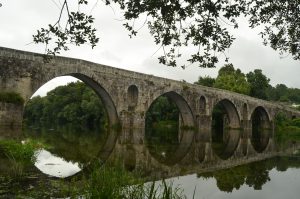
Puente de San Martín: Bridge with reflection over the River Targus, Toledo, Spain.
2024 Grant for “Between Past and Future” Project from The Gladys Krieble Delmas Foundation Research Libraries Program
2024 Anniversary Symposium in Thanks to Jesse Hurlbut: Program

You are browsing the Blog for Announcements

2023 Pre-Symposium Call for Papers: Intrepid Borders Lightning Talks

January 9, 2023 in Announcements, Manuscript Studies, RGME Symposia

Call for Papers

Intrepid Borders:
Marginalia in Medieval and Early Modern Books

A Virtual Lightning Talks / Half-Day Symposium
of the Research Group on Manuscript Evidence

Proposals due by Sunday, 12 February 2023

The Research Group on Manuscript Evidence seeks proposals for lightning talks (between 15–18 minutes each) for a half-day virtual symposium to be held on the afternoon of Friday, 24 March 2023.

This exploratory event about book marginalia and borders (including drolleries, glosses, inscriptions, and annotations) will kick off the Research Group’s virtual Spring Symposium to be held the next day on Saturday, March 25th. As part of the RGME’s Theme for the Year 2023, “Materials & Access”, the pair of 2023 Spring and Autumn Symposia considers interlinked areas “From the Ground Up” (Spring) and “Between Earth and Sky” (Autumn).

The set of Sessions on “Intrepid Borders” for the afternoon Pre-Symposium leading to the Spring Symposium are co-organized by Katharine Chandler, Jennifer Larson, and Jessica L. Savage.

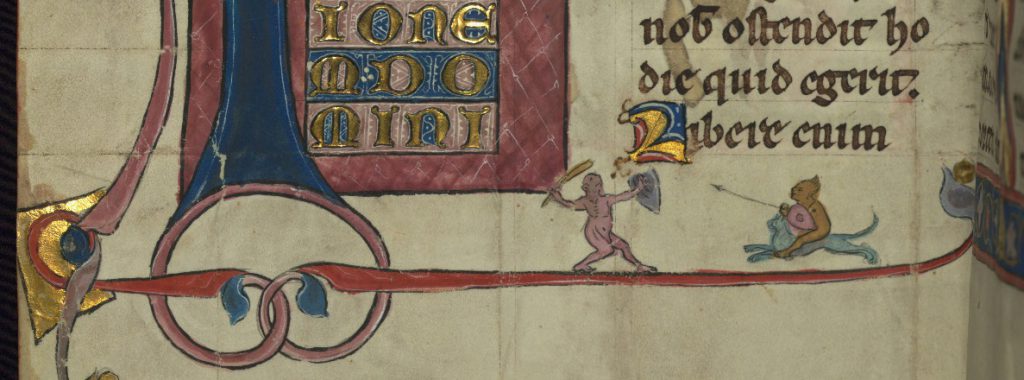
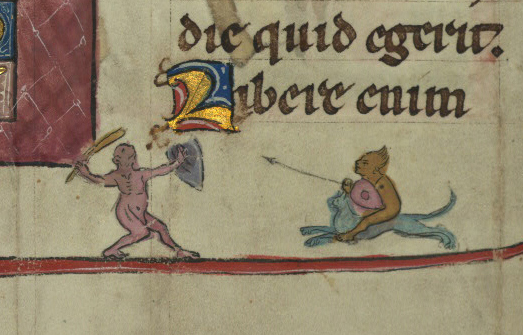
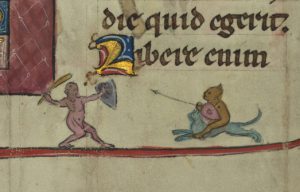
Baltimore, Walters Art Museum, MS. W.148, folio 33v. Detail: Bottom, with fighting creatures. Image via Creative Commons.

Baltimore, Walters Art Museum, MS. W.148, folio 33v. Detail: Bottom, with fighting creatures. Image via Creative Commons.

Vision for the Lightning Talks

The borders of books are usually narrow places where reader-viewers of manuscripts touched, turned, and lingered on pages. As a space to develop writing and decoration, marginalia, or “things in the margin,” might be integral to the design of a manuscript, or their marks could be extraneous additions to the page.

Papers might explore the interaction of readers with texts through annotations and glosses, and investigate the many varied inscriptions and their purposeful inclusion in book borders. Papers might also zero in on the iconographic programs and decorative surrounds in manuscripts, which evolved over the late Middle Ages and into the early modern period, and which contain compelling visual evidence of the whimsical and fantastic.

Proposals for Talks

We seek short abstracts (~200–250 words) detailing your title and topic as it fits with the above parameters, to reach us by the end of Sunday, 12 February 2023. Speakers will be notified in the following week of their acceptance.

Research works-in-progress and work from emerging scholars in manuscript studies are especially encouraged to submit their ideas for inclusion in the program.

Please send your abstracts through the linked Call for Papers Google Form.

More information about the 2023 Spring and Autumn Symposia can be found at: 2023 Spring and Autumn Symposia.

We look forward to your proposals.

*****

Fantastic fighters in the lower margin, Douce–Walters Homiliary, Walters Art Museum, MS. W.148, folio 33v.  On the manuscript, see The Digital Walters.

Baltimore, Walters Art Museum, MS. W.148, folio 33v, bottom right, with fighting creatures. Image via Creative Commons.

*****

Tags: Borders, Lightning Talks, Manuscript Illumination, Marginalia, Medieval manuscripts, RGME Symposia
1 Comment »

2023 Spring and Autumn Symposia

December 5, 2022 in Announcements, Manuscript Studies

2023 Spring and Autumn Symposia
on
“Materials & Access”

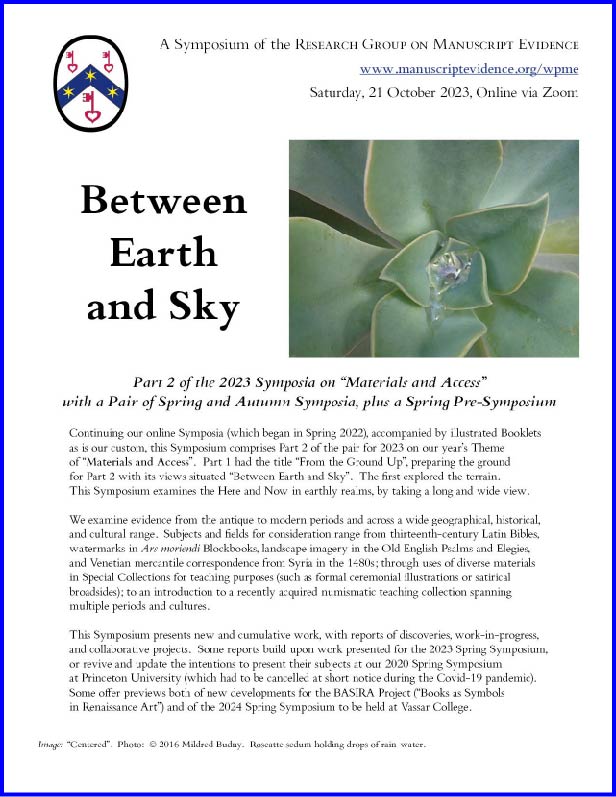
"Centered". Photograph Ⓒ 2014 Mildred Budny. Image of Dew at the center of Sedum.

“Centered”. Photograph Ⓒ 2014 Mildred Budny.

[Posted on 5 December 2022, with updates]

The Research Group prepares a pair of Symposia in 2023, continuing the pattern of paired Spring and Autumn Symposia launched in 2022.

[Update on 25 October: With both the 2023 Spring and Autumn Symposia now accomplished, the illustrated Symposium Booklets for both are published.  You could download both of them or ask for printed copies to be sent to you.  See below.]

The New Tradition

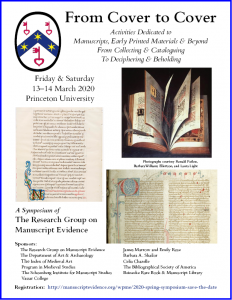
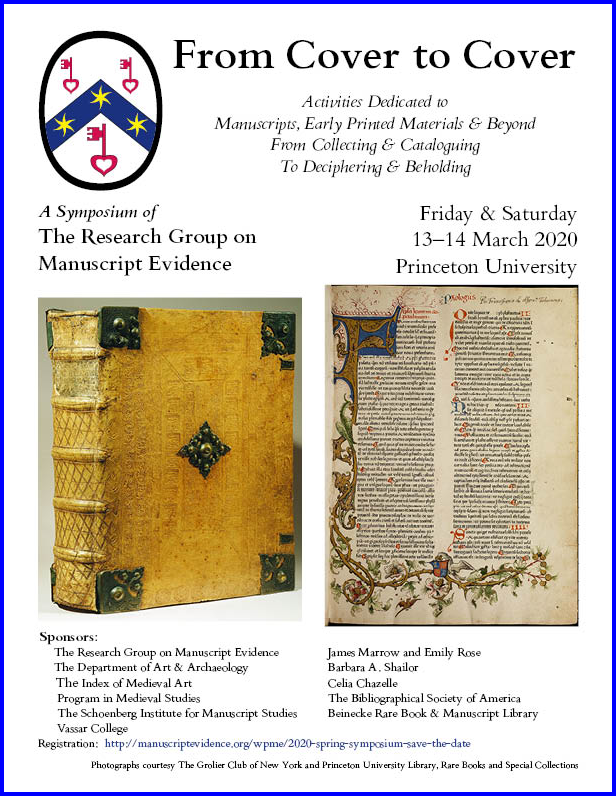
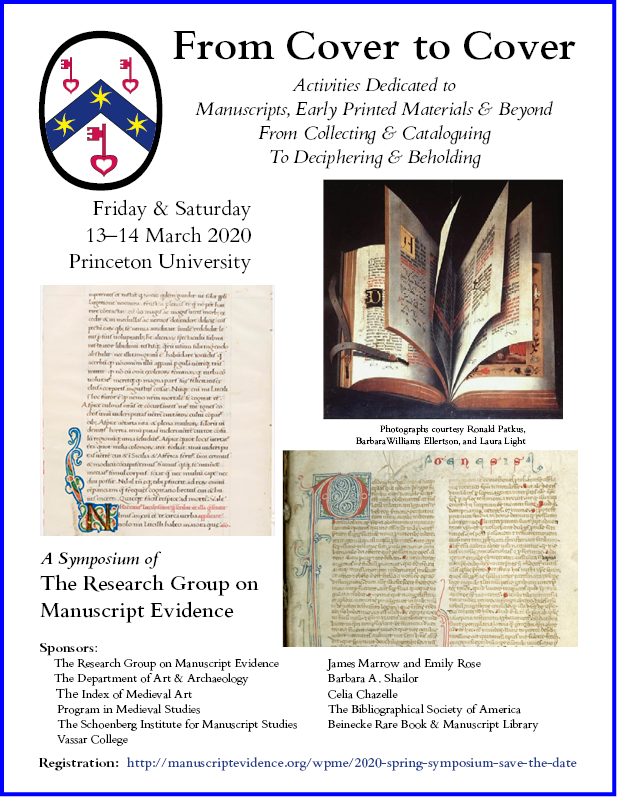
2020 Symposium "From Cover to Cover" Poster 2

2020 Symposium Poster 2

Before then, up to 2022, there would be only one Symposium in a given year, although the span could vary from one to three days, and the Symposia occurred only in person.  Also, previously, the pattern of Symposia did not always appear each year, except notably for our first Symposia, beginning in 1995 at Barnard College, which occurred for five years as a series:

  • “The Transmission of the Bible”: A Series of Annual Symposia (1995‒2000)

Then, after an interval, when we focused instead on other activities and tasks, including the incorporation of the RGME as a nonprofit educational corporation (1999), our resumption of Symposia in a “New Series” would examine a wide variety of themes in turn.  The New Series not only resumed our Symposia, with a difference, but also adopted other forms of Events, such as Colloquia and Workshops:

  • The “New Series” of Symposia, Colloquia, Workshops & Seminars (2001–)

The variation in the usage of terms for the events depended partly on their characteristics and partly on their host institutions’ preferences or requirements for given genres.

2022 Autumn Symposium Program Booklet, Front Cover (Page 1)

With the onset of the Covid-19 pandemic by 2020, RGME events shifted for a while from in-person to online.  After the cancellation of events in 2020, the RGME adopted online events in 2021, to resume Symposia in 2022.  In both 2022 and 2023, we held a pair of Spring and Autumn Symposia.  In this way, our tradition of Symposia comprises several forms or series:

  • RGME Symposia: The Various Series (1995–), in person or online.

And so, with paired Symposia for 2023, we affirm the momentum of our series of Symposia after the Covid-induced hiatus. Formerly, the Symposia were held at various centers, before the cancellation of our 2020 Spring Symposium, “From Cover to Cover”, intended for Princeton University. The illustrated Program Booklet for that Symposium reports its intentions.

The Revived Series

In resuming the series in 2022, we are able to return to some of its subjects, as the contributors make presentations, as their timetables allow, for one or other Session in the revived Symposia.  Some of those contributors propose to participate in our 2023 Symposia.

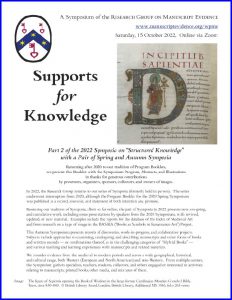
In 2022, the pair of Symposia addressed the year’s Theme of “Structured Knowledge”, for which the Spring Symposium considered “Structures of Knowledge”, and the Autumn Symposium considered “Supports for Knowledge”.  The webposts for them describes their scope and coverage.  The illustrated Program Booklet for the Autumn Symposium, available freely for download as a booklet of 54 pages in quarto (‘letter-size’) format.  The Symposia for 2023 and for 2024 already have their Year’s Theme as an overarching guide and a central focus, while other subjects also may be explored, sometimes interconnected.

2023: “Materials & Access”

For 2023, the Year’s Theme is “Materials & Access”.

The Spring Symposium has this focus: “From the Ground Up”.
The Autumn Symposium:  “Between Earth and Sky”.

Themes and Subjects for Sessions include some in our continuing series and others. Those subjects and interests are described, for example:

  • for our 2022 Symposia and
  • the Episodes for our series “The Research Group Speaks”.

Each Symposium will have the span of one day and take place on a Saturday.  The selected time-zone is Eastern Standard Time (GMT-5) / Eastern Daylight Time (GMT-4), depending upon time of year.  That is, this year, EDT for the Spring Symposium and EST for the Autumn Symposium.  The Symposia would take place online by Zoom.

Perhaps, conditions permitting, the Autumn Symposium might be hybrid, with attendance both in person and online.

The date for the Spring Symposium has been set.  It is planned for Saturday 25 March 2023, to span a full day (like the two Symposia in 2022) on the timezone of EST (GMT-5) and to take place online via Zoom.

We gather participants for the Presentations (of about 20 to 25 minutes each) and Responses (about 10 to 15 minutes each), for Sessions of 1 1/2 hours duration, with scope within them for Discussion (Q&A) and with Breaks between Sessions.

Participants, variously as Presenters, Respondents, Presiders, Moderators, and Advisers, include:

  • Linde M. Brocato, Mildred Budny, Katharine C. Chandler, Justin Hastings, Atria A. Larson, Ann Pascoe-van-Zyl, Ronald Patkus, David W. Sorenson, and others.

We look forward to your suggestions and participation.

The Program

As the Program for each Symposium gathers, we can post more information both here and on the individual webposts for the two Symposia.  Their webposts appear as

  • 2023 Spring Symposium
  • 2023 Autumn Symposium

If you have questions or comments, please Contact Us or leave your Comments Here.

Now see the developed Program for the 2023 Spring Symposium “From the Ground Up” on Saturday 25 March 2023.  It also has a half-day Pre-Symposium of Lightning Talks on “Intrepid Borders”, organized by Katharine C. Chandler, Jennifer Larson, and Jessica L. Savage, on Friday 24 March 2023.

See the webposts for these companion events, with their Programs and registration information:

  • 2023 Spring Pre-Symposium on “Intrepid Borders”

Baltimore, Walters Art Museum, MS. W.148, folio 33v, bottom right, with fighting creatures. Image via Creative Commons.

  • 2023 Spring Symposium “From the Ground Up”
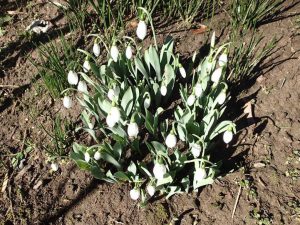
Photograph of the stems and white blooms of Snowdrops emerging from a patch of bare ground in the sunlight. Photograph Ⓒ Mildred Budny.

The blooms of Snowdrops emerging “From the Ground Up”. Photograph Ⓒ Mildred Budny.

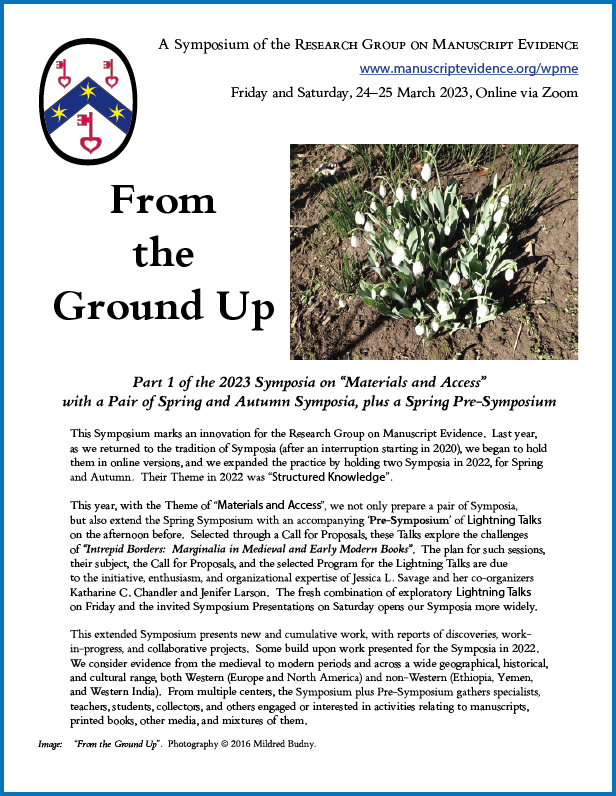
2023 Spring Pre-Symposium/Symposium Program Booklet

The 64-page illustrated Program Booklet is published ‘on the day’ or first day of the event (24 March 2023).

2023 Spring Pre-Symposium/Symposium Booklet Front Cover with photograph of snowdrops flowers rising from the earth.

2023 Spring Pre-Symposium/Symposium Booklet Front Cover.

See 2023 Spring Symposium “From the Ground Up” for information about how you could receive, order, or download a copy of this Booklet free of charge.

2023 Autumn Symposium

Plans advance for the 2023 Autumn Symposium “Between Earth and Sky”.

  • 2023 Autumn Symposium “Between Earth and Sky”

[Update: This event has been successfully accomplished.  See its post, with information for downloading its illustrated booklet of 54 pages.]

2023 Autumn Symposium Booklet Cover.

2023 RGME Events

Other Events are planned for the Year.  See

  • “The Research Group Speaks”: The Series
  • 2023 International Congress on Medieval Studies: Program

2024 RGME Events

“Study on a Medieval Bridge” at Amares, Braga District, Portugal. Image by Pedro Nuno Caetano (2019) via Wikimedia Commons via Creative Commons 2.0 Generic.

For activities planned for next year, an Anniversary Year for the RGME, with the year’s theme of “Bridges”, see:

  • RGME 2023 and 2024 Activities.
  • “Bridges” for our 2024 Anniversary Year

They include episodes for “The Research Group Speaks”, conference sessions at two international congresses for medieval studies (at Kalamazoo and Leeds), anniversary celebrations, and two symposia.

  • 2024 Anniversary Symposium in Thanks to Jesse Hurlbut, RGME WebMaster Emeritus
  • 2024 Spring Symposium at Vassar College

Suggestion Box

Please Contact Us or visit

  • our FaceBook Page
  • our Twitter Feed (@rgme_mss)
  • our Blog on Manuscript Studies and its Contents List

Donations and contributions, in funds or in kind, are welcome and easy to give.  See Contributions and Donations.

We look forward to hearing from you.

*****

Beinecke Rare Book & Manuscript Library, Otto Ege Collection, Volume II of Ege MS 51, View toward Gutter with Reused Manuscript Fragments. Photograph by Mildred Budny.

Beinecke Rare Book & Manuscript Library, Otto Ege Collection, Volume II of Ege MS 51, Displaced Folios 29v-26r. View toward Gutter with Reused Manuscript Fragments. Photograph by Mildred Budny.

*****

Tags: Catalogues & Metadata & Databases, Grounded, Hybrid Books, Manuscripts and Photography, Materials & Access, RGME Autumn Symposium, RGME Spring Symposium, RGME Symposia, Teaching with and through Manuscripts, The Living Library
No Comments »

Donncha MacGabhann on the Making of “The Book of Kells”

November 1, 2022 in Announcements, Manuscript Studies, Research Group Speaks (The Series)

The Research Group Speaks
Episode 9
Saturday 19 November 2022 online

“The Book of Kells:  A Masterwork Revealed”
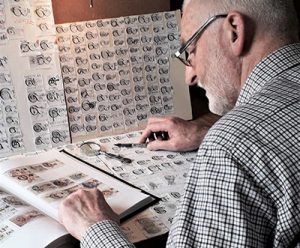
Donncha MacGabhann at work on his close study of letter forms in the Book of Kells. Photograph via his publisher, Sidestone Press (Leiden 2022)

Donncha MacGabhann at work on his close study of letter forms in the Book of Kells. Photograph via his publisher, Sidestone Press (Leiden 2022)

– An informal Interview/Conversation with Donncha MacGabhann, Associate of the RGME, about his newly published book

[Posted on 31 October 2022 by Mildred Budny, with updates]

For Episode 9 in the online series of The Research Group Speaks, we present an informal Conversation or Interview with the author about his new book on The Book of Kells:  The Making of a Masterwork (Leiden, 2022).

The Book has emerged from Donncha’s detailed study for the Ph. D. dissertation (London, 2016), as well as his own experience as an artist.  For our Episode, he will tell us about the making of his Book on the making of the Book of Kells . . .

To Register for the event, see Below.

The Book of Kells

One of the chief treasures of the Library of Trinity College Dublin (since at least 1661), and the subject of widespread fame, the Book of Kells might need no introduction.
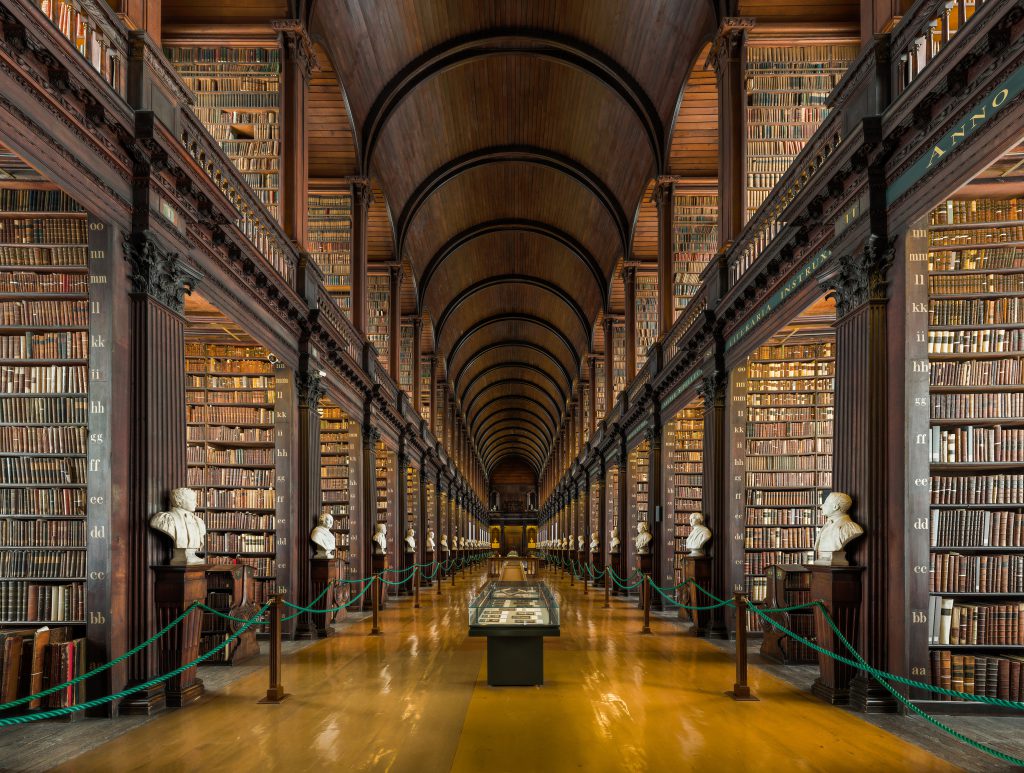
The Long Room of the Old Library, Trinity College Dublin, seen from the entrance (2015). Photo by DAVID ILIFF. License: CC BY-SA 3.0.

  • Dublin , Trinity College Library, MS A. I. [58], the Codex Cennanensis, now comprising 340 vellum folios, bound (since 1953) in four volumes, one for each Gospel.

The online Library catalogue offers concise descriptions.  About the contents, for example, some essential facts:

The Book of Kells (Leabhar Cheanannais, Trinity College Dublin MS 58) contains the four Gospels in Latin based on the Vulgate text which St Jerome [circa 342 – circa 347 – 30 September 420] completed in 384AD, intermixed with readings from the earlier Old Latin translation. The gospel texts are prefaced by other texts, including “canon tables”, or concordances of gospel passages common to two or more the Evangelists; summaries of the gospel narratives (Breves causae); and prefaces characterizing the Evangelists (Argumenta).

A different approach can be found, for example, in a concise guide for the curious:

  • Ten Things You Should Know about the Book of Kells, or the Book of Columba
    — along with, say, 10 Things You Should Know About The Gutenberg Bible.

Have a Look:

  • The Book itself, in online facsimile: Book of Kells. IE TCD MS 58
  • Its introduction: Book of Kells

For my part, one of the principal highlights — not the only one — of my long study of early medieval manuscripts from the British Isles, their companions, and their contexts (for example, British Library, Manuscript Royal 1 E. vi: The Anatomy of an Anglo-Saxon Bible Fragment and Deciphering the Art of Interlace), was the opportunity to examine directly, turning the pages, two volumes of the Book of Kells. That experience, over some days, augmented and amplified the observations of the volumes on display, along with other treasures, in the imposing Long Hall of the Library. The opportunity, with permission, to look at the Book itself took place in the Director’s office, with the clear light of natural light during an unusually dry summer with cloudless skies. Memorable indeed.  #turnedthepages.

A few years later, while part of the Book came on tour among the travelling Treasures of Ireland (1982 and 1983), I could see part of it again, in museums in Paris and in New York, under subdued light and behind the glass case. Different views, same astonishing monument.

Very, very many people can say that they have seen the Book of Kells.  Attracted by its fame, visitors to the Library, where it has been displayed since the nineteenth century, number on average some 500,000 each year.  On her visit, Queen Victoria (1819–1901) was encouraged to sign it — as an extraordinary form of ‘Visitors’ Book’.

Over the centuries, many have commented upon the Book of Kells.  They include scholars, historians, palaeographers, art historians, authors, artists, and others.  Some observers have taken inspiration from it in multiple ways, verbal and visual, to form creative works of their own, ranging from, say, Finnegans Wake (1939) to The Secret of Kells (2009).

Donncha MacGabhann’s long-term study, considering detail after detail of script and ornament, of the original Book of Kells as a whole brings fresh views of its process of creation, as the scribes worked their way across the pages and into an accomplishment truly worthy of curiosity, admiration, and wonder.  Aware of Donncha’s study for some years, I have looked forward to his book revealing the results of his research.

Donncha MacGabhann’s Book on Kells

About Donncha, see, for example,

  • Donncha MacGabhann Curriculum Vitae
  • Curriculum Vitae.

His Book, just about to appear in print, examines

  • The Book of Kells. A Masterwork Revealed: Creators, Collaboration, and Campaigns
    (Leiden: Sidestone Press, 2022).
    Paperback ISBN: 9789464261226 | Hardback ISBN: 9789464261233 |
    Ebook only (pdf) and Ebook (read online for free)Format: 210x280mm | 324 pp. | Language: English | 11 illus. (bw) | 109 illus. (fc) |
    Keywords: Book of Kells; insular manuscripts; insular art; palaeography; Early Medieval gospel books; Early Medieval Christianity; art history; calligraphy |


From the publisher comes this description:
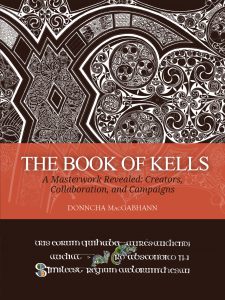
Front Cover of Donncha MacGabhann, “The Book of Kells: A Masterwork Revealed” (2022).

Sublime calligraphy, marvelous art, and amazing initials, have charmed and captivated the audience of the Book of Kells for over twelve hundred years. This remarkable illuminated Gospel book attracts the attention of scholars as well as those more generally interested in the fabulous artifacts of the past.

Everybody knows it was made by an extensive team of scribes and artists. Donncha MacGabhann knew that too. However, he was certain that a thorough examination could clearly identify the various contributions of its creators.

His life and work as an artist and teacher inspired the belief that a close visual study could solve some of its enduring puzzles. The deeper he delved, the more he was convinced that Kells is entirely the work of two individuals. This evolved into a novel paradigm through which he came to know and understand the manuscript. Following years of meticulous research, this book tells the story of Kells’ two Masters and their collaboration to create a Gospel book of unprecedented magnificence. Most poignantly, it reveals the struggle of the lone survivor of the two-man team to attempt the completion of their magnum opus.

The most important outcomes of this book go far beyond the simple attribution of work to different hands. Much more significantly, it affords insights into the imagination which inspired its creators, especially the unique vision of Kells’ great Scribe-Artist. Collectively, these new perspectives reveal a previously unknown ‘Book of Kells, ‘ one which, as it were, has remained hidden in plain sight.

Descriptions of Donncha’s book and its contents, approach, discoveries, and significance appear among various booksellers, as with

  • https://www.bookdepository.com/Book-Kells-Donncha-MacGabhann/9789464261226

The Process of Research and Discovery

In Donncha’s own words, as the research unfolded:
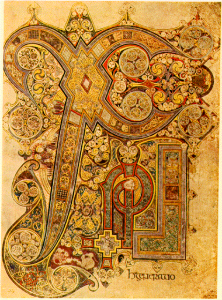
Dublin, Trinity College, MS A. 1 (58), folio 34r. Chi-Rho Initial Page (Matthew 1:18). Image via Wikimedia Commons; Public Domain in the US.

Key research interests include Insular palaeography and illumination. My current focus is to extend and develop the research which was the basis for my PhD (2016). My thesis investigation was concentrated on the makers and the making of The Book of Kells. This provides the first in-depth and comprehensive analysis of both the illumination and the scribal work in the manuscript.

My research was significantly informed by the experience gained in my career as an Artist and Art-Teacher. Complementary to the more traditional modes of academic enquiry this enabled me to draw on a skill-set which was integral to the development of my research methodology. This methodology of close visual analysis was central to my approach.

My immediate aim is communicate, through publication, the results of my doctoral research to the scholarly community. It is also my intention to extend the application of the methodology developed in my thesis to a number of other Insular manuscripts and to consider the implications of the revision of hands in the material culture of the Insular world more broadly. (Donncha MacGabhann)

Donncha’s Ph.D. dissertation is freely available for download:

  • The making of the Book of Kells: two Masters and two Campaigns (Doctoral thesis, University of London, 2016)  https://sas-space.sas.ac.uk/6920/ (via Creative Commons)

Its Abstract:

This thesis investigates the number of individuals involved in the making of the Book of Kells. It demonstrates that only two individuals, identified as the Scribe-Artist and the Master-Artist, were involved in its creation. It also demonstrates that the script is the work of a single individual – the Scribe-Artist. More specific questions are answered regarding the working relationships between the book’s creators and the sequence of production. This thesis also demonstrates that the manuscript was created over two separate campaigns of work. The comprehensive nature of this study focuses on all aspects of the manuscript including, script, initials, display-lettering, decoration and illumination.

Detail from Front Cover of Donncha MacGabhann, “The Book of Kells: A Masterwork Revealed” (2022): Black-and-white reproduction by the author of the ornamented center of the Chi-Rho Initial Page (Dublin, Trinity College, MS 58, folio 34r).

Previews

We met Donncha when he spoke for the RMGE about a facet of the Ph.D. research on the manuscript for one of our Sessions at the 49th International Congress on Medieval Studies (Kalamazoo, Michigan, May 2014).  The Session considered “Individual Style or House Style?  Assessing Scribal Contributions, Artistic Production, and Creative Achievements”.

Donncha’s paper examined the scribal uses of two forms or grades of late-antique and early-medieval script, Half-Uncial and Uncial, for the letter a at line-endings, where options for compression and variation could call for choice and artistic expression.

Half-Uncial a and Uncial a at Line-Ends:
The Division of Hands in the Book of Kells
and an Insight
into the ‘Calligraphic Imagination’ Evident in the Script

The abstract for Donncha’s paper appears on our website: MacGabhann 2014 Congress.

At the Congress, although we had corresponded earlier, we could meet Donncha, learn about his careful studies, his approaches to the creation and understanding of forms of the written word, and his observations about the original materials, in manuscript and in print, offered for display at some of our sessions.
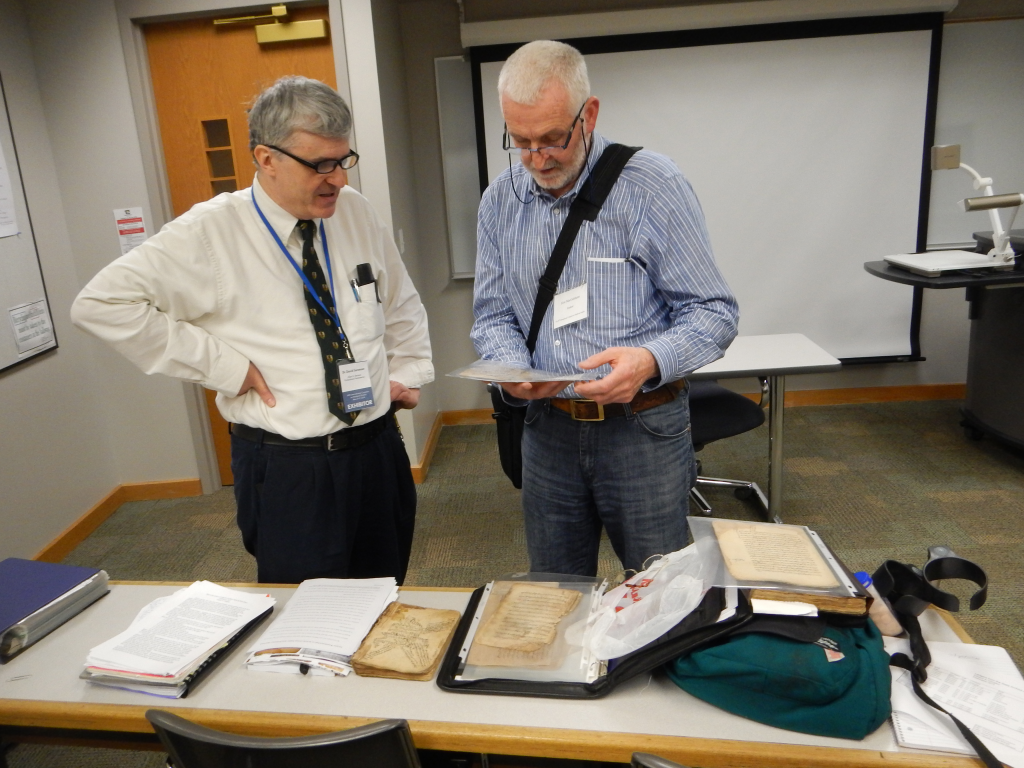
David Sorenson and Donncha MacGabhann examine manuscript materials

David Sorenson and Donnach MacGabhann examine manuscript materials after the RGME Writing Materials Session at the 2014 Congress. Photography by Mildred Budny.

Several papers published in the course of the research spell out the methodological approach.  For example,

Palaeographer Erika Eisenlohr has stated that ‘the similarity or dissimilarity of hands in Kells has so far mainly been based on more general impressions of the scripts’ (1994). My research attempts a more comprehensive investigation of the evidence including illuminated pages, script and illumination of the canon tables, mise-en-page, punctuation, display script, decorated initials, regular script and elaborations to the script.

— Donncha MacGabhann, Abstract for “The et-ligature in the Book of Kells (Revealing the ‘calligraphic imagination’ of its great scribe)” (2017), in Conor Newman, Mags Manion, and Fiona Gavin, eds., Islands in a Global Context. Proceedings of the seventh Conference on Insular Art, held at the National University of Ireland, Galway, 16–20 July, 2014 (Dublin, 2017), pp. 138–48.

The Script(s) of Kells

Discussion of the varieties of script, ornamented letter forms, and other forms of ornament in the Book of Kells continues in its own right over time.  It also forms, or should form, an integral part in an ongoing consideration of many features of the book, both individually and in combination.  That is:  the various texts (Gospel texts , their companion texts including prefaces, summaries, and canon tables with numerals and titles, as well as added texts such as Irish charters), illustrations, canon arcades and frameworks, scribal characteristics, writing materials (animal skins, inks, pigments, their binding agents, traces of layout marks, and so on), layers of accretion, condition, sewing patterns, binding history, library history, layout, design, artistry, and more.

Many features figure, to varying degrees, in assessments of the likely place and date of production of the manuscript.  Those assessments may remain open to exploration and refinement, as research advances, methods of exploration expand, attitudes may direct, and discoveries emerge.

Reproductions, Photographic and Pre-Photographic
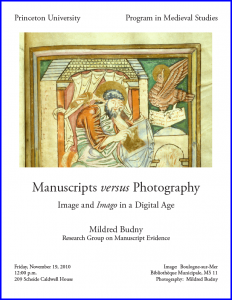
Poster for lecture on 'Manuscripts versus Photography: Image and "Imago" in a Digital Age' by Mildred Budny at Princeton University on 19 November 2010. Photograph by Mildred Budny of MS 10, Boulogne-sur-Mer, Bibliothèque des Annonciades,reproduced by permission.

Poster, designed by the RGME, for a lecture on 19 November 2020. Image: Photograph by Mildred Budny of Boulogne-sur-mer, Bibliothèque des Annonciades, MS 11, reproduced by permission.

With restricted access nowadays to the treasured original, and with the proliferation of digital means of reproduction and dissemination, close study of the multiple features of the manuscript would mostly rest upon consultation of such reproductions, however high in quality or ‘fidelity’.  That those reproductive materials would, in no small measure, determine, affect, or direct the nature of the forms of study — as well as, it may be, the interpretations of that (indirect) evidence — should be evident.

Such factors in the study of manuscripts under current, prevailing, conditions in the age of photographic reproduction and the age of the internet remain a subject of considerable interest for the Research Group on Manuscript Evidence.  For example:

  • Mildred Budny, “No Snap Decisions:  Challenges of Manuscript Photography”.  Paper delivered at the Session on “Imaging Manuscripts for the Twenty-First Century:  Photographs and Beyond” (1994), sponsored by the RGME at the 1994 International Congress on Medieval Studies.
    Published, with its Abstract, Text, and Images, here.
  • “Manuscripts versus Photography:  Image and Imago in a Digital Age”.  Lecture for the Program in Medieval Studies, Princeton University (19 November 2010).

Our events continue to consider such factors of manuscript studies, whether as, perhaps, part-and-parcel, bread-and-butter, or meat-and-potatoes.  That is, as Food for Thought.

As always, our interest in the processes of production and the people behind the books, keenly explored in cases of the medieval objects, extends also to the processes which underpin, sustain, and shape the studies themselves of those materials.  These interests are manifest in many RGME activities, as with continuing explorations of relationships between “Manuscripts and Photography” in Seminars, Workshops, Conference Sessions, and Symposia; and in Episodes of our series wherein The Research Group Speaks.  On such occasions, we might have opportunity to hear the authors of close studies of manuscripts or other materials speak about the origins, progress, and processes of their research, as well as its results.  Such is the case for this Episode with Donncha MacGabhann, as his new book, long in the making, reaches publication.

Drawings of elements in the Book of Kells — as appear among Donncha’s figures — belong to a venerable tradition which reaches back to pre-photographic means of reproduction.  Notable examples in that tradition include images from the manuscript carefully prepared by the observant entymologist and antiquarian John Obadiah Westwood (1805–1893).  Examples appear in these of Westwood’s publications:

  • Palaeographia sacra pictoria: Being a series of illustrations of the ancient versions of the Bible , copied from illuminated manuscripts, executed between the fourth and sixteenth centuries (London, 1845)
  • Facsimiles of Anglo-Saxon and Irish Manuscripts (London, 1868)
    Also, in excerpts: Facsimiles of Anglo-Saxon and Irish Manuscripts (London, 1868)

Close examination fostered by line-by-line reproduction, from one surface to another, may develop a keen awareness of specific details, in much the same way that detailed verbal descriptions can do, as with a catalogue or ‘inventory’ of features within a manuscript (or other monument).  I myself learned the lasting value of preparing such descriptions — from the originals, aided by my photographic reproductions including macro-photography — for features of manuscripts in the Illustrated Catalogue, one of the co-publications of the Research Group on Manuscript Evidence.

From observations of the evidence, by various means and methods, the interpretations may follow, redirect, or revise.

In the new book, the choice of methodology of palaeographical examination, centered upon photographic reproductions and drawings, focuses upon excerpts of specimen letters and initials.  Arrayed on these pages (printed or digital) in groups or rows of related letter-forms, the specimens stand removed or isolated from the ebb-and-flow of their naturally-occurring lines and columns of running texts upon their pages, and their openings, across the unfolding of the original book as a whole.

Mostly at a distance perforce from that original (even when viewed through the glass case of its exhibited pages), and very exceptionally in a direct encounter, we might find ways variously to imagine, to ‘reconstruct’, or to recollect, the process of turning its very pages and sensing the feel of the width of its leaves as their edges are turned.

Donncha’s Book on The Book of Kells
in our Episode for 19 November 2022

The publication of Donncha MacGabhann’s book is expected on 31 October 2022.  The book can be ordered in print and pdf forms from the publisher and other booksellers.  From the publisher’s website, it can be read online free of charge.  See:

  • The Book of Kells. A Masterwork Revealed: Creators, Collaboration, and Campaigns

Episode 9 in the online series of “The Research Group Speaks” is planned for Saturday 19 November 2022, via Zoom, at 12 pm EST (GMT – 5) for about 1 1/2 hours, with discussion and Q&A.  You are welcome to join us.

Registration for the Episode

If you wish to attend, please register here:

  • The Research Group Speaks, 9: Donncha MacGabhann on Making the Book of Kells

If you have questions or issues with the registration process, please contact director@manuscriptevidence.org.

Future Episodes

Future Episodes are planned.  See

  • “The Research Group Speaks”: The Series.

Suggestion Box

Please leave your Comments or questions here, Contact Us, or visit

  • our FaceBook Page
  • our Twitter Feed (@rgme_mss)
  • our Blog on Manuscript Studies and its Contents List

Donations and contributions, in funds or in kind, are welcome and easy to give.  See Contributions and Donations.

We look forward to hearing from you.
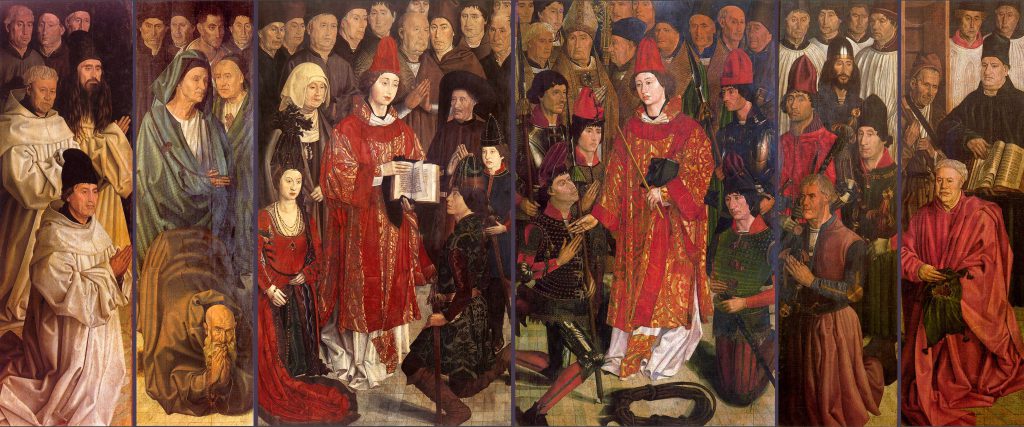
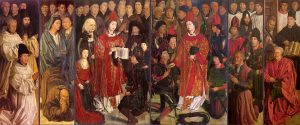
Lisbon, Museu Nacional de Arte Antiga: The mid 15th-century Saint Vincent Panels, attributed to Nuno Gonçalves. Image (https://upload.wikimedia.org/wikipedia/commons/3/3a/Nuno_Gon%C3%A7alves._Paineis_de_S%C3%A3o_Vicente_de_Fora.jpg) via Creative Commons.

*****
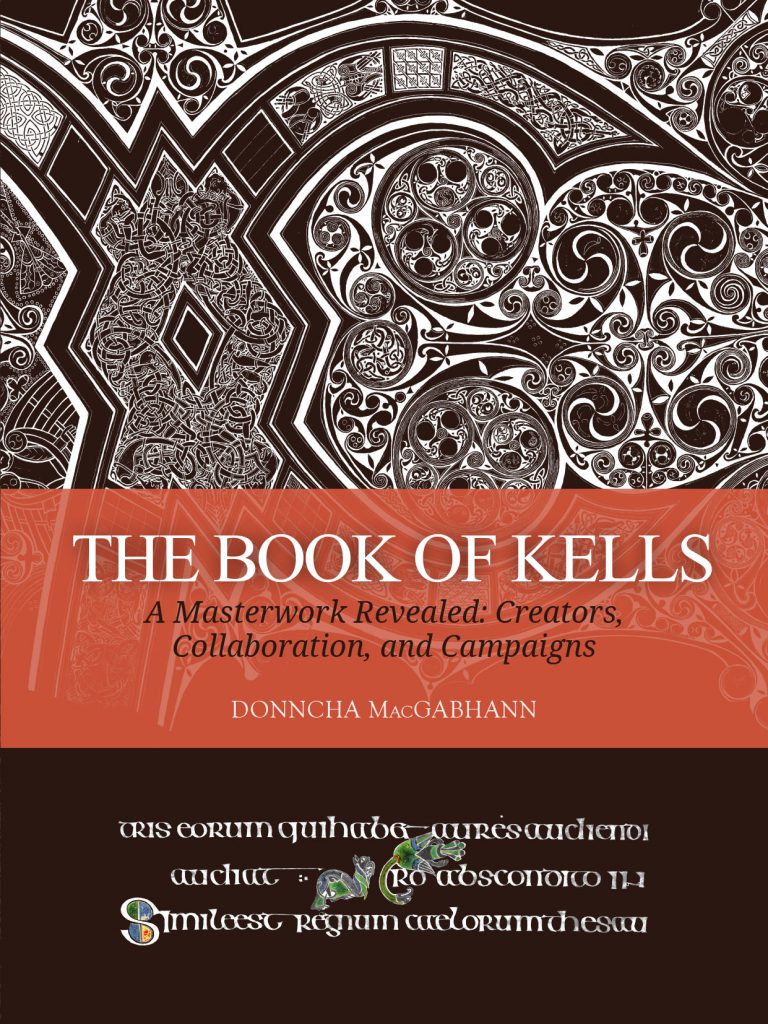
Front Cover of Donncha MacGabhann, “The Book of Kells: A Masterwork Revealed” (2022).

*****

Tags: Book of Kells, Donncha MacGabhann, Early Medieval Gospel Books, early medieval manuscripts, Finnegans Wake, Manuscript Photography, Manuscript studies, Medieval manuscripts, Palaeography, The Research Group Speaks, The Secret of Kells, Trinity College Dublin, Trinity College Dublin MS A 1 [58]
No Comments »

Program for 2022 Autumn Symposium on “Supports for Knowledge”

October 6, 2022 in Announcements, Conference Announcement, Manuscript Studies, Uncategorized

2022 RGME Spring and Autumn Symposia
on “Structured Knowledge”

© British Library Board, London, British Library, Add. MS 1546, folio 262v, detail. Opening of the Book of Sapientia (“Wisdom”).

2 of 2: 2022 Autumn Symposium
“Supports for Knowledge”
Saturday, 15 October 2022

Symposium Program
9:00 am – 5:30 pm EDT
Online via Zoom

Sessions with Presentations and Discussion (“Q&A”)
Breaks for Coffee, Lunch, and Tea
Closing Keynote Presentation and Concluding Remarks

For Registration see below

[Posted on 5 October, with updates]

On the pair of Symposia, see 2022 Spring and Autumn Symposia
On Part 1 of this pair, see 2022 Spring Symposium on “Structures of Knowledge”
On Part 2, see 2022 Autumn Symposium on “Supports for Knowledge”

Here we present the Program for Part 2 on “Supports for Knowledge”, held on Saturday 15 October 2022 by Zoom
— Registration is required, with a limited number of places (see below).

The Program Booklet (in preparation) will present the Program and Abstracts of the Presentations and Responses, with multiple Illustrations.  In accordance with our tradition of Program Booklets for our Symposia and some other events (see our Publications, it will be issued in printed form as well as digital form, with a downloadable pdf.

Timetable

Session 1.    9:00–10:30 am EDT
Brief Introduction to the Symposium and Welcome
“Teaching with (and through) Manuscripts, Part II”
Q&A

Break.          10:30–10:45 am

Session 2.   10:45 am – 12:15 pm
“Catalogs, Metadata, and Databases, Continued (Part III)”
Q&A

Lunch Break.   12:15–1:15 pm

–– During the Break.  12:30–12:50 pm

Presentation (at the time when the Speaker could attend)

David W. Sorenson (Allen Berman, Numismatist)
“A Jain Manuscript of the Seventeenth Century on Imported Watermarked Paper: An Early, Dated, Witness to Imported Paper Stocks in Indian Manuscripts”
As a contribution to our series on the “History and Uses of Paper”

Session 3.    1:15–2:45 pm
“The Living Library (Part II)”
Q&A

Break.          2:45–3:00 pm

Session 4.   3:00–4:30 pm
“Hybrid Books (Part I)”
Q&A

Break.         4:30–4:45 pm

Session 5.   4:45–5:30 pm EDT
“Books and Their Structures”
Closing Keynote Presentation and Concluding Remarks

*****

Sessions

Session 1.  “Teaching with (and through) Manuscripts, Part II”
— continuing the series begun at the Spring Symposium on “Structures of Knowledge”

Presider

David Porreca (Department of Classical Studies, University of Waterloo)

Speakers

Caley McCarthy (Research Associate and Project Manager, Environments of Change, University of Waterloo)
and
Andrew Moore (Research Fellow, Environments of Change, and Associate Director, DRAGEN Lab, University of Waterloo)
“Collaborative Pedagogy with Medieval Manuscripts in a Digital Lab”

William H. Campbell (Director, Center for the Digital Text, University of Pittsburgh-Greensburg)
Amber McAlister (Assistant Professor, History & Architecture, University of Pittsburgh-Greensburg)
and
Connor Chinoy (Student at the University of Pittsburgh-Greensburg and member of the “History of the Book” class)
“Books in the Flesh: An Interdisciplinary Undergraduate Class with Medieval Manuscripts”

Q&A

*****

Mid-Morning Break

*****

Session 2.  “Catalogs, Metadata, and Databases, Continued (Part III)”
— continuing our series
This is Part III in our series on these subjects, building upon Parts I and II, and leading to further Parts in 2023

  • our Roundtable in February on Catalogs, Metadata, and Databases, Part I and
  • the Session on “Catalogs, Metadata, and Databases, Part II” in the Spring Symposium

See the Links of Interest (Catalogs , Metadata, and Databases: A Handlist of Links)
— for which suggestions and additions are welcome.

Presider

Jessica L. Savage (Art History Specialist, Index of Medieval Art)

Speakers

Jessica L. Savage
“Cataloguing Manuscript Iconography between Digital Covers at the Index of Medieval Art”

Barbara Williams Ellertson (The BASIRA Project and Research Group on Manuscript Evidence)
“A Painter, a Printer, and a Search for Shared Exemplars”

Katharine C. Chandler (Special Collections and Serials Cataloger, University of Arkansas Libraries)
“Manuscripts from Print: The Schwenkfelders and their Dangerous Books”

Respondent

David Porreca (Department of Classics, University of Waterloo)
“My $0.02 Worth”

Moderator for the Questions-and-Answers

Derek Shank (Research Group on Manuscript Evidence)

Q&A

*****

Lunch Break

Perhaps — TBD — during part of the Break
Presentation (from about 12:15–12:35 pm), if the Speaker might attend, depending on short-notice work timetables:

David W. Sorenson (Allan Berman, Numismatist)
“A Jain MS of the Seventeenth Century on Imported Watermarked Paper:  An Early, Dated, Witness to Imported Paper Stocks in Indian Manuscripts”

*****

Session 3.  “The Living Library (Part II)”

— continuing the series begun at the Spring Symposium on “Structures of Knowledge”

Presider

Jaclyn Reed (Department of English and Writing Studies, University of Western Ontario)

Speakers

Christine E. Bachman (Department of Art & Art History, University of Colorado at Boulder)
“Unbound, Dispersed, Resewn:  The Flexible Codex in Eighth-Century Northwestern Europe”

Zoey Kambour (Post Graduate Fellow in European & American Art at the Jordan Schnitzer Museum of Art at the University of Oregon)
“Textual Interaction Through Artistic Expression:  The Marginal Drawings in the Decretales Libri V of Pope Gregory IX (University of Oregon MS 027)”

David Porreca (Department of Classical Studies, University of Waterloo)
“The Warburg Institute Library:   Where Idiosyncracy Meets User-Friendliness”

Respondent

Thomas E Hill (Art Librarian, Vassar College)
“Some Early Background to Warburg’s Project in Post-Wunderkammer Systematic Catalogues of the European Baroque and Enlightenment Periods”

Le Parc Abbey, Theological Volume, Part B and added Part-Leaf between folios 103–104 (or folios "7"–"8").

Private Collection, Le Parc Abbey, Theological Volume, Part B and added Part-Leaf (or Bookmark) between folios 103–104. Photography Mildred Budny.

Q&A

*****

Mid-Afternoon Break

*****

Session 4.  “Hybrid Books (Part I)”

— beginning a series for which more sessions are planned

Presider

Justin Hastings (University of Delaware)

Speakers

Hannah Goeselt (Library and Information Science (MS): Cultural Heritage Informatics, Simmons University, Boston)
“Structures of Art and Scripture in Otto Ege’s ‘Cambridge Bible’ (Ege Manuscript 6)”

Jennifer Larson (Department of Classics, Kent State University)
“Printed and Scribed:  A Collector’s View of Hybrid Books”

Linde M. Brocato (Cataloging & Metadata Librarian, University of Miami Libraries)
“Paths of Access and Horizons of Expectation, II:  From Book-In-Hand to Catalog(ues)”

N. Kıvılcım Yavuz (Lecturer in Medieval Studies and Digital Humanities, School of History, University of Leeds)
“Bound With:  Towards a Typology of Hybrid Codices”

Q&A

*****

Tea Break

*****

Session 5. “Books and Their Structures”

Presider

Mildred Budny (Director, Research Group on Manuscript Evidence)

Closing Keynote Presentation

Linde M. Brocato (Cataloging & Metadata Librarian, University of Miami Libraries)
“Hybrid Books: Fragments and Compilatio, Structure and Heuristic in Richard Twiss’s Farrago”

Discussion & Brief Concluding Remarks

Mildred Budny
“Structured Knowledge, Structures of Knowledge, and Supports for Knowledge:  A Framework for the Year”

*****

Closing Keynote Presentation

“Hybrid Books:
Fragments and Compilatio, Structure and Heuristic in
Richard Twiss’ Farrago“

In the group of artists’ books from the Ruth and Marvin Shackner Archive of Concrete Poetry purchased by the University of Miami Special Collections, there is an extraordinary volume, sold by a vendor as late 19th century, anonymous, and an artist’s book avant la lettre.  Careful analysis for bibliographical cataloging revealed the error in all these assertions.

In this presentation, I will lay out both the process of that analysis, and its results, along with reflections on hybrid books of various kinds.  My reflections will encompass the kinds of structured information that make their way into databases, and structuring codes of cataloging and bibliography, all of which are necessary but not sufficient for our understanding and convivencia with books , which are always already hybrid.  In these reflections, I will bring together many of the strands of thinking we have all worked to weave together in the symposium.

Richard Twiss, Farrago, held in the Unversity of Miami Special Collections, Artists’ Books Collection. Sidelong View. Photograph Linde M. Brocato.

Glimpses of the volume comprising Farrago compiled by the writer, traveler, chess-player, and would-be paper manufacturer Richard Twiss (1749–1821) can be seen in our blogpost called “I Was Here”, with photographs by Linde M. Brocato.

Concluding Remarks

Mildred Budny
“Structured Knowledge, Structures of Knowledge, and Supports for Knowledge: A Framework for the Year”

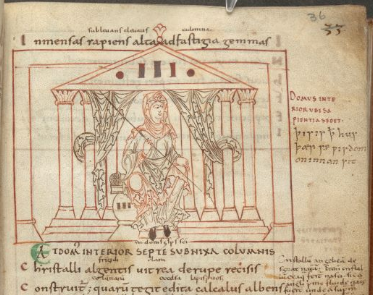
© British Library Board, London, British Library, Cotton MS Cleopatra C. viii, folio 36r, top: Sapientia in her Temple. Prudentius, Psychomachia, in a Canterbury copy of the late tenth or early eleventh century.

*****
To register for the Symposium, visit 2022 Autumn Symposium Registration. Places are limited.

Questions? Contact director@manuscriptevidence.org.

*****
Suggestion Box

Do you have suggestions for subjects for our events, or offers to participate? Please let us know.

If you wish to join our events, please contact director@manuscriptevidence.org.

For updates, watch this space, and visit:

  • 2022 Spring and Autumn Symposia
  • The Research Group Speaks: The Series;
  • our FaceBook Page and
  • our Twitter Feed (@rgme_mss).

Please leave your Comments below, Contact Us, and visit our FaceBook Page and Twitter Feed (@rgme_mss).  We look forward to hearing from you

We invite you to donate to our nonprofit educational mission. Donations may be tax-deductible. We welcome donations in funds and in kind:

  • Contributions and Donations .

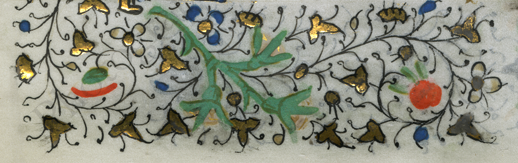
Floral Motif as Lower Border in a Book of Hours. Photography Mildred Budny.

*****


Tags: Catalogs & Metadata & Databases, Decretals of Pope Gregory IX, DRAGEN Lab, Fragmentology, History of Paper, Hybrid Books, Index of Medieval Art, Jain Manuscripts, Les Enluminures, Medieval Manuscript Fragments, Medieval manuscripts, Miniature Books, Otto Ege Manuscript 8, Otto Ege Manuscripts, RGME Symposia, Richard Twiss's Farrago, Schwenkfelder Books, Structured Knowledge, Teaching with and through Knowledge, Teaching with Manuscripts, The Living Library, University of Oregon MS 027, Warburg Institute Library, Watermarked Paper, Watermarks
No Comments »

2022 Autumn Symposium on “Supports for Knowledge”

April 7, 2022 in Announcements, Conference, Conference Announcement, Manuscript Studies

2022 RGME Spring and Autumn Symposia
on “Structured Knowledge”

© British Library Board, London, British Library, Add. MS 1546, folio 262v, detail. Opening of the Book of Sapientia (“Wisdom”).

2 of 2: Autumn Symposium
“Supports for Knowledge”
Saturday, 15 October 2022
Online

9:00 am – 5:30 pm EDT with Sessions, Discussion, and Breaks

2020 Spring Symposium "From Cover to Cover" Poster 2

2020 Spring Symposium Poster 2

[Posted on 5 April 2022 with updates]

In 2022, the Research Group returns to our series of Symposia (formerly held in person). The series underwent an interruption with the cancelled 2020 Spring Symposium, “From Cover to Cover”. See its record in the illustrated Program Booklet, with Abstracts of the planned presentations and workshops. Its core and its promise inspire this renewal.

This year, each Symposium in the pair is designed as a one-day event, with sessions and workshops of about 1 and 1/2 hours, giving scope for discussion. The Spring Symposium was held online by Zoom. The Autumn Symposium would be held online, but, conditions permitting, it might be hybrid, that is, partly in person, as well as online. See 2022 Spring and Autumn Symposia.

  1.  Structures of Knowledge (Spring)
  2.  Supports for Knowledge (Autumn)

These events, by request, flow in addition to — and partly from — our other activities during the year:

Lisbon, Museu Nacional de Arte Antiga: The mid 15th-century Saint Vincent Panels, attributed to Nuno Gonçalves. Image via Creative Commons.

1) Continuing Episodes in the online series of The Research Group Speaks (2021–)

  • https://manuscriptevidence.org/wpme/the-research-group-speaks-the-series/
  • Catalogs, Metadata, and Databases (Part I)

2) Our four sponsored and co-sponsored Congress Sessions at the 57th International Congress on Medieval Studies (online) in May

  • https://manuscriptevidence.org/wpme/2022-international-congress-on-medieval-studies-program
    (Abstracts of the Papers are included).

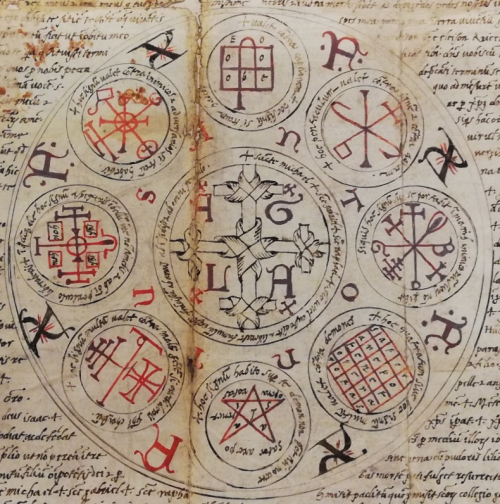
© The British Library Board. Additional MS 15505, folio 22r. Italian, early 16th century. Circular diagram with coloured drawings of nine magical seals, as a textual amulet with charms against diseases.

Structured Knowledge (Parts I and II)

The interlinked pair of Spring and Autumn Symposia examine themes of Structured Knowledge.

Some proposed presentations at these Symposia offer refreshed materials which had been planned for the cancelled 2020 Spring Symposium.

  • See https://manuscriptevidence.org/wpme/2020-spring-symposium-save-the-date, with a published Program Booklet including illustrations and Abstracts.
The Spring Symposium is dedicated to “Structures of Knowledge”. The Autumn Symposium considers “Supports for Knowledge”. Sessions include approaches to databases and library catalogs; specific case studies and projects; issues relating to reproductions and display , research and teaching, and more.

Part I: Spring Symposium (Saturday, 2 April 2022)
on “Structures of Knowledge”

  • See 2022 Spring Symposium on “Structures of Knowledge”

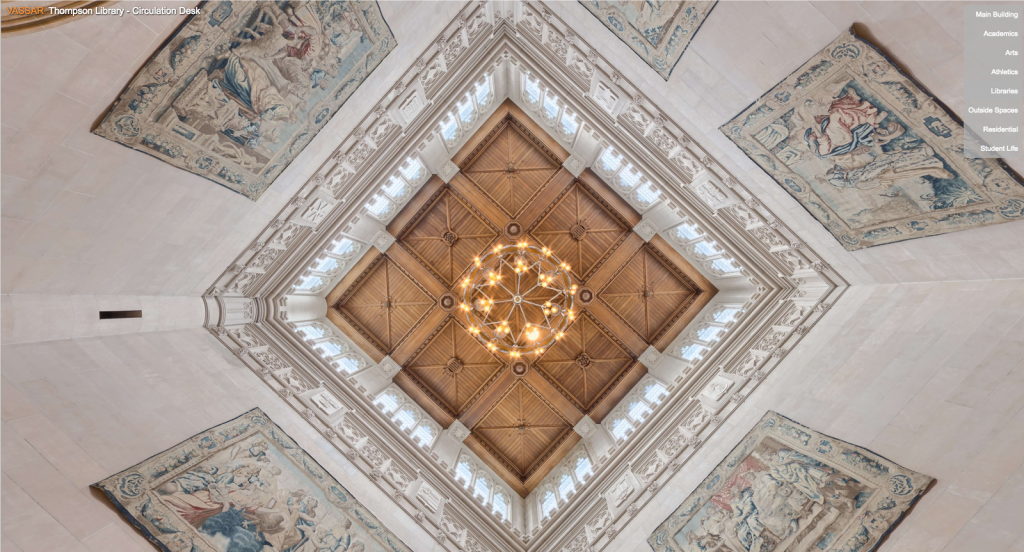
Vassar College, Frederick Thompson Memorial Library, Entry, Ceiling and Gobelin Tapestry Series.

Part II: Autumn Symposium (Saturday, 15 October 2022)
on “Supports for Knowledge”

For link to register for the Symposium, see below.

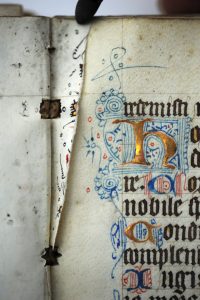
Private Collection, Book of Hours, Decorated Initial and Stub from Despoiled Leaf. Photography Mildred Budny.

Sessions include approaches to books, libraries, catalogues, and databases; case studies, projects, and work-in-progress and projects examining individual original sources or groups of them; the history, uses, and reuses of books and their materials; issues, opportunities, and successes in research and teaching; and more.

Speakers, Respondents, and Presiders:

Christine E. Bachman, Linde M. Brocato, Mildred Budny, William H. Campbell, Katharine C. Chandler, Connor Chinoy, Barbara Williams Ellertson, Hannah Goeselt, Justin Hastings, Thomas E. Hill, Zoey Kambour, Jennifer Larson, Amber McAlister, Caley Macaulay, Andrew Moore, David Porreca, Jaclyn Reed, Jessica L. Savage, Derek Shank, Kate Schmidt, David W. Sorenson, and N. Kıvılcım Yavuz.

Timetable

Session 1.    9:00–10:30 am EDT by Zoom

Coffee Break.          10:30–10:45 am

Session 2.   10:45 am – 12:15 pm

Lunch Break.   12:15–1:15 pm

Session 3.    1:15–2:45 pm

Tea Break.          2:45–3:00 pm

Session 4.   3:00–4:30 pm

Break.         4:30–4:45 pm

Session 5.   4:45–5:30 pm EDT
Closing Keynote Presentation, Discussion, and Concluding Remarks

Sessions

1.  “Teaching with (and through) Manuscripts, Part II”

— Part II in our series on these subjects, building upon Part I in the Spring Symposium.

— including presentations by:
Caley McArthur and Andrew Moore, representatives of the Team from the DRAGEN Lab, at the University of Waterloo, reporting on “initiatives in our lab to train students, both undergraduate and graduate, in medieval paleography”; and
William H. Campbell and his colleagues and students, Amber McAlister, Kate Schmidt, and Connor Chinoy, on the experience of teaching an undergraduate course this summer using the Les Enluminures Manuscripts in the Curriculum program at the University of Pittsburgh-Greensburg.

2. “Catalogs, Metadata, and Databases, Continued (Part III)”

— Part III in our series on these subjects, building upon our Roundtable in February on Catalogs, Metadata, and Databases, Part I and the Session on “Catalogs, Metadata, and Databases, Part II” in the Spring Symposium.

— including presentations by:
Jessica L. Savage
on “Cataloguing Manuscript Iconography between Digital Covers at the Index of Medieval Art”;
Katharine C. Chandler on “Manuscripts from Print: The Schwenkfelders and their Dangerous Books”; and
Barbara Williams Ellertson on “A Painter, a Printer, and a Search for Shared Exemplars”
(focusing upon Giovanni Bellini’s painting of Saint Benedict and his Book);
with a response by David Porreca on “My $0.02 Worth”.

For this Session, Jessica Savage and Barbara Williams Ellertson revive, update, and expand the presentations which they had prepared for the 2020 Spring Symposium, which had to be cancelled; their Abstracts then appear in its freely-available Program Booklet, published as a souvenir or token of the intentions for the event.

For the subject of this series, see the Links of Interest (Catalogs, Metadata, and Databases: A Handlist of Links), for which suggestions and additions are welcome.

3.  “The Living Library (Part II)”

Part II in the series, building upon Part I at the Spring Symposium
— including
Christine E. Bachman on “Unbound, Dispersed, Resewn:  The Flexible Codex in Eighth-Century Northwestern Europe”;
Zoey Kambour on interactions between scribes, readers, and text in a copy of the Decretals of Pope Gregory IX at the University of Oregon;
David Porreca‘s presentation which had been planned for our Spring Symposium:  “The Warburg Institute Library: Where Idiosyncracy Meets User-Friendliness”; and
Thomas E. Hill‘s response on systems of structuring libraries in Germany from the Baroque and Enlightenment periods.

4.  “Hybrid Books (Part I)”

Part I in a continuing series
— including
Hannah Goeselt on “Structures of Art and Scripture in Otto Ege’s ‘Cambridge Bible’ (Ege Manuscript 6)”;
Jennifer Larson‘s presentation of selected examples of types of “Hybrid Books” in her collection of miniature books;
Linde M. Brocato‘s demonstration, using some of Jennifer’s examples, of how to catalog such cases; and
N. Kıvılcım Yavuz‘s response on decision-making processes involved in producing codices composed of handwritten and printed components, with a proposal of ways of differentiating among different types of hybrid codices.

[Note:  Depending upon variable work timetables, David W. Sorenson might be able to attend at some point during the day to present preliminary findings on “A Jain MS of the Seventeenth Century on Imported Watermarked Paper”.]

Closing Keynote Presentation

Linde M. Brocato
“Hybrid Books:  Fragments and Compilatio, Structure and Heuristic in Richard Twiss’ Farrago”
[For glimpses of this book, see our blogpost called “I Was Here”.]

“In these reflections, I will bring together many of the strands of thinking we have all worked to weave together in the symposium.”

Richard Twiss, Farrago, held in the Unversity of Miami Special Collections, Artists’ Books Collection. Sidelong View. Photograph Linde M. Brocato.

Concluding Remarks

Mildred Budny
“Structured Knowledge, Structures of Knowledge, and Supports for Knowledge:  A Framework for the RGME Year 2022”

*****

© British Library Board, London, British Library, Cotton MS Cleopatra C. viii, folio 36r, top: Sapientia in her Temple. Prudentius, Psychomachia, in a Canterbury copy of the late tenth or early eleventh century.

The Schedule

For details see the 2022 Autumn Symposium Program.

Registration

Please register for the Symposium.  Space is limited.  Visit 2022 Autumn Symposium Registration.

Questions? Contact director@manuscriptevidence.org.

*****

Other Activities

Besides the 2022 Spring and Autumn Symposia , the Research Group

  • sponsors and co-sponsors Sessions at the ICMS (see our 2022 Congress Program and 2023 International Congress on Medieval Studies Preparations)
  • prepares more online Episodes for The Research Group Speaks: The Series
  • plans events for 2023, including online Open Business Meetings and a pair of Symposia (Spring and Autumn)
  • prepares publications in various forms from these events, research work, discoveries, and divers materials, including our blog on Manuscript Studies (see its Contents List) and more Research Booklets.

Suggestion Box

Do you have suggestions for subjects for our events, or offers to participate? Please let us know.

If you wish to join our events, please contact director@manuscriptevidence.org.

For updates, watch this space, see 2022 Spring and Autumn Symposia and The Research Group Speaks: The Series; and visit our FaceBook Page and Twitter Feed (@rgme_mss).

Floral Motif as Lower Border in a Book of Hours. Photography Mildred Budny.

We invite you to donate to our nonprofit educational mission. Donations may be tax-deductible. We welcome donations in funds and in kind:

  • Contributions and Donations .

Please leave your Comments below , Contact Us, and visit our FaceBook Page and Twitter Feed (@rgme_mss).  We look forward to hearing from you.

© British Library Board, London, British Library, Add. MS 1546, folio 262v, detail. Opening of the Book of Sapientia (“Wisdom”) in the Moutier-Grandval Bible, an imposing Carolingian manuscript of the Latin Vulgate Bible.

*****

Tags: Catalogs & Metadata & Databases, Giovanni Bellini, Hybrid Books, Index of Medieval Art, Manuscripts in the Curriculum, Otto Ege Manusript 6, RGME Symposia, Richard Twiss's Farrago, Structured Knowledge, Teaching with and through Manuscripts, The Living Library, Warburg Institute Library
No Comments »

2022 Congress Preparations

July 16, 2021 in Announcements, Conference, Conference Announcement, Ibero-Medieval Association of North America, IMANA, International Congress on Medieval Studies, Kalamazoo, Societas Magica

Call for Papers (CFP) for Sessions
Sponsored or Co-Sponsored by the RGME

at the 57th International Congress on Medieval Studies (Online)
Monday, May 9, through Saturday, May 14, 2022

CFP Deadline:  15 September 2021
[Deadline for Session Programs:  1 October 2021]

Le Parc Abbey, Theological Volume, Part B: Detail of Vellum Leaf.

Private Collection, Le Parc Abbey, Theological Volume, Part B: Detail of Vellum Leaf. Photography Mildred Budny.

[Update on 22 September 2021:
Following the close of the CFP on 15 September, we can welcome the received proposals for papers, observe their strength and range, and prepare the programs for each session.  With the selection of proposed papers accomplished, it comes time to arrange their sequence within the given Sessions, assign the Presiders for them, and submit the programs to the Congress Committee by 1 October 2021.

When appropriate, we can announce the Programs, report the assignment of their scheduling within the Congress Program overall, and publish the Abstracts of the Papers and Responses, as the authors might be willing. The Congress Program will become available in due course, and registration for the online Congress might commence.

Update on 1 October 2021:
At the close of the deadline for submission of the programs to the Congress, we report that each of our Sessions has three or four Papers; three sessions also have Responses; and we plan to hold a Business Meeting at the Congress, as in previous years.  All these activities are to take place online.]

[Posted on 15 July 2021]

After accomplishing the 2021 ICMS Online, with 5 Sponsored and Co-Sponsored Sessions, plus our Open Business Meeting, we produced the 2021 Congress Report, as we turned to preparations for the 2022 Congress.  We proposed Sessions, and received answers in stages.

Through the Confex system for the 2022 International Congress on Medieval Studies, we have learned that all but one of our proposed sessions have been accepted.

One of the accepted sessions resumes a series (“Medieval Writing Materials”) which a rejection for the 2015 Congress disrupted.  That rejection interfered with the momentum of our series of sessions on the subject at the 2011–2016 Congresses.  (See Sponsored Sessions.)  The interval between then and now is a long time to wait.  We had to turn to other subjects, as the momentum for their own action not only gathered to produce the proposals to sponsor or co-sponsor them, but also found favor by the Congress Committee, so that it could become possible to move to the phase of the Call for Papers for them. With the Pre-Congress Business Meeting in May 2021, as we prepared for this year’s Congress, we aimed to resume that series, as well as to explore other sessions as their subjects and proponents might direct.

So, we can resume the series on Medieval Writing Materials for 2022.  But a new rejection of another subject for the Congress leads us to reconsider our approach to its current momentum.  This time, learning from experience, we could choose what to do, but elsewhere, before long, with the subject not accepted this time around, rather than waiting for some other year — or decade — at the Congress.

And so, now, we announce the Call for Papers for the 2022 Congress.

Read the rest of this entry →

Tags: Ars Notaria, History of Alphabets, History of Magic, History of Paper, History of Paper Manufacture, History of Watermarks, Manuscript studies, Medieval Studies, Medieval Writing Materials
No Comments »

2021 Congress Program Announced

December 16, 2020 in Abstracts of Conference Papers, Announcements, Business Meeting, Conference, Conference Announcement, Events, Index of Medieval Art, International Congress on Medieval Studies, Kalamazoo, Societas Magica

Activities of the
Research Group on Manuscript Evidence
At the
56th International Congress on Medieval Studies
(10–15 May 2021)

Following the Call for Papers
(due by 15 September 2020)
and the Selection of Papers (due by 1 October 2020)
We announce the Program for our Sessions

#kzoo2021 / #kazoo2021

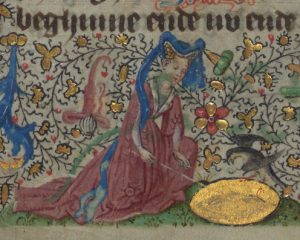
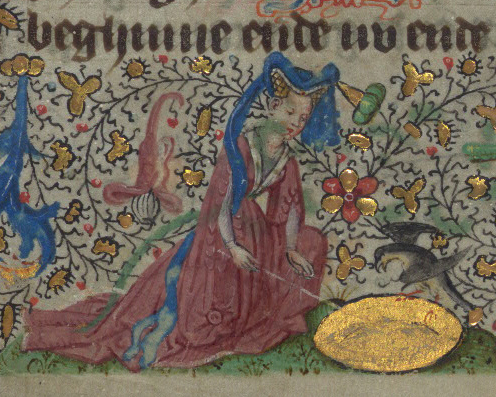
Baltimore, The Walters Art Museum, MS W.782, folio 15r. Van Alphen Hours. Dutch Book of Hours made for a female patron in the mid 15th century. Opening page of the Hours of the Virgin: "Here du salste opdoen mine lippen". Image via Creative Commons. At the bottom of the bordered page, an elegantly dressed woman sits before a shiny bowl- or mirror-like object, in order, perhaps, to perform skrying or to lure a unicorn.

Baltimore, The Walters Art Museum, MS W.782, folio 15r. Van Alphen Hours. Dutch Book of Hours. Image via Creative Commons.

Following the 2021 Congress Call for Papers, the Selection of proposed Papers, and the submission of the Programs for our Sessions to the Congress Committee (see our 2021 Congress Planning), we announce the Program for our Sessions and our other Activities for the 2021 ICMS Congress.

All activities at the Congress are scheduled to take place only “virtually”.  For such virtual plans, see the Congress page of the Medieval Institute. 

Watch this space. We await instructions from the Congress Committee regarding the revised approach to Sessions.

Note that, once the Committee announced that the Congress would have to go ‘virtual’, all 3 co-sponsors for our planned Reception agreed that it would make sense to wait for such an event until some suitable occasion in person.  However, we continue to plan for all 5 Sessions and our Open Business Meeting.

Update on 26 March 2021:
The Program of the Congress is now available. For information about the Congress, see its website.

*****

In a Nutshell

Open Business Meeting:  All are Welcome

Thursday, 13 May at 12:00 pm EDT.

  • 2021 Congress Program, page 99.

Sessions

Seal the Real, I–II

Congress Sessions 259 and 279, Virtually on
Thursday, 13 May at 11:00 am EDT and at 1:00 pm EDT

  • 2021 Congress Program, pages 92–93 and 100–101.

Medieval Magic in Theory:
Prologues to Learned Texts of Magic

Congress Session 103, Virtually on
Tuesday, 11 May at 11:00 am EDT

  • 2021 Congress Program, pages 38–39.

Revealing the Unknown, Parts I–II

Congress Sessions 181 and 201, Virtually on
Wednesday, 12 May at 11:00 am and 1:00 pm EDT

  • 2021 Congress Program, pages 66 and 73.

Details follow here.

Read the rest of this entry →

Tags: Bibliomancy, History of Documents, History of Magic, Manuscript studies, Matthew Paris, Medieval Lapidaries, Medieval Prologues, Medieval Seals, Picatrix, Reused Antique Gems, Scrying, Seals and Signatures, Sortilège, Thomas Hoccleve
No Comments »

2021 Congress Program in Progress

October 14, 2020 in Announcements, Business Meeting, Conference, Conference Announcement, Index of Medieval Art, International Congress on Medieval Studies, Societas Magica, Uncategorized

Activities of the
Research Group on Manuscript Evidence
Planned for the
56th International Congress on Medieval Studies
(13–16 > 10–15 May 2021)

Preparations

Following the Call for Papers due by 15 September 2020
and now the Announcement by the Medieval Institute on 16 October 2020

[Posted on 15 October 2020, with updates]

Update on 16 October 2020:

Today the Medieval Institute announced on its Congress page these changes for the 2021 Congress, which affect both the date-span and the activities, to occur only “virtually”:

Due to the ongoing health crisis, the 2021 International Congress on Medieval Studies hosted by Western Michigan University’s Medieval Institute will be held virtually, Monday to Saturday, May 10 to 15, 2021. More details will be released as they become available.

We will miss the camaraderie of the in-person experience. We look forward to hosting a vibrant and intellectually engaging virtual conference that offers plenty of opportunity for stimulating interaction at a distance. Please mark your calendar for these revised dates.

Watch this space.  We await instructions from the Congress Committee regarding the revised approach to Sessions.

Update on 5 November 2020:

As the plans advance for the now-virtual Congress, we announce that we continue to plan for the Sessions and the Open Business Meeting, but not for a Reception.  We co-sponsors for the Reception agree that it would make sense to wait for such an event under conditions in person.  We look forward to the new stages in preparing for a fully online presentation of the 2021 Congress.

*****

After the cancellation of the 2020 Congress (see our 2020 Congress Program Announced), preparations for the 2021 Congress permitted re-submitting the sessions which had been designed to take place in May 2020.  By popular request, we performed that re-submission for all 5 Sessions.  With approval by the Congress Committee, these Sessions joined the listings of all sessions on call on the Congress website — with additional details on our website, in our own 2021 Congress Call for Papers.  #kzoo2021.

New for this year, all proposals (or re-proposals from 2020) had to be made through a Confex system, as directed on the Congress website.  The new system imposed some teething problems for prospective participants, Session Organizers, and Sponsors.  These challenges emerged in several forms at various stages, including close to the several deadlines for submission of proposals for papers and of the proposed programs of the Sessions.

Especially under such conditions, it was helpful to have the benefit of collaborative consultations, among all our Organizers, and with our Sessions Co-Sponsor.  We thank Dr. Elizabeth Teviotdale of the Medieval Institute especially for her swift responses directly along the way, when our Director had to turn to her repeatedly for help, information, and advice.

In time, we will announce the Programs which we have chosen for the Sessions, now that the Call for Papers has completed on 15 September 2020, and following our choices for those Programs by 1 October 2020.  Before announcing our plans in detail, we await their Confirmation or adaptation by the Congress Committee.  We thank our Participants and Organizers for their contributions.

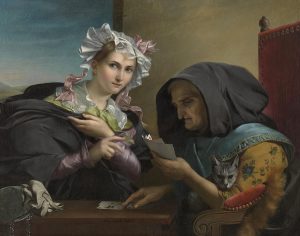
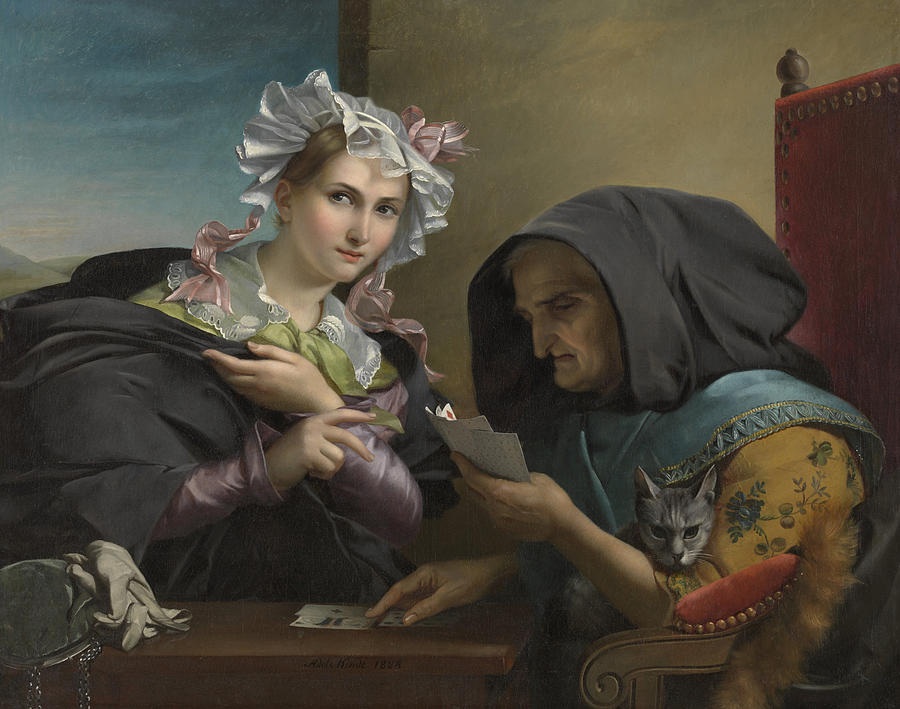
Adèle Kindt (1804–1884), The Fortune Teller (circa 1835). Antwerp, Koninklijk Museum voor Schone Kunsten. Image via Wikimedia Commons. A young lady, brightly lit and beautifully dressed, looks outward as an older woman, beneath a dark hood, holds a set of cards and stares at them with intent.

Adèle Kindt (1804–1884), The Fortune Teller (circa 1835). Antwerp, Koninklijk Museum voor Schone Kunsten. Image via Wikimedia Commons.

The Plan We Had for the 2020 Congress

The Announcement for our Sessions and other Activities at the 2020 Congress describes what we planned.  As customary, we published the Abstracts of Papers, so as to record the intentions of speakers for their presentations. The Abstracts are accessible both through that Announcement and through the Indexes of published Abstracts by Year and by Author.

The Sessions included 3 Sessions sponsored by the Research Group on Manuscript Evidence and 2 Sessions co-sponsored with the Societas Magica, in the 16th year of this co-sponsorship at the International Congress on Medieval Studies.

Like the 2015–2019 Congresses, we also planned for

  • an Open Business Meeting and
  • a co-sponsored Reception.

Even so, the Agenda for the postponed 2020 Business Meeting is available.  It takes into account the changes for Spring 2020:

  • 2020 Agenda.

The Plan We Have for 2021

We contemplate a similar approach to the 2021 Congress, conditions permitting.  [See Update above.]

For the 2021 Congress, we present the same Sessions, with a few changes.  Our pair of Sponsored Sessions dedicated to “Seal the Real I–II” remain as before.  The pair of co-sponsored Sessions dedicated to “Revealing the Unknown I–II” have some changes in the line-up.  One Session has a revised title (“Medieval Magic in Theory:  Prologues in Medieval Texts of Magic, Astrology, and Prophecy”).  For 2021, the Societas Magica has agreed also to co-sponsor this Session, so that the alignment of sponsorship has adapted to changing opportunities.

The 2021 Congress will be the 17th year of our co-sponsorship with the Societas Magica, in a constantly constructive partnership of friends, students, and colleagues.

As before, we have planned for an Open Business Meeting and a Co-Sponsored Reception.

For 2021, the co-sponsorship for a Reception joins the Research Group with the Societas Magica and The Index of Medieval Art, combining all 3 Sponsors in recent years.

[The virtual presentation of the Congress may allow for some form of Business Meeting and Reception.  Watch this Space.]

Read the rest of this entry →

Tags: Divination, History of Documents, History of Magic, Index of Medieval Art, International Congress on Medieval Studies, Manuscript studies, Medieval Seals, Skrying, Societas Magica
No Comments »

Keeping Up: Updates for Spring 2020

April 4, 2020 in Abstracts of Conference Papers, Announcements, Bembino, Business Meeting, Conference, Conference Announcement, ICMS, Index of Medieval Art, International Congress on Medieval Studies, Kalamazoo, Manuscript Studies, Princeton University, Societas Magica

Keeping Up:

Updates for Spring 2020

Baltimore, The Walters Art Museum, MS W.782, folio 15r. Van Alphen Hours. Dutch Book of Hours made for a female patron in the mid 15th century. Opening page of the Hours of the Virgin: "Here du salste opdoen mine lippen". Image via Creative Commons. At the bottom of the bordered page, an elegantly dressed woman sits before a shiny bowl- or mirror-like object, in order, perhaps, to perform skrying or to lure a unicorn.

Baltimore, The Walters Art Museum, MS W.782, folio 15r. Van Alphen Hours. Scrying, Perchance? Image via Creative Commons.

This Spring, the cancellation of 2 of our major events planned for this year, and intended to take place in mid-March and mid-May, produces perforce a redirection of energies and activities.  Call it “Regrouping”.

We report updates.

1.  Our 2020 Spring Symposium:  “From Cover to Cover”

Planned for 13–14 March at Princeton University
But Cancelled or Postponed

As preparations were proceeding apace, the event was cancelled by Princeton University — along with other events — on 9 March, in response to growing concerns for the spread of COVID-19 on a global scale.  Although at short notice, it was possible swiftly to cancel reservations for the venue, catering, and other services before participants had begun their journeys.

What We Planned

  • 2020 Spring Symposium: Save the Date
2020 Symposium "From Cover to Cover" Poster 2

2020 Symposium Poster 2

We aimed to consider, “From Cover to Cover”, activities dedicated to manuscripts, early printed materials, and beyond, from collecting and cataloguing to deciphering and beholding.  We prepared to gather specialists, teachers, students, and others engaged or interested in activities such as “Collecting, Curating, Conserving, Cataloguing, Deciphering, Reading, Reconsidering, Editing, Teaching, Displaying, Accessing, Beholding, and More”.

The focus was designed to center primarily upon medieval and early modern materials, both Western and non-Western.  The presentations would include reports of discoveries, work-in-progress, cumulative research, and collaborative projects by specialists from multiple centers, including independent scholars and younger scholars.

Included were workshops over original materials in manuscript and early print, a demonstration of materials and processes for medieval scripts, discussions about databases devoted to manuscripts and rare books, and sessions addressing multiple activities approaching medieval, early modern, and other textual resources.  Subjects would span a wide range geographically and chronologically, and take care to attend to the material and bibiographical evidence.

What We Can Do

There are requests for rescheduling the Symposium, or parts thereof, when conditions might permit.

Meanwhile, we can publish the Symposium Booklet.  At the time of cancellation, it had come close to completion for printing and distributing at the event and then afterward, as is our custom.  For example:

  • 2019 Anniversary Symposium on “The Roads Taken”
  • 2016 Symposium on ‘Words & Deeds”
  • 2014 Symposium on “Recollections of the Past”
  • 2013 Symposium on “Identity & Authenticity”

For all these and our other Booklets (see our Publications), the Research Group on Manuscript Evidence is the nonprofit publisher and distributor.  The design and layout conform with our Style Manifesto and employ our own digital font Bembino .

Florence, Galleria degli Uffizi, Anonymous, Still Life of an Illuminated Book, German School, 15th century. Oil on Wood. Opened book with fanned pages. Image via Wikimedia, Public Domain.

Florence, Galleria degli Uffizi, Anonymous, Still Life of an Illuminated Book, German School, 15th century. Image via Wikimedia, Public Domain.

The new 44-page Symposium Booklet contains the 2020 Symposium Program, Abstracts of the Papers and Masterclasses, and a set of accompanying Illustrations (some published for the first time).  The Booklet includes corrections and revisions offered by several of the authors as we completed the layout and editing, after the cancellation of the event.

It is the longest so far of all our Symposium Booklets. The 2019 Booklet for “The Roads Taken” has 28 pages, and the 2016 Booklet for “Words & Deeds” has 24 pages.  Only the Booklet for our multi-lingual digital font Bembino is longer, at 56 pages, including all the font tables for the different styles and languages. That Booklet and the font itself (now in Version 1.6) are freely available for download and use (commercial use included).  Here:  Bembino .

Our illustrated 2020 Spring Symposium Booklet is likewise freely available for download. As with other cases, for your convenience, we make it available in 2 versions, which may suit different printing arrangements, as wished.  The versions are:

  • printable in consecutive quarto-sized pages (8 1/2″ × 11″)
    2020 Spring Symposium Booklet as Consecutive Pages
  • printable as double sheets (11″ × 17″) which can be folded into the booklet, nesting the bifolia within each other
    — a design which does not require staples for closure and perusal
    2020 Spring Symposium as a Foldable Booklet

We thank our hosts, sponsors, contributors, owners and donors of images, editor, copy-editor, and layout designer. The publication is our gift to all who aimed to participate in the event and to follow its ‘ripples’ after the accomplishment of the Symposium. We offer it as a ‘souvenir’ of what our contributors, and the spirit of generous participation, intended for the event.

While we may explore plans to reschedule the event, or its parts, in some way or ways, the Booklet stands as a place-holder, and as a vivid glimpse of what could be and, indeed, can be. The gathering energy and enthusiasm for the event, as the weeks and days advanced toward it, remain a testimony to the constructive collective spirit which inspired it.

2020 Symposium "From Cover to Cover" Poster 1

2020 Symposium Poster 1

_____

With these observations, I am reminded of the Motto which I chose, years ago, for the 2-volume Illustrated Catalogue, co-published by the Research Group on Manuscript Evidence.

For Books are not absolutely dead things,
but doe contain a potencie of life in them
to be active as that soule was whose progeny they are;
nay, they do preserve as in a violl the purest efficacie and extraction
of the living intellect that bred them.

John Milton, Aeropagitica (1644)

Perhaps same as it ever was.

_____

Cover Page for Sorenson (2020 Spring Symposium Paper as Draft for Comment), with an array of illustrations and the title "Introduction to Indian Manuscripts"

Cover Page for Sorenson (2020 Spring Symposium Paper as Draft for Comment)

P. S.  Already one of our speakers, David W. Sorenson, has provided a draft version of his intended Symposium Paper for feedback. It expands the Abstract which appears in the 2020 Spring Symposium Booklet.

The paper provides “A Quick Introduction to Indian Manuscripts for the Non-Specialist”, with examples and illustrations.

With permission, we offer here his pdf.

Please contact us with your questions or suggestions.  (Contact details below.)

*****

2.  Our Activities at the 55th International Congress on Medieval Studies

Planned for 7–10 May at Kalamazoo
But Cancelled or Postponed

On 17 March, this year’s International Congress on Medieval Studies in May was cancelled, and with it all the activities which we were to sponsor and co-sponsor there, including Sessions and other meetings.  The Congress organizers declared that “We invite the organizers of sponsored . . . sessions approved for the 2020 Congress to re-propose them for the 2021 congress.  If proposed, they will be approved automatically”.

Unlike some organizations, who have declared this intention to re-present for the 2121 Congress, we do not know automatically if such a course would be appropriate for us, or for each and every one of our sessions.  Time will tell.

2019 Anniversary Reception Invitation. set in RGME digital font Bembino.

2019 Anniversary Reception Invitation.

Poster for our Session co-sponsored with the Societas Magica on "Celtic Magic Texts", organized by Phillip A. Bernhardt-House and sponsored by both the Research Group on Manuscript Evidence amd the Societas Magica at the 2018 International Congress on Medieval Studies. Poster set in RGME Bembino.

2018 Poster

The cancellation came in time before all reservations for the journey had been set into place.  Because our customary year-long preparations for the Congress had not reached the last weeks of its approach, we had not yet prepared the customary Posters for our Sessions or the Invitations to the Reception and Business Meeting, nor had the Agenda for that Meeting yet been drawn up.  Posters for previous Congresses show the standards.

However, we did in place have a series of posts on our website (You Are Here) announcing the plans for our 2020 Congress Activities, in stages with updates:

  • the Call for Papers for our approved Sessions, with descriptions of their aims and with selected Images (poster-worthy when the time would come) to exemplify their subjects and scope
  • the 2020 Congress Program, with the authors and titles of the selected Papers for each Session — including a permitted extra Session, given the strength of the responses to the Call, for our proposed Session “Seal the Real”
  • the 2020 Congress Program Announced, with the times and rooms assigned by the Congress Committee for our Program Activities, and with some of the Abstracts for the Papers.

In keeping with custom, we had begun, one by one (starting with the New Year), to post the Abstracts, as a foretaste for the presentations and discussions to come.

The cancellation of the Congress brought these stages to a halt, for a while, during which time we turned to other tasks — including the on-going follow-up from the cancellation or postponement of our Spring Symposium, and the completion of its Booklet.

Baltimore, The Walters Art Museum, MS W.782, folio 15r. Van Alphen Hours. Dutch Book of Hours made for a female patron in the mid 15th century. Opening page of the Hours of the Virgin: "Here du salste opdoen mine lippen". Image via Creative Commons. At the bottom of the bordered page, an elegantly dressed woman sits before a shiny bowl- or mirror-like object, in order, perhaps, to perform skrying or to lure a unicorn.

Baltimore, The Walters Art Museum, MS W.782, folio 15r. Van Alphen Hours. mage via Creative Commons.

What We Planned

  • 2020 International Congress on Medieval Studies Program Announced

We prepared for 5 Sessions with Papers, an Open Business Meeting, and a Reception.

These resemble the numbers and sorts of our activities in recent years at the Annual Congress.  For example:

  • 2019 Congress
  • 2018 Congress
  • 2017 Congress
  • 2016 Congress
  • 2015 Congress

This year’s plans also involved our 2 co-sponsors in recent years for Sessions and/or Receptions.

A.  Sessions

We prepared for 5 Sessions this year.

3 Sessions Sponsored by the Research Group on Manuscript Evidence

1–2. Seal the Real: Documentary Records, Seals & Authentications

organized by Mildred Budny

Part I.  Signed & Sealed
Part II.  × Marks the Spot

3. Prologues in Medieval Texts of Magic, Astrology, and Prophecy

organized by Vajra Regan

Logo of the Societas Magica, reproduced by permission

Logo of the Societas Magica

2 Sessions Co-Sponsored with the Societas Magica
in the 16th year of this collaboration

4–5. Revealing the Unknown

organized by Sanne de Laat and László Sándor Chardonnens

Part I.  Scryers and Scrying in the Middle Ages and Early Modern Period
Part II.   Sortilège, Bibliomancy, and Divination

B.  2020 Open Business Meeting of the Research Group on Manuscript Evidence

1-Page Agendas customarily provided at the time.  This year we send it out already.  (See below.)

C.  Reception co-sponsored with the Index of Medieval Art at Princeton University
in the 3rd year of this collaboration

_____

P. S.  Part of Mildred Budny’s on-going research on the subject of seals and signatures, which would have figured in her Response to Session II of our “Seals” Sessions, now appears on our blog, Manuscript Studies, presenting Preston Take 2.  (See the Contents List for the blog, as more discoveries await publication.)

_____

P. P. S.  It is not lost on us that some of our planned Sessions for 2020 were to consider aspects of the history of divinatory skills across time and place.  But when we collectively chose these, as well as other subjects, last year for our sponsored and co-sponsored Sessions this year, it was not easy to guess then that this year’s Sessions would not take place, after all, at their appointed time and place.

Adèle Kindt (1804–1884), The Fortune Teller (circa 1835). Antwerp, Koninklijk Museum voor Schone Kunsten. Image via Wikimedia Commons. A young lady, brightly lit and beautifully dressed, looks outward as an older woman, beneath a dark hood, holds a set of cards and stares at them with intent.

Adèle Kindt (1804–1884), The Fortune Teller (circa 1835). Antwerp, Koninklijk Museum voor Schone Kunsten. Image via Wikimedia Commons.

What We Can Do

A.  Abstracts for the 2020 Congress Papers

Detail of opened book with schematic text. Photography © Mildred BudnyOur custom is to post on our website the Abstracts for the Papers of our Sessions at the Congress.  (See our Abstracts for Congress Papers.)  This year is no different.
In the winter of 2019–2020, we had begun to post the 2020 Abstracts, one by one, as is our custom.  They are linked to our announced Program: 2020 Congress Program Announced. The Abstracts function as a foretaste of the ‘Menu’ of the Sessions, and can provide a record of their subjects, aims, and scope of the presentations.

Already in earlier years (as with the 2016 Congress and the 2014 Congress), as a sign of appreciation, we chose to adopt the tradition of posting Abstracts even when a contributor was unable to travel to the Congress and to present the paper in person.  The publication of such Abstracts states that, although proposed, accepted, and scheduled within the Session and Congress Program, the paper was not, in the event, presented.

Before March 2020, only once before, in more than 30 years of activities in many centers in the United States and elsewhere (see our Events and Congress Activities), has the Research Group had to cancel an event itself.  That case was only 1 Session among 7 sponsored and co-sponsored Sessions at the 48th International Congress on Medieval Studies in May 2013.

This year, after the cancellation of both our 2020 Spring Symposium (see above) and the 2020 Congress, we first turned to completing the Symposium Booklet, and then to completing the posting of the 2020 Abstracts.

Those tasks are now accomplished.  For these Congress Abstracts, see

  • 2020 Congress Program Announced and Abstracts of Congress Papers Listed by Year.

For the Symposium Booklet, see

  • 2020 Spring Symposium: Save the Date

Thus we honor the intentions of our participants and their readiness to contribute to our events.

Next, we might turn to contemplating further activities, and perhaps rescheduling some of these ones.

[Update:  In the summer and autumn of 2020, we advance with planning to hold the same Sessions, albeit with a few changes, at the 2021 Congress.  See the 2021 Congress Program in Progress.]

B.  Agenda for the 2020 Business Meeting

Meeting to be rescheduled:  Time and Place to be Determined

The Annual Agendas for our Open Business Meetings, customarily held at the International Congress on Medieval Studies, remain available for consultation.

  • 2019 Agenda
  • 2018 Agenda
  • 2017 Agenda
  • 2016 Agenda
  • 2015 Agenda

These 1-page statements serve as concise Reports for our Activities, Plans, and Desiderata.  After the Meetings, the Abstracts are available for download on our website.  Some of them remain among the most popular downloads here.

Normally, the Agenda is presented at the Meeting.  This year, we send it out ahead of time.  It incorporates the updates of Spring 2020 and their constructive measures.

  • 2020 Agenda

It is not yet clear when this year’s Meeting, which had to be postponed, will take place.  Under present circumstances, we may contemplate a virtual meeting, say via online conferencing in some form.

Please let us know if you wish to participate in the Meeting.  We invite your comments, questions, and suggestions.  (See below.)

C. More

We thank all our contributors to the 2020 events.  The continuing momentum for such activities is a tribute to you all.

Please Contact Us with your questions and suggestions, for example to items on our  2020 Agenda.

For updates, please visit this site, our News & Views, and our Facebook Page .

For our nonprofit educational mission, with tax-exempt status, your donations in funds and/or in kind (expertise, materials, time) are welcome. Join us!

Tags: 'Manuscript Studies' Blog, 2020 Congress, 2020 Symposium, Bembino, Bembino Digital Font, Business Meeting, Early Printing, History of Documents, Manuscript studies, Medieval Studies, Seals and Signatures, Style Manifesto
No Comments »

2020 Spring Symposium Cancelled or Postponed

March 10, 2020 in Abstracts of Conference Papers, Announcements, Conference, Conference Announcement, Index of Medieval Art, Princeton University, Uncategorized

Florence, Galleria degli Uffizi, Anonymous, Still Life of Illuminated Book (circa 1510). Image via Wikimedia Commons..

“From Cover to Cover”

Activities Devoted to Manuscripts, Early Printed Books & Beyond
From Collecting & Cataloguing to Deciphering & Beholding

2020  Spring Symposium
of the Research Group on Manuscript Evidence

Princeton University
* Friday & Saturday 13–14 March 2020

Update 5 April 2020

The Symposium Booklet is now published and available for download. See Keeping Up: Updates for Spring 2020.

* Update 9 March 2020 

This event is now cancelled, as Princeton University and other institutions respond to current health concerns, and take precautions regarding travel and meetings of various kinds in person.  The Symposium might be rescheduled, conditions permitting.  

Its plan is described in the announcement to Save the Date for our 2020 Spring Symposium .

Meanwhile, the Research Group aims to complete the Symposium Booklet and distribute it to contributors, registrants, and others, as a souvenir of our speakers’ good intentions.  Already, as a sign of appreciation, the Research Group has adopted the custom of posting on our website the abstracts of contributors who become unable to attend to present in person (as with the 2018 Congress, among others).

This time, under wider — even global — circumstances affecting the ensemble as a whole, we wish to show appreciation for the remarkable enthusiasm and dedication for the collaborative event demonstrated by our hosts, sponsors, speakers, moderators, and others.  This knowledge is something to remember with satisfaction, gratitude, and praise.

The publication could, perhaps, give a token to show for our shared efforts, and to demonstrate something of the spirit of dedication and focus which prepared to assemble for the event itself.

This aim might help to ease some of the disappointment over cancellation, while the cancellation itself might ease some uncertainties about travel at present.

*****

P. S.  Only once before, in more than 30 years of activities in many centers in the United States and elsewhere (see our Events and Congress Activities}, has the Research Group had to cancel an event.  It, however, was only 1 Session among 7 sponsored and co-sponsored Sessions at the 48th International Congress on Medieval Studies in May 2013, when the Session organizer and 2 presenters were unable to travel to the Congress.  We honored their intentions to contribute by continuing to record their abstracts and the statement of purpose of the Session on this  website.

Similar solidarity pertains to our record of this intended 2020 Spring Symposium.  This post (You are Here) reports the Cancellation or Postponement.

In the post announcing the Symposium, describing its scope, and providing its Program, not only do we now report the Cancellation or Postponement (as here), but also we preserve the description of the event in the updated version just before the decision to cancel this Symposium, among many gatherings at Princeton University and elsewhere at the beginning of the week in which the Symposium was planned to take place. See Save the Date.

2020 Symposium "From Cover to Cover" Poster 2

2020 Symposium Poster 2

New York, Grolier Club, \*434.14\Aug\1470\Folio. Flavius Josephus, De antiquitate Judiaca and De bello Judaico, translated by Rufinus Aquileinensis, printed in Augsburg on paper by Johannn Schüsseler in 2 Parts, dated respectively 28 June 1470 and 23 August 1470, and bound together with a manuscript copy dated 1462 of Eusebius Caesariensis, Historia ecclesiastica.

New York, Grolier Club, *434.14Aug1470Folio. 15th-century German binding for historical texts in print (Augsburg, 1470) and manuscript (1462). Image courtesy Meghan Constantinou.

*****

Watch this space and visit our FaceBook Page for updates.  For questions and suggesions,  please contact director@manuscriptevidence.org.

No Comments »

« Older Entries
Newer Entries »
  • Top
©2024 Research Group on Manuscript Evidence.


is proudly powered by WordPress. WordPress Themes X2 developed by ThemeKraft.