• News
    • News & Views
    • RGME Activities for 2024 and 2025
    • Around & About with the RGME
    • Reviews
    • Highlights
  • Blogs
    • Manuscript Studies
      • Manuscript Studies: Contents List
    • International Congress on Medieval Studies
      • Abstracts of Congress Papers
        • Abstracts of Papers Listed by Author
        • Abstracts of Papers Listed by Year
  • About
    • Mission
    • Who We Are
      • Officers, Associates & Volunteers
      • RGME Committees
      • Friends of the Research Group on Manuscript Evidence
    • Policies & Statements
      • RGME Privacy Policy Statement
      • RGME Intellectual Property Statement & Agreements
    • People
      • Mildred Budny — Her Page
      • Adelaide Bennett Hagens
    • Activities
      • Events
      • Congress Activities
        • Sponsored Conference Sessions (1993‒)
          • Panels at the M-MLA Convention (from 2016)
        • Co-sponsored Conference Sessions (2006‒)
    • History
      • Seals, Matrices & Documents
      • Genealogies & Archives
    • Contact Us
  • Bembino
    • Multi-Lingual Bembino
    • RGME Bembino: Resources
  • Congress
    • Sponsored Conference Sessions (1993‒)
    • Co-sponsored Conference Sessions (2006‒)
    • Abstracts of Congress Papers
      • Abstracts Listed by Author
      • Abstracts Listed by Year
    • Kalamazoo Archive
    • Panels at the M-MLA Convention (2016-2019)
      • Abstracts of Papers for the M-MLA Convention
      • Panels at the M-MLA Convention (from 2016)
  • Events
    • RGME Activities for 2024 and 2025
      • 2023 Activities and 2024 Planned Activities
    • Seminars, Workshops, Colloquia & Symposia (1989–)
      • Seminars on ‘The Evidence of Manuscripts’
      • Symposia on ‘The Transmission of the Bible’
      • The New Series (2001-)
        • 2019 Anniversary Symposium Program: The Roads Taken
        • 2019 Anniversary Symposium Registration
        • 2019 Anniversary Symposium Registration Open
      • RGME Symposia: The Various Series
      • The Research Group Speaks: The Series
      • Meetings of the Friends of the Research Group on Manuscript Evidence
      • RGME Online Events
    • Abstracts of Papers for Events
      • Abstracts of Papers for Seminars on ‘The Evidence of Manuscripts’
      • Abstracts of Papers for Symposia, Workshops & Colloquia
    • Receptions & Parties
    • Business Meetings
    • Photographic Exhibitions & Master Classes
    • Events Archive
  • ShelfLife
    • Journal Description
    • ShelfMarks: The RGME-Newsletter
    • Publications
      • “Insular, Anglo-Saxon, and Early Anglo-Norman Manuscript Art at Corpus Christi College, Cambridge” (1997)
        • Mildred Budny, ‘Catalogue’
        • The Illustrated Catalogue (1997)
      • The Illustrated Handlist
      • Semi-Official Counterfeiting in France 1380-1422
      • No Snap Decisions: Challenges of Manuscript Photography
    • History and Design of Our Website
  • Galleries
    • Watermarks & the History of Paper
    • Galleries: Contents List
    • Scripts on Parade
    • Texts on Parade
      • Latin Documents & Cartularies
      • New Testament Leaves in Old Armenian
    • Posters on Display
    • Layout Designs
  • Donations and Contributions
    • RGME Donor Promise
    • 2023 End-of-Year Fundraiser for our 2024 Anniversary Year
    • 2019 Anniversary Appeal
    • Orders
  • Links
    • Catalogs, Metadata, and Databases: A Handlist of Links
    • Handlist of Resources for Manuscript Studies and Fragmentology
    • Manuscripts & Rare Books
    • Maps, Plans & Drawings
    • Seals, Seal-Matrices & Documents

  • News
    • News & Views
    • RGME Activities for 2024 and 2025
    • Around & About with the RGME
    • Reviews
    • Highlights
  • Blogs
    • Manuscript Studies
      • Manuscript Studies: Contents List
    • International Congress on Medieval Studies
      • Abstracts of Congress Papers
        • Abstracts of Papers Listed by Author
        • Abstracts of Papers Listed by Year
  • About
    • Mission
    • Who We Are
      • Officers, Associates & Volunteers
      • RGME Committees
      • Friends of the Research Group on Manuscript Evidence
    • Policies & Statements
      • RGME Privacy Policy Statement
      • RGME Intellectual Property Statement & Agreements
    • People
      • Mildred Budny — Her Page
      • Adelaide Bennett Hagens
    • Activities
      • Events
      • Congress Activities
        • Sponsored Conference Sessions (1993‒)
          • Panels at the M-MLA Convention (from 2016)
        • Co-sponsored Conference Sessions (2006‒)
    • History
      • Seals, Matrices & Documents
      • Genealogies & Archives
    • Contact Us
  • Bembino
    • Multi-Lingual Bembino
    • RGME Bembino: Resources
  • Congress
    • Sponsored Conference Sessions (1993‒)
    • Co-sponsored Conference Sessions (2006‒)
    • Abstracts of Congress Papers
      • Abstracts Listed by Author
      • Abstracts Listed by Year
    • Kalamazoo Archive
    • Panels at the M-MLA Convention (2016-2019)
      • Abstracts of Papers for the M-MLA Convention
      • Panels at the M-MLA Convention (from 2016)
  • Events
    • RGME Activities for 2024 and 2025
      • 2023 Activities and 2024 Planned Activities
    • Seminars, Workshops, Colloquia & Symposia (1989–)
      • Seminars on ‘The Evidence of Manuscripts’
      • Symposia on ‘The Transmission of the Bible’
      • The New Series (2001-)
        • 2019 Anniversary Symposium Program: The Roads Taken
        • 2019 Anniversary Symposium Registration
        • 2019 Anniversary Symposium Registration Open
      • RGME Symposia: The Various Series
      • The Research Group Speaks: The Series
      • Meetings of the Friends of the Research Group on Manuscript Evidence
      • RGME Online Events
    • Abstracts of Papers for Events
      • Abstracts of Papers for Seminars on ‘The Evidence of Manuscripts’
      • Abstracts of Papers for Symposia, Workshops & Colloquia
    • Receptions & Parties
    • Business Meetings
    • Photographic Exhibitions & Master Classes
    • Events Archive
  • ShelfLife
    • Journal Description
    • ShelfMarks: The RGME-Newsletter
    • Publications
      • “Insular, Anglo-Saxon, and Early Anglo-Norman Manuscript Art at Corpus Christi College, Cambridge” (1997)
        • Mildred Budny, ‘Catalogue’
        • The Illustrated Catalogue (1997)
      • The Illustrated Handlist
      • Semi-Official Counterfeiting in France 1380-1422
      • No Snap Decisions: Challenges of Manuscript Photography
    • History and Design of Our Website
  • Galleries
    • Watermarks & the History of Paper
    • Galleries: Contents List
    • Scripts on Parade
    • Texts on Parade
      • Latin Documents & Cartularies
      • New Testament Leaves in Old Armenian
    • Posters on Display
    • Layout Designs
  • Donations and Contributions
    • RGME Donor Promise
    • 2023 End-of-Year Fundraiser for our 2024 Anniversary Year
    • 2019 Anniversary Appeal
    • Orders
  • Links
    • Catalogs, Metadata, and Databases: A Handlist of Links
    • Handlist of Resources for Manuscript Studies and Fragmentology
    • Manuscripts & Rare Books
    • Maps, Plans & Drawings
    • Seals, Seal-Matrices & Documents

Log in

Archives

Featured Posts

2026 RGME Symposium: “Teaching for the Future”
Workshop 11. “Manuscripts at Play, Continued: Figured Texts”
Episode 29. “The Life and Inquest of Jeanne-Marie de Maillé”
How to Join the RGME: Guide for Newcomers
Episode 28. Preview of Medieval “Printing on Fabric”
Episode 27. “Catalog(u)ing Collections and Materials”
2026 International Medieval Congress at Leeds: Program
Sanskrit and Prakrit Manuscripts, Continued: More Leaves for Manuscript Sample XII
Episode 24. “Life with Books” (Interview with John Windle)
Announcing the Launch of RGME Bembino WP
2026 RGME Colloquium at The Grolier Club: Report
Medieval Missal Fragment as Early-Modern Cover
The Weber Leaf from Ege MS 61
"Bembino" Booklet Cover
Episode 23. “Meet RGME Bembino: Facets of a Font”
2026 RGME Colloquium on “Transformations & Renewals” at The Grolier Club
2026 Theme of the Year: “Transformations and Renewals”
A Leaf with Patchwork from the Saint Albans Bible
A Sister Leaf from a Miniature Latin Vulgate Bible
A Little Latin Vulgate Bible Manuscript Leaf in Princeton
J. S. Wagner Collection. Leaf from from Prime in a Latin manuscript Breviary. Folio 4 Verso, with part of Psalm 117 (118) in the Vulgate Version, set out in verses with decorated initials.
2026 Annual Appeal
Episode 22: “Encounters with Local Saints and Their Cults”
Private Collection, Ege's FBNC Portfolio, Dante Leaf, Verso, Detail. Reproduced by Permission.
2025 RGME Autumn Colloquium on Fragments
Workshop 8: A Hybrid Book where Medieval Music Meets Early-Modern Herbal
2025 RGME Autumn Symposium on “Readers, Fakers, and Re-Creators of Books”
RGME Workshops on “The Evidence of Manuscripts, Etc.”
Episode 21. “Learning How to Look”
2025 International Congress on Medieval Studies: Program
2025 RGME Visit to Vassar College
Two Leaves in the Book of Numbers from the Chudleigh Bible
Delibovi on Glassgold on Boethius: A Blogpost
Ronald Smeltzer on “Émilie du Châtelet, Woman of Science”
2025 Spring Symposium: “Makers, Producers, and Collectors of Books”
Starters’ Orders
The Weber Leaf from the Saint Albans Bible
Workshop 4. “Manuscript Fragments Compared”
Episode 20. “Comic Book Theory for Medievalists”
Episode 19: “At the Gate: Starting the Year 2025 at its Threshold”
Favorite Recipes for Lemonade, Etc.
RGME Visit to the Lomazow Collection: Report
2024 Autumn Symposium: “At the Helm”
A Latin Vulgate Leaf of the Book of Numbers
The RGME ‘Lending Library’
Florence, Italy, Ponte Vecchio from Ponte alle Grazie. Photo: Ingo Mehling, CC BY-SA 4.0 , via Wikimedia Commons
Episode 17. “RGME Retrospect and Prospects: Anniversary Reflections”
Jesse Hurlbut at the Bonneville Salt Flats, Utah. Photograph Jesse Hurlbut.
Episode 16: An Interview with Jesse D. Hurlbut
Kalamazoo, MI Western Michigan University, Valley III from the side. Photograph: David W. Sorenson.
2024 International Congress on Medieval Studies: Report
2024 Spring Symposium at Vassar College
2024 Anniversary Symposium in Thanks to Jesse Hurlbut: Program

You are browsing the Blog for Medieval Manuscript Fragments

More Discoveries for ‘Otto Ege Manuscript 14’

August 3, 2020 in Manuscript Studies, Uncategorized

Some Known Leaves
from ‘Otto Ege Manuscript 14’
In Sequence

[Posted on 3 August 2020, with updates.]

Beinecke Rare Book & Manuscript Library, Otto Ege Collection, Family FOL Portfolio, Leaf 18 original recto, opening of Apocalypse Prologue.

Beinecke Rare Book & Manuscript Library, Otto Ege Collection, Family FOL Portfolio, Leaf 18 original recto, opening of Apocalypse Prologue.

We offer an updated and illustrated list of some of the leaves — not all — which have come to light from the dismembered and widely dispersed copy of the Vulgate Bible in large format now known as “Otto Ege Manuscript 14”.

It takes its name from the owner, Otto F. Ege (1888–1951), who took it to pieces and destroyed its integrity as an intact volume which had been purchased at auction in New York after World War II.  It takes its Number from the number which Ege assigned to it in the series of specimens from similarly dismembered medieval manuscripts arranged in his Portfolio of Fifty Original Leaves from Western Manuscripts (FOL for short), numbered 1–50.

There the specimens are presented in matted frames of uniform size and provided with a printed label which cites the Leaf Number and offers a paragraph with some generic observations about the manuscript, the author, the type of script, the genre of text, and suchlike.  The label was worded so as, presumably, to suit many different leaves from a given book.

Within the frame, the manuscript leaf would stand behind the windowed mat which obscures some of its exterior features.  The hinged mat allows (if permitted by the owner) for opening the frame to inspect the full extent of the leaf and, it may be, to lift the leaf so as to observe features on its other side.  Not infrequently, Ege turned the original rectos of the leaves to the verso position in the frame, so as to display whichever features might be deemed preferable for display.

Beinecke Rare Book & Manuscript Library, Otto Ege Collection, Leaf with the opening of the Book of Revelation within Ege's mat, which turns the original verso to the front.

Beinecke Rare Book & Manuscript Library, Otto Ege Collection, Leaf with the opening of the Book of Revelation within Ege’s mat, which turns the original verso to the front.

The former manuscript had many more leaves than the number required for the 40 numbered Sets of the FOL Portfolio — plus any unnumbered Sets, of which perhaps 1 or 2 are known.  As characteristic of Ege’s distribution strategies, individual leaves could have their own mats and, often, their own labels.

The current locations of a number of Sets have been identified, and more may come to light.  So too, many other leaves have turned up in various collections.  The work of identifying them as belonging to Ege Manuscript 14 and discovering where they are preserved represents a significant stage in the recovery process.  That many have passed through the sales rooms of auction houses and book-sellers, sometimes more than once, introduces challenges to that process of discovery.

Read the rest of this entry →

Tags: Beinecke Rare Book & Manuscri, Fragmentology, History of Bindings, Interpretation of Hebrew Names, Interpretationes Hebraicorum Nominum, Lectern Bible, manuscript fragments, Medieval Manuscript Fragments, Otto Ege Manuscript 14, Reconstructing Manuscripts Virtually
No Comments »

Some Leaves in Set 1 of Ege’s FOL Portfolio

June 19, 2020 in Manuscript Studies

Leaves from
‘Otto Ege Manuscripts 8, 14, 19, and 41’
In a Newly Discovered Portfolio
of Fifty Original Leaves (“FOL”)

[Published on 18 June 2020, with updates]

[Update on 22 January 2021:  This set, sold at auction at Christie’s in London on 8 December 2020, has been acquired by the Houghton Library at Harvard University, as announced by John Overholt.]

Continuing our series of blogposts (see our Contents List) on some manuscripts dismembered and dispersed by Otto F. Ege (1888–1951) in various Portfolios or by other means, we report on selected leaves which emerge into view in a newly discovered set of the Portfolio of Fifty Original Leaves (“FOL”). 

Set 1 of Ege's FOL Portfolio, Leaf 14 recto: Initial for Lamentations.

Set 1 of Ege’s FOL Portfolio, Leaf 14 recto: Initial for Lamentations.

Among the numbered sets, the ‘new’ one has the Number 1.  This “previously-unknown” set of Ege’s “Fifty Original Leaves” in private hands is reported by our Associate Lisa Fagin Davis in her blog: Manuscript Road Trip: Otto Ege, St. Margaret. and Digital Fragmentology, Part 2 (June 7, 2020), following her Part 1 describing her own and other scholars’ work — ours included — on the FOL manuscripts:  Manuscript Road Trip: Fragmentology in the Wild (July 14, 2019).

We thank the owner and Lisa for allowing us to see images of the relevant leaves in the new set, resulting in updates for the manuscripts which we have already considered within Ege’s FOL Portfolio.  A complete set of the Portfolio contains ‘Ege MSS 1–50’, as numbered both by Ege and by Scott Gwara in his book on Otto Ege’s Manuscripts (2013). 

Here, augmenting our work already on survivors from some of those Fifty manuscripts in other settings (sets of the FOL Portfolio and elsewhere), we focus on Ege MSS 8, 14, 19, and 41.   This post contributes to our on-going study of Ege’s manuscripts and other materials, medieval and other, Western and more.  So far:  Ege MSS 8, 14, 41, 51, 56, 61, and 214 (see our Contents List). Read the rest of this entry →

Tags: Christie's, De tribus diebus by Hugh of Saint-Victor, Dialogues of Gregory the Great, Dispersed Manuscript Leaves, Ege's FOL Portfolios, Epistles of John Chrysostom, Fragmentology, History of Manuscripts, Houghton Library, Hugh of Saint-Victor, Latin Vulgate Bible, Medieval Manuscript Fragments, Meditations of Saint Anselm, Otto Ege, Otto Ege MS 14, Otto Ege MS 19, Otto Ege MS 41, Otto Ege MS 8, Otto Ege Portfolios, Wilton Processional
3 Comments »

The Pearly Gateway: A Scrap from a Latin Missal or Breviary

April 26, 2020 in Manuscript Studies, Uncategorized

The Pearly Gateway:
A Scrap from a Latin Missal or Breviary

[Published on 25 April 2020]

A scrap of a late-medieval Latin manuscript joins the company of fragments from religious texts for collective use, including missals and breviaries, and also that of medieval manuscript fragments retrieved from secondary reuse in binding other forms of text.  See the Contents List for this blog.

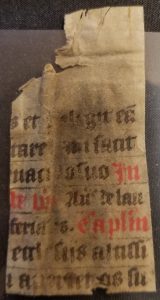
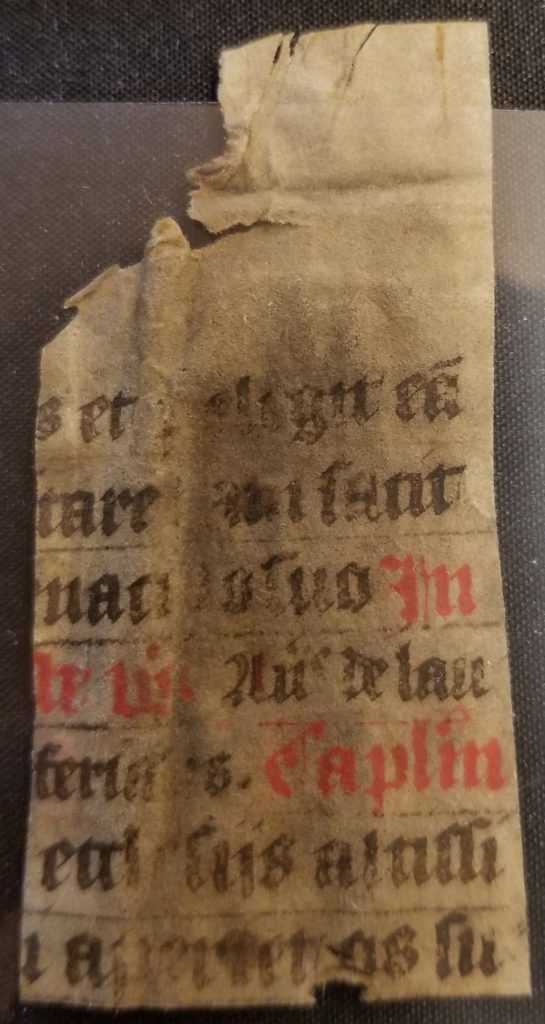
Private Collection, "Margaritas" fragment front side.

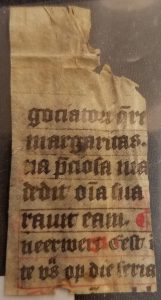
Private Collection, "Margaritas" fragment back side

Recently a small fragment of a leaf was acquired for a private collection from an unknown Latin manuscript.  We had the opportunity to examine and photograph the fragment, and we offer images of it here, along with preliminary observations.   Perhaps you recognize the script or text?

The scrap retains part of a single column of text, including some of the upper margin of the leaf.  The text amounts to one side of the column and 7 of its lines, plus the top of a next line.  One side of the scrap holds the opening, or left-hand side, of the column of text; the other holds the ending, or right-hand side, of its column.

The shape of the scrap shows that it was excised or trimmed down to its present limited extent by an uneven vertical slice both at the left of the column and through its middle, and an uneven horizontal slice through the top of its line 8.  It may have seemed unnecessary to cut through the upper margin, so perhaps the present height of the margin is the same as it was when the spoliation occurred.

Other forms of damage affect the scrap, including fold-lines, creases, tears, stains, and pigment offsets.  The patterns of folds, rubbed portions of text, and the losses probably from a mitred corner may show that this scrap came from a reused piece of vellum which served as the covering of a binding for some other text.  If so, the trimming of the part-column would have followed the retrieval of that reused vellum and its division into smaller portions for individual distribution, that is, sale.

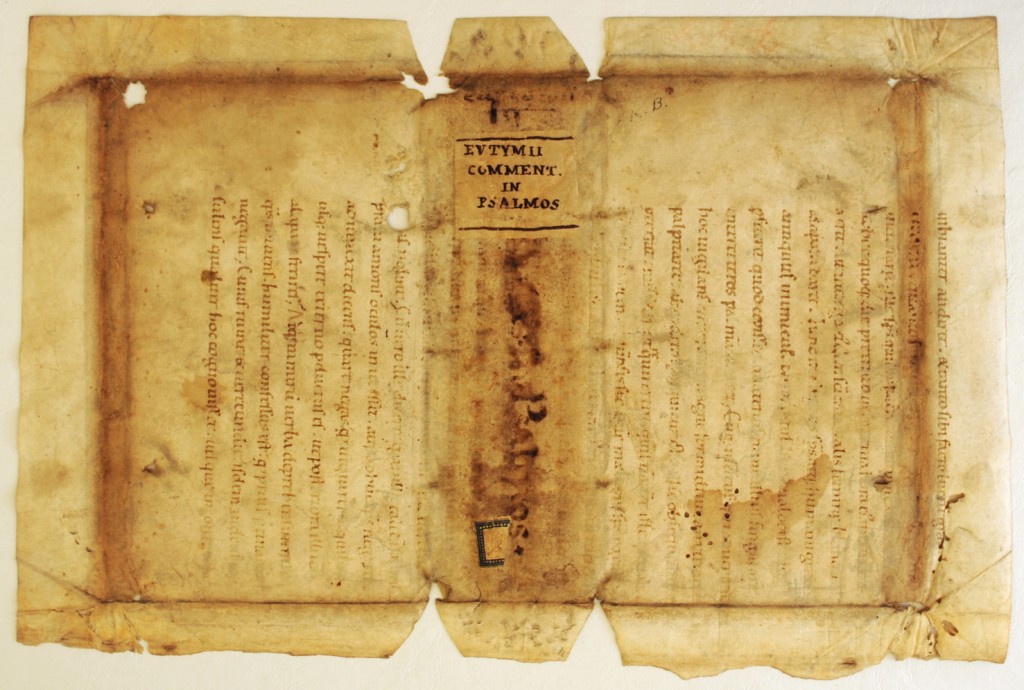
Fuller leaves deformed by reuse in bindings have passed through our blog.  They show more of the folding and mitering patterns which such reuse would have entailed.  For example, A Leaf from Gregory’s Dialogues Reused to Bind Euthymius:

Verso of Leaf from the Dialogues of Gregory the Great, Book III, chapter 7. Photography by Mildred Budny

Verso of Leaf from the Dialogues of Gregory the Great, Book III, chapter 7. Photography by Mildred Budny

Script and Layout

It is not clear whether the original leaf originally held a single column or double columns of text.  The margin to the right of the column might represent part of the inner margin of the leaf or part of the intercolumn separating the 2 columns (let us call them ‘a’ and ‘b’ from left to right).  If it came from a double-column format, this scrap would represent the first part of column a or b on one side, and the last part of the reverse (column b or a) on the other.  The distance textually between those remnants, as yet unknown, could help to assess the length of the columns as well as their number per page.

The text is written in ink, with rubricated elements in red pigment.  That pigment remains bright, without discoloration, probably indicating its vegetal (rather than metallic) origin.  Line 1 stands below the top ruled line of the framework for the text.  The ladder-like framework has outlined ‘rungs’ upon which the lines of script stand.  The lines of the framework are made in ink on one side of the scrap, but partly in ink and partly (in the lower part) in red pigment on the other side.

The text is written clearly in upright Gothic textura, with a few capitals.  The script employs a few abbreviations, low points for punctuation, and diagonal hairline strokes rising to the right as the dots over the i‘s.  The letter a has a firmly closed double-compartment bow.

Side 1

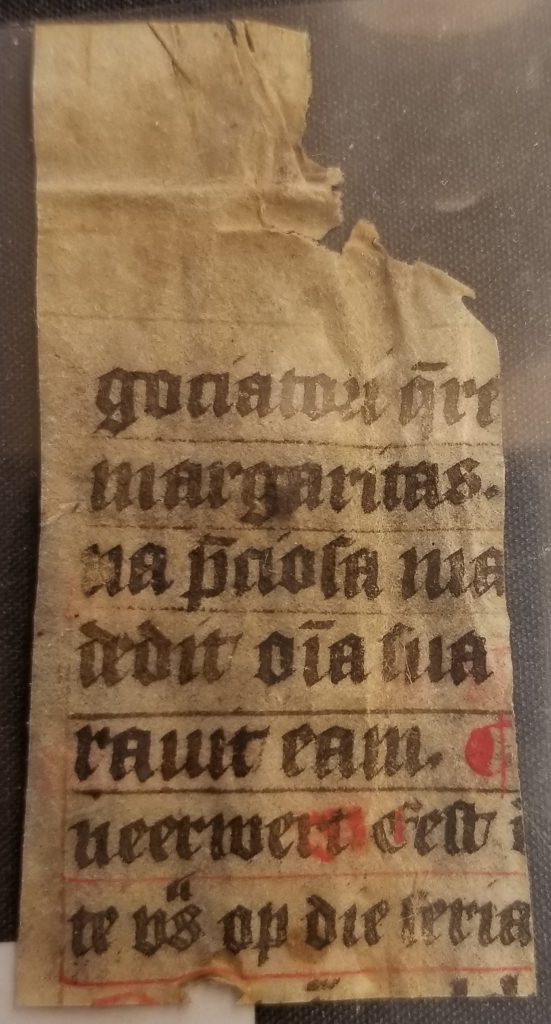
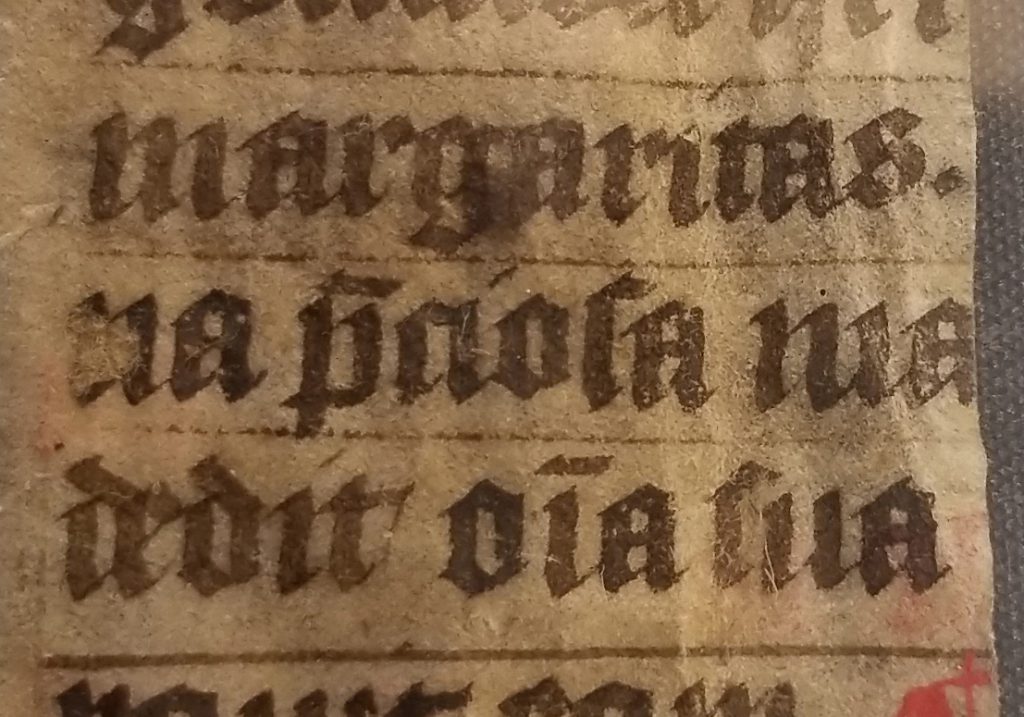
Private Collection, "Margaritas" fragment back side

Private Collection, “Margaritas” fragment back side.

Lines 1–3 on Side 1 correspond to part of De Uirgine que Martyr Fuerit in the published Missal of Saint Augustine’s Abbey, Canterbury, Appendix B, page 167. Here.  Andreas Falow observed that the passage belongs to the Responsonium
Simile est regnum caelorum homini negotiatori.

From these sources we supply, within square brackets [thus], the missing parts of each line opening the column.  Line 1 begins mid-word.

Line 1

[ne-/]gociatori queren[ti bonas]

margaritas. [inuenta u-]

[-]na preciosa ma[rgariti]

dedit omnia sua [et conp-]

Line 5

[-]aruit eam.  ¶ [ . . . ]

[]ue erineit ?est i[ . . . ]

[-]te us’ op die feria [ . . . ]

[ . . . ]

The passage in full would begin on at the bottom of the preceding column of text, either on the same page (in column a for column b in 2-column layout) or on the preceding page (in the single column in 2-column layout or in column b for 2-column layout).  Depending upon the location of this damaged column, it if stood at the left on the recto, the preceding column would have belonged to the preceding leaf.  By these words, we might recognize it, if it comes to light among surviving fragments.

The Response:

Simile est regnum caelorum homini negotiatori,
quaerenti bonas margaritas;
inventa una pretiosa margarita,
dedit omnia sua
et comparavit eam.

In German:

Das Reich der Himmel gleicht einem Kaufmann,
der schöne Perlen suchte.
Als er eine kostbare Perle fand,
gab er all das seine
und kaufte sie.

As Chris Nighman observes, the passage refers to the Parable of the Pearl, related in Matthew 13:45–46:

45 iterum simile est regnum caelorum homini negoiatori quaertenti bonas margaritas
46 inventa autem una pretiosa margarita abiit et vendid omnia que habuit et emit eam

In the King James Version:

Again, the kingdom of heaven is like unto a merchant man, seeking goodly pearls: Who, when he had found one pearl of great price, went and sold all that he had, and bought it.

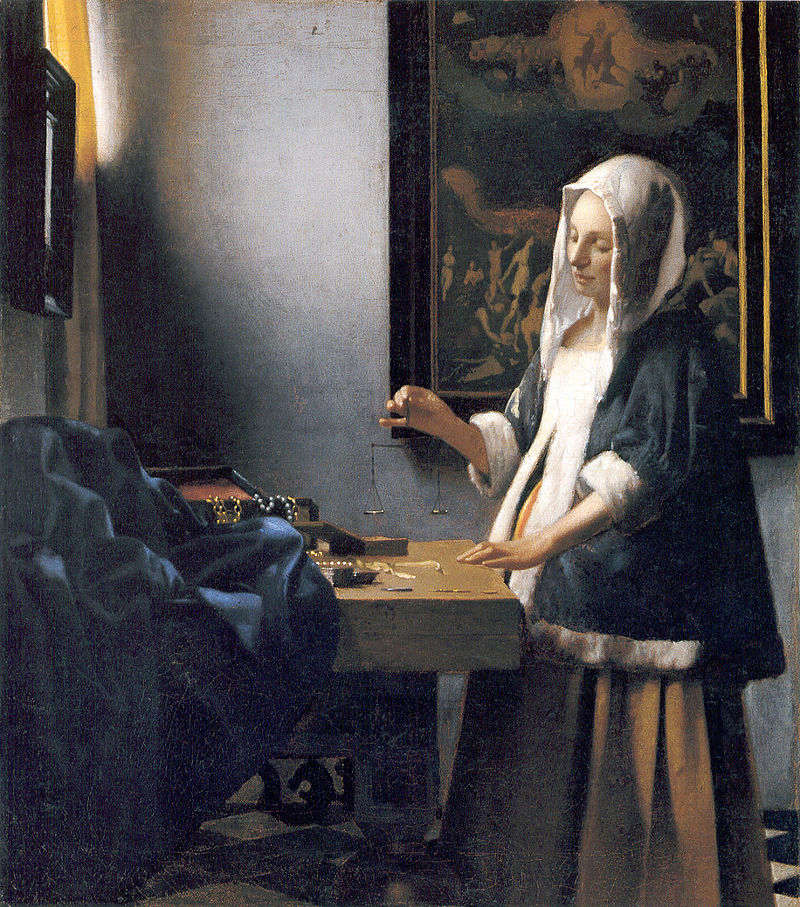
That passage, known as the Parable of the Pearl, or the Pearl of Great Price, alludes to the rarity and value of pearls both as physical and as symbolical treasures.

Washington, D. C., National Gallery of Art. Jan Vermeer, "The Pearl Merchant" or "Woman holding a Balance"(circa 1665). Image Public Domain via Wikimedia.

Washington, D. C., National Gallery of Art. Jan Vermeer, “The Pearl Merchant” or “Woman Holding a Balance” (circa 1665). Image Public Domain via Wikimedia.

Side 2

Private Collection, "Margaritas" fragment front side.

Private Collection, “Margaritas” fragment front side.

Line 1

[ . . . ]s et [ . . . ] eligit eam

[ . . . ]tare  [ . . . ]au[?]i facit

[ . . . ]uaci [ . . . ]o suo In

[ . . . ]le uii[ . . . ] Au’ de lau-

Line 5

[ . . . ]feria [.]s. Cap[itu]l[um] in

[ In] ecclesiis altissi[-]

[ -m]i apieret os su-[um . . . ]

In the Breviarium Remense (1830), In ecclesiis altisimi apieret os suum is a Response in Dominica I post Epiphianium in II Nocturno.

The Columns of Text Reconstructed

The portions of text which we can so far reconstruct through their recognition in other sources establish that each column had short lines, of which the scrap retains about one-half to one-third the former width.  Such presentation may indicate that the original manuscript had double columns.

Front & Back

It is not yet clear which side of the scrap was the front, or recto in the manuscript.  More research may clarify the issue.

But we can see which side of the skin is which.

The whitish flesh side of the animal skin stands on the side of the fragment which opens its column of text and places the word margaritas (“pearls”) in line 1.

Private Collection, "Margaritas" fragment back side, lines 2-5.

Private Collection, “Margaritas” fragment back side, lines 2-5.

The darker hair side includes a few short hairs from the animal on the partly-healed hole which interferes with the lower part of the o of os in the last line.  The slice through the leaf below this line bisects the hole.

Private Collection, "Margaritas" fragment front side, lines 4-7.

Private Collection, “Margaritas” fragment front side, lines 4-7.

It was the hair side which the leaf turned outside when it was reused to cover a binding.

*****

Do you recognize this scribe or the texts?

Please leave your Comments here, Contact Us with your questions and suggestions, and visit our Facebook Page.

Also, watch this blog for more discoveries.

*****

Tags: Breviary, manuscripts reused in bindings, Medieval Manuscript Fragments, Missal, Parable of the Pearl, Pearl of Great Price
3 Comments »

2020 Spring Symposium: Save the Date

February 15, 2020 in Announcements, Conference, Conference Announcement, Events, Index of Medieval Art, Princeton University, Reception, Uncategorized

New York, Grolier Club, \*434.14\Aug\1470\Folio. Flavius Josephus, De antiquitate Judiaca and De bello Judaico, translated by Rufinus Aquileinensis, printed in Augsburg on paper by Johannn Schüsseler in 2 Parts, dated respectively 28 June 1470 and 23 August 1470, and bound together with a manuscript copy dated 1462 of Eusebius Caesariensis, Historia ecclesiastica.

New York, Grolier Club, *434.14Aug1470Folio.

“From Cover to Cover”

Activities Devoted to Manuscripts, Early Printed Books & Beyond
From Collecting & Cataloguing to Deciphering & Beholding

2020  Spring Symposium
of the Research Group on Manuscript Evidence

Princeton University
Friday & Saturday 13–14 March 2020


Update 5 April 2020

The Symposium Booklet, with illustrations and Abstracts of Papers, is now published and available for download.
See Keeping Up: Updates for Spring 2020.

The Abstract of one paper in the 2020 Symposium Booklet has been expanded to a Draft Paper, available for Feedback:

  • “A Quick Introduction to Indian Manuscripts for the Non-Specialist”, with examples and illustrations,
    downloadable here.

Update 9 March 2020

This event is now cancelled, as Princeton University and other institutions respond to current health concerns, and take precautions regarding travel and meetings of various kinds in person.
The Symposium might be rescheduled, conditions permitting.  

Meanwhile, the Research Group aims to complete the Symposium Booklet and distribute it to contributors, registrants, and others, as a souvenir of our speakers’ good intentions.  Already, as a sign of appreciation, we have adopted the custom of posting on our website the abstracts of contributors who become unable to attend to present in person (as with the 2018 Congress, among others).

This time, under wider — even global — circumstances affecting the ensemble as a whole, we wish to show appreciation for the remarkable enthusiasm and dedication for the collaborative event demonstrated by our hosts, sponsors, speakers, moderators, and others.  This knowledge is something to remember with satisfaction, gratitude, and praise.

The publication could, perhaps, give a token to show for our shared efforts, and to demonstrate something of the spirit of dedication and focus which prepared to assemble for the event itself.

This aim might help to ease some of the disappointment over cancellation, while the cancellation itself might ease some uncertainties about travel at present.

P. S.  Only once before, in more than 30 years of activities in many centers in the United States and elsewhere (see our Events and Congress Activities}, has the Research Group had to cancel an event.  It, however, was only 1 Session among 7 sponsored and co-sponsored Sessions at the 48th International Congress on Medieval Studies in May 2013, when the Session organizer and 2 presenters were unable to travel to the Congress.  We honored their intentions to contribute by continuing to record their abstracts and the statement of purpose of the Session on this  website.

Similar solidarity pertains to our record of this intended 2020 Spring Symposium.  A summary of this Update appears in its own post.

Here we preserve the description of the event in the updated version just before the decision to cancel this Symposium, among many gatherings at Princeton University and elsewhere at the beginning of the week in which the Symposium was planned to take place.

*****

What We Planned

Saint Andrew. Oil on Canvas. Artus Wollfort (1581–1641). Private Collection, Public Domain. Via Wikipedia Commons.

Saint Andrew. Oil on Canvas. Artus Wollfort (1581–1641). Private Collection, Public Domain. Via Wikipedia Commons.

We announce the next Symposium of the Research Group on Manuscript Evidence, to be held at Princeton University on Friday afternoon and Saturday, 13–14 March 2020. This event follows from, and builds upon, our earlier events, including our 2019 Anniversary Symposium, also held at Princeton University.

Our subject this time: “From Cover to Cover”.   Some say, “That Covers It”.  (We might well agree.)

Such activities include Collecting, Curating, Conserving, Cataloguing, Deciphering, Editing, Reading, Teaching, Translating, Displaying, Accessing, Beholding, Reconsidering, and More.  Cover to Cover.

Naturally, these activities need not necessarily occur in that order, and often they appear in combination.

In addition we consider activities dedicated to manuscripts, early printed books, and beyond, in terms (as is our custom) of both media and chronology.  As often, we consider medieval manuscripts and early printed books from Western Europe, but also— as usual — we examine materials from other cultures, languages, and time-frames.

This recognition of the processes (necessarily integrated) infuses the collection of presentations and conversations which our Symposium aims to gather.  In a nutshell:  Food for Thought, Refreshments included.

For which ability, we have Sponsors, Hosts, Trustees, Associates, Contributors, and Volunteers heartily to thank.

Sponsors

Research Group on Manuscript Evidence

Department of Art & Archaeology, Princeton University

The Index of Medieval Art at Princeton University

Program in Medieval Studies, Princeton University

James Marrow and Emily Rose

Barbara A. Shailor

Celia Chazelle

The Schoenberg Institute for Manuscript Studies

The Bibliographical Society of America

Vassar College

On the Road
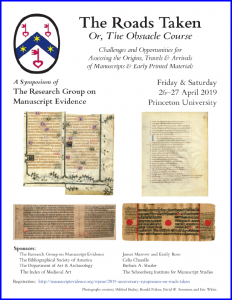
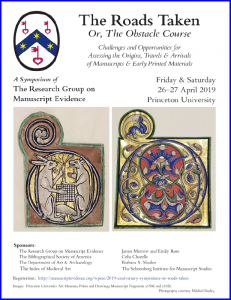
Poster 1 for 2019 Anniversary Symposium, with symposium information with images of manuscript and early printed pages..

Poster 1 for 2019 Symposium

Poster 2 for 219 Anniversary Symposium, with symposium information and 2 images of cropped initials, from 12th-century Latin manuscripts, from the Princeton University Art Museum.

Poster 2 for 2019 Symposium

Following upon, and building upon, the success of our Anniversary Symposium last year, we prepare the 2020 Spring Symposium.  Its date is now set, as is the Schedule.  (See below.)

For our 2019 Anniversary Symposium, see its Report and its freely downloadable 2019 Anniversary Symposium Booklet.  Like the Booklet, the 2 Posters (seen here) illustrate examples of manuscripts (Western and non-Western) showcased in the Symposium, its papers, and its workshops.

All these publications, as customary, are set in our very own copyright multilingual font Bembino , and designed and laid out according with our Style Manifesto.  This font is freely available through our website, for your use – whether individual, nonprofit, or commercial.

Both the font, and its descriptive Booklet, are downloadable here .  We have also prepared a booklet showing its abilities in setting multiple languages, both Western and non-Western.  See Multi-Lingual Bembino . Plus our Style Manifesto .

Cover Story

Now we turn to our 2020 Spring Symposium.  Please register (details below).
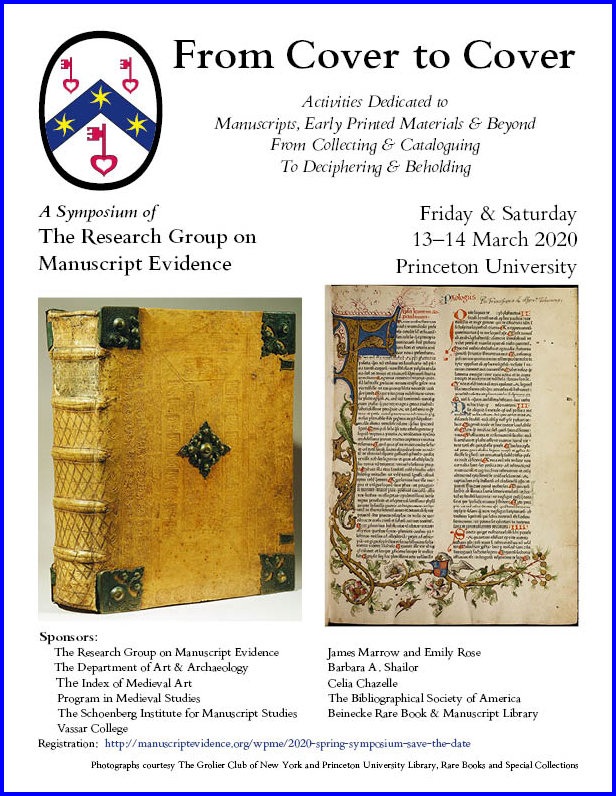
Poster 1 for the 2022 Spring Symposium.

Gladly we list the Sponsors, Speakers, and Moderators.

Speakers and Moderators (in alphabetical order)
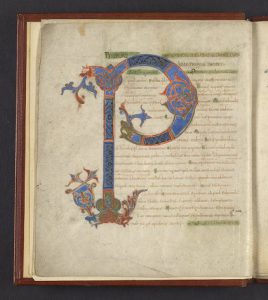
Philadelphia, University of Pennsylvania Libraries, Lawrence J. Schoenberg Collection, MS LJS 101, folio 1v. Opening of Boethius's translation of Aristotle's "Peri erimenias" within a collection of secular and classical texts, France, possibly at the Abbey of Fleury (Saint-Benoît-sur-Loire), 9th–11th centuries. Photograph courtesy OPenn.

Philadelphia, University of Pennsylvania Libraries, Lawrence J. Schoenberg Collection, MS LJS 101, folio 1v. Photograph courtesy OPenn.
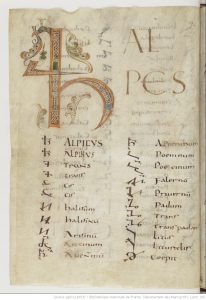
Paris, Bibliothèque nationale de France, MS latin 190, folio 1r. Opening page of the Commentarii notarum tironiarum, with an enlarged initial decorated with interlace and foliate ornament. Image via gallica.bnf.fr.

Paris, Bibliothèque nationale de France, MS latin 190, folio 1r. Photograph via gallica.bnf.fr.

Christine E. Bachman (Art History Department, University of Delaware and Graduate Student Fellow 2019–2020, Schoenberg Institute for Manuscript Studies, University of Pennsylvania)

Mildred Budny (Director, Research Group on Manuscript Evidence, Princeton)

Raymond Clemens (Curator, Early Books and Manuscripts, Beinecke Rare Book and Manuscript Library, Yale University, New Haven)

Meghan Constantinou (Librarian, The Grolier Club, New York, New York)

Barbara Williams Ellertson (Books as Symbols in Renaissance Art and Research Group on Manuscript Evidence)

Lynley Anne Herbert (Curator of Manuscripts and Rare Books, The Walters Art Museum, Baltimore, Maryland)

Carson Koepke (Program in Medieval Studies, Yale University)

Laura Light (Director and Senior Specialist, Text Manuscripts, Les Enluminures)

John T. McQuillen (Associate Curator, Printed Books & Bindings, The Morgan Library & Museum, New York, New York)

Bernard Maisner (Bernard Maisner and Bernard Maisner, Master Calligrapher)
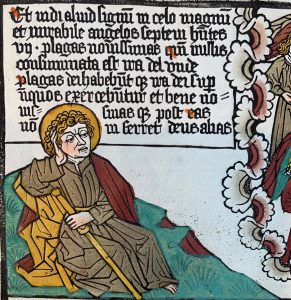
New York, Morgan Library & Museum, PML 7, folio P2r. Blockbook of Apocalypsis Sancti Johannis, printed in Germany circa 1468. Revelation 15:1, with hand-colored illustration.

New York, Morgan Library & Museum, PML 7, folio P2r. Blockbook of Apocalypsis Sancti Johannis, printed in Germany circa 1468. Revelation 15:1, with hand-colored illustration.

Sabrina Minuzzi (Researcher in Early Modern History, Marie Skłodowska-Curie Fellow, Ca’ Foscari University of Venice)

Ronald D. Patkus (Associate Director of the Libraries for Special Collections and Vassar Head of Special Collections, Vassar College, Poughkeepsie, New York)

Pamela Patton (Director, Index of Medieval Art at Princeton University)

Lynn Ransom (Curator of Programs, The Schoenberg Institute for Manuscript Studies, University of Pennsylvania Libraries)

Helmut Reimitz (Professor of History and Director, Program in Medieval Studies, Princeton University)

Jessica L. Savage (Art History Specialist, Index of Medieval Art)

Barbara A. Shailor (Department of Classics, Yale University, and President, Bibliographical Society of America)

       David W. Sorenson (Independent, Quincy, Massachusetts)

Kelly Tuttle (Project Cataloger, Manuscripts of the Muslim World, University of Pennsylvania Libraries)

Eric White (Curator of Rare Books and Acting Curator of Manuscripts, Special Collections, Firestone Library, Princeton University)
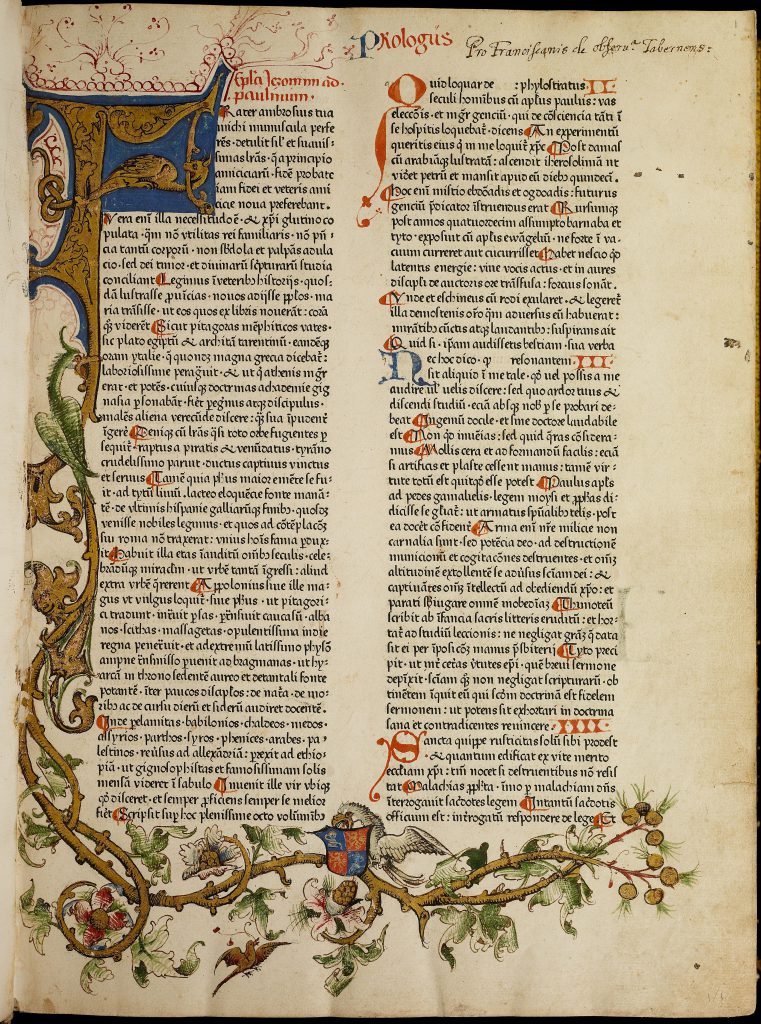
Princeton University Library, Rare Books and Special Collections, William H. Scheide Library, 53.8. Latin Bible in double columns of 49 lines, printed in Strasbourg by Johann Mentelin, not after 1460 CE.

Princeton University Library, Rare Books and Special Collections, William H. Scheide Library, 53.8. Latin Bible (printed in Strasbourg by Johann Mentelin, not after 1460 CE.) Photograph courtesy Princeton University Library, Rare Books and Special Collections.

The Aim

In a nutshell.
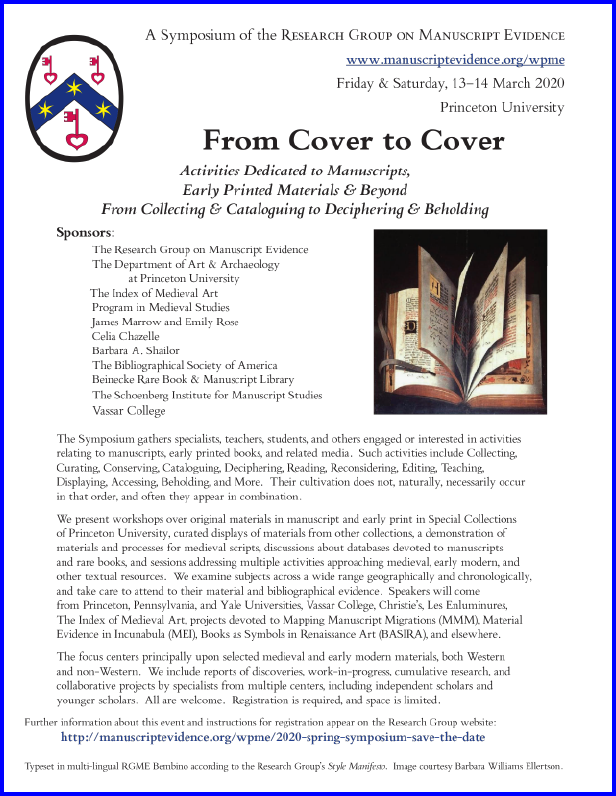
2020 Spring Symposium Announcement, describing the scope of the event, listing the Sponsors, and citing the link to the registration form.

2020 Spring Symposium Announcement, describing the scope of the event, listing the Sponsors, and citing the link to the registration form.

The Plan

Day 1

Friday 13 March: Classes, Workshops, Discussion, and a Reception

1) 12:00–1:00, 12:00–1:30, or 12:00–2:00pm (By Invitation)
Seminar Room of the Index of Medieval Art

“Comparing Notes about Databases:  Past, Present & Futures”
An Informal Discussion

2–3) 1:00–2:45 pm or 3:00–4:45 pm
Classes on Site at Firestone Library (Registration Required and Space Limited)

For registration for these classes and the symposium, see below.

“Material Evidence: A Workshop with 15th-Century Manuscripts and Incunabules”

Classes given (twice) by Eric White, Curator of Rare Books, Princeton University Library, in the Large Classroom of Floor C (Rare Books and Special Collections) at Firestone Library

Please gather in the Lobby at the entrance to Firestone Library, for special escorted access to Floor C, where there are lockable lockers (free) for your coats and cases, before entry to Special Collections.

2) Class 1:  Meet at 1:00 for 1:15–2:45 pm

3) Class 2 (repeated):  Meet at 3:00 for 3:15–4:45 pm

or

4) Session 3:00–5:00 pm
106 McCormick Hall

“Materials, Processes & Products:  A Workshop”

This workshop offers presentations by Bernard Maisner on “The Materials and Methods of Medieval & Renaissance Manuscript Gold-Illumination Techniques” and by David W. Sorenson on “An Introduction to Indian Manuscripts for the Non-Specialist”, along with curated displays of original materials in private collections and demonstrations of results from their close study.

5) Reception

5:00–7:00 pm
Lobby outside 106 McCormick Hall
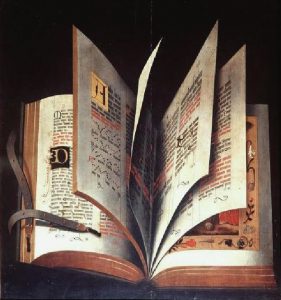
Florence, Galleria degli Uffizi, Anonymous, Still Life, German school of the XVI century, circa 1510, oil on wood, 70.2 × 65 cm. Opened book with fanned leaves showing pages of text and music set out in double columns and adorned with decorated initials and illustrations. Image via Wikimedia, public domain.

Florence, Galleria degli Uffizi, Anonymous, Still Life of an Illuminated Book, German school of the XVI century, circa 1510. Opened book with fanned leaves. Image via Wikimedia, public domain.

Day 2

Saturday 14 March:  Sessions, Refreshments, and Reception

106 McCormick Hall and its Lobby

6) 10:00 am – 5:30 pm

Sessions, Coffee Breaks, Lunch, and Discussion

7) Reception (5:30–7:00 pm)
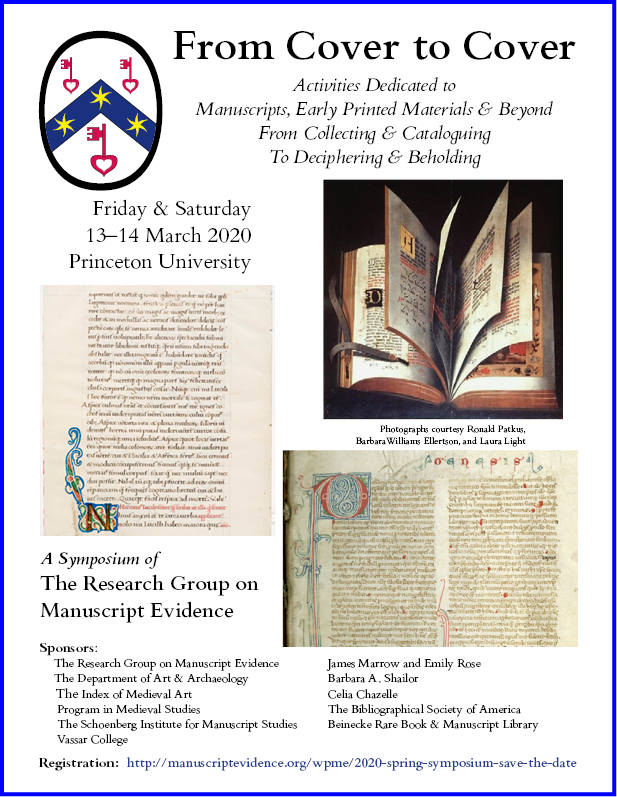
2020 Symposium "From Cover to Cover" Poster 2

2020 Symposium Poster 2

*****

The Schedule

The Schedule is available here.

*****

Registration

Please register for the Symposium.  We offer the Registration form as a downloadable pdf .

*****

Maps and Directions

Here.

*****

Please Contact us with questions and suggestions.

Watch this space and visit our FaceBook Page for updates.
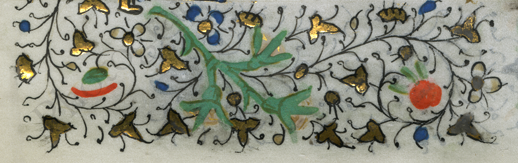
Floral Motif as Lower Border in a Book of Hours. Photography Mildred Budny.

We invite you to donate to our nonprofit educational mission. Donations may be tax-deductible. We welcome donations in funds and in kind: Contributions and Donations .

Please join us at the symposium, open to all.  You can register here .

*****

Tags: Early Printing, manuscript fragments, Manuscript Illumination, Manuscript studies, Medieval Manuscript Fragments, Medieval Studies, Medieval Writing Materials, Spring Symposium
6 Comments »

The Plot Thickens

June 7, 2019 in Manuscript Studies, Reports

A New Leaf Found at the University of Pennsylvania
from the
“Kurdian/Chicago New Testament Praxapostolos[?]
in Old Armenian”

The “Find-Place” of this Fragment
is a Surprise
also for Our Research on “Otto Ege Manuscripts”

[In our series of blogposts on Manuscript Studies, Mildred Budny (see Her Page) reports the unexpected discovery of another leaf from the same dismembered manuscript with portions of the New Testament in Old Armenian featured in an earlier blogpost, published on 28 September 2015, with an illustrated Report available for download.  Now we prepare for an updated, downloadable Report by describing the New Find and its location.]

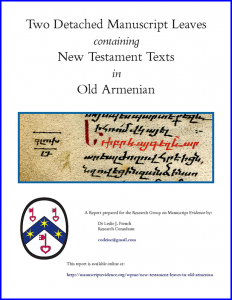
Cover for the Report on 'Two Detached Manuscript Leaves containing New Testament Texts in Old Armenian' by Leslie J. French for the Research Group on Manuscript Evidence, with a detail of Leaf I verso, column a lines 10-12, with the opening of Acts 23:12

Cover for “Two Detached Manuscript Leaves containing New Testament Texts in Old Armenian” (2015).

First the Report So Far. As part of the process of exhibiting images from manuscripts, documents, and other written materials — for example in our Galleries of Scripts on Parade and Texts on Parade, and in our Reports on Manuscript Studies — we offered a Report on ‘Two Detached Manuscript Leaves containing New Testament Texts in Old Armenian’ by our Associate, Leslie J. French.  The Report focuses upon the evidence of some New Leaves (as they came into our view), considering their materials, layout, text, apparatus, and language, with reference to the knowable features of other remnants of the manuscript, particularly the Chicago Leaf, and some relatives among other representatives of New Testament texts in Old Armenian written in bolorgir script and accompanied in the margins by the Euthalian apparatus.

The Report booklet is available for download in 2 versions. They respect options for printing which might be available to you.

  • ArmenianPages set out in individual letter-sized (or quarto) pages
  • ArmenianBooklet laid out on 11″ × 17″ sheets for folding into a 20-page booklet in consecutive reading order

Specifically for that Report, Armenian characters in both lower case and upper case were added to the multi-lingual digital font Bembino of the Research Group on Manuscript Evidence.  For information about the font and its current version, free for download and use, see Bembino.  A booklet demonstrates specimens in multiple languages, Armenian included, of the appearance on the page of Multi-Lingual Bembino.

Booklet ‘On Demand’

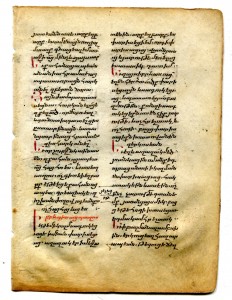
Old Armenian "New Leaf I", Verso. Fragment with part of the Acts of the Apostles (to Acts 23:19)

Folio Ir of Armenian New Testament fragment. Acts of the Apostles

This Report is available below for download as PDF. In the form of a booklet, it presents its materials laid out in the official font of the Research Group on Manuscript Evidence, Bembino, a multilingual digital font (which you see on this website), and in accordance with the principles of our Style Manifesto. Such an approach resembles the presentation of our Newsletter ShelfMarks in booklet form, likewise available freely for download — as are the Style Manifesto and the descriptive booklet, with specimens, for Bembino. The font itself is also FREE for download here (now in Version 1.3).

The Report examines and illustrates two detached leaves in Old Armenian which came to our attention when preparing their presentation among other specimens in various languages in our Gallery of Scripts on Parade. Then, identifying the passages of text and the elements of textual apparatus on the leaves proceeded hand in hand with an exploration of the available evidence, or records, for other parts of the same manuscript dispersed in several collections. Designing Armenian characters, lowercase and uppercase, for Bembino (in its next version, still in progress, responding to requests) allowed for the collation of the texts in full, as an aid to decipherment for readers who may be unfamiliar with the language or the medieval script forms. And so the booklet took shape.

The Manuscript in Question

These leaves, now in several collections, both private and institutional, preserve parts of dismembered manuscript in Old Armenian written in bolorgir minuscule script of the 15th or 16th century CE. The remnants contain parts of the New Testament (some observers say a Lectionary), plus a Prayer (or its opening line) and a Scribal Colophon (of unknown contents), now dispersed in parts among several collections worldwide.

Read the rest of this entry →

Tags: Bembino Digital Font, Dawson's Bookshop, Goodspeed Manuscript Collection, Manuscript studies, Medieval Manuscript Fragments, New Testament Manuscripts, Old Armenian, University of Pennsylvania Libraries
No Comments »

More Discoveries for ‘Otto Ege Manuscript 41’

November 27, 2018 in Manuscript Studies, Photographic Exhibition

New Haven, Yale University, Beinecke Rare Book and Manuscript Library, Otto Ege Collection, Family Portfolio of Fifty Original Leaves ("FOL") of Medieval Western Manuscripts, Leaf 41, recto, column b, top. Medieval Contents List for the Volume in the upper margin, above the concluding line of the Chaper List for Book I and the Opening of that Book. Photography by Mildred BudnyOtto Ege’s
Dismembered Manuscript 41

A Latin copy of the
Dialogues of Gregory the Great,
Epistles and Homilies of John Chrysostom,
Meditations of Anselm,
And Maybe More

Double columns of 40 lines with some embellishment

Produced probably in Flanders, perhaps circa 1450

Plundered in World War I
From the Library of the Van der Cruisse de Waziers, near Lille in France

Sold circa 1925 through the Bookseller Thorpe in Surrey, England

Brought to the United States Intact, Then Dismembered and Distributed in Pieces

Continuing our series on Manuscript Studies, Mildred Budny (see Her Page) adds new evidence to her earlier reports of some leaves from medieval manuscripts dispersed by Otto F. Ege (1888–1951). Further research and newly revealed materials augment our knowledge of these manuscripts (and others). 

This report updates our earlier blogpost on parts of Otto Ege Manuscript 41.  See also the posts for Ege Manuscripts 8, 14, 51, and 61, plus updates (More Discoveries for Ege Manuscript 61), as well as the Report for our 2016 Symposium on ‘Words & Deeds’, with an illustrated Program Booklet. 

This report, drafted following a first visit in 2017 to view examples in the Otto Ege Collection now at the Beinecke Rare Book and Manuscript Collection, benefits from updates following a new visit in October 2018, with my thanks for permission to examine and to photograph the materials, especially while they remain mostly uncatalogued.

Picking Up The Piecework

As more pieces of the manuscript come to light, and/or become recognized for what they are, the process of virtually picking up their pieces toward a reasonable reconstruction of their original contents can or must proceed piecemeal.  More discoveries advance that process considerably.  Here we report new stages.  Some of them, naturally enough, may revise the received understanding about the manuscript.

Read the rest of this entry →

Tags: Beinecke Rare Book and Manuscript Library, Dialogues of Gregory the Great, Epistles of John Chrysostom, Homilies of John Chrysostom, Homilies on the Epistle to the Hebrews, library of the Van Der Cruisse de Waziers family, Manuscript studies, Medieval Manuscript Fragments, Meditations of Saint Anselm, Otto Ege Manuscript 41, Otto Ege Manuscripts
1 Comment »

2019 International Congress on Medieval Studies Call for Papers

July 5, 2018 in Announcements, Call for Papers, Conference, Conference Announcement, Events, ICMS, Index of Medieval Art, International Congress on Medieval Studies, Kalamazoo, Manuscript Studies, Societas Magica

Sessions
Sponsored and Co-Sponsored
by the Research Group on Manuscript Evidence
at the 54th International Congress on Medieval Studies
9–12 May 2019

Call for Papers
Deadline for Proposals = 15 September 2018

[Published on 5 July 2018, with updates]

With the achievement of our Activities at the 2018 International Congress on Medieval Studies, as announced in our 2018 Congress Program, we both give a 2018 Congress Report and prepare a Behind the Scenes Report.

For updates, please watch this space and our Facebook Page.  [And now, with the completion of the span for the CFP in mid-September 2018, we prepare the Programs for our Sessions at the 2019 Congress, for which see, in time, our 2019 Congress Program announcement.]

*****

Now we proceed to preparations for the 2019 Congress. This next year, the Research Group on Manuscript Evidence celebrates its 20th year as a nonprofit educational corporation and its 30th year as an international scholarly organization.

We have a tradition of celebrating landmark Anniversaries, both for our organization, with organizations which which we share anniversaries, and for other events. As described, for example, in our 2014 Anniversary Reflections.

This coming year, 2019, we prepare events at the Congress and elsewhere, so as to represent, to explore, to promote, to celebrate, and to advance aspects of our shared range of interests, fields of study, subject matter, and collaboration between younger and established scholars, teachers, and others, in multiple centers.

In June 2018, we learned that most — not all — of our Session Proposals (due on 1 June) for the 2019 Congress have been accepted by the Congress Committee, so that we progress to their Call for Papers.  We regret the rejections for proposed Sessions which, for example, promoted initiatives by Graduate Students and by Independent Scholars, and which we wished to support.

Logo of the Research Group on Manuscript Evidence (colour version)The Congress Committee will publish the full 2019 Call for Papers for the 54th ICMS, with the list of Session Titles and Sponsors. Here we announce our 5 sponsored and co-sponsored Sessions and describe their aims.

As in recent years, we co-sponsor Sessions with the Societas Magica (2 Sessions). It will be the 14th year of this co-sponsorship.  It will be the first year of co-sponsorship with the newly-founded organization Polytheism-Oriented Medievalists of North America (POMONA).

Also, like the 2015–2018 Congresses, we plan for

  • an Open Business Meeting and
  • a Reception.

As usual, we aim to publish the Program for the accepted Papers, once the Call For Papers has completed its specified span.  We will publish the Abstracts for these Papers as the preparations for the Congress advance and as their Authors permit.  Abstracts for previous Congresses appear in our Congress Abstracts, conveniently Indexed both by Year and by Author.]

Read the rest of this entry →

Tags: Animals in Celtic Magical Texts, Classical Deities in Medieval Northern European Contexts, History of Magic, Index of Medieval Art at Princeton University, Manuscript studies, Medieval Manuscript Fragments, POMONA, Ritual Magic, Societas Magica
No Comments »

Updates for Some “Otto Ege Manuscripts”

March 23, 2018 in Manuscript Studies, Photographic Exhibition, Reports

More is More

New Acquisitions Exhibition at the Beinecke Rare Book and Manuscript Library in November 2016: View of Some Parts of "Otto Ege Manuscript 14".

“A Long Shot”. New Acquisitions Exhibition at the Beinecke Rare Book and Manuscript Library in November 2016: View of Some Parts of “Otto Ege Manuscript 14”.

Continuing our series on Manuscript Studies, Mildred Budny (see Her Page) adds new evidence to her earlier reports of some leaves from medieval manuscripts dispersed by Otto F. Ege (1888–1951).

Revisions are now in order.  As we continue to look at, and for, evidence of the dispersed materials, the old and new evidence shows more.  While giving some answers, the observations also raise new questions. 

Time now for more Updates for Some “Otto Ege Manuscripts”.

[Published on 15 December 2017, with updates]

Read the rest of this entry →

Tags: Ege Memorial Microfilm, Medieval Manuscript Fragments, Otto Ege, Otto Ege Manuscript 14, Otto Ege Manuscript 41, Otto Ege Manuscript 51, Otto Ege Manuscript 61, Otto Ege Manuscript 8
No Comments »

A 12th-Century Fragment of Anselm’s ‘Cur Deus Homo’

January 31, 2017 in Manuscript Studies, Reports, Uncategorized

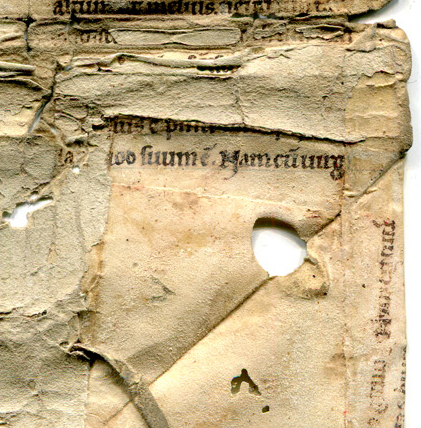
Verso of the Leaf and Interior of the Binding, Detail: Lower Right-Hand Corner, with the Mitered Flap Unfolde

Verso of the Leaf and Interior of the Binding, with the Mitered Flap Unfolded.

Tied Down

Fragmentary Leaf with Part of Anselm’s Cur Deus Homo

Book II, Chapters 17–18 or 18a–b
(sumpsit eam . . . Nam cum uirg[/initatis melior])
in Latin on vellum
measuring at the most circa 307 mm tall × circa 182 mm
< written area (including ascenders and descenders) 148 mm wide
with each column circa 65 mm wide
flanking the intercolumn of circa 18 mm wide >
laid out in double columns of 35 lines
written in brown ink in skilled ProtoGothic script
without embellishments

Continuing our series on Manuscript Studies, our Principal Blogger, Mildred Budny (see Her Page) reports the discovery of a reused fragmentary vellum Latin manuscript leaf extracted from a copy of Anselm’s masterwork Cur Deus Homo.  Whether as a text on its own or in the company of other texts, it was made probably in about the third quarter of the 12th century, to judge by the script, perhaps in France.  Norman, maybe?  Identifying the text and its sequence makes it possible to recognize which side of the leaf was the original recto, and which the verso.  The fragment joins the select known cast of 12th-century manuscript witnesses to this significant philosophical–theological text.

Anselm’s texts mostly took the forms of meditations or dialogues. Already our blog has showcased a manuscript with another text by Anselm: A New Leaf from ‘Otto Ege Manuscript 41’, which formerly contained a copy of the Prayers and Meditations. Now we focus upon one of his principal dialogues, cast between master and follower, as they debate the natures of divinity and necessity.

Read the rest of this entry →

Tags: Anselm's Cur Deus Homo, Archbishop Anselm, Bodleian Library Bodley MS 271, Bodleian Library MS Auct D 2 6, Budny Handlist, Canterbury Cathedral, Landscapes, Manuscript Fragments Reused in Bindings, Medieval Manuscript Fragments, ProtoGothic Script, R W Southern, Theodore Phyffers, Thionville, Trinity College Cambridge MS B 1 37
1 Comment »

Spoonful of Sugar

April 27, 2016 in Manuscript Studies, Photographic Exhibition

A Reused Medieval Bifolium from a
Latin Treatise on Medicinal Substances

13th Century?

Double columns of 57 lines
with rubricated headings
and
initials and paraph marks
rendered in alternately red or blue pigment
and embellished with extended penline-flourishes in the contrasting pigment

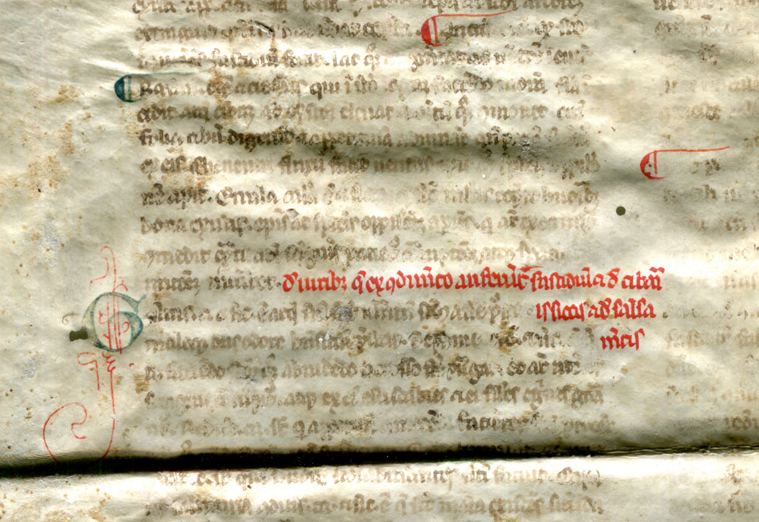
Detail with Initial G of Folio Ivb of Bifolium from a Latin Medicinal Treatise reused formerly as the cover of a binding for some other text, unknown. Reproduced by permissionContinuing our blog on Manuscript Studies, we illustrate a fragmentary medieval bifolium, much damaged, from a large-format manuscript retrieved (without recording the contextual information) from its long-term reuse as the vellum cover of an unknown book with a thick back.  The reuse, at an unknown stage, presumably took advantage of an out-of-date medicinal textbook.  Shame on the retrievers for not recording and letting us know the location from which the bifolium was removed.

Whereas many reused medieval manuscripts survive from discarded religious texts rendered obsolete by changes in liturgical practices and religious beliefs, for example during the Reformation, the French Revolution, or less catastrophic (r)evolutions, this case represents a relic, or battered fossil, of advances — or anyway transitions — in scientific, medical, pharmaceutical, and related spheres of knowledge in Western Europe.  Some of our posts describe the former; now we turn to the latter.  Here, we mainly allow the pictures to do the talking.

Read the rest of this entry →

Tags: Manuscript Fragments Reused in Bindings, Medieval Manuscript Fragments, medieval medicinal treatises
1 Comment »

« Older Entries
Newer Entries »
  • Top
©2024 Research Group on Manuscript Evidence.


is proudly powered by WordPress. WordPress Themes X2 developed by ThemeKraft.