• News
    • News & Views
    • RGME Activities for 2024 and 2025
    • Around & About with the RGME
    • Reviews
    • Highlights
  • Blogs
    • Manuscript Studies
      • Manuscript Studies: Contents List
    • International Congress on Medieval Studies
      • Abstracts of Congress Papers
        • Abstracts of Papers Listed by Author
        • Abstracts of Papers Listed by Year
  • About
    • Mission
    • Who We Are
      • Officers, Associates & Volunteers
      • RGME Committees
      • Friends of the Research Group on Manuscript Evidence
    • Policies & Statements
      • RGME Privacy Policy Statement
      • RGME Intellectual Property Statement & Agreements
    • People
      • Mildred Budny — Her Page
      • Adelaide Bennett Hagens
    • Activities
      • Events
      • Congress Activities
        • Sponsored Conference Sessions (1993‒)
          • Panels at the M-MLA Convention (from 2016)
        • Co-sponsored Conference Sessions (2006‒)
    • History
      • Seals, Matrices & Documents
      • Genealogies & Archives
    • Contact Us
  • Bembino
    • Multi-Lingual Bembino
    • RGME Bembino: Resources
  • Congress
    • Sponsored Conference Sessions (1993‒)
    • Co-sponsored Conference Sessions (2006‒)
    • Abstracts of Congress Papers
      • Abstracts Listed by Author
      • Abstracts Listed by Year
    • Kalamazoo Archive
    • Panels at the M-MLA Convention (2016-2019)
      • Abstracts of Papers for the M-MLA Convention
      • Panels at the M-MLA Convention (from 2016)
  • Events
    • RGME Activities for 2024 and 2025
      • 2023 Activities and 2024 Planned Activities
    • Seminars, Workshops, Colloquia & Symposia (1989–)
      • Seminars on ‘The Evidence of Manuscripts’
      • Symposia on ‘The Transmission of the Bible’
      • The New Series (2001-)
        • 2019 Anniversary Symposium Program: The Roads Taken
        • 2019 Anniversary Symposium Registration
        • 2019 Anniversary Symposium Registration Open
      • RGME Symposia: The Various Series
      • The Research Group Speaks: The Series
      • Meetings of the Friends of the Research Group on Manuscript Evidence
      • RGME Online Events
    • Abstracts of Papers for Events
      • Abstracts of Papers for Seminars on ‘The Evidence of Manuscripts’
      • Abstracts of Papers for Symposia, Workshops & Colloquia
    • Receptions & Parties
    • Business Meetings
    • Photographic Exhibitions & Master Classes
    • Events Archive
  • ShelfLife
    • Journal Description
    • ShelfMarks: The RGME-Newsletter
    • Publications
      • “Insular, Anglo-Saxon, and Early Anglo-Norman Manuscript Art at Corpus Christi College, Cambridge” (1997)
        • Mildred Budny, ‘Catalogue’
        • The Illustrated Catalogue (1997)
      • The Illustrated Handlist
      • Semi-Official Counterfeiting in France 1380-1422
      • No Snap Decisions: Challenges of Manuscript Photography
    • History and Design of Our Website
  • Galleries
    • Watermarks & the History of Paper
    • Galleries: Contents List
    • Scripts on Parade
    • Texts on Parade
      • Latin Documents & Cartularies
      • New Testament Leaves in Old Armenian
    • Posters on Display
    • Layout Designs
  • Donations and Contributions
    • RGME Donor Promise
    • 2023 End-of-Year Fundraiser for our 2024 Anniversary Year
    • 2019 Anniversary Appeal
    • Orders
  • Links
    • Catalogs, Metadata, and Databases: A Handlist of Links
    • Handlist of Resources for Manuscript Studies and Fragmentology
    • Manuscripts & Rare Books
    • Maps, Plans & Drawings
    • Seals, Seal-Matrices & Documents

  • News
    • News & Views
    • RGME Activities for 2024 and 2025
    • Around & About with the RGME
    • Reviews
    • Highlights
  • Blogs
    • Manuscript Studies
      • Manuscript Studies: Contents List
    • International Congress on Medieval Studies
      • Abstracts of Congress Papers
        • Abstracts of Papers Listed by Author
        • Abstracts of Papers Listed by Year
  • About
    • Mission
    • Who We Are
      • Officers, Associates & Volunteers
      • RGME Committees
      • Friends of the Research Group on Manuscript Evidence
    • Policies & Statements
      • RGME Privacy Policy Statement
      • RGME Intellectual Property Statement & Agreements
    • People
      • Mildred Budny — Her Page
      • Adelaide Bennett Hagens
    • Activities
      • Events
      • Congress Activities
        • Sponsored Conference Sessions (1993‒)
          • Panels at the M-MLA Convention (from 2016)
        • Co-sponsored Conference Sessions (2006‒)
    • History
      • Seals, Matrices & Documents
      • Genealogies & Archives
    • Contact Us
  • Bembino
    • Multi-Lingual Bembino
    • RGME Bembino: Resources
  • Congress
    • Sponsored Conference Sessions (1993‒)
    • Co-sponsored Conference Sessions (2006‒)
    • Abstracts of Congress Papers
      • Abstracts Listed by Author
      • Abstracts Listed by Year
    • Kalamazoo Archive
    • Panels at the M-MLA Convention (2016-2019)
      • Abstracts of Papers for the M-MLA Convention
      • Panels at the M-MLA Convention (from 2016)
  • Events
    • RGME Activities for 2024 and 2025
      • 2023 Activities and 2024 Planned Activities
    • Seminars, Workshops, Colloquia & Symposia (1989–)
      • Seminars on ‘The Evidence of Manuscripts’
      • Symposia on ‘The Transmission of the Bible’
      • The New Series (2001-)
        • 2019 Anniversary Symposium Program: The Roads Taken
        • 2019 Anniversary Symposium Registration
        • 2019 Anniversary Symposium Registration Open
      • RGME Symposia: The Various Series
      • The Research Group Speaks: The Series
      • Meetings of the Friends of the Research Group on Manuscript Evidence
      • RGME Online Events
    • Abstracts of Papers for Events
      • Abstracts of Papers for Seminars on ‘The Evidence of Manuscripts’
      • Abstracts of Papers for Symposia, Workshops & Colloquia
    • Receptions & Parties
    • Business Meetings
    • Photographic Exhibitions & Master Classes
    • Events Archive
  • ShelfLife
    • Journal Description
    • ShelfMarks: The RGME-Newsletter
    • Publications
      • “Insular, Anglo-Saxon, and Early Anglo-Norman Manuscript Art at Corpus Christi College, Cambridge” (1997)
        • Mildred Budny, ‘Catalogue’
        • The Illustrated Catalogue (1997)
      • The Illustrated Handlist
      • Semi-Official Counterfeiting in France 1380-1422
      • No Snap Decisions: Challenges of Manuscript Photography
    • History and Design of Our Website
  • Galleries
    • Watermarks & the History of Paper
    • Galleries: Contents List
    • Scripts on Parade
    • Texts on Parade
      • Latin Documents & Cartularies
      • New Testament Leaves in Old Armenian
    • Posters on Display
    • Layout Designs
  • Donations and Contributions
    • RGME Donor Promise
    • 2023 End-of-Year Fundraiser for our 2024 Anniversary Year
    • 2019 Anniversary Appeal
    • Orders
  • Links
    • Catalogs, Metadata, and Databases: A Handlist of Links
    • Handlist of Resources for Manuscript Studies and Fragmentology
    • Manuscripts & Rare Books
    • Maps, Plans & Drawings
    • Seals, Seal-Matrices & Documents

Log in

Archives

Featured Posts

2026 International Congress on Medieval Studies: Program
Episode 24. “Life with Books” (Interview with John Windle)
Announcing the Launch of RGME Bembino WP
2026 RGME Colloquium at The Grolier Club: Report
Medieval Missal Fragment as Early-Modern Cover
The Weber Leaf from Ege MS 61
"Bembino" Booklet Cover
Episode 23. “Meet RGME Bembino: Facets of a Font”
2026 RGME Colloquium on “Transformations & Renewals” at The Grolier Club
2026 Theme of the Year: “Transformations and Renewals”
A Leaf with Patchwork from the Saint Albans Bible
A Sister Leaf from a Miniature Latin Vulgate Bible
A Little Latin Vulgate Bible Manuscript Leaf in Princeton
J. S. Wagner Collection. Leaf from from Prime in a Latin manuscript Breviary. Folio 4 Verso, with part of Psalm 117 (118) in the Vulgate Version, set out in verses with decorated initials.
2026 Annual Appeal
Episode 22: “Encounters with Local Saints and Their Cults”
Private Collection, Ege's FBNC Portfolio, Dante Leaf, Verso, Detail. Reproduced by Permission.
2025 RGME Autumn Colloquium on Fragments
Workshop 8: A Hybrid Book where Medieval Music Meets Early-Modern Herbal
2025 RGME Autumn Symposium on “Readers, Fakers, and Re-Creators of Books”
RGME Workshops on “The Evidence of Manuscripts, Etc.”
2025 International Medieval Congress at Leeds: RGME Program
Episode 21. “Learning How to Look”
2025 International Congress on Medieval Studies: Program
2025 RGME Visit to Vassar College
Two Leaves in the Book of Numbers from the Chudleigh Bible
Delibovi on Glassgold on Boethius: A Blogpost
Ronald Smeltzer on “Émilie du Châtelet, Woman of Science”
2025 Spring Symposium: “Makers, Producers, and Collectors of Books”
Starters’ Orders
The Weber Leaf from the Saint Albans Bible
Workshop 4. “Manuscript Fragments Compared”
Episode 20. “Comic Book Theory for Medievalists”
Episode 19: “At the Gate: Starting the Year 2025 at its Threshold”
Favorite Recipes for Lemonade, Etc.
RGME Visit to the Lomazow Collection: Report
2024 Autumn Symposium: “At the Helm”
A Latin Vulgate Leaf of the Book of Numbers
The RGME ‘Lending Library’
Florence, Italy, Ponte Vecchio from Ponte alle Grazie. Photo: Ingo Mehling, CC BY-SA 4.0 , via Wikimedia Commons
Episode 17. “RGME Retrospect and Prospects: Anniversary Reflections”
2024 Anniversary Symposium: The Booklet
Jesse Hurlbut at the Bonneville Salt Flats, Utah. Photograph Jesse Hurlbut.
Episode 16: An Interview with Jesse D. Hurlbut
To Whom Do Manuscripts Belong?
Kalamazoo, MI Western Michigan University, Valley III from the side. Photograph: David W. Sorenson.
2024 International Congress on Medieval Studies: Report
2024 Spring Symposium at Vassar College
Puente de San Martín: Bridge with reflection over the River Targus, Toledo, Spain.
2024 Grant for “Between Past and Future” Project from The Gladys Krieble Delmas Foundation Research Libraries Program
2024 Anniversary Symposium in Thanks to Jesse Hurlbut: Program

You are browsing the Blog for Medieval Manuscript Fragments

A Leaf of Deuteronomy from ‘Otto Ege Manuscript 14’ in the Rosenbrook Collection

February 8, 2022 in Manuscript Studies, Uncategorized

Brent Rosenbrook Collection, Leaf from Ege Manuscript 14, ‘Recto’ (original Verso), top: Running title.

An Old Testament Leaf
from ‘Otto Ege Manuscript 14’
with part of Deuteronomy
in the Rosenbrook Collection

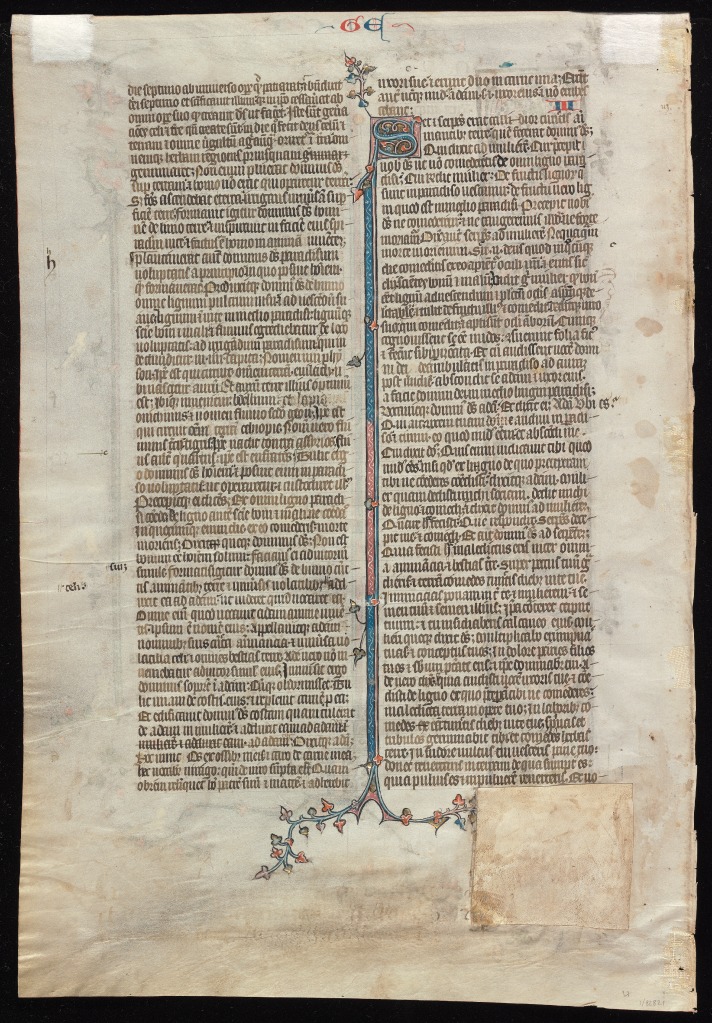
Large-format Latin Vulgate Lectern Bible
made in France
late 13th- or early 14th century

Single Leaf within a matted frame
Double columns of 50 lines

Maximum measurements circa 16 1/8″ × 10 11/16″ <written area circa 11″ × 7 3/8″>

Deuteronomy 11:21 ([quam iuravit] /) dominus patribus)
– 14:15 (strutionem ac noc-(/tuam et larum])

With bichrome running titles and chapter numbers,
polychrome decorated initials and border ornament with geometric and foliate motifs,
and added lection marks

[Posted on 8 February 2022, with updates]

Virginia Lazenby O’Hara Fine Books Division, Dallas Public Library, Framed Leaf from Otto Ege MS 14, ‘Recto’ (original Verso).

Brent Rosenbrook Collection, Matted Leaf from Otto Ege Manuscript 14, ‘Recto’ (original Verso).

Continuing the series of posts for our blog on Manuscript Studies, Mildred Budny describes another leaf from ‘Otto Ege Manuscript 14’, a large-format copy on vellum of the full Latin Bible in the Vulgate Version.

A leaf from this manuscript recently reached the collection of Brent Rosenbrook, who generously sent images and information about it, in response to the blogpost reporting More Discoveries for ‘Otto Ege Manuscript 14’.

A similar response several months ago brought to our attention the Dallas Leaf from the same manuscript, now kept at the Virginia Lazenbury O’Hara Fine Books Division of the Dallas Public Library in the City of Dallas, Texas. A report of that leaf, which carries the end of the Book of Joshua and the beginning of Judges in the Old Testament portion of the manuscript, appears in our blog on A Leaf in Dallas from ‘Otto Ege Manuscript 14’.

The ‘new’ leaf likewise comes from one of the early Books of the Old Testament. In the sequence, it stood one Book ahead.

Otto Ege Manuscript 14 and Manuscript Studies

Some discoveries for the manuscript have been reported in our blog.

  • A New Leaf from ‘Otto Ege Manuscript 14’
  • More Discoveries for ‘Otto Ege Manuscript 14’
  • A Leaf from ‘Otto Ege Manuscript 19’ and Ege’s Workshop Practices
  • Updates for Some ‘Otto Ege Manuscripts’ (Ege MSS 8, 14, 41, and 61)
  • Some Leaves in Set 1 of ‘Ege’s FOL Portfolio’ (Ege MSS 8, 14, 19, and 41)
  • Patch Work in ‘Otto Ege Manuscript 14’
  • A Leaf in Dallas from ‘Otto Ege Manuscript 14’.

See also The Illustrated Handlist (Number 4).

Brent Rosenbrook Collection, Leaf from Ege Manuscript 14, ‘Recto’ (original Verso), middle right: Deuteronomy 14 opens.

The Rosenbrook Leaf

When contacting me about the Leaf, its collector described the origins of his collecting spirit and the development of his book-collecting.

I wanted to give you a little bit of backstory and brief history. I am a layman in this field but have always been a collector of things since my childhood. I was a bibliophile long before I ever heard the term or would have understood its meaning. And although I am new to collecting illuminated manuscripts, I have always felt drawn to the beauty of them. As a teenager and young man I was especially stuck by the intricate, amazing imagery and knotwork in the Book of Kells. In 1998 I was fortunate to have visited Trinity College in Dublin and see it firsthand along with other books on display. It was a moment of wonder to finally be in the presence of that book. Although I never lost that sense of awe, for the next many years that was the extent of my experience and attention concerning manuscripts.

In December of 2016 my wife and I were visiting a friend’s home for the holidays when I noticed on the wall a large framed musical page of some sort. I could tell that it was hundreds of years old, handwritten, on animal skin. He knew little about it other than it belonged to a relative down the line and that at some point it was gifted to him. It was of course an antiphonal as I later discovered by searching online. It was (is) likely early 16th century and had one very large, but simple rubricated initial. Although it wouldn’t be considered elaborate or rare to a person knowledgeable in such things, for me the affect was basically “Wow, that’s really cool. I’ve got to figure out what that is. I want one of those”. The collector bug bit me again. . . .

Brent Rosenbrook Collection, Leaf from Ege MS 14, ‘Verso’ original Recto), bottom left.

My interest and enjoyment of looking at and learning about illuminated manuscripts (especially Bibles with historiated and zoomorphic initials) grew as I visited multiple websites over many weeks and scrolled through countless images of various western manuscripts. In March 2017 I acquired my first true illuminated leaf when I bid on and (unexpectedly) won a large Bible leaf which was from a manuscript previously owned by the famous collector Chester Beatty. As far as the Otto Ege leaf, it was a spontaneous purchase.

I received a notification . . . when this page was listed recently by Rodger Friedman Rare Book Studio. It wasn’t on my radar (or necessarily in the budget) to make a purchase but after glancing at the listing throughout the day I committed to buying it. I only knew the name Otto Ege vaguely through my reading up on manuscripts.

When I received the package and saw the leaf for the first time it evoked a lot of emotion. Although I knew its measurements when I purchased it, I still wasn’t prepared for the size and beauty of seeing it firsthand – it is stunning. It was only in the last few weeks after this acquiring this that I began reading up on and watching video postings about this famous biblioclast and the sets he sold off. . . . It was just this past Thursday night when I came across the RGME website and decided to reach out to you.

As for the Leaf itself, the collector reports that “It remains in the original matting that Ege used when he compiled these books.” Thus, this specimen qualifies for the group of survivors from the manuscript which circulated on their own, as a ‘Rogue Leaf’. Many of them traveled within one of Ege’s standard mats of a uniform size, accompanied by Ege’s printed Label giving a generic description of his Leaf 14. They resemble the presentation designed for specimen leaves from various manuscripts in Ege’s ‘FOL’ Portfolio of Fifty Original Leaves from Medieval Manuscripts, in which leaves from the dismembered Lectern Bible have the position of Number 14.

Now, with the collector’s permission, the Leaf might begin to assume its place within the virtual Reconstruction of the manuscript, as known from its fragments.  Brent Rosenbrook observes:

I think it’s nice for others to know that there are those who aren’t necessarily part of academic institution but still would like to contribute what they can to the advance of manuscript study.

We greatly admire this view!

A Note on the Photographs of the Leaf 

The images here show the Leaf and its details under several forms of light, taken at different times and at different angles. Their variety shows multiple aspects, including some 3-dimensional features which views at an angle can reveal of the curvature of the surface(s) of the animal skin and the furrows of the ruled lines upon it in drypoint.

Read the rest of this entry →

Tags: 'Fifty Original Leaves from Medieval Manuscripts', Beinecke Rare Book and Manuscript Library, Book of Deuteronomy, Brent Rosenbrook Collection, Dallas Public Library, Ege's FOL Portfolios, FOL Portfolio Set Number 39, Latin Vulgate Bible, Lectern Bible, Medieval Manuscript Fragments, Otto Ege, Otto Ege Collection, Otto Ege Manuscript 14, Reconstructing Manuscripts Virtually, Running Titles, Stony Brook University Library
6 Comments »

A Leaf in Dallas from “Otto Ege Manuscript 14” (Lectern Bible)

January 11, 2022 in Manuscript Studies

Virginia Lazenby O’Hara Fine Books Division, Dallas Public Library, Framed Leaf from Otto Ege Manuscript 14, ‘Recto’, top right: Initial P for ‘Post’ of Judges 1:1.

An Old Testament Leaf
from ‘Otto Ege Manuscript 14’
with the end of Joshua
and the beginning of Judges
in the
Virginia Lazenby O’Hara
Fine Books Division
of the Dallas Public Library
City of Dallas, Texas

Large-format Latin Vulgate Lectern Bible
(“the Bible of ‘Mirmelus Arnandi’ “)
made in France, late 13th- or early 14th century

Single Leaf mounted behind glass within a matted frame
Double columns of 50 lines

Visible side of the leaf (‘Recto’):
Joshua 24:18 ([igitur Dominus quia /] ipse Dominus – 24:38 (end)
and Judges 1:1 –15 (ending the verse with inriguum inferius [/ Filii autem . . . beginning 1:16])

With rubricated and polchrome elements, running titles, concluding-and-opening titles,
decorated and historiated initials, border ornament,
embellished pen-line line-fillers, and added lection marks

[Posted on 10 January 2022, with updates]

Continuing the series of posts for our blog on Manuscript Studies, Mildred Budny describes another leaf from ‘Otto Ege Manuscript 14’, a large-format copy on vellum of the full Latin Bible in the Vulgate Version.

The image shows the two columns of main text, its corrections, and its decoration and illustration.

Virginia Lazenby O’Hara Fine Books Division, Dallas Public Library, Framed Leaf from Otto Ege Manuscript 14, ‘Recto’ of Leaf.

With thanks to Molly Tepera of the Dallas Public Library of the City of Dallas, Texas, I can report details of a single, framed Leaf in its Virginia Lazenby O’Hara Fine Books Division from one of the celebrated manuscripts owned by Otto F. Ege (1888–1951). Now fragmented, the book has become known as ‘Otto Ege Manuscript 14’. The Dallas Leaf can be cited thus:

Framed Leaf from Otto Ege Manuscript 14
Virginia Lazenby O’Hara Fine Books Division
Dallas Public Library.

From the Old Testament portion of the manuscript, the Leaf carries the end of the Book of Joshua and the beginning of the Book of Judges. A principal highlight is the framed illustration within its opening initial for Judges.

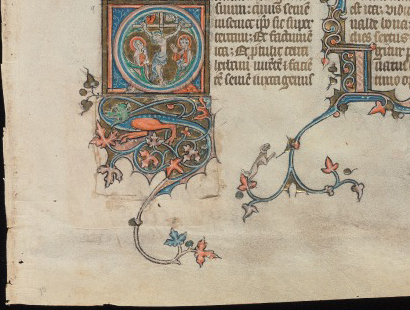
Many features of the Leaf correspond closely with other leaves from the same book. They include its representation of the Vulgate Version with some textual variants, its layout in double columns of 50 lines on the page, its Gothic script for the main text and for corrections inserted in the margins, its expansive decoration with foliate and zoomorphic ornament which often extends into the margins, its illustrated (or ‘historiated’) initial with a scene relating to the text, and its supplied lection marks in the margins (for reading aloud). Some features with the Leaf are unusual in the manuscript or specific to this Leaf, as with the full-line stretches of pen-line line-fillers on the one hand, and the present frame for the object on the other.

Some discoveries for the manuscript have been reported in our blog.

  • A New Leaf from ‘Otto Ege Manuscript 14’
  • More Discoveries for ‘Otto Ege Manuscript 14’
  • A Leaf from ‘Otto Ege Manuscript 19’ and Ege’s Workshop Practices
  • Updates for Some ‘Otto Ege Manuscripts’ (Ege MSS 8, 14, 41, and 61)
  • Some Leaves in Set 1 of ‘Ege’s FOL Portfolio’ (Ege MSS 8, 14, 19, and 41)

See also The Illustrated Handlist (Number 4).

As more research and discoveries continue apace for Otto Ege’s dispersed manuscripts by various scholars, curators, owners, vendors, and others, it might suffice, for this report, to mention the publication in print recently of an account by Peter Kidd of a detached New Testament leaf from this manuscript in the McCarthy Collection, along with a list of known leaves having historiated initials.

Peter Kidd, The McCarthy Collection, Volume III: French Miniatures (London: Ad Ilissum, 2021), number 60, “Historiated initial on a leaf from the Bible of Mirmelus Arnandi” (pp. 199–202).

That leaf carries the end of one of the Pauline Epistles and the beginning of the next: the Epistle to the Colossians and the beginning of that to the First Epistle to the Thessalonians, with a historiated initial on its recto. The initial shows Saint Paul, traditionally regarded as the author, sitting and holding both sword and book.

Peter Kidd’s title for the manuscript derives from the purported name of a medieval owner, “Mirmelus Arnandi” (a lawyer and judge), recorded within its pages. The attribution is, however, subject to revision, because modern views of that name may represent a misreading. See, for example:

  • MS 223: SEMI-QUADRATA BIBLE
  • The last leaf of the Psalms, from a very large Bible, in Latin [France (Paris), c.1300]
  • No. 6, From the so-called Bible of “Mirmelus Arnandi”
  • McCarthy Catalogue Vol. III (French Illuminations), note for Catalogue no. 60, with Kidd’s update for its entry.

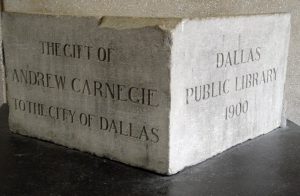
Cornerstone of the Dallas Public Library’s original Carnegie Library in downtown Dallas, Texas. Photograph from Wikimedia via Creative Commons.

The continuing flow of publications, in print or online, of yet more leaves from Otto Ege’s dispersed manuscripts, including his ‘Manuscript 14’, bring their features into view. Images reproduced from the individual remnants, while always useful, vary greatly in degree, quality, and size of reproduction. Sometimes those publications include recognition — by images, descriptions, or mentions alone — of the frames, mats, or other accompaniments for the leaves. More often they do not.

In the case of the Leaf in the Dallas Public Library, the images supplied by Molly Tepera fortunately show and share some accompanying material evidence.

Thus, this Report might set the Leaf both into the context of the manuscript, as the dispersed book becomes better known from its remnants, and into the context of Otto Ege’s workshop practices in preparing individual leaves (or occasionally bifolia, in a pair of connected leaves) for distribution and sale. The Report builds upon, and advances, my earlier reports about parts of Ege Manuscript 14 itself (see above) and my cumulative observations recorded for

  • A Leaf from ‘Otto Ege Manuscript 19’ and Ege’s Workshop Practices.

Read the rest of this entry →

Tags: 'Fifty Original Leaves from Medieval Manuscripts', Bible of Mirmelus Arnandi, Book of Joshua, Book of Judges, Dallas Public Library, Ege Family Portfolio, Ege's FOL Portfolio, Ege's Printed Labels, Historiated Initial, Image-Enhancement, Lectern Bible, Line-Fillers, Medieval Manuscript Fragments, Otto Ege Manuscript 14, Running Titles, Vulgate Bible Manuscripts
No Comments »

Two Vellum Leaves from a Large-Format Latin Breviary in Gothic Script

October 2, 2021 in Manuscript Studies

Private Collection, MS 1, Fol. 1 (‘137’)r, Initial I (for Inclina). Photography Mildred Budny. Reproduced by permission.

A Pair of Non-Consecutive Leaves
from a Large-Format
Latin Breviary
in Gothic Script on Vellum

Circa 590 mm × 447 mm
< written area circa 397 × 307 mm>
Single column of 15 lines
in Gothic Script
with rubrications, embellished initials,
and reiterated medieval and modern ‘folio’ numbers

Folio 1 (‘130’)
Vulgate Psalms (Septuagint Translation) 83:11 – 84:12 (Veri-[tas])

and

Folio 2 (‘137’)
Within Friday Matins:
Hymn Tu Trinitatis Unitas ([ . . . Ne corpus /] assit sordidum . . . Pater piissime)
Antiphon Inclina Domine, and Psalm 86 1:1–12 (Con-[fitebor])

14th or 15th Century, perhaps Italian or Spanish

Private Collection, MS 1, Fol. 130r, initials B and R. Photography Mildred Budny. Reproduced by permission.

Continuing to examine manuscripts and fragments in our blog on Manuscript Studies (see its Contents List), we turn to a pair of large, single leaves which arrived in a Private Collection several years ago, as a gift from another Private Collection.  About this pair of leaves, we might exclaim:  What beauties!

For the current owner, with an interest in manuscript studies, especially medieval manuscripts, these leaves comprise the first in the library (mostly printed books about books).  Hence the assigned number, “MS 1”, with two detached leaves (Folios ‘1’ and ‘2’ in the set) from the same original manuscript.

The identity and origin of that manuscript remain, for now, unknown.  Perhaps this blogpost, presenting the detached leaves to wider view through their photographs and related information, might bring to light more information about them and their travels across time and place.

The pair came on their own, safely packaged with mats in a large shipping box, but without any accompanying information.  That is, apart from the former owner’s recollection relayed in conversation and email.

These two large leaves would have come as a purchase some years ago, in the late 1980s or early 1990s, at the New York Antiquarian Book Fair, a repeated venue for some other purchases for the same collection.

“The two large ones are German and quite late, if I remember rightly.  I bought them from a German dealer at the NY Antiquarian Book Fair.  No, I don’t recall his name.  It was a looong [sic] time ago.  I suspect the two smaller ones [= MS 2, in another shipping] were purchased at the same venue, though different dealer.”

On their own, the two leaves must or can speak for itself.  We bring to the table the willingness to examine them closely, to admire their resonant beauty, and to see what they can say.  Their story resides not only in the text, which can be deciphered, abbreviations and all, but also in the features of layout, script, decoration, rubrications, annotations, the animal skins for the writing surfaces, the traces of a former binding, and other forms of material evidence.

Read the rest of this entry →

Tags: History of the Psalms, Late-Medieval Breviary, Medieval Manuscript Fragments, Medieval manuscripts
6 Comments »

Another Leaf from the Warburg Missal (‘Ege Manuscript 22’)

April 25, 2021 in Manuscript Studies, Reports

J. S. Wagner Collection, Ege Manuscript 22, Folio clvi, recto, within its frame.

J. S. Wagner Collection, Ege Manuscript 22, Folio clvi, recto, within its frame.

The Wagner Leaf

from Ege Manuscript 22

***

“The Warburg Missal”

Folio CLVI in the Temporale

with Part of the Mass for Corpus Christi

Latin Missal made in Germany circa 1325 Written in Gothic Script (Textualis)

Double columns of 31 lines

Circa 360 × 257 mm < written area circa 289 × 190 mm >

with Rubrications, Inset Initials in Red or Blue, and Musical Notation in Hufnagelschrift (“Horseshoe-Nail Notes”) on 4-Line Staves

With thanks to the collector, J. S. Wagner, we examine a newly identified leaf from one of the manuscripts dispersed by Otto F. Ege (1888–1951). It comes from ‘Ege Manuscript 22’, a Latin Missal written in double columns of 30–32 lines in Gothic Script, with musical notation.

This blogpost by Mildred Budny and the companion Report Booklet (2021) by Leslie J. French examine the Leaf, set it in context of its former manuscripts, and re-assess the attribution of the book.

The ‘Ege’ Number comes from the position of this manuscript (and its portions) in Ege’s distribution within one of his Portfolios of specimen leaves forcibly extracted from manuscripts and printed books. The Portfolio in question exhibits Fifty Original Leaves (FOL) from Medieval Manuscripts, Western Europe, XII–XVI Century. In this case, Leaf Number 22. The numbering system is defined and enshrined in Scott Gwara’s “Handlist” of Otto Ege’s Manuscripts (2016).

In the FOL Portfolio, specimens from the manuscript travelled, in their individual windowed mats, in the company of other Ege manuscript leaves. The Wagner Leaf, however, travelled on its own, through a different highway of circulation. It arrived in a glass-fronted ornamental frame. Behind that frame, Ege’s handwritten note on the recto, and the accompanying printed slip (see below), directly establish the Ege connection. All the features of text, script, musical notation, and folio numeration manifest a place within Ege’s Manuscript 22, as the collector readily discerned.

J. S. Wagner Collection, Leaf from Ege Manuscript 22, verso, bottom right: Ege's inscription in pencil.

J. S. Wagner Collection, Leaf from Ege Manuscript 22, verso, bottom right: Ege’s inscription in pencil.

Read the rest of this entry →

Tags: 'Fifty Original Leaves from Medieval Manuscripts', Benedictine Missal, Bergendal Collection, Bergendal Manuscript 69, Binding History, Ege Manuscript 22, Ege's FOL Portfolio, Fragmentology, Leander van Ess, Measure Theory, Medieval Manuscript Fragments, Missal Herbipolensis, Missale Coloniense, Otto Ege, Otto Ege's Manuscripts, Parochial Church of St John the Baptist Warburg, Reused Binding Fragments, Sales Catalogues, Sir Thomas Phillipps, Sothebys, The Warburg Missal
No Comments »

Otto Ege Manuscript 40, Part II: Before and After Ege

April 3, 2021 in Manuscript Studies

Otto Ege’s
Aquinas Manuscript in Humanist Script
(Ege Manuscript 40)

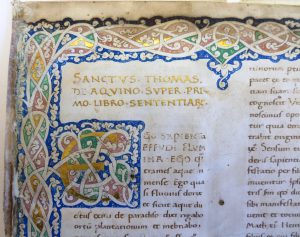
Private Collection, Ege's FBNC Portfolio, Aquinas Leaf, Recto, Top Right. Reproduced by Permission.

Private Collection, Ege’s FBNC Portfolio, Aquinas Leaf, Recto, Top Right. Reproduced by Permission.

PART II

Before and After Ege

  • Part I: Otto Ege’s Aquinas Manuscript in Humanist Script (Ege Manuscript 40).
  • Part II: Ege Manuscript 40: Before and After Ege (You are Here).
  • Part III: Specimens of ‘Ege Manuscript 40’ in the ‘Ege Family Portfolio’.

We continue explorations of Ege Manuscript 40, as we began in Part I, in a series of posts about Ege manuscript fragments in his Portfolio of Famous Books in Nine Centuries (FBNC).

The series began with

  • Otto Ege’s Portfolio of ‘Famous Books’ and Ege Manuscript 53 (Quran/Koran)
  • Volume II and More Parts of ‘Otto Ege Manuscript 51’ (Aristotle)

See also our Contents List.

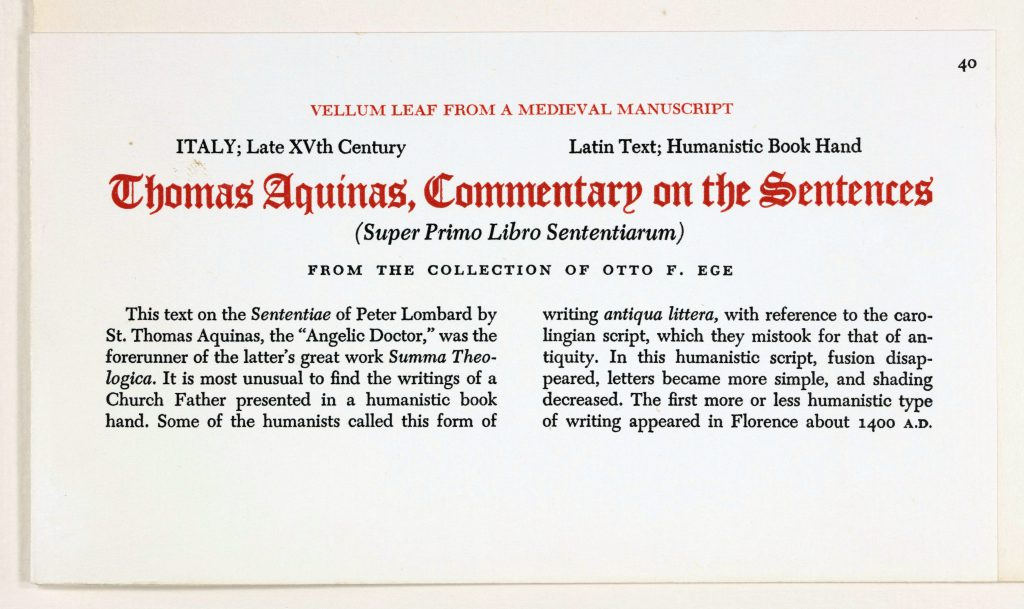
Now we turn to Part II on Otto Ege’s Aquinas Manuscript in Humanist Script. Its specimen leaves circulate not only in the Portfolio of Famous Books, in the longer, Deluxe Version in Nine Centuries, but also in the more famous Portfolio of Fifty Original Leaves (FOL) from Medieval Western Manuscripts. The Aquinas Manuscript takes its assigned Ege Manuscript Number from its place as Specimen Leaf Number 40 in the FOL Portfolio.

Ege’s Label for Manuscript Specimen 40
in the FOL Portfolio

Otto F. Ege: Fifty Original Leaves from Medieval Manuscripts, Leaf 40, Printed Label, Special Collections and University Archives, Stony Brook University Libraries.

Otto F. Ege: Fifty Original Leaves from Medieval Manuscripts, Leaf 40, Printed Label, Special Collections and University Archives, Stony Brook University Libraries.

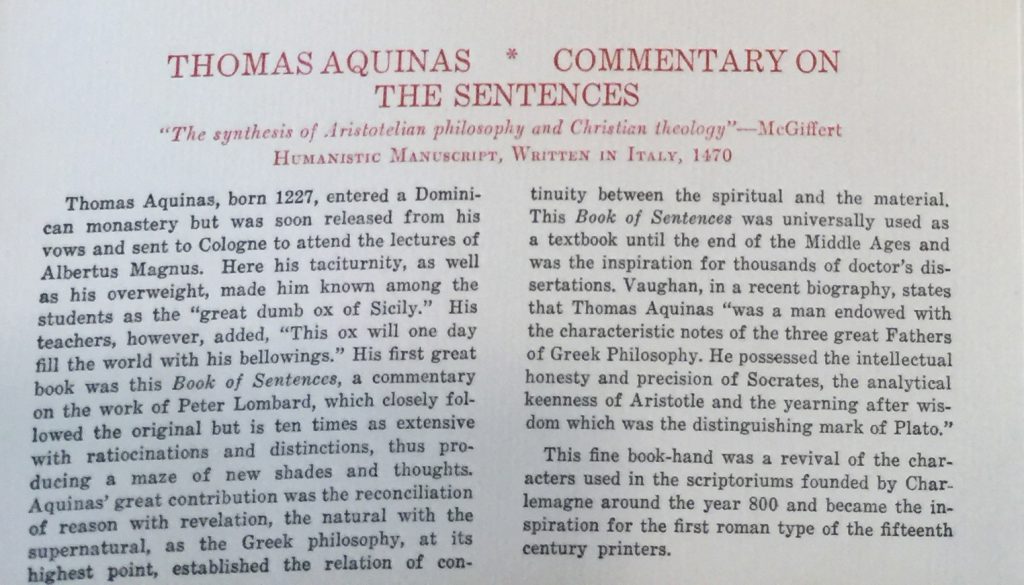
Ege’s Label for the Specimen Leaf in the Famous Books Portfolio in Nine Centuries

Private Collection, Ege's Famous Books in Nine Centuries, Label for the Aquinas Manuscript Leaf. Reproduced by permission.

Private Collection, Ege’s Famous Books in Nine Centuries, Label for the Aquinas Manuscript Leaf. Reproduced by permission.

Ege’s Label for the Specimen in the (Unnumbered) Contents List for FBNC

Private Collection, Ege's FBNS, Contents List, Detail: The Aquinas Manuscript. Reproduced by permission

Private Collection, Ege’s FBNS, Contents List, Detail: The Aquinas Manuscript. Reproduced by permission.

Part I in our series on Otto Ege’s Aquinas Manuscript in Humanist Script (Ege Manuscript 40) examines these labels as such.

Specimen Pages

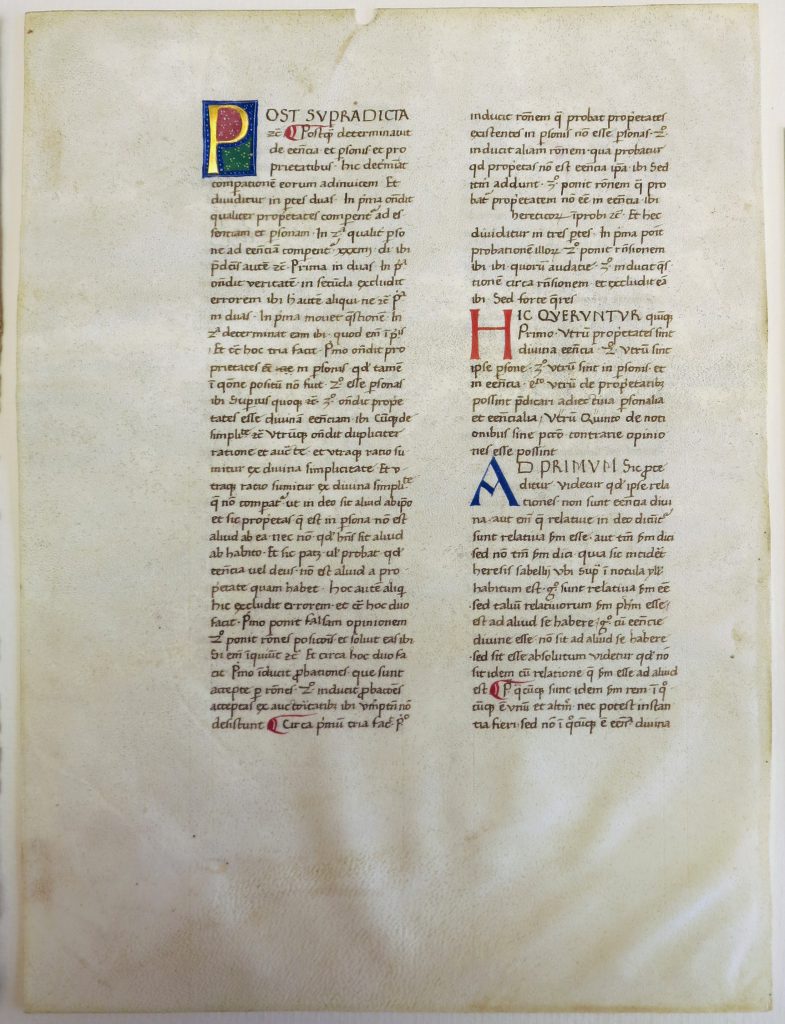
Examples from among the specimens displayed in Part I show several approaches to the layout of the text in 2 columns of 37 lines. Many of Ege’s specimens selected for the Portfolios show ‘standard’ pages, with script in Humanist Minuscule, Paraph markers in red and blue, and inset Capital Letters in blue or red.

Private Collection, FBNC, Aquinas Leaf 'Front'. Reproduced by permission.

Private Collection, FBNC, Aquinas Leaf ‘Recto’. Reproduced by permission.

Some specimens provide somewhat more elevated forms of polychrome decorated initials, including rectangular frames, gold elements, and patterns of dots.

Beinecke Rare Book & Manuscript Library, Otto Ege Collection, FOL Set 3, MS 40, Specimen 2 = folio 216v (turned to the front in Ege's Mount. Photography Mildred Budny.

Beinecke Rare Book & Manuscript Library, Otto Ege Collection, FOL Set 3, MS 40, Specimen 2 = folio 216v (turned to the front in Ege’s Mount. Photography Mildred Budny.

The Manuscript Before and After Ege

As frequently in studying manuscripts dispersed by Ege, sales and auction catalogues can provide invaluable information about the states of the manuscript in transmission across time, hands, and collections. Frequently, too, it can be challenging to try to identify the catalogues, and to find access to them. Part of the problem can come from abbreviated citations in reference works to catalogues only by a vendor’s name, a year-date, and/or a catalogue or bulletin number.

For example, with Ege MS 40, “Maggs, Bulletin 11 (1982)” stands for

  • Maggs Bros, European Miniatures and Illumination & Calligraphy also early writing from Egypt, Bulletin No. 11 (London: November 1982), item 79 and pl. XXXIII.

“Maggs Cat. No. 1227 [without a date]” stands for

  • Maggs Bros., Ltd., Illuminated Leaves and Mediaeval Miniatures, Catalogue 1227 (London: 1997), item 96.

I await the chance to see these items, whilst libraries are shut or difficult of access in the years 2020–2021.

Meanwhile, some online reference sources help somewhat to identify which are the correct catalogues, and which collection might have them, or grant access to them, even in digital form.

Earlier catalogues are also sought. They may report information about the manuscript in its former volume.

Duschnes, Catalogues 54 & 74 (1945–1946)

I’m on the lookout for:

  • Philip C. Duschnes, Catalogue 54 (1943), item 50
  • Philip C. Duschnes, Catalogue 74 (1946), item 50 — perhaps the same item, which continued to await sale?

The former, Catalogue 54 [53?], is “101 Original Leaves & Sets of Leaves from Medieval Manuscripts, Incunabula, Famous Bibles and Noted Presses, 1150 A. D. – 1935 A. D.” [Autumn 1942]. The front cover is illustrated here, in connection with Ege Manuscript 15 (the renowned Beauvais Missal).

Sotheby’s, 26 November 1985, Lot 80

  • “Sotheby’s 1985, lot 80” is identifiable with a catalogue already on my bookshelves, as it contains many lots (fifty-four in total, nos. 39–89) left over from Ege’s collection, including manuscript fragments of various kinds and in various states.

The catalogue presents Western Manuscripts and Miniatures for sale at auction in London on Tuesday 26th November 1985. Its Lot 80 offers

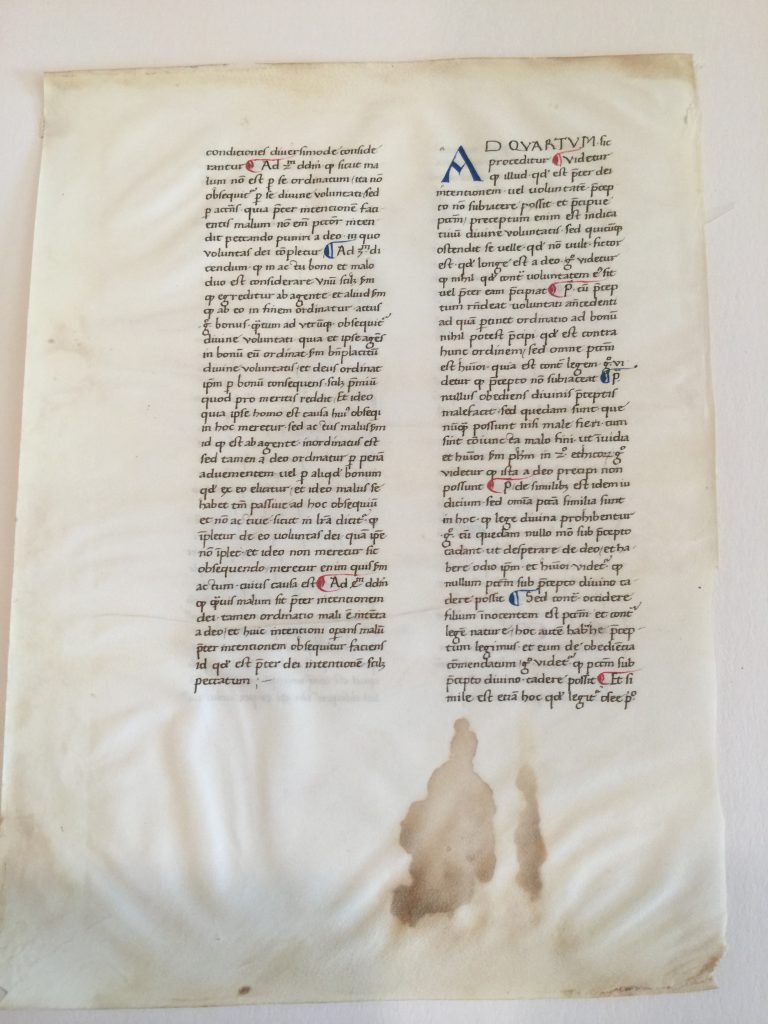
THIRTY-TWO LEAVES FROM THOMAS AQUINAS, COMMENTARY ON THE SENTENCES OF PETER LOMBARD, BOOK I, IN LATIN, MANUSCRIPT ON VELLUM [ITALY, SECOND HALF OF THE FIFTEENTH CENTURY

32 leaves, detached, double column, 37 lines, . . . written in brown ink in a humanistic hand with some gothic features, first words of each chapter in capitals, paragraph marks throughout in red or blue, PAINTED INITIALS (3-line) in red or blue at the start of each chapter . . .

The entry includes the tantalizing reference to an earlier catalogue (as yet unidentified), which presents the manuscript in its former state, binding included.

With a cutting from an American bookseller’s catalogue in which this manuscript, then with 309 leaves, was no. 12 (Emphasis added), describing a coat-of-arms on the first leaf, azure, 3 crescents or between a chevron of the same [Emphasis added], “probably the work was commissioned by some beauty-loving Italian duke . . . Certainly the work of the good saint have never been sent forth into the world in lovelier garb”, etc., with much more . . . ‘ “

An Observation on the Usefulness of Sales Clippings

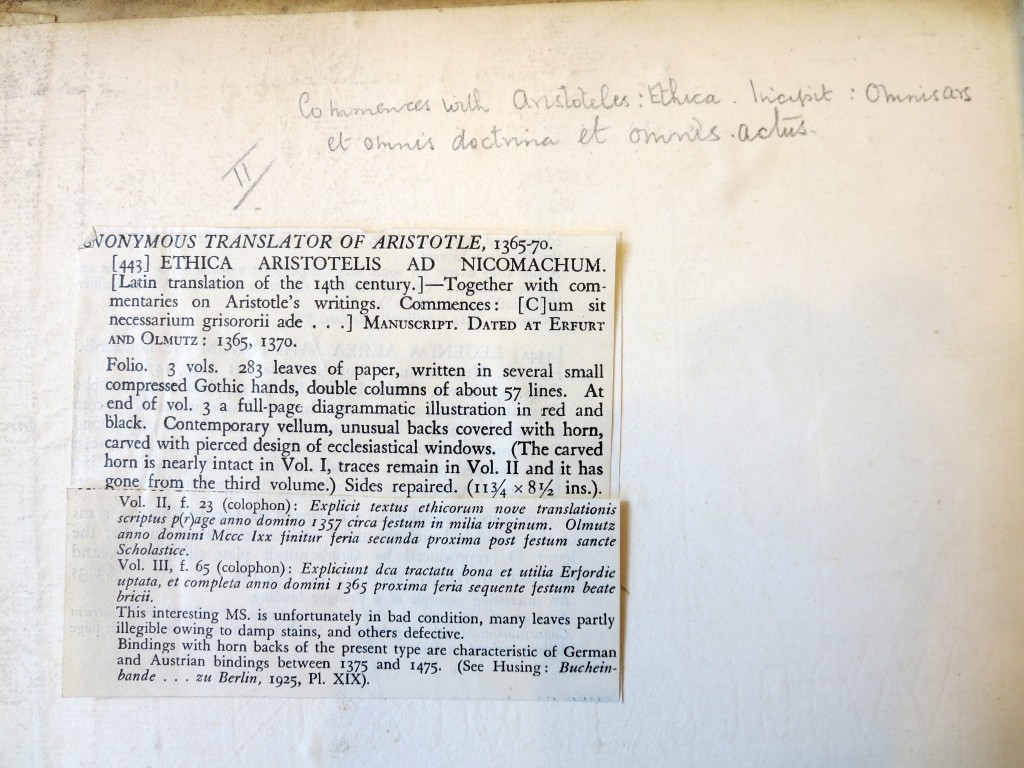
The mention there of a former sales clipping which continued to travel in the company of the manuscript reminds me of the pair of clippings (from a single, unnamed catalogue) pasted at the front of Volume II of Ege Manuscript 51, now at the Beinecke Rare Book & Manuscript Library.

The partly overlapping pair of clippings comes from consecutive pages in the lost catalogue, as the entry carried over from the bottom of one page (and leaf) to the top of the next, so as to complete the account of item 443. The catalogue remains unidentified; the overlap covers, or veils, the price of £21 at the end of the item. The entry describes the 3-volume set of Aristotelian texts before Ege took it to pieces.

Specimens from the Aristotle manuscript found their way into the Portfolios of Famous Books, in both Nine Centuries (like the Aquinas Manuscript) and Eight Centuries. See Volume II and More Parts of Ege Manuscript 51.

Beinecke Rare Book and Manuscript Library, Yale University. Otto Ege Collection, Ege Manuscript 51, Volume II, Front Pastedown, Top.

Beinecke Rare Book and Manuscript Library, Yale University. Otto Ege Collection, Ege Manuscript 51, Volume II, Front Pastedown, Top.

Inspired by the description in the Sotheby’s catalogue, I have found one or more possible earlier sales catalogues for the Aquinas manuscript — although it is not by an “American bookseller”, nor does its item number correspond with the reported number 12.

Davis & Orioli (1924 & 1925)

Two relevant entries appear in the Schoenberg Database of Manuscripts, although their records assimilate the details of the original catalogues in the requirement to conform with the format and fields designed for data entry and retrieval.

1) SDBM_262153

I. Davis & G. M. Orioli, Number 41 (1925), Rare Books & Interesting Manuscripts, Lot #4. Price 65.00 GPB

“Aquino (S. Thomas de)”, Super primo libro sententiarum, XVth century, parchment (fine vellum), Italy 310 folios, 37 lines, 2 columns

Binding: “rich-coloured brown morocco elaborately tooled in blind to a Veneto-Oriental design heightened with pointille decorations in gold”

Other info: “arms of owner within green wreath in lower margin”

2) SDBM_261443

I. Davis & G. M. Orioli, Number XLIV (1926), Early Printed Books: Literature, Science, and Medicines, Lot #1. Price 65.00 GPB

[Etc., as before]

These records conjure up the image of a volume prepared on “fine vellum” with the requisite number of columns and lines, with a tooled leather binding embellished in “a Veneto-Oriental design” including pointillé elements in gold, and an image of the owner’s arms (or coat-of-arms) in a lower margin someplace on the inside, presumably, as customary, on the frontispiece or first page of text.

From an Origin in Italy
To Collections in the United States (and Beyond)

That the firm of Davis & Orioli had offices in Florence, Italy (after 1910), and in London, England (after 1913), opens the possibility (or likelihood?) that the manuscript came to the firm from some source directly in Italy. Perhaps the manuscript of Aquinas’s Commentary on the Sentences, or at least the specified Book I, resided in Italy for several centuries between its production in the 15th century and its departure for other lands, presumably via London, by the start of the second quarter of the 20th century.

The early sales catalogues themselves could have more to tell about the manuscript in its former state than their database “skeleton” reveals.

The Number(s) of Leaves

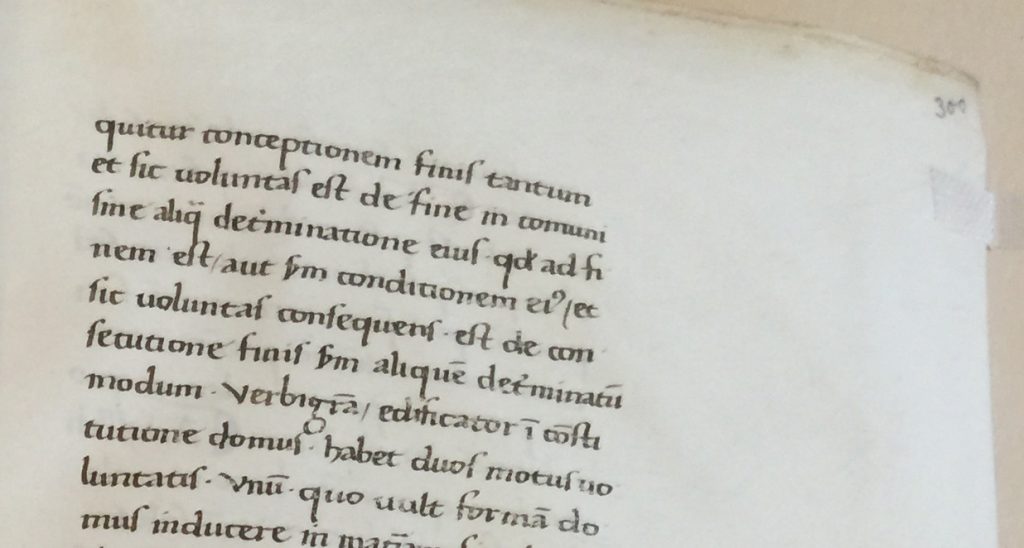
Already, however, it seems clear that ‘our’ folio 300 in the new set of FBNC occupied a position near the end of the volume, although reports of the total number of leaves in the volume differ somewhat. The Schoenberg Database entries for the 1925 and 1926 catalogues of Davis & Orioli report 310 leaves, whereas the “American bookseller’s catalogue” (of an unknown date) quoted by the Sotheby’s catalogue of 1985 cites 309 leaves. The numbers could well indicate that the pencil foliation stood already upon the leaves, at least as far as the now-visible 300.

Private Collection, FBNC, Aquinas Leaf 'Back' top right and page number.

Private Collection, FBNC, Aquinas Leaf ‘Back’ top right and page number. Reproduced by permission.

Who can tell, at present, if the slight difference in counting by 1 leaf between the catalogues (Davis & Orioli versus the ‘American’) represents a simple typographical mistake. Or a divergent or inconsistent approach to including manuscript leaves and endleaves?

But more, could it signify the removal of 1 leaf between the time of the Davis & Orioli sales catalogues (1925–1926) and the arrival of the manuscript in the hands of a next bookseller (name as yet unidentified), perhaps in America, by an American, or by a vendor aiming for the American market? Would a removal have claimed a folio deemed desirable to retain for one reason or other, or have extracted a folio especially damaged and unsightly?

It is worth wondering whence Ege acquired his varying assessments of the date of production of the manuscript as “1470”, tout court, and as “Late XVth Century” (see above). Would the manuscript have had a colophon or some other evidence for the cited date? Would the assessment depend upon the catalogue(s) through which, and travelling with which, the manuscript came to Ege? More research might reveal the answers.

More to Come

The next blogpost in our series on Ege Manuscript 40 examines more parts of the manuscript. The pair of specimens in the “Ege Family Portfolio” (FOL Set 3) contain significant evidence of its former character, decoration, and ownership.

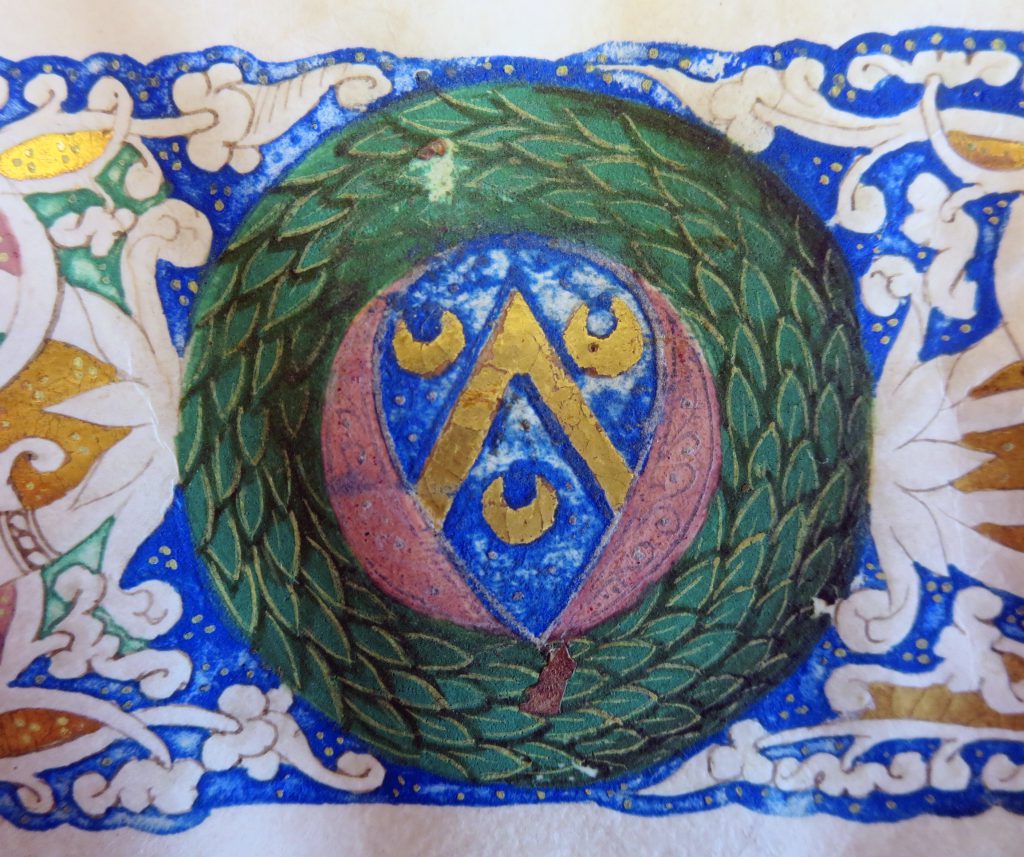
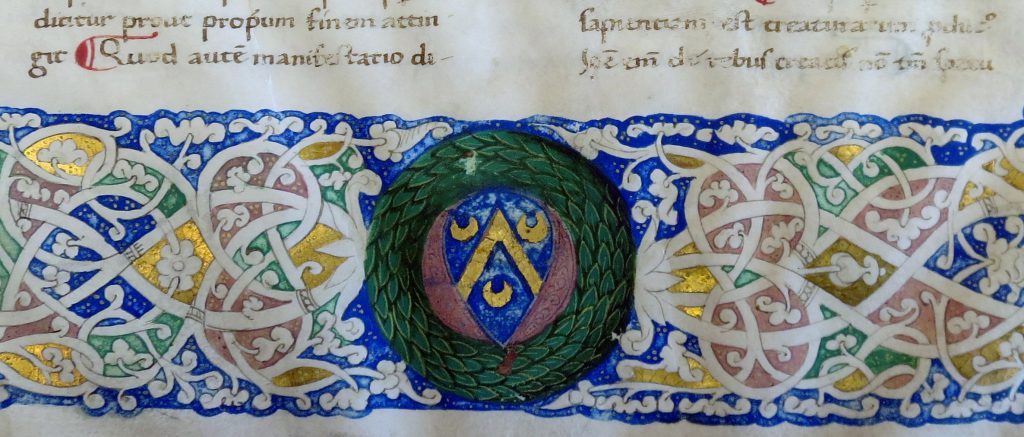
Among these signs are the owner’s arms within a wreath. In the image painted on the page, we can see for ourselves its rendering of the heraldic design, including the shapes and locations of the elements in gold (or), as precisely described in sales catalogues:

azure, 3 crescents or between a chevron of the same

Beinecke Rare Book & Manuscript Library, Otto Ege Collection, FOL Set 3, MS 40, Specimen 1 = folio '1'r, bottom center. Photography Mildred Budny.

Beinecke Rare Book & Manuscript Library, Otto Ege Collection, FOL Set 3, MS 40, Specimen 1 = folio ‘1’r, bottom center. Photography Mildred Budny.

*****

We thank the owner of the ‘new’ Portfolio and the owners of other specimens for permission to examine them. We are grateful for permission to reproduce the images. Thanks, as always, for the advice, encouragement, and suggestions of colleagues, students, and friends!

*****

Do you know of other leaves from this Aquinas manuscript? Other Sets of the Portfolio of Famous Books in Nine Centuries (FBNC), or Sets of the Fifty Original Leaves (FOL)?

Do you recognize the work of the scribe(s) in other manuscripts? Do you recognize the owner’s arms?

Please let us know. Please leave your Comments here, Contact Us, and/or visit our Facebook Page. We look forward to hearing from you.

Next stop, Part III:

  • Specimens of Ege Manuscript 40 (Aquinas) in the ‘Ege Family Portfolio’.

Private Collection, Ege's FBNC Portfolio, Aquinas Leaf, Recto, Top Right. Reproduced by Permission.

Private Collection, Ege’s FBNC Portfolio, Aquinas Leaf, Recto, Top Right. Reproduced by Permission.

*****

Tags: Aquinas on the Sentences of Peter Lombard, Clippings from Sales Catalogues, Davis & Orioli, Ege Manuscript 40, Ege Manuscript 51, Ege's FOL Portfolio, Ege's Portfolio of Famous Books, Fragmentology, Humanist Manuscripts, Medieval Manuscript Fragments, Otto Ege, Philip Duschnes, Sothebys, Thomas Aquinas
No Comments »

Another Leaf from the Warburg Missal (‘Ege Manuscript 22’)

March 23, 2021 in Manuscript Studies, Reports

J. S. Wagner Collection, Ege Manuscript 22, Folio clvi, recto, within its frame.

J. S. Wagner Collection, Ege Manuscript 22, Folio clvi, recto, within its frame. Reproduced by permission.

This post has moved to:
Another Leaf from the Warburg Missal
(“Ege Manuscript 22”)


Tags: 'Fifty Original Leaves from Medieval Manuscripts', Benedictine Missal, Bergendal Collection, Bergendal MS 69, Binding History, Ege Manuscript 22, Ege's FOL Portfolio, Fragmentology, Leander van Ess, Measure Theory, Medieval Manuscript Fragments, Missal Herbipolensis, Missale Coloniense, Otto Ege, Parochial Church of St John the Baptist Warburg, Reused Binding Fragments, Sir Thomas Phillipps, The Warburg Missal
Comments Off on Another Leaf from the Warburg Missal (‘Ege Manuscript 22’)

Specimens of Ege Manuscript 40 in the Ege Family Portfolio

March 19, 2021 in Manuscript Studies, Uncategorized

Specimens of the Aquinas Manuscript in Humanist Script
(Ege Manuscript 40)
in the ‘Ege Family Portfolio’

— Part III of III in the series on this manuscript —

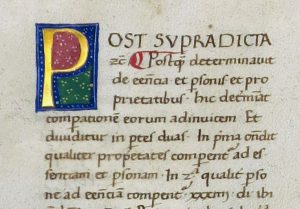
Beinecke Rare Book & Manuscript Library, Otto Ege Collection, FOL Set 3, MS 40, Specimen 1: folio '1'r, Bottom Center. Photography Mildred Budny.

Beinecke Rare Book & Manuscript Library, Otto Ege Collection, FOL Set 3, MS 40, Specimen 1: folio ‘1’r, Bottom Center. Photography Mildred Budny.

Thomas Aquinas, Commentary on Book I of Peter Lombard’s Sentences

Written in Latin on vellum

Italy, probably late 15th Century (circa 1475)

Circa 288 × 210 mm <Written area circa 178 × 130 mm>

Double columns of 37 lines

in Humanist Script (with Gothic Features)

*****

Folios ‘1’ and 216

[1] Super Sententiis, Prooemium (to Ipse dedit quosdam)
and
[2331] Super Sent., Liber 1, Distinctio 32, Quaestio 2, Articulo 2 (qc. 1 co), to [2341] Distinctio 33, Quaestio 1, Articulo 1 (arg. 2)

Beinecke Rare Book & Manuscript Library, Otto Ege Collection, FOL Set 3, MS 40, Specimen 2 = folio 216v (turned to the front in Ege's Mount: Top Left. Photography Mildred Budny.

Beinecke Rare Book & Manuscript Library, Otto Ege Collection, FOL Set 3, MS 40, Specimen 2 = Folio 216v, Top Left. Photography Mildred Budny.

Previously, in exploring the Portfolio of Famous Books assembled by Otto F. Ege, we examined the 15th-century Aquinas Manuscript whose dismembered specimens appear in 2 of his Portfolios.  See

  • Part I: Otto Ege’s “Aquinas Manuscript in Humanist Script” (Ege Manuscript 40).
  • Otto Ege Manuscript 40, Part II: Before and After Ege

Now we reach Part III of III.

Known as Ege Manuscript 40 from its assigned number in the Portfolio of Fifty Original Leaves from Medieval Western Manuscripts (“FOL”), its leaves also joined Ege’s Portfolio of Famous Books in Nine Centuries (“FBNC”) as the 6th Manuscript Specimen (of 6).  By virtue of its FOL position, it appears in the Handlist of Otto Ege’s Manuscripts (2016), as no. 40 (pp. 131–132 etc.).

Humanist Script and Book-Production

Its case pertains to the notable genre of Humanist Manuscripts, which emerged in Italy from the early 15th century onwards.  Illustrated descriptions of the origins and development of Humanist(ic) Script include:

  • Humanistic Script, via Digitized Medieval Manuscripts, and
  • Humanist Minuscule, via Wikipedia.

Displays of such books include:

  • The Humanistic Book at The Fitzwilliam Museum in Cambridge.

Beinecke Rare Book & Manuscript Library, Otto Ege Collection, FOL Set 3, MS 40, Specimen 1: folio '1'r, Top Left. Photography Mildred Budny.

Beinecke Rare Book & Manuscript Library, Otto Ege Collection, FOL Set 3, MS 40, Specimen 1: folio ‘1’r, Top Left. Photography Mildred Budny.

There, we find a concise description of the phenonemon (I emphasize several elements in red).

In Italy in the early fifteenth century a revolution took place in the script and decoration of the manuscript book, first in Florence, and very soon after in the rest of the peninsula. It involved the rediscovery of classical texts, the revival of ancient literature as a central element of the curriculum, the reform of Latin spelling, and a new style of writing, called by its contemporaries littera antica and known to us today as ‘humanistic script’.

The new type of book received a new style of decoration. At first, it was limited to the white-vine scrolls meandering around birds, butterflies, and chubby little boys, the ubiquitous putti. But by the mid-fifteenth century, illuminators were experimenting with three-dimensional images corresponding to the antiquarian passions of Humanist scholars and collectors. Ancient inscriptions, jewels, and archaeological finds inspired the illusionistic monumental frontispieces and architectural title pages, one of the most lasting contributions of the Humanistic manuscript to book design.

As they come into view, more leaves from the fragmented Ege Manuscript 40 allow its case to assume its proper place within the robust tradition of Humanist script and book-production.  Now we focus upon the special contributions which its leaves in the ‘Ege Family Portfolio’ can make to a fuller understanding of its origin and history.

Read the rest of this entry →

Tags: Aquinas on the Sentences of Peter Lombard, Beinecke Rare Book and Manuscript Library, British Library Harley MS 3110, Corpus Christi College Cambridge MS 81, Dispersed Manuscript Leaves, Ege Family Portfolio, Ege Manuscript 41, Ege's FOL Portfolio, Ege's Portfolio of Famous Books, Humanist Manuscripts, Humanist Script, Lawrence J. Schoenberg Collection LJS 225, manuscript fragments, Medieval Manuscript Fragments, Morgan Library MS M 476, Otto Ege Manuscript 31, Otto Ege Manuscript 40, Otto Ege Manuscript 51, Otto Ege Manuscript 53, Otto Ege Portfolios, Owner's Arms in Wreath, White Vine-Scroll Ornament
4 Comments »

Otto Ege’s Portfolio of ‘Famous Books’ and ‘Ege Manuscript 53’ (Quran)

January 27, 2021 in Manuscript Studies, Uncategorized

Ege’s Famous Books in Nine Centuries

and

A New Leaf from Ege Manuscript 53

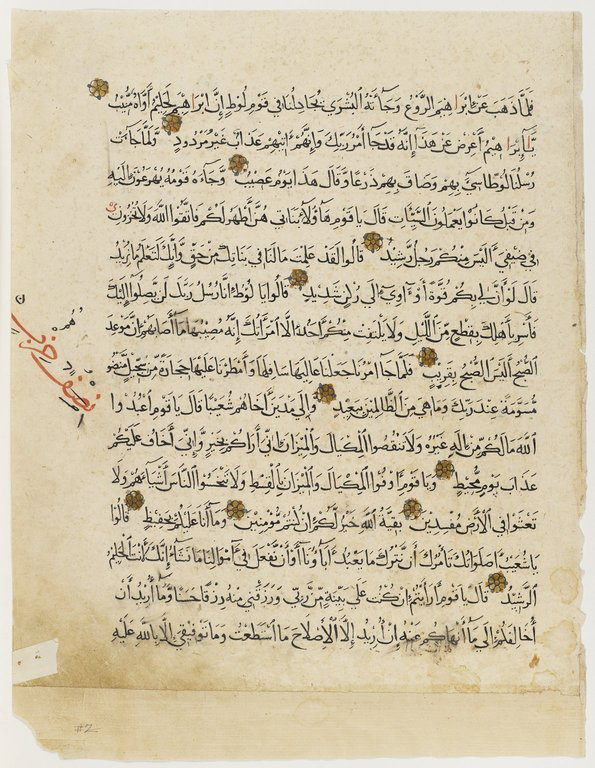
Qur’an or Koran written in Arabic on paper

Egypt, dated 1122 CE (500 AH), but later:  Probably Mamluk Dynasty, 14th or 15th Century

Circa 391 × 299 mm <Written area circa 285 × 220 mm>

Single column of 15 lines in Arabic

Surah 4:163 – Surah 5:4

With rubricated titles, textual dividers, and rosettes for verse markers
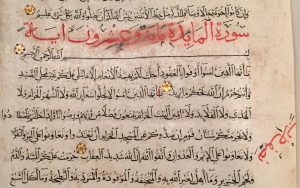
Private Collection, Koran Leaf in Ege's Famous Books in Nine Centuries, Back of Leaf, Detail. Reproduced by permission.

Private Collection, Koran Leaf in Ege’s Famous Books in Nine Centuries, Back of Leaf, Detail. Reproduced by permission.

[Published on 27 January 2021, with updates]

Here we begin to showcase a newly revealed set of one of the Portfolios of specimen Leaves from books and manuscripts assembled by Otto F. Ege (1888–1951).  This set presents a selection of specimens of Famous Books, in the longer, or deluxe version, of Nine Centuries.  The shorter version covers Eight Centuries.

The version in Nine Centuries was issued in 50 sets, with 40 specimen Leaves extracted from manuscripts and printed books.  The shorter version in Eight Centuries was issued in 110 sets of 25 Leaves.

In earlier blogposts, some sets in both versions have come into our view — mainly on account of the specimens from a 14th-century manuscript in Latin on paper with Aristotle’s Nichomachean Ethics or its commentaries.  Our study of that manuscript began with an isolated leaf in a private collection, then moved to examine more of its relatives surviving elsewhere.
  • More Leaves from ‘Otto Ege Manuscript 51’
  • More Parts of ‘Otto Ege Manuscript 51’

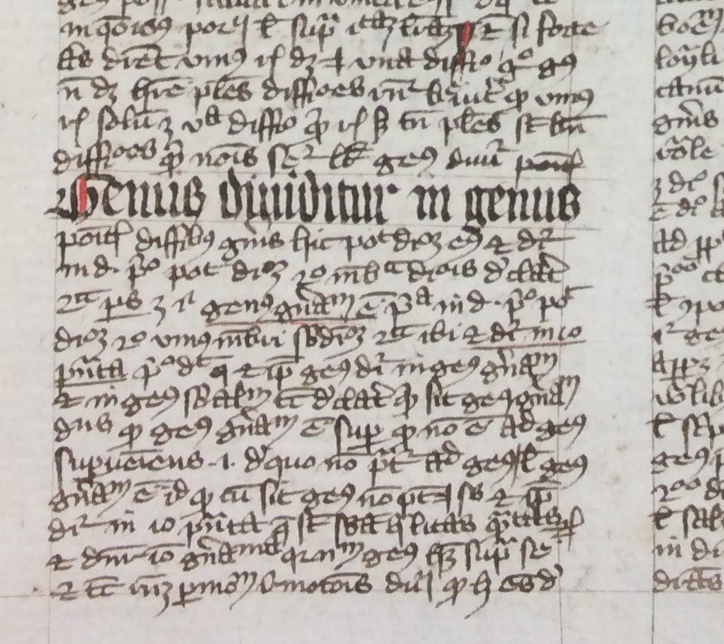
Opening for 'Genus dividitur in genus'. Detail from Recto of Aristotle leaf in Set 47 of Ege's Portfolio of 'Famous Books'. Kent State University Libraries, reproduced by permission.

Kent State University Libraries, Set 47 of Otto Ege’s Portfolio of ‘Famous Books’, Aristotle Leaf, detail: ‘Genus dividitur in genus’. Reproduced by permission.

Now, we consider the Portfolio in Nine Centuries as such more fully, in the light of the ‘new’ set.  This post first examines the nature of the Portfolio (and its fraternal twin in Eight Centuries), then turns to look at its Leaf 1, extracted from a Quran/Koran manuscript in Arabic on paper.  That manuscript presents its text in single columns (unframed) of 15 lines, with some rubricated elements and embellishments in gold and other pigments.

Further posts may examine other leaves in the Portfolio, in their manuscript and printed forms.

Broad in vision, the range of specimens come from religious and secular texts over the course of centuries and from a wide range of places of production.  As an indication, see Ege’s Contents List (shown below) and his individual Labels for all 40 specimens — displayed online from another set (at Case Western University).

The specimens represent texts in various languages (mostly Western) and by many notable, and even world-class, authors. Represented in their own language or another, they include Homer, Aristotle, Cicero, Ovid, Pliny, Virgil, Dante, Petrarch, Boccaccio, Erasmus, Chaucer, Cervantes, Shakespeare, Milton, Montaigne, the Beowulf poet, and the translators of the King James Version. The specimens represent many renowned printers in Western Europe and the United States, such as Nicolas Jenson, Aldus Manutius, Robert Estienne, Lucantonio Giunta, Bodoni, the Kelmscott Press, and the Riverside Press.  Not forgetting, among others, a specimen from the Nuremberg Chronicle of 1493 and from the Fourth Folio of 1685. A few specimens include illustrations.

The selection and design of the Portfolios of Famous Books correspond both neatly and closely with some central interests of Otto Ege throughout his career.  (See, for example, Introducing Otto Ege and Otto F. Ege.)  As a long-time teacher of graphic design and the history of the book (and later a Dean) at the Cleveland Institute of Art, and as a graphic designer (and printer) in his own right, here Ege was in his element.

The ‘New’ Set in a Private Collection

The ‘new’ set in Nine Centuries resides in a Private Collection.  The owner, noticing our webposts (see their Contents List) and mentioning to us the set of Ege’s Famous Books Portfolio, has kindly taken photographs, which we can show for inspection and research — with our thanks.

The set came from this sale: Fall Fine & Decorative Art Auction on October 4, 2015.  It was offered (out of Willoughby, Ohio) by Fusco Auctions as lot 81:  Ege Portfolio Original Leaves Famous Books, with an Estimate of $2,500 –  $3,000, and a realized price of $2,600.

The online catalogue for the sale of that lot presents 4 photographs of a few highlights.  They show views of the Portfolio Front Cover, Ege’s printed full-page Contents List, both sides of the First Leaf (from the Koran in Arabic), and Ege’s printed Label for that specimen Leaf.

The set, unnumbered, contains the full set of 40 specimen Leaves, as cited in the 1-page Contents List printed on a single companion leaf of paper.

Samples of Ege’s Portfolios

Some collections possess more than one of Ege’s Portfolios, dedicated to a variety of focused themes on the arts of the book in manuscript and in print across time and place.  The nature and themes of his multiple Portfolios are surveyed in several publications.  (See below.)

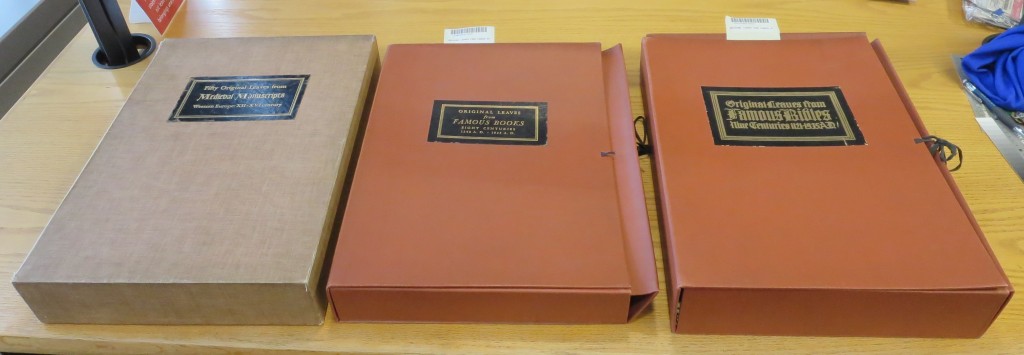
Occasionally, as I have found, it is possible, with permission, to examine more than one of the Portfolios side by side.  The opportunity has occurred, for example, at the Houghton Library at Harvard University in Massachusetts and at the Public Library of Cincinnati and Hamilton County in Ohio.  At the former, the consultation addressed 2 sets of the Portfolio of Famous Bibles; at the latter, 3 different Portfolios — all of which come under consideration for our present purposes:

  • Fifty Original Leaves from Medieval Manuscripts, Western Europe (“FOL”)
  • Original Leaves from Famous Bibles
  • Original Leaves from Famous Books

Three Ege Portfolios. "Fifty Original Leaves from Medieval Manuscripts", "Original Leaves from Famous Books" (Series A in "Eight Centuries"), and "Original Leaves from Famous Bibles" (Series B in "Nine Centuries"). From the Collection of The Public Library of Cincinnati and Hamilton County. Reproduced by permission. Photograph by Mildred Budny.

Three Ege Portfolios. “Fifty Original Leaves from Medieval Manuscripts”, “Original Leaves from Famous Books” (Series A in “Eight Centuries”), and “Original Leaves from Famous Bibles” (Series B in “Nine Centuries”). From the Collection of The Public Library of Cincinnati and Hamilton County. Photograph by Mildred Budny.

Two of these Portfolios, Famous Bibles and Famous Books, were issued in 2 versions, shorter and longer, in Eight Centuries and in Nine Centuries.

For present purposes, another of Ege’s Portfolios also comes into view.  It is devoted to

  • Fifteen Original Oriental Leaves of Six Centuries:  Twelve of the Middle East, Two of Russia, and One of Tibet, amounting to 15 Leaves in 40 Sets.

For that Portfolio, Gwara, Otto Ege’s Manuscripts, Appendix V (on page 103), lists 13 located sets; worldcat.org lists some of these as well as other sets.  Some sets can be viewed online, Leaf by Leaf, as with the set in the Brooklyn Museum:

  • New York, Brooklyn Museum Libraries, Special Collections, Call Number Z109 Eg7.

Earlier blogposts have considered aspects of all these Portfolios, but for the Oriental Leaves.  Within those reports, we have considered in particular Ege MSS 8, 14, 19, 29, 41, 51, and 61, along with Ege’s Workshop Practices.  (A post on Ege MS 22 is coming soon.)  See our Contents List.

Now, turning to the ‘new’ set of Famous Books, it seems clear that our previous explorations of the several different Portfolios come in handy as background — perhaps especially because there is some cross-over between different Portfolios in Ege’s distribution of individual copies of books and manuscripts.  We start with the Koran/Quran manuscript (‘Otto Ege MS 53’), with its specimens found in both Famous Books in Nine Centuries and in Oriental Leaves, as well as elsewhere.

The Portfolio in Question

By the title on its front cover and the Title-Page with Contents List, the ‘new’ Famous Books Portfolio proclaims itself as a set of Original Leaves from Famous Books, Nine Centuries, 1122 A. E. – 1923 A. D., with a List of 40 unnumbered Leaves.   This is the longer, deluxe, series in Ege’s 2 versions of the Portfolios of Original Leaves from Famous Books.  The shorter version spans only Eight Centuries, 1240 A. D. – 1923 A. D. in 25 leaves.

For short, some sources refer to these Portfolios as FBNC and FBEC, as in Scott Gwara’s account of Otto Ege’s Manuscripts (2013).  The close resemblance of these 2 acronyms, differing only partway through (N versus E), may require close inspection.  In context, referring to the variants as “Nine Centuries” or “Eight Centuries” might be clearer at a first glance, where concision of space or numbers of characters is not a primary consideration.

Gwara considers these 2 Portfolios as entities on his pages 36–37 and in his Appendixes III and IV (on pages 100–102), which list some current locations of their sets.  His “Handlist of Manuscripts and Fragments Collected or Sold by Otto F. Ege” (Appendix X on pages 116–201) lists the manuscripts in numerical order by assigned numbers (1–325 and counting), indicates their position in any of Ege’s Portfolios, and cites current locations, sales catalogues, and other information, as available.

Another invaluable resource for these and other Portfolios, or Leaf-Books, by Ege (and by others):

  • Christopher de Hamel and Joel Silver, with contributions by John P. Chalmers, Daniel W. Mosser, and Michael Thompson, Disbound and Dispersed:  The Leaf Book Considered (Chicago:  The Caxton Club, 2005), Catalog-Checklist no. 14/68 (pp. 74–75 and 116) and no. 20/98 (pp. 79–81 and 120), and Checklist nos. 21 (p. 110) and 51 (p.114)

This book doubles as an exhibition catalogue.  It contains a set of essays about Leaf Books in general and in particular, the “Catalog of the Exhibition” (pp. 62–101), and “A Checklist of Leaf Books” (pp. 102–137).  That both the Catalog and the Checklist have their own series of numbers (items 1–46 and 1–230 respectively) might prove ambiguous, so reporting their page-numbers as well as their section- and item-numbers can be helpful.

On one opening (pages 81–82), there are illustrated 6 sample plates of “Six leaves from Otto Ege’s 1949 boxed set of original leaves from famous books” in nine centuries (Catalogue number 20 / Checklist number 98), in the collection of Michael Thompson.  The sampling shows the specimens of 5 printed books and 1 manuscript — the Koran manuscript which opens the Portfolio. From that photograph of one of its sides (the recto), it is possible to identify its location within the former manuscript.

The Contents
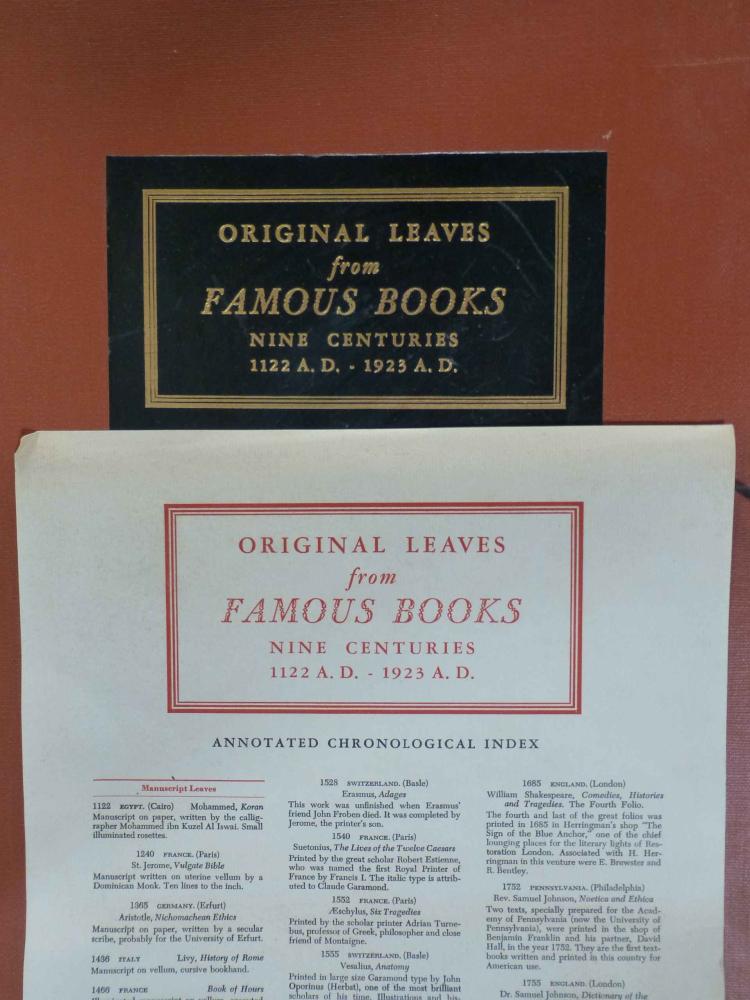
Private Collection, Ege's FBNC, Title and Headpiece for the Contents List.

Private Collection, Ege’s FBNC, Title and Headpiece for the Contents List.

In a single page, Ege’s Contents List, which he called an “Annotated Chronological Index”, arranges the specimens in groups by chronological order and by medium:

  • Manuscript Leaves
  • Incunabula Leaves, and
  • Imprints, in 2 subgroups:  XVI Century and XVI–XX Century
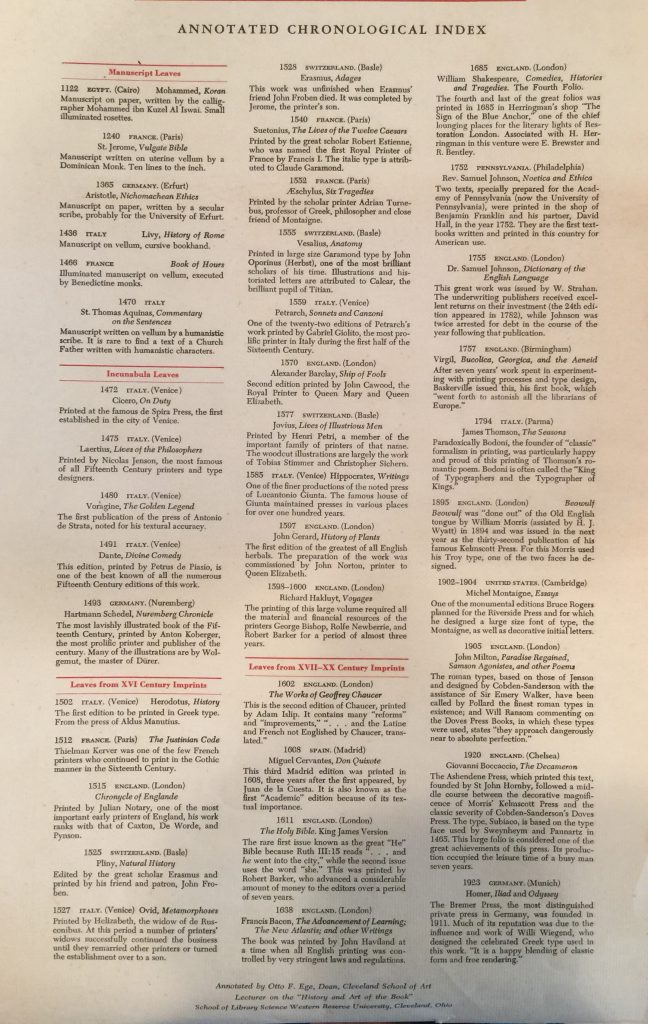
Private Collection, Contents List in Ege's Famous Books in Nine Centuries, Chronological Index. Reproduced by permission.

Private Collection, Contents List in Ege’s Famous Books in Nine Centuries, Chronological Index. Reproduced by permission.

The 4 groups commence with the Manuscripts.

First the Manuscript Specimens

There are six Specimens in total, with texts all in Latin but for the first in Arabic.  (The Portfolio in Eight Centuries has only three — and does not include the Arabic.)  They are written variously on paper or on animal skin (parchment or vellum).

Their list:
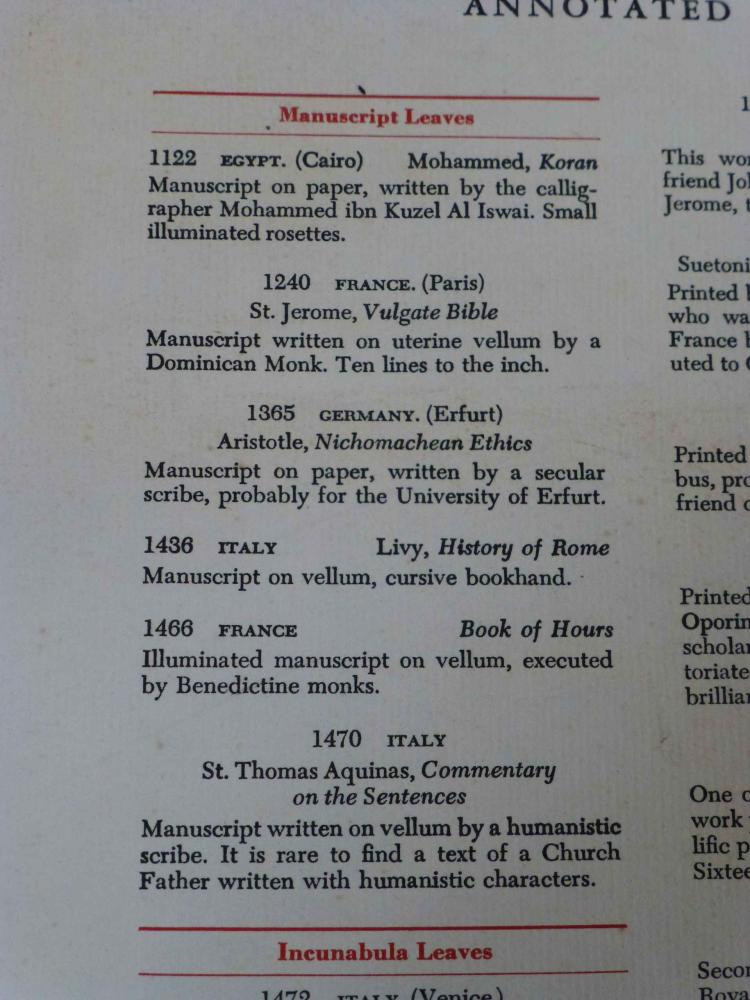
Note that Ege’s title or summary for each leaf customarily employs a title in English, regardless of the language of the specimen text.

  • 1122 Egypt.  Mohammed, Koran on paper
  • 1240 France.  St. Jerome, Vulgate Bible
  • 1365 Germany.  Aristotle, Nichomachian Ethics on paper
  • 1436 Italy.  Livy, History of Rome
  • 1466 Italy.  Book of Hours
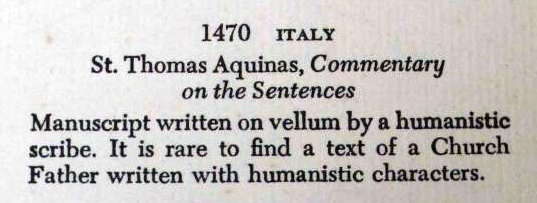
  • 1470 Italy.  St. Thomas Aquinas, Commentary on the Sentences

That is, according to the numbering assigned to Ege’s manuscripts in Gwara’s Handlist:

  • 1122 Egypt.  Mohammed, Koran on paper [ = Ege MS 53, here Surah 4:163 – 5:14]
  • 1240 France.  St. Jerome, Vulgate Bible [= Ege MS 54, here from the Book of Job chapters 8–12]
  • 1365 Germany.  Aristotle, Nichomachian Ethics on paper [= Ege MS 51, here folio 35/35]
  • 1436 Italy.  Livy, History of Rome [ = Ege MS 52; here folio 41]
  • 1466 Italy.  Book of Hours [ = Ege MS 55; here folio 53]
  • 1470 Italy.  St. Thomas Aquinas, Commentary on the Sentences of Peter Lombard [ = Ege MS 40; here folio 300, turned back-to-front in Ege’s mat]

These contents differ somewhat from the selection of Manuscripts in the Portfolio version of Eight Centuries, as seen in its Contents List with 3 Specimens in the set at Kent State University.
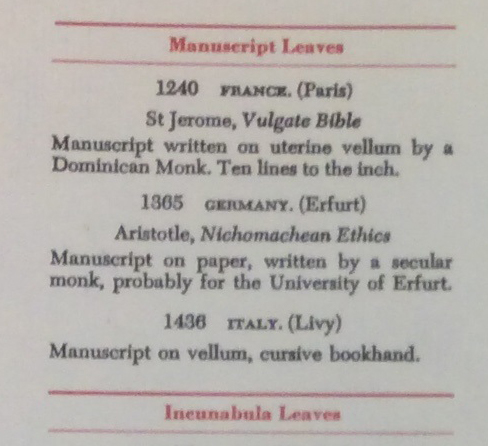
Otto Ege's Contents List of the Manuscripts in his FBEC Portfolio at Kent State University Libraries, reproduced by permission.

Otto Ege’s Contents List of the Manuscripts in his FBEC Portfolio at Kent State University Libraries, reproduced by permission.

Note that the components which Ege assigned to the individual sets of the Portfolio display some variation.  A look at individual Portfolio sets reveals certain changes, for which the data have yet to be examined in full, while the process of tracking the Portfolio sets, their dispersal, and their components remains ongoing.

Let us remain aware of the subsequent rearrangements and substitutions which owners might effect.  A documented case of such adjustments to the contents by Ege’s widow herself is vividly illustrated in a blogpost by our Associate, Lisa Fagin Davis, as part of her series Manuscript Road Trip, reporting a visit to Cincinnati, Ohio, and to a private collection which holds a set of the Famous Bibles in Nine Centuries, replete with annotated Contents List and substituted Contents (shown here).  The recorded replacement substitutes the specimen of one 13th-century Vulgate Bible for another, exchanging, as Leaf 2, a leaf from Ege MS 76 for one from Ege MS 59, and noting the substitution in annotations to the Contents List.

The Spread Across Portfolios

Specimens from some of these manuscripts served within more than 1 of Ege’s different Portfolios.  Such is the case with all but the Book of Hours.  Some of the selected manuscripts appear in both versions of Famous Books; some appear both there (both versions of the Portfolio in Eight or Nine Centuries) and elsewhere; and some appear in the longer version of Famous Books, as well as elsewhere.

Appearances in 5 ‘flavors’:

1) Some manuscripts served in both versions of the Portfolios of Famous Books, in Nine Centuries and in Eight Centuries (FBNC + FBEC).  Such is the case with

  • The Aristotle specimen (as Leaves 3 and 2 respectively in these two Portfolios) = Ege MS 51
  • The Livy specimen (as Leaves 4 and 3 respectively) = Ege MS 52
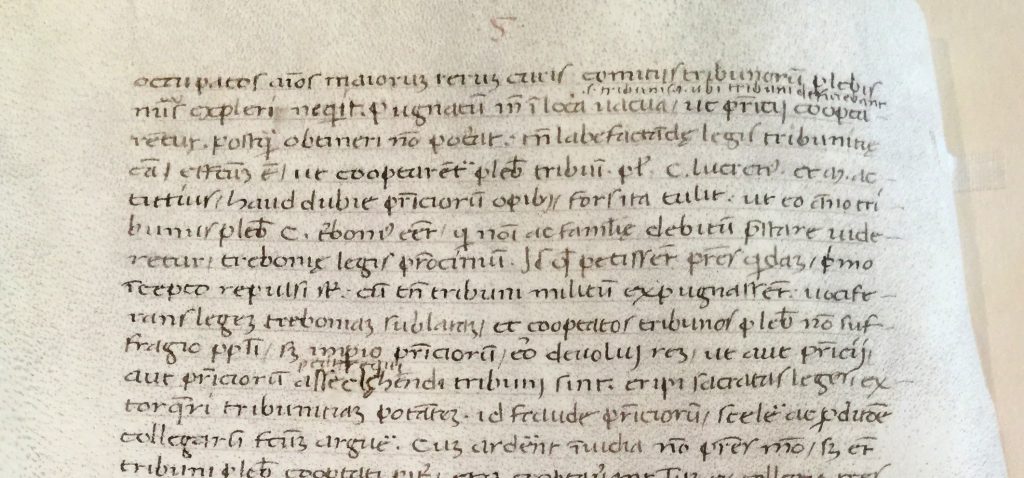
Private Collection, Ege's Portfolio of 'Famous Leaves', Livy MS Leaf, Back, Top. Reproduced by permission.

Private Collection, Ege’s Portfolio of ‘Famous Leaves’, Livy MS Leaf, Back, Top. Reproduced by permission.

2) Selections from the dismembered copy of the Koran appear in both the Portfolio of Famous Books in Nine Centuries (as Leaf 1) and the Portfolio of Oriental Leaves (likewise as Leaf 1).  That is,

  • The Koran specimen served as Leaf 1 in both FBNC and the Portfolio of Oriental Leaves = Ege MS 53

3) The dismembered Vulgate Bible of 1240 circulated in both FBNC and FBEC (as Leaves 2 and 1 respectively), although sometimes in FBEC its place was taken by a very similar pocket-sized Vulgate Bible used in the FOL Portfolio as its Leaf 9 ( = Ege MS 9).

  • The Vulgate Bible specimen of 1240 = Ege MS 54
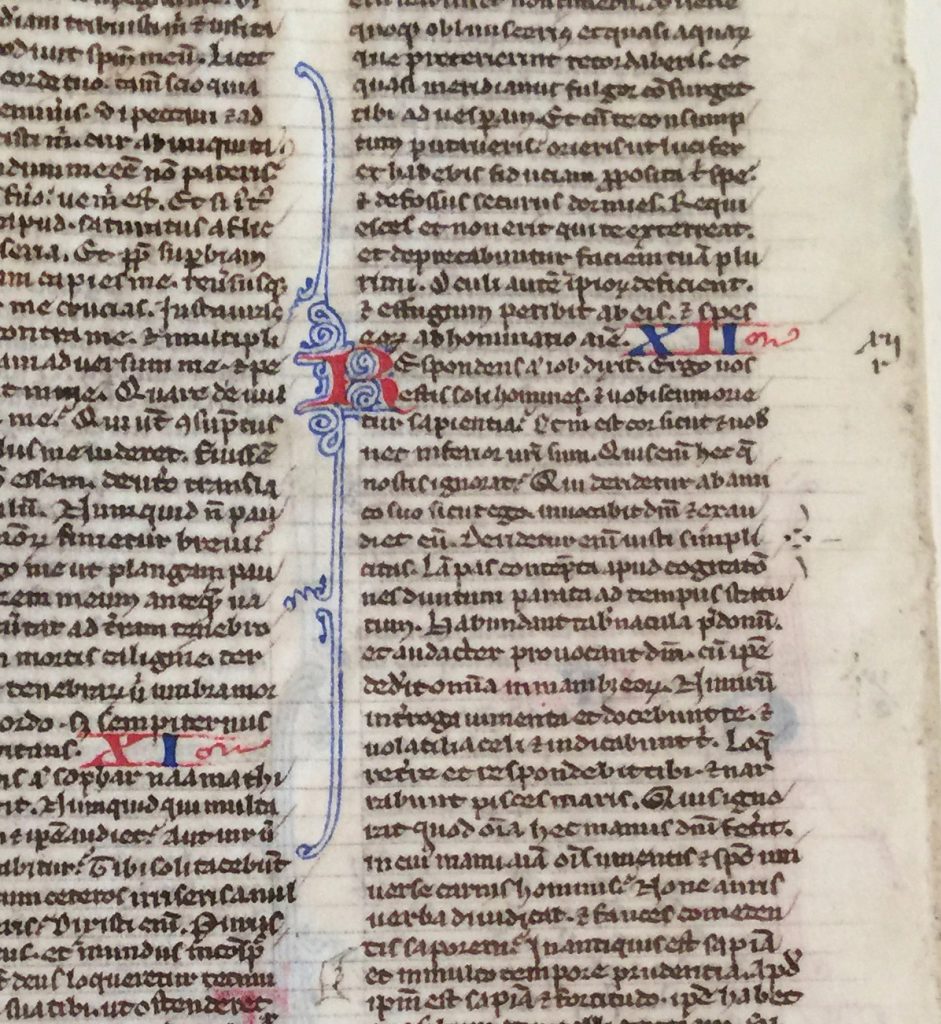
Private Collection, Ege's FBNC Portfolio, Vulgate Bible Leaf, Verso, Mid Right. Reproduced by Permission.

Private Collection, Ege’s FBNC Portfolio, Vulgate Bible Leaf, Verso, Mid Right. Reproduced by Permission.

4) The Aquinas specimen in Humanist Script circulated both in the FBNC (Leaf 6) and the more famous FOL (Leaf 40), from which position comes its number in Scott Gwara’s Handlist.  Its dismembered Leaves in some FOL sets are illustrated, for example, on the website ege.denison.edu.

  • The Aquinas specimen in Humanist Script = Ege MS 40

Note that this manuscript, although distributed in the same 2 Portfolios as the Vulgate Bible manuscript (FBNC + FOL) to which Gwara assigned 2 different Handlist numbers, holds only 1 number in Gwara’s Handlist, corresponding squarely with the position assigned to it in FOL.  The differential treatment in the Handlist of the Vulgate Bible specimen on the one hand, with 2 assigned numbers, and the Aquinas specimen on the other can lead to some confusion or conflation.  (As observed above.)
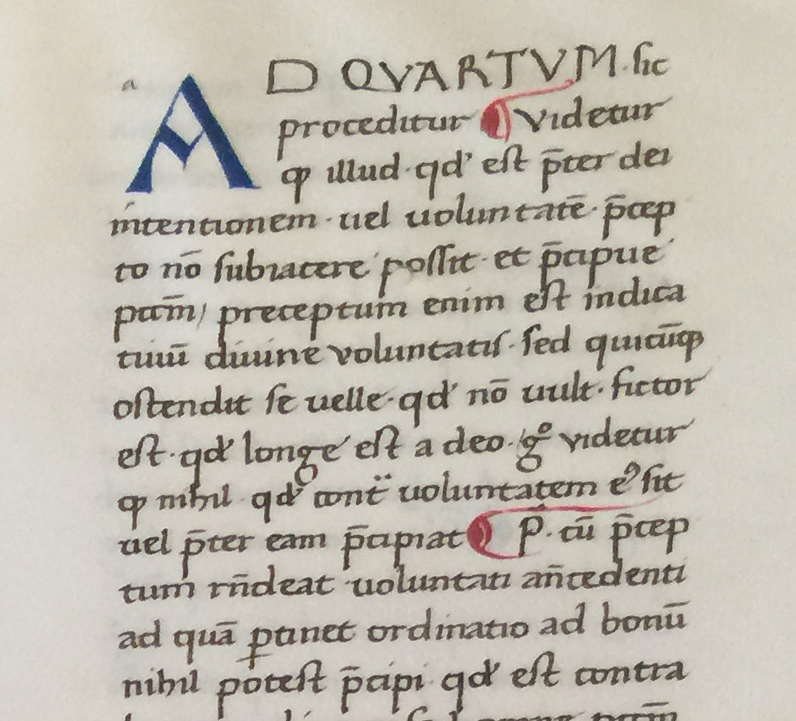
Private Collection, Ege's FBNC Portfolio, Aquinas Leaf, Recto, Top Right. Reproduced by Permission.

Private Collection, Ege’s FBNC Portfolio, Aquinas Leaf, Recto, Top Right. Reproduced by Permission.

5) So far as we know, among Ege’s Portfolios, the Book of Hours specimen in FBNC appears only in this one Portfolio (as Leaf 5).

  • The Book of Hours specimen from a manuscript dated 1460 = Ege MS 55 (see Gwara, Otto Ege’s Manuscripts, figure 63 on page 271)
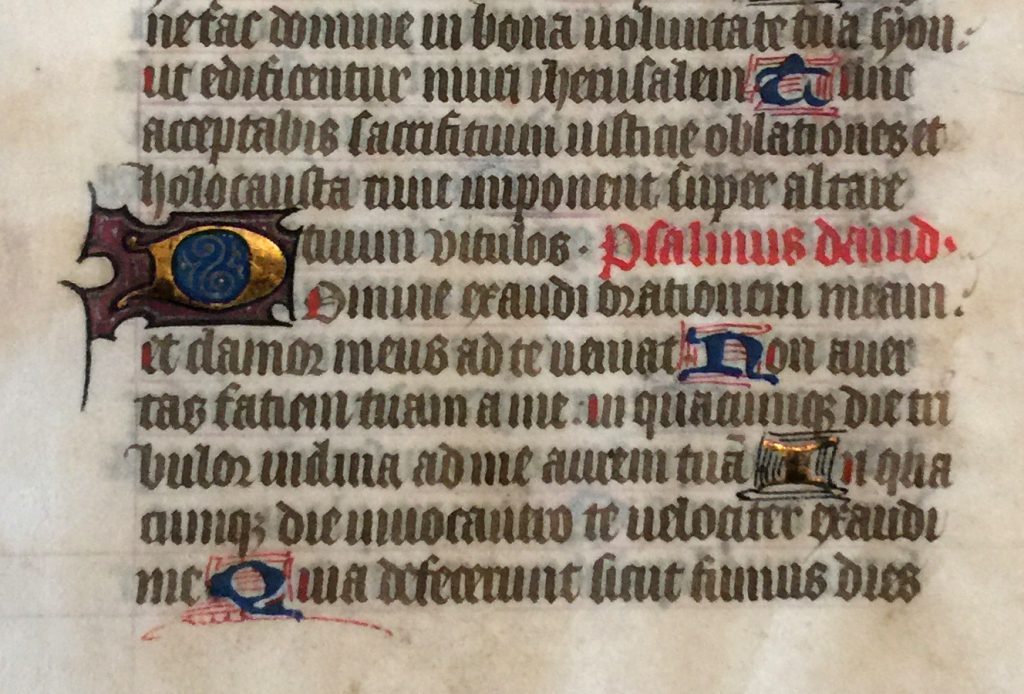
Private Collection, Ege's Famous Books in Nine Centuries, Book of Hours Leaf, Front, Lower Portion of Text. Reproduced by permission.

Private Collection, Ege’s Famous Books in Nine Centuries, Book of Hours Leaf, Front, Lower Portion of Text. Reproduced by permission.

All these leaves deserve attention in their own right and in the context of their dispersed relatives.  Already some studies consider one or other of them, particularly in the setting of the FOL Portfolio.  Examples include the website ege.denison.edu, showcasing “The Ege Manuscript Leaf Portfolios” and exhibiting images from each Leaf (not necessarily both sides) in specific sets of FOL at 14 institutional collections in the United States and Canada.

Printed Leaves

Whereas Scott Gwara’s Handlist in Otto Ege’s Manuscripts (2016) provides the standard for citing Ege’s Manuscripts, apparently there has appeared no comparable Handlist of Ege’s Printed Books — or even of his 15th-century Incunabula — and their distribution patterns and current locations.  Efforts toward this goal gather momentum, however, as part of the wider work on Ege’s books and their impact overall.

The full series of Ege’s Labels for the 40 specimens of textual materials in the Portfolio in Nine Centuries is displayed online for some sets, as at Case Western University in Cleveland, Ohio.  Set within rectangular borders resembling captions for an exhibition, the printed Labels expand the information in the Contents List into several paragraphs of observations about the genre of book, authorship, impact, and other generic features, with a few comments about the specific book from which the specimen derives.

In Ege’s 1-page Contents List, the 6 Manuscript Leaves (items 1–6) are followed by 5 Incunabula Leaves (items 7–11), then the groups of Leaves from XVI Century Imprints (items 12–26 with 14 specimens) and Leaves from XVII–XX Century Imprints (items 27–40 with 13 specimens).

Alongside the manuscript fragments, the printed specimens in the Portfolio hold interest also in their own right.  A special ‘subset’ is their group of leaves from early printed books, or Incunabula.
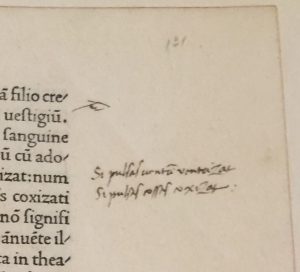
Private Collection, Ege's Portfolio of Famous Books in Nine Centuries, Laertius Leaf (1475), Front, Top Right. Reproduced by Permission.

Private Collection, Ege’s Portfolio of Famous Books in Nine Centuries, Laertius Leaf (1475), Front, Top Right. Reproduced by Permission.

For the printed materials, by definition other copies, more-or-less identical, may survive in other collections retaining the book in full (more-or-less).  Some copies are reproduced online in full or partial facsimile.  Some copies might still be available for direct inspection in their collections, for loan, or for purchase.

However, Ege’s leaves comprising printed matter sometimes carry marginalia and other forms of additions or alterations — as the case with some of the Incunabula — which ‘lift’ their status into unique witnesses to the transmission of the given book and edition.

In all cases, the patterns of location for the given titles as distributed within given sets (and in other settings) can contribute to the knowledge of Ege’s workshop practices in dismembering books and relocating their isolated elements for broader scattering into very many collections, which themselves might change hands — sometimes more than once.  See, for example, A Leaf from ‘Otto Ege Manuscript 19’ and Ege’s Workshop Practices.

A challenge to finding the location and character of other sets of the Portfolio (in one or other version), or perhaps dispersed parts of them, is the tendency of some institutional cataloging practices to separate the individual items into different departments or categories (literally or virtually), and, on occasion, to omit to mention, or to bury, the connection between the given Leaf or Leaves on the one hand and Ege and his Famous Books (or some other) Portfolio on the other.

We have encountered such problems with other parts of Ege’s oeuvre — as we might call his work and his works in the forms of dismembered and repositioned books of many kinds.  The problems multiply with the widespread dispersal of the Portfolios in whole or in part, as well as of individual Specimens.  Upon these conditions are piled the many challenges to identifying and locating them through library catalogues and websites (as well as sales catalogues).  We have reported on such constraints, for example, in our blogpost on More Discoveries for “Otto Ege Manuscript 61”.  See also below.

That some success is possible engaging with this challenge derives in no small measure from paying close attention to the terms in which Ege himself described the items, whether in print or in handwritten notes upon the leaves or their mats.  The attention can yield some results discoverable in roundabout, but effective, ways.

As always with researching materials dispersed in multiple collections, some of which have online information (sometimes including images of the materials), any results may have to depend upon the nature (and extent) of the information and metadata provided for the objects — and upon access to such materials and information.

Incunabula

Ege’s Contents List for the Incunabula (“Incunables“) in the Portfolio describes their Specimens in succinct terms.  They concern printed books produced in the early age of printing in the West — that is, by conventional agreement, up to the year 1500.  See, for example, surveys of the History of Printing and Incunables.  All are the products of printing by moveable type, rather than, say, blockbooks, a genre which Ege’s Portfolio ignores.
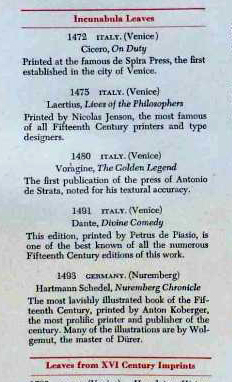
Private Collection, Ege FBNC Contents List, Detail: Incunabula.

Private Collection, Ege FBNC Contents List, Detail: Incunabula.

After the 6 specimen Manuscripts, the Incunabula are represented by 5 Specimens.  All on paper, their texts occur in Latin, Italian, or German.

Ege listed them thus:

  • 1472 Italy.  Cicero, On Duty, printed at the de Spira Press (Venice)
  • 1475 Italy.  Laertius, Lives of the Philosophers, printed by Nicolas Jenson (Venice)
  • 1480 Italy.  Voragine, The Golden Legend, printed by Antonio de Strata (Venice)
  • 1491 Italy.  Dante, Divine Comedy, printed by Petrus de Plasio (Venice)
  • 1493 Germany.  Hartmann Schedel, Nuremberg Chronicle, printed by Anton Koberger (Nurenberg)

That is, according to the numbering assigned to these publications in the Incunabula Short Title Catalogue (ISTC), they are:

  • 1472 Italy.  Cicero, On Duty, printed by Johann and Wendelin of Speyer / Giovanni and Vindelino da Spira (Venice, 1472), folio 41
    = ISTC ic00058000
  • 1475 Italy.  Laertius, Lives of the Philosophers (Lives and Opinions of Eminent Philosophers), printed by Nicolas Jenson (Venice, 1475), folio 131 (with marginalia)
    = ISTC id00022000
  • 1480 Italy.  Voragine, The Golden Legend, printed by Antonio da Strata (Venice, 1480)
    = ISTC ij00095000
  • 1491 Italy.  Dante, Divine Comedy, printed by Petrus de Plaisio (Venice, 1491)
    = ISTC id00033000
  • 1493 Germany.  Hartmann Schedel, Nuremburg Chronicle, printed by Anton Koberger (Nurenberg, 1493)
    = ISTC is00309000

To these specimens from Incunabula, as well as others among the later Imprints, we might return in other posts.
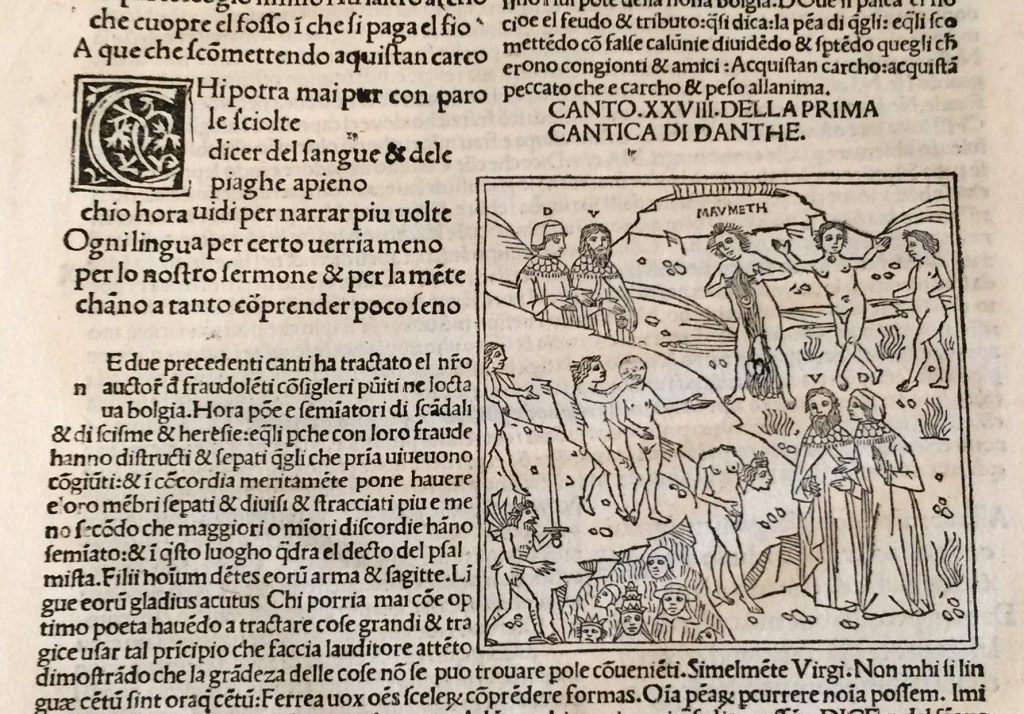
Private Collection, Ege's FBNC Portfolio, Dante Leaf, Verso, Detail. Reproduced by permission.

Private Collection, Ege’s FBNC Portfolio, Dante Leaf, Verso, Detail. Reproduced by permission.

Manuscripts, One By One

First we consider the manuscript fragments.

Already our blogposts have begun to consider parts of Ege MS 51, as distributed in Ege’s Portfolios and by other means.  The alternate means include the circulation of individual leaves on their own (sometimes in an Ege mat with his label), and the several portions of the ‘Residue’ (a binding included), after Ege’s extractions, now in the Otto Ege Collection at the Beinecke Rare Book & Manuscript Library at Yale University.  See:

  • More Leaves from Otto Ege Manuscript 51
  • More Parts of Otto Ege Manuscript 51.

My first introduction to the manuscript came from Leaf 96, in a Private Collection.  The leaf number appears at the bottom right of the recto, in pencil.  Acquired by itself, without any Label, the leaf is firmly recognizable as one of Ege’s by its correspondence in format, layout, textual contents, style of script, material, and other features which establish its position formerly within Ege Manuscript 51.
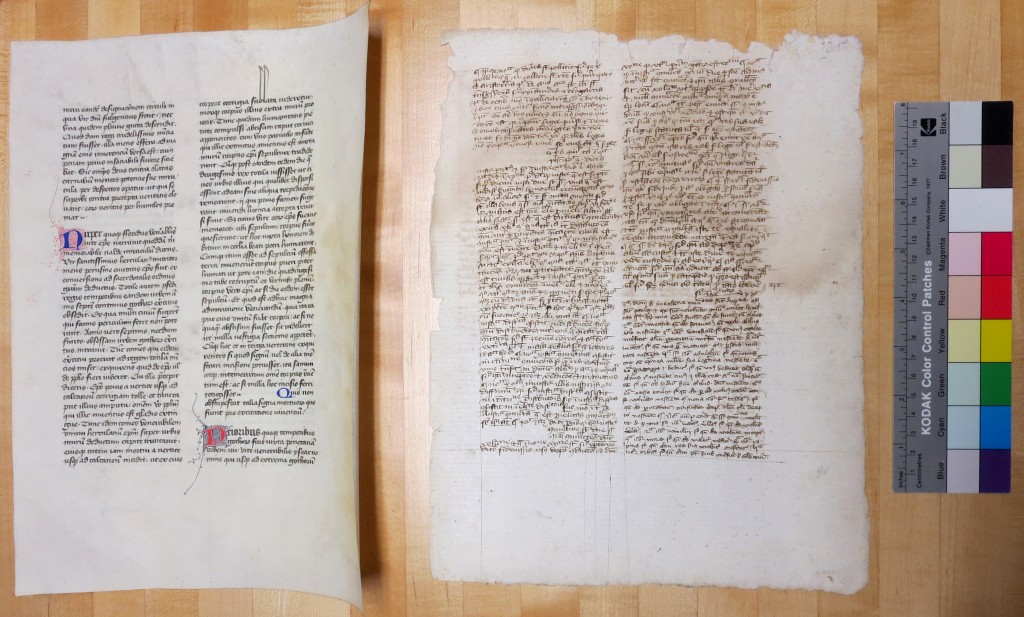
Private Collection, Rectos of Single Leaves from Ege MSS 41 and 51, with guide. Photography Mildred Budny.

Private Collection, Rectos of Single Leaves from Ege MSS 41 and 51, with guide. Photography Mildred Budny.

Some of the ‘Residue’ of Ege Manuscript 51, binding included, but with despoiled innards, has come into view in the Otto Ege Collection at the Beinecke Library.

The damaged binding of Volume II, viewed from the spine:
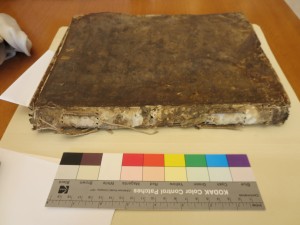
einecke Manuscript & Rare Book Library, Otto Ege Collection, Volume II of Ege Manuscript 51, Spine View.

Beinecke Manuscript & Rare Book Library, Otto Ege Collection, Volume II of Ege Manuscript 51, Spine View.

A view of the interior of the volume, opened to show its gutted gutter between folios 9v/27r (following the removal of folios 10–26 between them) and the results of water or liquid damage at the top of the book.  In the outer margin on the verso, accompanying the text, there stands a square-shaped diagram drawn in ink, with inscribed labels.
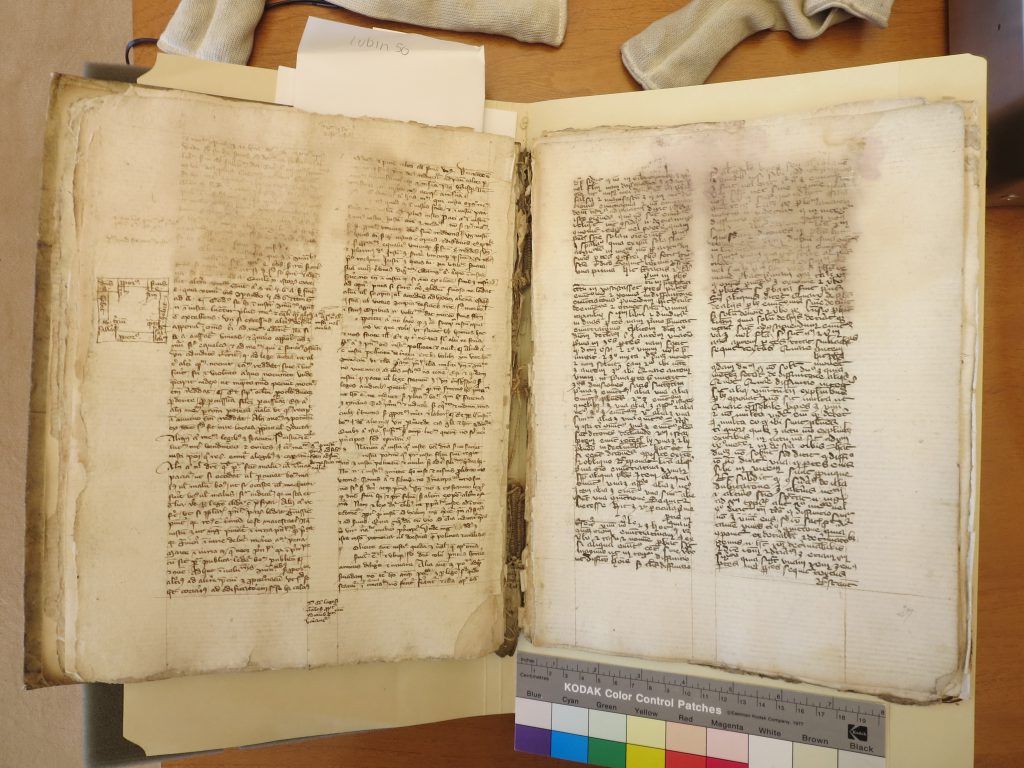
Beinecke Rare Book & Manuscript Library, Otto Ege Collection, Ege MS 51, Volume II, opened at the gap between folios 9v/27r. Photography Mildred Budny.

Beinecke Rare Book & Manuscript Library, Otto Ege Collection, Ege MS 51, Volume II, opened at the gap between folios 9v/27r. Photography Mildred Budny.

Now we consider the manuscript leaves in the newly revealed set of Famous Books in Nine Centuries which came from a sale in Ohio and entered a Private Collection.  With permission to show its images, we begin with the first Leaf in the set.

The Koran Leaf = Ege MS 53

In its mat, with its identifying label at lower left:
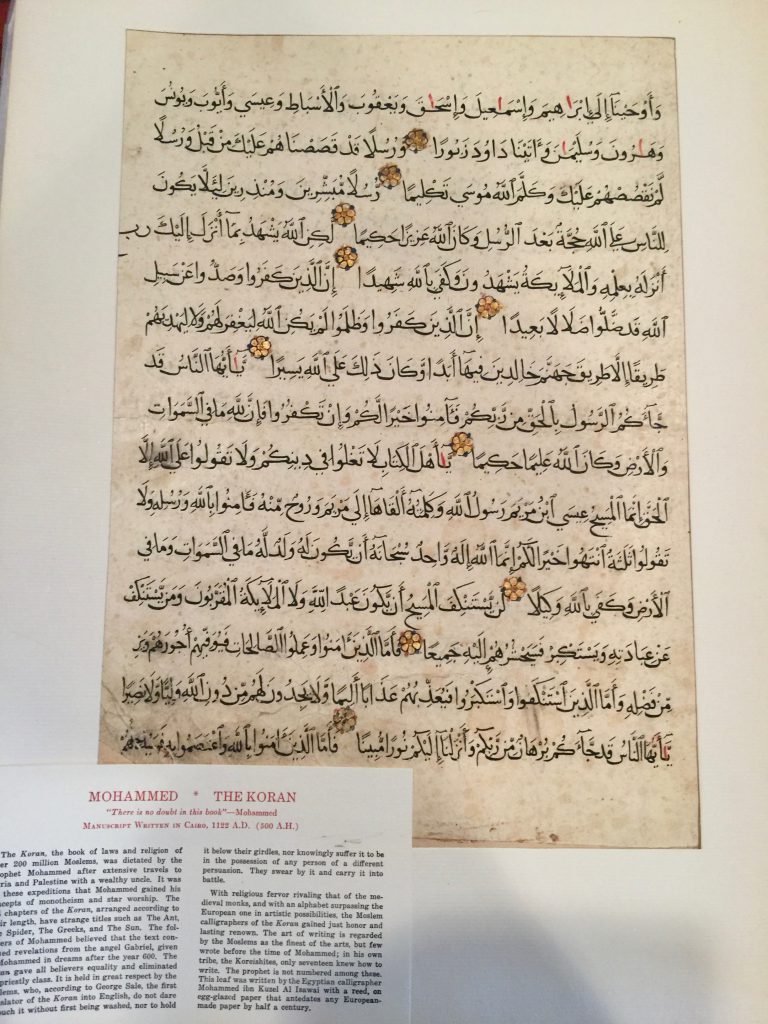
Koran 1 Ege MS 52 in Famous Books Portfolio in Mat

Koran 1 Ege MS 52 in Famous Books Portfolio in Mat

Closer up, behind the window of the mat, we can glimpse the full extent of the leaf, with trimmed or cropped margins which removed part of the script and other elements.  Patched repairs at the bottom of the leaf employ 2 overlapping pieces of paper.
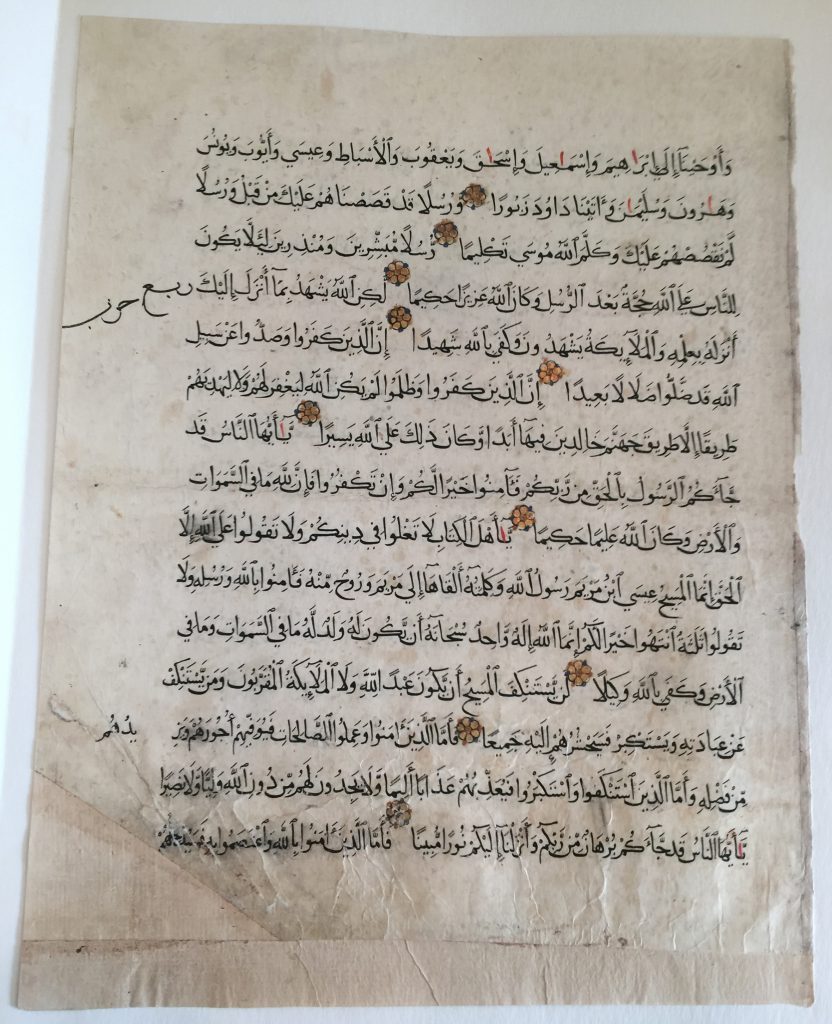
Private Collection, Koran Leaf in Ege's Famous Books in Nine Centuries, Front of Leaf. Reproduced by permission.

Private Collection, Koran Leaf in Ege’s Famous Books in Nine Centuries, Front of Leaf. Reproduced by permission.

The other side of the leaf, lifted partway from the backing mat on the hinged gauze tapes characteristic of Ege’s mountings:
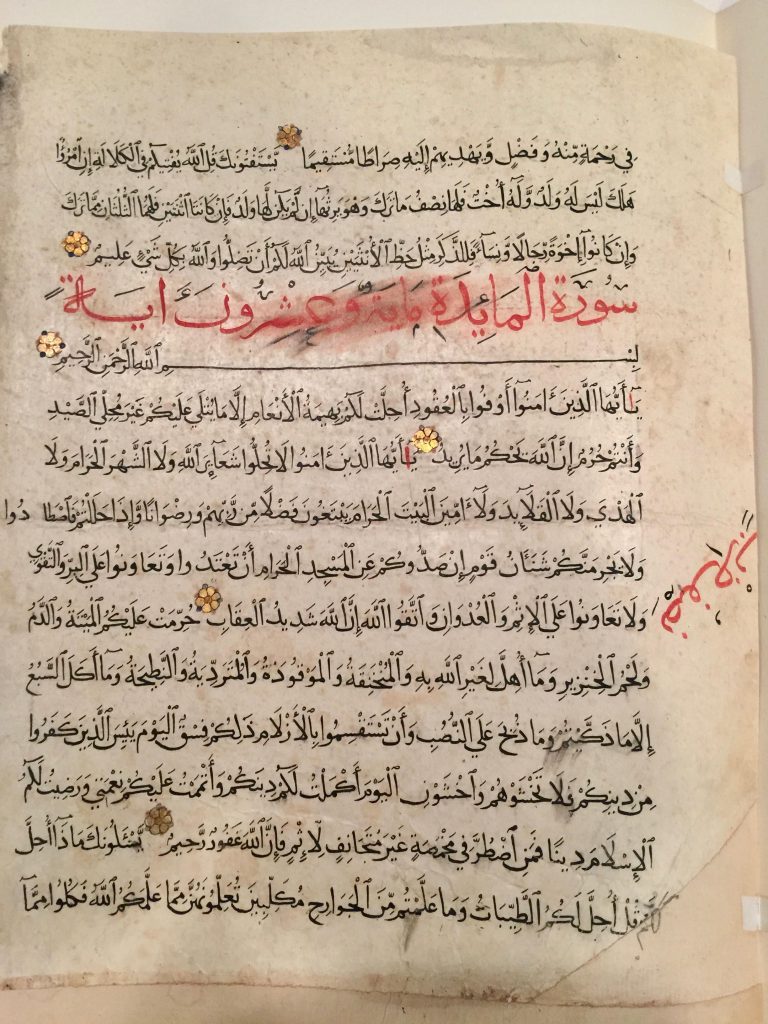
rivate Collection, Koran Leaf in Ege's Famous Books in Nine Centuries, Front of Leaf. Reproduced by permission.

Private Collection, Koran Leaf in Ege’s Famous Books in Nine Centuries, Back of Leaf. Reproduced by permission.

Note that the leaf has a pasted repair, sub-triangular in shape, at the lower inner corner, remedying a lost portion.  An added entry of script supplies the missing or covered elements on one side of the patch, pasted to the back of the leaf.  Pasted to the front of the leaf, a longer strip of paper across the width of the leaf repairs or strengthens its undulating lower edge.

The Text

The text starts on the front, or recto, of the leaf.  It begins within the middle of verse 162 (of 176 verses) of Surah ٱلنساء‎ / An-Nisāʾ (“The Women”).  On this Surah, Chapter 4 of the Quran, see, for example, An Nisa or An-Nisa. It considers issues relating to women, marriage, inheritance, orphans, rights, and more.  The text here differs slightly from the online version which we found (for example, Quran; see also Sacred-texts), in that the words occur in a different order. Continuing through An-Nisa, the page ends in the middle of verse  174.  The text continues on the other side of the leaf, on which Line 3 ends An-Nisa.

Next comes the rubricated title, spanning a full line, for Surah Al-Ma`idah (“The Table”, “The Table Spread”, or “The Table Spread with Food”), that is, Surah 5 which spans 120 verses.  See, for example, the opening and bilingual text of this Surah in Sacred-texts.

With a broader nib than the main text, the title is written in a single line of red pigment, spread the full width of the column (line 4).  Red dots above and below the characters provide the letter identifiers.  Marks in black ink indicate the vowel- and length-marks for reading.
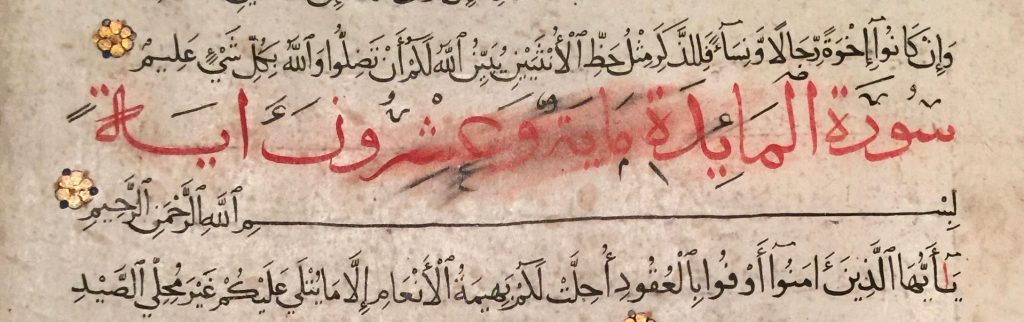
Private Collection, Koran Leaf in Ege's Famous Books in Nine Centuries, Title for Surah 5. Reproduced by permission.

Private Collection, Koran Leaf in Ege’s Famous Books in Nine Centuries, Title for Surah 5. Reproduced by permission.

Spread across another full line, in the same ink and script of the main body of text, there follows the Basmala, the standard invocation

بِسْمِ ٱللَّٰهِ ٱلرَّحْمَٰنِ ٱلرَّحِيمِ) (bi-smi llāhi r-raḥmāni r-raḥīmi , “In the name of Allah the merciful . . . “).

This phrase leads to the Surah text, starting at verse 1 and ending within verse 4 at the bottom of the page.  Thus, the span of text on the leaf extends from within Surah 4:163 to within 4:175 on the recto, and from thence to Surah 5:1–4 on the verso.

The polychrome verse-markers take the form of 6-petalled rosettes, usually raised above the baseline of script.  The group of petals surround a circular center of red pigment.  Smaller circular motifs, 6 in number, alternating in color (red and green?), nestle between, or emerge from, the outer tips of each pair of petals.

The addition of script at the lower right on the patch supplies the missing elements لَهُمۡۖ from the severed, covered, and repaired section at the beginning of the line of text.

Textual Divisions

Upside-down in the right-hand margin below the title, at an angle leading toward (‘descending to’) line 10, and partly trimmed away at the edge of the leaf, there stands an inscription to indicate the opening of a section.  Written in red, with letter-identifiers in red and vowel- and length-marks in black ink, it has a similar prominence and style as the title.  It appears to be the work of the same scribe.
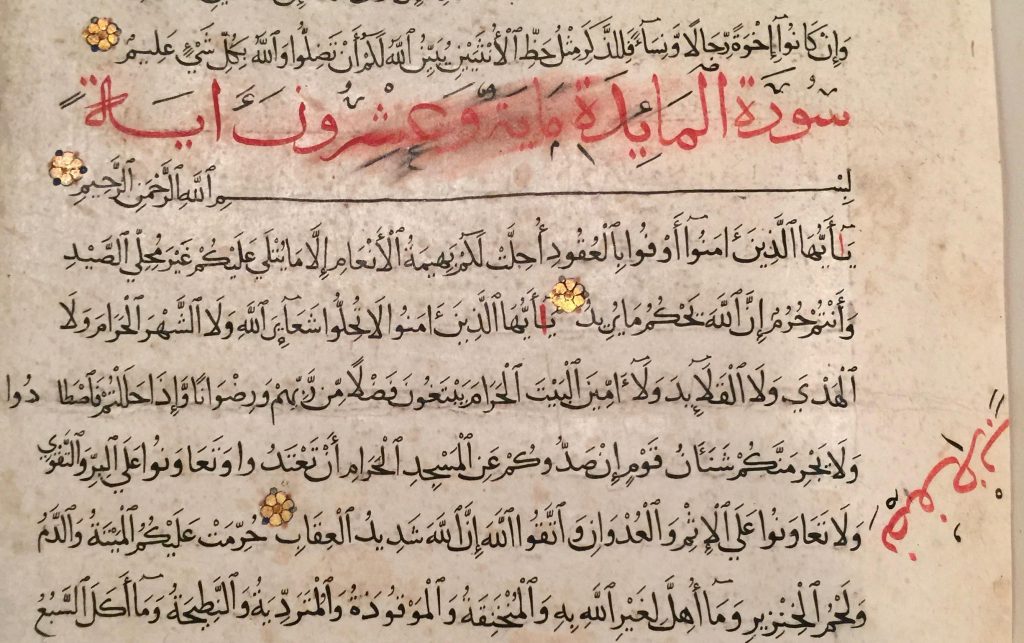
Private Collection, Koran Leaf in Ege's Famous Books in Nine Centuries, Back of Leaf, Detail. Reproduced by permission.

Private Collection, Koran Leaf in Ege’s Famous Books in Nine Centuries, Back of Leaf, Detail. Reproduced by permission.

Seen right-way up, that is, inverted with relation to the text, the marker reads thus:
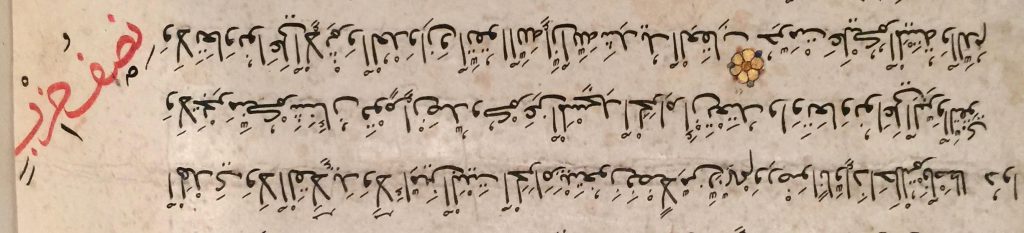
Private Collection, Koran Leaf in Ege's Famous Books in Nine Centuries, Back, lines 8-10, Inverted. Reproduced by permission.

Private Collection, Koran Leaf in Ege’s Famous Books in Nine Centuries, Back, lines 8-10, Inverted. Reproduced by permission.

The partly severed entry marks a division in the text.  The first word is نصف (nsf), meaning ‘half’.  There follow the letters z b (‘b’ certainly; ‘z’ is less certain), which might be read as زب — presumably a contraction of حزب  (ḥizb’), meaning ‘group’.  (Elsewhere the manuscript, as we can discover, preserves in full a comparable marking, so as to confirm this conjectured reading.)

The other side of the ‘new’ Leaf carries a second form of indicator for textual division.  Entered solely in black ink apparently by a different hand than the scribe of the text, it forms a descending angle in the outer margin at the end of line 4.  Upright with relation to the main text, it begins with the word ربع (rubuʿ, rubʿ, or rubue), “quarter”.  In its full form, it designates:  ربع حزب (‘quarter-hizb‘).
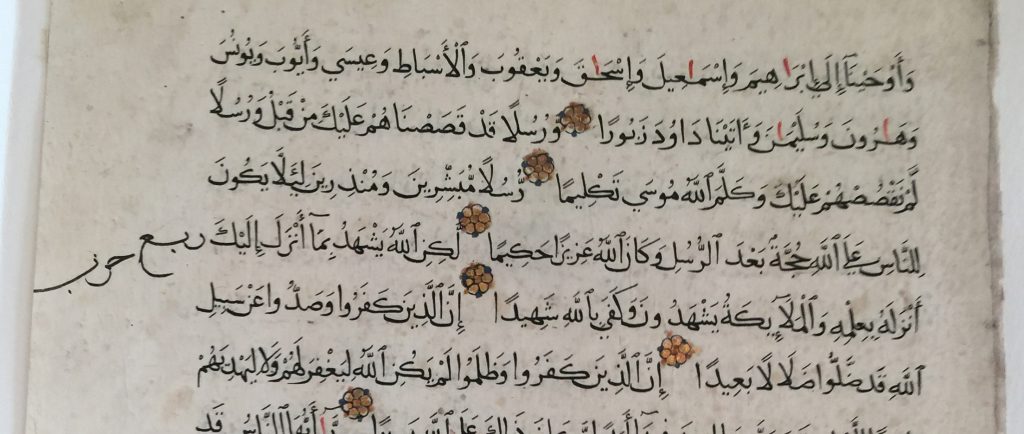
Private Collection, Koran Leaf in Ege's Famous Books in Nine Centuries, Front, lines 1-6. Reproduced by permission.

Private Collection, Koran Leaf in Ege’s Famous Books in Nine Centuries, Front, lines 1-6. Reproduced by permission.

The 2 marginal entries on recto and verso belongs to a graded system of inscriptions marking textual divisions in the Quran, intended to facilitate its recitation.  Briefly, the elements of the system, as it has evolved over time and place, comprise a variety of units.

  • Surah, or “Chapters”, 114 in number (of varying lengths), provided with titles
    — divided into verses, or ayah ʾĀyāt (of varying numbers), on which see ayah
  • Juz’ ( جُزْءْ, ), or “Part”, 30 in number (of varying lengths)
  • Hizb ( حزب , ḥizb), or “Group”, 60 in number (roughly equal lengths)

Further divisions also pertain.  For example (see, among others, Rub el Hizb):

  • A juzʼ is divided into ḥizbāni (“two Groups”)
  • A ḥizb is one-half of a juz’
  • Each ḥizb is subdivided into four quarters, making eight quarters per juzʼ
  • Each of these is called Arba (ارباع) “quarter”, or alternately maqraʼ (“Reading”), making 240 Ahzab or ‘quarters’ in the full Quran.

Moreover, longer chapters among the surah might receive other forms of subdivisions for purposes of recitation, without breaking the flow of the topic.

  • Ruku (رُكوع‎, Rukūʿ), “Passage” or “Stanza”, denoting a group of thematically related verses in the Quran, and amounting to 558 rukūʿs within it.

Each Hizb is subdivided into four equal parts, that is, a ‘quarter’ or Arba (ارباع). The three middle quarters of a ḥizb have these names:

  • First quarter of Hizb:  Rub ul Hizb (ربع الحزب)
  • Second quarter of Hizb:  Nisful Hizb (نصف الحزب)
  • Third quarter of Hizb:  Thalathatu (ثلاثة ارباع الحزب)

The ‘new’ leaf has diagonal entries in the margins marking both a ‘first’ and a ‘second’ quarter (without the ‘ul’).  The second is inscribed in rubricated, polychrome form similar to the Surah title and of an equivalent prominence.  The first appears less formal, inscribed only in ink and by a different, less polished, hand.  One marker is upright; the other is upside-down in relation to the Quran text.

According to the site https://en.wikipedia.org/wiki/Juz%27 , the first-quarter of Hizb 11 (spanning the text of Surahs 4:148 to 5:26) should occur at 4:163  (within An-nisah, as here).  The first verse on the leaf stands within 4:163.  Might we, perhaps, expect its marking (‘Hizb‘?) to stand at the bottom of the previous leaf?  Now dislocated from this one, perhaps it survives in some other collection.

In sum

To sum up the contents of the leaf:

Recto:   Surah 4:163 to 4:175 (in An-Nisa, “The Women”)

Verso:  Surah 4:175 to 4:176 (end of the Surah)

Rubric title for 5 Al-Ma`idah (“The Table Spread”) and the Bismallah

Surah 5:1 to 5:4 (halfway through the verse)

Margins:

Quarter-hizb near 4:166

Half-hizb near 5:3

From the Wikipedia site ( https://en.wikipedia.org/wiki/Juz’), the divisions of hizb 11 are:

4:148–4:162         (ḥizb)

4:163–4:176         (quarter-ḥizb)

5:1–5:11                (half-ḥizb)

5:12–5:26              (three-quarter-ḥizb)

The annotations on the leaf do not line up exactly with the WebSite ( https://en.wikipedia.org/wiki/Juz%27), if they are to mark the start of the section specified there.  However, the interval between them is consistent with the length of the passages.

The pattern(s) of textual division-markers applied to this Koran manuscript dismembered by Ege for his Portfolios may show its intentions for use in its original shape, its signs of use and adaptation, and perhaps also its position within the ‘evolution’ over time and place of practices of such markings — both upside-down and upright — for purposes of recitation.

Recto and Verso
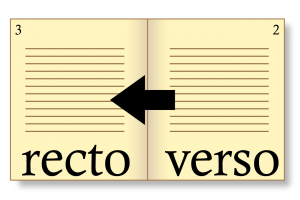
By TAKASUGI Shinji - Own work, Public Domain, via Wikimedia Commons.

Right-to-left Language Books. Diagram by Takasugi Shinji (Own Work), via Wikimedia Commons.

It is possible, perhaps probable, that the prominent smear across the middle section of the rubricated line of script of the title led Otto Ege to chose to place this side of the leaf on the hidden side within the mat, with the unsmeared page facing outward through the window.  The placement turned the original recto of the Arabic leaf into a Western recto, reversing its location within the original manuscript, properly to be read from right to left on the page and from front to back on its leaf.

Note that the terms ‘recto’ and ‘verso might mean different things, depending on the reading direction and the point of approach to the ‘start’ of the leaf.  See, for example, Recto and Verso (“Front” and “Back”). Here we use ‘recto’ to indicate the first side of the leaf intended to be read in the course of the text, and ‘verso’ to indicate the second side in the direction of reading.

Ege’s positioning of the selected leaves from whatever book within their windowed mats customarily masks from view the full contours of specimen.  As a result, it is often impossible to tell from the windowed front of a framed Specimen alone whether the Leaf comes from an original recto or verso.  In some exceptions, as with some specimens in the ‘new’ set, the framed view shows a folio-number, with one number to the leaf, or 2-sided folio.  Sometimes, instead, the number in view can pertain instead to a page-number, applying one number to each side of a leaf, or page.  Unless the observer is familiar with the edition in question, or has access to a view of the other side of the leaf, it could be unclear whether the number seen within the mat pertains to one folio (both recto and verso), or to only one side (either recto or verso).

A couple of cases in the ‘new’ Portfolio exemplify the range.

First, a manuscript, showing folio-number “35” (twice) within the mat (in ink at top right and in pencil at bottom right):
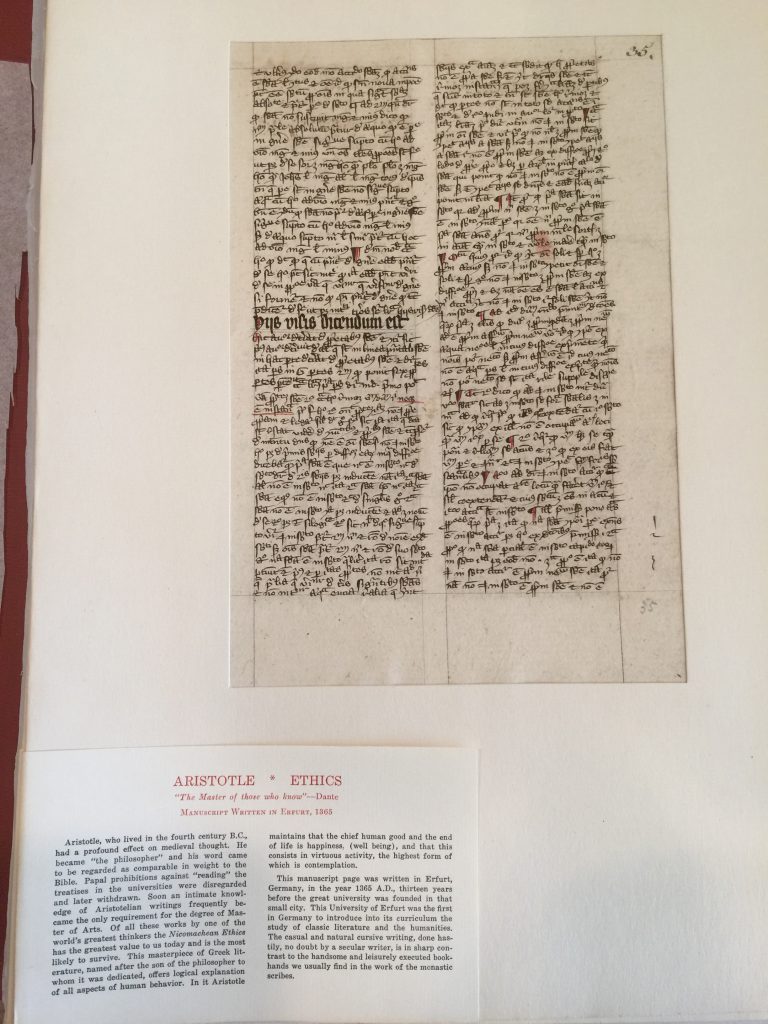
Private Collection, Ege's Famous Books in Nine Centuries, Aristotle Leaf within Mat. Reproduced by permission.

Private Collection, Ege’s Famous Books in Nine Centuries, Aristotle Leaf within Mat. Reproduced by permission.

(As it happens, the presence of these folio-numbers can significantly aid the virtual reconstruction of the manuscript in question, and contribute to the study of its history.  As shown in this blogpost: More Leaves from ‘Otto Ege Manuscript 51’.)

Second, a printed specimen, showing page “118” at the front (with page “117” turned to the back):
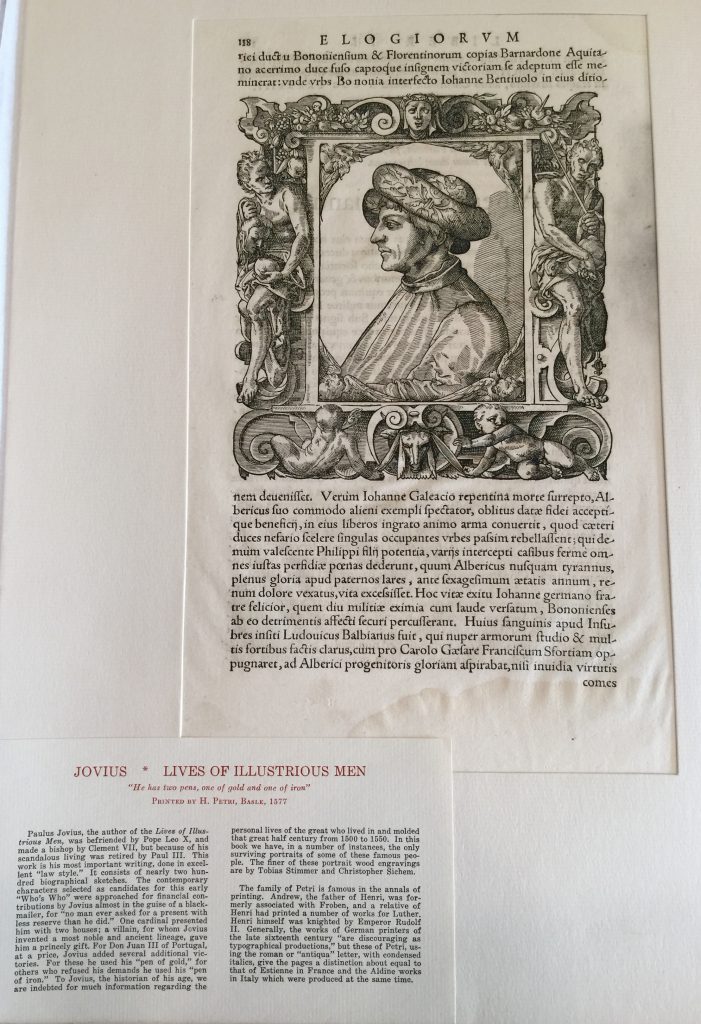
Private Collection, Ege's Portfolio of Famous Books in Nine Centuries, Jovius, Illustrious Men (1577) Specimen Front in mat. Reproduced by Permission.

Private Collection, Ege’s Portfolio of ‘Famous Books in Nine Centuries’, Jovius, ‘Illustrious Men’ (1577) Specimen Front in mat. Reproduced by Permission.

The practice of selecting, and visually cropping, a seemingly privileged side of a leaf — and not necessarily its original ‘recto’ — governs the presentation of Ege’s Specimens, regardless of whether they come from Western or other writing systems.

The Leaf and Its Manuscript
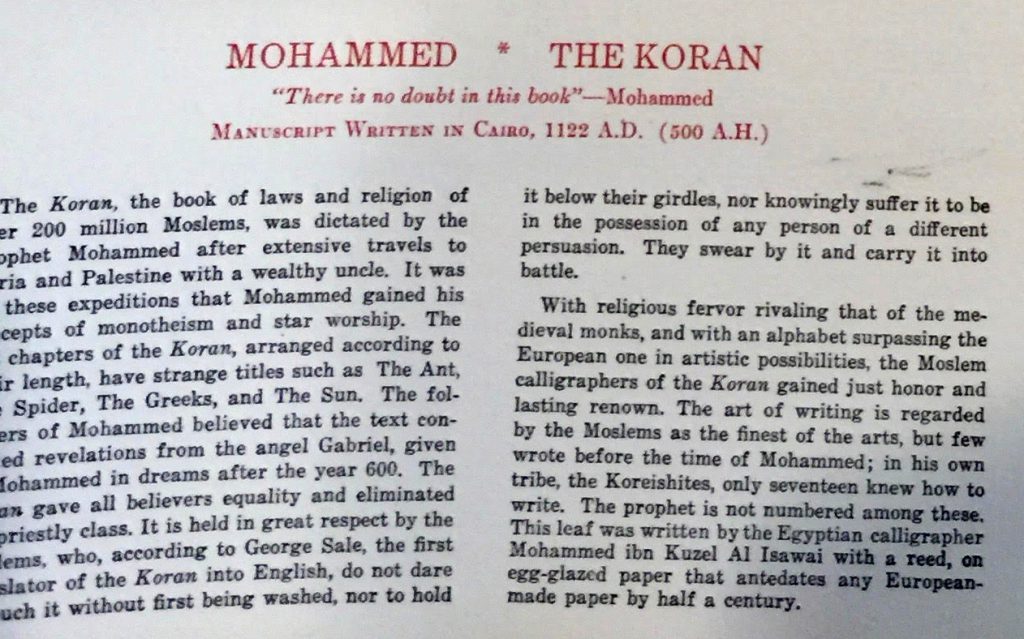
Private Collection, Ege FBNC Koran Leaf Label.

Private Collection, Ege FBNC Koran Leaf Label.

On this manuscript, and the individual specimen, Ege declared in his Label:

The Koran, the book of laws and religion of over 200 million Moslems, was dictated by the prophet Mohammed after extensive travels to Syria and Palestine with a wealthy uncle. It was on these expeditions that Mohammed gained his concepts of monotheism and star worship. The 114 chapters of the Koran, arranged according to their length, have strange titles such as The Ant, The Spider, The Greeks, and The Sun. The followers of Mohammed believed that the text contained revelations from the angel Gabriel, given to Mohammed in dreams after the year 600 [CE]. The Koran gave all believers equality and eliminated the priestly class. It is held in great respect by Moslems, who, according to George Sale, the first translator of the Koran into English, do not dare to touch it without first being washed, nor to hold it below their girdles, nor knowingly suffer it to be in the possession of any person of a different persuasion. They swear by it and carry it into battle.

With religious fervor rivaling that on the medieval monks, and with an alphabet surpassing the European one in artistic possibilities, the Moslem calligraphers of the Koran gained just honor and lasting renown. The art of writing is regarded by the Moslems as the finest of the arts, but few wrote before the time of Mohammed; in his own tribe, the Koreishites [Qyarysh], only seventeen knew how to write. The prophet is not numbered among these. This leaf was written by the Egyptian calligrapher Mohammed ibn Kuzel Al Isawai with a reed, on egg-glazed paper that antedates any European-made paper by half a century.  [Emphasis added.]

Ege’s entry for the Leaf in his Contents List identifies the work as

Mohammed, Koran Manuscript on paper, written by the calligrapher Mohammed ibn Kuzel Al Iswai.  Small illuminated rosettes.
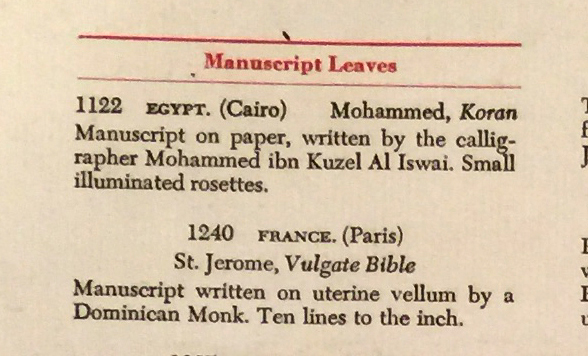
Private Collection, Ege FBNC, Contents List, Manuscripts 1 & 2.

Private Collection, Ege FBNC, Contents List, Manuscripts 1 & 2.

The Manuscript and Its Date

The date, place of production, and name of the scribe must derive from a scribal colophon which the manuscript contained, but which Ege’s dismemberment dislocated from the other leaves.  Those pieces of information had to circulate with Ege’s notes and his labels, without our ability by direct observation to challenge or to affirm the claims of the colophon, its manner of execution, and other means.

Alongside Ege’s attribution, Scott Gwara’s Handlist (p. 137) provides a different assessment:

Ege Description:  “Manuscript written in Egypt (Cairo), 1122 A. D. (500 A. H.)”.

Gwara Description:  “MS on paper.  Egypt, dated 1122 but Mamluk dynasty, s. xv”

The span of the Mamluk Sultanate extended from 1250–1517.  At the purported date of the manuscript (or its exemplar), Egypt belonged under the control of the Western caliphate and the Fatimid dynasty (969–1174), followed by the Ayyubids.  Many studies and reference works examine manuscript production for these periods.  See the suggestions for Further Reading at the end of this post.

When I asked our Associate, David Sorenson, what view he might have about the date-range of the “new” leaf and its manuscript, he replied:

Re. Quran — Boyd Mackus had one at K[alama]zoo [i. e. one year or other at the Annual International Congress on Medieval Studies; see its Archive].  It looked to me like a typical Mamluq leaf, 14th–15th century, as Scott says.  The easy way is to check the paper; if it has any chain lines it’s got to be after 1250 or so.  [Emphasis added.]  The writing style looks later, anyway.  You can look through Blair to see examples.  1100 or so would be an earlier type (late Fatimid) with a quite different script style.

The reference here to “Blair” indicates Sheila S. Blair, Islamic Calligraphy (Cairo, 2006).  Suggestions for further references and links to manuscript collections online appear at the end of this post.

Recently, in working to create a Gallery dedicated to Watermarks and the History of Paper, the Research Group on Manuscript Evidence has published the updated and downloadable version of David’s illustrated conference paper on “Paper-Moulds and Paper Traditions:  What Mould-Patterns in Near Eastern and Indian Paper Suggest Regarding Origins of Local Papermaking” (2020).  (See Paper Moulds and Paper Traditions and the downloadable paper.)  It includes observations about the importation and manufacture of paper in Egypt, or with Egyptian provenance, from about the ninth and tenth centuries (CE) onward (see especially pp. 5–7, with specimens).

Ege’s Portfolio of Oriental Leaves perhaps has a different Label for specimens from this Koran manuscript than its Label for Famous Books in Nine Centuries (as shown above).  So far, I have not yet seen an example of either the Contents List or “explanatory caption” for the Oriental Leaves, apart from quotations of information which accompanied the Leaf in some form.  The title of that Portfolio describes itself thus:

Fifteen Oriental Manuscript Leaves of Six Centuries:
Twelve of the Middle East, Two of Russia, and One of Tibet
from the Collection of and with Notes Prepared by Otto F. Ege

The online images of both sides of the Koran Leaf in the Oriental Leaves Portfolio at the Brooklyn Museum are accompanied by a caption quoting “Printed material” in these terms (presumably Ege’s?):

“Koran by Mohammed:  Egypt, Cairo, early 12th century 1122 A. D.; Arabic Mohammedan text, Arabic script, Nashki style.” (Koran Leaf)

On the style of script, see, for example Naskh (Script).

Leaves in Other Sets

Some other leaves from this manuscript appear online.  Under current conditions of bibliographical research, with access to many libraries closed or limited, exploring Ege’s Portfolios and their dispersal mainly requires resorting to online resources and the books and other materials which I have to hand, or can find.  Among them are stores of photographs from visits to multiple collections on the track of research on Ege’s Portfolios and other quests.

Some leaves from the Quran manuscript belong to one or other set of Ege’s Portfolio of Famous Books in Nine Centuries (as at the North Carolina Museum of Art in Raleigh).  Some belong to a set of Ege’s Portfolio of Oriental Leaves (as at the Brooklyn Museum in New York ).  Some appear to be separate leaves.  The appearance, or apparent condition, of separate leaves might in some cases (many?) reflect their institution’s label, the removal of the individual leaves from the set and the mats, and/or the distribution into different divisions of the larger collection or into different collections altogether.  As a result, for various reasons, the labelling or cataloguing by the collection or institution can mask, bury in ‘fine print’, or outright ignore the connection with Ege, or with one or other of his Portfolios.

Needless to say, such factors can impede or interfere with research to recognize different leaves from the manuscript now in different locations.

My consultation and photography, with permission, of the set (Number 20) now at the Princeton University Library several years ago provides the opportunity to re-examine it virtually offline, and to identify its place within the former manuscript.

  • Princeton, Princeton University Library, Firestone Library, Special Collections, Oversize 2008-007E;
    The recto, beginning midway through Surah 13:40, Ar-Ra’d (“The Thunder”), carries the rubricated title for Surah 14, Ibrahim (“Abraham”); the verso carries the rubricated upside-down marker ‘half-hizb’ in the outer margin opposite 14:10, and closes within 14:22.

A few examples of leaves as seen in print or online:

  • New York, Brooklyn Museum, Ege’s Portfolio of Oriental Leaves, Koran Leaf

Recto

Brooklyn Museum, Libraries and Archives, Z209 Eg7, Koran Leaf, Recto. No known copyright restrictions.

Brooklyn Museum, Libraries and Archives, Z209 Eg7, Koran Leaf, Recto. No known copyright restrictions.

The recto starts with verse 74 within Surah 11, “Hud“.  Note that the rubricated entry in the outer margin (partly trimmed, like the one on the ‘new’ leaf) marking the textual division of a “Half-Hisb“, or “Half-Group”, stands upright with relation to the text (unlike the orientation on the ‘new’ leaf).  Note also the modern paper repair across the bottom of the leaf.

Verso
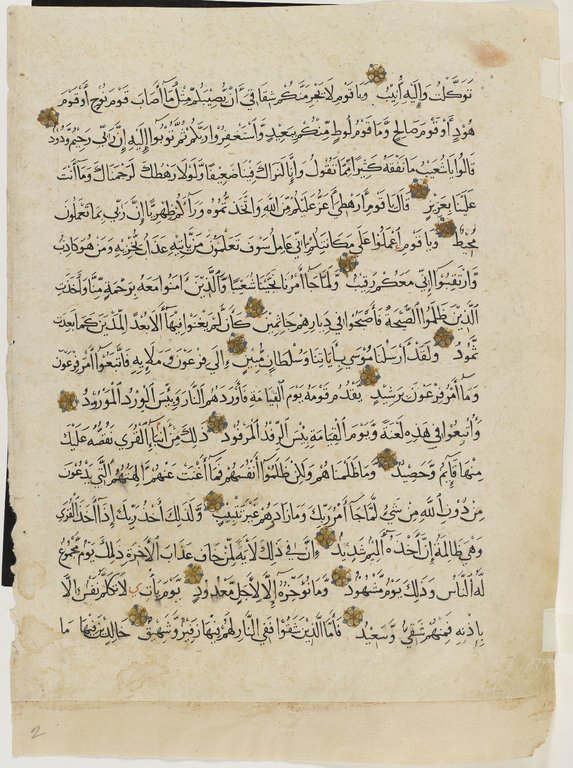
Brooklyn Museum, Libraries and Archives, Z209 Eg7, Koran Leaf, Verso. No known copyright restrictions.

Brooklyn Museum, Libraries and Archives, Z209 Eg7, Koran Leaf, Verso. No known copyright restrictions.

  • Private Collection, Koran Leaf within a set of the Famous Books Portfolio, illustrated (one side only, cropped without revealing whether recto or verso) in Disbound and Dispersed:  The Leaf Book Considered (2005), page 82.
    Its red title opens Surah 13:  Ar-Ra’d (“The Thunder”).
  • Location Unknown, FBNC Set 28, sold at Christie’s on 21 September 2020 as Lot 10.
    Provenance: (1) Otto F Ege (1888-1951). (2) Bruce Ferrini. (3) Alexander E. Vida, by descent.
    Images of both sides of the Quran leaf (gallery-13 and gallery-14) show its span of text. It contains part of Ar-Ra’d (“The Thunder”), Surah 13, starting in 13:15, with the page-break at mid 13:29, and ending mid 13:40. The hizb marker is roughly correct for Ar-Ra’d 13:19.
  • Memphis, Tennessee, Rhodes College, Archives and Special Collections, Hanson Collection, Ege Box 3, Leaf 1
    (identifier:  http://hdl.handle.net/10267/20164) – a leaf which, it is said, arrived within Ege’s mat for it.
    The red title, on the verso, opens Surah 28: Al-Qasas (The Stories”).
    Note the pair of paper patches at the lower edge, with a subtriangular patch at the outer margin and a longer horizontal patch across the bottom, like the ‘new’ leaf.

Recto
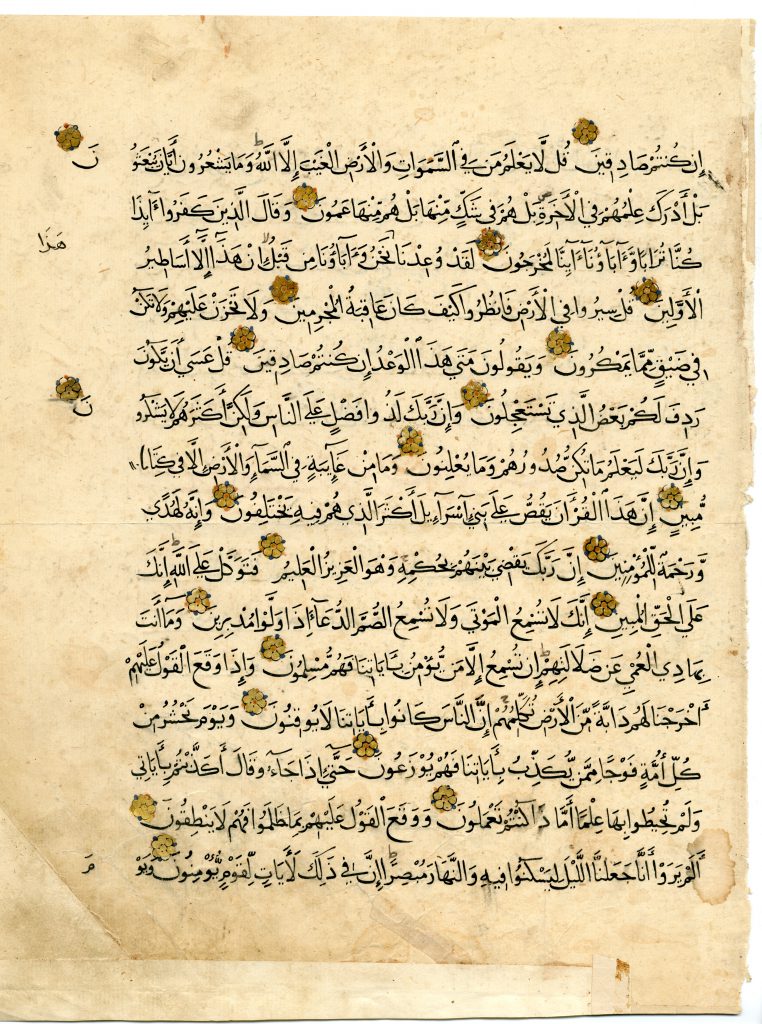
Rhodes College Archives and Special Collections, Memphis, TN. Hanson Collection 3, Koran Leaf, original recto, via http://hdl.handle.net/10267/20164.

Rhodes College Archives and Special Collections, Memphis, TN. Hanson Collection 3, Koran Leaf, original recto, via http://hdl.handle.net/10267/20164.

Verso
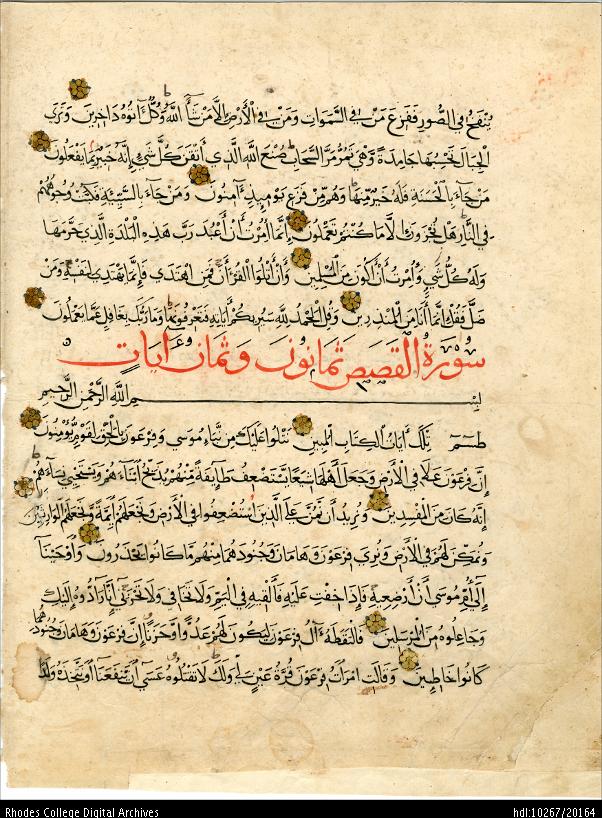
Rhodes College Archives and Special Collections, Memphis, TN. Hanson Collection 3, Koran Leaf, original verso, via http://hdl.handle.net/10267/20164.

Rhodes College Archives and Special Collections, Memphis, TN. Hanson Collection 3, Koran Leaf, original verso, via http://hdl.handle.net/10267/20164.

  • Queens, NY, Saint John’s University, Archives & Special Collections, FBNC, verso only; otherwise [access restricted]
    The text on this page extends from Az-Zumar (“The Groups”) at the start of Surah 39:63 ‘لَهُ مَقَالِيدُ السَّمَاوَاتِ’ to the end 39:75, followed in the last line by the title for Ghafir (“The Forgiver”) ‘غَافِر‘ (Surah 40).
    The rubricated inscription for the textual division of a “Half-Hizb” stands upside-down in the outer margin (see above).
  • Raleigh, North Carolina Museum of Art, Near Eastern Department, Leaf from a Koran, showing only the recto and citing the date 1122.
    (This leaf and its Portfolio set of Famous Books in Nine Centuries is not recorded in Gwara’s Handlist.)
    The rubricated inscription for the textual division of a “Half-Hizb” in the outer margin (see above) remains in full, uncropped; at an angle, it stands upright with relation to the text.
  • Columbia, South Carolina, University of South Carolina, Ernest F. Hollings Special Collections Library, Early Ms. 128 (the gift of Scott Gwara)
    — with no image, but with the information that “the word ḥizb is written upside down on the margin of the verso”, indicating a textual division.

In this latter case, the online catalogue entry not only refrains from identifying the span of the text, but also leaves uncertain whether the Leaf belongs to, or came from, one or other of Ege’s Portfolios, or circulated in some other way instead.  It states:

“[The leaf] Relates to a Qur’an leaves [sic] included in Otto F. Ege’s Fifteen original [Oriental] manuscript leaves of six centuries and Original leaves from famous books. This leaf was attributed to Mohammed ibn Kuzel Al Isawai by Otto F. Ege. Ege dated the ms. ca. 1122.”

More research, and more available information, would reveal further details about the structure of the manuscript as a whole, its context, its scribal attribution, and other features.

The Scribe and the Date

With accompanying labels or notes, the variously circulated leaves have mostly traveled to their current locations with a report of the name of the calligrapher as “Mohammed ibn Kuzel Al Iswai”, the date of “1122 [CE]”, and the place of origin as Egypt, and particularly Cairo.  This knowledge would have travelled with the leaf, whether in some note, label, or contents list by Ege.  Sometimes, alas, the specific form of transmission is not reported, or is only inconsistently or ambiguously mentioned, by the institution in its cataloguing or the accompanying metadata.

Sometimes the information about the leaf may have appeared in, or also in, handwriting — as seems to be the case with the leaf at the Brooklyn Museum of Art (to judge by part of the online catalogue description).  It was not uncommon for Ege to have inscribed such information in pencil at the bottom of the mat and/or on one side of a detached leaf itself, as the leaves from a book were separated and dispersed variously on their own or in company with severed leaves from other books or manuscripts, Portfolios and other means included.  Examples are illustrated in other blogposts about Ege’s manuscript fragments.  (See our Contents List.)

For the Koran manuscript, presumably we must assume that Ege derived the name of the calligrapher and the exact date from a scribal colophon within the manuscript — if not from some extra-textual information which came to him with the book, say on an endleaf or the binding, or in some other form from the seller.

As stated in his Label for the Nine Centuries Portfolio (seen above):

This leaf was written by the Egyptian calligrapher Mohammed ibn Kuzel Al Isawai with a reed, on egg-glazed paper that antedates any European-made paper by half a century.

So far, a scribal colophon has not come into view on any leaf as yet recognized as part of the same book. Occasionally for some of Ege’s manuscripts, a colophon surfaces somewhere in a dispersed leaf, as the case with 2 other manuscripts deployed as specimens in the Famous Books Portfolios:

  • the Aristotle manuscript (Ege Manuscript 51) and
  • the Livy manuscript (Ege Manuscript 52).

The latter case survives at Rhodes College, with the colophon reporting the date as 12 September 1456; it is shown here.  Multiple colophons in the former are described and illustrated in More Parts of ‘Otto Ege Manuscript 51’ .

One wonders what other information a colophon in Arabic might have conveyed, not only in terms of its textual contents, but also in terms of its script, its location within the book, and other material evidence.

As for a different date between the wording of a colophon and the apparent date of the manuscript, it is not unknown in manuscript production, both Eastern and Western, that the colophon of an earlier scribe, with its earlier date, could be copied unchanged in the process of transcribing the exemplar.

Presumably, Ege took the colophon at face value, without recognizing other features which could signify a much later date for the script, paper, textual markings, and other features.

Coda:  Reed or Pen

It is uncertain whence Ege derived his belief that “This leaf” (namely, whichever one accompanied his Label) “was written . . . with a reed”.  The use of a reed pen, especially for papyri (and cuneiform), is well attested. The images available for view from the Koran manuscript show rapid gradations in widths of strokes more characteristic of quill pens.

Perhaps Ege drew his inference from his belief that the manuscript represented an early, pre-European form — replete with egg-glaze as a finish.

*****

Further Reading

On the production of Quran manuscripts over time and place, from the 7th century (CE) onward, their scripts and calligraphic practices, and their structure, punctuation, and embellishment, see, for example:

For the Metropolitan Museum of Art:

  • Maryam Ekhtiar and Julia Cohen, Early Qur’ans (8th–Early 13th Century)“The introduction of paper into the region [with the importation from China to the Middle East] allowed for the production of far more Qur’ans than had previously been possible.”

For the British Library:

  • Colin F. Baker, Calligraphy of the Qur’an.

For islamic-awareness.org:

  • The Qur’anic Manuscripts.
    — with a list of links to “The Qur’anic Manuscripts In Museums, Institutes, Libraries & Collections”

Further references

Colin Baker, Qur’an Manuscripts: Calligraphy, Illumination, Design (London:  The British Library, 2007)

Sheila S. Blair, Islamic Calligraphy (Edinburgh:  Edinburgh University Press, 2006)

Francois Deroche. The Abbasid Tradition: Qur’ans of the 8th to 10th centuries A.D. (London:  Nour Foundation in association with Azimuth Editions and Oxford University Press, 1992)

———, Islamic Codicology:  An Introduction to the Study of Manuscripts in Arabic Script. (London:  Al-Furqān Islamic Heritage Foundation, 2005)

Mohammad Gharipour and Irvin Cemil Schick, eds. Calligraphy and Architecture in the Muslim World (Edinburgh:  Edinburgh University Press, 2013)

David Roxburgh, Writing the Word of God:  Calligraphy and the Qur’an (Houston:  Museum of Fine Arts, 2007)

Yasin Safadi, The Qur’an:  Catalogue of an Exhibition of Qur’an Manuscripts at the British Library (London:  World of Islam Publishing Co. Ltd for the British Library, 1976)

*****

We thank the owner of the “new” Portfolio of Famous Books in Nine Centuries for permitting us to examine and publish this find.  We likewise thank the owners of other materials from Otto Ege’s collection for allowing access to the sources and related evidence.  We give thanks also to our Associates and others for advice over the years about Ege’s manuscripts and their distribution, and now to Leslie French and David Sorenson for advice specifically about the Koran/Qur’an manuscript.

Further posts might present other leaves from this Portfolio and their relatives, as well as other discoveries for Ege Manuscripts.

Private Collection, Koran Leaf in Ege's Famous Books in Nine Centuries, Back of Leaf, Detail. Reproduced by permission.

Private Collection, Koran Leaf in Ege’s Famous Books in Nine Centuries, Back of Leaf, Detail. Reproduced by permission.

Do you know of more leaves from this manuscript?  Of other sets of the Portfolios of Famous Books (in Nine and/or Eight Centuries) or Oriental Books?  Do you have suggestions for the date and origin of this manuscript?  Other works by the named scribe?

Please let us know.  Please leave your comments here, Contact Us, and/or visit our Facebook Page.  We look forward to hearing from you.

*****

Tags: Brooklyn Museum, Dispersed Manuscript Leaves, Ege's FOL Portfolio, Ege's Portfolio of Famous Bibles, Ege's Portfolio of Famous Books, Ege's Portfolio of Oriental Books, Koran Manuscripts, Medieval Manuscript Fragments, North Carolina Museum of Art, Otto Ege Manuscript 51, Otto Ege Manuscript 53, Otto Ege Portfolios, Qur'an Manuscripts, Rhodes College
No Comments »

Patch Work in ‘Otto Ege Manuscript 14’

September 10, 2020 in Manuscript Studies, Uncategorized

Patched Repairs in ‘Otto Ege Manuscript 14’
With Pieces
of Text and Decoration
Extracted From the Same Manuscript

[Posted on 20 September 2020, with updates]

Beinecke Rare Book & Manuscript Library, Otto Ege Collection, MS 14, Genesis Opening Leaf: Recto, Detail of Patch.

Beinecke Rare Book & Manuscript Library, Otto Ege Collection, MS 14, Genesis Opening Leaf: Recto, Detail of Patch.

In a nutshell:  Patches Work.  Cut-Outs and Patches are recognized genres (sadly) in the history, transmission, plunder, and showcasing of medieval manuscript glories, plus efforts in some cases to cover the tracks.

Tracking those Traces?  Call it Forensics.  Detection Works.

Continuing our series of reports for some of the manuscripts dispersed by Otto F. Ege (1888–1951), we focus upon a little-recognized feature in one of them, which incorporates reused pieces from leaves in the same book for filling holes in other leaves.  Previous accounts of the manuscript have taken scare notice of the feature; it could be more widespread in the book than their individual reported cases would indicate.

About this manuscript see, for example:

  • Ege Manuscript 14
  • More Discoveries for ‘Ege Manuscript 14’
  • Updates for Some ‘Otto Ege Manuscripts’ (Ege MSS 8, 14, 41, and 61)
  • Some Leaves in Set 1 of ‘Ege’s FOL Portfolio’ (Ege MSS 8, 14, 19, and 41)

[And also now:

  • A Leaf in Dallas from ‘Otto Ege Manuscript 14’ (Lectern Bible)
  • A Leaf of Deuteronomy from ‘Otto Ege Manuscript 14’ in the Rosenbrook Collection]

See also The Illustrated Handlist (Number 4).

We look forward to further publications about this manuscript by other scholars, including Joseph Bernaer and Peter Kidd.  Joseph has kindly responded to our invitation to contribute his discoveries for publication, and Peter Kidd offers photographs which aid the quest.  Peter’s publication of Volume 3 of \The McCarthy Collection: French Miniatures (forthcoming, 2020) is eagerly anticipated.  [On this publication and its report of surviving illustrated portions of Ege Manuscript 14, see A Leaf in Dallas from ‘Otto Ege Manuscript 14″ (Lectern Bible).]

Patchwork

Beinecke Rare Book & Manuscript Library, Otto Ege Collection, 'Ege Family Album', Leaf 14 verso, detail.

Beinecke Rare Book & Manuscript Library, Otto Ege Collection, ‘Ege Family Album’, Leaf 14 verso, detail.

Some leaves of ‘Otto Ege Manuscript 14’ have patches which fill gaps made in excising decorative elements, presumably for display in their own rights as cuttings.

Many Western medieval manuscripts survive either with cuttings or from cuttings, which forcibly extracted portions of a leaf, resulting in a hole within its original expanse. Although very many of Ege’s leaves themselves constitute cuttings in the form of “whole leaves”, I distinguish these fragments from the related phenomenon of “snippets of decorated borders and isolated initials”, as described and illustrated from collections at the Victoria & Albert Museum, the British Library, and the Walters Art Museum.

So far as I know, studies of the manuscript and attempted reconstructions of the extant pieces of Ege Manuscript 14 do not take much account of the patches, apart from occasional mentions for some individual leaves.

While working to update an account of surviving parts of the manuscript, presented in More Discoveries for ‘Ege Manuscript 14’, I took care to inspect anew images of the leaves available for viewing online.  In the process, I was struck by the references to patches on a couple of different leaves described by catalogue entries.  Those references call for attention.

Their notices appears in 2 catalogue entries known to me.  Both are “Rogue Leaves”, a term applied to some pieces of Ege’s manuscripts.  That is, they were distributed otherwise than through the customary sets of Ege’s FOL Portfolio (Fifty Original Leaves from Western Medieval Manuscripts), in which specimens from Ege MS 14 — usually single leaves, but rarely a pair of leaves in a bifolium — were selected for Leaf Number 14.

An example, within its Ege mat:

The original manuscript is mostly known as Ege Manuscript 19 (Gwara, Handlist, No. 19, page 124).  The numbering follows Ege’s numbering for his FOL Portfolio.  Some identified parts are listed in Scott Gwara’s Handlist, by which we cite them here.

Via the Handlist

1. Gwara, Handlist 14.1.

Boston University = Judith H. Oliver, Manuscripts Sacred and Secular (1985), number 36 [but no plate]

  • End of Kings, Prologue to I Chronicles, and beginning of I Chronicles,
    with a ‘patch taken from another illuminated page of the same manuscript’ covering the cut-out from the ‘theft of initial for I Chronicles’.

One wonders which other page yielded its riches to patch up this leaf.  (See below.)

2.  Gwara Handlist 14. Ref 14.

Sold at Sotheby’s 10 July 2012, lot 2(b)

The leaf carries the Opening of the Catholic Epistle of James on its verso; I have not seen an image of its recto (But see below and Update).

The leaf is described in the Sotheby’s catalogue thus:

leaf from a lectern Bible, 400mm. by 270mm., with a large initial ‘I’ (opening “Iacobus ihesu christi seruus …”, the epistle of James) in burnished gold with a coloured architectural roof and arch, enclosing a bearded James with a golden halo pointing at the opening of his epistle, angular foliage forming text-frame around all sides of one text column, terminating in golden leaves and a dragon, 3-line initial enclosing ivy-leaf, similar text-frame on verso with a dragon and a 5-line initial containing a sprig of foliage ending with a dragon’s head, double column, 50 lines in a regular gothic hand, area of one column cut away (90mm. by 95mm., presumably once with a large initial), now repaired with another cutting from same volume [highlights added], once mounted on card with remains of tape on recto, France or southern Flanders, early fourteenth century

Its contents:

  • Part of the Prologue to the Catholic Epistle of James (from [ut quia Petrus /] est primus in ordine apostolorum) and the opening of this Book, with 1:1–2:4 (nonne iudacitis [/ apud vosmet])

— plus a replacement patch with lines of script from 2 columns of text

Pasted to the recto of the leaf, on the verso the patch shows through the acquired hole, which functions as a form of ‘windowed mat’, across the end of column a and most of column b in their lines 25—37 on the damaged verso of the leaf.  Viewed from the recto, the more-or-less rectangular patch, which has unevenly trimmed edges, can be seen to its full extent.  Viewed from the verso, the extent and shape of the cut-out itself is known.

The mention of “remains of tape on recto” by which the leaf was “once mounted on card” shows that Ege’s matting turned the leaf front-to-back to display the verso.  This is the same side as showcased in the Sotheby’s view online for its auction.  The removal of part of the leaf presumably addressed an attractive historiated initial which began the Prologue on the recto.

The text on the patch identifies the leaf from which it was extracted in turn.  (See below.)

[Update on 8 February 2022:

This leaf has returned to the market.  The current online offering by Stephen Butler Rare Books & Manuscripts of Milton Keynes in the United Kingdom — via both the firm’s website (St James Preaching in an historiated initial on a leaf from a Bible in Latin [Paris, late 13th or early 14th century]) and AbeBooks — illustrates the leaf in two full-page views (recto and verso) and three details (initials and zoomorphic/foliate finials).  The description reports travels from the 2012 Sotheby’s sale:

Sotheby’s, 10 July 2012, lot 2(b), the initial reproduced in colour in the catalogue; bought by:  Robert Weaver, London; recently deaccessioned. Text: The main text is from Acts 27:40 to the end of Acts, a prologue to James (Stegmüller [Repertorium Biblicum Medii Aevi,] no. 809), and the start of James as far as James 2:4, but a portion of text has been cut out and replaced by a patch of parchment from the following leaf of the same manuscript, containing parts of James 2:10 3:9 and 4:8 5:20. This leaf both confirms that Acts appeared between Hebrews (the last of the Pauline Epistles) and James (the first of the Catholic Epistles), and that Acts had an historiated initial. . . . The parent manuscript is discussed, and the known leaves listed, by Peter Kidd, The McCarthy Collection, III: French Miniatures (London, 2021), no 60, pp.199 202, citing the present leaf on p. 201, no. 80, when still in the collection of Robert Weaver.

On that publication and its list of known illustrated leaves, see above and A Leaf in Dallas from ‘Otto Ege Manuscript 14″ (Lectern Bible).  On the texts on the leaf and the patch, see below, reporting the fruits of study already from photographs kindly provided by Peter Kidd before the publication of his catalogue.]

In the “Otto Ege Collection” now at Yale

Another case has emerged in the Otto Ege Collection.  This “find-place” demonstrates that the patch was in place within Ege’s collection, not in some subsequent handling after it left his hands.  That same chronological sequencing evidently pertains to other leaves from the same manuscript with similar patching.

3.   First leaf of Genesis

Beinecke Rare Book & Manuscript Library, Otto Ege Collection

Genesis opens with a full-page initial I (for Initium) and carries the text from Book 1:1 to 3

Recto

Opening page of the Book of Genesis, with a full-page illustrated initial I for 'In' ('In Principio'), showing scenes from Creation to the Crucifixion. Dismembered leaf from 'Otto Ege MS 14'. Otto Ege Collection, Beinecke Manuscript and Rare Book Library, Yale University. Reproduced by permission.

First page of Genesis from ‘Otto Ege MS 14’. Otto Ege Collection, Beinecke Manuscript and Rare Book Library, Yale University. Reproduced by permission.

Verso

Beinecke Rare Book & Manuscript Library, Otto Ege Collection, MS 14, Genesis Opening Leaf: Verso.

Beinecke Rare Book & Manuscript Library, Otto Ege Collection, MS 14, Genesis Opening Leaf: Verso.

The Patched Repair

Recto

Beinecke Rare Book & Manuscript Library, Otto Ege Collection, MS 14, Genesis Opening Leaf: Recto, Detail of Patch.

Beinecke Rare Book & Manuscript Library, Otto Ege Collection, MS 14, Genesis Opening Leaf: Recto, Detail of Patch.

Verso

Beinecke Rare Book & Manuscript Library, Otto Ege Collection, MS 14, Genesis Opening Leaf: Verso, Detail of Patch.

Beinecke Rare Book & Manuscript Library, Otto Ege Collection, MS 14, Genesis Opening Leaf: Verso, Detail of Patch.

From Which Leaf?

Without (apparently) text on the patch to serve as a guide, it is uncertain to which leaf this decorated element belonged.  At least, to judge by the animated decoration, with a dragonesque biped and branching, scrolling foliate tail, the element belonged to part of a major decorated initial.

The blank side of the patch could be suggestive.  Can we know if originally the decorated element stood on a recto, with a blank verso, or the reverse?

As it now stands on the Genesis leaf, the decorated portion of the patch stands on the recto, with the blank side on the verso.  If the pasted portion of the patch, hidden from view at the edges of the patch where it is pasted to the verso of the leaf, carries any text, the quest might become easier.

Might the hidden side of the patch itself, wherein the pasted parts of its ‘recto’ attach to the verso of the Genesis leaf, hold further clues in any other elements of script or decoration?

Beinecke Rare Book & Manuscript Library, Otto Ege Collection, MS 14, Genesis Opening Leaf: Recto, Detail of Patch.

Beinecke Rare Book & Manuscript Library, Otto Ege Collection, MS 14, Genesis Opening Leaf: Recto, Detail of Patch.

Beinecke Rare Book & Manuscript Library, Otto Ege Collection, MS 14, Genesis Opening Leaf: Recto, Patch Rotated.

At present, in its patched position, the supplied decorative feature stands with the head of its dragonesque creature facing left with opened jaws.  Seen in profile, the biped spreads both legs — appearing as hindlegs — in a striding pose, appearing to march forward, while its elaborate foliate tail creates a nest of branching, coiling scrolls below its body, plus an extension which descends into the lower margin.  There, the tail branches again to form an opposed pair of foliate terminals.

On this side of the leaf, the patched portion neatly fits into the gap.  The supplied segment with its creature nestles below the flat base of the initial I (for Initium).  The letter comprises a vertical row of 8 block-like panels containing figural scenes illustrating episodes which culminate in the Crucifixion.

The tapering downward curve of the creature’s tail in the supplied portion appears to flow more-or-less seamlessly into an existing part of the decoration on the patched page, namely the downwards extension of a foliate strand which produces the pair of foliate terminals.  Thus, the supplied patch and the existing decoration form a new, remedied, form of elaborate terminal for the full-page initial.

Who can say at present from which leaf came the patch? Might its decorative creature have stood in some other alignment on its original page (for example, as shown on the right)?  That alternative, however, seems unlikely, given the orientations of similar decorative terminals to major initials in other parts of the book.

It is appropriate to wonder which major decorated element within the book was mostly ‘sacrificed’ for the sake of taking a patch from it.  And what forms, perhaps, of damage which that element and its leaf had undergone already to be deemed to ‘merit’ such treatment.  Relevant cases of significant damage could be, for example, the leaf near or at the front of the volume and now at Randolph College, with part of Jerome’s 2 Prologues to the Vulgate Bible.

The Patch for the “Sotheby Leaf” Sold on 10 July 2012
(Now in a Private Collection)

[Update:  Full-page images of the leaf in color now appear online by its vendor, via both the firm’s website (St James Preaching in an historiated initial on a leaf from a Bible in Latin [Paris, late 13th or early 14th century]) and AbeBooks.]

Viewed from the Verso

On the verso of the Sotheby leaf from the opening of the Epistle to James — seen online via  Sotheby’s 10 July 2012, lot 2(b) — the patch ‘fills in’ parts of 13 lines of text on the patched page.  Pasted onto the recto, on the verso the patch supplies the right-hand side, or end, of column a and most of column b on the page, as it peeps through the irregularly-shaped ‘window’ cut into the leaf.  In column b, the framed view of the patch covers most of the column between its line having mun-/tiam et habundantiam malitiae in man-[suetudine] of James 1:21 and its line with religio / Religio munda et immaculata apud deum et pa-/trem of James 1:27. The patch covers most of the lines in between, leaving visible the last few letters of the original column.

The patch provides the text of 13 lines from parts of 2 columns of text, presenting the narrow portion of a right-hand column and the wider portion of a left-hand column from some other leaf.  Its own column b carries most of the lines of text from James 3:5 to to 3:9.  Here I separate those transcribed lines into groups of 5, for convenience in keeping track of their span.  Square brackets enclose the lost, or hidden, letters at the ends of lines, as spaced within the original column.

  • Verso of Patch:  Text in parts of 2 columns from the Catholic Epistle of James 2:8–12+ (in one column) and 3:5–9 (in the next)

Column b:

lines ‘1–5’

quidem membrum est, et magna ex[altat.  Ecce]
quantus ignis quam ignis quam magnam [silvam incen-]
dit. Et lingua ignis est universitas [iniqui-]
tatis.  Lingua constituitur in mem[bris nostris]
quae maculat totum corpus, et inflamm[at ro-]

lines ‘6–10’

tam nativitatis nostrae inflammata [a genen-]
na; Omnis eni natura bestia[rum et volu-]
crum et serpentium, et ceterorum do[mantur,]
et domita sunt a natura humana: li[-nguam]
autem nummus hominum domare potest: [?]

lines ’10–12′

inquitum malum, plena venendo [mortifer-]
o .  In ipsa benedicimus Deum et Patrem [et in ipsa]
maledicimus homines, qui ad simili[tudinem . . . ]

The portions of column a on the patch show a few letters at the ends of lines of text apparently from James 2:8 to 12 and beyond.  For example, starting opposite line ‘2’ of the column b of the patch:

Column a:

lines 2–5

[ . . . proximum tuum sicut teipsum bene facitis]: si au–
[tem personas accipitis, peccatum operam]ini, re–
[darguti a lege quasi transgressores] Quicum–
[que autem totam legem servaverit, offendat] autem in

lines 6–7

[uno, factus est omnium reus. Qui enim] dixit
[Non moechaberis, dixit et:  Non occides. Qu]od si

[Etc.]

The other side of the patch would show the flow of text in its course either from or to these columns, so as to establish which side represents the original recto, and which the original verso.  (See below.)

Rate of Text-per-Column or Text-per-Page on the Manuscript Leaf
Versus the Printed Vulgate Edition

However, even without seeing that side of the patch, estimating the rate of text-per-column which the script and layout of the Vulgate text customarily accomplished on its pages in the manuscript, apart from decorated initials of various sizes and opening or closing titles, allows for an educated guess as to where the patch would once have stood on its original page, and to which leaf it would have belonged.

The span of text missing between the bottom of the verso on the “Sotheby’s Leaf” (which ends within James 2:4) and the top of its inserted patch (beginning within James 3:5) amounts to some 3 columns of text as printed in a standard edition of the Latin Vulgate.

I chose as standard the “Weber” critical edition, also known as the “Stuttgart Vulgate”, edited by Robert Weber, Biblia Sacra iuxta Vulgatam versionem (Stuttgart, 2 volumes, 2nd revised edition, 1969), although that edition exists in later forms. My copy has served faithfully over the years since I purchased it in Dublin in the early years of my postgraduate research dedicated to a magnificent large-format Vulgate Bible manuscript, also despoiled, made in Canterbury in the 9th century and surviving in fragments in different places. That manuscript, too, has patched portions which remedy cut-out holes and corner-sections.  (See below).

A note on available Vulgate editions (from Wikipedia, “Stuttgart Vulgate”):

  • Weber, Robert; Gryson, Roger, eds. (2007). Biblia sacra : iuxta Vulgatam versionem. Oliver Wendell Holmes Library, Phillips Academy (5th ed.). Stuttgart: Deutsche Bibelgesellschaft.
  • Weber-Gryson (Stuttgart) Vulgate – text only
  • Latin Vulgate with Parallel English Douay-Rheims and King James Version, Stuttgart edition, but missing 3 and 4 Esdras, Manasses, Psalm 151, and Laodiceans.

In the Weber edition, like some other editions of the Vulgate version of the Bible, the double columns of text per page are laid out per cola et commata, as arranged by its translator Jerome.  That is, the lines are set out in clause- and phrase-units, as an aid to readers, in accordance with long-standing tradition — rather than in continuous lines or paragraphs, as happens in Ege Manuscript 14.  The printed pages have critical textual apparatus in the lower margin to report significant variants found in certain manuscript witnesses and some earlier printed editions.  Note that the textual apparatus, reporting certain variants from the standard edition, can be useful in approaching late-medieval copies of the Vulgate, as I have found in examining portions of text in Ege Manuscript 14, including the ones here.

In Ege Manuscript 14, other cases of the rate-per-page can be seen on the first leaf of Genesis (also patched).  Its recto, with a full-page initial at the left-hand-side of its column a, introduces that significant decorated variable or disruption in the standard rate.  In contrast, its verso, without such major interruption or diversion within one of the columns, carries the text from Genesis 2:2 (et requirevit / de septimo ab universo) to within 3:19 (in pulverem reverteris et uo-[cavit Adam]). That span corresponds roughly to 3 1/2 columns of printed text (set out per cola et commata). 

So, counting the rate of coverage in the manuscript, roughly 3 columns of text, as printed, would have stood between the “Sotheby’s Leaf” and the top of the patch on that leaf when still part of its own leaf.  Which means the leaf following the Sotheby’s Leaf.

The patch extracted from James and 3:5 to 3:9 (on one of its sides) came conveniently from the very next leaf in the Bible; the recto of the patch served to remedy the recto of the cut-out portion on the restored leaf.  The cutting from the Sotheby Leaf itself would have carried the decorated, and perhaps or probably historiated, initial on its recto.

Viewed from the Recto

And now, in a development for the unfolding research, Peter Kidd has kindly sent me a photograph of the recto of the Sotheby Leaf, now in a Private Collection, and photographs of both sides of the patched leaf in Boston University.

Sotheby Leaf

  • Recto of Patch:  Text in parts of 2 columns from the Catholic Epistle of James2:8–12(+) and 3:5–9

The Patched Leaf at Boston University

As described in Judith Oliver’s Catalogue of Manuscripts Sacred and Secular (1985), the leaf with a patch at Boston University has the

  • End of Kings, Prologue to I Chronicles, and beginning of I Chronicles (as above)

It is now possible to refine the description, with thanks to Peter Kidd’s photographs.

The leaf is Boston University, School of Theology Library, MS Leaf 38.  The leaf itself contains, albeit with gaps front and back from the cut-out section:

  • the end of IV Kings 25:17 [cubitor altitudinis/] habeat columna) to the end (verso 30),
  • the text of Jerome’s Prologue to Paralipomenon (Chronicles) [however numbered as XXVI in the margin], including the decorated initial S of Si, and
  • the beginning of I Chronicles to 1:41 (Dison filii [/ Dison Amaran]), but without the decorated initial of the Book and parts of its column b (cut out and lost)

On the verso, seen in full, the patch covers part of column a, between the last few lines of the Prologue, following the words ipsi et / meis iuxta], and the first lines of Book 1 up to the last line of the column, preceding [Rif-]ath et Thorgorma filii autem Ie[-van Elisa].

The Patch carries portions of text from the same Catholic Epistle.  The framed recto of the patch shows 12 lines of text, while the full, unframed, extent of the verso shows 14 lines.  Seen in full, the verso demonstrates that the patch came from the bottom of its column, as it retains not only the last line of text but also the upper portion of the lower margin (some 2 lines’ worth of space), including parts of the foliate ornament of the lower terminal descending from the vertical band which frames the left-hand-side of the column.  The expanse of margin at the left beyond that border bar demonstrates that the column stood at the left in the pair of columns on its original page, and not in the narrower intercolumn between the pair.

  • Recto of Patch:  Catholic Epistle of James 3:17 ([sucedib-/il[is] bonis consentiens) to 4:4 (est Deo Quicum[/-que ergo]), including the opening initial U of Unde for Chapter 4
  • Verso of Patch:  Catholic Epistle of James 5:4 ([uestras qui] fraudata est) to 5:10 (patientiae prophetas [quo locuti])

Note:  The reading sucedibilis + bonis consentiens in James 3:17 corresponds to a variant attested in some other witnesses, shown in the textual apparatus for the Weber edition (1975), volume II, page 1862.

The Source Leaves

The gap in text between Patch ‘1’ from the Epistle of James and Patch ‘2’ — that is, the text between James 3:9 and 3:17 — amounts to roughly 3/4 of a printed column in the Weber edition.

It appears that the patch on the Boston University Leaf may have come from the same leaf as the one sacrificed to patch the ‘Sotheby Leaf’.

We might presume that the work of patching both these leaves belonged to a single operation.  Perhaps the patch for the Genesis opening leaf now at Yale likewise belongs to the same operation?

Styles of Cutting and Styles of Patching

It might be true that “A Rose is a Rose is a Rose”.  But the same does not pertain to “A Patch is a Patch is a Patch”.  Patches in medieval manuscripts come in many different shapes and sizes, and their styles of application vary, too.

Exhibit A

The 9th-century Royal Bible of Saint Augustine’s Abbey, Canterbury:  London, British Library, Royal MS 1 E. vi., available for view in a digital facsimile.  It is the subject of my Ph. D. dissertation, “British Library Manuscript Royal 1 E.vi:  The Anatomy of an Anglo-Saxon Bible Fragment” (University of London, 1985), published online.

The large-format Vulgate Bible has been reduced to a fragment of its former splendor.  Originally a Bible of some 1,000 leaves in large format, it has lost very many leaves, as well as some part-leaves.  At least some of them were apparently severed at knife-point for elements of illustration, decoration, and decorated text.  The losses belonged to more than one campaign of spoliation, which took place apparently at the home of the manuscript in the medieval period, Saint Augustine’s Abbey.

Here we consider the surviving patches, of uncertain date, which inelegantly fill the gaps introduced when portions of decorated script were cut out, perhaps to serve as specimens.

Patches adhere to 3 surviving leaves.  Each patched leaf has decorated text on its recto, while the verso was originally blank.

Folio 1

Folio 1 at the front of the Gospel or New Testament unit is a purple-dyed leaf written in lines of monumental capitals which alternate between lines of gold and (oxidized) silver pigment.  The centered last line of the inscription was cut out at some stage; presumably its letters were gold.  Its gap was filled with a stained and now darkened patch pasted to one side.

The process of cutting involved drawing the point of a knife along the surface of the leaf while it lay against the following leaves.  The cutting mark incised a corresponding flap in folio 2; the severed lines were stitched back into place.

© The British Library Board, Royal MS 1 E vi, folio 1v. Reproduced by permission

© The British Library Board, Royal MS 1 E vi, folio 1v. Reproduced by permission

The next leaf has a stitched repair for the cut-out flap which resulted from the drawing of the knife point against the sought-after recto of the preceding folio while the book lay open.  The stitching is visible just above the British Museum stamp centered below the columns of text.

© The British Library Board. Royal MS 1 E VI, folio 2r.

© The British Library Board. Royal MS 1 E VI, folio 2r.

Folio 28 (with a Patch similar to Folio 68)

The unevenly cut-out lower outer corner of the leaf with the Chapter List for the Mark Gospel was filled with an unevenly trimmed patch, similar to the patched repair on the John Chapter List.  In both cases, the Chapter List occupies the recto of the leaf; the verso is blank.  Presumably the tapered text of column b led to an embellished element of some kind, for which the excision was effected.  The patch is pasted to the verso.

Recto

© The British Library Board, Royal MS 1 E vi, folio 29r. Reproduced by permission

© The British Library Board, Royal MS 1 E vi, folio 29r. Reproduced by permission

Verso of Patch

On the back, the full extent of the patch shows itself.

© The British Library Board. Royal MS 1 E VI, folio 68v, detail. Verso of patch

© The British Library Board. Royal MS 1 E VI, folio 68v, detail. Verso of patch.

An Example of the Decorated Titles

© The British Library Board, Royal MS 1 E vi, folio 28v. Reproduced by permission

© The British Library Board, Royal MS 1 E vi, folio 28v. Reproduced by permission

The patches at least fill gaps on the leaves of the Bible, but their function solely replaces pieces of parchment.  In the case of Folio 1, the patch offers an attempt to colorize the patch, so as to try to match or mask the purple-dyed original leaf.  Over time, the color on the patch has faded or changed to brown, revealing its different stage in the non-original work on the manuscript.

Cuttings Galore

Specimens of cut-outs, once they are extracted from their original books, sometimes gather in collections dedicated to specific dates, regions (say, Italy), and types of decoration.  For example, The British Library’s collection of Italian illuminated cuttings. Described thus:

The British Library’s collection of Italian illuminated cuttings consists of around 675 initials, miniatures, and single leaves. These were predominantly cut from liturgical manuscripts of northern and central Italian monasteries and churches that were suppressed in the late eighteenth and early nineteenth centuries. Cuttings from non-religious manuscripts, such as miniatures from law text-books, and frontispieces from doge’s commissions of the Venetian Republic, are also represented in the collection.

The Victoria & Albert Museum has many such specimens, besides its collection of manuscripts.  The range is summarized thus:

The National Art Library at the V&A holds over 300 Western illuminated manuscripts dating from the 11th to the early 20th century, including books of hours, bibles, missals, choir books, classical works, patents of nobility, and grants of arms and illuminated addresses.

In addition to these, the museum’s collections also include about 2,500 manuscript cuttings representative of different styles, periods and regions. While a few Islamic and Ethiopian manuscripts are held in the National Art Library, most of the non-Western material is part of the museum’s Asian collections.

Etc.  Somewhere, perchance, the cuttings from Ege Manuscript 14 might survive, awaiting discovery.  Perchance might the leaves from which the patches were extracted also survive?

The Extant Patches in Ege Manuscript 14 as Cuttings
and Its Extant Leaves with Cut-Outs

So far, we know of no extant leaves from Ege Manuscript 14 which have holes left-over from decorated elements cut out from them, say in the form of cuttings for display on their own.

Perhaps it is worth considering scrapbooks or collections of cuttings as possible locations for dispersed parts of the book.  Peter Kidd’s website for Medieval Manuscripts Provenance reports admirable cumulative research on these subjects.

Are we in a position to know when the cuttings were extracted from Ege Manuscript 14?  All at once?  Neither of the sales catalogues which showcased the manuscript while still intact, at Sothebys in 1936 and at Parke Bernet in 1948, mention such cuttings, nor such repairs.   Does that omission indicate an unremarked or unmentioned feature, or did the cut-outs exit later?  Are we certain that the sale in 1948 went directly to Ege, or instead to some intermediary?

Clues toward the ‘workshop’ which patched the cuttings might reside in the ‘style’ of patch work.  That is, the choices of patches and their methods of placement and positioning upon the leaves exhibit an elevated degree of attention to design and layout.

The recto of the patched Sotheby’s leaf shows pencil markings in the form of arrows which guide the placement of the patch to fit within the ‘window’ of the hole.  See its image:  Sotheby’s 10 July 2012, lot 2(b) .  Might we guess whose marks are these?

More research on the fragments of Ege Manuscript 14, as more become visible to study, may help to answer such questions.  They may, for example, reveal further aspects of Ege’s workshop practices in dismembering his manuscripts or other books and presenting them for display and distribution.

Contributions to that research is presented on our blog.  For example:

  • A Leaf from ‘Otto Ege Manuscript 19’ and Ege’s Workshop Practices
  • Contents List for the blog on Manuscript Studies

*****

Do you know of other patched leaves in this manuscript?  Do you know of cuttings from it?

Please let us know.

Add your Comments here, Contact Us, and visit our Facebook Page.

Watch this space and follow our blog for further research on dispersed manuscripts, those of Otto Ege included.  See the Contents List.

*****
Tags: Beinecke Rare Book & Manuscript Library, Cut-outs from Manuscripts, Despoilated Manuscripts, Fragmentology, Medieval Manuscript Fragments, Otto Ege Collection, Otto Ege Manuscript 14, Patches in Manuscripts, Peter Kidd, Royal Bible of Saint Augustine's Abbey
No Comments »

Updates for ‘Otto Ege Manuscript 19’

August 12, 2020 in Manuscript Studies, Uncategorized

A Glimpse of
‘Otto Ege Manuscript 19’
While It Was Still Intact

Portable Quarto Bible in the Latin Vulgate Version
Italy, circa 1275, with Illuminations made apparently in Paris

Double columns in 48 lines
circa 235 × 170 mm <written area circa 153 × 107 mm>

[Posted on 12 August 2020]

Opening of the Book of Maccabees in Otto Ege MS 19. Private Collection.

Opening of the Book of Maccabees in Otto Ege MS 19. Private Collection.

Continuing to explore the tracks of manuscripts dispersed by Otto F. Ege (1888–1951), we gain access to the Sotheby’s catalogue for the auction in 1936 from which the manuscript mostly known as ‘Ege Manuscript 19’ came to him.  For the name, see  Scott Gwara, Handlist, Number 19 (page 124).

For access to the elusive catalogue, we thank Stephen Massey, Bruce McKinney, and our Associate, Eric White, for help with the quest while libraries remain closed through months in 2020.

We began to study the manuscript when the owner of one of its leaves, J. S. Wagner, contacted us on account of our blog, which reported discoveries for some other Ege manuscripts.  For example,

  • A New Leaf from ‘Otto Ege Manuscript 14’
  • More Discoveries for ‘Otto Ege Manuscript 14’
  • A Leaf from ‘Otto Ege Manuscript 19’ and Ege’s Workshop Practices
  • Updates for Some ‘Otto Ege Manuscripts’ (Ege MSS 8, 14, 41, and 61)
  • Some Leaves in Set 1 of ‘Ege’s FOL Portfolio’ (Ege MSS 8, 14, 19, and 41)
  • More Leaves from ‘Otto Ege Manuscript 51’
  • More Discoveries for ‘Otto Ege Manuscript 14’

Our discoveries for Ege MS 19 are reported here:

  • A Leaf from ‘Otto Ege Manuscript 19’ and Ege’s Workshop Practices
  • Some Leaves in Set 1 of ‘Ege’s FOL Portfolio’ (Ege MSS 8, 14, 19, and 41)

Now we examine the written record for the Provenance and the state of the volume before Ege.

Read the rest of this entry →

Tags: Ege Manuscipt 51, Ege Manuscript 14, Ege Manuscript 19, Fragmentology, History of Binding, Interpretation of Hebrew Names, Interpretationes Hebraicorum Nominum, Latin Vulgate Bible, Manuscript studies, Medieval Manuscript Fragments, Otto F. Ege, Sothebys
No Comments »

« Older Entries
Newer Entries »
  • Top
©2024 Research Group on Manuscript Evidence.


is proudly powered by WordPress. WordPress Themes X2 developed by ThemeKraft.