• News
    • News & Views
    • RGME Activities for 2024 and 2025
    • Around & About with the RGME
    • Reviews
    • Highlights
  • Blogs
    • Manuscript Studies
      • Manuscript Studies: Contents List
    • International Congress on Medieval Studies
      • Abstracts of Congress Papers
        • Abstracts of Papers Listed by Author
        • Abstracts of Papers Listed by Year
  • About
    • Mission
    • Who We Are
      • Officers, Associates & Volunteers
      • RGME Committees
      • Friends of the Research Group on Manuscript Evidence
    • Policies & Statements
      • RGME Privacy Policy Statement
      • RGME Intellectual Property Statement & Agreements
    • People
      • Mildred Budny — Her Page
      • Adelaide Bennett Hagens
    • Activities
      • Events
      • Congress Activities
        • Sponsored Conference Sessions (1993‒)
          • Panels at the M-MLA Convention (from 2016)
        • Co-sponsored Conference Sessions (2006‒)
    • History
      • Seals, Matrices & Documents
      • Genealogies & Archives
    • Contact Us
  • Bembino
    • Multi-Lingual Bembino
    • RGME Bembino: Resources
  • Congress
    • Sponsored Conference Sessions (1993‒)
    • Co-sponsored Conference Sessions (2006‒)
    • Abstracts of Congress Papers
      • Abstracts Listed by Author
      • Abstracts Listed by Year
    • Kalamazoo Archive
    • Panels at the M-MLA Convention (2016-2019)
      • Abstracts of Papers for the M-MLA Convention
      • Panels at the M-MLA Convention (from 2016)
  • Events
    • RGME Activities for 2024 and 2025
      • 2023 Activities and 2024 Planned Activities
    • Seminars, Workshops, Colloquia & Symposia (1989–)
      • Seminars on ‘The Evidence of Manuscripts’
      • Symposia on ‘The Transmission of the Bible’
      • The New Series (2001-)
        • 2019 Anniversary Symposium Program: The Roads Taken
        • 2019 Anniversary Symposium Registration
        • 2019 Anniversary Symposium Registration Open
      • RGME Symposia: The Various Series
      • The Research Group Speaks: The Series
      • Meetings of the Friends of the Research Group on Manuscript Evidence
      • RGME Online Events
    • Abstracts of Papers for Events
      • Abstracts of Papers for Seminars on ‘The Evidence of Manuscripts’
      • Abstracts of Papers for Symposia, Workshops & Colloquia
    • Receptions & Parties
    • Business Meetings
    • Photographic Exhibitions & Master Classes
    • Events Archive
  • ShelfLife
    • Journal Description
    • ShelfMarks: The RGME-Newsletter
    • Publications
      • “Insular, Anglo-Saxon, and Early Anglo-Norman Manuscript Art at Corpus Christi College, Cambridge” (1997)
        • Mildred Budny, ‘Catalogue’
        • The Illustrated Catalogue (1997)
      • The Illustrated Handlist
      • Semi-Official Counterfeiting in France 1380-1422
      • No Snap Decisions: Challenges of Manuscript Photography
    • History and Design of Our Website
  • Galleries
    • Watermarks & the History of Paper
    • Galleries: Contents List
    • Scripts on Parade
    • Texts on Parade
      • Latin Documents & Cartularies
      • New Testament Leaves in Old Armenian
    • Posters on Display
    • Layout Designs
  • Donations and Contributions
    • RGME Donor Promise
    • 2023 End-of-Year Fundraiser for our 2024 Anniversary Year
    • 2019 Anniversary Appeal
    • Orders
  • Links
    • Catalogs, Metadata, and Databases: A Handlist of Links
    • Handlist of Resources for Manuscript Studies and Fragmentology
    • Manuscripts & Rare Books
    • Maps, Plans & Drawings
    • Seals, Seal-Matrices & Documents

  • News
    • News & Views
    • RGME Activities for 2024 and 2025
    • Around & About with the RGME
    • Reviews
    • Highlights
  • Blogs
    • Manuscript Studies
      • Manuscript Studies: Contents List
    • International Congress on Medieval Studies
      • Abstracts of Congress Papers
        • Abstracts of Papers Listed by Author
        • Abstracts of Papers Listed by Year
  • About
    • Mission
    • Who We Are
      • Officers, Associates & Volunteers
      • RGME Committees
      • Friends of the Research Group on Manuscript Evidence
    • Policies & Statements
      • RGME Privacy Policy Statement
      • RGME Intellectual Property Statement & Agreements
    • People
      • Mildred Budny — Her Page
      • Adelaide Bennett Hagens
    • Activities
      • Events
      • Congress Activities
        • Sponsored Conference Sessions (1993‒)
          • Panels at the M-MLA Convention (from 2016)
        • Co-sponsored Conference Sessions (2006‒)
    • History
      • Seals, Matrices & Documents
      • Genealogies & Archives
    • Contact Us
  • Bembino
    • Multi-Lingual Bembino
    • RGME Bembino: Resources
  • Congress
    • Sponsored Conference Sessions (1993‒)
    • Co-sponsored Conference Sessions (2006‒)
    • Abstracts of Congress Papers
      • Abstracts Listed by Author
      • Abstracts Listed by Year
    • Kalamazoo Archive
    • Panels at the M-MLA Convention (2016-2019)
      • Abstracts of Papers for the M-MLA Convention
      • Panels at the M-MLA Convention (from 2016)
  • Events
    • RGME Activities for 2024 and 2025
      • 2023 Activities and 2024 Planned Activities
    • Seminars, Workshops, Colloquia & Symposia (1989–)
      • Seminars on ‘The Evidence of Manuscripts’
      • Symposia on ‘The Transmission of the Bible’
      • The New Series (2001-)
        • 2019 Anniversary Symposium Program: The Roads Taken
        • 2019 Anniversary Symposium Registration
        • 2019 Anniversary Symposium Registration Open
      • RGME Symposia: The Various Series
      • The Research Group Speaks: The Series
      • Meetings of the Friends of the Research Group on Manuscript Evidence
      • RGME Online Events
    • Abstracts of Papers for Events
      • Abstracts of Papers for Seminars on ‘The Evidence of Manuscripts’
      • Abstracts of Papers for Symposia, Workshops & Colloquia
    • Receptions & Parties
    • Business Meetings
    • Photographic Exhibitions & Master Classes
    • Events Archive
  • ShelfLife
    • Journal Description
    • ShelfMarks: The RGME-Newsletter
    • Publications
      • “Insular, Anglo-Saxon, and Early Anglo-Norman Manuscript Art at Corpus Christi College, Cambridge” (1997)
        • Mildred Budny, ‘Catalogue’
        • The Illustrated Catalogue (1997)
      • The Illustrated Handlist
      • Semi-Official Counterfeiting in France 1380-1422
      • No Snap Decisions: Challenges of Manuscript Photography
    • History and Design of Our Website
  • Galleries
    • Watermarks & the History of Paper
    • Galleries: Contents List
    • Scripts on Parade
    • Texts on Parade
      • Latin Documents & Cartularies
      • New Testament Leaves in Old Armenian
    • Posters on Display
    • Layout Designs
  • Donations and Contributions
    • RGME Donor Promise
    • 2023 End-of-Year Fundraiser for our 2024 Anniversary Year
    • 2019 Anniversary Appeal
    • Orders
  • Links
    • Catalogs, Metadata, and Databases: A Handlist of Links
    • Handlist of Resources for Manuscript Studies and Fragmentology
    • Manuscripts & Rare Books
    • Maps, Plans & Drawings
    • Seals, Seal-Matrices & Documents

Log in

Archives

Featured Posts

2026 International Congress on Medieval Studies: Program
Episode 24. “Life with Books” (Interview with John Windle)
Announcing the Launch of RGME Bembino WP
2026 RGME Colloquium at The Grolier Club: Report
Medieval Missal Fragment as Early-Modern Cover
The Weber Leaf from Ege MS 61
"Bembino" Booklet Cover
Episode 23. “Meet RGME Bembino: Facets of a Font”
2026 RGME Colloquium on “Transformations & Renewals” at The Grolier Club
2026 Theme of the Year: “Transformations and Renewals”
A Leaf with Patchwork from the Saint Albans Bible
A Sister Leaf from a Miniature Latin Vulgate Bible
A Little Latin Vulgate Bible Manuscript Leaf in Princeton
J. S. Wagner Collection. Leaf from from Prime in a Latin manuscript Breviary. Folio 4 Verso, with part of Psalm 117 (118) in the Vulgate Version, set out in verses with decorated initials.
2026 Annual Appeal
Episode 22: “Encounters with Local Saints and Their Cults”
Private Collection, Ege's FBNC Portfolio, Dante Leaf, Verso, Detail. Reproduced by Permission.
2025 RGME Autumn Colloquium on Fragments
Workshop 8: A Hybrid Book where Medieval Music Meets Early-Modern Herbal
2025 RGME Autumn Symposium on “Readers, Fakers, and Re-Creators of Books”
RGME Workshops on “The Evidence of Manuscripts, Etc.”
2025 International Medieval Congress at Leeds: RGME Program
Episode 21. “Learning How to Look”
2025 International Congress on Medieval Studies: Program
2025 RGME Visit to Vassar College
Two Leaves in the Book of Numbers from the Chudleigh Bible
Delibovi on Glassgold on Boethius: A Blogpost
Ronald Smeltzer on “Émilie du Châtelet, Woman of Science”
2025 Spring Symposium: “Makers, Producers, and Collectors of Books”
Starters’ Orders
The Weber Leaf from the Saint Albans Bible
Workshop 4. “Manuscript Fragments Compared”
Episode 20. “Comic Book Theory for Medievalists”
Episode 19: “At the Gate: Starting the Year 2025 at its Threshold”
Favorite Recipes for Lemonade, Etc.
RGME Visit to the Lomazow Collection: Report
2024 Autumn Symposium: “At the Helm”
A Latin Vulgate Leaf of the Book of Numbers
The RGME ‘Lending Library’
Florence, Italy, Ponte Vecchio from Ponte alle Grazie. Photo: Ingo Mehling, CC BY-SA 4.0 , via Wikimedia Commons
Episode 17. “RGME Retrospect and Prospects: Anniversary Reflections”
2024 Anniversary Symposium: The Booklet
Jesse Hurlbut at the Bonneville Salt Flats, Utah. Photograph Jesse Hurlbut.
Episode 16: An Interview with Jesse D. Hurlbut
To Whom Do Manuscripts Belong?
Kalamazoo, MI Western Michigan University, Valley III from the side. Photograph: David W. Sorenson.
2024 International Congress on Medieval Studies: Report
2024 Spring Symposium at Vassar College
Puente de San Martín: Bridge with reflection over the River Targus, Toledo, Spain.
2024 Grant for “Between Past and Future” Project from The Gladys Krieble Delmas Foundation Research Libraries Program
2024 Anniversary Symposium in Thanks to Jesse Hurlbut: Program

You are browsing the Blog for

Episode 23. “Meet RGME Bembino: Facets of a Font”

September 1, 2025 in Bembino, Book, Design, Event Registration, Manuscript Studies, Research Group Episodes for The Research Group Speaks, Research Group Speaks (The Series)

“The Research Group Speaks”
Episode 23

“Meet RGME Bembino:
Facets of a Font”
A Conversation

Saturday 21 February 2026
1:00–2:30 pm EST (GMT-5) by Zoom

[Posted on 31 August 2025, with updates]

As the series wherein “The Research Group Speaks” unfolds, we respond to suggestions and requests. For information about the series, please see:

  • “The Research Group Speaks”: The Series

The Plan

Join us for an informal conversation with the RGME Font-Designer, the RGME Director, an author, a graphic designer, and others who use our copyright multi-faceted multi-lingual digital font Bembino for scholarly or literary work, quality book-layout, and everyday use.

Years in the making, and responsive to requests (such as recently for Elvish),  Bembino is freely available for use whether commercial or non-commercial. It is FREE for download on our RGME website. It continues to develop, and we welcome feedback.

Meet the Font

For our Episode, we gather experts to report on their experience with the font, its use, its abilities, and its beauty.

  • Leslie J. French (see the Interview with our Font and Layout Designer)
  • Mildred Budny (Mildred Budny: Her Page)
  • Reid Byers, author of Imaginary Books (Oak Knoll Press, 2024) — the first full-length book to be set in RGME Bembino
  • Matthew Young, designer of Reid Byer’s book and exhibition catalogue of Imaginary Books

Reid Byers, Imaginary Books (set in RGME Bembino)

  • Reid Byers, Imaginary Books: Lost, Unfinished, and Fictive Works Found Only in Other Books”

Front Cover: Imaginary Books by Reid Byers (Oak Knoll Press, 2024), via https://reidbyers.com/?page_id=147; see https://www.oakknoll.com/pages/books/141071.

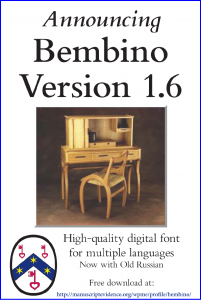
Poster announcing Bembino Version 1.6 (January 2019)

Information

  • Bembino
  • Multi-Lingual Bembino
  • Runes for Bembino
  • More Fonts for Bembino: Devanāgarī (Hindi) and Tibetan (High-Uchen Script)
  • Bembino WP for Word
  • Bembino: Handlist of Resources

Registration

  • Episode 23. Meet RGME Bembino: Registration
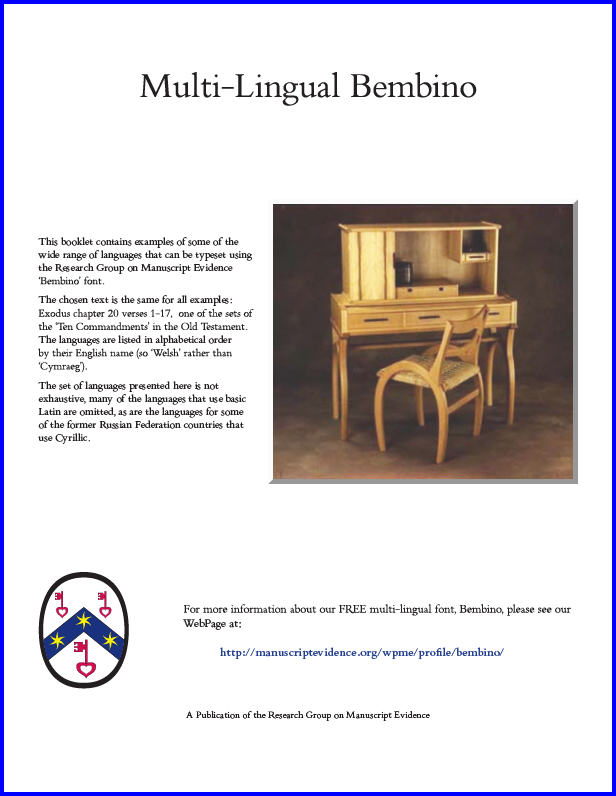
Cover page for 'Multi-Lingual Bembino' demonstrating specimens from a wide range of languages typeset in Bembino

Multi-Lingual Bembino Booklet Cover

Flyer

Downloadable as a 1-page pdf here:

  • Episode 23. RGME Bembino: Flyer

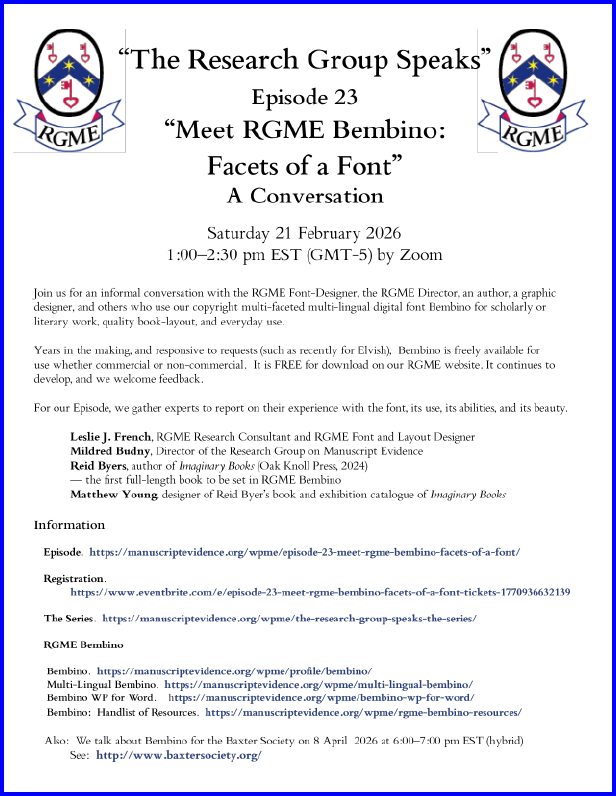
Episode 23. RGME Bembino: Poster, Set in RGME Bembino.

About the Font Bembino

  • Bembino (https://manuscriptevidence.org/wpme/bembino)
  • Multi-Lingual Bembino (https://manuscriptevidence.org/wpme/multi-lingual-bembino)
  • Bembino WP for Word (https://manuscriptevidence.org/wpme/bembino-wp-for-word/)
  • Bembino: Handlist of Resources (https://manuscriptevidence.org/wpme/rgme-bembino-resources/)

Permission for Use

Note that RGME Bembino is FREE.
The copyright for the Bembino font programs belongs to the RGME, which grants an automatic free license for use in typeset publications, including both scholarly and commercial material.

It Tracks

Keep track of the series as it unfolds:

  • “The Research Group Speaks”: The Series

We welcome suggestions and requests.

*****

Tags: Bembino WP for Word, digital fonts, Font Design, graphic design, History of Design, history of printing, Imaginary Books, Multi-Lingual Bembino, RGME Bembino, The Research Group Speaks
No Comments »

2025 International Congress on Medieval Studies: Report

August 24, 2025 in Abstracts of Conference Papers, Announcements, Business Meeting, Call for Papers, Conference, International Congress on Medieval Studies, Kalamazoo, Postal History at Kalamazoo, Societas Magica

RGME Activities
at the
2025 International Congress
on Medieval Studies:
Report

60th ICMS
Thursday through Saturday, 8–10 May 2025
(with Sessions variously
in Person, Online, or Hybrid)

[Posted on 20 August 2025]

Vista at the 2025 ICMS. Photograph by David W. Sorenson.

With the successful completion of our RGME activities at the 2025 International Congress on Medieval Studies, we offer a Report. For information about the Congress more generally:

  • About the Congress itself, see International Congress on Medieval Studies (ICMS).
  • About the 2025 Congress overall, see its website.

Building Blocks

The RGME activities at the 2025 Congress came into being in stages, according with the timetable for preparations for the annual ICMS from one year to the next.

1) First, as an Annual Congress takes place (for example, see our 2024 International Congress on Medieval Studies Report), we begin to confer about plans for the next year. We do so among ourselves and with current or potential co-sponsoring organizations who also make plans. At each Congress, our Open Business Meeting provides a gathering point to confer, share ideas, and spread the word to generate interest and find collaborators.

2) After designing the proposed sessions, we submit them by 30 May to the Congress Committee for approval, and then issue the Call for Papers, with the deadline of 15 September.

3) After the close of the CFP, selecting among the proposals received, we design the Program for each Session, with its Organizer or Co-Organizers, Presider, Speakers, and perhaps also a Respondent. In some years, as with 2025, our initial proposal can identify a subject for two sessions, Parts I and II.  In some years, as with 2025, the strength and number of responses to the Call for Papers can lead us to seek, in some cases, two sessions (Parts I and II) in place of the one which we had proposed.

4) When ready, the Programs for our Sessions — presenters, sequence of papers, response(s) if included — are sent to the Congress Committee by 15 October for review and approval. That is the time also for booking our Open Business Meeting at the Congress and, in some years, a Reception.

5) In due course, the program of the Congress in full is set into place, as the Committee determines its order to announce it. Thus we can learn the date-, time-, and room-assignments of our set of activities.

6) Our custom is to announce our activities for a given Congress on our website, in a HomePage of its own, like the one for the 2025 Congress. The HomePage serves as an information center, with updates as appropriate, such as when the Congress approaches and there might be changes such as in the room assignment or details of the program for a given session.

7) From the HomePage are launched the Abstracts for Papers, as the speakers might allow.  Note that the Abstracts are indexed, for convenience, in two ways:

  • By Year
  • By Author (Surname)

Venue at the 2025 ICMS. Photograph by David W. Sorenson.

8) On site, as the Congress takes place, our activities unfold in their sequence as listed in the Program or adapted through changes. For 2025, our activities comprised the sponsored and co-sponsored Sessions of Papers; and our Annual Open Business Meeting at the Congress.  The line-up by the time of the Congress:

  • 2025 International Congress on Medieval Studies.

All these events were successfully accomplished, with some adaptations within them as required. Hybrid sessions recorded by the Congress were available for viewing afterward by Congress registrants, for an assigned period.

9) Afterward, comparing notes and gathering photographs taken at the time, we produce the Report.

********************

Los Angeles, Getty Center, Ms. Ludwig XV 7 (83.MR.177), fol. 1. Scipio and Guillaume de Loris Lying in Their Beds Dreaming. Image Public domain, via Wikimedia Commons.

Building upon our successful activities at the 2024 ICMS (see our 2024 International Congress on Medieval Studies Report), we prepared for the 2025 ICMS. First we proposed a set of sessions, sponsored and co-sponsored. Then, when they had been accepted by the Congress Committee, we issued the Call for Papers (CFP) for our proposed Sessions. The strength and number of the responses by the due date (15 September 2024) led us to seek, in some cases, two sessions in place of the one which we had proposed.

With the Congress Program set into place or revised, we presented the Program of our activities, both sponsored and co-sponsored. We give thanks to our organizers, co-organizers, presenters, respondents, advisors, co-sponsors, participants, and audience both in-person and online, and to the Congress, its staff, and its co-ordination.

Read the rest of this entry →

Tags: Manuscript studies, Medieval Studies
No Comments »

2025 RGME Autumn Symposium on “Readers, Fakers, and Re-Creators of Books”

August 24, 2025 in Announcements, Conference, Conference Announcement, Event Registration, Manuscript Studies, Visits to Collections

2025
RGME Autumn Symposium

Part 2 of 2 in the 2025 Symposia on
“Agents and Agencies
in the Shaping
or Re-Shaping of Books”

“Readers, Fakers, and Re-Creators of Books:
From Page to Marketplace and Beyond”

Online Format
(Friday to Sunday 17–19 October)

[Posted on 20 August 2025, with updates]

Cambridge, Massachusetts, Harvard University, Houghton Library, MS Typ 947, recto. Image via https://iiif.lib.harvard.edu/manifests/view/drs:6517512$1i.

The RGME continues with its integrated pair of 2025 Spring and Autumn Symposia, as Parts 1 and 2 for the year. The 2025 Autumn Symposium in October takes shape as Part 2 of 2. For Part 1 of 2, which took place in March, see:

  • 2025 Spring Symposium on “Makers, Producers, and Collectors of Books”

For the predecessors in 2023 and 2024, see:

  • 2023 Spring and Autumn Symposia,
    with the year’s Theme of “Structures of Knowledge”
  • 2023 Pre-Symposium on “Intrepid Borders”
  • 2023 Spring Symposium “From the Ground Up”
  • 2023 Autumn Symposium “Between Earth and Sky”
  • 2024 Spring and Autumn Symposia”,
    with the year’s Theme of “Bridges”
  • 2024 Spring Symposium at Vassar College
  • 2024 Autumn Symposium

In 2025, they respond to our Theme for the Year:

  • “Thresholds and Communities”
  • Episode 19. “At the Gate”

Our Spring Symposium as Part 1 of 2 for 2025 took place successfully in online format in March.

  • 2025 Spring Symposium on “Makers, Producers, and Collectors of Books”

We thank our contributors, organizers, advisers, sponsors, and hosts.

British Library, Royal MS 14 E. v, vol. 1, fol. 3r. Image Public Domain via Wikimedia Commons.

The Interlinked Pair
of 2025 Symposia

Following the momentum of activities and enthusiasm in our 2024 Anniversary Year, the pair will draw upon the customary informal, but structured, approach of our events, symposia included.  These symposia will take place online or in partly hybrid format.

“Agents & Agencies” for 2025

As principal focus, our 2025 Symposia consider the myriad aspects and impact of agents and agencies (human and other) in the creation, dissemination, use, abuse, re-creation, safe-guarding, and enjoyment of books across time and place.

I. Spring Symposium (Part I of 2)

“Makers, Producers, and Collectors of Books:
From Author/Artist/Artisan to Library”

Friday to Sunday
28–30 March 2025 by Zoom

  • 2025 Spring Symposium on “Makers, Producers, and Collectors of Books”

This event explored the genesis and gestation of books, from first thoughts to processes of production leading to the finished product, and then to their owners and users.

For example, for the first stages, we could consider the author alone in his or her study, putting pen to page or thought to written word. Around him might, naturally, whether close at hand or in his memory or imagination, stand other books as examples or sources of inspiration, imitation, or perhaps plagarism.

The work of composing, copying, revising, and producing draft, fair, or final copies of the texts (with images where and as indicated) could be undertaken by more than one author, artist, and/or artisan. If so, would they work in tandem, sequence, or competition? Well, that might depend.

As the work progresses, there arrive further stages which create the issue or publication of the book, which then may enter the world in processes of dissemination, instruction, and incorporation within an individual or collective collection — or, it might be, from collection to collection, in one shape or another. The changed shapes could, of course, pertain to the book itself and/or the ownership.

British Library, Royal MS 14 E. 1, vol. 1, fol. 3r. Image Public Domain via Wikimedia Commons.

Note on the Image. Frontispiece/headpiece for the first volume of the Speculum Historiale (or Miroir historial) by Vincent of Beauvais (1184/1194 – c. 1264) in the Old French translation by Jean de Vignay (circa 1282/1285 – c. 1350). Bruges, circa c. 1478–1480, for Edward IV (1442–1483, king from 1461–1470 and again from 1471-1483). On this page, at the front of Vincent’s text, above its opening columns of script, the author sits as scribe in a book-furnished study, framed within an architectural arcade and set within an elaborate border containing the king’s arms below.

See more:

  • 2025 Spring Symposium on “Makers, Producers, and Collectors of Books”

*****

II. Autumn Symposium (Part 2 of 2)

“Readers, Fakers, and Re-Creators of Books:
From Page to Marketplace and Beyond”

Friday to Sunday, 17–19 October 2025
 Online by Zoom

In the Autumn Symposium, we follow up the explorations of the Spring Symposium as we turn to consider the ‘afterlives’ of books once they reach their audience, whether through the marketplace or other modes of presentation and distribution. Such conditions may acquire a life of their own, as readers, annotators, users, owners, thieves, despoilers, and others had or took a hand in shaping or reshaping their destinies — that is, of the books, those agents, and book history.

As examples, we may point to readers who would reshape the pages by placing their comments, revisions, scribbles, or sketches upon them. So, too, forgers as well as plagarists might appropriate others’ work as their own, say by reshaping its structure, grafting on other pieces, or extracting parts to re-assemble and redistribute in other forms for their own purposes. And then there are outright hoaxes, by which inventions purport to represent an activity or creation which exists only or principally by that newly implemented form.

Appropriation of others’ work might also occur, for example, as leaves or scraps of books were extracted, cut into further pieces, perhaps refolded, and reused as coverings or parts of bindings for other texts (manuscript or printed), or for other repurposed materials. Call it recycling for the sake of the materials themselves, put to different uses.

A different form of reuse concerns the fragmentation of books for the purpose of extracting leaves or part-leaves to serve as specimens of script, decoration, illustration, and/or graphic design. That approach forms the subject of our 2025 Autumn Colloquium on Fragments. See:

  • the 2025 RGME Autumn Colloquium on Fragments, taking place in November partly at Special Collections at Firestone Library at Princeton University.

Picking up the pieces of such fragmentation, that event is designed to showcase the legacy of such despoilers or ‘biblioclasts’ who dispersed the fragments of manuscripts and printed books far and wide and to celebrate the many initiatives to study and, in some measure, reconstruct the traces of that legacy. It considers such phenomena within the larger context of the ‘afterlives’ of books in many other forms as well.

The rôles of forgers, fakers, and frauds as agents in the production, re-creation, and distribution of books looms large in the history of books, perhaps from time immemorial. Our Symposium sets their activities or accomplishments into the context of “Agents and Agencies” as we examine the broad setting of books overall.

Speakers, Presiders, and Respondents

Participants who may speak, preside, or respond include (in alphabetical order):

Mildred Budny
Reid Byers
Meghan Constantinou
Jamie Cumby
Hannah Goeselt
Justin Hastings
Eve Kahn
Jennifer Larson
Steven Lomazow
Jack Lynch
Irene Malfatto
Beppy Landrum Owen
Anna Siebach–Larsen
David W. Sorenson
Janie Wright
N. Kıvılcım Yavuz

And others.

Program Overview (online by Zoom)

Day 1. Friday 17 October at  1:30 – 5:00 pm EDT (GMT -4)

Day 2. Saturday 18 October at 9:30 am – 5:00 pm EDT (GMT -4)

Day 3. Sunday 19 October at 10:30am – 12:00am EDT (GMT -4)

Program of Sessions

  • 2025 Autumn Symposium on 17–19 October: Program

Poster

The 2025 Autumn Symposium Poster is available for download. You are welcome to copies to circulate, keep as souvenirs, and show your friends.

  • 2025 RGME Autumn Symposium Poster

Symposium Booklet

We publish the 40-page illustrated Symposium Booklet, available in two formats for printing.

  • Consecutive pages (8 1/2″ × 11″)
  • Foldable booklet (11″ × 17″ sheets)

We give thanks to the contributors, photographers, collectors, advisors, editor, layout designer, and others who created the collective booklet.

British Library, Royal MS 14 E. v, vol. 1, fol. 3r. Image Public Domain via Wikimedia Commons.

Thanks

We give thanks to the speakers, respondents, advisers, back-up support, and participants for contributing to the symposium and its 2025 series of Spring and Autumn Symposia.

*****

Registration

  • https://www.eventbrite.com/e/2025-rgme-autumn-symposium-tickets-1236732924469

Registration is free. We encourage you to Pay What You Can by the option for Registration with a Voluntary Donation.

This year, the RGME has undergone setbacks with grants and funding, so that we ask your help. Any amount will give encouragement and contribute to recovering momentum. We thank you for your support.

Donations, which may be tax-deductible, help us to continue with our activities and sustain our mission for an organization principally powered by volunteers.

  • 2025 Annual Appeal
  • Donations and Contributions

Please note that, after registration, the Zoom link will be sent as an email from the RGME a few days before the event. For security reasons, we do not distribute tickets or links through Eventbrite or Zoom.

To register for other RGME events, please visit the RGME Registration Collection.

  • RGME Events

For our activities planned for 2025, see:

  • 2024 Activities and 2025 Planned Activities

*****

Questions? Suggestions?

  • Leave your comments or questions below
  • Contact Us

How to Join our Community

Visit our Social Media:

  • our FaceBook Page
  • our Facebook Group
  • our X/Twitter Feed (@rgme_mss)
  • our Bluesky nest @rgmesocial.bluesky.social)
  • our Instagram Page
  • our LinkedIn Group

Join the Friends of the RGME.

Please make a Donation in Funds or in Kind for our nonprofit educational corporation powered principally by volunteers. Your donations and contributions are welcome, and can go a long way. They may be tax-deductible to the fullest extent provided by the law.

  • Donations and Contributions
  • 2025 Annual Appeal

*****

Cambridge, Massachusetts, Harvard University, Houghton Library, MS Typ 947, ‘verso’. Images via https://iiif.lib.harvard.edu/manifests/view/drs:6517512$1i.

Tags: Fakers and Forgers, History of Manuscripts, Manuscript Readers, Manuscript studies, Recreators of Manuscripts, RGME Symposia
No Comments »

Episode 22: “Encounters with Local Saints and Their Cults”

August 20, 2025 in Announcements, Event Registration, Manuscript Studies, Research Group Episodes for The Research Group Speaks, Research Group Speaks (The Series)

“The Research Group Speaks”
Episode 22

“Encounters with
Local Saints and Their Cults:
Traces in
Prose, Poetry, and Relics”

Saturday 13 December 2025
1:00–2:30 pm EST (GMT-5) by Zoom

[Posted on 20 August 2025, with updates]

For the series wherein “The Research Group Speaks,” we respond to suggestions and requests as the series unfolds. For information, please see:

  • “The Research Group Speaks”: The Series

For Episode 22 we turn to reports by several scholars working in different areas and language-groups upon a similar subject of perennial interest in religious, historical, and devotional identities. Presentations will be accompanied by responses, followed by opportunities for feedback and discussion.

This Episode considers the characteristics of veneration of local saints, as manifested in the surviving evidence, especially in manuscripts. Among the materials are vitae, hymns and liturgical practices for saints’ feast days. The nature of the subject, as well as research work and discoveries in a variety of fields, shows that this episode offers scope for follow-up in one or more episodes in our series.

Speakers and Respondents

  • Guesh Solomon Teklu (Hiob Ludolf Centre for Ethiopian & Eritrean Studies, University of Hamburg)
  • Augustine Dickinson (University of Münster)
  • Mersha Alehegne Mengistie (Addis Ababa University; University of Hamburg)
  • Antony R. Henk (Ruhr-University Bochum)

Presider

  • Renate Blumenfeld–Kosinski (Renate Blumenfeld–Kosinski)

Outline

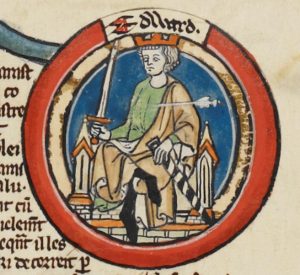
London, British Library, MS Royal 14 B VI, detail. King Edward Martyr, Image Public Domain via Wikimedia Commons via https://upload.wikimedia.org/wikipedia/commons/e/e3/Edward_the_Martyr_-_MS_Royal_14_B_VI.jpg.

This episode aims to consider the challenges and opportunities when encountering and studying local saints, those whose renown and veneration might not have reached a wide audience or enjoyed a persistent duration. Nonetheless, their stories and the individuals or communities who both followed and cultivated their appeal can reach across time and place to show how the habits of pious practices and the methodologies for discovering materials and contexts in modern study might be shared in widely different cultures, languages, and periods.

Looking at case studies from complete vitae, where the saint’s biography is given in full but only circulated locally, and progressing to hymns and paracontent, where only names and scattered biographic hints survive, the speakers and respondents will reflect on the methodological challenges posed in each instance and strategies for engaging with them.

Among the subjects will be Ethiopic vitae and hymns and Western Medieval liturgical Kalendars (such as in Books of Hours in Latin and/or vernaculars). Evidence includes manuscripts, printed sources, and textiles.

Program

1. Presentations

Guesh Solomon Teklu
(Hiob Ludolf Centre for Ethiopian & Eritrean Studies, University of Hamburg)

“The Gadla ʾAbbā Tansʾa Wald of Dabra Gʷǝlgizā and His Disciple Monks:
Thematic Aspects of Salāmtā Poetic Texts”

The Dabra Gʷǝlgizā (also known as Ǧǝwamāra) monastic tradition, founded by ʾAbbā Tansʾa Wald, represents a significant network of local and Egyptian saints and monasteries centered in Qollā Tamben, ʿĀdet, and Ṣallamṭi areas in Tigray, Ethiopia. The Gadla ʾAḫbǝro (literally ‘Combined vitae’) is a hagiographic compilation that chronicles the lives of ʾAbbā Tansʾa Wald and his disciple monks. The text mainly narrates the life of ʾAbbā Tansʾa Wald’s and the deputy abbot of ʾAbbā Maʿāza Dǝngǝl. The other fellow monks, ʾAbbā Tādewos of Dabra Maṣḥet ʿAbizāqa, ʾAbbā Tansʾa Krǝstos of Dabra Gannat, ʾAbbā Giyorgis of Kāwe, ʾAbbā Tomās of Ṣallay, ʾAbbā Zarʿā Bǝruk of ʾƎkkǝma, and ʾAbbā Fiqiṭor of Qaṣabā are mentioned several times throughout the hagiography. These monks lived and served together at Dabra Gʷǝlgizā in Qollā Tamben during the thirteenth to fourteenth centuries, according Gadla ʾAḫbǝro manuscripts.

This communal monastic life is extensively documented throughout the Gadla ʾAḫbǝro codices and the individual hagiographic texts of each saint. Following the death of the abbot, ʾAbbā Tansʾa Wald, his disciples established their own monastic churches, creating an interconnected network of religious foundations. The exception was ʾAbbā Maʿāza Dǝngǝl, who succeeded him as abbot at Dabra Gʷǝlgizā. Some remained in Qollā Tamben itself (ʾAbbā ʾAbbā Tomās, and ʾAbbā Zarʿā Bǝruk), while others founded monasteries in adjacent districts surrounding the Tekeze River, including ʿĀdet (ʾAbbā Giyorgis and ʾAbbā Fiqitor) and the Ṣallamṭi areas (ʾAbbā Tādewos and ʾAbbā Tansʾa Krǝstos). This presentation examines the religious, political, and environmental themes addressed in three hagiographies from this networked monastic tradition: the Gadla ʾAḫbǝro, the Gadla ʾAbbā Tādewos, and the Gadla ʾAbbā Tansʾa Krǝstos. Special emphasis is given to the thematic aspects of the salāmtā (ʾarke) poetic texts across these hagiographies.

Augustine Dickinson
(University of Münster)

“Identifying Ethiopic Hymns for Local Saints in Anthology Manuscripts”

When working with manuscript anthologies or collections of malkǝʾ-hymns, it is most often the case that the saints whose hymns are included are well-known and easily identified, whether they are saints known across Christian traditions or saints proper to the Ethiopian/Eritrean context. This paper will present case studies where the subject of a hymn is not so easily identified, always monastic saints commemorated only by a single monastery or within a relatively small network. Each case study will highlight strategies for finding clues leading to identifications (whether tentative or confident) of their respective subjects and contribute to broader remarks on this phenomenon in the field of Ethiopic hymnography.

2. Responses

Mersha Alehegne Mengistie
(Associate Professor, Department of Linguistics and Philology, Addis Ababa University)

“Experiences with and Discoveries for Local Hagiography in Ethiopia
and Their Implications for Publication”

Mersha will describe experiences with and discoveries for local hagiography in Ethiopia broadly and their implications for publication.

Antony R. Henk
(Ruhr-University Bochum)

“Inventing Peter the Deacon as Saint in Early England:
Mistaken Identity or Made up Entirely?”

Medieval English relic lists offer tantalizing clues to the presence of many now-obscure saints. One striking example is the presence of a later annotation in the late eleventh-century Exeter relic list in British Library, Royal MS 6 B VII, which explains that the relics of saint ‘Petri diaconi’ (Peter the Deacon) in that particular version of the list are, in fact, the relics of the ‘discipuli gregorii papae’ — the student of pope Gregory the Great, not the fourth-century Antiochene martyr by the same name commonly venerated in early England.

The English church’s deep affection for Gregory the Great is well understood, and his relics and feasts are widely attested in the English manuscript corpus. However, little evidence suggests that his companion and interlocutor in the Dialogi ever achieved lasting cult status in England, aside from a single embroidered depiction of a nimbed Peter on the early tenth-century maniple found with the body of Saint Cuthbert, still today an object of adoration at Durham Cathedral. In this short response, I ask a fateful question: Did the English Church try to ‘invent’ a Cult of Peter the Deacon, and what could the evidence here tell us about cases of seemingly mistaken sanctoral identity?

Note: For an image and bibliography about the textile image of Peter the Deacon as saint in the maniple among the Cuthbert embroideries see this site.

Antony Henk’s Handout:

  • Peter the Deacon: Episodes

3. Q&A

There follows the opportunity for questions, comments, and discussion. We welcome your observations.

Manuscript still in situ. Fols. 14v-15r. The beginning of Malkəʾa Marqorewos (Image of Marqorewos), a local saint of the monastery Ṣaʿadā ʾƎmbā ʾƎndā ʾAbuna Marʿāwe Krǝstos, within an anthology (malkǝʾa gubāʾe) manuscript. Photograph by Michael Gervers. Image via https://malkeagubae.com/manuscripts/MK049/#unit1item3.

Registration

Within the RGME Eventbrite Collection:

  • Episode 22. “Encounters with Local Saints and their Cults” Registration

Registration is free. We encourage you to Pay What You Can with the option for a Voluntary Donation. This year, the RGME has undergone setbacks with grants and funding, so that we ask your help. Any amount will give encouragement and contribute to recovering momentum. We thank you for your support.

Trier, Stadtbibliothek, MS. 171/1626: “Gregory Leaf”. Behind a curtain, Peter the Deacon witnesses Gregory the Great at work inspired by the Holy Spirit in the form of a dove. Master of the Registrum Gregorii, Image Public domain, via Wikimedia Commons.

Donations, which may be tax-deductible, help us to continue with our activities and sustain our mission for an organization principally powered by volunteers.

  • 2025 Annual Appeal
  • Donations and Contributions

Please note:

  • After your registration, the RGME will send you the Zoom Link as an email directly a few days before the event
  •  For security reasons, we do not distribute tickets or links through Eventbrite or Zoom.

If you have questions or problems with registering, or accessing the link,

  • Contact the RGME, not Eventbrite or Zoom,
    via rgmesocial@gmail.com

We use these measures to protect the security of our events.

Thank you for your interest in this event.

*****

Next Episode

Bembino Swash Motif

For our next Episode, see

  • Episode 23. Meet RGME Bembino: Facets of a Font
    Saturday 21 February 2026 at 1:00-2:30 pm EST (GMT-5) by Zoom

Registration

  • Episode 23. Meet RGME Bembino: Registration

*****

Questions? Suggestions?

  • Leave your comments or questions below
  • Contact Us

Visit our Social Media:

  • our FaceBook Page (https://www.facebook.com/people/Research-Group-on-Manuscript-Evidence/100064718795029/)
  • our Facebook Group (https://www.facebook.com/groups/rgmemss/)
  • our X/Twitter Feed (@rgme_mss)
  • our Bluesky nest @rgmesocial.bluesky.social)
  • our Instagram Page
  • our LinkedIn Group

Join the Friends of the RGME.

Please make a Donation in Funds or in Kind for our nonprofit educational corporation powered principally by volunteers. Your donations and contributions are welcome, and can go a long way. They may be tax-deductible to the fullest extent provided by the law.

  • Donations and Contributions
  • 2026 Annual Appeal

*****

Tags: History of Religion, Hymns and Hymnody, Liturgical Kalendars, Local Saints, Manuscript studies, Saints' Cults
2 Comments »

2026 IMC at Leeds: Call for Papers

August 13, 2025 in Announcements, Call for Papers, Conference, Conference Announcement, International Medieval Congress, Manuscript Studies

Call for Papers

Sessions Sponsored
by the Research Group on Manuscript Evidence

at the 2026 International Medieval Congress
(In person or Hybrid)
6–9 July 2026

“Manuscripts at Play and as Play:
Temporalities and (Re)Configurations
as Reading Methods”

Organisers:
Michael Allman Conrad
and Mildred Budny

Name of the Game

For 2026 the RGME proposes to explore the nature of play in manuscripts across time and place.  We think of manuscripts at play, as play, and in play.

With the success of our activities at the International Medieval Congress (IMC) at Leeds in 2024 and 2025, we prepare for another year responding to the “Special Thematic Strand” selected for the 2026 IMC. Thus, we announce our Call for Papers here and now.

For information about the IMC and its plans for 2026, see:

  • International Medieval Congress at Leeds
  • Call for Papers for the 2026 IMC, with the Special Thematic Strand of “Temporalities”.
  • IMC 2026 Padlet, with poster-like announcements of Calls for Papers

Locating Manuscripts in Their (Mobile) Temporalities

For the 2026 IMC and its Special Theme, we will consider manuscripts in terms of the essence of their ‘temporalities’ (also see Temporalities) — that is, in a nutshell, “the state of existing within or having some relationship with time”, which pertains intrinsically to any physical object, just like its “spatial position”. That essence or condition, combining location with points in time, forms both centerpiece and focus-point going forward in our continuing studies of Manuscript Evidence.

Building upon the success of our activities at the annual IMC in 2024 and 2025, we propose to extend the subject of one of our Sessions at the 2025 Congress:

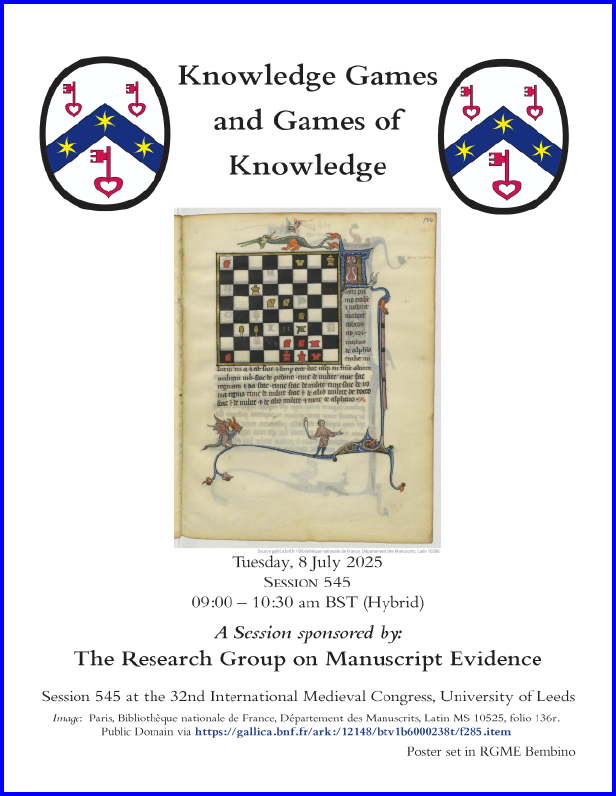
  • “Knowledge Games and Games of Knowledge”, organised by Michael Allman Conrad (see RGME @ 2025 IMC: Program)

2025 Leeds: “Knowledge Games and Games of Knowledge” Poster 1. Set in RGME Bembino.

Next, we seek to examine games and playful approaches of multiple kinds with regard to manuscripts. The opportunities across time range from the creation of a book to its use in the world. We observe, for example, habits of entering scribbles and sketches as spontaneous or imaginative playtime on the one hand to creating and transmitting texts about games or gaming strategies.

Aims

By their nature, whether text or image, the planarity of manuscript surfaces offers invitations for readers to engage with them playfully. This play entails a process of temporalisation, of setting manuscript elements into motion, resulting in configurations and re-configurations that are keys for deciphering hidden — or less apparent — meanings. While carmina figurata or picture poems may range among the most obvious examples, they are by no means limited to them. Such elements can include scribbles and sketches, diagrams (including game diagrams specifically), material extensions (such as volvelles and other pop-up features), acrostics, and other puzzles. We consider the performativity and dynamics at work, or play, on the pages.

We invite contributions on a wide range of materials and genres and from a variety of perspectives and any discipline, to consider case-studies, work-in-progress, or research results celebrating the roles of play in which manuscripts engage, and which they might inspire in us as readers, scholars, and beholders. Want to play? Are you game?

Papers might address, but are not limited to the following questions:

  • Are there any contemporary reflections on time and motion as keys for interpreting the playful elements of manuscripts, e.g., acrostics, scientific diagrams, or game diagrams (or others)? What can they tell us about the relationship of readers/spectators with time and across time?
  • As they are artworks and semantic devices at the same time, what may playful components tell us about how the similarities as well as differences between art and writing/reading were perceived at points of creation and use?
  • How did readers know how to decipher these playful elements? What part may contemporary game culture take in this understanding? What could the presence of playful elements in manuscripts indicate about the position of play and games within the broader scope of their culture?
  • What are possible reasons why scribes decided to include these elements exactly at this position within a manuscript? What strategies (be it either aesthetic, religious, cultural, or otherwise) may their application serve?
  • How does a preference for a playful element, its style and form, possibly tie into idiosyncrasies of the period?
  • What relationship between what can or cannot be known is expressed in the interplay between the visually hidden and virtually absent?

Proposals, Please

Please submit a title, an abstract of no more than 200 words, and a short bio by 15 September 2025 to

  • rgme.imc.sessions@gmail.com

We particularly welcome proposals for individual papers and panels from postgraduate and early career scholars. We look forward to your responses.

Images

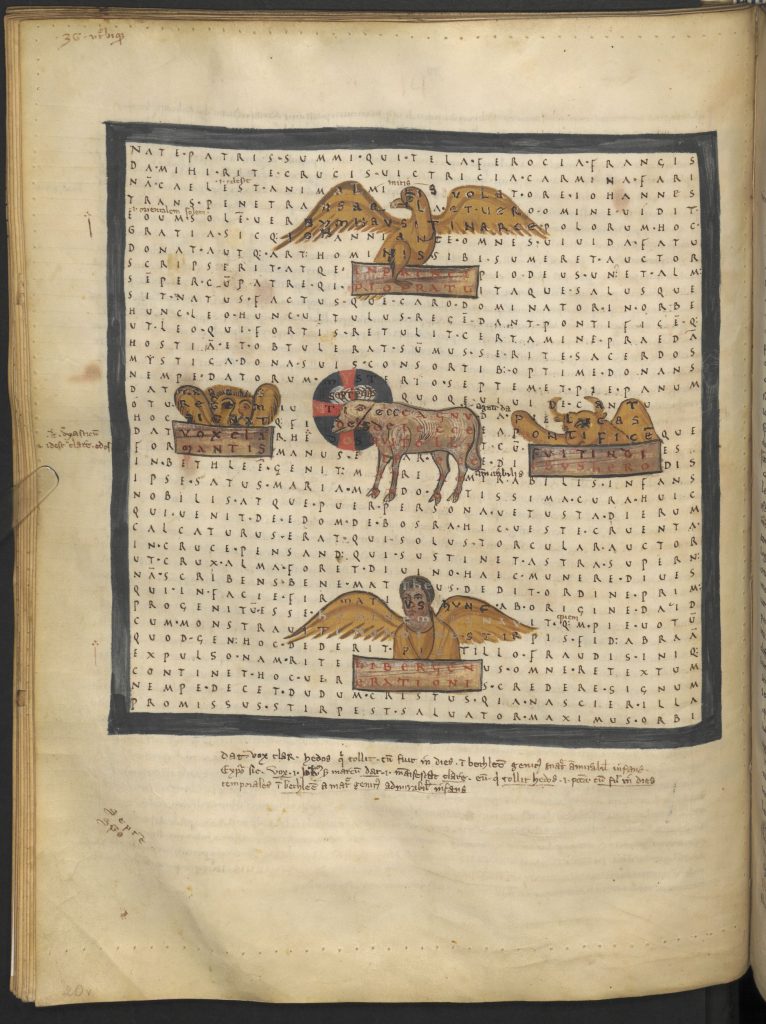
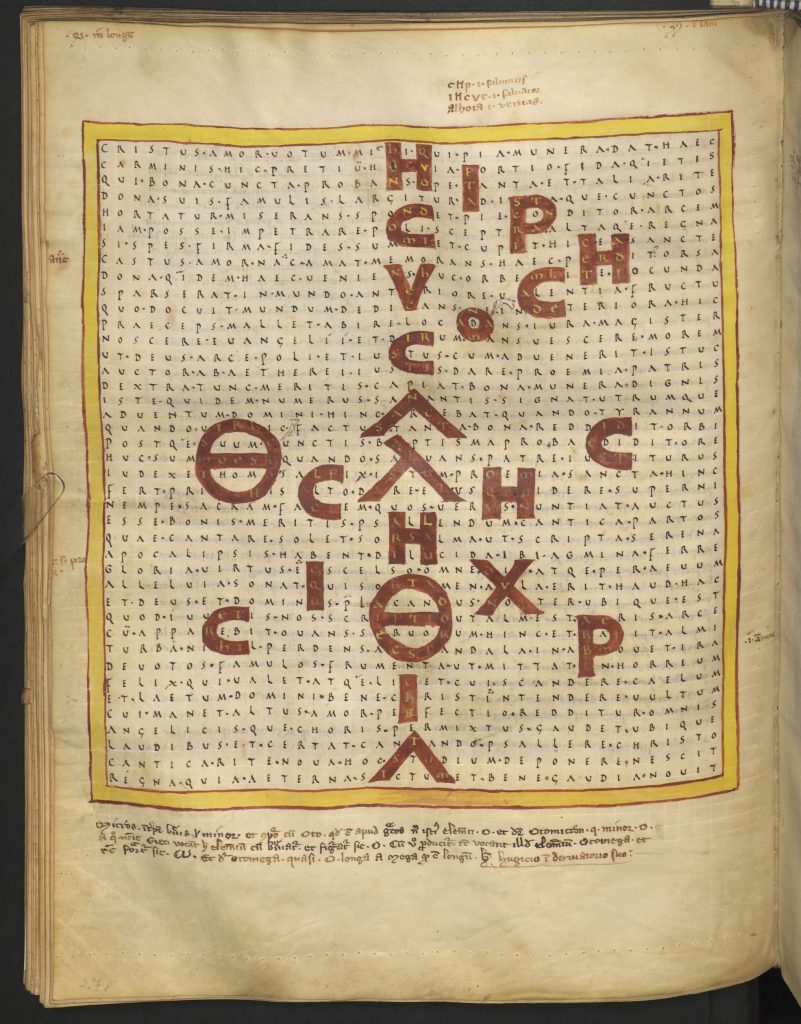
Examples of dynamic constructions involving word-play upon the page include the elaborate, intricate, and beautiful picture-poems favoured among some authors, not least at in the early medieval period. We display specimens by the Carolingian author Hrabanus (or Rabanus) Maurus Magnentius (circa 780 – 856), Archbishop of Mainz (from 847). His poem De laudibus sanctae crucis (“In Praise of the Holy Cross”), which survives in multiple copies, contains a series of poems laid out as rectangular constructions in which each line contains the same number of letters as any other.

Their patterns make it possible to lay out the letters not only in horizontal lines but also in vertical rows, strictly in line with each other. Moreover, it is possible to read key portions vertically as well as horizontally. Reading vertically in a line using the initial, medial, or final letter of each line yields an acrostic, mesostic, or telestic. Such forms of cross-word puzzles can produce wonders of legibility, requiring the attention in steps of time to gain comprehension of the message as a whole. Adding images to the ensemble increases the layering of meanings, and the possibilities of wonderment through resonance.

Vienna, Österreichische Nationalbibliothek, Cod. 652, fol. 20v (scan 50 of 109). Hrabanus Maurus, De laude sanctae crucibus. Mainz or Fulda, 9th century (circa 830-840). Carmen figuratum with four Evangelist symbols surrounding the Lamb of God. Image via https://viewer.onb.ac.at/10048D05/.

Vienna, Österreichische Nationalbibliothek, Cod. 652, fol.
Image https://viewer.onb.ac.at/10048D05/.

Questions or Suggestions?

  • Leave your comments or questions below
  • Contact Us
  • Sign up for our Newsletter and information about our activities.
    Send a note to director@manuscriptevidence.org or RGMEevents@gmail.com

Visit our Social Media:

  • our FaceBook Page
  • our Facebook Group
  • our Twitter Feed (@rgme_mss)
  • our Bluesky nest @rgmesocial.bluesky.social)
  • our LinkedIn Group

Join the Friends of the RGME.

Register for our Events by the RGME Eventbrite Collection.

Attend our next Events if your timetable allows.

Consider making a Donation in Funds or in Kind for our nonprofit educational corporation powered principally by volunteers. Your donations and contributions are welcome, and can go a long way. They may be tax-deductible to the fullest extent provided by the law.

  • Donations and Contributions
  • 2025 Annual Appeal

We look forward to hearing from you and welcoming you to our events.

*****


Tags: Acrostics, Call for Papers, Carmina Figurata, De laudibus sanctae crucis, Diagrams, History of Games, Hrabanus Maurus, International Medieval Congress, Manuscript studies, Manuscripts and Temporalities, Manuscripts as Play, Manuscripts at Play, Medieval manuscripts, Picture Poems, Scribbles and Sketches
No Comments »

Fragments from a Book of Hours

July 27, 2025 in Manuscript Studies, Photographic Exhibition, Research Group Workshops, Workshops on "The Evidence of Manuscripts"

Detective Story
“Fragments from a Book of Hours
Looking for their Identity”

[Posted on 25 July 2025]

Would you help us identify these fragments of a single leaf from a Book of Hours in a Private Collection? As if by the skin of their teeth, they survive together in a single collection. That collection has no other fragments from the same manuscript.

We wonder about these ‘foundlings’ and their former home in the medieval manuscript which contained them and their ‘relatives’ comprising the other leaves and the rest of this one leaf. Would you like to join the quest to find their identity?

Original Recto

Private Collection, Fragmentary Leaf from a Book of Hours. Recto, with two pieces aligned in their former original position. Photograph by Mildred Budny.

Original Verso

Private Collection, Fragmentary Leaf from a Book of Hours. Verso, with two pieces aligned in their former original position. Photograph by Mildred Budny.

Do you recognize their style, script, layout, and original manuscript? When and where do you think that it was made, and do you know, perchance, when and where it was dismembered for distribution?

We turn to the wider world to crowd-source the answers.

What do you think?

We plan to showcase these fragments and others looking for their identities in the series of

  • RGME Workshops on “The Evidence of Manuscripts, Etc.”

Please join us for the joys of detective work and sharing discoveries.

We look forward to hearing from you.

Private Collection, Fragmentary Leaf from a Book of Hours. Recto bottom, with two pieces aligned in their former original position. Photograph by Mildred Budny.

*****


Tags: Books of Hours, Fragmentology, Manuscript Foundlings, manuscript fragments, Medieval manuscripts
No Comments »

2026 International Congress on Medieval Studies: Call for Papers

July 2, 2025 in Announcements, Bāḥra ḥassāb: Knowledge Transmission in Ethiopia and Eritrea From Antiquity to Modern Times, Call for Papers, International Congress on Medieval Studies, Kalamazoo, Koller-Collins Center for English Studies, POMONA, Postal History at Kalamazoo, Princeton Bibliophiles and Book-Collectors, Rossell Hope Robbins Library at the University of Waterloo, Societas Magica

Call for Papers

Sessions Co-Sponsored by the RGME
at the
61st International Congress on Medieval Studies
May 14–16, 2026

(Sessions variously online, in-person, and hybrid)

Proposals due by 15 September 2025

[Posted on 1 July 2025, with updates]

Sounding the Call

View from Fetzer Lounge at the 2017 Congress. Photography © Mildred Budny.

View from Fetzer Lounge at the 2017 Congress. Photography © Mildred Budny.

We announce the Call for Papers for the Sessions (Panels of Papers) co-sponsored by the Research Group on Manuscript Evidence at the 2026 International Congress on Medieval Studies (ICMS). We describe the sessions one by one below, with direct links for you to submit proposals for each of our sessions.

The general Call for Papers appears on the Congress website.

  • Call for Papers

To find our Sessions there, search under Sponsoring Organization

  • Sponsor List

Search for the RGME (or our Co-Sponsor for the given session). In the Sponsors’ list, you will find our sessions as a group:

  • Sponsor: Research Group on Manuscript Evidence

Please submit your proposals for papers through the Congress Confex system through its Call for Papers, as described there. The deadline is 15 September 2025.

The participation by the RGME at the Annual ICMS over the years is chronicled in our blog.

Read the rest of this entry →

Tags: Bāḥra ḥassāb at the University of Hamburg, Divination, Grimoires, History of Alchemy, History of Magic, International Congress on Medieval Studies, Material Culture, Medieval Studies, Medieval Writing Materials, Pedagogy, Postal History, Rossell Hope Robbins Library, Solomonic Magic
No Comments »

2025 RGME Autumn Colloquium on Fragments

June 27, 2025 in Announcements, Koller-Collins Center for English Studies, Manuscript Studies, Princeton Bibliophiles & Collectors, Rossell Hope Robbins Library at the University of Rochester, Visits to Collections

2025 RGME Autumn Colloquium
on Fragments

“Break-Up Books
and Make-Up Books:

Encountering and Reconstructing
the Legacy of Otto F. Ege
and Other Biblioclasts
“

Friday to Sunday 21–23 November 2025
Hybrid and partly Online
Hybrid: In Person at Princeton and Online (Friday and Saturday)
Online: Zoom (Sunday)

*****

Colloquium Sponsors, Co-Sponsors, and Affiliates

Research Group on Manuscript Evidence

Princeton University Special Collections
The Friends of the Princeton University Library
Student Friends of the Princeton University Library
Princeton Bibliophiles & Collectors
Department of Art & Archaeology, Princeton University

Rossell Hope Robbins Library
and Koller-Collins Center for English Studies
at the University of Rochester

Bibliographical Society of America

Celia M. Chazelle
Barbara Hanselman
Barbara A. Shailor

[Your Name Here]

*****

[First posted on 5 January 2025, with updates. Now revised on 20 June 2025, 20 August 2025, 5 September 2025, and 29 October 2025, with changes in plan, co-sponsorship, host, and venues.]

Venue: In-Person, Hybrid, and Online

After an imposed change in venue from our initial plans, the Colloquium goes forward in online format, as planned from the beginning, with an in-person/hybrid component.  Its dates remain the same, from Friday to Sunday 21–23 November. The changes allow us to turn to a new host, for which we give thanks. For the earlier version, see

  • https://manuscriptevidence.org/wpme/2025-rgme-autumn-colloquium-at-the-university-of-waterloo/.

Online sessions will take place on Friday to Sunday. Sessions and Workshops will be hybrid on Friday and Saturday, with venues in different locations at Princeton University and nearby.

On Friday afternoon, our Associate Eric White, Curator of Rare Books, will hold a special set of Workshops on Fragments at Princeton in Special Collections at Firestone Library of the Princeton University Library. These workshops and reports on original materials return to a tradition of the RGME with Symposia and other events at Princeton University, before the Covid Pandemic. For example:

  • 2014 Seminar on Manuscripts and Their Photographs
  • 2019 Anniversary Symposium Program
  • 2020 Spring Symposium: Save the Date

For the 2025 Colloquium, searching for an appropriate location for other parts of the Colloquium beside the Workshops at Special Collections on the Friday afternoon, we explored collaboration with colleagues and organizations for other venues in Princeton to enable a Friday morning session and the Saturday sessions, all in hybrid format. Step by step, with assistance from the Friends of the Princeton University Library and the Department of Art & Archaeology, which had co-sponsored many of our Symposia before the Covid Pandemic. We give thanks for the generous responses to foster the plan for a ‘home’ for this Colloquium.

In such a way, people who travel to Princeton for the Friday workshops and related celebrations might also participate in other in-person sessions on both Friday and Saturday, leaving one session on Sunday to take place in online format only. With this news, some participants and attendees prepared to come to Princeton for the event IN PERSON.

With help of many kinds, we are able to report a collaborative event worthy of the initial plan to which many participants responded so enthusiastically (albeit for a different host which changed its mind). Reviving and transforming the plan has, we hope, been worthy of the complex, multi-faceted subject of fragments which reaches widely into very many aspects of manuscript and related studies, the history of collecting, and the recovery and transmission of written sources from the past. For this collaboration, we give thanks.

Read the rest of this entry →

Tags: Biblioclasts, Biblioclasts' Portfolios, Early modern printing, Fragmentology, History of Music, history of printing, manuscript fragments, Manuscript Fragments Reused in Bindings, Manuscript studies, Medieval manuscripts, Medieval Music Manuscripts, Otto F. Ege, Scrapbooks and Albums
No Comments »

A Leaf for Saint Stephen Protomartyr at Princeton from Otto Ege’s ‘Warburg Missal’

June 23, 2025 in Manuscript Studies, Reports

A Leaf at Princeton
from Otto Ege’s “Warburg Missal”
(Ege Manuscript 22)

Princeton University Library, MS 138.71

Latin Missal made in Germany circa 1325
Written in Gothic Script (Textualis)

Folio Number XVII
Within the Feast of Saint Stephen Protomartyr
(26 December)

Double columns of 31 lines
Circa 358 × 262 mm
< written area of rulings circa 258 × 196 mm>

with Rubrications,
Inset Initials in Red or Blue,
Corrections,
and Musical Notation
in Hufnagelschrift (“Horseshoe-Nail Notes”)
on 4-Line Staves

[Begun on 25 October 2023, posted on 20 June 2025]

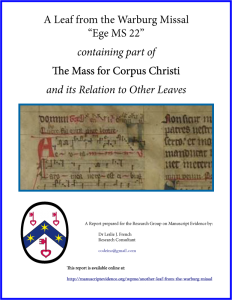
Front Cover for Report by Leslie J. French for Wagner Leaf from Ege MS 22 (2021)

Front Cover for Report by Leslie J. French for Wagner Leaf from Ege MS 22 (2021)

A chance discovery (new to us) of a leaf in Princeton from one of the manuscripts dispersed by Otto F. Ege (1888–1951) leads us to report its presence in the context of our continuing work on the manuscript in question. It is “Ege Manuscript 22″, a Latin Missal written in double columns of 30–32 lines in Gothic Script, with musical notation in Hufnagelschrift (“Horseshoe-Nail Notes”) on 4-Line Staves.

The ‘Ege Number’ used in scholarly discourse designates the number assigned to the manuscript in the standard Handlist of Otto Ege’s known manuscripts, compiled by Scott Gwara (2017), with updates in progress.

  • Scott Gwara, Otto Ege’s Manuscripts: A Study of Ege’s Manuscript Collections, Portfolios, and Retail Trade with a Comprehensive Handlist of Manuscripts Collected or Sold (Cayce, South Carolina: De Brailes Publishing, 2017) , Appendix X, with Number 22 at pp. 125.

This manuscript is also known by its putative place of origin or use. Otto Ege called it the Missale Herbipoliense (“Würzburg Missal”). We consider it to be “The Warburg Missal”. See our Research Booklet, setting out reasons grounded in a close study so far of the textual affiliations between an available sample of surviving leaves from Ege’s manuscript and related Missals or other books preserved in manuscript witnesses or printed editions.

  • A Leaf from the Warburg Missal (“Ege MS 22”) containing part of The Mass for Corpus Christi and its Relation to Other Leaves: An RGME Research Report

The Princeton University Library catalogue files the leaf under the former (as Missale Herbipoliense). It turns up in a search for “Ege, Otto”, whose name is mentioned in the entry only as “Author”. It would take someone familiar with the context of Ege’s interventions for multiple manuscripts to recognize, off hand, which manuscript is this one in the scope of his “oeuvre” as an Author-Compiler, and how its patterns of dispersal by Ege illuminate some features which the leaf itself carries in witness, after detectable rearrangements have taken place in stages of transmission from Ege’s hands to Special Collections in the basement of Firestone Library at Princeton University.

When I was examining Ege materials at Princeton University several years ago, whilst on the quest for some other Ege manuscripts, I was unaware of this Ege leaf. It had not yet reached the collection, for which it was acquired in 2017.

At the time, while examining some biblical and other fragments in Ege’s portfolios at Princeton as well as elsewhere, I would not have known that my later work elsewhere would lead me to familiarity with parts of this “Ege Manuscript 22” / “The Warburg Missal”. Those next steps would go hand-in-hand with increased understanding (in my own and others’ research) of the nature of its place in the work of Otto Ege as collector, destroyer, and disperser of medieval manuscripts and other materials in the history of the book.

Such work leads to the plans for an RGME event exploring the nature of that legacy and its context. See:

  • 2025 RGME Autumn Colloquium
    “Break-Up Books and Make-Up Books:
    Encountering and Reconstituting the Legacy of Otto F. Ege and Other Biblioclasts”
    .
    Friday to Sunday 21–23 November, partly hybrid and partly online

Read the rest of this entry →

Tags: Missale Herbipoliense, Missale Romanum, Otto Ege Manuscript 22, Princeton University Library, Saint Stephen Protomartyr, Warburg Missal, Würzburg Missal
No Comments »

A “Beatus Manuscripts” Project

May 10, 2025 in International Congress on Medieval Studies, Kalamazoo, Manuscript Studies

“The Methodology of Credulity:
Assessing the Manuscript Witnesses
to Beatus of Líebana, On the Apocalypse“

Reflections on
A Project Proposal

[Posted on 9 May 2025, with updates]

In honor of the session sponsored by the RGME at the 2025 International Congress on Medieval Studies and proposed and co-organized by our Associate Vajra Regan, I reflect with hindsight on the proposal years ago for a collaborative research project about the surviving “Manuscript Witnesses” to the influential medieval Latin Commentary on the Apocalypse by Beatus of Líebana (circa 730 – circa 735).

Proposed with a distinguished colleague circa 1999, that ambitious collaborative project did not come to fruition, so I turned to other ones claiming attention. For years its subject (rather than project) lay in the background, waiting, for a return to attention, amidst other projects and activities of the Research Group on Manuscript [and Other] Evidence (RGME) which advanced as this organization has continued on its path.

The 2025 RGME Session
on Beatus Manuscripts

The RGME Session on 10 May 2025 at the ICMS presents its focus thus:

“Rending the Veil:
The Rupture of Image and Text
in Medieval Apocalypse Commentaries”

Madrid, Biblioteca Nacional, MS Vitrina 14-2, fol. 287r. Facundus Beatus. Image via Biblioteca Digital Hispánica via https://bdh-rd.bne.es/viewer.vm?id=0000051522.

The title and approach were proposed by Vajra Regan, who deserves credit for the inspired approach to the genre. Responses to the Call for Papers for this session focused on specific aspects or case studies. Their approaches are reported in our Home Page for our events at the 2025 Congress and in the Abstracts for the presentations in the Program of the Session. See:

  • 2025 International Congress on Medieval Studies: Program
  • Kambour (2025 Congress)
  • Frisbie (2025 Congress)

We give thanks to the co-organizers and contributors to this session and to the helpers behind the scenes for its preparations and accomplishment. We admire the participants’ choices of subjects for their presentations, which focus respectively on a specific manuscript as case-study or on different manuscripts’ approaches to a specific illustration across the corpus of Beatus Manuscripts.

The Once-Upon-A-Time
Project Proposal on Beatus Manuscripts

It is this multi-tiered exploratory experience — with manuscripts containing Beatus’ Commentary on the Book of the Apocalypse in the New Testament and the Book of Daniel in the Old Testament, with studies about these manuscripts, their group, and their context, and with a developing awareness of a wealth of manuscript witnesses across time as my own research and that of the RGME — that leads me now to offer reflections with hindsight about an eager preparatory exploration of the manuscripts and their power as witnesses which generated a proposal for a major project.

The proposal envisioned an extended, several-year, multi-disciplinary study of the manuscripts themselves (where permitted), along with an international symposium to gather a range of relevant perspectives and approaches to them and their context, both individually and collectively as a genre attesting to the transmission and sometimes creative transformation of a compelling text which often traveled with resonant, sometimes disturbing, often challenging, images.

The details and aims for the plan are set out in the six-page proposal. Using Adobe Garamond for its font (in keeping with our preferred font before RGME Bembino, it has a title page and five pages of text outlining the “Project Proposal,” set out in sections:

The Material
The Nature of the Problem
The Scope and Aims of the Project
The Collaborative Process
The Stage of Development of the Project
Institutional Resources to be Consulted and Travel Plans
Results

With its strengths and weaknesses, the proposal can be viewed here.

It makes a statement about our reflective views on the subject of Beatus Manuscripts as a body of evidence, their challenges for research and comprehension, and possible approaches bringing a combination of perspectives and expertise in the pursuit of further knowledge about their potential as witnesses. In a way, it represents a statement of intention about a long-term project bringing together many fiends, centers, fields of expertise, and dedication.

Madrid, Biblioteca Nacional, MS Vitrina 14-2, fol. 6v. Facundus Beatus. Image via Biblioteca Digital Hispánica via https://bdh-rd.bne.es/viewer.vm?id=0000051522.

Madrid, Biblioteca Nacional, MS Vitrina 14-2, fol. 7r. Facundus Beatus. Image via Biblioteca Digital Hispánica via https://bdh-rd.bne.es/viewer.vm?id=0000051522.

AfterLife and Renewal

The proposal was not accepted, so its text has been set aside. It was said, whether accurate or not, by my collaborator that a reason, or the reason, for the rejection had to do with the choice of reviewer (an obvious choice), who had long expressed disagreement with my collaborator’s approach to the manuscripts, of which he had made a long-term study bringing a series of volumes on them as individuals and as a whole body of material.

The issues between those two scholars were not my concern. Both individuals (now dead) were RGME Associates; both contributed to various RGME Symposia in their own time and on different occasions.

With hindsight, I observe that it may well have been fortunate that the project did not go forward. Aside from the complex logistics across countries and disciplines outlined in the proposal, which may have proved unwieldy or intractable, there emerged other, more fundamental concerns. Unexpected arduous difficulties imposed in working with the same collaborator at her request to move her library from one state to another in 2002–2003, leading to months of ill health for me, taught that the responsibilities for such a project as the one which we proposed several years earlier would have placed most of the work upon me unaided. Meanwhile, I can be glad that the discussions and planning which led to the proposal brought me into contact more closely with the subject of the Beatus Manuscripts and its witnesses.

The occasion of the RGME’s Session on Apocalypse Commentaries in 2025 brings it forward as a record of our long-term interest in and commitment to the study of the manuscript witnesses. The renewal brings the chance to look afresh at the manuscripts, their scripts, their images, and their histories, especially as the arrival of digitization and online facsimiles for many of the witnesses has granted the ability to observe, compare, contrast, and learn ever more from their pages.

Madrid, Biblioteca Nacional, MS Vitrina 14-2, fol. 6r. Facundus Beatus. Image via Biblioteca Digital Hispánica via https://bdh-rd.bne.es/viewer.vm?id=0000051522.

A Treasured Memory

The process of planning a collaborative project involved learning from each other about our different, but overlapping, approaches to the study of manuscripts and their contexts from fields ranging from history and art history, through codicology, palaeography, and book history, to textual and linguistic studies and the transmission of text, scripts, and illustrations from exemplar to exemplar, place to place, and time to time. The quest was exhilarating.

Especially worthwhile was the opportunity which I could arrange, with the approval of the then-Curator at the Pierpont Morgan Library in New York City, William Voelkle (now a RGME Associate), to see two Beatus manuscripts side by side. We traveled to New York for the day from Princeton, New Jersey, for this purpose.  In the old Reading Room, as he turned the pages, we two collaborators could examine the two books at the same time, observing, conversing, and consulting with each other, all three of us. In decades of examining manuscripts at close hand, this experience remains one of the most memorable.

Thus we had the privilege of looking together at the Morgan Beatus (M. 644) of circa 940–945 and Las Huelgas Beatus (M. 429) dated by colophon to September 1220. I had seen one and other before, in the flesh, as part of my decades’ long study of manuscripts, but looking at both of them together, and with a colleague as well, represented a step forward for our collaborative work. Before digitization, long before online digital facsimiles of manuscripts, this opportunity was a rare treat.

While we were engaged with this opportunity, standing over the manuscripts and talking softly (but excitedly), another reader in the room walked by, exclaimed with delight, and asked if she might look over our shoulders as well. Welcoming her, we described something about the manuscripts, their significance, and our plans to study their group in greater depth. Her interest as a newcomer, happy that she had chanced upon and been welcomed into the exceptional encounter with the manuscripts, in our company, remains a happy part of the memory.

I rejoice that the occasion of the 2025 RGME Session on Beatus Manuscripts, with their complex interworking and/or interplay between text and images, brings to the fore my long-standing interest in their characteristics. Preparing for the session, I can return to the books about them which helped to inform and guide the proposal of yesteryear. These books include a bilingual Latin–Spanish edition of the complete works of Beatus lent by my collaborator and the majesterial multi-volume set on The Illustrated Beatus by the expert who had (it would seem) reviewed and declined our proposal. Over the years since the work to complete the proposal for submission, I have consulted each of these works for various reasons, but now they come out together to join in the renewal of exploration about Beatus Manuscripts, with more to discover.

For example, with this digital image of an opening of the Morgan Beatus, MS M. 644, as an example, we might imagine the living process of beholding the opened book directly, while the pages might (with permission) be turned to reveal another and another, at a given moment in time and space.

Beatus, Saint, Presbyter of Liebana, -798. Commentary on the Apocalypse (MS M.644). Spain, San Salvador de Tabara, ca. 945. fol. 222v. MS M.644.


Tags: Beatus Manuscripts, Facundus Beatus, Las Huelgas Beatus, Manuscript studies, Medieval manuscripts, Morgan Beatus
No Comments »

« Older Entries
Newer Entries »
  • Top
©2024 Research Group on Manuscript Evidence.


is proudly powered by WordPress. WordPress Themes X2 developed by ThemeKraft.