
A Leaf for Saint Stephen Protomartyr at Princeton from Otto Ege’s ‘Warburg Missal’
June 23, 2025 in Manuscript Studies, Reports
A Leaf at Princeton
from Otto Ege’s “Warburg Missal”
(Ege Manuscript 22)
Princeton University Library, MS 138.71
Latin Missal made in Germany circa 1325
Written in Gothic Script (Textualis)
Folio Number XVII
Within the Feast of Saint Stephen Protomartyr
(26 December)
Double columns of 31 lines
Circa 358 × 262 mm
< written area of rulings circa 258 × 196 mm>
with Rubrications,
Inset Initials in Red or Blue,
Corrections,
and Musical Notation
in Hufnagelschrift (“Horseshoe-Nail Notes”)
on 4-Line Staves
[Begun on 25 October 2023, posted on 20 June 2025]
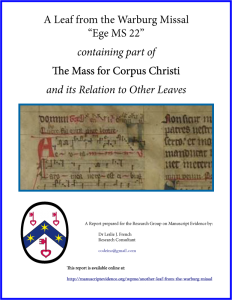
Front Cover for Report by Leslie J. French for Wagner Leaf from Ege MS 22 (2021)
A chance discovery (new to us) of a leaf in Princeton from one of the manuscripts dispersed by Otto F. Ege (1888–1951) leads us to report its presence in the context of our continuing work on the manuscript in question. It is “Ege Manuscript 22″, a Latin Missal written in double columns of 30–32 lines in Gothic Script, with musical notation in Hufnagelschrift (“Horseshoe-Nail Notes”) on 4-Line Staves.
The ‘Ege Number’ used in scholarly discourse designates the number assigned to the manuscript in the standard Handlist of Otto Ege’s known manuscripts, compiled by Scott Gwara (2017), with updates in progress.
- Scott Gwara, Otto Ege’s Manuscripts: A Study of Ege’s Manuscript Collections, Portfolios, and Retail Trade with a Comprehensive Handlist of Manuscripts Collected or Sold (Cayce, South Carolina: De Brailes Publishing, 2017) , Appendix X, with Number 22 at pp. 125.
This manuscript is also known by its putative place of origin or use. Otto Ege called it the Missale Herbipoliense (“Würzburg Missal”). We consider it to be “The Warburg Missal”. See our Research Booklet, setting out reasons grounded in a close study so far of the textual affiliations between an available sample of surviving leaves from Ege’s manuscript and related Missals or other books preserved in manuscript witnesses or printed editions.
- A Leaf from the Warburg Missal (“Ege MS 22”) containing part of The Mass for Corpus Christi and its Relation to Other Leaves: An RGME Research Report
The Princeton University Library catalogue files the leaf under the former (as Missale Herbipoliense). It turns up in a search for “Ege, Otto”, whose name is mentioned in the entry only as “Author”. It would take someone familiar with the context of Ege’s interventions for multiple manuscripts to recognize, off hand, which manuscript is this one in the scope of his “oeuvre” as an Author-Compiler, and how its patterns of dispersal by Ege illuminate some features which the leaf itself carries in witness, after detectable rearrangements have taken place in stages of transmission from Ege’s hands to Special Collections in the basement of Firestone Library at Princeton University.
When I was examining Ege materials at Princeton University several years ago, whilst on the quest for some other Ege manuscripts, I was unaware of this Ege leaf. It had not yet reached the collection, for which it was acquired in 2017.
At the time, while examining some biblical and other fragments in Ege’s portfolios at Princeton as well as elsewhere, I would not have known that my later work elsewhere would lead me to familiarity with parts of this “Ege Manuscript 22” / “The Warburg Missal”. Those next steps would go hand-in-hand with increased understanding (in my own and others’ research) of the nature of its place in the work of Otto Ege as collector, destroyer, and disperser of medieval manuscripts and other materials in the history of the book.
Such work leads to the plans for an RGME event exploring the nature of that legacy and its context. See:
- 2025 RGME Autumn Colloquium
“Break-Up Books and Make-Up Books:
Encountering and Reconstituting the Legacy of Otto F. Ege and Other Biblioclasts”.
Friday to Sunday 21–23 November, partly hybrid and partly online
The Source Manuscript
Meet the Leaf
Within its archival folder, this single vellum leaf is accompanied solely by a paper slip of introduction or confirmation. This slip provides a brief description of the leaf and steps in its provenance, leading to the purchase by Princeton University Library (although it does not state from whom) in February 2017.

Princeton University Library, MS 138 71, inserted slip accompanying Leaf from Otto Ege MS 22. Photograph by Mildred Budny.
Recto

Princeton University Library, MS 138 71, recto. Leaf from Otto Ege MS 22. Photograph by Mildred Budny.
At the top of the recto, close to the columns of text, stands the medieval folio number in roman numerals, xvii.
In column a, the annotation written in light brown ink with a scratchy pen at the end of line 7 and the beginning of line 8 supplies the missing text ‘ut discamus’, placing the ‘ut’ in the intercolumn at the end of ‘colimus’ and moving to ‘discamus’ in the outer margin.
A partly healed scar in the animal skin appears in the margin at the lower right.
Verso

Princeton University Library, MS 138 71, verso. Leaf from Otto Ege MS 22. Photograph by Mildred Budny.
Initials on this side of the leaf exhibit decorative and figural features. The first initial, opening the Versicle for Ecce inquit Stephanus, has a man’s face seen in profile emerging at the left, nestled alongside the headserif of the letter. With bulging forehead and stubby nose, the face has a wide-opened eye, straight mouth, and rounded, jutting chin.

Princeton, Princeton University Library, 138.71, verso: top. Photograph by Mildred Budny.
At the right, along the edge of the leaf there adhere the remnants of three tapes which hinged the leaf formerly to a backing. These traces resemble the characteristic fibrous tapes, whitish in color, which affix dismembered leaves to Ege’s mats. See, for example,
Texts and Music
For Saint Stephen, Protomartyr
(26 December)

London, National Gallery, Carlo Crivelli (circa 1435 – circa 1495), St. Stephen from The Demidoff Altarpiece, 1476. Image via https://www.nationalgallery.org.uk/paintings/carlo-crivelli-saint-stephen by CC BY NC ND 4.0.
The text presents most of the rite for S. Stephani Protomartyris, for his feast day of 26 December, as recorded in the 2004 Missale Romanum (MR), pages 27–29.
Saint Stephen (circa 5 – 34 AD), First or Protomartyr of the Christian Church, is reported in the Acts of the Apostles in the New Testament. Images of him depict him in deacon’s garments with the palm branch signifying martyrdom and the instruments of his passion, which occurred through death by stoning — sometimes also he is shown with a book. Such is the case with the compelling image of Saint Stephen painted by Carlo Crivelli (circa 1435 – circa 1495) as part of The Demidoff Altarpiece (1476), now at the National Gallery in London.
Recto
Verso
Ecce inquit stephanus video celos apertos et filium hominis stantem a dextris virrtutis dei.
There are more parts in the MR [as usual], but with various rubrics about inclusion or not depending on the calendar.
Chants with Music
1. Introit (beheaded) for Saint Stephen
[Etenim sederunt principes . . . ] or [Sederunt principes . . . ]
(CANTUS ID g00559 or go0559.1?)
Compare, for example:
Cantus ID g00559
- https://cantusdatabase.org/chant/638431, recorded in:
Porrentruy, Bibliothèque cantonale jurassienne, 18 (“Bellelay Gradual”), fol. 35v - https://cantusdatabase.org/chant/667110, recorded in Einseidln
Cantus ID g00559.i
- https://cantusindex.org/id/g00559.1, recorded in Portuguese sources

Princeton, Princeton University Library, 138.71, recto: top. Photograph by Mildred Budny.
2. Sederunt principes (Cantus ID g00560)
The chant Sederunt principes et adversum me loquebantur et iniqui persecuti sunt me corresponds with three witnesses listed so far in the CANTUS database.
- https://cantusdatabase.org/chant/667115. Einsiedeln, Stiftsbibliothek, Codex 121, fol. 34v
- https://cantusdatabase.org/chant/638434.
Porrentruy, Bibliothèque cantonale jurassienne, 18 (“Bellelay Gradual”), fol. 35v - https://cantusdatabase.org/chant/712102.
New York City (NY), Butler Library – Rare Book and Manuscript Library, Western MS 097, fol. 207v
3. Ecce inquit Stephanus (Cantus ID g02555)
- cantus g02555
- https://cantus.uwaterloo.ca/
source/682632
CZ-Pu XIII A 5c, f. 46v
This same specimen is also cited in the MMMO Database (Medieval Music Manuscripts Online)
- https://musmed.eu/chant/145050
NL-Uu : Hs. 0062, 019v
Their source is the Missale Traiectense [lWinterdeel], preserved in Utrecht, Museum Catharijneconvent, ABM h 62, made in “Utrecht, The Netherlands?, approximately 1200-1420”. On this manuscript, see:
It has a digital online facsimile:
4. Elegerunt apostoli Stephanum (Cantus ID 201540)
The chant Elegerunt apostoli Stephanum levitam plenum fide et spritu sancto corresponds with

Princeton, Princeton University Library, 138.71, verso: bottom. Photograph by Mildred Budny.
Other Sources
Offsets as Evidence
The Leaf in Context
In 2022, we published an RGME Research Booklet presenting a leaf from ‘Otto Ege Manuscript 22’ in the collection of Richard Weber. The Research Report examines a leaf from ‘Ege Manuscript 22’ dispersed by Otto F. Ege (1888–1951).
- The Weber Leaf from “The Warburg Missal” (Otto Ege Manuscript 22): Blogpost
- A Leaf from the Warburg Missal (“Ege MS 22”) containing part of The Mass for Corpus Christi and its Relation to Other Leaves: An RGME Research Report
We have examined some other materials in the Collection of Richard Weber, with several blogposts — with more on the way.
- A Leaf from ‘Otto Ege Manuscript 214’ in the Collection of Richard Weber
- More Leaves from an Old Armenian Praxapostolos
- Portfolio 93 of Ege’s “Famous Books in Eight Centuries” in the Collection of Richard Weber.
An earlier blogpost by Mildred Budny and the companion Research Report Booklet (2021) by Leslie J. French had examined another leaf from the same Ege manuscript, set it in its former context, and re-assessed the attribution of the book.
That leaf belongs to the collection of J. S. Wagner, about whose collection we have published blogposts and an RGME Research Report. See:
- Carmelite Missal Leaf of 1509
- The Penitent King David from a Book of Hours
- A Leaf from Prime in a Large-Format Breviary .
The Princeton University Leaf from Ege MS 22 deserves to be set in the context of continuing research on the manuscript, its survivors, and contextual evidence. The story so far, as we have uncovered it, permits the questioning of Ege’s identification of its place of origin.
Warburg / Würzburg:
A Tale of Two Cities, Ege Style
Examining the text on various accessible fragments from the original book, which Ege caused to be separated and dispersed as single leaves in multiple directions, we provisionally conclude that the origin would have been Warburg, rather than Würzburg, which spans the Mainz River in the northern part of Franconia in the German State of Bavaria. Warburg, in contrast, stands on the River Diemel in eastern North Rhine Westfalia in central Germany. As the crow flies, Warburg lies 122 miles / 197 kilometers northwest of Würzburg.
A Tale of Ege’s Portfolios, Mats,
Labels, and Solo Leaves
Among the patterns of dispersal of Otto Ege’s leaves from dismembered manuscripts or volumes destined principally for the specific sets of his Portfolios, the Princeton Leaf from Ege MS 22 appears to have travelled first as a single item with its original Ege Label and mat.
Normally, ‘Ege Manuscript 22’ would belong to the Portfolio of Fifty Original Leaves from from Medieval Manuscripts (FOL), where it functions a specimen leaf in position Number 22 out of the 50. See, for example:
Within a windowed mat, each leaf in Ege’s Portfolio has Ege’s rectangular printed label, attached to the lower left corner of the mat. Ege’s label describes the specimen in general terms that could pertain to any leaf from the manuscript, so that it avoids or neglects individual features of the specimen, such as its position within the text or other qualifying features. On labels in the FOL Portfolio, Ege’s number for the manuscript is printed at top right, designating the order in which the specimen was to be presented in the sequence of fifty loose mats housed within the box-like enclosure.
For Ege’s FOL Number 22, the label looks like this and describes its leaf thus:

Collection of Richard Weber, Leaf from ‘The Warburg Missal’, Ege Label. Reproduced by Permission.
In this case, a pencil annotation at lower left provides a revised number “#20” in a different sequence than the one established in the printed label: “22”. Rarely do Ege printed labels have revisions, but this one appears to belong to a different numbering system. The added number, with its prefatory hash (#), closely resembles the number #13 added to the Ege label for a detached leaf from ‘Otto Ege Manuscript 19’ in the Collection of Stephen Wagner.
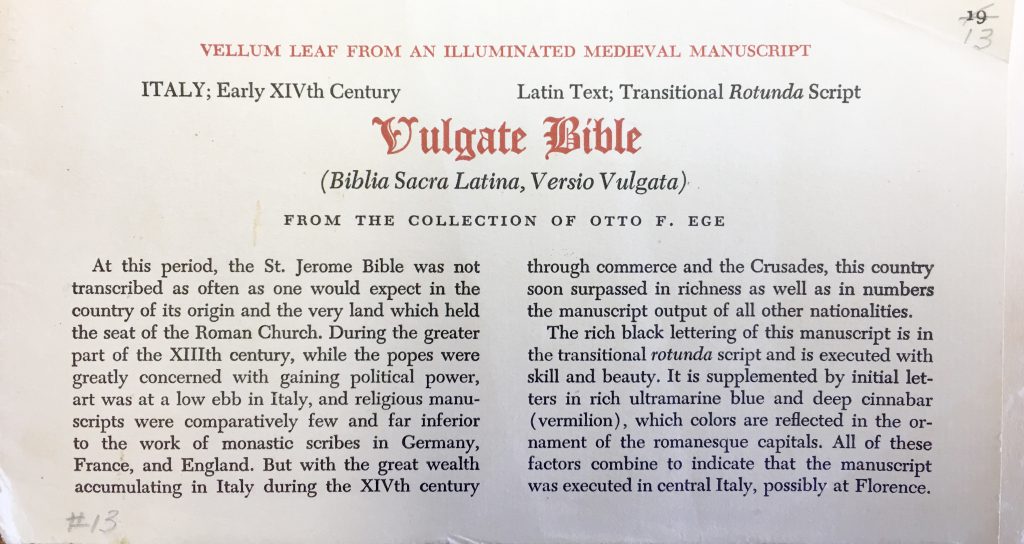
J. S. Wagner Collection. Otto Ege’s printed Label for his Specimens of Leaf 19 in the Portfolio of Fifty Original Leaves from Medieval Manuscripts. Western Europe, XII-XVI Century.
Without a mat or label for the Princeton Leaf, we cannot say whether it might formerly have belonged to a similar campaign of redistribution from an initial series. About such evidence and its usefulness, see:
Leaves also circulated outside the Portfolio sets. Such appears to be the case with both the Weber and Princeton University Library leaves.
Ege Tapes as Remnants
In the Princeton case, the leaf appears to lack an Ege label or mat (unless perhaps it is kept separately from the leaf). An association with Ege is reported by the testimony of the newer label, thereby at one or more removes.
However, the presence of the remnants of three tapes along the right-hand side of the verso appears to establish that the leaf formerly stood within a mat in characteristic Ege fashion —rather than circulating only on its own without one, like many Ege leaves from various manuscripts. An example from the Weber Collection from Ege MS 51:
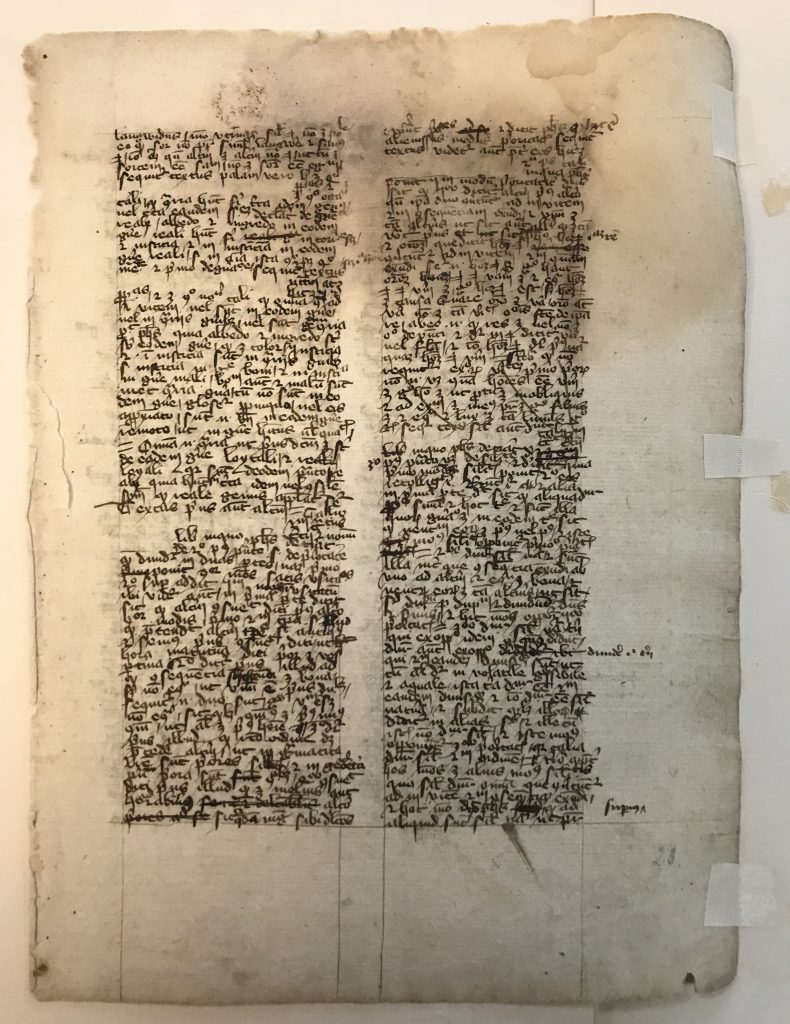
Richard Weber Collection, Famous Books in Eight Centuries, Portfolio Set 93, Aristotle, Folio 23 Recto. Reproduced by Permission.
The mat, and perhaps a label, would have been removed at some stage by an owner or seller. Could the removal sought to ‘erase’ evidence traveling with the leaf, and thereby cover some tracks in the transmission from Ege’s workshop to Princeton?
We look forward to learning more about the manuscript and its surviving components. The ability of the Princeton Leaf to join the known survivors adds its testimony to their set of songs.
*****
In our on-going study of the ‘Warburg Missal,’ we thank Richard Weber and J. S. Wagner for providing images and information about their leaves and for allowing their publication for wider awareness. We thank Eric White and Special Collections of Firestone Library of Princeton University for permission to examine and photograph the leaf, and to publish the photographs here.
Questions? Suggestions?
Do you know of more leaves from this manuscript? We look forward to hearing from you. You might:
- Leave your comments or questions below.
- Contact Us.
- Sign up for our Newsletter and information about our activities.
Send a note to director@manuscriptevidence.org or RGMEevents@gmail.com
Visit our Social Media:
- our FaceBook Page
- our Facebook Group
- our Twitter Feed (@rgme_mss)
- our Bluesky nest @rgmesocial.bluesky.social)
- Our Instagram account (rgme94)
- our LinkedIn Group
Join the Friends of the RGME.
Register for our Events by the RGME Eventbrite Collection.
Among them are the
- 2025 Spring and Autumn Symposia (online or hybrid)
- Episodes of “The Research Group Speaks” (online)
- RGME Workshops on “The Evidence of Manuscripts, Etc.” (online, in person, or hybrid)
- Meetings of the Friends of the RGME (online)
Please consider making a Donation in Funds or in Kind for our nonprofit educational corporation powered principally by volunteers. Your donations and contributions are welcome, and can go a long way. They may be tax-deductible to the fullest extent provided by the law.
*****