
A Leaf for Saint Stephen Protomartyr at Princeton from Otto Ege’s ‘Warburg Missal’
June 23, 2025 in Manuscript Studies, Reports
A Leaf at Princeton
from Otto Ege’s “Warburg Missal”
(Ege Manuscript 22)
Princeton University Library, MS 138.71
Latin Missal made in Germany circa 1325
Written in Gothic Script (Textualis)
Folio Number XVII
Within the Feast of Saint Stephen Protomartyr
(26 December)
Double columns of 31 lines
Circa 358 × 262 mm
< written area of rulings circa 258 × 196 mm>
with Rubrications,
Inset Initials in Red or Blue,
Corrections,
and Musical Notation
in Hufnagelschrift (“Horseshoe-Nail Notes”)
on 4-Line Staves
[Begun on 25 October 2023, posted on 20 June 2025]
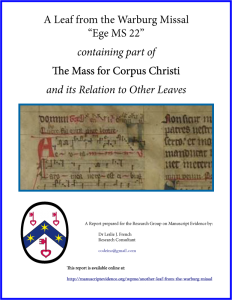
Front Cover for Report by Leslie J. French for Wagner Leaf from Ege MS 22 (2021)
A chance discovery (new to us) of a leaf in Princeton from one of the manuscripts dispersed by Otto F. Ege (1888–1951) leads us to report its presence in the context of our continuing work on the manuscript in question. It is “Ege Manuscript 22″, a Latin Missal written in double columns of 30–32 lines in Gothic Script, with musical notation in Hufnagelschrift (“Horseshoe-Nail Notes”) on 4-Line Staves.
The ‘Ege Number’ used in scholarly discourse designates the number assigned to the manuscript in the standard Handlist of Otto Ege’s known manuscripts, compiled by Scott Gwara (2017), with updates in progress.
- Scott Gwara, Otto Ege’s Manuscripts: A Study of Ege’s Manuscript Collections, Portfolios, and Retail Trade with a Comprehensive Handlist of Manuscripts Collected or Sold (Cayce, South Carolina: De Brailes Publishing, 2017) , Appendix X, with Number 22 at pp. 125.
This manuscript is also known by its putative place of origin or use. Otto Ege called it the Missale Herbipoliense (“Würzburg Missal”). We consider it to be “The Warburg Missal”. See our Research Booklet, setting out reasons grounded in a close study so far of the textual affiliations between an available sample of surviving leaves from Ege’s manuscript and related Missals or other books preserved in manuscript witnesses or printed editions.
- A Leaf from the Warburg Missal (“Ege MS 22”) containing part of The Mass for Corpus Christi and its Relation to Other Leaves: An RGME Research Report
The Princeton University Library catalogue files the leaf under the former (as Missale Herbipoliense). It turns up in a search for “Ege, Otto”, whose name is mentioned in the entry only as “Author”. It would take someone familiar with the context of Ege’s interventions for multiple manuscripts to recognize, off hand, which manuscript is this one in the scope of his “oeuvre” as an Author-Compiler, and how its patterns of dispersal by Ege illuminate some features which the leaf itself carries in witness, after detectable rearrangements have taken place in stages of transmission from Ege’s hands to Special Collections in the basement of Firestone Library at Princeton University.
When I was examining Ege materials at Princeton University several years ago, whilst on the quest for some other Ege manuscripts, I was unaware of this Ege leaf. It had not yet reached the collection, for which it was acquired in 2017.
At the time, while examining some biblical and other fragments in Ege’s portfolios at Princeton as well as elsewhere, I would not have known that my later work elsewhere would lead me to familiarity with parts of this “Ege Manuscript 22” / “The Warburg Missal”. Those next steps would go hand-in-hand with increased understanding (in my own and others’ research) of the nature of its place in the work of Otto Ege as collector, destroyer, and disperser of medieval manuscripts and other materials in the history of the book.
Such work leads to the plans for an RGME event exploring the nature of that legacy and its context. See:
- 2025 RGME Autumn Colloquium
“Break-Up Books and Make-Up Books:
Encountering and Reconstituting the Legacy of Otto F. Ege and Other Biblioclasts”.
Friday to Sunday 21–23 November, partly hybrid and partly online