• News
    • News & Views
    • RGME Activities for 2024 and 2025
    • Around & About with the RGME
    • Reviews
    • Highlights
  • Blogs
    • Manuscript Studies
      • Manuscript Studies: Contents List
    • International Congress on Medieval Studies
      • Abstracts of Congress Papers
        • Abstracts of Papers Listed by Author
        • Abstracts of Papers Listed by Year
  • About
    • Mission
    • Who We Are
      • Officers, Associates & Volunteers
      • RGME Committees
      • Friends of the Research Group on Manuscript Evidence
    • Policies & Statements
      • RGME Privacy Policy Statement
      • RGME Intellectual Property Statement & Agreements
    • People
      • Mildred Budny — Her Page
      • Adelaide Bennett Hagens
    • Activities
      • Events
      • Congress Activities
        • Sponsored Conference Sessions (1993‒)
          • Panels at the M-MLA Convention (from 2016)
        • Co-sponsored Conference Sessions (2006‒)
    • History
      • Seals, Matrices & Documents
      • Genealogies & Archives
    • Contact Us
  • Bembino
    • Multi-Lingual Bembino
    • RGME Bembino: Resources
  • Congress
    • Sponsored Conference Sessions (1993‒)
    • Co-sponsored Conference Sessions (2006‒)
    • Abstracts of Congress Papers
      • Abstracts Listed by Author
      • Abstracts Listed by Year
    • Kalamazoo Archive
    • Panels at the M-MLA Convention (2016-2019)
      • Abstracts of Papers for the M-MLA Convention
      • Panels at the M-MLA Convention (from 2016)
  • Events
    • RGME Activities for 2024 and 2025
      • 2023 Activities and 2024 Planned Activities
    • Seminars, Workshops, Colloquia & Symposia (1989–)
      • Seminars on ‘The Evidence of Manuscripts’
      • Symposia on ‘The Transmission of the Bible’
      • The New Series (2001-)
        • 2019 Anniversary Symposium Program: The Roads Taken
        • 2019 Anniversary Symposium Registration
        • 2019 Anniversary Symposium Registration Open
      • RGME Symposia: The Various Series
      • The Research Group Speaks: The Series
      • Meetings of the Friends of the Research Group on Manuscript Evidence
      • RGME Online Events
    • Abstracts of Papers for Events
      • Abstracts of Papers for Seminars on ‘The Evidence of Manuscripts’
      • Abstracts of Papers for Symposia, Workshops & Colloquia
    • Receptions & Parties
    • Business Meetings
    • Photographic Exhibitions & Master Classes
    • Events Archive
  • ShelfLife
    • Journal Description
    • ShelfMarks: The RGME-Newsletter
    • Publications
      • “Insular, Anglo-Saxon, and Early Anglo-Norman Manuscript Art at Corpus Christi College, Cambridge” (1997)
        • Mildred Budny, ‘Catalogue’
        • The Illustrated Catalogue (1997)
      • The Illustrated Handlist
      • Semi-Official Counterfeiting in France 1380-1422
      • No Snap Decisions: Challenges of Manuscript Photography
    • History and Design of Our Website
  • Galleries
    • Watermarks & the History of Paper
    • Galleries: Contents List
    • Scripts on Parade
    • Texts on Parade
      • Latin Documents & Cartularies
      • New Testament Leaves in Old Armenian
    • Posters on Display
    • Layout Designs
  • Donations and Contributions
    • RGME Donor Promise
    • 2023 End-of-Year Fundraiser for our 2024 Anniversary Year
    • 2019 Anniversary Appeal
    • Orders
  • Links
    • Catalogs, Metadata, and Databases: A Handlist of Links
    • Handlist of Resources for Manuscript Studies and Fragmentology
    • Manuscripts & Rare Books
    • Maps, Plans & Drawings
    • Seals, Seal-Matrices & Documents

  • News
    • News & Views
    • RGME Activities for 2024 and 2025
    • Around & About with the RGME
    • Reviews
    • Highlights
  • Blogs
    • Manuscript Studies
      • Manuscript Studies: Contents List
    • International Congress on Medieval Studies
      • Abstracts of Congress Papers
        • Abstracts of Papers Listed by Author
        • Abstracts of Papers Listed by Year
  • About
    • Mission
    • Who We Are
      • Officers, Associates & Volunteers
      • RGME Committees
      • Friends of the Research Group on Manuscript Evidence
    • Policies & Statements
      • RGME Privacy Policy Statement
      • RGME Intellectual Property Statement & Agreements
    • People
      • Mildred Budny — Her Page
      • Adelaide Bennett Hagens
    • Activities
      • Events
      • Congress Activities
        • Sponsored Conference Sessions (1993‒)
          • Panels at the M-MLA Convention (from 2016)
        • Co-sponsored Conference Sessions (2006‒)
    • History
      • Seals, Matrices & Documents
      • Genealogies & Archives
    • Contact Us
  • Bembino
    • Multi-Lingual Bembino
    • RGME Bembino: Resources
  • Congress
    • Sponsored Conference Sessions (1993‒)
    • Co-sponsored Conference Sessions (2006‒)
    • Abstracts of Congress Papers
      • Abstracts Listed by Author
      • Abstracts Listed by Year
    • Kalamazoo Archive
    • Panels at the M-MLA Convention (2016-2019)
      • Abstracts of Papers for the M-MLA Convention
      • Panels at the M-MLA Convention (from 2016)
  • Events
    • RGME Activities for 2024 and 2025
      • 2023 Activities and 2024 Planned Activities
    • Seminars, Workshops, Colloquia & Symposia (1989–)
      • Seminars on ‘The Evidence of Manuscripts’
      • Symposia on ‘The Transmission of the Bible’
      • The New Series (2001-)
        • 2019 Anniversary Symposium Program: The Roads Taken
        • 2019 Anniversary Symposium Registration
        • 2019 Anniversary Symposium Registration Open
      • RGME Symposia: The Various Series
      • The Research Group Speaks: The Series
      • Meetings of the Friends of the Research Group on Manuscript Evidence
      • RGME Online Events
    • Abstracts of Papers for Events
      • Abstracts of Papers for Seminars on ‘The Evidence of Manuscripts’
      • Abstracts of Papers for Symposia, Workshops & Colloquia
    • Receptions & Parties
    • Business Meetings
    • Photographic Exhibitions & Master Classes
    • Events Archive
  • ShelfLife
    • Journal Description
    • ShelfMarks: The RGME-Newsletter
    • Publications
      • “Insular, Anglo-Saxon, and Early Anglo-Norman Manuscript Art at Corpus Christi College, Cambridge” (1997)
        • Mildred Budny, ‘Catalogue’
        • The Illustrated Catalogue (1997)
      • The Illustrated Handlist
      • Semi-Official Counterfeiting in France 1380-1422
      • No Snap Decisions: Challenges of Manuscript Photography
    • History and Design of Our Website
  • Galleries
    • Watermarks & the History of Paper
    • Galleries: Contents List
    • Scripts on Parade
    • Texts on Parade
      • Latin Documents & Cartularies
      • New Testament Leaves in Old Armenian
    • Posters on Display
    • Layout Designs
  • Donations and Contributions
    • RGME Donor Promise
    • 2023 End-of-Year Fundraiser for our 2024 Anniversary Year
    • 2019 Anniversary Appeal
    • Orders
  • Links
    • Catalogs, Metadata, and Databases: A Handlist of Links
    • Handlist of Resources for Manuscript Studies and Fragmentology
    • Manuscripts & Rare Books
    • Maps, Plans & Drawings
    • Seals, Seal-Matrices & Documents

Log in

Archives

Featured Posts

2026 International Congress on Medieval Studies: Program
Episode 24. “Life with Books” (Interview with John Windle)
Announcing the Launch of RGME Bembino WP
2026 RGME Colloquium at The Grolier Club: Report
Medieval Missal Fragment as Early-Modern Cover
The Weber Leaf from Ege MS 61
"Bembino" Booklet Cover
Episode 23. “Meet RGME Bembino: Facets of a Font”
2026 RGME Colloquium on “Transformations & Renewals” at The Grolier Club
2026 Theme of the Year: “Transformations and Renewals”
A Leaf with Patchwork from the Saint Albans Bible
A Sister Leaf from a Miniature Latin Vulgate Bible
A Little Latin Vulgate Bible Manuscript Leaf in Princeton
J. S. Wagner Collection. Leaf from from Prime in a Latin manuscript Breviary. Folio 4 Verso, with part of Psalm 117 (118) in the Vulgate Version, set out in verses with decorated initials.
2026 Annual Appeal
Episode 22: “Encounters with Local Saints and Their Cults”
Private Collection, Ege's FBNC Portfolio, Dante Leaf, Verso, Detail. Reproduced by Permission.
2025 RGME Autumn Colloquium on Fragments
Workshop 8: A Hybrid Book where Medieval Music Meets Early-Modern Herbal
2025 RGME Autumn Symposium on “Readers, Fakers, and Re-Creators of Books”
RGME Workshops on “The Evidence of Manuscripts, Etc.”
2025 International Medieval Congress at Leeds: RGME Program
Episode 21. “Learning How to Look”
2025 International Congress on Medieval Studies: Program
2025 RGME Visit to Vassar College
Two Leaves in the Book of Numbers from the Chudleigh Bible
Delibovi on Glassgold on Boethius: A Blogpost
Ronald Smeltzer on “Émilie du Châtelet, Woman of Science”
2025 Spring Symposium: “Makers, Producers, and Collectors of Books”
Starters’ Orders
The Weber Leaf from the Saint Albans Bible
Workshop 4. “Manuscript Fragments Compared”
Episode 20. “Comic Book Theory for Medievalists”
Episode 19: “At the Gate: Starting the Year 2025 at its Threshold”
Favorite Recipes for Lemonade, Etc.
RGME Visit to the Lomazow Collection: Report
2024 Autumn Symposium: “At the Helm”
A Latin Vulgate Leaf of the Book of Numbers
The RGME ‘Lending Library’
Florence, Italy, Ponte Vecchio from Ponte alle Grazie. Photo: Ingo Mehling, CC BY-SA 4.0 , via Wikimedia Commons
Episode 17. “RGME Retrospect and Prospects: Anniversary Reflections”
2024 Anniversary Symposium: The Booklet
Jesse Hurlbut at the Bonneville Salt Flats, Utah. Photograph Jesse Hurlbut.
Episode 16: An Interview with Jesse D. Hurlbut
To Whom Do Manuscripts Belong?
Kalamazoo, MI Western Michigan University, Valley III from the side. Photograph: David W. Sorenson.
2024 International Congress on Medieval Studies: Report
2024 Spring Symposium at Vassar College
Puente de San Martín: Bridge with reflection over the River Targus, Toledo, Spain.
2024 Grant for “Between Past and Future” Project from The Gladys Krieble Delmas Foundation Research Libraries Program
2024 Anniversary Symposium in Thanks to Jesse Hurlbut: Program

You are browsing the Blog for

A Leaf with Patchwork from the Saint Albans Bible

December 29, 2025 in Fragments, Manuscript Studies

A Leaf with Patchwork
from the Saint Albans Bible
in the Collection of William Voelkle

Double columns of 46 lines in Gothic Script
with 2-line Decorated Initials, Bar-Extensions,
Foliate Ornament,
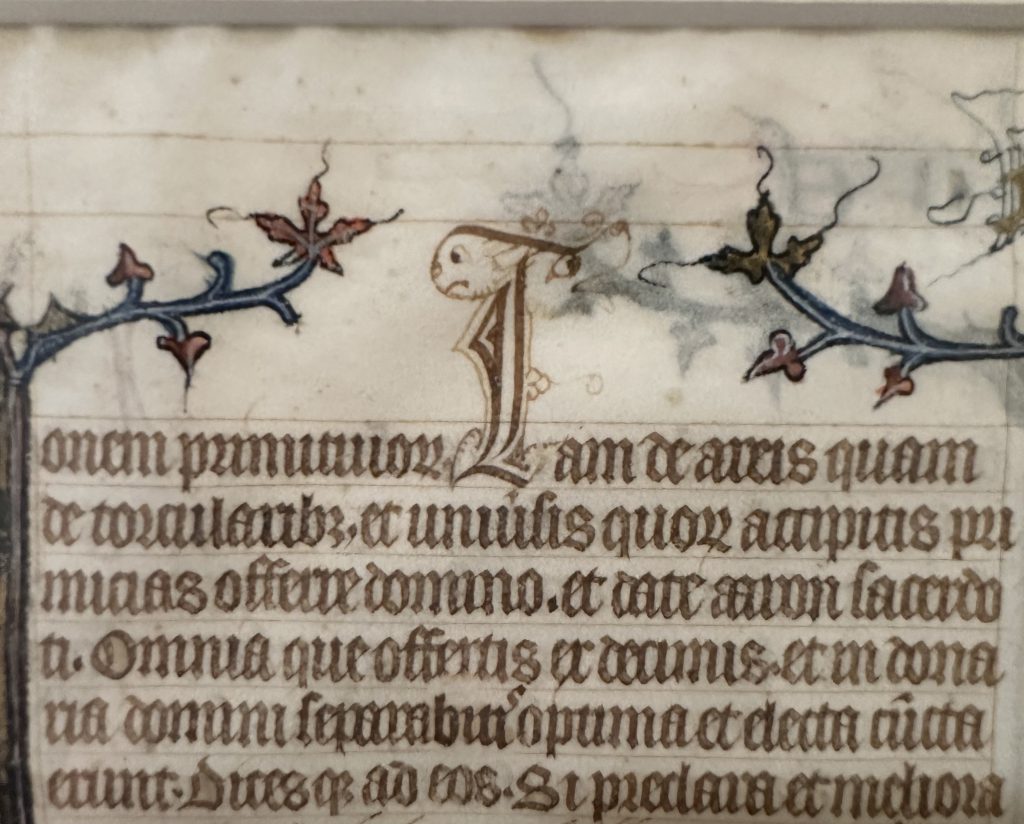
and Marginal Inhabitants (Monkey, Dragon, Bird)

Northern France, circa 1330

Psalms 107:14 ([facerimus uir-]/tutem et ipse)
– 108:31 (a persequentibus [animam meam] )
and 109:2 ([tuorum te-]cum principium . . . )
– 110:6 (. . . operum suorum / [adnuntiabit populo suo])

Plus Cut-Out with Patch apparently from the Same Bible
Cut out (in 14 lines of one column):
Psalms 109:1–2 (Dixit Dominus domino meo . . . tuorum te-/]cum principium)
Replacement Patch (in 14 lines pasted to opposite side):
Epistle of James 1:11–15 (peccatum uero cum / [consummatum fuerit]

[Posted on 27 December 2025]

Collection of William Voelkle, Framed Leaf from the Saint Albans Bible: Recto under glass. Photograph by William Voelkle.

Our series of RGME Workshops on “The Evidence of Manuscripts, Etc.”, continues to uncover more leaves from the fragmentary manuscripts which the workshops consider, by request. Now we report another leaf from the Saint Albans Bible, with which our workshops began.

We set the stage by reviewing two leaves which generated our interest in this manuscript and its fragments. They belong to the Farrell and Weber Collections respectively, with portions from the Old Testament and the New Testament respectively.

The ‘new’ leaf belongs to the Collection of William Voelkle. Its pieced-together pieces represent parts of one Book from the Old Testament and another from the New Testament.

The patchwork, replacing a cut-out portion with a cutting from elsewhere in the volume, resembles a phenomenon which we explored previously in another fragmentary Vulgate Bible, the larger Lectern Bible dispersed by Otto F. Ege as his Number 14.
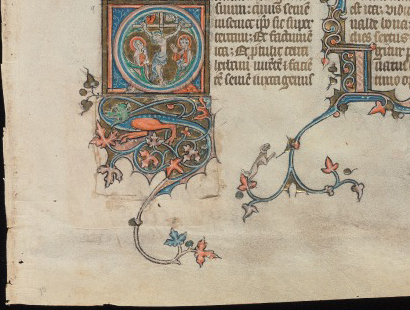
  • Patch Work in Otto Ege MS 14
Beinecke Rare Book & Manuscript Library, Otto Ege Collection, MS 14, Genesis Opening Leaf: Recto, Detail of Patch.

Beinecke Rare Book & Manuscript Library, Otto Ege Collection, MS 14, Genesis Opening Leaf: Recto, Detail of Patch.

Beinecke Rare Book & Manuscript Library, Otto Ege Collection, MS 14, Genesis Opening Leaf: Verso, Detail of Patch.

Beinecke Rare Book & Manuscript Library, Otto Ege Collection, MS 14, Genesis Opening Leaf: Verso, Detail of Patch.

1. The Farrell Leaf
(from the Book of Numbers)

Our workshops first examined a leaf on loan to the RGME with part of the text of the Book of Numbers in a Latin Vulgate Bible in double columns of 46 lines in Gothic script, with decorative elements. Reports of our discoveries about that leaf have been reported in our blog on Manuscript Studies.

  • A Latin Vulgate Leaf from the Book of Numbers (Part 1)
  • Latin Vulgate Bible Leaf in the Collection of Jennah Farrell, Part 2: Provenance
  • The Latin Vulgate Bible Leaf in the Farrell Collection Part 3: The Full Leaf
Collection of Jennah Farrell, Manuscript Leaf in Mat: top left. Photograph by Jennah Farrrell.

Recto

Collection of Jennah Farrell, Single Leaf from the Book of Numbers in a Medieval Latin Vulgate Bible manuscript. Full extent of the leaf, unframed: Recto. Photography by Mildred Budny.

Verso

Collection of Jennah Farrell, Latin Vulgate Bible Leaf: Verso with Ruler. Photograph by Mildred Budny.

2. The Weber Leaf
(from the Acts of the Apostles)

As the workshops progressed, our Associate Richard Weber revealed another leaf from this manuscript in his collection, to join our blogposts about various items in his collection. Unlike the first leaf considered in our workshops, from the Old Testament Book of Numbers, this leaf belongs to the New Testament portion of the bible, from within the text of the Acts of the Apostles. See

  • The Weber Leaf from the Saint Albans Bible

Collection of Richard Weber, Leaf from the Saint Albans Bible, Verso: Top Left. Photograph by Richard Weber.

Recto

Collection of Richard Weber, Leaf from the Saint Albans Bible, Recto. Photograph by Richard Weber.

Verso

Collection of Richard Weber, Leaf from the Saint Albans Bible, Recto. Photograph by Richard Weber.

Collection of William Voelkle, Framed Leaf from the Saint Albans Bible: Recto under glass. Photograph by William Voelkle.

3. The Voelkle Leaf
(from the Psalms
and the Epistle of James)
—A Patchwork Leaf

Next, our Associate William Voelkle sent a photograph of his leaf from the Saint Albans Bible.

About the leaf, William Voelkle reported that

I purchased the leaf from Philip Duschnes (NY dealer) August 10, 1983, as ‘repaired.’ The historiated miniature had been cut out and replaced with another section of the text.
— email of 29 December 2025

About Duschnes and his business, see, for example Philip C. Duschnes.

Contained within a glass-fronted frame, the leaf shows one side, but turns the other side to the back of the frame, where it remains hidden.

We examine the visible side, with glimpses also of the opposite side as revealed by show-through and other evidence.

Recto (the Visible Side)

Collection of William Voelkle, Framed Leaf from the Saint Albans Bible: Recto. Photograph by William Voelkle.

The page has no running title, unlike some other parts of the Saint Albans Bible (see above).

Mainly the text on the page presents part of the Book of Psalms, plus a replacement patch for fourteen lines cut out from one column, which removed the first lines of Psalm 109.

A modern pencil note at the left opposite line 3 of the left-hand column identifies the number of the Vulgate Psalm (“108”) which opens there (Deus laudem meam me tacueris). It seems likely that the note postdates the dismemberment of the manuscript, so that an identification of the contents of the leaf might be appropriate, starting with the first of the Psalms on the page.

Rubrication in red pigment announces the start of Psalms 108 and 110 — perhaps it did so also for the opening of Psalm 109, but that title would have been lost in the cut-out.

Show-through from the opposite side reveals (in mirrored view) the presence of polychrome bar ornament in verticals along the inner and outer margins as well as the intercolumn — that is, at the left-hand side of both columns of text on that page and, to a less marked extent, at the right-hand side of the outer column — and in branching formations at both upper and lower margins.

The Texts:
Parts of Two Different Books of the Bible

The visible side of the leaf carries text principally from the Book of Psalms. It begins midword within Psalms 107:14 ([facerimus uir-]/tutem et ipse) and ends within Psalms 110:31 (operum suorum / [adnuntiabit populo suo]). The text carries the full text of Psalm 108, but only the last part of Psalm 109, because its first lines have been cut out and removed, taking the opening initial and the adjacent section of its intercolumnar bar ornament at the left. Untouched was the bar ornament at the right-hand side, along with the full-length bird perched in profile upon its foliage.

The Psalms text in column a and the upper and lower parts of column b:

Psalms 107:14 ([facerimus uir-]/tutem et ipse) – 108:31 (a persequentibus /[animam meam])
and (after the gap produced by the cut-out)
Psalms 109:2 (tuorum te-/]cum principium) – 110:1–6 (operum suorum / [adnuntiabit populo suo])

Missing text cut out from column b:

Psalms 109:1–2 ([Dixit dominus Domino meo . . . tuorum te-]cum principium)

Replacement patch of fourteen lines in a single column:

Epistle of James 1:11–15 (Exortus est enim . . . peccatum uero cum / [consummatum fuerit]

Untouched in the cutting process was the bar ornament at the right-hand side, along with the full-length bird perched upon its foliage. Seen in profile facing left, the bird raises its offside leg and its head to look up to the left. Might the bird perhaps depict a thrush or strike?

Collection of William Voelkle, Framed Leaf from the Saint Albans Bible: Recto under glass, Midsection with patch. Photograph by William Voelkle.

A patch in the second column supplies a passage of fourteen lines of text where the original text had been cut out — presumably as a specimen of text and/or decoration. The supplied portion presents similar layout, script, structure, and intercolumnar border decoration as characteristic of the Saint Albans Bible, so perhaps or presumably another leaf from the same book supplied the gap. Certainty about the source of the replacement might become clearer if, say, the portion of the Epistle of James in the volume can be identified either intact or defective.

Collection of William Voelkle, Framed Leaf from the Saint Albans Bible: Recto under glass, Detail with patch. Photograph by William Voelkle.

The bar ornament at the left on the replacement patch is broader than the bar ornament which it supplants or interrupts in the intercolumn of the Psalms leaf, although its undulating ornamental pattern and coloring resembles that bar. The extensions to the left from the replacement bar imply that this patch came from a left-hand column on its former page, reaching into the inner margin.

The Decoration and Figural Ornament

Ornamented initials stand at the openings of the individual Psalms, as inset 2-line polychrome capitals within frames. From their left-hand side, extensions might rise or descend along the side of the column of text to curve into the upper or lower margins in elaborate branching foliate motifs. The individual verses of the Psalms open within the continuous lines of text as inset 1-line capitals, rendered alternately in blue pigment or gold, within beds of penline decoration.

Top

Collection of William Voelkle, Framed Leaf from the Saint Albans Bible: Recto under glass, Top. Photograph by William Voelkle.

Bottom

Collection of William Voelkle, Framed Leaf from the Saint Albans Bible: Recto under glass, Lower portion. Photograph by William Voelkle.

Seen in profile, the animated elements in the lower margin comprise

1) a charming undulating dragonesque creature with raised wings at the outer right, an elongated neck, and an open-mouthed head facing right with a dog-like head having pointed ears and a bearded lower jaw; and

2) an upright monkey striding toward the left. In its outstretched hands this creature holds an implement which might depict a spindle and whorl.

Below the monkey’s feet, two foliate terminals of the border ornament have descending streaks of ink and pigment which damaged the page at an unknown stage.

Collection of William Voelkle, Framed Leaf from the Saint Albans Bible: Recto under glass, detail: monkey. Photograph by William Voelkle.

Questions or Suggestions?

Do you know of other leaves from this Bible? Do you know of other works by the same scribe(s) or artist(s)? We welcome your feedback.

*************

Tags: Collection of Richard Wagner, Collection of William Voelkle, Fragmentology, Jennah Farrell Collection, manuscript fragments, Manuscript Illumination, Otto Ege MS 14, Patchwork in Manuscripts, RGME Workshops on the Evidence of MSS Etc., Saint Albans Bible, Vulgate Bible Manuscripts
No Comments »

Theme of the Year for the RGME

December 22, 2025 in Manuscript Studies, Theme of the Year

Theme for the Year for the RGME:
Journey of a Tradition

Papilio Machaeol: Old World Swallowtail, female, Dorsal side. Photograph (9 May 2016, Normandy) by Entomolo, CC BY-SA 4.0 <https://creativecommons.org/licenses/by-sa/4.0>, via Wikimedia Commons.

[Posted on 12 December 2025]

For the Year 2026, the Research Group on Manuscript Evidence chooses the Theme of “Transformations and Renewals” for exploration as part of its activities and projects. This choice stands within our tradition (since 2022) of a theme to guide and inspire the interconnected subjects and interwoven strands of activities and projects for the year.

On this choice and its aims, scope, and activities, see:

  • Transformations and Renewals: RGME Theme for the Year 2026.

Here, as we approach the Year 2026, we survey this tradition and its choices with successes and growth for individual years.

RGME Themes for the Year (since 2023)

Milan, Casa Campanini, Entry Gate, designed by Alfredo Campanini (1873–1926). Photograph by Giovanni Dall’Orto (26 February 2008), Share Alike 1.0, via Wikimedia Commons.

Last year, the RGME chose the Theme of “Thresholds and Communities”, which our multiple activities developed in a variety of ways.

The choice emerged in conversations reflecting upon the strong benefits of the previous year’s choice, “Bridges” as an overarching theme for 2024 and its year’s funded Project “Between Past and Future”, designed for “Building Bridges between Special Collections and Teaching for the Liberal Arts”.

For 2023, our Theme of “Materials and Access” drew guidance and inspiration through the funded 2023 Project on the “RGME Library & Archives” and the Spring and Autumn Symposia on “Materials and Access”.

For our first Theme for the Year in 2022, “Structured Knowledge” (chosen by our new Editorial Committee), the year’s activities explored such subjects as “Catalogues, Metadata, and Databases” in RGME Episodes and our 2022 Spring and Autumn Symposia on Structures for and Supports of Knowledge.

2025
“Thresholds and Communities”

  • Thresholds and Communities
  • Episode 19 “At the Gate”

“Agents and Agencies”

2025 Spring Symposium Poster, Set in RGME Bembino.

2024
“Bridges”

  • Bridges for Our Anniversary Year 2024

For example:

2024 RGME Spring Symposium at Vassar College

2024 RGME Inaugural Session at the International Medieval Congress at Leeds

RGME @ 2024 IMC at Leeds: Poster 2 set in RGME Bembino, with border.

2023
“Materials and Access”

2023 Spring and Autumn Symposia

  • 2023 Spring Symposium. “From the Ground Up”
  • 2023 Autumn Symposium. “Between Earth and Sky”
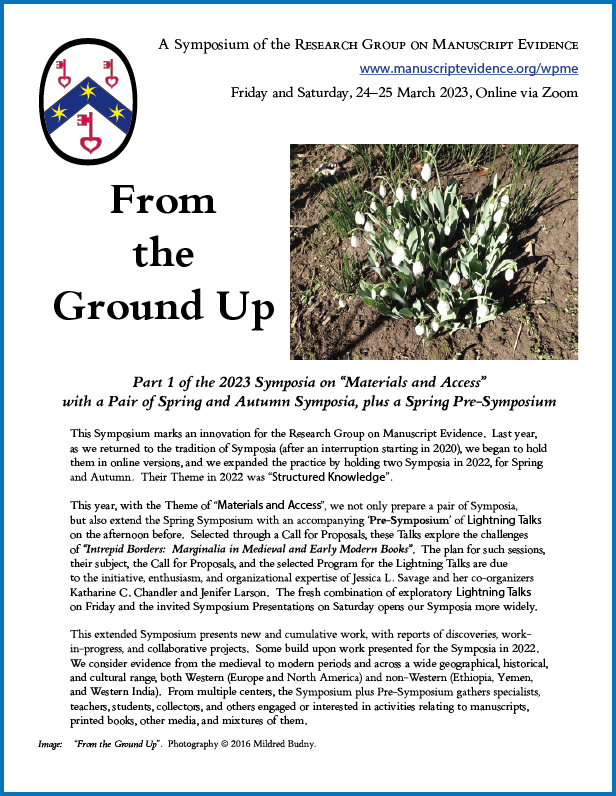
2023 Spring Pre-Symposium/Symposium Booklet Front Cover with photograph of snowdrops flowers rising from the earth.

2023 Spring Pre-Symposium/Symposium Booklet Front Cover.

2022
“Structured Knowledge”

See our 2022 Spring and Autumn Symposia:

  1. “Structures of Knowledge” (Spring)
  2. “Supports for Knowledge” (Autumn)

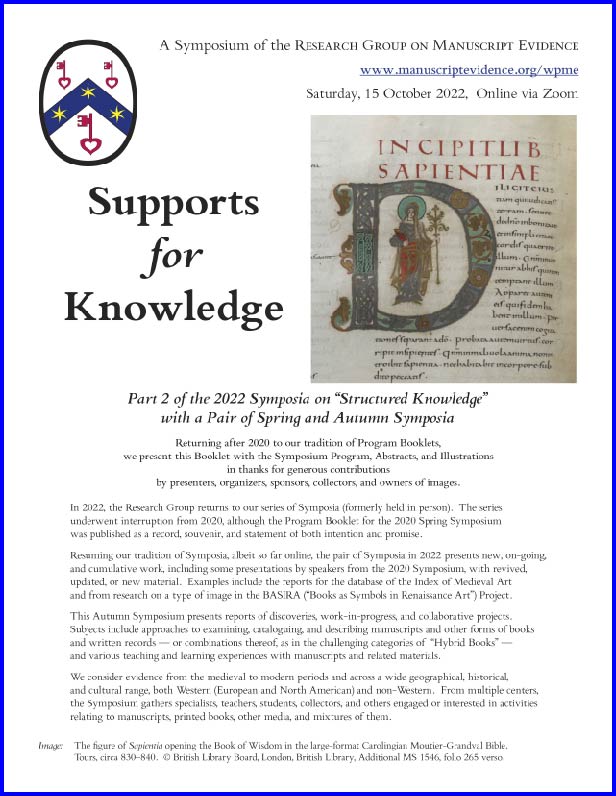
2022 Autumn Symposium Program Booklet, Front Cover (Page 1)

**********

Questions? Suggestions?

  • Leave your comments or questions below
  • Contact Us

Visit our Social Media:

  • our FaceBook Page (https://www.facebook.com/people/Research-Group-on-Manuscript-Evidence/100064718795029/)
  • our Facebook Group (https://www.facebook.com/groups/rgmemss/)
  • our X/Twitter Feed (@rgme_mss)
  • our Bluesky nest @rgmesocial.bluesky.social)
  • our Instagram Page
  • our LinkedIn Group

Join the Friends of the RGME.

Please make a Donation in Funds or in Kind for our nonprofit educational corporation powered principally by volunteers. Your donations and contributions are welcome, and can go a long way. They may be tax-deductible to the fullest extent provided by the law.

  • Donations and Contributions
  • 2026 Annual Appeal

*****************

Tags: RGME Symposia, RGME Theme for the Year, Thematic Directions
No Comments »

A Sister Leaf from a Miniature Latin Vulgate Bible

December 17, 2025 in Fragments, Manuscript Studies, Research Group Workshops, Workshops on "The Evidence of Manuscripts"

A Sister Leaf
from a Miniature Latin Vulgate Bible:
Fragments at Princeton

2 columns in 47 lines
Measurements
Leaf maximum circa 121 mm high × 82 mm wide
<Written area circa 90 × 57 mm>

[Posted on 16 December 2025]

Poster 3 for 2025 Autumn Colloquium. Workshops on “Fragments at Princeton”

For the recent 2025 RGME Autumn Colloquium on Fragments, our Associate Eric M. White presented a pair of Workshops on “Fragments at Princeton”, with a focus on “Books in Fragments / Fragments in Books”. The workshops took place in Special Collections of the Princeton University Library, in two sittings.

With a few variations in each workshop, the selected specimens considered a range of manuscript and printed materials. They included, for example, single manuscript leaves (or fragments thereof) on their own or manuscript fragments (single leaves or conjoint bifolia) reused as part of bindings, pastedowns, or endleaves for other texts.

For many of these specimens, Eric demonstrated their characteristics with a riveting commentary about the processes of discovery which brought them to Princeton or which enriched understanding about them once the curator or scholar came across them in the stacks or within their secondary homes in the form of composite codices mixing layers from different dates and places of production and different genres of books.

He presented some specimens of individual leaves as curiosities about which little is known — in case they might be recognized. About one of them I said that I thought I knew of another similar leaf. The Princeton University Leaf  came from a set of three boxes of manuscript fragments, which had little or no information about their sources.

Now we introduce another leaf which I believe came from the same manuscript. Do you agree?

Read the rest of this entry →

Tags: Book of Isaiah, Book of Wisdon, Fragmentology, manuscript fragments, Manuscript studies, Medieval Latin Vulgate Bibles, Medieval Manuscript Fragments, Princeton University Library
No Comments »

2026 Theme of the Year: “Transformations and Renewals”

December 13, 2025 in Uncategorized

“Transformations & Renewals”
Our Theme for 2026

[Posted by our Director on 10 December 2025, with updates]

For the Year 2026, the Research Group on Manuscript Evidence chooses the Theme of “Transformations and Renewals” for exploration as part of its activities and projects. This choice stands within our tradition (since 2022) of a theme to guide and inspire the interconnected subjects and interwoven strands of activities and projects for the year. On this tradition and its choices with successes and growth for individual years, see

  • Theme of the Year for the RGME: Progress of a Tradition

Through the year 2026, we propose to examine and contemplate myriad ways in which life-forces, powers (natural, man-made, unnatural, or supernatural), abilities, and changes have impact upon the realms of books and human knowledge, understanding, and creativity in word, image, and form. We search, for example, for cases and prospects for transformations, upheavals, metamorphoses, restorations, and other transitions or transmissions which may betoken, foster, or embody progress worthy of the name — especially in new, vital, or revived forms preserving or creating qualities or virtues worthy of adoption, incorporation, cultivation, nurture, growth, and celebration.

Join us as we discuss such components, characteristics, or conditions across a wide range of periods, places, genres, and case-studies to compare notes about ways in which transformations and renewals might, in turn, take seed or take flight, to grow or soar in a generations’-long process in the transmission of knowledge, skills, understanding, and the delight of learning, mentoring, and sharing fruits or journeys in the realms of the written word and its accompaniments in image, song, or memory.

Some motifs (or mascots, guides, cautions, or models) for our quest for 2026 include

  • seeds, sprouts, seedlings, plantlife, harvests, and cornucopias in the botanical and terrestrial world;
  • larvae, caterpillars, and butterflies; or eggs, hatchlings, fledglings, and birds or reptiles in the aerial or aquatic realms;
  • embryos, infants, youthful creatures/beings (such as cubs, kittens, children, or other forms), adults, and elders in human and animal realms;
  • entities or hybrids in biological, celestial, and/or imaginary realms (such as from the imagination to the stars and constellations and back again)

We look to examples in the natural world, literature, art, history, lore, and more. We welcome suggestions.

Cases in Point

Birth or Renewal

Image via https://mcswhispers.wordpress.com/2019/09/03/renewal/.

Growth and/with Change

Life Cycles or Stages

In Transition: Papilio Macheon Caterpillar

Papilionidae – Papilio machaon. Photograph (August 2007, Cerreto Ratti, Alessandria, Italy) by Hectonichus, CC BY-SA 3.0 <https://creativecommons.org/licenses/by-sa/3.0>, via Wikimedia Commons.

In the Fullness of Time: Papilio Machaeon (Old World Swallowtail) Butterfly

Papilio Machaeol: Old World Swallowtail, female, Dorsal side, recently emerged from its chrysalis. Photograph (9 May 2016, Normandy) by Entomolo, CC BY-SA 4.0 <https://creativecommons.org/licenses/by-sa/4.0>, via Wikimedia Commons.

Transformation

For example, when stories or ideas come to life. In the process, they might manifest, or make manifest, characteristics, dynamics, or powers in conjunction, conflict, resolution, and/or transformation.

Among precedents or models for such changes are the varied stories as episodes in the hauntingly memorable Metamorphoses in Latin verse in fifteen Books by Publius Ovidius Naso (43 BC–17/18 AD). In a nutshell: “The poem chronicles the history of the world from its creation to the deification of Julius Caesar in a mythico-historical framework comprising over 250 myths, 15 books, and 11,995 lines” (Metamorphoses). The enduring popularity of the work ensured copies in many forms in manuscript and print for a wide variety of audiences in a multiplicity of languages and formats.

An example: an early-printed copy of the Metamorphoses in Italian, translated with commentary by Giovanni Bonsignore and printed in Venice by Johannes Rubeus Vercellensis for Lucantonio Giunta, 10 Apr. 1497. (ISTC number io00185000; GW M28952.) Here the full-page frontispiece (Fol. 5r) locates the opening words of Book I within a landscape showing the figures of Creation before humans.

Ovid’s Metamorphoses (printed 10 April 1497), Carta_a1r2.jpg. Image via Biblioteca Europea di Informazione e Cultura, Public domain, via Wikimedia Commons.

In fact, years ago, the RGME prepared a major symposium on the subject of Ovid’s Metamorphoses and other forms of transformation or ‘reincarnation’. It was intended to be held at Trinity College Cambridge, where the co-organizer, our friend and Trustee Vivian Anne Law (1954–2002) was Fellow. The program as she and I planned and worked on it would have been superb. Her illness and unexpected complexities and obstacles or challenges attendant upon the RGME’s move of its principal base from England to the United States interrupted the progress of the plan. Since then, the papers for that intention reside in the RGME Library & Archives with the informal title “Avid for Ovid”.

Such awareness revives with the new choice to embrace the theme of “Transformations and Renewals” for the Year 2026 for RGME activities and projects.

Rome, Galleria Borghesi, Apollo and Daphne (1622) by Gian Lorenzo Bernini (1598–1680), after the Metamorphoses by Publius Ovidius Naso (43 BC–17/18 AD). Photograph by Architas, CC BY-SA 4.0 <https://creativecommons.org/licenses/by-sa/4.0>, via Wikimedia Commons.

Hybrid

Among many examples both real and fictional or surreal, we might highlight the fabled Sphinx of antiquity.

Vatican City, Vatican Museums. Oedipus and the Sphinx of Thebes, Red Figure Kylix, c. 470 BC, from Vulci, attributed to the Oedipus Painter (Inv. no. 16541). Photograph by Carole Raddato from FRANKFURT, Germany, CC BY-SA 2.0 <https://creativecommons.org>.

Watch this space as RGME activities for 2026 take shape.

*************

RGME Themes for the Year (since 2023)

Milan, Casa Campanini, Entry Gate, designed by Alfredo Campanini (1873–1926). Photograph by Giovanni Dall’Orto (26 February 2008), Share Alike 1.0, via Wikimedia Commons.

Last year, the RGME chose the Theme of “Thresholds and Communities”, which our multiple activities developed in a variety of ways.

The choice emerged in conversations reflecting upon the strong benefits of the previous year’s choice, “Bridges” as an overarching theme for 2024 and its year’s funded Project “Between Past and Future”, designed for “Building Bridges between Special Collections and Teaching for the Liberal Arts”.

For 2023, our Theme of “Materials and Access” drew guidance and inspiration through the funded 2023 Project on the “RGME Library & Archives” and the Spring and Autumn Symposia on “Materials and Access”.

For our first Theme for the Year in 2022, “Structured Knowledge” (chosen by our new Editorial Committee), the year’s activities explored such subjects as “Catalogues, Metadata, and Databases” in RGME Episodes and our 2022 Spring and Autumn Symposia on Structures for and Supports of Knowledge.

2025
“Thresholds and Communities”

  • Thresholds and Communities

“Agents and Agencies”

2025 Spring Symposium Poster, Set in RGME Bembino.

2024
“Bridges”

  • Bridges for Our Anniversary Year 2024

For example:

2024 RGME Spring Symposium at Vassar College

2024 RGME Inaugural Session at the International Medieval Congress at Leeds

RGME @ 2024 IMC at Leeds: Poster 2 set in RGME Bembino, with border.

2023
“Materials and Access”

2023 Spring and Autumn Symposia

  • 2023 Spring Symposium. “From the Ground Up”
  • 2023 Autumn Symposium. “Between Earth and Sky”
2023 Spring Pre-Symposium/Symposium Booklet Front Cover with photograph of snowdrops flowers rising from the earth.

2023 Spring Pre-Symposium/Symposium Booklet Front Cover.

2022
“Structured Knowledge”

See our 2022 Spring and Autumn Symposia:

  1. “Structures of Knowledge” (Spring)
  2. “Supports for Knowledge” (Autumn)

2022 Autumn Symposium Program Booklet, Front Cover (Page 1)

**********

Questions? Suggestions?

  • Leave your comments or questions below
  • Contact Us

Visit our Social Media:

  • our FaceBook Page (https://www.facebook.com/people/Research-Group-on-Manuscript-Evidence/100064718795029/)
  • our Facebook Group (https://www.facebook.com/groups/rgmemss/)
  • our X/Twitter Feed (@rgme_mss)
  • our Bluesky nest @rgmesocial.bluesky.social)
  • our Instagram Page
  • our LinkedIn Group

Join the Friends of the RGME.

Please make a Donation in Funds or in Kind for our nonprofit educational corporation powered principally by volunteers. Your donations and contributions are welcome, and can go a long way. They may be tax-deductible to the fullest extent provided by the law.

  • Donations and Contributions
  • 2026 Annual Appeal

*****************

No Comments »

A Little Latin Vulgate Bible Manuscript Leaf in Princeton

November 26, 2025 in Manuscript Studies, Princeton University

A Little Leaf
at Princeton University Library
from a Miniature Latin Vulgate Bible

2 columns in 47 lines

[Posted on 25 November 2025]

Poster 3 for 2025 Autumn Colloquium. Workshops on “Fragments at Princeton”

For the recent 2025 RGME Autumn Colloquium on Fragments, our Associate Eric M. White presented a pair of Workshops on “Fragments at Princeton”, with a focus on “Books in Fragments / Fragments in Books”. The workshops took place in Special Collections of the Princeton University Library, in two sittings.

With a few variations in each workshop, the selected specimens considered a range of manuscript and printed materials. They included, for example, single manuscript leaves (or fragments thereof) on their own or manuscript fragments (single leaves or conjoint bifolia) reused as part of bindings, pastedowns, or endleaves for other texts.

For many of these specimens, Eric demonstrated their characteristics with a riveting commentary about the processes of discovery which brought them to Princeton or which enriched understanding about them once the curator or scholar came across them in the stacks or within their secondary homes in the form of composite codices mixing layers from different dates and places of production and different genres of books.

He presented some specimens of individual leaves as curiosities about which little is known — in case they might be recognized. About one of them I said that I thought I knew of another similar leaf.

Read the rest of this entry →

Tags: Fragments, Manuscript studies, Martyrdom of Isaiah, Medieval manuscripts, Medieval Vulgate Manuscripts
No Comments »

2026 Annual Appeal

November 7, 2025 in Manuscript Studies, RGME Annual Appeal

2026 Annual Appeal
for Donations
to Support
our Mission and Activities

[Posted on 7 November 2025]

We invite you to join our 2026 Annual Appeal, as the Research Group rounds out the extraordinarily successful year of accomplishments for 2025 (see below), and prepares for the future. That we were able to accomplish so much in 2025, in the face of many significant setbacks for funding and swift shifts in plans to host our activities, attests to the strength and vigor of the volunteers and donors (individual and institutional).

They all, in collegial collaboration, have made it possible to maintain course for our activities, to produce so many events both hybrid and online, to gather to learn about discoveries for research and the progress on work-in-progress, and to celebrate the delights of learning more about the marvels of books and their stories transmitted across the centuries. This momentum carries our plans forward to 2026, with activities already planned and more to come.

We turn to you to help us to maintain momentum and share the quest. Please donate what you can. For our small, deducated, nonprofit organization powered principally by volunteers, every donation can make a difference.

Ways to Donate Online and Other Ways

Ways to contribute?

There are many ways to help: Funds, Goods, Expertise, Time. All can help our work and mission.

For suggestions, see:

  • Contributions & Donations
  • Donations

1) Via Mightycause:

  • Donate to RGME
  • RGME 2026 Annual Appeal via Mightycause

2) Via Paypal, Venmo, ApplePay, Pay Later, or Debit or Credit Card:


Suggestions or Feedback?

Please leave your Comments or questions below, Contact Us, or visit

  • our FaceBook Page
  • our Facebook Group
  • our Twitter Feed (@rgme_mss)
  • our Bluesky nest @rgmesocial.bluesky.social)
  • our LinkedIn Group
  • our Instagram presence(@rgme94)
  • our Blog on Manuscript Studies and its Contents List

A Community of Scholars,
Teachers, Students, Friends,
and Admirers of Books

We thank you for your support.

Please  join our community and join our cause.

******

Summary of Activities So Far

Building on the momentum and enthusiasm for this year’s accomplishments, we prepare more for 2026.

Activities in Progress and Accomplished in 2025

In 2025 we had:

Two Symposia dedicated to “Agents and Agencies” in the realms of books

  • 2025 Spring and Autumn Symposia

More Episodes for our online series “The Research Group Speaks”

  • “The Research Group Speaks”: The Series

More RGME Workshops on “The Evidence of Manuscripts, Etc.”

  • RGME Workshops on “The Evidence of Manuscripts, Etc.”

More Meetings of the Friends of the Research Group on Manuscript Evidence

  • Meetings of the Friends of the RGME

Logo (2024) of the Friends of the Research Group on Manuscript Evidence

Steps toward the preparation of a Cookbook of Favorite Recipes of the Friends of the RGME

  • For example, entries for Favorite Recipes for Lemonade, Etc.

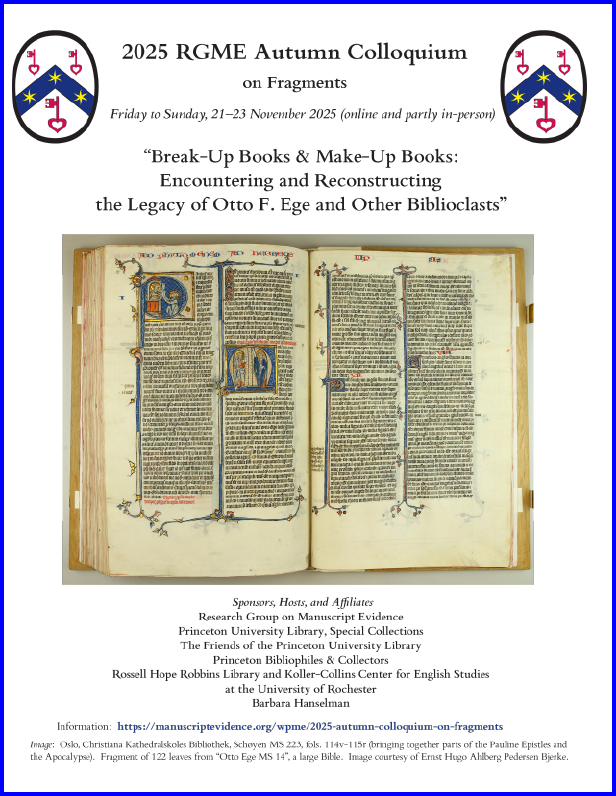
Poster 2. 2025 Autumn Colloquium. Poster set in RGME Bembino.

Multiple conference sessions, sponsored and co-sponsored, at

1) the International Congress on Medieval Studies at Kalamazoo
RGME Activities at the 2025 International Congress on Medieval Studies

2) the International Medieval Congress at Leeds
RGME Activities at the 2025 International Medieval Congress at Leeds

By request, a special Autumn Colloquium on Fragments, in hybrid form, which had to move abruptly from the first host institution to a welcome instead at Princeton

  • 2025 RGME Autumn Colloquium on Fragments

Onward to 2026

Our website reports activities and projects as they unfold for the Year 2026, when our Theme centers upon “Transformation and Renewal”. Join us to see how they may unfold.

Please donate what you can to keep our organization on course, in the face of widespread challenges for funding. We are grateful for your support.

1) Via Mightycause:

  • Donate to RGME
  • RGME 2026 Annual Appeal via Mightycause

2) Via Paypal, Venmo, ApplePay, Pay Later, or Debit or Credit Card:


Information and Suggestions
for Donations in Funds and Contributions in Kind

  • Contributions & Donations
  • Donations

Many thanks!

J. S. Wagner Collection. Leaf from from Prime in a Latin manuscript Breviary. Folio 4 Verso, with part of Psalm 117 (118) in the Vulgate Version, set out in verses with decorated initials.

J. S. Wagner Collection, Leaf from from Prime in a Latin manuscript Breviary. Folio 4 Verso, with part of Psalm 117 (118) in the Vulgate Version, set out in verses with decorated initials.

*****


Tags: Friends of the Reaearch Group on Manuscript Evidence, Manuscript studies, RGME Annual Appeal, RGME Symposia, RGME Workshops on the Evidence of MSS Etc., The Research Group Speaks
No Comments »

2025 RGME Autumn Colloquium Program Detailed

November 6, 2025 in Announcements, Conference, Conference Announcement, RGME Colloquia

Detailed Program

2025 RGME Autumn Colloquium
of the Research Group on Manuscript Evidence

“Break-Up Books and Make-Up Books:
Encountering and Reconstructing
the Legacy of Otto F. Ege
and Other Biblioclasts”

Friday – Sunday, 21-23 November 2025
In Person, Hybrid, or Online by Zoom

Program: 1) Overview and 2) Detailed View

I. Program Overview

Program Overview itself is available also here:

  • 2025 RGME Autumn Colloquium on Fragments: Program Overview

Day 1. Friday 17 October. 9:00 am – 5:00 pm EST (GMT-5)
— NOTE TWO DIFFERENT VENUES FOR FRIDAY Morning and Afternoon —

Morning Sessions at Green Hall (accessibility information). 9:00 am – 12:00 pm
Washington Road, Princeton, New Jersey 08542

Lunch Break. 12:00–1:00 pm

Afternoon Workshops with original materials at Special Collections, Firestone Library
(accessibility information)

Choose 1 of 2 (space is limited for in-person attendance)
2 Sittings:

1) Workshop 1. 1:30–3:00 pm (arrive at Firestone Library at 1:15 pm)
2) Workshop 2. 3:30–5:00 pm (arrive at Firestone Library at 3:15 pm)

Day 2. Saturday 18 October. 9:00 am – 5:00 pm

All-day Sessions at Nassau Presbyterian Church
(see also Nassau Presbyterian Church)
61 Nassau Street, Princeton, 08542
Accessibility information.

(Note: The original portion of the present building was designed and built by Charles Steadman and dedicated in 1836.)

Day 3. Sunday 19 October at 10:30am – 12:00am

Morning Sessions online. 10:30 am – 12:00 pm

Registration

Note: If accessing the registration link by laptop or computer does not connect through to select your choice of category, please access the link through your phone. For questions, please contact:

  • director@manuscriptevidence.org or rgmesocial@gmail.com

Choices

1) ONLINE (Friday to Sunday)

    • 2025 Autumn Colloquium: Online Attendance Tickets

2) IN PERSON (Friday and Saturday)

    • 2025 RGME Colloquium IN PERSON: Tickets

3) IN PERSON WORKSHOPS 1 and 2 at Special Collections (Friday afternoon)
(Space IN PERSON is limited; the Workshops are also available ONLINE)
Choose 1. Registration is required.

    • Workshop 1 (1:30 to 3:00 pm EST=GMT-5), First Sitting
      Workshop 1 IN PERSON: Tickets
    • Workshop 2 (3:30-5:00 pm EST), Second Sitting
      Workshop 2 IN PERSON: Tickets

4) Optional Dinner (at attendees’ expense) at a local restauraut

    • Friday 21 November (7:00–9:30 pm)
      and/or
    • Saturday 22 November (7:00–9:30 pm)
    • https://www.eventbrite.com/e/2025-rgme-colloquium-optional-dinner-friday-andor-saturday-tickets-1919146451699

Colloquium Booklet

The 64-page Colloquium Booklet, with abstracts and illustrations, will be available soon. When ready, it will be downloadable as a pdf in two formats:

  • Colloquium Booklet as consecutive pages (quarto-size 8 1/2″ × 11″ sheets)
  • Colloquium Booklet as foldable booklet (11″ × 17″ sheets)

For information and updates see the Colloquium HomePage

  • 2025 RGME Autumn Colloquium on Fragments

Read the rest of this entry →

Tags: Biblioclasts, history of printing, Manuscript studies, Medieval manuscripts, Otto F. Ege
No Comments »

Workshop 9 on “Books as Thresholds and Communities”

November 5, 2025 in Uncategorized

“The Research Group Speaks”

Workshop 9
“Books as Thresholds and Communities”

Sunday 21 December 2025
Online by Zoom

[Posted on 4 November 2025, with updates]

For our series, see

  • RGME Workshops on “The Evidence of Manuscripts, Etc.”

We propose hold the next Workshop on 21 December.

“Thresholds and Communities”

Florence, Cathedral of Santa Maria del Fiore, Domenico di Michelino, Dante Alighieri with Florence and the Realms of the Divine Comedy (Hell, Purgatory, Paradise). Oil on canvas, 1465. Image Public domain, via Wikimedia Commons via https://commons.wikimedia.org/wiki/File:Dante_Domenico_di_Michelino.jpg.

As the year 2025 draws to a close, we reflect on our Theme for the Year, “Thresholds and Communities” particularly as it applies to our explorations of books and their makers, users, collectors, readers, and others — through our series of workshops and other events — and as we prepare for next year and its new theme.

  • Thresholds and Communities: RGME Theme for the Year 2025

Poster 2. 2025 Autumn Colloquium. Poster set in RGME Bembino.

Also, because the 2025 RGME Autumn Colloquium in late November will consider the subject of Fragments (manuscript and printed) from many perspectives, we may discuss some discoveries from that event and follow up with more materials which it helped to bring to light.

  • 2025 RGME Autumn Colloquium on Fragments

Hint. See:

  • A Little Latin Vulgate Manuscript Leaf in Princeton
  • A Sister Leaf from a Miniature Latin Vulgate Bible

For example, do you have any manuscript or printed fragments that you would like to share or learn about? Bring them along, please, to our Zoom Meeting. Let’s see what we might learn together, and share the delights of discovery.

Registration

  • Workshop 9. Tickets

See you there!

Illumination from Hildegard’s Scivias (1151) showing her receiving a vision and dictating to teacher Volmar. Image Public Domain via Wikimedia Commons.

******

Questions? Suggestions?

  • Leave your comments or questions below
  • Contact Us

Visit our Social Media:

  • our FaceBook Page (https://www.facebook.com/people/Research-Group-on-Manuscript-Evidence/100064718795029/)
  • our Facebook Group (https://www.facebook.com/groups/rgmemss/)
  • our X/Twitter Feed (@rgme_mss)
  • our Bluesky nest @rgmesocial.bluesky.social)
  • our Instagram Page
  • our LinkedIn Group

Join the Friends of the RGME.

Please make a Donation in Funds or in Kind for our nonprofit educational corporation powered principally by volunteers. Your donations and contributions are welcome, and can go a long way. They may be tax-deductible to the fullest extent provided by the law.

  • Donations and Contributions
  • 2025 Annual Appeal

*****

No Comments »

2025 Autumn Symposium on 17-19 October: Program

October 11, 2025 in Announcements, Manuscript Studies, RGME Symposia

2025 Autumn Symposium
of the Research Group on Manuscript Evidence

“Readers, Fakers, and Re-Creators of Book:
From Page to Marketplace and Beyond”

Part 2 of 2 in the
2025 Spring and Autumn Symposia

Friday – Sunday, 17-19 October 2025
Online by Zoom

Preliminary Program

Overview

Day 1. Friday 17 October at  1:30 – 5:00 pm EDT (GMT -4)
Day 2. Saturday 18 October at 9:00 am – 5:00 pm EDT (GMT -4)
Day 3. Sunday 19 October at 10:30am – 12:00am EDT (GMT -4)

Registration

  • 2025 RGME Autumn Symposium Registration

Symposium HomePage (information and updates)

  • 2025 RGME Autumn Symposium on Readers, Fakers, and Re-Creators of Books

Symposium Booklet (40-page illustrated booklet, available in two formats for printing)

  • Consecutive pages (8 1/2″ × 11″)
  • Foldable booklet (11″ × 17″ sheets)

Program

* = Research Group on Manuscript Evidence (Trustees, Associates, Consultants)

Day 1. Friday 17 October at  1:30 – 5:00 pm EDT (GMT -4)

Session 1. 1:30 – 3:00 pm

Session 1
“A Life Imprinted:
From Life to Words to Print”

Presider. * Beppy Landrum Owen (Council Member, Grolier Club; Trustee, Rare Book School; Graduate Student, Master of Liberal Studies Program, Rollins College)

Speaker

* Eve Kahn (Independent Scholar)

“A Life in Print:
Zoe Anderson Norris (1860-1914) and Her Millions of Autobiographical Words”

Note: Eve’s new book: Queen of Bohemia Predicts her Own Death: Gilded Age Journalist Zoe Anderson Norris (Fordham University Press, 2025)

Break. 3:00–3:30 pm

Session 2. 3:30 – 5:00 pm

Session 2
“Now You See It, Now You Don’t:
Forgeries at Work and Play”

Presider. * Beppy Landrum Owen

Speakers

Tara Peterson (Medieval Studies, University of York)

““The Spanish Forger: 19th-Century Medievalism and the Value of Forgery”

* Reid Byers (President of the Baxter Society and Author of:
The Private Library: The history of the Architecture and Furnishing of the Domestic Book Room;
and Imaginary Books: Lost, Unfinished, and Fictive Works Found Only in Other Books)

““Collecting the Imaginary and The Fortsas Affair”

*****************

Day 2. Saturday 18 October at 9:00 am – 5:00 pm EDT (GMT -4)

Session 3. 9:00–10:30 am

Session 3
“Reading the Pages:
Witnesses Examined”

Presider. * N. Kıvılcım Yavuz (University of Leeds)

Speakers

Janie Wright (University of Leeds)
“A Textual Examination of Leeds, Leeds University Library, Ripon Cathedral Library MS 5:
Petrus Riga’s Aurora”

Mildred Budny
“Biblioclasts as ‘Editors’ and Re-Creators of Books:
A Scholar’s View of Otto F. Ege’s Oeuvre, Repurposing Specimens from Manuscripts and Printed Books”

Break. 10:30–11:00 am

Session 4. 11:00 am – 12:30 pm

Session 4
“(Re)Writing the Classics:
William Henry Ireland AKA Shakespeare”

Presider. * David Porreca (Department of Classics, University of Waterloo)

Speaker

Jack Lynch (Department of English, Rutgers University)

“The Shakespeare Phantom:
William Henry Ireland and Manuscript Evidence”

Lunch Break. 12:30–1:30 pm

Session 5. 1:30 – 3:00 pm

Session 5
“Books and Their Agents/Agencies”
A Roundtable Discussion

Presider. * Justin Hastings (Research Group on Manuscript Evidence)

Panelists (Alphabetical Order)
* Mildred Budny
* Beppy Landrum Owen
* David Porreca
* N. Kıvılcım Yavuz
And Others . . .

Break. 3:00–3:30 pm

Session 6. 3:30 – 5:00 pm

Session 6
“Fashioning or Re-Fashioning Plates
and Scrap-Booking Stories”

Presider. * Jennifer Larson (Kent State University)

Speakers

Meghan Constantinou (Simmons University)

“Phoebe A. D. Boyle (1831-1923):
Work in Progress on a Forgotten Bibliophile”

* Beppy Landrum Owen

“More Tales from the Making of Andreas Vesalius’s Icones anatomicae:
A Progress Report for an Exhibition”

Irene Malfatto (Bruce McKittrick Rare Books, Philadelphia)

“Creating and Re-Creating Natural History in Early-Modern Europe:
The ‘Aldrovandi Scrapbook’ “

*****************

Day 3. Sunday 19 October at 10:30 am – 12:00 pm EDT (GMT -4)

Session 7. 10:30 am – 12:00 pm

Session 7
“Manuscript Remnants
Reused, Recovered, Collected, Reconsidered:
Agents and Agencies
in the History of Transmission”

Presider. * Hannah Goeselt (Massachusetts Historical Society Library)

Speakers

* David W. Sorenson (Allen G. Berman, Numismatist)

“Cahiers des Manuscrits Perdus:
From Codices to Covers via the French Revolution”

* Mildred Budny

And Others

Closing Remarks:

“Rounding out the Series of 2025 Spring and Autumn Symposia,
with a Preview of the 2025 RGME Colloquium on ‘Fragments’  ”

*************

Registration

  • 2025 RGME Autumn Symposium Registration

For information and updates see the Symposium HomePage

  • 2025 RGME Autumn Symposium on Readers, Fakers, and Re-Creators of Books

Cambridge, Massachusetts, Harvard University, Houghton Library, MS Typ 947, ‘verso’. Images via https://iiif.lib.harvard.edu/manifests/view/drs:6517512$1i.

*************


Tags: 2025 Autumn Symposium, 2025 Spring and Autumn Symposia, Aldrovandi Scrapbook, Forgery, Fortsas Hoax, Icones Anatomicae of Vesalius, Manuscript studies, Petrus Riga, Phoebe A. D. Boyle, William Henry Ireland, William Shakespeare, Zoe Norris Anderson
No Comments »

Workshop 8: A Hybrid Book where Medieval Music Meets Early-Modern Herbal

October 11, 2025 in Announcements, Early-Printed Books, Event Registration, Manuscript Studies, Research Group Workshops, Workshops on "The Evidence of Manuscripts"

RGME Workshops
on
“The Evidence of Manuscripts, Etc.”

Workshop 8
“Face the Music, or,
Where Manuscript Meets Print
in a Hybrid Book:

An Early-Modern German Astrological Herbal
with a Reused Binding Fragment
from a Medieval Musical Manuscript”

Sunday 26 October 2025
Online by Zoom

[Posted on 15 September 2025, with updates)

Our series of Workshops on “The Evidence of Manuscripts, Etc.” continues with an exploration of a hybrid book for Workshop 8.

The Hybrid Book

This workshop will examine a puzzling vellum fragment (or is it a set of patchwork fragments?) in a private collection. The fragment(s) come(s) from a single musical manuscript in Latin on vellum laid out in double columns with text and notation on 4-line staves. The reused medieval material forms the outer covering of a 17th-century printed book in German on laid paper.

Private Collection, Front Cover with Reused Medieval Musical Fragment on Vellum. Photograph by Mildred Budny.

The Musical Fragment and its ‘Find-Place’

For the musical fragment, we will work to decipher the visible parts of the text and music, identify the readings/lections and chants, and, if possible (given the fragmentary nature), determine the probable genre of original manuscript, such as lectionary, breviary, antiphonary, or missal. Perhaps, over time, we might find other survivors from the same despoiled medieval manuscript.

Narrowing down its possible origin—or location in the early 17th century or later when it came to be reused as a binding cover–might aid the quest to determine the circumstances of its reuse and whence other parts of it might have been disseminated, whether as reused binding materials or otherwise.

For the workshop, we will examine the features of the printed book. It includes multiple woodcut illustrations and occasional marginalia in forms of annotations demonstrating attention of several kinds to the contents of the herbal.

What brought this medieval musical fragment and early modern printed book together? Even if we might never know all the answers, won’t it be fun to question how and why? There is a story here.

We love the puzzles, and give thanks to the collector for lending the book to the RGME for study and teaching and for sharing it with our audience in this workshop and beyond.

Information

People who be participating at the workshop to offer observations, reflections, and suggestions about the composite volume include (in alphabetical order):

Phillip Bernhardt–House

Mildred Budny

Natalia Fay

Leslie French (represented by a report on the musical manuscript fragment)

Beppy Landrum Owen

David Porreca

David W. Sorenson (with some specimens of herbals mentioning astrological influences)

And others.

At our 2024 Spring Symposium at Vassar College, Natalia delightfully described her work for her exhibition on herbals then on display in the Art Library. She shares the poster and brochure for the exhibition with us, as she returns to our events in this workshop to report on her continuing interests in plants, books, manuscripts, and their transmission.

  • Natalia Fay, Botanicals Thesis Poster
  • Natalia Fay, Arcane Botanicals Program

The Manuscript Fragments

The visible portions of the manuscript appear, with only one side facing and the other side hidden, on the outer sides of the front and back covers, spine, and fore-edges of the binding.

Their text and music on four-line staves stand upright on the volume. Written in Gothic script, the parallel lines of music and text have some elements in red and blue pigments. There are ten lines on the front cover and on the spine, but the back cover has an additional line of music at the bottom, amounting to 10 1/2 lines on this portion. Each portion of the fragment shows a single column, or part of one. At the right on the back cover, the right-hand side of the fragment extends beyond the column with an expanse of outer margin from its original extent.

Sections open with 2-line initials which span the full height of the paired lines of music-and-text, for which the staves separate their horizontal course. One initial comprises a blue capital I (front cover, line 7). Three band-like initials comprise decorative forms in black ink with a vertical twist at the left-hand side; red pigment fills the centers of their twists (front cover, lines 2 and 6; back cover, line 2).

1. Front Cover

Private Collection, Front Cover with Reused Medieval Musical Fragment on Vellum. Photograph by Mildred Budny.

2. Back Cover

Private Collection. Musical Manuscript Fragment, Back Cover with ruler.

Spine

Private Collection. Hybrid book with Musical Manuscript Fragment, Spine View.

The Printed Book

The printed text comprises the German Kreutterbuch (“Book of Herbs”), an astrological herbal, by Bartholomaeus Carrichter (1510–1574), in an early edition printed in Strasbourg in Alsace in 1606. The author, who wrote under the pseudonym of Philomusus Anonymus, was physician to Ferdinand I (1503–1564), Holy Roman Emperor from 1556, and his son Maximilian II, Holy Roman Emperor from 1564 to 1576. The first edition of his Kreutterbuch was printed in Strasbourg in 1517 by Chistian Muller. For later editions, the physician, poet, and alchemist Michael Toxites (1515–1581), whose birth-name was Johann Michael Schütz, added some material to Carrichter’s work and edited it.

One of various versions of the illustrated genre by different authors (see, for example the Kreutterbuch desz Hocgelehrten und Weitberuhmten Herrn D. Petri Andreae Matthioli . . . ), this book combines information about plants, use, and lore with astrological considerations.

Title Page

A catalogue description of the volume characteristically derives from information on the title page:

Philomusus Anonymous [Bartholomaeus Carrichter (1510–1574)], Horn des Heyls menschlicher Blödigkeit, oder Kreütterbuch, darinn die Kreütter des Teutschenlands auss dem Liecht der Natur nach rechter Art der himmelischen Einfliessungen beschriben / durch Philomusum Anonymum [Bartholomäus Carrichter], with a foreword by Michael Toxites, born Johann Michael Schütz (1514–1581), (Strassbourg: Anton Bertram, DCVI/1606).

An inscription in light black ink at the foot of the title page gives the initials “G. S.” Perhaps they refer to an owner.

Private Collection, Kreutterbuch, title page. Photograph by Mildred Budny.

For the first edition of 1576, printed in Straßburg, see an online digital facsimile of a copy in Augsburg, Staats- und Stadtbibliothek. For an edition of 1619 also printed by A. Bertram, see the copy in the Wellcome Collection.

Like the 1619 edition, this folio volume has 10 unnumbered pages, 180 numbered pages, and 5 unnumbered leaves, with a woodcut title page and outline illustrations. Interspersed within the columns of text, the book has 58 outline illustrations depicting the herbs which it describes. For example, borage (Borago officinalis) or starflower:

Private Collection, Carrichter’s Kreutterbuch (Strasbourg, 1604). Borage. Photography by Mildred Budny.

Up close:

Private Collection, Carrichter’s Kreutterbuch (Strasbourg, 1604). Borage. Photography by Mildred Budny.

For comparison: Borage ‘In The Wild’

Borago officinalis. Photograph by By Christian Orlandi (12 April 2025) – Own work, CC BY-SA 4.0. Image via Wikimedia Commons via https://commons.wikimedia.org/wiki/File:Borago_officinalis_(2025).jpg.

Some marginal annotations in brown ink amplify or comment upon passages.

Private Collection, Carrichter’s Kreutterbuch (Strasbourg, 1604). Textual opening with marginal Annotations. Photography by Mildred Budny.

*****

Registration for the Workshop

We invite you to join the quest.

  • https://www.eventbrite.com/e/workshop-8-a-hybrid-book-with-astrological-herbal-and-medieval-missal-tickets-1340074201009

*****

Questions? Suggestions?

  • Leave your comments or questions below
  • Contact Us

Visit our Social Media:

  • Leave your comments or questions below
  • Contact Us

Visit our Social Media:

  • our Facebook Page
  • our Facebook Group
  • our X/Twitter Feed (@rgme_mss)
  • our Bluesky nest @rgmesocial.bluesky.social)
  • our Instagram Page
  • our LinkedIn Group

Join the Friends of the RGME.

Please make a Donation in Funds or in Kind for our nonprofit educational corporation powered principally by volunteers. Your donations and contributions are welcome, and can go a long way. They may be tax-deductible to the fullest extent provided by the law.

  • Donations and Contributions
  • 2025 Annual Appeal

*************

Tags: astrological herbals, Bartholomaeus Carrichter, Early modern printing, history of herbals, history of printing, Kreutterbuch, manuscript fragments, Manuscript Fragments Reused in Bindings, Manuscript studies, medieval musical manuscripts, Michael Toxites
No Comments »

« Older Entries
Newer Entries »
  • Top
©2024 Research Group on Manuscript Evidence.


is proudly powered by WordPress. WordPress Themes X2 developed by ThemeKraft.