• News
    • News & Views
    • RGME Activities for 2024 and 2025
    • Around & About with the RGME
    • Reviews
    • Highlights
  • Blogs
    • Manuscript Studies
      • Manuscript Studies: Contents List
    • International Congress on Medieval Studies
      • Abstracts of Congress Papers
        • Abstracts of Papers Listed by Author
        • Abstracts of Papers Listed by Year
  • About
    • Mission
    • Who We Are
      • Officers, Associates & Volunteers
      • RGME Committees
      • Friends of the Research Group on Manuscript Evidence
    • Policies & Statements
      • RGME Privacy Policy Statement
      • RGME Intellectual Property Statement & Agreements
    • People
      • Mildred Budny — Her Page
      • Adelaide Bennett Hagens
    • Activities
      • Events
      • Congress Activities
        • Sponsored Conference Sessions (1993‒)
          • Panels at the M-MLA Convention (from 2016)
        • Co-sponsored Conference Sessions (2006‒)
    • History
      • Seals, Matrices & Documents
      • Genealogies & Archives
    • Contact Us
  • Bembino
    • Multi-Lingual Bembino
    • RGME Bembino: Resources
  • Congress
    • Sponsored Conference Sessions (1993‒)
    • Co-sponsored Conference Sessions (2006‒)
    • Abstracts of Congress Papers
      • Abstracts Listed by Author
      • Abstracts Listed by Year
    • Kalamazoo Archive
    • Panels at the M-MLA Convention (2016-2019)
      • Abstracts of Papers for the M-MLA Convention
      • Panels at the M-MLA Convention (from 2016)
  • Events
    • RGME Activities for 2024 and 2025
      • 2023 Activities and 2024 Planned Activities
    • Seminars, Workshops, Colloquia & Symposia (1989–)
      • Seminars on ‘The Evidence of Manuscripts’
      • Symposia on ‘The Transmission of the Bible’
      • The New Series (2001-)
        • 2019 Anniversary Symposium Program: The Roads Taken
        • 2019 Anniversary Symposium Registration
        • 2019 Anniversary Symposium Registration Open
      • RGME Symposia: The Various Series
      • The Research Group Speaks: The Series
      • Meetings of the Friends of the Research Group on Manuscript Evidence
      • RGME Online Events
    • Abstracts of Papers for Events
      • Abstracts of Papers for Seminars on ‘The Evidence of Manuscripts’
      • Abstracts of Papers for Symposia, Workshops & Colloquia
    • Receptions & Parties
    • Business Meetings
    • Photographic Exhibitions & Master Classes
    • Events Archive
  • ShelfLife
    • Journal Description
    • ShelfMarks: The RGME-Newsletter
    • Publications
      • “Insular, Anglo-Saxon, and Early Anglo-Norman Manuscript Art at Corpus Christi College, Cambridge” (1997)
        • Mildred Budny, ‘Catalogue’
        • The Illustrated Catalogue (1997)
      • The Illustrated Handlist
      • Semi-Official Counterfeiting in France 1380-1422
      • No Snap Decisions: Challenges of Manuscript Photography
    • History and Design of Our Website
  • Galleries
    • Watermarks & the History of Paper
    • Galleries: Contents List
    • Scripts on Parade
    • Texts on Parade
      • Latin Documents & Cartularies
      • New Testament Leaves in Old Armenian
    • Posters on Display
    • Layout Designs
  • Donations and Contributions
    • RGME Donor Promise
    • 2023 End-of-Year Fundraiser for our 2024 Anniversary Year
    • 2019 Anniversary Appeal
    • Orders
  • Links
    • Catalogs, Metadata, and Databases: A Handlist of Links
    • Handlist of Resources for Manuscript Studies and Fragmentology
    • Manuscripts & Rare Books
    • Maps, Plans & Drawings
    • Seals, Seal-Matrices & Documents

  • News
    • News & Views
    • RGME Activities for 2024 and 2025
    • Around & About with the RGME
    • Reviews
    • Highlights
  • Blogs
    • Manuscript Studies
      • Manuscript Studies: Contents List
    • International Congress on Medieval Studies
      • Abstracts of Congress Papers
        • Abstracts of Papers Listed by Author
        • Abstracts of Papers Listed by Year
  • About
    • Mission
    • Who We Are
      • Officers, Associates & Volunteers
      • RGME Committees
      • Friends of the Research Group on Manuscript Evidence
    • Policies & Statements
      • RGME Privacy Policy Statement
      • RGME Intellectual Property Statement & Agreements
    • People
      • Mildred Budny — Her Page
      • Adelaide Bennett Hagens
    • Activities
      • Events
      • Congress Activities
        • Sponsored Conference Sessions (1993‒)
          • Panels at the M-MLA Convention (from 2016)
        • Co-sponsored Conference Sessions (2006‒)
    • History
      • Seals, Matrices & Documents
      • Genealogies & Archives
    • Contact Us
  • Bembino
    • Multi-Lingual Bembino
    • RGME Bembino: Resources
  • Congress
    • Sponsored Conference Sessions (1993‒)
    • Co-sponsored Conference Sessions (2006‒)
    • Abstracts of Congress Papers
      • Abstracts Listed by Author
      • Abstracts Listed by Year
    • Kalamazoo Archive
    • Panels at the M-MLA Convention (2016-2019)
      • Abstracts of Papers for the M-MLA Convention
      • Panels at the M-MLA Convention (from 2016)
  • Events
    • RGME Activities for 2024 and 2025
      • 2023 Activities and 2024 Planned Activities
    • Seminars, Workshops, Colloquia & Symposia (1989–)
      • Seminars on ‘The Evidence of Manuscripts’
      • Symposia on ‘The Transmission of the Bible’
      • The New Series (2001-)
        • 2019 Anniversary Symposium Program: The Roads Taken
        • 2019 Anniversary Symposium Registration
        • 2019 Anniversary Symposium Registration Open
      • RGME Symposia: The Various Series
      • The Research Group Speaks: The Series
      • Meetings of the Friends of the Research Group on Manuscript Evidence
      • RGME Online Events
    • Abstracts of Papers for Events
      • Abstracts of Papers for Seminars on ‘The Evidence of Manuscripts’
      • Abstracts of Papers for Symposia, Workshops & Colloquia
    • Receptions & Parties
    • Business Meetings
    • Photographic Exhibitions & Master Classes
    • Events Archive
  • ShelfLife
    • Journal Description
    • ShelfMarks: The RGME-Newsletter
    • Publications
      • “Insular, Anglo-Saxon, and Early Anglo-Norman Manuscript Art at Corpus Christi College, Cambridge” (1997)
        • Mildred Budny, ‘Catalogue’
        • The Illustrated Catalogue (1997)
      • The Illustrated Handlist
      • Semi-Official Counterfeiting in France 1380-1422
      • No Snap Decisions: Challenges of Manuscript Photography
    • History and Design of Our Website
  • Galleries
    • Watermarks & the History of Paper
    • Galleries: Contents List
    • Scripts on Parade
    • Texts on Parade
      • Latin Documents & Cartularies
      • New Testament Leaves in Old Armenian
    • Posters on Display
    • Layout Designs
  • Donations and Contributions
    • RGME Donor Promise
    • 2023 End-of-Year Fundraiser for our 2024 Anniversary Year
    • 2019 Anniversary Appeal
    • Orders
  • Links
    • Catalogs, Metadata, and Databases: A Handlist of Links
    • Handlist of Resources for Manuscript Studies and Fragmentology
    • Manuscripts & Rare Books
    • Maps, Plans & Drawings
    • Seals, Seal-Matrices & Documents

Log in

Archives

Featured Posts

2026 “Transformations & Renewals”: The RGME visits Treasures of the Grolier Club Library
"Bembino" Booklet Cover
Episode 23. “Meet RGME Bembino: Facets of a Font”
2026 Theme of the Year: “Transformations and Renewals”
A Leaf with Patchwork from the Saint Albans Bible
A Sister Leaf from a Miniature Latin Vulgate Bible
A Little Latin Vulgate Bible Manuscript Leaf in Princeton
J. S. Wagner Collection. Leaf from from Prime in a Latin manuscript Breviary. Folio 4 Verso, with part of Psalm 117 (118) in the Vulgate Version, set out in verses with decorated initials.
2026 Annual Appeal
Episode 22: “Encounters with Local Saints and Their Cults”
Private Collection, Ege's FBNC Portfolio, Dante Leaf, Verso, Detail. Reproduced by Permission.
2025 RGME Autumn Colloquium on Fragments
Workshop 8: A Hybrid Book where Medieval Music Meets Early-Modern Herbal
2025 RGME Autumn Symposium on “Readers, Fakers, and Re-Creators of Books”
RGME Workshops on “The Evidence of Manuscripts, Etc.”
2025 International Medieval Congress at Leeds: RGME Program
Episode 21. “Learning How to Look”
2025 International Congress on Medieval Studies: Program
2025 RGME Visit to Vassar College
Two Leaves in the Book of Numbers from the Chudleigh Bible
Delibovi on Glassgold on Boethius: A Blogpost
Ronald Smeltzer on “Émilie du Châtelet, Woman of Science”
2025 Spring Symposium: “Makers, Producers, and Collectors of Books”
Starters’ Orders
The Weber Leaf from the Saint Albans Bible
Workshop 4. “Manuscript Fragments Compared”
Episode 20. “Comic Book Theory for Medievalists”
Episode 19: “At the Gate: Starting the Year 2025 at its Threshold”
Favorite Recipes for Lemonade, Etc.
RGME Visit to the Lomazow Collection: Report
2024 Autumn Symposium: “At the Helm”
A Latin Vulgate Leaf of the Book of Numbers
The RGME ‘Lending Library’
Florence, Italy, Ponte Vecchio from Ponte alle Grazie. Photo: Ingo Mehling, CC BY-SA 4.0 , via Wikimedia Commons
Episode 17. “RGME Retrospect and Prospects: Anniversary Reflections”
2024 Anniversary Symposium: The Booklet
Jesse Hurlbut at the Bonneville Salt Flats, Utah. Photograph Jesse Hurlbut.
Episode 16: An Interview with Jesse D. Hurlbut
To Whom Do Manuscripts Belong?
Kalamazoo, MI Western Michigan University, Valley III from the side. Photograph: David W. Sorenson.
2024 International Congress on Medieval Studies: Report
2024 Spring Symposium at Vassar College
Puente de San Martín: Bridge with reflection over the River Targus, Toledo, Spain.
2024 Grant for “Between Past and Future” Project from The Gladys Krieble Delmas Foundation Research Libraries Program
2024 Anniversary Symposium in Thanks to Jesse Hurlbut: Program

You are browsing the Blog for Medieval Manuscript Fragments

A Sister Leaf from a Miniature Latin Vulgate Bible

December 17, 2025 in Fragments, Manuscript Studies, Research Group Workshops, Workshops on "The Evidence of Manuscripts"

A Sister Leaf
from a Miniature Latin Vulgate Bible:
Fragments at Princeton

2 columns in 47 lines
Measurements
Leaf maximum circa 121 mm high × 82 mm wide
<Written area circa 90 × 57 mm>

[Posted on 16 December 2025]

Poster 3 for 2025 Autumn Colloquium. Workshops on “Fragments at Princeton”

For the recent 2025 RGME Autumn Colloquium on Fragments, our Associate Eric M. White presented a pair of Workshops on “Fragments at Princeton”, with a focus on “Books in Fragments / Fragments in Books”. The workshops took place in Special Collections of the Princeton University Library, in two sittings.

With a few variations in each workshop, the selected specimens considered a range of manuscript and printed materials. They included, for example, single manuscript leaves (or fragments thereof) on their own or manuscript fragments (single leaves or conjoint bifolia) reused as part of bindings, pastedowns, or endleaves for other texts.

For many of these specimens, Eric demonstrated their characteristics with a riveting commentary about the processes of discovery which brought them to Princeton or which enriched understanding about them once the curator or scholar came across them in the stacks or within their secondary homes in the form of composite codices mixing layers from different dates and places of production and different genres of books.

He presented some specimens of individual leaves as curiosities about which little is known — in case they might be recognized. About one of them I said that I thought I knew of another similar leaf. The Princeton University Leaf  came from a set of three boxes of manuscript fragments, which had little or no information about their sources.

Now we introduce another leaf which I believe came from the same manuscript. Do you agree?

Read the rest of this entry →

Tags: Book of Isaiah, Book of Wisdon, Fragmentology, manuscript fragments, Manuscript studies, Medieval Latin Vulgate Bibles, Medieval Manuscript Fragments, Princeton University Library
No Comments »

Two Leaves in the Book of Numbers from the Chudleigh Bible

April 22, 2025 in Announcements, Manuscript Studies, RGME Library & Archives

Two Leaves
in the Book of Numbers
from the Chudleigh Bible

Latin Vulgate Bible
Northern France
Sant-Vaast Abbey?
Circa 1220–1230

Text written in Gothic Bookhand
Laid out in Double Columns of 56 lines
with Running Titles, Rubrication,
Text-Initials in Red and Blue,
and Marginalia within Frames

[Posted on 17 April 2025, with updates]
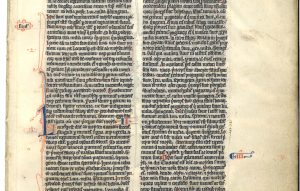
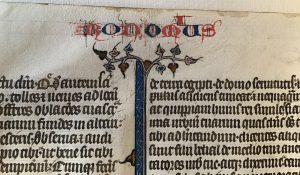
Formerly Collection of Richard Weber, Leaf 1 from the Chudleigh Bible: Recto, Detail. Photograph by Mildred Budny.

Continuing our series of posts describing discoveries for the study of manuscript fragments (see Manuscript Studies Blog: Contents List), we introduce two leaves which belonged to the Book of Numbers in the medium-format Latin Vulgate Bible now known as the Chudleigh Bible. The name derives from one of its former owners, the eleventh Baron Clifford of Chudleigh.

  • Charles Oswald Hugh Clifford (1887–1962), Lord Clifford of Chudleigh (Devon, England)
    See also:
  • “We Remember Charles Oswald Hugh Clifford”

The place Chudleigh itself is an ancient wool town in Devon in Southwest England.

First we introduce the two leaves. Then we describe the original manuscript, insofar as it is known from surviving fragments and the descriptions in catalogues (of sales, collections, and genres of medieval French manuscript production). A preliminary list of surviving leaves, including not only the seemly more significant and financially valuable leaves with illustrations, is offered, as a compliment or companion to existing lists.

Further blogposts will offer more information about both forms of experience for the manuscript and its identifiable fragments, whether indirectly by catalogue or other surrogate representative, or more directly by in-person inspection. The goal is to build towards a fuller recognition of the survivors, their characteristics, and their locations.

I. Two Leaves from the Book of Numbers

These two leaves come to the RGME as a donation by our Associate, Richard Weber. Previous blogposts have reported portions of his collection of manuscript fragments, starting with Set 93 of the Portfolio of Famous Books assembled by Otto F. Ege (1888–1951).

  • Portfolio 93 of Otto Ege’s Famous Books in Eight Centuries in the Collection of Richard Weber
  • The Weber Leaf from the Warburg Missal: Otto Ege Manuscript 22
  • The Weber Leaf from the Saint Albans Bible

1. That first post has set in motion a continuing study of that portfolio and its different components representing manuscript and printed materials alike. One development recently focuses upon a collaborative study of the dismembered volume of Dante as we prepare for the 2025 Autumn Colloquium on “Break-Up Books and Make-Up Books: Encountering and Reconstructing the Legacy of Otto F. Ege and Other Biblioclasts”. Richard has generously agreed to speak about his collecting interests for that event.

  • 2025 RGME Autumn Colloquium at the University of Waterloo

2. The Weber Leaf from Otto Ege Manuscript 22 inspired us to examine closely the evidence of origin, provenance, and genre of book for this leaf and other survivors of the same volume, set against Otto Ege’s labels of attribution based upon incomplete and misrepresented knowledge. The resulting Research Booklet, freely available, presents the evidence. You can find it here:

  • The Weber Leaf from the Warburg Missal: Otto Ege Manuscript 22

3. Richard shared photographs of his leaf from the Saint Albans Bible in response to our new series of Workshops on “The Evidence of Manuscripts, Etc.”, which took inspiration from the loan of a leaf from that Bible from the Collection of Jennah Farrell to the RGME for photography, study, and publication. We decided to turn to crowd-sourcing and mentoring in these workshops as a collaborative, collective way to learn about manuscripts together, including beginners, experts, and others in between. It was a good choice.

  • RGME Workshops on “The Evidence of Manuscripts, Etc.”

As the Workshops developed, they considered fragments from different Latin Bible manuscripts pertaining to similar periods, styles of production, and various sizes or formats. By Workshop 5, we could survey their range and the progress which the workshops and their collaborative approach had attained.

  • Workshop 5. “Identifying Medieval Latin Bible Manuscript Fragments”

At this Workshop, Richard Weber generously offered to give a couple of medieval Latin Bible leaves to the RGME for our Research Library & Archives.

Soon, the leaves arrived, which Richard had had beautifully framed in a pair of matching frames with windowed mats and easily removable backs. Protecting the leaves, these frames both showed each leaf to advantage and allowed for access from the back of the frame to allow us to see the other side of the leaf and its full extent.

Companion sheets of paper report details of the leaves, their seller, and the original manuscript, the Chudleigh Bible.

For this gift, we created a bookplate recording Richard’s donation. We give thanks for his characteristic generosity and thoughtfulness.

The Two Leaves

And so, we introduce a pair of non-consecutive leaves from the Book of Numbers in the Chudleigh Bible. The modern Arabic numbers written in pencil at the center directly below the columns of text label them as “38” and “43” respectively. Presumably they designate the folio numbers for them in a consecutive sequence entered before the separation of the leaves from each other.

So far we have not identified any surviving leaves which formerly stood between them or adjacent to them within the same Biblical Book.

Leaf 1: Folio 38

This leaf must have directly followed the opening leaf of the Book, as it starts partway within Chapter 1. That leaf would have carried the opening initial for the Book, with L for Locutusque. Its present location is unknown, but the contents of its illustrated initial have been recorded to indicate a depiction of the figures of God, Moses, and Joshua at an altar. (p. 69 and 72 note 8)

Recto

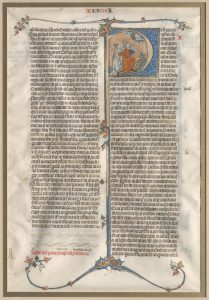
Formerly Collection of Richard Weber, Leaf 1 from the Chudleigh Bible: Recto.

Verso

Formerly Collection of Richard Weber, Leaf 1 from the Chudleigh Bible: Verso.

Leaf 2: Folio 43

Recto

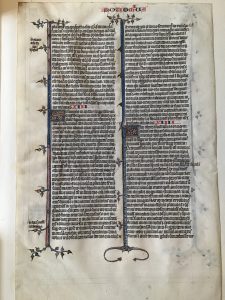
Formerly Collection of Richard Weber, Leaf 2 from the Chudleigh Bible: Recto.

Verso

Formerly Collection of Richard Weber, Leaf 2 from the Chudleigh Bible: Verso.

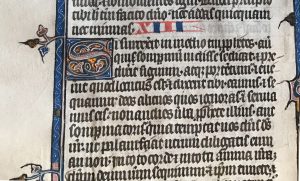
Note that there has been some correction/adjustment in the Chapter Numbering. In the intercolumn for the left-hand column there stands a second XVI on the verso, duplicating the same number on the recto. It has been crossed out with a horizontal stroke. The numbering continues below with XVII and XVIII for the left- and right-hand columns respectively.


Contents: Text

Leaf 1 (recto and verso)

Numbers 1  36 [De filiis Benjamin per generationes et familias ac domos] cognationum suarum recensiti sunt nominibus singulorum a vigesimo anno et supra, omnes qui poterant ad bella procedere, 37triginta quinque millia quadringenti.
Numbers 2 1 Locutusque est Dominus ad Moysen et Aaron, dicens
Numbers 3  1 Hæ sunt generationes Aaron et Moysi in die qua locutus est Dominus ad Moysen in monte Sinai.
7 et observent quidquid ad cultum pertinet multitudinis coram taberna // culo testimonii,
Numbers 4  1 Locutusque est Dominus ad Moysen et Aaron, dicens
14 ponentque cum eo omnia vasa, quibus in ministerio ejus utuntur, id est, ignium receptacula[, fuscinulas ac tridentes, uncinos et batilla.]

Leaf 2 (recto and verso)

Numbers 15 9 [dabis per singulos boves similæ tres decimas consper]sæ oleo, quod habeat medium mensuræ hin
Numbers 16 1 Ecce autem Core filius Isaar, filii Caath, filii Levi, et Dathan atque Abiron filii Eliab,
28 Et ait Moyses : In //hoc scietis quod Dominus miserit me ut facerem universa quæ cernitis, et non ex proprio ea corde protulerim :
[Possibly struck through incorrect marking for chapter 16 at]
Numbers 16 36 Locutusque est Dominus ad Moysen, dicens
Numbers 17 1 Et locutus est Dominus ad Moysen, dicens
Numbers 18 1 Dixitque Dominus ad Aaron
11 Primitias autem, quas voverint et obtulerint filii Israël, tibi dedi, et filiis tuis, ac filiabus tuis, jure perpetuo : qui mundus est [in domo tua, vescetur eis. ]

*****

As part of the RGME’s Research Library & Archives and our ongoing project on medieval manuscript fragments, we begin the study of this leaf and its context, as part of the quest to identify and virtually reconstruct its former volume. Another blogpost will report more information about these two leaves.

Now we survey reports about the original volume and some of its identified survivors.

II. Once Upon a Time:
A Single-Volume Vulgate Bible

Formerly, as described in its sales catalogue descriptions while still intact, the manuscript comprised a single volume of 411 vellum leaves, with its text laid out in double columns of 56 lines each. Initials opening Books of the Bible contained historiated scenes and decorative elements; some 90 or 91 of them were historiated.

The volume as such was sold at auction in London several times first by Sotheby & Co and then by Christie’s. Its appearance on the market began at the hands of its former owner, Charles Oswald Hugh Clifford, the eleventh Lord Clifford of Chudleigh. By that ownership it acquired its modern name.

I. As a Single Volume

For an overview of the former “Parent Volume” from which came dispersed leaves, see Peter Kidd, McCarthy Collection, Volume III: French Miniatures (London, 2021), No. 17 (pp. 69–73).

Notice of the manuscript, with some black-and-white images of its illustrated elements, appeared in print three times, corresponding with its sale by successive owners, starting with Lord Clifford of Chudleigh himself.

1) Sold by Sotheby & Co, London,
7 December 1953, lot 51
(pp. 00 in catalogue)

Catalogue of fine Western and Oriental manuscripts and miniatures . . . :  which will be sold by auction by Messrs. Sotheby & Co. . . . at their large galleries 34 & 35 New Bond Street, W.1

Bought by Maggs Bros., London, for £680.

2) Sold by Sotheby & Co, London,
Wednesday, 8th July 1970 as Lot 104 (pp. 78–79 in catalogue)

Catalogue of important Western manuscripts and miniatures . . . : which will be sold by auction by Sotheby & Co. . . . at their large galleries, 34 and 35 New Bond Street, W.1 . . . ; day of sale: Wednesday, 8th July, 1970

The entry cites 139 illuminated initials, some of which are historiated. It mentions some defects, including many margins “to some extent stained” and damage to some initials, of which “5 are badly damaged and 15 slightly damaged.” Some losses were discernible, with “the first two leaves largely defective” and “a few leaves missing at the end of the Interpretations [of Hebrew Names]”.

Facing the catalogue entry, the companion page of “Illustration” shows 8 cropped images with historiated initials (sometimes two in succession on the same page), encompassing 10 initials altogether. Their locations in the manuscript are not indicated.

“The text is the normal text of a thirteenth-century Bible, i.e. the modern Vulgate with the addition of Esdras III, which is called Esdras II, the modern Estras II being called Nehemiah. Acts follows the Pauline Epistles. . . . Marginal annotations in red and plummet are fairly numerous. Many are enclosed in red cartouches.”

3) Sold by Christie’s, London,
Thursday, July 11, 1974, lot 18
(pp. 00 in catalogue)

Important Western manuscripts and miniatures from various sources: which will be sold at auction by Christie, Manson & Woods Ltd. . . . 8 King Street, St. James’s, London, SW1Y 6QT . . . on Thursday, July 11, 1974.

While still intact, the codex was reported in print:

  • Robert Branner, Manuscript Painting in Paris: A Study of Styles. California Studies in the History of Art (1997), as Number 17 (page 30), described as made in Northern France and related to Parisian examples.

See also:

  • Lilian M.C. Randell, assisted by Judith Oliver, Christopher Clarkson, Jeanne Krochalis, and Jennifer Morrish, Medieval and Renaissance Manuscripts in the Walters Art Gallery, I: France, 875–1420 (Baltimore and London: The Johns Hopkins University Press in association with The Walters Art Gallery, 1989), Number 17 (MS W. 61), 40–44, at p. 43. Illustrations of MS W. 61 appear in color in Pl. IVb (from fol. 96r) on p. 290 and in black-and-white in Figs. 33–36 (from fols. 1r, 88v, 228v, and 236r) on p. 303.”The flair exhibited in the figural illustrations from Genesis through Psalms [in MS W. 61, assigned to “Northeast France, s. XIII 2/4″ on p. 40] is most closely paralleled in another Bible of undetermined provenance indubitably produced in the same workshop,” namely “the manuscript formerly owned by Lord Clifford of Chudleigh,” sold at Sotheby’s in 1970, “assigned an English provenance” in that sales catalogue, and “more recently cited in passing as one of a group of manuscripts known to have belonged formerly to Saint-Vaast at Arras” by Robert Branner (1997).Further, “Another Bible containing illustrations related to this first style in Walters 61 is Lille 37 [5],” assigned to the “Guines Atelier” by Branner (1977), fig. 130 on p. 00.Note that Walters MS W.61 does not yet appear in the Digital Walters suite of online digital facsimiles. See https://www.thedigitalwalters.org/.

Afterward the manuscript was dismembered in the 1980s and resold as leaves. The dispersal of the leaves has progressed piecemeal. At various intervals, the pieces surface for sale or transfer ownership as gifts.

II. As Individual Leaves or Groups of Leaves

Thereafter leaves appeared in various catalogues, including these (which I have not yet seen):

  • Quaritch cat. 1147 (1991), no. 15
  • Maggs Bros, Fine Books and manuscripts, cat. 1167 (1993), no. 2
  • Sotheby’s, Western Manuscripts and Miniatures, 6 December 2005, lot 16

For some others, see below.

Sometimes the manuscript might receive notice on its own account. For example:

  • Christopher de Hamel, Scribes and Illuminators. Medieval Craftsman Series (Toronto, 1992), page 43 and plate 36.

The Collection of Robert McCarthy
(No. 17)

A set of leaves assembled from different sources belong to the McCarthy Collection in London. They have been described by Peter Kidd in his catalogue of the French Miniatures in the collection, with color illustrations from them (initials or their pages only).

  • Peter Kidd, The McCarthy Collection, III: French Miniatures (London, 2021), no. 17 (pp. 69–73)

Leaf 17a. End of Exodus and beginning of Leviticus (initial on recto)

Leaf 17b. End of Nehemiah and beginning of I Esdras (initial on verso)

Leaf 1c. End of Psalm 25 and beginning of Psalm 26 (initial on recto)

In his blog, Peter Kidd listed more leaves, with their sources:

  • Manuscript Provenance: McCarthy Catalogue, Volume III (French Illuminations).

The list cites the sales catalogues for the opening leaves from Joshua, Sapientia/Wisdom, II Samuel, Ecclesiastes, and the Epistle to the Philippians.  See below.

Some Specimens

We gather a list of specimen leaves which have circulated through the marketplace on their own or in groups. To some extent, this list follows the order of the Books in the Vulgate manuscript; sometimes a catalogue listing groups into one entry a set of several leaves from the manuscript.

In time, in combination with other resources such as the list of illuminated leaves by Peter Kidd (see above), this list might aid a full virtual reconstruction of the manuscript, not only of its illustrated leaves, but also leaves of text like the Weber/RGME leaves from within the text of the Book of Numbers.

Old Testament

Leaves of Text from the Book of Numbers (Folios 38 and 43)

See above, with images of both recto and verso for two leaves, bearing the pencil numbers 38 and 43 on their rectos.

Currently on Sale: A Leaf from Ezekiel 41–44 (Folio 269)

  • https://www.abebooks.com/paper-collectibles/Leaf-Chudleigh-Bible-Latin-manuscript-parchment/31517694881/bd#&gid=1&pid=1 (Seller Inventory # ABE-1685363877355)
    — for sale for $1,022.24 from the United Kingdom
Highlights of the seller’s description, wrongly identifying the text as I Samuel:
Single leaf with three columns of 53 lines of a delicate French university bookhand, small initials in red or blue with undulating lines in same forming line-fillers, larger initials in same with contrasting penwork, running titles a or b in red with blue penwork twirls at their sides, slight cockling and discolouration at edges from use, small holes in corner of one leaf, else excellent condition, 285mm x 190 mm. (written space: 187 by 125 mm.) Text is 1 Samuel 2-3.

Openings of Prologue and Book of Joshua

These two openings stand on the recto of the leaf.

  • Hartung & Hartung, Munich, Auktion 148, 3 November 2020, lot 8 (page 9 and color illustration of recto.)
    (See http://www.mdcom.de/Hartung/PDF/HH_A148_locked.pdf)
  • Pirages, Catalogue 78: New Acquisitions (2021), no. 11 (pages 12–13, with color illustration of recto).
    (See An Illuminated Vellum Manuscript Leaf from the Chudleigh Bible)

Opening of the Book of Esdras

Sold at Sotheby’s, Medieval & Renaissance Manuscripts, 8 July 2014, lot 13

  • https://www.sothebys.com/en/auctions/ecatalogue/2014/medieval-renaissance-manuscripts-l14240/lot.13.html

“. . . with a 12-line historiated initial ‘E’ in light pink and blue with white penwork decoration on contrasting grounds, enclosing Josias celebrating the Passover with the inhabitants of Jerusalem against a burnished gold ground (for the opening of the Book of Esdras), . . . capitals stroked in red, rubrics in red, running headers and chapter numbers alternately in red and blue, 2-line initials in red or blue with contrasting pen-flourishing, with wide margins, small stains, else in excellent condition. . . .

“This is an appealing leaf from the profusely decorated Chudleigh Bible, sold by Baron Clifford of Chudleigh in our rooms, 7 December 1953, lot 51, reappearing again, 8 July 1970, lot 104. . . .

“The Bible fits into a group of illuminated manuscripts associated with the abbey of St.-Vaast in Arras and was perhaps made there, although cross-references with the Alexander atelier in Paris are also apparent [citing Branner, Manuscript Painting in Paris, p.30, n.17; see also L.M.C. Randall, Medieval and Renaissance Manuscripts, I, 1989, p. 43].

“The monumental size and the abundant use of burnished gold attest the high prestige of a grand commission.”

Opening of Prologue for the Book of Malachi

Sold at Sotheby’s, Medieval & Renaissance Manuscripts, 8 July 2014, lot 14 (see previous item from Esdras)

  • https://www.sothebys.com/en/auctions/ecatalogue/2014/medieval-renaissance-manuscripts-l14240/lot.14.html?locale=en

Three Leaves with Historiated Initials:
Openings of Prologues for the
Books of Tobit, Zephaniah, and I Samuel

Sold at Christie’s sale of Script and Illumination: Leaves from Medieval and Renaissance Manuscripts, 3 December 2019 (Online Sale 12584), lot 9.

  • https://onlineonly.christies.com/s/script-illumination-leaves-medieval-renaissance-manuscripts/three-leaves-3-historiated-initials-chudleigh-bible-north-eastern-8/22915

Highlights of the seller’s description:

Three leaves from what would doubtless have been a monumental and prestigious 13th-century illuminated Bible. The style of illumination is derived from that of the early Parisian Moralised Bible ateliers, and particularly the Alexander atelier, which takes its name from the inscription at the top of a Bible, now Bibliothèque nationale de France, ms. lat. 11930–11931. That said, this particular production fits into a group of illuminated manuscripts associated with the abbey of St-Vaast in Arras and was perhaps made there: a testament to early regional collaboration in manuscript illumination.

The illuminated initials are:

(i) ‘C’ opening the prologue to the book of Tobit; historiated initial ‘T’ with Tobias plucking the white spots out of Tobit’s eyes, relieving him of his blindness (surely one of the earliest depictions of cataract surgery?), opening the book of Tobit;

(ii) ‘T’ opening the prologue to the book of Zephaniah; historiated initial ‘U’ with Zephaniah, opening his book;

(iii) ‘U’ opening the prologue to the first book of Kings (I Samuel); historiated initial ‘F’ with Hannah, kneeling in prayer before the priest Eli, her husband Elkanah standing behind her, opening 1 Samuel (or 1 Kings).

Opening of II Samuel

  • Hartung & Hartung, Munich, Auktion 146, 5 November 2019, lot 22 (pages 16–17, with color illustration of verso)
    (See http://www.mdcom.de/Hartung/PDF/HH_A146_locked.pdf.)
    Beginning of II Samuel; presumably text of End of I Samuel on recto

Prologue and Opening of Sapientia/Wisdom

Initials on recto.

  • Hartung & Hartung, Munich, Wertvollebücher, Manuskripte, Autographen, Grafik. Auction 150, 2 November 2021, lot 19 (page 15, with color illustration of recto).
    (See http://www.mdcom.de/Hartung/PDF/HH_A150_locked.pdf)
    Prologue and Beginning of Ecclesiastes; initial on recto

Opening of Ecclesiastes

Initial on verso.

  • The Hartung & Hartung, Munich, Auktion 152, 8 November 2022, lot 5 (page 9, with color illustration of verso)
    (See http://www.mdcom.de/Hartung/PDF/HH_A152_locked.pdf)
    Beginning of Ecclesiastes on verso; presumably End of Canticum Canticorum on recto.

New Testament

Opening of Saint Paul’s Epistle to the Ephesians

Initials for Prologue and Epistle on recto, preceded by closing text of Epistle to the Galatians.

Sold at Sotheby’s, Books, Manuscripts and Music from Medieval to Modern, 19 July 2022, lot 3

  • https://www.sothebys.com/en/buy/auction/2022/books-manuscripts-from-medieval-to-modern/st-paul-giving-his-letter-to-the-ephesians

Opening of the Epistle to the Philippians

Initial on recto or verso?

  • The Philippians leaf was in the collection of John Feldman [1957–2021] in 1989, “depicting Paul preaching in the Synagogue at Damascus” ‘ See Kidd, Medieval Manuscripts Provenance (above).
    Beginning of Epistle to the Philippians (recto or verso?)

Epistle to the Hebrews 8–18

Sold at Sotheby’s, Books, Manuscripts and Music from Medieval to Modern, 19 July 2022, lot 4

  • https://www.sothebys.com/en/buy/auction/2022/books-manuscripts-from-medieval-to-modern/part-of-hebrews-8-11-on-a-leaf-from-the-chudleigh

Companion Textual Apparatus

Interpretation of Hebrew Names
(Leaf with Glossary for Da–Du Entries)

Sold at Addison & Sarova, Auctioneers (Macon, Georgia), 2017-11-18, lot 1

  • https://addisonsauction.hibid.com/lot/35711434/chudleigh-bible-leaf–manuscript-on-vellum?ref=catalog

*****

Watch for another blogpost with more information about this research.

Do you know of other leaves from this manuscript? Do you know of other work by its scribal hands?

We look forward to hearing from you.

*****

Questions? Suggestions?

  • Leave your comments or questions below
  • Contact Us

Visit our Social Media:

  • our Facebook Page
  • our Facebook Group
  • our X/Twitter Feed (@rgme_mss)
  • our Bluesky nest @rgmesocial.bluesky.social)
  • our Instagram Page
  • our LinkedIn Group

Join the Friends of the RGME.

Please make a Donation in Funds or in Kind for our nonprofit educational corporation powered principally by volunteers. Your donations and contributions are welcome, and can go a long way. They may be tax-deductible to the fullest extent provided by the law.

  • Donations and Contributions
  • 2025 Annual Appeal

*****

Tags: Chudleigh Bible, Collection of Richard Weber, Latin Vulgate Bibles, manuscript fragments, Manuscript studies, Medieval Manuscript Fragments, RGME Research Library & Archives
No Comments »

Two Pages from a Roman Breviary in Gothic Script

November 26, 2022 in Manuscript Studies, Reports

Two Framed Pages
from a Roman Breviary
on Vellum in Latin in Gothic Script

containing
Hours for First Sunday after Easter
and
Vespers for Holy Trinity Sunday

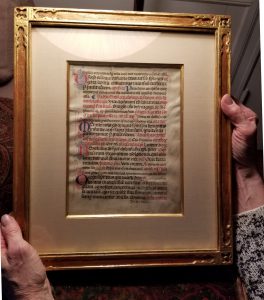
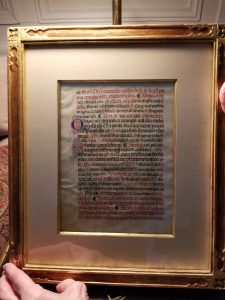
Private Collection, Roman Breviary Leaf in Frame: Page with Part of Vespers for Holy Trinity Sunday. Photography By Mildred Budny. Reproduced by permission.

Single-Column Pages
laid out in 27 lines of Gothic Script
with
Rubrications,
Minor Initials in Red or Blue Pigment,
and
Enlarged Initials
embellished with Pen-line Decoration

[Posted on 27 November 2022]

Two separate leaves, now in frames, in a Private Collection contain parts of a Latin Breviary for Roman Use, that is, the Church of Rome, or Breviarum Romanum. (See, for example, The Roman Breviary and Roman Breviary.)

Some earlier blogposts have considered fragments of Latin Breviaries or related liturgical books.

  • Two Vellum Leaves from a Large-Format Breviary in Gothic Script
  • The Pearly Gateway: A Scrap from a Latin Missal or Breviary
  • A Leaf from Prime in a Large-Format Breviary
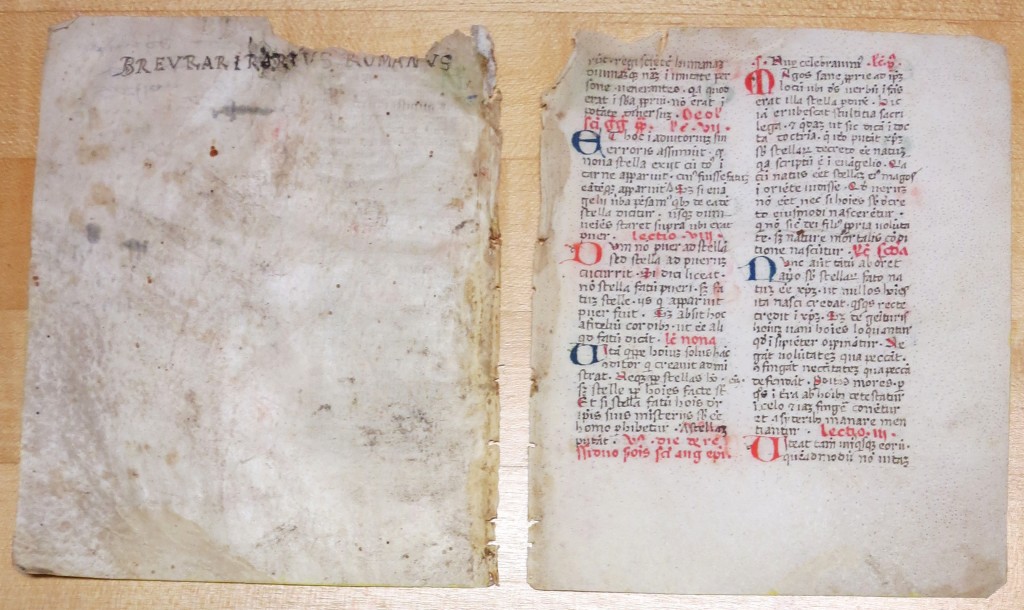
  • Written in the Stars: Roman Breviary Fragment with Latin Lections on Astrology

For example, from a different Private Collection, several leaves from a Roman Breviary:

Private Collection. Breviary Fragment, Folios IIv/Ir, with Revised Title and Penultimate Page of the Lections. Photography by Mildred Budny.

Private Collection. Breviary Fragment, Folios IIv/Ir, with Revised Title and Penultimate Page of the Lections. Photography by Mildred Budny.

The Pages from Two Leaves

Private Collection, Roman Breviary Leaf in Frame: Page in the Hours for First Sunday after Easter. Photography By Mildred Budny. Reproduced by permission.

The visible sides of the vellum leaves, on one page per leaf, contain parts of the text from the Hours for the First Sunday after Easter (see Second Sunday of Easter) and from Vespers for Holy Trinity Sunday (see Trinity Sunday).  Let us call the  Leaves 1 and 2, taking them in the sequence of their seasonal occasions in the cycle of the liturgical year, which extends from Advent to Trinity.

In the Western liturgical calendar, Trinity Sunday is the first Sunday after Pentecost; it is intended to celebrate the doctrine of the Trinity, the three Persons of God, namely the Father, Son, and Holy Spirit. Easter (or Resurrection) Sunday commemorates Jesus’ resurrection from the dead; the event is reported in the canonical Gospels (Matthew, Mark, Luke, and John) and some other sources.  As the start of Eastertide, or the Paschal season, Easter Sunday is followed by seven weeks to the fiftieth day on Pentecost Sunday.

The contents of the other sides of the leaves are unknown, apart from show-through onto the visible sides.  The text establishes that the two leaves were non-continuous in their former manuscript.

The vellum material of both leaves is evident in the texture of the visible surfaces as well as undulations across the expanse of the stretched animal skins. The smooth, whitish appearance makes it appear that both pages stand on the flesh sides of their skins.

Bringing the Leaves to light, we report the contents of the Pages, with descriptions and photographs.

Read the rest of this entry →

Tags: Breviarum Romanum, Fragmentology, House of Heydenryk, Manuscript studies, Medieval Manuscript Fragments, RGME Workshops on Looking at Manuscripts, Roman Breviary, The Bridge of Signs
No Comments »

Program for 2022 Autumn Symposium on “Supports for Knowledge”

October 6, 2022 in Announcements, Conference Announcement, Manuscript Studies, Uncategorized

2022 RGME Spring and Autumn Symposia
on “Structured Knowledge”

© British Library Board, London, British Library, Add. MS 1546, folio 262v, detail. Opening of the Book of Sapientia (“Wisdom”).

2 of 2: 2022 Autumn Symposium
“Supports for Knowledge”
Saturday, 15 October 2022

Symposium Program
9:00 am – 5:30 pm EDT
Online via Zoom

Sessions with Presentations and Discussion (“Q&A”)
Breaks for Coffee, Lunch, and Tea
Closing Keynote Presentation and Concluding Remarks

For Registration see below

[Posted on 5 October, with updates]

On the pair of Symposia, see 2022 Spring and Autumn Symposia
On Part 1 of this pair, see 2022 Spring Symposium on “Structures of Knowledge”
On Part 2, see 2022 Autumn Symposium on “Supports for Knowledge”

Here we present the Program for Part 2 on “Supports for Knowledge”, held on Saturday 15 October 2022 by Zoom
— Registration is required, with a limited number of places (see below).

The Program Booklet (in preparation) will present the Program and Abstracts of the Presentations and Responses, with multiple Illustrations.  In accordance with our tradition of Program Booklets for our Symposia and some other events (see our Publications, it will be issued in printed form as well as digital form, with a downloadable pdf.

Timetable

Session 1.    9:00–10:30 am EDT
Brief Introduction to the Symposium and Welcome
“Teaching with (and through) Manuscripts, Part II”
Q&A

Break.          10:30–10:45 am

Session 2.   10:45 am – 12:15 pm
“Catalogs, Metadata, and Databases, Continued (Part III)”
Q&A

Lunch Break.   12:15–1:15 pm

–– During the Break.  12:30–12:50 pm

Presentation (at the time when the Speaker could attend)

David W. Sorenson (Allen Berman, Numismatist)
“A Jain Manuscript of the Seventeenth Century on Imported Watermarked Paper: An Early, Dated, Witness to Imported Paper Stocks in Indian Manuscripts”
As a contribution to our series on the “History and Uses of Paper”

Session 3.    1:15–2:45 pm
“The Living Library (Part II)”
Q&A

Break.          2:45–3:00 pm

Session 4.   3:00–4:30 pm
“Hybrid Books (Part I)”
Q&A

Break.         4:30–4:45 pm

Session 5.   4:45–5:30 pm EDT
“Books and Their Structures”
Closing Keynote Presentation and Concluding Remarks

*****

Sessions

Session 1.  “Teaching with (and through) Manuscripts, Part II”
— continuing the series begun at the Spring Symposium on “Structures of Knowledge”

Presider

David Porreca (Department of Classical Studies, University of Waterloo)

Speakers

Caley McCarthy (Research Associate and Project Manager, Environments of Change, University of Waterloo)
and
Andrew Moore (Research Fellow, Environments of Change, and Associate Director, DRAGEN Lab, University of Waterloo)
“Collaborative Pedagogy with Medieval Manuscripts in a Digital Lab”

William H. Campbell (Director, Center for the Digital Text, University of Pittsburgh-Greensburg)
Amber McAlister (Assistant Professor, History & Architecture, University of Pittsburgh-Greensburg)
and
Connor Chinoy (Student at the University of Pittsburgh-Greensburg and member of the “History of the Book” class)
“Books in the Flesh: An Interdisciplinary Undergraduate Class with Medieval Manuscripts”

Q&A

*****

Mid-Morning Break

*****

Session 2.  “Catalogs, Metadata, and Databases, Continued (Part III)”
— continuing our series
This is Part III in our series on these subjects, building upon Parts I and II, and leading to further Parts in 2023

  • our Roundtable in February on Catalogs, Metadata, and Databases, Part I and
  • the Session on “Catalogs, Metadata, and Databases, Part II” in the Spring Symposium

See the Links of Interest (Catalogs , Metadata, and Databases: A Handlist of Links)
— for which suggestions and additions are welcome.

Presider

Jessica L. Savage (Art History Specialist, Index of Medieval Art)

Speakers

Jessica L. Savage
“Cataloguing Manuscript Iconography between Digital Covers at the Index of Medieval Art”

Barbara Williams Ellertson (The BASIRA Project and Research Group on Manuscript Evidence)
“A Painter, a Printer, and a Search for Shared Exemplars”

Katharine C. Chandler (Special Collections and Serials Cataloger, University of Arkansas Libraries)
“Manuscripts from Print: The Schwenkfelders and their Dangerous Books”

Respondent

David Porreca (Department of Classics, University of Waterloo)
“My $0.02 Worth”

Moderator for the Questions-and-Answers

Derek Shank (Research Group on Manuscript Evidence)

Q&A

*****

Lunch Break

Perhaps — TBD — during part of the Break
Presentation (from about 12:15–12:35 pm), if the Speaker might attend, depending on short-notice work timetables:

David W. Sorenson (Allan Berman, Numismatist)
“A Jain MS of the Seventeenth Century on Imported Watermarked Paper:  An Early, Dated, Witness to Imported Paper Stocks in Indian Manuscripts”

*****

Session 3.  “The Living Library (Part II)”

— continuing the series begun at the Spring Symposium on “Structures of Knowledge”

Presider

Jaclyn Reed (Department of English and Writing Studies, University of Western Ontario)

Speakers

Christine E. Bachman (Department of Art & Art History, University of Colorado at Boulder)
“Unbound, Dispersed, Resewn:  The Flexible Codex in Eighth-Century Northwestern Europe”

Zoey Kambour (Post Graduate Fellow in European & American Art at the Jordan Schnitzer Museum of Art at the University of Oregon)
“Textual Interaction Through Artistic Expression:  The Marginal Drawings in the Decretales Libri V of Pope Gregory IX (University of Oregon MS 027)”

David Porreca (Department of Classical Studies, University of Waterloo)
“The Warburg Institute Library:   Where Idiosyncracy Meets User-Friendliness”

Respondent

Thomas E Hill (Art Librarian, Vassar College)
“Some Early Background to Warburg’s Project in Post-Wunderkammer Systematic Catalogues of the European Baroque and Enlightenment Periods”

Le Parc Abbey, Theological Volume, Part B and added Part-Leaf between folios 103–104 (or folios "7"–"8").

Private Collection, Le Parc Abbey, Theological Volume, Part B and added Part-Leaf (or Bookmark) between folios 103–104. Photography Mildred Budny.

Q&A

*****

Mid-Afternoon Break

*****

Session 4.  “Hybrid Books (Part I)”

— beginning a series for which more sessions are planned

Presider

Justin Hastings (University of Delaware)

Speakers

Hannah Goeselt (Library and Information Science (MS): Cultural Heritage Informatics, Simmons University, Boston)
“Structures of Art and Scripture in Otto Ege’s ‘Cambridge Bible’ (Ege Manuscript 6)”

Jennifer Larson (Department of Classics, Kent State University)
“Printed and Scribed:  A Collector’s View of Hybrid Books”

Linde M. Brocato (Cataloging & Metadata Librarian, University of Miami Libraries)
“Paths of Access and Horizons of Expectation, II:  From Book-In-Hand to Catalog(ues)”

N. Kıvılcım Yavuz (Lecturer in Medieval Studies and Digital Humanities, School of History, University of Leeds)
“Bound With:  Towards a Typology of Hybrid Codices”

Q&A

*****

Tea Break

*****

Session 5. “Books and Their Structures”

Presider

Mildred Budny (Director, Research Group on Manuscript Evidence)

Closing Keynote Presentation

Linde M. Brocato (Cataloging & Metadata Librarian, University of Miami Libraries)
“Hybrid Books: Fragments and Compilatio, Structure and Heuristic in Richard Twiss’s Farrago”

Discussion & Brief Concluding Remarks

Mildred Budny
“Structured Knowledge, Structures of Knowledge, and Supports for Knowledge:  A Framework for the Year”

*****

Closing Keynote Presentation

“Hybrid Books:
Fragments and Compilatio, Structure and Heuristic in
Richard Twiss’ Farrago“

In the group of artists’ books from the Ruth and Marvin Shackner Archive of Concrete Poetry purchased by the University of Miami Special Collections, there is an extraordinary volume, sold by a vendor as late 19th century, anonymous, and an artist’s book avant la lettre.  Careful analysis for bibliographical cataloging revealed the error in all these assertions.

In this presentation, I will lay out both the process of that analysis, and its results, along with reflections on hybrid books of various kinds.  My reflections will encompass the kinds of structured information that make their way into databases, and structuring codes of cataloging and bibliography, all of which are necessary but not sufficient for our understanding and convivencia with books , which are always already hybrid.  In these reflections, I will bring together many of the strands of thinking we have all worked to weave together in the symposium.

Richard Twiss, Farrago, held in the Unversity of Miami Special Collections, Artists’ Books Collection. Sidelong View. Photograph Linde M. Brocato.

Glimpses of the volume comprising Farrago compiled by the writer, traveler, chess-player, and would-be paper manufacturer Richard Twiss (1749–1821) can be seen in our blogpost called “I Was Here”, with photographs by Linde M. Brocato.

Concluding Remarks

Mildred Budny
“Structured Knowledge, Structures of Knowledge, and Supports for Knowledge: A Framework for the Year”

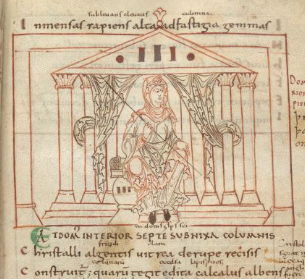
© British Library Board, London, British Library, Cotton MS Cleopatra C. viii, folio 36r, top: Sapientia in her Temple. Prudentius, Psychomachia, in a Canterbury copy of the late tenth or early eleventh century.

*****

To register for the Symposium, visit 2022 Autumn Symposium Registration. Places are limited.

Questions? Contact director@manuscriptevidence.org.

*****

Suggestion Box

Do you have suggestions for subjects for our events, or offers to participate? Please let us know.

If you wish to join our events, please contact director@manuscriptevidence.org.

For updates, watch this space, and visit:

  • 2022 Spring and Autumn Symposia
  • The Research Group Speaks: The Series;
  • our FaceBook Page and
  • our Twitter Feed (@rgme_mss).

Please leave your Comments below, Contact Us, and visit our FaceBook Page and Twitter Feed (@rgme_mss).  We look forward to hearing from you

We invite you to donate to our nonprofit educational mission. Donations may be tax-deductible. We welcome donations in funds and in kind:

  • Contributions and Donations .

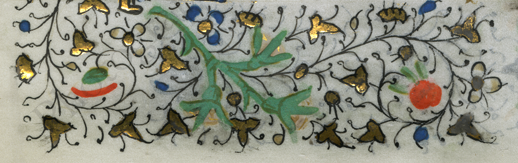
Floral Motif as Lower Border in a Book of Hours. Photography Mildred Budny.

*****


Tags: Catalogs & Metadata & Databases, Decretals of Pope Gregory IX, DRAGEN Lab, Fragmentology, History of Paper, Hybrid Books, Index of Medieval Art, Jain Manuscripts, Les Enluminures, Medieval Manuscript Fragments, Medieval manuscripts, Miniature Books, Otto Ege Manuscript 8, Otto Ege Manuscripts, RGME Symposia, Richard Twiss's Farrago, Schwenkfelder Books, Structured Knowledge, Teaching with and through Knowledge, Teaching with Manuscripts, The Living Library, University of Oregon MS 027, Warburg Institute Library, Watermarked Paper, Watermarks
No Comments »

Portfolio 93 of Ege’s “Famous Books in Eight Centuries” in the Collection of Richard Weber

June 22, 2022 in Manuscript Studies, Uncategorized

Selected Specimens,
Manuscript and Printed,
in Portfolio 93
of Otto Ege’s Famous Books in Eight Centuries (FBEC)
in the Collection of Richard Weber

[Posted on 21 June 2022, with updates]

Richard Weber Collection, Famous Books in Eight Centuries, Portfolio Set 93, Aristotle, Folio 23 Verso. Reproduced by Permission

With thanks, we offer a preliminary view of the full, and unexpected, glimpse of the Portfolio Number 93, which had been assembled by of Otto Ege (1888–1951) from manuscripts and printed books, so as to exhibit specimens of Famous Books, religious and other, from the medieval period onwards, in the Western middle ages and beyond.

This post offers a start in exploring the treasures in this set of the Portfolio.  Earlier blogposts have begun to examine the structure and elements of the Portfolio both in general and in particular.

This post takes note of the specifics, which hold some surprises.  The post builds upon some previous investigations, which establish points of departure and advances for various of the specimens in the Portfolio, both manuscript and printed.

Earlier blogposts reflect upon such possibilities and complexities.  For example:

  • Otto Ege’s Aquinas Manuscript in Humanist Script: Ege Manuscript 40
  • Otto Ege’s Portfolio of Famous Books and Ege Manuscript 53 (Quran)

We had intended to report more on the specimens of printed leaves, and not only the manuscripts, whilst other tasks called for attention.  The time has come to pick up those aspirations.
Read the rest of this entry →

Tags: Aristotle, Ege's Portfolio of Famous Books, Ege's Portfolio of Famous Books in Eight Centuries, Erfurt, Medieval Manuscript Fragments, Otto Ege Manuscript 51, Richard Weber Collection
No Comments »

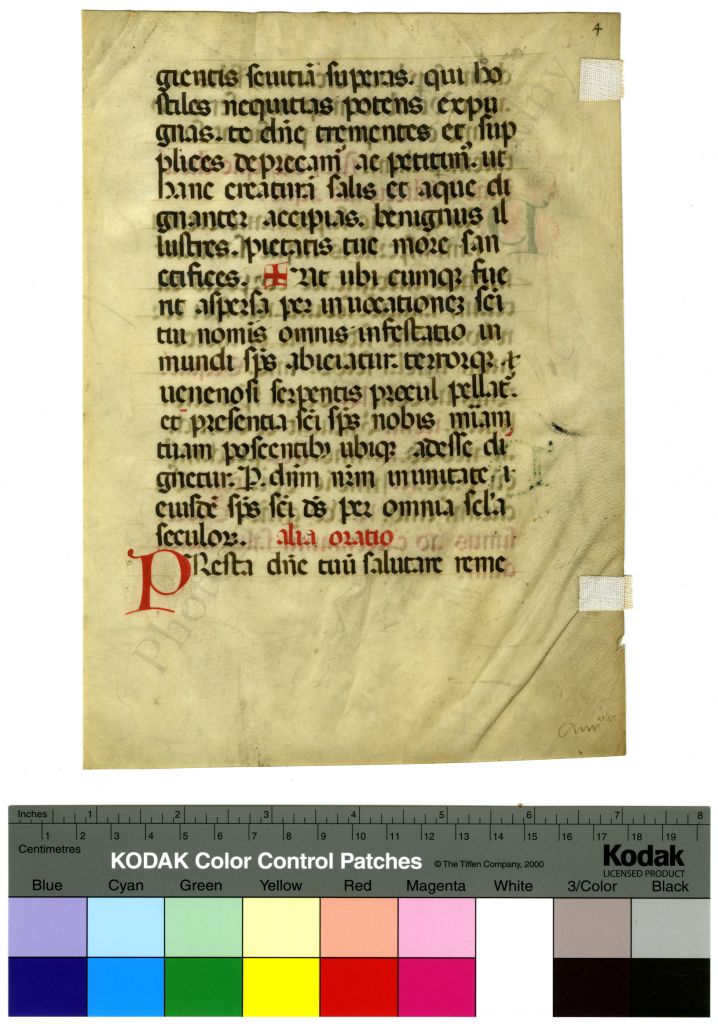
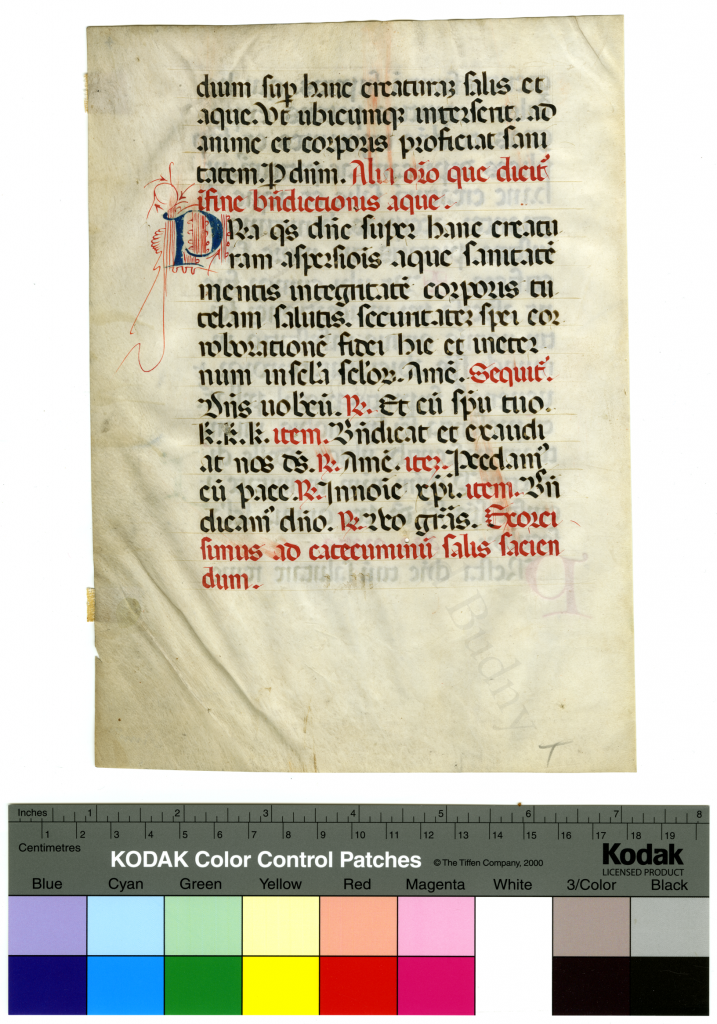
Folio 4 with Latin Blessings for Holy Water and an Exorcism for Salt

June 19, 2022 in Manuscript Studies, Photographic Exhibition

Folio 4 from an ‘Italian Missal’ in Latin

Private Collection, Single Leaf from a Latin Missal. Folio 4r, Detail. Photography Mildred Budny. Reproduced by permission.

Single Leaf on Vellum
Circa 222 × 158 mm
<written area circa 150 × 104 mm>

Single columns of 18 lines,
starting below the top ruled line,
with rubricated elements

Blessings of Holy Water and Salt
and the title for an Exorcism of Salt
[qui inimici ru-/]gientis seuitiam seperas . . .
Exorcisimus ad catecuminum salis faciendum. [/]

Italy?  Southern France?  circa 1400–1450

Budny Handlist 10

[Posted on 20 June 2022]

We post a report of a leaf from a Private Collection which we examined and photographed a few years ago, as part of a larger study for an Illustrated Handlist.

The leaf was recorded briefly, with a description supplied by its owner, in C. U. Faye and W. H. Bond, Supplement to the Census of Medieval and Renaissance Manuscripts in the United States and Canada (1962), page 284, number 5.  There it is described as part of an “Italian Missal”.  The owner acquired the leaf by an unknown route, perhaps by gift already framed, before the preparation of that description for the Census.

At the owner’s request several years ago, we removed the leaf first from its plain wooden frame and then from its stained and darkened backing mat, onto which parts of the original script had offset. The leaf was photographed at several stages and examined in detail.  We show views of the leaf while still on the mat and afterward.

The Leaf Before

Here are both sides of the leaf as it was mounted to the backing mat.

The Front, or Forward-Facing, Side of the Leaf as Mounted for the Frame

For the frame, the leaf faces front with lines in script in black ink and red pigment.

"Folio

positioned as the front-facing page for the viewer. Private Collection. Folio 4v facing front on the former mat. Photography © Mildred Budny. Reproduced by permission.

The Other Side, Partly Lifted

Turning over the leaf, we can see the pair of hinged gauze mounting tapes which attach the edge of the leaf to the mat.

Folio 4r still attached to the mat. Photograph © Mildred Budny

Private Collection. Folio 4r still attached to the mat with a pair of hinged gauze tapes. Photography Mildred Budny. Reproduced by permission.

The Leaf apart from the Mat

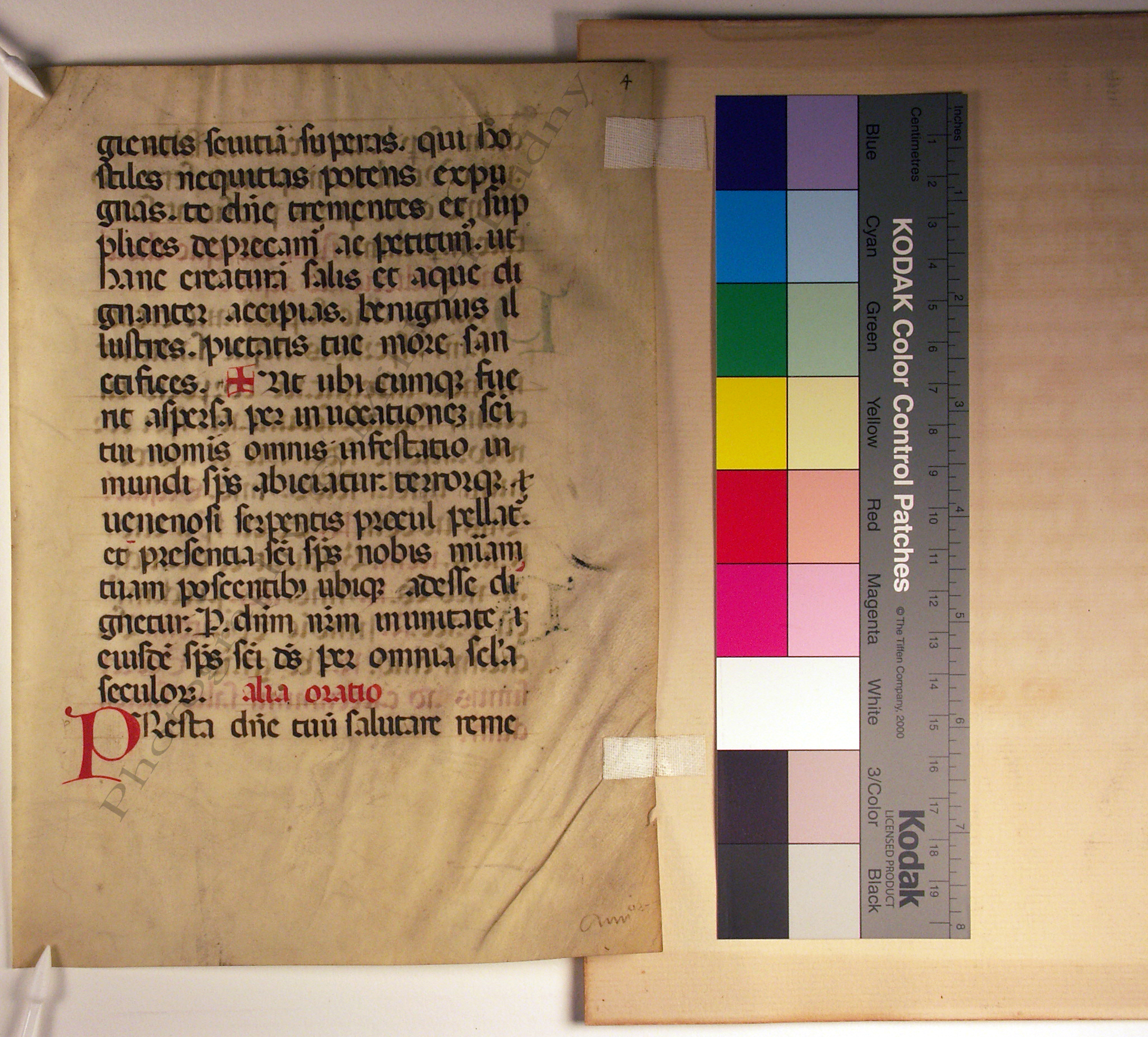
The Original Recto

The recto has a modern folio number, an upright arabic 4, entered in dark brown ink at the top right.  The different expanses of the upper and lower margins imply that the short upper margin was trimmed at some stage, whilst the lower and outer margins appear to retain all or most of their original extents.  The accumulated dirt along the upper edge attests to an extended duration when the former manuscript, closed, stood upright on a shelf or in storage.

Private Collection, Single Leaf from a Latin Missal. Folio 4v with Guide. Photography Mildred Budny. Reproduced by permission.

This side of the leaf shows offsets or show-through of enlarged initials at the right-hand side of the column, as well as rubricated script at points within it.  The initials, in reverse, show the forms of a P and a D.

Most of these elements can be accounted for by the rubrications and the enlarged initial P on the other side of the leaf, so that they constitute show-through.  For the other, we must recognize that its offset must derive from contact with a formerly adjacent leaf.

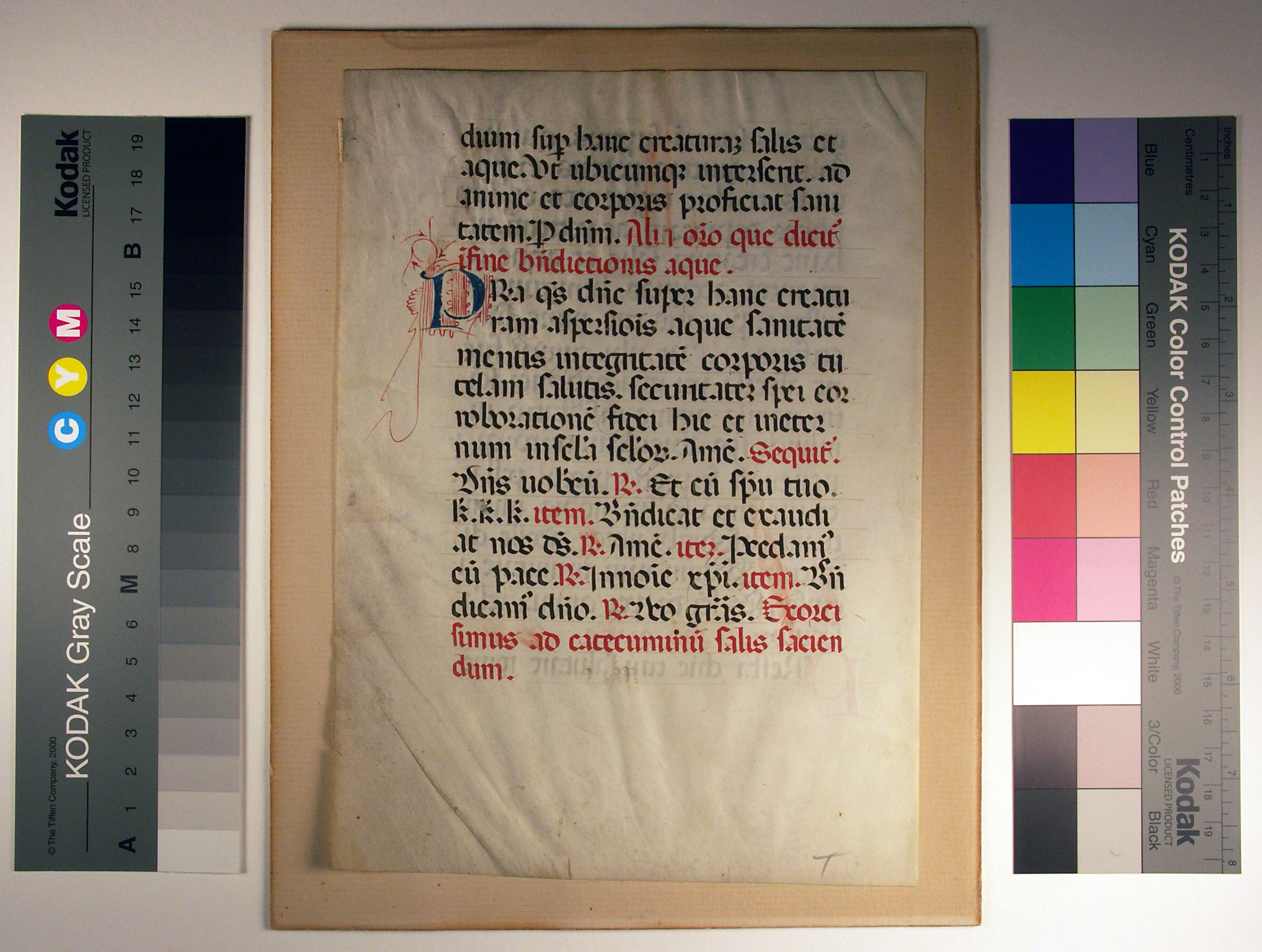
The Original Verso

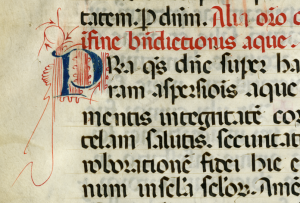
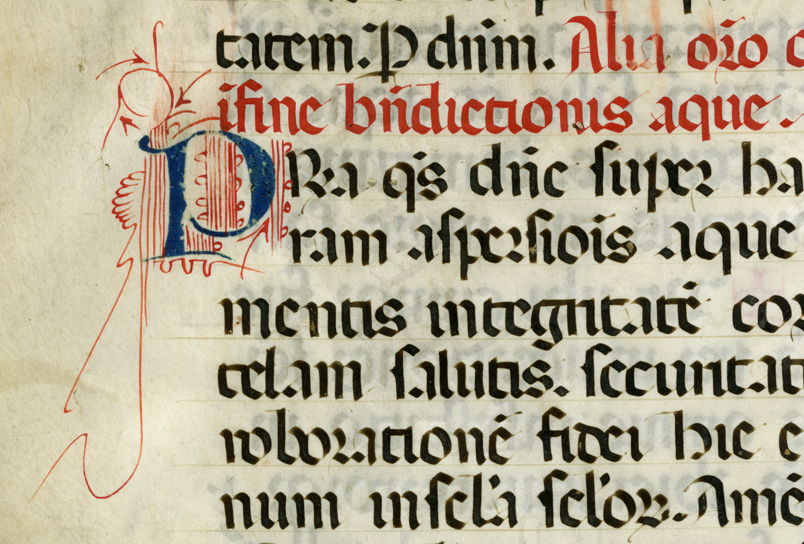
Private Collection, Single Leaf from a Latin Missal. Folio 4r. Detail. Photography Mildred Budny. Reproduced by permission.

On this page, an enlarged and decorated initial P, partly inset within two indented lines of text, comprises an enlarged Capital P (for Presta) rendered in blue pigment, with penline flourishes and extensions in red pigment.  In both curved and parallel straight lines, those flourishes fit between the initial and the indented letters, fill the bow and ‘footrest’ of the P, and extend in the margin above, beside, and below the initial.

A staple of the flourishing appears to be the sets of narrowly spaced parallel lines.  Characteristic, too, are the short, arrowhead-tipped elements which, separately, press into the cusps of parts of the flourishing below the right-hand side of the bow of the letter and in a whorl of three around the circular extension at the upper left of the letter.

The Text

The set of texts on the leaf provide directions for Exorcisms and Blessings of Salt and Water.  At an appropriate point, a sign of the cross (rendered within the outlines of a box-like frame, all in red) stands within the text to indicate its sign, or signing, as part of the ritual.

Specimens of such texts in medieval sources of various dates and from various places are edited, for example, in these bibliographical resources:

  • Benedictio Salis et Aquae in the Vetera Liturgia Alemannica = J. P. Migne, Patrologia Latina, Vol. 138, cols. 1039–1052 (downloadable here).
  • Missale Romanum Mediolani (1474), Vol. II = Henry Bradshaw Society, Vol. XXXIII (1907).

The text on the leaf provides snippets of the ritual for these functions.  We provide a transcription, with silently expanded abbreviations, and with indications of the rubrications in red.

Recto

[Oratio . . .  qui inimici ru-/]
gientis scuitiam superas. qui ho-
stiles nequitias potens expu-
gnas. te domine trementes et sup-
plices deprecam; ac petitumus. ut
hanc creaturam salis et aque di-
gnanter accipias. benignus il-
lustres. pietatis tue more san-
ctifices. + At ubi cumque sue-
nt aspersa per in uocationes sancti
tui nominis omis infestatio in
mundi spiritus abieiatur. terrorque . +
uenenosi serpentis procul pellatur.
et presentia sancti spiritus nobis misericordiam
tuam poscentibus ubique adesse di-
gnitur.  Per dominum nostrum in uinitate +
eiusdem spiritus sancti deus per omnia secula
seculorum.  Alia oratio
Presta domine tuum saltare reme-

Verso

dium super hand creaturam salis et
aque.  Ut ubicumque interserit. ad
anime et corporis proficiat sani-
tatem.  Per dominum.  Alia oratio qui dicitur
i[n] fine benedictionis aque.
Presta quos domine deus super hanc creatu-
ram aspersionis aque sanitatem
mentis integritatem corpus : tu-
telam saltis. securitatem spei. cor-
roborationem fidei hic et in eter-
num in secula seculorum.  Amen.  Sequitur.
Dominus vobiscum. Responsio. Et cum spiritu tuo.
kyrie. kyrie. kyrie. item.  Benedicat et exaudi-
at nos deus.  Responsio.  Amen.  iter.   Procedamus
cum pace.  Responsio.  Innomine [sic, for In nomine] christi.  item.  Bene-
dicamus domino.  Responsio.  Deo gratias.  Exorci-
simus at catecuminum salis facien-
dum.

The Former Manuscript

Parts of the text, or some texts in the sequence, can be found in other sources.  For example, comparisons for the text of the Roman Missal for the Liturgical Use of Milan (printed in 1474), show a similar version of the Presta which appears on the verso, although its version begins somewhat differently.

Presta michi domine deus per hanc creaturam aspersionis aque atque sanitatem mentis integritatem corpus : tutelam saltis : securitatem spei. corroborationem fidei : fructum charitatis nune et in futuro. Amen.

  • See Robert Lippe, Missale Romanum Mediolani (1474), Vol. II:  A Collation with other Editions Printed before 1570. Henry Bradshaw Society, Vol. XXXIII (1907), at page  385.
    The Milan Missal of 1474 was printed at Venice by Antonius Zarotis, with the date of 6 December 1474 (Incunabula Shorttitle Catalogue Number im00688450).

The long prayer on the recto belongs to the blessing of water.

  • See Traditional Rite of Blessing of Water.

It begins with an exorcism (or purification) of salt — but not the one intended for catechumens. as specified in the rubricated title at the bottom on the verso of the leaf.

Both the long prayer on the recto and the two following prayers also occur in that order in the Sacramentary portion of the composite Leofric Missal, but not followed by the exorcism of salt.

  • Frederick Edward Warren, ed., The Leofric Missal, As Used in the Cathedral of Exeter During the Episcopate of Its First Bishop, A.D. 1050-1072, Together with Some Account of the Red Book of Derby, the Missal of Robert of Jumieges, and a Few Other Early Manuscript Service Books of the English Church (Oxford:  Clarendon Press, 1883, page 250.

There is a close match for the sequence of texts on the leaf, with only a few variations, in an another source from Milan later than the printed edition of 1474.  That is:

  • the Rituale Sacramentorum ad Usum Mediolanensis Ecclesiae (“Ritual of the Sacraments for the Use of the Church of Milan“) of 1815, at pages 282–283.

The text on the Recto of the leaf starts on page 282 in the Oratio:  “[inimici ru-/]gientis saevitiam superas . . .”  The Oratio begins thus:  Deus invictae virtutis Auctor . . .  A brief section of text intervenes between this opening and the top of the extant recto.  Such an initial D, low in the column, formed the offset at the right-hand side of the column on the recto.

The “Alia Oratio Presta domine tuum salutare . . .” ends the recto and continues on the verso into the Aquam Benedictam “Presta quaesumus domine.”  Then come the Versicles and Responses extending to “Deo gratias”, but not the “Pax . . .”

Since the following text following refers to “hanc creaturam salis”, it may be the exorcism for which we have only the title.

The correspondences with texts in Missals associated with Milan, in northern Italy, might strengthen, but not confirm, the suggested origin of the leaf as part of an “Italian Missal” — or some similar liturgical handbook — in Latin from such a region.

For now, pending further information (such as the discovery of more parts of the same manuscript), let us continue to refer to it as containing (or, by virtue of the title, implying) a set of Ordines which address 1) the Blessing for the preparation of Holy Water and Salt, and 2) the Exorcism (or Purification) of Salt for Catechumens.  The former has a place in the Sacramentary portion of a Missal, whereas the latter would pertain, insofar as we have been able to discover, to a different form of book instead — such as a Collectar.

The folio number 4 indicates that the leaf occupied an early position within its book, whether or not that modern numeration took into account leaves (such as endleaves) which a modern observer might deem extraneous.  As companion materials, the texts to which this leaf belonged could have formed prefatory matter for a book of one or other genre designed to guide instruction and performance of liturgical practices at whatever stages required for the place of its production.

Perhaps other leaves from the same book as well as further research will resolve the mystery.  This lone leaf joins the company of all too many single, dispersed, leaves which have lost track or trace (apart from, say, an offset from an adjacent leaf) of their former siblings.  By close inspection of their material and textual evidence, it can partly become possible to retrieve some elements of their former connections and contexts.

Welcome to the ‘Foundling Hospital for Manuscript Fragments’, as invited in one of the early posts for our blog.

  • The ‘Foundling Hospital’ for Manuscript Fragments.

*****

Do you know of more leaves from this manuscript? Do you recognize the hand of the scribe, scribal artist, and rubricator in other parts of this book or in other manuscripts?

You might reach us via Contact Us or our Facebook Page. Comments here are welcome too. We look forward to hearing from you.

Watch our blog on Manuscript Studies for more discoveries. Please visit its Contents List.

*****

Private Collection, Single Leaf from a Latin Missal. Folio 4r, Detail. Reproduced by permission.

*****

Tags: 'Foundling Hospital' for Manuscript Fragments, Blessings for Holy Water and Salt, Census of Medieval and Renaissance Manuscripts, Collectar, Exorcism for Salt for Catechumens, Exorcisms and Blessings, Italian Missal, latin Missal, manuscript fragments, Medieval Manuscript Fragments, Offsets and Show-Through, Sacramentary
No Comments »

A Leaf from ‘Otto Ege Manuscript 214’ in the Collection of Richard Weber

June 14, 2022 in Manuscript Studies

Another Leaf from “Otto Ege Manuscript 214”
(A Dutch Prayerbook)

Richard Weber Collection. Single Leaf from “Otto Ege Manuscript 214”? Verso, Top Left. Image reproduced with permission.

Collection of Richard Weber

Single leaf from a small-format Prayerbook in Dutch
Circa 168 × 119 mm <written area circa 129 × 88 mm>
([. . . /]-te sprekene na die sentencie . . .
heest maer puerlijck am die [/ . . .])

Single column of 22 lines in Gothic Bookhand
with embellishments in red pigment
and a painted, framed, decorated initial in ‘rustic’ style

Flanders, circa 1330

Formerly part of ‘Ege Manuscript 214′
(Gwara , Handlist 214)

[Posted on 13 June 2022, with updates]

Another leaf from a medieval devotional manuscript in Dutch dispersed by Otto F. Ege (1888–1951) has come to light. It belongs to the Collection of Richard Weber. Sharing information and images, Richard Weber reports that he purchased it on its own from an online vendor (eBay – oldworldwonders).

Earlier blogposts have begun to report materials from his collection; more are in preparation. For example, so far:

  • More Leaves from an Old Armenian Praxapostolos.

An earlier blogpost considered portions of Ege’s dispersed Dutch manuscript in other collections.

  • A New Leaf from ‘Otto Ege Manuscript 214?”.

That blogpost focused upon one of the remnants, a single leaf now in a Private Collection. As seen below, the recto stands at the left, with the verso at the right. With the text set out continuously, as paragraphs run together, the script presents seemingly solid blocks of text in successive columns. The initials marking the beginning of phrases or sections are enhanced with vertical strokes of red pigment.

"Verso, owned and dismembered by Otto F. Ege” width=”1024″ height=”671″ /> Private Collection. Detached Leaf from ‘Otto Ege Manuscript 214’ (Dutch Prayerbook), Both Sides of the Leaf
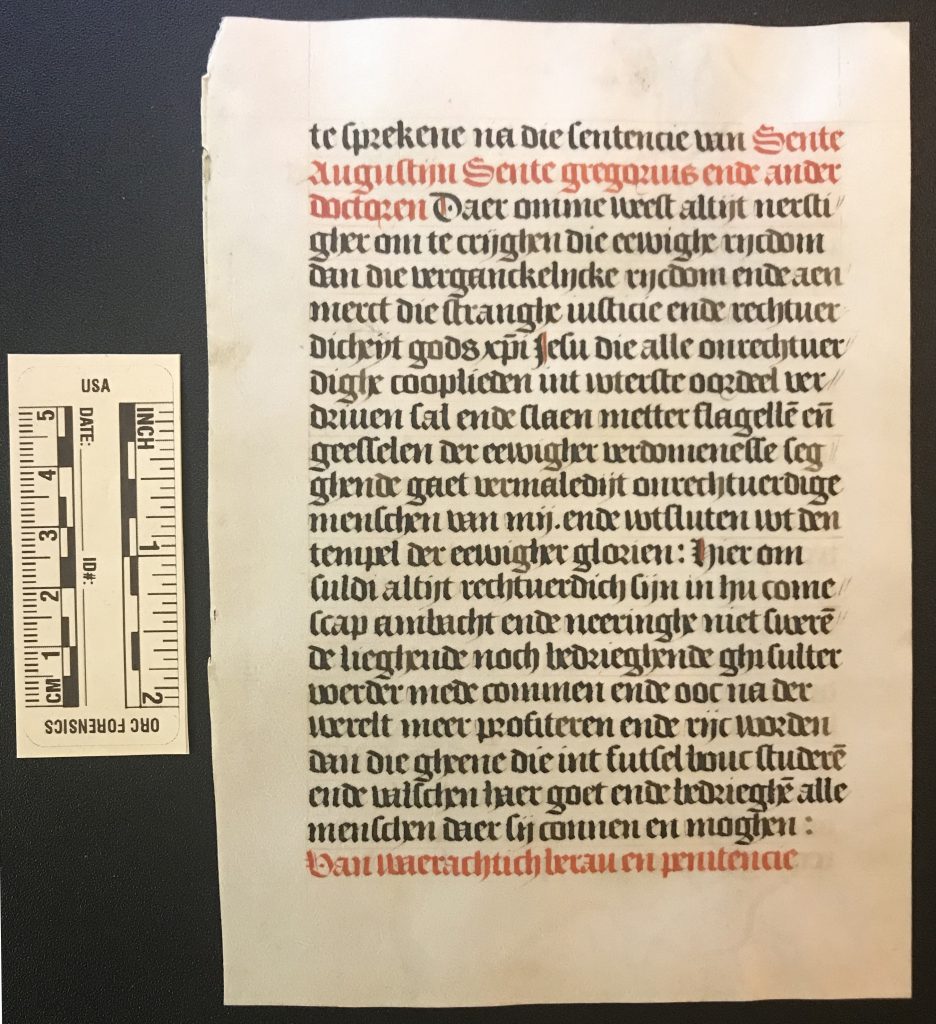
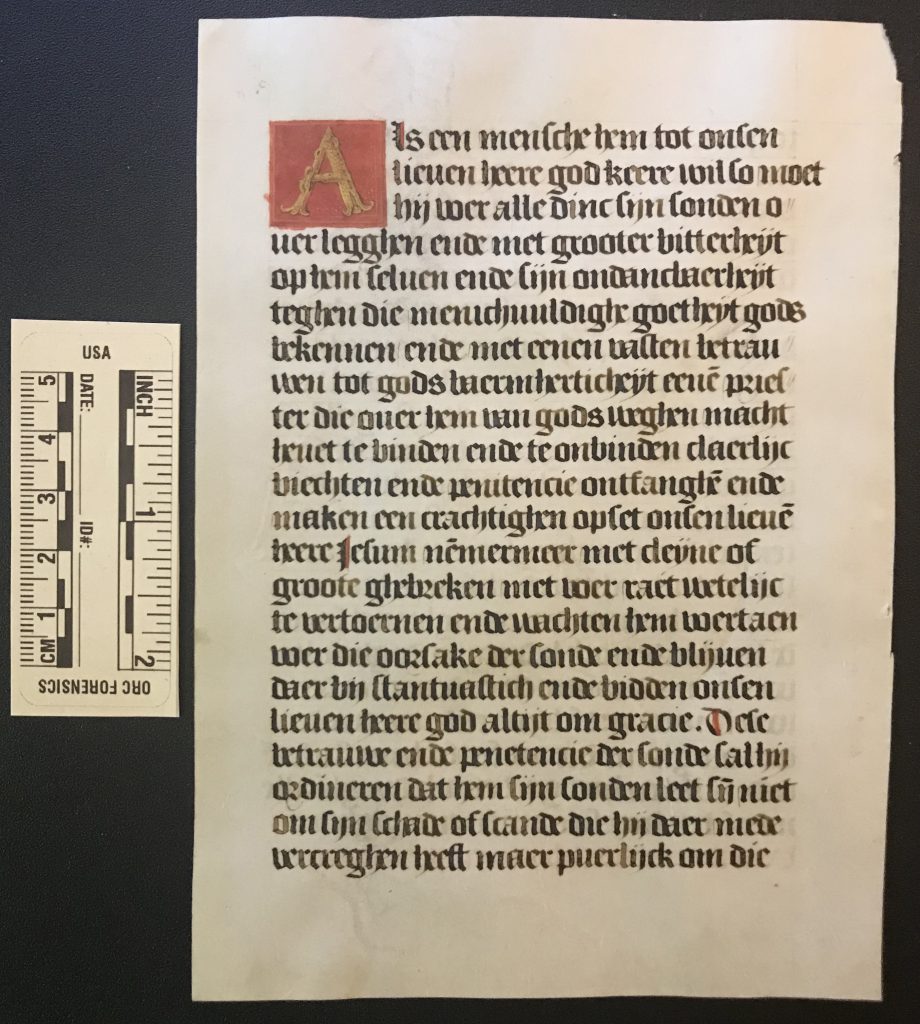
Some other leaves from the manuscript carry elements of decoration or illustration.

‘Otto Ege Manuscript 214’

In Scott Gwara’s Handlist of Manuscripts Collected or Sold by Otto F. Ege (2013), that manuscript, with some traceable remnants, is his Number 214 (Appendix X, pages 177–178). There he cites a few traceable remnants from it and their appearances in several catalogues. Our blogpost surveyed those resources. See A New Leaf from ‘Otto Ege Manuscript 214?”.

An update to that same blogpost reports other remnants, as identified by Peter Kidd. It quotes his email communication of 15 July 2019 about his discoveries for various Ege manuscripts, including this one. Peter Kidd reported that, for Ege Manuscript 214, that “There are leaves with miniatures at the National Gallery of Art in D.C., the Art Museum in Indianapolis, and (recently acquired) at Oberlin” College, along with the “unilluminated leaf at BU”, that is, at Boston University, School of Theology Library — listed in Scott Gwara’s Handlist. It is:

  • Boston, Massachusetts, Boston University, School of Theology Library, MS Leaf 7.

Some of the identified remnants have some form of illumination. The style is sometimes attributed to the “style of Simon Bening”, that is, Simon Bening (circa 1483 – 1561), one of the most famous and celebrated painters of the 1500s.

A sales catalogue entry for a portion of the manuscript is informative, albeit concise and lacking an illustration.

  • Sotheby’s, Western Manuscripts and Miniatures (London, Tuesday 26th November 1985), lot 88. The entry reports:

55 leaves, some detached, others still sewn to old bands with pieces of calf spine, 22 lines, written in dark brown ink by 2 scribes in a late gothic liturgical hand, rubrics in red, capitals touched in red, many initials in red or blue, SIX LARGE ILLUMINATED INITIALS (3- to 4-line) in delicate rustic designs in liquid gold on coloured grounds, fine condition (166mm by 120mm).

Also:

Comprising biblical readings and prayers, including three ascribed to the Commisasrius “meester Godschalc rosemond van Eundhoven, Doctoer in der godeyt” [that is, “Eindhoven in South Holland, about 45 miles south east of Utrecht“], there are offers of indulgences ascribed to popes Alexander VI (1482–1503), Julius III (1503–1513) and Leo X (1513–1521).

The sale included “fifty-four lots of single leaves and miniatures from the collection of Otto Ege”. Various of them comprised the “Residue” of despoiled manuscripts, sometimes with bindings or bits of bindings, left over after the their dismemberment and the distribution of leaves otherwise. It is apparent that the portion from Ege Manuscript 214 was such a case.

The companion Price List of “hammer prices” for the sale indicates that lot 88 was purchased by “Williams” for £330.

The “New” Leaf

The leaf in the Collection of Richard Weber, shown here, has one embellished initial, which occupies a 3-line inset frame. Rubrics in red occur on the other side of the leaf. It is perhaps not too much to ask if this leaf has strayed from the group of fifty-five leaves sold at Sotheby’s.

Recto

This page has a line or more of rubricated text at both top and bottom. The upper rubrication names as authorities “Saint Augustine, Saint Gregory, and other teachers” or Church Fathers.

-te sprekene na die sentencie van Sente
Autustini Sente Gregorius ende ander
doctoren
. . .

Richard Weber Collection. Single Leaf from “Otto Ege Manuscript 214”, Verso. Image reproduced with permission.

Verso

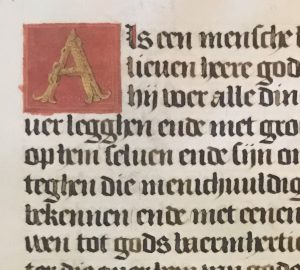
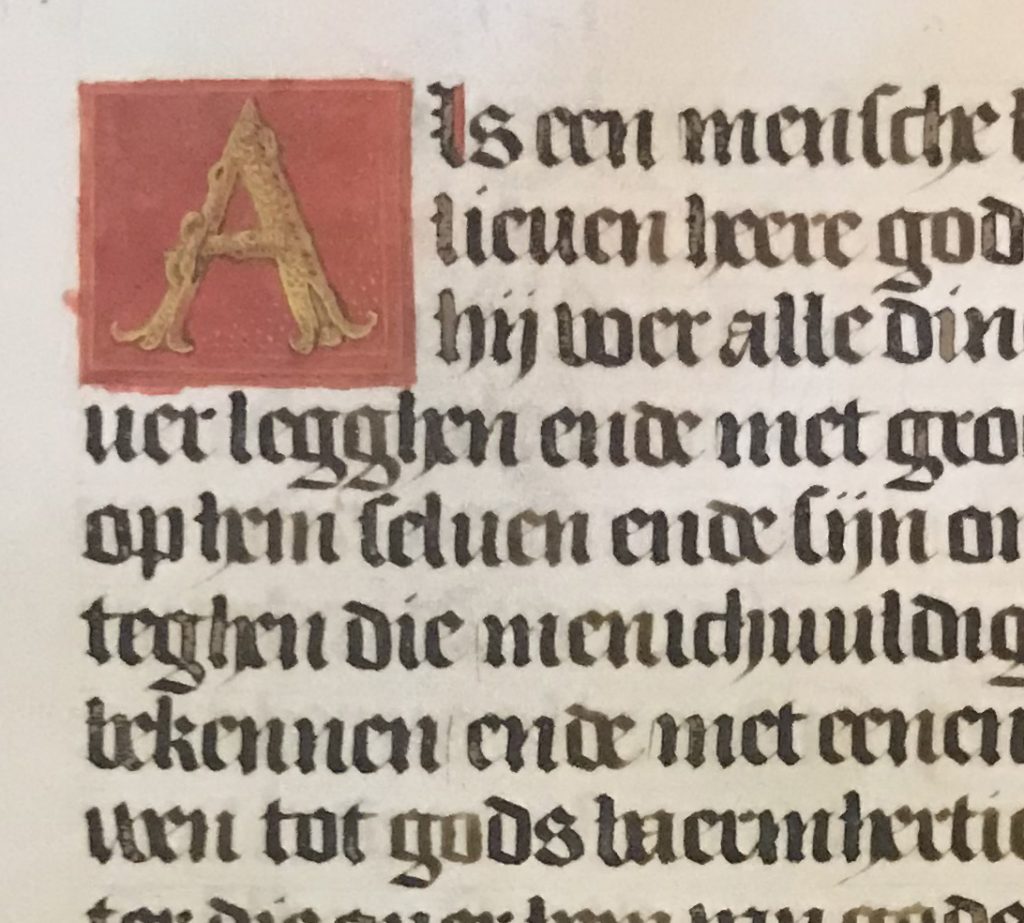
This page opens with a decorated initial A, heading a full block-like column of text relieved by two enlarged minor initials (lines 13 and 18) enlivened with a vertical stroke of red pigment.

Als een mensche hem tot onsen / lieuen heere god keere wil so moet . . .
. . . om sijn schade of scande die hii daer mede / vercreghen heest maer puerlijck am die / [. . .]

Richard Weber Collection. Single Leaf from “Otto Ege Manuscript 214”? Verso. Image reproduced with permission.

Initial A (of Als)

The inset three-line initial which opens the verso occupies a squared and bordered frame filled with red pigment, which overspreads the outer contour. The background within the initial is likewise filled with red pigment, with the addition of lighter, yellowish, drops or speckles.  The red pigment resembles the pigment employed in the rubricated letters and embellishments for minor initials.  It may be that the frame for the inset initial was given its red pigment in the same state of operation in preparing the leaf, from script to finishing touches.

The Capital Letter A is rendered in mid-tone brown pigment with dark brown outlines for shading, and with speckles overall in light brown pigment.  The letter takes the form of interlocked branch-like or twig-like elements with outspread terminals.  The highlights, speckling , and shading enhance the effect of three-dimensional sticks or twigs, hollows, and bark.  A fair description of this design, whilst skillfully executed, could be “rustic”.

Richard Weber Collection. Single Leaf from “Otto Ege Manuscript 214”? Verso, Top Left. Image reproduced with permission.

*****

We thank Richard Weber for sharing information and images of this leaf, and for answering queries about its features, source, and other aspects.

*****

Do you know of more leaves from this manuscript? Do you recognize the hands of the scribe and scribal artist in other parts of this book or in other manuscripts?

You might reach us via Contact Us or our Facebook Page. Comments here are welcome too. We look forward to hearing from you.

Watch our blog on Manuscript Studies for more discoveries. Please visit its Contents List.

*****

Tags: Collection of Richard Weber, Dutch Prayerbook, Illuminated Initials, manuscript fragments, Medieval Manuscript Fragments, Otto Ege Manuscript 214, Peter Kidd, Scott Gwara
No Comments »

More Leaves from an Old Armenian Praxapostolos

May 30, 2022 in Manuscript Studies, Reports, Uncategorized

More Leaves from
an Old Armenian New Testament Manuscript:
The “Kurdian/Chicago Praxapostolos“

Separate Leaves on Vellum
from the Acts of the Apostles
in Different Collections

Double columns of 27 lines in bolorgir minuscule script,
with rubrications and Euthalian apparatus

1) Private Collection: Acts 16:24 [middle] – 17:6 [middle]

2) Richard Weber Collection: Acts 20:5 [beginning] – Acts 20:26 [end]
(Leaf size: 10.2 x 13.7 cm; Written area: 7.1 x 10.2 cm; Column width: 3.2 cm)

[Posted on 30 May 2022, with updates]

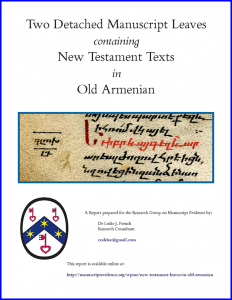
"Cover, with the opening of Acts 23:12"

Research Group on Manuscript Evidence, “Two Detached Leaves” Booklet Cover, with the opening of Acts 23:12.

More leaves emerge into view from a dismembered manuscript in Old Armenian with selections from the New Testament. Apparently it comprised a copy of a Praxapostolos, that is, containing parts of the New Testament without the Gospels and certain other Books.  We have examined several leaves from this book before.

Some earlier blogposts, and an RGME Research Booklet, have introduced other leaves from the same manuscript.

  • New Testament Leaves in Old Armenian
    reporting “A Pair of Leaves [in a Private Collection] Identified, Described, Collated, and Set into the Context of its Manuscript”
  • Leslie J. French, Two Detached Manuscript Leaves containing New Testament Texts in Old Armenian: A Report prepared for the Research Group on Manuscript Evidence (RGME, 2015)
  • The Plot Thickens
    reporting on “A New Leaf Found at the University of Pennsylvania
    from the “Kurdian/Chicago New Testament Praxapostolos[?]
    in Old Armenian”

For the Research Report, Armenian glyphs were designed for the Research Group’s multi-lingual digital font Bembino, freely available on our website.  (See Multi-lingual Bembino.)

As the word spreads, the story grows.

After those reports, we were contacted by Sani Eskinazi (then at Stanford University), as he worked to complete a Final Project for History 14N on “Reconstituting an Armenian Bible from the 15th Century” (2019), based upon a leaf in Special Collections with part of II Corinthians:  Stanford University Libraries, M0297, Box 1, Item 103. With Sani’s expected collaboration, we continue to prepare an updated and expanded version of the Report Booklet.

Meanwhile, it is time to show some more leaves from the same manuscript, as custodians and owners respond to our blogpost, and wish to share their materials more widely. As part of the work for the updated Report, here we present two leaves which have come to our attention this year.

First, we recall some other leaves from the manuscript.  (See below.)

Next we present the “new” leaves. Each of them was purchased online as a separate leaf, with or without an accompanying label. Each presents part of the text of the Acts of the Apostles.

1) One has come to the same Private Collection with the two leaves which prompted both our first blogpost on the manuscript and its accompanying Report Booklet. Those two leaves are considered to be Folios “I” and “II” in the collection; the new one is its Folio “III” (or “3”).

2) The other belongs to the collection of Richard Weber. While we prepare a report, or series of reports, on a group of other materials in his collection, manuscript and printed, we begin with the Old Armenian New Testament Leaf which he purchased on its own (plus label) from an online seller, who had little information about it.

Read the rest of this entry →

Tags: Dawson's Bookshop, Kurdian/Chicago Praxapostolos, manuscript fragments, Medieval Manuscript Fragments, Old Armenian, Old Armenian New Testament Praxapostolos, Otto F. Ege, Portfolio of Original Leaves from Famous Bibles, Richard Weber Collection, University of Pennsylvania Libraries, Zohrab Bible
No Comments »

Two Old Testament Leaves from ‘Otto Ege Manuscript 14’ at Smith College

March 11, 2022 in Manuscript Studies

Two Leaves
from ‘Otto Ege Manuscript 14’
at Smith College

Smith College Special Collections, MS 36-6, verso, top left, from ‘Otto Ege MS 14’. Photography by Hannah Goeselt.

Large-format Latin Vulgate Lectern Bible
made in France
late 13th- or early 14th century

Single Leaf within a matted frame
Double columns of 50 lines

Exodus 25:31 (procedentia) – 28:21 (cela-[/buntur singuli])
with Ege Label

and
Ezekiel 16:43 ([irascar amplius /] eo quod) – 17:14 (sic reg/-num humile et])

[Posted on 12 March 2022.]

We warmly thank Hannah Goeselt, responding to our blogposts, for sending information and images for parts of ‘Otto Ege Manuscript 14’ at Smith College, Northampton, Massachusetts. The ‘moniker’ for the manuscript derives from the decisive impact upon it effected by Otto F. Ege (1888–1951) and the place-number which its selected specimen leaves occupied in his monumental Portfolio of Fifty Original Leaves from Medieval Manuscripts, Western Europe, XIII–XVI Century, issued in forty numbered sets. Ege assigned the date of “1300 A. D.” to the Bible and its specimens.

Smith College Special Collections, MS 35-14, verso, from ‘Otto Ege MS 14’. Photography by Hannah Goeselt.

Discoveries for other parts of this dismembered and dispersed manuscript, a large-format Lectern Bible in the Latin Vulgate Version in Gothic Script, with historiated and decorated elements, have been reported in our blog.

  • A New Leaf from ‘Otto Ege Manuscript 14’
  • More Discoveries for ‘Otto Ege Manuscript 14’
  • A Leaf from ‘Otto Ege Manuscript 19’ and Ege’s Workshop Practices
  • Updates for Some ‘Otto Ege Manuscripts’ (Ege MSS 8, 14, 41, and 61)
  • Some Leaves in Set 1 of ‘Ege’s FOL Portfolio’ (Ege MSS 8, 14, 19, and 41)
  • Patch Work in ‘Otto Ege Manuscript 14’
  • A Leaf in Dallas from ‘Otto Ege Manuscript 14’.
  • A Leaf of Deuteronomy from ‘Otto Ege Manuscript 14’ in the Rosenbrook Collection

See also The Illustrated Handlist (Number 4).

The Smith College Leaves comprise two separate single leaves respectively from the Books of Exodus and Ezekiel. At least one retains the standard printed Ege Label, albeit displaced and rearranged.

The pair augment understanding of the original state of those Biblical Books in the manuscript, and also of habits in the transmission of leaves from it as they were prepared for distribution from Ege’s collection and accommodated in their next collection, where they remain. That their chain of transmission revolves around Mrs. Otto Ege — Louise Hedwig Lange Ege, an alumna of Smith College, and an active partner in the distribution of materials from the Ege Collection both during and after her husband’s lifetime — infuses the presence of these and other Ege leaves at her alma mater.

Read the rest of this entry →

Tags: Book of Exekiel, Book of Exodus, Ege Family Portfolio, Ege Manuscript 40, Ege's FOL Portfolio, manuscript fragments, Medieval Manuscript Fragments, Otto Ege Manuscript 14, Otto Ege Manuscript 27, Smith College
No Comments »

A Leaf of Deuteronomy from ‘Otto Ege Manuscript 14’ in the Rosenbrook Collection

February 8, 2022 in Manuscript Studies, Uncategorized

Brent Rosenbrook Collection, Leaf from Ege Manuscript 14, ‘Recto’ (original Verso), top: Running title.

An Old Testament Leaf
from ‘Otto Ege Manuscript 14’
with part of Deuteronomy
in the Rosenbrook Collection

Large-format Latin Vulgate Lectern Bible
made in France
late 13th- or early 14th century

Single Leaf within a matted frame
Double columns of 50 lines

Maximum measurements circa 16 1/8″ × 10 11/16″ <written area circa 11″ × 7 3/8″>

Deuteronomy 11:21 ([quam iuravit] /) dominus patribus)
– 14:15 (strutionem ac noc-(/tuam et larum])

With bichrome running titles and chapter numbers,
polychrome decorated initials and border ornament with geometric and foliate motifs,
and added lection marks

[Posted on 8 February 2022, with updates]

Virginia Lazenby O’Hara Fine Books Division, Dallas Public Library, Framed Leaf from Otto Ege MS 14, ‘Recto’ (original Verso).

Brent Rosenbrook Collection, Matted Leaf from Otto Ege Manuscript 14, ‘Recto’ (original Verso).

Continuing the series of posts for our blog on Manuscript Studies, Mildred Budny describes another leaf from ‘Otto Ege Manuscript 14’, a large-format copy on vellum of the full Latin Bible in the Vulgate Version.

A leaf from this manuscript recently reached the collection of Brent Rosenbrook, who generously sent images and information about it, in response to the blogpost reporting More Discoveries for ‘Otto Ege Manuscript 14’.

A similar response several months ago brought to our attention the Dallas Leaf from the same manuscript, now kept at the Virginia Lazenbury O’Hara Fine Books Division of the Dallas Public Library in the City of Dallas, Texas. A report of that leaf, which carries the end of the Book of Joshua and the beginning of Judges in the Old Testament portion of the manuscript, appears in our blog on A Leaf in Dallas from ‘Otto Ege Manuscript 14’.

The ‘new’ leaf likewise comes from one of the early Books of the Old Testament. In the sequence, it stood one Book ahead.

Otto Ege Manuscript 14 and Manuscript Studies

Some discoveries for the manuscript have been reported in our blog.

  • A New Leaf from ‘Otto Ege Manuscript 14’
  • More Discoveries for ‘Otto Ege Manuscript 14’
  • A Leaf from ‘Otto Ege Manuscript 19’ and Ege’s Workshop Practices
  • Updates for Some ‘Otto Ege Manuscripts’ (Ege MSS 8, 14, 41, and 61)
  • Some Leaves in Set 1 of ‘Ege’s FOL Portfolio’ (Ege MSS 8, 14, 19, and 41)
  • Patch Work in ‘Otto Ege Manuscript 14’
  • A Leaf in Dallas from ‘Otto Ege Manuscript 14’.

See also The Illustrated Handlist (Number 4).

Brent Rosenbrook Collection, Leaf from Ege Manuscript 14, ‘Recto’ (original Verso), middle right: Deuteronomy 14 opens.

The Rosenbrook Leaf

When contacting me about the Leaf, its collector described the origins of his collecting spirit and the development of his book-collecting.

I wanted to give you a little bit of backstory and brief history. I am a layman in this field but have always been a collector of things since my childhood. I was a bibliophile long before I ever heard the term or would have understood its meaning. And although I am new to collecting illuminated manuscripts, I have always felt drawn to the beauty of them. As a teenager and young man I was especially stuck by the intricate, amazing imagery and knotwork in the Book of Kells. In 1998 I was fortunate to have visited Trinity College in Dublin and see it firsthand along with other books on display. It was a moment of wonder to finally be in the presence of that book. Although I never lost that sense of awe, for the next many years that was the extent of my experience and attention concerning manuscripts.

In December of 2016 my wife and I were visiting a friend’s home for the holidays when I noticed on the wall a large framed musical page of some sort. I could tell that it was hundreds of years old, handwritten, on animal skin. He knew little about it other than it belonged to a relative down the line and that at some point it was gifted to him. It was of course an antiphonal as I later discovered by searching online. It was (is) likely early 16th century and had one very large, but simple rubricated initial. Although it wouldn’t be considered elaborate or rare to a person knowledgeable in such things, for me the affect was basically “Wow, that’s really cool. I’ve got to figure out what that is. I want one of those”. The collector bug bit me again. . . .

Brent Rosenbrook Collection, Leaf from Ege MS 14, ‘Verso’ original Recto), bottom left.

My interest and enjoyment of looking at and learning about illuminated manuscripts (especially Bibles with historiated and zoomorphic initials) grew as I visited multiple websites over many weeks and scrolled through countless images of various western manuscripts. In March 2017 I acquired my first true illuminated leaf when I bid on and (unexpectedly) won a large Bible leaf which was from a manuscript previously owned by the famous collector Chester Beatty. As far as the Otto Ege leaf, it was a spontaneous purchase.

I received a notification . . . when this page was listed recently by Rodger Friedman Rare Book Studio. It wasn’t on my radar (or necessarily in the budget) to make a purchase but after glancing at the listing throughout the day I committed to buying it. I only knew the name Otto Ege vaguely through my reading up on manuscripts.

When I received the package and saw the leaf for the first time it evoked a lot of emotion. Although I knew its measurements when I purchased it, I still wasn’t prepared for the size and beauty of seeing it firsthand – it is stunning. It was only in the last few weeks after this acquiring this that I began reading up on and watching video postings about this famous biblioclast and the sets he sold off. . . . It was just this past Thursday night when I came across the RGME website and decided to reach out to you.

As for the Leaf itself, the collector reports that “It remains in the original matting that Ege used when he compiled these books.” Thus, this specimen qualifies for the group of survivors from the manuscript which circulated on their own, as a ‘Rogue Leaf’. Many of them traveled within one of Ege’s standard mats of a uniform size, accompanied by Ege’s printed Label giving a generic description of his Leaf 14. They resemble the presentation designed for specimen leaves from various manuscripts in Ege’s ‘FOL’ Portfolio of Fifty Original Leaves from Medieval Manuscripts, in which leaves from the dismembered Lectern Bible have the position of Number 14.

Now, with the collector’s permission, the Leaf might begin to assume its place within the virtual Reconstruction of the manuscript, as known from its fragments.  Brent Rosenbrook observes:

I think it’s nice for others to know that there are those who aren’t necessarily part of academic institution but still would like to contribute what they can to the advance of manuscript study.

We greatly admire this view!

A Note on the Photographs of the Leaf 

The images here show the Leaf and its details under several forms of light, taken at different times and at different angles. Their variety shows multiple aspects, including some 3-dimensional features which views at an angle can reveal of the curvature of the surface(s) of the animal skin and the furrows of the ruled lines upon it in drypoint.

Read the rest of this entry →

Tags: 'Fifty Original Leaves from Medieval Manuscripts', Beinecke Rare Book and Manuscript Library, Book of Deuteronomy, Brent Rosenbrook Collection, Dallas Public Library, Ege's FOL Portfolios, FOL Portfolio Set Number 39, Latin Vulgate Bible, Lectern Bible, Medieval Manuscript Fragments, Otto Ege, Otto Ege Collection, Otto Ege Manuscript 14, Reconstructing Manuscripts Virtually, Running Titles, Stony Brook University Library
6 Comments »

« Older Entries
  • Top
©2024 Research Group on Manuscript Evidence.


is proudly powered by WordPress. WordPress Themes X2 developed by ThemeKraft.