The RGME ‘Lending Library’
Books, Manuscripts, Fragments,
Documents, Seals and Seal Matrices,
Photographs, Prints and Drawings, and other Original Materials
Sometimes the Sources come to visit
the Research Group on Manuscript Evidence
Sometimes our Materials go to visit
for workshops, exhibitions, and study
[Posted on 4 September 2024, with updates]
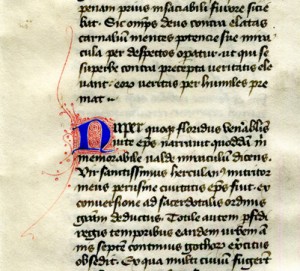
Manuscript Leaf with Dialogues of Gregory the Great, Book III, chapter 13 initial, while on loan. Photography by Mildred Budny.
Over the years, private collectors, scholars, students, and others continue to seek advice and expertise from the Research Group about manuscript, printed, documentary, and other materials in their possession. Indeed, our mission seeks to examine original sources of written works and their relatives by a dedicated process of “Going to the Sources”. (On this mission, see, for example, our 2024 Spring Symposium at Vassar College.)
Often the sources, or their surrogates in photographic and other means, come to us. Sometimes they come to stay, as gifts. Sometimes they come on loan.
How do they find us? They do so as their owners or researchers approach us from learning about the RGME and our wide range of interests and network of contacts, whether through our scholarly events (in person or online) or by word of mouth, posts on social media, or our blog on Manuscript Studies. Then they make contact to ask if we might be interested in looking at the item(s) in question. They send photographs to show the characteristics of the materials, and generously allow us to work with the evidence in their care, whether as gifts or through photographs or loans of the items.
Sometimes the owners generously loan original materials to the RGME for research, conservation, photography, and publication. This process can yield remarkable results.
Preparing now for our 2024 Autumn Symposium showcasing the work and potential of Special Collections of many kinds for teaching, it seems time to describe the years’-long tradition of sharing materials and expertise through the RGME Lending Library. (You are Here.)
Multi-Directional
Sometimes, in turn, we bring original materials — in our own collection, our Director’s, and other collections — to the attention of audiences in various locations, as we might take them for exhibitions, workshops, seminars, tutorials, research consultations, and teaching/learning opportunities. Sometimes this comprises displays at Receptions for our Symposia, and informal, sometimes ad-hoc, gatherings, such as at Sessions or Receptions at the International Congress on Medieval Studies.
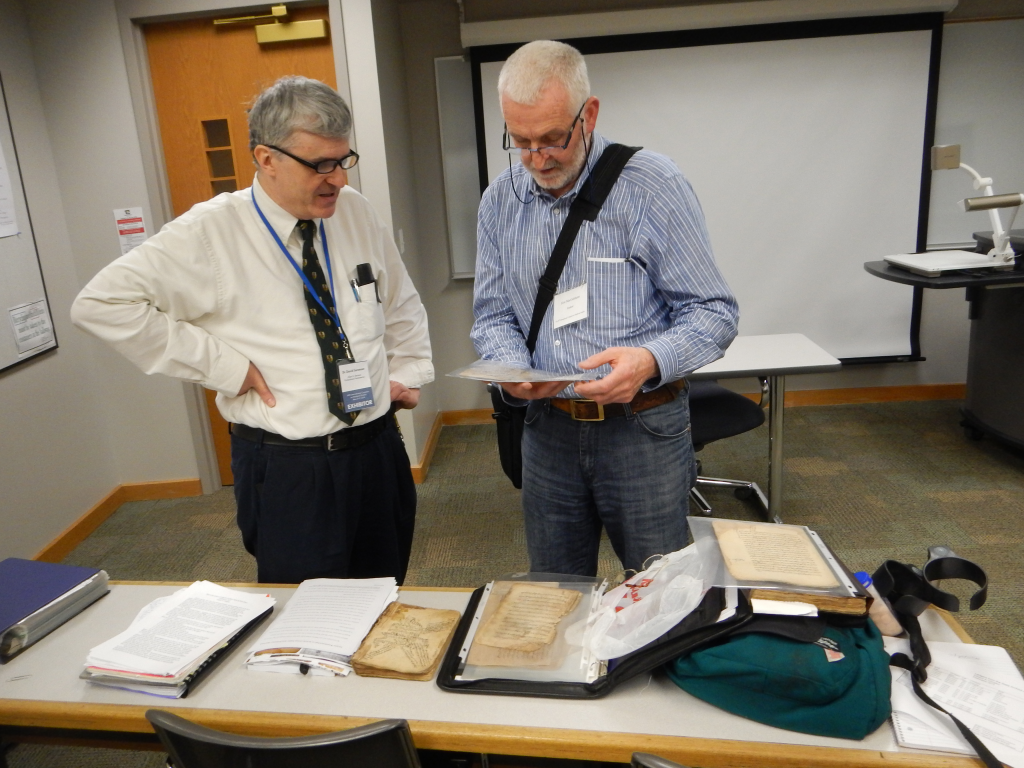
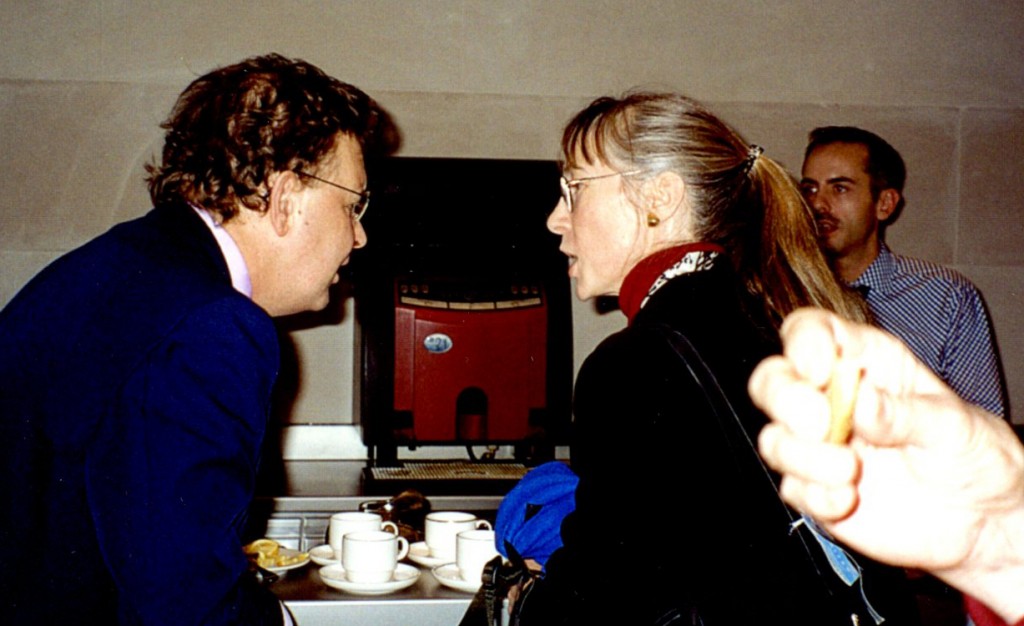
David Sorenson and Donnach MacGabhann examine manuscript materials after the RGME Writing Materials Session at the 2014 Congress. Photography by Mildred Budny
One of the most memorable on our roster of events over the years was the 2014 Seminar on site at the Index of Christian Art to consider selected examples (manuscripts, fragments, and documents) from a Private Collection on loan to the RGME for some years.
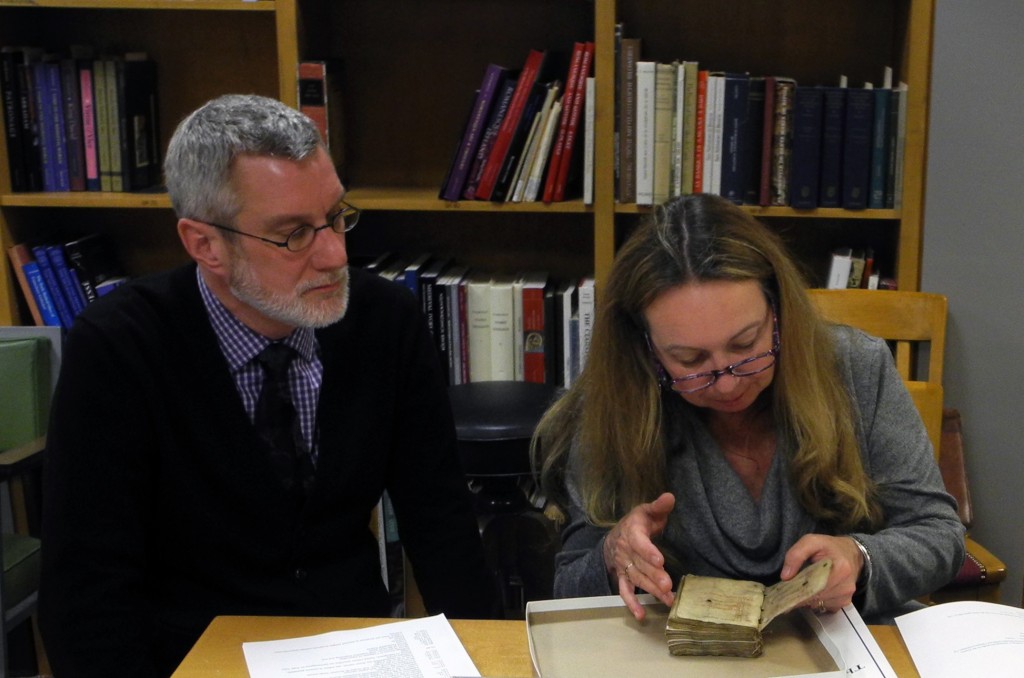
Observing the Book of Hours at the 2014 Seminar
Images
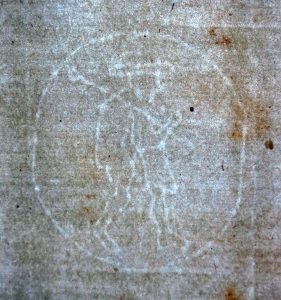
Private Collection, Back Endpaper for Printed Postilla: Watermark of Pilgrim with staff.
Sending photographs to us gives information about the item(s). Having a look, we might propose to help and also, if permission is granted, to ask others within our circles about further information in the areas, regions, subjects, languages, genres of objects, and contexts to which the materials pertain. For example, over the years, sharing photographs from a single private collection has, with permission, generated reports on a wide variety of items on paper and vellum or parchment, manuscript or printed, from many places of origin and in diverse languages.
Sometimes the approach concerns an object which relates to materials which we have already researched and published. Among them are fragments from specific medieval manuscripts or printed materials dispersed by Otto F. Ege (1888–1951) which our research has explored; and fragments from other manuscripts or printed materials also dispersed by Ege alone or in compilations of Portfolios of fragments reused as specimens intended for teaching and display. Sometimes (as with some of those cases), as time goes on and opportunity arises, travel permitting, we have the chance to see the originals which have become familiar through our research work from photographs.
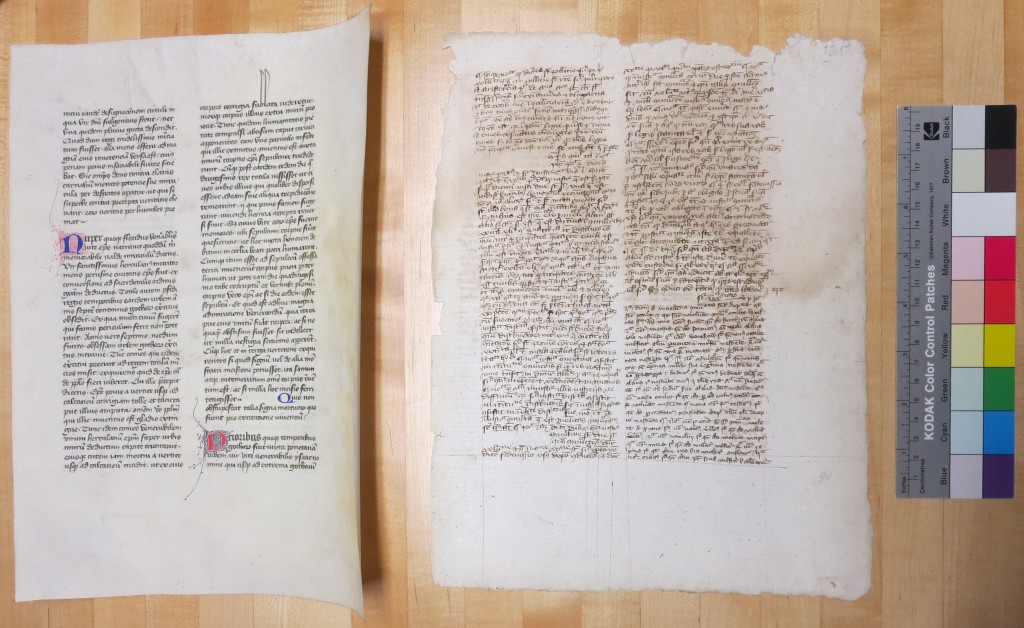
‘New Leaves’ from Ege Manuscript 41, Verso, and from Ege Manuscript 51, Recto, viewed in November 2016. Photograph by Mildred Budny
Sometimes the collector’s initial approach to us about a specimen broaches a book or fragment of some other kind, in case our sphere of interests and contacts might bring enlightenment.
An example is the query several years ago from a collector abroad about a South Asian manuscript newly acquired from a friend; the language was unfamiliar; might we know what the book is? The process of constructive, and amiable, collaborative inquiry led, with generous permission, to two blogposts which offer instruction about the book and its place within widespread practices in the book-trading world for tourists who may have little knowledge about the genre of book and its integrity as an object.
Often, as in that case, our research work progresses with the photographic representatives of the materials generously supplied by the owners. Sometimes, as we explore together, the others take more photographs to illustrate specific features or produce diagrams for ruling patterns, folds, and alignment of the insides and outsides of bifolia within the original book.
On Site
Sometimes the owners generously send the materials themselves on loan to the Research Group, for detailed study in person, over a period of time. This loan enables detailed examination, photography, research, consultation, and refinement of results, whereupon the materials return to their owners or transfer to new ownership according to the owners’ directions.
Sometimes, if wished and permitted by the owner, the period of loan includes the conservation work, such as removal from non-archival frames or boxes, rematting, reframing, and/or placement in archival housing for storage, handling, or display.
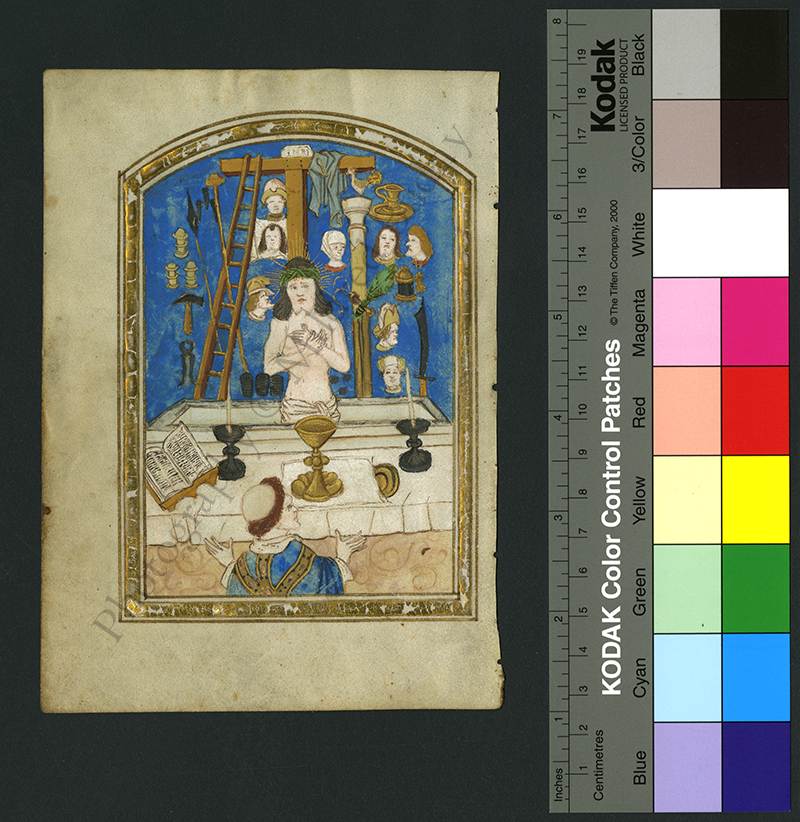
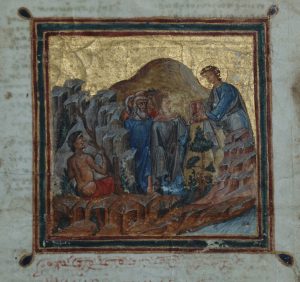
Private Collection, Vellum leaf with illustration of “Gregory Mass”, verso. Photograph by Mildred Budny.
With these opportunities, close inspection is possible under various lights and angles of vision. These multiple approaches can be done in the presence of the object. Such variety can reveal features not necessarily clear or apparent in digital reproductions of single views, however high-quality they might be and capable of showing details under high magnification.
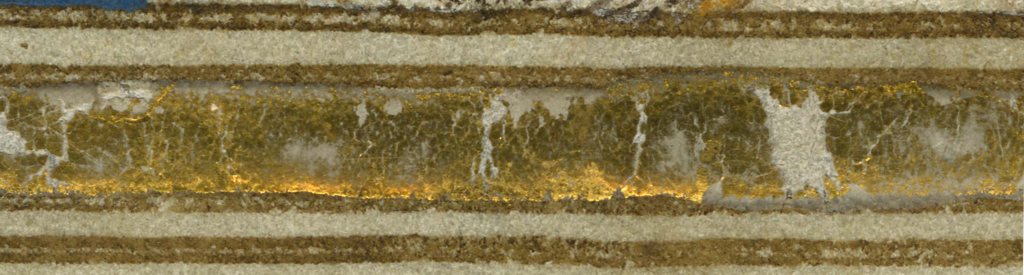
Private Collection, Vellum leaf with illustration of “Gregory Mass”, verso: detail of lower border. Photograph by Mildred Budny.
Results
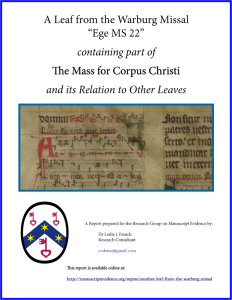
Front Cover for Report by Leslie J. French for Wagner Leaf from Ege MS 22 (2021)
The quests can result — depending upon the materials and their context, the time available or required for research and write-up, and the choices for presentation of the results — variously in RGME blogposts, presentations for symposia, conference sessions, or other scholarly events, exhibition displays, RGME Research Booklets, and a combination of these.
With these presentations and publications, knowledge about the original materials can reach a wide audience, and add to knowledge about their contexts, including relatives among surviving witnesses to their periods and places of production, makers, owners, readers, collectors, collections, and other features.
Examples
So far, the range of materials is exemplified by a range of publications of materials from private collections, named or anonymous. Sometimes the publications include or represent materials in institutions, such as university or public libraries. Named private collections represented include:
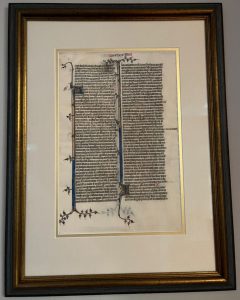
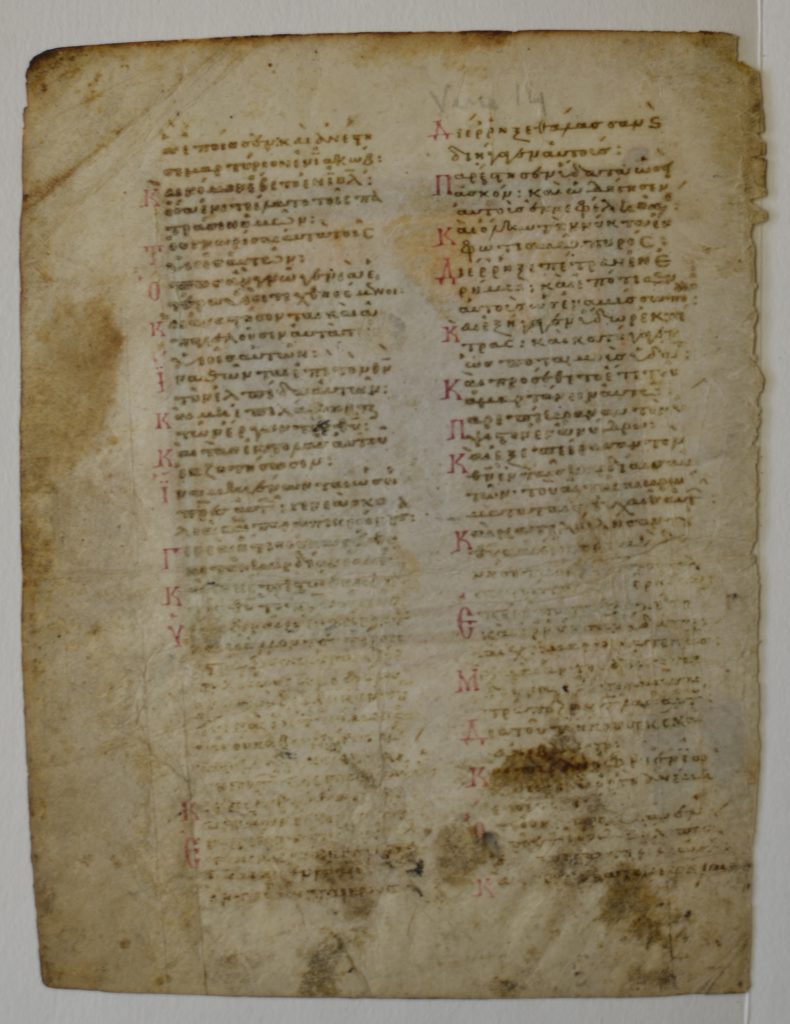
Collection of Birgitt G. Lopez, Framed Leaf from ‘Otto Ege Manuscript 14’. Leaf in Frame. Reproduced by permission.
Birgitt G. Lopez Collection
Brent Rosenbrook Collection
Ronald K. Smeltzer Collection
Stephen Soderlind Collection
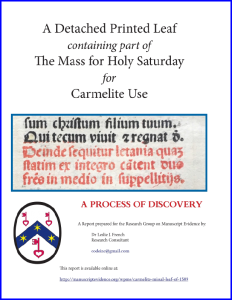
Camelite Booklet Cover Page with New Front Cover with border
J.S. Wagner Collection
Robert Weber Collection
Two cases from the J.S. Wagner Collection represent:
1) The opening of one of the Penitential Psalms (with the Penitent King David) from the Psalter
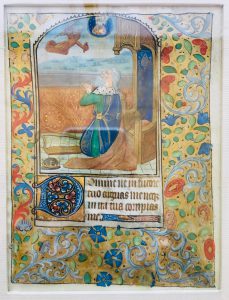
J. S. Wagner Collection. Detached Manuscript Leaf with the Opening in Latin of the Penitent Psalm 37 (38) and its Illustration of King David.
2) The opening of the Old Testament Book of Macabees in a Bible manuscript disbound and distributed by Otto F. Ege
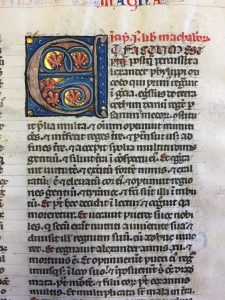
Wagner Collection. Opening of the Book of Macabees in Otto Ege MS 19.
Books and Fragments
Examples include
1) books and fragments from a single private assembly in the Illustrated Handlist, including specimens which we were asked to remove from their damaging modern frames for conservation and archival mounting.
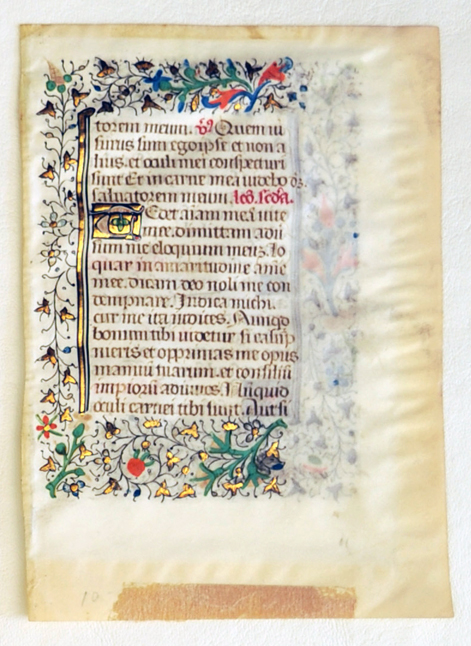
Book of Hours with floral border. Photography by Mildred Budny.
2) manuscripts, fragments, documents, printed materials, and other media in various private collections as represented in our blog on Manuscript Studies; and
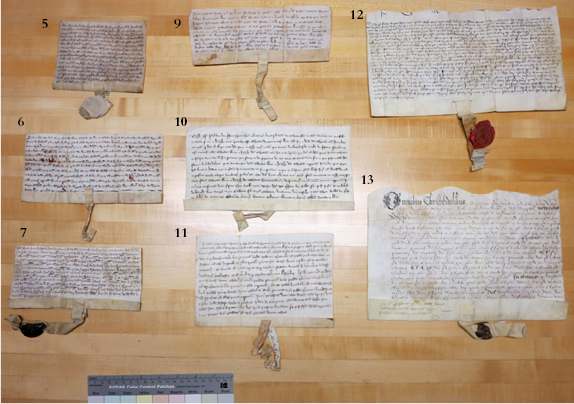
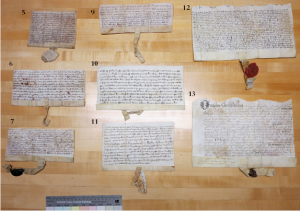
Private Collection. “Preston Charters” Faces. Photograph Mildred Budny.
3) books or part-books, such as a disordered and reassembled Sinalese palm-leaf manuscript (with its reworked cover), which our study could reconstruct in part:
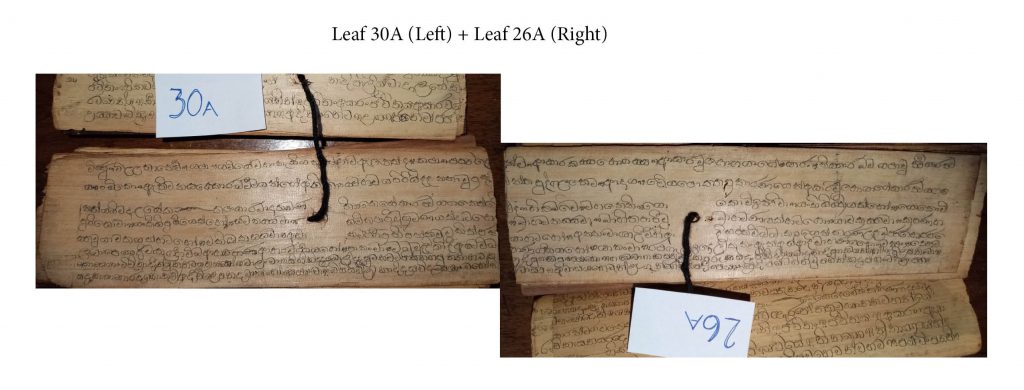
Private Collection, Sinhalese Palm-Leaf Manuscript, Reconstructed View of Former Leaf (’30A’ + 26A’).
Books and Fragments On Loan
In some cases, the current owner’s curiosity about materials in his or her collection leads to the loan to the Research Group or its Director to enable direct examination, which can be an optimal circumstance for research.
1. The Illustrated Handlist
For example, the extended loans over several years (in stages) to the Director for conservation, photography, and research of materials in a private collection — comprising an assembly of manuscript, documentary, and early printed materials — provided the impetus for interim and cumulative reports in scholarly events of several kinds, such as conference or symposium sessions, and an RGME seminar at Princeton University.
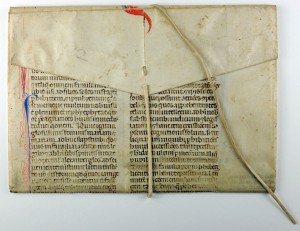
Budny Handlist 7: Folder from Back with Flap.
For the range of that assembly, now dispersed in different directions, see
For example: It’s a Wrap.
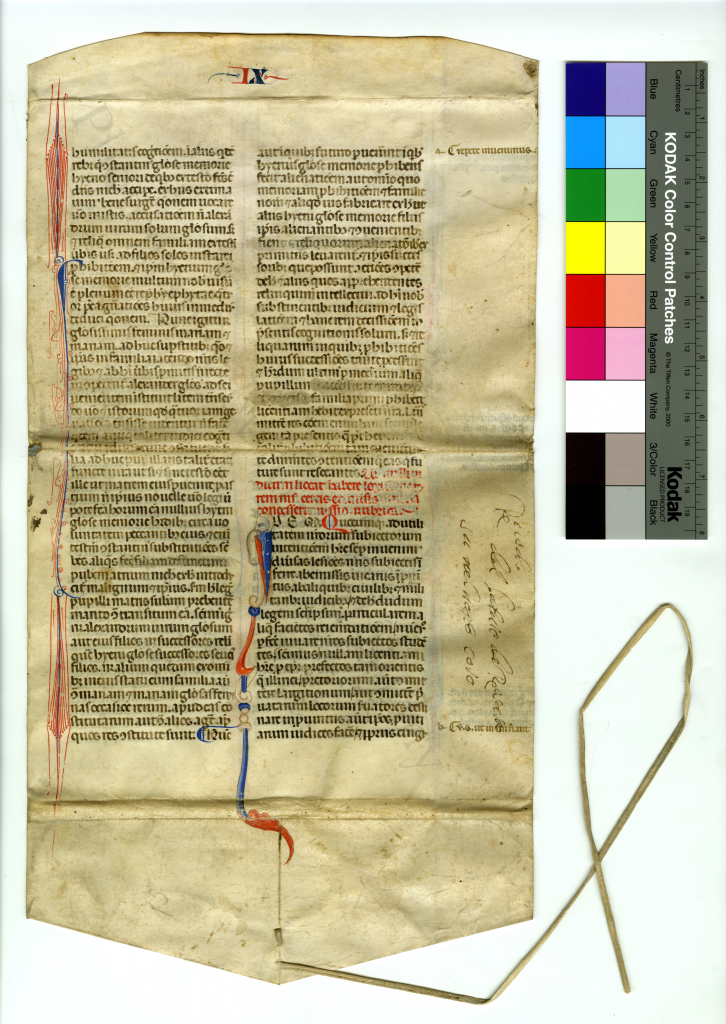
Outside of Wrapper = Recto of Leaf
2. A Hybrid Book with Two Layers of Manuscripts
Another extended loan from another private collector in 2022–2023 generously brought a remarkable hybrid book, comprising a sandwiched set of vellum leaves within a limp-vellum binding, to the RGME for close inspection over months. The experience, with different forms of lighting (natural, artificial, enhanced), including back-lighting and side-lighting, made it possible to examine multiple aspects of the book which combines two layers produced in the scholastic period of the High Middle Ages and in the Counter Reformation respectively. In time, when appropriate, we hope to describe the characteristics of this book and the results of our research.
3. The New Loan of a Manuscript Fragment (2024)
A new loan in 2024 brings a medieval manuscript leaf, in its frame, for study and publication, with permission, before its return. See below for a first glimpse as our study begins.
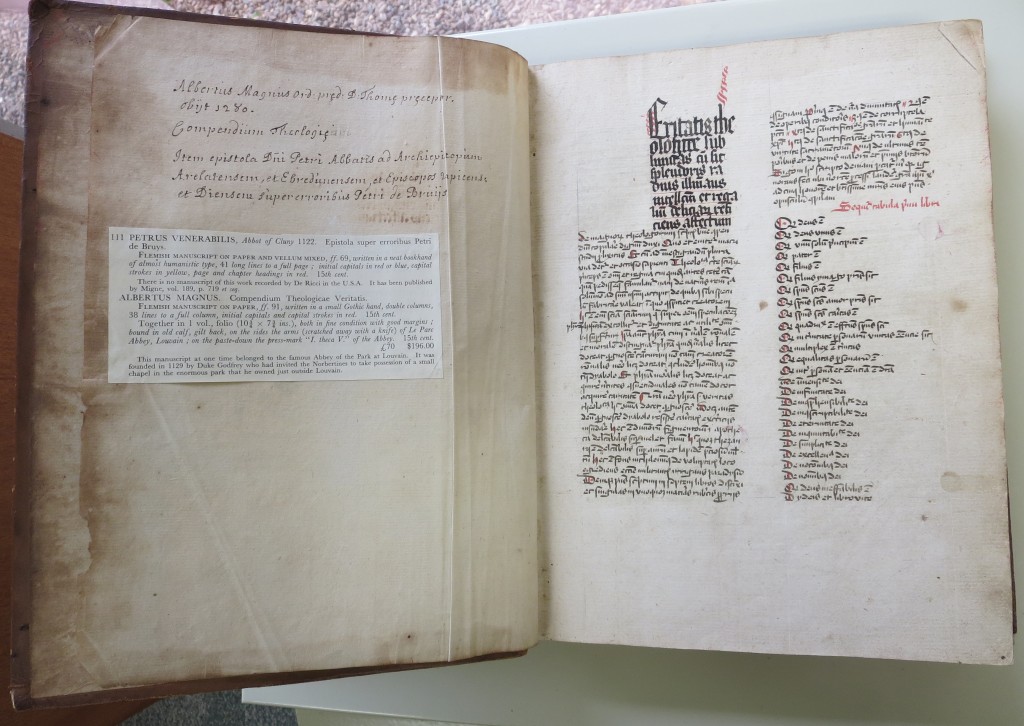
Opening between the Front Flyleaf, Verso, and Folio 1 recto, opening Part A (“Albertus Magnus”). Photography Mildred Budny.
Up Close
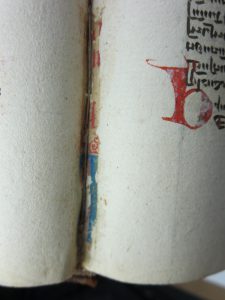
Le Parc Abbey, Theological Volume, Part A, gutter. Photography Mildred Budny.
The opportunity to study these varied materials at close hand and over extended periods of time, as the research advanced and there emerged new discoveries, including by other scholars on related subjects and materials (such as the manuscripts dispersed by Otto F. Ege), spurred the creation of the RGME blog on Manuscript Studies and provided case-studies for multiple blogposts.
Often these reports have newly discovered results augmenting knowledge about the object, its original state, and its context. They appear on our website as blogposts about individual items or groups of items; a webpage for the The Illustrated Handlist of a single assembly of items; and reports in other forms, including presentations as scholarly events, their publications, and exhibitions both in person and online. Cases include:
We give thanks to the collectors who send photographs of their materials and those who lend materials to the RGME for study, learning, and teaching for audiences near and far.
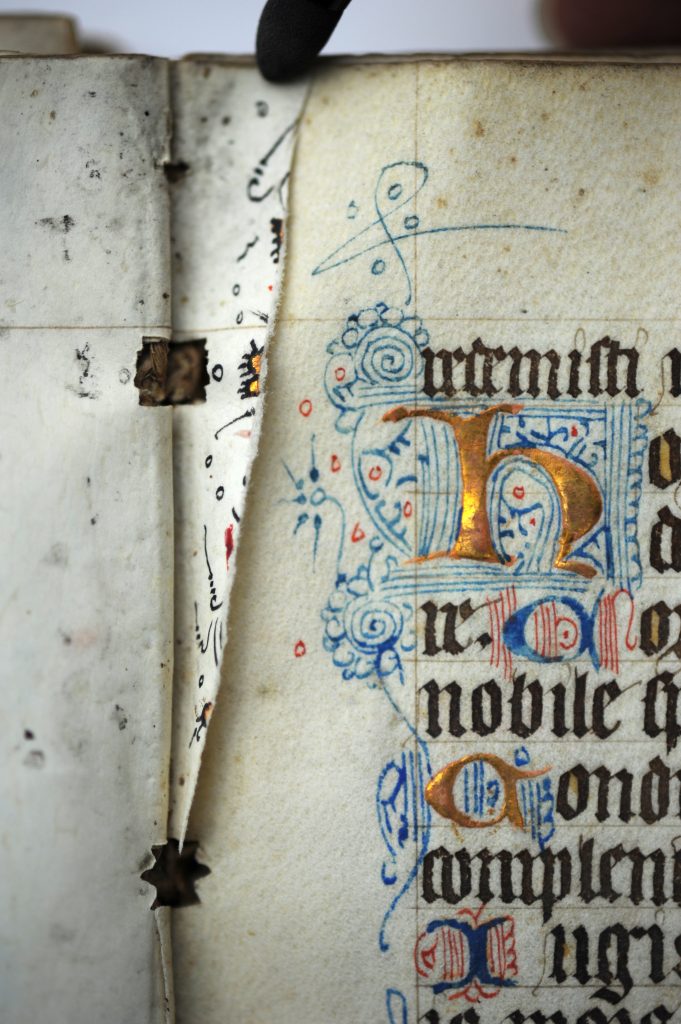
Private Collection, Book of Hours, Decorated Initial and Stub from Despoiled Leaf. Photography Mildred Budny.
Our Records of Earlier States, now Lost
In some cases, as the lent items after their return have transferred to new ownership from the private collections through which we met them, they have undergone transformations in themselves. In such cases, it can be fortunate that our research has reported their previous stages, as some evidence has been destroyed in new ownership. See, for example, the separation in 2023 of a composite medieval manuscript from Le Parc Abbey, Belgium, into two parts with the removal and loss of the binding given by its original institution.
As a result, our blogposts preserve records of lost evidence. Perforce, because of our care to record and report the evidence of the original item, in so far as time and resources allow, elements in our photographs, notes, descriptions, and reports reach the level of ‘primary evidence’ or surrogates for evidence in the originals which has been lost.
Opening between the Front Flyleaf, Verso, and Folio 1 recto, opening Part A (“Albertus Magnus”). Photography Mildred Budny.
A New Loan
A new loan to the RGME for examination brings a single vellum leaf from a medieval manuscript, which the present owner recently acquired from a former owner’s belongings in its frame with mat. The new owner approached the RGME Director on the strength of one of our blogposts. With permission, the leaf has been sent on loan to the RGME in June 2024.
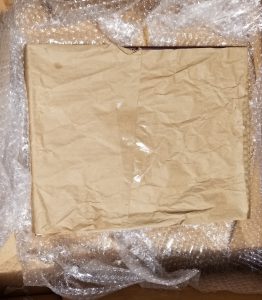
Private Collection. Framed Bible Leaf in its Wrapping for Transit to the RGME in July 2024: View upon arrival in unpacking the leaf. Photograph by Mildred Budny.
Work on the leaf after it had safely arrived, in secure packing, had to wait while disruptions to the RGME website and a cluster of other unexpected issues intervened, requiring attention. Resuming work (as you can see, our website is back in accessible working order), we begin our report on the leaf with this blogpost. It sets the scene and shows first photographs of the leaf still in its frame, to introduce the leaf to you.
At present, the leaf remains in its frame, while we study its visible features and explore its context. Then we will, with permission, remove the leaf from the frame, to photograph and study its other side and outer edges now hidden below the windowed opening of the mat and by the back of the frame.
The Visible Text: Recto or Verso?
The leaf stands in the windowed glass frame in which it reached its current owner.
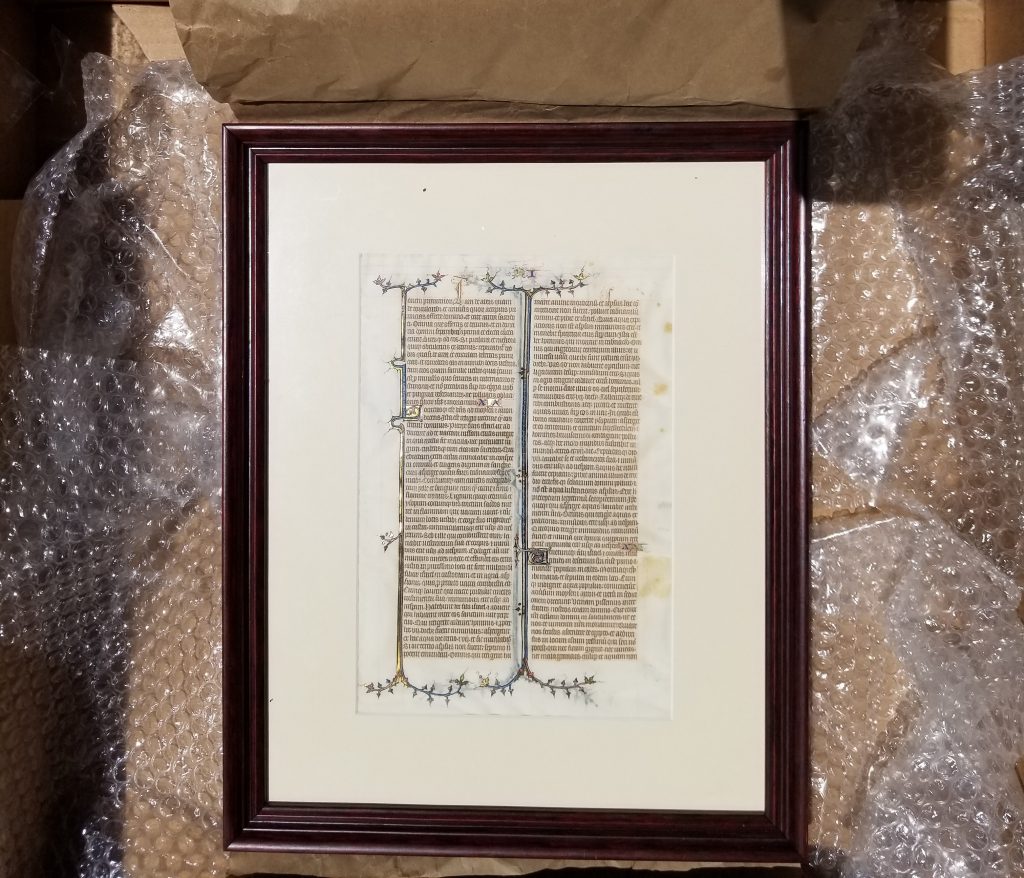
Collection of Jennah Farrell, Manuscript Leaf in Frame: Front, emerging from packaging upon arrival for study. Photograph by Mildred Budny.
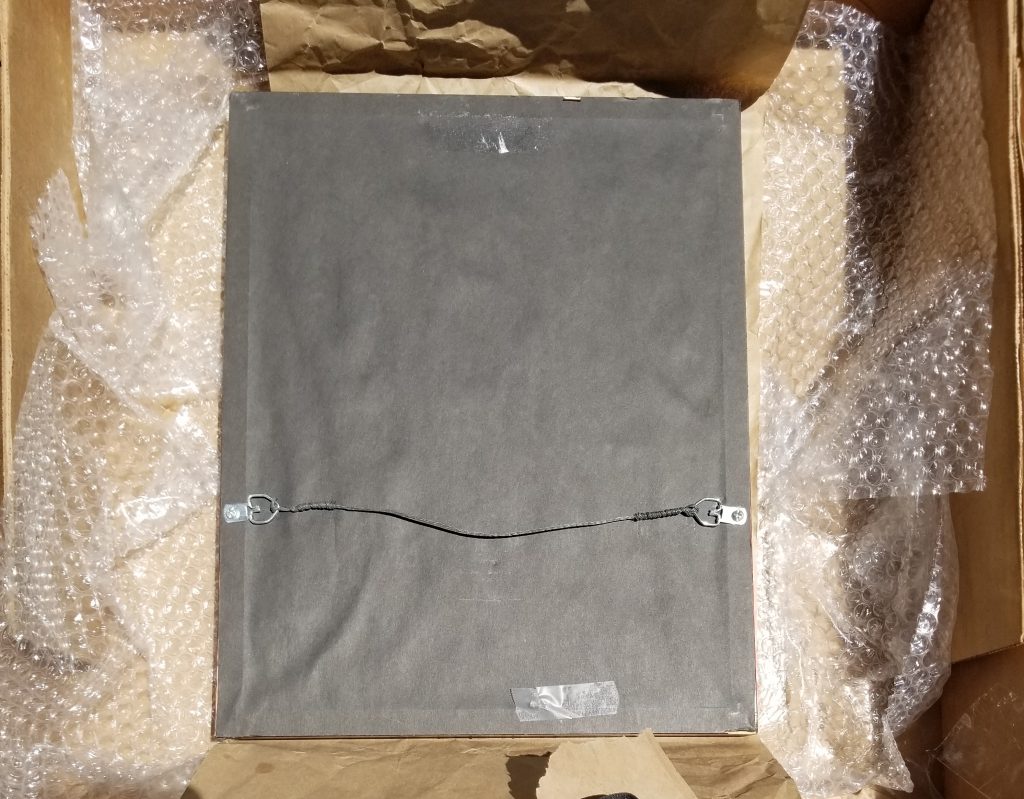
The back of the frame has few identifying features. Its black paper covering has the traces of a removed label formerly centered at the bottom and a companion picture nail taped off-center at the top.
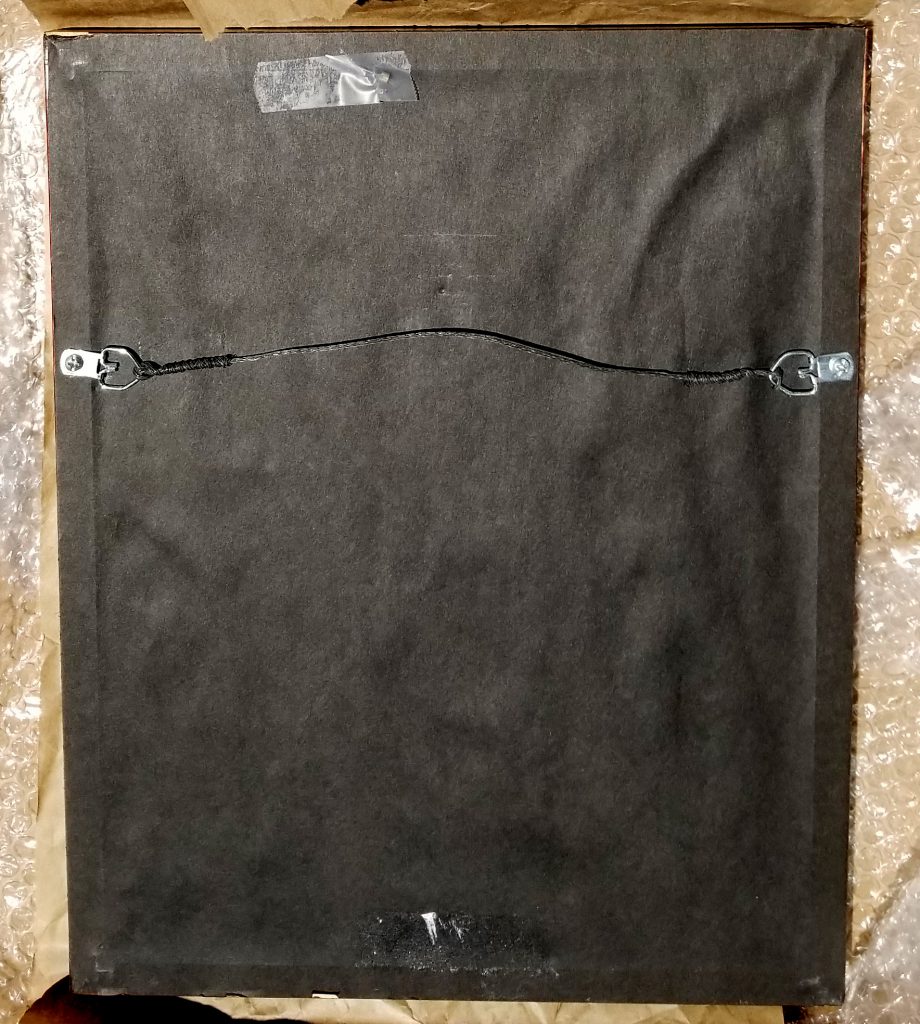
Collection of Jennah Farrell, Manuscript Leaf: Back of Frame. Photograph by Mildred Budny.
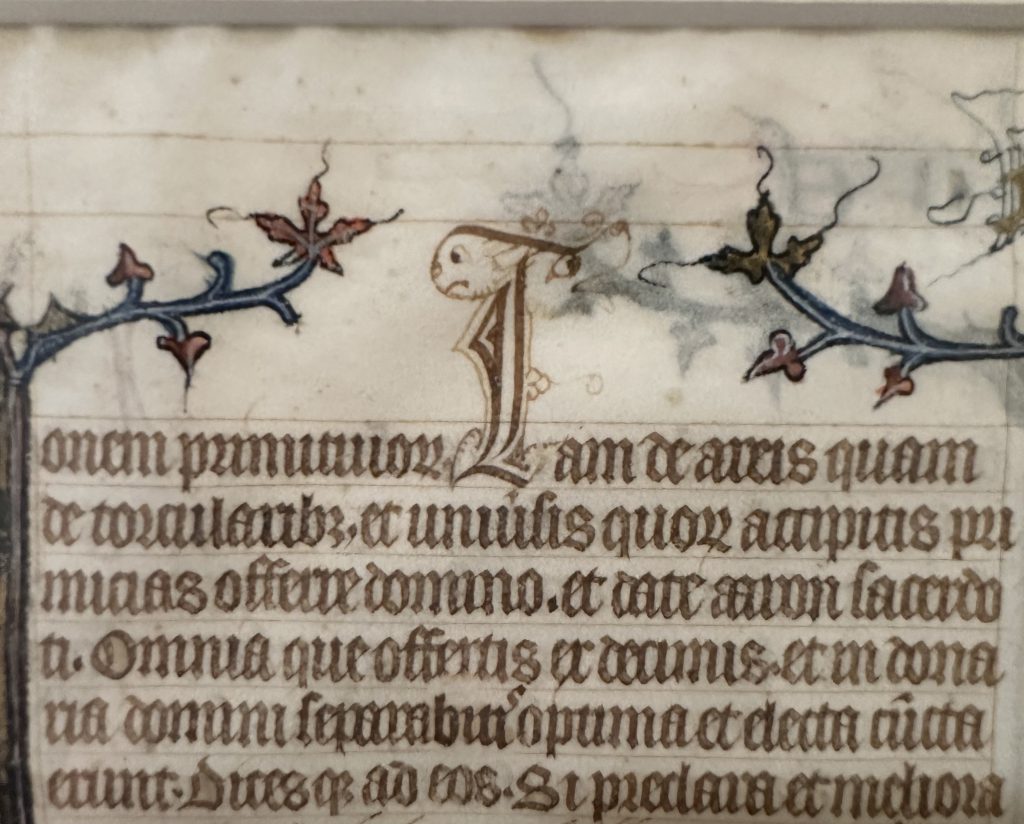
The visible extent of the leaf within the mat measures a maximum of circa 24.1 cm. tall × 16.3 cm. wide (circa 9 7/8 in. tall × 6 7/8 in. wide). The ruled writing area measures circa 18.7 × 12.5 cm. (7 3/4 × 4 7/8 in.).
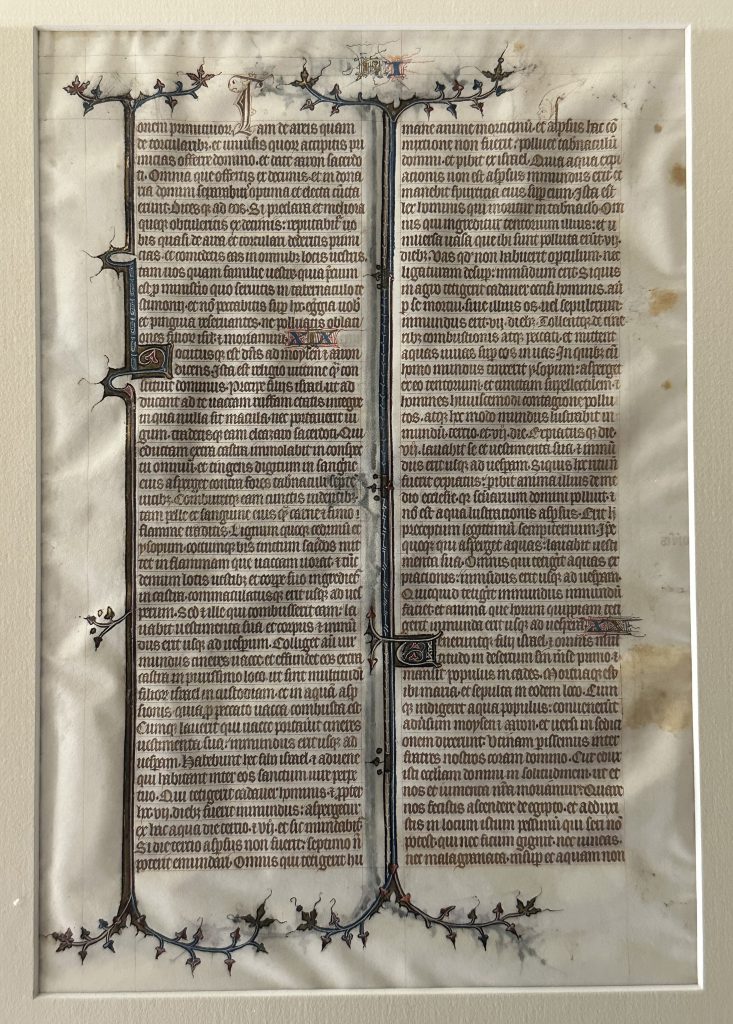
Collection of Jennah Farrell, Manuscript Leaf in Mat. Photograph by Jennah Farrrell.
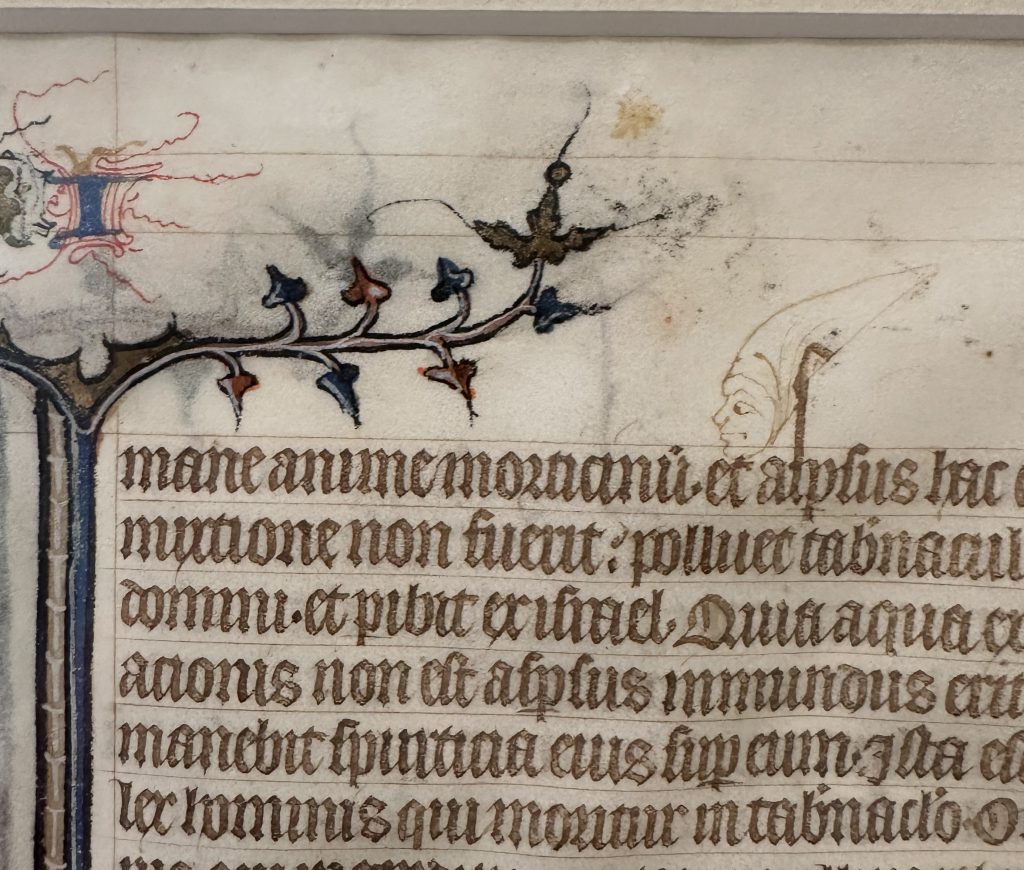
Before the leaf is removed from its frame, the visible features of the leaf within the windowed mat must speak for themselves.
We might use this condition as a teaching exercise or opportunity, to see how much we might learn about the leaf from this perspective, before approaching its other side and the edges of the sheet which lie behind the mat and which remain hidden beneath the back covering of the frame. How much can it tell us in this state, before we move to the next?
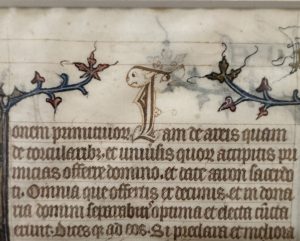
Collection of Jennah Farrell, Manuscript Leaf in Mat: top left. Photograph by Jennah Farrrell.
More to Come
Watch this space, as a next blogpost will examine the leaf in its own right. Join the quest!
Update (11 September 2024): Now see:
P.S. Do you recognize this manuscript? Are you familiar with other leaves from it? Please let us know.
Please Contact Us or visit
We look forward to hearing from you.
Update: Our work with these lent or donated materials has developed into a series of online collaborative workshops. See:
*****








2025 International Medieval Congress at Leeds: Call for Papers
August 1, 2024 in Announcements, Call for Papers, International Medieval Congress, Leeds, Manuscript Studies
2025 International Medieval Congress
at Leeds:
Call for Papers
“Manuscripts as Worlds of Learning”
(2 Sessions + Roundtable)
32nd Annual IMC
Monday to Thursday 07–10 July 2025
(with In-Person and Virtual Components)
Deadline for your Proposals for Papers: 5 September 2024
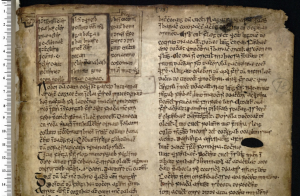
Dublin, Royal Irish Academy, MS 23 E 25, p. 73, top. Image via https://codecs.vanhamel.nl/Dublin,_Royal_Irish_Academy,_MS_23_E_25 via Creative Commons (CC BY-SA 3.0).
[Posted on 1 August 2024, with updates]
Building upon the successful completion of our RGME Inaugural Session at the International Medieval Congress (IMC) at the University of Leeds in July 2024, we announce the Call for Papers (CFP) for our activities at next year’s Congress.
For information about the Congress, see
Note that the general deadline for individual papers without specified sessions in a general pool is 31 August 2024.
The deadline for proposals for our RGME-sponsored Sessions is 5 September 2024. Please send your proposals directly to us as organisers; we will select the programmes by their deadline of 30 September 2024. (Instructions below.)
“Worlds of Learning” at Leeds in 2025
Next year’s Thematic Focus for the IMC is “Worlds of Learning”. The broad scope is described in the general Call for Papers: IMC 2025 – ‘Worlds of Learning’.
We invite you to submit proposals for a set of interlinked events planned for the Research Group on Manuscript Evidence (RGME) to focus on the power and potential of manuscripts to contain, convey, and embody worlds of learning within their span. In effect, given their structure and contents, as we approach them as beholder, user, reader, student, teacher, or admirer, they may carry worlds in our hands.
How might medieval manuscripts do so, variously for their medieval audience, later intermediaries, and our own times? How might and do they function as “Worlds of Learning” in their own right/write? We explore.
Update (14 August 2024): As interest grows, we plan several sessions for the 2025 IMC.
In another post, we present a Session with Papers devoted to “Game Knowledge and Knowledge of Games”, which follows up a strand in our RGME Inaugural Session this year.
Here we present a suite of events containing two Sessions with Papers accompanied by a Round Table with Discussion, all dedicated to “Manuscripts as Worlds of Learning”.
Read the rest of this entry →
Tags: 'Commonplace Books', Authority Texts, Biblical Commentaries, Classbooks, History of Pedagogy, Instruments of Learning, International Congress on Medieval Studies, International Medieval Congress, Lebor na hUidre (LU), Legal Commentaries, Manuscript Miscellanies, Manuscript studies, Pedagogy, RIA MS 23 E 25, Worlds of Learning
No Comments »