• News
    • News & Views
    • RGME Activities for 2024 and 2025
    • Around & About with the RGME
    • Reviews
    • Highlights
  • Blogs
    • Manuscript Studies
      • Manuscript Studies: Contents List
    • International Congress on Medieval Studies
      • Abstracts of Congress Papers
        • Abstracts of Papers Listed by Author
        • Abstracts of Papers Listed by Year
  • About
    • Mission
    • Who We Are
      • Officers, Associates & Volunteers
      • RGME Committees
      • Friends of the Research Group on Manuscript Evidence
    • Policies & Statements
      • RGME Privacy Policy Statement
      • RGME Intellectual Property Statement & Agreements
    • People
      • Mildred Budny — Her Page
      • Adelaide Bennett Hagens
    • Activities
      • Events
      • Congress Activities
        • Sponsored Conference Sessions (1993‒)
          • Panels at the M-MLA Convention (from 2016)
        • Co-sponsored Conference Sessions (2006‒)
    • History
      • Seals, Matrices & Documents
      • Genealogies & Archives
    • Contact Us
  • Bembino
    • Multi-Lingual Bembino
    • RGME Bembino: Resources
  • Congress
    • Sponsored Conference Sessions (1993‒)
    • Co-sponsored Conference Sessions (2006‒)
    • Abstracts of Congress Papers
      • Abstracts Listed by Author
      • Abstracts Listed by Year
    • Kalamazoo Archive
    • Panels at the M-MLA Convention (2016-2019)
      • Abstracts of Papers for the M-MLA Convention
      • Panels at the M-MLA Convention (from 2016)
  • Events
    • RGME Activities for 2024 and 2025
      • 2023 Activities and 2024 Planned Activities
    • Seminars, Workshops, Colloquia & Symposia (1989–)
      • Seminars on ‘The Evidence of Manuscripts’
      • Symposia on ‘The Transmission of the Bible’
      • The New Series (2001-)
        • 2019 Anniversary Symposium Program: The Roads Taken
        • 2019 Anniversary Symposium Registration
        • 2019 Anniversary Symposium Registration Open
      • RGME Symposia: The Various Series
      • The Research Group Speaks: The Series
      • Meetings of the Friends of the Research Group on Manuscript Evidence
      • RGME Online Events
    • Abstracts of Papers for Events
      • Abstracts of Papers for Seminars on ‘The Evidence of Manuscripts’
      • Abstracts of Papers for Symposia, Workshops & Colloquia
    • Receptions & Parties
    • Business Meetings
    • Photographic Exhibitions & Master Classes
    • Events Archive
  • ShelfLife
    • Journal Description
    • ShelfMarks: The RGME-Newsletter
    • Publications
      • “Insular, Anglo-Saxon, and Early Anglo-Norman Manuscript Art at Corpus Christi College, Cambridge” (1997)
        • Mildred Budny, ‘Catalogue’
        • The Illustrated Catalogue (1997)
      • The Illustrated Handlist
      • Semi-Official Counterfeiting in France 1380-1422
      • No Snap Decisions: Challenges of Manuscript Photography
    • History and Design of Our Website
  • Galleries
    • Watermarks & the History of Paper
    • Galleries: Contents List
    • Scripts on Parade
    • Texts on Parade
      • Latin Documents & Cartularies
      • New Testament Leaves in Old Armenian
    • Posters on Display
    • Layout Designs
  • Donations and Contributions
    • RGME Donor Promise
    • 2023 End-of-Year Fundraiser for our 2024 Anniversary Year
    • 2019 Anniversary Appeal
    • Orders
  • Links
    • Catalogs, Metadata, and Databases: A Handlist of Links
    • Handlist of Resources for Manuscript Studies and Fragmentology
    • Manuscripts & Rare Books
    • Maps, Plans & Drawings
    • Seals, Seal-Matrices & Documents

  • News
    • News & Views
    • RGME Activities for 2024 and 2025
    • Around & About with the RGME
    • Reviews
    • Highlights
  • Blogs
    • Manuscript Studies
      • Manuscript Studies: Contents List
    • International Congress on Medieval Studies
      • Abstracts of Congress Papers
        • Abstracts of Papers Listed by Author
        • Abstracts of Papers Listed by Year
  • About
    • Mission
    • Who We Are
      • Officers, Associates & Volunteers
      • RGME Committees
      • Friends of the Research Group on Manuscript Evidence
    • Policies & Statements
      • RGME Privacy Policy Statement
      • RGME Intellectual Property Statement & Agreements
    • People
      • Mildred Budny — Her Page
      • Adelaide Bennett Hagens
    • Activities
      • Events
      • Congress Activities
        • Sponsored Conference Sessions (1993‒)
          • Panels at the M-MLA Convention (from 2016)
        • Co-sponsored Conference Sessions (2006‒)
    • History
      • Seals, Matrices & Documents
      • Genealogies & Archives
    • Contact Us
  • Bembino
    • Multi-Lingual Bembino
    • RGME Bembino: Resources
  • Congress
    • Sponsored Conference Sessions (1993‒)
    • Co-sponsored Conference Sessions (2006‒)
    • Abstracts of Congress Papers
      • Abstracts Listed by Author
      • Abstracts Listed by Year
    • Kalamazoo Archive
    • Panels at the M-MLA Convention (2016-2019)
      • Abstracts of Papers for the M-MLA Convention
      • Panels at the M-MLA Convention (from 2016)
  • Events
    • RGME Activities for 2024 and 2025
      • 2023 Activities and 2024 Planned Activities
    • Seminars, Workshops, Colloquia & Symposia (1989–)
      • Seminars on ‘The Evidence of Manuscripts’
      • Symposia on ‘The Transmission of the Bible’
      • The New Series (2001-)
        • 2019 Anniversary Symposium Program: The Roads Taken
        • 2019 Anniversary Symposium Registration
        • 2019 Anniversary Symposium Registration Open
      • RGME Symposia: The Various Series
      • The Research Group Speaks: The Series
      • Meetings of the Friends of the Research Group on Manuscript Evidence
      • RGME Online Events
    • Abstracts of Papers for Events
      • Abstracts of Papers for Seminars on ‘The Evidence of Manuscripts’
      • Abstracts of Papers for Symposia, Workshops & Colloquia
    • Receptions & Parties
    • Business Meetings
    • Photographic Exhibitions & Master Classes
    • Events Archive
  • ShelfLife
    • Journal Description
    • ShelfMarks: The RGME-Newsletter
    • Publications
      • “Insular, Anglo-Saxon, and Early Anglo-Norman Manuscript Art at Corpus Christi College, Cambridge” (1997)
        • Mildred Budny, ‘Catalogue’
        • The Illustrated Catalogue (1997)
      • The Illustrated Handlist
      • Semi-Official Counterfeiting in France 1380-1422
      • No Snap Decisions: Challenges of Manuscript Photography
    • History and Design of Our Website
  • Galleries
    • Watermarks & the History of Paper
    • Galleries: Contents List
    • Scripts on Parade
    • Texts on Parade
      • Latin Documents & Cartularies
      • New Testament Leaves in Old Armenian
    • Posters on Display
    • Layout Designs
  • Donations and Contributions
    • RGME Donor Promise
    • 2023 End-of-Year Fundraiser for our 2024 Anniversary Year
    • 2019 Anniversary Appeal
    • Orders
  • Links
    • Catalogs, Metadata, and Databases: A Handlist of Links
    • Handlist of Resources for Manuscript Studies and Fragmentology
    • Manuscripts & Rare Books
    • Maps, Plans & Drawings
    • Seals, Seal-Matrices & Documents

Log in

Archives

Featured Posts

Episode 24. “Life with Books” (Interview with John Windle)
Announcing the Launch of RGME Bembino WP
2026 RGME Colloquium at The Grolier Club: Report
Medieval Missal Fragment as Early-Modern Cover
The Weber Leaf from Ege MS 61
"Bembino" Booklet Cover
Episode 23. “Meet RGME Bembino: Facets of a Font”
2026 RGME Colloquium on “Transformations & Renewals” at The Grolier Club
2026 Theme of the Year: “Transformations and Renewals”
A Leaf with Patchwork from the Saint Albans Bible
A Sister Leaf from a Miniature Latin Vulgate Bible
A Little Latin Vulgate Bible Manuscript Leaf in Princeton
J. S. Wagner Collection. Leaf from from Prime in a Latin manuscript Breviary. Folio 4 Verso, with part of Psalm 117 (118) in the Vulgate Version, set out in verses with decorated initials.
2026 Annual Appeal
Episode 22: “Encounters with Local Saints and Their Cults”
Private Collection, Ege's FBNC Portfolio, Dante Leaf, Verso, Detail. Reproduced by Permission.
2025 RGME Autumn Colloquium on Fragments
Workshop 8: A Hybrid Book where Medieval Music Meets Early-Modern Herbal
2025 RGME Autumn Symposium on “Readers, Fakers, and Re-Creators of Books”
RGME Workshops on “The Evidence of Manuscripts, Etc.”
2025 International Medieval Congress at Leeds: RGME Program
Episode 21. “Learning How to Look”
2025 International Congress on Medieval Studies: Program
2025 RGME Visit to Vassar College
Two Leaves in the Book of Numbers from the Chudleigh Bible
Delibovi on Glassgold on Boethius: A Blogpost
Ronald Smeltzer on “Émilie du Châtelet, Woman of Science”
2025 Spring Symposium: “Makers, Producers, and Collectors of Books”
Starters’ Orders
The Weber Leaf from the Saint Albans Bible
Workshop 4. “Manuscript Fragments Compared”
Episode 20. “Comic Book Theory for Medievalists”
Episode 19: “At the Gate: Starting the Year 2025 at its Threshold”
Favorite Recipes for Lemonade, Etc.
RGME Visit to the Lomazow Collection: Report
2024 Autumn Symposium: “At the Helm”
A Latin Vulgate Leaf of the Book of Numbers
The RGME ‘Lending Library’
Florence, Italy, Ponte Vecchio from Ponte alle Grazie. Photo: Ingo Mehling, CC BY-SA 4.0 , via Wikimedia Commons
Episode 17. “RGME Retrospect and Prospects: Anniversary Reflections”
2024 Anniversary Symposium: The Booklet
Jesse Hurlbut at the Bonneville Salt Flats, Utah. Photograph Jesse Hurlbut.
Episode 16: An Interview with Jesse D. Hurlbut
To Whom Do Manuscripts Belong?
Kalamazoo, MI Western Michigan University, Valley III from the side. Photograph: David W. Sorenson.
2024 International Congress on Medieval Studies: Report
2024 Spring Symposium at Vassar College
Puente de San Martín: Bridge with reflection over the River Targus, Toledo, Spain.
2024 Grant for “Between Past and Future” Project from The Gladys Krieble Delmas Foundation Research Libraries Program
2024 Anniversary Symposium in Thanks to Jesse Hurlbut: Program

You are browsing the Blog for Manuscript Studies

2018 Congress Call for Papers

July 3, 2017 in Conference, Conference Announcement, Events, International Congress on Medieval Studies, Kalamazoo, Manuscript Studies, Uncategorized

Sessions
Sponsored and Co-Sponsored
by the Research Group on Manuscript Evidence
at the 53rd International Congress on Medieval Studies
10–13 May 2018

Call for Papers
— Deadline for Proposals = 15 September 2017 —

[Published on 3 July 2017, with updates.
Further update:  With the close of the Call for Papers, we have evaluated the proposals received, and chosen the Programs for all the Sessions, both sponsored and co-sponsored.  Upon submitting those Programs to the Congress Committee, we prepare an update for our website, which, when ready, will appear as our 2018 Congress Program.]

With the achievement of our Activities at the 2017 International Congress on Medieval Studies, as announced in our 2017  Congress Program, we both give a 2017 Congress Report and begin to prepare a special Behind the Scenes Report (in preparation).

(Please note:  Illness and a death in the family have impeded these stages, so please watch this space and our Facebook Page for notice of the appearance of that Extra Report.)

*****

Now we proceed to preparations for the 2018 Congress. All but one of our Session Proposals have been accepted, so that we progress to their Call for Papers.  Shame about the refusal for one proposal.  It would have been great.  (Our opinion.)

Logo of the Research Group on Manuscript Evidence (colour version)The Congress Committee now publishes the full 2017 Call for Papers for 52nd ICMS, with the list of Session Titles and Sponsors. Here we announce our 5 co-sponsored Sessions and describe their aims.

As in recent years, we co-sponsor Sessions with the Societas Magica (3 Sessions).  But not, because of that refusal (Boo Hoo!) can there be a session co-sponsored with the Center for Medieval and Early Modern Studies at the University of Florida.

It will be the 13th year of co-sponsorship with the Societas Magica, and it would have been the 5th year with the Center for Medieval and Early Modern Studies.  Both collaborations are excellently collegial.  (Fun, too!)

IMG_3788 Frank & David P at Soc Mag Reception AZO 2017 cropped

The co-organizers are justly happy with our 2017 Co-Sponsored Session on “Manuscripts to Materials”. Totally. Photography by Mildred Budny.

Also, like the 2017 Congress, we plan for

  • an Open Business Meeting and
  • a Reception.

[Update.  With the arrival of the date ending the Call for Papers, we now assess the proposals for papers for our Sessions.  After deliberating and reporting the selected Programs to the Congress Committee, we can report these developments.

As usual, we aim to publish the Abstracts for the accepted Papers as the preparations for the Congress advance.  Abstracts for previous Congresses appear in the Congress Abstracts, listed by Year and by Author.]

Read the rest of this entry →

Tags: Arabic and Persian Occult Texts, Celtic Magic Texts, Center for Medieval and Early Modern Studies at the University of Florida, International Congress on Medieval Studies, Libro de los juegos, Manuscript studies, Picatrix, Societas Magica
No Comments »

Designing Academic Posters

May 29, 2017 in Announcements, Manuscript Studies

Steady on the Page

Gold stamp on blue cloth of the logo of the Research Group on Manuscript Evidence. Detail from the front cover of Volume II of 'The Illustrated Catalogue'Continuing to reflect on the values of presenting materials, whether text, image, or both, upon a page or writing surface, we have decided to proclaim the principles which guide our approach to layout of posters. You may have noticed some of them at our events, on the Posts of Pages pertaining to them, and/or in the Poster Gallery on this website.

You may know already about our views about design and layout, for example in the Illustrated Catalogue (our own design throughout, apart from the front covers and the promotional booklet), in our Style Manifesto (we are not so shy, uncommitted, or wimpy, as to call it a “Style Sheet”), and in all of our Publications.

Page 1 of the 'Style Manifesto' of the Research Group on Manuscript Evidence in the version of April 2014 (4 pages)

Version of April 2015

Principles and Principled

Now we offer a similarly clear, and polemical, description of principles which we believe should govern the processes, and products, of Designing Academic Posters. The 4-page Booklet, set in RGME Bembino, describes and illustrates the aims.

You may download our booklet in whichever form you prefer:

  • Designing Academic Posters set out in 4 individual letter-sized (or quarto) pages
  • Designing Academic Posters as Booklet laid out on 11″ × 17″ sheets for folding into a 4-page booklet in consecutive reading order

We adopted this dual form of publishing our Booklets for some earlier cases, as with the Report on some New Testament Leaves in Old Armenian.  Its 20-page Report appears both as

  • Armenian Pages set out in individual letter-sized (or quarto) pages
  • Armenian Booklet laid out on 11″ × 17″ sheets for folding into a booklet in consecutive reading order

Experience shows that some of you may prefer the second option, so we continue the provision.

Enjoy!

Examples from our Poster Gallery

2014 Poster/Program for the Colloquium on 'When the Dust Has Settled, Or, When Good Scholars Go Back . . . ', laid out in RGME Bembino

What do you think? We invite your comments. We’d be glad to improve.

Poster 2 for the 2016 'Words & Deeds' Symposium at Princeton University, with 2 images from the Otto Ege Collection, The Beinecke Rare Book and Manuscript Library, Yale University. Photography by Lisa Fagin Davis. Reproduced by permission. Poster set in RGME Bembino

And another favorite:

Poster for 'In a Knotshell' (November 2012)with border

Please let us know your favorites!  We’d be glad to hear from you!

Comments here or Contact Us.

*****

Tags: Bembino, Bembino Digital Font, Budny's Illustrated Catalogue, design layout, Research Group designs, Research Group Posters, Style Manifesto
No Comments »

More Discoveries for “Otto Ege Manuscript 61”

May 23, 2017 in Manuscript Studies, Photographic Exhibition, Uncategorized

Initial I of 'In' opening of the Book of Zachariah. Courtesy of Flora Lamson Hewlett Library, Graduate Theological Union, Berkeley, CA. Reproduced by permission.

Zachariah. Courtesy of Flora Lamson Hewlett Library, Graduate Theological Union, Berkeley, CA.

More Fragments are Revealed
from a Dismembered and Dispersed
32-line French Vulgate Pocket Bible
Made Probably in Southern France
circa 1325 C.E.
= “Otto Ege Manuscript 61”

Probably Southern France, circa 1325

Circa 186 × 126 mm
< written area circa 119 × 81 mm >
Double columns of 32 lines, with embellishments and running titles

[Posted on 23 May 2017, with updates]

Updating an earlier blogpost reporting A New Leaf from “Otto Ege Manuscript 61” in our series on Manuscript Studies, Mildred Budny (see Her Page) describes further progress in locating and identifying more parts from that little book.  It should be said that, after the initial discovery and draft write-up, in the excitement of new discoveries, some long illnesses and a wrenching death in the family, with some gratuitous onslaughts from so-called family members, made it difficult to return on course.  Back again.

These new discoveries go hand-in-hand with a rapid pace of strides further in continuing research on some other dismembered “Ege Manuscripts”, owned and dispersed by Otto F. Ege (1888–1951), as well as on some other manuscript fragments – which turn out to have unexpectedly interlocking patterns of transmission by 20th-century sellers.  The advances are described in Updates for Some ‘Otto Ege Manuscripts’.

Read On, Dear Reader, Read On. To say that “The Plot Thickens” would take the words right out of our mouth.

Read the rest of this entry →

Tags: Budny Handlist, Dawson's Bookshop, Ege Memorial Microfilm, Manuscript studies, Otto Ege, Otto Ege Manuscript 61, Philip Duschnes, University of Pennsylvania, University of Virginia, Vulgate Pocket Bible, WorldCat
1 Comment »

Say Cheese

May 21, 2017 in Manuscript Studies, Photographic Exhibition, Uncategorized

Survey of Rents for Plots of Land
circa 1530s
from Brie in France

Single-Sheet Document
Undated
in French on Vellum
with mostly Blank Dorse

[First published on 21 May 2017, with updates]

Continuing our series on Manuscript Studies, our Principal Blogger, Mildred Budny (see Her Page) briefly describes a single-sheet vellum document, which lists in French the rents for various plots of land concerning the region of Brie (renowned for, among other things, its distinctive Cheese).

Detail of "Brie Champenoise" from the "Atlas Moderne" by Rigbert Bonne (1771). Via Wiki Commons.

Detail of “Brie Champenoise” from the “Atlas Moderne” by Rigbert Bonne (1771). Via Wiki Commons.

Face Front

The document in question, now in a private collection, measures at the most circa 298 × 149 mm. The script of the document uses the whitish flesh side of the animal skin.  The written side presents a description in French in 22 1/3 long lines of fields and rents from various properties in the area.

By a single hand, the text is skillfully and swiftly written in faded brown ink.  The lines are not uniformly horizontal.  They stand upon an unevenly trimmed sheet, whose contours perhaps conform partly to the shape of the sheet as it emanated from the initial preparation of the writing material.

The dorse (not shown here; no image is yet available) is mostly blank, although apparently black light reveals some scarcely decipherable traces of script which has been rubbed or effaced.  To quote the collector’s report:  the document “has nothing obvious written on the verso, although a black light shows what may possibly be faint text that has rubbed out.  The recto text is mostly readable with the black light.”  Glad for image enhancement, wherever possible.

Single-sheet document in Latin on vellum, circa 1530s, listing rents for plots of land, from Brie in France. Private collection, reproduced by permission.

Face of the document.

The document is undated.  A sensible assessment of its probable date of origin must depend, for example, upon the style of its script.  Given points of comparison (in Latin:  comparanda), let us suggest that it probably dates from the 153os.  An earlier post in our blog considers 16th-century script by more than one skilled French hands: Scrap of Information.

That post illustrates a large single-sheet charter from Vienne in Nouvelle-Aquitaine, also in a private collection, emanating from the 1530s.  Seen here:

1530 document from Vienne. Reproduced by permission

Different hands, stylistic differences, but some similar approaches in both these documents.  Plus, the Vienne document contains entries by several different hands.  Shared features.

Closer Up

A few closer views, first the left-hand half:

Left-hand half of face of Single-sheet document in Latin on vellum, circa 1530s, listing rents for plots of land, from Brie in France. Private collection, reproduced by permission.

Left-hand Half of the Brie Document. Reproduced by permission.

Now the right-hand half:

Right-hand half of face of Single-sheet document in Latin on vellum, circa 1530s, listing rents for plots of land, from Brie in France. Private collection, reproduced by permission.

Right-hand Half. Reproduced by permission.

What Up?

To put it mildly, much of the vocabulary is more than a bit unfamiliar.  Let’s take a sampling, and you might take it from there.

For example, one line (guess which one?) reads “. . . Les courres des godeaux situes du ladite paroisse de brye contenans trois journaulx ung quart de journaul et ung quar de carreau ladit bernardeau promo . . .”  Presumably the terms ‘carreau’ and ‘journaul’ are land measures. 

To state that this is “not exactly our field” applies both to the fields in the region of Brie, not possessed by anyone we know, and to our own fields of expertise (so far).  Way to go?  Bien sur!

Way to Go

Do you know, perhaps, of other extant monuments of script from this scribe, from this region at the same point in time, or locations indicated in the span of the document?  We would be glad to know more.

Piece of Cake?  Piece of Cheese?

Slice of Brie. Photograph by Coyau via Wikipedia Commons.

Slice of Brie. Photograph by Coyau via Wikipedia Commons.

Over to you.  Please let us know your comments.

*****

Next stop:  More Manuscripts, Of Course.

Keep sight of the Contents List for this Blog.

*****

Update July 2020

For reports on other 16th-century documents in French on vellum, see

  • Scrap of Information, from a document including the date or number 1538,
    and also a document of circa 1530 from Vienne, Isère
  • Vellum Binding Fragments in a Parisian Printed Book of 1598, from a legal document of circa 1510 to 1520

Please let us know if you know of other documents like these.

You might reach us via Contact Us or our Facebook Page. Comments here are welcome too.

*****

Tags: documents in question, French documents, List of Fields and Rents, manuscript fragments, Manuscript Photography, Manuscript studies, Region of Brie
No Comments »

Fit to Be Tied

May 9, 2017 in Manuscript Studies, Photographic Exhibition, Uncategorized

1320 Letter of Berengarius
Concerning a Dispute at Calahorra

Or Not!

Single-Sheet Document
of Cardinal–Bishop Bérengar de Frédul
dated 13 July 1320
in Latin on Vellum
with Red Cord Tie
and Docketing on the Dorse in Spanish

Budny Handlist 21

Budny Handlist 21 Dorse of Document of Berengar Fredul of 1320 with red cord tie and Docketing in Spanish. Photography by Mildred Budny.

Document of Pope John XXII for Berengarius, unfolded. Photography by Mildred Budny

Continuing our series on Manuscript Studies, our Principal Blogger, Mildred Budny (see Her Page) describes a single-sheet vellum Latin document, plus cord, which came within the span of her conservation, photography, and research for the Illustrated Handlist.

There, the document holds Number 21.  Unlike the other items (so far) in the Illustrated Handlist, this one appears to be a forgery, albeit skilled.  In a word:  Curious.

The Thing as Such

First some ‘statistics’.

Cameo of Pope John XXII. Photograph via Wikimedia Commons.

Cameo of Pope John XXII. Photograph via Wikimedia Commons.

Epistolary Document of
Bérenger Fredoli (circa 1250 – 1323),
Cardinal–Bishop (1309–1323)
of Frascati near Rome,
Issued Purportedly during
Year 4 of the Reign
of the Avignon Pope John XXII (1316–1377)
and dated 13 July 1320,
with knotted red cord tie

Circa 230 × 423 mm with flap closed; full height counting flap = circa 169 × 316 mm
Single column of 18 long lines
< written area circa 169 × 316 mm >
plus red knotted cord tie laced through the flap
with docketing in Spanish on the dorse

Provenance Interrupted

The document was acquired by gift in 1955.  The method and appurtenances of presentation provide the name of the donor, Philip Hofer, (1898–1984), his letter announcing and accompanying the gift as a thank-offering, and his custom-made box for the offering.

However, it provides no information whatsoever about the provenance, source of acquisition, the presentation provides other useful elements of information which the intermediary would have had.  We are stuck with those gaps.  Shame.

About those lamentable and noxious with-holdings of information in the transmission of materials between modern handlers, some of our blogposts already document the miseries in trying to piece together the traces.  See the blog’s Contents List.

We are entitled to wonder, also, about the caliber of the gift, which, itself doubtless well-meaning between equals at Harvard with stature and means, carries questionability in its own ‘right’ (or ‘wrong’), considering the dubious nature of the document itself.

Information about where and how the donor acquired the document is much to be wished.  Or what he thought it constituted.

As a Gift

Folded in half horizontally and then in thirds across, along its medieval folds, the document was contained in its custom-made 20th-century lined clam-shell box for presentation to the Owner by Philip Hofer, along with the letter describing that presentation, signed by Hofer and dated 14 December 1955.

With that presentation enclosure, I first came to know the shape and features of the object.  It took a while before the oddities came pressingly into the forefront.

Happy as a Clam-Shell

The Presentation Box

In and Out.  All About.

1.  Outside

Unfolded exterior of Custom Clam-Shell Box

2.  Inside
Unfolded Interior of Custom Clam-Shell Box with Donor's Presentation Letter

Unfolded Interior of Custom Clam-Shell Box with Donor’s Presentation Letter and Folded Document

CenterFold

Opening of Indulgence from Pope John XXIII for Berengarius, Cardinal-Bishop of Frascati. Photography © Mildred Budny

Who, What, Where, Wherefore?

The text of the document begins with an enlarged and decorated ink initial B, which stands upon the baseline of the first line of script and rises firmly into the upper margin.  The other letters of the name Berengarius ascend as a clustered, narrow group, before the document settles into the main script, which provides an upright, neatly written Gothic Textualis, with some curved, hook-like tips ascending or descending into the interlines.  Although the lettering, which employs some abbreviations, is, for the most part, clearly decipherable, the sense of the phrasing overall proves a puzzle.

A transcription and attempted translations of the text reveal that the Latinity leaves something to be desired in terms of clarity or comprehension.  Several of us looking at its challenges wonder about its command of the language.  Neatly put, as one scholar declared in a message:  “I cannot make out much of your document; the Latin is awful!”

The Bishop addresses the recipient of the letter, the Thesaurius (“treasurer”) of Calahorra in the province of La Rioja in northeastern Spain, with an appeal on behalf of the clergy of its churches of Saint Andrew and Saint Christopher.  The clergy claimed that they had “at one time” made a deal with the Thesaurius, who possibly had given them property to administer (or something).  The deal went sour.  They claimed that the Thesaurius had pulled a fast one on them; they appealed to the Bishop, who had authority from the Pope; and the Bishop turned to the official.  To whit, this Letter.  To quote our scholar again:  “That’s the best I can do.  I find most of the Latin incomprehensible.”

Panorama view of the historical district of Calahorra. Photograph: Own Work by De Zarateman via Creative Commons.De Zarateman - Trabajo propio, CC0, https://commons.wikimedia.org/w/index.php?curid=50474431

Panorama view of the historical district of Calahorra. Photograph: Own Work by De Zarateman via Creative Commons.

Cameo of Pope John XXII. Photograph via Wikimedia Commons.The letter declares its issue during the reign of Pope John XXII (1244–1334), the second Avignon Pope (reigned 1316–1334).  The issue of the letter relates to the span of “political and administrative correspondence of the Avignon popes, 1305–1378”, as surveyed, for example, by Patrick Zutschi in a paper presented in 1988 (published in 1990).  As such, it would hold interest as a relic of that contested period in the papacy.

*****

When the Dust Has Settled

An interior view of the fold:

Detail of Document of Berengarius, viewing the interior of the right-hand side of the folded flap at its bottom, to reveal the gathered dust and glimpse part of the red silk cord. Photography © Mildred Budny

We plan to write some more about this questionable document, but other tasks and challenges (including illnesses and a death in the family) have interfered with the completion of the report.  Returning somewhat to health, I decided that it might be useful to send forth these observations, questions, and images, to set the discussion going.  Do you have any views on this matter and material?  Please let us know.

Meanwhile, feast your eyes on its features.  Photography by Mildred Budny.


Document of Pope John XXII for Berengarius, unfolded. Photography by Mildred Budny

*****

Budny Handlist 21 Dorse of Document of Berengar Fredul of 1320 with red cord tie and Docketing in Spanish. Photography by Mildred Budny.

*****

Some Background Reading

Patrick Zutschi, “The political and administrative correspondence of the Avignon popes, 1305–1378:  a contribution to papal diplomatic”, in Actes de la table ronde d’Avignon (23-24 janvier 1988).  Publications de l’École française de Rome, 138 (1990), 371–384

*****

More to come.  Please watch this space.

Tags: Avignon Popes, Bérengar de Frédul, Budny Handlist, Calahorra, Document with Cord Tie, Documents of 1320, Forgeries & Imitations, Medieval Documents, medieval forgery, Pope John XXII
No Comments »

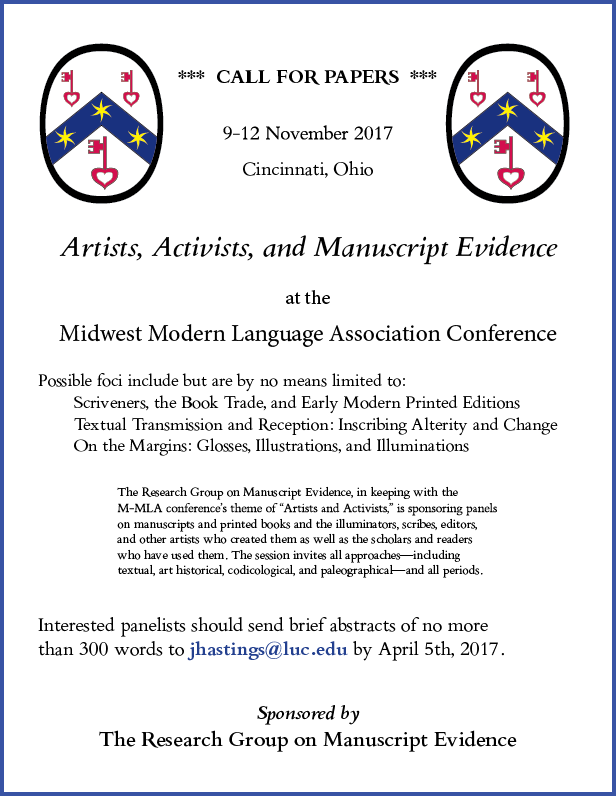
2017 M-MLA Call for Papers

March 14, 2017 in Conference, Conference Announcement, M-MLA, Manuscript Studies

Poster for CFP RGME Sponsored Panels for 2017 M-MLA ConventionCall for Papers

“Artists, Activists, and Manuscript Evidence”

2017 Theme for the

Research Group on Manuscript Evidence
Permanent Panels
at the
Midwest Modern Language Association

2017 Convention
Cincinnati, Ohio
November 9-12, 2017

Logo of the Research Group on Manuscript Evidence (colour version)[Update:  At our recent Open Business Meeting (see our 2017 International Congress on Medieval Studies Report), the organizer of these panels reported that the deadline for proposals for papers has been extended to 1 June.  Please send your proposals to Justin Hastings, as described below.  We hope to see you at the panels.]

The Research Group on Manuscript Evidence, in keeping with the 2017 M-MLA Convention’s theme of “Artists and Activists,” is sponsoring panels on manuscripts and printed books and the illuminators, scribes, editors, and other artists who created them and the scholars and readers who used them. The session invites all approaches, including textual, art historical, codicological, and paleographical.

Possible foci include but are by no means limited to:

  • Scriveners, the Book Trade, and Early Modern Printed Editions
  • Textual Transmission and Reception: Inscribing Alterity and Change
  • On the Margins: Glosses, Illustrations, and Illuminations

Interested panelists should send brief abstracts of no more than 300 words to the organizer by 5 April 2017:

Justin Hastings
Department of English
Loyola University Chicago
Chicago, Illinois 60626
jhastings@luc.edu .

*****

A New Tradition

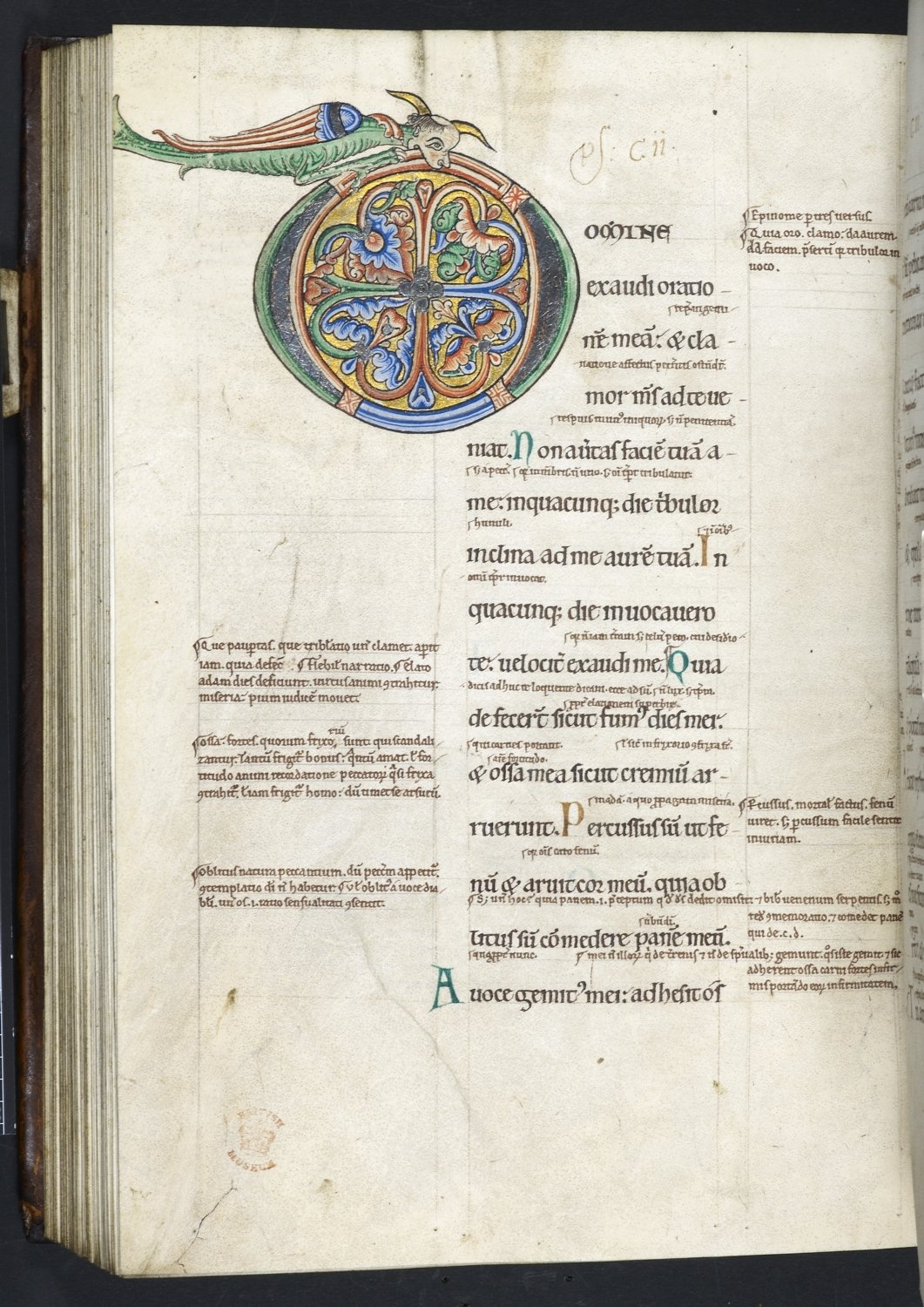
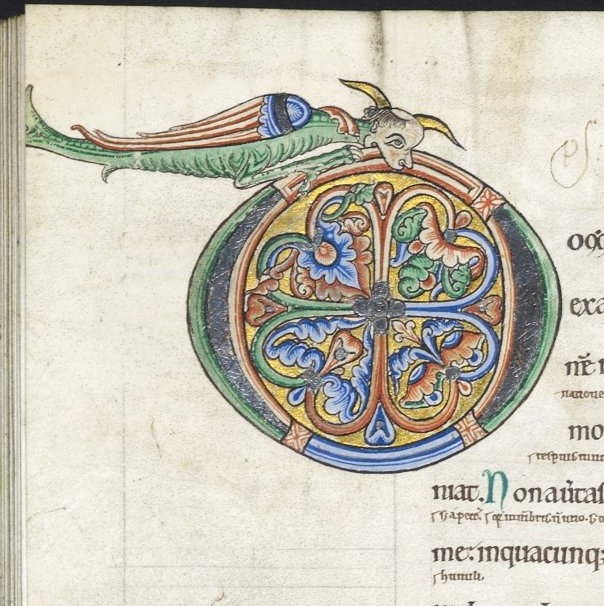
Initial D for 'Domine' with inset bearded human head seen in 3/4 view peeping toward the left, on the recto of a detached leaf in a private collection. Reproduced by permission.For information about the Events of the Research Group on Manuscript Evidence, to which these Sponsored Panels belong, please see our Events and Events Archive.  For convenience, we distinguish between these Events elsewhere and our many Congress Activities over the years at the Annual International Congress on Medieval Studies, likewise with a Congress Archive, held at Western Michigan University each May in Kalamazoo.

Our Associate, Justin Hastings, generously offered to organize panels for the 2016 M-MLA Convention to be sponsored by the Research Group on Manuscript Evidence. The Call for Papers yielded not one, but two panels, with contributions spanning a wide range of materials, texts, periods, and regions. These sponsored panels represented the first time, apart from the Kalamazoo Congress, that the Research Group sponsored meetings within an existing conference held in North America, although we have co-organized and co-sponsored Events afresh in various centers in North America and elsewhere, as described in the Events Archive.

Poster 2 of 2 for the RGME Sponsored Panels at the 2016 M-MLA Convention

2016 Poster 2 of 2

Poster 1 of 2 for the RGME Sponsored Panels at the 2016 M-MLA Convention

2016 Poster 1 of 2

The plan to sponsor the 2017 Panels follows our first appearance as a Sponsor at the 2016 M-MLA Convention — with 2 Panels on Marginalia in Manuscripts and Books in response to the Call for Papers for 1 Panel alone. See the 2016 M-MLA Report for these Panels, with the published Abstracts of the Papers and a view of the Posters.

The continuation of the tradition of Permanent Panels at the M-MLA Convention is most welcome, and we thank our organizer, Justin Hastings, and the Midwest Modern Language Association.  We congratulate Justin for his expert organizational skills and outstanding collegiality, and we applaud his willingness to continue to organize the panels for the Research Group on Manuscript Evidence.

Further information about the Convention can be found in the 2017 M-MLA Convention Permanent Section Call for Papers .

Another First

This year, responding gladly to Justin’s initiative, we issue a Poster for the Call for Papers.

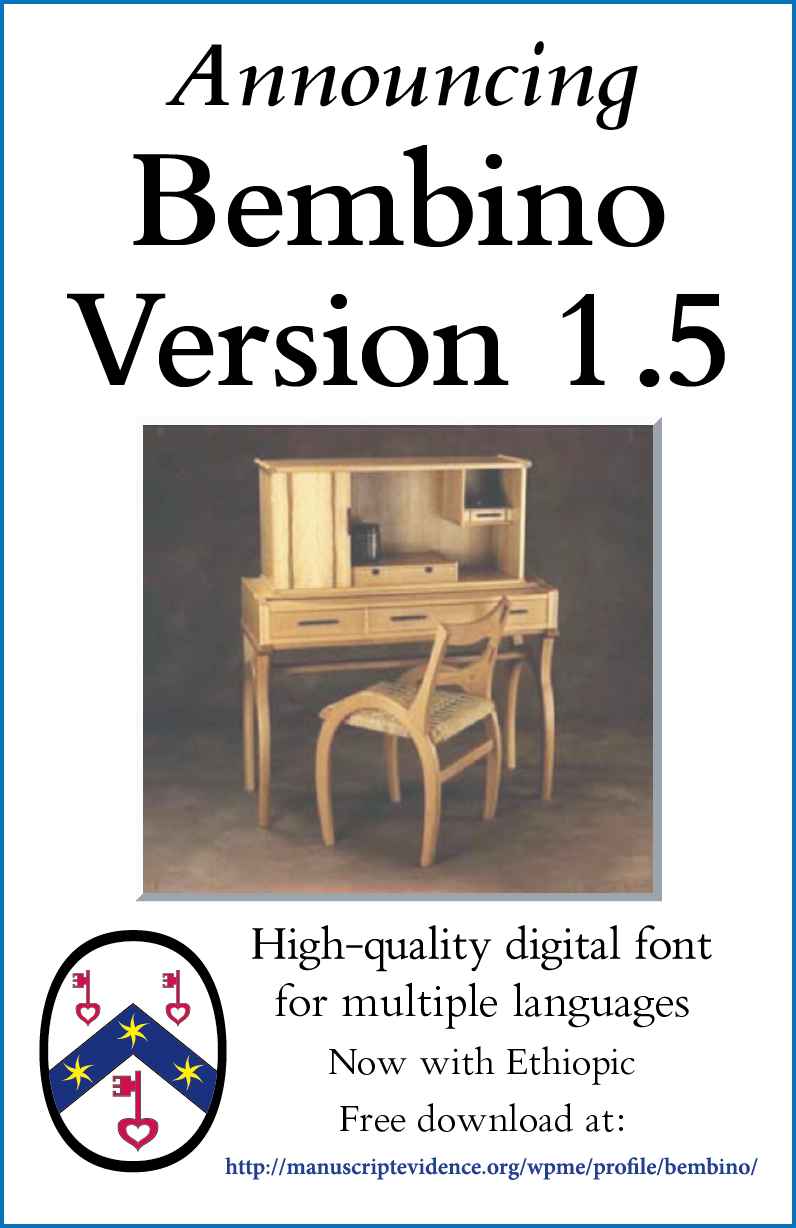
"Bembino" Booklet CoverSeal of Approval, as logo for the 'Style Manifesto' of the Research Group on Manuscript Evidence, with red border, yellow ground, and capital 'S' in the RGME font BembinoAs customary, the design of the Poster corresponds with the Research Group’s Style Manifesto, and employs our very own copyright font Bembino — available freely for download, along with the booklet describing its reasons and range.  (Tip:  The next version of Bembino is advancing toward its launch very soon, in the next few weeks!  Update:  It is now available!  See Bembino .)

Up to now, our Posters in recent years have accompanied our Congress Activities and Symposia, Colloquia, Workshops, and the like.  Circulated at those events or activities, the Posters now illustrate the Pages or Posts devoted to them on our website.  Also, a Gallery illustrates the sequence of our Posters on Display. They exemplify aspects of our multiple Layout Designs, which have a Gallery as well.

Sometimes, we issued a Poster for the Save-the-Date Announcement of an approaching Symposium.   Those specimens likewise appear in the Poster Gallery.  However, this is the first time for a Poster for the Call for Papers.  Nice!

Thank you, Justin.

Poster for CFP RGME Sponsored Panels for 2017 M-MLA Convention

Join the Event

Remember, please send your proposals by April 5th to Justin:
jhastings@luc.edu .

Many subjects and approaches may suit the themes of

“Artists, Activists, and Manuscript Evidence”

What do you think?

You might Contact Us and visit our FaceBook Page for further conversations.

*****

Update: Following the Call for Papers, we now announce the program. Please see the plan for our 2017 M-MLA Panel.

Tags: Book Trade, Early Modern Printed Editions, Glosses, Manuscript studies, Marginalia, Midwest Modern Language Association, Scriveners, Textual Transmission
No Comments »

2016 M-MLA Report

March 14, 2017 in Announcements, Conference Announcement, Manuscript Studies, Reports

Border States:
Marginalia in North American Manuscripts and Printed Books

Logo of the Research Group on Manuscript Evidence (colour version)Two Panels
Sponsored by the Research Group on Manuscript Evidence
and Organized by Justin Hastings
(Department of English, Loyola University Chicago)

at the Convention of the Midwest Modern Language Association (M-MLA)
held on 10-13 November 2016 at St. Louis, Missouri

[Report for our Panels on Marginalia in Books for 2016 M-MLA]

Invitation Letter, Plus Marginalia, for 24 June 1994.

Invitation Letter, Plus Marginalia, for ‘Marginalia in Manuscripts’, 24 June 1994

The Research Group on Manuscript Evidence, in keeping with the M-MLA conference’s theme of “Border States,” sponsored its pair of Special Session Panels examining materials in North American collections. The responses to the Call for Papers for our sponsored Special Session yielded two panels rather than one, and extended their scope both temporally and geographically.

The subjects, and their range, accord well with the Research Group’s long-term interest in the physical characteristics of books, their modes of production, and their processes of use across time. The subject of “Marginalia in Manuscripts” formed the focus of one of the Seminars on “The Evidence of Manuscripts” in our early years based in the Parker Library of Corpus Christi College. Our blog on “Manuscript Studies” — plus some printed books — includes reports of discoveries grounded in close analysis of their surfaces, marginalia often included.

Do we practice what we preach? Well, we prefer to refrain from writing in books belonging to others, as we recommend to you, but our own pages? That might be different. Witness the Master Copy of the Invitation Letter to that Seminar (see here). Marginalia Lives On!

For the 2016 Panels, we publish the Abstracts for the Papers.

Read the rest of this entry →

Tags: Aesop's Fables, Book of Hours, California Gold Rush, Curricular Romulus, Dance of Death, Danse Macabre, J H Gybon Spilsbury, John Ker Duke of Roxburghe, John Ldgate, Justin Hastings, Manuscript Marginalia, Manuscript studies, Marginalia, Midwest Modern Language Association, Newberry Library, Office of the Dead, Otto Ege's Manuscripts, Pierpont Morgan Library MS M 359, Thomas Hoccleve
No Comments »

A 12th-Century Fragment of Anselm’s ‘Cur Deus Homo’

January 31, 2017 in Manuscript Studies, Reports, Uncategorized

Verso of the Leaf and Interior of the Binding, Detail: Lower Right-Hand Corner, with the Mitered Flap Unfolde

Verso of the Leaf and Interior of the Binding, with the Mitered Flap Unfolded.

Tied Down

Fragmentary Leaf with Part of Anselm’s Cur Deus Homo

Book II, Chapters 17–18 or 18a–b
(sumpsit eam . . . Nam cum uirg[/initatis melior])
in Latin on vellum
measuring at the most circa 307 mm tall × circa 182 mm
< written area (including ascenders and descenders) 148 mm wide
with each column circa 65 mm wide
flanking the intercolumn of circa 18 mm wide >
laid out in double columns of 35 lines
written in brown ink in skilled ProtoGothic script
without embellishments

Continuing our series on Manuscript Studies, our Principal Blogger, Mildred Budny (see Her Page) reports the discovery of a reused fragmentary vellum Latin manuscript leaf extracted from a copy of Anselm’s masterwork Cur Deus Homo.  Whether as a text on its own or in the company of other texts, it was made probably in about the third quarter of the 12th century, to judge by the script, perhaps in France.  Norman, maybe?  Identifying the text and its sequence makes it possible to recognize which side of the leaf was the original recto, and which the verso.  The fragment joins the select known cast of 12th-century manuscript witnesses to this significant philosophical–theological text.

Anselm’s texts mostly took the forms of meditations or dialogues. Already our blog has showcased a manuscript with another text by Anselm: A New Leaf from ‘Otto Ege Manuscript 41’, which formerly contained a copy of the Prayers and Meditations. Now we focus upon one of his principal dialogues, cast between master and follower, as they debate the natures of divinity and necessity.

Read the rest of this entry →

Tags: Anselm's Cur Deus Homo, Archbishop Anselm, Bodleian Library Bodley MS 271, Bodleian Library MS Auct D 2 6, Budny Handlist, Canterbury Cathedral, Landscapes, Manuscript Fragments Reused in Bindings, Medieval Manuscript Fragments, ProtoGothic Script, R W Southern, Theodore Phyffers, Thionville, Trinity College Cambridge MS B 1 37
1 Comment »

A Leaf from Gregory’s Dialogues Reused for Euthymius

December 24, 2016 in Manuscript Studies, Photographic Exhibition, Uncategorized

A Leaf from Gregory’s Dialogues
Reused for Binding
A Copy of
Euthymius Zigabenus’s On the Psalms

Budny Handlist 3

In our blog on Manuscript Studies (see its Contents List), Mildred Budny (see Her Page) continues to report the results of research for her Illustrated Handlist.

Here, we focus upon a leaf plucked from its 12th-century manuscript and pressed into service, with trimmed edges and mitered folds, as the vellum covering for a binding for a different text of small format.  Both texts, primary and secondary in the life of the leaf, concern religious subjects, but they emanate from authors of different dates, locations, and languages in the Latin West and the Orthodox East respectively.  The primary text represents a remnant of a text and an author familiar in some other blogposts, which consider the Dialogues, the Sermons or Homilies, and other texts by Pope Gregory the Great (pope from 590 to 694 CE).

Reused Leaf from Gregory's Dialogues Book III viewed from recto (inside of reused book cover) with text upright and with guides. Photograph © Mildred Budny.

Handlist 3, Recto

Reused Leaf from Gregory's Dialogues Book III viewed from verso (outside of reused book cover) with text upright and with guides. Photograph © Mildred Budny.

Handlist 3, Verso

Part of Gregory’s Dialogues, Book III, Chapter 7

(on Andreas, Bishop of Fondi/Fundi):
Sections 2 (Hic namque uenerabilis uir) –
8 (uel quae in conuentu)

Present measurements:
Circa 357 × 237 mm
< written area circa 266 × 133 mm >
Single column of 28 lines
in revived Caroline minuscule
without embellishments
Germany, circa 1175

Reused for some time as the vellum cover for the binding of a copy of
Euthymius Zigabenus‘s Commentary on the Psalms
in Greek or in Latin translation?
(now lost or preserved elsewhere in a location unknown)

For this secondary use, the remnants of a set of titles on the outside of the spine of the cover (the original verso of the reused leaf) remain in place, albeit abraded and fragmented, as both a pasted, inscribed paper label (orientated along the ‘horizontal’ across the spine) and an ink inscription on the reused leaf itself in Capitals (‘vertical’, with the tops of those letters turned toward the ‘front cover’).  Another, smaller and fragmentary pasted label with a broad rectangular border stands near the bottom of the broad spine of the cover and partly overlies the ‘vertical’ spine inscription.

Reused Leaf from Gregory's Dialogues Book III viewed from verso (outside of reused book cover). Photograph © Mildred Budny.

Acquired, probably by purchase (according to the Owner’s recollections), in France in the past 15 years or so, but before 2007 when I first saw and began to photograph the leaf.   This item and others in the Illustrated Handlist acquired in France at various times and by various means (purchase, gift, or exchange), came from a single source in the Département of Saône-et-Loire, from about 1999 onward.  Because the leaf does not carry indications of its original place and time of production, apart from its materials, layout, design, script, orthography, and punctuation, those unknowns must depend upon evaluations of the style of the script, lacking any forms of embellishment, such as decorated initials, which might have provided possibly more closely datable symptoms than the letters “alone”.

Read the rest of this entry →

Tags: 'Fifty Original Leaves from Medieval Manuscripts', Binding History, Bishop Andrew of Fundi, Budny's Illustrated Catalogue, Ege Manuscript 41, Euthymius Zigabenos, Fondi, Gregory the Great, Gregory's Dialogues, manuscript fragments, Manuscript Fragments Reused in Bindings, Manuscript studies, Psalter Commentary, Saki, Temple of Apollo
No Comments »

Another Witness to the Cistercian Statutes of 1257

December 2, 2016 in Manuscript Studies, Photographic Exhibition

Detail of the top of the verso of the fragmentary leaf from a 13th-century copy of Statutes for the Cistercian Order. Reproduced by permission.Part-Leaf from a Dismembered Witness
to the 1257 Codification of the Statutes
for the Cistercian Order

A Part-Leaf, now on its own, carries parts of the Chapter De Conversis (“On the Lay Brothers”)
from Distinctio (“Section”) XIV (out of XV in total)
in the Codification of 1257 of Statutes for the Cistercian Order

This installment of our blog on Manuscript Studies identifies a fragmentary 13th-century leaf on vellum with monastic rules in Latin.  Now reduced to a single column of its original double columns of text, the fragment carries parts of the Statutes of the Cistercian Order, in a mid-–13th-century version — or, rather, extension — of those Statutes.  That extended version appears in full in a few other extant manuscripts.  Mildred Budny describes the fragment and its testimony.

Read the rest of this entry →

Tags: British Library Additional MS 11294, Cistercian Statutes, Cistercian Statutes of 1257-1258, Fontanay Abbey, Manuscript studies, Medieval manuscripts
2 Comments »

« Older Entries
Newer Entries »
  • Top
©2024 Research Group on Manuscript Evidence.


is proudly powered by WordPress. WordPress Themes X2 developed by ThemeKraft.