• News
    • News & Views
    • RGME Activities for 2024 and 2025
    • Around & About with the RGME
    • Reviews
    • Highlights
  • Blogs
    • Manuscript Studies
      • Manuscript Studies: Contents List
    • International Congress on Medieval Studies
      • Abstracts of Congress Papers
        • Abstracts of Papers Listed by Author
        • Abstracts of Papers Listed by Year
  • About
    • Mission
    • Who We Are
      • Officers, Associates & Volunteers
      • RGME Committees
      • Friends of the Research Group on Manuscript Evidence
    • Policies & Statements
      • RGME Privacy Policy Statement
      • RGME Intellectual Property Statement & Agreements
    • People
      • Mildred Budny — Her Page
      • Adelaide Bennett Hagens
    • Activities
      • Events
      • Congress Activities
        • Sponsored Conference Sessions (1993‒)
          • Panels at the M-MLA Convention (from 2016)
        • Co-sponsored Conference Sessions (2006‒)
    • History
      • Seals, Matrices & Documents
      • Genealogies & Archives
    • Contact Us
  • Bembino
    • Multi-Lingual Bembino
    • RGME Bembino: Resources
  • Congress
    • Sponsored Conference Sessions (1993‒)
    • Co-sponsored Conference Sessions (2006‒)
    • Abstracts of Congress Papers
      • Abstracts Listed by Author
      • Abstracts Listed by Year
    • Kalamazoo Archive
    • Panels at the M-MLA Convention (2016-2019)
      • Abstracts of Papers for the M-MLA Convention
      • Panels at the M-MLA Convention (from 2016)
  • Events
    • RGME Activities for 2024 and 2025
      • 2023 Activities and 2024 Planned Activities
    • Seminars, Workshops, Colloquia & Symposia (1989–)
      • Seminars on ‘The Evidence of Manuscripts’
      • Symposia on ‘The Transmission of the Bible’
      • The New Series (2001-)
        • 2019 Anniversary Symposium Program: The Roads Taken
        • 2019 Anniversary Symposium Registration
        • 2019 Anniversary Symposium Registration Open
      • RGME Symposia: The Various Series
      • The Research Group Speaks: The Series
      • Meetings of the Friends of the Research Group on Manuscript Evidence
      • RGME Online Events
    • Abstracts of Papers for Events
      • Abstracts of Papers for Seminars on ‘The Evidence of Manuscripts’
      • Abstracts of Papers for Symposia, Workshops & Colloquia
    • Receptions & Parties
    • Business Meetings
    • Photographic Exhibitions & Master Classes
    • Events Archive
  • ShelfLife
    • Journal Description
    • ShelfMarks: The RGME-Newsletter
    • Publications
      • “Insular, Anglo-Saxon, and Early Anglo-Norman Manuscript Art at Corpus Christi College, Cambridge” (1997)
        • Mildred Budny, ‘Catalogue’
        • The Illustrated Catalogue (1997)
      • The Illustrated Handlist
      • Semi-Official Counterfeiting in France 1380-1422
      • No Snap Decisions: Challenges of Manuscript Photography
    • History and Design of Our Website
  • Galleries
    • Watermarks & the History of Paper
    • Galleries: Contents List
    • Scripts on Parade
    • Texts on Parade
      • Latin Documents & Cartularies
      • New Testament Leaves in Old Armenian
    • Posters on Display
    • Layout Designs
  • Donations and Contributions
    • RGME Donor Promise
    • 2023 End-of-Year Fundraiser for our 2024 Anniversary Year
    • 2019 Anniversary Appeal
    • Orders
  • Links
    • Catalogs, Metadata, and Databases: A Handlist of Links
    • Handlist of Resources for Manuscript Studies and Fragmentology
    • Manuscripts & Rare Books
    • Maps, Plans & Drawings
    • Seals, Seal-Matrices & Documents

  • News
    • News & Views
    • RGME Activities for 2024 and 2025
    • Around & About with the RGME
    • Reviews
    • Highlights
  • Blogs
    • Manuscript Studies
      • Manuscript Studies: Contents List
    • International Congress on Medieval Studies
      • Abstracts of Congress Papers
        • Abstracts of Papers Listed by Author
        • Abstracts of Papers Listed by Year
  • About
    • Mission
    • Who We Are
      • Officers, Associates & Volunteers
      • RGME Committees
      • Friends of the Research Group on Manuscript Evidence
    • Policies & Statements
      • RGME Privacy Policy Statement
      • RGME Intellectual Property Statement & Agreements
    • People
      • Mildred Budny — Her Page
      • Adelaide Bennett Hagens
    • Activities
      • Events
      • Congress Activities
        • Sponsored Conference Sessions (1993‒)
          • Panels at the M-MLA Convention (from 2016)
        • Co-sponsored Conference Sessions (2006‒)
    • History
      • Seals, Matrices & Documents
      • Genealogies & Archives
    • Contact Us
  • Bembino
    • Multi-Lingual Bembino
    • RGME Bembino: Resources
  • Congress
    • Sponsored Conference Sessions (1993‒)
    • Co-sponsored Conference Sessions (2006‒)
    • Abstracts of Congress Papers
      • Abstracts Listed by Author
      • Abstracts Listed by Year
    • Kalamazoo Archive
    • Panels at the M-MLA Convention (2016-2019)
      • Abstracts of Papers for the M-MLA Convention
      • Panels at the M-MLA Convention (from 2016)
  • Events
    • RGME Activities for 2024 and 2025
      • 2023 Activities and 2024 Planned Activities
    • Seminars, Workshops, Colloquia & Symposia (1989–)
      • Seminars on ‘The Evidence of Manuscripts’
      • Symposia on ‘The Transmission of the Bible’
      • The New Series (2001-)
        • 2019 Anniversary Symposium Program: The Roads Taken
        • 2019 Anniversary Symposium Registration
        • 2019 Anniversary Symposium Registration Open
      • RGME Symposia: The Various Series
      • The Research Group Speaks: The Series
      • Meetings of the Friends of the Research Group on Manuscript Evidence
      • RGME Online Events
    • Abstracts of Papers for Events
      • Abstracts of Papers for Seminars on ‘The Evidence of Manuscripts’
      • Abstracts of Papers for Symposia, Workshops & Colloquia
    • Receptions & Parties
    • Business Meetings
    • Photographic Exhibitions & Master Classes
    • Events Archive
  • ShelfLife
    • Journal Description
    • ShelfMarks: The RGME-Newsletter
    • Publications
      • “Insular, Anglo-Saxon, and Early Anglo-Norman Manuscript Art at Corpus Christi College, Cambridge” (1997)
        • Mildred Budny, ‘Catalogue’
        • The Illustrated Catalogue (1997)
      • The Illustrated Handlist
      • Semi-Official Counterfeiting in France 1380-1422
      • No Snap Decisions: Challenges of Manuscript Photography
    • History and Design of Our Website
  • Galleries
    • Watermarks & the History of Paper
    • Galleries: Contents List
    • Scripts on Parade
    • Texts on Parade
      • Latin Documents & Cartularies
      • New Testament Leaves in Old Armenian
    • Posters on Display
    • Layout Designs
  • Donations and Contributions
    • RGME Donor Promise
    • 2023 End-of-Year Fundraiser for our 2024 Anniversary Year
    • 2019 Anniversary Appeal
    • Orders
  • Links
    • Catalogs, Metadata, and Databases: A Handlist of Links
    • Handlist of Resources for Manuscript Studies and Fragmentology
    • Manuscripts & Rare Books
    • Maps, Plans & Drawings
    • Seals, Seal-Matrices & Documents

Log in

Archives

Featured Posts

Episode 24. “Life with Books” (Interview with John Windle)
Announcing the Launch of RGME Bembino WP
2026 RGME Colloquium at The Grolier Club: Report
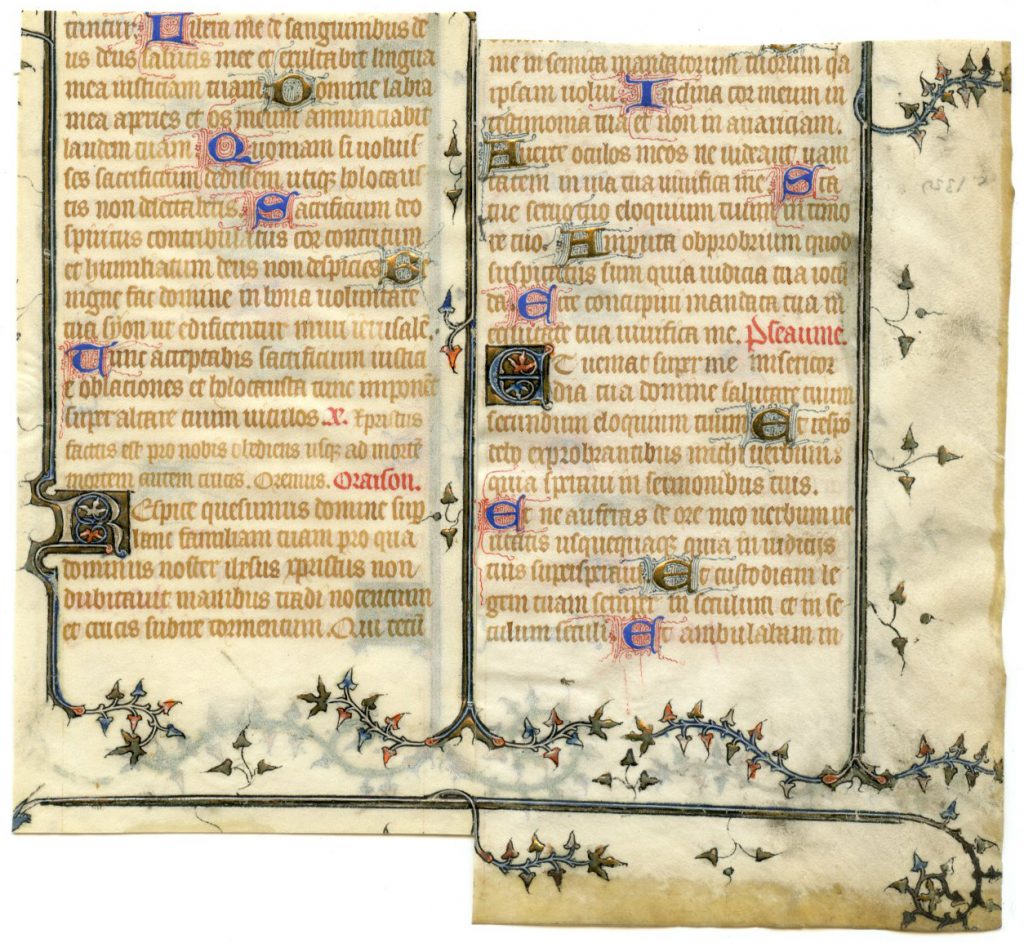
Medieval Missal Fragment as Early-Modern Cover
The Weber Leaf from Ege MS 61
"Bembino" Booklet Cover
Episode 23. “Meet RGME Bembino: Facets of a Font”
2026 RGME Colloquium on “Transformations & Renewals” at The Grolier Club
2026 Theme of the Year: “Transformations and Renewals”
A Leaf with Patchwork from the Saint Albans Bible
A Sister Leaf from a Miniature Latin Vulgate Bible
A Little Latin Vulgate Bible Manuscript Leaf in Princeton
J. S. Wagner Collection. Leaf from from Prime in a Latin manuscript Breviary. Folio 4 Verso, with part of Psalm 117 (118) in the Vulgate Version, set out in verses with decorated initials.
2026 Annual Appeal
Episode 22: “Encounters with Local Saints and Their Cults”
Private Collection, Ege's FBNC Portfolio, Dante Leaf, Verso, Detail. Reproduced by Permission.
2025 RGME Autumn Colloquium on Fragments
Workshop 8: A Hybrid Book where Medieval Music Meets Early-Modern Herbal
2025 RGME Autumn Symposium on “Readers, Fakers, and Re-Creators of Books”
RGME Workshops on “The Evidence of Manuscripts, Etc.”
2025 International Medieval Congress at Leeds: RGME Program
Episode 21. “Learning How to Look”
2025 International Congress on Medieval Studies: Program
2025 RGME Visit to Vassar College
Two Leaves in the Book of Numbers from the Chudleigh Bible
Delibovi on Glassgold on Boethius: A Blogpost
Ronald Smeltzer on “Émilie du Châtelet, Woman of Science”
2025 Spring Symposium: “Makers, Producers, and Collectors of Books”
Starters’ Orders
The Weber Leaf from the Saint Albans Bible
Workshop 4. “Manuscript Fragments Compared”
Episode 20. “Comic Book Theory for Medievalists”
Episode 19: “At the Gate: Starting the Year 2025 at its Threshold”
Favorite Recipes for Lemonade, Etc.
RGME Visit to the Lomazow Collection: Report
2024 Autumn Symposium: “At the Helm”
A Latin Vulgate Leaf of the Book of Numbers
The RGME ‘Lending Library’
Florence, Italy, Ponte Vecchio from Ponte alle Grazie. Photo: Ingo Mehling, CC BY-SA 4.0 , via Wikimedia Commons
Episode 17. “RGME Retrospect and Prospects: Anniversary Reflections”
2024 Anniversary Symposium: The Booklet
Jesse Hurlbut at the Bonneville Salt Flats, Utah. Photograph Jesse Hurlbut.
Episode 16: An Interview with Jesse D. Hurlbut
To Whom Do Manuscripts Belong?
Kalamazoo, MI Western Michigan University, Valley III from the side. Photograph: David W. Sorenson.
2024 International Congress on Medieval Studies: Report
2024 Spring Symposium at Vassar College
Puente de San Martín: Bridge with reflection over the River Targus, Toledo, Spain.
2024 Grant for “Between Past and Future” Project from The Gladys Krieble Delmas Foundation Research Libraries Program
2024 Anniversary Symposium in Thanks to Jesse Hurlbut: Program

You are browsing the Blog for Manuscript Studies

Latin Document of 1437 on Vellum from Barcelona

August 13, 2018 in Manuscript Studies, Uncategorized

Large-Format Single-Sheet Document in Latin on Vellum
Circa 58.4 cm × 34.1 cm|
With a Matching, and Still Conjoint, Pair of Records
for a Sale in 1437 (Perhaps Effected?)
between 2 Named ‘Transporters of Animals’
in the ‘City of Barcelona’

Large Single-Sheet Latin Document on Vellum recording a sale of land of 1437. Private Collection. Reproduced by Permission.[Published on 20 August 2018.  Our blog continues to report discoveries among dispersed manuscript fragments and documents of varying dates and provenance. See the Contents List, arranged principally by genres.

Update on 15 July 2020:  Now see Fragments of a Castle Capbreu from Catalonia, examining parts of the volume for which this pair of documents apparently formerly served as the cover or wrapper.]

Recycling in Action

As a reused older document, the large vellum sheet served for a time as the parchment cover from some later register (now lost, or lost track of).  With an undulating and irregular upper edge, the sheet now measures circa 584 mm × 341 cm.

Bipartite 1437 Document in Latin from Barcelona. Docketing Inscription on verso or dorse of the vellum sheet, with information about the former volume which the vellum sheet formerly covered. Private Collection, reproduced by permission.Placed on one side of the sheet, the original text comprises two documents, one after the other, or rather two copies of a single document, regarding the same sale, dated 1437 and supplied with the same notarial signature.  The other side of the sheet carries a set of inscriptions which provide information concerning the contents of the former register, rather than docketing information for the document itself. 

Such docketing inscriptions appear, for example, on some other subjects of our blog, as with some other documents not pressed into service as reused covers: here and here. These differ from the titles or identifying inscriptions for the volumes which the reused sheets formerly covered. Such cases appear, for example, on large vellum sheets, from documents or manuscripts, pressed into service as covers, as here.

The document now resides in a Private Collection, obtained through an online transaction.  We thank the owner for bringing this item to our attention and supplying information as well as images.

Size Matters

The size of the object required a piece-meal set of scans for its reproduction.  Preparing the image shown here, the owner reports that, given the size of the available scanner,

I had to fit four scans together, and it [that is, the image] isn’t quite complete, although it is missing at most three or four letters from [the end of] each line.  One of the parties is a certain Johannem Sabaterii curritorem animalium civem Barchine who sells the property to one Berengario Doluge curritorem animalium civem Barchine.

And so, with that resourceful tesselation, the face of the document appears here more-or-less in full:Large Single-Sheet Latin Document on Vellum recording a sale of land of 1437. Private Collection. Reproduced by Permission.

From One “Animal Transporter” To Another

The transaction(s) on the document concern(s) the sale of property from one “transporter of animals” to another.

Various documentary records which survive and have online access for research cite this occupation for individuals engaging in transactions of some kind or other, as here: curritorem animalium.

Both Agents Based in, or From, the ‘City of Barcelona’

On this document, both individuals which engage in the transaction are identified moreover as coming from, or belonging to, the civ[itat]em Barchine.  That is, presumably, the city of Barcelona: civitatem barcinoniae, or Barcelona.

Astronaut photo of Barcelona, Catalonia, Spain (3 June 2004). Via Earth Observations Laboratory, Johnson Space Center. NASA, public domain.

Astronaut photo of Barcelona, Catalonia, Spain (3 June 2004). Via Earth Observations Laboratory, Johnson Space Center. NASA, public domain.

Docketing for the Former Contents:  Cabreo de Castelloni for 1488

On the verso (or dorse) of the document there stands a set of inscriptions written in two stages in two different inks and by two or more different hands identifying the contents.  In three lines, the inscriptions state:

Añ[n]o 14.88.
Cabreo de Castello[n]i.
32 . . . . 3 . . . . 2

“Year 1488.
Cabreo of the Castle
32 . . . . 3 . . . . 2″

The first two lines state their case in a tall, imposing script written in dark brown ink.  The third line rests its case in a series of numerals and dots written in mostly darker ink with a thinner pen (or pens) and partly retraced and add components, perhaps entered by two different hands or one hand on a revisit.

568 1437 Document Docketing

The language is Castellan, as signalled by the word cabreo: “In Catalonia and probably also in other areas of Spain, documents called Capbreus (in Castilian Spanish: Cabreo) are known from the Middle Ages.”

The inscription indicates that the vellum document served for a time as the cover, or part of the cover, of the cartulary of the castle, presumably Montjuïc Castle.  The building still stands, although its former moat has been overplanted. The identification of which castle derives from other evidence pertaining to materials purchased from the same online source.

Entrance to Montjuïc castle across the former moat. Photograph 2007 by Puigalder, via Wikipedia Commons.

Entrance to Montjuïc castle across the former moat. Photograph 2007 by Puigalder, via Wikipedia Commons.

*****

289 1437 Document Top Right cropped

Top Left: Document Version 1

Latin document of 1437 detail of Top Left. Private collection, reproduced by permission.

Bottom Left: Document Version 2

1437 upright Mid Left

The Notary Petrus Pons of Barcelona and His Sign

So far, as we begin to examine the document, so good.  More research may yield further information about the named individuals, including the notary, whose professional script and distinctive notary sign imply extensive practice at the skill.

290 1437 Top Left rotated Notarial Signature

Signum Petri Pons . . . legia not[aria] publi[c]a barch[i]ue

Notarial Sign Version 1

Notarial Sign Version 1

Notarial Sign Version 2

Notarial Sign Version 2

Also, given the still-conjoined duplicate copies of the transaction, we might wonder if the transaction somehow was incomplete, or aborted, so that one, another, or neither party received his or their copies of the deed.

Perhaps therein lies a tale.

Any Suggestions?

More to Learn

Do you have any suggestions or observations? Might you join the quest to discover more about this large-format single-sheet document on vellum in Latin apparently from Barcelona?

Do you recognize this scribe, his notarial sign, those parties to the transaction, or similar circumstances?  Do you know of other records naming these parties:   Johannem Sabaterii curritorem animalium civem Barchine who sells the property to one Berengario Doluge curritorem animalium civem Barchine?

Please let us know.  Please add your contents here or Contact Us.

*****

Tags: Barcelona, curritorem animalium, Medieval Documents Reused as Binding Covers, Notarial Sign, Petrus Pons Notary of Barcelona
No Comments »

2019 International Congress on Medieval Studies Call for Papers

July 5, 2018 in Announcements, Call for Papers, Conference, Conference Announcement, Events, ICMS, Index of Medieval Art, International Congress on Medieval Studies, Kalamazoo, Manuscript Studies, Societas Magica

Sessions
Sponsored and Co-Sponsored
by the Research Group on Manuscript Evidence
at the 54th International Congress on Medieval Studies
9–12 May 2019

Call for Papers
Deadline for Proposals = 15 September 2018

[Published on 5 July 2018, with updates]

With the achievement of our Activities at the 2018 International Congress on Medieval Studies, as announced in our 2018 Congress Program, we both give a 2018 Congress Report and prepare a Behind the Scenes Report.

For updates, please watch this space and our Facebook Page.  [And now, with the completion of the span for the CFP in mid-September 2018, we prepare the Programs for our Sessions at the 2019 Congress, for which see, in time, our 2019 Congress Program announcement.]

*****

Now we proceed to preparations for the 2019 Congress. This next year, the Research Group on Manuscript Evidence celebrates its 20th year as a nonprofit educational corporation and its 30th year as an international scholarly organization.

We have a tradition of celebrating landmark Anniversaries, both for our organization, with organizations which which we share anniversaries, and for other events. As described, for example, in our 2014 Anniversary Reflections.

This coming year, 2019, we prepare events at the Congress and elsewhere, so as to represent, to explore, to promote, to celebrate, and to advance aspects of our shared range of interests, fields of study, subject matter, and collaboration between younger and established scholars, teachers, and others, in multiple centers.

In June 2018, we learned that most — not all — of our Session Proposals (due on 1 June) for the 2019 Congress have been accepted by the Congress Committee, so that we progress to their Call for Papers.  We regret the rejections for proposed Sessions which, for example, promoted initiatives by Graduate Students and by Independent Scholars, and which we wished to support.

Logo of the Research Group on Manuscript Evidence (colour version)The Congress Committee will publish the full 2019 Call for Papers for the 54th ICMS, with the list of Session Titles and Sponsors. Here we announce our 5 sponsored and co-sponsored Sessions and describe their aims.

As in recent years, we co-sponsor Sessions with the Societas Magica (2 Sessions). It will be the 14th year of this co-sponsorship.  It will be the first year of co-sponsorship with the newly-founded organization Polytheism-Oriented Medievalists of North America (POMONA).

Also, like the 2015–2018 Congresses, we plan for

  • an Open Business Meeting and
  • a Reception.

As usual, we aim to publish the Program for the accepted Papers, once the Call For Papers has completed its specified span.  We will publish the Abstracts for these Papers as the preparations for the Congress advance and as their Authors permit.  Abstracts for previous Congresses appear in our Congress Abstracts, conveniently Indexed both by Year and by Author.]

Read the rest of this entry →

Tags: Animals in Celtic Magical Texts, Classical Deities in Medieval Northern European Contexts, History of Magic, Index of Medieval Art at Princeton University, Manuscript studies, Medieval Manuscript Fragments, POMONA, Ritual Magic, Societas Magica
No Comments »

2018 International Congress on Medieval Studies Report

May 22, 2018 in Abstracts of Conference Papers, Announcements, Business Meeting, Conference, Conference Announcement, ICMS, Index of Christian Art, Index of Medieval Art, International Congress on Medieval Studies, Kalamazoo, Manuscript Studies, Princeton University, Reception, Societas Magica

Report:  Sessions & Events
Sponsored and Co-Sponsored
by the Research Group on Manuscript Evidence
at the 53rd International Congress on Medieval Studies
10–13 May 2018

[Published on 23 May 2018, with updates]

20180514_131049 The Scene of the Time the Morning After cropped more

“The Scene of the Time” Photography by Mildred Budny.

With the completion of our Call for Papers for the 2018 Congress, we prepared the Programs for our Sessions and other Events — Reception and Open Business Meeting included. With the turn of the New Year, as customary, we began to add the Abstracts of Papers and Response, as their Authors permit, to our webpost announcing our activities for the 2018 Congress Program.  Next, with the publication of the full Congress Program in a “sneak preview” at the beginning of February, the allocated times and locations become known.  Also, as time progressed, more Abstracts joined our gathering Report.

Now we report the Congress activities as they occurred.  You Are Here.

A Behind The Scenes Report gathers momentum as well.  Coming Soon to a Screen Near You.  Watch This Place.

Background and Foreground

The course of announcements and reports about the 2018 Congress may follow the sequence of previous years. For example, for the 2018 Congress, we announced the Plans and the Call for Papers (which has a deadline of 15 September), the Program (once the Sessions are designed from the responses to the Call for Papers), then an updated version or versions of the Program with the addition of the Abstracts and other news (same URL), and, once the Congress is accomplished, a Report as well as, it may be, a Report Behind the Scenes.

  • 2018 Congress Call for Papers
  • 2018 Congress Program
  • 2018 Congress Report
  • 2018 Congress Behind the Scenes Report (in preparation).

*****

Logo of the Research Group on Manuscript Evidence (colour version)As in recent years, we co-sponsored Sessions with the Societas Magica (3 Sessions), and we co-sponsor a Reception.

Also, like the 2017 Congress, we held

  • an Open Business Meeting and
  • a Reception, co-sponsored with The Index of Medieval Art at Princeton University.

It is the 13th year of our co-sponsorship with the Societas Magica, and our 3rd year of co-sponsorship with the Index of Christian Art at Princeton University, now (since 2017) known as the Index of Medieval Art at Princeton University.

As usual, we publish the Abstracts for the accepted Papers. Both they and the Abstracts for previous Congresses appear in our Congress Abstracts, listed by Year and by Author.

Read the rest of this entry →

Tags: Business Meeting, Index of Christian Art at Princeton University, Index of Medieval Art at Princeton University, International Congress on Medieval Studies, Reception, Societas Magica
1 Comment »

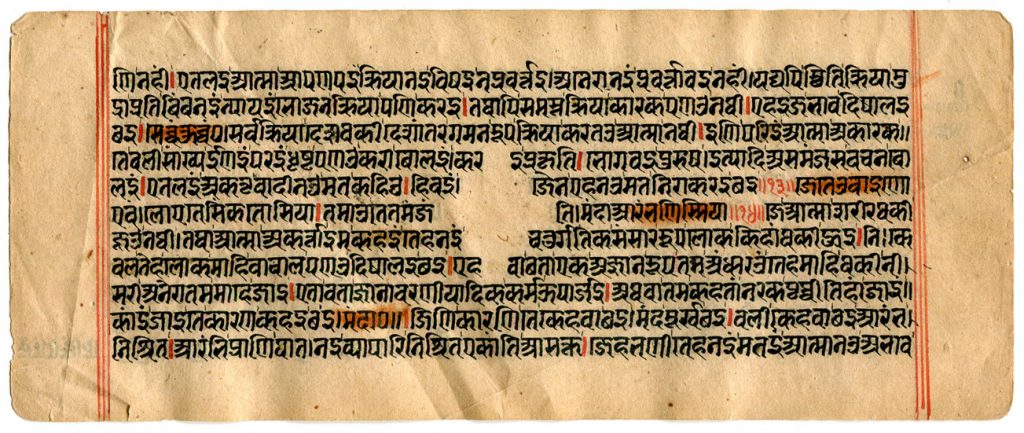
Sanskrit and Prakrit Manuscripts

April 18, 2018 in Manuscript Studies, Uncategorized

Palm-Leaf and Paper Manuscripts

[Posted on 18 April 2018, with updates and corrections.  Among the updates are new images, showing more specimens in the collection.  We thank John Stavrellis, who works toward a Ph.D. in Indology at the University of Bonn, for identifications of the text on some leaves.]

Paper Leaf in Sanskrit with an Ornate Frame for the 4-Line Text. Gold-framed rectangular green border with frieze-like floral designs in dark green pigment. Private Collection. Photography by Mildred Budny.Inspired by some recent communications, as scholars, collectors, and devotees of manuscripts around the world recognize a welcome on our website, we present some fragments from palm-leaf and paper manuscripts which have joined a collection willing to welcome them.  This private collection of many varieties of scripts, texts, languages, formats across the ages and across many cultures — see our Galleries — has generously allowed us to display, study, and publish them, along with discoveries that this collaboration permits.

For some time, I have meant to present these images on a Gallery of one kind or another on our nonprofit website.  In the transition from our first (Drupal) website to the second (WordPress), I encountered so many difficulties regarding any advance with the Galleries and Media, ensuring an inevitably cumbersome transition from one to the other.

That was then.  This is now. Read the rest of this entry →

Tags: Astrological Manuscripts, Bhagavadgita Manuscripts, Devī Māhātmyam Manuscripts, Kalpa Sūtra Manuscripts, Mahābhārata Manuscripts, Palm-Leaf Manuscripts, Prakrit, Sanskrit, Stringing Holes, Vishnu Sahasranāma stotra Manuscripts
5 Comments »

Bembino Version 1.5 (2018)

April 18, 2018 in Announcements, Bembino, Manuscript Studies, Uncategorized

The Newest Version of Bembino (Version 1.5)

Poster Announcing Bembino Version 1.5 (April 2018) with border for Web display

Poster Announcing Bembino Version 1.5

Years in the making, through consultation with scholars, students, and readers in a wide range of fields, Bembino is designed to allow multiple languages to live in harmony on the same page.

We offer Bembino Version 1.5 (2018), together with an updated version of the companion Booklet.

Available FREELY for download here.

Enjoy!

Would you like further elements? Please Contact-Us .

****

Tags: Bembino, Bembino Digital Font
No Comments »

A New Leaf from ‘Otto Ege Manuscript 214’?

April 13, 2018 in Anniversary, Manuscript Studies

Part of a 22-Line Prayerbook in Dutch
From the Collection of Otto F. Ege?

Single leaf from a small-format Prayerbook
Circa 166 × 177 mm <written area circa 128 × 82 mm>
Single column of 22 lines in Gothic Bookhand, with embellishments in red pigment

Pencil inscription ‘X . 43  Flanders 1525’ at the bottom of the recto

Perhaps formerly part of Ege Manuscript 214 (Gwara, Handlist 214)

Flanders, circa 1330

Lower Half of the Original Verso of a Single Leaf detached from a prayerbook in Dutch made circa 1530, owned and dismembered by Otto F. Ege, with the seller's description in pencil in the lower margin. Image reproduced by permission.

Private Collection. Leaf from a prayerbook in Dutch, detail.

[Published on 13 April 2018, now with updates with thanks to Peter Kidd.]

Continuing our series on Manuscript Studies, Mildred Budny (see Her Page) adds new evidence to her earlier reports about some medieval manuscripts dispersed by Otto F. Ege (1888–1951).  See our Contents List.

This time we showcase a leaf recently acquired for a private collection.

Its online seller did not cite provenance nor identify the text and any source manuscript.  The new owner, dedicated to the acquisition of manuscript fragments (conditions permitting), having acquired several Ege manuscript fragments already, opined that this leaf would have come from “Otto Ege Manuscript 214”.  Could be.

So, what is that little-known “Ege Manuscript  214”, and what are its surviving fragments?  How might we find out enough from the scrappy sources about those scraps to figure out whether or not the “source manuscript” — AKA the former manuscript of this specific remnant — is that book from which the New Leaf came?

Wait and See.  Read On, Dear Reader, Read On.

Read the rest of this entry →

Tags: Dutch Prayerbook, Ege Manscript 61, Ege Manuscript 214, Ege Manuscript 41, Ege Manuscript 51, manuscript fragments, Manuscript studies, Otto Ege Portfolios, Otto Ege's Manuscripts, Papal Indulgences, Simon Bening
No Comments »

Updates for Some “Otto Ege Manuscripts”

March 23, 2018 in Manuscript Studies, Photographic Exhibition, Reports

More is More

New Acquisitions Exhibition at the Beinecke Rare Book and Manuscript Library in November 2016: View of Some Parts of "Otto Ege Manuscript 14".

“A Long Shot”. New Acquisitions Exhibition at the Beinecke Rare Book and Manuscript Library in November 2016: View of Some Parts of “Otto Ege Manuscript 14”.

Continuing our series on Manuscript Studies, Mildred Budny (see Her Page) adds new evidence to her earlier reports of some leaves from medieval manuscripts dispersed by Otto F. Ege (1888–1951).

Revisions are now in order.  As we continue to look at, and for, evidence of the dispersed materials, the old and new evidence shows more.  While giving some answers, the observations also raise new questions. 

Time now for more Updates for Some “Otto Ege Manuscripts”.

[Published on 15 December 2017, with updates]

Read the rest of this entry →

Tags: Ege Memorial Microfilm, Medieval Manuscript Fragments, Otto Ege, Otto Ege Manuscript 14, Otto Ege Manuscript 41, Otto Ege Manuscript 51, Otto Ege Manuscript 61, Otto Ege Manuscript 8
No Comments »

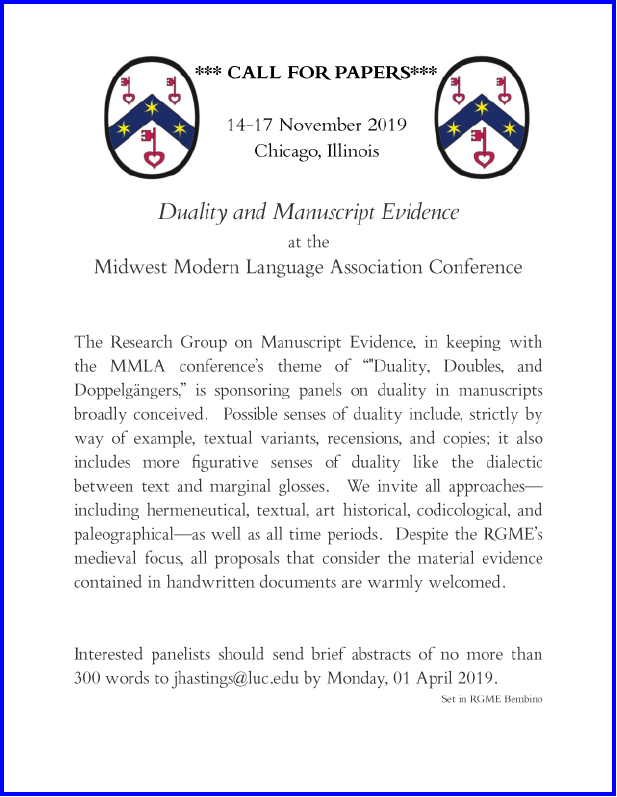
2018 M-MLA Call for Papers

February 16, 2018 in Announcements, Call for Papers, Manuscript Studies

Call for Papers

“Consuming Cultures and Manuscript Evidence”

2018 Theme for the

Permanent Panels sponsored by the
Research Group on Manuscript Evidence
at the
Midwest Modern Language Association (M-MLA)

2018 Convention
Kansas City, Missouri
November 15–18, 2018

[Posted on 16 February 2018]

The Research Group on Manuscript Evidence, in keeping with the M-MLA’s theme of “Consuming Cultures” for its 2018 Convention, is sponsoring panels on the consumption of manuscripts.

This consumption can be both literal or metaphorical — or both.  For example, it could mean the destruction wrought by bookworms, fires, and biblioclasts, and/or the consumption effected by textual transmission and reception more broadly.

We invite all approaches, including textual, art historical, codicological, and paleographical.  We also invite subjects from all periods.

Interested panelists should send brief abstracts of no more than 300 words to jhastings@luc.edu by Wednesday, 04 April 2018.

© The British Library Board. Harley MS 628, folio 160 verso. Psalms 101 begin.

© The British Library Board. Harley MS 628, folio 160 verso. Psalms 101 begin.

*****

Thanks to the expert initiatives by our Associate Justin Hastings, this will be the 3rd year that the Research Group sponsors Permanent Panels at the Annual Convention of the Midwest Modern Language Association.

The plan to sponsor the 2018 Panels draws inspiration from the success of our Panels at the M-MLA in the past 2 years. Details here:

2017 M-MLA Panel on “Artists, Activists, and Manuscript Evidence”
2017 M-MLA Panel Report

“Marginalia in Manuscripts and Books” for the 2018 M-MLA
2016 M-MLA Report

As customary for our Sessions at the International Congress on Medieval Studies, we publish the Abstracts of the Papers for our Panels at the M-MLA Convention in our Panel Announcements and Reports.

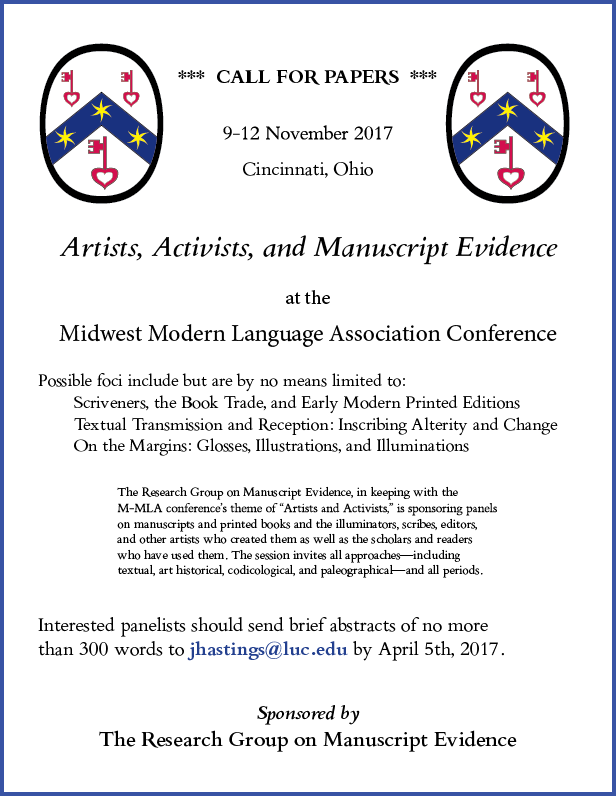
Poster for CFP RGME Sponsored Panels for 2017 M-MLA Convention*****

The continuation of the tradition of Permanent Panels at the M-MLA Convention is most welcome, and we thank our organizer, Justin Hastings, and the Midwest Modern Language Association.  We congratulate Justin for his expert organizational skills and outstanding collegiality, and we applaud his willingness to continue to organize the panels for the Research Group on Manuscript Evidence.

*****

© The British Library Board. Harley MS 628, folio 160 verso. the initial 'd' for 'Domini'.

© The British Library Board. Harley MS 628, folio 160 verso, detail. Psalm 101 begins with the initial ‘d’ for ‘Domini’.

Further information about the Convention can be found in the 2017 M-MLA Convention Permanent Section Call for Papers .

Please Contact Us with your questions and suggestions.  See you there!

*****

Tags: Midwest Modern Language Association
No Comments »

2017 M-MLA Panel Report

November 14, 2017 in Abstracts of Conference Papers, Announcements, Conference, Conference Announcement, Manuscript Studies, Reports

Chandelier and Ceiling Murals at the Netherland Plaza Hotel. Photography by Mildred Budny.

“Seeing the Light”. Chandelier and Ceiling Murals at the Netherland Plaza Hotel.

Artists, Activists, and Manuscript Evidence

Research Group on Manuscript Evidence
Permanent Panel
at the
Midwest Modern Language Association (M-MLA)

2017 Convention
Cincinnati, Ohio
November 9-12, 2017

Our 2017 Panel

With the accomplishment of the 2017 M-MLA Convention in Cincinnati, we happily report the Permanent Panel which the Research Group on Manuscript Evidence sponsored, in the second year of its participation at the Convention. As this participation continues to build, we create a Page devoted to the Panels at the M-MLA Convention, along with our many Activities and Events.

Like last year’s pair of sponsored Panels, described in our 2016 M-MLA Report, this year’s Panel was expertly organized by our Associate Justin Hastings of Loyola University Chicago, institutional host of the Midwest Modern Language Association.

The plan for our 2017 Panel arose in responding to the theme chosen for the 2017 Convention, “Artists and Activists”. Naturally, we selected the themes of “Artists, Activists, and Manuscript Evidence”, which might include, or also include, printed books and other forms of written materials.  Our Call for Papers invited contributions for multiple subjects and approaches, including textual, art-historical, codicological, and palaeographical, which might center upon facets, or stages, of the material evidence of manuscripts in their travels across time and space.  The variety of responses to the Call shaped the Program for the Panel, as announced in the Convention Program Book and for our 2017 M-MLA Panel.  Updates for our Announcement soon provided the Abstracts for the 3 papers, also with some images.

The time has come for the Report.  You are Here.

Read the rest of this entry →

Tags: Cincinnati Public Library of Cincinnati and Hamilton County, Colonial Records of Pennsylvania, Conrad Weiser, Coronation Roll of Edward IV, Free Library of Philadelphia, Iriquois Nation, Manuscript studies, Midwest Modern Language Association, Netherland Plaza Hotel, Otto Ege, Yogi Berra
No Comments »

2017 M-MLA Panel

August 19, 2017 in Announcements, Manuscript Studies, Uncategorized

“Artists, Activists, and Manuscript Evidence”

Research Group on Manuscript Evidence
Permanent Panel
at the
Midwest Modern Language Association (M-MLA)

2017 Convention
Cincinnati, Ohio
November 9-12, 2017

Following the successful Call for Papers, we announce the program for our sponsored Panel at the 2017 Convention of the M-MLA. Organized by Justin Hastings, this panel forms the second year of our participation at the Annual Convention of the M-MLA. Last year’s pair of panels, organized by Justin, are described in the 2016 M-MLA Report.

The panel planned for the 2017 Convention explores a comparably broad range of subjects. In keeping with the 2017 M-MLA Convention’s theme of “Artists and Activists,” the Research Group on Manuscript Evidence sponsors a panel on manuscripts and printed books and the illuminators, scribes, editors, and other artists who created them and the scholars and readers who used or disseminated them. The session explores multiple subjects and approaches, including textual, art historical, codicological, and paleographical.

*****

Our 2017 Panel

Make It and/or Break It:
the Material Evidence
of Creating, Using, Disseminating, and Dispersing Manuscripts

Sponsored by: Research Group on Manuscript Evidence

Organizer and Presider

Justin Hastings (Loyola University Chicago)

Presenters

1. Laura Melin (University of York, United Kingdom)

“The Coronation Roll of Edward IV and Its Audience”

Abstract:

My paper will focus on the artwork on the Chronicle of the History of the World from Creation to Woden, with a Genealogy of Edward IV (Free Library of Philadelphia, Lewis 201), otherwise known as the ‘Coronation Roll’, to see what its content reveals about possible audiences. The Roll was commissioned circa 1461 by Edward IV, who needed to legitimise his usurpation of the English throne from Henry VI in order to gain the support of both the English nobility and international noble (and royal) audiences. I will argue that the artists of the Coronation Roll appealed to both sets of audiences through the creative use of traditional iconographies of kingship within the genealogical format. After emphasising the common use of genealogies among the nobility, both at home and abroad, I will examine three key artistic clues within the Coronation Roll:

  • the strong emphasis on Edward’s personal heraldry and badges, which line the Roll and are intertwined with the genealogical table, included to appeal to the nobility’s sense of heritage and lineage;
  • Edward’s equestrian portrait, which echoes similar portraits found on seals, coins, and manuscripts across Europe;
  • and the inclusion of emblems such as the Order of the Garter, which would have been familiar to an international noble audience.

I will conclude by assessing available evidence to determine how the Roll might have been displayed for the visual consumption of his audience.

Note: See the manuscript online here: Coronation Roll, and the Arms of Edward IV here (from this manuscript:

©The British Library Board. London, British Library, Royal MS 14 E. I, folio 3r, detail: Arms of England for Edward IV.

©The British Library Board. London, British Library, Royal MS 14 E. I, folio 3r, detail: Royal Arms of Edward IV.

2.  Katie Gutierrez (Loyola University Chicago)

“Native American Misrepresentation in Early America:
A Study on the Variants Presented in Conrad Weiser’s Travel Narrative:
A Journal of the Proceedings of Conrad Weiser”

Abstract:

The Native American translator and colonial government official Conrad Weiser (1696 – 1760) is an often-overlooked figure in Early American history. As a translator for the Pennsylvanian government, Weiser occupied a unique position in both colonial America and the Iroquois nation.  Conrad Weiser’s state-sponsored travel narrative, “A journal of the proceedings of Conrad Weiser: on his journey to Ohio with a message & present from the government of Pensilvania to the Indians there, 1748 Aug. 11 – Oct. 2”, exists in four separate versions.  By applying a critical lens to the text, this paper will illuminate the significant changes between its versions, particularly by examining the representation of the Sinicker tribe of the Iroquois nation.

This paper will carefully outline the variants that occur over the four versions of Weiser’s travel narrative:

  • Weiser’s original manuscript written in 1748,
  • a copy of Weiser’s journal transcribed by his descendent Hiester Muhlenberg in 1830,
  • a copy of Weiser’s journal proceedings published in the Colonial Records of Pennsylvania in 1851,
  • and a reproduction of Weiser’s journal proceedings published in 1847 in I.D. Rupp’s Early history of western Pennsylvania: and of the West, and of western expeditions and campaigns from MDCCLIV to MDCCCXXXIII.

By examining these four versions simultaneously, it is evident that Conrad Weiser’s interactions with Queen Scayhuhady of the Sinicker tribe were omitted in the later versions of his document, the official colonial record book and historical book of Pennsylvania.
I will argue for a restoration of Weiser’s original 1748 travel-narrative in order to re-establish historical accuracy and to include the interactions with the Sinicker tribe omitted from later historical documents and records.  This paper will attempt to answer questions of how and when changes were introduced to Weiser’s narrative and to outline themes between each set of variants that occur, as well as their importance to a modern reader.

Note:  Images of Conrad Weiser appear to be scarce, little attested, or confected after the fact.   We might glimpse an old image of his tombstone and a fanciful or wishful image for tobacco purveyance, as here.

Tombstone of Conrad Weiser, from Morton L. Montgomery, "Life and Times of Conrad Weiser" (1893), via Wikipedia Commons.

Tombstone of Conrad Weiser, from Morton L. Montgomery, “Life and Times of Conrad Weiser” (1893), via Wikipedia Commons.

Conrad Weiser Cigars, manufactured in Lebanon Pennsylvania, via Wikipedia Commons.

Emblem for Conrad Weiser Cigars, manufactured in Lebanon Pennsylvania, via Wikipedia Commons.

3.  Mildred Budny (Research Group on Manuscript Evidence)

“ ‘It’s amazing what you can see when you look’:
New Light on Old Manuscripts Dispersed by Otto Ege”

Just as Yogi Berra’s catchy turns of phrase encourage, or, for that matter, require, us to think, as well as rethink, so, too, does the process of looking, and looking again (even again and again), have the power to conjure forth fresh views, insights, and understandings.  The term ‘conjure’ here may convey some of the steps, skills, and wondrous results in that process — when it works — of close interaction between the scholar, viewer, beholder and the materials in question.

In this case, we consider the potential for medieval (and other) manuscripts of many kinds, dates, genres, subjects, patterns of transmission, and challenges in general or particular.  All the more so when accomplished cumulatively, with assembled, tested, and refined expertise, whereby, fortunately and ‘magically’, the total gain is far greater than the sum of the parts.

This paper reports new, also cumulative and collaborative, discoveries concerning some of the vast numbers of leaves detached and dispersed from their former manuscripts by the notorious bibliophile and self-styled ‘biblioclast’ Otto F. Ege (1888‒1951), whose spheres of activity mostly centered upon Cleveland.  In the past few years, as my own tasks of conservation and research regarding telling cases of those manuscript ‘strays’ or ‘orphans’, seemingly unrelated, turn out to be related powerfully in terms of linked or implicated transmission, discerned by means of discovery through expertise gathered cumulatively over the years, across a broad range of written and printed materials.

Our celebration of these rediscoveries may include fresh observations of materials close to Otto Ege’s home base. Surprises await when we look.

Note:  Some discoveries are reported on our website, for example here:

  • A New Leaf from ‘Otto Ege Manuscript 14’
  • A New Leaf from ‘Otto Ege’s Manuscript 41’
  • More Leaves from ‘Otto Ege Manuscript 51’
  • A New Leaf from ‘Otto Ege’s Manuscript 61’
  • 2016 Symposium on ‘Words & Deeds’ Report
Leaf 41, Recto, Top Right, in the Family Album (Set Number 3) of Otto Ege's Portfolio of 'Fifty Original Leaves' (FOL). Otto Ege Collection, Beinecke Rare Book and Manuscript Library, Yale University. Photograph by Mildred Budny.

Leaf 41, Recto, Top Right, in the Family Album (Set Number 3) of Otto Ege’s Portfolio of ‘Fifty Original Leaves’ (FOL). Otto Ege Collection, Beinecke Rare Book and Manuscript Library, Yale University. Photograph by Mildred Budny.

Respondent

4.  Justin Hastings

“Making, Breaking, and Using Manuscripts:
New Looks at Material Evidence”

*****

More information about the Convention itself appears on its website. Full details for the 2017 Annual Convention are now published in its Program Book.

As Permanent Session 55 at the Convention, our sponsored panel will take place on Friday, 12 November 2017, from 11:30 a.m. to 12:45 p.m. at the Convention venue.

Please join us!

*****

Tags: Conrad Weiser, Coronation Roll of Edward IV, Free Library of Philadelphia, Manuscript studies, Midwest Modern Language Association, Otto Ege, Yogi Berra
No Comments »

« Older Entries
Newer Entries »
  • Top
©2024 Research Group on Manuscript Evidence.


is proudly powered by WordPress. WordPress Themes X2 developed by ThemeKraft.