• News
    • News & Views
    • RGME Activities for 2024 and 2025
    • Around & About with the RGME
    • Reviews
    • Highlights
  • Blogs
    • Manuscript Studies
      • Manuscript Studies: Contents List
    • International Congress on Medieval Studies
      • Abstracts of Congress Papers
        • Abstracts of Papers Listed by Author
        • Abstracts of Papers Listed by Year
  • About
    • Mission
    • Who We Are
      • Officers, Associates & Volunteers
      • RGME Committees
      • Friends of the Research Group on Manuscript Evidence
    • Policies & Statements
      • RGME Privacy Policy Statement
      • RGME Intellectual Property Statement & Agreements
    • People
      • Mildred Budny — Her Page
      • Adelaide Bennett Hagens
    • Activities
      • Events
      • Congress Activities
        • Sponsored Conference Sessions (1993‒)
          • Panels at the M-MLA Convention (from 2016)
        • Co-sponsored Conference Sessions (2006‒)
    • History
      • Seals, Matrices & Documents
      • Genealogies & Archives
    • Contact Us
  • Bembino
    • Multi-Lingual Bembino
    • RGME Bembino: Resources
  • Congress
    • Sponsored Conference Sessions (1993‒)
    • Co-sponsored Conference Sessions (2006‒)
    • Abstracts of Congress Papers
      • Abstracts Listed by Author
      • Abstracts Listed by Year
    • Kalamazoo Archive
    • Panels at the M-MLA Convention (2016-2019)
      • Abstracts of Papers for the M-MLA Convention
      • Panels at the M-MLA Convention (from 2016)
  • Events
    • RGME Activities for 2024 and 2025
      • 2023 Activities and 2024 Planned Activities
    • Seminars, Workshops, Colloquia & Symposia (1989–)
      • Seminars on ‘The Evidence of Manuscripts’
      • Symposia on ‘The Transmission of the Bible’
      • The New Series (2001-)
        • 2019 Anniversary Symposium Program: The Roads Taken
        • 2019 Anniversary Symposium Registration
        • 2019 Anniversary Symposium Registration Open
      • RGME Symposia: The Various Series
      • The Research Group Speaks: The Series
      • Meetings of the Friends of the Research Group on Manuscript Evidence
      • RGME Online Events
    • Abstracts of Papers for Events
      • Abstracts of Papers for Seminars on ‘The Evidence of Manuscripts’
      • Abstracts of Papers for Symposia, Workshops & Colloquia
    • Receptions & Parties
    • Business Meetings
    • Photographic Exhibitions & Master Classes
    • Events Archive
  • ShelfLife
    • Journal Description
    • ShelfMarks: The RGME-Newsletter
    • Publications
      • “Insular, Anglo-Saxon, and Early Anglo-Norman Manuscript Art at Corpus Christi College, Cambridge” (1997)
        • Mildred Budny, ‘Catalogue’
        • The Illustrated Catalogue (1997)
      • The Illustrated Handlist
      • Semi-Official Counterfeiting in France 1380-1422
      • No Snap Decisions: Challenges of Manuscript Photography
    • History and Design of Our Website
  • Galleries
    • Watermarks & the History of Paper
    • Galleries: Contents List
    • Scripts on Parade
    • Texts on Parade
      • Latin Documents & Cartularies
      • New Testament Leaves in Old Armenian
    • Posters on Display
    • Layout Designs
  • Donations and Contributions
    • RGME Donor Promise
    • 2023 End-of-Year Fundraiser for our 2024 Anniversary Year
    • 2019 Anniversary Appeal
    • Orders
  • Links
    • Catalogs, Metadata, and Databases: A Handlist of Links
    • Handlist of Resources for Manuscript Studies and Fragmentology
    • Manuscripts & Rare Books
    • Maps, Plans & Drawings
    • Seals, Seal-Matrices & Documents

  • News
    • News & Views
    • RGME Activities for 2024 and 2025
    • Around & About with the RGME
    • Reviews
    • Highlights
  • Blogs
    • Manuscript Studies
      • Manuscript Studies: Contents List
    • International Congress on Medieval Studies
      • Abstracts of Congress Papers
        • Abstracts of Papers Listed by Author
        • Abstracts of Papers Listed by Year
  • About
    • Mission
    • Who We Are
      • Officers, Associates & Volunteers
      • RGME Committees
      • Friends of the Research Group on Manuscript Evidence
    • Policies & Statements
      • RGME Privacy Policy Statement
      • RGME Intellectual Property Statement & Agreements
    • People
      • Mildred Budny — Her Page
      • Adelaide Bennett Hagens
    • Activities
      • Events
      • Congress Activities
        • Sponsored Conference Sessions (1993‒)
          • Panels at the M-MLA Convention (from 2016)
        • Co-sponsored Conference Sessions (2006‒)
    • History
      • Seals, Matrices & Documents
      • Genealogies & Archives
    • Contact Us
  • Bembino
    • Multi-Lingual Bembino
    • RGME Bembino: Resources
  • Congress
    • Sponsored Conference Sessions (1993‒)
    • Co-sponsored Conference Sessions (2006‒)
    • Abstracts of Congress Papers
      • Abstracts Listed by Author
      • Abstracts Listed by Year
    • Kalamazoo Archive
    • Panels at the M-MLA Convention (2016-2019)
      • Abstracts of Papers for the M-MLA Convention
      • Panels at the M-MLA Convention (from 2016)
  • Events
    • RGME Activities for 2024 and 2025
      • 2023 Activities and 2024 Planned Activities
    • Seminars, Workshops, Colloquia & Symposia (1989–)
      • Seminars on ‘The Evidence of Manuscripts’
      • Symposia on ‘The Transmission of the Bible’
      • The New Series (2001-)
        • 2019 Anniversary Symposium Program: The Roads Taken
        • 2019 Anniversary Symposium Registration
        • 2019 Anniversary Symposium Registration Open
      • RGME Symposia: The Various Series
      • The Research Group Speaks: The Series
      • Meetings of the Friends of the Research Group on Manuscript Evidence
      • RGME Online Events
    • Abstracts of Papers for Events
      • Abstracts of Papers for Seminars on ‘The Evidence of Manuscripts’
      • Abstracts of Papers for Symposia, Workshops & Colloquia
    • Receptions & Parties
    • Business Meetings
    • Photographic Exhibitions & Master Classes
    • Events Archive
  • ShelfLife
    • Journal Description
    • ShelfMarks: The RGME-Newsletter
    • Publications
      • “Insular, Anglo-Saxon, and Early Anglo-Norman Manuscript Art at Corpus Christi College, Cambridge” (1997)
        • Mildred Budny, ‘Catalogue’
        • The Illustrated Catalogue (1997)
      • The Illustrated Handlist
      • Semi-Official Counterfeiting in France 1380-1422
      • No Snap Decisions: Challenges of Manuscript Photography
    • History and Design of Our Website
  • Galleries
    • Watermarks & the History of Paper
    • Galleries: Contents List
    • Scripts on Parade
    • Texts on Parade
      • Latin Documents & Cartularies
      • New Testament Leaves in Old Armenian
    • Posters on Display
    • Layout Designs
  • Donations and Contributions
    • RGME Donor Promise
    • 2023 End-of-Year Fundraiser for our 2024 Anniversary Year
    • 2019 Anniversary Appeal
    • Orders
  • Links
    • Catalogs, Metadata, and Databases: A Handlist of Links
    • Handlist of Resources for Manuscript Studies and Fragmentology
    • Manuscripts & Rare Books
    • Maps, Plans & Drawings
    • Seals, Seal-Matrices & Documents

Log in

Archives

Featured Posts

2026 International Congress on Medieval Studies: Program
Episode 24. “Life with Books” (Interview with John Windle)
Announcing the Launch of RGME Bembino WP
2026 RGME Colloquium at The Grolier Club: Report
Medieval Missal Fragment as Early-Modern Cover
The Weber Leaf from Ege MS 61
"Bembino" Booklet Cover
Episode 23. “Meet RGME Bembino: Facets of a Font”
2026 RGME Colloquium on “Transformations & Renewals” at The Grolier Club
2026 Theme of the Year: “Transformations and Renewals”
A Leaf with Patchwork from the Saint Albans Bible
A Sister Leaf from a Miniature Latin Vulgate Bible
A Little Latin Vulgate Bible Manuscript Leaf in Princeton
J. S. Wagner Collection. Leaf from from Prime in a Latin manuscript Breviary. Folio 4 Verso, with part of Psalm 117 (118) in the Vulgate Version, set out in verses with decorated initials.
2026 Annual Appeal
Episode 22: “Encounters with Local Saints and Their Cults”
Private Collection, Ege's FBNC Portfolio, Dante Leaf, Verso, Detail. Reproduced by Permission.
2025 RGME Autumn Colloquium on Fragments
Workshop 8: A Hybrid Book where Medieval Music Meets Early-Modern Herbal
2025 RGME Autumn Symposium on “Readers, Fakers, and Re-Creators of Books”
RGME Workshops on “The Evidence of Manuscripts, Etc.”
2025 International Medieval Congress at Leeds: RGME Program
Episode 21. “Learning How to Look”
2025 International Congress on Medieval Studies: Program
2025 RGME Visit to Vassar College
Two Leaves in the Book of Numbers from the Chudleigh Bible
Delibovi on Glassgold on Boethius: A Blogpost
Ronald Smeltzer on “Émilie du Châtelet, Woman of Science”
2025 Spring Symposium: “Makers, Producers, and Collectors of Books”
Starters’ Orders
The Weber Leaf from the Saint Albans Bible
Workshop 4. “Manuscript Fragments Compared”
Episode 20. “Comic Book Theory for Medievalists”
Episode 19: “At the Gate: Starting the Year 2025 at its Threshold”
Favorite Recipes for Lemonade, Etc.
RGME Visit to the Lomazow Collection: Report
2024 Autumn Symposium: “At the Helm”
A Latin Vulgate Leaf of the Book of Numbers
The RGME ‘Lending Library’
Florence, Italy, Ponte Vecchio from Ponte alle Grazie. Photo: Ingo Mehling, CC BY-SA 4.0 , via Wikimedia Commons
Episode 17. “RGME Retrospect and Prospects: Anniversary Reflections”
2024 Anniversary Symposium: The Booklet
Jesse Hurlbut at the Bonneville Salt Flats, Utah. Photograph Jesse Hurlbut.
Episode 16: An Interview with Jesse D. Hurlbut
To Whom Do Manuscripts Belong?
Kalamazoo, MI Western Michigan University, Valley III from the side. Photograph: David W. Sorenson.
2024 International Congress on Medieval Studies: Report
2024 Spring Symposium at Vassar College
Puente de San Martín: Bridge with reflection over the River Targus, Toledo, Spain.
2024 Grant for “Between Past and Future” Project from The Gladys Krieble Delmas Foundation Research Libraries Program
2024 Anniversary Symposium in Thanks to Jesse Hurlbut: Program

You are browsing the Blog for Newberry Library

2018 M-MLA Panel

October 17, 2018 in Abstracts of Conference Papers, Announcements, Midwest Modern Language Association, Uncategorized
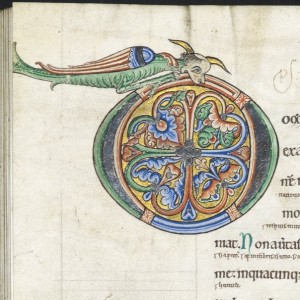
© The British Library Board. Harley MS 628, folio 160 verso. the initial 'd' for 'Domini'.

© The British Library Board. Harley MS 628, folio 160 verso, detail. Psalm 101 begins with the initial ‘d’ for ‘Domini’.

“Consuming Cultures and Manuscript Evidence”

2018 Permanent Panel
sponsored by the
Research Group on Manuscript Evidence
at the
Midwest Modern Language Association (M-MLA)
2018 Convention

Kansas City, Missouri
November 15–18, 2018

[Posted on 30 August 2018, with updates, now with a change to the Program.  An earlier version of this announcement appeared as Consuming Cultures and Manuscript Evidence 2018.]

The Research Group on Manuscript Evidence, in keeping with the M-MLA’s theme of “Consuming Cultures” for its 2018 Convention, sponsors a panel on the “Consumption of Manuscripts”.  After the completion of the Call for Papers, we now announce the Program for the Panel, which will take place on 15 November. The Program for the Convention in full is now available in preview through the M-MLA website: 2018 Program Booklet.

Food for Thought

In our design for the Panel, both in its proposal (as circulated in the Call for Papers) and in the selected design for its Program, we recognize that consideration of “consumption” can be literal, metaphorical, or both.  For example, the process and product could mean the destruction wrought by bookworms, fires, and biblioclasts, and/or the consumption effected by textual transmission and reception more broadly.

Accordingly, we have invited all approaches, including textual, art historical, codicological, and paleographical.  Also invite subjects from all periods.  Nice.

Year 3 of Our Panels at the M-MLA

Thanks to the expert initiatives by our Associate Justin Hastings, this will be the 3rd year that the Research Group sponsors Permanent Panels at the Annual Convention of the Midwest Modern Language Association.

The plan to sponsor the 2018 Panels draws inspiration from the success of our Panels at the M-MLA in the past 2 years. Details here:

2017

2017 M-MLA Panel on “Artists, Activists, and Manuscript Evidence”
2017 M-MLA Panel Report

2016

“Marginalia in Manuscripts and Books” for the 2016 M-MLA
2016 M-MLA Report
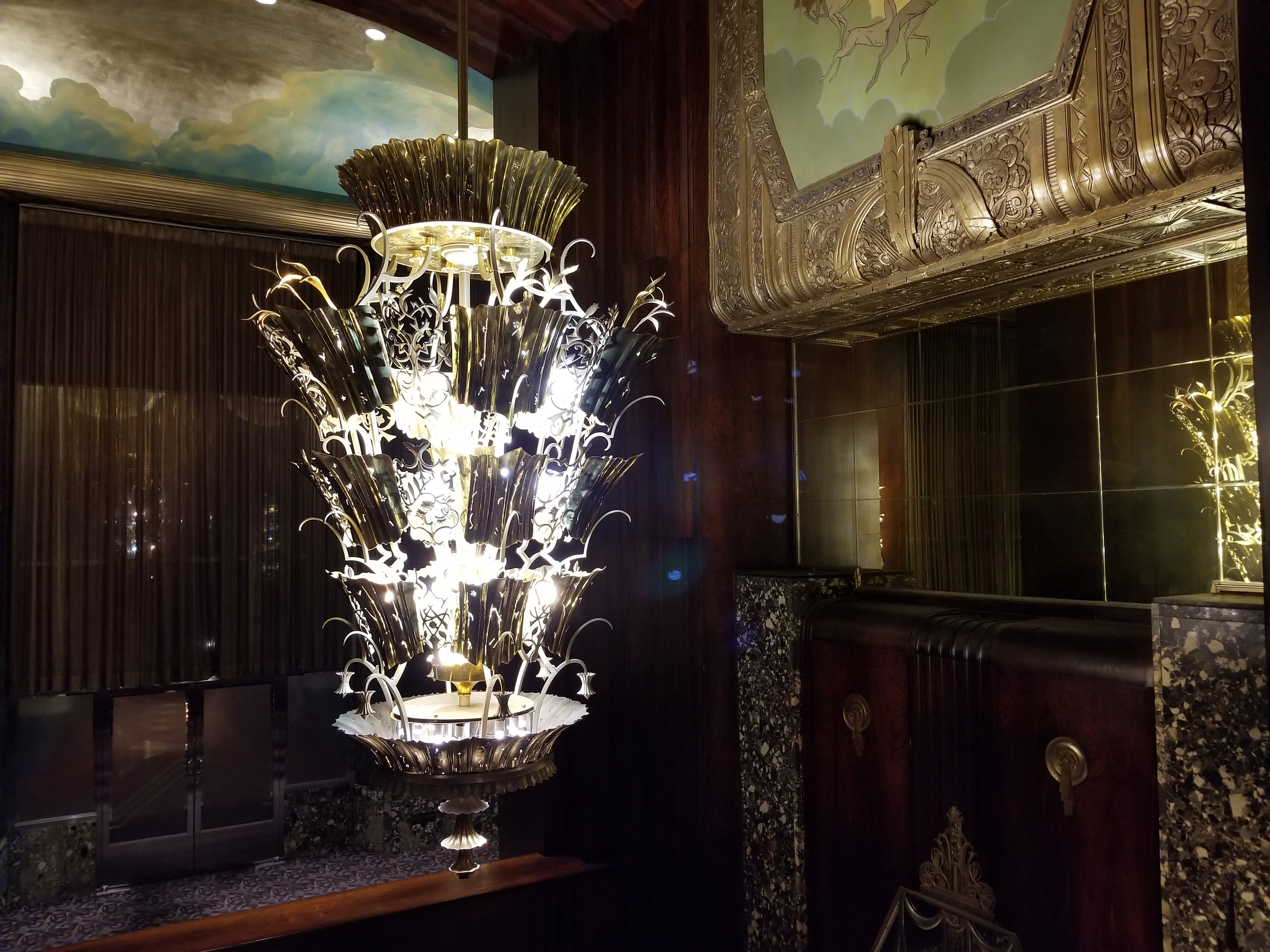
Chandelier and Ceiling Murals at the Netherland Plaza Hotel. Photography by Mildred Budny.

“Seeing the Light”. Chandelier and Ceiling Murals at the Netherland Plaza Hotel.

As customary for our Sessions at the International Congress on Medieval Studies, we publish the Abstracts of the Papers for our Panels at the M-MLA Convention in our Panel Announcements and Reports.

*****

The continuation of the tradition of Permanent Panels at the M-MLA Convention is most welcome, and we thank our organizer, Justin Hastings, and the Midwest Modern Language Association. We congratulate Justin for his expert organizational skills and outstanding collegiality, and we applaud his willingness to continue to organize the panels for the Research Group on Manuscript Evidence.

*****

Program

Session 21. Friday 8:30–9:45 a.m.

“Consuming Cultures and Manuscript Evidence”
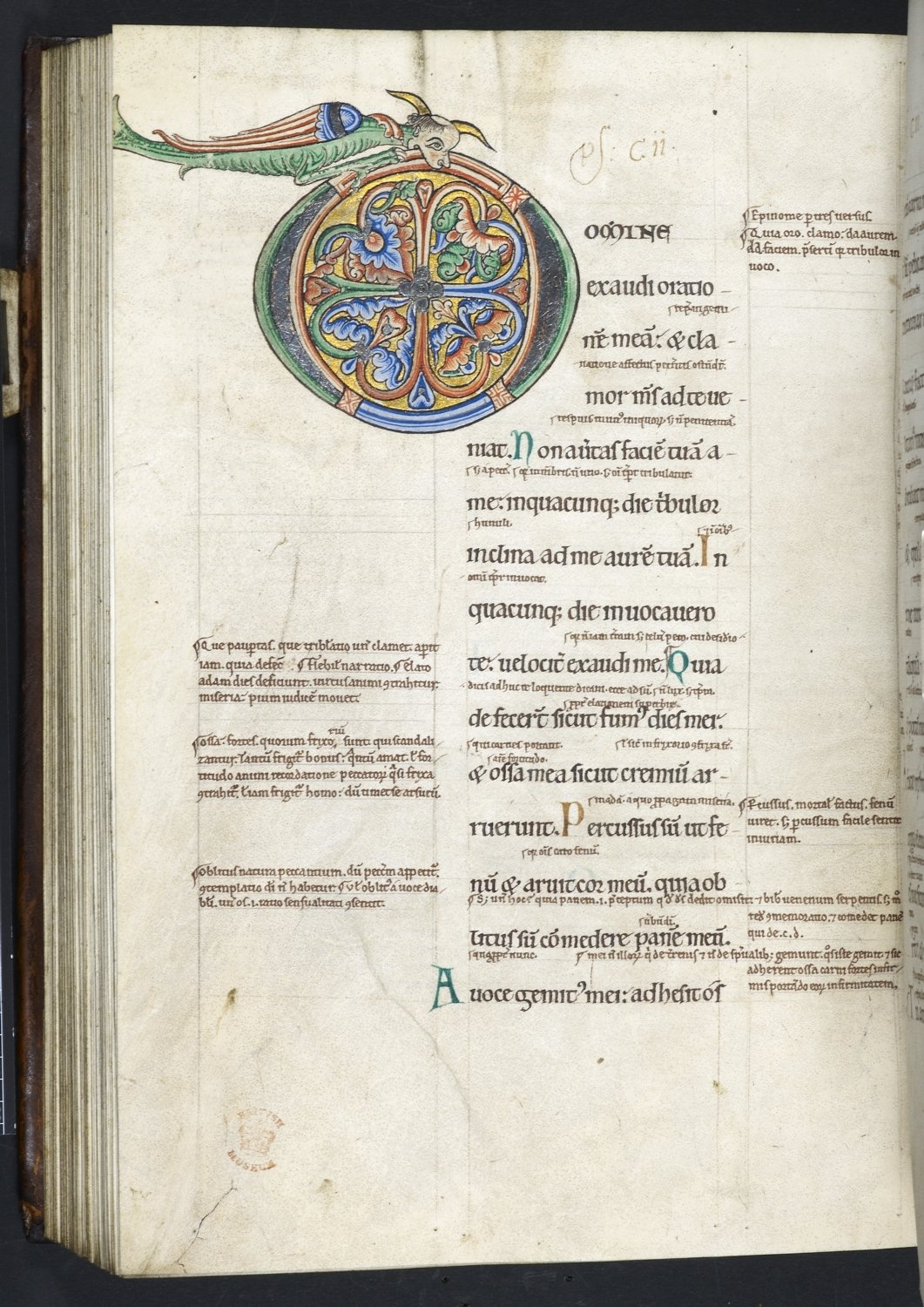
© The British Library Board. Harley MS 628, folio 160 verso. Psalms 101 begin.

© The British Library Board. Harley MS 628, folio 160 verso. Psalms 101 begin.

Panel Sponsored by the Research Group on Manuscript Evidence
at the Midwest Modern Language Association Convention
15 November 2018

Panel Chair:  Justin Hastings, Loyola University Chicago

[Note the recent change in Program, by which the paper by Jessie McDowell will be replaced by Justin’s.]

Chikako D. Kumamoto, College of DuPage, Addison, Illinois
“ ‘The Press and the Fire’ and ‘Discretion’:
Distributing Cognition and Its Reception through Paratextual Apparatus in Print and Manuscript Culture”

Abstract of Paper

Two sources inspire my title.

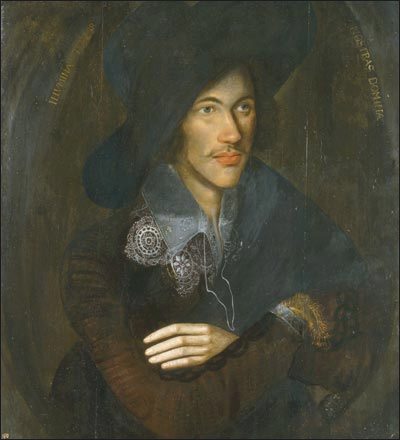
Portrait of John Donne as a young man, circa 1595. London, National Portrait Gallery, via Wikipedia Commons in the Public Domain.

Portrait of John Donne as a young man, circa 1595. London, National Portrait Gallery, via Wikipedia Commons in the Public Domain.

Its first part comes from the letter by John Donne (1572–1631) to Robert Ker (1570? – 1650), wherein he included his manuscript of Biathanatos, while instructing Ker to “publish it not, but yet burn it not, and between those do what you will with it” (Gosse, 2:124).  In this letter, Donne places his writing between the rigid visual fixity of print ([“Press”]) and the complete destruction of his words in the manuscript ([“the Fire”]), and asks Ker to use his “discretion” (“do what you will with it”) to guard against the potential misreading by readers.  The second part refers to Edwin Hutchins’s 1995 study of maritime navigation, Cognition in the Wild, which argues that cognition is “always situated in a complex sociocultural world” (Hutchins, page xiii) and that “thinking and action occur as individuals mobilize a range of external resources and representations” (xii).

Viewing Donne and Hutchins at the trans-epochal threshold of cognition/knowledge-making and its distribution and reception from writer to reader, I seek to examine how Donne’s misgivings about a potential loss of his actual voice in manuscript predictively signal readers’ mental activities occurring during their print-oriented, socially-networked reading — the process to which Hutchings’s cognitive systems, composed of multiple social agents in the material world, can be applied.  For both writers provoke an epistemic dialectics of textual reading as culturally-constituted, collaborative activities (writing and publishing manuscripts, and their paratextual apparatus such as title pages, prefaces, images), impacting on the reader’s thinking, knowing, and interpreting outside the writer’s manuscript culture.

By also analyzing title pages of Quarto 1 and Quarto 2 of Shakespeare’s Romeo and Juliet, I exemplify how their paratextual apparatus transmits the play’s central message which  Shakespeare’s, as well as our contemporary, readers will receive collaboratively from the “discrete” dialogue between writer and reader, between a manuscript text and its paratextual apparatus.

Tentative Bibliography

Donne, John. The Life and Letters of John Donne. Ed. Edmund Gosse.  2 vols. New York: Dodd, Mead and Company, 1899;  rprt. Gloucester, MA: Peter Smith, 1959.

Halio, Jay I. ed. Romeo and Juliet: Parallel Texts of Quart 1 (1597) and Quart 2 (1599). Newark: University of Delaware Press, 2008.

Hutchins, Edwin. Cognition in the Wild. Cambridge, MA, and London: MIT Press, 1995.

Shakespeare, William. The Tragedy of Romeo and Juliet. Folger Library Shakespeare. Ed. Barbara A. Mowat and Paul Werstine. New York: Washington Square Press, 1992.
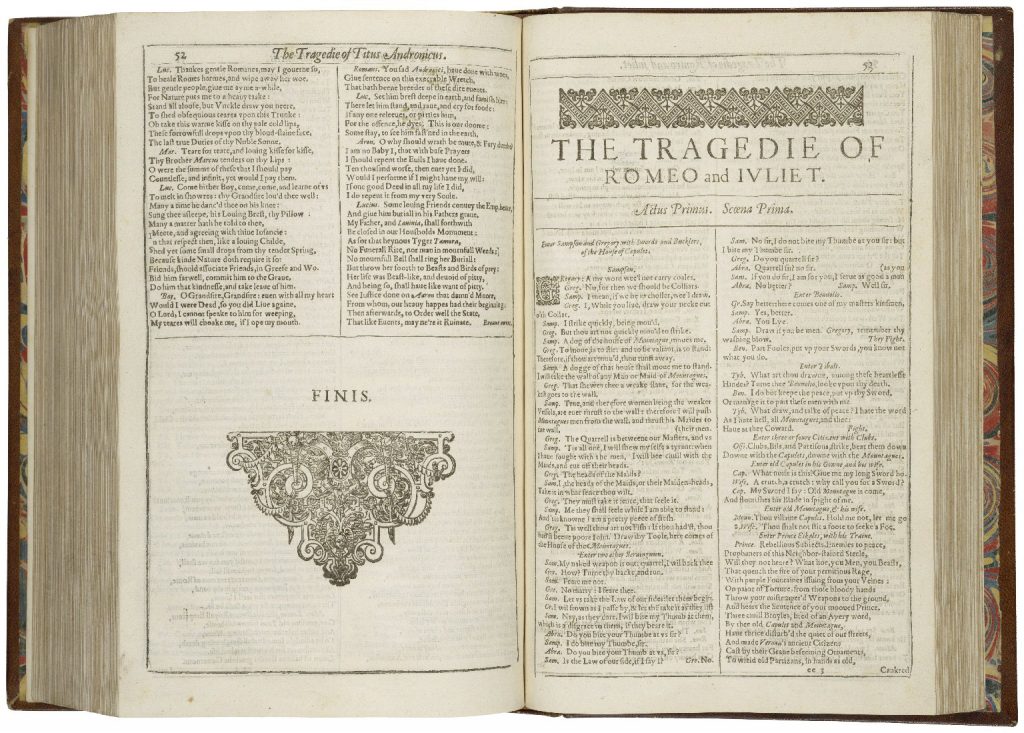
Title Page of "Romeo and Juliet" in the First Folio (1631). Folger Shakespeare Library., via Wikipedia Commons.

Title Page of “Romeo and Juliet” in the First Folio (1631). Folger Shakespeare Library., via Wikipedia Commons.

[This paper has been withdrawn:

Jessie McDowell, Loyola University Chicago
“Medieval Manuscripts and Interoperability:
Scholarly Editing, Collaboration, and the Digital Artisan”]

Justin Hastings, Loyola University Chicago
“Sexual Consumption and Paratextual Restraint in Lady Margaret Cavendish’s ‘The Convent of Pleasure’:
Newberry Library Case Y 135.N43”

Abstract:
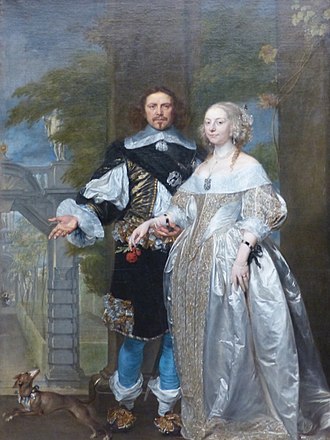
Portraits of Margaret Cavendish and her husband, William Cavendish, 1st Duke of Newcastle-upon-Tyne. Oil on canvas, attributed to Gonzales Coques (between 1614 and 1618 - 18 April 1684). Image via Wikipedia Commons.

Portraits of Margaret Cavendish and her husband, William Cavendish, 1st Duke of Newcastle-upon-Tyne. Berlin, Gemäldegalerie. Oil on canvas, attributed to Gonzales Coques (between 1614 and 1618 – 18 April 1684). Image via Wikipedia Commons.

In “The Convent of Pleasure” by Margaret Cavendish (1623-1673), Duchess of Newcastle, the play’s protagonist Lady Happy, finding herself her father’s sole heir, proposes to encloister herself with “so many Noble Persons of my own Sex, as my Estate will plentifully maintain, such whose Births are greater then their Fortunes, and are resolv’d to live a single life and vow Virginity” (2.2).  Lady Happy’s rationale for this is that it is impossible for a woman to be happy in marriage, since under the contemporary legal doctrine of Coverture, a wife not only surrendered her wealth to her husband, but her very selfhood was legally consumed as well.

Lady Happy, consequently, removes both herself and a coterie of similar wellborn women from a system of economic exchange in which an aristocratic women serves simply as the financial instrument by which wealth and power may pass from a hegemonic male to his heir. The fourth act of the play interrupts the otherwise subversive thrust of the play to present a reimagined fertility ritual accompanied by a pair of verse passages written by William Cavendish (1592–1676), 1st Duke of Newcastle, that serve to reinscribe the very system of aristocratic marriage that the rest of the play seeks to complicate: coats of arms are offered up as the prize for the maypole dance, and “holy Hymen’s Law” is reinstated and reinforced (4.1).

Unlike the 1662 edition of the play, the 1668 edition, as attested by Chicago, Newberry Library, Case Y 135.N43, explicitly ascribes authorship of these passages via a pair of pasted-down strips of paper imprinted with “VVritten by my Lord Duke.”  Other extant copies of the 1668 edition preserve this feature along with a sequence of hand-corrections throughout the volume.

This paper will examine these and other codicological features, including an interruption in the regular quire construction at the play’s fourth act, to argue that the 1668 edition’s explicit attribution of authorship of these verse passages is tied to shifts in William Newcastle’s political fortunes and a renewed need to be seen to curb his wife’s literary aspirations, which were understood as a form of marital unchastity that diminished the Duke’s social reputation.

*****

Further information about the Convention can be found on its website. See also the M-MLA Convention Permanent Section Call for Papers .

Please Contact Us with your questions and suggestions. See you there!

For our other events, please see our News & Views”, and the reports of our activities at the annual International Congress on Medieval Studies and elsewhere.
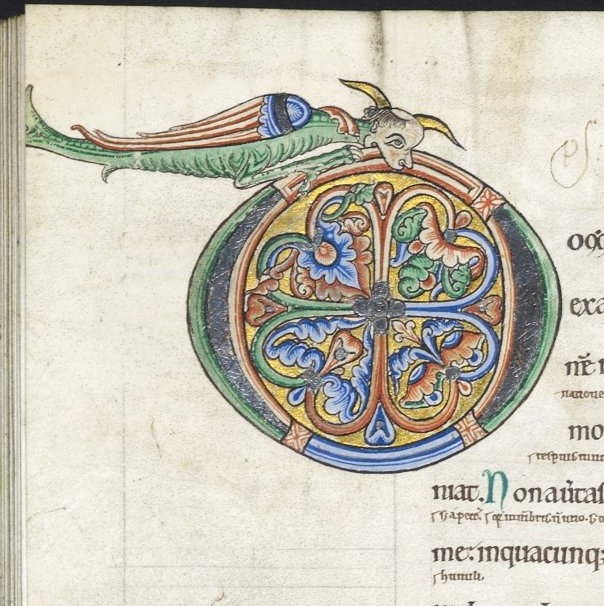
© The British Library Board. Harley MS 628, folio 160 verso. the initial 'd' for 'Domini'.

© The British Library Board. Harley MS 628, folio 160 verso, detail. Psalm 101 begins with the initial ‘d’ for ‘Domini’.

*****

Tags: "The Convent of Pleasure", Conference, Conference Announcement, Edwin Hutchins, John Donne, Margaret Cavendish Dutchess of Newcastle, Midwest Modern Language Association, Newberry Library, Robert Ker, Romeo & Juliet, Shakespeare, William Cavendish 1st Duke of Newcastle
No Comments »

2016 M-MLA Report

March 14, 2017 in Announcements, Conference Announcement, Manuscript Studies, Reports

Border States:
Marginalia in North American Manuscripts and Printed Books

Logo of the Research Group on Manuscript Evidence (colour version)Two Panels
Sponsored by the Research Group on Manuscript Evidence
and Organized by Justin Hastings
(Department of English, Loyola University Chicago)

at the Convention of the Midwest Modern Language Association (M-MLA)
held on 10-13 November 2016 at St. Louis, Missouri

[Report for our Panels on Marginalia in Books for 2016 M-MLA]

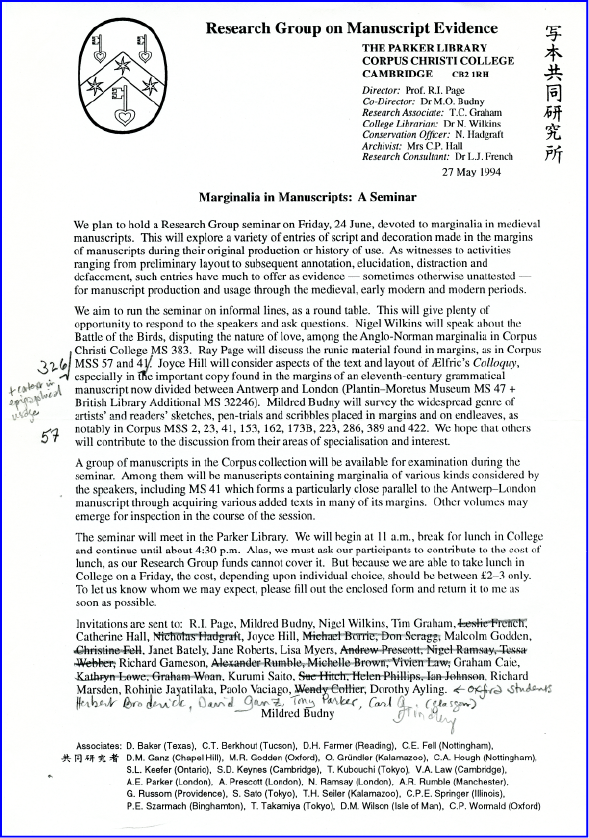
Invitation Letter, Plus Marginalia, for 24 June 1994.

Invitation Letter, Plus Marginalia, for ‘Marginalia in Manuscripts’, 24 June 1994

The Research Group on Manuscript Evidence, in keeping with the M-MLA conference’s theme of “Border States,” sponsored its pair of Special Session Panels examining materials in North American collections. The responses to the Call for Papers for our sponsored Special Session yielded two panels rather than one, and extended their scope both temporally and geographically.

The subjects, and their range, accord well with the Research Group’s long-term interest in the physical characteristics of books, their modes of production, and their processes of use across time. The subject of “Marginalia in Manuscripts” formed the focus of one of the Seminars on “The Evidence of Manuscripts” in our early years based in the Parker Library of Corpus Christi College. Our blog on “Manuscript Studies” — plus some printed books — includes reports of discoveries grounded in close analysis of their surfaces, marginalia often included.

Do we practice what we preach? Well, we prefer to refrain from writing in books belonging to others, as we recommend to you, but our own pages? That might be different. Witness the Master Copy of the Invitation Letter to that Seminar (see here). Marginalia Lives On!

For the 2016 Panels, we publish the Abstracts for the Papers.

Read the rest of this entry →

Tags: Aesop's Fables, Book of Hours, California Gold Rush, Curricular Romulus, Dance of Death, Danse Macabre, J H Gybon Spilsbury, John Ker Duke of Roxburghe, John Ldgate, Justin Hastings, Manuscript Marginalia, Manuscript studies, Marginalia, Midwest Modern Language Association, Newberry Library, Office of the Dead, Otto Ege's Manuscripts, Pierpont Morgan Library MS M 359, Thomas Hoccleve
No Comments »

Marginalia in Books for 2016 M-MLA

May 10, 2016 in Conference, Conference Announcement

Border States:
Marginalia in North American Manuscripts and Printed Books

Logo of the Research Group on Manuscript Evidence (colour version)Two Panels
Sponsored by the Research Group on Manuscript Evidence
and Organized by Justin Hastings
(Department of English, Loyola University Chicago)

at the Convention of the Midwest Modern Language Association (M-MLA)
to be held on 10-13 November 2016 at St. Louis, Missouri

[Posted on 10 May 2016, with updates. A further update appears in the 2016 M-MLA Report.]

Invitation Letter, Plus Marginalia, for 24 June 1994.

Invitation Letter, Plus Marginalia, for ‘Marginalia in Manuscripts’, 24 June 1994

The Research Group on Manuscript Evidence, in keeping with the M-MLA conference’s theme of “Border States,” announces the following pair of Special Session Panels examining materials in North American collections.  The responses to the Call for Papers for our sponsored Special Session yielded two panels rather than one, and extend their scope both temporally and geographically.

The subjects, and their extended range, accord well with the Research Group’s long-term interest in the physical characteristics of books, their modes of production, and their processes of use across time. The subject of “Marginalia in Manuscripts” formed the focus of one of the Seminars on “The Evidence of Manuscripts” in our early years based in the Parker Library of Corpus Christi College.  Our blog on “Manuscript Studies” — plus some printed books — includes reports of discoveries grounded in close analysis of their surfaces, marginalia often included. Do we practice what we preach?  Well, we prefer to refrain from writing in books belonging to others, as we recommend to you, but our own pages?  That might be different.  Witness the Master Copy of the Invitation Letter to that Seminar (see here).  Marginalia Lives On!

For the 2016 Panels, we publish the Abstracts for the Papers in stages, starting now.  The publication of the Convention timetable allows us also to report the schedule for our Sessions.

Read the rest of this entry →

Tags: Aesop's Fables, Book of Hours, California Gold Rush, Curricular Romulus, Dance of Death, Danse Macabre, J H Gybon Spilsbury, John Ker Duke of Roxburghe, John Lydgate, Justin Hastings, Manuscript Marginalia, Manuscript studies, Marginalia, Midwest Modern Language Association, Newberry Library, Office of the Dead, Otto Ege's Manuscripts, Pierpont Morgan Library MS M 359, Thomas Hoccleve
No Comments »

  • Top
©2024 Research Group on Manuscript Evidence.


is proudly powered by WordPress. WordPress Themes X2 developed by ThemeKraft.