• News
    • News & Views
    • RGME Activities for 2024 and 2025
    • Around & About with the RGME
    • Reviews
    • Highlights
  • Blogs
    • Manuscript Studies
      • Manuscript Studies: Contents List
    • International Congress on Medieval Studies
      • Abstracts of Congress Papers
        • Abstracts of Papers Listed by Author
        • Abstracts of Papers Listed by Year
  • About
    • Mission
    • Who We Are
      • Officers, Associates & Volunteers
      • RGME Committees
      • Friends of the Research Group on Manuscript Evidence
    • Policies & Statements
      • RGME Privacy Policy Statement
      • RGME Intellectual Property Statement & Agreements
    • People
      • Mildred Budny — Her Page
      • Adelaide Bennett Hagens
    • Activities
      • Events
      • Congress Activities
        • Sponsored Conference Sessions (1993‒)
          • Panels at the M-MLA Convention (from 2016)
        • Co-sponsored Conference Sessions (2006‒)
    • History
      • Seals, Matrices & Documents
      • Genealogies & Archives
    • Contact Us
  • Bembino
    • Multi-Lingual Bembino
    • RGME Bembino: Resources
  • Congress
    • Sponsored Conference Sessions (1993‒)
    • Co-sponsored Conference Sessions (2006‒)
    • Abstracts of Congress Papers
      • Abstracts Listed by Author
      • Abstracts Listed by Year
    • Kalamazoo Archive
    • Panels at the M-MLA Convention (2016-2019)
      • Abstracts of Papers for the M-MLA Convention
      • Panels at the M-MLA Convention (from 2016)
  • Events
    • RGME Activities for 2024 and 2025
      • 2023 Activities and 2024 Planned Activities
    • Seminars, Workshops, Colloquia & Symposia (1989–)
      • Seminars on ‘The Evidence of Manuscripts’
      • Symposia on ‘The Transmission of the Bible’
      • The New Series (2001-)
        • 2019 Anniversary Symposium Program: The Roads Taken
        • 2019 Anniversary Symposium Registration
        • 2019 Anniversary Symposium Registration Open
      • RGME Symposia: The Various Series
      • The Research Group Speaks: The Series
      • Meetings of the Friends of the Research Group on Manuscript Evidence
      • RGME Online Events
    • Abstracts of Papers for Events
      • Abstracts of Papers for Seminars on ‘The Evidence of Manuscripts’
      • Abstracts of Papers for Symposia, Workshops & Colloquia
    • Receptions & Parties
    • Business Meetings
    • Photographic Exhibitions & Master Classes
    • Events Archive
  • ShelfLife
    • Journal Description
    • ShelfMarks: The RGME-Newsletter
    • Publications
      • “Insular, Anglo-Saxon, and Early Anglo-Norman Manuscript Art at Corpus Christi College, Cambridge” (1997)
        • Mildred Budny, ‘Catalogue’
        • The Illustrated Catalogue (1997)
      • The Illustrated Handlist
      • Semi-Official Counterfeiting in France 1380-1422
      • No Snap Decisions: Challenges of Manuscript Photography
    • History and Design of Our Website
  • Galleries
    • Watermarks & the History of Paper
    • Galleries: Contents List
    • Scripts on Parade
    • Texts on Parade
      • Latin Documents & Cartularies
      • New Testament Leaves in Old Armenian
    • Posters on Display
    • Layout Designs
  • Donations and Contributions
    • RGME Donor Promise
    • 2023 End-of-Year Fundraiser for our 2024 Anniversary Year
    • 2019 Anniversary Appeal
    • Orders
  • Links
    • Catalogs, Metadata, and Databases: A Handlist of Links
    • Handlist of Resources for Manuscript Studies and Fragmentology
    • Manuscripts & Rare Books
    • Maps, Plans & Drawings
    • Seals, Seal-Matrices & Documents

  • News
    • News & Views
    • RGME Activities for 2024 and 2025
    • Around & About with the RGME
    • Reviews
    • Highlights
  • Blogs
    • Manuscript Studies
      • Manuscript Studies: Contents List
    • International Congress on Medieval Studies
      • Abstracts of Congress Papers
        • Abstracts of Papers Listed by Author
        • Abstracts of Papers Listed by Year
  • About
    • Mission
    • Who We Are
      • Officers, Associates & Volunteers
      • RGME Committees
      • Friends of the Research Group on Manuscript Evidence
    • Policies & Statements
      • RGME Privacy Policy Statement
      • RGME Intellectual Property Statement & Agreements
    • People
      • Mildred Budny — Her Page
      • Adelaide Bennett Hagens
    • Activities
      • Events
      • Congress Activities
        • Sponsored Conference Sessions (1993‒)
          • Panels at the M-MLA Convention (from 2016)
        • Co-sponsored Conference Sessions (2006‒)
    • History
      • Seals, Matrices & Documents
      • Genealogies & Archives
    • Contact Us
  • Bembino
    • Multi-Lingual Bembino
    • RGME Bembino: Resources
  • Congress
    • Sponsored Conference Sessions (1993‒)
    • Co-sponsored Conference Sessions (2006‒)
    • Abstracts of Congress Papers
      • Abstracts Listed by Author
      • Abstracts Listed by Year
    • Kalamazoo Archive
    • Panels at the M-MLA Convention (2016-2019)
      • Abstracts of Papers for the M-MLA Convention
      • Panels at the M-MLA Convention (from 2016)
  • Events
    • RGME Activities for 2024 and 2025
      • 2023 Activities and 2024 Planned Activities
    • Seminars, Workshops, Colloquia & Symposia (1989–)
      • Seminars on ‘The Evidence of Manuscripts’
      • Symposia on ‘The Transmission of the Bible’
      • The New Series (2001-)
        • 2019 Anniversary Symposium Program: The Roads Taken
        • 2019 Anniversary Symposium Registration
        • 2019 Anniversary Symposium Registration Open
      • RGME Symposia: The Various Series
      • The Research Group Speaks: The Series
      • Meetings of the Friends of the Research Group on Manuscript Evidence
      • RGME Online Events
    • Abstracts of Papers for Events
      • Abstracts of Papers for Seminars on ‘The Evidence of Manuscripts’
      • Abstracts of Papers for Symposia, Workshops & Colloquia
    • Receptions & Parties
    • Business Meetings
    • Photographic Exhibitions & Master Classes
    • Events Archive
  • ShelfLife
    • Journal Description
    • ShelfMarks: The RGME-Newsletter
    • Publications
      • “Insular, Anglo-Saxon, and Early Anglo-Norman Manuscript Art at Corpus Christi College, Cambridge” (1997)
        • Mildred Budny, ‘Catalogue’
        • The Illustrated Catalogue (1997)
      • The Illustrated Handlist
      • Semi-Official Counterfeiting in France 1380-1422
      • No Snap Decisions: Challenges of Manuscript Photography
    • History and Design of Our Website
  • Galleries
    • Watermarks & the History of Paper
    • Galleries: Contents List
    • Scripts on Parade
    • Texts on Parade
      • Latin Documents & Cartularies
      • New Testament Leaves in Old Armenian
    • Posters on Display
    • Layout Designs
  • Donations and Contributions
    • RGME Donor Promise
    • 2023 End-of-Year Fundraiser for our 2024 Anniversary Year
    • 2019 Anniversary Appeal
    • Orders
  • Links
    • Catalogs, Metadata, and Databases: A Handlist of Links
    • Handlist of Resources for Manuscript Studies and Fragmentology
    • Manuscripts & Rare Books
    • Maps, Plans & Drawings
    • Seals, Seal-Matrices & Documents

Log in

Archives

Featured Posts

Episode 28. Preview of Medieval “Printing on Fabric”
2027 International Congress on Medieval Studies: Call for Papers
Episode 27. “Catalog(u)ing Collections and Materials”
2026 International Medieval Congress at Leeds: Program
Sanskrit and Prakrit Manuscripts, Continued: More Leaves for Manuscript Sample XII
2026 International Congress on Medieval Studies: Program
Episode 24. “Life with Books” (Interview with John Windle)
Announcing the Launch of RGME Bembino WP
2026 RGME Colloquium at The Grolier Club: Report
Medieval Missal Fragment as Early-Modern Cover
The Weber Leaf from Ege MS 61
"Bembino" Booklet Cover
Episode 23. “Meet RGME Bembino: Facets of a Font”
2026 RGME Colloquium on “Transformations & Renewals” at The Grolier Club
2026 Theme of the Year: “Transformations and Renewals”
A Leaf with Patchwork from the Saint Albans Bible
A Sister Leaf from a Miniature Latin Vulgate Bible
A Little Latin Vulgate Bible Manuscript Leaf in Princeton
J. S. Wagner Collection. Leaf from from Prime in a Latin manuscript Breviary. Folio 4 Verso, with part of Psalm 117 (118) in the Vulgate Version, set out in verses with decorated initials.
2026 Annual Appeal
Episode 22: “Encounters with Local Saints and Their Cults”
Private Collection, Ege's FBNC Portfolio, Dante Leaf, Verso, Detail. Reproduced by Permission.
2025 RGME Autumn Colloquium on Fragments
Workshop 8: A Hybrid Book where Medieval Music Meets Early-Modern Herbal
2025 RGME Autumn Symposium on “Readers, Fakers, and Re-Creators of Books”
RGME Workshops on “The Evidence of Manuscripts, Etc.”
Episode 21. “Learning How to Look”
2025 International Congress on Medieval Studies: Program
2025 RGME Visit to Vassar College
Two Leaves in the Book of Numbers from the Chudleigh Bible
Delibovi on Glassgold on Boethius: A Blogpost
Ronald Smeltzer on “Émilie du Châtelet, Woman of Science”
2025 Spring Symposium: “Makers, Producers, and Collectors of Books”
Starters’ Orders
The Weber Leaf from the Saint Albans Bible
Workshop 4. “Manuscript Fragments Compared”
Episode 20. “Comic Book Theory for Medievalists”
Episode 19: “At the Gate: Starting the Year 2025 at its Threshold”
Favorite Recipes for Lemonade, Etc.
RGME Visit to the Lomazow Collection: Report
2024 Autumn Symposium: “At the Helm”
A Latin Vulgate Leaf of the Book of Numbers
The RGME ‘Lending Library’
Florence, Italy, Ponte Vecchio from Ponte alle Grazie. Photo: Ingo Mehling, CC BY-SA 4.0 , via Wikimedia Commons
Episode 17. “RGME Retrospect and Prospects: Anniversary Reflections”
Jesse Hurlbut at the Bonneville Salt Flats, Utah. Photograph Jesse Hurlbut.
Episode 16: An Interview with Jesse D. Hurlbut
Kalamazoo, MI Western Michigan University, Valley III from the side. Photograph: David W. Sorenson.
2024 International Congress on Medieval Studies: Report
2024 Spring Symposium at Vassar College
2024 Anniversary Symposium in Thanks to Jesse Hurlbut: Program

You are browsing the Blog for Manuscript Studies

How to Be Tarzan in the Catalog, Or, Tarzan-Moves of the Mind

July 2, 2022 in Manuscript Studies, Research Group Speaks (The Series)

The Research Group Speaks
Episode 8

Tarzan of the Apes (1914). Image Public Domain via Wikimedia Commons.

Tarzan-Moves of the Mind
— or —
Brachiation in Research:
Going from Indiana Jones’s Big Picture
to Effective Research Moves

Linde M. Brocato

Saturday, 17 September 2022 online via Zoom

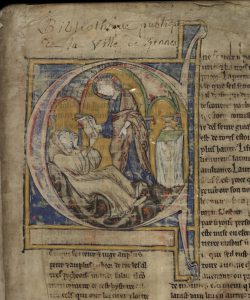
Rennes, Bibliothèque Municipale, MS 255, folio 1 recto. L’Estoire del saint Graal, Opening initial.
Photographer: Peter Scott. Image via Wikimedia Commons.

[Posted on 2 July 2022, with updates]

The Plan

This Episode in the online series of The Research Group Speaks complements and develops from Episode 4 (11 December 2021):

  • “How to be Indiana Jones in the Catalog:  Treasure and Power in/of the Bibliographical Record”.

As the next installment, this one about Tarzan and Brachiation applies the ideas and techniques explored then to some specific problems.

While we might informally call the subject of Episode 8 “How to be Tarzan in the Catalog”, the full title reveals the complexity and some appropriate exercises to strengthen skills for encountering the challenges — some of which might be unexpected.

The Aim and the Reach

Our presenter Linde M. Brocato, scholar-librarian, is Associate of the Research Group on Manuscript [and Other] Evidence, and long-time contributor to our events of various kinds. On her experience and expertise, see Linde Brocato, Linde M. Brocato, Curriculum Vitae, and Google Scholar.

She describes her plan for the Episode as an invitation, and an inviting challenge:

Tarzan-Moves of the Mind,
— or —
Brachiation in Research:

Going from Indiana Jones’ Big Picture to Effective Research Moves

Linde M. Brocato

This workshop / demonstration of how to leverage the power of the bibliographical catalog follows up on the presentation 11 December 2021,“How to be Indiana Jones in the Catalog:  Treasure and Power in/of the Bibliographical Record”, applying those ideas and techniques to specific bibliographic problems.

I invite submissions of irritating and evasive bibliographic problems for a demonstration of how I would go about solving them.  Let’s see if we can!

The earlier Episode, with a Handout with useful links, considered as ‘model’ the popular fictional figure of Indiana Jones (or Dr. Henry Walton “Indiana” Jones, Jr.) in the quest for a Holy Grail of some kind.

Now, the Episode turns to another “notable” character for inspiration and possible instruction in an authentic encounter of material evidence “in the wild”.

Brachiation in Research

After Indiana Jones, this Episode turns to another imaginary figure, larger perhaps than life, and evocative as can be:  Tarzan in one form and another.

Color cover of the book Tarzan of the Apes, written by Edgar Rice Burroughs and published in 1914. Image Public Domain via Wikimedia Commons.

For example, the fabulous character created by Edgar Rice Burroughs, starting with a magazine publication in 1912, Tarzan (John Clayton II, Viscount Greystoke) had a feral upbringing and an intricate, conflicted, introduction to ‘civilization’, before choosing to return to the wild (in whatever forms) — with heroic encounters. Many films, among other media, ensued, successfully to promulgate, expand, and reinforce knowledge (or the like) about this mythical creature, as a foil or embodiment of the situation of the individual in (or against) the prevailing general cases or standards.

With this resonant model, what might we discover in the wilds — or a hitherto neglected or ill-tended wilderness — to be found in the catalog (however defined)?

Some of our earlier blogposts have expressed grumbles about the standardization of catalog descriptions, notably where WorldCat lumps together multiple cases of individual sets of various Portfolios, with specimen manuscript and printed leaves, assembled from dismembered books by Otto Ege.  See, for example, More Discoveries for ‘Otto Ege Manuscript 61″.

We look forward to learning more about the skills of Brachiation, and how to exercise as well as to develop and deploy them, when we find ourselves in the Catalog(ue) — and in the world of exploring books and related written materials of whatever kind or unkind.

This Episode engages in conversation not only with other Episodes of The Research Group Speaks:  The Series, but also with other sessions in our RGME events.  Notable among them are the examinations of “Catalogs, Metadata, and Databases” in that series as well as in our 2022 Spring and Autumn Symposia on “Structured Knowledge”, whose theme was designed and inspired by Linde Brocato.

Send Suggestions for Bibliographical Problems to Explore

Please let us know if you wish to attend this Episode and if you have specific bibliographic wishes on your To Do List.  If so, please contact director@manuscriptevidence.org.

*****

[Update:

Soon after the event, there appeared a news story about a discovery which Linde mentioned in the University of Miami Libraries — discoveries by a new member of staff, Catherine Steele, bringing to light not only one, but two, important books.

  • “Valuable Treasures Unearthed in the University’s Special Collections”.

Among the findings was a sketch in a book at the University of Miami Otto G. Richter Library determined to be a drawing by Mexican muralist Diego Rivera. . . . It was owned by Andy Warhol, the famous artist, and then sold to Jay Jensen, a University of Miami alumnus and former actor who taught drama at Miami Beach Senior High School for many years. Jensen donated the book to the University.

The next discovery, only a few days later, “was a green cloth tome of ‘Leaves of Grass’ signed by the author, American poet Walt Whitman, which was published in 1882″.

Recognized for what they are, they can tell their stories more clearly.

“These treasures, and others housed by Special Collections, provide many opportunities for students and scholars to do research and delve deeper into areas of study such as art, history, and literature”, [Linde M.] Brocato pointed out.

“This collection is heavily used for teaching and that is why you want to have these kinds of books.”

There is a special excitement when a user encounters a book like Whitman’s and the one with the Rivera sketch, Brocato explained. “Once you have opened it up there is a physical engagement. It almost jumps out at you.”

We know the feeling.

*****

More Episodes are in hand and in preparation.  See The Research Group Speaks:  The Series.

Do you have suggestions for subjects?  Please let us know.  Please leave your Comments below, Contact Us, and visit our FaceBook Page.  We look forward to hearing from you.

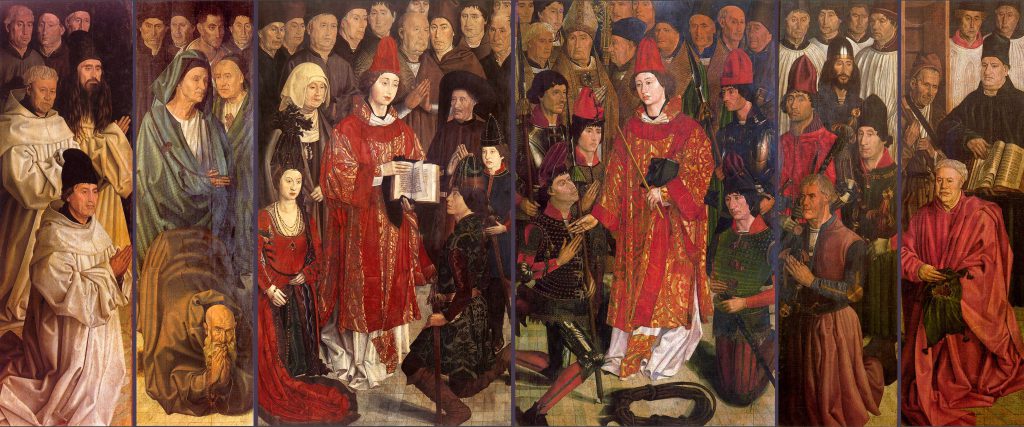
Lisbon, Museu Nacional de Arte Antiga: The mid 15th-century Saint Vincent Panels, attributed to Nuno Gonçalves. Image (https://upload.wikimedia.org/wikipedia/commons/3/3a/Nuno_Gon%C3%A7alves._Paineis_de_S%C3%A3o_Vicente_de_Fora.jpg) via Creative Commons.

*****
Tags: Bibliographical Records, Brachiation, Catalogs & Metadata & Databases, Indiana Jones, Tarzan
No Comments »

Portfolio 93 of Ege’s “Famous Books in Eight Centuries” in the Collection of Richard Weber

June 22, 2022 in Manuscript Studies, Uncategorized

Selected Specimens,
Manuscript and Printed,
in Portfolio 93
of Otto Ege’s Famous Books in Eight Centuries (FBEC)
in the Collection of Richard Weber

[Posted on 21 June 2022, with updates]

Richard Weber Collection, Famous Books in Eight Centuries, Portfolio Set 93, Aristotle, Folio 23 Verso. Reproduced by Permission

With thanks, we offer a preliminary view of the full, and unexpected, glimpse of the Portfolio Number 93, which had been assembled by of Otto Ege (1888–1951) from manuscripts and printed books, so as to exhibit specimens of Famous Books, religious and other, from the medieval period onwards, in the Western middle ages and beyond.

This post offers a start in exploring the treasures in this set of the Portfolio.  Earlier blogposts have begun to examine the structure and elements of the Portfolio both in general and in particular.

This post takes note of the specifics, which hold some surprises.  The post builds upon some previous investigations, which establish points of departure and advances for various of the specimens in the Portfolio, both manuscript and printed.

Earlier blogposts reflect upon such possibilities and complexities.  For example:

  • Otto Ege’s Aquinas Manuscript in Humanist Script: Ege Manuscript 40
  • Otto Ege’s Portfolio of Famous Books and Ege Manuscript 53 (Quran)

We had intended to report more on the specimens of printed leaves, and not only the manuscripts, whilst other tasks called for attention.  The time has come to pick up those aspirations.
Read the rest of this entry →

Tags: Aristotle, Ege's Portfolio of Famous Books, Ege's Portfolio of Famous Books in Eight Centuries, Erfurt, Medieval Manuscript Fragments, Otto Ege Manuscript 51, Richard Weber Collection
No Comments »

Folio 4 with Latin Blessings for Holy Water and an Exorcism for Salt

June 19, 2022 in Manuscript Studies, Photographic Exhibition

Folio 4 from an ‘Italian Missal’ in Latin

Private Collection, Single Leaf from a Latin Missal. Folio 4r, Detail. Photography Mildred Budny. Reproduced by permission.

Single Leaf on Vellum
Circa 222 × 158 mm
<written area circa 150 × 104 mm>

Single columns of 18 lines,
starting below the top ruled line,
with rubricated elements

Blessings of Holy Water and Salt
and the title for an Exorcism of Salt
[qui inimici ru-/]gientis seuitiam seperas . . .
Exorcisimus ad catecuminum salis faciendum. [/]

Italy?  Southern France?  circa 1400–1450

Budny Handlist 10

[Posted on 20 June 2022]

We post a report of a leaf from a Private Collection which we examined and photographed a few years ago, as part of a larger study for an Illustrated Handlist.

The leaf was recorded briefly, with a description supplied by its owner, in C. U. Faye and W. H. Bond, Supplement to the Census of Medieval and Renaissance Manuscripts in the United States and Canada (1962), page 284, number 5.  There it is described as part of an “Italian Missal”.  The owner acquired the leaf by an unknown route, perhaps by gift already framed, before the preparation of that description for the Census.

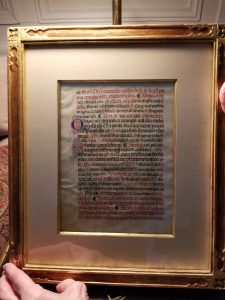
At the owner’s request several years ago, we removed the leaf first from its plain wooden frame and then from its stained and darkened backing mat, onto which parts of the original script had offset. The leaf was photographed at several stages and examined in detail.  We show views of the leaf while still on the mat and afterward.

The Leaf Before

Here are both sides of the leaf as it was mounted to the backing mat.

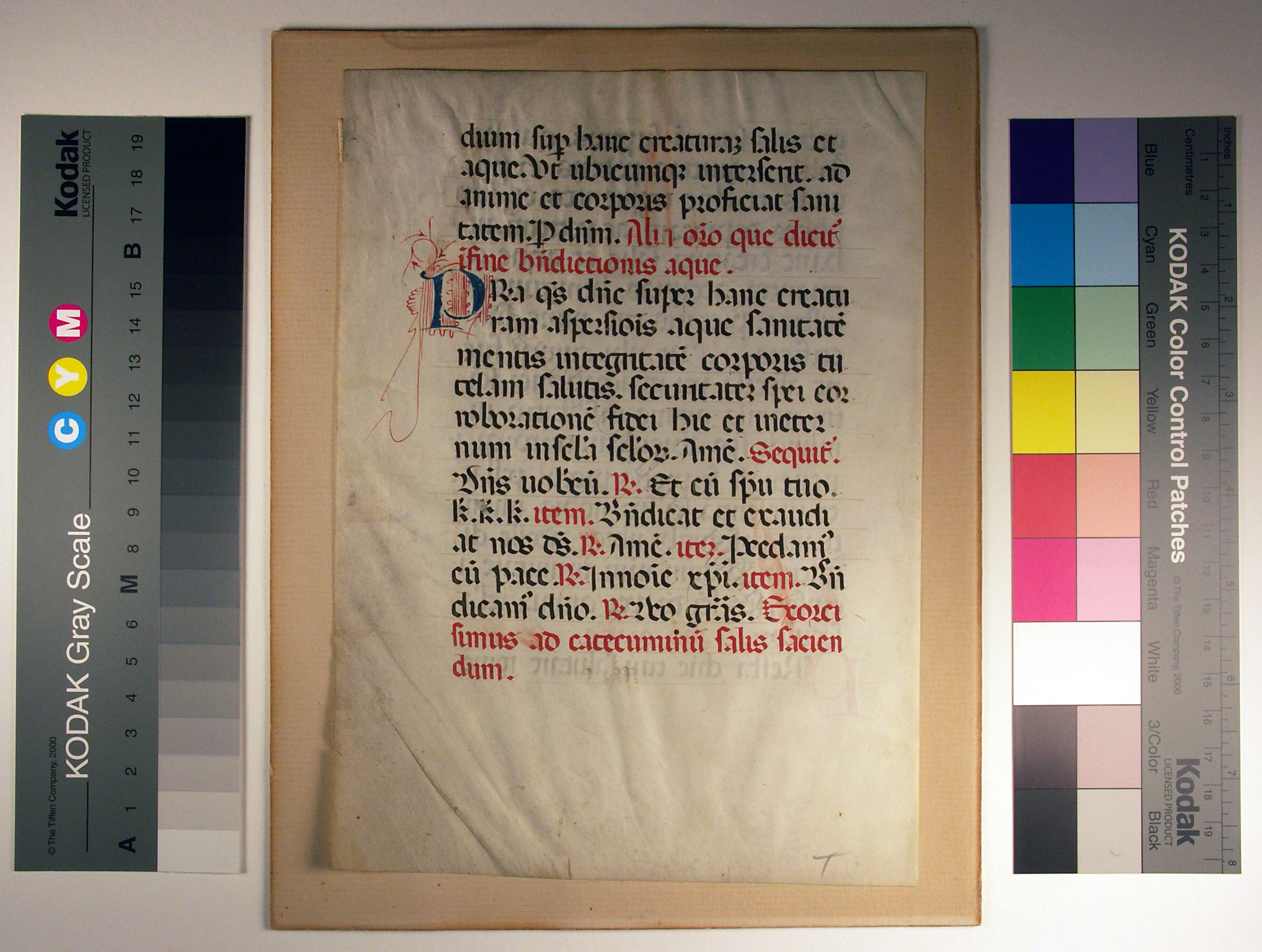
The Front, or Forward-Facing, Side of the Leaf as Mounted for the Frame

For the frame, the leaf faces front with lines in script in black ink and red pigment.

"Folio

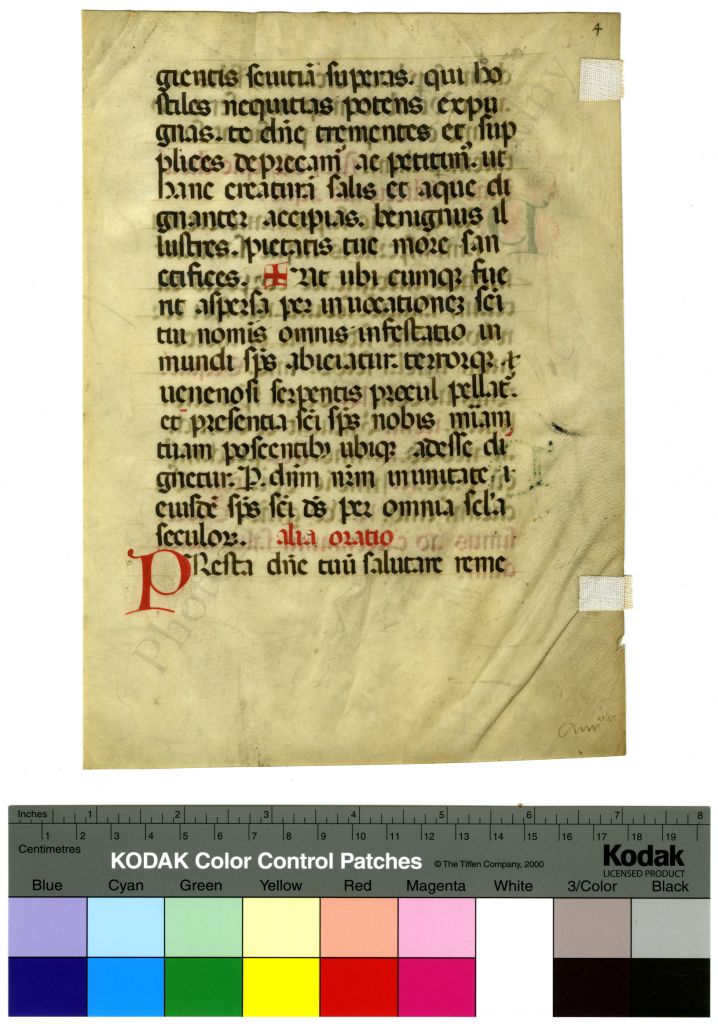
positioned as the front-facing page for the viewer. Private Collection. Folio 4v facing front on the former mat. Photography © Mildred Budny. Reproduced by permission.

The Other Side, Partly Lifted

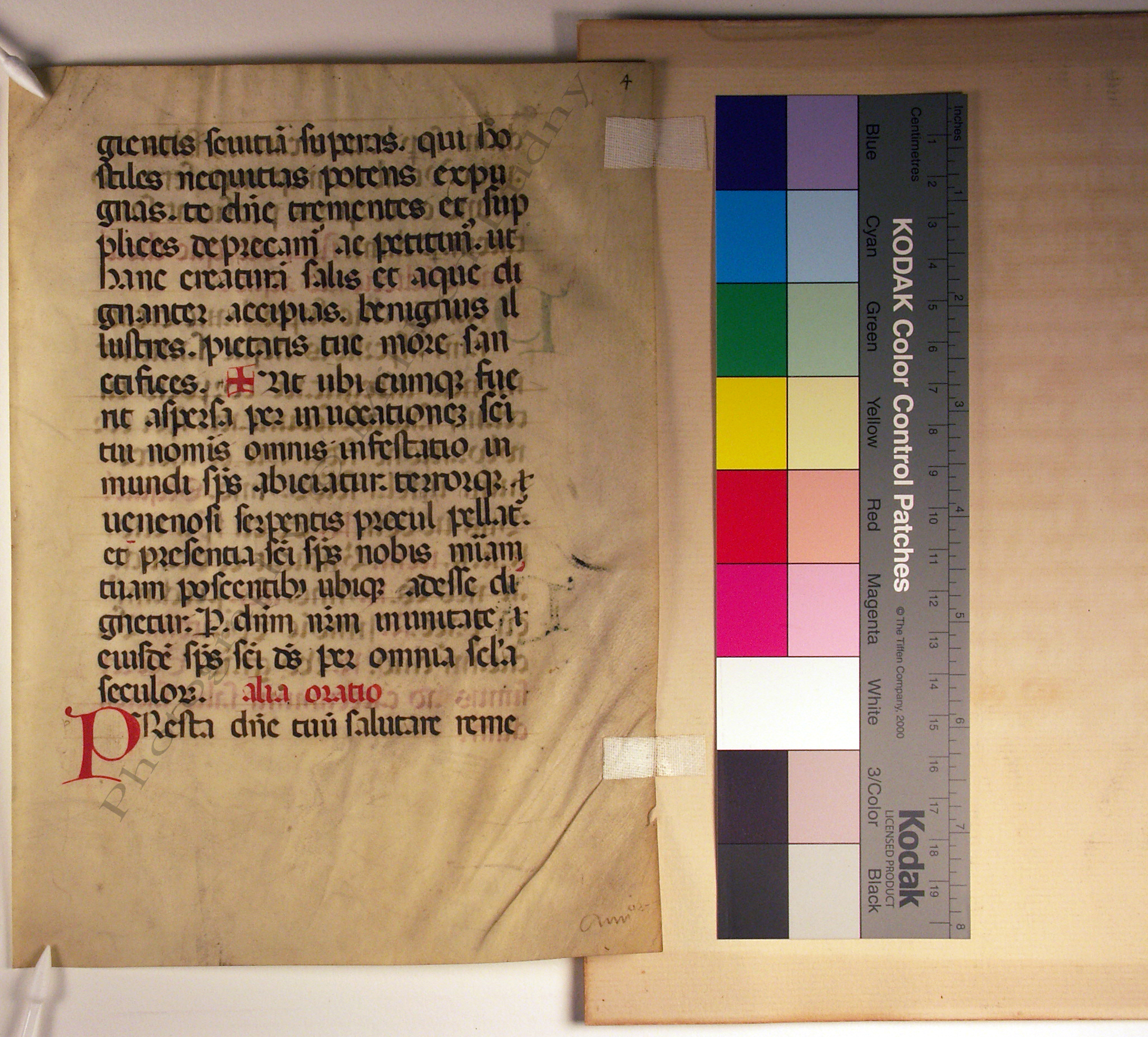
Turning over the leaf, we can see the pair of hinged gauze mounting tapes which attach the edge of the leaf to the mat.

Folio 4r still attached to the mat. Photograph © Mildred Budny

Private Collection. Folio 4r still attached to the mat with a pair of hinged gauze tapes. Photography Mildred Budny. Reproduced by permission.

The Leaf apart from the Mat

The Original Recto

The recto has a modern folio number, an upright arabic 4, entered in dark brown ink at the top right.  The different expanses of the upper and lower margins imply that the short upper margin was trimmed at some stage, whilst the lower and outer margins appear to retain all or most of their original extents.  The accumulated dirt along the upper edge attests to an extended duration when the former manuscript, closed, stood upright on a shelf or in storage.

Private Collection, Single Leaf from a Latin Missal. Folio 4v with Guide. Photography Mildred Budny. Reproduced by permission.

This side of the leaf shows offsets or show-through of enlarged initials at the right-hand side of the column, as well as rubricated script at points within it.  The initials, in reverse, show the forms of a P and a D.

Most of these elements can be accounted for by the rubrications and the enlarged initial P on the other side of the leaf, so that they constitute show-through.  For the other, we must recognize that its offset must derive from contact with a formerly adjacent leaf.

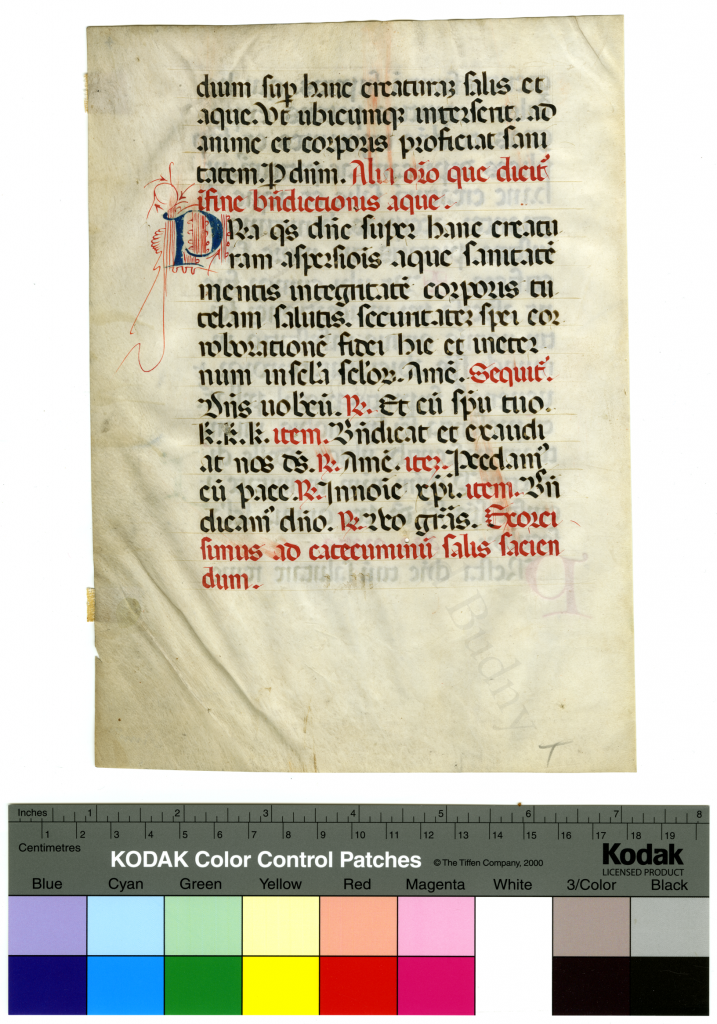
The Original Verso

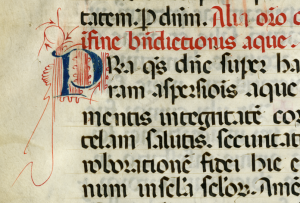
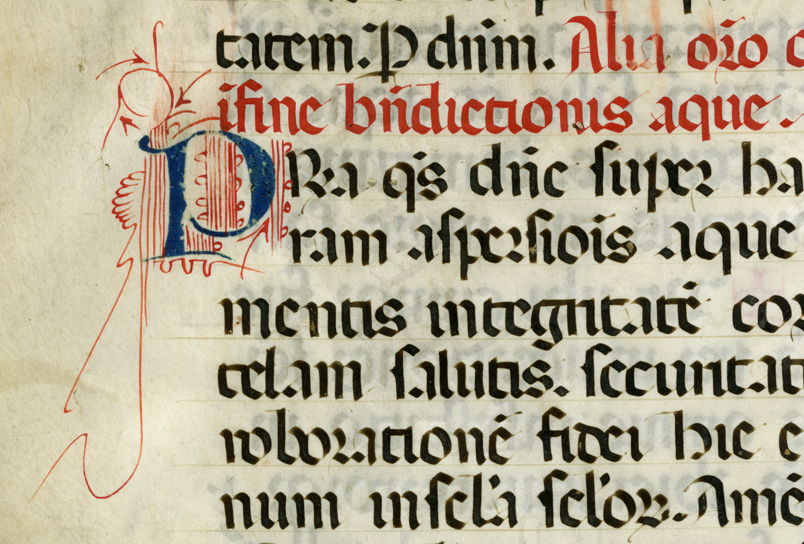
Private Collection, Single Leaf from a Latin Missal. Folio 4r. Detail. Photography Mildred Budny. Reproduced by permission.

On this page, an enlarged and decorated initial P, partly inset within two indented lines of text, comprises an enlarged Capital P (for Presta) rendered in blue pigment, with penline flourishes and extensions in red pigment.  In both curved and parallel straight lines, those flourishes fit between the initial and the indented letters, fill the bow and ‘footrest’ of the P, and extend in the margin above, beside, and below the initial.

A staple of the flourishing appears to be the sets of narrowly spaced parallel lines.  Characteristic, too, are the short, arrowhead-tipped elements which, separately, press into the cusps of parts of the flourishing below the right-hand side of the bow of the letter and in a whorl of three around the circular extension at the upper left of the letter.

The Text

The set of texts on the leaf provide directions for Exorcisms and Blessings of Salt and Water.  At an appropriate point, a sign of the cross (rendered within the outlines of a box-like frame, all in red) stands within the text to indicate its sign, or signing, as part of the ritual.

Specimens of such texts in medieval sources of various dates and from various places are edited, for example, in these bibliographical resources:

  • Benedictio Salis et Aquae in the Vetera Liturgia Alemannica = J. P. Migne, Patrologia Latina, Vol. 138, cols. 1039–1052 (downloadable here).
  • Missale Romanum Mediolani (1474), Vol. II = Henry Bradshaw Society, Vol. XXXIII (1907).

The text on the leaf provides snippets of the ritual for these functions.  We provide a transcription, with silently expanded abbreviations, and with indications of the rubrications in red.

Recto

[Oratio . . .  qui inimici ru-/]
gientis scuitiam superas. qui ho-
stiles nequitias potens expu-
gnas. te domine trementes et sup-
plices deprecam; ac petitumus. ut
hanc creaturam salis et aque di-
gnanter accipias. benignus il-
lustres. pietatis tue more san-
ctifices. + At ubi cumque sue-
nt aspersa per in uocationes sancti
tui nominis omis infestatio in
mundi spiritus abieiatur. terrorque . +
uenenosi serpentis procul pellatur.
et presentia sancti spiritus nobis misericordiam
tuam poscentibus ubique adesse di-
gnitur.  Per dominum nostrum in uinitate +
eiusdem spiritus sancti deus per omnia secula
seculorum.  Alia oratio
Presta domine tuum saltare reme-

Verso

dium super hand creaturam salis et
aque.  Ut ubicumque interserit. ad
anime et corporis proficiat sani-
tatem.  Per dominum.  Alia oratio qui dicitur
i[n] fine benedictionis aque.
Presta quos domine deus super hanc creatu-
ram aspersionis aque sanitatem
mentis integritatem corpus : tu-
telam saltis. securitatem spei. cor-
roborationem fidei hic et in eter-
num in secula seculorum.  Amen.  Sequitur.
Dominus vobiscum. Responsio. Et cum spiritu tuo.
kyrie. kyrie. kyrie. item.  Benedicat et exaudi-
at nos deus.  Responsio.  Amen.  iter.   Procedamus
cum pace.  Responsio.  Innomine [sic, for In nomine] christi.  item.  Bene-
dicamus domino.  Responsio.  Deo gratias.  Exorci-
simus at catecuminum salis facien-
dum.

The Former Manuscript

Parts of the text, or some texts in the sequence, can be found in other sources.  For example, comparisons for the text of the Roman Missal for the Liturgical Use of Milan (printed in 1474), show a similar version of the Presta which appears on the verso, although its version begins somewhat differently.

Presta michi domine deus per hanc creaturam aspersionis aque atque sanitatem mentis integritatem corpus : tutelam saltis : securitatem spei. corroborationem fidei : fructum charitatis nune et in futuro. Amen.

  • See Robert Lippe, Missale Romanum Mediolani (1474), Vol. II:  A Collation with other Editions Printed before 1570. Henry Bradshaw Society, Vol. XXXIII (1907), at page  385.
    The Milan Missal of 1474 was printed at Venice by Antonius Zarotis, with the date of 6 December 1474 (Incunabula Shorttitle Catalogue Number im00688450).

The long prayer on the recto belongs to the blessing of water.

  • See Traditional Rite of Blessing of Water.

It begins with an exorcism (or purification) of salt — but not the one intended for catechumens. as specified in the rubricated title at the bottom on the verso of the leaf.

Both the long prayer on the recto and the two following prayers also occur in that order in the Sacramentary portion of the composite Leofric Missal, but not followed by the exorcism of salt.

  • Frederick Edward Warren, ed., The Leofric Missal, As Used in the Cathedral of Exeter During the Episcopate of Its First Bishop, A.D. 1050-1072, Together with Some Account of the Red Book of Derby, the Missal of Robert of Jumieges, and a Few Other Early Manuscript Service Books of the English Church (Oxford:  Clarendon Press, 1883, page 250.

There is a close match for the sequence of texts on the leaf, with only a few variations, in an another source from Milan later than the printed edition of 1474.  That is:

  • the Rituale Sacramentorum ad Usum Mediolanensis Ecclesiae (“Ritual of the Sacraments for the Use of the Church of Milan“) of 1815, at pages 282–283.

The text on the Recto of the leaf starts on page 282 in the Oratio:  “[inimici ru-/]gientis saevitiam superas . . .”  The Oratio begins thus:  Deus invictae virtutis Auctor . . .  A brief section of text intervenes between this opening and the top of the extant recto.  Such an initial D, low in the column, formed the offset at the right-hand side of the column on the recto.

The “Alia Oratio Presta domine tuum salutare . . .” ends the recto and continues on the verso into the Aquam Benedictam “Presta quaesumus domine.”  Then come the Versicles and Responses extending to “Deo gratias”, but not the “Pax . . .”

Since the following text following refers to “hanc creaturam salis”, it may be the exorcism for which we have only the title.

The correspondences with texts in Missals associated with Milan, in northern Italy, might strengthen, but not confirm, the suggested origin of the leaf as part of an “Italian Missal” — or some similar liturgical handbook — in Latin from such a region.

For now, pending further information (such as the discovery of more parts of the same manuscript), let us continue to refer to it as containing (or, by virtue of the title, implying) a set of Ordines which address 1) the Blessing for the preparation of Holy Water and Salt, and 2) the Exorcism (or Purification) of Salt for Catechumens.  The former has a place in the Sacramentary portion of a Missal, whereas the latter would pertain, insofar as we have been able to discover, to a different form of book instead — such as a Collectar.

The folio number 4 indicates that the leaf occupied an early position within its book, whether or not that modern numeration took into account leaves (such as endleaves) which a modern observer might deem extraneous.  As companion materials, the texts to which this leaf belonged could have formed prefatory matter for a book of one or other genre designed to guide instruction and performance of liturgical practices at whatever stages required for the place of its production.

Perhaps other leaves from the same book as well as further research will resolve the mystery.  This lone leaf joins the company of all too many single, dispersed, leaves which have lost track or trace (apart from, say, an offset from an adjacent leaf) of their former siblings.  By close inspection of their material and textual evidence, it can partly become possible to retrieve some elements of their former connections and contexts.

Welcome to the ‘Foundling Hospital for Manuscript Fragments’, as invited in one of the early posts for our blog.

  • The ‘Foundling Hospital’ for Manuscript Fragments.

*****
Do you know of more leaves from this manuscript? Do you recognize the hand of the scribe, scribal artist, and rubricator in other parts of this book or in other manuscripts?

You might reach us via Contact Us or our Facebook Page. Comments here are welcome too. We look forward to hearing from you.

Watch our blog on Manuscript Studies for more discoveries. Please visit its Contents List.

*****
Private Collection, Single Leaf from a Latin Missal. Folio 4r, Detail. Reproduced by permission.

*****

Tags: 'Foundling Hospital' for Manuscript Fragments, Blessings for Holy Water and Salt, Census of Medieval and Renaissance Manuscripts, Collectar, Exorcism for Salt for Catechumens, Exorcisms and Blessings, Italian Missal, latin Missal, manuscript fragments, Medieval Manuscript Fragments, Offsets and Show-Through, Sacramentary
No Comments »

A Detached Folio 108 with Part of Vulgate Psalm 118 (117)

June 18, 2022 in Manuscript Studies

A Leaf on Vellum with Part of Vulgate Psalm 118 (117)

Collection of Stephen Soderlind

Single leaf from a large-format manuscript in Latin
Single Columns of 14 Lines
Circa 29 1/2 × 19 1/4 inches <written area circa 25 1/4 × 14 1/4 inches>

Psalm 118 (117):18–22 (Domus Aaron sperauit . . . super filios uestros)

Folio “108”
Single column of 14 lines in Gothic Bookhand
with embellishments in red pigment
(bounding lines, ruled lines, and initials)

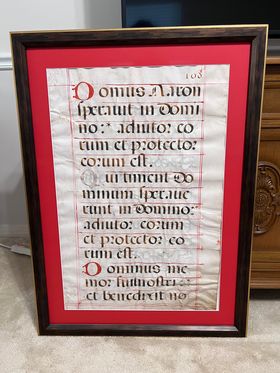
Collection of Stephen Soderlind, Single Leaf in Frame as purchased: Front of Frame. Reproduced by Permission.

[Posted on 18 June 2022]

Continuing our series of brief reports about stray manuscript leaves which emerge in various collections — as the leaves move from one to the next, and as collectors reach out to us with images, information, and questions about their materials, and wish to share them with a wider world — we report a new find from an estate sale.

The large leaf now belongs to the Collection of Stephen Soderlind. It arrived in a plain frame with a windowed red mat , which overlay the outer edges of the leaf and held it in place, as if cropped.

Within the window, the arabic number 108 in a modern hand at the top right above the single column of text appears within view. Without the chance to see the other side of the leaf, hidden within the frame, it remained uncertain whether the number serves as the folio number (for one side of the leaf) or the page number (for this side of the leaf in particular, reserving another number for the other side).

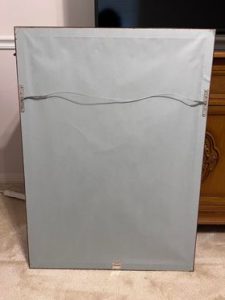
The back of the frame holds little information.

Collection of Stephen Soderlind, Single Leaf in Frame as purchased: Back of Frame. Reproduced by Permission.

Released from the frame, the wrinkles and creases in most parts of the leaf are characteristic of vellum subjected to humid conditions for an extended period, without the stretching under pressure while drying requisite to produce, or reinstate, the smooth surface of vellum or parchment. The wrinkles visible through the glass of the former frame indicate that the leaf as displayed and stored therein pertain to that stage in the life of the leaf, if not already before.

Closer examination yields further information about the leaf and its genre of book. We examine both sides of the leaf, consider some features in detail, and open the discussion for analysis of the probable place and date of origin. We invite your observations and suggestions.

Read the rest of this entry →

Tags: Below Top Line, Collection of Stephen Soderlind, Gothic Bookhand, Latin Vulgate Psalms, manuscript fragments, Psalm 118
No Comments »

“Falling in Love with a Source” (An Interview with Michael Allman Conrad)

June 18, 2022 in Manuscript Studies

The Research Group Speaks
Episode 7
Saturday 23 July 2022

“Falling in Love with a Source . . .
Or: How Much fou Is There In This amour?”

– An Interview with Michael Allman Conrad

[Posted on 18 June 2022]

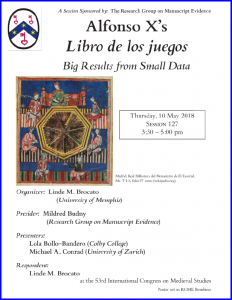
Poster for our Sponsored Session on the " 'Libro de los juegos': Big Results from Small Data", organized by Linde M. Brocato and sponsored by the Research Group on Manuscript Evidence at the 2018 International Congress on Medieval Studies. Poster set in RGME Bembino.

2018 Poster for ‘Libro de los juegos’ Session

The publication this spring by our Associate, Michael Allman Conrad (see also his Curriculum Vitae), of the book which builds upon his Ph.D. Dissertation for Humboldt University, Berlin (2021), gave rise to the invitation to speak for our online series of The Research Group Speaks.  This Episode is the 7th in the series.

Planned for Saturday, 23 July 2022, Michael Allman Conrad will consider, in conversation, the choice of subject and the voyage for his Ph.D. Dissertation and its resulting book, in the light of the journey toward discovery which the process called forth.  The title reflects on aspects of, or approaches to, Love and dedication to it that might perchance touch or verge upon the complex nature of Amour fou.

If you wish to attend, please contact director@manuscriptevidence.org.

The Ph. D. Dissertation and its Book

Michael received the Ph.D. from Humboldt University, Berlin, in 2021.  We thank him for the invitation to attend the online defense of the dissertation, which offered a model of engaged scholarly discourse.

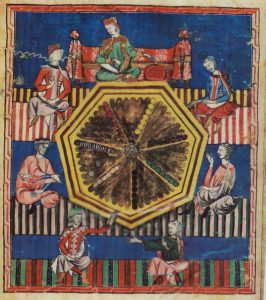
Libro de los juegos. Madrid, El Escorial, MS T.1.6, folio 97 verso, detail. Game of Astronomical Tables. Image Public Domain via Wikimedia Commons.

The book emerging from the dissertation was recently published:

  • Michael A. Conrad, Ludische Praxis und Kontingenzbewältigung (De Gruyter, 2022)
    Ludische Praxis und Kontingenzbewältigung im Spielebuch Alfonsʼ X.
    und anderen Quellen des 13. Jahrhunderts:Spiel als Modell guten Entscheidens

    (“Ludic Practice and Dealing with Contingency in the Book of Games [Libro de los juegos] of Alfonso X and Other Sources from the Thirteenth Century:
    Games as Models of Good Decision-Making”)

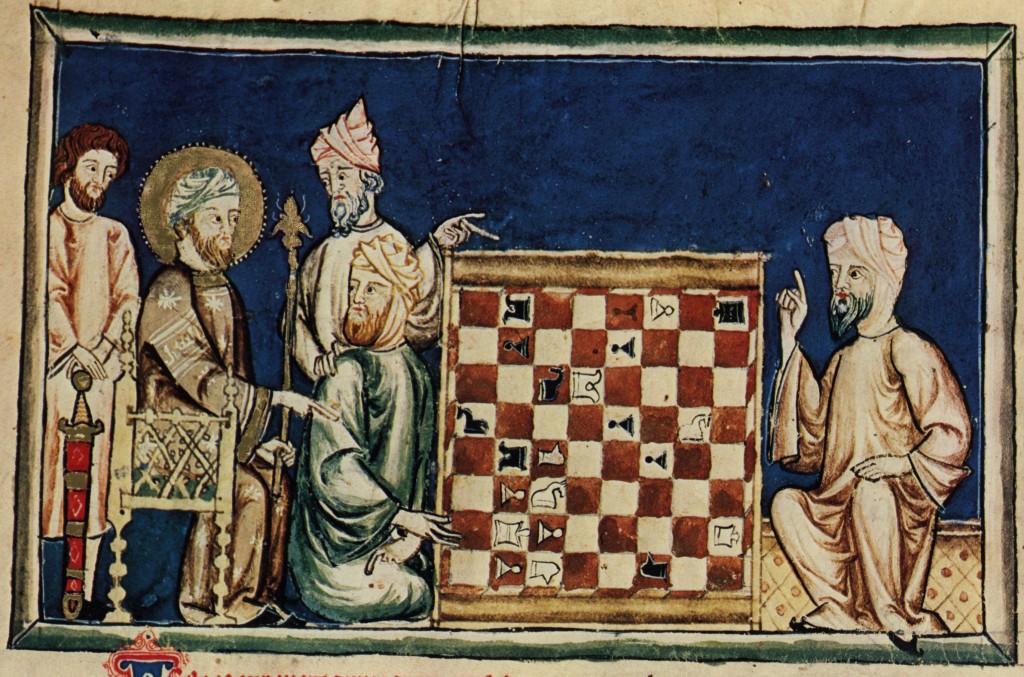
The detailed examination, years in the making — as both Michael and the world changed, with more choices and responses — centers upon the remarkable Libro de los Juegos, or Book of Games commissioned by King Alfonso X of Castile.  The image on the cover of Michael’s book features the extraordinary image of the Game of Astronomical Tables as illustrated in the manuscript (seen at the right here).

The publisher’s summary describes the scope and strategy of the volume:

Taking [Alfonso’s] book as a starting point, this volume reflects on how games were viewed by Alfons and other contemporary authors as a practice that allowed them to come to terms with contingency and as a model of good decision-making, in particular in the fields of strategy, economics, ethics, and metaphysics.

"Libro

Libro de los juegos. Madrid, El Escorial, MS T.1.6, folio 17 verso, detail. Image via Wikimedia Commons.

Read the rest of this entry →

Tags: Alfonso X of Castile, Amour fou, Constantine P. Cavafy, History of Games, Ithaka, Libro de los juegos, Michael Allman Conrad, Models of Decision-Making, Plato, The Book of Games, The Research Group Speaks
No Comments »

A Leaf from ‘Otto Ege Manuscript 214’ in the Collection of Richard Weber

June 14, 2022 in Manuscript Studies

Another Leaf from “Otto Ege Manuscript 214”
(A Dutch Prayerbook)

Richard Weber Collection. Single Leaf from “Otto Ege Manuscript 214”? Verso, Top Left. Image reproduced with permission.

Collection of Richard Weber

Single leaf from a small-format Prayerbook in Dutch
Circa 168 × 119 mm <written area circa 129 × 88 mm>
([. . . /]-te sprekene na die sentencie . . .
heest maer puerlijck am die [/ . . .])

Single column of 22 lines in Gothic Bookhand
with embellishments in red pigment
and a painted, framed, decorated initial in ‘rustic’ style

Flanders, circa 1330

Formerly part of ‘Ege Manuscript 214′
(Gwara , Handlist 214)

[Posted on 13 June 2022, with updates]

Another leaf from a medieval devotional manuscript in Dutch dispersed by Otto F. Ege (1888–1951) has come to light. It belongs to the Collection of Richard Weber. Sharing information and images, Richard Weber reports that he purchased it on its own from an online vendor (eBay – oldworldwonders).

Earlier blogposts have begun to report materials from his collection; more are in preparation. For example, so far:

  • More Leaves from an Old Armenian Praxapostolos.

An earlier blogpost considered portions of Ege’s dispersed Dutch manuscript in other collections.

  • A New Leaf from ‘Otto Ege Manuscript 214?”.

That blogpost focused upon one of the remnants, a single leaf now in a Private Collection. As seen below, the recto stands at the left, with the verso at the right. With the text set out continuously, as paragraphs run together, the script presents seemingly solid blocks of text in successive columns. The initials marking the beginning of phrases or sections are enhanced with vertical strokes of red pigment.

"Verso, owned and dismembered by Otto F. Ege” width=”1024″ height=”671″ /> Private Collection. Detached Leaf from ‘Otto Ege Manuscript 214’ (Dutch Prayerbook), Both Sides of the Leaf

Some other leaves from the manuscript carry elements of decoration or illustration.

‘Otto Ege Manuscript 214’

In Scott Gwara’s Handlist of Manuscripts Collected or Sold by Otto F. Ege (2013), that manuscript, with some traceable remnants, is his Number 214 (Appendix X, pages 177–178). There he cites a few traceable remnants from it and their appearances in several catalogues. Our blogpost surveyed those resources. See A New Leaf from ‘Otto Ege Manuscript 214?”.

An update to that same blogpost reports other remnants, as identified by Peter Kidd. It quotes his email communication of 15 July 2019 about his discoveries for various Ege manuscripts, including this one. Peter Kidd reported that, for Ege Manuscript 214, that “There are leaves with miniatures at the National Gallery of Art in D.C., the Art Museum in Indianapolis, and (recently acquired) at Oberlin” College, along with the “unilluminated leaf at BU”, that is, at Boston University, School of Theology Library — listed in Scott Gwara’s Handlist. It is:

  • Boston, Massachusetts, Boston University, School of Theology Library, MS Leaf 7.

Some of the identified remnants have some form of illumination. The style is sometimes attributed to the “style of Simon Bening”, that is, Simon Bening (circa 1483 – 1561), one of the most famous and celebrated painters of the 1500s.

A sales catalogue entry for a portion of the manuscript is informative, albeit concise and lacking an illustration.

  • Sotheby’s, Western Manuscripts and Miniatures (London, Tuesday 26th November 1985), lot 88. The entry reports:

55 leaves, some detached, others still sewn to old bands with pieces of calf spine, 22 lines, written in dark brown ink by 2 scribes in a late gothic liturgical hand, rubrics in red, capitals touched in red, many initials in red or blue, SIX LARGE ILLUMINATED INITIALS (3- to 4-line) in delicate rustic designs in liquid gold on coloured grounds, fine condition (166mm by 120mm).

Also:

Comprising biblical readings and prayers, including three ascribed to the Commisasrius “meester Godschalc rosemond van Eundhoven, Doctoer in der godeyt” [that is, “Eindhoven in South Holland, about 45 miles south east of Utrecht“], there are offers of indulgences ascribed to popes Alexander VI (1482–1503), Julius III (1503–1513) and Leo X (1513–1521).

The sale included “fifty-four lots of single leaves and miniatures from the collection of Otto Ege”. Various of them comprised the “Residue” of despoiled manuscripts, sometimes with bindings or bits of bindings, left over after the their dismemberment and the distribution of leaves otherwise. It is apparent that the portion from Ege Manuscript 214 was such a case.

The companion Price List of “hammer prices” for the sale indicates that lot 88 was purchased by “Williams” for £330.

The “New” Leaf

The leaf in the Collection of Richard Weber, shown here, has one embellished initial, which occupies a 3-line inset frame. Rubrics in red occur on the other side of the leaf. It is perhaps not too much to ask if this leaf has strayed from the group of fifty-five leaves sold at Sotheby’s.

Recto

This page has a line or more of rubricated text at both top and bottom. The upper rubrication names as authorities “Saint Augustine, Saint Gregory, and other teachers” or Church Fathers.

-te sprekene na die sentencie van Sente
Autustini Sente Gregorius ende ander
doctoren
. . .

Richard Weber Collection. Single Leaf from “Otto Ege Manuscript 214”, Verso. Image reproduced with permission.

Verso

This page opens with a decorated initial A, heading a full block-like column of text relieved by two enlarged minor initials (lines 13 and 18) enlivened with a vertical stroke of red pigment.

Als een mensche hem tot onsen / lieuen heere god keere wil so moet . . .
. . . om sijn schade of scande die hii daer mede / vercreghen heest maer puerlijck am die / [. . .]

Richard Weber Collection. Single Leaf from “Otto Ege Manuscript 214”? Verso. Image reproduced with permission.

Initial A (of Als)

The inset three-line initial which opens the verso occupies a squared and bordered frame filled with red pigment, which overspreads the outer contour. The background within the initial is likewise filled with red pigment, with the addition of lighter, yellowish, drops or speckles.  The red pigment resembles the pigment employed in the rubricated letters and embellishments for minor initials.  It may be that the frame for the inset initial was given its red pigment in the same state of operation in preparing the leaf, from script to finishing touches.

The Capital Letter A is rendered in mid-tone brown pigment with dark brown outlines for shading, and with speckles overall in light brown pigment.  The letter takes the form of interlocked branch-like or twig-like elements with outspread terminals.  The highlights, speckling , and shading enhance the effect of three-dimensional sticks or twigs, hollows, and bark.  A fair description of this design, whilst skillfully executed, could be “rustic”.

Richard Weber Collection. Single Leaf from “Otto Ege Manuscript 214”? Verso, Top Left. Image reproduced with permission.

*****

We thank Richard Weber for sharing information and images of this leaf, and for answering queries about its features, source, and other aspects.

*****

Do you know of more leaves from this manuscript? Do you recognize the hands of the scribe and scribal artist in other parts of this book or in other manuscripts?

You might reach us via Contact Us or our Facebook Page. Comments here are welcome too. We look forward to hearing from you.

Watch our blog on Manuscript Studies for more discoveries. Please visit its Contents List.

*****

Tags: Collection of Richard Weber, Dutch Prayerbook, Illuminated Initials, manuscript fragments, Medieval Manuscript Fragments, Otto Ege Manuscript 214, Peter Kidd, Scott Gwara
No Comments »

More Leaves from an Old Armenian Praxapostolos

May 30, 2022 in Manuscript Studies, Reports, Uncategorized

More Leaves from
an Old Armenian New Testament Manuscript:
The “Kurdian/Chicago Praxapostolos“

Separate Leaves on Vellum
from the Acts of the Apostles
in Different Collections

Double columns of 27 lines in bolorgir minuscule script,
with rubrications and Euthalian apparatus

1) Private Collection: Acts 16:24 [middle] – 17:6 [middle]

2) Richard Weber Collection: Acts 20:5 [beginning] – Acts 20:26 [end]
(Leaf size: 10.2 x 13.7 cm; Written area: 7.1 x 10.2 cm; Column width: 3.2 cm)

[Posted on 30 May 2022, with updates]

"Cover, with the opening of Acts 23:12"

Research Group on Manuscript Evidence, “Two Detached Leaves” Booklet Cover, with the opening of Acts 23:12.

More leaves emerge into view from a dismembered manuscript in Old Armenian with selections from the New Testament. Apparently it comprised a copy of a Praxapostolos, that is, containing parts of the New Testament without the Gospels and certain other Books.  We have examined several leaves from this book before.

Some earlier blogposts, and an RGME Research Booklet, have introduced other leaves from the same manuscript.

  • New Testament Leaves in Old Armenian
    reporting “A Pair of Leaves [in a Private Collection] Identified, Described, Collated, and Set into the Context of its Manuscript”
  • Leslie J. French, Two Detached Manuscript Leaves containing New Testament Texts in Old Armenian: A Report prepared for the Research Group on Manuscript Evidence (RGME, 2015)
  • The Plot Thickens
    reporting on “A New Leaf Found at the University of Pennsylvania
    from the “Kurdian/Chicago New Testament Praxapostolos[?]
    in Old Armenian”

For the Research Report, Armenian glyphs were designed for the Research Group’s multi-lingual digital font Bembino, freely available on our website.  (See Multi-lingual Bembino.)

As the word spreads, the story grows.

After those reports, we were contacted by Sani Eskinazi (then at Stanford University), as he worked to complete a Final Project for History 14N on “Reconstituting an Armenian Bible from the 15th Century” (2019), based upon a leaf in Special Collections with part of II Corinthians:  Stanford University Libraries, M0297, Box 1, Item 103. With Sani’s expected collaboration, we continue to prepare an updated and expanded version of the Report Booklet.

Meanwhile, it is time to show some more leaves from the same manuscript, as custodians and owners respond to our blogpost, and wish to share their materials more widely. As part of the work for the updated Report, here we present two leaves which have come to our attention this year.

First, we recall some other leaves from the manuscript.  (See below.)

Next we present the “new” leaves. Each of them was purchased online as a separate leaf, with or without an accompanying label. Each presents part of the text of the Acts of the Apostles.

1) One has come to the same Private Collection with the two leaves which prompted both our first blogpost on the manuscript and its accompanying Report Booklet. Those two leaves are considered to be Folios “I” and “II” in the collection; the new one is its Folio “III” (or “3”).

2) The other belongs to the collection of Richard Weber. While we prepare a report, or series of reports, on a group of other materials in his collection, manuscript and printed, we begin with the Old Armenian New Testament Leaf which he purchased on its own (plus label) from an online seller, who had little information about it.

Read the rest of this entry →

Tags: Dawson's Bookshop, Kurdian/Chicago Praxapostolos, manuscript fragments, Medieval Manuscript Fragments, Old Armenian, Old Armenian New Testament Praxapostolos, Otto F. Ege, Portfolio of Original Leaves from Famous Bibles, Richard Weber Collection, University of Pennsylvania Libraries, Zohrab Bible
No Comments »

Another Leaf from a Portable Manuscript Bible in the Collection of Birgitt G. Lopez

May 18, 2022 in Manuscript Studies, Uncategorized

Another Latin Bible Manuscript Leaf
in the Collection of Birgitt G. Lopez

Single Leaf from a Latin Vulgate Bible
Folio “74[?]” with Part of the Book of Daniel

Daniel 9:11 ([. . . et declinaverunt / ] ne audirent)
– 11:30 (et cogitabit [ / advesum eos . . . ])

Double Columns of 56 lines

Written in Gothic Script
with Running Titles, Initials, Pen-flourishes, and Annotations
including a Modern Folio Number

Collection of Birgitt G. Lopez, Vulgate Bible Manuscript Leaf purchased in London around 2000: Recto with opening of Daniel Chapter X.

[Posted on 17 May 2022]

Collection of Birgitt G. Lopez, Framed Leaf from ‘Otto Ege Manuscript 20’, Front-Facing Page (“Recto”).

Collection of Birgitt G. Lopez, Framed Leaf from ‘Otto Ege Manuscript 14’.

Following our blogpost reporting Two Ege Manuscript Leaves and Two Ege Labels in the Collection of Birgitt G. Lopez, we learn of another leaf in the same collection, with a different provenance.  Those two Ege leaves and labels pertain to three manuscripts dismembered and distributed by Otto F. Ege (1888–1951).  That is,

  • with a leaf from “Otto Ege Manuscript 14” and its Ege Label,
  • an Ege Label from “Ege Manuscript 54”, and
  • a leaf from “Ege Manuscript 20”.

They all pertain to books of the Latin Vulgate Bible, either as full Bibles in large or small format, or as the Book of Psalms in a separate volume (or Psalter) in small format. They came to their collector in stages, by purchase at auction at the Dallas Public Library in 1998, or as a gift in 2003 from its former Librarian, Lillian Moore Bradshaw (1915–2010), with a mix-up at some stage between labels and leaves.

Collection of Birgitt G. Lopez, Otto Ege Label for “Ege Manuscript 54”.

The Next Leaf

The next leaf reaching our attention came from a small-format Vulgate Bible manuscript.  In correspondence, Ernesto Lopez reports that he purchased the leaf in London, England, around the year 2000.

The unframed leaf and its seller’s label tell the story of a pattern of transmission of a dismembered medieval manuscript leaf which, at some stage in transmission after dismemberment, lost a record of connection to the original book.  Here we examine the label and both sides of the leaf, as revealed in the collector’s photographs, generously supplied for study and for presentation here to a wider world.

The Seller’s Label

With the leaf is a folded rectangular paper label with printed or print-out text in two halves above and below the fold-line which would permit the label to stand upright, say in a case or on a shelf.  The upper half of the sheet, above the fold line, identifies the seller, the Parthenon Gallery in London, purveyor of “Ancient coins, antiquities & fossils”.  This gallery is still located in the same place, at 25, Bury Place, WC1A 2JH.

Within a rectangular frame, the lower half of the label calls the specimen “Early Medieval”.  Details cite the item as comprising “Illuminated manuscript pages [sic] from an early medieval bible written on vellum, with Latin written in a miniscule hand”; identifies the contents as part of the text of “I Machabees, relating the episode of “The Temple taken”; and dates the item to “Circa 1280 A.D. Not after 1300.”

At the bottom of the frame, at the left, there stands the printed identifier “9037   R  0”, in arabic-numbers-plus-letters (or-letter).   At the right, layered pieces of gauze tape cover the price identifier, which is partly visible in show-through, beginning with the currency-identifier for pounds sterling (£).

The Leaf

Side 1

To begin with, we saw a photograph of only one side.  The cropped edges of the photograph do not offer indications of which side of the leaf it is, whether recto or verso.  We decided to examine the image for what it might show.

The Text

Despite the label, this leaf does not belong to any part of the First Book of Maccabees (I Maccabees). Instead it has part of the text in the Book of Daniel.

The text on the page starts within Daniel 10:14 ([ . . . sunt populo / ] tuo in novissimis diebus, quoniam adhuc visio in dies).   The page ends in the middle of 11:30 (et faciet: reverteturque, et cogitabit [ / advesum eos . . . ]).

The enlarged initial signals the beginning of Chapter 11:1, which reads:  Ego autem ab anno primo Darii Medi stabam ut confortaretur et roboraretur.  Rendered in blue pigment, the initial E stands outside the column of text.  Above and below the letter extend pen-flourishes in red pigment, which reach most of the height of the column. In places, the flourishes form the outlines of foliate motifs, sometimes branching, with rippled contours in some places.

Show-through from the opposite side of the leaf indicates that a similar enlarged chapter-initial, with pen-flourishes, stands in the intercolumn, pertaining to a place in column b, about one-quarter of the way down its course.  Chapter 12 would begin with an initial I:  In tempore autem . . .  Chapter 10 would begin with an initial A:  Anno tertio Cyri regis Persarum . . .  On the strength of those different letter-forms, it is tempting to guess that that opposite side of the leaf carries the last part of Chapter 9 and the first part of Chapter 10.

Even the running title points to the Book of Daniel.  Centered at the top of the page , the bichrome red-and-blue capital letters designate the first part of the name:  “DANI-“.  Given the orientation, this portion of a bi-partite title on a verso would be complemented by the second portion on the formerly facing recto of the next leaf in the book.

An addition in ink in the left margin supplies a missing word confortare, with a signe-de-renvoi linking it with its place in the text, within Daniel 10:19

et dixit: Noli timere, vir desideriorum: pax tibi: confortare, et esto robustus. Cumque loqueretur mecum, convalui, et dixi: Loquere, domine mi, quia confortasti me.

The signes-de-renvoi take the form of an identical pair of triple dots in triangular formation in red pigment.  One twin stands at the upper left of the correction.  The other hovers in the interline at the place within the column of text where the insertion is to be supplied.  A wash of red pigment enhances the bow of the somewhat enlarged letter c, like various minor text initials in the columns of text.

At first, when I examined the photograph of this page, some features, including forms of the pen-flourishing, reminded me especially of a couple of Vulgate Bible manuscripts dismembered by Otto Ege and distributed in more than one of his several Portfolios of specimen leaves from manuscripts and printed books.

The pair of manuscripts , which I come on occasion to think of as “Otto Ege Manuscript 9 + Manuscript 54”, featured in my recent blogpost exploring the Two Ege Manuscript Leaves and Two Ege Labels in the Collection of Birgitt G. Lopez.  Their numbers derive from the different positions of cataloguing the two manuscripts in Scott Gwara’s Handlist of Ege’s Manuscripts.  They figure on the one hand as its Handlist Number 9 (for its position among the numbered specimens in the Fifty Original Leaves Portfolio, or FOL) on the one hand; and, on the other, as its Handlist Number 54 (for both versions of the Original Leaves from Famous Books Portfolio, respectively in Eight and Nine Centuries, or FBEC and FBNC).  For citations, please see that earlier blogpost.

The overlap or perhaps sometimes confusion between the two manuscripts results from the distribution of their respective specimens sometimes in FOL and sometimes in the versions of Famous Books , as substitutions might arise in the course of assembling individual sets of one or other Portfolio.  For example, the manuscript normally deployed for Number 9 in FOL sometimes did service in FBEC or FBNC.   The other manuscript sometimes or normally deployed instead for FBEC (as Leaf 1) or FBNC (as Leaf 2), has Gwara’s assigned Number 54.

If this seems complicated, welcome to the world of Ege Manuscript Studies!  Fortunately, careful and precise examination of the individual cases can aid the process by bringing a strong dose of recognition of their specific characteristics.

Ege’s Labels for these two manuscripts, curiously interlinked or intermixed in Ege’s distribution patterns, identify them differently as

  • a Bible written written in France, specifically Paris, in the middle of the XIIIth Century (FOL), or
  • a Bible written by Dominicans in Paris circa 1240 (FBNC)
    — as seen above, in one of the Ege Labels in the Collection of Birgitt G. Lopez.

For the two books Gwara prefers an attribution of “France, ca. 1250” (No. 9 for FOL and FBEC); and “Northern France, ca. 1250” (No. 54 for FBEC and FBNC), with cross-references between both numbers.  Gwara’s list notes different numbers of lines for those two items, with script in double columns respectively of “53 lines” and  “57 lines”.

The variation in numbers of lines per column and page in a single volume with closely-spaced text is not unaccustomed in small-format Vulgate Bible manuscripts of the period, so that the span of 56 lines on the Lopez Leaf under examination here, like some stylistic variations in script and pen-flourishes, need not in themselves rule out a possible association or connection with that Ege manuscript.

The point is that the general resemblance only, without closer inspection, brings to mind rather similar manuscripts from Ege’s collection whose features I have been recently been surveying, in the quest to sort out the partly divergent evidence of the Ege Labels and Leaves with a Dallas Public Library in the Collection of Birgitt G. Lopez.

More information comes to light on the other side of the leaf from London.

Side 2

Next, upon request, we could see the other side, revealing the full expanse of the leaf, insofar as it survives, and with a scale to indicate size.

Collection of Birgitt G. Lopez, Vulgate Bible Manuscript Leaf purchased in London around 2000: Recto with Scale.

This page shows some tell-tale features pertaining to the structure, location, and forms of use of the leaf within its former book.  They include annotations which provide medieval references in ink in the outer margin and a modern folio number in pencil at the bottom right.  The edge of the gutter, or stitching line, remains at the right-hand contour, while the wider expanse of the outer margin on the opposite edge appears to represent its full original extent.

In that outer margin stand the blue Chapter numeral X; a mark designating the roman numeral lvii or lxii (“lvij” or “xlij”) opposite line 4 of the text; an abbreviated mark awaiting decipherment to its right; a vertical set of three marks at intervals down the page, in the form of triple dots in triangular formation atop a leftwards-curving tail (let’s cite it here as “;”); and the arabic numeral 74, 75, or 76[?] in the lower outer corner.

At the top of the page stands part of of a bipartite running title in bichrome Gothic Capitals, forming the second half of the name for the Biblical Book of [DANI-/]EL.

Evidently, this side of the leaf is the original recto.

Collection of Birgitt G. Lopez, Vulgate Bible Manuscript Leaf purchased in London around 2000: Recto.

The text begins within Daniel 9:11.

[11 Et omnis Israël prævaricati sunt legem tuam, et declinaverunt / ] ne audirent vocem tuam: et stillavit super nos maledictio et detestatio quæ scripta est in libro Moysi servi Dei, quia peccavimus ei.

The marks opposite line 4 in the outer margin, lvij or lxij, plus a larger abbreviation to its right, might signal the passage for reading.  The ‘;’ markings at intervals opposite more lines lower down might be related to the readings from Daniel for the 21-day fast.  See:

  • https://likeabubblingbrook.com/daniel-fast-scripture-readings/

The listed readings in that resource do not exactly line up with this version, but it is the closest which we have found so far.

*****

Further research might identify which Vulgate Bible manuscript gave this specimen, somehow to reach the antiquary shop in London.  As yet, it is unclear by which time and where the leaf acquired its modern folio number within the original volume, became separated from the book, and acquired its inventory number, selling price, and label, giving an attribution to a different text, and a particular passage, from a different Biblical Book in the Old Testament.  We might assume, say, given the plural “pages” in the label, that its text was drafted to identify a group of specimens from the specific manuscript, laid out in an array from which a purchase might be selected.  From them one, but not this one, could correspond to the specified passage about the Temple in I Macabees.

Perhaps the formula which the label assigns to the date-range of the specimen, like the citation of “I Machabees”, will provide a clue to its former location in a source-manuscript, according with a form of identification not unlike some employed by, say, Otto Ege, in labeling the dismembered pieces for distribution and perhaps offering a selling-point.  For now, we might begin to look for Vulgate Bible specimens in double columns of around 56 lines, with comparable dimensions, and with corresponding folio numbers, all of which are identified as dating from “Circa 1280 A.D. Not after 1300.”

The modern folio number points to a different manuscript than the one which first came to mind when I saw a photograph from its “first side”, perhaps probably because that manuscript was fresh in mind.  Some Ege manuscripts have modern folio numbers, entered before the books were taken to pieces.  (See, for example, More Leaves from “Otto Ege Manuscript 51”.) But not, apparently, any leaves from Ege MS 9 or MS 54.  The quest is open.

I invite your advice.

*****

Do you know of more leaves from this manuscript?  Do you recognize the hands of these scribes, artists, and annotators in other parts of this book or in other manuscripts?

You might reach us via Contact Us or our Facebook Page. Comments here are welcome too. We look forward to hearing from you.

Watch our blog on Manuscript Studies for more discoveries. Please visit its Contents List.

*****

Tags: Book of Daniel, Book of I Macabees, Latin Vulgate Bibles, manuscript fragments, Otto Ege Manuscript 14, Otto Ege Manuscript 20, Otto Ege Manuscript 54, Otto Ege Manuscript 9, Otto Ege Manuscripts
No Comments »

Two Ege Leaves and Two Ege Labels in the Collection of Birgitt G. Lopez

May 10, 2022 in Manuscript Studies, Uncategorized

Two Ege Leaves in Frames
with
Two Ege Labels

in the Collection of Birgitt G. Lopez

(Ege MS 14, MS 20, and MS 9 + 54)

Mildred Budny

Collection of Birgitt G. Lopez, Framed Leaf from ‘Otto Ege Manuscript 20’, Front-Facing Page (“Recto”).

[Posted on 10 May 2022, with an update]

Acquired separately in Dallas, Texas, over the course of some five years and through the Dallas Public Library, two vellum leaves from manuscripts dispersed through Otto F. Ege (1888–1951) now belong to a single collection, that of Birgitt G. Lopez. The two leaves, differing in size, script, layout, and type of book, come from two different manuscripts from Ege’s collection.  With each leaf travelled a printed Label composed and printed by Ege to accompany the dispersed specimens of the particular manuscript.

Each leaf has been reframed.  Its identifying Label is retained and taped to the back of the frame.  Recently, after a visit to Dallas Public Library to examine its relative from one of those Ege manuscripts, Mr. Lopez contacted me, at the suggestion of the Librarian, and generously offered to share information about both Ege leaves in the collection with our and others’ study of Ege materials.

The Links of Transmission from Otto Ege

When reporting the existence of the leaves to me, Ernesto Lopez recollects that the first leaf was purchased at an auction benefiting the Dallas Public Library.  The second was a gift some five years later from Lillian Moore Bradshaw (1915–2010), long-time Director of the Dallas Public Library (1962–1984).

Mr. Lopez reports:

I purchased the first one in an auction benefiting the Dallas Public Library 1998 and the second one was a gift in 2003 from Lillian Bradshaw, the long-time Dallas Public Library Director.  Ms. Bradshaw told me at the time that she purchased the items directly from Mr. Ege; I have the letter laying out the provenance in Ms. Bradshaw’s hand.  . . . .  She told me [that] she was working in the Dallas Public Library’s Director’s office when Mr. Ege came to make a sales call. . . . I served eight years on the Dallas Municipal Library Board where I got to know Mrs. Bradshaw.

Also:

Several months ago, I went to the Rare Books collection at Dallas Public Library to do some research on the two leaves that I own.  The Rare Books Librarian gave me your email address so that my two leaves can be added to the body of work your group is doing on the Otto Ege manuscripts.

I framed both of the leaves leaving the explanatory text from Otto Ege on the back of the framed works.
The first leaf is similar to the leaf in the Dallas Public Library collection. It is roughly 15″ by 10″.

With permission, we publish images and report some preliminary research results, which can aid in allowing the leaves to become more widely known in their own right.

Read the rest of this entry →

Tags: Beinecke Rare Book & Manuscript Library, Collection of Birgitt G Lopez, Dallas Public Library, Ege FOL Portfolio, Ege Labels, Ege's Portfolio of Famous Bibles, Ege's Portfolio of Famous Books, Lilian Moore Bradshaw, manuscript fragments, Otto Ege Manuscript 14, Otto Ege Manuscript 20, Otto Ege Manuscript 54, Otto Ege Manuscript 9
1 Comment »

2022 Autumn Symposium on “Supports for Knowledge”

April 7, 2022 in Announcements, Conference, Conference Announcement, Manuscript Studies

2022 RGME Spring and Autumn Symposia
on “Structured Knowledge”

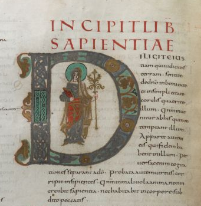
© British Library Board, London, British Library, Add. MS 1546, folio 262v, detail. Opening of the Book of Sapientia (“Wisdom”).

2 of 2: Autumn Symposium
“Supports for Knowledge”
Saturday, 15 October 2022
Online

9:00 am – 5:30 pm EDT with Sessions, Discussion, and Breaks

2020 Spring Symposium "From Cover to Cover" Poster 2

2020 Spring Symposium Poster 2

[Posted on 5 April 2022 with updates]

In 2022, the Research Group returns to our series of Symposia (formerly held in person). The series underwent an interruption with the cancelled 2020 Spring Symposium, “From Cover to Cover”. See its record in the illustrated Program Booklet, with Abstracts of the planned presentations and workshops. Its core and its promise inspire this renewal.

This year, each Symposium in the pair is designed as a one-day event, with sessions and workshops of about 1 and 1/2 hours, giving scope for discussion. The Spring Symposium was held online by Zoom. The Autumn Symposium would be held online, but, conditions permitting, it might be hybrid, that is, partly in person, as well as online. See 2022 Spring and Autumn Symposia.

  1.  Structures of Knowledge (Spring)
  2.  Supports for Knowledge (Autumn)

These events, by request, flow in addition to — and partly from — our other activities during the year:

Lisbon, Museu Nacional de Arte Antiga: The mid 15th-century Saint Vincent Panels, attributed to Nuno Gonçalves. Image via Creative Commons.

1) Continuing Episodes in the online series of The Research Group Speaks (2021–)

  • https://manuscriptevidence.org/wpme/the-research-group-speaks-the-series/
  • Catalogs, Metadata, and Databases (Part I)

2) Our four sponsored and co-sponsored Congress Sessions at the 57th International Congress on Medieval Studies (online) in May

  • https://manuscriptevidence.org/wpme/2022-international-congress-on-medieval-studies-program
    (Abstracts of the Papers are included).

© The British Library Board. Additional MS 15505, folio 22r. Italian, early 16th century. Circular diagram with coloured drawings of nine magical seals, as a textual amulet with charms against diseases.

Structured Knowledge (Parts I and II)

The interlinked pair of Spring and Autumn Symposia examine themes of Structured Knowledge.

Some proposed presentations at these Symposia offer refreshed materials which had been planned for the cancelled 2020 Spring Symposium.

  • See https://manuscriptevidence.org/wpme/2020-spring-symposium-save-the-date, with a published Program Booklet including illustrations and Abstracts.
The Spring Symposium is dedicated to “Structures of Knowledge”. The Autumn Symposium considers “Supports for Knowledge”. Sessions include approaches to databases and library catalogs; specific case studies and projects; issues relating to reproductions and display , research and teaching, and more.

Part I: Spring Symposium (Saturday, 2 April 2022)
on “Structures of Knowledge”

  • See 2022 Spring Symposium on “Structures of Knowledge”

Vassar College, Frederick Thompson Memorial Library, Entry, Ceiling and Gobelin Tapestry Series.

Part II: Autumn Symposium (Saturday, 15 October 2022)
on “Supports for Knowledge”

For link to register for the Symposium, see below.

Private Collection, Book of Hours, Decorated Initial and Stub from Despoiled Leaf. Photography Mildred Budny.

Sessions include approaches to books, libraries, catalogues, and databases; case studies, projects, and work-in-progress and projects examining individual original sources or groups of them; the history, uses, and reuses of books and their materials; issues, opportunities, and successes in research and teaching; and more.

Speakers, Respondents, and Presiders:

Christine E. Bachman, Linde M. Brocato, Mildred Budny, William H. Campbell, Katharine C. Chandler, Connor Chinoy, Barbara Williams Ellertson, Hannah Goeselt, Justin Hastings, Thomas E. Hill, Zoey Kambour, Jennifer Larson, Amber McAlister, Caley Macaulay, Andrew Moore, David Porreca, Jaclyn Reed, Jessica L. Savage, Derek Shank, Kate Schmidt, David W. Sorenson, and N. Kıvılcım Yavuz.

Timetable

Session 1.    9:00–10:30 am EDT by Zoom

Coffee Break.          10:30–10:45 am

Session 2.   10:45 am – 12:15 pm

Lunch Break.   12:15–1:15 pm

Session 3.    1:15–2:45 pm

Tea Break.          2:45–3:00 pm

Session 4.   3:00–4:30 pm

Break.         4:30–4:45 pm

Session 5.   4:45–5:30 pm EDT
Closing Keynote Presentation, Discussion, and Concluding Remarks

Sessions

1.  “Teaching with (and through) Manuscripts, Part II”

— Part II in our series on these subjects, building upon Part I in the Spring Symposium.

— including presentations by:
Caley McArthur and Andrew Moore, representatives of the Team from the DRAGEN Lab, at the University of Waterloo, reporting on “initiatives in our lab to train students, both undergraduate and graduate, in medieval paleography”; and
William H. Campbell and his colleagues and students, Amber McAlister, Kate Schmidt, and Connor Chinoy, on the experience of teaching an undergraduate course this summer using the Les Enluminures Manuscripts in the Curriculum program at the University of Pittsburgh-Greensburg.

2. “Catalogs, Metadata, and Databases, Continued (Part III)”

— Part III in our series on these subjects, building upon our Roundtable in February on Catalogs, Metadata, and Databases, Part I and the Session on “Catalogs, Metadata, and Databases, Part II” in the Spring Symposium.

— including presentations by:
Jessica L. Savage
on “Cataloguing Manuscript Iconography between Digital Covers at the Index of Medieval Art”;
Katharine C. Chandler on “Manuscripts from Print: The Schwenkfelders and their Dangerous Books”; and
Barbara Williams Ellertson on “A Painter, a Printer, and a Search for Shared Exemplars”
(focusing upon Giovanni Bellini’s painting of Saint Benedict and his Book);
with a response by David Porreca on “My $0.02 Worth”.

For this Session, Jessica Savage and Barbara Williams Ellertson revive, update, and expand the presentations which they had prepared for the 2020 Spring Symposium, which had to be cancelled; their Abstracts then appear in its freely-available Program Booklet, published as a souvenir or token of the intentions for the event.

For the subject of this series, see the Links of Interest (Catalogs, Metadata, and Databases: A Handlist of Links), for which suggestions and additions are welcome.

3.  “The Living Library (Part II)”

Part II in the series, building upon Part I at the Spring Symposium
— including
Christine E. Bachman on “Unbound, Dispersed, Resewn:  The Flexible Codex in Eighth-Century Northwestern Europe”;
Zoey Kambour on interactions between scribes, readers, and text in a copy of the Decretals of Pope Gregory IX at the University of Oregon;
David Porreca‘s presentation which had been planned for our Spring Symposium:  “The Warburg Institute Library: Where Idiosyncracy Meets User-Friendliness”; and
Thomas E. Hill‘s response on systems of structuring libraries in Germany from the Baroque and Enlightenment periods.

4.  “Hybrid Books (Part I)”

Part I in a continuing series
— including
Hannah Goeselt on “Structures of Art and Scripture in Otto Ege’s ‘Cambridge Bible’ (Ege Manuscript 6)”;
Jennifer Larson‘s presentation of selected examples of types of “Hybrid Books” in her collection of miniature books;
Linde M. Brocato‘s demonstration, using some of Jennifer’s examples, of how to catalog such cases; and
N. Kıvılcım Yavuz‘s response on decision-making processes involved in producing codices composed of handwritten and printed components, with a proposal of ways of differentiating among different types of hybrid codices.

[Note:  Depending upon variable work timetables, David W. Sorenson might be able to attend at some point during the day to present preliminary findings on “A Jain MS of the Seventeenth Century on Imported Watermarked Paper”.]

Closing Keynote Presentation

Linde M. Brocato
“Hybrid Books:  Fragments and Compilatio, Structure and Heuristic in Richard Twiss’ Farrago”
[For glimpses of this book, see our blogpost called “I Was Here”.]

“In these reflections, I will bring together many of the strands of thinking we have all worked to weave together in the symposium.”

Richard Twiss, Farrago, held in the Unversity of Miami Special Collections, Artists’ Books Collection. Sidelong View. Photograph Linde M. Brocato.

Concluding Remarks

Mildred Budny
“Structured Knowledge, Structures of Knowledge, and Supports for Knowledge:  A Framework for the RGME Year 2022”

*****

© British Library Board, London, British Library, Cotton MS Cleopatra C. viii, folio 36r, top: Sapientia in her Temple. Prudentius, Psychomachia, in a Canterbury copy of the late tenth or early eleventh century.

The Schedule

For details see the 2022 Autumn Symposium Program.

Registration

Please register for the Symposium.  Space is limited.  Visit 2022 Autumn Symposium Registration.

Questions? Contact director@manuscriptevidence.org.

*****

Other Activities

Besides the 2022 Spring and Autumn Symposia , the Research Group

  • sponsors and co-sponsors Sessions at the ICMS (see our 2022 Congress Program and 2023 International Congress on Medieval Studies Preparations)
  • prepares more online Episodes for The Research Group Speaks: The Series
  • plans events for 2023, including online Open Business Meetings and a pair of Symposia (Spring and Autumn)
  • prepares publications in various forms from these events, research work, discoveries, and divers materials, including our blog on Manuscript Studies (see its Contents List) and more Research Booklets.

Suggestion Box

Do you have suggestions for subjects for our events, or offers to participate? Please let us know.

If you wish to join our events, please contact director@manuscriptevidence.org.

For updates, watch this space, see 2022 Spring and Autumn Symposia and The Research Group Speaks: The Series; and visit our FaceBook Page and Twitter Feed (@rgme_mss).

Floral Motif as Lower Border in a Book of Hours. Photography Mildred Budny.

We invite you to donate to our nonprofit educational mission. Donations may be tax-deductible. We welcome donations in funds and in kind:

  • Contributions and Donations .

Please leave your Comments below , Contact Us, and visit our FaceBook Page and Twitter Feed (@rgme_mss).  We look forward to hearing from you.

© British Library Board, London, British Library, Add. MS 1546, folio 262v, detail. Opening of the Book of Sapientia (“Wisdom”) in the Moutier-Grandval Bible, an imposing Carolingian manuscript of the Latin Vulgate Bible.

*****

Tags: Catalogs & Metadata & Databases, Giovanni Bellini, Hybrid Books, Index of Medieval Art, Manuscripts in the Curriculum, Otto Ege Manusript 6, RGME Symposia, Richard Twiss's Farrago, Structured Knowledge, Teaching with and through Manuscripts, The Living Library, Warburg Institute Library
No Comments »

« Older Entries
Newer Entries »
  • Top
©2024 Research Group on Manuscript Evidence.


is proudly powered by WordPress. WordPress Themes X2 developed by ThemeKraft.