• News
    • News & Views
    • RGME Activities for 2024 and 2025
    • Around & About with the RGME
    • Reviews
    • Highlights
  • Blogs
    • Manuscript Studies
      • Manuscript Studies: Contents List
    • International Congress on Medieval Studies
      • Abstracts of Congress Papers
        • Abstracts of Papers Listed by Author
        • Abstracts of Papers Listed by Year
  • About
    • Mission
    • Who We Are
      • Officers, Associates & Volunteers
      • RGME Committees
      • Friends of the Research Group on Manuscript Evidence
    • Policies & Statements
      • RGME Privacy Policy Statement
      • RGME Intellectual Property Statement & Agreements
    • People
      • Mildred Budny — Her Page
      • Adelaide Bennett Hagens
    • Activities
      • Events
      • Congress Activities
        • Sponsored Conference Sessions (1993‒)
          • Panels at the M-MLA Convention (from 2016)
        • Co-sponsored Conference Sessions (2006‒)
    • History
      • Seals, Matrices & Documents
      • Genealogies & Archives
    • Contact Us
  • Bembino
    • Multi-Lingual Bembino
    • RGME Bembino: Resources
  • Congress
    • Sponsored Conference Sessions (1993‒)
    • Co-sponsored Conference Sessions (2006‒)
    • Abstracts of Congress Papers
      • Abstracts Listed by Author
      • Abstracts Listed by Year
    • Kalamazoo Archive
    • Panels at the M-MLA Convention (2016-2019)
      • Abstracts of Papers for the M-MLA Convention
      • Panels at the M-MLA Convention (from 2016)
  • Events
    • RGME Activities for 2024 and 2025
      • 2023 Activities and 2024 Planned Activities
    • Seminars, Workshops, Colloquia & Symposia (1989–)
      • Seminars on ‘The Evidence of Manuscripts’
      • Symposia on ‘The Transmission of the Bible’
      • The New Series (2001-)
        • 2019 Anniversary Symposium Program: The Roads Taken
        • 2019 Anniversary Symposium Registration
        • 2019 Anniversary Symposium Registration Open
      • RGME Symposia: The Various Series
      • The Research Group Speaks: The Series
      • Meetings of the Friends of the Research Group on Manuscript Evidence
      • RGME Online Events
    • Abstracts of Papers for Events
      • Abstracts of Papers for Seminars on ‘The Evidence of Manuscripts’
      • Abstracts of Papers for Symposia, Workshops & Colloquia
    • Receptions & Parties
    • Business Meetings
    • Photographic Exhibitions & Master Classes
    • Events Archive
  • ShelfLife
    • Journal Description
    • ShelfMarks: The RGME-Newsletter
    • Publications
      • “Insular, Anglo-Saxon, and Early Anglo-Norman Manuscript Art at Corpus Christi College, Cambridge” (1997)
        • Mildred Budny, ‘Catalogue’
        • The Illustrated Catalogue (1997)
      • The Illustrated Handlist
      • Semi-Official Counterfeiting in France 1380-1422
      • No Snap Decisions: Challenges of Manuscript Photography
    • History and Design of Our Website
  • Galleries
    • Watermarks & the History of Paper
    • Galleries: Contents List
    • Scripts on Parade
    • Texts on Parade
      • Latin Documents & Cartularies
      • New Testament Leaves in Old Armenian
    • Posters on Display
    • Layout Designs
  • Donations and Contributions
    • RGME Donor Promise
    • 2023 End-of-Year Fundraiser for our 2024 Anniversary Year
    • 2019 Anniversary Appeal
    • Orders
  • Links
    • Catalogs, Metadata, and Databases: A Handlist of Links
    • Handlist of Resources for Manuscript Studies and Fragmentology
    • Manuscripts & Rare Books
    • Maps, Plans & Drawings
    • Seals, Seal-Matrices & Documents

  • News
    • News & Views
    • RGME Activities for 2024 and 2025
    • Around & About with the RGME
    • Reviews
    • Highlights
  • Blogs
    • Manuscript Studies
      • Manuscript Studies: Contents List
    • International Congress on Medieval Studies
      • Abstracts of Congress Papers
        • Abstracts of Papers Listed by Author
        • Abstracts of Papers Listed by Year
  • About
    • Mission
    • Who We Are
      • Officers, Associates & Volunteers
      • RGME Committees
      • Friends of the Research Group on Manuscript Evidence
    • Policies & Statements
      • RGME Privacy Policy Statement
      • RGME Intellectual Property Statement & Agreements
    • People
      • Mildred Budny — Her Page
      • Adelaide Bennett Hagens
    • Activities
      • Events
      • Congress Activities
        • Sponsored Conference Sessions (1993‒)
          • Panels at the M-MLA Convention (from 2016)
        • Co-sponsored Conference Sessions (2006‒)
    • History
      • Seals, Matrices & Documents
      • Genealogies & Archives
    • Contact Us
  • Bembino
    • Multi-Lingual Bembino
    • RGME Bembino: Resources
  • Congress
    • Sponsored Conference Sessions (1993‒)
    • Co-sponsored Conference Sessions (2006‒)
    • Abstracts of Congress Papers
      • Abstracts Listed by Author
      • Abstracts Listed by Year
    • Kalamazoo Archive
    • Panels at the M-MLA Convention (2016-2019)
      • Abstracts of Papers for the M-MLA Convention
      • Panels at the M-MLA Convention (from 2016)
  • Events
    • RGME Activities for 2024 and 2025
      • 2023 Activities and 2024 Planned Activities
    • Seminars, Workshops, Colloquia & Symposia (1989–)
      • Seminars on ‘The Evidence of Manuscripts’
      • Symposia on ‘The Transmission of the Bible’
      • The New Series (2001-)
        • 2019 Anniversary Symposium Program: The Roads Taken
        • 2019 Anniversary Symposium Registration
        • 2019 Anniversary Symposium Registration Open
      • RGME Symposia: The Various Series
      • The Research Group Speaks: The Series
      • Meetings of the Friends of the Research Group on Manuscript Evidence
      • RGME Online Events
    • Abstracts of Papers for Events
      • Abstracts of Papers for Seminars on ‘The Evidence of Manuscripts’
      • Abstracts of Papers for Symposia, Workshops & Colloquia
    • Receptions & Parties
    • Business Meetings
    • Photographic Exhibitions & Master Classes
    • Events Archive
  • ShelfLife
    • Journal Description
    • ShelfMarks: The RGME-Newsletter
    • Publications
      • “Insular, Anglo-Saxon, and Early Anglo-Norman Manuscript Art at Corpus Christi College, Cambridge” (1997)
        • Mildred Budny, ‘Catalogue’
        • The Illustrated Catalogue (1997)
      • The Illustrated Handlist
      • Semi-Official Counterfeiting in France 1380-1422
      • No Snap Decisions: Challenges of Manuscript Photography
    • History and Design of Our Website
  • Galleries
    • Watermarks & the History of Paper
    • Galleries: Contents List
    • Scripts on Parade
    • Texts on Parade
      • Latin Documents & Cartularies
      • New Testament Leaves in Old Armenian
    • Posters on Display
    • Layout Designs
  • Donations and Contributions
    • RGME Donor Promise
    • 2023 End-of-Year Fundraiser for our 2024 Anniversary Year
    • 2019 Anniversary Appeal
    • Orders
  • Links
    • Catalogs, Metadata, and Databases: A Handlist of Links
    • Handlist of Resources for Manuscript Studies and Fragmentology
    • Manuscripts & Rare Books
    • Maps, Plans & Drawings
    • Seals, Seal-Matrices & Documents

Log in

Archives

Featured Posts

Episode 24. “Life with Books” (Interview with John Windle)
Announcing the Launch of RGME Bembino WP
2026 RGME Colloquium at The Grolier Club: Report
Medieval Missal Fragment as Early-Modern Cover
The Weber Leaf from Ege MS 61
"Bembino" Booklet Cover
Episode 23. “Meet RGME Bembino: Facets of a Font”
2026 RGME Colloquium on “Transformations & Renewals” at The Grolier Club
2026 Theme of the Year: “Transformations and Renewals”
A Leaf with Patchwork from the Saint Albans Bible
A Sister Leaf from a Miniature Latin Vulgate Bible
A Little Latin Vulgate Bible Manuscript Leaf in Princeton
J. S. Wagner Collection. Leaf from from Prime in a Latin manuscript Breviary. Folio 4 Verso, with part of Psalm 117 (118) in the Vulgate Version, set out in verses with decorated initials.
2026 Annual Appeal
Episode 22: “Encounters with Local Saints and Their Cults”
Private Collection, Ege's FBNC Portfolio, Dante Leaf, Verso, Detail. Reproduced by Permission.
2025 RGME Autumn Colloquium on Fragments
Workshop 8: A Hybrid Book where Medieval Music Meets Early-Modern Herbal
2025 RGME Autumn Symposium on “Readers, Fakers, and Re-Creators of Books”
RGME Workshops on “The Evidence of Manuscripts, Etc.”
2025 International Medieval Congress at Leeds: RGME Program
Episode 21. “Learning How to Look”
2025 International Congress on Medieval Studies: Program
2025 RGME Visit to Vassar College
Two Leaves in the Book of Numbers from the Chudleigh Bible
Delibovi on Glassgold on Boethius: A Blogpost
Ronald Smeltzer on “Émilie du Châtelet, Woman of Science”
2025 Spring Symposium: “Makers, Producers, and Collectors of Books”
Starters’ Orders
The Weber Leaf from the Saint Albans Bible
Workshop 4. “Manuscript Fragments Compared”
Episode 20. “Comic Book Theory for Medievalists”
Episode 19: “At the Gate: Starting the Year 2025 at its Threshold”
Favorite Recipes for Lemonade, Etc.
RGME Visit to the Lomazow Collection: Report
2024 Autumn Symposium: “At the Helm”
A Latin Vulgate Leaf of the Book of Numbers
The RGME ‘Lending Library’
Florence, Italy, Ponte Vecchio from Ponte alle Grazie. Photo: Ingo Mehling, CC BY-SA 4.0 , via Wikimedia Commons
Episode 17. “RGME Retrospect and Prospects: Anniversary Reflections”
2024 Anniversary Symposium: The Booklet
Jesse Hurlbut at the Bonneville Salt Flats, Utah. Photograph Jesse Hurlbut.
Episode 16: An Interview with Jesse D. Hurlbut
To Whom Do Manuscripts Belong?
Kalamazoo, MI Western Michigan University, Valley III from the side. Photograph: David W. Sorenson.
2024 International Congress on Medieval Studies: Report
2024 Spring Symposium at Vassar College
Puente de San Martín: Bridge with reflection over the River Targus, Toledo, Spain.
2024 Grant for “Between Past and Future” Project from The Gladys Krieble Delmas Foundation Research Libraries Program
2024 Anniversary Symposium in Thanks to Jesse Hurlbut: Program

You are browsing the Blog for History of Paper

2016 Congress Report

May 19, 2016 in Abstracts of Conference Papers, Bembino, Business Meeting, Conference, ICMS, Kalamazoo, Reception, Reports

Jesse Meyer demonstrates the squirrel parchment prepared for the Research Group's Session, at the 51st International Congress on Medieval Studies. 13 May 2016. Photography © Mildred Budny

Show & Tell. Photography by Mildred Budny

51st International Congress on Medieval Studies

12–15 May 2016

Report

[Published on 18 May 2016, with updates]

The Research Group on Manuscript Evidence reports its activities accomplished at the 2016 International Congress on Medieval Studies, held at Kalamazoo, Michigan.

After the completion of

  • our Congress Planning, which reported the Sessions selected by the Congress Committee,
  • our 2016 Congress Call for Papers, which described the aims of the Sessions, and
  • our Congress Program, which set forth the schedule for our Sessions and other Activities
    (together with the Abstracts of some Papers),

we now Report its achievements.  They include the notice of a couple of late changes to the Program of individual Sessions, the unveiling — with the publication here — of both the Posters for our multiple activities at the Congress and an illustrated Program Booklet for a pair of co-sponsored Sessions, and other developments.  These publications, as is our practice, are set in our copyright multilingual font Bembino and laid out in accordance with our Style Manifesto. You may view them below.

Read the rest of this entry →

Tags: Balkan Studies, Bembino, Business Meeting, Center for Medieval and Early Modern Studies at the University of Florida, History of Paper, Index of Christian Art at Princeton University, magic in manuscript, Medieval Writing Materials, Parchment making, Reception, Societas Magica
No Comments »

2016 Congress Program

January 11, 2016 in Business Meeting, Conference Announcement, International Congress on Medieval Studies, Reception

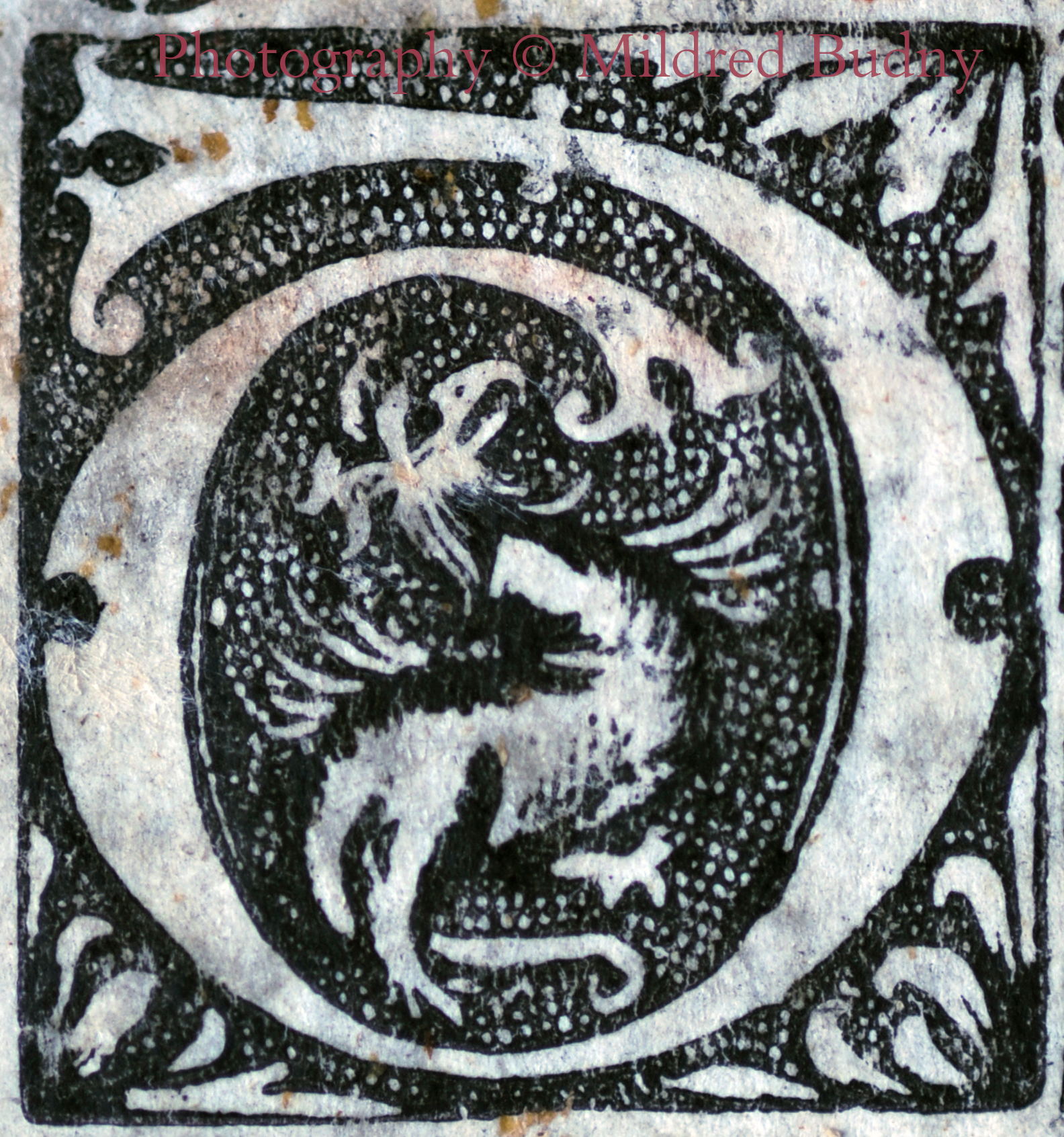
Initial d in a printed Missal, enclosing an upward-looking hybrid creature which looks up to the right, with spread wings, raised offside, and curled tail. Photography © Mildred Budny.51st International Congress on Medieval Studies

12–15 May 2016

Program

[Published on 11 January 2016, with updates]

After the completion of the 2016 Congress Call for Papers, which described the aims of the sessions, and the Congress Planning, which reported the Sessions selected by the Congress Committee, the Research Group on Manuscript Evidence advances with the planning for its 4 sponsored and co-sponsored sessions for the next International Congress on Medieval Studies.

Now we announce the programs. The Congress Schedule reveals the time- and room-assignments.  Also, we begin to publish Abstracts of the papers, as their authors might wish.

*****

The next Congress will be the eleventh year of our co-sponsorship with the Societas Magica, the third year of co-sponsorship with the Center for Medieval and Early Modern Studies at the University of Florida, and the second year of co-sponsorship with the Index of Christian Art at Princeton University.

Our 2014 and 2015 sessions and receptions with these organizations are illustrated in the 2014 Congress Report and 2015 Congress Report. The history of our sponsorships and co-sponsorships at the Congress is recorded for our Sponsored Sessions and Co-Sponsored Congress Sessions, and in our blog.

Read the rest of this entry →

Tags: Balkan Studies, Byzantine Studies, Center for Medieval and Early Modern Studies at the University of Florida, History of Magic, History of Paper, History of the Crusades, Index of Christian Art at Princeton University, Medieval Studies, Medieval Writing Materials, Mirror as Image, Mirror as Other, Ottoman Studies, Parchment making, Societas Magica
No Comments »

2016 Congress Call for Papers

June 29, 2015 in Call for Papers, Conference Announcement, International Congress on Medieval Studies, Kalamazoo

Call for Papers

for Sessions Sponsored and Co-Sponsored
by the Research Group on Manuscript Evidence
at the 2016 International Congress on Medieval Studies

12–15 May

[Updating our Post of 10 June 2015, now with the Call for Papers for Our Sessions on 29 June 2015, and additionally with further updates after the timely links regarding the Congress have become obsolete]

For the 51st International Congress on Medieval Studies [“http://wmich.edu/medieval/congress/sessions.html” link no longer valid] at Kalamazoo next May, the Research Group will sponsor and co-sponsor Sessions, as part of our continuing activities at this Congress. For example, at the 50th International Congress on Medieval Studies, the Research Group had 2 sponsored and 3 co-sponsored Sessions.

As before, we co-sponsor sessions with the Societas Magica (since 2006) and with the Center for Medieval and Early Modern Studies at the University of Florida (since 2014).  Here we announce the Call for Papers for all our Sessions for the 2016 Congress.

Read the rest of this entry →

Tags: Balkan Studies, Byzantine Studies, Center for Medieval and Early Modern Studies at the University of Florida, Editing Magical Texts, History of Magic, History of Paper, International Congress on Medieval Studies, Medieval and Early Modern Studies, Medieval Writing Materials, Shaping Identity via the 'Other', Societas Magica, The Late Crusades
No Comments »

Curiouser & Curiouser

June 10, 2015 in Documents in Question, Manuscript Studies, Photographic Exhibition

Document on Paper from Grenoble,
Dated 22 February 1345 (Old Style),
With a curious Seal

[Posted on 20 June 2010, with updates]

Mildred Budny reflects upon a fragmentary document, its enigmatic wax seal, and the mid-14th-century owner of the seal.

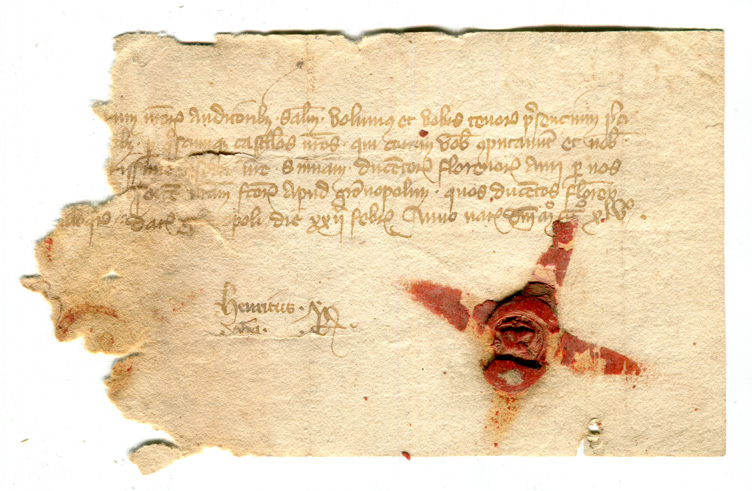
Today we showcase the fragment of a documentary record on paper which has traveled across time and space to find renewed attention.  Among its curiosities, it carries a seal in red wax depicting a male human head accompanied by creatures and part-creatures drawn from the animal, avian, and insect realms.  Now in a private collection, the document was recently purchased online from a seller in Isère, France, not far from its place of origin in or near Grenoble nearly seven centuries ago. Document in 5 lines on paper, dated 22 February 1345 (Old Style), with red wax seal. Image reproduced by permission.Reproduced here by permission, the fragmentary document written in Latin on paper records a transaction conducted apud Gratianopolis (‘at Grenoble’) in the Dauphiné” (now France), with the date of 22 February 1345 Old Style.  The left-hand side of the document has been roughly torn away, with the loss (of uncertain extent, probably about half) of the first part of the lines of text.
Map it Out

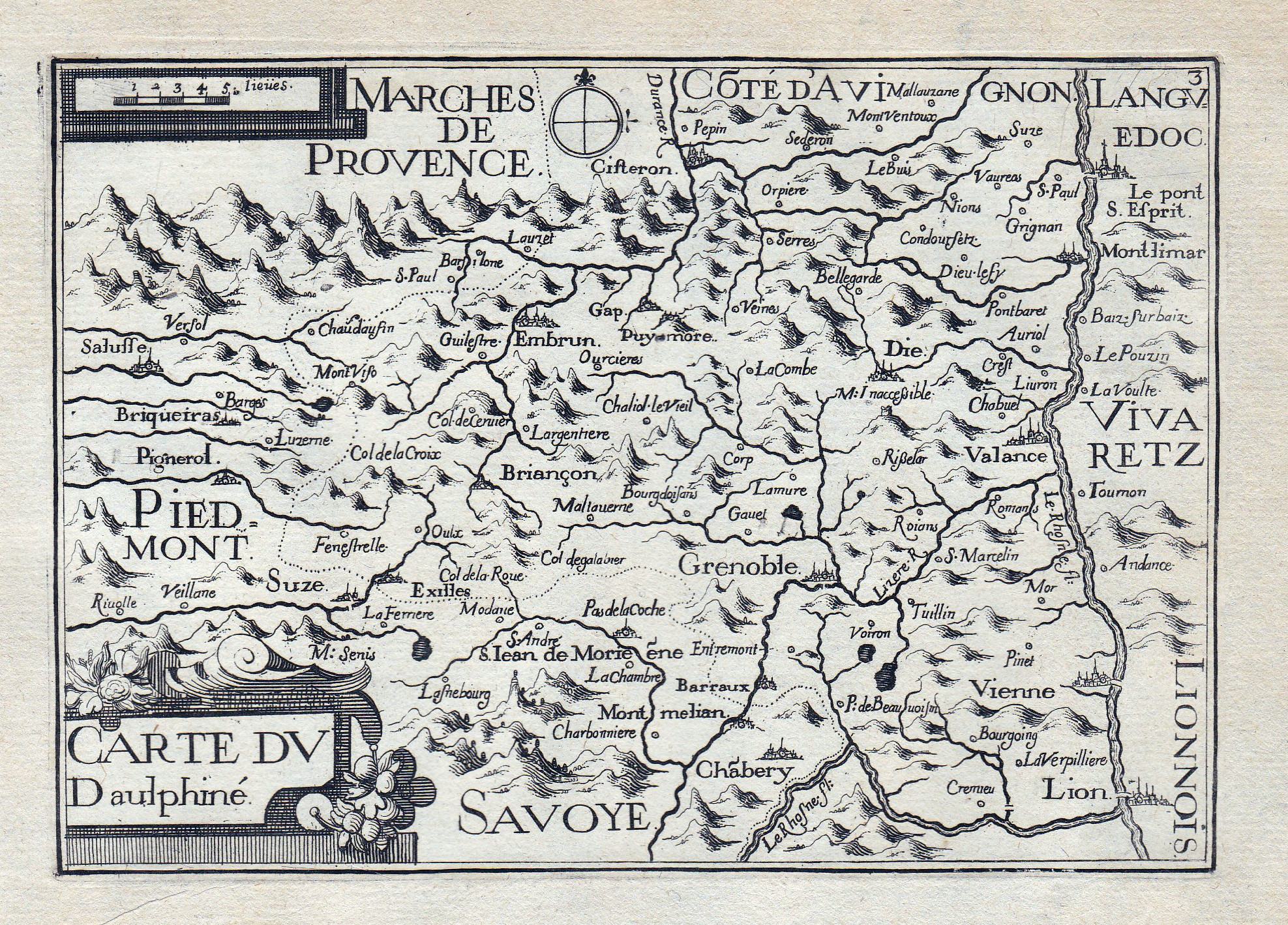
The ‘Carte du Dauphiné’ by Christophe (or Nicolas) Tassin (died 1660), printed in 1630, sets the scene.
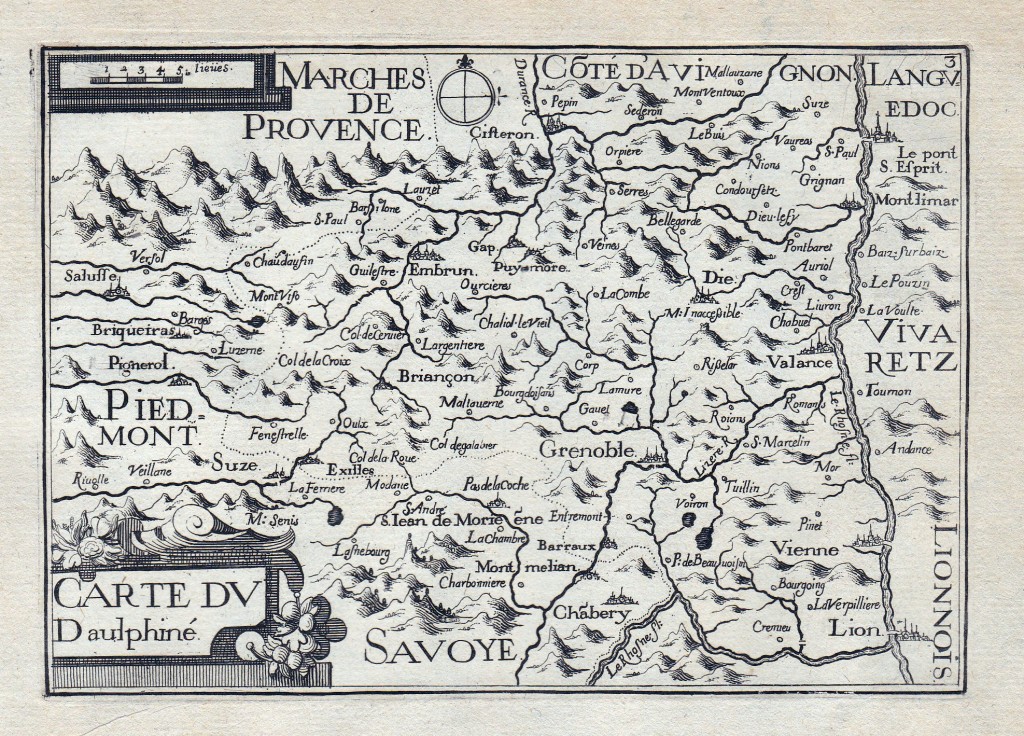
'Carte du Dauphiné' by Christophe (or Nicolas) Tassin, printed in 1630. Private Collection, reproduced by permission.

‘Carte du Dauphiné’ by Christophe (or Nicolas) Tassin, printed in 1630. Private Collection, reproduced by permission.

[Update:  A Comment by Wales Legerwood on 11 January 2022 observes: “I have this map in my collection. Interesting that the north arrow of the compass rose as drawn on this particular map is engraved pointing in the wrong direction: south. It should be rotated about 180 degrees.”
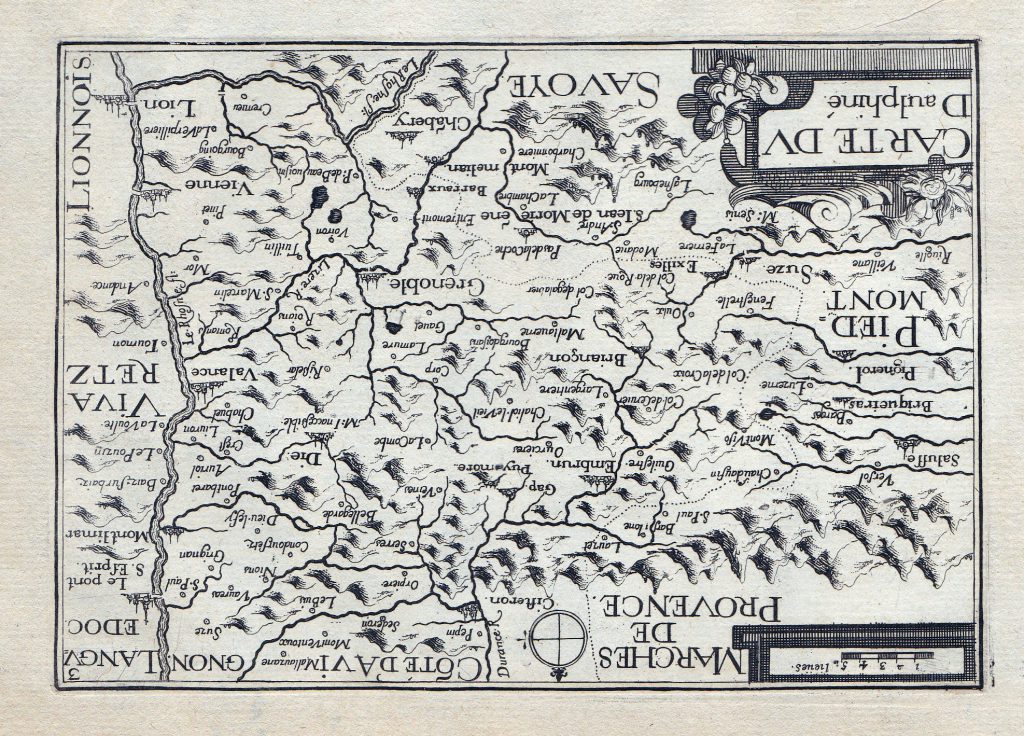
'Carte du Dauphiné' by Christophe (or Nicolas) Tassin, printed in 1630. Private Collection, reproduced by permission.

‘Carte du Dauphiné’ by Christophe (or Nicolas) Tassin, printed in 1630. Private Collection, reproduced by permission.

[A map printed a few years later by the same cartographer shows another view.]
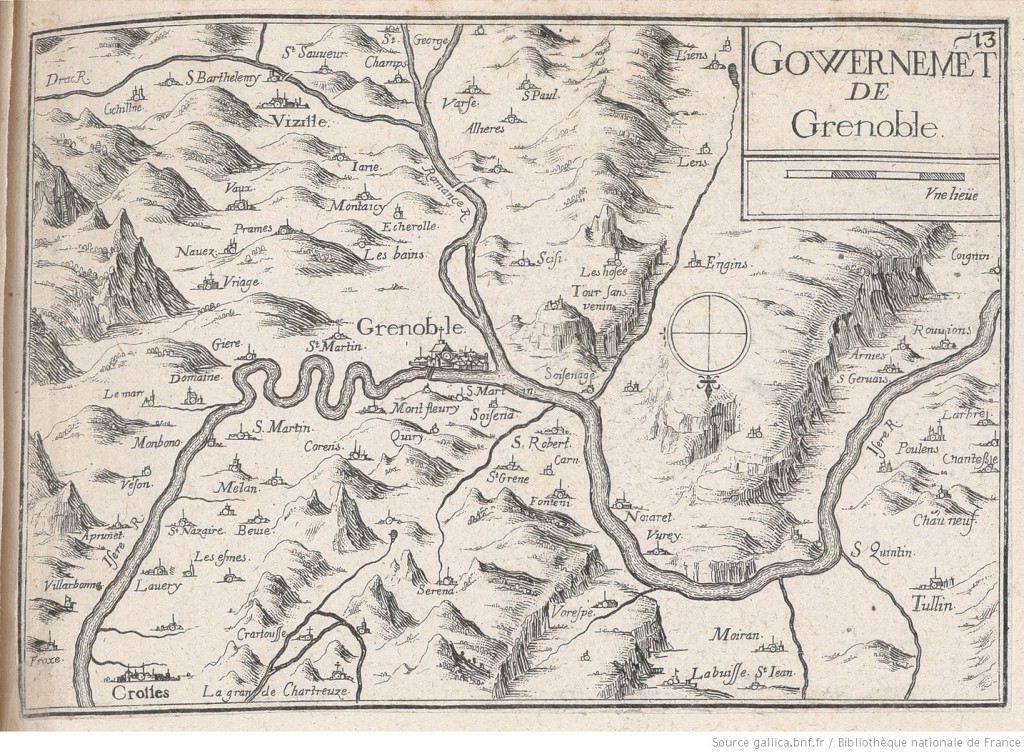
Govvernement du Grenoble. 'Plans, vues et cartes du Dauphiné' by Christophe Tassin (1634). Via gallica.bfn.fr: https://gallica.bnf.fr/ark:/12148/btv1b53152793f/f2.item.r=Christophe%20TassinDauphine%20Dauphine.

Govvernement du Grenoble. ‘Plans, vues et cartes du Dauphiné’ by Christophe Tassin (1634). Via gallica.bfn.fr.

Seal the Deal

Written in an expert cursive documentary script in brown ink by a single scribe, the 5-line record is ‘signed’ or attested by the double names of Henricus in full (‘Henri’) and the abbreviated Joha[nnes?] (‘Jean’?), accompanied by a tall monogram or cypher to their right.  Both the single names and the cypher are flanked or surrounded by dots, setting them off as names and/or signs as such.

The names and cypher are written in 2 lines by a single hand, perhaps different from the main scribe, in a more compressed upright script.  The names are flanked by dots.  The cypher, both flanked and surmounted by dots, perhaps combines their initial letters h and J in an elegant flourish.

If the names pertain to a single individual, during this period the combination implies a person of some importance worthy of a first and a second name together.  Both the names and the cypher manifest an accomplished hand.  If written by their named individual, they manifest his scribal training to proficiency and, perhaps as well, a commensurate degree of literacy.

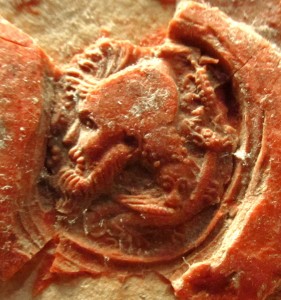
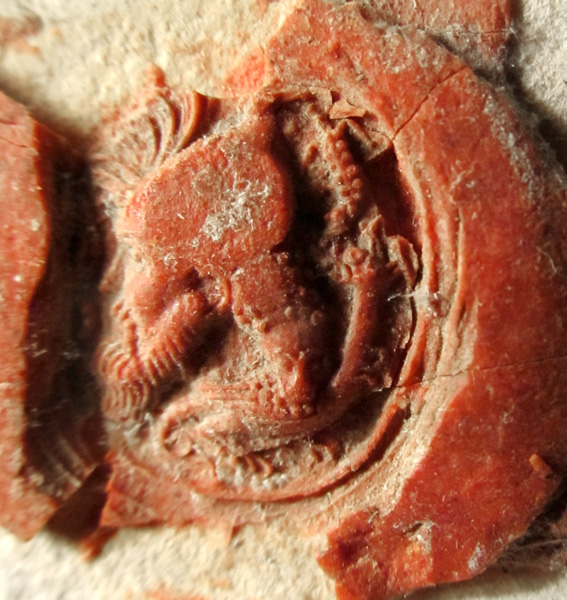
Detail of red wax seal on Latin document issued at Grenoble and dated on 22 February 1345 Old Style, with human head in profile facing left. Image reproduced by permission.The names may hold some clue(s) to the meaning of the Device (that is, images) on the Seal, which bears no Legend (that is, inscription) to aid, compound, or delight the process of its decipherment. Perhaps deciphering the one in time may speed the decipherment of the other.

Whoever their owner, the complexity of the design on the Device and the manifest skill of its execution demonstrates an imposing, and perhaps comparably idiosyncratic, identity for this Henricus Joha[. . . ], whose second name could be Johannes (or the like).  It is worth recognizing, however, that, given late medieval naming practices in many regions, the abbreviation for a second name or surname could stand for a place-name, an occupational name, a nickname, or some other appellation, rather than a personal name.

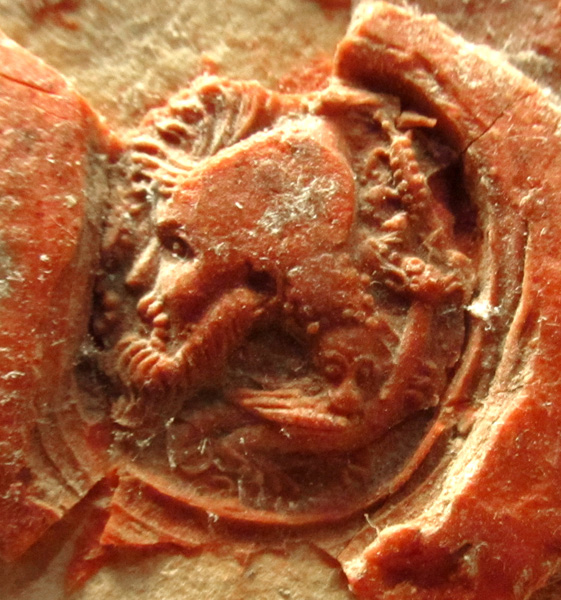
The seal in red wax affixed directly to the page to the lower right of these 2 names depicts within a now-fragmentary roundel the image of a male human head seen in profile with a straight nose, both beard and moustache, and either a conical helmet (albeit without any rim) or an elongated, distorted skull formation.  As it stands on the page, sealed in wax, the head faces downward, but when it is seen upright, the head faces left.

On the page to the left of the names Henri and Jean[?] there appear the remnants in red of a rimmed element and other elements pertaining either to the offset of this seal (for which no folds on the document bear obvious witness) or perhaps to another attestation of unknown identity, now mostly effaced.

Paper Trail

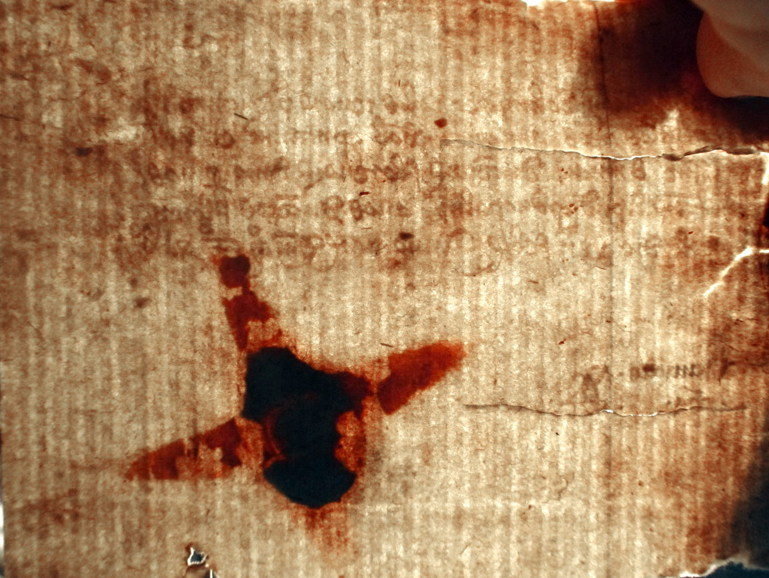
The paper itself carries no watermark, unfortunately, but the surviving remnant of the document is a small portion of the original sheet of paper.  The lines within the paper, however, are very different from those found on later samples, so that the specimen merits interest as an unusual survivor in the history of the development of European paper.

Back-lighting, as seen here, reveals the structure of the lines more clearly.  More posts about this subject, plus a gallery of specimens of European paper across centuries, are in preparation for our website.
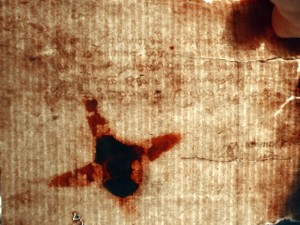
Back-lit view of the paper of the Grenoble document of 22 February 1345 Old Style, showing the lines of the paper. Image reproduced by permission.

Wax Lyrical

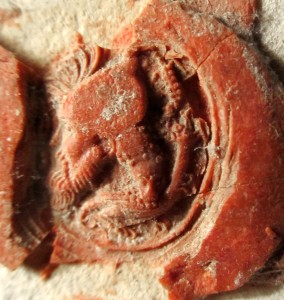
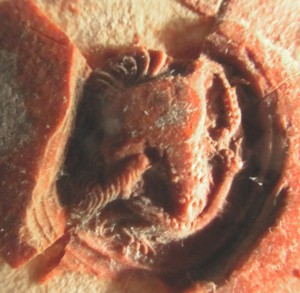
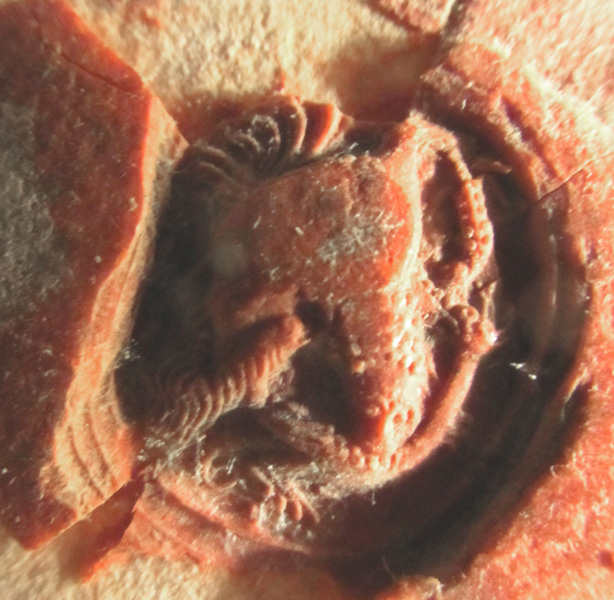
The red wax seal seen upright, with the male human head facing left. Document on paper issued at Grenoble and dated 13 February 1345 (Old Style). Image reproduced by permissionClose-up of the seal with side-lighting. Image reproduced by permission.Close-up of the seal with lower side-lighting. Image reproduced by permission.Different levels of side-lighting, shown here, reveal more of the details of the Device on the seal.  Its features are curious, to say the least.

At the base of the human neck appears the frontal face (or ‘mask’) of a lion-like creature, which grips in its jaws the base of the long neck of a wide-eyed, winged goose-like creature, seen in profile, crouched beneath the human head.  Fanned plumes or a crest rise(s) above and in front of the head or, it may be, helmet.  Details to the fore of the face seem difficult to discern, perhaps an indication of some wear and age to the seal matrix.  Such ‘blurred’ or fragmented features could suggest that the matrix had received much use, perhaps from being handed down within a family.

A knob-like extension at the crest of the head-or-helmet leads to the base of some formation lost in the damaged ‘apex’ of the field. Behind the rounded back of the head stretches a skinny lizard-like creature, seen from above, rising or crawling above the goose’s head toward the ‘top’ of the scene.  Damage to the seal (or imperfection in its impression) at the right of the lower half of the ‘lizard’ perhaps removed some element in the scene.  The goose’s closed beak clamps onto the remnant of lizard’s right hind-leg.  A curious combination.

The depicted food chain appears to defy biology.  But it does pique curiosity.  Human Neck —> ‘Lion’ Mask —> ‘Goose’ —> ‘Lizard’.  Huh?
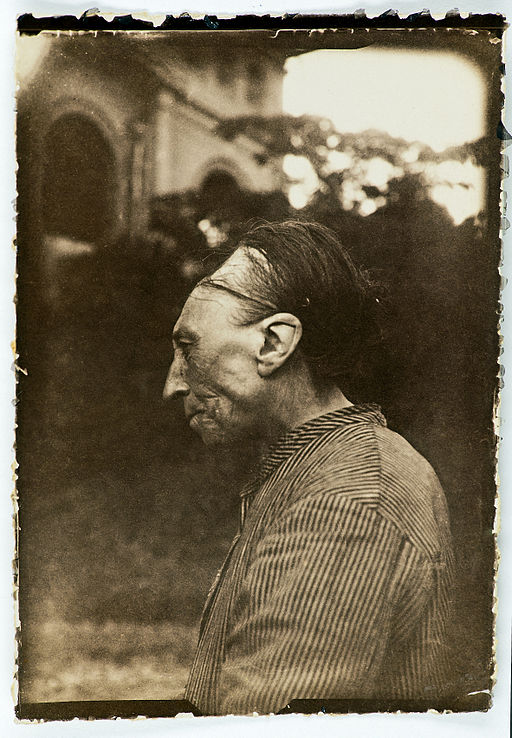
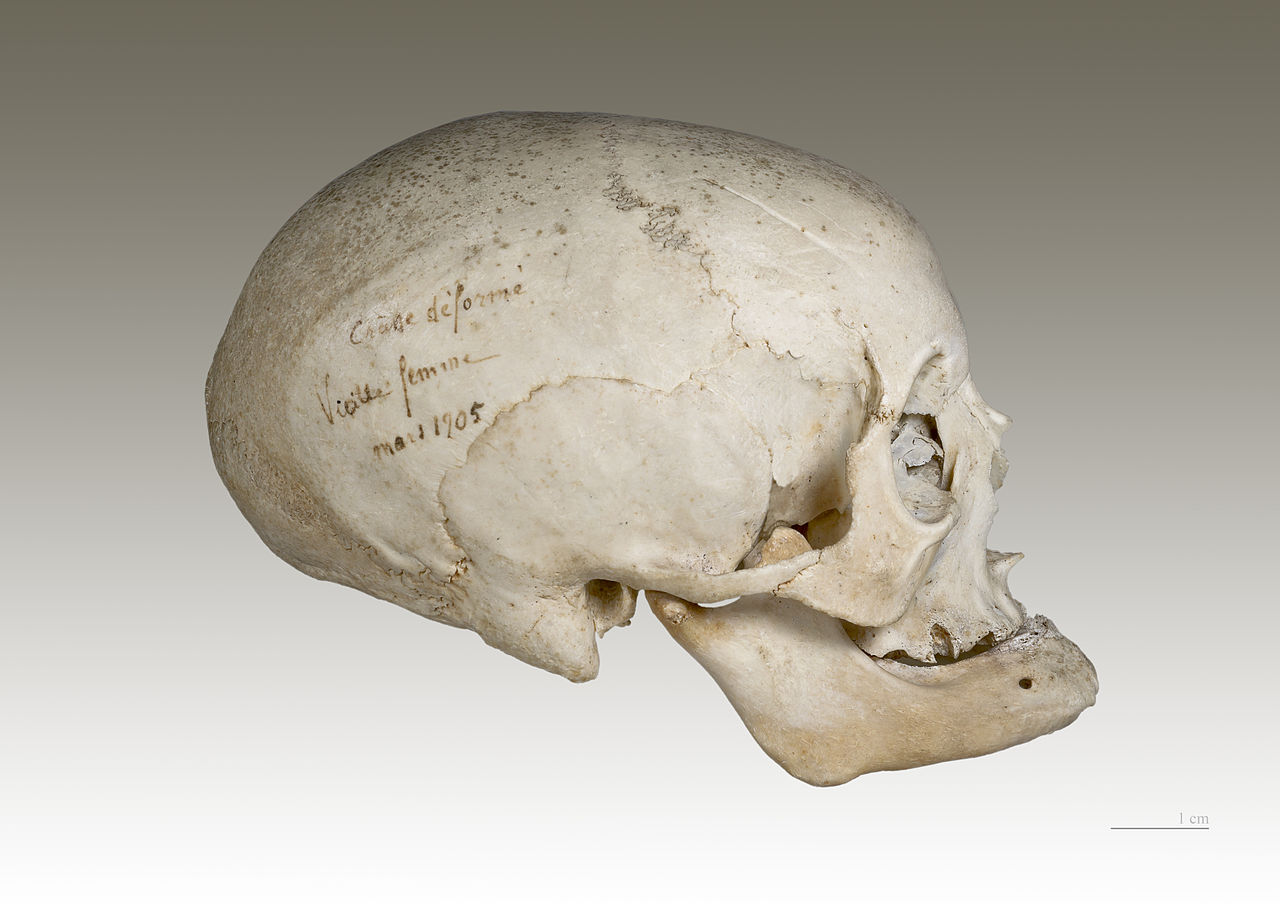
Homo sapiens sapiens - Deliberate deformity of the skull, "Toulouse deformity"

«_déformation_toulousaine_»_MHNT (Author Unknown / restoration and digitization. Didier Descouens / Wikimedia Commons / Public Domain)

Skull-Duggery

Curious, too, is the elongated shape of the skull, which might or might not be ‘natural’.  The shape appears deformed, like the cranial deformation of human heads or skulls observed in many parts of the world across the centuries or millenia, whether biological or artificial. Widely ranging examples include many ancient Peruvian skulls (from circa 6000–7000 BCE onward), ancient Egyptian examples from the sphere of the Pharoah Akhenaten (1375–1358 BCE), manifestations in art and the archaeological record through many periods of Mesoamerican Mayan culture, and recognized cases of skulls among East Germanic and Huns peoples in migration in the early medieval period in the West.

[Update: Newly discovered is a ‘Conehead’ skeleton, approximately 2,000 years old, of a woman of the Sarmati tribe excavated at Arkaim, near Chelyabinsk, in the southern Urals.]

Such practices reshaped the heads of some humans, for whatever reasons, perhaps or apparently involving prestige.  Both the evidence and the issues remain subjects of fascination and controversy. For example, not all cases which have been considered as representatives of the habit still qualify, as with a Proto-Neolithic skull from Shanidar (circa 300,000–30,000 BCE), previously believed to comprise the earliest known example but now differently reconstructed. But the amplitude of the bodies of evidence for alteration of the shape of skulls through human intervention provides a source of wonder. The practice of intentional cranial deformation, in different manifestations across the centuries in many parts of the world, could produce a ‘permanently visible symptom of social affiliation’. So prominent a feature is hard to miss.

It seems that, in certain contexts, head shape demarcates membership and hierarchies within social or ethnic groups among larger societies, with some apparent manipulation of shapes in the pursuit of demonstrating, or cultivating, affiliations with groups or individuals in power.  The wide range of observable cases of skull deformation globally has been the focus of medical study and classification, for example by Eric John Dingwall (1931) (freely available in full online) and by Amit Ayer, Alexander Campbell, et al. ‘The Sociopolitical History and Physiological Underpinnings of Skull Deformation’ (2010).

Not all cases of strange skull shapes are deliberate, of course, but, whatever the case here in the wax seal, the outcome — if it represents head-shape rather than helmet (which might, presumably, be removed at will) — would be permanently, irrevocably visible for all to see.  Perhaps for some it would have been a source of awe, if not admiration.

Such aspirations for altering physical characteristics of a specific, and visible, part of the human body seem to have governed, for example, the practices of Chinese foot-binding.  The late survivors of that practice make it possible to interview, as well as to photograph in the flesh, some living witnesses.

In a way, the seal of Henry J. itself might give us a glimpse, close-up, of his particular, if not peculiar, characteristics, along with some choices of his own about elements outside his body (animal, etc.) to express his identity on the page.

A Medieval Case of the ‘Toulouse Deformity’?
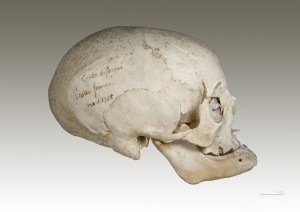
« Crane déformé 1905 MHNT » par Didier Descouens — Travail personnel. Sous licence CC BY-SA 3.0 via Wikimedia Commons

Déformation toulousaine – Muséum de Toulouse. « Crane déformé 1905 MHNT » par Didier Descouens (Own work), via Wikimedia Commons

Curiouser for the presence of our seal on a Grenoble document is the persistence of such a custom, altering the shape of the human cranium by artificial distortion, in parts of Southern France until rather recently, as described and illustrated, for example, in the Wiki articles on Artificial Cranial Deformation or Déformation volontaire du crâne.  This ‘deliberate deformity of the skull’ is known as the ‘Toulouse deformity’.  In this style or type of cranial deformation, a tight cap is placed upon the head, or a band is wrapped around the cranium to compress it into a circular shape, which expands upwards into a cone.

The study of ‘Later Artificial Cranial Deformation in Europe’ (1931) observes that such practices in recent centuries centered upon France.  Perhaps the elongated conical shape of the head on the wax seal formed in 1345 bears witness to the custom as a revival or survival of earlier practices, in their transmission variably across time within or across regions.

It’s a Stretch

It seems not inappropriate to consider in this connection the condition — not entirely a predicament — of being ‘stretched tall’, in which Alice found herself to appear in Wonderland (1853), under the heading of Curiouser and Curiouser.
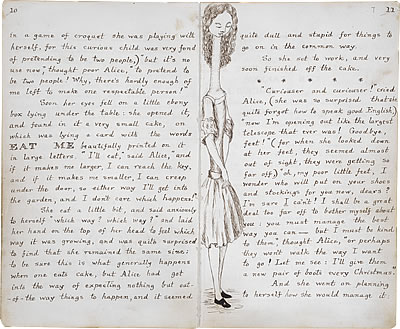
©The British Library Board, Add. MS 46700, pgs 10-11

©The British Library Board, Add. MS 46700, pgs 10-11. Reproduced by permission

“Curiouser and curiouser!” cried Alice, (she was so surprised that she quite forgot how to speak good English,) “now I’m opening out like the largest telescope that ever was! Goodbye, feet!”

The author’s original manuscript of the first version of the text, now in the British Library, illustrates Alice’s elongated form as envisioned by her creator ‘Lewis Carroll’ (1832–1898), whose pen-name itself is a confection.

The similarly elongated neck on the seal enters a world of fantasy and imagination with its combination of creatures somehow integrated with the human world, both seemingly easily and not so much.

Skull-asticism

Whether the image on the seal represents, or is intended to represent, a given human individual rather than some fanciful being, the combination of creatures clustered around his head suggests a puzzle or word-play.  Within the complex, wide-ranging world of medieval seals and their molds or matrices, there were multiple forms of presenting, or combining, images of one kind and/or another, with or without text.  Many other medieval seals, too, draw upon non-heraldic structures — that is, elements not specifically assigned (as yet) in the time-honored code of heraldry, according to specific rules for devising heraldic coats of arms of rank for persons, families, dynasties, towns, cities, and other organizations.

Non-heraldic forms on seals can indicate in less formally codified, but not necessarily less rigorously chosen, elements to indicate, or to suggest, the identity, name, occupation, preoccupations, predilections, or other characteristics of the owner of the seal.  Many cases, which we in the Research Group on Manuscript Evidence have had the opportunity over recent years to study in detail on site over time, occur within the remarkable selection of medieval seal matrices and documents assembled in the Collection of our Associate John H. Rassweiler and now presented in part as the Rassweiler Collection Online.
The red wax seal seen upright, with the male human head facing left. Document on paper issued at Grenoble and dated 13 February 1345 (Old Style). Image reproduced by permissionThe ensemble in Henricus J.‘s seal confirming a transaction in Grenoble in 1345 may, for example, function as a form of rebus, with an allusion to the owner or his identity in some way, or as the visual illustration of some proverb, in a motto for his or anyone’s consideration.  Such practices are not uncommon in shaping the Devices of medieval European seals.

Or, could we say, such practices may be most uncommon, although widespread.  Common and Uncommon:  that combination could be right for this seal’s Device.  Its designer may have smiled to think of the curious combination.

Within the genre, this Device seems remarkably ingenious.  The script of its owner’s ‘signature’ could indicate that he was well educated.

Dare we say Cerebral?

Its answer, or solution, may yet come to light.

You Think?

More research might illuminate the context of this document, reveal more of its original text, identify the person(s) involved in its record and attestation, and provide the key to its curious seal.  Perhaps you could help with suggestions and information.

We invite you to contribute to the exploration – and its adventure.

Please leave a  Comment here, Contact Us, or join the conversation on our Facebook page.

P. S.  In the conversations about this Post, one of our friends called it a case where ‘Codicology Meets Craniology’.  Cool.

*****

[Published on 10 June 2015, with updates]

Tags: 'Toulouse deformity', 22 February 1345 Old Style, Alice in Wonderland, Artificial cranial deformation, Cranial deformation, Grenoble, History of Paper, Medieval Dauphiné, Medieval Latin documents, medieval seal, Red wax seal
No Comments »

2014 Congress Report

June 25, 2014 in Abstracts of Conference Papers, Bembino, Conference Announcement, ICMS, International Congress on Medieval Studies, Kalamazoo

49th International Congress on Medieval Studies
An Anniversary Year

8-11 May 2014

[Published on 25 June 2014, with updates]

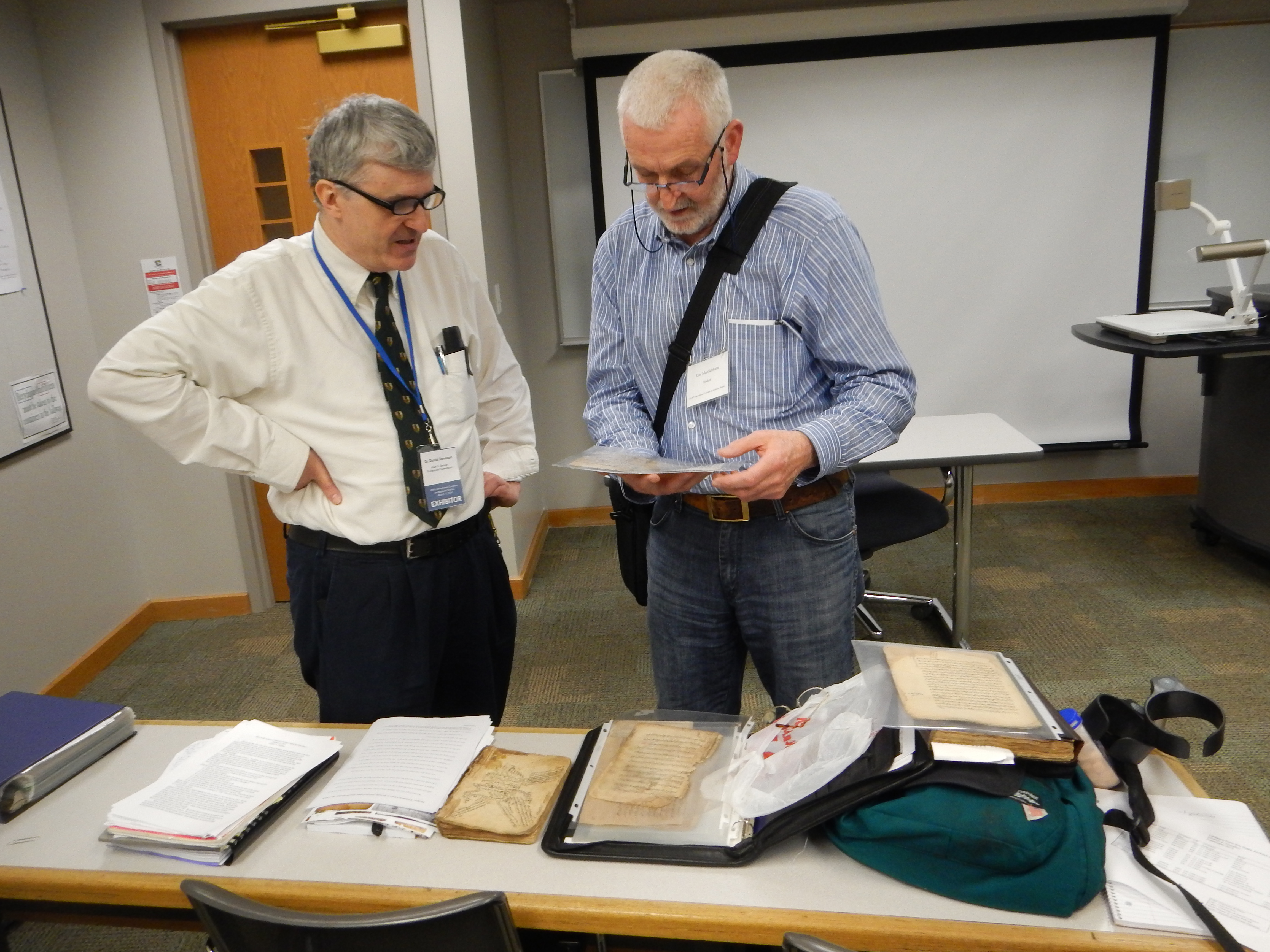
David Sorenson and Donncha MacGabhann examine manuscript materials

Photography by Mildred Budny

Our sessions at the 2014 Congress formed part of the celebrations for our anniversary year.   2014 marks our 15th anniversary as a nonprofit educational organization and our 25th anniversary as an international scholarly society.  At the Congress, we both sponsored sessions and co-sponsored sessions, as before, with the Societas Magica, in the eighth year of this co-sponsorship, and, for the first time, with the Center for the Study of Medieval and Early Modern Studies at the University of Florida.  As is our practice, various of our Trustees, Officers, and Associates participated in these and other sessions at the Congress.

Read the rest of this entry →

Tags: Anglo-Saxon Manuscripts, Assenids, Book of Kells, Carolingian Manuscripts, Center for Medieval and Early Modern Studies at the University of Florida, Datini Archives, Early Ottoman Empire, Ethiopic Manuscripts, Gems, History of Canon Law, History of Magic, History of Paper, House Style, Individual Style, Islamic Manuscripts, Manuscript Illumination, Manuscript studies, Medieval manuscripts, Medieval Music, Medieval Writing Materials, Palaeography, Second Bulgarian Empire, Societas Magica, Talismans
No Comments »

2014 Congress Announced

January 8, 2014 in Anniversary, Conference Announcement, ICMS, International Congress on Medieval Studies, Kalamazoo

49th International Congress on Medieval Studies

8-11 May 2014

[Published on our first website on 8 January 2014, with updates there and here]

We announce the program for our sponsored and co-sponsored sessions at the next International Congress on Medieval Studies, when we will celebrate our anniversary year, along with that of one of our co-sponsors, the Societas Magica.  2014 marks the 20th anniversary of the Societas Magica.  For the Research Group on Manuscript Evidence, it marks our 15th anniversary as a nonprofit educational organization and our 25th anniversary as an international scholarly society.  This is the ninth year of our co-sponsorship with the Societas Magica, and the first year of co-sponsorship with the Center for Medieval and Early Modern Studies at the University of Florida.  The Events at this Congress celebrate these shared accomplishments.

This year, with the transition to our second, updated website (begun in 2014 and completed in 2015), we began to issue the announcements for a given Congress in a series of blogposts, rather than overwriting its statements, which had left only the final state in view.  Here we offer the Congress Announced, with more to come.

Read the rest of this entry →

Tags: Abba Gärima Gospels, Anglo-Saxon Manuscripts, Archaeology, Barberini Gospels, Biblical Studies, Book of Kells, Bulgarian Studies, Center for Medieval and Early Modern Studies at the University of Florida, City of Tărnovo, Corpus Christi College MS 197B, Datini Archives, Early Medieval Art, Early Ottoman Empire, Ethiopic Manuscripts, Gems, Half-Uncial Script, History of Canon Law, History of Catholicism, History of Magic, History of Music, History of Paper, History of Style, History of the Assenids, History of Watermarks, House Style, Individual Style, Insular Manuscripts, Islamic Manuscripts, Legal History, Manuscript Illumination, McGill University MS MCG 117, Medieval manuscripts, Medieval Studies, Mediterranean Trade, Orthodox Christianity, Palaeography, Polygraphism, Renaissance Studies, Renaissance Visual Culture, Second Bulgarian Empire, Silistra, Societas Magica, South-East European History, Talismans, Uncial Script, Workshop Practices, Writing materials
No Comments »

2013 Congress

January 1, 2014 in Abstracts of Conference Papers, Bembino, Conference Announcement, ICMS, International Congress on Medieval Studies, Kalamazoo

48th International Congress on Medieval Studies

9-12 May 2013

[First published on our first website on *6 December 2012, with updates there and here]

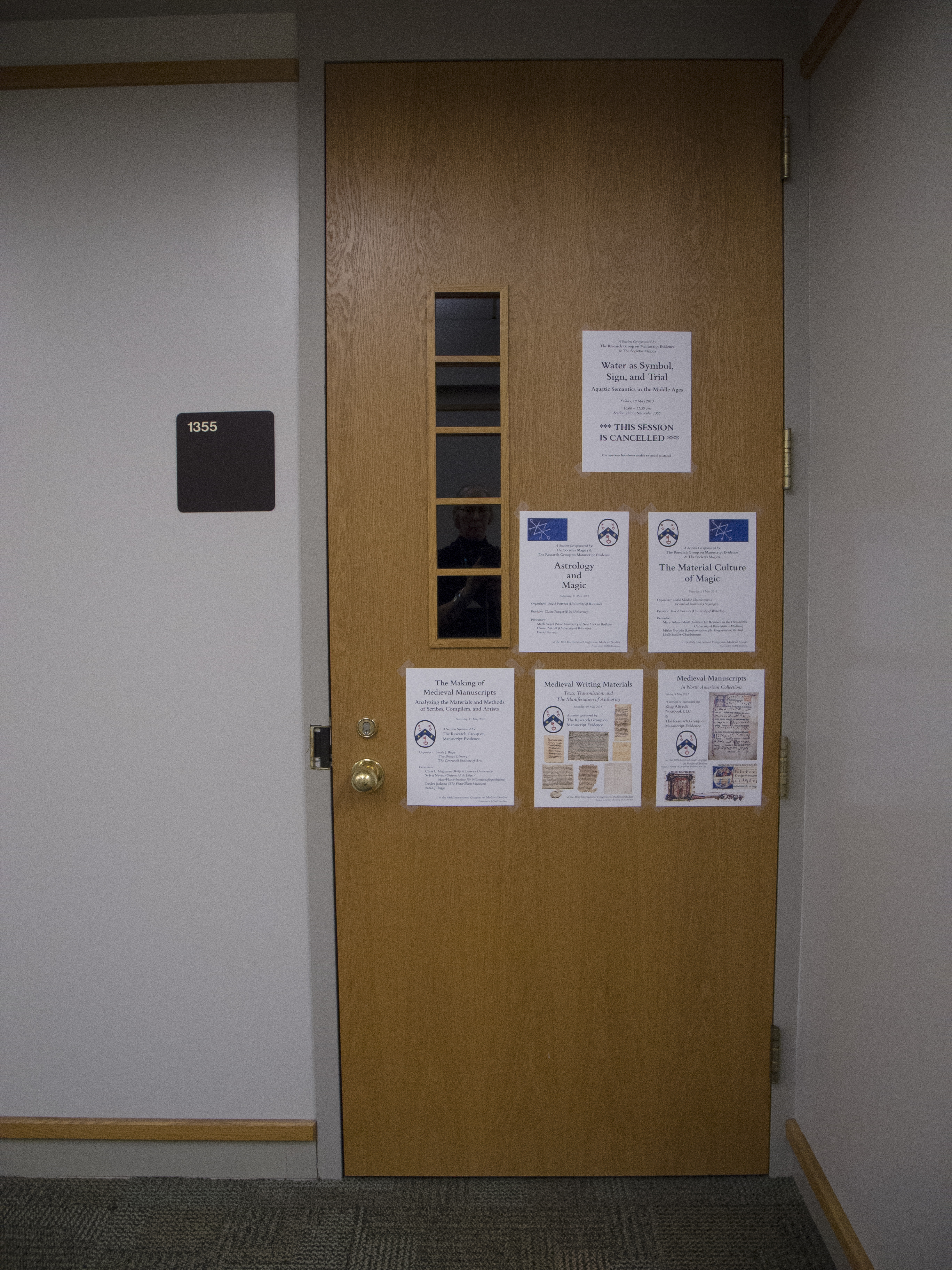
Posters for our Sessions displayed at the 2014 CongressWith its mission to “apply an integrated, holistic approach to manuscripts and texts in all forms,” at the International Congress on Medieval Studies in 2013, the Research Group on Manuscript Evidence held sponsored and co-sponsored sessions examining the material culture, production, and purposes of written records in Western Europe and beyond, and the dispersal, recovery, and study of those works in various forms and widespread locations.  Besides these interlinked subjects, the year’s highlighted genres were astrology, the material technology of magic, and the symbolism of water in the Middle Ages.

As before, we co-sponsored sessions with the Societas Magica and King Alfred’s Notebook LLC (respectively in the eighth and second years of this co-sponsorship). Also, three of our Trustees and many of our Officers, and Associates presented papers at the Congress in a variety of sessions.

Here we report the Programs for our Sessions, publish the Abstracts of their Papers, and illustrate the Posters for the Sessions.  For the first time, we designed Posters for all of our Sessions at the Congress, Sponsored and Co-Sponsored.  At the 2011 Congress we had one Poster, and two Posters at this 2013 Congress for our Sponsored Sessions, all with images courtesy of David W. Sorenson, whose donation of images inspired their creation. The series of Posters now stand exhibited in our Gallery of Posters on Display.  The Posters are set in our own multi-lingual digital font Bembino, available for download for FREE here.

Read the rest of this entry →

Tags: 'Huntingdonshire Scribe', Adam Pinkhurst, Artists' Recipe Books, Astrology, Bibliothèque nationale de France Ms Latin 16714, British Library Cotton MS Faustina C i, Datini Archive, Digital Imaging, Ducal Charters, History of Paper, Islamic Paper, Late Medieval English Scribes Project, Manipulus Florum, Manuscript Illumination, Manuscript studies, Medieval Manuscript Collecting, Medieval manuscripts, Medieval Music, Medieval Writing Materials, Middle English, Orpiment Pigment, Palaeography, Peter of Blois, Picatrix, Pigment Analysis, Popular Magic, Rhygyfarch ap Sulien, Scribe B - Pynkhurst Debate, Sigillum Dei, Silesia, Societas Magica, Textual Amulet, Thomas of Ireland, Welsh-Latin Poetry
No Comments »

2012 Congress

January 1, 2014 in Abstracts of Conference Papers, Bembino, Conference Announcement, ICMS, International Congress on Medieval Studies, Kalamazoo

47th International Congress on Medieval Studies

10–13 May 2012

[First published on our first website on *15 December 2011, with updates there and here]

Our four Sponsored and Co-Sponsored Sessions at the 2012 Congress examined the material culture and production of written records in Western Europe and beyond, and the dispersal, recovery, and preservation of those works in various forms and widespread locations.  Besides these interlinked subjects, our highlighted genre was “Dream Books”, appearing in multiple manifestations in both manuscript and print.

One Session was the second in our series at the Congress on “Medieval Writing Materials”.  Its series (2011–2014 and, intended, 2016) is listed in our Sponsored Conference Sessions.

This year, for the first time, after the debut of a single illustrated Poster for one of our sponsored Sessions at the 2011 Congress, an illustrated Posters accompanied both of our own Sponsored Sessions.  Since 2015, the full series of illustrated Posters for Congress Sessions and other Events appear in our Gallery of Posters on Display. Read the rest of this entry →

Tags: Alchemy, Archaeology, Bembino Digital Font, Books of Hours, British Library, Chinese Manuscripts, Codicology, Datini Archives, Dream Books, Dream Divination, Ethiopic Manuscripts, History of Paper, History of Scotland, Islamic Manuscripts, Manuscript Illumination, Manuscripts & Early Printed Books, Medieval & Modern Scribal Practices, Medieval China, Medieval Italian Studies, Medieval Manuscript Collecting, Medieval manuscripts, Medieval Writing Materials, Mediterranean Trade, Middle English, Multi-spectral Imaging, North American Library History, Oneirocritical Manuscripts, Parc Abbey Bible, Pigment Analysis, Societas Magica, Somniale Danielis, Venice
No Comments »

2011 Congress

January 1, 2014 in Abstracts of Conference Papers, Bembino, Conference Announcement, ICMS, International Congress on Medieval Studies

46th International Congress on Medieval Studies

12–15 May 2011

[First published on our first website on *20 January 2011, with updates]

At this Congress, the Research Group on Manuscript Evidence held two sessions, respectively sponsored and co-sponsored, in the fifth year of co-sponsorship with the Societas Magica.  As customary, Trustees and Associates of the Research Group participated in the Congress in various capacities.

Here we list the Programs of the sessions, along with Abstracts of Papers, and we publish the first of our Posters ever for such sessions.

The inspiration for the poster came from the generous offer by our session participant David W. Sorenson to give images of manuscripts free of charge for reproduction for such purposes.  Thus the poster includes donated images and design, with images courtesy of David Sorenson and with layout in our copyright digital font Bembino, described and downloadable for FREE here:  Bembino.

[Update: This ‘first edition’ inaugurated a tradition of illustrated Posters for our Congress Sessions in following years, as recorded in our Congress Activities, as well as for our other Events elsewhere, including Colloquia & Symposia. Since 2014, they are exhibited in our Gallery of Posters on Display.]

Read the rest of this entry →

Tags: Archaeology of Manuscripts, Bembino Digital Font, Blythburgh Tablet, Carrara Herbal, Catacombs in Rome, Cyphers, Epigraphs, Ethiopic Manuscripts, History of Paper, Manuscript studies, Medieval manuscripts, Medieval Writing Materials, Mediterrnanean Commerce, Middle English Studies, Monumental Inscriptions, Near Eastern Studies, Oxford MS Bodleian Hatton 56, Sobieski Hours, Societas Magica, Writing materials, Writing Tablets
No Comments »

Newer Entries »
  • Top
©2024 Research Group on Manuscript Evidence.


is proudly powered by WordPress. WordPress Themes X2 developed by ThemeKraft.