• News
    • News & Views
    • RGME Activities for 2024 and 2025
    • Around & About with the RGME
    • Reviews
    • Highlights
  • Blogs
    • Manuscript Studies
      • Manuscript Studies: Contents List
    • International Congress on Medieval Studies
      • Abstracts of Congress Papers
        • Abstracts of Papers Listed by Author
        • Abstracts of Papers Listed by Year
  • About
    • Mission
    • Who We Are
      • Officers, Associates & Volunteers
      • RGME Committees
      • Friends of the Research Group on Manuscript Evidence
    • Policies & Statements
      • RGME Privacy Policy Statement
      • RGME Intellectual Property Statement & Agreements
    • People
      • Mildred Budny — Her Page
      • Adelaide Bennett Hagens
    • Activities
      • Events
      • Congress Activities
        • Sponsored Conference Sessions (1993‒)
          • Panels at the M-MLA Convention (from 2016)
        • Co-sponsored Conference Sessions (2006‒)
    • History
      • Seals, Matrices & Documents
      • Genealogies & Archives
    • Contact Us
  • Bembino
    • Multi-Lingual Bembino
    • RGME Bembino: Resources
  • Congress
    • Sponsored Conference Sessions (1993‒)
    • Co-sponsored Conference Sessions (2006‒)
    • Abstracts of Congress Papers
      • Abstracts Listed by Author
      • Abstracts Listed by Year
    • Kalamazoo Archive
    • Panels at the M-MLA Convention (2016-2019)
      • Abstracts of Papers for the M-MLA Convention
      • Panels at the M-MLA Convention (from 2016)
  • Events
    • RGME Activities for 2024 and 2025
      • 2023 Activities and 2024 Planned Activities
    • Seminars, Workshops, Colloquia & Symposia (1989–)
      • Seminars on ‘The Evidence of Manuscripts’
      • Symposia on ‘The Transmission of the Bible’
      • The New Series (2001-)
        • 2019 Anniversary Symposium Program: The Roads Taken
        • 2019 Anniversary Symposium Registration
        • 2019 Anniversary Symposium Registration Open
      • RGME Symposia: The Various Series
      • The Research Group Speaks: The Series
      • Meetings of the Friends of the Research Group on Manuscript Evidence
      • RGME Online Events
    • Abstracts of Papers for Events
      • Abstracts of Papers for Seminars on ‘The Evidence of Manuscripts’
      • Abstracts of Papers for Symposia, Workshops & Colloquia
    • Receptions & Parties
    • Business Meetings
    • Photographic Exhibitions & Master Classes
    • Events Archive
  • ShelfLife
    • Journal Description
    • ShelfMarks: The RGME-Newsletter
    • Publications
      • “Insular, Anglo-Saxon, and Early Anglo-Norman Manuscript Art at Corpus Christi College, Cambridge” (1997)
        • Mildred Budny, ‘Catalogue’
        • The Illustrated Catalogue (1997)
      • The Illustrated Handlist
      • Semi-Official Counterfeiting in France 1380-1422
      • No Snap Decisions: Challenges of Manuscript Photography
    • History and Design of Our Website
  • Galleries
    • Watermarks & the History of Paper
    • Galleries: Contents List
    • Scripts on Parade
    • Texts on Parade
      • Latin Documents & Cartularies
      • New Testament Leaves in Old Armenian
    • Posters on Display
    • Layout Designs
  • Donations and Contributions
    • RGME Donor Promise
    • 2023 End-of-Year Fundraiser for our 2024 Anniversary Year
    • 2019 Anniversary Appeal
    • Orders
  • Links
    • Catalogs, Metadata, and Databases: A Handlist of Links
    • Handlist of Resources for Manuscript Studies and Fragmentology
    • Manuscripts & Rare Books
    • Maps, Plans & Drawings
    • Seals, Seal-Matrices & Documents

  • News
    • News & Views
    • RGME Activities for 2024 and 2025
    • Around & About with the RGME
    • Reviews
    • Highlights
  • Blogs
    • Manuscript Studies
      • Manuscript Studies: Contents List
    • International Congress on Medieval Studies
      • Abstracts of Congress Papers
        • Abstracts of Papers Listed by Author
        • Abstracts of Papers Listed by Year
  • About
    • Mission
    • Who We Are
      • Officers, Associates & Volunteers
      • RGME Committees
      • Friends of the Research Group on Manuscript Evidence
    • Policies & Statements
      • RGME Privacy Policy Statement
      • RGME Intellectual Property Statement & Agreements
    • People
      • Mildred Budny — Her Page
      • Adelaide Bennett Hagens
    • Activities
      • Events
      • Congress Activities
        • Sponsored Conference Sessions (1993‒)
          • Panels at the M-MLA Convention (from 2016)
        • Co-sponsored Conference Sessions (2006‒)
    • History
      • Seals, Matrices & Documents
      • Genealogies & Archives
    • Contact Us
  • Bembino
    • Multi-Lingual Bembino
    • RGME Bembino: Resources
  • Congress
    • Sponsored Conference Sessions (1993‒)
    • Co-sponsored Conference Sessions (2006‒)
    • Abstracts of Congress Papers
      • Abstracts Listed by Author
      • Abstracts Listed by Year
    • Kalamazoo Archive
    • Panels at the M-MLA Convention (2016-2019)
      • Abstracts of Papers for the M-MLA Convention
      • Panels at the M-MLA Convention (from 2016)
  • Events
    • RGME Activities for 2024 and 2025
      • 2023 Activities and 2024 Planned Activities
    • Seminars, Workshops, Colloquia & Symposia (1989–)
      • Seminars on ‘The Evidence of Manuscripts’
      • Symposia on ‘The Transmission of the Bible’
      • The New Series (2001-)
        • 2019 Anniversary Symposium Program: The Roads Taken
        • 2019 Anniversary Symposium Registration
        • 2019 Anniversary Symposium Registration Open
      • RGME Symposia: The Various Series
      • The Research Group Speaks: The Series
      • Meetings of the Friends of the Research Group on Manuscript Evidence
      • RGME Online Events
    • Abstracts of Papers for Events
      • Abstracts of Papers for Seminars on ‘The Evidence of Manuscripts’
      • Abstracts of Papers for Symposia, Workshops & Colloquia
    • Receptions & Parties
    • Business Meetings
    • Photographic Exhibitions & Master Classes
    • Events Archive
  • ShelfLife
    • Journal Description
    • ShelfMarks: The RGME-Newsletter
    • Publications
      • “Insular, Anglo-Saxon, and Early Anglo-Norman Manuscript Art at Corpus Christi College, Cambridge” (1997)
        • Mildred Budny, ‘Catalogue’
        • The Illustrated Catalogue (1997)
      • The Illustrated Handlist
      • Semi-Official Counterfeiting in France 1380-1422
      • No Snap Decisions: Challenges of Manuscript Photography
    • History and Design of Our Website
  • Galleries
    • Watermarks & the History of Paper
    • Galleries: Contents List
    • Scripts on Parade
    • Texts on Parade
      • Latin Documents & Cartularies
      • New Testament Leaves in Old Armenian
    • Posters on Display
    • Layout Designs
  • Donations and Contributions
    • RGME Donor Promise
    • 2023 End-of-Year Fundraiser for our 2024 Anniversary Year
    • 2019 Anniversary Appeal
    • Orders
  • Links
    • Catalogs, Metadata, and Databases: A Handlist of Links
    • Handlist of Resources for Manuscript Studies and Fragmentology
    • Manuscripts & Rare Books
    • Maps, Plans & Drawings
    • Seals, Seal-Matrices & Documents

Log in

Archives

Featured Posts

2026 RGME Symposium: “Teaching for the Future”
Workshop 11. “Manuscripts at Play, Continued: Figured Texts”
Episode 29. “The Life and Inquest of Jeanne-Marie de Maillé”
How to Join the RGME: Guide for Newcomers
Episode 28. Preview of Medieval “Printing on Fabric”
Episode 27. “Catalog(u)ing Collections and Materials”
2026 International Medieval Congress at Leeds: Program
Sanskrit and Prakrit Manuscripts, Continued: More Leaves for Manuscript Sample XII
Episode 24. “Life with Books” (Interview with John Windle)
Announcing the Launch of RGME Bembino WP
2026 RGME Colloquium at The Grolier Club: Report
Medieval Missal Fragment as Early-Modern Cover
The Weber Leaf from Ege MS 61
"Bembino" Booklet Cover
Episode 23. “Meet RGME Bembino: Facets of a Font”
2026 RGME Colloquium on “Transformations & Renewals” at The Grolier Club
2026 Theme of the Year: “Transformations and Renewals”
A Leaf with Patchwork from the Saint Albans Bible
A Sister Leaf from a Miniature Latin Vulgate Bible
A Little Latin Vulgate Bible Manuscript Leaf in Princeton
J. S. Wagner Collection. Leaf from from Prime in a Latin manuscript Breviary. Folio 4 Verso, with part of Psalm 117 (118) in the Vulgate Version, set out in verses with decorated initials.
2026 Annual Appeal
Episode 22: “Encounters with Local Saints and Their Cults”
Private Collection, Ege's FBNC Portfolio, Dante Leaf, Verso, Detail. Reproduced by Permission.
2025 RGME Autumn Colloquium on Fragments
Workshop 8: A Hybrid Book where Medieval Music Meets Early-Modern Herbal
2025 RGME Autumn Symposium on “Readers, Fakers, and Re-Creators of Books”
RGME Workshops on “The Evidence of Manuscripts, Etc.”
Episode 21. “Learning How to Look”
2025 International Congress on Medieval Studies: Program
2025 RGME Visit to Vassar College
Two Leaves in the Book of Numbers from the Chudleigh Bible
Delibovi on Glassgold on Boethius: A Blogpost
Ronald Smeltzer on “Émilie du Châtelet, Woman of Science”
2025 Spring Symposium: “Makers, Producers, and Collectors of Books”
Starters’ Orders
The Weber Leaf from the Saint Albans Bible
Workshop 4. “Manuscript Fragments Compared”
Episode 20. “Comic Book Theory for Medievalists”
Episode 19: “At the Gate: Starting the Year 2025 at its Threshold”
Favorite Recipes for Lemonade, Etc.
RGME Visit to the Lomazow Collection: Report
2024 Autumn Symposium: “At the Helm”
A Latin Vulgate Leaf of the Book of Numbers
The RGME ‘Lending Library’
Florence, Italy, Ponte Vecchio from Ponte alle Grazie. Photo: Ingo Mehling, CC BY-SA 4.0 , via Wikimedia Commons
Episode 17. “RGME Retrospect and Prospects: Anniversary Reflections”
Jesse Hurlbut at the Bonneville Salt Flats, Utah. Photograph Jesse Hurlbut.
Episode 16: An Interview with Jesse D. Hurlbut
Kalamazoo, MI Western Michigan University, Valley III from the side. Photograph: David W. Sorenson.
2024 International Congress on Medieval Studies: Report
2024 Spring Symposium at Vassar College
2024 Anniversary Symposium in Thanks to Jesse Hurlbut: Program

You are browsing the Blog for Photographic Exhibition

The Mass of Saint Gregory, Illustrated

April 7, 2015 in Manuscript Studies, Photographic Exhibition

A Solitary Leaf, Detached

[Published on 7 April 2015, with updates]
Mildred Budny (see Her Page) reflects on a medieval manuscript leaf and its clues as a detached artifact.  This post is one of the first in our blog on Manuscript Studies, for which there is now a Contents List.

Detail of the head of Christ. Photography © Mildred Budny

Christ’s Head, with Crown of Thorns

Detail of Veronica's Veil with the imprinted Face of Christ. Photography © Mildred Budny

Veronica’s Veil


On the occasion of Holy Week, Good Friday, and Easter (Western and Orthodox) 2015, we post a new set of photographs of a detached leaf from a 15th-century prayerbook of some kind, as yet unidentified.  Perhaps other parts of the book survive elsewhere.

The Image

Illustration of Gregory Mass, cropped to frame. Photography © Mildred Budny

The Mass of Saint Gregory

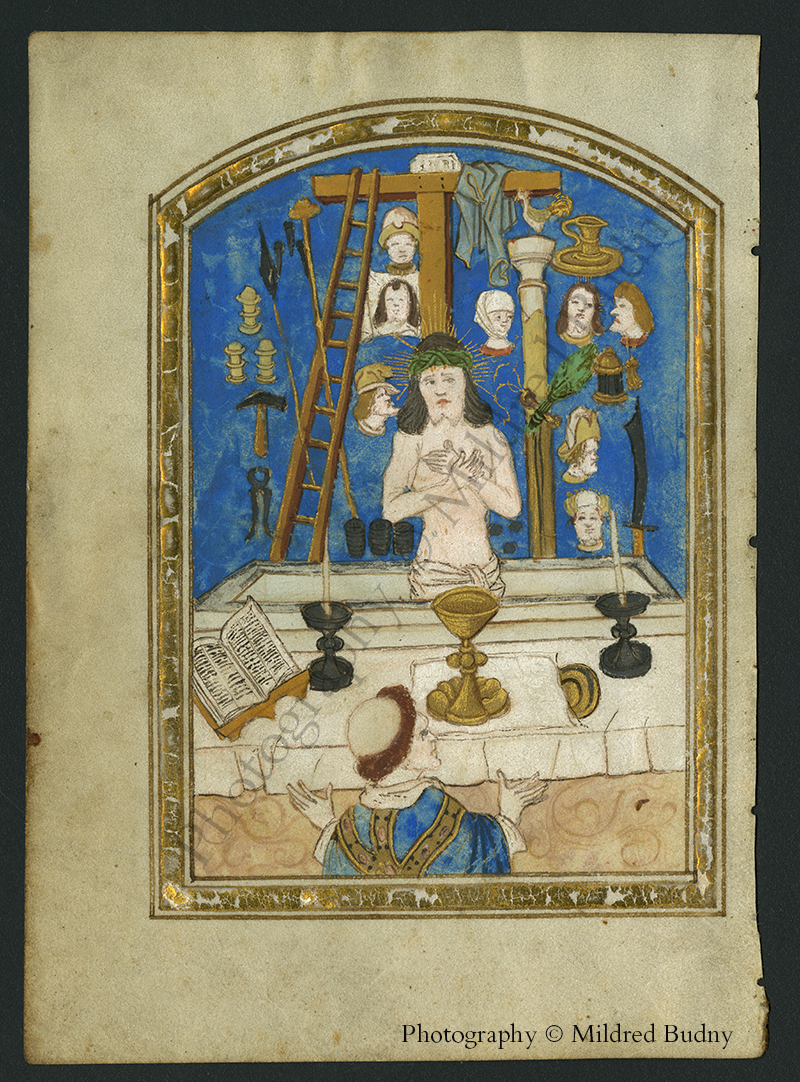
The small-format vellum leaf carries a full-page, framed illustration of the visionary Mass of Saint Gregory the Great (pope from 590 to 604).  It represents a scene derived from an early account of his life and transmitted through later sources.

Here, the part-length upright figure of Christ, surrounded by many of the Instruments of His Passion as well as the disembodied heads of Tormenters, Traitors, and Others involved in those processes, arises from the open top of a sarcophagus behind a draped altar, which stretches the full width of the scene, as He appears to the tonsured and richly vested celebrant of the Mass.  Seen from the back, turning his head toward the right, and lacking a halo, the part-length celebrant, who understandably raises both hands in wonder, might represent not only Gregory himself but also any metropolitan (or above) entitled to wear the pallium over his chasuble.  With such cues, the image appears to stand, and to resonate, within, across, and outside time.  The niche-like frame, with straight sides and a curved top, encloses the votive image with a rimmed gold band.

Both the details of the subject and the style of the skillful illustration point to a place of production probably in Flanders or Northern France in the early fifteenth century.  The subject of Gregory’s Mass enjoyed wide popularity in the late Middle Ages, especially at this time, with depictions in various media (including manuscripts) encouraging meditation upon Christ’s Passion and its implications.  Surveys of the transmission of the subject and suggested reading lists for further information appear freely online for example in German, French, and English, dedicated to somewhat different audiences and interests as well as languages — much as the subject itself could do in its medieval and early modern spheres.

An example of an illustration fit for a king, likewise with a bright blue background, painted circa 1500 in Tours, France, by the expert artist Jean Poyer, precedes the Seven Prayers of Saint Gregory in the Hours of Henry VIII, accompanied in its reproduction online by an exemplary curatorial description of the nature, history, and setting of the subject.  Although less richly and expertly painted, with fewer human “witnesses” present, and deprived of its former manuscript context as well as the name of its artist and its place of production, “our” leaf apparently belong to a similar version of the genre, and perhaps to a similar place in its own book.  Within Books of Hours, the illustration of Gregory’s Mass often, fittingly, accompanied the Hours of the Cross or the Seven Penitential Psalms as well as “Gregory’s Prayers”.

Surveys of the surviving medieval corpus of materials with representations of the subject and variations upon its theme, such as the Instruments of the Passion (or Arma Christi) on their own, include the German Gregorsmesse database and the Index of Christian Art at Princeton University, whose resources and staff on site have aided the study and decipherment of this case.  Without identifying inscriptions, the interpretation of some objects among the Instruments and the Persons among the scattered heads depend upon their characteristics, attributes, and location, for example as some pairs of heads may depict a particular scene or episode.  For a contemporary audience, the various forms of headdress, expression, and demeanor would have conveyed clear clues which to some extent have disappeared from our own awareness of modes of social presentation, given the extent to which customs, fashions, and expectations have changed over the centuries.  Fortunately we might find help, for example, in expert guides (for example here) to the depiction of forms of dress in manuscripts in France and the Netherlands during the period of production and early ownership of “our” image.  Among many variants of the scene, cases with similar choices of objects and heads appearing in Gregory’s vision include this one.

The Instruments and Individuals

As in many cases, here the Instruments and Participants in the Passion seem to be scattered across, or clustered upon, the background, without identifying inscriptions, as if they challenge the viewer to discern their identities correctly, somewhat like a Riddle or Rebus.  Set for the Mass, the altar table carries an opened missal-type book, poised upon a lectern, with double columns of indecipherable text per page; two silver candlesticks supporting tall, unlit white candles; and a gold chalice standing upon a spread corporal, which partly covers a rimmed gold paten.  Below the short front of the plain white altarcloth, the pale foreground flanking the celebrant is decorated with branching, scrolling foliage, perhaps emulating an embroidered or brocaded altarfront.
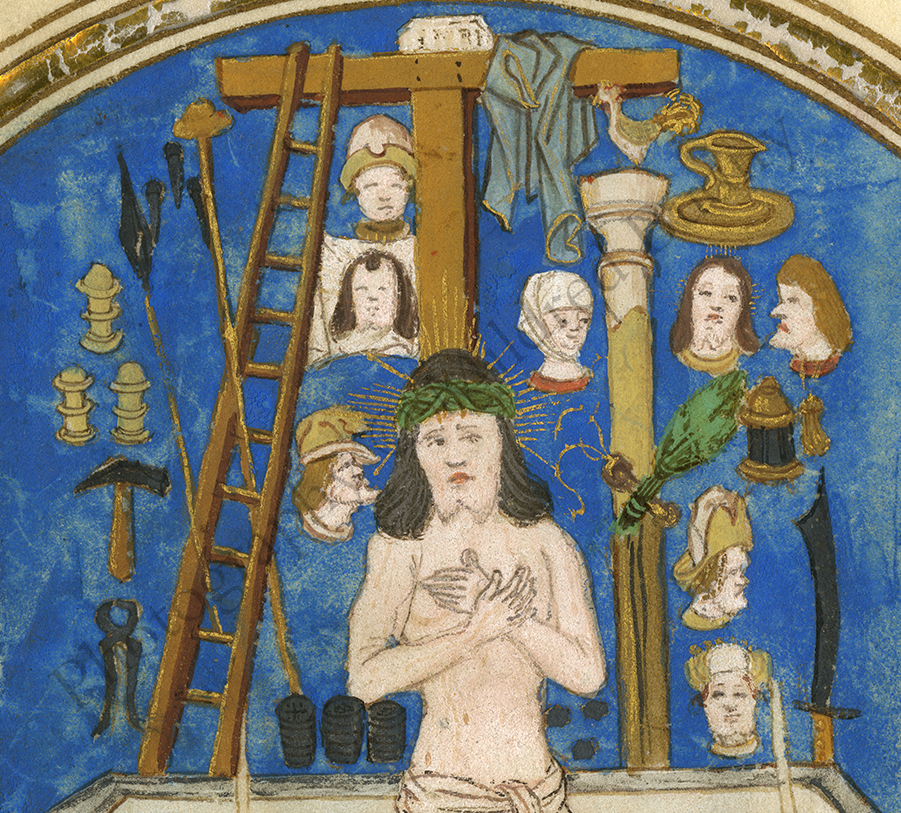
Illustration of Gregory Mass, cropped to upper portion of scene. Photography © Mildred BudnyAs for the Instruments, how many do you see?

I count the centrally placed tau-shaped True Cross, surmounted by its Titulus, draped with a garment (presumably the Shroud or seamless Garment, not the purple Robe), and flanked by the Ladder for the Deposition at the left and the Column for the Flagellation at the right.  The Crown of Thorns rests upon Christ’s Head.  The rim of the Sarcophagus appears as an extension beyond the altar table.  Between the Cross and the Ladder stretches the Veil of Veronica, bearing the imprint of Christ’s closed-eyed frontal Head. Atop the Column perches the Rooster, facing left, for Peter’s Denial.  The Whips (Scourge and Switches) are crossed, right over left, halfway down the front of the Column, with a dangling pair of romal reins of another Whip (or two) which descends from the base of the Switches to the top of the Sarcophagus.  Between the unbroken rungs of the Ladder, which leans upon the Cross, rise the long shaft of the Lance and reed of the Sponge.  Between their tops hover three Nails for Christ’s Wounds.  Suspended, as if scattered, upon the background in counterclockwise formation, there appear three more-or-less identical balustraded Vessels (perhaps buckets, salt-cellars, censers, and/or covered Jars for the gall-with-vinegar and the anointing myrrh); a Hammer and set of Pincers for attaching and removing the Nails; three stacks of Silver Coins for Judas’s price of betrayal; three silver Dice for casting lots for the Robe; the Scimitar for severing the High Priest’s Servant’s Ear; a Lantern for the Arrest; and a Pitcher or Ewer upon a Platter or Basin for service perhaps severally at the Last Supper, the Washing of the Hands, and the gathering of Christ’s Blood.

Seven human Heads, male and female, hover in the background.  Those in profile appear to scowl or scoff.  Five heads wear headgear. The base of each neck has the rounded neckline of a garment.  A helmeted, short-haired, clean-shaven soldier (presumably Longinus) rises above the Veil.  Below it, a Mocker or Spitter confronts Christ’s Head, with a brimmed “bag hat”(capeline) and projected, pointed beard which abuts Christ’s hair.  To the right of the Column, more-or-less in line with the Veil, there appears a woman wearing a neat white wimple (perhaps Veronica, the Servant Girl at Peter’s Denial, or Mary).  In a row to the right appears a bearded, long-haired head tilted outward below the Ewer-with-Dish (probably Christ at the Betrayal, rather than Peter at either his Denial or the Notice Thereof) and the scowling Judas wearing a pendant moneybag at his neck.  In a vertical row beside the upright Sword; a glowering figure wearing a high hat with a bilobed top (probably the High Priest Caiaphas) and an imposing frontal figure  with an elaborate headdress or diadem (presumably Pilate or, rather, Herod).

Wearing a loincloth, a double-pointed beard, and long, straight hair, Christ opens his eyes and crosses his hands in front of his bare chest, with rays of light as a cross-nimbus streaming from his head.  Without visible Wounds, He emerges alive through or despite the Crucifixion.  Similar rays extend both from the version of his Head on Veronica’s Veil and the Head of Judas’ Companion.  Some other depictions of the Gregory Mass endow other figures than Christ (notably Gregory) with rays of light, so that this case could designate or imply Peter (compromised at the Denial, but rehabilitated and raised to sainthood through subsequent events).  However, the features of face, hair, and beard, the rays, and the positioning appear here to designate Christ at the Moment of Betrayal, with a prescient set of rays of light which also pertain to Veronica’s Veil.  Wedged between the Ewer, the branching Scourge, and the Lantern, this Companion seems to be hemmed in for the events of Holy Week leading to the Crucifixion and the Re-emergence from the Tomb.  Such tokens imply that the “narrative” of the imagery follows a sequence that moves, or might move, from moment to moment, from episode to episode, from implement to implement, and from import to impact in a cycle which follows varying directions and possibilities from top to bottom, left to right, right to left, around and about, and back again, as contemplation, reflection, and reconsideration might direct.

The choices among which Instruments to include, and how to represent them, opt for plenitude as to number of Instruments (among representatives of the genre) and for triplicate in series of objects.  That there are 3 Nails (for the spread Hands and the overlapping Feet), 3 similarly-shaped Vessels (perhaps for different types of materials more or-less-viscous and more-or-less vicious applied at different stages of the proceedings), 3 piles of the 30 silver Coins, and 3 Dice, reiterates an emphasis upon trifold entities.  That is, in sum, a Trinity.  Such emphasis could govern the focus for this illustration, its intended viewer, and, perhaps, within (or at) its full volume.

The Leaf

The leaf now belongs to a private assemblage of manuscript and early printed materials.  It was purchased, on its own, from a renowned bookseller about 25 years ago.  A black-and-white reproduction of the illustration appears in print here (first published in 1995), page 229.

Beginning several years ago, I have had the opportunity to examine, photograph, conserve, and re-frame the fragment, as part of a long-term project described elsewhere on this website.  This work included the preparation of photographs with different lights, backgrounds, cameras, and lenses, experimenting with different methods and responding to various aspects of the artifacts themselves as the research developed.

The time has come to illustrate the leaf, on both sides, and in detail, as a contribution toward the study of this artifact, its genre, and the group of medieval and early modern materials to which it now belongs.  In my Handlist of those materials, this leaf is Number 13.  [Future posts, starting here, describe the Handlist and its components.]

First, to show its scale and the brilliance of its colors, including gold, we exhibit an image of the leaf in full, with both a standard scale (both inches and centimeters) and color-guide.  The presence of the color guide within the image can demonstrate — even at first glance — the degree of fidelity of the color reproduction which this shared method of digital transmission permits (or not), as it passes from screen to screen, from device to device, and from viewer to viewer.
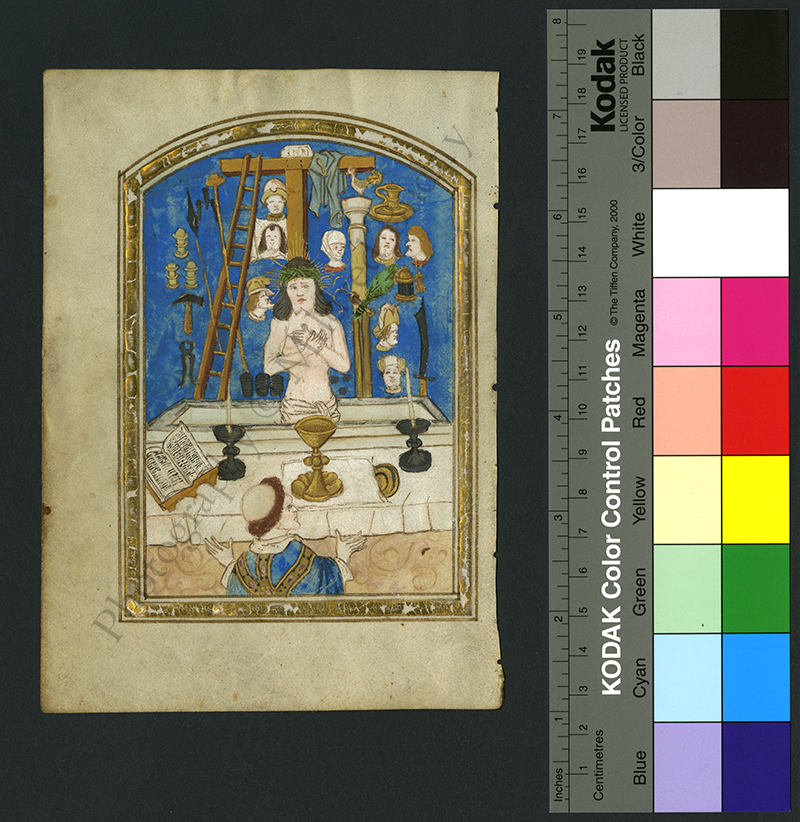
Full-page, framed illustration of the Mass of Saint Gregory on a detached leaf from a prayerbook. Photography © Mildred Budny

The Full Extent of the Leaf, plus Scale and Color Guide

Although the “interesting” part of the leaf — for those who (like Alice) prefer their books to have pictures — would be the illustrated side, it is worth showing the other side, too, for what it’s worth.

 The Front and Back, Revealed

Blank side of leaf with illustration of the Mass of Saint Gregory. Photography © Mildred Budny

Recto

Leaf with Gregory Mass illustration on black background. Photography © Mildred Budny

Verso


It is worthwhile to see what the leaf, in all its surviving glory, both has and does not have.  No text, not a bit, apart, that is, from the 20th-century seller’s code in pencil at the bottom left (‘4327Ø3315o67W0’), the schematic lines of “text” on the celebrant’s opened book, and the partly effaced Monumental Capitals of the Latin Titulus (“Label”) of the Cross, with the acronym INRI abbreviating Iesus Nazarenus Rex Iudaeorum (“Jesus the Nazarene, King of the Jews“).

Gregory Leaf on Black cropped to top of cross reduced

The Titulus

So, apart from that Titulus, the leaf itself carries no original text as such to indicate what language(s), form(s) of script, numbers of lines of text per page, and specific genre of prayerbook pertained to the manuscript to which this now-solitary leaf once belonged, nor the place which it held within the sequence of the book, apart from somewhere in the “middle” and within a binding. The size of the leaf implies that the main text occurred in single columns.  The language may have been Latin and/or a vernacular.  The professionalism of the painted illustration and the use of gold leaf and powdered gold among its pigments indicate a production of some quality and expense.  Some details of the execution — like schematic facial features and the overshot outlines of the outer contours of the frame as they rise from the left-hand side into, and partly over, the curved top of the frame — demonstrate an approach somewhat below the highest order of meticulous craftsmanship and artistry.

For a while when I first encountered the fragment, it could be viewed only behind the glass and mat of the gilded frame into which its owner had placed it. This setting allowed a view only of part of the illustrated side, “cropped” by the window of the mat to a narrow margin around the arch-shaped border of the scene.  (As you see at the top of this Post.)

The considered decision to remove the fragment from the frame, to release it from the non-archival mat and backing, to conserve and photograph it, and to re-frame it (with archival materials) allowed the opportunity to see the full extent of the leaf, that is, insofar as its historical spoliation permits.

Clues

Thus revealed are the surviving extents of the margins, the notched edge of the stitching line at the former spine of the leaf, and consequently the former layout of the leaf as recto and verso.  It is clear that the originally blank flesh side and the illustrated hair side of the animal skin were turned to the front and back respectively. Within the volume, the illustration faced the opening of its companion text, after the “blank” page at the end of the preceding text.

Orange pigment offsets onto the blank recto from the formerly adjacent leaf (now lost). Photography © Mildred Budny

Orange pigment offsets from the (lost) preceding verso

Detail of recto lower edge with red stain and inner edge with stitching groove. Photography © Mildred Budny

Stitching notches (bottom here) and red stain traces (at right)

Revealed, too, are some other tell-tale features. They reveal aspects of the processes of production and characteristics of the volume apart from the image itself.

For example, the offsets of a pair of curved segments of bright reddish orange pigment on the “blank” recto migrated from the formerly adjacent page, perhaps part of an initial in an upper line of the text.

The faint traces of reddish stain at the lower edge of the leaf indicate colored treatment which it must have shared with the other leaves in the rest of the closed book-block.

Production prickings to lay out the contours of the frame and yellow "gunge" on the recto of the leaf. Photography © Mildred Budny

Pricking holes lower on the frame

Detail of "blank" recto with show-through from the illustration and preliminary pricking holes to delineate the contours of the border. Photography © Mildred Budny

Pricking holes for the frame

The closely spaced pricking holes made to delineate the outer contours of the frame and some other parts for the illustration have pierced the leaf, with partly blackened edges from corrosion of the metallic traces left by the sharpened implement.  On the “blank” side, these holes emerge more clearly into view.  The yellowish “gunge” comes from an unknown stage in the history of the fragment.

The clear background revealed between the surviving portions of the gold leaf, where other portions have flaked or lifted away, indicates the uncolored form of adhesive used in its application.  In addition, the illustration employs powdered gold pigment, adding highlights and rays of light.

The pair of darkened stains at the outer edge of the leaf may bear witness to clasps for the volume. The notches along the inner edge, severed by an uneven cutting line from its former stub or adjacent leaf in its original bifolium, demarcate the stitching stations for the binding, in accordance with widespread medieval bookbinding practices, in this case 5 stations.

Detail of cross-shaft, rays of light, and blue sky or background in the illustration of the Mass of Saint Gregory. Photography © Mildred Budny

Layers of pigment, including powdered gold

Such traces could help to confirm the identification of other parts of the same volume, should they survive.  In the absence of a specimen text-page, this leaf must await other methods of discovery than, say, the convenient and widely employed searching method to reunite (even if only virtually) books and their fragments by number of lines per column and per page.

It is a pity that this leaf has been forcibly removed from its original manuscript setting, presumably for commercial purposes, but it is useful to recognize that, at least, the despoiler did not trim away all traces of the former margins and sewing line.  In such ways, the leaf itself, when revealed in the processes of conservation, photography, and uncropped reframing, can show clues about its former book that the cropped image alone fails to do.

Set “free” in such a way, it might direct our research more surely to its former “home”, even if that reunion might have to remain within our imagined or “virtual” reconstruction.  Such a process could befit the aims of the image, intended to evoke reflective meditation upon the nature and significance of its subject-matter across the instances of time and place.
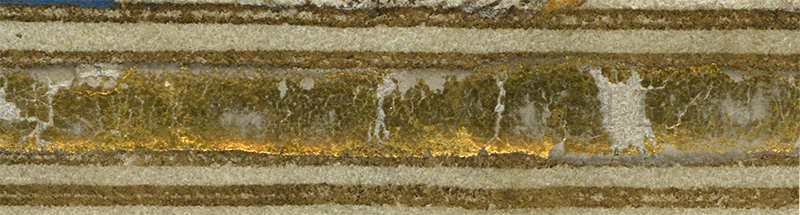
Gold Leaf partly lifted. Photography © Mildred Budny

The Fragility and Tenacity of Gold Leaf

*****

Photography © Mildred Budny
High-quality images suitable for reproduction may be available upon request to director@manuscriptevidence.org.

Perhaps you know where other parts of the original manuscript may survive?  We would be glad to hear from you.
Please leave a Comment here, Contact Us, or enter into a conversation with us on Facebook.

*****


Tags: Archaeology of Manuscripts, Budny Handlist, Instruments of Christ's Passion, Manuscript Photography, Mass of Saint Gregory, Medieval Manuscript Fragments
No Comments »

2014 Seminar on “Manuscripts & Their Photographs”

December 12, 2014 in Events, Manuscript Studies, Photographic Exhibition

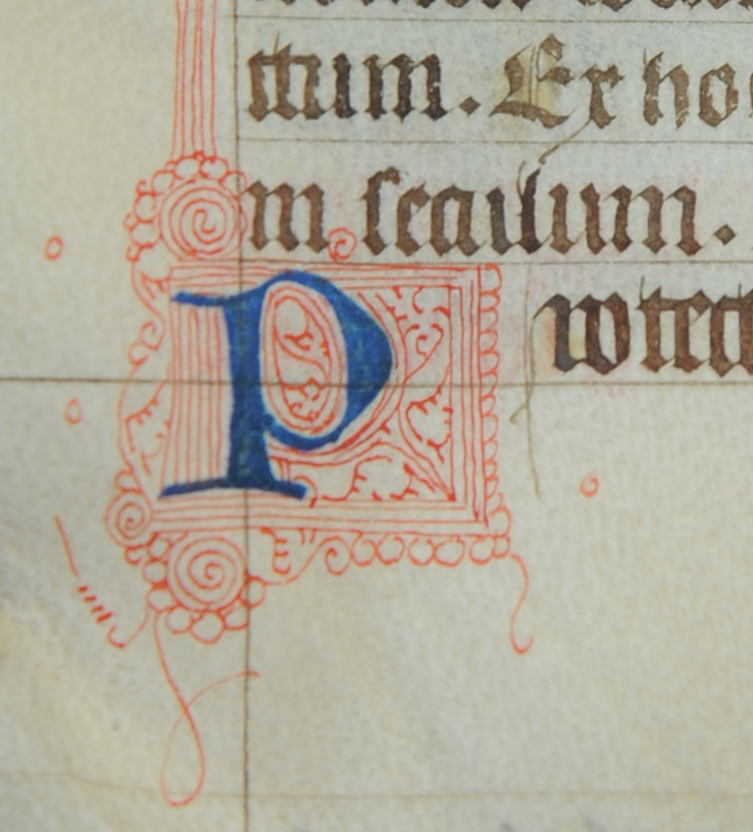
Initial P of Prayer in Book of Hours, with Photography © Mildred Budny

Photography © Mildred Budny

Close Up & Up Close

On Tuesday, 9 December 2014, we held a seminar at the Index of Christian Art of Princeton University.  With examples on hand, Giles Constable and Mildred Budny offered reflections on the processes involved in

1) assembling over decades an ‘accumulation’ — not exactly a deliberate ‘collection’ — of medieval manuscripts (or fragments thereof), documents, and early printed materials, and

2) photographing them over several years, in stages and under varied conditions, for the record and for research, sometimes along with conservation work (where called for in certain cases).

Read the rest of this entry →

Tags: Book of Hours, Index of Christian Art, manuscript fragments, Manuscript Photography, manuscripts reused in bindings, medieval seal, Philip II Count of Savoy, Vitae Patrum
2 Comments »

2014 Anniversary Reflections

August 17, 2014 in Anniversary, Bembino, Events, Favorites, International Congress on Medieval Studies, Photographic Exhibition

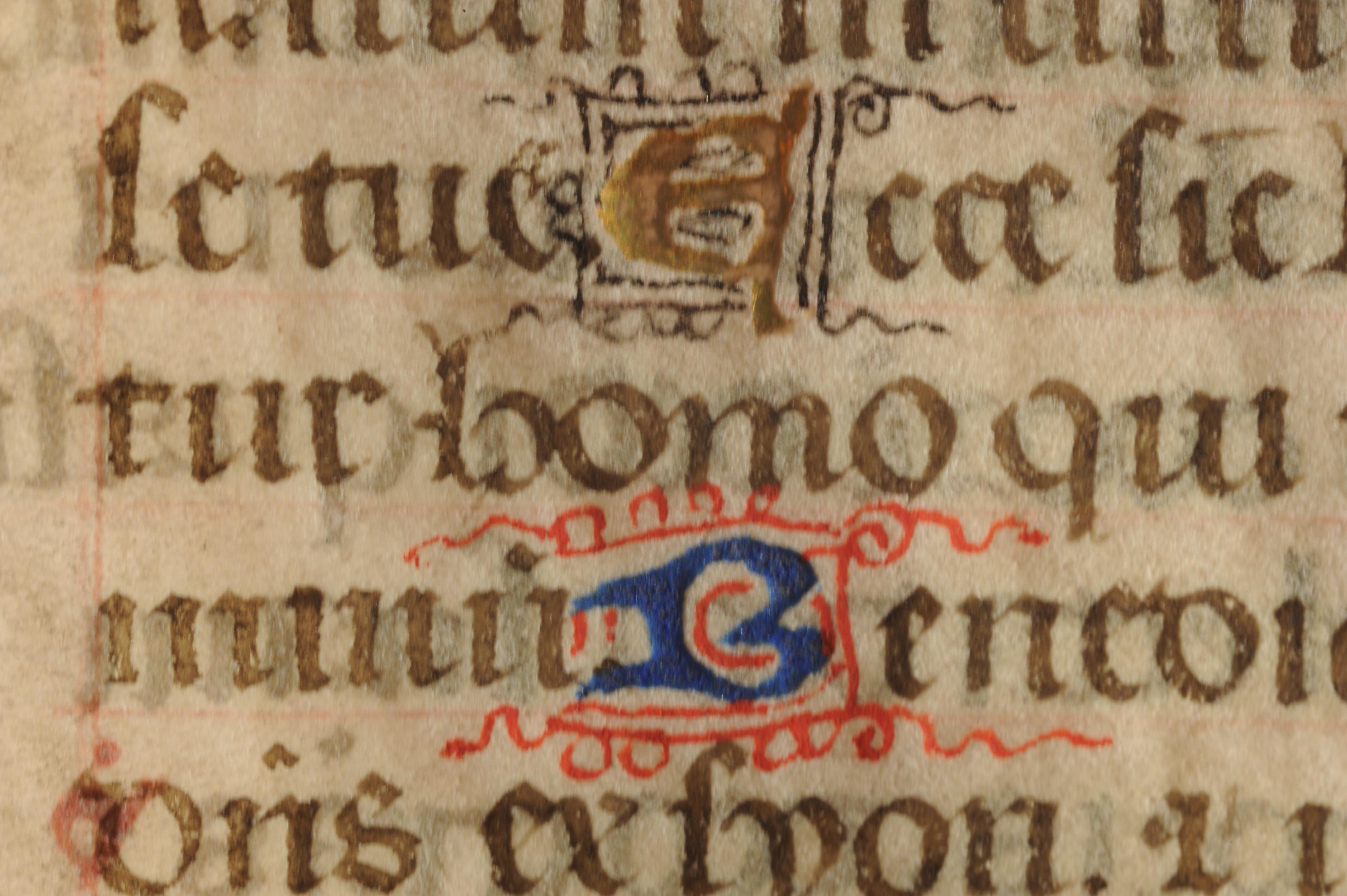
Detail of decorated initials and script, with focus upon 'Ecce . . . Bene', with photography by Mildred Budny

‘Ecce . . . Bene’. Photography © Mildred Budny

Who, What, Where, When, Why Not

[Published on 17 August 2014, with updates]

The Mission, History, People, and Activities of the Research Group on Manuscript Evidence are reported on the Pages and Posts of our website and other Publications.  During this landmark anniversary year, celebrating 15 years as a nonprofit educational corporation and 25 as an international scholarly society, we pause to reflect upon the course and nature of our essence and abilities as a collective entity.  And we give thanks.  Couldn’t do it alone!  Come with us to see how that works, and plays! Read the rest of this entry →

Tags: Bembino Digital Font, Insular Anglo-Saxon and Early Anglo-Norman Art at Corpus Christi College Cambridge, International Congress on Medieval Studies, Princeton University
No Comments »

2009 Anniversary Symposium “Gathering at the Threshold”

January 1, 2014 in Anniversary, Conference Announcement, Events, Photographic Exhibition

Gathering at the Threshold:
A Celebratory Symposium

In 2009 and 2010 the Research Group celebrated the twentieth anniversary of its formation as an entity in England and the tenth anniversary of its formation as a nonprofit educational corporation based in Princeton, New Jersey.  The stages of our history and the variety of our activities are reported in the pages of our Profile and History.

The date of our “official birthday” as a New Jersey Nonprofit Corporation occurs in November.  We celebrated our Tenth/Twentieth Anniversary of 2009 with a gathering of Trustees, Honorary Trustees, Honorary Associates, Volunteers, and newcomers.

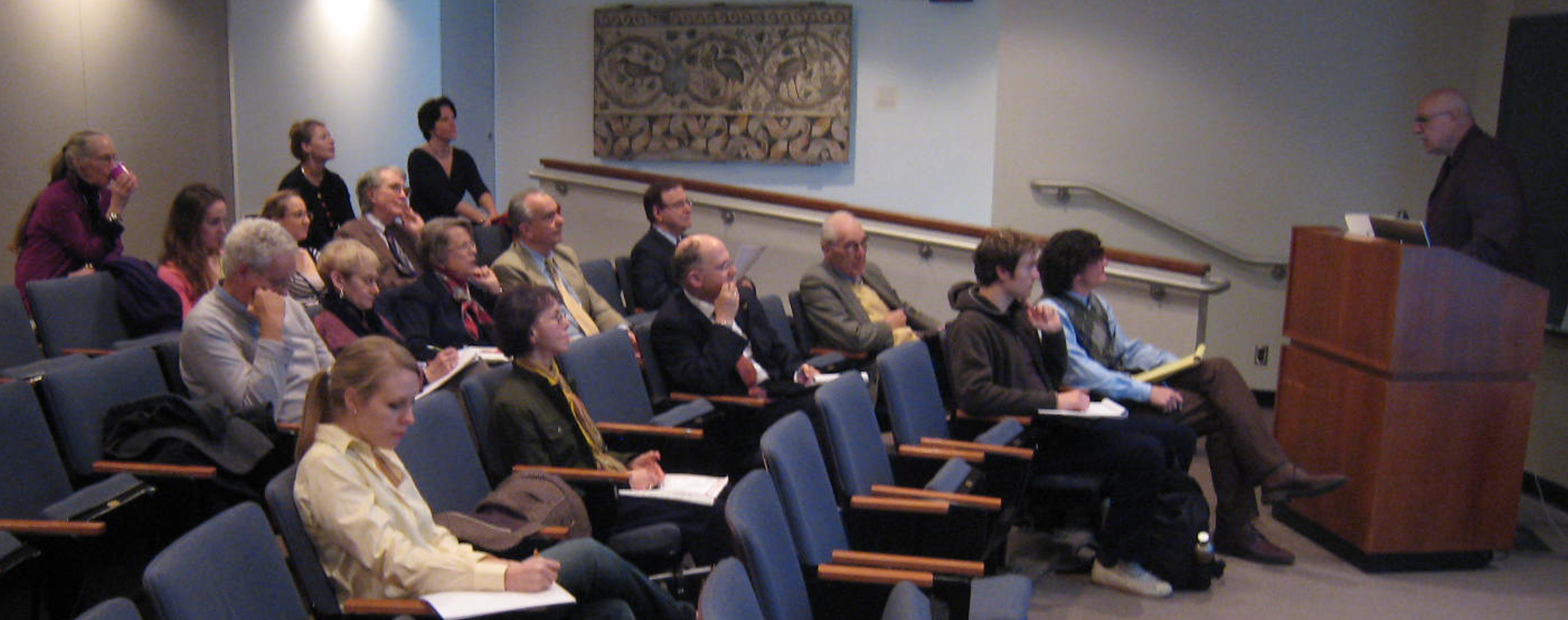
Raymond Cormier Speaks at our 2009 Symposium.  Photography by James P. Heidere.

Raymond Cormier Speaks at our 2009 Symposium. Photography by James P. Heidere.

Read the rest of this entry →

Tags: Anniversary Celebration, Department of Art & Archaeology, Insular Script, Medieval Adaptations of Vergil's Aeneid, Origen, Pontius Pilate, Princeton University, Ruskin and Art History, Women's Wills
No Comments »

1994 Congress

January 1, 2014 in Conference Announcement, ICMS, International Congress on Medieval Studies, Kalamazoo, Photographic Exhibition

29th International Congress on Medieval Studies

5‒8 May 1994

[First published on our first website on *19 April 2006, with updates]

At the 1994 Congress, in the second year of its sponsorship of Sessions, the Research Group on Manuscript Evidence sponsored three Sessions and provided a Photographic Exhibition for the Dedication ceremony of the new Richard Rawlinson Center for Anglo-Saxon Studies.  At the time, as of February 1994, Mildred Budny, Director of the Research Group, had been appointed the first Director of that Center.

A change in direction several months later, required by unilateral and impractible changes by the University to the agreed appointment, led the Research Group to a base in Princeton instead.

The record of subsequent activities by the Research Group at the International Congress on Medieval Studies and in our other Events demonstrates the momentum of our mission following the First Phase which gathered focus and intent during the early years of our work in the major multidisciplinary Research Project from which the Research Group emerged.

Read the rest of this entry →

Tags: Abraham Whelock, Anglo-Saxon Manuscripts, Anglo-Saxon Poetry, Anglo-Saxon Studies, Computer-Based Image Enhancement, Corpus of Anglo-Saxon Illuminated Manuscripts, Eadwine Psalter, Early Modern Studies, Editing Medieval Texts, George Hickes, Illuminated Manuscripts, John Joscelyn, Manuscript Imaging, Manuscript Photography, Medieval Palaeography, Medieval Studies, Morphing Software, Old English Charters, Old English Lexicography, William L'Isle, William Somner
No Comments »

1993 Congress

January 1, 2014 in Book, Conference Announcement, Exhibition, ICMS, International Congress on Medieval Studies, Manuscript Studies, Photographic Exhibition

28th International Congress on Medieval Studies

6‒9 May, 1993

[First published on our first website on *19 April 2006, with updates]

Logo of the Research Group on Manuscript Evidence in Monochrome VersionAt the 1993 Congress, for the first time, the Research Group on Manuscript Evidence appeared officially on the program, as it sponsored one Session and provided a Photographic Exhibition. A report of its contributions was offered in another session as well, with a publication of its text and some illustrations.

At some earlier Congresses, at first Mildred Budny (1985–1987 and 1989–1992) and, then, also Timothy Graham (1992) presented papers.  The Abstracts of some of those papers are reported in the Old English Newsletter.

This Congress marked the first year of our sponsored Sessions at the International Congress on Medieval Studies held by the Medieval Institute of Western Michigan University.  Various of our Associates also participated in this and other Sessions at the Congress.

The official Congress Archive of the Medieval Institute reproduces the individual Congress Program Booklets (plus their “Corrigenda” as presented at the Congress).  The 1993 Congress began a partly interrupted Series of Congresses at which the Research Group on Manuscript Evidence participated.  Our own Congress Archive records the stages of this Series, plus its “Prequel” in earlier Congresses.

Medieval Institute, Walwood Hall, Western Michigan University, February 1992. Photography © Mildred Budny

Medieval Institute, Walwood Hall, Western Michigan University, February 1992. Photography © Mildred Budny

Read the rest of this entry →

Tags: 'Matthew Parker and His Books', and Early Anglo-Norman Manuscript Art at Corpus Christi College, Anglo-Saxon Manuscripts, Boethius' De Arithmetica, Budny's Illustrated Catalogue, Corpus Christi College Cambridge, Corpus Christi College MS 199, Corpus Christi College MS 23A, Corpus Christi College MS 286, Corpus Christi College MS 352, CORPUS Project, Corpus Prudentius, Gospels of Saint Augustine of Canterbury, History of Arithmetic, Illuminated Manuscripts, Manuscript studies, Medieval Institute Publications, Medieval manuscripts, Medieval Studies
No Comments »

Photographic Exhibitions & Masterclasses (1990–)

January 1, 2014 in Events, ICMS, Manuscript Studies, Photographic Exhibition

[Published on 1 January 2014, with updates]

Photography by Mildred Budny. For the Research Group on Manuscript Evidence, logo included

Now in Bembino

Since 1990, sometimes as part of its Seminars, Workshops, and Conference Sessions, the Research Group has held photographic exhibitions on Anglo-Saxon and related manuscripts at Corpus Christi College, Cambridge; the University of Oxford; and elsewhere.

Mostly using photographs by Mildred Budny, they include many of the Research Group Seminars on “The Evidence of Manuscripts” as well as these occasions:

“The Integrated Approach to Manuscript Studies” (Tokyo, 1992)

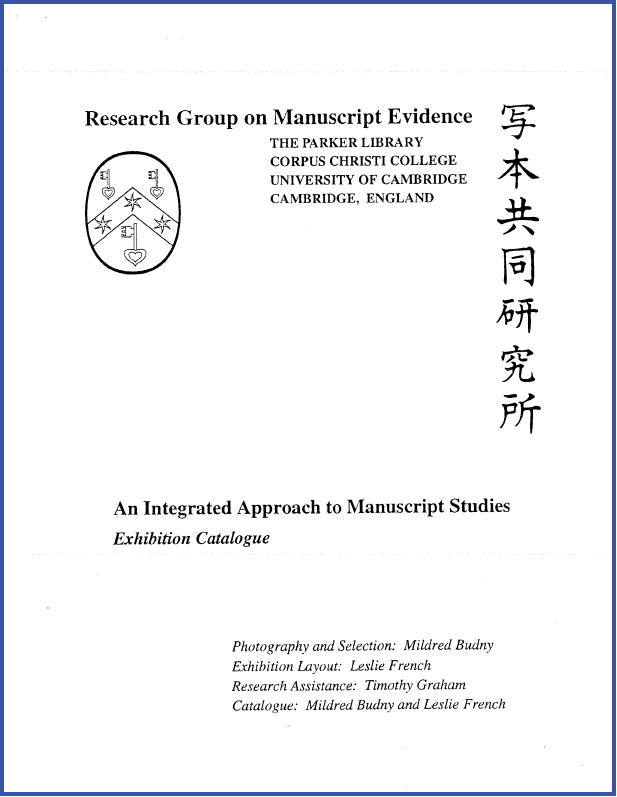
Exhibition held with variations at the University of Tokyo at Komaba, at Chuo University, Tokyo, and at Aoyama Gakuin University, Tokyo (November and December 1992).  The Exhibition Booklet is now downloadable here (2016).

Cover Page for 1992 Exhibition Catalogue on 'An Integrated Approach to Manuscript Studies'

“The Integrated Approach to Manuscript Studies” (International Congress on Medieval Studies, 1993 & 1994)

The previous exhibition held with further variations twice at Western Michigan University, Kalamazoo at the International Congress on Medieval Studies (May 1993 and May 1994).

These exhibitions formed part of the contributions by the Research Group on Manuscript Evidence and its Director to the Congress, as reported for our Session at the 28th International Congress on Medieval Studies and Session at the 29th International Congress on Medieval Studies.  The 1994 exhibition was designed to accompany the Dedication ceremony for the new Richard Rawlinson Center for Anglo-Saxon Studies.  The current activities of that Center are reported here: About Us at the Richard Rawlinson Center.

“The Monastic Library:  Books from St. Augustine’s Abbey, Canterbury” (Princeton University, 1995)

Exhibition held at Wilson College, Princeton University (March 1995).

*****

Since 2006, invited Master Classes taught by Mildred Budny, in Princeton and elsewhere, have provided instruction on aspects and techniques of responsibly photographing manuscripts, documents, and works of art for purposes of research, preservation, exhibition, and publication.  Some of these classes accompany, and augment, our continuing work on Genealogies & Archives.

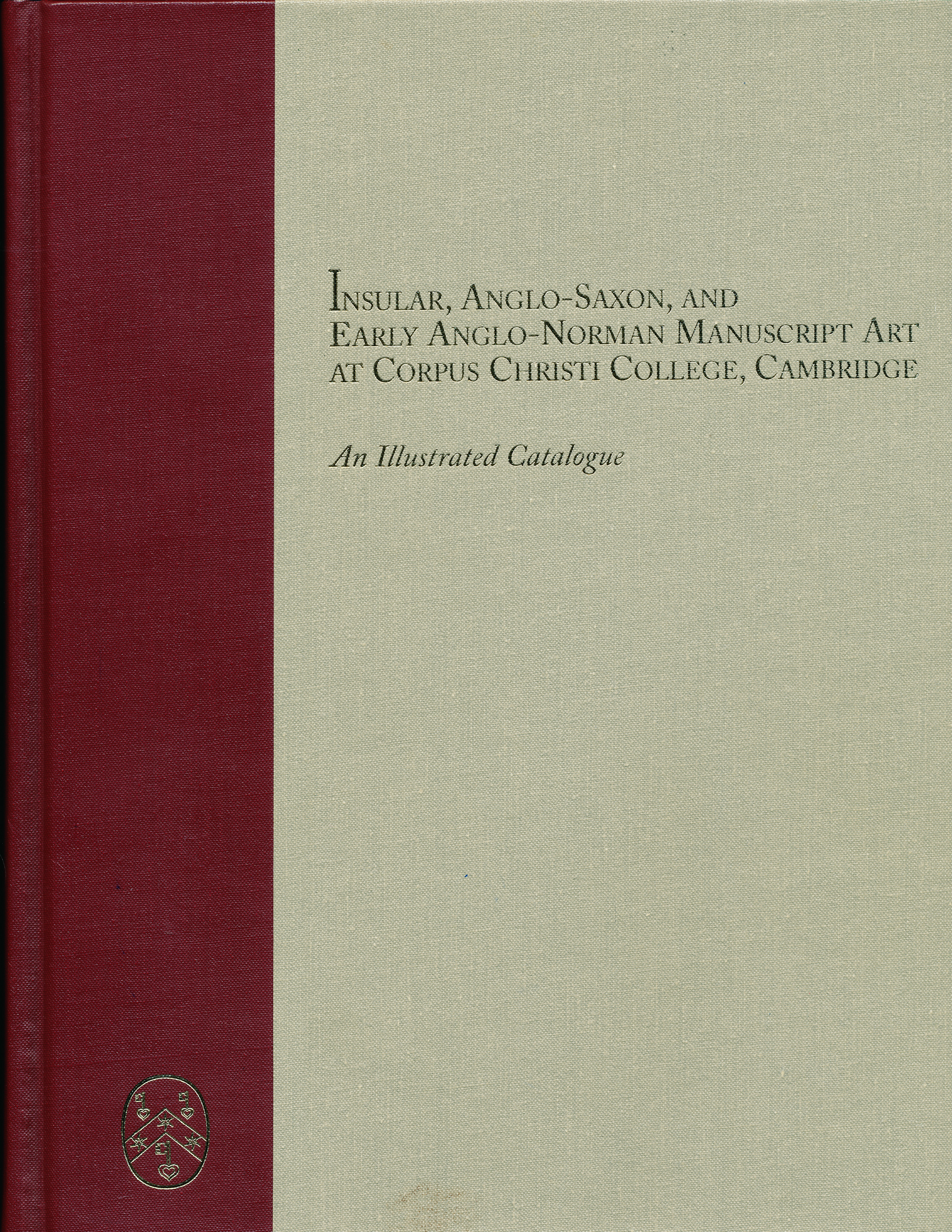
MB Catalogue Front Cover Vol I-1

Front Cover Volume I: Text

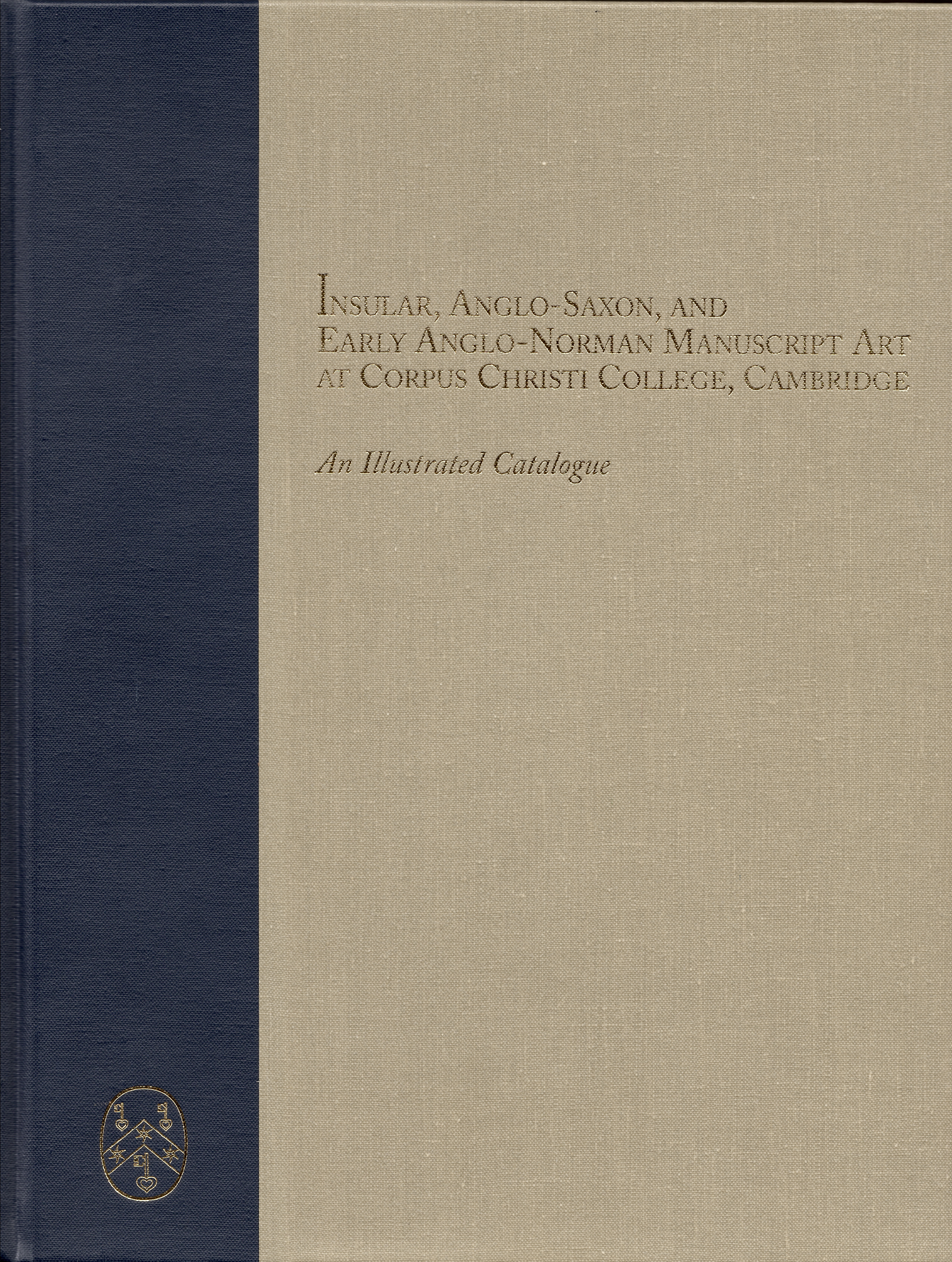
Catalogue Front Cover Volume II: Plates

Front Cover Volume II: Plates

Our publications or co-publications include photographs of the manuscripts themselves and related materials (many or mostly by Mildred Budny).  Some publications contain so generous a number of photographs as to constitute a form of exhibition, as with the two-volume illustrated catalogue of Insular, Anglo-Saxon, and Early Anglo-Norman Manuscript Art at Corpus Christi College, Cambridge.  They are listed in our Publications.

While the world in recent years has turned widespread and extensively funded attention to the production, proliferation, and presentation of digital images reproducing manuscripts for online exhibition, the photographic work of the Research Group on Manuscript Evidence in its foundational collaborative and integrated study of manuscripts, before the dawn of the Digital Age, represents an example of the collaborative efforts to produce and reproduce images as accurately as possible so as to demonstrate the evidence and to encourage responsible interpretations from a wide and integrated range of specialists, students, and interested “bystanders” alike.

An example demonstrating these multiple approaches is our 2014 Seminar on “Manuscripts & Their Photographs”.

*****

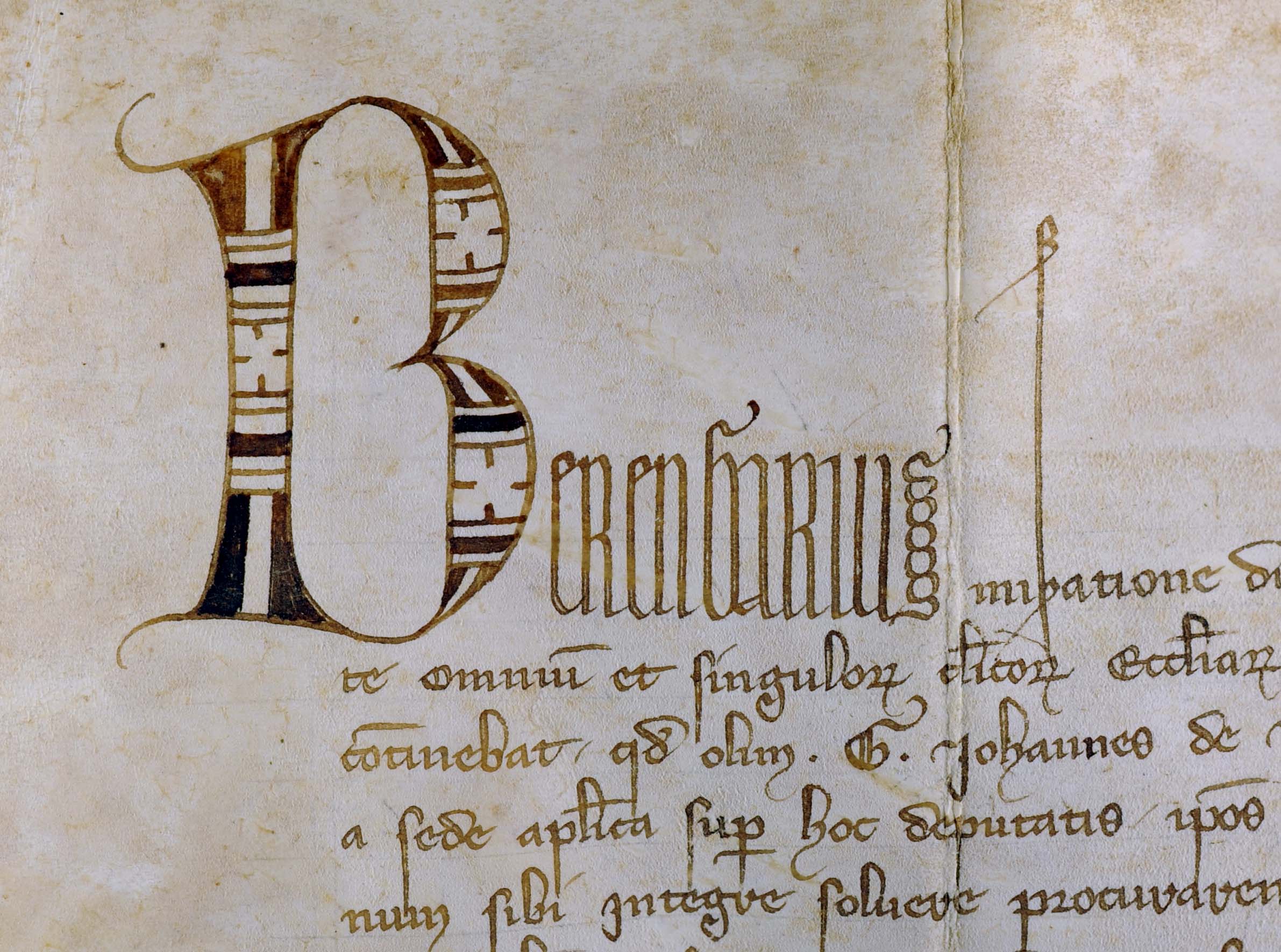
Beregendarius document (detail of opening text) with photography © Mildred Budny

Photography © Mildred Budny

In August 2008, in exploring new developments and potential for our first website [launched in 2007 as www.manuscriptevidence.org, and then archived as http://www.manuscriptevidence.org/data/ during the transition to our second, updated website, launched in 2014 as manuscriptevidence.org/wpme/; You are Here], we were granted generous permission to photograph a group of medieval manuscript fragments and documents in a private collection, and to publish these images here, when the site allowed.

The photography is designed to show the whole objects, as well as details.

We invite, conduct, and report research on these materials. With their accompanying descriptions and assessments, the display may constitute a virtual exhibition.

We welcome questions or comments about the images. We hope that exhibiting them in this way will promote fuller knowledge of their nature, context, significance, and relatives.

We may also use this opportunity to discuss suitable techniques of photographing manuscripts and other artifacts responsibly, with respect to the directions of scholarly interests as well as curatorial and conservational concerns. Not always do these interests and concerns need to stand at odds with or against each other, especially with communication and collaboration. Such discussion may function, for example, as form of a tipsheet or masterclass.

*****

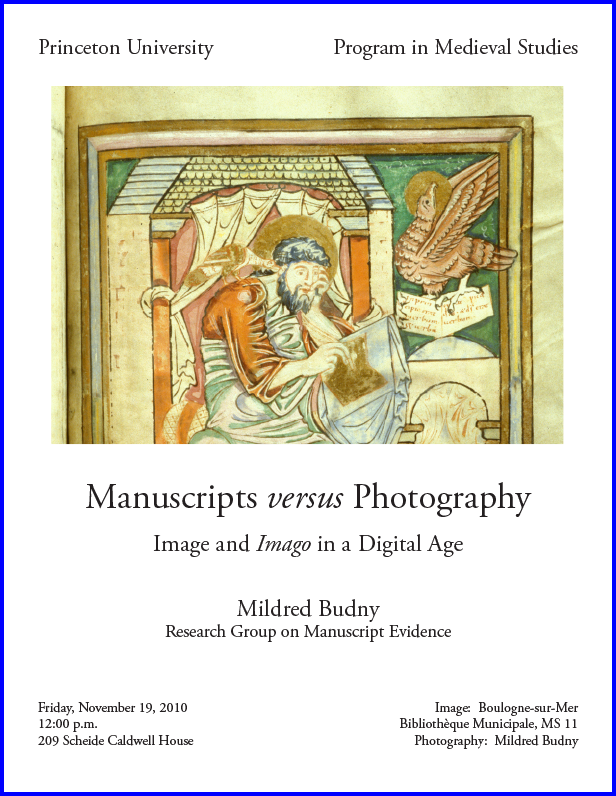
Poster for lecture on 'Manuscripts versus Photography: Image and "Imago" in a Digital Age' by Mildred Budny at Princeton University on 19 November 2010. Photograph by Mildred Budny of MS 10, Boulogne-sur-Mer, Bibliothèque des Annonciades,reproduced by permission.

Photograph by Mildred Budny of MS 10, Boulogne-sur-mer, Bibliothèque des Annonciades, reproduced by permission

As part of this process, we continue to present results and to discuss the issues involved in photographic recording of manuscript and related materials. An example is recorded at web.princeton.edu/sites/medieval/calendar_f10.html, with its accompanying Poster.   We thank the owners of the image and of the photograph for permission for reproduction on the poster.

*****

Please watch this space for further developments, as we unveil a new, illustrated page in our history.

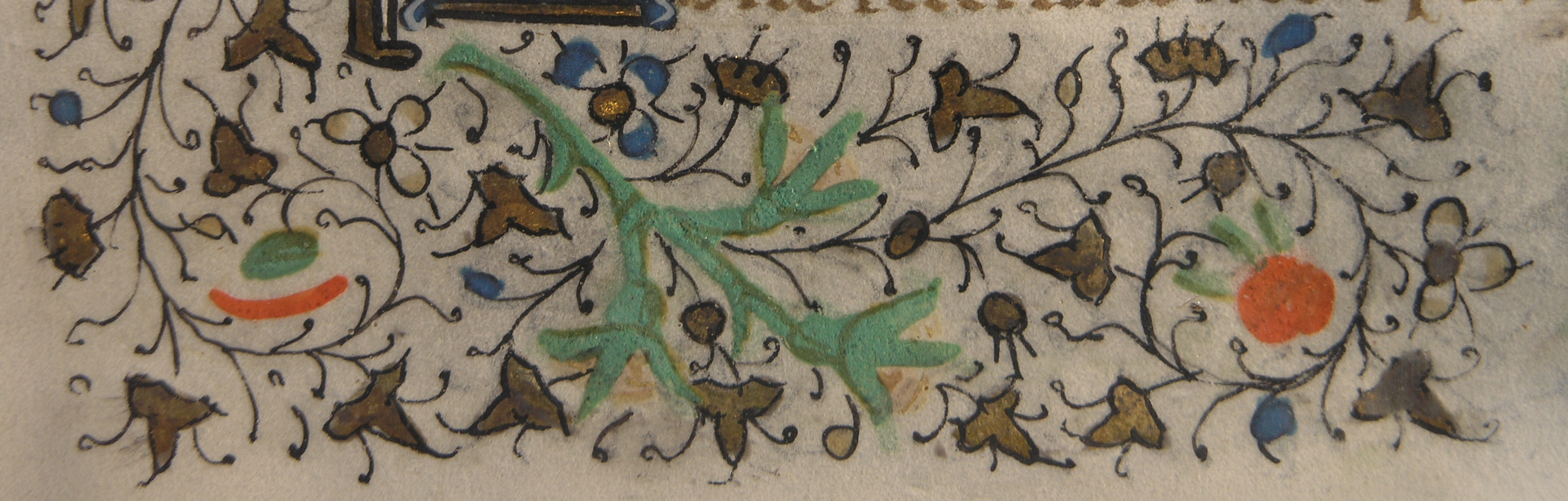
Floral Border with gold pigment, photography © Mildred Budny

Photography © Mildred Budny

*****

[Update]

And now, we offer fruits, with illustrations, of these interlinked processes of photography, research, photography, research, reflection, revision, and reports, in our series of blogposts (since 2015) on Manuscript Studies.  Its Contents List (shown there) is growing.

Besides, along the way, we have also been able to open a series of Galleries on this website (since 2014) showcasing, generously from another private collection, a set of images of scripts and texts across the centuries and in a variety of languages:

Scripts on Parade
Texts on Parade

Have a look!  More to come . . .

Please let us know if you recognize any of the manuscripts from which some of these fragments have come!

*****

Tags: Aoyama Gakuin University, Budny's Illustrated Catalogue, Digital Imaging, Manuscript Illumination, Manuscript Photography, Manuscript studies, Manuscripts & Early Printed Books, Medieval manuscripts, Princeton University, Richard Rawlinson Center for Anglo-Saxon Studies, University of Tokyo, Wilson College
No Comments »

Image-Processing and Manuscript Studies (January 1994)

January 1, 2014 in Events, Manuscript Studies, Photographic Exhibition, Reports

Cover for Preliminary Report of the January 1994 Workshop on 'Image Processing and Manuscript Studies'A one-day Workshop held
at the Parker Library of Corpus Christi College, Cambridge,
by the Research Group on Manuscript Evidence

15 January 1994

In the Series of Research Group Seminars on ‘The Evidence of Manuscripts’
The Parker Library, Corpus Christi College, Cambridge

[First published on 13 October 2015 from our Archives, with updates]

This workshop focused upon optical imaging techniques as aids for manuscript studies.  It considered developments in imaging through photographic and computerised methods, as it provided a forum for information and feedback about techniques of image processing, both existing and planned:  applications, capabilities, limitations, desiderata, and future potential.  Participants included experts in manuscript studies, conservation, photography, imaging aids, computing, radio astronomy, engineering, forensics and medical imaging.

Our First Event Report in Booklet Form

Front cover of the assembled booklet with the Profile of the Research Group on Manuscript Evidence and the full set of 5 Annual Reports to the Leverhulme Trust, which funded the 5-year major Research ProjectA ‘Preliminary Report’ of the proceedings of the Workshop was prepared and printed by the Research Group as a small-format Booklet soon after the event.

Following the move of our principal base to the United States later that year, not to the destination expected, but to Princeton, we thought that the Booklet had disappeared.  Describing the event for our upgraded website (in October 2015), we had to rely on the corrected proof-copy, transcribed here.  More recently, from another section of our Archives, the printed copy of the Booklet has emerged, and we publish it as well in downloadable form.

It represents the first of our printed Booklets for any of our events.  It followed the model of our Annual Reports for the Research Project, composed principally by Mildred Budny and circulated in printed copies both individually and as a collected group, as described among our Publications).  Those reports summarised our Seminars and Workshops, along with accounts of our other activities and the research work itself.

It also followed the model of the Exhibition Booklets for the exhibitions at the Parker Library of “Canterbury at Corpus” (1991) and “Matthew Parker in Cambridge” (1993), although those are illustrated with our photographs from Parker Library materials. Both were printed in-house and circulated at the events, as well as afterward. Both were reprinted, but in quarto format, in the Old English Newsletter, 24:4 (Summer 1991), Appendix A (= pages A-1–A-7) and 27:1 (Fall 1993), Apendix A (A-1–A-8); the latter issue is available online in the OEN Archives, but not yet the former. In their original design, these Exhibition Booklets emanated in A3 format as a group of single sheets stapled twice along the left-hand side; the 1991 Exhibition Booklet, with text and photographs by Mildred Budny, was also prepared as an A5 booklet of folded and nested leaves with the pages of text and image reduced to half-size in photocopying. Similar layout in small-format booklets came to pertain also to the Annual Reports. Such forms of in-house design, layout, and publication by the Research Group on Manuscript Evidence prepared precedents, and customs, for the Workshop Booklet.

Then, after the Research Project was completed and the Research Group moved to the New World, our scholarly Events mainly focused upon Symposia for some years.  As our Annual Series of Symposia on “The Transmission of the Bible” gathered momentum, their Programs, with brief Abstracts of the Papers, grew from single or double-sided pages (1995, 1996, and 1997), and took the form of short booklets, as here:

  • 1998 Symposium exterior
    1998 Symposium interior
  • 1999 Symposium exterior
    1999 Symposium interior
  • 2000 Symposium exterior
    2000 Symposium interior

Those folded and unstapled booklets comprise either a double-sided 4-page unit (1 quarto sheet folded in half as a bifolium) or a menu-like tryptich (1 legal-size sheet folded in three) with wings to open and close at will.  Each case was issued in printed form at the event and circulated afterward also in printed form.  In this respect, the Symposium Booklets differ from the 1994 Imaging Seminar Report, which emerged after the event — indeed like the Annual Reports of our events overall (1990–1994).  The 1994 “Preliminary Report” takes the form of 6 double-sided sheets folded into 12 pages as a small-format booklet (A5), although it also circulated as full-page sheets (A3).

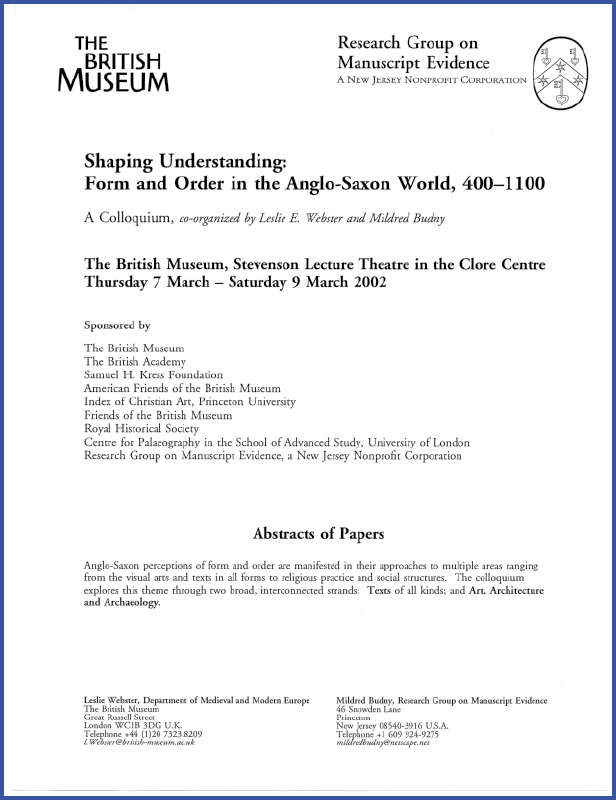
Cover Page for 2002 British Museum Colloquium Program Booklet, with Abstracts of Papers, compiled and edited by Mildred Budny, and laid out and printed by the Research Group on Manuscript Evidence.2016 Symposium Program Booklet Cover Page with borderA longer booklet accompanied our 2002 Colloquium at the British Museum. That case stands within The New Series of our Seminars, Workshops, Colloquia & Symposia.

Within the New Series, the Booklets have become a regular, but not necessarily invariable, feature, while illustrations enter their pages more and more, through generous donations of images for the purposes.  Our experience in designing, laying out, and typesetting our Illustrated Bulletin ShelfLife (2006–) prepared the way for the illustrated Booklets as a way of life.

Each case was issued in printed form at the event and circulated afterward also in printed form, until we acquired a website and the site could accommodate them. Our tradition is to “launch” the publication of the booklet in its printed form at the event itself. Then we may post it on the website and circulate it elsewhere.

More recent, and illustrated, examples of the booklets employ our copyright font Bembino. Issued in print at the event, as is the custom, they now appear on our site in downloadable form:

  • 2013 Symposium on “Identity and Authenticity”
  • 2014 Symposium on “Recollections of the Past”
  • 2014 Colloquium on “When the Dust has Settled”
  • 2015 Congress (“Predicting the Past”)
  • 2016 Symposium on “Words & Deeds”
  • 2016 Congress (“Crusading” and “Mirror”)

See also our list of Publications.  The “Imaging” Booklet joins their company.

Read the rest of this entry →

Tags: Bembino Digital Font, British Library, Corpus Christi College MS 111, Corpus Christi College MS 12, Corpus Christi College MS 173, Corpus Christi College MS 197B, Corpus Christi College MS 201, Corpus Christi College MS 23, Corpus Christi College MS 422, Corpus Christi College MS 44, Cotton MS Claudius A III, Cotton MS Otho C VI, Cotton MS Vitellius A.xv, DScriptorium, Electronic Beowulf, Imaging Aids, Manuscript studies, Parker Library, RGME Program Booklets, RGME Publications, RGME Webmaster
No Comments »

Newer Entries »
  • Top
©2024 Research Group on Manuscript Evidence.


is proudly powered by WordPress. WordPress Themes X2 developed by ThemeKraft.