• News
    • News & Views
    • RGME Activities for 2024 and 2025
    • Around & About with the RGME
    • Reviews
    • Highlights
  • Blogs
    • Manuscript Studies
      • Manuscript Studies: Contents List
    • International Congress on Medieval Studies
      • Abstracts of Congress Papers
        • Abstracts of Papers Listed by Author
        • Abstracts of Papers Listed by Year
  • About
    • Mission
    • Who We Are
      • Officers, Associates & Volunteers
      • RGME Committees
      • Friends of the Research Group on Manuscript Evidence
    • Policies & Statements
      • RGME Privacy Policy Statement
      • RGME Intellectual Property Statement & Agreements
    • People
      • Mildred Budny — Her Page
      • Adelaide Bennett Hagens
    • Activities
      • Events
      • Congress Activities
        • Sponsored Conference Sessions (1993‒)
          • Panels at the M-MLA Convention (from 2016)
        • Co-sponsored Conference Sessions (2006‒)
    • History
      • Seals, Matrices & Documents
      • Genealogies & Archives
    • Contact Us
  • Bembino
    • Multi-Lingual Bembino
    • RGME Bembino: Resources
  • Congress
    • Sponsored Conference Sessions (1993‒)
    • Co-sponsored Conference Sessions (2006‒)
    • Abstracts of Congress Papers
      • Abstracts Listed by Author
      • Abstracts Listed by Year
    • Kalamazoo Archive
    • Panels at the M-MLA Convention (2016-2019)
      • Abstracts of Papers for the M-MLA Convention
      • Panels at the M-MLA Convention (from 2016)
  • Events
    • RGME Activities for 2024 and 2025
      • 2023 Activities and 2024 Planned Activities
    • Seminars, Workshops, Colloquia & Symposia (1989–)
      • Seminars on ‘The Evidence of Manuscripts’
      • Symposia on ‘The Transmission of the Bible’
      • The New Series (2001-)
        • 2019 Anniversary Symposium Program: The Roads Taken
        • 2019 Anniversary Symposium Registration
        • 2019 Anniversary Symposium Registration Open
      • RGME Symposia: The Various Series
      • The Research Group Speaks: The Series
      • Meetings of the Friends of the Research Group on Manuscript Evidence
      • RGME Online Events
    • Abstracts of Papers for Events
      • Abstracts of Papers for Seminars on ‘The Evidence of Manuscripts’
      • Abstracts of Papers for Symposia, Workshops & Colloquia
    • Receptions & Parties
    • Business Meetings
    • Photographic Exhibitions & Master Classes
    • Events Archive
  • ShelfLife
    • Journal Description
    • ShelfMarks: The RGME-Newsletter
    • Publications
      • “Insular, Anglo-Saxon, and Early Anglo-Norman Manuscript Art at Corpus Christi College, Cambridge” (1997)
        • Mildred Budny, ‘Catalogue’
        • The Illustrated Catalogue (1997)
      • The Illustrated Handlist
      • Semi-Official Counterfeiting in France 1380-1422
      • No Snap Decisions: Challenges of Manuscript Photography
    • History and Design of Our Website
  • Galleries
    • Watermarks & the History of Paper
    • Galleries: Contents List
    • Scripts on Parade
    • Texts on Parade
      • Latin Documents & Cartularies
      • New Testament Leaves in Old Armenian
    • Posters on Display
    • Layout Designs
  • Donations and Contributions
    • RGME Donor Promise
    • 2023 End-of-Year Fundraiser for our 2024 Anniversary Year
    • 2019 Anniversary Appeal
    • Orders
  • Links
    • Catalogs, Metadata, and Databases: A Handlist of Links
    • Handlist of Resources for Manuscript Studies and Fragmentology
    • Manuscripts & Rare Books
    • Maps, Plans & Drawings
    • Seals, Seal-Matrices & Documents

  • News
    • News & Views
    • RGME Activities for 2024 and 2025
    • Around & About with the RGME
    • Reviews
    • Highlights
  • Blogs
    • Manuscript Studies
      • Manuscript Studies: Contents List
    • International Congress on Medieval Studies
      • Abstracts of Congress Papers
        • Abstracts of Papers Listed by Author
        • Abstracts of Papers Listed by Year
  • About
    • Mission
    • Who We Are
      • Officers, Associates & Volunteers
      • RGME Committees
      • Friends of the Research Group on Manuscript Evidence
    • Policies & Statements
      • RGME Privacy Policy Statement
      • RGME Intellectual Property Statement & Agreements
    • People
      • Mildred Budny — Her Page
      • Adelaide Bennett Hagens
    • Activities
      • Events
      • Congress Activities
        • Sponsored Conference Sessions (1993‒)
          • Panels at the M-MLA Convention (from 2016)
        • Co-sponsored Conference Sessions (2006‒)
    • History
      • Seals, Matrices & Documents
      • Genealogies & Archives
    • Contact Us
  • Bembino
    • Multi-Lingual Bembino
    • RGME Bembino: Resources
  • Congress
    • Sponsored Conference Sessions (1993‒)
    • Co-sponsored Conference Sessions (2006‒)
    • Abstracts of Congress Papers
      • Abstracts Listed by Author
      • Abstracts Listed by Year
    • Kalamazoo Archive
    • Panels at the M-MLA Convention (2016-2019)
      • Abstracts of Papers for the M-MLA Convention
      • Panels at the M-MLA Convention (from 2016)
  • Events
    • RGME Activities for 2024 and 2025
      • 2023 Activities and 2024 Planned Activities
    • Seminars, Workshops, Colloquia & Symposia (1989–)
      • Seminars on ‘The Evidence of Manuscripts’
      • Symposia on ‘The Transmission of the Bible’
      • The New Series (2001-)
        • 2019 Anniversary Symposium Program: The Roads Taken
        • 2019 Anniversary Symposium Registration
        • 2019 Anniversary Symposium Registration Open
      • RGME Symposia: The Various Series
      • The Research Group Speaks: The Series
      • Meetings of the Friends of the Research Group on Manuscript Evidence
      • RGME Online Events
    • Abstracts of Papers for Events
      • Abstracts of Papers for Seminars on ‘The Evidence of Manuscripts’
      • Abstracts of Papers for Symposia, Workshops & Colloquia
    • Receptions & Parties
    • Business Meetings
    • Photographic Exhibitions & Master Classes
    • Events Archive
  • ShelfLife
    • Journal Description
    • ShelfMarks: The RGME-Newsletter
    • Publications
      • “Insular, Anglo-Saxon, and Early Anglo-Norman Manuscript Art at Corpus Christi College, Cambridge” (1997)
        • Mildred Budny, ‘Catalogue’
        • The Illustrated Catalogue (1997)
      • The Illustrated Handlist
      • Semi-Official Counterfeiting in France 1380-1422
      • No Snap Decisions: Challenges of Manuscript Photography
    • History and Design of Our Website
  • Galleries
    • Watermarks & the History of Paper
    • Galleries: Contents List
    • Scripts on Parade
    • Texts on Parade
      • Latin Documents & Cartularies
      • New Testament Leaves in Old Armenian
    • Posters on Display
    • Layout Designs
  • Donations and Contributions
    • RGME Donor Promise
    • 2023 End-of-Year Fundraiser for our 2024 Anniversary Year
    • 2019 Anniversary Appeal
    • Orders
  • Links
    • Catalogs, Metadata, and Databases: A Handlist of Links
    • Handlist of Resources for Manuscript Studies and Fragmentology
    • Manuscripts & Rare Books
    • Maps, Plans & Drawings
    • Seals, Seal-Matrices & Documents

Log in

Archives

Featured Posts

2026 International Congress on Medieval Studies: Program
Episode 24. “Life with Books” (Interview with John Windle)
Announcing the Launch of RGME Bembino WP
2026 RGME Colloquium at The Grolier Club: Report
Medieval Missal Fragment as Early-Modern Cover
The Weber Leaf from Ege MS 61
"Bembino" Booklet Cover
Episode 23. “Meet RGME Bembino: Facets of a Font”
2026 RGME Colloquium on “Transformations & Renewals” at The Grolier Club
2026 Theme of the Year: “Transformations and Renewals”
A Leaf with Patchwork from the Saint Albans Bible
A Sister Leaf from a Miniature Latin Vulgate Bible
A Little Latin Vulgate Bible Manuscript Leaf in Princeton
J. S. Wagner Collection. Leaf from from Prime in a Latin manuscript Breviary. Folio 4 Verso, with part of Psalm 117 (118) in the Vulgate Version, set out in verses with decorated initials.
2026 Annual Appeal
Episode 22: “Encounters with Local Saints and Their Cults”
Private Collection, Ege's FBNC Portfolio, Dante Leaf, Verso, Detail. Reproduced by Permission.
2025 RGME Autumn Colloquium on Fragments
Workshop 8: A Hybrid Book where Medieval Music Meets Early-Modern Herbal
2025 RGME Autumn Symposium on “Readers, Fakers, and Re-Creators of Books”
RGME Workshops on “The Evidence of Manuscripts, Etc.”
2025 International Medieval Congress at Leeds: RGME Program
Episode 21. “Learning How to Look”
2025 International Congress on Medieval Studies: Program
2025 RGME Visit to Vassar College
Two Leaves in the Book of Numbers from the Chudleigh Bible
Delibovi on Glassgold on Boethius: A Blogpost
Ronald Smeltzer on “Émilie du Châtelet, Woman of Science”
2025 Spring Symposium: “Makers, Producers, and Collectors of Books”
Starters’ Orders
The Weber Leaf from the Saint Albans Bible
Workshop 4. “Manuscript Fragments Compared”
Episode 20. “Comic Book Theory for Medievalists”
Episode 19: “At the Gate: Starting the Year 2025 at its Threshold”
Favorite Recipes for Lemonade, Etc.
RGME Visit to the Lomazow Collection: Report
2024 Autumn Symposium: “At the Helm”
A Latin Vulgate Leaf of the Book of Numbers
The RGME ‘Lending Library’
Florence, Italy, Ponte Vecchio from Ponte alle Grazie. Photo: Ingo Mehling, CC BY-SA 4.0 , via Wikimedia Commons
Episode 17. “RGME Retrospect and Prospects: Anniversary Reflections”
2024 Anniversary Symposium: The Booklet
Jesse Hurlbut at the Bonneville Salt Flats, Utah. Photograph Jesse Hurlbut.
Episode 16: An Interview with Jesse D. Hurlbut
To Whom Do Manuscripts Belong?
Kalamazoo, MI Western Michigan University, Valley III from the side. Photograph: David W. Sorenson.
2024 International Congress on Medieval Studies: Report
2024 Spring Symposium at Vassar College
Puente de San Martín: Bridge with reflection over the River Targus, Toledo, Spain.
2024 Grant for “Between Past and Future” Project from The Gladys Krieble Delmas Foundation Research Libraries Program
2024 Anniversary Symposium in Thanks to Jesse Hurlbut: Program

You are browsing the Blog for

An Illustrated Leaf from the Shahnameh with a Russian Watermark

August 4, 2021 in Manuscript Studies

An Illustrated Persian Leaf on Paper
from the Shahnameh
(Humai & Darab)
with a Russian Watermark

[Posted on 5 August 2021]

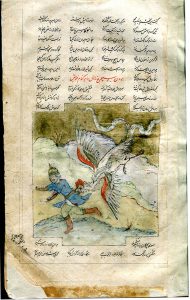
Continuing our examination of Watermarks and the History of Paper, we display an illustrated paper leaf from an illustrated manuscript which has come to our notice.  Its owner identified the text, but wondered about the watermark.  Responding to our blog, he offered its images for examination.

Private Collection, Leaf from a Persian Shanameh. Simurgh and Zal.

Private Collection, Leaf from a Persian Shanameh. Simurgh and Zal.

Now in a private collection, the detached leaf formerly belonged to an illustrated manuscript in Persian of the Shahnameh or ŠĀH-NĀMA / Šāhnāme (شاهنامه or “Book of Kings”), the renowned epic poem by the Persian poet Abul-Qâsem Ferdowsi Tusi or Ferdowsi (circa 329 – 411 AH / 940 – 1010 CE).  This poem, which the poet began to compose circa 977 CE and completed on 8 March 1010 CE, extends for more than 50,000 couplets.  Its text recounts the history of the kings and heroes of Persia from mythical times to the overthrow of the Sassanids by the Arabs in the middle of the 7th century.

The importance and popularity of the text ensured that it has circulated in very many copies produced at various times and in various places, manuscripts included.  Not all of them survive, and some survive only in pieces.

An earlier post in our blog (see its Contents List) considered a detached leaf from another portion of the epic, from another illustrated manuscript, and in another private collection.

Simurgh and Zal from a Persian Shahnameh.

That leaf illustrates an episode from the fabulous story of the winged creature Simurgh and her adopted human warrior son Zāl. Within a stepped frame set within the page of text, its illustration depicts the large creature as she swoops down to grasp or grab him by the waistband as he flees.

The ‘new’ leaf belongs to a different episode, a different manuscript, and a different style of illustration, in the long and richly varied tradition of illustrations for the Shahnameh or Šāh-nāma  in books and other visual arts, and in Persian and other spheres.

Humai and Darab

Among the Episodes of the Shahnameh, the sections devoted to a legendary queen of Iran, Humai or Humay Chehrzad (sections 609–614 in one form of reckoning), recount events of her reign within the legendary Kayanian dynasty. They relate the birth of her son Kai Darab, her abandonment of him as an infant, her recognition of him as an adult as her son, after he had helped to defeat the attacking Romans at the edge of the Iranian Empire.  These sections end with her retirement from the throne in favor of him as the next king, Dara I.

The text on the leaf belongs to the episode that recounts how, after “Darab fights against the Host of Rum” (612), “Humai recognises her Son Darab” (613).

Read the rest of this entry →

Tags: History of Watermarks, Humai and Darab, manuscript fragments, Manuscript studies, Russian Watermarks, Shahnameh
No Comments »

2022 Congress Preparations

July 16, 2021 in Announcements, Conference, Conference Announcement, Ibero-Medieval Association of North America, IMANA, International Congress on Medieval Studies, Kalamazoo, Societas Magica

Call for Papers (CFP) for Sessions
Sponsored or Co-Sponsored by the RGME

at the 57th International Congress on Medieval Studies (Online)
Monday, May 9, through Saturday, May 14, 2022

CFP Deadline:  15 September 2021
[Deadline for Session Programs:  1 October 2021]

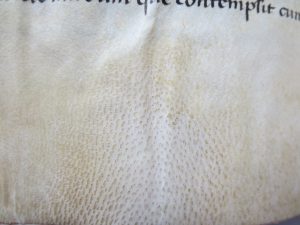
Le Parc Abbey, Theological Volume, Part B: Detail of Vellum Leaf.

Private Collection, Le Parc Abbey, Theological Volume, Part B: Detail of Vellum Leaf. Photography Mildred Budny.

[Update on 22 September 2021:
Following the close of the CFP on 15 September, we can welcome the received proposals for papers, observe their strength and range, and prepare the programs for each session.  With the selection of proposed papers accomplished, it comes time to arrange their sequence within the given Sessions, assign the Presiders for them, and submit the programs to the Congress Committee by 1 October 2021.

When appropriate, we can announce the Programs, report the assignment of their scheduling within the Congress Program overall, and publish the Abstracts of the Papers and Responses, as the authors might be willing. The Congress Program will become available in due course, and registration for the online Congress might commence.

Update on 1 October 2021:
At the close of the deadline for submission of the programs to the Congress, we report that each of our Sessions has three or four Papers; three sessions also have Responses; and we plan to hold a Business Meeting at the Congress, as in previous years.  All these activities are to take place online.]

[Posted on 15 July 2021]

After accomplishing the 2021 ICMS Online, with 5 Sponsored and Co-Sponsored Sessions, plus our Open Business Meeting, we produced the 2021 Congress Report, as we turned to preparations for the 2022 Congress.  We proposed Sessions, and received answers in stages.

Through the Confex system for the 2022 International Congress on Medieval Studies, we have learned that all but one of our proposed sessions have been accepted.

One of the accepted sessions resumes a series (“Medieval Writing Materials”) which a rejection for the 2015 Congress disrupted.  That rejection interfered with the momentum of our series of sessions on the subject at the 2011–2016 Congresses.  (See Sponsored Sessions.)  The interval between then and now is a long time to wait.  We had to turn to other subjects, as the momentum for their own action not only gathered to produce the proposals to sponsor or co-sponsor them, but also found favor by the Congress Committee, so that it could become possible to move to the phase of the Call for Papers for them. With the Pre-Congress Business Meeting in May 2021, as we prepared for this year’s Congress, we aimed to resume that series, as well as to explore other sessions as their subjects and proponents might direct.

So, we can resume the series on Medieval Writing Materials for 2022.  But a new rejection of another subject for the Congress leads us to reconsider our approach to its current momentum.  This time, learning from experience, we could choose what to do, but elsewhere, before long, with the subject not accepted this time around, rather than waiting for some other year — or decade — at the Congress.

And so, now, we announce the Call for Papers for the 2022 Congress.

Read the rest of this entry →

Tags: Ars Notaria, History of Alphabets, History of Magic, History of Paper, History of Paper Manufacture, History of Watermarks, Manuscript studies, Medieval Studies, Medieval Writing Materials
No Comments »

2021 International Congress on Medieval Studies Report

July 7, 2021 in Conference, Conference Announcement, International Congress on Medieval Studies, Kalamazoo, Reports

Report

Activities of the
Research Group on Manuscript Evidence
at the
56th International Congress on Medieval Studies
(10–15 May 2021)

#kzoo2021 / #kazoo2021

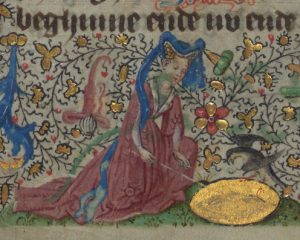
Baltimore, The Walters Art Museum, MS W.782, folio 15r. Van Alphen Hours. Dutch Book of Hours made for a female patron in the mid 15th century. Opening page of the Hours of the Virgin: "Here du salste opdoen mine lippen". Image via Creative Commons. At the bottom of the bordered page, an elegantly dressed woman sits before a shiny bowl- or mirror-like object, in order, perhaps, to perform skrying or to lure a unicorn.

Baltimore, The Walters Art Museum, MS W.782, folio 15r. Van Alphen Hours. Dutch Book of Hours. Image via Creative Commons.

We report the accomplishment of our activities at the 2021 ICMS, held entirely online. Individually and collectively, we have attended the Congress for many years.  Our ICMS blog records activities sponsored and co-sponsored by the RGME along the way.

This year’s Congress presented the first time for a totally “virtual” process.  Next year’s Congress will be the second.

The new format posed challenges, mostly surmounted.  Gladly we observe that, albeit with several technical glitches and scheduling issues, the activities of the RGME, both sponsored and co-sponsored, succeeded as we had wished.  The Sessions and Business Meeting proceeded smoothly, with time and scope for feedback and discussion.

How We Prepared

First, there was the cancellation of the 2020 Congress itself.  See our 2020 Congress Program Announced.

Then came the re-planning for the 2021 Congress.  Initially, it was designed to be held in person, like the 2019 Congress, and others before it.

Only after all the re-submissions of our intended 2020 Sessions to the Congress Committee, the completion of the 2021 Congress Call for Papers, the selection of the Session Programs, and the bookings for our Reception and Business Meeting (see our 2021 Congress Planning), did there come the decision that the 2021 Congress had to take place only online.

That choice led all 3 co-sponsors for our planned Reception —RGME, Societas Magica, and Index of Medieval Art — to agree that it makes sense to wait, instead, for such an event until a suitable occasion in person.  Likewise, a few rearrangements were required for the Sessions as had been planned.

Preparing for the 5 Sessions and our Open Business Meeting, we announced our Activities for the 2021 Congress Program.

Next came the Congress itself, as described in its own Program (plus Corrigenda), with further information on its website.

Sessions

Recorded Sessions

Vajra Regan presents his Paper for his 2021 Congress Session on “Prologues”.

With the virtual format, some Congress events were recorded, so as to be available for viewing by Congress Registrants from 17 to 29 May.  According with the participants’ wishes, 2 of our Sessions were recorded.  

  • Medieval Magic in Theory:
    Prologues to Learned Texts of Magic

Congress Session 103

  • Revealing the Unknown, II

    Congress Session 279

Thus were available, for a time, the chances to view and to re-view, a few of our activities ‘there’ this year.  For them and the others, this Report describes the accomplishment of the plans, already for the 2020 Congress, which had to be cancelled.  This year’s Congress gave the opportunity to complete the plan, with some changes as appropriate.

Read the rest of this entry →

Tags: 'Toulouse deformity', Bibliomancy, Ephesia Grammata, Headbinding, History of Documents, History of Magic, Manuscript studies, Matthew Paris, Medieval Lapidaries, Medieval Prologues, Medieval Seals, Picatrix, Reused Antique Gems, Scrying, Seals and Signatures, Sortilège, Thomas Hoccleve
No Comments »

Medieval Magic in Theory

May 6, 2021 in Abstracts of Conference Papers, Conference, International Congress on Medieval Studies, Kalamazoo, Societas Magica

Medieval Magic in Theory:
Prologues to Learned Texts of Magic

Session Organized by Vajra Regan

***

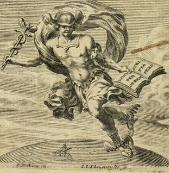
Hermes Trismegistus. Frontispiece image (Lyons, 1669) via Wikimedia Commons and Wellcome Images (Wellcome_L0000980).

Hermes Trismegistus. Frontispiece image (Lyons, 1669) via Wikimedia Commons and Wellcome Images.

Session (1 of 3) Co-sponsored by
the Research Group on Manuscript Evidence
and the Societas Magica
at the
56th International Congress on Medieval Studies
(10–15 May 2021)

2021 Congress Program Announced

Congress Session 103, Virtually on
Tuesday, 11 May at 11:00 am EDT

= 2021 Congress Program, pages 38–39

Our plans for this 2021 Session adapt its plan for the cancelled 2020 Congress. Now it is co-sponsored by the Research Group and the Societas Magica, and parts of the contents have been updated.

Scope & Aims

The prologues to medieval texts of learned magic could serve a variety of functions. They were a space for their authors to announce the theme of the work, to situate the work within a specific literary, philosophical, or theological landscape, and to lay special claim to the reader’s attention. Consequently, these prologues have much to tell us about the traditions and beliefs underlying certain magical texts. Moreover, because many magical texts are substantially anonymous compilations, their prologues often provide unique access to the lives and contexts of the men and women behind the parchment.

The aim of this session is to explore these still largely understudied prologues which testify to the variety of medieval approaches to ‘magic’. We are especially interested in how magic is theorized in these prologues. What insights do these prologues offer into contemporary debates about the epistemological status of magic? Moreover, what can they tell us about the social, religious, and institutional contexts of their authors and readers?

Read the rest of this entry →

Tags: Areola Diagram, Astral magic, Bartholomei de Ripa Romea, Book of Hermes, Collected Treasures, Glossa ordinaria, Hermes Trismegistus, History of Magic, History of Prologues, Lapidaries, Liber dabessi, Magicians in History, Picatrix, Saint Gall Incantations, Sorcerers, The Emerald Table
No Comments »

Another Leaf from the Warburg Missal (‘Ege Manuscript 22’)

April 25, 2021 in Manuscript Studies, Reports

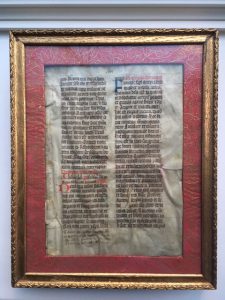
J. S. Wagner Collection, Ege Manuscript 22, Folio clvi, recto, within its frame.

J. S. Wagner Collection, Ege Manuscript 22, Folio clvi, recto, within its frame.

The Wagner Leaf

from Ege Manuscript 22

***

“The Warburg Missal”

Folio CLVI in the Temporale

with Part of the Mass for Corpus Christi

Latin Missal made in Germany circa 1325 Written in Gothic Script (Textualis)

Double columns of 31 lines

Circa 360 × 257 mm < written area circa 289 × 190 mm >

with Rubrications, Inset Initials in Red or Blue, and Musical Notation in Hufnagelschrift (“Horseshoe-Nail Notes”) on 4-Line Staves

With thanks to the collector, J. S. Wagner, we examine a newly identified leaf from one of the manuscripts dispersed by Otto F. Ege (1888–1951). It comes from ‘Ege Manuscript 22’, a Latin Missal written in double columns of 30–32 lines in Gothic Script, with musical notation.

This blogpost by Mildred Budny and the companion Report Booklet (2021) by Leslie J. French examine the Leaf, set it in context of its former manuscripts, and re-assess the attribution of the book.

The ‘Ege’ Number comes from the position of this manuscript (and its portions) in Ege’s distribution within one of his Portfolios of specimen leaves forcibly extracted from manuscripts and printed books. The Portfolio in question exhibits Fifty Original Leaves (FOL) from Medieval Manuscripts, Western Europe, XII–XVI Century. In this case, Leaf Number 22. The numbering system is defined and enshrined in Scott Gwara’s “Handlist” of Otto Ege’s Manuscripts (2016).

In the FOL Portfolio, specimens from the manuscript travelled, in their individual windowed mats, in the company of other Ege manuscript leaves. The Wagner Leaf, however, travelled on its own, through a different highway of circulation. It arrived in a glass-fronted ornamental frame. Behind that frame, Ege’s handwritten note on the recto, and the accompanying printed slip (see below), directly establish the Ege connection. All the features of text, script, musical notation, and folio numeration manifest a place within Ege’s Manuscript 22, as the collector readily discerned.

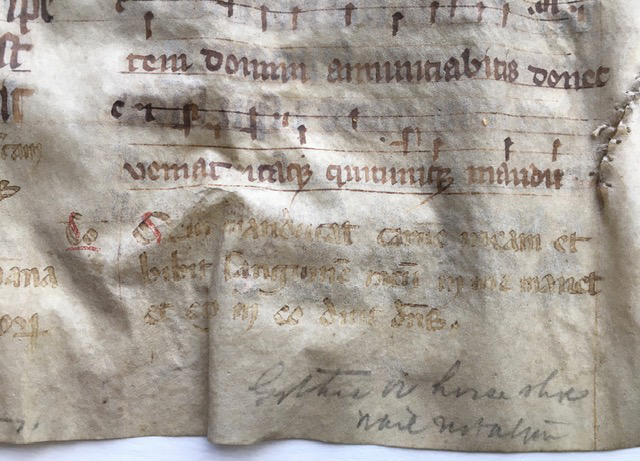
J. S. Wagner Collection, Leaf from Ege Manuscript 22, verso, bottom right: Ege's inscription in pencil.

J. S. Wagner Collection, Leaf from Ege Manuscript 22, verso, bottom right: Ege’s inscription in pencil.

Read the rest of this entry →

Tags: 'Fifty Original Leaves from Medieval Manuscripts', Benedictine Missal, Bergendal Collection, Bergendal Manuscript 69, Binding History, Ege Manuscript 22, Ege's FOL Portfolio, Fragmentology, Leander van Ess, Measure Theory, Medieval Manuscript Fragments, Missal Herbipolensis, Missale Coloniense, Otto Ege, Otto Ege's Manuscripts, Parochial Church of St John the Baptist Warburg, Reused Binding Fragments, Sales Catalogues, Sir Thomas Phillipps, Sothebys, The Warburg Missal
No Comments »

More Leaves from a Deconstructed Sinhalese Palm-Leaf Manuscript

April 10, 2021 in Manuscript Studies

More Leaves of a Deconstructed
Sinhalese Palm-Leaf Manuscript

with Stringing Holes

Part 2

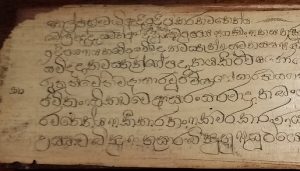
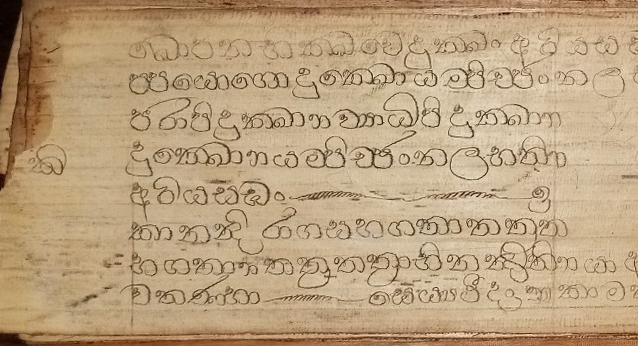
Private Collection, Sinhalese Palm-Leaf Manuscript, Leaf ’31’, Side 1, Detail: Left-hand Side. Reproduced by Permission.

[Posted on 10 April, with updates, as Mildred Budny continues the quest, and the owner supplies the full series of images.]

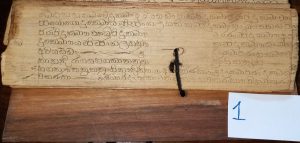
Following Part 1, we continue the display of the leaves — or rather bisected half-leaves — in a Sinhalese Palm-Leaf Manuscript now in a private collection. The fragment apparently presents a single Buddhist text, albeit in a disordered sequence with some gaps.  The text is not yet identified.

The manuscript is written, from left to right, in Sinhalese script (see Sinhala_script) upon palm-leaves.  The language is mostly likely Pali (a guide: Pali).  At present, the 33 half-leaves are strung on string or cord through a single stringing hole, ending in a simple beveled rectangular cover.  The text is written in single columns of 5 to 8 lines per column.

A match for the specimen in terms of script appears here, with transliteration of its text:

  • www.ancient-buddhist-texts.net/Buddhist-Texts/XX-Dhammacakka/Dhammacakka.htm.

Some half-leaves have Letter/Number Marks in the left-hand margin.  They correspond with one of the systems for Sinhala Numerals.

The Kaṭapayādi or Katapayadi System uses Sinhala consonants to depict Numbers 1 to 9 and 0, “for easy remembrance of numbers as words or verses”.  The numeration “is known as Katapayadiya since number one is allocated with the Sinhala letters ‘Ka’ (ක), ‘Ta’ (ට), ‘Pa’ (ප ) and ‘Ya’ (ය)”.

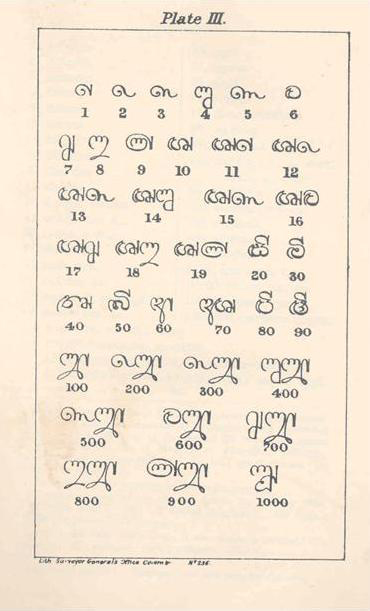
Some archaic Sinhala Numerals are shown in A Comprehensive Grammar of Sinhalese Language by Mendis Gunasekera (1891), Plate III.

Mendia Gunesekera (1891), Plate III. Image via Creative Commons.

By such guides, as well as other material and textual features of the half-leaves, a conjectured reconstruction might be assembled.

A Full Leaf Reconstructed

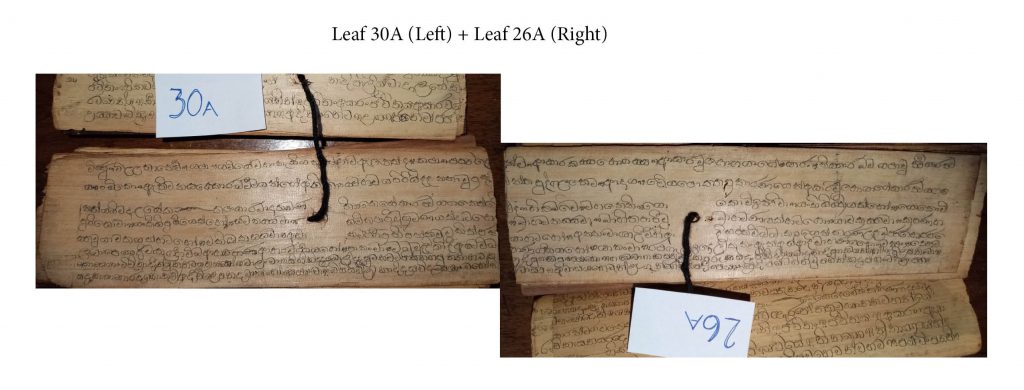
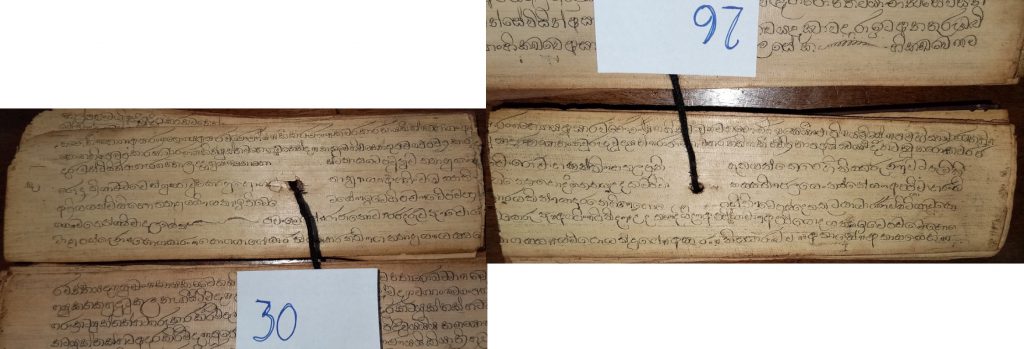
An example, showing the full leaf on one of its sides, combines its fragmentary half-leaves photographically.  Part 1 already showed one side. Now in Part 2 we show both.

One Side (30A + 26A Upright)

Private Collection, Sinhalese Palm-Leaf Manuscript, Reconstructed View of Former Leaf ('30A' + 26A').

Private Collection, Sinhalese Palm-Leaf Manuscript, Reconstructed View of Former Leaf (’30A’ + 26A’).

The Other Side (30 + 26 Upright)

Private Collection, Sinhalese Palm-Leaf Book. Reconstructed View of Former Leaf (’30’ + 26′ upright). Reproduced by Permission.

A Case Study

The goal here is both:

  • to show the book as a case study, or cautionary tale, for materials from foreign lands and languages, and
  • to gather feedback and suggestions for reconstructing its original order, recognizing its text, and identifying its probable date and place of production.

You can join the quest even if you do not (yet) know the language, because material features and pattern recognition offer useful guides for solving the puzzle.

Part 1 considered:

  • A Sinhalese Palm-Leaf Book in Deconstructed and Reconstructed Order.

Private Collection, Sinhalese Palm-Leaf Manuscript, End-Leaf 01, Left, with Letter/Number Ka..

Private Collection, Sinhalese Palm-Leaf Manuscript, End-Leaf 01, Left.

That first Post presented, with the owner’s permission, images of some leaves out of the full set in the book at present.  The full set of images encompasses Sides 1–30A, plus the cover.

The numbering was adopted by the collector for photographing the half-leaves in their current series within the book. Numbers 1–30 for the leaves, and suffix A for their second sides:  1, 1A, 2, 2A, and so on.  Let’s call them “Sides”.  Note that the current assembly of the leaves, and the photographs made in consecutive sequence turning its leaves one by one, sometimes show the text on them upside-down.

The first post displayed images in several groups:

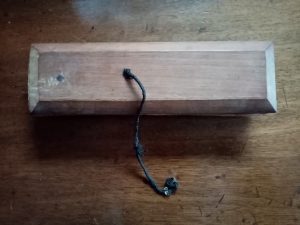
  • Beveled Rectangular Cover

    Private Collection, Sinhalese Palm-Leaf Manuscript, Cover.

    Private Collection, Sinhalese Palm-Leaf Manuscript, Cover.

  • Numbers 1–8A

    To Start the Show

    Private Collection, Sinhalese Palm-Leaf Manuscript, End Leaf '01a' =Side 1.

    Private Collection, Sinhalese Palm-Leaf Manuscript, End Leaf ’01a’ =Side 1.

  • Numbers 9–11A and 23–24A

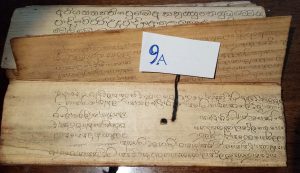
    To Exhibit the Half-Leaves which have Doubled (or Repierced) Sets of Stringing Holes

    Private Collection, Sinhalese Palm-Leaf Manuscript, Leaf 9A.

    Private Collection, Sinhalese Palm-Leaf Manuscript, Leaf 9A.

  • Numbers 30A + 26A:

    To Demonstrate the Virtual Reconstruction of the Originally Conjoined Halves of one Full Side (front or back) of a Single Leaf

    Private Collection, Sinhalese Palm-Leaf Manuscript, Reconstructed View of Former Leaf ('30A' + 26A').

    Private Collection, Sinhalese Palm-Leaf Manuscript, Reconstructed View of Former Leaf (’30A’ + 26A’).

That virtual reconstruction of 1 former side of 1 full leaf vividly demonstrates the reshuffling of the half-leaves in producing a newly reconstructed ‘deck’ for the sequence.

Now we show more of the manuscript.

Read the rest of this entry →

Tags: Buddhist Texts, Deconstructed Manuscripts for the Market, Fragmentology, manuscript fragments, Palm-Leaf Manuscripts, Reconstructing Manuscripts Virtually, Sinhalese Manuscripts
2 Comments »

A Sinhalese Palm-Leaf Book in Deconstructed and Reconstructed Order

April 8, 2021 in Manuscript Studies

A Sinhalese Palm-Leaf Book
with Chopped and Disordered Leaves

A Cautionary Tale

Recently, we were contacted by a private collector, reading our blogposts and wondering about a book which had come through inheritance, without any identification to speak of.  The bare bones of information relayed got the object indicated “that it is a Buddhist book, with handwritten pages of about 33 leaves written on both sides”.  But what language?  Is it manuscript or print?  Etc.?

Private Collection, Sinhalese Palm-Leaf Manuscript, End-Leaf 01, Left.

Private Collection, Sinhalese Palm-Leaf Manuscript, End-Leaf 01, Left.

A few photographs gave some first glimpses.  (See below.)  With them, we conferred among ourselves, and offered a preliminary description.  It includes a brief guide about how to proceed, if wished, to examine the artefact more closely.

Mind you, we are talking in a time of pandemic and Bibliographical Lockdown.  (See, with some observations about escape routes, Selbold Cartulary Fragments, including some resourceful tips. Summed up as: “When all else fails, read the text.”)

Images are an amazing resource, of course, but what photographs might we seek to take, and how to look at them?  That question might come to the fore if, perchance, you don’t know what sort of book it is, let alone what language?  What if you can’t read the text?  And which way is up?

I phrase the questions this way because, in part, I can’t (yet) read every language (Can Dream!), decipher every script, etc., etc.

Perhaps you too?

Willing to learn?  At least some rudiments appropriate for the particular artefact?  Yes?

Read On!

Read the rest of this entry →

Tags: Buddhist Texts, Deconstructed Manuscripts for the Market, Fragmentology, Manuscript studies, Palm-Leaf Manuscripts, Reconstructing Manuscripts, Sinhalese Manuscripts
2 Comments »

Otto Ege Manuscript 40, Part II: Before and After Ege

April 3, 2021 in Manuscript Studies

Otto Ege’s
Aquinas Manuscript in Humanist Script
(Ege Manuscript 40)
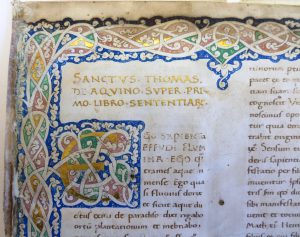
Private Collection, Ege's FBNC Portfolio, Aquinas Leaf, Recto, Top Right. Reproduced by Permission.

Private Collection, Ege’s FBNC Portfolio, Aquinas Leaf, Recto, Top Right. Reproduced by Permission.

PART II

Before and After Ege

  • Part I: Otto Ege’s Aquinas Manuscript in Humanist Script (Ege Manuscript 40).
  • Part II: Ege Manuscript 40: Before and After Ege (You are Here).
  • Part III: Specimens of ‘Ege Manuscript 40’ in the ‘Ege Family Portfolio’.

We continue explorations of Ege Manuscript 40, as we began in Part I, in a series of posts about Ege manuscript fragments in his Portfolio of Famous Books in Nine Centuries (FBNC).

The series began with

  • Otto Ege’s Portfolio of ‘Famous Books’ and Ege Manuscript 53 (Quran/Koran)
  • Volume II and More Parts of ‘Otto Ege Manuscript 51’ (Aristotle)

See also our Contents List.

Now we turn to Part II on Otto Ege’s Aquinas Manuscript in Humanist Script. Its specimen leaves circulate not only in the Portfolio of Famous Books, in the longer, Deluxe Version in Nine Centuries, but also in the more famous Portfolio of Fifty Original Leaves (FOL) from Medieval Western Manuscripts. The Aquinas Manuscript takes its assigned Ege Manuscript Number from its place as Specimen Leaf Number 40 in the FOL Portfolio.

Ege’s Label for Manuscript Specimen 40
in the FOL Portfolio
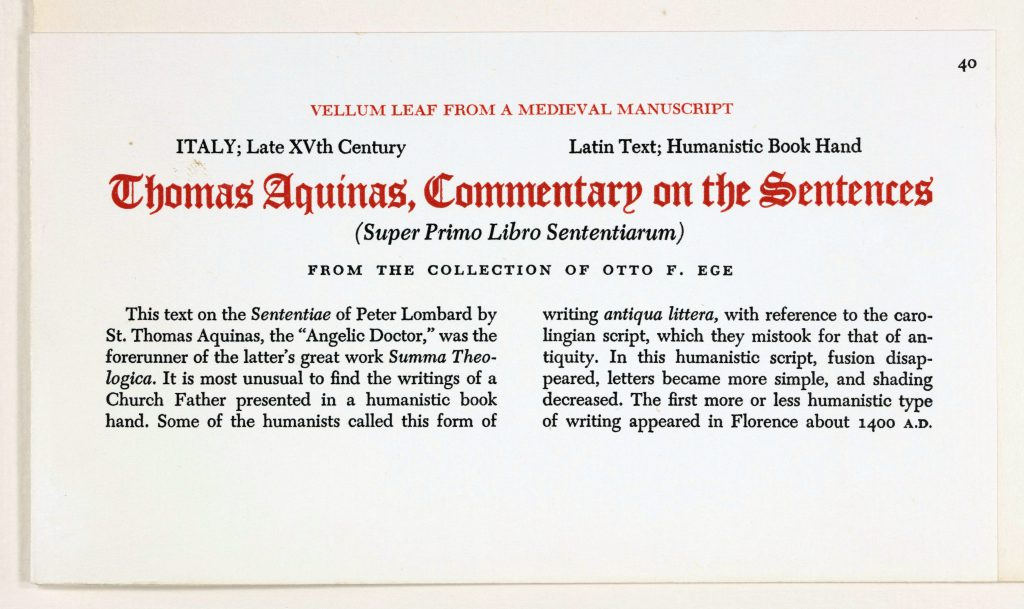
Otto F. Ege: Fifty Original Leaves from Medieval Manuscripts, Leaf 40, Printed Label, Special Collections and University Archives, Stony Brook University Libraries.

Otto F. Ege: Fifty Original Leaves from Medieval Manuscripts, Leaf 40, Printed Label, Special Collections and University Archives, Stony Brook University Libraries.

Ege’s Label for the Specimen Leaf in the Famous Books Portfolio in Nine Centuries
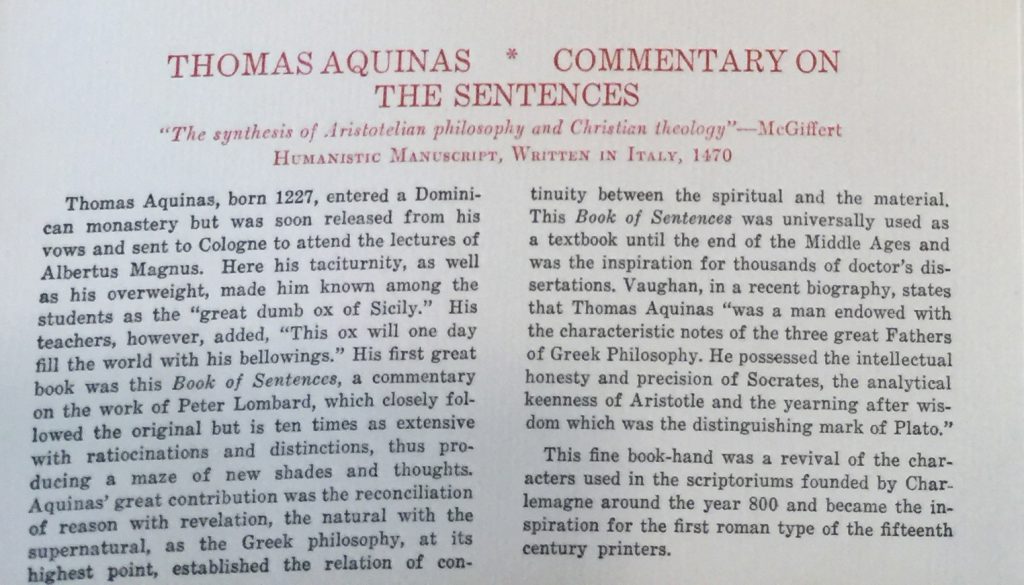
Private Collection, Ege's Famous Books in Nine Centuries, Label for the Aquinas Manuscript Leaf. Reproduced by permission.

Private Collection, Ege’s Famous Books in Nine Centuries, Label for the Aquinas Manuscript Leaf. Reproduced by permission.

Ege’s Label for the Specimen in the (Unnumbered) Contents List for FBNC
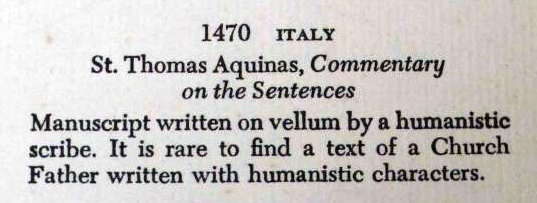
Private Collection, Ege's FBNS, Contents List, Detail: The Aquinas Manuscript. Reproduced by permission

Private Collection, Ege’s FBNS, Contents List, Detail: The Aquinas Manuscript. Reproduced by permission.

Part I in our series on Otto Ege’s Aquinas Manuscript in Humanist Script (Ege Manuscript 40) examines these labels as such.

Specimen Pages

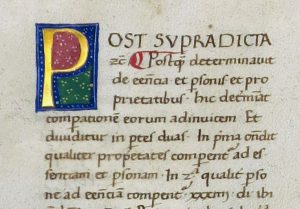
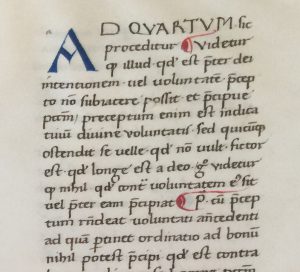
Examples from among the specimens displayed in Part I show several approaches to the layout of the text in 2 columns of 37 lines. Many of Ege’s specimens selected for the Portfolios show ‘standard’ pages, with script in Humanist Minuscule, Paraph markers in red and blue, and inset Capital Letters in blue or red.
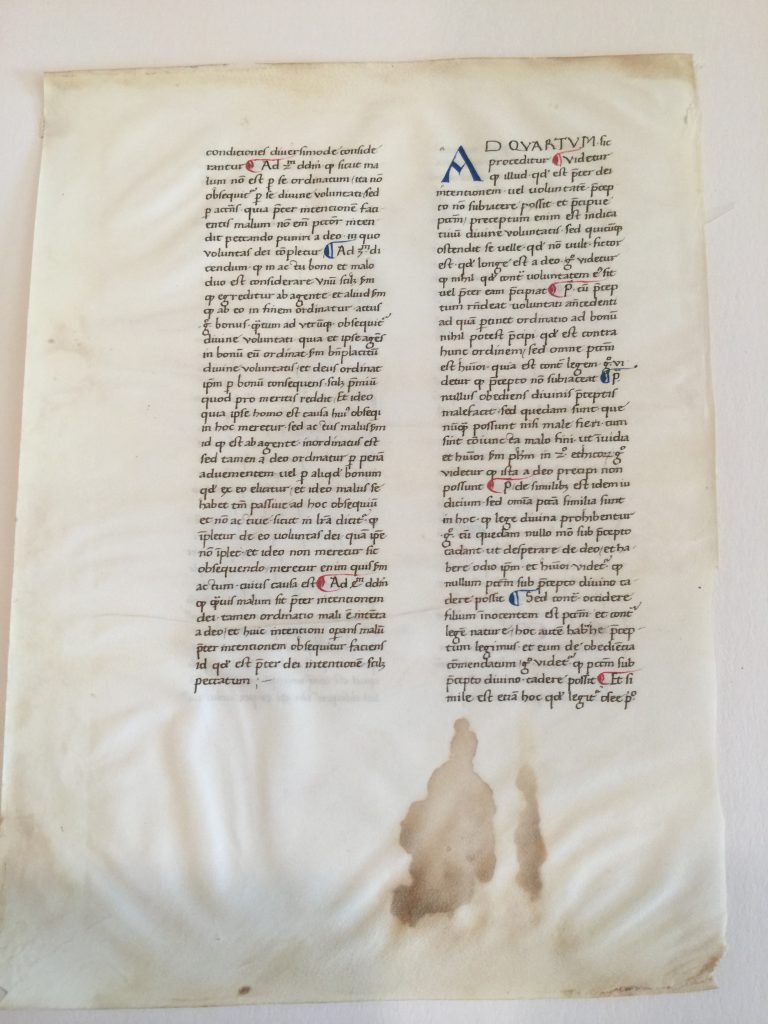
Private Collection, FBNC, Aquinas Leaf 'Front'. Reproduced by permission.

Private Collection, FBNC, Aquinas Leaf ‘Recto’. Reproduced by permission.

Some specimens provide somewhat more elevated forms of polychrome decorated initials, including rectangular frames, gold elements, and patterns of dots.
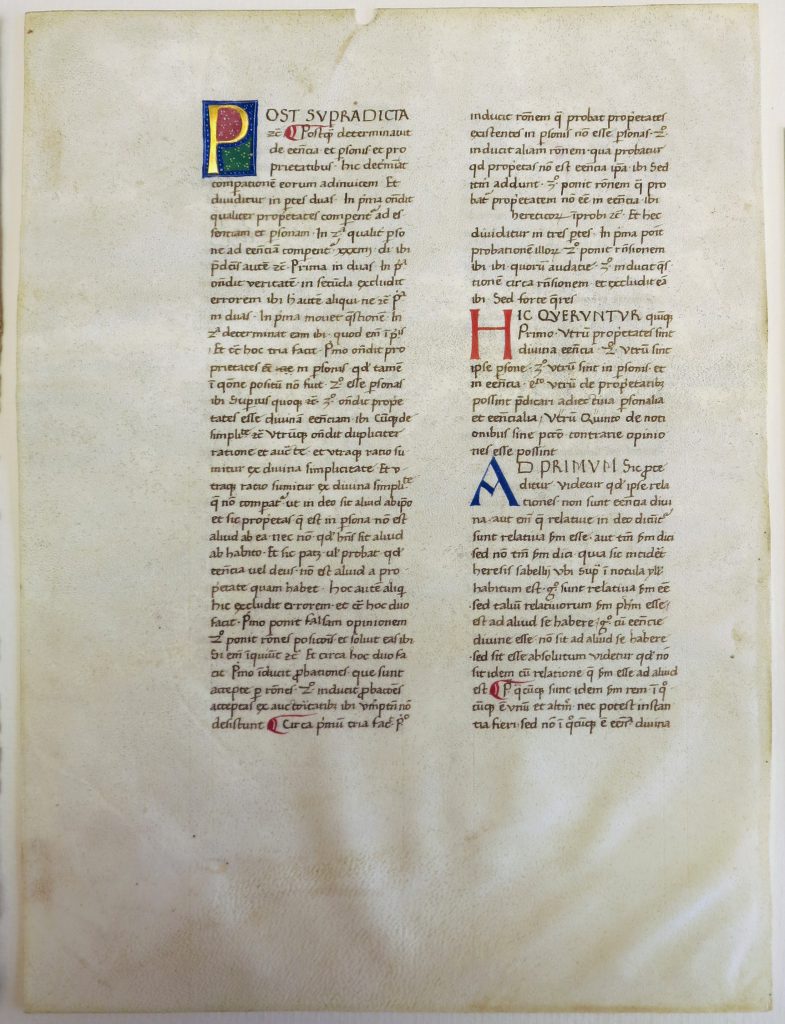
Beinecke Rare Book & Manuscript Library, Otto Ege Collection, FOL Set 3, MS 40, Specimen 2 = folio 216v (turned to the front in Ege's Mount. Photography Mildred Budny.

Beinecke Rare Book & Manuscript Library, Otto Ege Collection, FOL Set 3, MS 40, Specimen 2 = folio 216v (turned to the front in Ege’s Mount. Photography Mildred Budny.

The Manuscript Before and After Ege

As frequently in studying manuscripts dispersed by Ege, sales and auction catalogues can provide invaluable information about the states of the manuscript in transmission across time, hands, and collections. Frequently, too, it can be challenging to try to identify the catalogues, and to find access to them. Part of the problem can come from abbreviated citations in reference works to catalogues only by a vendor’s name, a year-date, and/or a catalogue or bulletin number.

For example, with Ege MS 40, “Maggs, Bulletin 11 (1982)” stands for

  • Maggs Bros, European Miniatures and Illumination & Calligraphy also early writing from Egypt, Bulletin No. 11 (London: November 1982), item 79 and pl. XXXIII.

“Maggs Cat. No. 1227 [without a date]” stands for

  • Maggs Bros., Ltd., Illuminated Leaves and Mediaeval Miniatures, Catalogue 1227 (London: 1997), item 96.

I await the chance to see these items, whilst libraries are shut or difficult of access in the years 2020–2021.

Meanwhile, some online reference sources help somewhat to identify which are the correct catalogues, and which collection might have them, or grant access to them, even in digital form.

Earlier catalogues are also sought. They may report information about the manuscript in its former volume.

Duschnes, Catalogues 54 & 74 (1945–1946)

I’m on the lookout for:

  • Philip C. Duschnes, Catalogue 54 (1943), item 50
  • Philip C. Duschnes, Catalogue 74 (1946), item 50 — perhaps the same item, which continued to await sale?

The former, Catalogue 54 [53?], is “101 Original Leaves & Sets of Leaves from Medieval Manuscripts, Incunabula, Famous Bibles and Noted Presses, 1150 A. D. – 1935 A. D.” [Autumn 1942]. The front cover is illustrated here, in connection with Ege Manuscript 15 (the renowned Beauvais Missal).

Sotheby’s, 26 November 1985, Lot 80

  • “Sotheby’s 1985, lot 80” is identifiable with a catalogue already on my bookshelves, as it contains many lots (fifty-four in total, nos. 39–89) left over from Ege’s collection, including manuscript fragments of various kinds and in various states.

The catalogue presents Western Manuscripts and Miniatures for sale at auction in London on Tuesday 26th November 1985. Its Lot 80 offers

THIRTY-TWO LEAVES FROM THOMAS AQUINAS, COMMENTARY ON THE SENTENCES OF PETER LOMBARD, BOOK I, IN LATIN, MANUSCRIPT ON VELLUM [ITALY, SECOND HALF OF THE FIFTEENTH CENTURY

32 leaves, detached, double column, 37 lines, . . . written in brown ink in a humanistic hand with some gothic features, first words of each chapter in capitals, paragraph marks throughout in red or blue, PAINTED INITIALS (3-line) in red or blue at the start of each chapter . . .

The entry includes the tantalizing reference to an earlier catalogue (as yet unidentified), which presents the manuscript in its former state, binding included.

With a cutting from an American bookseller’s catalogue in which this manuscript, then with 309 leaves, was no. 12 (Emphasis added), describing a coat-of-arms on the first leaf, azure, 3 crescents or between a chevron of the same [Emphasis added], “probably the work was commissioned by some beauty-loving Italian duke . . . Certainly the work of the good saint have never been sent forth into the world in lovelier garb”, etc., with much more . . . ‘ “

An Observation on the Usefulness of Sales Clippings

The mention there of a former sales clipping which continued to travel in the company of the manuscript reminds me of the pair of clippings (from a single, unnamed catalogue) pasted at the front of Volume II of Ege Manuscript 51, now at the Beinecke Rare Book & Manuscript Library.

The partly overlapping pair of clippings comes from consecutive pages in the lost catalogue, as the entry carried over from the bottom of one page (and leaf) to the top of the next, so as to complete the account of item 443. The catalogue remains unidentified; the overlap covers, or veils, the price of £21 at the end of the item. The entry describes the 3-volume set of Aristotelian texts before Ege took it to pieces.

Specimens from the Aristotle manuscript found their way into the Portfolios of Famous Books, in both Nine Centuries (like the Aquinas Manuscript) and Eight Centuries. See Volume II and More Parts of Ege Manuscript 51.
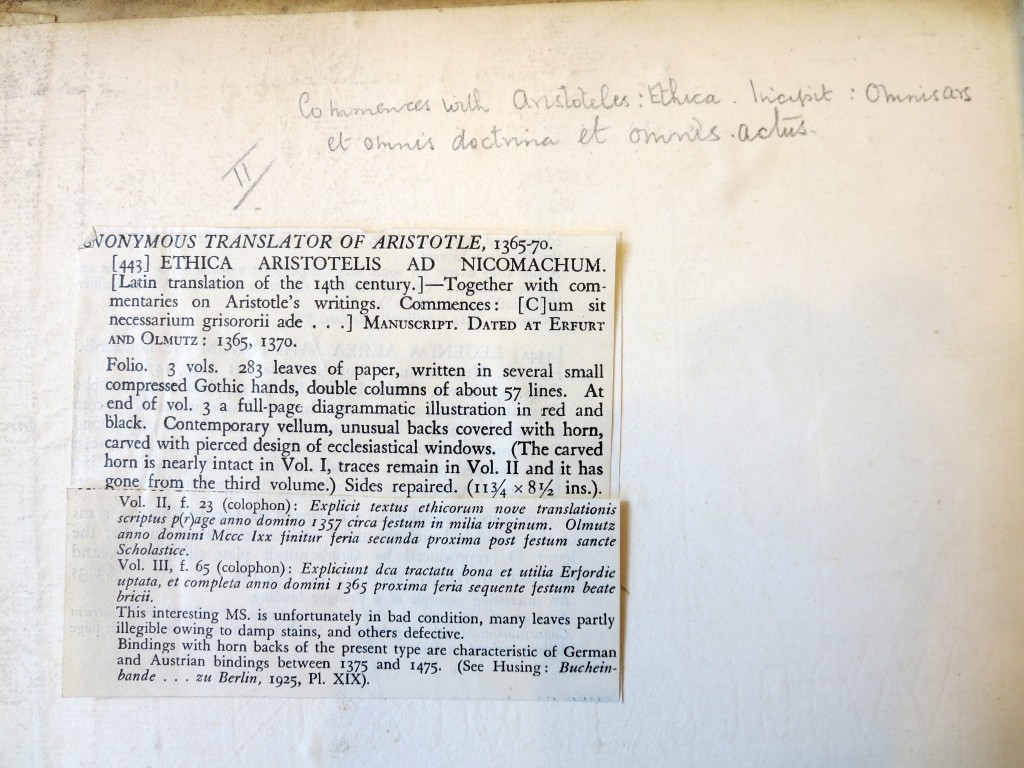
Beinecke Rare Book and Manuscript Library, Yale University. Otto Ege Collection, Ege Manuscript 51, Volume II, Front Pastedown, Top.

Beinecke Rare Book and Manuscript Library, Yale University. Otto Ege Collection, Ege Manuscript 51, Volume II, Front Pastedown, Top.

Inspired by the description in the Sotheby’s catalogue, I have found one or more possible earlier sales catalogues for the Aquinas manuscript — although it is not by an “American bookseller”, nor does its item number correspond with the reported number 12.

Davis & Orioli (1924 & 1925)

Two relevant entries appear in the Schoenberg Database of Manuscripts, although their records assimilate the details of the original catalogues in the requirement to conform with the format and fields designed for data entry and retrieval.

1) SDBM_262153

I. Davis & G. M. Orioli, Number 41 (1925), Rare Books & Interesting Manuscripts, Lot #4. Price 65.00 GPB

“Aquino (S. Thomas de)”, Super primo libro sententiarum, XVth century, parchment (fine vellum), Italy 310 folios, 37 lines, 2 columns

Binding: “rich-coloured brown morocco elaborately tooled in blind to a Veneto-Oriental design heightened with pointille decorations in gold”

Other info: “arms of owner within green wreath in lower margin”

2) SDBM_261443

I. Davis & G. M. Orioli, Number XLIV (1926), Early Printed Books: Literature, Science, and Medicines, Lot #1. Price 65.00 GPB

[Etc., as before]

These records conjure up the image of a volume prepared on “fine vellum” with the requisite number of columns and lines, with a tooled leather binding embellished in “a Veneto-Oriental design” including pointillé elements in gold, and an image of the owner’s arms (or coat-of-arms) in a lower margin someplace on the inside, presumably, as customary, on the frontispiece or first page of text.

From an Origin in Italy
To Collections in the United States (and Beyond)

That the firm of Davis & Orioli had offices in Florence, Italy (after 1910), and in London, England (after 1913), opens the possibility (or likelihood?) that the manuscript came to the firm from some source directly in Italy. Perhaps the manuscript of Aquinas’s Commentary on the Sentences, or at least the specified Book I, resided in Italy for several centuries between its production in the 15th century and its departure for other lands, presumably via London, by the start of the second quarter of the 20th century.

The early sales catalogues themselves could have more to tell about the manuscript in its former state than their database “skeleton” reveals.

The Number(s) of Leaves

Already, however, it seems clear that ‘our’ folio 300 in the new set of FBNC occupied a position near the end of the volume, although reports of the total number of leaves in the volume differ somewhat. The Schoenberg Database entries for the 1925 and 1926 catalogues of Davis & Orioli report 310 leaves, whereas the “American bookseller’s catalogue” (of an unknown date) quoted by the Sotheby’s catalogue of 1985 cites 309 leaves. The numbers could well indicate that the pencil foliation stood already upon the leaves, at least as far as the now-visible 300.
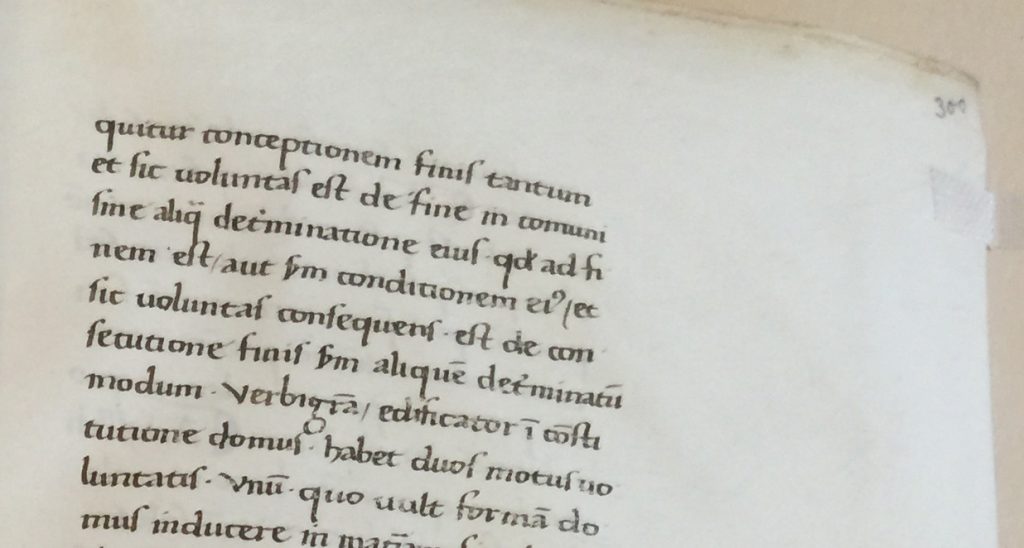
Private Collection, FBNC, Aquinas Leaf 'Back' top right and page number.

Private Collection, FBNC, Aquinas Leaf ‘Back’ top right and page number. Reproduced by permission.

Who can tell, at present, if the slight difference in counting by 1 leaf between the catalogues (Davis & Orioli versus the ‘American’) represents a simple typographical mistake. Or a divergent or inconsistent approach to including manuscript leaves and endleaves?

But more, could it signify the removal of 1 leaf between the time of the Davis & Orioli sales catalogues (1925–1926) and the arrival of the manuscript in the hands of a next bookseller (name as yet unidentified), perhaps in America, by an American, or by a vendor aiming for the American market? Would a removal have claimed a folio deemed desirable to retain for one reason or other, or have extracted a folio especially damaged and unsightly?

It is worth wondering whence Ege acquired his varying assessments of the date of production of the manuscript as “1470”, tout court, and as “Late XVth Century” (see above). Would the manuscript have had a colophon or some other evidence for the cited date? Would the assessment depend upon the catalogue(s) through which, and travelling with which, the manuscript came to Ege? More research might reveal the answers.

More to Come

The next blogpost in our series on Ege Manuscript 40 examines more parts of the manuscript. The pair of specimens in the “Ege Family Portfolio” (FOL Set 3) contain significant evidence of its former character, decoration, and ownership.

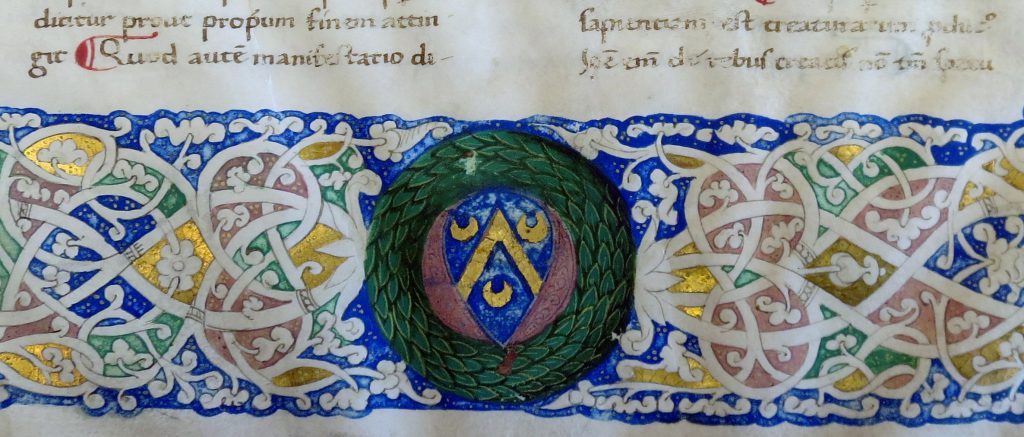
Among these signs are the owner’s arms within a wreath. In the image painted on the page, we can see for ourselves its rendering of the heraldic design, including the shapes and locations of the elements in gold (or), as precisely described in sales catalogues:

azure, 3 crescents or between a chevron of the same
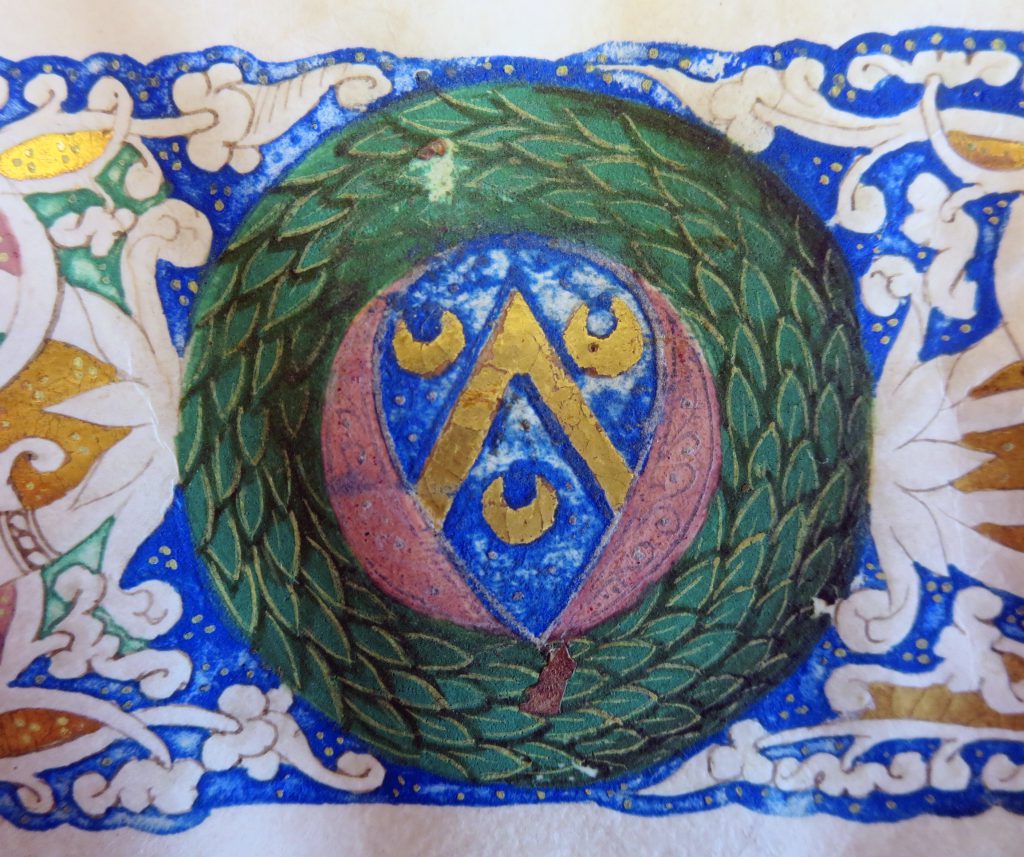
Beinecke Rare Book & Manuscript Library, Otto Ege Collection, FOL Set 3, MS 40, Specimen 1 = folio '1'r, bottom center. Photography Mildred Budny.

Beinecke Rare Book & Manuscript Library, Otto Ege Collection, FOL Set 3, MS 40, Specimen 1 = folio ‘1’r, bottom center. Photography Mildred Budny.

*****

We thank the owner of the ‘new’ Portfolio and the owners of other specimens for permission to examine them. We are grateful for permission to reproduce the images. Thanks, as always, for the advice, encouragement, and suggestions of colleagues, students, and friends!

*****

Do you know of other leaves from this Aquinas manuscript? Other Sets of the Portfolio of Famous Books in Nine Centuries (FBNC), or Sets of the Fifty Original Leaves (FOL)?

Do you recognize the work of the scribe(s) in other manuscripts? Do you recognize the owner’s arms?

Please let us know. Please leave your Comments here, Contact Us, and/or visit our Facebook Page. We look forward to hearing from you.

Next stop, Part III:
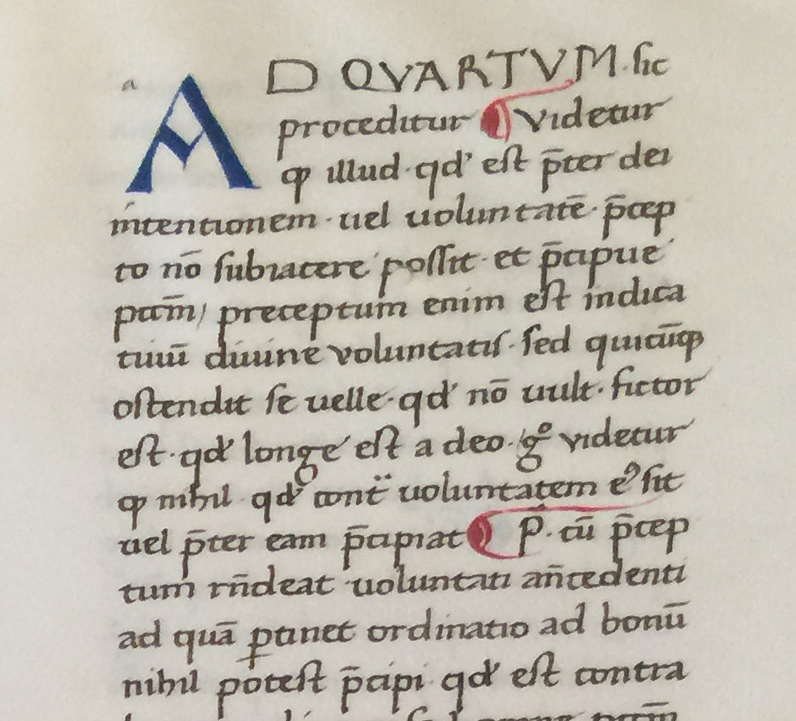
  • Specimens of Ege Manuscript 40 (Aquinas) in the ‘Ege Family Portfolio’.

Private Collection, Ege's FBNC Portfolio, Aquinas Leaf, Recto, Top Right. Reproduced by Permission.

Private Collection, Ege’s FBNC Portfolio, Aquinas Leaf, Recto, Top Right. Reproduced by Permission.

*****

Tags: Aquinas on the Sentences of Peter Lombard, Clippings from Sales Catalogues, Davis & Orioli, Ege Manuscript 40, Ege Manuscript 51, Ege's FOL Portfolio, Ege's Portfolio of Famous Books, Fragmentology, Humanist Manuscripts, Medieval Manuscript Fragments, Otto Ege, Philip Duschnes, Sothebys, Thomas Aquinas
No Comments »

Another Leaf from the Warburg Missal (‘Ege Manuscript 22’)

March 23, 2021 in Manuscript Studies, Reports

J. S. Wagner Collection, Ege Manuscript 22, Folio clvi, recto, within its frame.

J. S. Wagner Collection, Ege Manuscript 22, Folio clvi, recto, within its frame. Reproduced by permission.

This post has moved to:
Another Leaf from the Warburg Missal
(“Ege Manuscript 22”)


Tags: 'Fifty Original Leaves from Medieval Manuscripts', Benedictine Missal, Bergendal Collection, Bergendal MS 69, Binding History, Ege Manuscript 22, Ege's FOL Portfolio, Fragmentology, Leander van Ess, Measure Theory, Medieval Manuscript Fragments, Missal Herbipolensis, Missale Coloniense, Otto Ege, Parochial Church of St John the Baptist Warburg, Reused Binding Fragments, Sir Thomas Phillipps, The Warburg Missal
Comments Off on Another Leaf from the Warburg Missal (‘Ege Manuscript 22’)

Specimens of Ege Manuscript 40 in the Ege Family Portfolio

March 19, 2021 in Manuscript Studies, Uncategorized

Specimens of the Aquinas Manuscript in Humanist Script
(Ege Manuscript 40)
in the ‘Ege Family Portfolio’

— Part III of III in the series on this manuscript —

Beinecke Rare Book & Manuscript Library, Otto Ege Collection, FOL Set 3, MS 40, Specimen 1: folio '1'r, Bottom Center. Photography Mildred Budny.

Beinecke Rare Book & Manuscript Library, Otto Ege Collection, FOL Set 3, MS 40, Specimen 1: folio ‘1’r, Bottom Center. Photography Mildred Budny.

Thomas Aquinas, Commentary on Book I of Peter Lombard’s Sentences

Written in Latin on vellum

Italy, probably late 15th Century (circa 1475)

Circa 288 × 210 mm <Written area circa 178 × 130 mm>

Double columns of 37 lines

in Humanist Script (with Gothic Features)

*****

Folios ‘1’ and 216

[1] Super Sententiis, Prooemium (to Ipse dedit quosdam)
and
[2331] Super Sent., Liber 1, Distinctio 32, Quaestio 2, Articulo 2 (qc. 1 co), to [2341] Distinctio 33, Quaestio 1, Articulo 1 (arg. 2)

Beinecke Rare Book & Manuscript Library, Otto Ege Collection, FOL Set 3, MS 40, Specimen 2 = folio 216v (turned to the front in Ege's Mount: Top Left. Photography Mildred Budny.

Beinecke Rare Book & Manuscript Library, Otto Ege Collection, FOL Set 3, MS 40, Specimen 2 = Folio 216v, Top Left. Photography Mildred Budny.

Previously, in exploring the Portfolio of Famous Books assembled by Otto F. Ege, we examined the 15th-century Aquinas Manuscript whose dismembered specimens appear in 2 of his Portfolios.  See

  • Part I: Otto Ege’s “Aquinas Manuscript in Humanist Script” (Ege Manuscript 40).
  • Otto Ege Manuscript 40, Part II: Before and After Ege

Now we reach Part III of III.

Known as Ege Manuscript 40 from its assigned number in the Portfolio of Fifty Original Leaves from Medieval Western Manuscripts (“FOL”), its leaves also joined Ege’s Portfolio of Famous Books in Nine Centuries (“FBNC”) as the 6th Manuscript Specimen (of 6).  By virtue of its FOL position, it appears in the Handlist of Otto Ege’s Manuscripts (2016), as no. 40 (pp. 131–132 etc.).

Humanist Script and Book-Production

Its case pertains to the notable genre of Humanist Manuscripts, which emerged in Italy from the early 15th century onwards.  Illustrated descriptions of the origins and development of Humanist(ic) Script include:

  • Humanistic Script, via Digitized Medieval Manuscripts, and
  • Humanist Minuscule, via Wikipedia.

Displays of such books include:

  • The Humanistic Book at The Fitzwilliam Museum in Cambridge.

Beinecke Rare Book & Manuscript Library, Otto Ege Collection, FOL Set 3, MS 40, Specimen 1: folio '1'r, Top Left. Photography Mildred Budny.

Beinecke Rare Book & Manuscript Library, Otto Ege Collection, FOL Set 3, MS 40, Specimen 1: folio ‘1’r, Top Left. Photography Mildred Budny.

There, we find a concise description of the phenonemon (I emphasize several elements in red).

In Italy in the early fifteenth century a revolution took place in the script and decoration of the manuscript book, first in Florence, and very soon after in the rest of the peninsula. It involved the rediscovery of classical texts, the revival of ancient literature as a central element of the curriculum, the reform of Latin spelling, and a new style of writing, called by its contemporaries littera antica and known to us today as ‘humanistic script’.

The new type of book received a new style of decoration. At first, it was limited to the white-vine scrolls meandering around birds, butterflies, and chubby little boys, the ubiquitous putti. But by the mid-fifteenth century, illuminators were experimenting with three-dimensional images corresponding to the antiquarian passions of Humanist scholars and collectors. Ancient inscriptions, jewels, and archaeological finds inspired the illusionistic monumental frontispieces and architectural title pages, one of the most lasting contributions of the Humanistic manuscript to book design.

As they come into view, more leaves from the fragmented Ege Manuscript 40 allow its case to assume its proper place within the robust tradition of Humanist script and book-production.  Now we focus upon the special contributions which its leaves in the ‘Ege Family Portfolio’ can make to a fuller understanding of its origin and history.

Read the rest of this entry →

Tags: Aquinas on the Sentences of Peter Lombard, Beinecke Rare Book and Manuscript Library, British Library Harley MS 3110, Corpus Christi College Cambridge MS 81, Dispersed Manuscript Leaves, Ege Family Portfolio, Ege Manuscript 41, Ege's FOL Portfolio, Ege's Portfolio of Famous Books, Humanist Manuscripts, Humanist Script, Lawrence J. Schoenberg Collection LJS 225, manuscript fragments, Medieval Manuscript Fragments, Morgan Library MS M 476, Otto Ege Manuscript 31, Otto Ege Manuscript 40, Otto Ege Manuscript 51, Otto Ege Manuscript 53, Otto Ege Portfolios, Owner's Arms in Wreath, White Vine-Scroll Ornament
4 Comments »

« Older Entries
Newer Entries »
  • Top
©2024 Research Group on Manuscript Evidence.


is proudly powered by WordPress. WordPress Themes X2 developed by ThemeKraft.