• News
    • News & Views
    • RGME Activities for 2024 and 2025
    • Around & About with the RGME
    • Reviews
    • Highlights
  • Blogs
    • Manuscript Studies
      • Manuscript Studies: Contents List
    • International Congress on Medieval Studies
      • Abstracts of Congress Papers
        • Abstracts of Papers Listed by Author
        • Abstracts of Papers Listed by Year
  • About
    • Mission
    • Who We Are
      • Officers, Associates & Volunteers
      • RGME Committees
      • Friends of the Research Group on Manuscript Evidence
    • Policies & Statements
      • RGME Privacy Policy Statement
      • RGME Intellectual Property Statement & Agreements
    • People
      • Mildred Budny — Her Page
      • Adelaide Bennett Hagens
    • Activities
      • Events
      • Congress Activities
        • Sponsored Conference Sessions (1993‒)
          • Panels at the M-MLA Convention (from 2016)
        • Co-sponsored Conference Sessions (2006‒)
    • History
      • Seals, Matrices & Documents
      • Genealogies & Archives
    • Contact Us
  • Bembino
    • Multi-Lingual Bembino
    • RGME Bembino: Resources
  • Congress
    • Sponsored Conference Sessions (1993‒)
    • Co-sponsored Conference Sessions (2006‒)
    • Abstracts of Congress Papers
      • Abstracts Listed by Author
      • Abstracts Listed by Year
    • Kalamazoo Archive
    • Panels at the M-MLA Convention (2016-2019)
      • Abstracts of Papers for the M-MLA Convention
      • Panels at the M-MLA Convention (from 2016)
  • Events
    • RGME Activities for 2024 and 2025
      • 2023 Activities and 2024 Planned Activities
    • Seminars, Workshops, Colloquia & Symposia (1989–)
      • Seminars on ‘The Evidence of Manuscripts’
      • Symposia on ‘The Transmission of the Bible’
      • The New Series (2001-)
        • 2019 Anniversary Symposium Program: The Roads Taken
        • 2019 Anniversary Symposium Registration
        • 2019 Anniversary Symposium Registration Open
      • RGME Symposia: The Various Series
      • The Research Group Speaks: The Series
      • Meetings of the Friends of the Research Group on Manuscript Evidence
      • RGME Online Events
    • Abstracts of Papers for Events
      • Abstracts of Papers for Seminars on ‘The Evidence of Manuscripts’
      • Abstracts of Papers for Symposia, Workshops & Colloquia
    • Receptions & Parties
    • Business Meetings
    • Photographic Exhibitions & Master Classes
    • Events Archive
  • ShelfLife
    • Journal Description
    • ShelfMarks: The RGME-Newsletter
    • Publications
      • “Insular, Anglo-Saxon, and Early Anglo-Norman Manuscript Art at Corpus Christi College, Cambridge” (1997)
        • Mildred Budny, ‘Catalogue’
        • The Illustrated Catalogue (1997)
      • The Illustrated Handlist
      • Semi-Official Counterfeiting in France 1380-1422
      • No Snap Decisions: Challenges of Manuscript Photography
    • History and Design of Our Website
  • Galleries
    • Watermarks & the History of Paper
    • Galleries: Contents List
    • Scripts on Parade
    • Texts on Parade
      • Latin Documents & Cartularies
      • New Testament Leaves in Old Armenian
    • Posters on Display
    • Layout Designs
  • Donations and Contributions
    • RGME Donor Promise
    • 2023 End-of-Year Fundraiser for our 2024 Anniversary Year
    • 2019 Anniversary Appeal
    • Orders
  • Links
    • Catalogs, Metadata, and Databases: A Handlist of Links
    • Handlist of Resources for Manuscript Studies and Fragmentology
    • Manuscripts & Rare Books
    • Maps, Plans & Drawings
    • Seals, Seal-Matrices & Documents

  • News
    • News & Views
    • RGME Activities for 2024 and 2025
    • Around & About with the RGME
    • Reviews
    • Highlights
  • Blogs
    • Manuscript Studies
      • Manuscript Studies: Contents List
    • International Congress on Medieval Studies
      • Abstracts of Congress Papers
        • Abstracts of Papers Listed by Author
        • Abstracts of Papers Listed by Year
  • About
    • Mission
    • Who We Are
      • Officers, Associates & Volunteers
      • RGME Committees
      • Friends of the Research Group on Manuscript Evidence
    • Policies & Statements
      • RGME Privacy Policy Statement
      • RGME Intellectual Property Statement & Agreements
    • People
      • Mildred Budny — Her Page
      • Adelaide Bennett Hagens
    • Activities
      • Events
      • Congress Activities
        • Sponsored Conference Sessions (1993‒)
          • Panels at the M-MLA Convention (from 2016)
        • Co-sponsored Conference Sessions (2006‒)
    • History
      • Seals, Matrices & Documents
      • Genealogies & Archives
    • Contact Us
  • Bembino
    • Multi-Lingual Bembino
    • RGME Bembino: Resources
  • Congress
    • Sponsored Conference Sessions (1993‒)
    • Co-sponsored Conference Sessions (2006‒)
    • Abstracts of Congress Papers
      • Abstracts Listed by Author
      • Abstracts Listed by Year
    • Kalamazoo Archive
    • Panels at the M-MLA Convention (2016-2019)
      • Abstracts of Papers for the M-MLA Convention
      • Panels at the M-MLA Convention (from 2016)
  • Events
    • RGME Activities for 2024 and 2025
      • 2023 Activities and 2024 Planned Activities
    • Seminars, Workshops, Colloquia & Symposia (1989–)
      • Seminars on ‘The Evidence of Manuscripts’
      • Symposia on ‘The Transmission of the Bible’
      • The New Series (2001-)
        • 2019 Anniversary Symposium Program: The Roads Taken
        • 2019 Anniversary Symposium Registration
        • 2019 Anniversary Symposium Registration Open
      • RGME Symposia: The Various Series
      • The Research Group Speaks: The Series
      • Meetings of the Friends of the Research Group on Manuscript Evidence
      • RGME Online Events
    • Abstracts of Papers for Events
      • Abstracts of Papers for Seminars on ‘The Evidence of Manuscripts’
      • Abstracts of Papers for Symposia, Workshops & Colloquia
    • Receptions & Parties
    • Business Meetings
    • Photographic Exhibitions & Master Classes
    • Events Archive
  • ShelfLife
    • Journal Description
    • ShelfMarks: The RGME-Newsletter
    • Publications
      • “Insular, Anglo-Saxon, and Early Anglo-Norman Manuscript Art at Corpus Christi College, Cambridge” (1997)
        • Mildred Budny, ‘Catalogue’
        • The Illustrated Catalogue (1997)
      • The Illustrated Handlist
      • Semi-Official Counterfeiting in France 1380-1422
      • No Snap Decisions: Challenges of Manuscript Photography
    • History and Design of Our Website
  • Galleries
    • Watermarks & the History of Paper
    • Galleries: Contents List
    • Scripts on Parade
    • Texts on Parade
      • Latin Documents & Cartularies
      • New Testament Leaves in Old Armenian
    • Posters on Display
    • Layout Designs
  • Donations and Contributions
    • RGME Donor Promise
    • 2023 End-of-Year Fundraiser for our 2024 Anniversary Year
    • 2019 Anniversary Appeal
    • Orders
  • Links
    • Catalogs, Metadata, and Databases: A Handlist of Links
    • Handlist of Resources for Manuscript Studies and Fragmentology
    • Manuscripts & Rare Books
    • Maps, Plans & Drawings
    • Seals, Seal-Matrices & Documents

Log in

Archives

Featured Posts

2026 International Congress on Medieval Studies: Program
Episode 24. “Life with Books” (Interview with John Windle)
Announcing the Launch of RGME Bembino WP
2026 RGME Colloquium at The Grolier Club: Report
Medieval Missal Fragment as Early-Modern Cover
The Weber Leaf from Ege MS 61
"Bembino" Booklet Cover
Episode 23. “Meet RGME Bembino: Facets of a Font”
2026 RGME Colloquium on “Transformations & Renewals” at The Grolier Club
2026 Theme of the Year: “Transformations and Renewals”
A Leaf with Patchwork from the Saint Albans Bible
A Sister Leaf from a Miniature Latin Vulgate Bible
A Little Latin Vulgate Bible Manuscript Leaf in Princeton
J. S. Wagner Collection. Leaf from from Prime in a Latin manuscript Breviary. Folio 4 Verso, with part of Psalm 117 (118) in the Vulgate Version, set out in verses with decorated initials.
2026 Annual Appeal
Episode 22: “Encounters with Local Saints and Their Cults”
Private Collection, Ege's FBNC Portfolio, Dante Leaf, Verso, Detail. Reproduced by Permission.
2025 RGME Autumn Colloquium on Fragments
Workshop 8: A Hybrid Book where Medieval Music Meets Early-Modern Herbal
2025 RGME Autumn Symposium on “Readers, Fakers, and Re-Creators of Books”
RGME Workshops on “The Evidence of Manuscripts, Etc.”
2025 International Medieval Congress at Leeds: RGME Program
Episode 21. “Learning How to Look”
2025 International Congress on Medieval Studies: Program
2025 RGME Visit to Vassar College
Two Leaves in the Book of Numbers from the Chudleigh Bible
Delibovi on Glassgold on Boethius: A Blogpost
Ronald Smeltzer on “Émilie du Châtelet, Woman of Science”
2025 Spring Symposium: “Makers, Producers, and Collectors of Books”
Starters’ Orders
The Weber Leaf from the Saint Albans Bible
Workshop 4. “Manuscript Fragments Compared”
Episode 20. “Comic Book Theory for Medievalists”
Episode 19: “At the Gate: Starting the Year 2025 at its Threshold”
Favorite Recipes for Lemonade, Etc.
RGME Visit to the Lomazow Collection: Report
2024 Autumn Symposium: “At the Helm”
A Latin Vulgate Leaf of the Book of Numbers
The RGME ‘Lending Library’
Florence, Italy, Ponte Vecchio from Ponte alle Grazie. Photo: Ingo Mehling, CC BY-SA 4.0 , via Wikimedia Commons
Episode 17. “RGME Retrospect and Prospects: Anniversary Reflections”
2024 Anniversary Symposium: The Booklet
Jesse Hurlbut at the Bonneville Salt Flats, Utah. Photograph Jesse Hurlbut.
Episode 16: An Interview with Jesse D. Hurlbut
To Whom Do Manuscripts Belong?
Kalamazoo, MI Western Michigan University, Valley III from the side. Photograph: David W. Sorenson.
2024 International Congress on Medieval Studies: Report
2024 Spring Symposium at Vassar College
Puente de San Martín: Bridge with reflection over the River Targus, Toledo, Spain.
2024 Grant for “Between Past and Future” Project from The Gladys Krieble Delmas Foundation Research Libraries Program
2024 Anniversary Symposium in Thanks to Jesse Hurlbut: Program

You are browsing the Blog for

Catalogs, Metadata, and Databases (Part I)

February 9, 2022 in Manuscript Studies, Research Group Speaks (The Series), Uncategorized
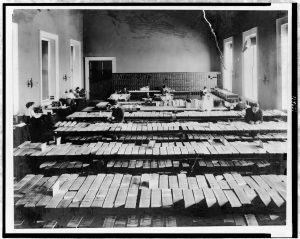
Card Division in the Library of Congress, Washington, D.C. Photograph circa 1900-1920. Image Public Domain.

The Research Group Speaks
Episode 6

Catalogs, Metadata, and Databases (Part I)
A Roundtable

19 February 2022

[Posted on 9 February 2022, with updates, now with the accomplishment of the event.]

By special request, a roundtable discussion aims to consider challenges and opportunities encountered in making, and using, catalogs and databases — with a focus especially on bibliographical and manuscript materials. This aim flows from the plan to hold a lunch at the Index of Medieval Art at Princeton University during our 2020 Spring Symposium (which had to be cancelled), to bring together participants engaged with such issues, from the Index of Medieval Art, the BASIRA Project, the Schoenberg Institute for Manuscript Studies, and elsewhere.
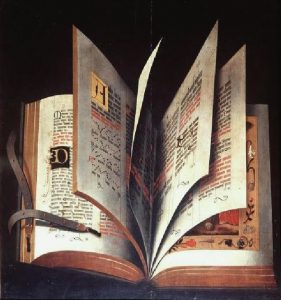
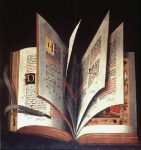
Florence, Galleria degli Uffizi, Anonymous, Still Life of an Illuminated Book, German School, 15th century. Oil on Wood. Opened book with fanned pages. Image via Wikimedia, Public Domain.

Florence, Galleria degli Uffizi, Anonymous, Still Life of an Illuminated Book, German School, 15th century. Image Public Domain.

As the next episode in the online series of webinars, workshops, and other meetings wherein The Research Group Speaks, the February 2022 Roundtable  explores challenges and opportunities for the catalogs, metadata, and databases, the characteristics of the materials which these structures seek to address, and some case studies.  Examples include the BASIRA Project on “Books as Symbols in Renaissance Art”, the Index of Medieval Art Database, Digital Scriptorium 2.0, the Pinakes/Πίνακες Database of Greek Texts and Manuscripts, and approaches to cataloging collections or selected source materials (such as artists’ books).

Speakers and Respondents include Barbara Williams Ellertson, Jessica L. Savage, Linde M. Brocato, Lynn Ransom, Katharine Chandler, Georgi Parpulov, Howard German, and David Porreca.  Subjects for consideration include “Standards and Vocabularies in Art-History Cataloging”, “Labelling, Way-finding, and Meaning”, “About ‘Aboutness’ “, “Teaching Cataloguing Today”, “The Pinakes Database”, “Digital Scriptorium 2.0:  Manuscript Description in a Linked Open Data Context”, and more.  See the Program below.

We gather perspectives from those who make, and those who use, such resources.

Preparations for the roundtable offer ‘Handouts’ in online format.

1) Below here:

  • a preliminary list of Questions for discussion at the roundtable and beyond, with a view also to planning further sessions on these subjects
  • an announcement about Future Plans, as Some Next Steps, for further sessions on these and related subjects.

2) Also, as an individual webpage:

  • an online Handout with a Draft List of Links to projects, databases, and other resources, including some mentioned in presentations in the roundtable:
    Catalogs, Metadata, and Databases: A Handlist of Links.

The roundtable is designed to compare notes, formulate questions, express wishes, and plan further sessions.  For example, we prepare sessions on “Catalogs, Metadata, and Databases, Continued“, for the pair of Spring and Autumn Symposia on “Structures of Knowledge” and “Supports for Knowledge”.  They belong to one of the overarching themes for RGME activities in 2022:  “Structured Knowledge“.

We welcome advice, suggestions, and contributions.
Read the rest of this entry →

Tags: BASIRA Project, CANTUS Chant, Controlled Vocabulary, DACT Project, Digital Scriptorium, Digital Scriptorium 2.0, Fragmentarium, History of Cataloging, Index of Medieval Art, Linked Open Data, Manuscript studies, Metadata and Databases, Pinakes | Πίνακες Database, Structures of Knowledge, Supports for Knowledge, The Research Group Speaks
No Comments »

A Leaf of Deuteronomy from ‘Otto Ege Manuscript 14’ in the Rosenbrook Collection

February 8, 2022 in Manuscript Studies, Uncategorized

Brent Rosenbrook Collection, Leaf from Ege Manuscript 14, ‘Recto’ (original Verso), top: Running title.

An Old Testament Leaf
from ‘Otto Ege Manuscript 14’
with part of Deuteronomy
in the Rosenbrook Collection

Large-format Latin Vulgate Lectern Bible
made in France
late 13th- or early 14th century

Single Leaf within a matted frame
Double columns of 50 lines

Maximum measurements circa 16 1/8″ × 10 11/16″ <written area circa 11″ × 7 3/8″>

Deuteronomy 11:21 ([quam iuravit] /) dominus patribus)
– 14:15 (strutionem ac noc-(/tuam et larum])

With bichrome running titles and chapter numbers,
polychrome decorated initials and border ornament with geometric and foliate motifs,
and added lection marks

[Posted on 8 February 2022, with updates]

Virginia Lazenby O’Hara Fine Books Division, Dallas Public Library, Framed Leaf from Otto Ege MS 14, ‘Recto’ (original Verso).

Brent Rosenbrook Collection, Matted Leaf from Otto Ege Manuscript 14, ‘Recto’ (original Verso).

Continuing the series of posts for our blog on Manuscript Studies, Mildred Budny describes another leaf from ‘Otto Ege Manuscript 14’, a large-format copy on vellum of the full Latin Bible in the Vulgate Version.

A leaf from this manuscript recently reached the collection of Brent Rosenbrook, who generously sent images and information about it, in response to the blogpost reporting More Discoveries for ‘Otto Ege Manuscript 14’.

A similar response several months ago brought to our attention the Dallas Leaf from the same manuscript, now kept at the Virginia Lazenbury O’Hara Fine Books Division of the Dallas Public Library in the City of Dallas, Texas. A report of that leaf, which carries the end of the Book of Joshua and the beginning of Judges in the Old Testament portion of the manuscript, appears in our blog on A Leaf in Dallas from ‘Otto Ege Manuscript 14’.

The ‘new’ leaf likewise comes from one of the early Books of the Old Testament. In the sequence, it stood one Book ahead.

Otto Ege Manuscript 14 and Manuscript Studies

Some discoveries for the manuscript have been reported in our blog.

  • A New Leaf from ‘Otto Ege Manuscript 14’
  • More Discoveries for ‘Otto Ege Manuscript 14’
  • A Leaf from ‘Otto Ege Manuscript 19’ and Ege’s Workshop Practices
  • Updates for Some ‘Otto Ege Manuscripts’ (Ege MSS 8, 14, 41, and 61)
  • Some Leaves in Set 1 of ‘Ege’s FOL Portfolio’ (Ege MSS 8, 14, 19, and 41)
  • Patch Work in ‘Otto Ege Manuscript 14’
  • A Leaf in Dallas from ‘Otto Ege Manuscript 14’.

See also The Illustrated Handlist (Number 4).

Brent Rosenbrook Collection, Leaf from Ege Manuscript 14, ‘Recto’ (original Verso), middle right: Deuteronomy 14 opens.

The Rosenbrook Leaf

When contacting me about the Leaf, its collector described the origins of his collecting spirit and the development of his book-collecting.

I wanted to give you a little bit of backstory and brief history. I am a layman in this field but have always been a collector of things since my childhood. I was a bibliophile long before I ever heard the term or would have understood its meaning. And although I am new to collecting illuminated manuscripts, I have always felt drawn to the beauty of them. As a teenager and young man I was especially stuck by the intricate, amazing imagery and knotwork in the Book of Kells. In 1998 I was fortunate to have visited Trinity College in Dublin and see it firsthand along with other books on display. It was a moment of wonder to finally be in the presence of that book. Although I never lost that sense of awe, for the next many years that was the extent of my experience and attention concerning manuscripts.

In December of 2016 my wife and I were visiting a friend’s home for the holidays when I noticed on the wall a large framed musical page of some sort. I could tell that it was hundreds of years old, handwritten, on animal skin. He knew little about it other than it belonged to a relative down the line and that at some point it was gifted to him. It was of course an antiphonal as I later discovered by searching online. It was (is) likely early 16th century and had one very large, but simple rubricated initial. Although it wouldn’t be considered elaborate or rare to a person knowledgeable in such things, for me the affect was basically “Wow, that’s really cool. I’ve got to figure out what that is. I want one of those”. The collector bug bit me again. . . .

Brent Rosenbrook Collection, Leaf from Ege MS 14, ‘Verso’ original Recto), bottom left.

My interest and enjoyment of looking at and learning about illuminated manuscripts (especially Bibles with historiated and zoomorphic initials) grew as I visited multiple websites over many weeks and scrolled through countless images of various western manuscripts. In March 2017 I acquired my first true illuminated leaf when I bid on and (unexpectedly) won a large Bible leaf which was from a manuscript previously owned by the famous collector Chester Beatty. As far as the Otto Ege leaf, it was a spontaneous purchase.

I received a notification . . . when this page was listed recently by Rodger Friedman Rare Book Studio. It wasn’t on my radar (or necessarily in the budget) to make a purchase but after glancing at the listing throughout the day I committed to buying it. I only knew the name Otto Ege vaguely through my reading up on manuscripts.

When I received the package and saw the leaf for the first time it evoked a lot of emotion. Although I knew its measurements when I purchased it, I still wasn’t prepared for the size and beauty of seeing it firsthand – it is stunning. It was only in the last few weeks after this acquiring this that I began reading up on and watching video postings about this famous biblioclast and the sets he sold off. . . . It was just this past Thursday night when I came across the RGME website and decided to reach out to you.

As for the Leaf itself, the collector reports that “It remains in the original matting that Ege used when he compiled these books.” Thus, this specimen qualifies for the group of survivors from the manuscript which circulated on their own, as a ‘Rogue Leaf’. Many of them traveled within one of Ege’s standard mats of a uniform size, accompanied by Ege’s printed Label giving a generic description of his Leaf 14. They resemble the presentation designed for specimen leaves from various manuscripts in Ege’s ‘FOL’ Portfolio of Fifty Original Leaves from Medieval Manuscripts, in which leaves from the dismembered Lectern Bible have the position of Number 14.

Now, with the collector’s permission, the Leaf might begin to assume its place within the virtual Reconstruction of the manuscript, as known from its fragments.  Brent Rosenbrook observes:

I think it’s nice for others to know that there are those who aren’t necessarily part of academic institution but still would like to contribute what they can to the advance of manuscript study.

We greatly admire this view!

A Note on the Photographs of the Leaf 

The images here show the Leaf and its details under several forms of light, taken at different times and at different angles. Their variety shows multiple aspects, including some 3-dimensional features which views at an angle can reveal of the curvature of the surface(s) of the animal skin and the furrows of the ruled lines upon it in drypoint.

Read the rest of this entry →

Tags: 'Fifty Original Leaves from Medieval Manuscripts', Beinecke Rare Book and Manuscript Library, Book of Deuteronomy, Brent Rosenbrook Collection, Dallas Public Library, Ege's FOL Portfolios, FOL Portfolio Set Number 39, Latin Vulgate Bible, Lectern Bible, Medieval Manuscript Fragments, Otto Ege, Otto Ege Collection, Otto Ege Manuscript 14, Reconstructing Manuscripts Virtually, Running Titles, Stony Brook University Library
6 Comments »

A Leaf in Dallas from “Otto Ege Manuscript 14” (Lectern Bible)

January 11, 2022 in Manuscript Studies

Virginia Lazenby O’Hara Fine Books Division, Dallas Public Library, Framed Leaf from Otto Ege Manuscript 14, ‘Recto’, top right: Initial P for ‘Post’ of Judges 1:1.

An Old Testament Leaf
from ‘Otto Ege Manuscript 14’
with the end of Joshua
and the beginning of Judges
in the
Virginia Lazenby O’Hara
Fine Books Division
of the Dallas Public Library
City of Dallas, Texas

Large-format Latin Vulgate Lectern Bible
(“the Bible of ‘Mirmelus Arnandi’ “)
made in France, late 13th- or early 14th century

Single Leaf mounted behind glass within a matted frame
Double columns of 50 lines

Visible side of the leaf (‘Recto’):
Joshua 24:18 ([igitur Dominus quia /] ipse Dominus – 24:38 (end)
and Judges 1:1 –15 (ending the verse with inriguum inferius [/ Filii autem . . . beginning 1:16])

With rubricated and polchrome elements, running titles, concluding-and-opening titles,
decorated and historiated initials, border ornament,
embellished pen-line line-fillers, and added lection marks

[Posted on 10 January 2022, with updates]

Continuing the series of posts for our blog on Manuscript Studies, Mildred Budny describes another leaf from ‘Otto Ege Manuscript 14’, a large-format copy on vellum of the full Latin Bible in the Vulgate Version.

The image shows the two columns of main text, its corrections, and its decoration and illustration.

Virginia Lazenby O’Hara Fine Books Division, Dallas Public Library, Framed Leaf from Otto Ege Manuscript 14, ‘Recto’ of Leaf.

With thanks to Molly Tepera of the Dallas Public Library of the City of Dallas, Texas, I can report details of a single, framed Leaf in its Virginia Lazenby O’Hara Fine Books Division from one of the celebrated manuscripts owned by Otto F. Ege (1888–1951). Now fragmented, the book has become known as ‘Otto Ege Manuscript 14’. The Dallas Leaf can be cited thus:

Framed Leaf from Otto Ege Manuscript 14
Virginia Lazenby O’Hara Fine Books Division
Dallas Public Library.

From the Old Testament portion of the manuscript, the Leaf carries the end of the Book of Joshua and the beginning of the Book of Judges. A principal highlight is the framed illustration within its opening initial for Judges.

Many features of the Leaf correspond closely with other leaves from the same book. They include its representation of the Vulgate Version with some textual variants, its layout in double columns of 50 lines on the page, its Gothic script for the main text and for corrections inserted in the margins, its expansive decoration with foliate and zoomorphic ornament which often extends into the margins, its illustrated (or ‘historiated’) initial with a scene relating to the text, and its supplied lection marks in the margins (for reading aloud). Some features with the Leaf are unusual in the manuscript or specific to this Leaf, as with the full-line stretches of pen-line line-fillers on the one hand, and the present frame for the object on the other.

Some discoveries for the manuscript have been reported in our blog.

  • A New Leaf from ‘Otto Ege Manuscript 14’
  • More Discoveries for ‘Otto Ege Manuscript 14’
  • A Leaf from ‘Otto Ege Manuscript 19’ and Ege’s Workshop Practices
  • Updates for Some ‘Otto Ege Manuscripts’ (Ege MSS 8, 14, 41, and 61)
  • Some Leaves in Set 1 of ‘Ege’s FOL Portfolio’ (Ege MSS 8, 14, 19, and 41)

See also The Illustrated Handlist (Number 4).

As more research and discoveries continue apace for Otto Ege’s dispersed manuscripts by various scholars, curators, owners, vendors, and others, it might suffice, for this report, to mention the publication in print recently of an account by Peter Kidd of a detached New Testament leaf from this manuscript in the McCarthy Collection, along with a list of known leaves having historiated initials.

Peter Kidd, The McCarthy Collection, Volume III: French Miniatures (London: Ad Ilissum, 2021), number 60, “Historiated initial on a leaf from the Bible of Mirmelus Arnandi” (pp. 199–202).

That leaf carries the end of one of the Pauline Epistles and the beginning of the next: the Epistle to the Colossians and the beginning of that to the First Epistle to the Thessalonians, with a historiated initial on its recto. The initial shows Saint Paul, traditionally regarded as the author, sitting and holding both sword and book.

Peter Kidd’s title for the manuscript derives from the purported name of a medieval owner, “Mirmelus Arnandi” (a lawyer and judge), recorded within its pages. The attribution is, however, subject to revision, because modern views of that name may represent a misreading. See, for example:

  • MS 223: SEMI-QUADRATA BIBLE
  • The last leaf of the Psalms, from a very large Bible, in Latin [France (Paris), c.1300]
  • No. 6, From the so-called Bible of “Mirmelus Arnandi”
  • McCarthy Catalogue Vol. III (French Illuminations), note for Catalogue no. 60, with Kidd’s update for its entry.

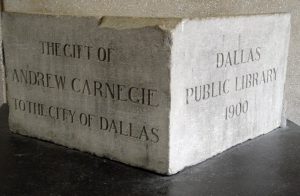
Cornerstone of the Dallas Public Library’s original Carnegie Library in downtown Dallas, Texas. Photograph from Wikimedia via Creative Commons.

The continuing flow of publications, in print or online, of yet more leaves from Otto Ege’s dispersed manuscripts, including his ‘Manuscript 14’, bring their features into view. Images reproduced from the individual remnants, while always useful, vary greatly in degree, quality, and size of reproduction. Sometimes those publications include recognition — by images, descriptions, or mentions alone — of the frames, mats, or other accompaniments for the leaves. More often they do not.

In the case of the Leaf in the Dallas Public Library, the images supplied by Molly Tepera fortunately show and share some accompanying material evidence.

Thus, this Report might set the Leaf both into the context of the manuscript, as the dispersed book becomes better known from its remnants, and into the context of Otto Ege’s workshop practices in preparing individual leaves (or occasionally bifolia, in a pair of connected leaves) for distribution and sale. The Report builds upon, and advances, my earlier reports about parts of Ege Manuscript 14 itself (see above) and my cumulative observations recorded for

  • A Leaf from ‘Otto Ege Manuscript 19’ and Ege’s Workshop Practices.

Read the rest of this entry →

Tags: 'Fifty Original Leaves from Medieval Manuscripts', Bible of Mirmelus Arnandi, Book of Joshua, Book of Judges, Dallas Public Library, Ege Family Portfolio, Ege's FOL Portfolio, Ege's Printed Labels, Historiated Initial, Image-Enhancement, Lectern Bible, Line-Fillers, Medieval Manuscript Fragments, Otto Ege Manuscript 14, Running Titles, Vulgate Bible Manuscripts
No Comments »

The Curious Printing History of ‘La Science de l’Arpenteur’

December 1, 2021 in Manuscript Studies, Research Group Speaks (The Series), Uncategorized

The Research Group Speaks
Episode 5

The Curious, Possibly Unique, Printing History
of Editions (1766–1813)
of La Science de l’Arpenteur
by Dupain de Montesson

Ronald K. Smeltzer

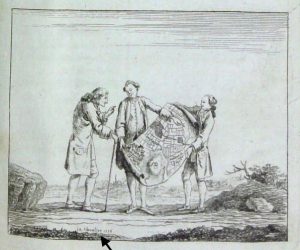
Dupain de Montesson, Le spectacle de la campagne and La science de l’arpenteur (1777), First Title-page, Vignette. Ronald K. Smeltzer Collection. Photograph Ronald K. Smeltzer, reproduced by permission.

[Posted on 1 December 2021, with updates]

For Episode 5 in our series (23 January 2022), Ronald K. Smeltzer (Ronald K. Smeltzer, Ph.D.) examines a telling case of multiple editions, issued with variations in printing methods, of an eighteenth-century treatise in French on methods of surveying.  The technique of surveying has a long and venerable tradition, with a varied series of books on the subject from late-antiquity onward.

The Plan

Direct, detailed examination of the editions, all in octavo format, of La science de l’arpenteur by Louis Charles Dupain de Montesson reveals multiple changes and adaptations that illuminate its extraordinary printing history.  Early editions were printed all engraved including signatures of the leaves.  Some of the later changes to the text and to the book design were a direct result of the French Revolution.  Assembling examples of all the known editions has taken twenty years.  The process attests to the value of direct inspection.  This presentation describes the results.

Read the rest of this entry →

Tags: Dupain de Montesson, French Revolution, history of printing, History of surveying, Intaglio printing, La science de l'arpenteur, Le spectacle de la campagne, Letterpress Printing, The Research Group Speaks
No Comments »

How to Be Indiana Jones in the Catalog

November 29, 2021 in Manuscript Studies, Uncategorized

The Research Group Speaks
Episode 4

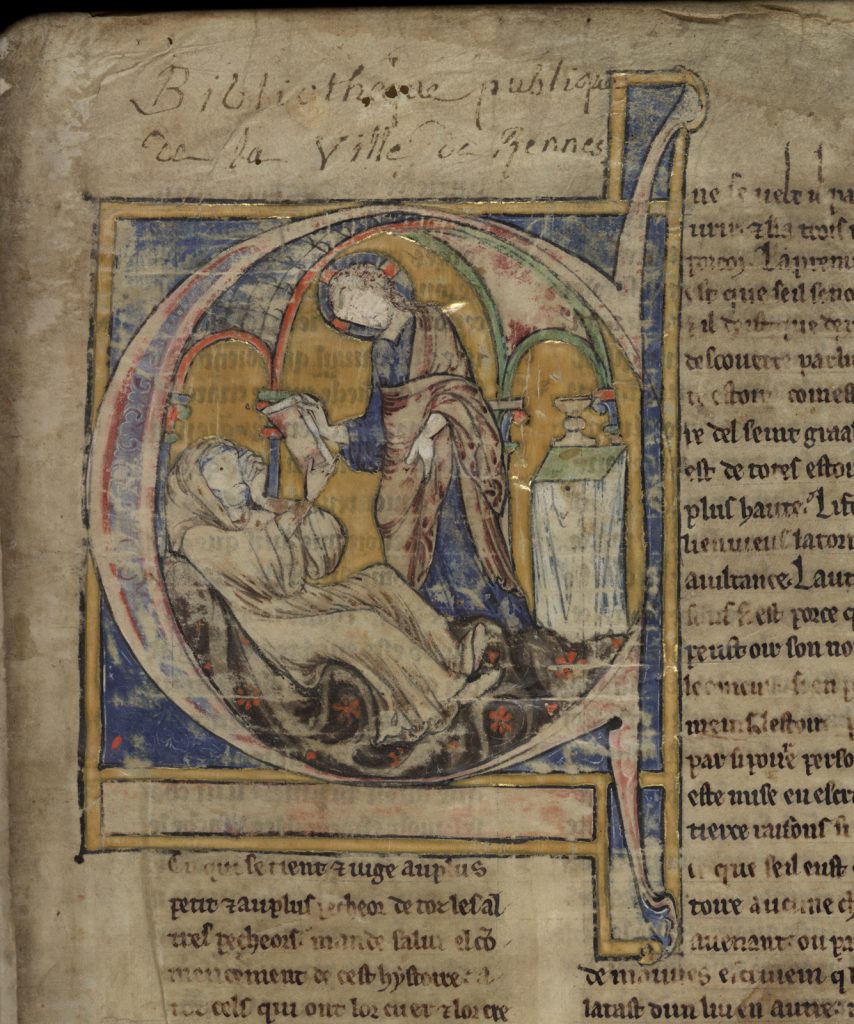
Rennes, Bibliothèque Municipale, MS 255, folio 1 recto. L’Estoire del saint Graal, Opening initial, with the Holy Grail. Photographer: Peter Scott. Image via Wikimedia Commons.

How to be Indiana Jones in the Catalog

Treasure and Power
In/Of the Bibliographical Record

Linde M. Brocato

The Series So Far

During a time of pandemic, before in-person events might resume, the RGME aims for some online events.

The Series at which “The Research Group Speaks” online began in July 2021.  This Episode rounds out the set for the calendar year, and points the way toward the themes for the new year.

*****

Florence, Galleria degli Uffizi, Anonymous, Still Life of an Illuminated Book, German School, 15th century. Oil on Wood. Opened book with fanned pages. Image via Wikimedia, Public Domain.

Florence, Galleria degli Uffizi, German School. Image Public Domain, via Wikimedia.

Episode 1 (July 2021)

Barbara Williams Ellertson and BASIRA, with a Timeline

The series commenced with an Interview with our Associate, Barbara Williams Ellertson (July 2021).

Barbara spoke about the BASIRA Project, its background, and her other interests.

For information about the Project on Books as Symbols in Renaissance Art, its subjects, its scope, and its aims, see https://basiraproject.org.

*****

Episode 2 (September 2021)

Platina, De honesta voluptate et valetudine (Venice, 1494). Image via BEI, Public Domain.

Southern Italian Cuisine Before Columbus

Next came a Presentation and Demonstration by the food historian Linda Civitello (September 2021).

Linda spoke about the early history of Italian cuisine, especially Cuoco Napolitano, and its ingredients, sources, and influences — for Southern Italian cuisine and beyond. Inspired by the 15th-century sources in manuscript and early printing, Linda described approaches to the subject and gave a demonstration.

*****

Episode 3 (November 2021)

Tales from the Library Crypt

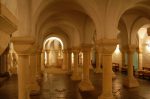
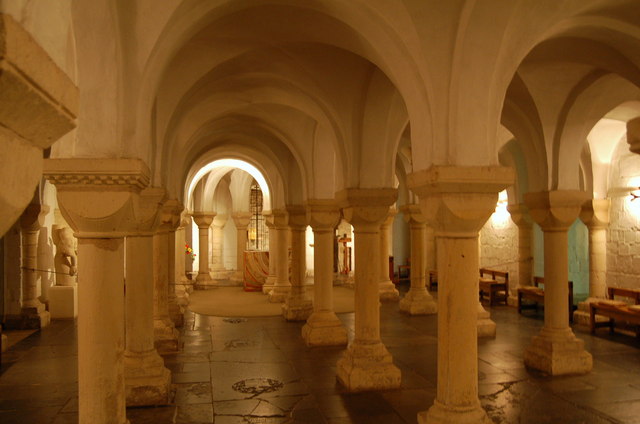
Worcester Cathedral, Crypt. Image via Wikimedia Commons.

Then we offered an informal round-table discussion, to compare notes about searching bibliographic materials in a time of pandemic.

Over the past year and more, under exceptional circumstances, there are doubtless to be encountered challenges and disappointments through closures of libraries, access to library resources, and other factors.

But there can also be successes, through serendipity, resourcefulness, friendship, and solidarity across institutions and among wider readership. Comparing notes might offer tips and guidance. Commiseration can come in handy. And the successes are worth celebrating. There are stories to tell.

*****

Next Up

Episode 4 (December 2021)

How to Be Indiana Jones in the Catalog:
Treasure and Power in/of the Bibliographical Record

Linde Brocato, scholar librarian, proposes to give a guided tour of several specimens and case-studies offering bibliographical and cataloguing challenges. (On her experience and expertise, see Linde Brocato, Linde M. Brocato, Curriculum Vitae, and Google Scholar.)

The plan:

Understanding the dynamics and rules of cataloging gives strong insight into how to search:  When to use the basic search box, i.e. keyword search; and When to use advanced search, i.e. the indexes.
I will discuss the bibliographic record, the kinds of decisions catalogers make about how to encode information, and tools to release and enhance your power to find the bibliographic treasure you seek!

P. S.  If it is, perchance, the Holy Grail that you seek, see, for example, Rennes 255:

Rennes, Bibliothèque Municipale, MS 255, folio 1 recto. L’Estoire del saint Graal, Opening initial.
Photographer: Peter Scott. Image via Wikimedia Commons.

Also, for reference:

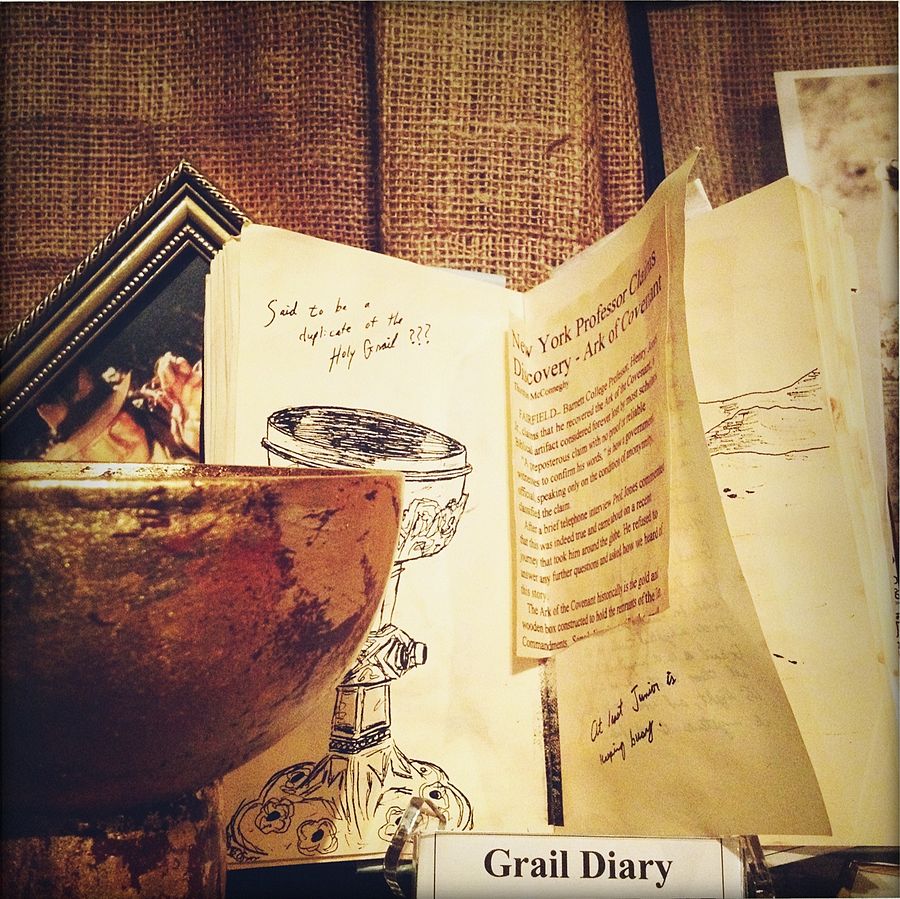
Grail diary of Henry Jones, Sr., from the film ‘Indiana Jones and the Last Crusade’ (1989), displayed at the Hollywood Museum, Hollywood, California. Image via Wikimedia Commons.

Handout

The single-page Handout for Linde’s Presentation is available for download as a pdf.

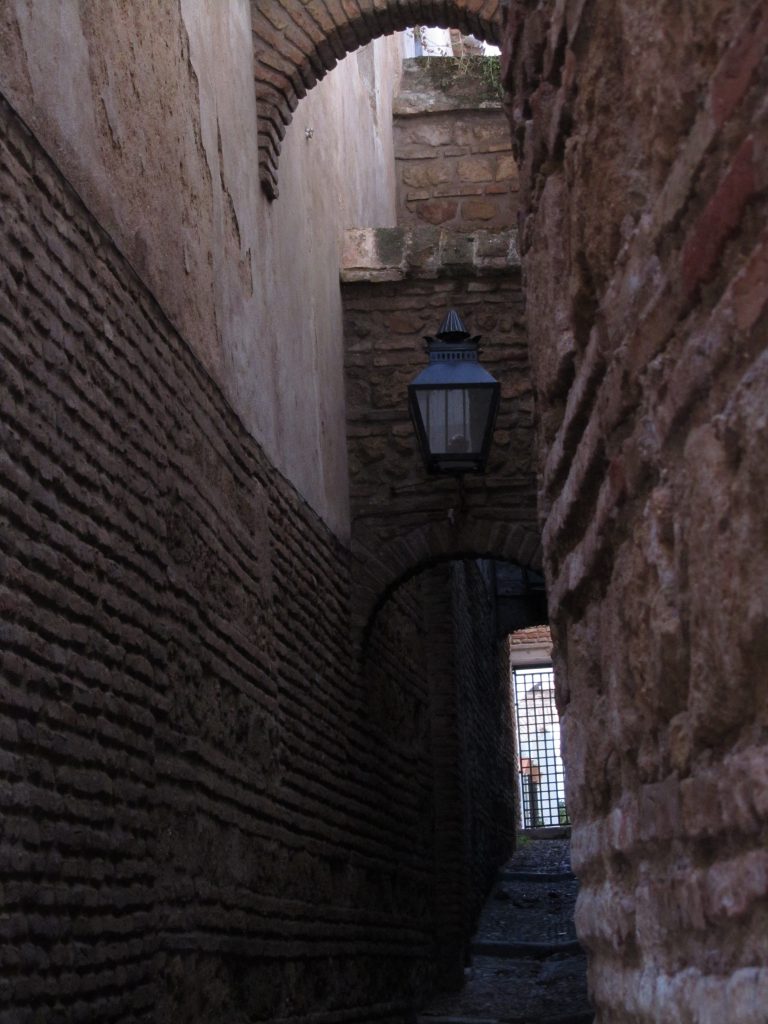
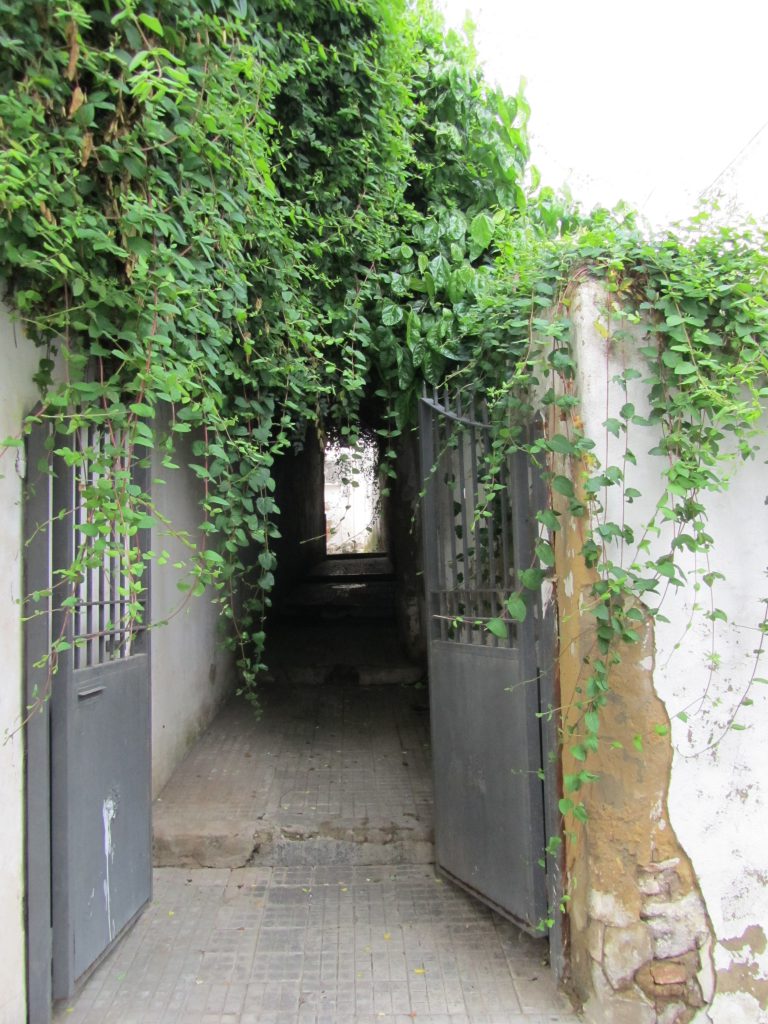
“Passages”

(Photographs © 2011 Linde M. Brocato)

Light at the End of the Tunnel

Photo © 2011 Linde M. Brocato. Cordoba, Passage.

Into the Light:

Photo © 2011 Linde M. Brocato. Cordoba, Passage.

*****

This episode opens a set of explorations on the subject of “Structured and Structuring Knowledge”.  It is one of our themes for next year — with an eye, for example, to Catalogues, Metadata, and Databases.

More Episodes are in preparation. See The Research Group Speaks: The Series.

Episodes in the New Year will begin in January 2022.

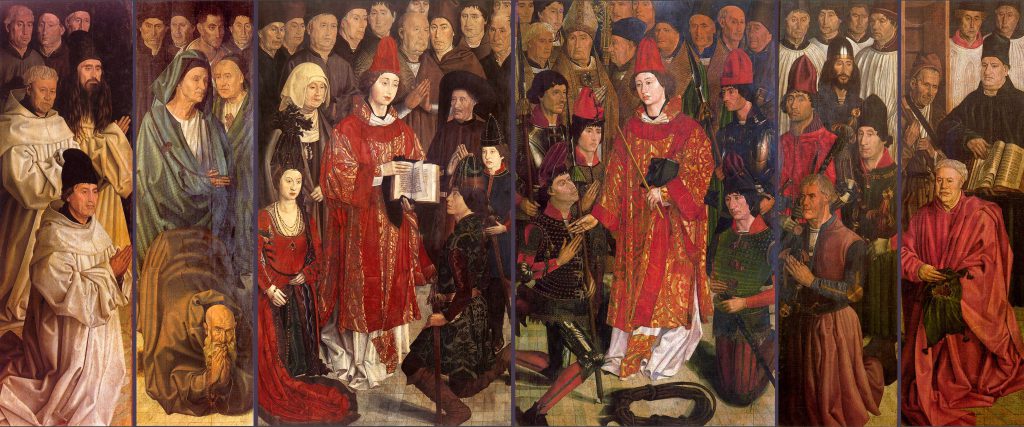
Lisbon, Museu Nacional de Arte Antiga: The mid 15th-century Saint Vincent Panels, attributed to Nuno Gonçalves. Image (https://upload.wikimedia.org/wikipedia/commons/3/3a/Nuno_Gon%C3%A7alves._Paineis_de_S%C3%A3o_Vicente_de_Fora.jpg) via Creative Commons.

*****

Do you have suggestions for subjects? Please let us know. Please leave your Comments below , Contact Us, and visit our FaceBook Page. We look forward to hearing from you.

*****

Tags: Bibliographal Quests, Bibliographical Records, History of Cataloging, Holy Grail, Indiana Jones, The Research Group Speaks
No Comments »

Tales from the Library Crypt

November 25, 2021 in Uncategorized

The Research Group Speaks
Episode 3

Tales from the Library Crypt

Bibliographical Quests in a Time of Pandemic

The Series So Far

During a time of pandemic, before in-person events might resume, the RGME aims for some online events.

The Series at which “The Research Group Speaks” online began in July 2021.

Florence, Galleria degli Uffizi, Anonymous, Still Life of an Illuminated Book, German School, 15th century. Oil on Wood. Opened book with fanned pages. Image via Wikimedia, Public Domain.

Florence, Galleria degli Uffizi, Anonymous, German School, 15th century. Image via Wikimedia, Public Domain.

Episode 1

The series commenced with an Interview with our Associate, Barbara Williams Ellertson  (July 2021).

Barbara spoke about the BASIRA Project, its background, and her other interests.  For information about the Project on Books as Symbols in Renaissance Art, its subjects, its scope, and its aims, see https://basiraproject.org.

See Barbara Williams Ellertson and BASIRA, with a Timeline

Episode 2

Next came a Presentation and Demonstration by the food historian Linda Civitello (September 2021).

Linda spoke about the early history of Italian cuisine, especially Cuoco Napolitano, and its ingredients, sources, and influences — for Southern Italian cuisine and beyond. Inspired by the 15th-century sources in manuscript and early printing, Linda described approaches to the subject and gave a demonstration.

See Southern Italian Cuisine Before Columbus.

Episode 3

Then we offered an informal round-table discussion, to compare notes about searching bibliographic materials in a time of pandemic (November 2021).

We call it:  “Tales from the Library Crypt”. Inspired, in part, by episodes of Tales from the Crypt, with books often in view, we recall that in a crypt might reside relics, secrets, and treasures.  Similarly, the vaults of libraries might shelter, or hide, treasures and secrets in its collection. To visitors, or initiates, these contents might become revealed.  Sometimes, they require guides.

Our exploration offers some guided tours, and celebrates resourcefulness and collegiality.  Call them, perhaps, Cryptic Remarks (puns included).
The plan:
Over the past year and more, under exceptional circumstances, there are doubtless to be encountered challenges and disappointments through closures of libraries, access to library resources, and other factors.  But there can also be successes, through serendipity, resourcefulness, friendship, and solidarity across institutions and among wider readership.  Comparing notes might offer tips and guidance.  Commiseration can come in handy.  And the successes are worth celebrating.  There are stories to tell.
For example, Jessica Savage and Pamela Patton of the Index of Medieval Art at Princeton University described experiences of being on both sides of the fence, seeking and guarding access to resource materials, and of what the pandemic revealed about issues already with access, and what might be done about it longer term.  Mildred Budny reported measures which the Research Group has undertaken in response to bibliographical lockdown, including blogposts, other publications, and this series of online events.  David Porreca and Linde Brocato offered advice about bibliographical quests for materials, in Special Collections or other locations.  Participants generously shared tips for such quests.

The recording of the event is being edited for presentation and wider viewing as a podcast, as the participants might permit.

We thank our speakers generous preparation and presentation.  We thank the participants for offering feedback, information, and advice.

Worcester Cathedral, Crypt. Image from geograph.org.uk via Wikimedia Commons.

*****

More Episodes are in preparation.  See The Research Group Speaks:  The Series.

We plan the next Episode.  Linde Brocato, scholar librarian, proposes to give a guided tour of several specimens offering bibliographical and cataloguing challenges (December 2021). Or, “How to Be Indiana Jones in the Catalog:  Treasure and Power in/of the Bibliographical Record”.  See Indiana Jones in the Catalog.

Episodes in the New Year will begin in January 2022.

Lisbon, Museu Nacional de Arte Antiga: The mid 15th-century Saint Vincent Panels, attributed to Nuno Gonçalves. Image (https://upload.wikimedia.org/wikipedia/commons/3/3a/Nuno_Gon%C3%A7alves._Paineis_de_S%C3%A3o_Vicente_de_Fora.jpg) via Creative Commons.

*****

Do you have suggestions for subjects?  Please let us know.  Please leave your Comments below, Contact Us, and visit our FaceBook Page.  We look forward to hearing from you.

*****

Tags: Bibliograpical Lockdown, Crypt, History of Libraries, History of Literacy, Index of Medieval Art, Library Access, Tales from the Crypt
No Comments »

Southern Italian Cuisine Before Columbus

November 25, 2021 in Manuscript Studies, Uncategorized

The Research Group Speaks
Episode 2

Southern Italian Cuisine Before Columbus

Linda Civitello, Ph.D.

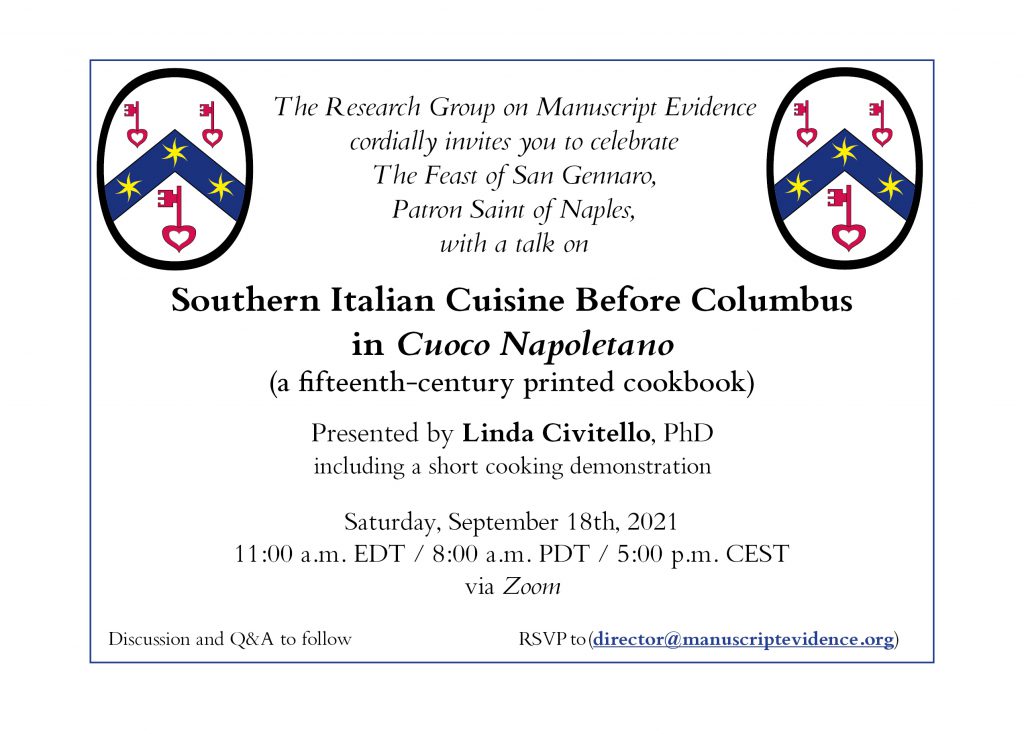
For our new Series, the food historian Linda Civitello talks about the early history of Italian cuisine, especially Cuoco Napolitano, and its ingredients, sources, and influences — for Southern Italian cuisine and beyond. Inspired by the 15th-century sources in manuscript and early printing, Linda describes approaches to the subject and gives a demonstration. In these ways,we might explore the traditions of southern Italian cuisine before the arrival of such New World ingredients as the tomato.

With an invited audience, we held the event on Saturday 18 September 2021 — the day before the Feast of San Gennaro. The martyred Saint Janurarius, first Bishop of Benevento (of unknown dates), is the patron saint of Naples.

Our Speaker

Linda Civitello is the author of the award-winning books:

  • Baking Powder Wars: The Cut-throat Food Fight That Revolutionized Cooking
    and
  • Cuisine and Culture: A History of Food and People, which is used to teach food history in culinary schools throughout the U.S. and Canada.

Linda developed the curriculum, and taught history of food, at culinary schools in southern California. She also taught the History of Chocolate and the History of Food in California at UCLA Extension.

Linda speaks frequently on a wide range of food history topics. She has spoken at Harvard University, and appeared on television on Bizarre Foods and on the BBC. She also cooks professionally, making historic recipes using heirloom flour, and Italian pastries and gelati for a select clientele.

She is currently writing an article on food and racism, and a book on Food and Film from Prohibition to James Bond. Linda has a B.A. from Vassar College and a Ph.D. from the University of California at Los Angeles.

(She and our Director met in freshman year at College, when we shared the same Medieval History Class.)

For further information about Linda‘s accomplishments and publications, see, for example, Linda Civitello and Linda Civitello.

The Sources

By request, Linda’s presentation includes a brief introduction by our Director, Mildred Budny, to the early modern textual sources, in manuscript and print.

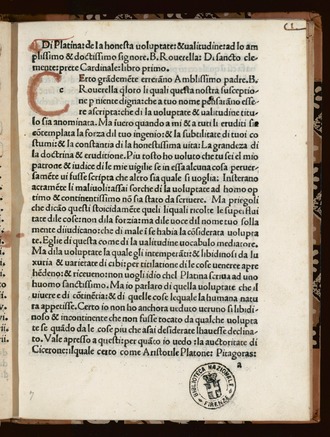
Platina, De honesta voluptate et valetudine (Venice, 1494), Opening page. Image via Biblioteca Europea di Informazione e Cultura, via Public Domain.

Vernacular Italian sources for Cucoco Napolitano include:

  • the late 15th-century Morgan Library & Museum, MS Bühler 19, written by an anonymous scribe and author
    (https://www.themorgan.org/manuscript/77146)
  • Bartholomaeus Sacchi/Platina, De honesta voluptate et valetudine, printed in Venice in 1487 and 1494 by different printers1487: [Hieronymus de Sanctis and Cornelio], with the date of 15 Dec. 1487 (https://data.cerl.org/istc/ip00766500 )1494: [Bernardinus Benalius], with the date of 25 Aug. 1494 (https://data.cerl.org/istc/ip00767000).

The Morgan Manuscript: Cuoco Napolitano

New York, Morgan Library & Museum, Bühler MS 19 came to the Morgan in 1985 as part of the bequest of Curt F. Bühler (1905–1985). He had served as a rare book curator at the Pierpont Morgan Library (as it was then known) from 1934 to 1973. He bequeathed his collection of manuscripts and early printed books to that library.  The scribe and author of the text are unknown.

The Morgan website provides a selection of images from the pages in the manuscript which contain illustrations. As colored drawings placed in the margins below or beside the text, they depict creatures of several kinds — animals, birds, and vegetation — which appear to illustrate the recipes.

The Early-Printed Books (pre-1500)

Italian cookery served as subject in the course of expansion of printing in Western Europe. Among incunables, that is, early printed books before 1500 CE, there survive copies from various printings of the popular treatise composed in Latin by Bartholomeo Sacchi (1421–1481), known as Il Platina. That name derives from his place of origin, Piadena/Platina near Cremona in Lombardy, in northern Italy. By turns soldier, humanist, author, prisoner, and Librarian of the Vatican Apostolic Library, Platina produced writings on various subjects, including biographies, or Lives, of the Popes, and the gastronomical treatise which circulated widely.

His text De honesta voluptate et valitudine (“On honorable pleasure and health” or “On honest indulgence and good health”) appeared first in Latin, in several printings. Among them are issues from Venice (1475), Venice (1498), Bologna (1499), and elsewhere.

The text appeared soon in vernacular translation, in various languages, including Italian regional dialect but still with the same Latin title. Among incunables, that is, early printed books before 1500 CE, two different printed editions of this translation are known. Both were issued in Venice, but by different printers.

The ‘Competition’:  Maestro Martino and the Libro de Arte Coquinaria

The recipes in Platina’s popular treatise overlap with, and perhaps mostly derive from, a work by a renowned chef Martino da Como or Maestro Martino da Como (circa 1430 – end of the 15th century), the Libro de Arte Coquinaria, known in a single manuscript copy.

This manuscript, now at the Library of Congress (with full digital facsimile), was written perhaps between 1460 and 1480 by a known scribe, Antonio Toffio. An edition of the text is available online.

Resources in Print and Online

Studies about these sources and their context include:

  • Terence Scully with Rudolf Grewe, Cuoco Napoletano: The Neapolitan Recipe Collection (Ann Arbor: The University of Michigan Press, 2000).
  • Medieval Cookery Books: Europe, specifically Italian or in Italian.

*****

The recording of the episode is being edited for presentation and wider viewing as a podcast.  It includes, by request, a brief introduction to the sources (see above) in manuscript and early printing by our Director, Mildred Budny. It also reports feedback and suggestions by the invited audience both at the time and afterwards.

We thank Linda for her generous preparation and presentation.  We thank the participants for joining the online gathering, and for offering feedback and encouragement.

*****

More Episodes are in hand and in preparation.  See The Research Group Speaks:  The Series.

Do you have suggestions for subjects?  Please let us know.  Please leave your Comments below, Contact Us, and visit our FaceBook Page.  We look forward to hearing from you.

*****

Tags: Bartholomaeus Sacchi, Cuoco Napolitano, De honesta voluptate et valetutine, History of Cookery, Il Platina, Libro de Arte Coquinaria, Linda Civitello, Maestro Martino, Morgan Library MS Bühler 19, Southern Italian Cuisine before Columnus
No Comments »

Barbara Williams Ellertson and the BASIRA Project, with a Timeline

November 25, 2021 in Manuscript Studies, Uncategorized

The Research Group Speaks
Episode 1

Interview with Barbara Williams Ellertson
The BASIRA Project and a Timeline

Florence, Galleria degli Uffizi, Anonymous, Still Life of an Illuminated Book, German School, 15th century. Oil on Wood. Opened book with fanned pages. Image via Wikimedia, Public Domain.

Florence, Galleria degli Uffizi, Anonymous, Still Life of an Illuminated Book, German School, 15th century. Oil on Wood. Opened book with fanned pages. Image via Wikimedia, Public Domain.

This Series began with an Interview with our Associate, Barbara Williams Ellertson.  (See also Ellertson.)

The recorded event took place via Zoom in July 2021, with a small invited audience, and with scope for questions, comments, and discussion. Barbara spoke about the BASIRA Project, its background, and her other interests.  For information about the Project on Books as Symbols in Renaissance Art, its subjects, its scope, and its aims, see https://basiraproject.org.

Barbara described key stages in her education, upbringing, and career, as she offered an illustrated Timeline for the origins and development of the project. A selection of images exhibit aspects of her work, the processes of creating the BASIRA Project, some key stages in its evolution, and some of her favorites among the subjects which it covers.

Questions and discussion addressed a wide range of interests in the subject matter, the approaches to its structures in the database and metadata, the expanding coverage of the project, and its future work.

The recording of the event is being edited for presentation and wider viewing as a podcast. It will take two parts: Interview and Question & Answer.

We thank Barbara for her generous preparation and presentation.  We thank the participants for joining the online gathering, and offering feedback and encouragement.

*****

More Episodes are in hand and in preparation.  See The Research Group Speaks:  The Series.

Do you have suggestions for subjects?  Please let us know.  Please leave your Comments below, Contact Us, and visit our FaceBook Page.  We look forward to hearing from you.

*****

Tags: BASIRA Project
No Comments »

2022 International Congress on Medieval Studies: Program

November 23, 2021 in Ibero-Medieval Association of North America, International Congress on Medieval Studies, Kalamazoo, Societas Magica, Uncategorized

2022 Congress Activities
Sponsored and Co-Sponsored by the RGME

at the 57th International Congress on Medieval Studies
Online
Monday, May 9 – Saturday, May 14, 2022

Le Parc Abbey, Theological Volume, Part B: Detail of Vellum Leaf.

Private Collection, Le Parc Abbey, Theological Volume, Part B: Detail of Vellum Leaf. Photography Mildred Budny.

Posted on 22 November 2021, with updates

Following the close of the 2022 Congress Preparations: Call for Papers, then the selection of proposals and arrangement of sequence of papers within the sessions, for the submission of their programs to the Congress Committee, we announce the Programs for our Sessions at the 2022 ICMS online in May 2021. As in previous years, we plan to hold a Business Meeting at the Congress.

All activities are to take place online, like 2021. See our 2021 Congress Report.

When appropriate, we can report the assignment of the scheduling of Sessions within the Congress Program overall.  Meanwhile, we publish the Abstracts of the Papers and Responses, as the authors might be willing. Note that the Abstracts for Congress Sessions are Indexed on our website by Author (in progress for 2022) and by Year (2022 included).

Now that [4 February 2022] the Congress Program has become available (see its website), we can post the assigned days and times for our activities, along with the assigned Numbers for the Sessions.  All our activities are scheduled for Wednesday and Friday, 11 and 13 May 2022.  Times are in Eastern Daylight Time.

Wednesday 11 May 2022

  • Session 173 (1 pm).  Medieval Writing Materials:   Processes, Products, and Case-Studies
  • Open Business Meeting (3 pm).  All are welcome.
  • Session 193 (7 pm).  Alter(n)ative Alphabets in the Iberian Middle Ages (co-sponsored with IMANA)|

Friday 13 May 2022

  • Session 310 (1 pm).  The Iconography of Medieval Magic (co-sponsored with the Societas Magica)
  • Session 324 (3 pm).  Pressing Politics:
         Interactions between Authors and Printers in the 15th and 16th Centuries

In due course, sometime in March, registration for the online Congress will commence.  After the close of the Congress, recorded content will be available to registrants from Monday, May 16, through Saturday, May 28.

Watch this space for updates. Read the rest of this entry →

Tags: Aljamiado, Business Meeting, Divinatory Games, Hernán Núñez, History of Divination, History of Documents, History of Magic, History of Paper, Ibero-Medieval Association of North America, International Congress on Medieval Studies, Italian Paper, Libro del juego delas suertes, Manuscript studies, Marsilio Ficino, Medieval Writing Materials, Merchants of Venice, Morisco Manuscripts, Morisco Spells, Polish Coronation Sword, Societas Magica, Szczerbiec, The Lay of the Mantle, Venetian Documents
No Comments »

Two Vellum Leaves from a Large-Format Latin Breviary in Gothic Script

October 2, 2021 in Manuscript Studies

Private Collection, MS 1, Fol. 1 (‘137’)r, Initial I (for Inclina). Photography Mildred Budny. Reproduced by permission.

A Pair of Non-Consecutive Leaves
from a Large-Format
Latin Breviary
in Gothic Script on Vellum

Circa 590 mm × 447 mm
< written area circa 397 × 307 mm>
Single column of 15 lines
in Gothic Script
with rubrications, embellished initials,
and reiterated medieval and modern ‘folio’ numbers

Folio 1 (‘130’)
Vulgate Psalms (Septuagint Translation) 83:11 – 84:12 (Veri-[tas])

and

Folio 2 (‘137’)
Within Friday Matins:
Hymn Tu Trinitatis Unitas ([ . . . Ne corpus /] assit sordidum . . . Pater piissime)
Antiphon Inclina Domine, and Psalm 86 1:1–12 (Con-[fitebor])

14th or 15th Century, perhaps Italian or Spanish

Private Collection, MS 1, Fol. 130r, initials B and R. Photography Mildred Budny. Reproduced by permission.

Continuing to examine manuscripts and fragments in our blog on Manuscript Studies (see its Contents List), we turn to a pair of large, single leaves which arrived in a Private Collection several years ago, as a gift from another Private Collection.  About this pair of leaves, we might exclaim:  What beauties!

For the current owner, with an interest in manuscript studies, especially medieval manuscripts, these leaves comprise the first in the library (mostly printed books about books).  Hence the assigned number, “MS 1”, with two detached leaves (Folios ‘1’ and ‘2’ in the set) from the same original manuscript.

The identity and origin of that manuscript remain, for now, unknown.  Perhaps this blogpost, presenting the detached leaves to wider view through their photographs and related information, might bring to light more information about them and their travels across time and place.

The pair came on their own, safely packaged with mats in a large shipping box, but without any accompanying information.  That is, apart from the former owner’s recollection relayed in conversation and email.

These two large leaves would have come as a purchase some years ago, in the late 1980s or early 1990s, at the New York Antiquarian Book Fair, a repeated venue for some other purchases for the same collection.

“The two large ones are German and quite late, if I remember rightly.  I bought them from a German dealer at the NY Antiquarian Book Fair.  No, I don’t recall his name.  It was a looong [sic] time ago.  I suspect the two smaller ones [= MS 2, in another shipping] were purchased at the same venue, though different dealer.”

On their own, the two leaves must or can speak for itself.  We bring to the table the willingness to examine them closely, to admire their resonant beauty, and to see what they can say.  Their story resides not only in the text, which can be deciphered, abbreviations and all, but also in the features of layout, script, decoration, rubrications, annotations, the animal skins for the writing surfaces, the traces of a former binding, and other forms of material evidence.

Read the rest of this entry →

Tags: History of the Psalms, Late-Medieval Breviary, Medieval Manuscript Fragments, Medieval manuscripts
6 Comments »

« Older Entries
Newer Entries »
  • Top
©2024 Research Group on Manuscript Evidence.


is proudly powered by WordPress. WordPress Themes X2 developed by ThemeKraft.