• News
    • News & Views
    • RGME Activities for 2024 and 2025
    • Around & About with the RGME
    • Reviews
    • Highlights
  • Blogs
    • Manuscript Studies
      • Manuscript Studies: Contents List
    • International Congress on Medieval Studies
      • Abstracts of Congress Papers
        • Abstracts of Papers Listed by Author
        • Abstracts of Papers Listed by Year
  • About
    • Mission
    • Who We Are
      • Officers, Associates & Volunteers
      • RGME Committees
      • Friends of the Research Group on Manuscript Evidence
    • Policies & Statements
      • RGME Privacy Policy Statement
      • RGME Intellectual Property Statement & Agreements
    • People
      • Mildred Budny — Her Page
      • Adelaide Bennett Hagens
    • Activities
      • Events
      • Congress Activities
        • Sponsored Conference Sessions (1993‒)
          • Panels at the M-MLA Convention (from 2016)
        • Co-sponsored Conference Sessions (2006‒)
    • History
      • Seals, Matrices & Documents
      • Genealogies & Archives
    • Contact Us
  • Bembino
    • Multi-Lingual Bembino
    • RGME Bembino: Resources
  • Congress
    • Sponsored Conference Sessions (1993‒)
    • Co-sponsored Conference Sessions (2006‒)
    • Abstracts of Congress Papers
      • Abstracts Listed by Author
      • Abstracts Listed by Year
    • Kalamazoo Archive
    • Panels at the M-MLA Convention (2016-2019)
      • Abstracts of Papers for the M-MLA Convention
      • Panels at the M-MLA Convention (from 2016)
  • Events
    • RGME Activities for 2024 and 2025
      • 2023 Activities and 2024 Planned Activities
    • Seminars, Workshops, Colloquia & Symposia (1989–)
      • Seminars on ‘The Evidence of Manuscripts’
      • Symposia on ‘The Transmission of the Bible’
      • The New Series (2001-)
        • 2019 Anniversary Symposium Program: The Roads Taken
        • 2019 Anniversary Symposium Registration
        • 2019 Anniversary Symposium Registration Open
      • RGME Symposia: The Various Series
      • The Research Group Speaks: The Series
      • Meetings of the Friends of the Research Group on Manuscript Evidence
      • RGME Online Events
    • Abstracts of Papers for Events
      • Abstracts of Papers for Seminars on ‘The Evidence of Manuscripts’
      • Abstracts of Papers for Symposia, Workshops & Colloquia
    • Receptions & Parties
    • Business Meetings
    • Photographic Exhibitions & Master Classes
    • Events Archive
  • ShelfLife
    • Journal Description
    • ShelfMarks: The RGME-Newsletter
    • Publications
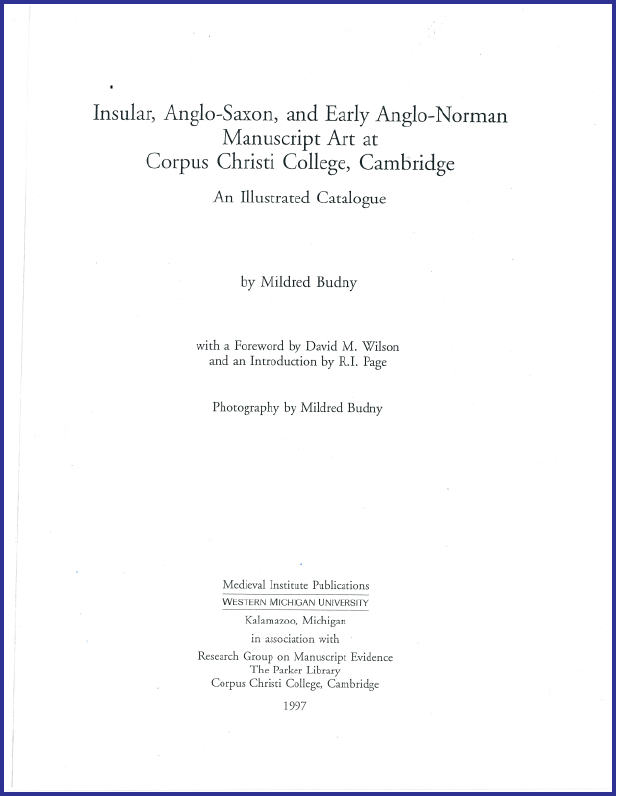
      • “Insular, Anglo-Saxon, and Early Anglo-Norman Manuscript Art at Corpus Christi College, Cambridge” (1997)
        • Mildred Budny, ‘Catalogue’
        • The Illustrated Catalogue (1997)
      • The Illustrated Handlist
      • Semi-Official Counterfeiting in France 1380-1422
      • No Snap Decisions: Challenges of Manuscript Photography
    • History and Design of Our Website
  • Galleries
    • Watermarks & the History of Paper
    • Galleries: Contents List
    • Scripts on Parade
    • Texts on Parade
      • Latin Documents & Cartularies
      • New Testament Leaves in Old Armenian
    • Posters on Display
    • Layout Designs
  • Donations and Contributions
    • RGME Donor Promise
    • 2023 End-of-Year Fundraiser for our 2024 Anniversary Year
    • 2019 Anniversary Appeal
    • Orders
  • Links
    • Catalogs, Metadata, and Databases: A Handlist of Links
    • Handlist of Resources for Manuscript Studies and Fragmentology
    • Manuscripts & Rare Books
    • Maps, Plans & Drawings
    • Seals, Seal-Matrices & Documents

  • News
    • News & Views
    • RGME Activities for 2024 and 2025
    • Around & About with the RGME
    • Reviews
    • Highlights
  • Blogs
    • Manuscript Studies
      • Manuscript Studies: Contents List
    • International Congress on Medieval Studies
      • Abstracts of Congress Papers
        • Abstracts of Papers Listed by Author
        • Abstracts of Papers Listed by Year
  • About
    • Mission
    • Who We Are
      • Officers, Associates & Volunteers
      • RGME Committees
      • Friends of the Research Group on Manuscript Evidence
    • Policies & Statements
      • RGME Privacy Policy Statement
      • RGME Intellectual Property Statement & Agreements
    • People
      • Mildred Budny — Her Page
      • Adelaide Bennett Hagens
    • Activities
      • Events
      • Congress Activities
        • Sponsored Conference Sessions (1993‒)
          • Panels at the M-MLA Convention (from 2016)
        • Co-sponsored Conference Sessions (2006‒)
    • History
      • Seals, Matrices & Documents
      • Genealogies & Archives
    • Contact Us
  • Bembino
    • Multi-Lingual Bembino
    • RGME Bembino: Resources
  • Congress
    • Sponsored Conference Sessions (1993‒)
    • Co-sponsored Conference Sessions (2006‒)
    • Abstracts of Congress Papers
      • Abstracts Listed by Author
      • Abstracts Listed by Year
    • Kalamazoo Archive
    • Panels at the M-MLA Convention (2016-2019)
      • Abstracts of Papers for the M-MLA Convention
      • Panels at the M-MLA Convention (from 2016)
  • Events
    • RGME Activities for 2024 and 2025
      • 2023 Activities and 2024 Planned Activities
    • Seminars, Workshops, Colloquia & Symposia (1989–)
      • Seminars on ‘The Evidence of Manuscripts’
      • Symposia on ‘The Transmission of the Bible’
      • The New Series (2001-)
        • 2019 Anniversary Symposium Program: The Roads Taken
        • 2019 Anniversary Symposium Registration
        • 2019 Anniversary Symposium Registration Open
      • RGME Symposia: The Various Series
      • The Research Group Speaks: The Series
      • Meetings of the Friends of the Research Group on Manuscript Evidence
      • RGME Online Events
    • Abstracts of Papers for Events
      • Abstracts of Papers for Seminars on ‘The Evidence of Manuscripts’
      • Abstracts of Papers for Symposia, Workshops & Colloquia
    • Receptions & Parties
    • Business Meetings
    • Photographic Exhibitions & Master Classes
    • Events Archive
  • ShelfLife
    • Journal Description
    • ShelfMarks: The RGME-Newsletter
    • Publications
      • “Insular, Anglo-Saxon, and Early Anglo-Norman Manuscript Art at Corpus Christi College, Cambridge” (1997)
        • Mildred Budny, ‘Catalogue’
        • The Illustrated Catalogue (1997)
      • The Illustrated Handlist
      • Semi-Official Counterfeiting in France 1380-1422
      • No Snap Decisions: Challenges of Manuscript Photography
    • History and Design of Our Website
  • Galleries
    • Watermarks & the History of Paper
    • Galleries: Contents List
    • Scripts on Parade
    • Texts on Parade
      • Latin Documents & Cartularies
      • New Testament Leaves in Old Armenian
    • Posters on Display
    • Layout Designs
  • Donations and Contributions
    • RGME Donor Promise
    • 2023 End-of-Year Fundraiser for our 2024 Anniversary Year
    • 2019 Anniversary Appeal
    • Orders
  • Links
    • Catalogs, Metadata, and Databases: A Handlist of Links
    • Handlist of Resources for Manuscript Studies and Fragmentology
    • Manuscripts & Rare Books
    • Maps, Plans & Drawings
    • Seals, Seal-Matrices & Documents

Log in

Archives

Featured Posts

Sanskrit and Prakrit Manuscripts, Continued: More Leaves for Manuscript Sample XII?
2026 International Congress on Medieval Studies: Program
Episode 24. “Life with Books” (Interview with John Windle)
Announcing the Launch of RGME Bembino WP
2026 RGME Colloquium at The Grolier Club: Report
Medieval Missal Fragment as Early-Modern Cover
The Weber Leaf from Ege MS 61
"Bembino" Booklet Cover
Episode 23. “Meet RGME Bembino: Facets of a Font”
2026 RGME Colloquium on “Transformations & Renewals” at The Grolier Club
2026 Theme of the Year: “Transformations and Renewals”
A Leaf with Patchwork from the Saint Albans Bible
A Sister Leaf from a Miniature Latin Vulgate Bible
A Little Latin Vulgate Bible Manuscript Leaf in Princeton
J. S. Wagner Collection. Leaf from from Prime in a Latin manuscript Breviary. Folio 4 Verso, with part of Psalm 117 (118) in the Vulgate Version, set out in verses with decorated initials.
2026 Annual Appeal
Episode 22: “Encounters with Local Saints and Their Cults”
Private Collection, Ege's FBNC Portfolio, Dante Leaf, Verso, Detail. Reproduced by Permission.
2025 RGME Autumn Colloquium on Fragments
Workshop 8: A Hybrid Book where Medieval Music Meets Early-Modern Herbal
2025 RGME Autumn Symposium on “Readers, Fakers, and Re-Creators of Books”
RGME Workshops on “The Evidence of Manuscripts, Etc.”
2025 International Medieval Congress at Leeds: RGME Program
Episode 21. “Learning How to Look”
2025 International Congress on Medieval Studies: Program
2025 RGME Visit to Vassar College
Two Leaves in the Book of Numbers from the Chudleigh Bible
Delibovi on Glassgold on Boethius: A Blogpost
Ronald Smeltzer on “Émilie du Châtelet, Woman of Science”
2025 Spring Symposium: “Makers, Producers, and Collectors of Books”
Starters’ Orders
The Weber Leaf from the Saint Albans Bible
Workshop 4. “Manuscript Fragments Compared”
Episode 20. “Comic Book Theory for Medievalists”
Episode 19: “At the Gate: Starting the Year 2025 at its Threshold”
Favorite Recipes for Lemonade, Etc.
RGME Visit to the Lomazow Collection: Report
2024 Autumn Symposium: “At the Helm”
A Latin Vulgate Leaf of the Book of Numbers
The RGME ‘Lending Library’
Florence, Italy, Ponte Vecchio from Ponte alle Grazie. Photo: Ingo Mehling, CC BY-SA 4.0 , via Wikimedia Commons
Episode 17. “RGME Retrospect and Prospects: Anniversary Reflections”
2024 Anniversary Symposium: The Booklet
Jesse Hurlbut at the Bonneville Salt Flats, Utah. Photograph Jesse Hurlbut.
Episode 16: An Interview with Jesse D. Hurlbut
To Whom Do Manuscripts Belong?
Kalamazoo, MI Western Michigan University, Valley III from the side. Photograph: David W. Sorenson.
2024 International Congress on Medieval Studies: Report
2024 Spring Symposium at Vassar College
Puente de San Martín: Bridge with reflection over the River Targus, Toledo, Spain.
2024 Grant for “Between Past and Future” Project from The Gladys Krieble Delmas Foundation Research Libraries Program
2024 Anniversary Symposium in Thanks to Jesse Hurlbut: Program

You are browsing the Blog for Medieval manuscripts

Lead the People Forward (by Zoey Kambour)

February 13, 2022 in Manuscript Studies, Uncategorized

Lead the People Forward:
The Contemporaneity
of the Medieval Iberian Haggadah

Zoey Kambour, MA

15 February, 2022

Pursuit by the Egyptians. Detail of Figure 4 (see Figure 4b below). Manchester, John Rylands Library, Rylands Heb. MS 6, fol. 18v, lower. Copyright of the University of Manchester.

[Editor’s Note: This blogpost, by GuestBlogger, Zoey Kambour, is published through the process of peer review by three expert reviewers, each of whom we thank. Thanks are due to the owners of the manuscripts and photographers for permission to reproduce the images here of the medieval manuscripts and architectural structures.

About Zoey, see linkedin.com, uoregon.academia.edu/ZoeyK (with CV), and below.  We thank Zoey for proposing to contribute to our blog, preparing this essay from on-going research interests and projects, joining the peer-review process, responding to questions and suggestions, completing the presentation for publication in this format, and obtaining the permissions to reproduce the illustrations here. Congratulations!

Zoey’s essay in the format of a blogpost presents its scholarly structure with Text, interlinked Notes, Acknowledgments, Zoey Kambour’s Biography, and Figures. All the full-size Figures appear in a group at the end, with details along the way.]

“Lead the People Forward”

Passover is a holiday that focuses on the personalized retelling of Exodus — the second book in the Torah, which tells the story of the plight, liberation, and departure of the Israelites under the prophet Moses in Egypt. In this retelling, the participants must see themselves as if they were liberated from Egypt.[1]  In addition, the exercise facilitates reflection on how the story of Jewish liberation applies to the current moment.  During a time of stress and loss, such as the current  pandemic, Passover is a deeply unifying holiday; it reminds the Jewish people of their deep connection to each other, despite the quarantined distance, through their suffering and fight for freedom. Passover conveys a message of hope that applies to any current moment.

The Haggadah (plural Haggadot), the text recited at Seder, is not liturgical, but rather a guide. The participants follow the order of prayers and interactions with the ritual foods displayed on the Seder plate. After the Seder, Exodus is retold in the Maggid portion of the Haggadah.[2]  However, unlike a standard liturgical text, the worshippers are encouraged to ad lib, improvise, and add their own unique spin upon the story of Exodus during the performance.

Read the rest of this entry →

Tags: British Library Add MS. 27210, Castillo Templario de Ponferrada, Golden Haggadah, Illustrations of Exodus, Manuscript Illumination, Manuscript studies, Medieval Architecture, Medieval Clothing, Medieval Iberian Hagaddah, Medieval manuscripts, Rylands Haggadah, Rylands Hebrew MS. 6, Santa Maria de Léon Cathedral, Visual Anachronism, Zoey Kambour
No Comments »

Two Vellum Leaves from a Large-Format Latin Breviary in Gothic Script

October 2, 2021 in Manuscript Studies

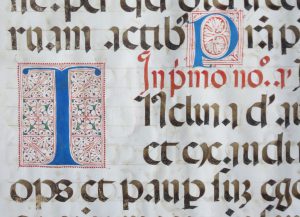
Private Collection, MS 1, Fol. 1 (‘137’)r, Initial I (for Inclina). Photography Mildred Budny. Reproduced by permission.

A Pair of Non-Consecutive Leaves
from a Large-Format
Latin Breviary
in Gothic Script on Vellum

Circa 590 mm × 447 mm
< written area circa 397 × 307 mm>
Single column of 15 lines
in Gothic Script
with rubrications, embellished initials,
and reiterated medieval and modern ‘folio’ numbers

Folio 1 (‘130’)
Vulgate Psalms (Septuagint Translation) 83:11 – 84:12 (Veri-[tas])

and

Folio 2 (‘137’)
Within Friday Matins:
Hymn Tu Trinitatis Unitas ([ . . . Ne corpus /] assit sordidum . . . Pater piissime)
Antiphon Inclina Domine, and Psalm 86 1:1–12 (Con-[fitebor])

14th or 15th Century, perhaps Italian or Spanish

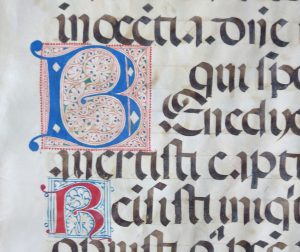
Private Collection, MS 1, Fol. 130r, initials B and R. Photography Mildred Budny. Reproduced by permission.

Continuing to examine manuscripts and fragments in our blog on Manuscript Studies (see its Contents List), we turn to a pair of large, single leaves which arrived in a Private Collection several years ago, as a gift from another Private Collection.  About this pair of leaves, we might exclaim:  What beauties!

For the current owner, with an interest in manuscript studies, especially medieval manuscripts, these leaves comprise the first in the library (mostly printed books about books).  Hence the assigned number, “MS 1”, with two detached leaves (Folios ‘1’ and ‘2’ in the set) from the same original manuscript.

The identity and origin of that manuscript remain, for now, unknown.  Perhaps this blogpost, presenting the detached leaves to wider view through their photographs and related information, might bring to light more information about them and their travels across time and place.

The pair came on their own, safely packaged with mats in a large shipping box, but without any accompanying information.  That is, apart from the former owner’s recollection relayed in conversation and email.

These two large leaves would have come as a purchase some years ago, in the late 1980s or early 1990s, at the New York Antiquarian Book Fair, a repeated venue for some other purchases for the same collection.

“The two large ones are German and quite late, if I remember rightly.  I bought them from a German dealer at the NY Antiquarian Book Fair.  No, I don’t recall his name.  It was a looong [sic] time ago.  I suspect the two smaller ones [= MS 2, in another shipping] were purchased at the same venue, though different dealer.”

On their own, the two leaves must or can speak for itself.  We bring to the table the willingness to examine them closely, to admire their resonant beauty, and to see what they can say.  Their story resides not only in the text, which can be deciphered, abbreviations and all, but also in the features of layout, script, decoration, rubrications, annotations, the animal skins for the writing surfaces, the traces of a former binding, and other forms of material evidence.

Read the rest of this entry →

Tags: History of the Psalms, Late-Medieval Breviary, Medieval Manuscript Fragments, Medieval manuscripts
6 Comments »

2019 International Congress on Medieval Studies Report

September 14, 2019 in Abstracts of Conference Papers, Anniversary, Announcements, Bembino, Business Meeting, Conference, Events, International Congress on Medieval Studies, Kalamazoo, POMONA, Reception, Reports, Societas Magica, Uncategorized

Report:  Events Sponsored and Co-Sponsored
by the Research Group on Manuscript Evidence
at the 54th International Congress on Medieval Studies
9–12 May 2019

[Published on 2 June 2019. With the achievement of our Activities at the 2019 Congress, we offer this Report (Abstracts of Papers Included), while we advance with preparations for the 2020 Congress. For updates, as they evolve, please watch this space and our Facebook Page.]

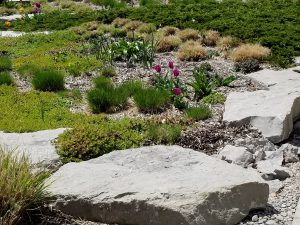
Central Rock Garden at WMU International Congress on Medieval Studies at Kalamazoo May 2019. Photograph Mildred Budny.

Central Rock Garden. Photograph Mildred Budny.

In 2019, the Research Group on Manuscript Evidence celebrates its 20th year as a nonprofit educational corporation and its 30th year as an international scholarly organization. Accordingly, we hold both customary and extra-special events, both at the Congress and elsewhere. For example, shortly before the 2019 Congress, we

We have a tradition of celebrating landmark Anniversaries, both for our organization, with organizations which which we share anniversaries, and for other events. As described, for example, in our 2014 Anniversary Reflections. For 2019, our events aim to represent, to explore, to promote, to celebrate, and to advance aspects of our shared range of interests, fields of study, subject matter, and collaboration between younger and established scholars, teachers, and others, in multiple centers.

Now we Report the successful accomplishment of our Activities at the 2019 Congress.

Who, What, Why Not

Logo of the Research Group on Manuscript Evidence (colour version)As in recent years, we co-sponsored Sessions with the Societas Magica (2 Sessions). It is the 14th year of this co-sponsorship, and the first year of co-sponsorship with the newly-founded organization Polytheism-Oriented Medievalists of North America (P.-O.M.O.N.A).

Also, like the 2015–2018 Congresses, we held

  • an Open Business Meeting, with a convenient downloadable 2019 Agenda, and
  • a co-sponsored Reception.

As usual, we publish the Program for the accepted Papers, as their Authors permit. Abstracts for previous Congresses appear in our Congress Abstracts, conveniently Indexed both by Year and by Author.

Read the rest of this entry →

Tags: Animals in Celtic Magical Texts, Beinecke Takamiya MS 23, Business Meeting, Celtic Magical Texts, Classical Deities, Classical Deities in Medieval Northern European Contexts, Dionysus, Ecstasy Defense, Grettisfærsla, Hêliand, History of Magic, Lapidaries, Mary Moody Emerson, Medieval manuscripts, Medieval Studies, P.-O.M.o.N.A., Reception, Societas Magica
No Comments »

2019 M-MLA Call for Papers

March 3, 2019 in Announcements, Conference, Conference Announcement, Events, M-MLA, Manuscript Studies, Midwest Modern Language Association

Call for Papers

“Duality and Manuscript Evidence”

2019 Theme for the

Permanent Panels sponsored by the
Research Group on Manuscript Evidence
at the
Midwest Modern Language Association (M-MLA)

2019 Convention
Chicago, Illinois
November 14–17, 2019

[Posted on 2 March 2019]

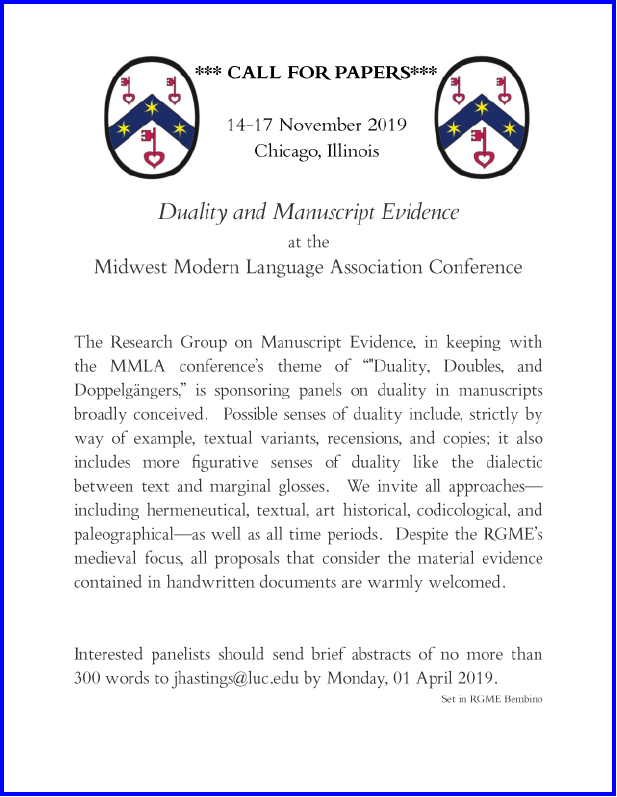
Poster announcing the Call for Papers for the Permanent Panels sponsored by the Research Group on Manuscript Evidence, to be held at the 2019 MMLA Convention in Chicago in November. Poster set in RGME Bembino and designed by Justin Hastings.

Poster designed by Justin Hastings

The Research Group on Manuscript Evidence, in keeping with the MMLA conference’s theme of “Duality, Doubles, and Doppelgängers” for the 2019 Convention in Chicago, is sponsoring panels on duality in manuscripts broadly conceived.

Information about the conference appears on the MMLA website: MMLA Convention.

For our panels, possible senses of duality include, strictly by way of example, textual variants, recensions, and copies.  It also includes more figurative senses of duality, like the dialectic between text and marginal glosses.

We invite all approaches — including hermeneutical, textual, art historical, codicological, and paleographical — as well as all time periods. Despite the RGME’s traditional medieval focus, which has expanded, not least through these panels at the MMLA, we declare that all proposals considering the material evidence contained in handwritten documents are warmly welcomed.

Interested panelists should send brief abstracts of no more than 300 words to

jhastings@luc.edu by Monday, 01 April 2019.

*****

Thanks to the expert initiatives by our Associate Justin Hastings, this will be the 4th year that the Research Group sponsors Permanent Panels at the Annual Convention of the Midwest Modern Language Association.

It is a special pleasure that our panels at the 2019 Convention form part of our anniversary celebrations.  2019 marks the 20th anniversary of our nonprofit educational corporation based in Princeton, New Jersey, and the 30th anniversary of our international scholarly society founded at the Parker Library of Corpus Christi College, Cambridge.

  • 2018 M-MLA Panel on “Consuming Cultures and Manuscript Evidence”
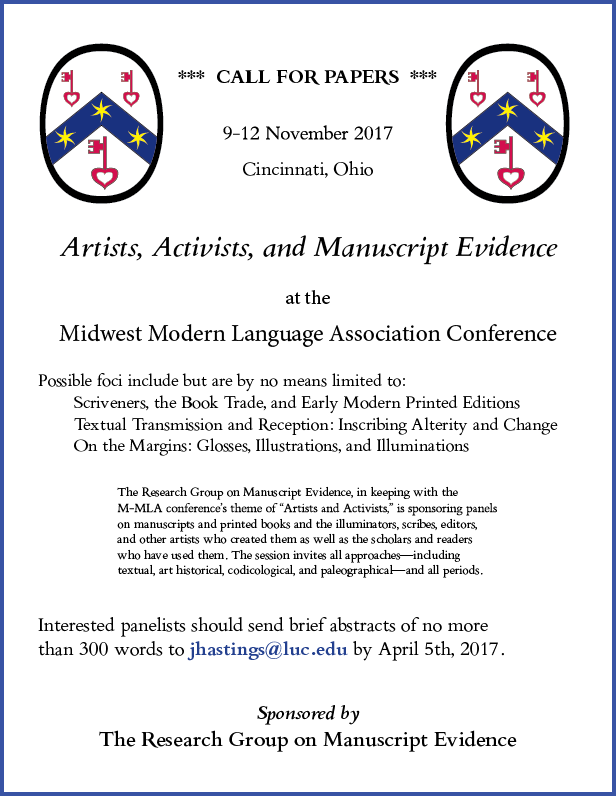
  • 2017 M-MLA Panel on “Artists, Activists, and Manuscript Evidence”
    2017 M-MLA Panel Report
  • “Marginalia in Manuscripts and Books” for the 2018 M-MLA
    2016 M-MLA Report

As customary for our Sessions at the International Congress on Medieval Studies, we publish the Abstracts of the Papers for our Panels at the M-MLA Convention in our Panel Announcements and Reports.

Poster for CFP RGME Sponsored Panels for 2017 M-MLA Convention*****

The continuation of the tradition of Permanent Panels at the M-MLA Convention is most welcome, and we thank our organizer, Justin Hastings, and the Midwest Modern Language Association.  We congratulate Justin for his expert organizational skills and outstanding collegiality, and we applaud his willingness to continue to organize the panels for the Research Group on Manuscript Evidence.

*****

Further information about the Convention and the Call for Papers for Permanent Panels can be found on the M-MLA website:

  • M-MLA Convention
  • M-MLA Convention Permanent Section Call for Papers .

Please Contact Us with your questions and suggestions.  See you there!

*****

Tags: Manuscript studies, Medieval manuscripts, Midwest Modern Language Association
No Comments »

2019 International Congress on Medieval Studies Program Details

January 31, 2019 in Abstracts of Conference Papers, Anniversary, Announcements, Bembino, Business Meeting, Conference, Conference Announcement, International Congress on Medieval Studies, Kalamazoo, Societas Magica

Events
Sponsored and Co-Sponsored
by the Research Group on Manuscript Evidence
at the 54th International Congress on Medieval Studies
9–12 May 2019

[Published on 24 September 2019, with updates. With the achievement of our Activities at the 2018 Congress, we offered the 2018 Congress Report, and advance with preparations for the 2019 Congress. Now we announce the 2019 Congress Program, also with information about time-and-room assignments, as well as Abstracts for the Papers and Responses.  For updates, please watch this space and our Facebook Page.

Update: Now see our 2019 International Congress on Medieval Studies Report]

In 2019, the Research Group on Manuscript Evidence celebrates its 20th year as a nonprofit educational corporation and its 30th year as an international scholarly organization. Accordingly, we aim to hold both customary and extra-special events, both at the Congress and elsewhere.

We have a tradition of celebrating landmark Anniversaries, both for our organization, with organizations which which we share anniversaries, and for other events. As described, for example, in our 2014 Anniversary Reflections. For 2019, our events aim to represent, to explore, to promote, to celebrate, and to advance aspects of our shared range of interests, fields of study, subject matter, and collaboration between younger and established scholars, teachers, and others, in multiple centers.

Now we announce the Programs for our Sessions, as well as our other Events planned for the Congress.  Soon, as is our custom, we will publish the Abstracts for the Papers.  We look forward to seeing you at the Congress and our other Anniversary Year events.

Who, What, Why Not

Logo of the Research Group on Manuscript Evidence (colour version)As in recent years, we co-sponsor Sessions with the Societas Magica (2 Sessions). It will be the 14th year of this co-sponsorship. It will be the first year of co-sponsorship with the newly-founded organization Polytheism-Oriented Medievalists of North America (POMONA).

Also, like the 2015–2018 Congresses, we plan for

  • an Open Business Meeting and
  • a Reception.

As usual, we aim to publish the Program for the accepted Papers, as their Authors permit. Abstracts for previous Congresses appear in our Congress Abstracts, conveniently Indexed both by Year and by Author.

Read the rest of this entry →

Tags: Anniversary, Dionysos, Extasy Defence, Grettisfærsla, Hêliand, History of Magic, Lapidaries, manuscript fragments, Manuscript Lacunae, Manuscript studies, Mary Moody Emerson, Medieval manuscripts, P.-O.M.o.N.A., Societas Magica, Takamiya MS 23
No Comments »

Design & Layout of “The Illustrated Catalogue”

October 12, 2018 in Bembino, Design, Interviews, Manuscript Studies, Parker Library, Photographic Exhibition, Reports, Uncategorized

Gold stamp on blue cloth of the logo of the Research Group on Manuscript Evidence. Detail from the front cover of Volume II of 'The Illustrated Catalogue'Continuing our series of interviews and reports, we explore the processes by which Mildred Budny’s 2-volume Insular, Angl0-Saxon, and Early Anglo-Norman Manuscript Art at Corpus Christi College, Cambridge:  An Illustrated Catalogue (“The Catalogue” or “The Illustrated Catalogue”) was designed, laid out, and typeset to camera-ready copy for its publication as a set of 2 volumes of “Text” and “Plates”.

Now we present a joint interview with the Author and the Layout Designer of “The Illustrated Catalogue”.

For information about that publication see Insular, Anglo-Saxon, and Early Anglo-Norman Manuscript Art at Corpus Christi College, Cambridge: An Illustrated Catalogue.

Our interview appears in the new Booklet describing “The Design and Layout of ‘The Illustrated Catalogue’ “.  This 16-page booklet is available freely as a pdf for quarto-size pages:

  • As a series of consecutive pages.
  • In foldable booklet form suitable for printing on 11 1/2 in. × 17 in. sheets.

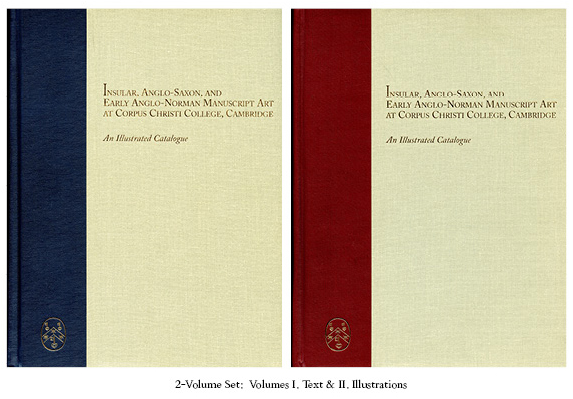
Front Covers for Volumes I & II of 'Insular, Anglo-Saxon, and Anglo-Norman Manuscript Art at Corpus Christi College, Cambridge: An Illustrated Catalogue' by Mildred Budny, with the title of the publication and the gold-stamped logo of the Research Group on Manuscript Evidence, co-publisher of the volumes


Some of the background for preparing this ground-breaking publication is described in the “Interview with our Font & Layout Designer” (published in print on 25 September 2016 and online on 6 October 2016), with illustrations, and downloadable here.

For the progress and development of our Research Group Publications, please see our Publications. We invite your contributions, suggestions, and feedback.

*****

Tags: Anglo-Saxon Manuscripts, Budny's Illustrated Catalogue, Manuscript Illumination, Medieval manuscripts
No Comments »

Another Witness to the Cistercian Statutes of 1257

December 2, 2016 in Manuscript Studies, Photographic Exhibition

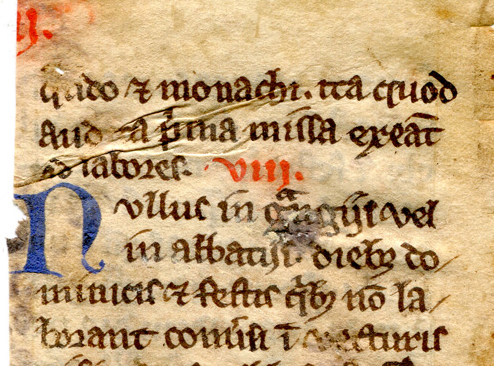
Detail of the top of the verso of the fragmentary leaf from a 13th-century copy of Statutes for the Cistercian Order. Reproduced by permission.Part-Leaf from a Dismembered Witness
to the 1257 Codification of the Statutes
for the Cistercian Order

A Part-Leaf, now on its own, carries parts of the Chapter De Conversis (“On the Lay Brothers”)
from Distinctio (“Section”) XIV (out of XV in total)
in the Codification of 1257 of Statutes for the Cistercian Order

This installment of our blog on Manuscript Studies identifies a fragmentary 13th-century leaf on vellum with monastic rules in Latin.  Now reduced to a single column of its original double columns of text, the fragment carries parts of the Statutes of the Cistercian Order, in a mid-–13th-century version — or, rather, extension — of those Statutes.  That extended version appears in full in a few other extant manuscripts.  Mildred Budny describes the fragment and its testimony.

Read the rest of this entry →

Tags: British Library Additional MS 11294, Cistercian Statutes, Cistercian Statutes of 1257-1258, Fontanay Abbey, Manuscript studies, Medieval manuscripts
2 Comments »

Seminar on the Evidence of Manuscripts (20 June 1992)

August 28, 2016 in Photographic Exhibition, Seminars on Manuscript Evidence, Uncategorized

“Research on Anglo-Saxon Manuscripts in Cambridge and Oxford”
20 June 1992
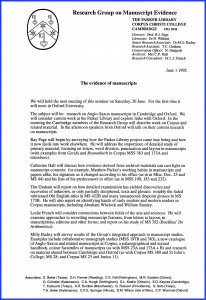
Anglo-Saxon MSS in Cambridge & Oxford Invitation 20 June 1992 Page 1 with border

Invitation Page 1

Invitation to 'Anglo-Saxon Manuscripts in Cambridge and Oxford' Seminar Invitation 20 June 1992 Page 2

Invitation Page 2

In the Series of Seminars on the Evidence of Manuscripts
Mostly at the Parker Library, Corpus Christi College, Cambridge
20 June 1992

Invitation in pdf.

The previous Seminar in the series considered

“Corpus Christi College MSS 23 and 223:  The Corpus Prudentius and the Saint-Bertin Prudentius”
Parker Library, 5 June 1992

For the first time, the Seminar met in Oxford University. And not for the only time. Two more such Seminars followed in Oxford, before the close of the Series.  They took place March 1993 and in April 1994.

Photographic Exhibition Included

Each time, the Oxford meetings of the Series had a travelling exhibition of photographs from manuscripts and other materials, mostly from Corpus Christi College, Cambridge, home of the Research Group. This first Seminar at Oxford established the custom, which extended to the Research Group’s visit to Japan several months later, in November and December 1992, and to its activities at the International Congress on Medieval Studies in both 1993 and 1994, of bringing the manuscripts, at least in the form of photographic reproductions, to the people.
Sign for Photographic Exhibitions of the Research Group on Manuscript Evidence, laid out in Adobe Garamond, with the Research Group logo in monochrome, and crediting the 'Photography by Mildred Budny'*****

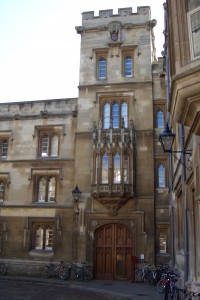
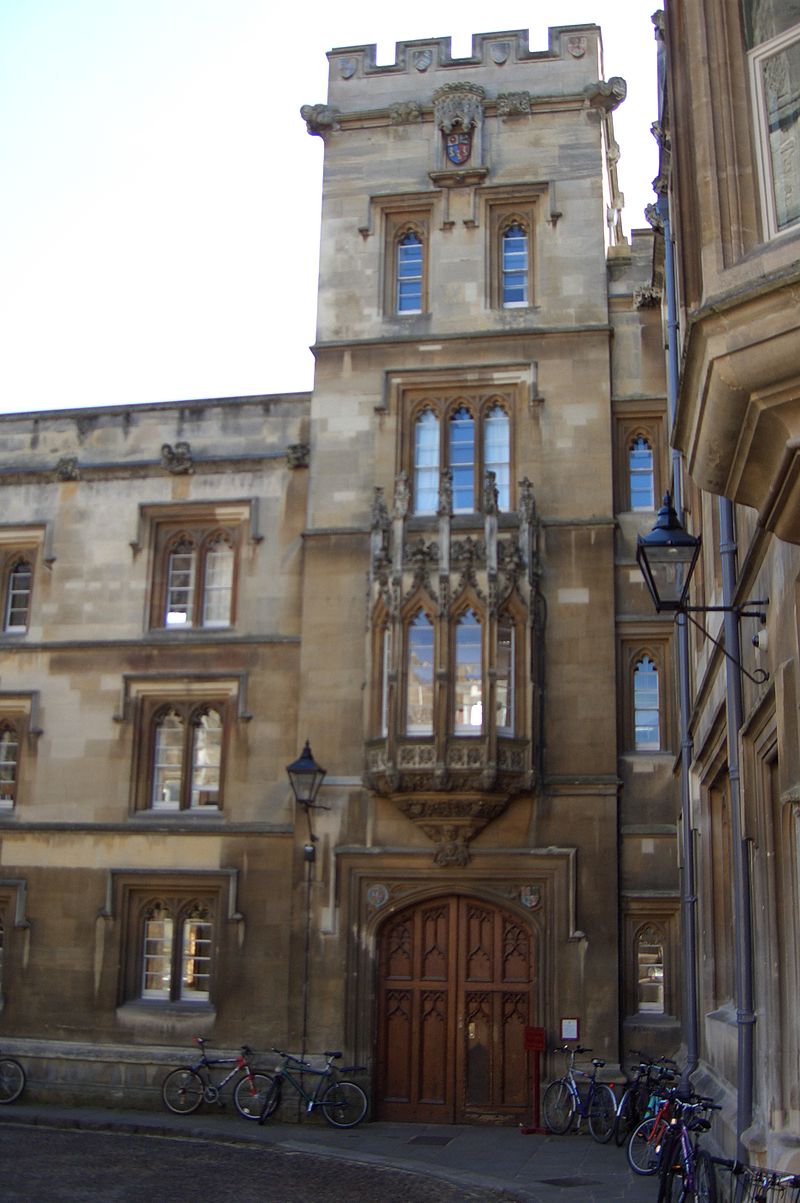
Entrance to Pembroke College. Photo by Jakob Leimgruber (JREL) via Wikipedia Commons

Entrance to Pembroke College in Pembroke Square. Photo by Jakob Leimgruber (JREL) via Wikipedia Commons.

Plan

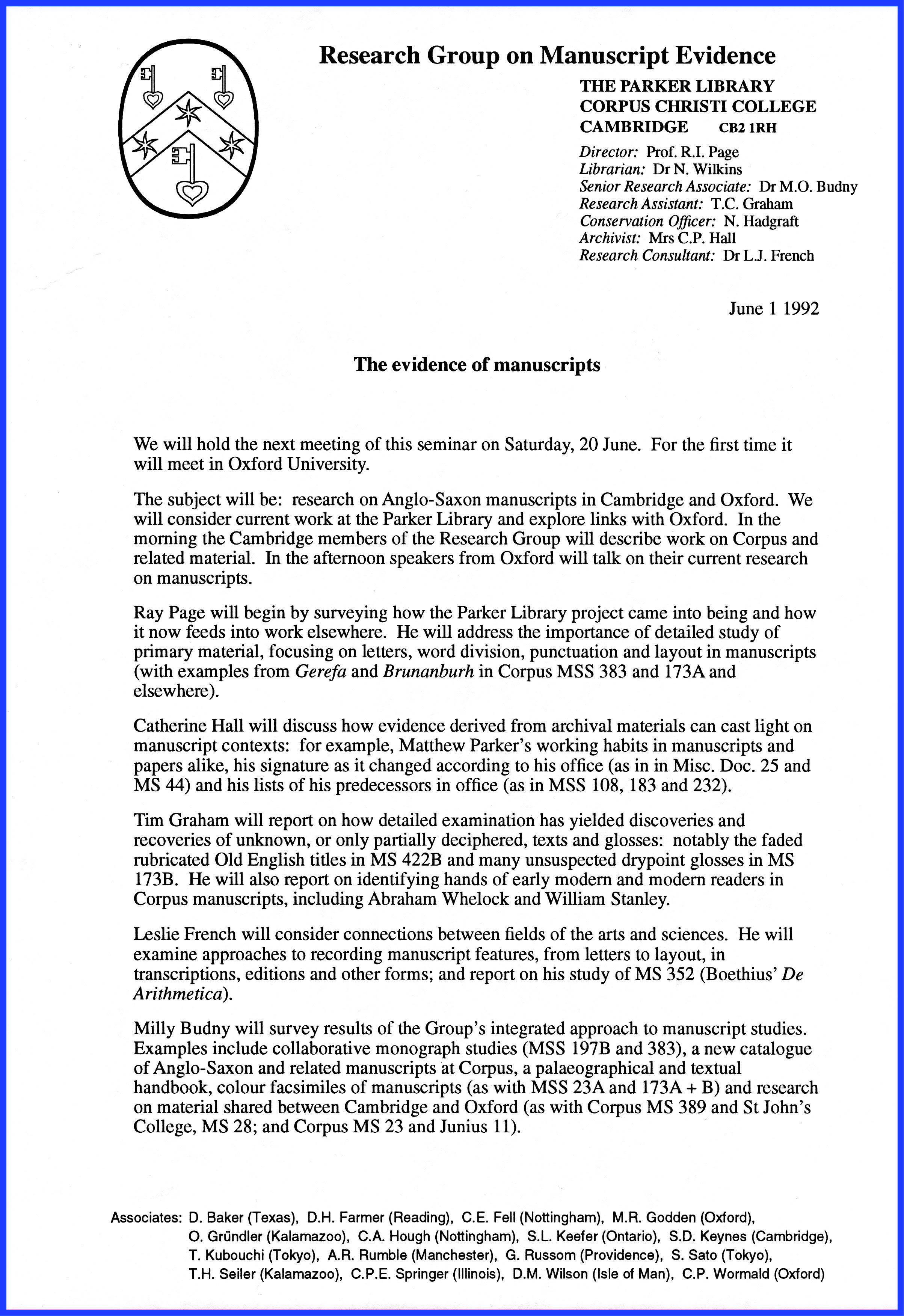
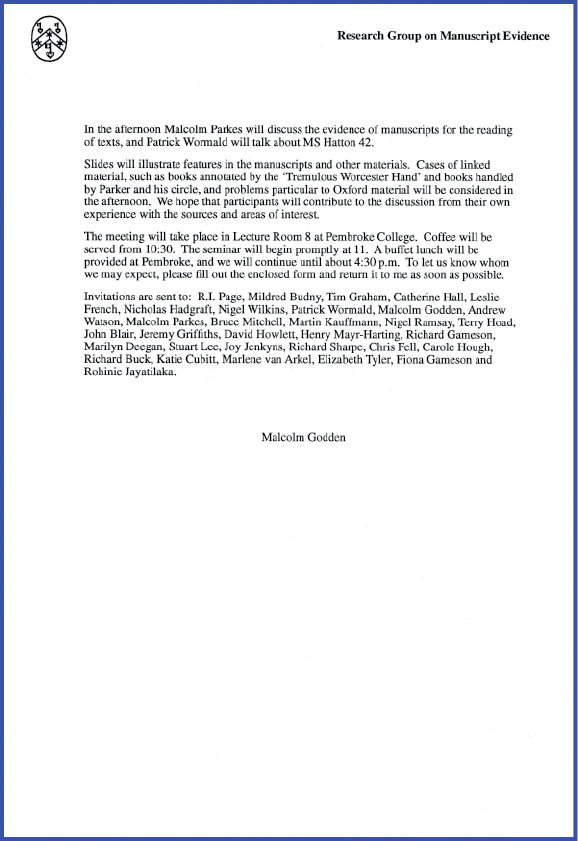
With the subject of “research on Anglo-Saxon manuscripts in Cambridge and Oxford” — and with the characteristics of the venue as well as the willing assembly of interests and expertise — the Invitation Letter describes the aims and elements of the meeting.

We will consider current work at the Parker Library and explore links with Oxford.  In the morning the Cambridge members of the Research Group will describe work on Corpus and related material.  In the afternoon speakers from Oxford will talk on their current research on manuscripts.

Ray Page will begin by surveying how the Parker Library project came into being and how it now feeds into work elsewhere.  He will address the importance of detailed study of primary material, focusing on letters, word division, punctuation and layout in manuscripts (with examples from Gerefa and Brunanburh in Corpus MSS 383 and MS 173A and elsewhere).

Catherine Hall will discuss how evidence derived from archival materials can cast light on manuscript contexts:  for example, Matthew Parker’s working habits in manuscripts and papers alike, his signature as it changed according to his office (as in Misc. Doc. 25 and MS 44) and his lists of his predecessors in office (as in MSS 108, MS 183 and MS 232).

Tim Graham will report on how detailed examination has yielded discoveries and recoveries of unknown, or only partially deciphered, texts and glosses:  notably the faded rubricated titles in MS 422B and many unsuspected drypoint glosses in MS 173B.  He will also report on identifying hands of early modern and modern readers in Corpus manuscripts, including Abraham Whelock and William Stanley.

Leslie French will consider connections between fields of the arts and sciences.  He will examine approaches to recording manuscript features, from letters to layout, in transcriptions, editions and other forms; and report on his study of MS 352 (Boethius’ De Arithmetica).

Milly Budny will survey results of the Group’s integrated approach to manuscript studies.  Examples include collaborative monograph studies (MSS 197B and 383), a new catalogue of Anglo-Saxon and related manuscripts at Corpus, a palaeographical and textual handbook, colour facsimiles of manuscripts (as with MSS 23A and 173 A+B) and research on material shared between Cambridge and Oxford (as with Corpus MS 389 and St John’s College, MS 28; and Corpus MS 23 and Junius 11).

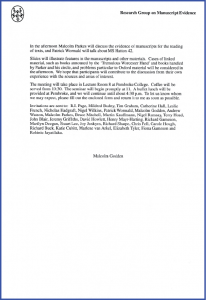
In the afternoon Malcolm Parkes will discuss the evidence of manuscripts for the reading of texts, and Patrick Wormald will talk about MS Hatton 42.

Images of Originals

The Letter points to the presence of photographic reproductions as part of the proceedings.

Slides will illustrate features in the manuscripts and other materials.  Cases of linked material, such as books annotated by the ‘Tremulous Worcester Hand’ and books handled by Parker and his circle, and problems particular to Oxford material will be considered in the afternoon.  We hope that participants will contribute to the discussion from their own experience with the sources and areas of interest.

Also, an exhibition of photographs mounted on foamboards travelled to Oxford for the purpose.  The Research Group Archives for this Seminar retain the set of printouts used for the captions for the display boards and a set of snapshots of the layout of the display on this occasion.

Sign for Photographic Exhibitions of the Research Group on Manuscript Evidence, laid out in Adobe Garamond, with the Research Group logo in monochrome, and crediting the 'Photography by Mildred Budny'Place, Time, People, Lunch

The meeting will take place in Lecture Room 8 at Pembroke College.  Coffee will be served from 10:30.  The seminar will begin promptly at 11.  A buffet lunch will be provided at Pembroke, and we will continue until about 4:30 p.m.  To let us know whom we may expect, please fill out the enclosed form and return it to me as soon as possible.

Invitations sent to:

R.I. Page, Mildred Budny, Tim Graham, Catherine Hall, Leslie French, Nicholas Hadgraft, Nigel Wilkins, Patrick Wormald, Malcolm Godden, Andrew Watson, Malcolm Parkes, Bruce Mitchell, Martin Kauffmann, Nigel Ramsay, Terry Hoad, John Blair, Jeremy Griffiths, David Howlet, Henry Mayr–Harting, Richard Gameson, Marilyn Deegan, Stuart Lee, Joy Jenkyns, Richard Sharpe, Chris Fell, Carole Hough, Richard Buck, Katie Cubitt, Marlene van Arkel, Elizabeth Tyler, Fiona Gameson and Rohinie Jayatilaka.

It was agreed that the experience of a Seminar in the Series was worth repeating at Oxford.  The generous hospitality which Professor Godden, his wife Julia, and others extended to the whole travelling band of the Research Group for the visit and its overnight stay deserves long-term thanks.
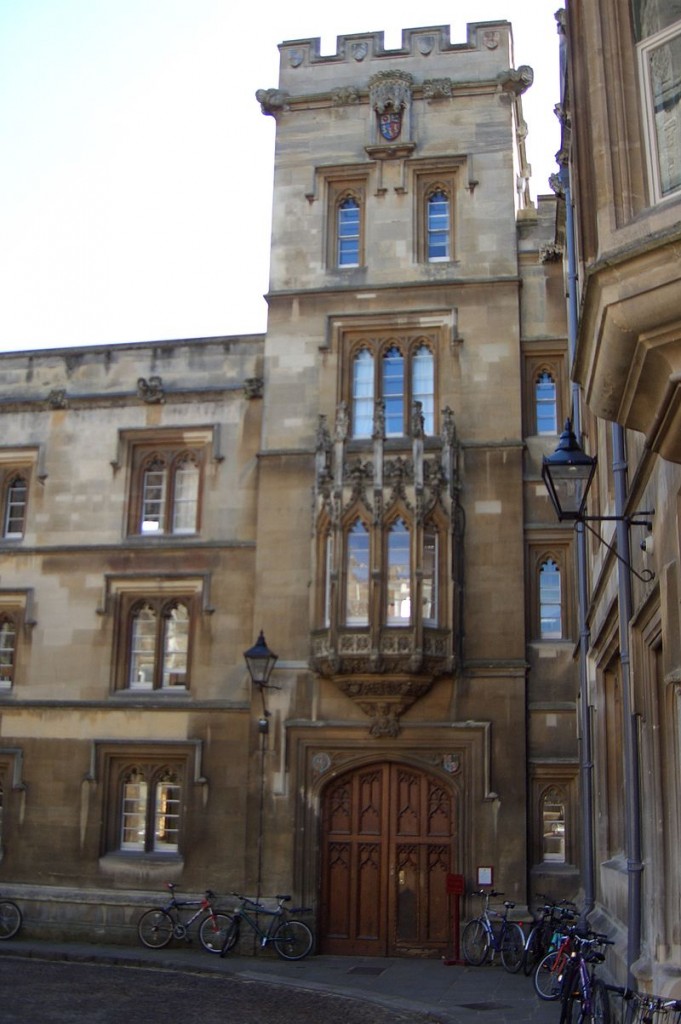
Entrance to Pembroke College. Photo by Jakob Leimgruber (JREL) via Wikipedia Commons

Entrance to Pembroke College. Photo by Jakob Leimgruber (JREL) via Wikipedia Commons.

*****

The next set of Seminars, Workshops, or Sessions in the Series took place in Japan.  Similarly accompanied by photographic exhibitions, they considered:

  • “The Research Group on Manuscript Evidence and Its Work”
    November 1992
  • “Aspects of the Research Group on Manuscript Evidence”
    December 1992
  • “The Integrated Approach to Manuscript Studies”
    December 1992

The next Seminar in England considered:

  • “Corpus Christi College MS 44:  The Corpus Canterbury Pontifical”
    Parker Library, 27 February 1993

Before long, the Seminar revisited Oxford:

  • “Anglo-Saxon Manuscripts from Worcester”
    Pembroke College, 13 March 1993

*****

The design and layout, as well as some of the images, of the exhibition of photographs which the Research Group brought to this first Seminar in Oxford in mid-1992 served as the template for its exhibitions in Japan in November–December and then in the United States in both May 1993 and May 1994, respectively for the 27th and 28th International Congress on Medieval Studies. For the latter Congress, the exhibition accompanied the opening of a new center for Anglo-Saxon Manuscript Studies, modeled in part upon the work of the Research Group on Manuscript Evidence.

*****

Some Publications Arising

Gold-stamped logo of the Research Group on Manuscript Evidence on Red fabric ground on the Front Cover of Volume I (Text) of 'Insular, Anglo-Saxon, and Early Anglo-Norman Manuscript Art at CorpusChristi College, Cambridge' by Mildred BudnyBesides the other publications which emanated from some presentations at this Seminar — for example, from within the Research Group on Manuscript Evidence, Timothy Graham‘s careful work on the drypoint glosses and the annotating habits of Wheelock and Stanley — some of the manuscripts considered and exhibited photographically figure in one or more of the Research Group publications or planned publications.  From the beginning, we understood the importance of reproducing, insofar as possible, photographic reproductions (preferrably high-quality) of the material evidence of the manuscripts.

And so, much of our energies were dedicated to photographic work, guided by scholarly interests and expertise, and to the preparations to disseminate its results to the wider world of scholars, students, and others interested in the transmission of learning, language, history, literature, and many other elements of human experience across time and space.  That other challenges, some practical, some not, interfered with the accomplishment of all those plans (published facsimiles included, despite the completion of the photographic work for them) may be partly due to the conditions of a dedicated and talented research project subjected to insufficient resources and contextual support, given the nature of the world at large in a crucial transitional period in the history of scholarship and research in the British Isles and elsewhere.

Those reflections may deserve another forum.  Here, let us celebrate the collaborative activities between centers and fields of study, and the forms of publications which did emerge, in the welcome for the integrated approach to manuscript studies, Anglo-Saxon manuscripts included, in Cambridge and Oxford (and elsewhere), which the Series of Seminars on “The Evidence of Manuscript” was able to find, to enjoy, and to extend, even into other parts of the world.

“Matthew Parker in Cambridge” Exhibition & Booklet

Catherine Hall’s examination of scripts and documents relating to “Matthew Parker in Cambridge” turned into an exhibition at the Parker Library itself, as well as a Catalogue Booklet, with Mildred Budny’s photographs. The exhibition extended from October 1993 to February 1994. Its booklet was reprinted as an Appendix to an issue of the Old English Newsletter (Volume 27:1) for Fall 1993, and now it is available online with the digitization of the Old English Newsletter Archives. Its plates reproduce part of Misc. Doc. 25 (Catalogue Item 5) demonstrated in her presentation for the Seminar at Pembroke College.

The Palaeographical and Textual Handbook
and the Illustrated Catalogue
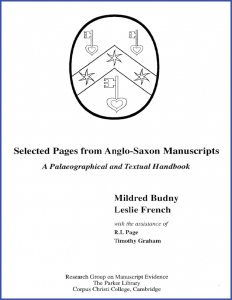
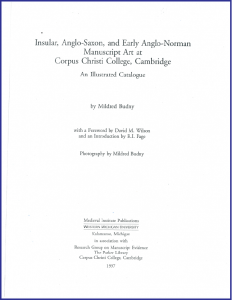
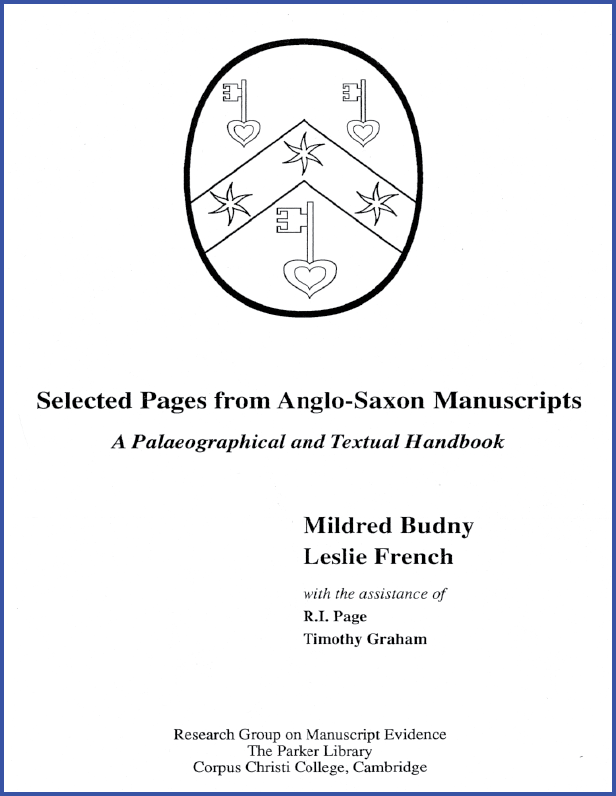
Cover for "Selected Pages from Anglo-Saxon Manuscripts: A Palaeographical and Textual Handbook" by Mildred Budny, Leslie French et al.Title Page for "Insular, Anglo-Saxon, and Early Anglo-Norman Manuscript Art at Corpus Christi College, Cambridge" (1997)Besides the photographs painstakingly prepared for many of the Corpus manuscripts, and intended for analogue facsimiles (remember, this was before digital photography came to dominate as more-or-less viable, let alone admirable, methods of communicating images), some of them found places in the prototype of the Palaeographical and Textual Handbook (previewed in an early Seminar in the series).  A larger group of them reached print at last in the 2-volume Illustrated Catalogue of Insular, Anglo-Saxon, and Early Anglo-Norman Manuscript Art at Corpus Christi College, Cambridge co-published by the Research Group on Manuscript Evidence (2 volumes, 1997).

In both cases, the photographs are accompanied by, and intended to illustrate, it may be to confirm, detailed observation and analysis.
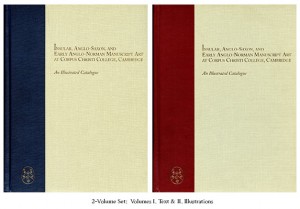
Front Covers for Volumes I & II of 'Insular, Anglo-Saxon, and Anglo-Norman Manuscript Art at Corpus Christi College, Cambridge: An Illustrated Catalogue' by Mildred Budny, with the title of the publication and the gold-stamped logo of the Research Group on Manuscript Evidence, co-publisher of the volumesThe Illustrated Catalogue (2 volumes, 1997) emanated from the long-term, integrated research work on selected Anglo-Saxon and related manuscripts at The Parker Library of Corpus Christi College, Cambridge. The stages of the research work are recorded, for example, in the Annual Reports to the Leverhulme Trust, described in our Publications. Many of the catalogue entries, as noted therein, report the results of discoveries and discussions emerging in our series of Seminars, including this one.

The manuscripts in the Catalogue which we examined, at a distance, in the first Oxford Seminar are:

  • MS 23, Part I = Budny Number 24 (The Corpus Prudentius)
  • MS 44 = Budny Number 46 (The Corpus Canterbury Pontifical)
  • MS 144 = Budny Number 6 (The Corpus Glossary)
  • MS 173, Part I [or A] = Budny Number 11 (Parker Chronicle and Laws)
  • MS 173, Part II [or B] = Budny Number 4 (The Corpus Sedulius)
  • MS MS 183 = Budny Number 12 (King Athelstan’s Presentation Copy of Bede’s Vita Sancti Cuthberti and Other Texts)
  • MS 197, Part I [or B] = Budny Number 3 (The Cambridge Portion of the Cambridge–London Gospels)
  • MS 352 = Budny Number 20 (Boethius’s De Instituione Arithemetica)
  • MS 389 = Budny Number 23 (The Vitae of Saints Paul and Guthlac by Saint Jerome and Felix)

Also, specimens from all of these manuscripts were selected for the Palaeographical and Textual Handbook, along with MS 383.

*****

Tags: 'Matthew Parker in Cambridge', Abraham Whelock, Anglo-Saxon Manuscripts, Budny's Illustrated Catalogue, Corpus Christi College Ms 108, Corpus Christi College MS 173, Corpus Christi College MS 183, Corpus Christi College MS 23, Corpus Christi College Ms 232, Corpus Christi College MS 352, Corpus Christi College MS 383, Corpus Christi College MS 389, Corpus Christi College MS 422, Corpus Christi College MS 44, Hatton MS 20, Junius MS 11, Manuscript studies, Matthew Parker, Medieval manuscripts, Old English Newsletter, Palaeographical and Textual Handbook, Parker Library, Pembroke College Oxford, Tremulous Worcester Hand, William Stanley
No Comments »

Workshop on Medieval Manuscripts (October 1991)

August 26, 2016 in Manuscript Studies, Seminars on Manuscript Evidence, Uncategorized

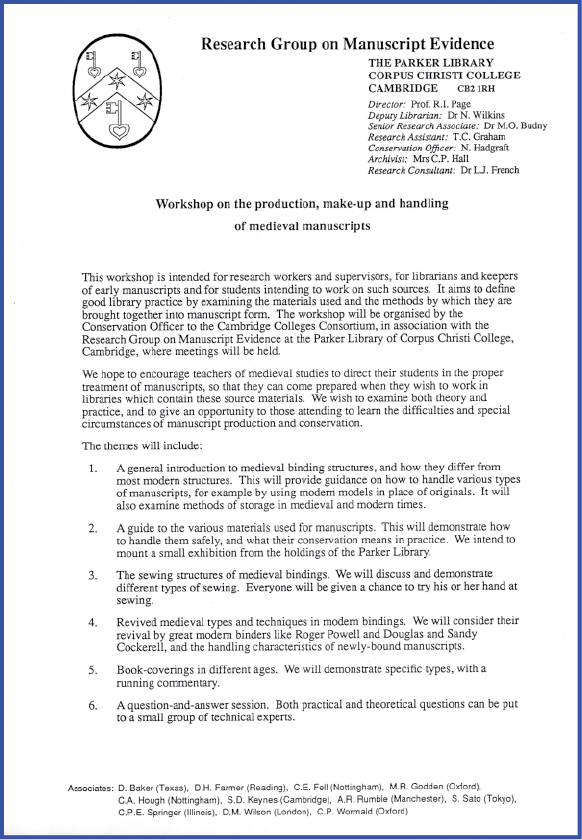
“The Production, Make-Up and Handling
of Medieval Manuscripts:
A Workshop”

5 October 1991

MS Production & Handling Workshop Invitation 5 Oct 1991 with border

5 October 1991 Prospectus

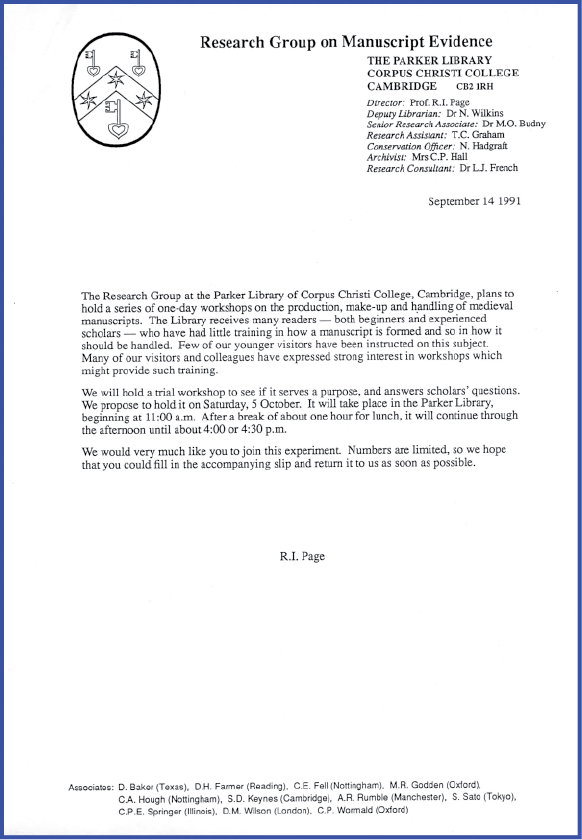
Invitation Cover Letter for Research Group Workshop on 'The Production, Make-Up and Handling of Medieval Manuscripts' on 5 October 1991 at the Parker Library

Cover Letter for 5 October 1991

Accompanying the Series of Seminars on the Evidence of Manuscripts
The Parker Library, Corpus Christi College, Cambridge
Invitation in pdf in 3 pages with Cover Letter, Prospectus, and RSVP Form.

The previous Seminar in the series considered
“Technical Literature and its Form and Layout in Early Medieval Manuscripts”
(Parker Library, July 1991).

[First published on 26 August 2016]

Issued on Research Group letterhead, the 1-page description of the workshop (the “Prospectus”) accompanying the 1-page Invitation Letter, dated 14 September 1991, describes the plan.  The Invitation Letter lays the ground work.

Read the rest of this entry →

Tags: Alexander R. Rumble, Binding History, Douglas Cockerell, History of Bookbinding, Medieval Bindings, Medieval manuscripts, Medieval Studies, Nicholas Hadgraft, Parker Library, Roger Powell, Sandy Cockerell, Sewing Structures for Bookbinding
No Comments »

Cover-Up

June 17, 2016 in Manuscript Studies, Photographic Exhibition

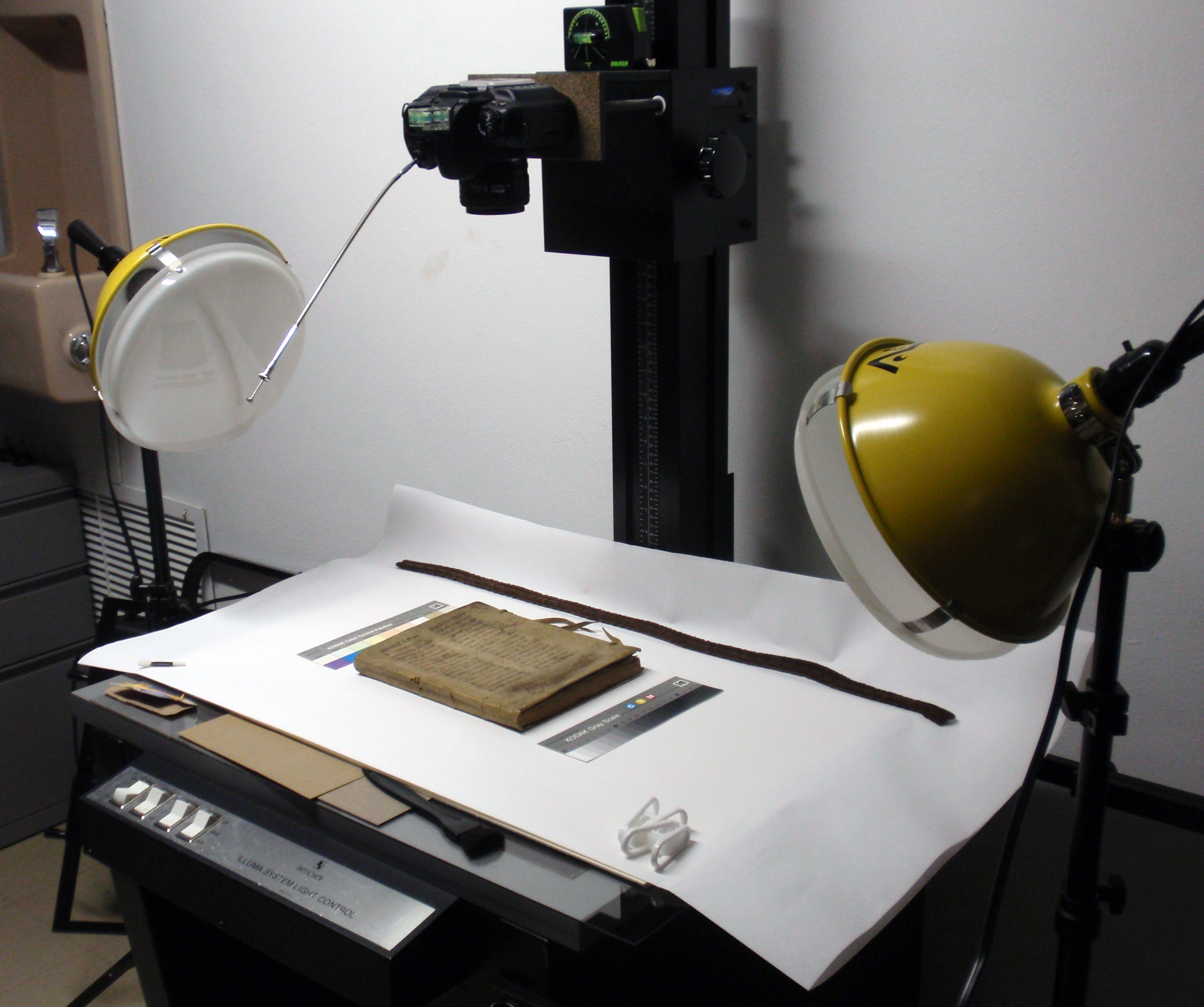
The Medieval-Psalter-Covered French Notebook in course of photography, archivally-sensitive equipment in place. Vire from the front cover, with untied ties. Photography © Mildred Budny. Reproduced by permission.

Photography © Mildred Budny

A Medieval Bifolium
From a Medium-Format Vulgate Latin Psalter
Reused as the Cover
of the Binding
of an 18th-Century Paper Notebook
With Receipts in French

Budny Handlist 5


Continuing our reports of discoveries about manuscripts and written materials in our blog on Manuscript Studies,
Mildred Budny examines a reused medieval fragment in its reused state, still attached to its modern notebook containing many receipts in French. Read the rest of this entry →

Tags: Breviary, Dijon, French Notebooks, French Revolution, Fructidor, Manuscript Fragments Reused in Bindings, Medieval manuscripts, Napoleonic Wars, Psalter Manuscripts
No Comments »

« Older Entries
Newer Entries »
  • Top
©2024 Research Group on Manuscript Evidence.


is proudly powered by WordPress. WordPress Themes X2 developed by ThemeKraft.