RGME Workshops on “The Evidence of Manuscripts, Etc.”
January 4, 2025 in Manuscript Studies, Workshops on "The Evidence of Manuscripts"
RGME Workshops
on
“The Evidence of Manuscripts, Etc.”
[Posted on 31 December 2024, with updates]

Private Collection, Pieces of a Vellum Leaf from a Medieval Manuscript: Recto. Photography by Mildred Budny.
In 2024 the RGME launched its series of Workshops dedicated to “The Evidence of Manuscripts, Etc.”
The series began in October 2024. So far they take place online as sessions of one and one-half hours, including scope for questions and answers. They are designed to teach and to crowdsource research on original materials, which may be newly discovered and so far unknown.
The workshops are free of charge. All are welcome to attend, join the discussion, and participate in the study of manuscripts and other original sources.
With this series, we revive an approach to collaborative events “On the Evidence of Manuscripts” which we nutured in our early years.
Our Early Series of Seminars
on “The Evidence of Manuscripts” (1989–1995)

RGME Logo in Black-and-White.
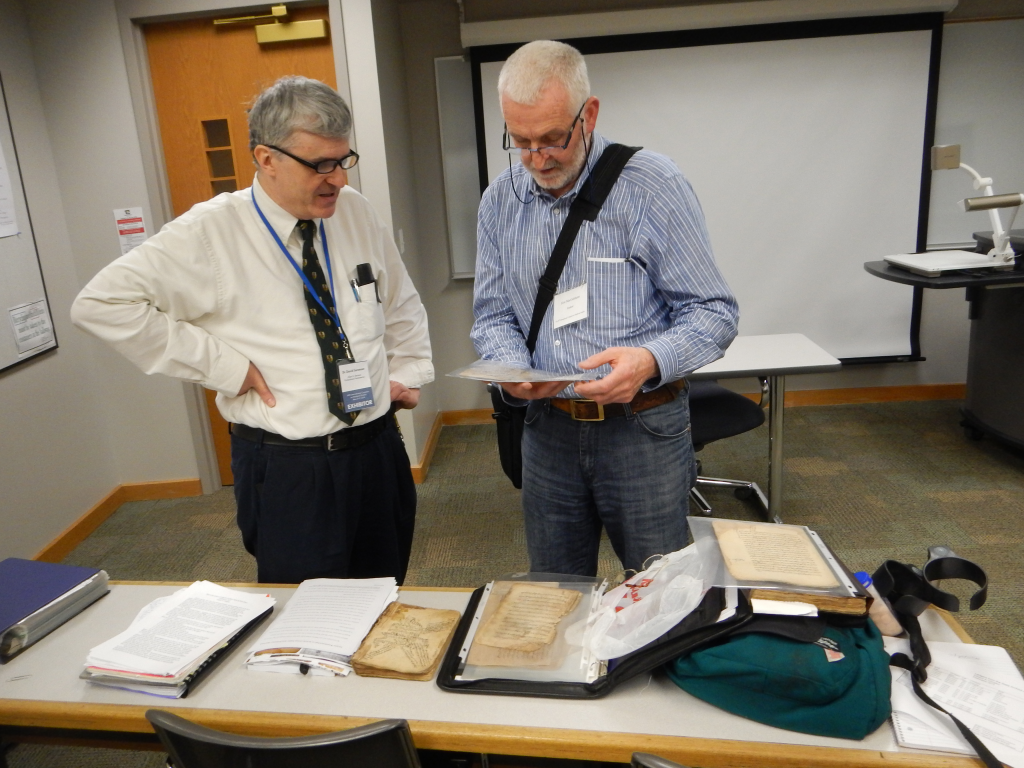
In its early years while based at the Parker Library of Corpus Christi College, Cambridge, the Research Group on Manuscript Evidence held a series of Seminars, Workshops, and Symposia (organized or co-organized by Mildred Budny) variously at the Parker Library and at other centers in England, Japan, and the United States. At libraries, the sessions took place over relevant manuscripts in the collection, supplemented by photographs. Elsewhere, the sessions were usually accompanied by displays or exhibitions of photographs (mostly by Mildred Budny).
In England, many of these sessions belonged to the series of Research Group Seminars on “The Evidence of Manuscripts.” Often they took place at the Parker Library in the company of the manuscripts under examination, sometimes also with early-printed books.
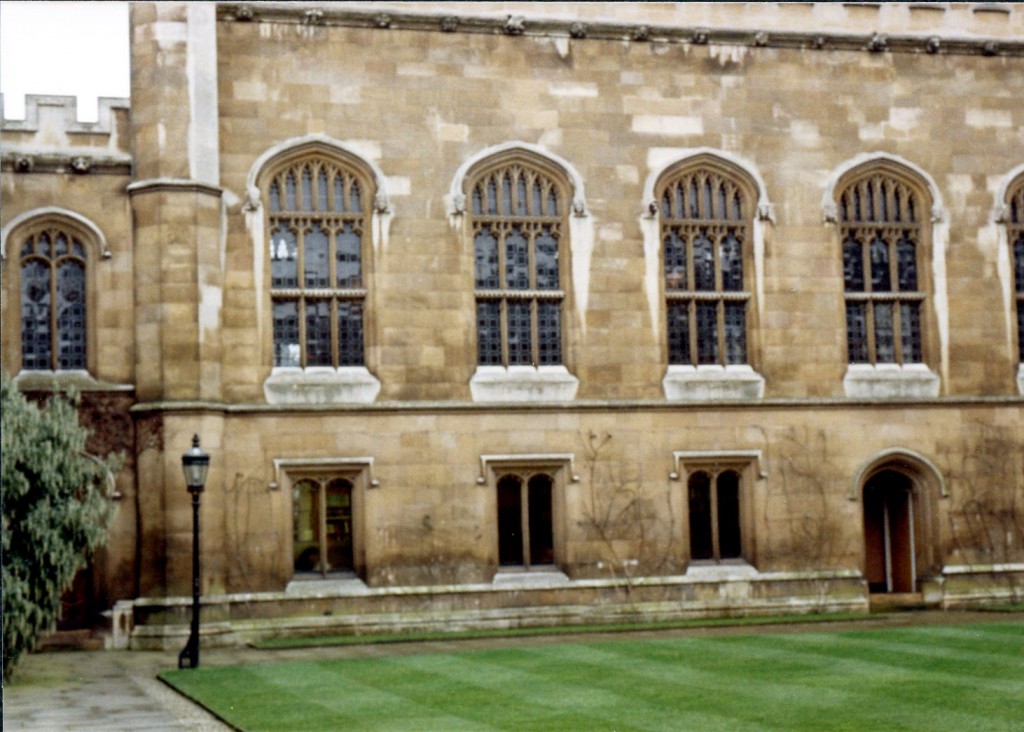
View Toward the Entrance to the Parker Library in mid-1989. Photograph © Mildred Budny.
Harking back to our first series of events as the RGME, in the series of RGME Seminars on “The Evidence of Manuscripts” (1989–1994), this new series brings forward for collective study (‘crowdsourcing’ and collaboration) the original specimens as witnesses in our own RGME Special Collections and the RGME Lending Library
Foreground

View of the Pont Neuf, Paris. Photograph by Claudio Mota via https://www.pexels.com/photo/pont-neuf-bridge-in-paris-9999874/.
Registration for the Workshops
To register for individual workshops in the series, please visit the RGME Eventbrite Collection for “The Evidence of Manuscripts, Etc.”
Workshop 1
“Introducing the Farrell Leaf”
Sunday 17 November 2024
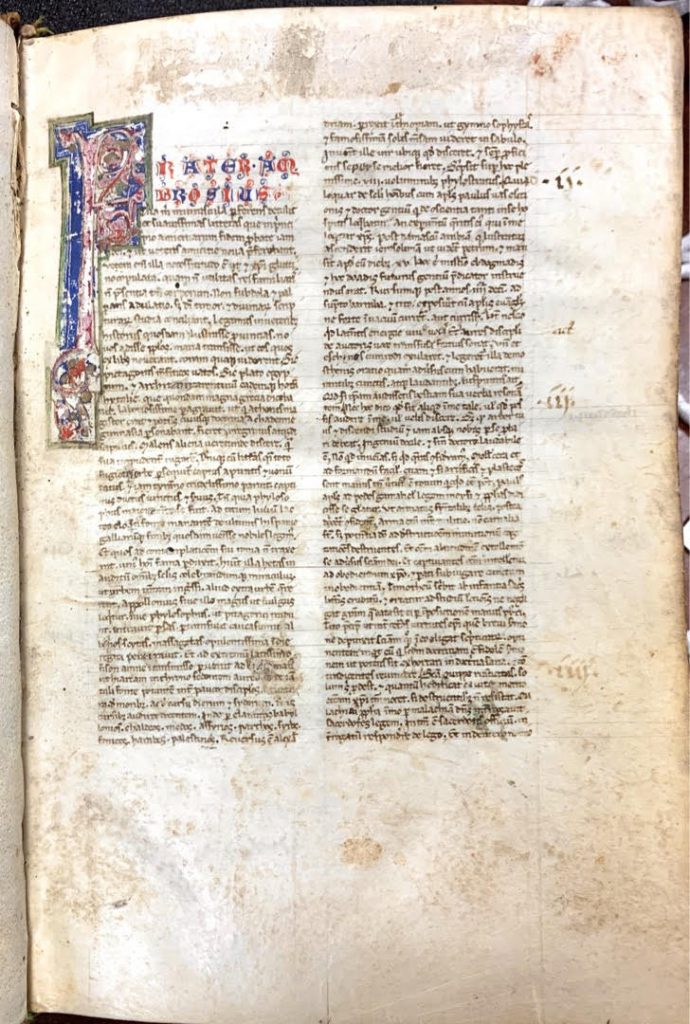
The first Workshop considers practices of manuscript studies and introduces the first specimen for collaborative examination. We meet the medieval Latin Vulgate Bible leaf from the Book of Numbers in the Jennah Farrell Leaf, now on loan to the RGME “Lending Library”.
For background information about this leaf based on the characteristics of the leaf itself and the owner’s knowledge about its provenance with reference to the previous owner, see
- our Blog on Manuscript Studies
- and its Manuscript Studies Contents List.

Medieval Latin Vulgate Bible manuscript: Verso, top. Photography by Mildred Budny.
Workshop 2
“Follow-Up for the Farrell Leaf”
Sunday 15 December 2024
At this workshop, comparing notes about our investigations which followed Workshop 1, we agreed that, most probably (and perhaps almost certainly), this leaf formerly belonged to the Saint Albans Bible, dispersed only in recent decades and now having its surviving leaves widely separated through the marketplace. On this bible see, for example:
- King David in the Waters Blessed by God, in a pair of leaves sold at Christie’s on 10 July 2019 and now in the McCarthy Collection
Fuller confidence in this proposed identification of the Farrell Leaf as part of the Saint Albans Bible might have to await the discovery or recognition of one of the leaves which formerly stood immediately adjacent, that is, directly preceding this leaf or directly following it, with a continuous flow of the text from leaf to leaf.
We continue our explorations.
Medieval Latin Vulgate Bible manuscript: Verso, top. Photography by Mildred Budny.
Workshop 3
“The Farrell Leaf and its Context”
Sunday 12 January 2025
Next, we consider the Farrell Leaf in its context:
- in its original manuscript,
- in relation to other leaves bearing the work of its scribe and scribal artist,
- among other representatives in its time of the genre of Vulgate Bible manuscripts of medium format, and
- as a witness to its production and deconstruction, whereby individual leaves became scattered through the sales room, sometimes multiple times over before reaching ‘Forever Homes’.

Collection of Jennah Farrell, Latin Vulgate Bible Leaf: Verso, Bottom of Columns. Photograph by Mildred Budny.
Registration:
*****
Workshop 4
“Manuscript Fragments Compared:
The Saint Albans Bible and Otto Ege MS 14”
Sunday 23 February 2025
Continuing our exploration of the Saint Albans Bible, from the previous Workshops (1–3), we now expand our scope to set its complex characteristics as a fragmentary, dispersed Latin Vulgate Bible manuscript in a wider context. Also, we can reveal another leaf from the same Bible, which came to our attention following Workshop 3.
We thank our Associate, Richard Weber, for sharing information and photographs about the leaf in his collection from the same manuscript, but from the New Testament portion.

Collection of Richard Weber, Leaf from the Saint Albans Bible, Recto: Top Right. Photograph by Richard Weber.
Note that, with permission, our blog has published discoveries for other leaves in Richard Weber’s collection. See:
- A Leaf from “Otto Ege Manuscript 214” in the Collection of Richard Weber
- More Leaves from an Old Armenian Praxapostolos
- Portfolio 93 of Otto Ege’s “Famous Books in Eight Centuries” in the Collection of Richard Weber
At our Workshop, we may survey our progress for the Saint Albans Bible, as we collectively continue to explore the extent, range, and nature of its surviving parts, or to conjure up other parts for whom whereabouts are unknown from other sources as well as from the evidence of the leaves themselves or reports about them or the original manuscript. We can report the progress of the work to shape a list of known survivors, their present locations, their contents (which part of the Bible or the companion apparatus such as the glossary of Interpretations of Hebrew Names), span of text upon the individual fragments, and the citations about the manuscript and its fragments in books, articles, blogs, or sales catalogues.
In taking into consider other relatives of the genre, our quest can be twofold, taking into account
1) the genre of medieval Vulgate Bible manuscripts containing the full text of the Bible, both Old and New Testaments, within a single volume; and
2) such manuscripts which have befallen the fate of dismemberment and distribution of individual leaves or groups of leaves through the saleroom or other means.
Accordingly, first we might consider the possible survivors of other works by the same scribes, artists, and workshop.
Next we can take note of other Vulgate Latin Bibles of the period which may have suffered the same fate through fragmentation, dispersal, and restorative efforts to recognize the fragments wherever they might survive, study their evidence closely, and, insofar as possible reconstruct the fragments at least virtually.

Private Collection, Leaf from ‘Ege MS 14’. Part of the Book of Jeremiah, Recto, Detail. Photograph by Mildred Budny.
As a model for the latter, we turn to the case of the large-format Lectern Vulgate Bible which Otto F. Ege dispersed as his Manuscript 14, following his numeration of the specimen leaves which he selected for his portfolio of Fifty Original Leaves from Manuscripts of Western Europe (FOL). This manuscript we have been chasing for years in our research, as reported in our blog on Manuscript Studies. See its
A new Loan to the RGME brings a leaf from that Bible to the service of our RGME Workshops. Let us introduce it to you in the Workshop.
Information
Registration
*****
Workshop 5
“Identifying Medieval Bible Manuscript Fragments”
Sunday 23 March 2025
We consider specimens from, for example,
- the Saint Albans Bible,
- Otto Ege MS 14, and
- the Chudleigh Bible.

Collection of Richard Weber, Leaf from Otto Ege MS 14, recto. Photograph by Richard Weber.
Workshop 5 picks up where Workshop 4 left off, within the comparison of two medieval Latin Vulgate Bible manuscripts of different sizes and functions, as represented by some of their fragments. Formerly each comprised a single-volume Bible, with both Old and New Testaments.
These two manuscripts, the medium-format Saint Albans Bible and the large-format Otto Ege MS 14, merit further examination as we add another fragment into view. This discovery is a leaf from the Book of II Corinthians in the Collection of Richard Weber.
This leaf joins our quest to learn more about the original manuscripts and their context. We thank Richard for his generosity in sharing information of materials in his collection for our research and teaching.
After Workshop 4, Richard sent to the RGME a pair of single leaves from another dismembered Latin Vulgate Bible manuscript, this time a medium-format specimen in double columns of 53 lines. It belongs to the Chudleigh Bible, produced in northwestern France in the 13th century and dismembered after its sale in London in 1970. We will introduce the leaves at Workshop 5, to set their study in the context of our ongoing quest to learn more about the fragments Saint Albans Bible and Ege MS 14 and their original manuscripts.
This workshop could, for now, round out our introductory set of workshops on medieval Bible manuscripts, as other sorts of manuscript fragments have also come forward for study and teaching.
Would you like to join us in writing up the reports or blogposts about these leaves as they have come to light?
This workshop continues the demonstration of detective techniques for learning how to identify manuscript fragments which might come to light with little or no companion information. Using different manuscripts and their fragments as case studies, we advance with the quest to learn more about looking at the original sources. More surprises and discoveries may emerge.
Registration

Collection of Richard Weber, Leaf from Otto Ege MS 14, recto, middle. Photograph by Richard Weber.
*****
Workshop 6
“What’s In a Name?
Guides to Nomenclature for Manuscript Studies”
Sunday 27 April 2025

Jan Van Eyck, The Virgin and Child with Canon van der Paele, 1434–36, Bruges, Groeningemuseum (detail), image from the Closer to Van Eyck project (https://closertovaneyck.kikirpa.be/)
By request, we will consider ‘best practices’ with regard to the use of Nomenclature for Manuscript Studies.
We explore the range of terms in use (in English and other languages) for different parts of books, from the outside in. In this way, we consider the merits — or otherwise — of terms in use for different parts of manuscripts, books, bindings, and other features of the material evidence of written sources. How helpful and comprehensible are the systems of terminology?
Examples of reference works online and in print will be examined, with observations on their usefulness for various purposes, types of books, problems, and approaches.
Do you have specific questions? We can help.
Extra
After our Workshops 1–5, another medieval Latin Vulgate Bible leaf has come to light. The owner has given permission for us to study the leaf as part of our ongoing project on medieval manuscript fragments.

Private Collection. Leaf from a Medieval Latin Vulgate Bible, Manuscript, ‘Verso’.
We will introduce the leaf so that it can begin to join the world of knowledge about dispersed medieval manuscripts which come to light in the work for virtually reconstructing their original codices, insofar as the identified and located fragments can allow.
Information
Registration
*****
Workshop 7
“Fragments & Documents”
Sunday 29 June 2025
This workshop will continue our exploration of fragments and open our investigations to the realm of documents, which resemble manuscript materials in certain respects, but also present significant differences from them. Our Workshop will consider the differences and similarities as we compare and contract techniques and methodologies from manuscript studies, fragmentology, and diplomatics.
Information
- Examples may include the “Preston Series”.
See:
Manuscript Studies: Contents List for Preston Charters
Registration
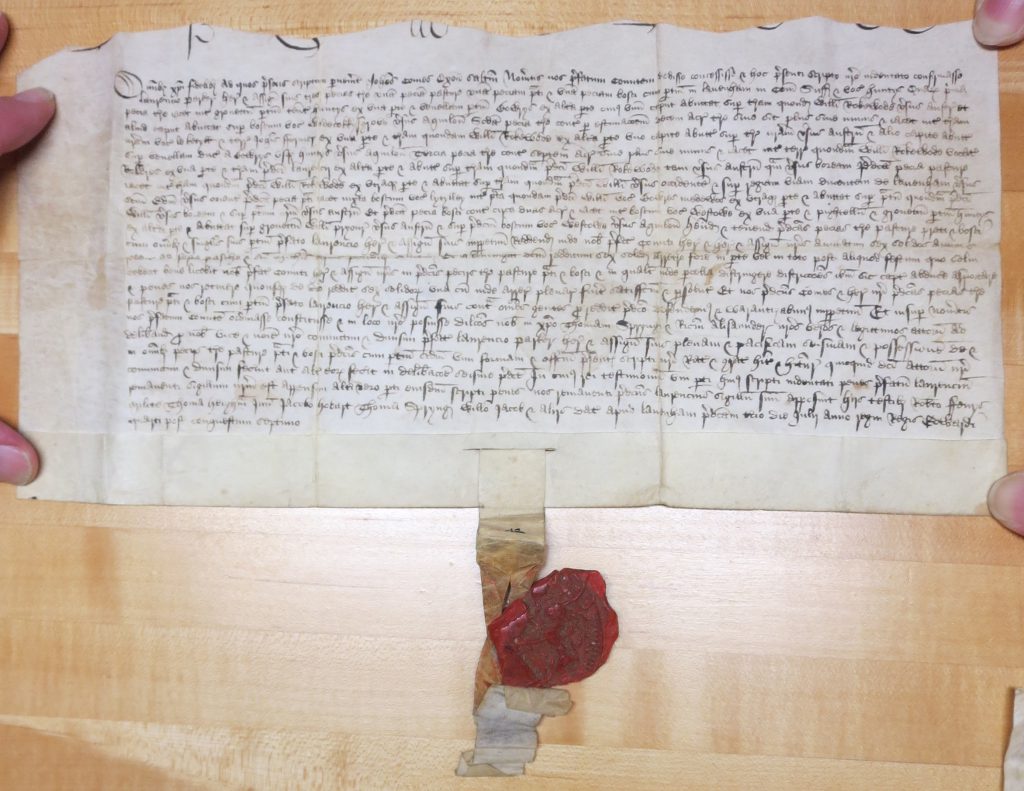
Preston Charter 12 Face with Seal. Photograph Mildred Budny.
*****
Workshop 8
“Face the Music, or,
Where Manuscript Meets Print in a Hybrid Book:
An Early-Modern German Herbal
with a Reused Binding Fragment
from a Medieval Musical Manuscript”
Sunday 26 October 2025
This workshop will examine a puzzling vellum fragment (or is it a set of patchwork fragments?) in a private collection. The fragment(s) come(s) from a single musical manuscript in Latin on vellum laid out in double columns with text and notation on 4-line staves. The reused medieval material forms the outer covering of a 17th-century printed book in German on laid paper.
We will work to decipher the visible parts of the text and music, identify the readings/lections and chants, and, if possible (given the fragmentary nature), determine the probable genre of original manuscript, such as lectionary, breviary, or missal. Perhaps we might find other survivors from the same despoiled medieval manuscript.
Plus we will exclaim over the features of the printed book, which includes illustrations and marginalia in forms of annotations demonstrating attention of several kinds.
What brought this medieval musical fragment and early modern printed book together? Even if we might never know all the answers, won’t it be fun to question how and why? There is a story here.
We love the puzzle, and give thanks to the collector for lending the book to the RGME for study and teaching.
Information
- Workshop 8. A Hybrid Book where Medieval Music Meets Early-Modern Herbal
We invite you to join our collaborative quest to learn more about the different parts of the ensemble.
Registration for the Workshop
The Manuscript Fragment and the Printed Book

Private Collection, Front Cover with Reused Medieval Musical Fragment on Vellum. Photograph by Mildred Budny.
Title Page
[Bartholomaeus Carrichter (1510–1574)], Horn des Heyls menschlicher Blödigkeit, oder Kreütterbuch, darinn die Kreütter des Teutschenlands auss dem Liecht der Natur nach rechter Art der himmelischen Einfliessungen beschriben / durch Philomusum Anonymum [Bartholomäus Carrichter], with a foreword by Michael Toxites, born Johann Michael Schütz (1514–1581), (Strassbourg: Anton Bertram, DCVI/1606).

Private Collection, Kreutterbuch, title page. Photograph by Mildred Budny.
For the first edition of 1576, printed in Straßburg, see an online digital facsimile of a copy in Augsburg, Staats- und Stadtbibliothek. For an edition of 1619 also printed by A. Bertram, see the copy in the Wellcome Collection.
Like the 1619 edition, this folio volume has 10 unnumbered pages, 180 numbered pages, and 5 unnumbered leaves, with a woodcut title page and outline illustrations.
*****
Workshop 9
“Books as Thresholds and Communities”
Sunday 21 December 2025
As the year 2025 draws to a close, we reflect on our Theme for the Year, “Thresholds and Communities” particularly as it applies to our explorations of books and their makers, users, collectors, readers, and others — through our series of workshops and other events — and as we prepare for next year and its new theme. Now we consider how manuscripts and printed books or other written materials might function as Thresholds and represent or foster Communities.
- Thresholds and Communities: RGME Theme for the Year 2025
We draw inspiration from our year’s activities, conversations, and insights. We may reflect on the multiple ways that they offered encounters with books of many kinds, from different ages and places, and with many voices, sometimes in harmony. With such perspectives, we might brace for, prepare for, and choose to welcome the new year.

Poster 2. 2025 Autumn Colloquium. Poster set in RGME Bembino.
Because the 2025 RGME Autumn Colloquium in late November will consider the subject of Fragments (manuscript and printed) from many perspectives, we may discuss some discoveries from that event and follow up with more materials which it helped to bring to light.
For example, do you have any manuscript or printed fragments that you would like to share or learn about? Bring them along, please, to our Zoom Meeting. Let’s see what we might learn together, and share the delight of discovery.
Part of the voyage, we have learned, brings the refreshing reconstitution or renewal of scattered and seemingly disparate fragments, to form new forms of communities fostered by books and the meanings or stories of human lives across time which they can convey.
Information
Registration
See you there!

Illumination from Hildegard’s Scivias (1151) showing her receiving a vision and dictating to teacher Volmar. Image Public Domain via Wikimedia Commons.
******
Workshop 10. Sunday 29 March 2026
” ‘Transformations and Renewals’ in our Ongoing Studies”
For this workshop, we show examples of our selected theme for the year in action for the close study of material evidence in books. On the theme, see:
For an exploration of the theme as applied to and manifested in books, see our Episode 24 (Sunday 18 April 2026) on “Transformations and Renewals by Way of Books”.
- The Research Group Speaks: The Series
- Episode 24. “Transformations and Renewals by Way of Books”: Registration
- Eventbrite Portal for RGME
In Workshop 10, we take note of multiple discoveries so far in our series. From workshop to workshop, discoveries have come to light through our own continuing research and the revelations of materials in private or public collections which correspond to some specimens highlighted in one or more workshops.
We survey multiple discoveries for a variety of manuscripts, manuscript fragments, printed books, and combinations of printed books with reused manuscript fragments as a re-created form of hybrid book mixing media, periods of production, genres of book, and sometimes also languages in their different layers or components between, upon, and around the covers.
There is much to report. Examples, depending upon time allotted, might include more specimens from the dismembered Chudleigh Bible, an update about the dismembered Saint Albans Bible (the subject of our first four Workshops), new results from on-going RGME studies of missals dismembered by Otto F. Ege (notably the Cistercian Missal of “Ege MS 2,” as featured in our recent 2026 RGME Colloquium at the Grolier Club, and the Warburg Missal of “Ege MS 22“), and discoveries of more cases of hybrid 16th-century printed books from Germany with medieval Latin missal fragments (such as Medieval Missal Fragment as Early-Modern Cover).
We take note of the successful function and generously shared results of our RGME Workshops on “The Evidence of Manuscripts, Etc.” so far, as we celebrate the tenth in their series and look toward the future, with thanks to participants, audience, collaborators, collectors, students, advisers, and lovers of books.
Bring your questions, favorite cases, puzzles, and observations to the conversation!
Registration

J. S. Wagner Collection, Ege Manuscript 22, Folio clvi, verso: Top Left. Reproduced by permission.
*************
Workshop 11. Sunday 25 October 2026
“Manuscripts at Play, Continued:
Figured Texts”

2026 IMC Poster 2 (Image)
For this workshop, we follow up, by request, our sponsored session at this year’s International Medieval Congress at Leeds in July. For that event, which considered “Manuscripts at Play and as Play,” see:
This follow-up brings together speakers, respondents, and participants from that event, as it develops our selected theme for the year on “Transformations and Renewals” and our continuing dedication to the close study of material evidence in books. On the theme, see:
In Workshop 11, we explore further aspects of the 2026 Leeds subject. There gather members of the team (in alphabetical order):
Mildred Budny will offer further reflections on figured approaches to texts and manuscripts in Anglo-Saxon and related manuscripts of the early medieval period.
Michael Allman Conrad (University of Konstanz)
Mark Saltveit (Independent Scholar)
Antony R. Henk (Ruhr-Universität Bochum)
“Playing with Sacred Space:
Mapping and Re-Mapping the Holy Land
in Manuscripts of Adomnán’s and Bede’s De locis sanctis”
Adomnán, De locis sanctis, Diagram of the Church of the Holy Sepulchre. Paris, Bibliothèque nationale de France, Département des Manuscrits, MS Latin 13048, f. 4v: Detail, Image Public Domain via https://gallica.bnf.fr/ark:/12148/btv1b10533305c/f16.item.
In my response paper for the 2026 Leeds session ‘Manuscripts at Play and as Play: Temporalities and (Re)Configurations as Reading Methods’, I discussed how the diagrams which accompany many manuscript recensions of Adomnán’s De locis sanctis can be understood as tools which facilitate Jean Leclerq’s concept (1961) of the peregrinatio in stabilitate. I suggested that these diagrams of holy sites are analogous to the ‘battle maps’ or ‘dungeon maps’ used in tabletop role-playing games, in that they allow the audience to more concretely visualise physical space than is possible via narrative description alone.
In my revisit to this topic and framework, I wish to examine how various copies of Adomnán’s work, and copies of Bede’s epitome of it, engage in ‘playing’ with these maps and the locations they aim to depict. In particular, I will explore the interplay of text and drawing, as well as the scribe-artists’ widely varying treatments of visual symbol, abstraction, and aestheticism.
David Porreca will report on his ongoing work for a critical edition of the many marginal notes (some take figured shapes) in a Copenhagen manuscript:
- Copenhagen, Det Konglige Bibliotek, MS Fabricius 91 4°, containing works by Sidonius Apollinaris, Apuleius, Bernardus Silvestris, Bernardus magister, and others.
We invite you to bring your questions and observations to the conversation!
Information
Registration
- Workshop 11. “Manuscripts at Play, Continued: Figured Texts”. Registration
- Eventbrite Portal for RGME
*************
Workshop 12 (Date To Be Determined)
“New Finds from Old Books”
We catch up with new finds of manuscript or early-printed fragments which we and friends have discovered, whether through research, acquisition, or gift.
Our explorations can revisit some old favorites examined in earlier workshops, as more leaves from them have come forward. Among these discoveries include fragments from the Saint Albans Bible, the Chudleigh Bible, and several of the manuscripts dispersed by Otto F. Ege in one or more of his Portfolios of specimen leaves in selected genres. We celebrate the generosity of owners, curators, and scholars, in showing these little-known or previously-unknown materials.
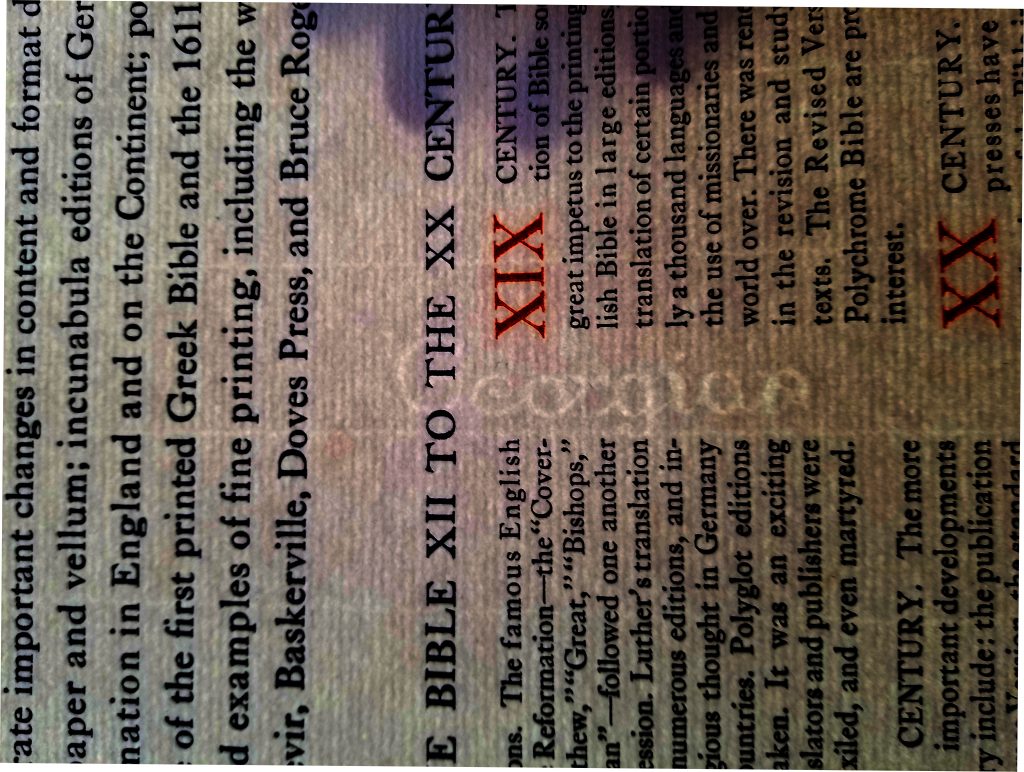
Private Collection. Otto Ege’s Contents’ List for a set (unnumbered) of his Portfolio of specimen leaves from Famous Bibles, Nine Centuries. 20th-century Watermark reading”Georgian”. Photograph by Mildred Budny.
*************
Workshop 13 (Date To Be Determined)
“Early-Modern Archives in Old and New England”
For this workshop we consider the challenges and opportunities of studying a rich selection of archival materials produced in the early seventeenth-century. Mildred Budny will explore cases of women’s wills, centered upon a holograph specimen of 1604 for the widow Sarah Overton of Southold, Long Island, and antecedents among Anglo-Saxon noblewomen’s wills of the tenth century, including the Will of Æthelgifu . Hannah Goeselt will analyze the legacy of a manuscript documenting the proceedings of the House of Commons for the year 1628 as it survives in American contexts, notably in the Massachusetts Historical Society Library. These cases may serve to highlight the nature of inventories, estate lists, wills, documentary records, literacy, and early collecting in colonial North America.
We welcome the chance to learn about other cases and projects concerning such materials. Please let us know about your interests in them. Contact us!

Boston, Massachusetts Historical Society Library, Ms. N-1325, “House of Commons Proceedings, 1628”, fols. 73v-74r. Photograph by Hannah Goeselt.
*****************
Workshop 14, Etc.
Subjects To Be Determined (We accept requests!)
Among subjects requested are:
Catalog(u)ing Manuscripts, Part 2: Makers’ and Readers’ Perspectives
We follow from Part 1 of this series:
RGME Episode 26 (Saturday 25 July 2026)
“Catalog(u)ing Collections and Materials:
Processes, Challenges, Requests, and Opportunities”
Part 1 of a Series
The Research Group Speaks: The Series
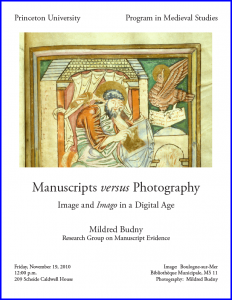
Manuscripts and (or Versus) Photography
A User’s Guide
‘Hybrid Books’: What Are They?
Examples and Case-Studies
*****
Questions? Suggestions?
- Leave your comments or questions below
- Contact Us
Visit our Social Media:
- our Facebook Page
- our Facebook Group
- our X/Twitter Feed (@rgme_mss)
- our Bluesky nest @rgmesocial.bluesky.social)
- our Instagram Page
- our LinkedIn Group
Join the Friends of the RGME.
Please make a Donation in Funds or in Kind for our nonprofit educational corporation powered principally by volunteers. Your donations and contributions are welcome, and can go a long way. They may be tax-deductible to the fullest extent provided by the law.
*****

Private Collection, Pieces of a Vellum Leaf from a Medieval Manuscript: Verso. Photography by Mildred Budny.