• News
    • News & Views
    • RGME Activities for 2024 and 2025
    • Around & About with the RGME
    • Reviews
    • Highlights
  • Blogs
    • Manuscript Studies
      • Manuscript Studies: Contents List
    • International Congress on Medieval Studies
      • Abstracts of Congress Papers
        • Abstracts of Papers Listed by Author
        • Abstracts of Papers Listed by Year
  • About
    • Mission
    • Who We Are
      • Officers, Associates & Volunteers
      • RGME Committees
      • Friends of the Research Group on Manuscript Evidence
    • Policies & Statements
      • RGME Privacy Policy Statement
      • RGME Intellectual Property Statement & Agreements
    • People
      • Mildred Budny — Her Page
      • Adelaide Bennett Hagens
    • Activities
      • Events
      • Congress Activities
        • Sponsored Conference Sessions (1993‒)
          • Panels at the M-MLA Convention (from 2016)
        • Co-sponsored Conference Sessions (2006‒)
    • History
      • Seals, Matrices & Documents
      • Genealogies & Archives
    • Contact Us
  • Bembino
    • Multi-Lingual Bembino
    • RGME Bembino: Resources
  • Congress
    • Sponsored Conference Sessions (1993‒)
    • Co-sponsored Conference Sessions (2006‒)
    • Abstracts of Congress Papers
      • Abstracts Listed by Author
      • Abstracts Listed by Year
    • Kalamazoo Archive
    • Panels at the M-MLA Convention (2016-2019)
      • Abstracts of Papers for the M-MLA Convention
      • Panels at the M-MLA Convention (from 2016)
  • Events
    • RGME Activities for 2024 and 2025
      • 2023 Activities and 2024 Planned Activities
    • Seminars, Workshops, Colloquia & Symposia (1989–)
      • Seminars on ‘The Evidence of Manuscripts’
      • Symposia on ‘The Transmission of the Bible’
      • The New Series (2001-)
        • 2019 Anniversary Symposium Program: The Roads Taken
        • 2019 Anniversary Symposium Registration
        • 2019 Anniversary Symposium Registration Open
      • RGME Symposia: The Various Series
      • The Research Group Speaks: The Series
      • Meetings of the Friends of the Research Group on Manuscript Evidence
      • RGME Online Events
    • Abstracts of Papers for Events
      • Abstracts of Papers for Seminars on ‘The Evidence of Manuscripts’
      • Abstracts of Papers for Symposia, Workshops & Colloquia
    • Receptions & Parties
    • Business Meetings
    • Photographic Exhibitions & Master Classes
    • Events Archive
  • ShelfLife
    • Journal Description
    • ShelfMarks: The RGME-Newsletter
    • Publications
      • “Insular, Anglo-Saxon, and Early Anglo-Norman Manuscript Art at Corpus Christi College, Cambridge” (1997)
        • Mildred Budny, ‘Catalogue’
        • The Illustrated Catalogue (1997)
      • The Illustrated Handlist
      • Semi-Official Counterfeiting in France 1380-1422
      • No Snap Decisions: Challenges of Manuscript Photography
    • History and Design of Our Website
  • Galleries
    • Watermarks & the History of Paper
    • Galleries: Contents List
    • Scripts on Parade
    • Texts on Parade
      • Latin Documents & Cartularies
      • New Testament Leaves in Old Armenian
    • Posters on Display
    • Layout Designs
  • Donations and Contributions
    • RGME Donor Promise
    • 2023 End-of-Year Fundraiser for our 2024 Anniversary Year
    • 2019 Anniversary Appeal
    • Orders
  • Links
    • Catalogs, Metadata, and Databases: A Handlist of Links
    • Handlist of Resources for Manuscript Studies and Fragmentology
    • Manuscripts & Rare Books
    • Maps, Plans & Drawings
    • Seals, Seal-Matrices & Documents

  • News
    • News & Views
    • RGME Activities for 2024 and 2025
    • Around & About with the RGME
    • Reviews
    • Highlights
  • Blogs
    • Manuscript Studies
      • Manuscript Studies: Contents List
    • International Congress on Medieval Studies
      • Abstracts of Congress Papers
        • Abstracts of Papers Listed by Author
        • Abstracts of Papers Listed by Year
  • About
    • Mission
    • Who We Are
      • Officers, Associates & Volunteers
      • RGME Committees
      • Friends of the Research Group on Manuscript Evidence
    • Policies & Statements
      • RGME Privacy Policy Statement
      • RGME Intellectual Property Statement & Agreements
    • People
      • Mildred Budny — Her Page
      • Adelaide Bennett Hagens
    • Activities
      • Events
      • Congress Activities
        • Sponsored Conference Sessions (1993‒)
          • Panels at the M-MLA Convention (from 2016)
        • Co-sponsored Conference Sessions (2006‒)
    • History
      • Seals, Matrices & Documents
      • Genealogies & Archives
    • Contact Us
  • Bembino
    • Multi-Lingual Bembino
    • RGME Bembino: Resources
  • Congress
    • Sponsored Conference Sessions (1993‒)
    • Co-sponsored Conference Sessions (2006‒)
    • Abstracts of Congress Papers
      • Abstracts Listed by Author
      • Abstracts Listed by Year
    • Kalamazoo Archive
    • Panels at the M-MLA Convention (2016-2019)
      • Abstracts of Papers for the M-MLA Convention
      • Panels at the M-MLA Convention (from 2016)
  • Events
    • RGME Activities for 2024 and 2025
      • 2023 Activities and 2024 Planned Activities
    • Seminars, Workshops, Colloquia & Symposia (1989–)
      • Seminars on ‘The Evidence of Manuscripts’
      • Symposia on ‘The Transmission of the Bible’
      • The New Series (2001-)
        • 2019 Anniversary Symposium Program: The Roads Taken
        • 2019 Anniversary Symposium Registration
        • 2019 Anniversary Symposium Registration Open
      • RGME Symposia: The Various Series
      • The Research Group Speaks: The Series
      • Meetings of the Friends of the Research Group on Manuscript Evidence
      • RGME Online Events
    • Abstracts of Papers for Events
      • Abstracts of Papers for Seminars on ‘The Evidence of Manuscripts’
      • Abstracts of Papers for Symposia, Workshops & Colloquia
    • Receptions & Parties
    • Business Meetings
    • Photographic Exhibitions & Master Classes
    • Events Archive
  • ShelfLife
    • Journal Description
    • ShelfMarks: The RGME-Newsletter
    • Publications
      • “Insular, Anglo-Saxon, and Early Anglo-Norman Manuscript Art at Corpus Christi College, Cambridge” (1997)
        • Mildred Budny, ‘Catalogue’
        • The Illustrated Catalogue (1997)
      • The Illustrated Handlist
      • Semi-Official Counterfeiting in France 1380-1422
      • No Snap Decisions: Challenges of Manuscript Photography
    • History and Design of Our Website
  • Galleries
    • Watermarks & the History of Paper
    • Galleries: Contents List
    • Scripts on Parade
    • Texts on Parade
      • Latin Documents & Cartularies
      • New Testament Leaves in Old Armenian
    • Posters on Display
    • Layout Designs
  • Donations and Contributions
    • RGME Donor Promise
    • 2023 End-of-Year Fundraiser for our 2024 Anniversary Year
    • 2019 Anniversary Appeal
    • Orders
  • Links
    • Catalogs, Metadata, and Databases: A Handlist of Links
    • Handlist of Resources for Manuscript Studies and Fragmentology
    • Manuscripts & Rare Books
    • Maps, Plans & Drawings
    • Seals, Seal-Matrices & Documents

Log in

Archives

Featured Posts

2026 International Congress on Medieval Studies: Program
Episode 24. “Life with Books” (Interview with John Windle)
Announcing the Launch of RGME Bembino WP
2026 RGME Colloquium at The Grolier Club: Report
Medieval Missal Fragment as Early-Modern Cover
The Weber Leaf from Ege MS 61
"Bembino" Booklet Cover
Episode 23. “Meet RGME Bembino: Facets of a Font”
2026 RGME Colloquium on “Transformations & Renewals” at The Grolier Club
2026 Theme of the Year: “Transformations and Renewals”
A Leaf with Patchwork from the Saint Albans Bible
A Sister Leaf from a Miniature Latin Vulgate Bible
A Little Latin Vulgate Bible Manuscript Leaf in Princeton
J. S. Wagner Collection. Leaf from from Prime in a Latin manuscript Breviary. Folio 4 Verso, with part of Psalm 117 (118) in the Vulgate Version, set out in verses with decorated initials.
2026 Annual Appeal
Episode 22: “Encounters with Local Saints and Their Cults”
Private Collection, Ege's FBNC Portfolio, Dante Leaf, Verso, Detail. Reproduced by Permission.
2025 RGME Autumn Colloquium on Fragments
Workshop 8: A Hybrid Book where Medieval Music Meets Early-Modern Herbal
2025 RGME Autumn Symposium on “Readers, Fakers, and Re-Creators of Books”
RGME Workshops on “The Evidence of Manuscripts, Etc.”
2025 International Medieval Congress at Leeds: RGME Program
Episode 21. “Learning How to Look”
2025 International Congress on Medieval Studies: Program
2025 RGME Visit to Vassar College
Two Leaves in the Book of Numbers from the Chudleigh Bible
Delibovi on Glassgold on Boethius: A Blogpost
Ronald Smeltzer on “Émilie du Châtelet, Woman of Science”
2025 Spring Symposium: “Makers, Producers, and Collectors of Books”
Starters’ Orders
The Weber Leaf from the Saint Albans Bible
Workshop 4. “Manuscript Fragments Compared”
Episode 20. “Comic Book Theory for Medievalists”
Episode 19: “At the Gate: Starting the Year 2025 at its Threshold”
Favorite Recipes for Lemonade, Etc.
RGME Visit to the Lomazow Collection: Report
2024 Autumn Symposium: “At the Helm”
A Latin Vulgate Leaf of the Book of Numbers
The RGME ‘Lending Library’
Florence, Italy, Ponte Vecchio from Ponte alle Grazie. Photo: Ingo Mehling, CC BY-SA 4.0 , via Wikimedia Commons
Episode 17. “RGME Retrospect and Prospects: Anniversary Reflections”
2024 Anniversary Symposium: The Booklet
Jesse Hurlbut at the Bonneville Salt Flats, Utah. Photograph Jesse Hurlbut.
Episode 16: An Interview with Jesse D. Hurlbut
To Whom Do Manuscripts Belong?
Kalamazoo, MI Western Michigan University, Valley III from the side. Photograph: David W. Sorenson.
2024 International Congress on Medieval Studies: Report
2024 Spring Symposium at Vassar College
Puente de San Martín: Bridge with reflection over the River Targus, Toledo, Spain.
2024 Grant for “Between Past and Future” Project from The Gladys Krieble Delmas Foundation Research Libraries Program
2024 Anniversary Symposium in Thanks to Jesse Hurlbut: Program

You are browsing the Blog for

Preston Charters: The Chierographs

April 12, 2020 in Manuscript Studies, Uncategorized

Meet the Preston Chierographic Charters:
Charters 12 and 13
from the Reigns of Edward IV and Elizabeth I

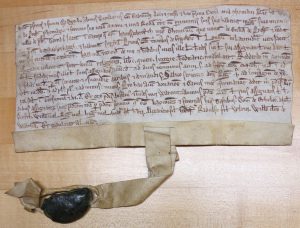
Preston Charter 7 Face with Tag and Seal. Photograph Mildred Budny.

Preston Charter 7 Face. Photograph Mildred Budny.

Following our 4 previous blogposts on the group of charters from Preston in Suffolk, England, now in a private collection, we advance with further reports about them.  Those blogposts focused upon 6 of the group of 8 charters.  Employing the owner’s numbering system, they considered

  • Charters 5 and 7:  Full Court Preston and Preston Take 2
  • Charters 6 and 9:  Preston Charters Continued
  • Charters 10 and 11:  Charter the Course

(Remember, Charter 8 is missing.)

Now we turn to the last pair:  Charters 12 and 13.

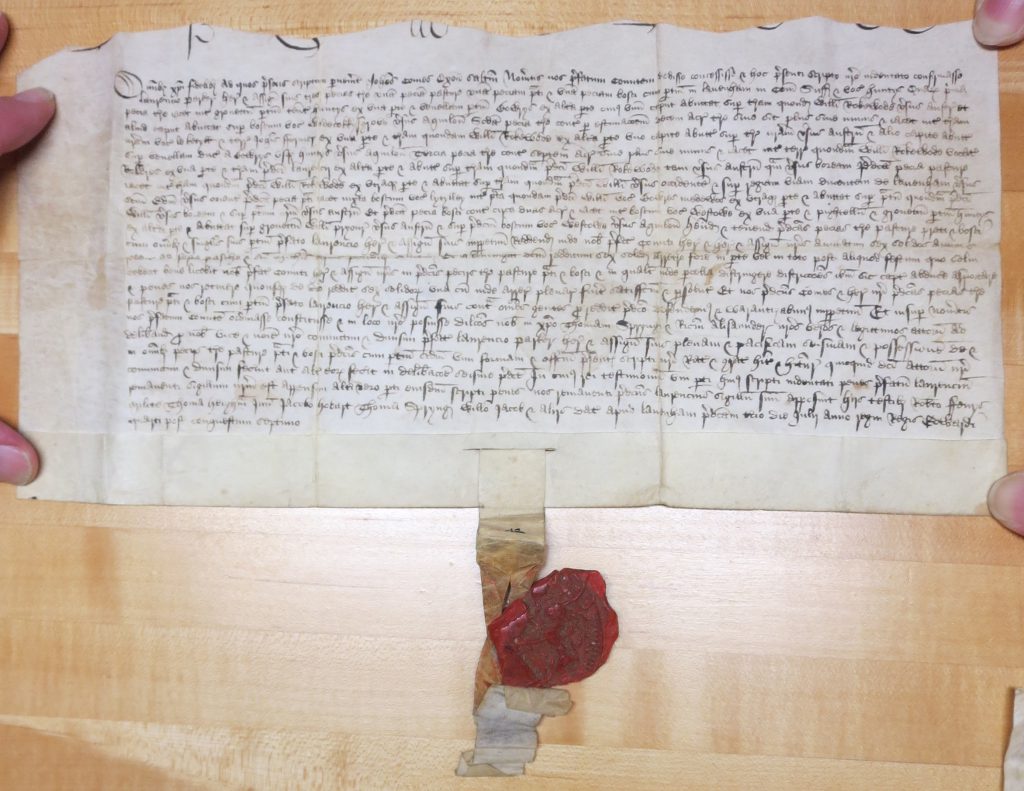
These are the chirographs, with wavy upper contours made to match.  Both documents are dated, like Charters 9–11, but those earlier charters belong to the reign of King Edward II (reigned 1307–1327), during which reign they were spaced at 4-year intervals.  Charters 12 and 13 stand more than a century apart from those and from each other.  Both retain their wax seals, in full or in part.

A wavy contour:

Preston Charter 12 Face with Seal. Photograph Mildred Budny.

Preston Charter 12 Face with Seal. Photograph Mildred Budny.

The Group of Preston Charters

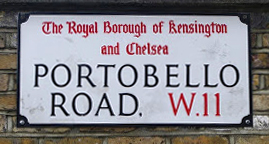
Sign for the Portobello Road, W11, London

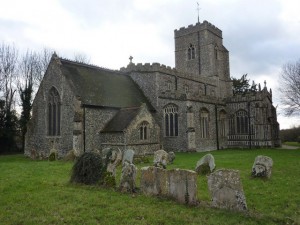
https://upload.wikimedia.org/wikipedia/commons/7/7d/Church_at_Preston_St_Mary_-_geograph.org.uk_-_1598436.jpg

Church at Preston St Mary. Photograph by Andrew Hill via Wikimedia Creative Commons

The present owner purchased the Preston group as a group, amounting to 9 documents, in the 1980s in London, probably in the Portobello Road, a renowned location of markets and shops of many kinds, including used goods, curiousities, and antiquities.

[Update:  Now we know that his first 2 purchases of English documents were of single documents:  “one Ric. II” and “the other Edw. IV”.  Then came the rest.  On those first 2, now see More Light on English Charters.]

The group has a consecutive series of modern Arabic numbers, running from 5 to 13.  The individual number is entered in black ink at the top left corner of the dorse (or back) of each document.

Of that original group, only 8 survive in the collection, because Charter 8 went missing after a class some years ago, considerably before the group came into our view.  Consequently, we know now only of Charters 5–7 and 9–13.

In our series of blogposts on the Preston Charters, Charters 5 and 7 figured in our first 2 blogposts, with an introduction, photographs and descriptions, transcriptions and translations of their texts, and some observations about their characteristics and contexts (Full Court Preston and Preston Take 2).  Next, Charters 6 and 9 took the stage (Preston Charters Continued). Then Charters 10 and 11 came forward to Charter the Course.

Now we complete the course with Charters 12 and 13.  Each carries the regnal year of the sovereign, but a different sovereign in each case:  Edward IV and Elizabeth I.

Read the rest of this entry →

Tags: Chirograph, Edward II, Edward IV, Elizabeth I, History of Documents, Portobello Road, Preston, Preston Charters, Seal, Seal Tag
No Comments »

Preston Charters, Continued

April 7, 2020 in Anniversary, Manuscript Studies, Uncategorized

Preston Charters, Continued

Charters 6 & 9

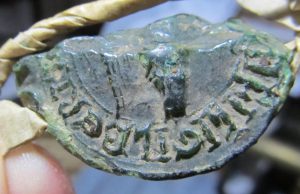
Preston Charter 7 Seal Face with the name Gilbertus. Photograph Mildred Budny.

Preston Charter 7 Seal.

Following our 2 previous blogposts on a group of single-sheet charters in Latin on vellum from Preston in Suffolk, England, now in a private collection, we advance with further reports about them.

Those first 2 blogposts, Full Court Preston and Preston Take 2, focused upon 2 of the group.  They considered Charters ‘1’ and ‘2’ (as we first called them), or Charters 7 and 5 in the present owner’s numbering system entered upon the dorse of each document.  Those blogposts provided detailed photographs and descriptions of the documents, transcriptions and translations of their texts, and observations about their characteristics and contexts.

Here we focus upon Charters 6 and 9.  (Remember, Charter 8 is lost or mislaid.)

First we survey the Preston group, which comprises a series with modern numbering from 5 to 13.  Then we consider these two documents, one by one.

The Group

Sign for the Portobello Road, W11, London

https://upload.wikimedia.org/wikipedia/commons/7/7d/Church_at_Preston_St_Mary_-_geograph.org.uk_-_1598436.jpg

Church at Preston St Mary. Photograph by Andrew Hill via Wikimedia Creative Commons

The owner purchased the group in a bag, in the 1980s in London, probably — according to his recollection — in the Portobello Road, a renowned location of markets and shops of many kinds, including used goods, curiousities, and antiquities.  The group has his consecutive series of modern Arabic numbers, running from 5 to 13.  The individual number stands in black ink at the top left corner of the dorse (or back) of each document.

Of that original group of 9, only 8 documents survive in the group, preserved within a notebook for the English charter materials in the collection.  Charter 8 went missing or mislaid after a class some years ago — considerably before the group came into our view.  Consequently, we know only of Charters 5–7 and 9–13, until Charter 8 might return to view.

Our survey of the group progresses in pairs, more-or-less chronologically.  The first 3 documents (Charters 5, 6, and 7) are undated, so that an assessment of their probable dating depends upon stylistic features of the script, orthographic features, and other evidence both internal and contextual.  The others (Charters 9–13) carry their dates, to the regnal year and sometimes to the very day.

The pair under consideration here has one of each, respectively undated and dated.

Read the rest of this entry →

Tags: Anglicana Formata, Gwyndon de Mortuomar, History of Documents, King Edward II, Medieval Seals, Norwich, Portobello Road, Preston, Preston Saint Mary, Richard of Otelye, Seal Tags, Symon Purte of Preston
No Comments »

Keeping Up: Updates for Spring 2020

April 4, 2020 in Abstracts of Conference Papers, Announcements, Bembino, Business Meeting, Conference, Conference Announcement, ICMS, Index of Medieval Art, International Congress on Medieval Studies, Kalamazoo, Manuscript Studies, Princeton University, Societas Magica

Keeping Up:

Updates for Spring 2020

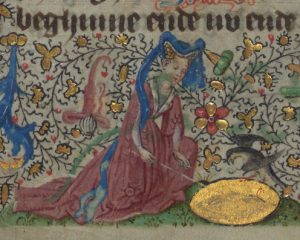
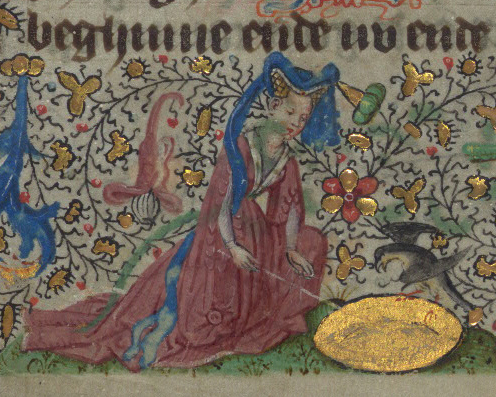
Baltimore, The Walters Art Museum, MS W.782, folio 15r. Van Alphen Hours. Dutch Book of Hours made for a female patron in the mid 15th century. Opening page of the Hours of the Virgin: "Here du salste opdoen mine lippen". Image via Creative Commons. At the bottom of the bordered page, an elegantly dressed woman sits before a shiny bowl- or mirror-like object, in order, perhaps, to perform skrying or to lure a unicorn.

Baltimore, The Walters Art Museum, MS W.782, folio 15r. Van Alphen Hours. Scrying, Perchance? Image via Creative Commons.

This Spring, the cancellation of 2 of our major events planned for this year, and intended to take place in mid-March and mid-May, produces perforce a redirection of energies and activities.  Call it “Regrouping”.

We report updates.

1.  Our 2020 Spring Symposium:  “From Cover to Cover”

Planned for 13–14 March at Princeton University
But Cancelled or Postponed

As preparations were proceeding apace, the event was cancelled by Princeton University — along with other events — on 9 March, in response to growing concerns for the spread of COVID-19 on a global scale.  Although at short notice, it was possible swiftly to cancel reservations for the venue, catering, and other services before participants had begun their journeys.

What We Planned

  • 2020 Spring Symposium: Save the Date
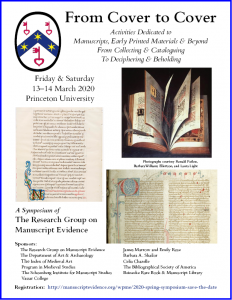
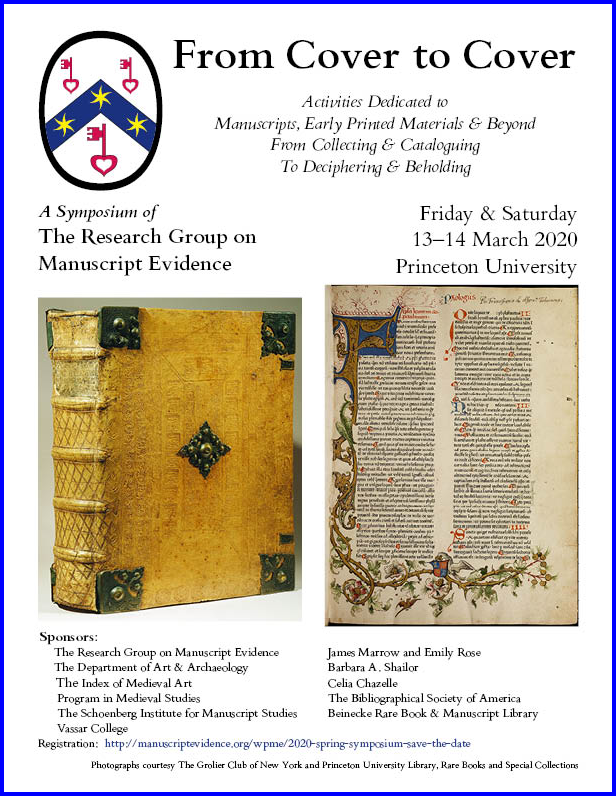
2020 Symposium "From Cover to Cover" Poster 2

2020 Symposium Poster 2

We aimed to consider, “From Cover to Cover”, activities dedicated to manuscripts, early printed materials, and beyond, from collecting and cataloguing to deciphering and beholding.  We prepared to gather specialists, teachers, students, and others engaged or interested in activities such as “Collecting, Curating, Conserving, Cataloguing, Deciphering, Reading, Reconsidering, Editing, Teaching, Displaying, Accessing, Beholding, and More”.

The focus was designed to center primarily upon medieval and early modern materials, both Western and non-Western.  The presentations would include reports of discoveries, work-in-progress, cumulative research, and collaborative projects by specialists from multiple centers, including independent scholars and younger scholars.

Included were workshops over original materials in manuscript and early print, a demonstration of materials and processes for medieval scripts, discussions about databases devoted to manuscripts and rare books, and sessions addressing multiple activities approaching medieval, early modern, and other textual resources.  Subjects would span a wide range geographically and chronologically, and take care to attend to the material and bibiographical evidence.

What We Can Do

There are requests for rescheduling the Symposium, or parts thereof, when conditions might permit.

Meanwhile, we can publish the Symposium Booklet.  At the time of cancellation, it had come close to completion for printing and distributing at the event and then afterward, as is our custom.  For example:

  • 2019 Anniversary Symposium on “The Roads Taken”
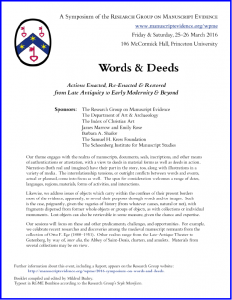
  • 2016 Symposium on ‘Words & Deeds”
  • 2014 Symposium on “Recollections of the Past”
  • 2013 Symposium on “Identity & Authenticity”

For all these and our other Booklets (see our Publications), the Research Group on Manuscript Evidence is the nonprofit publisher and distributor.  The design and layout conform with our Style Manifesto and employ our own digital font Bembino .

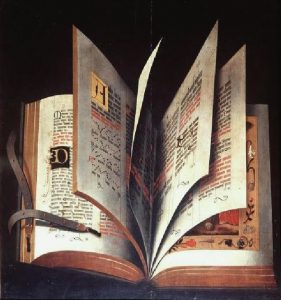
Florence, Galleria degli Uffizi, Anonymous, Still Life of an Illuminated Book, German School, 15th century. Oil on Wood. Opened book with fanned pages. Image via Wikimedia, Public Domain.

Florence, Galleria degli Uffizi, Anonymous, Still Life of an Illuminated Book, German School, 15th century. Image via Wikimedia, Public Domain.

The new 44-page Symposium Booklet contains the 2020 Symposium Program, Abstracts of the Papers and Masterclasses, and a set of accompanying Illustrations (some published for the first time).  The Booklet includes corrections and revisions offered by several of the authors as we completed the layout and editing, after the cancellation of the event.

It is the longest so far of all our Symposium Booklets. The 2019 Booklet for “The Roads Taken” has 28 pages, and the 2016 Booklet for “Words & Deeds” has 24 pages.  Only the Booklet for our multi-lingual digital font Bembino is longer, at 56 pages, including all the font tables for the different styles and languages. That Booklet and the font itself (now in Version 1.6) are freely available for download and use (commercial use included).  Here:  Bembino .

Our illustrated 2020 Spring Symposium Booklet is likewise freely available for download. As with other cases, for your convenience, we make it available in 2 versions, which may suit different printing arrangements, as wished.  The versions are:

  • printable in consecutive quarto-sized pages (8 1/2″ × 11″)
    2020 Spring Symposium Booklet as Consecutive Pages
  • printable as double sheets (11″ × 17″) which can be folded into the booklet, nesting the bifolia within each other
    — a design which does not require staples for closure and perusal
    2020 Spring Symposium as a Foldable Booklet

We thank our hosts, sponsors, contributors, owners and donors of images, editor, copy-editor, and layout designer. The publication is our gift to all who aimed to participate in the event and to follow its ‘ripples’ after the accomplishment of the Symposium. We offer it as a ‘souvenir’ of what our contributors, and the spirit of generous participation, intended for the event.

While we may explore plans to reschedule the event, or its parts, in some way or ways, the Booklet stands as a place-holder, and as a vivid glimpse of what could be and, indeed, can be. The gathering energy and enthusiasm for the event, as the weeks and days advanced toward it, remain a testimony to the constructive collective spirit which inspired it.

2020 Symposium "From Cover to Cover" Poster 1

2020 Symposium Poster 1

_____

With these observations, I am reminded of the Motto which I chose, years ago, for the 2-volume Illustrated Catalogue, co-published by the Research Group on Manuscript Evidence.

For Books are not absolutely dead things,
but doe contain a potencie of life in them
to be active as that soule was whose progeny they are;
nay, they do preserve as in a violl the purest efficacie and extraction
of the living intellect that bred them.

John Milton, Aeropagitica (1644)

Perhaps same as it ever was.

_____

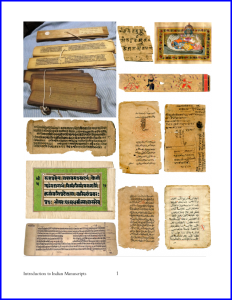
Cover Page for Sorenson (2020 Spring Symposium Paper as Draft for Comment), with an array of illustrations and the title "Introduction to Indian Manuscripts"

Cover Page for Sorenson (2020 Spring Symposium Paper as Draft for Comment)

P. S.  Already one of our speakers, David W. Sorenson, has provided a draft version of his intended Symposium Paper for feedback. It expands the Abstract which appears in the 2020 Spring Symposium Booklet.

The paper provides “A Quick Introduction to Indian Manuscripts for the Non-Specialist”, with examples and illustrations.

With permission, we offer here his pdf.

Please contact us with your questions or suggestions.  (Contact details below.)

*****

2.  Our Activities at the 55th International Congress on Medieval Studies

Planned for 7–10 May at Kalamazoo
But Cancelled or Postponed

On 17 March, this year’s International Congress on Medieval Studies in May was cancelled, and with it all the activities which we were to sponsor and co-sponsor there, including Sessions and other meetings.  The Congress organizers declared that “We invite the organizers of sponsored . . . sessions approved for the 2020 Congress to re-propose them for the 2021 congress.  If proposed, they will be approved automatically”.

Unlike some organizations, who have declared this intention to re-present for the 2121 Congress, we do not know automatically if such a course would be appropriate for us, or for each and every one of our sessions.  Time will tell.

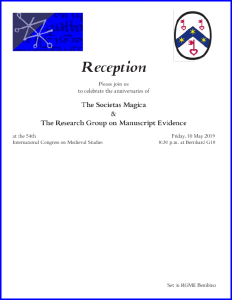
2019 Anniversary Reception Invitation. set in RGME digital font Bembino.

2019 Anniversary Reception Invitation.

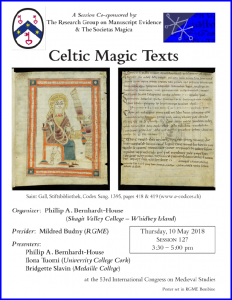
Poster for our Session co-sponsored with the Societas Magica on "Celtic Magic Texts", organized by Phillip A. Bernhardt-House and sponsored by both the Research Group on Manuscript Evidence amd the Societas Magica at the 2018 International Congress on Medieval Studies. Poster set in RGME Bembino.

2018 Poster

The cancellation came in time before all reservations for the journey had been set into place.  Because our customary year-long preparations for the Congress had not reached the last weeks of its approach, we had not yet prepared the customary Posters for our Sessions or the Invitations to the Reception and Business Meeting, nor had the Agenda for that Meeting yet been drawn up.  Posters for previous Congresses show the standards.

However, we did in place have a series of posts on our website (You Are Here) announcing the plans for our 2020 Congress Activities, in stages with updates:

  • the Call for Papers for our approved Sessions, with descriptions of their aims and with selected Images (poster-worthy when the time would come) to exemplify their subjects and scope
  • the 2020 Congress Program, with the authors and titles of the selected Papers for each Session — including a permitted extra Session, given the strength of the responses to the Call, for our proposed Session “Seal the Real”
  • the 2020 Congress Program Announced, with the times and rooms assigned by the Congress Committee for our Program Activities, and with some of the Abstracts for the Papers.

In keeping with custom, we had begun, one by one (starting with the New Year), to post the Abstracts, as a foretaste for the presentations and discussions to come.

The cancellation of the Congress brought these stages to a halt, for a while, during which time we turned to other tasks — including the on-going follow-up from the cancellation or postponement of our Spring Symposium, and the completion of its Booklet.

Baltimore, The Walters Art Museum, MS W.782, folio 15r. Van Alphen Hours. Dutch Book of Hours made for a female patron in the mid 15th century. Opening page of the Hours of the Virgin: "Here du salste opdoen mine lippen". Image via Creative Commons. At the bottom of the bordered page, an elegantly dressed woman sits before a shiny bowl- or mirror-like object, in order, perhaps, to perform skrying or to lure a unicorn.

Baltimore, The Walters Art Museum, MS W.782, folio 15r. Van Alphen Hours. mage via Creative Commons.

What We Planned

  • 2020 International Congress on Medieval Studies Program Announced

We prepared for 5 Sessions with Papers, an Open Business Meeting, and a Reception.

These resemble the numbers and sorts of our activities in recent years at the Annual Congress.  For example:

  • 2019 Congress
  • 2018 Congress
  • 2017 Congress
  • 2016 Congress
  • 2015 Congress

This year’s plans also involved our 2 co-sponsors in recent years for Sessions and/or Receptions.

A.  Sessions

We prepared for 5 Sessions this year.

3 Sessions Sponsored by the Research Group on Manuscript Evidence

1–2. Seal the Real: Documentary Records, Seals & Authentications

organized by Mildred Budny

Part I.  Signed & Sealed
Part II.  × Marks the Spot

3. Prologues in Medieval Texts of Magic, Astrology, and Prophecy

organized by Vajra Regan

Logo of the Societas Magica, reproduced by permission

Logo of the Societas Magica

2 Sessions Co-Sponsored with the Societas Magica
in the 16th year of this collaboration

4–5. Revealing the Unknown

organized by Sanne de Laat and László Sándor Chardonnens

Part I.  Scryers and Scrying in the Middle Ages and Early Modern Period
Part II.   Sortilège, Bibliomancy, and Divination

B.  2020 Open Business Meeting of the Research Group on Manuscript Evidence

1-Page Agendas customarily provided at the time.  This year we send it out already.  (See below.)

C.  Reception co-sponsored with the Index of Medieval Art at Princeton University
in the 3rd year of this collaboration

_____

P. S.  Part of Mildred Budny’s on-going research on the subject of seals and signatures, which would have figured in her Response to Session II of our “Seals” Sessions, now appears on our blog, Manuscript Studies, presenting Preston Take 2.  (See the Contents List for the blog, as more discoveries await publication.)

_____

P. P. S.  It is not lost on us that some of our planned Sessions for 2020 were to consider aspects of the history of divinatory skills across time and place.  But when we collectively chose these, as well as other subjects, last year for our sponsored and co-sponsored Sessions this year, it was not easy to guess then that this year’s Sessions would not take place, after all, at their appointed time and place.

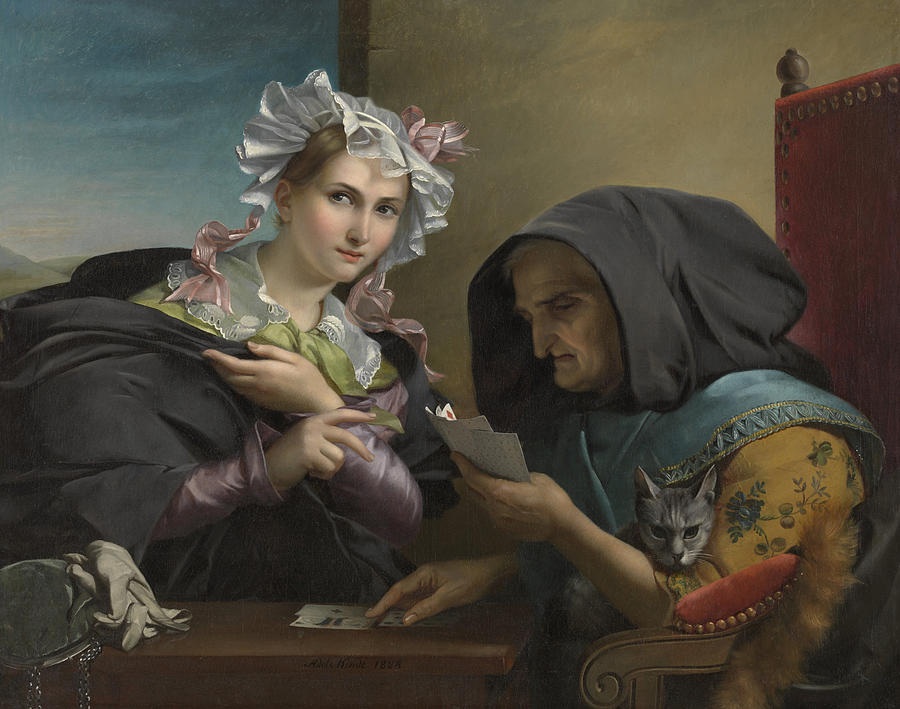
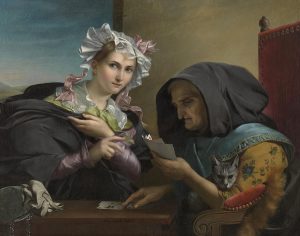
Adèle Kindt (1804–1884), The Fortune Teller (circa 1835). Antwerp, Koninklijk Museum voor Schone Kunsten. Image via Wikimedia Commons. A young lady, brightly lit and beautifully dressed, looks outward as an older woman, beneath a dark hood, holds a set of cards and stares at them with intent.

Adèle Kindt (1804–1884), The Fortune Teller (circa 1835). Antwerp, Koninklijk Museum voor Schone Kunsten. Image via Wikimedia Commons.

What We Can Do

A.  Abstracts for the 2020 Congress Papers

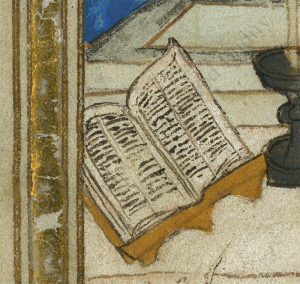
Detail of opened book with schematic text. Photography © Mildred BudnyOur custom is to post on our website the Abstracts for the Papers of our Sessions at the Congress.  (See our Abstracts for Congress Papers.)  This year is no different.

In the winter of 2019–2020, we had begun to post the 2020 Abstracts, one by one, as is our custom.  They are linked to our announced Program: 2020 Congress Program Announced. The Abstracts function as a foretaste of the ‘Menu’ of the Sessions, and can provide a record of their subjects, aims, and scope of the presentations.

Already in earlier years (as with the 2016 Congress and the 2014 Congress), as a sign of appreciation, we chose to adopt the tradition of posting Abstracts even when a contributor was unable to travel to the Congress and to present the paper in person.  The publication of such Abstracts states that, although proposed, accepted, and scheduled within the Session and Congress Program, the paper was not, in the event, presented.

Before March 2020, only once before, in more than 30 years of activities in many centers in the United States and elsewhere (see our Events and Congress Activities), has the Research Group had to cancel an event itself.  That case was only 1 Session among 7 sponsored and co-sponsored Sessions at the 48th International Congress on Medieval Studies in May 2013.

This year, after the cancellation of both our 2020 Spring Symposium (see above) and the 2020 Congress, we first turned to completing the Symposium Booklet, and then to completing the posting of the 2020 Abstracts.

Those tasks are now accomplished.  For these Congress Abstracts, see

  • 2020 Congress Program Announced and Abstracts of Congress Papers Listed by Year.

For the Symposium Booklet, see

  • 2020 Spring Symposium: Save the Date

Thus we honor the intentions of our participants and their readiness to contribute to our events.

Next, we might turn to contemplating further activities, and perhaps rescheduling some of these ones.

[Update:  In the summer and autumn of 2020, we advance with planning to hold the same Sessions, albeit with a few changes, at the 2021 Congress.  See the 2021 Congress Program in Progress.]

B.  Agenda for the 2020 Business Meeting

Meeting to be rescheduled:  Time and Place to be Determined

The Annual Agendas for our Open Business Meetings, customarily held at the International Congress on Medieval Studies, remain available for consultation.

  • 2019 Agenda
  • 2018 Agenda
  • 2017 Agenda
  • 2016 Agenda
  • 2015 Agenda

These 1-page statements serve as concise Reports for our Activities, Plans, and Desiderata.  After the Meetings, the Abstracts are available for download on our website.  Some of them remain among the most popular downloads here.

Normally, the Agenda is presented at the Meeting.  This year, we send it out ahead of time.  It incorporates the updates of Spring 2020 and their constructive measures.

  • 2020 Agenda

It is not yet clear when this year’s Meeting, which had to be postponed, will take place.  Under present circumstances, we may contemplate a virtual meeting, say via online conferencing in some form.

Please let us know if you wish to participate in the Meeting.  We invite your comments, questions, and suggestions.  (See below.)

C. More

We thank all our contributors to the 2020 events.  The continuing momentum for such activities is a tribute to you all.

Please Contact Us with your questions and suggestions, for example to items on our  2020 Agenda.

For updates, please visit this site, our News & Views, and our Facebook Page .

For our nonprofit educational mission, with tax-exempt status, your donations in funds and/or in kind (expertise, materials, time) are welcome. Join us!

Tags: 'Manuscript Studies' Blog, 2020 Congress, 2020 Symposium, Bembino, Bembino Digital Font, Business Meeting, Early Printing, History of Documents, Manuscript studies, Medieval Studies, Seals and Signatures, Style Manifesto
No Comments »

Preston Take 2

April 3, 2020 in Manuscript Studies, Uncategorized

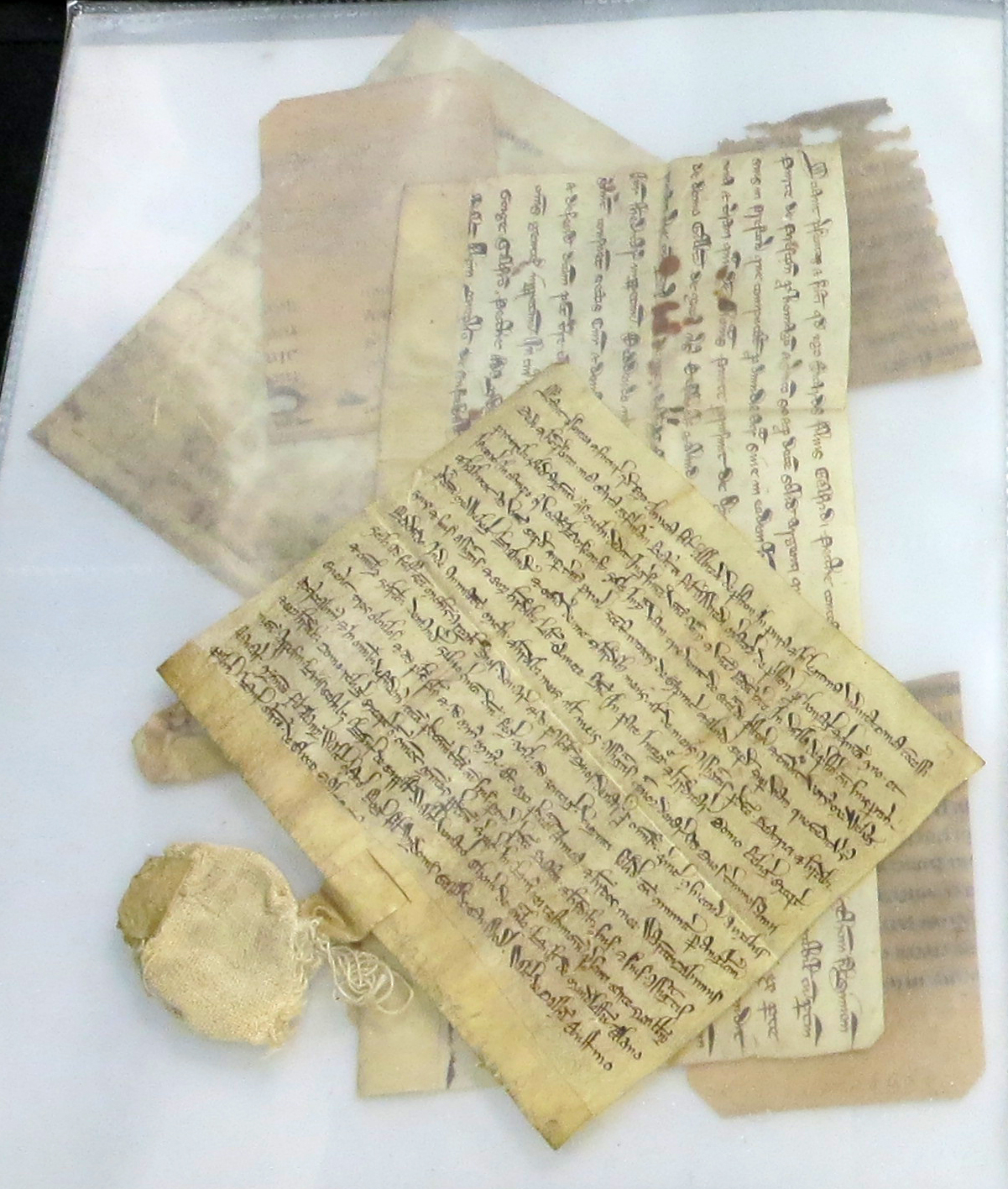
Pile of documents and manuscript fragments within melanex protective sheets, with 2 medieval documents from Preston Saint Mary at the top. Photograph by Mildred Budny.

Revisiting a Set of 13th-Documents
in Latin from Preston in Suffolk

With a Winning Competition

In our earlier blogpost on this subject, Full Court Preston, we showcased 2 single-sheet documents which came from a shared location, from dates there separated across generations, and with or without their original seals. We called them Preston Charters 1 and 2, now preserved in a private collection.  Charter 2 lies at the top of the pile in the image here at the left.

Now, having had the opportunity to examine the full set of medieval charters from Preston which came as a group into that collection, we can call these two by their present owner’s numbering system (in these cases, Preston Charters 5 and 7), as we also announce the winner of our competition to transcribe and translate one or other, or both, of this selected pair.

Other reports on our website examine single-sheet medieval and later documents with, or without, their original seals.  These reports appear

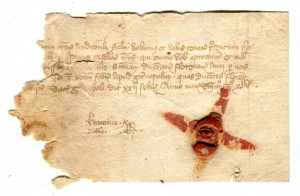
Document in 5 lines on paper, dated 22 February 1345 (Old Style), with red wax seal. Image reproduced by permisison.

Document from Grenoble dated 22 February 1345 (Old Style), with wax seal.

1) In our blog on Manuscript Studies  (see its Contents List):

  • Curiouser and Curiouser
  • Fit to Be Tied
  • Say Cheese
  • Latin Document of 1437 on Vellum from Barcelona

2) In The Illustrated Handlist, Part II.  “Documents on Vellum”

3) In Starter Kit, giving a brief introduction to a group of 14 medieval Seal Matrices (mostly, it appears, from England)

The Preston set came up for sale in London some years ago, apparently as a single batch, preserved together and sent forth together, after centuries and generations with a common heritage. Their origin relates to Preston (now known as Preston St Mary), near Ipswich, in Suffolk in England.

Now we revisit them, with a view of the set in full — insofar as it survives as a group of documents, plus some of their wax seals and a now-empty pouch for a seal.  We announce the winner of our competition to transcribe and translate the first 2 documents, as first introduced in our blog, with observations about their specific characteristics.  Other posts will report on other documents in the set, taking them pair by pair.

Read the rest of this entry →

Tags: Amicia Daughter of Alured, Anselm Cutler of Saint Edmund, Bury Saint Edmund, Horscroft, Ipswich, Medieval Documents, Medieval English Charters, Medieval Seals, Preston, Preston Saint Mary, The Gilbert Seal
No Comments »

2020 Spring Symposium Cancelled or Postponed

March 10, 2020 in Abstracts of Conference Papers, Announcements, Conference, Conference Announcement, Index of Medieval Art, Princeton University, Uncategorized

Florence, Galleria degli Uffizi, Anonymous, Still Life of Illuminated Book (circa 1510). Image via Wikimedia Commons..

“From Cover to Cover”

Activities Devoted to Manuscripts, Early Printed Books & Beyond
From Collecting & Cataloguing to Deciphering & Beholding

2020  Spring Symposium
of the Research Group on Manuscript Evidence

Princeton University
* Friday & Saturday 13–14 March 2020

Update 5 April 2020

The Symposium Booklet is now published and available for download. See Keeping Up: Updates for Spring 2020.

* Update 9 March 2020 

This event is now cancelled, as Princeton University and other institutions respond to current health concerns, and take precautions regarding travel and meetings of various kinds in person.  The Symposium might be rescheduled, conditions permitting.  

Its plan is described in the announcement to Save the Date for our 2020 Spring Symposium .

Meanwhile, the Research Group aims to complete the Symposium Booklet and distribute it to contributors, registrants, and others, as a souvenir of our speakers’ good intentions.  Already, as a sign of appreciation, the Research Group has adopted the custom of posting on our website the abstracts of contributors who become unable to attend to present in person (as with the 2018 Congress, among others).

This time, under wider — even global — circumstances affecting the ensemble as a whole, we wish to show appreciation for the remarkable enthusiasm and dedication for the collaborative event demonstrated by our hosts, sponsors, speakers, moderators, and others.  This knowledge is something to remember with satisfaction, gratitude, and praise.

The publication could, perhaps, give a token to show for our shared efforts, and to demonstrate something of the spirit of dedication and focus which prepared to assemble for the event itself.

This aim might help to ease some of the disappointment over cancellation, while the cancellation itself might ease some uncertainties about travel at present.

*****

P. S.  Only once before, in more than 30 years of activities in many centers in the United States and elsewhere (see our Events and Congress Activities}, has the Research Group had to cancel an event.  It, however, was only 1 Session among 7 sponsored and co-sponsored Sessions at the 48th International Congress on Medieval Studies in May 2013, when the Session organizer and 2 presenters were unable to travel to the Congress.  We honored their intentions to contribute by continuing to record their abstracts and the statement of purpose of the Session on this  website.

Similar solidarity pertains to our record of this intended 2020 Spring Symposium.  This post (You are Here) reports the Cancellation or Postponement.

In the post announcing the Symposium, describing its scope, and providing its Program, not only do we now report the Cancellation or Postponement (as here), but also we preserve the description of the event in the updated version just before the decision to cancel this Symposium, among many gatherings at Princeton University and elsewhere at the beginning of the week in which the Symposium was planned to take place. See Save the Date.

2020 Symposium "From Cover to Cover" Poster 2

2020 Symposium Poster 2

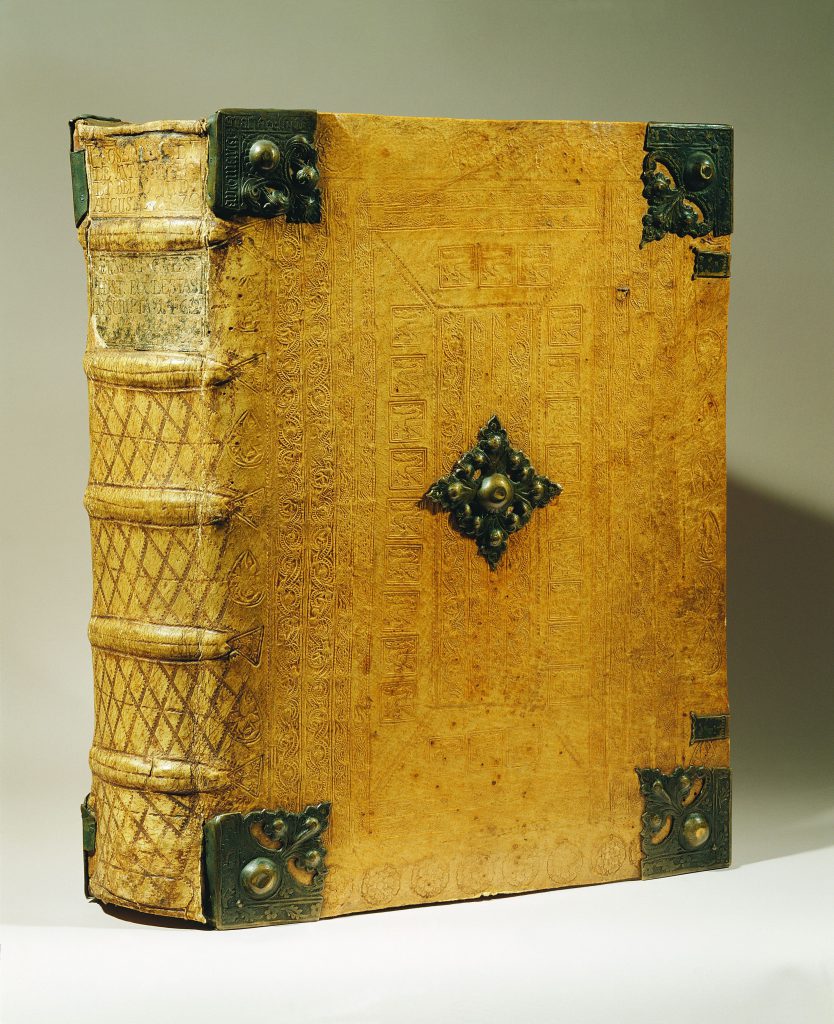
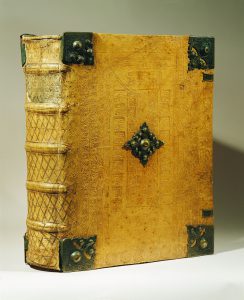
New York, Grolier Club, \*434.14\Aug\1470\Folio. Flavius Josephus, De antiquitate Judiaca and De bello Judaico, translated by Rufinus Aquileinensis, printed in Augsburg on paper by Johannn Schüsseler in 2 Parts, dated respectively 28 June 1470 and 23 August 1470, and bound together with a manuscript copy dated 1462 of Eusebius Caesariensis, Historia ecclesiastica.

New York, Grolier Club, *434.14Aug1470Folio. 15th-century German binding for historical texts in print (Augsburg, 1470) and manuscript (1462). Image courtesy Meghan Constantinou.

*****

Watch this space and visit our FaceBook Page for updates.  For questions and suggesions,  please contact director@manuscriptevidence.org.

No Comments »

2020 Spring Symposium: Save the Date

February 15, 2020 in Announcements, Conference, Conference Announcement, Events, Index of Medieval Art, Princeton University, Reception, Uncategorized

New York, Grolier Club, \*434.14\Aug\1470\Folio. Flavius Josephus, De antiquitate Judiaca and De bello Judaico, translated by Rufinus Aquileinensis, printed in Augsburg on paper by Johannn Schüsseler in 2 Parts, dated respectively 28 June 1470 and 23 August 1470, and bound together with a manuscript copy dated 1462 of Eusebius Caesariensis, Historia ecclesiastica.

New York, Grolier Club, *434.14Aug1470Folio.

“From Cover to Cover”

Activities Devoted to Manuscripts, Early Printed Books & Beyond
From Collecting & Cataloguing to Deciphering & Beholding

2020  Spring Symposium
of the Research Group on Manuscript Evidence

Princeton University
Friday & Saturday 13–14 March 2020


Update 5 April 2020

The Symposium Booklet, with illustrations and Abstracts of Papers, is now published and available for download.
See Keeping Up: Updates for Spring 2020.

The Abstract of one paper in the 2020 Symposium Booklet has been expanded to a Draft Paper, available for Feedback:

  • “A Quick Introduction to Indian Manuscripts for the Non-Specialist”, with examples and illustrations,
    downloadable here.

Update 9 March 2020

This event is now cancelled, as Princeton University and other institutions respond to current health concerns, and take precautions regarding travel and meetings of various kinds in person.
The Symposium might be rescheduled, conditions permitting.  

Meanwhile, the Research Group aims to complete the Symposium Booklet and distribute it to contributors, registrants, and others, as a souvenir of our speakers’ good intentions.  Already, as a sign of appreciation, we have adopted the custom of posting on our website the abstracts of contributors who become unable to attend to present in person (as with the 2018 Congress, among others).

This time, under wider — even global — circumstances affecting the ensemble as a whole, we wish to show appreciation for the remarkable enthusiasm and dedication for the collaborative event demonstrated by our hosts, sponsors, speakers, moderators, and others.  This knowledge is something to remember with satisfaction, gratitude, and praise.

The publication could, perhaps, give a token to show for our shared efforts, and to demonstrate something of the spirit of dedication and focus which prepared to assemble for the event itself.

This aim might help to ease some of the disappointment over cancellation, while the cancellation itself might ease some uncertainties about travel at present.

P. S.  Only once before, in more than 30 years of activities in many centers in the United States and elsewhere (see our Events and Congress Activities}, has the Research Group had to cancel an event.  It, however, was only 1 Session among 7 sponsored and co-sponsored Sessions at the 48th International Congress on Medieval Studies in May 2013, when the Session organizer and 2 presenters were unable to travel to the Congress.  We honored their intentions to contribute by continuing to record their abstracts and the statement of purpose of the Session on this  website.

Similar solidarity pertains to our record of this intended 2020 Spring Symposium.  A summary of this Update appears in its own post.

Here we preserve the description of the event in the updated version just before the decision to cancel this Symposium, among many gatherings at Princeton University and elsewhere at the beginning of the week in which the Symposium was planned to take place.

*****

What We Planned

Saint Andrew. Oil on Canvas. Artus Wollfort (1581–1641). Private Collection, Public Domain. Via Wikipedia Commons.

Saint Andrew. Oil on Canvas. Artus Wollfort (1581–1641). Private Collection, Public Domain. Via Wikipedia Commons.

We announce the next Symposium of the Research Group on Manuscript Evidence, to be held at Princeton University on Friday afternoon and Saturday, 13–14 March 2020. This event follows from, and builds upon, our earlier events, including our 2019 Anniversary Symposium, also held at Princeton University.

Our subject this time: “From Cover to Cover”.   Some say, “That Covers It”.  (We might well agree.)

Such activities include Collecting, Curating, Conserving, Cataloguing, Deciphering, Editing, Reading, Teaching, Translating, Displaying, Accessing, Beholding, Reconsidering, and More.  Cover to Cover.

Naturally, these activities need not necessarily occur in that order, and often they appear in combination.

In addition we consider activities dedicated to manuscripts, early printed books, and beyond, in terms (as is our custom) of both media and chronology.  As often, we consider medieval manuscripts and early printed books from Western Europe, but also— as usual — we examine materials from other cultures, languages, and time-frames.

This recognition of the processes (necessarily integrated) infuses the collection of presentations and conversations which our Symposium aims to gather.  In a nutshell:  Food for Thought, Refreshments included.

For which ability, we have Sponsors, Hosts, Trustees, Associates, Contributors, and Volunteers heartily to thank.

Sponsors

Research Group on Manuscript Evidence

Department of Art & Archaeology, Princeton University

The Index of Medieval Art at Princeton University

Program in Medieval Studies, Princeton University

James Marrow and Emily Rose

Barbara A. Shailor

Celia Chazelle

The Schoenberg Institute for Manuscript Studies

The Bibliographical Society of America

Vassar College

On the Road
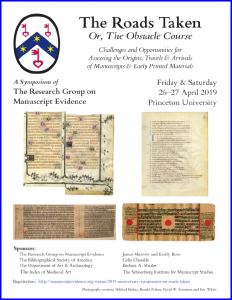
Poster 1 for 2019 Anniversary Symposium, with symposium information with images of manuscript and early printed pages..

Poster 1 for 2019 Symposium

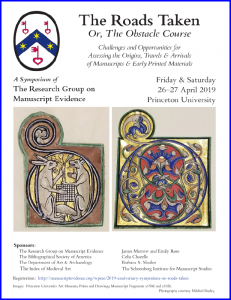
Poster 2 for 219 Anniversary Symposium, with symposium information and 2 images of cropped initials, from 12th-century Latin manuscripts, from the Princeton University Art Museum.

Poster 2 for 2019 Symposium

Following upon, and building upon, the success of our Anniversary Symposium last year, we prepare the 2020 Spring Symposium.  Its date is now set, as is the Schedule.  (See below.)

For our 2019 Anniversary Symposium, see its Report and its freely downloadable 2019 Anniversary Symposium Booklet.  Like the Booklet, the 2 Posters (seen here) illustrate examples of manuscripts (Western and non-Western) showcased in the Symposium, its papers, and its workshops.

All these publications, as customary, are set in our very own copyright multilingual font Bembino , and designed and laid out according with our Style Manifesto.  This font is freely available through our website, for your use – whether individual, nonprofit, or commercial.

Both the font, and its descriptive Booklet, are downloadable here .  We have also prepared a booklet showing its abilities in setting multiple languages, both Western and non-Western.  See Multi-Lingual Bembino . Plus our Style Manifesto .

Cover Story

Now we turn to our 2020 Spring Symposium.  Please register (details below).
Poster 1 for the 2022 Spring Symposium.

Gladly we list the Sponsors, Speakers, and Moderators.

Speakers and Moderators (in alphabetical order)
Philadelphia, University of Pennsylvania Libraries, Lawrence J. Schoenberg Collection, MS LJS 101, folio 1v. Opening of Boethius's translation of Aristotle's "Peri erimenias" within a collection of secular and classical texts, France, possibly at the Abbey of Fleury (Saint-Benoît-sur-Loire), 9th–11th centuries. Photograph courtesy OPenn.

Philadelphia, University of Pennsylvania Libraries, Lawrence J. Schoenberg Collection, MS LJS 101, folio 1v. Photograph courtesy OPenn.
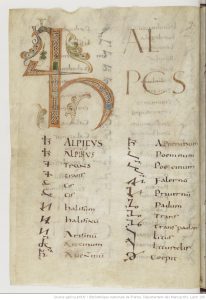
Paris, Bibliothèque nationale de France, MS latin 190, folio 1r. Opening page of the Commentarii notarum tironiarum, with an enlarged initial decorated with interlace and foliate ornament. Image via gallica.bnf.fr.

Paris, Bibliothèque nationale de France, MS latin 190, folio 1r. Photograph via gallica.bnf.fr.

Christine E. Bachman (Art History Department, University of Delaware and Graduate Student Fellow 2019–2020, Schoenberg Institute for Manuscript Studies, University of Pennsylvania)

Mildred Budny (Director, Research Group on Manuscript Evidence, Princeton)

Raymond Clemens (Curator, Early Books and Manuscripts, Beinecke Rare Book and Manuscript Library, Yale University, New Haven)

Meghan Constantinou (Librarian, The Grolier Club, New York, New York)

Barbara Williams Ellertson (Books as Symbols in Renaissance Art and Research Group on Manuscript Evidence)

Lynley Anne Herbert (Curator of Manuscripts and Rare Books, The Walters Art Museum, Baltimore, Maryland)

Carson Koepke (Program in Medieval Studies, Yale University)

Laura Light (Director and Senior Specialist, Text Manuscripts, Les Enluminures)

John T. McQuillen (Associate Curator, Printed Books & Bindings, The Morgan Library & Museum, New York, New York)

Bernard Maisner (Bernard Maisner and Bernard Maisner, Master Calligrapher)
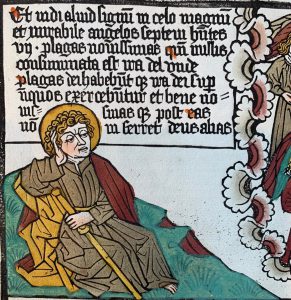
New York, Morgan Library & Museum, PML 7, folio P2r. Blockbook of Apocalypsis Sancti Johannis, printed in Germany circa 1468. Revelation 15:1, with hand-colored illustration.

New York, Morgan Library & Museum, PML 7, folio P2r. Blockbook of Apocalypsis Sancti Johannis, printed in Germany circa 1468. Revelation 15:1, with hand-colored illustration.

Sabrina Minuzzi (Researcher in Early Modern History, Marie Skłodowska-Curie Fellow, Ca’ Foscari University of Venice)

Ronald D. Patkus (Associate Director of the Libraries for Special Collections and Vassar Head of Special Collections, Vassar College, Poughkeepsie, New York)

Pamela Patton (Director, Index of Medieval Art at Princeton University)

Lynn Ransom (Curator of Programs, The Schoenberg Institute for Manuscript Studies, University of Pennsylvania Libraries)

Helmut Reimitz (Professor of History and Director, Program in Medieval Studies, Princeton University)

Jessica L. Savage (Art History Specialist, Index of Medieval Art)

Barbara A. Shailor (Department of Classics, Yale University, and President, Bibliographical Society of America)

       David W. Sorenson (Independent, Quincy, Massachusetts)

Kelly Tuttle (Project Cataloger, Manuscripts of the Muslim World, University of Pennsylvania Libraries)

Eric White (Curator of Rare Books and Acting Curator of Manuscripts, Special Collections, Firestone Library, Princeton University)
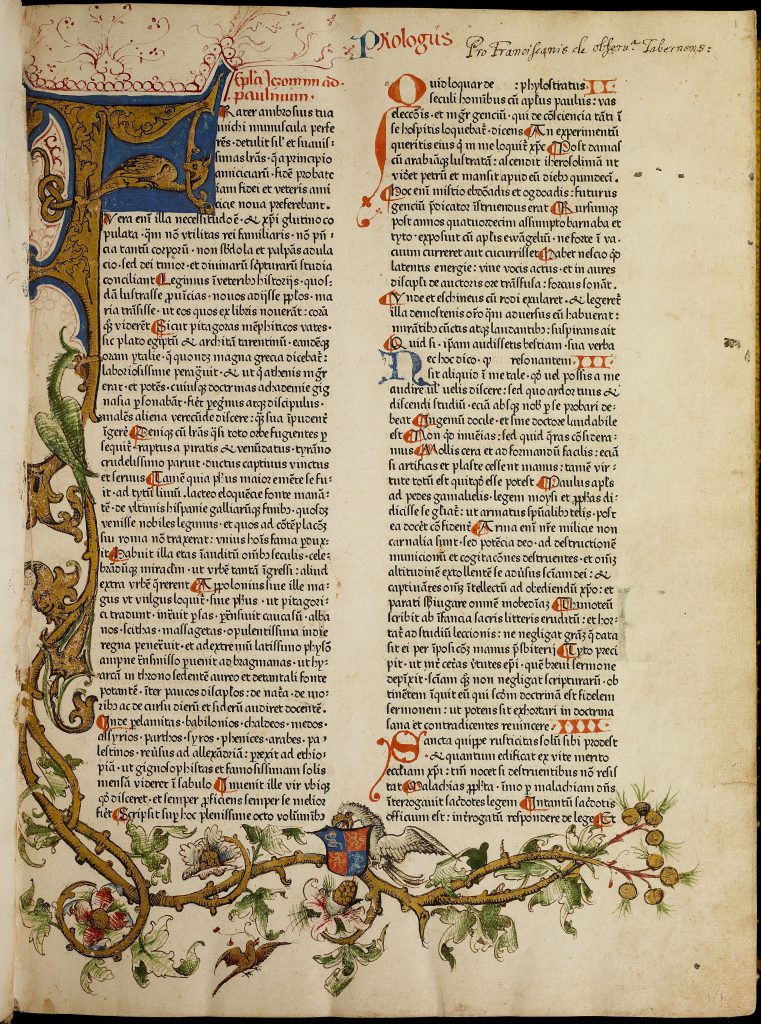
Princeton University Library, Rare Books and Special Collections, William H. Scheide Library, 53.8. Latin Bible in double columns of 49 lines, printed in Strasbourg by Johann Mentelin, not after 1460 CE.

Princeton University Library, Rare Books and Special Collections, William H. Scheide Library, 53.8. Latin Bible (printed in Strasbourg by Johann Mentelin, not after 1460 CE.) Photograph courtesy Princeton University Library, Rare Books and Special Collections.

The Aim

In a nutshell.
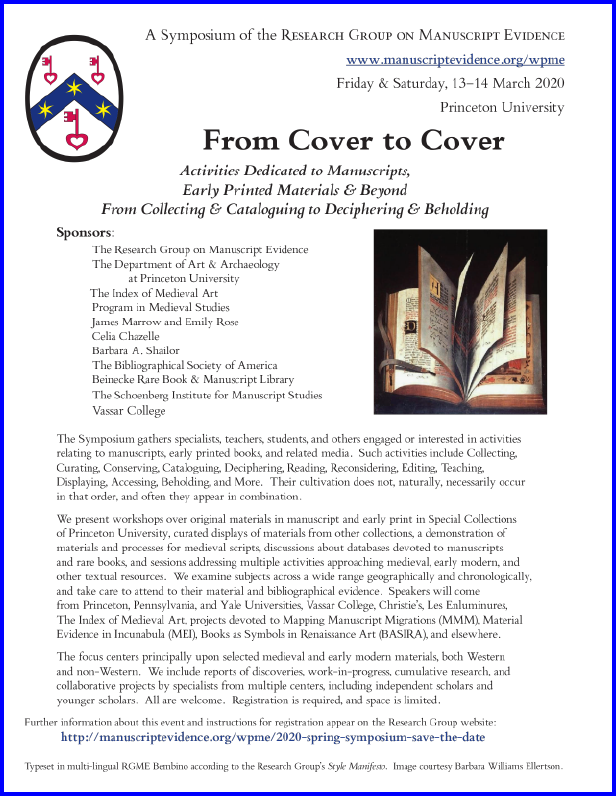
2020 Spring Symposium Announcement, describing the scope of the event, listing the Sponsors, and citing the link to the registration form.

2020 Spring Symposium Announcement, describing the scope of the event, listing the Sponsors, and citing the link to the registration form.

The Plan

Day 1

Friday 13 March: Classes, Workshops, Discussion, and a Reception

1) 12:00–1:00, 12:00–1:30, or 12:00–2:00pm (By Invitation)
Seminar Room of the Index of Medieval Art

“Comparing Notes about Databases:  Past, Present & Futures”
An Informal Discussion

2–3) 1:00–2:45 pm or 3:00–4:45 pm
Classes on Site at Firestone Library (Registration Required and Space Limited)

For registration for these classes and the symposium, see below.

“Material Evidence: A Workshop with 15th-Century Manuscripts and Incunabules”

Classes given (twice) by Eric White, Curator of Rare Books, Princeton University Library, in the Large Classroom of Floor C (Rare Books and Special Collections) at Firestone Library

Please gather in the Lobby at the entrance to Firestone Library, for special escorted access to Floor C, where there are lockable lockers (free) for your coats and cases, before entry to Special Collections.

2) Class 1:  Meet at 1:00 for 1:15–2:45 pm

3) Class 2 (repeated):  Meet at 3:00 for 3:15–4:45 pm

or

4) Session 3:00–5:00 pm
106 McCormick Hall

“Materials, Processes & Products:  A Workshop”

This workshop offers presentations by Bernard Maisner on “The Materials and Methods of Medieval & Renaissance Manuscript Gold-Illumination Techniques” and by David W. Sorenson on “An Introduction to Indian Manuscripts for the Non-Specialist”, along with curated displays of original materials in private collections and demonstrations of results from their close study.

5) Reception

5:00–7:00 pm
Lobby outside 106 McCormick Hall
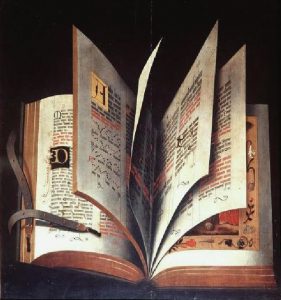
Florence, Galleria degli Uffizi, Anonymous, Still Life, German school of the XVI century, circa 1510, oil on wood, 70.2 × 65 cm. Opened book with fanned leaves showing pages of text and music set out in double columns and adorned with decorated initials and illustrations. Image via Wikimedia, public domain.

Florence, Galleria degli Uffizi, Anonymous, Still Life of an Illuminated Book, German school of the XVI century, circa 1510. Opened book with fanned leaves. Image via Wikimedia, public domain.

Day 2

Saturday 14 March:  Sessions, Refreshments, and Reception

106 McCormick Hall and its Lobby

6) 10:00 am – 5:30 pm

Sessions, Coffee Breaks, Lunch, and Discussion

7) Reception (5:30–7:00 pm)
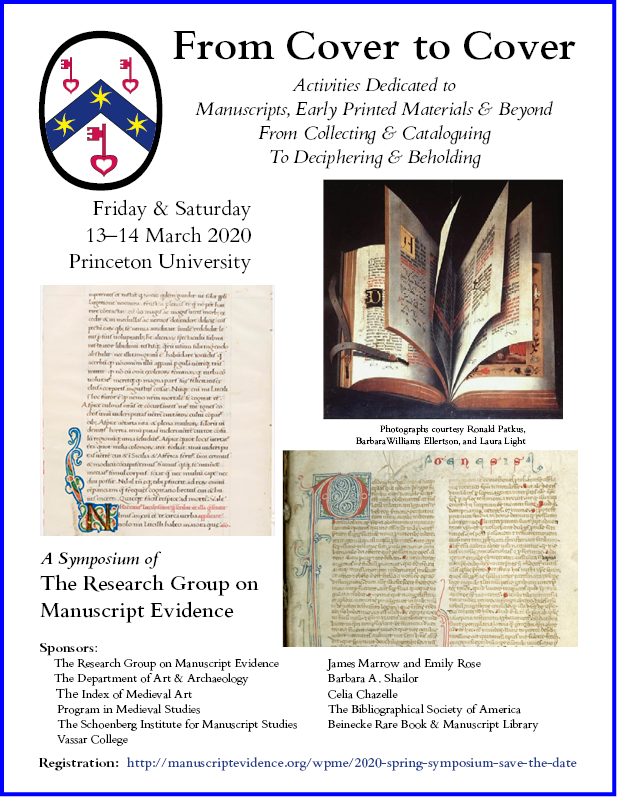
2020 Symposium "From Cover to Cover" Poster 2

2020 Symposium Poster 2

*****

The Schedule

The Schedule is available here.

*****

Registration

Please register for the Symposium.  We offer the Registration form as a downloadable pdf .

*****

Maps and Directions

Here.

*****

Please Contact us with questions and suggestions.

Watch this space and visit our FaceBook Page for updates.
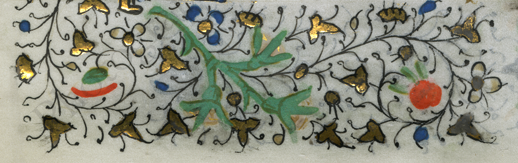
Floral Motif as Lower Border in a Book of Hours. Photography Mildred Budny.

We invite you to donate to our nonprofit educational mission. Donations may be tax-deductible. We welcome donations in funds and in kind: Contributions and Donations .

Please join us at the symposium, open to all.  You can register here .

*****

Tags: Early Printing, manuscript fragments, Manuscript Illumination, Manuscript studies, Medieval Manuscript Fragments, Medieval Studies, Medieval Writing Materials, Spring Symposium
6 Comments »

2020 International Congress on Medieval Studies Program Announced

January 18, 2020 in Abstracts of Conference Papers, Announcements, Bembino, Conference, Conference Announcement, Index of Christian Art, Index of Medieval Art, International Congress on Medieval Studies, Kalamazoo, Societas Magica

Research Group on Manuscript Evidence
at the 55th International Congress on Medieval Studies
7–10 May 2020

Program Announced
[NOW CANCELLED OR POSTPONED]

[Update on 12 July 2020:  Now see 2021 International Congress on Medieval Studies Call for Papers]

[Published on 18 January 2020, with updates.

Adèle Kindt (1804–1884), The Fortune Teller (circa 1835). Antwerp, Koninklijk Museum voor Schone Kunsten. Image via Wikimedia Commons. A young lady, brightly lit and beautifully dressed, looks outward as an older woman, beneath a dark hood, holds a set of cards and stares at them with intent.

Adèle Kindt (1804–1884), The Fortune Teller (circa 1835). Antwerp, Koninklijk Museum voor Schone Kunsten. Image via Wikimedia Commons.

Update on 17 March.  The 55th Congress has been Cancelled. 

According to the website for the International Congress on Medieval Studies:

The health and safety of our attendees and our community are our first priority. Due to the COVID-19 outbreak and the most recent recommendations of the CDC and the WHO regarding social distancing and public gatherings, we have made the difficult decision to cancel the 55th International Congress on Medieval Studies (May 7-10, 2020).

As for the future, according to the Congress organizers:

We invite the organizers of sponsored and special sessions approved for the 2020 Congress to re-propose them for the 2021 congress. If proposed, they will be approved automatically.

Meanwhile, with the preparations for the Congress set aside, the Research Group on Manuscript Evidence continues to advance with posting the Abstracts of the intended Papers for our 2020 ICMS Sessions, to stand alongside their Statements of Purpose as designed for the Call for Papers and announced in this post.

Our tradition regularly has been to post on our website the Abstracts before our Sessions in a given Congress, as a foretaste of the Menu.  Years ago, as a sign of appreciation, we adopted the custom of posting the Abstract of one or other contributor who became unable to attend to present in person (as with the 2016 Congress and the 2014 Congress).  Thus we honor the intentions of our participants to present the results (or interim results) of their research and reflections, even when they could not do so at the event.

Before March 2020, only once before, in more than 30 years of activities in many centers in the United States and elsewhere (see our Events and Congress Activities), has the Research Group had to cancel an event itself.  That case was only 1 Session among 7 sponsored and co-sponsored Sessions at the 48th International Congress on Medieval Studies in May 2013.

This March, in stark contrast, 2 of our major events for 2020 have had to be cancelled as a whole.  This change pertains both at the Congress and elsewhere.  First, our 2020 Spring Symposium, From Cover to Cover, intended for 13–14 March at Princeton University, has been Cancelled or Postponed.  Now, the 55th ICMS intended for May at Kalamazoo. 

For the former, we aim to complete the Symposium Booklet, with the Program, Abstracts, and Illustrations, as planned,and distribute it to contributors, registrants, and others, as a souvenir of the collective aims for the gathering.   Here we similarly honor our participants’ intentions by recording their Abstracts.]

*****

What We Planned

Baltimore, The Walters Art Museum, MS W.782, folio 15r. Van Alphen Hours. Dutch Book of Hours made for a female patron in the mid 15th century. Opening page of the Hours of the Virgin: "Here du salste opdoen mine lippen". Image via Creative Commons. At the bottom of the bordered page, an elegantly dressed woman sits before a shiny bowl- or mirror-like object, in order, perhaps, to perform skrying or to lure a unicorn.

Baltimore, The Walters Art Museum, MS W.782, folio 15r. Van Alphen Hours. Image via Creative Commons.

With the achievement of our Activities at the 2019 International Congress on Medieval Studies (ICMS), described in our 2019 Congress Report, we prepare for the 2020 Congress. With the conclusion of the Call for Papers on 15 September 2019 for our sponsored and co-sponsored Sessions, we have assigned their Programs and reported them to the Congress Committee.

Now, as the new year begins, we announce the programs as well as our other activities at the 2020 Congress.  As the Congress announces its Sneak Preview of the 2020 Congress Program, we report the times and room assignments. Soon, as is our custom, we will publish the Abstracts for their Papers and Responses.

*****

Our events at the Congress, as always, are designed to represent, to explore, to promote, to celebrate, and to advance aspects of our shared range of interests, fields of study, subject matter, and collaboration between younger and established scholars, teachers, and others, in multiple centers.

This year, the response to the Call for Papers for our Session on Seals received so strong a response that we have been granted 2 sessions in the place of the one as accepted. Again this year we co-sponsor Sessions with the Societas Magica (2 Sessions this year). It will be the 16th year of this co-sponsorship.

Also, like the 2015–2019 Congresses, we plan for

  • an Open Business Meeting and
  • a co-sponsored Reception.

Again, like the 2016–2018 Congresses, we co-sponsor a Reception with the Index of Medieval Art at Princeton University (formerly the Index of Christian Art).

Abstracts for previous Congresses appear in our Congress Abstracts, Indexed both by Year and by Author.  The Abstracts for this year’s Congress will join their company.

Read the rest of this entry →

Tags: 'Toulouse deformity', Bibliomancy, Divination, History of Documents, History of Magic, Manuscript studies, Medieval Seals, Scrying, Seals and Signatures, Sortilège
No Comments »

A Leaf from Prime in a Large-Format Latin Breviary

January 1, 2020 in Manuscript Studies, Uncategorized

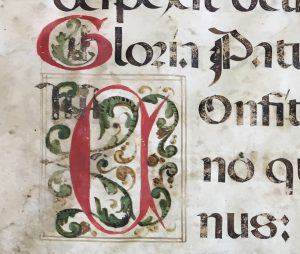
J. S. Wagner Collection. Leaf from from Prime in a Latin manuscript Breviary. Folio 4 Recto, with the opening of Psalm 117 (118) in the Vulgate Version. with a framed initial C for Confitimini, decorated wih scrolling foliate ornament.

J. S. Wagner Collection. Leaf from from Prime in a Latin manuscript Breviary. Folio 4 Recto, with the opening of Psalm 117 (118) in the Vulgate Version.

 Leaf “4” from Prime in a Large-Format Latin Breviary

Spain, 16th or 17th century

Single columns in 14 lines
circa 395 x 515 mm
with Foliate and Floral Decorated Initials

J. S. Wagner Collection

J. S. Wagner Collection. Detached Manuscript Leaf with the Opening in Latin of the Penitent Psalm 4 or Psalm 37 (38) and its Illustration of King David.

J. S. Wagner Collection. King David as Penitent from a Book of Hours.

[Published on 1 January 2020, with updates]

We continue our series of reports revealing unknown witnesses to the creativity of written materials, manuscript and in print, across the centuries.  See the Contents List for this blog for discoveries so far and unfolding.

Now, with thanks to the collector, who brought this and other manuscript and early-printed materials to our attention, we offer images of a detached leaf from a large-format manuscript for liturgical use.

Already we showcased another leaf in that collection.  It has an illustrated opening for one or another of the Penitential Psalms — we can’t know which one, given that its few visible opening lines pertain to 2 Psalms — depicting the Old Testament King David in his penitence, with crown and lyre set to one side.  The publication of that illustration, and the gathering advice of experts whom we could ask, led to improved knowledge about the probable orgin of the leaf and its original manuscript.  A similar process commences with this next leaf, also from a religious manuscript.

Read the rest of this entry →

Tags: Antiphonary, Antiphons, Dispersed Manuscript Leaves, Dotted Letter I, Floral Decoration, Gloria Patri, Hour of Prime, Latin Breviary, Manuscripts from Spain, Missal, Psalm 117 (118), Psalm 53, Roman Breviary, Sarum Breviary
No Comments »

“Gutenberg and After” at Princeton University Library

December 11, 2019 in Book & Exhibition Reviews, Events, Princeton University

Guided Tours 2019

Gutenberg & Friends

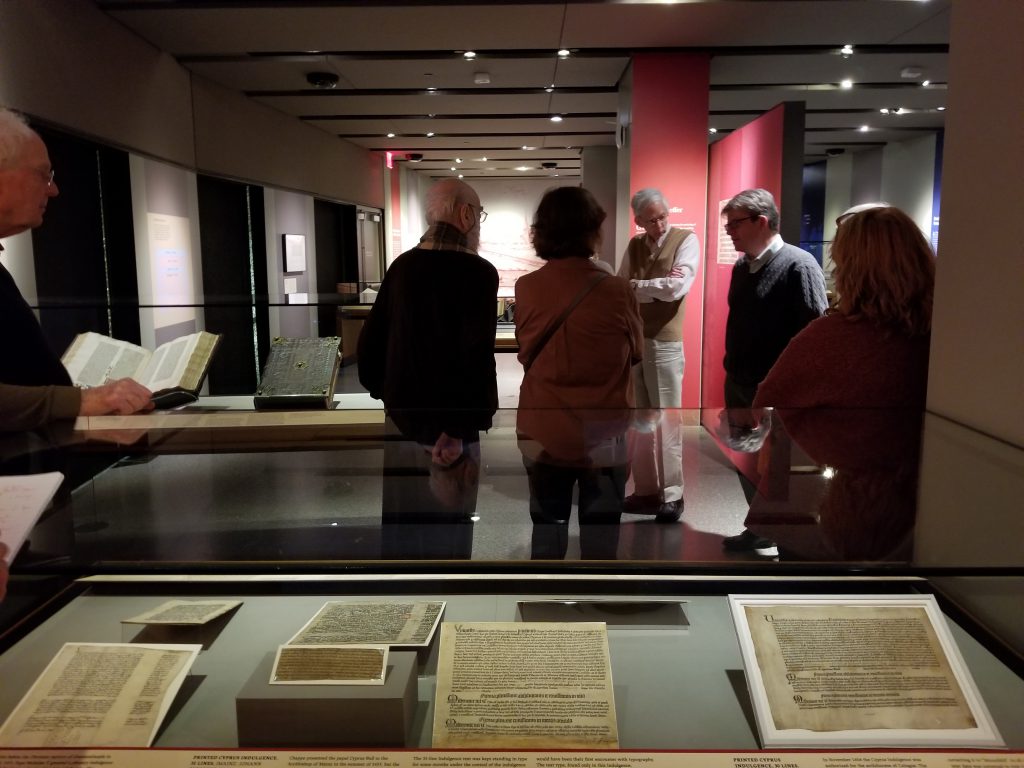
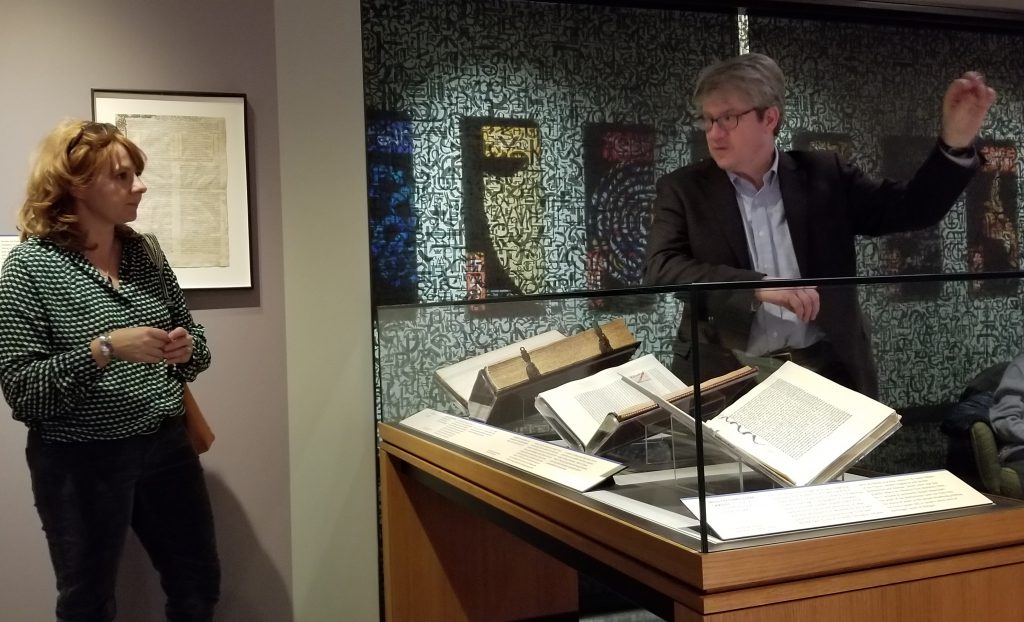
Among the events for our 2019 Anniversary Year (see below), the Research Group enjoys a set of Guided Tours by our Associate Eric White, Curator of Rare Books in Special Collections of Princeton University Libraries.  He guided us through his co-curated Exhibition at Princeton University Library on Gutenberg and After:  Europe’s First Printers 1450-1470 (12 September 2019 – 15 December 2019).

At the Exhibition of "Gutenberg and After" at Princeton University in 2019, the group listens to Eric White's tour..

The Group Listens. Photograph by Mildred Budny.

These tours, which included members of the Princeton Bibliophiles and Book Collectors (a subgroup of the Friends of the Princeton University Libraries), took place on Monday, 18 November, and Friday 13 December.  In appreciation, we took Eric for refreshments afterward nearby.

Thus, it was possible not only to ask questions during the tour itself, but also to reflect further in conversations emerging from those direct, expertly guided encounters with the materials themselves.

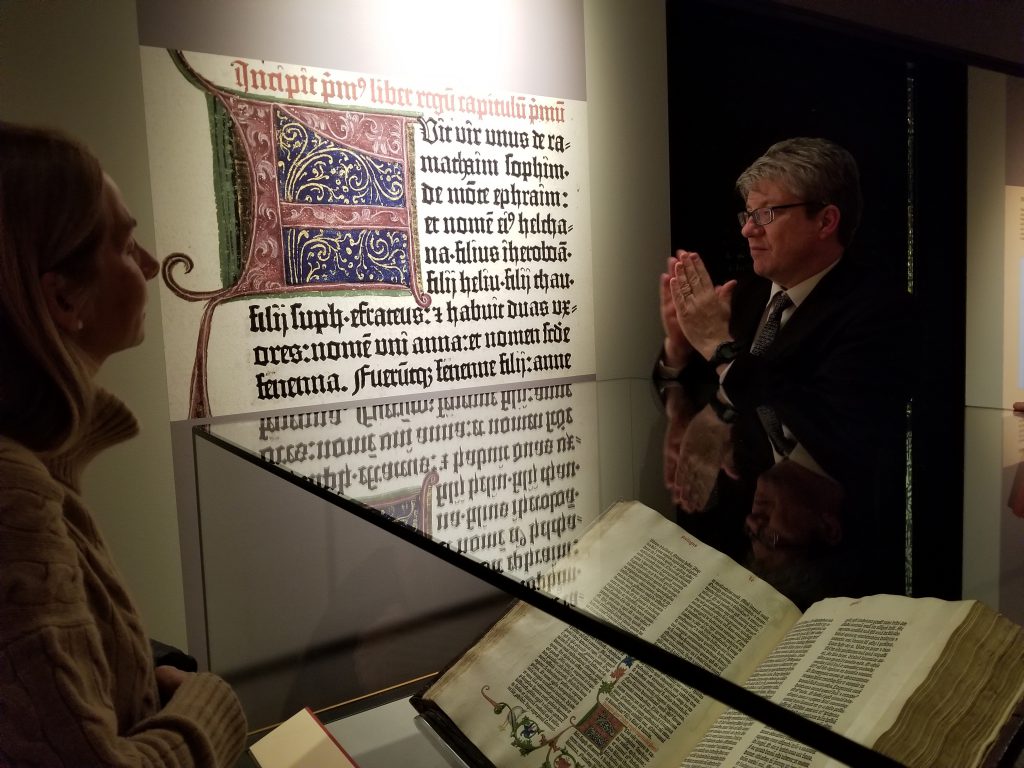
At the Exhibition of "Gutenberg and After" at Princeton University in 2019, the Co-Curator Eric White stands before the Scheide Gutenberg Bible displayed at the opening of the Book of I Kings.

Eric White Explains the Choice for Display of the Opening of I Kings in the Gutenberg Bible of 1455 (Scheide Library copy). Photograph by Mildred Budny.


Armchair Exhibition

More information about the exhibition, its background, and its selected exhibits, is presented online. Enjoy!

  • Rare Collections
  • About the Exhibition

Close Up & Personal

Accompanying the exhibition is an online series of 7 short, thematic essays focusing upon selected aspects of the materials and their evidence.

1.  Authenticity

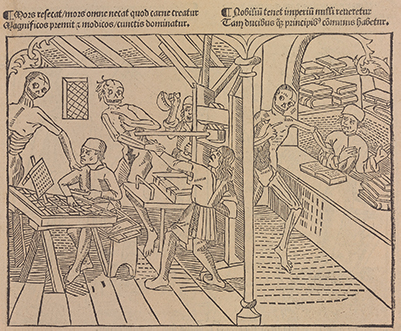
Princeton University Library. "La Grant Danse Macabre" (Lyons, 1499), one of two surviving copies. It contains the earliest depiction of a printing shop, albeit accompanied by animated cadavers.

Princeton University Library. “La Grant Danse Macabre” (Lyons, 1499), one of two surviving copies. It contains the earliest depiction of a printing shop, albeit accompanied by animated cadavers.

2.  Indulgences

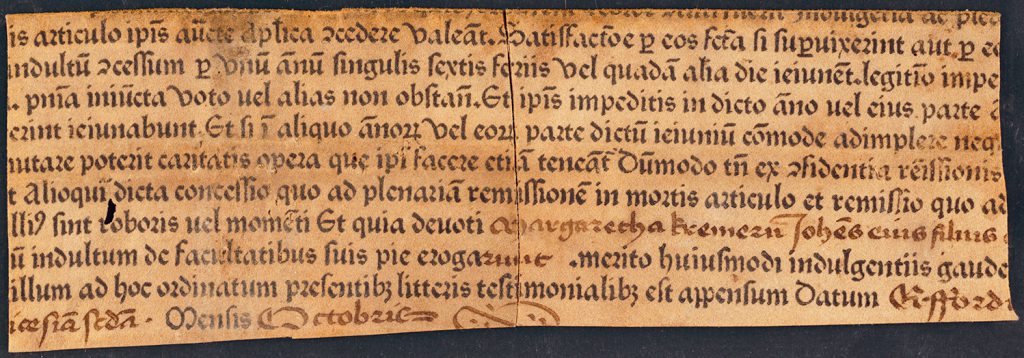
Princeton University Library, Special Collections. Printed Cyprus Indulgence, 31 Lines. (Mainz: Johann Gutenberg, 1454).

Princeton University Library, Special Collections. Printed Cyprus Indulgence, 31 Lines. (Mainz: Johann Gutenberg, 1454).

3. Illumination

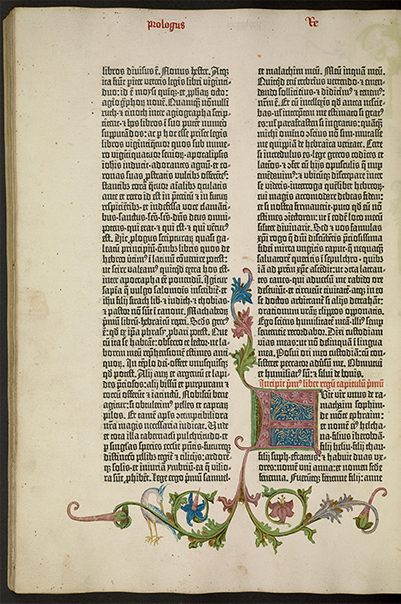
Princeton University Library, Scheide Library. Gutenberg Bible of 1455, Opening Page of I Kings.

Princeton University Library, Scheide Library. Gutenberg Bible of 1455. Opening Page of I Kings.

4. Uniqueness

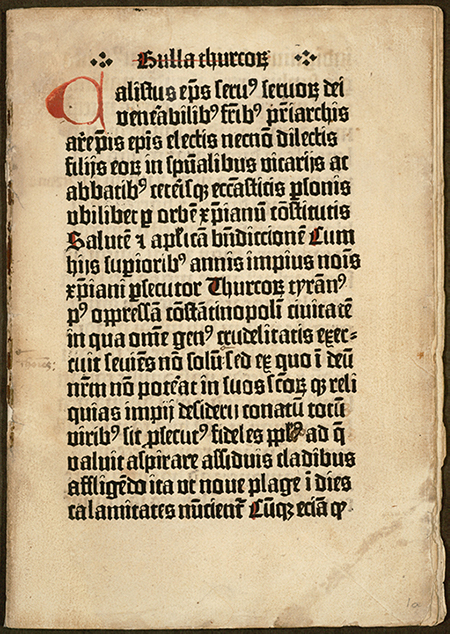
THURCORUM (Mainz: Gutenberg, late 1456), opening page.

Princeton University Library, Scheide Library. CALIXTUS III, BULLA THURCORUM (Mainz: Gutenberg, late 1456), opening page.

5. Johann Neumeister

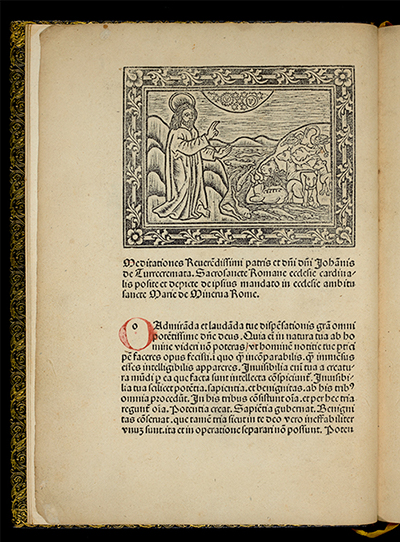
Princeton University Library, Scheide Library. Turrecremata, "Meditations" (Albi: Johann Neumeister, 1481).

Princeton University Library, Scheide Library. Turrecremata, “Meditations” (Albi: Johann Neumeister, 1481).

6. Fragments

Princeton University Library, Scheide Library. Donatus, "Ars minor" on vellum (Mainz: almost certainly Johann Gutenberg and Johann Fust, perhaps ca. 1453-54), fragment.

Princeton University Library, Scheide Library. Donatus, “Ars minor” on vellum (Mainz: almost certainly Johann Gutenberg and Johann Fust, perhaps ca. 1453-54), fragment.

7. Survivals

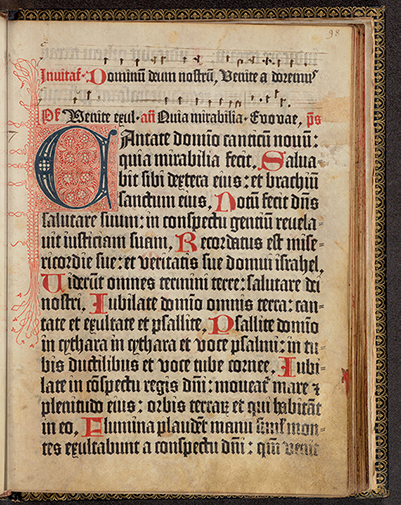
Princeton University Library, Scheide Library. Mainz Psalter on vellum (Mainz: Johann Fust and Peter Schoeffer, 14 August 1457), folio 98.

Princeton University Library, Scheide Library. Mainz Psalter on vellum (Mainz: Johann Fust and Peter Schoeffer, 14 August 1457), folio 98.

Round-Up

These articles are stored here:

Inside Milberg Gallery “Gutenberg and After” .

An online exhibition displays detailed views: here .  There, exploration is possible among the options of “Printer”, “Publisher”, “Subject”, “Language”.  For example, seaching by “Printer” and selecting Gutenberg, Johann yields closer views and detailed descriptions of 7 exhibited items, with their digital facsimiles.  Thus it is possible virtually to turn their pages, from

1.  The 2-volume Gutenberg Bible of circa 1455 from Mainz in the Scheide Collection, with its original Erfurt binding and illuminations

to

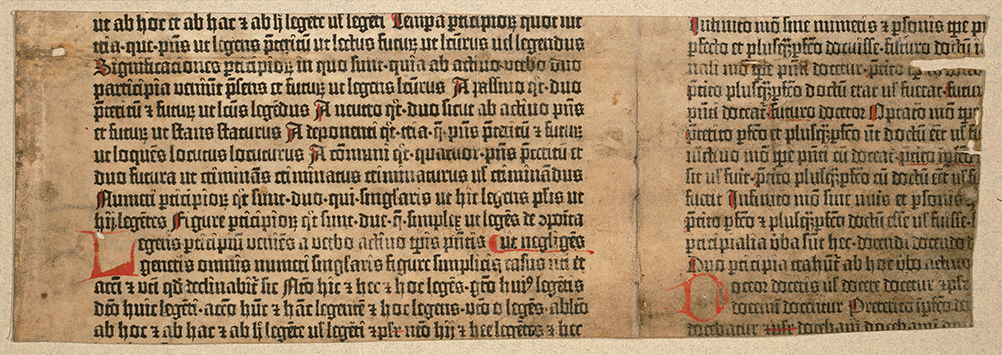
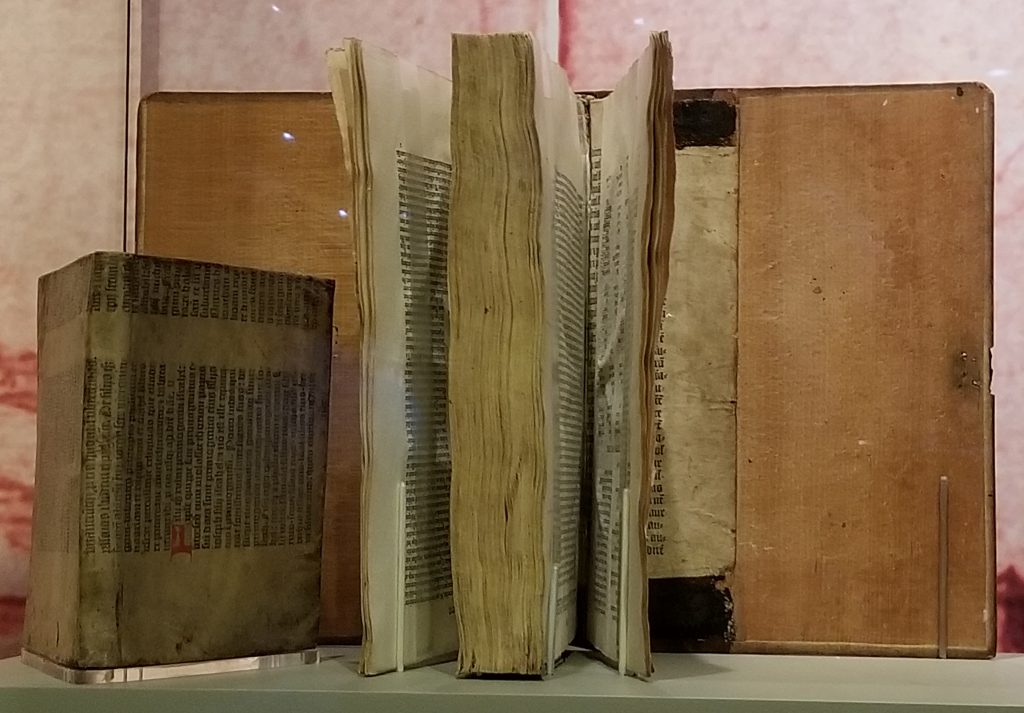
7.  A reused leaf from a Gutenberg Bible in the Princeton University Library, in its converted state as a vellum binding cover for a 1666 lawbook — seen here at the left in the exhibtion.

Princeton University Library. Gutenberg Bible Leaves Recycled as Binding Materials. Photograph by Mildred Budny.

Princeton University Library. Gutenberg Bible Leaves Recycled as Binding Materials. Photograph by Mildred Budny.

Previews

The Cover Page for the 2019 Anniversary Symposium Booklet displays the name and logo of the Research Group on Manuscript Evidence, the title and subtitle of the Symposium, the List of Sponsors, and a description of the scope and aims of the Symposium. Like the rest of the Booklet, the Cover Page is set in RGME Bembino, the copyright multilingual font of the Research Group on Manuscript Evidence.

2019 Symposium Booklet, Cover Page

2016 Symposium Program Booklet, Cover Page, with RGME logo, Symposium title, list of sponsors, and description.

2016 Symposium Program Booklet, Cover Page.

Eric White presented some of the discoveries which appear in the exhibition earlier for 2 of our Research Group Symposia at Princeton University, including our Symposium in this Anniversary Year.

  • Words and Deeds (2016)
  • The Roads Taken (2019)

The booklets for these Symposia (downloadable through those links) include the abstracts of Eric’s papers and some accompanying images — which present materials included in the current exhibition.  His presentations and workshops for those events gave helpful preparation for viewing the exhibition and for learning more from Eric’s guided tours.

We thank him for teaching us more about these challenging, intriguing, and ground-breaking materials in the history of books.  We look forward to learning more.

*****

Preparations are on course for a printed catalogue of the exhibition.  More to discover!

At the Exhibition of "Gutenberg and After" at Princeton University in 2019, the Co-Curator Eric White answers questions.

Eric Answers Questions. Photograph by Mildred Budny.

*****

Anniversary Celebrations

These events in Princeton form part of our activities during 2019, a landmark Anniversary Year for the Research Group on Manuscript [and Other] Evidence.  They include:

  • Specially Guided Tours for the RGME at the the Princeton University Exhibition on Gutenberg and After (November and December)
  • Permanent Panel at the Midwest Duality and Manuscript Evidence at the Midwest Modern Language Association 2019 Convention (November)
  • 2019 International Congress on Medieval Studies (May)
  • 2019 Anniversary Symposium on “The Roads Taken” (April)

Watch This Space

Building upon the momentum of events for our Anniversary Year, we plan more events for 2020. Among them are the activities for the 2020 International Congress on Medieval Studies in May.

Also a Symposium at Princeton University in the Spring. Perhaps with more news about the background and foreground of the Gutenberg and Beyond Exhibition?  Hopeful.

Join Us

Please Contact Us with your questions and suggestions.

For updates, please visit this site, our News & Views, and our Facebook Page .

For our nonprofit educational mission, with tax-exempt status, your donations in funds and in kind (expertise, materials, time) are welcome.

Join us!


Tags: Early Printed Fragments reused in Bindings, Early Printing, Eric White, Fragments, Gutenberg Bible, Gutenberg Press, Indulgences, Johannes Gutenberg, Milberg Gallery, Princeton University Library
No Comments »

The Penitent King David from a Book of Hours

November 27, 2019 in Manuscript Studies

J. S. Wagner Collection. Detached Manuscript Leaf with the Opening in Latin of the Penitent Psalm 4 or Psalm 37 (38) and its Illustration of King David.

Detached Manuscript Leaf on Vellum
with Framed Illustration and Text

King David with Crown and Lyre
at the Opening of Psalm 6 or 37 (38) in Latin from a Book of Hours

At least circa 125 × 160 mm (as framed and matted)

Rouen, circa 1480–90
or Western France circa 1470

J. S. Wagner Collection

[Posted on 27 November 2019, with updates, for which we thank our Honorary Trustee, James H. Marrow, and our Honorary Invited Associate, Gregory T. Clark.]

J. S. Wagner Collection, Detached Leaf. Opening of Psalm 6 or 37 (38) in 4 lines.J. S. Wagner Collection, Detached Leaf. Opening of Psalm 6 or 37 (38) in 4 lines, with an enlarged and decorated initial D for "Domine"..

J. S. Wagner Collection, Detached Leaf. Opening of Psalm 6 or 37 (38) in 4 lines.

Continuing our exploration of manuscript fragments in our Blog on Manuscript Studies, we welcome a new addition to the quest. See the Contents List for this blog, mostly written by Mildred Budny, for the series of revelations.

From the collection of J. S. Wagner, we offer images from a detached leaf on Vellum in Latin apparently from a Book of Hours. Some of our earlier posts have addressed Books of Hours. See our Contents List.

At present, the Wagner leaf is contained within a frame, so that only one side is visible.  It might be the recto or verso of the leaf. If the former, the reader and beholder would have to turn the page in order to advance to the sequential text. If the latter, the facing page would have manifested it at a glance.

As it stands, the page presents the illustrated opening of one of the Penitential Psalms in Latin in the Vulgate Version from a luxurious Book of Hours.  The ambition of its production is manifested by the script, illustration, and decoration, as well as the use of gold and other pigments. The quality of the execution, however, exhibits some haste in places.

The set of Penitential Psalms comprise Psalms 6, 31, 37, 50, 101, 129, and 142 (that is, 6, 32, 38, 51, 102, 130, and 143 in the Hebrew numbering).
The opening of text upon the page corresponds to Verse 1 of both Psalm 6 and Psalm 37 (38).  See below for those options.  That is, at present, given the state of the leaf, we don’t know which.

Now contained within a frame behind glass, this page might represent the recto or the verso of the leaf.  For example, if the other side (if the verso) continues the text, it would establish which Psalm is represented.  If the other side (if the recto) is the formerly previous text, then it might designate some Psalm or otherwise in the liturgical sequence.

Needless to say, problems aplenty can arise when a leaf is excised and dispersed without accompanying information.  (Examples and their challenges appear in many of our blogposts.  See our Contents List.)

Call it detective work, and you would be right on track.  The good thing is that sharing of images and information might yield increased knowledge.  We thank the owner for sharing his images with us, and we thank our friends, colleagues, Associates, and Trustees for helping to discover more information about the center from which this leaf came.

Read the rest of this entry →

Tags: "Beyond Use" website, Book of Hours, Books of Hours, Crown, Flemish Psalter Illustration, J.S. Wagner Collection, King David, Lyre, Museu Gulbenkian LA 135, Penitent Psalms, Playfair Hours, Poitiers, Psalm 37 (38), Psalm 6, Rouen
No Comments »

« Older Entries
Newer Entries »
  • Top
©2024 Research Group on Manuscript Evidence.


is proudly powered by WordPress. WordPress Themes X2 developed by ThemeKraft.