• News
    • News & Views
    • RGME Activities for 2024 and 2025
    • Around & About with the RGME
    • Reviews
    • Highlights
  • Blogs
    • Manuscript Studies
      • Manuscript Studies: Contents List
    • International Congress on Medieval Studies
      • Abstracts of Congress Papers
        • Abstracts of Papers Listed by Author
        • Abstracts of Papers Listed by Year
  • About
    • Mission
    • Who We Are
      • Officers, Associates & Volunteers
      • RGME Committees
      • Friends of the Research Group on Manuscript Evidence
    • Policies & Statements
      • RGME Privacy Policy Statement
      • RGME Intellectual Property Statement & Agreements
    • People
      • Mildred Budny — Her Page
      • Adelaide Bennett Hagens
    • Activities
      • Events
      • Congress Activities
        • Sponsored Conference Sessions (1993‒)
          • Panels at the M-MLA Convention (from 2016)
        • Co-sponsored Conference Sessions (2006‒)
    • History
      • Seals, Matrices & Documents
      • Genealogies & Archives
    • Contact Us
  • Bembino
    • Multi-Lingual Bembino
    • RGME Bembino: Resources
  • Congress
    • Sponsored Conference Sessions (1993‒)
    • Co-sponsored Conference Sessions (2006‒)
    • Abstracts of Congress Papers
      • Abstracts Listed by Author
      • Abstracts Listed by Year
    • Kalamazoo Archive
    • Panels at the M-MLA Convention (2016-2019)
      • Abstracts of Papers for the M-MLA Convention
      • Panels at the M-MLA Convention (from 2016)
  • Events
    • RGME Activities for 2024 and 2025
      • 2023 Activities and 2024 Planned Activities
    • Seminars, Workshops, Colloquia & Symposia (1989–)
      • Seminars on ‘The Evidence of Manuscripts’
      • Symposia on ‘The Transmission of the Bible’
      • The New Series (2001-)
        • 2019 Anniversary Symposium Program: The Roads Taken
        • 2019 Anniversary Symposium Registration
        • 2019 Anniversary Symposium Registration Open
      • RGME Symposia: The Various Series
      • The Research Group Speaks: The Series
      • Meetings of the Friends of the Research Group on Manuscript Evidence
      • RGME Online Events
    • Abstracts of Papers for Events
      • Abstracts of Papers for Seminars on ‘The Evidence of Manuscripts’
      • Abstracts of Papers for Symposia, Workshops & Colloquia
    • Receptions & Parties
    • Business Meetings
    • Photographic Exhibitions & Master Classes
    • Events Archive
  • ShelfLife
    • Journal Description
    • ShelfMarks: The RGME-Newsletter
    • Publications
      • “Insular, Anglo-Saxon, and Early Anglo-Norman Manuscript Art at Corpus Christi College, Cambridge” (1997)
        • Mildred Budny, ‘Catalogue’
        • The Illustrated Catalogue (1997)
      • The Illustrated Handlist
      • Semi-Official Counterfeiting in France 1380-1422
      • No Snap Decisions: Challenges of Manuscript Photography
    • History and Design of Our Website
  • Galleries
    • Watermarks & the History of Paper
    • Galleries: Contents List
    • Scripts on Parade
    • Texts on Parade
      • Latin Documents & Cartularies
      • New Testament Leaves in Old Armenian
    • Posters on Display
    • Layout Designs
  • Donations and Contributions
    • RGME Donor Promise
    • 2023 End-of-Year Fundraiser for our 2024 Anniversary Year
    • 2019 Anniversary Appeal
    • Orders
  • Links
    • Catalogs, Metadata, and Databases: A Handlist of Links
    • Handlist of Resources for Manuscript Studies and Fragmentology
    • Manuscripts & Rare Books
    • Maps, Plans & Drawings
    • Seals, Seal-Matrices & Documents

  • News
    • News & Views
    • RGME Activities for 2024 and 2025
    • Around & About with the RGME
    • Reviews
    • Highlights
  • Blogs
    • Manuscript Studies
      • Manuscript Studies: Contents List
    • International Congress on Medieval Studies
      • Abstracts of Congress Papers
        • Abstracts of Papers Listed by Author
        • Abstracts of Papers Listed by Year
  • About
    • Mission
    • Who We Are
      • Officers, Associates & Volunteers
      • RGME Committees
      • Friends of the Research Group on Manuscript Evidence
    • Policies & Statements
      • RGME Privacy Policy Statement
      • RGME Intellectual Property Statement & Agreements
    • People
      • Mildred Budny — Her Page
      • Adelaide Bennett Hagens
    • Activities
      • Events
      • Congress Activities
        • Sponsored Conference Sessions (1993‒)
          • Panels at the M-MLA Convention (from 2016)
        • Co-sponsored Conference Sessions (2006‒)
    • History
      • Seals, Matrices & Documents
      • Genealogies & Archives
    • Contact Us
  • Bembino
    • Multi-Lingual Bembino
    • RGME Bembino: Resources
  • Congress
    • Sponsored Conference Sessions (1993‒)
    • Co-sponsored Conference Sessions (2006‒)
    • Abstracts of Congress Papers
      • Abstracts Listed by Author
      • Abstracts Listed by Year
    • Kalamazoo Archive
    • Panels at the M-MLA Convention (2016-2019)
      • Abstracts of Papers for the M-MLA Convention
      • Panels at the M-MLA Convention (from 2016)
  • Events
    • RGME Activities for 2024 and 2025
      • 2023 Activities and 2024 Planned Activities
    • Seminars, Workshops, Colloquia & Symposia (1989–)
      • Seminars on ‘The Evidence of Manuscripts’
      • Symposia on ‘The Transmission of the Bible’
      • The New Series (2001-)
        • 2019 Anniversary Symposium Program: The Roads Taken
        • 2019 Anniversary Symposium Registration
        • 2019 Anniversary Symposium Registration Open
      • RGME Symposia: The Various Series
      • The Research Group Speaks: The Series
      • Meetings of the Friends of the Research Group on Manuscript Evidence
      • RGME Online Events
    • Abstracts of Papers for Events
      • Abstracts of Papers for Seminars on ‘The Evidence of Manuscripts’
      • Abstracts of Papers for Symposia, Workshops & Colloquia
    • Receptions & Parties
    • Business Meetings
    • Photographic Exhibitions & Master Classes
    • Events Archive
  • ShelfLife
    • Journal Description
    • ShelfMarks: The RGME-Newsletter
    • Publications
      • “Insular, Anglo-Saxon, and Early Anglo-Norman Manuscript Art at Corpus Christi College, Cambridge” (1997)
        • Mildred Budny, ‘Catalogue’
        • The Illustrated Catalogue (1997)
      • The Illustrated Handlist
      • Semi-Official Counterfeiting in France 1380-1422
      • No Snap Decisions: Challenges of Manuscript Photography
    • History and Design of Our Website
  • Galleries
    • Watermarks & the History of Paper
    • Galleries: Contents List
    • Scripts on Parade
    • Texts on Parade
      • Latin Documents & Cartularies
      • New Testament Leaves in Old Armenian
    • Posters on Display
    • Layout Designs
  • Donations and Contributions
    • RGME Donor Promise
    • 2023 End-of-Year Fundraiser for our 2024 Anniversary Year
    • 2019 Anniversary Appeal
    • Orders
  • Links
    • Catalogs, Metadata, and Databases: A Handlist of Links
    • Handlist of Resources for Manuscript Studies and Fragmentology
    • Manuscripts & Rare Books
    • Maps, Plans & Drawings
    • Seals, Seal-Matrices & Documents

Log in

Archives

Featured Posts

Announcing the Launch of RGME Bembino WP
2026 RGME Colloquium at The Grolier Club: Report
Medieval Missal Fragment as Early-Modern Cover
The Weber Leaf from Ege MS 61
"Bembino" Booklet Cover
Episode 23. “Meet RGME Bembino: Facets of a Font”
2026 RGME Colloquium on “Transformations & Renewals” at The Grolier Club
2026 Theme of the Year: “Transformations and Renewals”
A Leaf with Patchwork from the Saint Albans Bible
A Sister Leaf from a Miniature Latin Vulgate Bible
A Little Latin Vulgate Bible Manuscript Leaf in Princeton
J. S. Wagner Collection. Leaf from from Prime in a Latin manuscript Breviary. Folio 4 Verso, with part of Psalm 117 (118) in the Vulgate Version, set out in verses with decorated initials.
2026 Annual Appeal
Episode 22: “Encounters with Local Saints and Their Cults”
Private Collection, Ege's FBNC Portfolio, Dante Leaf, Verso, Detail. Reproduced by Permission.
2025 RGME Autumn Colloquium on Fragments
Workshop 8: A Hybrid Book where Medieval Music Meets Early-Modern Herbal
2025 RGME Autumn Symposium on “Readers, Fakers, and Re-Creators of Books”
RGME Workshops on “The Evidence of Manuscripts, Etc.”
2025 International Medieval Congress at Leeds: RGME Program
Episode 21. “Learning How to Look”
2025 International Congress on Medieval Studies: Program
2025 RGME Visit to Vassar College
Two Leaves in the Book of Numbers from the Chudleigh Bible
Delibovi on Glassgold on Boethius: A Blogpost
Ronald Smeltzer on “Émilie du Châtelet, Woman of Science”
2025 Spring Symposium: “Makers, Producers, and Collectors of Books”
Starters’ Orders
The Weber Leaf from the Saint Albans Bible
Workshop 4. “Manuscript Fragments Compared”
Episode 20. “Comic Book Theory for Medievalists”
Episode 19: “At the Gate: Starting the Year 2025 at its Threshold”
Favorite Recipes for Lemonade, Etc.
RGME Visit to the Lomazow Collection: Report
2024 Autumn Symposium: “At the Helm”
A Latin Vulgate Leaf of the Book of Numbers
The RGME ‘Lending Library’
Florence, Italy, Ponte Vecchio from Ponte alle Grazie. Photo: Ingo Mehling, CC BY-SA 4.0 , via Wikimedia Commons
Episode 17. “RGME Retrospect and Prospects: Anniversary Reflections”
2024 Anniversary Symposium: The Booklet
Jesse Hurlbut at the Bonneville Salt Flats, Utah. Photograph Jesse Hurlbut.
Episode 16: An Interview with Jesse D. Hurlbut
To Whom Do Manuscripts Belong?
Kalamazoo, MI Western Michigan University, Valley III from the side. Photograph: David W. Sorenson.
2024 International Congress on Medieval Studies: Report
2024 Spring Symposium at Vassar College
Puente de San Martín: Bridge with reflection over the River Targus, Toledo, Spain.
2024 Grant for “Between Past and Future” Project from The Gladys Krieble Delmas Foundation Research Libraries Program
2024 Anniversary Symposium in Thanks to Jesse Hurlbut: Program

You are browsing the Blog for Events

Announcing the Launch of RGME Bembino WP

February 16, 2026 in Announcements, Bembino, Design, Events, Manuscript Studies, Research Group Speaks (The Series)

“Announcing the Launch
of RGME Bembino WP:

A High-Quality Font
for Word-Processing”

Launch Date: 25 March 2026

[Posted on 14 February 2026 with updates]

The full, 16-file, professional, level of our digital font RGME Bembino has been available for a while, with several updates in response to requests for more languages or features.  We are thrilled to announce the launch of BembinoWP, a 4-file subset bringing our font to the Mac and Windows Word-processing Communities at large (by request).

BembinoWP has been circulating in a provisional version over recent months, for review, feedback. and corrections. Now we launch it more widely, for all to try out and use.

Find it here:

  • Bembino WP for Word-Processing

This release enables the font to reach desk-top publishers and report-writers using widely-available text-processing tools including Microsoft Word and PowerPoint. The BembinoWP variant offers a migration path to the full version of the font for higher-quality typesetting through professional tools such as Adobe InDesign or Quark.

Watch for its official Launch on 25 March 2026. This date marks the anniversary of the very first printed text set in Bembino: a “Happy Birthday” greeting for our Director.

For the launch, the RGME offers some occasions where you could meet the font, hear from its maker and users, and join the Q&A.

Read the rest of this entry →

Tags: Bembino Digital Font, history of printing, Launch Announcement, RGME Publications, The Research Group Speaks
No Comments »

2026 International Congress on Medieval Studies: Program

February 1, 2026 in Announcements, Bāḥra ḥassāb: Knowledge Transmission in Ethiopia and Eritrea From Antiquity to Modern Times, Business Meeting, Conference, Conference Announcement, Event Registration, Events, ICMS, International Congress on Medieval Studies, Manuscript Studies, POMONA, Postal History at Kalamazoo, Rossell Hope Robbins Library at the University of Waterloo, Societas Magica

Program

Activities Sponsored and Co-Sponsored by the RGME
at the
61st International Congress on Medieval Studies
May 14–16, 2026

(Sessions variously online, in-person, and hybrid)

Sequence of RGME Activities at the 2026 Congress

[Posted on 15 January 2026, with updates]

View from Fetzer Lounge at the 2017 Congress. Photography © Mildred Budny.

View from Fetzer Lounge at the 2017 Congress. Photography © Mildred Budny.

Here we list the Program of Activities of the Research Group on Manuscript Evidence (RGME) at the 2026 International Congress on Medieval Studies (ICMS).

First we collaboratively designed a suite of Sessions (Panels of Papers) to sponsor or co-sponsor at this year’s Congress and, when they were accepted for the Congress, issued the Call for Papers:

  • 2026 ICMS: RGME’s Call for Papers
  • 2026 ICMS Call for Papers

With the completion of the Call for Papers, the next stages followed: selecting among the proposals received, designing each session (assigning the presider, sequence of papers, etc.), and submitting the session programs to the ICMS. Upon the formation of the full Congress Program (see link below), we announce the RGME Program of activities at the 2026 Congress—including the Sessions and our annual Open Business Meeting. We describe the activities one by one in the assigned sequence in which they will occur.

Congress Program

The Program and information for the 2026 Congress appears on the Congress website.

  • 2026 International Congress on Medieval Studies
  • 61st Congress Program

There, to find the RGME Business Meeting and Sessions, search under Sponsoring (or Co-Sponsoring) Organization

  • Sponsor List
  • Sponsor: Research Group on Manuscript Evidence

The participation by the RGME at the Annual ICMS over the years is chronicled in our blog

  • RGME Blog for International Congress on Medieval Studies

Now we turn to the 2026 Congress and invite you to join our activities.

Read the rest of this entry →

No Comments »

2026 RGME Colloquium on “Transformations & Renewals” at The Grolier Club

January 27, 2026 in Announcements, Event Registration, Events, Friends of the Research Group on Manuscript Evience, Manuscript Studies, Visits to Collections

2026 RGME Colloquium
at The Grolier Club

“Transformations and Renewals”
Examining and Celebrating
Treasures of the Grolier Club Library

Wednesday 11 February 2026 (Hybrid, in Two Events)
Workshop + Roundtable

[Posted on 15 January 2026, with updates
Now see also the
2026 RGME Colloquium at The Grolier Club: Report]

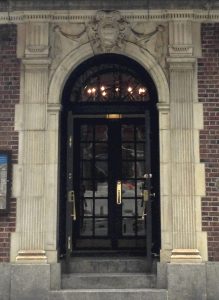
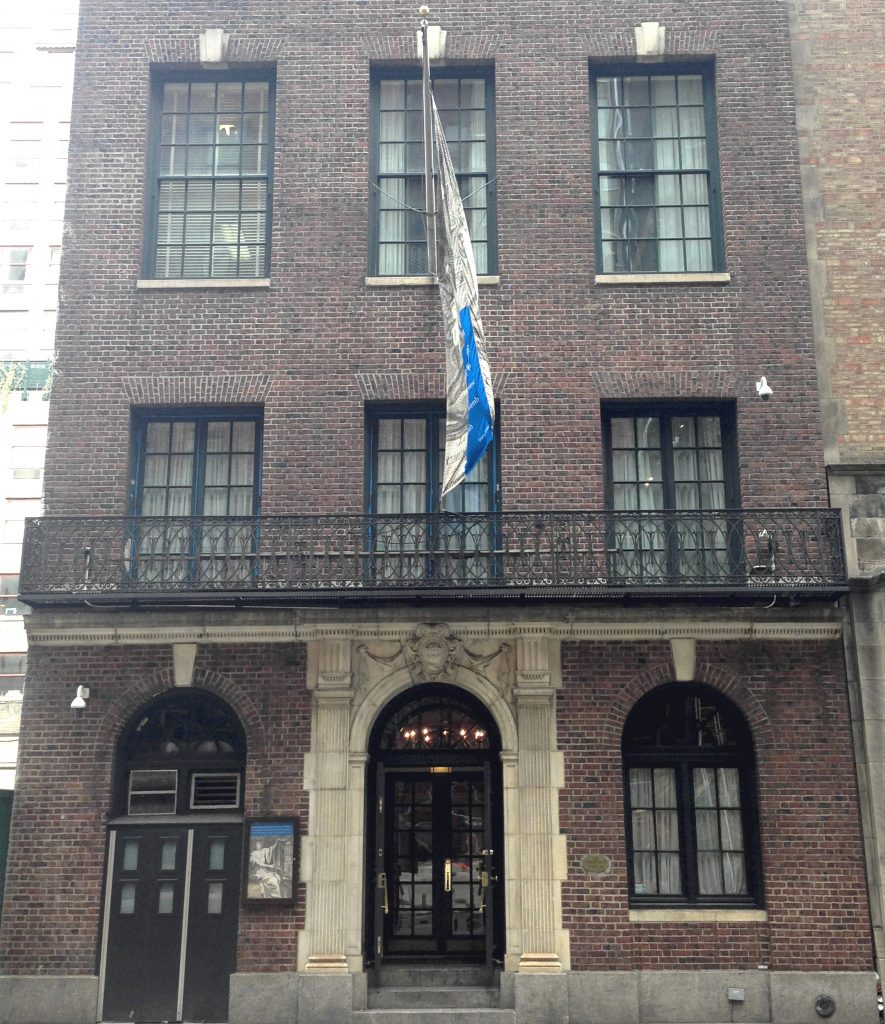
Front Entrance of The Grolier Club. Photograph (4 April 2008) [cropped] by participant/team W. C. Minor as part of the Commons:Wikipedia Takes Manhattan project, licensed under the Creative Commons Attribution-Share Alike 3.0 Unported license., via https://commons.wikimedia.org/wiki/File:Grolier_Club.jpg.

For the Year 2026, the Research Group on Manuscript Evidence chooses the Theme of “Transformations and Renewals” for exploration across its activities and projects.

Our first hybrid event of the year brings the RGME to The Grolier Club of the City of New York, in central Manhattan, for a curated set of hybrid events on Wednesday 11 February 2026. In keeping with the RGME’s dedication to accessibility for events reaching a wider audience, these events will be available both in person and online. For registration for the different events and functionalities (in person or online), see below.

With registration beforehand (see below), the day’s events comprise:

  • a “Show-Off-and-Tell” Workshop in the afternoon
    2:30–4:30 pm EST (GMT-4)

    1) online open to the public
    2) in person privately with limited seating, open for Grolier Club Members and RGME invited guests
  • a “Transformations and Renewals” Roundtable in the early evening
    6:00–7:30 pm EST
    open to the public

    1) online and
    2) in person

We gather a team of specialists, collectors, and curators of books — all Grolier Club Members and mostly RGME Associates— to examine, reflect on, and celebrate selected treasures of the Grolier Club Library. On offer: reports and conversations about research discoveries, work-in-progress, and the joys of experiencing the materials directly and also sharing their stories. Join us!

2024 Beletsky logo of the Grolier Club of the City of New York.

Program

For information about the scope of the event, its Participants, its two parts as Workshop and Roundtable, and Registration for each part, see below. Both parts are hybrid, through the RGME for the Workshop and through the Grolier Club for the Roundtable.

The Program for both the afternoon Workshop and early-evening Roundtable can now be downloaded as a 4-page

2026 RGME-Grolier Colloquium Poster 1. Set in RGME Bembino.

Program Booklet, set in RGME Bembino.

  • 2026 RGME Colloquium at the Grolier Club: Program

Posters

Both Posters for this bipartite event can be downloaded:

  • 2026 RGME Colloquium at the Grolier Club: Poster 1
  • 2026 RGME Colloquium at the Grolier Club: Poster 2

Colloquium Booklet

We offer the 64-page illustrated Colloquium Booklet as a guide and souvenir for the event. You may download it here, in two formats according with your printing and viewing preferences.

  • 2026 RGME Colloquium Booklet: Pages (as a series of individual pages on 8 1/2″ × 11″ sheets)
  • 2026 RGME Colloquium Booklet: Foldable Booklet (laid out for printing on 11″ × 17″ sheets, ready for folding)

Speakers and Panelists

Speakers with comments at the afternoon workshop over original materials and/or with lightning talks at the early-evening roundtable:

  • Jamie Elizabeth Cumby (Grolier Club Librarian)
    “ ‘Show-Off-and Tell’: A Curated Selection from the Grolier Club Library”
  • Beppy Landrum Owen (also Oral History Project: Beppy Landrum Owen)
    “ ‘That skull had a tongue in it, and could sing once. . .’
    Lost Stories of the Making of the Bremer Presse’s 1934 (but 1935) Vesalian Icones anatomicae”
  • John T. McQuillen (Morgan Library & Museum, Associate Curator of Printed Books & Bindings)
    “Blockbooks Dismembered”
    Note:
    Watch for the coming exhibition at the Morgan later this year:

    “Late Medieval European Blockbooks: The First Printed Picture Books” (6 November 2026 to 16 May 2027)
  • Mildred Budny (Director of the Research Group on Manuscript Evidence)
    “A Medieval Missal Fragment from the Otto F. Ege Collection and its Provenance”
    Note:
    “Break-Up Books and Make-Up Books: Encountering and Reconstituting the Legacy of Otto F. Ege and Other Bibliocasts” (See 2025 RGME Autumn Colloquium on Fragments)
  • Reid Byers (Reid Byers, Author)
    “Secrets in Secrets in Secrets”
    Note:
    Reid Byers, Imaginary Books: Lost, Unfinished, and Fictive Works Found Only in Other Books (Oak Knoll Press and Le Club Fortsas, 2024)
  • Richard Kopley (Distinguished Professor of English, Emeritus, Penn State DuBois, and Author)
    “William Gowans, New York Bookman and Poe Family Boarder”
    Note:
    Richard Kopley, Edgar Allan Poe: A Life (2024)
  • Mark Samuels Lasner (Mark Samuels Lasner)
    “A Gift from William Morris to the Grolier Club”
    Note:
    Wilhelm Meinhold, Sidona the Sorceress (Kelmscott Press, 1893), translated by “Francesca Speranza” / Jane Francesca Agnes Wilde, Lady Wilde—a novel drawn from the life of the Pomeranian noblewoman Sidonia von Borcke (1548–1620), accused of witchcraft and executed.
  • Mary Crawford (Co-Curator, current exhibition at the Grolier Club; Bio)
    “From ‘By a Lady’ to Global Superstar: Curating 250 Years of Jane Austen”
    Note:
    Grolier Club Exhibition. “Paper Jane” (to 14 February 2026)
    Online exhibition. Exhibition Gallery
    Online curators’ tour. Tour of Paper Jane
    Catalogue. Catalogue

Presider/Moderator for Roundtable

  • Anna Siebach–Larson

Book-Signings at Roundtable for Grolier Authors’ Publications

  • Reid Byers, Mary Crawford, Richard Kopley, and Mark Samuels Lasner


We look forward to welcoming you!

The Grolier Club, View of Exhibition “Paper Jane” (to 14 February 2025). Image: Grolier Club.

Registration for the 2 Hybrid Events

We give information for
I. the evening Roundtable first,
II. then the afternoon Workshop.

I. Hybrid Roundtable in the Grolier Club Exhibition Hall
6:00 to 7:30 pm
EST (GMT-4)

Open to the public both in-person and online
Book-signings available

Registration through the Grolier Club

  • Grolier Club: Eventbrite

Overview

With Mildred Budny, Beppy Landrum Owen, John T. McQuillen, Reid Byers, Richard Kopley, Mark Samuels Lasner, and Mary Crawford

Friends of the Research Group on Manuscript Evidence, a Princeton-based 501(c)(3) educational organization, will visit the Grolier Club for an in-person/hybrid ‘Roundtable’. In lightning talks, several Club members will discuss a curated selection of books, manuscripts, and prints on the RGME’s 2026 organizational theme of “Transformations and Renewals. Open to the public, this event will be live-streamed and will offer book-signings for Club member guides who have recently published works discussed.

Registration for the Roundtable
Virtual or In-Person Attendance

Public roundtable on “Transformations and Renewals” at 6:00-7:30 pm EST (GMT-4)
[although the registration portal lists the time as “6:00-7:00”]
All are welcome to attend in both functionalities.

1) Virtual
“Transformations and Renewals” Roundtable (Virtual)

2) In-Person
“Transformations and Renewals” Roundtable (In-Person)

2026 RGME-Grolier Colloquium Poster 2. Set in RGME Bembino.

II. Hybrid “Show-Off-and-Tell” Workshop upstairs
preceding the Roundtable
2:30 to 4:30 pm EST (GMT-4)
with Break at 3:15–3:30 pm

Open to the public online;
In-person seats limited, for Grolier Members and invited RGME Guests

Registration through the RGME

  • RGME Eventbrite Collection

Overview

As a prelude to the Roundtable on “Transformations and Renewals”, Friends of the Research Group on Manuscript Evidence and Grolier Club Members will have a hybrid “Show-Off-and-Tell’ Workshop to examine, up close, the original materials (as book, manuscript, print) to be discussed further at the evening Roundtable in lightning talks. The curated selections comprise favorites from the Grolier Club Library which have given rise to detailed study and discoveries for them and their contexts.

Like our pair of hybrid workshops recently over original manuscript and printed materials in Special Collections at the Princeton University Library, held by our Associate Eric White at the 2025 RGME Colloquium on Fragments, this hybrid workshop will take place over original materials at the Grolier Club, guided by the Librarian Jamie Cumby (see also Jamie Cumby).

We gather to share experiences of delight and wonder, to celebrate the joys of learning from original materials at the Club and their relatives in other collections, especially in combination, to learn more about the rich range of the Grolier Club Library, and to give thanks for responsible access to it and for its curators. Open to the public online and to an invited audience in person (limited seating), this event will be accessible widely by interactive Zoom Meeting.

Speakers (in order of presentation):
Jamie Elizabeth Cumby, Beppy Landrum Owen, John T. McQuillen, Mildred Budny, Reid Byers, Richard Kopley, and Mark Samuels Lasner

Registration for the “Show-Off-and-Tell” Workshop
Virtual or In-Person Attendance

Hybrid Workshop at 2:30-4:30 pm EST (GMT-4)
All are welcome to attend online; space is limited in person.

1) ONLINE (Open to the public)

    • Workshop Online: Registration
      Note that, after you register, the RGME will send you the Zoom Link a day or so before the event. For security, the Zoom Link will be sent to you by the RGME, and NOT Eventbrite or Zoom.

2) IN-PERSON (Space is limited, by invitation)

    • “Show-Off-and-Tell” Workshop IN PERSON for Speakers, Grolier Members, and Invited Guests: Registration
      In case of demand, we offer a Waiting List.

Willhelm Meinhold, Sidona the Sourceress (Kelmscott Press, 1893), Opening of Book I, Chapter 1, “Of the Education of Sidonia”. Photograph courtesy of Mark Samuels Lasner.

*******************

Questions? Suggestions?

  • Leave your comments or questions below
  • Contact Us

Join Us!

Learn about the RGME, its mission, and its activities

  • Who Are We?

Visit our Social Media:

  • our FaceBook Page (or Facebook Page)
  • our Facebook Group
  • our X/Twitter Feed (@rgme_mss)
  • our Bluesky nest @rgmesocial.bluesky.social)
  • our Instagram Page
  • our LinkedIn Group

Join the Friends of the RGME. (There is no charge.) All are welcome. The Friends hold special meetings, competitions with prizes, and other activities, recognizing the wide range of interests among our audience, scholarly and more.

Donations and Contributions

Please make a Donation in Funds or in Kind for our nonprofit educational corporation powered principally by volunteers. Your donations and contributions are welcome, and can go a long way. They may be tax-deductible to the fullest extent provided by the law.

  • Donations and Contributions
  • 2026 Annual Appeal

We look forward to welcoming you to the special visit to the Grolier Club, whether you can attend in person or online!


Front of The Grolier Club. Photograph (4 April 2008) [cropped] by participant/team W. C. Minor as part of the Commons:Wikipedia Takes Manhattan project, licensed under the Creative Commons Attribution-Share Alike 3.0 Unported license, via https://commons.wikimedia.org/wiki/File:Grolier_Club.jpg.

Tags: Edgar Allan Poe, Exhibitions, Grolier Club Library, History of Blockbooks, history of printing, History of Provenance, Jane Austen, Kelmscott Press, Manuscript studies, Otto Ege Fragments, Responsible Access to Collections, RGME Visits to Special Collections, Transformations & Renewals, William Morris
No Comments »

Ronald Smeltzer on “Émilie du Châtelet, Woman of Science”

April 9, 2025 in Announcements, Event Registration, Events, Manuscript Studies, Princeton Bibliophiles and Book-Collectors

The RGME and
Princeton Bibliophiles & Collectors
present a hybrid meeting

Ronald Smeltzer speaks about
“Émilie du Châtelet, Woman of Science”

Wednesday, 23 April 2025
5:00–6:30 pm EDT (GMT-5)

Princeton Public Library
Conference Room
Witherspoon Street
Princeton, New Jersey 08540

In Person and By Zoom
Registration Required

[Posted on 8 April 2025, with updates]

Partnership for the Meeting

Frontispiece to the Institutions de Physique (1740). Image Public Domain.

Co-sponsored by the Princeton Bibliophiles & Collectors
and the Research Group on Manuscript Evidence

This special event produces a Hybrid Visit in partnership between the Research Group on Manuscript Evidence (RGME) and the Princeton Bibliophiles & Collectors (PB&C), an affiliate of the Friends of the Princeton University Library (FPUL).

The meeting will take place in the Conference Room of the Princeton Public Library, Witherspoon Street, Princeton 08540. Parking is available in the Spring Street Parking Lot nearby.

The PB&C, led by Ronald Smeltzer, and the RGME, directed by Mildred Budny, have collaborated before with some RGME Symposia held at Princeton University (2018, 2019) before the Covid Pandemic. Now we move forward with a new form of collaboration.

With this event, the Meetings of the PB&C resume after a hiatus. The RGME shares the organizational tasks, manages the registration, and adds an online functionality for a fully hybrid event. This practice reflects RGME practices for its online events since 2021 and developments since 2024 for its In-Person Visits, with a hybrid feature, to Special Collections of various kinds, both private and public. This meeting represents the first in this year’s RGME In-Person Visits, for which several are scheduled for later this year.

The meeting will take place, as customary in recent years for the PB&C, at the Princeton Public Library, for which the Conference Room has been reserved. The RGME will bring the online function, through an interactive Zoom Meeting. This step corresponds with the RGME’s tradition since 2021 of providing online access for our events. This meeting also represents a development in Princeton for the RGME to hold an In-Person Visit — with online access for a fully hybrid occasion — to Special Collections of various kinds, private and public, as we resumed in November 2024.

The Speaker and Subject

Private Collection, Choisel, Château de Breteuil. Portrait of Emilie du Chatelet st her desk by Maurice Quentin de la Tour (1704–1788). Oil on canvas, 1750. Image via Wikimedia Commons.

Ronald K. Smeltzer will describe highlights of his years’-long interest in collecting and researching materials relating to Émilie du Châtelet (1706–1749), French mathematician and physicist. Some results of this work have appeared in the landmark exhibition at the Grolier Club,

  • Extraordinary Women in Science & Medicine: Four Centuries of Achievement, co-curated by Ronald K. Smelzer, Robert J. Rubin, and Paulette Rose (2013).

Now, Ronald will speak informally about reflections on this subject, with a view to Du Châtelet’s life, life’s work, collaboration with Voltaire (1694-1788), and early death at the age of 42. Among her many scholarly accomplishments are the Instutitions du Physique (Paris, 1740, with a second edition in 1742, translated also into German and Italian in 1743) and her translation into French of the Mathematical Principles of Natural Philosophy by Isaac Newton (1643-1727).

Ronald’s collecting interests and discoveries concern a variety of published and unpublished materials, gathered over many years. Ronald’s collecting interests and discoveries concern a variety of published and unpublished materials, gathered over many years. His talk illustrates merits of gathering into one collection an ensemble of materials about a particular subject, including different copies of a given edition, which may, upon inspection and comparison, exhibit significant differences. As he says about the discoveries, “It is important to look.”

At our meeting, we have the opportunity to hear from the scholar-collector about his experiences in forming the collection and bringing their discoveries to wider knowledge. Among the sources are manuscript materials. It might be possible, in person, to see several examples from the collection. Here we might learn more about them, in person and online, from Ronald himself.

Please join us if you can. We look forward to welcoming you.

Thanks

We thank the Friends of the Princeton University Library and also the Princeton Public Library for help with arranging and hosting this landmark event for the RGME in association with the PB&BC.

Registration

Please register to attend the event. There are two registration portals, for attendance in person or online.

Registration to Attend IN PERSON
Space is limited for the In-Person Event.

Please be sure to register so that we can know whom and how many to expect to attend in person. Registration is free. We invite Voluntary Donations for the RGME, a Section 501(c)(3) nonprofit organization principally run by volunteers.

  • https://www.eventbrite.com/e/ronald-smeltzer-talks-about-emilie-du-chatelet-woman-of-science-online-tickets-1310959468059

Registration to Attend ONLINE

  • https://www.eventbrite.com/e/ronald-smeltzer-talks-about-emilie-du-chatelet-woman-of-science-online-tickets-1310959468059

After registration, the RGME will send the Zoom Link to registrants a few days before the event.  To safeguard the security of our online events, the Zoom Link will not be sent by Eventbrite or by Zoom. Please do not share the Zoom Link with others; ask them to register for their own Zoom Link, so that we can keep track of attendance and monitor access to the Zoom Waiting Room.

If you have issues with the registration or Zoom Link, please turn to us for help. Send your questions to rgmesocial@gmail.com.

*****

Frontispiece to the Institutions de Physique (1740). Image Public Domain.

Image: Frontispiece for the First Edition of the Institutions de Physique (Paris, 1740), center, with an image of female figure in classical dress climbing to the Temple of Truth. Image Public Domain.

*****


Image: Title Page for the First Edition of the Institutions de Physique (Paris, 1740). Image Public Domain.

*****

Private Collection, Choisel, Château de Breteuil. Portrait of Emilie du Chatelet st her desk by Maurice Quentin de la Tour (1704–1788). Oil on canvas, 1750. Image via Wikimedia Commons.

Image: Portrait of Gabrielle Émilie Le Tonnelier de Breteuil, marquise du Châtelet (1706-1749), French mathematician and physicist. Oil on canvas. By Maurice Quentin de La Tour – http://enlenguapropia.files.wordpress.com/2013/06/emilie_chatelet.jpg viahttps://gallica.bnf.fr/essentiels/du-chatelethttp://classes.bnf.fr/pdf/Chatelet.pdfhttps://web.archive.org/web/20211016012211/http://classes.bnf.fr/pdf/Chatelet.pdf, Public Domain, https://commons.wikimedia.org/w/index.php?curid=29159624

*****

Tags: Émilie du Châtelet, Friends of the Princeton University Library, Institutions du Physique, Isaac Newton, Princeton Bibliophiles and Book Collectors, Ronald K. Smeltzer, Voltaire, Women of Science
No Comments »

2024 Landmarks

March 3, 2025 in 2024 Grant, Anniversary, Events, Manuscript Studies, RGME Recollections, RGME Symposia, Student Friends of Princeton University Library, Visits to Collections, Workshops on "The Evidence of Manuscripts"

Landmarks

Achievements for the RGME Anniversary Year

Reflections on the Year’s RGME Visits
(In Person, Virtual, and Hybrid)
to Special Collections

2024 Spring and Autumn Symposia
2024 Spring Symposium at Vassar College
2024 Autumn Symposium “At The Helm”
RGME Visit to the Collection of Steven M. Lomazow: Report

[Posted on 2 March 2025]

Private Collection, Photograph of Bridges in Paris, 1850s (enhanced). Image courtesy of David W. Sorenson.

Reflecting upon the many achievements of the Research Group on Manuscript Evidence in its 2024 Anniversary Year, we celebrate the Landmarks in the journey, as well as the individual and collective steps of its full course.

For the Anniversary Year, our Theme was “Bridges”. Our funded Project for a major part of its accomplishments was “Between Past and Future”. See:

  • 2024 Grant for “Between Past and Future” Project from The Gladys Krieble Delmas Foundation Research Libraries Program

With the completion of the year’s work for 2024, we observe that it brought many developments for the RGME, as we responded to the momentum of the events as they unfolded. Learning from them and gathering their momentum with follow-up events, we discovered that it was possible to create fresh approaches, returning participation, and new collaborations.

Let us focus on one of those sets of landmarks, to show how both the planned activities and their unexpected expansions could produce a remarkable series of visits to Special Collections of various kinds, whether in person, online, or both in hybrid format.

RGME Visits to Special Collections in 2024

The story unfolded in a series of steps, leading to specific events.

Spring and Autumn Symposium as a Pair,
with Follow-Up

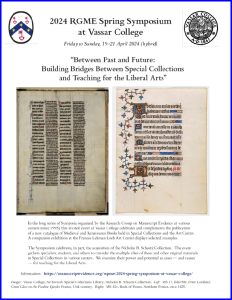
Poster 2 has two manuscript images at the center, with the RGME logo at top left and the Vassar College logo at top right.

Poster 2: Program for 2024 Spring Symposium at Vassar.

They centered upon the pair of 2024 Spring and Autumn Symposia, designed for the Project as an invited, hybrid, 3-day event in the Spring at Vassar College, and an online 1-day event in the Autumn as its follow-up.

  • 2024 Spring Symposium at Vassar College
  • 2024 Autumn Symposium “At the Helm”

The Spring Symposium took place as planned, while a few updates in the program adapted to circumstances, such as when a few speakers as short notice had to change travel plans and present in online format rather than in person. Our dedication to a hybrid format for the event maintained our commitment to our wider audience from the need to create online events in recent years, while we waited for the return of in-person events.

Spring Symposium “Between Past and Future”
April (hybrid)

That opportunity came in 2024, with the invitation to hold our Spring Symposium at Vassar College in April. The focus of the Symposium is manifested in its title,

“Between Past and Future:
Building Bridges between Special Collections
and Teaching for the Liberal Arts”
.

Speakers from Vassar and other centers in the United States and the United Kingdom reported projects and initiatives for Special Collections dedicated to teaching with original sources in manuscript and other forms.

Our subjects were primarily medieval and early modern, in keeping with the new catalogue of such materials and the special exhibition on “Books of the Middle Ages & Renaissance” at the college. Thus collectively, with the Spring Symposium, were celebrated the acquisition of the Nicholas B. Scheetz Collection of Medieval and Renaissance Manuscripts.

Autumn Symposium “At The Helm”
October (online)

Enthusiasm for the Spring Symposium led, by participants’ requests, to extend the Autumn Symposium to 2 days instead. This symposium featured a set of curated virtual visits to Special Collections, both private and public.

Poster 2 for RGME 2024 Autumn Symposium. Set in RGME Bembino. Image: Coventry Patmore, Amelia: An iIyll (1878), title page, illuminated by Bertha Patmore. Mark Samuels Lasner Collection, University of Delaware Library, Musuems and Press.

Expanding the time-frame of the Spring Symposium, the Autumn Symposium considered materials from antiquity to the present day, medieval and early modern still included. The materials under consideration included manuscripts, printed books, and coins.

The virtual visits examined highlights of collections at Vassar College (both Special Collections and the Art Center) and the Universities of Delaware, Missouri, Rochester, and Waterloo, as well as private collections. Manuscripts showcased in the presentations included examples not only from them, but also, for example, from the Biblioteca Capitolare in Vercelli, Princeton University, and the RGME’s own Library & Archives.

Collectors speaking about their collections and the inspiration for them included our RGME Associates, Mark Samuels Lasner, Beppy Owen, and Reid Byers, who previewed his exhibition on “Imaginary Books” about to open at The Grolier Club. Its catalogue, we note with delight, is set in our own RGME Bembino (like our website), Reid’s choice for its font.

The enthusiasm for that event was remarkable. It had vivid presentations and discussions about them by curators, teachers, students (undergraduate and graduate), independent scholars, and others. We can sum up the atmosphere with the words of one presider, Librarian at the University of Missouri, that the Symposium celebrated, and brought home and alive, “the joy of education”.

This momentum called for its own follow-up. Accordingly, we turned to an invitation (since January) to visit a private collection. The nature of our year’s Project encouraged us to prepare the visit, if possible, before the end of our Anniversary Year.

In-Person/Online Visit
November (hybrid)

In November, the RGME visited the Collection of Dr. Steven M. Lomazow both in person and online. The scope of the collection and our visit to it, with thanks to the generosity of Dr. Lomazow and his wife Suze Bienaimee, are described in our announcement and report:

  • RGME Visit to the Collection of Steven M. Lomazow, M.D.
  • RGME Visit to the Lomazow Collection: Report

This visit in hybrid format represents a significant landmark for the RGME. With it, we return to our tradition of In-Person Visits to collections, such as Firestone Library and the Princeton University Art Museum for our 2019 Spring Symposium “The Roads Taken”.

Poster 1 2024 Autumn Symposium

With the invited 2024 Spring Symposium at Vassar College, we have returned to In-Person Events, after having developed our multiple forms of Online Events in response to the Covid-19 Pandemic beginning in 2020.

The online 2024 Autumn Symposium “At the Helm” followed up the wonderfully successful Spring Symposium and carried forward its momentum by a set of curated virtual visits to Special Collections of various kinds, extending its range and covering many periods.

With the invited Visit to the Lomazow Collection, as a further follow-up for the curated visits of the 2024 Autumn Symposium “At the Helm”, we bring to the table the tradition of our online commitment to our wider audience.

Also, with this event came a new collaboration with the Student Friends of the Princeton University Library (SFPUL). We hope that it may continue into the future.

Culmination and Achievements

In certain ways, this hybrid visit in November represents a culmination for our 2024 Year of visits and virtual visits to see original materials attesting to the transmission of the written word across time and place. The inspiration and accomplishment of these goals formed the centerpiece for our 2024 Project “Between Past and Future”, designed to focus upon the strengths of Special Collections of many kinds for teaching and research in the Liberal Arts and other realms.

We give thanks to all our hosts, sponsors, contributors, participants, and audience for such instructive, illuminating, and enjoyable experiences.

The Golden Gate Bridge in San Francisco, California, as seen from Battery East. Photograph © Frank Schulenburg / CC BY-SA 4.0 via https://upload.wikimedia.org/wikipedia/commons/b/bf/Golden_Gate_Bridge_as_seen_from_Battery_East.jpg

Tags: 2024 Anniversary Year, 2024 Autumn Symposium, 2024 Project "Between Past and Future", 2024 Spring Symposium, Collection of Steven M. Lomazow, Vassar College, Visits to Special Collections
No Comments »

2025 RGME Autumn Colloquium at the University of Waterloo: A Failed Plan

January 5, 2025 in Announcements, Conference, Conference Announcement, Event Registration, Events, Manuscript Studies, RGME Colloquia, University of Waterloo

NOW OLD:
Plans have changed.
See
2025 RGME Autumn Colloqium on Fragments

and

2025 RGME Autumn Colloquium at the University of Waterloo with background

—————

[Note: This outdated post remains as a record
of the first intentions for the event
and its first six months of preparation
]

2025 RGME Autumn Colloquium
at the University of Waterloo

“Break-Up Books
and Make-Up Books:

Encountering and Reconstructing
the Legacy of Otto F. Ege
and Other Biblioclasts
“

Friday to Sunday 21–23 November 2025
in Hybrid Format (pending funding)
or Online by Zoom

Colloquium ‘Home Page’
for information and updates

[Posted on 5 January 2025, with updates. As of June 2025, the University of Waterloo is not a co-sponsor or host for the event. The renewed version of the initial plan retains its structure, but not that location or partner, while it honors the commitment by contributors who responded to the initial call. 

For the revised version at Princeton, see

  • 2025 RGME Autumn Colloquium on Fragments. 

For background on the necessary change, see 2025 RGME Autumn Colloquium at the University of Waterloo.]

Motto

“Yet will I leave a remnant, that ye may have some that shall escape the sword among the nations, when ye shall be scattered through the countries”
— Ezekiel 6:8

Waterloo, University of Waterloo, DRAGEN Lab, Vellum Leaf from a Book of Hours, Recto.

By request, in collaboration with the University of Waterloo, the RGME prepares a special 2025 Autumn Colloquium on the phenomena of widely dispersed remnants of dismembered manuscripts and other written materials scattered at the hands of biblioclasts such as Otto F. Ege (1888–1951), for a variety of purposes more and less laudable. We will showcase work being done in various centers and by many individuals on these materials, as part of long-term, laborious, significant, and sometimes dispersed research to identify, reclaim, and, insofar as possible, virtually reconstruct the originals and place them in context.

We seek to gather perspectives on the challenges and opportunities presented by the dispersed manuscript or other materials which survive, albeit disordered or reordered, after passing through the hands of collectors-turned-biblioclasts, for whatever reasons.

A main focus, given the number and variety of projects dedicated to them, will be the manuscripts and other materials dispersed by Otto F. Ege and his collaborators, notably his wife/widow Louise and the New York book-dealer and book-breaker Philip C. Duschnes (1897–1970). Yet, not least because many of their remnants have joined or become intermixed with fragments dispersed by others and through diverse processes in varied collections, it is worthwhile to consider that complex factor for their effective study as well.

We seek to showcase the work of these projects, compare notes about issues and methods of research, and set the legacy of those biblioclasts in the context of others working as predecessors, contemporaries, or followers, as they also redirected the course of manuscript and related studies by disrupting and dislocating its evidence.

The ‘delivery methods’ of dispersal range from assemblages of sets of fragments as specimens in Portfolios, Leaf-Books, Albums, Scrapbooks, or Loose Leaves which might circulate in mats with or without labels, on their own, or in groups sans identifying information. In effect, many of these remnants were cast out on their own as no-name ‘orphans’ whom expertise, serendipity, and circumstance might recognize as ‘foundlings’ or find forever homes, whether virtual or actual. (See The “Foundling Hospital” for Manuscript Fragments.)

Our Colloquium highlights the processes of recovery by multiple, interlinked, and interlocking means, as we gather representatives from the fields of manuscript studies and fragmentology to share their stories, processes, progress, and accomplishments.

New Haven, Yale University, Beinecke Rare Book and Manuscript Library, Otto F. Ege Collection, Leaf in Ege’s Mat from ‘Ege MS 14’. Opening page of the Apocalypse / Revelations in a large-format Lectern Bible in the Latin Vulgate Version. Photograph by Mildred Budny.

Scope

The University of Waterloo and the RGME propose to co-host an international Colloquium with hybrid functionality, for access by a wide audience with interests in multiple subjects. Our two educational organizations in Canada and the United States respectively combine experience and skills to produce a scholarly event with companion publications pre- and post-event, to promote and disseminate research work and discoveries in multiple, interrelated fields of study.

Waterloo, University of Waterloo, DRAGEN Lab, Vellum Leaf with music and notation for liturgical chants: Recto.

Our plan takes its starting point from the wish to gather expertise and perspectives from a different collections of manuscript materials — such as at the Medieval DRAGEN Lab (Digital Research Arts for Graphical & Environmental Networks — and the rich variety of new and long-term projects (both institutional and individual) dedicated to research on the medieval Western manuscripts despoiled and dispersed by Otto F. Ege and his collaborators.

These initiatives include the new project by the Cantus database (Cantus: A Database for Latin Ecclesiastical Chant – Inventories of Chant Sources) to produce a database of the musical manuscript fragments in Ege’s Portfolio of Fifty Original Leaves from Western Manuscripts (FOL). This notorious Portfolio was issued in multiple sets now widely dispersed in public or private collections through North America and beyond. Like others of Ege’s Portfolios, some sets are lost, or lost track of; some have themselves become fragmented, as parts have been removed, as specific manuscript specimens were further disjointed from their relatives, original or newer companions in the biblioclasts’ assemblages. Some of these ‘orphans’ or cast-offs have lost their identifying Ege mats or labels, further to complicate the issues of identification, recognition, and retrieval.

The RGME’s long-term project of research in these fields focuses on the variety of Ege’s Portfolios overall.  Dedicated to specific genres of books, such as Famous Books or Famous Bibles, they include not only manuscript fragments but also a multitude of printed materials ranging from incunabula (up to the year 1500) to the twentieth century; all were selected and arranged by Ege and his circle as specimens of the graphic arts and book arts for instruction and display. (For examples, see our blog on Manuscript Studies and its Contents List for Ege materials.)

Private Collection, Leaf from ‘Ege MS 14’. Part of the Book of Jeremiah, Recto, Detail. Photograph by Mildred Budny.

Research on the surviving evidence on many fronts and in multiple centers can bring expertise to bear upon specific genres (such as manuscripts containing music). So, too, it reveals the processes of workshop practices over decades in the destruction, re-constitution, and further distribution of the original books. For example, such elements have bearing upon the provenance of individual fragments and potential impact upon that of other fragments whose provenance might not otherwise be known.

Collection of Richard Weber, Leaf from Otto Ege MS 14, recto. Photograph by Richard Weber.

Given the progress of these and other projects in various centers concerned with Ege’s legacy, the time is right to bring their representatives (established scholars, curators, collectors, and others, as well as younger scholars) together to compare notes, showcase their work, and strengthen contacts between individuals and centers across borders.

By examining the book-breaking practices overall by “Ege & Co.” in the wider context of biblioclasts over time, including many of Ege’s contemporaries, predecessors, and followers, we might gain fuller knowledge of the individually as well as collectively destructive habits and their legacy. Likewise by comparing notes, surveying the results so far of different projects, and, it might be, identifying more of the seemingly lost fragments in unknown or unexpected places, our Colloquium could cross thresholds and open more gateways to wider knowledge.

Such larger contexts provide wider horizons and more comprehensive awareness of the destructive tendencies towards books in given times and places. They can demonstrate, by examination and comparison, the particular characteristics or ‘style’ of the collector, book-breaker, book-seller, and the resulting forms as altered pieces or bodies of evidence for the lost and damaged originals. Among notable predecessors for the genre can be counted the albums of “visually appealing” manuscript fragments created by Samuel Pepys (1633–1703) or the cuttings prepared by John Ruskin (1819-1900) and others.

Examining the complex legacy of these various re-creators of medieval manuscripts and other written materials and the range of projects dedicated to them from perspectives and fields of many kinds, sometimes integrated across a broad spectrum encompassing expertise in the arts and sciences, can advance knowledge in individual projects as well as in wider discourse relating to the transmission of written evidence from generation to generation and century to century, with losses, discoveries, and reconstitutions along the way.

Our focus for the co-sponsored Autumn Colloquium is the legacy of book-breakers, book-destroyers, and book-recreators active in multiple centers in Europe, the British Isles, and North America (at least), with the fragments produced by their activities and transmitted to diverse locations worldwide, often without appropriate identifying information. Our task, as receivers of the evidence from such disruptions, is to make sense of the evidence, identify it appropriately, recognize its characteristics as bodies of witnesses with a complex history, compare information about diverse projects (in many centers) relating to these materials, gather feedback, and disseminate the results to a wide audience.

Waterloo, University of Waterloo, DRAGEN Lab, Vellum Leaf from a Book of Hours, Recto, detail.

Purpose

This 2025 Colloquium stands within the long tradition of symposia, colloquia, workshops, and other scholarly events of the Research Group on Manuscript Evidence, now entering its second quarter-of-a-century as a nonprofit educational corporation based in Princeton, New Jersey. The RGME is dedicated to the study of manuscripts and other written records across the centuries. This year our theme is “Thresholds and Communities”.

Waterloo, University of Waterloo, DRAGEN Lab, Vellum Leaf with music and notation for liturgical chants: Verso.

For the 2025 Autumn Colloquium on 21–23 November, the RGME collaborates with the University of Waterloo and its range of programs and projects, including the Cantus Database and the DRAGEN Lab.

The Advisory Committee for the Colloquium comprises:

  • Mildred Budny, Director, Research Group on Manuscript Evidence
  • Debra Lacoste, Cantus Database, University of Waterloo; The Institute of Mediaeval Music; Digital Analysis of Chant Transmission, Dalhousie University
  • David Porreca, Associate Professor; President, Faculty Association of the University of Waterloo; Co-Director, Medieval Studies Undergraduate Program; Department of Classical Studies and Department of History, University of Waterloo

Spanning three days with half-days on Friday and Sunday, the Colloquium will include a series of sessions with presentations and Q&A, roundtable discussions/panels, hands-on workshops, and exhibitions of several kinds.

To augment the scholarly sessions of presentations and discussions, we plan for displays of original materials in manuscript or other forms and demonstrations of the sounds of music represented in medieval manuscript fragments. Among them is a SoundWalk which allows passersby to access audio recordings of specific musical passages preserved on medieval leaves in collections including the DRAGEN Lab and the Cantus Database.

A Reception ending each day’s sessions will lead from the scholarly program to further conversations.

Participants

Participants represent a wide range of interests, approaches, subjects, centers, and materials.

Speakers, Respondents, Panelists, Hosts, and Presiders
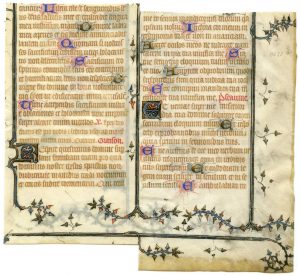
Rejoined Pieces of a Leaf from a Book of Hours. Private Collection, reproduced by permission.

Rejoined Pieces of a Leaf from a Book of Hours. Private Collection. Photography by Mildred Budny.

Participants include (in alphabetical order):

Alison Altstatt (University of Northern Iowa)
Steven Bednarski
(DRAGEN Lab, University of Waterloo)
Mildred Budny (Research Group on Manuscript Evidence)
John P. Chalmers (Retired)
Katharine C. Chandler (University of Arkansas)
Lisa Fagin Davis (Medieval Academy of America)
Juilee Decker (Rochester Institute of Technology)
Augustine Dickinson (University of Hamburg)
Scott Ellwood (Grolier Club Library)
Steven Galbraith (Rochester Institute of Technology)
Hannah Goeselt (Massachusetts Historical Library)
Scott Gwara (University of South Carolina and King Alfred’s Notebook LLC)
Elizabeth Hebbard (Indiana University Bloomington and Peripheral Manuscripts Project)
Josephine Koster (Winthrop University)
Debra Lacoste (University of Waterloo, Cantus Database, and Dalhousie University)
David Porreca (University of Waterloo)
Eleanor Price (University of Rochester)
Agnieszka Rec (Beinecke Rare Book & Manuscript Library)
Irina Savinetskaya (Syracuse University)
Kate Steiner (Conrad Grebel University College and University of Waterloo)
Anna Siebach–Larsen (University of Rochester)
Richard Weber (Independent Scholar)
N. Kıvılcım Yavuz (University of Leeds)

And others . . .

Some Results

RGME tradition produces illustrated Program Booklets for major events such as this Colloquium, with participants’ abstracts and selected accompanying illustrations, to grant insider glimpses for our audience (at the event and after) not necessarily familiar with the wide range of subjects and materials under discussion.

A recent example from our 2024 Autumn Symposium “At the Helm” can be downloaded from the RGME website: 

  • 2024 Autumn Symposium Booklet

Waterloo, University of Waterloo, DRAGEN Lab, Vellum Leaf from a Book of Hours, Recto, with the Opening of the Liturgical Kalendar for the Month of February.

We explore sources of funding and sponsorship for the event as a whole.  Information about the results would emerge as these explorations advance. Our aim is to have an in-person event with online access (for speakers and audience) for a fully hybrid colloquium; the online functionality would occur by Zoom Meetings (rather than Webinars with closed access). If funding proves elusive for the in-person facets as well, the event will take place online by Zoom.

We hope to welcome you to the Colloquium.

*****

Note:  For information about the RGME Autumn Colloquium as it develops, please continue to visit this ‘Home Page’.

For related RGME events, please see, for example:

  • 2025 Spring and Autumn Symposia

Registration

To register for RGME events, please visit:

  • RGME Eventbrite Collections

To register for the Autumn Colloquium, we offer portals to attend online or in person respectively.

1) Register for ONLINE Attendance

  • 2025 RGME Autumn Colloquium: Tickets for ONLINE Attendance

2) Register for IN PERSON Attendance

  • 2025 RGME Autumn Colloquium: Tickets for IN PERSON Attendance

Registration Fees

Circumstances lead us to charge a modest registration fee to attend this 3-day event. The extra costs for preparations in several formats and from different locations require a registration fee to help to offset them.

When you register, we ask you please to add the Eventbrite handling fee for the transaction, as a contribution to the RGME’s costs for this event.

1) General Attendance: $60 US per person

2) Student Discount for Official Students: $35 US per person. When registering for the discount, please let us know your registered affiliation as a student.

The registration fee is waived only for Speakers and Presiders, for whose contributions we give thanks.

We also encourage you to consider adding a Voluntary Donation in support of the RGME, a Section 501(c)(3) nonprofit educational organization principally powered by volunteers.  See:

  • 2025 Annual Appeal
  • Donations

We thank you for your support and your interest in the Colloquium.

*****

Questions? Suggestions?

  • Waterloo, University of Waterloo, DRAGEN Lab, Vellum Leaf from a Book of Hours, Recto, with the Liturgical Kalendar for the Month of February: Top.

    Leave your comments or questions below

  • Contact Us
  • Sign up for our Newsletter and information about our activities.
    Send a note to director@manuscriptevidence.org or RGMEevents@gmail.com

Visit our Social Media:

  • our FaceBook Page
  • our Facebook Group
  • our Twitter Feed (@rgme_mss)
  • our Bluesky nest @rgmesocial.bluesky.social)
  • Our Instagram account (rgme94)
  • our LinkedIn Group

Join the Friends of the RGME.

Register for our Events by the RGME Eventbrite Collection.

Among them are the

  • 2025 Spring and Autumn Symposia (online or hybrid)
  • Episodes of “The Research Group Speaks” (online)
  • RGME Workshops on “The Evidence of Manuscripts, Etc.” (online, in person, or hybrid)
  • Meetings of the Friends of the RGME (online)

Please consider making a Donation in Funds or in Kind for our nonprofit educational corporation powered principally by volunteers. Your donations and contributions are welcome, and can go a long way. They may be tax-deductible to the fullest extent provided by the law.

  • Donations and Contributions
  • 2025 Anniversary Appeal

We thank the hosts, co-organizers, advisers, and participants for generously contributing to this Colloquium.

*****

Waterloo, University of Waterloo, DRAGEN Lab, Vellum Leaf from a Book of Hours, Verso.

 

Tags: Albums of Manuscript Fragments, Biblioclasts, Broken Books, CANTUS Database, Dispersed Manuscripts, DRAGEN Lab, Early modern printing, Fragmentology, Leaf-Books, manuscript fragments, Manuscript studies, Medieval manuscripts, Otto Ege Portfolios, Otto F. Ege, Philip C. Duschnes, RGME Colloquia, University of Waterloo
No Comments »

2025 International Medieval Congress at Leeds: RGME Program

December 9, 2024 in Announcements, Conference, Conference Announcement, Events, ICMS, International Medieval Congress, Leeds, Manuscript Studies

2025 International Medieval Congress
at Leeds:
RGME Program

32nd Annual IMC
Monday to Thursday 07–10 July 2025
(with In-Person and Virtual Components)

“Manuscripts as Worlds of Learning”
(3 Sessions + Roundtable)

“Knowledge Games and Games of Knowledge”
(1 Session)

Congress Theme: “Worlds of Learning”

Private Collection. Stereoscopic Photograph of Bridges of Paris, circa 1850s.

[Posted on 8 December 2024, with updates]

Building upon the successful completion of our RGME Inaugural Session at the International Medieval Congress (IMC) at the University of Leeds in July 2024, and responding to the strength and numbers of proposals for our Call for Papers for the IMC in 2025, we announce the Program for our sponsored activities at next year’s Congress.

For information about the Congress, see

  • its official website and
  • the Padlet Page showing the range of organised sessions advertising for papers (as part of the Call for Papers, now completed).

“Worlds of Learning” at Leeds in 2025

The Thematic Focus for the IMC in 2025 is “Worlds of Learning”. The broad scope is described in the general Call for Papers: IMC 2025 – ‘Worlds of Learning’.

The worlds to explore in and for learning are wide. We look to manuscripts as carriers, portals, and thresholds, in keeping with our chosen theme for 2025 RGME activities, “Thresholds and Communities”.

Our Aims

Our set of interlinked events planned for the Research Group on Manuscript Evidence (RGME) focuses on the power and potential of manuscripts to contain, convey, and embody worlds of learning within their span.  In effect, given their structure and contents, as we approach them as beholder, user, reader, student, teacher, or admirer, they may carry worlds in our hands.

How might medieval manuscripts do so, variously for their medieval audience, later intermediaries, and our own times? How might and do they function as “Worlds of Learning” in their own right/write?  We explore.

As interest has grown, the two sessions (plus roundtable) which we planned for “Manuscripts as Worlds of Learning” grew into three (plus roundtable), amounting to four events.  See:

  • Call for Papers for “Manuscripts as Worlds of Learning”

We also present a Session with Papers devoted to “Game Knowledge and Knowledge of Games”, which follows up a strand in our RGME Inaugural Session this year.

  • “Knowledge Games and Games of Knowledge”: An RGME Session for IMC 2025

Following in succession the close of the Call for Papers, our choices for the programs for the sessions and roundtable, and the acceptance of all these sessions plus roundtable by the IMC, we present

  • a suite of events containing three Sessions with Papers accompanied by a Round Table with Discussion, all dedicated to “Manuscripts as Worlds of Learning”
    (Monday 7 July 2025)
  • a Session with Papers dedicated to “Knowledge Games and Games of Knowledge: A Global Perspective on How Manuscripts Conserve and Transmit Ludic Knowledge”
    (Tuesday 8 July 2025)
    Read the rest of this entry →

Tags: Games of Knowledges, International Medieval Congress, Knowledge Games, Manuscript studies, Manuscripts as Worlds of Learning, University of Leeds, Worlds of Learning
No Comments »

Knowledge Games and Games of Knowledge: An RGME Session for IMC 2025

August 13, 2024 in Announcements, Call for Papers, Conference, Events, International Medieval Congress, Leeds, Manuscript Studies

Call for Papers
“Knowledge Games and Games of Knowledge:
A Global Perspective on
How Manuscripts Conserve and Transmit Ludic Knowledge”

Session
Sponsored by the RGME
IMC Leeds 2025

Organised by Michael A. Conrad
(University of Sankt-Gallen)

[Posted on 13 August 2024]

Following the success of our Inaugural Session at the International Medieval Congress this year, the Research Group on Manuscript Evidence announces its proposed Sessions for the International Medieval Congress to be held at the University of Leeds from 1–10 July 2025.

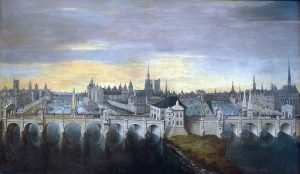
Paris, Musée Carnavalet, Projet pour le Pont Neuf, circa 1577. Image via Wikimedia via Creative Commons Attribution 3.0 Unported.

Background: 2024

Our 2024 Inaugural Session, co-organised by our Associates Ann Pascoe-van Zyl and Michael Allman Conrad, focused on “Building Bridges ‘Over Troubled Waters'”:

  • 2024 International Medieval Congress at Leeds: 2024

Foreground: 2025

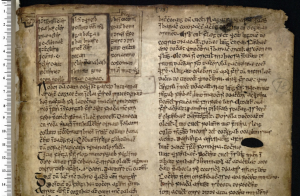
Dublin, Royal Irish Academy, MS 23 E 25, p. 73, top. Image via https://codecs.vanhamel.nl/Dublin,_Royal_Irish_Academy,_MS_23_E_25 via Creative Commons (CC BY-SA 3.0).

For 2025,with the IMC’s Thematic focus of “Worlds of Learning”, the RGME proposes an integrated suite of events comprising a pair of Sessions of papers plus a Roundtable discussion on “Manuscripts as Worlds of Learning”.

  • 2025 International Medieval Congress at Leeds: Call for Papers (Manuscripts as Worlds of Learning)

In addition, following up on a strand in our 2024 Inaugural Session, the RGME also proposes a sponsored session organised by that session’s co-organizer and presenter, Michael Allman Conrad.

The Plan for the Session

“Knowledge Games and Games of Knowledge:
A Global Perspective on
How Manuscripts Conserve and Transmit
Ludic Knowledge”

Recent scholarship has pointed out time and again how much in the Middle Ages games and other joyful pastimes were not only cherished and accepted as an essential part of everyday life, but also well appreciated as educational tools for making difficult lessons more palatable for students.

Some of these educational games have a long tradition, such as rithmomachia, which was used in schools for instruction in the quadrivial arts and still known by scholars of the 17th century. Some disciplines, such as astronomy, even had their own games — in this case, for example, the ludus astrologicus. The knowledge of such elaborate games was transmitted through manuscripts, often as part of miscellanies. Besides, there is no lack of writings dedicated to more profane games either. In fact, there are collections of board games (and other pastimes), with some of these manuscripts showing very rich and ornate embellishments and game diagrams, along with vivid miniatures depicting players in action.

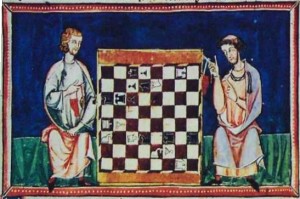
Madrid, Real Biblioteca del Monasterio de El Escorial, MS T-I-6, folio 27 verso. Image in the Public Domain, Via Wikipedia Commons.
Madrid, Real Biblioteca del Monasterio de El Escorial, MS T-I-6, folio 27 verso. Image in the Public Domain, Via Wikipedia Commons.
Examples of such works include

  • the Book of Games (Libro de acedrez dados e tablas c. 1284) by Alfonso X of Castile, in the Bonus Socius group (13th century?),
  • the Paris manuscript of Le jeu de echecs by Nicola de S. Nicholai (Paris, Bibliothèque nationale de France (BNF), MS fr. 1173, 14th century),
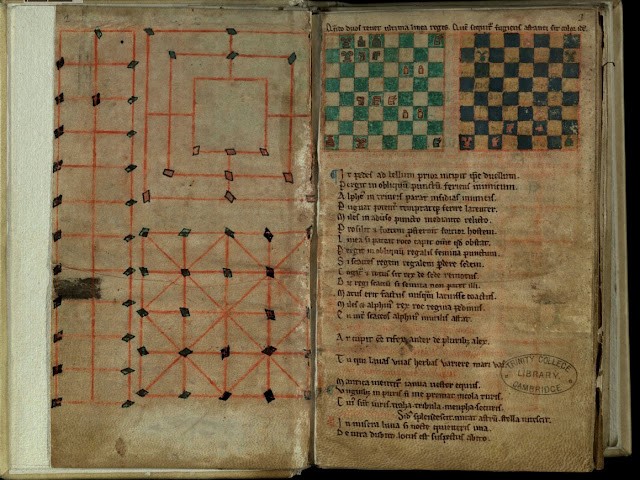
  • as well as lesser-known manuscripts, such as Cambridge, Trinity College, MS O 2.45 (after 1248 AD).

The book medium, however, poses serious challenges to scribes concerned with conserving and conveying knowledge related to games and other pastimes, as their existence is ephemeral and their experience difficult to verbalize — which is a reason why in the (Arabic and European) tradition medieval books on games usually came with said pictures and diagrams, with the intent to compensate for what cannot be easily expressed through words alone. What is more, in medieval writings on games their epistemological status often remains ambivalent and uncertain, as they were often touted as morally ambiguous and did not fit existing knowledge systems. That said, there nonetheless were some scholars that tried to fit ludic knowledge into prevalent eschatological framework of knowledge, such as Hugh of Saint-Victor, with some of them basing their (re-)assessments of the morality and epistemic status of games and other forms of entertainment on Arabic and Greek influences.  As reaffirmed by Hugh and in the work of Thomas Aquinas, the Latin concept of ludus could not only serve as an umbrella term for various kinds of games, but all forms of entertainment.

While the focus of the proposed Session is games, the evocation of ludic knowledge is intended as an invitation to different kinds of pastimes in order jointly to examine how medieval scholars dealt with game-related forms of knowledge, from material objects to their metaphysical and anthropological relevance. Especially the latter implies and extends the perspective towards practices employing games and other pastimes methodologically for educational purposes. Consequently, the geographical scope is not restricted to the European sphere. On the contrary, since there is strong evidence that European game manuscripts drew much from Arabic and other non-Latin traditions, contributors focusing on the Byzantine Empire, the Islamic world, India, or other cultural world regions are very much welcome and encouraged to partake.

Some possible questions could be (but are not limited to):

  • What do we know about the authorship of game manuscripts?
  • Are the works written by single individuals or collectives?
  • In what types of miscellanies do writings on games and game manuals appear and why?
  • How do manuscripts/authors deal with ephemeral aspects of games and other pastimes that are difficult to be expressed linguistically?
  • How can we reconstruct the concrete educational practices wherein games and other pastimes were used?
  • What hints thereof can we find in the material evidence of manuscripts?
  • How do authors try to systematize ludic knowledge and where do they position it within given epistemic frameworks?
  • What can we say about the relationship between game diagrams and diagrammatic representations in scientific disciplines in terms of a shared visual vocabulary?

Cambridge, Trinity College, MS O.2.45, fols 2v-3r. Image copyright the Master and Fellows of Trinity College, Cambridge, via CC-NY 4.0.

Note on the Image

Cambridge, Trinity College, MS O 2.45 (after 1248 AD), folios 2v and 3r. Accompanying the text, diagrams and illustrations depict two chess boards, an alquerque, a nine-mens-morris and a daldøsa game board. The first moves of the game are already played.

Image © the Master and Fellows of Trinity College, Cambridge, via License CC BY-NC 4.0 via Trinity College Cambridge.

Proposals

For information about submitting your proposals for our Sessions, please see the CFP for our companion suite for IMC 2025:

  • 2025 International Medieval Congress at Leeds: Call for Papers (Manuscripts as Worlds of Learning)

Deadlines for Proposals

  • 5 September 2024 for your individual paper proposals for our RGME Sessions and Round-table Discussion
  • 30 September 2024 for the RGME to complete and submit its programmes.

To prepare your proposals, see the IMC instructions

  • How to Submit a Proposal

Send your proposals for our Session to us at

  • rgme.imc.sessions@gmail.com by 5 September 2024

When your proposals are accepted, we will direct you to submit them through the

  • IMC-Leeds Confex Submission Portal

Spread the Word

Look for our RGME CFPs on the IMC 2025 website:

  • IMC 2025 Padlet Page

Questions and Suggestions?

If you wish, please:

  • add your Comments here,
  • send us a message (Contact Us),
  • visit our Facebook Page and Facebook Group,
  • join the Friends of the Research Group on Manuscript Evidence (there is no charge), and
  • register for our events on our RGME Eventbrite Portal:
    RGME Eventbrite Collection

*****


Tags: Alfonso X of Castile, Board Games, Book of Games, Chess, Games in the Middle Ages, History of Board Games, Jeu des echecs, Le jeu de echecs, Ludus astrologicus, Manuscript studies, Quadrivia, Rhythmomachy
No Comments »

Medieval Women’s Networks

August 4, 2024 in Announcements, Event Registration, Events, Manuscript Studies, Medieval Women's Networks

“Medieval Women’s Networks:
Exploring Tools and Techniques
for Digital Analysis”

A Pair of Interactive Public Workshops

co-organized by
Kathy Krause and Laura Morreale
and co-sponsored by the RGME

Thursday and Friday 17–18 October 2024 (Online)
12:30–14:30 pm EDT (GMT-4)

[Posted on 5 August 2024, with updates]

We gladly announce another event for our 2024 Anniversary Year.

The RGME has been invited to co-sponsor the free 2-day online event to explore and advance the swiftly developing world of work on Medieval Women’s Networks.

Co-Organizers

The event is conceived and co-organized by experts

  • Kathy Krause (University of Missouri, Kansas City, Emerita)
  • Laura Morreale (Independent Scholar and Middle Ages for Educators)

Laura, our RGME Associate, gave a presentation for our 2024 Anniversary Symposium “Manuscript Heart” in February. This coming event joins a series of collaborative events and projects which she helps to organize, accomplish, and publish.

We are glad to join forces with Kathy and her and all the co-sponsors for Medieval Womens’ Networks.

Co-Sponsors

To be held online, the event is co-sponsored by

  • Center for Digital and Public Humanities, the University of Missouri Kansas City
  • Digital Medievalist
  • the Research Group on Manuscript Evidence
  • and a generous Anonymous Benefactor.

UMKC Center for Digital and Public Humanities Logo

Logo of the Research Group on Manuscript Evidence (colour version)

RGME Logo

Digital Medievalist Logo

Dates

The Interactive Public Workshop will take place over two days, in sessions devoted respectively to

1) Projects. Thursday 17 October 2024
2) Data. Friday 18 October 2024

Each session is scheduled for 12:30–2:30 pm EDT (GMT-4) online.

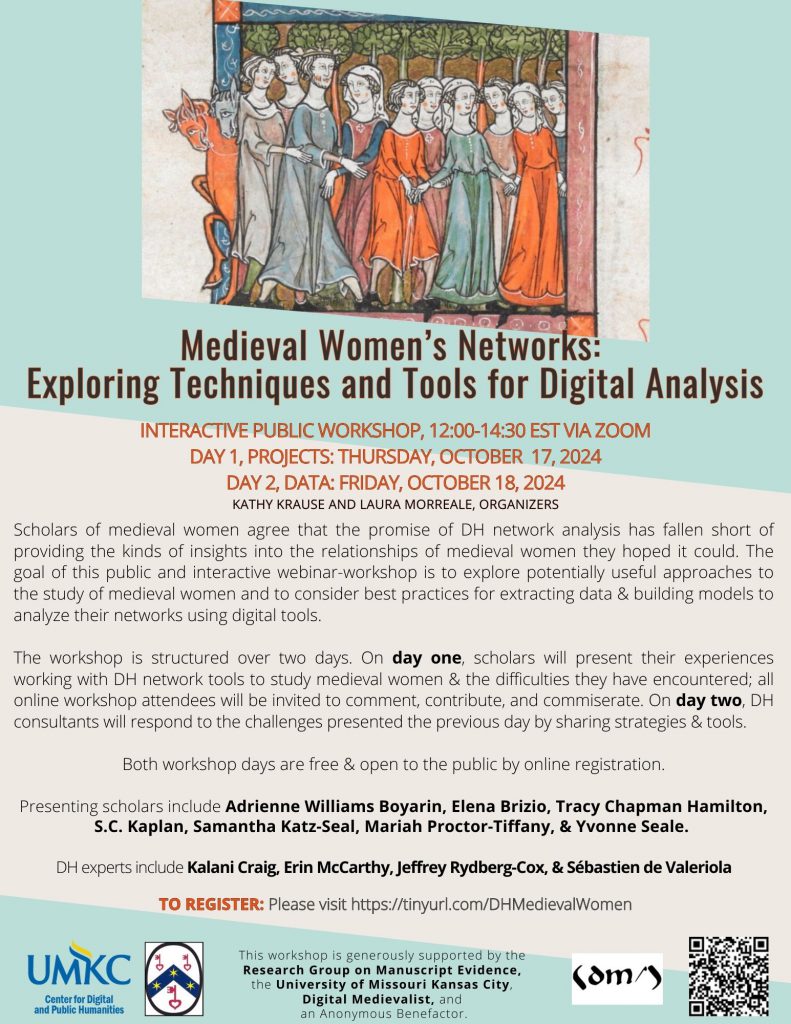
For information see the flyer, shown here, and links below.

“Medieval Women’s Networks” Flyer.

Participants

Speakers and Digital Humanities Experts come from an international variety of centers and perspectives.

Speakers for Workshop 1: Projects

  • Adrienne Williams Boyarin (University of Victoria)
  • Elena Brizio (Georgetown University)
  • Tracy Chapman Hamilton (Sweet Briar College)
  • S.C. Kaplan (University of California, Santa Barbara)
  • Samantha Katz–Seal (University of New Hampshire)
  • Mariah Proctor–Tiffany (University of California, Long Beach)
  • Yvonne Seale (State University of New York, College at Geneseo)

Digital Humanities Experts for Workshop 2: Data

  • Kalani Craig (Indiana University)
  • Erin McCarthy (Saint Lawrence University)
  • Jeffrey Rudberg–Cox (University of Missouri, Kansas City)
  • Sébastien de Valeriola (Université libre de Bruxelles)

Information and Registration

To register please visit the Event registration form via Google Docs, where can also be found online information.

1. Event registration
2. An online information sheet
If Google Workspace is not accessible to you, please contact us. (See below.)
The Event flyer is available for download on the RGME website in two formats:
  • DHWomenFinalFlyer3 (pdf)
  • Medieval Women’s Networks Flyer (jpg)

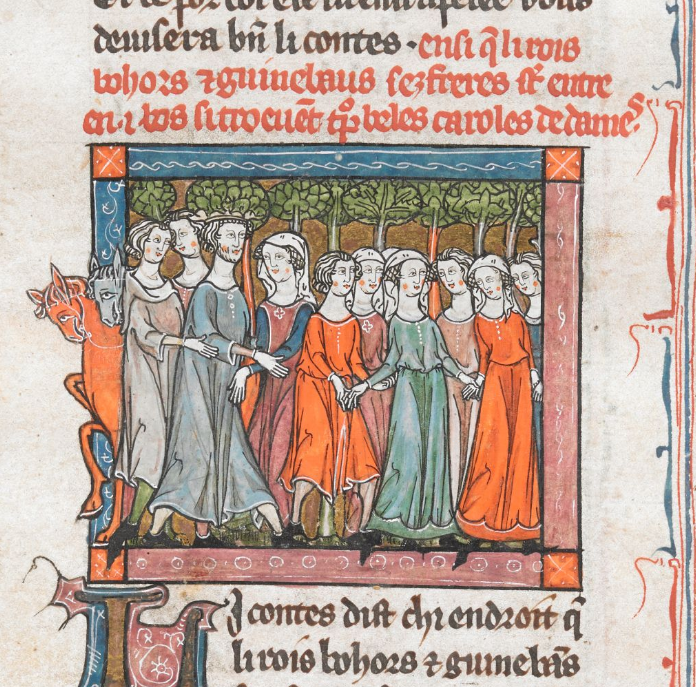
London, British Museum, Additional MS 10292, fol. 149r. Prose Lancelot-Grail. Saint Omer or Tournai, 1316. Image © The British Library.

We thank the co-organizers and co-sponsors of Medieval Women’s Networks for the opportunity to join the carefully-prepared program for this outstanding event.  We look forward eagerly to it.  We invite you to join it!

*****

Other RGME-sponsored Events
for our 2024 Anniversary Year

  • 2023 and 2024 Events
  • Episode 17. “RGME Retrospect and Prospects: Anniversary Reflections (Saturday 21 September, online)
  • 2024 Autumn Symposium “At The Helm” (Friday and Saturday 25-26 October 2024, online)
  • Episode 18. “Women as Makers of Books” (Saturday 14 December 2024, online)

To register for these sponsored events, please visit the RGME Eventbrite Collection:

  • RGME Eventbrite Registration Portal

An RGME Bulletin Board

Ronda, Galicia, Spain, Puente Nuevo Bridge. Photograph 14 August 2007 by Mark Gilbert. Image: Judas6000 at English Wikipedia, CC BY 3.0 <https://creativecommons.org/licenses/by/3.0>, via Wikimedia Commons at https://commons.wikimedia.org/wiki/File:Punte_Nuevo_Bridge,_Ronda_-_Spain.jpg.

The co-sponsorship for Medieval Women’s Networks leads the RGME to open a new page on our website for news about activities, projects, conference papers, publications, and initiatives by people of the RGME.  Functioning as a form of bulletin board with announcements, it appears here:

  • Around and About with the RGME

First up, with an announcement by Laura Morreale, is the Sweet 16 Competition launched by the Princeton-based Middle Ages for Educators (MAFE). The due date for proposals is 1 October 2024.

Questions? Suggestions?

  • Leave your comments or questions below
  • Contact Us

Visit our Social Media:

  • our FaceBook Page
  • our Facebook Group
  • our Twitter Feed (@rgme_mss)
  • our Bluesky nest @rgmesocial.bluesky.social)
  • our LinkedIn Group

Join the Friends of the RGME.

Consider making a Donation in Funds or in Kind for our nonprofit educational corporation powered principally by volunteers. Your donations and contributions are welcome, and can go a long way. They may be tax-deductible to the fullest extent provided by the law.

  • Donations and Contributions
  • 2024 Anniversary Appeal

Remember to register for “Medieval Women’s Networks” for 17–18 October 2024 (see above). See you there!

*****

Tags: Center for Digital and Public Humanities, Digital Medievalist, Interactive Public Workshop, Medieval Women's Networks, RGME Anniversary, RGME Anniversary Year, University of Missouri Kansas City
No Comments »

2024 International Congress on Medieval Studies: Report

May 15, 2024 in Abstracts of Conference Papers, Anniversary, Announcements, Conference, Conference Announcement, Events, ICMS, Illustrated Handlist, International Congress on Medieval Studies, Kalamazoo, POMONA, Postal History at Kalamazoo, Societas Magica

2024 International Congress on Medieval Studies: Report

59th ICMS (9–11 May 2024)

Held in a transitional ‘hybrid’ form
with RGME Co-Sponsored Sessions,
an Open Business Meeting,
and Co-Sponsored Reception

In a Nutshell:
Mission Accomplished!

With Thanks to our Participants,
Co-Sponsors, Audience, and Friends

[Posted on 14 May 2024]

Western Michigan University, Valley III from the side. Photograph: David W. Sorenson.

Western Michigan University, Valley III from the side. Photograph: David W. Sorenson.

After the successful completion of all our activities at the 59th Annual 2024 International Congress on Medieval Studies International Congress on Medieval Studies (ICMS), we report our accomplishments and give updates about changes to the Program which we announced (with updates as appropriate) for its items. See the full ICMS Program issued by its organizing Committee:

  • 2024 Congress Program, with Corrigenda.

The Journey

Already from our first preparations toward the 2024 Congress,

  • starting with the 2023 Congress and our Open Business Meeting there to invite proposals,
  • moving on to our proposals for Sessions for 2024 submitted to the Congress Committee by 1 June 2023,
  • progressing with the approved Call for Papers for the 2024 ICMS,
  • reaching the firm conclusion of that Call on 15 September 2024, and
  • selecting the Program for our Sessions according to responses to that Call and related developments,

we have made revisions and provided updates for our plan.

They gave rise to our announcement for our own (and co-sponsored) Program (including the details of Sessions, their speakers, titles of papers, order of presentation, and so on; as well as ancillary events such as the Anniversary Reception), its updates throughout the months from October to May and the start of the Congress.  Now we follow up with the Report.

The proposals received not only yielded Programs for which the order of Papers and the follow-up invitation to Presiders and Panelists, but also encouraged us to combine resources within the Research Group, with our frequent co-sponsor, the Societas Magica, and with others.  Thus we collaboratively created a strong program of activities for the 2024 Congress.

Along the way, between

  • the submission of our selected Program to the Congress Committee by 15 October 2023,
  • its acceptance,
  • the assignment of dates, times, and venues for the individual activities for the 2024 Congress Program as officially published (with a series of Corrigenda, not affecting us, as the date of the Congress approached), and
  • the start of the Congress itself on Thursday 9 May 2024, with events variously in online and/or in-person formats,

our own 2024 Congress Program has had a few minor revisions, as people and technological arrangements permitted.

These changes did not interfere with the overall success of our activities.  Our 2024 Congress Program reported various changes up to the Congress; this Report describes those effected at or around the Congress.

Access Included

As in 2023, the RGME responded to the partly ‘hybrid’ conditions of the Congress by providing its Zoom Meetings for two scheduled solely ‘In Person’ Sessions, as well as for our In-Person catered lunchtime Open Business Meeting, and by reserving an onsite Remote Participation Room on campus for those participants for a scheduled ‘Virtual’ Session who were present at the Congress to be able to gather to sign on to the online Session hosted by the Congress Confex Portal. The RGME managed all these extra Zoom provisions and reservations, as part of its contribution to sponsoring or co-sponsoring Sessions at the ICMS over the years.

It can be worth noting that those donations — at the cost of the RGME, are made possible by donations to enable its Zoom Subscription, by our own provisions for technical backup, and principally by the many pro-bono donations by its Director as overall organizer and co-ordinator of the RGME activities at the Congress and elsewhere — are not covered within the costs to produce the Congress, which registration fees by attendees online and in-person work to subsidize. The extra efforts by the RGME to provide features or facilities for the contributors, participants, and attendees of its activities at the Congress, whether online or onsite, correspond with our approach to our activities of many kinds.

In this spirit, the RGME has consistently stepped up to the plate in response to changes in the facilities for the ICMS before and after the start of the Covid-19 pandemic, when the Congress was successively

  • 1) cancelled outright (2020),
  • 2) rescheduled in online format only (2021), and
  • 3) re-introduced in a partly in-person, partly virtual, ‘hybrid’ format (2022, 2o23, 2024, and more).

Throughout these developments, responding to their changing requirements, the RGME has continued to seek, insofar as possible with our own limited resources, to provide access to our sponsored and co-sponsored Congress activities to as wide an audience as possible, including those with disablilities, health issues, and difficulties in finding resources to travel and cover expenses to attend the Congress in person.

These ‘extras’ which we provide stand alongside the RGME tradition for many years of promoting our authors and the contributions of their work to our Congress Programs (see our Congress Activities) by the series of RGME promotional notices for the year’s Congress (with updates):

  • on our official Website (You are Here),
  • on our Social Media (listed Below),
  • in the Posters for each of our Congress activities, and
  • in the Congress Abstracts which we publish for the Authors’ presentations.

The Posters normally are displayed in printed form at the Congress — where permitted, such as on cork boards in the different buildings and in the rooms where our events take place — and on the RGME website, with printed copies also sent to presenters as souvenirs to display in their offices or studies and to give to their mothers.  For example for the 2015 Congress:

Derek Shank stands beside the RGME Poster Display for the 2025 ICMS. Photography by Mildred Budny.

The Abstracts appear in their own individual webpages — which can 1) extend for a longer span than the assigned limit (100 words) for the submission of a proposal for a Congress Paper; 2) add notes, links, and bibliography; and 3) include images — as publications in their own right.

Moreover, we take care to index all the Authors’ Abstracts for a given Congress to grant wider access both:

  • Alphabetically by Author’s Surname and
  • Chronologically by Year of Author’s Presentation.

The Arrival

After the Journey to arrive, there remained some bumps in the road at the destination.  The RGME Director was unable to travel for health reasons, and so had to attend online.

Program

One person on the Program for one Session decided not to attend.  Technical issues with one Speaker’s PowerPoint Presentation and its Zoom projection interrupted a short span of the flow of slides in an expertly crafted presentation in another Session, but this interruption could smoothly be kept to a brief minimum through co-ordination prepared ahead of time between the Speaker and the RGME Zoom Host, together with the Session Organizer.  The prepared co-ordination ahead of time for hybrid access dropped the ball between one scheduled in-person Session and the RGME-hosted Zoom online facility, required, it turned out, not as an extra, but as an essential, so as to enable the Presider and two of the Speakers unable to travel to the Congress to participate in the Session.

Audience Participation

At the last minute, an audience member generously offered to lend his computer so that the Organizer / Second Speaker could connect the Zoom Meeting for the Session and the In-Person Room.  We give thanks to collegiality and generous resourcefulness.

Posters

Another surprise came for the RGME Posters for our Congress Activities when the eve of the Congress arrived and participants came on site.  We suddenly discovered that the 2024 Congress prohibited the display of posters anywhere in a printed form, apart from selected tables requiring horizontal piles, rather than enabling vertical display for which our Posters are designed.

This change meant that the extra efforts by our Trustee and Co-Organizer David Porreca in the days before the Congress to produced printed Posters for display and distribution there — while our Director could not travel to the Congress to bring them as usual — were thwarted.  Henceforth, we will plan accordingly and distribute our Posters outside the Congress walls, both in digital and printed formats.

By fortunate choice, without knowing about the Congress’s redirections, the Director had posted the newly-designed Posters in a Web Gallery of their own on our website just a couple of days before the Congress, in a new departure for our tradition of sponsorship and co-sponsorship. Customarily, she would post them in the RGME webpost for the year’s Congress shortly after it had been accomplished, as part of its Report. (See 2023 International Congress on Medieval Studies: Report.)

Now, see the special Pop-Up Exhibition!

  • RGME Pop-Up Poster Exhibition for the 2024 ICMS
2024 ICMS Alchemical Session Poster 2

2024 ICMS Alchemical Session Poster 2

The Program as Accomplished

Our Program comprised:

  • three Co-sponsored Sessions 
  • our Open Business Meeting and
  • a co-sponsored Anniversary Reception.

In stages, first (in November 2023) we announced the Sessions, and reported the sequence of papers for them.  Next (January 2024), with information from the ICMS, we could report their assigned times, days, and locations on campus in cases of the in-person events, along with our other activities at the Congress.  Then we began to publish the abstracts for them; that process is now completed. Soon we will complete the Indexes for them.

For the In-Person Sessions and the Open Business Meeting, the RGME provided an online option for Congress Registrants through our Zoom Subscription and our Eventbrite Registration Portal:

  • Eventbrite: Research Group on Manuscript Evidence

‘Hybrid’ Facilities

Like last year (see 2023 International Congress on Medieval Studies: Report), the RGME offered Registration (without charge) for Online access through our Zoom Subscription to some of our In-Person events this year.  Likewise we offered registration for our two In-Person events to help us to learn how many to expect to attend for our planning and the catering for our Open Business Meeting and Co-Sponsored Reception.

For one Online Session, a remote-participation conference room was reserved so that participants and attendees on campus for the Congress might gather to join the online format while in company.

At ICMS for the RGME Anniversary Year

In 2024, the RGME celebrates its Anniversary Year to mark 25 years as a nonprofit educational corporation based in Princeton, New Jersey, and 25 years as an international scholarly society founded out of a major research project at Corpus Christi College in the University of Cambridge.

For our Anniversary Year, the theme is “Bridges”.

  • “Bridges” for our 2024 Anniversary Year
Ada Bridge pylon, Belgrade, Serbia

Ada Bridge pylon, Belgrade, Serbia. Photograph Petar Milošević (1 August 2021). Image via Wikimedia Creative Commons Attribution-Share Alike 4.0 International license.

Read the rest of this entry →

Tags: Abstracts of Congress Papers, Bridges, Early Printed Books, History of Alchemy, ICMS, International Congress on Medieval Studies, Manuscript studies, P.-O.M.o.N.A., Postal History at Kalamazoo, RGME Anniversary, RGME Anniversary Reception, RGME Business Meeting, RGME Posters, Societas Magica
No Comments »

« Older Entries
  • Top
©2024 Research Group on Manuscript Evidence.


is proudly powered by WordPress. WordPress Themes X2 developed by ThemeKraft.