• News
    • News & Views
    • RGME Activities for 2024 and 2025
    • Around & About with the RGME
    • Reviews
    • Highlights
  • Blogs
    • Manuscript Studies
      • Manuscript Studies: Contents List
    • International Congress on Medieval Studies
      • Abstracts of Congress Papers
        • Abstracts of Papers Listed by Author
        • Abstracts of Papers Listed by Year
  • About
    • Mission
    • Who We Are
      • Officers, Associates & Volunteers
      • RGME Committees
      • Friends of the Research Group on Manuscript Evidence
    • Policies & Statements
      • RGME Privacy Policy Statement
      • RGME Intellectual Property Statement & Agreements
    • People
      • Mildred Budny — Her Page
      • Adelaide Bennett Hagens
    • Activities
      • Events
      • Congress Activities
        • Sponsored Conference Sessions (1993‒)
          • Panels at the M-MLA Convention (from 2016)
        • Co-sponsored Conference Sessions (2006‒)
    • History
      • Seals, Matrices & Documents
      • Genealogies & Archives
    • Contact Us
  • Bembino
    • Multi-Lingual Bembino
    • RGME Bembino: Resources
  • Congress
    • Sponsored Conference Sessions (1993‒)
    • Co-sponsored Conference Sessions (2006‒)
    • Abstracts of Congress Papers
      • Abstracts Listed by Author
      • Abstracts Listed by Year
    • Kalamazoo Archive
    • Panels at the M-MLA Convention (2016-2019)
      • Abstracts of Papers for the M-MLA Convention
      • Panels at the M-MLA Convention (from 2016)
  • Events
    • RGME Activities for 2024 and 2025
      • 2023 Activities and 2024 Planned Activities
    • Seminars, Workshops, Colloquia & Symposia (1989–)
      • Seminars on ‘The Evidence of Manuscripts’
      • Symposia on ‘The Transmission of the Bible’
      • The New Series (2001-)
        • 2019 Anniversary Symposium Program: The Roads Taken
        • 2019 Anniversary Symposium Registration
        • 2019 Anniversary Symposium Registration Open
      • RGME Symposia: The Various Series
      • The Research Group Speaks: The Series
      • Meetings of the Friends of the Research Group on Manuscript Evidence
      • RGME Online Events
    • Abstracts of Papers for Events
      • Abstracts of Papers for Seminars on ‘The Evidence of Manuscripts’
      • Abstracts of Papers for Symposia, Workshops & Colloquia
    • Receptions & Parties
    • Business Meetings
    • Photographic Exhibitions & Master Classes
    • Events Archive
  • ShelfLife
    • Journal Description
    • ShelfMarks: The RGME-Newsletter
    • Publications
      • “Insular, Anglo-Saxon, and Early Anglo-Norman Manuscript Art at Corpus Christi College, Cambridge” (1997)
        • Mildred Budny, ‘Catalogue’
        • The Illustrated Catalogue (1997)
      • The Illustrated Handlist
      • Semi-Official Counterfeiting in France 1380-1422
      • No Snap Decisions: Challenges of Manuscript Photography
    • History and Design of Our Website
  • Galleries
    • Watermarks & the History of Paper
    • Galleries: Contents List
    • Scripts on Parade
    • Texts on Parade
      • Latin Documents & Cartularies
      • New Testament Leaves in Old Armenian
    • Posters on Display
    • Layout Designs
  • Donations and Contributions
    • RGME Donor Promise
    • 2023 End-of-Year Fundraiser for our 2024 Anniversary Year
    • 2019 Anniversary Appeal
    • Orders
  • Links
    • Catalogs, Metadata, and Databases: A Handlist of Links
    • Handlist of Resources for Manuscript Studies and Fragmentology
    • Manuscripts & Rare Books
    • Maps, Plans & Drawings
    • Seals, Seal-Matrices & Documents

  • News
    • News & Views
    • RGME Activities for 2024 and 2025
    • Around & About with the RGME
    • Reviews
    • Highlights
  • Blogs
    • Manuscript Studies
      • Manuscript Studies: Contents List
    • International Congress on Medieval Studies
      • Abstracts of Congress Papers
        • Abstracts of Papers Listed by Author
        • Abstracts of Papers Listed by Year
  • About
    • Mission
    • Who We Are
      • Officers, Associates & Volunteers
      • RGME Committees
      • Friends of the Research Group on Manuscript Evidence
    • Policies & Statements
      • RGME Privacy Policy Statement
      • RGME Intellectual Property Statement & Agreements
    • People
      • Mildred Budny — Her Page
      • Adelaide Bennett Hagens
    • Activities
      • Events
      • Congress Activities
        • Sponsored Conference Sessions (1993‒)
          • Panels at the M-MLA Convention (from 2016)
        • Co-sponsored Conference Sessions (2006‒)
    • History
      • Seals, Matrices & Documents
      • Genealogies & Archives
    • Contact Us
  • Bembino
    • Multi-Lingual Bembino
    • RGME Bembino: Resources
  • Congress
    • Sponsored Conference Sessions (1993‒)
    • Co-sponsored Conference Sessions (2006‒)
    • Abstracts of Congress Papers
      • Abstracts Listed by Author
      • Abstracts Listed by Year
    • Kalamazoo Archive
    • Panels at the M-MLA Convention (2016-2019)
      • Abstracts of Papers for the M-MLA Convention
      • Panels at the M-MLA Convention (from 2016)
  • Events
    • RGME Activities for 2024 and 2025
      • 2023 Activities and 2024 Planned Activities
    • Seminars, Workshops, Colloquia & Symposia (1989–)
      • Seminars on ‘The Evidence of Manuscripts’
      • Symposia on ‘The Transmission of the Bible’
      • The New Series (2001-)
        • 2019 Anniversary Symposium Program: The Roads Taken
        • 2019 Anniversary Symposium Registration
        • 2019 Anniversary Symposium Registration Open
      • RGME Symposia: The Various Series
      • The Research Group Speaks: The Series
      • Meetings of the Friends of the Research Group on Manuscript Evidence
      • RGME Online Events
    • Abstracts of Papers for Events
      • Abstracts of Papers for Seminars on ‘The Evidence of Manuscripts’
      • Abstracts of Papers for Symposia, Workshops & Colloquia
    • Receptions & Parties
    • Business Meetings
    • Photographic Exhibitions & Master Classes
    • Events Archive
  • ShelfLife
    • Journal Description
    • ShelfMarks: The RGME-Newsletter
    • Publications
      • “Insular, Anglo-Saxon, and Early Anglo-Norman Manuscript Art at Corpus Christi College, Cambridge” (1997)
        • Mildred Budny, ‘Catalogue’
        • The Illustrated Catalogue (1997)
      • The Illustrated Handlist
      • Semi-Official Counterfeiting in France 1380-1422
      • No Snap Decisions: Challenges of Manuscript Photography
    • History and Design of Our Website
  • Galleries
    • Watermarks & the History of Paper
    • Galleries: Contents List
    • Scripts on Parade
    • Texts on Parade
      • Latin Documents & Cartularies
      • New Testament Leaves in Old Armenian
    • Posters on Display
    • Layout Designs
  • Donations and Contributions
    • RGME Donor Promise
    • 2023 End-of-Year Fundraiser for our 2024 Anniversary Year
    • 2019 Anniversary Appeal
    • Orders
  • Links
    • Catalogs, Metadata, and Databases: A Handlist of Links
    • Handlist of Resources for Manuscript Studies and Fragmentology
    • Manuscripts & Rare Books
    • Maps, Plans & Drawings
    • Seals, Seal-Matrices & Documents

Log in

Archives

Featured Posts

2026 International Congress on Medieval Studies: Program
Episode 24. “Life with Books” (Interview with John Windle)
Announcing the Launch of RGME Bembino WP
2026 RGME Colloquium at The Grolier Club: Report
Medieval Missal Fragment as Early-Modern Cover
The Weber Leaf from Ege MS 61
"Bembino" Booklet Cover
Episode 23. “Meet RGME Bembino: Facets of a Font”
2026 RGME Colloquium on “Transformations & Renewals” at The Grolier Club
2026 Theme of the Year: “Transformations and Renewals”
A Leaf with Patchwork from the Saint Albans Bible
A Sister Leaf from a Miniature Latin Vulgate Bible
A Little Latin Vulgate Bible Manuscript Leaf in Princeton
J. S. Wagner Collection. Leaf from from Prime in a Latin manuscript Breviary. Folio 4 Verso, with part of Psalm 117 (118) in the Vulgate Version, set out in verses with decorated initials.
2026 Annual Appeal
Episode 22: “Encounters with Local Saints and Their Cults”
Private Collection, Ege's FBNC Portfolio, Dante Leaf, Verso, Detail. Reproduced by Permission.
2025 RGME Autumn Colloquium on Fragments
Workshop 8: A Hybrid Book where Medieval Music Meets Early-Modern Herbal
2025 RGME Autumn Symposium on “Readers, Fakers, and Re-Creators of Books”
RGME Workshops on “The Evidence of Manuscripts, Etc.”
2025 International Medieval Congress at Leeds: RGME Program
Episode 21. “Learning How to Look”
2025 International Congress on Medieval Studies: Program
2025 RGME Visit to Vassar College
Two Leaves in the Book of Numbers from the Chudleigh Bible
Delibovi on Glassgold on Boethius: A Blogpost
Ronald Smeltzer on “Émilie du Châtelet, Woman of Science”
2025 Spring Symposium: “Makers, Producers, and Collectors of Books”
Starters’ Orders
The Weber Leaf from the Saint Albans Bible
Workshop 4. “Manuscript Fragments Compared”
Episode 20. “Comic Book Theory for Medievalists”
Episode 19: “At the Gate: Starting the Year 2025 at its Threshold”
Favorite Recipes for Lemonade, Etc.
RGME Visit to the Lomazow Collection: Report
2024 Autumn Symposium: “At the Helm”
A Latin Vulgate Leaf of the Book of Numbers
The RGME ‘Lending Library’
Florence, Italy, Ponte Vecchio from Ponte alle Grazie. Photo: Ingo Mehling, CC BY-SA 4.0 , via Wikimedia Commons
Episode 17. “RGME Retrospect and Prospects: Anniversary Reflections”
2024 Anniversary Symposium: The Booklet
Jesse Hurlbut at the Bonneville Salt Flats, Utah. Photograph Jesse Hurlbut.
Episode 16: An Interview with Jesse D. Hurlbut
To Whom Do Manuscripts Belong?
Kalamazoo, MI Western Michigan University, Valley III from the side. Photograph: David W. Sorenson.
2024 International Congress on Medieval Studies: Report
2024 Spring Symposium at Vassar College
Puente de San Martín: Bridge with reflection over the River Targus, Toledo, Spain.
2024 Grant for “Between Past and Future” Project from The Gladys Krieble Delmas Foundation Research Libraries Program
2024 Anniversary Symposium in Thanks to Jesse Hurlbut: Program

2025 RGME Visit to Vassar College

March 2, 2025 in Uncategorized

2025 RGME Visit
to Vassar College

Medieval & Renaissance
Manuscripts & Cuttings
at
The Archives & Special Collections Library
and
The Frances Lehman Loeb Art Center

Sunday 4 May 2025
4:00 – 6:00 pm
and
Monday 5 May 2025
11:00 am – 4:30 pm
In person and Online by Zoom

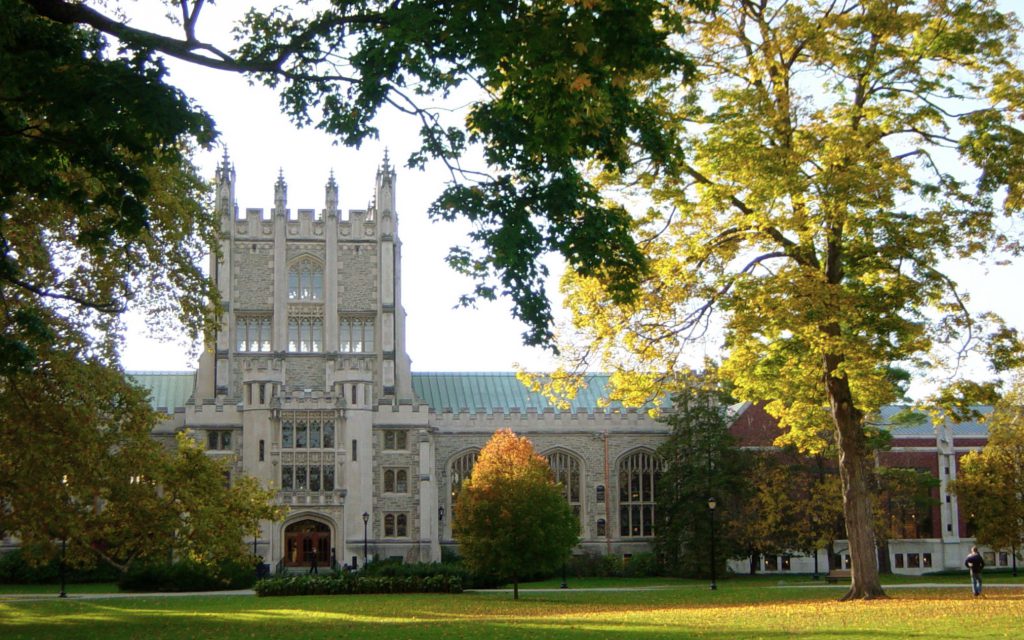
Approach to Main Library, Vassar College. Photograph by Mildred Budny.

[Posted on 1 March 2025, with updates]

Inspired by the 2024 RGME Spring Symposium at Vassar College, we return in May for a visit to its collections.

This time, we will see some of its Medieval & Renaissance manuscripts, fragments, and cuttings. These manuscript materials at Vassar are held in the

  • Archives & Special Collections Library
    and
  • Frances Lehman Loeb Art Center

We will visit both, with lunch in between. An RGME Roundtable discussion will follow the afternoon visit.

In addition, at each location, undergraduate students or a new member of the faculty for the Art Department will speak about their work on some of the manuscript materials. They will present new discoveries, with the chance to see the original materials themselves.
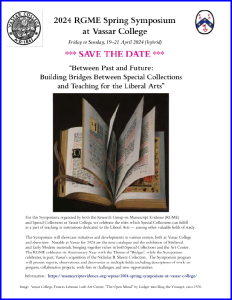
Save-the-Date Poster for 2024 RGME Spring Symposium at Vassar College. Poster set in RGME Bembino.

Prequel:
Our 2024 Spring Symposium

Some of these materials were considered in presentations at the 2024 Spring Symposium; some were displayed at the special exhibition, where we could see them on view. See:

  • Books of the Middle Ages and and Renaissance (April 19–June 23, 2024)

At the first Reception of the Symposium, Vassar undergraduate students described their work on several of them to prepare for this exhibition.

Coinciding with the Symposium was the publication of the new catalogue of these materials.

  • Catalogue of Medieval & Renaissance Manuscripts at Vassar College, Including the Nicholas B. Scheetz Collection and the Frances Lehman Loeb Art Center, compiled by Peter Kidd (Vassar College, 2024)
    ISBN 9798218363758

2025 RGME Visit to Vassar

Our 2025 RGME In-Person/Hybrid Visit will take place on Monday 5 May. There will be a preliminary session on Sunday 4 May.

We invite you to attend either:

  • in person (places are limited due to space) or
  • online.

The RGME will provide online and interactive access by Zoom, to allow a wider audience to join us for an interactive Zoom Meeting.

For Registration information, see below.

A Centerpoint for the RGME’s 2025 Activities

The plan for this visit connects with the RGME theme of collectors and collecting for our events this year, and also for our work on manuscript fragments.

For the various events, held online and in various locations as in-person/hybrid events, see:

  • RGME 2024 and 2025 Activities
  • 2025 Spring and Autumn Symposia: “Agents and Agencies”

Spring (Part 1 of 2)
“Makers, Producers, and Collectors of Books:
From Author/Artist/Artisan to Library” (28–30 March online)

Autumn (Part 2 of 2)
“Readers, Fakers, and Re-Creators of Books:
From Page to Marketplace and Beyond” (17–19 October online or hybrid)

  • 2025 Autumn Colloquium at the University of Waterloo. (21–23 November hybrid)
    “Break-Up Books and Make-Up Books:
    Encountering and Reconstructing the Legacy
    of Otto F. Ege and Other Biblioclasts”

Plan/Program

Overview

Sunday 4 May

  • The afternoon before the full day’s visit, a preliminary session (hybrid) at 4:00–5:30 pm EDT offers the chance to gather at the Murphy Room of the Art Library for Martha Frish’s presentation on “The Symbols of Vassar Architecture”. This presentation gives an update from her Post-Symposium Presentation last year. (See 2024 Spring Symposium.)
  • For the location of the Murphy Room, see Maps and Call Numbers, Art Library

Monday 5 May

  • In the morning we will visit the Frances Lehman Loeb Art Center (on its closed day), to see some of its manuscripts and manuscript cuttings.
  • Lunch will be held in its Sculpture Garden (or inside in case of inclement weather).
  • After lunch, we will visit the Frederick Ferris Thompson Memorial Library (Main Library), to see some of its manuscript materials held in the Archives & Special Collections Library.
  • Then we will move to the Seminar Room in Special Collections to hold a Roundtable discussion. We may continue conversation about the materials, compare notes, and reflect on the day.
  • For drinks and dinner, we would go to a local restaurant, for repasts at our own expense.
Speakers include:
John P. Murphy
Ronald D. Patkus
Rachel Wise
Benjamin Garrity (Vassar Class of 2027)
Tara Peterson (Vassar Class of 2025)
Both John P. Murphy and Ronald D. Patkus will speak about the materials in the Art Center.

Rachel Wise, Professor of Art, will speak about her study of one of the most important manuscripts in its collection.

Ronald Patkus will speak about provenance for materials in both the Art Center and Special Collections.

Two Vassar students will speak about the art of materials in Special Collections:

Benjamin Garrity (Class of ’27) will speak about the Loeb Book of Hours.
Tara Peterson (Class of ’25) will speak about the Spanish Forger.

The showcased items in the two collections comprise: an album of collected initials; selected Books of Hours; and a leaf illustrated in medieval style by the prolific and renowned Spanish Forger. On hand, by request, at the session on Special Collections, might be its leaf from the Saint Albans Bible, a dismembered manuscript being researched by the RGME because of a current loan. (See below.)

Program

1. Sunday 4 May

Afternoon: 4:00–5:30 pm EDT (GMT-4)

The hybrid RGME Visit opens with a presentation by Martha Frish on Sunday afternoon, when she will speak about
“Some Symbols in the Architecture at Vassar College.” Her illustrated presentation will highlight features of the campus which distinguish it from many American colleges. By examining many of the buildings in their architectural settings, both in their landscape and in their historical periods, demonstrates the ways in which Vassar represents a physical documentation of the architectural history of the United States.
As an introduction to the RGME Visit to the College all day on Monday 5 May, this ‘tour’ sets the scene by locating the visit within the physical space of the collections at the Frances Lehman Loeb Art Center and Special Collections of the Frederick Ferris Thompson Memorial Library. Martha’s invitation to examine the buildings and their own settings offers a companion to the ways in which readers, students, and beholders would at the manuscript sources in these collections, in order to discover more of their meanings and stories of their own.

This special presentation will take place in person in the

  • Murphy Room, Art Library

To register for this portion of the Visit, please use these links:

1) In Person:
https://www.eventbrite.com/e/sunday-in-person-for-2025-rgme-vassar-visit-symbols-of-vassar-architecture-tickets-1347124799539

2) Online:
https://www.eventbrite.com/e/sunday-online-2025-rgme-vassar-visit-symbols-of-vassar-architecture-tickets-1348928243689

"The Quad as Exterior Room". Photograph of the Residential Quad by Martha Frish (2016).

“The Quad as Exterior Room”. Photograph of the Residential Quad by Martha Frish (2016).

2. Monday 5 May

Morning
10:30–11:30
Art Center, Seminar Room

We would meet by 10:30 am in the Entrance Lobby of the Frances Lehman Loeb Art Center . Note that the Art Center is otherwise closed on Mondays.

Our visit allows us to see some of its manuscripts and manuscript cuttings. They include materials not normally on show.

Both John P. Murphy and Ronald D. Patkus will speak about the materials. Rachel Wise, Professor of Art, will speak about her study of one of the most important manuscripts in the collection.

They will demonstrate 1) an album of cuttings of choice portions from manuscripts (such as illuminated initials) and 2) a Book of Hours. These monuments are:

1.  Album of Cuttings, 15th century (Loeb 864.2.242-864.2.258)
Seventeen cuttings with illuminated initials, removed from an Alphabetical Index (so far unidentified). Germany, 15th century.

Other contents include drawings of architectural features, copies of paintings, and copies of manuscript illuminations and marginalia from medieval manuscripts now in Oxford, London, and Salisbury Cathedral. Some of those manuscripts have been the subjects of RGME seminars.

Catalogue, pp. 246–249 (with plate on p. 246)
See also  Object: Manuscript
John Murphy will speak about the initials, Ronald Patkus about provenance, and then we will have discussion.

2.  Book of Hours, 15th century (Loeb 1994.2.2)

Book of Hours of Jean Olivier, Bishop of Angers (bishop from 1532–1540), for the Use of Rome, in Latin and French. France: Paris? Circa 1510–1540 or 1510–1520.

Artist: Jean Pichore (French, active c. 1501–1520)
Catalogue, pp. 266–269 (with plate on p. 267)
See also The Melun-Epinoy Hours

Rachel Wise, Professor of Art, will speak about the art of the manuscript, Ronald Patkus about provenance, and then we will have discussion.

The Melun-Épinoy Hours, opened to Annunciation scene. c. 1501–1520. Image: Frances Lehman Loeb Art Center, Vassar College

12:00–1:00 pm
Lunch

Lunch will take place in the outdoor Sculpture Garden.  In case of inclement weather, we will go inside.

Afternoon

After lunch we will move to the Frederick Ferris Thompson Memorial Library (Main Library).

The first afternoon session, showcasing materials in Special Collections, will take place in the Class of 1951 Reading Room.

The second afternoon session, featuring a RGME Roundtable discussion, will take place in the Seminar Room of Special Collections (which closes at 4:30 pm).

1:00–2:00 pm
Spotlight on Special Collections

Class of 1951 Reading Room

Selected materials from Special Collections will be available for examination and discussion.

Ronald D. Patkus will speak about the materials. Students of both Ronald and Rachel Wise will speak about their work 1) on a leaf by The Spanish Forger, a notorious and prolific producer active in the late-nineteenth and/or early twentieth century, probably in Paris; and 2) on the Loeb Book of Hours.

3.  Leaf 42, 14th and 19th/20th centuries
Single leaf as a cutting, reused.
Text on one side from an Antiphonary.  Italy, 14th century
Painted image on the other.  The image depicts an encounter outside a walled city between a solder and a lady, each with retinue. France, late 19th or early 20th century.
Artist: The Spanish Forger. (Active France, late 19th or early 20th century)
Catalogue, pp. 107–109 (with plate on p. 108)
4. Book of Hours, 15th century (MS. 6)
Book of Hours for the Use of Paris, in Latin and French
Catalogue, pp. 21–14 (with plate on p. 13)
Students will speak about their work on these materials; Ronald Patkus will speak about the provenance; and there will be scope for discussion.

2:00–2:30 pm
Break

3:30–4:00 pm
RGME Roundtable
“Looking at Manuscripts and Collections”

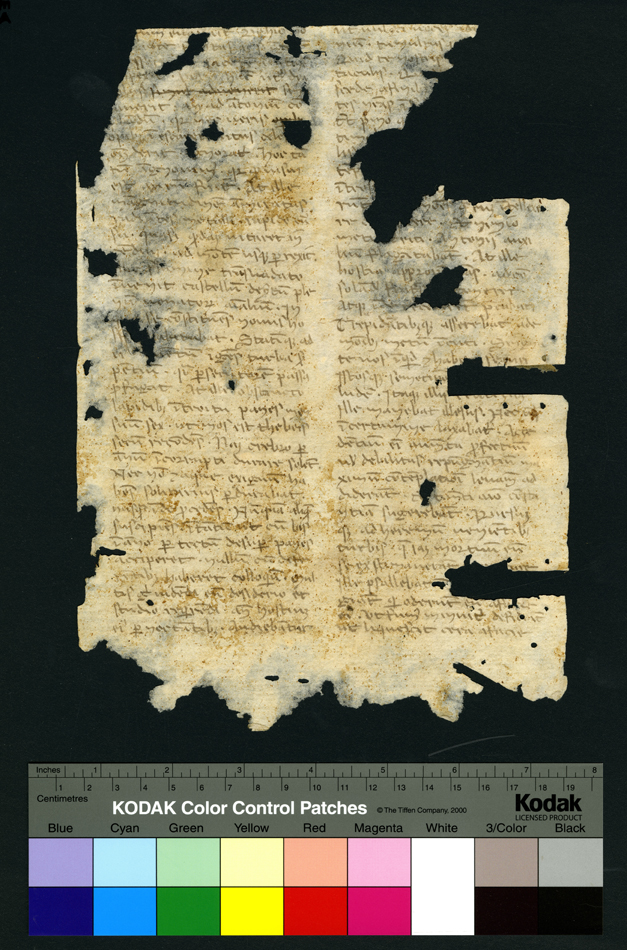
Collection of Jennah Farrell, Vulgate Bible Leaf, Recto. Photography by Mildred Budny.

This occasion offers the opportunity to share reflections about the materials demonstrated on our visit to both the Art Center and Main Library. Several of us might describe our research on some of them or relatives to them. We would consider their bearing on subjects which the RGME considers this year in its variety of events and projects.

1. Manuscript Fragments:
Challenges and Opportunities for Research

For example, recently the RGME has been examining the Farrell Leaf and the Weber Leaf from the Saint Albans Bible, dismembered directly after sale in 1964 and widely distributed thereafter frequently through sale rooms. The original manuscript, a single-volume Latin Vulgate Bible, was produced in France, probably Paris, circa 1330-1340. See our Workshops on “The Evidence of Manuscripts, Etc.”

A leaf from the same book belongs to Vassar College. It is part of the Nicholas B. Scheetz Collection of Medieval & Renaissance Manuscripts (Scheetz MS 27). About this leaf, see the entry in the recent catalogue:

  • Catalogue of Medieval & Renaissance Manuscripts at Vassar College, compiled by Peter Kidd (Vassar College, 2024), p. 217.

It could be useful to compare notes about these relatives which formerly stood within the same covers of a single-volume Latin Vulgate Bible. Whereas many leaves known from the original manuscript in a variety of collections belong to the Old and New Testament portions of the Bible, the Vassar leaf from the Scheetz Collection belongs to part of the textual apparatus of the Interpretation of Hebrew Names in glossary form, arranged alphabetically, and specifically from within the section for terms beginning with the letter B.

Collection of Richard Weber, Leaf from the Saint Albans Bible, Recto: Top Right. Photograph by Richard Weber.

2. Provenance: A Perennial Quest

Other subjects under consideration this year by the RGME fall into the sphere of the Visit to Vassar’s collections. Among them are issues of provenance for the objects, whether known, detectable, or unknown. Such issues can form an important part of the history of their transmission and, perhaps, of legitimacy, as in the case of forgeries.

Our roundtable might mention various points of contact between the visit and our other events for this year, which have led to the selection of objects to examine. The Vassar Visit stands poised between them:

  • our Spring and Autumn Symposia which explore aspects of “Agents and Agencies” in the realms of books
    2025 Spring and Autumn Symposia
  • our sessions on “Manuscripts at Worlds of Knowledge” at the 2025 International Medieval Congress at Leeds
    2025 International Medieval Congress at Leeds: RGME Program
  • our Autumn Colloquium on “Break-Up Books and Make-Up Books: Encountering and Reconstructing the Legacy of Otto F. Ege and Other Biblioclasts”
    2025 RGME Autumn Colloquium at the University of Waterloo

The design of the Visit, selected by Ronald Patkus and John Murphey, responds thoughtfully and expertly to these shared interests for collective exploration in 2025.

Reception

A Reception will close the day’s visit.

Celebratory Reception
5:00–7:30 pm EDT
Class of 1951 Reading Room

We celebrate the visit, the sharing of expertise and experiences in studying the original sources at Vassar, and the generosity of the curators, donors, contributors, organizers, hosts, and student interns. We invite you to join us.

Dinner

Afterward, we would go to a local restaurant for drinks and/or dinner (at our own expense). There, we could continue conversation in the company of people interested in books, their care, their study, their ability to teach, their stories, and their delight.

Information for Visiting Vassar

For information on travel, directions, campus maps, accommodation, dining, and other features in the area, see:
  • Visit Vassar

A photo of the Thompson Library at Vassar College in Poughkeepsie, New York, taken by me [Noteremote] on November 2, 2007. via Wikimedia Commons Creative Commons Attribution-Share Alike 3.0 Unported, via https://en.wikipedia.org/wiki/File:Thompson_Library_(Vassar_College).jpg.

Registration

You can register for the RGME Vassar Visit through the RGME Eventbrite Portal. See:

  • RGME Eventbrite Collection

There you will be able to register to attend either in person or online.

We encourage you to make a Voluntary Donation when you register. It will help to support our small nonprofit educational organization powered principally by volunteers.

1. Sunday 4 May 2025

To register for the preliminary presentation on Sunday afternoon, please use these links:

1) In Person:
https://www.eventbrite.com/e/sunday-in-person-for-2025-rgme-vassar-visit-symbols-of-vassar-architecture-tickets-1347124799539

2) Online:
https://www.eventbrite.com/e/sunday-online-2025-rgme-vassar-visit-symbols-of-vassar-architecture-tickets-1348928243689

2. Monday 5 May 2025

To register for the Visit to the Art Center and the Main Library on Monday 5 May, please use these links:

1) In-Person Visit

For in-person attendance, space is limited. In registering for in-person attendance, for the catering you will be given the opportunity to indicate any dietary requirements.

2025 RGME Visit to Vassar College IN PERSON

2) Online Visit

For online attendance, once you register, the Zoom Link will be sent to you shortly before the event.

2025 RGME Visit to Vassar College ONLINE

Thank you for your interest and support. We look forward to welcoming you.

*****

Thanks

For arranging this visit, we thank:

  • Ronald D. Patkus, Head of Special Collections and College Historian, Adjunct Associate Professor of History on the Frederick Weyerhaeuser Chair
  • John P. Murphy, Philip and Lynn Straus Curator of Prints and Drawings at the Frances Lehman Loeb Art Center

We thank the speakers for their contributions to share their work on manuscript materials at Vassar College: Rachel Wise, Ronald Patkus, John Murphy, and Vassar students Ben Gerrity and Tara Peterson. Thanks go to Thomas E. Hill, Art Librarian, for arranging the visit to the Murphy Room, to Francine Brown of the Art Center, and Amanda Burdine. Thanks go to the 2025 RGME Visit Student Interns for help behind the scenes: Betsy Subiros (Class of 2025), Anna Gilsdorf, and Rachel Stanger (Class of 2027).

We give thanks to the staff and others at Vassar College for this visit.

We look forward to the visit. You are invited to join, whether in person or virtually.

*****

Questions or Suggestions?

Please let us know.

  • Leave your comments or questions below
  • Contact Us

Visit our Social Media:

    • our href=”https://www.facebook.com/Research-Group-on-Manuscript-Evidence-259443617456668/” target=”_blank” rel=”noopener”>FaceBook Page
    • our href=”https://www.facebook.com/groups/rgmemss” target=”_blank” rel=”noopener”>Facebook Group
    • our X/Twitter Feed (@rgme_mss)
    • our Bluesky nest (@rgmesocial.bluesky.social)
  • our href=”https://www.instagram.com/rgme94/” target=”_blank” rel=”noopener”>Instagram Page
  • our LinkedIn Group

Join the Friends of the RGME

Please make a Donation in Funds or in Kind for our nonprofit educational corporation powered principally by volunteers. Your donations and contributions are welcome, and can go a long way. They may be tax-deductible to the fullest extent provided by the law.

  • Donations and Contributions
  • 2025 Annual Appeal

We look forward to seeing you and welcoming you to our events.

*****

Tags: Archives & Special Collections of Vassar College, Books of Hours, Frances Lehman Loeb Art Center, Manuscript Cuttings, manuscript fragments, Manuscript studies, RGME Visits to Collections, The Spanish Forger, Vassar College, Virtual Visits to Collections
No Comments »

Starters’ Orders

February 25, 2025 in Announcements, Friends of the Research Group on Manuscript Evience, Manuscript Studies, RGME Competition, RGME Friends' Meetings, RGME Recipes

“Starters’ Orders”
Competition for Favorite Recipes

Appetizers, Hors d’Oeuvres,
Canapés, and Starters

Round 2
of the Competition
for the Favorite Recipes of the Friends
of the Research Group on Manuscript Evidence

Logo (2024) of the Friends of the Research Group on Manuscript Evidence

[Posted on 25 February 2025, with updates]

Following the completion of Round 1 and the awards of its Prizes and the creation of its Award Certificates for the Prize Winners, we turn to Round 2.

For Round 1 and its Entries, see:

  • Three-Step Program, Lemonade Included
  • RGME Favorite Recipes for Lemonade, Etc.


After exploring recipes for Lemonade, Etc., and awarding prizes for the winning entries in our Friends Meeting 3 (27 January 2025), we sought suggestions for the subject of Round 2 in our Competition for Favorite Recipes (and stories about them) for the RGME Friends Favorite Recipes Cookbook.

Prizes for the Favorite Recipes for “Lemonade, Etc.” Wrapped and ready to send. Photograph by Mildred Budny.

Our Favorite Recipe Competition now turns to Round 2. The theme for this round was chosen at our Fifth Meeting (23 February 2025).  We wondered: Shall we move from drinks such as lemonade to hors d’oeuvres, entrées, soups, salads, etc., or go straight to desserts? At once came the collective answer: “Starters!”

Starters’ Orders

So we order Starters for our next Round of Recipes.

For this round, we consider Appetizers, Hors D’Oeuvres, Canapes, Finger Food, and Starters of many kinds.

Whatever they are called, this multi-form and multi-purpose variety of foodstuffs is designed to perk the appetite (as “amuse-bouches” or the like), serve as bite-size morsels of deliciousness, stave off hunger in place of a meal when time or opportunity constrains, start a round of courses for a full meal, or stand in between courses as a sort of intermission within an elaborate meal.

Their creation can draw upon a wide range of ingredients and culinary traditions, along with time-tested recipes perhaps handed down in the family. They might also take inspiration from improvisations drawing together what is on hand in the pantry, in the fridge, on the shelves, in the garden or orchard, in the market, or in the shop. They might comprise single ingredients or types of ingredients — such as a handful of nuts, a selection of olives, a piece or pieces of cheese, a nibbling of crudités — or combinations of flavors, textures, and tastes, such as with sauces or dips for fruits and vegetables, raw or cooked.

They serve many purposes and take multiple forms. For example, one widespread genre, Canapes, might be described as:

“a type of starter, a small, prepared, and often decorative food, consisting of a small piece of bread (sometimes toasted) or cracker, wrapped or topped with some savoury food, held in the fingers and often eaten in one bite.”

————— Canapes

What are some of your favorites, and do you have stories about them? Let us know!

As for this Round on the ride to our RGME Friends’ Favorite Recipes Cookbook, shall we call it “Starters’ Orders”?

“Angels on Horseback”. Photograph by Lana via e Creative Commons Attribution 2.0 Generic lic.

Given the name of this game, might there, among the entries, be room for one or other of these offerings, which involve sticks or skewers?

  • Devils on Horseback
  • Angels on Horseback

Prizes and Incentives

As with Round 1, prizes (provided by a donation) await the winning entries. Please send in your entry, with title, description, and story. Sending more than one entry is allowed, indeed encouraged.

We will review the entries and award prizes at one of our Friends’ Meetings. See their schedule:

  • Meetings of the Friends of the Research Group on Manuscript Evidence

Also please visit our Eventbrite Registration Portal for information about our events and registration for them.

  • RGME Eventbrite Collection

A list of customary or popular offerings in this broad category might jog your memory and perk your interest.

  • Category: Appetizers

*****

From Soup to Nuts

We aim, over time, to gather recipes and stories to fill a cookbook. In this way, we can compare notes and share experiences reflecting the range and breadth of our RGME community. A full-course meal, perhaps, in a veritable Feast.

13-Course Place Setting. Photograph (2019) By Hopefulromntic21 – Own work, via Wikimedia Commons via CC BY-SA 4.0.

*****

Comments, questions, or suggestions?

Send your entries and contact the Friends via

  • friends.of.rgme@gmail.com

*****

Haarlem, Frans Hals Museum, Still Life with Fruits, Nuts, and Cheese (1613) by Floris Claesz van Dyck (1575–1651). By Floris van Dyck – The Yorck Project (2002) 10.000 Meisterwerke der Malerei (DVD-ROM), distributed by DIRECTMEDIA Publishing GmbH. ISBN: 3936122202., Public Domain, https://commons.wikimedia.org/w/index.php?curid=150586

Note on the Image: Haarlem, Netherlands, Frans Hals Museum, “Still Life with Fruits, Nuts, and Cheese” (1613) by Floris Claesz van Dyck (1575–1651). Credit: By Floris van Dyck – The Yorck Project (2002) 10.000 Meisterwerke der Malerei (DVD-ROM), distributed by DIRECTMEDIA Publishing GmbH. ISBN: 3936122202., Public Domain, https://commons.wikimedia.org/w/index.php?curid=150586.

*****

Tags: Appetizers, Favorite Recipes, Friends of the Reaearch Group on Manuscript Evidence, Hors d'Oeuvres, Lemonade, Recipe Competition, RGME Cookbook, Starters
No Comments »

The Weber Leaf from the Saint Albans Bible

February 22, 2025 in Manuscript Studies, Workshops on "The Evidence of Manuscripts"

Leaf from the Saint Albans Bible
in the Collection of Richard Weber

Double columns of 46 lines in Gothic Script
with Decorated Initials, Bar-Extensions,
and Running Titles
Acts 26:14 (est tibi) – Acts 28:9 (insula habe[/-bant] )

Northern France, circa 1330

Collection of Richard Weber, Leaf from the Saint Albans Bible, Recto: Top Right. Photograph by Richard Weber.

[Posted on 21 February 2025]

In connection with our new series of RGME Workshops on “The Evidence of Manuscripts, Etc.”, our Associate, Richard Weber, revealed another leaf in his collection. This discovery joins the posts about different items in his collection which have been reported in our blog on Manuscript Studies.

Our workshops began by examining a leaf on loan to the RGME with part of the text of the Book of Numbers in a Latin Vulgate Bible in double columns of 46 lines in Gothic script, with decorative elements. See the reports of our discoveries about that leaf:

  • A Latin Vulgate Leaf from the Book of Numbers (Part 1)
  • Latin Vulgate Bible Leaf in the Collection of Jennah Farrell, Part 2: Provenance
  • The Latin Vulgate Bible Leaf in the Farrell Collection Part 3: The Full Leaf

Collection of Jennah Farrell, Single Leaf from the Book of Numbers in a Medieval Latin Vulgate Bible manuscript: Recto, top. Photography by Mildred Budny.

The collaborative work in our workshops, crowdsourcing the quest to identify the leaf, has revealed that it most probably came from the dismembered Saint Albans Bible, produced in Northern France in the 1320s or 1330s and formerly owned by Saint Albans’ Abbey. Our search among online resources, such as blogposts and vendors’ sites, and in printed works, ranging from books and journal articles to catalogues of sales or individual collections, followed up clues leading from one collection or sales room to another.

Collection of Jennah Farrell, Single Leaf from the Book of Numbers in a Medieval Latin Vulgate Bible manuscript: Recto. Photography by Mildred Budny.

The process of discovery persuaded us, from the resemblances between the leaf in hand and features of some surviving leaves from the Saint Albans Bible, that this leaf very likely came from the same manuscript — if not from another much like it by some of the same scribes and artists. We believe that proof positive (or the like) for this conjectured identification might come were one or both of the leaves which formerly directly preceded and directly followed the leaf to emerge into the light so as to demonstrate an exact match in the flow of text from one to the next.

And so we continue our search among the survivors, as we track the leaves from both the Old and New Testaments in the Saint Albans Bible, especially from the Book of Numbers. In view might be, were time and resources available, the creation of a virtual reconstruction of the manuscript, as has been accomplished or begun for various other manuscripts which now survive in fragments scattered across many locations.

Learning from our workshops that the Farrell Leaf is identifiable most probably as part of the dismembered Saint Albans Bible, our Associate, Richard Weber, reported the presence of another leaf from the same manuscript in his collection. With his permission, for which we give thanks, we introduce it to you and our Workshop Series, starting with RGME Workshop 4: “Manuscript Fragments Compared”.

The Weber Leaf
from the Saint Albans Bible

Acquired on May 23, 2023, from The Raab Collection (Nathan “Nate” Raab and Karen Pearlman Raab), this leaf preserves part of the Acts of the Apostles in the Saint Albans Bible, which was dismembered for resale in 1964. The leaf comes from the last part of the Book of Acts. It breaks off mid-word in its final chapter, about one-third of the way through it.

The Apostle Paul, His Travels, and His Travails

The text on the leaf presents the text from within Chapter 26 to within Chapter 28 of Acts in the Latin Vulgate Version. It opens within verse 14 ([persequeris durum /] est tibi contra) of Chapter 26, completes the chapter, turns to the full span of Chapter 27, and opens the last chapter of the Book up to its verse 9, whereupon it breaks off mid-word (insula habe[/-bant infirmitates]). That is, the span of text encompasses Acts 26:14–32 (the latter portion of the chapter); Acts 27:1–44 (the full chapter); and Acts 28:1–9 (the first third).

The leaf contains most of the extended first-hand account by the Apostle Paul (circa 5 – circa 64/65 AD) of his life’s adventures in his defense before King Herod Agrippa II of Judea (27/28 – 92 or 100 AD). From his own viewpoint, we hear about his transformation from soldier and Roman citizen to apostle in locations stretching from Tarsus in Asia Minor to Jerusalem, Antioch, Thessaloniki, Athens, Corinth, Ephesus, Malta, and finally Rome.

The scope, range, and variety of his exploits or adventures are illustrated vividly in some medieval manuscript illustrations. Notable among them is the full-page, multi-tiered cycle of scenes rendered by an exceptional master artist in the large-format Carolingian version of the Latin Vulgate Bible prepared at Tours for presentation to the monarch Charles the Bald (823–877). On this imposing Bible, see, for example, Latin 1.

Paris, Bibliothèque nationale de France. Département des Manuscrits. Latin 1, fol. 386v. Image Public Domain via https://gallica.bnf.fr/ark:/12148/btv1b8455903b/f780.item#.

The Leaf, Its Contents, and Its Presentation

Sections of the text are demarcated by

1) enlarged, decorated initials rendered in polychrome or in ink,
2) ornamental vertical bars extending from the 2-line inset polychrome Chapter Initials to foliate terminals,
3) ornamental or figurative motifs embellishing the enlarged pen-initial in the top line of all but one column,
4) polychrome chapter numerals,
5) polychrome running titles in the upper margins, rendered partly in alternating pigments and partly in pen-line flourishes, and
6) a marginal ‘insertion’ of script to correct an omission in the text.

Let us have a closer look.

The Recto

The recto of the Weber Leaf

Collection of Richard Weber, Leaf from the Saint Albans Bible, Recto. Photograph by Richard Weber.

Lively decorated letters rendered in ink rise to considerable heights in the first lines of each column of text, one to each column. In column a, E for Ego opens Verse 15 of Chapter 26. In column b, T completes the opening word UT of Chapter 27:1.

The two-part running title at the top spaces its words at a distance from each other. It keeps the first part (Actus) more-or-less centered above the two columns and places the second, abbreviated word (Ap[osto]lor[um]) offset extending partway into the margin.

The distant, offset half of the running title appears like an afterthought, although apparently as the work of the same scribal artist and during the same campaign of operation (if not at the same sitting). Could it represent a correction to supplement the ‘mistake’ of putting the first component, Actus, on the recto of an opening, rather than on the verso?

On the verso of a two-page opening, with the verso of one leaf facing the recto of the next, customarily a bipartite running title for one set text on both pages might have the first half or portion of a single title on the verso and the continuation in the second half or portion on the recto. What if this leaf received the Actus as if it were a verso, so that its match or completion, Apostolorum, was deemed to need to be fitted in? We wonder what the verso originally facing this leaf had for its running title.

Collection of Richard Weber, Leaf from the Saint Albans Bible, Recto: Top Right. Photograph by Richard Weber.

The Verso

Collection of Richard Weber, Leaf from the Saint Albans Bible, Verso. Photograph by Richard Weber.

This side of the leaf retains the use of a tall ink-drawn letter in the top line, but only for one column. The initial U or V for Valida opening 27:18

The running title keeps to its short form of one word (or syllable) only. Presumably the second part of the title appeared facing it on the recto of the next leaf. We are uncertain what intentions were in place for this enigmatic running title comprising DE (“Of”, “About”), which seems to stand in a suspended state awaiting the completion of a name or phrase on the formerly facing recto. Here is another mystery awaiting resolution, if possible, with the discovery of the next leaf in the sequence in the original book.

Collection of Richard Weber, Leaf from the Saint Albans Bible, Recto: Top Center. Photograph by Richard Weber.

The first stem of the animated pen-initial U atop Column a (the left-hand column of the pair on the page) on the verso rises to a backwards and downwards curve containing the shaggy neck and head of a wide-eyed creature with opened jaws with exposed teeth and fangs. One might wonder if the apparent ferocity of the creature emulates or evokes the stormy text of the verse which this initial opens (27:18), as it reads: Valida autem nobis tempestate jactatis sequenti die jactum fecerunt (“And we exceedingly tossed with a tempest, the next day they lightened the ship.”) Might we think of this creature as presenting the Jaws of a Tempest?

Collection of Richard Weber, Leaf from the Saint Albans Bible, Verso: Top Left. Photograph by Richard Weber.

The Seller’s Description

Richard shares with us the description which accompanied the leaf in preparation for its sale by The Raab Collection in 2023. This description deserves to join the growing group of sellers’, collectors, scholars’, curators’, and others’ descriptions of individual leaves or groups of leaves which are present, for a time, in their hands and before their eyes.

As such they can constitute direct witnesses to surviving portions of the manuscript. Our work toward a collaborative virtual reconstruction of the original will also assemble the descriptions as a contribution toward fuller knowledge of the manuscript and its stages of ownership, study, and wider understanding.

We quote:

The Saint Alban’s Bible started life in Paris in the 1320s or 1330s. Likely, three artists worked together in an atelier, or workshop, to create the high quality product. The workshop to which Christopher de Hamel attributes the creation is that of the famed Parisian artist, Jean Pucelle, one of the most important and influential artists for the Gothic style. While the Saint Alban’s Bible is not in the hand of John Pucelle, it is in the hands of his associates, the Saint Louis Master, whose name has been identifed as Mahiet (Kuroiwa, “Working with Jean Pucelle”). On the margins of another manuscript illustrated by the Saint Louis Master, housed in the Bibliotheque Nationale de France in Paris, a marginal note from Pucelle to an illuminator, Mahiet, confirms the Saint Louis Master’s identity. Through the association of the Saint Albans Bible with Mahiet and Pucelle, a complex network of Parisian bookmakers opens up, and their works can be traced.

From its manufacture on the Rue de la Parcheminerie, the Bible was likely a gift from Richard de Bury, Bishop of Durham to the Abbey of Saint Albans after his 1320-1330s visit to Paris (de Hamel, “Leaf of a Bible Manuscript”). Leaves have ended up in collections such as the Tokyo National Museum of Western Art, the University of Colorado at Boulder, and the University of British Columbia, with others in private hands. The post-medieval lives of manuscripts, as they fragment and change hands, demonstrates their endurance as status symbols and works of art— as a whole and as a part.

The text gives part of Paul’s recount of his life story to King Agrippa who is almost persuaded to become a Christian. The imprisoned Paul’s ship runs aground and he is shipwrecked in Malta on his way to face trial in Rome. The barbarians of Malta show Paul and the shipwrecked crew kindness by building a fire, but a viper emerged from the ashes and bit Paul’s hand, though he did not die.

Provenance: 1. From an incomplete Bible sold at Sotheby’s, 6 July 1964, lot 239, to the dealer and book-breaker Philip C. Duschnes [1897–1970], who dispersed it. Other leaves had already been removed, with some ending up in the collections of E.H. Dring (1864-1928), one reappearing in Bernard Quaritch, cat. 1036, 1984, no. 76).

Then identified in 1981 as from the medieval library of St Albans Abbey, Hertfordshire, and perhaps to be identified as one of ‘duas bonas biblias’ acquired by Abbot Michael de Mentmore (C. de Hamel in Fine Books and Book Collecting, 1981, pp. 10–12).2.

More details:

Leaf from the St Albans Abbey Bible, in Latin, illuminated manuscript on parchment [northern France (Paris), c. 1330] Single leaf, with double columns of 46 lines in a fine gothic bookhand (Acts 26:14–32; Acts 27:1–44; Acts 28:1–9), with hairline penwork ornamenting the V with a grotesque animal head biting the ascender, versal numbers (27, 28) in alternate liquid gold and blue capitals with contrasting penwork, running titles in same, two 2-line initials (one each side of leaf) each in faded pink with white ornamentation on gold background and enclosing foliage, one medieval correction in the margin indicated by a signe-de-renvoi, modern pencil numerations (3, 73), 295 by 200mm or 12 by 8 inches.

*****

Join the Quest

Would you like to join the quest? Do you know of other leaves from the Saint Albans Bible? Do you know of other works by the same scribes or artists? Are you curious about books and ways of looking at them?

Join our Workshops!

*****

Collection of Richard Weber, Leaf from the Saint Albans Bible, Recto: Top Right. Photograph by Richard Weber.


Tags: Acts of the Apostles, Book of Numbers, Collection of Jennah Farrell, Collection of Richard Weber, manuscript fragments, Manuscript studies, Medieval Vulgate Bibles, Saint Albans Bible
No Comments »

Workshop 4. “Manuscript Fragments Compared”

February 16, 2025 in Announcements, Manuscript Studies, Research Group Workshops

RGME Workshops
on
“The Evidence of Manuscripts, Etc.”
(Formerly: “Examining Original Sources”)

Workshop 4
“Manuscript Fragments Compared”

Sunday 23 February 2025
1:00- 2:30 p.m. EST (GMT-4) by Zoom

We cordially invite you to join us for our next RGME Workshop on the “Evidence of Manuscripts Etc.” The series gives the opportunity collectively to examine original sources, in manuscript and other written forms. Beginners and experts are welcome; we can learn together.

The Series

Originally this series was planned as a two-part series of workshops to consider the medieval “Farell Leaf” on loan to the RGME Library and Archives from the Collection of Jennah Farrell. After rich discussions concerning the fragment and evidence for its production and provenance, most probably as part of the Saint Albans Bible (dismembered in 1964), our workshops have turned into a series for teaching manuscripts and related studies.

Collection of Jennah Farrell, Single Leaf from the Book of Numbers in a Medieval Latin Vulgate Bible manuscript: Recto, top. Photography by Mildred Budny.

Workshop 4

Workshop 4 introduces a comparative study. The plentiful genre of medieval Latin Vulgate Bibles is a rich field in Manuscript Studies. Work on cases of deliberately disbursed manuscripts has yielded in the last two decades a selection of stand-out works. Among them is the Saint Albans Bible, known through numerous studies in print and online. Examples include

  • “Breaking Bad: The Incomplete History of the Saint Albans Bible” (1 Nov 2019)
  • The Book, The Leaf, The Knife, and Some Bother
  • The St Albans Bible (20 June 2021)

Since Workshop 3, another leaf from the medium-format Saint Albans Bible has come to our attention. It stands in the collection of our Associate, Richard Weber – from whose collection our blog on Manuscript Studies has reported other discoveries. Its portion from the Acts of the Apostles offers comparison with the Farrell Leaf from the Book of Numbers, with a view toward the presentation of both Old and New Testaments within its former single volume.

Now see:

  • The Weber Leaf from the Saint Albans Bible

Collection of Richard Weber, Leaf from the Saint Albans Bible, Recto: Top Right. Photograph by Richard Weber.

In our workshop, the case of that manuscript is joined by another fragmented Bible, dismembered instead by the biblioclast Otto F. Ege: namely his large-format Ege MS 14, represented by a leaf now on loan to the RGME for teaching purposes. Over the years, our blog has contributed discoveries to knowledge of that manuscript (see Manuscript Studies). For our workshop, Richard Weber reports his leaf from that manuscript as well.

Private Collection, Leaf from ‘Ege MS 14’. Part of the Book of Jeremiah, Recto, Detail. Photograph by Mildred Budny.

Resources for the Quest

The different agents of destruction for these two books provide instructive case studies for the different but overlapping resources available in print and online for the detective work of fragmentology, in the quest to trace the steps of re-distribution of leaves from these Bibles, with a view toward identifying the locations of survivors and virtually reconstructing their original books, insofar as possible.

We welcome participants to join the quest and come forward with questions, updates on any work they have been doing on the Farrell Leaf, or suggestions for potential avenues of study in future workshops.

Registration

Registration is required and free. We are grateful for Voluntary Donations accompanying your Registration to help support our nonprofit educational organization powered principally by volunteers.

  • Workshop 4. “Manuscript Fragments Compared”: Tickets

Note that our Workshop series now appears on our Eventbrite Registration Portal:

  • RGME Workshops on “Examining Original Sources”: Tickets: Tickets

If you have issues with the Zoom Link or connecting, please contact

  • director@manuscriptevidence.org or rgmesocial@gmail.com .

Information about the series

  • RGME Workshops on “The Evidence of Manuscripts, Etc.”

  • The Bridge of Signs

  • Handlist of Recources for Manuscript Studies and Fragmentology

Workshop 5 is planned for Sunday March 2025 at 1:30-2:30 pm EST (GMT-5) by Zoom.

Please join us if your timetable allows. We look forward to welcoming you.

*****

Questions? Suggestions?

  • Leave your comments or questions below
  • Contact Us

Visit our Social Media:

  • our Facebook Page
  • our Facebook Group
  • our X/Twitter Feed (@rgme_mss)
  • our Bluesky nest @rgmesocial.bluesky.social)
  • our Instagram Page
  • our LinkedIn Group

Join the Friends of the RGME.

Please make a Donation in Funds or in Kind for our nonprofit educational corporation powered principally by volunteers. Your donations and contributions are welcome, and can go a long way. They may be tax-deductible to the fullest extent provided by the law.

  • Donations and Contributions
  • 2025 Annual Appeal

We look forward to seeing you at our events!

*****

Tags: Collection of Richard Weber, Fragmentology, Jennah Farrell Collection, Latin Vulgate Bibles, Manuscript studies, Medieval manuscripts, Otto Ege MS 14, Otto F. Ege, RGME Workshops on the Evidence of MSS Etc., Saint Albans Bible
No Comments »

“Thresholds and Communities”

February 8, 2025 in Announcements, Manuscript Studies, Theme of the Year

“Thresholds and Communities”
Our Theme for 2025

[Posted on 5 February 2025, with updates]

Milan, Casa Campanini, Entry Gate. Designed by Alfredo Campanini (1873–1926). Photograph by Giovanni Dall’Orto (26 February 2008), Share Alike 1.0, via Wikimedia Commons. Giovanni Dall’Orto, Attribution, via Wikimedia Commons

For the Year 2025, the Research Group on Manuscript Evidence chooses the Theme of “Thresholds and Communities” for exploration as part of its activities and projects.

We began the year’s activities with Episode 19 of our online series wherein “The Research Group Speaks”, in a roundtable discussion introducing the theme and our planned activities. The discussion considered multiple aspects, meanings, and approaches to Thresholds, functioning also as Gateways, Portals, Doors, and Entrances of many kinds.

  • Episode 19: “At the Gate”

For activities planned for the year, see:

  • 2024 and 2025 Activities

As the year progresses, we will ‘visit’ thresholds of different kinds as we observe their variety. Likewise we will visit communities of various kinds, from the past, present, and perhaps future, as we cultivate the community of the RGME, its participants, audience, friends, and others in the wider world.

Doorways as Grand Entrances

For example, appreciating the photography which showcases the creativity of the design and monumentality of the construction, we might admire the portal to the Casa Campanini, constructed between 1903 and 1906 and designed by the architect Alfredo Campanini (1873–1926). Standing at 11 Via Bellini in Milan, Italy, the main entrance is flanked by a pair of caryatids formed in concrete by the sculptor Michele Vedani (1874–1969). Designed by Campanini and created by Alessandro Mazzucotelli (1865–1938), the wrought iron gate is decorated with graceful floral motifs.

Milan, Casa Campanini, Art Nouveau Style, completed in 1906. Designed by Alfredo Campanini. Image via Dhona, via https://www.facebook.com/groups/Italian.liberty/posts/9132766936775312/.

Thresholds in Literature

We begin with a survey of passages referring to one or more “threshold” in the Bible.

  • “Threshold” in the Bible
    Judges 19:27
    1 Kings 14:17
    2 Chronicles 3:7 (the threshold of the Temple, lined with gold)
    Isaiah 6:4
    Ezekiel 46:2 (guards at the threshold of the Temple)
    Zephaniah 1:9
    1 Samuel 5:4-5 (dismembered parts of the fallen idol Dagon laid at the threshold of the temple of idols)
    — Illustrated, for example, in the Morgan Crusader Bible
    (New York, Morgan Library and Museum, MS M.361, fol. 21r)

    Jeremiah 35:4

Copenhagen, Entrance to Carlsberg Brewery, built 1901.
Image via https://www.facebook.com/story.php?story_fbid=122224750046226885&id=61556806553551&post_id=61556806553551_122224750046226885&rdid=4h6i5pJiunR2zey7.

Import of a Theme, Place, or Possibility

In addition to physical spaces, “Thresholds” in metaphysical, spiritual, and metaphorical terms are places of transition, which represent beginnings and endings. Navigating them can pose challenges or difficulties. Some of them might not be meant to be traversed, as barriers or points of demarcation. Not always is their passage guaranteed, advisable, or bi-directional. Their presence can be worthy of respect, awe, wonder, admiration, and contemplation.

They offer points of boundary, division, and potential meeting-points for communities.

More to come.

Wells Cathedral, Medieval Door to Undercroft. Wood dated dendochronologically to circa 1265. Image via https://www.facebook.com/photo.php?fbid=374843081890636&id=100080948424342&set=a.155695930472020.

Theme and Opportunities

Our events in 2025 on multiple subjects continue to respond to the theme in a myriad of ways. We give thanks to its inspiration and guiding principles.

For example, parts of our 2025 RGME Autumn Colloquium on Fragments invoked the explorations across the thresholds into communities of distinctly different kinds enshrined in the Divina Commedia by Dante Alighieri. See:

  • 2025 RGME Autumn Colloquium on Fragments

Florence, Cathedral of Santa Maria del Fiore, Domenico di Michelino, Dante Alighieri with Florence and the Realms of the Divine Comedy (Hell, Purgatory, Paradise). Oil on canvas, 1465. Image Public domain, via Wikimedia Commons via https://commons.wikimedia.org/wiki/File:Dante_Domenico_di_Michelino.jpg.

Places and Fields of Studies to Enter

Entrance to Swift Hall and the Department of History at Vassar College, Poughkeepsie, New York. Photograph by Mildred Budny (2025).

Pertinacity

Entrances and Communities across time.

Transept and nave of the Abbey Church of Notre-Dame of the Abbey of Jumièges (Seine-Maritime, France). Photograph by Delphine Malassingne (20 September 2014), CC BY-SA 3.0 <https://creativecommons.org/licenses/by-sa/3.0>, via Wikimedia Commons at https://commons.wikimedia.org/wiki/File:Abbatiale_Notre-Dame,_Jumi%C3%A8ges.jpg

Possibilities and Choices

“At the Threshold”. Two cats, footprints, snow, and the story of “The Road Not Taken”. Photograph by Mildred Budny.

We look forward to our next year and its theme. Watch this space!

Now see:

  • Transformations and Renewals: RGME Theme for 2026.

*****

Tags: "Thresholds and Communities", Casa Campanini, Morgan Crusader Bible, Wells Cathedral
No Comments »

Two Example Pages, Described and Analyzed

January 18, 2025 in Uncategorized

Two Example Pages
Described and Analyzed

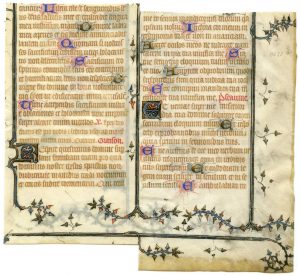
As companion to the RGME Workshops on “The Evidence of Manuscripts, Etc.” (Also Known as “Looking at Original Sources”), launched in 2024, we present a case setting out the stages of looking at the pages of two medieval manuscripts.

As part of the “RGME Lending Library,” these two pages have been introduced in a blogpost soon after we first encountered them, as they stand in their archival modern frames which turn the backs of the leaves to the covered back of the frame. Our examination proceeds by the pages which are revealed to us. For the story so far, see:

  • Two Pages

We now prepare a RGME Research Booklet to demonstrate the steps and present the results of the investigation which they enable. This Booklet and demonstration build upon the foundation principles of the RGME Workshops, described here:

  • The Bridge of Signs

Watch This Space.

We invite you to attend the Workshops:

  • RGME Workshops on “The Evidence of Manuscripts, Etc.”

All are welcome, including experts and beginners alike. Given the range of materials and original sources to explore, and the fields of expertise or experience which they call for, it is perhaps unlikely that anyone might be expert in everything under examination.

There might be something to learn, and the range of materials can pertain to a very wide range of interests, medieval and more.

*****
 

Tags: RGME Workshops on Looking at Manuscripts, RGME Workshops on the Evidence of MSS Etc., The Bridge of Signs
No Comments »

Episode 21. “Learning How to Look”

January 18, 2025 in Announcements, Manuscript Studies, Research Group Speaks (The Series)

“The Research Group Speaks”
Episode 21

“Learning How to Look”
A Roundtable

Saturday 24 May 2025
1:00–2:30 pm EST (GMT-5) by Zoom

[Posted on 17 January 2025]

As the series wherein “The Research Group Speaks,” we respond to suggestions and requests as the series unfolds. For information about the series, please see:

  • “The Research Group Speaks”: The Series

London, British Library, Yates Thompson MS 5, fol. 12r. Book of Hours, 15th century, France, perhaps Tours. Saint Matthew, Evangelist, with book, spectacles, and lion attribute. Image via https://blogs.bl.uk/digitisedmanuscripts/2019/02/medieval-spectacles.html

The Plan

For this Episode, by request, a group of experts, scholars, students, and interested observers will compare notes and share experiences. We examine the painstaking yet rewarding quest to learn how to look at objects or materials.

Cases in point will come from the detailed study of manuscripts and printed books, photographs, human anatomy, numismatics, prints and drawings, textual transmission, the natural world, and other spheres. From personal experience, our speakers may report on how they learned how to look, at various stages in their lives and studies, and what tips or methods they find helpful in the process.

We might provide some references as guides or handbooks for this instruction, whether self-taught, mentored, or a combination. For example, to what extent does the process of learning carefully how to look at one body of material transfer to another, that is, to another body of material or to another observer?

Related to this quest for learning how to look more fully at objects and original sources, so as better to understand them, is the need to consider how to describe what it is that we see. Describing can develop understanding the nature of the object more clearly. Putting that recognition into words with precision calls upon accuracy of terminology or nomenclature.

That complex subject might itself call for another Episode of its own. Let us see how this Episode take shape, and where it might lead.

Speakers include (in alphabetical order):

Nan Anantharaman, Mildred Budny, Michael Allman Conrad, David W. Sorenson, and others.

Vitas Patrum Folio 5A. Photography © Mildred Budny

Private Collection, Vitae Patrum, Folio 5A. Photography by Mildred Budny.

Registration

See the registration portal for our events.

  • RGME Eventbrite Collection

For this Episode, you can register through its own portal:

  • Episode 21 “Learning How to Look” Tickets

Registration for the Episode is free. The Zoom Link will be sent to you directly shortly before the event.

We welcome Voluntary Donations with your registration. See also:

  • Contributions and Donations
  • 2025 Annual Appeal

Thank you for joining us!

*****

Questions? Suggestions?

  • Leave your comments or questions below
  • Contact Us

Visit our Social Media:

  • our FaceBook Page
  • our Facebook Group
  • our X/Twitter Feed (@rgme_mss)
  • our Bluesky nest @rgmesocial.bluesky.social)
  • our Instagram Page
  • our LinkedIn Group

Join the Friends of the RGME.

Please make a Donation in Funds or in Kind for our nonprofit educational corporation powered principally by volunteers. Your donations and contributions are welcome, and can go a long way. They may be tax-deductible to the fullest extent provided by the law.

  • Donations and Contributions
  • 2025 Annual Appeal

*****

London, British Library, Yates Thompson MS 5, fol. 12r. Book of Hours, 15th century, France, perhaps Tours. Saint Matthew, Evangelist, with book, spectacles, and lion attribute. Image via https://blogs.bl.uk/digitisedmanuscripts/2019/02/medieval-spectacles.html

Tags: Manuscript studies
No Comments »

Episode 20. “Comic Book Theory for Medievalists”

January 16, 2025 in Manuscript Studies, Research Group Episodes for The Research Group Speaks, Research Group Speaks (The Series)

“The Research Group Speaks”
Episode 20

“Comic Book Theory
for Medievalists:
The Poetics”

Jesse D. Hurlbut

Saturday 1 March 2025
1:00–2:30 pm EST (GMT-5) by Zoom

[Posted on 20 January 2025]

Our series wherein “The Research Group Speaks” continues with its Twentieth Episode in an exploration of the phenomenon of dynamic interactions between words and images found in books from widely distant centuries, yet in compellingly similar modes of presentation.

BnF, Fr, 1141, fol. 140v, detail.

London, British Museum. Door-sill carved as a carpet. From Room I, door c, the North Palace of Ashurbanipal II at Nineveh, Iraq. 645-640 BCE. Photograph (2014) Osama Shukir Muhammed Amin FRCP(Glasg), CC BY-SA 4.0 <https://creativecommons.org/licenses/by-sa/4.0>, via Wikimedia Commons..

This Episode follows Episode 19 in January 2025 “At the Gate: RGME Activities for 2025” to launch our Theme for this Year, “Thresholds and Communities”, with reflections on the theme and an introduction to the suite of our multiple activities for 2025.

Episode 20 takes a look at an engaging didactic genre of illustrated books, whether in manuscript or print, which displays an unfolding story as the pages take their turns.

Which genre is that? Comic books, par excellence, along with their popular forerunners in medieval narratives of many kinds in which sequential series of images accompany or take over the story.

Read the rest of this entry →

Tags: BnF MS Fr. 1141, Comic Book Theory, Comic Books, Dream Visions, Guillaume de Diguillevile, Jesse D. Hurlbut, Jimmy Corigan, Manuscript studies, Medieval manuscripts, Pèlerinage de la Vie Humaine, Words and Images
No Comments »

2025 Autumn Colloquium at the University of Waterloo

January 6, 2025 in Announcements, Co-Sponsorships with the RGME, Conference, Conference Announcement, DRAGEN Lab, RGME Recollections, University of Waterloo

This link for the

2025 Autumn Colloquium at the University of Waterloo

“Break-Up Books and Make-Up Books:
Encountering the Legacy of Otto F. Ege and Other Biblioclasts”

Friday to Sunday, 21–23 November 2025

redirects you to another link, which retains the record of a plan that could not come to fruition:

  • 2025 RGME Autumn Colloquium at the University of Waterloo: A Failed Plan

That plan had to  be aborted.

1. The University and its DRAGEN Lab, which asked to host the 3-day international RGME hybrid colloquium in the first place and set the dates, changed plans with scant notice, despite remonstrations. It abandoned the project, at great financial and other costs to the RGME for the year 2024, during which our plans had focused in good faith on that partnership.

The University and its DRAGEN Lab, despite promises and demands that we provide the documentation and other organizational work, from our own projects and commitments, did not support the grant applications twice over, despite requesting us to help substantially to help to write and then revise for one and the next of two missed application deadlines of 1 March and 1 May. Resourcefully we offered a proposal (Prospectus for Collaboration and companion Memorandum) for a 15 June deadline with constructive, experienced suggestions for co-sponsorship nevertheless.

With no reply, we were left at considerable cost to plan the event without support.

2. Over time, regrouping and turning resourcefully to friends, colleagues, and institutions, the Colloquium found a host at Princeton instead. Thus we could honor the intentions and dedication of colleagues, near and far, who responded to my invitation for contributions when we first issued the call in January.

The outdated post about the 2025 RGME Autumn Colloquium at the University of Waterloo: A Failed Plan remains online as a record of the original intentions for the colloquium and the first six months of preparations, when the University of Waterloo presented itself as co-sponsor and called upon our uncompensated expertise,  time, and organizational experience.

Poster 1. 2025 Autumn Colloquium: Save-the-Date. Poster set in RGME Bembino.

The event took place with a different structure and with different supporters and sponsors.

For the revised, revived version of the event, now see:

  • 2025 RGME Autumn Colloquium on Fragments

Perhaps of interest are these descriptions of some practices and guidelines for co-sponsorship, drawn from RGME experience over decades, for hosted events at institutions in the United States and beyond:

  • Prospectus for Collaboration
  • and its companion Memorandum

Thank you for your patience and understanding.

*************

Updates

1. Foreground [25 February 2026]

It has come to our attention that representatives of the University of Waterloo continue to claim credit for the event, after the RGME managed, at great cost and hardship for a small organization with very few resources and no employees, no office spaces, and a very limited endowment (having to undergo being drained by exploitation of our skills and resources), to hold the 2025 RGME Autumn Colloquium at the requested time and with the requested participant. Perhaps an acknowledgement of thanks, perhaps, for the RGME enforced, uncompensated labor is appropriate?

2. Background [20 November 2025]

The Journey Toward an Event

For years the RGME has promoted, showcased, undertaken, and published research on fragments of manuscripts and printed books, including cases dispersed by Otto F. Ege and other biblioclasts — as reported, for example, on our website, at a variety of our events, and in our blog (see its Contents List).

The RGME began to plan an event for 2025 on Otto Ege and fragments in response to a request during Session 4 on 25 October in our 2024 Autumn Symposium. Planning for it developed through discussions in conversation and at various RGME meetings through December.

With the suggestion in late December that the University of Waterloo might host the event, the RGME was invited by a representative of the University in early January 2025 to hold the event in hybrid format there, hosted by the DRAGEN Lab. The university chose the dates of 21-23 November 2025 for the event, which we confirmed with prospective participants. The university requested the RGME 1) to develop a program for the event through our network of international contacts in many spheres relating to work on the subject, 2) help to find major funding for the event, 3) co-write and then revise a major grant application for a Canadian government Connection Grant, and 4) undertake to produce the event — as the RGME had done successfully for such co-sponsored events over many years, including recently in hybrid format for the invited 2024 RGME Spring Symposium at Vassar College.

Accordingly, with that commitment, the RGME undertook to set up the program, find matching grants, help significantly to write the grant application and then revise it, at UWaterloo’s request. We did so on the understanding that the application would be submitted in timely fashion for the event as designed, and that the RGME would gain benefit from that investment of our time, work, focus, and expertise for the specific purpose, as agreed. When UWaterloo proved unable to honor that commitment, without proposing or discussing a viable, credible, alternative, we had to seek other, reliable sources of funding and support for the  2025 design, which had a specific date, set of RGME commitments, assigned RGME resources, and cast of contributors dedicated to it.

The success of the rescue operation to enable the colloquium to take place on time within 2025, as needed at short notice, forms a testimony to collaborative good resourcefulness and good will. We thank all individuals and institutional sponsors who worked together to make it possible.

  • 2025 RGME Autumn Colloquium on Fragments

Private Collection, Leaf from ‘Ege MS 14’. Part of the Book of Jeremiah, Recto, Detail. Photograph by Mildred Budny.

No Comments »

2025 RGME Autumn Colloquium at the University of Waterloo: A Failed Plan

January 5, 2025 in Announcements, Conference, Conference Announcement, Event Registration, Events, Manuscript Studies, RGME Colloquia, University of Waterloo

NOW OLD:
Plans have changed.
See
2025 RGME Autumn Colloqium on Fragments

and

2025 RGME Autumn Colloquium at the University of Waterloo with background

—————

[Note: This outdated post remains as a record
of the first intentions for the event
and its first six months of preparation
]

2025 RGME Autumn Colloquium
at the University of Waterloo

“Break-Up Books
and Make-Up Books:

Encountering and Reconstructing
the Legacy of Otto F. Ege
and Other Biblioclasts
“

Friday to Sunday 21–23 November 2025
in Hybrid Format (pending funding)
or Online by Zoom

Colloquium ‘Home Page’
for information and updates

[Posted on 5 January 2025, with updates. As of June 2025, the University of Waterloo is not a co-sponsor or host for the event. The renewed version of the initial plan retains its structure, but not that location or partner, while it honors the commitment by contributors who responded to the initial call. 

For the revised version at Princeton, see

  • 2025 RGME Autumn Colloquium on Fragments. 

For background on the necessary change, see 2025 RGME Autumn Colloquium at the University of Waterloo.]

Motto

“Yet will I leave a remnant, that ye may have some that shall escape the sword among the nations, when ye shall be scattered through the countries”
— Ezekiel 6:8

Waterloo, University of Waterloo, DRAGEN Lab, Vellum Leaf from a Book of Hours, Recto.

By request, in collaboration with the University of Waterloo, the RGME prepares a special 2025 Autumn Colloquium on the phenomena of widely dispersed remnants of dismembered manuscripts and other written materials scattered at the hands of biblioclasts such as Otto F. Ege (1888–1951), for a variety of purposes more and less laudable. We will showcase work being done in various centers and by many individuals on these materials, as part of long-term, laborious, significant, and sometimes dispersed research to identify, reclaim, and, insofar as possible, virtually reconstruct the originals and place them in context.

We seek to gather perspectives on the challenges and opportunities presented by the dispersed manuscript or other materials which survive, albeit disordered or reordered, after passing through the hands of collectors-turned-biblioclasts, for whatever reasons.

A main focus, given the number and variety of projects dedicated to them, will be the manuscripts and other materials dispersed by Otto F. Ege and his collaborators, notably his wife/widow Louise and the New York book-dealer and book-breaker Philip C. Duschnes (1897–1970). Yet, not least because many of their remnants have joined or become intermixed with fragments dispersed by others and through diverse processes in varied collections, it is worthwhile to consider that complex factor for their effective study as well.

We seek to showcase the work of these projects, compare notes about issues and methods of research, and set the legacy of those biblioclasts in the context of others working as predecessors, contemporaries, or followers, as they also redirected the course of manuscript and related studies by disrupting and dislocating its evidence.

The ‘delivery methods’ of dispersal range from assemblages of sets of fragments as specimens in Portfolios, Leaf-Books, Albums, Scrapbooks, or Loose Leaves which might circulate in mats with or without labels, on their own, or in groups sans identifying information. In effect, many of these remnants were cast out on their own as no-name ‘orphans’ whom expertise, serendipity, and circumstance might recognize as ‘foundlings’ or find forever homes, whether virtual or actual. (See The “Foundling Hospital” for Manuscript Fragments.)

Our Colloquium highlights the processes of recovery by multiple, interlinked, and interlocking means, as we gather representatives from the fields of manuscript studies and fragmentology to share their stories, processes, progress, and accomplishments.

New Haven, Yale University, Beinecke Rare Book and Manuscript Library, Otto F. Ege Collection, Leaf in Ege’s Mat from ‘Ege MS 14’. Opening page of the Apocalypse / Revelations in a large-format Lectern Bible in the Latin Vulgate Version. Photograph by Mildred Budny.

Scope

The University of Waterloo and the RGME propose to co-host an international Colloquium with hybrid functionality, for access by a wide audience with interests in multiple subjects. Our two educational organizations in Canada and the United States respectively combine experience and skills to produce a scholarly event with companion publications pre- and post-event, to promote and disseminate research work and discoveries in multiple, interrelated fields of study.

Waterloo, University of Waterloo, DRAGEN Lab, Vellum Leaf with music and notation for liturgical chants: Recto.

Our plan takes its starting point from the wish to gather expertise and perspectives from a different collections of manuscript materials — such as at the Medieval DRAGEN Lab (Digital Research Arts for Graphical & Environmental Networks — and the rich variety of new and long-term projects (both institutional and individual) dedicated to research on the medieval Western manuscripts despoiled and dispersed by Otto F. Ege and his collaborators.

These initiatives include the new project by the Cantus database (Cantus: A Database for Latin Ecclesiastical Chant – Inventories of Chant Sources) to produce a database of the musical manuscript fragments in Ege’s Portfolio of Fifty Original Leaves from Western Manuscripts (FOL). This notorious Portfolio was issued in multiple sets now widely dispersed in public or private collections through North America and beyond. Like others of Ege’s Portfolios, some sets are lost, or lost track of; some have themselves become fragmented, as parts have been removed, as specific manuscript specimens were further disjointed from their relatives, original or newer companions in the biblioclasts’ assemblages. Some of these ‘orphans’ or cast-offs have lost their identifying Ege mats or labels, further to complicate the issues of identification, recognition, and retrieval.

The RGME’s long-term project of research in these fields focuses on the variety of Ege’s Portfolios overall.  Dedicated to specific genres of books, such as Famous Books or Famous Bibles, they include not only manuscript fragments but also a multitude of printed materials ranging from incunabula (up to the year 1500) to the twentieth century; all were selected and arranged by Ege and his circle as specimens of the graphic arts and book arts for instruction and display. (For examples, see our blog on Manuscript Studies and its Contents List for Ege materials.)

Private Collection, Leaf from ‘Ege MS 14’. Part of the Book of Jeremiah, Recto, Detail. Photograph by Mildred Budny.

Research on the surviving evidence on many fronts and in multiple centers can bring expertise to bear upon specific genres (such as manuscripts containing music). So, too, it reveals the processes of workshop practices over decades in the destruction, re-constitution, and further distribution of the original books. For example, such elements have bearing upon the provenance of individual fragments and potential impact upon that of other fragments whose provenance might not otherwise be known.

Collection of Richard Weber, Leaf from Otto Ege MS 14, recto. Photograph by Richard Weber.

Given the progress of these and other projects in various centers concerned with Ege’s legacy, the time is right to bring their representatives (established scholars, curators, collectors, and others, as well as younger scholars) together to compare notes, showcase their work, and strengthen contacts between individuals and centers across borders.

By examining the book-breaking practices overall by “Ege & Co.” in the wider context of biblioclasts over time, including many of Ege’s contemporaries, predecessors, and followers, we might gain fuller knowledge of the individually as well as collectively destructive habits and their legacy. Likewise by comparing notes, surveying the results so far of different projects, and, it might be, identifying more of the seemingly lost fragments in unknown or unexpected places, our Colloquium could cross thresholds and open more gateways to wider knowledge.

Such larger contexts provide wider horizons and more comprehensive awareness of the destructive tendencies towards books in given times and places. They can demonstrate, by examination and comparison, the particular characteristics or ‘style’ of the collector, book-breaker, book-seller, and the resulting forms as altered pieces or bodies of evidence for the lost and damaged originals. Among notable predecessors for the genre can be counted the albums of “visually appealing” manuscript fragments created by Samuel Pepys (1633–1703) or the cuttings prepared by John Ruskin (1819-1900) and others.

Examining the complex legacy of these various re-creators of medieval manuscripts and other written materials and the range of projects dedicated to them from perspectives and fields of many kinds, sometimes integrated across a broad spectrum encompassing expertise in the arts and sciences, can advance knowledge in individual projects as well as in wider discourse relating to the transmission of written evidence from generation to generation and century to century, with losses, discoveries, and reconstitutions along the way.

Our focus for the co-sponsored Autumn Colloquium is the legacy of book-breakers, book-destroyers, and book-recreators active in multiple centers in Europe, the British Isles, and North America (at least), with the fragments produced by their activities and transmitted to diverse locations worldwide, often without appropriate identifying information. Our task, as receivers of the evidence from such disruptions, is to make sense of the evidence, identify it appropriately, recognize its characteristics as bodies of witnesses with a complex history, compare information about diverse projects (in many centers) relating to these materials, gather feedback, and disseminate the results to a wide audience.

Waterloo, University of Waterloo, DRAGEN Lab, Vellum Leaf from a Book of Hours, Recto, detail.

Purpose

This 2025 Colloquium stands within the long tradition of symposia, colloquia, workshops, and other scholarly events of the Research Group on Manuscript Evidence, now entering its second quarter-of-a-century as a nonprofit educational corporation based in Princeton, New Jersey. The RGME is dedicated to the study of manuscripts and other written records across the centuries. This year our theme is “Thresholds and Communities”.

Waterloo, University of Waterloo, DRAGEN Lab, Vellum Leaf with music and notation for liturgical chants: Verso.

For the 2025 Autumn Colloquium on 21–23 November, the RGME collaborates with the University of Waterloo and its range of programs and projects, including the Cantus Database and the DRAGEN Lab.

The Advisory Committee for the Colloquium comprises:

  • Mildred Budny, Director, Research Group on Manuscript Evidence
  • Debra Lacoste, Cantus Database, University of Waterloo; The Institute of Mediaeval Music; Digital Analysis of Chant Transmission, Dalhousie University
  • David Porreca, Associate Professor; President, Faculty Association of the University of Waterloo; Co-Director, Medieval Studies Undergraduate Program; Department of Classical Studies and Department of History, University of Waterloo

Spanning three days with half-days on Friday and Sunday, the Colloquium will include a series of sessions with presentations and Q&A, roundtable discussions/panels, hands-on workshops, and exhibitions of several kinds.

To augment the scholarly sessions of presentations and discussions, we plan for displays of original materials in manuscript or other forms and demonstrations of the sounds of music represented in medieval manuscript fragments. Among them is a SoundWalk which allows passersby to access audio recordings of specific musical passages preserved on medieval leaves in collections including the DRAGEN Lab and the Cantus Database.

A Reception ending each day’s sessions will lead from the scholarly program to further conversations.

Participants

Participants represent a wide range of interests, approaches, subjects, centers, and materials.

Speakers, Respondents, Panelists, Hosts, and Presiders

Rejoined Pieces of a Leaf from a Book of Hours. Private Collection, reproduced by permission.

Rejoined Pieces of a Leaf from a Book of Hours. Private Collection. Photography by Mildred Budny.

Participants include (in alphabetical order):

Alison Altstatt (University of Northern Iowa)
Steven Bednarski
(DRAGEN Lab, University of Waterloo)
Mildred Budny (Research Group on Manuscript Evidence)
John P. Chalmers (Retired)
Katharine C. Chandler (University of Arkansas)
Lisa Fagin Davis (Medieval Academy of America)
Juilee Decker (Rochester Institute of Technology)
Augustine Dickinson (University of Hamburg)
Scott Ellwood (Grolier Club Library)
Steven Galbraith (Rochester Institute of Technology)
Hannah Goeselt (Massachusetts Historical Library)
Scott Gwara (University of South Carolina and King Alfred’s Notebook LLC)
Elizabeth Hebbard (Indiana University Bloomington and Peripheral Manuscripts Project)
Josephine Koster (Winthrop University)
Debra Lacoste (University of Waterloo, Cantus Database, and Dalhousie University)
David Porreca (University of Waterloo)
Eleanor Price (University of Rochester)
Agnieszka Rec (Beinecke Rare Book & Manuscript Library)
Irina Savinetskaya (Syracuse University)
Kate Steiner (Conrad Grebel University College and University of Waterloo)
Anna Siebach–Larsen (University of Rochester)
Richard Weber (Independent Scholar)
N. Kıvılcım Yavuz (University of Leeds)

And others . . .

Some Results

RGME tradition produces illustrated Program Booklets for major events such as this Colloquium, with participants’ abstracts and selected accompanying illustrations, to grant insider glimpses for our audience (at the event and after) not necessarily familiar with the wide range of subjects and materials under discussion.

A recent example from our 2024 Autumn Symposium “At the Helm” can be downloaded from the RGME website: 

  • 2024 Autumn Symposium Booklet

Waterloo, University of Waterloo, DRAGEN Lab, Vellum Leaf from a Book of Hours, Recto, with the Opening of the Liturgical Kalendar for the Month of February.

We explore sources of funding and sponsorship for the event as a whole.  Information about the results would emerge as these explorations advance. Our aim is to have an in-person event with online access (for speakers and audience) for a fully hybrid colloquium; the online functionality would occur by Zoom Meetings (rather than Webinars with closed access). If funding proves elusive for the in-person facets as well, the event will take place online by Zoom.

We hope to welcome you to the Colloquium.

*****

Note:  For information about the RGME Autumn Colloquium as it develops, please continue to visit this ‘Home Page’.

For related RGME events, please see, for example:

  • 2025 Spring and Autumn Symposia

Registration

To register for RGME events, please visit:

  • RGME Eventbrite Collections

To register for the Autumn Colloquium, we offer portals to attend online or in person respectively.

1) Register for ONLINE Attendance

  • 2025 RGME Autumn Colloquium: Tickets for ONLINE Attendance

2) Register for IN PERSON Attendance

  • 2025 RGME Autumn Colloquium: Tickets for IN PERSON Attendance

Registration Fees

Circumstances lead us to charge a modest registration fee to attend this 3-day event. The extra costs for preparations in several formats and from different locations require a registration fee to help to offset them.

When you register, we ask you please to add the Eventbrite handling fee for the transaction, as a contribution to the RGME’s costs for this event.

1) General Attendance: $60 US per person

2) Student Discount for Official Students: $35 US per person. When registering for the discount, please let us know your registered affiliation as a student.

The registration fee is waived only for Speakers and Presiders, for whose contributions we give thanks.

We also encourage you to consider adding a Voluntary Donation in support of the RGME, a Section 501(c)(3) nonprofit educational organization principally powered by volunteers.  See:

  • 2025 Annual Appeal
  • Donations

We thank you for your support and your interest in the Colloquium.

*****

Questions? Suggestions?

  • Waterloo, University of Waterloo, DRAGEN Lab, Vellum Leaf from a Book of Hours, Recto, with the Liturgical Kalendar for the Month of February: Top.

    Leave your comments or questions below

  • Contact Us
  • Sign up for our Newsletter and information about our activities.
    Send a note to director@manuscriptevidence.org or RGMEevents@gmail.com

Visit our Social Media:

  • our FaceBook Page
  • our Facebook Group
  • our Twitter Feed (@rgme_mss)
  • our Bluesky nest @rgmesocial.bluesky.social)
  • Our Instagram account (rgme94)
  • our LinkedIn Group

Join the Friends of the RGME.

Register for our Events by the RGME Eventbrite Collection.

Among them are the

  • 2025 Spring and Autumn Symposia (online or hybrid)
  • Episodes of “The Research Group Speaks” (online)
  • RGME Workshops on “The Evidence of Manuscripts, Etc.” (online, in person, or hybrid)
  • Meetings of the Friends of the RGME (online)

Please consider making a Donation in Funds or in Kind for our nonprofit educational corporation powered principally by volunteers. Your donations and contributions are welcome, and can go a long way. They may be tax-deductible to the fullest extent provided by the law.

  • Donations and Contributions
  • 2025 Anniversary Appeal

We thank the hosts, co-organizers, advisers, and participants for generously contributing to this Colloquium.

*****

Waterloo, University of Waterloo, DRAGEN Lab, Vellum Leaf from a Book of Hours, Verso.


Tags: Albums of Manuscript Fragments, Biblioclasts, Broken Books, CANTUS Database, Dispersed Manuscripts, DRAGEN Lab, Early modern printing, Fragmentology, Leaf-Books, manuscript fragments, Manuscript studies, Medieval manuscripts, Otto Ege Portfolios, Otto F. Ege, Philip C. Duschnes, RGME Colloquia, University of Waterloo
No Comments »

« Older Entries
Newer Entries »
  • Top
©2024 Research Group on Manuscript Evidence.


is proudly powered by WordPress. WordPress Themes X2 developed by ThemeKraft.