• News
    • News & Views
    • RGME Activities for 2024 and 2025
    • Around & About with the RGME
    • Reviews
    • Highlights
  • Blogs
    • Manuscript Studies
      • Manuscript Studies: Contents List
    • International Congress on Medieval Studies
      • Abstracts of Congress Papers
        • Abstracts of Papers Listed by Author
        • Abstracts of Papers Listed by Year
  • About
    • Mission
    • Who We Are
      • Officers, Associates & Volunteers
      • RGME Committees
      • Friends of the Research Group on Manuscript Evidence
    • Policies & Statements
      • RGME Privacy Policy Statement
      • RGME Intellectual Property Statement & Agreements
    • People
      • Mildred Budny — Her Page
      • Adelaide Bennett Hagens
    • Activities
      • Events
      • Congress Activities
        • Sponsored Conference Sessions (1993‒)
          • Panels at the M-MLA Convention (from 2016)
        • Co-sponsored Conference Sessions (2006‒)
    • History
      • Seals, Matrices & Documents
      • Genealogies & Archives
    • Contact Us
  • Bembino
    • Multi-Lingual Bembino
    • RGME Bembino: Resources
  • Congress
    • Sponsored Conference Sessions (1993‒)
    • Co-sponsored Conference Sessions (2006‒)
    • Abstracts of Congress Papers
      • Abstracts Listed by Author
      • Abstracts Listed by Year
    • Kalamazoo Archive
    • Panels at the M-MLA Convention (2016-2019)
      • Abstracts of Papers for the M-MLA Convention
      • Panels at the M-MLA Convention (from 2016)
  • Events
    • RGME Activities for 2024 and 2025
      • 2023 Activities and 2024 Planned Activities
    • Seminars, Workshops, Colloquia & Symposia (1989–)
      • Seminars on ‘The Evidence of Manuscripts’
      • Symposia on ‘The Transmission of the Bible’
      • The New Series (2001-)
        • 2019 Anniversary Symposium Program: The Roads Taken
        • 2019 Anniversary Symposium Registration
        • 2019 Anniversary Symposium Registration Open
      • RGME Symposia: The Various Series
      • The Research Group Speaks: The Series
      • Meetings of the Friends of the Research Group on Manuscript Evidence
      • RGME Online Events
    • Abstracts of Papers for Events
      • Abstracts of Papers for Seminars on ‘The Evidence of Manuscripts’
      • Abstracts of Papers for Symposia, Workshops & Colloquia
    • Receptions & Parties
    • Business Meetings
    • Photographic Exhibitions & Master Classes
    • Events Archive
  • ShelfLife
    • Journal Description
    • ShelfMarks: The RGME-Newsletter
    • Publications
      • “Insular, Anglo-Saxon, and Early Anglo-Norman Manuscript Art at Corpus Christi College, Cambridge” (1997)
        • Mildred Budny, ‘Catalogue’
        • The Illustrated Catalogue (1997)
      • The Illustrated Handlist
      • Semi-Official Counterfeiting in France 1380-1422
      • No Snap Decisions: Challenges of Manuscript Photography
    • History and Design of Our Website
  • Galleries
    • Watermarks & the History of Paper
    • Galleries: Contents List
    • Scripts on Parade
    • Texts on Parade
      • Latin Documents & Cartularies
      • New Testament Leaves in Old Armenian
    • Posters on Display
    • Layout Designs
  • Donations and Contributions
    • RGME Donor Promise
    • 2023 End-of-Year Fundraiser for our 2024 Anniversary Year
    • 2019 Anniversary Appeal
    • Orders
  • Links
    • Catalogs, Metadata, and Databases: A Handlist of Links
    • Handlist of Resources for Manuscript Studies and Fragmentology
    • Manuscripts & Rare Books
    • Maps, Plans & Drawings
    • Seals, Seal-Matrices & Documents

  • News
    • News & Views
    • RGME Activities for 2024 and 2025
    • Around & About with the RGME
    • Reviews
    • Highlights
  • Blogs
    • Manuscript Studies
      • Manuscript Studies: Contents List
    • International Congress on Medieval Studies
      • Abstracts of Congress Papers
        • Abstracts of Papers Listed by Author
        • Abstracts of Papers Listed by Year
  • About
    • Mission
    • Who We Are
      • Officers, Associates & Volunteers
      • RGME Committees
      • Friends of the Research Group on Manuscript Evidence
    • Policies & Statements
      • RGME Privacy Policy Statement
      • RGME Intellectual Property Statement & Agreements
    • People
      • Mildred Budny — Her Page
      • Adelaide Bennett Hagens
    • Activities
      • Events
      • Congress Activities
        • Sponsored Conference Sessions (1993‒)
          • Panels at the M-MLA Convention (from 2016)
        • Co-sponsored Conference Sessions (2006‒)
    • History
      • Seals, Matrices & Documents
      • Genealogies & Archives
    • Contact Us
  • Bembino
    • Multi-Lingual Bembino
    • RGME Bembino: Resources
  • Congress
    • Sponsored Conference Sessions (1993‒)
    • Co-sponsored Conference Sessions (2006‒)
    • Abstracts of Congress Papers
      • Abstracts Listed by Author
      • Abstracts Listed by Year
    • Kalamazoo Archive
    • Panels at the M-MLA Convention (2016-2019)
      • Abstracts of Papers for the M-MLA Convention
      • Panels at the M-MLA Convention (from 2016)
  • Events
    • RGME Activities for 2024 and 2025
      • 2023 Activities and 2024 Planned Activities
    • Seminars, Workshops, Colloquia & Symposia (1989–)
      • Seminars on ‘The Evidence of Manuscripts’
      • Symposia on ‘The Transmission of the Bible’
      • The New Series (2001-)
        • 2019 Anniversary Symposium Program: The Roads Taken
        • 2019 Anniversary Symposium Registration
        • 2019 Anniversary Symposium Registration Open
      • RGME Symposia: The Various Series
      • The Research Group Speaks: The Series
      • Meetings of the Friends of the Research Group on Manuscript Evidence
      • RGME Online Events
    • Abstracts of Papers for Events
      • Abstracts of Papers for Seminars on ‘The Evidence of Manuscripts’
      • Abstracts of Papers for Symposia, Workshops & Colloquia
    • Receptions & Parties
    • Business Meetings
    • Photographic Exhibitions & Master Classes
    • Events Archive
  • ShelfLife
    • Journal Description
    • ShelfMarks: The RGME-Newsletter
    • Publications
      • “Insular, Anglo-Saxon, and Early Anglo-Norman Manuscript Art at Corpus Christi College, Cambridge” (1997)
        • Mildred Budny, ‘Catalogue’
        • The Illustrated Catalogue (1997)
      • The Illustrated Handlist
      • Semi-Official Counterfeiting in France 1380-1422
      • No Snap Decisions: Challenges of Manuscript Photography
    • History and Design of Our Website
  • Galleries
    • Watermarks & the History of Paper
    • Galleries: Contents List
    • Scripts on Parade
    • Texts on Parade
      • Latin Documents & Cartularies
      • New Testament Leaves in Old Armenian
    • Posters on Display
    • Layout Designs
  • Donations and Contributions
    • RGME Donor Promise
    • 2023 End-of-Year Fundraiser for our 2024 Anniversary Year
    • 2019 Anniversary Appeal
    • Orders
  • Links
    • Catalogs, Metadata, and Databases: A Handlist of Links
    • Handlist of Resources for Manuscript Studies and Fragmentology
    • Manuscripts & Rare Books
    • Maps, Plans & Drawings
    • Seals, Seal-Matrices & Documents

Log in

Archives

Featured Posts

2026 International Congress on Medieval Studies: Program
Episode 24. “Life with Books” (Interview with John Windle)
Announcing the Launch of RGME Bembino WP
2026 RGME Colloquium at The Grolier Club: Report
Medieval Missal Fragment as Early-Modern Cover
The Weber Leaf from Ege MS 61
"Bembino" Booklet Cover
Episode 23. “Meet RGME Bembino: Facets of a Font”
2026 RGME Colloquium on “Transformations & Renewals” at The Grolier Club
2026 Theme of the Year: “Transformations and Renewals”
A Leaf with Patchwork from the Saint Albans Bible
A Sister Leaf from a Miniature Latin Vulgate Bible
A Little Latin Vulgate Bible Manuscript Leaf in Princeton
J. S. Wagner Collection. Leaf from from Prime in a Latin manuscript Breviary. Folio 4 Verso, with part of Psalm 117 (118) in the Vulgate Version, set out in verses with decorated initials.
2026 Annual Appeal
Episode 22: “Encounters with Local Saints and Their Cults”
Private Collection, Ege's FBNC Portfolio, Dante Leaf, Verso, Detail. Reproduced by Permission.
2025 RGME Autumn Colloquium on Fragments
Workshop 8: A Hybrid Book where Medieval Music Meets Early-Modern Herbal
2025 RGME Autumn Symposium on “Readers, Fakers, and Re-Creators of Books”
RGME Workshops on “The Evidence of Manuscripts, Etc.”
2025 International Medieval Congress at Leeds: RGME Program
Episode 21. “Learning How to Look”
2025 International Congress on Medieval Studies: Program
2025 RGME Visit to Vassar College
Two Leaves in the Book of Numbers from the Chudleigh Bible
Delibovi on Glassgold on Boethius: A Blogpost
Ronald Smeltzer on “Émilie du Châtelet, Woman of Science”
2025 Spring Symposium: “Makers, Producers, and Collectors of Books”
Starters’ Orders
The Weber Leaf from the Saint Albans Bible
Workshop 4. “Manuscript Fragments Compared”
Episode 20. “Comic Book Theory for Medievalists”
Episode 19: “At the Gate: Starting the Year 2025 at its Threshold”
Favorite Recipes for Lemonade, Etc.
RGME Visit to the Lomazow Collection: Report
2024 Autumn Symposium: “At the Helm”
A Latin Vulgate Leaf of the Book of Numbers
The RGME ‘Lending Library’
Florence, Italy, Ponte Vecchio from Ponte alle Grazie. Photo: Ingo Mehling, CC BY-SA 4.0 , via Wikimedia Commons
Episode 17. “RGME Retrospect and Prospects: Anniversary Reflections”
2024 Anniversary Symposium: The Booklet
Jesse Hurlbut at the Bonneville Salt Flats, Utah. Photograph Jesse Hurlbut.
Episode 16: An Interview with Jesse D. Hurlbut
To Whom Do Manuscripts Belong?
Kalamazoo, MI Western Michigan University, Valley III from the side. Photograph: David W. Sorenson.
2024 International Congress on Medieval Studies: Report
2024 Spring Symposium at Vassar College
Puente de San Martín: Bridge with reflection over the River Targus, Toledo, Spain.
2024 Grant for “Between Past and Future” Project from The Gladys Krieble Delmas Foundation Research Libraries Program
2024 Anniversary Symposium in Thanks to Jesse Hurlbut: Program

You are browsing the Blog for

Episode 11: Michael Allman Conrad on “Gamified Numbers”

May 26, 2023 in Manuscript Studies, Research Group Speaks (The Series), Uncategorized

The Research Group Speaks
Episode 11
Saturday 8 July 2023 online
12:00–1:30 pm EDT (GMT-4) by Zoom

“Gamified Numbers and Digitalized Castles:

Digital Reconstructions of Medieval Board Games
and Other Forms of Data Visualization
as Methods in the Humanities
“

Michael Allman Conrad

[Posted on 5 June 2023, with updates]

For Episode 11 in the online series of The Research Group Speaks, our Associate Michael Allman Conrad will talk about his ongoing work on games, board games, and interrelations between gameplay and numbers.

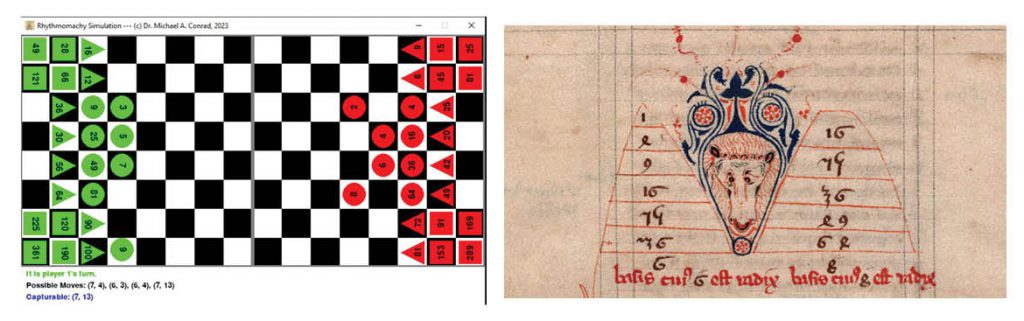
Left: Rhythmomachy Simulation (Player 1's turn). Image © 2023 Michael A. Conrad. Right: Bibliothèque interuniversitaire, Section Médecine, Montpellier, H 366, f. 13v, with rhythmomachy pyramids at the top flanking a lion's mask. Image via Creative Commons, via https://portail.biblissima.fr/fr/ark:/43093/mdata268b7df0d12be6fa155f802fd66b4123b9ddd65a.Left: Rhythmomachy Simulation (Player 1's turn). Image © 2023 Michael A. Conrad. Right: Bibliothèque interuniversitaire, Section Médecine, Montpellier, H 366, f. 13v, with rhythmomachy pyramids at the top flanking a lion's mask. Image via Creative Commons, via https://portail.biblissima.fr/fr/ark:/43093/mdata268b7df0d12be6fa155f802fd66b4123b9ddd65a.

Left: Rhythmomachy Simulation (Player 1’s turn). Image © 2023 Michael A. Conrad.
Right: Bibliothèque interuniversitaire, Section Médecine, Montpellier, H 366, f. 13v, with rhythmomachy pyramids at the top flanking a lion’s mask. Image via Creative Commons.

Recently, Michael spoke about some aspects of this work for a Session co-sponsored by the Societas Magica and the Research Group on Manuscript Evidence at the 2023 International Congress on Medieval Studies in May.  See the Program for our activities there (2023 Congress Program) and the illustrated Abstract for Michael’s paper.

In our co-sponsored Session on “Teaching Astrology and Other Liberal Arts” , Michael’s topic was “Gamified Numbers:  Board Games as Educational Instruments for Teaching Astrology and Other Quadrivial Arts”.  In the short time-span permitted by a full Session with four individual presentations , he briefly examined the game of rhythmomachy (rhitmomachia or “Battle of Numbers”), an early mathematical board game, and described his project of studying and preparing a computer simulation for its play.

Now we have the opportunity to hear Michael describe this complicated game, its origins, and its intricate relationship with knowledge of Boethian theories on the mathematical arts. That is, its structure is grounded in the understanding of those arts expounded by Anicius Manlius Severinus Boethius (circa 480 – 524 CE) in his influential manual De Institutione arithmetica Libri duo, based upon his loose translation of the treatise on the subject composed in Greek by the Neopythagorean philosopher Nicomachus of Gerasa (circa 60 – circa 120 CE).

More than that, Michael’s explorations of the game and its underlying theories build a bridge to a more general debate on the use of digital methods in the humanities, which he is also exploring in different ongoing data projects of his, some of which he is also going to introduce briefly in the course of his paper. The discussion will start with reflections on his experiences with using these methods, their requirements, benefits, and downsides.

Please register to attend this online event (see below).

Read the rest of this entry →

Tags: Alfonso X of Castile, Anicius Manilius Severinus Boethius, De consolatione philosophiae, De institutione arithmetica, Gameplay, History of Board Games, Mathematical Games, Nichomachus of Gerasa, Rhythmomachy, Ritmomachia, Scholasticism, The Research Group Speaks
No Comments »

2023 Autumn Symposium “Between Earth and Sky”

March 21, 2023 in Manuscript Studies, RGME Symposia, Uncategorized

2023 Autumn Symposium
“Between Earth and Sky”

Part 2 of 2 in the
2023 Spring and Autumn Symposia
on “Materials & Access”

Saturday 21 October 2023
9:30 am – 5:00 pm EDT (GMT-4) by Zoom

[Posted on 21 March 2023, with updates]

For 2023, the Year’s Theme for the Research Group is “Materials & Access”.

The RGME continues with its pair of Symposia for 2023, continuing its expanded pattern of paired day-long virtual Spring and Autumn Symposia launched in 2022.

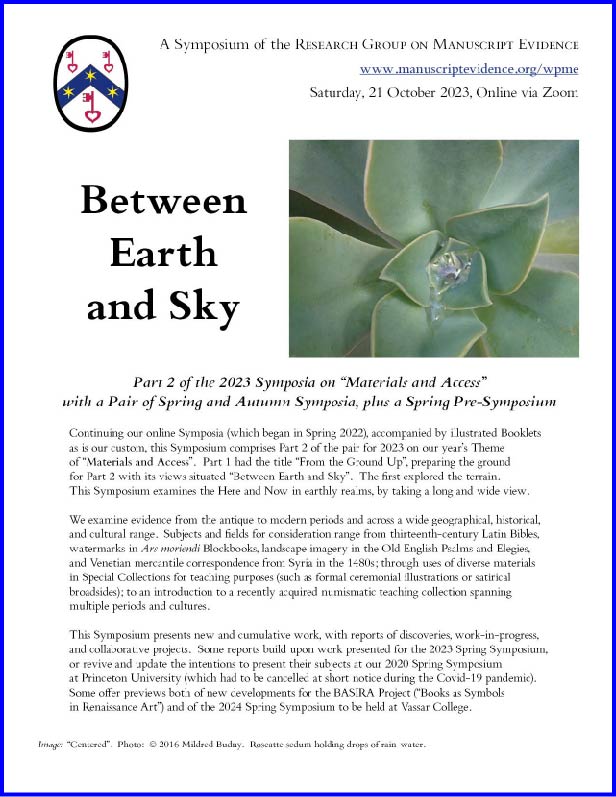
"Centered". Photograph Ⓒ 2014 Mildred Budny. Image of Dew at the center of Sedum.

“Centered”. Photograph Ⓒ 2014 Mildred Budny.

This year, the Spring and Autumn Symposia will take place by Zoom respectively on:

  • Saturday, 25 March 2023
  • Saturday 21 October 2023 (“The Sweetest Day” 2023)

Each Symposium in the pair explores a wide range of spheres, subjects, case-studies, and issues connected with the duality of Materials of many kinds and varieties of Access to them.

Part 1, “From the Ground Up”, explored the terrain for Materials and Access in a wide variety of fields.

Part 2, “Between Earth and Sky”, examines the conditions and opportunities for Materials and Access in the world as we might know it, both in the Here and Now and beyond.

1 of 2.  2023 Spring Symposium,
with a Pre-Symposium of Lightning Talks

Pre-Symposium:  “Intrepid Borders” (24 March 2023)

Spring Symposium:  “From the Ground Up” (25 March 2023)

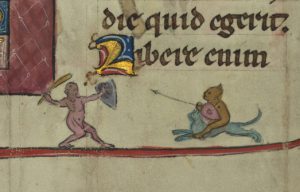
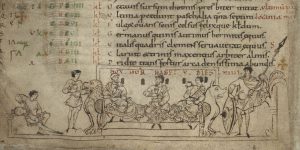
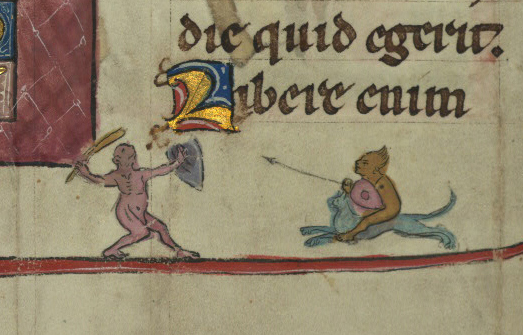
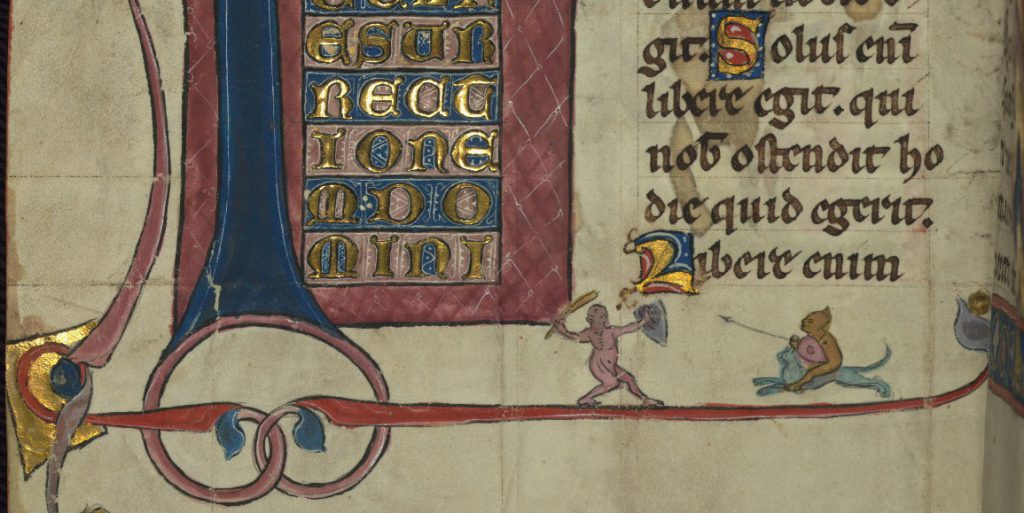
Baltimore, Walters Art Museum, MS. W.148, folio 33v, bottom right, with fighting creatures. Image via Creative Commons.

Baltimore, Walters Art Museum, MS. W.148, folio 33v, bottom right. Image via Creative Commons.

The Spring Symposium acquired a companion event, in the form of a half-day virtual Pre-Symposium with Lightning Talks selected from responses to a Call for Proposals and organized by Katharine C. Chandler, Jennifer Larson, and Jessica L. Savage.

Information about these companion events, which took place on Friday afternoon 24 March and all day Saturday 25 March 2023:

  • 2023 Spring Pre-Symposium on “Intrepid Borders”
  • 2023 Spring Symposium “From the Ground Up”
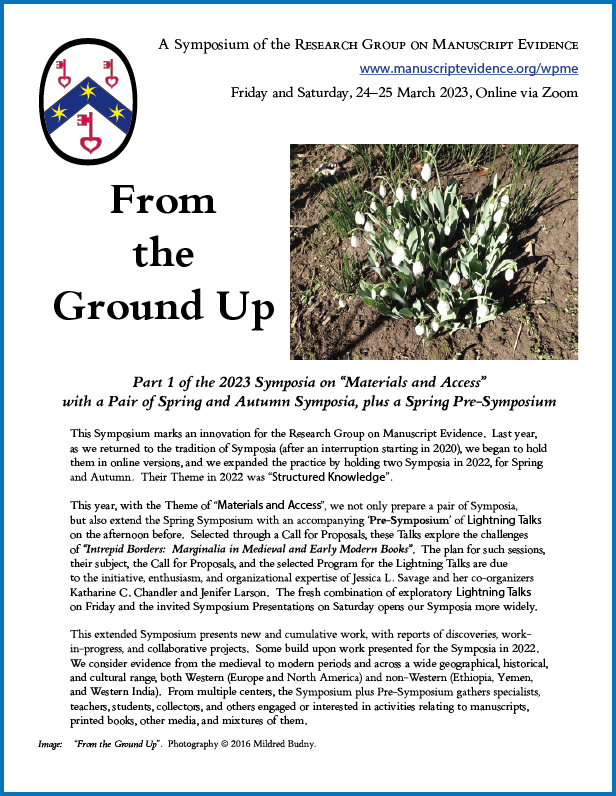
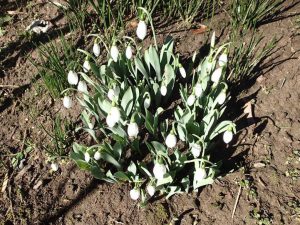
Photograph of the stems and white blooms of Snowdrops emerging from a patch of bare ground in the sunlight. Photograph Ⓒ Mildred Budny.

The blooms of Snowdrops emerging “From the Ground Up”. Photograph Ⓒ Mildred Budny.

The 2023 Spring Pre-Symposium/Symposium Booklet records the Program for both events and the Abstracts for their Presentations, with Illustrations.  The digital version can be downloaded freely here in two formats, for your printing facilities and preferences.

  • Consecutive Pages (quarto size, or 8 1/2″ × 11″ sheets)
    consecutive pages
  • Foldable Booklet (11″ × 17″ sheets), to be folded in half
    foldable booklet

2 of 2.  2023 Autumn Symposium:
“Between Earth and Sky”

Saturday 21 October 2023 by Zoom

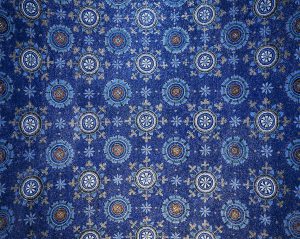
Ravenna, Mausoleum of Galla Placidia, Ceiling Mosaic. Photo: Petar Milošević / CC BY-SA, Wikipedia.

Grounded in the experiences and expertise of our fields of study, our 2023 Autumn Symposium might take notice of view-points across time and place which can inform and enlighten our explorations of materials, memory aids, and forms of understanding transmitted from the past.

Note on the Image

With an eye toward the heavens, a visitor looking upward in the late-antique Mausoleum of Galla Placidia, created for an empress in Ravenna, Italy, can glimpse the mosaic ceiling patterned with star-studded and celestial skies of deep blue.

Photograph by Petar Milošević, via CC BY-SA License via Wikipedia.

Participants

Participants for the 2023 Autumn Symposium, variously as Presenters, Respondents, Presiders, Moderators, and Advisers, include (in alphabetical order):

  • Phillip A. Bernhardt-House, Mildred Budny, Barbara Williams Ellertson, Hannah Goeselt, Justin Hastings, Jennifer Larson, Laura Light, John McQuillen, Ann Pascoe-van-Zyl, Ronald Patkus, David Porreca, David W. Sorenson, Kathy Young, N. Kıvılcım Yavuz, and others.
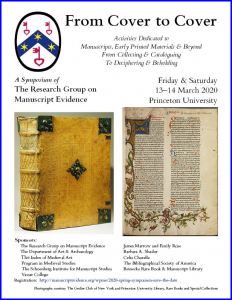
2020 Symposium "From Cover to Cover" Poster 1

2020 Symposium Poster 1

Among them are Speakers who now reprise or offer a variant on the papers which they planned for the RGME 2020 Spring Symposium in person at Princeton University.  Their illustrated Abstracts for that cancelled event describe the intentions then.  See 2020 Spring Symposium (Save the Date) and the published Symposium Booklet, available as a pdf laid out

  • in consecutive pages,
  • or as foldable booklet.

A similar Symposium Booklet is planned for the 2023 Autumn Symposium.

For the Preliminary Program for the 2023 Autumn Symposium, see below.  As it takes fuller shape, its details will appear here.  For an e-version of the companion Symposium Booklet, see below.

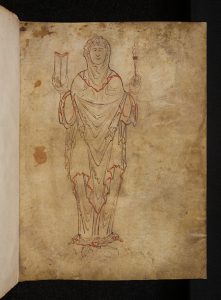
Full-length figure of Philosophy at the front of Boethius' Consolation of Philosophy in a 10th-Century Anglo-Saxon copy.

Cambridge, Trinity College, MS O.3.7, fol. 1r. Frontispiece image of Philosophy Personnified for Boethius, De consolatione philosophiae, with commentary. Image via CC 4.0 International License, via https://mss-cat.trin.cam.ac.uk/Manuscript/O.3.7

A ‘Poster Person’

As a beacon for the event, we reflect on the majestic standing figure of Lady Philosophy appearing as a frontispiece in a Late Anglo-Saxon manuscript.  Standing upright with a steady frontal gaze, wrapped in flowing garments, she rests her feet upon hilly ground, while she holds up to the sides an elongated book in one hand and a foliate scepter in the other.  This is a favorite book and image.

Preliminary Program

(For Registration, see below.)

Speakers, Respondents, and Presiders for the event include the Director and Associates of the RGME as well as others.

Recording. We will record the event for our records, also with the aim of making the recording available for viewing afterward, subject to processing and permission.

Please watch this space for updates.

Schedule and List of Presentations
(the order may vary)

Full Day:  9:30 am to 5:00 pm EDT (GMT-4) with breaks

Morning

Session 1. “Sources, Resources, and Encounters”
9:30–11:15 am EDT (GMT-4)

Presider: Jennifer Larson (Classics Department, Kent State University)

  • Mildred Budny (Director, Research Group on Manuscript Evidence)
    “Opening Remarks”
  • Kathryn Young (University Archivist / Curator of Rare Books, Loyola University Chicago)
    and
    Justin Hastings
    (Assistant Teaching Professor, Department of English, Loyola University Maryland)
    “Crowning a King, Interpreting Society, and Scaring the Kids:
    First-Year Composition Students Meet the Archives and Special Collections”
  • Ronald Patkus (Head of Special Collections and College Historian, Adjunct Associate Professor of History on the Frederick Weyerhaeuser Chair, Vassar College)
    “Preview of 2024 RGME Spring Symposium at Vassar College”
    — April 2024 (hybrid):
    “Between Past and Future:
    Building Bridges between Special Collections and Teaching for the Liberal Arts”

London, British Library, Cotton MS Julius A. VI, fol. 4v, detail.

Lunch Break. 11:15 am – 12:30 pm EDT (GMT-4)

Afternoon

Session 2. “By Land and By Sea”
12:30-2:00 pm EDT (GMT-4)

Presider: Hannah Goeselt (Library, Massachusetts Historical Society, Boston)

  • Ann Pascoe-van-Zyl (Ph.D. Candidate, Department of English, Trinity College Dublin)
    “Affective Landscape Imagery in the Old English Psalms and the Old English Elegies”
  • Eleanor Congdon (Department of Humanities and Social Sciences, Youngstown State University, Ohio)
    “Letters to Ambrogio Malipiero, a Venetian Vice Consul in Syria during the 1480s​“
  • David Porreca (Department of Classical Studies, University of Waterloo, Kitchener, Ontario)
    “An Introduction to the Edgar William Pyke Coin Collection at the University of Waterloo”
  • David W. Sorenson (Allen G. Berman, Professional Numismatist)
    “Response:  Collecting and Studying Coins as Records of History” [if David’s variable work timetable permits him to attend]

Break. 2:00–2:30 pm EDT

Session 3. “Having a Look, Looking Anew, and Looking Forward”
2:30–4:00 pm EDT

Presider: Jessica L. Savage (Art History Specialist, Index of Medieval Art, Princeton University)

  • Laura Light (Director and Senior Specialist, Text Manuscripts, Les Enluminures, Chicago, New York, and Paris)
    “Do Manuscript Descriptions Influence Scholarship?
    The Case of Thirteenth-Century Latin Bibles”
  • John T. McQuillen (Associate Curator, Printed Books and Bindings, Morgan Library and Museum, New York)
    “Ars moriendi Blockbooks: What Can Watermarks in Paper Tell Us?”
  • Barbara Williams Ellertson (The BASIRA Project: Books as Symbols in Renaissance Art and Research Associate of the Schoenberg Institute for Manuscript Studies, University of Pennsylvania Libraries, Philadelphia)
    “A Preview of a new Open Access Resource:  Searching the BASIRA Project Database”

Break. 4:00–4:30 pm EDT

Presider: David Porreca

Session 4. “Accessing Materials / Bridging Time and Place”
4:30–5:00 pm EDT (GMT-4)

  • Phillip Bernhardt-House (Academic Vagabond)
    “A Few Reflections on Materials and Their Access:
    Accessibility Concerns and Scholarship”

  • Mildred Budny
    Concluding Remarks:
    “From ‘Materials and Access’ in 2023 to ‘Bridges’ in 2024:
    Accomplishments and Prospects for an Anniversary Year”

2023 Autumn Symposium Booklet Cover.

The Illustrated Symposium Booklet

As the Symposium approaches, the illustrated Symposium Booklet becomes ready.

Our practice is to make the illustrated Symposium Booklet available close to the time of the event, for distribution in printed and digital formats.  The e-version (in pdf format) will be downloadable in two formats:

  • as consecutive pages.
  • as foldable booklet.

Registration for the 2023 Autumn Symposium

To register for the event, visit the RGME Eventbrite Collection.

  • RGME Events on Eventbrite.
  • 2023 Autumn Symposium Tickets.
    General Admission
    or
    Admission with Voluntary Donation

Registration is required; there is no charge for admission.  We welcome donations.

Donations for our mission and activities may be tax-deductible.  Registering for the event offers an option for you to make a donation easily and conveniently.  See also

  • Donations and Contributions.

We thank you for your interest and support.

More Information and Updates

Watch this space for more information as it unfolds.

Questions?  Ask director@manuscriptevidence.org.

2023 RGME Events

Other events are planned for the Year.  See

  • “The Research Group Speaks”: The Series

The next episode for this online series is Episode 14 on Sunday 19 November 2023
2:00-2:30 pm EST (GMT-5) by Zoom.  See

  • Episode 14: Translating the Latin Hermetica by Committee

2024 RGME Events for an Anniversary Year

Announcements of our events planned for 2024 are coming soon.  Some will be announced for the 2023 Autumn Symposium.  They include:

  • 2024 Spring Symposium at Vassar College:
    “Between Past and Future:
    Building Bridges between Special Collections and Teaching for the Liberal Arts”.

Suggestion Box

Please Contact Us or visit

  • our FaceBook Page
  • our Twitter Feed (@rgme_mss)
  • our Blog on Manuscript Studies and its Contents List

Donations and contributions, in funds or in kind, are welcome and easy to give.

  • See Contributions and Donations.

We look forward to hearing from you.

"Centered". Photograph Ⓒ 2014 Mildred Budny. Image of Dew at the center of Sedum.

“Centered”. Photograph Ⓒ 2014 Mildred Budny.

*****

Tags: "Between Earth and Sky", 13th-century Latin Bibles, Ars Moriendi, BASIRA Project, Blockbooks, History of Mercantile Correspondence, History of Watermarks, Materials and Access, Mausoleum of Galla Placidia, Old English Elegies, Old English Psalms, Philosophy Personnified, Pyke Coin Collection, RGME Autumn Symposium, RGME Spring Symposium, RGME Symposia, Special Collections, Teaching Collections, Teaching with Special Collections
No Comments »

2023 Pre-Symposium on “Intrepid Borders” before the Spring Symposium

March 9, 2023 in Uncategorized

Intrepid Borders:
Marginalia in Medieval and Early Modern Books

Baltimore, Walters Art Museum, MS. W.148, folio 33v, detail. Image via Creative Commons.

A Virtual Lightning Talks / Half-Day Symposium
of the Research Group on Manuscript Evidence

co-organized by Katharine Chandler,
Jennifer Larson,
and Jessica L. Savage

Friday, 24 March 2023
2:00 – 5:30 pm E.D.T. (GMT-4) by Zoom

The Research Group on Manuscript Evidence invites you to attend our innovative half-day virtual symposium to be held on the afternoon of Friday, 24 March 2023. It features two sessions of Lightning Talks (between 15–18 minutes each) which have been selected from the Call for Proposals.  Here is how we presented the Call:

  • 2023 Pre-Symposium Call for Papers: “Intrepid Borders” Lightning Talks.

With strong and plentiful responses, the Program has been selected, filling the afternoon.

This exploratory event about book marginalia and borders (including drolleries, glosses, inscriptions, and annotations) will kick off the Research Group’s virtual Spring Symposium to be held the next day on Saturday, March 25th.

As part of the RGME’s Theme for the Year 2023, “Materials & Access”, the pair of 2023 Spring and Autumn Symposia considers interlinked areas “From the Ground Up” (Spring) and “Between Earth and Sky” (Autumn).  For information about the Spring Symposium and registration for it, see:

  • 2023 Spring Symposium “From the Ground Up”

The set of Sessions on “Intrepid Borders” for the afternoon Pre-Symposium is co-organized by

Katharine Chandler, Jennifer Larson, and Jessica L. Savage.

Registration for “Intrepid Borders” is required, and can be made through its portal:

  • https://www.eventbrite.com/e/intrepid-borders-pre-symposium-for-2023-spring-symposium-tickets-512253994487

After you have registered, the Zoom link will be sent out shortly before the event.

Baltimore, Walters Art Museum, MS. W.148, folio 33v. Detail: Bottom, with fighting creatures. Image via Creative Commons.

Baltimore, Walters Art Museum, MS. W.148, folio 33v. Detail: Bottom, with fighting creatures. Image via Creative Commons.

Vision for the Lightning Talks

The borders of books are usually narrow places where reader-viewers of manuscripts touched, turned, and lingered on pages. As a space to develop writing and decoration, marginalia, or “things in the margin,” might be integral to the design of a manuscript, or their marks could be extraneous additions to the page.

Papers might explore the interaction of readers with texts through annotations and glosses, and investigate the many varied inscriptions and their purposeful inclusion in book borders. Papers might also zero in on the iconographic programs and decorative surrounds in manuscripts, which evolved over the late Middle Ages and into the early modern period, and which contain compelling visual evidence of the whimsical and fantastic.

Read the rest of this entry →

Tags: 2023 Pre-Symposium on "Intrepid Borders", Anatoli’s Malmad ha-Talmidim, Book of Kells, Clumber Park Chartrier, Decoration in Books, Early Modern Studies, Ethiopian Hymn Anthologies, Flower Collection, Flower-Strewn Borders, Glosses, Lightning Talks, Manuscript Illumination, Manuscript studies, Manuscripts of Dante's Divine Comedy, Marginalia, Readers in 16th-century Scotland, RGME Symposia, Tridentine Reform in Mons: Belgium, Unknown Readers
No Comments »

2023 International Congress on Medieval Studies: Program

January 15, 2023 in Conference, Conference Announcement, International Congress on Medieval Studies

2023 International Congress on Medieval Studies: Program

58th ICMS (11–13 May 2023)

To occur in a transitional ‘hybrid’ form
with Sponsored and Co-Sponsored Sessions
—  to be held either in person or online (with some options) —
and with an Open Business Meeting
and Co-Sponsored Reception

[Posted on 17 January 2023, with updates]

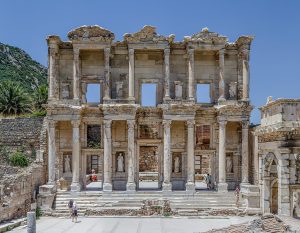
Façade of the Celsus library, in Ephesus, near Selçuk, west Turkey. Photograph (1910): Benh LIEU SONG, via Creative Commons.

Façade of the Celsus library, in Ephesus, near Selçuk, west Turkey. Photograph (1910): Benh LIEU SONG, via Creative Commons.

Building upon the successful completion of our activities at the 2022 ICMS (see our 2022 International Congress on Medieval Studies Program), we announce our Activities for the 2023 International Congress on Medieval Studies, following our Preparations for them, with the completion of the Call for Papers (15 September 2022) and the selection and submission of the Programs for our Sessions (by 15 October 2022).

For information about the Congress, registration for it, and the current version of the 2023 Congress Program (plus the extra Corrigenda), see the Congress website.

With the turn of the calendar year toward the year of the Congress, we published the selected Programs for our Sessions and announced our other Activities, while we awaited the promulgation of the official Schedule for the 2023 Congress as a whole.  With the publication of a Sneek Peak for the Congress Program, we can add the times and venues for our Sessions.  As the Congress approaches, new information guides additional features of our planning, with Virtual options now possible for some of our In-Person events, through extra arrangements by the RGME.

This year, with some Sessions on line and some in person in a transitional ICMS, we prepare six Sessions, an Open Business Meeting, and a Reception. Our co-sponsors:

  • Societas Magica:  2 Sessions and the Reception
  • Schoenberg Institute for Manuscript Studies (SIMS): 2 Sessions
  • Polytheism-Oriented Medievalists of North America (P.-O.M.o.N.A.): 1 Session
  • Index of Medieval Art at Princeton University: Reception

This year marks Year 19 of our co-sponsorship with the Societas Magica; the second (non-consecutive) year of co-sponsorship with POMONA, the third of co-sponsorship with the Index of Medieval Art, and the first year of co-sponsorship with SIMS.

As always, we thank the host, organizers, co-sponsors, presiders, speakers, respondents, advisers, and participants for our activities at the Congress, along with the Congress staff and support staff.

Here we list our Sessions (arranged in the order in which they are scheduled for the Congress), with the Links to the Abstracts for the individual Papers, then turn to our other Activities (Open Business Meeting and Reception).  A Note on our Congress Sessions describes the Indexes of the Abstracts for Papers as published on our website, listed both by Alphabetical order of Author’s Surname and by Year.

Logistics

This year, the partly in-person, virtual, and hybrid modalities to the Congress add to the complexity, tasks, resources, and expenses for preparing for our events there.  The complexity encourages us to create more flexible and resourceful our arrangements for some events held in person or virtually, so as to accommodate attendance in these different modalities directed by the Congress, while any fully hybrid event is not permitted for us in the arrangements by this online/offline Congress.

1) Optional RGME Zoom Meeting Room in live time for some In-Person events.  For Congress participants unable to travel to the place, but registered for the Congress, we offer an optional Virtual Meeting Room by RGME Zoom subscription.  In this way, an In Person Congress event might be accessed virtually — with registration for each of them through our RGME Eventbrite Collection.

We provide the RGME Zoom option (by specific registration, without charge) for

  • our In Person Open Business Meeting on Thursday lunchtime and
  • our pair of co-sponsored In-Person Sessions on Saturday afternoon.

2) Especially Reserved In-Person Room for In-Person Attendees of the Congress who will log-on to our Virtual Sessions.  These reserved rooms are prepared (in different, but adjacent, buildings) for:

  • our first, Virtual Session on Thursday morning, with an In-Person option (Session 50 / Schneider 1220)
  • the pair of our co-sponsored Virtual Sessions on Thursday afternoon, with In-Person option (Sessions 87 + 137 / Fetzer 1030)The second dedicated room is located a few steps away, on the same floor, in the same building, from the two In-Person events before and after that pair of Sessions, namely the Open Business Meeting and the Reception.

Details below, including information about how to register with us for the access by Zoom for the In-Person events.

In brief:

Day 1 of the Congress (Thursday 11 May) has a full set of events. They open with the Morning Session, lead to the RGME Open Business Meeting (with lunch provided), follow with a pair of Sessions, and round out with the co-hosted Reception.

  1. Session 50 on “Words as Agents”
    held Virtually
    from 10:00-11:30 am EDT (GMT-4)
    — with In-Person option:  By arrangement, Schneider 1220 is reserved for us for that time period for those attending the Congress in person, to be able to gather for accessing the online Sessions with their own computers
  2. RGME Open Business Meeting
    held In Person
    in Fetzer 1035 from 12:00-1:00 pm EDT, with catered lunch (donations are welcome)
    — We recommend registering if you plan to attend in person, so that we could know how many to expect.
    In Person Reservation for RGME Open Business Meeting
    — We also offer the option to attend virtually through the RGME (not via the Congress), for Congress participants unable to travel.  With your registration for the event itself, we will send the Zoom link ahead of time.
    Virtual Registration Option for RGME Open Business Meeting
  3. Sessions 87 and 137 on “The Eloquence of Medieval Book Bindings”, Parts 1-2
    (“Bindings from German Lands” and “Diverse Regional Techniques”)
    held Virtually from 1:30-3:00 pm and 3:30-5:00 pm EDT (GMT-4)
    — with In-Person option:  Fetzer 1030 is reserved for us for the afternoon for those attending the Congress in person, to gather for accessing the online Sessions with their own computers
    Update on 7 May: The order of the three Papers in Session 87 is changed from that advertised in the Congress Program Booklet. The Paper by William H. Campbell, formerly in first position, has moved to third, as indicated below.
  4. Co-hosted Reception
    held in Person
    in Fetzer 1035-1045 from 5:30-7:00 pm EDT (GMT-4).

For the RGME Open Business Meeting held In Person, open to to Congress attendees, it would help us to know how many to expect if you would please register for it through the RGME Eventbrite collection.  See below.

Day 3 of the Congress (Saturday 13 May) has a pair of Sessions.

  1. Sessions 369 and 419 on”Moving Parts and Pedagogy”, Parts I–II (“Teaching Magic and Other Occult Arts” and “Teaching Astrology and Other Liberal Arts”)
    held In Person in Fetzer 2040 from 1:30-3:00 pm and 3:30-5:00 pm EDT (GMT-4)
    (If requested, we will set up an RGME Zoom Room for these Sessions.)

Note:  If you have questions about these arrangements, we apologize for the complexity, and ask that you contact director@manuscriptevidence.org.  Safe travels!

Read the rest of this entry →

Tags: Albert the Great, Archaeology of Bindings, Astrology, Board Games, Catalogues & Metadata & Databases, Chieromancy, Datini Collection, Ephesia Grammata, Ephesus, Fairy Summoning, Fragmentology, Gutenberg Bible, History of Games, History of Magic, Index of Medieval Art, Islamic Bookbindings, Liberal Arts Curriculum, Ludwig Millich, Manuscript studies, Medieval Writing Materials, Otto Ege Fragments, Pedagogy, POMONA, Quadrivium, Quire Signatures, Schoenberg Institute for Manuscript Studies, Seven Liberal Arts, Societas Magica, Trivium, William Fulke, Witchcraft
No Comments »

2023 Spring Symposium: “From the Ground Up”

January 12, 2023 in Conference, Conference Announcement, Manuscript Studies, RGME Symposia

Photograph of the stems and white blooms of Snowdrops emerging from a patch of bare ground in the sunlight. Photograph Ⓒ Mildred Budny.

“From the Ground Up”. Photograph Ⓒ Mildred Budny.

2023 Spring Symposium
“From the Ground Up”

Part 1 of 2 in the
2023 Spring and Autumn Symposia
on “Materials & Access”

[Posted on 12 January 2023 , with updates]

With its chosen Theme of “Materials & Access” for the Year 2023, the Research Group prepares a pair of Symposia, continuing its expanded pattern of paired day-long virtual Spring and Autumn Symposia launched in 2022.   Until then, RGME Symposia had occurred on occasion at one per year, sometimes annually and sometimes at intervals.  Whereas previously they occurred in person, at various centers (like the 2020 Spring Symposium, which had to be cancelled on account of lockdown for Covid), the Symposia in 2022 and 2023 take place online by Zoom.

This year, the Spring and Autumn Symposia will take place by Zoom on:

  • Saturday, 25 March 2023
  • Saturday 21 October 2023 (“The Sweetest Day” 2023)

And There’s More

In a further expansion, the 2023 Spring Symposium will be preceded by a half-day Pre-Symposium which presents a series of Lightning Talks.  They will emerge from the Call for Proposals, issued on 10 January 2023, with a deadline of 12 February 2023.

  • 2023 Pre-Symposium Call for Papers: “Intrepid Borders” Lightning Talks.

Following that deadline, the Program of Talks for the Pre-Symposium has been selected and is now announced.

  • 2023 ‘Pre-Symposium’ on “Intrepid Borders”

The New Ensemble:  Pre-Symposium and Symposium

This year, with the Theme of “Materials and Access”, we not only prepare a pair of Symposia, but also extend the Spring Symposium with an accompanying ‘Pre-Symposium’ of Lightning Talks on the afternoon before. Selected through a Call for Proposals, these Talks explore the challenges of “Intrepid Borders: Marginalia in Medieval and Early Modern Books”. The plan for such sessions, their subject, the Call for Proposals, and the selected Program for the Lightning Talks are due to the initiative, enthusiasm, and organizational expertise of Jessica L. Savage and her co-organizers Katharine C. Chandler and Jenifer Larson. The fresh combination of exploratory Lightning Talks on Friday and the invited Symposium Presentations on Saturday opens our Symposia more widely.

The extended Symposium presents new and cumulative work, with reports of discoveries, work-in-progress, and collaborative projects. Some build upon work presented for the Symposia in 2022 (2022 Spring Symposium on “Structures of Knowledge” and 2022 Autumn Symposium on “Supports for Knowledge”).

We consider evidence from the medieval to modern periods and across a wide geographical, historical, and cultural range, both Western (Europe and North America) and non-Western (Ethiopia, Yemen, and Western India). From multiple centers, the Symposium plus Pre-Symposium gathers specialists, teachers, students, collectors, and others engaged or interested in activities relating to manuscripts, printed books, other media, and mixtures of them.

Program Booklet

To accompany the event and celebrate its contributors, we publish a combined Pre-Symposium/Symposium Program Booklet, with Abstracts of Presentations and companion Images.  See below for information how to receive a copy in print or by download on this site.

*****

2023 half-day Pre-Symposium and full-day Symposium (online)

I.   “Pre-Symposium of Lightning Talks” on Friday afternoon 24 March 2023

“Intrepid Borders:
Marginalia in Medieval Manuscripts and Early Modern Books”

A Virtual Lightning Talks / Half-Day Symposium
of the Research Group on Manuscript Evidence

Co-Organized by Katharine C. Chandler, Jennifer Larson, and Jessica L. Savage

2023 RGME ‘Pre-Symposium’ on “Intrepid Borders”

Registration for this event is required, and can be made through its portal:
  • https://www.eventbrite.com/e/intrepid-borders-pre-symposium-for-2023-spring-symposium-tickets-512253994487

Baltimore, Walters Art Museum, MS. W.148, folio 33v, bottom. Image via Creative Commons.

II.   Symposium on Saturday 25 March 2023

“From the Ground Up”

Following the models of the 2022 Spring and Autumn Symposia, the 2023 Spring and Autumn Symposia will showcase some of our ongoing series of subjects, as well as introduce new ones.  We explore challenges and opportunities for approaching and accessing materials of many kinds in the history, production, transmission, study, and display of manuscripts and books, across time and place.

Registration for this event can be made through its portal:

  • 2023 RGME Spring Symposium “From the Ground Up”

Speakers, Respondents, Presiders, and Moderators (in alphabetical order):

  • Linde M. Brocato, Mildred Budny, Katharine C. Chandler, Hannah Goeselt, Justin Hastings, Zoey Kambour, Atria A. Larson, Jennifer Larson, Ann Pascoe-van Zyl, Ronald Patkus, Jaclyn Reed, David W. Sorenson, and others.

Occasion:

This Symposium occurs on 25 March, a day for, among other celebrations, the liturgical Feast of the Annunciation.  (See below.)  This manuscript image represents the decisive event with a rich interior, landscape exterior and inhabited foliage in the margins, and bookish features such as a speech scroll and an opened book on a table at the back.
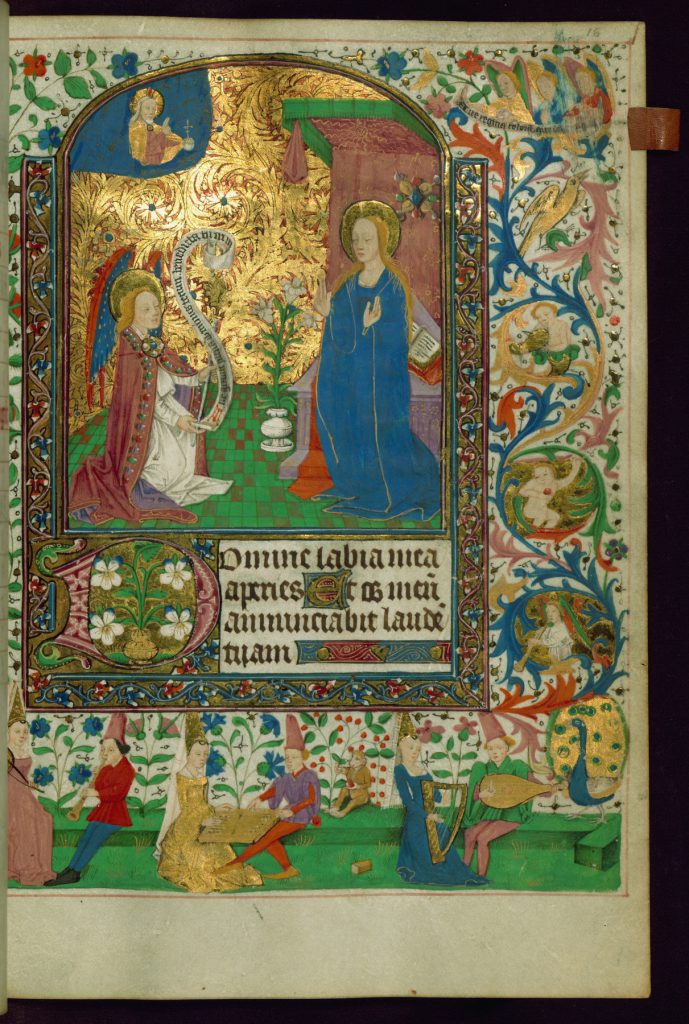
Within a foliate border, the verse of Psalm 50:17 (Domine labia mea aperies et os meum annuntiatbit laudem tuam) fits between a framed image of the Annunciation above, with an opened book on a lectern and and inscribed unrolled scroll. The foliate border includes an ‘inhabited’ scrolling stem at the right, with angels, humans, and birds; and a garden scene below, where human couples play musical instruments and backgammon.

Baltimore, The Walters Art Museum, MS M.269, folio 16r. Book of Hours, France, circa 1460. Image courtesy The Walters Art Museum by CC0 License via https://www.thedigitalwalters.org/Data/WaltersManuscripts/html/W269/.

Program

Saturday 25 March 2023

9:30 am – 5:00 pm EDT (GMT-4) online by Zoom
with registration through Eventbrite
via 2023 RGME Spring Symposium “From the Ground Up”

Session 1.  “Laying the Groundwork”
9:30 – 11:00 am EDT (GMT -4)

Welcome and Introduction

Mildred Budny (Director, Research Group on Manuscript Evidence)

Opening Keynote Presentation

Linde M. Brocato (Cataloging & Metadata Librarian, University of Miami Libraries)
“Grounding the Work, Making the Book”

Presider:  Mildred Budny

Coffee Break
11:15 – 11:30 am EDT

Session 2.  “The Lay of the Land”
11:30 am – 1:00 pm EDT

Presider:  Jennifer Larson (Department of Classics, Kent State University)

Ann Pascoe-Van Zyl (School of English, Trinity College, Dublin)
“Landscape and the Mind in Exile: Four Old English Elegies”

Justin Hastings (The John Dickinson Writings Project, University of Delaware)
“The Horatian Ground of John Dickinson’s Farmer Persona”

Hannah Goeselt (Library and Information Science (MS): Cultural Heritage Informatics, Simmons University, Boston)
      and
Zoey Kambour (Post Graduate Fellow in European & American Art at the Jordan Schnitzer Museum of Art at the    University of Oregon)
“Where Are We Now?  Informal Updates since Last Year’s RGME Symposia”

Lunch Break
1:00 – 1:45 pm EDT

Session 3.  “Materials & Margins”
1:45 – 3:15 pm EDT

Presider:  Jaclyn Reed (Department of English and Writing Studies, University of Western Ontario)

Atria A. Larson (Associate Professor of Medieval Christianity, Saint Louis University)
“Gallery of Glosses:
An NEH-Funded Digital Humanities Project that Cultivates Scholarly Attention to Manuscript Margins”

David W. Sorenson (Allen G. Berman, Professional Numismatist)
“Examples of Paleography and Paper in dated Jain Manuscripts of the 15th through 19th Centuries”
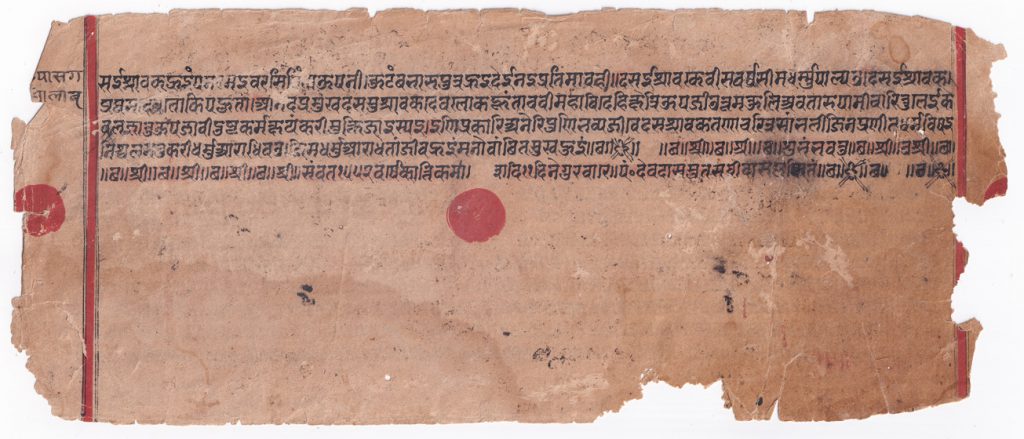
Private Collection, Jain manuscript on paper, dated Vikrama Samvat (VS) 1552 = AD 1496 by colophon.

Private Collection, Jain manuscript on paper, dated Vikrama Samvat (VS) 1552 = AD 1496 by colophon.

Tea Break
3:15 – 3:30 pm EDT

Session 4.  “The Living Library (Part III):
Manuscripts & Collections as Sources for Teaching & Research”
3:30 – 5:00 pm EDT

Presider:  Justin Hastings

Ronald Patkus (Head of Special Collections
          and Adjunct Associate Professor of History on the Frederick Weyerhaeuser Chair, Vassar College)
“Nicholas B. Scheetz’s Medieval and Renaissance Manuscripts at Vassar:
A Teaching Collection for a Teaching Collection”

Katharine C. Chandler (Special Collections and Serials Cataloger, University of Arkansas Libraries)
“Sister Manuscripts from the Carthusian Monastery of Chartreuse de Champmol”

Concluding Remarks:

Mildred Budny (Director, Research Group on Manuscript Evidence)
“Material Grounds for  Teaching, Study, and Varieties of Access”

*****

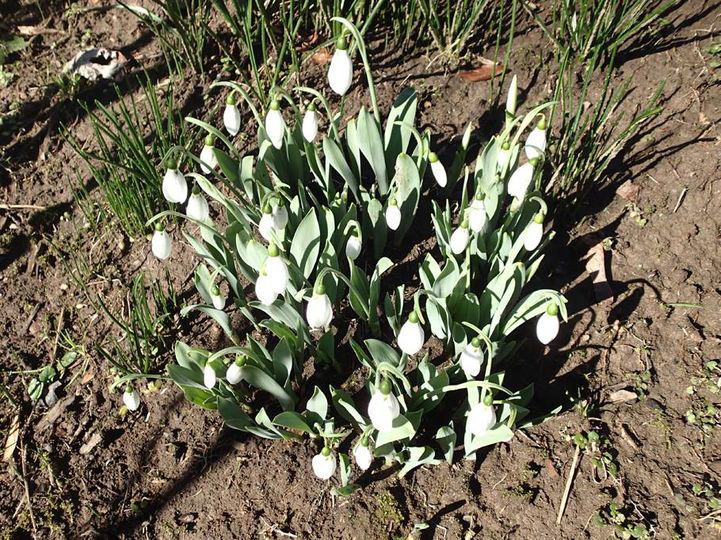
In keeping with the 2023 Theme of “Materials & Access” and the focus of attention in the Spring Symposium “From the Ground Up”, we may celebrate the emergence of fresh shoots and blooms as Winter turns to Spring, and the earth revives its cycle of growth and renewal.

We note that the date selected for this Spring Symposium, 25 March, represents the celebration of, among other things, the Feast of the Annunciation in the Christian liturgical calendar and the occurrence of the spring (or vernal) equinox (see also March equinox.
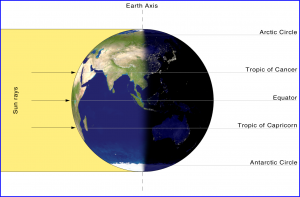
Image of illumination of earth by the sun on the Spring or Autumn Equinox (Vernal and Autumnal)

Depiction of the llumination of Earth by the Sun on the Spring or Autumn Equinox (Vernal and Autumnal) Image by Przemyslaw “Blueshade” Idzkiewicz via cc-by-sa license.

This is the second time that a RGME Spring Symposium included the date of 25 March in its events stretching over more than one day.  See the 2012 Symposium on “Words and Deeds” Report for our Symposium on 25–26 March 2016 at Princeton University.

We thank the contributors and advisers for help in organizing this event, as well as its new companion the Pre-Symposium.

  • 2023 RGME ‘Pre-Symposium’ on “Intrepid Borders”
  • 2023-spring-symposium-from-the-ground-up (You are Here)

*****

Registration

Registration for the Pre-Symposium and the Spring Symposium is required for each event.

Registration for these events can be made through their portals:
  • “Intrepid Borders” Pre-Symposium for 2023 Spring Symposium
  • 2023 RGME Spring Symposium “From the Ground Up”
Photograph of the stems and white blooms of Snowdrops emerging from a patch of bare ground in the sunlight. Photograph Ⓒ Mildred Budny.

The blooms of Snowdrops emerging “From the Ground Up”. Photograph Ⓒ Mildred Budny.

The Program Booklet

Printed copies of the 2023 Spring Symposium Program Booklet can be distributed on request to participants and others.  If you wish a printed copy, please contact please contact director@manuscriptevidence.org and provide your mailing address.

The digital version can be downloaded freely here.  We provide two formats, or ‘flavors’, of the digital Program Booklet, in consecutive pages and as a foldable booklet.  The choice depends upon your printing facilities and preferences.  Experience shows that the choice can be helpful.

  • Consecutive Pages (quarto size, or 8 1/2″ × 11″ sheets)
    consecutive pages
  • Foldable Booklet (11″ × 17″ sheets), to be folded in half, producing a nested group of bifolia
    foldable booklet

Please note that some images are included in the booklet through the License or Contract stipulating their reproduction for this publication alone.  We ask you to respect these conditions.

We thank the contributors, private collectors, and institutions for the images and the permission to reproduce them.  We wish also to extend thanks to these individuals, for their extra efforts in this quest:  Ágnes Kelecsényi and Judit Jabloknay of the Library of the Hungarian Academy of Sciences; and Graham Fereday and Gary Stringer of the Digital Humanities – Library and Culture Services of the University of Exeter; Exeter Cathedral Library.

Thanks also are due to the authors, photographers, owners and providers of photographs, organizers, compilers, editors, copy-editors, images and permissions researcher, typesetter, layout designer, proof-readers, printer, web-editor, and others.

That most of these tasks required for producing and publishing the booklet are carried out — and to the level of proficiency manifested on the pages — by one or two volunteers is a tribute to the collegial collaboration and dedication of our nonprofit educational organization, which has no paid staff whatsoever, and which has a shoestring budget.  That budget is itself the product almost entirely of the generosity of volunteer donations, year by year.

These results can be accomplished mostly because of the pro-bono donations by so many contributors, who help to make the events possible, and for whom we give steady thanks.

*****

2023 RGME Events

Other Events are planned for the Year.  See
  • “The Research Group Speaks”: The Series
  • 2023 International Congress on Medieval Studies: Program for Thursday 11 to Saturday 13 May 2023
  • 2023 Autumn Symposium “Between Earth and Sky”
    Registration here: 2023 Autumn Symposium Tickets for Saturday 21 October 2023 by Zoom
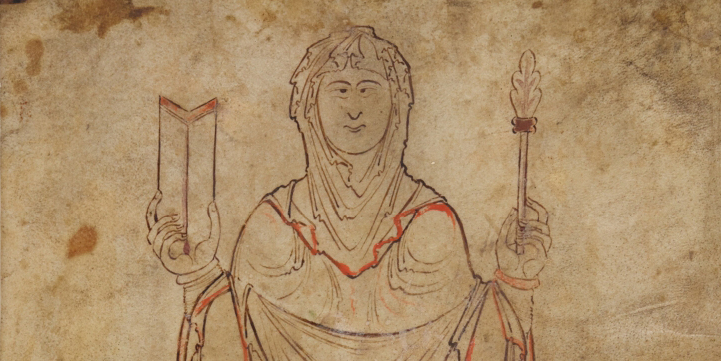
Philosophy personified as female figure, wearing headveil and mantle, holding at both sides a raised book and a foliate-topped scepter. Frontispiece figure for Boethius' Consolation of Philosophy.

Trinity College, Cambridge, MS O.3.7, fol. 1r, top. Philosophy Personified, with book and scepter. Frontispiece figure for Boethius’ Consolation of Philosophy. Image via CC 4.0 International License, via https://mss-cat.trin.cam.ac.uk/Manuscript/O.3.7. Image cropped here to detail (unchanged otherwise).

Suggestion Box

Please Contact Us or visit:

  • our FaceBook Page
  • our Twitter Feed (@rgme_mss)
  • our Blog on Manuscript Studies and its Contents List

Donations and contributions, in funds or in kind, are welcome and easy to give.  See Contributions and Donations.

We look forward to hearing from you.

*****

"Centered". Photograph Ⓒ 2014 Mildred Budny. Image of Dew at the center of Sedum.

“Centered”. Photograph Ⓒ 2014 Mildred Budny.

*****

Tags: Annunciation, Chartreuse de Champmol, Early Books, Glossing Glosses, History of Paper, Jain Manuscripts, John Dickinson, Manuscript Decoration, Manuscript Illustration, Manuscript studies, Manuscripts at Vassar College, Materials & Access, Nicholas B Sheetz Collection, Old English Elegies, Palaeography, RGME Symposia
No Comments »

2023 Pre-Symposium Call for Papers: Intrepid Borders Lightning Talks

January 9, 2023 in Announcements, Manuscript Studies, RGME Symposia

Call for Papers

Intrepid Borders:
Marginalia in Medieval and Early Modern Books

A Virtual Lightning Talks / Half-Day Symposium
of the Research Group on Manuscript Evidence

Proposals due by Sunday, 12 February 2023

The Research Group on Manuscript Evidence seeks proposals for lightning talks (between 15–18 minutes each) for a half-day virtual symposium to be held on the afternoon of Friday, 24 March 2023.

This exploratory event about book marginalia and borders (including drolleries, glosses, inscriptions, and annotations) will kick off the Research Group’s virtual Spring Symposium to be held the next day on Saturday, March 25th. As part of the RGME’s Theme for the Year 2023, “Materials & Access”, the pair of 2023 Spring and Autumn Symposia considers interlinked areas “From the Ground Up” (Spring) and “Between Earth and Sky” (Autumn).

The set of Sessions on “Intrepid Borders” for the afternoon Pre-Symposium leading to the Spring Symposium are co-organized by Katharine Chandler, Jennifer Larson, and Jessica L. Savage.

Baltimore, Walters Art Museum, MS. W.148, folio 33v. Detail: Bottom, with fighting creatures. Image via Creative Commons.

Baltimore, Walters Art Museum, MS. W.148, folio 33v. Detail: Bottom, with fighting creatures. Image via Creative Commons.

Vision for the Lightning Talks

The borders of books are usually narrow places where reader-viewers of manuscripts touched, turned, and lingered on pages. As a space to develop writing and decoration, marginalia, or “things in the margin,” might be integral to the design of a manuscript, or their marks could be extraneous additions to the page.

Papers might explore the interaction of readers with texts through annotations and glosses, and investigate the many varied inscriptions and their purposeful inclusion in book borders. Papers might also zero in on the iconographic programs and decorative surrounds in manuscripts, which evolved over the late Middle Ages and into the early modern period, and which contain compelling visual evidence of the whimsical and fantastic.

Proposals for Talks

We seek short abstracts (~200–250 words) detailing your title and topic as it fits with the above parameters, to reach us by the end of Sunday, 12 February 2023. Speakers will be notified in the following week of their acceptance.

Research works-in-progress and work from emerging scholars in manuscript studies are especially encouraged to submit their ideas for inclusion in the program.

Please send your abstracts through the linked Call for Papers Google Form.

More information about the 2023 Spring and Autumn Symposia can be found at: 2023 Spring and Autumn Symposia.

We look forward to your proposals.

*****

Fantastic fighters in the lower margin, Douce–Walters Homiliary, Walters Art Museum, MS. W.148, folio 33v.  On the manuscript, see The Digital Walters.

Baltimore, Walters Art Museum, MS. W.148, folio 33v, bottom right, with fighting creatures. Image via Creative Commons.

*****

Tags: Borders, Lightning Talks, Manuscript Illumination, Marginalia, Medieval manuscripts, RGME Symposia
1 Comment »

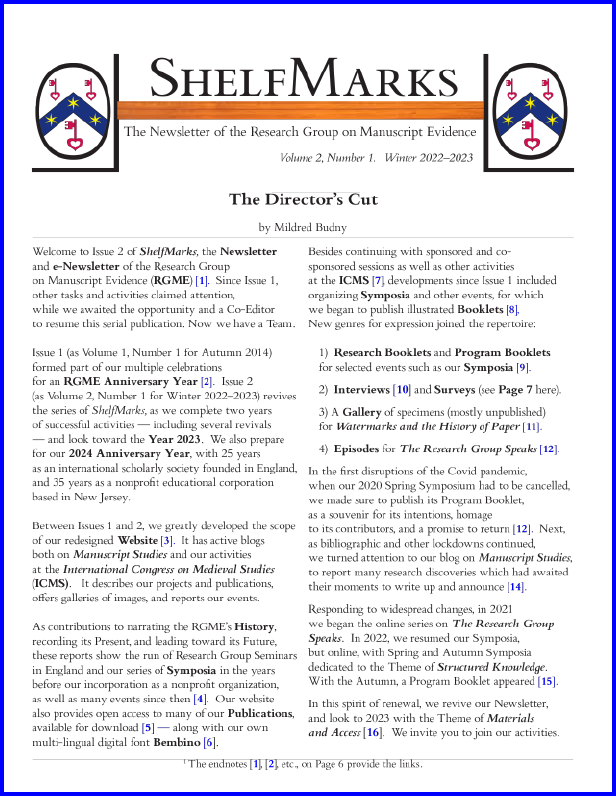
ShelfMarks Issue 2 (Volume 2, Number 1 for Winter 2022–2023)

December 13, 2022 in ShelfMarks the RGME Newsletter

ShelfMarks masthead corrected 26 Oct 2014

Our occasional RGME-Newsletter resumes

Announcing:
Issue 2
Volume 2, Number 1 (Winter 2022–2023)

[Posted on 10 December 2022]

ShelfMarks, the occasional RGME Newsletter, experienced a long interval between Volumes 1 and 2:  Issues 1 and 2, respectively for Autumn 2014 and Winter 2022–2023.  The first was published on 8 October 2014.  Issue 2 appears, at last, in December 2022.

In between, the RGME had to turn to many other tasks — their work and results are reported among, for example, our Events and blogs on Manuscript Studies and our activities at the International Congress on Medieval Studies — and to await the help of a new Co-Editor.  Now, with the formation of the new Editorial Committee in 2022 and many other activities, both resumed and transformed or newly adopted, we turn again to our occasional Newsletter and e-Newsletter, with the help of an Editorial Team.

Issue 2 is freely available for download as a pdf.  See below.

Our Newsletter

Our Newsletter and e-Newsletter ShelfMarks stands among our various Publications, both online and in print.  It aims to report activities, work-in-progress, research results, discoveries, questions, reviews, and news.  The alternate forms in print and digital transmission allows our RGME-Newletter to appear by email, on screens, and it print.

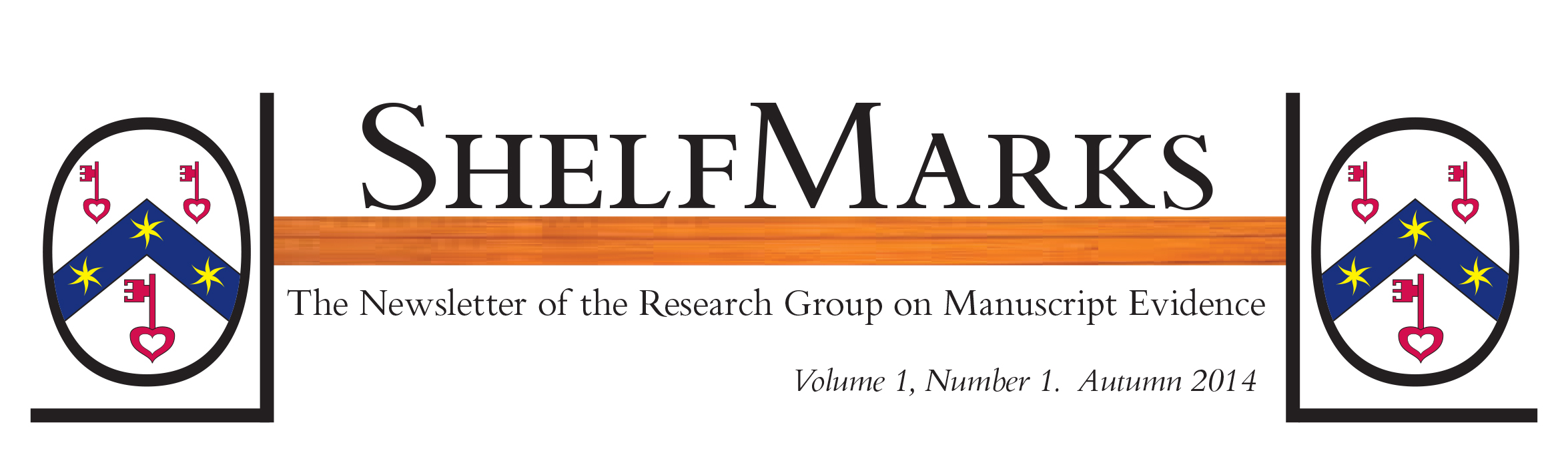
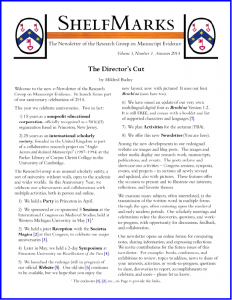
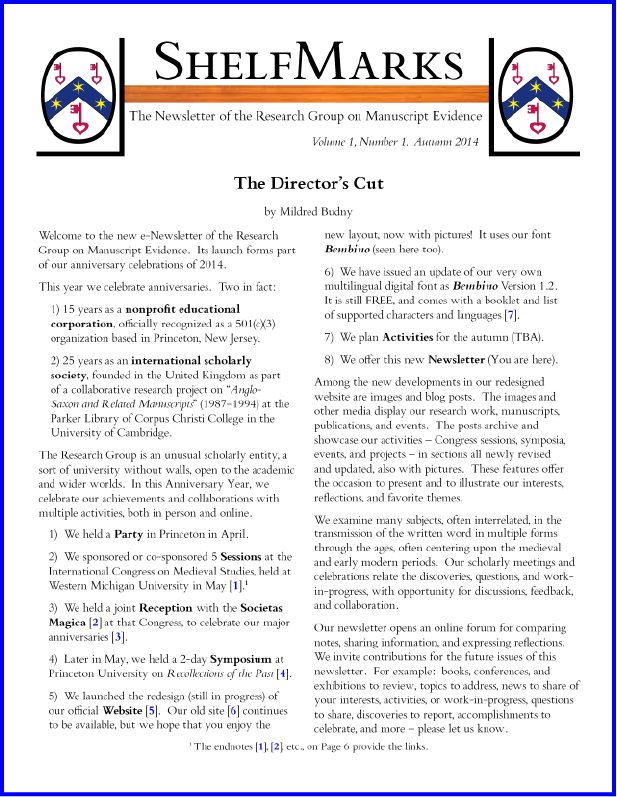
Opening Page of Issue 1 of 'ShelfMarks: The RGME-Newsletter' (Autumn 2014)

Opening Page of ‘ShelfMarks’ Issue 1 (Autumn 2014).

The printed version of ShelfMarks displays our own font Bembino  and our design layout, set out page by page in full.  (8 pages in both the first and second Issues.)  Its PDF form preserves the layout which we created.

The EMAIL version, formerly circulated via MailChimp, provides excerpts and highlights, with links in further directions, set out in web form — plus some images of its own.

To distinguish between these forms, as an aid to bibliographers, book-lovers, and all of our friends, we think of the e-version as a form of ShelfTags for ShelfMarks.  The e-version provides a summary, with illustrations, of what is happening in the Research Group on Manuscript Evidence.

ShelfMarks (Print)
ISSN 2377-4096

[ShelfTags for] ShelfMarks (Online)
ISSN 2377-4118

We invite you to explore further, and to join the conversation.

Issue 1 of our Newsletter was edited by Mildred Budny and Jim Tigwell.

Issue 2 is compiled, edited, and partly written by Mildred Budny.  An Editorial Team, with members of the RGME Editorial Committee, aided the work immeasurably.

Please send items, announcements, suggestions for book reviews, and conference or exhibition listings to the Editors:  director@manuscriptevidence.org.
To subscribe, contact director@manuscriptevidence.org.

*****

Contents of  Issue 2: Volume 2, Number 1 (Winter 2022–2023)

Private Collection, MS 1, Folio ‘130’ recto, detail. Photography by Mildred Budny.

1) “The Director’s Cut”

Highlights of RGME activities since Issue 1, described by our Director

Between Issue 1 (Volume 1, Number 1 for Autumn 2014) and Issue 2 (Volume 2, Number 1 for Winter 2022–2023), we greatly developed the scope of our redesigned Website, with active blogs on Manuscript Studies and on our activities at the International Congress on Medieval Studies (ICMS).  The website describes our projects and publications, offers galleries of images, and reports our events.  It also provides open access to many of our Publications, including our own multi-lingual font Bembino (now in Version 1.6).

Besides our sponsored and co-sponsored Sessions (as well as Receptions and Open Business Meetings) at the ICMS, developments include organizing Symposia and other events, for which we began to publish Posters and illustrated Booklets.  New genres also have emerged:

1) Research Booklets and Program Booklets

2) Interviews and Surveys

3) A Gallery of specimens (mostly hitherto unpublished) for Watermarks and the History of Paper

4) Episodes for “The Research Group Speaks“

5) Pre-Congress Business Meetings, held online for our wider audience

Since 2020, when our Spring Symposium had to be cancelled, we turned at first, after publishing its Program Booklet anyway, to reporting a backlog of discoveries for our blog on Manuscript Studies.  By 2021, our online activities began in May with the revived ICMS (cancelled in 2020) and a Pre-Congress Business Meeting to plan beforehand.  In July, an online Interview with Barbara Williams Ellertson (about her interests in books and the formation of the BASIRA Project) launched the series wherein “The Research Group Speaks”.  By November 2022, the series had reached Episode 9; more are planned.

In 2022, we resumed our Symposia, online, before the opportunity for in-person events returns.  For the first time, we held two Symposia in a single year.  Thus began the paired Spring and Autumn Symposia devoted to a shared theme:  “Structured Knowledge” in 2022, and, planned for 2024, “Materials and Access”.   With the 2022 Autumn Symposium, we resumed the preparation and publication of its illustrated Booklet, in 54 pages.

Issue 2 of the RGME Newsletter joins this spirit, and this accomplishment, of revivals.  They form part of the work toward 2023 and beyond.  For our Anniversary Year in 2024, the RGME would celebrate

1) 25 years as a nonprofit educational corporation, officially recognized as a 501(c)(3) organization based in Princeton, New Jersey

2) 35 years as an international scholarly society, founded in the United Kingdom as part of a collaborative research project (1987–1994) at Corpus Christi College in the University of Cambridge

Like Issue 1 , Issue 2 offers the opportunity to celebrate and advance our activities.

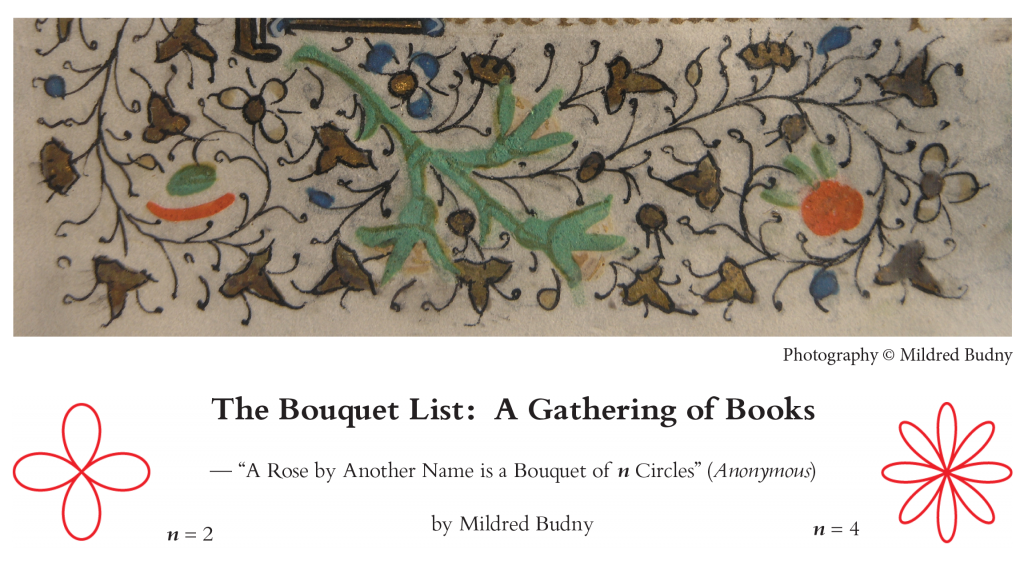
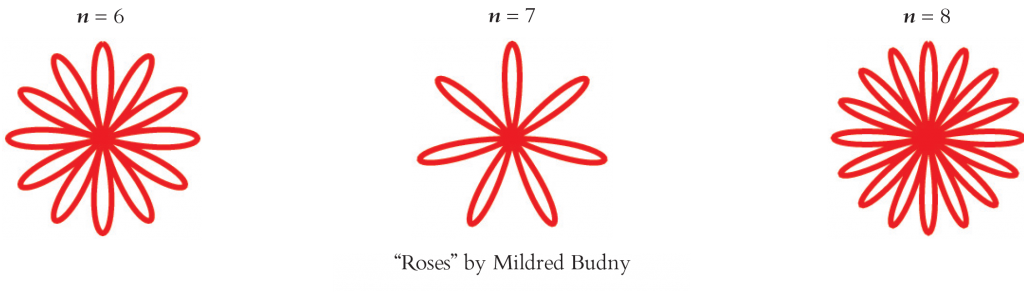
"The Bouquet List: A Gathering of Books", a review by Mildred Budny with motto: "A Rose by Another Name is a Bouquet of n Circles" (Anonymous)

2) “The Bouquet List:  A Gathering of Books”

The second in the series of reviews by Mildred Budny

The title alludes to the widespread medieval genre of florilegia (“gatherings of flowers”).  We may think of the blooms in our gatherings as forms of Bouquets of Circles, or roses, in a mathematical sense, relating to overlapping or interlinked circles or ovals joined at a center.

The series is designed mainly for notices of books prepared by, or partly by, RGME Associates, Officers, and Volunteers, or related to RGME events.  The books under consideration in this issue (with RGME names in bold):

  1. Gregory T. Clark, Art in a Time of War: The Master of Morgan 453 and Manuscript Illumination in Paris during the English Occupation (1419-1435) (Toronto: Pontifical Institute of Mediaeval Studies, 2016). ISBN 978-0-88844-197-3.
  2. Tributes to Adelaide Bennett Hagens: Manuscripts, Iconography, and the Medieval Viewer, edited by Pamela A. Patton and Judith K. Golden (London and Turnhout: Harvey Miller Publications, 2017). ISBN 978-1-909400-79-5.
  3. Celia Chazelle , The Codex Amiatinus and its Sister Bibles: Scripture, Liturgy, and Art in the Milieu of the Venerable Bede (Leiden: Brill, 2019). ISBN 978-90-39013-3.
  4. Dan Attrell and David Porreca, Picatrix: A Medieval Treatise on Astral Magic, translated with an Introduction (University Park: Penn State Press, 2019). ISBN 978-0-271-08212-7.
  5. Michael A. Conrad, Ludische Prais und Kontingenz-bewältigung im Spielebuch Alfons’ X. und anderen Quellen des 13. Jahrhunderts. Spiel als Modell guten Entscheidens (Berlin: De Gruyter, 2022). ISBN 978-3-11-076440-6.
  6. Donncha MacGabhann, The Book of Kells: A Masterwork Revealed (Leiden: Sidestone Press, 2022). ISBN 978-9-46-426123-3.

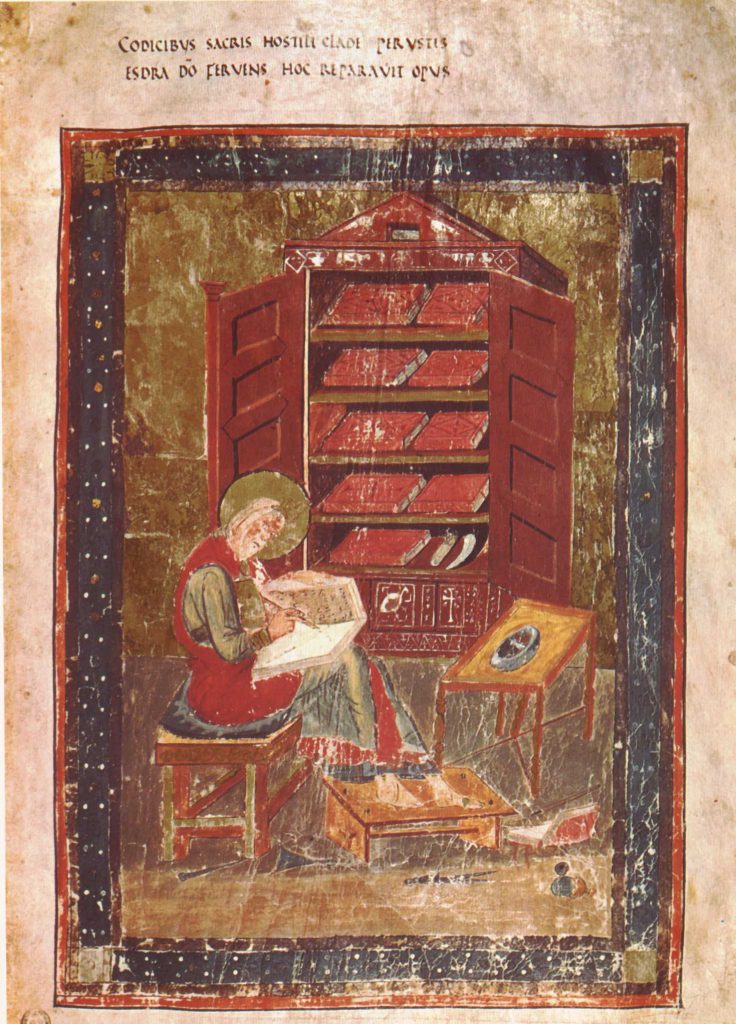
Folio 5r from the Codex Amiatinus (Florence, Biblioteca Medicea Laurenziana, MS Amiatinus 1). Image via Creative Commons.

3)”Links to Explore”

Directions for web-references in the form of endnotes.

[Note:
Over time, and with changes in the names or structures of organizations or services, some links in the list for Issue 1 (see ShelfMarks) became unusable.  We try to remedy the lapses where they come to notice.]

4) “The 2022 RGME Participants’ Survey”

A report by the Editorial Team, showing that Your Voices are Heard.

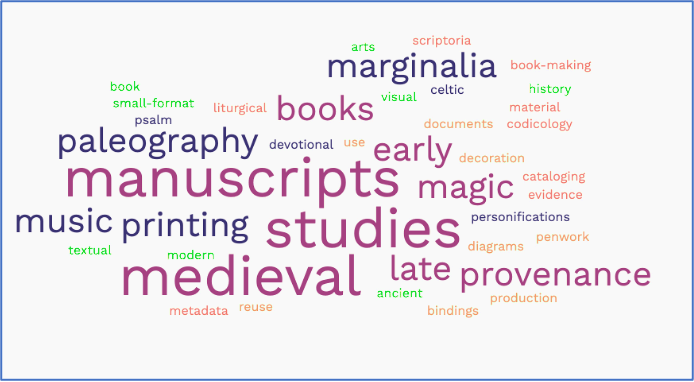
In 2022, the RGME carried out two Surveys.  The first addressed the Editorial Committee (a creation of 2022), while the second turned to our wider audience of Participants.  Prepared by Jessica L. Savage (who designed the Surveys), the Reports of Responses to both Surveys in turn showed a broad range of interests, which may guide planning for future events and topics, and offers to present at RGME events and to help in other ways.

We thank the Respondents for their comments, suggestions, and wishes.

Word Cloud of Responses to the 2022 Editorial Committee Survey. Prepared by Jessica L. Savage.

The Tradition Resumes

For comparison, and as a demonstration of continuity within change, we exhibit the front pages, or covers, of Issues 1 and 2.  Gladly, after eagerly awaiting its appearance, we welcome Issue 2 into the fold of RGME Publications.

Issue 1:

Opening Page of Issue 1 of 'ShelfMarks: The RGME-Newsletter' (Autumn 2014)

Opening Page of ‘ShelfMarks’ 1

Issue 2:

ShelfMarks Issue 2, Page 1 (Front Cover)

Printed Version of ShelfMarks

The PDF version of this issue is available for download here.  (Issue 1 is here.)

Issue 2.  We offer its pdf (8 pages in quarto format) in two versions.

  • As consecutive pages (eight 8 1/2″ × 11″ sheets)
  • As a foldable booklet (printable on two 11 1/2″ × 17″ sheets, to be folded in half)

Please note: If you click to open the PDF in your browser, it may strip out the links. We suggest that you download the PDF and open it in Acrobat Reader to activate the hyperlinks.

Email Version of ShelfMarks

The EMAIL version, as a form of ShelfTags for ShelfMarks, with some extra images, is available here.

Remember, you may Subscribe here.

Please Contact us or leave Comments here with your questions, suggestions, and comments.


Roses as n=6, n=7. and n=8 in designs by Mildred Budny

*****

Tags: 2022 RGME Surveys, Adelaide Bennett Hagens, Book of Kells, Celia Chazelle, Codex Amiatinus, Dan Attrell, David Porreca, Donncha MacGabhann, Gregory Clark, Manuscript studies, Michael Allman Conrad, Monkwearmouth, Morgan Ms 453, Picatrix, ShelfMarks the RGME Newsletter, The Bouquet List
No Comments »

2023 Spring and Autumn Symposia

December 5, 2022 in Announcements, Manuscript Studies

2023 Spring and Autumn Symposia
on
“Materials & Access”

"Centered". Photograph Ⓒ 2014 Mildred Budny. Image of Dew at the center of Sedum.

“Centered”. Photograph Ⓒ 2014 Mildred Budny.

[Posted on 5 December 2022, with updates]

The Research Group prepares a pair of Symposia in 2023, continuing the pattern of paired Spring and Autumn Symposia launched in 2022.

[Update on 25 October: With both the 2023 Spring and Autumn Symposia now accomplished, the illustrated Symposium Booklets for both are published.  You could download both of them or ask for printed copies to be sent to you.  See below.]

The New Tradition

2020 Symposium "From Cover to Cover" Poster 2

2020 Symposium Poster 2

Before then, up to 2022, there would be only one Symposium in a given year, although the span could vary from one to three days, and the Symposia occurred only in person.  Also, previously, the pattern of Symposia did not always appear each year, except notably for our first Symposia, beginning in 1995 at Barnard College, which occurred for five years as a series:

  • “The Transmission of the Bible”: A Series of Annual Symposia (1995‒2000)

Then, after an interval, when we focused instead on other activities and tasks, including the incorporation of the RGME as a nonprofit educational corporation (1999), our resumption of Symposia in a “New Series” would examine a wide variety of themes in turn.  The New Series not only resumed our Symposia, with a difference, but also adopted other forms of Events, such as Colloquia and Workshops:

  • The “New Series” of Symposia, Colloquia, Workshops & Seminars (2001–)

The variation in the usage of terms for the events depended partly on their characteristics and partly on their host institutions’ preferences or requirements for given genres.

2022 Autumn Symposium Program Booklet, Front Cover (Page 1)

With the onset of the Covid-19 pandemic by 2020, RGME events shifted for a while from in-person to online.  After the cancellation of events in 2020, the RGME adopted online events in 2021, to resume Symposia in 2022.  In both 2022 and 2023, we held a pair of Spring and Autumn Symposia.  In this way, our tradition of Symposia comprises several forms or series:

  • RGME Symposia: The Various Series (1995–), in person or online.

And so, with paired Symposia for 2023, we affirm the momentum of our series of Symposia after the Covid-induced hiatus. Formerly, the Symposia were held at various centers, before the cancellation of our 2020 Spring Symposium, “From Cover to Cover”, intended for Princeton University. The illustrated Program Booklet for that Symposium reports its intentions.

The Revived Series

In resuming the series in 2022, we are able to return to some of its subjects, as the contributors make presentations, as their timetables allow, for one or other Session in the revived Symposia.  Some of those contributors propose to participate in our 2023 Symposia.

In 2022, the pair of Symposia addressed the year’s Theme of “Structured Knowledge”, for which the Spring Symposium considered “Structures of Knowledge”, and the Autumn Symposium considered “Supports for Knowledge”.  The webposts for them describes their scope and coverage.  The illustrated Program Booklet for the Autumn Symposium, available freely for download as a booklet of 54 pages in quarto (‘letter-size’) format.  The Symposia for 2023 and for 2024 already have their Year’s Theme as an overarching guide and a central focus, while other subjects also may be explored, sometimes interconnected.

2023: “Materials & Access”

For 2023, the Year’s Theme is “Materials & Access”.

The Spring Symposium has this focus: “From the Ground Up”.
The Autumn Symposium:  “Between Earth and Sky”.

Themes and Subjects for Sessions include some in our continuing series and others. Those subjects and interests are described, for example:

  • for our 2022 Symposia and
  • the Episodes for our series “The Research Group Speaks”.

Each Symposium will have the span of one day and take place on a Saturday.  The selected time-zone is Eastern Standard Time (GMT-5) / Eastern Daylight Time (GMT-4), depending upon time of year.  That is, this year, EDT for the Spring Symposium and EST for the Autumn Symposium.  The Symposia would take place online by Zoom.

Perhaps, conditions permitting, the Autumn Symposium might be hybrid, with attendance both in person and online.

The date for the Spring Symposium has been set.  It is planned for Saturday 25 March 2023, to span a full day (like the two Symposia in 2022) on the timezone of EST (GMT-5) and to take place online via Zoom.

We gather participants for the Presentations (of about 20 to 25 minutes each) and Responses (about 10 to 15 minutes each), for Sessions of 1 1/2 hours duration, with scope within them for Discussion (Q&A) and with Breaks between Sessions.

Participants, variously as Presenters, Respondents, Presiders, Moderators, and Advisers, include:

  • Linde M. Brocato, Mildred Budny, Katharine C. Chandler, Justin Hastings, Atria A. Larson, Ann Pascoe-van-Zyl, Ronald Patkus, David W. Sorenson, and others.

We look forward to your suggestions and participation.

The Program

As the Program for each Symposium gathers, we can post more information both here and on the individual webposts for the two Symposia.  Their webposts appear as

  • 2023 Spring Symposium
  • 2023 Autumn Symposium

If you have questions or comments, please Contact Us or leave your Comments Here.

Now see the developed Program for the 2023 Spring Symposium “From the Ground Up” on Saturday 25 March 2023.  It also has a half-day Pre-Symposium of Lightning Talks on “Intrepid Borders”, organized by Katharine C. Chandler, Jennifer Larson, and Jessica L. Savage, on Friday 24 March 2023.

See the webposts for these companion events, with their Programs and registration information:

  • 2023 Spring Pre-Symposium on “Intrepid Borders”

Baltimore, Walters Art Museum, MS. W.148, folio 33v, bottom right, with fighting creatures. Image via Creative Commons.

  • 2023 Spring Symposium “From the Ground Up”
Photograph of the stems and white blooms of Snowdrops emerging from a patch of bare ground in the sunlight. Photograph Ⓒ Mildred Budny.

The blooms of Snowdrops emerging “From the Ground Up”. Photograph Ⓒ Mildred Budny.

2023 Spring Pre-Symposium/Symposium Program Booklet

The 64-page illustrated Program Booklet is published ‘on the day’ or first day of the event (24 March 2023).

2023 Spring Pre-Symposium/Symposium Booklet Front Cover with photograph of snowdrops flowers rising from the earth.

2023 Spring Pre-Symposium/Symposium Booklet Front Cover.

See 2023 Spring Symposium “From the Ground Up” for information about how you could receive, order, or download a copy of this Booklet free of charge.

2023 Autumn Symposium

Plans advance for the 2023 Autumn Symposium “Between Earth and Sky”.

  • 2023 Autumn Symposium “Between Earth and Sky”

[Update: This event has been successfully accomplished.  See its post, with information for downloading its illustrated booklet of 54 pages.]

2023 Autumn Symposium Booklet Cover.

2023 RGME Events

Other Events are planned for the Year.  See

  • “The Research Group Speaks”: The Series
  • 2023 International Congress on Medieval Studies: Program

2024 RGME Events

“Study on a Medieval Bridge” at Amares, Braga District, Portugal. Image by Pedro Nuno Caetano (2019) via Wikimedia Commons via Creative Commons 2.0 Generic.

For activities planned for next year, an Anniversary Year for the RGME, with the year’s theme of “Bridges”, see:

  • RGME 2023 and 2024 Activities.
  • “Bridges” for our 2024 Anniversary Year

They include episodes for “The Research Group Speaks”, conference sessions at two international congresses for medieval studies (at Kalamazoo and Leeds), anniversary celebrations, and two symposia.

  • 2024 Anniversary Symposium in Thanks to Jesse Hurlbut, RGME WebMaster Emeritus
  • 2024 Spring Symposium at Vassar College

Suggestion Box

Please Contact Us or visit

  • our FaceBook Page
  • our Twitter Feed (@rgme_mss)
  • our Blog on Manuscript Studies and its Contents List

Donations and contributions, in funds or in kind, are welcome and easy to give.  See Contributions and Donations.

We look forward to hearing from you.

*****

Beinecke Rare Book & Manuscript Library, Otto Ege Collection, Volume II of Ege MS 51, View toward Gutter with Reused Manuscript Fragments. Photograph by Mildred Budny.

Beinecke Rare Book & Manuscript Library, Otto Ege Collection, Volume II of Ege MS 51, Displaced Folios 29v-26r. View toward Gutter with Reused Manuscript Fragments. Photograph by Mildred Budny.

*****
Tags: Catalogues & Metadata & Databases, Grounded, Hybrid Books, Manuscripts and Photography, Materials & Access, RGME Autumn Symposium, RGME Spring Symposium, RGME Symposia, Teaching with and through Manuscripts, The Living Library
No Comments »

Two Pages from a Roman Breviary in Gothic Script

November 26, 2022 in Manuscript Studies, Reports

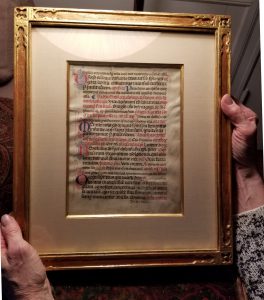
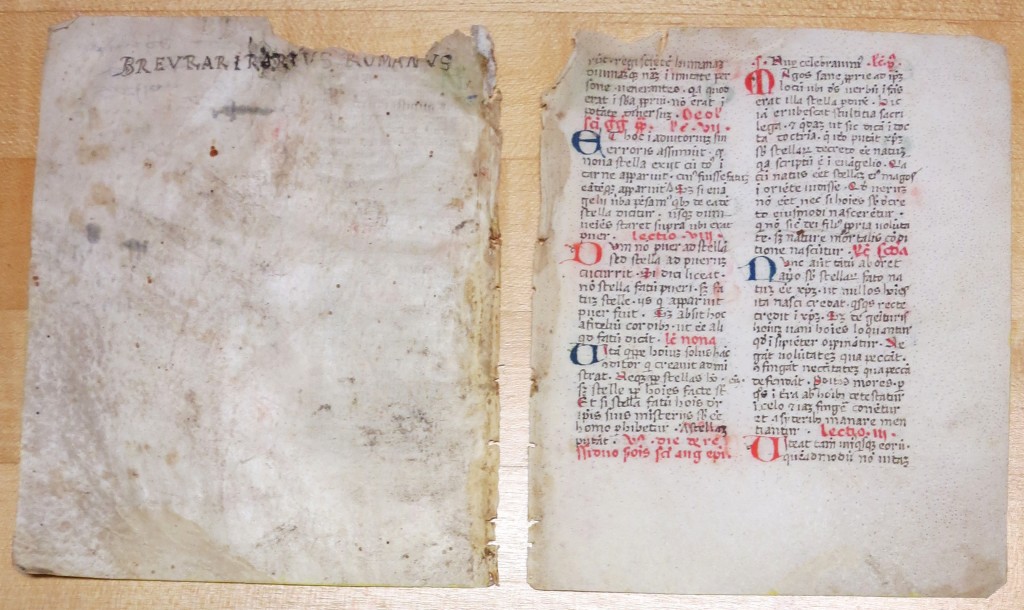
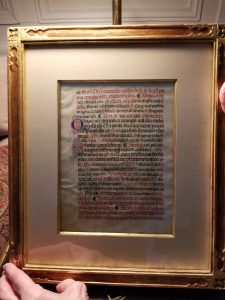
Two Framed Pages
from a Roman Breviary
on Vellum in Latin in Gothic Script

containing
Hours for First Sunday after Easter
and
Vespers for Holy Trinity Sunday

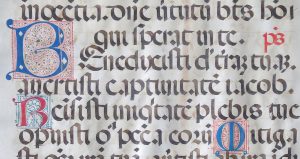
Private Collection, Roman Breviary Leaf in Frame: Page with Part of Vespers for Holy Trinity Sunday. Photography By Mildred Budny. Reproduced by permission.

Single-Column Pages
laid out in 27 lines of Gothic Script
with
Rubrications,
Minor Initials in Red or Blue Pigment,
and
Enlarged Initials
embellished with Pen-line Decoration

[Posted on 27 November 2022]

Two separate leaves, now in frames, in a Private Collection contain parts of a Latin Breviary for Roman Use, that is, the Church of Rome, or Breviarum Romanum. (See, for example, The Roman Breviary and Roman Breviary.)

Some earlier blogposts have considered fragments of Latin Breviaries or related liturgical books.

  • Two Vellum Leaves from a Large-Format Breviary in Gothic Script
  • The Pearly Gateway: A Scrap from a Latin Missal or Breviary
  • A Leaf from Prime in a Large-Format Breviary
  • Written in the Stars: Roman Breviary Fragment with Latin Lections on Astrology

For example, from a different Private Collection, several leaves from a Roman Breviary:

Private Collection. Breviary Fragment, Folios IIv/Ir, with Revised Title and Penultimate Page of the Lections. Photography by Mildred Budny.

Private Collection. Breviary Fragment, Folios IIv/Ir, with Revised Title and Penultimate Page of the Lections. Photography by Mildred Budny.

The Pages from Two Leaves

Private Collection, Roman Breviary Leaf in Frame: Page in the Hours for First Sunday after Easter. Photography By Mildred Budny. Reproduced by permission.

The visible sides of the vellum leaves, on one page per leaf, contain parts of the text from the Hours for the First Sunday after Easter (see Second Sunday of Easter) and from Vespers for Holy Trinity Sunday (see Trinity Sunday).  Let us call the  Leaves 1 and 2, taking them in the sequence of their seasonal occasions in the cycle of the liturgical year, which extends from Advent to Trinity.

In the Western liturgical calendar, Trinity Sunday is the first Sunday after Pentecost; it is intended to celebrate the doctrine of the Trinity, the three Persons of God, namely the Father, Son, and Holy Spirit. Easter (or Resurrection) Sunday commemorates Jesus’ resurrection from the dead; the event is reported in the canonical Gospels (Matthew, Mark, Luke, and John) and some other sources.  As the start of Eastertide, or the Paschal season, Easter Sunday is followed by seven weeks to the fiftieth day on Pentecost Sunday.

The contents of the other sides of the leaves are unknown, apart from show-through onto the visible sides.  The text establishes that the two leaves were non-continuous in their former manuscript.

The vellum material of both leaves is evident in the texture of the visible surfaces as well as undulations across the expanse of the stretched animal skins. The smooth, whitish appearance makes it appear that both pages stand on the flesh sides of their skins.

Bringing the Leaves to light, we report the contents of the Pages, with descriptions and photographs.

Read the rest of this entry →

Tags: Breviarum Romanum, Fragmentology, House of Heydenryk, Manuscript studies, Medieval Manuscript Fragments, RGME Workshops on Looking at Manuscripts, Roman Breviary, The Bridge of Signs
No Comments »

Barbara Heritage on Charlotte Brontë’s Fair Copy of “Shirley”

November 18, 2022 in Uncategorized

The Research Group Speaks
Episode 10
Saturday 18 February 2023 online
1:00–2:30 pm EST (GMT-5) by Zoom

“Stages of Composition:
Charlotte Brontë’s Fair-Copy Manuscript for Shirley“

Barbara Heritage

London, National Portrait Gallery, Chalk drawing (1850) of Charlotte Charlotte Brontë (Mrs A.B. Nicholls) by George Richmond (1809-1898). Image Public Domain via Wikimedia Commons.

[Posted on 18 November 2022]

For Episode 10 in the online series of The Research Group Speaks, Barbara Heritage of the Rare Book School at the University of Virginia will talk about her cumulative work on benefits of examining the material evidence for the processes of creation by a major English author in shaping the text for a next novel.  Please note that registration is required (see below).

The Subject for the Episode

Barbara will examine aspects of the work — and evidence for work-in-progress — in the writings of Charlotte Brontë (1816–1855) at a significant period in her life, after the successful publication of her first novel and after the deaths of the last of her living siblings.  On Charlotte’s life, see, for example, the Oxford Dictionary of National Biography:

  • Brontë [married name Nicholls]. Charlotte [pseud. Currer Bell].

The RGME Episode with Barbara Heritage showcases a study of the author at work, based upon material evidence in the structure of the manuscript itself intended for the printing.

Title and Abstract

Stages of Composition:
Charlotte Brontë’s Fair-Copy Manuscript for Shirley

 Barbara Heritage

Barbara’s Abstract for her presentation:

On 8 September 1849, James Taylor traveled from London to Haworth, Yorkshire, to collect the manuscript of Charlotte Brontë’s novel, Shirley, for publication.  His firm, Smith, Elder and Co., had been anxiously awaiting the completion of the book for nearly a year.  Readers both in England and abroad were eager to read the next work by “Currer Bell”, whose first published novel, Jane Eyre (1847), had proved surprisingly popular.

The manuscript, which now resides in the British Library (Add MS 43479), includes numerous excisions to its 896 leaves.  Its three volumes have been characterized by some as a confused “text of grief” written during the loss of Brontë’s siblings — and by another as proof of self-censorship and even “symptoms of a writing disorder or disease.”  A close codicological study of the manuscript offers an alternative reading by drawing on the correlation of paper stocks and varying pagination, providing new material-based evidence for how Brontë strategically and deliberately revised — and even expanded — her manuscript after serving as the primary caregiver for her siblings.

The First page of the First Edition of ‘Shirley’ by Charlotte Brontë (1849). Image Public Domain via Wikimedia Commons.

Materials, Handwriting & Their Evidence

Some other manuscripts, letters, and other materials produced by Charlotte Brontë are available for viewing online (in full or in part).  See, for example:

  • Fair copy manuscript of Charlotte Brontë’s Jane Eyre (London, British Library, Add MS 43474-43476)
  • Earliest known writings of Charlotte Brontë
  • Charlotte Brontë’s journal (Haworth, Brontë Parsonage Museum, Bonnell 98)
  • Brontë treasures saved for the nation (from the Blavatnik Honresfield Library)

Barbara’s Publications on Charlotte Brontë and Related Subjects

More of Barbara’s work on the subject and its context appears, for example, here:

  • Barbara Heritage, “Stages of Composition: An Analysis of Charlotte Brontë’s Fair-Copy Manuscript of ‘Shirley,’ ” in Studies in Bibliography (2022). (See Studies in Bibliography.) Accepted and forth-coming peer-reviewed article.
  • Barbara Heritage and Ruth-Ellen St. Onge, Building the Book from the Ancient World to the Present Day: How Manuscript, Printed, and Digital Texts Are Made. Illustrated from the Teaching Collections of Rare Book School (Ann Arbor, Michigan: The Legacy Press, distributed by the University of Virginia Press, 2022).
    — online exhibition viewable as Building the Book from the Ancient World to the Present Day.
  • Barbara Heritage, “Reading the Writing Desk: Charlotte Brontë’s Instruments and Authorial Craft”, in Romantic Women and their Books, a special issue of Studies in Romanticism, Volume 60, Number 4 (Winter 2021), pp. 503–522 — available here via Project Muse (by subscription).  Peer-reviewed article.
  • —, “Charlotte Brontë’s ‘Chinese Fac-similes’: A Comparative Approach to Interpreting the Materials of Authorial Labour and Artistic Process”, in Charlotte Brontë, Embodiment and the Material World, edited by Justine Pizzo and Eleanor Houghton.  Palgrave Studies in Nineteenth-Century Writing and Culture (Cham, Switzerland:  Palgrave Macmillan, 2020), 207–232 — available here by subscription.
  • The Scale of Genius: Charlotte Brontë’s Miniature Archive (Middletown, Ohio: Miniature Book Society, 2019). An essay and documentary transcription published in the form of a miniature book.
  • —, The Archeology of the Book”, in Charlotte Brontë: The Lost Manuscripts. (Keighley, United Kingdom: The Brontë Society, 2018), 22–69.  A commission from the Brontë Society.
  • —, Brontë and the Bookmakers: Jane Eyre in the Nineteenth-Century Marketplace (Ph. D. Dissertation, University of Virginia, 2014).
  • —, “Authors and Bookmakers: Jane Eyre in the Marketplace,” in The Papers of the Bibliographical Society of America, 106:4 (2012), 449–85 available here by subscription.  Peer-reviewed article.
  • —, “The Shapes Jane Eyre Takes: Ephemeral Responses to the Book and Its Themes,” RBM: A Journal of Rare Books, Manuscripts, and Cultural Heritage, 9.1 (2008), 58–66.  Invited submission.

Worth the visit!

*****

The offices of Smith, Elder & Co. at No. 15 Waterloo Place in London, from The House of Smith Elder (1904) by Philip Norman (1832-1941). Image Public Domain.

*****
Registration for the Episode

Episode 10 in the online series of “The Research Group Speaks” is planned for Saturday 18 February 2023, via Zoom, at 1 pm EST (GMT – 5) for about 1 1/2 hours, with discussion and Q&A.  You are welcome to join us.

If you wish to attend, please register here:

  • The Research Group Speaks 10. Barbara Heritage: Charlotte Brontë’s Shirley

If you have questions or issues with the registration process, please contact director@manuscriptevidence.org.

Future Episodes

Future Episodes are planned.  See

  • “The Research Group Speaks”: The Series.

Suggestion Box

Please leave your Comments or questions here, Contact Us, or visit

  • our FaceBook Page
  • our Twitter Feed (@rgme_mss)
  • our Blog on Manuscript Studies and its Contents List

Donations and contributions, in funds or in kind, are welcome and easy to give.  See Contributions and Donations.

We look forward to hearing from you.

Lisbon, Museu Nacional de Arte Antiga: The mid 15th-century Saint Vincent Panels, attributed to Nuno Gonçalves. Image (https://upload.wikimedia.org/wikipedia/commons/3/3a/Nuno_Gon%C3%A7alves._Paineis_de_S%C3%A3o_Vicente_de_Fora.jpg) via Creative Commons.

*****
Tags: Author's Fair Copy, Authorial revisions, Brontë siblings, Charlotte Brontë, Codicology, History of Paper, Manuscript studies, Manuscripts, Shirley (Novel), Stages of Composition, The Research Group Speaks
No Comments »

« Older Entries
Newer Entries »
  • Top
©2024 Research Group on Manuscript Evidence.


is proudly powered by WordPress. WordPress Themes X2 developed by ThemeKraft.