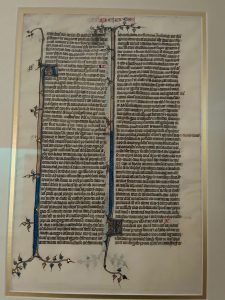
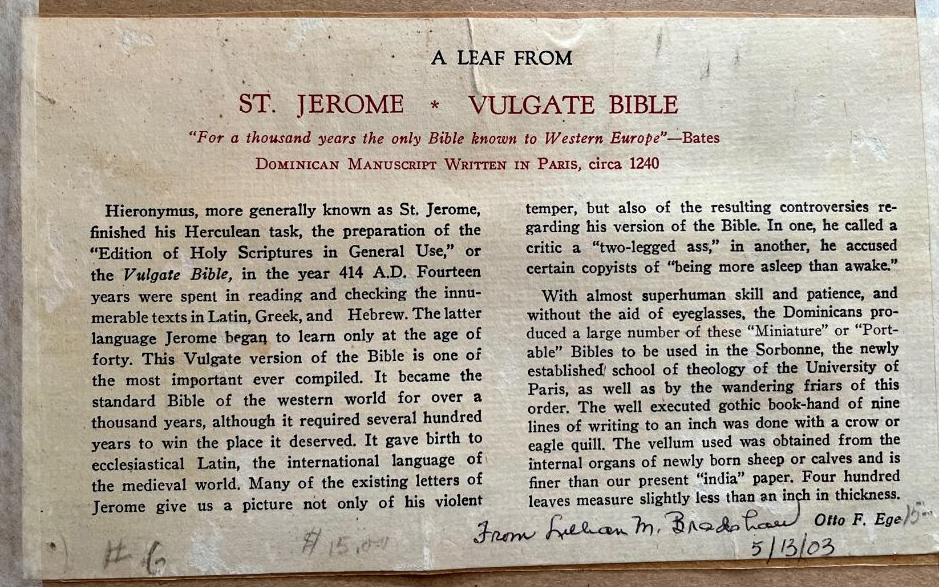
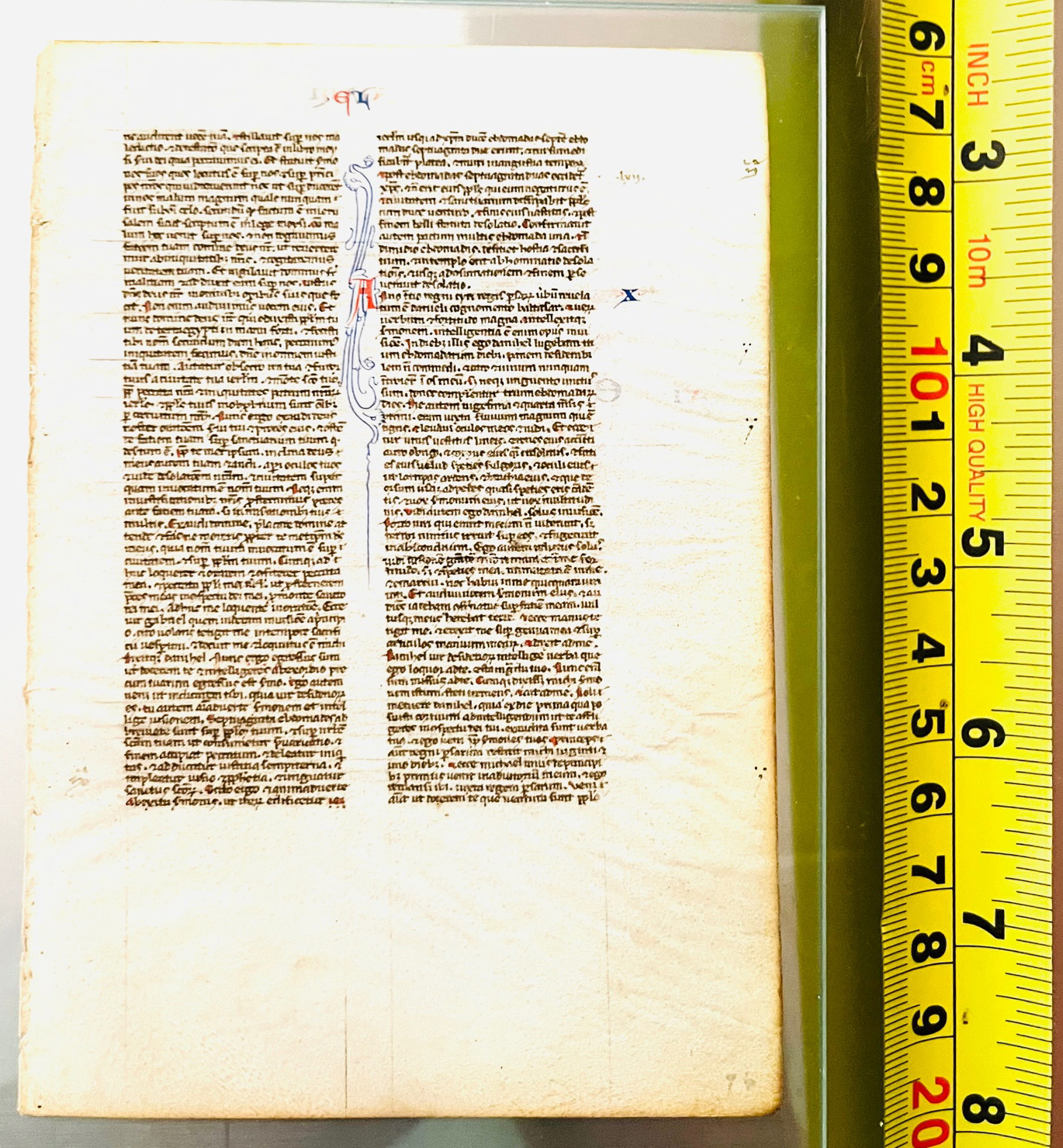
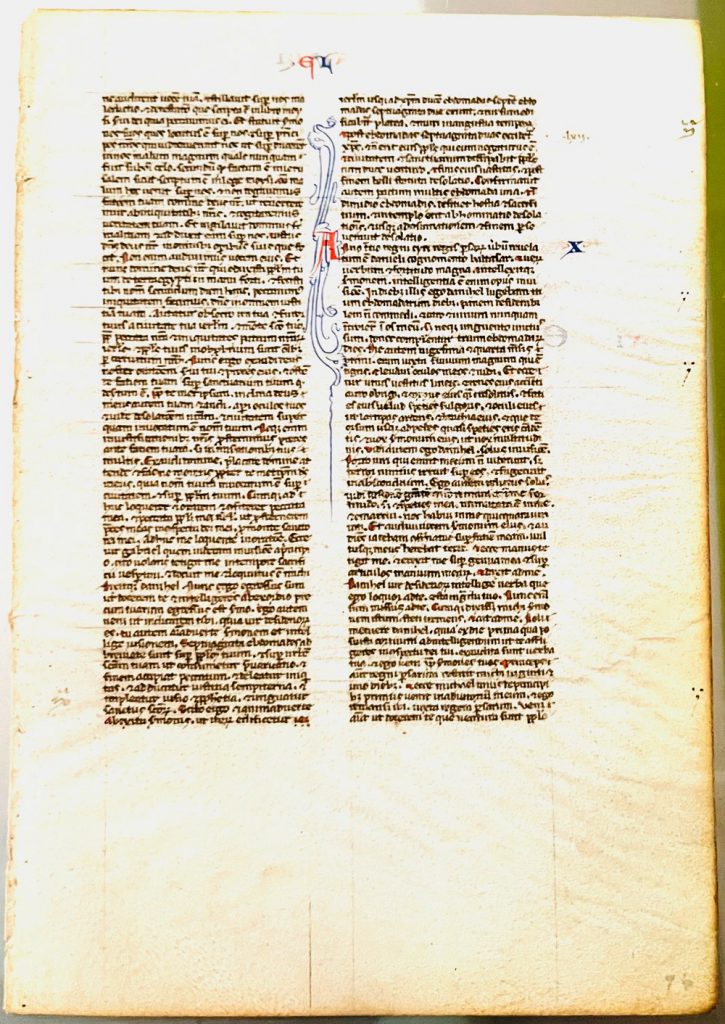
• News
    • News & Views
    • RGME Activities for 2024 and 2025
    • Around & About with the RGME
    • Reviews
    • Highlights
  • Blogs
    • Manuscript Studies
      • Manuscript Studies: Contents List
    • International Congress on Medieval Studies
      • Abstracts of Congress Papers
        • Abstracts of Papers Listed by Author
        • Abstracts of Papers Listed by Year
  • About
    • Mission
    • Who We Are
      • Officers, Associates & Volunteers
      • RGME Committees
      • Friends of the Research Group on Manuscript Evidence
    • Policies & Statements
      • RGME Privacy Policy Statement
      • RGME Intellectual Property Statement & Agreements
    • People
      • Mildred Budny — Her Page
      • Adelaide Bennett Hagens
    • Activities
      • Events
      • Congress Activities
        • Sponsored Conference Sessions (1993‒)
          • Panels at the M-MLA Convention (from 2016)
        • Co-sponsored Conference Sessions (2006‒)
    • History
      • Seals, Matrices & Documents
      • Genealogies & Archives
    • Contact Us
  • Bembino
    • Multi-Lingual Bembino
    • RGME Bembino: Resources
  • Congress
    • Sponsored Conference Sessions (1993‒)
    • Co-sponsored Conference Sessions (2006‒)
    • Abstracts of Congress Papers
      • Abstracts Listed by Author
      • Abstracts Listed by Year
    • Kalamazoo Archive
    • Panels at the M-MLA Convention (2016-2019)
      • Abstracts of Papers for the M-MLA Convention
      • Panels at the M-MLA Convention (from 2016)
  • Events
    • RGME Activities for 2024 and 2025
      • 2023 Activities and 2024 Planned Activities
    • Seminars, Workshops, Colloquia & Symposia (1989–)
      • Seminars on ‘The Evidence of Manuscripts’
      • Symposia on ‘The Transmission of the Bible’
      • The New Series (2001-)
        • 2019 Anniversary Symposium Program: The Roads Taken
        • 2019 Anniversary Symposium Registration
        • 2019 Anniversary Symposium Registration Open
      • RGME Symposia: The Various Series
      • The Research Group Speaks: The Series
      • Meetings of the Friends of the Research Group on Manuscript Evidence
      • RGME Online Events
    • Abstracts of Papers for Events
      • Abstracts of Papers for Seminars on ‘The Evidence of Manuscripts’
      • Abstracts of Papers for Symposia, Workshops & Colloquia
    • Receptions & Parties
    • Business Meetings
    • Photographic Exhibitions & Master Classes
    • Events Archive
  • ShelfLife
    • Journal Description
    • ShelfMarks: The RGME-Newsletter
    • Publications
      • “Insular, Anglo-Saxon, and Early Anglo-Norman Manuscript Art at Corpus Christi College, Cambridge” (1997)
        • Mildred Budny, ‘Catalogue’
        • The Illustrated Catalogue (1997)
      • The Illustrated Handlist
      • Semi-Official Counterfeiting in France 1380-1422
      • No Snap Decisions: Challenges of Manuscript Photography
    • History and Design of Our Website
  • Galleries
    • Watermarks & the History of Paper
    • Galleries: Contents List
    • Scripts on Parade
    • Texts on Parade
      • Latin Documents & Cartularies
      • New Testament Leaves in Old Armenian
    • Posters on Display
    • Layout Designs
  • Donations and Contributions
    • RGME Donor Promise
    • 2023 End-of-Year Fundraiser for our 2024 Anniversary Year
    • 2019 Anniversary Appeal
    • Orders
  • Links
    • Catalogs, Metadata, and Databases: A Handlist of Links
    • Handlist of Resources for Manuscript Studies and Fragmentology
    • Manuscripts & Rare Books
    • Maps, Plans & Drawings
    • Seals, Seal-Matrices & Documents

  • News
    • News & Views
    • RGME Activities for 2024 and 2025
    • Around & About with the RGME
    • Reviews
    • Highlights
  • Blogs
    • Manuscript Studies
      • Manuscript Studies: Contents List
    • International Congress on Medieval Studies
      • Abstracts of Congress Papers
        • Abstracts of Papers Listed by Author
        • Abstracts of Papers Listed by Year
  • About
    • Mission
    • Who We Are
      • Officers, Associates & Volunteers
      • RGME Committees
      • Friends of the Research Group on Manuscript Evidence
    • Policies & Statements
      • RGME Privacy Policy Statement
      • RGME Intellectual Property Statement & Agreements
    • People
      • Mildred Budny — Her Page
      • Adelaide Bennett Hagens
    • Activities
      • Events
      • Congress Activities
        • Sponsored Conference Sessions (1993‒)
          • Panels at the M-MLA Convention (from 2016)
        • Co-sponsored Conference Sessions (2006‒)
    • History
      • Seals, Matrices & Documents
      • Genealogies & Archives
    • Contact Us
  • Bembino
    • Multi-Lingual Bembino
    • RGME Bembino: Resources
  • Congress
    • Sponsored Conference Sessions (1993‒)
    • Co-sponsored Conference Sessions (2006‒)
    • Abstracts of Congress Papers
      • Abstracts Listed by Author
      • Abstracts Listed by Year
    • Kalamazoo Archive
    • Panels at the M-MLA Convention (2016-2019)
      • Abstracts of Papers for the M-MLA Convention
      • Panels at the M-MLA Convention (from 2016)
  • Events
    • RGME Activities for 2024 and 2025
      • 2023 Activities and 2024 Planned Activities
    • Seminars, Workshops, Colloquia & Symposia (1989–)
      • Seminars on ‘The Evidence of Manuscripts’
      • Symposia on ‘The Transmission of the Bible’
      • The New Series (2001-)
        • 2019 Anniversary Symposium Program: The Roads Taken
        • 2019 Anniversary Symposium Registration
        • 2019 Anniversary Symposium Registration Open
      • RGME Symposia: The Various Series
      • The Research Group Speaks: The Series
      • Meetings of the Friends of the Research Group on Manuscript Evidence
      • RGME Online Events
    • Abstracts of Papers for Events
      • Abstracts of Papers for Seminars on ‘The Evidence of Manuscripts’
      • Abstracts of Papers for Symposia, Workshops & Colloquia
    • Receptions & Parties
    • Business Meetings
    • Photographic Exhibitions & Master Classes
    • Events Archive
  • ShelfLife
    • Journal Description
    • ShelfMarks: The RGME-Newsletter
    • Publications
      • “Insular, Anglo-Saxon, and Early Anglo-Norman Manuscript Art at Corpus Christi College, Cambridge” (1997)
        • Mildred Budny, ‘Catalogue’
        • The Illustrated Catalogue (1997)
      • The Illustrated Handlist
      • Semi-Official Counterfeiting in France 1380-1422
      • No Snap Decisions: Challenges of Manuscript Photography
    • History and Design of Our Website
  • Galleries
    • Watermarks & the History of Paper
    • Galleries: Contents List
    • Scripts on Parade
    • Texts on Parade
      • Latin Documents & Cartularies
      • New Testament Leaves in Old Armenian
    • Posters on Display
    • Layout Designs
  • Donations and Contributions
    • RGME Donor Promise
    • 2023 End-of-Year Fundraiser for our 2024 Anniversary Year
    • 2019 Anniversary Appeal
    • Orders
  • Links
    • Catalogs, Metadata, and Databases: A Handlist of Links
    • Handlist of Resources for Manuscript Studies and Fragmentology
    • Manuscripts & Rare Books
    • Maps, Plans & Drawings
    • Seals, Seal-Matrices & Documents

Log in

Archives

Featured Posts

Episode 24. “Life with Books” (Interview with John Windle)
Announcing the Launch of RGME Bembino WP
2026 RGME Colloquium at The Grolier Club: Report
Medieval Missal Fragment as Early-Modern Cover
The Weber Leaf from Ege MS 61
"Bembino" Booklet Cover
Episode 23. “Meet RGME Bembino: Facets of a Font”
2026 RGME Colloquium on “Transformations & Renewals” at The Grolier Club
2026 Theme of the Year: “Transformations and Renewals”
A Leaf with Patchwork from the Saint Albans Bible
A Sister Leaf from a Miniature Latin Vulgate Bible
A Little Latin Vulgate Bible Manuscript Leaf in Princeton
J. S. Wagner Collection. Leaf from from Prime in a Latin manuscript Breviary. Folio 4 Verso, with part of Psalm 117 (118) in the Vulgate Version, set out in verses with decorated initials.
2026 Annual Appeal
Episode 22: “Encounters with Local Saints and Their Cults”
Private Collection, Ege's FBNC Portfolio, Dante Leaf, Verso, Detail. Reproduced by Permission.
2025 RGME Autumn Colloquium on Fragments
Workshop 8: A Hybrid Book where Medieval Music Meets Early-Modern Herbal
2025 RGME Autumn Symposium on “Readers, Fakers, and Re-Creators of Books”
RGME Workshops on “The Evidence of Manuscripts, Etc.”
2025 International Medieval Congress at Leeds: RGME Program
Episode 21. “Learning How to Look”
2025 International Congress on Medieval Studies: Program
2025 RGME Visit to Vassar College
Two Leaves in the Book of Numbers from the Chudleigh Bible
Delibovi on Glassgold on Boethius: A Blogpost
Ronald Smeltzer on “Émilie du Châtelet, Woman of Science”
2025 Spring Symposium: “Makers, Producers, and Collectors of Books”
Starters’ Orders
The Weber Leaf from the Saint Albans Bible
Workshop 4. “Manuscript Fragments Compared”
Episode 20. “Comic Book Theory for Medievalists”
Episode 19: “At the Gate: Starting the Year 2025 at its Threshold”
Favorite Recipes for Lemonade, Etc.
RGME Visit to the Lomazow Collection: Report
2024 Autumn Symposium: “At the Helm”
A Latin Vulgate Leaf of the Book of Numbers
The RGME ‘Lending Library’
Florence, Italy, Ponte Vecchio from Ponte alle Grazie. Photo: Ingo Mehling, CC BY-SA 4.0 , via Wikimedia Commons
Episode 17. “RGME Retrospect and Prospects: Anniversary Reflections”
2024 Anniversary Symposium: The Booklet
Jesse Hurlbut at the Bonneville Salt Flats, Utah. Photograph Jesse Hurlbut.
Episode 16: An Interview with Jesse D. Hurlbut
To Whom Do Manuscripts Belong?
Kalamazoo, MI Western Michigan University, Valley III from the side. Photograph: David W. Sorenson.
2024 International Congress on Medieval Studies: Report
2024 Spring Symposium at Vassar College
Puente de San Martín: Bridge with reflection over the River Targus, Toledo, Spain.
2024 Grant for “Between Past and Future” Project from The Gladys Krieble Delmas Foundation Research Libraries Program
2024 Anniversary Symposium in Thanks to Jesse Hurlbut: Program

You are browsing the Blog for manuscript fragments

RGME Workshops on “The Evidence of Manuscripts, Etc.”

January 4, 2025 in Manuscript Studies, Workshops on "The Evidence of Manuscripts"

RGME Workshops
on
“The Evidence of Manuscripts, Etc.”

[Posted on 31 December 2024, with updates]

Private Collection, Pieces of a Vellum Leaf from a Medieval Manuscript: Recto. Photography by Mildred Budny.

In 2024 the RGME launched its series of Workshops dedicated to “The Evidence of Manuscripts, Etc.”

The series began in October 2024. So far they take place online as sessions of one and one-half hours, including scope for questions and answers. They are designed to teach and to crowdsource research on original materials, which may be newly discovered and so far unknown.

The workshops are free of charge. All are welcome to attend, join the discussion, and participate in the study of manuscripts and other original sources.

With this series, we revive an approach to collaborative events “On the Evidence of Manuscripts” which we nutured in our early years.

Our Early Series of Seminars
on “The Evidence of Manuscripts” (1989–1995)

Logo of the Research Group on Manuscript Evidence in Monochrome Version

RGME Logo in Black-and-White.

In its early years while based at the Parker Library of Corpus Christi College, Cambridge, the Research Group on Manuscript Evidence held a series of Seminars, Workshops, and Symposia (organized or co-organized by Mildred Budny) variously at the Parker Library and at other centers in England, Japan, and the United States. At libraries, the sessions took place over relevant manuscripts in the collection, supplemented by photographs. Elsewhere, the sessions were usually accompanied by displays or exhibitions of photographs (mostly by Mildred Budny).

  • Seminars, Workshops, Colloquia, and Symposia

In England, many of these sessions belonged to the series of Research Group Seminars on “The Evidence of Manuscripts.” Often they took place at the Parker Library in the company of the manuscripts under examination, sometimes also with early-printed books.
  • RGME Seminars on “The Evidence of Manuscripts”
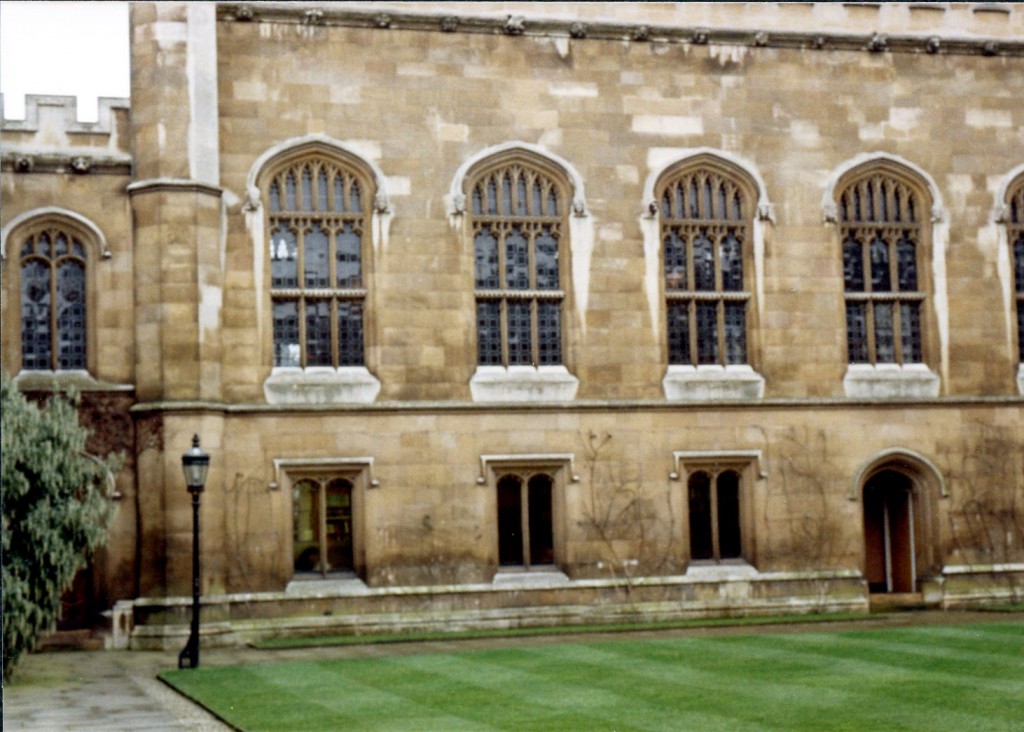
View Toward the Entrance to the Parker Library in mid-1989 photograph © Mildred Budny

View Toward the Entrance to the Parker Library in mid-1989. Photograph © Mildred Budny.

Harking back to our first series of events as the RGME, in the series of RGME Seminars on “The Evidence of Manuscripts” (1989–1994), this new series brings forward for collective study (‘crowdsourcing’ and collaboration) the original specimens as witnesses in our own RGME Special Collections and the RGME Lending Library

Foreground

  • “The Bridge of Signs”

View of the Pont Neuf, Paris. Photograph by Claudio Mota via https://www.pexels.com/photo/pont-neuf-bridge-in-paris-9999874/.

Registration for the Workshops

To register for individual workshops in the series, please visit the RGME Eventbrite Collection for “The Evidence of Manuscripts, Etc.”

  • RGME Collection: Workshops

Workshop 1
“Introducing the Farrell Leaf”
Sunday 17 November 2024

The first Workshop considers practices of manuscript studies and introduces the first specimen for collaborative examination. We meet the medieval Latin Vulgate Bible leaf from the Book of Numbers in the Jennah Farrell Leaf, now on loan to the RGME “Lending Library”.

For background information about this leaf based on the characteristics of the leaf itself and the owner’s knowledge about its provenance with reference to the previous owner, see

  • our Blog on Manuscript Studies
  • and its Manuscript Studies Contents List.

Medieval Latin Vulgate Bible manuscript: Verso, top. Photography by Mildred Budny.

Workshop 2
“Follow-Up for the Farrell Leaf”
Sunday 15 December 2024

At this workshop, comparing notes about our investigations which followed Workshop 1, we agreed that, most probably (and perhaps almost certainly), this leaf formerly belonged to the Saint Albans Bible, dispersed only in recent decades and now having its surviving leaves widely separated through the marketplace. On this bible see, for example:

  • King David in the Waters Blessed by God, in a pair of leaves sold at Christie’s on 10 July 2019 and now in the McCarthy Collection

Fuller confidence in this proposed identification of the Farrell Leaf as part of the Saint Albans Bible might have to await the discovery or recognition of one of the leaves which formerly stood immediately adjacent, that is, directly preceding this leaf or directly following it, with a continuous flow of the text from leaf to leaf.

We continue our explorations.

Medieval Latin Vulgate Bible manuscript: Verso, top. Photography by Mildred Budny.

Workshop 3
“The Farrell Leaf and its Context”
Sunday 12 January 2025

Next, we consider the Farrell Leaf in its context:

  • in its original manuscript,
  • in relation to other leaves bearing the work of its scribe and scribal artist,
  • among other representatives in its time of the genre of Vulgate Bible manuscripts of medium format, and
  • as a witness to its production and deconstruction, whereby individual leaves became scattered through the sales room, sometimes multiple times over before reaching ‘Forever Homes’.

Collection of Jennah Farrell, Latin Vulgate Bible Leaf: Verso, Bottom of Columns. Photograph by Mildred Budny.

Registration:

  • Workshop 3. The Farrell Leaf and its Context: Tickets

*****

Workshop 4
“Manuscript Fragments Compared:
The Saint Albans Bible and Otto Ege MS 14”
Sunday 23 February 2025

Continuing our exploration of the Saint Albans Bible, from the previous Workshops (1–3), we now expand our scope to set its complex characteristics as a fragmentary, dispersed Latin Vulgate Bible manuscript in a wider context. Also, we can reveal another leaf from the same Bible, which came to our attention following Workshop 3.

We thank our Associate, Richard Weber, for sharing information and photographs about the leaf in his collection from the same manuscript, but from the New Testament portion.

Collection of Richard Weber, Leaf from the Saint Albans Bible, Recto: Top Right. Photograph by Richard Weber.

Note that, with permission, our blog has published discoveries for other leaves in Richard Weber’s collection. See:

  • A Leaf from “Otto Ege Manuscript 214” in the Collection of Richard Weber
  • More Leaves from an Old Armenian Praxapostolos
  • Portfolio 93 of Otto Ege’s “Famous Books in Eight Centuries” in the Collection of Richard Weber

At our Workshop, we may survey our progress for the Saint Albans Bible, as we collectively continue to explore the extent, range, and nature of its surviving parts, or to conjure up other parts for whom whereabouts are unknown from other sources as well as from the evidence of the leaves themselves or reports about them or the original manuscript. We can report the progress of the work to shape a list of known survivors, their present locations, their contents (which part of the Bible or the companion apparatus such as the glossary of Interpretations of Hebrew Names), span of text upon the individual fragments, and the citations about the manuscript and its fragments in books, articles, blogs, or sales catalogues.

In taking into consider other relatives of the genre, our quest can be twofold, taking into account

1) the genre of medieval Vulgate Bible manuscripts containing the full text of the Bible, both Old and New Testaments, within a single volume; and

2) such manuscripts which have befallen the fate of dismemberment and distribution of individual leaves or groups of leaves through the saleroom or other means.

Accordingly, first we might consider the possible survivors of other works by the same scribes, artists, and workshop.

Next we can take note of other Vulgate Latin Bibles of the period which may have suffered the same fate through fragmentation, dispersal, and restorative efforts to recognize the fragments wherever they might survive, study their evidence closely, and, insofar as possible reconstruct the fragments at least virtually.

Private Collection, Leaf from ‘Ege MS 14’. Part of the Book of Jeremiah, Recto, Detail. Photograph by Mildred Budny.

As a model for the latter, we turn to the case of the large-format Lectern Vulgate Bible which Otto F. Ege dispersed as his Manuscript 14, following his numeration of the specimen leaves which he selected for his portfolio of Fifty Original Leaves from Manuscripts of Western Europe (FOL). This manuscript we have been chasing for years in our research, as reported in our blog on Manuscript Studies. See its

  • Manuscript Studies: Contents List

A new Loan to the RGME brings a leaf from that Bible to the service of our RGME Workshops. Let us introduce it to you in the Workshop.

Information

  • Workshop 4. “Manuscript Fragments Compared”

Registration

  • Workshop 4. “Manuscript Fragments Compared”: Tickets

*****

Workshop 5
“Identifying Medieval Bible Manuscript Fragments”
Sunday 23 March 2025

We consider specimens from, for example,

  • the Saint Albans Bible,
  • Otto Ege MS 14, and
  • the Chudleigh Bible.

Collection of Richard Weber, Leaf from Otto Ege MS 14, recto. Photograph by Richard Weber.

Workshop 5 picks up where Workshop 4 left off, within the comparison of two medieval Latin Vulgate Bible manuscripts of different sizes and functions, as represented by some of their fragments. Formerly each comprised a single-volume Bible, with both Old and New Testaments.

These two manuscripts, the medium-format Saint Albans Bible and the large-format Otto Ege MS 14, merit further examination as we add another fragment into view. This discovery is a leaf from the Book of II Corinthians in the Collection of Richard Weber.

This leaf joins our quest to learn more about the original manuscripts and their context. We thank Richard for his generosity in sharing information of materials in his collection for our research and teaching.

After Workshop 4, Richard sent to the RGME a pair of single leaves from another dismembered Latin Vulgate Bible manuscript, this time a medium-format specimen in double columns of 53 lines. It belongs to the Chudleigh Bible, produced in northwestern France in the 13th century and dismembered after its sale in London in 1970. We will introduce the leaves at Workshop 5, to set their study in the context of our ongoing quest to learn more about the fragments Saint Albans Bible and Ege MS 14 and their original manuscripts.

This workshop could, for now, round out our introductory set of workshops on medieval Bible manuscripts, as other sorts of manuscript fragments have also come forward for study and teaching.

Would you like to join us in writing up the reports or blogposts about these leaves as they have come to light?

This workshop continues the demonstration of detective techniques for learning how to identify manuscript fragments which might come to light with little or no companion information. Using different manuscripts and their fragments as case studies, we advance with the quest to learn more about looking at the original sources. More surprises and discoveries may emerge.

Registration

  • Workshop 5. “Identifying Medieval Bible Manuscript Fragments”. Tickets

Collection of Richard Weber, Leaf from Otto Ege MS 14, recto, middle. Photograph by Richard Weber.

*****

Workshop 6
“What’s In a Name?
Guides to Nomenclature for Manuscript Studies”
Sunday 27 April 2025

Jan Van Eyck, The Virgin and Child with Canon van der Paele, 1434–36, Bruges, Groeningemuseum (detail), image from the Closer to Van Eyck project (https://closertovaneyck.kikirpa.be/)

By request, we will consider ‘best practices’ with regard to the use of Nomenclature for Manuscript Studies.

We explore the range of terms in use (in English and other languages) for different parts of books, from the outside in. In this way, we consider the merits — or otherwise — of terms in use for different parts of manuscripts, books, bindings, and other features of the material evidence of written sources. How helpful and comprehensible are the systems of terminology?

Examples of reference works online and in print will be examined, with observations on their usefulness for various purposes, types of books, problems, and approaches.

Do you have specific questions? We can help.

Extra

After our Workshops 1–5, another medieval Latin Vulgate Bible leaf has come to light. The owner has given permission for us to study the leaf as part of our ongoing project on medieval manuscript fragments.

Private Collection. Leaf from a Medieval Latin Vulgate Bible, Manuscript, ‘Verso’.

We will introduce the leaf so that it can begin to join the world of knowledge about dispersed medieval manuscripts which come to light in the work for virtually reconstructing their original codices, insofar as the identified and located fragments can allow.

Information

  • Workshop 6. “What’s In A Name?”

Registration

  • Workshop 6. “What’s In a Name?” Tickets

*****

Workshop 7
“Fragments & Documents”

Sunday 29 June 2025

This workshop will continue our exploration of fragments and open our investigations to the realm of documents, which resemble manuscript materials in certain respects, but also present significant differences from them. Our Workshop will consider the differences and similarities as we compare and contract techniques and methodologies from manuscript studies, fragmentology, and diplomatics.

Information

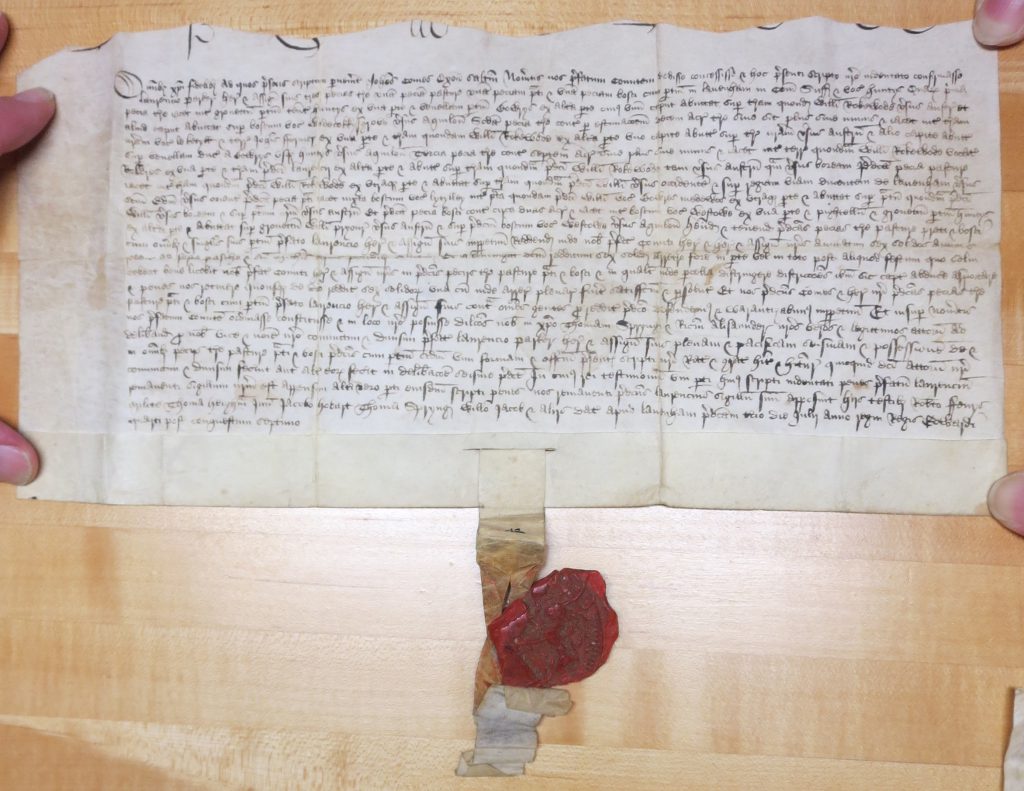
  • Examples may include the “Preston Series”.
    See:
    Manuscript Studies: Contents List for Preston Charters

Registration
  • Workshop 7. “Fragments and Documents”: Tickets
Preston Charter 12 Face with Seal. Photograph Mildred Budny.

Preston Charter 12 Face with Seal. Photograph Mildred Budny.

*****

Workshop 8
“Face the Music, or,
Where Manuscript Meets Print
in a Hybrid Book:
An Early-Modern German Herbal
with a Reused Binding Fragment
from a Medieval Musical Manuscript”

Sunday 26 October 2025

This workshop will examine a puzzling vellum fragment (or is it a set of patchwork fragments?) in a private collection. The fragment(s) come(s) from a single musical manuscript in Latin on vellum laid out in double columns with text and notation on 4-line staves. The reused medieval material forms the outer covering of a 17th-century printed book in German on laid paper.

We will work to decipher the visible parts of the text and music, identify the readings/lections and chants, and, if possible (given the fragmentary nature), determine the probable genre of original manuscript, such as lectionary, breviary, or missal. Perhaps we might find other survivors from the same despoiled medieval manuscript.

Plus we will exclaim over the features of the printed book, which includes illustrations and marginalia in forms of annotations demonstrating attention of several kinds.

What brought this medieval musical fragment and early modern printed book together? Even if we might never know all the answers, won’t it be fun to question how and why? There is a story here.

We love the puzzle, and give thanks to the collector for lending the book to the RGME for study and teaching.

Information

  • Workshop 8. A Hybrid Book where Medieval Music Meets Early-Modern Herbal
    We invite you to join our collaborative quest to learn more about the different parts of the ensemble.

Registration for the Workshop

  • https://www.eventbrite.com/e/workshop-8-a-hybrid-book-with-astrological-herbal-and-medieval-missal-tickets-1340074201009

The Manuscript Fragment and the Printed Book

Private Collection, Front Cover with Reused Medieval Musical Fragment on Vellum. Photograph by Mildred Budny.

Title Page

[Bartholomaeus Carrichter (1510–1574)], Horn des Heyls menschlicher Blödigkeit, oder Kreütterbuch, darinn die Kreütter des Teutschenlands auss dem Liecht der Natur nach rechter Art der himmelischen Einfliessungen beschriben / durch Philomusum Anonymum [Bartholomäus Carrichter], with a foreword by Michael Toxites, born Johann Michael Schütz (1514–1581), (Strassbourg: Anton Bertram, DCVI/1606).

Private Collection, Kreutterbuch, title page. Photograph by Mildred Budny.

For the first edition of 1576, printed in Straßburg, see an online digital facsimile of a copy in Augsburg, Staats- und Stadtbibliothek. For an edition of 1619 also printed by A. Bertram, see the copy in the Wellcome Collection.

Like the 1619 edition, this folio volume has 10 unnumbered pages, 180 numbered pages, and 5 unnumbered leaves, with a woodcut title page and outline illustrations.

*****

Workshop 9
“Books as Thresholds and Communities”

Sunday 21 December 2025

As the year 2025 draws to a close, we reflect on our Theme for the Year, “Thresholds and Communities” particularly as it applies to our explorations of books and their makers, users, collectors, readers, and others — through our series of workshops and other events — and as we prepare for next year and its new theme. Now we consider how manuscripts and printed books or other written materials might function as Thresholds and represent or foster Communities

  • Thresholds and Communities: RGME Theme for the Year 2025

We draw inspiration from our year’s activities, conversations, and insights. We may reflect on the multiple ways that they offered encounters with books of many kinds, from different ages and places, and with many voices, sometimes in harmony. With such perspectives, we might brace for, prepare for, and choose to welcome the new year.

Poster 2. 2025 Autumn Colloquium. Poster set in RGME Bembino.

Because the 2025 RGME Autumn Colloquium in late November will consider the subject of Fragments (manuscript and printed) from many perspectives, we may discuss some discoveries from that event and follow up with more materials which it helped to bring to light.

  • 2025 RGME Autumn Colloquium on Fragments

For example, do you have any manuscript or printed fragments that you would like to share or learn about? Bring them along, please, to our Zoom Meeting. Let’s see what we might learn together, and share the delight of discovery.

Part of the voyage, we have learned, brings the refreshing reconstitution or renewal of scattered and seemingly disparate fragments, to form new forms of communities fostered by books and the meanings or stories of human lives across time which they can convey.

Information

  • Workshop 9 on “Thresholds and Communities”

Registration

  • Workshop 9. Tickets

See you there!

Illumination from Hildegard’s Scivias (1151) showing her receiving a vision and dictating to teacher Volmar. Image Public Domain via Wikimedia Commons.

******

Workshop 10. Sunday 29 March 2026
” ‘Transformations and Renewals’ in our Ongoing Studies”

For this workshop, we show examples of our selected theme for the year in action for the close study of material evidence in books. On the theme, see:

  • RGME Theme for the Year 2026: “Transformations and Renewals”

For an exploration of the theme as applied to and manifested in books, see our Episode 24 (Sunday 18 April 2026) on “Transformations and Renewals by Way of Books”.

  • The Research Group Speaks: The Series
  • Episode 24. “Transformations and Renewals by Way of Books”: Registration
  • Eventbrite Portal for RGME

In Workshop 10, we take note of multiple discoveries so far in our series. From workshop to workshop, discoveries have come to light through our own continuing research and the revelations of materials in private or public collections which correspond to some specimens highlighted in one or more workshops.

We survey multiple discoveries for a variety of manuscripts, manuscript fragments, printed books, and combinations of printed books with reused manuscript fragments as a re-created form of hybrid book mixing media, periods of production, genres of book, and sometimes also languages in their different layers or components between, upon, and around the covers.

There is much to report. Examples, depending upon time allotted, might include more specimens from the dismembered Chudleigh Bible, an update about the dismembered Saint Albans Bible (the subject of our first four Workshops), new results from on-going RGME studies of missals dismembered by Otto F. Ege (notably the Cistercian Missal of “Ege MS 2,” as featured in our recent 2026 RGME Colloquium at the Grolier Club, and the Warburg Missal of “Ege MS 22“), and discoveries of more cases of hybrid 16th-century printed books from Germany with medieval Latin missal fragments (such as Medieval Missal Fragment as Early-Modern Cover).

We take note of the successful function and generously shared results of our RGME Workshops on “The Evidence of Manuscripts, Etc.” so far, as we celebrate the tenth in their series and look toward the future, with thanks to participants, audience, collaborators, collectors, students, advisers, and lovers of books.

Bring your questions, favorite cases, puzzles, and observations to the conversation!

Registration

  • Workshop 10. “Transformations and Renewals” in our Ongoing Studies


J. S. Wagner Collection, Ege Manuscript 22, Folio clvi, verso: Top Left. Reproduced by permission.

J. S. Wagner Collection, Ege Manuscript 22, Folio clvi, verso: Top Left. Reproduced by permission.

*************

Workshop 11
Sunday 9 August 2026
“Early-Modern Archives in Old and New England”

For this workshop we consider the challenges and opportunities of studying a rich selection of archival materials produced in the early seventeenth-century. Mildred Budny will explore cases of women’s wills, centered upon a holograph specimen of 1604 for the widow Sarah Overton of Southold, Long Island, and antecedents among Anglo-Saxon noblewomen’s wills of the tenth century, including the Will of Æthelgifu . Hannah Goeselt will analyze the legacy of a manuscript documenting the proceedings of the House of Commons for the year 1628 as it survives in American contexts, notably in the Massachusetts Historical Society Library. These cases may serve to highlight the nature of inventories, estate lists, wills, documentary records, literacy, and early collecting in colonial North America.

We welcome the chance to learn about other cases and projects concerning such materials. Please let us know about your interests in them. Contact us!

Boston, Massachusetts Historical Society Library, Ms. N-1325, “House of Commons Proceedings, 1628”, fols. 73v-74r. Photograph by Hannah Goeselt.

*****************

Workshop 12, Etc.
Subjects To Be Determined (We accept requests!)

Among subjects requested are:

Cataloging Manuscripts: Readers’ Perspectives
     Or, A User’s Guide to the Catalogue You Always Wanted
Now also see:

RGME Episode 26 (Saturday 25 July 2026)
“Catalog(u)ing Collections and Materials:
Processes, Challenges, Requests, and Opportunities”
Part 1 of a Series
 The Research Group Speaks: The Series

Manuscripts and (or Versus) Photography
     A User’s Guide

‘Hybrid Books’: What Are They?
Examples and Case-Studies

*****

Questions? Suggestions?

  • Leave your comments or questions below
  • Contact Us

Visit our Social Media:

  • our Facebook Page
  • our Facebook Group
  • our X/Twitter Feed (@rgme_mss)
  • our Bluesky nest @rgmesocial.bluesky.social)
  • our Instagram Page
  • our LinkedIn Group

Join the Friends of the RGME.

Please make a Donation in Funds or in Kind for our nonprofit educational corporation powered principally by volunteers. Your donations and contributions are welcome, and can go a long way. They may be tax-deductible to the fullest extent provided by the law.

  • Donations and Contributions
  • 2025 Annual Appeal

*****

Private Collection, Pieces of a Vellum Leaf from a Medieval Manuscript: Verso. Photography by Mildred Budny.
Tags: Chudleigh Bible, Collection of Jennah Farrell, Collection of Richard Weber, Farrell Leaf, Latin Vulgate Bibles, manuscript fragments, Manuscript studies, Medieval manuscripts, Otto Ege MS 14, Otto F. Ege, RGME Seminars on the Evidence of Manuscripts, RGME Workshops, The Saint Albans Bible
No Comments »

A Latin Vulgate Leaf of the Book of Numbers

September 12, 2024 in Manuscript Studies, RGME Lending Library

A Latin Vulgate Bible Leaf
in the Collection of Jennah Farrell

Part of the Book of Numbers
laid out in double columns of 46 lines in Gothic Script

Visible area within mat:
maximum circa 24.1 cm. tall × 16.3 cm. wide
(circa 9 7/8 in. tall × 6 7/8 in. wide)

< ruled writing area circa 18.7 × 12.5 cm.
(7 3/4 × 4 7/8 in.)

[Posted on 11 September 2024]

After introducing you to the RGME “Lending Library”, we turn to a “New Loan” mentioned in that blogpost. Sent to the RGME for study, the loan comprises a single vellum leaf from a medieval Latin Vulgate Bible manuscript which the present owner acquired in its frame among a former owner’s belongings.

The new owner approached the RGME Director on the strength of one of our blogposts.  The leaf has been sent on loan to the RGME in June 2024.  With permission, we report results as we continue to study the leaf and its context. Later we will remove the leaf from its modern frame and reveal more discoveries.

First Steps

Private Collection. Framed Bible Leaf in its Wrapping for Transit to the RGME in July 2024: View upon arrival in unpacking the leaf. Photograph by Mildred Budny.

Work on the leaf after it had safely arrived, in secure packing, had to wait while disruptions to the RGME website and a cluster of other unexpected issues intervened, requiring attention. Resuming work (as you can see, our website is back in accessible working order), we begin our report on the leaf with this blogpost. It sets the scene and shows first photographs of the leaf still in its frame, to introduce the leaf to you.

At present, the leaf remains in its frame, while we study its visible features and explore its context. Then we will, with permission, remove the leaf from the frame, to photograph and study its other side and outer edges now hidden below the windowed opening of the mat and by the back of the frame.

The Visible Text: Recto or Verso?

The leaf stands in the windowed glass frame in which it reached its current owner.  On partly puckered vellum, the text in Latin presents part of the Old Testament Book of Numbers in the Vulgate Version.

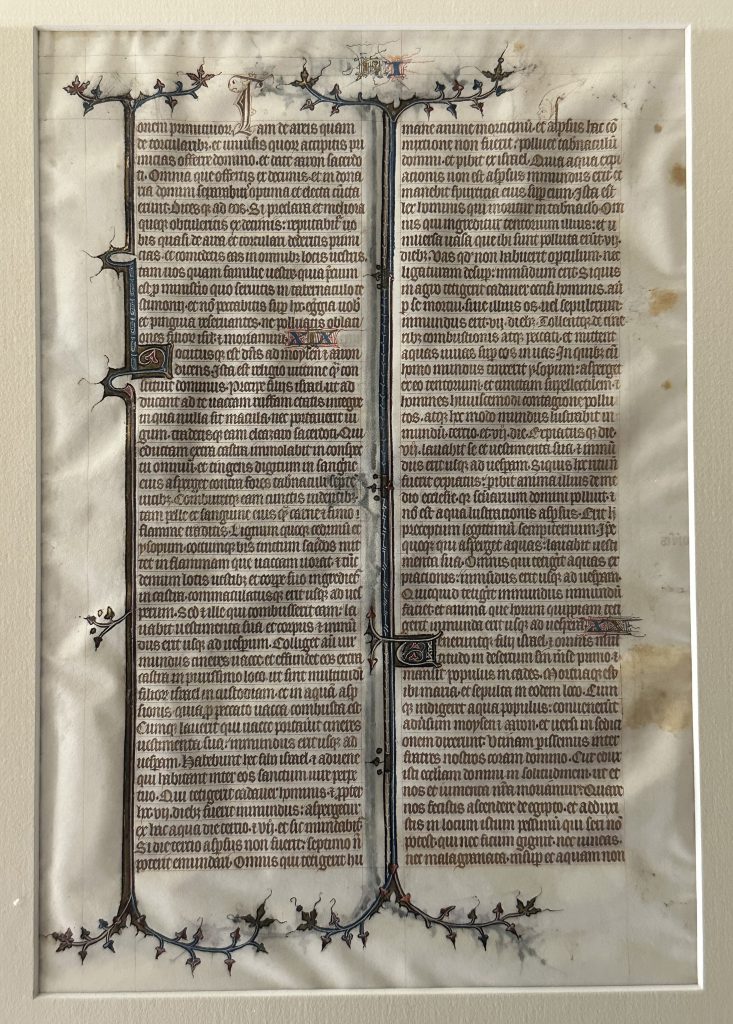
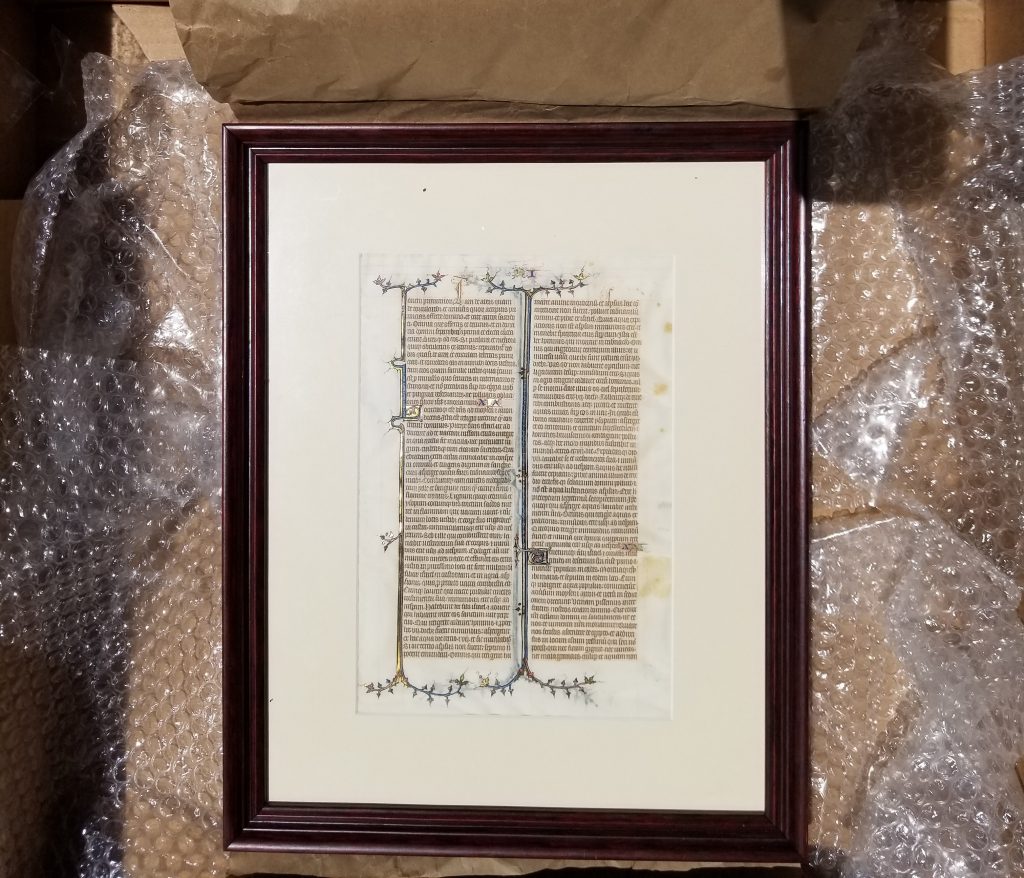
Collection of Jennah Farrell, Manuscript Leaf in Frame: Front, emerging from packaging upon arrival for study. Photograph by Mildred Budny.

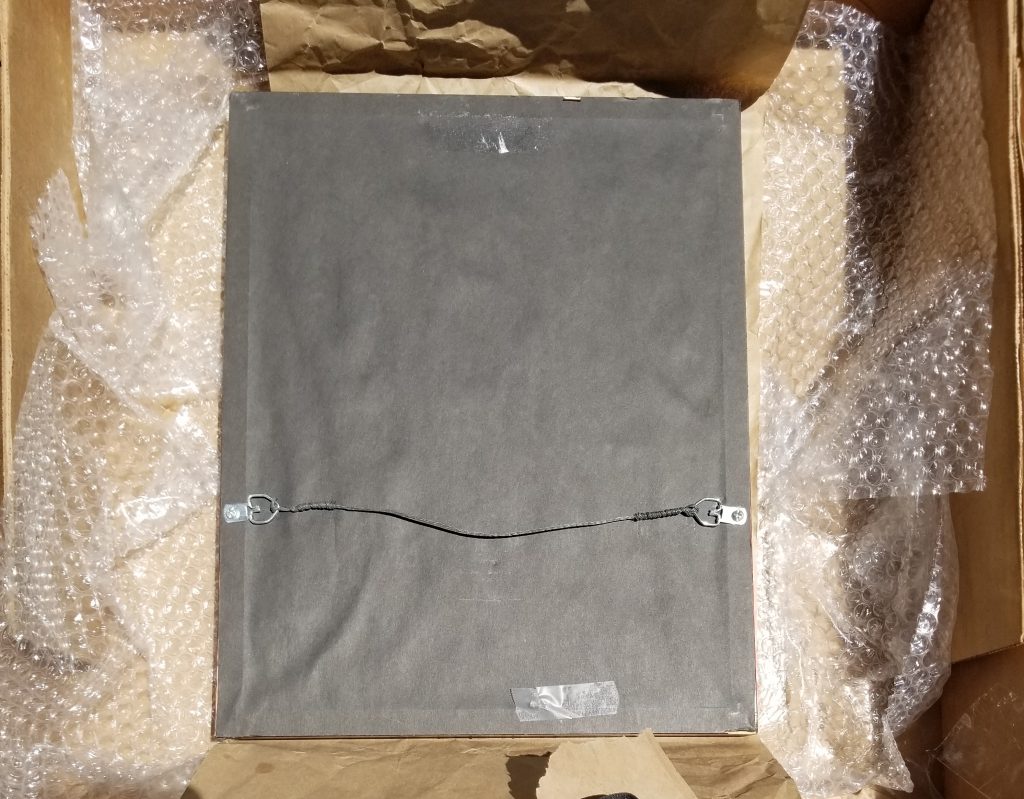
The back of the frame has few identifying features.  Besides the metal hanging wire and its pair of mounts, its black paper covering has the traces of a removed label formerly centered at one end and a companion nail taped off-center to the opposite end.

Collection of Jennah Farrell, Manuscript Leaf: Back of Frame emerging from packaging. Photograph by Mildred Budny.

Through the glass of the frame, most of one side of the leaf can be seen, with its outer edges on all sides covered to some extent by the windowed mat.
The visible extent of the leaf within the mat measures a maximum of circa 24.1 cm. tall × 16.3 cm. wide (circa 9 7/8 in. tall × 6 7/8 in. wide).  The ruled writing area measures circa 18.7 × 12.5 cm. (7 3/4 × 4 7/8 in.). As presented to view, the full extent can be seen of the two columns of script and most of the appendages and additional elements which accompany it as navigation aids. The latter include the running title, inset chapter numerals, and decorative embellishments.

Collection of Jennah Farrell, Manuscript Leaf in Mat. Photograph by Jennah Farrrell.

The Text, Decoration, and Layout

Written in Gothic script, the text in Latin is laid out in two columns of 46 lines each: columns a at the left and b at the right.  To the left of each column stands a decorative vertical bar extending the full height of the column and reaching into the upper and lower margins of the page, with foliate extensions branching sideways in both directions.
Inset decorative 2-line text initials, set in sub-rectangular gold frames, attach to the right-hand sides of the columnar bars, with one per column.  With the identifying Roman chapter-numbers written in Capitals against decorated backgrounds at the ends of the preceding lines, these initials open Chapters XIX and XX in the Old Testament Book of Numbers.
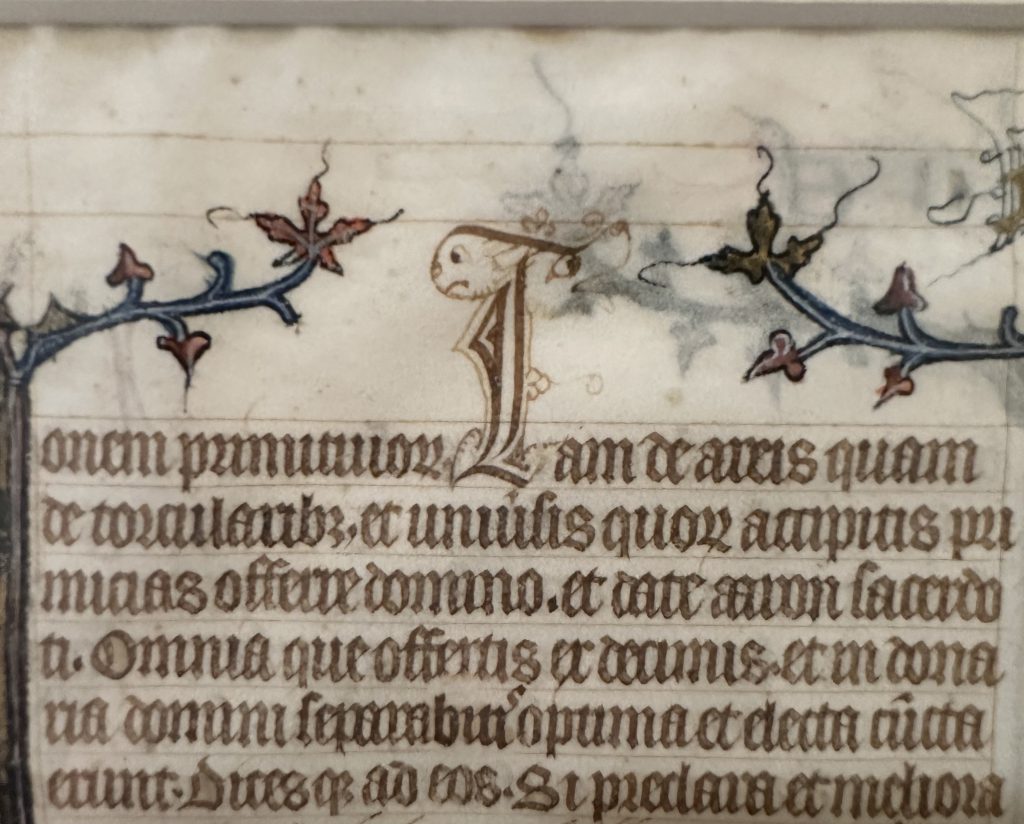
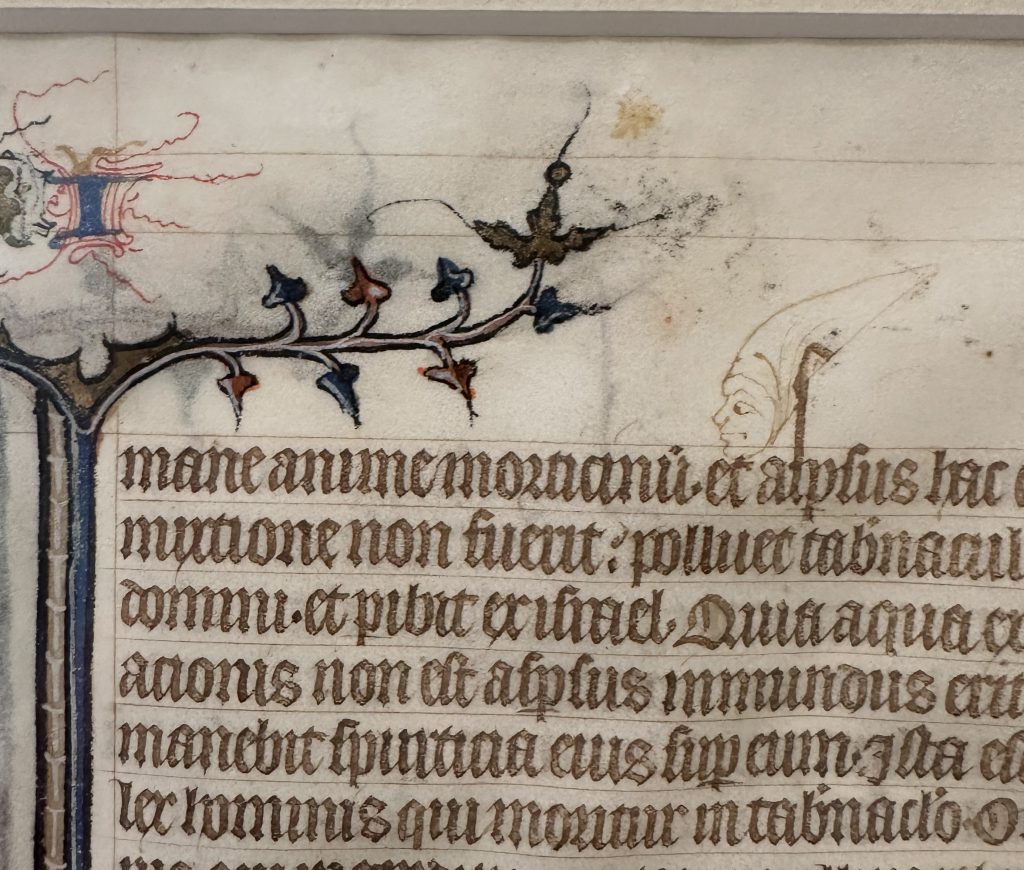
In the top line of each column, an extended letter rises to a leftward-facing head in profile: animal in column a and male with extended pointed cap in column b.

Collection of Jennah Farrell, Manuscript Leaf in Mat: top left. Photograph by Jennah Farrrell.

The running title at the top, set within parallel lines ruled in drypoint, identifies the text with “RI” in Capitals.  Expecting the first part of the word “NUME” on the facing verso of the original manuscript, this would be the recto.

Collection of Jennah Farrell, Manuscript Leaf in Frame: Top right. Photograph by Jennah Farrrell.

The text on the page starts in Numbers 18:27 of the Latin Vulgate version: “. . . [oblati]onem primitovorum.  Tam de areis quam“.  “XIX” marks the start of Numbers 19: “Locutus est dominus ad moysen“.  There then follows a long list of rules about becoming ‘unclean’ after touching a dead body.
“XX” marks the start of Numbers 20: “Veneruntque filii israel“.  The page ends in 20:5 “. . . et aquam non [/ habet ad bibendum]”, expected to continue on the verso.  The last line has “malagranata“, the Latin for “pomegranates”.
The left-facing man’s head at the top of col.b does not appear to be at a significant point in the text.  It stands in the middle of 19:13 against an extended tall-s of “asp[er]sus“.  The text:
[13] omnis qui tetigerit humanae animae morticinum et aspersus hac commixtione non fuerit polluet tabernaculum Domini et peribit ex Israhel quia aqua expiationis non est aspersus inmundus erit et manebit spurcitia eius super eum
[13] Every one that toucheth the corpse of a man, and is not sprinkled with mixture, shall profane the tabernacle of the Lord, and shall perish out of Israel: because he was not sprinkled with the water of expiation, he shall be unclean, and his uncleanness shall remain upon him.

Show-Through and the Other Side

Show-through from the verso reveal features of ink and pigment which diverge from those on the recto.  For example:
1) parts of the running title likewise in Capitals (the letters NUME would be expected);
2) a vertical bar down the intercolumn edging column b, but not one for column a
3) an inset 2-line initial with sub-rectangular frame in column b at the start of lines 23–24 (presumably the q for Quod for Numbers chapter 21); and
4) foliate extensions across most of the lower margin, but not reaching into its span below the inner or outer margins, unlike the formation from the bar for column a on the recto.
Let us see what becomes revealed with the leaf is removed from its frame.  That step comes later, to be revealed in another blogpost.
Meanwhile, we could take as educated ‘predictions’ of what to expect such evidence as the show-through of features from the verso and the place in the course of the known text where column b on the recto breaks off mid-phrase. This process could serve as a useful teaching exercise.
For example, the other side holds evidence which can become available to view once outside the frame. It could correct or confirm our conjectures about its features as we examine the visible recto before then.
How accurate are these conjectures? Let’s see!

More to Come

Watch this space.  A next blogpost would reveal more as our research continues.

Update: See our next blogpost and join a pair of Workshops on “Looking at Manuscripts”, dedicated to this Leaf. Would you like to help us to identify it? Come and learn how!

  • Latin Vulgate Bible Leaf in the Collection of Jennah Farrell: Part 2

Comments? Join the Journey!

Do you recognize this manuscript? Are you familiar with other leaves from it? Please let us know.

Please Contact Us or visit

  • our FaceBook Page
  • our Facebook Group
  • our Twitter Feed (@rgme_mss)
  • our Bluesky nest @rgmesocial.bluesky.social)
  • our LinkedIn Group
  • our Blog on Manuscript Studies and its Contents List

Would you like to help? Donations and contributions, in funds or in kind, are welcome and easy to give.  Given our low overheads, your donations have direct impact on our work and the furtherance of our mission.  For our Section 501(c)(3) nonprofit educational organization, your donations may be tax-deductible to the fullest extent permitted by law.  Thank you for your support!

  • Contributions and Donations
  • 2024 Anniversary Appeal

We look forward to hearing from you.

*****

Tags: Collection of Jennah Farrell, Latin Vulgate Bibles, manuscript fragments, Manuscript studies, Old Testament Book of Numbers
No Comments »

The Weber Leaf from “The Warburg Missal” (Otto Ege Manuscript 22)

July 5, 2022 in Manuscript Studies

The Weber Leaf
from ‘Otto Ege Manuscript 22’
(The Warburg Missal)

Collection of Richard Weber

Latin Missal made in Germany circa 1325
Written in Gothic Script (Textualis)

Folio Number Absent

Double columns of 31 lines
Circa 360 × 257 mm < written area circa 289 × 190 mm >

with Rubrications,
Inset Initials in Red or Blue,
and Musical Notation in Hufnagelschrift (“Horseshoe-Nail Notes”)
on 4-Line Staves

[Posted on 5 July 2022]

Front Cover for Report by Leslie J. French for Wagner Leaf from Ege MS 22 (2021)

Front Cover for Report by Leslie J. French for Wagner Leaf from Ege MS 22 (2021)

With thanks to the collector, Richard Weber, we examine a leaf from one of the manuscripts dispersed by Otto F. Ege (1888–1951). It comes from ‘Ege Manuscript 22’, a Latin Missal written in double columns of 30–32 lines in Gothic Script, with musical notation.

An earlier blogpost by Mildred Budny and the companion Report Booklet (2021) by Leslie J. French examine another Leaf from the same manuscript, set it in its former context, and re-assess the attribution of the book.

See:

  • Another Leaf from the Warburg Missal in the Collection of J. S. Wagner.
  • A Leaf from the Warburg Missal (“Ege MS 22”) containing part of The Mass for Corpus Christi and its Relation to Other Leaves.

Already, too, we have examined some other materials in the Collection of Richard Weber, with several blogposts — with more on the way.

  • A Leaf from ‘Otto Ege Manuscript 214’ in the Collection of Richard Weber
  • More Leaves from an Old Armenian Praxapostolos
  • Portfolio 93 of Ege’s “Famous Books in Eight Centuries” in the Collection of Richard Weber.

Now we turn to a leaf from Otto Ege’s dispersals that stands outside a specific set of a Portfolio, but with its original Ege Label and mat.  Normally, ‘Ege Manuscript 22’ would belong to the Portfolio of Fifty Original Leaves from from Medieval Manuscripts, as a specimen leaf in position Number 22 out of the 50.  See, for example:

  • Otto F. Ege Collection
  • The Guide to the Otto F. Ege Collection.

In this case, the Leaf must speak for itself.

Read the rest of this entry →

Tags: Collection of J. S Wagner, Collection of Richard Weber, Gloria, Kyrie Elieson, manuscript fragments, Medieval Manuscript Fragmenta, Otto Ege Manscript 19, Otto Ege Manuscript 22, Otto Ege Manuscripts, The Warburg Missal
No Comments »

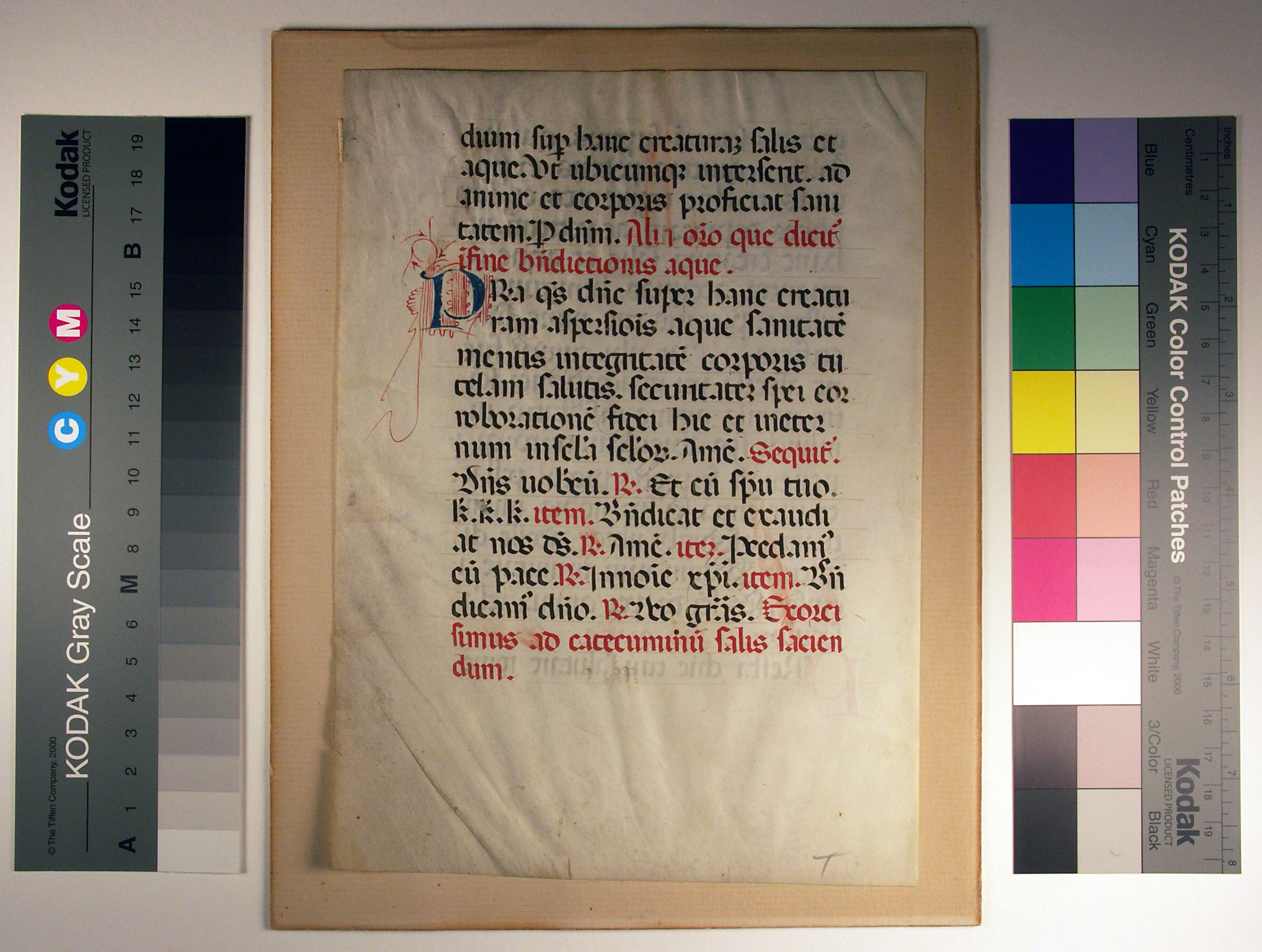
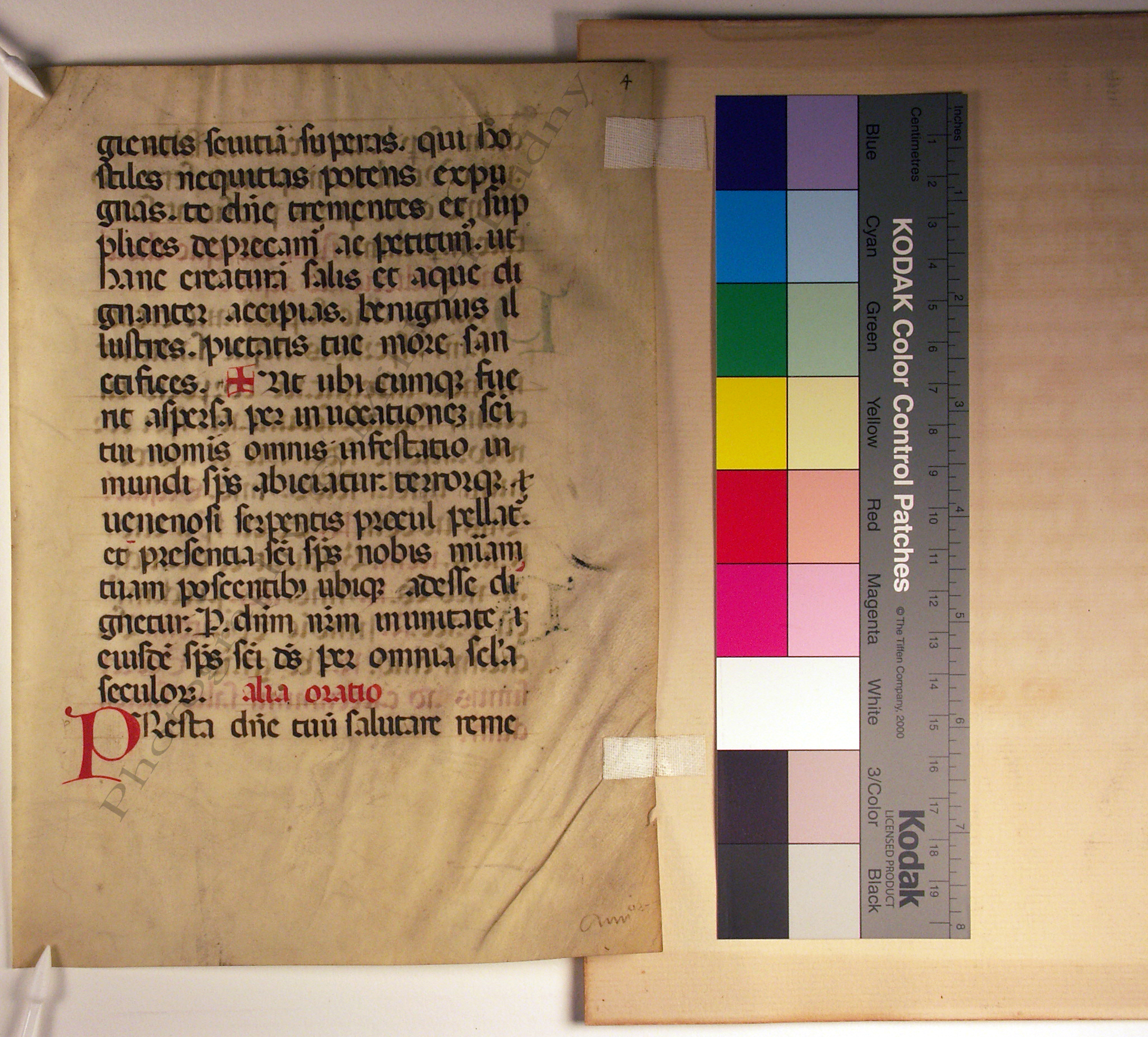
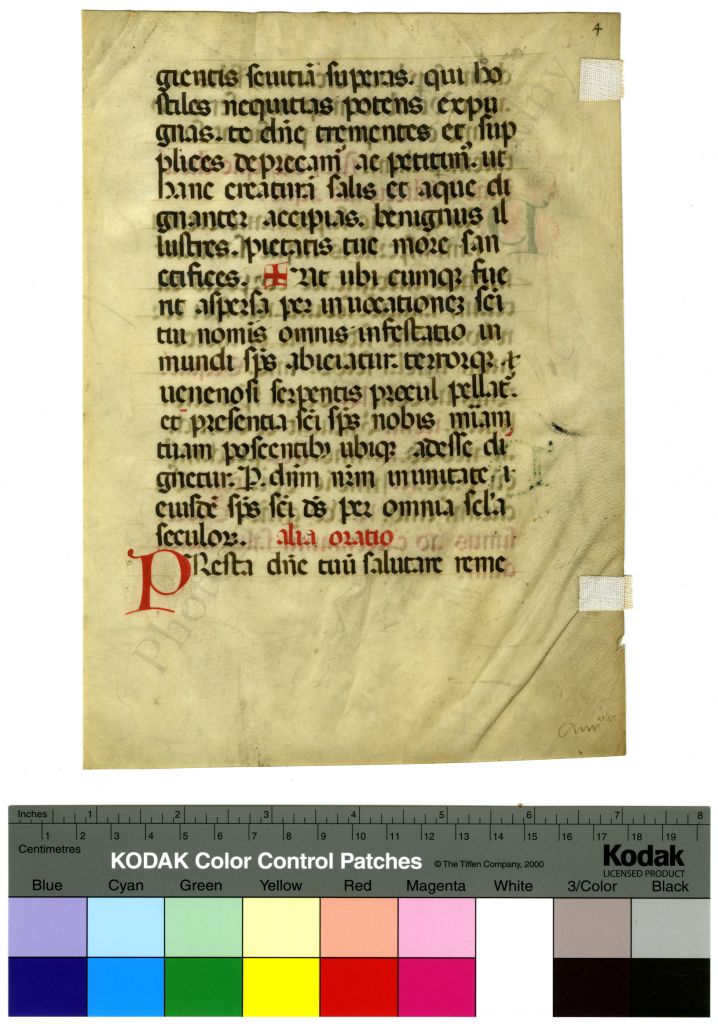
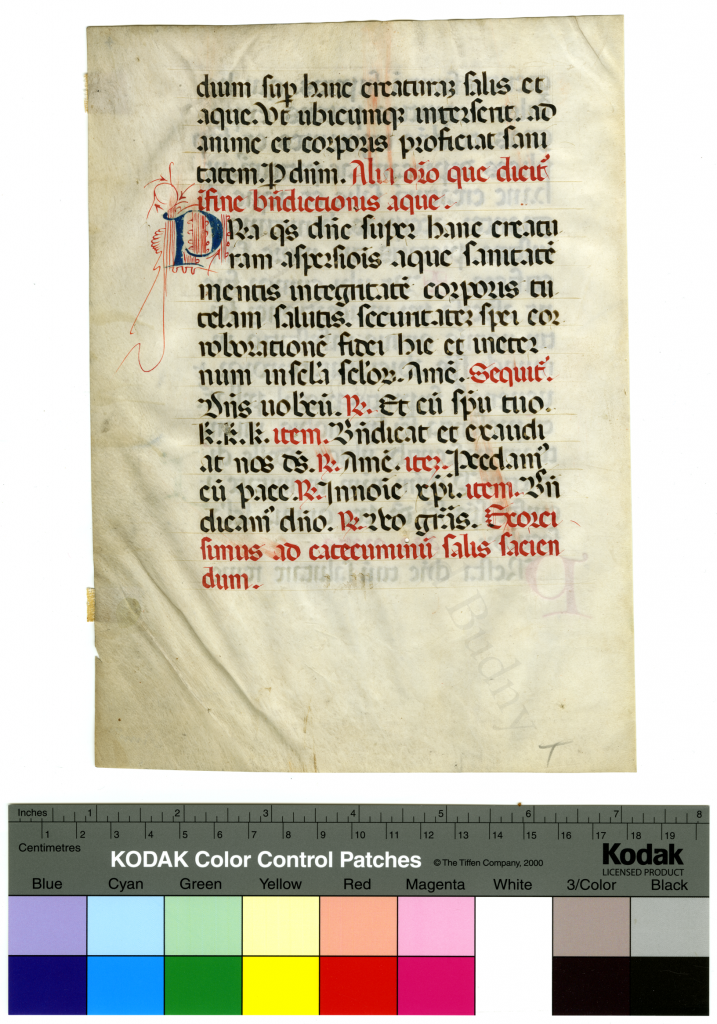
Folio 4 with Latin Blessings for Holy Water and an Exorcism for Salt

June 19, 2022 in Manuscript Studies, Photographic Exhibition

Folio 4 from an ‘Italian Missal’ in Latin

Private Collection, Single Leaf from a Latin Missal. Folio 4r, Detail. Photography Mildred Budny. Reproduced by permission.

Single Leaf on Vellum
Circa 222 × 158 mm
<written area circa 150 × 104 mm>

Single columns of 18 lines,
starting below the top ruled line,
with rubricated elements

Blessings of Holy Water and Salt
and the title for an Exorcism of Salt
[qui inimici ru-/]gientis seuitiam seperas . . .
Exorcisimus ad catecuminum salis faciendum. [/]

Italy?  Southern France?  circa 1400–1450

Budny Handlist 10

[Posted on 20 June 2022]

We post a report of a leaf from a Private Collection which we examined and photographed a few years ago, as part of a larger study for an Illustrated Handlist.

The leaf was recorded briefly, with a description supplied by its owner, in C. U. Faye and W. H. Bond, Supplement to the Census of Medieval and Renaissance Manuscripts in the United States and Canada (1962), page 284, number 5.  There it is described as part of an “Italian Missal”.  The owner acquired the leaf by an unknown route, perhaps by gift already framed, before the preparation of that description for the Census.

At the owner’s request several years ago, we removed the leaf first from its plain wooden frame and then from its stained and darkened backing mat, onto which parts of the original script had offset. The leaf was photographed at several stages and examined in detail.  We show views of the leaf while still on the mat and afterward.

The Leaf Before

Here are both sides of the leaf as it was mounted to the backing mat.

The Front, or Forward-Facing, Side of the Leaf as Mounted for the Frame

For the frame, the leaf faces front with lines in script in black ink and red pigment.

"Folio

positioned as the front-facing page for the viewer. Private Collection. Folio 4v facing front on the former mat. Photography © Mildred Budny. Reproduced by permission.

The Other Side, Partly Lifted

Turning over the leaf, we can see the pair of hinged gauze mounting tapes which attach the edge of the leaf to the mat.

Folio 4r still attached to the mat. Photograph © Mildred Budny

Private Collection. Folio 4r still attached to the mat with a pair of hinged gauze tapes. Photography Mildred Budny. Reproduced by permission.

The Leaf apart from the Mat

The Original Recto

The recto has a modern folio number, an upright arabic 4, entered in dark brown ink at the top right.  The different expanses of the upper and lower margins imply that the short upper margin was trimmed at some stage, whilst the lower and outer margins appear to retain all or most of their original extents.  The accumulated dirt along the upper edge attests to an extended duration when the former manuscript, closed, stood upright on a shelf or in storage.

Private Collection, Single Leaf from a Latin Missal. Folio 4v with Guide. Photography Mildred Budny. Reproduced by permission.

This side of the leaf shows offsets or show-through of enlarged initials at the right-hand side of the column, as well as rubricated script at points within it.  The initials, in reverse, show the forms of a P and a D.

Most of these elements can be accounted for by the rubrications and the enlarged initial P on the other side of the leaf, so that they constitute show-through.  For the other, we must recognize that its offset must derive from contact with a formerly adjacent leaf.

The Original Verso

Private Collection, Single Leaf from a Latin Missal. Folio 4r. Detail. Photography Mildred Budny. Reproduced by permission.

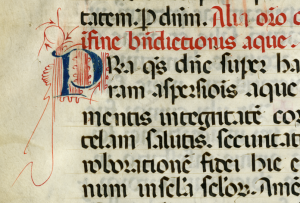
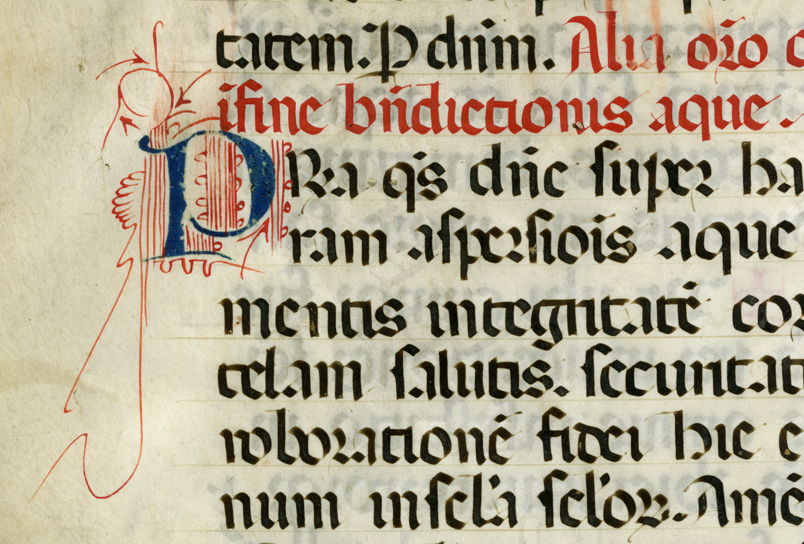
On this page, an enlarged and decorated initial P, partly inset within two indented lines of text, comprises an enlarged Capital P (for Presta) rendered in blue pigment, with penline flourishes and extensions in red pigment.  In both curved and parallel straight lines, those flourishes fit between the initial and the indented letters, fill the bow and ‘footrest’ of the P, and extend in the margin above, beside, and below the initial.

A staple of the flourishing appears to be the sets of narrowly spaced parallel lines.  Characteristic, too, are the short, arrowhead-tipped elements which, separately, press into the cusps of parts of the flourishing below the right-hand side of the bow of the letter and in a whorl of three around the circular extension at the upper left of the letter.

The Text

The set of texts on the leaf provide directions for Exorcisms and Blessings of Salt and Water.  At an appropriate point, a sign of the cross (rendered within the outlines of a box-like frame, all in red) stands within the text to indicate its sign, or signing, as part of the ritual.

Specimens of such texts in medieval sources of various dates and from various places are edited, for example, in these bibliographical resources:

  • Benedictio Salis et Aquae in the Vetera Liturgia Alemannica = J. P. Migne, Patrologia Latina, Vol. 138, cols. 1039–1052 (downloadable here).
  • Missale Romanum Mediolani (1474), Vol. II = Henry Bradshaw Society, Vol. XXXIII (1907).

The text on the leaf provides snippets of the ritual for these functions.  We provide a transcription, with silently expanded abbreviations, and with indications of the rubrications in red.

Recto

[Oratio . . .  qui inimici ru-/]
gientis scuitiam superas. qui ho-
stiles nequitias potens expu-
gnas. te domine trementes et sup-
plices deprecam; ac petitumus. ut
hanc creaturam salis et aque di-
gnanter accipias. benignus il-
lustres. pietatis tue more san-
ctifices. + At ubi cumque sue-
nt aspersa per in uocationes sancti
tui nominis omis infestatio in
mundi spiritus abieiatur. terrorque . +
uenenosi serpentis procul pellatur.
et presentia sancti spiritus nobis misericordiam
tuam poscentibus ubique adesse di-
gnitur.  Per dominum nostrum in uinitate +
eiusdem spiritus sancti deus per omnia secula
seculorum.  Alia oratio
Presta domine tuum saltare reme-

Verso

dium super hand creaturam salis et
aque.  Ut ubicumque interserit. ad
anime et corporis proficiat sani-
tatem.  Per dominum.  Alia oratio qui dicitur
i[n] fine benedictionis aque.
Presta quos domine deus super hanc creatu-
ram aspersionis aque sanitatem
mentis integritatem corpus : tu-
telam saltis. securitatem spei. cor-
roborationem fidei hic et in eter-
num in secula seculorum.  Amen.  Sequitur.
Dominus vobiscum. Responsio. Et cum spiritu tuo.
kyrie. kyrie. kyrie. item.  Benedicat et exaudi-
at nos deus.  Responsio.  Amen.  iter.   Procedamus
cum pace.  Responsio.  Innomine [sic, for In nomine] christi.  item.  Bene-
dicamus domino.  Responsio.  Deo gratias.  Exorci-
simus at catecuminum salis facien-
dum.

The Former Manuscript

Parts of the text, or some texts in the sequence, can be found in other sources.  For example, comparisons for the text of the Roman Missal for the Liturgical Use of Milan (printed in 1474), show a similar version of the Presta which appears on the verso, although its version begins somewhat differently.

Presta michi domine deus per hanc creaturam aspersionis aque atque sanitatem mentis integritatem corpus : tutelam saltis : securitatem spei. corroborationem fidei : fructum charitatis nune et in futuro. Amen.

  • See Robert Lippe, Missale Romanum Mediolani (1474), Vol. II:  A Collation with other Editions Printed before 1570. Henry Bradshaw Society, Vol. XXXIII (1907), at page  385.
    The Milan Missal of 1474 was printed at Venice by Antonius Zarotis, with the date of 6 December 1474 (Incunabula Shorttitle Catalogue Number im00688450).

The long prayer on the recto belongs to the blessing of water.

  • See Traditional Rite of Blessing of Water.

It begins with an exorcism (or purification) of salt — but not the one intended for catechumens. as specified in the rubricated title at the bottom on the verso of the leaf.

Both the long prayer on the recto and the two following prayers also occur in that order in the Sacramentary portion of the composite Leofric Missal, but not followed by the exorcism of salt.

  • Frederick Edward Warren, ed., The Leofric Missal, As Used in the Cathedral of Exeter During the Episcopate of Its First Bishop, A.D. 1050-1072, Together with Some Account of the Red Book of Derby, the Missal of Robert of Jumieges, and a Few Other Early Manuscript Service Books of the English Church (Oxford:  Clarendon Press, 1883, page 250.

There is a close match for the sequence of texts on the leaf, with only a few variations, in an another source from Milan later than the printed edition of 1474.  That is:

  • the Rituale Sacramentorum ad Usum Mediolanensis Ecclesiae (“Ritual of the Sacraments for the Use of the Church of Milan“) of 1815, at pages 282–283.

The text on the Recto of the leaf starts on page 282 in the Oratio:  “[inimici ru-/]gientis saevitiam superas . . .”  The Oratio begins thus:  Deus invictae virtutis Auctor . . .  A brief section of text intervenes between this opening and the top of the extant recto.  Such an initial D, low in the column, formed the offset at the right-hand side of the column on the recto.

The “Alia Oratio Presta domine tuum salutare . . .” ends the recto and continues on the verso into the Aquam Benedictam “Presta quaesumus domine.”  Then come the Versicles and Responses extending to “Deo gratias”, but not the “Pax . . .”

Since the following text following refers to “hanc creaturam salis”, it may be the exorcism for which we have only the title.

The correspondences with texts in Missals associated with Milan, in northern Italy, might strengthen, but not confirm, the suggested origin of the leaf as part of an “Italian Missal” — or some similar liturgical handbook — in Latin from such a region.

For now, pending further information (such as the discovery of more parts of the same manuscript), let us continue to refer to it as containing (or, by virtue of the title, implying) a set of Ordines which address 1) the Blessing for the preparation of Holy Water and Salt, and 2) the Exorcism (or Purification) of Salt for Catechumens.  The former has a place in the Sacramentary portion of a Missal, whereas the latter would pertain, insofar as we have been able to discover, to a different form of book instead — such as a Collectar.

The folio number 4 indicates that the leaf occupied an early position within its book, whether or not that modern numeration took into account leaves (such as endleaves) which a modern observer might deem extraneous.  As companion materials, the texts to which this leaf belonged could have formed prefatory matter for a book of one or other genre designed to guide instruction and performance of liturgical practices at whatever stages required for the place of its production.

Perhaps other leaves from the same book as well as further research will resolve the mystery.  This lone leaf joins the company of all too many single, dispersed, leaves which have lost track or trace (apart from, say, an offset from an adjacent leaf) of their former siblings.  By close inspection of their material and textual evidence, it can partly become possible to retrieve some elements of their former connections and contexts.

Welcome to the ‘Foundling Hospital for Manuscript Fragments’, as invited in one of the early posts for our blog.

  • The ‘Foundling Hospital’ for Manuscript Fragments.

*****

Do you know of more leaves from this manuscript? Do you recognize the hand of the scribe, scribal artist, and rubricator in other parts of this book or in other manuscripts?

You might reach us via Contact Us or our Facebook Page. Comments here are welcome too. We look forward to hearing from you.

Watch our blog on Manuscript Studies for more discoveries. Please visit its Contents List.

*****

Private Collection, Single Leaf from a Latin Missal. Folio 4r, Detail. Reproduced by permission.

*****

Tags: 'Foundling Hospital' for Manuscript Fragments, Blessings for Holy Water and Salt, Census of Medieval and Renaissance Manuscripts, Collectar, Exorcism for Salt for Catechumens, Exorcisms and Blessings, Italian Missal, latin Missal, manuscript fragments, Medieval Manuscript Fragments, Offsets and Show-Through, Sacramentary
No Comments »

A Detached Folio 108 with Part of Vulgate Psalm 118 (117)

June 18, 2022 in Manuscript Studies

A Leaf on Vellum with Part of Vulgate Psalm 118 (117)

Collection of Stephen Soderlind

Single leaf from a large-format manuscript in Latin
Single Columns of 14 Lines
Circa 29 1/2 × 19 1/4 inches <written area circa 25 1/4 × 14 1/4 inches>

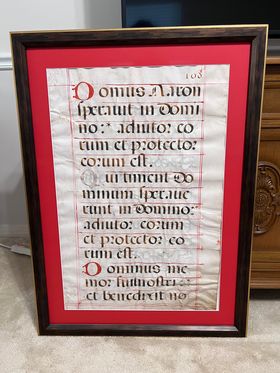
Psalm 118 (117):18–22 (Domus Aaron sperauit . . . super filios uestros)

Folio “108”
Single column of 14 lines in Gothic Bookhand
with embellishments in red pigment
(bounding lines, ruled lines, and initials)

Collection of Stephen Soderlind, Single Leaf in Frame as purchased: Front of Frame. Reproduced by Permission.

[Posted on 18 June 2022]

Continuing our series of brief reports about stray manuscript leaves which emerge in various collections — as the leaves move from one to the next, and as collectors reach out to us with images, information, and questions about their materials, and wish to share them with a wider world — we report a new find from an estate sale.

The large leaf now belongs to the Collection of Stephen Soderlind. It arrived in a plain frame with a windowed red mat , which overlay the outer edges of the leaf and held it in place, as if cropped.

Within the window, the arabic number 108 in a modern hand at the top right above the single column of text appears within view. Without the chance to see the other side of the leaf, hidden within the frame, it remained uncertain whether the number serves as the folio number (for one side of the leaf) or the page number (for this side of the leaf in particular, reserving another number for the other side).

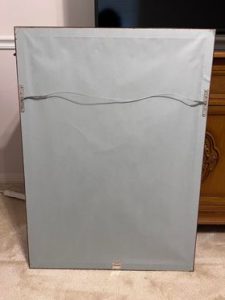
The back of the frame holds little information.

Collection of Stephen Soderlind, Single Leaf in Frame as purchased: Back of Frame. Reproduced by Permission.

Released from the frame, the wrinkles and creases in most parts of the leaf are characteristic of vellum subjected to humid conditions for an extended period, without the stretching under pressure while drying requisite to produce, or reinstate, the smooth surface of vellum or parchment. The wrinkles visible through the glass of the former frame indicate that the leaf as displayed and stored therein pertain to that stage in the life of the leaf, if not already before.

Closer examination yields further information about the leaf and its genre of book. We examine both sides of the leaf, consider some features in detail, and open the discussion for analysis of the probable place and date of origin. We invite your observations and suggestions.

Read the rest of this entry →

Tags: Below Top Line, Collection of Stephen Soderlind, Gothic Bookhand, Latin Vulgate Psalms, manuscript fragments, Psalm 118
No Comments »

A Leaf from ‘Otto Ege Manuscript 214’ in the Collection of Richard Weber

June 14, 2022 in Manuscript Studies

Another Leaf from “Otto Ege Manuscript 214”
(A Dutch Prayerbook)

Richard Weber Collection. Single Leaf from “Otto Ege Manuscript 214”? Verso, Top Left. Image reproduced with permission.

Collection of Richard Weber

Single leaf from a small-format Prayerbook in Dutch
Circa 168 × 119 mm <written area circa 129 × 88 mm>
([. . . /]-te sprekene na die sentencie . . .
heest maer puerlijck am die [/ . . .])

Single column of 22 lines in Gothic Bookhand
with embellishments in red pigment
and a painted, framed, decorated initial in ‘rustic’ style

Flanders, circa 1330

Formerly part of ‘Ege Manuscript 214′
(Gwara , Handlist 214)

[Posted on 13 June 2022, with updates]

Another leaf from a medieval devotional manuscript in Dutch dispersed by Otto F. Ege (1888–1951) has come to light. It belongs to the Collection of Richard Weber. Sharing information and images, Richard Weber reports that he purchased it on its own from an online vendor (eBay – oldworldwonders).

Earlier blogposts have begun to report materials from his collection; more are in preparation. For example, so far:

  • More Leaves from an Old Armenian Praxapostolos.

An earlier blogpost considered portions of Ege’s dispersed Dutch manuscript in other collections.

  • A New Leaf from ‘Otto Ege Manuscript 214?”.

That blogpost focused upon one of the remnants, a single leaf now in a Private Collection. As seen below, the recto stands at the left, with the verso at the right. With the text set out continuously, as paragraphs run together, the script presents seemingly solid blocks of text in successive columns. The initials marking the beginning of phrases or sections are enhanced with vertical strokes of red pigment.

"Verso, owned and dismembered by Otto F. Ege” width=”1024″ height=”671″ /> Private Collection. Detached Leaf from ‘Otto Ege Manuscript 214’ (Dutch Prayerbook), Both Sides of the Leaf
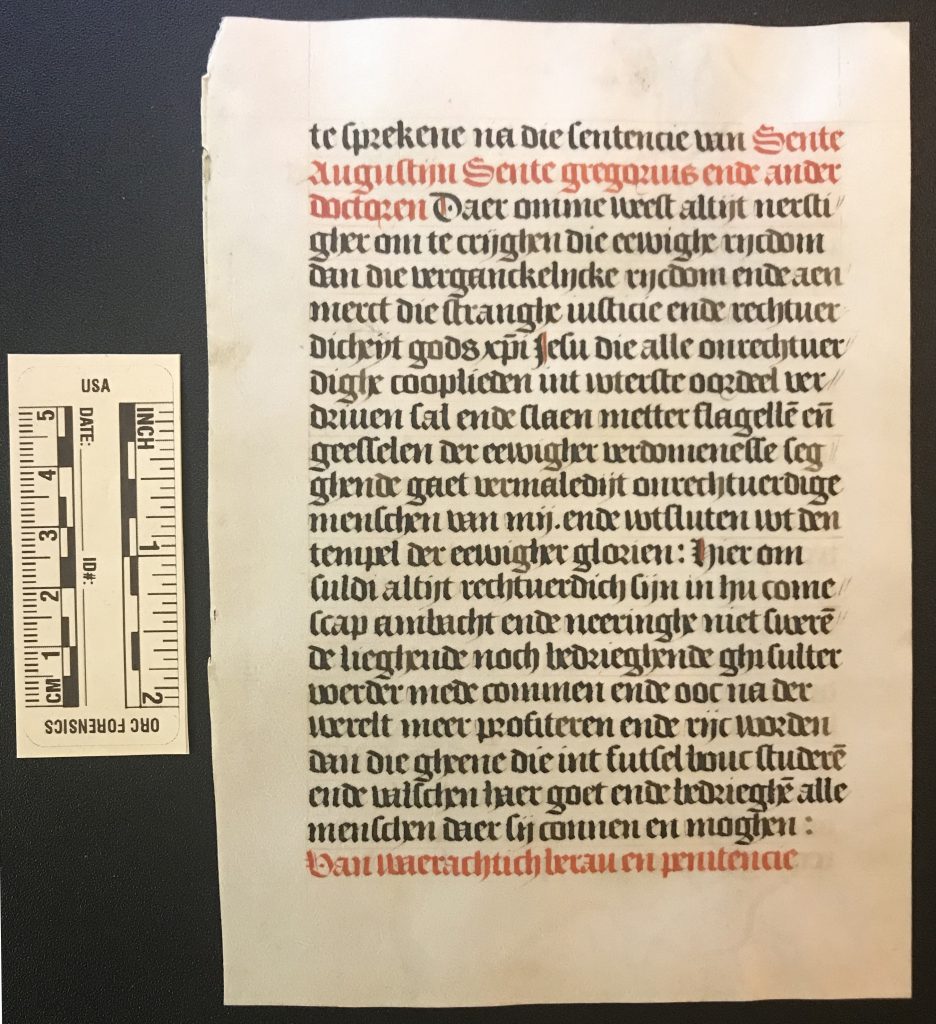
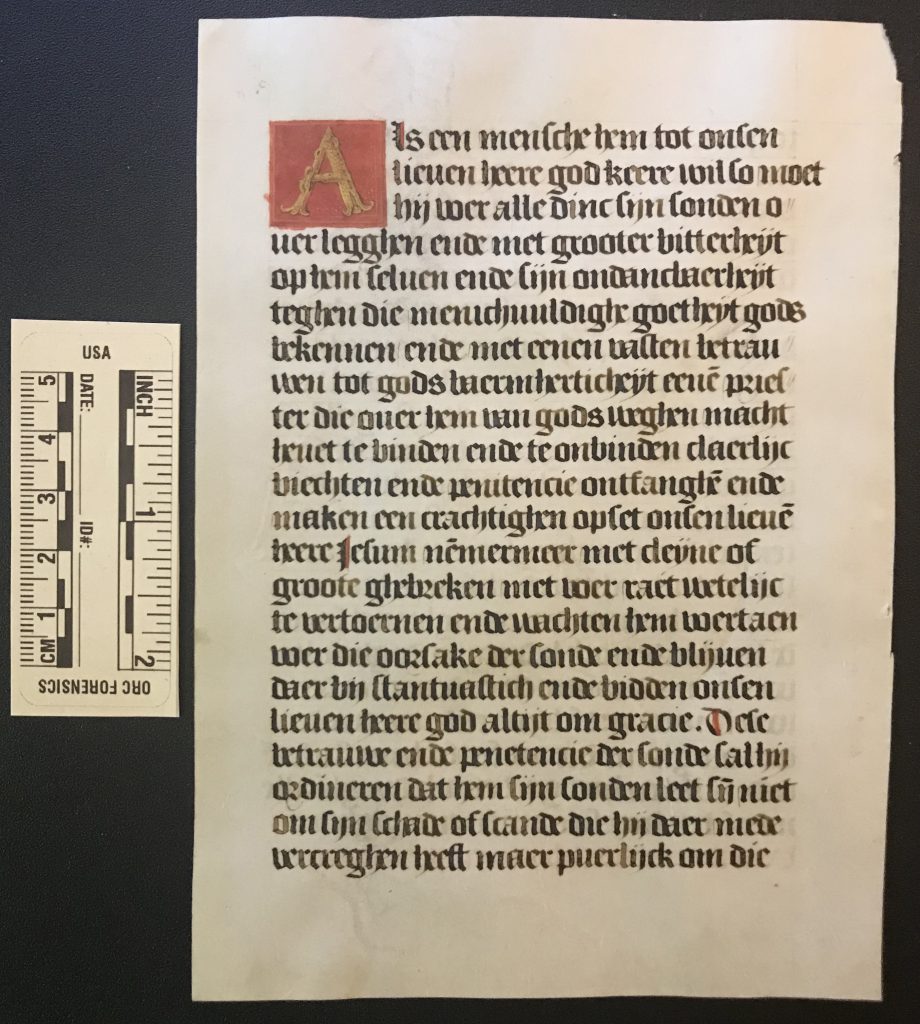
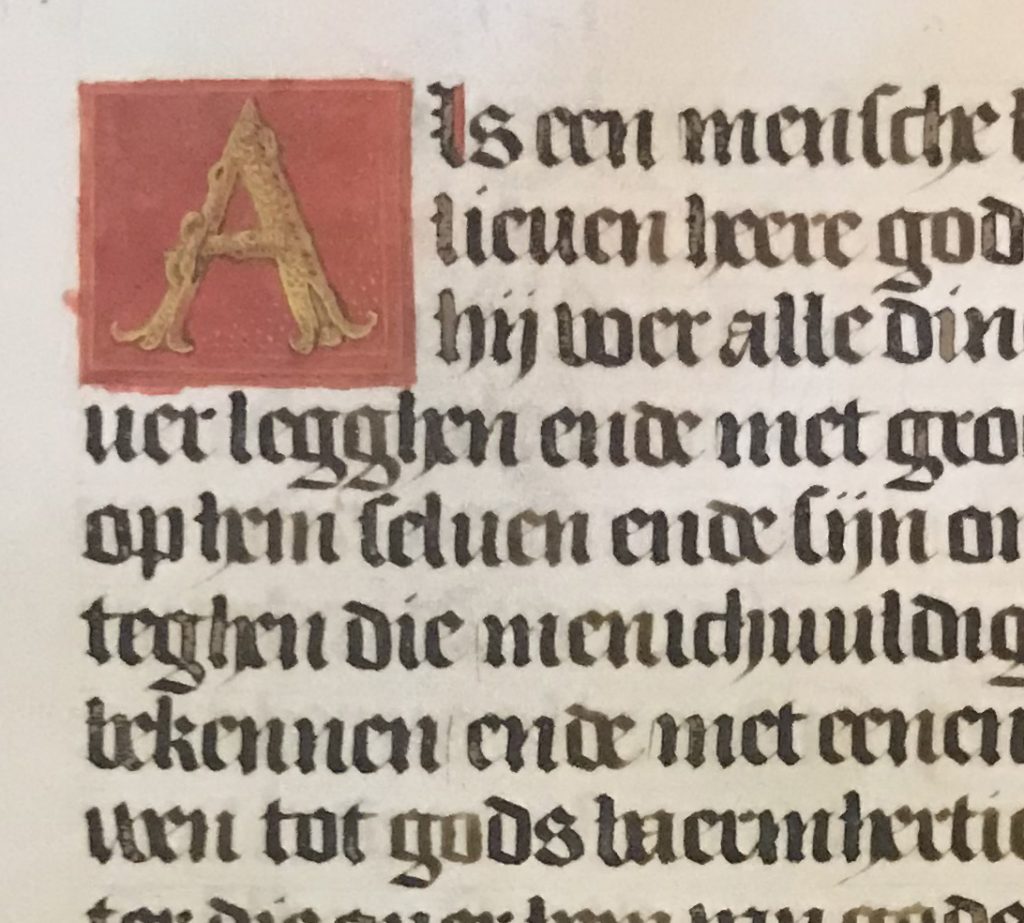
Some other leaves from the manuscript carry elements of decoration or illustration.

‘Otto Ege Manuscript 214’

In Scott Gwara’s Handlist of Manuscripts Collected or Sold by Otto F. Ege (2013), that manuscript, with some traceable remnants, is his Number 214 (Appendix X, pages 177–178). There he cites a few traceable remnants from it and their appearances in several catalogues. Our blogpost surveyed those resources. See A New Leaf from ‘Otto Ege Manuscript 214?”.

An update to that same blogpost reports other remnants, as identified by Peter Kidd. It quotes his email communication of 15 July 2019 about his discoveries for various Ege manuscripts, including this one. Peter Kidd reported that, for Ege Manuscript 214, that “There are leaves with miniatures at the National Gallery of Art in D.C., the Art Museum in Indianapolis, and (recently acquired) at Oberlin” College, along with the “unilluminated leaf at BU”, that is, at Boston University, School of Theology Library — listed in Scott Gwara’s Handlist. It is:

  • Boston, Massachusetts, Boston University, School of Theology Library, MS Leaf 7.

Some of the identified remnants have some form of illumination. The style is sometimes attributed to the “style of Simon Bening”, that is, Simon Bening (circa 1483 – 1561), one of the most famous and celebrated painters of the 1500s.

A sales catalogue entry for a portion of the manuscript is informative, albeit concise and lacking an illustration.

  • Sotheby’s, Western Manuscripts and Miniatures (London, Tuesday 26th November 1985), lot 88. The entry reports:

55 leaves, some detached, others still sewn to old bands with pieces of calf spine, 22 lines, written in dark brown ink by 2 scribes in a late gothic liturgical hand, rubrics in red, capitals touched in red, many initials in red or blue, SIX LARGE ILLUMINATED INITIALS (3- to 4-line) in delicate rustic designs in liquid gold on coloured grounds, fine condition (166mm by 120mm).

Also:

Comprising biblical readings and prayers, including three ascribed to the Commisasrius “meester Godschalc rosemond van Eundhoven, Doctoer in der godeyt” [that is, “Eindhoven in South Holland, about 45 miles south east of Utrecht“], there are offers of indulgences ascribed to popes Alexander VI (1482–1503), Julius III (1503–1513) and Leo X (1513–1521).

The sale included “fifty-four lots of single leaves and miniatures from the collection of Otto Ege”. Various of them comprised the “Residue” of despoiled manuscripts, sometimes with bindings or bits of bindings, left over after the their dismemberment and the distribution of leaves otherwise. It is apparent that the portion from Ege Manuscript 214 was such a case.

The companion Price List of “hammer prices” for the sale indicates that lot 88 was purchased by “Williams” for £330.

The “New” Leaf

The leaf in the Collection of Richard Weber, shown here, has one embellished initial, which occupies a 3-line inset frame. Rubrics in red occur on the other side of the leaf. It is perhaps not too much to ask if this leaf has strayed from the group of fifty-five leaves sold at Sotheby’s.

Recto

This page has a line or more of rubricated text at both top and bottom. The upper rubrication names as authorities “Saint Augustine, Saint Gregory, and other teachers” or Church Fathers.

-te sprekene na die sentencie van Sente
Autustini Sente Gregorius ende ander
doctoren
. . .

Richard Weber Collection. Single Leaf from “Otto Ege Manuscript 214”, Verso. Image reproduced with permission.

Verso

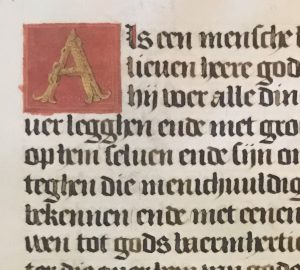
This page opens with a decorated initial A, heading a full block-like column of text relieved by two enlarged minor initials (lines 13 and 18) enlivened with a vertical stroke of red pigment.

Als een mensche hem tot onsen / lieuen heere god keere wil so moet . . .
. . . om sijn schade of scande die hii daer mede / vercreghen heest maer puerlijck am die / [. . .]

Richard Weber Collection. Single Leaf from “Otto Ege Manuscript 214”? Verso. Image reproduced with permission.

Initial A (of Als)

The inset three-line initial which opens the verso occupies a squared and bordered frame filled with red pigment, which overspreads the outer contour. The background within the initial is likewise filled with red pigment, with the addition of lighter, yellowish, drops or speckles.  The red pigment resembles the pigment employed in the rubricated letters and embellishments for minor initials.  It may be that the frame for the inset initial was given its red pigment in the same state of operation in preparing the leaf, from script to finishing touches.

The Capital Letter A is rendered in mid-tone brown pigment with dark brown outlines for shading, and with speckles overall in light brown pigment.  The letter takes the form of interlocked branch-like or twig-like elements with outspread terminals.  The highlights, speckling , and shading enhance the effect of three-dimensional sticks or twigs, hollows, and bark.  A fair description of this design, whilst skillfully executed, could be “rustic”.

Richard Weber Collection. Single Leaf from “Otto Ege Manuscript 214”? Verso, Top Left. Image reproduced with permission.

*****

We thank Richard Weber for sharing information and images of this leaf, and for answering queries about its features, source, and other aspects.

*****

Do you know of more leaves from this manuscript? Do you recognize the hands of the scribe and scribal artist in other parts of this book or in other manuscripts?

You might reach us via Contact Us or our Facebook Page. Comments here are welcome too. We look forward to hearing from you.

Watch our blog on Manuscript Studies for more discoveries. Please visit its Contents List.

*****

Tags: Collection of Richard Weber, Dutch Prayerbook, Illuminated Initials, manuscript fragments, Medieval Manuscript Fragments, Otto Ege Manuscript 214, Peter Kidd, Scott Gwara
No Comments »

More Leaves from an Old Armenian Praxapostolos

May 30, 2022 in Manuscript Studies, Reports, Uncategorized

More Leaves from
an Old Armenian New Testament Manuscript:
The “Kurdian/Chicago Praxapostolos“

Separate Leaves on Vellum
from the Acts of the Apostles
in Different Collections

Double columns of 27 lines in bolorgir minuscule script,
with rubrications and Euthalian apparatus

1) Private Collection: Acts 16:24 [middle] – 17:6 [middle]

2) Richard Weber Collection: Acts 20:5 [beginning] – Acts 20:26 [end]
(Leaf size: 10.2 x 13.7 cm; Written area: 7.1 x 10.2 cm; Column width: 3.2 cm)

[Posted on 30 May 2022, with updates]

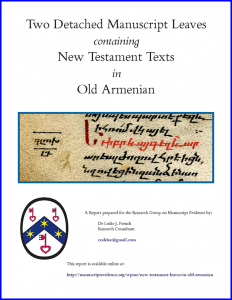
"Cover, with the opening of Acts 23:12"

Research Group on Manuscript Evidence, “Two Detached Leaves” Booklet Cover, with the opening of Acts 23:12.

More leaves emerge into view from a dismembered manuscript in Old Armenian with selections from the New Testament. Apparently it comprised a copy of a Praxapostolos, that is, containing parts of the New Testament without the Gospels and certain other Books.  We have examined several leaves from this book before.

Some earlier blogposts, and an RGME Research Booklet, have introduced other leaves from the same manuscript.

  • New Testament Leaves in Old Armenian
    reporting “A Pair of Leaves [in a Private Collection] Identified, Described, Collated, and Set into the Context of its Manuscript”
  • Leslie J. French, Two Detached Manuscript Leaves containing New Testament Texts in Old Armenian: A Report prepared for the Research Group on Manuscript Evidence (RGME, 2015)
  • The Plot Thickens
    reporting on “A New Leaf Found at the University of Pennsylvania
    from the “Kurdian/Chicago New Testament Praxapostolos[?]
    in Old Armenian”

For the Research Report, Armenian glyphs were designed for the Research Group’s multi-lingual digital font Bembino, freely available on our website.  (See Multi-lingual Bembino.)

As the word spreads, the story grows.

After those reports, we were contacted by Sani Eskinazi (then at Stanford University), as he worked to complete a Final Project for History 14N on “Reconstituting an Armenian Bible from the 15th Century” (2019), based upon a leaf in Special Collections with part of II Corinthians:  Stanford University Libraries, M0297, Box 1, Item 103. With Sani’s expected collaboration, we continue to prepare an updated and expanded version of the Report Booklet.

Meanwhile, it is time to show some more leaves from the same manuscript, as custodians and owners respond to our blogpost, and wish to share their materials more widely. As part of the work for the updated Report, here we present two leaves which have come to our attention this year.

First, we recall some other leaves from the manuscript.  (See below.)

Next we present the “new” leaves. Each of them was purchased online as a separate leaf, with or without an accompanying label. Each presents part of the text of the Acts of the Apostles.

1) One has come to the same Private Collection with the two leaves which prompted both our first blogpost on the manuscript and its accompanying Report Booklet. Those two leaves are considered to be Folios “I” and “II” in the collection; the new one is its Folio “III” (or “3”).

2) The other belongs to the collection of Richard Weber. While we prepare a report, or series of reports, on a group of other materials in his collection, manuscript and printed, we begin with the Old Armenian New Testament Leaf which he purchased on its own (plus label) from an online seller, who had little information about it.

Read the rest of this entry →

Tags: Dawson's Bookshop, Kurdian/Chicago Praxapostolos, manuscript fragments, Medieval Manuscript Fragments, Old Armenian, Old Armenian New Testament Praxapostolos, Otto F. Ege, Portfolio of Original Leaves from Famous Bibles, Richard Weber Collection, University of Pennsylvania Libraries, Zohrab Bible
No Comments »

Another Leaf from a Portable Manuscript Bible in the Collection of Birgitt G. Lopez

May 18, 2022 in Manuscript Studies, Uncategorized

Another Latin Bible Manuscript Leaf
in the Collection of Birgitt G. Lopez

Single Leaf from a Latin Vulgate Bible
Folio “74[?]” with Part of the Book of Daniel

Daniel 9:11 ([. . . et declinaverunt / ] ne audirent)
– 11:30 (et cogitabit [ / advesum eos . . . ])

Double Columns of 56 lines

Written in Gothic Script
with Running Titles, Initials, Pen-flourishes, and Annotations
including a Modern Folio Number

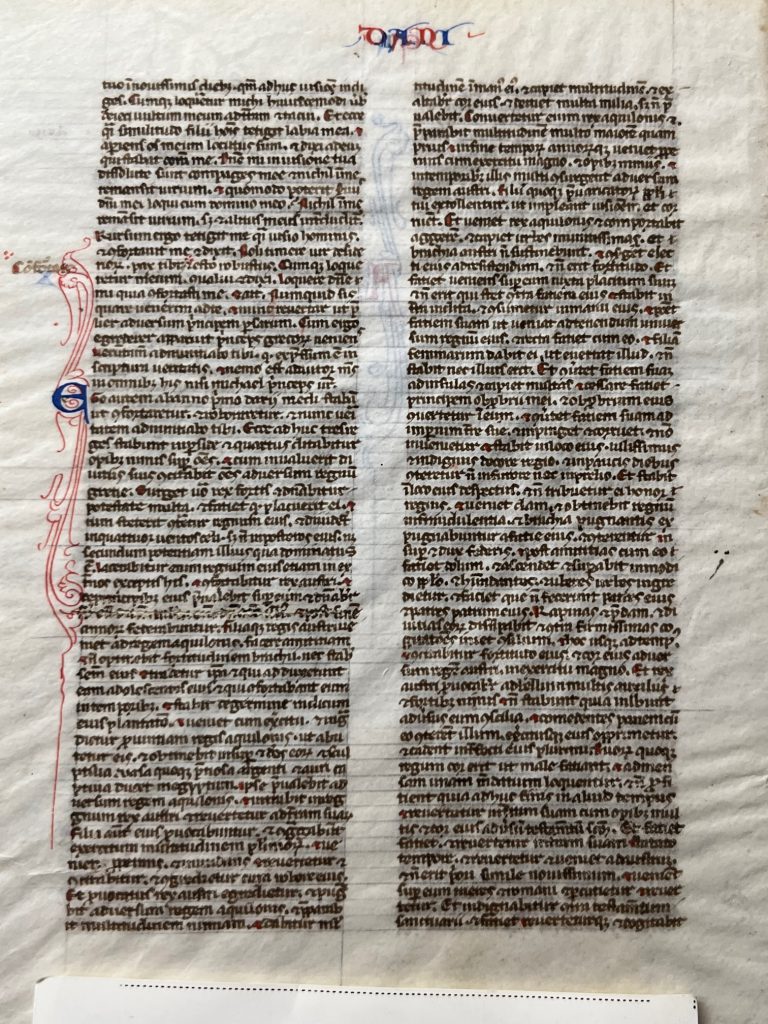
Collection of Birgitt G. Lopez, Vulgate Bible Manuscript Leaf purchased in London around 2000: Recto with opening of Daniel Chapter X.

[Posted on 17 May 2022]

Collection of Birgitt G. Lopez, Framed Leaf from ‘Otto Ege Manuscript 20’, Front-Facing Page (“Recto”).

Collection of Birgitt G. Lopez, Framed Leaf from ‘Otto Ege Manuscript 14’.

Following our blogpost reporting Two Ege Manuscript Leaves and Two Ege Labels in the Collection of Birgitt G. Lopez, we learn of another leaf in the same collection, with a different provenance.  Those two Ege leaves and labels pertain to three manuscripts dismembered and distributed by Otto F. Ege (1888–1951).  That is,

  • with a leaf from “Otto Ege Manuscript 14” and its Ege Label,
  • an Ege Label from “Ege Manuscript 54”, and
  • a leaf from “Ege Manuscript 20”.

They all pertain to books of the Latin Vulgate Bible, either as full Bibles in large or small format, or as the Book of Psalms in a separate volume (or Psalter) in small format. They came to their collector in stages, by purchase at auction at the Dallas Public Library in 1998, or as a gift in 2003 from its former Librarian, Lillian Moore Bradshaw (1915–2010), with a mix-up at some stage between labels and leaves.

Collection of Birgitt G. Lopez, Otto Ege Label for “Ege Manuscript 54”.
The Next Leaf

The next leaf reaching our attention came from a small-format Vulgate Bible manuscript.  In correspondence, Ernesto Lopez reports that he purchased the leaf in London, England, around the year 2000.

The unframed leaf and its seller’s label tell the story of a pattern of transmission of a dismembered medieval manuscript leaf which, at some stage in transmission after dismemberment, lost a record of connection to the original book.  Here we examine the label and both sides of the leaf, as revealed in the collector’s photographs, generously supplied for study and for presentation here to a wider world.

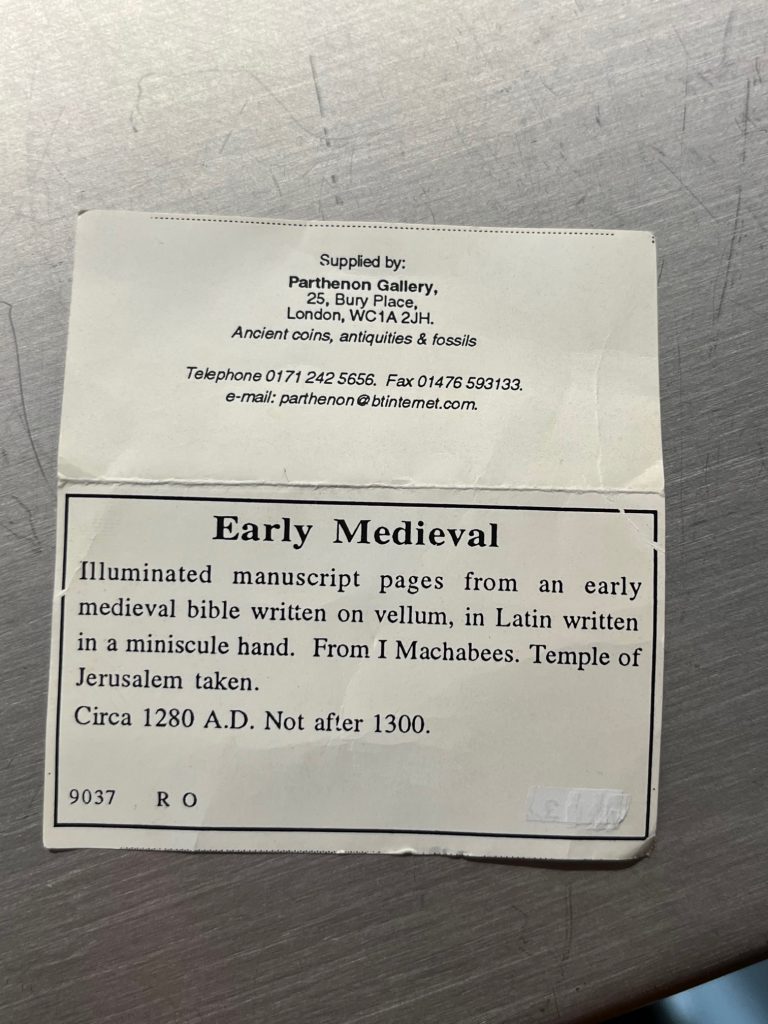
The Seller’s Label

With the leaf is a folded rectangular paper label with printed or print-out text in two halves above and below the fold-line which would permit the label to stand upright, say in a case or on a shelf.  The upper half of the sheet, above the fold line, identifies the seller, the Parthenon Gallery in London, purveyor of “Ancient coins, antiquities & fossils”.  This gallery is still located in the same place, at 25, Bury Place, WC1A 2JH.

Within a rectangular frame, the lower half of the label calls the specimen “Early Medieval”.  Details cite the item as comprising “Illuminated manuscript pages [sic] from an early medieval bible written on vellum, with Latin written in a miniscule hand”; identifies the contents as part of the text of “I Machabees, relating the episode of “The Temple taken”; and dates the item to “Circa 1280 A.D. Not after 1300.”

At the bottom of the frame, at the left, there stands the printed identifier “9037   R  0”, in arabic-numbers-plus-letters (or-letter).   At the right, layered pieces of gauze tape cover the price identifier, which is partly visible in show-through, beginning with the currency-identifier for pounds sterling (£).

The Leaf

Side 1

To begin with, we saw a photograph of only one side.  The cropped edges of the photograph do not offer indications of which side of the leaf it is, whether recto or verso.  We decided to examine the image for what it might show.

The Text

Despite the label, this leaf does not belong to any part of the First Book of Maccabees (I Maccabees). Instead it has part of the text in the Book of Daniel.

The text on the page starts within Daniel 10:14 ([ . . . sunt populo / ] tuo in novissimis diebus, quoniam adhuc visio in dies).   The page ends in the middle of 11:30 (et faciet: reverteturque, et cogitabit [ / advesum eos . . . ]).

The enlarged initial signals the beginning of Chapter 11:1, which reads:  Ego autem ab anno primo Darii Medi stabam ut confortaretur et roboraretur.  Rendered in blue pigment, the initial E stands outside the column of text.  Above and below the letter extend pen-flourishes in red pigment, which reach most of the height of the column. In places, the flourishes form the outlines of foliate motifs, sometimes branching, with rippled contours in some places.

Show-through from the opposite side of the leaf indicates that a similar enlarged chapter-initial, with pen-flourishes, stands in the intercolumn, pertaining to a place in column b, about one-quarter of the way down its course.  Chapter 12 would begin with an initial I:  In tempore autem . . .  Chapter 10 would begin with an initial A:  Anno tertio Cyri regis Persarum . . .  On the strength of those different letter-forms, it is tempting to guess that that opposite side of the leaf carries the last part of Chapter 9 and the first part of Chapter 10.

Even the running title points to the Book of Daniel.  Centered at the top of the page , the bichrome red-and-blue capital letters designate the first part of the name:  “DANI-“.  Given the orientation, this portion of a bi-partite title on a verso would be complemented by the second portion on the formerly facing recto of the next leaf in the book.

An addition in ink in the left margin supplies a missing word confortare, with a signe-de-renvoi linking it with its place in the text, within Daniel 10:19

et dixit: Noli timere, vir desideriorum: pax tibi: confortare, et esto robustus. Cumque loqueretur mecum, convalui, et dixi: Loquere, domine mi, quia confortasti me.

The signes-de-renvoi take the form of an identical pair of triple dots in triangular formation in red pigment.  One twin stands at the upper left of the correction.  The other hovers in the interline at the place within the column of text where the insertion is to be supplied.  A wash of red pigment enhances the bow of the somewhat enlarged letter c, like various minor text initials in the columns of text.

At first, when I examined the photograph of this page, some features, including forms of the pen-flourishing, reminded me especially of a couple of Vulgate Bible manuscripts dismembered by Otto Ege and distributed in more than one of his several Portfolios of specimen leaves from manuscripts and printed books.

The pair of manuscripts , which I come on occasion to think of as “Otto Ege Manuscript 9 + Manuscript 54”, featured in my recent blogpost exploring the Two Ege Manuscript Leaves and Two Ege Labels in the Collection of Birgitt G. Lopez.  Their numbers derive from the different positions of cataloguing the two manuscripts in Scott Gwara’s Handlist of Ege’s Manuscripts.  They figure on the one hand as its Handlist Number 9 (for its position among the numbered specimens in the Fifty Original Leaves Portfolio, or FOL) on the one hand; and, on the other, as its Handlist Number 54 (for both versions of the Original Leaves from Famous Books Portfolio, respectively in Eight and Nine Centuries, or FBEC and FBNC).  For citations, please see that earlier blogpost.

The overlap or perhaps sometimes confusion between the two manuscripts results from the distribution of their respective specimens sometimes in FOL and sometimes in the versions of Famous Books , as substitutions might arise in the course of assembling individual sets of one or other Portfolio.  For example, the manuscript normally deployed for Number 9 in FOL sometimes did service in FBEC or FBNC.   The other manuscript sometimes or normally deployed instead for FBEC (as Leaf 1) or FBNC (as Leaf 2), has Gwara’s assigned Number 54.

If this seems complicated, welcome to the world of Ege Manuscript Studies!  Fortunately, careful and precise examination of the individual cases can aid the process by bringing a strong dose of recognition of their specific characteristics.

Ege’s Labels for these two manuscripts, curiously interlinked or intermixed in Ege’s distribution patterns, identify them differently as

  • a Bible written written in France, specifically Paris, in the middle of the XIIIth Century (FOL), or
  • a Bible written by Dominicans in Paris circa 1240 (FBNC)
    — as seen above, in one of the Ege Labels in the Collection of Birgitt G. Lopez.

For the two books Gwara prefers an attribution of “France, ca. 1250” (No. 9 for FOL and FBEC); and “Northern France, ca. 1250” (No. 54 for FBEC and FBNC), with cross-references between both numbers.  Gwara’s list notes different numbers of lines for those two items, with script in double columns respectively of “53 lines” and  “57 lines”.

The variation in numbers of lines per column and page in a single volume with closely-spaced text is not unaccustomed in small-format Vulgate Bible manuscripts of the period, so that the span of 56 lines on the Lopez Leaf under examination here, like some stylistic variations in script and pen-flourishes, need not in themselves rule out a possible association or connection with that Ege manuscript.

The point is that the general resemblance only, without closer inspection, brings to mind rather similar manuscripts from Ege’s collection whose features I have been recently been surveying, in the quest to sort out the partly divergent evidence of the Ege Labels and Leaves with a Dallas Public Library in the Collection of Birgitt G. Lopez.

More information comes to light on the other side of the leaf from London.

Side 2

Next, upon request, we could see the other side, revealing the full expanse of the leaf, insofar as it survives, and with a scale to indicate size.

Collection of Birgitt G. Lopez, Vulgate Bible Manuscript Leaf purchased in London around 2000: Recto with Scale.

This page shows some tell-tale features pertaining to the structure, location, and forms of use of the leaf within its former book.  They include annotations which provide medieval references in ink in the outer margin and a modern folio number in pencil at the bottom right.  The edge of the gutter, or stitching line, remains at the right-hand contour, while the wider expanse of the outer margin on the opposite edge appears to represent its full original extent.

In that outer margin stand the blue Chapter numeral X; a mark designating the roman numeral lvii or lxii (“lvij” or “xlij”) opposite line 4 of the text; an abbreviated mark awaiting decipherment to its right; a vertical set of three marks at intervals down the page, in the form of triple dots in triangular formation atop a leftwards-curving tail (let’s cite it here as “;”); and the arabic numeral 74, 75, or 76[?] in the lower outer corner.

At the top of the page stands part of of a bipartite running title in bichrome Gothic Capitals, forming the second half of the name for the Biblical Book of [DANI-/]EL.

Evidently, this side of the leaf is the original recto.

Collection of Birgitt G. Lopez, Vulgate Bible Manuscript Leaf purchased in London around 2000: Recto.
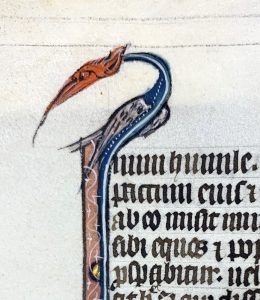
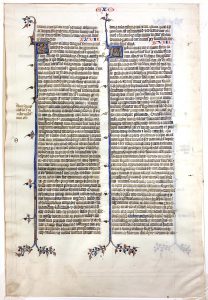
The text begins within Daniel 9:11.

[11 Et omnis Israël prævaricati sunt legem tuam, et declinaverunt / ] ne audirent vocem tuam: et stillavit super nos maledictio et detestatio quæ scripta est in libro Moysi servi Dei, quia peccavimus ei.

The marks opposite line 4 in the outer margin, lvij or lxij, plus a larger abbreviation to its right, might signal the passage for reading.  The ‘;’ markings at intervals opposite more lines lower down might be related to the readings from Daniel for the 21-day fast.  See:

  • https://likeabubblingbrook.com/daniel-fast-scripture-readings/

The listed readings in that resource do not exactly line up with this version, but it is the closest which we have found so far.

*****

Further research might identify which Vulgate Bible manuscript gave this specimen, somehow to reach the antiquary shop in London.  As yet, it is unclear by which time and where the leaf acquired its modern folio number within the original volume, became separated from the book, and acquired its inventory number, selling price, and label, giving an attribution to a different text, and a particular passage, from a different Biblical Book in the Old Testament.  We might assume, say, given the plural “pages” in the label, that its text was drafted to identify a group of specimens from the specific manuscript, laid out in an array from which a purchase might be selected.  From them one, but not this one, could correspond to the specified passage about the Temple in I Macabees.

Perhaps the formula which the label assigns to the date-range of the specimen, like the citation of “I Machabees”, will provide a clue to its former location in a source-manuscript, according with a form of identification not unlike some employed by, say, Otto Ege, in labeling the dismembered pieces for distribution and perhaps offering a selling-point.  For now, we might begin to look for Vulgate Bible specimens in double columns of around 56 lines, with comparable dimensions, and with corresponding folio numbers, all of which are identified as dating from “Circa 1280 A.D. Not after 1300.”

The modern folio number points to a different manuscript than the one which first came to mind when I saw a photograph from its “first side”, perhaps probably because that manuscript was fresh in mind.  Some Ege manuscripts have modern folio numbers, entered before the books were taken to pieces.  (See, for example, More Leaves from “Otto Ege Manuscript 51”.) But not, apparently, any leaves from Ege MS 9 or MS 54.  The quest is open.

I invite your advice.

*****

Do you know of more leaves from this manuscript?  Do you recognize the hands of these scribes, artists, and annotators in other parts of this book or in other manuscripts?

You might reach us via Contact Us or our Facebook Page. Comments here are welcome too. We look forward to hearing from you.

Watch our blog on Manuscript Studies for more discoveries. Please visit its Contents List.

*****

Tags: Book of Daniel, Book of I Macabees, Latin Vulgate Bibles, manuscript fragments, Otto Ege Manuscript 14, Otto Ege Manuscript 20, Otto Ege Manuscript 54, Otto Ege Manuscript 9, Otto Ege Manuscripts
No Comments »

Two Ege Leaves and Two Ege Labels in the Collection of Birgitt G. Lopez

May 10, 2022 in Manuscript Studies, Uncategorized

Two Ege Leaves in Frames
with
Two Ege Labels

in the Collection of Birgitt G. Lopez

(Ege MS 14, MS 20, and MS 9 + 54)

Mildred Budny

Collection of Birgitt G. Lopez, Framed Leaf from ‘Otto Ege Manuscript 20’, Front-Facing Page (“Recto”).

[Posted on 10 May 2022, with an update]

Acquired separately in Dallas, Texas, over the course of some five years and through the Dallas Public Library, two vellum leaves from manuscripts dispersed through Otto F. Ege (1888–1951) now belong to a single collection, that of Birgitt G. Lopez. The two leaves, differing in size, script, layout, and type of book, come from two different manuscripts from Ege’s collection.  With each leaf travelled a printed Label composed and printed by Ege to accompany the dispersed specimens of the particular manuscript.

Each leaf has been reframed.  Its identifying Label is retained and taped to the back of the frame.  Recently, after a visit to Dallas Public Library to examine its relative from one of those Ege manuscripts, Mr. Lopez contacted me, at the suggestion of the Librarian, and generously offered to share information about both Ege leaves in the collection with our and others’ study of Ege materials.

The Links of Transmission from Otto Ege

When reporting the existence of the leaves to me, Ernesto Lopez recollects that the first leaf was purchased at an auction benefiting the Dallas Public Library.  The second was a gift some five years later from Lillian Moore Bradshaw (1915–2010), long-time Director of the Dallas Public Library (1962–1984).

Mr. Lopez reports:

I purchased the first one in an auction benefiting the Dallas Public Library 1998 and the second one was a gift in 2003 from Lillian Bradshaw, the long-time Dallas Public Library Director.  Ms. Bradshaw told me at the time that she purchased the items directly from Mr. Ege; I have the letter laying out the provenance in Ms. Bradshaw’s hand.  . . . .  She told me [that] she was working in the Dallas Public Library’s Director’s office when Mr. Ege came to make a sales call. . . . I served eight years on the Dallas Municipal Library Board where I got to know Mrs. Bradshaw.

Also:

Several months ago, I went to the Rare Books collection at Dallas Public Library to do some research on the two leaves that I own.  The Rare Books Librarian gave me your email address so that my two leaves can be added to the body of work your group is doing on the Otto Ege manuscripts.

I framed both of the leaves leaving the explanatory text from Otto Ege on the back of the framed works.
The first leaf is similar to the leaf in the Dallas Public Library collection. It is roughly 15″ by 10″.

With permission, we publish images and report some preliminary research results, which can aid in allowing the leaves to become more widely known in their own right.

Read the rest of this entry →

Tags: Beinecke Rare Book & Manuscript Library, Collection of Birgitt G Lopez, Dallas Public Library, Ege FOL Portfolio, Ege Labels, Ege's Portfolio of Famous Bibles, Ege's Portfolio of Famous Books, Lilian Moore Bradshaw, manuscript fragments, Otto Ege Manuscript 14, Otto Ege Manuscript 20, Otto Ege Manuscript 54, Otto Ege Manuscript 9
1 Comment »

Two Old Testament Leaves from ‘Otto Ege Manuscript 14’ at Smith College

March 11, 2022 in Manuscript Studies

Two Leaves
from ‘Otto Ege Manuscript 14’
at Smith College

Smith College Special Collections, MS 36-6, verso, top left, from ‘Otto Ege MS 14’. Photography by Hannah Goeselt.

Large-format Latin Vulgate Lectern Bible
made in France
late 13th- or early 14th century

Single Leaf within a matted frame
Double columns of 50 lines

Exodus 25:31 (procedentia) – 28:21 (cela-[/buntur singuli])
with Ege Label

and
Ezekiel 16:43 ([irascar amplius /] eo quod) – 17:14 (sic reg/-num humile et])

[Posted on 12 March 2022.]

We warmly thank Hannah Goeselt, responding to our blogposts, for sending information and images for parts of ‘Otto Ege Manuscript 14’ at Smith College, Northampton, Massachusetts. The ‘moniker’ for the manuscript derives from the decisive impact upon it effected by Otto F. Ege (1888–1951) and the place-number which its selected specimen leaves occupied in his monumental Portfolio of Fifty Original Leaves from Medieval Manuscripts, Western Europe, XIII–XVI Century, issued in forty numbered sets. Ege assigned the date of “1300 A. D.” to the Bible and its specimens.

Smith College Special Collections, MS 35-14, verso, from ‘Otto Ege MS 14’. Photography by Hannah Goeselt.

Discoveries for other parts of this dismembered and dispersed manuscript, a large-format Lectern Bible in the Latin Vulgate Version in Gothic Script, with historiated and decorated elements, have been reported in our blog.

  • A New Leaf from ‘Otto Ege Manuscript 14’
  • More Discoveries for ‘Otto Ege Manuscript 14’
  • A Leaf from ‘Otto Ege Manuscript 19’ and Ege’s Workshop Practices
  • Updates for Some ‘Otto Ege Manuscripts’ (Ege MSS 8, 14, 41, and 61)
  • Some Leaves in Set 1 of ‘Ege’s FOL Portfolio’ (Ege MSS 8, 14, 19, and 41)
  • Patch Work in ‘Otto Ege Manuscript 14’
  • A Leaf in Dallas from ‘Otto Ege Manuscript 14’.
  • A Leaf of Deuteronomy from ‘Otto Ege Manuscript 14’ in the Rosenbrook Collection

See also The Illustrated Handlist (Number 4).

The Smith College Leaves comprise two separate single leaves respectively from the Books of Exodus and Ezekiel. At least one retains the standard printed Ege Label, albeit displaced and rearranged.

The pair augment understanding of the original state of those Biblical Books in the manuscript, and also of habits in the transmission of leaves from it as they were prepared for distribution from Ege’s collection and accommodated in their next collection, where they remain. That their chain of transmission revolves around Mrs. Otto Ege — Louise Hedwig Lange Ege, an alumna of Smith College, and an active partner in the distribution of materials from the Ege Collection both during and after her husband’s lifetime — infuses the presence of these and other Ege leaves at her alma mater.

Read the rest of this entry →

Tags: Book of Exekiel, Book of Exodus, Ege Family Portfolio, Ege Manuscript 40, Ege's FOL Portfolio, manuscript fragments, Medieval Manuscript Fragments, Otto Ege Manuscript 14, Otto Ege Manuscript 27, Smith College
No Comments »

« Older Entries
Newer Entries »
  • Top
©2024 Research Group on Manuscript Evidence.


is proudly powered by WordPress. WordPress Themes X2 developed by ThemeKraft.