Fragments of a Castle ‘Capbreu’ from Catalonia
July 15, 2020 in Manuscript Studies
Fragments on Paper
from a Medieval Capbreu
(or Terrier)
for a Castle in Catalonia:
Vallfort or Castellví?
[Posted on 15 July 2020, with updates]
We examine fragments from a late-medieval Spanish manuscript on paper, with texts in Latin and Catalan. They come from a castle in Catalonia, Spain. In its texts the castle is named (so I am told) as Vallfort. Its lord is noted in one formula as Gaspar vilana senyor dela baronia e terme de castellny strem dela marcha . . . (“Gaspar Vilana, Lord of the Barony of Castellny and its Bounds, at the edge of the March . . . “). The “March” in this case presumably refers to the Hispanic Marches or the March of Barcelona — wherever and from what perspective then stood its particular terme. Purchased several years ago from a seller in Barcelona, the fragments are now in a private collection.
What’s In a Name?
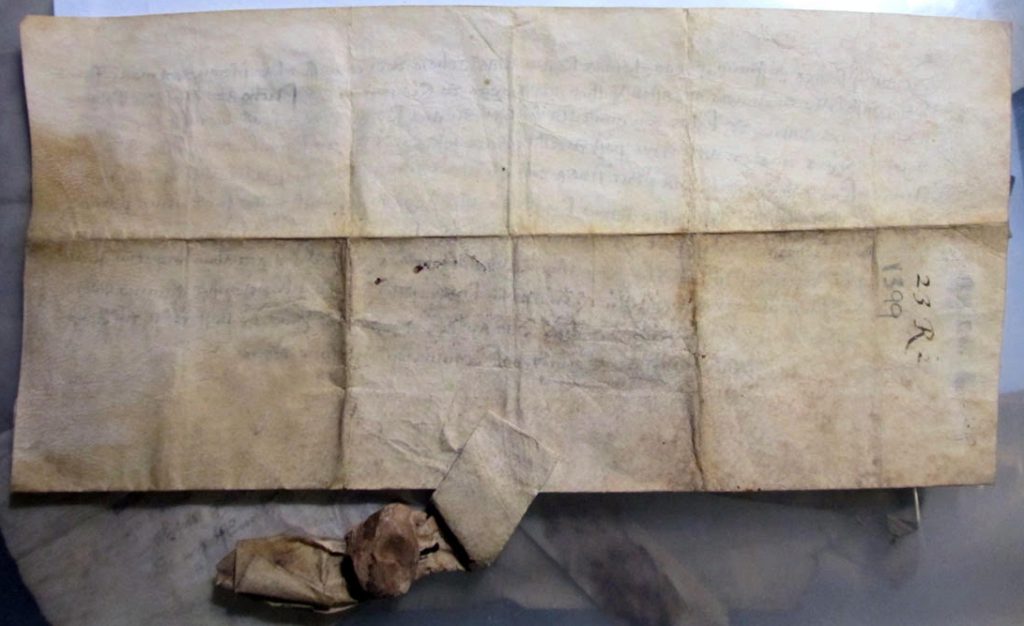
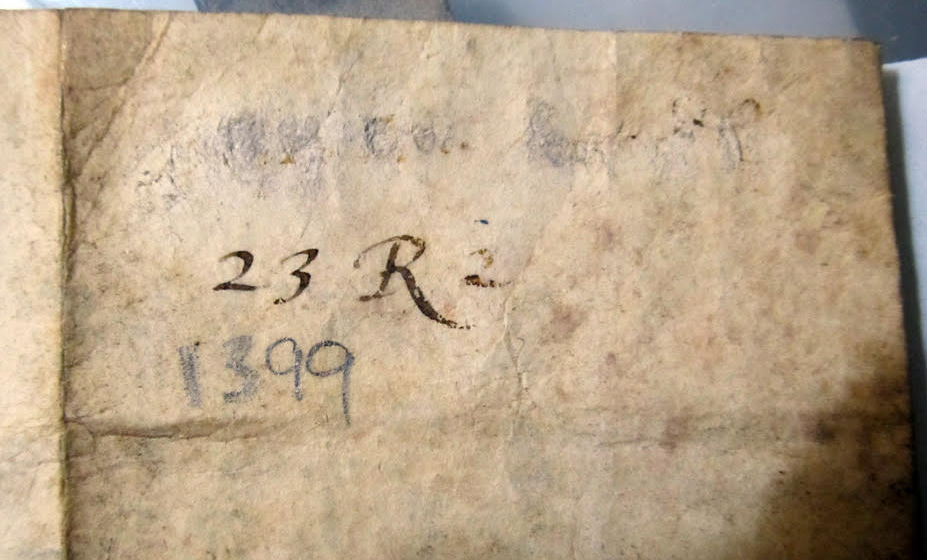
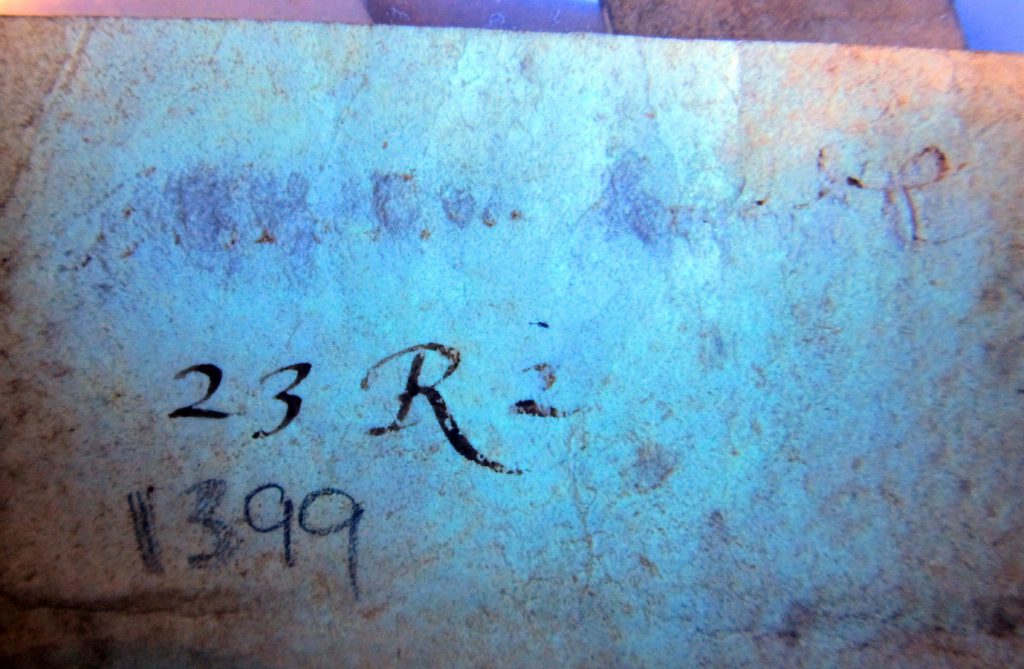
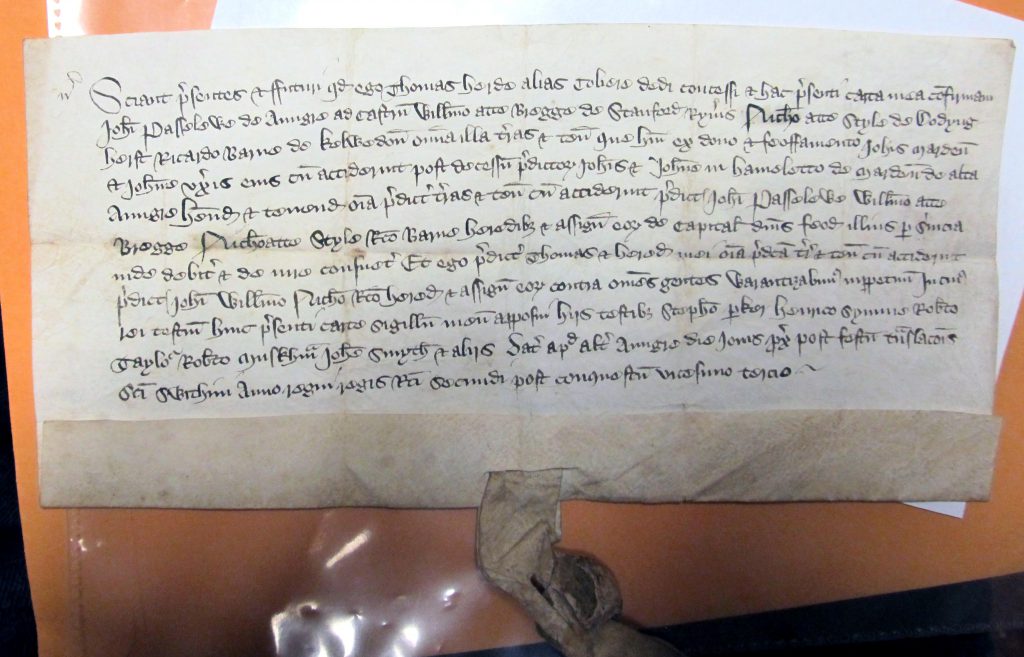
Because the book has been dismembered and scattered, without the transmission of a clear record of its former state, contents, and sequence of leaves, and because medieval spellings of names of people and places exhibit differences and variants in the records (even in a single record or set of records for a particular individual or place), it is useful to state some givens. The power of such respect for individual and varied forms is exhibited, for example, in the study of another document elsewhere in this blog: A Charter of 1399 from High Ongar in Essex.
In the Catalan manuscript fragment, or rather the available parts of it, we encounter names designating one or other castle. In the Catalan language, or Català, the word Castel(l) means “Castle”. Vell means “old”. Castelví comes from Castel(l)vell. See, for example, Castellvi; and Occitan and Catalan Names in the Medieval Names Archive.
In a region of the world where, given its history, there were many castles (see a partial List of castles in Spain), some of them, by the late medieval period, could or would have been perceived and described as “old”. Moreover, over time, as names for a particular place could have varied before settling down into a preferred and established choice, the forms –vell, –ví, and the like, all meaning “old”, might have alternated with each other for the same edifice and place, not least when translating a name from another language into the Catalan. Some of those names may have passed out of use for the given place in modern times, and some may have disappeared from the record altogether.
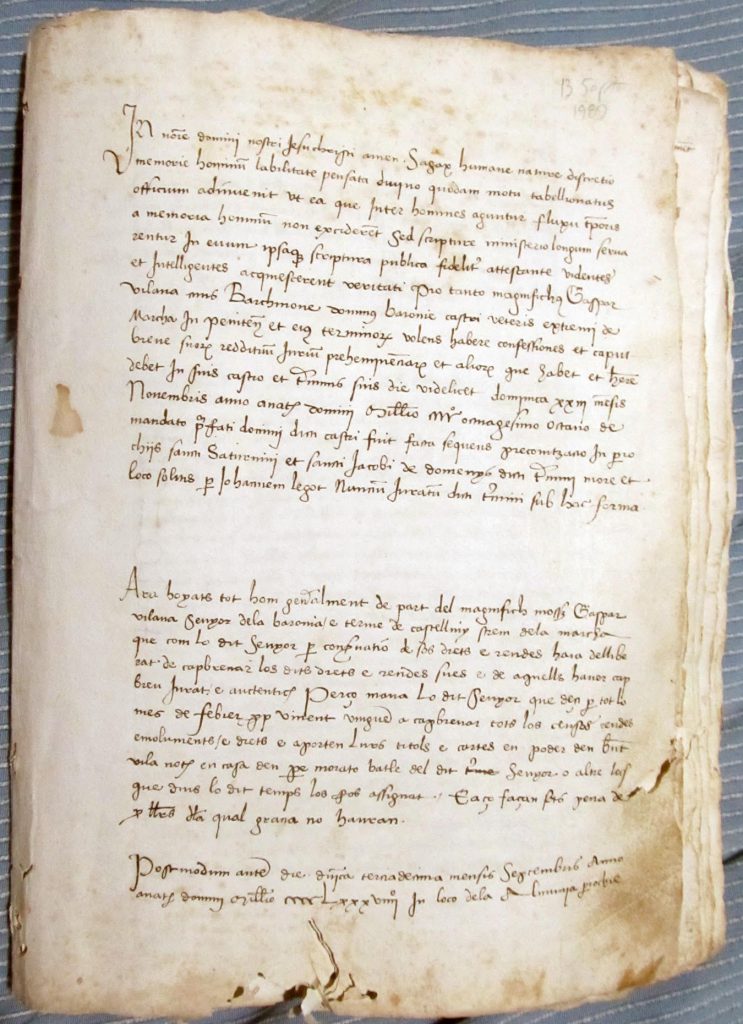
Private Collection, Castle Cartulary Fragment, Folio 1r / Page 1 fuller view.
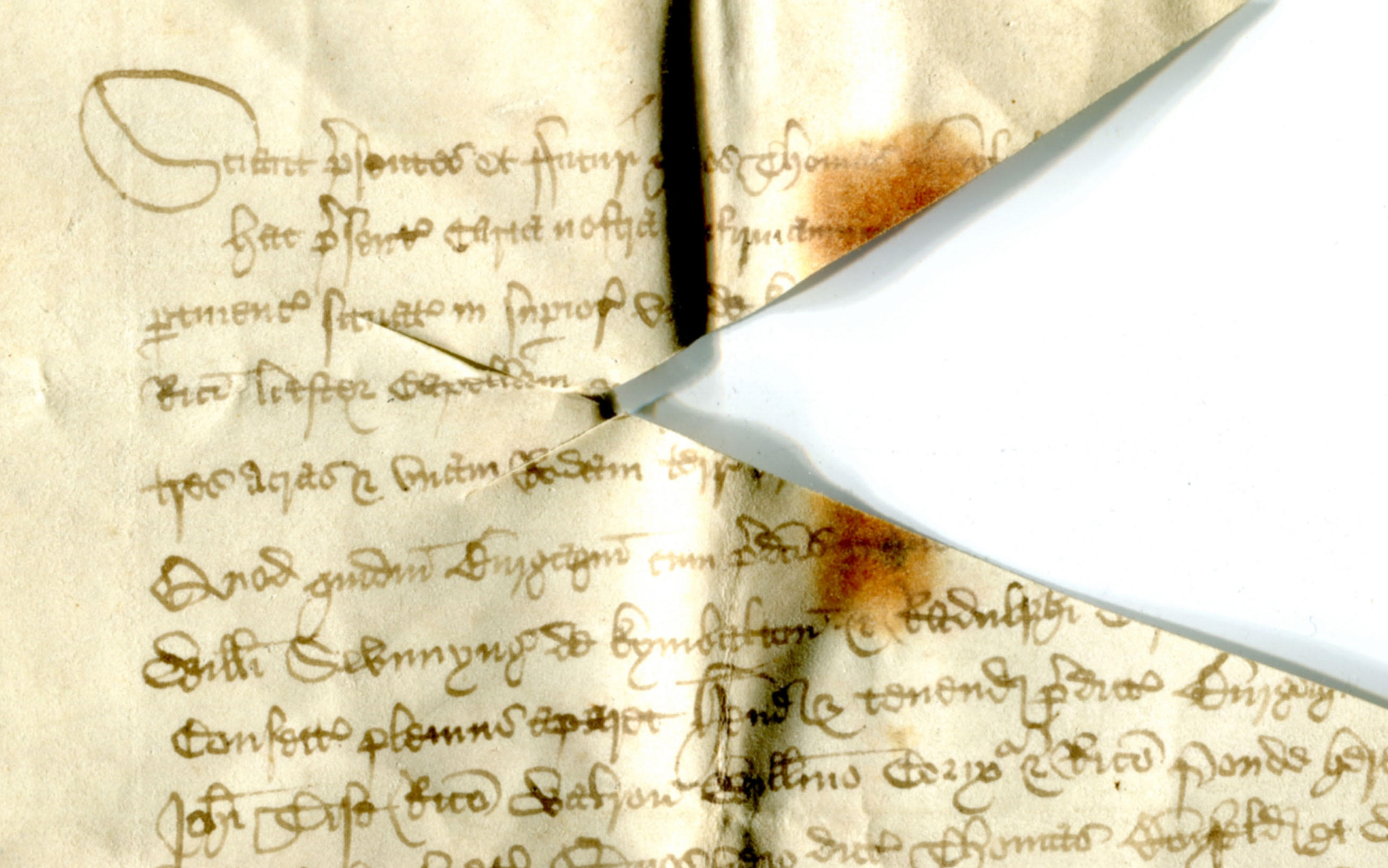
In some bilingual portions of the fragment, a single location is referred to as the “old castle” in both Latin and in Catalan. On a single page (both Folio ‘1’ recto and verso), it appears both as Castri ueteris (in the Latin genitive) and as Castellví or Castellvy (or Castellny/Castellni). Such patterns appear both on the title-page of the book (as known from the seller’s image) and on the first pages of the fragment from it as preserved in the collection which we showcase here.
Given multiple “old castles” which remained in seigneurial or baronial use at the time of these records, this one might well have required other descriptive elements to differentiate one from another. Such is the case now for some places which have, or retain, the name Castellvi, Castel(l)vell, and the like. For example, in Barcelona, there are still:
- Castellví de Rosanes at Baix Llobregat, Barcelona, with castle ruins known as El Castellot
- Castelví de la Marca, at Alt Penedés, Barcelona, likewise with castle ruins.
In the light of spellings discerned or potentially deciphered in the fragments, is the form Castellní (or similar) a known alternate for one or other of these? If not, then for some other place?
Given a castle-name Vallfort, the collector suggests that it may pertain to the family considered in: La documentació de la casa de Clariana (s. XIII-XV) conservada a l’Arxiu del Castell de Vilassar (1989), available online. For example, an inventory item for 23 November 1335 (No. 2 on p. 338) mentions a comte de Castellbó i senyor de Castellvell (“Count of Castellbó and Lord of Castellvell”) and a senyor de la casa de Vallfort dins del terrne de Castell vell (“Lord of the House of Vallfort within the terrne of Castellvell”). Here (highlights added):
1335, novembre, 23 Llicencia concedida per Roger Bematde Foix, comte de Castellbó i senyor de Castellvell, a Guillem de Clariana, senyor de la casa de Vallfort dins del terrne de Castell vell, donant-li perrnís pera construir dins del terrne i fins el coll d’ Alberic o de Santa Cristina premses i molins d’oli. Estableix en emfiteusi els molins i premses a Guillem, sota cens anual d’una quartera d’oli per premsa, cens que Roger es di vidira arnb Mir de Castell vell, e as tia del castell. Per entrada Guillem paga dos sous de moneda barcelonesa de tem.
Candidates for identifying these named places with modern ones could include:
- Castellbó within Montferrer i Castellbó
- Castellvell, a community in Bajo Campo, Tarragona
For the latter, we learn, a documentary record in 1336 mentions the “old castle” (castri veteri, terminus de reddis), whereas the place-name Castelvell does not appear in the historical record before 1409.
As for a Casa or Castle Named Vallfort, the present collector suggests that “the site is probably near the hotel/venue named Masia Vallfort” (see also Masia Vallfort), a restored medieval house, castle, or structure “in the Penedès area”. That venue describes itself thus: “Masia Vallfort is located in Camí des Clots, s / n, in Sant Jaume dels Domenys, . . . 10km from the beach, 25km from Sitges, 40km from Tarragona and 50km from Barcelona airport.” (See its Contact.)
Cartulary or Capbreu?
These leaves, which I have not yet seen in person (apart from photographs), have been described as part of a “castle cartulary”. Perhaps that appelation derives from the seller’s listings and records (which I have not seen).
Late-medieval fragments of a cartulary from the Church at Selbold, in Hessen, Germany, now in the same private collection, are examined in our blog on the Selbold Cartulary Fragments (seen in one page at the right). According with this type of book, the leaves contain copies or transcriptions of multiple documents, issued at various times by authorities (secular or ecclesiastical) conferring or affirming the rights and benefits which pertain to the particular institution.
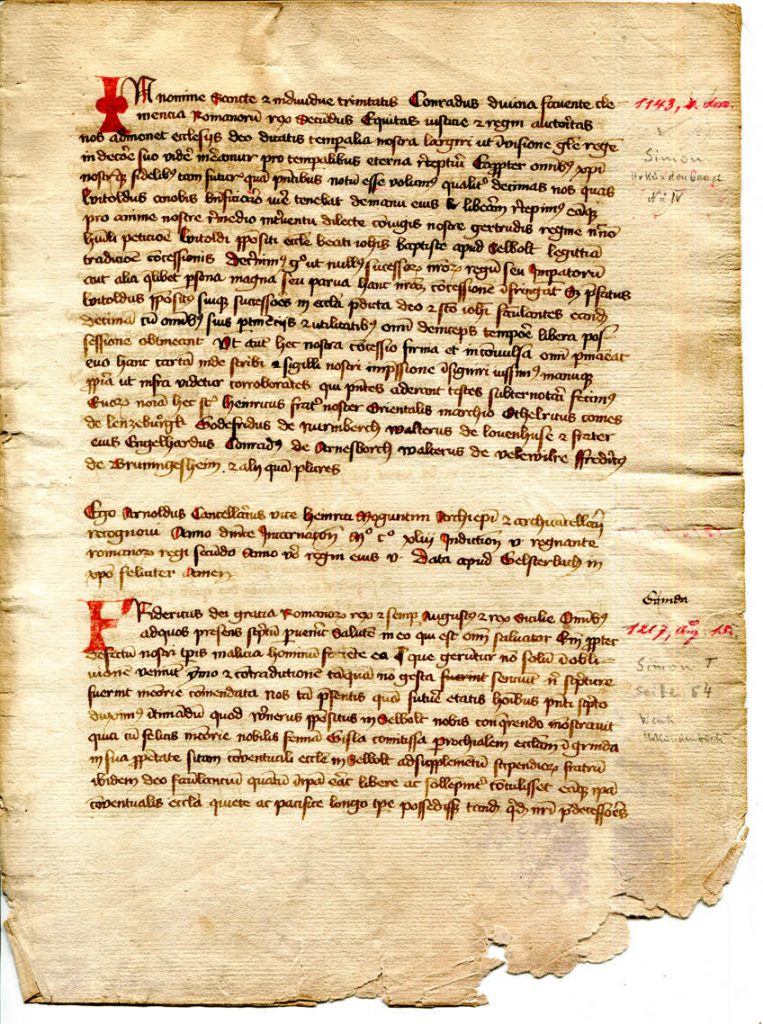
Private Collection, Selbold Cartulary Fragment, Folio 2 recto.
The text on one leaf in the “castle cartulary fragments” from Barcelona (shown above and below as “folio ‘1’r–v”) constitutes the text or transcription of such a document, in both Latin and Catalan versions, including its dating clause in its own paragraph or section. A similar approach can be seen in the presentation of the Latin documents, with separately spaced dating clauses, in the Selbold Cartulary Fragments.
However, as a few more leaves of the Spanish/Catalan “castle cartulary” come into view, it becomes clear that it was a different type of book instead, with different purposes, and also with various other types of texts. That type of book is stated clearly in its own name for itself, on the former title page and also on the reused parchment document (issued at Barcelona in 1437) which, apparently, served as its cover or wrapper.
In its own words, this book is a Capbreu in Català, French, and other languages — which in English would be a terrier. The word derives from the Latin phrase caput breve. It denotes a specific type of seigneurial inventory, in the form of a book or register surveying the lord’s lands and tenants. The genre provides a record system for an institution’s land and property holdings; it “differs from a land register in that it is maintained for the organisation’s own needs and may not be publicly accessible”.
Described in French:
le capbreu ou livre de reconnaissances est un registre notarié en parchemin ou en papier dans lequel sont enregistrées les déclarations faites sous serment des tenanciers possédant des terres et autres biens-fonds relevant de la directe d’un seigneur foncier
Described in Català:
Un capbreu és un document on anotava, en forma abreujada i en períodes cronològics espaiats, les confessions o reconeixements fets pels emfiteutes o pels pagesos tenidors (podien ser de remença) als senyors directes, per tal de conservar memòria o prova de la subsistència dels drets dominicals.
Note that it is notarized.
Called capbreviato (capbrevació in Catalan), the process of compiling the registers on occasion might include the summoning of tenants before administrators and a notary, for the tenants to present for review the written titles to any lands which they held from their lord, and for disputes such as contested boundaries to be resolved. The head of each family was to swear on the Evangelists [or their Four Gospels] to tell the truth concerning the lands, rents, and services required. These representations would be recorded by the notary.
Characteristic of the genre would be multiple entries, made at different times and by different hands, sometimes over long periods of time extending across generations. The genre reflects a close relationship between land, countryside, seigniorial power, and families over changing conditions. An evocative description of the genre, its procedures, and its source-materials emerges in
- Marc Conesa, “Capbreu et paysage. Remarques sur l’utilisation d’une source seigneuriale dans l’étude des paysages des Pyrénées de l’est (Cerdagne, XVIe–XVIIIe siècle)”, Liame, 14 (2007), pp. 97–124.
A few more of the studies which I have found helpful on the genre, its functions, its agents, and its settings variously geographical, sociological, economic, cultural, and more:
- Rodrique Tréton et al., Les Capbreus du roi Jacques II de Majorque (1292-1294). Documentes inédits sur l’histoire de France, 393 and 490 (Paris: CTSH, 2 vols, 2011).
- Pere Benito i Monclús, “Agents du pouvoir ou entrepreneurs ruraux? Les intermédiaires de la seigneurie en Catalogne médievalé, essor et déclin,” in Les élites rurales dans l’Europe médiévale et moderne, ed. François Menant and Jean-Pierre Jessenne (Toulouse: Presses Universitaires du Mirail, 2007), 111-127.
- Jonathan C. Farr, “Imagined Geographies and the Production of Space in Occitània and Northern Catalunya in the Thirteenth and Fourteenth Centuries” (Ph. D. Dissertation, University of Michigan, 2017), available here .
The Looks of the Books
The genre of capbreus had a long and active life, with recognizable, albeit varied, features pertaining to individual institutions, locations, holdings, and forms of book-production. The title-page from a Ca(p)breu now at the Arxiu Comarcal del Baix Penedès writes its title large on the page, with some forms of wording comparable to the notarized title in the “Castle Cartulary”:
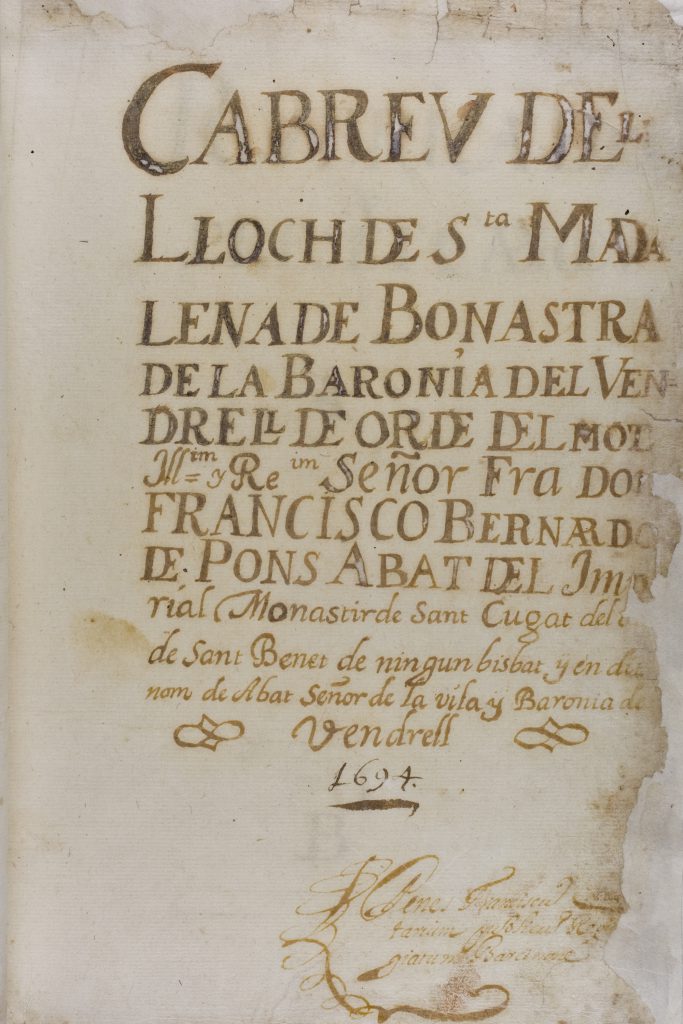
Capbreu de Santa Magdalena de Bonastre, 1694: Title Page. Image via Notari reial Franesc Cervera. In Public Domain.
Another, calling itself a Caput breue, bears its signed attestation by the named notary at the lower right in 5 lines, beginning apud me . . . (“according to me”):
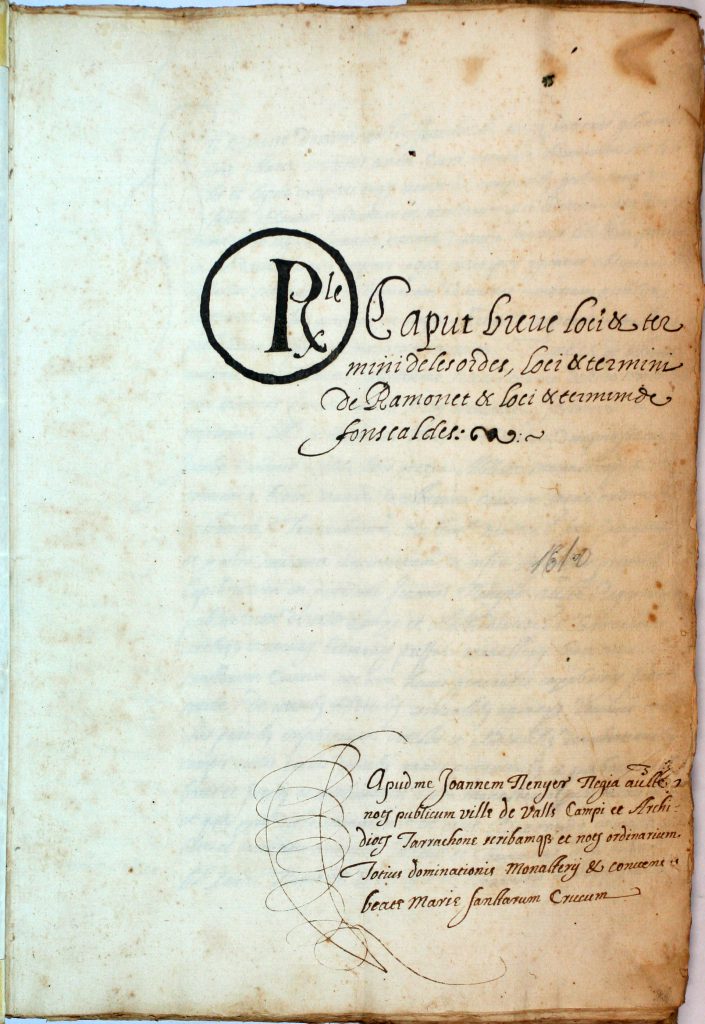
Capbreu dels llocs i termes de Ramonet, Les Ordes i Fontscaldes, dated 4 March 1616 – 29 August 1616. Image via Wikimedia Commons.
A Cabreu might even hold fine decoration and illustration, manifesting a chain of command, as with the headpiece illustration of the Cabreu of Saint-Laurent de la Salanque, now at Perpignan (A.D.P.O, MS IB33, folio 1r). At the left, the enthroned king has crown, orb, and scepter. In the middle stand 2 male witnesses. At the right, the suppliant bends on 1 knee, raises his right hand, and places his hand on the holy book (the Gospels) held open by the adjudicator, who stands in front of a bench. Between these 2 figures, a seated scribe, with monastic habit and cowl, bends to the task of recording the event. Held up at an angle between his knees and facing us, his writing sheet carries the name of the first tenant in the act copied directly below the scene. This detail manifests a conscious case of indicating that the scene illustrated represents the very action.
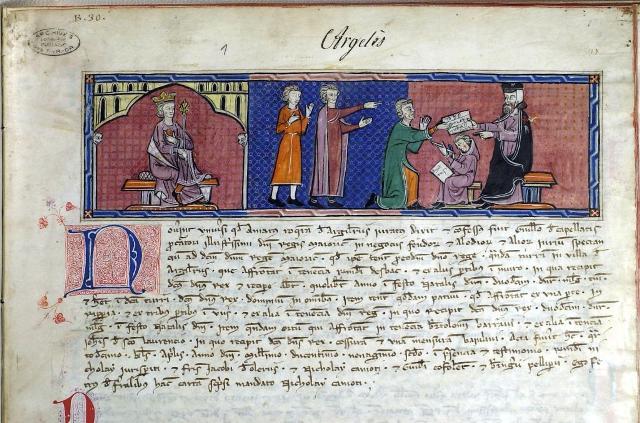
Capbreu d’Argeles (1292). Perpignan, Archives départementales des Pyrénées-Orientales (A.D.P.O.), 1 B 30, folio 1r, for Juane I, King of Majorca. Image in Public Domain, via Wikimedia Commons.
The Fragments
This portion of the former volume of the Catalan “Castle Cartulary”, or Capbreu, comprises 28 leaves. All of paper, they are mostly bifolia, plus a folded full sheet inserted in their midst. The last 7 leaves are blank on both sides. The text presents entries or documents in book form.
All the entries in this portion have dates between 13 and 25 September 1489. A preliminary report of the fragment was presented in a conference session sponsored by the Research Group.
A look at the unbound group of fragments opened:
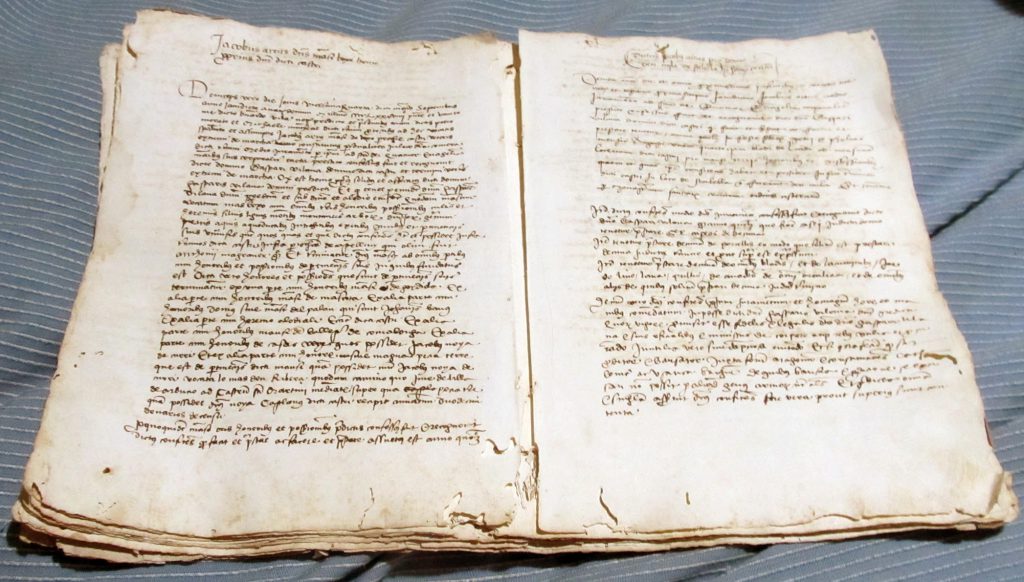
Private Collection, Spanish Castle Cartulary Fragment, Viewed Opened.
Most of the wormholes are a result of the stacking of the disbound leaves, although one wormhole is a relic of the original binding.
A view closer up of that opening, naming Jacobus . . . dominus . . . at the top right:
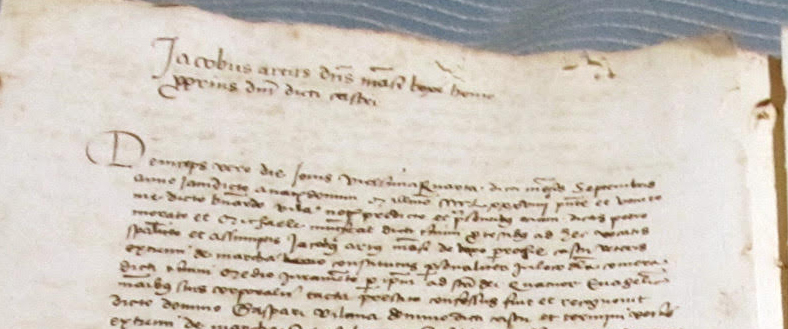
Private Collection, Spanish Castle Cartulary Fragment, Viewed Opened: Top Right.
The front of the Fragment:
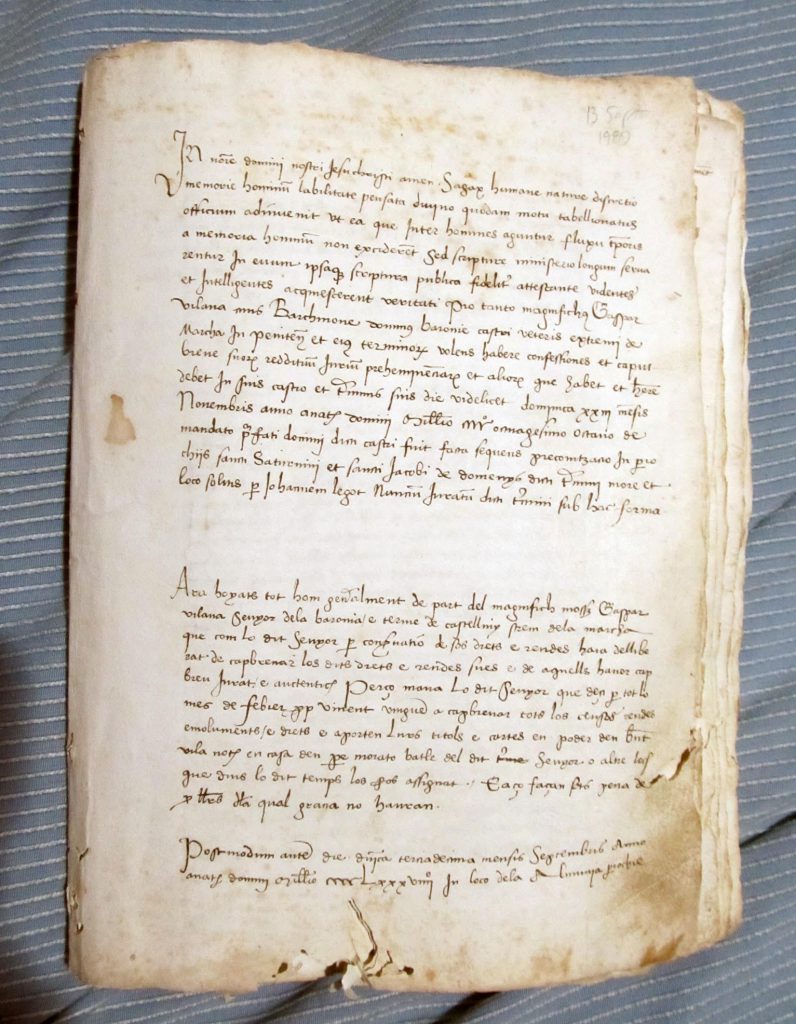
Private Collection, Spanish Castle Cartulary, Folio ‘1’r.
The Next Page (Folio ‘1’v)
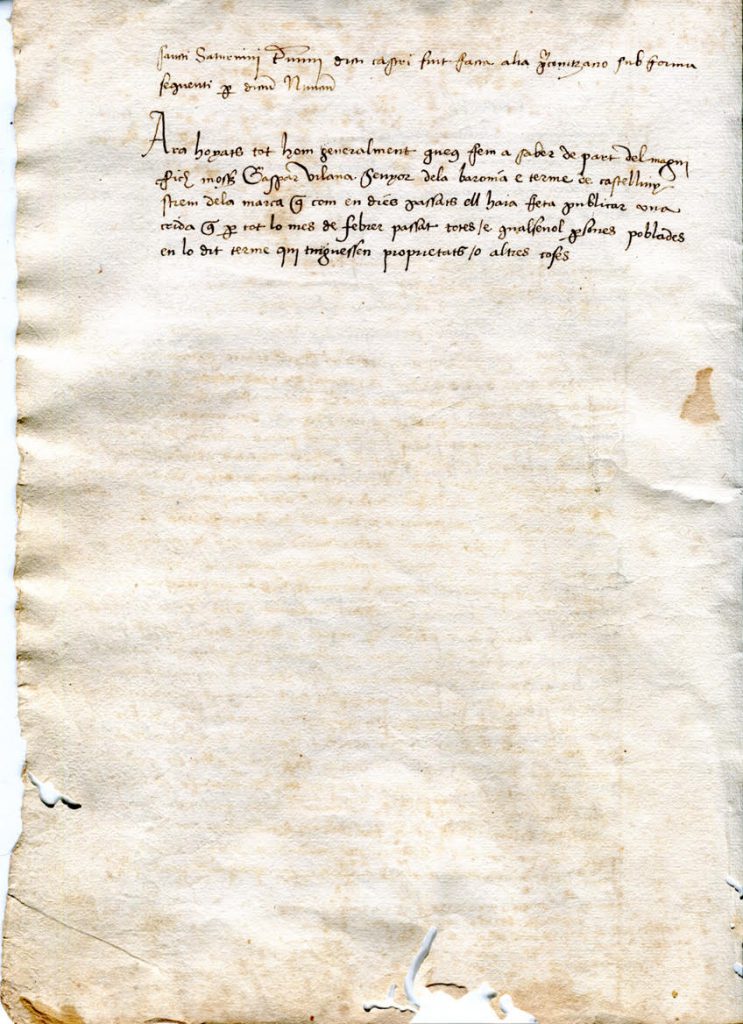
Private Collection, Spanish Castle Cartulary, Folio ‘1’v.
Other Parts of the Book
More parts of the dismembered volume were offered for sale at the same time, so other leaves survive elsewhere. The seller’s photographs total 52, all of which the collector saved to keep with the group of leaves. So far, I have seen only 2 of those images, whose information deserves incorporation here. As the copyright for those images reside with the seller, we show only ‘postage-stamp’ versions of them, whose display on the internet for the purpose of selling predates my acquaintance with the materials at all.
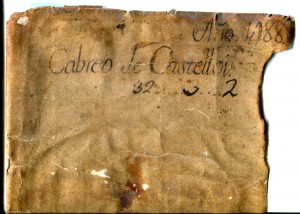
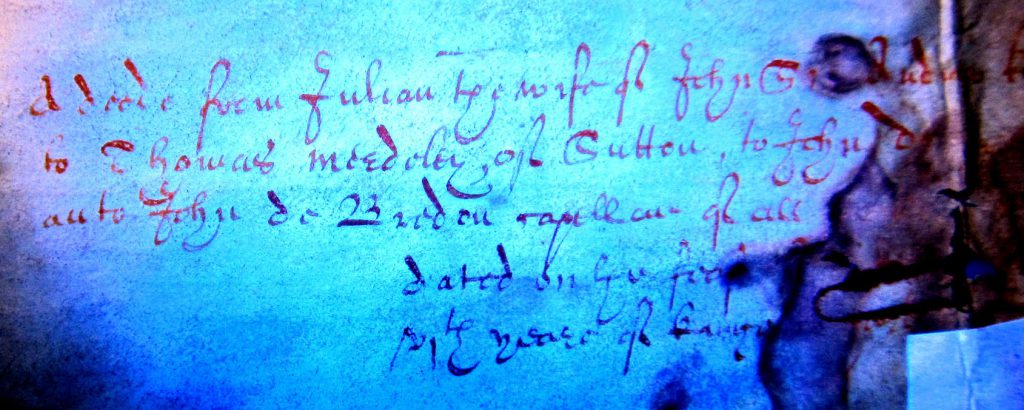
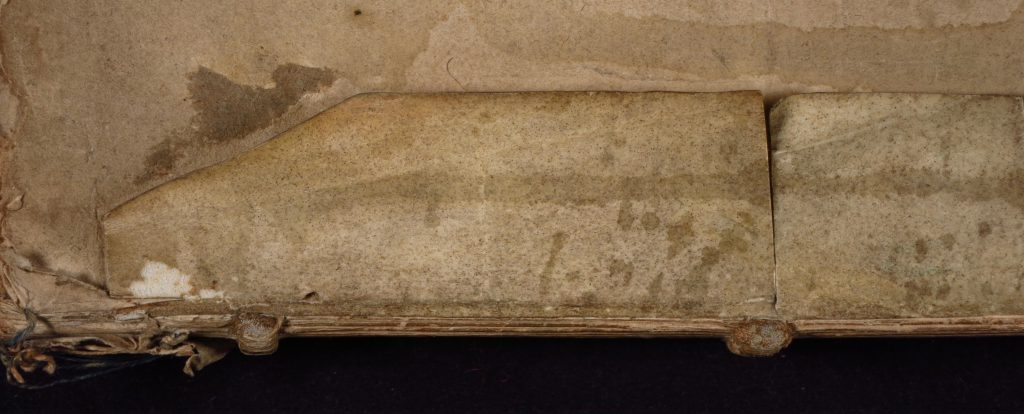
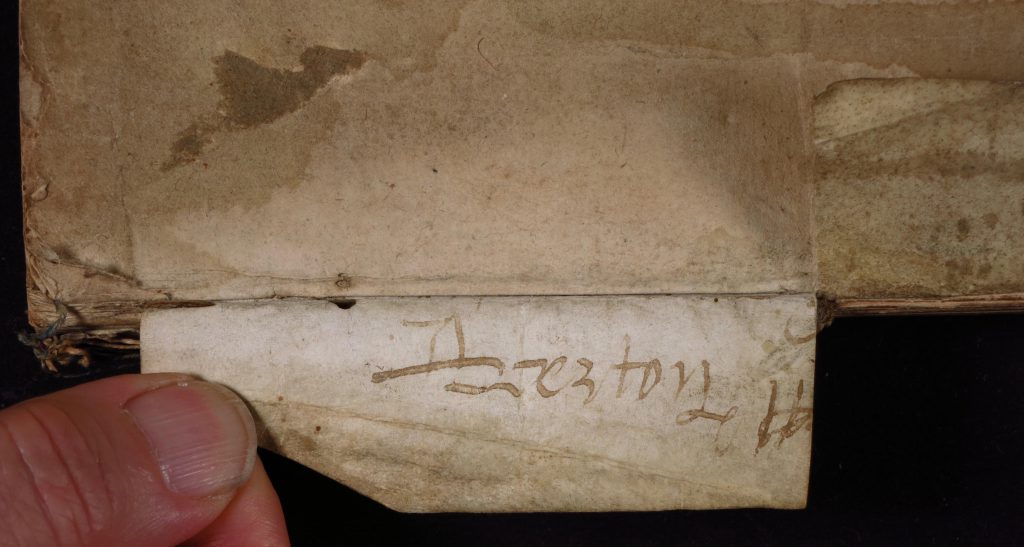
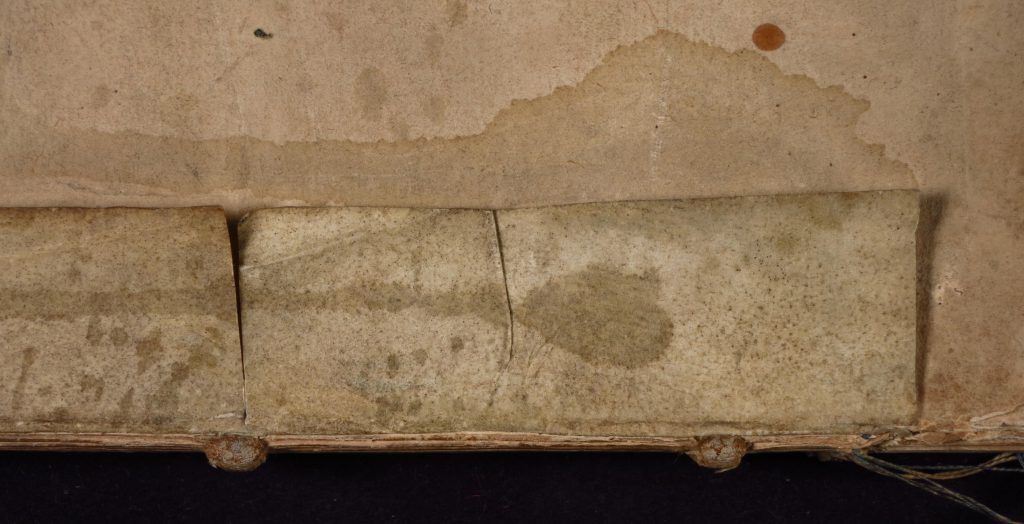
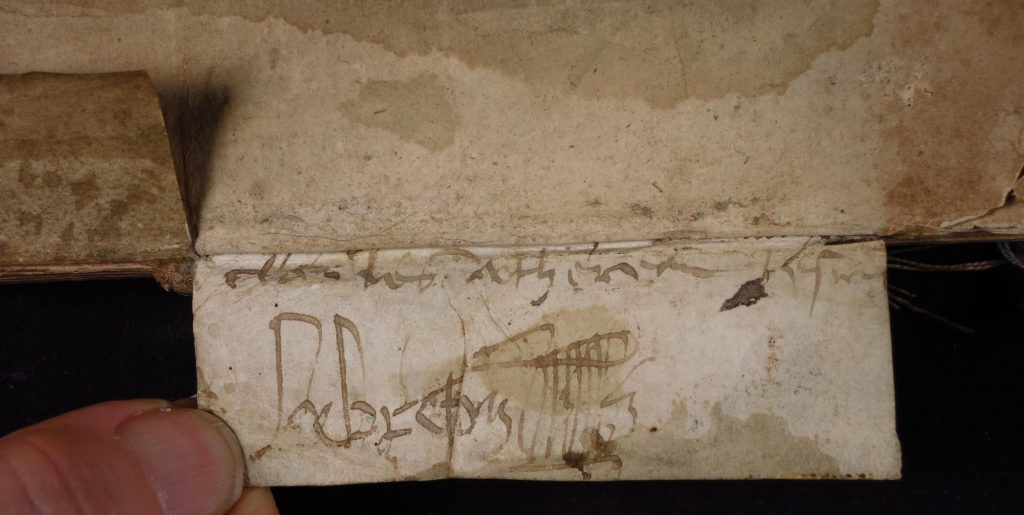
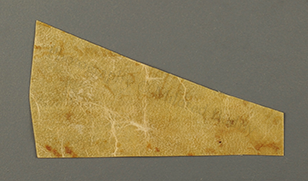
Bipartite of Document 1437 in Latin from Barcelona: Docketing on the Dorse.
Some elements of what can be known about the former ensemble derive from the seller’s account, as reported to me. For example, a parchment document of 1437 was said to have formed the cover for a time.
By inference — shall we say, by a preponderance of the evidence so far available — it appears that it was that very document which the seller sent, as a sort of extra bonus, to the same collection as the Fragments of 28 leaves presented here. Shortly after the document arrived in the collection, and without knowing about the possible connection with other leaves on the way, we reported it with a blog-post of its own, as a Latin Document of 1437 on Vellum from Barcelona. Now, its docketing assumes a heightened pertinence in the context of the Fragments.
The Front Page
The “former cover”, or title-leaf, was purchased by some other collector. The features of its front or recto can be glimpsed in the seller’s image. Besides marks of wear and tear, stains, and wormhole patterns, it has a series of entries by 3 different hands.
Centered at the top, a partly damaged 5-line Latin inscription in brown ink gives a description of the contents (Capibre[?] . . . omni . . . et H . . . domini Baronie Caste[?] . . . extrem . de Mar[?]. . . ). It closes with the attestation of the scribe as notary, cited by name as Bernard Vila and accompanied by his knot-like nota.
Capibre[?] . . . omni . . . et H . . . domini Baronie
Castri ueteris extrem . de Mar[?]. . . apud me Bernardum Vila
Villefranche penit[?]en’ a uet‘ . . . notarium publicum per totas
. . .et . . . Illust’ . . . Aragonum Qui . . .
But no date. The name Villefranche perhaps indicates the town still known as Villefranche (Vilfranca in Catalan) in Catalonia.
In dark ink, an X-shaped cross demarcates most of the page. Within its wedges stand four personal names (clockwise from the top): Johannes/ Marchus / Matheus / Lucas. With the name Johannes settled below the tail of the nota, it is not certain whether or not this entry pre-dates the Latin ‘title’. In any event, the four names represent the 4 Evangelists, on, or on whose names, the swearing would be intended to occur.
In pale brown ink, 2 later hands using cursive script entered variant versions of Catalan translations for the Latin inscription. Their fewer damaged passages may clarify some words of the Latin.
Capbreu que portanen a la jurisdicio del S[eño]r Baro di Castellví y extrem de la marca en poder di Bernard Vila Notari di Vilafranca . . .
That is, this is the “Capbreu which pertains to the jurisdiction of Señor Baron of Castellví and the end of the March . . . ”
The alignments of these entries demonstrate an adaptation of sorts to the pre-existing X-shaped bounding lines. Perhaps, among other things, they formed exercises in Latin translation.
Another Page
Another page offered for sale from the dismembered book, and sold elsewhere, appeared in the seller’s posted image.
Its text records an event of Wednesday, 23 January 1587, and names some persons of the Parrochie Sancti Jacobi de Castellvi dela Marca vicaria Villafrancha Penitenz ex altera. By its name, their parish presumably pertains to the still-surviving municipality of Castellvi (also spelled as Castelvell) de la Marca, in Alto Penedés, in the province of Barcelona.
At the top left on the page, the name Castellví is writ large in dark ink, in a less steady hand, adding a contents heading, rather like docketing for a document proper.
The ruins of Castell Castelvi still loom large:
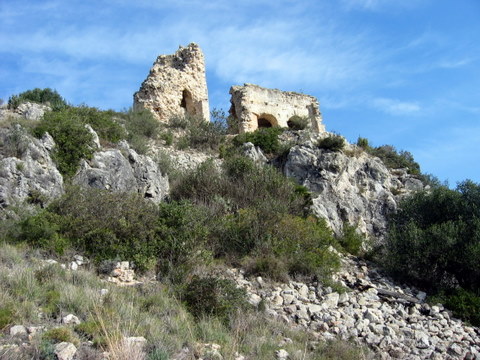
Castell de Castellvi, Catalunya. View from below. Photograph by Antoni Grifol (2007), via Creative Commons.
Vilafranca del Penedès is not far from this place.
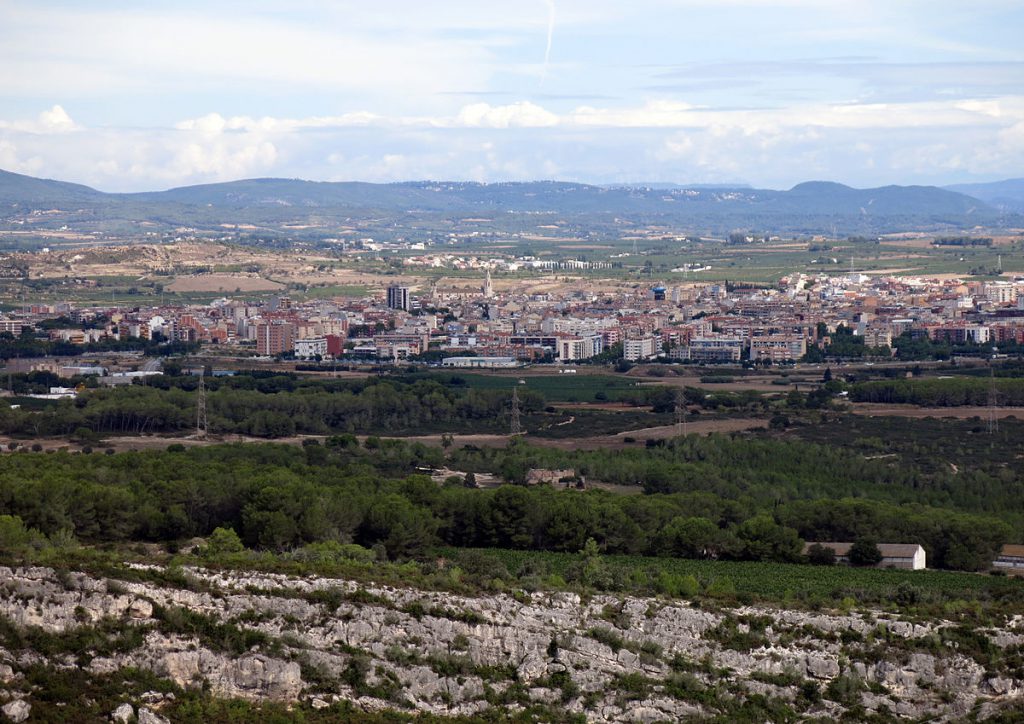
Vilafranca del Penedès des del jaciment d’Olèrdola. Photograph by Enric (2015), via Creative Commons.
The Parchment Cover for the Cabreo de Castellvi:
Reused Documents of 1437 from Barcelona
With the sale of the fragments as delivered in stages, the seller added a bonus item, the parchment cover from some ‘register’, not specifically named. That cover reused an older pair of documents, dated 1437.
We reported the document in an earlier blogpost, on its own, soon after it reached its current collection: Latin Document of 1437 on Vellum from Barcelona. Looking at it again, as we examine the Catalan ‘Castle Cartulary’ fragments in their own right, it now seems most likely that this document performed the service as the covering of this particular cartulary/register.
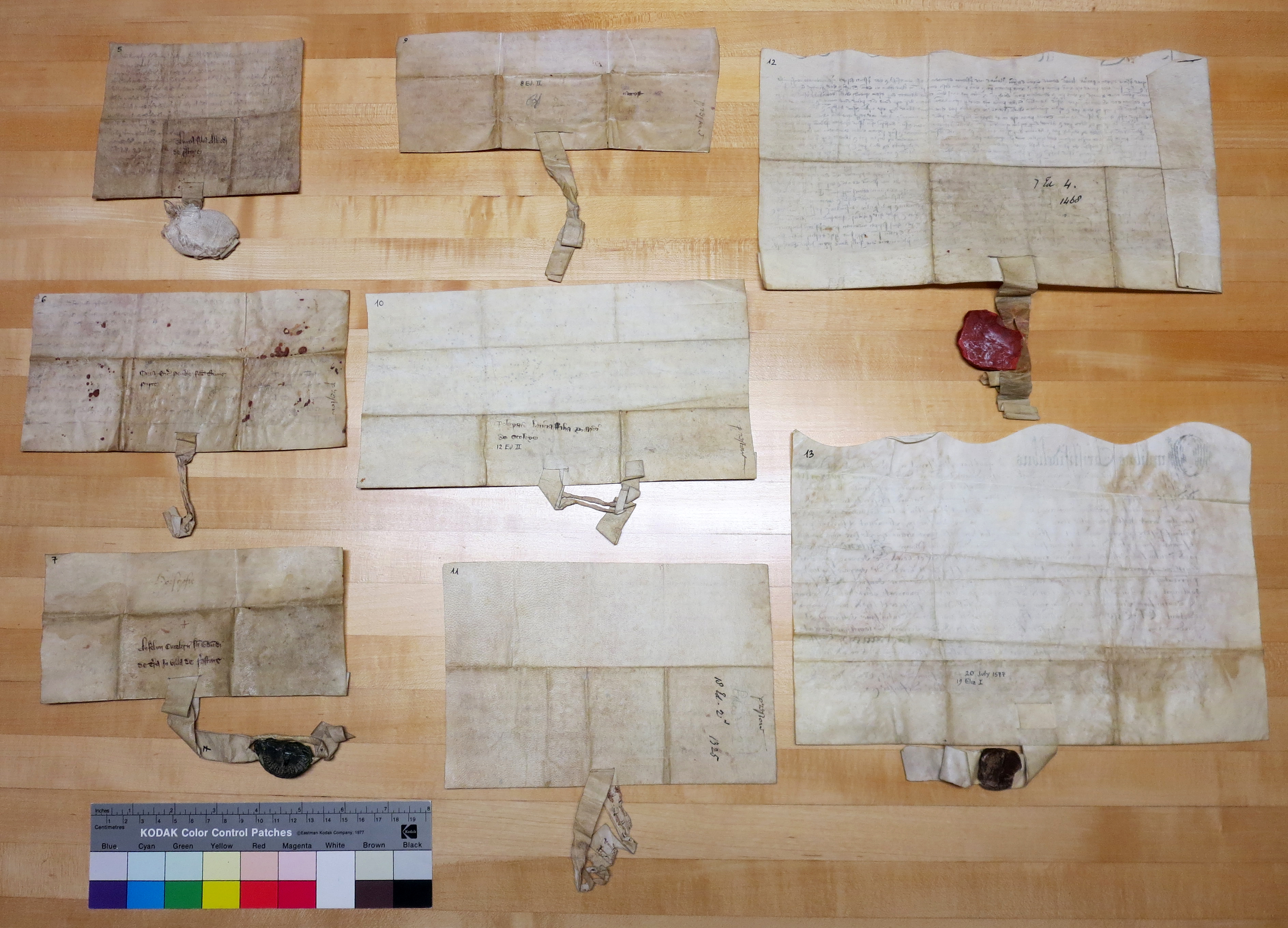
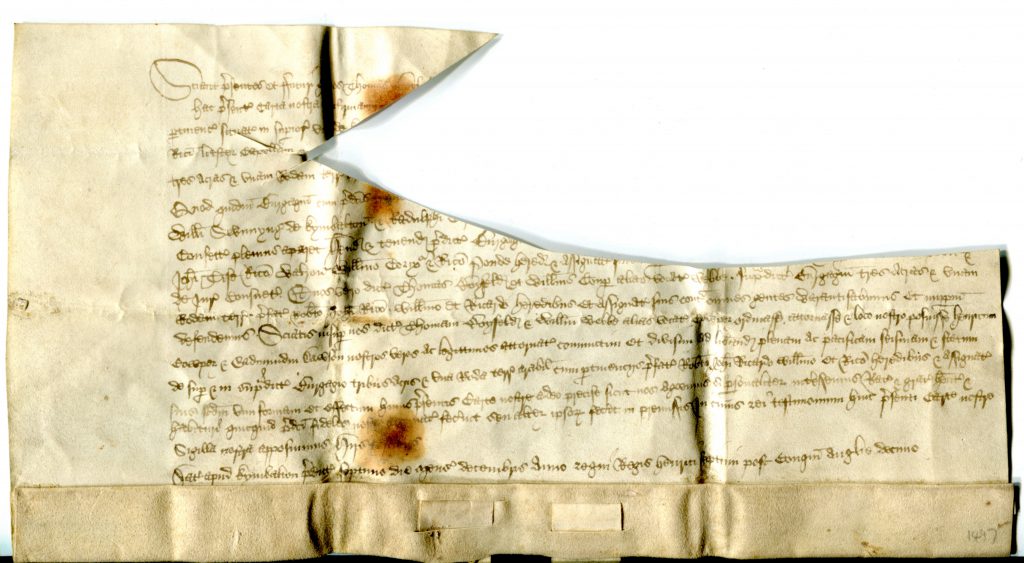
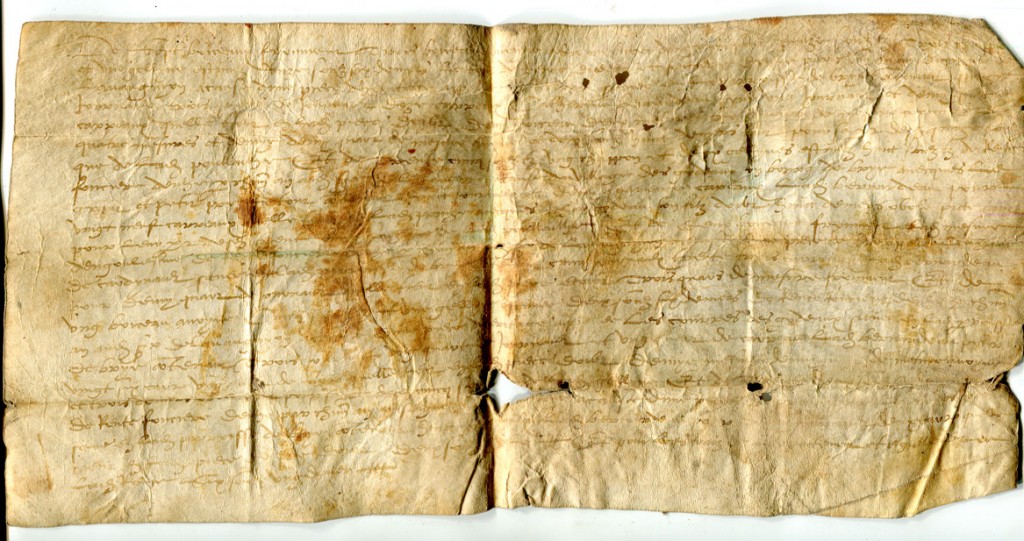
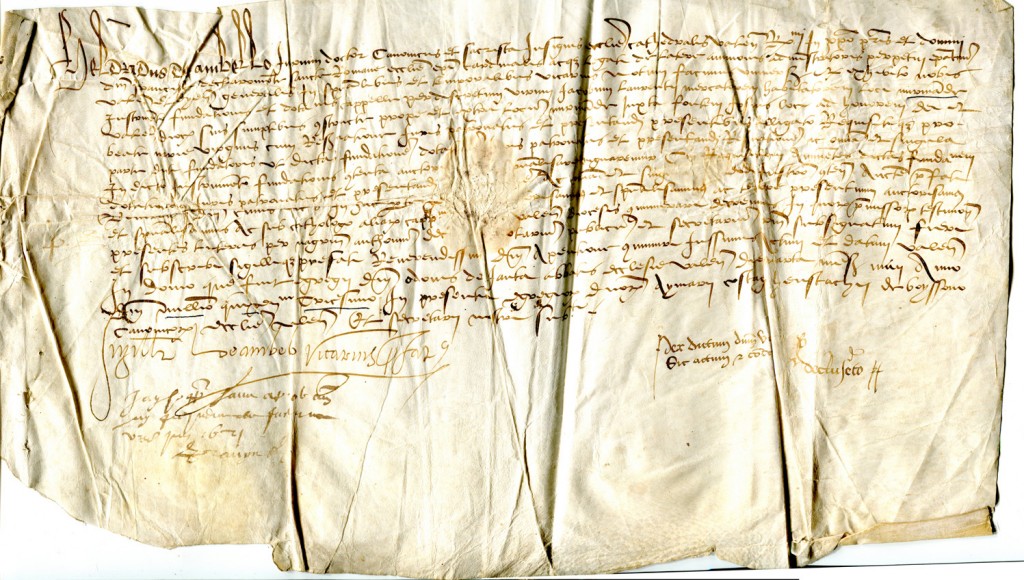
The large, single-sheet document now measures circa 58.4 cm × 34.1 cm (22 1/2 × 13″). Its size calls for photography in stages. Piecing together the images of the differently-folded pieces shows much of the whole, viewed from their faces. The undulating contour at the top corresponds with the chirographic approach to documents, as described and illustrated in our post on Preston Charters: The Chierographs. The wavy upper contours are made to match in a pair, to be cut from a single sheet, and matched-up later, if necessary to prove their equality as witnesses.
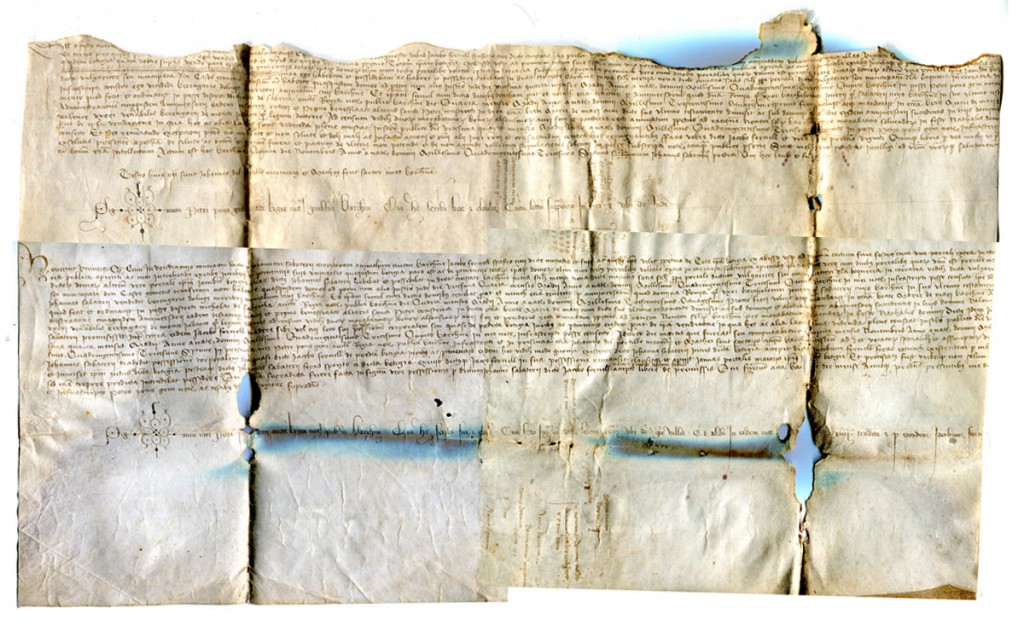
Bipartite Document of 1437 in Latin from Barcelona.
The ensemble comprises a still-joined, matching pair of records for a Sale in 1437 between 2 named ‘Transporters of Animals’ in the ‘City of Barcelona’. The pair of records would presumably have been intended for each of them, vendor and purchaser. Perhaps the sale was not effected, so that the documents had no cause for distribution?
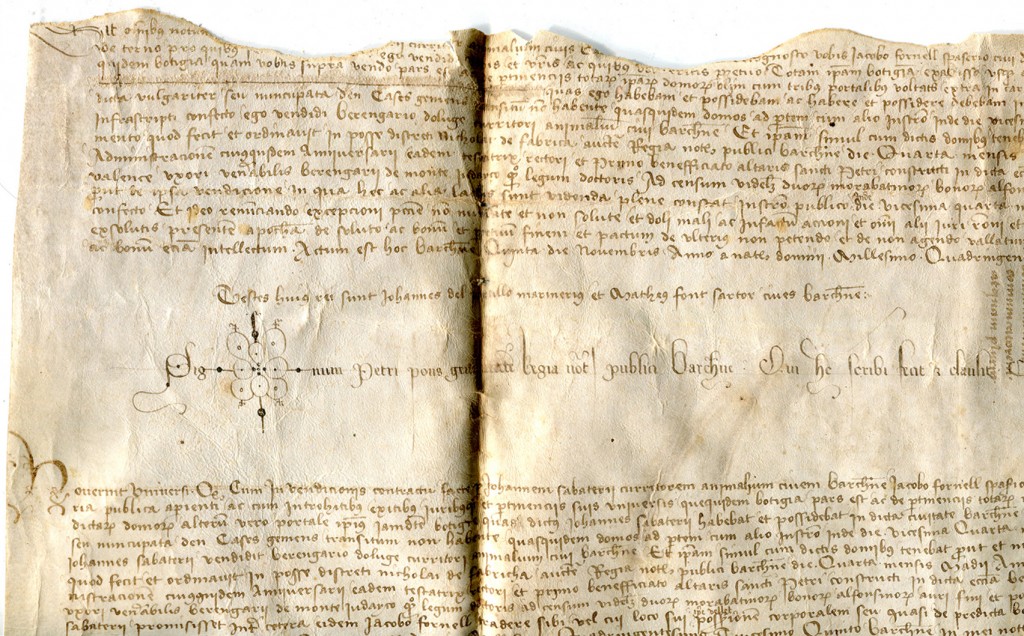
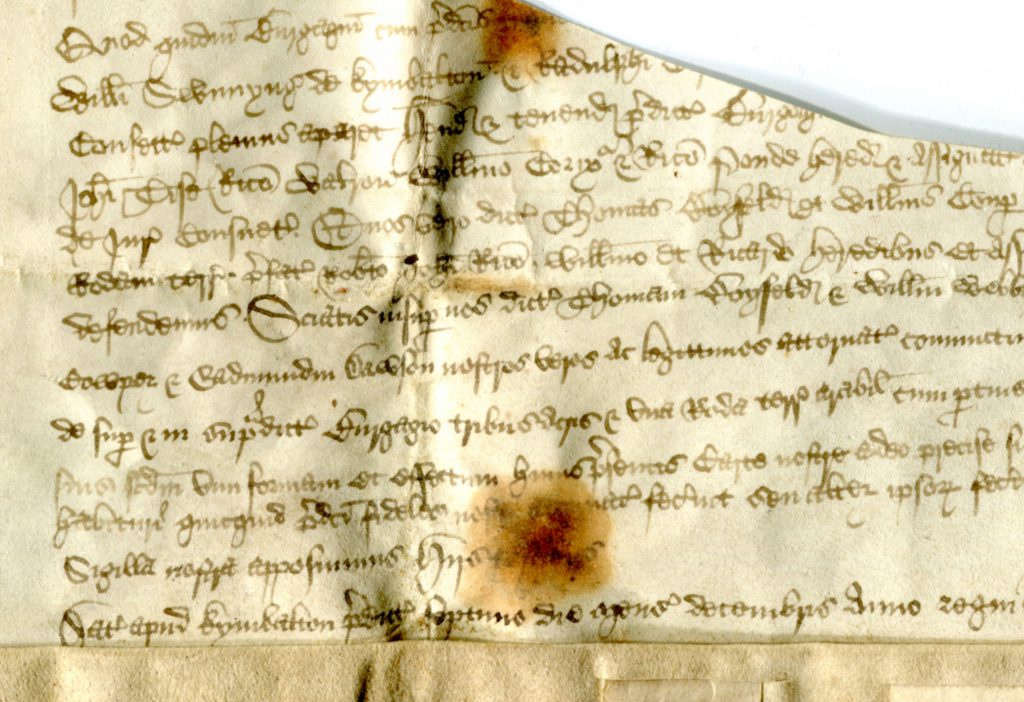
Private Collection, Bipartite Document of 1437 in Latin from Barcelona: Top Left.
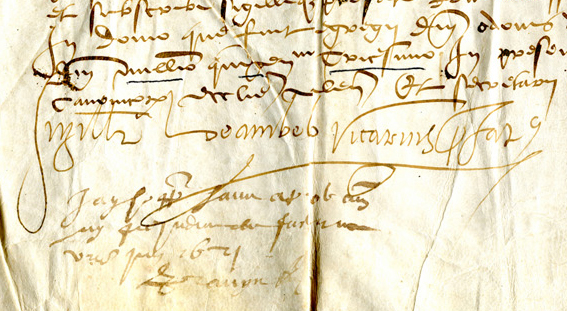
Both versions of the document have the notary’s name, signature, and nota. He was the notary Petrus Pons of Barcelona. His Nota in Version 1 of the document:
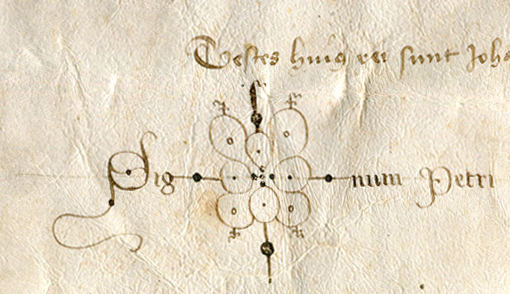
Bipartite Document of 1437 in Latin from Barcelona: Notarial Signature Version 1.
The Dorse
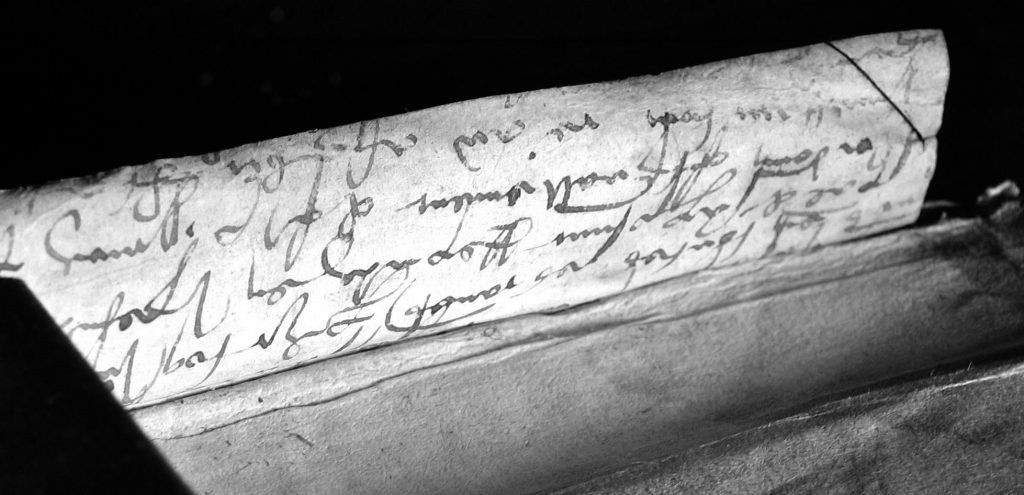
The ‘docketing’ or title on the dorse of the document names the register for which it served as cover. The dorse in full:
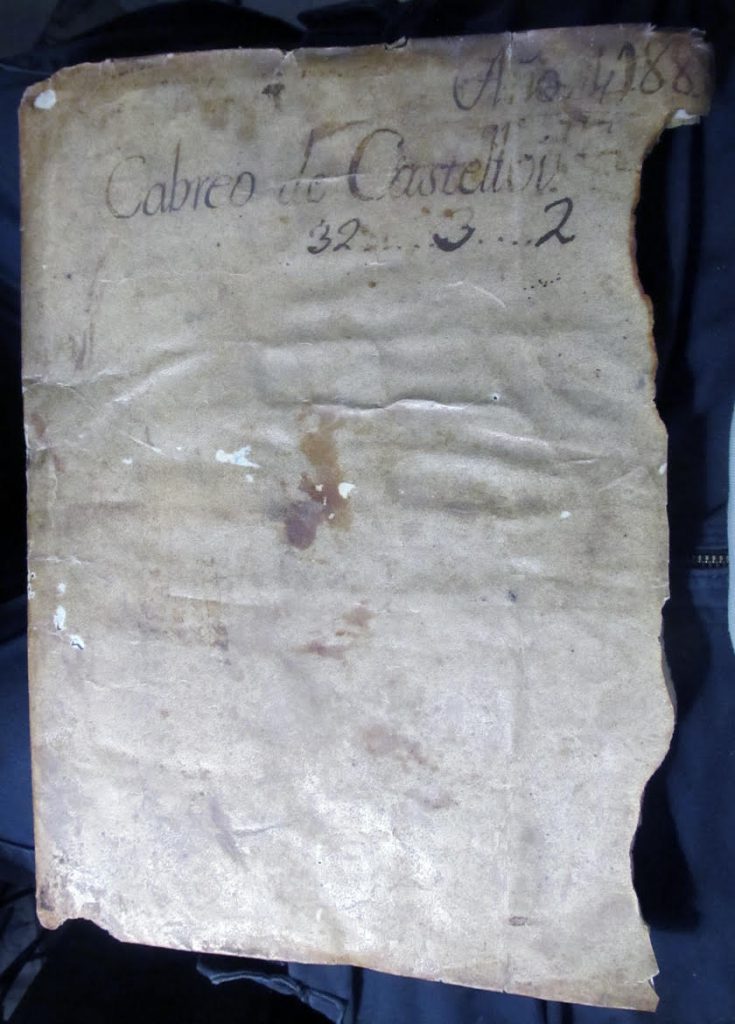
Private Collection, Document of 1437 from Barcelona, Dorse.
The Docketing and Annotations
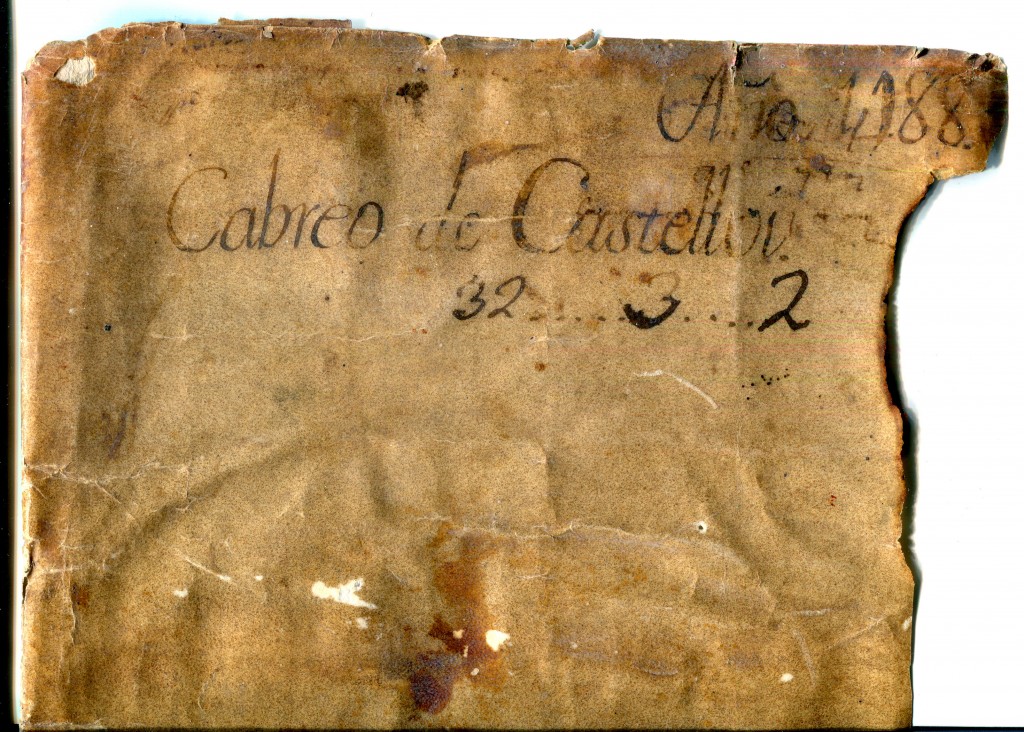
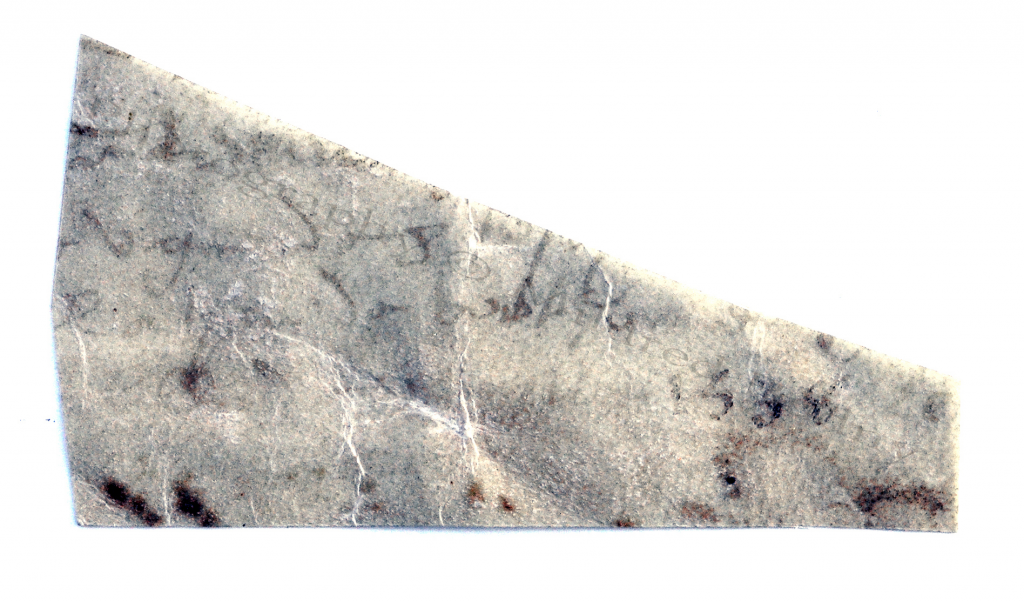
Bipartite of Document 1437 in Latin from Barcelona: Docketing on the Dorse.
Written in two stages in two different inks and by two or more different hands identifying the contents, the inscriptions state:
Añ[n]o 14.88.
Cabreo de Castellví.
32 . . . . 3 . . . . 2
That is,
Year 1488.
Cabreo of Castellví
32 . . . . 3 . . . . 2
(Thus we correct our earlier transcription and translation. Examination of leaves from the “Castle Cartulary” and their spellings of the place-names revises a view of the penultimate letter as v, and the stain over it as extraneous rather than integral, Here is another case of the ways in which deciphering by photographs might be hampered by the archaeological “layering” which the artefact itself might contain. A telling example of the power of such correctives: St Dunstan’s ‘Classbook’ and its Frontispiece: Dunstan’s Portrait and Autograph.)
Our earlier report on this document supposed that the castle in question was “presumably Montjuïc Castle“, whose building still stands, although its moat has been overplanted. It was said then that this identification “derives from other evidence pertaining to materials purchased from the same online source.”
But now, it seems much more likely that the castle in question can find its identity through association with the Catalan Castle Capbreu fragments, disbound and sold in batches by the same vendor, who had stated that a document of 1437 formed the former cover for them.
Montjuïc Castle was a royal fortress. This one was a small baronial castle.
So, which castle? That question calls for inspection of the texts on the leaves of the Fragments.
The ‘Castle Cartulary’ Leaves
Without having seen or studied most of the leaves in the Fragment, I attend to a few which demonstrate some of its characteristics.
The First Leaf
The first page of the fragment as now collected launches straight into a single transcribed document.
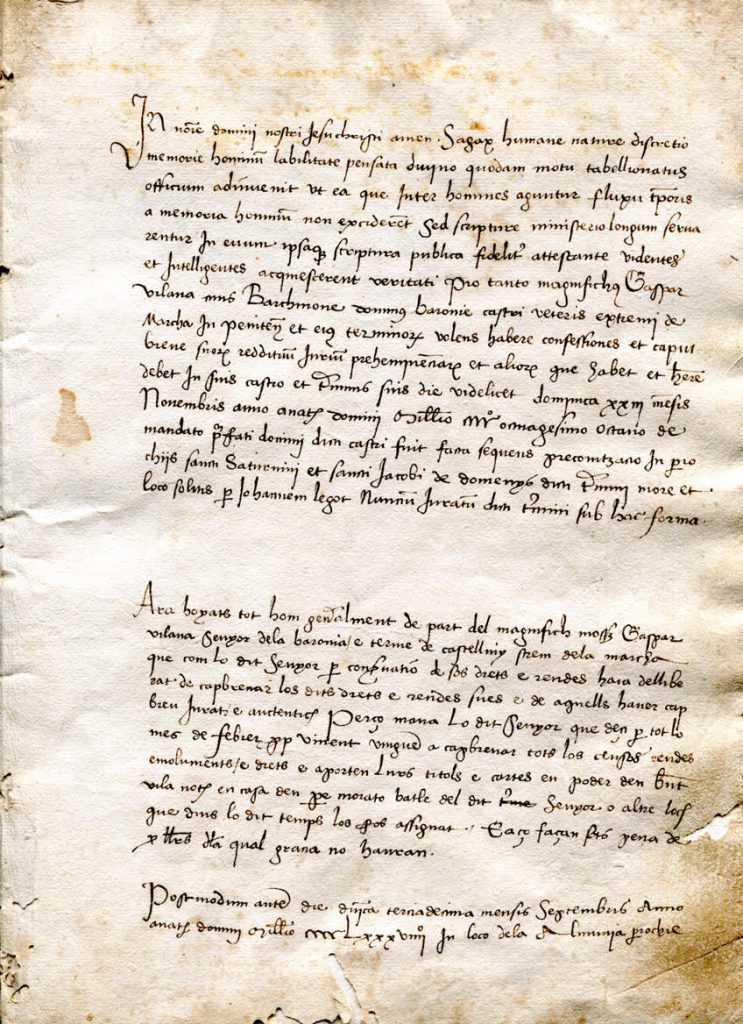
Private Collection, Castle Cartulary Fragment, Folio 1r / Page 1.
Set out in 3 paragraphs or sections of long lines in a single column, it carries text first in Latin and then in Catalan, followed by the 2-line dating clause in Latin its own section.
Upper portion: Latin
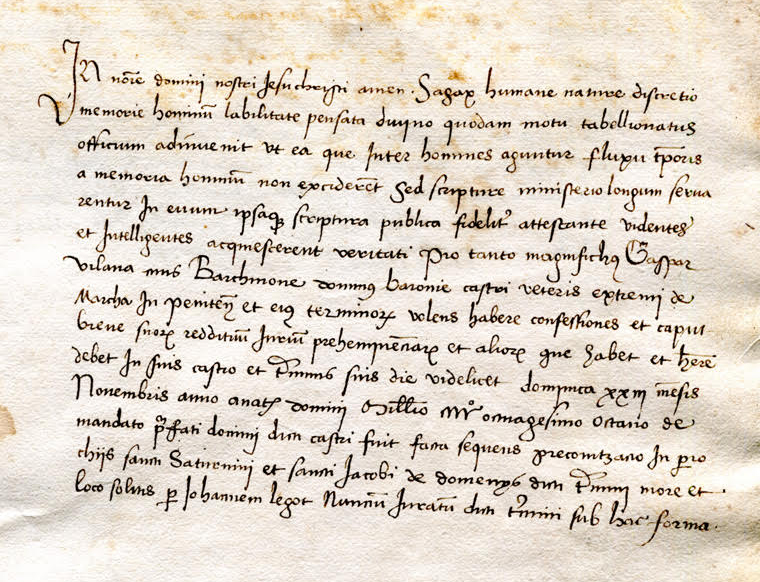
Private Collection, Castle Cartulary Fragment, Folio 1r / Page 1, Upper Portion.
Lower Portion: Catalan and Latin
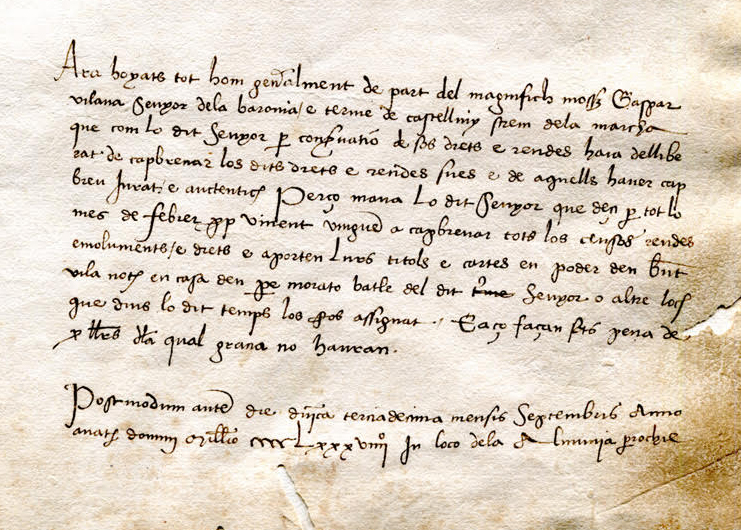
Private Collection, Castle Cartulary Fragment, Folio 1r / Page 1, Lower Portion.
Here is named bilingually
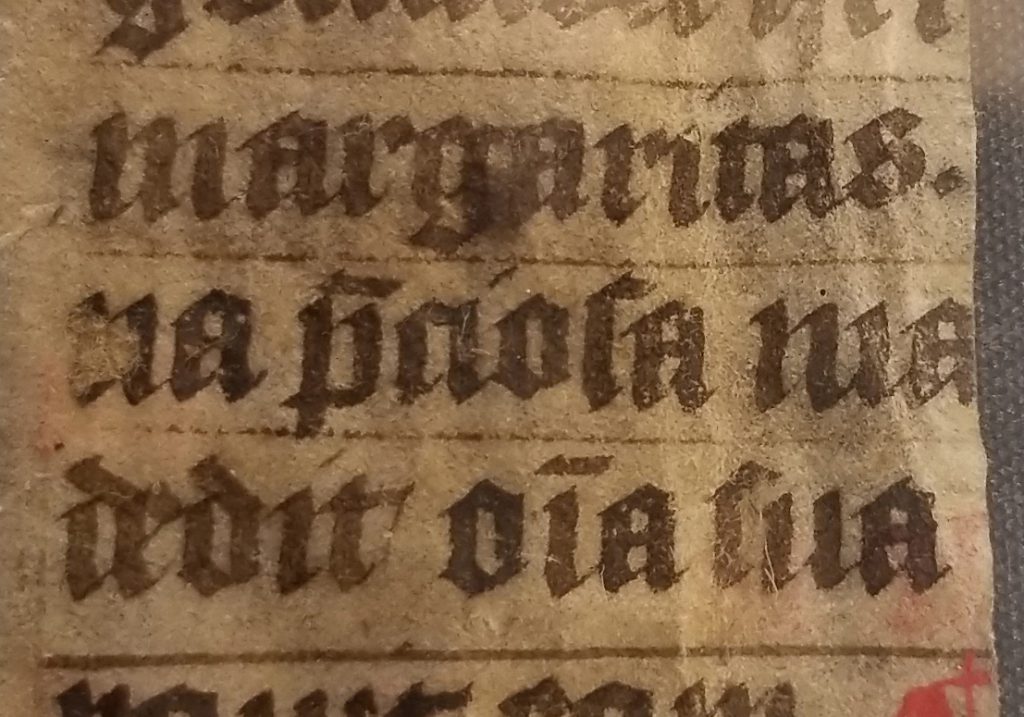
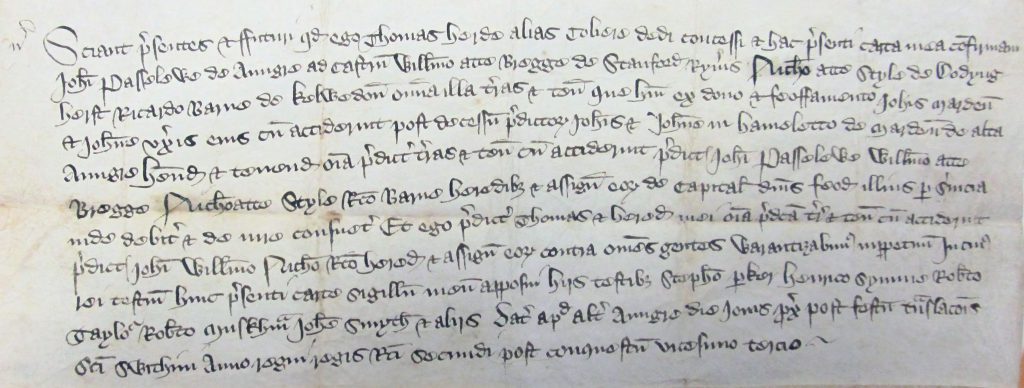
Gaspar vilana . . . Barchmone domini baronie castri veteris extremi di Marcha In peniten’ et eis terminorum . . . . In suis castro et terminis suis . . . (lines 6–8)
Gaspar vilana senyor dela baronia e terme de castellny strem della marcha . . . . (lines 15–16).
That might be:
“Gaspar Vilana, Lord of the Barony of the Old Castle (Castellvy) and its bounds, at the edge of the March in Peniten‘ “. Presumably the form Peniten’ indicates the (or a) Latin form for ‘Penedès’, expandable in some appropriate way.
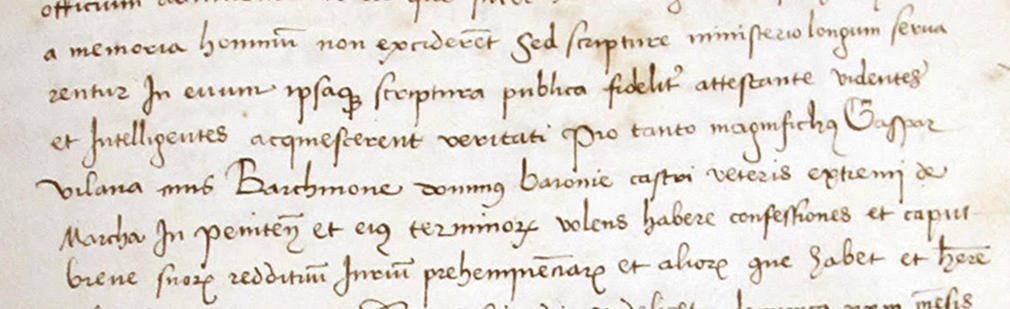
Private Collection, Spanish Castle Cartulary, Folio ‘1’r: Name in Latin.
Both Latin and Catalan sections refer to this lord’s caput / breue suorum redditum (lines 8–9) or cap/breu (lines 18–19). Namely: this very book.
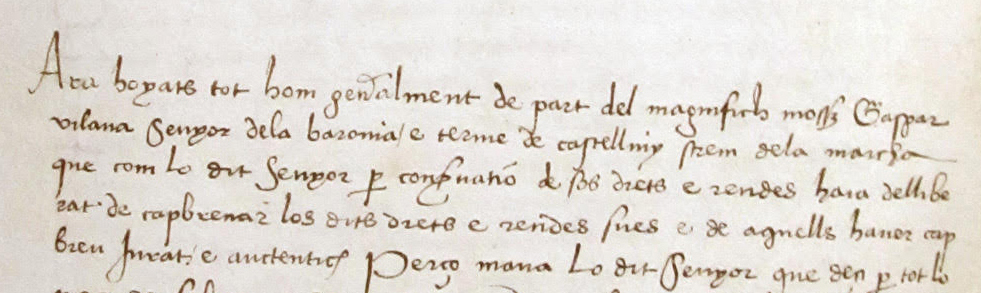
Private Collection, Spanish Castle Cartulary, Folio ‘1’r: Name in Catalan.
The dating clause also names the place: In loco dela Almunia perrochie . . . (“In the place of Almunia Parish”), at which point the text leads to the next page.
The Verso
The text continues to the top of the verso, on which the rest of the page remains blank. Again the Catalan, with a slight spelling variant, names Gaspar Vilana Senyor dela baronía e terme de castellniy strem dela marca.
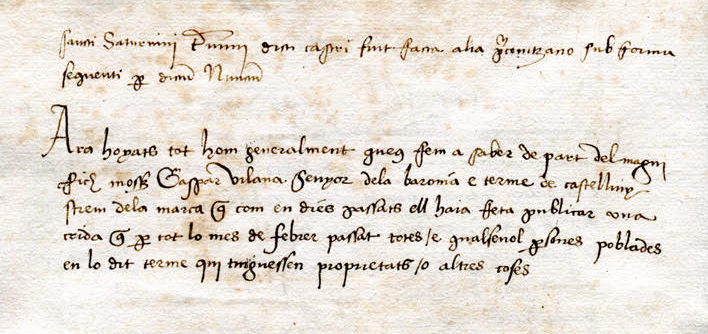
Private Collection, Spanish Castle Cartulary, Folio ‘1’v, top.
These reiterated appelations emphasize the location of the castle as the “old” one, strem dela marca. Provided that boundary “at the edge of the March” stood in or near a place still known as Penedès, it could be more closely located. Historically a border region within the county of Barcelona, and now within the Province of Catalonia, this region lies between the pre-coastal mountain-range and the Mediterranean Sea.
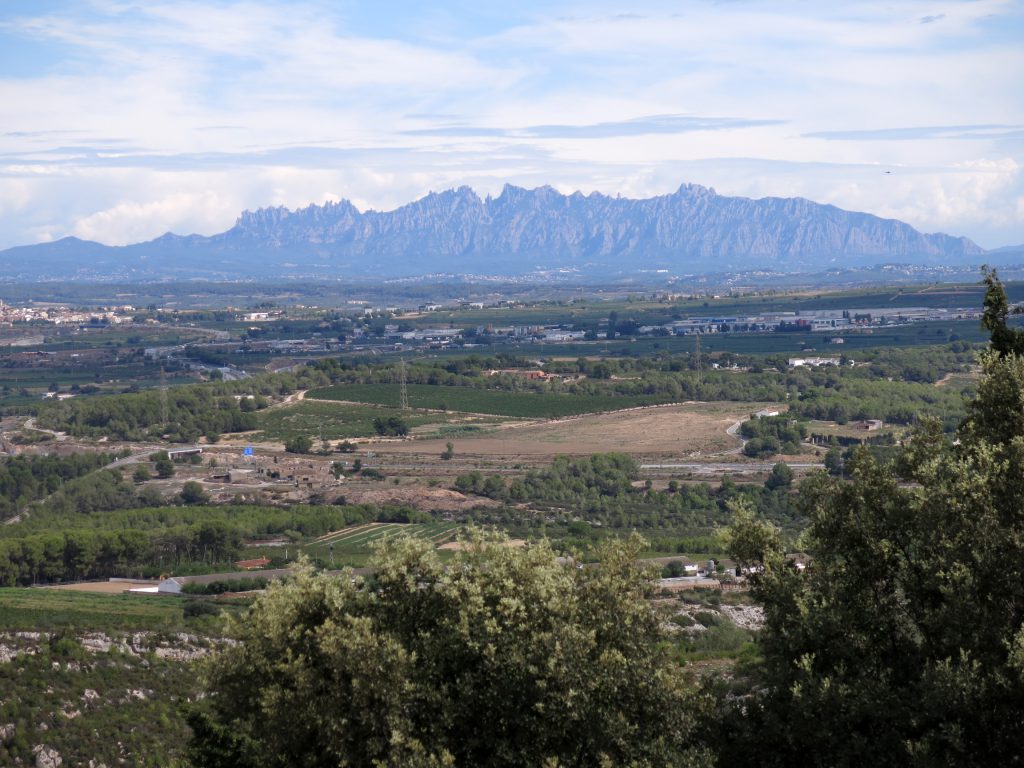
La plana del Penedès i Montserrat des del jaciment d’Olèrdola. Photograph (2015) by Enric, via Creative Commons.
Its sub-divisions include Alt Penedès and Baix Penedès. The capital of the former is Vilafranca del Penedès, which name also features in the texts of the Fragments.
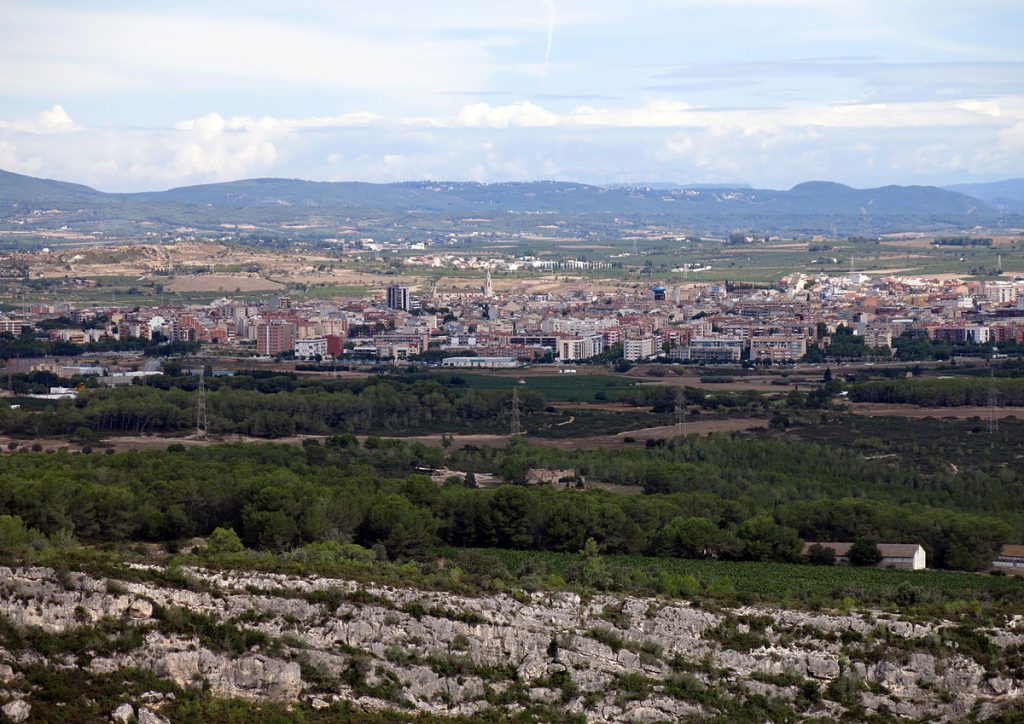
Vilafranca del Penedès des del jaciment d’Olèrdola. Photograph (2015) by Enric, via Creative Commons.
*****
Some Other Leaves
Another recto, copied by a different scribe, likewise set out in a single column.
Here, the second entry is written in smaller script of more densely packed lines. The principal paragraph includes some corrections, with horizontal cancelling lines, interlinear insertions, and a marginal entry.
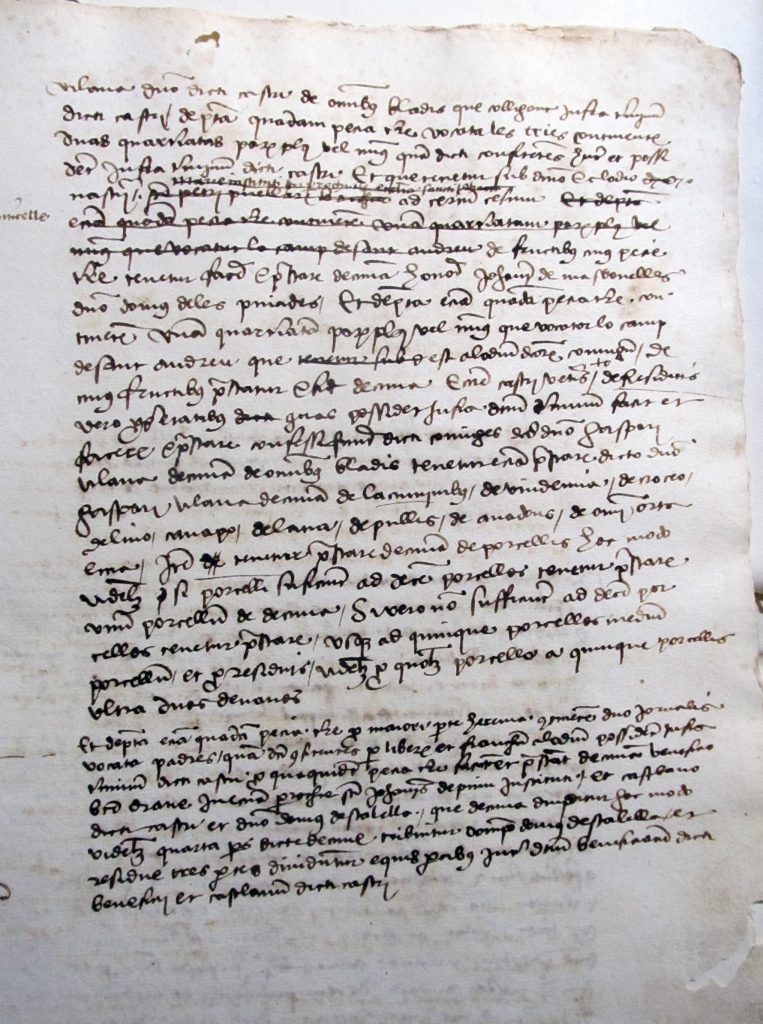
Private Collection, Castle Cartulary, Spain, Script Sample.
The text includes such words in Catalan as Vindemia (“Vintage” wines), de lana (“of wool”), de anadous (“of ducklings”), and gelino, perhaps for gallina (“hen”). It may present a list of things owned, or owed, in a form of inventory.
A Verso, partly filled with script:
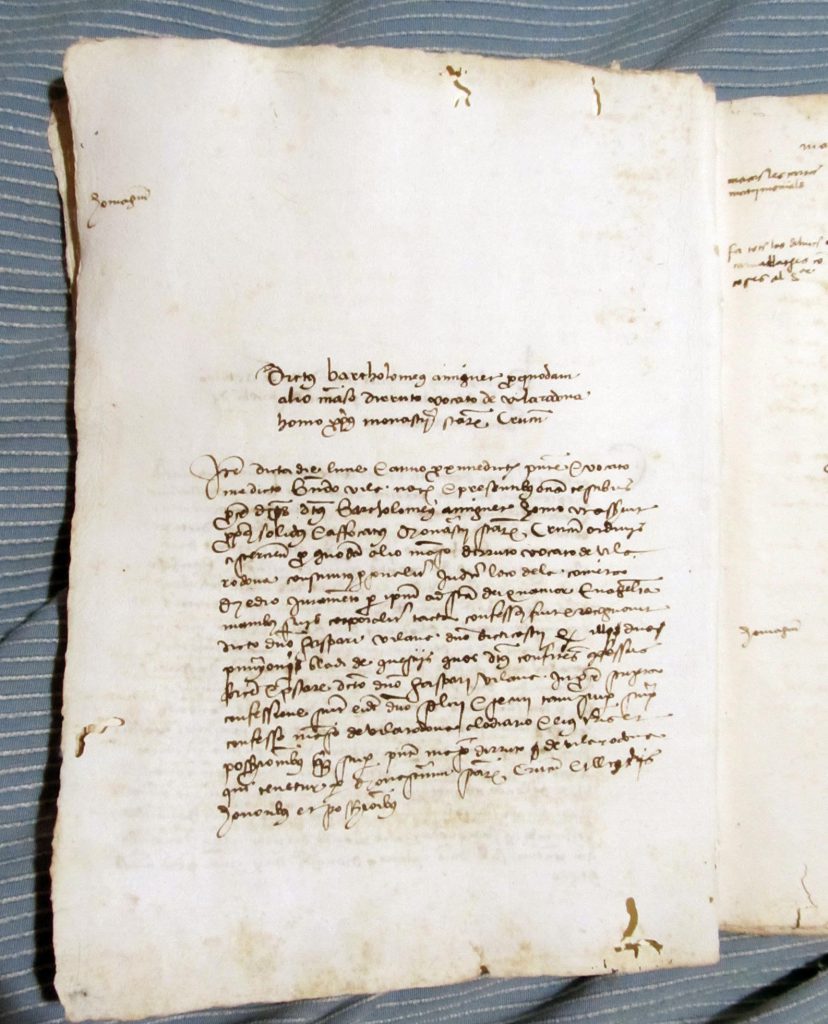
Private Collection, Spanish Castle Cartulary, Part-Filled Verso.
A closer view of the script:
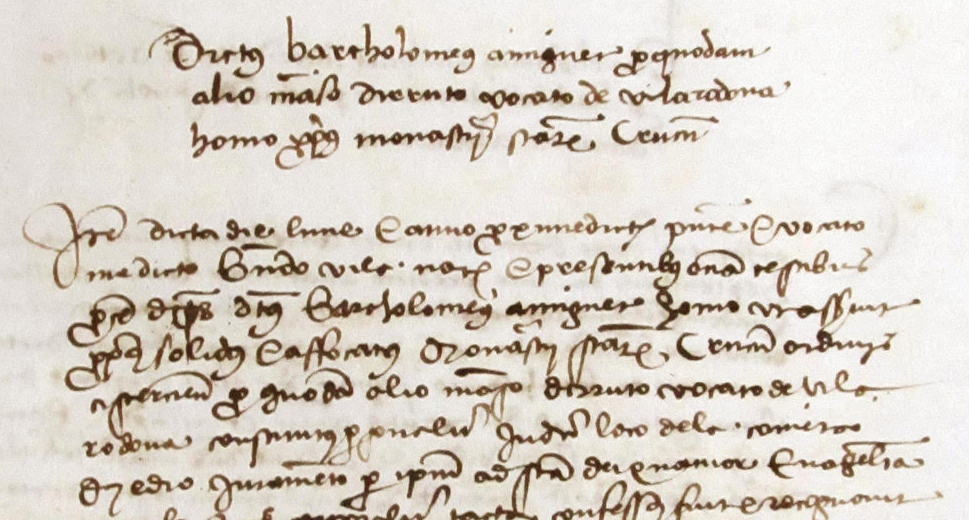
Private Collection, Spanish Castle Cartulary, Part-Filled Verso, Detail: Script.
The inserted, folded sheet
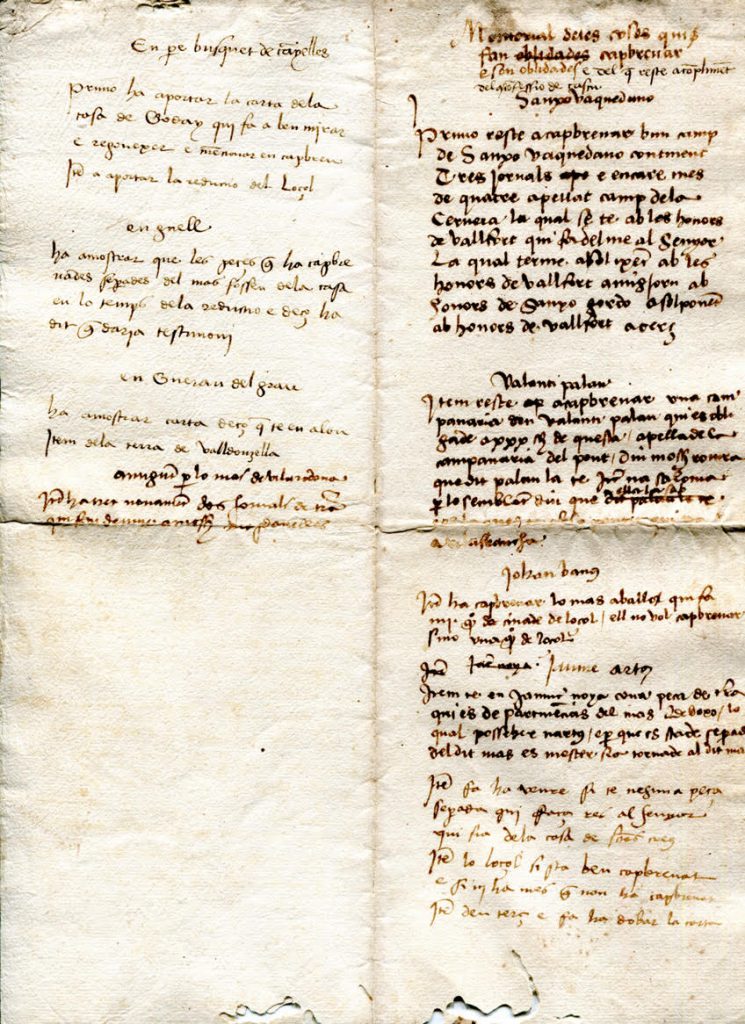
Private Collection, Castle Cartulary Fragment, Inserted Folded Sheet, Opened.
A heading, partly altered, beginning Memorial . . .
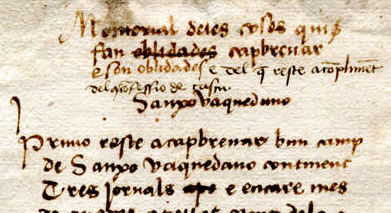
Private Collection, Castle Cartulary Fragment, Inserted Folded Sheet, Opened: Top Right.
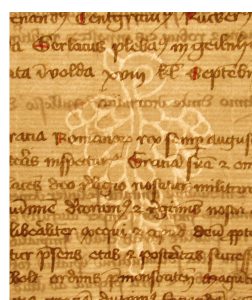
The Watermark: Architectural Column Surmounted by a Simple Latin Cross
The fragment has consistent watermarks of an upright architectural column topped by a cross. The cross is formed of single lines. In the Latin version of the cross, its stem is longer than its crossbar. With a single contour, the column comprises a stacked pile of 8 segments, variously oval, rectangular, sub-rectangular, and other, with a cushion-like segment with rounded sides at top and bottom.
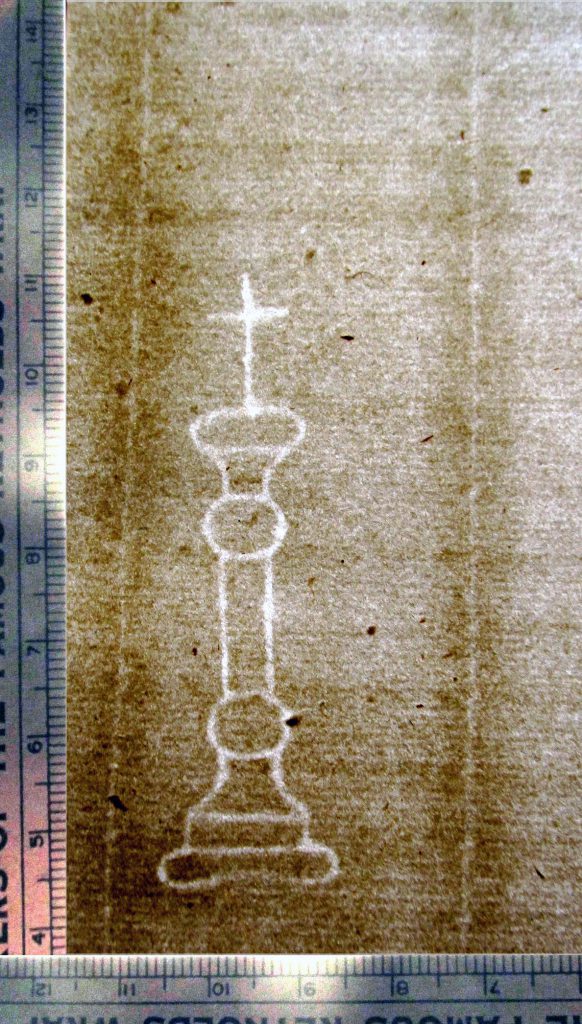
Private Collection, Castle Cartulary, Spain, Watermark of a Column.
In the monumental printed resource on watermarks assembled by Charles M. Briquet in the volumes of Les Filigranes: Dictionnaire historique des marques du papier dès leur apparition vers 1282 jusqu’en 1600 (Paris etc., 1907), available as Briquet Online, this specimen belongs to his group of watermarks known as Colonne | surmontée d’une croix. Among them, this version corresponds to Briquet number 4361, with sightings in materials dated or datable to “Narbonne 1488″ etc., as Briquet cited here.
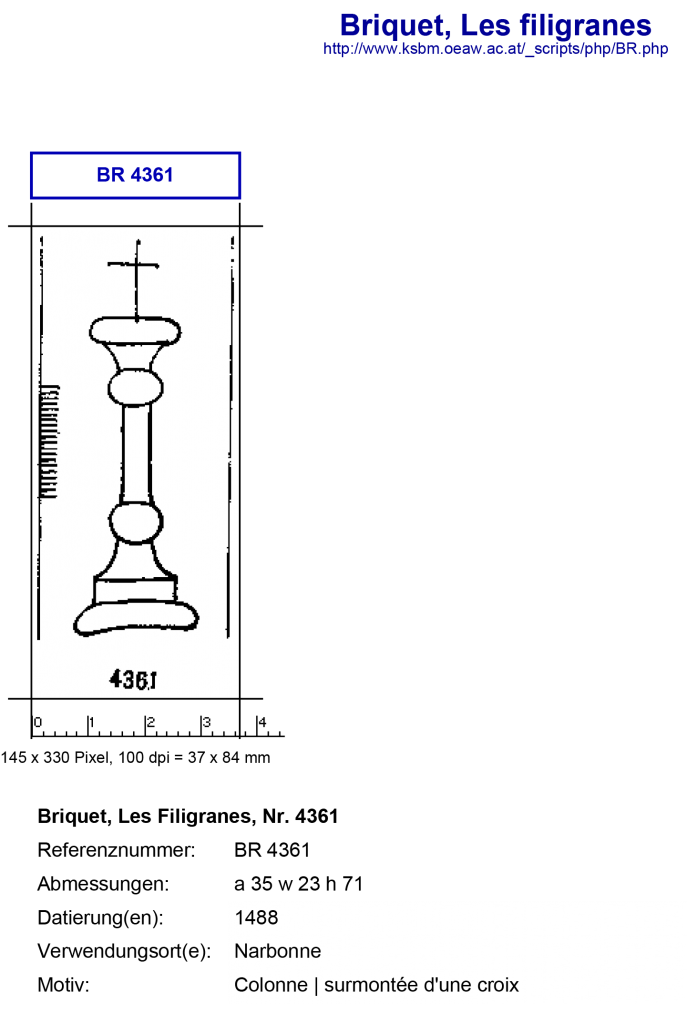
Briquet 4361 Colonne.
The “find-place” of the watermark, that is, on a set of leaves carrying handwritten documentary materials in book form, includes dated entries for certain months of a single year, 1489, and for a given place and its region, at or near Barcelona. This case deserves to be counted among the “sightings” of the watermark as recognized by Briquet.
Private Collection, Castle Cartulary Fragment, Folio 1r / Page 1, Upper Portion.
This Specimen now joins our Gallery of Specimens for Watermarks & the History of Paper.
*****
Piecing together the fragments of evidence which the dispersed parts of the Capbreu (or Terrier) from Castellví — somewhere in Barcelona, apparently the one at Alt Penedès — might currently offer to view, it is possible to glean some shreds of information that might reveal its former nature, home, scope, and some of the individuals who contributed to it.
Perhaps more information might come to light from the other parts of the book and the seller’s notes. The images here make a start toward recognizing the characteristics of this manuscript witness.
*****
Do you know of other leaves from this Castle Capbreu? Do you recognize these scribes in other manuscripts? Do you know of other “find-places” for this version of a watermark of a Cross-Topped Column?
Do you have comments or suggestions?
Please offer your Comments here, Contact Us, or our Facebook Page. We look forward to hearing from you.
*****
More to Come. Follow our blog, and check its Contents List for more discoveries.
*****



![Boston Public Library, Map of "Essex actually surveyed with the several Roads from London, etc." (London [1678]), Image via Public Domain.](https://manuscriptevidence.org/wpme/wp-content/uploads/2020/05/commonwealth_ww72bp422_productionMaster-at-180-dpi-1024x814.jpg)
![Boston Public Library, Map of "Essex actually surveyed with the several Roads from London, etc." (London [1678]), Detail of Ongar Hundred. Image via Public Domain.](https://manuscriptevidence.org/wpme/wp-content/uploads/2020/05/commonwealth_ww72bp422_productionMaster-to-Ongar-Hundred-897x1024.jpg)