• News
    • News & Views
    • RGME Activities for 2024 and 2025
    • Around & About with the RGME
    • Reviews
    • Highlights
  • Blogs
    • Manuscript Studies
      • Manuscript Studies: Contents List
    • International Congress on Medieval Studies
      • Abstracts of Congress Papers
        • Abstracts of Papers Listed by Author
        • Abstracts of Papers Listed by Year
  • About
    • Mission
    • Who We Are
      • Officers, Associates & Volunteers
      • RGME Committees
      • Friends of the Research Group on Manuscript Evidence
    • Policies & Statements
      • RGME Privacy Policy Statement
      • RGME Intellectual Property Statement & Agreements
    • People
      • Mildred Budny — Her Page
      • Adelaide Bennett Hagens
    • Activities
      • Events
      • Congress Activities
        • Sponsored Conference Sessions (1993‒)
          • Panels at the M-MLA Convention (from 2016)
        • Co-sponsored Conference Sessions (2006‒)
    • History
      • Seals, Matrices & Documents
      • Genealogies & Archives
    • Contact Us
  • Bembino
    • Multi-Lingual Bembino
    • RGME Bembino: Resources
  • Congress
    • Sponsored Conference Sessions (1993‒)
    • Co-sponsored Conference Sessions (2006‒)
    • Abstracts of Congress Papers
      • Abstracts Listed by Author
      • Abstracts Listed by Year
    • Kalamazoo Archive
    • Panels at the M-MLA Convention (2016-2019)
      • Abstracts of Papers for the M-MLA Convention
      • Panels at the M-MLA Convention (from 2016)
  • Events
    • RGME Activities for 2024 and 2025
      • 2023 Activities and 2024 Planned Activities
    • Seminars, Workshops, Colloquia & Symposia (1989–)
      • Seminars on ‘The Evidence of Manuscripts’
      • Symposia on ‘The Transmission of the Bible’
      • The New Series (2001-)
        • 2019 Anniversary Symposium Program: The Roads Taken
        • 2019 Anniversary Symposium Registration
        • 2019 Anniversary Symposium Registration Open
      • RGME Symposia: The Various Series
      • The Research Group Speaks: The Series
      • Meetings of the Friends of the Research Group on Manuscript Evidence
      • RGME Online Events
    • Abstracts of Papers for Events
      • Abstracts of Papers for Seminars on ‘The Evidence of Manuscripts’
      • Abstracts of Papers for Symposia, Workshops & Colloquia
    • Receptions & Parties
    • Business Meetings
    • Photographic Exhibitions & Master Classes
    • Events Archive
  • ShelfLife
    • Journal Description
    • ShelfMarks: The RGME-Newsletter
    • Publications
      • “Insular, Anglo-Saxon, and Early Anglo-Norman Manuscript Art at Corpus Christi College, Cambridge” (1997)
        • Mildred Budny, ‘Catalogue’
        • The Illustrated Catalogue (1997)
      • The Illustrated Handlist
      • Semi-Official Counterfeiting in France 1380-1422
      • No Snap Decisions: Challenges of Manuscript Photography
    • History and Design of Our Website
  • Galleries
    • Watermarks & the History of Paper
    • Galleries: Contents List
    • Scripts on Parade
    • Texts on Parade
      • Latin Documents & Cartularies
      • New Testament Leaves in Old Armenian
    • Posters on Display
    • Layout Designs
  • Donations and Contributions
    • RGME Donor Promise
    • 2023 End-of-Year Fundraiser for our 2024 Anniversary Year
    • 2019 Anniversary Appeal
    • Orders
  • Links
    • Catalogs, Metadata, and Databases: A Handlist of Links
    • Handlist of Resources for Manuscript Studies and Fragmentology
    • Manuscripts & Rare Books
    • Maps, Plans & Drawings
    • Seals, Seal-Matrices & Documents

  • News
    • News & Views
    • RGME Activities for 2024 and 2025
    • Around & About with the RGME
    • Reviews
    • Highlights
  • Blogs
    • Manuscript Studies
      • Manuscript Studies: Contents List
    • International Congress on Medieval Studies
      • Abstracts of Congress Papers
        • Abstracts of Papers Listed by Author
        • Abstracts of Papers Listed by Year
  • About
    • Mission
    • Who We Are
      • Officers, Associates & Volunteers
      • RGME Committees
      • Friends of the Research Group on Manuscript Evidence
    • Policies & Statements
      • RGME Privacy Policy Statement
      • RGME Intellectual Property Statement & Agreements
    • People
      • Mildred Budny — Her Page
      • Adelaide Bennett Hagens
    • Activities
      • Events
      • Congress Activities
        • Sponsored Conference Sessions (1993‒)
          • Panels at the M-MLA Convention (from 2016)
        • Co-sponsored Conference Sessions (2006‒)
    • History
      • Seals, Matrices & Documents
      • Genealogies & Archives
    • Contact Us
  • Bembino
    • Multi-Lingual Bembino
    • RGME Bembino: Resources
  • Congress
    • Sponsored Conference Sessions (1993‒)
    • Co-sponsored Conference Sessions (2006‒)
    • Abstracts of Congress Papers
      • Abstracts Listed by Author
      • Abstracts Listed by Year
    • Kalamazoo Archive
    • Panels at the M-MLA Convention (2016-2019)
      • Abstracts of Papers for the M-MLA Convention
      • Panels at the M-MLA Convention (from 2016)
  • Events
    • RGME Activities for 2024 and 2025
      • 2023 Activities and 2024 Planned Activities
    • Seminars, Workshops, Colloquia & Symposia (1989–)
      • Seminars on ‘The Evidence of Manuscripts’
      • Symposia on ‘The Transmission of the Bible’
      • The New Series (2001-)
        • 2019 Anniversary Symposium Program: The Roads Taken
        • 2019 Anniversary Symposium Registration
        • 2019 Anniversary Symposium Registration Open
      • RGME Symposia: The Various Series
      • The Research Group Speaks: The Series
      • Meetings of the Friends of the Research Group on Manuscript Evidence
      • RGME Online Events
    • Abstracts of Papers for Events
      • Abstracts of Papers for Seminars on ‘The Evidence of Manuscripts’
      • Abstracts of Papers for Symposia, Workshops & Colloquia
    • Receptions & Parties
    • Business Meetings
    • Photographic Exhibitions & Master Classes
    • Events Archive
  • ShelfLife
    • Journal Description
    • ShelfMarks: The RGME-Newsletter
    • Publications
      • “Insular, Anglo-Saxon, and Early Anglo-Norman Manuscript Art at Corpus Christi College, Cambridge” (1997)
        • Mildred Budny, ‘Catalogue’
        • The Illustrated Catalogue (1997)
      • The Illustrated Handlist
      • Semi-Official Counterfeiting in France 1380-1422
      • No Snap Decisions: Challenges of Manuscript Photography
    • History and Design of Our Website
  • Galleries
    • Watermarks & the History of Paper
    • Galleries: Contents List
    • Scripts on Parade
    • Texts on Parade
      • Latin Documents & Cartularies
      • New Testament Leaves in Old Armenian
    • Posters on Display
    • Layout Designs
  • Donations and Contributions
    • RGME Donor Promise
    • 2023 End-of-Year Fundraiser for our 2024 Anniversary Year
    • 2019 Anniversary Appeal
    • Orders
  • Links
    • Catalogs, Metadata, and Databases: A Handlist of Links
    • Handlist of Resources for Manuscript Studies and Fragmentology
    • Manuscripts & Rare Books
    • Maps, Plans & Drawings
    • Seals, Seal-Matrices & Documents

Log in

Archives

Featured Posts

Episode 24. “Life with Books” (Interview with John Windle)
Announcing the Launch of RGME Bembino WP
2026 RGME Colloquium at The Grolier Club: Report
Medieval Missal Fragment as Early-Modern Cover
The Weber Leaf from Ege MS 61
"Bembino" Booklet Cover
Episode 23. “Meet RGME Bembino: Facets of a Font”
2026 RGME Colloquium on “Transformations & Renewals” at The Grolier Club
2026 Theme of the Year: “Transformations and Renewals”
A Leaf with Patchwork from the Saint Albans Bible
A Sister Leaf from a Miniature Latin Vulgate Bible
A Little Latin Vulgate Bible Manuscript Leaf in Princeton
J. S. Wagner Collection. Leaf from from Prime in a Latin manuscript Breviary. Folio 4 Verso, with part of Psalm 117 (118) in the Vulgate Version, set out in verses with decorated initials.
2026 Annual Appeal
Episode 22: “Encounters with Local Saints and Their Cults”
Private Collection, Ege's FBNC Portfolio, Dante Leaf, Verso, Detail. Reproduced by Permission.
2025 RGME Autumn Colloquium on Fragments
Workshop 8: A Hybrid Book where Medieval Music Meets Early-Modern Herbal
2025 RGME Autumn Symposium on “Readers, Fakers, and Re-Creators of Books”
RGME Workshops on “The Evidence of Manuscripts, Etc.”
2025 International Medieval Congress at Leeds: RGME Program
Episode 21. “Learning How to Look”
2025 International Congress on Medieval Studies: Program
2025 RGME Visit to Vassar College
Two Leaves in the Book of Numbers from the Chudleigh Bible
Delibovi on Glassgold on Boethius: A Blogpost
Ronald Smeltzer on “Émilie du Châtelet, Woman of Science”
2025 Spring Symposium: “Makers, Producers, and Collectors of Books”
Starters’ Orders
The Weber Leaf from the Saint Albans Bible
Workshop 4. “Manuscript Fragments Compared”
Episode 20. “Comic Book Theory for Medievalists”
Episode 19: “At the Gate: Starting the Year 2025 at its Threshold”
Favorite Recipes for Lemonade, Etc.
RGME Visit to the Lomazow Collection: Report
2024 Autumn Symposium: “At the Helm”
A Latin Vulgate Leaf of the Book of Numbers
The RGME ‘Lending Library’
Florence, Italy, Ponte Vecchio from Ponte alle Grazie. Photo: Ingo Mehling, CC BY-SA 4.0 , via Wikimedia Commons
Episode 17. “RGME Retrospect and Prospects: Anniversary Reflections”
2024 Anniversary Symposium: The Booklet
Jesse Hurlbut at the Bonneville Salt Flats, Utah. Photograph Jesse Hurlbut.
Episode 16: An Interview with Jesse D. Hurlbut
To Whom Do Manuscripts Belong?
Kalamazoo, MI Western Michigan University, Valley III from the side. Photograph: David W. Sorenson.
2024 International Congress on Medieval Studies: Report
2024 Spring Symposium at Vassar College
Puente de San Martín: Bridge with reflection over the River Targus, Toledo, Spain.
2024 Grant for “Between Past and Future” Project from The Gladys Krieble Delmas Foundation Research Libraries Program
2024 Anniversary Symposium in Thanks to Jesse Hurlbut: Program

You are browsing the Blog for Otto F. Ege

Update for 2016 Symposium Booklet

October 15, 2016 in Abstracts of Conference Papers, Announcements

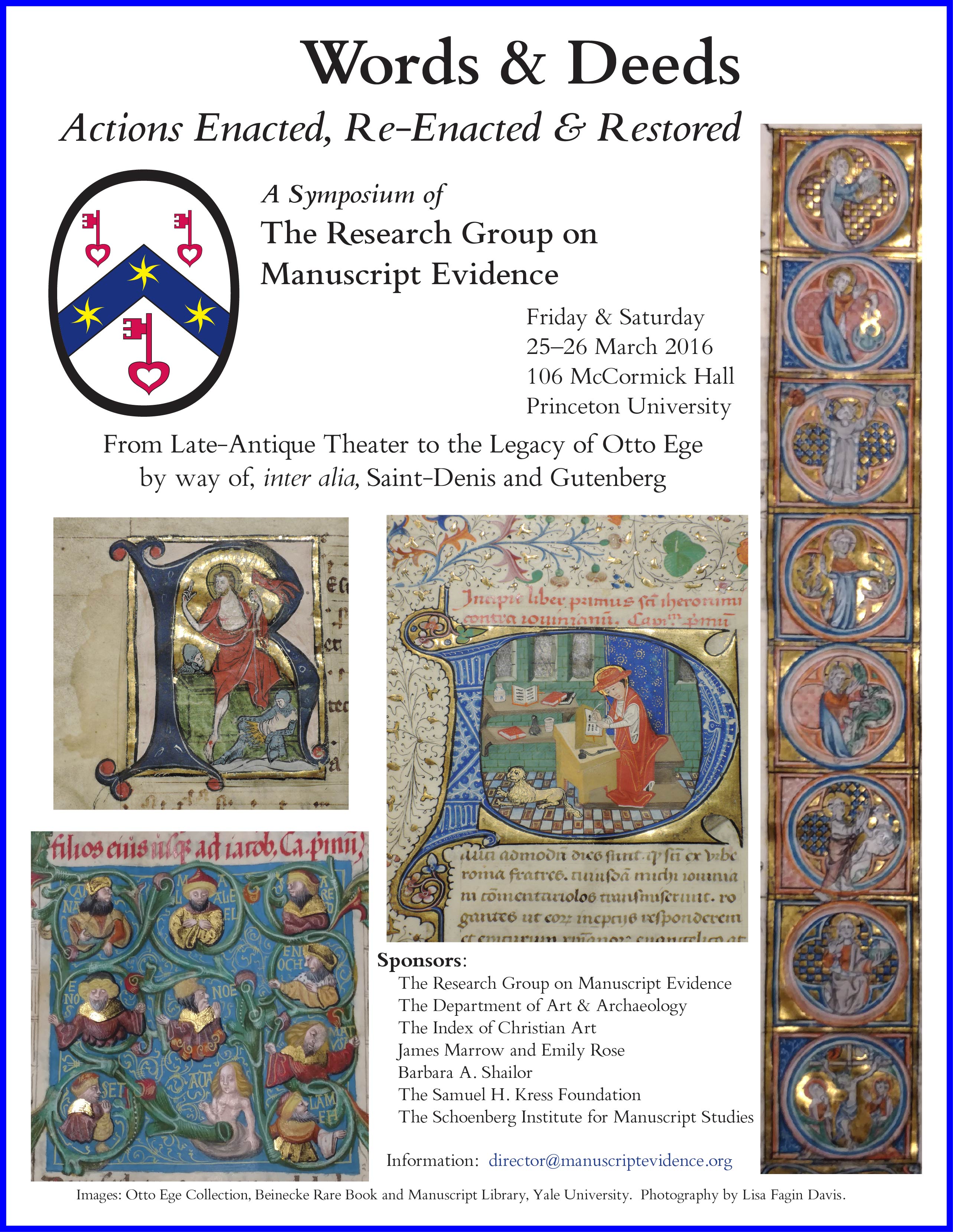
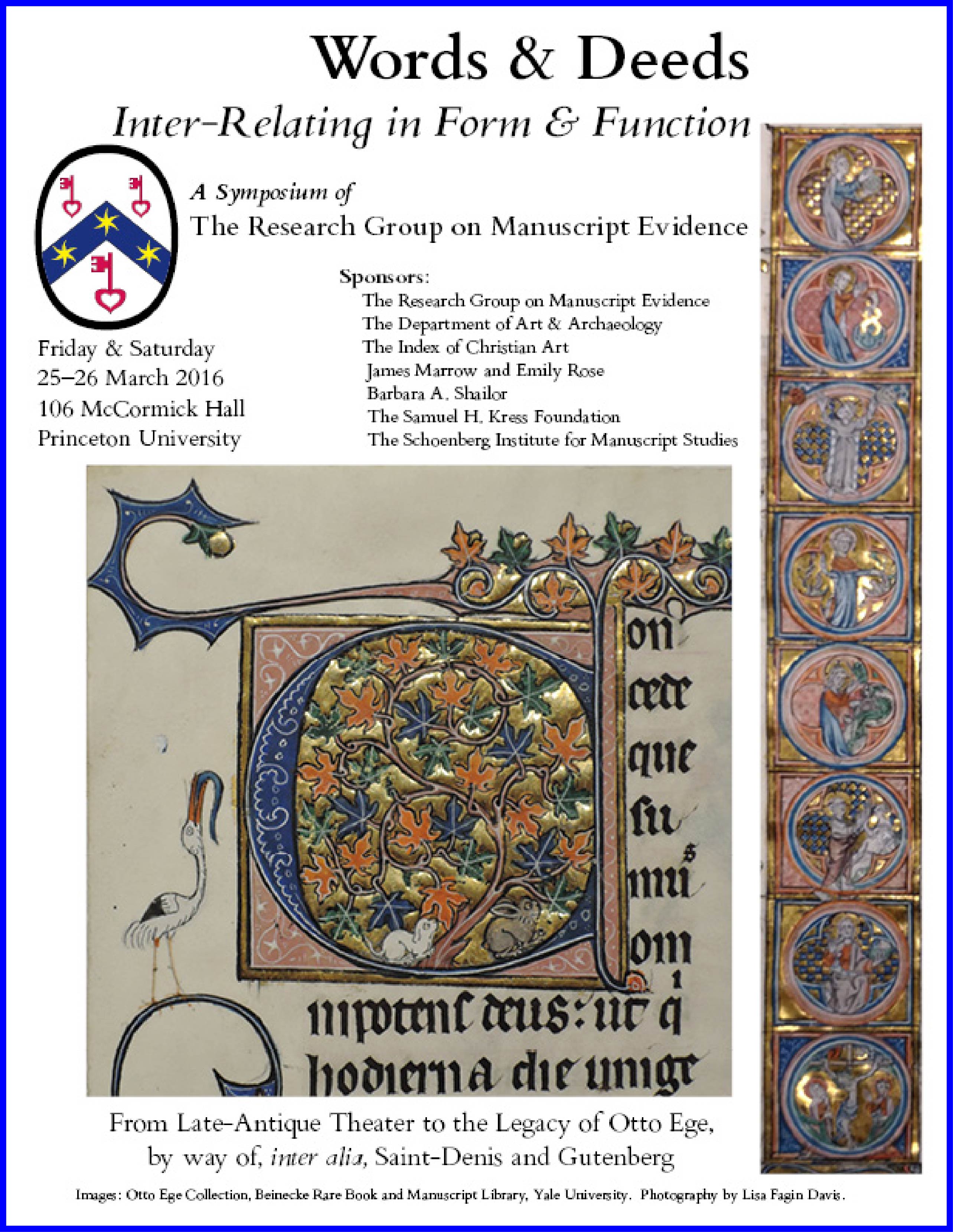
Poster 1 for the 2016 'Words & Deeds' Symposium at Princeton University, with 4 images from the Otto Ege Collection, The Beinecke Rare Book and Manuscript Library, Yale University. Photography by Lisa Fagin Davis. Reproduced by permission. Poster set in RGME BembinoPoster 2 for the 2016 'Words & Deeds' Symposium at Princeton University, with 2 images from the Otto Ege Collection, The Beinecke Rare Book and Manuscript Library, Yale University. Photography by Lisa Fagin Davis. Reproduced by permission. Poster set in RGME BembinoUpdate:

We have fixed the broken link for downloading the Program Booklet, with Abstracts and Illustrations, for our Symposium in March on “Words & Deeds”, exploring a rich array of subjects. The subjects range from the Late-Antique Theater to Gutenberg, by way of (among others), the Abbey of Saint-Denis, charters, and amulets. For example, we celebrate, and illustrate, recent researches and discoveries among the medieval manuscript remnants from the collection of Otto F. Ege.

The 2016 Symposium Announcement and the  2016 Symposium Report provide additional details.

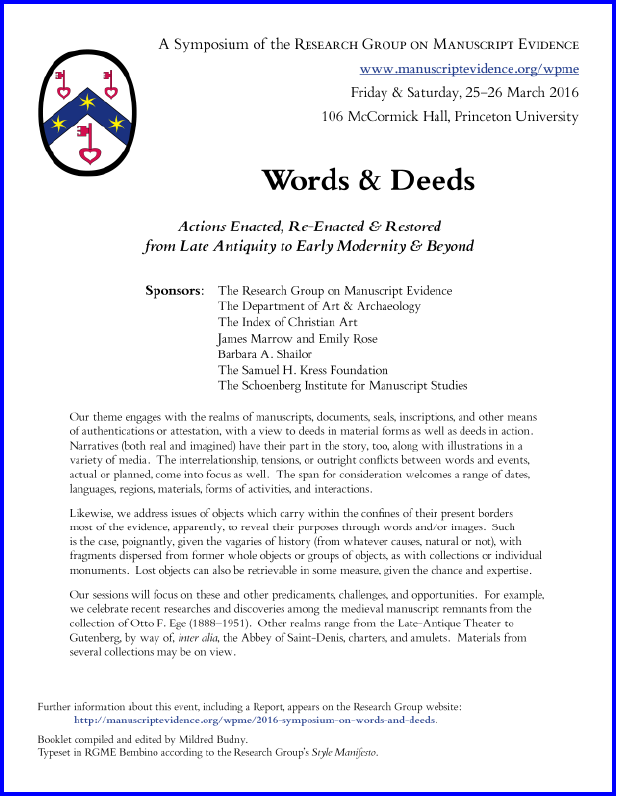
You may find the Booklet here.  Laid out on our copyright font Bembino, it conforms with the principles of our Style Manifesto and celebrates the contributions of experts in various fields of study and interest.

2016 Symposium Program Booklet Cover Page with Border

2016 Symposium Booklet Cover Page

*****

Tags: "Words & Deeds", 2016 Symposium, Abbey of Saint-Denis, Amulets, Bembino, Charters, Gutenberg Press, Late-Antique Theater, Otto F. Ege, Style Manifesto
No Comments »

More Leaves from ‘Otto Ege Manuscript 51’

August 10, 2016 in Manuscript Studies, Photographic Exhibition

Detached Leaves from Otto Ege’s
Erfurt Manuscript of
Aristotle’s Nichomachean Ethics
in Latin Translation on Paper

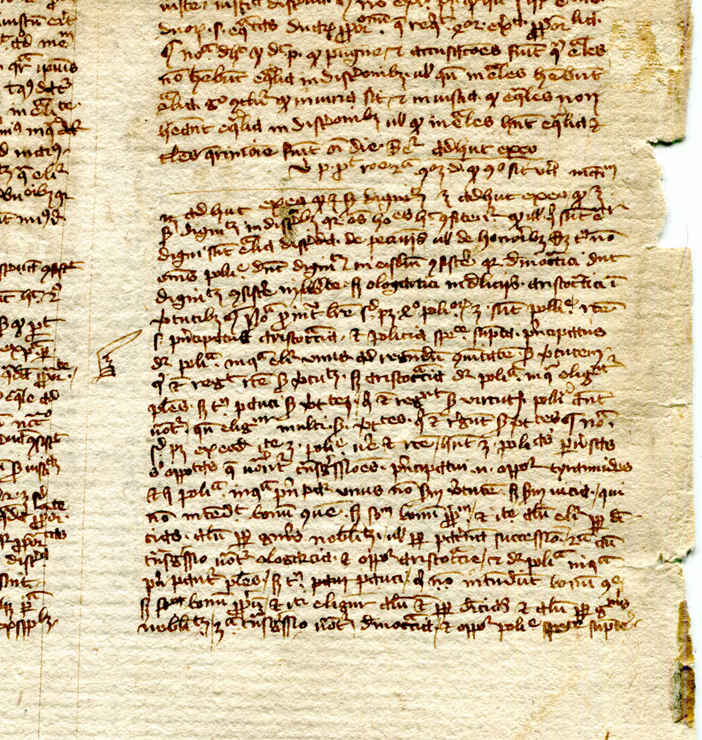
Detail of Recto of detached leaf from the Nichomachean Ethics in Latin translation, from a manuscript dispersed by Otto Ege and now in a private collection. Reproduced by permission.Continuing our series on Manuscript Studies, Mildred Budny newly identifies 2 detached leaves, in separate collections, from a paper manuscript dispersed by Otto F. Ege (1888–1951).  Containing parts of the text of Aristotle’s Nichomachean Ethics in medieval Latin translation, the leaves formerly belonged to a copy prepared at Erfurt in Thuringia in Germany, and dated by colophon to 1365 C.E.

Detached leaves from this book were distributed, in part, through one or another of Ege’s series of Portfolio editions of individual specimen leaves extracted from manuscripts and printed books.  Earlier blogposts have examined cases from Ege’s Portfolios of Fifty Original Leaves (1930–1950) and Famous Bibles (1938 and 1949).  They report the discoveries of a New Leaf respectively from Ege Manuscript 41, from Ege Manuscript 8, from Ege Manuscript 61, and from Ege Manuscript 14.  Now it is the turn of “Ege Manuscript 51” and the Portfolios of Original Leaves from Famous Books (1923 and 1949), in which its Aristotelian specimens normally appeared as their Leaf Number 2.

Read the rest of this entry →

Tags: 'Fifty Original Leaves from Medieval Manuscripts', 'Original Leaves from Famous Bibles', 'Original Leaves from Famous Books in Eight Centuries', 'Original Leaves from Famous Books in Nine Centuries', Aristotle, Beauvais Missal, Beinecke Rare Book and Manuscript Library, Briquet Filigranes, Briquet Number 5726, Burgunsius Pisanus, Erfurt, Germany, History of Paper, History of Watermarks, Johannes Gutenberg, Kent State University Special Collections and Archives, Lisa Fagin Davis, Manicula, Manuscript Road Trip, Martin Luther, Nichomachean Ethics, Nurenberg Chronicles, Otto Ege, Otto Ege MS 51, Otto F. Ege, Robert Grosseteste, Royal MS 6 E V, The British Library, University of Erfurt, Vladimir Nabokov, Wilhelm von Mörbeke, Wilton Processional
3 Comments »

A New Leaf from ‘Otto Ege Manuscript 8’

August 15, 2015 in Manuscript Studies, Photographic Exhibition

Processional for Nuns for Palm Sunday

Budny Handlist, Number 4

From a ‘Gradual’
Produced in England, circa 1275

In our series on ‘Manuscript Fragments’ within our blog (see its Contents List), we continue to examine some leaves dispersed into various collections, both private and public, through the methods of Otto F. Ege. Earlier posts on those leaves considered Lost and Foundlings, A New Leaf from ‘Otto Ege Manuscript 41’, and A New Leaf from ‘Otto Ege Manuscript 61’.  [Update: See also More Leaves from ‘Otto Ege Manuscript 51’. Now we focus on a musical leaf for liturgical performance with Singing Nuns on a high holy day.

Read the rest of this entry →

Tags: Alison Altstatt, Edith of Wilton, Ege MS 14, Ege MS 41, Ege MS 51, Ege MS 61, Ege MS 8, Medieval Manuscript Fragments, Otto Ege's Manuscripts, Otto F. Ege, Processional for Nuns, Processional for Palm Sunday, Wilton Abbey, Wilton Processional
2 Comments »

A New Leaf from ‘Otto Ege Manuscript 61’

August 10, 2015 in Manuscript Studies, Photographic Exhibition

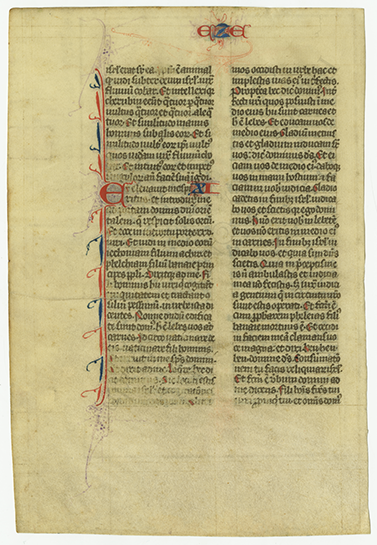
Budny Handlist 7. Ezekiel Leaf Verso with the end of Chapter 10 and the beginning of Chapter 11. Photography by Mildred Budny

Ezekiel Leaf Verso

Part of Ezekiel from a
32-Line Latin Vulgate Pocket Bible from France

Budny Handlist 7

Single leaf from a pocket-sized Bible
Circa 186 × 126 mm <written area circa 119 × 81 mm>
Double columns of 32 lines in Gothic Bookhand, with embellishments in red, blue, and purple pigment

Pencil inscription ‘1310 French Bible’ at the bottom of the recto

Formerly part of Ege Manuscript 61 (Gwara, Handlist 61)

Southern France, circa 1325

Read the rest of this entry →

Tags: Dawson's Bookshop, Ege Manuscript 61, manuscript fragments, Manuscript studies, Otto Ege's Manuscripts, Otto F. Ege, Pocket Bible
No Comments »

A New Leaf from ‘Otto Ege Manuscript 41’

July 7, 2015 in Manuscript Studies, Photographic Exhibition, Uncategorized

Part of the Dialogues of Gregory the Great

Book III, Chapters 12,3.23 (intra eandem) ‒ 14,6.60 (in ortum), plus catchword

Produced probably in Flanders, perhaps circa 1450

Mildred Budny reports on a stray leaf and its former manuscript, as part of a series including
The Foundling Hospital and Lost & Foundlings among Manuscript Fragments.

[Published on 7 July 2015, with updates. The announcement that (after earlier sales from that collection), the residue of manuscript materials in the possession of Otto F. Ege’s family has been purchased by the Beinecke Library at Yale University encourages the anticipation of more revelations about surviving leaves from the dispersed manuscripts, perhaps also this one. Reports on that collection figured in our 2016 Symposium on ‘Words & Deeds’. Also, we can include the specimen from this manuscript now at The Newark Public Library.]

With permission, we illustrate a detached leaf, now in a private collection, from one of the manuscripts which the notorious bibliophile and self-styled ‘biblioclast’ Otto F. Ege (1888‒1951) dismantled for dispersal, mostly by sale, among different collectors and collections far and wide.  Our recent post reflected on the conditions of dispersal and partial recovery for some of those fragments.

The leaf, seen here on both recto and verso, was purchased on its own several years ago in Boston. Its seller had little information about the leaf, whose identity awaited recognition.  The present owner, having identified the Ege connection, told me about the leaf when I mentioned my work on some dispersed Ege leaves in other connections, and generously allowed me to study the specimen and report further findings.

Read the rest of this entry →

Tags: 'Fifty Original Leaves from Medieval Manuscripts', Anselm's Meditations and Prayers, catchword, Château du Sart, Dialogues of Gregory the Great, Ege MS 41, Homilies of John Chrysostom, library of the Van Der Cruisse de Waziers family, manuscript fragments, Otto F. Ege, Thomas Thorpe
2 Comments »

The ‘Foundling Hospital’ for Manuscript Fragments

June 26, 2015 in Book & Exhibition Reviews, Manuscript Studies, Photographic Exhibition, Uncategorized

Gathering Waifs and Strays among Manuscript Fragments
Dispersed to the Winds of Change

Their Recognition for What They Are
Can Emerge Through Chance Discoveries as Well as Dedicated Expertise

As Part I in a series, Mildred Budny reflects on recognizing the familial connections of ‘orphans’ among dispersed manuscript leaves. Part II considers a group of them as ‘Lost and Foundlings’.
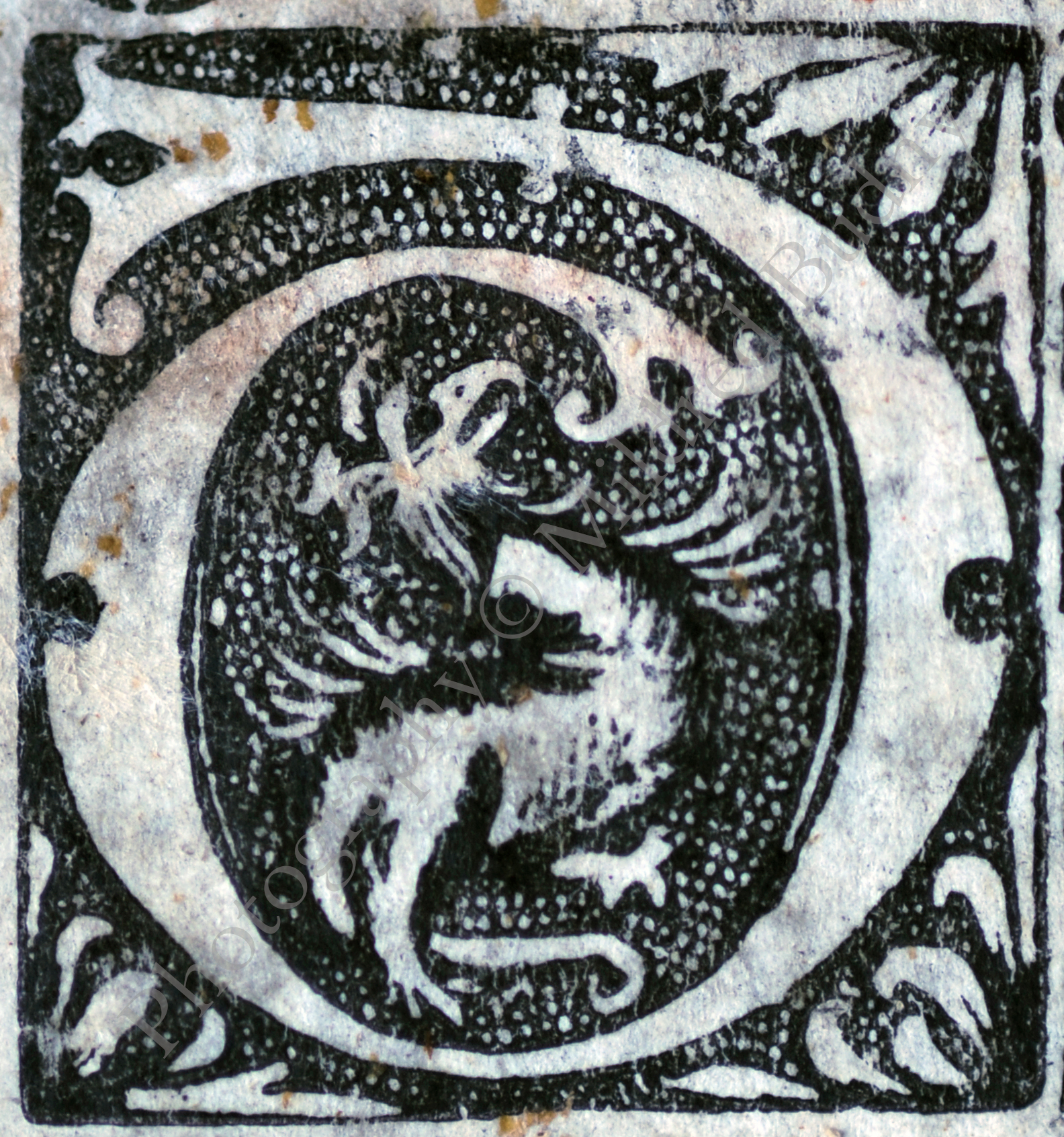
Initial d in woodcut with winged hybrid creature as an inhabitant. Photography © Mildred Budny

Initial D on a detached bifolium, printed on vellum. Photography © Mildred Budny

‘Do the right thing’, we often hear.  Yes, presumably, that seems worthwhile, given the chance, ability, or will.   But how to do it and what to do?

Doing the Right Thing for Historical Records?  Hmm.  Preserving artefacts and monuments from the past is not always straightforward, nor always deemed desirable.  The issues remain subject to controversy and concern.  When it comes to old manuscripts and their fragments, the set of choices could depend upon opportunities, determination, and intention, as well as, on occasion, serendipity.

Foundlings, Given the Chance

Recently I have been thinking about the humanitarian purpose and activities of the 18th-century foundation of the Foundling Hospital, whose grounds I used to visit during my long postgraduate years in London.   Now my thoughts focus on that place, and its place in history, not only in its own right, but as a metaphor or model for the challenges and opportunities in gathering together the orphans, waifs, and strays among despoiled manuscripts and books of earlier ages.
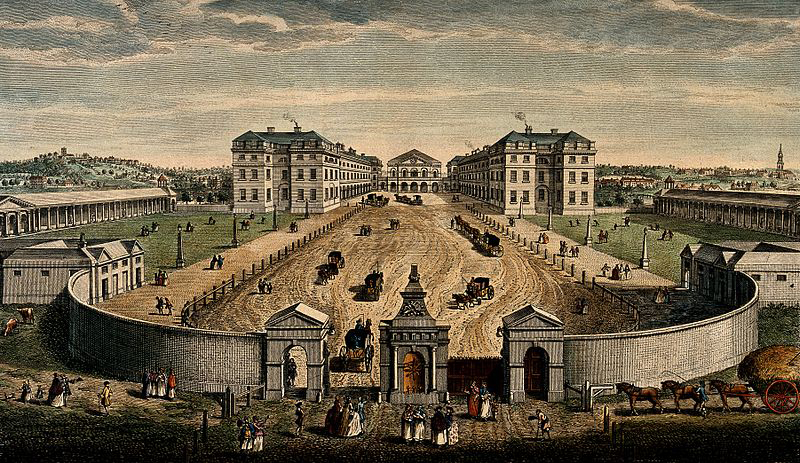
Coloured engraving of a bird's eye view of the Courtyard of the Foundling Hospital, Holbourne, London, with scenes of humans and other creatures both within and without.  Coloured engraving by T. Bowles after L.P. Boitard (1753).  Image via Wikimedia Commons from Wellcome Images (http://wellcomeimages.org

The Foundling Hospital, Holbourn, London: A bird’s eye view of the courtyard. Coloured engraving by T. Bowles after L.P. Boitard (1753). Wellcome Images (wellcomeimages.org) via Wikimedia Commons

These reflections have come to mind as I work to shape the illustrated Handlist of a group of medieval and early modern manuscript fragments and documents, plus some early printed materials, which I have had the opportunity to photograph, conserve, and study for some time (as reported, for example, on this website and in a close-up).  By its owner’s wishes, for now the group is called an ‘Assemblage’ because its group was assembled over decades less specifically or purposefully than a ‘Collection’ as such might imply.

Recently, during the accelerated course of the work on the materials as a group, there has appeared the poignant illustrated blogpost by Erik Kwaakel showcasing a group of handwritten tags intended to identify, and to accompany, children who passed through the Holy Spirit Orphanage (Heilige Geest- of Arme Wees- en Kinderhuis in Dutch) in Leiden in The Netherlands in the 15th century.  These brief slips can or must stand now for their bearers, long gone into the past, perhaps with little or no other written record for their living existence.

Manuscripts and Foundlings:  somehow they interrelate.  Manuscripts as Foundlings, and Human Foundlings with Manuscript Tags.  Poignant predicaments, and poignant traces.  It seems a mercy that any traces may remain to bear witness to the lives, and also the books which any lives have produced, owned, read, perhaps enjoyed, and lost.  The time has come for finding, and for caring.

A New Handlist for a Group of Manuscript and Early Printed Materials
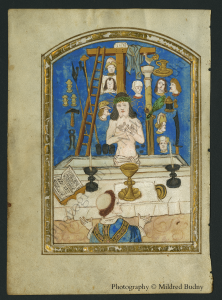
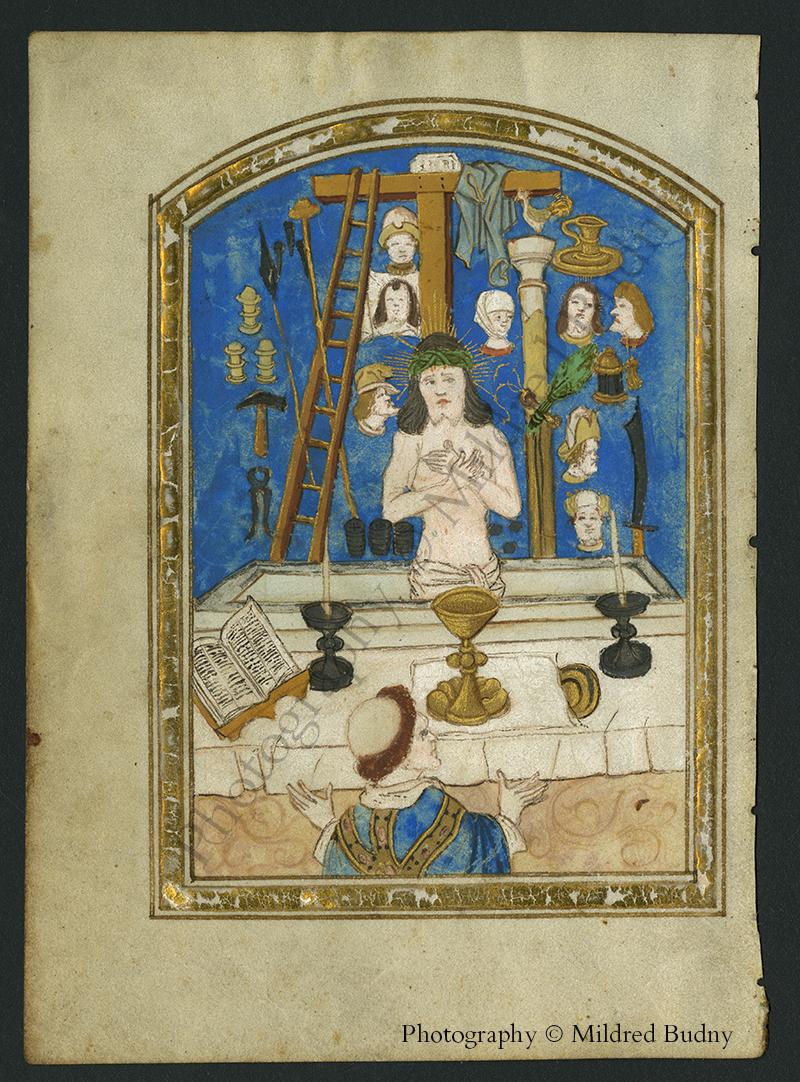
Leaf with Gregory Mass illustration on black background. Photography © Mildred Budny

Budny Handlist 13

Although few in number, the fragments in the Handlist come from a varied range of types of texts, dates and places of origin, and modes of descent into modern times — not least through their dismembered reuse as binding materials of several kinds or for individual display as specimens of script, decoration, or illustration.  Mostly they comprise single leaves (folia), pairs of conjoined leaves (folded bifolia), or scraps.  Mostly they come with few, if any, indications of either their former ‘families’ within their original volumes and their former ‘homes’ in libraries or collections, or the identity of their despoilers.  That is, apart from the clues which they carry upon their very surfaces or on materials which may have migrated with them, whether by chance or by design.

Those indicators, written or unwritten, may reveal their testimony principally in connection with the evidence preserved in other materials in other collections, provided that researchers might find it or learn about it.  We have described and illustrated the interim results for one of the Handlist items recently (‘Handlist 13’, shown here), a detached 15th-century leaf with an intricate illustration on its verso of the Mass of Saint Gregory the Great, at which the celebrant of the Mass experiences a vision of Christ surrounded by the Instruments and Agents of the Passion.

The widespread dispersal, across the centuries and even — alas — nowadays, of scraps, leaves, or bits of manuscripts without regard, usually, to their complete original context within a whole manuscript, collection, or body of work by their given creator(s) can give rise to mixed feelings.  The degree of mixture may depend upon the circumstances of dispersal or the disposition of the viewer, in various measures.  On the one hand, the phenomenon constitutes a trashing of cultural heritage to be deplored.  On the other, we might have some slender sense of relief that something, at least, has remained, if only by the skin of its teeth.

Following that toothy metaphor, we might lament or marvel, by turns or in combination, that any traces whatsoever might remain of past achievements, however down in the tooth, toothless, or plagued with perhaps ill-fitting artificial teeth they might now be.   Let’s chew on that.

The Tips of Icebergs

In recent years, much attention in medieval manuscript studies (for example) has considered the despoliation, usually willful, of whole manuscripts so as to extract the juicy bits, such as illustrations, decoration, and choice specimens of script.  Mostly without bothering to record their context and companions. Such practices have occurred across the centuries in many situations and for varied purposes, sometimes laudable.

The Magnificent, Despoiled,
Royal Bible of Saint Augustine’s Abbey, Canterbury
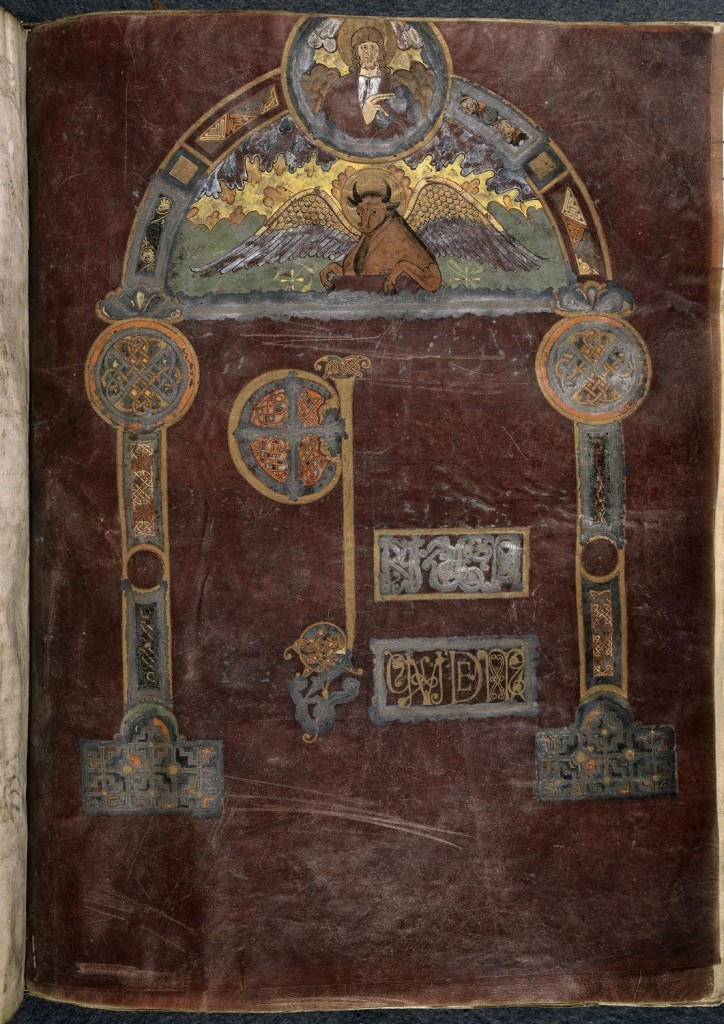
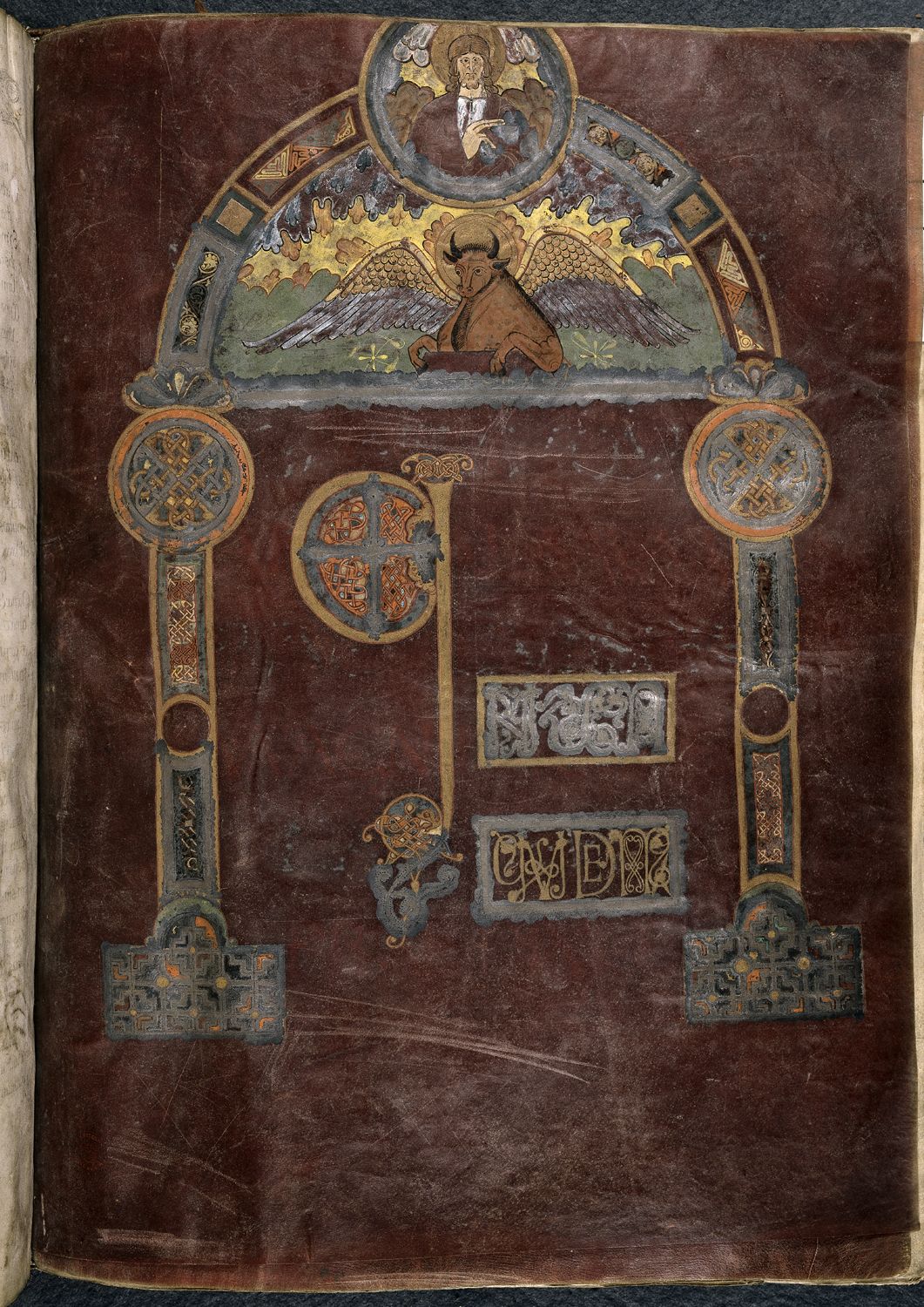
© The British Library Board, Royal MS 1 E.VI, folio 43r. Reproduced by permission

© The British Library Board, Royal MS 1 E.VI, folio 43r. Reproduced by permission

Years ago, in embarking on manuscript studies in earnest as a graduate student at University College London, I encountered this tendency, at a safe distance removed by centuries, in deciphering the evidence of the remnants of a superb manuscript made in the 9th century C.E. at St. Augustine’s Abbey, Canterbury. The manuscript contained a large-format copy of the full Vulgate Bible in Latin, with some prefatory texts and illustrations.Its remaining treasures include some richly purple-dyed leaves with full-page monumental inscriptions in gold and silver lettering and the majestic opening to the Gospel of Luke, which enshrines the intricately decorated opening words Quoniam quidem (‘Foreasmuch as’) within a full-page arcade with panels of ornamental interlace, geometrical, foliate, and animal patterns and with the half-length figures of both the evangelist’s symbol (a winged bull) and Christ holding books and appearing within heavenly clouds.

That monument, whose remnants survive mostly in London, British Library, Royal MS 1 E.vi, formed the subject of a detailed, holistic study, entitled ‘British Library Manuscript Royal 1 E. VI:  The Anatomy of an Anglo-Saxon Bible Fragment’ (London, 1984), available freely online.  Further discoveries about the manuscript and its astonishing Late-Antique model, the now-lost Biblia Gregoriana of the abbey, are reported here.

The process, progress, and discoveries of this cumulative work, demonstrating the value of a detailed, holistic study integrating multiple forms of evidence and fields of expertise, helped to lead to the formation and practices of the Research Group on Manuscript Evidence.  Such fruits appear, for example, in the largest co-publication to date of the Research Group:  the 2-volume Illustrated Catalogue of Insular, Anglo-Saxon, and Early Anglo-Norman Manuscript Art at Corpus Christi College, Cambridge.
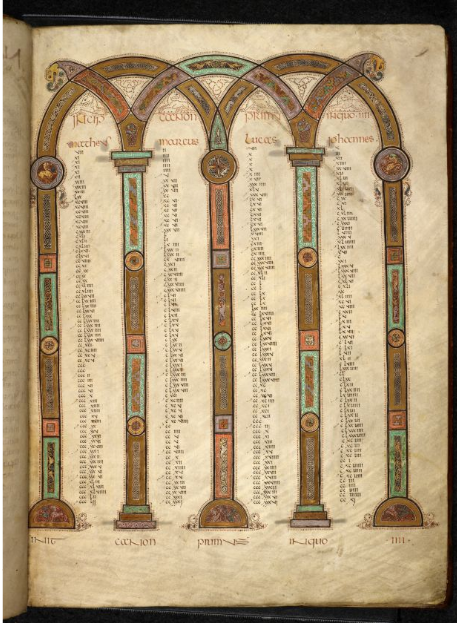
© The British Library Board, Royal MS 1 E vi, folio 4r. Reproduced by permission
© The British Library Board, Royal MS 1 E vi, folio 4r. Reproduced by permission

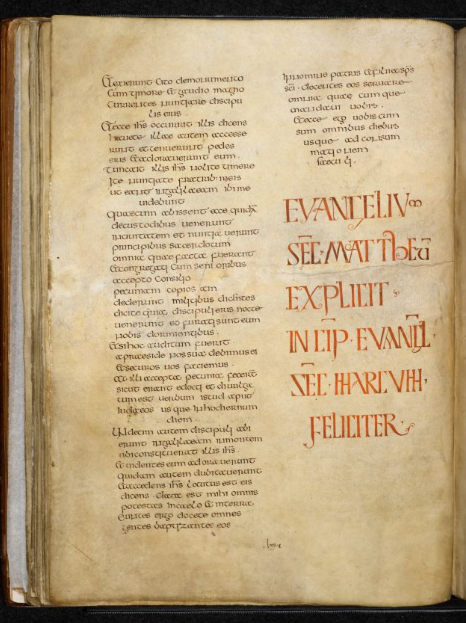
© The British Library Board, Royal MS 1 E vi, folio 28v. Reproduced by permission

© The British Library Board, Royal MS 1 E vi, folio 28v. Reproduced by permission


Taking It Out

Why the medieval abbey — one of the principal centers of book-production in England — which had created so splendid a manuscript as the Royal Bible would choose to strip it of samples of illustrations and exemplary script within a mere two centuries of its creation (as the evidence establishes) remains a mystery, although there are some possible explanations.  Explanations are not necessarily tenable justifications, of course.

By about the middle of the 11th century, some leaves and parts of leaves were cut from the manuscript at knifepoint, mostly with uneven cuts which appear to manifest disdain or haste — or both — in the process of excision.  Thus were removed:

  • numerous whole leaves with illustrations, leaving no gaps in the Bible text
  • some frontispieces with illustrations for individual Books of the Bible (as with each of the four Gospels and the Gospel unit itself)
  • some of the full-page monumental inscriptions which provided descriptive captions (tituli) for those illustrations (as with Matthew and John)
  • some elaborate openings of Books of the Bible (as with the Gospels of Matthew, Mark, and John)
  • some specimens of one or more elaborate lines of script (as with the last line of the Gospel frontispiece titulus on folio 1 and the complete concluding titles for the Mark and John chapter lists on folios 29 and 69)
  • and perhaps more sorts of elements.
© The British Library Board, Royal MS 1 E vi, folio 29r.  Reproduced by permission
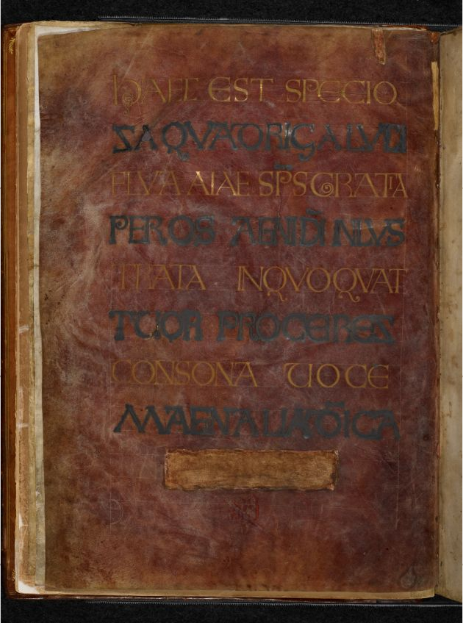
© The British Library Board, Royal MS 1 E vi, folio 29r. Reproduced by permission

© The British Library Board, Royal MS 1 E vi, folio 1v.  Reproduced by permission

© The British Library Board, Royal MS 1 E vi, folio 1v. Reproduced by permission


Some of those removed leaves or parts of leaves left offsets of their pigments on the pages which they formerly faced.  Such are the case, for example, with the concluding title for the Mark chapter list and both the titulus and opening page for John.

Sometimes the removed portion introduced a gap within a leaf or at a lower corner of a leaf left behind.  They occurred in excising specimens of elaborate script from it:  taking the last line, in gold, from the descriptive titulus for the frontispiece to the Gospels (folio 1) and the elaborate concluding titles for the Mark and John chapter lists (folios 29 and 68).

The gaps were replaced with patches of parchment pasted onto the bare backs of the leaves. For a purple leaf, the patch was colored, somewhat inefficiently, with a pigment that has now faded to brown.

Taking Advantage, with Restorations of Sorts, in the 11th Century
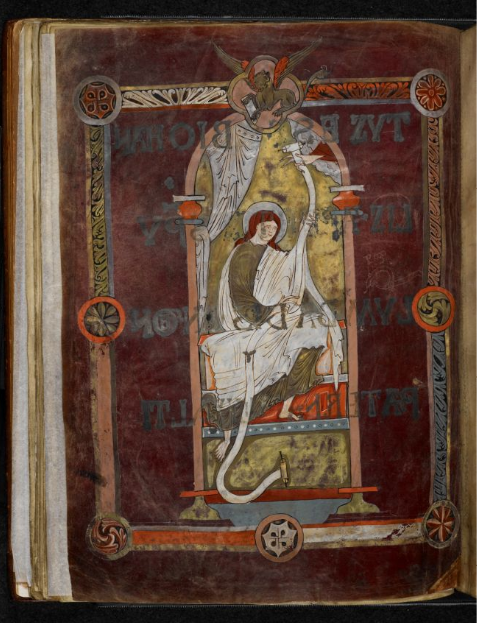
© The British Library Board, Royal MS 1 E vi, folio 30v. Reproduced by permission

© The British Library Board, Royal MS 1 E vi, folio 30v. Reproduced by permission

The cutting lines along part or all of some leaves adjacent to fully excised leaves, resulting from the slits of the knife drawn along the inner margin of the book, as the plunderer faced the wanted page, have been stitched together in a set of repairs following the spoliation and, it seems, following the retrieval of some of the fully severed leaves.  For example, the leaf with the titulus for the Mark Gospel frontispiece (now folio 30) was completely severed, but it was resewn to its resulting ‘stub’.  The following leaf received the same treatments, that is, severance by knife followed by reconnection with needle and thread.
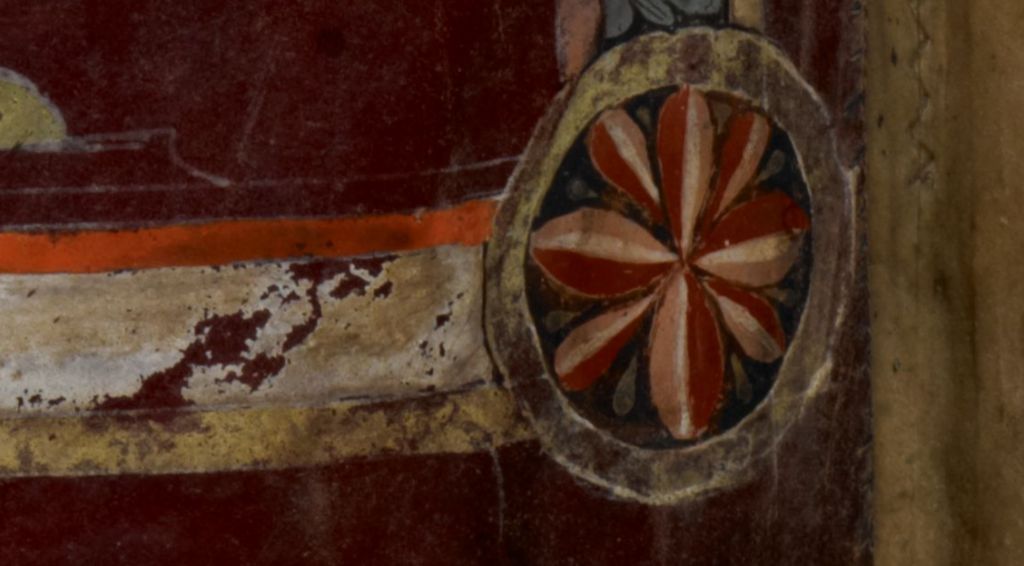
© The British Library Board, Royal MS 1 E vi, folio 30v, detail.  Reproduced by permission.

© The British Library Board, Royal MS 1 E vi, folio 30v, detail. Reproduced by permission.

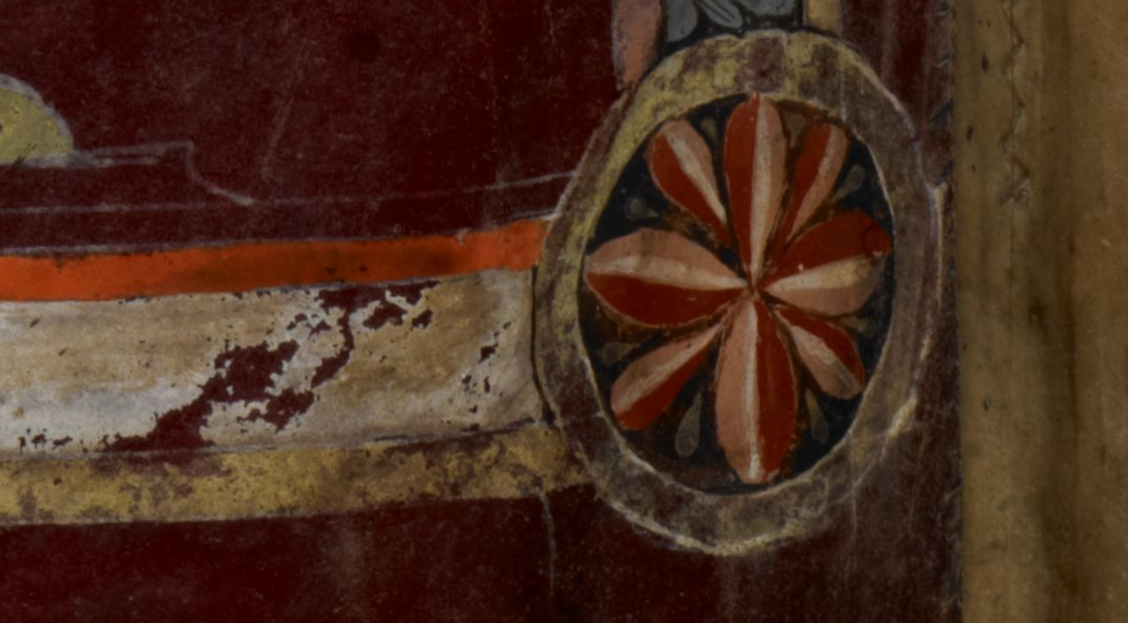
That this spoliation occurred by the mid-11th century or so is established by the white pigment overlay and overflow onto one of those stitching lines, along the inner margin of verso of that leaf  which carries the Mark titulus on its recto.  The overlying pigment belongs to the added frontispiece on the verso, which provides a framed frontispiece in a different style and with a different structure.  In outlining the roundel at the bottom right of the paneled rectangular frame, the brush caught onto the repairing stitch, which tugged part of its tip and dragged some of the pigment, leaving the track which establishes the sequence of accretions.  First came the cuts to excise leaves and parts of leaves.  There followed the repairs to stitch some severed parts back into the book.  Then came the addition of the painted frontispiece for the Mark Gospel, perhaps in an effort to refurbish the book, replace the lost Mark frontispiece in a new style, and/or try out an approach to painting on a purple-dyed leaf on an available expanse.

The artist of that Mark addition is identifiable as an artistic active in Canterbury, and at Saint Augustine’s Abbey, in about the mid-11th century.  I have identified his work in some other manuscripts in my detailed long-term study.  Among them are

  • contributions to parts of the Illustrated Old English Hexateuch
  • the 2 added frontispieces for the Rule of Saint Benedict and the Regularis Concordia
    in British Library, Cotton MS Tiberius A. iii and
  • the added frontispieces in the Corpus Eremetical Saints’ Lives.

Within the Royal Bible, in applying an outline of white pigment to the border roundel at the lower right-hand corner of the frame, his brush caught onto the stitching repair and left its traces there. Caught in the act.

Taking More, with Some Further Repairs, by the 14th Century

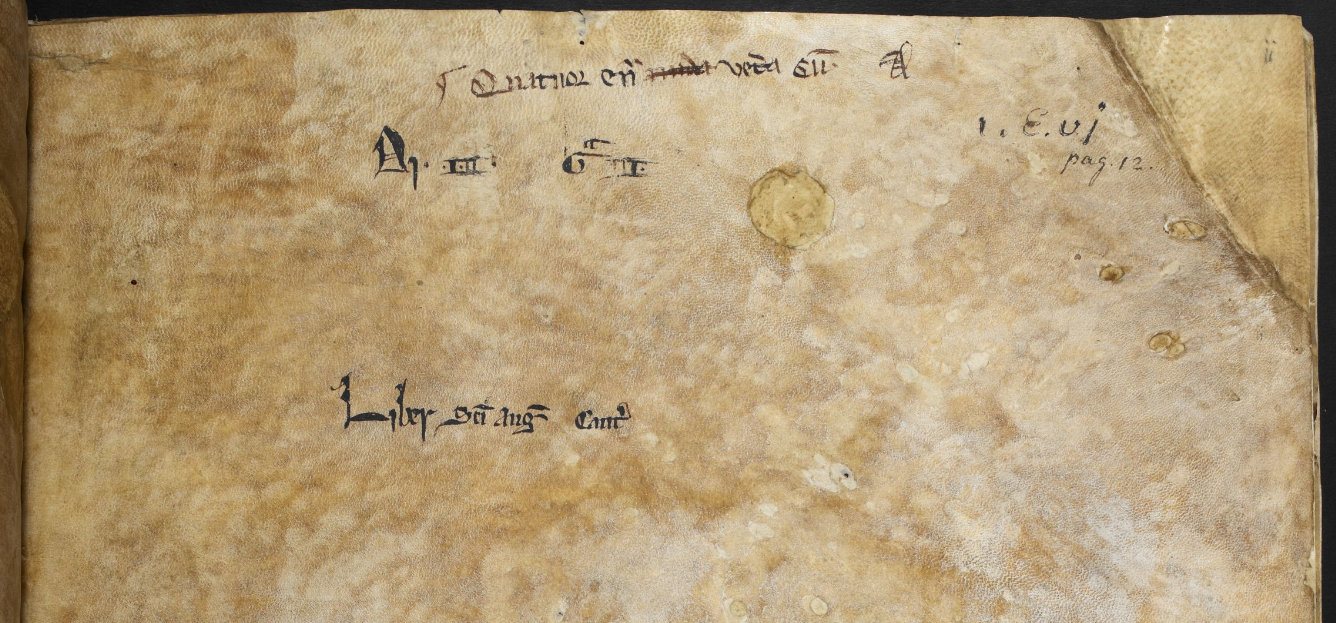
By the late Middle Ages, the manuscript had lost many more of its leaves — while still at the abbey — for reuse as binding material for other texts.  Two of those reused leaves have surfaced at Canterbury Cathedral (as a folder for some unknown materials, removed from them without record in the 19th century) and in the Bodleian Library in Oxford (as a folded pair of endleaves for a 10th-century manuscript, removed from it in the 19th century).  This form of despoilation of leaves for reuse in binding texts of other kinds occurred apparently by the 14th century.  The forms of evidence which point to this date-range include the abbey librarian’s inscriptions, entered in stages at the top of one of the flyleaves added to the Royal portion by the 14th century.  They provide the library ownership inscription, the library pressmark, and a brief description of the contents as an ‘old’ (vetera) and ‘bare’ or ‘despoiled’ (nuda) copy of the ‘4 Gospels with [the lettermark] A’.   As on other books from the library, the lettermark stood on the binding (now lost in the rebinding at the British Museum in the 18th century).  The rough parchment patches on the flyleaves, like the flyleaves themselves, belong to a recognizable stock of parchment leaves used for flyleaves, patches, and other work on the manuscripts in the abbey library during the 14th century.

Useful to know.  And that knowledge about those tell-tale features of the parchment itself comes from having looked at very many of the many manuscripts which survive from the abbey library and show signs of refurbishment and other forms of alteration during this period (among others).
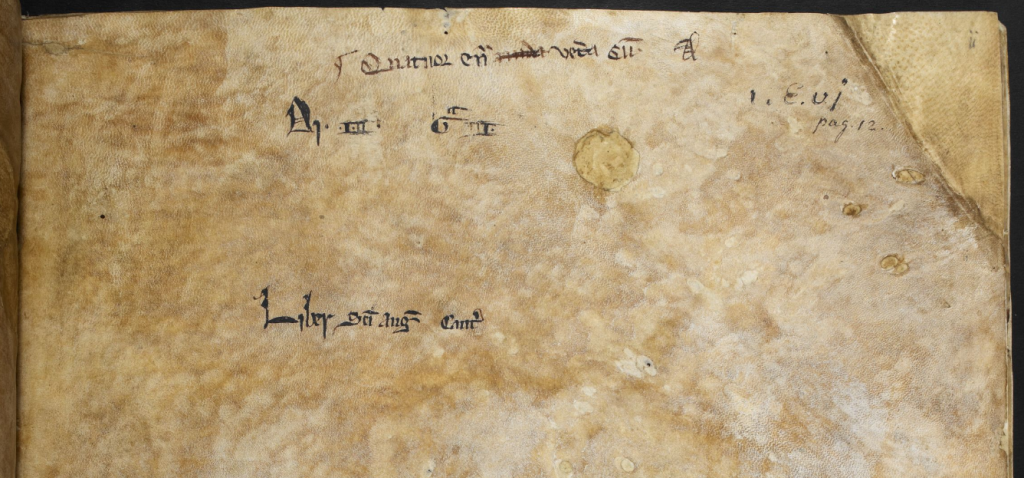
© The British Library Board, Royal MS 1 E vi, folio ii recto, top. Reproduced by permission

© The British Library Board, Royal MS 1 E vi, folio ii recto, top. Reproduced by permission

Altogether only 79 leaves remain of more than 1,000 leaves originally, plus the 2 endleaves added in the 14th-century to the front and back of the London portion, then reduced to a fragment of the Gospels.  The Canterbury leaf, with its part from the John Gospel, formerly followed the last leaf in the Royal portion directly, as the first leaf of the next quire.  Formerly placed at the distance of a few leaves from the Gospel portion, perhaps halfway through the quire after that, the Oxford leaf holds part of the Acts of the Apostles.

A small, but significant, remnant.

Competition

Few full Bibles survive from the Latin West up to the time of this 9th-century Royal Bible, and only one made in England:  the early 8th-century Codex Amiatinus, but with fewer illustrations and less magnificent decoration.  (No offense to that Bible, an astonishing witness in its own ways.)  That somewhat distant relative, from Northumbria, and from the double monasteries of Monkwearmouth–Jarrow, home of the Venerable Bede (who may have had a hand in the production or design), helps to gauge the former stature of the monument, when complete.

The nearly contemporary Continental competition for our Royal Bible among large-format illustrated Carolingian Bibles or Spanish and other Bibles is another story.  Have a look, for example at one of the earliest.  These are big books, worth standing up to view them and, when chance arises, turn their pages.

‘The Ozymandias of Early Anglo-Saxon Book-Production’

About the Royal Bible, it is worth remembering that the despoiled carcass (shall we say) which remains of that vibrant whole, although dispersed between London (now with online facsimile), Canterbury, and Oxford, continues to bear witness to a former monument of extraordinary magnificence, albeit reduced to the floating tips of a once-weighty and mighty iceberg. Having worked to identify its significance as a precarious, but vigorous, witness, both to its original monument and to its majestic Late-Antique exemplar, the lost Biblia Gregoriana, I find some solace in the recognition by a sympathetic colleague, Richard Gameson  (our Associate), that this 9th-century Royal Bible of St. Augustine’s Abbey, “still majestic despite truncation and mutilation,” might rightly be regarded as “the Ozymandias of early Anglo-Saxon book-production” (Royal Manuscripts: The Genius of Illumination (2011), no. 2).

In order words, this fractured, but still magnificent, monument must and can carry the weight of centuries. Fortunate it might be to find the opportunity, after all, to regain some of its eloquence. It is a privilege to spend time in its company, and I continue to remember, with affection, the very many days, months, and years on end of turning its pages, inspecting its details, learning to know its features, reflecting upon its character and contexts, and becoming familiar with its variety, complexity, and beauty as one of the most significant manuscripts of its age.

*****

And so now, with this case study freshly in mind, we turn to another group of ‘Lost and Foundlings’ among manuscript fragments, this time from dispersals of books from various centers, periods, types of texts, and styles of medieval book production, in ‘The Case of Otto F. Ege’, selfstyled ‘Biblioclast’. We invite you to have a look, as we unveil some newly recognized fragments among those dispersals.
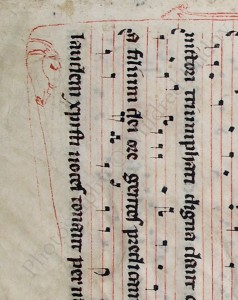
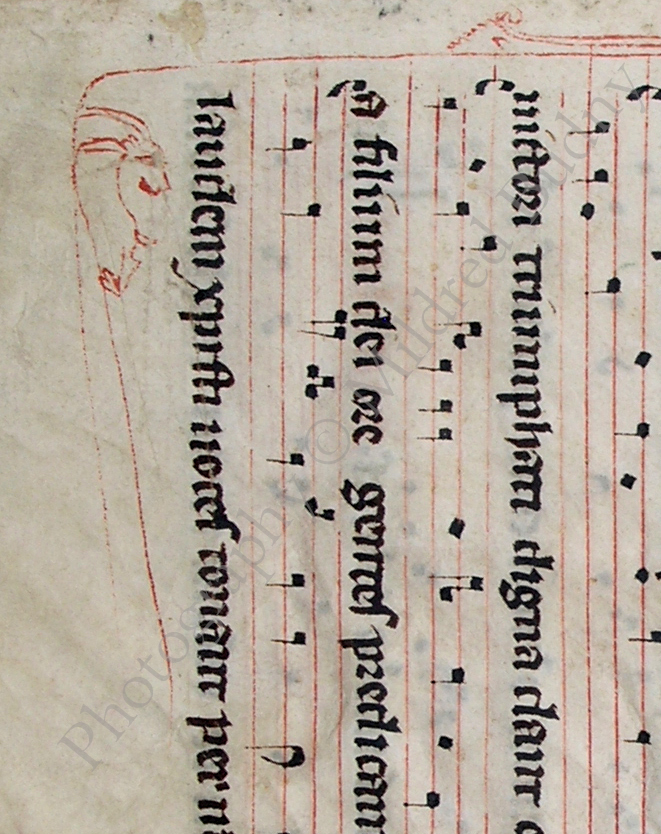
Penwork extending from a decorated initial extends below the final line of text and ends in a horned animal head which looks into its direction.  Photography © Mildred Budny

A whimsical creature at the bottom of the page faces the music. Budny Handlist 4


A Virtual ‘Orphanage’

How the different ‘Foundlings’ among manuscript fragments might sometime find a proper, albeit virtual, home so as to acknowledge, to record, and to welcome their familial connections in former whole manuscripts as a form of ‘genealogical recovery’ remains to be determined in the concerted quest in various centers to establish and to foster such projects.  While they find their fuller footing, with larger institutional supports, we will turn to the next report on our findings.

Next stop:  ‘Lost and Foundlings’.

We welcome your comments, questions, and feedback.  Please leave a comment or Contact Us.

*****



Tags: Biblia Gregoriana, Illustrated Old English Hexateuch, Mass of Gregory the Great, Medieval Manuscript Fragments, Otto Ege's Manuscripts, Otto F. Ege, Royal Bible of St. Augustine's Abbey Canterbury, Saint Dunstan's 'Classbook'
No Comments »

Newer Entries »
  • Top
©2024 Research Group on Manuscript Evidence.


is proudly powered by WordPress. WordPress Themes X2 developed by ThemeKraft.