• News
    • News & Views
    • RGME Activities for 2024 and 2025
    • Around & About with the RGME
    • Reviews
    • Highlights
  • Blogs
    • Manuscript Studies
      • Manuscript Studies: Contents List
    • International Congress on Medieval Studies
      • Abstracts of Congress Papers
        • Abstracts of Papers Listed by Author
        • Abstracts of Papers Listed by Year
  • About
    • Mission
    • Who We Are
      • Officers, Associates & Volunteers
      • RGME Committees
      • Friends of the Research Group on Manuscript Evidence
    • Policies & Statements
      • RGME Privacy Policy Statement
      • RGME Intellectual Property Statement & Agreements
    • People
      • Mildred Budny — Her Page
      • Adelaide Bennett Hagens
    • Activities
      • Events
      • Congress Activities
        • Sponsored Conference Sessions (1993‒)
          • Panels at the M-MLA Convention (from 2016)
        • Co-sponsored Conference Sessions (2006‒)
    • History
      • Seals, Matrices & Documents
      • Genealogies & Archives
    • Contact Us
  • Bembino
    • Multi-Lingual Bembino
    • RGME Bembino: Resources
  • Congress
    • Sponsored Conference Sessions (1993‒)
    • Co-sponsored Conference Sessions (2006‒)
    • Abstracts of Congress Papers
      • Abstracts Listed by Author
      • Abstracts Listed by Year
    • Kalamazoo Archive
    • Panels at the M-MLA Convention (2016-2019)
      • Abstracts of Papers for the M-MLA Convention
      • Panels at the M-MLA Convention (from 2016)
  • Events
    • RGME Activities for 2024 and 2025
      • 2023 Activities and 2024 Planned Activities
    • Seminars, Workshops, Colloquia & Symposia (1989–)
      • Seminars on ‘The Evidence of Manuscripts’
      • Symposia on ‘The Transmission of the Bible’
      • The New Series (2001-)
        • 2019 Anniversary Symposium Program: The Roads Taken
        • 2019 Anniversary Symposium Registration
        • 2019 Anniversary Symposium Registration Open
      • RGME Symposia: The Various Series
      • The Research Group Speaks: The Series
      • Meetings of the Friends of the Research Group on Manuscript Evidence
      • RGME Online Events
    • Abstracts of Papers for Events
      • Abstracts of Papers for Seminars on ‘The Evidence of Manuscripts’
      • Abstracts of Papers for Symposia, Workshops & Colloquia
    • Receptions & Parties
    • Business Meetings
    • Photographic Exhibitions & Master Classes
    • Events Archive
  • ShelfLife
    • Journal Description
    • ShelfMarks: The RGME-Newsletter
    • Publications
      • “Insular, Anglo-Saxon, and Early Anglo-Norman Manuscript Art at Corpus Christi College, Cambridge” (1997)
        • Mildred Budny, ‘Catalogue’
        • The Illustrated Catalogue (1997)
      • The Illustrated Handlist
      • Semi-Official Counterfeiting in France 1380-1422
      • No Snap Decisions: Challenges of Manuscript Photography
    • History and Design of Our Website
  • Galleries
    • Watermarks & the History of Paper
    • Galleries: Contents List
    • Scripts on Parade
    • Texts on Parade
      • Latin Documents & Cartularies
      • New Testament Leaves in Old Armenian
    • Posters on Display
    • Layout Designs
  • Donations and Contributions
    • RGME Donor Promise
    • 2023 End-of-Year Fundraiser for our 2024 Anniversary Year
    • 2019 Anniversary Appeal
    • Orders
  • Links
    • Catalogs, Metadata, and Databases: A Handlist of Links
    • Handlist of Resources for Manuscript Studies and Fragmentology
    • Manuscripts & Rare Books
    • Maps, Plans & Drawings
    • Seals, Seal-Matrices & Documents

  • News
    • News & Views
    • RGME Activities for 2024 and 2025
    • Around & About with the RGME
    • Reviews
    • Highlights
  • Blogs
    • Manuscript Studies
      • Manuscript Studies: Contents List
    • International Congress on Medieval Studies
      • Abstracts of Congress Papers
        • Abstracts of Papers Listed by Author
        • Abstracts of Papers Listed by Year
  • About
    • Mission
    • Who We Are
      • Officers, Associates & Volunteers
      • RGME Committees
      • Friends of the Research Group on Manuscript Evidence
    • Policies & Statements
      • RGME Privacy Policy Statement
      • RGME Intellectual Property Statement & Agreements
    • People
      • Mildred Budny — Her Page
      • Adelaide Bennett Hagens
    • Activities
      • Events
      • Congress Activities
        • Sponsored Conference Sessions (1993‒)
          • Panels at the M-MLA Convention (from 2016)
        • Co-sponsored Conference Sessions (2006‒)
    • History
      • Seals, Matrices & Documents
      • Genealogies & Archives
    • Contact Us
  • Bembino
    • Multi-Lingual Bembino
    • RGME Bembino: Resources
  • Congress
    • Sponsored Conference Sessions (1993‒)
    • Co-sponsored Conference Sessions (2006‒)
    • Abstracts of Congress Papers
      • Abstracts Listed by Author
      • Abstracts Listed by Year
    • Kalamazoo Archive
    • Panels at the M-MLA Convention (2016-2019)
      • Abstracts of Papers for the M-MLA Convention
      • Panels at the M-MLA Convention (from 2016)
  • Events
    • RGME Activities for 2024 and 2025
      • 2023 Activities and 2024 Planned Activities
    • Seminars, Workshops, Colloquia & Symposia (1989–)
      • Seminars on ‘The Evidence of Manuscripts’
      • Symposia on ‘The Transmission of the Bible’
      • The New Series (2001-)
        • 2019 Anniversary Symposium Program: The Roads Taken
        • 2019 Anniversary Symposium Registration
        • 2019 Anniversary Symposium Registration Open
      • RGME Symposia: The Various Series
      • The Research Group Speaks: The Series
      • Meetings of the Friends of the Research Group on Manuscript Evidence
      • RGME Online Events
    • Abstracts of Papers for Events
      • Abstracts of Papers for Seminars on ‘The Evidence of Manuscripts’
      • Abstracts of Papers for Symposia, Workshops & Colloquia
    • Receptions & Parties
    • Business Meetings
    • Photographic Exhibitions & Master Classes
    • Events Archive
  • ShelfLife
    • Journal Description
    • ShelfMarks: The RGME-Newsletter
    • Publications
      • “Insular, Anglo-Saxon, and Early Anglo-Norman Manuscript Art at Corpus Christi College, Cambridge” (1997)
        • Mildred Budny, ‘Catalogue’
        • The Illustrated Catalogue (1997)
      • The Illustrated Handlist
      • Semi-Official Counterfeiting in France 1380-1422
      • No Snap Decisions: Challenges of Manuscript Photography
    • History and Design of Our Website
  • Galleries
    • Watermarks & the History of Paper
    • Galleries: Contents List
    • Scripts on Parade
    • Texts on Parade
      • Latin Documents & Cartularies
      • New Testament Leaves in Old Armenian
    • Posters on Display
    • Layout Designs
  • Donations and Contributions
    • RGME Donor Promise
    • 2023 End-of-Year Fundraiser for our 2024 Anniversary Year
    • 2019 Anniversary Appeal
    • Orders
  • Links
    • Catalogs, Metadata, and Databases: A Handlist of Links
    • Handlist of Resources for Manuscript Studies and Fragmentology
    • Manuscripts & Rare Books
    • Maps, Plans & Drawings
    • Seals, Seal-Matrices & Documents

Log in

Archives

Featured Posts

2026 International Congress on Medieval Studies: Program
Episode 24. “Life with Books” (Interview with John Windle)
Announcing the Launch of RGME Bembino WP
2026 RGME Colloquium at The Grolier Club: Report
Medieval Missal Fragment as Early-Modern Cover
The Weber Leaf from Ege MS 61
"Bembino" Booklet Cover
Episode 23. “Meet RGME Bembino: Facets of a Font”
2026 RGME Colloquium on “Transformations & Renewals” at The Grolier Club
2026 Theme of the Year: “Transformations and Renewals”
A Leaf with Patchwork from the Saint Albans Bible
A Sister Leaf from a Miniature Latin Vulgate Bible
A Little Latin Vulgate Bible Manuscript Leaf in Princeton
J. S. Wagner Collection. Leaf from from Prime in a Latin manuscript Breviary. Folio 4 Verso, with part of Psalm 117 (118) in the Vulgate Version, set out in verses with decorated initials.
2026 Annual Appeal
Episode 22: “Encounters with Local Saints and Their Cults”
Private Collection, Ege's FBNC Portfolio, Dante Leaf, Verso, Detail. Reproduced by Permission.
2025 RGME Autumn Colloquium on Fragments
Workshop 8: A Hybrid Book where Medieval Music Meets Early-Modern Herbal
2025 RGME Autumn Symposium on “Readers, Fakers, and Re-Creators of Books”
RGME Workshops on “The Evidence of Manuscripts, Etc.”
2025 International Medieval Congress at Leeds: RGME Program
Episode 21. “Learning How to Look”
2025 International Congress on Medieval Studies: Program
2025 RGME Visit to Vassar College
Two Leaves in the Book of Numbers from the Chudleigh Bible
Delibovi on Glassgold on Boethius: A Blogpost
Ronald Smeltzer on “Émilie du Châtelet, Woman of Science”
2025 Spring Symposium: “Makers, Producers, and Collectors of Books”
Starters’ Orders
The Weber Leaf from the Saint Albans Bible
Workshop 4. “Manuscript Fragments Compared”
Episode 20. “Comic Book Theory for Medievalists”
Episode 19: “At the Gate: Starting the Year 2025 at its Threshold”
Favorite Recipes for Lemonade, Etc.
RGME Visit to the Lomazow Collection: Report
2024 Autumn Symposium: “At the Helm”
A Latin Vulgate Leaf of the Book of Numbers
The RGME ‘Lending Library’
Florence, Italy, Ponte Vecchio from Ponte alle Grazie. Photo: Ingo Mehling, CC BY-SA 4.0 , via Wikimedia Commons
Episode 17. “RGME Retrospect and Prospects: Anniversary Reflections”
2024 Anniversary Symposium: The Booklet
Jesse Hurlbut at the Bonneville Salt Flats, Utah. Photograph Jesse Hurlbut.
Episode 16: An Interview with Jesse D. Hurlbut
To Whom Do Manuscripts Belong?
Kalamazoo, MI Western Michigan University, Valley III from the side. Photograph: David W. Sorenson.
2024 International Congress on Medieval Studies: Report
2024 Spring Symposium at Vassar College
Puente de San Martín: Bridge with reflection over the River Targus, Toledo, Spain.
2024 Grant for “Between Past and Future” Project from The Gladys Krieble Delmas Foundation Research Libraries Program
2024 Anniversary Symposium in Thanks to Jesse Hurlbut: Program

You are browsing the Blog for Manuscript studies

Delibovi on Glassgold on Boethius: A Blogpost

March 5, 2025 in Guest Blogposts, Manuscript Studies, Translations

The Manuscript
as
Creative Undercurrent:

Reflections on the Reissue of
Glassgold’s “Englishings” of Poems by Boethius

Dana Delibovi

[Posted on 18 March 2025]

Editor’s Note
We welcome Dana Delibovi as Guest Blogger. We thank her for sharing her explorations on a subject dear to our hearts.

Imprisoned and awaiting execution, Anicius Manlius Severinus Boethius (c. 480 – 524) wrote On the Consolation of Philosophy, a work of Latin prose often translated into prose and poetry. The original manuscript has not survived, but later manuscripts of the text have, including some important English translations.

These English manuscripts are a creative undercurrent to a volume reissued in the autumn of 2024, Boethius: Poems From On the Consolation of Philosophy, with the subtitle, “Translated Out of the Original Latin into Diverse Historical Englishings, Diligently Collaged” by Peter Glassgold.[1] Manuscripts — objects with a physical as well as a verbal aesthetic — indirectly lend pictorial, methodological, and ekphrastic inspiration to Glassgold’s work. Inspiration like this, I believe, may have implications for current appreciation of historical manuscripts.

Riffing on the English translators

In the introduction and afterword to his book, Glassgold mentions his debt to three important English translators of On the Consolation of Philosophy, whose “word-work” Glassgold explored to create “sound-collages” that chime with English in its many historical incarnations.[2] These translators, working in Old, Middle, and Early Modern English respectively, are:

  • King Alfred (848–899, ruled 871–899),
  • Geoffrey Chaucer (died 1400), and
  • Queen Elizabeth I (1533–1603, ruled 1558–1603).

I recently interviewed Glassgold for the e-zine Cable Street, where he stated that, in any single line of the poetry, he “ranged through the whole known vocabulary of English, from Old to Modern. The making of [these] Boethius translations was not so much a process as an attitude ― improvisational, you might even say jazzy.”[3]

An example from a poem in Book I of Boethius’ work shows how Glassgold invents translations across the evolution of the spoken and written language, melding Old, Middle and Modern English.[4]

Now he lies of mindz light weakened
and nekke pressid by overheuy chaines,
his chere holding downcast for the weighte,
cumpeld, eala! to scan the dreary earth.

The avant-garde poet and literary scholar Charles Bernstein, writing in the book’s foreword, calls Glassgold’s approach “pataquerical” — spontaneous, playful, sometimes irascible, and imagined across multiple iterations of language. “The historical progression of English translations offers Glassgold stratified layers of linguistic sediment that he entangles in his palimpsestic composition.”[5.]

Part of the “linguistic sediment” of Boethius in English are manuscripts — including manuscripts of Alfred the Great, Chaucer, and Elizabeth I that survive today in some form (Figures 1–3; see below). One of these is a profoundly fire-damaged manuscript of the “Alfredian” Old English Boethius (Figure 1). This work was either translated by King Alfred the Great or anonymous translators assisting with the king’s efforts to revive learning.[6] Other manuscripts of note are a 1380 transcription by Adam Scrivener of the Middle English translation by Chaucer (Figure 2)[7] and the translation into early Modern English by Queen Elizabeth I (Figure 3).[8]

Undercurrents—
Pictorial, Methodological, and Ekphrastic

I believe that such English manuscripts of Boethius represent three creative undercurrents to Glassgold’s work. Two are fairly obvious. One is speculative.

1. Pictorial Inspiration

The first and probably most obvious is pictorial inspiration from manuscripts. The cover of Glassgold’s book, created by Andrew Bourne, uses typography bearing a family resemblance to the handwriting of manuscripts. Bourne creates the illusion of cut-up strips of handwriting to covey the collaging of manuscript text (Figure 4). This thoughtful cover design made Literary Hub’s list of The 167 Best Book Covers of 2024.

2. Methodological Inspiration

The second fairly obvious inspiration is methodological. As Glassgold describes his work process:

I was surrounded by books, De Consolatione and the various Consolations I’d gathered, set propped up on stands in chronological order from left to right, along with piles of dictionaries in, behind, and around them. I wrote slowly, by hand—as I always do my first drafts, though it felt especially appropriate in these circumstances.[9]

In creating his book, Glassgold worked with published, typeset versions of the translations of Alfred, Chaucer, Elizabeth, and other English translators. But writing his work by hand felt more appropriate than usual. This feeling might arise from the known existence of manuscripts — the emotional connection to handwritten physical objects.

The manuscript is not merely a vehicle for thought in the manner of mass-produced text, especially digital text. The manuscript has a material structure connected to the natural world through its parchments, papyri, chalks, and inks, as has been noted by Ittai Weinryb.[10] To write physically, in longhand, is to engage in a mimesis of the manuscript process, infinitely satisfying and emotionally resonant. In addition, Glassgold’s project of “collaging” other translations to make his own channels the painstaking work of manuscript creation, which involves copying, cutting, patching, and erasure.

3. Ekphrasis

The third creative undercurrent is ekphrasis — writing that describes or works of the plastic arts. This undercurrent is speculative — a concept I am exploring, rather than asserting. I believe that Glassgold’s finished work can be considered ekphrastic, manuscripts in their substance as works of bookbinding, illustration, calligraphy, and, in the case of Elizabeth’s text of Boethius’s poetry, a flamboyant personal hand. I believe this to be true even though Glassgold used typeset source materials and the publisher set the book using modern technologies.

My thesis stems from the shared idea of Walter Benjamin (1892–1940), Jacques Derrida (1930–2004), and Rabindranath Tagore (1861–1941) that translation is the “afterlife” or “reincarnation” of prose or poetry.[11] Benjamin wrote that, in translations, “the life of the originals attains . . . its ever-renewed and most abundant flowering.” He thought the “afterlife” of literature was “a transformation and a renewal of something living” into a new, still living work.[12]

The literary ‘life’ of Boethius’s work includes an array of aesthetic, visual and tactile objects — manuscripts. The life of Glassgold’s work must encompass and take ekphrastic inspiration from those visual and tactile works.

Ekphrasis in such a case shines through the work in tonality and energy. For example, Elizabeth’s muscular handwritten lines from the start of Poem XII, Book III, slant powerfully upward at an increasing angle as she moves down the page; Glassgold’s translations of the same lines pick up steam as they go. Elizabeth and Glassgold both end this section with a akin to Anglo-Saxon prosody: “the hilly house went to” and “wente to the hous of helle.”[13] The  physical work of art, the manuscript, reiterates the boldness of the text, and subliminally transmits the spark of the manuscript.

Looking Ahead

I am in the process of developing arguments against my thesis. No doubt, readers of this post will develop many more. But regardless of these particular arguments’ merits, I believe there is merit in approaching manuscripts — in all their robust materiality — as integral to the continued life of older texts. Surely, the power of a physical work we can see, hold, and even smell must push its way into later print and digital incarnations. Appreciating this may hold a key to rescuing literature from the current flimsiness of mass-market paperbacks and e-books.

*****

Illustrations

Figure 1

King Alfred’s Boethius

The burned 10th-century manuscript of the old English translation of Boethius, On the Consolation of Philosophy, attributed to Alfred the Great (849–899). The fire that burned the manuscript occurred in 1731.

Photo from British Library Collection Care website: Cotton MS Otho A. VI., folio 32r, top:
Collection Care Fired Up for BBC Fourth Appearance (= https://blogs.bl.uk/collectioncare/2013/08/collection-care-fired-up-for-bbc-four-appearance.html); Accessed January 4, 2025.

Figure 2

Chaucer’s Boethius

A portion of folio 2v of the translation by Chaucer (c. 1340–1400) of On the Consolation of Philosophy into Middle English. The first segment shown is “The ferthe Metur” (fourth poem) of Book I.

In the first three lines, Chaucer writes:

“Who so it be þat is clere of vertue sad and wel ordinat of lyuyng. þat haþ put vnderfote þe prowed[e] wierdes and lokiþ vpryȝt vpon eyþer fortune.”

Glassgold renders this as:

Who serene in settled life
haþ put proud fate underfote
and rihtwis eyeing eyþer fortune.

The folios also contain marks, such as line breaks, by later hands.

Aberystwyth, Llyfrgell Genedlaethol Cymru – The National Library of Wales, Peniarth MS 393D, De consolatione Philosophiae, folio 2v, bottom; c. 1380. Image via Public Domain Mark from the online database for The National Library of Wales; Accessed February 17, 2025.

Text clarification by type from Project Gutenberg: Gutenberg.org; Accessed January 4, 2025.

Figure 3

Queen Elizabeth I’s Boethius

A section of On the Consolation of Philosophy, Poem XII, Book III, translated and in the handwriting of Elizabeth I (1533–1603). It is believed that Elizabeth translated and hand-wrote the poems from the work, but dictated the prose to her secretary.

London, Public Record Office, MS SP 12/289 folio 48r. Image from the British National Archives, October and November 1593 (SP 12/289 folio 48), via https://www.nationalarchives.gov.uk/education/resources/elizabeth-monarchy/elizabeths-translation-of-the-consolation-of-philosophy/; Accessed January 4, 2025.

Figure 4

Peter Glassgold’s Boethius

Cover detail, showing motifs of handwriting and collage of text strips, for Peter Glassgold’s book. Designed by Andrew Bourne, 2024, World Poetry Books.

Notes

WebEditor’s Note on the appearance of some Broken Links. Some links provided here might appear as broken, with a horizontal line strike-through (like this). Where we find them and can fix them, we do. Please let us know.

Some links which report the URLs as we access them might appear here to be broken because, it seems, their access depends upon the gate-keeping thresholds of their own websites (for example, jstor), which require some action upon entry from you, such as:

1) to confirm that you are human,
2) respond with some form of acknowledgement of their website cookie policies, and/or
3) have access by subscription to the site.

If you have difficulties or questions, please Contact Us.

[1] Boethius, Boethius: Poems From On the Consolation of Philosophy, trans. Peter Glassgold (New York: World Poetry Books, 2024), 136, 138.

[2] Boethius/Glassgold, 136, 138.

[3] Dana Delibovi, “The Deep Humanity of Boethius: An Interview with Peter Glassgold, creator of collaged “Englishings” of the poems from Boethius’ On the Consolation of Philosophy,” Cable Street 2, no. 7 (2024).

[4] Boethius/Glassgold, 9.

[5] Boethius/Glassgold, xi.

[6] As Mildred Budny has noted in a personal communication.

[7] “Adam Scrivener” as been identified by L.R. Mooney as the scribe Adam Pinkhurst, although other scholars have dissented. See:

Linne R Mooney, “Chaucer’s Scribe.” Speculum 81, no. 1 (2006): 97–138 (= https://www.jstor.org/stable/20463608); and

Jane Roberts, “On Giving Scribe B a Name and a Clutch of London Manuscripts From c. 1400.” Medium Ævum 80, no. 2 (2011): 247–70 (= https://www.jstor.org/stable/43632873).

[8] Benkert, Lysbeth. “Translation as Image-Making: Elizabeth I’s Translation of Boethius’s Consolation of Philosophy.” Early Modern Literary Studies 6.3 (January, 2001): 2.1–20, via http://purl.oclc.org/emls/06-3/benkboet.htm.

Queen Elizabeth’s Englishings of Boethius, De Consolatione Philosophiae, A.D. 1593; Plutarch, De Curiositate, Horace, De Arte Poetica (part), A.D. 1598, edited from the unique MS, partly in the Queen’s Hand, in the Public Record Office, London, by Miss Caroline Pemberton. Early English Text Society, Original Series, 113 (London, 1899), via https://ia800504.us.archive.org/9/items/queenelizabethse00eliz/queenelizabethse00eliz.pdf.

Also The Consolation of Queen Elizabeth I: The Queen’s Translation of Boethius’s De Consolatione Philosophiae. Public Record Office Manuscript SP 12/289, ed. Noel Harold Kaylor, Jr., and Philip Edward Phillips. Medieval and Renaissance Texts and Studies, Volume 366 (Tempe, Arizona, 2009).

[9] Boethius/Glassgold, 138.

[10] Ittai Weinryb, “Living Matter: Materiality, Maker, and Ornament in the Middle Ages,” Gesta 52, no. 2 (2013): 128 (= https://www.jstor.org/stable/10.1086/672086).

[11] Walter Benjamin, “The Task of the Translator,” in Illuminations, ed. Hannah Arendt (New York: Houghton Mifflin, 2019), 11; Also “Walter Benjamin as Translator” (= https://www.konstfack.se/PageFiles/46686/Walter%20Benjamin%20-%20The%20task%20of%20the%20Translator.pdf).

Jacques Derrida, “What Is a Relevant Translation?” trans. Lawrence Venuti, Critical Inquiry 27, Winter (2001), 199–200 (= https://trad1y2ffyl.wordpress.com/wp-content/uploads/2009/03/venuti31.pdf).

Subhas Dasgupta, “Tagore’s Concept of Translation: A Critical Study,” Indian Literature 56, no. 3 (2012), 139–140 (= https://www.jstor.org/stable/23345972).

[12] Benjamin/Arendt, 14–15.

[13] The National Archives, “Elizabeth’s Translation of The Consolation of Philosophy” (= https://www.nationalarchives.gov.uk/education/resources/elizabeth-monarchy/elizabeths-translation-of-the-consolation-of-philosophy/); Boethius/Glassgold, 87.

*****


Tags: Adam Scrivener, Anicius Manlius Severinus Boethius, British Library Cotton MS Otho A.vi, Consolation of Philosophy, Early Modern English, Ekphrasis, Englishing, Geoffrey Chaucer, King Alfred, King Alfred's Boethius, London Public Record Offfice MS SP 12/289, Manuscript studies, Methodological Inspiration, Middle English, National Library of Wales Peniarth MS 393D, Old English, Peter Glassgold, Pictorial Inspiration, Queen Elizabeth I, Undercurrents
No Comments »

2025 RGME Visit to Vassar College

March 2, 2025 in Uncategorized

2025 RGME Visit
to Vassar College

Medieval & Renaissance
Manuscripts & Cuttings
at
The Archives & Special Collections Library
and
The Frances Lehman Loeb Art Center

Sunday 4 May 2025
4:00 – 6:00 pm
and
Monday 5 May 2025
11:00 am – 4:30 pm
In person and Online by Zoom

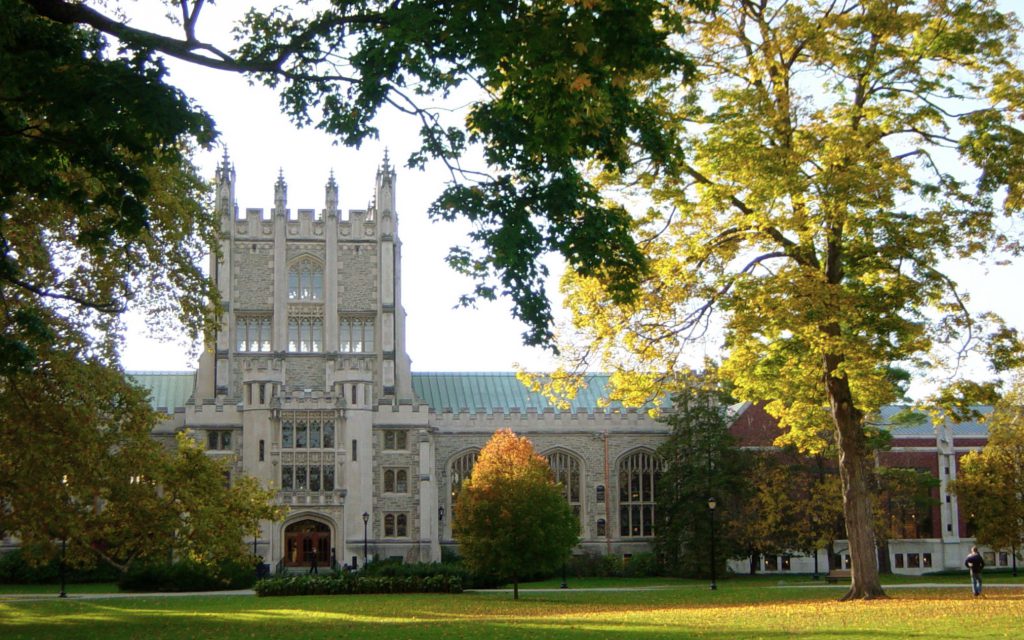
Approach to Main Library, Vassar College. Photograph by Mildred Budny.

[Posted on 1 March 2025, with updates]

Inspired by the 2024 RGME Spring Symposium at Vassar College, we return in May for a visit to its collections.

This time, we will see some of its Medieval & Renaissance manuscripts, fragments, and cuttings. These manuscript materials at Vassar are held in the

  • Archives & Special Collections Library
    and
  • Frances Lehman Loeb Art Center

We will visit both, with lunch in between. An RGME Roundtable discussion will follow the afternoon visit.

In addition, at each location, undergraduate students or a new member of the faculty for the Art Department will speak about their work on some of the manuscript materials. They will present new discoveries, with the chance to see the original materials themselves.

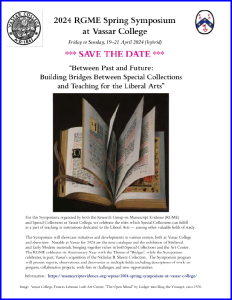
Save-the-Date Poster for 2024 RGME Spring Symposium at Vassar College. Poster set in RGME Bembino.

Prequel:
Our 2024 Spring Symposium

Some of these materials were considered in presentations at the 2024 Spring Symposium; some were displayed at the special exhibition, where we could see them on view. See:

  • Books of the Middle Ages and and Renaissance (April 19–June 23, 2024)

At the first Reception of the Symposium, Vassar undergraduate students described their work on several of them to prepare for this exhibition.

Coinciding with the Symposium was the publication of the new catalogue of these materials.

  • Catalogue of Medieval & Renaissance Manuscripts at Vassar College, Including the Nicholas B. Scheetz Collection and the Frances Lehman Loeb Art Center, compiled by Peter Kidd (Vassar College, 2024)
    ISBN 9798218363758

2025 RGME Visit to Vassar

Our 2025 RGME In-Person/Hybrid Visit will take place on Monday 5 May. There will be a preliminary session on Sunday 4 May.

We invite you to attend either:

  • in person (places are limited due to space) or
  • online.

The RGME will provide online and interactive access by Zoom, to allow a wider audience to join us for an interactive Zoom Meeting.

For Registration information, see below.

A Centerpoint for the RGME’s 2025 Activities

The plan for this visit connects with the RGME theme of collectors and collecting for our events this year, and also for our work on manuscript fragments.

For the various events, held online and in various locations as in-person/hybrid events, see:

  • RGME 2024 and 2025 Activities
  • 2025 Spring and Autumn Symposia: “Agents and Agencies”

Spring (Part 1 of 2)
“Makers, Producers, and Collectors of Books:
From Author/Artist/Artisan to Library” (28–30 March online)

Autumn (Part 2 of 2)
“Readers, Fakers, and Re-Creators of Books:
From Page to Marketplace and Beyond” (17–19 October online or hybrid)

  • 2025 Autumn Colloquium at the University of Waterloo. (21–23 November hybrid)
    “Break-Up Books and Make-Up Books:
    Encountering and Reconstructing the Legacy
    of Otto F. Ege and Other Biblioclasts”

Plan/Program

Overview

Sunday 4 May

  • The afternoon before the full day’s visit, a preliminary session (hybrid) at 4:00–5:30 pm EDT offers the chance to gather at the Murphy Room of the Art Library for Martha Frish’s presentation on “The Symbols of Vassar Architecture”. This presentation gives an update from her Post-Symposium Presentation last year. (See 2024 Spring Symposium.)
  • For the location of the Murphy Room, see Maps and Call Numbers, Art Library

Monday 5 May

  • In the morning we will visit the Frances Lehman Loeb Art Center (on its closed day), to see some of its manuscripts and manuscript cuttings.
  • Lunch will be held in its Sculpture Garden (or inside in case of inclement weather).
  • After lunch, we will visit the Frederick Ferris Thompson Memorial Library (Main Library), to see some of its manuscript materials held in the Archives & Special Collections Library.
  • Then we will move to the Seminar Room in Special Collections to hold a Roundtable discussion. We may continue conversation about the materials, compare notes, and reflect on the day.
  • For drinks and dinner, we would go to a local restaurant, for repasts at our own expense.
Speakers include:
John P. Murphy
Ronald D. Patkus
Rachel Wise
Benjamin Garrity (Vassar Class of 2027)
Tara Peterson (Vassar Class of 2025)
Both John P. Murphy and Ronald D. Patkus will speak about the materials in the Art Center.

Rachel Wise, Professor of Art, will speak about her study of one of the most important manuscripts in its collection.

Ronald Patkus will speak about provenance for materials in both the Art Center and Special Collections.

Two Vassar students will speak about the art of materials in Special Collections:

Benjamin Garrity (Class of ’27) will speak about the Loeb Book of Hours.
Tara Peterson (Class of ’25) will speak about the Spanish Forger.

The showcased items in the two collections comprise: an album of collected initials; selected Books of Hours; and a leaf illustrated in medieval style by the prolific and renowned Spanish Forger. On hand, by request, at the session on Special Collections, might be its leaf from the Saint Albans Bible, a dismembered manuscript being researched by the RGME because of a current loan. (See below.)

Program

1. Sunday 4 May

Afternoon: 4:00–5:30 pm EDT (GMT-4)

The hybrid RGME Visit opens with a presentation by Martha Frish on Sunday afternoon, when she will speak about
“Some Symbols in the Architecture at Vassar College.” Her illustrated presentation will highlight features of the campus which distinguish it from many American colleges. By examining many of the buildings in their architectural settings, both in their landscape and in their historical periods, demonstrates the ways in which Vassar represents a physical documentation of the architectural history of the United States.
As an introduction to the RGME Visit to the College all day on Monday 5 May, this ‘tour’ sets the scene by locating the visit within the physical space of the collections at the Frances Lehman Loeb Art Center and Special Collections of the Frederick Ferris Thompson Memorial Library. Martha’s invitation to examine the buildings and their own settings offers a companion to the ways in which readers, students, and beholders would at the manuscript sources in these collections, in order to discover more of their meanings and stories of their own.

This special presentation will take place in person in the

  • Murphy Room, Art Library

To register for this portion of the Visit, please use these links:

1) In Person:
https://www.eventbrite.com/e/sunday-in-person-for-2025-rgme-vassar-visit-symbols-of-vassar-architecture-tickets-1347124799539

2) Online:
https://www.eventbrite.com/e/sunday-online-2025-rgme-vassar-visit-symbols-of-vassar-architecture-tickets-1348928243689

"The Quad as Exterior Room". Photograph of the Residential Quad by Martha Frish (2016).

“The Quad as Exterior Room”. Photograph of the Residential Quad by Martha Frish (2016).

2. Monday 5 May

Morning
10:30–11:30
Art Center, Seminar Room

We would meet by 10:30 am in the Entrance Lobby of the Frances Lehman Loeb Art Center . Note that the Art Center is otherwise closed on Mondays.

Our visit allows us to see some of its manuscripts and manuscript cuttings. They include materials not normally on show.

Both John P. Murphy and Ronald D. Patkus will speak about the materials. Rachel Wise, Professor of Art, will speak about her study of one of the most important manuscripts in the collection.

They will demonstrate 1) an album of cuttings of choice portions from manuscripts (such as illuminated initials) and 2) a Book of Hours. These monuments are:

1.  Album of Cuttings, 15th century (Loeb 864.2.242-864.2.258)
Seventeen cuttings with illuminated initials, removed from an Alphabetical Index (so far unidentified). Germany, 15th century.

Other contents include drawings of architectural features, copies of paintings, and copies of manuscript illuminations and marginalia from medieval manuscripts now in Oxford, London, and Salisbury Cathedral. Some of those manuscripts have been the subjects of RGME seminars.

Catalogue, pp. 246–249 (with plate on p. 246)
See also  Object: Manuscript
John Murphy will speak about the initials, Ronald Patkus about provenance, and then we will have discussion.

2.  Book of Hours, 15th century (Loeb 1994.2.2)

Book of Hours of Jean Olivier, Bishop of Angers (bishop from 1532–1540), for the Use of Rome, in Latin and French. France: Paris? Circa 1510–1540 or 1510–1520.

Artist: Jean Pichore (French, active c. 1501–1520)
Catalogue, pp. 266–269 (with plate on p. 267)
See also The Melun-Epinoy Hours

Rachel Wise, Professor of Art, will speak about the art of the manuscript, Ronald Patkus about provenance, and then we will have discussion.

The Melun-Épinoy Hours, opened to Annunciation scene. c. 1501–1520. Image: Frances Lehman Loeb Art Center, Vassar College

12:00–1:00 pm
Lunch

Lunch will take place in the outdoor Sculpture Garden.  In case of inclement weather, we will go inside.

Afternoon

After lunch we will move to the Frederick Ferris Thompson Memorial Library (Main Library).

The first afternoon session, showcasing materials in Special Collections, will take place in the Class of 1951 Reading Room.

The second afternoon session, featuring a RGME Roundtable discussion, will take place in the Seminar Room of Special Collections (which closes at 4:30 pm).

1:00–2:00 pm
Spotlight on Special Collections

Class of 1951 Reading Room

Selected materials from Special Collections will be available for examination and discussion.

Ronald D. Patkus will speak about the materials. Students of both Ronald and Rachel Wise will speak about their work 1) on a leaf by The Spanish Forger, a notorious and prolific producer active in the late-nineteenth and/or early twentieth century, probably in Paris; and 2) on the Loeb Book of Hours.

3.  Leaf 42, 14th and 19th/20th centuries
Single leaf as a cutting, reused.
Text on one side from an Antiphonary.  Italy, 14th century
Painted image on the other.  The image depicts an encounter outside a walled city between a solder and a lady, each with retinue. France, late 19th or early 20th century.
Artist: The Spanish Forger. (Active France, late 19th or early 20th century)
Catalogue, pp. 107–109 (with plate on p. 108)
4. Book of Hours, 15th century (MS. 6)
Book of Hours for the Use of Paris, in Latin and French
Catalogue, pp. 21–14 (with plate on p. 13)
Students will speak about their work on these materials; Ronald Patkus will speak about the provenance; and there will be scope for discussion.

2:00–2:30 pm
Break

3:30–4:00 pm
RGME Roundtable
“Looking at Manuscripts and Collections”

Collection of Jennah Farrell, Vulgate Bible Leaf, Recto. Photography by Mildred Budny.

This occasion offers the opportunity to share reflections about the materials demonstrated on our visit to both the Art Center and Main Library. Several of us might describe our research on some of them or relatives to them. We would consider their bearing on subjects which the RGME considers this year in its variety of events and projects.

1. Manuscript Fragments:
Challenges and Opportunities for Research

For example, recently the RGME has been examining the Farrell Leaf and the Weber Leaf from the Saint Albans Bible, dismembered directly after sale in 1964 and widely distributed thereafter frequently through sale rooms. The original manuscript, a single-volume Latin Vulgate Bible, was produced in France, probably Paris, circa 1330-1340. See our Workshops on “The Evidence of Manuscripts, Etc.”

A leaf from the same book belongs to Vassar College. It is part of the Nicholas B. Scheetz Collection of Medieval & Renaissance Manuscripts (Scheetz MS 27). About this leaf, see the entry in the recent catalogue:

  • Catalogue of Medieval & Renaissance Manuscripts at Vassar College, compiled by Peter Kidd (Vassar College, 2024), p. 217.

It could be useful to compare notes about these relatives which formerly stood within the same covers of a single-volume Latin Vulgate Bible. Whereas many leaves known from the original manuscript in a variety of collections belong to the Old and New Testament portions of the Bible, the Vassar leaf from the Scheetz Collection belongs to part of the textual apparatus of the Interpretation of Hebrew Names in glossary form, arranged alphabetically, and specifically from within the section for terms beginning with the letter B.

Collection of Richard Weber, Leaf from the Saint Albans Bible, Recto: Top Right. Photograph by Richard Weber.

2. Provenance: A Perennial Quest

Other subjects under consideration this year by the RGME fall into the sphere of the Visit to Vassar’s collections. Among them are issues of provenance for the objects, whether known, detectable, or unknown. Such issues can form an important part of the history of their transmission and, perhaps, of legitimacy, as in the case of forgeries.

Our roundtable might mention various points of contact between the visit and our other events for this year, which have led to the selection of objects to examine. The Vassar Visit stands poised between them:

  • our Spring and Autumn Symposia which explore aspects of “Agents and Agencies” in the realms of books
    2025 Spring and Autumn Symposia
  • our sessions on “Manuscripts at Worlds of Knowledge” at the 2025 International Medieval Congress at Leeds
    2025 International Medieval Congress at Leeds: RGME Program
  • our Autumn Colloquium on “Break-Up Books and Make-Up Books: Encountering and Reconstructing the Legacy of Otto F. Ege and Other Biblioclasts”
    2025 RGME Autumn Colloquium at the University of Waterloo

The design of the Visit, selected by Ronald Patkus and John Murphey, responds thoughtfully and expertly to these shared interests for collective exploration in 2025.

Reception

A Reception will close the day’s visit.

Celebratory Reception
5:00–7:30 pm EDT
Class of 1951 Reading Room

We celebrate the visit, the sharing of expertise and experiences in studying the original sources at Vassar, and the generosity of the curators, donors, contributors, organizers, hosts, and student interns. We invite you to join us.

Dinner

Afterward, we would go to a local restaurant for drinks and/or dinner (at our own expense). There, we could continue conversation in the company of people interested in books, their care, their study, their ability to teach, their stories, and their delight.

Information for Visiting Vassar

For information on travel, directions, campus maps, accommodation, dining, and other features in the area, see:

  • Visit Vassar

A photo of the Thompson Library at Vassar College in Poughkeepsie, New York, taken by me [Noteremote] on November 2, 2007. via Wikimedia Commons Creative Commons Attribution-Share Alike 3.0 Unported, via https://en.wikipedia.org/wiki/File:Thompson_Library_(Vassar_College).jpg.

Registration

You can register for the RGME Vassar Visit through the RGME Eventbrite Portal. See:

  • RGME Eventbrite Collection

There you will be able to register to attend either in person or online.

We encourage you to make a Voluntary Donation when you register. It will help to support our small nonprofit educational organization powered principally by volunteers.

1. Sunday 4 May 2025

To register for the preliminary presentation on Sunday afternoon, please use these links:

1) In Person:
https://www.eventbrite.com/e/sunday-in-person-for-2025-rgme-vassar-visit-symbols-of-vassar-architecture-tickets-1347124799539

2) Online:
https://www.eventbrite.com/e/sunday-online-2025-rgme-vassar-visit-symbols-of-vassar-architecture-tickets-1348928243689

2. Monday 5 May 2025

To register for the Visit to the Art Center and the Main Library on Monday 5 May, please use these links:

1) In-Person Visit

For in-person attendance, space is limited. In registering for in-person attendance, for the catering you will be given the opportunity to indicate any dietary requirements.

2025 RGME Visit to Vassar College IN PERSON

2) Online Visit

For online attendance, once you register, the Zoom Link will be sent to you shortly before the event.

2025 RGME Visit to Vassar College ONLINE

Thank you for your interest and support. We look forward to welcoming you.

*****

Thanks

For arranging this visit, we thank:

  • Ronald D. Patkus, Head of Special Collections and College Historian, Adjunct Associate Professor of History on the Frederick Weyerhaeuser Chair
  • John P. Murphy, Philip and Lynn Straus Curator of Prints and Drawings at the Frances Lehman Loeb Art Center

We thank the speakers for their contributions to share their work on manuscript materials at Vassar College: Rachel Wise, Ronald Patkus, John Murphy, and Vassar students Ben Gerrity and Tara Peterson. Thanks go to Thomas E. Hill, Art Librarian, for arranging the visit to the Murphy Room, to Francine Brown of the Art Center, and Amanda Burdine. Thanks go to the 2025 RGME Visit Student Interns for help behind the scenes: Betsy Subiros (Class of 2025), Anna Gilsdorf, and Rachel Stanger (Class of 2027).

We give thanks to the staff and others at Vassar College for this visit.

We look forward to the visit. You are invited to join, whether in person or virtually.

*****

Questions or Suggestions?

Please let us know.

  • Leave your comments or questions below
  • Contact Us

Visit our Social Media:

    • our href=”https://www.facebook.com/Research-Group-on-Manuscript-Evidence-259443617456668/” target=”_blank” rel=”noopener”>FaceBook Page
    • our href=”https://www.facebook.com/groups/rgmemss” target=”_blank” rel=”noopener”>Facebook Group
    • our X/Twitter Feed (@rgme_mss)
    • our Bluesky nest (@rgmesocial.bluesky.social)
  • our href=”https://www.instagram.com/rgme94/” target=”_blank” rel=”noopener”>Instagram Page
  • our LinkedIn Group

Join the Friends of the RGME

Please make a Donation in Funds or in Kind for our nonprofit educational corporation powered principally by volunteers. Your donations and contributions are welcome, and can go a long way. They may be tax-deductible to the fullest extent provided by the law.

  • Donations and Contributions
  • 2025 Annual Appeal

We look forward to seeing you and welcoming you to our events.

*****

Tags: Archives & Special Collections of Vassar College, Books of Hours, Frances Lehman Loeb Art Center, Manuscript Cuttings, manuscript fragments, Manuscript studies, RGME Visits to Collections, The Spanish Forger, Vassar College, Virtual Visits to Collections
No Comments »

The Weber Leaf from the Saint Albans Bible

February 22, 2025 in Manuscript Studies, Workshops on "The Evidence of Manuscripts"

Leaf from the Saint Albans Bible
in the Collection of Richard Weber

Double columns of 46 lines in Gothic Script
with Decorated Initials, Bar-Extensions,
and Running Titles
Acts 26:14 (est tibi) – Acts 28:9 (insula habe[/-bant] )

Northern France, circa 1330

Collection of Richard Weber, Leaf from the Saint Albans Bible, Recto: Top Right. Photograph by Richard Weber.

[Posted on 21 February 2025]

In connection with our new series of RGME Workshops on “The Evidence of Manuscripts, Etc.”, our Associate, Richard Weber, revealed another leaf in his collection. This discovery joins the posts about different items in his collection which have been reported in our blog on Manuscript Studies.

Our workshops began by examining a leaf on loan to the RGME with part of the text of the Book of Numbers in a Latin Vulgate Bible in double columns of 46 lines in Gothic script, with decorative elements. See the reports of our discoveries about that leaf:

  • A Latin Vulgate Leaf from the Book of Numbers (Part 1)
  • Latin Vulgate Bible Leaf in the Collection of Jennah Farrell, Part 2: Provenance
  • The Latin Vulgate Bible Leaf in the Farrell Collection Part 3: The Full Leaf

Collection of Jennah Farrell, Single Leaf from the Book of Numbers in a Medieval Latin Vulgate Bible manuscript: Recto, top. Photography by Mildred Budny.

The collaborative work in our workshops, crowdsourcing the quest to identify the leaf, has revealed that it most probably came from the dismembered Saint Albans Bible, produced in Northern France in the 1320s or 1330s and formerly owned by Saint Albans’ Abbey. Our search among online resources, such as blogposts and vendors’ sites, and in printed works, ranging from books and journal articles to catalogues of sales or individual collections, followed up clues leading from one collection or sales room to another.

Collection of Jennah Farrell, Single Leaf from the Book of Numbers in a Medieval Latin Vulgate Bible manuscript: Recto. Photography by Mildred Budny.

The process of discovery persuaded us, from the resemblances between the leaf in hand and features of some surviving leaves from the Saint Albans Bible, that this leaf very likely came from the same manuscript — if not from another much like it by some of the same scribes and artists. We believe that proof positive (or the like) for this conjectured identification might come were one or both of the leaves which formerly directly preceded and directly followed the leaf to emerge into the light so as to demonstrate an exact match in the flow of text from one to the next.

And so we continue our search among the survivors, as we track the leaves from both the Old and New Testaments in the Saint Albans Bible, especially from the Book of Numbers. In view might be, were time and resources available, the creation of a virtual reconstruction of the manuscript, as has been accomplished or begun for various other manuscripts which now survive in fragments scattered across many locations.

Learning from our workshops that the Farrell Leaf is identifiable most probably as part of the dismembered Saint Albans Bible, our Associate, Richard Weber, reported the presence of another leaf from the same manuscript in his collection. With his permission, for which we give thanks, we introduce it to you and our Workshop Series, starting with RGME Workshop 4: “Manuscript Fragments Compared”.

The Weber Leaf
from the Saint Albans Bible

Acquired on May 23, 2023, from The Raab Collection (Nathan “Nate” Raab and Karen Pearlman Raab), this leaf preserves part of the Acts of the Apostles in the Saint Albans Bible, which was dismembered for resale in 1964. The leaf comes from the last part of the Book of Acts. It breaks off mid-word in its final chapter, about one-third of the way through it.

The Apostle Paul, His Travels, and His Travails

The text on the leaf presents the text from within Chapter 26 to within Chapter 28 of Acts in the Latin Vulgate Version. It opens within verse 14 ([persequeris durum /] est tibi contra) of Chapter 26, completes the chapter, turns to the full span of Chapter 27, and opens the last chapter of the Book up to its verse 9, whereupon it breaks off mid-word (insula habe[/-bant infirmitates]). That is, the span of text encompasses Acts 26:14–32 (the latter portion of the chapter); Acts 27:1–44 (the full chapter); and Acts 28:1–9 (the first third).

The leaf contains most of the extended first-hand account by the Apostle Paul (circa 5 – circa 64/65 AD) of his life’s adventures in his defense before King Herod Agrippa II of Judea (27/28 – 92 or 100 AD). From his own viewpoint, we hear about his transformation from soldier and Roman citizen to apostle in locations stretching from Tarsus in Asia Minor to Jerusalem, Antioch, Thessaloniki, Athens, Corinth, Ephesus, Malta, and finally Rome.

The scope, range, and variety of his exploits or adventures are illustrated vividly in some medieval manuscript illustrations. Notable among them is the full-page, multi-tiered cycle of scenes rendered by an exceptional master artist in the large-format Carolingian version of the Latin Vulgate Bible prepared at Tours for presentation to the monarch Charles the Bald (823–877). On this imposing Bible, see, for example, Latin 1.

Paris, Bibliothèque nationale de France. Département des Manuscrits. Latin 1, fol. 386v. Image Public Domain via https://gallica.bnf.fr/ark:/12148/btv1b8455903b/f780.item#.

The Leaf, Its Contents, and Its Presentation

Sections of the text are demarcated by

1) enlarged, decorated initials rendered in polychrome or in ink,
2) ornamental vertical bars extending from the 2-line inset polychrome Chapter Initials to foliate terminals,
3) ornamental or figurative motifs embellishing the enlarged pen-initial in the top line of all but one column,
4) polychrome chapter numerals,
5) polychrome running titles in the upper margins, rendered partly in alternating pigments and partly in pen-line flourishes, and
6) a marginal ‘insertion’ of script to correct an omission in the text.

Let us have a closer look.

The Recto

The recto of the Weber Leaf

Collection of Richard Weber, Leaf from the Saint Albans Bible, Recto. Photograph by Richard Weber.

Lively decorated letters rendered in ink rise to considerable heights in the first lines of each column of text, one to each column. In column a, E for Ego opens Verse 15 of Chapter 26. In column b, T completes the opening word UT of Chapter 27:1.

The two-part running title at the top spaces its words at a distance from each other. It keeps the first part (Actus) more-or-less centered above the two columns and places the second, abbreviated word (Ap[osto]lor[um]) offset extending partway into the margin.

The distant, offset half of the running title appears like an afterthought, although apparently as the work of the same scribal artist and during the same campaign of operation (if not at the same sitting). Could it represent a correction to supplement the ‘mistake’ of putting the first component, Actus, on the recto of an opening, rather than on the verso?

On the verso of a two-page opening, with the verso of one leaf facing the recto of the next, customarily a bipartite running title for one set text on both pages might have the first half or portion of a single title on the verso and the continuation in the second half or portion on the recto. What if this leaf received the Actus as if it were a verso, so that its match or completion, Apostolorum, was deemed to need to be fitted in? We wonder what the verso originally facing this leaf had for its running title.

Collection of Richard Weber, Leaf from the Saint Albans Bible, Recto: Top Right. Photograph by Richard Weber.

The Verso

Collection of Richard Weber, Leaf from the Saint Albans Bible, Verso. Photograph by Richard Weber.

This side of the leaf retains the use of a tall ink-drawn letter in the top line, but only for one column. The initial U or V for Valida opening 27:18

The running title keeps to its short form of one word (or syllable) only. Presumably the second part of the title appeared facing it on the recto of the next leaf. We are uncertain what intentions were in place for this enigmatic running title comprising DE (“Of”, “About”), which seems to stand in a suspended state awaiting the completion of a name or phrase on the formerly facing recto. Here is another mystery awaiting resolution, if possible, with the discovery of the next leaf in the sequence in the original book.

Collection of Richard Weber, Leaf from the Saint Albans Bible, Recto: Top Center. Photograph by Richard Weber.

The first stem of the animated pen-initial U atop Column a (the left-hand column of the pair on the page) on the verso rises to a backwards and downwards curve containing the shaggy neck and head of a wide-eyed creature with opened jaws with exposed teeth and fangs. One might wonder if the apparent ferocity of the creature emulates or evokes the stormy text of the verse which this initial opens (27:18), as it reads: Valida autem nobis tempestate jactatis sequenti die jactum fecerunt (“And we exceedingly tossed with a tempest, the next day they lightened the ship.”) Might we think of this creature as presenting the Jaws of a Tempest?

Collection of Richard Weber, Leaf from the Saint Albans Bible, Verso: Top Left. Photograph by Richard Weber.

The Seller’s Description

Richard shares with us the description which accompanied the leaf in preparation for its sale by The Raab Collection in 2023. This description deserves to join the growing group of sellers’, collectors, scholars’, curators’, and others’ descriptions of individual leaves or groups of leaves which are present, for a time, in their hands and before their eyes.

As such they can constitute direct witnesses to surviving portions of the manuscript. Our work toward a collaborative virtual reconstruction of the original will also assemble the descriptions as a contribution toward fuller knowledge of the manuscript and its stages of ownership, study, and wider understanding.

We quote:

The Saint Alban’s Bible started life in Paris in the 1320s or 1330s. Likely, three artists worked together in an atelier, or workshop, to create the high quality product. The workshop to which Christopher de Hamel attributes the creation is that of the famed Parisian artist, Jean Pucelle, one of the most important and influential artists for the Gothic style. While the Saint Alban’s Bible is not in the hand of John Pucelle, it is in the hands of his associates, the Saint Louis Master, whose name has been identifed as Mahiet (Kuroiwa, “Working with Jean Pucelle”). On the margins of another manuscript illustrated by the Saint Louis Master, housed in the Bibliotheque Nationale de France in Paris, a marginal note from Pucelle to an illuminator, Mahiet, confirms the Saint Louis Master’s identity. Through the association of the Saint Albans Bible with Mahiet and Pucelle, a complex network of Parisian bookmakers opens up, and their works can be traced.

From its manufacture on the Rue de la Parcheminerie, the Bible was likely a gift from Richard de Bury, Bishop of Durham to the Abbey of Saint Albans after his 1320-1330s visit to Paris (de Hamel, “Leaf of a Bible Manuscript”). Leaves have ended up in collections such as the Tokyo National Museum of Western Art, the University of Colorado at Boulder, and the University of British Columbia, with others in private hands. The post-medieval lives of manuscripts, as they fragment and change hands, demonstrates their endurance as status symbols and works of art— as a whole and as a part.

The text gives part of Paul’s recount of his life story to King Agrippa who is almost persuaded to become a Christian. The imprisoned Paul’s ship runs aground and he is shipwrecked in Malta on his way to face trial in Rome. The barbarians of Malta show Paul and the shipwrecked crew kindness by building a fire, but a viper emerged from the ashes and bit Paul’s hand, though he did not die.

Provenance: 1. From an incomplete Bible sold at Sotheby’s, 6 July 1964, lot 239, to the dealer and book-breaker Philip C. Duschnes [1897–1970], who dispersed it. Other leaves had already been removed, with some ending up in the collections of E.H. Dring (1864-1928), one reappearing in Bernard Quaritch, cat. 1036, 1984, no. 76).

Then identified in 1981 as from the medieval library of St Albans Abbey, Hertfordshire, and perhaps to be identified as one of ‘duas bonas biblias’ acquired by Abbot Michael de Mentmore (C. de Hamel in Fine Books and Book Collecting, 1981, pp. 10–12).2.

More details:

Leaf from the St Albans Abbey Bible, in Latin, illuminated manuscript on parchment [northern France (Paris), c. 1330] Single leaf, with double columns of 46 lines in a fine gothic bookhand (Acts 26:14–32; Acts 27:1–44; Acts 28:1–9), with hairline penwork ornamenting the V with a grotesque animal head biting the ascender, versal numbers (27, 28) in alternate liquid gold and blue capitals with contrasting penwork, running titles in same, two 2-line initials (one each side of leaf) each in faded pink with white ornamentation on gold background and enclosing foliage, one medieval correction in the margin indicated by a signe-de-renvoi, modern pencil numerations (3, 73), 295 by 200mm or 12 by 8 inches.

*****

Join the Quest

Would you like to join the quest? Do you know of other leaves from the Saint Albans Bible? Do you know of other works by the same scribes or artists? Are you curious about books and ways of looking at them?

Join our Workshops!

*****

Collection of Richard Weber, Leaf from the Saint Albans Bible, Recto: Top Right. Photograph by Richard Weber.


Tags: Acts of the Apostles, Book of Numbers, Collection of Jennah Farrell, Collection of Richard Weber, manuscript fragments, Manuscript studies, Medieval Vulgate Bibles, Saint Albans Bible
No Comments »

Workshop 4. “Manuscript Fragments Compared”

February 16, 2025 in Announcements, Manuscript Studies, Research Group Workshops

RGME Workshops
on
“The Evidence of Manuscripts, Etc.”
(Formerly: “Examining Original Sources”)

Workshop 4
“Manuscript Fragments Compared”

Sunday 23 February 2025
1:00- 2:30 p.m. EST (GMT-4) by Zoom

We cordially invite you to join us for our next RGME Workshop on the “Evidence of Manuscripts Etc.” The series gives the opportunity collectively to examine original sources, in manuscript and other written forms. Beginners and experts are welcome; we can learn together.

The Series

Originally this series was planned as a two-part series of workshops to consider the medieval “Farell Leaf” on loan to the RGME Library and Archives from the Collection of Jennah Farrell. After rich discussions concerning the fragment and evidence for its production and provenance, most probably as part of the Saint Albans Bible (dismembered in 1964), our workshops have turned into a series for teaching manuscripts and related studies.

Collection of Jennah Farrell, Single Leaf from the Book of Numbers in a Medieval Latin Vulgate Bible manuscript: Recto, top. Photography by Mildred Budny.

Workshop 4

Workshop 4 introduces a comparative study. The plentiful genre of medieval Latin Vulgate Bibles is a rich field in Manuscript Studies. Work on cases of deliberately disbursed manuscripts has yielded in the last two decades a selection of stand-out works. Among them is the Saint Albans Bible, known through numerous studies in print and online. Examples include

  • “Breaking Bad: The Incomplete History of the Saint Albans Bible” (1 Nov 2019)
  • The Book, The Leaf, The Knife, and Some Bother
  • The St Albans Bible (20 June 2021)

Since Workshop 3, another leaf from the medium-format Saint Albans Bible has come to our attention. It stands in the collection of our Associate, Richard Weber – from whose collection our blog on Manuscript Studies has reported other discoveries. Its portion from the Acts of the Apostles offers comparison with the Farrell Leaf from the Book of Numbers, with a view toward the presentation of both Old and New Testaments within its former single volume.

Now see:

  • The Weber Leaf from the Saint Albans Bible

Collection of Richard Weber, Leaf from the Saint Albans Bible, Recto: Top Right. Photograph by Richard Weber.

In our workshop, the case of that manuscript is joined by another fragmented Bible, dismembered instead by the biblioclast Otto F. Ege: namely his large-format Ege MS 14, represented by a leaf now on loan to the RGME for teaching purposes. Over the years, our blog has contributed discoveries to knowledge of that manuscript (see Manuscript Studies). For our workshop, Richard Weber reports his leaf from that manuscript as well.

Private Collection, Leaf from ‘Ege MS 14’. Part of the Book of Jeremiah, Recto, Detail. Photograph by Mildred Budny.

Resources for the Quest

The different agents of destruction for these two books provide instructive case studies for the different but overlapping resources available in print and online for the detective work of fragmentology, in the quest to trace the steps of re-distribution of leaves from these Bibles, with a view toward identifying the locations of survivors and virtually reconstructing their original books, insofar as possible.

We welcome participants to join the quest and come forward with questions, updates on any work they have been doing on the Farrell Leaf, or suggestions for potential avenues of study in future workshops.

Registration

Registration is required and free. We are grateful for Voluntary Donations accompanying your Registration to help support our nonprofit educational organization powered principally by volunteers.

  • Workshop 4. “Manuscript Fragments Compared”: Tickets

Note that our Workshop series now appears on our Eventbrite Registration Portal:

  • RGME Workshops on “Examining Original Sources”: Tickets: Tickets

If you have issues with the Zoom Link or connecting, please contact

  • director@manuscriptevidence.org or rgmesocial@gmail.com .

Information about the series

  • RGME Workshops on “The Evidence of Manuscripts, Etc.”

  • The Bridge of Signs

  • Handlist of Recources for Manuscript Studies and Fragmentology

Workshop 5 is planned for Sunday March 2025 at 1:30-2:30 pm EST (GMT-5) by Zoom.

Please join us if your timetable allows. We look forward to welcoming you.

*****

Questions? Suggestions?

  • Leave your comments or questions below
  • Contact Us

Visit our Social Media:

  • our Facebook Page
  • our Facebook Group
  • our X/Twitter Feed (@rgme_mss)
  • our Bluesky nest @rgmesocial.bluesky.social)
  • our Instagram Page
  • our LinkedIn Group

Join the Friends of the RGME.

Please make a Donation in Funds or in Kind for our nonprofit educational corporation powered principally by volunteers. Your donations and contributions are welcome, and can go a long way. They may be tax-deductible to the fullest extent provided by the law.

  • Donations and Contributions
  • 2025 Annual Appeal

We look forward to seeing you at our events!

*****

Tags: Collection of Richard Weber, Fragmentology, Jennah Farrell Collection, Latin Vulgate Bibles, Manuscript studies, Medieval manuscripts, Otto Ege MS 14, Otto F. Ege, RGME Workshops on the Evidence of MSS Etc., Saint Albans Bible
No Comments »

Episode 21. “Learning How to Look”

January 18, 2025 in Announcements, Manuscript Studies, Research Group Speaks (The Series)

“The Research Group Speaks”
Episode 21

“Learning How to Look”
A Roundtable

Saturday 24 May 2025
1:00–2:30 pm EST (GMT-5) by Zoom

[Posted on 17 January 2025]

As the series wherein “The Research Group Speaks,” we respond to suggestions and requests as the series unfolds. For information about the series, please see:

  • “The Research Group Speaks”: The Series

London, British Library, Yates Thompson MS 5, fol. 12r. Book of Hours, 15th century, France, perhaps Tours. Saint Matthew, Evangelist, with book, spectacles, and lion attribute. Image via https://blogs.bl.uk/digitisedmanuscripts/2019/02/medieval-spectacles.html

The Plan

For this Episode, by request, a group of experts, scholars, students, and interested observers will compare notes and share experiences. We examine the painstaking yet rewarding quest to learn how to look at objects or materials.

Cases in point will come from the detailed study of manuscripts and printed books, photographs, human anatomy, numismatics, prints and drawings, textual transmission, the natural world, and other spheres. From personal experience, our speakers may report on how they learned how to look, at various stages in their lives and studies, and what tips or methods they find helpful in the process.

We might provide some references as guides or handbooks for this instruction, whether self-taught, mentored, or a combination. For example, to what extent does the process of learning carefully how to look at one body of material transfer to another, that is, to another body of material or to another observer?

Related to this quest for learning how to look more fully at objects and original sources, so as better to understand them, is the need to consider how to describe what it is that we see. Describing can develop understanding the nature of the object more clearly. Putting that recognition into words with precision calls upon accuracy of terminology or nomenclature.

That complex subject might itself call for another Episode of its own. Let us see how this Episode take shape, and where it might lead.

Speakers include (in alphabetical order):

Nan Anantharaman, Mildred Budny, Michael Allman Conrad, David W. Sorenson, and others.

Vitas Patrum Folio 5A. Photography © Mildred Budny

Private Collection, Vitae Patrum, Folio 5A. Photography by Mildred Budny.

Registration

See the registration portal for our events.

  • RGME Eventbrite Collection

For this Episode, you can register through its own portal:

  • Episode 21 “Learning How to Look” Tickets

Registration for the Episode is free. The Zoom Link will be sent to you directly shortly before the event.

We welcome Voluntary Donations with your registration. See also:

  • Contributions and Donations
  • 2025 Annual Appeal

Thank you for joining us!

*****

Questions? Suggestions?

  • Leave your comments or questions below
  • Contact Us

Visit our Social Media:

  • our FaceBook Page
  • our Facebook Group
  • our X/Twitter Feed (@rgme_mss)
  • our Bluesky nest @rgmesocial.bluesky.social)
  • our Instagram Page
  • our LinkedIn Group

Join the Friends of the RGME.

Please make a Donation in Funds or in Kind for our nonprofit educational corporation powered principally by volunteers. Your donations and contributions are welcome, and can go a long way. They may be tax-deductible to the fullest extent provided by the law.

  • Donations and Contributions
  • 2025 Annual Appeal

*****

London, British Library, Yates Thompson MS 5, fol. 12r. Book of Hours, 15th century, France, perhaps Tours. Saint Matthew, Evangelist, with book, spectacles, and lion attribute. Image via https://blogs.bl.uk/digitisedmanuscripts/2019/02/medieval-spectacles.html

Tags: Manuscript studies
No Comments »

Episode 20. “Comic Book Theory for Medievalists”

January 16, 2025 in Manuscript Studies, Research Group Episodes for The Research Group Speaks, Research Group Speaks (The Series)

“The Research Group Speaks”
Episode 20

“Comic Book Theory
for Medievalists:
The Poetics”

Jesse D. Hurlbut

Saturday 1 March 2025
1:00–2:30 pm EST (GMT-5) by Zoom

[Posted on 20 January 2025]

Our series wherein “The Research Group Speaks” continues with its Twentieth Episode in an exploration of the phenomenon of dynamic interactions between words and images found in books from widely distant centuries, yet in compellingly similar modes of presentation.

BnF, Fr, 1141, fol. 140v, detail.

London, British Museum. Door-sill carved as a carpet. From Room I, door c, the North Palace of Ashurbanipal II at Nineveh, Iraq. 645-640 BCE. Photograph (2014) Osama Shukir Muhammed Amin FRCP(Glasg), CC BY-SA 4.0 <https://creativecommons.org/licenses/by-sa/4.0>, via Wikimedia Commons..

This Episode follows Episode 19 in January 2025 “At the Gate: RGME Activities for 2025” to launch our Theme for this Year, “Thresholds and Communities”, with reflections on the theme and an introduction to the suite of our multiple activities for 2025.

Episode 20 takes a look at an engaging didactic genre of illustrated books, whether in manuscript or print, which displays an unfolding story as the pages take their turns.

Which genre is that? Comic books, par excellence, along with their popular forerunners in medieval narratives of many kinds in which sequential series of images accompany or take over the story.

Read the rest of this entry →

Tags: BnF MS Fr. 1141, Comic Book Theory, Comic Books, Dream Visions, Guillaume de Diguillevile, Jesse D. Hurlbut, Jimmy Corigan, Manuscript studies, Medieval manuscripts, Pèlerinage de la Vie Humaine, Words and Images
No Comments »

2025 RGME Autumn Colloquium at the University of Waterloo: A Failed Plan

January 5, 2025 in Announcements, Conference, Conference Announcement, Event Registration, Events, Manuscript Studies, RGME Colloquia, University of Waterloo

NOW OLD:
Plans have changed.
See
2025 RGME Autumn Colloqium on Fragments

and

2025 RGME Autumn Colloquium at the University of Waterloo with background

—————

[Note: This outdated post remains as a record
of the first intentions for the event
and its first six months of preparation
]

2025 RGME Autumn Colloquium
at the University of Waterloo

“Break-Up Books
and Make-Up Books:

Encountering and Reconstructing
the Legacy of Otto F. Ege
and Other Biblioclasts
“

Friday to Sunday 21–23 November 2025
in Hybrid Format (pending funding)
or Online by Zoom

Colloquium ‘Home Page’
for information and updates

[Posted on 5 January 2025, with updates. As of June 2025, the University of Waterloo is not a co-sponsor or host for the event. The renewed version of the initial plan retains its structure, but not that location or partner, while it honors the commitment by contributors who responded to the initial call. 

For the revised version at Princeton, see

  • 2025 RGME Autumn Colloquium on Fragments. 

For background on the necessary change, see 2025 RGME Autumn Colloquium at the University of Waterloo.]

Motto

“Yet will I leave a remnant, that ye may have some that shall escape the sword among the nations, when ye shall be scattered through the countries”
— Ezekiel 6:8

Waterloo, University of Waterloo, DRAGEN Lab, Vellum Leaf from a Book of Hours, Recto.

By request, in collaboration with the University of Waterloo, the RGME prepares a special 2025 Autumn Colloquium on the phenomena of widely dispersed remnants of dismembered manuscripts and other written materials scattered at the hands of biblioclasts such as Otto F. Ege (1888–1951), for a variety of purposes more and less laudable. We will showcase work being done in various centers and by many individuals on these materials, as part of long-term, laborious, significant, and sometimes dispersed research to identify, reclaim, and, insofar as possible, virtually reconstruct the originals and place them in context.

We seek to gather perspectives on the challenges and opportunities presented by the dispersed manuscript or other materials which survive, albeit disordered or reordered, after passing through the hands of collectors-turned-biblioclasts, for whatever reasons.

A main focus, given the number and variety of projects dedicated to them, will be the manuscripts and other materials dispersed by Otto F. Ege and his collaborators, notably his wife/widow Louise and the New York book-dealer and book-breaker Philip C. Duschnes (1897–1970). Yet, not least because many of their remnants have joined or become intermixed with fragments dispersed by others and through diverse processes in varied collections, it is worthwhile to consider that complex factor for their effective study as well.

We seek to showcase the work of these projects, compare notes about issues and methods of research, and set the legacy of those biblioclasts in the context of others working as predecessors, contemporaries, or followers, as they also redirected the course of manuscript and related studies by disrupting and dislocating its evidence.

The ‘delivery methods’ of dispersal range from assemblages of sets of fragments as specimens in Portfolios, Leaf-Books, Albums, Scrapbooks, or Loose Leaves which might circulate in mats with or without labels, on their own, or in groups sans identifying information. In effect, many of these remnants were cast out on their own as no-name ‘orphans’ whom expertise, serendipity, and circumstance might recognize as ‘foundlings’ or find forever homes, whether virtual or actual. (See The “Foundling Hospital” for Manuscript Fragments.)

Our Colloquium highlights the processes of recovery by multiple, interlinked, and interlocking means, as we gather representatives from the fields of manuscript studies and fragmentology to share their stories, processes, progress, and accomplishments.

New Haven, Yale University, Beinecke Rare Book and Manuscript Library, Otto F. Ege Collection, Leaf in Ege’s Mat from ‘Ege MS 14’. Opening page of the Apocalypse / Revelations in a large-format Lectern Bible in the Latin Vulgate Version. Photograph by Mildred Budny.

Scope

The University of Waterloo and the RGME propose to co-host an international Colloquium with hybrid functionality, for access by a wide audience with interests in multiple subjects. Our two educational organizations in Canada and the United States respectively combine experience and skills to produce a scholarly event with companion publications pre- and post-event, to promote and disseminate research work and discoveries in multiple, interrelated fields of study.

Waterloo, University of Waterloo, DRAGEN Lab, Vellum Leaf with music and notation for liturgical chants: Recto.

Our plan takes its starting point from the wish to gather expertise and perspectives from a different collections of manuscript materials — such as at the Medieval DRAGEN Lab (Digital Research Arts for Graphical & Environmental Networks — and the rich variety of new and long-term projects (both institutional and individual) dedicated to research on the medieval Western manuscripts despoiled and dispersed by Otto F. Ege and his collaborators.

These initiatives include the new project by the Cantus database (Cantus: A Database for Latin Ecclesiastical Chant – Inventories of Chant Sources) to produce a database of the musical manuscript fragments in Ege’s Portfolio of Fifty Original Leaves from Western Manuscripts (FOL). This notorious Portfolio was issued in multiple sets now widely dispersed in public or private collections through North America and beyond. Like others of Ege’s Portfolios, some sets are lost, or lost track of; some have themselves become fragmented, as parts have been removed, as specific manuscript specimens were further disjointed from their relatives, original or newer companions in the biblioclasts’ assemblages. Some of these ‘orphans’ or cast-offs have lost their identifying Ege mats or labels, further to complicate the issues of identification, recognition, and retrieval.

The RGME’s long-term project of research in these fields focuses on the variety of Ege’s Portfolios overall.  Dedicated to specific genres of books, such as Famous Books or Famous Bibles, they include not only manuscript fragments but also a multitude of printed materials ranging from incunabula (up to the year 1500) to the twentieth century; all were selected and arranged by Ege and his circle as specimens of the graphic arts and book arts for instruction and display. (For examples, see our blog on Manuscript Studies and its Contents List for Ege materials.)

Private Collection, Leaf from ‘Ege MS 14’. Part of the Book of Jeremiah, Recto, Detail. Photograph by Mildred Budny.

Research on the surviving evidence on many fronts and in multiple centers can bring expertise to bear upon specific genres (such as manuscripts containing music). So, too, it reveals the processes of workshop practices over decades in the destruction, re-constitution, and further distribution of the original books. For example, such elements have bearing upon the provenance of individual fragments and potential impact upon that of other fragments whose provenance might not otherwise be known.

Collection of Richard Weber, Leaf from Otto Ege MS 14, recto. Photograph by Richard Weber.

Given the progress of these and other projects in various centers concerned with Ege’s legacy, the time is right to bring their representatives (established scholars, curators, collectors, and others, as well as younger scholars) together to compare notes, showcase their work, and strengthen contacts between individuals and centers across borders.

By examining the book-breaking practices overall by “Ege & Co.” in the wider context of biblioclasts over time, including many of Ege’s contemporaries, predecessors, and followers, we might gain fuller knowledge of the individually as well as collectively destructive habits and their legacy. Likewise by comparing notes, surveying the results so far of different projects, and, it might be, identifying more of the seemingly lost fragments in unknown or unexpected places, our Colloquium could cross thresholds and open more gateways to wider knowledge.

Such larger contexts provide wider horizons and more comprehensive awareness of the destructive tendencies towards books in given times and places. They can demonstrate, by examination and comparison, the particular characteristics or ‘style’ of the collector, book-breaker, book-seller, and the resulting forms as altered pieces or bodies of evidence for the lost and damaged originals. Among notable predecessors for the genre can be counted the albums of “visually appealing” manuscript fragments created by Samuel Pepys (1633–1703) or the cuttings prepared by John Ruskin (1819-1900) and others.

Examining the complex legacy of these various re-creators of medieval manuscripts and other written materials and the range of projects dedicated to them from perspectives and fields of many kinds, sometimes integrated across a broad spectrum encompassing expertise in the arts and sciences, can advance knowledge in individual projects as well as in wider discourse relating to the transmission of written evidence from generation to generation and century to century, with losses, discoveries, and reconstitutions along the way.

Our focus for the co-sponsored Autumn Colloquium is the legacy of book-breakers, book-destroyers, and book-recreators active in multiple centers in Europe, the British Isles, and North America (at least), with the fragments produced by their activities and transmitted to diverse locations worldwide, often without appropriate identifying information. Our task, as receivers of the evidence from such disruptions, is to make sense of the evidence, identify it appropriately, recognize its characteristics as bodies of witnesses with a complex history, compare information about diverse projects (in many centers) relating to these materials, gather feedback, and disseminate the results to a wide audience.

Waterloo, University of Waterloo, DRAGEN Lab, Vellum Leaf from a Book of Hours, Recto, detail.

Purpose

This 2025 Colloquium stands within the long tradition of symposia, colloquia, workshops, and other scholarly events of the Research Group on Manuscript Evidence, now entering its second quarter-of-a-century as a nonprofit educational corporation based in Princeton, New Jersey. The RGME is dedicated to the study of manuscripts and other written records across the centuries. This year our theme is “Thresholds and Communities”.

Waterloo, University of Waterloo, DRAGEN Lab, Vellum Leaf with music and notation for liturgical chants: Verso.

For the 2025 Autumn Colloquium on 21–23 November, the RGME collaborates with the University of Waterloo and its range of programs and projects, including the Cantus Database and the DRAGEN Lab.

The Advisory Committee for the Colloquium comprises:

  • Mildred Budny, Director, Research Group on Manuscript Evidence
  • Debra Lacoste, Cantus Database, University of Waterloo; The Institute of Mediaeval Music; Digital Analysis of Chant Transmission, Dalhousie University
  • David Porreca, Associate Professor; President, Faculty Association of the University of Waterloo; Co-Director, Medieval Studies Undergraduate Program; Department of Classical Studies and Department of History, University of Waterloo

Spanning three days with half-days on Friday and Sunday, the Colloquium will include a series of sessions with presentations and Q&A, roundtable discussions/panels, hands-on workshops, and exhibitions of several kinds.

To augment the scholarly sessions of presentations and discussions, we plan for displays of original materials in manuscript or other forms and demonstrations of the sounds of music represented in medieval manuscript fragments. Among them is a SoundWalk which allows passersby to access audio recordings of specific musical passages preserved on medieval leaves in collections including the DRAGEN Lab and the Cantus Database.

A Reception ending each day’s sessions will lead from the scholarly program to further conversations.

Participants

Participants represent a wide range of interests, approaches, subjects, centers, and materials.

Speakers, Respondents, Panelists, Hosts, and Presiders

Rejoined Pieces of a Leaf from a Book of Hours. Private Collection, reproduced by permission.

Rejoined Pieces of a Leaf from a Book of Hours. Private Collection. Photography by Mildred Budny.

Participants include (in alphabetical order):

Alison Altstatt (University of Northern Iowa)
Steven Bednarski
(DRAGEN Lab, University of Waterloo)
Mildred Budny (Research Group on Manuscript Evidence)
John P. Chalmers (Retired)
Katharine C. Chandler (University of Arkansas)
Lisa Fagin Davis (Medieval Academy of America)
Juilee Decker (Rochester Institute of Technology)
Augustine Dickinson (University of Hamburg)
Scott Ellwood (Grolier Club Library)
Steven Galbraith (Rochester Institute of Technology)
Hannah Goeselt (Massachusetts Historical Library)
Scott Gwara (University of South Carolina and King Alfred’s Notebook LLC)
Elizabeth Hebbard (Indiana University Bloomington and Peripheral Manuscripts Project)
Josephine Koster (Winthrop University)
Debra Lacoste (University of Waterloo, Cantus Database, and Dalhousie University)
David Porreca (University of Waterloo)
Eleanor Price (University of Rochester)
Agnieszka Rec (Beinecke Rare Book & Manuscript Library)
Irina Savinetskaya (Syracuse University)
Kate Steiner (Conrad Grebel University College and University of Waterloo)
Anna Siebach–Larsen (University of Rochester)
Richard Weber (Independent Scholar)
N. Kıvılcım Yavuz (University of Leeds)

And others . . .

Some Results

RGME tradition produces illustrated Program Booklets for major events such as this Colloquium, with participants’ abstracts and selected accompanying illustrations, to grant insider glimpses for our audience (at the event and after) not necessarily familiar with the wide range of subjects and materials under discussion.

A recent example from our 2024 Autumn Symposium “At the Helm” can be downloaded from the RGME website: 

  • 2024 Autumn Symposium Booklet

Waterloo, University of Waterloo, DRAGEN Lab, Vellum Leaf from a Book of Hours, Recto, with the Opening of the Liturgical Kalendar for the Month of February.

We explore sources of funding and sponsorship for the event as a whole.  Information about the results would emerge as these explorations advance. Our aim is to have an in-person event with online access (for speakers and audience) for a fully hybrid colloquium; the online functionality would occur by Zoom Meetings (rather than Webinars with closed access). If funding proves elusive for the in-person facets as well, the event will take place online by Zoom.

We hope to welcome you to the Colloquium.

*****

Note:  For information about the RGME Autumn Colloquium as it develops, please continue to visit this ‘Home Page’.

For related RGME events, please see, for example:

  • 2025 Spring and Autumn Symposia

Registration

To register for RGME events, please visit:

  • RGME Eventbrite Collections

To register for the Autumn Colloquium, we offer portals to attend online or in person respectively.

1) Register for ONLINE Attendance

  • 2025 RGME Autumn Colloquium: Tickets for ONLINE Attendance

2) Register for IN PERSON Attendance

  • 2025 RGME Autumn Colloquium: Tickets for IN PERSON Attendance

Registration Fees

Circumstances lead us to charge a modest registration fee to attend this 3-day event. The extra costs for preparations in several formats and from different locations require a registration fee to help to offset them.

When you register, we ask you please to add the Eventbrite handling fee for the transaction, as a contribution to the RGME’s costs for this event.

1) General Attendance: $60 US per person

2) Student Discount for Official Students: $35 US per person. When registering for the discount, please let us know your registered affiliation as a student.

The registration fee is waived only for Speakers and Presiders, for whose contributions we give thanks.

We also encourage you to consider adding a Voluntary Donation in support of the RGME, a Section 501(c)(3) nonprofit educational organization principally powered by volunteers.  See:

  • 2025 Annual Appeal
  • Donations

We thank you for your support and your interest in the Colloquium.

*****

Questions? Suggestions?

  • Waterloo, University of Waterloo, DRAGEN Lab, Vellum Leaf from a Book of Hours, Recto, with the Liturgical Kalendar for the Month of February: Top.

    Leave your comments or questions below

  • Contact Us
  • Sign up for our Newsletter and information about our activities.
    Send a note to director@manuscriptevidence.org or RGMEevents@gmail.com

Visit our Social Media:

  • our FaceBook Page
  • our Facebook Group
  • our Twitter Feed (@rgme_mss)
  • our Bluesky nest @rgmesocial.bluesky.social)
  • Our Instagram account (rgme94)
  • our LinkedIn Group

Join the Friends of the RGME.

Register for our Events by the RGME Eventbrite Collection.

Among them are the

  • 2025 Spring and Autumn Symposia (online or hybrid)
  • Episodes of “The Research Group Speaks” (online)
  • RGME Workshops on “The Evidence of Manuscripts, Etc.” (online, in person, or hybrid)
  • Meetings of the Friends of the RGME (online)

Please consider making a Donation in Funds or in Kind for our nonprofit educational corporation powered principally by volunteers. Your donations and contributions are welcome, and can go a long way. They may be tax-deductible to the fullest extent provided by the law.

  • Donations and Contributions
  • 2025 Anniversary Appeal

We thank the hosts, co-organizers, advisers, and participants for generously contributing to this Colloquium.

*****

Waterloo, University of Waterloo, DRAGEN Lab, Vellum Leaf from a Book of Hours, Verso.


Tags: Albums of Manuscript Fragments, Biblioclasts, Broken Books, CANTUS Database, Dispersed Manuscripts, DRAGEN Lab, Early modern printing, Fragmentology, Leaf-Books, manuscript fragments, Manuscript studies, Medieval manuscripts, Otto Ege Portfolios, Otto F. Ege, Philip C. Duschnes, RGME Colloquia, University of Waterloo
No Comments »

RGME Workshops on “The Evidence of Manuscripts, Etc.”

January 4, 2025 in Manuscript Studies, Workshops on "The Evidence of Manuscripts"

RGME Workshops
on
“The Evidence of Manuscripts, Etc.”

[Posted on 31 December 2024, with updates]

Private Collection, Pieces of a Vellum Leaf from a Medieval Manuscript: Recto. Photography by Mildred Budny.

In 2024 the RGME launched its series of Workshops dedicated to “The Evidence of Manuscripts, Etc.”

The series began in October 2024. So far they take place online as sessions of one and one-half hours, including scope for questions and answers. They are designed to teach and to crowdsource research on original materials, which may be newly discovered and so far unknown.

The workshops are free of charge. All are welcome to attend, join the discussion, and participate in the study of manuscripts and other original sources.

With this series, we revive an approach to collaborative events “On the Evidence of Manuscripts” which we nutured in our early years.

Our Early Series of Seminars
on “The Evidence of Manuscripts” (1989–1995)

Logo of the Research Group on Manuscript Evidence in Monochrome Version

RGME Logo in Black-and-White.

In its early years while based at the Parker Library of Corpus Christi College, Cambridge, the Research Group on Manuscript Evidence held a series of Seminars, Workshops, and Symposia (organized or co-organized by Mildred Budny) variously at the Parker Library and at other centers in England, Japan, and the United States. At libraries, the sessions took place over relevant manuscripts in the collection, supplemented by photographs. Elsewhere, the sessions were usually accompanied by displays or exhibitions of photographs (mostly by Mildred Budny).

  • Seminars, Workshops, Colloquia, and Symposia

In England, many of these sessions belonged to the series of Research Group Seminars on “The Evidence of Manuscripts.” Often they took place at the Parker Library in the company of the manuscripts under examination, sometimes also with early-printed books.

  • RGME Seminars on “The Evidence of Manuscripts”
View Toward the Entrance to the Parker Library in mid-1989 photograph © Mildred Budny

View Toward the Entrance to the Parker Library in mid-1989. Photograph © Mildred Budny.

Harking back to our first series of events as the RGME, in the series of RGME Seminars on “The Evidence of Manuscripts” (1989–1994), this new series brings forward for collective study (‘crowdsourcing’ and collaboration) the original specimens as witnesses in our own RGME Special Collections and the RGME Lending Library

Foreground

  • “The Bridge of Signs”

View of the Pont Neuf, Paris. Photograph by Claudio Mota via https://www.pexels.com/photo/pont-neuf-bridge-in-paris-9999874/.

Registration for the Workshops

To register for individual workshops in the series, please visit the RGME Eventbrite Collection for “The Evidence of Manuscripts, Etc.”

  • RGME Collection: Workshops

Workshop 1
“Introducing the Farrell Leaf”
Sunday 17 November 2024

The first Workshop considers practices of manuscript studies and introduces the first specimen for collaborative examination. We meet the medieval Latin Vulgate Bible leaf from the Book of Numbers in the Jennah Farrell Leaf, now on loan to the RGME “Lending Library”.

For background information about this leaf based on the characteristics of the leaf itself and the owner’s knowledge about its provenance with reference to the previous owner, see

  • our Blog on Manuscript Studies
  • and its Manuscript Studies Contents List.

Medieval Latin Vulgate Bible manuscript: Verso, top. Photography by Mildred Budny.

Workshop 2
“Follow-Up for the Farrell Leaf”
Sunday 15 December 2024

At this workshop, comparing notes about our investigations which followed Workshop 1, we agreed that, most probably (and perhaps almost certainly), this leaf formerly belonged to the Saint Albans Bible, dispersed only in recent decades and now having its surviving leaves widely separated through the marketplace. On this bible see, for example:

  • King David in the Waters Blessed by God, in a pair of leaves sold at Christie’s on 10 July 2019 and now in the McCarthy Collection

Fuller confidence in this proposed identification of the Farrell Leaf as part of the Saint Albans Bible might have to await the discovery or recognition of one of the leaves which formerly stood immediately adjacent, that is, directly preceding this leaf or directly following it, with a continuous flow of the text from leaf to leaf.

We continue our explorations.

Medieval Latin Vulgate Bible manuscript: Verso, top. Photography by Mildred Budny.

Workshop 3
“The Farrell Leaf and its Context”
Sunday 12 January 2025

Next, we consider the Farrell Leaf in its context:

  • in its original manuscript,
  • in relation to other leaves bearing the work of its scribe and scribal artist,
  • among other representatives in its time of the genre of Vulgate Bible manuscripts of medium format, and
  • as a witness to its production and deconstruction, whereby individual leaves became scattered through the sales room, sometimes multiple times over before reaching ‘Forever Homes’.

Collection of Jennah Farrell, Latin Vulgate Bible Leaf: Verso, Bottom of Columns. Photograph by Mildred Budny.

Registration:

  • Workshop 3. The Farrell Leaf and its Context: Tickets

*****

Workshop 4
“Manuscript Fragments Compared:
The Saint Albans Bible and Otto Ege MS 14”
Sunday 23 February 2025

Continuing our exploration of the Saint Albans Bible, from the previous Workshops (1–3), we now expand our scope to set its complex characteristics as a fragmentary, dispersed Latin Vulgate Bible manuscript in a wider context. Also, we can reveal another leaf from the same Bible, which came to our attention following Workshop 3.

We thank our Associate, Richard Weber, for sharing information and photographs about the leaf in his collection from the same manuscript, but from the New Testament portion.

Collection of Richard Weber, Leaf from the Saint Albans Bible, Recto: Top Right. Photograph by Richard Weber.

Note that, with permission, our blog has published discoveries for other leaves in Richard Weber’s collection. See:

  • A Leaf from “Otto Ege Manuscript 214” in the Collection of Richard Weber
  • More Leaves from an Old Armenian Praxapostolos
  • Portfolio 93 of Otto Ege’s “Famous Books in Eight Centuries” in the Collection of Richard Weber

At our Workshop, we may survey our progress for the Saint Albans Bible, as we collectively continue to explore the extent, range, and nature of its surviving parts, or to conjure up other parts for whom whereabouts are unknown from other sources as well as from the evidence of the leaves themselves or reports about them or the original manuscript. We can report the progress of the work to shape a list of known survivors, their present locations, their contents (which part of the Bible or the companion apparatus such as the glossary of Interpretations of Hebrew Names), span of text upon the individual fragments, and the citations about the manuscript and its fragments in books, articles, blogs, or sales catalogues.

In taking into consider other relatives of the genre, our quest can be twofold, taking into account

1) the genre of medieval Vulgate Bible manuscripts containing the full text of the Bible, both Old and New Testaments, within a single volume; and

2) such manuscripts which have befallen the fate of dismemberment and distribution of individual leaves or groups of leaves through the saleroom or other means.

Accordingly, first we might consider the possible survivors of other works by the same scribes, artists, and workshop.

Next we can take note of other Vulgate Latin Bibles of the period which may have suffered the same fate through fragmentation, dispersal, and restorative efforts to recognize the fragments wherever they might survive, study their evidence closely, and, insofar as possible reconstruct the fragments at least virtually.

Private Collection, Leaf from ‘Ege MS 14’. Part of the Book of Jeremiah, Recto, Detail. Photograph by Mildred Budny.

As a model for the latter, we turn to the case of the large-format Lectern Vulgate Bible which Otto F. Ege dispersed as his Manuscript 14, following his numeration of the specimen leaves which he selected for his portfolio of Fifty Original Leaves from Manuscripts of Western Europe (FOL). This manuscript we have been chasing for years in our research, as reported in our blog on Manuscript Studies. See its

  • Manuscript Studies: Contents List

A new Loan to the RGME brings a leaf from that Bible to the service of our RGME Workshops. Let us introduce it to you in the Workshop.

Information

  • Workshop 4. “Manuscript Fragments Compared”

Registration

  • Workshop 4. “Manuscript Fragments Compared”: Tickets

*****

Workshop 5
“Identifying Medieval Bible Manuscript Fragments”
Sunday 23 March 2025

We consider specimens from, for example,

  • the Saint Albans Bible,
  • Otto Ege MS 14, and
  • the Chudleigh Bible.

Collection of Richard Weber, Leaf from Otto Ege MS 14, recto. Photograph by Richard Weber.

Workshop 5 picks up where Workshop 4 left off, within the comparison of two medieval Latin Vulgate Bible manuscripts of different sizes and functions, as represented by some of their fragments. Formerly each comprised a single-volume Bible, with both Old and New Testaments.

These two manuscripts, the medium-format Saint Albans Bible and the large-format Otto Ege MS 14, merit further examination as we add another fragment into view. This discovery is a leaf from the Book of II Corinthians in the Collection of Richard Weber.

This leaf joins our quest to learn more about the original manuscripts and their context. We thank Richard for his generosity in sharing information of materials in his collection for our research and teaching.

After Workshop 4, Richard sent to the RGME a pair of single leaves from another dismembered Latin Vulgate Bible manuscript, this time a medium-format specimen in double columns of 53 lines. It belongs to the Chudleigh Bible, produced in northwestern France in the 13th century and dismembered after its sale in London in 1970. We will introduce the leaves at Workshop 5, to set their study in the context of our ongoing quest to learn more about the fragments Saint Albans Bible and Ege MS 14 and their original manuscripts.

This workshop could, for now, round out our introductory set of workshops on medieval Bible manuscripts, as other sorts of manuscript fragments have also come forward for study and teaching.

Would you like to join us in writing up the reports or blogposts about these leaves as they have come to light?

This workshop continues the demonstration of detective techniques for learning how to identify manuscript fragments which might come to light with little or no companion information. Using different manuscripts and their fragments as case studies, we advance with the quest to learn more about looking at the original sources. More surprises and discoveries may emerge.

Registration

  • Workshop 5. “Identifying Medieval Bible Manuscript Fragments”. Tickets

Collection of Richard Weber, Leaf from Otto Ege MS 14, recto, middle. Photograph by Richard Weber.

*****

Workshop 6
“What’s In a Name?
Guides to Nomenclature for Manuscript Studies”
Sunday 27 April 2025

Jan Van Eyck, The Virgin and Child with Canon van der Paele, 1434–36, Bruges, Groeningemuseum (detail), image from the Closer to Van Eyck project (https://closertovaneyck.kikirpa.be/)

By request, we will consider ‘best practices’ with regard to the use of Nomenclature for Manuscript Studies.

We explore the range of terms in use (in English and other languages) for different parts of books, from the outside in. In this way, we consider the merits — or otherwise — of terms in use for different parts of manuscripts, books, bindings, and other features of the material evidence of written sources. How helpful and comprehensible are the systems of terminology?

Examples of reference works online and in print will be examined, with observations on their usefulness for various purposes, types of books, problems, and approaches.

Do you have specific questions? We can help.

Extra

After our Workshops 1–5, another medieval Latin Vulgate Bible leaf has come to light. The owner has given permission for us to study the leaf as part of our ongoing project on medieval manuscript fragments.

Private Collection. Leaf from a Medieval Latin Vulgate Bible, Manuscript, ‘Verso’.

We will introduce the leaf so that it can begin to join the world of knowledge about dispersed medieval manuscripts which come to light in the work for virtually reconstructing their original codices, insofar as the identified and located fragments can allow.

Information

  • Workshop 6. “What’s In A Name?”

Registration

  • Workshop 6. “What’s In a Name?” Tickets

*****

Workshop 7
“Fragments & Documents”

Sunday 29 June 2025

This workshop will continue our exploration of fragments and open our investigations to the realm of documents, which resemble manuscript materials in certain respects, but also present significant differences from them. Our Workshop will consider the differences and similarities as we compare and contract techniques and methodologies from manuscript studies, fragmentology, and diplomatics.

Information

  • Examples may include the “Preston Series”.
    See:
    Manuscript Studies: Contents List for Preston Charters

Registration

  • Workshop 7. “Fragments and Documents”: Tickets
Preston Charter 12 Face with Seal. Photograph Mildred Budny.

Preston Charter 12 Face with Seal. Photograph Mildred Budny.

*****

Workshop 8
“Face the Music, or,
Where Manuscript Meets Print
in a Hybrid Book:
An Early-Modern German Herbal
with a Reused Binding Fragment
from a Medieval Musical Manuscript”

Sunday 26 October 2025

This workshop will examine a puzzling vellum fragment (or is it a set of patchwork fragments?) in a private collection. The fragment(s) come(s) from a single musical manuscript in Latin on vellum laid out in double columns with text and notation on 4-line staves. The reused medieval material forms the outer covering of a 17th-century printed book in German on laid paper.

We will work to decipher the visible parts of the text and music, identify the readings/lections and chants, and, if possible (given the fragmentary nature), determine the probable genre of original manuscript, such as lectionary, breviary, or missal. Perhaps we might find other survivors from the same despoiled medieval manuscript.

Plus we will exclaim over the features of the printed book, which includes illustrations and marginalia in forms of annotations demonstrating attention of several kinds.

What brought this medieval musical fragment and early modern printed book together? Even if we might never know all the answers, won’t it be fun to question how and why? There is a story here.

We love the puzzle, and give thanks to the collector for lending the book to the RGME for study and teaching.

Information

  • Workshop 8. A Hybrid Book where Medieval Music Meets Early-Modern Herbal
    We invite you to join our collaborative quest to learn more about the different parts of the ensemble.

Registration for the Workshop

  • https://www.eventbrite.com/e/workshop-8-a-hybrid-book-with-astrological-herbal-and-medieval-missal-tickets-1340074201009

The Manuscript Fragment and the Printed Book

Private Collection, Front Cover with Reused Medieval Musical Fragment on Vellum. Photograph by Mildred Budny.

Title Page

[Bartholomaeus Carrichter (1510–1574)], Horn des Heyls menschlicher Blödigkeit, oder Kreütterbuch, darinn die Kreütter des Teutschenlands auss dem Liecht der Natur nach rechter Art der himmelischen Einfliessungen beschriben / durch Philomusum Anonymum [Bartholomäus Carrichter], with a foreword by Michael Toxites, born Johann Michael Schütz (1514–1581), (Strassbourg: Anton Bertram, DCVI/1606).

Private Collection, Kreutterbuch, title page. Photograph by Mildred Budny.

For the first edition of 1576, printed in Straßburg, see an online digital facsimile of a copy in Augsburg, Staats- und Stadtbibliothek. For an edition of 1619 also printed by A. Bertram, see the copy in the Wellcome Collection.

Like the 1619 edition, this folio volume has 10 unnumbered pages, 180 numbered pages, and 5 unnumbered leaves, with a woodcut title page and outline illustrations.

*****

Workshop 9
“Books as Thresholds and Communities”

Sunday 21 December 2025

As the year 2025 draws to a close, we reflect on our Theme for the Year, “Thresholds and Communities” particularly as it applies to our explorations of books and their makers, users, collectors, readers, and others — through our series of workshops and other events — and as we prepare for next year and its new theme. Now we consider how manuscripts and printed books or other written materials might function as Thresholds and represent or foster Communities

  • Thresholds and Communities: RGME Theme for the Year 2025

We draw inspiration from our year’s activities, conversations, and insights. We may reflect on the multiple ways that they offered encounters with books of many kinds, from different ages and places, and with many voices, sometimes in harmony. With such perspectives, we might brace for, prepare for, and choose to welcome the new year.

Poster 2. 2025 Autumn Colloquium. Poster set in RGME Bembino.

Because the 2025 RGME Autumn Colloquium in late November will consider the subject of Fragments (manuscript and printed) from many perspectives, we may discuss some discoveries from that event and follow up with more materials which it helped to bring to light.

  • 2025 RGME Autumn Colloquium on Fragments

For example, do you have any manuscript or printed fragments that you would like to share or learn about? Bring them along, please, to our Zoom Meeting. Let’s see what we might learn together, and share the delight of discovery.

Part of the voyage, we have learned, brings the refreshing reconstitution or renewal of scattered and seemingly disparate fragments, to form new forms of communities fostered by books and the meanings or stories of human lives across time which they can convey.

Information

  • Workshop 9 on “Thresholds and Communities”

Registration

  • Workshop 9. Tickets

See you there!

Illumination from Hildegard’s Scivias (1151) showing her receiving a vision and dictating to teacher Volmar. Image Public Domain via Wikimedia Commons.

******

Workshop 10. Sunday 29 March 2026
” ‘Transformations and Renewals’ in our Ongoing Studies”

For this workshop, we show examples of our selected theme for the year in action for the close study of material evidence in books. On the theme, see:

  • RGME Theme for the Year 2026: “Transformations and Renewals”

For an exploration of the theme as applied to and manifested in books, see our Episode 24 (Sunday 18 April 2026) on “Transformations and Renewals by Way of Books”.

  • The Research Group Speaks: The Series
  • Episode 24. “Transformations and Renewals by Way of Books”: Registration
  • Eventbrite Portal for RGME

In Workshop 10, we take note of multiple discoveries so far in our series. From workshop to workshop, discoveries have come to light through our own continuing research and the revelations of materials in private or public collections which correspond to some specimens highlighted in one or more workshops.

We survey multiple discoveries for a variety of manuscripts, manuscript fragments, printed books, and combinations of printed books with reused manuscript fragments as a re-created form of hybrid book mixing media, periods of production, genres of book, and sometimes also languages in their different layers or components between, upon, and around the covers.

There is much to report. Examples, depending upon time allotted, might include more specimens from the dismembered Chudleigh Bible, an update about the dismembered Saint Albans Bible (the subject of our first four Workshops), new results from on-going RGME studies of missals dismembered by Otto F. Ege (notably the Cistercian Missal of “Ege MS 2,” as featured in our recent 2026 RGME Colloquium at the Grolier Club, and the Warburg Missal of “Ege MS 22“), and discoveries of more cases of hybrid 16th-century printed books from Germany with medieval Latin missal fragments (such as Medieval Missal Fragment as Early-Modern Cover).

We take note of the successful function and generously shared results of our RGME Workshops on “The Evidence of Manuscripts, Etc.” so far, as we celebrate the tenth in their series and look toward the future, with thanks to participants, audience, collaborators, collectors, students, advisers, and lovers of books.

Bring your questions, favorite cases, puzzles, and observations to the conversation!

Registration

  • Workshop 10. “Transformations and Renewals” in our Ongoing Studies


J. S. Wagner Collection, Ege Manuscript 22, Folio clvi, verso: Top Left. Reproduced by permission.

J. S. Wagner Collection, Ege Manuscript 22, Folio clvi, verso: Top Left. Reproduced by permission.

*************

Workshop 11
Sunday 9 August 2026
“Early-Modern Archives in Old and New England”

For this workshop we consider the challenges and opportunities of studying a rich selection of archival materials produced in the early seventeenth-century. Mildred Budny will explore cases of women’s wills, centered upon a holograph specimen of 1604 for the widow Sarah Overton of Southold, Long Island, and antecedents among Anglo-Saxon noblewomen’s wills of the tenth century, including the Will of Æthelgifu . Hannah Goeselt will analyze the legacy of a manuscript documenting the proceedings of the House of Commons for the year 1628 as it survives in American contexts, notably in the Massachusetts Historical Society Library. These cases may serve to highlight the nature of inventories, estate lists, wills, documentary records, literacy, and early collecting in colonial North America.

We welcome the chance to learn about other cases and projects concerning such materials. Please let us know about your interests in them. Contact us!

Boston, Massachusetts Historical Society Library, Ms. N-1325, “House of Commons Proceedings, 1628”, fols. 73v-74r. Photograph by Hannah Goeselt.

*****************

Workshop 12, Etc.
Subjects To Be Determined (We accept requests!)

Among subjects requested are:

Cataloging Manuscripts: Readers’ Perspectives
     Or, A User’s Guide to the Catalogue You Always Wanted
Now also see:

RGME Episode 26 (Saturday 25 July 2026)
“Catalog(u)ing Collections and Materials:
Processes, Challenges, Requests, and Opportunities”
Part 1 of a Series
 The Research Group Speaks: The Series

Manuscripts and (or Versus) Photography
     A User’s Guide

‘Hybrid Books’: What Are They?
Examples and Case-Studies

*****

Questions? Suggestions?

  • Leave your comments or questions below
  • Contact Us

Visit our Social Media:

  • our Facebook Page
  • our Facebook Group
  • our X/Twitter Feed (@rgme_mss)
  • our Bluesky nest @rgmesocial.bluesky.social)
  • our Instagram Page
  • our LinkedIn Group

Join the Friends of the RGME.

Please make a Donation in Funds or in Kind for our nonprofit educational corporation powered principally by volunteers. Your donations and contributions are welcome, and can go a long way. They may be tax-deductible to the fullest extent provided by the law.

  • Donations and Contributions
  • 2025 Annual Appeal

*****

Private Collection, Pieces of a Vellum Leaf from a Medieval Manuscript: Verso. Photography by Mildred Budny.

Tags: Chudleigh Bible, Collection of Jennah Farrell, Collection of Richard Weber, Farrell Leaf, Latin Vulgate Bibles, manuscript fragments, Manuscript studies, Medieval manuscripts, Otto Ege MS 14, Otto F. Ege, RGME Seminars on the Evidence of Manuscripts, RGME Workshops, The Saint Albans Bible
No Comments »

2025 Spring and Autumn Symposia

December 31, 2024 in Announcements, Conference Announcement, Manuscript Studies, RGME Symposia

2025
RGME Spring & Autumn Symposia

Agents and Agencies
in the Shaping
or Re-Shaping of Books

[Posted on 30 December 2024]

As in 2023 and 2024, for 2025 the RGME prepares an integrated pair of Spring and Autumn Symposia (as Parts 1 and 2 for the year). For those predecessors, see:

  • 2023 Spring and Autumn Symposia,
    with the year’s Theme of “Structures of Knowledge”
  • 2024 Spring and Autumn Symposia”,
    with the year’s Theme of “Bridges”

This year, they respond to our Theme for the Year, “Thresholds and Communities”.

First Steps

London, British Museum. Door-sill carved as a carpet. From Room I, door c, the North Palace of Ashurbanipal II at Nineveh. Photograph (2014) Osama Shukir Muhammed Amin FRCP(Glasg), CC BY-SA 4.0 <https://creativecommons.org/licenses/by-sa/4.0>, via Wikimedia Commons.

First, in January 2025, to set the stage, our first Episode for the year for our online series “The Research Group Speaks” explores the theme of “Thresholds and Communities” and describes the year’s planned projects and activities. Their centerpiece is the pair of Spring and Autumn Symposia. For this episode and the theme, see:

  • Episode 19. “At the Gate”

This event and other activities through the year prepare the ground, follow-up, and follow-though for the Spring and Autumn Symposia.

The Interlinked Pair
of Symposia

British Library, Royal MS 14 E. v, vol. 1, fol. 3r. Image Public Domain via Wikimedia Commons.

Following the momentum of activities and enthusiasm in our 2024 Anniversary Year, the pair will draw upon the customary informal, but structured, approach of our events, symposia included.

These Symposia will take place online (like both our 2023 Symposia and our 2024 Autumn Symposium). Perhaps parts of them will also occur in-person (like our three-day 2024 Spring Symposium at Vassar College in hybrid format and our 2025 Autumn Colloquium at the University of Waterloo planned for hybrid format).

The dates and titles for these Symposia have been set. Details of their Programs are taking shape, as we continue to make preparations.

Agents & Agencies

As principal focus, our 2025 Symposia consider the myriad aspects and impact of agents and agencies (human and other) in the creation, dissemination, use, abuse, re-creation, safe-guarding, and enjoyment of books across time and place.

I. Spring Symposium (Part I of 2)

“Makers, Producers, and Collectors of Books:
From Author/Artist/Artisan to Library”

Friday to Sunday
28–30 March 2025 by Zoom

We explore the genesis and gestation of books, from first thoughts to processes of production leading to the finished product, and then to their owners and users.

For example, for the first stages, we might consider the author alone in his or her study, putting pen to page or thought to written word. Around him might, naturally, whether close at hand or in his memory or imagination, stand other books as examples or sources of inspiration, imitation, or perhaps plagarism.

British Library, Royal MS 14 E. 1, vol. 1, fol. 3r. Image Public Domain via Wikimedia Commons.

Note on the Image. Frontispiece/headpiece for the first volume of the Speculum Historiale (or Miroir historial) by Vincent of Beauvais (1184/1194 – c. 1264) in the Old French translation by Jean de Vignay (circa 1282/1285 – c. 1350). Bruges, circa c. 1478–1480, for Edward IV (1442–1483, king from 1461–1470 and again from 1471-1483). On this page, at the front of Vincent’s text, above its opening columns of script, the author sits as scribe in a book-furnished study, framed within an architectural arcade and set within an elaborate border containing the king’s arms below.

The work of composing, copying, revising, and producing draft, fair, or final copies of the texts (with images where and as indicated) could be undertaken by more than one author, artist, and/or artisan. If so, would they work in tandem, sequence, or competition? Well, that might depend.

Aachen, Schatzkammer, Aachen Gospels, fol. 13r. The Four Evangelists at Work. Circa 820. Image via Karolingischer Buchmaler um 820, Public domain, via Wikimedia Commons.

As the work progresses, there arrive further stages which create the issue or publication of the book, which then may enter the world in processes of dissemination, instruction, and incorporation within an individual or collective collection — or, it might be, from collection to collection, in one shape or another. The changed shapes could, of course, pertain to the book itself and/or the ownership.

In the image below, we draw attention to the large, closed volume being held diagonally by a figure at far right, as he faces toward the king at the center. Given its context within the book and its historical setting, that very volume would contain as its frontispiece the image which we see here. Designed and engraved by Sébastien Le Clerc (1637—1714), the scene depicts an idealized visit by the king, Louis XIV of France (1638–1715, ruled from 1643), to the Académie Royale des Sciences founded in 1666.

Sébastien Leclerc I, Engraving on paper. King Louis XIV visits the Académie Royale des Sciences in an idealized view. Image Public Domain.

Note on the Image. Engraving on paper by Sébastien Leclerc I (1637–1714), 1671. Within a large room overlooking the gardens and containing a multitude of specimens, scientific apparatus, and other materials for study, Louis XIV (1638–1715, King of France from 1643) visits his Royal Academie des Sciences in an idealized view. Image Public Domain.

Various large-scale publications by this Academy employ Le Clerc’s image as their monumental frontispiece. Among them would be one held in this image by its author, as identifiable from images during his lifetime.

*****
II. Autumn Symposium (Part 2 of 2)

“Readers, Fakers, and Re-Creators of Books:
From Page to Marketplace and Beyond”

Friday to Sunday, 17–19 October 2025 by Zoom

In the Autumn Symposium, we follow up the explorations of the Spring Symposium as we turn to consider the ‘afterlives’ of books once they reach their audience, whether through the marketplace or other modes of presentation and distribution. Such conditions may acquire a life of their own, as readers, annotators, users, owners, thieves, despoilers, and others had or took a hand in shaping or reshaping their destinies — that is, of the books, those agents, and book history.

As examples, we may point to readers who would reshape the pages by placing their comments, revisions, scribbles, or sketches upon them. So, too, forgers as well as plagarists might appropriate others’ work as their own, say by reshaping its structure, grafting on other pieces, or extracting parts to re-assemble and redistribute in other forms for their own purposes. Such might occur, for example, as leaves or scraps were extracted, cut into further pieces, perhaps refolded, and reused as coverings or parts of bindings for other texts (manuscript or printed), or for other repurposed materials.

Justinian Wrapper folded from back with flap.

Budny Handlist 7: Medieval Leaf reused as Folder. seen from Back with Flap and Tie. Photograph by Mildred Budny.

A different form of reuse concerns the fragmentation of books for the purpose of extracting leaves or part-leaves to serve as specimens of script, decoration, illustration, and/or graphic design.

The 2025 RGME Autumn Colloquium at the University of Waterloo in November 2025 is designed, picking up the pieces, to showcase the legacy of such despoilers or ‘biblioclasts’ who dispersed the fragments of manuscripts and printed books far and wide. The 2025 RGME Autumn Symposium considers such phenomena within the larger context of the ‘afterlives’ of books in many other forms as well.

New Acquisitions Exhibition at the Beinecke Rare Book and Manuscript Library in November 2016: View of Some Parts of "Otto Ege Manuscript 14".

“A Long Shot”. New Acquisitions Exhibition at the Beinecke Rare Book and Manuscript Library in November 2016: View of Some Parts of “Otto Ege Manuscript 14”.

The rôles of forgers, fakers, and frauds as agents in the production, re-creation, and distribution of books looms large in the history of books, perhaps from time immemorial. Our Symposium sets their activities or accomplishments into the context of “Agents and Agencies” as we examine the broad setting of books overall.

*****

Watch this space as the plans take shape.

For our activities planned for 2025, see:

  • 2024 Activities and 2025 Planned Activities

*****

Registration

To register for each symposium or both, please visit the RGME Registration Collection.

  • RGME Events

Registration is free. We encourage you to make a volunteer donation when you register, to help support our nonprofit educational corporation powered principally by volunteers.

After you register, the Zoom Link for the online event or the online functionality of a hybrid event will be sent to you before the event.

Eventbrite Registration

  • Episode 19. “At the Gate: RGME Activities for 2025”

Thank you for joining us!

*****

Questions? Suggestions?

  • Leave your comments or questions below
  • Contact Us

How to Join our Community

Visit our Social Media:

  • our FaceBook Page
  • our Facebook Group
  • our X/Twitter Feed (@rgme_mss)
  • our Bluesky nest @rgmesocial.bluesky.social)
  • our Instagram Page
  • our LinkedIn Group

Join the Friends of the RGME.

Please make a Donation in Funds or in Kind for our nonprofit educational corporation powered principally by volunteers. Your donations and contributions are welcome, and can go a long way. They may be tax-deductible to the fullest extent provided by the law.

  • Donations and Contributions
  • 2025 Annual Appeal

*****

Christine de Pizan, La cité des dames, in the copy in Paris, Bibliothèque nationale de France, Département des Manuscrits, Français 1179, folio 3 recto. Image Public Domain via gallica.bnf.fr.

*****

 

Tags: "Thresholds and Communities", Books as Agents, Manuscript studies, RGME Symposia, The Agency of Books
No Comments »

Episode 19: “At the Gate: Starting the Year 2025 at its Threshold”

December 27, 2024 in Announcements, Event Registration, Manuscript Studies, Research Group Episodes for The Research Group Speaks, Research Group Speaks (The Series)

“The Research Group Speaks”
Episode 19
“At the Gate:
RGME Activities for 2025”
A Roundtable

Saturday 18 January 2025
1:00–2:30 pm EST (GMT-5) by Zoom

[Posted on 28 December 2025, with updates]

London, British Museum. Door-sill carved as a carpet. From Room I, door c, the North Palace of Ashurbanipal II at Nineveh, Iraq. 645-640 BCE. Photograph (2014) Osama Shukir Muhammed Amin FRCP(Glasg), CC BY-SA 4.0 <https://creativecommons.org/licenses/by-sa/4.0>, via Wikimedia Commons.

To open our events for 2025, our first Episode of the year in the online series wherein “The Research Group Speaks” positions us “At the Gate” as we embark on a year with a Theme dedicated to “Thresholds and Communities“.

Here we discuss the aims and structures of our series of activities and projects for 2025, as their organizers, co-organizers, advisors, and participants join an informal roundtable.

We invite you to join us to learn about the plans as they develop, and contribute feedback as we start the year’s program.

Following Episode 18 in December 2024 on “Women as Makers of Books” at the close of our Anniversary Year, this next Episode introduces the Theme for the New Year, as it launches the suite of our multiple activities for 2025.

We introduce our Theme for the Year and present the plan for our events and publications.

Our Theme for 2025:
“Thresholds and Communities”

Our activities will address a wide variety of subjects, fields of study, and genres of materials as we focus especially upon original sources, representing witnesses to writing in multiple forms. They include manuscripts, printed books, maps, music, works of art, epigraphy, and other forms, in keeping with our interests in a rich variety of sources from the past and recent past.

Some activities continue strands and momentum from 2024 activities. For example, the 2025 Spring and Autumn Symposia build upon the accomplishments of the highly successful series in 2024 by focusing upon Special Collections and original materials and their uses for study, teaching, and more.

London, British Library, Harley MS 4431, fol. 4r.Christine de Pisan sits at work writing in an interior accompanied by a dog. France (Paris), c. 1410 – c. 1414. Image via https://blogs.bl.uk/digitisedmanuscripts/2013/06/christine-de-pizan-and-the-book-of-the-queen.html.

London, British Library, Harley MS 4431, fol. 4r. Christine de Pisan sits at work writing. France (Paris), c. 1410 – c. 1414. Image via https://blogs.bl.uk/digitisedmanuscripts/2013/06/christine-de-pizan-and-the-book-of-the-queen.html.

Similarly we build upon the inspiration of two Episodes for “The Research Group Speaks” which formed bookends or pendants for our Anniversary Year in January and December. The former considered the roles of Women Writers from the Medieval to Post-Modern Periods. The latter addressed Women as Makers of Books, by considering not only functions as authors but also activities as authorial book-designers or as calligraphers, illustrators, compilers, and editors, such as for successful serial publications.

The pair of Episodes focused upon the agency of women in and for books.

  • Episode 15. Women Writers from the Medieval to Post-Modern Periods
  • Episode 18. Women as Makers of Books

In 2025, we propose to examine, among other subjects, the multiple types and forms of agents and agencies in the making, producing, disseminating, collecting, reading, using, abusing, re-creating, and transmitting of books across time and place. Our programs shape accordingly.

Watch this space, and come to our Episode 19 to hear about the plans. We welcome your feedback and participation.

Panelists and Subjects

Panelists for our Roundtable include:

Phillip Bernhardt–House, Mildred Budny, Hannah Goeselt, Justin Hastings, and others.

Topics to consider include the processes of choosing the subjects, approaches, and structures of the events in their interconnected series. Our Speakers may describe the thought-processes, explorations, research, and consultations which underpin this creativity.

Plans for the year work to shape individual events or their series, and to integrate them into the full suite of events and publications of the RGME for the year round. Attendees are invited to offer suggestions and volunteer to participate in the events and their organization as well as their follow-up.

  • Episodes of “The Research Group Speaks”
  • Workshops on “The Evidence of Manuscripts, Etc.”
  • In-Person (and hybrid) Visits to Collections
  • Co-Sponsored 2025 Digital Medieval Studies Institute in Boston/Cambridge (March)
  • 2025 Spring and Autumn Symposia
    — Spring Symposium. “Makers, Producers, and Collectors of Books, From Author/Artist/Artisan to Library”
    — Autumn Symposium. “Readers, Fakers, and Re-Creators of Books, From Page to Marketplace and Beyond”
  • 2025 Autumn Colloquium
  • 2025 Conference Activities:
    — 2025 International Congress on Medieval Studies (ICMS) at Kalamazoo in May
    — 2025 International Medieval Congress (IMC) at Leeds in July
  • Meetings of the Friends of the Research Group on Manuscript Evidence
  • Competitions for the Friends (such as Favorite Recipes for an RGME Recipe Book),
    — Prizes Included
  • Masterclasses (by Request)

Rome, Capitoline Museums, Front panel of a sarcophagus representing the four seasons. Marble, Roman artwork, middle of the 3rd century CE. Photograph by Jean-Pol GRANDMONT. Image via Capitoline Museums, CC BY-SA 3.0 <https://creativecommons.org/licenses/by-sa/3.0>, via

Reflections on the Theme

In this living context, our Speakers may address the Year’s Theme of Thresholds in wider ramifications.

1) Liminal Deities

Vatican City, Vatican Museums, Museo Chiaramonti, section XIV, no.17. Janus-type Double Herm. Marble, Roman copy after a Greek original. Image via Wikimedia via Creative Commons 3.0 Unported.

For example, Phillip Bernhardt–House might survey some rituals and divinities or beings whose charge or domain occupies, or relates to, thresholds of various kinds from antiquity onward. Among them are numbered

  • Janus, the Roman “God of all beginnings, gates, transitions, time, choices, duality, doorways, passages, and endings” (Janus)
  • Hecate, the Greek goddess of boundaries, crossroads, doorways, and city walls
  • Cardea, the Roman goddess of health, thresholds, and door hinges and handles
  • Heimdall, the Norse god associated with boundaries, borders, and liminal spaces
  • Hermes, Greek god of roads, merchants, travelers, trade, thievery/thieves, cunning, and animal husbandry; messenger of Zeus and psychopomp (“guide of souls). In particular, Hermes is associated with particular types of oracles (the Astragalomanteia and the Kledones; see also Cledonism and Cleromancy), as well as with words, language, and magic — comprising some of the most liminal but connective and ‘commercial’ activities of all.
  • Mercury, Roman messenger god and psychopomp; equivalent to the Greek Hermes, sharing some of his functions, such as being a god of commerce, travelers, merchants, and thieves.

London, British Museum, Drawing of a Hekate Triformis, perhaps as a Hekation or shrine, Public domain, via Wikimedia Commons

2) Thresholds as Emblems

Our Director would briefly describe characteristics of Thresholds/Portals/Gateways, as exemplified or embodied in language, literature, art, architecture, religion, ritual, and imagination. Such reflections have sometimes guided RGME and related activities, as with the Symposium held at Princeton University for our 2009 Anniversary Year.

  • Gathering At the Threshold: A Celebratory Symposium

As motto, she proposes a quotation from the introduction to the first issue of a short-lived periodical by the polymath Johann Wolfgang von Goethe (1749–1832) under the name Propylaen (July 1798–1801). Regarding that enterprise, it can be observed that:

Through its German name, “Propyläen” (from the Greek προπύλαιον, propylaion, pl. προπύλαια, propulaia, an entryway to a building), which can be translated to English as “Propylaea“, the periodical, including its various themes, was to represent a uniquely cultural “entryway”; and thus, it symbolized the building that is life into which the artist is required to enter.

— Propyläen

Goethe’s Birthplace: Goethe-Haus, Grosser Hirschgraben, Frankfurt-am-Main, Innenstadt. Image: Dontworry, CC BY-SA 3.0 <https://creativecommons.org/licenses/by-sa/3.0>, via Wikimedia Commons

Selected as a motto at the start of her own Ph.D. Dissertation (London, 1985), Goethe’s classic “Introduction” (Einleitung) to his serial publication states a sobering observation from eloquent and perhaps prescient experience.

THE YOUTH (Jüngling), when Nature and Art attract him, thinks that with a vigorous effort he can soon penetrate into the innermost sanctuary; the Man, after long wanderings, finds himself still in the outer court.

Such an observation has suggested our title. It is only on the step, in the gateway, the entrance, the vestibule, the space between the outside and the inner chamber, between the sacred and the common, that we may ordinarily tarry with our friends.

In German:

Der Jüngling, wenn Naur und Kunst ihn anziehen, glaubt mit einer lebhaften Streben bald in das innerste Heiligtum zu dringen; der Mann bemerkt, nach langem Umherwandeln, daβ er sich noch immer in den Vorhõfen befinde.

Eine solche Betrachtung hat unsern Titel veranlaβt: Stufe, Tor, Eingang, Vorhalle, der Raum zwischen dem Innern und Ausern, zwischen den Heiligen und Gemeinem kann nur die Stelle sein, auf der wir uns mit unsern Freunden gewönlich aud halten werden.

—— Preface to Propyläen

Sesterce of Nero, 54-68 AD, Reverse: Temple of Janus with Closed Doors. Patrick H. C. Tan Collection. Image: Classical Numismatic Group, Inc. http://www.cngcoins.com, CC BY-SA 2.5 <https://creativecommons.org/licenses/by-sa/2.5>, via Wikimedia Commons

Registration

Please register to attend this online Episode. Registration is free, and we invite you to make a volunteer donation when you register, to help support our nonprofit educational corporation powered principally by volunteers.

After you register, the Zoom Link will be sent to you before the event.

Eventbrite Registration

  • Episode 19. “At the Gate: RGME Activities for 2025”

Thank you for joining us!

*****
Questions? Suggestions?

  • Leave your comments or questions below
  • Contact Us

Visit our Social Media:

  • our FaceBook Page
  • our Facebook Group
  • our X/Twitter Feed (@rgme_mss)
  • our Bluesky nest @rgmesocial.bluesky.social)
  • our Instagram Page
  • our LinkedIn Group

Join the Friends of the RGME.

Please make a Donation in Funds or in Kind for our nonprofit educational corporation powered principally by volunteers. Your donations and contributions are welcome, and can go a long way. They may be tax-deductible to the fullest extent provided by the law.

  • Donations and Contributions
  • 2025 Annual Appeal

*****

Paris, Porte Saint-Denis, from the South. Image: Photograph (10 September 2011) by Coyau / Wikimedia Commons/ via https://commons.wikimedia.org/wiki/File:Porte_Saint-Denis_01.jpg.

*****

Tags: "Thresholds and Communities", Friends of the Research Group on Manuscript Evidence, Gates and Gateways, Janus, Johann Wolfgang von Goethe, Liminal Deities, Manuscript studies, Propylaen, RGME Roundtable, RGME Theme for the Year, The Research Group Speaks
No Comments »

« Older Entries
Newer Entries »
  • Top
©2024 Research Group on Manuscript Evidence.


is proudly powered by WordPress. WordPress Themes X2 developed by ThemeKraft.