• News
    • News & Views
    • RGME Activities for 2024 and 2025
    • Around & About with the RGME
    • Reviews
    • Highlights
  • Blogs
    • Manuscript Studies
      • Manuscript Studies: Contents List
    • International Congress on Medieval Studies
      • Abstracts of Congress Papers
        • Abstracts of Papers Listed by Author
        • Abstracts of Papers Listed by Year
  • About
    • Mission
    • Who We Are
      • Officers, Associates & Volunteers
      • RGME Committees
      • Friends of the Research Group on Manuscript Evidence
    • Policies & Statements
      • RGME Privacy Policy Statement
      • RGME Intellectual Property Statement & Agreements
    • People
      • Mildred Budny — Her Page
      • Adelaide Bennett Hagens
    • Activities
      • Events
      • Congress Activities
        • Sponsored Conference Sessions (1993‒)
          • Panels at the M-MLA Convention (from 2016)
        • Co-sponsored Conference Sessions (2006‒)
    • History
      • Seals, Matrices & Documents
      • Genealogies & Archives
    • Contact Us
  • Bembino
    • Multi-Lingual Bembino
    • RGME Bembino: Resources
  • Congress
    • Sponsored Conference Sessions (1993‒)
    • Co-sponsored Conference Sessions (2006‒)
    • Abstracts of Congress Papers
      • Abstracts Listed by Author
      • Abstracts Listed by Year
    • Kalamazoo Archive
    • Panels at the M-MLA Convention (2016-2019)
      • Abstracts of Papers for the M-MLA Convention
      • Panels at the M-MLA Convention (from 2016)
  • Events
    • RGME Activities for 2024 and 2025
      • 2023 Activities and 2024 Planned Activities
    • Seminars, Workshops, Colloquia & Symposia (1989–)
      • Seminars on ‘The Evidence of Manuscripts’
      • Symposia on ‘The Transmission of the Bible’
      • The New Series (2001-)
        • 2019 Anniversary Symposium Program: The Roads Taken
        • 2019 Anniversary Symposium Registration
        • 2019 Anniversary Symposium Registration Open
      • RGME Symposia: The Various Series
      • The Research Group Speaks: The Series
      • Meetings of the Friends of the Research Group on Manuscript Evidence
      • RGME Online Events
    • Abstracts of Papers for Events
      • Abstracts of Papers for Seminars on ‘The Evidence of Manuscripts’
      • Abstracts of Papers for Symposia, Workshops & Colloquia
    • Receptions & Parties
    • Business Meetings
    • Photographic Exhibitions & Master Classes
    • Events Archive
  • ShelfLife
    • Journal Description
    • ShelfMarks: The RGME-Newsletter
    • Publications
      • “Insular, Anglo-Saxon, and Early Anglo-Norman Manuscript Art at Corpus Christi College, Cambridge” (1997)
        • Mildred Budny, ‘Catalogue’
        • The Illustrated Catalogue (1997)
      • The Illustrated Handlist
      • Semi-Official Counterfeiting in France 1380-1422
      • No Snap Decisions: Challenges of Manuscript Photography
    • History and Design of Our Website
  • Galleries
    • Watermarks & the History of Paper
    • Galleries: Contents List
    • Scripts on Parade
    • Texts on Parade
      • Latin Documents & Cartularies
      • New Testament Leaves in Old Armenian
    • Posters on Display
    • Layout Designs
  • Donations and Contributions
    • RGME Donor Promise
    • 2023 End-of-Year Fundraiser for our 2024 Anniversary Year
    • 2019 Anniversary Appeal
    • Orders
  • Links
    • Catalogs, Metadata, and Databases: A Handlist of Links
    • Handlist of Resources for Manuscript Studies and Fragmentology
    • Manuscripts & Rare Books
    • Maps, Plans & Drawings
    • Seals, Seal-Matrices & Documents

  • News
    • News & Views
    • RGME Activities for 2024 and 2025
    • Around & About with the RGME
    • Reviews
    • Highlights
  • Blogs
    • Manuscript Studies
      • Manuscript Studies: Contents List
    • International Congress on Medieval Studies
      • Abstracts of Congress Papers
        • Abstracts of Papers Listed by Author
        • Abstracts of Papers Listed by Year
  • About
    • Mission
    • Who We Are
      • Officers, Associates & Volunteers
      • RGME Committees
      • Friends of the Research Group on Manuscript Evidence
    • Policies & Statements
      • RGME Privacy Policy Statement
      • RGME Intellectual Property Statement & Agreements
    • People
      • Mildred Budny — Her Page
      • Adelaide Bennett Hagens
    • Activities
      • Events
      • Congress Activities
        • Sponsored Conference Sessions (1993‒)
          • Panels at the M-MLA Convention (from 2016)
        • Co-sponsored Conference Sessions (2006‒)
    • History
      • Seals, Matrices & Documents
      • Genealogies & Archives
    • Contact Us
  • Bembino
    • Multi-Lingual Bembino
    • RGME Bembino: Resources
  • Congress
    • Sponsored Conference Sessions (1993‒)
    • Co-sponsored Conference Sessions (2006‒)
    • Abstracts of Congress Papers
      • Abstracts Listed by Author
      • Abstracts Listed by Year
    • Kalamazoo Archive
    • Panels at the M-MLA Convention (2016-2019)
      • Abstracts of Papers for the M-MLA Convention
      • Panels at the M-MLA Convention (from 2016)
  • Events
    • RGME Activities for 2024 and 2025
      • 2023 Activities and 2024 Planned Activities
    • Seminars, Workshops, Colloquia & Symposia (1989–)
      • Seminars on ‘The Evidence of Manuscripts’
      • Symposia on ‘The Transmission of the Bible’
      • The New Series (2001-)
        • 2019 Anniversary Symposium Program: The Roads Taken
        • 2019 Anniversary Symposium Registration
        • 2019 Anniversary Symposium Registration Open
      • RGME Symposia: The Various Series
      • The Research Group Speaks: The Series
      • Meetings of the Friends of the Research Group on Manuscript Evidence
      • RGME Online Events
    • Abstracts of Papers for Events
      • Abstracts of Papers for Seminars on ‘The Evidence of Manuscripts’
      • Abstracts of Papers for Symposia, Workshops & Colloquia
    • Receptions & Parties
    • Business Meetings
    • Photographic Exhibitions & Master Classes
    • Events Archive
  • ShelfLife
    • Journal Description
    • ShelfMarks: The RGME-Newsletter
    • Publications
      • “Insular, Anglo-Saxon, and Early Anglo-Norman Manuscript Art at Corpus Christi College, Cambridge” (1997)
        • Mildred Budny, ‘Catalogue’
        • The Illustrated Catalogue (1997)
      • The Illustrated Handlist
      • Semi-Official Counterfeiting in France 1380-1422
      • No Snap Decisions: Challenges of Manuscript Photography
    • History and Design of Our Website
  • Galleries
    • Watermarks & the History of Paper
    • Galleries: Contents List
    • Scripts on Parade
    • Texts on Parade
      • Latin Documents & Cartularies
      • New Testament Leaves in Old Armenian
    • Posters on Display
    • Layout Designs
  • Donations and Contributions
    • RGME Donor Promise
    • 2023 End-of-Year Fundraiser for our 2024 Anniversary Year
    • 2019 Anniversary Appeal
    • Orders
  • Links
    • Catalogs, Metadata, and Databases: A Handlist of Links
    • Handlist of Resources for Manuscript Studies and Fragmentology
    • Manuscripts & Rare Books
    • Maps, Plans & Drawings
    • Seals, Seal-Matrices & Documents

Log in

Archives

Featured Posts

2026 International Medieval Congress at Leeds: Program
Sanskrit and Prakrit Manuscripts, Continued: More Leaves for Manuscript Sample XII
2026 International Congress on Medieval Studies: Program
Episode 24. “Life with Books” (Interview with John Windle)
Announcing the Launch of RGME Bembino WP
2026 RGME Colloquium at The Grolier Club: Report
Medieval Missal Fragment as Early-Modern Cover
The Weber Leaf from Ege MS 61
"Bembino" Booklet Cover
Episode 23. “Meet RGME Bembino: Facets of a Font”
2026 RGME Colloquium on “Transformations & Renewals” at The Grolier Club
2026 Theme of the Year: “Transformations and Renewals”
A Leaf with Patchwork from the Saint Albans Bible
A Sister Leaf from a Miniature Latin Vulgate Bible
A Little Latin Vulgate Bible Manuscript Leaf in Princeton
J. S. Wagner Collection. Leaf from from Prime in a Latin manuscript Breviary. Folio 4 Verso, with part of Psalm 117 (118) in the Vulgate Version, set out in verses with decorated initials.
2026 Annual Appeal
Episode 22: “Encounters with Local Saints and Their Cults”
Private Collection, Ege's FBNC Portfolio, Dante Leaf, Verso, Detail. Reproduced by Permission.
2025 RGME Autumn Colloquium on Fragments
Workshop 8: A Hybrid Book where Medieval Music Meets Early-Modern Herbal
2025 RGME Autumn Symposium on “Readers, Fakers, and Re-Creators of Books”
RGME Workshops on “The Evidence of Manuscripts, Etc.”
2025 International Medieval Congress at Leeds: RGME Program
Episode 21. “Learning How to Look”
2025 International Congress on Medieval Studies: Program
2025 RGME Visit to Vassar College
Two Leaves in the Book of Numbers from the Chudleigh Bible
Delibovi on Glassgold on Boethius: A Blogpost
Ronald Smeltzer on “Émilie du Châtelet, Woman of Science”
2025 Spring Symposium: “Makers, Producers, and Collectors of Books”
Starters’ Orders
The Weber Leaf from the Saint Albans Bible
Workshop 4. “Manuscript Fragments Compared”
Episode 20. “Comic Book Theory for Medievalists”
Episode 19: “At the Gate: Starting the Year 2025 at its Threshold”
Favorite Recipes for Lemonade, Etc.
RGME Visit to the Lomazow Collection: Report
2024 Autumn Symposium: “At the Helm”
A Latin Vulgate Leaf of the Book of Numbers
The RGME ‘Lending Library’
Florence, Italy, Ponte Vecchio from Ponte alle Grazie. Photo: Ingo Mehling, CC BY-SA 4.0 , via Wikimedia Commons
Episode 17. “RGME Retrospect and Prospects: Anniversary Reflections”
2024 Anniversary Symposium: The Booklet
Jesse Hurlbut at the Bonneville Salt Flats, Utah. Photograph Jesse Hurlbut.
Episode 16: An Interview with Jesse D. Hurlbut
To Whom Do Manuscripts Belong?
Kalamazoo, MI Western Michigan University, Valley III from the side. Photograph: David W. Sorenson.
2024 International Congress on Medieval Studies: Report
2024 Spring Symposium at Vassar College
Puente de San Martín: Bridge with reflection over the River Targus, Toledo, Spain.
2024 Grant for “Between Past and Future” Project from The Gladys Krieble Delmas Foundation Research Libraries Program
2024 Anniversary Symposium in Thanks to Jesse Hurlbut: Program

You are browsing the Blog for The Research Group Speaks

Episode 11: Michael Allman Conrad on “Gamified Numbers”

May 26, 2023 in Manuscript Studies, Research Group Speaks (The Series), Uncategorized

The Research Group Speaks
Episode 11
Saturday 8 July 2023 online
12:00–1:30 pm EDT (GMT-4) by Zoom

“Gamified Numbers and Digitalized Castles:

Digital Reconstructions of Medieval Board Games
and Other Forms of Data Visualization
as Methods in the Humanities
“

Michael Allman Conrad

[Posted on 5 June 2023, with updates]

For Episode 11 in the online series of The Research Group Speaks, our Associate Michael Allman Conrad will talk about his ongoing work on games, board games, and interrelations between gameplay and numbers.

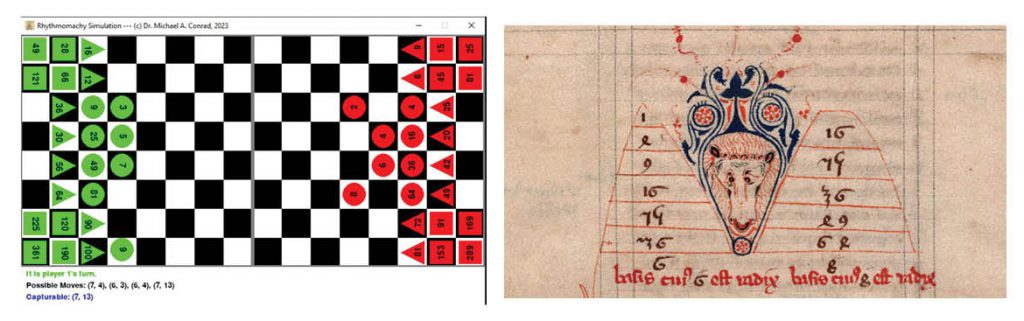
Left: Rhythmomachy Simulation (Player 1's turn). Image © 2023 Michael A. Conrad. Right: Bibliothèque interuniversitaire, Section Médecine, Montpellier, H 366, f. 13v, with rhythmomachy pyramids at the top flanking a lion's mask. Image via Creative Commons, via https://portail.biblissima.fr/fr/ark:/43093/mdata268b7df0d12be6fa155f802fd66b4123b9ddd65a.Left: Rhythmomachy Simulation (Player 1's turn). Image © 2023 Michael A. Conrad. Right: Bibliothèque interuniversitaire, Section Médecine, Montpellier, H 366, f. 13v, with rhythmomachy pyramids at the top flanking a lion's mask. Image via Creative Commons, via https://portail.biblissima.fr/fr/ark:/43093/mdata268b7df0d12be6fa155f802fd66b4123b9ddd65a.

Left: Rhythmomachy Simulation (Player 1’s turn). Image © 2023 Michael A. Conrad.
Right: Bibliothèque interuniversitaire, Section Médecine, Montpellier, H 366, f. 13v, with rhythmomachy pyramids at the top flanking a lion’s mask. Image via Creative Commons.

Recently, Michael spoke about some aspects of this work for a Session co-sponsored by the Societas Magica and the Research Group on Manuscript Evidence at the 2023 International Congress on Medieval Studies in May.  See the Program for our activities there (2023 Congress Program) and the illustrated Abstract for Michael’s paper.

In our co-sponsored Session on “Teaching Astrology and Other Liberal Arts” , Michael’s topic was “Gamified Numbers:  Board Games as Educational Instruments for Teaching Astrology and Other Quadrivial Arts”.  In the short time-span permitted by a full Session with four individual presentations , he briefly examined the game of rhythmomachy (rhitmomachia or “Battle of Numbers”), an early mathematical board game, and described his project of studying and preparing a computer simulation for its play.

Now we have the opportunity to hear Michael describe this complicated game, its origins, and its intricate relationship with knowledge of Boethian theories on the mathematical arts. That is, its structure is grounded in the understanding of those arts expounded by Anicius Manlius Severinus Boethius (circa 480 – 524 CE) in his influential manual De Institutione arithmetica Libri duo, based upon his loose translation of the treatise on the subject composed in Greek by the Neopythagorean philosopher Nicomachus of Gerasa (circa 60 – circa 120 CE).

More than that, Michael’s explorations of the game and its underlying theories build a bridge to a more general debate on the use of digital methods in the humanities, which he is also exploring in different ongoing data projects of his, some of which he is also going to introduce briefly in the course of his paper. The discussion will start with reflections on his experiences with using these methods, their requirements, benefits, and downsides.

Please register to attend this online event (see below).

Read the rest of this entry →

Tags: Alfonso X of Castile, Anicius Manilius Severinus Boethius, De consolatione philosophiae, De institutione arithmetica, Gameplay, History of Board Games, Mathematical Games, Nichomachus of Gerasa, Rhythmomachy, Ritmomachia, Scholasticism, The Research Group Speaks
No Comments »

Barbara Heritage on Charlotte Brontë’s Fair Copy of “Shirley”

November 18, 2022 in Uncategorized

The Research Group Speaks
Episode 10
Saturday 18 February 2023 online
1:00–2:30 pm EST (GMT-5) by Zoom

“Stages of Composition:
Charlotte Brontë’s Fair-Copy Manuscript for Shirley“

Barbara Heritage

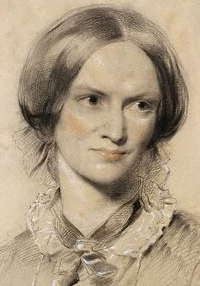
London, National Portrait Gallery, Chalk drawing (1850) of Charlotte Charlotte Brontë (Mrs A.B. Nicholls) by George Richmond (1809-1898). Image Public Domain via Wikimedia Commons.

[Posted on 18 November 2022]

For Episode 10 in the online series of The Research Group Speaks, Barbara Heritage of the Rare Book School at the University of Virginia will talk about her cumulative work on benefits of examining the material evidence for the processes of creation by a major English author in shaping the text for a next novel.  Please note that registration is required (see below).

The Subject for the Episode

Barbara will examine aspects of the work — and evidence for work-in-progress — in the writings of Charlotte Brontë (1816–1855) at a significant period in her life, after the successful publication of her first novel and after the deaths of the last of her living siblings.  On Charlotte’s life, see, for example, the Oxford Dictionary of National Biography:

  • Brontë [married name Nicholls]. Charlotte [pseud. Currer Bell].

The RGME Episode with Barbara Heritage showcases a study of the author at work, based upon material evidence in the structure of the manuscript itself intended for the printing.

Title and Abstract

Stages of Composition:
Charlotte Brontë’s Fair-Copy Manuscript for Shirley

 Barbara Heritage

Barbara’s Abstract for her presentation:

On 8 September 1849, James Taylor traveled from London to Haworth, Yorkshire, to collect the manuscript of Charlotte Brontë’s novel, Shirley, for publication.  His firm, Smith, Elder and Co., had been anxiously awaiting the completion of the book for nearly a year.  Readers both in England and abroad were eager to read the next work by “Currer Bell”, whose first published novel, Jane Eyre (1847), had proved surprisingly popular.

The manuscript, which now resides in the British Library (Add MS 43479), includes numerous excisions to its 896 leaves.  Its three volumes have been characterized by some as a confused “text of grief” written during the loss of Brontë’s siblings — and by another as proof of self-censorship and even “symptoms of a writing disorder or disease.”  A close codicological study of the manuscript offers an alternative reading by drawing on the correlation of paper stocks and varying pagination, providing new material-based evidence for how Brontë strategically and deliberately revised — and even expanded — her manuscript after serving as the primary caregiver for her siblings.

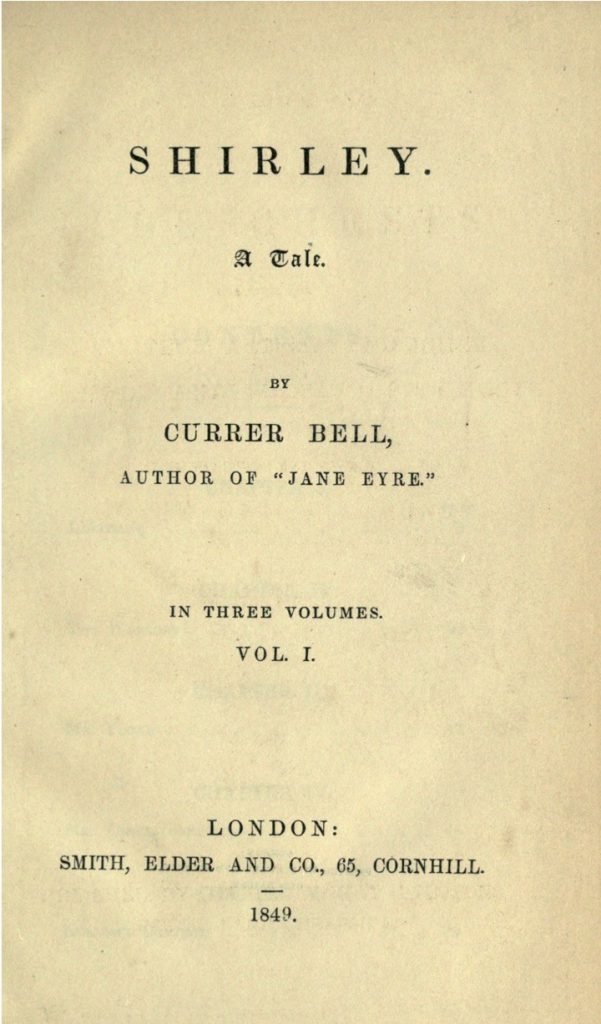
The First page of the First Edition of ‘Shirley’ by Charlotte Brontë (1849). Image Public Domain via Wikimedia Commons.

Materials, Handwriting & Their Evidence

Some other manuscripts, letters, and other materials produced by Charlotte Brontë are available for viewing online (in full or in part).  See, for example:

  • Fair copy manuscript of Charlotte Brontë’s Jane Eyre (London, British Library, Add MS 43474-43476)
  • Earliest known writings of Charlotte Brontë
  • Charlotte Brontë’s journal (Haworth, Brontë Parsonage Museum, Bonnell 98)
  • Brontë treasures saved for the nation (from the Blavatnik Honresfield Library)

Barbara’s Publications on Charlotte Brontë and Related Subjects

More of Barbara’s work on the subject and its context appears, for example, here:

  • Barbara Heritage, “Stages of Composition: An Analysis of Charlotte Brontë’s Fair-Copy Manuscript of ‘Shirley,’ ” in Studies in Bibliography (2022). (See Studies in Bibliography.) Accepted and forth-coming peer-reviewed article.
  • Barbara Heritage and Ruth-Ellen St. Onge, Building the Book from the Ancient World to the Present Day: How Manuscript, Printed, and Digital Texts Are Made. Illustrated from the Teaching Collections of Rare Book School (Ann Arbor, Michigan: The Legacy Press, distributed by the University of Virginia Press, 2022).
    — online exhibition viewable as Building the Book from the Ancient World to the Present Day.
  • Barbara Heritage, “Reading the Writing Desk: Charlotte Brontë’s Instruments and Authorial Craft”, in Romantic Women and their Books, a special issue of Studies in Romanticism, Volume 60, Number 4 (Winter 2021), pp. 503–522 — available here via Project Muse (by subscription).  Peer-reviewed article.
  • —, “Charlotte Brontë’s ‘Chinese Fac-similes’: A Comparative Approach to Interpreting the Materials of Authorial Labour and Artistic Process”, in Charlotte Brontë, Embodiment and the Material World, edited by Justine Pizzo and Eleanor Houghton.  Palgrave Studies in Nineteenth-Century Writing and Culture (Cham, Switzerland:  Palgrave Macmillan, 2020), 207–232 — available here by subscription.
  • The Scale of Genius: Charlotte Brontë’s Miniature Archive (Middletown, Ohio: Miniature Book Society, 2019). An essay and documentary transcription published in the form of a miniature book.
  • —, The Archeology of the Book”, in Charlotte Brontë: The Lost Manuscripts. (Keighley, United Kingdom: The Brontë Society, 2018), 22–69.  A commission from the Brontë Society.
  • —, Brontë and the Bookmakers: Jane Eyre in the Nineteenth-Century Marketplace (Ph. D. Dissertation, University of Virginia, 2014).
  • —, “Authors and Bookmakers: Jane Eyre in the Marketplace,” in The Papers of the Bibliographical Society of America, 106:4 (2012), 449–85 available here by subscription.  Peer-reviewed article.
  • —, “The Shapes Jane Eyre Takes: Ephemeral Responses to the Book and Its Themes,” RBM: A Journal of Rare Books, Manuscripts, and Cultural Heritage, 9.1 (2008), 58–66.  Invited submission.

Worth the visit!

*****

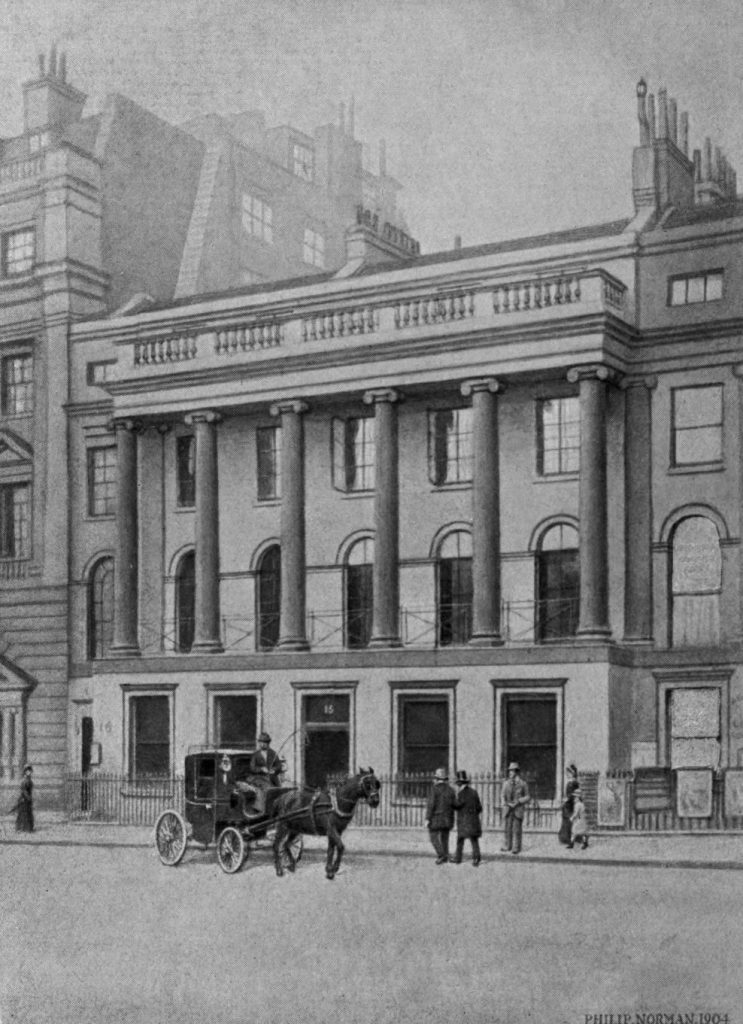
The offices of Smith, Elder & Co. at No. 15 Waterloo Place in London, from The House of Smith Elder (1904) by Philip Norman (1832-1941). Image Public Domain.

*****

Registration for the Episode

Episode 10 in the online series of “The Research Group Speaks” is planned for Saturday 18 February 2023, via Zoom, at 1 pm EST (GMT – 5) for about 1 1/2 hours, with discussion and Q&A.  You are welcome to join us.

If you wish to attend, please register here:

  • The Research Group Speaks 10. Barbara Heritage: Charlotte Brontë’s Shirley

If you have questions or issues with the registration process, please contact director@manuscriptevidence.org.

Future Episodes

Future Episodes are planned.  See

  • “The Research Group Speaks”: The Series.

Suggestion Box

Please leave your Comments or questions here, Contact Us, or visit

  • our FaceBook Page
  • our Twitter Feed (@rgme_mss)
  • our Blog on Manuscript Studies and its Contents List

Donations and contributions, in funds or in kind, are welcome and easy to give.  See Contributions and Donations.

We look forward to hearing from you.

Lisbon, Museu Nacional de Arte Antiga: The mid 15th-century Saint Vincent Panels, attributed to Nuno Gonçalves. Image (https://upload.wikimedia.org/wikipedia/commons/3/3a/Nuno_Gon%C3%A7alves._Paineis_de_S%C3%A3o_Vicente_de_Fora.jpg) via Creative Commons.

*****

Tags: Author's Fair Copy, Authorial revisions, Brontë siblings, Charlotte Brontë, Codicology, History of Paper, Manuscript studies, Manuscripts, Shirley (Novel), Stages of Composition, The Research Group Speaks
No Comments »

Donncha MacGabhann on the Making of “The Book of Kells”

November 1, 2022 in Announcements, Manuscript Studies, Research Group Speaks (The Series)

The Research Group Speaks
Episode 9
Saturday 19 November 2022 online

“The Book of Kells:  A Masterwork Revealed”
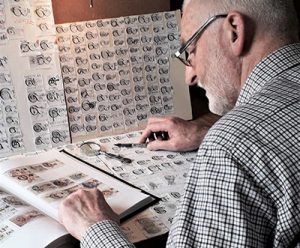
Donncha MacGabhann at work on his close study of letter forms in the Book of Kells. Photograph via his publisher, Sidestone Press (Leiden 2022)

Donncha MacGabhann at work on his close study of letter forms in the Book of Kells. Photograph via his publisher, Sidestone Press (Leiden 2022)

– An informal Interview/Conversation with Donncha MacGabhann, Associate of the RGME, about his newly published book

[Posted on 31 October 2022 by Mildred Budny, with updates]

For Episode 9 in the online series of The Research Group Speaks, we present an informal Conversation or Interview with the author about his new book on The Book of Kells:  The Making of a Masterwork (Leiden, 2022).

The Book has emerged from Donncha’s detailed study for the Ph. D. dissertation (London, 2016), as well as his own experience as an artist.  For our Episode, he will tell us about the making of his Book on the making of the Book of Kells . . .

To Register for the event, see Below.

The Book of Kells

One of the chief treasures of the Library of Trinity College Dublin (since at least 1661), and the subject of widespread fame, the Book of Kells might need no introduction.
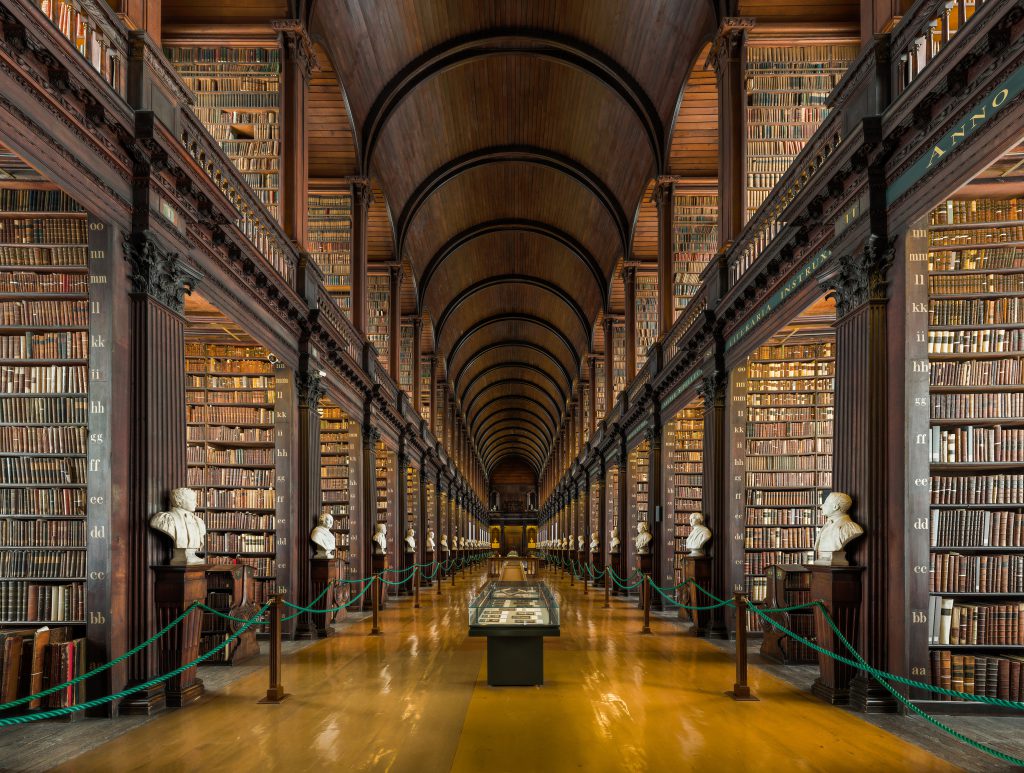
The Long Room of the Old Library, Trinity College Dublin, seen from the entrance (2015). Photo by DAVID ILIFF. License: CC BY-SA 3.0.

  • Dublin , Trinity College Library, MS A. I. [58], the Codex Cennanensis, now comprising 340 vellum folios, bound (since 1953) in four volumes, one for each Gospel.

The online Library catalogue offers concise descriptions.  About the contents, for example, some essential facts:

The Book of Kells (Leabhar Cheanannais, Trinity College Dublin MS 58) contains the four Gospels in Latin based on the Vulgate text which St Jerome [circa 342 – circa 347 – 30 September 420] completed in 384AD, intermixed with readings from the earlier Old Latin translation. The gospel texts are prefaced by other texts, including “canon tables”, or concordances of gospel passages common to two or more the Evangelists; summaries of the gospel narratives (Breves causae); and prefaces characterizing the Evangelists (Argumenta).

A different approach can be found, for example, in a concise guide for the curious:

  • Ten Things You Should Know about the Book of Kells, or the Book of Columba
    — along with, say, 10 Things You Should Know About The Gutenberg Bible.

Have a Look:

  • The Book itself, in online facsimile: Book of Kells. IE TCD MS 58
  • Its introduction: Book of Kells

For my part, one of the principal highlights — not the only one — of my long study of early medieval manuscripts from the British Isles, their companions, and their contexts (for example, British Library, Manuscript Royal 1 E. vi: The Anatomy of an Anglo-Saxon Bible Fragment and Deciphering the Art of Interlace), was the opportunity to examine directly, turning the pages, two volumes of the Book of Kells. That experience, over some days, augmented and amplified the observations of the volumes on display, along with other treasures, in the imposing Long Hall of the Library. The opportunity, with permission, to look at the Book itself took place in the Director’s office, with the clear light of natural light during an unusually dry summer with cloudless skies. Memorable indeed.  #turnedthepages.

A few years later, while part of the Book came on tour among the travelling Treasures of Ireland (1982 and 1983), I could see part of it again, in museums in Paris and in New York, under subdued light and behind the glass case. Different views, same astonishing monument.

Very, very many people can say that they have seen the Book of Kells.  Attracted by its fame, visitors to the Library, where it has been displayed since the nineteenth century, number on average some 500,000 each year.  On her visit, Queen Victoria (1819–1901) was encouraged to sign it — as an extraordinary form of ‘Visitors’ Book’.

Over the centuries, many have commented upon the Book of Kells.  They include scholars, historians, palaeographers, art historians, authors, artists, and others.  Some observers have taken inspiration from it in multiple ways, verbal and visual, to form creative works of their own, ranging from, say, Finnegans Wake (1939) to The Secret of Kells (2009).

Donncha MacGabhann’s long-term study, considering detail after detail of script and ornament, of the original Book of Kells as a whole brings fresh views of its process of creation, as the scribes worked their way across the pages and into an accomplishment truly worthy of curiosity, admiration, and wonder.  Aware of Donncha’s study for some years, I have looked forward to his book revealing the results of his research.

Donncha MacGabhann’s Book on Kells

About Donncha, see, for example,

  • Donncha MacGabhann Curriculum Vitae
  • Curriculum Vitae.

His Book, just about to appear in print, examines

  • The Book of Kells. A Masterwork Revealed: Creators, Collaboration, and Campaigns
    (Leiden: Sidestone Press, 2022).
    Paperback ISBN: 9789464261226 | Hardback ISBN: 9789464261233 |
    Ebook only (pdf) and Ebook (read online for free)Format: 210x280mm | 324 pp. | Language: English | 11 illus. (bw) | 109 illus. (fc) |
    Keywords: Book of Kells; insular manuscripts; insular art; palaeography; Early Medieval gospel books; Early Medieval Christianity; art history; calligraphy |


From the publisher comes this description:
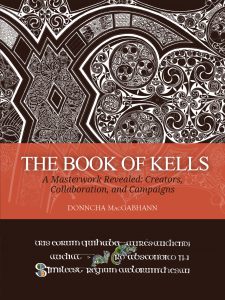
Front Cover of Donncha MacGabhann, “The Book of Kells: A Masterwork Revealed” (2022).

Sublime calligraphy, marvelous art, and amazing initials, have charmed and captivated the audience of the Book of Kells for over twelve hundred years. This remarkable illuminated Gospel book attracts the attention of scholars as well as those more generally interested in the fabulous artifacts of the past.

Everybody knows it was made by an extensive team of scribes and artists. Donncha MacGabhann knew that too. However, he was certain that a thorough examination could clearly identify the various contributions of its creators.

His life and work as an artist and teacher inspired the belief that a close visual study could solve some of its enduring puzzles. The deeper he delved, the more he was convinced that Kells is entirely the work of two individuals. This evolved into a novel paradigm through which he came to know and understand the manuscript. Following years of meticulous research, this book tells the story of Kells’ two Masters and their collaboration to create a Gospel book of unprecedented magnificence. Most poignantly, it reveals the struggle of the lone survivor of the two-man team to attempt the completion of their magnum opus.

The most important outcomes of this book go far beyond the simple attribution of work to different hands. Much more significantly, it affords insights into the imagination which inspired its creators, especially the unique vision of Kells’ great Scribe-Artist. Collectively, these new perspectives reveal a previously unknown ‘Book of Kells, ‘ one which, as it were, has remained hidden in plain sight.

Descriptions of Donncha’s book and its contents, approach, discoveries, and significance appear among various booksellers, as with

  • https://www.bookdepository.com/Book-Kells-Donncha-MacGabhann/9789464261226

The Process of Research and Discovery

In Donncha’s own words, as the research unfolded:
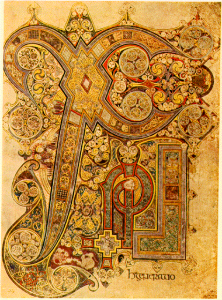
Dublin, Trinity College, MS A. 1 (58), folio 34r. Chi-Rho Initial Page (Matthew 1:18). Image via Wikimedia Commons; Public Domain in the US.

Key research interests include Insular palaeography and illumination. My current focus is to extend and develop the research which was the basis for my PhD (2016). My thesis investigation was concentrated on the makers and the making of The Book of Kells. This provides the first in-depth and comprehensive analysis of both the illumination and the scribal work in the manuscript.

My research was significantly informed by the experience gained in my career as an Artist and Art-Teacher. Complementary to the more traditional modes of academic enquiry this enabled me to draw on a skill-set which was integral to the development of my research methodology. This methodology of close visual analysis was central to my approach.

My immediate aim is communicate, through publication, the results of my doctoral research to the scholarly community. It is also my intention to extend the application of the methodology developed in my thesis to a number of other Insular manuscripts and to consider the implications of the revision of hands in the material culture of the Insular world more broadly. (Donncha MacGabhann)

Donncha’s Ph.D. dissertation is freely available for download:

  • The making of the Book of Kells: two Masters and two Campaigns (Doctoral thesis, University of London, 2016)  https://sas-space.sas.ac.uk/6920/ (via Creative Commons)

Its Abstract:

This thesis investigates the number of individuals involved in the making of the Book of Kells. It demonstrates that only two individuals, identified as the Scribe-Artist and the Master-Artist, were involved in its creation. It also demonstrates that the script is the work of a single individual – the Scribe-Artist. More specific questions are answered regarding the working relationships between the book’s creators and the sequence of production. This thesis also demonstrates that the manuscript was created over two separate campaigns of work. The comprehensive nature of this study focuses on all aspects of the manuscript including, script, initials, display-lettering, decoration and illumination.
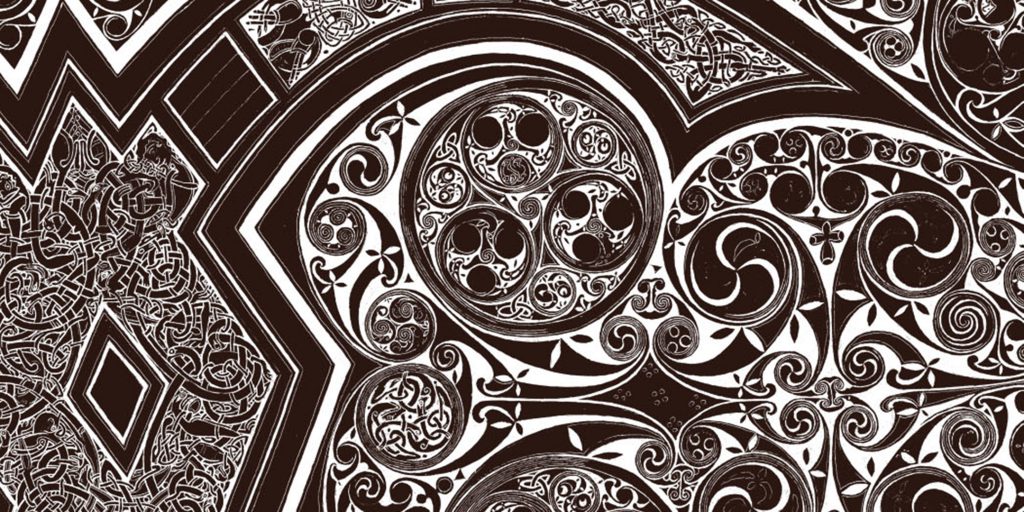
Detail from Front Cover of Donncha MacGabhann, “The Book of Kells: A Masterwork Revealed” (2022): Black-and-white reproduction by the author of the ornamented center of the Chi-Rho Initial Page (Dublin, Trinity College, MS 58, folio 34r).

Previews

We met Donncha when he spoke for the RMGE about a facet of the Ph.D. research on the manuscript for one of our Sessions at the 49th International Congress on Medieval Studies (Kalamazoo, Michigan, May 2014).  The Session considered “Individual Style or House Style?  Assessing Scribal Contributions, Artistic Production, and Creative Achievements”.

Donncha’s paper examined the scribal uses of two forms or grades of late-antique and early-medieval script, Half-Uncial and Uncial, for the letter a at line-endings, where options for compression and variation could call for choice and artistic expression.

Half-Uncial a and Uncial a at Line-Ends:
The Division of Hands in the Book of Kells
and an Insight
into the ‘Calligraphic Imagination’ Evident in the Script

The abstract for Donncha’s paper appears on our website: MacGabhann 2014 Congress.

At the Congress, although we had corresponded earlier, we could meet Donncha, learn about his careful studies, his approaches to the creation and understanding of forms of the written word, and his observations about the original materials, in manuscript and in print, offered for display at some of our sessions.
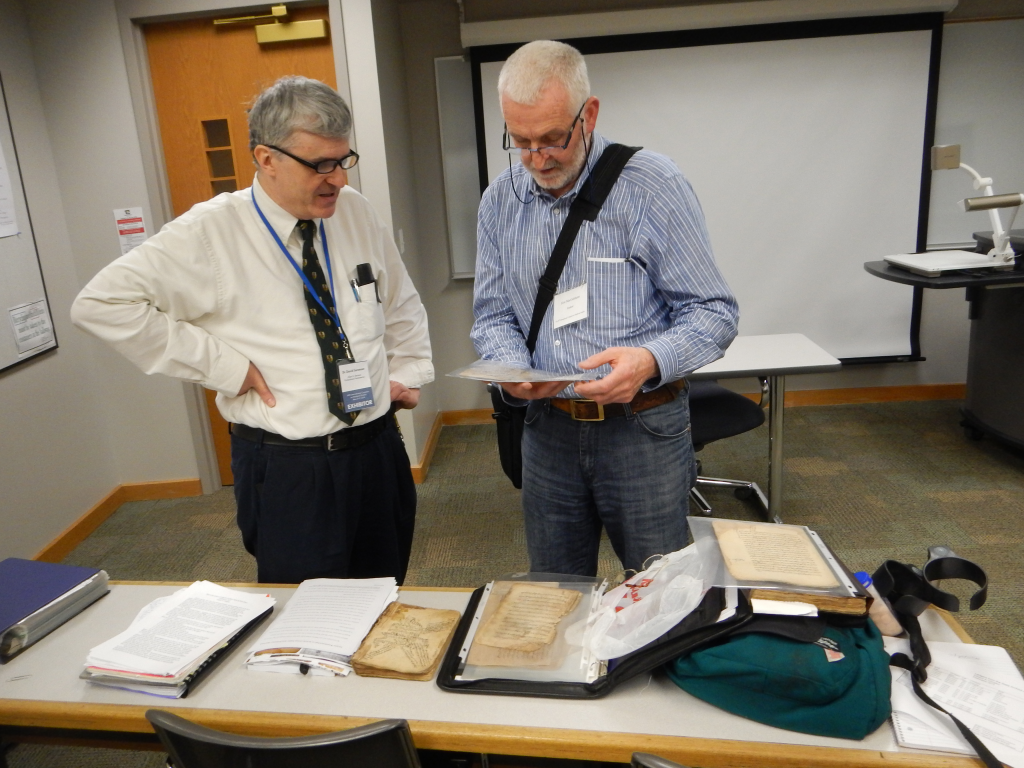
David Sorenson and Donncha MacGabhann examine manuscript materials

David Sorenson and Donnach MacGabhann examine manuscript materials after the RGME Writing Materials Session at the 2014 Congress. Photography by Mildred Budny.

Several papers published in the course of the research spell out the methodological approach.  For example,

Palaeographer Erika Eisenlohr has stated that ‘the similarity or dissimilarity of hands in Kells has so far mainly been based on more general impressions of the scripts’ (1994). My research attempts a more comprehensive investigation of the evidence including illuminated pages, script and illumination of the canon tables, mise-en-page, punctuation, display script, decorated initials, regular script and elaborations to the script.

— Donncha MacGabhann, Abstract for “The et-ligature in the Book of Kells (Revealing the ‘calligraphic imagination’ of its great scribe)” (2017), in Conor Newman, Mags Manion, and Fiona Gavin, eds., Islands in a Global Context. Proceedings of the seventh Conference on Insular Art, held at the National University of Ireland, Galway, 16–20 July, 2014 (Dublin, 2017), pp. 138–48.

The Script(s) of Kells

Discussion of the varieties of script, ornamented letter forms, and other forms of ornament in the Book of Kells continues in its own right over time.  It also forms, or should form, an integral part in an ongoing consideration of many features of the book, both individually and in combination.  That is:  the various texts (Gospel texts , their companion texts including prefaces, summaries, and canon tables with numerals and titles, as well as added texts such as Irish charters), illustrations, canon arcades and frameworks, scribal characteristics, writing materials (animal skins, inks, pigments, their binding agents, traces of layout marks, and so on), layers of accretion, condition, sewing patterns, binding history, library history, layout, design, artistry, and more.

Many features figure, to varying degrees, in assessments of the likely place and date of production of the manuscript.  Those assessments may remain open to exploration and refinement, as research advances, methods of exploration expand, attitudes may direct, and discoveries emerge.

Reproductions, Photographic and Pre-Photographic
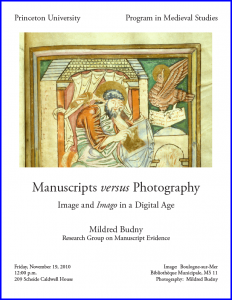
Poster for lecture on 'Manuscripts versus Photography: Image and "Imago" in a Digital Age' by Mildred Budny at Princeton University on 19 November 2010. Photograph by Mildred Budny of MS 10, Boulogne-sur-Mer, Bibliothèque des Annonciades,reproduced by permission.

Poster, designed by the RGME, for a lecture on 19 November 2020. Image: Photograph by Mildred Budny of Boulogne-sur-mer, Bibliothèque des Annonciades, MS 11, reproduced by permission.

With restricted access nowadays to the treasured original, and with the proliferation of digital means of reproduction and dissemination, close study of the multiple features of the manuscript would mostly rest upon consultation of such reproductions, however high in quality or ‘fidelity’.  That those reproductive materials would, in no small measure, determine, affect, or direct the nature of the forms of study — as well as, it may be, the interpretations of that (indirect) evidence — should be evident.

Such factors in the study of manuscripts under current, prevailing, conditions in the age of photographic reproduction and the age of the internet remain a subject of considerable interest for the Research Group on Manuscript Evidence.  For example:

  • Mildred Budny, “No Snap Decisions:  Challenges of Manuscript Photography”.  Paper delivered at the Session on “Imaging Manuscripts for the Twenty-First Century:  Photographs and Beyond” (1994), sponsored by the RGME at the 1994 International Congress on Medieval Studies.
    Published, with its Abstract, Text, and Images, here.
  • “Manuscripts versus Photography:  Image and Imago in a Digital Age”.  Lecture for the Program in Medieval Studies, Princeton University (19 November 2010).

Our events continue to consider such factors of manuscript studies, whether as, perhaps, part-and-parcel, bread-and-butter, or meat-and-potatoes.  That is, as Food for Thought.

As always, our interest in the processes of production and the people behind the books, keenly explored in cases of the medieval objects, extends also to the processes which underpin, sustain, and shape the studies themselves of those materials.  These interests are manifest in many RGME activities, as with continuing explorations of relationships between “Manuscripts and Photography” in Seminars, Workshops, Conference Sessions, and Symposia; and in Episodes of our series wherein The Research Group Speaks.  On such occasions, we might have opportunity to hear the authors of close studies of manuscripts or other materials speak about the origins, progress, and processes of their research, as well as its results.  Such is the case for this Episode with Donncha MacGabhann, as his new book, long in the making, reaches publication.

Drawings of elements in the Book of Kells — as appear among Donncha’s figures — belong to a venerable tradition which reaches back to pre-photographic means of reproduction.  Notable examples in that tradition include images from the manuscript carefully prepared by the observant entymologist and antiquarian John Obadiah Westwood (1805–1893).  Examples appear in these of Westwood’s publications:

  • Palaeographia sacra pictoria: Being a series of illustrations of the ancient versions of the Bible , copied from illuminated manuscripts, executed between the fourth and sixteenth centuries (London, 1845)
  • Facsimiles of Anglo-Saxon and Irish Manuscripts (London, 1868)
    Also, in excerpts: Facsimiles of Anglo-Saxon and Irish Manuscripts (London, 1868)

Close examination fostered by line-by-line reproduction, from one surface to another, may develop a keen awareness of specific details, in much the same way that detailed verbal descriptions can do, as with a catalogue or ‘inventory’ of features within a manuscript (or other monument).  I myself learned the lasting value of preparing such descriptions — from the originals, aided by my photographic reproductions including macro-photography — for features of manuscripts in the Illustrated Catalogue, one of the co-publications of the Research Group on Manuscript Evidence.

From observations of the evidence, by various means and methods, the interpretations may follow, redirect, or revise.

In the new book, the choice of methodology of palaeographical examination, centered upon photographic reproductions and drawings, focuses upon excerpts of specimen letters and initials.  Arrayed on these pages (printed or digital) in groups or rows of related letter-forms, the specimens stand removed or isolated from the ebb-and-flow of their naturally-occurring lines and columns of running texts upon their pages, and their openings, across the unfolding of the original book as a whole.

Mostly at a distance perforce from that original (even when viewed through the glass case of its exhibited pages), and very exceptionally in a direct encounter, we might find ways variously to imagine, to ‘reconstruct’, or to recollect, the process of turning its very pages and sensing the feel of the width of its leaves as their edges are turned.

Donncha’s Book on The Book of Kells
in our Episode for 19 November 2022

The publication of Donncha MacGabhann’s book is expected on 31 October 2022.  The book can be ordered in print and pdf forms from the publisher and other booksellers.  From the publisher’s website, it can be read online free of charge.  See:

  • The Book of Kells. A Masterwork Revealed: Creators, Collaboration, and Campaigns

Episode 9 in the online series of “The Research Group Speaks” is planned for Saturday 19 November 2022, via Zoom, at 12 pm EST (GMT – 5) for about 1 1/2 hours, with discussion and Q&A.  You are welcome to join us.

Registration for the Episode

If you wish to attend, please register here:

  • The Research Group Speaks, 9: Donncha MacGabhann on Making the Book of Kells

If you have questions or issues with the registration process, please contact director@manuscriptevidence.org.

Future Episodes

Future Episodes are planned.  See

  • “The Research Group Speaks”: The Series.

Suggestion Box

Please leave your Comments or questions here, Contact Us, or visit

  • our FaceBook Page
  • our Twitter Feed (@rgme_mss)
  • our Blog on Manuscript Studies and its Contents List

Donations and contributions, in funds or in kind, are welcome and easy to give.  See Contributions and Donations.

We look forward to hearing from you.
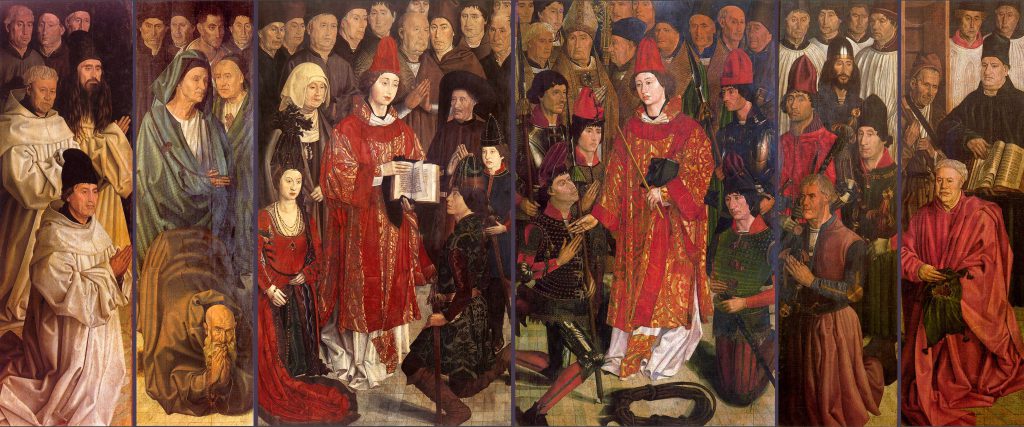
Lisbon, Museu Nacional de Arte Antiga: The mid 15th-century Saint Vincent Panels, attributed to Nuno Gonçalves. Image (https://upload.wikimedia.org/wikipedia/commons/3/3a/Nuno_Gon%C3%A7alves._Paineis_de_S%C3%A3o_Vicente_de_Fora.jpg) via Creative Commons.

*****
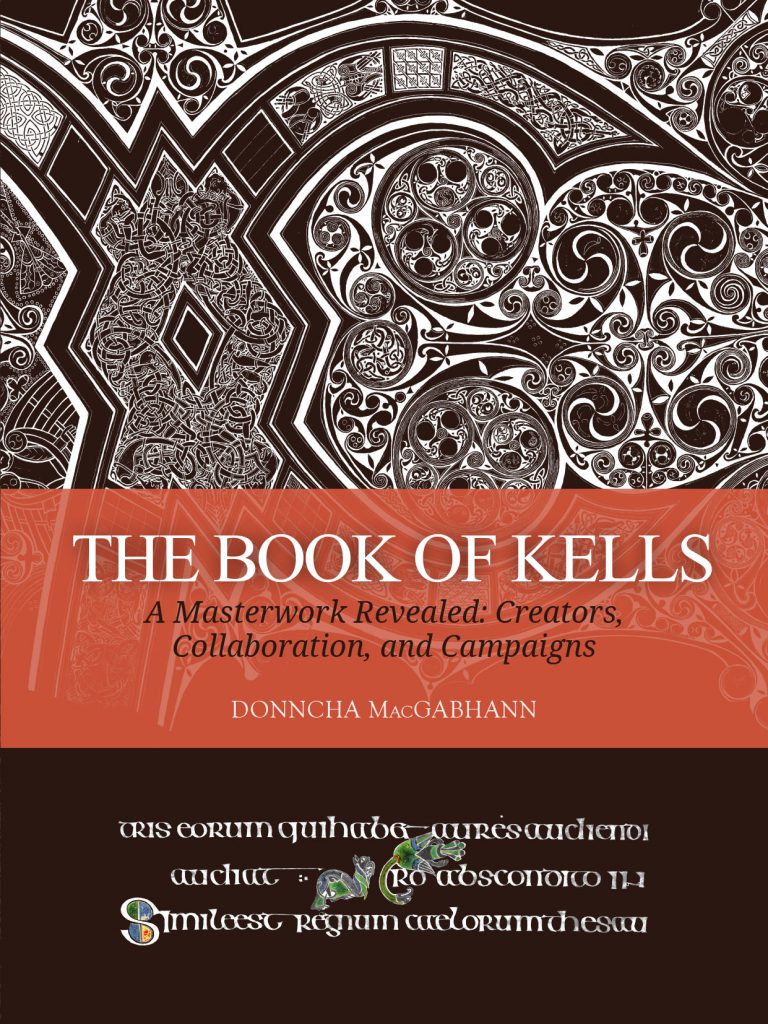
Front Cover of Donncha MacGabhann, “The Book of Kells: A Masterwork Revealed” (2022).

*****

Tags: Book of Kells, Donncha MacGabhann, Early Medieval Gospel Books, early medieval manuscripts, Finnegans Wake, Manuscript Photography, Manuscript studies, Medieval manuscripts, Palaeography, The Research Group Speaks, The Secret of Kells, Trinity College Dublin, Trinity College Dublin MS A 1 [58]
No Comments »

“Falling in Love with a Source” (An Interview with Michael Allman Conrad)

June 18, 2022 in Manuscript Studies

The Research Group Speaks
Episode 7
Saturday 23 July 2022

“Falling in Love with a Source . . .
Or: How Much fou Is There In This amour?”

– An Interview with Michael Allman Conrad

[Posted on 18 June 2022]

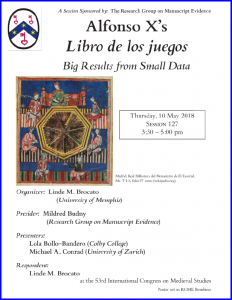
Poster for our Sponsored Session on the " 'Libro de los juegos': Big Results from Small Data", organized by Linde M. Brocato and sponsored by the Research Group on Manuscript Evidence at the 2018 International Congress on Medieval Studies. Poster set in RGME Bembino.

2018 Poster for ‘Libro de los juegos’ Session

The publication this spring by our Associate, Michael Allman Conrad (see also his Curriculum Vitae), of the book which builds upon his Ph.D. Dissertation for Humboldt University, Berlin (2021), gave rise to the invitation to speak for our online series of The Research Group Speaks.  This Episode is the 7th in the series.

Planned for Saturday, 23 July 2022, Michael Allman Conrad will consider, in conversation, the choice of subject and the voyage for his Ph.D. Dissertation and its resulting book, in the light of the journey toward discovery which the process called forth.  The title reflects on aspects of, or approaches to, Love and dedication to it that might perchance touch or verge upon the complex nature of Amour fou.

If you wish to attend, please contact director@manuscriptevidence.org.

The Ph. D. Dissertation and its Book

Michael received the Ph.D. from Humboldt University, Berlin, in 2021.  We thank him for the invitation to attend the online defense of the dissertation, which offered a model of engaged scholarly discourse.

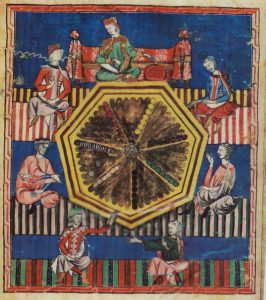
Libro de los juegos. Madrid, El Escorial, MS T.1.6, folio 97 verso, detail. Game of Astronomical Tables. Image Public Domain via Wikimedia Commons.

The book emerging from the dissertation was recently published:

  • Michael A. Conrad, Ludische Praxis und Kontingenzbewältigung (De Gruyter, 2022)
    Ludische Praxis und Kontingenzbewältigung im Spielebuch Alfonsʼ X.
    und anderen Quellen des 13. Jahrhunderts:Spiel als Modell guten Entscheidens

    (“Ludic Practice and Dealing with Contingency in the Book of Games [Libro de los juegos] of Alfonso X and Other Sources from the Thirteenth Century:
    Games as Models of Good Decision-Making”)

The detailed examination, years in the making — as both Michael and the world changed, with more choices and responses — centers upon the remarkable Libro de los Juegos, or Book of Games commissioned by King Alfonso X of Castile.  The image on the cover of Michael’s book features the extraordinary image of the Game of Astronomical Tables as illustrated in the manuscript (seen at the right here).

The publisher’s summary describes the scope and strategy of the volume:

Taking [Alfonso’s] book as a starting point, this volume reflects on how games were viewed by Alfons and other contemporary authors as a practice that allowed them to come to terms with contingency and as a model of good decision-making, in particular in the fields of strategy, economics, ethics, and metaphysics.

"Libro

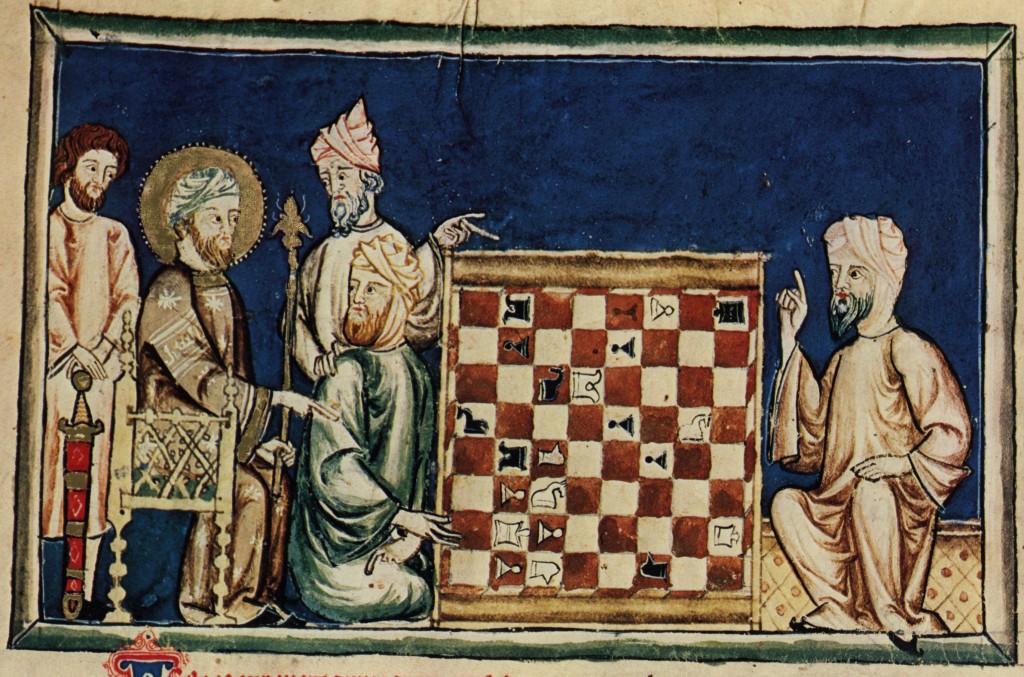
Libro de los juegos. Madrid, El Escorial, MS T.1.6, folio 17 verso, detail. Image via Wikimedia Commons.

Read the rest of this entry →

Tags: Alfonso X of Castile, Amour fou, Constantine P. Cavafy, History of Games, Ithaka, Libro de los juegos, Michael Allman Conrad, Models of Decision-Making, Plato, The Book of Games, The Research Group Speaks
No Comments »

Catalogs, Metadata, and Databases (Part I)

February 9, 2022 in Manuscript Studies, Research Group Speaks (The Series), Uncategorized

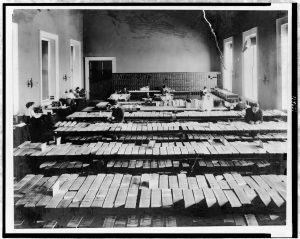
Card Division in the Library of Congress, Washington, D.C. Photograph circa 1900-1920. Image Public Domain.

The Research Group Speaks
Episode 6

Catalogs, Metadata, and Databases (Part I)
A Roundtable

19 February 2022

[Posted on 9 February 2022, with updates, now with the accomplishment of the event.]

By special request, a roundtable discussion aims to consider challenges and opportunities encountered in making, and using, catalogs and databases — with a focus especially on bibliographical and manuscript materials. This aim flows from the plan to hold a lunch at the Index of Medieval Art at Princeton University during our 2020 Spring Symposium (which had to be cancelled), to bring together participants engaged with such issues, from the Index of Medieval Art, the BASIRA Project, the Schoenberg Institute for Manuscript Studies, and elsewhere.

Florence, Galleria degli Uffizi, Anonymous, Still Life of an Illuminated Book, German School, 15th century. Oil on Wood. Opened book with fanned pages. Image via Wikimedia, Public Domain.

Florence, Galleria degli Uffizi, Anonymous, Still Life of an Illuminated Book, German School, 15th century. Image Public Domain.

As the next episode in the online series of webinars, workshops, and other meetings wherein The Research Group Speaks, the February 2022 Roundtable  explores challenges and opportunities for the catalogs, metadata, and databases, the characteristics of the materials which these structures seek to address, and some case studies.  Examples include the BASIRA Project on “Books as Symbols in Renaissance Art”, the Index of Medieval Art Database, Digital Scriptorium 2.0, the Pinakes/Πίνακες Database of Greek Texts and Manuscripts, and approaches to cataloging collections or selected source materials (such as artists’ books).

Speakers and Respondents include Barbara Williams Ellertson, Jessica L. Savage, Linde M. Brocato, Lynn Ransom, Katharine Chandler, Georgi Parpulov, Howard German, and David Porreca.  Subjects for consideration include “Standards and Vocabularies in Art-History Cataloging”, “Labelling, Way-finding, and Meaning”, “About ‘Aboutness’ “, “Teaching Cataloguing Today”, “The Pinakes Database”, “Digital Scriptorium 2.0:  Manuscript Description in a Linked Open Data Context”, and more.  See the Program below.

We gather perspectives from those who make, and those who use, such resources.

Preparations for the roundtable offer ‘Handouts’ in online format.

1) Below here:

  • a preliminary list of Questions for discussion at the roundtable and beyond, with a view also to planning further sessions on these subjects
  • an announcement about Future Plans, as Some Next Steps, for further sessions on these and related subjects.

2) Also, as an individual webpage:

  • an online Handout with a Draft List of Links to projects, databases, and other resources, including some mentioned in presentations in the roundtable:
    Catalogs, Metadata, and Databases: A Handlist of Links.

The roundtable is designed to compare notes, formulate questions, express wishes, and plan further sessions.  For example, we prepare sessions on “Catalogs, Metadata, and Databases, Continued“, for the pair of Spring and Autumn Symposia on “Structures of Knowledge” and “Supports for Knowledge”.  They belong to one of the overarching themes for RGME activities in 2022:  “Structured Knowledge“.

We welcome advice, suggestions, and contributions.

Read the rest of this entry →

Tags: BASIRA Project, CANTUS Chant, Controlled Vocabulary, DACT Project, Digital Scriptorium, Digital Scriptorium 2.0, Fragmentarium, History of Cataloging, Index of Medieval Art, Linked Open Data, Manuscript studies, Metadata and Databases, Pinakes | Πίνακες Database, Structures of Knowledge, Supports for Knowledge, The Research Group Speaks
No Comments »

The Curious Printing History of ‘La Science de l’Arpenteur’

December 1, 2021 in Manuscript Studies, Research Group Speaks (The Series), Uncategorized

The Research Group Speaks
Episode 5

The Curious, Possibly Unique, Printing History
of Editions (1766–1813)
of La Science de l’Arpenteur
by Dupain de Montesson

Ronald K. Smeltzer

Dupain de Montesson, Le spectacle de la campagne and La science de l’arpenteur (1777), First Title-page, Vignette. Ronald K. Smeltzer Collection. Photograph Ronald K. Smeltzer, reproduced by permission.

[Posted on 1 December 2021, with updates]

For Episode 5 in our series (23 January 2022), Ronald K. Smeltzer (Ronald K. Smeltzer, Ph.D.) examines a telling case of multiple editions, issued with variations in printing methods, of an eighteenth-century treatise in French on methods of surveying.  The technique of surveying has a long and venerable tradition, with a varied series of books on the subject from late-antiquity onward.

The Plan

Direct, detailed examination of the editions, all in octavo format, of La science de l’arpenteur by Louis Charles Dupain de Montesson reveals multiple changes and adaptations that illuminate its extraordinary printing history.  Early editions were printed all engraved including signatures of the leaves.  Some of the later changes to the text and to the book design were a direct result of the French Revolution.  Assembling examples of all the known editions has taken twenty years.  The process attests to the value of direct inspection.  This presentation describes the results.

Read the rest of this entry →

Tags: Dupain de Montesson, French Revolution, history of printing, History of surveying, Intaglio printing, La science de l'arpenteur, Le spectacle de la campagne, Letterpress Printing, The Research Group Speaks
No Comments »

How to Be Indiana Jones in the Catalog

November 29, 2021 in Manuscript Studies, Uncategorized

The Research Group Speaks
Episode 4

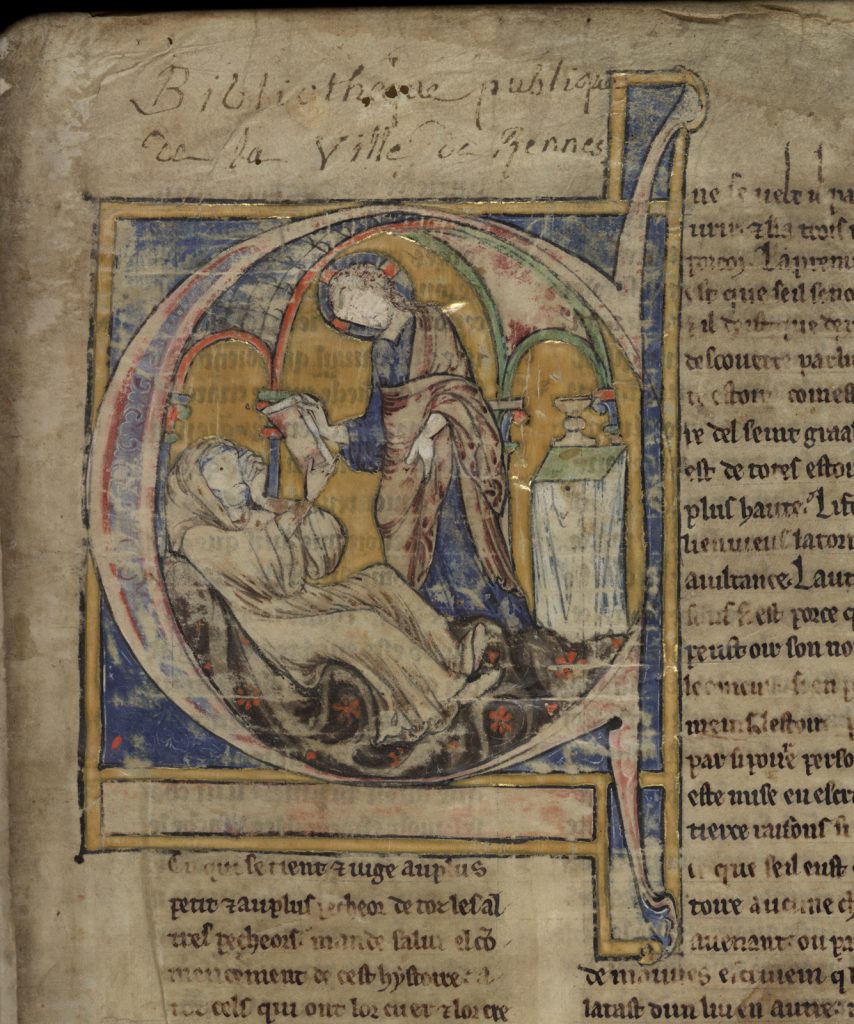
Rennes, Bibliothèque Municipale, MS 255, folio 1 recto. L’Estoire del saint Graal, Opening initial, with the Holy Grail. Photographer: Peter Scott. Image via Wikimedia Commons.

How to be Indiana Jones in the Catalog

Treasure and Power
In/Of the Bibliographical Record

Linde M. Brocato

The Series So Far

During a time of pandemic, before in-person events might resume, the RGME aims for some online events.

The Series at which “The Research Group Speaks” online began in July 2021.  This Episode rounds out the set for the calendar year, and points the way toward the themes for the new year.

*****

Florence, Galleria degli Uffizi, Anonymous, Still Life of an Illuminated Book, German School, 15th century. Oil on Wood. Opened book with fanned pages. Image via Wikimedia, Public Domain.

Florence, Galleria degli Uffizi, German School. Image Public Domain, via Wikimedia.

Episode 1 (July 2021)

Barbara Williams Ellertson and BASIRA, with a Timeline

The series commenced with an Interview with our Associate, Barbara Williams Ellertson (July 2021).

Barbara spoke about the BASIRA Project, its background, and her other interests.

For information about the Project on Books as Symbols in Renaissance Art, its subjects, its scope, and its aims, see https://basiraproject.org.

*****

Episode 2 (September 2021)

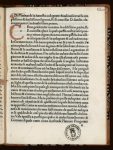
Platina, De honesta voluptate et valetudine (Venice, 1494). Image via BEI, Public Domain.

Southern Italian Cuisine Before Columbus

Next came a Presentation and Demonstration by the food historian Linda Civitello (September 2021).

Linda spoke about the early history of Italian cuisine, especially Cuoco Napolitano, and its ingredients, sources, and influences — for Southern Italian cuisine and beyond. Inspired by the 15th-century sources in manuscript and early printing, Linda described approaches to the subject and gave a demonstration.

*****

Episode 3 (November 2021)

Tales from the Library Crypt

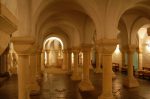
Worcester Cathedral, Crypt. Image via Wikimedia Commons.

Then we offered an informal round-table discussion, to compare notes about searching bibliographic materials in a time of pandemic.

Over the past year and more, under exceptional circumstances, there are doubtless to be encountered challenges and disappointments through closures of libraries, access to library resources, and other factors.

But there can also be successes, through serendipity, resourcefulness, friendship, and solidarity across institutions and among wider readership. Comparing notes might offer tips and guidance. Commiseration can come in handy. And the successes are worth celebrating. There are stories to tell.

*****

Next Up

Episode 4 (December 2021)

How to Be Indiana Jones in the Catalog:
Treasure and Power in/of the Bibliographical Record

Linde Brocato, scholar librarian, proposes to give a guided tour of several specimens and case-studies offering bibliographical and cataloguing challenges. (On her experience and expertise, see Linde Brocato, Linde M. Brocato, Curriculum Vitae, and Google Scholar.)

The plan:

Understanding the dynamics and rules of cataloging gives strong insight into how to search:  When to use the basic search box, i.e. keyword search; and When to use advanced search, i.e. the indexes.
I will discuss the bibliographic record, the kinds of decisions catalogers make about how to encode information, and tools to release and enhance your power to find the bibliographic treasure you seek!

P. S.  If it is, perchance, the Holy Grail that you seek, see, for example, Rennes 255:

Rennes, Bibliothèque Municipale, MS 255, folio 1 recto. L’Estoire del saint Graal, Opening initial.
Photographer: Peter Scott. Image via Wikimedia Commons.

Also, for reference:

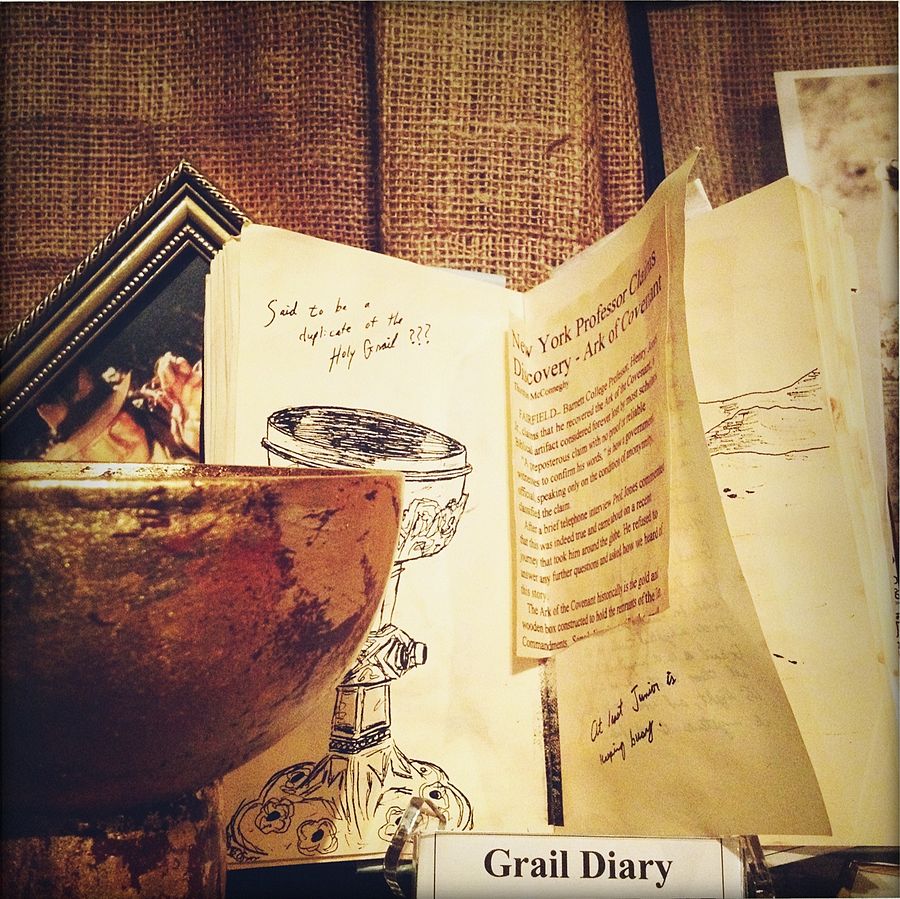
Grail diary of Henry Jones, Sr., from the film ‘Indiana Jones and the Last Crusade’ (1989), displayed at the Hollywood Museum, Hollywood, California. Image via Wikimedia Commons.

Handout

The single-page Handout for Linde’s Presentation is available for download as a pdf.

“Passages”

(Photographs © 2011 Linde M. Brocato)

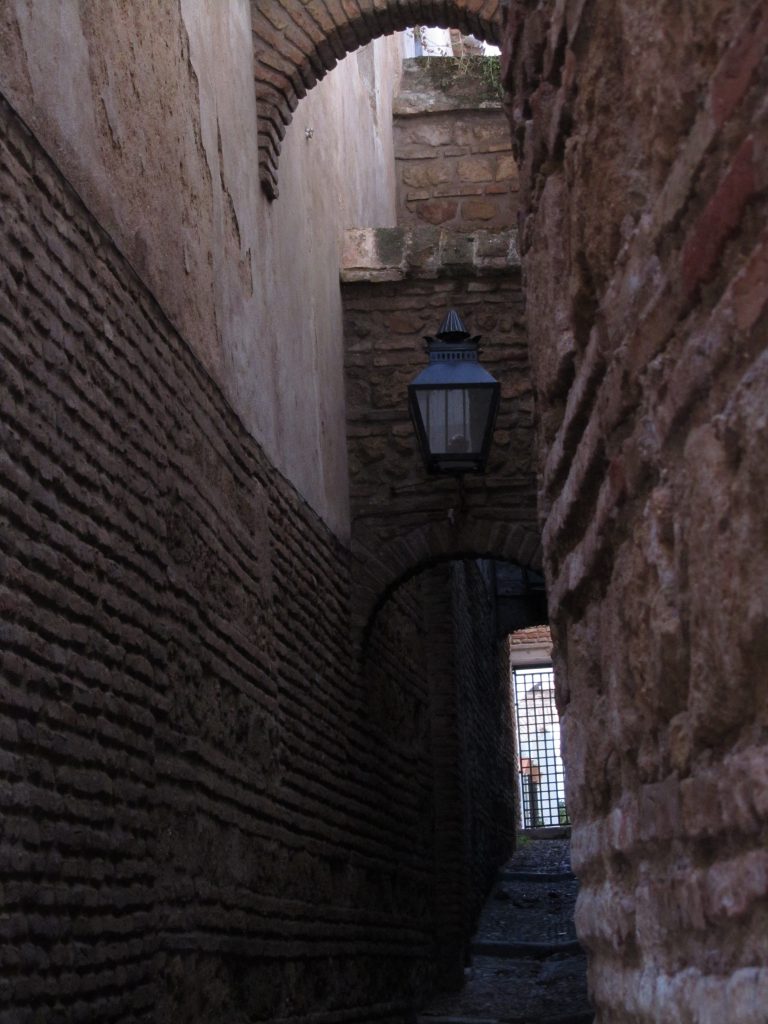
Light at the End of the Tunnel

Photo © 2011 Linde M. Brocato. Cordoba, Passage.

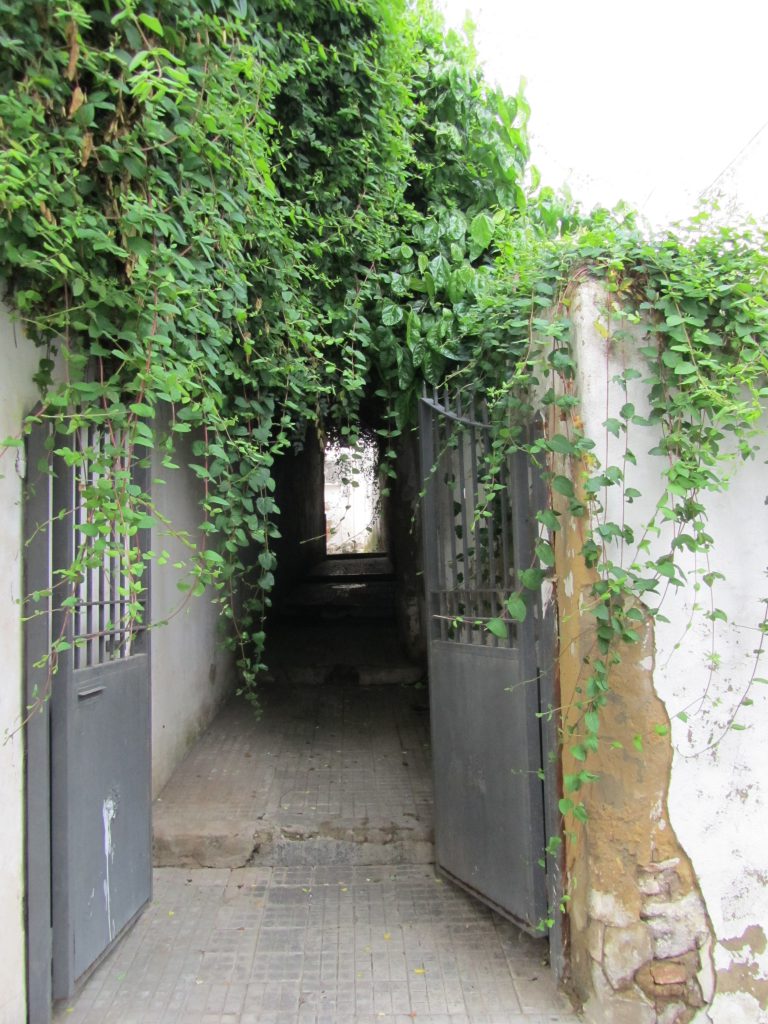
Into the Light:

Photo © 2011 Linde M. Brocato. Cordoba, Passage.

*****

This episode opens a set of explorations on the subject of “Structured and Structuring Knowledge”.  It is one of our themes for next year — with an eye, for example, to Catalogues, Metadata, and Databases.

More Episodes are in preparation. See The Research Group Speaks: The Series.

Episodes in the New Year will begin in January 2022.

Lisbon, Museu Nacional de Arte Antiga: The mid 15th-century Saint Vincent Panels, attributed to Nuno Gonçalves. Image (https://upload.wikimedia.org/wikipedia/commons/3/3a/Nuno_Gon%C3%A7alves._Paineis_de_S%C3%A3o_Vicente_de_Fora.jpg) via Creative Commons.

*****

Do you have suggestions for subjects? Please let us know. Please leave your Comments below , Contact Us, and visit our FaceBook Page. We look forward to hearing from you.

*****

Tags: Bibliographal Quests, Bibliographical Records, History of Cataloging, Holy Grail, Indiana Jones, The Research Group Speaks
No Comments »

Newer Entries »
  • Top
©2024 Research Group on Manuscript Evidence.


is proudly powered by WordPress. WordPress Themes X2 developed by ThemeKraft.